+THE CONCLUSION OF THIS CHAPTER — The turquoise coat – Part three: Darker than night (dark side, book 2, chapter 35)

°<>°<>°<>°<>°<>°<>°<>°<>°<>°

35.  The turquoise coat – Part three:  Darker than night

°<>°<>°<>°<>°<>°<>°<>°<>°<>°

Commentary

April 18, 2013.  This is the 62nd time in my life I have lived through a date of the 18th of April.  I am surrounded by the blooming beauty of the many roses and other perennials in my high desert Arizona garden as the morning light pushes away the shadows left by the last nightfall.  Although I sit outside writing wearing my knitted winter hat and long black down coat I know by the time night shadows are gone I will be warmed again by that magnificent orb we call the sun.

I think about many things including the dreams I had last night about two of my brothers and the bush of pink roses whose blush has never been matched by anything I have seen in my waking life.  I think about the many disadvantages I have because I was given so few opportunities as a child to learn to be a social being among others of my species.  Flowers in my garden take care of themselves as long as I make sure their roots don’t dry out, as long as I trim off old growth and shape them when needed.

People, on the other hand, seem to need perpetual care and mostly I don’t understand what they are asking for.  I think of a chapter I read several years ago, Responding to need in intimate relationships: Normative processes and individual differences, whose lead author was Nancy Collins (Department of Psychology, University of California in Santa Barbara).  (See note below.)  I found information about human relationships in this writing that I needed to know. 

Because we are members of a social species we have built within our body a sophisticated collection of interrelated physiological systems that are all geared toward modulating our attachment to life that includes other people.  Of course, as the Teicher article I mentioned in my previous chapter makes clear, abuse and early relationship trauma changes how our physiology develops so that these systems then operate differently from ordinary.

An ordinarily-built attachment system is designed to turn itself off and on.  Those of us with early relationship trauma have built into our body what can be simply termed an insecure attachment disorder.  One of the consequences of having been built this way is that our on/off switch becomes essentially broken.

In Collin’s description our body also grows within it an interactive caregiving system that is also based upon physiological abilities in our body that come into play ONNLY when the operation of our own attachment system is turned off.  People whose physiological development was changed through chronic exposure to early relationship trauma and deprivations can have an attachment system that never turns itself off.  Those people therefore experience detriments in their ability to genuinely and appropriately “give care” to others.

How all of these systems work together to balance our ability to have our own needs met “good enough” so that our attachment system CAN and periodically DOES turn itself off so our capacities to caregive to someone else is very complex.  Understanding what these systems are supposed to accomplish is part of what we need to know before we can accurately figure out how to make positive changes.  As long as we blindly allow ourselves to follow along the attachment-caregiver routes our physiology dictates for us we lack the capacity to consciously modulate how we are interacting in our relationships.

People who were given the opportunity to grow the best possible body-brain in a resource-adequate predominately safe and secure early attachment relationship environment can trust that the operation of these two main systems is working “good enough” to give them opportunity to both take and give in their relationships in a balanced and healthy way.  Those of us raised in early environments scarce with resources and deprived of safe and secure attachments will spend most of our lives struggling in ways that safe and securely attached people never will.

For us the shadows of nightfall are never fully chased away by a new day’s sunshine.  I could even say that we are walking stress response systems that never had a chance to build the physiological ability to experience the counterbalance state of peaceful calm into our body.  We can easily be in a chronic state of unmet need which means our attachment system cannot turn itself off.

I would suggest that for any “psychological” or “psychiatric” or even sociological approach to be effective (or even rational) it must set its beginning point of thought at the beginning point of human life.  Recent advances in technology now take the guesswork out of what truly makes us the same and what makes us different in terms of how our physiology is forced to accommodate itself to a life of woe versus a life of ease.  The essential changes that happen through adaptation to stressful trauma during the first 33 months of life (conception to age two) determine the trajectory of any individual who experiences them.  NOBODY, for example, can be spared degrees of debilitating change to their physiological development during those first 33 months of life if chronic stress-related biochemical reaches toxic levels in their body-brain.  On the other hand, being spared the flooding of these toxic hormones would benefit anyone.

Taken to extremes it is specifically the difference between the levels of toxic stress (distress) that infants are exposed to through the presence or absence of trauma in their earliest attachment relationships with their caregivers that creates the physiological body-brain that is designed for a lifetime of either plenty or of scarcity.  Degrees of change directly affect all social-emotional interactions a person has with self and with others for the rest of their lives.  The operation of and the balance between their attachment need and their caregiver systems will be impacted.

Rather than getting lost in an abyss of confusion about what I am attempting to describe I will ground my writing in the life experience of my mother whose attachment system had been formed in an early environment of such stressful trauma that only in the strangest ways in the rarest of circumstances could it ever be turned off for even the briefest periods of time.  Mother, as I study what patterns I can see of her life, more than ran on empty.  She ran on a perpetual vacuum that meant not only could she not caregive, but she sucked the life out of anyone she was around if they could not stop her from doing so.  Certainly Mildred’s dependent children had no capacity to protect themselves from her appetites of need except as they were able to preserve the inner integrity of their own mind.

I doubt there is any greater potential for child abuse than that which exists in a mother who is left alone with her children to suck their experience of childhood out of them by creating such an environment of continual trauma that any safe and secure attachments are prevented from forming.

°<>°

Life is in me and life surrounds me.  Life itself is a “one thing.”  It is tenacious in all of its variety of expression in form.  Life has a voracious, insatiable appetite essentially for one thing:  More life.

As I sat perched alone that night on the metal kitchen stool I had what all life yearns for.  I was alive.  I was carried through that night by the same processes that carried me in their current all the way through my life with mother.  I had my life.  I had the greatest powers on my side in existence.  Life itself carried me forward in its grip and it did not let go of me.

That level of attachment cannot be questioned, but it was not an attachment to humans on any but the most basic level of my having received what I needed to sustain my body that my parents “took care” of me.  Mother fed off of me as her (psycho-projected) all-bad child because the cord of her connection to being alive was contorted and twisted.  In very real and profoundly disturbed ways Mother robbed enough from me to stay alive herself and to have enough to give to her other “adored” children to sustain them.

She left me alone in the darkness on that stool all night because she needed to.  How she turned my suffering into cheerfulness to give to her other children is a mystery of psychotic Borderline Personality Disorder that needs to be solved.  Mother’s broken attachment system required that her needs be met through reverse-caregiving me. 

That is exactly, in my thinking, what all adult abuse of children is meant to accomplish:  Take away from a child everything but its very life to get what’s needed to take care of the unmet needs of self.  Additionally in Mother’s case she also took from me enough to minimally take care of her other “adored” children.  What is left over when these patterns are in operation is the great suffering of one that achieves some form of benefit for others.

These are excessively primitive, evolutionarily altered patterns of survival.  It was never Mother’s direct intention to kill me.  I was, so to speak, the perpetual fountain of her “youth” (life).  Her madness needed me alive.  It did not need me happy.

I do not believe any other species has the ability to create and sustain such a distortion of natural systems’ operation.  Because of our innate complexity humans have more to give, more to get and more to spare than other creatures do.  Mental, psychological, emotional and even spiritual abuse happens to children because it can.  Children are alive in each of these areas.  They have within them mines of resources that a deranged needy abuser will simply go after – because they need to and because they can.  (Society lets them.)

It is only to the extent that an infant or child who is under such attack can sustain itself and continue to replenish its inner resources that it will survive.  Without access to protective factors nobody can remain alive.  Certainly not young infants and children.

°<>°

I hung onto life because life hung onto me.  I was not uprooted.  Yet seldom in my life have I ever been able to experience true rest.  Perhaps such survivors as I am were forced to stretch a tap root so deeply into ongoing life itself that our continued existence was guaranteed simply because we were able to do so.

But on this my 62nd experience of the 18th of April I consider a body of information provided by the Center for Disease Control (CDC) through their Adverse Childhood Experiences (ACE) study research.  This research has shown clearly that the more of these ACEs a person experienced the more likely it will be that they will suffer from difficulties throughout their lifespan that those with a low ACE count will not.  Long-term (longitudinal) research that attempted to follow high ACE count survivors became difficult to pursue because these survivors die on the average of twenty years earlier than low ACE people do.  (Again, basic information on this research and its findings can be found through using “CDC ACE study pyramid” in an online search.)

As a high ACE count survivor who has already survived advanced aggressive breast cancer I do not take for granted that I will have dozens more of these dates to account for.   Between this April 18th and the next one I am committed to completing the writing of what parts of my story I feel have something useful to offer to others.  I realized this morning that hope itself can so fade into the background as a motivating force that it can seem to vanish altogether.  It is no longer hope that keeps me writing.  It is the extent of my caring.

I realize today that hope is connected to an attachment need that seeks fulfillment.  Caring comes from the quieting of attachment needs that allows for that system to turn itself off.  In all but the most pathological cases when the human attachment system has turned itself off the caregiving system is activated.  This happens when there is an excess of resources one can then release and give away.

The fact that we know there are over three million infants and children suffering abuse in our American nation each year, with millions more suffering under conditions of deprivation, tells me that on the whole there must not be enough Americans living here who have the ability to turn their own attachment system off so that they can begin to take care of these suffering millions of our nation’s offspring.  Perhaps the reason we have not yet stopped their suffering is because we are still too needy as adults to do so.  I have a small suggestion that might be of some assistance.

The more we educate ourselves about the lifelong benefits given to those whose bodies were formed in a safe and secure attachment relationship environment the more we will identify the riches those people have always had in comparison to others who experienced an early life under the opposite conditions.  With this recognition can come the realization that where it matters most there is probably not enough need present in a safe and securely attached person’s life to prevent them from NOT letting their attachment system turn itself off so that their caregiving system can turn itself all the way on.

A drizzle of caregiving done by only a few people will not accomplish what needs to be done to improve the life of the suffering millions of abused and deprived infants and children alive in our nation.  A recognition of the privilege that safe and securely attached people have always known might stimulate an increase in their personal experience of caring – and I mean as in GIVING a meaningful DAMN – about suffering caused to other people’s children.

If caring does not follow into actions of meaningful caregiving it is not really caring at all any more than an empty promise is a promise.

°<>°<>°<>°<>°<>°<>°<>°<>°<>°

Note:  Collins, N. L., Ford, M. B., Guichard, A. C., & Feeney, B. C. (2006). Responding to need in intimate relationships: Normative processes and individual differences. In M. Mikulincer & G. Goodman (Eds.), Dynamics of romantic love: Attachment, caregiving, and sex. New York: Guilford.  (pages 149-189)

°<>°<>°<>°<>°<>°<>°<>°<>°<>°

Please click here to read or to Leave a Comment »

The first part of this chapter is in the previous post

+The turquoise coat – Part three: Darker than night (dark side, book 2, chapter 35)

++++
+The turquoise coat – Part three: Darker than night (dark side, book 2, chapter 35)

The Dark Side of Mildred’s Mountain series – Angel book 2 beginning with the POP!  Goes Alaska letters – chapter 35

°<>°<>°<>°<>°<>°<>°<>°<>°<>°

35.  The turquoise coat – Part three:  Darker than night

In Mildred’s November 13, 1957 letter she wrote of me 2½ months past my sixth birthday as she had forced me to wear such a coat as this was through long first grade days at school and on filthy bus rides in the mucky gray filth of a rainy Alaskan late fall as it moved into a still snowless winter:

Her beautiful turquoise jacket and white fur is filthy.  First day she ruined it, I washed it heartbroken (it’s a beauty and expensive) and made her wear old jacket for one week.  Then let her wear it again – same thing – and always blames other children!  I gave up.

°<>°<>°<>°

It was this day Mildred referred to when she took my coat away that she tore it off me as she attacked me when I walked in the log house door after school.  I was very small compared to her largeness and could not protect myself as she swung me around in circles by my arm so thin she could easily close her hand around it while she beat me with her wooden jelly making spoon in the kitchen.  As hard as she could.  With the spoon in her other hand.  The sounds of my wailing and of her screaming must have terrified my sisters (age 2 and 4) and my brother (age 7).

“Stand in the corner until your father gets home.  He’ll deal with you then!”  Shoved face into the wall beside the back door.  SLAM went the lid of the washing machine with my “washable” coat in it.  The water runs.

Standing still.  My forehead against the wall.  I did not mean to get my coat dirty.  I didn’t know how that happened.

Daddy came home from work.  He walked in the front door.  She screamed and shouted at him about what I had done.  “Take off your belt and give it to me.  I’ll show that girl of mine I mean business.”

I could not get away when she came at me.  Stomping fast across the kitchen floor.  She brought the metal kitchen stool with her and smashed it down on the laundry room floor in front of the drier screaming at me to pull my panties down.  “I’m going to give you want you deserve.  I will give you something you will remember.  Now bend over that stool right now!”

I wasn’t tall enough but I tried to hold onto it but I couldn’t.  Both of her hands holding onto the snaking arc of Daddy’s leather belt slashing against my back, my arms, my bottom, my legs.

Knocked down.  Dragged up.  Slammed against the edge of the doorway.  Both hands.  I tried to hold on. 

Into the kitchen.  Banged against the cold white edge of the stove.  Against the other side of the doorway and again into the back hall.  Beating.  Beating.

No scene such as this one was could ever be shown in any movie.  Never.  No thing should ever be done to a child that can’t be seen in the light of day by other people.  In view of strangers.

I crumpled.  She let go of me then.  All tired out from screaming and beating.  “Get up off the floor and sit on that stool.  Stay there and don’t get off of it.  I can’t stand the sight of you.  You’ll have no supper tonight!”

The stool must have been placed very near to the trapdoor John remembers in the back hall over the well.  I faced the drier but I could not reach out to touch it to keep from falling.  I had to do that part by myself.

So hard was the stool.  My bottom hurt very badly.  I dared not move.  Crying.  Breathing.  Gasping.  Crying.  As quietly as I possibly could so she wouldn’t hear me.

Mother’s voice changed.  She was cheerful as she made the sounds that went with making supper.  Pots and pans.  Metal cupboard doors open and close.  Dishes onto the table.  “Everyone come eat.  It’s time for supper.”

She didn’t mean me.

The food smelled so good.  I was so very hungry.  I heard them all talking together.  Eating their supper.  Then they were done.

Clearing off the table now.  She washes all the dishes.  She turns off the light as she walked away.  There is no light on where I am.  They are all in the living room.  They are all happy.  The television set is on.  Then it is off.  “Time to put your pajamas on.  Time for bed!”

The house grew quieter and quieter.  Daddy pulled open the couch into their bed in the living room.  The light went out everywhere.  No more distant murmuring.  Everyone asleep but me.

Not asleep.  So hungry.  So tired.  Dead dizzy tired.  In pain.  My stomach hurts, too.  I am getting colder.  I am weak and shaky.  Arms wrapped tight around my middle.  Feet hang down.  I dare not move.  I have to go to the bathroom.  I cannot.  I am scared.  I cannot move.

Alone in the darkness shivering.  I am a chill inside my skin.  Barely.  I rock myself forward and back.  Forward and back.

Coat.  In the washing machine.  She did not come to take it out.  She did not come get me.

I thought without thinking about everyone else eating supper in the dining room.  With their eating supper voices.  Sometimes they had laughed.   Rising.  Falling.  Happy voices eating smell-good supper.  Daddy’s smiling voice.  Mommy’s smiling voice.

Now they are all sleeping.  Sleeping.  All in their beds sleeping.  I am not sleeping.  I make no sound.  Tears.  Sliding down my cheeks.  Dripping.  Dripping down my neck.  Cold.

Long night.  Long silent night.  I am tired.  I am scared.  I am alone.  I am forgotten.

No lights anywhere.  Woods outside.  The refrigerator hums.  It stops.

So quiet.  So still.  So still.  Still.

There is nothing but me.  I am still waiting.

°<>°<>°<>°<>°<>°<>°<>°<>°<>°

Please click here to read or to Leave a Comment »

++++

+WHAT ABOUT THEM? INTRO TO CHAPTER 32 (dark side, book 2)

°<>°<>°<>°<>°<>°<>°<>°<>°<>°

32.  (under construction – intro only)

April 15, 2013.  On the Tuesday morning of September 11, 2001 Boston was brought into national attention because of the horror wrecked from the actions of those inside two jetliners that lifted off from Logan Airport.  Boston is in the news again today for two explosions that sounded like booming claps of thunder that came seconds apart at 2:50 P.M. near the finish line of the prestigious Boston Marathon.  According to the latest ABC news report at least three people were killed, one of them an eight-year-old boy.  Over 140 others were injured including children; at least ten of these people suffer from “amputated” limbs. 

Federal law enforcement officials confirmed that the blasts were caused by explosive devices.  As night falls authorities know nothing about “who was behind this act of terror,” or if this was a domestic or a foreign attack.  Horror and acts of terror shock.  They belong in the news, deserve and get attention, cause concern and outrage.  They stimulate compassion for the victims.  Everyone wants to know who is responsible and who will be held accountable.

Yet what about infants and children suffering from traumas behind the closed doors of the homes they live in?  Who cares about them?  Who notices?  Who identifies their attackers?  Who responds?  Who asks questions, rescues these little ones, treats their wounds, listens to their stories, keeps them safe and holds their attackers accountable?  Who speaks for these hidden silent fallen little ones? 

According to the most current statistics from the U.S. Department of Health & Human Services, 3.3 million children were abused in America in 2010.  These were REPORTED cases of abuse.  There is no reason to believe this is not a gross understatement.  Who cares about all of these terrorized little ones?  How do we define a crisis?

°<>°

At the start of this chapter before I write about what happened to me during the span of time Mildred’s letters cover here, I want to mention a blog called Crosstalk that one of my Stop the Storm blog’s commenters posted the link to last week in response to my posting of chapter 20 of this book, A durable, endurable child.  The title of the post I visited on Crosstalk, written 96 weeks before I arrived on the site to read it, is Mothers Who Dislike Their Children Are Disturbed, Not Normal.  (It can be found via an online search using the title as the search term if the article does not get deleted!)

The post is well worth a read for anyone concerned especially with a split-mind (all-good/all-bad) abusive Borderline Personality Disorder (BPD) psychotic mother.  The author of this post who goes by the online moniker of LessThanZero on the Crosstalk blog wrote “… my mother stripped me of all my clothes in December in Buffalo, New York, and locked me out of the house, telling me to stand outside naked for the night if I wanted to run to my friend’s house without a coat on….” 

When I visited the site this morning there were many comments listed at the end of this post yet when I went back to look at them this evening they have all been erased!  In response to one of the commenters to her post LessThanZero added further information about the fact that she and her sister had both run to the friend’s house without their coats on.  While the author, the all-bad child, received horrendous abuse her all-good sister was coddled, given a warm bath and then wrapped in blankets by their abusive BPD split-mind mother who was, I believe, psychotic like my mother was or more so.

Another commenter to this post on Crosstalk wrote that when she was four her mother decided to teach her to swim.  The little girl didn’t learn well enough, quickly enough, so her (psychotic) BPD mother cast her out alone into the middle of a fast-flowing river.  I want to know how this child made it back to shore by herself so that she could stay alive – and no doubt suffer continued horrendous abuse by her mentally ill mother.

I have a lot of questions!  I can ask, “How did these children survive?”  At the same time I ask that question of myself even though the abuse I suffered did not match in horror that spoken of within the two accounts mentioned here.  I want to know the “crime report” stories that belong to such survivors.  I want to know the context, the bigger picture, details of who could have and did not step in to STOP this kind of insane abuse!  All I have to work with is what I can discover of my own story with my own psychotic BPD abusive mother.

°<>°<>°<>°<>°<>°<>°<>°<>°<>°

Please click here to read or to Leave a Comment »

++++

+”GIVE IT UP, LINDA! ENOUGH IS ENOUGH!” (lots of blog links)

++++

At first I thought I was going to post all of this as a comment which requires this format for links to be active.  Now that I have changed my mind and have moved all of this over here, I am leaving the “ugly” version of the active links — because I am too lazy to alter how this appears.  I have a whole bunch of vegetables crying in the fridge because they want to be all chopped up and cooked into soup.  (I am adding a few more links (not vegies) at the bottom in the old-fashioned format!)

I was trying to find past posts related to the topic of SHAME.  Well, I guess anything I have ever written about severe infant-child abuse and trauma is about shame.  So, while these posts might not be as specific as they COULD be, they are as specific a collection as will be the vegetables in my eventual pot of soup!

Posts on this blog related to what WE need to know about shame — and have a hard time finding:

+THOUGHTS ON THE TRIGGER POINT OF SHAME
at

https://stopthestorm.wordpress.com/2009/12/07/thoughts-on-the-trigger-point-of-shame/

>>>>>>>>>>>>>>>>

+EARLY ORIGIN OF OUR ONGOING EXPERIENCE OF SHAME AND FORGIVENESS
at

https://stopthestorm.wordpress.com/2009/05/23/early-origin-of-our-ongoing-experience-of-shame-and-forgiveness/

>>>>>>>>>>>>>>>>

+SEIGEL ON SHAME
at

https://stopthestorm.wordpress.com/emotions/the-shame-spectrum/seigel-on-shame/

>>>>>>>>>>>>>>>>

**Shame
at

https://stopthestorm.wordpress.com/?s=shame

>>>>>>>>>>>>>>>>

++ DR. SCHORE ON SHAME
at

https://stopthestorm.wordpress.com/emotions/dr-allan-schore-on-emotional-regulation-notes/dr-schore-on-shame/

>>>>>>>>>>>>>>>>

*The Shame Spectrum
at

https://stopthestorm.wordpress.com/emotions/the-shame-spectrum/

>>>>>>>>>>>>>>>>

+WHEN PEOPLE TRY TO SHUT US UP
at

https://stopthestorm.wordpress.com/2012/12/19/when-people-try-to-shut-us-up/

>>>>>>>>>>>>>>>>

+POST FOR CHILD ABUSE SURVIVORS: WHAT CAN WE KNOW FROM AN INNER ‘CRINGE’?
at

https://stopthestorm.wordpress.com/2012/03/09/post-for-child-abuse-survivors-what-can-we-know-from-an-inner-cringe/

>>>>>>>>>>>>>>>>

+HOP! HOP! THE BLOG FROG’S PICK OF PAST POSTS
at

https://stopthestorm.wordpress.com/2011/10/16/hop-hop-the-blog-frogs-pick-of-past-posts/

>>>>>>>>>>>>>>>>

+THE ESSENCE OF JOY IN THE ABSENCE OF PAIN AND SORROW
at

https://stopthestorm.wordpress.com/2011/07/28/the-essence-of-joy-in-the-absence-of-pain-and-sorrow/

>>>>>>>>>>>>>>>>

+HEALING FROM ABUSE: FINDING MY OWN GOODNESS AND STICK TO THAT
at

https://stopthestorm.wordpress.com/2011/06/20/healing-from-abuse-finding-my-own-goodness-and-stick-to-that/

++++

+A COLLECTION OF LINKS ON BODY-BRAIN CHANGES CAUSED BY EARLY INFANT-CHILD ABUSE

+PITY HURTS, COMPASSION HEALS: KNOWING THE DIFFERENCE

+AS HARD AS OUR ABUSER(S) TRIED, THEY DID NOT HAVE THE POWER TO TOUCH US!

+TO BE OR NOT TO BE — HUMAN OR OBJECT: EARLY ATTACHMENT PATTERNS DECIDE AS THEY BUILD OUR ANS

+DISSOCIATION AS AN ALLERGIC REACTION TO ABUSE

+RESLIENCY FACTORS AND THE ‘AT LEAST….’ GAME

+DISSOCIATION: THE SURVIVOR’S CURSE?

+SEVERE EARLY ABUSE SURVIVORS: LEARNING TO READ, IT’S MORE THAN YOU THINK

++++

Please click here to read or to Leave a Comment »

++++

+SHADOW WRITERS COME AND GO, LEAVING BOOK-WORDS BEHIND THEM

++++

April 13, 2013, Saturday.  There is a level of truth between severe early abuse and trauma survivors that is for us our status quo, our familiar territory, our set of givens, and the basis of our reality.  Safe and securely attached people have a different layout.  If I could erase my personal self from most of my writing I would do so.  I — that tiny word — troubles me in that what I have to say often has to do with nothing more than the experience of a lifetime of adjustments caused in my body by early traumatic changes to my physiological development.

This is nothing personal.  It is nothing especial about me.  This is a layer of experience that some of us know — and some do not — in the BODY.

As I return to my book writing (which pleases me) I am aware of the fine line I walk — and I bet most early abuse survivors walk — between what my body knows and remembers and what I want nothing to do with in my thoughts.  There is no way I can write about Mother and her abuse of me without my body responding — or trying hard to respond to — what I am doing.

So I DREAM having terrible headaches.  In waking life I don’t remember the last headache I had.  I am blessed to live without them.  Or, perhaps not — but if they attack me in my sleep — I leave them there.

Phantom stomach aches these past days out of NOWHERE (it seems).  I don’t have stomach aches ordinarily, either.

What about my entire scalp erupting last evening in hives?

++

All can seem bizarre and senseless if not taken to show that my body – severe abuse survivors’ bodies — remember all sorts of thing we do not and often can never know about consciously.  I think being aware of this fact is helpful.  This is a spooky process, like my very body is haunted.  Which, I suppose, it most certainly is!!

Walking around inside a body full of ghosts.

I only want to touch and awaken the memories I select for these books.  These memories have a chorus of supporting memories in my body – that would HOOT and POKE and SHOUT to become a part of this story.  I am the boss here, I say!  I am composing this symphony MY WAY.

It’s not that I don’t admire my body for keeping itself alive and me with it.  I appreciate that effort.  But when it comes to trying to compose a coherent narrative of the whole story the cacophony of sounds – whispers sometimes – clapping – whatever.  You name it.  All those “sounds” are in my body each with its own filed-away memory of something — usually — quite awful.

I am not after the awfulness of the story that COULD be told about what very mentally ill Borderline Personality Disorder psychotic Mother did to me.  I want to look for the structure, the patterns.  I search for even the wisdom of what happened inside Mother’s developing body-brain when she was little and in trauma-trouble.

Whatever I write — even though often lately it seems someone other than ongoing-I is doing the writing — whomever with fingers on the keyboard, a shadow that writes, then vanishes before I can even check its dance card. 

Obviously there is invitation to a memory of some kind attached to every moment over the 18 years I was trapped in this woman’s hell.  But I select to have open invitations — and CLOSED ONES!  If the ones I will not let trample over me in some stampede to be listened and attended to want to poke into my awareness through dream headaches and hives — well, I will take that into account and in stride.  As I move forward….

++++++

By the way, very good news to me via my mother’s friend, Joe Anne.  I spoke with her via telephone yesterday and she has the medal to the metal — reading every single one of Mother’s 7 volumes of letters and asking me ASAP for every manuscript of my own.  She now says “Leave all those names alone!”  Whatever Mother wrote about anyone is part of this story, an important part.

Joe Anne is onboard as she realizes she is “supposed to be” although she doesn’t literally know why she has a part to play in this writing project any more than I do.  I am VERY happy to have her beside me!

Joe Anne speaks of the Mildred she knew for 46 years.  Of Mother (died 10 years ago) in the public sphere.  Critically important insights about how Mother’s mental illness looked to outsiders to our family — and how it now looks from what Mildred wrote in her own words.

I write from inside the story — Joe Anne now is the voice, 56 years after she first met Mother — of the outsiders’ story.

++++

Please click here to read or to Leave a Comment »

++++

+LITTLE ANGELS AND DANCERS (FROM RECYCLED GROCERY BAGS)

++++

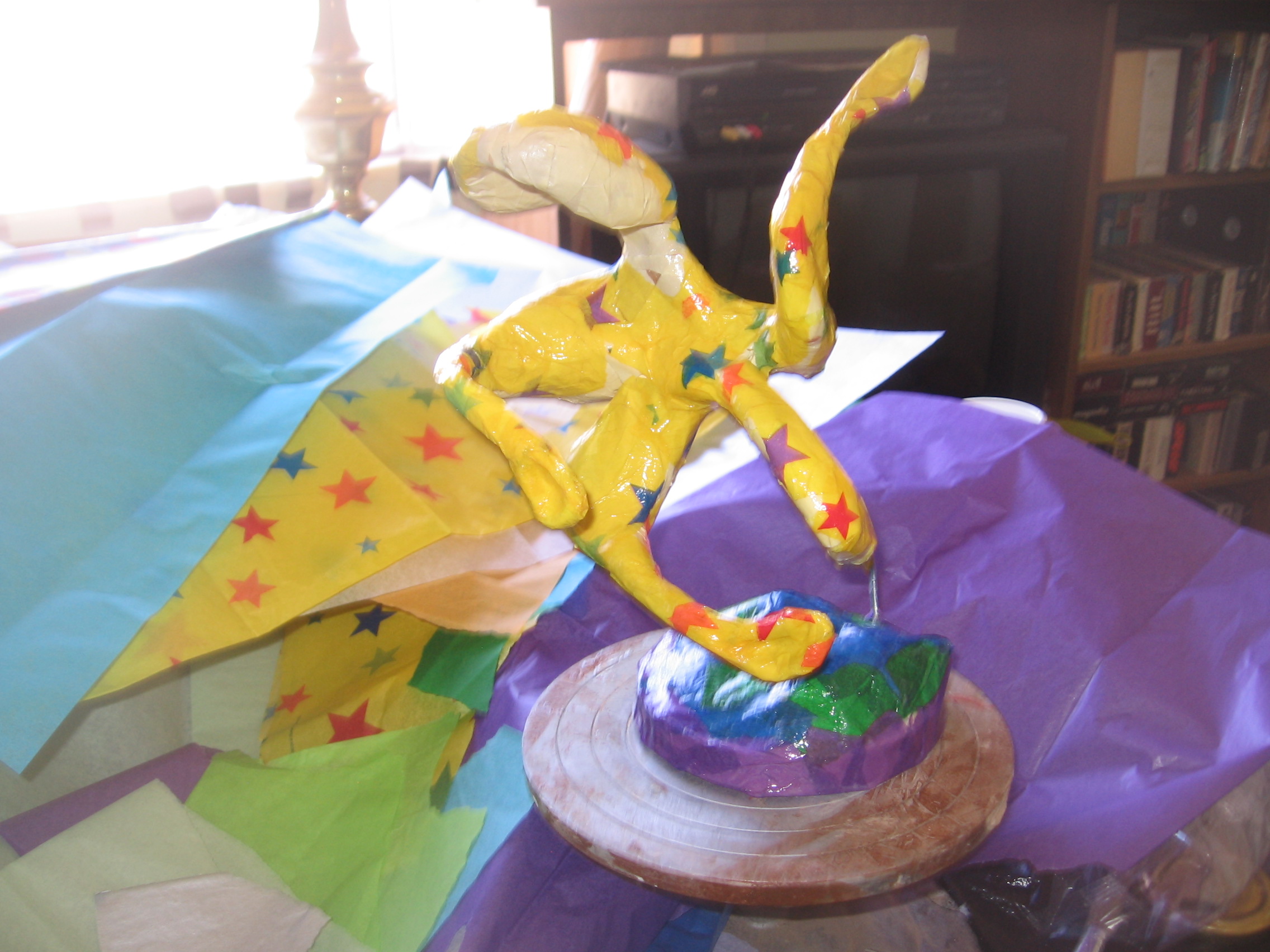
I volunteered to assist a local artist at a Bisbee all-day art fair.  Our project was making sculptures of paper (or plastic) wrapped with masking tape and then covered with tissue paper and Mod Podge.  I made this Mountain Angel, who is in these pictures moving around in my spring garden.

0413 mt angel 2

0413 mt angel 1

0413 mt angel 3

This is a crazy angel – there’s a tiny horse down there!

0413 d angel 40413 d angel 3

The green angel is under construction, stuffed with grocery bags

0413 grn angel

The blue dancer is about as tall as my hand is long.

0413 blue dance

Yellow dancer is larger, under construction.

0413 yellow dance 20413 yellow dance 1

Woke this morning to the first of the climbing roses blooming.

0413 yel frnt rose

++++

Please click here to read or to Leave a Comment »

++++


+THE SANCTUARY OF CHILDHOOD (Dark Side book 2, chapter 23)

The Dark Side of Mildred’s Mountain series – Angel book 2 beginning with the POP!  Goes Alaska letters – chapter 23

°<>°<>°<>°<>°<>°<>°<>°<>°<>°

23.  The sanctuary of childhood

April 4, 2013.  I had planned for today to be one without writing.  My plan has been delayed.  I posted my previous chapter 22, Buried treasure, last evening on my Stop the Storm blog and found in a reader’s comment to it this morning:

So why did you hide the marbles?  What was your story?

I wrote in my reply:

When I was a child I thought and acted as a child.  The answers to your questions are in this story.  I had no ulterior motives.  I was playing.  It is the sanctity of childhood play that play is play.  As the story states I had the sanctity of my play violated so that I never got to finish my game.  I have no idea how my game would have ended had my little space of sanctuary not been violated.

Evidently I have more to say or I wouldn’t be here with another chapter heading in place at the top of this page.  I look to Merriam-Webster’s online dictionary (the source also used for what follows) to find out more about the word that is perhaps the most important one I can include in my writings about what I believe the “place” is that infants and children occupy in the world.  Sanctuarya consecrated place; a place of refuge and protection.  First known use:  14th century.  Origins of the word are from Latin sanctus.

The connecting word in my thoughts as I expressed them in my previous chapter is Sanctityholiness of life and character; the quality or state of being holy or sacred.  First known use was again the 14th century.  Origins of the word trace to Latin from sanctus – sacred.  I search further into related origins of the word sacred to find that it connects to the Indo-European Hittite word šaklāi – rite.

°<>°

My use of these words is not tied in any way to a consideration of religion.  I use them to describe what I consider to be an essential quality that is indivisible in my thoughts.  I believe there is a lengthy period of human development that begins at conception forward during which “children,” to use a blanket word, are dependent upon adults to whom their care is entrusted to give them all that they need to maximize their physiological growth and development in every way possible.

In my thinking childhood is a physiological condition of dependency.  It is a natural unique life stage during which circumstances in a child’s life directly impact the physiological development of the body, brain, self, and mind of the childhood inhabitant in profoundly important ways that cannot be undone after this lengthy period has passed.  Children are not adults.  While cultures and societies vary in their presumptions about when childhood ends (and even begins) I find no reason to jump into this fray of arguments.  I personally consider the most accurate marker for the onset of maturity to be age 15.  (We cannot intelligently address child abuse without defining what we mean by “child.”)

°<>°

Without losing my words and thoughts in an arena of verbal competition within which it seems Americans certainly tend to lose all sight of reason, I simply state my personal perspective:  Childhood, which I define as including human life as it progresses from conception to age 15, is itself a “rite of passage.”  I will not bother to describe here how I believe all of life is sacred.  I will continue to assert that during childhood it is the obligation of adults to provide for the offspring of our species in adequate ways to maximize the health and well-being of children.  We clearly know as a species what this means.

In my terms childhood is a period of sanctuary within which the sanctity of the young person going through it needs to be inviolably recognized, respected and protected.  While many developmental experts use the term “good enough” to describe what is acceptable in adult-child interactions, I consider “maximally beneficial” to be the necessary standard.  “Good enough” is substandard to “maximally beneficial.” 

I am not advocating the “spoiling” of children, nor do I believe that the term “pampering” fits with “maximally beneficial.”  Appropriate structure, rules, manners, ethics, morals, virtues, and high expectations on all levels are aspects of health and well-being.  Appropriately guiding children through the first fifteen-year era of their lifespan does not involve violating the sanctity of the child nor does it involve the rupturing of the sanctuary of childhood, itself.

°<>°

Every reader of my words was once a child who lived through a childhood.  My writing will inevitably awaken long-held assumptions about both children and childhood.  At the same time beliefs about what it means to be an adult in relationship with children will also be brought into focus.  No child grows to adulthood without adults present in their life.

Children only gradually obtain the physiological capacity to question adults.  Healthy adults are not threatened by children’s questions.  I write as an adult who for the first 18 years of my life could not have formed a question in my thoughts about the adults who surrounded me if my life had depended on it.  I question now why I could not question then the so blatantly questionable harmful actions against me by the adults in my life overtly and covertly – both by commission and by omission.

The only adult in my childhood who probably did begin to question what was happening to me was my grandmother.  Once I was removed from the range of her perceptions those questions ceased.  They needed to be asked.

°<>°

When I reached my mid-30s I decided it was time for me to tie on a pair of roller skates and head out under the colored lights flashing from the spinning mirrored ball hanging from the ceiling onto the hardwood floor of our small town’s rink.  Slowly at first I half stumbled my way around in the widest circle possible as I clung to the hope that in the absence of any detectable talent I would still eventually be able to move out into the inner flow where everyone else seemed to be having so much fun.  I stuck with it and after a few days’ sessions I did find myself rolling around with a smile of confidence.  Eventually I even reached a point where the music mattered more to me than my feet did.

All went smoothly until the instant I ran over what felt like a hole in the floor.  Down I went hard on my tailbone.  By the time I had painfully stood up and limped off the floor I had figured out that of course there had been no hole in the floor.  I had run over my own dragging shoelace.

It took weeks before the pain left my back end.  But I never returned to the rink.  I never again stuck my feet into another pair of roller skates.

My point is that this is a shoelace tripping moment in this book for some readers.  To continue reading smoothly it might be necessary to take the time to think about your answer to two connected but distinctly separate questions:  (1) What do you know about your childhood?  (2)  What do you know about being inside your child self living through the experiences of your childhood?

The first question can be answered from afar.  The second question can only be answered up-close.  The objective stance lets us report from our adulthood perspective about our childhood from a distance outside of the sanctuary of childhood.  The subjective stance lets us know the living poem belonging to the child self that lived within the sanctuary of childhood.

People who suffered from neglect and abusive trauma while they were children need to of course be extremely careful not to transgress their own limits of safety in regard to these two questions I pose.  This also means they need to be equally careful of reading my story.  It may be that these readers exit the rink, remove their skates and do not return unless they can do so with necessary protection in place.  (Communicate with a therapist, a trusted friend, etc.)

°<>°

I was alerted to my need to write this chapter by those questions one reader had to my last chapter:  “So why did you hide the marbles?  What was your story?”  There are indigenous cultures around our globe within which it is considered disrespectful, intrusive and rude to ask people questions.  As one of my university professors put it to his counseling class, “Look at the shape of a question mark.  It is shaped like a hook.  When you toss one out at another person you are fishing for something.  You are trying to hook someone else into giving you something you want.  Think carefully before you proceed with the aggressiveness of questions.”

A question belongs to the person who asks it.  I am asking my own questions as I write.  I search for and upon occasion even find the answers I seek.  I cannot answer anyone else’s questions although I might come up with some related suggestions.  There are inner concerns within readers that might prevent them from looking within their own experience of being a child, of having lived through the stage of their childhood, of being an adult in a world full of children to locate their own answers. 

My guess is that readers who can find a way to comfortably answer the two questions I presented above will be able to comprehend what I say in a different way than will readers who cannot yet descriptively answer them.  Truly reading a story is not a static process.  It is a living one.

 In the nonliterate, oral tradition the audience is a part of the storytelling and therefore a living part of the story itself.  In the literate tradition this process changes.  Reading is a solitary venture, and this story can be a hard one to be alone with because it can set up resonating factors that deeply affect the person reading it. 

Some readers will begin to hear another story being told at the same time they are reading mine.  That story might need to be listened to first for it may well be a poem being told from within the sanctuary of one’s own childhood about the beauty of being a child.  Stranger things can happen!

°<>°<>°<>°<>°<>°<>°<>°<>°<>°

Please click here to read or to Leave a Comment »

++++

+BURIED TREASURE (Dark Side book 2, chapter 22)

The Dark Side of Mildred’s Mountain series – Angel book 2 beginning with the POP!  Goes Alaska letters – chapter 22

°<>°<>°<>°<>°<>°<>°<>°<>°<>°

22.  Buried treasure

April 3, 2013.  Something else happened long before the snow fell that had to do with my turning six that began before the fiasco at the fair and ended after it.  Every year Grandmother sent each of us a five dollar bill in our birthday card.  Because Mildred was so happy in love with Alaska, and because my birthday was on a Saturday of the long Labor Day weekend when Father was home, I believe I got to choose what I wanted to buy myself with my gift money on the very day of my birthday.

All of my life until the writing of this book I have wondered who loved me so much and knew me so well that they would have chosen the most perfect gift possible to give me for my sixth birthday.  I couldn’t imagine that it had been Mother.  I thought perhaps Grandmother had sent it to me from California but that did not seem likely because she was so far away and I didn’t guess she knew me THAT well.  That is why she liked to send us the birthday money in the first place!

Through a process of close scrutiny of available options it finally came clear in my own mind that of course I was the only person who knew me well enough to choose this exact present!!  Of course as things went in my childhood figuring out this part of the story does nothing to make what happened to me and my present any easier to write about.  The fact is, it makes it harder.  It makes it even more of a personal tragedy knowing that it was me who chose the gift that was most important to me.

I am very good at spouting off on my Stop the Storm of trauma blog about how important and helpful I believe it is for people who had severely troubled and abusive childhoods to be able in some way to go back to toss out the wreckage and rubble so they can find the goodness and beauty that is always present somewhere in childhood.  If it can be found nowhere else, what was pure and beautiful was always there within the child itself.  In my thinking there can be no childhood so dark there was no light in it because it did have a CHILD in it.

OK, can I take my own advice?  Here I am just now working myself even deeper into the briar patch where the brambles grow bigger and the thorns grow wickeder and wickeder and wickeder.  Dare I go on?  Yes.  I have assigned myself that task.  But first I will make myself and then enjoy a tasty cappuccino.

°<>°

Where do the words begin that tell about the difference between losing something of great value versus having it taken away by somebody else?  How many days had to pass by after Mother got mad at me at the fair before she set me free enough to take my birthday present outside to play with it?  Something happened on a fall day after I had already started first grade when I was allowed to go outside to play.

I had spent my birthday money from Grandma on a soft brown leather bag with two leather strings I could pull to close it at the top.  Then I had a handle to put my hand through to carry it with me out of the log house door, down the steps, across the driveway into the woods beside the Jamesway hut used for storage.  I didn’t walk very far before I stepped onto a thick carpet of brilliant green moss that grew in a wide circle around a tree stump whose jagged top edges reached almost to my waist.

Having been raised a city girl until we came to Alaska the month before, the discoveries I made in the woods captivated me.  The tall ferns were not growing in this spot, only soft moss.  It was even growing up the sides of what was left of a broken tree I sat beside on the moss with my little bag.

Carefully I pulled open the gathered top edges of the suede and poured my beautiful marbles into a pile on the moss beside me.  There were two big ones and four tiny ones and a whole bunch of them in between.  I separated the sizes and then one by one picked them up to examine them. 

They were all sorts of colors!  Some had trails of different colors twisting inside of them.  The big and tiny ones were only a single color all the way through.  So were some of the middle sized ones.  I had never seen anything so pretty.

When I rolled them together in my palms they warmed up.  They made such a pleasant sound as they quietly clicked against one another.  There were so many of them I couldn’t even hold them in one hand.  Oh, I felt so RICH!

I put them down again so I could pick them up one at a time to hold them in front of me.  When the light came through them I could see tiny, tiny bubbles inside.  I admired everything about my marbles.  How round and smooth they were.  How hard and shiny.  And of course, how beautiful.

I didn’t mean for them to turn into a treasure.  It just happened that way.  But once it did I knew that they were a treasure that needed to be buried somewhere safe where only I knew where to find them.  That’s what people do with treasures.

I looked around me.  Hum.  Where to put a buried treasure?

I began to gently pull the moss away from the ground at the bottom of the stump and found it was loose and easy to lift and move aside in big flat pieces.  The black dirt beneath the moss was soft.  Then I got excited.  I had an idea.  I went to work.

I didn’t want to get the moss all dirty so when I scooped out dirt to make a hole to put my treasure in I released each handful of dirt into the worn-away holes at the top of the stump.  I was very busy.  I broke off parts of the soft rotten wood at the top of the stump and threw it away into the woods where it landed on fallen golden birch leaves.  Then I had more room in the stump to put the dirt I was moving until the hole I had made was deep into the earth like a bucket.

When I was done I broke up some of the moss so I could lay it inside the hole to cover up the dirt.  I made the hole all green so I could put my bag of marbles in there and it wouldn’t get dirty.  I had enough of the moss patches left over to cover the hiding hole.  All the edges fit together like a spongy puzzle.  When I had finished making the treasure invisible I sat back and studied my work.  I had done a very good job.  I knew nobody would ever know my treasure was there.

°<>°

I was happy in my lonely play.  I wished for nothing else.  Nothing more.  I was content.  I felt proud of my work and satisfied.  I had no plans for what I was going to do next.  I didn’t get to play long enough to know what I would have decided to do with my marbles.

I cannot say there was no sanctity in my childhood.  The sanctity was inside of me.  That just turned six little girl I was, playing my own creative, inventive solo game with my marbles – yes, precious to me – was made of sanctity as all children are.  What I was doing was as holy and sacred as was the soft, lush moss I sat upon.  As was the slowly decomposing tree and the black rich soil.  As were the emptying birch branches crossing through the sky above my head.

I was not prepared for the log house door to open.  For my mother to come out of it yelling, “LINDA!  Where are you LINDA?  Answer me right this minute!”

“Over here, Mommy.  I’m over here!”

I was not prepared for what happened next.  I wasn’t ready.  How could I have known?   Mother stormed across the driveway shouting, “What on earth are you doing sitting by yourself in the woods?  What are you DOING?”

I didn’t even have time to stand up before she got to me.  Demanding.  Mad.  Demanding.  “I asked you a question now ANSWER ME!  What are YOU DOING OUT HERE?”

I was telling her that I made a treasure place for my marbles but all she heard was MARBLES.  “Where are they?  Where did you put them?  What did you do with your marbles?”

She didn’t listen to me.  I kept telling her about my game as I pointed to where the marbles were buried all safe, beautiful, waiting.  No raging gorilla could have hit the back of my head harder as Mother dropped to her knees and began clawing away the moss until she had my bad of marbles in her hands.  “You selfish selfish child,” she roared at me.  “Here you are out here burying your marbles in a hole in the dirt like an animal would so you don’t have to share them with your sisters and your brother.  You HORRIBLE SELFISH CHILD!”

Off to the house I was dragged.  She gave my marbles to my brother.  I never saw them again.

°<>°

This “crime” was added to Mother’s abuse litany, too.  Along with all my other “crimes” I was beaten for this one also throughout the years of my childhood.

How close this attack was to the one at the fair I do not know, but it was warm out so it probably happened about a week later.  Both of these attacks happened during the two weeks of silence between Mother’s August 30th and her September 15th letters to her mother.  I think it took her that long to calm down enough to be able to write.  She could not have told her mother the truth about what she had done to me.  Mother knew that.

She was not stupid in her madness.  She certainly knew how to manipulate the school, her husband, and her mother.  It is the pattern of clever disguise of her actions in her letters and the massive gaps where she never referred to the truth of what she was doing in her home that make the places in her letters where I detect the darkness “sticking up” very important to note.

The attack of me over the marbles was a different kind of combination of her madness so that I was affected in a complicated way.  I could not deny that I had not buried the marbles.  This had really happened in the real world.  I knew that clearly.

I would not apologize to her for what I had not THOUGHT in this situation.  I knew what I had been doing when she came outside to look for me had nothing at all to do with my not wanting to share my marbles or let my siblings play with them.  Those thoughts had never entered my mind.  They were a psychotic projection by Mother onto me.  Of course I could not understand any of this.  Yet the clarity of my perspective was still as impeccable as it was on times when she attacked me for physical actions I had not done.  In this case as in all others I could do nothing but endure.

I have not kept the indoors part of this memory except in generalized awareness that more abuse followed her taking of my marbles.  It is the beauty in my experience of playing in the woods with my treasure that captivates me.  It is important to me that I know myself as a child in these ways.  I am not accountable and never have been for what Mildred did to me.

For many years into my adulthood I smiled at the irony of finding marbles somewhere in or on the ground every spring no matter where I lived.  As a gardener I suppose my chances of replacing my marbles in this way was likely, and replace them I did.  Marble by marble, spring after spring the marbles appeared until I had collected far more than enough marbles to make up for those that were so cruelly taken from me.  Those opportunities brought me smiles that nobody who does not know this small piece of my childhood as I have written it here could begin to understand.  Life does have a way of taking care of those who live it.

°<>°<>°<>°<>°<>°<>°<>°<>°<>°

Please click here to read or to Leave a Comment »

++++

+MY FIRST SCHOOL DAYS (Dark Side book 2, chapter 21)

The Dark Side of Mildred’s Mountain series – Angel book 2 beginning with the POP!  Goes Alaska letters – chapter 21

°<>°<>°<>°<>°<>°<>°<>°<>°<>°

21.  My first school days

April 2, 2013.  Having had the spell of my own muse broken by the unkindness of Mother’s written statements in her letters about my grade school self, in combination with the questionably motivated notes teachers wrote on the back of my report cards I found in the collection of her papers, how can I include what used to be my recollection of first grade without having my perspective contaminated with such condemning contradictions?  Why does it matter to me that Mildred’s version smashed to smithereens what used to be my glowing sense of myself being safe if not loved in my school womb without Mother in it?

Of course nobody made me keep and read Mother’s letters.  I went down that dark road all by myself.  Why did I choose to open all those nasty doors, anyway?  I changed the course of my life in significant ways by doing so.  What was I looking for?  Certainly not my own redemption.

Or was I?  Am I even now trying to resurrect my own pristine little self out of the ruined landscape of a childhood preserved in tomes Mother wrote and left behind her scattered in worn boxes beaten up and broken by the years of her life?

Am I attempting to glue together the wreckage of some sunken family Titanic saga told through the biased mind of my psychotically mentally ill Mother?  Do I search instead for a treasure held not in some clever chest as my child mother placed it in her child stories intact and waiting at the bottom of a shallow sea but rather scattered to the currents that have moved and shifted fragments of my story so that I can locate only those parts I wish to keep?

Are my pieces and parts of childhood luminescent?  Do they stand out for me because they are good or because they are mine?  Am I willing to grant innocence and purity only to myself until I reached a certain age – and then what?  Is there a natural component to being a child that issues protection against the onset of inner malice?

Perhaps I ask these questions with a backward application simply because all evil even as being the devil’s child stole from me all absence of malice in the mind of Mother who scorned all that I was and all, in her mind, that I “stood for.”  What greatness of intent was I granted in her mind that even in the womb I intended to kill her?  What extent of inner scarring do I carry and to what extent have I been spared?

How could such a malicious conspiracy envelop and contain an infant, a preschooler, a school-aged child?  Where was I in this gut twisting, stomach churning, bile producing scheme of such great and, yes, terrible madness?

°<>°

Eager anticipation

What little socks did I have on my feet as I slipped into my school-bound shoes on the first day I entered the soft golden glow of my first grade classroom?  Did Mother drive us to Chugiak that day or did John and I stretch out our short legs to climb the rubber coated steps into our first yellow school bus?

I can see the long wall black chalkboard with the tray underneath it holding chalk and erasers running along the end of my classroom.  High above it ran a long yellow sheet of paper with all of the letters of the alphabet printed on it.  How exciting!  Big letters.  Little letters.  Even some numbers at the far right end where one room merged into another one if you went up a few steps.  Oh, the wondrous mystery of it all!  A future of learning had begun for me.

A room full of resplendence, of anticipation filled with warm hope of discovery of things I knew nothing about – but soon would.  Going to school.  All I had to do was go to school and every day another door would open in my mind so I could know something I had not known just one second earlier.

I ate up learning as if I was starving to death.  Maybe my hope and wonder and enthusiasm had nothing to do with the contents of my first grade curriculum.  Maybe I was finally simply momentarily granted freedom from oppression so that I could afford to be that hungry and fortunate enough to find what my teacher taught me insatiably satisfying to me.

°<>°

My first snowfall

I would have lingered there within that great room with its wall of high picture windows that faced a long hill covered with trees as long as I could.  At first the leaves were golden.  Next they were gone.  And then it snowed!  And when it began I was caught in a spell of eternity.  As if I was drawn by a magnet I got up from my desk, pulled by my eyes following giant snowflakes slowly tumbling down from the sky.  I was witnessing “forever.”

Of all the beauty I have seen in my life none has ever captured my attention again in such a mesmerizing fashion.  Hypnotized.  There are moments in life when all of a sudden everything else disappears so that all there is left is the stillness of a perfect blessed peace.  Those are our matchless moments.

Surprisingly tears well in my eyes as I write these words.  Nobody alive, certainly not a battered child, can ever get enough of that peace.  I would almost call it a kind of magical death for me as I stood in front of that window.

All else I had ever known vanished.  I was surrounded by the kind of quiet that taps itself so tenderly, so gently and softly and warmly into a person that in those moments nothing else can possibly matter.

Oh, how much I needed that solace.  Oh, what a great use I have made of those few special moments all of my life.  The ground soon disappeared under a blanket of whiteness.  Dimly the tall grey-brown trunks of the trees on the hill disappeared in whiteness, as well.  All that was left in the world was me watching snowflakes drifting down as if they could never stop.

I grant a great sense of kindness in my teacher who herself probably knew of the great powers Alaska has to comfort and to heal people.  She probably had no more of such thoughts in those moments than I did, yet her gift to me was that she did not stop me.  She did not interfere.  She did not speak to me or reach out to touch me even though after a while I knew she was standing a little ways behind my right shoulder.

I bet she was watching snow, too.  When a person watches in that way there are no words anywhere around.  That is a big part of the peace.

I stood there until the bell rang and it was time to go home.

°<>°

Trauma power in a word

All of my life since the afternoon I witnessed my first snowfall and felt such an impact of beauty I have been able to let myself be drawn away from my little desk again to stand in front of that big window.  What I have now is the place in the time line of my childhood as it has been constructed through the context provided in Mother’s letters that told me where it belongs.  Claiming my life must be important to me because that is what I am doing now as if the act of doing so can give me the clearest sense of myself I have ever known.

I have never in my memory lived my life being soley aware of the misery present in my life as a child.  I am aware that the great contrast between my suffering and my bright spots of bliss sharpened my need to keep my own inner light alive and shining back to me in brilliance.  Perhaps this choice of keeping my own inner balance is connected to why I can so clearly see the physical lights suspended from the ceiling in my first grade classroom.

There were three concentric circles of wide metal gray bands surrounding each large globe.  These reflectors sent the light out into all the corners of the room.  There was nothing I could not see.  I guess I must have spent a lot of time just looking around me.  I liked being there.  I liked everything about my class except for one thing.

Someone else must have come into our class to help my teacher when it was reading circle time.  I can’t see that person but I can see the picture in the book she was holding up so we could see the pictures in it.  I was sitting in a little chair next to other children in my class, but the group was not large so half of my classmates must have been in a different group.

My back was facing the heavy wooden door of the bathroom in our class.  I remember the shock that went through my body as I was electrocuted with horror as the word in the book were read that I KNEW should NEVER be spoken in front of anybody else.  “The bell on the collar of the little goat tinkled as he ran away.”

TINKLED?  I would have cut myself up into little pieces before I would have ever spoken that word out loud to anyone.  Although the jolt of horror I felt when I heard it inside my classroom remains crystal clear in my memory I would not want to know how Mother had set me up for that reaction.  At that moment I felt as if she was right there in that room standing in front of me – MAD!

Obviously there was something terribly wrong with the traumatic association I had between the word “tinkle” and the bodily function it described in Mother’s vocabulary so that this remains one of my clearest childhood memories 55 years later.  That first grade traumatic reaction and my memory of it are both connected to a dissociated gateway into hell that cannot be safely opened.  I believe I have thousands and thousands of these gateways.  There are very few of them open to me so that I can look inside.  Of these few I will write and there are enough of them to tell my story.  I need know no more.

°<>°<>°<>°<>°<>°<>°<>°<>°<>°

Please click here to read or to Leave a Comment » 

++++

+A DURABLE, ENDURABLE CHILD (Dark Side book 2, chapter 20)

The Dark Side of Mildred’s Mountain series – Angel book 2 beginning with the POP!  Goes Alaska letters – chapter 20

°<>°<>°<>°<>°<>°<>°<>°<>°<>°

20.  A durable, endurable child

April 2, 2013.  I begin this chapter with the same trepidation I felt writing yesterday’s description of what happened at the fair the weekend of my sixth birthday.  There is a two-week gap of silence in Mildred’s letters between what she wrote to her mother on August 30, 1957 and the next letter that appeared in the collection of her papers dated September 15, 1957.  Because I know the patterns of Mother’s rage and of her attacks on me I believe she did not let go of me as we traveled home from Palmer in our big Ford station wagon.  Her rage would have traveled home with us.

Alone in my tomb of isolation I would have spent my time on the trip home still listening to shrieking streams of verbal abuse about what I had done to destroy the joy of Mother’s wonderful day at the fair.  As I write this I insulate myself from knowing intimately how I felt.  I would have been terrified of what was going to happen to me next once we arrived home and Mother would be free to pursue her anger out of the public’s eye.  Mine would not have been a thinking kind of terror.  It would have been the creeping around in a shuddering belly kind.

I refuse to allow myself to follow my memory to the parking of the car in front of the log house, or up the steps into the house – and beyond.  When Mother was mad at me she had no brakes on her actions.  At the very least I would have been fully “spanked” bare bottomed and sent to bed without supper – and without the mercy of the sad, scared, concerned and worried looks from my young siblings (like little animals watching me clamped in a deadly trap) that would have let me know I existed at all in someone else’s eyes.

What I do understand as I write is that the aftermath of Mother’s self-justified rage and of her actions would have profoundly affected how I felt the day I started first grade after Labor Day weekend.  I don’t want to know this.  I have never on my own allowed myself to connect how Mother’s beliefs, feelings, judgments and abuse of me was transferred (like an infectious disease) to the sanctity of happiness and safety I have always believed I found outside of Mother’s reach when I was at school, beginning on my first day of first grade.

°<>°

The wooden paddle

The destruction of my delusion that I was able to live a different life free of horror at school came to me in two ways.  As I worked through the transcription of Mother’s letters I was shocked by dismay to read the nasty, hate-filled – and on behalf of my teachers, of their collusion with her psychotic madness about me – accounts of my “abysmal failure” to be a “good girl” at school. 

A few years ago my sister Cindy contributed to the bursting of my “school was a haven for me” bubble by reminding me of something Mother no doubt began doing the first of my school days.  “Remember the wooden paddles Mother used to bring to the school principals?”  No, I had not remembered until she reminded me, but then I remembered them instantly.

I am glad because the existence of those paddles gives me a way to understand how the long arm and rabid words of Mother formed and then crossed over the bridge she was fully capable of creating and of sustaining between her psychosis of me at home and her psychosis of me when I was outside of her physical reach.  She freely shared with willing others whose charge should have been to ally themselves with me on their school grounds.  Leave it to the skill of psychotic Borderline Personality Disorder Mother to invent a way to turn a toy into a weapon through which she could convey to school personnel her version of hatred toward me. 

(Now considered a retro toy wooden paddles with a small rubber ball attached by an elastic string were common during my childhood.  Although the history of handball tracks in Egypt to 2000 BC, it is believed that the involvement of a paddle to bounce balls against the walls of buildings was added by Irish and Scottish immigrants to New York before 1900 to prevent frozen hands in frigid winter months.  Wooden paddles with the balls attached began to appear in the 1930s in America so the competition could be taken indoors and played solo.)

Mother’s unique twist, as Cindy described it and as I then remembered was to remove the string and ball, write “Linda’s Paddle” on the wood and then march off into my future with the full intent of being a caring, involved so-helpful Mother of a little girl she assured the principal and thus my teachers was “nothing but trouble to me.”  Mother gave the school her permission to use “my” paddle on me anytime they needed to.  To whom does the credit belong that I was never “sent to the principal’s office” and never saw this paddle in any teacher’s hand?

How evil!  How unfair, cruel and sick was this humiliation of an innocent little girl who entered what should have been a sanctuary from all of these influences in her life at least during the hours of her school days?  As Joe Anne Vanover repeated over and over again in our last telephone conversation about Mildred, “You poor children!  You poor, poor children!”  And there I was all alone in a piranha cesspool of adult participants in Mother’s psychotic abuse leading me to believe from my first day of first grade, after being attacked for “envying” my siblings’ brilliant cotton candy in comparison to my dull brown apple, having my innocence and willingness to learn viciously sabotaged without my even knowing it.

(I note here that the pervasive deterioration of American’s educational system removes a platform of safety that is essential for children who are being abused at home.  In the era of my childhood child crime against child (including drug sales) was not “in session” yet.  Had I been bullied at school in any way during my school career I am not at all sure that I would have survived my childhood intact.  It was soon to be my school experience to be nothing but utterly ignored.  I could live with and through that.)

°<>°

Increasing my powers

What powers did I have to combat this conspiracy of abusive aggression against me as it took place between Mother and my teachers?  I consider it both a divine irony and a gift to me that with an August 31st birthday I entered school being the absolute youngest child in my classroom.  This disadvantage hurt me in considerable ways throughout the history of my childhood. 

Not only did I live under the gargantuan shadow of a psychotically abusive mentally ill woman in my home life, I was deprived of stepping out from under this shadow even in the one place some degree of safety, protection, compassion, understanding and of rational objective intelligence (let alone of professional ethics) should have protected, assisted and helped to sustain me.  I had not been allowed any opportunities to play in ordinary ways with my siblings or with other children.  I therefore had been deprived of the opportunities necessary to become even remotely socially and emotionally competent or adjusted. 

Add to this extremely hurtful, difficult and disadvantageous condition the fact that I always suffered from being the youngest student in every grade of my schooling it might be a wonder that I consider these age-related challenges as having been one of my most useful protective factors that strengthened my resiliency so that I could endure and survive within the hell I was trapped in.  The key word here is “challenge.” 

Obviously I was born with the challenge of making it through the deadly mine field of Mother’s psychotic brutality that defined the 18 years of my childhood.  I never wavered in my course and I never succumbed to her harm.  I do not consider myself special.  I took the only road through my childhood that was available to me.  This was a completely natural road.  I lived and I kept on living.

Mother did not specifically design me to be the youngest child among my school peers.  Nature and the laws of Alaska regarding school attendance gave me that challenge.  I did not survive Mother by being weak.  As I grew older and as her psychosis worsened my strength had to increase in equal measure.  I had to continue to be a durable child.  Spending segments of the time of my childhood outside the worst of Mother’s abuse allowed me to find my own ways to meet the challenges presented to me by my age which included a corresponding diminishment of my physical size compared to my classmates.

Given the combined conditions of my childhood if anyone was going to save me it was I.  I had no way of knowing that the obstacles so familiar to me were any different than anyone else’s were.  Nobody ever told me I could not win the race through the years of my childhood. 

I therefore was preserved from any self-doubt.  I was able to live heroically because I had no other option.  The challenges inherent in being the youngest and smallest person in my classes therefore simply made me stronger as a matter of course.  To use a popular phrase, “Failure was not an option.”

Fuel added to a healthy fire will by nature’s design simply feed the fire and burn itself up.  The more the fuel the greater the fire.  Challenges were my fuel and because the age challenge was a persistent one I never ran out of fuel.  Lucky me.  (The challenges of our continual moves, changing schools and often starting school late gave me similar patterns of advantage.)

°<>°

I am left now, however, needing to be an emotional acrobat, an intellectual gymnast of great flexibility and endurance, a skilled contortionist to make my way through what Mildred reports to my grandmother in her letters about my “behaviors,” my “attitudes” and “shortcomings” at school.  As I first encountered Mother’s statements I felt dismayed beyond belief and words to find my teachers had apparently not returned to me the thrilled adoration and blissful appreciation I so innocently, naturally and unconditionally gave to them.  I have throughout my life preserved in every recollection of school nothing except positive thoughts and feelings about my teachers and my classroom experiences. 

School was my sanctuary.  Have my rave reviews been tempered now by reality?  By whose reality?

A friend of mine who has read the first four manuscripts of the Mildred’s Mountain series assured me that if Mother had received the same reports from teachers of her adored children that were given to me she would have translated them through her all-good filter either into something positive or would have criticized the error of their teacher’s ways.  At the same time if the same reports were given by my teachers as were given about my siblings Mother would have filtered them through the all-bad half of her psychosis about me into something negative.  I will comment on these patterns as they obviously appear in Mildred’s following letters throughout the volumes of The Dark Side of Mildred’s Mountain series.

°<>°<>°<>°<>°<>°<>°<>°<>°<>°

April 3, 2013.  I did not mention this when I first wrote this chapter because I did not want to believe my own certainty.  I cannot continue to leave this part out because the vision of this is only growing stronger.  It will hang around haunting my mind and my emotions until I put it where it belongs.

Father must have ridden to work in Anchorage with someone else on the first morning of the school year, or perhaps he didn’t go to work at all.  Mother had the car.  She drove John and I to Chugiak.

John’s class was in a two-story building separate from mine.  She walked John to his classroom door and left him there.  Then she walked with me to the principal’s office which was in this same building.  I was told to sit down in a chair in a row beneath a window.  My feet did not reach the floor.

Mother stood talking to the principal who was seated behind his big desk.  She took the wooden paddle with my name written on it with red crayon out of her purse, holding it in front of her while she told this man what a bad child I was and all about the paddle.  When she finally handed it to him, the principal took it in his right hand, reached forward and laid it on top of a pile of papers at the front corner of his desk.

Then I had to follow Mother who kept telling me to “hurry up” across the playground to the long one-story building where my class was.  She scolded me, left me standing at my first grade classroom door and walked away.

°<>°<>°<>°<>°<>°<>°<>°<>°<>°

Please click here to read or to Leave a Comment »

++++