+JUST A LINK TO A LITTLE “HAPPY” AND A LITTLE “BREATHER” TECHNIQUES

+++++++++++++++++++++++++++++

Here’s a link to a couple of ‘feel good’ tips that caught my eye!  It’s a cool and very wet and gray day here today after last night’s wind.  Excellent to have the moisture, but we desert rats always miss the sunshine!  Thought these ideas might help….

HIT YOUR ZOOM BUTTON TO SEE THESE BETTER!

**Happy Tips and “Take A Breather”

+++++++++++++++++++++++++++++

*Age 21 – Photograph of Me in 1973

+++++++++++++++++++++++++++++

+LIVING IN THE ACCEPTANCE ZONE: WAS THE REAL ME PRESENT AND ACCOUNTED FOR?

++++++++++++++++++

I question the whole 12-step requirement for ‘acceptance.’  I think we can accept ourselves into terribly destructive and unhappy situations, while we all the time blame ourselves if we DARE to whimper or question our lives.  In 1981 the antidepressants I was given (and took) just further erased Linda from the scene of my life.  I was quiet, complacent, and busy trying so hard to BE good and to DO good…..

++++++++++++++++++

I have to say, never in the 10 years I’ve lived down here in the Arizona high desert right on the Mexico line have I ever heard such furious wind gusts as are appearing and disappearing around here tonight.  They come barreling through like they are on rails, intent on taking the house roof with them, and then they are — GONE — and an eerie silence fills my ears.  No big deal, I’m sure.  The power hasn’t even flickered.  I am SO GLAD I no longer live up north with those winters — like my kids in Fargo do!  In 1981 I just accepted living in a place with harsh and long winters — not any more!

++++++++++++++++++

I had just turned 30 when this part of my journals were written in 1981-1982.  I post the writings here just in case there’s something from my “recovery” past that might be of use to someone going through the new stages — or even the later ones — of their own recovery.  There’s nothing spectacular here.  Just one woman, still young, living a humble life, trying to grow, always hoping…..but was I really even there?

My antidepressants have kicked in by this time, and I am zoning along doing what I (and everybody around me) thinks is best.  It really didn’t matter if I was REALLY there in the show or not!  Nobody, myself included, knew the difference.

++++++++++++++++++

*Age 30 Journal – Sept. through Dec. 1981

++++++++++++++++++

Excerpts:

September 7, 1981

Got in touch with a lot of pain and loneliness and realized on a deep level for the first time that is what my “wild” feeling is.”

I used to think about this feeling when it came over me as being like the wind — only a wind that blew right through the outline-shape of who I was in my body.  I knew I had felt it in Alaska, most remembered in the wilderness — hence my name for it, my “wild” feeling.

++

Recovery in families often begins with one single person.  In my case, following my entry and completion of treatment both my husband and his cousin both began recovery for alcoholism.

In that process I entered treatment again out-patient as the spouse of Leo when he began his treatment.  Minnesota treatment models for addiction focus on it being a “family disease.”

I noted on October 1, 1981:

Afraid to look at myself.  I am self-centered to the max and would control everyone around me if I could and yet Lief [therapist] said tonight a lot of anger comes from me not being willing to take the risks I need to get my needs met.  I’m not sure I even know what my needs are.  Everything seems complicated – feels confusing.”

++

October 24, 1981

Oh, and then there were the sex problems……never a good sign!

++

November 17, 1981

Sometimes I feel as though I were haunted by things from my past.  Not as many as before, but just a general feeling like the “real me” is not all here.  Maybe it is the “real me” that haunts me, or the “ideal me” that will never be.”

++

November 19, 1981

Spent an hour reading to the girls tonight and read old Raggedy Ann book from Mom’s and my childhood.  Also Kay saw film about menstruation in school today.  She felt good and so did I that she can talk with me.  She said she used to think her mom was mean because I wouldn’t let her go to the store, etc. but now she sees we can talk where many of her friends can’t talk to their moms.  Thank you God for helping and healing.

++++++++++++++++++

++++++++++++++++++++++++++++++++++++

I do not wish to leave the information contained in these links behind as I continue with my posting.  Please consider them for your study:

+’RED HIGH ALERT’ EMOTIONS AND ASSISTANCE FROM ASTROLOGY

+++++++++++++++++++++++++++++

Well, I had to cook up something entirely different today.  I found yesterday that going back to my age 29 journal was an incredibly difficult and painful experience.  There is nothing easy about any part of my life thanks to the treatment I received at the hands (and mouth) of my psychotic severe Borderline Personality Disordered mother.  So how do I live with, process, understand and begin to heal the powerful, intense and nearly overwhelming emotions I experience — frequently — as a consequence of my childhood?

My emotions reached the ‘Red High Alert’ stage yesterday.  I knew I had to find some way to ‘self sooth’ them down as many notches as I possibly could.  That meant I had to reach for some external resource for help, but which one?

I found and played a tape recording of an astrological reading I had done for me last March of 2009 specifically about the difficulties I have with my emotions by a man I consider to be a blessed and extremely talented and knowledgeable astrologer:  Zane (see Zane’s Page).

I learned a long time ago that because of the severity and extent of the child abuse I suffered, which began at my birth and lasted until I left home at 18, I have to consider and access the best of the best help I can find — anywhere I can find it — in order to live with and try to heal from the consequences of that torture.  Astrology is one of those avenues of assistance I have turned to in some of the toughest times of my adult life.

++++

I believe it takes a full lifetime of study coupled with incredible efforts at self-healing, and a whole lot of gifted talent for any individual to truly practice astrology.  I barely know enough personally to begin to understand the influences that the natural world exercise over me in this lifetime so that I can begin to gain assistance and insight from the best astrologers I can find.

Some people find it helpful to have ‘daily’ sorts of readings through which certain influences on their lives are made more clear as their lifetime progresses.  I am not interested in accessing that kind of astrological information.  I simply need to know what forces operated at my birth, throughout my childhood, and continue to operate during this very difficult lifetime I seem to have found myself in.  Zane is the most skilled and qualified astrologer I have ever found.

The internet provides a wealth of information about the basics of astrology.  There are websites that provide a free natal chart.  As with any search on the web, consumers need to pay careful attention to the information they obtain, but time spent considering the topic is, I believe, time well spent.  If you choose to consult with Zane at Zane’s Page, you can email him with specific questions or to set an appointment with him should you choose to purchase one of his readings.

++++

It is not my intention to either explain or defend astrology in this post.  Today I simply transcribed the reading I had with Zane last March.  I find the information helpful to me, and where I have differences of opinion with Zane, I note them within the text.

If you are interested, please follow this link to the whole report text:

*Age 57 – March 2009 (whole text) Astrological Reading About My Emotions

Transcribed from tape of telephone consultation

++++

Or refer to individual sections of the reading here:

MY EMOTIONS

MY DIFFERENT KIND OF LOGIC

MY FEELING DIFFERENT FROM OTHER PEOPLE

MY MARS AND JUPITER:  BEING A TEACHER

POTENTIAL AND PSYCHOLOGY

SUMMARY AND CONCLUSION

+++++++++++++++++++++++++++++++

+HOW DO WE BUILD A LIFE WHEN WE DO NOT KNOW WHO WE ARE?

+++++++++++++++++++++++++++++++

Sometimes we can go back and pick up the pieces of ourselves we left behind back somewhere in our lives.  In my journal entries right before my 30th birthday I can see one of those clear threads — and threads is an appropriate word!   As a child of a severely abusive Borderline mother, I have found myself a clue about who I am from my own writings half a lifetime ago……

I used to spin and weave back then.  I love it, but I made a decision to pack it all up and walk away.  Today I realized I want very badly to let that part of ME back into my life — and 29 years later I am going to find a way to do it.  I deserve it.

People who do not have to become dissociated from their own self through severe child abuse have, in my thinking, a chance to build a life that reflects who they truly are.  Those of us who were so severely abused that our selves never got to grow in the first place, can have an unbelievably difficult time living a life that is connected to our SELF.  Weaving and spinning was directly connected to ME, and I know that because, even looking back ‘then’, I can FEEL it.

How is it for others who have come from childhoods similar to mine?  Do we all need to pay very close attention on a physical, feeling level to those little clues we might come across that let us know which things in our life truly matter to us?  I tried to ‘reason’ my way through life.  From the time I went into ‘recovery’ onward I have worked to understand that my feelings not only matter, they are critical to letting me know WHO I am.

It can be hard to give ourselves permission to follow up on those clues.  If others are at all like me, I created a whole life of responsibility without knowing who the person was (ME) that was actually creating that life.  It was like I was living in a dream life I had built the best I knew how to, but it was not a healthy one for ME, and it was not built from the center of who I am because I had no idea who I was.  Does that make any sense to anyone out there?

*Age 29 – Journal Entries – Trying to Orient and Organize A Lost Self

+++++++++++++++++++++++++++++++

Try this for fun:

Myer Briggs personality type

http://www.humanmetrics.com/cgi-win/JTypes2.asp

+++++++++++++++++++++++++++++++

+++++++++++++++++++++++++++++++

Borderline Personality Disorder

“…[they] often engage in destructive behaviors not because they intend to hurt you, but because their suffering is so intense they feel they have no other way to survive.”

In the Spotlight | More Topics |
from Kristalyn Salters-Pedneault, PhD
I’ve gotten quite a few questions about the connection between lying and BPD. Lying is not one of the symptom criteria for BPD, but loved ones report that they see a connection between lying and BPD and that this is one of the most difficult behaviors to deal with.
In the Spotlight
Lying and BPD – Is There a Connection?
There isn’t a lot of good research on a possible connection between BPD and lying. However, the fact that BPD is associated with shame and impulsivity may set you up for a tendency to tell lies.
More Topics
Readers Respond: Do You Tell Lies?
This is probably a silly question, because of course everyone lies sometimes. But do you find you tell lies more than other people? What triggers your lying? What do you lie about? Do you agree that there is a connection between BPD and lying, or do you think this is just part of the stigma of BPD?
Will I Have BPD Forever?
At one time, experts did believe that BPD was a life sentence; they thought that BPD was not likely to respond to treatment and that BPD was always chronic and lifelong. Turns out the experts were wrong!

About.com

Borderline Personality Disorder

In the Spotlight | More Topics |

from Kristalyn Salters-Pedneault, PhD
I’ve gotten quite a few questions about the connection between lying and BPD. Lying is not one of the symptom criteria for BPD, but loved ones report that they see a connection between lying and BPD and that this is one of the most difficult behaviors to deal with.

In the Spotlight

Lying and BPD – Is There a Connection?
There isn’t a lot of good research on a possible connection between BPD and lying. However, the fact that BPD is associated with shame and impulsivity may set you up for a tendency to tell lies.

More Topics

Readers Respond: Do You Tell Lies?
This is probably a silly question, because of course everyone lies sometimes. But do you find you tell lies more than other people? What triggers your lying? What do you lie about? Do you agree that there is a connection between BPD and lying, or do you think this is just part of the stigma of BPD?

Will I Have BPD Forever?
At one time, experts did believe that BPD was a life sentence; they thought that BPD was not likely to respond to treatment and that BPD was always chronic and lifelong. Turns out the experts were wrong!

+WHEN BEING LOST IS NORMAL – My Age 29 Journal Continued….

+++++++++++++++++++++++++++++++++

In continuing to look at my journal writings from half my lifetime ago when I was 29, I don’t see in them the one word I wish I had been able to say back then that I can say now:  I was lost.  Completely, utterly, totally and absolutely lost.  Lost to myself.  Lost to my life.  Lost IN life, and I didn’t even know it.

The rest of the month of March 1981 following my return from my 30-day bus trip is covered here (link below), along with the month of April.  These writings cover the period of time when I was assessed for depression, ‘diagnosed and given my first prescription for antidepressants.  I feel dismayed to see that my therapist ‘dropped’ me as soon as the medications ‘seemed’ to be taking effect.  Like I didn’t have a lifetime of trouble to talk about with her?

++++

How much of ordinary people’s lives could best be described as accidental?  I can see that I was trying to apply what I now know is called Mind Sight.  I was trying hard to understand myself in my own life, but I was blind.  I didn’t have anything to compare myself to.  I didn’t know I didn’t really have a self, had never had a self, not even the self that was supposed to form by the time I was two years old.  I was a blind woman stumbling down the path of my life just as I had been doing from the moment I walked out the door of my home of origin.

All I knew how to do was to go forward.  That is how I survived my insane and abusive childhood.  I had simply continued to live, breathing in, breathing out, putting one foot in front of the other and moving forward — without mind sight or fore sight, into my own future.  If I bumped into something on the road and tripped, I caught my balance, stood up straight again, and marched on.  There was nobody there to tell me life could be any different.  Nobody had ever told me that my life could be anything different than an accident.

What is worse, being lost and not knowing it, or being lost and knowing it?  I had stumbled along blindly making choices when they had to be made until I had myself completely blocked into a corner and I believed it was my life.  If everyone else thought that taking pills was all I needed to be ‘better’, then I was willing to go along with the ‘program’.  I didn’t know there was anything else I could do.

Having a life, any kind of life, was better than having no life at all.  That’s all I knew.  I kept on trying.  I kept walking forward.  My life had been built out of pieces and parts, bits and pieces, like trying to turn a pile of sawdust into a good, strong, wholesome board.  The very simplest thing anybody could do was call it depression and give me some pills to ‘fix’ me.

The hardest thing somebody could have done was to help me go all the way back to the beginning so that I could see what had gone so terribly wrong in my childhood and how it affected me with every breath I took.  Perhaps then I could have become strong enough and clear enough to understand that the whole darn pile of pieces was not a ME at all.  It was just an attempt born of desperation to create a life when I really had nothing to go on.  As things were, I saw no other choice but to try to make a better me so that I could make the most out of a life I simply wandered around lost in.

+++++++++++++++++++++++++++++++++

*Age 29 – Beginning March 1981 Journal After 30-Day Bus Trip

+++++++++++++++++++++++++++++++++

+”ROW, ROW, ROW MY BOAT…” – What Can I Learn from My Age 29 Water Dream?

+++++++++++++++++++++++++++++

I am thinking about this dream posted yesterday:

March 11, 1981 Wednesday

I had a strange dream last night.  I was in a room with someone and we were looking out a window across a valley when suddenly what appeared to be the sea a great distance away began to rise.  It just rose like the water level in a glass when liquid is being poured in.  This mass of water came very fast and flooded everything and soon completely swallowed the building we were in.  The person in the room ran out the door and I could hear them getting carried away, but the door shut and no water came in the room.  I wondered why the pressure of the water did not cave in the walls and then realized they must have been built strong enough for such a happening as this.

I struggled inside with the knowledge it was inevitable that I would have to face that water and my death, wondering how it would feel and knowing others were experiencing it.  I decided to wait in my room as I knew there was enough oxygen to last awhile, and that’s what I did.

from journal entry found at: *Age 29 – Greyhound bus trip started February 17, 1981 – Journal entries

+++++++++++++++++++++++++++++

Looking again at the dream I included with yesterday’s postings, I think about the fact that nearly 60% of the human body is water.  I think about how everything we have ever experienced is stored as memory inside our body, most of which will never be accessible to our conscious mind.

I think about my childhood, and about how for all my mother’s writings I have transcribed, not one single thing I have found in them triggered any conscious memory retrieval of anything new that I don’t already know about (which is a pitifully small part of what happened to me).  Most of my life seems to be gone.  Missing.

Does that happen for everyone, traumatized or not, that we do not remember consciously very much of our lives at all?  It makes me wonder, “What’s the point of any of it if that is the true reality of our experience here on earth during our lifetime?”

One of my dear friends in town here told me on Friday that she has a friend who has a friend in Bisbee who has refrigerator boxes in the rooms on the second floor of her house that contain diaries and journals that were written by members of her family as far back as the sixteen-hundreds!  I try to imagine that!  Neither this woman nor her only brother ever had any children.  My friend figures that arrangements must have been made for those journals to go to somebody in the family when this woman dies.

++++

Very few people write hard copy letters anymore to one another.  How many people write today only online or on their computers?  What is becoming of the paper trail of our own simple writings that record the experiences of our lives?  Who will be able to read them 50 or 100 years from now?  Where will all these words, and the memories they contain, go to?

++++

When I think today about my ‘flooding’ dream, I know it is related to the kind of obliteration that would happen to so many of us, especially with severe trauma and abuse histories, should we ever have to know what our body remembers and we have no words or conscious thoughts for.  I see myself today, 29 years after I had that dream and wrote about it, as having lived most of my life inside a tiny little room of consciousness because what I have really experienced would be too dangerous and overwhelming to remember.  Was that dream about an ocean of tears?  Does it describe how ‘defense mechanisms’ keep us alive and are within us for a very good reason?

Yet my 29-year-old intention on taking that 30-day bus trip was in part to find some part of my missing self.  I met myself meeting my adult sister whom I hadn’t seen since our shared terrible childhood.  Yet in all my writings, I never could I say that I loved her.  That is so sad.  So much of my being has always been tied up inside that vast ocean that has had to stay at bay so I wouldn’t have to drown.

What survival-based part of me ever decided what needed to remain in that dangerous ocean and what I could know as I sat ‘protected and defended’ in my tiny room of consciousness?  Do I even now have to simply remain content with the fact that most of my life is known by and in my body, without the rest of me remembering consciously, and that is enough?  Is this something I never had a conscious choice over because my body wanted me to stay alive and so it took over the chore of deciding what I should know and what I shouldn’t?

I think about that dream now, and I don’t believe anything has ever changed.  I don’t think there’s any way my conscious mind could begin to make sense out of what happened to me for 18 years.  Yet it seems nearly everything else that has happened in my life — except for the big and obvious pieces of my adulthood, somehow also found their way into that vast ocean ‘out there’.

Yet at the same time I know that I will never be immune from feeling what is in all that ‘water’.  I think about the hippopotamus who has two completely different sets of ears.  When it sits with its head partly in the water, partly out, it can hear what’s going on in the air above the water with one set of ears while it listens at the same time to what is going on in the water with its other set of ears.

Can I be more like the hippo?  What a concept!  But it might be a useful one to me to help me find ways to tap into what my body knows about me and my life, like art does.  I really know I can still trust the wisdom of my body.  It kept me alive through 18 years of hell, and we are a pretty fine team even today.  How I handle my ‘little room’ of safety, security and salvation is something for me to think about.

It wasn’t an accident that out of 30 years’ worth of journals in my pile that I randomly picked the one I did last night.  There’s something important here for me to learn about being myself in my own life.  Why don’t I have a grand old boat, anyway?  Do I have to remain afraid of my own personal ocean?  (Oh, I wish I could afford to go visit the real one!)

What can I learn if I find myself two sets of ears so I can listen both above and below to hear my own life song, like hearing my own blood rushing when I put a sea shell up to my ear and hear the ocean waves roaring?  Oh, how ancient are the mysteries of the sea.

+++++++++++++++++++++++++++++

+I FOUND MYSELF TODAY AT HALF MY AGE – MY AGE 29 JOURNAL ENTRIES – 30 DAY ROAD TRIP TO FIND MYSELF

++++++++++++++++++++++++++++++++++++++

I went visiting around on Borderline Personality Disorder (my mother = extremely abusive Borderline) blogs this afternoon.  I got the sense that many readers and posters are probably at a completely different stage of their lives than I am.  What do I remember of my own years of being a mother with young children in my home?  What do I remember, really, of being a much younger adult than I am today?

I decided to randomly pick one of my journals from the many I have written over the years of my adulthood and have never again opened since the day I wrote them.  I ran my fingers over the journals, picked one, pulled it out an opened it.  It turns out that it was written when I was exactly half of my lifetime younger than I am today.

I went through my 7-week alcoholism treatment program in October and November of 1980.  This journal’s first entry is from February 17, 1981, just 3 months after my completion of treatment and entry into the new-found world of my first steps into ‘recovery’.

I had left my children in the care of their father, my husband, and left on a 30-day Greyhound bus trip by myself.  The pages in the following link were written during that trip.  I returned to see my first husband’s parents on this trip.  I returned to the ocean where I met and fell in love with their son when I was 18.  I returned to the town on the beach where our daughter was conceived.  I was trying to heal the hole in my heart that relationship gave me.

I went to see my sister and her family, and we talked about all kinds of things, including about being mothers.  We had not spent any time together as adults, and this was the first time I had confronted any of my feelings about my childhood.  In fact, I was brand new to the concept of feelings at all!  The Minnesota model of alcoholism treatment pioneered the idea that addictions are ‘feeling diseases’.  My journal writings on this 30-day journey show the new baby-feeling-Linda’s first steps into a world I should have been introduced into from the time I was born.

++++++++++++++++++++++++++++++++++++++

*Age 29 – Greyhound bus trip started February 17, 1981 – Journal entries

++++++++++++++++++++++++++++++++++++++

+THE TOUGH FACTS: MY MOTHER ABUSED ME BECAUSE SHE LIVED LONG ENOUGH TO DO IT.

++++++++++++++++++++++++++++++++++++

Sometimes when I write I feel the presence of my Siamese twin.  One voice tries to speak while the other is full of silence.  One voice is bold and rushes forward, sword raised in her hand, while the other twin, so timid, hides under the bed.

One voice says, “I know what the ancient will of our species is.”  The other voice says, “Don’t mention it.  No words are meant to speak that will in this world today.”

One voice says, “My mother lived too long.  She was supposed to die much before she did.  Her time came and went and yet she endured.”  The other voice says, “That’s not for you to judge.”

One voice says, “What happened to my mother when she was a little girl ended up turning her into a monster.  It’s like what happened to Hitler.  His mother birthed him, but she should not have raised him.  My mother was not meant to raise me.  In fact, I doubt I was meant to be born at all.”

The other voice?  I don’t hear her.  She’s too far away from me now.  After all, she’s hiding underneath a very big bed and I am busy here in the other room.

++++

When times are very hard in childhood, a growing person changes.  That’s the ancient will of our species.  It only matters that any person lives long enough to produce offspring if possible, so there will be somebody left to carry us on.

It does not matter who it is that raises such children.  It is not meant to be that the changed people raise them.  It is better that unchanged people raise them.

The unchanged people were loved from the moment they were born.  Someone was there to take care of them.  They took one fork in the road that began in a good world and moved forward into the same.

The ones that have to change were born into a world where nobody was there to love and take care of them.  That told their body to follow the other fork in the road, the fork that says “The world is bad and is bound to get worse.  Make a different body now, one that can live long enough to make a baby.  You won’t live long enough to raise it.”

++++

Only somebody changed the rules our species has known for millions of years.  No longer do these changed ones expire as they once did in a world that was as bad later on as it was at their beginning.  These changed ones continue to live, past when their body was programmed to end.  These changed ones end up raising their children when they shouldn’t have to.  They were not designed for it.  They only pass on the same trauma that built them, and the dark road overflows with too many people.

++++

Our species only cares that babies be born.  It meant for the good-fork road people to raise them.  Our species has always held this hope, that someone on the good-fork road could raise the children for a better world.  Our species has always believed in a better world coming.

But we are slipping up now.  We no longer seem to believe in the good-fork-bad-fork road.  We no longer believe that our genetic memory has any wisdom, that it has the power to change us if our early beginnings are more bad than good.  We no longer believe that there are two main kinds of people – those who survived a bad beginning and changed to survive it – and those that had a good beginning who could simply just get on with the business of moving into a good future without having to change back to the ‘old way’ that our genetic memories remember.

++++

I am a child of a changed one.  Nobody from the good-fork road took me away from her and raised me in a good world like they were supposed to so I wouldn’t have to change, to adjust to a bad world.

People are confused now.  They don’t even want to admit that there is a difference between a bad world childhood and a good world childhood.  They don’t want to understand that the good of our species still governs how the bad childhood people have to turn out.  They want to join my Siamese twin sister and go hide under the bed.  Or they just want to get on with their own lives of good-fork-road play.

++++

It is an upside-down world in which parents kill their babies, but nobody ever thinks about the fact that those parents should not have been allowed to keep their babies in the first place.  In our older, more ancient and wiser days, our species knew this.  I am telling you why.  Parents who cannot provide a good-fork in the road childhood for their own children simply were never meant to keep them.  These changed parents in the old days would not have lived in a world good enough for very many to survive in at all, and the few that did survive had to take the best care possible of the little ones or none of us would be here today.

Somebody else is supposed to be raising those changed parents’ babies.  The will of our species has determined that.  It’s the same will that has kept our species alive for all these millions of years.  We are supposed to be wise, not dumb, ignorant or stupid.

++++

Conditions in the world build these two roads.  The good-fork road is not the same thing as the bad-fork road, and the people on these two roads are not the same, either, because little people raised by bad-fork changed parents have to change themselves or they will not survive long enough to have babies of their own.  One road is like Easy Street.  The other road is very, very hard and makes the people who have to be on it suffer very much.

When you are very little, if nobody takes you away to a better place and you have to suffer that much, your body and your brain have to change as you grow up or you will die.  In the olden, ancient days if you had to make these kinds of changes it was a sign that the world was very hard and you probably would not live very much longer.

At least being able to make these changes let you live a little longer, but they also meant back then that somebody else who didn’t have things quite this hard would probably be able to raise your children, if you lived long enough to have any, better in a better world.  Then your children wouldn’t have to change so much or maybe not at all.  I can see that people now have forgotten how this used to work and what it meant.  Now the changed ones don’t die so soon and their children are left to just suffer on that hard road so that they have to change, too.

What has happened to our species that we no longer know which is which?  Are there just too many of us now, and our old, ancient wisdom isn’t important any more?

It all seems very clear to me because I can write this with a 14 year old mind because my grown up Siamese twin is still in there hiding under the bed.  I know what it’s like to have a bad-fork in the road mother.  I remember.  I know somebody was supposed to take me away from her and raise me on the good-fork road.  Why didn’t anyone do that?  Did they forget what their ancient wise specie memory told them?  I guess they just choose not to pay it any attention at all.

++++++++++++++++++++++++++++++++++++

I do not wish to leave the information contained in these links behind as I continue with my posting.  Please consider them for your study:

+CRY FOR THE NIGHTBIRDS – SOME CHILDREN NEED TO BE SAVED FROM THEIR PARENTS

++++++++++++++++++++++++++++++++++

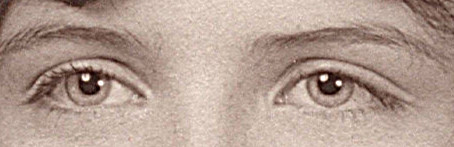
The strangest thing is, for all the many, many, many moves, for all the thousands of miles traveled, for all the years in storage, within this disarrayed collection of my mother’s papers, letters and photographs I am going through, I found my mother’s and my senior high school pictures  — having been somehow brought together at some point in time so that they were stored as I found them this week — laying face to face.

++++++++++++++++++++++++++++++++++

*1943 – Mildred Ann Cahill Lloyd – Senior High School Picture

1943 - mother's eyes

++++++++++++++++++++++++++++++++++

*Age 17 – Linda’s Senior High School Picture 1969

1969 age 17 - my eyes - senior high school picture

++++++++++++++++++++++++++++++++++

I do not like the look of my mother’s eyes.  I do not like the look in my mother’s eyes.  Those readers who were exposed to the insanity of violent rage attacks against them by an adult when they were children no doubt KNOW that look that comes into the face of such an attacker.

I didn’t think about it when I was a child, but when I was 20 I took my young daughter and returned home to visit my family where they were living in Tucson at the time.  I won’t describe the details of what happened there right now, but I saw that look — again — come into my mother’s eyes and I was able to think to myself, “That woman looks like she is possessed.  She looks like a demon has taken over her body!”  The visit did not go well, and I and my daughter escaped.  I never again returned to my parents’ home.

++++++++++++++++++++++++++++++++++

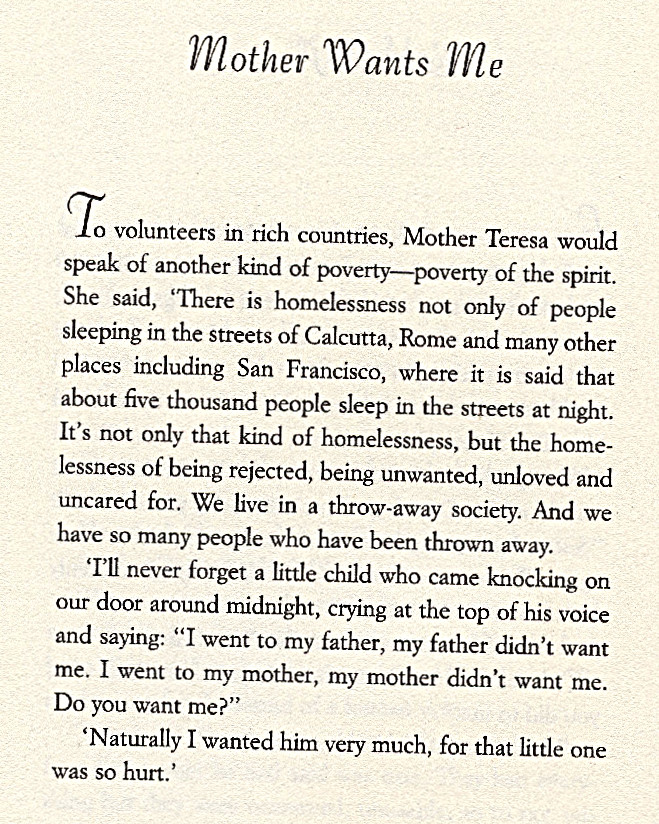
Mother Teresa’s Reaching Out in Love: Stories Told by Mother Teresa by Edward Le Joly and Jaya Chaliha, 1998 (page 66)

To whom -- and with whom -- do the children belong?

++++++++++++++++++++++++++++++++++

I KNOW no child should ever look this sad.  Yet compared to other abused and neglected children, I had it good.

I grew up in a culture that 100%  supported what my mother did to me for 18 years.  I grew up in a culture that 100% supported my father’s enabling of my mother’s abuse of me.  How do I know this to be true?  Because nobody — ever — not one single solitary TIME – EVER looked into my eyes, saw my suffering, and so much as said a word.  Not once did anybody question.  Not once did they blink an eye.  Obviously they were in support!

++++++++++++++++++++++++++++++++++

Click here to listen:

STEVIE NICKS “NIGHTBIRD” LIVE WITH LORI NICKS 1983

++

Nightbird Lyrics

“…And when I call
Will you walk gently
Thru my shadow
The ones who sing at night
The ones you dream of
The ones who walk away
Capes pulled around them tight
Cryin’ for the night
Cry for the nightbird tonite

And the darkened eyes
Thru the net of the lace
In the darkness
It’s hard to see her face
Pulls back the net
And you feel the touch
Of her fingers
And you see she turns the eyes
And you see the eyes of a nightbird
The ones you dream of
Finally the nightbird
Tonite”

++++++++++++++++++++++++++++++++++

This post is dedicated to the nightbirds, to every child who has ever cringed in terror, screamed through tortures, sobbed silently in the darkness of the night without anyone there to hear, to care, or to save them.  It is dedicated to all the adult nightbirds who suffer the same as grownups because of what happened to them THEN still happens to them NOW.

It is not singing for these nightbirds that we need to do, though.  We need to pay attention, look into their sorrow filled eyes, and DO SOMETHING to help them.

I have though long and hard about my next statement:  There are times when a child or children in a family cannot be loved by their parents.  These children, when abuse, violation, violence, and severe neglect is present, need to be permanently removed from their home of origin and placed into families where love is truly present, where safe and secure attachments can be formed, where damage done to these children can hopefully begin to be rectified, and where hope for a better life can be born.

Nobody can ever make anybody love anyone.  It is not humanly possible.  If a parent does not love a child it is because they cannot.  We, as a society, are 100% supportive participants in any abuse that happens to children if we refuse to face this fact and take action on behalf of unloved children.

Children are not objects.  They are not possessions.  Children do not belong to their parents as if they were.  Parents do not own their children.  In my book, children’s rights to get their basic needs met and their rights to be loved and cherished in a safe and securely attached environment completely outweigh the rights of any parent to abuse and neglect them.

That we have an incompetent and inadequate system to care for the needs of unloved children is the problem that needs to be addressed.  No child should ever have to suffer because of adult lack of preparedness.  It is every adult in a society that fails an abused, neglected and unloved child, not just the parents.

I can claim all I want to that I would not have forgone growing up with my siblings.  I can say in the end it was all O.K. with me because I was able to meet, greet and fall in love with the wilderness of our homestead.  At the same time I can see the truth.  It was no kind of childhood at all to be a little one who had only a cold stone snow shrouded distant and remote mountain peak that was the only source I had of comfort and connection.  I needed caring humans.  I needed to be loved.

++++++++++++++++++++++++++++++++++

We can do nothing now about what happened to us when we were children.  We can try to learn how to parent our own offspring better.  We can try to help other children now.  We can learn as much as we can about what our deepest needs for love and attachment were as children, and still are.  I do not wish to leave the information contained in these links behind as I continue with my posting.  Please consider them for your study:

++++++++++++++++++++++++++++++++++

+THE COMPLEXITIES OF SECURE AND INSECURE ATTACHMENT – DO-IT-YOURSELF STUDY LINKS

++++++++++++++++++++++++++++++

One important point to realize about insecure attachment disorders is that in effect, our on-off switch governing our human relationships is not set right, or is nearly broken completely.  We rarely, if ever, truly feel safe, secure and connected to others.  This leaves us feeling pain and anxiety much of the time (Yes, we feel that Substance P).

A securely attached person does not have their attachment system ON all of the time.  It will turn on and off appropriately.  If an attachment system cannot turn itself on and off correctly, none of the other systems will work correctly, either (exploration, caregiving, sexuality).

++++++++++++++++++++++++++++++

In our ‘modern era’ humans seem tempted to believe we are above the rules and laws of nature.  We are not, and if enough of these rules and laws are breached early enough in our development, the ensuing trajectory of all our future development will be sent off into an unhealthy, survival-only-based for the short term, direction.

Our species has evolved over millions of years in such a way that there is a narrow margin for what is most needed for our best development.  As we change how we raise our children from an extended family, tribal and community base, we are placing ourselves and our children at ever increasing risk for suffering from insecure attachment disorders with all their accompanying disruptions for the life span.

What happened to my mother and my father in their earliest beginnings set in motion a chain of predictable consequences that culminated in the 18-year torturous childhood I endured.  They both had insecure attachment early histories with resulting insecure attachment disorders.  Those disorders let the dark rather than the sunshine in to my childhood.

++++++++++++++++++++++++++++++

There is nothing easy about writing this post.  I am tempted to offer a blanket apology for the disarrayed information I am going to post links for you today.  What I WANT is polished, completed perfection.  What I WANT to present to you would look like the information contained in my October 1, 2009 post +CHILDHOOD DISSOCIATION, DEPERSONALIZATION, DEREALIZATION – I NEVER HAD A CHOICE TO BE OR NOT TO BE about the symptoms of childhood dissociation.

I was envious of those few succinct and perfectly chosen words that presented that information on Guidelines for the Evaluation and Treatment of Dissociative Symptoms in Children and Adolescents written by someone for the International Society for the Study of Dissociation.  Then I realized that these concepts were probably part of what could be called a White Paper.  They were no doubt an accumulation of multiple minds working on a problem that needed a solution, and what is presented is the result of a combined effort.

I had some friends when I lived in northern Minnesota who owned 40 acres of sugar maple trees.  Every spring when the sap began to run their entire family would participate in tapping the trees, collecting the sap, and boiling it down in huge vats until it turned into maple syrup.  It took 60 gallons of sap to create one gallon of syrup.

Thinking about secure and insecure attachment feels like a similar process to me.  I can’t begin to imagine the brilliant genius of the minds of the specialists who discover facts and write about the topic.  What I am presenting today is still — only — a collection of their words as I try to gather enough information, and go over it enough times, that I might begin to glimpse the critical significance of their work.

+++++++++++++++++++

Because the experiences of abuse and trauma I endured during the 18 years of my childhood were so extreme, my search of the ‘ordinary’ literature on ‘dysfunctional’ childhoods did not begin to answer my questions about what happened to me and why.  These links I present today contain what I KNOW is critical information about what put both of my parents at risk for turning into monsters.

In order to begin to understand the life of a tree I would not simply study the tip of the topmost and outermost branches.  To understand the bigger picture I would have to study the whole tree, down to the deepest roots that keep it standing in the sky.  I am not content to rely simply on such terms as ‘mental illness’ or ‘Borderline Personality Disorder’ to describe what I might be able to learn about my mother.  I am not content to simply label my father ‘an enabler’.  Who my parents were, why and how they operated the way that they did toward me, I will never actually know.

Attachment research gives me the clearest and most correct platform I have ever found from which I can begin to understand — and therefore begin to apply informed compassion — to the criminal actions my parents took against me.  It also helps me to understand the most important consequences caused by their actions toward me, and helps me learn how to transform them.

+++++++++++++++++++

Even a quick but dedicated quick scanning of the words contained in the following links will have the capacity to change how you look at yourself, your parents, your relationships.  These words are about how early caregiver interactions — good and bad — form the brain-mind.  It is from the foundation of these early beginnings that all future development of an individual arises, in the same way that all the future growth of a tree begins with the cracking of a fertile seed and the growth down of roots and up of its trunk and branches.

The very bare-bones layout of the information in the links covers the difference between secure attachment (about 55% of our population) and insecure attachment (the other 45%).  Most researchers use one set of words to describe the insecure attachment disorder in infants and another for adults related to the exact same patterns.  I see no reason to do this.  What exists in infancy as a disordered attachment remains for a lifetime unless some specific interventions and applied efforts are made toward trying to change the hard-wiring of the infant brain as it was built in the first place so that it becomes more ‘secure’ later in life.

There are breakdowns within the category of insecure attachment that cover what happens to the 45% of people who have less than an optimal early caregiver brain building interaction period in their infancy.  My guesstimate is that about one-third of this 45% fit into each of the following three main categories.

— There are two ‘organized’ insecure attachment disorders/patterns/systems = Avoidant-Dismissive Insecure Attachment and Preoccupied-Ambivalent Insecure Attachment.   The important word here is ORGANIZED, which is in contrast to the third insecure attachment disorder which is NOT organized.

— This is the disorganized  insecure attachment disorder/pattern/system known as the  – Disorganized-Disoriented Insecure Attachment.  Serious dissociation occurs within this group as well as many of the more serious so-called mental illnesses.

There are at least two other attachment categories that may or may not be recognized in the future as having enough merit on their own to remain distinguished from any of the above categories.  They are the ‘earned secure attachment‘ and the ‘cannot classify insecure attachment‘ groupings.

+++++++++++++++++++

I hope that readers will find something useful in these links.  I am a long, long way from coming up with my own version of a simple, clear and succinct ‘white’ paper. What appears in italics in these links are my own words as I processed these technical writings as I read them.

The main references you will find in these links are as follows as they match my codes for citation page numbers (you will also occasionally find a page number inserted in the middle of some paragraphs to note where in a sentence the page number changed):

Siegel/tdm = The Developing Mind: Toward a Neurobiology of Interpersonal Experience by Daniel J. Siegel

Schore/ad = Affect Dysregulation and Disorders of the Self by Allan N. Schore

Schore/ar = Affect Regulation and the Origin of the Self: The Neurobiology of Emotional Development by Allan N. Schore

+++++++++++++++++++

These writings contain many unfamiliar words.  If you are scanning only, skip them.  Or, do a quick Google search using “Webster define _____.”

I believe that the more traumatic a reader’s childhood was, the more they will benefit from gaining an understanding of this information.   It will improve understanding on a more profound level about what happened to their own self development and the development of their early caregivers.  (I need to specify here that I can make no assumptions about how sexual abuse fits into the picture of secure and insecure attachments.  That is not a part of my story, and I cannot and do not make any statements about it.)

++++++++++++++++++++++++++++++

++++++++++++++++++++++++++++++