
+++++
Experts say that we cannot be truly autonomous and secure adults if we lack the ability to have safe and secure attachments.
I wanted to write today about Dr. Siegel’s next statements about secure-autonomous attachment. I find, as usual, that I am nearly completely lost in trying to understand what he is saying (see bottom of this post) because I do not come from a childhood of safe and secure attachments. Instead my 18 years of abuse from birth gave me the opposite – a disorganized-disoriented insecure attachment disorder. To begin to understand what Siegel is saying, I have to turn his words upside down and backwards so that they can make sense to ‘opposite’ extra-ordinary ME.
++++
In order to keep my thoughts from appearing and flying away in their often random way, I had to find my own internal image to attach them to so that they could have an order I can understand. What came to me in relation to what Siegel is saying about secure versus insecure attachment was: “stolen thunder.” In working with my own internal image I came to understand three basic questions about how parents raise their children. In fact, I think it might be the simplest ‘test’ possible to determine the quality of the parenting we received and of the parenting we give our own children.
++++
1. Does a parent help their child’s own personal power, uniqueness, expression and self to grow? In other words, do they help their child’s thunder to grow or do they interfere with their child’s growing thunder (self=personal power)?
Yes or No
2. Does a parent actually steal their child’s thunder away from them so that the child is diminished rather than helped and allowed to grow and thrive?
Yes or No
3. Does the parent then project their own garbage onto and into their child?
Yes or No
++++
These questions are, of course, only showing us what the very tip of the iceberg is like about how parents can act toward their children. But I think the answers give a pretty clear indication about what lies below the surface:
As I thought about my mother’s interactions with me from my birth, I realized that 1. was No; 2. was Yes; 3. was Yes. N-Y-Y. She did not allow my personal thunder to grow, she stole it away from me and projected her garbage onto me. (This is exactly what I believe my mother’s mother and grandmother did to her in her childhood.)
I thought about my father and 1. was No; 2. was No; 3. was No. N-N-N. He did not help me to grow my own thunder, but he did not steal it away from me, either. Nor did he project his garbage onto me. I basically did not seem to exist in his world at all.
I thought about my interactions with my own children and 1. was Yes; 2. was No; and 3. was No. Y-N-N. My foremost effort with my children was to allow them and to help them grow into their own self and to grow their personal thunder. I did not steal their thunder away from them or deny them the opportunity to grow their own strong, clear self. I did not confuse, overpower or disempower them. I did not project my own garbage onto them. I had what the child development attachment experts would call an ‘earned secure’ attachment with my children. (I think about this from my own perspective as my having built a ‘borrowed secure’ attachment with my children.)
NOTE: Our patterns of trying to give our thunder away is a topic for some future writing…..
++++
Out of curiosity I wanted to know where the phrase “steal my thunder” even came from. At trivia-library.com I found it to be 300 years old:
Origins of Sayings – Steal My Thunder
About the history, origin and story behind the famous saying
STEAL MY THUNDER
Who Said It: John Dennis
When: 1709
The Story behind It: John Dennis, English critic and playwright, invented a new way of simulating the sound of thunder on stage and used the method in one of his plays, Appius and Virginia. Dennis “made” thunder by using “troughs of wood with stops in them” instead of the large mustard bowls usually employed. The thunder was a great success, but Dennis’ play was a dismal failure. The manager at Drury Lane, where the play was performed, canceled its run after only a few performances. A short time later, Dennis returned to Drury Lane to see Shakespeare’s Macbeth. As he sat in the pit, he was horrified to discover that his method of making thunder was being used. Jumping to his feet, Dennis screamed at the audience, “That’s my thunder, by God! The villains will not play my play but they steal my thunder.”
++++
I have a different association with thunder. I used to be terrified of electrical storms. Gradually, after more than 25 years spent in friendships with traditional-believing Native Americans in northern Minnesota, I came to understand another perspective on these storms.
I had a friend who was a lawyer and Chief Magistrate, and not given to ‘flights of fancy’. One time she told the story of driving a stretch of deserted 2-lane highway after leaving Canada as she headed home. She glanced in her rear view mirror and saw a massive bird speeding towards her along the line of road. It shone copper, and when it reached her car it lifted over it and swooped down in front of her and continued down the road. It was so big its wing tips reached over the shoulders on both sides of the road. My friend was stunned and shaken, and pulled off the road and stopped as she watched it disappear ahead of her.
Traditional Anishinabeg (Ojibway, Chippewa) and other Tribal teachings tell of how thunder is the sound of the voice of these great Thunderbirds, and lightning is the light flashing from their eyes. I am no longer afraid of electrical storms. Finding, claiming and growing my own personal thunder remains a bit more of a challenge!
++++
My entire recovery from the terrible child abuse I suffered has been about the healing of myself and the claiming of my personal power to be my self, in my power, in my life. How does having one’s personal thunder — or not — apply to my understanding of the following words by Dr. Daniel Siegel? I guess my discussion of this information now belongs in tomorrow’s post:
“Moreover, the capacity to reflect on the role of mental states in determining human behavior is associated with the capacity to provide sensitive and nurturing parenting….this reflective function is more than the ability to introspect; it directly influences a self-organizational process within the individual…..the reflective function also enables the parent to facilitate the self-organizational development of the child….the coherent organization of the mind depends upon an integrative process that enables such reflective processes to occur….integrative coherence within the individual may early in life depend upon, and later facilitate, interpersonal connections that foster the development of emotional well-being. (Siegle/tdm/312)”
+++++++
This post follows:
+DISSOCIATION AND THE TRAUMA-SPECIALIZED BRAIN 11-11-09
+SECURE AND INSECURE ATTACHMENT AND THE CHILDHOOD NARRATIVE 11-13-09
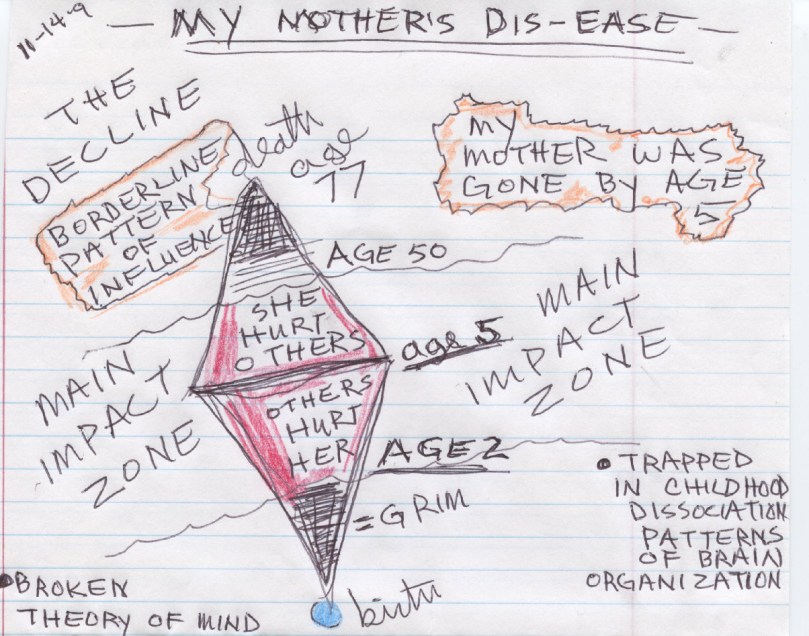
+EXPLODING MOTHER, IMPLODING ME: SOME FUNDAMENTAL DIFFERENCES BETWEEN US 11-14-09
+++++++
MORE INFORMATION ABOUT BORDERLINE PERSONALITY DISORDER
(IN MEMORY OF MY MOTHER)
Borderline Personality Disorder
| In the Spotlight | More Topics | |
| from Kristalyn Salters-Pedneault, PhD Most people with a diagnosis of BPD have at least one (if not more) co-occurring disorders. Common comorbid conditions include mood and anxiety disorders and substance use problems. But other disorders can occur alongside BPD as well. |
| In the Spotlight |
+++++++++++++++++++++++++++++++++++++++++++++++++++
|
||||||||||

 Stop the Storm
You must be logged in to post a comment.