+PORGES’ IMPORTANT NEW BOOK TO HELP INFANT-CHILD ABUSE SURVIVORS

++++++++++++++++

I have absolute confidence that this new book authored by Dr. Stephen W. Porges that is nearing its release will be of the greatest help to survivors of severe early infant-child abuse and trauma:

The Polyvagal Theory: Neurophysiological Foundations of Emotions, Attachment, Communication, and Self-regulation

This title is available for pre-order at Amazon.com by clicking on this title, and at a very reasonable price!

Product Description

A collection of groundbreaking research by a leading figure in neuroscience. This book compiles, for the first time, Stephen W. Porges’s decades of research. The world’s leading expert on the autonomic nervous system, Porges is the mind behind the groundbreaking Polyvagal Theory, which has startling implications for the treatment of anxiety, depression, trauma, and autism.

About the Author

Stephen W. Porges, PhD, is a professor of psychiatry and the director of the Brain-Body Center at the University of Illinois at Chicago.

++

I encountered reference to Porges’ work on the polyvagal theory several years ago, and as patience would have it – here comes HIS BOOK!

I posted this reference a week ago to his Australian seminar to be held November 2, 2011:

Polyvagal theory, oxytocin and the neurobiology of love and attachment:  A two day seminar with Stephen Porges and Sue Carter

The objective of this workshop is to describe current research and theory in behavioural neuroscience that can be translated into demystifying the features of many emotional, psychological and behavioural problems faced by children, young people and adults. It will provide invaluable insights into breaking maladaptive cycles to enable clients to experience states of calmness and to feel safe with other people.

++

I fully believe that Porges’ book will do exactly this:  “…provide invaluable insights into breaking maladaptive cycles to enable clients to experience states of calmness and to feel safe with other people.

In this short sentence I found a great resonance with what my body knows:  I DO NOT feel safe with other people!

What does Porges’ work have to teach me about this consequence that was built into my body from birth at the same time that GREAT harm and danger ‘from other people’ so traumatized me?

I am most curious to find out!

++++++++++++++++

+LINKS – VAGUS NERVE – ABUSE- HEALING

++++++++++++++++++++++++++++

No hand wringing allowed about what severe infant-child abuse is, what it comes from, what the Trauma Altered Development consequences of being such a survivor are, along with what can be done to prevent and ameliorate its cause and effects — some LIGHT reading links beginning with my favorite!

TAKE A LOOK AT THIS – MY DREAM SEMINAR!!  Oh, to my invisible Patron — get me to THIS one!!  Talk about life changing!

OH, THIS WOULD BE THE SEMINAR OF MY CHOICE!  To be held November 2, 2011 in Australia

The objective of this workshop is to describe current research and theory in behavioural neuroscience that can be translated into demystifying the features of many emotional, psychological and behavioural problems faced by children, young people and adults. It will provide invaluable insights into breaking maladaptive cycles to enable clients to experience states of calmness and to feel safe with other people.

Polyvagal theory, oxytocin and the neurobiology of love and attachment:  A two day seminar with Stephen Porges and Sue Carter

++

The history of intergenerational trauma is contained in this link!  Important read!  This website contains amazing info on healing traumas of all kinds — a gift site!

I bet this treatment is exactly what I need for my healing — of course being broke and poor denies me access.

Autonomic Nervous System and the Vagus Nerve – This link talks about the ANS being the ‘gateway of our humanness’ – worth a read!

Dr. Paul Canali’s universe of healing – WOW!

Survival Mode

Heal Trauma

Read handout here!

++

What is the vagus nerve?

++

Vagus Nerve Stimulation Therapy

++

Considering that my mother’s psychotic break, that led directly to her abuse of me, began during our difficult breach-birth labor, this article about supportive care of mother’s in labor and how it can directly improve mother-infant bonding, brain activity and vagus nerve functioning fascinates me:

RESEARCH PERSPECTIVES:  Mother and Infant: Early Emotional Ties

By Marshall Klaus

PEDIATRICS Vol. 102 No. 5 Supplement November 1998, pp. 1244-1246

++

Autonomic impairment in borderline personality disorder: a laboratory investigation.

Weinberg A, Klonsky ED, Hajcak G.

Brain Cogn. 2009 Dec;71(3):279-86. Epub 2009 Sep 13.

++

Effect of Neglect & Abuse on Brain Functioning

September 7, 2009 by Diane

Brain deficits develop in children exposed to neglect and abuse. It is critical that researchers and society understand these devastating consequences and how children are impacted later in life. Theoretically, during early brain development, neglect and abuse lead to deprivation of input needed by the infant brain. Thus, subsequent brain functioning is impaired.

A child faced with a frightening experience, and unable to escape, “resorts” to dissociation, disengaging attention from the present reality.[8] In this process the vagus nerve, the parasympathetic part of the autonomic nervous system, becomes activated, leading to a slowing of the heart rate and a fall in blood pressure. It is postulated that as a part of the dissociation process, opiates associated with dopamine systems that arise in the brain stem and are activated by stress, alter the perception of painful stimuli. [9]

++

Hypoarousal and the Dorsal Vagal Nerve

(See also on this blog: +HONEST THINKING ABOUT DISSOCIATION AND DEATH)

++

The vagus nerve takes this cue to slow down your heart rate and your blood pressure……”

++

Psychology beyond the Brain

What scientists are discovering by measuring the beating of the heart

By Adam Waytz | October 5, 2010 |

(Includes info on the vagus – vagal nerve…..)

++

UNIFIED FITNESS AND THE VAGAL NERVE

++++

Rush AJ, George MS, Sackeim HA, Marangell LB, Husain MM, Giller C, Nahas Z, Haines S, Simpson RKJ, Goodman R: Vagus nerve stimulation (VNS) for treatment-resistant depressions: a multicenter study. Biol Psychiatry 2000 , 47(4):276286 PubMed Abstract | Publisher Full Text

Sackeim HA, Rush AJ, George MS, Marangell LB, Husain MM, Nahas Z, Johnson CR, Seidman S, Giller C, Haines S, Simpson RKJ, Goodman RR: Vagus nerve stimulation (VNS) for treatment-resistant depression: efficacy, side effects, and predictors of outcome. Neuropsychopharmacology 2001 , 25(5):713-728. PubMed Abstract | Publisher Full Text

Marangell LB, Rush AJ, George MS, Sackeim HA, Johnson CR, Husain MM, Nahas Z, Lisanby SH: Vagus nerve stimulation (VNS) for major depressive episodes: one year outcomes. Biol Psychiatry 2002 , 51(4):280-287. PubMed Abstract | Publisher Full Text

++

Vagus Nerve Stimulation and Depression

++

See also on this blog:

+MY MOTHER’S VAGUS NERVE: THE MAKING OF HER PERFECT BORDERLINE STORM?

+++++++++++++++++++++++++++

+NOTHING SIMPLE ABOUT THE TOPIC OF ‘PRIDE’

+++++++++++++++++++++++

How necessary is the “Who is proud of whom for what?” game?

I feel strange.  I am face-to-face with some part of my self that can do things some other parts of my self know nothing about.  I was going to back for a few minutes today and write about something I introduced the other day when I mentioned feeling proud for our children (an for our self?).

From the blog post:  Pride in the successes, achievements and accomplishments of one’s child is just another emotion and state of being that abusive parents are deprived of.  The children of these parents are then deprived of having parents who truly appreciate them for the wonderful people that they are.

I was going to return to one of the chapters I skipped in Born to Be Good: The Science of a Meaningful Life.  He included a chapter on ‘awe’ that I wanted to read this morning because I suspected that the ability to feel awe, an experience connected to the feel good-be good happiness, compassion and connection arm of our vagus nerve system is involved in the experience of pride as well as of awe.

Problem is for me at this moment, I cannot find his book anywhere in my house.  True, I was having problems sorting out what I could believe, accept and understand in Keltner’s writing from what I suspected was grounded in arrogance and bias, but how did I manage to vanquish this book from my sight at the same time I have no memory of doing so?

I have many books on trauma on my book shelves.  Keltner’s book is not among them.  I have searched through every pile of papers, on every table top, every book shelf, in short I have looked everywhere in my house where I could have possibly placed that book once I was done reading it, and the book is nowhere to be found.  I can’t believe I would have either trashed or donated the book without having some memory trace of having done so.  Evidently I really DIDN’T like that book!  Hum…….

So I guess I will have to wing the writing of this post about pride and the vagus nerve as I figure out what I know on my insides about this experience.  Meanwhile, this me of today is very curious about where Keltner’s book is eventually going to make its reappearance in my life!  It HAS to be here some place, but I sure have managed to hide it from myself.

This experience of missing this book makes me wonder how much can we and do we manage to hide from our own self in our life, not even realizing that we are doing so?  I have to wonder at this moment.  How much do we put away, disguise, place ‘out of sight, out of mind’ in our life because our ability to tolerate has diminished something to the point we simply cannot or will not deal with it any more?  (Was I THAT sick of Keltner?)

++++

So at this point, as I continue down the pathway of “What is pride?” on my forensic autobiographical journey, I call not Keltner as my first witness, but my dear sister, Cindy.  When we spoke about the topic on the telephone last night, she mentioned that from the Christian training she had in her young adult lives, she knows that the word and concept of RESPECT is directly tied in its roots to AWE.

She also affirmed that never once to her knowledge was my mother ever proud of me.  Also, in her memory, she knows of only one single instance where she knew absolutely that our mother was proud of her.  That happened when my sister trained our family’s dog for an obedience dog show and they won first place.  Mother didn’t SAY anything to Cindy, but Cindy knew mother was proud of her.

One of my own questions about pride enters my thoughts right now, though I’ll wait for a moment to consider it.  I find myself wondering, “Is the feeling of being proud of another person tied more to conditional love than it is to unconditional love?  Is there a difference between the experience of feeling proud – really for the other or for one’s own self – based on a conditional valuing based on what a person DOES rather than on who a person IS irregardless of what they actually DO?”

But, first, to finish the thoughts from last night’s conversation with my sister, I have to mention that she told me that in all her 56 years, it has been her observation that the topic of pride is a VERY SENSITIVE ONE to many if not most people.  She believe that all of these people suffer their entire lives from a wound that means they continually ACT in ways that they WANT to create a demonstration of pride for them from their parents.

The saddest part of this is that this lack of feeling ‘proud for’ existed in their earliest years and continues to be a part of adults’ feeling reality for their entire lives – and is rarely if ever fulfilled so that the DESIRE is gone.  As a consequence, people then feel empty in a place that is never filled.  It sounds to me like there’s a wound that never heals about this, a hole that’s always there, a continually unmet attachment need that then affects how a person IS in their body, in relationship with their own self and with others, for their entire life time.

My sister understands for herself that the root of ‘awe’ that is a part of ‘respect’ means that when we hear someone say to us, “That is awesome,” we are really receiving from that person a fundamental recognition of our worthiness based on fundamental respect.  My sister believes that once we lose respect for another person, our relationship with them changes – often instantaneously – forever.  Evidently being able to have respect for another person is somehow directly tied to our ability to feel pride for them.

++++

If this is true, I have some searching to do in order that I can understand with clarity within my own self how this respect-awe-pride pathway might actually work.  Even though I cannot locate Keltner’s book anywhere in my house, I know he connected ‘awe’ to the healthy operation of the vagus nerve system just as he did embarrassment, genuine D-miles and compassion – or he would not have included a chapter on ‘awe’ in his book.

I already know that something was wrong with the operation of my mother’s feel good-be good vagus nerve system branch.  I can understand that her stress response was “ON” all of the time.  As a result, her “STOP” arm of her vagus nerve system and of her autonomic nervous system (ANS) could never be activated toward true peaceful calmness and connection to others.  She was not safely and securely attached to her own self or to anyone else.

Now I can add her lack of ability to feel pride for me, and just barely for any of her other children, to the list of ‘symptoms’ of her infant-childhood changed growth and development from trauma, abuse and neglect.

++++

From this point forward in today’s writing I have to make it clear that I think the way I do in a particular way that gives me a bias on the topic that most people do not have – either most fortunately or most unfortunately.  I evidently have some strange immunity regarding the subject of whether other people feel proud of me or not that came from my mother’s abuse of me.

I have written in previous posts that my mother’s demise that led her development down a pathway where she was incapable of experiencing either well-being for her own self or in connection to anyone else happened (I suspect) because of the very traumatic experiences she had with her earliest caregivers as they gave her so-called love that was insanely and unreasonably conditional.  She grew up believing that her personal ‘badness’ caused her caregivers to hate her.  If she could only be ‘good enough’ she could bask in the warmth of their love.

Hers was an environment of terrible and terrifying betrayal.  This betrayal broke her.  I had the benefit of having never been betrayed.  I knew she hated me from the first breath I took.  My mother did not vacillate.  She did not wander away from her first stated course of action toward me from the time I was born.  My mother never swerved off of her course.  In her mind, I was not human.  I was the devil’s child, bad beyond possibility of redemption.

I was never tricked into believing in any way, ever, that there was anything I could do NOT to be hated and abused.  I was never fooled into believing that if I could be ‘good enough’ that she would love me.  I was never given false hope either than I was loveable or that my parents could possibly love me.

True, I am painting a grim picture almost beyond belief.  I can see this even though I know that the picture I am painting was absolutely real.  At the same time I am saying that the absolute devastation of my infant-childhood gave me at the same time the possibility of surviving it as I grew into the person I am now.

I will give you this bizarre yet accurate image:  If we could imagine an infant being born into a world where no air was ever available either that infant would die or it would find a way to endure in spite of the absence of air.  If this is the reality this infant faced, and it did manage to adapt and survive anyway, the concept of ‘air’ and the experience of needing it or of being dependent upon its presence would simply never exist.

Of course we know no human can live without air.  But if we substitute love for air in this image, I can assure you humans can manage to endure without it.  I basically did.  What little bit of love-air I found came from my 14-month-older brother, and very occasionally from contact with my grandmother and father.  Eventually I became an absolute professional at being able to endure and survive on such a pitifully inadequate supply of love-air that it’s almost beyond belief.  But because it was love that I was deprived of rather than of air, my body kept on enduring and growing through its developmental stages because it could adapt to these devastating conditions.

++++

As a consequence, I cannot conceive of the world the way my sister seems to, or in the way that evidently MOST people do.  I have no ability to imagine ever wanting or desiring my mother or father to feel proud of me.  It is not possible for me to do so.  Therefore, I cannot probably empathize with all the other people who ‘have issues’ concerning their need or desire for this ‘feeling proud’ of them by their parents – or anyone else.

On some levels, having just realized this about my self is very scary.  Yet at the same time the benefit of the pattern of abuse I received seems obvious to me.  Nothing my mother did or did not do to me altered my ability to feel proud of or for my own children.

That’s pretty darn amazing!  I could call this miracle, but I understand that in no possible way are my abilities, as they are so different from my mother’s, a miracle.  My abilities, as are everyone’s, lie within me because they are physiologically possible.  My mother lacked these abilities because they were physiologically impossible for her.

My body-brain-mind-self development did not ever include the possibility of my mother loving me, or with the possibility she could be correspondingly proud of me.  Impossible is exactly just that – impossible.  Only when the POSSIBILITY exists of something happening do we ever wish for it, desire it, hope for it, anticipate it, or expect it.    I knew from the moment I was born there was no possibility my mother loved me, conditionally or unconditionally.  Her love for me or her lack of it was never an issue.  Things were simply the way that they were and that was that.

In other words, the issue of ‘sometimes’ or of ‘some of the time’ didn’t exist for me.  Ever.  My mother did not play the tug-o-war, and I mean WAR, game with me of ‘sometimes I will love you’ or of ‘some of the time I love you’ or of ‘I would and could love you if only……”  She just fundamentally hated me.  How strange, and looking at this from this present moment, how freeing for me this ACTUALLY was.

I did not learn how to conditionally love.  I did not learn how to conditionally BE loved.  At the same time, though I don’t call it a miracle, I will say the blessing of this whole pattern in combination with my own particular makeup as a person was this:  I came out of my infant-childhood completely free to love, and I DO.  How cool is that?  Cool, I would say, beyond words or measure!

++++

Physiologically, even though I suffer from trauma and abuse in-built anxiety problems of many kinds, my vagus nerve system as it connects with my STOP and GO autonomic nervous system remained able to operate so that I am free to feel a range of emotion that includes the feel good-be good emotions and their corresponding range of options for actions.  My problem lies in that RECEIVING love and affection in all its forms is difficult if not impossible for me to FEEL.  But I CAN feel these feelings for others, and if I had to make a choice, this is the better one.  It means I can offer to others what I never had myself.

++++

I want to go back for a moment here to the ideas contained in the words ‘respect’, ‘awe’ and ‘pride’ and to very real human experience of and with them.  I suspect that my sister’s thoughts on the root of ‘respect’ might be tied to the Bible’s Hebrew translation into English text rather than to the roots in English of the word itself.  I turn to Webster’s:

RESPECT

Etymology: Middle English, from Latin respectus, literally, act of looking back, from respicere to look back, regard, from re- + specere to look — more at spy

Date: 14th century

1 : a relation or reference to a particular thing or situation <remarks having respect to an earlier plan>
2 : an act of giving particular attention : consideration
3 a : high or special regard : esteem b : the quality or state of being esteemed c plural : expressions of respect or deference <paid our respects>

This description doesn’t go back far enough in its origins for my liking (14th century).  I’ll follow ‘respect’ back to ‘spy’:

SPY

Etymology: Middle English spien, from Anglo-French espier, of Germanic origin; akin to Old High German spehōn to spy; akin to Latin specere to look, look at, Greek skeptesthai & skopein to watch, look at, consider

Date: 13th century

transitive verb 1 : to watch secretly usually for hostile purposes
2 : to catch sight of : see
3 : to search or look for intensively —usually used with out <spy out places fit for vending…goods — S. E. Morison>intransitive verb 1 : to observe or search for something : look
2 : to watch secretly as a spy

This goes back further, to the 13th century, but this still isn’t far enough for my liking.  I want to find the connections as far back as the dictionary will track them (before the 12th century) because only then to I feel at rest knowing I am getting at a root image and concept.  I find that both the word ‘look’ and ‘see’ originated in the English language before the 12th century:

LOOK

Etymology: Middle English, from Old English lōcian; akin to Old Saxon lōcōn to look

Date: before 12th century

SEE

Etymology: Middle English seen, from Old English sēon; akin to Old High German sehan to see and perhaps to Latin sequi to follow — more at sue

Date: before 12th century

Under ‘see’ I can follow ‘sue’.  I find we are now moving forward in time to the 14th century and away from older images in the word, except any reference in word origins to Sanskrit always intrigues me:

SUE

Etymology: Middle English sewen, siuen to follow, strive for, petition, from Anglo-French sivre, siure, from Vulgar Latin *sequere, from Latin sequi to follow; akin to Greek hepesthai to follow, Sanskrit sacate he accompanies

Date: 14th century

The word ‘accompany’ connects to ‘companion’:

COMPANION

Etymology: Middle English compainoun, from Anglo-French cumpaing, cumpaignun, from Late Latin companion-, companio, from Latin com- + panis bread, food — more at food

Date: 13th century

And here I find what makes me happy – a reference to a fundamental image – FOOD!  The necessity for, the procurement, provision, consumption and sharing of this basic element of FOOD is connected to safe and secure attachment in and to the world:

FOOD

Etymology: Middle English fode, from Old English fōda; akin to Old High German fuotar food, fodder, Latin panis bread, pascere to feed

Date: before 12th century

++++

OK, so I don’t see ‘awe’ in this family of word connections in relationship to ‘respect’.  What do I find if I specifically follow the meanings and origins of this word, ‘awe’?  This is interesting, and not what I would have expected (someday if I find Keltner’s book it will be interesting to see how he defines ‘awe’.):

AWE

Etymology: Middle English, from Old Norse agi; akin to Old English ege awe, Greek achos pain

Date: 13th century

1 : an emotion variously combining dread, veneration, and wonder that is inspired by authority or by the sacred or sublime <stood in awe of the king> <regard nature’s wonders with awe>
2 archaic a : dread, terror b : the power to inspire dread

Uh-oh!  Follow that link to pain and find reference to ‘punishment’ and ‘grief’.  So, what about the word ‘pride’ itself?  Can this idea, with roots in our language before the 12th century, be in any way connected to a sense of amazement and awe at and for another person?  The concepts of ‘pride’ and ‘proud’ are fully RELATIONSHIP oriented, contextual ideas that involve social judgment:

PRIDE

Etymology: Middle English, from Old English prȳde, from prūd proud — more at proud

Date: before 12th century

1 : the quality or state of being proud: as a : inordinate self-esteem : conceit b : a reasonable or justifiable self-respect c : delight or elation arising from some act, possession, or relationship <parental pride>
2 : proud or disdainful behavior or treatment : disdain
3 a : ostentatious display b : highest pitch : prime
4 : a source of pride : the best in a group or class
5 : a company of lions
6 : a showy or impressive group <a pride of dancers>

PROUD

Etymology: Middle English, from Old English prūd, probably from Old French prod, prud, prou advantageous, just, wise, bold, from Late Latin prode advantage, advantageous, back-formation from Latin prodesse to be advantageous, from pro-, prod- for, in favor + esse to be — more at pro-, is

Date: before 12th century

1 : feeling or showing pride: as a : having or displaying excessive self-esteem b : much pleased : exultant c : having proper self-respect
2 a : marked by stateliness : magnificent b : giving reason for pride : glorious <the proudest moment in her life>
3 : vigorous, spirited <a proud steed>

Pause for a moment and take a look at the social judgment loading and weight related to this concept.  Look at the synonyms and try to imagine how it is possible that beginning from the time of our birth, as social beings in social interactions beginning with our earliest caregivers, we might move through our childhood and into our adulthood REALLY being able to both understand these concepts let alone being able to negotiate the billions of ways human interactions involve them:

synonyms proud, arrogant, haughty, lordly, insolent, overbearing, supercilious, disdainful mean showing scorn for inferiors. proud may suggest an assumed superiority or loftiness <too proud to take charity>. arrogant implies a claiming for oneself of more consideration or importance than is warranted <a conceited and arrogant executive>. haughty suggests a consciousness of superior birth or position <a haughty aristocrat>. lordly implies pomposity or an arrogant display of power <a lordly condescension>. insolent implies contemptuous haughtiness <ignored by an insolent waiter>. overbearing suggests a tyrannical manner or an intolerable insolence <an overbearing supervisor>. supercilious implies a cool, patronizing haughtiness <an aloof and supercilious manner>. disdainful suggests a more active and openly scornful superciliousness <disdainful of their social inferiors>.

++++

We have to consider the cultural environment that creates the social context of our human interactions – including the religious underpinnings of our culture.  These look to me to be anything but serene, calm, peaceful, safe and secure waters to negotiate!!  How can a very young child, moving through its age 4-6 stage of developing a workable Theory of Mind, even begin to comprehend what’s what socially?

My guess is that for anyone who has a reason to think about the idea of feeling proud for self or others, or of having others feel proud of them, would benefit from taking some time to explore in the real world, in real time, and in the language of the REAL words we use to talk and think about the topic, how incredibly complex it is.  We need to understand that when considering the idea of ‘proud’ we are considering what really is a war zone with mine fields of explosively emotionally dangerous, if not devastating, concepts.  This idea, ‘pride’ and feeling ‘proud’ deserves a warning:  DANGER ZONE!  HIGH RISK HERE!

++++

While all this might look like a Pandora’s Box, if I look among the above definitions carefully, I find the words that can best assist me in my thinking about the topic.  They are not the bold-typed words; they are the humble ones:  ‘just, wise’, ‘reasonable’, ‘having proper self-respect’.  Even the word ‘bold’ is up there, having to do with our ability to exercise our courage (within the origins of the word ‘proud’).  These, to me, are the important words related to the healing possibilities of how we can learn to think about our concerns related to absence and presence of ‘pride’.

These words are connected to the center point of calm in our vagus nerve and autonomic nervous system as they connect our experience within our body and brain.  They reside in the quiet, in the place of cooperation and acceptance, not of competition and judgment.  These are not frenetic words.  They are not restless or demanding words.  At the same time, we need to realize that at whatever point in the continuum of the pride-proud spectrum we stand as we consider our potential related losses and our gains, it is our ability to reach that center point on the teeter-totter that truly matters.

THAT point is where, I believe, our hope for increased resiliency and well-being lies, not with our worrying about who has what or who gives what to whom.  In the end, once a pride-proud transaction has occurred, what matters is that we feel safe, secure and attached within our own self with and to those we care most about.  This is an experience of acceptance, or peaceful ‘OK-ness’ in the world.  What matters is the love expressed, felt and shared.

++++

When I said the other day that abusive parents are deprived of the feeling of being proud of and for their offspring, which then deprives the offspring of the feeling that their caregiver IS proud of them, what we are talking about is actually degrees of love and of attachment as they connect to our emotional experience negotiated in our body-brain by our vagus nerve and autonomic nervous system.

The presence or absence of the positive transactions related to pride-proud happen physiologically just as the shame reaction does.  Both are about ‘rupture and repair’, rejection and acceptance.  Both of these are STOP and GO interactions that share their existence in the same physiological systems that our rest and stress responses do.  We can pay attention to the emotions (and how they feel to us in the body) as we experience them related to both kinds of experiences.

How our earliest caregivers treated us had HUGE influence on how our physiological body-brain developed, but our body-brain-mind-self BELONGS to us, not to them.  My mother’s hate-full treatment of me did not fill me with hate.  Yes, there are many levels of my being that are connected to my corresponding RAGE from being traumatized by her the way I was, but rage is not the same thing as hate.  But even the word ‘hate’ cannot be dissociated from its fundamental root concept in ‘care’:

HATE

Etymology: Middle English, from Old English hete; akin to Old High German haz hate, Greek kēdos care

Date: before 12th century

1 a : intense hostility and aversion usually deriving from fear, anger, or sense of injury b : extreme dislike or antipathy : loathing <had a great hate of hard work>
2 : an object of hatred <a generation whose finest hate had been big business — F. L. Paxson>

Looking carefully at what it says here I have to think about my mother’s hatred of me, and what her hatred REALLY tells me – not about me, but about her:  “intense hostility and aversion usually deriving from fear, anger, or sense of injury.”

Not even a consideration of the word ‘care’ or of all the actions that are connected to it – including early caregiver interactions that we experienced from infant-childhood (and beyond) is a simple or straightforward one:

CARE

Etymology: Middle English, from Old English caru; akin to Old High German kara lament, Old Irish gairm call, cry, Latin garrire to chatter

Date: before 12th century

1 : suffering of mind : grief
2 a : a disquieted state of mixed uncertainty, apprehension, and responsibility b : a cause for such anxiety
3 a : painstaking or watchful attention b : maintenance <floor-care products>
4 : regard coming from desire or esteem
5 : charge, supervision <under a doctor’s care>
6 : a person or thing that is an object of attention, anxiety, or solicitude

++++

Over and over and over again I will say that if there is any one single simple idea I can help to introduce to people, especially to survivors who have suffered early trauma and abuse, it is the idea of what I call INFORMED COMPASSION, which is a reason-able response.

Being gentle and kind within our own self as we seek to heal and grow DEMANDS AND REQUIRES of us that we learn how to expand this gentle kindness to a consideration of those who harmed and hurt us.  I don’t think we can grow gentle kindness within our own self while at the same time withholding it from the stance we take regarding others – because this stance we take comes from within our own self.

Compassion comes from the same systems in our body that create our stress and calmness responses.  It is an option we can exercise with our conscious intention, will, awareness and reflective abilities.  Informing ourselves by thinking about the words we use to think WITH is a critical part of this healing process.  It’s a part of our continued growth and development.  It’s a part of our continuing to grow up as we ‘grow out’ an expanding circle of understanding how incredibly complex it is to be a human being, let alone to be one WELL, in multiple senses of this word.

When we think in terms of pride and proud, we are really at the threshold of thinking about our truest concern:  Are we accepted or isolated?  Are we together-with or isolated and alone?  Are we approved of?  Are we deemed and proved worthy of being a part of the whole – which has to do with our very survival?  Because if we follow these concepts far enough back in our language that is what we are really talking about:  To be or not to be.  It’s about living or dying, being built up or being destroyed.

Fortunately, I was so busy growing up with my own survival in mind that I didn’t have time to learn to worry if the same woman who was so busy trying to destroy me was at the same time feeling proud of me for avoiding her destruction.  (Or proud of me for any other reason:  She was not a reason-able person.)  Looking at the roots of the word ‘proud’, it is my ability to recognize what is wise and just, along with my ability to be bold in pursuing what I know in my own self to be GOOD that I have, access and use my own power.

Nothing my mother did to me took these abilities away from me.  Her unconditional hatred of me seems to have been better for me that would have been her conditional love.  The trade-off seems to be that I have the ability to love unconditionally, which means I feel proud of and for my children because I CAN.

++++++++++++++++++++++++++++++++++++++

+TRUE HEALING POSSIBLE – MY #1 CHOICE FOR TREATMENT

+++++++++++++++++++++++++

I have nothing but good to say about the information contained in this post and the article referenced here.  This is the most comprehensive, practical and hopeful information I have found on healing yet.  This would be my NUMBER ONE pick as a healing technique for infant-child abuse survivors.  Please spend some time looking this over – I have also ordered this book:

The Oxytocin Factor: Tapping the Hormone of Calm, Love, and Healing

BY: Kerstin Uvnas Moberg

+++++++++++++++++++++++++

WEBSITE:  The Rosen Institute

Rosen Method Bodywork and Movement

What is Rosen Method Bodywork?

What is Rosen Method Movement?

Benefits of Rosen Method
Bodywork & Movement

It appears that accessing this therapy is difficult but not impossible within the United States  —  it looks to me to be the real thing.  Can demand help stimulate increasing supply even though there are not the billions to be made off of REAL therapy that addresses our REAL problems and can REALLY help us to REALLY heal — like there are to be made within the psychopharmacalogical industry of pills, pills, pills and more pills and drugs, drugs, drugs and more drugs?

I haven’t personally tried this therapy — but I sure would if I could or will if I can!!

+++++++++++++++++++++++++

Resonance, Regulation and Revision:  Rosen Method Meets the Growing Edge of Neurological Research

BY:  Dorothea Hrossowyc

Rosen Method Bodywork Practitioner

Introductory Workshop Teacher and Bodywork Teacher in Training

Northfield, MN

hrossowyc@gmail.com

Published in Rosen Method International Journal (RMIJ), 2(2), 2009

ABSTRACT

This article presents some of the recent research from the burgeoning field of neuroscience that supports what we do in Rosen Method Bodywork. Current neuroscience is confirming that deep listening, presence, and limbic resonance are powerful healing tools as they provide regulation and revision for human beings. The healing cascade of the human connection system, stimulated by the hormone oxytocin, regulates and revises our neurological health and our physiological functioning, modulating emotions, hormonal status, immune function, stability, and likely our fresh, creative thinking. Epigenetics, which says genes are not destiny, and brain plasticity, the ability of the brain to grow and change, may also be affected by Rosen Method touch. Turning off the fight/flight adrenaline system in the body and turning on this powerful physiological system of relationship, caring, and trust has far reaching implications for our physical and mental health and for our evolution as a species.

++++

(Article here for educational purposes only)

“A recent program on public television titled “The New Medicine” stirred coverage in news media for suggesting putting “the care back into medical care,” and for suggesting that the relationship between a caregiver and a client is an extremely important factor in healing.   In Rosen Method, we have long understood the term resonance, the ability humans have to sense deeply the feeling state of another in relationship.  In Touching the Body, Healing the Soul, Rosen Method Senior Teacher, Sandra Wooten, long ago referred to affective resonance in psychotherapy, as the matching that takes place on an emotional level between a client and a listener.   But she states further, “In the physical, somatic realm of touch, I have coined the term, somatic resonance to define the matching that takes place with gentle, therapeutic (Rosen Method) touch between the client and the practitioner, allowing enhanced inward attention and perception for both” (Wooten, 1995, p 24.   In Rosen Method, we know that when we touch someone sensitively and inquisitively, we can often sense the emotional state in the other, that two people, even strangers, can be attuned to the inner state of each other through deep listening, and that this, in itself, is a powerful healing tool.

“The idea of “limbic resonance” is getting a lot of attention currently by scientists like Thomas Lewis and Stephen Porges, and in such body psychotherapies as Hakomi Experiential Psychotherapy, Sensorimotor Psychotherapy, Somatic Experiencing and others.   It seems this is something that human beings have always known how to do, and now we are remembering its importance.  Though scientific confirmation has not been necessary to know the benefits of Rosen practice, I find it exciting that now neuroscience is confirming what we have long known or believed.  Knowledge of the basic findings of neuroscience may also contribute in the long- run to Rosen practice.

Limbic Resonance

“Thomas Lewis tells us that contact and connection, or physical and emotional closeness and connection, actually affect the physiology of human beings in regulatory ways (Lewis et al., 2000).  Neurological research in animals and in human beings shows that humans are wired for connection, i.e. we have neural circuits that foster interpersonal connection.   According to Lewis, many of these circuits are located in the limbic system, the feeling part of the brain.   The neocortex has a large part of the thinking, cognitive functions of the brain where abstraction, learning, and voluntary behavior reside.  The limbic system, which evolved in mammals, has to do with socialization, social communication, care of the young, bonding, relational attachment, and play, i.e. with caring, and emotionality.   From a young age, we need caring connections to promote healthy development of the limbic system.   From research with both monkeys and infants, Lewis tells us that we mammals need relatedness or connection for our “neurophysiology to coalesce correctly.”  We are designed this way, he says, for the “shaping physiologic force of love” (Lewis et al., 2000, p 218).

“A mother who is functioning well with her child is attuned in both a feeling sense and a physiological sense, what Lewis calls “limbic resonance,” sensing the child’s inner state and responding appropriately.   The mother’s contact with her infant affects the physiological state of the infant, and her physiology is affected as well by this contact, connection, and physical and emotional closeness.   The child knows this instinctively, and senses the physiological need for the mother in times of stress or pain.   Consider the ill child who wants to be held all the time, or the vigorous protest during times of separation.   Lewis says, “The first part of emotional healing is being limbically known, having someone with a keen ear sense your melodic essence” (Lewis et al., 2000, p 170).   In Rosen Method we might call this presence, being conscious and aware in the present moment, taking the whole of another in, listening deeply, attuning, sensing the feeling, sensing the essence, reflecting back.

“The idea of this mutual regulation via limbic resonance is supported by very interesting recent research by Michael Meaney, co-director of the Sackler Program for Epigenetics and Psychobiology at McGill University, who studied rats with varying levels of maternal licking and grooming (Meaney, 2001; Fish, Shahrokh, Bagot, Calji, Bredy, Szyf, & Meaney, 2004; Swan, 1997).   Rats with attentive mothers grow up with more receptors for neurotransmitters that inhibit the activity of the amygdala, and fewer for stress hormones like adrenalin and corticotropin releasing hormones.  The amygdala is the part of the limbic system that senses and conveys fear responses.

“Rats raised with high maternal contact, lots of licking and grooming, grow up with adequate but lower responses to stress hormonally and so are less fearful, more curious, and more exploratory.  Those with low physical contact grow up to have more receptors for stress hormones and are more timid, more withdrawing, and more fearful in novel situations. Low physical contact pups grow up to be low contact mothers (Fish et al., 2004).

“Meaney’s research further shows that in rats, low physical contact affects epigenetic changes.  Epigenetics is the idea, supported in some of the newest genetic research, that “DNA is Not Destiny” (Fish et al, 2004, Watters, 2006).  While the DNA sequence is not changed, epigenetics is the process by which environmental factors and chemical modification of inherited genes can affect whether a particular gene is expressed or not expressed, silenced or activated like an on/off switch for genetic expression.  Meaney tested the methylation of a gene important to the stress response.   Methylation is a chemical marker of an epigenetic process, i.e. the state of methylation is critical to gene activity and to whether the gene expresses.   He found distinct differences, after birth, in methylation patterns between pups with high licking mothers and low licking mothers.   Before birth there is normally no methylation, so the difference in genetic expression happens after birth according to low or high physical contact.   Equally interesting is that low contact pups showed reversal of the effects when they were placed later in life with high physical contact mothers, or into nurturing, playful, low stress “social” situations around healthier rats.   Physical contact as late as adolescence still changes the epigenetic processes, suggesting that the adverse effects of low physical contact are reversible by more physical contact later (Meaney, 2001; Fish et al., 2004; Swan, 1997).

“Meaney’s research suggests that genes responsible for controlling the stress hormonal response are epigenetically regulated by maternal care, in particular, the physical contact of licking and grooming.   This means that the way the genetic material is expressed is affected, and that these epigenetic changes can be altered later. I suggest that this is what Lewis calls “revision”, revising the physiology through contact and connection (Lewis et al., 2000).

“What if physical contact and touch actually reverses the effects of stress responses that occurred in human infancy and childhood as well as in rats?  Lewis suggests this regulation and revision involves more than just touch for humans, however.   It involves touch with a limbic resonance, what Sandra Wooten calls “somatic resonance,” a presence with a relationship to the feeling state of the other.   Lewis calls this “somatic concordance” not just normal, but necessary for human development (Lewis et al., 2000).

““Without rich limbic resonance, a child doesn’t discover how to sense with his limbic brain, how to tune in to the emotional channel, and apprehend himself and others.   Without sufficient opportunity for limbic regulation he cannot internalize emotional balance. Children thus handicapped grow up to become fragile adults who remain uncertain of their own identities, cannot modulate their emotions and fall prey to chaos when stress threatens” (Lewis et al., 2000, p. 210).

“Lewis goes on to say that anxiety and depression are the consequences of disconnection.  Monkeys deprived of early limbic regulation lose billions of neurons they would ordinarily develop in caring environments.   They suffer neural disorganization and lose the capacity to modulate aggression   If the isolation stretches out, and they survive physically, they are marked by lethargic despair with the accompanying outpouring of stress hormones and neurotransmitters with unpredictable negative physical effects. Moreso, “they become erratically, unpredictably and chaotically vicious” (Lewis et al., 2000, p. 218).

“Lewis describes the limbically damaged human, seriously neglected, seriously deprived of human care, or living largely without physical and social contact and connection, without limbic regulation and revision, as deadly: “a functionally reptilian organism armed with the cunning of a neocortical brain, lacking compunction about harming others” (Lewis et al., 2000, p.218).   He challenges us to imagine and act on how society might be different if we were intolerant of childhood abuse and neglect.   Parents, and the physicians and others who guide them, need to understand the importance of emotional presence and resonance, holding, and gentle, contactful touch.

“Lewis reminds us that children don’t grow up to be fully self-regulating, even with good contact as infants and children.   Adults are still social animals, requiring stabilization outside themselves.  Physiological stability means finding people who regulate you well and staying by them. (Lewis et al, 2000).   Babies know this instinctually, and it is why they don’t want to be left alone.   It is why hurts around attachment, abandonment, and aloneness are so big in the adults we see as clients. Rosen work is so powerful, helpful, and effective as it recreates a special experience of limbic resonance, regulation and revision, a deep, resonating connection providing neural lessons missed earlier, and changing neural pathways. And what if it also provides a revision of genetic expression?

“In Rosen work these are all happening:

  • • There is resonance, in the Rosen practitioner’s deep, listening presence, attending to, really tuning in to someone, “catching the melodic essence”, the client being limbically known, reflected, and the client “knowing,” sensing himself/herself.
  • • There is regulation, with the change happening in the breath, in the release of body tension, in increased circulation and aliveness, in relaxation, the body working as it should, physiology regulating itself through resonance.   Limbic regulation thus allows the ability to modulate emotions, neurophysiology, hormonal status, immune function, sleep rhythms and stability (Lewis et al, 2000).
  • • There is revision, changing one another’s brains through limbic revision.   The Rosen therapist supports the client to bring long repressed emotions into consciousness, and these are received and affirmed by the therapist without judgment. The Rosen therapist supports the client to bring unconscious behavior patterns into consciousness where there is choice about them, even if the choice has to be made consistently and persistently against longstanding neural patterning and conditioning.  Neurobiologist and author Candace Pert tells us that the more we exercise choice against our neural patterning, the more we “exercise” that part of our brain that makes us uniquely human: our free will, the freedom to choose against conditioned neural patterning.   And the more we exercise our free will against one pattern, the freer we are to choose against all of our conditioned patterning (Pert, 1999; 2006). And there is the possibility of epigenetic changes described by Meaney and colleagues.

“The possibility of “limbic revision” indicates that the therapist needs to do her own work, get her own mental and emotional house in order, because the client regulates and revises to and through the therapist.   As much as we in Rosen Method would like to not have to pay attention to the “clinical relationship”, and do not consider ourselves mental health therapists, the clinical relationship is already there, a vital part of the work.   And it is crucially important that Rosen is taught experientially.  We learn the work by doing it and by receiving it, revising and regulating our own physiology and neural pathways.   In this way we meet the “…urgent necessity of the therapist to get his own house in order.   His patients are coming to stay, and they may have to live there for the rest of their lives” (Lewis et al., 2000, p. 187).

Oxytocin and the Human Connection System

“Science is just beginning to explore the physiological importance of human connection and Rosen work has been indirectly involved in some of the scientific research into the human connection system in Sweden.   The oxytocin cascade is an understudied part of this system, just beginning to get a lot of scientific attention. Kerstin Uvnas-Moberg is a researcher from Sweden who published many scientific articles on this hormone and its subsequent cascade, and also a book called The Oxytocin Factor: Tapping the hormone of calm, love, and healing (Uvnas-Moberg, 2003). It is worth noting that in Sweden, the book was titled Calm and Stillness Though Touch.

“While studying attachment and mother infant bonding, Uvnas-Moberg became fascinated by oxytocin, which is both a hormone and a neurotransmitter.   Knowing it is stimulated by touch, she researched the effects of touch on the production of this bonding, relaxation hormone.   She used massage practitioners in her research, some of whom are also Rosen practitioners, though they did not use Rosen Method in the sessions that were in the studies.  I first heard about Uvnas-Moberg’s  research before the book was published in English, from her good friend, Swedish Rosen Senior Teacher Annika Minnbergh, in her lecture at Calistoga, California, in 2001 at one of the first international Rosen gatherings.

“There has also been more research of this connection hormone by scientists in the US including Susan Carter, who did a study about oxytocin levels in the species of voles, small rodents like mice, who mate for life.  Carter is the wife of Stephen Porges, who developed the polyvagal theory, and the theory of the social engagement system, or human connection system facilitated by the vagus nerve and the oxytocin cascade.

“The polyvagal theory postulates that humans have three hierarchical systems of protection in the body, the freeze system, the fight/flight system and the social engagement system.   The social engagement system, or the human connection system, was the latest to evolve, and Porges suggests it is really a whole complex physical system of communication and connection facilitated by the ventral or front part of vagus nerve, and stimulated by oxytocin.   He suggests that fight /flight is connected to the central part of the vagus, which comes to the area of the diaphragm, and that the freeze system is connected to the dorsal part of the vagus nerve, which comes in to the lower part of the spine (Porges, 2001; 2006).  Carter and Uvnas-Moberg have published together about oxytocin and bonding, and are friends.  Porges’s work is related.

“Thus, the oxytocin cascade is proposed as part of a whole physiological system in the body we are just beginning to understand.   This is the study of human connection, and the physiological system that supports human connection, or social engagement.  We know a lot about the fight/flight and the freeze systems in the body, and it is time we learn as much about the human connection system, or the social engagement system.

“If one thinks of this social engagement or human connection system as a biological system in the body, and as the latest to evolve in humans, then one might say it is evolutionary for humans that it is being studied now in human history and that we are just beginning to understand its importance and its workings.   Even if we are not so proficient at it, it is part of the design, available to develop and bring into consciousness.   According to these researchers of the oxytocin cascade and the social engagement system, oxytocin is the bonding hormone, highly activated at birth and in nursing mothers.  It is not just a female hormone, however, but present in both females and males (Uvnas-Moberg, 2003).   It is the hormone that helps a parent get up many times in the middle of the night, not go completely crazy, and still love her baby.

“But when adrenalin is high, the oxytocin sites shut down (Minnbergh, 2001; Uvnas Moberg, 2003).  Adrenalin is about firing up the musculature and organs for fight or flight capability.   Often, intense physical tension and pain in the body is a result of chronic activation of this system, and the result of a chronic production of stress hormones such as adrenalin, cortisol, and noradrenalin.

“These stress hormones have many beneficial effects as they facilitate the fight/flight response.  When needed, they stimulate increased cardiac output, increased blood pressure, and increased heart rate to do the strong physical tasks we require.  But these effects can be unnecessarily sustained and lead to a sustained stress response.   The increase in blood pressure and heart rate can be sustained even when no longer needed, or when the limbic brain perceives threat that isn’t there anymore.   These chemicals are harsh on the body when sustained over long periods, and can produce chronic tension and physical pain and wear the body down.   Other potentially adverse effects of these hormones include adverse effects on the heart, increased blood glucose, increased blood pressure, decreased memory, negative effects on sleep, impaired immune function, and they are linked to higher rates of weight gain and obesity.   Persistent or sustained increases in stress hormones also suppress nonessential functions in a fight/flight situation, or a perceived fight/flight situation.   Even in a perceived flight/fight situation, there can be adverse effects on the digestive system, reproductive system, and growth processes (McMahon, 2009; Minnbergh, 2007).

“From stem cell research, Bruce Lipton found that cells responding to stress or fear do not grow (Lipton, 2005).   The body turns off any nonessential activity, like digesting your food, if it thinks you have to pay attention to fighting or fleeing, even if the threat is only perceived, not really happening in present time.

“There is also new research from Nuno Sousa and colleagues in the Life and Health Sciences Foundation in Portugal that shows chronic stress in rats produces what looks like “thinking in a rut”, repeating the same patterned, ineffective behavior again and again.   Sousa found parts of the brain that are associated with executive functions and goal-directed behavior had shriveled in chronically stressed rats, and those parts of neural circuits linked to habit formation had grown.   “Behaviors become habitual faster in stressed animals than in the controls, and worse, the stressed animals can’t shift back to goal directed-behaviors when that would be the better approach” (Angier, 2009).   Sousa’s research supports the idea that when we are in chronic stress, we are more likely to rely on distressed, patterned behavior rather than fresh, clear, creative thinking.

“Sousa also found, as Meaney’s studies did, that taking the stressed rats out of the stressful situation and putting them “on vacation” with healthier comrades, even for just 4 weeks, helped them to rewire, and use innovative skills again.  “Atrophied synaptic connections in the decisive regions of the prefrontal cortex resprouted, while the overgrown dendritic vines of the habit-prone sensorimotor striatum retreated” (Angier, 2009).

“This plasticity in the brain is another aspect of our newly understood neural circuitry and a finding in many new research studies.   Bruce McEwen, head of the neuroendocrinology lab at Rockefeller University, describes the brain as “…a very resilient and plastic organ.   Dendrites and synapses retract and reform, and reversible remodeling can occur throughout life” (Angier, 2009).

“In contrast to the stress responses, oxytocin and the oxytocin cascade — stimulated through touch, connection, and presence, and possibly regulated by the vagus nerve — is about calm, nourish, digest, relax, restore, connect and grow: the trust system in the body. Give it to roosters and they act like mother hens, showing nurturing behavior. Give it to rats and they come out of their cages with less fear, recognize their littermates, and socialize with other rats less fearfully.   Give it to stockbrokers and they are not afraid of risks and act more trusting with their money.

“The oxytocin cascade, or the human connection system, is about stress release, pain release, and it plays a larger role than we have known in the recovery from illness, injury and disease.   It may also play a role in creating fresh, innovative responses, new possibilities, and clearer thinking.   Moberg describes it as an open loop, one that feeds upon itself.  The more you have, the more you get.   Then the more you connect with others, the more of this neurotransmitter is stimulated, the whole cascade is stimulated again, so then the more you are able to connect, to yourself, to others, to something larger than yourself (Uvnas-Moberg 2003; Minnbergh, 2001).

“If you think of this as a protection system in the body, the implications of this theory are great:  social engagement and connection as the highest most evolved form of human protection rather than the adrenalin/fight/flight system in the body, one which possibly produces fresh, innovative thinking, and even more human connection, than other patterned responses.

“Moberg’s research shows oxytocin is elevated after sessions of touch therapy, but it goes back down.   After 4 sessions, it tends to go up and stay elevated.   After 7 sessions, it tends to stay elevated for longer periods.   And the research shows it is best stimulated by gentle touch, not heavy, deep tissue work, and especially by stroking on the belly (Minnbergh, 2001).   Uvnas-Moberg also found that the oxytocin levels in the practitioner increase as well through contactful touch.

“We know this healing cascade is stimulated largely by touch with other humans, by doing fun things, by being with other people, by connecting.  It is also stimulated by alcohol, nicotine, and the process of smoking, and by high fat foods (comfort foods) (Uvnas-Moberg, 2003).   So if you are not getting your social connection system stimulated any other way, have no other way of turning off the adrenalin or fight/flight system in the body, then you may turn to one of these less healthy alternatives.   It is not surprising that these are addictive substitutes for something else that the body needs.

“In Porges’ polyvagal theory, we learn that humans have inherited three forms of protection:  The first and most evolved form of protection is the ability to connect in relationship to other humans through complex and instantly read facial expressions and the human voice, this connection system being regulated by the upper end of the vagus nerve and stimulated by oxytocin.   Fight/flight is the second level of protection in this evolutionary hierarchy.   The freeze response, going numb, going unconscious, checking out, withdrawing, isolating or dissociating is the third and most primitive (Porges, 2001; 2006).

“Each of these is a necessary form of protection for the human.   We need to know how to go unconscious in an accident, for example, to conserve all resources for the tremendous job of healing that has to happen, and also to withstand the pain.   But chronic numbness or chronic unconscious living, chronic isolation, chronic aggression or fighting, chronic stress is obviously not life-enhancing for humans, and physically harmful.

“Porges theorizes from research with autistic children that relaxing areas where the vagus nerve comes close to the surface, i.e. the occipital ridge, the back and sides of the neck, the face, especially around the ears, and of course, the diaphragm, can help turn on the social engagement system.   These are all areas  we commonly work in Rosen Method.   Porges uses sound waves to relax the vagus nerve through the ears in autistic children (Porges, 2001; 2006).

“Rosen Method uses touch, presence, and limbic resonance to relax the whole body, which likely turns on this system.   Perhaps when the vagus nerve can function well, uninhibited by muscular tension, the social engagement system or human connection system may be encouraged to function well also.

Conclusion

“So relationship, through the healing cascade of the human connection system, regulates and revises our neurological health and our physiological functioning.   In loving and caring, in connecting through touch or otherwise, we modulate each other’s emotions, neurophysiology, hormonal status, immune function, sleep rhythms, and stability.   When you find someone who regulates you well,  someone with whom you feel good, with whom you can share at least some physical closeness and touch, around whom you can revise, then stick with that person.  And that is why your clients should stick with you.
“We know, and neuroscience is confirming, the importance of touch and caring, and of understanding and stimulating this biological system in the body, for recovery from illness, disease, injury, but also for human development and peace in the world.   We can use touch, presence and limbic resonance for the evolution of a new human species that will use connection to other human beings as its first form of protection.  Through touch, and also through the connection that is the essence of Rosen work, we are stimulating a whole physiological system in the body, the physiological system of trust, and human connection, facilitating the evolution of the human species toward more and deeper intimacy, connection and safety.”

References

Angier, N. (2009).   Brain is a co-conspirator in a vicious stress loop.   The New York Times, August 17, 2009.

Fish, E., Shahrokh, D., Bagot, R., Calji, C., Bredy, T., Szyf, M. & Meaney, M. J. (2004).   Epigenetic programming of stress responses through variations in maternal care.    Annals of the New York Academy of Sciences, 1036, 167-180.

Lewis, T., Fari, A. & Lannon, R. (2000).   A general theory of love. Random House.

Lipton, B. (2005).   The biology of belief. Hay House.

McMahon, M. (2009, in preparation).   Common effects of stress hormones on the body.

Meaney, M. J. (2001).   Maternal care, gene expression, and the transmission of individual differences in stress reactivity across generations.   Annual Review of Neuroscience, 24, 1161-92.

Minnbergh, A. (2001).   New research from Sweden on the oxytocin hormone and touch.  Lecture presented at the International Rosen Method Gathering, Calistoga, CA.

Minnbergh, A. (2007).   Comparing the adrenelin/stress response and the oxytocin cascade.   Lecture presented at the Rosen Method Global Congress, Imatra, Finland.

Pert, C. (2006).   The biochemistry of consciousness.  Lecture presented at the Continuum Center,  Minneapolis, MN.

Pert, C. (1999).   The molecules of emotion.   Touchstone.

Porges, S. W. (2001).   The polyvagal theory:  Phylogenetic substrates of a social nervous system.   International Journal of Psychophysiology, 42, 123-146.

Porges, S. W. (2006).   The polyvagal theory. Lecture presented at Hakomi International Conference, Boulder, CO.

Rosen, M. (with Brenner, S.) (2003).   Rosen method bodywork:   Accessing the unconscious through touch.   North Atlantic Books.

Swan, N. (1997).   Maternal care. Radio interview with Michael Meaney, Radio National Home, The Health Report, November 17.

Uvnas-Moberg, K. (2003).   The oxytocin factor:  Tapping the hormone of calm, love and healing. Da Capo Press.

Watters, E. (2006).   DNA is not destiny.  Discover Magazine, November, 33-75.

Wooten, S. (1995).  Touching the body reaching the soul: How touch influences the nature of human beings. Chimes Printing.

++++

READ ABOVE ARTICLE ONLINE HERE

SEE ALSO:

Rosen Method International Journal

Alan Fogel, Editor

Rosen Method Bodywork Practitioner, PhD, LMT

+++++++++++++++++++++++++++

DON’T MISS THE WEALTH OF INFORMATION FOR YOUR READING/STUDY/RESEARCH AND HEALING FROM INFANT-CHILD ABUSE PLEASURE AT THIS LINK

+++++++++++++++++++++++++++

Must be why I was drawn to buy myself this amazing electric piano keyboard so I can learn to play – and use music to ‘heal my abused infant brain’:

Porges uses sound waves to relax the vagus nerve through the ears in autistic children (Porges, 2001; 2006).  “

+++++++++++++++++++++++++++

+MY MOTHER COULD NOT ‘SIGH’ FOR ME

++++++++++++++++++++++++++

If we cannot ever stop wincing from our own internal, unconscious pain we will never be able to truly sign from another’s.

++++++++++++++++++++++++++

I had a dream last night that I cannot remember.  All I know is that it had something to do with improvement in well-being that can happen in more than one way and involves the vagus nerve system.  Some of those ways of positive change could happen consciously and some of them could happen automatically and unconsciously.  In my dream these changes seemed to be linked like spokes of a bicycle wheel to a center hub – which was the vagus nerve.

Feeling a little puzzled this morning about what this dream was telling me, I returned yet again to Dr. Dacher Keltner’s chapter on compassion (from his book Born to Be Good: The Science of a Meaningful Life) where he writes about the methods developed about fifteen years ago that measure the activity of the wandering vagus nerve bundle that have shown:

When we inhale, the vagus nerve is inhibited, and heart rate speeds up.  When we exhale, the vagus nerve is activated, and heart rate slows down….  The vagus nerve controls how breathing influences fluctuations in heart rate.  We measure the strength of the vagus nerve response, therefore, by capturing how heart rate variability is linked to cyclical changes in respiration.”  (page 233 – also included with yesterday’s post).

At the same time that I was having this dream last night, I was also having the sense that for all the work I’ve put into trying to ‘technically’ understand the dynamics of my mother’s abusive relationship with me, this single vagus nerve-hub-image is the most important one I have discovered thus far.  As I think about it all this morning in the light of this cloudy, gray day, I also realize that yesterday’s post directly about the hub of the vagus nerve and my mother’s self-weakness brought the fewest numbers of readers to my post of any in many, many months.

As I to suppose that I have ended up at a dead end in the labyrinth of my thinking about the causes, consequences and hope for ‘cure’ for those of us who suffer from severe early abuse histories reflected in the dearth of interest shown by readers to my yesterday’s post?

My dreams have never, in the six years I have been studying the case history of my mother’s severe abuse of me, been wrong.  They have never led me astray.  Many times my dreams have opened a new direction in my search and thinking that have allowed my past thinking to gel so that some new thinking can emerge.  Last night, I know, was no different and the images that I remember upon waking are no doubt correct.  My dream is pointing me toward something important.

++++

I find that Keltner next directly ties the physical measurement of vagus nerve activity not only to the experience of compassion versus pride, but also to altruistic acts.  Nobody except those concerned with infant and child abuse would probably ever have a need to think about appropriate and adequate parenting of offspring in terms of altruism.  Isn’t loving one’s babies and children something humans simply do automatically and instinctively?

Obviously, from the point of view of severe infant-childhood abuse, neglect, and malevolent abuse survivors, NO it is not!

Although the research that Keltner describes was not designed to target the vagus nerve bundle as the being the seat of abuse, as soon as he described it as the probable seat of compassion he is suggesting to me that it is.  Keltner cites research in his chapter on compassion that documents “that this selfless state of compassion produces altruism.”  (page 237), and that when faced with a situation that can trigger either “pure self-interest” or “the swell of compassion” in the chest (page 238) the reaction of the vagus nerve system will show corresponding activity as one of the branches of the Autonomic Nervous System (ANS) responds:  either the GO fight/flight arm related to pride and self-interest or the STOP arm related to compassion.

The research findings about the vagus nerve and compassion have shown in these studies that (as mentioned in yesterday’s post):

Participants’ reports of their feelings of compassion increased as their vagus nerve activity increased.  With increasing vagus nerve response, participants’ orientation shifted toward one of care rather than attention to what is strong about the self.
Then our participants, feeling surges of either compassion or pride, indicated how similar they themselves were to twenty other groups….  Our participants made to feel compassion by viewing images of harm reported a broader circle of care – they reported a greater sense of similarity to the 20 groups – than people feeling pride.  This feeling of similarity to others increased as individuals’ vagus nerve fired more intensely.

“And when we looked more closely at whom people feeling compassion and pride felt most similar to…we found that pride made people feel more similar to the strong, resource-rich groups in the set of twenty that they rated….  Compassion, on the other hand, made people feel more similar to the vulnerable groups – the homeless, the ill, the elderly….  Compassion is anything but blind or biased by subjective concerns;  it is exquisitely attuned to those in need.”  (pages 234-235)

++++

Why am I bothering to again repeat Keltner’s words here?  My dream last night showed me that while these findings lie very close to the heart of the infant-child abuse perpetrator’s problem, they are not what is actually at the very center of the hub.

These words are talking about an inner alignment that is supposed to happen in our body as it corresponds to the activity of the vagus nerve in response to either stimulus that appropriately creates a pride reaction or appropriately stimulates a caring reaction.  Infant-child abusers, in my thinking, cannot possibly be experiencing appropriate responses along this continuum.

Keltner is describing here that these pride versus caring reactions are associated with how the self aligns itself on a continuum of power and resources.  Pride corresponds to an alignment with ‘power-full’ others while caring corresponds to an alignment with ‘power-less’ others.  The resource being considered here is POWER.

I cannot see a way that anyone’s self can consider power as it relates to others without at the same time considering power as it relates to their own self.  If a person’s own self was formed in a malevolent, unsafe and insecurely attached environment that self will not automatically have a sense of itself as being ‘power-full’.  Such a self, because it suffered from degrees of powerlessness in the face of overwhelming traumas as it was growing, will have formed itself with depletion rather than with plenty at its center.  Such a self will continue to negotiate itself in power-related situations in different ways than will a self that was formed in a benevolent, safe and secure attachment environment.

++++

I believe that we are close to the hub of what is wrong with infant-child abuse perpetrators when we read these few words in Keltner’s statement:  “With increasing vagus nerve response, participants’ orientation shifted toward one of care rather than attention to what is strong about the self.” (page 234)  The three key words here are ORIENTATION and ATTENTION and the action of SHIFTING.

A strongly formed self can choose – consciously or unconsciously — to accomplish this shifting of orientation and attention away from self and toward others smoothly and appropriately in ways that a weakly formed self cannot.  The activity of this shifting can be measured with the vagus nerve response.  This measured vagus nerve response shows the degree of orientation and attention to the self versus orientation and attention to the other.

Three key and fundamental factors of being an ‘evolutionarily advanced’ member of the human species are altered in these early malevolent self-forming environments:  (1) the nature and recognition of the individual self, (2) the nature and recognition of the ‘other’s self’, and (3) the nature and recognition of the boundary that separates ‘self’ from ‘other’.

A weak self, formed in an early environment of malevolent, overwhelming trauma, will NOT be strong enough to shift its orientation or attention away from its own self-preservation. In addition, because a weak self is formed in unsafe and insecure early attachment relationships, it has no clear idea about its own self in relationship with any other self.  To miss or to ignore these facts is to entirely miss and ignore the very heart of infant-child abuse cause and consequence.

I believe this very heart can be measured if not actually SEEN in the response of an infant-child abuse perpetrator’s vagus nerve.

++++

I am not going to try to shorten what Keltner says next.  Within his words is a clear example of the vagus nerve response already operates when we are very young along with what Keltner refers to the “clarifying point” that determines what a person is actually likely to DO in response to another person’s weakness/vulnerability/need:

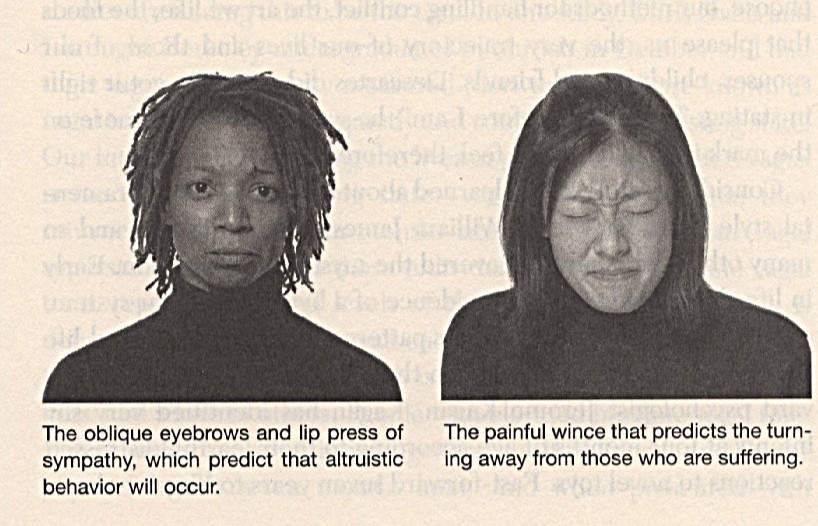
Stronger evidence still would link selfless, altruistic action to activation in the vagus nerve.  Nancy Eisenberg has gathered just this kind of data.  In one illustrative study, young children (second-graders and fifth-graders) and college students watched a videotape of a young mother and her children who had recently been injured in a violent accident.  Her children were forced to miss school while they recuperated from their injuries in the hospital.  After watching the videotape, the children were given the opportunity to take homework to the recovering children during their recess (thus sacrificing precious playground time).  Those children who reported feeling compassion and who shoed heart rate deceleration – a sign of vagus nerve activity – as well as oblique, concerned eyebrows while watching the video (see figure below) were much more likely to help out the kids in the hospital.  In contrast, those children who winced, who reported distress, and who showed heart rate acceleration – that is, those children who winced, who reported distress, and who showed heart rate acceleration – that is, those children who reacted with their own personal distress – were less likely to help.  These findings make a clarifying point:  It is an active concern for others, and not a simple mirroring of others’ suffering, that is the fount of compassion, and that leads to altruistic ends.”  (pages 239-240 – bolding is mine)

At the center of the hub of the wheel of my mother's self, she had this wince -- an unconscious pain that evidently did not allow her to respond to the suffering she caused me

What is fascinating about this “clarifying point” that Keltner is making is the fact that it is when early infant-child mirroring activities between early caregiver and the little one in the attachment environment, while its self is forming well before the age of two, that these response patterns between self and other form the nervous system and brain.  In traumatic early environments, a different nervous system, brain and self are formed that will operate differently throughout the lifespan.

What Keltner is describing here is the HUB OF THE WHEEL of the caring-compassion response that was changed in my mother, and I would say within all infant-child abusing caregivers.  Because their self formed with the distress being a part of the self, because the self did not form with the power to make the distress STOP, wincing will always be the vagus nerve response rather than the sigh.

But a self formed like my mother’s was seals off from consciousness any awareness of the self’s distress, pain or ‘wince’.  Such a self also seals off from conscious awareness its own inherent power-less state.

When the self contains its own perpetual pain, distress and powerlessness, when it cannot clearly identify who its own self in or who the self of any other is clearly, when it cannot define clearly where the boundary lies between its own self and another self, it will never be able to respond appropriately to pain – its own or anyone else’s.

The center point of the hub of the wheel where humans negotiate self and other seems to lie in the vagus nerve response, where orientation and attention to the self can shift toward others – or not.  That the entire array of responses can be narrowed down to the difference between a wince or a sigh makes perfect sense to me.

My mother did not know where her own self started and stopped.  She did not know where I started and stopped.  My mother never stopped wincing from her own (unconscious) pain.   My mother could never appropriately sigh for anyone else, certainly not for me.

(Post subject to be continued…..)

++++++++++++++++++++++++++++++++++++++

+CALM THE CRYING BABY — IMMUNE SYSTEM STIMULATES VAGUS NERVE TRAUMA ALTERED DEVELOPMENT

+++++++++++++

I have been in HOT pursuit of an idea all day.  This thought has lingered inside of me for 4 years in a ‘body knowing’ place because of what I know as a survivor of severe abuse and malevolent treatment from birth until I left home at 18.

In order for this idea to be given form I need to link it to other people’s related thoughts, and many of these ideas are only recently appearing as science races into a new place of truth about what it means to be a human — and how we develop in interaction with our environment from out conception.

I am not a scientist.  Even if I come up with a theory, and develop an hypothesis, I cannot create or perform research to either prove or disprove my ideas.  So, I have to use the interactive thinking the web provides and see what I can come up with.

And I found something very exciting – but I could not find it until I included the words ‘fish’ and ‘evolution’ into my search on the ‘vagus nerve’ and ‘the immune response’.

It has been my thinking that there has to be a point within the body — and within the body of a developing infant-child exactly ‘where the fire meets the gunpowder’.  A tiny person is powerless to stop trauma that happens to it from outside of its body.  It is therefore forced to try to stop the trauma ON ITS INSIDES.

This STOP action is the job of the vagus nerve as it controls the parasympathetic STOP arm of our Autonomic Nervous System and interacts with our immune system.  Right at this point where the developing body has to try to STOP the force of the impact of trauma ON ITS INSIDES is where Trauma Altered Development is forced to kick in.

It is RIGHT here, at this present moment in time where I cannot think into the future and must patiently await for science to confirm what I know is true – that RIGHT here where the fire meets the gunpowder, where a developing infant-child has to adapt within a malevolent environment and alter who it is becoming that EPIGENTIC forces that interfere with normal development by altering the immune system-vagus nerve-Autonomic Nervous System and brain interactions in preparation for survival within a toxic, malevolent unsafe and insecure attachment environment come into play.  The research proving this point is coming, but it is not entirely here yet.

This, I believe, is where and how what Dr. Martin Teicher calls evolutionarily altered development happens.  When a tiny growing body cannot STOP the ongoing affects of trauma happening to it from outside its body, the STOPPING happens on the inside.

This form of Stop the Storm of the impact of trauma — within a developing little body — causes things to happen like what happened to change my mother into the monster she became.  She could not afford to experience the suffering deprivation-trauma caused her so her body found a way to STOP it.

++++

My idea goes back to the very beginnings of how severe abuse and neglect in a malevolent environment force a newborn to begin to alter its development in adaptation to the deprivation-traumas that surround and impact it.

Thinking about how a tiny little body has so much work to do to grow its Central Nervous System including its brain, and about how its Autonomic Nervous System is able to at least control its heart rate and breathing from birth, knowing that an infant’s immune system is already in operation, I think about how all these developing processes interconnect.

I believe that it is the job of the immune system to protect and defend us within our environment.  I therefore suspect that it is our immune system that responds to the toxins in our environment – and if our earliest caregivers actually maltreat us and are themselves toxins in our early world, then our immune system must respond accordingly.

In this response to threat, to trauma, all our development is changed.  I suspect that there is an intersection within us where our immune system affects our Autonomic Nervous System (ANS).  The vagus nerves are intimately connected with the parasympathetic STOP arm of our ANS.  (I have collected pages of information and active links today on the subject.)

I think about how development altered through trauma ends up often making people into such changed people that their lives become very difficult in adulthood, both for themselves and for those around them.  I think about my mother’s birthday post I wrote for her last night, and I think about how compassionate would be the opposite of the way she turned out.

++++

I have spent the best part of this day searching for information I read online a few years back about how information transmitted through the vagus nerve reaches male brains differently than it does female’s.  I remember reading that men receive the information from one branch of the nerve – the left one – only while women receive information into both sides of their brains through both branches of the vagus nerve at the same time.

I combed through every gender and the brain link I presented last Sunday, and found nothing about this!  So I have been on the hunt, in pursuit, ever since.

I just found a fascinating article connecting the vagus nerve to compassion—something that my mother, through her trauma altered early development, did not grow up to possess – compassion.  Something about her adaptation to early deprivation and trauma changed her – and eliminated the possibility of having this experience from her for the rest of her life.

This article 9referenced below) follows exactly my line of expanding thought about how early trauma interacts with our immune system, our developing brain, and impacts our Autonomic Nervous System’s development.  It seems very probable to me that the evolutionarily altered person Dr. Martin Teicher describes due to developmental changes through early exposure to trauma experiences changes related to what this article is describing.

Compassion at the Core of Social Work: A – Florida State University

This article by Dan Orzech contains the following:

THE SEAT OF COMPASSION:

THE VAGUS NERVE?


“… Dacher Keltner, PhD, believes that the seat of compassion may just lie somewhere else: the vagus nerve. Keltner is a professor of psychology at the University of California, Berkeley, and coeditor of Greater Good, a magazine about prosocial behavior such as compassion and forgiveness. For the past several years, he has been examining the novel hypothesis that the vagus nervea bundle of nerves that emerges out of the brain stem and wanders throughout the body, connecting to the lungs, heart, and digestive system, among other areas-is related to prosocial behavior such as caring for others and connecting with other people.

The vagus nerve is considered part of the parasympathetic branch of the autonomic nervous system. That means it’s involved in relaxation and calming the body down-the opposite of the “fight or flight” arousal for which the sympathetic branch of the autonomic nervous system is responsible. Medicine has traditionally focused on the vagus nerve’s role in controlling things such as breathing, heart rate, kidney function, and digestion. But researchers lately have experimented with stimulating the vagus nerve to treat epilepsy as well as drug-resistant cases of clinical depression (see sidebar).

Keltner has been exploring the idea that the vagus nerve-which is unique to mammals-is part of an attachment response. Mammals, he says, “attach to their offspring, and the vagus nerve helps us do that.” Researchers have already found that children with high levels of vagal activity are more resilient, can better handle stress, and get along better with peers than children with lower vagal tone.

In his laboratory; Keltner has found that the level of activity in peoples vagus nerve correlates with how warm and friendly they are to other people. Interestingly it also correlates with how likely they are to report having had a spiritual experience during a six-month follow-up period. And, says Keltner, vagal tone is correlated with how much compassion people feel when they’re presented with slides showing people in distress, such as starving children or people who are wincing or showing a facial expression of suffering. Among other things, Keltner is interested in the implications of these findings for human evolution. “Much of the scientific research so far on emotions,” he says, “has focused on negative emotions like anger, fear, or disgust”-what Keltner calls the “fight or flight” emotions. “We tend to assume,” says Keltner, “that evolution produced just these fight/flight tendencies, but it may have also produced a biologically based tendency to be good to other people and to sacrifice self-interest.

Evolutionary thought is increasingly arising at the position that the defining characteristic of human evolution is our sociality We are constantly cooperating, constantly doing things in interdependent fashion, and constantly embedded in relationships. From an evolutionary perspective, that suggests that we should have a set of emotions that help us do that work.”

MORE:

WATCH THIS VIDEO – HE SAYS WHAT I’VE BEEN LOOKING FOR – THE VAGUS NERVE CONTROLS OUR IMMUNE SYSTEM!!  I believe that it is here that an abused developing infant-child experiences the start of its Trauma Altered Development.


Dacher Keltner in Conversation

43 min – Feb 5, 2009
Why have we evolved positive emotions like gratitude, amusement, awe and compassion? Dacher Keltner, professor of psychology at UC Berkeley
fora.tv/2009/02/05/Dacher_Keltner_in_Conversation

+++++++++++++++

HIS BOOK:

Born to Be Good: The Science of a Meaningful Life by Dacher Keltner

++++

The Evolution of Compassion

Dacher Keltner

University of California, Berkeley

++

Dacher Keltner
Professor
Ph.D., Stanford University

Campus Contact Information
Departmental Area(s): Social/Personality; Change, Plasticity &
Development;
Director: Berkeley Social Interaction Laboratory

Interests: Social/Personality: emotion; social interaction; individual
differences in emotion; conflict and negotiation; culture

+++++++++++++++++++++


Well, this is enough thinking and research for one day!  I am not going on to read the following today!!  It has just always made perfect sense to me that something in a traumatized tiny developing body causes its immune system to respond – and triggers the vast array of changes that we see in severe infant-child abuse survivors.  I believe the answer lies along this track.

What happens to an infant’s physiological development when no one calms the crying baby?

WHAT HAPPENS WHEN PARENTS HIT AND TERRIFY THE BABY?  Immune systems changes to development through interaction with the vagus nerve, that’s what.

++++

Vagal activity, early growth and emotional development – Elsevier

by T Field – 2008 – Cited by 1Related articles
The vagus nerve is a key component in the regulation of the autonomic nervous system and Infant growth and development. Several studies have documented a ….. including the hypothalamic-pituitary–adrenal axis and the immune system

++++

Parental Meta-Emotion Philosophy and the Emotional Life of …

by JM Gottman – 1996 – Cited by 228Related articlesAll 5 versions
nerve. The tonic firing of the vagus nerve slows down many physiological processes, such as the …. a central part of the immune system that is …..

++++

Calm Sleeping Baby – Baby Massage

Relaxation and enhancement of neurological development. Massage provides both stimulation and relaxation for an infant, Massage stimulates a nerve in the brain, known as the vagus nerve. Strengthens the immune system. Massage causes a significant increase is Natural Killer Cell numbers.

++++

Tears – Wikipedia, the free encyclopedia

Strong emotions, such as sorrow or elation, may lead to crying. lysozyme) fight against bacterial infection as a part of the immune system. A newborn infant has insufficient development of nervous control, so s/he “cries without weeping. of the facial nerve causes sufferers to shed tears while eating.

++++

TOUCH IN LABOR AND INFANCY: Clinical Implications

Increases in infants’ vagal activity during massage may lead to an increase As noted earlier, massage has been shown to increase activity of the vagus nerve, As in animal studies, massage has shown immunesystem benefits in humans. autonomic nervous system; a disturbance in the development of sleep-wake

++++

INFANT IN PAIN

Oct 29, 2009 Does your infant suffer from colic? Reflux? Projectile Vomiting? In her book, Molecules of Emotion,8 Dr Candice Pert (a recognized system interference are a hindrance to normal immune system function. Scientists are still discovering exactly how the immune and nerve systems interrelate.

++++

[PDF] Emotion

File Format: PDF/Adobe Acrobat – View as HTML
vagus nerve— a branch of the parasympathetic autonomic nervous system — may be involved in positive …. New research on the immune system suggests a biological …… Handbook of infant development

++++

[PDF] Phylogenetic origins of affective experiences: The neural …

File Format: PDF/Adobe Acrobat – Quick View
by SW Porges – Cited by 3Related articlesAll 3 versions
The healing power of emotion: Affective neuroscience, development ….. how the autonomic nervous system interacts with the immune system, nervous system. The vagus nerve exits the brain stem and has branches …… Porges SW, Doussard-Roosevelt JA, Portales AL, and Greenspan SI (1996) Infant regulation of the

++++

Evolution and Emotions

File Format: Microsoft Powerpoint – View as HTML
Neurological Development and the Limbic System. R-Hemi has closer connections to limbic system than L-Hemi. R-Hemi develops earlier in infancy than L-Hemi. Emotions appear in Stim vagus nerve, slows Heart 1 (H1). ….Effectiveness of the immune system; ability to ward off illness,

++++

The Brain and the Neuro-psycho-immune System – Anne Baring’s Website

When Cannon stimulated the vagus through electrodes implanted in the …. Emotions are in the digestive system, in the immune system, The nervous system consists of the brain and network of nerve cells We remember most the most vivid memories – this was probably of great help in evolutionary development,

++++

Vagus Nerve Is Direct Link From Brain To Immune System

++++

Deep Brain Stimulation … – Blogs – Revolution Health

which explains how the brain and the immune system are interconnected through the vagus nerve. “It turns out that the brain talks directly to the immune

++++

How the Dalai Lama can help you live to 120… « Terryorisms

Oct 5, 2006 … it is the way the immune system responds to the mind. Let me explain. You immune system is controlled by a nerve call the vagus nerve

++++

The Dana Foundation – Seeking the cause of deadly inflammation ….

May 3, 2007 And the vagus nerve story is progressing on multiple fronts, for device development, for understanding classical physiology, meditation, “Look, everybody knows that meditation is good for your immune system.


++++

Breakthrough “Neuro Nutrition” Targets the Brain and Vagus Nerve

Jul 6, 2008 … The Vagus Nerve is the body’s most powerful anti-inflammatory … the Vagus Nerve, has a direct ability to restore the human immune system

++++

NSLIJ – Scientists Figure Out How the Immune System and Brain …

When they stimulated the vagus nerve, a long nerve that goes from the base of Many laboratories at The Feinstein Institute study the immune system in

++++

Cholinergic anti-inflammatory pathway – Wikipedia, the free …

Kevin Tracey found that the vagus nerve provides the immune system with a direct connection to the brain. Tracey’s paper in the December 2002 issue of

++++

The vagus nerve, cytokines and depression

The vagus nerve mediates behavioural depression, but not fever, in response to peripheral immune The immune system, depression and antidepressants

++++

Article: Scientists figure out how the immune system and brain ….

Jul 21, 2008 Scientists figure out how the immune system and brain communicate When they stimulated the vagus nerve, a long nerve that goes from the ……..In a major step in understanding how the nervous system and the immune system Pain & Central Nervous System

++++

Brain ‘talks’ directly to body’s immune system – The Hindustan …

Brain ‘talks’ directly to body’s immune system – Report from the Asian News Pain & Central Nervous System Week, Vagus Nerve Stimulation Can Suppress

++++

FASCINATING IDEAS HERE — DOES THE VAGUS NERVE HELP ORGANIZE CONSCIOUSNESS AND THE SELF?

[PDF] Does vagus nerve constitute a self-organization complexity or a …

File Format: PDF/Adobe Acrobat
by B Mravec – 2006 – Cited by 3Related articles
nervous system modulates immune functions via vagus nerve (5, 6). from the immune system to the brain via the vagus nerve

++++

[PDF] Evidences for vagus nerve in maintenance of immune balance and …

++++

Brain ‘talks’ directly to body’s immune system

post: Nov 14, 2007

He discovered that the vagus nerve speaks directly to the immune system through a neurochemical called acetylcholine.

++++

Vagus Nerve Schwannoma: effects on internal organs?

I just gave a talk the vagus nerve and the immune system–the vagus nerve > probably plays a very important role in many important chemoregulatory


++++

BiomedExperts: The vagus nerve mediates behavioural depression ….

We propose that behavioural depression is mediated by the vagus nerve indicate that the recently proposed vagal link between the immune system and the


++++++++++++++++++++++++++++++++

MY MOTHER’S DREAM – March 29, 1960
The whole family was out walking and suddenly we looked up to see a dark rainbow appear – then it got bright and behind it a skyline appeared outlining massive dormed buildings such as I’ve never seen and skyscraper buildings – then it all disappeared and a big wind came.

We realized it was a hurricane. We could hardly stand up against the wind. We saw big apartment buildings on the sides of the streets but the entrances faced another street and we were on the wrong side. The wind grew stronger – finally a door appeared and we went in the building and the person asked us what was wrong? We told her of the great wind but as we pointed outside – all was silent and the wind was gone … and I awoke.

++++

Stop the Storm of the intergenerational transmission of unresolved trauma carried on through the maltreatment of little infant-children.  If we don’t do this, changes in development will continue to rob these children of their own life free from Trauma Altered Development.

If we don’t stop the trauma from happening on the outside, the tiny developing body will do everything in its power to stop its affects on the inside.  This is what happened to my mother.

++++++++++++++++++++++++++++++++

Don’t forget to check out — Brain Facts – A primer on the brain and nervous system

++++

— NEW:  CLICK ON POST, PAGE AND/OR COMMENT TITLE

AND LOOK FOR ‘YOU RATE IT’ STARS AT BOTTOM OF PAGE —

Please feel free to comment directly at the end of this post or on

+++++++

Your Page – Readers’ Responses

+++++++++++++++++++++++++