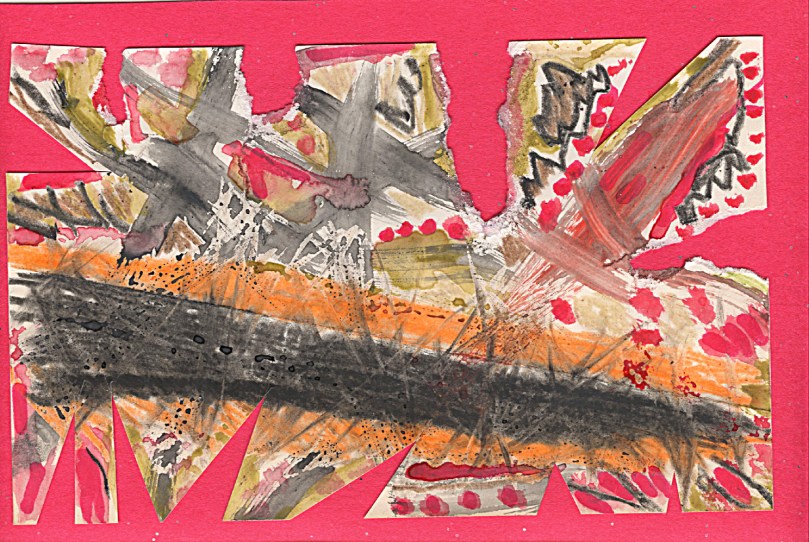
+THESE 1983 – 1984 WRITINGS LED TO TODAY’S EARLIER POST….

+++++++++++++++++++++++++

I just spoke with a dear friend I’ve known for 30 years.   She suggested that I think about how the animals and bugs and plants and rocks exist on this earth.  Then think about this:  “Life is empty and meaningless and it doesn’t mean anything that it’s empty and meaningless.”

Then I can think about how humans add meaning because we can think.  That means that it’s all made up.  My friend’s suggestion is about how I might as well make up something I like for a life.  She’ll call me on Sunday to check in with me and see how I am doing in my new meaningless life!

I have to take a break from here until Monday while I try this out!  Have a great weekend!

++++++++++++++++++++++++

Nothing about being raised and abused from birth and for the next 18 years by my incredibly mean, psychotic borderline mother has made my living in this world easy.

++++++++++++++++++++++++

December 28, 1983

Coming alive is a tenuous, delicate, natural thing.”

++++++++++++++++++++++++

As can be seen in my post from earlier today, I have lost my tolerance for facing myself in my age 31 and 32 year old journals.  I am including the link here for those writings I have transcribed so far.  What follows in those journals are the kinds of desperate questions about myself and my life that led to today’s post +THE POWER OF JOURNALING – ASKING A QUESTION THAT HAS AN ANSWER

+++++++++++++++++++++++++

LINK FOR LATEST JOURNALS TRANSCRIBED:

*Ages 31 – 32 – August 13, 1983 through January 22, 1984 Journal

+++++++++++++++++++++++++

+THE POWER OF JOURNALING – ASKING A QUESTION THAT HAS AN ANSWER

+++++++++++++++++++++++++++++++

I am in a battle with myself over whether or not there is any value to myself or to anyone else in my reading and transcribing my quarter of a century old journals.  Part of me wants to burn them all.  I think about how to contain the fire I could make of them so no smoldering ashes would escape and float away to light some part of this dry high desert landscape around me on fire.

Maybe I could tear them all into tiny pieces and soak them in water and then cook them into papier mache mash and make something beautiful out of them.  Maybe I could tear them up and dig them into the damp earth of my composting pile where I know the hungering masses of worms and slugs there would chew them up gladly and digest them into soil.

Maybe I could box them all up and take them camping when my sister comes next month to visit.  We could burn them more safely in the contained campground fire pit, have a little releasing ceremony and let all the words that record what all the versions of Linda talked about for 25 years vanish as if they had never been.

++++

What is the value of this journaling process that so many therapists (and others) seem so fond of recommending?  We could just as well write our words on an area of flat dirt and then sweep them away when we are finished.  We could just as well write them with chalk on slate or with grease pencil on a mirror or a piece of glass, and erase them as soon as they no longer hold any meaning to us.

Who are we telling the intimate details of our lives to as we sit alone and tarry over our silent words so studiously copied as if we are creating lessons for ourselves out of nothing but the contents of our minds?

Does journaling help us tolerate our hard times, I would say ‘better’, but I really mean ‘tolerate them at all’?

Or does the writing simply contain the passage of time as we transition through all the changes that happen to us along the way of our lifetime, both outside of us and within?

Does journaling help us to think more clearly?  Do we create a dialog with our self because we are so alone there is no other person alive we can trust enough to pass ourselves on to?

What is it about writing the words our souls tell us in hidden places between two covers of a journal that helps us or heals us?  And in today’s world where keyboards replace ink or lead, our words simply join some cyber network, taking their place in simultaneous land where they enter themselves into an invisible cue, waiting for whom to go back and read them?

++++

Or do those of us who write do so simply because we are writers?  Could we find a writing gene somewhere in our constitution if we knew where to look for it?  Do we write because we care about certain things in a particular way that non-writers can’t even imagine?

++++

That would be all fine and worthy if I could SEE what matters about the process of journaling for me in the end.  What I am finding instead is that the same concerns I wrote about 25 years ago are really right here inside of me today if I let them be.  Questions.  I asked thousands of questions on those pages that I had no answers for.

I recorded my inner conflicts and turmoil and suffering.  I recorded how it felt to be so lost from myself and others that I could only ask the questions themselves and could never find any answers, no matter how committed I was to finding them.  The answers were intangible.  They were invisible.

++++

My journals portray my journey, each word on a line in the order I could see them.  Writing was my way of trying to organize and orient myself in my body in my life.

Time has moved forward.  My children grew up, left home intact, and have orchestrated their own lives free from trauma.  Because I was their mother, far from perfect but ‘good enough’, their journey will always remain connected to mine but not central.

In the meantime my journals reveal all the turbulence, all the missteps and attempts I have made to catch up to a Linda who was living a life that never has been coherent or integrated or cohesive or well planned.  I know now that I was always trying to make sense of myself in my life even though I was missing all the most important pieces.

I mistakenly thought I could create an ordinary life without knowing the extreme, long term abuse I suffered from birth and for the 18 years of my childhood had changed the way my body-brain developed, and had therefore changed me.

Not only was the development of my right and left brain hemispheres changed, and the corpus callosum that connects them and transmits information between the two changed, but also the development of my higher level thinking cortex part of my brain was changed, as well.

I have avoided writing about the development of my ‘executive cortex’.  When I am ready to do so I will have to consider how child abuse deprived me of an ‘ordinary’ ability to process information about the future and affected all my choice and decision making abilities.

Normal, ordinary brains that form without a history of severe abuse and trauma continue to grow all the way through the teen and early adult years.  A normal, ordinary cortex does not finish its development until somewhere between ages 25 and 30.  A severely abused and traumatized child’s cortex atrophies early and never finishes its development to become normal and ordinary.

++++

Nobody was there to stop me just as I crossed the threshold out of my parents’ home and into my own life when I was 18 to tell me that what I had just endured of a childhood was hell, wrong, and extremely hurtful to me.  Nobody explained to me that the trauma I had suffered from birth had so changed the way I had to grow and develop so I could survive it that it meant I now have a different brain that works fine in terrible, toxic, malevolent, threatening, dangerous and self-obliterating conditions but was not designed like an ordinary brain to work well in an ordinary, benevolent world.

Maybe nobody told me this in 1969 when I left home because nobody knew it.  Certainly if all the infant and child development experts didn’t know these basic facts, if the human brain development neuroscientists and physiologists didn’t know, I need not blame myself for not knowing this critical information about my chances for achieving any quality of well-being in an ‘ordinary’ life, either.

++++

So what exists in the last 25 years of my journals in their piles on the shelves beside my computer desk is a simple chronicling of one severe child abuse survivor’s disorganized, disoriented incoherent life story about how the changes my body and brain had to make so that I could survive the hell of my childhood could not possibly have prepared me to live any kind of an ordinary life.

++++

I look up above me right now as I sit here outside my door writing in the high desert gentle sunlight of this early November 2009 morning and watch the wispy tendrils of clouds drifting, white against the distant blue sky, and I know that’s the same sky that caps the lives of everyone living below it.  At the same time I know there are two kinds of people on this planet, plain and simple, no matter where they plant their feet on this grand planet earth.

There are those whose early caregivers loved them and cared for them appropriately when they were an infant-child the way human evolution has dictated in order for an ordinary-functioning brain to grow and develop.  They provided safe and secure attachment for their offspring.

And then there are the rest of us who were not loved, who were treated malevolently by our early caregivers.  The traumatizing circumstances of our early environments demanded of our growing early body-brain that we change and adapt or we die.

There are degrees of change just as there are degrees of trauma, but because I know so clearly what the circumstances of my infancy and childhood were as a result of my mother’s psychotic break when I was born and because of her severe mental illness, I no longer have to ask the thousands of questions I used to ask in my  journals without being able to find any answers.

There remains only one single answer that matters to me now.  It’s the same answer for every one of those questions I have been asking all of my adult life as I tried to make myself into a ‘better’ and a different more ordinary person who could then live a more ordinary life of ordinary well-being.

The reason I cannot become an ‘ordinary’ person is because I have an ‘extra-ordinary’ brain that had to grow, develop and form under the ‘extra-ordinary’ circumstances of severe trauma and abuse that was my infant-child environment.  My trauma-changed-body and brain does not receive ‘ordinary’ information from the environment in ‘ordinary’ ways.  It does not process information in ‘ordinary’ ways, either.  There is very little about severe-abuse-and-trauma-survivor Linda that is ‘ordinary’ or can EVER be ‘ordinary’.  Just because I look ordinary on the outside tells me nothing about how I am different on the inside.

If I continue to ignore what I now know about being a changed-by-severe early abuse and trauma person, I will condemn myself to the continued struggle of asking questions forever that I will never find the answers for.

++++

I realize now that all my journal writings up until this point in time have created a chronicle of my journey through adulthood with a changed body and brain, and what this has been like for me.  Continued research is now chronicling the life long changes severe abuse creates for its survivors on a much larger scale.  The outcomes appear extremely bleak and grim for survivors.  We have to put the facts together and realize that the very foundation in our body and brain has been changed, and these changes give us a changed life outcome.

It is not possible for us to escape the consequences of what was done to us until we begin to understand how we changed and how those changes continue to affect EVERYTHING about us and our lives.

++++

For those of us who journal, we will see in our own words how exploring ourselves in our life will change as we begin to include this vital information in our thinking.  Just because everyone else has remained ignorant of the changed body and brain because of early trauma and abuse survival information, does not mean we have to remain ignorant of the facts ourselves.  We owe it to ourselves not to continue archaic patterns of thinking about ourselves in the world.

In fact, those of us who experience this ‘extra-ordinary’ reality are the REAL experts.  We know, down to our last cell in our body, what being changed by child abuse and trauma did to us.  We know our truth.  Now we have to empower ourselves to know what we have known all along.

Together we can define what living in a trauma-changed body is like.  On this planet earth, under this arching blue sky, we have to begin to understand that what humanity’s right arm might know about being ‘ordinary’ is balanced by what humanity’s left arm knows about not ever being allowed to both be ‘ordinary’ and remain alive.  We can no longer afford to let ‘ordinary’ condemn us to a lifetime of suffering because of who we are – different from ordinary.

We can join together to learn how to end the suffering of all of us.  A reality of privilege can no longer remain the standard we measure survival against.  If what happened to us had happened to ‘them’, they would have been changed just as we were or they would have died.  That is the reality of being human in an imperfect world.  What happens – and happened – to infants and children that causes these changes must become the primary concern for all of us.

Otherwise we will continue to ask all the wrong questions for which there are no answers.  We need to ask the right question, “How does severe early trauma and abuse change developing humans into ‘extra-ordinary’ beings, and how do those changes affect them for the rest of their lives?”  This IS a question we can find the answer to when we are willing to consider the truth – both individually and as a species.

+++++++++++++++++++++++++++++++

PS.  What will I do with my old journals?  I still do not know.

++++++++++++

+DISSOCIATION: PRESERVING A SELF IN HIDING

++++++++++++++++++++++++++++++++++++++++

We are born with the capacity to learn about who we are, and to remember ourselves throughout our many and varied experiences.  This is meant to happen as we grow from birth being cared for by loving caregivers, people who give us care consistently over time.

It is natural that caregivers understand an infant is not them, but is somebody else, a separate unique individual.  They communicate this knowledge by everything they say and do with the infant.

These patterns of interaction are building the infant’s growing brain.  Humans are designed from birth to be able to see their own separate and unique self as it is mirrored back and reflected to them by their caregivers, who are their attachment humans.

If a parent such as my mother was lacks the capacity to understand that her infant is NOT her, she will overwhelm her infant with information from herself that has absolutely no relevance to her infant’s developing connection with itself.  The infant will miss the critical interactions with its caregiver that are meant to feedback to it information about its own self.

If the infant has access to additional caregivers who are themselves of healthy brain-mind-self, the infant can get at least some of the feedback about its own self from them, and this information will be critical to the infant’s brain-mind-self growth and development.

Without access to other appropriate (secure attachment) caregivers, the infant’s brain-mind-self will not develop in an ordinary way.  Its body will of course continue to develop, but the self of the infant-child cannot possibly find its way into being a cohesive, integrated, clear and affirmed self-hood.

++++

Whatever the break was that happened within my mother’s brain-mind-self, it had consumed her by the time I took my first tiny breath into my body in this world in my lifetime.  She was prevented from ever looking at me and being able to allow my individual self to be born.  She could only see some split-off part of herself in me that she hated and wanted to destroy.

Her mental illness (I believe psychotic borderline) left no room for Linda to be present in my body or in my life.  All I could do was remain buried alive, hidden from her view, protected only by the miracle of life that demands that people remain intact, separate from one another.

In the meantime all the trauma she caused me from birth built my brain, the only one I have to use to get along in this world.  That my brain could not include clear and definable connections to my own selfhood HAD to be the result of my mother being not only my primary caregiver, but with the exception of early contact with my 14-month-old brother and very occasional exposure to my father or grandmother, she was my sole caregiver.

++++

I can try to describe every resiliency factor I can think of that probably contributed to me being able to survive my childhood with my mother so that I appeared on the adult end of my life to be mostly intact and ‘ordinary’.  At the same time, however, I have to include my dissociational abilities as being the most important resiliency factor I have.

The real me I was born as could remain hidden and protected from my mother where she could not reach me.  At the same time the self of me could not come out into the world to play, grow, learn and live.  My self could not be recognized, could not express myself.  My needs were not met except as they invisibly allowed me to continue to exist without my mother ever being able to stop me except by killing my body (which I helped her not to do).

++++

Evidently I was born strong.  But who and where and how the essential me is in the world still remains extremely difficult for me to detect.  I can sit here writing on this pad at this moment in time with this pen in my hand and hope I am at this moment able to open a clear, true pathway that allows the real me, the hidden-away-from-my-mean-mother me, to speak these words.

It’s like I have to keep the deep, pure waters within myself perfectly still without a single small ripple in order for the real me to appear in my life.  I do not believe this is the way ordinary people have to engage their self.  Life is busy.  It is full of stimulation and changes.  One’s self is supposed to be able to maintain its integrity in spite of external (distracting) factors.

It is only when the environment I am in is quiet, peaceful, safe and predictable that I can experience my core self.  Once anything hits my inner still pool and causes a ripple, my inner me vanishes and I cannot reach her.

When a disturbance happens, a frantic feeling that translates into anxiety follows, as professionals call this state along with the host of other labels they insist on using to describe what my fragile connection to my own true self looks like or seems like from the inside of me.

I am left having to be so careful – so full of care concerning my self in this world — now at 58, because nobody was there in the beginning to do it for me.  I can think about my connection to my self in today’s world as being like a frequently ‘dropped call’.  When life challenges me, the resulting disturbance inside of me causes a ‘call lost’ reaction.  Then some version of Linda has to keep on going, the best way that it-I can until circumstances change and complete calm around and within me returns.

Believe me, this is a hard, hard way to be in this world.

++++++++++++++++++++++++++++++++++++++++

This is a duplicate of *Age 58 – November 5, 2009 – A hard way to be in the world

written for my adult story pages on dissociation

++++


+BEING THE ‘ME’ I DISSOCIATE FROM

+++++++++++++++++++++++++++++

I believe there is a difference between being a self and having a self.

‘Having a self’ is complicated for those of us who grew up under severe abuse situations that created dissociational patterns in our brains.   Sometimes it seems I have a different self for every single moment of my life that passes by me in time that is especially dependent upon whatever demands are being made of me at any given moment.   All of them are, of course, specifically confined to this body I was born with.  The whole process, whatever it is, seems connected to memory and to feeling because it involves ongoing experience and the passage of time.

Fortunately, I do have a single self that is the one I call ‘being in the world’.  It seems to be the ME that all the other versions are a dissociation from.

As I grew up from birth,  ‘being a self’ only happened when my mother was absent from being near me, and therefore from hurting and terrifying me.  ‘Being a self’ only happened when I had no feelings, and no thoughts, as I describe here:

*Age 58 – The simple state of just being in the world

+++++++++++++++++++++++++++++

NOTE:  For me, writing itself can be a disorganizing and disorienting experience.  Many times I am acutely aware that the version of Linda that writes a post vanishes as soon as the post is completed and published.  I cannot then go back and edit a post, remember what I wrote, or often even reread it.

I am having this experience today in relation to the post I wrote yesterday.  I can only hope that there is something in it that touches the minds, hearts and lives of all those much-appreciated readers who have stopped by my blog today as the count is the highest it has ever been since I began this blog last April.

Please always know you are welcome to leave your comments!  They are always welcome and appreciated!  Linda

++

+DISSOCIATION IS ORDINARY AND NORMAL WHEN OUR CHILDHOODS ARE NOT

++++++++++++++++++++++++++++++++++

Breaking free from denial (magical wishful childhood thinking) about our histories of child abuse is essential at some point for any recovery to be initiated.  In these next journal pages I began my attempt at that process.

This section of my age 31 journal covers my entry into trauma and addiction treatment.  My childhood experience of severe trauma was recognized and validated in this treatment process, but evidently once therapy began in earnest I was expected to turn my journal writing into my therapists and I complied.  I have no record of that treatment process.  The treatment center closed when the owner died about 10 years ago and evidently all records were destroyed.

From my 2009 perspective of today, I suggest that very few, if any severe child abuse survivors made it through their childhood without dissociating.  I now understand that even though I did not dissociate during the incidents of abuse I experienced for 18 years, I did dissociate BETWEEN them.  This means, as I have said before, that my experience of my own childhood is in dissociated fragments.  What I know now is that “as it was in the beginning, so shall it forever be.”

I do not believe there is any way to ‘heal’ myself from this fact.  It is just as important, however,  for me to recognize the dissociation built within me as it is to recognize the horrors and traumas that caused it from the time of my birth.  No therapist I have ever had helped me to understand what dissociation truly is, how it affected my childhood development and how it affects me today.

And as I begin to understand these aspects of myself now, I also am coming to understand that I am NOT BROKEN, I am simply different from ‘ordinary’ people as a result of having survived extraordinarily traumatic childhood experiences that changed me during my critical stages of child development.  In my case, I do not see dissociation as the proverbial and supposed ‘defense mechanism’ professionals seem fond of naming it.

My dissociation is not ‘psychological’ in any Freudian sense.  There is simply more than one way to ‘be’ in the world because there is more than one kind of world to ‘be’ in.  How our body-brain-mind-self gets made in the first place is a result of which kind of world we were living in while our development took place.

My dissociation happened because the separate incidents of horrible trauma that happened to me as an infant-child made no sense.  There was therefore no way for my brain to ‘associate’ them together.  The only pattern present was unpredictable, violent, scary insane chaos and nobody’s brain can build itself in any ‘ordinary’ way under these kinds of malevolent circumstances.

I was not, of course, even remotely aware of my dissociation as I wrote the June pages of my 1983 journal.  I simply recorded what I thought I remembered from my childhood, but even this was a significant step.  I had never done it before.  In the end, it is not the details of the traumas themselves that I may or may not remember (over 90% of them I’m sure I never will remember consciously) that matter.  It is how my growing body had to adapt and change as a result of experiencing these traumas that matters to me now.

++++++++++++++++++++++++++++++++++

*Age 31 – Journal Starting June 10 to 27, 1983

++++++++++++++++++++++++++++++++++

++++

I do not wish to leave the information contained in these links behind as I continue with my posting.  Please consider them for your study:

+RETURNING WITH AGE TO HOW I HAVE ALWAYS BEEN AND DIDN’T KNOW IT: DISSOCIATED

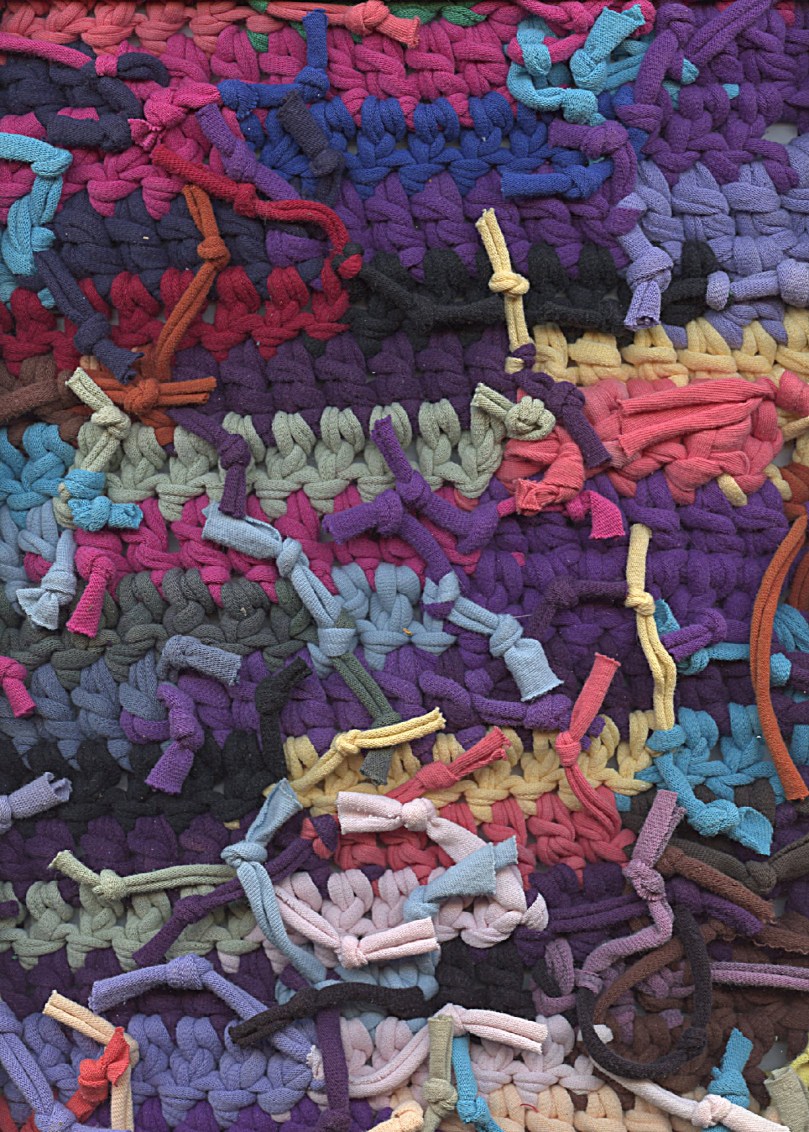
1 t-shirt mat
From the time we are conceived life in this world it is full of stimulation and changes. In a mostly safe and secure world we can accept them all and our experiences of transition and change moves smoothly along as we grow into a person with a self that can connect all our experiences together into some kind of fabric that is the whole of our life. This image reminds me of a safe and secure organized attachment!
2 t-shirt mat
The reverse side of my little crocheted T-shirt rug reminds me of organized insecure attachment. The transitions between 'events' has been made, but on the inside some vestiges of lack of smooth transtions between experiences remains like little loose ends that most organized insecurely attached people remain completely unaware of.
3 t-shirt mat
This would be an extreme illustration of a disorganized and disoriented insecure attachment disorder. Life has been too traumatic, and without safety and security to make transitions between traumatic and nontraumatic early experiences, the body-nervous system including the brain, the mind and the self of someone raised in a malevolent world will not be able to put things together to make a solid, coherent 'story' of their self in their life.

+++++++++++++++++++++++++++++++++++++++++++++

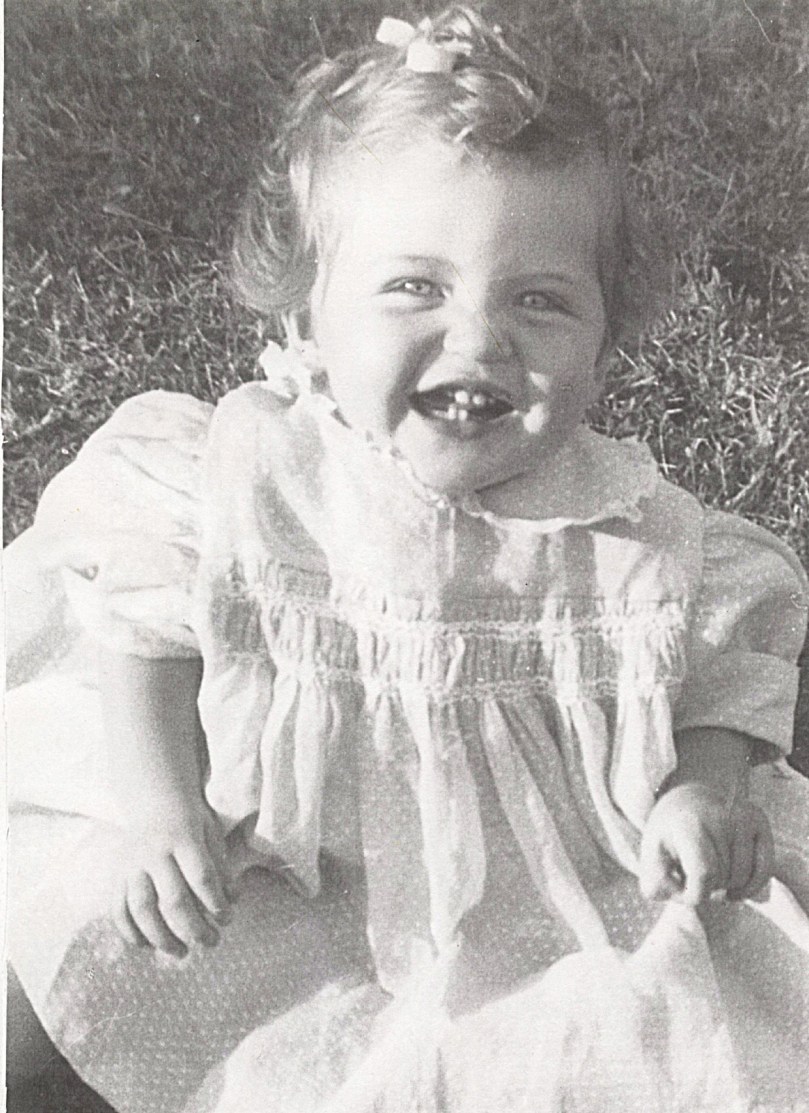
This is me at 11 months old, all dressed up with curls in my hair. This is me looking 'happy' during a picture taking event.
11 month old 'happy' me - mother allowed it at this moment -- it was 'be happy, picture taking time' -- which had nothing to do with my 'other' ongoing realities
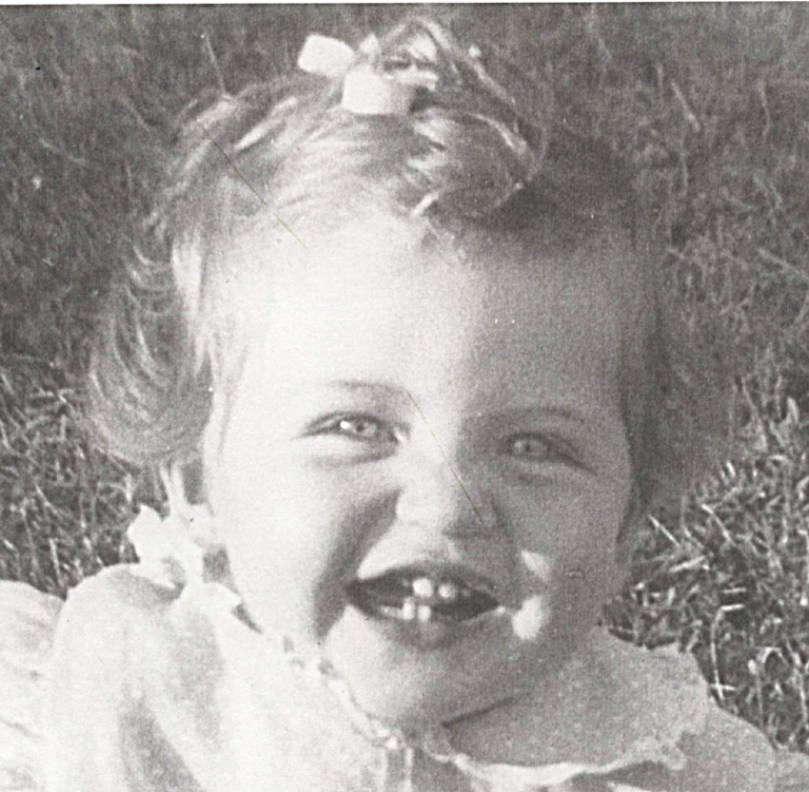
1952 closeup - 11 mos baby pic
Yes, 'happy' for this instant, but I now know this is a dissociated state. It was not part of any ongoing safe and secure organization of my baby brain as it had formed itself through chaotic, unstable and dangerous early caregiver interactions. (I can't get the scratch damage off of the photo at present)

+++++++++++++++++++++++++++++++++++++++++++++

When I first found this photograph of me two years ago in MY BABY BOOK I was pleased to see that I could ‘still be happy’ when I was eleven months old.  It gave me hope that at least some of my developing baby brain’s left hemisphere happy center neurons had been activated, and gave me hope that I can find them today and build on them.

Then the more I considered my baby picture, the more I realized that this happy picture was not showing me ‘sun and roses’.  I have come to understand that this was a dissociated state that baby me was not going to be able to transition  smoothly in my baby brain to any other kind of state that was likely to follow. What I first saw as an expression in my baby eyes close to ecstatic I have come to see as over-stimulated, too intense, and most likely a sign of my dysregulated right limbic brain development due to my mother’s psychotic abuse of me.

The early and ongoing environment I formed in was chaotic, unstable, unpredictable, often terrorizing, terrifying, violent and painful.  Safe, secure peaceful serenity and calmness did not form itself at the center of my body-nervous system-brain-mind self as it was supposed to.

My set point of balanced equilibrium is not at calm.    Patterns of adjustment and adaptation to my infant-child malevolent environment, which happened to a large extent through dissociation,  had to build themselves into me so that I could survive and ‘go on being’ — and now I clearly know they are still there.

+++++++++++++++++++++++++++++++++++++++++++++

I had an experience last night that gave me a clear insight about how I am in the world.

Around the time of my 1980 – 1983 journals I am transcribing from around my age of 30, I could function in the world in a relatively ‘ordinary’ way.  Now, through circumstances of my life, I have returned to who-how I have always been in the world and didn’t, until now, have to know about.  Just using the experience I had last night as an example, I can see that

(1) first I learned how to get along in both of the worlds of my childhood, the chaotic, malevolent, insanely abuse world of my home life with my mother, and in the ‘ordinary’ world outside my home such as school.

(2) Once I left my childhood abusive home, I found myself living entirely in an ‘ordinary’ world.  I could fake it by then so that only those in my most intimate circle of friends could have known that things were not all right with me on my insides.

(3)  I continued down that trying-to-be-ordinary road all of my life until two things happened to me that brought into focus in the forefront how ‘unordinary’ I really am.

(4) After 35 years of having a child under the age of 18 in my care, my baby left home nearly six years ago.  I didn’t know what was happening to me at the time, but looking back the disorganization and disorientation of my insecure attachment disorder reared its head.  Breast cancer manifested itself in my body immediately, although I was not to discover its presence for another 3 years.  It seemed that the entire world of my life dropped out from under me and I tumbled down Alice’s not so wonderful rabbit hole, disoriented and disorganized and not having a clue what that was.  Then

(5) happened.  Finding out I had cancer so completely threatened the only true source of safety and security I had ever known, my body itself, and coupled with the terrors of treatment and the consequences that chemotherapy had on my brain, left me where I am today — on mental and emotional disability with an extremely limited arena of activities that I can tolerate with any degree of comfort.

I have lost any way I developed (learned) to transition into an inner feeling state of calm, serene, safety within my body no matter where I am in the world.  This ability never developed at my core as it was supposed to from infancy.  For me, a state of calm equilibrium has evidently always been a dissociative state, and seems to be one that I now have lost access to — unless I can ‘get there’ through remaining in a very controlled, calm and quiet external environment which then ‘soothes my soul’.

++

This leads me to last night’s adventure.  A close friend of mine encouraged me to attend the local Fiber Arts Guild meeting that was preceded by a fantastic presentation on African textiles.  Of course I am not presently comfortable with people at all, certainly not with groups of people, certainly not with strangers.  I am not comfortable in small closed environments.  I am not comfortable with ‘noise.’  But, in light of my recent journal transcribing realization about how important weaving and spinning and related textile arts are to me, and considering that I want to TRY to ‘get better’, I went to this meeting.

Nothing disastrous happened, which is great.  But what I felt on the inside, and can still feel today is both intensely disappointing and creatively illuminating.  We cannot work with trying to change or improve what we cannot see about ourselves — so now I have some clearer information.

++

In light of what I now understand about how insecure attachment disorders exist in the brain as a result of changes that happen when we are very young and our brains are growing and developing in the first place, I can FEEL and begin to understand the damage done by these changes.  My right, social, limbic, emotional brain does not receive or process ordinary information in ordinary ways.  For all the years that I was able to ‘function’ in the ordinary world in a ‘good enough’ fashion, I was able to work around and hide what my brain was really doing.  I can’t do that any more.

Too much stimulation.  My brain does not regulate input or experience correctly.  I cannot do what experts call switch states, or move smoothly and comfortably through what is called transition states.  In that group of around 40 women last night, the walls began to close in, sound became a noisy roar.  Faces became super animated, and people began to get larger and larger in relation to me.  Noise and more noise as I lost the ability to focus on one single pattern of sound or conversation.  I tolerated nearly three hours of this mayhem and madness (to me), and began to crave silence, calmness, peace and simplicity.

Because my internal self cannot provide these things for me, I am nearly completely at the mercy of where I am and what is going on around me physically and externally on the outside of my body.  It is not supposed to work this way — not in ordinary situations.  Our right brain, in balance with our reasonable left brain and our rational cortex, is supposed to be able to navigate throughout life with the peace and calm on the INSIDE of us.

++

I feel I am failing at a description of what I am trying to explain and describe, so I added some visuals here that might be able to convey an image on the OUTSIDE that relates to what I know on my INSIDE.  Part of what I did to self-soothe my ‘anxiety’ level from too much stimulation last night that continued to reverberate in my brain and body, was to pick up the closest thing I could find and begin working with my hands which always calms me, focuses my attention, and provides a transition space for me to deescalate.

(My condition makes me think about the increase in ADHD and autism and about how little researchers know or are willing to admit about what they know about what is causing this condition among today’s children.  I suspect it will eventually be tracked back to inadequate conception to age one brain development — because we are losing our ancient wisdom about taking care of our babies right during early critical brain and body developmental stages.)

++

Those women last night were ordinary women who meant me no harm.  They were not threatening.  They were not dangerous.  I was not in danger of being further traumatized.  But the oldest part of who I am and how I operate in this body in this world does not seem able to any longer put on the town dress, put curls in my hair, walk out into the world and be able to smoothly handle multiple stimuli from the environment and the required transitions that would enable me to be comfortable.

++++++++++++++++++++++++++++++++++++++++

+SUNFLOWER, SELF, DISSOCIATON AND THE SEEDS OF LOST MEMORIES

++++++++++++++++++++++++++++++++++

I have had the image of sunflowers (in relation to the self and dissociation) in my mind for days now, so I guess I need to go ahead and write what I am thinking so  my thoughts can move off to something else.

Under ordinary conditions an infant is born into this lifetime with the potential to create a wonderful whole and healthy self.  All its experiences are integrated and stored at its center as they grow to fruition during a lifetime.

When severe trauma in a malevolent environment surrounds an infant-child, and dissociation has to take over the job of handling the memory of traumatic experiences, all this person’s ‘seed memories’ will not be central at the center of the flower of self.  The self will not be able to organize and orient itself in the ordinary way.  Instead, many or most of the seeds of experience will be missing, not connected and integrated at the center of self.

Perhaps it’s like the birds steal all the seeds away.  Perhaps it is like the seeds are simply missing, or scattered somewhere so we cannot find them.

seeds - sunflower
How can a self form right if trauma steals all the seeds of our memories?

Yet our trauma memories and reactions can pop up, unanticipated, unexpected, any time they are triggered.  We cannot control this.  It makes life hard.  It makes us different.  We cannot search for and find all our lost memories, all the lost parts of our self and put all the seeds back in our center where an  ‘ordinary’ person’s seed-memories have been stored all along — even if we want to.  And some part of our self flies away or gets lost with each disappearing part of our history.

Yet we are the same as everyone else.  We are all STILL sunflowers, even if our self is a different kind of self.  We are still beautiful, turning to follow the sun as we stand with everyone else in the field of life.

++++++++++++++++++++++++++++++++++

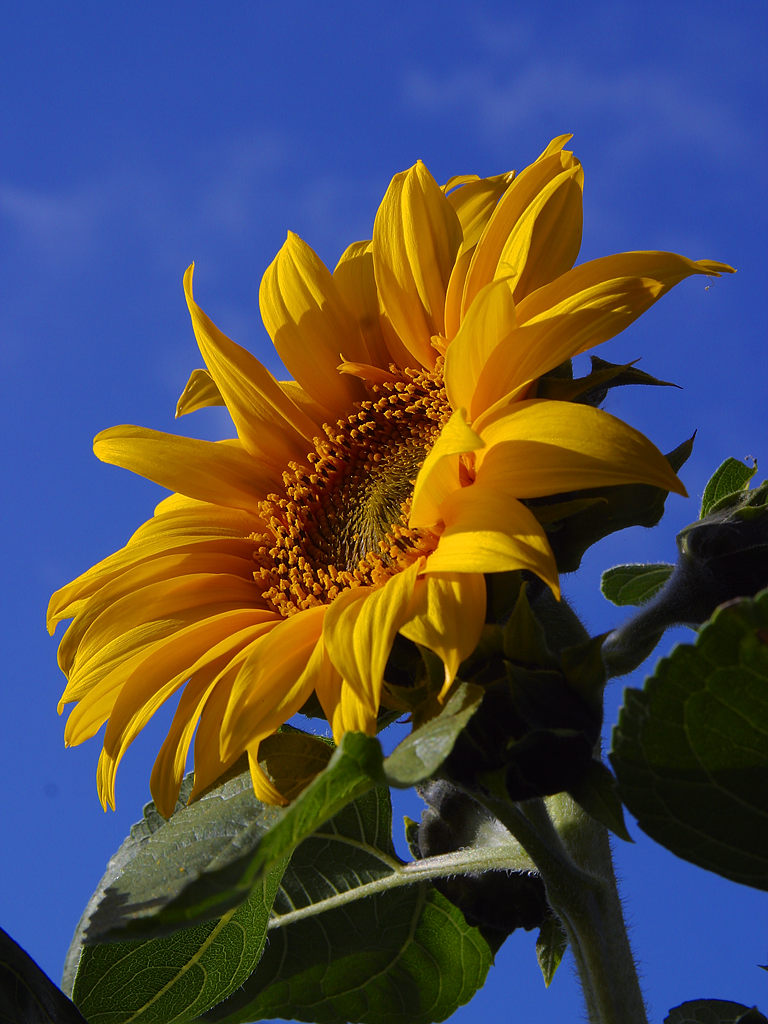
sunflower
Sunflower -- I am thinking of the sunflower as an image of a self -- Photo courtesy PDPhoto.org
sunflower-sunset
Lots of sunflowers, lots of people in the field of life

Sunflower as the image of self, all the seeds organized as a part of the flower, in the center, memories of our expriences -- unless - - - -

++++++++++++++++++++++++++++++++++

IN MEMORY OF MY MOTHER:

Borderline Personality Disorder

In the Spotlight | More Topics |

from Kristalyn Salters-Pedneault, PhD
BPD is a disorder that is often misunderstood and frequently stigmatized. Do you dread telling people about your diagnosis? Are you tired of trying to correct the myths about BPD that are out there? This week’s newsletter is for you!

In the Spotlight
The Stigma of BPD
The general public today is as afraid or more afraid of people with mental illness than they were decades ago. And people with BPD are among the most highly stigmatized groups.
More Topics
BPD Mythology – Help Challenge These Myths!
Borderline personality disorder is a very real and serious mental illness. It is not a “personality problem” or just a set of maladaptive ways of coping with the world.
Should You Tell Others Your Diagnosis?
Lots of you report that you’re afraid to tell other people about your BPD diagnosis. When is it safe to tell? Here are some guidelines…

++++++++++++++++++++++++++++++++++++++++++++++++++++++++++++

+TODAY’S ARTWORK – A BORDERLINE MOTHER’S DAUGHTER –

+++++++++++++++++++++++++++

*Age 58 – Artwork October 29, 2009

++++++++++++++++++++++++++++

I could wonder if my spontaneous, quick art work images will ever come out innocuous instead of intense and unsettling, but then I would be contradicting myself.  When I write about not believing images come from any invisible ‘inner child’, I am at the same time very aware of how people could interpret this kind of creative process I am doing as being related to having an experience with such an invisible entity.

3 102909
From today's artwork link - Borderline Mother

What I know about how my child abuse altered brain operates helps me to understand my artistic process in a different way.  Particularly because my Borderline mother’s abuse of me began when I was born, neither of the hemispheres of my brain nor the way they operate together developed in an ‘ordinary’ way.  All of us have access to an unending storehouse of images.  The biggest problem is trying to get around our left brain’s inner critic, as  Betty Edwards describes in her excellent books about drawing.

Perhaps because of the affects my early abuse had on my developing brain, I have an almost literal switch I can flip, or a door I can simply open, that turns my left brain critic off and allows my creativity to escape.  I don’t believe my left and right brain hemispheres ever developed an ‘ordinary’ working partnership with one another, so I-Linda am learning that I can tell them what to do.  I can tell my left brain to just get out of the way, making an art image is not its concern.

There is no reason for any of us to worry about how we make our images, what they contain, or even what they look like.  To me, the important part of the process is simply to trust ourselves with the process of creating a representation of any image our right brain passes ‘out’ to us.  As humans, we have a clear inner sense of imagery.  What I really suspect is going on is that, as Alice Miller considers in her book I mentioned in yesterday’s post, Pictures of a Childhood: Sixty-Six Watercolors and an Essay, is that being an adult in our ‘modern culture’ makes us afraid of the image making process because we are afraid of what we will see.

Images cannot hurt us.  Giving them tangible visibility will not hurt us.  Most likely we will be helped, not harmed.  If we ‘give birth’ to an image that is intense or unsettling, all we have to do is put it away somewhere and keep it for as long as it takes for us to be able to be able to tolerate our own images so that we can witness our own expression.

++++

Every image has something powerful to say.  Because we are often raised, particularly those of us with severe child abuse histories, unable to stand in our own power as individual selves, it is often the experience of the power of creating itself that feels frightening to us.  Making art is a personal-power-enhancing process that belongs to all of us.  It is very simple.  We simply have to give ourselves permission and that whole world of making art is ours.

I am working with dollar store art supplies.  I use larger 5″ by 8″ index cards.  These ones happened to be included in a metal file box designed for that sized card I bought at the thrift store to save my childhood-related photographs in once they have been scanned and posted.  I like that size, though any size will do.  One advantage of choosing a size to begin an art image exploration series is that the limitation of size becomes a freeing factor because it does not need to be renegotiated as a choice every time a person begins to work.  I also have glue and colored paper, cheap paint, markers and crayons.  I am wishing for some oil pastels, but I don’t have any and that lack is NOT going to stop me.

I am, of course, encouraging every single one of my readers to get themselves some basic art materials and something to put them on, and go to work playing with their own image making process.  You will be amazed at the process and the results.  Show your images, keep them, hide them, post them.  One thing I strongly recommend is that on the back of whatever you make, always put the full date and the sequence number of the piece for the date you make them.  I can — and probably will at some point — explain why this matters.

++++

If I wanted to ‘work with’ my own images as an art therapist, I would have my work cut out for me.  They seem simple, they produce themselves quickly, but each one holds a universe all its own of ‘in-form-ation’.  I’m not at all concerned with that right now.  I only want to make them as a part of my commitment to myself to allow my self to ‘speak’.  I am eager to discover what this process has to teach me — both the process of making and the art images themselves.

But I do not wish to fly too close to the sun.  I have no intention of overwhelming myself by being too brazen about ‘digging out the truth’.  Whatever I do or don’t do, the truth already exists.  I simply need to get strong enough to visit it.

+++++++++++++++++++++++++++

Don’t miss this

Traumatic Childhood Can Reduce Life Expectancy

+++++++++++++++++++++++++++

+THE GLIMMER OF BEGINNING TO KNOW WHO I AM

+++++++++++++++++++++++++++++

I was feeling better in this section of my journal that ends on my ‘Golden Birthday’ of turning 31 on the 31st of August, 1982.  I was beginning to take form as a person, becoming less hollow and less like a ghost-girl in my own life.

I think the successful definite steps forward I had made by working through some very difficult school work bolstered me.  My feet might have still been mired in the unknown of my past, my ‘true self’ was still missing in action, but the woman I was becoming had begun to find some sunshine for herself.  The vigorous exercise workout I was doing made me physically strong and began to anchor me into my body.  I was gaining a sense of self-confidence for the first time in my life.

I now had nearly two years ‘clean and sober’ (from nonprescription drugs), had a sponsor and faithfully attended at least one AA meeting every week.  I also attended a weekly woman’s growth and support group through the local mental health center.

Part of my transformation was coming through my ‘discovery’ of so-called ‘feminism’ as I began to understand that women experience their lives very differently than men do.  I believe I was for the first time beginning to collect for myself a sense of my own personal empowerment.

*Age 30 – Journal from May 1982 through August 1982

+++++++++++++++++++++++++++++

May 22, 1982

Things OK in the water bed – Leo is keeping to himself.  I think he’s afraid to touch me – sometimes I’d like to be touched; not sexually — just touched.

++

We could not get anything larger than a double bed up our little stairs, so the king size water bed was the only solution we could think of.  Well……

++

I knew inside on some level there was something ‘wrong’.  I really knew.   I found this in one of my little poems on this date —

Do I have a personality

When there’s no one here but me?

++++

June 9, 1982

Perhaps calcium now

Will help calm me down

But I don’t feel like myself

My spirit feels larger

Than my body

Like a wad of bread dough

Or play dough

Yellow

++++

June 16, 1982

Decided I may try writing an autobiography –

++

I record a 2009 note with this journal entry about two statements made, on two occasions by two different people — that changed the course of my life — because I heard them and I knew they were true.

++++

June 26, 1982

Been cleaning – sorting clothes in closets and dressers all day.  Felt real depressed yesterday – [Doctor] decided to up the Imipramine to the 150 mg.  I was taken off of Desipramine – slow the thoughts down – don’t handle being alone very well.

I could not handle letting my own inner reality surface — not yet, anyway.  I can sense my insecure attachment disorder here, like an invisible electric current running inside a live wire.

++++

July 2, 1982

I’m feeling my wild feeling, and walked down the “trail” to an old grain wagon parked in the grasses.  The sun is still above the horizon, and it is hot.  Clouds below the sun will soon swallow it.

Wind is rustling the trees, and I am reminded of the homestead – the trees on the mountainside and the river on the valley floor.

I’d like to be that wind – free – from thought.

++

Oceans lie where we can always find them.  Why can’t I?

++

And as I write, capturing time,

I can reread, and see my past

In my present.

++++

August 3, 1982

Now

I’m a spider

Expertly spinning

My thoughts

Into miraculous

Flowing webs

When I’m depressed

I’m a fly

Tangled

Frightened

Captured

By these same

Silken

Threads

++

I just had a 2009 thought as I read this.  I wasn’t only unaware of HOW to feel, I did not know HOW to think, either (not about anything personal).  I did not grow up in my insanely abusive childhood being able to think.  ‘Ordinary’ childhoods, without a need for continual and nearly constant dissociation, no doubt allow children to grow up THINKING, and to grow into their thoughts.  I never had that opportunity to get familiar with my own thoughts, to practice being a person WITH thoughts.  No wonder ‘thinking’ felt so foreign, uncomfortable and dangerous to me!

(Also glad to see at least I was still doing some spinning and weaving at this time.)

+++++++++++++++++++++

AND A GIFT OF INFORMATION FROM:

Prevent Child Abuse New York Blog


Making Kids a Priority


Posted: 29 Oct 2009 10:57 AM PDT

Guest post by Michelle Gross, Project/Public Policy Manager, Prevent Child Abuse New York

In this recession, working families are struggling to meet their children’s basic needs. Five out of six children in low-income families have at least one adult who works.   These families are struggling to keep a roof over their heads, food on the table, and gas in the car so they can get to work. The stress of these difficult financial times takes the heaviest toll on at-risk families. More than ever before, programs that support families, like home visiting, parenting education, family resource centers, fatherhood and kinship support, and child advocacy centers play a pivotal role in ensuring a stable and more prosperous future.

Yet, these services continue to be in danger of funding cuts. New York’s families’ health and well-being rests on the voices of advocates like you.  As we prepare for the New York State Budget proposal for 2010-11, we must be vigilant in continuing to contact our state government representatives, from the governor to the legislature, and even locally. Regularly updating your elected officials on your program’s successes helps to reinforce the important role it plays in supporting families. Every voice counts, and it is up to us to speak for those who cannot. It can be daunting to contact your representative, but your advocacy can make the difference between a program funding cut and a program funding expansion. Here are a few tips on calling your elected official’s office:

  • When calling, you will likely reach a staff member rather than your representative directly. Staff             members can be just as influential as the legislator themselves.
  • Be sure to tell the staff member your name and where you live. It’s important that they know you are a constituent.
  • Inform the staffer of the reason for your call. It can  be as simple as saying that you’d like to make sure the program does not get cut in the state budget.
  • Tell the staffer why the program is important and what difference it has made in your life or the lives of those around you.
  • Thank the staffer for their time and ask for a follow  up if you feel its necessary.
  • Always follow up a phone call with a letter restating your call.
  • Call again in a month just to check in, and ask others to call on behalf of the program. Persistence is key in advocacy!

Again, remember that what you have to say matters. As Margaret Mead said, “Never doubt that a small group of thoughtful, committed citizens can change the world.  Indeed, it is the only thing that ever has.” Children’s needs, long overlooked, should receive the highest priority during critical discussions leading to cuts in the New York State Budget. Far too few services are available at a time when demand is increasing greatly. We encourage our legislators to support programs that work, and to support families through this fiscal crisis.

For more information about Prevent Chils Abuse New York’s Advocacy Programs, please visit our website: http://preventchildabuseny.org/advocacy.shtml

Traumatic Childhood Can Reduce Life Expectancy


Posted: 29 Oct 2009 08:27 AM PDT

A difficult childhood reduces life expectancy by up to 20 years according to a study published in the American Journal of Preventive Medicine. The study found that participants who were exposed to more then five different types of adverse childhood experiences (ACEs) were over 50 percent more likely to die during the 10-year period of the study. On the other hand, people who reported fewer than six ACEs did not have a statistically increased risk of death compared with the control group.

Listen to a podcast Adversce Childhood Experiences and the Risk of Premature Mortality.

To explore the effect that childhood trauma could have on life span, Kaiser Permanente mailed questionnaires to adults who were 18 years and older, and who had visited the Kaiser clinic in San Diego from 1995 to 1997. Overall, the study subjects were middle-class and had good health coverage. Of those surveyed, 75 percent were white, 11 percent Latino, 7 percent Asian, and 5 percent African-American. They’re educated: 75 percent attended college and 40 percent have a basic or higher college education. When they filled out the questionnaire, their average age was 57. Most of them had jobs. Half were women, half were men.

The participants were asked about their exposure to eight categories of abuse or dysfunction based on previous Kaiser studies. One third of the 17,337 participants who replied to the questionnaires had an ACE score of zero, meaning they had not been exposed to any of the eight types of abuse or household dysfunction. The majority of the remaining responders registered a score of between one and four, whereas about 8 percent of the scoring participants were rated five, and roughly three percent, six to eight.

During the next decade, the study authors, kept records of which of the 17,337 participants passed away by matching identifying information such as Social Security numbers from the questionnaire with data from the National Death Index. In total 1,539 of the participants died during the follow-up period. When the increased number of deaths in those subjects with an ACE score of six or greater was compared with the control group, their mortality risk was 1.5 times higher than for people whose childhoods had been free of all eight types of abuse. They lost about 20 years from their lives, living to 60.6 years on average, whereas the average age of death for the control group was 79.1.

It is unclear why the authors saw more death ages during the 10-year period only for the group with an ACE score of six or greater. Previous studies by these authors found that the risk of chronic illnesses, such as heart disease, lung disease and cancer, was greater only for people with these high ACE scores. In contrast, the risk of substance abuse and suicide increased stepwise from low to high scores. The authors found that ACE-related health risks, namely mental illness, social problems and prescription medication use, accounted for about 30 percent of the 50 percent greater risk of death seen in this population. “As would be expected, the documented ACE-related conditions among participants appear to account for some, although not all, of the increased risk of premature death observed in the current study,” wrote David Brown, an epidemiologist at the U.S. Centers for Disease Control and Prevention (CDC), and lead author of the study.

This posting includes an audio/video/photo media file: Download Now

+ALL OF ME. I DON’T HAVE ‘A CHILD WITHIN’

++++++++++++++++++++++

In the words of Alice Miller

— Articulating the child’s authentic voice —

from

Pictures of a Childhood: Sixty-Six Watercolors and an Essay by Alice Miller

++++++++++++++++++++++

“Only when I make room for the voice of the child within me do I feel myself to be truly genuine and creative.  I use every means now at my disposal…to help this child to find the appropriate way of expressing herself and to be understood.”  (Page 17)

++

“Those who take a stand in today’s world on behalf of workers, women, or even mistreated animals will find a group to represent them, but someone who becomes a strong advocate for the child and opposes the lies society has tolerated in the guise of child-rearing practices will stand alone.  This situation is difficult to understand, especially when we consider that we were once all children ourselves.  I can explain it only by suggesting that unequivocal advocacy of the child represents a threat to most adults.  For when it becomes possible for children to speak out and confront us with their experiences, which were once ours as well, we become painfully aware of the loss of our own powers of perception, our sensibilities, feelings, and memories.  Only if the child is forced to be silent are we able to deny our pain, and we can again believe what we were told a children:  that it was necessary, valuable, and right for us to make the emotional sacrifices demanded of us in the name of traditional child-rearing.  As a consequence of the adult’s arrogant attitude toward the child’s feelings, the child is trained to be accommodating, but his or her true voice is silenced.  Another arrogant and blind adult is the result.

Is it not senseless, then, to let children speak, to help them to become articulate in an arrogant adult world as long as there is so little hope of their being listened to by adults and when the danger exists that their authentic voice will be silenced as soon as it it heard?  I do not believe it is senseless; it is essential to let their voices, the voices of those who have been afflicted by silence, speak if we hope to prevent the total disappearance of the springs of knowledge and creativity concealed in every childhood.  In this regard, the published reports by former victims of child abuse will be particularly beneficial in exposing the distortion of the truth so widespread in many areas of our life.”  (pages 18-19)

++++++++++++++++++++++

JUST FOR FUN – LISTEN HERE

++++++++++++++++++++++

In my own words:

Blasphemy!  I do not have a “child within me.”  There is only ME within ME.  I am today totally the full sum of every experience I have ever had.  The memory I have of them, consciously or not, and the impact they had on me are all contained within this body that is ME — right here, right now.

Because I have suffered from dissociation since I was born into a malevolent world of abuse, chaos and madness, I cannot afford to pretend there are any more stray parts of me floating around ‘somewhere’ than there already — legitimately — are.  And there certainly isn’t ‘one in there’ I would ever care to name ‘the child within me’.  How silly is that idea?

I believe we do ourselves a great disservice in suggesting that we have some ‘alien’ life force or form within us that we might even begin to think about as our ‘child within’.  We have all integrated our experiences since conception into our bodies, including our brain.  What is the purpose of denying this fact?

If cohesiveness and coherency are the goal that any of us with less than an optimal safe and secure infancy-childhood might be aiming toward, what good does it do us to pretend that some magical, mysterious part of us is supposedly missing from the action of our living, breathing body at exactly this present moment in time?

Not only does the concept of an ‘inner child’ or a ‘child within’ feel demeaning, disrespectful and dishonoring of who I AM as a person no matter what hell I have survived in my lifetime, it also seems blatantly ridiculous.  It’s just too Twilight Zonish for me.  It’s too Alice in Wonderlandish, too Through the Looking Glass weird to me.  I spent the first 18 years of my life in the Twilight Zone.  I don’t need another split second of it now.  No way.

Let those with the luxury to afford to buy this myth — well, buy it.  Not gonna be me….  I work hard to give myself permission to be the whole of who I am, the one who has followed THIS life path from the moment of my conception to this instant in time — there is no possible way I left any part of myself behind, and I know it.  I am.  I am, most grandly, wholly ME — even if the whole of me exists as a thousand dissociated parts, they are MY ADULT parts.

The great thing is to find moments I can actually have fun being ALL OF ME!

++++++++++++++++++++++

*Age 58 – October 28, 2009 – Dollar store paint, crayon and marker images

++++++++++++++++++++++