+ORDER OUT OF CHAOS BRINGS ME CALM PEACEFULNESS

++++++++++++++++++++++++++++++++++

I am paying attention to myself as I walk somewhere between fearfully and courageously into the next moments of my life to my process.  HOW am I doing that?  HOW am I using my efforts and life energy to order and organize myself at the forefront — at the leading edge — of this sense of chaos I am trying to overcome rather than being overwhelmed by?

This is a personal inexact science.  I realize this at the same time I marvel at my self as I notice how I do this.  I find myself realizing that after I left my miserable home of origin and entered my adult life the pattern I notice TODAY is probably the same one I have used ALL OF MY ADULT LIFE!

What I did from the instant I posted my last piece of writing was look around the universe that is my tiny little piece of the world and asked, “What around me NEEDS me to take care of it?  What around me needs me to work with it so that it can achieve its own natural progress in its own life?”

As I asked these questions I realized that part of what probably contributes to altered development of an early abuse survivor’s left brain is that — as happened to me — is that nobody ever let me set my own individually-based PRIORITIES!  (My single priority as an infant-child-teen, unconscious and body-based as it was, was solely to endure and survive!)  Nobody was ever concerned with what I NEEDED or with what I WANTED.  So how could I begin to ‘train my brain’ to process my own priorities?

Priorities, I just now realized very clearly, are what humans use to ORDER and ORGANIZE their self in their life — which means moving through time one instant at a time.

My priority as an adult has most centrally always been to help, or to caregive to, someone else.

‘Experts’ say that it is only when our own internal attachment system is turned off that we are free to caregive.  They describe these two systems of being connected to one another like the ends of a teeter-totter.  One up/on the other down/off.

Well, I believe from inside my own life that in cases of severe abuse survivors we can operate differently.  I certainly did as a mother and I see myself doing the same thing today:  Taking care of someone/something outside of myself IS taking care of ME!

I had a terrible, nearly fatal reaction to my last child leaving home.  It was so far past ‘ordinary empty nest’ that I could almost laugh at the concept itself.  My entire BEING was ordered and organized around caregiving my children — and doing that job the best possible way.  No more kids at home?  Linda as a self disappeared again into the invisibility I spent my entire first 18 years surviving in.

++

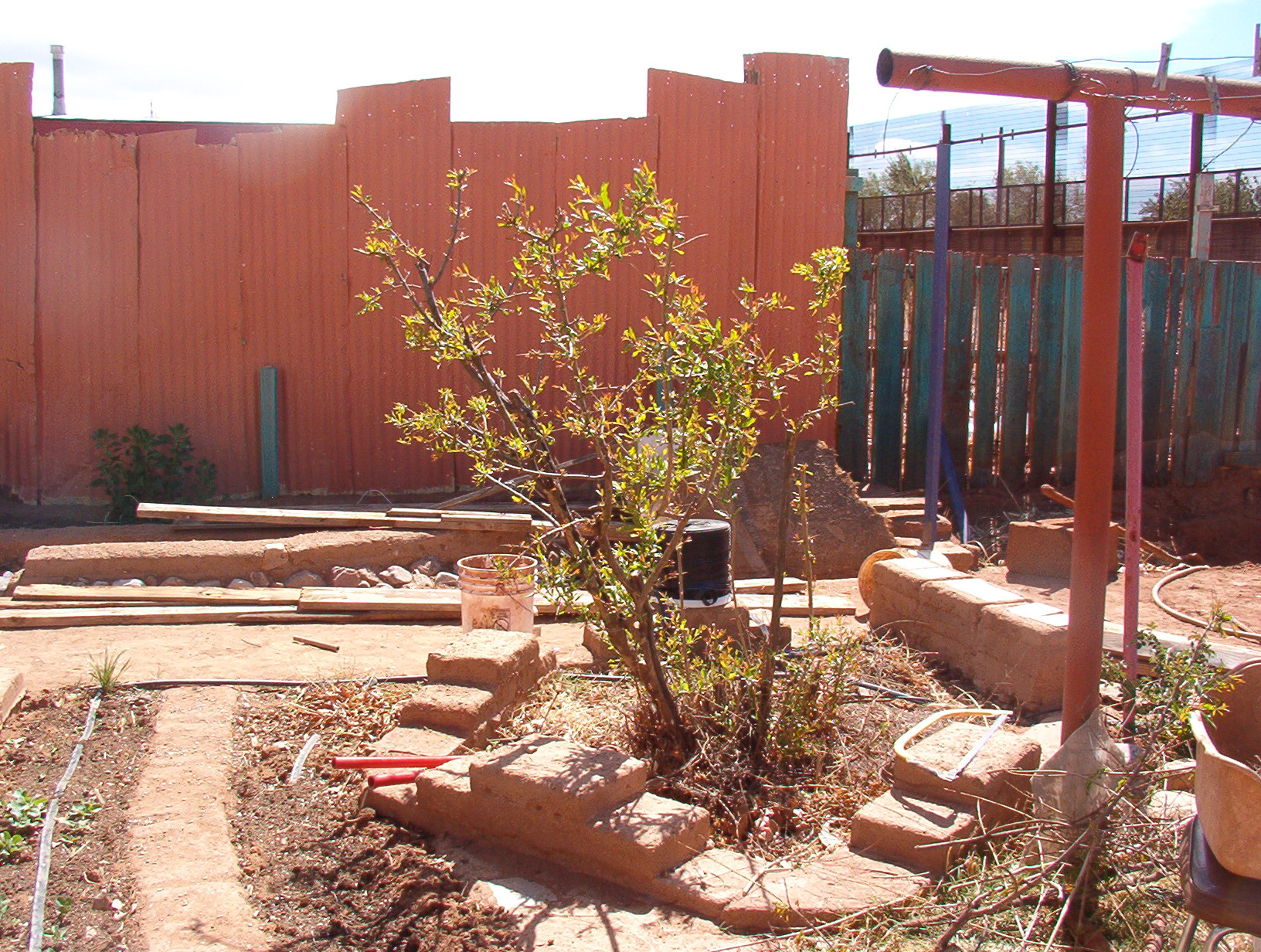
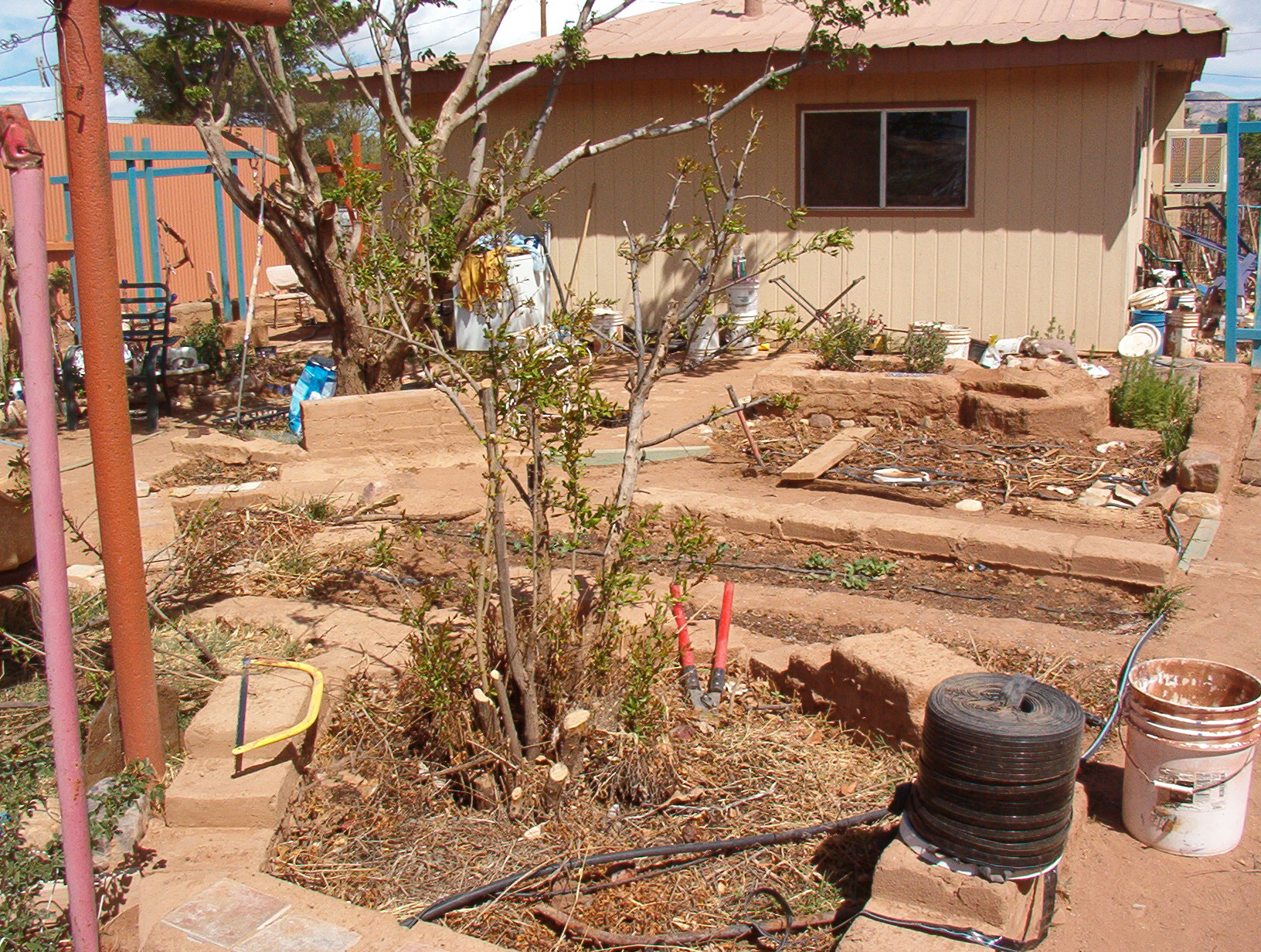
So my pick-for-the-start-of-ordering and organizing my self for this day?  The priority?  I headed outside, dull clippers in hand, to salvage my Pomegranate tree!  As its tiny new deep green leaves began to appear last week I realized that I had neglected to even consider that last winter’s 2-below-zero nights of freezing might have killed that tree!  But, oh does it look SAD!  A few leaves here, a few leaves there — among masses of obviously dead dead dead brown brittle branches.

While it might be somebody else’s priority to wash the dishes or put away all the goodies that litter the kitchen floor in plastic bags, doing so is NOT my heart’s desire!  THIS is Linda, not somebody else.  This is ME that desires to be outside and a part of the gentle wind, under the scooting shadows of the rare desert sky cloud cover, warmed by the sun but still needing several layers of clothing to stay warm out there.

It gives me joy to know that I have the power to act upon the future of that tree in such a way that I CAN save its life.  At the same time I know that helping that tree into a thriving future benefits me because its fruits are luscious and SO GOOD FOR ME!  I can productively apply myself to caregive that tree – and it is my priority at this moment and my desire and my passion to do so.

As I FOCUS on this job all anxiety leaves me.  There is no pressure to do this job ‘right’ because I am confident in my ability to automatically accomplish this task in the best way possible.

It strikes me that I intuitively and instinctively had this same sense as I raised my children.  True, my efforts with my firstborn (conceived when I was 18) were not what they grew to be later on.  But I know about myself that when I follow my OWN inner priorities I do the best I possibly can as I try in some small way to help the world become a better place.

++

All that's left of the Pomegranate tree now -- kind of like all healing work, what's dead harms the whole unless it's gone!
I'm sure willing to bet that this tree will now thrive again. Today's cooler temps and my extra clothes did the job for pruning this tree with its 4" sharp thorns! Caregiving ALL life is the responsibility of the human race - I believe I learned that as a child on our Alaskan mountain homestead as the land took care of me!

++

Next priority for this day:  Create the best home possible for the hundreds of red wiggler worms by beloved Seattle sister sent me for the garden!  Yup!  Caregiving worms so they can caregive the garden so it can feed me is part of The Bigger Plan for my life.  Gotta love this life!

++

Previous post: +BEFRIENDING CHAOS? (EARLY ABUSE SURVIVORS AND CHOICE)

++++++++++++++++++++++++++++++++++

+BEFRIENDING CHAOS? (EARLY ABUSE SURVIVORS AND CHOICE)

+++++++++++++++++++++++

I can’t imagine that any severe early abuse survivor would say that they LIKE this feeling, the one that exists at the edge of where being OK meets ‘dissociation’.  But while I will never LIKE this feeling it is a reality of my life and my concern today is that somehow I learn how to peacefully co-exist with it knowing the feeling itself was built into my body-brain through trauma and abuse from the moment I was born.

I have written recently about my efforts to discriminate between the feeling of what I used to call continual foreboding and the one I more recently named prescience.  Today I would call it a chronic wariness state, one that is tied to chronic anxiety but that also seems to lie at an edge-line where I still retain the power of careful and conscious choice contrasted to the state that lies across this line in which full-blown stress-anxiety takes over the show.

When my personal ‘show’ becomes ruled by my body’s physiological reactions to stress dissociation is most likely to place me in a state of lessened powers of conscious choice.  I would rather have the power to choose how I am going to handle ‘things’ as my day progresses.  And, yes, all of this feels like work to me – often intangible work but work nonetheless.

++

Backing up a day to yesterday…..  I went into town with my monthly income and spent nearly all of it on necessities which included material to finish my chicken pen and coop roof.  The back of my 1978 (gas hog) El Camino is filled with bags of potting soil, stucco lathe, stucco wire (which is far cheaper than chicken wire) to enclose the pen, 2’ x 4’ boards for the roof.

My kitchen floor is covered with food staples to pack away that will hopefully last me until my disability check comes in again the first of next month.  There are also bags from our new ACE hardware store containing various boxes and paper bags full of nails and screws.  There is plant food, various useful findings from the local thrift store, and many cans of ‘no sugar added’ canned fruit that was on sale at the only grocery store we have in town.

I am good to go!

Or am I?

++

What is actually contributing to my current ‘on the edge of anxiety’ state is that there are TOO MANY THINGS here which places me in a state of TOO MANY CHOICES of where to go from here.

I think about this in relation to my recent posts about the work of Dr. Martin Teicher regarding the kinds of very real physiological changes that happened to my earliest developing body-brain.

Making conscious choices is an activity handled best by a balanced flow of information between my left brain (changed in its development) and my right brain (also changed in its development) ALONG WITH the assistance of the super highway corpus callosum region of my brain in the middle that is meant to send information back and forth between my two brain hemispheres (also changed in its development).

What all these changes contribute to my FEELING and to my AWARENESS states is a quality of being overwhelmed by possibilities!

“Aren’t possibilities supposed to be a good thing?”  I ask of myself.

“Yes,” I respond, “but all these possibilities sit very closely in my reality to the state I knew ALL OF THE TIME as a little person – CHAOS!”

Some say that chaos is the realm where all possibilities exist co-currently, simultaneously and that it is only by a CHOICE being made and a DECISION being implemented that a tiny piece of chaos is changed into a more useful and constructive reality.

“OK, then,” my inner dialog continues.  “I think I understand these feelings that I am caught in like a gigantic spider web a little bit better.  Because I was so overwhelmed by abuse for the first 18 years of my life, and because I was left with so little opportunity to actually make conscious self-initiated choices and decisions regarding my own self-reality-life, my decision-making left brain did not develop itself to process any of these interactions!”

From the inside of me (not from the Ivory Tower outside of me) I know what all this feels like to me right at this moment.  My body-brain has to fight its way up for air – which is to say it has to fight itself up to the conscious level where I can PEACEFULLY order and organize my own thoughts, desires, efforts, feelings and actions MY OWN SELF.  I have to FORCE my body-brain to calm itself down, to be OK, to feel safe and secure enough at this moment in time to know that I not only have the RIGHT to order and organize myself and my life the way I want to – but that also have the ability to do this!

Choice and decision making – creating organized order out of overwhelming chaos – is an activity that was SUPPOSED to grow into my body-brain from the time I was born.  This is how the SELF of a new human being becomes integrated into all aspects of its life in the world.

As this happens during ‘Critical Windows of Development ’ the substructure that allows everything to flow cooperatively together to accomplish a lifetime of tasks (large and small) is wired into the developing body-brain on the physiological level.

Severe early abuse, neglect, trauma and malevolent treatment of little people sabotages the ‘normal/ordinary’ development of these abilities.

++

Enough said about all of this for this moment.  This blog is packed full of information about all of those changes in development.  What I need at the moment is to accept this reality as it exists in my body-brain (still, at my age of 59 ½) – so that if I can’t find a way to become friends right this moment with my body-brain as it was created, at least I can find ways to NOT be its enemy.

Being angry at my reality, being full of misery and suffering because of it, remaining in a feeling-awareness state of blocked mobility in my actions for the day will not help me one little bit!  How can I ACTUALLY organize and orient myself today so that I can move forward?  How do I settle this being-overwhelmed-in-the-sea-of-chaos (too many possibilities) DOWN?

++

This disorganized-disoriented insecure attachment-built body-brain that I live in/with doesn’t get to pick and choose when, where, how or why it operates because it is directly built into my entire physiology.  I will always believe that it is ONLY through conscious application of new information about me that can free me from my physiological natural state so that I can experience some peaceful calm that does NOT automatically exist in my body-brain.

I relate everything I am experiencing this morning back to Teicher’s writings (recently posted) including what it IS like and FEELS like to have an apt-to-kindle right limbic brain (which is intimately tied to what it knows of our body).  I have to (in essence) take my finger out of the pot of boiling water!!  Boiling water might be what my body-brain essentially knows, but I AM here, and I CAN make different choices today rather than let this perpetual peritraumatic acute trauma-reality state rule my day.

I can tell myself that all stimulation that happens in life is NOT BAD – nor is it automatically overwhelming!  While this is the reactive state that is most familiar to me, it is not the ONLY state that exists.

Can I take my own hand and in partnership if not in friendship discover how to move forward in time as I change inner CONFLICT awareness into calm peacefulness?  Let me see………

+++++++++++++++++++++++

+MAYBE WE CAN’T BE FOOLED – THIS IS NOT A BENIGN WORLD!

+++++++++++++++++++++++++++++++++++

I have a lot of thoughts this morning as I wait out the dawn for the sun to rise.  I am thinking about the book that was recommended to me by a therapist nearly 30 years ago – the one I read that led to my finally being able to disown my mother.  In People of the Lie: The Hope for Healing Human Evil by M. Scott Peck I found something I needed:  How to tell truth from untruth by listening to what my body tells me in my gut.

This morning I put this thought together with the concluding paragraphs Dr. Martin Teicher includes in one of his important articles about how the stress caused by infant-child abuse, neglect and trauma changes the development of the brain:

In our hypothesis, postnatal neglect or other maltreatment serves to elicit a cascade of stress responses that organizes the brain to develop along a specific pathway selected to facilitate reproductive success and survival in a world of deprivation and strife.  This pathway, however, is costly as it is associated with an increased risk of developing serious medical and psychiatric disorders and is unnecessary and maladaptive in a more benign environment.”

I am questioning my own conclusion that I reached after discovering Teicher’s work.  “Who says that severe early abuse survivors hatch out from their first malevolent environment when they leave home into a “more benign environment?”  Does an environment that lacks direct assault constitute a benign environment?”

No.

I woke up this morning thinking about the interactions I had with my neighbor children yesterday (ages 6 and 12).  The 6 year old is still young enough to be oblivious to many of the stresses present in the world she is growing up in and for.  The child who just turned 12 two days ago is increasingly showing great signs of inner conflict and distress.  She is vastly overweight, receives blatant derogatory comments at school about her weight, and openly admitted to me yesterday that the teasing she receives at school makes her feel ‘mean’.  And mean she can be!  She is not a happy child.

I also think about a friend of mine (alcoholic/addict) who has the sweetest heart and who is running his body directly into the ground.  I hadn’t seen him for many months.  He stopped by this week for a visit and brought a friend of his who must have repeated to me six times that his ex-wife ‘ripped him off’ after 34 years of marriage, etc.

I found myself after he told the story once wondering why he repeated it again – and again – and again…..  Then I found myself completely without compassion realizing that I don’t give a hoot about what happened to him.  He is a complete stranger to me.  In my world if something that happens in your life continues to trouble you, deal with it!  Grapple with it!  Wrestle with it!  Examine the conditions surrounding the events that cling on and on and on – and get over it!

UNLESS!!!  I reserve for the category of ‘there’s no way this one will ever leave me’ for victims of early infant-childhood trauma and abuse the reality that because that trauma changed the course of our physiological development permanently so that we ended up with a different body-brain our trauma built us and built itself INTO us.  As long as we live in our body the consequences of our earliest traumas reside within us.  We cannot leave those traumas behind.

SO…..

I did ask both my addicted friend and the friend he brought with him what their childhoods were like.  The addict insists that his earliest years were ideal.  OK.  Addictions can hit without early trauma.  The other man admitted that his early years were awful.

OK

“So go back to the beginning,” I wanted to tell him.  “Go back there and find the beginning of your own path through life and follow it.  Untangle it where you can.  Expose your early sufferings where you can.  But what good will it do you — or others who are weighted down by repeated exposure to a boring story of ‘gee my ex was so mean’ – to hear about something that has nothing to do with us?”

Am I getting harsh in my aging years?  Probably so…..

But

These thoughts are connected for me today as I received a lightening bolt realization:  None of us – no matter what nation we live in – are living in a perfect ‘BENIGN’ world.  As long as anyone is suffering, the world is not benign.

But

We have to look at the biggest picture possible.  This world and the civilizations upon it are supposed to be maturing and advancing, evolving, growing up.  Once this process is complete, only THEN will this world be benign.

Even within the boundaries of our great (rich) nation nearly a quarter of our children go to bed hungry because they don’t have enough food to eat.  Forty percent of our nation’s children are living in unstable housing.  Never mind the numbers of our children that are obese, that don’t make it through high school, or the numbers who cannot read well or think for themselves even if they do graduate.

This is NOT a benign environment, Dr. Martin Teicher.

I have, on some profound levels, bought (as Mr. Peck would say) that lie!

This is not a world where every human being is cherished.  This is not a world that does everything possible to make sure everyone has what they need from conception onward to thrive as the best person they can be as they live a life of well-being.

This COULD be a different, benign benevolent world – but it ISN’T one yet.

Just because those of us who suffered terrible things during our earliest years might have escaped one level of trauma as we stepped away from our home of origin and escaped our childhoods does NOT mean that we entered a wonderful world!

If we are going to define what is good for us and what isn’t, we have to think about what the world COULD be like and not pretend that the world is REALLY that world we imagine.

And perhaps those of us who survived our terrifying and terrible earliest years happen to have a body that is not, as Teicher states, designed ONLY for living in a malevolent world.  Perhaps we have a body that craves that better world that isn’t here yet at the same time that we ALWAYS know that this world we are in is NOT the benign world that most people seem intent on believing it is.

Perhaps we WANT more, NEED more in more intense and direct ways because we have suffered so much already.  Perhaps we crave a truly peaceful, safe-and-secure, fair, just, compassionate and caring world because we know so well how bad things can be – and that stepping out of our home of origin was REALLY only one small step in perhaps a better direction – but NONE of us are ‘there’ yet!!  Making the world a better place is a mutual job that everyone has to work on together.

“It is no measure of health to be well adjusted to a profoundly sick society.” -Jiddu Krishnamurti

+++++++++++++++++++++++++++++++++++

+THE LIVING AND THE DYING IN MY GARDEN – SEEING MYSELF IN THE LIFE OF MY PLANTS

+++++++++++++++++++++++++++++++++

I am up and wide awake (Such an odd expression – what exactly is the alternative to being ‘wide awake’?) at 4 a.m. this morning.  It is a perfect temperature outside.  I hear the first single rooster crowing up the sun across the border in Mexico.  A part of me is eager for the morning light to flood my yard so I can go rescue one of the native southwestern plants I bought that I know – of all of them – is NOT thriving where I planted it.  In fact, it is dying.

I don’t know what is troubling my Henry Eiler’s Quilled Black Eyed Susan, but it was supposed to be the showcase plant in the back yard!  It was supposed to grow into a thriving and glorious giant!  Nope.  Not doing that!  It is shriveling and losing all of its baby leaves as if it is sinking into the earth rather than growing in the opposite direction!

All I can think of is to carefully dig it out and put it back into a pot.  I need to move it where I can watch it carefully, like my precious grandson was watched in his intensive care neonatal environment after he was born six weeks prematurely.

Will it survive?  Can I provide for this little plant what it needs so it can grow past this life-or-death stage?  What am I doing WRONG for it?  Can I figure that out so I can do it RIGHT?

I am a complete newbie when it comes to drip irrigation.  I don’t understand the living complexity of this (for me) massive system I am still in the process of installing in my growing garden.  Only the RIGHT amount of water, at the RIGHT amount of pressure, streaming CORRECTLY through the RIGHT amount of line is needed.  If the ‘zone’ length is too long water comes out at the front end too MUCH and doesn’t make it to the back end of the line.  How do I adjust all of this so that I can guarantee every single plant, each with its own particular and special growth needs just the RIGHT amount of water at the RIGHT periods of time?

I don’t know.  And I hate to sacrifice the life of any individual plant as I work as hard as I can to figure all of this out!

We are evidently in a period of drought down here in southeastern Arizona.  I don’t actually understand what it is about ME that is stimulating me to work so hard to have a yard filled with living, thriving and blooming plants that will bring beauty to this piece of earth IN SPITE of the harsh conditions present here.

I am challenging myself.  I have a WANT and a DESIRE and the INTENTION of trying to cooperate within the limitations of this climate and of this soil and of these growing conditions on this little patch of ground I am living on to MAKE LIFE HAPPEN and to MAKE THAT LIFE BEAUTIFUL.  Of course that suggests (truly) that bare dusty reddish-brown soil on its own is not beautiful to me.  I am suggesting that THINGS CAN BE BETTER if I try hard enough, work hard enough, am determined enough, sacrifice enough.

I want to do something DIFFERENT and SPECIAL here in my little life, my little yard.  I want to figure all of this out!  At the same time, except for needing the vital resource of WATER to move around on this soil to bring life to these plants, I want the garden to be sustainable.  I desire that this garden find its own thriving balance point, its own ‘tipping point’ and stay there provided I can do my part to take care of it correctly.

++++

On the other hand as I look at my own situation as a human being I know that nothing was done for me during the first 18 years of life (other than being given the physical necessities of shelter, water, food, etc.) correctly.  Me, like the tiny Brown Eyed Susan in my yard spent my entire infant-childhood on the verge of dying.  Not only did nobody NOTICE, nobody CARE, but my parents continually cooperated with each other to make things WORSE for me, never BETTER.

So in a way I guess my gardening here in this arid high desert land is a sort of trauma drama reenactment for me, an effort to ACT out a way to create a beautiful, thriving garden IN SPITE of similar (parallel-symbolic) conditions to my own infant-childhood as they attack these plants.  Can I protect them?  Can I take adequate care of them?  Can I give them what they need?  Can I help them to thrive IN SPITE of all the detriments within this environment that are working against them?

And in the case of this single plant that seems to be losing its battle/struggle to remain alive let alone to GROW, can I-we win this battle?  Can I figure out what is WRONG and make it BETTER?  Can I ‘repair’ the ‘rupture’ in the patterns of this plant’s existence so that it can actually continue to BE on this earth?

Today I will try.  I will do everything in my power to help this plant.

++

RECENT POSTS:

+ADOBE MOMMA NEWS: COOP WINDOWS (AND A FEW FLOWERS)

+’BAD MEDICINE’: PRETENDING EARLY ABUSE SURVIVORS HAVE AN ‘ORDINARY’ BODY

+AS DR. MARTIN TEICHER STATES — EARLY ABUSE, ALTERED BRAIN DEVELOPMENT AND THE SCARS THAT WON’T HEAL

+++++++++++++++++++++++++++++++++

+AS DR. MARTIN TEICHER STATES — EARLY ABUSE, ALTERED BRAIN DEVELOPMENT AND THE SCARS THAT WON’T HEAL

+++++++++++++++++++++++++++++++++++

Sometimes I try to figure out how the kinds of altered brain development that happened to me through severe abuse and trauma especially during the early years of my growth actually FEEL like from the inside of me.  Today, as this poor parched and unusually dry earth sends back to me a dull hollow thumping sound when I send a stream of water from the hose upon it, I think about what it feels like to be that kind of thirsty.

I contrast that thought with the knowledge that too much water upon the earth is equally as harmful as too little is.  Then I find myself wondering, “Are the left brain hemisphere developmental changes abuse survivors experience a consequence of too much harmful experience or are they a consequence of too little positive experience?  Are the changes created by a combination of both, or are they created by something else entirely?”

Does anyone know?

While it might not be possible for the very earth that provides all life to experience both severe drought and severe flooding in the same place at the same time, as I read SCARS THAT WON’T HEAL: THE NEUROBIOLOGY OF CHILD ABUSE —By Martin H. Teicher I am beginning to understand that what he describes of the changes that happen to the developing brain of a traumatized infant-child in fact creates a similar – and therefore very possible – reality as the combined flooding and drought at the same time would be like.

++

I encourage readers to please take a look at this entire article by clicking HERE.  (It includes a mention toward the end about Borderline Personality Disorder, as well.)  I am going to skip down to the end of the article to post today what Teicher says in conclusion [I added underlining for emphasis]:

Adaptive Detriment

Our team initiated this research with the hypothesis that early stress was a toxic agent that interfered with the normal, smoothly orchestrated progression of brain development, leading to enduring psychiatric problems. Frank W. Putnam of Children’s Hospital MedicalCenter of Cincinnati and Bruce D. Perry of the Alberta Mental Health Board in Canada have now articulated the same hypothesis.  I have come to question and reevaluate our starting premise, however.  Human brains evolved to be molded by experience, and early difficulties were routine during our ancestral development.  Is it plausible that the developing brain never evolved to cope with exposure to maltreatment and so is damaged in a nonadaptive manner? This seems most unlikely. The logical alternative is that exposure to early stress generates molecular and neurobiological effects that alter neural development in an adaptive way that prepares the adult brain to survive and reproduce in a dangerous world.

What traits or capacities might be beneficial for survival in the harsh conditions of earlier times? Some of the more obvious are the potential to mobilize an intense fight-or-flight response, to react aggressively to challenge without undue hesitation, to be at heightened alert for danger and to produce robust stress responses that facilitate recovery from injury.  In this sense, we can reframe the brain changes we observed as adaptations to an adverse environment.

Although this adaptive state helps to take the affected individual safely through the reproductive years (and is even likely to enhance sexual promiscuity), which are critical for evolutionary success, it comes at a high price. McEwen has recently theorized that overactivation of stress response systems, a reaction that may be necessary for short-term survival, increases the risk for obesity, type II diabetes and hypertension; leads to a host of psychiatric problems, including a heightened risk of suicide; and accelerates the aging and degeneration of brain structures, including the hippocampus.

We hypothesize that adequate nurturing and the absence of intense early stress permits our brains to develop in a manner that is less aggressive and more emotionally stable, social, empathic and hemispherically integrated.  We believe that this process enhances the ability of social animals to build more complex interpersonal structures and enables humans to better realize their creative potential.

Society reaps what it sows in the way it nurtures its children. Stress sculpts the brain to exhibit various antisocial, though adaptive, behaviors.  Whether it comes in the form of physical, emotional or sexual trauma or through exposure to warfare, famine or pestilence, stress can set off a ripple of hormonal changes that permanently wire a child’s brain to cope with a malevolent world.  Through this chain of events, violence and abuse pass from generation to generation as well as from one society to the next.  Our stark conclusion is that we see the need to do much more to ensure that child abuse does not happen in the first place, because once these key brain alterations occur, there may be no going back.

+++++++++++++++++++++++++++++++++++

+SCREW THE DRUGS – I AM SEEKING HEALTHY REWARDS TO HEAL MY DOPAMINE SYSTEM

++++++++++++++++++++++++++++++++

I have been thinking a lot lately about my so-called (treatment resistant) ‘major depressive disorder’ that I know was directly created because of continual severe abuse and trauma I could not escape from my birth until I left home at 18.  Yesterday (as I mentioned) I continued to try to think of one instance during those 18 years when my ‘reward’ (dopamine-related) system was allowed to fully operate within my growing and developing body-brain normally.  Didn’t happen.

I have been thinking about addictions and their known connection to a thwarted reward system due to early infant-childhood malevolent treatment.  I think about the continual pain I was in for those 18 years.  At the same time I have been thinking about NO REWARD experiences = ZIP I also realize that the complete inability to escape the pain combined to create within me physiological patterns of so-called ‘depression’ that nobody is going to help me untangle but myself.

I am recognizing that I MUST discover some things in my current life that feel rewarding to me – no matter how small the activity or goal might be.  I even found these super-fun videos last night in my search for reward – and they made me giggle when I tried to follow him!

I call them THE ORANGE SHIRT GUY moves – I am learning Salsa dancing in my living room alone with my favorite broom.  Since the moment I left home I have loved to DANCE – and by golly I am going to DANCE NOW!

I am thinking back as far as I can think in search of what rewarded me INTRINSICALLY (inside my self) – those qualities of ME my mother did not touch because she was too busy projecting her darkness on to me and then trying to abuse it out of me.  My SELF held seeds of a love of beauty, a love of movement, a love of the outdoors, of flowers, of gardening, of making things with my hands – and I need to find ways to build THOSE REWARDS into my days somehow so that I won’t sink out of sight into the quicksand of the great (unbearable) sadness inside of me that is always on the near-verge of consuming me.

It also struck me yesterday what a miracle it was that I found MOTHERING-caregiving my children ABSOLUTELY REWARDING!

I think about my own physiology (because my body-brain was built in trauma) in terms of overloaded Substance P (pain) coupled with underloaded reward (including problems with all my safe-secure attachment-reward circuits – CLICK HERE FOR ARTICLE ON THE ‘DRUGS’ and depression).

++

In my searching today I found this fascinating article!  Well worth a read!  It also includes info on ‘learned helplessness’ – something severe early abuse concretizes in our little trauma-altered-development body!!  We need to understand that all our seeking and reward systems begin to be built as our earliest seek-reward attachment behavior either protects us — or does not (causing cascades of Trauma Altered Development).

The Brain’s SEEKING system

By S. N. Koch

Although the details of human hopes are surely beyond the imagination of other creatures,” writes Jaak Panksepp in Affective Neuroscience: The Foundations of Human and Animal Emotions (1998), “the evidence now clearly indicates that certain intrinsic aspirations of all mammalian minds, those of mice as well as men, are driven by the same ancient neurochemistries.” Regarding what he has labeled the SEEKING system, Panksepp explains that the mesolimbic and mesocortical dopamine pathways….

Panksepp suggests that the SEEKING system “responds not simply to positive incentives but also to many other emotional challenges where animals must seek solutions.” In “The Involvement of Nucleus Accumbens Dopamine in Appetitive and Aversive Motivation” (1994), J.D. Salamone explains that dopamine release and metabolism within the nucleus accumbens “is activated by a wide variety of stressful conditions.” Salamone points out that blocking dopamine transmission or otherwise interfering with nucleus accumbens dopamine transmission “has been shown to disrupt active avoidance behavior.” In other words, when dopamine is decreased, animals cease trying to escape aversive stimulation. Instead of trying to cope with stress, they give up.”

NOTE:  I write about MY OWN PATHWAY, not yours.  Your medical needs belong to you and your professional provider.

++++++++++++++++++++++++++++++++

+TO BE ‘WALKED RIGHT THROUGH’ – WHAT MY BODY REMEMBERS ABOUT MY NONEXISTANT SELF

+++++++++++++++++++++++++

I suspect that knowledge of the threat of death, even if existing only on a cellular level within our DNA, must accompany a newborn infant into this world.  Why else would a person’s life force naturally accomplish all that is possible to remain alive?  Is safe and secure attachment to caregivers designed to somehow banish this awareness of the threat of death?  Is this part of the mechanics of change that severe infant abuse/trauma (especially) maltreated survivors never lose when we never had those attachments?

When the caregivers are NOT the source of protection but are rather the transmitters of harm and great violence, what THEN happens to this awareness of the threat of death?

++

It seems almost strange to me that as I wait this morning for the HUD housing inspector to park in my yard this afternoon it is the awareness of the continuity throughout my entire life since my birthing of this awareness of the threat of death that is being fed into my thinking directly from the way my body is feeling right now.

As I pay attention I understand that ‘being walked right through’ is a big part of what I am sensing in my body connected to its memory.  Yes, this inspector will ‘walk right through’ this entire personal, sacred, precious space of my home that is so much a part of ME right now.

The ‘being walked right through’ feels both extremely threatening to me right now and extremely familiar.  It brings to mind my memory of being 21, walking around the northern town I lived in alone late at night in a snowstorm as I stood with my bare hands out in front of me, looked at my palms and heard a ‘voice’ say to me from within:  “I am a wraith.”

At that time I didn’t even ‘logically’ know what the word wraith meant.  Searching online I find that it is used mostly this way:

1 –an apparition of a living person supposed to portend his or her death.

2 — a visible spirit.

The origins of the word appear to be unclear though either Scottish or Celtic origins are suspected.  Most of my genetic heritage is linked to these cultures.

For all the thousands of physical attacks I endured during the 18 years of my childhood, never – not one single time – did I experience of a sense that I as a person-self existed in the body that was being pummeled.  I didn’t have that sense because I DIDN’T exist.  And it wasn’t until that instant in that snowstorm that the first vague and distant clue arrived that I, in fact, did exist.

Until that instant there had never been a connection for me between my BODY and a ME-SELF capable of realizing anything about my own existence.

The two pieces of information had simply never built themselves into the associational networks in my brain.  For this connection between body and awareness of self to come to me, and then for a connection to be made between the self as being connected to that body to happen SO LATE in my life would be nearly unbelievable to me if I didn’t know my own life story.

MY SELF-self HAD always been ‘walked right through’.  My self, as existing not connected to my body, did not receive the physical blows that would have let it know it existed in time and space.  My body obviously knew this information.  It had suffered greatly.

My invisible self, my wraith self – contrary to definition in the dictionary – appeared for the first time when I was 21 not because I was on the verge of DYING but because I was on the verge of COMING ALIVE.

++

Today I struggle with staying in and with my body as I go through this distress-provoking experience related to my well-being.  My body, with its in-built ancient DNA instinctual wisdom DID endure, DID persevere.  But this SELF I am with my awareness of my SELF existence remains only tenuously connected.  The two can very easily become disassociated rather than associated with one another.

My SELF does not want to become nonexistent.  I am very aware that in my case, given my unique history, that the fight to self-preserve happened IN MY BODY, but not in any way with this SELF I work to identify with today.

It is this self, who recognized herself for the first time when I was 21 in those words, “I am a wraith,” who knows what it was like to have no existence so that it could be ‘walked right through’ for my first 18 long years of torture.

++

This is not an easy day……

+++++++++++++++++++++++++

+BLOGGING AND THINKING WITH A TRAUMA-CHANGED BRAIN

++++++++++++++++

I live in and with an over-sensitized, over-sensitive, anxiety-trauma-built body.  Among the changes that happened in my physiological development is that ALL of me was changed in adaptation to severe abuse and violent trauma from the moment I was born and during the following 18 years I could not escape my mother.  This includes how my brain was structured from the beginning of life so that NOW it operates differently from ‘ordinary’.

These facts of course affect not only my thinking, but my writing as well.  I FORCE myself to think in words, which is an essential process that I do not obscure in my writing.

Although I am not ‘autistic’ my patterns of thinking can be as disconcerting to follow verbally as an autistic person’s can be.  I do not – because I really cannot – attempt to obscure from my writing how my brain (hence, I) move forward in time within the realm of words.

++

Blogging has comfortingly allowed me to write in loops and circles.  What my body knows (as with everyone’s) provides information through my right brain that must then be handed over to my left brain for linear-logical-verbal exposure to consciousness.  In order for this process to happen, all this back-and-forth has to involve the ‘bridge’ between my two brain hemispheres – my corpus callosum.  As is well known and is much written about today, the development of both brains and the bridge between them is greatly affected by severe abuse, neglect, trauma, violence and malevolent treatment during the brain’s most critical early stages of growth.

I suffer from these consequences.  But I am determined and courageous.  It is my intent to make the most good possible come out of my disastrous early beginnings, and as is my prayer every day of my life, to at least offer something that might help someone else.

When I began this blog in April of 2009 I could not go back and reread or edit in any way anything that I wrote.  Whatever state I was in when I wrote was not one I could return to even in the immediate future.  I had no tolerance for my own words as if I was deadly allergic to them.  What I wrote about had been deadly toxic to me – and remained so.

I have made SOME progress, although most of the time I have to ‘look the other way’ as the words come out.  Having entirely lacked any concept of ‘being a self’ or of ‘having a self’ for the first 18 years of my life has left me with that all too familiar dissociational condition of being ‘depersonalized’ so that once a single instant of time has passed by in my life it becomes the ‘dereal’ past – not directly connected to me in any way unless I consciously, logically FORCE an awareness of a connection.

But I do not FEEL connected to myself as a ‘past entity’ or as a ‘future entity’.  All perception of time was built into my body-brain in the midst of ongoing severe trauma, and I now believe that if there is NEVER a sense of safety or security (as expressed in human attachment relationships), when there is no safe and secure time to REST between experiences of trauma, the acute trauma stage with its altered sense of time becomes permanent.

This also affects me as I think in written words.  I am ‘mind blind’ to words that are going to follow one another.  I have to, again, ‘look the other way’ rather than anticipate where my thoughts are going.  I believe when Dr. Daniel Siegel speaks of ‘Mind Sight’ he is referring to consequences such as I suffer from.  In my courage and determination I do not let these alterations stop me.

++

Sometimes my posts must seem redundant to this blog’s faithful readers.  Every post I write has to have enough inner integrity that it can be found through someone’s future online search, read, and understood in context.  This is an example of this process in motion over time:

Posted yesterday in comment to a post:  +A LONG, THOUGHTFUL LOOK AT VERBAL ABUSE AS MALIGNANT TEASING

Word Count: 5876

I googled “teasing as verbal abuse” because i wanted to read something exactly like this.”

This post is a long one.  Yet somehow within its structure of words it held something of helpful meaning to this reader – and I am glad it did!

++

Because of my brain being built in the midst of severe trauma my emotional right limbic brain and the body that feeds it information IS overly sensitive-sensitized.  I will struggle with ‘failure’ on a primal level within me for the rest of my life, so when a comment comes in like this one, I struggle directly with the ‘rejection’ that it triggered:

Posted yesterday in a comment to post:   +INSECURE INFANT ATTACHMENT, DAY CARE AND EMOTIONAL NEGLECT

Word Count: 1234

I’ve been skimming your recent posts (sorry, they’re a little long)

And this post was a relatively short one.  Of course I welcome all comments.  My discomfort has nothing to do with the words of the commenter – nearly everything about being alive in my body is a trauma trigger to me, so pervasive was the malevolent trauma that built me!

++

Now, THIS post is a very long one and I thought about perhaps figuring out a way to impose some structure on it at the time it was posted.  And yet dividing one of my thought stream writing processes into segments, like chapters, doesn’t work well in this blog’s format.  Although it easily contains enough words for 4-5 posts, it needs to remain a ‘stand alone’ piece for someone to discover sometime in the future as a ‘whole thing’ with its context intact.

January 16, 2011 post:  +TO BE OR NOT TO BE — HUMAN OR OBJECT: EARLY ATTACHMENT PATTERNS DECIDE AS THEY BUILD OUR ANS

Word count: 4095

++

Computerized reading is nicely designed to allow for scanning and skimming.  Any post can also be read in parts over time – put down and picked up again like a book.

Somehow, to me, the nature of my writing-thinking process is integral to the purpose of this blog.  Nothing comes easily.  Nothing comes without effort.  When a severe infant-child abuse survivor attempts to accomplish a lifespan in a body-brain that was altered and changed in its development by trauma, nothing about our life happens in a simple straightforward way.  This can be especially true with our patterns of processing words that match our experience.

++

NOTE:  It is always best to come directly to the blog post as it exists in real time because I DO now often go back after the post is published and make changes — exactly as I am at this moment.

++++++++++++++++++++++++++++

+THE ABSENCE OF SAFE AND SECURE ATTACHMENT AND THE NEED TO SELF-PRESERVE

+++++++++++++++++++++++++++++++

This will not be an easy day for me, nor did the event I anticipate happening today let me have much sleep last night.  Because I try as hard as I can to learn something useful out of every difficulty I encounter, the experience I am having right now must have a pearl at the center of it somewhere.

Being quite low income (fixed disability) I put my name on the local HUD Section 8 Rental Assistance program waiting list over three years ago.  My name came up.  Fortunately my kind, supportive, caring, helpful, loving and very clear-thinking daughter was willing to take care of the first level of paperwork when she came down to visit earlier this month.  This afternoon the housing inspector comes over to take a look around.

There is no way that I can escape the anxiety this entire scenario creates for me.  And this level of anxiety, because it threatens the entire safety and security of my life, disorganizes and disorients me.  In short, it hurts.

++

Older houses in this border region were never built by rich people.  They don’t match anyone’s ‘building code’.  In the four plus years I’ve been renting this one I, and my loving brother when he comes to visit, have made every improvement that my limited budget could afford.

I have been cleaning and painting – and rearranging – and waiting – and stressing in my own unique distressed way for weeks.  Knowing the wiring in this house is really inadequate, and that my usual string of extension cords would be a dead give-a-way to that fact, I have worked to eliminate them.  Then there’s heating the inspector won’t like.  There’s all kinds of things about this house the inspector might not like.

Will he, can he make exceptions to his rules?  Will he overlook things in this poor house so its poor tenant can continue to live here?

Not knowing.  The unknown.  The helplessness and powerlessness and vulnerability and fear – no terror – I feel.  Dare I hope?

This is my home.  This and my gardens.  This spot on the earth I have found.  I do not want to move.  I cannot imagine moving.  Moving would be a malevolent traumatization to me that I can not imagine enduring or surviving.

If this house does not pass inspection, will my landlord alter-fix what needs to be done to make it pass?

I don’t know that, either.

If it comes to having to move from here to keep my valuable rental assistance voucher – what will I decide to do?

I do not know.

++

Vulnerability is not good for me.  Being of low resources is not good for me, but it is the way my life is and I am grateful for all the programs I receive help from – at the same time I feel guilty, and feel sad for all those much needier than me, those with young children, all those who struggle – and I think I should have let my expiration date pass when my cancer came instead of fighting it, enduring, remaining alive, consuming resources that I cannot earn or pay for on my own.

++

There’s a lot at risk.  There’s a lot at stake.  This strange man will come into my house, do his job, prowl around with his critical and meticulous eye, doing his job.  Will he look into every crack and crevice, every cupboard, every closet, peer here and there asking his questions, and will I be able to remain calm enough – not panic – not dissolve into the too-familiar tears that often come now when my anxiety erupts into escalated disaster-based emotions?

My home is my solace.  My infant-childhood abuse and trauma-related disabilities keep me mostly HERE in this place of my safety, security and comfort – such as I can wrest now from this world I abide in.  I do not leave here often, and do not go very far.  I can’t.

++

Yesterday as I forced myself through the final stages of preparation for what FEELS LIKE an attack on my hard won well-being in my tiny corner of the world, I became very aware of my heightened depression and of its connection to one critically important state of existence.

In part because of my recent readings and study about how ALL attachment relationships are about PROTECTION first and foremost – protection of the BODY that holds the SELF – I realized that what triggers my deepest sadness (and it was triggered yesterday and certainly here it is today) – is the most ancient pervasive overwhelming state that I spent the first 18 years of my life in:

NOBODY is here to help me.  NOBODY is here to protect me.  NOBODY cares if I live or die (as an infant-child I was very aware they wanted me dead).  I am IN THIS ALONE.  I am desperate.  I am threatened.  My extinction is imminent.

I have to pause here and wait through my disorganized-disoriented storm, searching for words, for a pattern of thinking in words that I can reach for, grab onto, and follow as if dragged forward through time from this moment into the next one and the next one.

What?

I know I know it.  I know I know what I want to say.  I know that I am a self and that this self knows.  I know this scrambling is directly connected to how trauma formed my brain – my right brain, my left brain, the middle of the two – all changed by trauma so that thinking in words can be impossible at the same time emotions consume my body.

What?

I go back to the beginning.  No protection.  AHH!  That’s the word:  Self-preservation.

From the instant I was born if I was going to stay alive in the midst of violent trauma and abuse, if I was going to stay alive it was up to me to preserve my own self.

NOBODY as a tiny infant-toddler-child born tiny and helpless and needy and vulnerable and dependent SHOULD EVER HAVE TO KNOW THIS FEELING.

This is what I felt so strongly yesterday as I dragged my great depression and growing sadness about this inspection and all that hangs weighted in the balance.  This terrible sadness I drag around through my life as a ball-and-chain.

Being deprived by violent trauma and abuse without having a safe and secure attachment to ANYONE for 18 years – and surviving that IN SPITE of this fact – I self-preserved.  I persevered in my self-preservation – but there was and is a high, high cost.

That cost is sadness.

That cost is hurt.

When I read in the article posted yesterday about child abuse consequences that Substance P IS INVOLVED – as I know it is – I can now hang my sadness on that hook.  Being not only deprived for 18 years of ANY protection because I was deprived of ANY attachment – at the same time I was continually attacked by those same people nature had designated to be my caregivers – self-preservation grew and grew and took the place of what I needed and was SUPPOSED to have at the same time great pain and sadness grew within me at the same time.

Facing this inspection today with all the threat to my safety and security it entails, threatens also to overwhelm me with this sadness.  My abilities to self-preserve are coupled with this pain.

++++++++++++++++++++++++++++

+CLEAR ARTICLE ON LIFELONG INFANT-CHILD TRAUMA CONSEQUENCES

++++++++++++++++++++++++++++++

Although I am nothing like a ‘scientific expert’ on the topics I present on this blog, I sure can recognize comprehensive outside support articles on what exposure to passive and active malevolent treatment including violent trauma (including emotional and verbal abuse), emotional neglect, physical neglect and unsafe and insecure early caregiver attachments do to change the physiological and psychological development of infants, toddler, children and teens.

This article by Dr. McCollum that I present here today presents the topic of what I call Trauma Altered Development (TAD) in a clear, lay-readable format.  For all the times that I have mentioned that I believe that TAD directly affects the human developing immune system, I find the material in this article supportive of my belief.

The term being used here, Adverse Childhood Experiences (ACE) comes from our nation’s Center for Disease Control (CDC) and is working to standardize the measurement across scientific fields of study related to suffering in infant-childhood caused by trauma in a little one’s earliest environment.

One of my strongest suggestions for standardizing all research about infant-child abuse and its lifelong consequences would be implementation of a federal-state mandate that would require that every American receiving any kind of health care services fill out a CDC ACE study questionnaire and that the results of these reports be accumulated in a federal (confidential) databank.

The article that follows gives us convincing reasons for believing that making the connection between the overall well-being of our nation’s offspring is of critical national interest.  If the subject of infant-child lack of well-being, neglect and abuse ever crosses a person’s mind, the following is the kind of information that needs to inform their thinking.  (I believe many forms of arthritis and cancer belong to the ‘health consequence list’. We also can no longer ignore the epigenetic changes that child abuse often creates that can also be passed down the generations.)

++

I located this March 2006 article today on the Minnesota Medicine website, and have copied it over onto my blog for educational purposes only (please click on article title to find the list of references):

Clinical and Health Affairs — Child Maltreatment and Brain Development

By David McCollum, M.D.

Abstract
“A growing body of research has linked childhood experiences of maltreatment with a host of physical conditions that manifest in adulthood. In addition, newer neuroimaging techniques have documented structural changes that occur in the brains of individuals who suffer early maltreatment. This article briefly reviews the literature on these topics and outlines the connection between abuse in childhood and health problems in adulthood.


It has long been observed that some children raised in violent, abusive, or neglectful settings grow up to express violence, anger, depression, or to be engaged in drug use, alcoholism, or criminal activity. The thinking has been that children copy what they see and hear. When anti-social behavior is the norm and when it is reinforced by adults in the environment, children repeat it. During the past 15 years, scientific and clinical research has begun to document that more is at work. Anatomical and functional alterations occur in the brains of children who are exposed to adverse events.1 Research has also shed light on the less obvious link between childhood abuse and lifetime physical and mental health outcomes.2,3 This article reviews some of the research showing the neurobiological, neuroanatomical, and physiological effects of early life stressors and how they might relate to ongoing medical problems later in life.

The Connection between Abuse and Disease
Repeated exposure to adverse or harmful events in childhood has been linked to many adult health consequences. The adverse experiences that have been studied most are sexual abuse, physical abuse, and neglect. Anda et al. identified additional experiences that influence health behavior and outcomes, including mother treated violently, mental illness, substance abuse, incarcerated household member, and parental separation or divorce.4 Because at least 30% of children in this country experience some form of child abuse prior to age 18, we can expect adverse childhood experiences to have a significant impact on the health care system.5

New technologies such as functional MRI, PET, and MRI/T2 relaxometry (T2-RT) have enabled scientists to identify the chemical and structural differences between the central nervous systems of abused and nonabused individuals.6,7 This research shows that many health problems—including panic disorder/post-traumatic stress disorder, chronic fatigue syndrome, fibromyalgia, depression, some auto-immune disorders, suicidal tendencies, abnormal fear responses, preterm labor, chronic pain syndromes, and ovarian dysfunction—can be understood, in some cases, as manifestations of childhood maltreatment.8-13

Brain Development
An infant’s brain is equipped with an overabundance of neurons, synaptic potential, and dendrites. DNA is responsible for early brain development. But after birth, experience helps to determine which neurons will persist, which synapses will develop and become permanent, and which connections will take prominence or be subdued. Myelination, formation of the protective sheath surrounding nerve fibers, continues throughout childhood and, in some areas of the brain, into the third decade of life. This process establishes final, permanent linkages within the brain structures.14

The limbic system is the part of the brain most vulnerable to adverse childhood experiences. The system is made up of the amygdala, hippocampus, cingulate gyrus, thalamus, hypothalamus, and putamen. Related structures include the cerebellar vermis, prefrontal cortex, and visual and parietal cortex. The limbic system is responsible for the generation and control or inhibition of emotions. It is also involved in interpreting facial expressions and evaluating danger, is responsible for the fight-or-flight response to stress, and integrates emotional reactions and connects them with the physical response. Various components are also involved in memory, both implicit and explicit, and in learning (Table).

Brain Sequelae
Stress initiates a series of hormonal responses in the limbic system. The initial response to stress or danger is activation of the hypothalamic-pituitary- adrenal (HPA) axis. This occurs in the locus coeruleus and the sympathetic nervous system, causing a release of the hormones norepinephrine, serotonin, and dopamine. The amygdala reacts to this hormone release and, in turn, stimulates the hypothalamus to release corticotrophin-releasing factor (CRF). CRF, itself, acts as both a hormone, to stimulate adrenocorticotropin hormone (ACTH) secretion, and as a neurotransmitter, affecting areas of the cortex that are involved in executive functioning (eg, motivation, planning, and logic).15 Increasing ACTH secretion then leads to elevated glucocorticoids (cortisol). High levels of glucocorticoids have been shown to negatively affect the hippocampus, resulting in decreased dendritic branching, changes in synaptic terminal structure, and neuronal loss.16 A feedback mechanism in the hypothalamus and the hippocampus normally brings these levels back to their resting state.

If this process occurs repeatedly, CRF and glucocorticoids remain elevated, which eventually causes structural changes in the brain and impedes the feedback mechanism, leading to an imbalance in hormones and dysregulation of the HPA axis.17

Signs of Stress in the Brain
Several studies have shown a measurable reduction in the size of the amygdala, hippocampus (primarily the left side), corpus callosum, and the cerebellar vermis, and an increase in size of the putamen and lateral ventricles in both children and adults who experienced repeated childhood trauma.18-20 These changes are thought to be an effect of elevated glucocorticoid levels inhibiting myelination in these structures.14 Because most areas of the limbic system are high in glucocorticoid receptors, they are susceptible to the effects of early childhood abuse.

Functional changes have also been noted in the anterior cingulate gyrus and the visual and parietal cortex. Elevated resting levels of CRF have been found in the spinal fluid of abuse victims.21 Elevated T3 levels have also been found in patients with a history of childhood abuse.22

Dopamine, which is released during the stress response, stimulates areas of the prefrontal cortex, probably resulting in heightened attention and improved cognitive capacity. Chronic stress, however, appears to cause an overproduction of dopamine, which can result in reduced attention, increased overall vigilance, as well as a diminished capacity to learn new material and increased paranoid and psychotic behavior.23

Serotonin stimulates both anxiogenic and anxiolytic circuits, which create and reduce anxiety. Decreased serotonin levels in the prefrontal cortex have been found as a result of chronic stress. Suicidal behavior, depression, and aggression have been shown to result from low serotonin levels.

Substance P, a neuropeptide found throughout the body that participates in the pain response and inflammation, has been found at much higher levels in the spinal fluid of those with significant abuse history. Studies in rats showed that injecting high levels of substance P in the spinal fluid caused a significantly exaggerated pain response to a noxious stimulus.24

Related Health Problems
The health problems associated with these changes in the brain are significant. According to Anda et al., atrophy of the hippocampus, amygdala, and prefrontal cortex, and the subsequent dysfunction is related to anxiety, panic, depressed affect, hallucinations, and substance abuse. Increased locus coeruleus and norepinephrine activity have been related to tobacco use, alcoholism, illicit drug use, and injectable drug use. Defects in the amygdala and related deficits in oxytocin result in sexual aggression, sexual dissatisfaction, perpetration of intimate partner violence, and impaired pair bonding.4

Anderson et al. used a novel technology called static functional MRI T2 relaxometry (T2-RT) on a population that had experienced childhood sexual trauma and found evidence of significant changes in the cerebellar vermis in abused individuals compared with nonabused individuals.6 The vermis has been shown to play a role in suppressing excitability within the limbic system. The most consistent anatomical finding in children with ADHD is a reduction in the size of the cerebellar vermis. Other studies show similarities in hormonal changes in children with ADHD. Famularo showed a high correlation between traumatic family environments and ADHD comorbidity.25,26

Allsworth showed that dysfunction in the hypothalamic-pituitary-adrenal (HPA) axis, common in people who have been abused, leads to ovarian dysfunction and early menopause.13 This is likely to increase the risk of cardiovascular disease in these women because estrogen is reduced prematurely and, therefore, its protective function is lost earlier, increasing risk for cardiovascular disorders. Another interesting finding is that early stress may lead to premature involution of the thymus gland. Anti-nuclear antibodies, which attack the body’s own tissues instead of foreign toxins and are frequently present in people with systemic lupus erythematosus, also have been found at higher levels in girls who have been sexually abused compared with those who have never experienced abuse.9

The link between fibromyalgia and sexual abuse has been extensively studied.27 Dysregulation of the HPA axis has been found in most patients with fibromyalgia.28 Substance P is found in high levels in this population. Irritable bowel syndrome has also been shown to be correlated with childhood sexual abuse, and higher levels of substance P have been found in the colonic mucosa of individuals who were maltreated as children. Also, increased glucocorticoid has been shown to act on the intra-abdominal adipocytes leading to increased fat storage.4 Findings that memory pathways are adversely affected by exposure to abuse may explain some amnesia, delayed recall of abuse, and dissociative disorders.29 Some authors consider conversion reactions and pseudoseizures a form of dissociative disorder.30 [bold type is mine]

Conclusion
For years, we have ignored the potential influence of childhood traumatic experiences on adult disease, preferring to look for genetic causes of disease and pure biochemical factors without considering experiential influences. Given new evidence that trauma in childhood alters the physiology of the brain, it is time for all physicians to be educated about the full health impact of violence and abuse and be trained to explore these issues as the true etiology of or an underlying potentiating factor that contributes to their patients’ maladies.”

++++++++++++++++++++++++++++++