+PTSD AND SEVERE ABUSE SURVIVORSHIP – PART THREE

+++++++++++++++++++++++++++++++++

I find that the only standard I can consistently depend upon in my considerations about what constitutes malevolent treatment versus adequate, benevolent treatment lies within the context of the United Nations Universal Declaration of the Human Rights of Children.  Safe, secure, appropriate and adequate early care that leads to an infant-child’s optimal development lies on a continuum at the opposite end from early malevolent conditions that present nearly a constant challenge and threat to survival itself.

The basic needs of children are defined in this Declaration.  In looking at my own history of survivorhood (I was never allowed to be a child, and therefore I no longer consider that I had a childhood at all) it is clear to me that every one of my rights as an infant-child were violated.  It was in that malevolent environment of deprivation that I was exposed to the degrees of trauma that were severe enough to create within the physiology of my body Trauma Altered Development (TAD).

From my earliest beginnings as a being physically separate from my mother was suffered from a lack of safe and secure attachment.  Deprived of that most fundamental resiliency factor, my body-brain-mind-self had to do the best that I could do to continue to grow and develop within that terrible environment that threatened my very existence.

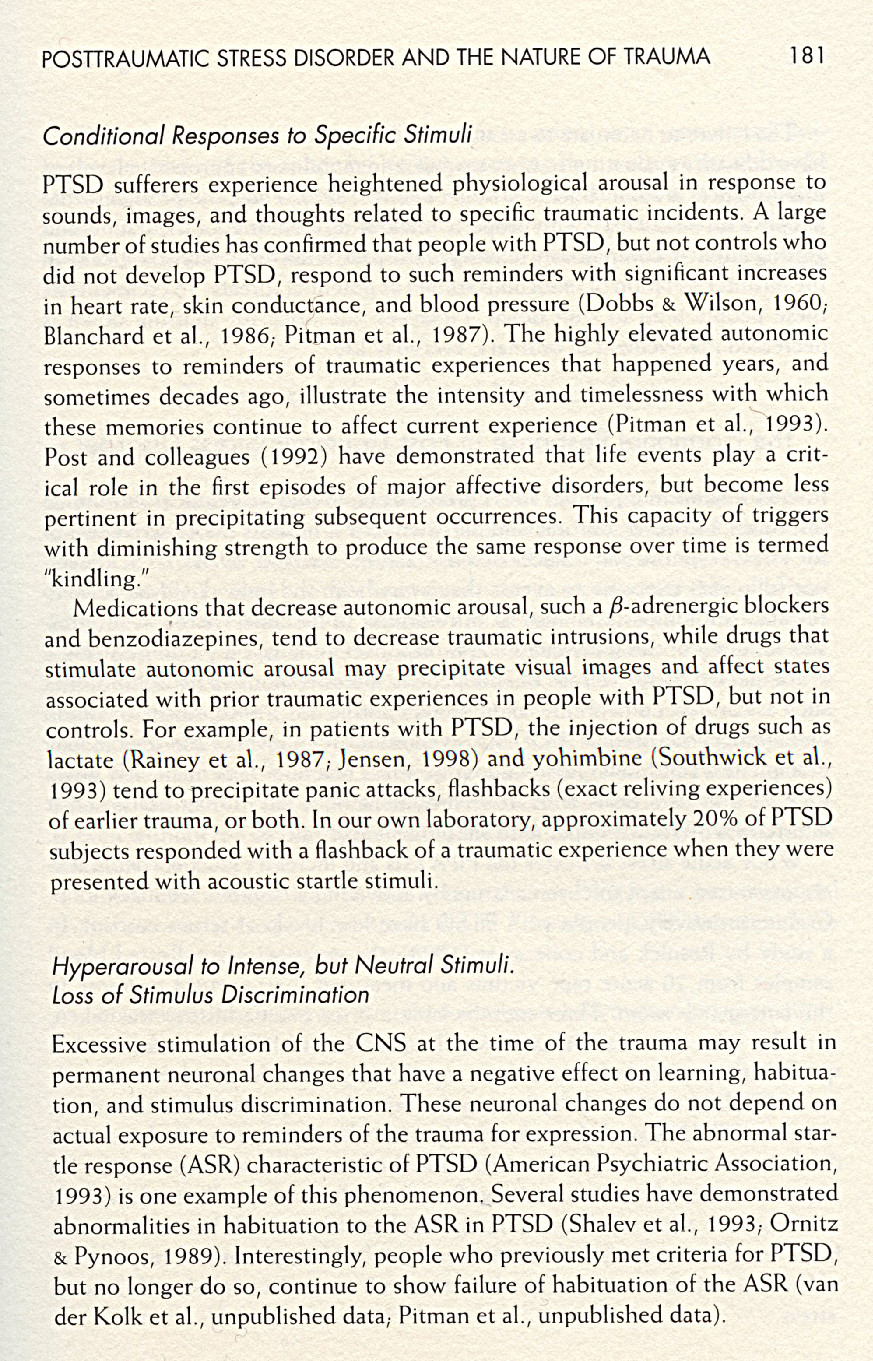
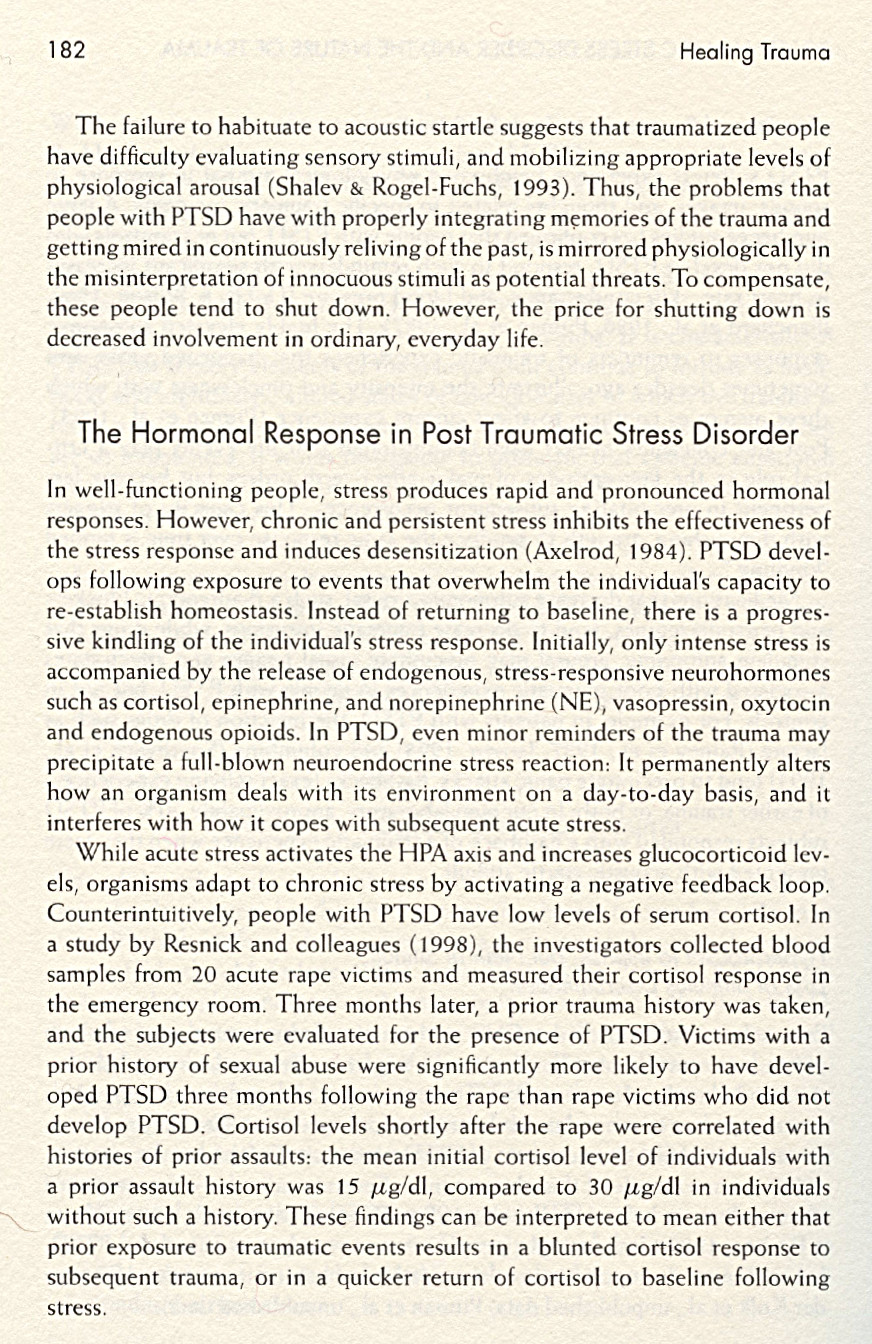
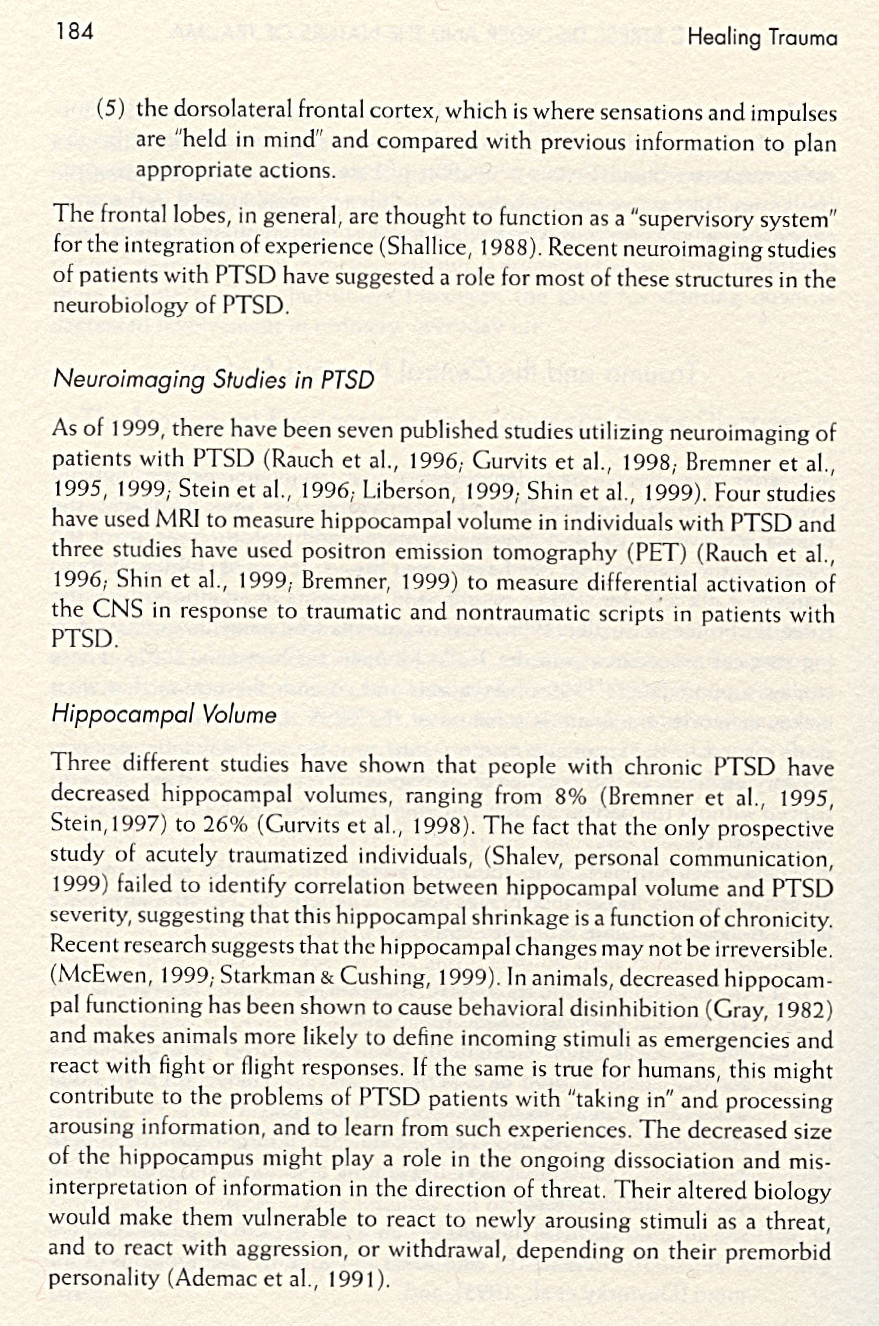
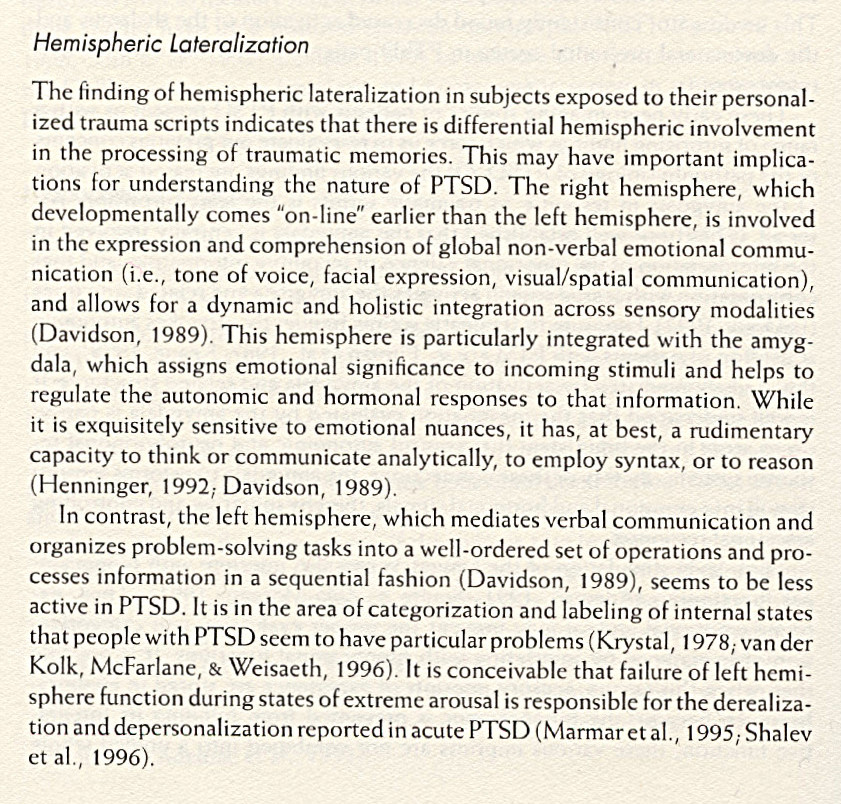
This third post on the topic again continues an exploration of how TAD changes an infant-child abuse survivor’s reaction to ALL trauma.   Van der Kolk writes about posttraumatic stress disorder (PTSD) in the book, Healing Trauma: Attachment, Mind, Body, and Brain – Hardcover (Jan 2003, W.W. Norton and Co.) by Daniel J. Siegel, Marion F. Solomon, and Marion Solomon, chapter 4 (pages 168-195) written by Bessel A. van der Kolk:  “Posttraumatic Stress Disorder and The Nature of Trauma.”

++++

I begin writing today by considering the last sentence of the scanned book pages that were posted on November 30, 2009:

“….progress in understanding the function of attachment in shaping the individual and rapid developments in the neurosciences gave a new shape to these old insights [about the importance of trauma].”  (page 177)

++++

Van der Kolk next considers “The Psychobiology of Trauma” in his writing:

Modern research has come to elucidate the degree to which PTSD is, indeed, a “physioneurosis,” a mental disorder based on the persistence of biological emergency responses.”  (page 177)

In my thinking, naming PTSD ‘a mental disorder’ ignores the overwhelming evidence that the entire human body is included in the ‘persistence of biological emergency responses’ that the author is talking about.  From my point of view, it is the consideration of how severe infant-child maltreatment and abuse changes the development of the ENTIRE BODY of the little one that matters to those of us who survived this degree of early trauma.

‘Biological emergency responses’ BUILT our bodies.  These responses signaled our DNA how to express itself.  These responses signaled our developing nervous system and brain on all levels about how to adapt to trauma.  Our developing nervous system was also intimately involved in these responses as it formed, also.  It is at this most basic, profound level of our physiological development from our beginnings that we have to understand how our development changed in ways that a non-TAD ‘ordinary’ body did not.

The adaptive changes that happened to us took place on far, far deeper levels than just the level of mind.  Mind is simply the topmost layer of our existence that I see as being related to our body as smoke is to fire.  I do not have a ‘mental disorder’.  My entire being is ordered in a very particular way in accordance with what surviving my infant-child trauma required.

It is this Trauma Altered Development that created my survival based, trauma centered ordering of my entire being that I seek to understand.  I am not convinced that van der Kolk has anything more than a passing surface notion of what these TAD changes actually ARE, how they affect us, or even if they legitimately belong to anything like a PTSD diagnostic category.

++++

Van der Kolk continues by saying:

To understand how trauma affects psychobiological activity, it is useful to briefly revisit some basic tenets of neurobiology.”

I do not like the term ‘psychobiological activity’ because it implies that anyone on the outside can ever have any accurate information about what another person’s ‘psyche’ is like.  That is why researchers try to more completely understand the human ability to form a Theory of Mind.  MIND belongs to each of us as individuals, and everyone has their own.  Nobody can ever come to understand what the subjective experience of MIND is like for another person.

‘Neurobiology’ is a different thing.  This is a realistic descriptive word that refers to a part of a person that can, within the current limitations of science, be understood and described because it is physically real on the molecular level.  But neurobiology is not the same thing as MIND.

Van der Kolk continues:

McLean (1990) defined the brain [my note:  The brain is a biological reality as part of our nervous system, from which an individual’s MIND originates.  Brain and MIND are not the same thing.] as a detecting, amplifying, and analyzing device for maintaining us in our internal and external environment.  These functions range from the visceral regulation of oxygen intake and temperature balance to the categorization of incoming information necessary for making complex, long-term decisions affecting both individual and social systems.  In the course of evolution, the human brain has developed three interdependent subanalyzers, each with different anatomical and neurochemical substrates:

(1)  the brain stem and hypothalamus, which are primarily associated with the regulation of internal homeostasis,

(2) the limbic system, which is charged with maintaining the balance between the internal world and external reality, and

(3) the neocortex, which is responsible for analyzing and interacting with the external world.

It is generally thought that the circuitry of the brain stem and hypothalamus is most innate and stable, that the limbic system contains both innate circuitry and circuitry modifiable by experience [my note:  This emotional area of the brain forms through early caregiver attachment interactions birth to age one, forming MUCH earlier than the neocortex], and that the structure of the neocortex is most affected by environmental input (Damasio, 1995).  If that is true, trauma would be expected to leave its most profound changes on neocortical functions, and least affect basic regulatory functions.  However, while this may be true for the ordinary stress response, trauma – stress that overwhelms the organism – seems to affect people over a wide range of biological functioning, involving a large variety of brain structures and neurotransmitter systems.”  (pages 177-178)

++++

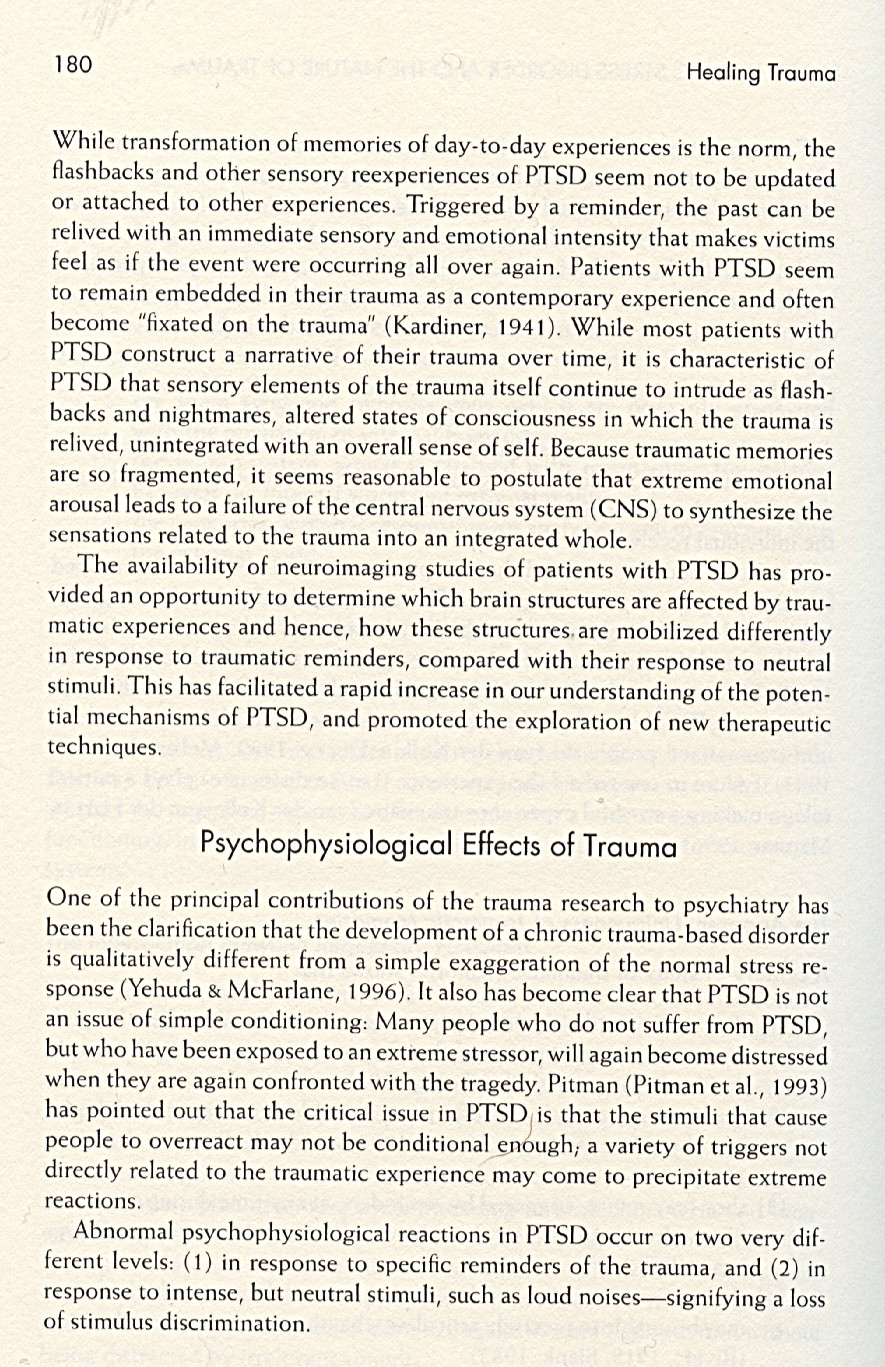
I am going to scan in the book pages that follow in van der Kolk’s description of how trauma affects people.  I believe his statement on the bottom half of page 190 is extremely important:

“…the development of a chronic trauma-based disorder is qualitatively different from a simple exaggeration of the normal stress response….”

We need to stretch that concept as far as we possibly can if we are going to understand how severe trauma from malevolent infant-child abuse and neglect changes our entire development – nothing about us is excluded.  Any possible aspect of our development that can adapt its development in order to help us endure and survive early trauma – does so.

Our problem comes when the reality of our early trauma is denied along with the depth, breadth and width of its impact on our development.  What may be true for a non trauma altered development person cannot be assumed to be true for us.  Yes, we know what the following descriptions of consequences FEELS like – but we also know that we never knew any other, different way of being in the world.

Due to the changed development we experienced as we survived our early severe traumas, anything that we might begin to understand now as being more like  ‘ordinary’ in our physical – and correspondingly in our mental — ability to experience our self in our body in our lifetime, will happen as we begin to understand how deeply trauma formed us in the first place so that we will NEVER experience trauma (or life) in the same way as will a person who did not experience Trauma Altered Development when they were little.

++++

The scanned pages below (from the book mentioned above!) is complicated information, but it is a place for us to truly begin to understand ourselves – the way were MADE in the severely abusive and trauma-filled environments we were formed in.

On page 184 van der Kolk notes that “PTSD patients” have problems

“…with “taking in” and processing arousing information, and to learn from such experiences.”

Sorry, but I am not a ‘PTSD patient’.  I am a 58-year-old woman who has suffered from an extra-ordinary body, altered in all its developmental stages in adaptation to trauma, that has never been able to ‘take in’ even ordinary information, let alone ‘arousing information’, or to ‘learn from’ the experiences of my life in an ordinary way.

What on earth do we expect to happen to little people who must continue to develop and survive even while they have little or no access to even their most basic Universal Human Rights?  Infant-child development IS ALTERED under these conditions.  It is time that we realize this is the most truly horrific consequence of early abuse and trauma.  We don’t get to experience ANYTHING the same way as non-early-traumatized people do – not even later traumas.

(note:  I believe in ‘degrees of damage’ – the 75% of our sub-par young adults in this country have suffered some degree of damage that has changed the course of their development away from optimal and BEST!  We cannot afford to ignore that fact – deprivation and violation of the Universal Human Rights of Children causes changes in the way their body and brain develop.  There is a very real, physiological process through which trauma and deprivation get passed on down the generations.  We know it is happening when we see the consequences in degrees of lack of well-being –- which are detectable no matter what our age.)

++++
(The following is from page 186 on left or right handedness and trauma)

++++++++++++++++++++++++++++++

This post follows:

from November 30, 2009 +PTSD AND SEVERE ABUSE SURVIVORSHIP – PART TWO

from November 28, 2009 +PTSD AND SEVERE CHILD ABUSE SURVIVORSHIP – PART ONE

+++++++++++++++++++++++

PLEASE NOTE:  Do not take anything I say as a reason to alter any ongoing treatment, therapy or medication you are receiving.  Consult with your provider if you find something in my writing that brings questions to your mind regarding your health and well-being.

++++++++++++++++++++++++++++++++

Please feel free to comment directly at the end of this post or on

+++++++

Your Page – Readers’ Responses

++++++++++++++++++++++++++++++++
+PTSD AND SEVERE ABUSE SURVIVORSHIP – PART TWO

+++++++++++++++++++

This second post about Posttraumatic Stress Disorder (PTSD) refers again to a book called Healing Trauma: Attachment, Mind, Body, and Brain – Hardcover (Jan 2003, W.W. Norton and Co.) by Daniel J. Siegel, Marion F. Solomon, and Marion Solomon, chapter 4 (pages 168-195) written by Bessel A. van der Kolk:  “Posttraumatic Stress Disorder and The Nature of Trauma.”

Today’s post follows the November 28, 2009 post

+PTSD AND SEVERE CHILD ABUSE SURVIVORSHIP – PART ONE

PLEASE NOTE:  Do not take anything I say as a reason to alter any ongoing treatment, therapy or medication you are receiving.  Consult with your provider if you find something in my writing that brings questions to your mind regarding your health and well-being.

+++++++++++++++++++

The following is taken from pages 172 of the above text.  I will consider this information in my writing below:

+++++++++++++++++++

It is now easier for me to work with this information because I have described my own version of an alternative way of thinking about the ongoing complications severe infant-child abuse and malevolent treatment survivors face as a direct result not only of the specifics of the actual horrific traumas they lived through, but also because of the very real physiological changes that surviving these traumas created in their infant-child growing and developing body.

(see yesterday’s November 29, 2009 post

+TRAUMA ALTERED DEVELOPMENT (TAD) – A NEW DESCRIPTIVE CONCEPT)

++++

An accurate primary and initial assessment of TAD for those of us who are Infant-Child Severe Maltreatment Survivors would allow us to know immediately how the changes our body-brain had to make created us to be different from ‘ordinary’ people who do not have the history of trauma that we do.

In this TAD assessment two critical resiliency factors would also need to be assessed because these two resiliency factors (one primary, the other secondary) are known to have the ability to nearly completely modify and modulate the power that early trauma has to change our developing body-brain.

The presence of safe and secure attachment to some early primary caregiver is the most basic and important resource an Infant-Child Severe Maltreatment Survivor had.  The current assessment tools available to assess adult secure and insecure attachment need to be simplified, refined and made accessible to the public.

Stemming from the degree of safety and security available through early caregiver attachment, the ability to play is a secondary but critical resiliency factor that impacts an Infant-Child Severe Maltreatment Survivor’s body-brain development.  I believe that assessment criteria and tools to measure this critical factor consistently and accurately can be developed and also made available to the public.

++++

NOTE:  In our new age of technology, the public has the right to be able to access critically important information about themselves and how their early infant and childhood experiences impacted their development.  At present this information remains ONLY available within ‘clinical’ settings, if even there.

++++

As far as I am concerned, anything and everything that is currently lumped under so-called ‘psychological’ categories belongs to the sinking Titanic of dark age medical model thinking that I referred to in yesterday’s post.

Until Trauma Altered Development (TAD) is assessed at the bedrock level of how Infant-Child Severe Maltreatment Survivors changed at their own bedrock (molecular) level, any attempt to moderate so-called ‘symptoms’ remains a crap shoot in the dark.

TAD assessment can connect the consequences of early trauma to altered physiological changes that an Infant-Child Severe Maltreatment Survivor’s body was forced to make to best ensure continued survival in early malevolent environments,

++++

Early caregiver attachment experiences from birth build the body-brain we will live with for the rest of our lives.

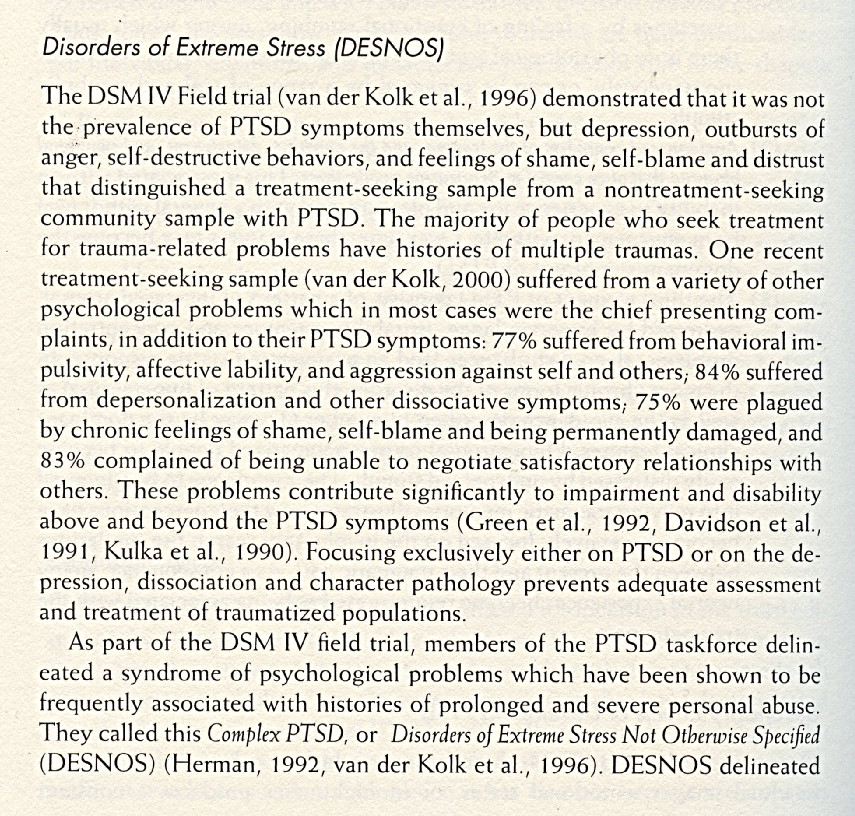
Van der Kolk (scanned text above) writes that it is not usually the symptoms of PTSD itself that brings those seeking help to a clinical setting.  Rather, he says that it is “depression, outbursts of anger, self-destructive behaviors, and feelings of shame, self-blame and distrust that distinguished a treatment-seeking sample from a nontreatment-seeking community sample with PTSD.”

Through an accurate TAD assessment, any ongoing difficulty an Infant-Child Severe Maltreatment Survivor has with emotions and social interactions can be traced to inadequate early caregiver interactions in a malevolent environment that built for the survivor an entirely different early-forming right-limbic-emotional-social brain.

When the foundation of the early forming right brain is altered because of maltreatment, the Infant-Child Severe Maltreatment Survivor’s later developmental stages involving shame, guilt and embarrassment will also be off course from ‘ordinary and optimal’ and will cause altered patterns of development in the body-brain.

++++

Van der Kolk states:

The majority of people who seek treatment for trauma-related problems have histories of multiple traumas.”

OK, I can certainly understand this, but here again, as I mentioned above, I do not agree with applying so-called ‘psychological’ and ‘symptom based’ medical model diagnostic thinking used in the author’s next statements.  I absolutely disagree with ever using terms such as ‘character pathology’ in reference to Infant-Child Severe Maltreatment Survivors!

One recent treatment-seeking sample…suffered from a variety of other psychological problems which in most cases were the chief presenting complaints, in addition to their PTSD symptoms:  77% suffered from behavioral impulsivity, affect lability, and aggression against self and others; 84% suffered from depersonalization and other dissociative symptoms; 75% were plagued by chronic feelings of shame, self-blame and being permanently damaged and 93% complained of being unable to negotiate satisfactory relationships with others.  These problems contribute significantly to impairment and disability above and beyond the PTSD symptoms….Focusing exclusively either on PTSD or on the depression, dissociation and character pathology prevents adequate assessment and treatment of traumatized populations.”

TAD assessments will clearly show that ‘impulsivity’, ‘affect liability’, most aggression, and dissociation are directly connected to changes in how an Infant-Child Severe Maltreatment Survivor’s nervous system, including their brain – and here, particularly their right brain – formed differently from ‘ordinary’ due to growth and development in trauma.

Chronic feelings of shame, self-blame and being permanently damaged” are also directly connected to trauma through developmental changes an Infant-Child Severe Maltreatment Survivor’s nervous system, including their brain – and here, particularly their later forming (after age one) left brain – had to make while developing in an early malevolent, trauma-filled environment.

Rather than referring to these changes as ‘character pathologies’, which in my thinking is the maltreatment, abusive stance taken by the medical model toward Infant-Child Severe Maltreatment Survivors, a TAD assessment can accurately and specifically pinpoint the origin of these changes in the body-brain and describe the consequences of them.

Receiving an accurate TAD assessment will show us exactly how our body was forced to adapt during our development through trauma so that we could survive it.   Yes, I do believe we KNOW we are different from ‘ordinary,’ but we are not ‘permanently damaged’.   We ARE permanently changed.

The changes Infant-Child Severe Maltreatment Survivors experience are fundamental and profound!  Everything about us was subject to adjustment for our trauma survival – our body, our nervous system and brain, our immune system, our mind, and our connection between our self and our self and between our self and the entire world around us.  NOT facing the truth and discovering the facts through TAD assessment will NOT resolve the difficulties we face with our continued survival into adulthood.

The only long term solution societies have is to STOP Infant-Child Severe Maltreatment!!!  Part of that solution is to provide the kind of TAD assessment Infant-Child Severe Maltreatment Survivors need, and to make available to us the resources necessary for us to live the best life we can in spite of the changes we had to make in order to stay alive because nobody STOPPED the Infant-Child Severe Maltreatment that happened to us.

It is the pathological character of the society we were born into that allowed what happened to us to happen at all, let alone allowed it to continue to the degree that trauma changed our physiological development.  If there is any self blame to be had, it is on the level far beyond OURS as the Infant-Child Severe Maltreatment Survivors.

++++

That the grand sinking Titanic of the archaic dark age’s medical model about Infant-Child Severe Maltreatment Survivors has at least THOUGHT about throwing us a life boat becomes apparent in van der Kolk’s next words:

As part of the DSM IV field trial, members of the PTSD taskforce delineated a syndrome of psychological problems which have been shown to be frequently associated with histories of prolonged and severe personal abuse.  They call this Complex PTSD, or Disorders of Extreme Stress Not Otherwise Specified (DESNOS).”

Great!  A life boat full of holes!  Gee, why are we NOT thankful for that?

A syndrome of psychological problems” be damned!  Infant-Child Severe Maltreatment Survivors do not suffer from a ‘syndrome’, and ours are not ‘psychological problems’!  For all the reasons I have repeatedly described, we simply need a TAD assessment that will tell us HOW our little body adapted down to our molecular level during our development in the midst of, and in spite of, toxic malevolent trauma.  Then we need resources that inform us how to live NOW with these profound trauma-caused changes that happened to us THEN.

The author continues:

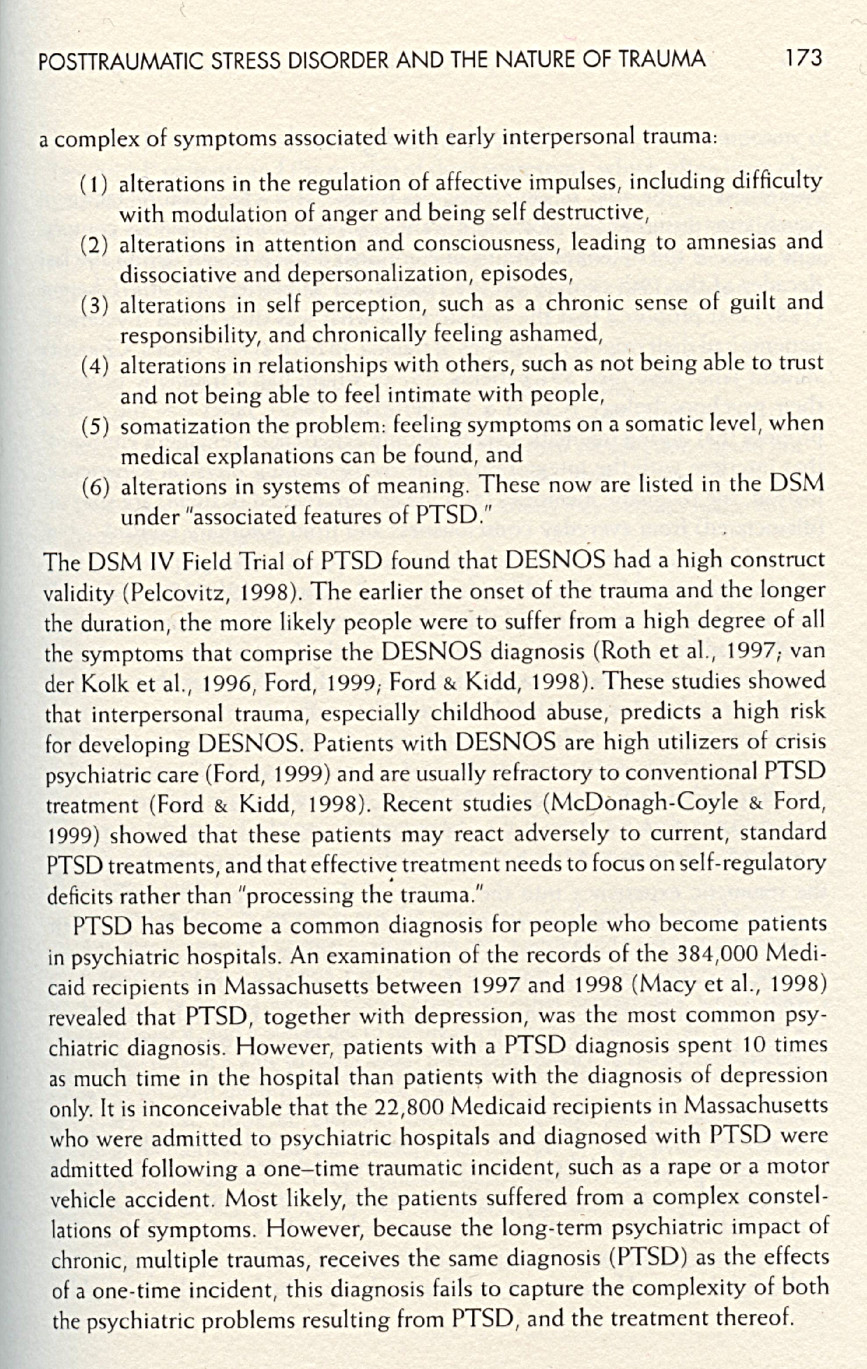
DESNOS delineated a complex of symptoms associated with early interpersonal trauma.”

Again, we don’t have ‘symptoms’.  We have a different body-brain-mind-self that adapted to survival in a malevolent world and caused us to have Trauma Altered Development (TAD).

We don’t have symptoms, we have consequences.  Every single item in the list of so-called ‘complex symptoms’ (see them in the page scan below) that van der Kolk describes are directly connected to our TAD.  EVERY SINGLE ONE OF THESE ITEMS exist within us because of changes our body-brain was forced to make.  They are consequences of the changes our body had to make through our TAD.

The only real progress in the right direction I can see – given to us like faulty patches to a sinking life boat thrown to us from a sinking ship – is that at least an association ‘with early interpersonal trauma’ is finally being considered in the current medical model thinking.

But this tiny droplet of hoped for healing balm offered by the creation of a construct named “Complex PTSD, or Disorders of Extreme Stress Not Otherwise Specified (DESNOS)” is not what we Infant-Child Severe Maltreatment Survivors need in my book.

We need our entire society to understand and accept the truth that the Infant-Child Severe Maltreatment that happened to me and others – and continues to happen to children around us today – is nothing short of a form of parental-selected genocide that did not fulfill its intent to completely destroy us.  We are Infant-Child Severe Maltreatment Survivors because we are still alive, and we ONLY SURVIVED because we were able to adapt our body throughout our Trauma Altered Development to and within the malevolent environments that formed us.

++++

The rest of van der Kolk’s words (below) simply bring into my mind the image of the author being like a modern day Paul Revere, whose horse’s hooves pound along the streets of our nation as he screams a warning.  I am certainly not convinced, however, that even this author knows which message it is that most needs to be delivered.

The Trauma Altered Development that Infant-Child Severe Maltreatment Survivors experienced had no choice but to build itself into every part of who we are BECAUSE we live in a body, and our body had no choice but to change so that we could stay alive.

To describe any aspect of what happened to us in terms of a ‘diagnosis’ or a ‘symptom’, ‘complex’ or not, to call us ‘maladjusted’ or to tell us we suffer from any form of a ‘character pathology’ or ‘psychological problem’ is to continue to condemn us with stigmas and stereotyped prejudice which makes as much sense as applying all of the above labels to someone who is tall versus short, or who has red hair rather than blond.

If we wish as a society to remain in the dark ages about the consequences of Trauma Altered Development for Infant-Child Severe Maltreatment Survivors then at least we should have enough honor and common sense to admit it.  If we are appalled by the ignorance that is still applied to our circumstances, today is the day we can enlighten ourselves and get on with the legitimate task of figuring out how to accurately assess Trauma Altered Development so that we can begin to live well as the changed, extraordinary Infant-Child Severe Maltreatment Survivors that we are.

Our Trauma Altered Development did not affect WHO we are in the world, but it absolutely changed HOW we are in the world.  It is up to all of us to learn what that means.

+++++++++++++++++++

The following is taken from pages 173 of the above text:

Again, it is not a picture of ‘long-term psychiatric impact’ nor a ‘diagnosis’ that Trauma Altered Development affected Infant-Child Severe Maltreatment Survivors need.  We need to understand the changes our body had to make to guarantee our survival and specifically how those changes affect us, and specifically how to improve our quality of life and well-being in the world in spite of our TAD.

+++++++++++++++++++++++++++++++++++++++++

Please feel free to comment directly at the end of this post or on

+++++++

Your Page – Readers’ Responses

++++++++++++++++++++++++++++++++
+TRAUMA ALTERED DEVELOPMENT (TAD) – A NEW DESCRIPTIVE CONCEPT

+++++++++++++++++++++++++

Presenting a new descriptive concept that applies specifically to severe infant-child abuse and serious neglect survivors of all ages:

Trauma Altered Development (TAD)

++++++++++++++++++++++++++

Those of us who suffered enough severe traumas through malevolent treatment including abuse during our growth and developmental stages of our infant-child ‘survivorhood’ to alter how our body developed do not need a diagnosis.

— We need an assessment of the changes that happened to us because of the abuse.

— We need information about how these changes affect us in our lives today.

— We need resources that tell us how to improve our well-being in the world in spite of the changes our body had to make in order for us to survive the traumatic environment that formed us.

++++

Thinking in terms of changes that happened to me as a result of my development in a severe abuse environment in my infant-child survivorhood, I am beginning to understand that my body developed to manage all resources available to me in my environment – both inner and outer – to maximize my opportunity for successful survivorship.

I am preparing to stand in opposition to the current ‘mental health’ and ‘behavioral health’ models that obviously are not capable of meeting my true needs as stated above.

I want to see the creation of new thinking about the changes that happened to me and to others whose altered early development allowed them to continue living in spite of insurmountable traumatic obstacles.

I have a new name for what happened to me:  Trauma Altered Development (TAD)

TAD is an accurate, factual description of a physiological process that allows individuals to survive in early malevolent environments.  TAD is not a diagnosis.  It is not a label, and it carries with it no stigma toward a person whatsoever.  It is not naming a ‘disorder’, a ‘pathology’ or a ‘maladjustment.’  Trauma Altered Development (TAD) is an accurate descriptive concept that needs to be the starting point for all positive changes we hope to make for ourselves in this world.

Trauma Altered Development (TAD) can be assessed.  In today’s world, it might take a think tank of dedicated people to put together tools to get this job done, but the information DOES exist and an accurate assessment of trauma-forced change can be described for every one of us that went through this process in our early development because of infant-child trauma and abuse.

I would like to see a systematic effort applied to establish national, regional and local Trauma Altered Development Resource and Referral Centers.  These centers would be connected to a global clearinghouse that gathers research, assessment tools, informational and educational curricula about how trauma alters development for the duration of an individual’s lifespan and how well-being for a lifetime can specifically be improved in spite of these trauma altered developmental changes.

Trauma Altered Development (TAD) assessment would consider not only the changes that happened to us in our development and how those changes affect our well-being and our personal resource management systems in our adulthood, but would also increasingly assist in the recognition of how these changes are directly tied to the resiliency abilities that lie within our species.

Trauma Altered Development (TAD) assessment cannot possibly separate any part of an individual from the whole of who they are.  Trying to consider physical health and well-being as being separate from our ‘mental’ or ‘behavioral’ well-being is just plain goofy!  TAD affected our entire being in the world from our beginning and it affects us now.

++++

I don’t want to save a sinking Titanic of dark-age thinking about so-called ‘mental illness’ or ‘behavioral health’.  I want a whole new boat!  Trauma Altered Development (TAD) is a descriptive concept that appears to me to be that new boat.  I know it sits on the bedrock foundation of what happened to me as a result of my mother’s severe abuse of me.  I believe that TAD must be accurately assessed at this bedrock level for every infant-child trauma and abuse survivor because it affects every aspect of our being in the world for the rest of our lives.

Once an accurate TAD assessment has been completed, all other services designed to address our degrees of lack of well-being will make sense to us because they will be based on the truth of the facts about how we developed through trauma to be the way we are in the world — every step of our lives.

++++++++++++++++++++++++++++++++++

Please feel free to comment directly at the end of this post or on

+++++++

Your Page – Readers’ Responses

++++++++++++++++++++++++++++++++
+LIGHT T-DAY READING ON RATS AND THE DALAI LAMA

+++++++++++++++++++++++++++++++++++

I’m not at all sure why I feel safer on the planet knowing the Dalai Lama is here, but I do.  The following links are to information related to the conference presentation to the Dalai Lama about the effects of maternal distress behaviors on her offspring – just a little T-Day light reading!

This is the gist of science told the Dalai Lama:

If a distressed mother rat raises all her own babies, they will all turn out distressed.

If a calm mother rat raises all her own babies, they will all turn out calm.

If you change the litters at birth, and give the calm mother’s babies to the distressed mother, all those babies will grow up distressed.

If you take the distressed mother’s babies at birth and give them to the calm mother, the babies will all grow up calm.

In essence, the distressed mother’s treatment of her babies triggers epigenetic changes in the way the babies she raises turn out because their genes are triggered differently by the distress.

++++

Pity the Poor Lab Rat by Kathy Brown

“…in spite of all our advances in knowledge about mental disorders and the advances in technology that have resulted in an impressive smorgasbord of pharmaceutical agents, the overall prevalence of depression is increasing at an alarming rate. Moreover, the average age at onset continues to drop. Whereas patients once presented with their initial depressive episode in their fifth decade of life, the average age of onset has now dropped into the twenties.”

++++

Mom, Dad, DNA and Suicide by Sharon Begley

Such changes are called “epigenetic,” to distinguish them from changes that affect the sequence of nucleotides in DNA. Epigenetics is arguably the next frontier in genetic research, promising to show why people with identical DNA, such as monozygotic twins, have different traits, including traits known to be strongly affected by genes. The answer seems to be that the events of our lives, including parental behavior, turns some genes on and some genes off. In this case, parental care (or, specifically, abuse) changed the expression of the crucial glucocorticoid-receptor gene in the brain.”

++++

Abuse changes brains of suicide victims

Suicide victims who were abused as children have clear genetic changes in their brains…”

+++++++++++++++++++++

While the new research on neuroplasticity in the brain is important, those of us whose body and brain were changed as a result of severe early child abuse, again, may not be in the realm of ‘ordinary’ when it comes to the changes we can expect in our brains compared to others…..

++++

Buddhism – A meeting of minds by Swati Chopra

At the 12th mind and life conference in dharamshala, buddhism and modern science found points of convergence as the dalai lama and western scientists spoke about neuroplasticity, the brain’s ability to change with experience and focused training.”

++++

2004: Neuroplasticity: The Neuronal Substrates of Learning
and Transformation
a 2004 conference that got neuroscientists together with the Dalai Lama

Download MLXII: Neuroplasticity Brochure PDF

++++

Can Our Minds Change Our Brains?

Train Your Mind, Change Your Brain: How a New Science Reveals Our Extraordinary Potential to Transform OurselvesBy Sharon Begley

At the Dalai Lama’s private compound in Dharamsala, India, leading neuroscientists and Buddhist philosophers met to consider “neuroplasticity.”  The conference was organized by the Mind and Life Institute as part of a series of meetings, beginning in 1987, for brain researchers and Buddhist scholars to share insights into the workings of the mind and brain. The 2004 meeting set out to answer two questions: “Does the brain have the ability to change, and what is the power of the mind to change it?””

++++++++++++++++++++++++++++++++++++++++++++++++++++++++

Child Abuse Causes Lifelong Changes To DNA Expression And Brain.

++++

Mechanisms underlying epigenetic effects of early social experience

++++

Epigenetics. Child abuse alters genes.

++++

What role might epigenetics have in shaping a person’s development?

++++++++++++++++++++++++++++++++++++

Please feel free to comment directly at the end of this post or on +

+++++++

Your Page – Readers’ Responses

++++++++++++++++++++++++++++++++

+THREAT OF ATTACK – STAYING NUMB – PTSD AND DISSOCIATION

++++

Something happened inside of me when I reached the end of the post I wrote on November 19, 2009 – +I WILL NEVER BE ORDINARY. IT IS TIME FOR ME TO KNOW THIS TRUTH..  The writing has become so much harder for me to do than it was before.

Do I abandon my efforts?

The ‘transparent moment’ I experienced on November 19 was evidently deeply connected within my body to my present experience of myself in my life.  Evidently transparency does not feel safe to me.  Yet I have courage, stamina and willingness to move forward, though I do not know ahead of time where my writing process is going to take me.

I didn’t know on November 19 that I was writing myself up to that transparent moment.  I didn’t see it coming.  I didn’t predict or anticipate where I was going or where I would end up.  The experience of that transparent moment just happened – but it happened because of the writing.  On some deeper level that I cannot actually SEE within me my instincts say to me – “DON”T WRITE!  STOP!  WRITING IS NOT SAFE.  IT LEADS YOU TO UNKNOW PLACES, AND UNKNOWN IS DANGEROUS TO YOUR WELL-BEING!”

++++

Because it is my basic premise that I cannot separate any experience I have from the disorganized-disoriented insecure attachment system I have as a direct result of my mother’s abuse of me, I have to allow myself to understand that my current state of NOT WRITING is connected to how this system operates to try to keep me safe and secure in the world.

Hiding is, for me, a trauma related response.  I can translate what is going on for me in the present to:  transparency = dangerous = HIDE NOW!  Hiding means that I am hiding from my own words, which are directly connected in the writing process to who I am – all my memories (even those only my body remembers), how I survived, what I am willing to think about, what I am willing to feel – and to the full consequence of the posttraumatic stress disorder (PTSD) that I have along with dissociation that does not allow me to KNOW things in a necessarily ongoing, coherent, integrated fashion.

So, I STOP!

At the same time I am willing to share with you in a somewhat transparent way the following words that are connected to this whole process – as I forced myself to write them across lined sheets of spiral notebook paper —

++++++++++++++++++++++++++++++++++++++++

Make a difference in someone’s life

I used to believe in this

Is this a different Linda?

This one doesn’t even want to write any more.

Transitions between states of mind

Sometimes they are WIDE and I fall in.

I don’t know where the writing Linda went

I don’t want the sad one here.

Sometimes things cost too much – does caring?

Without the grief, am I just numb to everything?

A Linda-safer-floating around on a raft – but fragile amidst the sharks of chaos I know are all around me.

Don’t tip the raft.  Don’t look down.

Is that state mostly where I spent my childhood in between my mother’s attacks?

Out of nowhere she would attack me.  The raft of numb would disappear from under me.

I’d be in the ocean full of sharks – attacked again.

++

Cancer was an attack from within.

++

What does that mean

Changing our minds?

Like changing gears?

Or changing jobs?

Or changing our clothes?

Or changing a baby’s diaper?

Making change with money

A change in one’s fortune

A change in the weather

++

Paving stones with spaces between them

Grout between tiles

Mortar between stones or bricks

In PTSD-Dissociation our traumatic experiences are separated by fear and confusion

Cracks in a sidewalk

Shifting plates of the earth’s crust

Water surrounding continents

If I go to a place of what seems ‘calm’ to me

I suspect I am really ‘numb’ instead

Because peaceful calmness was never allowed (and did not build itself into my body)

At times I do not wish to disturb this numbness

Once I leave the numbness I don’t know and can’t predict what will get triggered and what state I’ll end up in next

And I don’t know how long I’ll end up in some other ‘changed state’ or if, when or how I can get back to ‘numb’

So it seems best not to disturb or change anything

Like a great game of hop scotch only I can’t control or predict where I’ll end up next

Leave well enough alone

Don’t think

Don’t feel

Just be

Try to leave everything within me alone

Control = control where I am in the environment

I don’t want to be challenged there, either

For all the same

Reasons

++

It’s like skating on a deep lake with uneven ice

Places that are thick and solid and I’m safe

Places where the ice is thin and I can crash through

But from the top side I can’t tell which is which

Nobody WANTS to fall through

OPTION?  Stay off of the lake

= do not write

I can’t predict where it will take me

++++++++++++++++++++++++++++++++++++

Please feel free to comment directly at the end of this post or on ++++++++++++++++++++++++++++++++

Your Page – Readers’ Responses

++++++++++++++++++++++++++++++++

November is National Adoption Month

Posted: 24 Nov 2009 10:14 AM PST

Currently, there are 130,000 children and youth waiting to be adopted. National Adoption Month urges Americans to “Answer the Call” to adopt children and youth from foster care. National Adoption Month intends to raise awareness about the adoption of children and youth from foster care.

The Ad Council’s latest public service “You don’t have to be perfect to be a perfect parent” urges potential parents that perfection is not the goal. Children just need loving, caring environments with stability. This award-winning campaign is a partnership of the Children’s Bureau, the Ad Council, and AdoptUsKids. This year’s ads target the African-American community and finding homes for African-American children in care. The ads feature humorous everyday scenarios illustrating that parents need not be perfect to offer the stability and commitment that a “forever family” provides to a waiting child.

Visit the 2009 National Adoption Month Website for more information: http://www.childwelfare.gov/adoption/nam/

Additionally, The Children’s Bureau Express has a Spotlight on National Adoption Month webpage The CBE has information about how agencies celebrate National Adoption Month, and find out more about the latest adoption resources and research.  They also offer more information and service on:

PSA Campaign Recruits Families for African-American Children
Adoption Month Calendar Features Innovative Activities
National Survey of Adoptive Parents Releases First Data
Post adoption Support Guide
Positive Outcomes for Late-Placed Adoptees
Court Collaboration Expedites Adoptions
Parent-to-Parent Support for Adoptive Families

To view more information please visit their Spotlight on National Adoption Month: http://cbexpress.acf.hhs.gov/index.cfm?event=website.viewSection&issueID=111&subsectionID=8

++++++++++++++++++++++++++++++++++++

+CRIMES AGAINST CHILDREN – WHO ARE THEIR PROTECTORS?

++++++++++++++++++++++++++++++++

Something so troubles me that I cannot sleep tonight.  Could it be the sound of hurt and scared children crying, if only silently in their wounded hearts?  Who is protecting these children?

++++++++++++++++++++++++++++++++

A new page posted along the top of my blog has been added JUST FOR READERS to write any trauma-related thoughts that come to mind — either directly in response to something I have posted — or not!

Please feel free to click on the COMMENT link at the bottom of this new page that will always be at the top of the blog — and write!  Your words are important!

++++++++++++++++++++++++++++++++

Your Page – Readers’ Responses

++++++++++++++++++++++++++++++++

++++

Remembering what I wrote yesterday about the lack of playfulness and the ability to play being directly connected to the presence of trauma in a child’s environment, reading this new report about our nation’s children’s exposure to violence greatly troubles me.

++++

Please take some time to look at the report’s information, and also check out the information at the Safe Start Center website!

++++

The Office of Juvenile Justice and Delinquency Prevention published a new report that discusses findings from a survey examining children’s exposure to violence. The survey is the first to attempt to comprehensively measure exposure to violence for nationally representative sample of 4,549 children younger then 18 across major categories. Some of these categories were:

  1. Conventional crime, including robbery, theft, destruction of property, attack with an object or weapon
  2. Child maltreatment, other than spanking on the bottom
  3. Sexual victimization
  4. Witnessing and indirect victimization
  5. Exposure to family violence
  6. School violence and threat
  7. Internet violence and victimization, including Internet threats or harassment and unwanted online sexual solicitation

Results suggest that most children in the U.S. are exposed to violence in their daily lives, with more than 60 percent of the children surveyed having been exposed to violence within the past year. Nearly half of the children surveyed had been assaulted in the previous year, and nearly 1 in 10 witnessed one family member assaulting another.

Safe Start Center is dedicated to teaching about the harmful effects of the exposure of violence on children. Safe Start’s website is packed with information and resources for parents and the community to help our children stay safe. To read the full report of to learn more about the Safe Start Initiative, visit www.safestartcenter.org.

++++

About the Crimes Against Children Research Center

The mission of the Crimes against Children Research Center (CCRC) is to combat crimes against children by providing high quality research and statistics to the public, policy makers, law enforcement personnel, and other child welfare practitioners. CCRC is concerned with research about the nature of crimes including child abduction, homicide, rape, assault, and physical and sexual abuse as well as their impact.

++++

Here, also, is some more information on borderline personality disorder put together by —

In the Spotlight | More Topics |
Kristalyn Salters-Pedneault, PhD
When we talk about the impact of BPD, we’re not just talking about symptoms; BPD also has a major impact on your quality of life. From work, to relationships, to your physical health, think about the ways that BPD may be interfering for you.
In the Spotlight
Your Life with BPD
What is it like to live with BPD? It’s not easy. Intense emotional pain, and feelings of emptiness, desperation, anger, hopelessness, and loneliness are common. But life with BPD is not hopeless, and you can create a life full of quality and meaning.
More Topics
BPD and Relationships
Many of the symptoms of BPD can have direct impact on relationships, and other symptoms have an indirect (but not necessarily less disruptive) influence.
Physical Health Problems and BPD
People with BPD are more likely to report a variety of physical health problems, and are more likely to need to be hospitalized for medical reasons, than those without BPD

++++++++++++++++++++++++++++++++

+I WILL NEVER BE ORDINARY. IT IS TIME FOR ME TO KNOW THIS TRUTH.

++++++++++++++++++++++++++++++++++++

I try to be as positive as I can about the work I am doing with my writing about the permanent and lifelong trauma-centered changes that plague survivors of severe abuse and trauma that happened during their early infant-child developmental changes.

Today’s transcription of my quarter of a century old letters my friend just returned back to me has left me feeling anything but positive.  The reality of the kinds of childhoods like mine, and like the kind I am talking about and describing, is horrible.  There is no way to pretty up the picture about what was done to us and what happened to us as a result.

I am faced with the tragedy of what my mother’s abuse did to me — not just during my childhood, but throughout my entire life up until this very instant in time.  Primarily I balance my mother’s abuse by the other side of my child abuse history.  No one was there for me to form a safe and secure attachment with.  THIS LACK, I believe, had as much to do with how my body-brain-mind-self had to change in order to survive as did the abuse itself.

I believe that having a safe and secure attachment to at least one other person from birth particularly through age 5 is a critical resiliency factor to balance out the terrible harm of abuse in infancy and childhood.  When I consider the terrible abuse of my childhood, it is ALSO the absence of having any other person I could form at attachment to and with that profoundly harmed me.

It is not JUST the presence of abuse that truly creates a malevolent childhood.  It is also the complete absence of safe and secure attachment to ANYONE else.  That absence, I believe, amplifies the impact of the trauma of abuse nearly beyond belief.  That absence, in particular, coupled with the abuse, so changes a person’s development that trauma becomes the underlying pivotal factor of their ongoing existence.

No matter how benign our adult life may appear from the outside, the reality of this kind of childhood trauma within us manifests itself in every feeling, thought, action, decision and experience that we have.   How to live well in spite of the trauma-centered developmental changes that happened to us is so far past my ability to understand today that I can’t imagine it.

++++

I am having a transparent moment, as if all the illusions I have ever had about myself being an ‘ordinary’ person in an ‘ordinary’ world have now completely evaporated.  Is this a feeling of complete hopelessness that I am experiencing?  It can’t be.  I won’t let it be.

Having illusions about who and how I am in this body in this lifetime is not the same thing as having hope.  Just because today, finally, all my illusions have vanished because I have challenged them and found that they do not fit me, does not mean that I have no right to find a way to a better life in this world.

At this moment I feel as if I have one foot poised in the air over a threshold I am crossing into a new vision of myself in my life.  I can, for the first time ever, looking backward through the time of my life and see myself being born a pure and innocent child, full of potential, full of life, full of the ability to respond to the world I was born into.

That this world welcomed me with trauma and abuse, which held me firmly within its grasp for the first, formative, 18 years of my life does not mean that I, as a human being, have changed in my essence.  But I do have to work with this body, nervous system, and brain that changed itself to survive the horrors of that ongoing trauma.  It is my mind I am working to change, to the best of my ability, not because it is in any way ill, but because it is mine.

My mind can no longer afford to feed itself on a diet of illusion and false belief that what happened to me did not affect me in ways that I now KNOW it did.  And with this knowledge I now have the most profound hope I have ever had.  It is time for me to learn how to experience life MY way, my CHANGED way, without ever again expecting anything about myself to be — ordinary.

There is an invisible line that is crossed during a severely abused infant-child’s life where the option to develop in an ‘ordinary’ way is removed.  To deny this fact is to suffer from delusion.

++++++++++++++++++++++++++++++++++++

*Ages 29-33 – Eight Letters to a Friend

++++++++++++++++++++++++++++++++++++

*Commentary on the eight letters to a friend – ages 29-33

++++++++++++++++++++++++++++++++++++

SOME OF THE KEY TYPICAL TROUBLESOME WORDS, CONCEPTS AND EXPERIENCES THAT ARE DIFFERENT FOR SEVERE CHILD ABUSE SURVIVORS – SEEN FROM MY NEWLY INFORMED PERSPECTIVE.

These things connect to what continues to ‘trouble’ us because they are all connected to the changes that our body-brain-mind had to make in order to survive early severe abuse during our infant-child developmental stages:

Choice

Feeling guilty – the whole concept of guilty

Concept of procrastination as being a source of our problems

‘shirking’ responsibility – the whole concept of ‘response-ability’ as it applies to us

dealing with things on a self-honesty level

concept of ‘changing’

the concept of feelings, feeling feelings, experiencing feelings

emotional brain not form ‘ordinarily’; emotional dysregulation = chronic problem

feeling lonely, depressed, crying – all different for us than for ‘ordinary’ people

experience of ‘feeling low’ and low on energy is different

‘anger’ has a different meaning to us – both our own and other people’s

being with other people

feeling trapped

our experience of the experience of ‘being sick’ and recuperating is altered

our experience of being kind to ourselves

our experience of giving ourselves ‘permission’

how we experience anticipation of enjoyable experiences

experience of worry different

experience of ‘wishful thinking’ is different

experience of disappointment different

Experience of trust is different

Our experience of the passage of time is VERY different!

Our experience of friendships is different

Being willing to reach for and experience ANY kind of self-help we can find

Finding that it does not REALLY help us at all

blaming-shaming ourselves that it doesn’t

not being able to immediately and completely trust our impressions of people

my ‘who-to-trust/not-trust’ center in my infant brain could not form correctly

making a mess of our own thinking trying to change these first impressions!

Our sense of safety with others is THE number ONE issue – we have to trust it

Intense feelings of isolated-alone, trust them, they are REAL beyond belief

Realize that ‘ordinary’ people do not experience them with the pain we do

Yes, we will do everything possible to ‘protect our feelings’ – naturally

Have to be hyper aware of what feels threatening and scary to us – it’s real

There are memories and feelings we can’t touch because it isn’t good for us to

Repression of trauma is not the same thing as dissociation

we can’t ‘work through issues’ like others if we dissociate

not helpful to feel guilty-shame for what we cannot possible accomplish!

Terrible ambiguity can exist about our abuser(s) – ordinary people can’t imagine

Confused-meshed identity and relationship with abuser

Commonly called ‘defense mechanisms’ don’t begin to describe true insanity

Have to be realistic about ‘recovery’ goals – ours will be different than ‘ordinary’

Be careful of what we believe of what therapists who do truly not know us, tell us

We don’t really know what love is or what it feels like – we weren’t built that way

I strongly suspect that ‘love’ is different from ordinary for us

We will never stop learning about what ‘ordinary’ people automatically know

We did not grow into our thinking abilities like ‘ordinary’ people do

Not helpful to be told by others we are ‘rationalizing’ as a defense when we think

We need help learning about our thinking process because abuse changed it

Our disorganized insecure attachment means that we do not grieve the same

Extremely helpful to understand insecure attachment and love relationships

Our own pain-loneliness puts us at risk for attaching harmfully in relationships

Our sense of ‘time passing’ is different; things do not ‘end’ in time like ordinary

Difficulties with accountability if we don’t know source of our difficulties

Terrible troubles with goals-future plans, our higher cortex formed differently

We have a different version of a selfhood – not the ordinary one formed by age 2

When we feel alone in the world, a lot of it is because we are lonely for our self

(a self-centered-self is cultural and evolutionarily a recent luxury we didn’t get)

We had no say in the matter – we developed a trauma-centered self from birth

12-step program talk about ‘unmanageability’ = not from our ‘planet of origin’

12-step program talk about ‘acceptance’ = not from our ‘planet of origin’

12-step program talk about ‘powerlessness’ = not from our ‘planet of origin’

12-step program talk about ‘resentments’ = not from our ‘planet of origin’

the set-point for our nervous system is not at ‘calm’ like ‘ordinary’ is

(these points are included at the end of the link presented above)

++++++++++++++++++++++++++++++++++++

+WHEN ABUSIVE PARENTS STEAL THEIR CHILD’S THUNDER

+++++

Experts say that we cannot be truly autonomous and secure adults if we lack the ability to have safe and secure attachments.

I wanted to write today about Dr. Siegel’s next statements about secure-autonomous attachment.  I find, as usual, that I am nearly completely lost in trying to understand what he is saying (see bottom of this post) because I do not come from a childhood of safe and secure attachments.  Instead my 18 years of abuse from birth gave me the opposite – a disorganized-disoriented insecure attachment disorder.  To begin to understand what Siegel is saying, I have to turn his words upside down and backwards so that they can make sense to ‘opposite’ extra-ordinary ME.

++++

In order to keep my thoughts from appearing and flying away in their often random way, I had to find my own internal image to attach them to so that they could have an order I can understand.  What came to me in relation to what Siegel is saying about secure versus insecure attachment was:  “stolen thunder.”  In working with my own internal image I came to understand three basic questions about how parents raise their children.  In fact, I think it might be the simplest ‘test’ possible to determine the quality of the parenting we received and of the parenting we give our own children.

++++

1.  Does a parent help their child’s own personal power, uniqueness, expression and self to grow?  In other words, do they help their child’s thunder to grow or do they interfere with their child’s growing thunder (self=personal power)?

Yes or No

2.  Does a parent actually steal their child’s thunder away from them so that the child is diminished rather than helped and allowed to grow and thrive?

Yes or No

3.  Does the parent then project their own garbage onto and into their child?

Yes or No

++++

These questions are, of course, only showing us what the very tip of the iceberg is like about how parents can act toward their children.  But I think the answers give a pretty clear indication about what lies below the surface:

As I thought about my mother’s interactions with me from my birth, I realized that 1. was No; 2. was Yes; 3.  was Yes.  N-Y-Y.  She did not allow my personal thunder to grow, she stole it away from me and projected her garbage onto me.  (This is exactly what I believe my mother’s mother and grandmother did to her in her childhood.)

I thought about my father and 1. was No; 2. was No; 3.  was No.  N-N-N.  He did not help me to grow my own thunder, but he did not steal it away from me, either.  Nor did he project his garbage onto me.  I basically did not seem to exist in his world at all.

I thought about my interactions with my own children and 1. was Yes; 2. was No; and 3. was No.  Y-N-N.  My foremost effort with my children was to allow them and to help them grow into their own self and to grow their personal thunder.  I did not steal their thunder away from them or deny them the opportunity to grow their own strong, clear self.  I did not confuse, overpower or disempower them.  I did not project my own garbage onto them.  I had what the child development attachment experts would call an ‘earned secure’ attachment with my children.  (I think about this from my own perspective as my having built a ‘borrowed secure’ attachment with my children.)

NOTE:  Our patterns of trying to give our thunder away is a topic for some future writing…..

++++

Out of curiosity I wanted to know where the phrase “steal my thunder” even came from.  At trivia-library.com I found it to be 300 years old:

Origins of Sayings – Steal My Thunder

About the history, origin and story behind the famous saying

STEAL MY THUNDER

Who Said It: John Dennis

When: 1709

The Story behind It: John Dennis, English critic and playwright, invented a new way of simulating the sound of thunder on stage and used the method in one of his plays, Appius and Virginia. Dennis “made” thunder by using “troughs of wood with stops in them” instead of the large mustard bowls usually employed. The thunder was a great success, but Dennis’ play was a dismal failure. The manager at Drury Lane, where the play was performed, canceled its run after only a few performances. A short time later, Dennis returned to Drury Lane to see Shakespeare’s Macbeth. As he sat in the pit, he was horrified to discover that his method of making thunder was being used. Jumping to his feet, Dennis screamed at the audience, “That’s my thunder, by God! The villains will not play my play but they steal my thunder.”

++++

I have a different association with thunder.  I used to be terrified of electrical storms.  Gradually, after more than 25 years spent in friendships with traditional-believing Native Americans in northern Minnesota, I came to understand another perspective on these storms.

I had a friend who was a lawyer and Chief Magistrate, and not given to ‘flights of fancy’.  One time she told the story of driving a stretch of deserted 2-lane highway after leaving Canada as she headed home.  She glanced in her rear view mirror and saw a massive bird speeding towards her along the line of road.  It shone copper, and when it reached her car it lifted over it and swooped down in front of her and continued down the road.  It was so big its wing tips reached over the shoulders on both sides of the road.  My friend was stunned and shaken, and pulled off the road and stopped as she watched it disappear ahead of her.

Traditional Anishinabeg (Ojibway, Chippewa) and other Tribal teachings tell of how thunder is the sound of the voice of these great Thunderbirds, and lightning is the light flashing from their eyes.  I am no longer afraid of electrical storms.  Finding, claiming and growing my own personal thunder remains a bit more of a challenge!

++++

My entire recovery from the terrible child abuse I suffered has been about the healing of myself and the claiming of my personal power to be my self, in my power, in my life.  How does having one’s personal thunder — or not — apply to my understanding of the following words by Dr. Daniel Siegel?  I guess my discussion of this information now belongs in tomorrow’s post:

“Moreover, the capacity to reflect on the role of mental states in determining human behavior is associated with the capacity to provide sensitive and nurturing parenting….this reflective function is more than the ability to introspect; it directly influences a self-organizational process within the individual…..the reflective function also enables the parent to facilitate the self-organizational development of the child….the coherent organization of the mind depends upon an integrative process that enables such reflective processes to occur….integrative coherence within the individual may early in life depend upon, and later facilitate, interpersonal connections that foster the development of emotional well-being.  (Siegle/tdm/312)”

+++++++

This post follows:

+DISSOCIATION AND THE TRAUMA-SPECIALIZED BRAIN 11-11-09

+SECURE AND INSECURE ATTACHMENT AND THE CHILDHOOD NARRATIVE 11-13-09

+EXPLODING MOTHER, IMPLODING ME: SOME FUNDAMENTAL DIFFERENCES BETWEEN US 11-14-09

+++++++

MORE INFORMATION ABOUT BORDERLINE PERSONALITY DISORDER

(IN MEMORY OF MY MOTHER)

Borderline Personality Disorder

In the Spotlight | More Topics |
from Kristalyn Salters-Pedneault, PhD
Most people with a diagnosis of BPD have at least one (if not more) co-occurring disorders. Common comorbid conditions include mood and anxiety disorders and substance use problems. But other disorders can occur alongside BPD as well.
In the Spotlight
Eating Disorders and BPD
Recent research is revealing how often BPD and eating disorders co-occur, why they may be related and how to treat these two types of disorders when they do co-occur.
More Topics

Alcoholism and BPD
There is a remarkable overlap between substance abuse disorders and borderline personality disorder. One study found that about 60% of patients in psychiatric hospitals who have been diagnosed with BPD also have a co-occurring substance use disorder such as alcohol dependence.

+++++++++++++++++++++++++++++++++++++++++++++++++++

+EARLY ABUSE AFFECTS OUR REACTION TO ADULT TRAUMA EXPOSURE

+++++++++++++++++++

My revised list — common reactions to a stressful event can include:

Shock and disbelief

Feeling powerless

(Short and/or long term immune system responses) headaches, back pains, and stomach problems

Sadness and depression (depression is an anxiety response)

Crying

Apathy and emotional numbing (dissociation, depersonalization, derealization)

(Denial – distortion or loss of memory)

Anger

Fear and anxiety about the future

(Over or under reaction to stimuli – hyper- or hypo-startle response)

Sleep difficulties

Nightmares and reoccurring thoughts about the event (left-right brain cannot process trauma information while awake or during dream sleep — ambidextrous  and left handed people at higher risk)

Difficulty concentrating

Difficulty making decisions

(Difficulty assessing meaning and prioritizing)

Loss of appetite (or increase)

(For children – disturbance in play activities)

(Difficulty with social interactions)

(Inability to use words to describe the experience)

++++

I cannot read information such as what is presented at the end of the post from any ‘ordinary’ perspective.  The list presented as “common reactions to a stressful event” describes the kind of traumatic stress reactions that are built into the growing body-brains of severely abused infants and young children.  On some level, these reactions have become our norm.  When additional traumas occur in our later adult lives all of these pre-existing traumatic reactions become stimulated and activated.  We are, therefore, at highest risk for having serious reactions to later traumas in our lives.

I hate having to write about these things.  I hate having to even think about them.  I hate it that my body knows far more than my conscious mind ever will about the reality of what the challenges of trauma can do to us.

Professionals call a reaction to trauma disordered when these reactions do not dissipate after a reasonable period of time goes by after a trauma has happened.  For those of us whose body-brain was built during trauma, we have never had the luxury of having a body-brain that does not include trauma reactions in its makeup.  We cannot return to a pre-trauma condition because we never had one in the first place.

That makes any childhood trauma survivor more vulnerable to post trauma stress disorders.  Personally, I don’t like the use of the word ‘disorder’ and would prefer a recognition that what happens to us after trauma exposure is as natural a reaction as what happens to us as the trauma occurs.  If our reaction is exaggerated or extended, there is a reason for this happening.  Until this fact, coupled with a complete recognition of how early infant-child abuse and trauma alter the developing body-brain from the start is recognized and respected, I do believe the word ‘disorder’ must be used carefully in trauma response considerations.  What ‘they’ see as ‘disordered’ is a different kind of ordering for the entire body-brain from the ground up, from the beginning of life onward for those who have survived severe infant-childhood traumas

Whatever words are used to describe the continued suffering from ongoing reactions to traumas, the long term effects are very real and can be debilitating in regard to quality of life and general well-being.  Adaptations in the body-brain of early trauma survivors means that we react to trauma differently than ‘ordinary’ people do.  We were ‘reordered’ and our ongoing processing of information reflects that condition in our body-brain.

To call us ‘disordered’ is to call us flawed.  We are different, not flawed.

++++++++++++++++

INFORMATION FROM:

Prevent Child Abuse New York Blog

Dealing with a Traumatic EventPosted: 14 Nov 2009 01:26 PM PSTIn the wake of the tragic events at Fort Hood November 5, 2009, it’s important to remember that when traumatic incidents occur, the Center for Disease Control’s Injury Center can assist by providing information that can help people cope and recover. Sometimes after experiencing a traumatic event, including personal or environmental disasters, or being threatened with an assault, people have a strong and lingering reaction to stress. When the symptoms of stress last too long, it can cause people to feel overwhelmed and have an effect on their ability to cope.Common reactions to a stressful event can include:
Disbelief and shock
Fear and anxiety about the future
Difficulty making decisions
Apathy and emotional numbing
Loss of appetite
Nightmares and reoccurring thoughts about the event
Anger
Increased use of alcohol and drugs
Sadness and depression
Feeling powerless
Crying
Sleep difficulties
Headaches, back pains, and stomach problems
Difficulty concentratingFor more information, tips on how to handle a traumatic experience, or to read this full article please visit: http://www.cdc.gov/Features/HandlingStress/ or http://www2c.cdc.gov/podcasts/player.asp?f=5256

++++++++++++++++++++++++++++

+EXPLODING MOTHER, IMPLODING ME: SOME FUNDAMENTAL DIFFERENCES BETWEEN US

++++++++++++++++++++++++

I am revisiting what I see as the core differences between my borderline mother and myself.  I find that nothing has changed in my thinking about these differences in my past five years of research.  My mother’s childhood-onset dissociation became malignant while mine remained benign.

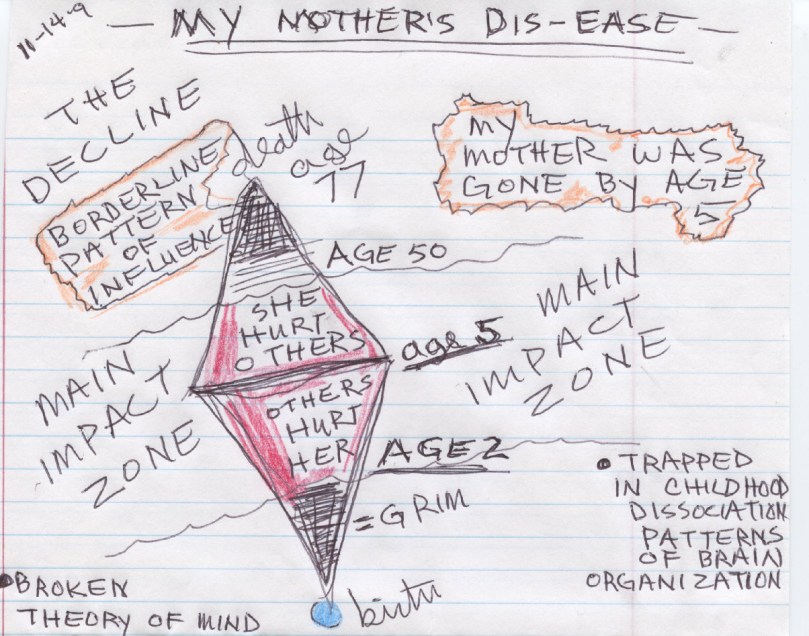
In my first ‘doodle’ I visualized the impact of infant developmental attachment deprivations she suffered from birth until age two.  Born into a family with marital discord and left with her primary care in the hands of a ‘nanny’, I envision that my mother’s developing brain-mind-self was already far off course before she reached the stage of developing a Theory of Mind.

1 111409 post

During the developmental stages from age 2 – 5 conditions in my mother’s childhood so severely impacted her brain-mind that I believe her later mental illness had already centralized the organization of her self.  From the age of 5 it was simply a matter of time before the bomb that was her Borderline Personality Disorder condition would explode – which it did during her terrible delivery of me.

The broader dimensions of the diamond figure that I drew show that in the bottom half powerful interactions with others in her life were feeding her unstable growing self.  She had reached what I call the ‘rage stage’ which was coupled with the following:

My mother was a victim of a lie.  She was told through word and deed by her early caregivers that sometimes she was good enough to be loved.  She was also told that sometimes she was so bad she was un-love-able.  The lie was that she had the power to change herself from being bad to being good, and if she changed into being good (made the bad go away) she would be love-able – and therefore would be loved.

2 111409 post

These conditions presented my mother with an impossible paradox for which there was no answer.  She never knew she was being lied to by her attachment caregivers.  She did not know that there was no solution to this paradox.  She was told she had the power to change herself into being ‘all good’, and she eventually found her solution – me.

The impossible solution to her fundamental betrayal problem was to spit off all her badness and project it onto me.  That left her being all good and me being all bad.  She never had the capacity to know she had believed a lie, found an impossible solution to an impossible riddle, or that she had been tricked and fooled.  Once her child brain-mind wrapped herself around the too-big problem of her early life, her brain-mind continued to grow with this malignant lie within it.

As she moved out of her childhood into her adulthood, and then into the stage of her childbearing years, her childhood dissociation, fueled by childhood rage and a broken Theory of Mind, meant that her children remained her doll-imaginary friends with me as her imaginary enemy (as I have previously described).  By the later years of  my mother’s life she had fewer and fewer people she could influence through her mental illness, and she died as alone and unconsciously troubled as she had been from the time of her birth.

I see this ‘main impact zone’ as being the mass of incoming information that hurt her, followed my the mass of information she later could displace and project onto others to hurt them (primarily me).

++++

My second doodle page (above) presents the basics of what I believe are the differences between my mother and myself.  Like her, my foundation from birth was in disorganizing, disorienting insecure attachment to early caregivers.  But unlike her, I was never fooled, tricked, or betrayed.  Her projection of her own badness onto me condemned me absolutely and permanently.  I was simply doomed to be hated without hope of reprieve, salvation, or any hope of implementing my own solution to solve any of the ‘problems’ I had with her.

The simplicity of my life saved me.  I was not faced with solving an impossible riddle.  I was not presented with the impossible paradox of “you can change yourself into a good and love-able child and then I will love you.”  My childhood was one continual ‘rupture’ without either repair or hope for repair.  My mother’s childhood contained ‘ruptures’ with faulty and deceiving repairs.

In the final analysis, I was far more fortunate than my mother was.  She was set up to fail at being love-able.  I was simply not love-able.  It was the constancy of my unloved-being hated state that saved me.  It was the inconsistency of her unloved-sometimes loved state that ruined her.

I believe her brain fixated a rigid solution to an unsolvable problem.  Her childhood dissociation organized in her brain-mind-self around this solution – which became her internal and unconscious fulltime goal.  I believe her mental illness was fueled by childhood rage.  Her childhood dissociation became malignant, and I became its operational target.

My childhood dissociation had no goal other than physical enduring survival.  My brain-mind-self was left in a fluid, continually changing and adapting state because I HAD NO GOAL and I had no hope, false or otherwise.  My mother’s treatment of me was made tolerable through what I call benign dissociation and my development occurred in a world of sadness.

++++

My mother ended up fighting to be love-able, fueled by rage.  Rage is tied to active coping skills, whether we want to admit this or not.  I did not grow up a fighter.  I grew up a sorrow-filled victim stuck in the passive coping skill state.  My mother was told she had the power to change what happened to her, even though it was a lie and it was not within her power to change the dynamics of her caregivers’ treatment of her.

My mother was damned and didn’t know it.  I was damned and I did know it.  I knew I had no power to change what happened to me.   Nobody ever fooled me into thinking otherwise — from the time I was born.  I believe that there are two entirely different trajectories of development set up by the two different childhood scenarios I am describing.  One leads to the development of a dangerous, demonizing mother and the other one does not.

Both my life and my mother’s of course ended up being extremely complicated with devastating consequences stemming from child abuse and neglect in a malevolent environment during critical body-brain-mind-self stages of early development that resulted in a changed brain for both of us.  Yet as I see it, I was never betrayed or set-up with an impossible task to accomplish like my mother was, and being free from these overpowering early forces allowed me to become who I am.

My mother’s mental illness prevented her from ever being able to tolerate becoming conscious either of how she behaved or of what had happened to so wound her in childhood.  I am not barred in the same way from consciousness.  As I continue to explore the underlying aspects of safe and secure attachment, I will explore how having the ability to be self-aware and self-reflective makes all the difference in how and who we become in our lives.

++++

This post follows:

+DISSOCIATION AND THE TRAUMA-SPECIALIZED BRAIN 11-11-09 and

+SECURE AND INSECURE ATTACHMENT AND THE CHILDHOOD NARRATIVE 11-13-09

++++

++++++++++++++++++++++++++++++++++

THIS INFORMATION COMES TO YOU FROM:

Prevent Child Abuse New York Blog

Improving Children’s Mental Health through Parenting EducationPosted: 13 Nov 2009 03:01 AM PSTGuest post by Michelle Gross, Projects/Public Policy Manager, Prevent Child Abuse New York In today’s difficult times, one of the most important skills one must possess is the ability to form healthy relationships and cope with life’s challenges. Our children are not born with these skills, but rather learn them through their social and emotional development.While providers have traditionally focused on physical development, in 2006, the New York State Legislature passed the Children’s Mental Health Act. The Act required the development of a statewide plan to address issues in children’s social and emotional health, zero to eighteen. As a result of this legislation, the Children’s Plan was developed in collaboration with nine state agencies and led by the New York State Office for Mental Health.The Children’s Plan serves as a blueprint for New York state agencies, providers, and communities to
improve the social and emotional development of children and their families. The Plan focuses on engaging children and their families in services early, ensuring that systems are collaborating to provide effective and efficient services and meeting families’ needs by focusing on their strengths and abilities.

Within the Children’s Plan is a directive for the Office of Mental Health to work with parenting educators to better support parents in raising emotionally healthy children.  The New York State Parenting Education Partnership has been chosen to play this pivotal role in educating providers who work with families and supporting a network of family support and information.

NYSPEP’s efforts to provide professional development sessions for parenting educators will enhance providers’ ability to communicate the importance of social and emotional development with parents, and offer both providers and families tools to facilitate children’s healthy development.

For more information, visit our web site at: http://www.parentingeducationpartnership.org.

Positive Parenting Can have Lasting Impact for Generations

Posted: 12 Nov 2009 07:15 PM PST

A new study that looks at data on three generations of Oregon families shows that “positive parenting” not only has positive impacts on adolescents, but on the way they parent their own children. ” Positive Parenting can include factors such as warmth, monitoring children’s activities, involvement, and consistency of discipline.

Researchers from the Oregon Social Learning Center conducted surveys on 206 boys who were considered “at-risk” for juvenile delinquency. The boys and their parents were interviewed and observed, researchers information about how the boys were parented. Starting in 1984, the boys met with researchers every year from age 9 to 33. As the boys grew up and started their own families, their partners and children began participating in the study. In this way, the researchers learned how the men’s childhood experiences influenced their own parenting.

There is often an assumption that people learn parenting methods from their own parents. In fact, most research shows that a direct link between what a person experiences as a child and what she or he does as a parent is fairly weak. The researchers found that children who had parents who monitored their behavior, were consistent with rules and were warm and affectionate were more likely to have close relationships with their peers, be more engaged in school, and have better self-esteem.

For more information relating to positive parenting techniques, please visit our website http://preventchildabuseny.org/parents.shtml

+++++++++++++++++++++++++++++++++++++++