
+PTSD AND SEVERE ABUSE SURVIVORSHIP – PART TWO

+++++++++++++++++++

This second post about Posttraumatic Stress Disorder (PTSD) refers again to a book called Healing Trauma: Attachment, Mind, Body, and Brain – Hardcover (Jan 2003, W.W. Norton and Co.) by Daniel J. Siegel, Marion F. Solomon, and Marion Solomon, chapter 4 (pages 168-195) written by Bessel A. van der Kolk:  “Posttraumatic Stress Disorder and The Nature of Trauma.”

Today’s post follows the November 28, 2009 post

+PTSD AND SEVERE CHILD ABUSE SURVIVORSHIP – PART ONE

PLEASE NOTE:  Do not take anything I say as a reason to alter any ongoing treatment, therapy or medication you are receiving.  Consult with your provider if you find something in my writing that brings questions to your mind regarding your health and well-being.

+++++++++++++++++++

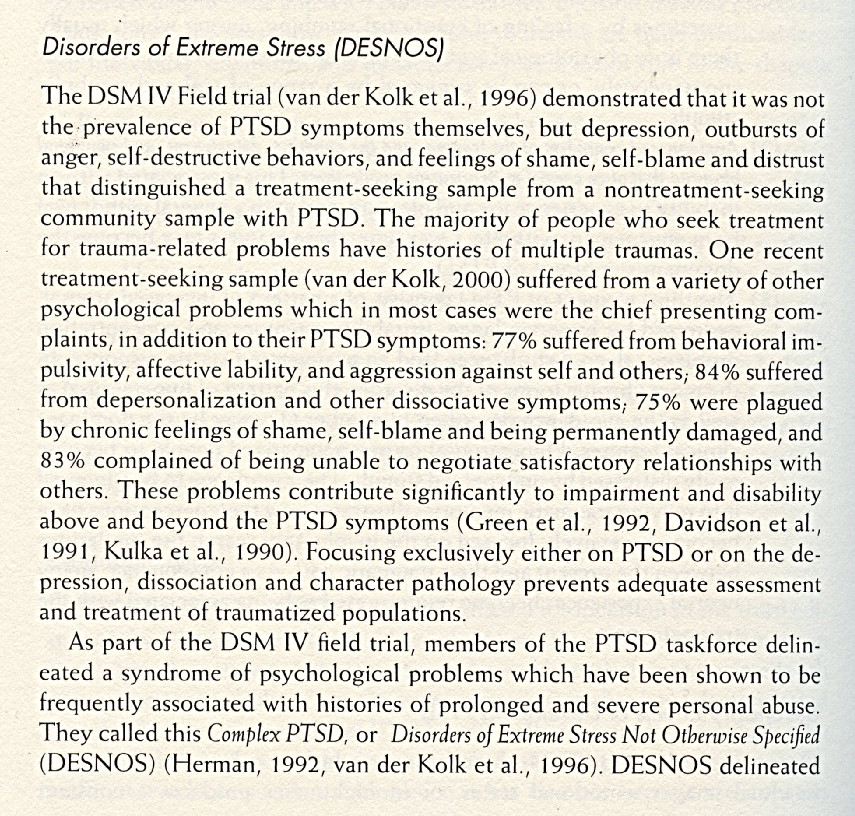
The following is taken from pages 172 of the above text.  I will consider this information in my writing below:
+++++++++++++++++++

It is now easier for me to work with this information because I have described my own version of an alternative way of thinking about the ongoing complications severe infant-child abuse and malevolent treatment survivors face as a direct result not only of the specifics of the actual horrific traumas they lived through, but also because of the very real physiological changes that surviving these traumas created in their infant-child growing and developing body.

(see yesterday’s November 29, 2009 post

+TRAUMA ALTERED DEVELOPMENT (TAD) – A NEW DESCRIPTIVE CONCEPT)

++++

An accurate primary and initial assessment of TAD for those of us who are Infant-Child Severe Maltreatment Survivors would allow us to know immediately how the changes our body-brain had to make created us to be different from ‘ordinary’ people who do not have the history of trauma that we do.

In this TAD assessment two critical resiliency factors would also need to be assessed because these two resiliency factors (one primary, the other secondary) are known to have the ability to nearly completely modify and modulate the power that early trauma has to change our developing body-brain.

The presence of safe and secure attachment to some early primary caregiver is the most basic and important resource an Infant-Child Severe Maltreatment Survivor had.  The current assessment tools available to assess adult secure and insecure attachment need to be simplified, refined and made accessible to the public.

Stemming from the degree of safety and security available through early caregiver attachment, the ability to play is a secondary but critical resiliency factor that impacts an Infant-Child Severe Maltreatment Survivor’s body-brain development.  I believe that assessment criteria and tools to measure this critical factor consistently and accurately can be developed and also made available to the public.

++++

NOTE:  In our new age of technology, the public has the right to be able to access critically important information about themselves and how their early infant and childhood experiences impacted their development.  At present this information remains ONLY available within ‘clinical’ settings, if even there.

++++

As far as I am concerned, anything and everything that is currently lumped under so-called ‘psychological’ categories belongs to the sinking Titanic of dark age medical model thinking that I referred to in yesterday’s post.

Until Trauma Altered Development (TAD) is assessed at the bedrock level of how Infant-Child Severe Maltreatment Survivors changed at their own bedrock (molecular) level, any attempt to moderate so-called ‘symptoms’ remains a crap shoot in the dark.

TAD assessment can connect the consequences of early trauma to altered physiological changes that an Infant-Child Severe Maltreatment Survivor’s body was forced to make to best ensure continued survival in early malevolent environments,

++++

Early caregiver attachment experiences from birth build the body-brain we will live with for the rest of our lives.

Van der Kolk (scanned text above) writes that it is not usually the symptoms of PTSD itself that brings those seeking help to a clinical setting.  Rather, he says that it is “depression, outbursts of anger, self-destructive behaviors, and feelings of shame, self-blame and distrust that distinguished a treatment-seeking sample from a nontreatment-seeking community sample with PTSD.”

Through an accurate TAD assessment, any ongoing difficulty an Infant-Child Severe Maltreatment Survivor has with emotions and social interactions can be traced to inadequate early caregiver interactions in a malevolent environment that built for the survivor an entirely different early-forming right-limbic-emotional-social brain.

When the foundation of the early forming right brain is altered because of maltreatment, the Infant-Child Severe Maltreatment Survivor’s later developmental stages involving shame, guilt and embarrassment will also be off course from ‘ordinary and optimal’ and will cause altered patterns of development in the body-brain.

++++

Van der Kolk states:

The majority of people who seek treatment for trauma-related problems have histories of multiple traumas.”

OK, I can certainly understand this, but here again, as I mentioned above, I do not agree with applying so-called ‘psychological’ and ‘symptom based’ medical model diagnostic thinking used in the author’s next statements.  I absolutely disagree with ever using terms such as ‘character pathology’ in reference to Infant-Child Severe Maltreatment Survivors!

One recent treatment-seeking sample…suffered from a variety of other psychological problems which in most cases were the chief presenting complaints, in addition to their PTSD symptoms:  77% suffered from behavioral impulsivity, affect lability, and aggression against self and others; 84% suffered from depersonalization and other dissociative symptoms; 75% were plagued by chronic feelings of shame, self-blame and being permanently damaged and 93% complained of being unable to negotiate satisfactory relationships with others.  These problems contribute significantly to impairment and disability above and beyond the PTSD symptoms….Focusing exclusively either on PTSD or on the depression, dissociation and character pathology prevents adequate assessment and treatment of traumatized populations.”

TAD assessments will clearly show that ‘impulsivity’, ‘affect liability’, most aggression, and dissociation are directly connected to changes in how an Infant-Child Severe Maltreatment Survivor’s nervous system, including their brain – and here, particularly their right brain – formed differently from ‘ordinary’ due to growth and development in trauma.

Chronic feelings of shame, self-blame and being permanently damaged” are also directly connected to trauma through developmental changes an Infant-Child Severe Maltreatment Survivor’s nervous system, including their brain – and here, particularly their later forming (after age one) left brain – had to make while developing in an early malevolent, trauma-filled environment.

Rather than referring to these changes as ‘character pathologies’, which in my thinking is the maltreatment, abusive stance taken by the medical model toward Infant-Child Severe Maltreatment Survivors, a TAD assessment can accurately and specifically pinpoint the origin of these changes in the body-brain and describe the consequences of them.

Receiving an accurate TAD assessment will show us exactly how our body was forced to adapt during our development through trauma so that we could survive it.   Yes, I do believe we KNOW we are different from ‘ordinary,’ but we are not ‘permanently damaged’.   We ARE permanently changed.

The changes Infant-Child Severe Maltreatment Survivors experience are fundamental and profound!  Everything about us was subject to adjustment for our trauma survival – our body, our nervous system and brain, our immune system, our mind, and our connection between our self and our self and between our self and the entire world around us.  NOT facing the truth and discovering the facts through TAD assessment will NOT resolve the difficulties we face with our continued survival into adulthood.

The only long term solution societies have is to STOP Infant-Child Severe Maltreatment!!!  Part of that solution is to provide the kind of TAD assessment Infant-Child Severe Maltreatment Survivors need, and to make available to us the resources necessary for us to live the best life we can in spite of the changes we had to make in order to stay alive because nobody STOPPED the Infant-Child Severe Maltreatment that happened to us.

It is the pathological character of the society we were born into that allowed what happened to us to happen at all, let alone allowed it to continue to the degree that trauma changed our physiological development.  If there is any self blame to be had, it is on the level far beyond OURS as the Infant-Child Severe Maltreatment Survivors.

++++

That the grand sinking Titanic of the archaic dark age’s medical model about Infant-Child Severe Maltreatment Survivors has at least THOUGHT about throwing us a life boat becomes apparent in van der Kolk’s next words:

As part of the DSM IV field trial, members of the PTSD taskforce delineated a syndrome of psychological problems which have been shown to be frequently associated with histories of prolonged and severe personal abuse.  They call this Complex PTSD, or Disorders of Extreme Stress Not Otherwise Specified (DESNOS).”

Great!  A life boat full of holes!  Gee, why are we NOT thankful for that?

A syndrome of psychological problems” be damned!  Infant-Child Severe Maltreatment Survivors do not suffer from a ‘syndrome’, and ours are not ‘psychological problems’!  For all the reasons I have repeatedly described, we simply need a TAD assessment that will tell us HOW our little body adapted down to our molecular level during our development in the midst of, and in spite of, toxic malevolent trauma.  Then we need resources that inform us how to live NOW with these profound trauma-caused changes that happened to us THEN.

The author continues:

DESNOS delineated a complex of symptoms associated with early interpersonal trauma.”

Again, we don’t have ‘symptoms’.  We have a different body-brain-mind-self that adapted to survival in a malevolent world and caused us to have Trauma Altered Development (TAD).

We don’t have symptoms, we have consequences.  Every single item in the list of so-called ‘complex symptoms’ (see them in the page scan below) that van der Kolk describes are directly connected to our TAD.  EVERY SINGLE ONE OF THESE ITEMS exist within us because of changes our body-brain was forced to make.  They are consequences of the changes our body had to make through our TAD.

The only real progress in the right direction I can see – given to us like faulty patches to a sinking life boat thrown to us from a sinking ship – is that at least an association ‘with early interpersonal trauma’ is finally being considered in the current medical model thinking.

But this tiny droplet of hoped for healing balm offered by the creation of a construct named “Complex PTSD, or Disorders of Extreme Stress Not Otherwise Specified (DESNOS)” is not what we Infant-Child Severe Maltreatment Survivors need in my book.

We need our entire society to understand and accept the truth that the Infant-Child Severe Maltreatment that happened to me and others – and continues to happen to children around us today – is nothing short of a form of parental-selected genocide that did not fulfill its intent to completely destroy us.  We are Infant-Child Severe Maltreatment Survivors because we are still alive, and we ONLY SURVIVED because we were able to adapt our body throughout our Trauma Altered Development to and within the malevolent environments that formed us.

++++

The rest of van der Kolk’s words (below) simply bring into my mind the image of the author being like a modern day Paul Revere, whose horse’s hooves pound along the streets of our nation as he screams a warning.  I am certainly not convinced, however, that even this author knows which message it is that most needs to be delivered.

The Trauma Altered Development that Infant-Child Severe Maltreatment Survivors experienced had no choice but to build itself into every part of who we are BECAUSE we live in a body, and our body had no choice but to change so that we could stay alive.

To describe any aspect of what happened to us in terms of a ‘diagnosis’ or a ‘symptom’, ‘complex’ or not, to call us ‘maladjusted’ or to tell us we suffer from any form of a ‘character pathology’ or ‘psychological problem’ is to continue to condemn us with stigmas and stereotyped prejudice which makes as much sense as applying all of the above labels to someone who is tall versus short, or who has red hair rather than blond.

If we wish as a society to remain in the dark ages about the consequences of Trauma Altered Development for Infant-Child Severe Maltreatment Survivors then at least we should have enough honor and common sense to admit it.  If we are appalled by the ignorance that is still applied to our circumstances, today is the day we can enlighten ourselves and get on with the legitimate task of figuring out how to accurately assess Trauma Altered Development so that we can begin to live well as the changed, extraordinary Infant-Child Severe Maltreatment Survivors that we are.

Our Trauma Altered Development did not affect WHO we are in the world, but it absolutely changed HOW we are in the world.  It is up to all of us to learn what that means.

+++++++++++++++++++

The following is taken from pages 173 of the above text:
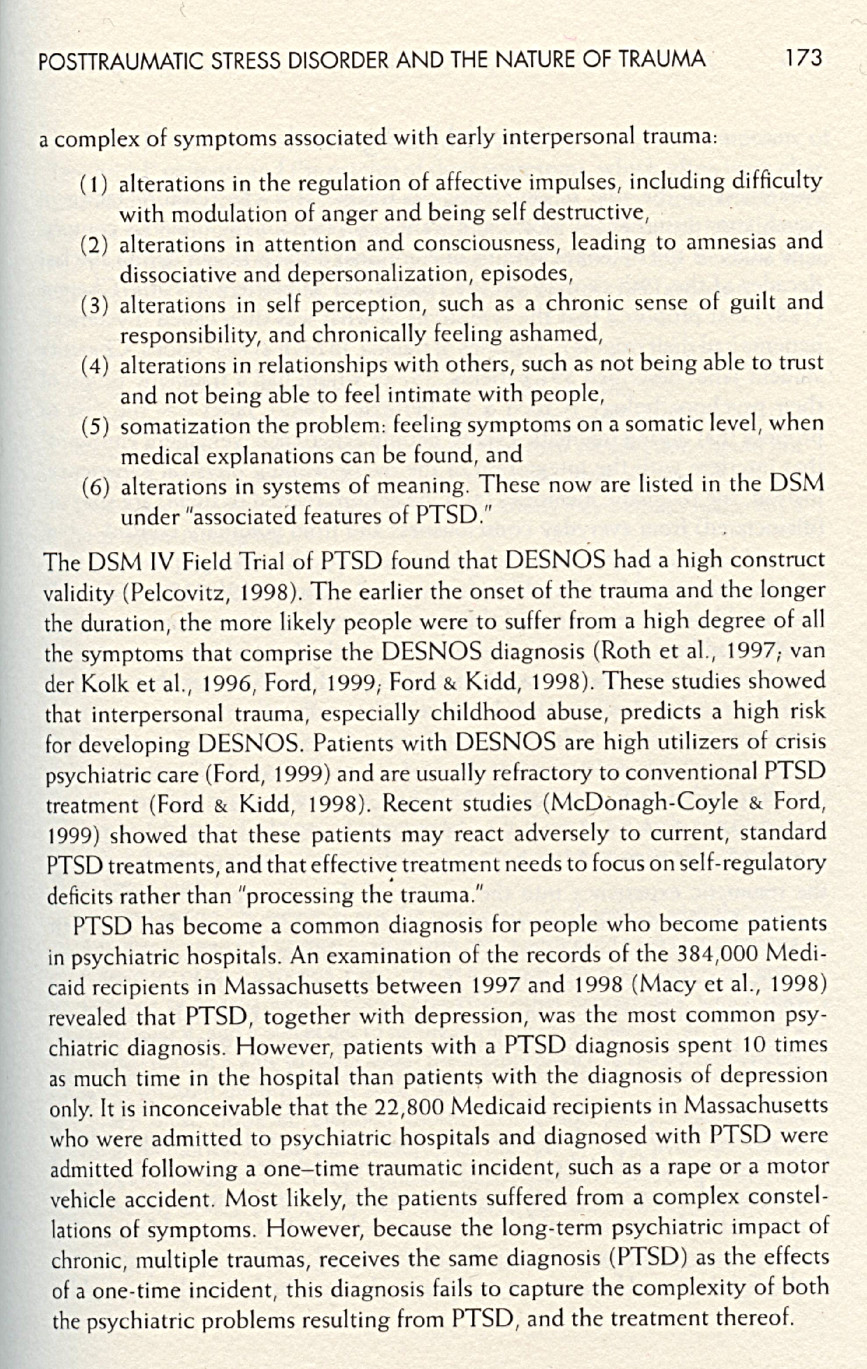
Again, it is not a picture of ‘long-term psychiatric impact’ nor a ‘diagnosis’ that Trauma Altered Development affected Infant-Child Severe Maltreatment Survivors need.  We need to understand the changes our body had to make to guarantee our survival and specifically how those changes affect us, and specifically how to improve our quality of life and well-being in the world in spite of our TAD.

+++++++++++++++++++++++++++++++++++++++++

Please feel free to comment directly at the end of this post or on

+++++++

Your Page – Readers’ Responses

++++++++++++++++++++++++++++++++

+FORCED THROUGH ABUSE IN INFANT-CHILDHOOD TO GROW A DISSOCIATING SELF

+++++++++++++++++++++++++++++++++

Growing a self (with matter) in a body in the world is an infant-child’s sole job in childhood.  Our early caregivers either help us or they harm us in our efforts.

For someone as abused as I was from birth and throughout their childhood, with without a safe and a secure attachment to any early caregiver that would allow them to develop their self in connection to their body in the world, feeling as if one MATTERS or even is a self WITH MATTER is extremely hard to do.

Everyone is born with a spark of life that is uniquely theirs and nobody else’s.  Parents are not supposed to work to destroy that spark.  They are supposed to recognize it in the body (and as the body) of the little one under their care.  They are supposed to recognize the growing self of their infant-child as being separate from their own self, so they can fan the spark and feed it fuel to grow on.

Parents who have serious unresolved trauma complications of their own often cannot do their job.  In my mother’s case, she never recognized ME as a separate being from herself at all.  She overwhelmed me, threatened my spark of life, and my growing and developing body-SELF from the moment I was born and for the next 18 years of my childhood.

Only no matter how hard she tried she could never destroy the spark of life that was-is me.  She heaped every possible obstacle in the way of ME growing my SELF in my body in the world that she could.

I see in my mind the terrible image of an un-jolly giant wielding a gargantuan sledge hammer (like in a tragic cartoon), smashing it down on top of me every chance she got.  In this image I am no bigger than a tiny ant.  As much as it was possible for me to do, my growing self had to stay hiding in order to stay alive at all.

++++

When early caregivers are not available to recognize and nurture and reflect an infant-child’s spark of life self back to it, that little self can seem to all but disappear over time.

I was never allowed to have happy genuine time to grow my self or to even be my self from birth (except in hiding).  The ugly giant with her weapons of destruction was always present or near5 by.  Any time she caught me out in the open being my self in play, exploration or in a state of mistaken safety, she would attack me again.

I see another image in my mind that reminds me of the Phantom of the Opera, because this image is of a stage.  I was only allowed to be like a shadow on the stage of my family’s play.  My mother completely controlled and directed the show.  Mostly I was ‘in trouble’ and being punished somewhere off stage.  I was banished and forbidden to be a part of the ongoing play.

I was left alone in misery because that’s where my mother wanted me (short of dead, which she dared not accomplish).  I could only appear in some version of her dramas such as “It’s a fun family holiday” or “This is Linda in the classroom.”

Mostly I remained either hidden, or under attack.

The REAL me was able to remain hidden back stage and could only sneak around like a phantom where she couldn’t detect me.  Over time, as I aged, I learned to appear on stage in different roles, both as an older child and later as an adult.  But my self-in-hiding could not become integrated within the body that appeared in all of its roles.

Only I didn’t know this was happening.  I have seen in my adult journals how lost I was to myself.  As I’ve mentioned before, my being lost in the world appeared in an unending sequence of patterns of questions that I could never find the answers for no matter how hard I searched or tried.

I have only been able to see the parts of myself that are reflected in my actions performed either around other people, or in my actions I perform when I am alone.  I so rarely have any sense that my WHOLE SELF exists at all that doubt I even have one.  I’ve always had a sense that most of who I am remains somewhere in hiding.

++++

Some would say that loving my ‘inner child’ would give her permission to come out of hiding.  I do not attach an age to the self.  A self moves forward in time just as a body does.  Neither exist ‘back there’ somewhere, suspended in the past.

From my perspective as I write this, I would think that the WHOLE of me simply knows things, as do its ‘parts’.  This self of me was forced to make decisions about how to remain alive in a dangerous world every step forward through my childhood from birth.

Every time my growing and developing self was attacked, my body-self was forced at the same time to make a decision about how best to adapt its growth and development so I could survive in a malevolent world.  Those decisions were made automatically in my body on the cellular, molecular level – including the epigenetic processes that used all the available options possible to tell my DNA how to ensure my survival in a chaotic and dangerous world.

++++

As   strange as it might seem as I write this, I believe by body-brain continued to develop throughout my entire childhood without the ‘usual’ connections to the ongoing presence of a continuous self within it.  Any time I was attacked by my mother and a survival-based decision had to be made in my tiny body about how to stay alive, my growing body went one way and my spark-of-life-self went a different way.

I was supposed to be growing an intimate, inseparable connection between my self and my body.  My mother’s attacks on me were so threatening and continual that this connection could not be formed – physiologically – in any ordinary way.

My ongoing responses to attacks during my early growth and developmental stages changed not only how my body-brain developed, and changed this connection between my self and my body, it also changed how I experienced my self in a body in the world.  Both my growing body and self had to include these changes on a structural and operational level.  There was no magic.  There was no possible alternative.

++++

These patterns of interruption between my growing self and body happened so many times that they cannot be counted.  Two examples that I’ve written earlier come immediately to mind.

One happened when I was two:  *AGE 2 – CINDY BORN – 1953

The other happened when I was three:  *Age 3 – THE TOILET BOWL

I already suffered from an extremely disorganized, disoriented insecure attachment to my ‘caregiving’ mother, to the world around me, and most importantly to my developing body-self connection well before these experiences happened to me.  I believe my mother had already overwhelmed my ability to have any ongoing self experience of having an experience an uncountable number of times well before I reached the age of two.  Without safe, secure and stable early caregiving interactions a safe, secure and stable connection between a growing self and a growing body cannot possibly be made.

After my mother dragged me out of the safety of my grandmother’s bed on the day a month and a half before my second birthday, my mother’s version of this incident was added to her abuse litany of me as proof that I wanted to be an only child, that I loved my grandmother more than I loved her, that I was able to deceive my grandmother by hiding my true, terrible self from her, and that I wanted my grandmother to be my mother and not her.

I first remembered this incident from my vantage point of being a very small toddler floating above my body which I could see in lying at the head in the middle of the expanse of my grandmother’s bed.  I can also remember this experience from within my body on the bed and see the ‘other me’ up there above me looking down.  Only by closing my eyes in my remembering process or by not looking up at all can I make ‘that one’ go away.

I can float around my grandmother’s entire house in that little body.  I can float over the heads of the two screaming women.  I can float over to the window and touch the lace of the curtains.  I can float through the open walk-in closet door, out the bedroom door, down the long curving hallway, into the massive kitchen, into the dusky living room.  I can experience the whole nasty, terrifying event from within the little physical body on the bed, but I cannot bring these two states of experiencing the experience together into one.

++++

When it comes to the toilet bowl incident that happened a month and a half before my fourth birthday, I cannot experience both sides of my memory’s experience.  This ‘event’ was added to my mother’s ongoing abuse litany as proof that I was a murderer who wanted my little sister dead, and that I tried to kill her.

I can remember being in my small battered body as it crumpled against the cold hard surface of the side of the bathtub where my mother threw me after she had exhausted herself in beating me.  What I experienced next I cannot put back together.

As my mother turned to storm out of the bathroom I turned my eyes upward to the window high on the wall across from my sobbing, shaking body.  I can return to this memory in my body.  I remember feeling some part of me rise out of my body and float up toward that window and out of it into the radiant blue sky.  In this memory my awareness remains in my tortured body as the other part of me left my body-self behind.

++++

These are remembered patterns of who-what separates from who-what.  I believe that because I was older and further down the body-brain-self developmental pathway when the toilet bowl attack happened that the separation between my body and self that happened then has continued as a pattern of my being in the world ever since.  What happened that day was an inner rupture without repair.

++++

As I sit here writing at this moment, thinking about what I might be willing or able to say about the part of my self that drifted up out of my body, aimed itself at the window, found its way to escape and floated away, I am having a rather ‘Disney Moment.’

Those of you who watched the movie, ‘Who Framed Roger Rabbit’, can probably remember the final scenes as the wall disappears and a magical world of animation opens up into motion, light, music and color.  At this moment I can sense a similar scene going on behind my shoulders as I write these words.  Thousands of brilliantly colored butterflies dance in the sunlight behind me, each one being a fragment of my experience of myself in my life.

Yet I also know that if I could enter that scene, and travel more deeply within it, that the light would dim, the sounds would change, the butterflies would not be dancing………there I will not go.

This sense I am having of this other world is eerie and makes the hairs on the back of my neck begin to crawl.  I turn around and look behind my back.  There is nothing there but my kitchen wall.  It helps to see a framed picture of Johnny Depp in his pirate guise hanging there.  Seeing it there, I smile.

++++++++++++++++++++++++++++++++++++++++++

For those of you who might be curious, this is the link to the latest ‘counseling’ report I asked for from astrologer Zane:

*Age 58 – Astrology reading about life and death

++++++++++++++++++++++++++++++++++++

Please feel free to comment directly at the end of this post or on

+++++++

Your Page – Readers’ Responses

++++++++++++++++++++++++++++++++

+LIGHT T-DAY READING ON RATS AND THE DALAI LAMA

+++++++++++++++++++++++++++++++++++

I’m not at all sure why I feel safer on the planet knowing the Dalai Lama is here, but I do.  The following links are to information related to the conference presentation to the Dalai Lama about the effects of maternal distress behaviors on her offspring – just a little T-Day light reading!

This is the gist of science told the Dalai Lama:

If a distressed mother rat raises all her own babies, they will all turn out distressed.

If a calm mother rat raises all her own babies, they will all turn out calm.

If you change the litters at birth, and give the calm mother’s babies to the distressed mother, all those babies will grow up distressed.

If you take the distressed mother’s babies at birth and give them to the calm mother, the babies will all grow up calm.

In essence, the distressed mother’s treatment of her babies triggers epigenetic changes in the way the babies she raises turn out because their genes are triggered differently by the distress.

++++

Pity the Poor Lab Rat by Kathy Brown

“…in spite of all our advances in knowledge about mental disorders and the advances in technology that have resulted in an impressive smorgasbord of pharmaceutical agents, the overall prevalence of depression is increasing at an alarming rate. Moreover, the average age at onset continues to drop. Whereas patients once presented with their initial depressive episode in their fifth decade of life, the average age of onset has now dropped into the twenties.”

++++

Mom, Dad, DNA and Suicide by Sharon Begley

Such changes are called “epigenetic,” to distinguish them from changes that affect the sequence of nucleotides in DNA. Epigenetics is arguably the next frontier in genetic research, promising to show why people with identical DNA, such as monozygotic twins, have different traits, including traits known to be strongly affected by genes. The answer seems to be that the events of our lives, including parental behavior, turns some genes on and some genes off. In this case, parental care (or, specifically, abuse) changed the expression of the crucial glucocorticoid-receptor gene in the brain.”

++++

Abuse changes brains of suicide victims

Suicide victims who were abused as children have clear genetic changes in their brains…”

+++++++++++++++++++++

While the new research on neuroplasticity in the brain is important, those of us whose body and brain were changed as a result of severe early child abuse, again, may not be in the realm of ‘ordinary’ when it comes to the changes we can expect in our brains compared to others…..

++++

Buddhism – A meeting of minds by Swati Chopra

At the 12th mind and life conference in dharamshala, buddhism and modern science found points of convergence as the dalai lama and western scientists spoke about neuroplasticity, the brain’s ability to change with experience and focused training.”

++++

2004: Neuroplasticity: The Neuronal Substrates of Learning
and Transformation
a 2004 conference that got neuroscientists together with the Dalai Lama

Download MLXII: Neuroplasticity Brochure PDF

++++

Can Our Minds Change Our Brains?

Train Your Mind, Change Your Brain: How a New Science Reveals Our Extraordinary Potential to Transform OurselvesBy Sharon Begley

At the Dalai Lama’s private compound in Dharamsala, India, leading neuroscientists and Buddhist philosophers met to consider “neuroplasticity.”  The conference was organized by the Mind and Life Institute as part of a series of meetings, beginning in 1987, for brain researchers and Buddhist scholars to share insights into the workings of the mind and brain. The 2004 meeting set out to answer two questions: “Does the brain have the ability to change, and what is the power of the mind to change it?””

++++++++++++++++++++++++++++++++++++++++++++++++++++++++

Child Abuse Causes Lifelong Changes To DNA Expression And Brain.

++++

Mechanisms underlying epigenetic effects of early social experience

++++

Epigenetics. Child abuse alters genes.

++++

What role might epigenetics have in shaping a person’s development?

++++++++++++++++++++++++++++++++++++

Please feel free to comment directly at the end of this post or on +

+++++++

Your Page – Readers’ Responses

++++++++++++++++++++++++++++++++

+CRIMES AGAINST CHILDREN – WHO ARE THEIR PROTECTORS?

++++++++++++++++++++++++++++++++

Something so troubles me that I cannot sleep tonight.  Could it be the sound of hurt and scared children crying, if only silently in their wounded hearts?  Who is protecting these children?

++++++++++++++++++++++++++++++++

A new page posted along the top of my blog has been added JUST FOR READERS to write any trauma-related thoughts that come to mind — either directly in response to something I have posted — or not!

Please feel free to click on the COMMENT link at the bottom of this new page that will always be at the top of the blog — and write!  Your words are important!

++++++++++++++++++++++++++++++++

Your Page – Readers’ Responses

++++++++++++++++++++++++++++++++

++++

Remembering what I wrote yesterday about the lack of playfulness and the ability to play being directly connected to the presence of trauma in a child’s environment, reading this new report about our nation’s children’s exposure to violence greatly troubles me.

++++

Please take some time to look at the report’s information, and also check out the information at the Safe Start Center website!

++++

The Office of Juvenile Justice and Delinquency Prevention published a new report that discusses findings from a survey examining children’s exposure to violence. The survey is the first to attempt to comprehensively measure exposure to violence for nationally representative sample of 4,549 children younger then 18 across major categories. Some of these categories were:

  1. Conventional crime, including robbery, theft, destruction of property, attack with an object or weapon
  2. Child maltreatment, other than spanking on the bottom
  3. Sexual victimization
  4. Witnessing and indirect victimization
  5. Exposure to family violence
  6. School violence and threat
  7. Internet violence and victimization, including Internet threats or harassment and unwanted online sexual solicitation

Results suggest that most children in the U.S. are exposed to violence in their daily lives, with more than 60 percent of the children surveyed having been exposed to violence within the past year. Nearly half of the children surveyed had been assaulted in the previous year, and nearly 1 in 10 witnessed one family member assaulting another.

Safe Start Center is dedicated to teaching about the harmful effects of the exposure of violence on children. Safe Start’s website is packed with information and resources for parents and the community to help our children stay safe. To read the full report of to learn more about the Safe Start Initiative, visit www.safestartcenter.org.

++++

About the Crimes Against Children Research Center

The mission of the Crimes against Children Research Center (CCRC) is to combat crimes against children by providing high quality research and statistics to the public, policy makers, law enforcement personnel, and other child welfare practitioners. CCRC is concerned with research about the nature of crimes including child abduction, homicide, rape, assault, and physical and sexual abuse as well as their impact.

++++

Here, also, is some more information on borderline personality disorder put together by —

In the Spotlight | More Topics |
Kristalyn Salters-Pedneault, PhD
When we talk about the impact of BPD, we’re not just talking about symptoms; BPD also has a major impact on your quality of life. From work, to relationships, to your physical health, think about the ways that BPD may be interfering for you.
In the Spotlight
Your Life with BPD
What is it like to live with BPD? It’s not easy. Intense emotional pain, and feelings of emptiness, desperation, anger, hopelessness, and loneliness are common. But life with BPD is not hopeless, and you can create a life full of quality and meaning.
More Topics
BPD and Relationships
Many of the symptoms of BPD can have direct impact on relationships, and other symptoms have an indirect (but not necessarily less disruptive) influence.
Physical Health Problems and BPD
People with BPD are more likely to report a variety of physical health problems, and are more likely to need to be hospitalized for medical reasons, than those without BPD

++++++++++++++++++++++++++++++++

+PLAY AS AN INDICATOR OF SAFETY AND SECURITY IN A BENEVOLENT WORLD

+++++++++++++++++++++++++++++++++++++++++

Mothers have evolved throughout the millennia to play with their infants.

Having the ability to engage in healthy play has evolved through the millennia to build healthy body-nervous system-brain-mind selves in our species.  Play happens when the world is a friendly place to be.  Play TELLS us that the world is a friendly place to be.

When the environment surrounding mother and infant-child is benevolent, healthy play is most usually present.  This benevolence in the environment is then built into the growing-developing offspring.

When the environment surrounding mother and infant-child is hostile, toxic, lacking in essential survival qualities and therefore is malevolent, a mother’s ability to engage in healthy play with her offspring is interfered with.

Thus, the absence of healthy playfulness between mother and offspring signal the developing infant-child on every physiological level that trauma exists in its world.  The offspring will then be forced to change and adapt to the best of its physiological abilities to prepare itself for a lifetime within a malevolent world.

++++

Healthy playfulness between a mother and her offspring only happens to the degree that the environment is safe and secure enough to allow this play to happen.

If a mother grew and developed in her own early childhood in a world that signaled her body-nervous system-brain-mind self that the world was malevolent, she is most likely carrying unresolved trauma within herself that then signals to her offspring that the world is malevolent.  Her offspring will then have to change according to the trauma-present-in-the-world message just as its mother did.

Both mother and infant-child will then suffer from a lack of safety and security perceived as permanent and real by their physiological development.  When trauma is present, healthy play is interfered with because our evolution has designed our species so that degree, quality, kinds of, presence of healthy play and playful attitudes directly indicate the degree of either benevolence or malevolence in the world.

++++

I am not talking about play as we might think about it in today’s world.  This kind of play has nothing to do with toys or ‘stuff’.  Healthy play that signals to offspring the condition of the world is about direct face-to-face interaction between mother and infant-child.  The presence of a world safe and secure enough to allow for this kind of play between early caregivers and offspring has operated throughout our evolution.

It was only when the world because safe and secure enough, adequate and benevolent enough for this level of play to grow and thrive that humans ever achieved powers of speech at all (only about 140,000 years ago).  The physiological systems within our body and brain had to have already evolved sophisticated organizational and orientational abilities to have ever allowed our powers of speech to manifest in the first place because speech uses all those preexisting abilities.

Any time trauma happens it always disrupts ongoing coherent life.  If trauma cannot be resolved, consequences happen.  Dissociation represents one of the fundamental consequences of a being’s inability to resolve trauma.  Dissociation continues to affect a mother because its very existence means that something malevolent occurred that was not able to be resolved.

A dissociating mother thus communicates her state of unresolved trauma to her offspring primarily through an interruption in her ability to engage in healthy play and playful attitudes with her offspring.  The key to healthy playfulness between a mother and her offspring is that it is APPROPRIATE.

Appropriate, and therefore healthy play and playfulness between a mother and her offspring, the kind of play that then signals the offspring to grow an entire body geared for life in a benevolent world, happens when the mother’s entire focus is on fostering the well-being of her infant-child.

Mother’s have evolutionarily evolved to respond appropriately to their offspring so that their play-filled responses do not overwhelm, over stimulate or under stimulate them.  When a mother has experienced enough trauma during her own development that incoherency in the form of dissociation has been built into her entire body, she is not likely to be able to operate from this optimal, benign, benevolent-world-condition state within herself.  She will then communicate her own preexisting, unresolved trauma states directly to her offspring.

++++

Terror, pain and trauma interrupt play and the ability to play.  This lack of play and the ability to play then acts as a direct signal that communicates malevolence in the world.  When healthy play and playfulness exist, they happen in a safe and secure world, not in the midst of trauma.

A mother who does not carry unresolved trauma into her interactions with her offspring will be able to focus on the well-being of her offspring and demonstrate the benevolence of the world to her developing infant-child through her healthy, appropriate play and playfulness with it.

These interactions operate from birth to form first the right, limbic, emotional, social brain.  As the infant-child continues to grow, the foundation of play or its absence, built within its body-nervous system-brain-mind-self will further influence the development of its later-forming left brain, the connection between the two hemispheres of its brain, and the development of its higher-processing cortical abilities.

A non-dissociating mother is able to have appropriate hopes, dreams, wishes and desires for the well-being of her offspring.  She will automatically be able to orient herself and organize her interactions with her offspring.  Her goal, destination, direction and purpose regarding her offspring will be benevolent.  This benevolence will be communicated through safety and security that manifests itself in healthy play and playfulness toward her offspring.

A dissociating mother will experience breaks in her ongoing interactions with her offspring that will vary in degree according to the changes that had to happen to her during her own development in a malevolent early environment.

In my case, my mother’s dissociation toward me was extreme, fundamental and complete.  In her psychosis she believed that I was evil, that I tried to kill her while I was being born, that I was not human, and that I was sent to be a curse on her life.  Her psychotic dissociation in-formed every interaction she ever had with me from the time I was born.

My mother’s unresolved trauma, manifesting itself in her dissociation, prevented her from ever being able to respond to me with anything like appropriate, healthy play or playfulness.  She was not able to consider my well-being because she could never understand that I was a separate entity from her.  I was merely and continually the recipient of her slit-off projection of her intolerable perception of her own badness.

She not only could not have playful interactions with me that I needed to build a non-trauma centered body-nervous system-brain-mind-self, but her psychosis was so severe that she prevented ME from ever being able to play at all.

++++

The absolute disturbance in the necessary operation of play in my childhood directly ties into my own dissociation.  The trauma I experienced in the malevolent environment of my childhood could not possibly be integrated into a coherent self.  However, as a mother to my own children I was able to know they were separate beings from me, and I was able to focus as much as I possibly could on them and on the development of their well-being.

In other words, I was able to organize and orient a ‘mothering self’ within me that existed to foster the development of my children.  Because I could do this, I could offer to them enough play and playfulness that it communicated to them a relative lack of trauma in the world and enough of a sense of safety and security in the world that I did not pass my unresolved trauma onto them.

They did not have perfect childhoods because the unresolved trauma and the changes that had to happen to me so that I could survive my childhood affected every other aspect of my being-in-the-world, and therefore DID affect them.  But these problems were MINE and I was able to keep them myself.  I did not force them INTO my children the way my mother forced her unresolved trauma INTO growing and developing me.

++++

As we return in our thoughts to consider our infancy and childhood through the lens of playfulness and play or its absence, we can become much more clear about how our caregivers’ unresolved trauma — or the absence of it — operated to directly communicate to our growing and developing body on all its levels what the condition of the world was like.

If appropriate and healthy play and playfulness was there for us, it is during those experiences that we were developing in an ‘ordinary’ way.  If it was absent, some degree of trauma was present, and we were forced at those times in our development to try to adapt to that malevolency.

Who we are today and how we are in our bodies in the world is directly connected to play and playfulness because it is only in times of safety and security that play exists at all.

+++++++++++++++++++++++++++++++++++++

+TEARS, BEING LOST, ORGANIC CHOCOLATE CAKE BAKING IN THE OVEN…..

+++++++++++++++++++++++++

Has there ever been a time since the moment I was born when I wasn’t lost?  I don’t think so.  (Maybe I didn’t even find my way to my right mother!)

I just found a piece of paper lying face down on the floor by my computer chair.  I was looking for something to write a telephone number down on so I could order some yarn so I can warp my loom.  I tore the bottom off of this paper and used it.  This is what was on the top half:

January 14, 1988

The years go by.

I want a dream

a vision

something I can live by

Art Therapy

living in Albuquerque

Yet if I’m empty inside — then what?

It’s so easy to forget what I’m doing and why.

+++++++++++++++++++++++++

This must have fallen out of something in my pile of journals.  The cats love to tumble around and must have knocked it loose.  I feel disheartened reading this, realizing this was written just after I made the decision to apply for art therapy graduate school.

Whenever I have stopped to think back at that stage of my life, I have always ‘remembered’ that I knew what I was doing then, or certainly that I didn’t know what I know now about how lost I’ve been all of my life.  I didn’t know I felt lost — even then — even after making such a big decision for my life and my future.  Or so I thought….

This paper shows otherwise.  It makes me MAD and SAD to see this lostness I still feel now WAS with me back then — yet why would I think it would not have been?  Has any decision I’ve ever made in my life ever moved me off of my dead center spot of being lost?

What have I been thinking these past 21 years?  That I have only been lost some of the time?  That I have ever had a reprieve?  True, I had hope then that led me to move with my children from northern Minnesota to New Mexico by fall 1988 and complete graduate school (1990) to become a nationally registered art therapist.  But what good did that effort do me?

I guess I better scoot back from my keyboard.  My tears might short circuit it.  Then where would I be?  It surprises me how quickly the tears came once I began to write this.  It’s a good thing I have a soon-to-be delicious organic chocolate cake (mix from our local food co-op) baking itself in my oven; I hear the egg timer ticking.

Healthy, right? And it has a matching organic chocolate frosting mix to go with it!

Tick, tick, tick.  There go the years of my life.  I would not be this lost if I had not had my mother for a mother.  I wouldn’t even be this lost if she had at least let me PLAY — at all — in my childhood.  What a strange realization.  What a true one.

+++++++++++++++++++++++++

I was going to make the following easier to read, but just don’t have it in me right now.  There’s a lot of information here — even just for scan reading.  I know it is about my dissociated mother, who was a professional at making me her dissociated daughter!  It’s about everyone’s mother who was borderline or otherwise dissociated, including depressed.

Maternal dissociation is directly connected to a mother’s inability to play with her infant, a critical participatory activity between mother and infant that builds the right limbic emotional social brain and conditions the infant’s nervous system.

My mother was so sick that her inability to be playful with me she ended up so abusing me that she interrupted my play-brain-growth by preventing my play and by distorting my attempts to be a child throughout my entire childhood.

When a mother dissociates (especially in rage) while in interaction with her young infant the infant’s developing brain-mind essentially ‘falls through its own cracks’.  Dissociation is, I firmly believe, directly communicated from the mother’s brain and nervous system to the infant as it grows and develops its own brain and nervous system.  The long term consequence of this harmful degree of dissociation is being lost in one’s own life.

++++

You will need to know this before you take a look at the link below:

Dissociation in mothers affects how the nervous system in her infant develops.

The ANS, or autonomic nervous system has two branches, or arms.

One arm is the sympathetic branch, or the GO part of our ANS.

The other arm is the parasympathetic branch, or the STOP part of our ANS.  I remember which is which by thinking ‘pair a brakes’ for ‘para’ — STOP.

Dissociation in the mother is communicated to the infant and destabilizes the ‘ordinary’ development of the infant’s ANS.  The information below relates to maternal dissociation:

+SCHORE ON BRAIN AND NERVOUS SYSTEM DEVELOPMENT

ANS – Dr. Allan N. Schore – “Affect Regulation and the repair of the self,” chapter 4
Selves on the brink between imploding and exploding
Dissociation:  “The neurobiology of the later forming dissociative reaction is different than the initial hyperarousal response (for models of the neurobiology of dissociation (see Scaer, 2001; Schore, 2001c) (schore/ar/125)”
Autonomic Nervous System (ANS) and DISSOCIATION

++++

“As episodes of relational trauma commence, the infant is processing information from the external and […]

Read Full Post »

+++++++++++++++++++++++++

+CONTINUALLY TRYING TO CREATE MYSELF IN TIME AND SPACE

+++++++++++++++++++++++++++

I tell myself to put my fingers on this keyboard and make them move.  “Speech is silver.  Silence is golden.”  I choose to go for the silver.  I was forced for the first 18 years of my life to be as silent as a child can be.  Silence will not heal me.

Writing is all tangled up today with what I choose to write about.  Having a disorganized-disoriented insecure attachment MEANS that having access to one single, integrated, cohesive, coherent Linda is extremely difficult.  I will not admit defeat and say it is impossible.  I am coming to understand, and believe, that using my words – putting them together in lines across the page – will help me become more organized, oriented, integrated, cohesive and coherent.  So here goes…..

I am thinking a jumble of thoughts, all tied into very old and continual thoughts about myself in my body in my life since my beginning.  I was not allowed to be a person.  My mother interfered with my normal, ordinary development every single step of my development.  I have paid a price for her terrible abuse of me.  The biggest one is that I didn’t so much as LOSE my self, I didn’t get one in the first place.

++++

So I have to imagine what it would be like to have one of those illusive organized, oriented, integrated, cohesive and coherent selves.  How do all these aspects of such a strong, clear, healthy self operate in time and space, which is what I guess being in a body in a life, in the world is all about?

Today, I want to know the difference between having goals, destination and purpose and having hopes, dreams and wishes.

I want to know because it seems to be I wouldn’t have to question these things the way I do now if I HAD any real idea what they mean.

My mother interfered with my development regarding everything, so why wouldn’t I expect that having a clear sense of goals, destination, purpose, hopes, dreams and wishes would be a part of what I am missing?

She never hesitated to control and abuse me in any way that she could.  Her abuse included confining me in space and time beginning when I was very, very small.  She withheld food, prevented me from even going to the bathroom when I got older.  She woke me from sound sleep to beat me, or didn’t let me sleep.  When I got older she forced me to overeat.  I could go on and on, but this isn’t what I want to say right now.  Not being free to be a growing child, not being safe or allowed to play greatly harmed my development in every single way.

What I want to say is that great sense of loss and grief I feel is tied as much to my loss of access to my inner needs, wants, desires, ability to have intentions, and the ability to find ways to know what brought me happiness as a person and what gave me pleasure.  I didn’t grow up knowing much of anything except how to survive my mother’s torture and abuse.

++++

This thinking is tied to what I believe about people like me with disorganized-disorganized insecure attachment.  I believe I organized and oriented myself around being a mother for the 35 years I had children under 18 in my care.  Today it seems that I used the goal of caring for them as well as I could, the destination I saw for them in the future as leaving home well and happy people, my purpose in life of being their mother, to organize and orient my self in the world.  My hopes, dreams and wishes were tied up in that whole process.

Having them grow up and leave was wonderful.  Yet I was left again being the disorganized-disoriented insecurely attached-to-my-own-self and the world just as I had always been for the first 18 years of my life.

Without the strange and complicated relationship I formed after they left again leaves me feeling inwardly desperate, destitute, lost and confused – again disorganized and disoriented.

I was able to obtain the goals for my education, but the process was extremely confused, and in the end I am still lost.  I can ‘make things’ with my hands, but even being able to use the ‘goal-destination-purpose’ and ‘hopes-dreams-wishes’ thinking only lasts for short periods of time and nothing about me seems connected and tied together.

I want to understand how the brain-mind changes that I have continue to cause me great difficulties in these areas.  Somehow I sense that COMMITMENT has always been a key and central piece of anything I have ever accomplished.  If I say I hope to write, that writing is tied to my dreams and wishes, how do I connect that to my goals, my destination, my purpose?

Because my right brain, left brain, corpus callosum that connects them together, and my higher executive function cortex did not form in an ordinary fashion and instead will suffer from severe trauma influence for the rest of my life, I cannot simply accept that I am going to ‘naturally’ find a solution to my dilemmas.  I have to continue to focus my will toward the goal of better understanding how all these changes – that result in what I am naturally missing – connect to my overall feelings of hopeless sadness in my life.

How does changed me find my self in time and space so that I don’t constantly know that I don’t ‘fit in’, am lost, and want to ‘leave here’?

I don’t know yet, but I wanted to say I am working on these things.  Today.  I continually have to try to learn how to create my self in time and space because this process was completely interrupted for me growing up with such abuse.  I have a trauma bond with myself that makes it hard for me to get through life feeling whole and successful.  There is a rupture between my self and myself and the world I am constantly trying to find ways to repair.

I have to start with the little things, and writing here is one of them.  Now, I will go eat breakfast as I move my self forward in the time and space that is today.

+++++++++++++++++++++++++++++++

It strikes me after putting the above words into their order that the most important word in the whole piece is PLAY.  I was not allowed to play, and as many of my childhood memories show, my mother had an uncanny ability to turn whatever childhood play thoughts or actions I had into something painful for me.

Beginning with playful interactions between infants and their early caregivers, and moving all the way through childhood, play is nature’s way of building an organized and oriented self in the world.  I suffered terribly from the lack of play and from interruption of play every step of my development because of my mother’s abuse.

My sister just gave me a simple example of how play interacts with a growing brain-mind-self regarding hopes, desires and wishes on the one hand, and goals, direction toward a destination and purpose on the other.

She took her granddaughters to a fund raiser bake sale today.  The seven year old bought muffins and a specially formed little bundt cake with a hole in its center.  On the way home she ate the muffins but carefully protected and saved the cake.  At the urging of grandma and her 10 year old sister she finally, shyly told them her PLANS for her special cake.

She wanted to take it home, fill the center with pudding, put a candle on it, and have a birthday party with her Barbie dolls.  This, of course, is what she was allowed to go home and immediately accomplish.  Even her sister, who thinks she’s too grown up to play Barbies, came to the party.  Through each step in her process she was building another healthy, happy aspect of her brain-mind-self.  Severely abused children are very often deprived SO MANY or ALL TIMES of this kind of experience — and this kind of loss is big part of what happened to change us.

I see that everything I am thinking about this morning is simply contained in that pattern of child play.  Play is how children learn to be social (after their infant brain forms through early mirroring caregiving).  Play can involve rules, or not.  Child play does allow the brain not only to build its happy-joy center, but also all the other brain patterns and circuits I am beginning to understand as they in-form our lives.

The arenas of damage my mother orchestrated against me were many and devastating, but today it is particularly the damage done to me by her abuse of my play drive and abilities that has harmed me immeasurably in my adulthood.

Today I also realize that the absence of my sadness that being with my boyfriend gave me was directly tied into play.  He was my playmate.  That is a big part of the joy and happiness I felt when I was with him.  I didn’t know this until today.  I have no built-in experience of play-joy from childhood.  I didn’t even recognize my happy feelings with him were directly connected to play.  My playmate doesn’t want to play any more.  Certainly that gives me great sadness.

What can I learn about play at 58?  How can I begin to understand that a lot of the sadness I feel stems from never having play in my childhood?  My siblings played together, and they all remember my part in their play – by my absence from all of it!

That especially the lack of play in my childhood (coupled with the rest of the terrible abuse) directly created my adult brain-mind-self’s great difficulty with the ability to dream, wish, hope or to plan, have a goal, a sense of direction, a destination for myself in my life, or a sense of purpose — in-forms my sense of grief, loss, and feeling lost like I don’t belong ‘here’ — is not a small piece of information.

+++++++++++++++++++++++++++++++

+I WILL NEVER BE ORDINARY. IT IS TIME FOR ME TO KNOW THIS TRUTH.

++++++++++++++++++++++++++++++++++++

I try to be as positive as I can about the work I am doing with my writing about the permanent and lifelong trauma-centered changes that plague survivors of severe abuse and trauma that happened during their early infant-child developmental changes.

Today’s transcription of my quarter of a century old letters my friend just returned back to me has left me feeling anything but positive.  The reality of the kinds of childhoods like mine, and like the kind I am talking about and describing, is horrible.  There is no way to pretty up the picture about what was done to us and what happened to us as a result.

I am faced with the tragedy of what my mother’s abuse did to me — not just during my childhood, but throughout my entire life up until this very instant in time.  Primarily I balance my mother’s abuse by the other side of my child abuse history.  No one was there for me to form a safe and secure attachment with.  THIS LACK, I believe, had as much to do with how my body-brain-mind-self had to change in order to survive as did the abuse itself.

I believe that having a safe and secure attachment to at least one other person from birth particularly through age 5 is a critical resiliency factor to balance out the terrible harm of abuse in infancy and childhood.  When I consider the terrible abuse of my childhood, it is ALSO the absence of having any other person I could form at attachment to and with that profoundly harmed me.

It is not JUST the presence of abuse that truly creates a malevolent childhood.  It is also the complete absence of safe and secure attachment to ANYONE else.  That absence, I believe, amplifies the impact of the trauma of abuse nearly beyond belief.  That absence, in particular, coupled with the abuse, so changes a person’s development that trauma becomes the underlying pivotal factor of their ongoing existence.

No matter how benign our adult life may appear from the outside, the reality of this kind of childhood trauma within us manifests itself in every feeling, thought, action, decision and experience that we have.   How to live well in spite of the trauma-centered developmental changes that happened to us is so far past my ability to understand today that I can’t imagine it.

++++

I am having a transparent moment, as if all the illusions I have ever had about myself being an ‘ordinary’ person in an ‘ordinary’ world have now completely evaporated.  Is this a feeling of complete hopelessness that I am experiencing?  It can’t be.  I won’t let it be.

Having illusions about who and how I am in this body in this lifetime is not the same thing as having hope.  Just because today, finally, all my illusions have vanished because I have challenged them and found that they do not fit me, does not mean that I have no right to find a way to a better life in this world.

At this moment I feel as if I have one foot poised in the air over a threshold I am crossing into a new vision of myself in my life.  I can, for the first time ever, looking backward through the time of my life and see myself being born a pure and innocent child, full of potential, full of life, full of the ability to respond to the world I was born into.

That this world welcomed me with trauma and abuse, which held me firmly within its grasp for the first, formative, 18 years of my life does not mean that I, as a human being, have changed in my essence.  But I do have to work with this body, nervous system, and brain that changed itself to survive the horrors of that ongoing trauma.  It is my mind I am working to change, to the best of my ability, not because it is in any way ill, but because it is mine.

My mind can no longer afford to feed itself on a diet of illusion and false belief that what happened to me did not affect me in ways that I now KNOW it did.  And with this knowledge I now have the most profound hope I have ever had.  It is time for me to learn how to experience life MY way, my CHANGED way, without ever again expecting anything about myself to be — ordinary.

There is an invisible line that is crossed during a severely abused infant-child’s life where the option to develop in an ‘ordinary’ way is removed.  To deny this fact is to suffer from delusion.

++++++++++++++++++++++++++++++++++++

*Ages 29-33 – Eight Letters to a Friend

++++++++++++++++++++++++++++++++++++

*Commentary on the eight letters to a friend – ages 29-33

++++++++++++++++++++++++++++++++++++

SOME OF THE KEY TYPICAL TROUBLESOME WORDS, CONCEPTS AND EXPERIENCES THAT ARE DIFFERENT FOR SEVERE CHILD ABUSE SURVIVORS – SEEN FROM MY NEWLY INFORMED PERSPECTIVE.

These things connect to what continues to ‘trouble’ us because they are all connected to the changes that our body-brain-mind had to make in order to survive early severe abuse during our infant-child developmental stages:

Choice

Feeling guilty – the whole concept of guilty

Concept of procrastination as being a source of our problems

‘shirking’ responsibility – the whole concept of ‘response-ability’ as it applies to us

dealing with things on a self-honesty level

concept of ‘changing’

the concept of feelings, feeling feelings, experiencing feelings

emotional brain not form ‘ordinarily’; emotional dysregulation = chronic problem

feeling lonely, depressed, crying – all different for us than for ‘ordinary’ people

experience of ‘feeling low’ and low on energy is different

‘anger’ has a different meaning to us – both our own and other people’s

being with other people

feeling trapped

our experience of the experience of ‘being sick’ and recuperating is altered

our experience of being kind to ourselves

our experience of giving ourselves ‘permission’

how we experience anticipation of enjoyable experiences

experience of worry different

experience of ‘wishful thinking’ is different

experience of disappointment different

Experience of trust is different

Our experience of the passage of time is VERY different!

Our experience of friendships is different

Being willing to reach for and experience ANY kind of self-help we can find

Finding that it does not REALLY help us at all

blaming-shaming ourselves that it doesn’t

not being able to immediately and completely trust our impressions of people

my ‘who-to-trust/not-trust’ center in my infant brain could not form correctly

making a mess of our own thinking trying to change these first impressions!

Our sense of safety with others is THE number ONE issue – we have to trust it

Intense feelings of isolated-alone, trust them, they are REAL beyond belief

Realize that ‘ordinary’ people do not experience them with the pain we do

Yes, we will do everything possible to ‘protect our feelings’ – naturally

Have to be hyper aware of what feels threatening and scary to us – it’s real

There are memories and feelings we can’t touch because it isn’t good for us to

Repression of trauma is not the same thing as dissociation

we can’t ‘work through issues’ like others if we dissociate

not helpful to feel guilty-shame for what we cannot possible accomplish!

Terrible ambiguity can exist about our abuser(s) – ordinary people can’t imagine

Confused-meshed identity and relationship with abuser

Commonly called ‘defense mechanisms’ don’t begin to describe true insanity

Have to be realistic about ‘recovery’ goals – ours will be different than ‘ordinary’

Be careful of what we believe of what therapists who do truly not know us, tell us

We don’t really know what love is or what it feels like – we weren’t built that way

I strongly suspect that ‘love’ is different from ordinary for us

We will never stop learning about what ‘ordinary’ people automatically know

We did not grow into our thinking abilities like ‘ordinary’ people do

Not helpful to be told by others we are ‘rationalizing’ as a defense when we think

We need help learning about our thinking process because abuse changed it

Our disorganized insecure attachment means that we do not grieve the same

Extremely helpful to understand insecure attachment and love relationships

Our own pain-loneliness puts us at risk for attaching harmfully in relationships

Our sense of ‘time passing’ is different; things do not ‘end’ in time like ordinary

Difficulties with accountability if we don’t know source of our difficulties

Terrible troubles with goals-future plans, our higher cortex formed differently

We have a different version of a selfhood – not the ordinary one formed by age 2

When we feel alone in the world, a lot of it is because we are lonely for our self

(a self-centered-self is cultural and evolutionarily a recent luxury we didn’t get)

We had no say in the matter – we developed a trauma-centered self from birth

12-step program talk about ‘unmanageability’ = not from our ‘planet of origin’

12-step program talk about ‘acceptance’ = not from our ‘planet of origin’

12-step program talk about ‘powerlessness’ = not from our ‘planet of origin’

12-step program talk about ‘resentments’ = not from our ‘planet of origin’

the set-point for our nervous system is not at ‘calm’ like ‘ordinary’ is

(these points are included at the end of the link presented above)

++++++++++++++++++++++++++++++++++++

+SIMPLE MOMENTS OF HUMAN KINDNESS CAN SAVE AN ABUSED CHILD’S SELF-LIFE

++++++++++++++++++++++++++++

I woke up on this sunny, warm morning thinking about the post I wrote last night, feeling concerned about the darkness in it.  Somehow two topics came into my mind almost like they came to me as a balance weight against that darkness that was the history of the making of Linda.  One topic is about the Brownie scout leader I had when I was eight.  The other topic is my strange cat, Gerri.

I will only know by writing this piece how the darkness and the light within the story of the Brownie scout leader and my cat fit together.  I know attachment lies at the root of this piece of writing.

++++

I will start with Gerri because she is here with me in the present.  She is (I know nothing about cat breeds so I will do the best I can to describe her) a mostly black tortoise shell calico cat.  She has splashes of white markings and light tan, almost peach legs, with some tan speckles throughout her fur.  Her coat is so thick I can scrunch my fingers into it, but also a little oily and waxy.  It reminds me of a soft version of the undercoat a buffalo might wear.

Her eyes are round and always big, yellow with a pitch black slit in them.  She reminds me of an owl when she looks at me, and her look is always a stare as if she is continually looking for threat and danger.  She often looks worried as if I might eat her.  There is always tension in her small body (she is not a big or heavy cat).  I will never know her whole background or history, but what I do know explains for me why she is such an unusual and strange cat.  I don’t expect her to ever be ‘ordinary’ the way the three now mostly grown kitten-cats I rescued are.  But I am seeing the REAL Gerri emerging within this precious original cat!

Those of you who read my postings on my 1982 journal remember that I reached a point all those years ago when I packed up my spinning and weaving and put it all away when I entered college, and my life changed.  As I transcribed those journal pages I realized how sad it was that I let go one of the few parts of myself that were really an important and positive part of me.  I looked at the beautiful maple loom sitting in the corner of my living room and realized that I can place some important energy in my present life getting that part of myself that loves to work with fleece and yarn back into my life.

++++

Now the story about the loom and Gerri intertwine.  About four years ago I happened to hear about this loom that someone in a town about 50 miles from where I live had to give away.  I was fortunate to get this woman’s number and called her.  The following weekend the loom was in my house.  The woman who brought it here was a friend of the woman who owned it, whose Alzheimer’s had progressed to the point she had to be placed in a full-care institution.  It turns out this woman who owned the loom (I never met her) also had two cats that needed a home, too.  I offered to take the cats.

The next weekend the cats arrived, Gerri being one of them and a huge fat white cat named Poe being the other one.  The wisdom of my hindsight came very quickly into play as the woman who brought the cats in their cardboard cat carrier boxes brought them into my house, opened them up immediately, and the cats got away.  I should have insisted immediately that the cats be left in their boxes for awhile until I had time to meet and greet them before I let them out.

Poe only disappeared for a few hours.  The little black one was gone for four months.  I hoped she was still in my house and had not escaped at some sly moment when the door was open, but I didn’t know for sure.  All I could do was keep food, water and litter filled and wait.

Eventually I heard the black one.  I had not written her name down when she had been left at my house, so I called her by the name the little neighbor boy suggested.  Gerri.  After her four months of sneaking out at night and hiding thoroughly during the day, I began to see fleeting shadows of Gerri darting along the outside walls of the house from hiding place to hiding place.  As she became more trusting and daring she would appear here and there away from the walls.  That’s when I began to realize that big fat Poe bullied her.

I ended up finding a home for Poe.  No bullying allowed in my home!  It has taken 3 ½ years for Gerri to transform into my pet.  Gerri is missing her front left paw.  She was stepped on by a horse when she was so tiny she could barely walk, and the woman who owned the loom had taken her to the vet’s and saved her life.  The more I come to know Gerri, the more I realize that she has cat version posttraumatic stress disorder.  I would call her absolutely ‘mentally ill’ and neurotic if I didn’t know better.

Also, the more I have gotten to know Gerri, the more I wonder if her previous owner’s increasing dementia didn’t severely further traumatize this cat.  It makes me worry for pets who are under the care of Alzheimer people before they progress into total near-oblivion.  The hyper startle response this little cat has, her nervousness, her obvious distrust of the world she lives in, her difficulty in forming attachment to me, all make me think that there were many times in her 14-year life that she was threatened not only by a giant horse, and a huge bullying white cat, but also by her increasingly demented owner.

++++

But Gerri seems to realize more every day of her life that she is now safe from harm and secure in my care and affection.  Nothing will ever take away from her either the background experiences of suffering that she’s had, or her physiological responses to those traumas.  But I am watching her become, a little more every day, more and more of the fine cat, Gerri that she is.

She loves to be brushed, and I don’t mean she’s a little fond of it.  She gets ecstatic!  I keep a brush on the bathroom floor, and every time I use the toilet Gerri gets some profoundly happy moments!  I have even seen her let herself be chased by the sweetest of my three half grown kittens.  Gerri is queen of the house now.  She will never eat while the other three do, but she watches them from the middle of the kitchen floor with interest.  She will even curl up now on a corner of my sheet-covered bed in the sunlight during the day, allowing herself to be present with three other cats on the bed!

But it is what happens at night when I first go to bed that tickles me most.  I don’t know why she just started this a week ago.  It’s like some ancient Gerri-is-a-cat genetic memory has kicked into gear.  She always knows about 15 minutes before I head to bed that it is TIME, and she begins to prance around me, waiting.  As soon as the lights are off and I am snuggled under my covers and stop moving, Gerri rushes into the living room.  It took me a couple of days to put two and two together to figure out what her new routine actually was.

I would here her return to my room as she made the strangest cat deep growling  cat talking sounds.  Then they would stop, she would leave the room, and soon she would be back repeating her verbal display.  After awhile she would jump onto my bed and nestle down somewhere near my feet where she spent the night.  Eventually I noticed the pile of cat toy soft balls piled under my bed near my head.  “Oh!  She’s HUNTING for me!”

In order for this game to repeat itself for the first few nights Gerri had to move all the balls back into the living room during the day so she could hunt for them again at night.  Now I round them all up and hide them for her.  At first I kept the hiding simple and obvious so she would have no trouble finding them.  I didn’t want to discourage her from hunting for them.  Now I can be a little more challenging in where I put them in the morning, because she still finds them all at night and brings them back for me.

Now HERE is the connection to my Brownie scout leader when I was eight.  I am Gerri’s attachment person.  She hunts for me because she loves me and she is taking care of me like a momma cat would hunt and bring her kill to her kittens.  I am like her mother at the same time she is mothering me.

++++

When I was eight, shortly after my family had left Los Angeles and moved to Alaska, my mother was still practicing the “Let’s be a GOOD (public face) mother so I make an impression on all these new people I am meeting here!” façade.   Eventually, and it only took less than two years, she stopped caring a hoot what anyone thought about her in her new location and became again completely the mean mother she was to me.

In the meantime, I was allowed to attend Brownies for about a year, which culminated in my being allowed to attend Brownie day camp for a week the June we first began homesteading.   Mother drove me to the Eagle River Shopping Center parking lot and the Brownie leader picked me up and drove me to camp and back again.

I am thinking about how the attachment and child development experts tell us that the ability to form secure attachments lies within each individual child.  When insecure attachment happens instead, the ‘fault’ does not lie within the victim-child.  It lies with the inadequate early caregivers.  I have never forgotten the time I spent at that Brownie camp.  It was one of the very, very few times I actually GOT TO BE A CHILD!  I loved the activities, enjoyed being with the other children, and was treated grandly by every one of the adults.

Yet one particular experience that happened on a return trip back to the shopping center that remains a ‘flashbulb’ memory for me (the same as trauma can create flashbulb memories, so also can extremely positive events, especially when a child is immersed in the darkness of trauma on an ongoing basis).  We had left the camp a little early, and the Brownie scout leader asked me on the return trip if I liked flowers.  I trusted this woman completely by now, and I can remember my own ecstasy when I responded back to her with the full life-force and enthusiasm I was capable of, “Oh, YES!  I LOVE flowers.”

“OK,” this woman responded back to me with a smile.  “Just wait.  I am going to show you something very special.”

She turned off of the paved highway and drove down a narrow dirt road and parked near the edge of the great Knik River.  She walked ahead of me on a slippery damp wet packed black mud pathway along the shore until we came to a small open area where she showed me the Chocolate Lilies growing there.

So beautiful, I thought!  I had never before seen a brown flower!  But when I smelled them, the STUNK!  How could something that looked so beautiful smell so bad?

Well, I have NEVER forgotten those shining moments or the kindness of that woman.  Yet I also realize that woman’s attention and generous kindness to me where probably not one single bit out of the ordinary for her.  I had no idea at all that people ordinarily treat children that way, treat each other that way.  For me, that week at day camp, and my ‘commutes’ with this woman remained the safest, most secure, most kind and happiest days of my entire childhood.

Hope from human kindness means the universe to abused children -- budding flowers in spring -- the Chocolate Lily

++++

Which again takes me back to myself and little traumatized kitty Gerri.  I understand that getting stepped on by a horse and losing your paw can be put in the category of trauma that just happens sometimes.  But neither Gerri nor I ever deserved anything less than perfect kindness.  That we didn’t get it, changed us.  But just as there is a perfect cat Gerri inside that furry body sleeping in the sun at the foot of my bed right now with her three furry companions (the first she has ever let into her life), there always remains a perfect Linda present in this body no matter how difficult it is for me to remain ‘in touch’ with her.

++++

So, in response to the dark reality of the post I wrote last night, I want to remind all of us that because we are still alive there HAD TO BE shining moments of safe and secure attachment with someone somewhere and some time in our childhood.  I won’t talk here about the unspeakable tragedy it is that abused children have to make a few tiny moments of glowing kindness into enough of a sustaining memory to last them throughout their terrible, dark, dangerous, traumatic childhoods.

But I also believe that I would have had a different life course in the end than I did if I had NOT had those few shining moments with that perfect stranger.  Her kindness sustained me throughout my childhood because those moments with her were the only true Linda being Linda and being accepted, treated kindly and being genuinely and completely happy that I can think of.  But the quality of my attachment experiences with this woman kept the channel of secure attachment open for me within my own body-brain-mind.

I have no doubt that in those few joy-filled moments with that woman who cared enough about me to take a little detour to show me new flowers that I loved, in those few secure attachment moments borrowed from the ‘ordinary’ world, that woman saved my life in the same way I am saving little Gerri’s and she is saving mine.

Hope beats within the heart of these moments.

+++++++++++++++++++++++++++++++++++++++++++

+DEGREES OF CHANGEABLITY = HOW WELL WE CAN PLAY THE CARD GAME OF LIFE?

++++

The Theory of Mind that a child forms by around the age of five is built upon the brain-mind bedrock that was itself built from every single early caregiver interaction that child experienced from birth.  If those early experiences were unstable, unpredictable, toxic and malevolent, there is no possible way that child can move on to their Theory of Mind developmental stage with an ‘ordinary’ foundation of benevolent safe and secure attachment.  Abused children have no choice but to end up with alterations in their eventual Theory of Mind.

++++

Having “the capacity to reflect on the role of mental states in determining human behavior” is, according to developmental neuroscientist Dr. Daniel Siegel, critical to being able “to provide sensitive and nurturing parenting.”  (see his writing at bottom of post)  Siegel calls having this capacity ‘mindsight’.  This is a BIG subject, and is directly tied to our early childhood development of a Theory of Mind (TOM).

Having this “capacity to reflect on the role of mental states in determining human behavior” affects ALL of our interactions with others, and I would add, all of our interactions between our self and our self, and our self and the whole world around us – because we are human and we process all information by using our human faculties.  Theory of Mind is HOW we are in the world.

Theory of Mind is directly tied to a developmental process that begins at birth that allows humans to understand others’ thoughts, feelings, and intentions behind actions.  Without an adequate (ordinary) Theory of Mind, an abused child cannot possibly understand EITHER others or their own self in an ordinary way.  The ability to recognize states of mind, to tolerate them in self or others, and to transition between them is connected to how an individual’s Theory of Mind operates.

This is a HUGE and critically important concept.  I encourage readers to follow some of the links above and to think about Theory of Mind as it affects all of our lives from the first thoughts we have until the last ones.  We are a social species.  If our Theory of Mind cannot develop through safe and secure early attachments, it will be ‘off center’ and ‘out of balance’ for the rest of our lives.  If we have a history of early and severe abuse, we have been given no choice but to try to understand and apply consciously to ourselves the kinds of ‘rules’ and ‘patterns’ of interaction with self and others that securely attached from birth people have built within themselves and never have to think about.

Ongoing life happens because of ongoing communication that involves patterns of signaling (down to the molecular level).  The signals must be sent, received and understood accurately for life to continue at all.  Any problems with communication signaling will be reflected in some kind of lack of well-being.  It is, to me, as simple as that.

++++

When I consider the statistics that tell us between 50% and 55% of us were raised from birth under ordinary safe and secure attachment conditions, I have to wrap my thinking around the fact that the other 50% to 45% of us were not, and that loss left us with some degree of insecure attachment disorder.  Given the vastness of degrees of difference among us according to how we were treated from birth, it is hard to make any blanket statements.  But I will say that I don’t like to think in terms of ‘damage’ due to irregular or malevolent early caregiving experiences.  I think in terms of ‘changed from the ordinary’.

I envision it like all of us are prepared one way or the other to get along in the ‘game of life’.  If I think about this like we are all prepared by our early experiences to join in a game of cards, I can see how all the problems we experience then play themselves out.

Somebody has to know the rules to the game.  Let’s say the securely attached half of us know these rules.  The rest of us don’t.  We end up with varying degrees of confusion, varying ideas about what this card game is about, how we are to participate, and what all aspects of the game MEAN to self and others.

I think about personality disorders like my mother had, or like someone who has a Narcissistic Personality Disorder.  I am beginning to understand that their difficulties in forming a solid, ordinary Theory of Mind in their early childhood left them prepared to take their place in the Card Game of Life in a very particular way.  My mother’s rules were rigid, bizarre and enforced – period.  Anyone who was forced to be a part of her card game had no choice but to play by her rules.

What if you and I were playing a card game and I drew a 2 of clubs.  But I had no tolerance for a 2 of clubs.  I believed I HAD to have a queen of diamonds.  If I was my mother, that 2 of clubs would BE a queen of diamonds, and there would be nothing you could do but play the game by my rules in spite of my delusion.  To try to challenge me or convince me of a different reality would cause WWII X to break out (at the very least).

Or, what if you were playing cards with me as I am in the world as a result of my having to grow up under my mother’s rules.  I simply would never really understand any part of this game.  Anything that I might know about playing remains illusive to me.  I have to reinvent myself in the game with every card that’s played – by me or by anybody else.

++++

My mother’s version of getting along in the world worked for her because she could exclude any incoming information that she believed on some level to threaten her.  I have great difficulty with excluding any information.  It all comes in, and I am left in the opposite camp from my mother.  I have to continually deal with everything on some level as if it is a new situation that I have never experienced before.

My way of being in the world is costly and exhausting.  My mother’s way, or the way of people with personality disorders (I believe) works better in many ways because it eliminates or greatly reduces the amount of information that has to be consciously experienced and dealt with.  Personality disorders simply allow a person to continue to play the Card Game of Life by a constricting set of rules that was set in place in their childhood and is not subject to change.  Only through a costly application of personal conscious will and effort can those patterns of interaction between the self in the world with others be changed.

I, on the other hand, have to apply great effort to find any kind of an ongoing structure from which to order, organize and orient myself in this world of others.  My mother built herself a mental box that she remained within her entire life.  It was her version of safety in the world.  That her version didn’t match external reality was not of the least concern to her.  She couldn’t afford to let it be.

I don’t have such a box, so I am not limited in my ability to feel unsafe and insecure in the world.  I am forced to recognize that I don’t really have much of a clue about how ordinary people get along in the world with each other.  My mother really didn’t, either, but her personality disorder protected her from ever having to experience that fact.

My mother did not have to feel the experience of being completely baffled, confused, disoriented, disorganized, unsafe and insecure in the world.  She could not have tolerated that reality, so from a very young Theory of Mind developmental stage, she invented her own reality.  Because her version of reality so completely included the need to project her own sense of badness out onto me, and because her focus was so intense, powerful and all consuming, there was absolutely NO ROOM for me to develop any sense of my own cohesiveness as an individual self.  I could only exist entirely as a fixated-upon card within the deck of playing cards she held in her hand for the first 18 years of my life.

The only tiny fragments of self identity that I could form happened in spite of my mother’s focused hatred of me.  They could not become integrally connected to one another because of my mother’s nearly constant interruption of my process.  I could not think with a Theory of Mind of my own because there was no room in my mother’s card game for that to happen.  I am left now trying to piece together all the millions of tiny fragments of my self into a beautiful vase that is Linda even though that vase was never allowed to exist in the first place.  This has left me with a Dissociative Identity Disorder without the identities.  And yes, this CAN happen because it DOES happen.

++++

Where does this leave me in regard to Siegel’s statement about having the capacity to reflect on the role of mental states in determining human behavior?”  I am nearly at ‘ground zero’ where anything and everything is possible.

I came out of my childhood with 2 strong and related missions in life:  “Be good so you don’t get into trouble,” and “don’t hurt anybody else if you can help it.”  I at least had those two cards in my hand, and as it turns out they both acted as wild cards.  I have been able to ‘act as if’ I had a clue about playing the Card Game of Life, but this is a very expensive way to get along in life.

I have always felt as if I am on the outside looking in on ‘ordinary’ life.  I am conscious of what this state feels like.  I see my condition as being the opposite of my mother’s.  She was locked up on the inside of herself looking out, and had to manipulate every possible experience to fit her inner reality.  She did not have to be conscious of how her reality operated in the world or how she affected others.  I am continually left trying to figure everything out as I go along.

In the end, the price of my mother’s way of being in the world cost her every single caring, loving relationship that she could have had.  In the end there was no way around the fact that she was locked in the box of her personality-disordered, insecurely-attached self and was absolutely alone.

At least with my way of being in the world I can keep on trying, always trying to understand, to re-form my Theory of Mind and the way I am with myself and others in the world.  I understand I have never had, nor will I ever have, the benefit and luxury of being an ordinary person in ordinary relationship with ordinary people in any ordinary way.  But I do have the luxury my mother never had of at least being able to comprehend this truth so that I can try to change some things about how I am in the world for the better.

I suffer from having too much flexibility in my being while my mother suffered from having too little.  My state of being in the world involves uncertain and nearly constantly changing reflections.  My mother had no ability to tolerate any reflection at all.  I retained the gift of changeability.  My mother (and others with severe personality disorders) left that gift behind them in their early childhoods.

I would rather suffer from too much changeability in myself than have none at all.  At least having my wild cards, having the capacity to know that they are wild cards, having the capacity to learn how I am different from ‘ordinary’  people and knowing I can realistically change lets me stay in the game.

+++++++++++++++++++++++++++

“Moreover, the capacity to reflect on the role of mental states in determining human behavior is associated with the capacity to provide sensitive and nurturing parenting….this reflective function is more than the ability to introspect; it directly influences a self-organizational process within the individual…..the reflective function also enables the parent to facilitate the self-organizational development of the child….the coherent organization of the mind depends upon an integrative process that enables such reflective processes to occur….integrative coherence within the individual may early in life depend upon, and later facilitate, interpersonal connections that foster the development of emotional well-being.  (Siegle/tdm/312)”

+++++++++++++++++++++++++++

This post follows these others in my exploration about secure versus insecure attachment:

+DISSOCIATION AND THE TRAUMA-SPECIALIZED BRAIN 11-11-09

+SECURE AND INSECURE ATTACHMENT AND THE CHILDHOOD NARRATIVE 11-13-09

+EXPLODING MOTHER, IMPLODING ME: SOME FUNDAMENTAL DIFFERENCES BETWEEN US 11-14-09

+WHEN ABUSIVE PARENTS STEAL THEIR CHILD’S THUNDER 11-16-09

++++++++++++++++++++++++++++