+COLD FISH – AGE 11 – LETTER I WROTE TO MY GRANDMA

+++++++++++++++++++++++++++++++++++++++++

Moving into the more ‘recent history’ of my childhood as I search through my mother’s accumulation of papers begins to make my stomach queasy and gives me a feeling that something icy is crawling around on the inside ‘surface’ of my skin.  I feel very small, nearly caught by the cast of a massive creeping shadow.

The following link is to a letter I wrote to my grandmother while we were living in the Eagle River log house the winter of my 6th grade of school.  I enjoyed very much reading about the ‘clappers’ because I have never forgotten that experience — though now I know that at the time I was (just to make you a little curious) sick to death of ‘clapping’!  I have always remembered being a part of the group with all of my classmates, on equal ground and on equal footing with them as we practiced our unique musical skills.  I have always thought what joy it would give me to be able to repeat the experience with a group of adults!

I can sense the same lack of emotion in this letter that I sense in the ones I wrote to my own mother well into my adulthood — before I disowned her.  I hear the cold distant ring of the left-brained intellect, devoid of any in-formation from passion, from body memory or emotion from the beating heart of the right brain.

It’s like I hear myself speaking in a vast, empty hollow chamber so big that all sound dissipates into nothingness before it can actually reach anyone — and I am absolutely alone.  More accurately, it feels to me today like I opened my mouth, pantomiming communication but not a single word or sound came out.   I see the image of Edvard Munch’s ‘The Scream’.  How does a child create a self in a world of violence, where the inner and the outer world feels exactly like a vacuum?

Perhaps it’s the contrast and contradiction between supposedly attempting to communicate in my letter, while at the same time knowing that ‘Linda wasn’t at home’ when she wrote it that bothers me most.  She/I was not connected to any feeling center that was informed with the warmth of being alive in a body in her/my world.

+++++++++++++++++++++++++++++++++++++++++

*Age 11 – My May 30, 1963 Letter to Grandma

+++++++++++++++++++++++++++++++++++++++++

+CHILDHOOD DISSOCIATION, DEPERSONALIZATION, DEREALIZATION – I NEVER HAD A CHOICE TO BE OR NOT TO BE

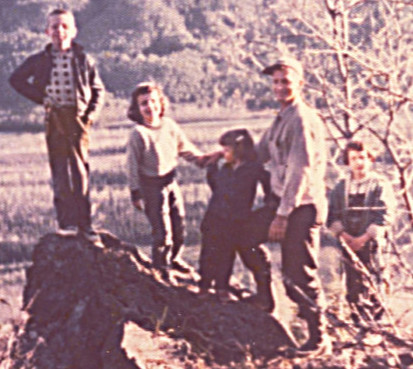
June 1959 - Age 7 - Me on the right - excluded from the family
May 23, 1959 - Age 7 - Me on the right - excluded from the family
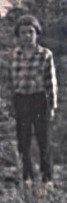
July 1959 - Age 7 - Me on the right - cut off from the family
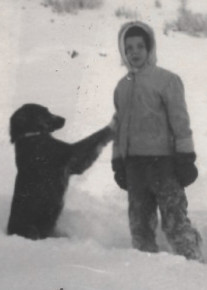
December 1959 - Age 7 - Me cut off from Smokey
December 1959 - Age 8 - Me cut off from Smokey

++++++++++++++++++++++++++++++++++++++++++++++

I cannot improve the focus in these pictures.  I expanded from the originals because I wanted to see the similarities between the three pictures in terms of my body language reflected in the three of them.

++++++++++++++++++++++++++++++++++++++++++++++

AND THIS IS HOW I SEE ‘THE WHOLE BALL OF WAX IN A NUT SHELL’

— the professionals back me up!

This describes what happened to me, to my mother, and the how and why of it all — the 18 years of severe child abuse I suffered — and how my mother became ‘mad’ enough to do it.

+++++++++++++++++++++++++++++++++++++++++++++++++++++++++++++

Guidelines for the Evaluation and Treatment

of Dissociative Symptoms in Children

and Adolescents

International Society for the Study of Dissociation

Journal of Trauma & Dissociation, Vol. 5(3) 2004

Digital Object Identifier: 10.1300/J229v05n03_09 119

++++++++++++++++++++++++++++++

Please follow (above) link to read this entire article and to find the exact references the authors are referring to in this section of their article (below):

“There is no consensus yet on the exact etiological pathway for the development of dissociative symptomatology, but newer theoretical models stress impaired parent-child attachment patterns (Barach, 1991; Liotti, 1999; Ogawa, Sroufe, Weinfield, Carlson, & Egeland, 1997) and trauma-based disruptions in the development of self-regulation of state transitions (Putnam, 1997; Siegel, 1999).

Newer theorizing ties maladaptive attachment patterns directly to dysfunctional brain development that may inhibit integrative connections in the developing child’s brain (Schore, 2001; Stien & Kendall, 2003).

From the vantage point of treating children and adolescents, a developmental understanding of dissociation makes the most sense.

That is, dissociation may be seen as a developmental disruption in the integration of adaptive memory, sense of identity, and the self-regulation of emotion.

According to Siegel (1999), integration is broadly defined as “how the mind creates a coherent self-assembly of information and energy flow across time and context” (p. 316).

In other words, Siegel sees the development of an integrated self as an ongoing process by which the mind continues to make increasingly organized connections that allow adaptive action.

Children and adolescents may present with a variety of dissociative symptoms that reflect a lack of coherence in the self-assembly of mental functioning:

1. Inconsistent consciousness may be reflected in symptoms of fluctuating attention, such as trance states or “black outs.”

2. Autobiographical forgetfulness and fluctuations in access to knowledge may reflect incoherence in developmental memory processes.

3. Fluctuating moods and behavior, including rage episodes and regressions, may reflect difficulties in self-regulation.

4. The child’s belief in alternate selves or imaginary friends that control the child’s behavior may reflect disorganization in the development of a cohesive self. 

5. Depersonalization and derealization may reflect a subjective sense of dissociation from normal body sensation and perception or from a sense of self.

+++++++++++++++++++++++++++++++++++++++++++++++++++++++++++++

This condition and these symptoms originate with insecure early attachments.  I believe they lie at the core of many (if not most) later-developing adult-onset ‘mental illness’ disabilities.

These descriptions of childhood dissociation apply to me, except for #4.  I did not have enough of a self to even imagine friendship, real or imaginary.  I also believe they all apply to my mother, with a shift in #4.  She developed the imaginary belief that she could CONTROL her imaginary friends — her children (me being the enemy) rather than being controlled by them.

I can see the lost, empty child in these pictures, cut off from being a member of a family, cut off from the development of a clear and cohesive self.  Devoid of a connected lifetime of experience, I appeared simply as a physical body taking up space in the universe, not as an animated LIVING child present as an identity within that body.

At any given moment my exact existence was only determined by the situation I was present in at that moment.  If the conductor of an orchestra points the baton at an individual with a particular instrument, it is time for all to hear that instrument play.  If we place our computer cursor over a particular link and click on it, we expect and anticipate that a particular action is going to occur.

From the moment of my birth my mother determined in her profound and comprehensive control of me how Linda was allowed to be in the world.  Because she never knew me as a human being, nor wished to, I existed as a puppet-fied manifestation of her inner psyche – as her projection of the BAD CHILD.

++++

There was no room for Linda to exist at all, and I can clearly see that emptiness of personhood and of selfhood in me in these pictures.  I appear as a child ‘stripped of a self’.

My emptiness, my dissociation was on an on-again, off-again condition.  The few times that I was left alone to be with myself simply existed in their own dissociative bubbles that never connected themselves to the ongoing experiences of me in my own body, in my own life.

I existed in relation to myself as I existed in the world these photographs captured – isolated, cut off, alone, unanimated, empty – like a husk of a child, a shell of a child – a body that existed to be battered, shoved, yanked, slapped, hit, punched, etc.  As an empty person to be screamed at, stormed at, thrown around in every imaginable way – at any time for any reason or for no reason whatsoever.

As an individual child-person, I was not allowed to exist.  I was not given permission to exist.  I ONLY existed as a figment of my mother’s twisted and brutalizing imagination

I no more had an identity or existed as a person (let alone as a child) than did the stone we stood on, the background trees, the tumbling rivers, the passing clouds, or the freezing snow.  I was less alive and less whole than was our dog, Smokey.  I was an apparition, a wraith, a mirage of a child.  Linda wasn’t there at all.

I was a missing child, and nobody noticed because nobody cared.  I experienced no difference between the cells of my body, the skin I wore like my clothing, the earth I walked upon or the air I breathed.  Moment to moment I could not count on anything.  I had always lived in an insecure, unpredictably unsafe world.

No child can for its self, its one self, if it is not allowed to.  I was never given permission to exist, so I didn’t.  I was as invisible and as intangible as the sound of rushing water or the wind.  I was given no more permission to exist than a leaf is, and less permission to exist than Smokey the dog was.  The homestead was more real to my mother, to both my parents, than I was.

++++

If I isolate the image of myself out of these photographs what remains is an unfocused child posed in a rigid standing posture.  That, sadly, is about all there was, a child existing by posing as a body – like a tree exists by posing with a trunk, limbs, branches, twigs and sometimes leaves – its root invisible beneath the soil.

But I had no roots.  From moment to moment I had no history of my own.  I didn’t even have the history of what mother did to me.  Even those experiences were not retained, kept, stored or retrieved in any stuck-together ongoing autobiographical coherent story-of-an-ongoing-child’s- life.  There ONLY existed each separate ongoing moment, and each of those moments was a likely to change into something else, something terrifying and painful, at any second. — unpredictably, unexpectedly, unfathomably.

Nothing mattered any more to me nor did I matter any more than if I was a snowflake, a scrap of cloth, or a pot to be scrubbed or pounded upon.  I simply existed without a self as a body that continued to grow over time without ME KNOWING I was in it.  I was my mother’s chosen ‘evil-bad’ projection, barely an object, not a person — and most definitely NOT a child.  Does an object have a sense of itself?

Just me age 7 in a body on a rock on a mountain
Just me age 7 in a body, rigid, at this second no more real than the grass I am standing on
Just me age 7 in the snow in a parka that meant more to mother than I did with a dog mother could love even though she could not love me
Just me age 8 in the snow in a parka that meant more to mother than I did with a dog mother could love even though she could not love me

++++++++++++++++++++++++++++++++++++++++++++

My mother was a master magician.  She was an expert at her craft.

Often she would banish me “from her sight”

— sometimes for days or weeks at a time —  so I would vanish from the family all together — body and all.

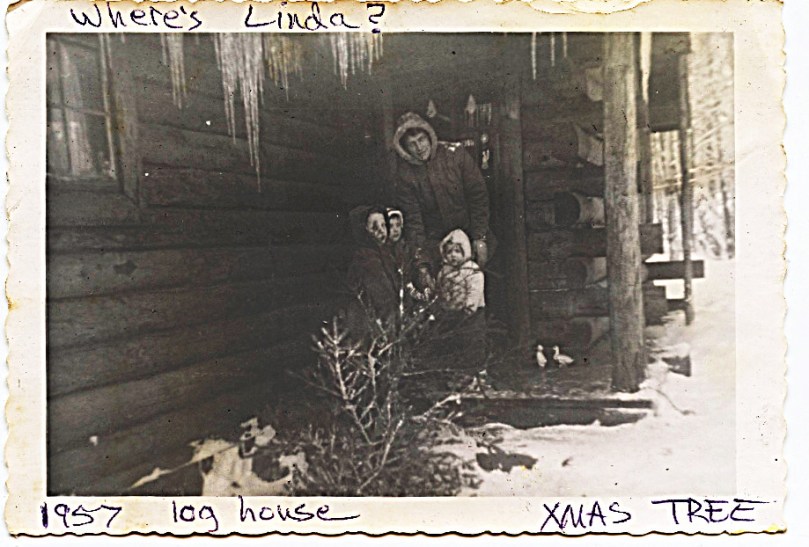
In the family pictures taken of  bringing in the Christmas tree in 1957 when I was 6, our first winter in Alaska, I am nowhere to be seen.

I have disappeared completely.

I am ‘missing in action’ and nobody seems to notice I am gone.

I am invisible.   I don’t exist at all.

I was erased.

+++++++++++++++++

See

++MY CHILDHOOD STORIES

Age 6 - Mother's magic -- Linda has completely vanished from the family picture of bringing in the Christmas tree

+WAS MY FATHER’S ‘SELF’ MISSING IN ACTION DURING OUR CHILDHOOD?

+++++++++++++++++++++++++++++++

Please don’t miss my siblings’ comments about my father at the end of this page —

*Age 8 – Photograph – Me, Smokey and Snow

+++++++++++++++++++++++++++++++

And included with comments at the end of this post —

+CRIMES OF MY FATHER: WAS HE AS BAD AS MY MOTHER WAS?

+++++++++++++++++++++++++++++++

I just watched my gold girl kitty, Goldilocks, sneak up on and capture a small lizard in my newest flower bed this morning.  Of course, she first nabbed its tail and if fell off in her mouth.  That’s OK.  Only in the most dire circumstances does a lizard have to sacrifice its tail, but when they do it is in an effort to survive the nearly unsurvivable.  Lizards are designed to grow a new tail — if they escape to a place of safety.

Of course Goldilocks was not about to let this poor little thing get away.  She tossed it into the air and followed it wherever it went.  Then the other two half grown kittens joined her.  Hunter, the boy, ended up with the lizard cornered on the sidewalk.  Once flipped onto its back it laid there — as if it was dead.

None of the three wanted to eat this prey, I’m sure there’s something about lizards that make them far more unpalatable than rodents are.  Yet as I watched Hunter watching this tailless lizard plopped onto its back with its silver belly to the sky, feet splayed out straight to its sides — I saw it miraculously flip itself over and try to get away again.

Of course Hunter would have pursued it as long as it had life left in its body to move.  So I chased away the kitten and picked the lizard up by its tiny little foot and tossed it into the massive azalea bush where I hope it can find its way to safety — and grow a new tail.

It made me think of my father, as my sister mentions in her comments perhaps nearly entirely invisible to us when we were children except for the few precious artifacts of his ‘truer’ self, his original self, his OTHER self that we were on occasion privileged to discover.

++++

My mother always said that she came to Alaska because father wanted to.  She said it was a good thing because he loved the out-of-doors.  He loved the mountains, he loved to hike and fish.  Before we left Los Angeles he was a member of the Mountaineers’ Club that accomplished search and rescue for hikers in the mountains surrounding the city.  He disappeared on week-ends, perhaps to escape her, but she hated that.

Move to Alaska.  Homestead.  For father’s benefit?  For ours?  Or because her sick mixed up disturbed mind found for itself the perfect obsession?

All of our lives with my mother were grueling.  I wonder what happens to the spouses and partners of those with serious, unrecognized mental disorders.  The 12-step program of Al-anon for people with active addicts and alcoholics in their lives says that the people who live with the addicts become ‘as sick or sicker’ than the addict.  Isn’t this just as true for spouses of people like my mother was?

Did everyone in my family, my father included, end up like this tailless lizard unable to escape the pervasive effects of my mother’s disturbed psyche?  Were we all her prey?  Did my father pay the price of losing himself by staying with her for nearly 30 years?  Did he flip onto his back and play dead during her attacks on him?  If he was so ineffective in being able to preserve his own self with her, how aware and concerned could he have been about what was happening to his children — especially to me?

++++

It is possible that given a less-than-optimal early developmental environment that a person’s self never develops ‘optimally’ in the first place.  Nor would a person’s connection to their ‘self’ develop optimally under malevolent early conditions, either.  Perhaps the human ‘optimal self’ is designed through the forces of evolution under harsh conditions to be as dispensable under severe trauma conditions as is a lizard’s tail.

Perhaps only when the forces of ongoing trauma are removed can the self and connection to it be reestablished — or even be established at all, such as in my situation.  My mother’s self did not develop properly in her early childhood, nor did her connection to her self.  There’s a very good chance that my father’s earliest developmental environment did not allow him the chance to develop his ‘best self’, either.  He was NOT a wanted child.  Putting these two wounded selves together was a recipe for disaster.  Need we be surprised that disaster was exactly what happened?

++++

PLEASE NOTE:

Just as a lizard has an ‘insecure attachment’ to its tail when its life is threatened, both of my parents came out of their early childhoods with insecure attachment disorders — primarily to their selves.  My father’s was an ‘organized’ insecure attachment disorder, the dismissive-avoidant one, I believe.  This allowed him to appear to function as a professional civil engineer and as a provider, even under incredible duress.

My mother’s was of the disorganized insecure attachment disorder variety, I believe of the worst kind — a disorganized-disoriented insecure attachment disorder.  Her true level of functioning was just about zero!  If she could manipulate her ‘stage’ according to her fairy tale wishes, she could orchestrate floor-waxing, curtain-washing and cookie-baking like a pro.  Anything else?  She was a disoriented, disorganized mess.

It took my father’s super human efforts, every single time, to try to get her, and us, out of the incredible messes she made — except for the most important one.  He could not rescue any of us — not even himself.  We would all have needed outside intervention and assistance for that to happen — and it never did!

+++++++++++++++++++++++++++++++

+++++++++++++++++++++++++++++++

This is interesting!

The following website belongs to Dr. Leland M. Heller, author of the book, ‘Biological Unhappiness’.

Here’s one review of the book by Zig Ziglar:

“Open this book and it will open your mind.  By combining proven medical procedure with hope and inspiration, Dr. Heller has made a significant difference in thousands of patients who had little hope for recovery.  “Biological Unhappiness” contains critical information for those who have lost hope.”

Zig Ziglar, motivational speaker, author, See You at the Top, Over the Top, Success for Dummies, Raising Positive kids in a Negative World.

Check out this fascinating website!

http://www.biologicalunhappiness.com

+++++++++++++++++++++++++++++++

+IMMUNITY AGAINST INSECURE ATTACHMENT DISORDERS BEGINS AT CONCEPTION

092609 post Origins of Emotional Abuse

++++++++++++++++++++++++++++++++++++

Emotional Abuse Recovery NOW

Annie Kaszina offers free assistance on her site and through her free email support to women who have experienced emotional abuse.  I personally find it disheartening that she does not equally offer her advise and expertise to men as well as to women, but I am mentioning her work here because I want to consider information presented in her writing about emotional abuse.

++++++++++++++++++++++++++++++++++++

Emotional abuse is not JUST a woman’s issue, it is a human issue.  Emotional abuse is not JUST an adult issue.  The seed potential for being both a perpetrator and a victim of emotional abuse begins – believe it or not – even before our conception.

No matter our sex, no matter what our genetic potential makeup may be, a mother’s emotional state influences her body to such an extent that her hormones and other body chemicals affect whether or not conception even takes place, as well as affects whether or not the tiny new human can or does implant itself on her uterine wall to further its growth and development from that time forward.

A mother’s hormones and internal chemical environment constantly signal through molecular communication what the world is going to be like that this new human is going to be born into.  Those signals about stress, distress or future well being influence how the genetic potential of a human manifests itself – from conception onward.

These early signaling processes particularly influence the future sensitivity of the new human.  I mention this now because Ms. Kaszina’s words this morning, as they arrived new and shiny in my email inbox, are concerned with emotional sensitivity.

Emotional sensitivity is not something that some of us have and some of us don’t have.  All humans have emotions.  All humans also vary in degree of sensitivity according to their fundamental genetic makeup, according to the information all kinds of molecular signaling has given them about the benevolence or malevolence of the world their body is growing up to live in, and according to the information that a newborn infant’s body-brain-self receives from its first early caregiver environment.

++++

We cannot possibly disentangle the topic of secure and insecure attachment disorders – from conception onward – from any discussion about so-called emotional abuse.  What we are actually considering when we talk about emotions and sensitivity, in my opinion, has to do with the quality and kind of human attachment system we developed from conception.

If adults do not provide safe and secure attachments to infants and young children from the beginning of their lives, HOW this tiny person develops will be affected on every level.  This most certainly includes emotional sensitivity.  If the safe and secure attachments do not exist in an infant’s life, its body-brain-mind will be forced to take a pathway in its development that is less-than-optimal.  An insecure attachment pattern, or insecure attachment disorder, WILL result from these conditions.  That is the way our social species is designed.

++++

If a person could actually weigh information, tons of it exists at our fingertips about secure and insecure attachments.  My purpose is to encourage readers to go poke around and take a look at this information for themselves.  Without including the facts about our human attachment system in our thinking about ANYTHING that has to do with ANY human relationship, we are like children ourselves who might expect to sit in a broken down car out behind a weathered barn in some countryside – hoping and hoping if we just hope enough that useless car will take us out away from our miseries.

++++

Every human being whose brain-mind did not develop in an early environment that included a caregiver to whom that infant could safely and securely attach – on a predictable and sustained level – will end up with an altered brain-mind that includes an insecure attachment disorder built into it.  All humans are amazingly resilient, and even a tiny infant can make amazing use of whatever safe and secure human attachment opportunities that DO actually exist in its early environment.

But at the same time we ARE human, and we are vulnerable and fragile.  Degrees of damage are exactly that!  If you spend some time following links included above, you will discover enough information for yourself to begin to understand what Dr. Allan Schore says about all insecure attachment disorders include empathy disorders.  Nobody is immune to the consequences of forming a body-brain-mind in a malevolent world.

++++

With this very brief survey as an introduction to the following words written by Annie Kaszina, I encourage readers to begin to realize that both ‘perpetrators’ and ‘victims’ of emotional abuse most likely suffer from an adult version of an insecure attachment disorder – either an ‘organized’ one or a ‘disorganized’ one.  If our first displays of our emotions were not consistently appropriately and adequately responded to from the time we were born by one or more early caregivers – our emotional self will have altered the way it developed.  This naturally affects both how we respond to our own and to others’ emotions.

If we are going to refer to these changed patterns as ABUSE, we need to include in our thinking that all these emotional patterns exist in our brain’s construction and operation.  They can sometimes be changed to some degree, but our emotional construction is as much a part of our body as are our organs and limbs.

++++

From my own childhood experience I can say that the environment of the home I grew up in, with my Mad Monster Mother at the helm, contained no real emotional health and well being except as it was accidentally provided – mostly to my siblings.  My entire blog is devoted to this HUGE topic.  My point this morning is that I encourage every reader to read the following words as if they are simply and completely referring to interactions between parents and children – not between adults.

Focus your inner vision.  Consider your childhood – whether you were a girl or a boy — for awhile ONLY as it either sustained the development of your authentic self emotionally – or did not.   Parents are not their offspring’s’ partners.  They have assumed the job of raising their children so that they themselves can later be other human’s partners.

Please ‘translate’ this information provided below through the lens of your own very young childhood perspective.  What you were given THEN is reflected in how you are NOW!  We had no choice as infant-children but to build into our growing body-brain-mind the attachment patterns our early caregivers ‘fed us’.

Down the road, the following is exactly how insecure attachment disorders (systems) can show themselves when we are all grown up.  We can repeat them with both the adults and the children in our lives.  We need to understand what this means by beginning to in-form our thinking about how these patterns established themselves PHYSIOLOGICALLY into our very young developing bodies — and remain within us for the rest of our lives.  Once recognized consciously, we can begin to alter the effects our inner attachment system has on the quality of our life.

++++++++++++++++++++++++++++++++++++

++++++++++++++++++++++++++++++++++++

Emotional Abuse Recovery NOW

Written and published by Annie Kaszina
Women’s Self-Discovery Coach
www.EmotionalAbuseRecoveryNow.com

To sign up to this ezine, go to www.EmotionalAbuseRecoveryNow.com

My name is Annie Kaszina and I spent over twenty years in an abusive marriage, before I learned how I could become the woman I want to be. Now I work with women who have been in controlling and abusive relationships, to facilitate their journey into joy and self-realisation.”

“You’re just too sensitive!”

“Has an abusive partner ever told you: “You’re just too sensitive?”

Okay, let’s be more precise about this; has your abusive partner repeatedly told you that you are too sensitive?  Because the chances are, if he has said it to you once, he’s said it a thousand times.  That’s how abusive relationships work; an abusive man throws the same complaints at you over and over again.

Why?

We’ll come to that in a moment.  First, let’s deal with the really important question: How has that left you feeling?

Clearly, I don’t know you, and I can’t know how you think, but I’m guessing that it leaves you feeling small, needy, pathetic and very, very flawed.  Accusing a partner of being ‘too sensitive’ tends to make them feel as if someone has exposed a very dark, unlovable, immature feeling at the very heart of their being.

In short, it makes them feel unlovable.

There is a reason for this.  When an abusive man says his partner is ‘too sensitive’, that is not just a throwaway remark, triggered by frustration; it is, actually, a well-calculated barb with a venomous hidden agenda.

“You’re too sensitive”, is code; a code that, I suspect, you have not been translating correctly, until now.  If you had, you probably would not have given your accuser the opportunity to wound you with that well-honed barb, time after time.

“But”, you might object, “I am very sensitive.”   You might even say: “I am too sensitive.”

There is a distinction here that we need to clarify.  When you say that you are ‘very sensitive’, or even ‘too sensitive’, what you actually mean is this: “I can feel hurt very easily; it doesn’t take much.  I really wish that it wasn’t like this, but it is.  There doesn’t seem to be much I can do about it.”

Acknowledging the acuity of their sensitivity tends to be a kind of apology that I often hear form abused women.  They wish they could change it, but they can’t; at least not with the tools currently available to them.

When an abusive partner, or other near one, tells you that you are ‘too sensitive’, it is, apparently, because they wish you could change.  (The subtext is that if you could change that it would, somehow, transform the abusive relationship.)  Not that they are offering you any clues as to how you might reduce that sensitivity.

In reality, they don’t know how you could reduce that sensitivity; nor do they care.  Much as they may criticize you for it, your sensitivity fits very nicely with their agenda.  But they are not in a rush to admit that to you.

Think for a moment about the circumstances in which have been told that you are too sensitive.  Most probably it happens when you feel hurt by something your abusive partner said; or else something they did, or did not do.  Had you been ‘less sensitive’, they figure, you would not have reacted.  In other words, you would have just ‘got on with it’, and spared them the trouble of having to consider your feelings.

This holds true for other circumstances in which your ‘hypersensitivity’ means that you would like to receive comfort or reassurance.

That is not what your abusive partner, or other near one, had in mind.

When they say: “You’re too sensitive”, what they really mean is this: “Please don’t visit your feelings on me, I don’t want to hear about them.”  There’s more as well – and it doesn’t get any better.

“You’re too sensitive” is shorthand for; “I’m really not prepared to take your feelings into account.  In fact, I thoroughly resent your visiting them on me.  As far as I am concerned, this is the way I believe our relationship should work: I can say whatever I like to you, and you will get on and deal with it, without making a fuss and trying to make me feel bad about it.  What’s wrong with you, anyway?  Why can’t you just get on with being in an abusive relationship without moaning about it?”

The question, “What’s wrong with you, anyway?” is the key to your partner’s thinking.  There must be something wrong with you, or else you would respond to whatever it is that they said or did in exactly the way they would have you respond.  In other words, what they wanted was no response from you.  (In an abusive relationship, all communication is intended to be a one way street.) Whatever it was that they said or di, they hoped that you would let them ‘get away with it’.  And you did not.

It’s not as if you took a strong stand; anything but.  A strong stand would have meant saying: “This is unacceptable.”  You would then make yourself scarce, as far as they were concerned.  Your abusive partner would duly get the message that they were out of order, and would need to clean up their act, or else lose you.

Whether or not they would clean up their act is another story.  If, instead, your refusal to accept abuse led to the earlier end of a damaging relationship that was bound to end in unhappiness anyway, then your strong stand has paid off handsomely.  That would save you time and misery.  And if it concentrated their mind, and led them to behave better in the future, even better.

But just asking an abusive man to behave, and/or speak to you, differently, is as ineffectual as saying to a child: “Oh, don’t do that!” All it conveys is your weakness and your reluctance to act.

It leaves your abuser free to repeat the pattern time and time again.  He will continue to speak and act as he pleases and, when you object, he will reproach you, again, for ‘being too sensitive’.

With that one simple phrase he has laid the blame for the hurt in the situation on you.  With one simple piece of sleight of mouth, he has dumped blame for the situation on you, so that he comes up smelling of roses.  Or, at least, as close to smelling of roses as he is ever likely to get.

How did you get into an abusive relationship like that in the first place?

Here’s the irony: it happened, in part, because of your sensitivity.  Not that there is anything wrong with being sensitive; there is not.  However, an abusive man has a finely tuned nose, and can smell sensitivity a mile off.  He knows that he can exploit that sensitivity to gain control over another person.  He knows just how to do that – as you have discovered, to your cost.

So what will you do differently about your sensitivity in the future?

First, you need to become much more vigilant; you learn that someone who is prepared to disregard your ‘sensitivity’ is telling you that they will completely and utterly disregard your feelings.  You give such people a very wide berth.  Second, you learn to honour and manage that sensitivity; treat it with respect and other people will treat you with respect, also.”

++++++++++++++++++++++++++++++++++++

— SEE ALSO —

+++++++++++++++++++++++++++++++++++
+INFO ABOUT BORDERLINE PERSONALITY DISORDER (BPD)

+++++++++++++++++++++++++++++++++++

New Resource for Parents: CDC Parent Portal

+++++++++++++++++++++++++++++++++++
Related Post:

+CHILDHOOD DISSOCIATION, DEPERSONALIZATION, DEREALIZATION – I NEVER HAD A CHOICE TO BE OR NOT TO BE

+++++++++++++++++++++++++++++++++++

+EXPERTS LEAVE US KNOWING WE NEED ‘SOMETHING MORE’

+++++++++++++++++++++++++++++++++
I would like to recommend (with the following reservations) the book

Surviving a Borderline Parent: How to Heal Your Childhood Wounds & Build Trust, Boundaries, and Self-Esteem by Kimberlee Roth, Freda B. Friedman, and Randi Kreger.

The authors have created a recovery tool for anyone exposed in childhood to the whims and rages of a parent with this form of mental illness.  The book is clearly divided into sections which cover NEARLY every topic of interest for those of us who had to endure childhoods under the care (or more likely the lack of care) of a parent whose mind never worked correctly.

Yet while the book carries within its pages hundreds of tips for working out our adult ‘issues’ created within this malevolent kind of childhood, it does not, in my opinion, speak to the single most important FACT that those of us who were raised from birth by parents – particularly mothers – who manifested the most severe ‘style’ of Borderline Personality Disorder known within the human species know instinctively about ourselves.

++++

This book, like most others except The Boy Who Was Raised as a Dog: And Other Stories from a Child Psychiatrist’s Notebook Child Psychiatrist’s Notebook–What Traumatized Children Can Teach Us About Loss, Love, and Healing by Bruce Perry and Maia Szalavitz, does not discuss or present the very real brain development changes that occur as a result of an infant being raised in a truly malevolent environment.

I find that altered brain development is a completely ignored consequence of being raised by a severe Borderline parent.  I remain disappointed that the experts in the topic of working to recover a healthy self and a healthy life post-malevolent childhoods do not consider that for every word of their expert writing those of us who HAVE one of these altered brains read, we are still left ‘starving and alone’, bereft of the most important information we need in order to make use of the information all the experts are giving us.

No matter how helpful, how accurate, how comprehensive, how informed or how ‘scientifically based’ any Borderline Personality Disorder recovery book may intend to be, either for the BPD person or for their offspring, if altered brain development is not presented as THE SINGLE most significant consequence of a malevolent childhood, then the authors’ words are missing the point.

++++

Even though Roth, Friedman and Kreger at least mention insecure attachment disorders in their book, they do not develop the potential that exists within this one crucial sphere of thought to its REAL conclusion.  Insecure attachment patterns from birth, if they are not altered and improved by secure attachment patterns with other adequate early infant and childhood caregivers, result in the development of a changed brain.

These changed brains will NEVER process incoming information in the same way as a securely attached, benevolently formed brain will.  When this fact is ignored in any ‘self help’ book — which I might add currently includes ALL of them – the foundational brain of the person trying to make sense of the ‘help’ and apply it to themselves is left floating around without the information most needed in order to make improvements in their lives.

++++

This, to me, amounts to a situation similar to one in which instruction is given in how to drive a car safely without anyone ever acknowledging or addressing the single most important aspect of the task – one must not be completely sightless.  It’s like being instructed to build a modern day wood frame house while at the same time NOT being told that one must have something to measure with, cut the wood with, and drive the nails with.

In other words, every ‘self help’ book I have ever read, with the exception of those who specifically begin from the start by identifying the fundamental brain changes that result from infant and child development in a malevolent world, make major assumptions about their readership that leaves those of us with these changed brains flailing around in the dark.  We know from our insides that something is missing.  I am here to say the missing information is not due to any fault of ours.  The missing information is in the writing and work of the ‘experts’ who are presenting THEIR information while ignoring what some of us know absolutely to be true.

‘Un-ordinary’ infancies and childhoods create ‘un-ordinary’ brain-mind-bodies.  Those with severe Borderline Personality Disorder are among such people, and it is likely that without outside assistance during our childhoods that those of us raised by these BPD parents end up with ‘un-ordinary’ brains, as well.

++++

The tricky part of trying to locate, access and use information helpful to improving the quality of our lives is that those people with an ‘ordinary brain’ and those with an ‘un-ordinary’ brain might both be left needing to build the proverbial modern wood frame house.  The first have the box of tools, the second do not – and may well NEVER have them because the brain that was built inside their skulls from birth was simply not made to be an ‘ordinary brain’.

Yes, the brain is plastic and can accomplish incredible feats of adjustment.  But the fundamental brain regions, circuits, pathways and patterns of operation are built into the brain’s structure before the age of two.   These most fundamental aspects of a brain, once it has been built, cannot be changed in any fundamental way.  It would seem far more helpful to me to have experts tell me what these brain changes are, how to recognize how they affect me, and how to work most constructively in order to try to create a quality life in spite of them.

++++

Without information about my changed brain, I am left alone deep within a pitch dark cave without a source of light.  The ‘self help’ books can tell me what it’s like up there on the earth’s surface, but they do not describe where I am to start with, nor do they give me a single solitary clue how to find my way to the surface so that I can try to begin the journey they so helpfully describe for those who are already there.

Yet even if I do somehow miraculously make my way to the ‘ordinary surface’, my journey there would STILL be a far different one than ‘ordinary’ because of my brain-mind-body changes.  I would STILL be left trying to translate their helpful instructions about how to ‘drive safely’ even though I lack the sightedness these authors take completely for granted.  Where DOES this quandary leave me?  Let me ‘count the ways’ I know there’s a field on the surface that is not covered with daisies.

++++

I was raised from birth by a Narcissistic Psychotic Borderline.  At the same time I can say that my experiences were obviously an exception to the RULE, I can also say that this proves to me that what is considered to be the RULE is fallible.  Therefore in my thinking the RULE is not a RULE at all.  It is simply an assumption about brain formation based on what optimal caregiving environments produce.

Similar breaches of this RULE, as I experienced them, produced my mother’s changed brain during her own early development, as well.  Therefore, in my thinking, obviously the RULE cannot apply to my experience as all ‘self help’ authors seem to assume.

My mother and I, as exceptions to the RULE, must therefore exist in a world that operates under completely different rules, and we ended up with a brain-mind-body that resulted from our adaptations to this altered ‘un-ordinary’ world.  Because nobody tells me what these changes really ARE, I am left trying to figure them out for myself.

Most simply put, I do not receive ‘ordinary’ information in an ‘ordinary’ way.  From those beginnings, I do not process the ‘un-ordinary’ information I receive or act on it in an ‘ordinary’ way, either.  Just taking these simple facts into account, I cannot read any ‘self help’ book and make any ‘ordinary’ sense out of it unless I understand that those books are not addressing the altered reality that I was forced to grow up adjusting to.

Let me give you a few examples.  Because from the time I was born I had no way to count on a ‘good mother’ appearing in response to my infant needs, my brain’s processing systems had to expand themselves to accept that incoherent malevolent chaos was just as equally likely to respond to ME as was coherent benevolent niceness.   Well before the age of three months my brain would already have changed from ‘ordinary optimal’ development as a consequence.

When an infant ordinarily needs something and that something is out-of-sight, it can ordinarily begin to form brain circuits that allow it to WAIT HOPEFULLY because it can TRUST that its caregiver is going to return to take care of it.  If incoherent malevolent chaos is just as likely to appear as the alternative, it seems perfectly obvious to me that this tiny forming brain is not going to have the ‘ordinary’ experiences required to build an ‘ordinary’ brain – from the start.

Most simply put, because my mother lacked the capacity to respond to me as my own self, nothing inside of me was able to respond back to her from my own internal ‘self place’.  I simply have what I can most clearly describe as blank spots in my brain where ‘ordinary’ patterns and circuits were supposed to develop.  As a consequence I am NOT an ‘ordinary’ person and never will be, no matter what good use I try to make out of information contained in expert self help books.

++++

As a result of my development within the malevolent conditions my mother was just as likely to provide for me as her periodic – and undependable – benevolent conditions, my brain did not build within itself any ‘ordinary’ potential to process human interactions.  This is a complicated condition that I will not cover in detail here.  But I will say here that as a consequence, my right brain did not grow to include ‘ordinary’ processing of social or emotional information.  Its connection with information in my body is different.

Once the major development of the right brain is completed before the age of one, it is time for the left brain to begin going through its major developmental stages.  Under extreme malevolent conditions, there is no way that the left brain can develop ‘ordinarily’, either.  It is not possible for the corpus coliseum, the region of the brain that transfers information between the right and left brain for processing, to develop ‘ordinarily’, either.

That’s just the very earliest beginnings of what I know about changes in my own (and my mother’s) brain development.  We could move on in our understanding of how the development of an infant’s left brain ‘happy’ center’s neurons are affected, how the ability to process social cues is affected, how the brain’s ability to form understandings about trust and hope is affected, how the brain’s neurological information processing about the self is affected, and about how all aspects of communication from the molecular to the verbal are affected as a result of a brain’s ability to adapt a human being’s development to and under malevolent environmental conditions.

There is absolutely no way that the higher functioning cortical areas develop in any ‘ordinary’ fashion, either.  As a result, future planning, decision making, and the ability to understand consequences with cognitive flexibility are affected.

I personally know that my brain does not even process the fundamental concept of TIME in an ordinary way.  Yet I am even here only describing the proverbial ‘tip of the iceberg’ of how extreme early infant and child abuse changes the fundamental ways a survivor’s brain-mind-body changes.

++++

In other words, even if we take every single expert self help book and put them together in one volume, the OTHER volume that some of us most need to read simply does not exist – yet.  We are left trying to find a fit for ourselves as we attempt to understand ourselves in relation to the more ‘ordinary’ world we were hatched into as adults.

I’m not saying that we can’t make good use of information found in books that do not recognize our ‘un-ordinary’ reality or what our changed brains are really like.  I’m simply making a point that no matter how hard these self help books might try to help us a create a more ‘ordinary’ life, they are evidently unable to address the specifics of what actually happened to some of us.

For any of us who have ever had the attempted-recovery-based feeling of “YES, but……..  “ when we try to apply what seems to make sense to everyone else but not QUITE to us, we are absolutely correct!!  There IS something missing – but the trouble is NOT with us.  The trouble is that what happened to us has yet to be truly recognized for what it is – the creation of ‘un-ordinary’ individuals who were able to adapt physiologically on our most fundamental levels to endure unimaginably malevolent early developmental conditions.

+++++++++++++++++++++++++++++++++

We are truly extraordinary people, and it evidently remains for us to identify and describe exactly what that means!!  Nobody else seems able to do that for us!

We don’t have to look beyond ourselves to know what living with a changed brain is like.  We’ve made that quantum leap in understanding.  We were forced to, or we would not have survived the malevolent world we developed in.

The rest of the ‘expert’ world just has to catch up with us.  We know what we are talking about.  We are our own living proof!

+++++++++++++++++++++++++++++++++

+SOME FANTASTIC LINKS ON CHILD ABUSE AND BRAIN CHANGES!

+++++++++++++++++++++++++

Greetings to each and every person who has visited this blog during the seven weeks of absence from writing here.  I am home now after more than 10,000 miles of traveling during the past seven weeks as I visited family and friends whom I love and who love me.

The time I spent in Alaska, the home of my heart, was everything I needed it to be in order for me to move forward with the writing of my book.

I will at this point be dividing my writing clearly between my book (which will not be appearing on this blog) and other assorted writing specifically for the blog.  As my precious Alaskan baby brother (now 44) told me, if it is my desire and my intention to write a book, then I need to do it.  He explained it to me this way:

A person might pick up tools and a block of wood intending to carve an image.  Perhaps they are not quite sure what image lies within the wood so they begin carving in process until that image becomes clear and the carving can then give it form.  If, however, that point never occurs where the image within the wood is found, shaped and born, all that will result from the effort of carving is a pile of wood shavings and dust.

I heard and understand the wisdom contained in my brother’s words, and I recognize that continuing to pour words out into my blog will not accomplish the creation of my book.  I will now separate the words that belong in my book from those that do not.

+++++++++++++++++++++++++

As I continue through the process of getting my ‘home legs’ under me, I will at least post a few interesting links here for reader consideration!  Please follow some or all of these links – THEY ARE IMPORTANT!  Please also join me in my gratitude to every single person who is involved with this quality of work to further our understanding about the impact of severe child abuse on human development – and the work of everyone committed to ending child maltreatment around the globe.

Please also remember the abuse being done to the fragile web of life on our glorious planet and the suffering of so many species being caused by the thoughtless harm of all kinds caused by humans.

And, for a load of Alaskan MOOSE FUN….

+++++++++++++++++++++++++

Back to School Tips: Parents Should Get Ready, Too!

Posted: 27 Aug 2009 08:21 AM PDT

Tips for parents on helping their kids succeed in school, adapter from information provided by our friends at Prevent Child Abuse New Jersey.

Amid the shopping trips for sharpened #2 pencils, crisp notebooks and new shoes, parents should start thinking about what they can do to become the best possible support system for their child this school year. The beginning of the new academic season is often the most important, as it sets the tone for a meaningful and successful year.  Research shows that students are more equipped to thrive academically and socially when parents are actively involved in their child’s education.

+++++++++++++++++++++++++

Emotional Abuse Recovery NOW

+++++++++++++++++++++++++

Going Big: Harlem Children’s Zone on This American Life

Posted: 18 Aug 2009 02:17 AM PDT

Hats off to This American Life for shining a spotlight on the solutions to the many problems that plague our nation’s impoverished families. Going Big, this week’s episode, profiles Geoffrey Canada, a pioneer in the fields of child and family support and poverty prevention. His organization, Harlem Children’s Zone, boasts tremendous outcomes for the families and community it serves, including:

  • l00% of students in the Harlem Gems pre-K program were found to be school-ready for the sixth year in a row.
  • 81% of Baby College parents improved the frequency of reading to their children.
  • $4.8 million returned to 2,935 Harlem residents as a result of HCZ’s free tax-preparation service
  • 10,883 number of youth served by HCZ in 2008.

Listen to the This American Life podcast.

Below is a five-minute video of moms talking about the challenges of raising children in Harlem and the difference HCZ is making in their lives.

This posting includes an audio/video/photo media file: Download Now

+++++++++++++++++++++++++

Brain Development Altered by Violence

By Dale Russakoff
Washington Post Staff Writer
Saturday, May 15, 1999; Page A3

LITTLETON, Colo.—More than a week had passed since Krystie DeHoff felt bullets and bombs explode all around her, since she ran in horror past young, dead bodies to safety. Now she was inching toward normality, shopping at King Soopers grocery, when the most innocent sound–a baby crying in his mother’s arms–set the Columbine High School massacre in motion again, this time in her mind. Her heart raced, her muscles coiled. She heard not a baby, but her classmates, shrieking. “All I could think was: MAKE HIM STOP!” she said.

READ MORE……

+++++++++++++++++++++++++

Using Mental Strategies Can Alter

The Brain’s Reward Circuitry

ScienceDaily (June 30, 2008) — The cognitive strategies humans use to regulate emotions can determine both neurological and physiological responses to potential rewards, a team of New York University and Rutgers University neuroscientists has discovered. The findings, reported in the most recent issue of the journal Nature Neuroscience, shed light on how the regulation of emotions may influence decision making.

READ MORE….

+++++++++++++++++++++++++

The Neural Self: The Neurobiology of Attachment

By Phil Rich, Ed.D., LICSW

It is its basis in biology that makes attachment theory unique among theories of psychology and child development. From the biological perspective, attachment is simply an evolutionarily-evolved process to ensure species survival, and is thus as much a part our biology as that of any animal.

From this perspective, cognitive schema and the resulting mental map is not merely a psychological phenomenon, but a physical entity, hard-wired into neural circuits and reflected in neurochemical and electrical activity within the central nervous system.

The mental map into which our experiences and memories are imprinted is thus a neurobiological structure, the result of synaptic processes, out of which human cognition and behavior emerges, resulting in LeDoux’s (2002) description of our “synaptic” self.

Siegel (2001) describes the pattern and clusters of synaptic firing as “somehow creat(ing) the experience of mind” (p. 69). He writes that “integration” reflects the manner in which functionally separate neural structures and processes cluster together and interact to form a functional whole – in this case, our selves.

READ MORE…..

+++++++++++++++++++++++++

Child abuse marks genes, affects ability to cope: Study

By Margaret Munro , Canwest News Service

+++++++++++++++++++++++++

Stress

Your Three Brains

The neurologist Paul MacLean has proposed that our skull holds not one brain, but three, each representing a distinct evolutionary stratum that has formed upon the older layer before it, like an archaeological site – he calls it the “triune brain.” MacLean, now the director of the Laboratory of Brain Evolution and Behaviour in Poolesville, Maryland, says that three brains operate like “three interconnected biological computers, each with its own special intelligence, its own subjectivity, its own sense of time and space and its own memory”.

READ MORE….

+++++++++++++++++++++++++

+SIBLING PARTICIPATION IN CHILD ABUSE

++++++++++++++++++++++++++++++++++++++++++++++++++++++

So far none of these stories are getting any easier to write, but fortunately my determination to write them more than matches any reluctance I have to do so.

Each memory that leads to each story seems to be difficult in a unique and unforeseen way.  Some I can write about with more immunity that others.  The one I wrote today has been the most difficult, and having done so I feel a quivering inside my gut because the story STILL scares me.

*Age 14 – Gardening and the Sabotage

++++++++++++++++++++++++++++++++++++++++++++++++++++++

I think again about M. Scott Peck’s book, “People of the Lie: The Hope for Healing Human Evil” that I referred to in my story about how I abused my little son that was also directly connected to my being able to finally disown my mother.  I wonder about the entire web of my childhood, even as it is presented in the words of my mother’s own writing.  It was all a lie.

Nobody on the outside of our family could have possibly believed the lie– BECAUSE THEY DIDN’T HAVE TO!  This was a fact by default.  Only those of us on the inside of my family had to believe it.  They had no choice.  We were all forced to play our part, one way or the other.

At what point does free will and conscious choice on the part of such a distorted family members enter the picture in any meaningful way?  How can that freedom even be allowed to exist in a family that depends on living the lie for its very existence and survival?  Can we trust that telling the truth always means that we are on the road of healing?

I don’t know that I know the answer, but I wrote this story in spite of that fact.  Did doing so in any way contribute to an increase in my freedom from the hold that my horrendous child abuse history holds over me?  After all, today is the 4th of July, and we are supposed to be celebrating what it means to be free.

++++++++++++++++++++++++++++++++++++++++++++++++++++++

+LINK TO NEW PAGE ADDED TODAY – FIGHTING BACK?

++++++++++++++++++++++++++++++++++++

+Age 14 – SCRUBBED IN THE TUB

++++++++++++++++++++++++++++++++++++

We have to be more careful than words can describe not to either blame others for their victimization or to blame ourselves for the harm that was done to us.  How realistic is it for us to expect that any long term violent, consistent, severe abuse survivor EVER had a chance to fight back?

By suggesting that it is the victim’s fault that abuse ever happened in the first place, let alone continued to happen, creates an unattainable illusion within our social consciousness that we don’t — as outsiders — REALLY need to step in and stop abuse.  We are saying that if only the victim had done THEIR JOB to stop the abuse none of the rest of us would have to be involved at all.

Sound extreme?  Read this page.

++++++++++++++++++++++++++++++++++++

+LINK TO NEWLY ADDED CHILDHOOD STORY


+++++++++++++++++++++

*Age 10 – NIGHTMARES AND BED WETTING

+++++++++++++++++++++

This page has just been completed and published under MY CHILDHOOD STORIES.  This page contains a ‘MAY TRIGGER ABUSE MEMORIES’ tag, so please be careful, cautious and considerate of yourself if you have a personal history of sexual abuse.

In this page I also wrote about how factual memory of trauma differs from emotional memory of trauma.  Our emotional memory is processed through the amygdala region of our brain and is ALWAYS stored in our body even though the factual memory might not be.  (When the facts are remembered this is called an ‘explicit‘ memory.  When only the emotions and body memory exist without specific facts, this is called an ‘implicit‘ memory.)

The ‘semantic, autobiographical’ factual part of our memories are processed through a different region of our brain, the hippocampus.  There are times particularly in very early childhood when all memory is preverbal and can only be accessed in our body and not through fact.  These memories will govern our unconscious behavior for the rest of our lives.  There are also times when facts related to memory, particularly of trauma memory, is ‘forgotten’ and invisible to us — sometimes forever, sometimes until it is triggered.

It is also important to realize that the stress hormone cortisol can so heat up our hippocampal memory cells as they try to process trauma-related facts that they are fried to a cinder and the facts of a memory will never be recorded – and therefore will never be available to recall.  When and if this happens — and it can happen both to victims and perpetrators-in-the-act — the emotional memory is ALWAYS stored and retained within the body.

++++++++++++++++++++++++++++++++++++++++

+WE NEED NEW WORDS TO DIALOG WITH OUR BODY ABOUT TRAUMA

I am trying to think of another word other than ‘renaissance’, or rebirth, to describe what I wish was happening now among those of us ordinary people who are trying to live the best lives we can without necessarily having the kind of safe and secure attachment background we needed to get along better in life.

I am thinking especially about what little information we really have about our bodies and how they operate.  Sometime in our first year of life people begin to teach infants about their body — and most of us never progress much past that point!  We are taught to point to our eyes, nose, mouth, ears, limbs, etc.

Eventually we learn through our public education and then through osmosis over time about the major organs of our body, and make little progress past that point unless we get sick and then learn the minimum we need to in order to understand what is happening to us.  We seem to prefer to use only one syllable words to think about the only body we will ever have to live in for the rest of our lives.

Yet while we would rather leave anything more complicated than what we consider essential to the ‘experts’, at the same time I do believe our platform of information concerning our bodies is making advancements.  We hear about things through the general media and that information will eventually ‘stick’ if we hear it enough and somehow we begin to understand it is important because it applies to us.

As we are doing this learning, as unintentionally as it might be, we are at the same time expanding our vocabulary.  It’s no different than teaching an infant the word for their nose.  We are learning to name what is going on inside of us.  Yet at the same time we are learning meanings for words like diabetes, hypertension, obesity, allergies, arthritis, osteoporosis, cancer, learning disabilities, addiction, anxiety, depression, serotonin, dopamine, reward system, we less likely to learn how these kinds of ‘events’ are all connected within us to who we are within our own body.

++++

We all know we are dependent upon and would rather support a medical model that prefers to respond only to symptoms,  prescribe every kind of expensive test to diagnosis illness, dish out every imaginable kind of drug to treat sickness than we are to put forth the effort ourselves to learn any more complicated information about our body than we have to.

Why is that?  When and how did we learn to accept that we don’t need to learn anything more than a 5th grader could learn about how our body operates?  Did someone tell us we are too dumb to learn anything more complicated?  Looking backward, maybe this kind of thinking has worked for all of the generations that have gone before us.

Today there are more of us living longer than ever before in history.  But taking material goods out of the equation, what is our quality of life?  Particularly, what is the quality of our human attachments — our own attachment with our self included?  As a social species, it matters.  We have the desire to live our years better, last longer, and suffer less.  Understanding how our attachment system operates, what has hurt it and what can help it can help us live a better life on every level because it operates on every single level of who we are.

Those of us who suffered from extra-ordinary trauma and abuse during our developmental stages especially need to learn the words that will let us be able to understand how that abuse changed our bodies.  I see it as being no different than any healing process of disclosure. Any improvement we can make to talk about the effects our traumas had on us is empowering.  Trauma changed our bodies, and we don’t even know — on the most vital and profound levels — what that means.

We need the words.  We need them badly.  A  securely-attached-from-birth person has all that good-safe information built right into their body-brain-mind.  They don’t have to think about it.  They don’t even need to talk about it.  They just live it.

Those of us who were so abused that we are the insecurely-attached-from-birth, however, have to learn NOW what these ‘others’ learned when they were supposed to learn it — as infants and young children.  Our communication signals between our body, brain, mind and self are all scrambled up.  We have to learn NOW what those ‘others’ learned from the time they were born.  We cannot efficiently and effectively learn NOW what we have no words to talk about.

++++

I think at this moment how strange it seems that I, of all people, would be writing about attachment.  Looking back at the strangeness, the unpredictable, escalating, irrational violence and abuse, looking back at the extreme isolation I was forced to endure through my childhood, I can’t help but say that of all the people I can imagine writing about attachment, I can be good at it because I am so bad at it.

Suffering from the long term consequences of an extremely abusive childhood can make us feel so alienated from what ‘ordinary’ people seem to now about living ‘ordinary’ lives that we might be tempted to simply throw in the towel, give up and quit.  Yet as I work my way through the volumes of technical, even molecular research information about our own internal cannabinoid (‘cannabis’)  (and opioid) attachment systems, I realize that by my just being alive I HAVE to know there are things about my attachment system that went right from the beginning or I most simply — would not be here.

I was attached enough to life from the beginning that I was conceived in the first place, implanted onto my mother’s uterine wall, received nourishment from her body, and made it through a difficult birth — just to GET here and to BE here.  Through all the terrible traumas, through all the pain, suffering, sorrows and sadness of my childhood I was still attached enough between my inner, true self and the world to STILL be able to find, recognize, appreciate and value beauty — wherever I found it as a very small child —  even in bubble shadows reflected on the bottom of a toilet bowl, even in the shimmering reflection of water on my bedroom ceiling when I was so punished for doing nothing but being alive.

I am amazed as I work on the endocannabinoid file regarding human reproduction.  Perhaps because I cannot take any kind of safe and secure attachment either lightly or for granted I marvel at the very essence of the miracle of life that was each of our beginnings.  How can such a perfectly ordered system like our attachment system is, be sent off into such difficult directions through insufficient if not outright malevolent circumstances of traumatic early childhood experiences?

I understand that given the requirements of staying alive — if at all possible, in the very worst of situations –that we could not make the adjustments we had to make to survive THEN and necessarily be ‘ordinary’ NOW.  Yet at the same time I also understand that all of it was and is about signals of communication on the molecular and genetic level between the environment we live in and the self we live in it with.

That is the same process that happened when I was conceived, the same process that is happening in each present moment I am alive, the same process that connects every moment of my life together with me in the center of it.

++++

If I did not have a disorganized-disoriented insecure attachment disorder I doubt that I would have ever been motivated to go looking for the big multiple-syllable words that I know I now need to understand the ‘extra-ordinary’ way my body-brain-mind was forced to adapt, develop, and the way it works now.  It is not by looking at all the ways I am dissociated, fragmented and disconnected that will make me feel more safe and secure in my own body in this world.  It is by looking at the ways I am associated, connected and organized that helps me to know that things can never be all that bad!  After all, I am a participant in some kind of miracle here!  We all call that — LIFE!

++++

So maybe ‘renaissance’, or rebirth, is the word I need.  Maybe as I go back all the way to my very first beginnings I can bring a new kind of understanding about my own place in my own body in my own life into my present.  I find I need to know new things and I need to know new words to know these new things.  I am sitting in the middle of a tragic relationship breakup, not far into a new future of cancer recovery, completely unsure of who I really am, of what I want, or of what is even possible for my future.

But maybe I do not know because I cannot know.  I have to wait for the signals.  The ones I need are not going to come from anywhere else other than from within my own body.  On the most tiny, minute level of who I am — right where my own molecules are constantly interacting with my genetics — something interesting is ALWAYS occurring.  It is that inner world that guides what happens to me as I interact with this great, big wide outer world.

I want to be amazed.  I want to be more attached.  Safely.  Securely.  Peacefully.  Whatever it takes for me to get there I will try to do.  This isn’t about whatever the Buddhist concept of detachment is.  I have been forced to be detached from my own self in my own body all of my life.  Terrible, terrifying, insane abuse put me in THAT place.  I want something new and different, something I think non-abused ‘ordinary’ people can take for granted all of their lives.

I want to know, without a single shadow of any kind of doubt, that I have a right to be here and do so willingly, if not eventually happily.  That was the destiny of the fertilized egg that was me in my beginnings.  How could it be anything but my destiny today?  I did not become lost to the path of that good journey on purpose (I had a great deal of help through a great deal of harm), and while it is taking the better part of my life to find my way back, it is not a journey I am making alone!

++++++++++++++++++++++++++++++++++++++++++++++++++++++