+HOOKED ON ‘D’ SMILES – THE HAPPINESS CENTER

+++++++++++++++++

The advantage of being in my own think tank of one is that I can be like a frog jumping from lily pad to lily pad, following my own fly, landing when and where I want to, devouring information without having to answer to anyone else.  This is why I can follow my last post on pathological liars with this one on smiles!

I am still hopping around in the same pond I was in yesterday as I search for information about how my mother’s abusive Borderline brain gave me a torturous, miserable childhood.  I am still trying to understand how what happened to her in her own abusive childhood gave her such an awful brain.  Today I just landed on a different lily pad.

++++

I am back for the moment with Dr. Dacher Keltner’s 2009 book, Born to Be Good: The Science of a Meaningful Life, having landed on his chapter on smiles.

It turns out that of the vast number of kinds of smiles humans produce, there really is only one authentic, genuine real one and a whole lot of fakes.  In the field of research that Keltner belongs to, scientists have discovered the facial-muscle vocabulary of all human emotion expressed by the face.  Smiling has a language.

Keltner describes how the genuine smile originates in the left anterior frontal lobe, a region whose activity is connected to positive emotional experience.  All the phony impostor, fake smiles originate in the right anterior frontal lobe.  We can tell the difference and respond accordingly from nearly the time we are born.  Infants are the first smile detection quality experts.

There are two very specific facial muscles involved in a real, genuine left-brain smile display:  the zygomatic major muscle and the orbicularis oculi.  The smile these two muscles combine to create by their movement has been named, according to Keltner,

“…in honor of the French neuroanatomist Guilluame Benjamin Amand Duchenne (1806-1875), who first discovered the visible traces of the activity of orbicularis occuli.  Smiles that do not involve the activity of the happiness muscle, the orbicularis oculi, are sensibly known as non-Duchenne or non-D smiles.”  (page 105)

“When a ten-month-old is approached by his or her mother, the face lights up with the D smile; when a stranger approaches, the same infant greets the approaching adult with a wary non-D smile.”  (page 106)

So, we have been able to tell the difference between a real D smile and a fake non-D smile from our first days as breathing creatures.  I’ve just never thought about the difference in words before today.  The D smile involves

“…the activity of the happiness muscle, the orbicularis oculi.  This muscle surrounds the eyes and when contracted leads to the raising of the cheek, the pouching of the lower eyelid, and the appearance of those dreaded crow’s feet – the most visible sign of happiness – which the Botox industry is trying to wipe out of the vocabulary of human expression.”  (page 105)

“Duchenne smiles differ morphologically in many ways from the many other smiles that do not involve the action of the orbicularis oculi muscle.  They tend to last between one and five seconds, and the lip corners tend to be raised to equal degrees on both sides of the face.  Smiles missing the action of the orbicularis oculi and likely masking negative states can be on the face for very brief periods (250 milliseconds [1/4 of a second]) or very long periods (a lifetime of polite smiling…).”  (pages 105-106)

“And importantly, several studies have found that Duchenne and non-Duchenne smiles, brief two- to three-second displays differing only in the activation of the orbicularis oculi muscle, map onto entirely different emotional experiences.”  (pages 106-107)

In other words, these two kinds of smiles are connected to entirely different sides of the brain and their corresponding emotional centers:  The D smile to the happiness center on the left side, the fake non-D smiles on the right, negative emotional side of the brain.  The D smile “accompanies high spirits and goodwill” while the non-D smile “reflects the attempt to mask some underlying negative state.”  (page 108)

++++

I can easily see how these two kinds of smiles communicate to all of us and especially to tiny infants in their earliest brain formation stages, the state of the environment.  A genuine D smile signals through happiness states of safe and secure attachment and at least – at that instant – life in a benign, benevolent world.  (It is really an ‘approach’ signal.)

The non-D smile communicates something else entirely.  Our sophisticated emotional-social brains are genetically programmed to read these extremely rapid emotional signals from human faces.  We KNOW when a non-D smile happens, and that it happens from the negative (unsafe, insecure, “something is not quite right in the world”) place inside another person.  (It is really an ‘avoid’ signal.)

The predominant pattern of smiling signals is one of the MAJOR ways our brain is directed in its formation from the time we are born.  Unsafe world equals poverty in the genuine happiness D smile.  Safe world equals lots of signals about what a wonderful, safe and secure place the world is to be in.  The nature of these signals communicate to an infant’s developing body-brain what kind of a world its genetics have to prepare for, and the signals affect the entire body, including the developing nervous and immune system.

The genuine D smile is a flashing green safe-to-GO light.  Then fake smile, masking negative emotional states is some degree of a yellow warning light or a down right flashing unsafe-STOP light.  Our infant developing body-brain builds itself around this kind of information, and we respond to our environment with this body-brain for the rest of our lives.

++++

Keltner misses what I consider a most important fact about what he talks about next in his presentation about how depressed mothers responses to and with their infants.  It is the nature of these kinds of signaling patterns between a mother and her infant that is building her infant’s body-brain from the beginning of her infant’s life.

(It is also extremely important to note here that a vastly understated problem exists of women who negatively affect their infant’s development because of postpartum anxiety that does not appear as ‘typical’ as postpartum depression.  This post also underscores how vitally important it is for any ‘mental health’ treatment a pregnant mother or a mother of a young infant receives to be tied into the needs of her developing infant – such as is now recognized through the field of Infant Mental HealthCalifornia, for example, has highly developed services in this regard funded by tobacco taxes.)

Keltner writes:

“In the 1980s developmental psychologists Ed Tronick, Jeff Cohn, and Tiffany Field became interested in what postpartum depression does to mother-child interactions.  Their studies, and those of other investigators, revealed that postpartum depression mutes the positive emotionality of the mother – she smiles less, she vocalizes with less warm intonation, and her positive emotional repertoire is less contingent upon the actions of her child.  Children of mothers experiencing postpartum depression tend to show complementary behavior – they are more agitated, distressed, and anxious.

“This kind of result is compellingly intuitive.  Any parent or friend who has been up close to this phenomenon, who has been in the living room of a depressed mother whose positive emotion is dampened and disengaged from that of her child, readily knows how essential the exchanges of smiles, coos, touch, play faces, and interested and encouraging eyebrow flashes are to the parent-child dynamic.  Yet from a scientific standpoint, the finding – the mother’s impoverished positive emotional repertoire brings about anxiety and agitation in the child – is plagued by alternative explanations.  Perhaps agitated, fussy infants produce muted positive emotionality and depression in the mother.  Perhaps they both share some genetically based tendency that predisposes their parent-child interactions to lack mutual smiles, coos, touches, and play.  Perhaps their shared emotional condition is the product of deeper structural causes – underpaid work, poverty, alienated or abusive husbands and the like.

“So to study the role of smiling and muted positive emotionality in parent-child interactions, Tronick, Cohn, and Field developed what has come to be known as the still-face paradigm.  This experimental technique is profoundly simple but powerful.  The mother is requested to simply be in the presence of her young infant, say nine months old, but to show no facial expressions whatsoever, and none of the most common of facial expressions for young mothers – smiles.  As the young child navigates around the laboratory environment, approaching toy robots and stuffed elephants and brightly colored objects that make farm animal noises, the child looks to the mother’s face for signals about the environment.  The child seeks information in facial muscle movements about what is safe, fun, and worthy of curious exploration, and what is not, and the mother sits there impassionate, stone-faced, and unresponsive.

“The results are astonishing.  In a smile-impoverished environment, the young child no longer explores the environment, no longer approaches novel toys or play structures; her imagination shuts down.  The child quickly becomes agitated and distressed, often wildly so, arching his or her back and crying out.  The child will often move to the mother and try to provoke her, stir her out of her stupor, with a vocalization or touch or encouraging smile.  And as the child begins to resign herself to the unexpressive condition of the mother, she moves away from the mother, refusing eye contact, and eventually falls into listlessness and torpor.”  (pages 108-110)

++++

The first thing I want to say about this information is that what Keltner is describing is the difference between safe and secure and unsafe and insecure attachment in the world for the playing, exploring, and still very dependent infant.  The only way this infant can determine the ‘condition of the world’ is through signals sent back and forth between it and its mother.

My strong suspicion is that if an infant has been exposed from birth to a mother who is depressed, anxious, dissociated, frightened or who abuses the infant, the entire scenario Keltner is describing would take a different course.  The infant reaction he describes could only happen if an infant had a safe and secure attachment with its mother before they entered the laboratory.

Imagine – taking just these few words and thinking long and deeply about them – how profoundly and negatively a deprived-traumatized infant’s body-brain would have had to develop ALREADY by the age of nine months.  Positive and appropriate safe and secure attachment experiences from birth – or their opposite — would have already had powerful impact on and influence over how the infant’s body-brain had formed itself in critical ways.

It would be a most excellent sign in the experiment described above if the infant DID become agitated, distressed, and tried to engage its mother.  An abused infant would demonstrate all kinds of alterations in its patterns of interaction with its mother.  But see how quickly the infant gives up trying and slumps into helpless, powerless hopelessness even in this brief of an interaction when the mother does not TELL the infant anything it can use to feel safe, secure and attached?

++++

Keltner continues about the social reinforcement of smiles:

“…they are the first incentives toward which young children move, and that parents hungrily seek.  In relevant research, when one-year-old infants sit at the edge of a visual cliff, a glass surface over a precipitous drop, with their mother on the other side, the infant immediately looks to the mother for information about this ambiguous scene, which looks both dangerous and passable.  If the mother shows fear, not a single child will crawl across the glass surface.  If the mother smiles…approximately 80 percent of the infants will eagerly cross the surface, risking potential harm, to be in the warm, reassuring midst of their mother’s smile.”  (page 111)

++++

Long, long before an infant can move itself around in the world at a distance from its earliest caregivers, its brain has been shaped in its development as circuits, pathways and regions have developed themselves in direct response to the kinds of facial signals it has had with its caregivers – or not had as in the case of deprivation of appropriate interactions.

Keltner describes the physiological benefits of both sending and receiving genuine D smiles:

“Two smiles are exchanged within the span of a second or two…  Within the bodies of those individuals…are reciprocally coordinated surges of dopamine and the opiates.  Stress-related cardiovascular response reduces.  A sense of trust and social well-being rises.  The smile….evolved as a neon-light signal of cooperativeness, it became embedded in social exchanges between individuals that give rise to closeness and affiliation.”  (pages 112-113)

++++

A core belief in my thinking is that our entire feel-good biochemical body systems is designed to keep us attached in positive ways to members of our species.  To the degrees that we have lost sight of this, we suffer from all the kinds of ‘addictions’ and social ills known within our species, not the least of which is severe infant-child abuse.

I don’t believe my mother’s earliest life was filled with genuine smiles anymore than mine was.  If it had been, I can guarantee I wouldn’t be sitting here writing these words today.  Had any of my readers own mother been born into a world of genuine smiles they would not be hear reading my words, either.

While the related subjects of humor and laughter await a future post, it is enough today to suggest that by thinking back – mostly within our body – we can track the presence of absence of unresolved trauma in our infant-childhood by the presence or absence of genuine D smiles.  It is most helpful to realize that long before our conscious memory abilities were able to operate, the patterns of smiles versus traumas that we experienced built the very foundation of our brain through which we process our emotions for the rest of our lives.

It is never too late to learn more about the power of genuine happiness to expand the activity of and connections between what happy center neurons we have – even if we don’t have very many.  That left brain happy center is definitely one that shed unused neurons (those not stimulated by happy caregivers in infancy) as it formed in our early lives.  They can never be replaced.  Safe and securely attached people HAVE MORE OF THEM present!

Research on brain plasticity clearly shows that exercising areas of our brain can build more and stronger CONNECTIONS BETWEEN NEURONS and thus expand the operation of brain regions – the happy center included.

But I am a realist.  Those of us who suffered greatly from infant-child abuse, deprivation and trauma and were NOT born to happy mothers or families, simply did not get to build as big a left brain happy center as did those with opposite experiences.  As adults, we actually – in our body – KNOW THIS!

I personally doubt I would be alive if I had not had my brother John, 14 months older than me, who is by character about the dearest person on earth.  He got to keep his happy neurons because my mother was able to love him, as was my father.  By the time I was born he was fully shining.  It is because he lovingly turned the power of his genuine smiling happy neurons upon little tiny (much hated by my turned-psychotic mother) me that any happy neurons were left alive in my brain at all.

Learning how to exercise them so that my happy center neurons can form better connections is one of the most important missions of my life time.

++++

NOTE:  Too much happy stimulation can overstimulate an infant and harm its developing nervous system and brain!  A healthy, happy mother knows instinctively how much is enough and when and how to calm her baby down!  HINT:  When an infant turns its head away and breaks eye contact, LET IT!  It is busy with all the information it can handle (like a busy telephone line).  Do not get right back into its face or you will overwhelm it.  At such times an infant is processing information, building its brain, regulating its own emotional state (self soothing), organizing itself, and calming itself down!  The infant will let you know when it is done and ready to reengage with you.  Another hint:  Men in general are not geared as women are to recognize over stimulating activity with young infants – be careful!

(When such an infant turns its head to the right it is organizing the left side of its brain and vice versa!)

+++++++++++++++++++++++++++++++++

REMEMBER THIS:

Any parent or friend who has been up close to this phenomenon, who has been in the living room of a depressed mother whose positive emotion is dampened and disengaged from that of her child, readily knows how essential the exchanges of smiles, coos, touch, play faces, and interested and encouraging eyebrow flashes are to the parent-child dynamic.

MOST IMPORTANTLY — They are VITAL!  Please do not forget this – and please do remember to find a way to help any parent and infant you might encounter who is experiencing anxious or depressed interactions so that infant can have a better chance to build a better brain and have a better life – When you see negative, anxious, depressed kinds of infant-caregiver interaction patterns, know they are hurting an infant’s brain development and changing the degree of well-being it will experience for the rest of its life.  FIND A WAY TO EDUCATE – TO POSITIVELY INTERVENE!

+++++++++++++++++++++++++++++++++
+DEGREES-OF-WELL-BEING IS ABOUT SOCIAL HEALTH, NOT “MENTAL” OR “BEHAVIORAL”

++++

At the same time that I do not personally like the use of the words either ‘mental’ or ‘behavioral’ health in regard to the well-being of humans, I cannot fight the world on this point, but I sure can examine what is meant by the words themselves.  The human ‘mind’ is a nebulous, invisible, intangible nonexistent physical entity.  It is not a THING we can detect through our ordinary senses.  We are always forced to follow some magical ‘this is subjective but we’ll all pretend it isn’t” course in our thinking about the concept of MIND.

Dr. Daniel J. Siegel’s work and writings talk about how humans both develop a mind and the ability to have what he calls ‘Mind Sight’.   Siegel serves as the Executive Director of the Mindsight Institute, an educational organization that focuses on how the development of insight, compassion and empathy in individuals, families and communities can be enhanced by examining the interface of human relationships and basic biological processes.  His work accurately describes how the mind does not exist separately from the physiological body that comes to manifest it.

If we are going to continue to use the term ‘mental health’ it must be done within the context that Siegel presents.  ‘Behavioral health’ must also be firmly anchored into an accurate understanding that behavior, just like ‘mind’, stems from physiological processes within a person’s body and is completely open for subjective interpretation.

By using either one of these terms on a grand scale, either ‘mental health’ or ‘behavioral health’,  we are pretending that we are talking about a THING.  A thing is an object.  Humans are not objects.  We are living beings who exist in relationship with our environment, within our own body and to everyone and everything around us.  To try to define our well-being in the world in terms of our mind or our behavior as if they are separate THINGS that have nothing to do with our physiological body is STUPID!

++++

We CAN talk about human well-being at every stage of our existence from conception until death.  Before I would trust any individual national, state, regional, local or individual opinion on any topic of human health, I would want to know what our global ‘best of the best’ have to say about it.

The World Health Organization’s website has a page devoted to Mental Health, where they say:

Mental health is not just the absence of mental disorder. It is defined as a state of well-being in which every individual realizes his or her own potential, can cope with the normal stresses of life, can work productively and fruitfully, and is able to make a contribution to her or his community.”

The World Health Organization defines some specifics about “the early signs of mental disorders”:

A mental or behavioural disorder is characterized by a disturbance in thinking, mood, or behaviour, which is out of keeping with cultural beliefs and norms. In most cases the symptoms are associated with distress and interference with personal functions.

Mental disorders produce symptoms that sufferers or those close to them notice. These may include:

  • physical symptoms (e.g. aches and sleep disturbance)
  • emotional symptoms (e.g. feeling sad, scared, or anxious)
  • cognitive symptoms (e.g. difficulty thinking clearly, abnormal beliefs, memory disturbance)
  • behavioural symptoms (e.g. behaving in an aggressive manner, inability to perform routine daily functions, excessive use of substances)
  • perceptual symptoms (e.g. seeing or hearing things that others cannot)

++++

Well, I am getting nowhere here, so I am going back to look at the origins of the word ‘mind’ itself.  Interestingly, I have to continue to search for the actual date this word came into our modern English language.  My hard-copy dictionary gives the date as being before the 12th century.:

Main Entry: 1mind

Function: noun

Etymology: Middle English, from Old English gemynd; akin to Old High German gimunt memory, Latin ment-, mens mind, monEre to remind, warn, Greek menos spirit, mnasthai, mimnEskesthai to remember

1 : RECOLLECTION, MEMORY <keep that in mind> <time out of mind>
2 a : the element or complex of elements in an individual that feels, perceives, thinks, wills, and especially reasons b : the conscious mental events and capabilities in an organism c : the organized conscious and unconscious adaptive mental activity of an organism
3 : INTENTION, DESIRE <I changed my mind>
4 : the normal or healthy condition of the mental faculties
5 : OPINION, VIEW
6 : DISPOSITION, MOOD
7 a : a person or group embodying mental qualities <the public mind> b : intellectual ability
8 capitalized, Christian Science : GOD 1b
9 : a conscious substratum or factor in the universe
10 : ATTENTION <pay him no mind>

++++

Very interesting origins!  I looked up the word “mental” and found:

Main Entry: 1men·tal

Function: adjective

Etymology: Middle English, from Late Latin mentalis, from Latin ment-, mens mind — more at mind

Date: 15th century

1 a : of or relating to the mind; specifically : of or relating to the total emotional and intellectual response of an individual to external reality <mental health> b : of or relating to intellectual as contrasted with emotional activity c : of, relating to, or being intellectual as contrasted with overt physical activity d : occurring or experienced in the mind : inner <mental anguish> e : relating to the mind, its activity, or its products as an object of study : ideological f : relating to spirit or idea as opposed to matter
2 a (1) : of, relating to, or affected by a psychiatric disorder <a mental patient> (2) : mentally disordered : mad, crazy b : intended for the care or treatment of persons affected by psychiatric disorders <mental hospitals>
3 : of or relating to telepathic or mind-reading powers

Ah!  Here again, as with the word ‘symptom’ (see post on topic here) , we have a Renaissance-origin word:  ‘Mental’ as an adjective.

++++

It becomes immediately clear to me as soon as I try to discover the roots of human thinking behind a term like ‘mental health’ that we are evidently not willing to talk about what we are really talking about!

When the invisible unreal entity of MIND is considered independently from the human body that both HAS a mind and experiences life WITH this mind, what we are really talking about – as we can see from our consideration of the meaning of ‘mind’ and ‘mental’ in relationship to their origins —  is HOW A PERSON’S  SPIRIT REMEMBERS ITSELF in the world.

(If the treatment a developing infant receives from its mother is unsafe and insecure, that treatment is a warning to the infant that adjustments need to be made in order to survive within a malevolent world.  A mother’s treatment of her offspring ‘reminds’ it of the conditions of the environment.  All human ‘remembering’ (including how our DNA manifests itself) happens from conception within this framework.  Because we are a social species, all our ‘remembering’ happens through the body-brain we developed primarily before the age of one.)

No matter what the Renaissance thinkers intended as they began to talk about ‘mind’ and ‘mental’ the reality is that no consideration of mind is actually remotely scientific!  Just by making up a meaning and attaching it to a made-up word DOES NOT MAKE SOMETHING into a real, tangible THING.

++++

Are we really talking about something no less tangible than what one of my favorite words describes?

Main Entry: al·che·my

Function: noun

Etymology: Middle English alkamie, alquemie, from Middle French or Medieval Latin; Middle French alkimie, from Medieval Latin alchymia, from Arabic al-kīmiyā’, from al the + kīmiyā’ alchemy, from Late Greek chēmeia

Date: 14th century

1 : a medieval chemical science and speculative philosophy aiming to achieve the transmutation of the base metals into gold, the discovery of a universal cure for disease, and the discovery of a means of indefinitely prolonging life
2 : a power or process of transforming something common into something special
3 : an inexplicable or mysterious transmuting

al·chem·i·cal \-mi-kəl\ also al·chem·ic \al-ˈke-mik\ adjective

al·chem·i·cal·ly \-mi-k(ə-)lē\ adverb

There it is:  “an inexplicable or mysterious transmuting.”  We have transmuted the invisible process of how and who a human being is in the world into a tangible THING, giving the words ‘mind’ and ‘mental’ meaning AS IF we are talking about something REAL and tangible rather than something UNREAL and intangible.

++++

What happens if I turn my considerations toward ‘behavioral health’ instead of ‘mental health’?  Hummmmm – this search also is leading me toward the obvious – yet another Renaissance word:

Main Entry: be·have

Function: verb

Inflected Form(s): be·haved; be·hav·ing

Etymology: Middle English behaven, from be- + haven to have, hold

Date: 15th century

transitive verb 1 : to manage the actions of (oneself) in a particular way
2 : to conduct (oneself) in a proper mannerintransitive verb 1 : to act, function, or react in a particular way
2 : to conduct oneself properly

++++

If I make a gigantic leap and connect “to conduct oneself properly” in relationship to ‘behavioral health’ back through ‘mind’ as being a ‘remembering of the spirit’, and return full circle to the beginning of the post, I find in the World Health Organization’s discussion about the ‘symptoms’ of ‘mental illness’ and ‘mental disorders’ that they clearly present this qualifying statement:

A mental or behavioural disorder is characterized by a disturbance in thinking, mood, or behaviour, which is out of keeping with cultural beliefs and norms”

In other words, it is impossible to even begin to think even about ‘disorder’ itself, in relation to either a so-called ‘mental’ or a ‘behavioral’ one without first defining what any particular culture’s ‘beliefs and norms’ are.

Any consideration of ‘disorder’ has to be done within a consideration of the established social-cultural patterns of what’s considered to be ‘order’.  Disorder is itself another Renaissance word:

Main Entry: 1dis·or·der

Function: transitive verb

Date: 15th century

1 : to disturb the order of
2 : to disturb the regular or normal functions of

++

Even if I try to place the IDEA of disorder within the larger context of what ORDER might mean, I find myself looking at an English word that is connected not in our history of Renaissance-period thinking, but to our Medieval-period, or Middle Age Millennium of thinking:

Main Entry: 1or·der

Function: verb

Inflected Form(s): or·dered; or·der·ing \ˈȯr-d(ə-)riŋ\

Etymology: Middle English, from ordre, noun

Date: 13th century

transitive verb 1 : to put in order : arrange
2 a : to give an order to : command b : destine, ordain <so ordered by the gods> c : to command to go or come to a specified place <ordered back to the base> d : to give an order for <order a meal>intransitive verb 1 : to bring about order : regulate
2 a : to issue orders : command b : to give or place an order

OR AS A NOUN:

Main Entry: 2order

Function: noun

Etymology: Middle English, from Anglo-French ordre, from Medieval Latin & Latin; Medieval Latin ordin-, ordo ecclesiastical order, from Latin, arrangement, group, class; akin to Latin ordiri to lay the warp, begin

Date: 14th century

1 a : a group of people united in a formal way: as (1) : a fraternal society <the Masonic Order> (2) : a community under a religious rule; especially : one requiring members to take solemn vows b : a badge or medal of such a society; also : a military decoration
2 a : any of the several grades of the Christian ministry b plural : the office of a person in the Christian ministry c plural : ordination
3 a : a rank, class, or special group in a community or society b : a class of persons or things grouped according to quality, value, or natural characteristics: as (1) : a category of taxonomic classification ranking above the family and below the class (2) : the broadest category in soil classification

++

As a weaver, I find “akin to Latin ordiri to lay the warp, begin” fascinating!  That is exactly what a mother does for her infant — she lays the warp as her infant begins its life as a social being, and with that warp a person’s life is created.

++++

We cannot consider ‘mental’ or ‘behavioral’ ‘disorders’ outside of the context that gave birth not only to the words themselves, but to the cultural ideas and concepts that contain them.

It is clear to me that all of these words originated within a Christian mindset and cultural world view.  We continue to use these words AS IF (think alchemy again) we could transmute the concepts, values, beliefs, understandings and religious underpinnings beneath and behind them into something magically SCIENTIFIC.

Main Entry: sci·ence

Function: noun

Etymology: Middle English, from Anglo-French, from Latin scientia, from scient-, sciens having knowledge, from present participle of scire to know; perhaps akin to Sanskrit chyati he cuts off, Latin scindere to split — more at shed

Date: 14th century

1 : the state of knowing : knowledge as distinguished from ignorance or misunderstanding
2 a : a department of systematized knowledge as an object of study <the science of theology> b : something (as a sport or technique) that may be studied or learned like systematized knowledge <have it down to a science>
3 a : knowledge or a system of knowledge covering general truths or the operation of general laws especially as obtained and tested through scientific method b : such knowledge or such a system of knowledge concerned with the physical world and its phenomena : natural science
4 : a system or method reconciling practical ends with scientific laws <cooking is both a science and an art>

++

“Scientific’ is supposedly “the state of knowing : knowledge as distinguished from ignorance or misunderstanding.”  We are all familiar in our culture with the other end of the ‘nonscientific’ spectrum, and the conflict that often arises between them:

Main Entry: re·li·gion

Function: noun

Etymology: Middle English religioun, from Anglo-French religiun, Latin religion-, religio supernatural constraint, sanction, religious practice, perhaps from religare to restrain, tie back — more at rely

Date: 13th century

1 a : the state of a religious <a nun in her 20th year of religion> b (1) : the service and worship of God or the supernatural (2) : commitment or devotion to religious faith or observance
2 : a personal set or institutionalized system of religious attitudes, beliefs, and practices
3 archaic : scrupulous conformity : conscientiousness
4 : a cause, principle, or system of beliefs held to with ardor and faith

++++

Yet if we are honest with ourselves as a species, this entire discussion and any consideration of what the terms ‘mental health’ and ‘behavioral health’, as well as ‘mental disorder’ and ‘behavioral disorder’ is really describing is how comfortably –or not — an individual fits into the social system of which they are a member.

At the point that so-called ‘science’ wanted to begin to establish itself separately from ‘religion’ words began to be used in our language that were supposed to take ‘how spirit remembers itself’ and transmute them magically into something else – something tangible, literal, measurable and real.

++++

As we accept these terms and use them to describe ourselves and/or others, we are continuing only to consider human beings in the context of the social environment they live within.  We are not REALLY concerning ourselves with the actual conditions of well-being or lack of well-being that a person experiences from within their own skin.  We are a social species, so it is not at all surprising that the formulas we use in our thinking about how we fit into the larger social context are all reducible down to social relationships.

And, again, it is the earliest mothering caregiver interactions we experience during our infant brain developmental stages that entirely build the foundation of our social brain that will regulate our interactions within our own self and within our social environment for the rest of our lives.  These experiences ‘order’ our brain.  It is at this level that we have to look for what happens to us the rest of our lives.

It is at this very real level of interaction between our social environment (our mothering experiences) and our growing and forming social brain’s foundation that we can NOW understand the science of social interaction.  It has nothing to do with ‘religion’ as we usually understand it as lying at the foundation of our culture, our social order, or the words, concepts and terms we use to consider our ‘invisible’ ideas.

The Latin conception of ‘religio’ as tying and binding together is, in its largest sense, what mothering an infant adequately is all about.  Social interaction is the way humans, as members of a social species, find themselves in the world from the building of our early-forming social-brain on up.  Neurons tie themselves together and form circuits, pathways, patterns in our early-forming brain that are SUPPOSED to link us harmoniously to our own SELF and to other selves in the world around us – beginning with our mothering early caregiver.  How our brain is ‘ordered’ and organized happens through social attachment.

++++

Looking at the roots of our word ‘social’ I find it related in its origins to ‘man, companion, ally’ (and also, interestingly, as it relates to ‘sue’).  We are a social species, and therefore the issue of companionship – companionship with our mother, companionship with our developing self, and companionship with other members of our species – forms the foundation of who we are through the social brain we built.

Our word ‘companion’ is fundamentally connected in its origins to FOOD, and for all the words I have considered today, it is only in this simple word – food – that I find an origin in our language that goes back before the 12th century.

FOOD

Etymology: Middle English fode, from Old English fōda; akin to Old High German fuotar food, fodder, Latin panis bread, pascere to feed

++

NOW THIS IS TAKING US BACK TO WHAT MATTERS.  THIS WORD TAKES US BACK TO OUR HUMAN ROOTS.  THIS WORD IS ABOUT OUR ORIGINS.  With our mothers, beginning our human journey, we transition into the social ordering of our very foundational social brain through all the kinds and qualities of FEEDING that our earliest caregiver, our mother, gives to us.

This is the natural order of making a human being.  This is where our attachments in the world begin.  This is where all our feel-good physiological processes originate.

++++

If you are still reading this post, and have followed along this far, you will appreciate what a search through words in our language now gives us.  Mothering is about something both so simple and so profound that it lies at the basis of our species.  Mothers can either provide the best possible nourishment for her offspring or she cannot.

Main Entry: nour·ish

Pronunciation: \ˈnər-ish, ˈnə-rish\

Etymology: Middle English nurishen, from Anglo-French nuriss-, stem of nurrir, norrir, from Latin nutrire to suckle, nourish; akin to Greek nan to flow, noteros damp, Sanskrit snauti it drips

Date: 14th century

1 : nurture, rear
2 : to promote the growth of
3 a : to furnish or sustain with nutriment : feed b : maintain, support

nour·ish·er noun

++

All of my thoughts, in fact all of anyone’s thoughts, always return in their origins to the mother who brought us into the world and who was then responsible for forming the foundations of our earliest social-emotional brain.  We find in one single word the essence of all that matters in our beginnings.

Main Entry: 1suck

Function: verb

Etymology: Middle English suken, from Old English sūcan; akin to Old High German sūgan to suck, Latin sugere

Date: before 12th century

transitive verb 1 a : to draw (as liquid) into the mouth through a suction force produced by movements of the lips and tongue <sucked milk from his mother’s breast> b : to draw something from or consume by such movements c : to apply the mouth to in order to or as if to suck out a liquid
2 a : to draw by or as if by suction b : to take in and consume by or as if by suction

We draw the world into ourselves in our beginnings through our interactions with our earliest caregiver, our earliest representation of humanity in our world – our mother.  We take in and consume what she provides for us and build a brain out of it, build a nervous system, an immune system, and entire body that has at its basis of operation in the world the signals her treatment of us communicates to us about the condition of the world:  Is it a safe and secure benevolent world or is it an unsafe, insecure malevolent one?

The resiliency factors available in our own DNA memory or our species allow us to adapt to and adjust within the quality of the world our mother presents to us from our conception.  How our developing body-brain is ordered is dependent upon the interactions we have with ALL of our earliest caregivers, but most centrally upon the interactions with the mother that suckles us – by feeding us information about the condition of the world that we adapt ourselves to in our earliest development.

++++

We have reached the heart of the matter.  We cannot separate either our mind or our behavior from the body we live within, this same body that was guided in its development by the suckling we received from our mothering caregiver that built us.

What we are actually talking about is our degree of SOCIAL HEALTH.  This is, in my opinion, the most accurate term we can use to talk about how we are in the world as members of a social species.

The problem with adopting Social Health as an accurate term related to our degrees of well-being is that it simply does not allow us to continue using stigma against one another.  Social Health and well-being is about ALL OF US.  It is about our entire body, not only individually, but about the health of the culture we live within and on the largest scale, of the entire quality of health for every single one of the members of our species on our planet.

Main Entry: stig·ma

Function: noun

Inflected Form(s): plural stig·ma·ta

\stig-ˈmä-tə, ˈstig-mə-tə\ or stig·mas

Etymology: Latin stigmat-, stigma mark, brand, from Greek, from stizein to tattoo — more at stick

Date: circa 1593

1 a archaic : a scar left by a hot iron : brand b : a mark of shame or discredit : stain <bore the stigma of cowardice> c : an identifying mark or characteristic; specifically : a specific diagnostic sign of a disease
2 a stigmata plural : bodily marks or pains resembling the wounds of the crucified Jesus and sometimes accompanying religious ecstasy

Once we are given a ‘diagnosis’, we are then the recipient of a ‘brand’ or a ‘mark’ that sticks to us and separates us from ‘the others’.

Main Entry: 1stickFunction: noun

Etymology: Middle English stik, from Old English sticca; akin to Old Norse stik stick, Old English stician to stick

Date: before 12th century

1 : a woody piece or part of a tree or shrub: as a : a usually dry or dead severed shoot, twig, or slender branch b : a cut or broken branch or piece of wood gathered for fuel or construction material
2 a : a long slender piece of wood or metal: as (1) : a club or staff used as a weapon (2) : walking stick b : an implement used for striking or propelling an object in a game c : something used to force compliance d : a baton symbolizing an office or dignity; also : a person entitled to bear such a baton

We are cast aside, as if we are cut off as a branch would be broken from the main tree of human life.  We are both ‘stuck’ with the stigma and ‘struck’ by it because stigmas hurt people.

Social Health is an inclusive rather than an exclusive term.  Using it would stop stigmatization dead in its tracks.  Everyone would then be included; nobody would be marked, cast off, stigmatized, judged, condemned or punished as being different from anybody else.  Everyone has some degree of social health.

++++

Oh, but in the U.S.A. we are such big fans of uniqueness and individuality.  Social Health smacks of ‘socialism’ and unwanted oppression over the rights of the individual!  We want to be ‘free’ to be ‘different’ from everyone else.  We do not want to accept that after all, we are human beings just like everyone else is.

When we are ‘free’ to be ‘unique individuals’ and ‘different’ from everyone else, we can feel superior or inferior, better-than or less-than other people.  We can keep our stigmas, our prejudices, our arrogance and our ignorance.  We do not want to admit or accept that these aspects to our ‘social ordering’ within our culture are fooling no one but ourselves.

We continue to keep our illusions intact, and believe in ‘manifest destiny’ and ‘the right of imminent domain’.  After all, in America anyone and everyone can ‘pull themselves up by their bootstraps’ if they only want to.  After all, we are all born ‘all men are equal before the law’.

Never mind that laws are not enforced equally.  Never mind that infant-children can be neglected, battered, abused and maltreated within our national boundaries, forcing these victim-survivors to grow a completely evolutionarily altered body and brain that will change how they are in the world for the rest of their lives.  What is happening to The Great Society?

++++

Our primary concern is with health – every kind of health related to the conditions of being human.  Because we are a species of social beings, all of our health concerns boil down to social ones.  The adjective we use to talk about how we are as social beings in the world, in relationship with our own self and with one another needs to be accurate.  Social Health uses the right adjective.

Main Entry: health

Function: noun

Usage: often attributive

Etymology: Middle English helthe, from Old English ̄lth, from hāl

Date: before 12th century

1 a : the condition of being sound in body, mind, or spirit; especially : freedom from physical disease or pain b : the general condition of the body <in poor health> <enjoys good health>
2 a : flourishing condition : well-being b : general condition or state <poor economic health>

+++++++++++++++++++++++++

Please feel free to comment directly at the end of this post or on

+++++++

Your Page – Readers’ Responses

++++++++++++++++++++++++++++++++

+TO BE OR NOT TO BE A TRAUMA-CHANGED HUMAN — THE QUALITY OF MOTHERING HOLDS THE ABSOLUTE KEY

+++++

Early mothering-infant caregiver interactions build a human body-brain-mind-self from the foundation on up.  We cannot change the way Nature remembers to make a human being.  If Nature’s laws are broken, a surviving infant-child-adult will suffer the consequences from having to change its early physiological development in adjustment to deprivation-trauma for the rest of its life.

+++++++++++

I am again returning to the writings of Dr. Daniel J. Siegel in his book The Developing Mind: How Relationships and the Brain Interact to Shape Who We Are (The Guilford Press, 1999).

Siegel writes:

What are the mechanisms by which human relationships shape brain structure and function?  How is it possible for interpersonal experience – the interactions between two people – to affect something so inherently different as the activity of neurons?”  (page 9)

I have already laid out in my thinking that human infant-children have basic needs that are met through having their Universal Human Rights met as described in the December 12, 1989 United Nations General Assembly document from the Convention on the Rights of the Child.  Yesterday’s post describes my belief that mothers are ultimately responsible for the well-being of the children they bring into the world.  Just as mothers are biologically designed to carry and birth offspring, they are also biologically designed to provide all that is necessary for an infant to continue to develop in the best way possible most critically through the first year of an infant’s life.

If a mother cannot or chooses not to provide for the necessary memory-making processes her infant requires for its best development, another WOMAN can certainly provide these experiences to an infant under the age of one.  What an infant needs, as I will begin to clarify today, is MOTHERING.  I am not using the word ‘mothering’ interchangeably with ‘nurturing’, which is certainly something anyone can provide.  Mothering is based on the biological memory contained within our specie’s DNA that forms the structure of human-being-making.

An infant’s body, including its nervous system-brain, grows best under adequate care provided by its mother.  Next in line for an infant’s best care are other women who also have the ability to adequately meet the developmental needs of the infant.  As I will describe here, those needs are very specific.  The wonder of making a human from ‘scratch’ is that under ordinary circumstances, women have always known from the origins of our species how to meet the needs of infants.  It does not take a rocket scientist to tell us how to mother.  I believe if we have not experienced infant-child deprivation and trauma-related changes in our own development ourselves as women that we are automatically born with everything we need to raise our offspring right – and by right I mean in the best way possible.

Siblings and other children have, I believe, always been important in the early care of infant-children.  They can certainly be adequate for the job on some levels if they have also been built from conception in the best way possible.  But children cannot take over the job because it is an appropriately regulated brain within the mother than interacts with the developing brain of her infant that paves the way for all future development of her offspring.  It is the ‘interpersonal experiences’ an infant has with its mother (or other mothering female) that shape its early forming (foundational) body-brain.

Love between an infant and its father is no less important than mother-infant love.  Fathers are also important to the well-being of an infant’s development, but nature has designed their contribution (other than the obvious first one) to be in the role of provider and protector of the mother and the infant so that the earliest needs of growing humans can be met by women.  Men tend to excite and overstimulate infants.  They are not biologically designed for the early job of establishing all the nerve-growth factors that create a balanced, healthy brain and nervous system in a tiny person.

Fathers are naturally meant to participate actively with their offspring AFTER the first year of life at the time that an infant has grown a body-nervous system-brain (at about a year of age) that allows it to venture away from its mother further and further into the exciting, stimulating bigger world.  Before that time it is the primary safe and secure attachment an infant has with its mothering caregiver that builds the foundation for all growth and development that will follow.

++++

Over the millennia of human evolution mothering has always been a basic, critically important process that happened naturally.  Mothers were adequately mothered in their own development so that nothing interfered with their memory of how to mother, and they were naturally able to go on to have offspring of their own that they, in turn, adequately mothered.

I do not believe that women evolved to share the earliest infant interactional experiences with men.  Women evolved to share these experiences with other women.  Living in cultures that today isolate women from one another is contributing to the difficulties women are facing in being the best mothers they were naturally designed to be.  In today’s world it has become too easy for women to forget what mothering young infant-children is supposed to be like.  I think it is a pitiful symptom of the decline in the value our species has always placed on the mother-infant-child relationship that makes us now have to turn to neuroscience to tell us about the specifics of building a human being that we have always naturally known how to do.

Even though women are biologically prepared to mother, even those fundamental memories can be tampered with, changed and removed through interactions a human mother has with all those around her as her own DNA memories are telling her how to prepare herself for life in the world she is born into.  The more disconnected mothering becomes from its biological roots, the more complicated our return to mothering naturally becomes.

++++

It does no good whatsoever to sit around, whine and wring our hands when any problem appears that needs to be resolved.  If it takes an understanding of brain development to convince women that the mothering of their infant-child is the most important job they will ever do, then so be it.  If it takes an education in the importance of safe and secure attachment experiences before an infant is one year old to build a ‘best’ human body-brain, we better get to work.

If we were not adequately mothered ourselves, these regions that Siegel is describing (below) have already been altered during their early growth periods of our own infant-childhood in direct response to the deprivations-traumas we experienced during our own development.  Pay particular attention to the information Siegel is presenting on the limbic system.  This system is the main area of the brain being built by mother-infant interactional experiences from birth until age one – and is directed in its development by the degree of safe and secure attachment an infant has with its earliest, primary caregiver.

Siegel writes:

The brain is a complex system of interconnected parts.  The “lower structures” include those circuits of brainstem deep within the skull that mediate basic elements of energy flow, such as states of arousal and alertness and the physiological state of the body (temperature, respiration, heart rate).  At the top of the brainstem is the thalamus, an area that serves as a gateway for incoming sensory information and has extensive connections to other regions of the brain, including the neocortex, just above it.” (page 10)

Pausing for a moment, I will note here that human infants are not developed enough when they are born to be able to regulate or modulate much about themselves at all.  Their body can regulate respiration and heart rate, but they are not yet developed enough to even control their bodily temperature.  An infant is born with more fat cells on its back side to keep it warm, which works fine because adults naturally remember that holding a baby close to one’s body keeps its front side warmest!  Adult caregivers, especially the mothering ones, provide all the interactional experiences necessary to ‘train’ a baby during its development so that it can increasingly regulate everything about itself in the world.  This happens through natural processes – we hope.

Siegel continues, and we have to remember that he is describing brain areas and functions that develop within an infant-child during a succession of growth and developmental windows over time (note:  He wrote the following as one paragraph that I am breaking apart for ease of reading):

The “higher structures,” such as the neocortex at the top of the brain, mediate “more complex” information-processing functions such as perception, thinking, and reasoning.  These areas are considered to be the most evolutionarily “advanced” in humans and mediate the complex perceptual and abstract representations that constitute our associational thought processes.”

[My note:  These regions are formed later in an infant-child’s developmental journey.  The neocortex is not fully developed in humans until between the ages of 25-30.  However, as Dr. Martin Teicher notes, traumatized and abused children’s neocortex actually “atrophies early” and never finishes its course of development properly.  For these survivors, the best growth and development of their neocortex has been robbed from them during their Trauma Altered Development that also affected the development of all the other regions – and the nervous system and immune system – of the survivor during all their preceding critical developmental stages.]

The centrally located “limbic system” – including the regions called the orbitofrontal cortex, anterior cingulate, and amygdala – plays a central role in coordinating the activity of higher and lower brain structures.  The limbic regions are thought to mediate emotion, motivation, and goal-directed behavior.  Limbic structures permit the integration of a wide range of basic mental processes, such as the appraisal of meaning, the processing of social experience (called “social cognition”), and the regulation of emotion.  This region also houses the medial temporal lobe (toward the middle, just to the sides of the temples), including the hippocampus, which is thought to play a central role in consciously accessible forms of memory.

The brain as a whole functions as an interconnected and integrating system of subsystems.  Although each element contributes to the functioning of the whole, regions such as the limbic system, with extensive input and output pathways linking widely distributed areas in the brain, may be primarily responsible for integrating brain activity.

When we look to understand how the mind develops, we need to examine how the brain comes to regulate its own processes.  Such self-regulation appears to be carried out in large part by these limbic regions.”  (pages 10-11 – bolding is mine)

++++

If I cut the fluff, I can simply say that a screwed up, dysregulated mother will ‘download’ her screwed up, dysregulated limbic brain directly into her infant’s growing brain – especially the earliest forming limbic structures —  from birth to age one.  It is within the attachment, caregiving interactions a mother has with her infant that the infant’s brain is formed.  These interactions FORM the infant brain through the ongoing interactional experiences that an infant has with its mother.

Evolution has determined that this is the way growing a body-brain happens.  No infant is ever given the choice to say, “Gee whiz!  There’s something wrong with my mother!  She has an awfully dysregulated brain and she is forcing me to grow one, too!  Help!  Somebody get me a different mother NOW!”

Nope.  Doesn’t happen this way unless someone external to the mother-infant relationship is smart enough to helpfully intervene (and this usually means consciously informed in today’s world) because they know that a dysregulated-brained mother is creating a replica of her own brain as she builds the brain of her infant.

++++

Siegel continues, and this information is critically important.  Any of us who have ‘anxiety’ related disturbances in our body suffered changes in our Hypothalamic–pituitary–adrenal axis (HPA axis responsible for regulating the stress response), as it was formed in us through combinations of early deprivation-trauma to these developing regions:

The limbic and lower regions of the brain also house the hypothalamus and the pituitary, which are responsible for physiological homeostasis [Linda note:  or feedback control.  Our earliest attachment experiences build into our body a memory of how to BE in relationship to our center point of balanced equilibrium.  This point is set at CALM in the best safe and secure attachment environment, and is set somewhere else if we experience deprivation-trauma during this early developmental stage.], or bodily equilibrium, established by way of neuroendocrine activity (neuronal firing and hormonal release).  Stress is often responded to by the “hypothalamic-pituitary-adrenocortical (HPA) axis, and this system can be adversely affected by trauma.  This neuroendocrine axis, along with the autonomic nervous system (regulating such things as heart rate and respiration) and the neuroimmune system (regulating the body’s immunological defense system) are ways in which the function of the brain and body are intricately intertwined.”  (page 11)

[My note:  Autonomic Nervous System – ANS: Remember sympathetic GO arm and parasympathetic STOP arm “pair a brakes” as I have written about it earlier in relation to the age one onset of the physiological experience of shame.  I also believe, and I have tracked my thoughts through research, that it is the developing immune system itself that orchestrates through signals to the growing infant whether or not the world is a safe, secure benevolent place to be living in or not.  If the immune system, whose job it is to protect and defend us down to our most basic molecular level,  identifies deprivation-trauma, it signals the entire cascade of Trauma Altered Development to occur.]

++++

I will close today’s post by adding the following description Siegel presents about brain development as it applies most importantly to an infant’s early body-brain development before the age of one:

The activation of neural pathways directly influences the way connections are made within the brain.  Though experience shapes the activity of the brain and the strength of neuronal connections throughout life, experience early in life may be especially crucial in organizing the way the basic structures of the brain develop.  For example, traumatic experiences at the beginning of life may have more profound effects on the “deeper” structures of the brain, which are responsible for basic regulatory capacities and enable the mind to respond later to stress.  Thus we see that abused children have elevated baseline and reactive stress hormone levels.”  (page 13 – bolding is mine)

Researchers seem forced to use the term “may be” in their writings to avoid some kind of potential peer sanction against their own thinking.  There is nothing “may be” about how early experience IS “especially crucial in organizing the way the basic structures of the brain develop.”  What I hope to convey today is how profound and permanent adaptations to deprivation-trauma are in terms of infant body-brain-nervous system-immune system development.

Early attachment interactional experiences that an infant has with its primary mothering caregiver tells all the mechanisms that govern its early development HOW to build themselves in preparation for either a benevolent, safe and secure world or for an unsafe, insecure and malevolent one.  Once all these critical regulatory structural systems have been built – with or without the need for changes – they will operate on an implicit memory unconscious level, guiding a person’s future interactions from within the core of their body, for the rest of their lives.

If infant mothering is inadequate so that deprivations and trauma are allowed to occur during first-year critical growth stages, Trauma Altered Development is GOING to occur.  There is no possible way it can’t.  And there is no possible way to consider Trauma Altered Development without considering the quality of mothering an infant receives because it is those interactions an infant has with its mothering caregiver that either tell an infant’s DNA to respond to trauma or not to.

If deprivation-trauma does exist in an infant-child’s interactions with its mothering caregiver, this ONLY happens because the same kind of deprivation-trauma was built into the infant’s mother at the start of her life.  This is the way dysregulated trauma-based patterns of ‘being in the world’ topple on down through the generations.  It is in this way, and through these processes that the malevolent conditions of the world are signaled through direct mother-infant communications so that Trauma Altered Development –built right into the forming infant body-brain — can change a growing human into one that can survive in a malevolent world both in the present as well as in the future.

Trauma and the memory of the experience of trauma causes physiological developmental changes because they both build the traumatized infant’s body at the same time they build themselves into it.  This is not like knitting a sweater where an identified mistake can be fixed by unraveling the sweater back to the mistake and correcting it, so a person can start over again and do things right.

Trauma-related adaptive physiological changes that happen within a developing human infant cannot be corrected later.  Any future efforts made to give such a survivor a ‘better life’ have to happen WITH and WITHIN the body-brain that was altered in the first place.  Humans do not REALLY get a second chance to mother an infant right, and we need to drop the illusion that we do.

We have no power to change the way Nature remembers how to make a human being.  The way we form, through mothering-infant social-attachment interactions happens according to Nature’s laws.  If those laws are broken through unsafe, insecure, malevolent early experiences, the developing body-brain of the infant will build all that information into its most basic, fundamental trauma-changed structures.  Survivors of infant-child abuse and maltreatment are left to live with and within a trauma-altered body-brain for the rest of their lives.  I kid you not.

++++++++++++++++++++++++++++++++++++++++++++

PLEASE NOTE:  Do not take anything I say as a reason to alter any ongoing treatment, therapy or medication you are receiving.  Consult with your provider if you find something in my writing that brings questions to your mind regarding your health and well-being.

+++++++++++++++++++++++++

Please feel free to comment directly at the end of this post or on

+++++++

Your Page – Readers’ Responses

++++++++++++++++++++++++++++++++

+THREE TOPIC INFORMATION POST

++++++++++++++++++++++++++

FROM THE:

Prevent Child Abuse New York Blog

Early Learning:   Key to National Defense

Posted: 30 Nov 2009 09:36 AM PST

A new press release, published by Mission Readiness says that according to Pentagon data, that 75% of our nation’s 17 to 24-year-olds are unfit for service due to failure to complete high school, past criminal record or are physically unfit. Military leaders are calling on Congress to pass the Early Learning Challenge Grant legislation.

The Obama Administration’s Early Learning Challenge Grant proposal would challenge states to develop effective, innovative models that promote high standards of quality and a focus on outcomes across early learning settings, and dedicate $10 billion over ten years toward this effort.  The goal is to reform and improve early learning programs to deliver a complete and competitive education to every child in America.

Congress is now considering the proposal, which would help states provide more at-risk kids with access to quality early learning programs.  It would provide grants to the states of $1 billion a year for up to ten years to improve the quality of early childhood development programs and expand access to more at-risk kids.

Some of the goals of the fund are to:

  • Drive results-oriented, standards reform across programs, setting a high standard of quality for programs to strive toward, in order to better promote early learning, child development, and school readiness.
  • Fund and implement pathways to improve existing early learning programs, with the goal of increasing the number of low-income young children who participate in higher-quality settings.
  • Ensure that more children enter kindergarten ready, with the healthy cognitive, social, emotional, and physical skills and ability necessary for success.

The military is currently meeting recruitment goals, due in part to the severe economic recession, but the retired leaders said the challenge of finding quality recruits will return when the economy recovers. Rear Admiral Barnett said, “Our national security in the year 2030 is absolutely dependent on what’s going on in pre-kindergarten today. We urge Congress to take action on this issue this year.”

Major General Comstock adds: “I’m a lifelong political conservative, and I believe that government should intervene on a limited and targeted basis.   Early education is not conservative common sense or liberal common sense, it’s just plain common sense. Reaching the most at-risk kids helps increase graduation rates and cut crime, so early education is a matter of national security.”

To view the full press release please visit : http://www.missionreadiness.org/press110509.html

++++++++++++++++++++++++++

THE FOLLOWING IS PRESENTED IN MEMORY OF MY MOTHER:

FROM About.comBorderline Personality Disorder

In the Spotlight | More Topics |
from Kristalyn Salters-Pedneault, PhD
Lots of people with BPD worry about the whether their marriage can weather the storms that can come with the disorder. And many people who are married to those with BPD wonder whether therapy can improve the quality of the relationship.

Can a BPD Marriage Survive?
Couples counseling may be one helpful avenue of treatment, but there are no systematic studies of these types of therapies in BPD couples.

More Topics

Can I Get Better on My Own?
If you or your spouse has BPD, you may be wondering whether treatment is really necessary. Unfortunately, BPD isn’t the kind of disorder that is easily treated through self-help.

Should I Divorce My BPD Spouse?
Of course there is no blanket answer for this one. Some people make their BPD marriage work, and others can’t. But here are some things to consider…

++++++++++++++++++++++++++

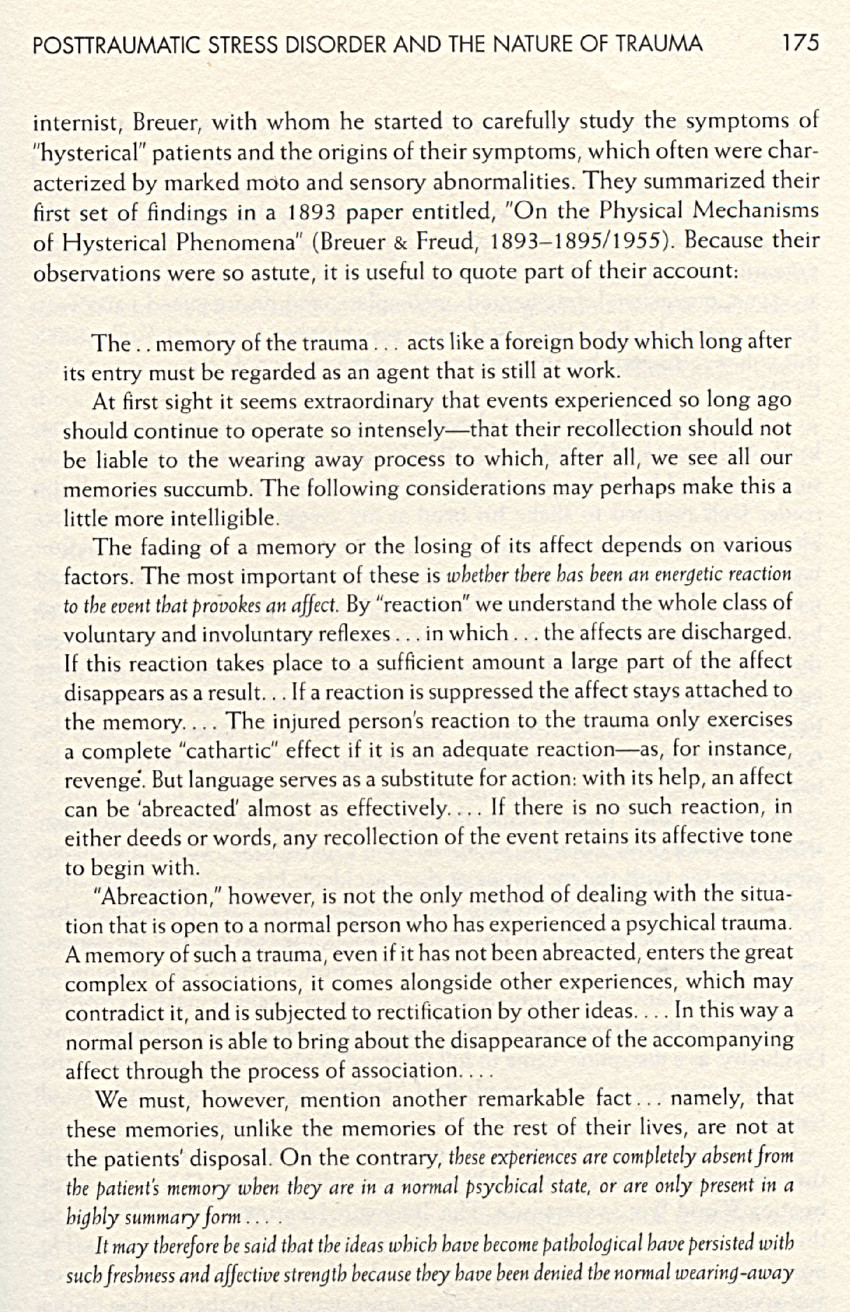
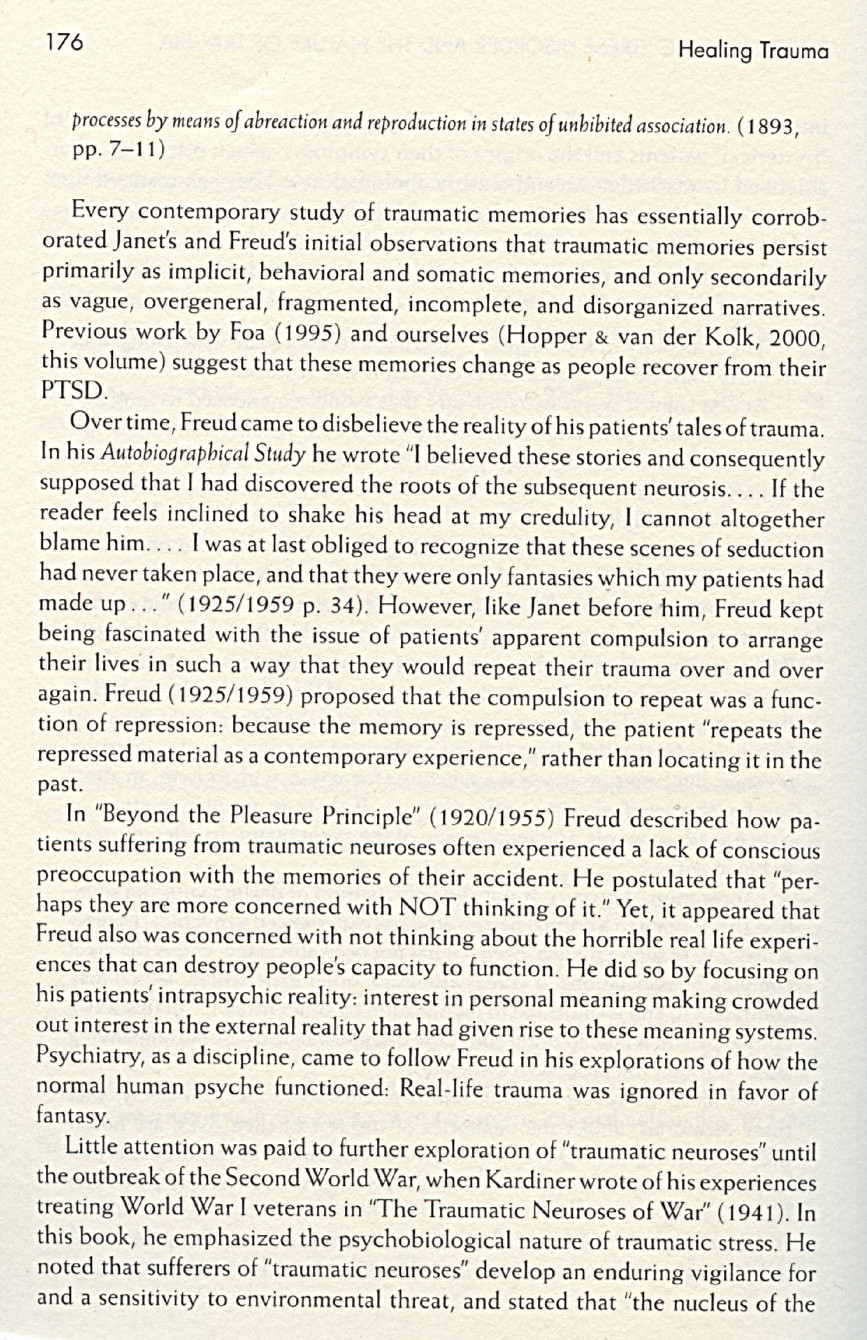
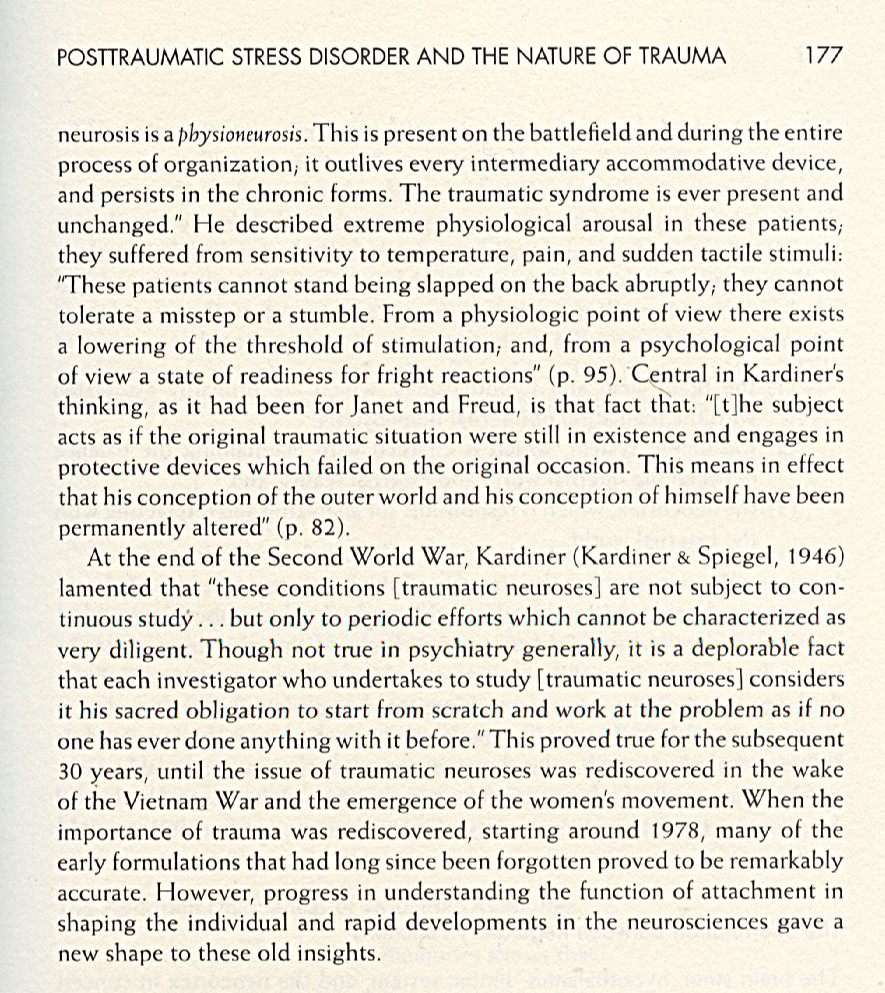
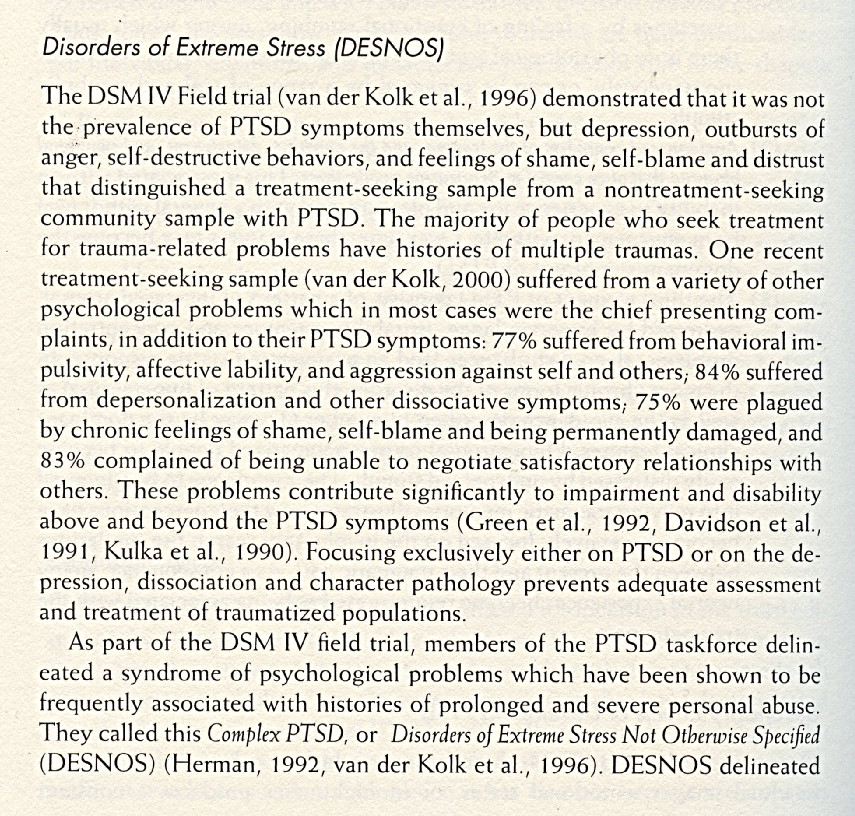
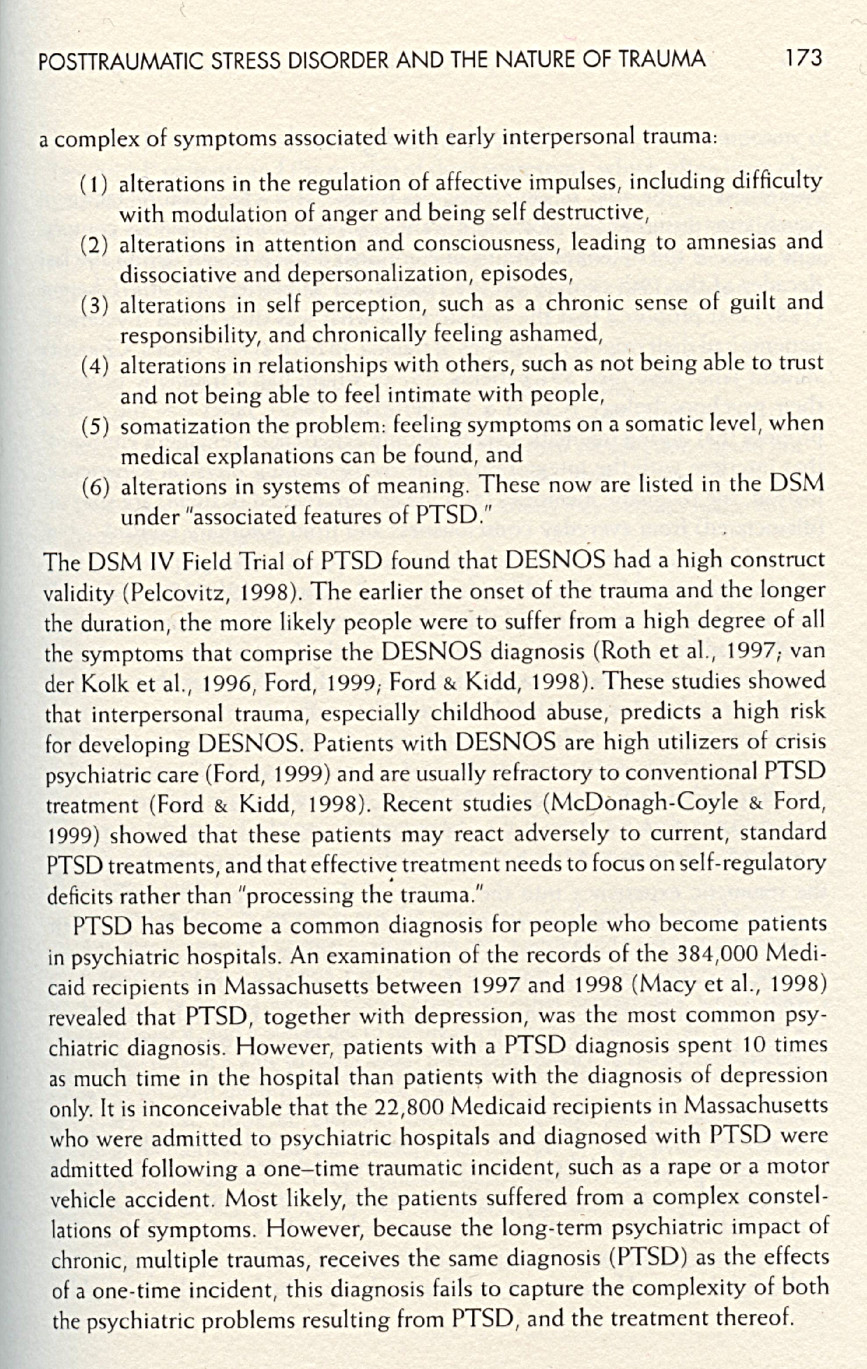
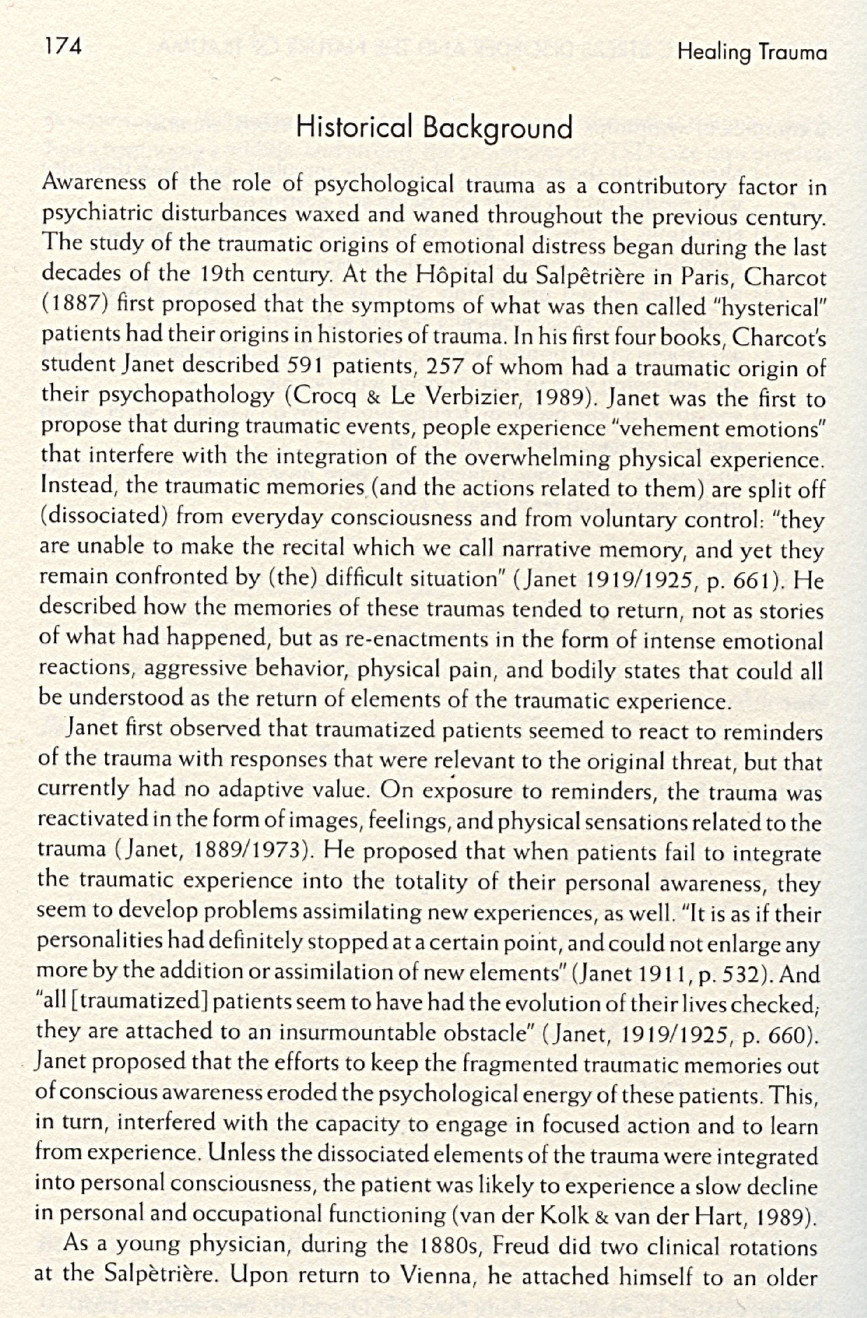
I am scanning in the following four pages about the history of the treatment of trauma for your consideration.  It is the last sentence on page 177 that interests me most as I will consider in a future post, but in all fairness to the author and to my readers, the rest of this information needs to be presented here for educational purposes.

These pages are taken from the book, Healing Trauma: Attachment, Mind, Body, and Brain – Hardcover (Jan 2003, W.W. Norton and Co.) edited by Daniel J. Siegel, Marion F. Solomon, and Marion Solomon, chapter 4 (pages 168-195) written by Bessel A. van der Kolk:  “Posttraumatic Stress Disorder and The Nature of Trauma.

++++

++++++++++++++++++++++++++

Please feel free to comment directly at the end of this post or on

+++++++

Your Page – Readers’ Responses

++++++++++++++++++++++++++++++++

PLEASE NOTE:  Do not take anything I say as a reason to alter any ongoing treatment, therapy or medication you are receiving.  Consult with your provider if you find something in my writing that brings questions to your mind regarding your health and well-being.

++++++++++++++++++++++++++++++++

+PTSD AND SEVERE ABUSE SURVIVORSHIP – PART TWO

+++++++++++++++++++

This second post about Posttraumatic Stress Disorder (PTSD) refers again to a book called Healing Trauma: Attachment, Mind, Body, and Brain – Hardcover (Jan 2003, W.W. Norton and Co.) by Daniel J. Siegel, Marion F. Solomon, and Marion Solomon, chapter 4 (pages 168-195) written by Bessel A. van der Kolk:  “Posttraumatic Stress Disorder and The Nature of Trauma.”

Today’s post follows the November 28, 2009 post

+PTSD AND SEVERE CHILD ABUSE SURVIVORSHIP – PART ONE

PLEASE NOTE:  Do not take anything I say as a reason to alter any ongoing treatment, therapy or medication you are receiving.  Consult with your provider if you find something in my writing that brings questions to your mind regarding your health and well-being.

+++++++++++++++++++

The following is taken from pages 172 of the above text.  I will consider this information in my writing below:

+++++++++++++++++++

It is now easier for me to work with this information because I have described my own version of an alternative way of thinking about the ongoing complications severe infant-child abuse and malevolent treatment survivors face as a direct result not only of the specifics of the actual horrific traumas they lived through, but also because of the very real physiological changes that surviving these traumas created in their infant-child growing and developing body.

(see yesterday’s November 29, 2009 post

+TRAUMA ALTERED DEVELOPMENT (TAD) – A NEW DESCRIPTIVE CONCEPT)

++++

An accurate primary and initial assessment of TAD for those of us who are Infant-Child Severe Maltreatment Survivors would allow us to know immediately how the changes our body-brain had to make created us to be different from ‘ordinary’ people who do not have the history of trauma that we do.

In this TAD assessment two critical resiliency factors would also need to be assessed because these two resiliency factors (one primary, the other secondary) are known to have the ability to nearly completely modify and modulate the power that early trauma has to change our developing body-brain.

The presence of safe and secure attachment to some early primary caregiver is the most basic and important resource an Infant-Child Severe Maltreatment Survivor had.  The current assessment tools available to assess adult secure and insecure attachment need to be simplified, refined and made accessible to the public.

Stemming from the degree of safety and security available through early caregiver attachment, the ability to play is a secondary but critical resiliency factor that impacts an Infant-Child Severe Maltreatment Survivor’s body-brain development.  I believe that assessment criteria and tools to measure this critical factor consistently and accurately can be developed and also made available to the public.

++++

NOTE:  In our new age of technology, the public has the right to be able to access critically important information about themselves and how their early infant and childhood experiences impacted their development.  At present this information remains ONLY available within ‘clinical’ settings, if even there.

++++

As far as I am concerned, anything and everything that is currently lumped under so-called ‘psychological’ categories belongs to the sinking Titanic of dark age medical model thinking that I referred to in yesterday’s post.

Until Trauma Altered Development (TAD) is assessed at the bedrock level of how Infant-Child Severe Maltreatment Survivors changed at their own bedrock (molecular) level, any attempt to moderate so-called ‘symptoms’ remains a crap shoot in the dark.

TAD assessment can connect the consequences of early trauma to altered physiological changes that an Infant-Child Severe Maltreatment Survivor’s body was forced to make to best ensure continued survival in early malevolent environments,

++++

Early caregiver attachment experiences from birth build the body-brain we will live with for the rest of our lives.

Van der Kolk (scanned text above) writes that it is not usually the symptoms of PTSD itself that brings those seeking help to a clinical setting.  Rather, he says that it is “depression, outbursts of anger, self-destructive behaviors, and feelings of shame, self-blame and distrust that distinguished a treatment-seeking sample from a nontreatment-seeking community sample with PTSD.”

Through an accurate TAD assessment, any ongoing difficulty an Infant-Child Severe Maltreatment Survivor has with emotions and social interactions can be traced to inadequate early caregiver interactions in a malevolent environment that built for the survivor an entirely different early-forming right-limbic-emotional-social brain.

When the foundation of the early forming right brain is altered because of maltreatment, the Infant-Child Severe Maltreatment Survivor’s later developmental stages involving shame, guilt and embarrassment will also be off course from ‘ordinary and optimal’ and will cause altered patterns of development in the body-brain.

++++

Van der Kolk states:

The majority of people who seek treatment for trauma-related problems have histories of multiple traumas.”

OK, I can certainly understand this, but here again, as I mentioned above, I do not agree with applying so-called ‘psychological’ and ‘symptom based’ medical model diagnostic thinking used in the author’s next statements.  I absolutely disagree with ever using terms such as ‘character pathology’ in reference to Infant-Child Severe Maltreatment Survivors!

One recent treatment-seeking sample…suffered from a variety of other psychological problems which in most cases were the chief presenting complaints, in addition to their PTSD symptoms:  77% suffered from behavioral impulsivity, affect lability, and aggression against self and others; 84% suffered from depersonalization and other dissociative symptoms; 75% were plagued by chronic feelings of shame, self-blame and being permanently damaged and 93% complained of being unable to negotiate satisfactory relationships with others.  These problems contribute significantly to impairment and disability above and beyond the PTSD symptoms….Focusing exclusively either on PTSD or on the depression, dissociation and character pathology prevents adequate assessment and treatment of traumatized populations.”

TAD assessments will clearly show that ‘impulsivity’, ‘affect liability’, most aggression, and dissociation are directly connected to changes in how an Infant-Child Severe Maltreatment Survivor’s nervous system, including their brain – and here, particularly their right brain – formed differently from ‘ordinary’ due to growth and development in trauma.

Chronic feelings of shame, self-blame and being permanently damaged” are also directly connected to trauma through developmental changes an Infant-Child Severe Maltreatment Survivor’s nervous system, including their brain – and here, particularly their later forming (after age one) left brain – had to make while developing in an early malevolent, trauma-filled environment.

Rather than referring to these changes as ‘character pathologies’, which in my thinking is the maltreatment, abusive stance taken by the medical model toward Infant-Child Severe Maltreatment Survivors, a TAD assessment can accurately and specifically pinpoint the origin of these changes in the body-brain and describe the consequences of them.

Receiving an accurate TAD assessment will show us exactly how our body was forced to adapt during our development through trauma so that we could survive it.   Yes, I do believe we KNOW we are different from ‘ordinary,’ but we are not ‘permanently damaged’.   We ARE permanently changed.

The changes Infant-Child Severe Maltreatment Survivors experience are fundamental and profound!  Everything about us was subject to adjustment for our trauma survival – our body, our nervous system and brain, our immune system, our mind, and our connection between our self and our self and between our self and the entire world around us.  NOT facing the truth and discovering the facts through TAD assessment will NOT resolve the difficulties we face with our continued survival into adulthood.

The only long term solution societies have is to STOP Infant-Child Severe Maltreatment!!!  Part of that solution is to provide the kind of TAD assessment Infant-Child Severe Maltreatment Survivors need, and to make available to us the resources necessary for us to live the best life we can in spite of the changes we had to make in order to stay alive because nobody STOPPED the Infant-Child Severe Maltreatment that happened to us.

It is the pathological character of the society we were born into that allowed what happened to us to happen at all, let alone allowed it to continue to the degree that trauma changed our physiological development.  If there is any self blame to be had, it is on the level far beyond OURS as the Infant-Child Severe Maltreatment Survivors.

++++

That the grand sinking Titanic of the archaic dark age’s medical model about Infant-Child Severe Maltreatment Survivors has at least THOUGHT about throwing us a life boat becomes apparent in van der Kolk’s next words:

As part of the DSM IV field trial, members of the PTSD taskforce delineated a syndrome of psychological problems which have been shown to be frequently associated with histories of prolonged and severe personal abuse.  They call this Complex PTSD, or Disorders of Extreme Stress Not Otherwise Specified (DESNOS).”

Great!  A life boat full of holes!  Gee, why are we NOT thankful for that?

A syndrome of psychological problems” be damned!  Infant-Child Severe Maltreatment Survivors do not suffer from a ‘syndrome’, and ours are not ‘psychological problems’!  For all the reasons I have repeatedly described, we simply need a TAD assessment that will tell us HOW our little body adapted down to our molecular level during our development in the midst of, and in spite of, toxic malevolent trauma.  Then we need resources that inform us how to live NOW with these profound trauma-caused changes that happened to us THEN.

The author continues:

DESNOS delineated a complex of symptoms associated with early interpersonal trauma.”

Again, we don’t have ‘symptoms’.  We have a different body-brain-mind-self that adapted to survival in a malevolent world and caused us to have Trauma Altered Development (TAD).

We don’t have symptoms, we have consequences.  Every single item in the list of so-called ‘complex symptoms’ (see them in the page scan below) that van der Kolk describes are directly connected to our TAD.  EVERY SINGLE ONE OF THESE ITEMS exist within us because of changes our body-brain was forced to make.  They are consequences of the changes our body had to make through our TAD.

The only real progress in the right direction I can see – given to us like faulty patches to a sinking life boat thrown to us from a sinking ship – is that at least an association ‘with early interpersonal trauma’ is finally being considered in the current medical model thinking.

But this tiny droplet of hoped for healing balm offered by the creation of a construct named “Complex PTSD, or Disorders of Extreme Stress Not Otherwise Specified (DESNOS)” is not what we Infant-Child Severe Maltreatment Survivors need in my book.

We need our entire society to understand and accept the truth that the Infant-Child Severe Maltreatment that happened to me and others – and continues to happen to children around us today – is nothing short of a form of parental-selected genocide that did not fulfill its intent to completely destroy us.  We are Infant-Child Severe Maltreatment Survivors because we are still alive, and we ONLY SURVIVED because we were able to adapt our body throughout our Trauma Altered Development to and within the malevolent environments that formed us.

++++

The rest of van der Kolk’s words (below) simply bring into my mind the image of the author being like a modern day Paul Revere, whose horse’s hooves pound along the streets of our nation as he screams a warning.  I am certainly not convinced, however, that even this author knows which message it is that most needs to be delivered.

The Trauma Altered Development that Infant-Child Severe Maltreatment Survivors experienced had no choice but to build itself into every part of who we are BECAUSE we live in a body, and our body had no choice but to change so that we could stay alive.

To describe any aspect of what happened to us in terms of a ‘diagnosis’ or a ‘symptom’, ‘complex’ or not, to call us ‘maladjusted’ or to tell us we suffer from any form of a ‘character pathology’ or ‘psychological problem’ is to continue to condemn us with stigmas and stereotyped prejudice which makes as much sense as applying all of the above labels to someone who is tall versus short, or who has red hair rather than blond.

If we wish as a society to remain in the dark ages about the consequences of Trauma Altered Development for Infant-Child Severe Maltreatment Survivors then at least we should have enough honor and common sense to admit it.  If we are appalled by the ignorance that is still applied to our circumstances, today is the day we can enlighten ourselves and get on with the legitimate task of figuring out how to accurately assess Trauma Altered Development so that we can begin to live well as the changed, extraordinary Infant-Child Severe Maltreatment Survivors that we are.

Our Trauma Altered Development did not affect WHO we are in the world, but it absolutely changed HOW we are in the world.  It is up to all of us to learn what that means.

+++++++++++++++++++

The following is taken from pages 173 of the above text:

Again, it is not a picture of ‘long-term psychiatric impact’ nor a ‘diagnosis’ that Trauma Altered Development affected Infant-Child Severe Maltreatment Survivors need.  We need to understand the changes our body had to make to guarantee our survival and specifically how those changes affect us, and specifically how to improve our quality of life and well-being in the world in spite of our TAD.

+++++++++++++++++++++++++++++++++++++++++

Please feel free to comment directly at the end of this post or on

+++++++

Your Page – Readers’ Responses

++++++++++++++++++++++++++++++++

+RETHINKING THE CONSEQUENCES OF EARLY (DEVELOPMENTAL) TRAUMA

++++++++++

Most of us are familiar with the sideways “8” symbol for infinity.   It’s a simple image, but is designed to represent a continuation of something that flows smoothly without having an end in itself.

I was thinking about the symbol this morning in terms of how we use resources in our life from the time we are conceived.  When we came into this world as a fertilized egg we could live off of our own inner resources just long enough to receive signals from our mother’s body that told us it was ‘safe’ to attach to her uterine wall.  Signals from her body told us where to attach, and the ability to receive those signals and act on them allowed us to accomplish this required attachment.

During the length of time we remained attached to the world through our attachment inside our mother we grew an increasingly more complex body by using resources we received from our mother.  From the time we were born as a breathing being into this world outside our mother’s body we were still completely dependent on outside others to provide all our resources for us.  We needed our early caregivers to allow us to breath, to keep us warm, to feed us, to protect us from harm.

During our most dependent stages of growth and development outside our mother’s body we were using the resources given to us by our early caregivers to continue our growth and development which included our nervous system-brain, immune system, and our entire body.  Nature has designed this process to work very well!

If safe and secure attachments continue to exist as they operate through our early caregivers’ attention to us, we continue to grow along an ‘ordinary’ and optimal pathway.  If trauma is introduced into our growing environment, and if it is allowed to overwhelm what is needed for our ‘ordinary’ and optimal growth, changes in our development HAVE to happen so that we can continue to remain alive.

I was thinking about our early growth and development in terms of the infinity sign because in a benevolent world our increasing ability to find and use resources can be represented by an expanding infinity sign.  In a safe and secure attachment environment we have a need, resources are provided to us, we take those resources into our bodies, can use them to our best advantage and we continue to grow.

If trauma in an unsafe and insecure early attachment world that threatens our ‘ordinary’, optimal development by directly interrupting our ability to access and use the resources we need to grow up in a benevolent world, what is changing in our developing body-brains as a consequence is our ability to get the resources we need in order to continue to grow to fulfill our potential for living in a safe and secure world.

As I have said many times in the past, the changes our body has to make due to interruptions through trauma during our early development are not maladaptive or ‘pathological’.  They are necessary and required for continuation of our life.

When we grow up and find ourselves living in a far more benevolent world than the one was that we formed in, we simply (!!) do not have a body-brain-mind-self that is prepared to access and use resources in the same way that an ‘ordinary’ non-traumatized (in early childhood) person can.  Something about our infinity sign has been changed.  Something about how we detect, access and use resources changed as a result of growing a body-brain in an early environment filled not with safety and security but rather with a lack of safety and security = trauma.

++++

When I think about this sideways “8” sign as it passes resources back and forth between the world outside of the body and the world inside a person, I have to think about boundaries.  Where do I stop and where does the outside world begin?

As I continue to explore the existing information about posttraumatic stress disorder (PTSD), I will have to consider one of the fundamental and primary concerns that this diagnostic category of ‘mental illness’ is attempting to address – how we detect, access and use the resource of information from our environment.  This information comes to us in the form of stimuli – both from within our own body and from the world outside of us.  Severe early trauma has changed us in ways that make our stimuli information resource systems work differently from ‘ordinary’.

If there is some degree of lack of well-being exiting within either a fertilized egg or in its mother, the step of attaching safely and securely to the uterine wall is interfered with, the infinity sign of resource transactions required for continued life ceases, and that is the end of life for the new little person.  This kind of risk continues for us every step of our life.  Given enough trauma and given enough inability to overcome the trauma, life stops.

The resource transaction process continues because information passes freely between the world and a life form.  We might think of air and water and food and heat ranges as resources, but do we think of their presence, availability and quality as providing basic information about the condition of the world we live in?  Do we think of early caregiver interactions with offspring as directly providing information (a vital resource about vital resources) concerning the quality of the environment the little one is growing up in – and for?

++++

If a person was built from conception in a safe and secure world, they will have a resource management system designed in, by and for a benevolent world.  If that person later experiences severe trauma, they will process it according to the resource management system they received very early in their lives – because that system has built itself into their body.  This ‘ordinary’ person will still have to access and use plenty of resources to overcome the experience of later traumas – but they will do so differently than someone will who has resource management systems (i.e. body-brain) designed in, by and for a malevolent, traumatic world.

Most plainly put, the following stems from my on-paper doodling as it relates to this critical topic or resource management and the changes our developing body-brain had to make in an unsafe, insecure and traumatic early environment:

S surviving

T – trauma

O – orients

P – personality

The

S – surviving

T – trauma

O – orients

R – resource

M – management

If a newborn finds itself in a malevolent environment all its ongoing experiences will send it signals about the trauma-filled world it lives in so that it can alter its ongoing resource management systems as they develop to maximize its ability to survive in this malevolent world.

If a newborn finds itself in a benevolent environment all its ongoing experiences will send it signals about a safe and secure world so that it can continue our species’ best-case development pathway using information it has received about adequate resources in the world.

Our particular personality is one of our primary resource management assets – but its development is influenced by the information an infant-child receives from its environment.  (More on this later regarding how early trauma creates ‘personality disorder’ developmental conditions.)

++++

Information communicated through the ability to send and receive signals on the molecular level continues throughout our entire life span.  Not only is the information itself a vital resource, but so also is the ability to send and receive these signals.  Beginning from conception information is transmitted between the environment and the organism living in the environment.

As a result of the information we receive and through our potential to adjust to the world we live in, we end up with an orientation either to a safe and secure or a trauma filled world.  Child abuse during critical developmental stages communicates on the molecular level what the conditions of our early world are like.  Our body has the miraculous ability to receive these signals of information and to adjust our development accordingly.

On the most basic level, when we are considering the effects that severe and early trauma has on a developing infant-child, this is what we are talking about – orientation in the world that determines how our resource management systems develop and operate to maximize our chances of survival.

Those of us who had to develop in a malevolent world have a body that is designed through flexible adaptive abilities during early development to be oriented to survival in a malevolent world.  Everything our body-brain knows about being in the world was set by this initial orientation-in-the-world process.

Current clinical thinking about trauma uses a model that looks like this:

Pre-trauma > trauma > post-trauma

That model DOES NOT apply to me.

Because I was born into a world filled with trauma, and because my tiny body-brain had to adapt its development in response to surviving that trauma, trauma built itself into me.  My most fundamental physiological orientation is based on surviving trauma.  I never had a ‘pre-trauma’ state.  Without having one, I cannot have a ‘post-trauma’ state, either.

So what might a severe infant-child abuse survivor’s trauma model look like?

Trauma < > trauma < > trauma

This model represents to me the development of a body-brain on all levels that has trauma at its origins because trauma was present at ground zero when development occurred.  (I am saying ground zero, but in my case that point happened at the moment I was born.  Variations of trauma can exist in utero.  In my case it did not.)

++++

What do we do with such a infant-child abuse trauma model?  My suggestion:  Go back to the drawing board.  The existing model about trauma and PTSD simply do not make sense as it is currently being used to describe what happened to and continues to happen for early severe infant-child abuse survivors.

The operation of our infinity sign resource management system simply developed differently from ‘ordinary’.  We are optimally designed to survive in a malevolent world.  No amount of magical, wishful childhood thinking (termed denial) is going to make us into ‘ordinary’ people.  We were not built in an ordinary world nor designed for living in a benevolent one.

By rethinking what is known about the affects of severe early abuse during infant-child development I have no doubt that we can and will become clear about what our changed body-brain resource management systems are designed to do for us and how they operate.  Once we have this information, we can THEN realistically and most effectively begin to find ways to alter our present experience of being alive in a more benevolent world while having to do so in/with a body physiologically designed in, by and for a malevolent world.

To continue to ignore and deny that we do not fit existing clinical models of ‘mental health’ and that we need to come up with new and appropriate ones, means that the storm of trauma that created us differently in the first place has no real possibility of ending.  The consequences to all of us for not being willing to consider the truth about how a trauma-changed body affects our ability to live well in a more benevolent world means that the wake trauma creates in our beginnings will follow us on through the rest of our lives.

We can do better than this!

++++++++++++++++++++++++++++++++++++++++++++

Please feel free to comment directly at the end of this post or on

+++++++

Your Page – Readers’ Responses

++++++++++++++++++++++++++++++++

+SECURE AND INSECURE ATTACHMENT AND THE CHILDHOOD NARRATIVE

++++

This post follows +DISSOCIATION AND THE TRAUMA-SPECIALIZED BRAIN from November 11, 2009

++++

I woke today as if in a different world than usual.  The wind is tearing around my house as if it is demanding something from me and I don’t know what it wants.  The wind is angry.  It rips leaves off of trees and chases them madly around the yard.  With its roaring and whistling it has stolen all my peace away.  It is harder to remember who and when and where I am.

If only the wind would stop and the sun would come out so calm would again surround this body I am in.  Then I could be more certain that my past was in the past and I am in the here and now.  I can I not help feeling challenged and disturbed, made uneasy and agitated in this wind.

++++

I wanted to continue to write this morning about secure-autonomous attachment.  I read Dr. Daniel Siegel’s words again:

The abilities to reflect upon one’s own childhood history, to conceptualize the mental states of one’s parents, and to describe the impact of these experiences on personal development are the essential elements of coherent adult attachment narratives.  (Siegle/tdm/312)”

I do not understand these words.  I do not have the “abilities” Siegel is describing.  I cannot possibly begin to “conceptualize the mental states” of either one of my parents.  I cannot “describe the impact of these experiences” on my development without consulting complicated information from infant and child brain scientists’ research.

If having the ability to “reflect” on my childhood, to “conceptualize” the minds of my parents, to “describe” the impact my childhood experiences on how I developed “are the essential elements of coherent adult attachment narratives,” then I am forced to admit I am coming up empty and confused as if some drastic, terrible wind ripped any chance I might have to begin to think about myself in my life ‘coherently’ from the beginning of my life away as surely as this morning’s wind is forcing away any semblance of a calm and peaceful day.

I feel angry that I have been robbed.  There is no corner of my childhood I can return to without being engulfed in turbulence and trauma.  I am as incapable of ‘conceptualizing’ particularly the mind of my mother at age 58 as I was the day I was born.  That children and the adults they grow into are SUPPOSED to be able to conceptualize the minds of their parents seems beyond belief to me.  I cannot begin to make an attempt in that direction, any more than I can begin to conceptualize the mind of the wind.

++++

Can I begin to understand that my lack of ‘abilities’ to convey even to myself a coherent story of myself in this life from the time of my beginnings is NOT because I am personally deprived, but that this lack of abilities comes directly from the kinds of terrible experiences I had to survive in my parents’ home?  It doesn’t FEEL that way.  It feels that somehow there is something wrong with me that I do not possess these essential requirements Siegel lays out for being an ‘ordinary’ safe and securely attached individual.

Do I understand that I cannot control the wind?  Do I understand that the only way I can ensure that the force of the wind is not directly affecting me is by seeking shelter from it?  Was there any possible shelter I could have sought as an infant-child to escape the terrible storm of my childhood?  No, there wasn’t, except as I could isolate myself in my brain-mind because the only hope of remaining apart from the traumas that I endured ONLY existed within the walls of my own skin.

++++

The words, “There are many rooms in my Father’s mansion” come into my mind.  Because from birth I had no choice but to try to survive within my body as my only protection from insane abuse, it was within me that I had to create these ‘many rooms’ so that the overwhelming traumas I had to endure did not engulf me, swallow me up and destroy me.  My mother’s mind was a cauldron of malevolent chaos.  I am sorry, child development experts, but conceptualizing that kind of mind is not only humanly impossible, it is against all instinct for ongoing survival.

In order to ‘reflect’ on another person’s mind so that it might be ‘conceptualized’, one must be able to make some connection between one’s own mind and the other’s.  Do attachment researchers understand how humanly impossible it is to do this when a parent’s mind is ‘on the other side’ of being human?  My mother was the antithesis of being a mother.  I know I am not alone in my experience.  But I take issue with the suggestion that there’s something wrong with me that I lack the abilities necessary to accomplish the impossible!

The only people I can imagine that could possibly ‘conceptualize’ the mind of my mother would be other mothers who had minds nearly exactly like hers.  What a fantastic delight of an experience it would be to put my mother and the other two mothers I know of like her in an observation room and then ask them all the ‘right’ questions!  Now THERE would be an opportunity for learning!

++++

Short of having this kind of opportunity to explore my mother’s mind – which is, of course impossible because she is dead – I am fighting against having to take on the burden of believing I am at fault in any way for not being able to conceptualize her mind.  Ability is not the right word.  I was born with the ability to accomplish what Siegel is suggesting IF I had been provided with parents whose minds were ‘conceptualizeable’!  Nobody can conceptualize what is impossible to conceptualize!

The abilities to reflect upon one’s own childhood history” – I have the ability to state today that my mother was insane, that my father supported her madness, that my childhood was chaotic, malevolent, dangerous, traumatic, and only survivable because I had the ability to survive it!  That the thousands of abuse memories I might have are stored in their corresponding ‘many rooms’ in the ‘mansion’ of my body where I cannot get to them does not mean that I am in any way more ‘disabled’ than anyone else would be if they had endured the same experiences.

The mansion of my body DOES coherently remember everything that has ever happened to me.  However, it is also a physiological fact that if there were enough stress hormones present at the time the traumas occurred, they would have fried the brain cells designed to store the facts of my experience so that only the emotional memories remained — in my body.

Coherency, as the developmental brain specialists are using the word, applies to their version of remembering the FACTS that tell the linear (left brain) story in words (narrative) of a person’s childhood.  These researchers neglect to mention that an intact, living, breathing, moving, sustainable body is proof enough that coherency is a much larger concept than they seem willing to conceive of.

++++

If I am fighting for the right to stand on my square foot of ground upon this earth in dignity without being judged as being somehow deficient or insufficient or unable to tell a coherent life story, if I am making the statement that I was born with the ABILITY to do so, that I still have this ability, and that the problem is in NO WAY because of any fault of mine but rather lies in the fact that my childhood was simply NOT COHERENT – and that nobody could tell a true story of madness and MAKE it coherent – then where do I go for my proof?

I am going to the dictionary.  I want to learn about this word ‘abilities’ (root word being ‘able’) that Siegel has thrown out as his defining qualification for everything else he says about being the kind of parent who can provide safe and secure attachment to their offspring.

What did I find in my exploration about the word and its family of relatives?  When I try to find ‘coherency’ or understanding about words I always try to find how they are connected in the language of English at the time of their appearance into our language as far back as I can find them – which is always ‘before the 12th century’.

I find that ‘able’ is a young word in our language.  So are its relatives ‘habit’ and ‘give’.  I tracked the word back to its older ancestor words ‘have’, ‘heave’, ‘hold’, and ‘take’.  Interestingly, the word ‘heaven’ is connected through its origins to ‘heave’, and by association of opposites, I find ‘hell’ connected to the word ‘conceal’ and from there to ‘hide’.

++++

I would understand that a dive into the origin and meanings of words might not be something many readers have found to be useful in the past.  Yet we are talking about a BIG subject – our lives and our well-being as it began either in a childhood close to heaven, or in a childhood closer to hell.  If you keep an open mind and meander among the following words, you can see that in our language such subjects as entitlement appear.

Being ‘able’ involves having resources to accomplish a goal.  I was born with and have retained the ability to tell a coherent story about my childhood if I had been given a coherent childhood to tell about.  I have the skill, but I cannot accomplish an impossible task to make madness, chaos and insanity into anything else other than what it was:  incoherent.

I was ‘given’ that childhood’  It was a nasty ‘present’, and I would much rather have had a different one.  The experiences of terrible trauma that I went through were put into my possession and I work as hard as I can to make the best use possible that I can out of what was done to me-given to me.

I cannot make my childhood into anything other than what it was.  It is the childhood that I have.  It is a part of the whole of who I am.  Under the definition of ‘have’ we read:  “to experience especially by submitting to, undergoing, or suffering.”  I performed the best that I could both to endure it and to survive it.

What is the relationship between this subject and ‘heave’ as it relates to ‘heaven’?  ‘Heave’ being related to labor and struggle.  Yet in the origins of this word we can directly see the same origins connected to our word for ‘heaven’.  Both words contain an image of ‘’lifting and heaving something up into the air’.  We are talking old language thinking here.  We are talking about trying to conceive of a ‘place’ beyond comprehension.  Where else would we put our conception of heaven but ‘up there’?

++++

Children are supposed to have good childhoods.  Good childhoods provide no challenge to telling a coherent story about them.  The reality is that some of us have the opposite kinds of childhoods, and it is through no fault of ours that we cannot make them into coherent childhood stories.  On our end, where hell was the norm, ‘concealing’ and ‘hiding’ from our conscious mind experiences that would have overwhelmed our self to death was our only alternative.  Dissociation allowed us to do this.

We cannot possibly tell a coherent childhood story in words about what is hidden and invisible, which is where most of our childhood realities are stored.  We have to believe ourselves!  We have to trust what we do know about our childhoods, even if we simply reduce what we know to our sense of ourselves when we were little.  We know.  Nothing was ever hidden FROM our body.  What we cannot access directly is hidden WITHIN our body.  There is no other possible place for it to be.  I AM my life story.

That means to me that being here alive today IS my coherent story.  My body IS my coherent story – all of it, every single last minute detail of it.  Seigel and other developmental experts are suggesting that it is in the telling of a coherent VERBAL narrative that all hope of having future and ongoing safe and secure attachment lies, including those with our children and mates.  I have to think bigger, because I know better.

I am not my mother.  My mind is ordered in a very particular trauma-survival-based way, but it is NOT in chaos, even if I cannot detect in words what I most know about having been raised through 18 years of terrible abuse.  ‘Coherent’ is a young 1555 word in our language.  Where did it come from?  What meaning is it connected to?  What are its ancestors?

It is related to the idea of sticking things together.  ‘Stick’ has been in our language from before the 12th century:  “to put or set in a specified place or position.”  I am here to tell all the attachment experts that I am stuck together just fine!  Everything I have been through is stuck somewhere inside of me, as well.  That I don’t have words to neatly spin a tidy heavenly story from my childhood in hell does mean I COULD NOT if I had an entirely different story to tell.

To me, what Siegel is really saying is that most patterns of ongoing intergenerational transmission of safe and secure attachments happen among adults who can put their childhood narrative into words.  OK.  I get it.  I can tell my childhood narrative with a three word statement about my childhood.  “It was hell.”  If I tell someone that and they do not understand what I am saying, there are not enough words in the universe to explain to them what my childhood was like.

Meanwhile, the wind has stopped blowing.  All is calm outside my house now.  I like that.  Peace and quiet now mean the world to me.  The version of hell I endured was a very wild and noisy place!  Those of you who have been there, too, know exactly what I am talking about, and I don’t have to spin a coherent narrative to tell you what I mean!  How cool is that?

++++

HERE ARE THE WORDS RELATED TO THIS POST’S  SEARCH:

able

Etymology: Middle English, from Anglo-French, from Latin habilis apt, from habēre to have — more at habit

Date: 14th century

1 a : having sufficient power, skill, or resources to accomplish an object b : susceptible to action or treatment
2 : marked by intelligence, knowledge, skill, or competence

habit

Etymology: Middle English, from Anglo-French, from Latin habitus condition, character, from habēre to have, hold — more at give

Date: 13th century
3 : manner of conducting oneself : bearing
5 : the prevailing disposition or character of a person’s thoughts and feelings : mental makeup
6 : a settled tendency or usual manner of behavior
8 : characteristic mode of growth or occurrence

give

Etymology: Middle English, of Scandinavian origin; akin to Old Swedish giva to give; akin to Old English giefan, gifan to give, and perhaps to Latin habēre to have, hold

Date: 13th century

1 : to make a present of
2 a : to grant or bestow by formal action b : to accord or yield to another

3 a : to put into the possession of another for his or her use

have

Etymology: Middle English, from Old English habban; akin to Old High German habēn to have, and perhaps to hevan to lift — more at heave

Date: before 12th century

transitive verb 1 a : to hold or maintain as a possession, privilege, or entitlement  b : to hold in one’s use, service, regard, or at one’s disposal  c : to hold, include, or contain as a part or whole

3 : to stand in a certain relationship to

4 a : to acquire or get possession of
5 a : to be marked or characterized by (a quality, attribute, or faculty)

6 a : to experience especially by submitting to, undergoing, or suffering b : to make the effort to perform (an action) or engage in (an activity)

heave

Etymology: Middle English heven, from Old English hebban; akin to Old High German hevan to lift, Latin capere to take

Date: before 12th century

intransitive verb 1 : labor, struggle

heaven

Etymology: Middle English heven, from Old English heofon; akin to Old High German himil heaven

Date: before 12th century

1 : the expanse of space that seems to be over the earth like a dome : firmament —usually used in plural
2 a often capitalized : the dwelling place of the Deity and the blessed dead b : a spiritual state of everlasting communion with God
3 capitalized : god 1
4 : a place or condition of utmost happiness

hold

Etymology: Middle English, from Old English healdan; akin to Old High German haltan to hold, and perhaps to Latin celer rapid, Greek klonos agitation

Date: before 12th century

transitive verb 1 a : to have possession or ownership of or have at one’s disposal  b : to have as a privilege or position of responsibility  c : to have as a mark of distinction
4 a : to have or maintain in the grasp
6 a : to enclose and keep in a container or within bounds : contain

take

Etymology: Middle English, from Old English tacan, from Old Norse taka; akin to Middle Dutch taken to take

Date: before 12th century

transitive verb 1 : to get into one’s hands or into one’s possession, power, or control

4 a : to receive into one’s body (as by swallowing, drinking, or inhaling)

hell

Etymology: Middle English, from Old English; akin to Old English helan to conceal, Old High German helan, Latin celare, Greek kalyptein

Date: before 12th century

conceal

Etymology: Middle English concelen, from Anglo-French conceler, from Latin concelare, from com- + celare to hide — more at hell

Date: 14th century

1 : to prevent disclosure or recognition of <conceal the truth>
2 : to place out of sigh

hide

Etymology: Middle English hiden, from Old English hȳdan; akin to Greek keuthein to conceal

Date: before 12th century

transitive verb 1 a : to put out of sight : secrete b : to conceal for shelter or protection : shield
2 : to keep secret
3 : to screen from or as if from view : obscure
4 : to turn (the eyes or face) away in shame or angerintransitive verb 1 : to remain out of sight —often used with out
2 : to seek protection or evade responsibility

++++

+’RED HIGH ALERT’ EMOTIONS AND ASSISTANCE FROM ASTROLOGY

+++++++++++++++++++++++++++++

Well, I had to cook up something entirely different today.  I found yesterday that going back to my age 29 journal was an incredibly difficult and painful experience.  There is nothing easy about any part of my life thanks to the treatment I received at the hands (and mouth) of my psychotic severe Borderline Personality Disordered mother.  So how do I live with, process, understand and begin to heal the powerful, intense and nearly overwhelming emotions I experience — frequently — as a consequence of my childhood?

My emotions reached the ‘Red High Alert’ stage yesterday.  I knew I had to find some way to ‘self sooth’ them down as many notches as I possibly could.  That meant I had to reach for some external resource for help, but which one?

I found and played a tape recording of an astrological reading I had done for me last March of 2009 specifically about the difficulties I have with my emotions by a man I consider to be a blessed and extremely talented and knowledgeable astrologer:  Zane (see Zane’s Page).

I learned a long time ago that because of the severity and extent of the child abuse I suffered, which began at my birth and lasted until I left home at 18, I have to consider and access the best of the best help I can find — anywhere I can find it — in order to live with and try to heal from the consequences of that torture.  Astrology is one of those avenues of assistance I have turned to in some of the toughest times of my adult life.

++++

I believe it takes a full lifetime of study coupled with incredible efforts at self-healing, and a whole lot of gifted talent for any individual to truly practice astrology.  I barely know enough personally to begin to understand the influences that the natural world exercise over me in this lifetime so that I can begin to gain assistance and insight from the best astrologers I can find.

Some people find it helpful to have ‘daily’ sorts of readings through which certain influences on their lives are made more clear as their lifetime progresses.  I am not interested in accessing that kind of astrological information.  I simply need to know what forces operated at my birth, throughout my childhood, and continue to operate during this very difficult lifetime I seem to have found myself in.  Zane is the most skilled and qualified astrologer I have ever found.

The internet provides a wealth of information about the basics of astrology.  There are websites that provide a free natal chart.  As with any search on the web, consumers need to pay careful attention to the information they obtain, but time spent considering the topic is, I believe, time well spent.  If you choose to consult with Zane at Zane’s Page, you can email him with specific questions or to set an appointment with him should you choose to purchase one of his readings.

++++

It is not my intention to either explain or defend astrology in this post.  Today I simply transcribed the reading I had with Zane last March.  I find the information helpful to me, and where I have differences of opinion with Zane, I note them within the text.

If you are interested, please follow this link to the whole report text:

*Age 57 – March 2009 (whole text) Astrological Reading About My Emotions

Transcribed from tape of telephone consultation

++++

Or refer to individual sections of the reading here:

MY EMOTIONS

MY DIFFERENT KIND OF LOGIC

MY FEELING DIFFERENT FROM OTHER PEOPLE

MY MARS AND JUPITER:  BEING A TEACHER

POTENTIAL AND PSYCHOLOGY

SUMMARY AND CONCLUSION

+++++++++++++++++++++++++++++++

+MAD MOTHERS AND THE LACK OF MENTORSHIP

+++++++++++++++++++++++++++++++

Mentoring–from the Greek word meaning enduring-

+++++++++++++++++++++++++++++++

I am thinking this morning about my mother’s attitudes about women coupled with her own self imposed isolation.  She complained about being lonely at the same time she told her mother things like what I find in her March 9, 1964 letter as I try to decipher what it is she might really have been saying here:

March 9, 1964

P.T.A., which I never attend when up here – and I detest groups of women anyways!  is putting on a play and wants me to sell ads in program so I said O.K. as couldn’t refuse.

Am supposed to go see about it – at Mauldin’s (ugh) and Thomas’ – Darn.

[ME:  How could she have any friends with this attitude?]

Oh Mom, I realize this year life is so short – I am getting grey streaks – no white in my hair!  What’s life all about?  I don’t enjoy it the way I once did – I feel such a loss!  Why?

I try so hard to get enthusiastic but I can’t.

I’m lonely for someone to talk and bubble with.

Bill works nites here and is so quiet and un-bubbly.  He knows I’m different and doesn’t seem to know what to do about it.  How can I tell him?  I’ve tried.

[ME:  Dad worked days at a professional civil engineering job, had incredibly long and difficult commutes, and worked after he got home hauling water from the creek, plowing roads, repairing the tractor, cutting and hauling firewood, running errands, transporting children back and forth to school – – – ]

David is so dear but sometimes I tire of him and Laila is a nice neighbor but Mom, I’ve seen too much of her.  I wanted those classes Oh Mom, I need to be part of the world after 15 years.”

[Me:  David turned three two weeks after this letter was written, and was no longer a baby.  As I’ve described in my previous writings, once my mother’s children, her ‘imaginary friends’ outgrew their allowed baby-doll status, my mother had increasing difficulties in getting her needs met through them.  In fact, she had another baby 11 months after this letter was written.]

++++

I think about how my mother’s ‘time’ was before so-called ‘women’s liberation.  I think about how she was descended from a mother who was educated with her masters degree in 1918, from a grandmother who was highly self-educated and while did not work to support herself or her family, owned her own property that she ‘managed’.  I also think about my mother’s mental illness as I come to understand that it permeated every aspect of her mind and of her life and limited her ability to live a happy, healthy and fulfilling life in every dimension, including friendships.

I think about how my mother did not know what a person really was, and could therefore not ever participate wholly in friendships of any kind.  In this March 9, 1963 letter mother is alluding to taking a university class as if it would have provided her with her ONLY possibility for getting her social needs met.  Yet these ‘classes’ were really an unknown for my mother, something she could dream and fantasize about because they were NOT a part of her reality in any other way.

Yet every time something ACTUALLY became real in my mother’s life, she suffered from disillusionment and disappointment.  She was a master at fault finding with others.  That was a part of her disability, of her mental illness.  As long as her perceived opportunities to have her social needs met remained invisibly ‘out there’ – rather than within the very real opportunity she had to make friends and to socialize with the real people in her life – she could keep the invisible not real people in her imagination as hoped-for ‘imaginary friends’ — and evidently ‘bubbly’ ones at that.

++++

I had no frame of reference growing up from which to understand that my mother’s mind was sick.  Looking back, it’s not only what my mother did do to me that was a problem, it was also what she did not do.  One of those ‘not do’ things is that she never showed me, or any of my siblings, how to have genuine nurturing caring supportive friendships with other adults – particularly with women.

Fortunately I was able to overcome my biases about ‘hating women’ fairly early in my adulthood so that I have several long term friendships even today.  But I still do suffer from something very subtle that my mother could not show me:  How to find and use a mentor, particularly a female one.  I’m not even sure that I could define for myself today what I think a mentor is, or what a mentor would do, or what I could gain from having one.  I only know that I am missing one in my life.

I don’t think there would be the same kind of mutual reliance or give-and-take between a mentor and ‘mentee’ as there is between friends.  I would want my mentor to be so clearly, strongly and firmly walking ahead of me in her own chosen path that she would never need me to further her own life.  Yet perhaps my thinking about the matter of mentorship is all mixed up with what having a mother would have meant to me – because I never really had one.

++++

What a novel thought it is for me that parents should mentor their children.  Certainly I am old enough now that my parents are naturally dead.  But I will never NOT suffer from the deprivations from my childhood – until and unless I can truly recognize and make up for some of them.

So, at present, I simply invented a mentor.  I found two beautiful black and white full page magazine pictures of Meryl Streep.  I bought two $6 black frames and now have Meryl’s pictures hanging on my wall.  When I have a question, I simply ask myself, “What might Meryl do?  What might Meryl think?  Would Meryl tolerate this?”  I don’t, of course, have any real idea what the answers to my questions would REALLY be, and it doesn’t matter, because Meryl is my imaginary mentor!

It has certainly been easier for me to make real friends in my life than it has been to find a real mentor for myself.  Just having Imaginary Mentor Meryl Streep in this role in my life helps me take small steps forward in my thinking toward what I believe is a more positive direction in my life, one question at a time.  This might seem silly, but it helps me – and I know there’s really nothing silly about that.

+++++++++++++++++++++++++++++++

Borderline Personality From The Inside Out

My parents left me like a rudderless ship.  I don’t like that feeling!

Mentor: Someone whose hindsight can become your foresight

My mother’s brain didn’t work right!  She had no properly functioning foresight, middle sight or hindsight!  She didn’t even have mindsight!  So she certainly could not see me, could not see what I needed – and could not provide it.

It’s up to me to figure out what I need — and then to find ways to get those needs met, even with an imaginary mentor!

+++++++++++++++++++++++++++++++

+MOTHER’S MELANCHOLY, LONELY LETTER 3-1-1960

+++++++++++++++++++++++++++++++

One of the things I suspect about a severe insecure attachment disorder — like the disorganized-disoriented one my mother had and gave to me — is that we perpetually long for the closeness of the ones that love us most, and those we most love.

There’s nothing inherently wrong with this, but in part our longing is bigger than life because we cannot summon the inner feeling connection with these people to sustain ourselves comfortably in their absence.

I believe there exists in our brains a fundamental breach or dissociation between our left brain’s attempts to ‘understand and know’ logically and verbally that we are loved and our right brain’s inability to FEEL that we are loved.

Our insecure attachment disorder also manifests itself in the fact that we cannot feel sustaining emotional connections with ‘regular’ people we might encounter or seek out in our lives, either.  Our lack of ability to form safe and secure attachments means that we ache inside all of the time except when we are in the actual, physical presence of our most important attachment figures.

This ache seems permanent.  I believe it is fundamentally connected to the unbearable pain of isolation from secure attachments when we were our youngest and needed them most.  Because sustaining early caregiver attachments were missing, unbearable pain and sadness built itself into our young growing right emotional-social-limbic brain instead of a sense of safety, security and attachment to others in the world.

I think my mother is expressing some of that unbearable pain in this letter, some of her deepest longing for HOME — for the safety and security of loving attachments connected to the HOME of the self in the world.

(Her words in this letter are unusual because she is acknowledging that not even being on the homestead will ease the longings of her heart.)

+++++++++++++++++++++++++++++++

March 1, 1960

Dear Mom,

Just walked over to mail box and got your long very much appreciated letter and also received your gorgeous — how do you find time to do it – knitting.  Oh Mom they’re really expert – really!!  The hat is a real beauty and the blue mittens just match her hat – and the socks are so warm.  I love hand knits….

Last week I felt absolutely marvelous – cold cleared up and I had too much pep.  Then Friday evening within one hour I came down with bad cold again!  Head stuffed up – feverish etc. – went to bed early but didn’t help.  Saturday I had so much to do and Sunday went to church again but felt horrible. Came home and had promised kids to go in town to walk around as Fur Rendezvous – Bill won’t even take time to go to movie but each has allowance and could spend it (Linda lost her purse and all her $ saved for camp – 3.50!)  Why she brought it to town I don’t know!  I felt too sick but we went and Monday I was ill.  George Washington’s Birthday but there was school but Bill was home and I stayed in bed all day – believe it or not.  Had sinus so bad it ached and felt sick all over.  Had the girl coming Tuesday (60.00 per month and ho how we need it) – luckily that broke the cold and loosened it.  This is Wednesday and I’m better but oh such mucous and my voice sounds hoarse but over sick part.  All kids have coughs – Linda was sick several days and Cindy threw up other nite all over sleeping bag that I had just finally gotten out of cleaners because it cost 5.00 to be cleaned.  (They’re off to nap and I’ll write more)

Well, they’re in bed for a nap and I find we’re on a better schedule with Suzie here – she’s 5 and so good – quite a homely plain child but so obedient and smart and a very nice play mate for Sharon who was lonely.

We do papers, paint etc. and eat at noon and they nap plus the extra $.  I almost had another child but her neighbor is caring for him.  Well what with more time to put in on homestead – just as well and Suzie’s $ will pay to have La Verne here then.  I wish I could save it but Bill and I will do well if we can get up and down – the kids couldn’t walk that mountain every nite.

We had planned for me to go in with Bill Monday and he was to drive the tractor out but I couldn’t have!  Maybe this week-end.  I dread the bill.  Oh Mom I too will be glad when we hold title.

I worry over where we’ll live next year but we’ll have to wait and see.  I wrote Spoerry one month ago about this house and she never answered (?)

I’m so glad you’re not rushed – it’s most upsetting.  By the way, you asked me if I wanted anything – I would love any of anything if you have it and I guess we could have Army ship up when we come on trip – we’ll wait and see.  Lately I’ve been wishing for a big old house – with library, dining room and all!!  I’m so tired of not having a home and kids are so big now and need their own rooms.  It seems so long since we’ve had a home.  I’ve been wishing we kept my bedroom set, our piano [from her childhood, mentioned in her 1945 diary before they left Boston for L.A.] and all.  Oh Mom, we had such a wonderful home – I wish ours had same now.  I marvel at how you did all you did – I really do – more and more.  Oh Mom, I wish we’d kept that chair Grandpa made – I wish I had our old things, altogether and a road to our homestead and house and all but honestly sometimes it seems it will never be and I get more discouraged now than before.

I wish you were settled or knew at least what you want.

Gunter’s plan to sell their house and build up the street this summer.

Poor family with 5 children got burned out Monday up the street.

I never go anywhere or see anyone.  Wish I had 6 children all day – I only charge 15.00 per week (includes lunch) [in her nursery school]

Lately I’ve felt so blue and lonely.  I need to be out and do things.  I’m tired of staying home and dread the lonely, long summer [on the mountain homestead].

Bill will be so busy again – I really dread it – terribly.

Wish you were coming up – I’d be so happy then – oh, that you were – for the entire summer.  I’d sing, I’d fly! – but as it is I dread [underlined 8 times] this summer.

It’s not even as if I had water to make a garden and I refuse to sit up there all summer again – and yet, what else??

Well, as I said no news and on I rattle about nothing.  Hope C and C aren’t mad I didn’t send $ for your hospital bill – oh that I could.

Write me – I wish I could see you.  Take care.  I love you so!!  Mildred

+++++++++++++++++++++++++++++++

letter is filed here:

*1960 (IN THE ACT) HOMESTEADING

+++++++++++++++++++++++++++++++