
+CLEAR ARTICLE ON LIFELONG INFANT-CHILD TRAUMA CONSEQUENCES

++++++++++++++++++++++++++++++

Although I am nothing like a ‘scientific expert’ on the topics I present on this blog, I sure can recognize comprehensive outside support articles on what exposure to passive and active malevolent treatment including violent trauma (including emotional and verbal abuse), emotional neglect, physical neglect and unsafe and insecure early caregiver attachments do to change the physiological and psychological development of infants, toddler, children and teens.

This article by Dr. McCollum that I present here today presents the topic of what I call Trauma Altered Development (TAD) in a clear, lay-readable format.  For all the times that I have mentioned that I believe that TAD directly affects the human developing immune system, I find the material in this article supportive of my belief.

The term being used here, Adverse Childhood Experiences (ACE) comes from our nation’s Center for Disease Control (CDC) and is working to standardize the measurement across scientific fields of study related to suffering in infant-childhood caused by trauma in a little one’s earliest environment.

One of my strongest suggestions for standardizing all research about infant-child abuse and its lifelong consequences would be implementation of a federal-state mandate that would require that every American receiving any kind of health care services fill out a CDC ACE study questionnaire and that the results of these reports be accumulated in a federal (confidential) databank.

The article that follows gives us convincing reasons for believing that making the connection between the overall well-being of our nation’s offspring is of critical national interest.  If the subject of infant-child lack of well-being, neglect and abuse ever crosses a person’s mind, the following is the kind of information that needs to inform their thinking.  (I believe many forms of arthritis and cancer belong to the ‘health consequence list’. We also can no longer ignore the epigenetic changes that child abuse often creates that can also be passed down the generations.)

++

I located this March 2006 article today on the Minnesota Medicine website, and have copied it over onto my blog for educational purposes only (please click on article title to find the list of references):

Clinical and Health Affairs — Child Maltreatment and Brain Development

By David McCollum, M.D.

Abstract
“A growing body of research has linked childhood experiences of maltreatment with a host of physical conditions that manifest in adulthood. In addition, newer neuroimaging techniques have documented structural changes that occur in the brains of individuals who suffer early maltreatment. This article briefly reviews the literature on these topics and outlines the connection between abuse in childhood and health problems in adulthood.


It has long been observed that some children raised in violent, abusive, or neglectful settings grow up to express violence, anger, depression, or to be engaged in drug use, alcoholism, or criminal activity. The thinking has been that children copy what they see and hear. When anti-social behavior is the norm and when it is reinforced by adults in the environment, children repeat it. During the past 15 years, scientific and clinical research has begun to document that more is at work. Anatomical and functional alterations occur in the brains of children who are exposed to adverse events.1 Research has also shed light on the less obvious link between childhood abuse and lifetime physical and mental health outcomes.2,3 This article reviews some of the research showing the neurobiological, neuroanatomical, and physiological effects of early life stressors and how they might relate to ongoing medical problems later in life.

The Connection between Abuse and Disease
Repeated exposure to adverse or harmful events in childhood has been linked to many adult health consequences. The adverse experiences that have been studied most are sexual abuse, physical abuse, and neglect. Anda et al. identified additional experiences that influence health behavior and outcomes, including mother treated violently, mental illness, substance abuse, incarcerated household member, and parental separation or divorce.4 Because at least 30% of children in this country experience some form of child abuse prior to age 18, we can expect adverse childhood experiences to have a significant impact on the health care system.5

New technologies such as functional MRI, PET, and MRI/T2 relaxometry (T2-RT) have enabled scientists to identify the chemical and structural differences between the central nervous systems of abused and nonabused individuals.6,7 This research shows that many health problems—including panic disorder/post-traumatic stress disorder, chronic fatigue syndrome, fibromyalgia, depression, some auto-immune disorders, suicidal tendencies, abnormal fear responses, preterm labor, chronic pain syndromes, and ovarian dysfunction—can be understood, in some cases, as manifestations of childhood maltreatment.8-13

Brain Development
An infant’s brain is equipped with an overabundance of neurons, synaptic potential, and dendrites. DNA is responsible for early brain development. But after birth, experience helps to determine which neurons will persist, which synapses will develop and become permanent, and which connections will take prominence or be subdued. Myelination, formation of the protective sheath surrounding nerve fibers, continues throughout childhood and, in some areas of the brain, into the third decade of life. This process establishes final, permanent linkages within the brain structures.14

The limbic system is the part of the brain most vulnerable to adverse childhood experiences. The system is made up of the amygdala, hippocampus, cingulate gyrus, thalamus, hypothalamus, and putamen. Related structures include the cerebellar vermis, prefrontal cortex, and visual and parietal cortex. The limbic system is responsible for the generation and control or inhibition of emotions. It is also involved in interpreting facial expressions and evaluating danger, is responsible for the fight-or-flight response to stress, and integrates emotional reactions and connects them with the physical response. Various components are also involved in memory, both implicit and explicit, and in learning (Table).

Brain Sequelae
Stress initiates a series of hormonal responses in the limbic system. The initial response to stress or danger is activation of the hypothalamic-pituitary- adrenal (HPA) axis. This occurs in the locus coeruleus and the sympathetic nervous system, causing a release of the hormones norepinephrine, serotonin, and dopamine. The amygdala reacts to this hormone release and, in turn, stimulates the hypothalamus to release corticotrophin-releasing factor (CRF). CRF, itself, acts as both a hormone, to stimulate adrenocorticotropin hormone (ACTH) secretion, and as a neurotransmitter, affecting areas of the cortex that are involved in executive functioning (eg, motivation, planning, and logic).15 Increasing ACTH secretion then leads to elevated glucocorticoids (cortisol). High levels of glucocorticoids have been shown to negatively affect the hippocampus, resulting in decreased dendritic branching, changes in synaptic terminal structure, and neuronal loss.16 A feedback mechanism in the hypothalamus and the hippocampus normally brings these levels back to their resting state.

If this process occurs repeatedly, CRF and glucocorticoids remain elevated, which eventually causes structural changes in the brain and impedes the feedback mechanism, leading to an imbalance in hormones and dysregulation of the HPA axis.17

Signs of Stress in the Brain
Several studies have shown a measurable reduction in the size of the amygdala, hippocampus (primarily the left side), corpus callosum, and the cerebellar vermis, and an increase in size of the putamen and lateral ventricles in both children and adults who experienced repeated childhood trauma.18-20 These changes are thought to be an effect of elevated glucocorticoid levels inhibiting myelination in these structures.14 Because most areas of the limbic system are high in glucocorticoid receptors, they are susceptible to the effects of early childhood abuse.

Functional changes have also been noted in the anterior cingulate gyrus and the visual and parietal cortex. Elevated resting levels of CRF have been found in the spinal fluid of abuse victims.21 Elevated T3 levels have also been found in patients with a history of childhood abuse.22

Dopamine, which is released during the stress response, stimulates areas of the prefrontal cortex, probably resulting in heightened attention and improved cognitive capacity. Chronic stress, however, appears to cause an overproduction of dopamine, which can result in reduced attention, increased overall vigilance, as well as a diminished capacity to learn new material and increased paranoid and psychotic behavior.23

Serotonin stimulates both anxiogenic and anxiolytic circuits, which create and reduce anxiety. Decreased serotonin levels in the prefrontal cortex have been found as a result of chronic stress. Suicidal behavior, depression, and aggression have been shown to result from low serotonin levels.

Substance P, a neuropeptide found throughout the body that participates in the pain response and inflammation, has been found at much higher levels in the spinal fluid of those with significant abuse history. Studies in rats showed that injecting high levels of substance P in the spinal fluid caused a significantly exaggerated pain response to a noxious stimulus.24

Related Health Problems
The health problems associated with these changes in the brain are significant. According to Anda et al., atrophy of the hippocampus, amygdala, and prefrontal cortex, and the subsequent dysfunction is related to anxiety, panic, depressed affect, hallucinations, and substance abuse. Increased locus coeruleus and norepinephrine activity have been related to tobacco use, alcoholism, illicit drug use, and injectable drug use. Defects in the amygdala and related deficits in oxytocin result in sexual aggression, sexual dissatisfaction, perpetration of intimate partner violence, and impaired pair bonding.4

Anderson et al. used a novel technology called static functional MRI T2 relaxometry (T2-RT) on a population that had experienced childhood sexual trauma and found evidence of significant changes in the cerebellar vermis in abused individuals compared with nonabused individuals.6 The vermis has been shown to play a role in suppressing excitability within the limbic system. The most consistent anatomical finding in children with ADHD is a reduction in the size of the cerebellar vermis. Other studies show similarities in hormonal changes in children with ADHD. Famularo showed a high correlation between traumatic family environments and ADHD comorbidity.25,26

Allsworth showed that dysfunction in the hypothalamic-pituitary-adrenal (HPA) axis, common in people who have been abused, leads to ovarian dysfunction and early menopause.13 This is likely to increase the risk of cardiovascular disease in these women because estrogen is reduced prematurely and, therefore, its protective function is lost earlier, increasing risk for cardiovascular disorders. Another interesting finding is that early stress may lead to premature involution of the thymus gland. Anti-nuclear antibodies, which attack the body’s own tissues instead of foreign toxins and are frequently present in people with systemic lupus erythematosus, also have been found at higher levels in girls who have been sexually abused compared with those who have never experienced abuse.9

The link between fibromyalgia and sexual abuse has been extensively studied.27 Dysregulation of the HPA axis has been found in most patients with fibromyalgia.28 Substance P is found in high levels in this population. Irritable bowel syndrome has also been shown to be correlated with childhood sexual abuse, and higher levels of substance P have been found in the colonic mucosa of individuals who were maltreated as children. Also, increased glucocorticoid has been shown to act on the intra-abdominal adipocytes leading to increased fat storage.4 Findings that memory pathways are adversely affected by exposure to abuse may explain some amnesia, delayed recall of abuse, and dissociative disorders.29 Some authors consider conversion reactions and pseudoseizures a form of dissociative disorder.30 [bold type is mine]

Conclusion
For years, we have ignored the potential influence of childhood traumatic experiences on adult disease, preferring to look for genetic causes of disease and pure biochemical factors without considering experiential influences. Given new evidence that trauma in childhood alters the physiology of the brain, it is time for all physicians to be educated about the full health impact of violence and abuse and be trained to explore these issues as the true etiology of or an underlying potentiating factor that contributes to their patients’ maladies.”

++++++++++++++++++++++++++++++
+TO BE OR NOT TO BE — HUMAN OR OBJECT: EARLY ATTACHMENT PATTERNS DECIDE AS THEY BUILD OUR ANS

++++++++++++++++++++++++++++++

I woke up this morning to find my mind raring to GO like a team of healthy horses all hitched up, prancing around and chomping at their bits.  “WHOA!” I have to say to myself.  “I can see you have something important to say but I have no idea where I’m going with this!”

“Sadly,” I might add.  Sadly I have to remain poised at the beginning of writing something I know about infant-human development as I put myself on ‘pause’.  “How do I begin to write about something that is so critically important to the creation of a human being at the same time that the most accurate information about the topic lies only within the most densely-packed, difficult to read, most unnatural form that any lay readers could find it — ensconced in the tombs of writing created by the best-of-the-best developmental neuroscientists?”

I ask, “Who am I to assume that I might be the one to translate this critically important information into words that make perfect, clear, digestible and usable form for regular people?  Who am I to be the one that believes I can make logical connections between bits of scientific information that so-far mostly remain within the vernacular realm of ‘open to debate’ or ‘not remotely related’ to what people need to know about being alive in a human body in a culture that really doesn’t seem to care what being a human being MEANS, anyway?”

And I — simple I.  “Why me?”

“Why should I be the one trying to make these important connections about being born a tiny human being in a body that has so far to go before it can even grasp the reins of its own great potential to be a separate person among billions of others on the planet today?”

“Why — I — who had removed from me (through unbelievable trauma, torture, neglect and abuse from the time of my birth) perhaps as effectively as is humanly possible nearly ever single chance, nearly every single possibility of being the ME I was born as, of having a chance to grow that ME into a self in a healthy body so that I could have gone off in completely different directions with my life so that I would have ended up a different person in a different body living a different life than I am today?”

++

I am not an ‘acadamian’.  I don’t have, and never will have a doctorate or a string of impressive degree titles strung after my name to prove to anyone that I know what I’m talking about.

I don’t even know what I’m talking about.  The only strength I possess is my determination to FIND OUT what I know — inside my own body — as I work as hard as I can at being TRUE to what I know and try to communicate that information as it matches what the developmental neuroscientists know.

NOT AN EASY TASK.  None of this is.  And the two intimately connected subjects I WANT to write about, that I WANT to understand, that I believe are so important for ALL OF US to understand surround me at this very instant as they threaten to do what they do BEST — obliterate ME.

Those two subjects are DISSOCIATION and SHAME as they both utilize the same human physiological pathways within our body that, when they exist in a person’s body, lie within our Autonomic Nervous System (ANS).

++

Part of what keeps me sitting here this morning on complete ‘pause’ is that I am realizing how profoundly I have been guilty of allowing an obstacle to sit in my own pathway that has continued to limit what I understand about how the malevolent trauma of my earliest physiological developing moments, days, weeks, months and years not ONLY changed how my brain developed, and not ONLY changed the development of this collection of living tissue referred to as my BODY — the pervasive traumas that happened to me ALSO changed how my BRAIN and my BODY communicate with one another.

Dissociation and shame, both happening as BRAKES on experience a person has as they operate within a human’s ANS, can shatter the continuity of one’s experience of being alive at the same time they disrupt and destroy the formation of those physiological routes WITHIN THE BODY that a person MUST HAVE to become and to remain a healthy, whole SELF.

++

It is at this point, as I sit reins in hand with my prancing, chomping, raring-to-go team of horses ahead of this too-flimsy cart I sit perched on that I realize I have no clear idea about which direction to go in.

At the same time I recognize that I know that eventually ‘all roads lead to Rome’ and that it doesn’t matter which direction I head off to.  In the end, ALL OF WHAT I KNOW from the 18-year infant-childhood of horrific abuse, trauma and malevolent treatment that I survived — coupled with every shred of neuroscientific information I have sought for and attempted to comprehend about human infant-child development and about how neglect, abuse and trauma changes the development of our BODY itself — means the same thing.

If a human infant is not given as nearly as possible EXACTLY what it needs — safe and secure early attachment interactions with its earliest primary caregivers most essentially with its mother — OPTIMAL development on every single level of its developing body will NOT happen as a consequence.

++

Perhaps for the first time in the 59 years of my life I am finding myself as the severely abused infant-child I was, falling-drifting into place among all the other members of my species.   As horrifically an exception to the ‘norm’ that my severely abusive-traumatizing infant-childhood consistently was, there is NOTHING about what happened to me that was in any way an exception to the rule of ‘human is, human does’.

The more I understand that any form of interference with or neglect of providing (especially for a human being ages 0-3) OPTIMAL conditions to develop RIGHT results in negative changes to the development of the BODY and of all its components, the more I understand that our culture is creating a nation of people who do NOT have an optimal body at the same time they do not have AN OPTIMAL SELF.

++

As I sit upon my flimsy cart of ‘trying to figure out how all the FACTS fit together into a whole’, I realize that in some ways all the color is draining out of my view of the world.  As I make the inner agreement with myself to just relax and let this color-draining happen so that I can come a little bit closer to KNOWING WHAT I KNOW inside my body-self, I am beginning to see that when it comes to forming OPTIMAL people from the moment of their conception, there really doesn’t appear to be much GRAY in this world at all!

It is into this very black and white world that I can see myself slipping-sliding-drifting-falling as just one more person among no doubt millions of others whose earliest most critical stages of development deprived me of the chance to become an OPTIMAL human being.

++

Black OR white world:  Either an infant-child is born into an environment that provides (as exactly as possible = ‘good enough’) what it needs to recognize its own self at the same time it is given what it needs to GROW that self into a BODY that forms with this SELF front-stage-and-center — or it isn’t.

++

I don’t WANT to write this post.  I don’t WANT to think about ANYTHING I seem now-destined to think about.  I would much rather have been immediately whisked away forever at the instant of my birth from my severely abusive mother into a DIFFERENT world, one in which I would have been raised OPTIMALLY so that right now I would be a DIFFERENT me living a different life in an entirely different body.

It is a tragedy beyond measure that I am sitting here being who I AM, not because I am flawed as a SELF, but because my development of my SELF included the development of this body on all its levels that my SELF has to live in/with.  THIS IS NOT THE SAME BODY that I would have had if the whisked-away had happened.  THIS BODY was permanently changed in its development ON ALL ITS LEVELS in response to the deprivations and trauma I was formed in and by.

++

Not being a computer literate person I can’t truly begin to understand the analogy that is stuck in my thoughts today.  I will loosen the brakes on this wagon I am perched on and gently shake the reins and speak to my team of horses in a quiet, gentle voice.  “Inch forward a little tiny bit,” I tell them.  And then SLAM, back on go the brakes.

I would say at this point that building a human being from conception forward might involve on the molecular level a process similar to booting a computer.

As I understand it, I push a button (baby conceived) and then let the computer proceed through whatever stages it invisibly accomplishes all on its own until VOILA!  I can use the computer for my intended purposes.

I don’t begin to understand what my computer is ACTUALLY doing as it goes through its necessary stages to make itself operational.  Nor do I tamper with, attempt to rearrange, or in any other way interfere with my computer’s ‘developmental stages’ to reach its operational abilities.

I simply let all that happen on its own.

NOW – enter a MOTHER of a human infant into the picture (and I intentionally say MOTHER because, by hook or by crook, it is MOTHERS who bring these new human beings out into the world).  Of course MOTHERS exist within environments that hopefully contain other people who can assist her in her job of ‘booting up’ the full operating potential of her infant-toddler-child.

In this black and white world of ‘do it right’ or ‘do it wrong’ that I am thinking within at this moment, we humans are not only fully capable of interfering with a human being’s ‘booting up’ process, we can so disturb it that we essentially RUIN it.

Then we blame and shame, wring our hands, whine, complain and in other ways HATE that the human beings that emerge at the end of a thwarted ‘booting up’ interactive developmental process are LESS THAN OPTIMAL or nearly completely BROKEN as a direct consequence of not accomplishing what NATURE requires for the ‘booting up’ to happen right.

True, human infant-children are malleable.  True, resiliency and risk factors that exist within their body and within the environment their body is growing itself within seem to give us certain additional options that a booting computer doesn’t possess.

+++++++++

At this instant I am going to close my proverbial mind’s eye and then open it again — a sort of slow blink.  Now I see a wide open straight smooth track ahead of me as it disappears into the horizon.  I look to my right and see all of my favorite developmental neuroscientists, developmental pediatricians, human attachment experts beside me in a row.

“Ah-ha!”  I experience a split second of elation because I know that I am NOT alone in my considerations about how HUMAN development happens in direct interaction with existing infant-caregiver interactions in the earliest of human environments.

But wait!  I look at myself.  Here I am in my thrift store clothing, holding reins and a harness made of twisted, braided ducktape.  My pathetic little cart has been built and rebuilt using scraps of wood and metal I found tossed into the growing pile of trash behind my neighbor’s fence.  Not only are my wheels missing spokes, but as I look ahead of me I see that the only source of energy I have to move me forward into new understanding about what I in fact SHARE with other human beings is a tired old gray mare — and I mean THE old gray mare.

To the side of me sit the others on their fabulous rigs, their well-heeled horses ahead of them in equal health and splendor.  Off we go!  Or, I should say, off THEY go!

Pounding hooves toss up clouds of dust but the stunning racers stretch out way ahead of it.  Here I am, having barely moved ahead by a fraction of an inch watching all those ‘professionals’ eat up the miles and disappear into the distance.

I do what any sane lay person would do.  I get out and walk.  But because this old gray mare has been such a good and loyal friend to me, I will not leave her behind.  I unhitch her from this shabby contraption of a cart, reach into my pocket and pull our a carrot and give it to her.  As she munches it happily I wrap my fingertips into her soft warm mane and together we saunter along after the others.

At the same time I think about the words I have heard to be attributed to Gandhi:  “There go my people.  I must follow.  I am their leader.”

+++++++++++++++++++++++

This post is a collection of my thoughts that are connected to the horrific experiences my just-turned-10-month old grandson had in his new day care last week.  It’s enough to say that this VERY safely and securely attached infant experience a radical breach in his reality in that experience directly related to his mismatch between his OPTIMAL attachment at his developmental stage and the NOT optimal attachment environment that his day care provider considered ‘normal’.

After three days my grandson was ‘expelled’ as the provider told my daughter and her husband that they better go get some ‘behavioral health’ counseling for their baby.

++

The other collection of thoughts that lies behind this post today has to do with my thinking about two articles that I have recently read and am heavily pondering:

One of them was referenced in this recent post: +A START ON THE TOPIC OF TEARS, CRYING, WEEPING, THE ANS AND ATTACHMENT….

and refers to this article:

THE MEANING OF CRYING BASED ON ATTACHMENT THEORY

In it the author describes that the bottom-line purpose of the human attachment system is for protection.  That makes sense to me on one level.  Why else would we talk about human attachment in terms of being safe and secure — or not?

But I, with my lay-rig-thinking ALSO know that because we are HUMAN the bottom-line below this bottom-line is that our attachment needs are not ONLY about protecting the existence of our body itself, but  are fundamentally about PROTECTING AN INDIVIDUAL’S SELF both as it forms at the beginning of our life and as it continues to exist as long as the body that contains this self remains alive.

++++++++++++

The other article of immediate importance to me in my pondering is this one:

Shattered Shame States and their Repair

The John Bowlby Memorial Lecture

Saturday March 10, 2007

Judith Lewis Herman, M.D.

This is the article I mentioned in my recent post that asserts that Posttraumatic Stress Disorder (PTSD) may well be a shame-based disorder.

++

Yet at the same time I am considering the information presented in these two articles I understand that I am reading second-hand what the developmental neuroscientists say about human infant development as they describe what needs to happen during the initial 0-3 ‘booting up’ time of human development for things to go OPTIMALLY WELL  and what happens when OPTIMAL doesn’t happen.

I am dismayed to realize that I have to AGAIN go back to the source of the information all the other writers are speaking about second-hand.  Believe me, this will entail yet another long, difficult and arduous effort on my part to present this first-hand information to my blog readers.

But that is what my WORK truly is — WORK!

If what is now known about human development actually was in fact a perfect grapefruit sitting in the middle of a Round Table, and if all the ‘experts’ were sitting around the table using the terminology of what they KNOW about that fruit, they would all approach its description differently.

Some might say “It is certainly round.”  Others might say “It is certainly yellow.”  Others, “It is certainly a fruit” or “It’s certainly edible” or “It’s certainly yellow on the outside, but I bet it’s pink on the inside.”

My point being, I have yet to see all of these divisions of knowledge ABOUT WHAT’S REALLY IMPORTANT unify their thinking into a single whole that can be presented WITH MEANING to those of us not sitting at that table.

Nor is what we infant-child severe trauma survivors KNOW about this entire area of study INCLUDED equally in intelligent discussion.

++

Back to the proverbial drawing board I will have to go now.  When I encounter something new I have to go back and straighten out my own thinking about what I have already studied so that my INNER understanding within my body can match the increasingly simple yet increasingly BIGGER picture about what all of this means.

Right now — at this single solitary moment in time — I am coming to the conclusion that as we follow all of the ‘scientific’ information back and back and back to the beginning of human infant development at birth, all of it is about MAKING A HUMAN BEING versus creating an entity that DOES NOT HAVE A HEALTHY SELF.

Without a healthy self, a human being is NOT fully human.

I sense that this statement approaches heresy.

Without having a healthy self — which includes any degree of interruption in the development of an infant’s BODY that HAS to happen for a healthy self to recognize and express itself (healthy in my mind meaning the same thing as WHOLE) — an individual cannot possibly tell itself apart from AN OBJECT.

++

While I might bemoan the fact that I will never be able to understand all the physiological connections within the human brain and body that connect to one another and than come ‘online’ in the human ‘booting up’ early developmental process, at the same time I can trust my sense from my own experience about what all the research is probably saying.

Everything within us IS connected in critical ways, and I suspect that the connections between our brain and our visceral body happen within our Autonomic Nervous System in some critically important way so that non-optimal early experiences change our ANS development.  Traumatic non-optimal early experiences that happen to us before our ANS has developed an optimal safe and secure attachment system by the age of one (or, in cases like mine when safe and secure attachments are left entirely out of the picture for an entire childhood) dissociational patterns somehow contaminate the development of what is supposed to be healthy and normal shame reactions.

As far as I can tell dissociation and shame are physiologically THE SAME.

My guess is that early relational trauma distorts the healthy optimal development of the ANS in such a way that dissociation rather than a healthy shame reaction form themselves into a body that will henceforth be deprived of the development of a healthy WHOLE self that has been enabled (in its ‘booting up’ process) to separate itself entirely from any contamination with ‘being an object’.  (This level of trauma-caused developmental damage, by the way, creates butcher-killers and severe psychotic child abusers like my mother was.)

Because we are members of a social species, this entire ‘coming online booting up process’ 0-3 fundamentally affects all of our interactions not only with our OWN self, but with the selves of others.  If in our own development we were not enabled to cross the invisible line between being an object and being a separate HUMAN entity, we cannot possibly know what any other person truly is, either.

All the intricate information feedback and feedforward loops that exist in our body make sure that WHAT we know about WHO we are and about HOW we are in the world is known at all levels of our physiology.  What information we have gained about being a whole self or a partial self-partial object permeates our existence in the same way that our DNA does.  My guess is that every caregiver-interactional experience we had within our earliest environment literally left its footprint in the development of our Autonomic Nervous System (ANS) and its corresponding attachment-experience related stress-calm response patterns.

It would then seem entirely possible to me that the more I can identify the dissociation-shame reactions being expressed within my ANS the more I can wrest away from my unconscious automatic ANS responses my own conscious SELF.  This is not a meaningless process for me of objectively finding ways to describe the grapefruit in the middle of the table.  If I liken that unique grapefruit to being a unique individual human being — well — my mother blew up my grapefruit BEFORE I WAS BORN.

The psychotic break that my mother evidently experienced while birthing (breach) me in which she was convinced that the devil sent me to kill her while I was being born meant that from that point onward I was not only not a SELF, I was not even a human being but rather was the child-tool of the devil.

I can’t imagine a scenario more guaranteed to completely obliterate the development of a human self.  To be born as a non-human devil-child intent on murdering my mother meant that ‘SHAME on YOU’ was all I ever knew from before my first breath.  If shame and dissociation are the same physiological response, I was BORN dissociated at the same time I was born being the epitome of shame.

(The premature introduction of shame into an infant’s experience before its ANS has developed physiologically to the point where it is has advanced enough that it can process this abrupt ANS-STOP reaction at about the age of one is extremely damaging (creating dissociational circuitry and pathways in body-brain that will be reused over a lifetime).  In addition, nature’s intent in giving humans the ANS-STOP reaction related to the experience of shame was that it be entirely connected not ONLY to the rupture in attachment relationships that shame causes and represents, but to the REPAIR of these shame disruptions-ruptures.  Shame is meant to bind humans together in appropriate social interaction — not to destroy the movement of the creation of SELF out of the murky fog of being an object into the realm of being fully human.)

Because I was born into and formed by this far, far extreme away from an optimal infant development environment perhaps I can come closer to describing ‘the grapefruit’ not from the OUTSIDE of it, but from the inside.  My entire being from my first breath was nothing but a stress response to the trauma of my mother.

It is from this extreme vantage point that I make my guess that any serious breach in optimal safe and secure 0-3 infant-toddler attachment directly damages the infant’s developing body-self connection by interfering with the human need to differentiate being human from being an object.  These changes directly appear in the operation of the Autonomic Nervous System (ANS)/stress-calm connection response system on a continuum of healthy versus not healthy human dissociation-shame.

(i.e. Our degrees of safe and secure attachment or degrees of NOT safe and secure attachment are directly connected to the operation of our ANS and its stress-calm connection response system.)

The more an infant is not enabled through safe and secure optimal attachment to develop its SELF as separate from being an object the more associated it will be with patterns of dissociation-shame within its ANS that prevent its body from responding within the environment in optimal human ways.  Because we are members of a social species, these changes will ALWAYS be reflected in impediments related to social interactions — with self, with other people, and with the world.

++

Note:  I am using a simplistic division between ‘object’ and ‘human’.  Actually, I believe it is true that an infant’s developing brain learns quite early that there is a category in between the two:  that of animal.  Evidently the single most useful piece of information the early brain uses to distinguish between ‘object’ and ‘animal’ is that the latter has the inherent ability to move in erratic ways all by itself while the former does not.

For simplicity I am not arguing the point that humans might evolve as fully individual human selves more directly from the level of being ‘animal’ rather than from being ‘object’.

++++++++++++++++++++++++++++++

+A START ON THE TOPIC OF TEARS, CRYING, WEEPING, THE ANS AND ATTACHMENT….

+++++++++++++++++++++++++++++

Well, if I am going to ‘try to think’ about Substance P and pain, I guess it’s a logical next step to ‘try to think’ about crying and tears!  I actually located an entire book devoted to the topic – not about babies or children, but about adults:

Adult Crying: A Biopsychosocial Approach (Biobehavioural Perspectives on Health & Disease Prevention) by Ad J.J.M. Vingerhoets and Randolph R. Cornelius (Mar 15, 2002)

Product Description

Crying is a typical human expression of emotion. Surprisingly, until now little scientific attention has been devoted to this phenomenon. Many textbooks on emotion fail to pay attention to it, and in scientific journals there are hardly any contributions focusing on this behavior. In contrast, there is much interest from the lay public, allowing pseudo-scientists to formulate theories that have little or no scientific basis. Is there any evidence in support of statements that crying is healthy or that not crying may result in toxification? How do people react to the crying of others? Is crying important for the diagnosis of depression, and if so, how? This book aims to fill this gap in scientific literature. Crying is discussed from several perspectives and specific attention is given to methodological issues and assessment. Each chapter provides a review and a summary of the relevant scientific literature.

About the Author

Ad J. J. M. Vingerhoets is Professor of CLinical Health Psychology at Tilburg University, The Netherlands.

Randolph R. Cornelius is Professor of Psychology at Vassar College, Poughkeepsie, New York, USA.

++

Well, in my ignorance on the subject (even though I’ve shed my share of tears in my lifetime) I have never before heard of the ‘lacrimal gland’.  Makes sense that we have one for each eye – and that the actual specifics about these glands sound complicated with all kinds of scientific terms and names.  The only part of the description that sounds even remotely familiar to me has to do with the nerve connection that tears have to the parasympathetic (STOP) branch of our Autonomic Nervous System (ANS).  (Yes, that’s the STOP and GO, stress-calm response control system that has such influence on how we are in our body in the world.)

Well, and then there’s this (from the book mentioned above):

The lacrimal nucleus receives neuronal input from the frontal cortex, the basal ganglia, the thalamus, and the hypothalamus, as well as from the retina.

“Parasympathetic secretory fibres [sic] from the lacrimal nucleus pass through the geniculate ganglion, synapse in the superior cervical ganglion and then follow the course of the carotid, the ophthalmic artery, and its lacrimal branch to provide sympathetic stimulation of the small arteries within the lacrimal gland.  (page 23)”

Gee, and how come I never knew THIS about crying?  Wait, it gets better!  (Clear as mud!)

Stimulation of sympathetic fibers appears to have little effect on tear secretion but does act through the regulation of the blood supply of the main lacrimal gland.  Besides the nerve fibers containing the classical neurotransmitters acetylcholine (parasympathetic) and norepinephrine (sympathetic), fibers are present that contain neuropeptides such as Vasoactive Intestinal Polypeptide (VIP), Met- and Leu-Enkaphalin (M- and L-Enk), Neuropeptide Y (NPY) and Substance P [serum] (SP)….  The VIP and the M- and L-Enk nerves in the lacrimal gland are mostly of parasympathetic origin, where VIP and M- and L-Enk coexist presumably with acetylcholine.  NPY in the periphery in most cases coexists in postganglionic sympathetic neurons with norepinephrine.  SP is of primary sensory origin, differentiating from the trigeminal ganglion.  The colocalization in the close association of the peptidergic fibers with the secretory structures of the gland suggests that the neuropeptides are important neuromodulators of lacrimal secretion.  This complex innervation of the lacrimal gland may reflect different populations of acinar cells that are activated separately thus producing a different secretory mix of fluids or proteins in the tears.  Another view is that it represents a necessary redundancy, a safety factor, in the control of tear production.  (page 24)”

This chapter goes on to describe reflex tears, tear gas, “crocodile tears,” along with all kinds of other bits of information about tears I’m not sure I ever want to know.

But what about tears of grief and sadness?  OK, here it is:

Of all the vertebrates, including the primates, humans alone possess the psychogenic type of reflex secretion, designated as crying or weeping.  This affective lacrimation is controlled in the frontal cortex and in the anterior portion of the limbic lobe of the brain.  There is no evidence of any animal other than humans shedding tears due to emotion rather than stress or irritation, despite many anecdotal reports about pets and other animals.  Asian elephants (Elephas maximus) may show tears, wetting the surrounding lids, because a groove in the skin, continuous with the medial canthus of the lids, drains the tears onto the face….  Lacrimal puncta for normal drainage of tears are not visible.  The aquatic mammals such as seals, dolphins and whales secrete a watery mucus to protect their eyes from sea water.  The overflow of these tears due to lack of a drainage system may have been misconstrued as emotional tears.

Patients with a proven decrease or absence of conjunctival sensory nerve impulses in the Schirmer test will give a history of having copious tears during emotional stress.  The Schirmer test was applied for the first time as an objective test for psychogenic reflex tearing by Delp and Sackeim (a987).  In their study on the impact of psychological manipulations of mood on tearing, lacrimal flow was assessed before and after mood manipulations intended to produce states of happiness and sadness.  Lacrimal flow, at least among women, appeared to be responsive to manipulations of mood and may be an index of aspects of affective experience that are incompletely or poorly assessed by self report techniques.  (pages 26-27)”

“…all terrestrial animals produce tears, but there is an evolutionary divergence in the composition of tears and pronounced species differences have been described in this respect….  Causes for these differences remain as yet unknown, but an explanation might be that they are attributable to adaptation to the changing environment during the evolution of the various animals.  Emotional or psychogenic tears are in fact reflex tears, where the stimulus is emotional rather than irritant-induced.   (pages 27-28)”

Crying has no direct biological function in the protection of the eye and may serve no physiological purpose whatever.  All animal species can survive in their natural environment without the capacity of crying. Darwin (1872/1965) gave the subject of weeping much thought in his masterpiece The expression of the emotions in man and animals, but he nowhere ventured a suggestion as to how it has come about in the evolution that man is the only animal that weeps.  Montagu (1960) proposed the hypothesis that in man weeping established itself as an adaptive trait in that it served to counteract the effects of more or less prolonged tearless crying upon the nasal mucosa of the infant.  Early in the development of man, those individuals who were able to produce an abundant flow of tears would be naturally selected in the struggle for existence, since the tears acted to prevent mucosal dehydration, whereas those who were not so able would be more likely to succumb more frequently at all ages and leave the perpetuation of the species to those who could weep.  (page 28)”

Frey et al. (1986) demonstrated the presence of prolactin in the main lacrimal gland and in tears and suggested that this substance may function to stimulate tear production.  This might help explain, in part, why male and female children have similar crying behavior (Bell & Ainsworth, 1972; Maccoby & Geldman, 1972), but women cry more often than men once they reach adulthood….  Serum prolactin levels in male and female infants and children are not significantly different; it is only after the age of about 16 that female prolactin levels exceed those of males….  Prolactin is dramatically increased during pregnancy….  (page 29)”

Newborn babies secrete tear fluid already in the first day of their life…although they do not demonstrate weeping overtly.  Premature infants, however, may fail to secrete tears at birth, depending on the degree of prematurity….  In most cases, crying with tears starts at about six weeks of age…when the efferent nerve supply to the main lacrimal gland is completely established.  Crying thus seems to be both phylogenetically and ontogenetically a late development in the human species.  (page 30)”

++

In this book of 352 pages I’ve read enough to know that other than the citation mentioned (in the excerpt above) to the work of Bell & Ainsworth, 1972 I need to look elsewhere to find information on the link between emotional pain, crying and human attachment.

I got lucky!  I found this:

THE MEANING OF CRYING BASED ON ATTACHMENT THEORY

Judith Kay Nelson, Ph.D.

Published in Clinical Social Work Journal

Vol. 26, No. 1, Spring 1998

ABSTRACT: Crying is inborn attachment behavior which, according to attachment theorists John Bowlby and Margaret Ainsworth, is primarily an appeal for the protective presence of a parent. Infant crying triggers corresponding caretaking behavior in the parents. These reciprocal behaviors help establish and maintain the parent-child attachment bond.

Crying continues throughout life to be a reaction to separation and loss, to carry an attachment message, and to trigger caretaking responses. Crying can be classified according to the stage of the grieving process to which it corresponds: protest or despair. The absence of crying when it would be expected or appropriate corresponds to an unresolved grief reaction representing detachment. Each type of crying and noncrying elicits different caretaking responses with interpersonal, clinical, and cultural implications.

In order to establish effectively and maintain the attachment tie, crying, as well as other attachment behaviors, triggers a reciprocal set of responses in others known as caretaking behaviors.”

Well worth a read!

No doubt more posts on this topic coming!

see: +MORE LINKS ON TEARS, CRYING AND WEEPING

+++++++++++++++++++++++++++++

+STARK REALITY: MOTHERS WHO ARE REWARDED BY THE SUFFERING OF THEIR INFANT-CHILDREN

++++++++++++++++++++++++++++

I just can’t leave this piece of research I discovered while I was writing my last post alone.  Something inside of me feels like I just received a massive electric shock!  Yet at the same time I recognize this feeling.  It’s one that happens when something I read resonates within me to the bottom of my core.

Study: Crying Baby ‘Natural High’ for Some Moms

A screaming, crying baby is not usually a source of enjoyment for new mothers, but a recent study has found that some moms actually get a “natural high” when faced with their crying infant.

I NEVER anticipated finding such a piece of research!  At the same time I am amazed that someone actually had the smarts and the courage to FIND this information — not just any old place — but within the brain of MOTHERS who delight in the suffering of their infant-children!

My mother’s ‘unfairness, pain or disgust’ response is what motivated-created the pain-inducing response TO ME in my mother.  My mother, plain and simple, was capable of completely hating me.  (That these same brain regions must be involved in twisted confusions between self-other from early on in hate-projected-out-onto-offspring cases like my mother’s was is subject for my further investigations.)

I have such a powerful sense of BINGO BINGO BINGO!

BUT……  This is my sociologist daughter’s take on this article:

__________________________________________

This is very interesting.  I had a somewhat different interpretation than you though (looking at your blog post):

I think this statement “For mothers with a secure attachment, we found that both happy and sad infant faces produced a reward signal in their brain, or a ‘natural high’,” is related to this statement “Moms found as having a secure attachment in childhood showed a greater release of the hormone oxytocin into their bloodstream, according to the report.”

I interpreted this as meaning that healthy (i.e., secure attachment) moms received an oxytocin release from sad faces as well as happy — which evolutionarily would better equip them to deal with the sad infant (not just walk away…)?

The part I thought you meant was like your mom was this:
“However, mothers with an insecure attachment pattern didn’t show the same brain response … their own infant’s crying face activated the insula, a brain region associated with unfairness, pain or disgust.”
So, she never had the appropriate hormone release to *want* to deal with the crying baby (you).  It instead activated a sense of unfairness, disgust………..???

______________________________________

I KNOW this kind of mother!  I also believe that many of this blog’s readers know this kind of mother, also!

Now, can we imagine a more obvious contortion of what nature intends for a newborn infant than a mother that actually FINDS GREAT REWARD IN ITS SUFFERING?

Believe me, these mothers DO EXIST!  Suddenly, after encountering those few words, Study: Crying Baby ‘Natural High’ for Some Moms, a new light has gone off inside of me that illuminates the entire world differently!

I am AFFIRMED!  I have a new clarity!  That is EXACTLY what my mother did every minute of every hour of every day and night of the entire 18 years I spent being beaten and battered and tortured and tormented and violently traumatized.  SHE ENJOYED doing that to me!!!

In fact, she so enjoyed my suffering, and it so rewarded her that she devised all kinds of ways to MAKE sure I suffered as much as possible!

I don’t have the inner fortitude right now to pursue this line of thinking-via-research right now.  This new affirmation, this new confirmation of my own reality of suffering has to sink in — down to the operations of every molecule in my body — this body whose development my mother’s insane abuse so changed in its development as I had to respond to the worst of the worst some human mothers CAN and DO perpetrate against their offspring.

These kinds of mothers obviously have a body-brain that is built completely differently from normal.  Nothing about their stress – calm connection response system is working normally or WELL on ANY level.  That technological advances have actually given researchers a way to SEE and WATCH these changes is beyond amazing, beyond incredible.  My reaction?  “IT’S ABOUT DAMN TIME!  Maybe NOW someone will FINALLY be able to HEAR the survivors of these kinds of mothers!  Maybe NOW someone can begin to begin to grasp what we are trying to live with and heal from!”

++++++++++++++++++++++++++++

+INSECURE DISMISSIVE-AVOIDANT MOTHERS – THEIR BRAIN OPERATES DIFFERENTLY IN RESPONSE TO THEIR BABY

+++++++++++++++++++++++++++++++

Insecurely attached dismissive-avoidant mothers’ brains show differences in how they respond to their babies. I found a slideshow online with lots of pictures and diagrams called The Neurobiology of Mother-Infant Attachment.  Once I had the page open and my cursor placed on top of it, I simply used the roller between the buttons on my computer’s mouse to scroll through all this visual information and its accompanying captions to ‘get a picture’ of what the differences look like within the brain of a securely attached mother of an infant and the brain of an insecurely attached dismissive-avoidant mother’s brain looks like as they interact with facial cues from their infant.

I was curious about who exactly put this remarkable informative slideshow together, so continued my online search until I found a leaflet featuring a workshop on this same topic that was held in London March 3, 210.  The slideshow matches.  All of this is the work of Dr. Lane Strathearn, a developmental pediatrician working in Houston, Texas.

++

Oh, MY!  What a range of research listings appeared on my computer screen when I Googled this doctor’s name!  (This was my mother — who DELIGHTED in my suffering from the moment I was born!)  The first one that catches my eye is this one reported on FOX News Thursday, August 27, 2009:

Study: Crying Baby ‘Natural High’ for Some Moms

A screaming, crying baby is not usually a source of enjoyment for new mothers, but a recent study has found that some moms actually get a “natural high” when faced with their crying infant.

The study, which looked in the cause of maternal neglect, involved 30 first-time mothers. Researchers studied their brain activity as they were shown photos of their newborns, with various facial expressions.

The researchers also looked at the factors related to the new mothers own upbringing, including how “secure” their attachment was to parents and careers.

“For mothers with a secure attachment, we found that both happy and sad infant faces produced a reward signal in their brain, or a ‘natural high’,” said Dr. Lane Strathearn of University of Queensland in Australia.

“However, mothers with an insecure attachment pattern didn’t show the same brain response … their own infant’s crying face activated the insula, a brain region associated with unfairness, pain or disgust.”

Moms found as having a secure attachment in childhood showed a greater release of the hormone oxytocin into their bloodstream, according to the report.”

Click here to read more from AAP.

++
I am reminded of this post:  +HOOKED ON ‘D’ SMILES – THE HAPPINESS CENTER

And about all the others that I wrote about the genuine smile:  Follow this to blog posts

++

This link follows to an article that mentions exactly what my daughter and I have been thinking about regarding the writing of ‘our book’ about my childhood.  We cannot consider secure and insecure attachments and the conditions that create them without looking for our answers in the bigger picture – that really shows us what the society is like that creates the individuals that are its members.

University of Queensland – UQ research finds the mum-bub bond may reduce neglect

UQ researcher Dr Lane Strathearn sees strengthening the bond between mother and baby as a possible way of reducing childhood neglect.

Dr Strathearn’s recently completed PhD identifies how increased pressures placed on mothers by society have reduced the perceived importance of raising children.

“Over the past decade we have seen dramatic changes in the social landscape in which our children are raised, with increasing demands on mothers in particular to balance raising a family with providing an income and meeting educational and career-related demands,” Dr Strathearn said.

“I feel that the basic needs of children have fallen lower and lower on the priority list of families and society, with physical or emotional neglect often the unfortunate result.

“This study emphasises the need to address the basic, universal needs of children, and stresses the importance of this early mother-infant relationship.

Strengthening this crucial relationship may help to prevent some of the long term consequences of neglect that we are seeing more commonly today, such as delinquency, crime, developmental delay and psychiatric disorders.”

A father of seven, Dr Strathearn grew up in Redcliffe, studied medicine at UQ and completed paediatric training at the Brisbane Mater Children’s Hospital, before heading to the US in 2001.

Now based at Baylor College of Medicine, Texas, he still has close ties to Brisbane, with his PhD completed through UQ’s School of Medicine.

Spanning nine years and drawing upon large longitudinal studies based in Brisbane and brain imaging data collected in Houston, Dr Strathearn’s research aimed to develop a better understanding of the pervasive problem of child neglect.”  READ ARTICLE HERE

++

There seems to be no scientific doubt that emotional neglect creates insecure dismissive-avoidant attachment.

+++++++++++++++++++++++++++++++

+INFANT-CHILD ABUSE, SUBSTANCE P AND A LIFETIME OF SADNESS

++++++++++++++++

I have yet to find a way to write about the connection I know exists between infant-child violent trauma caused within an abusive environment and the lifelong experience of living in a body that henceforth knows ONLY one thing for sure:  Pain of Sadness.  Nor can I find ANYONE who has clearly written about this subject before me as it involves Substance P and depression caused by infant-child abuse.

I know intuitively (and my body knows it) that Substance P (our pain neurostransmitter), chronic sadness, chronic depression, chronic anxiety ‘stress response’ (PTSD) and an extremely insecure and unsafe infant-toddler-child attachment-relationship environment are absolutely connected.  I also believe that future research that focuses on these connections will show I am right.  This is logical because ABUSE CAUSES PAIN and when this pain is extreme (and chronic), happens early in an infant-child’s life during its rapid growth during critical windows of development, and involves a failed-dangerous attachment relationship, there is no way that the Substance P system (along with all other developing physiology of a little one) could NOT be radically changed as a consequence.

I still believe that all Trauma Altered Development due to growth of a human infant 0-3 (and beyond) in an environment of violent trauma and malevolent deprivation is orchestrated by the immune system in a feedback-loop process that changes the body-brain we live in for the rest of our lives.

Sometimes when I turn to an online search regarding a topic that is front and center in my thinking I am astounded to immediately locate EXACTLY what I need.  The excerpt from a research study specifically refers to Substance P, the neuropeptide of pain signaling, as being connected to the stress-fear response related – in my thinking – to interrupted early attachment:

Substance P causes a “fight or flight” response, and there is evidence of substance P antagonists blocking this stress response via blockade of substance P receptors in the amygdala.  There are multiple animal models providing evidence for this. Guinea pig pups that are separated from their mothers make vocalizations that seem to result from increased substance P released in their internal amygdala. [This bold type and italics is mine.]  Substance P antagonists inhibit these vocalizations. More direct evidence has come from cats who manifest rage behavior when their medial hypothalamus is stimulated. The medial hypothalamus has direct projections to the medial amygdala. Substance P antagonists as well as antidepressants block this behavior. Similar effects have been noted in hamsters with forced intruders in their cages and in mice forced to swim. There appears to be no direct interaction between substance P antagonists and antidepressants; substance P antagonists seem to work at sites unrelated to monoamines.

Other areas of the brain that have been implicated in substance P activity are the dorsal raphe nucleus and an area of the thalamus called the habenula, which has the highest density of substance P receptors. The habenula inhibits firing of the dorsal raphe nucleus. The dorsal raphe consists of approximately 50% serotonin neurons and 50% substance P neurons.”

“It [Substance P] is thought to be the primary neurotransmitter for nociceptive [pain] information.”

2001 informative and fascinating article on Substance P (CLICK FOR FULL ARTICLE) by Harrison S, Geppetti P., Italy

++

Article on cell communication and signaling from Germany (2008):

Impact of norepinephrine, dopamine and substance P on the activation and function of CD8 lymphocytes

During the past 30 years in became evident that neurotransmitter are important regulators of the immune system.  The presence of nerve fibers and the release of neurotransmitters within lymphoid organs represent a mechanism by which signals from the central nervous system influence the immune cell functions. Neurotransmitter per se cannot induce any new function in immune cells but they are mainly responsible for the “fine-tuning” of an immune response.”

neurotransmitters are specific modulators of certain immune functions.”  [bold type is mine]

++

Divergent effects of norepinephrine, dopamine and substance P on the activation, differentiation and effector functions of human cytotoxic T lymphocytes (2009)

Neurotransmitters are important regulators of the immune system, with very distinct and varying effects on different leukocyte subsets…..  Conclusion:  Neurotransmitters are specific modulators of CD8 + T lymphocytes not by inducing any new functions, but by fine-tuning their key tasks. The effect can be either stimulatory or suppressive depending on the activation status of the cells.”

++

(Hypertension. 1997;29:510.)
© 1997 American Heart Association, Inc.

Hypothalamic Substance P Release

++

From Harvard Medical School – Harvard Health Publications

Depression and pain

Hurting bodies and suffering minds often require the same treatment.

(This article was first printed in the September 2004 issue of the Harvard Mental Health Letter. For more information or to order, please go to http://www.health.harvard.edu/mental.)

The convergence of depression and pain is reflected in the circuitry of the nervous system. In the experience of pain, communication between body and brain goes both ways. Normally, the brain diverts signals of physical discomfort so that we can concentrate on the external world. When this shutoff mechanism is impaired, physical sensations, including pain, are more likely to become the center of attention. Brain pathways that handle the reception of pain signals, including the seat of emotions in the limbic region, use some of the same neurotransmitters involved in the regulation of mood, especially serotonin and norepinephrine. When regulation fails, pain is intensified along with sadness, hopelessness, and anxiety. And chronic pain, like chronic depression, can alter the functioning of the nervous system and perpetuate itself.

The mysterious disorder known as fibromyalgia may illustrate these biological links between pain and depression. Its symptoms include widespread muscle pain and tenderness at certain pressure points, with no evidence of tissue damage. Brain scans of people with fibromyalgia show highly active pain centers, and the disorder is more closely associated with depression than most other medical conditions. Fibromyalgia could be caused by a brain malfunction that heightens sensitivity to both physical discomfort and mood changes.

++

An online chapter reading on Sadness and Depression – worth a read.  Unfortunately (on page 7) the article does not state that failed safe and secure attachment with a primary caregiver(s) is probably the most neglected ‘cause’ of depression at the same time it influences genetic expression most powerfully.

++

“Substance P (SP) is thought to have an impact in the pathophysiology of depression and the mechanism of action of antidepressant drugs.”

Substance P serum levels are increased in major depression: preliminary results

By Baghai et al., University of Munich, Germany, Biol Psychiatry 2003 Mar 15;53(6):538-42

++

More United Kingdom research on Substance P and depression HERE

++++++++++++++++++

I ask, “What happens to our development when contact with humans causes infants pain rather than brings them reward (Dopamine, a reward-related chemical)?”

Transitions in infant learning are modulated by dopamine in the amygdala

By Barr et al., Nature Neuroscience 12, 1367 – 1369 (2009)

++

International research team on infant frontal cortex development at 9 months:

Polymorphisms in Dopamine System Genes are Associated with Individual Differences in Attention in Infancy

By Holmboe et al., Nature Neuroscience 12, 1367 – 1369 (2009)

++++++++++++++++++

+SUBSTANCE P – IT’S OUR BODY’S BIOLOGICAL LINK TO FEELING EMOTIONAL AND PHYSICAL PAIN

++

Interesting article:

Sadness Strengthens with Age

Researcher “…Levenson thinks the heightened sadness response might be beneficial for maintaining and strengthening social ties. Sadness “is a very functional emotion,” Levenson says. “It’s an emotion that really brings people towards us and motivates them to help us.”

SEE ALSO:

+CLEAR ARTICLE ON LIFELONG INFANT-CHILD TRAUMA CONSEQUENCES

+++++++++++++++++++++++++++++

+ONE IN THREE CHILDREN SUFFER FROM DEPRESSION? – THE STATS

++++++++++++++++++++++++++++++

Earlier this week I had plans to go into town and meet my friend for lunch.  It took me four hours of steady movement to get out the door.  I noticed that even my cell phone seemed to take HOURS longer to charge itself, longer than usual.  EVERYTHING seemed to take a long time – a long, long time.

I was reminded of an image that appears in Dr. Bruce Perry’s PowerPoint –Neurodevelopmental Impact of Childhood Trauma:  Focus on Dissociation –about how the sense of time passing builds itself into various brain regions as an infant-child’s body grows and develops as shown in his diagram on page 10:

The ‘Sense of Time’ is broken down to show the primary and secondary brain areas involved, along with the kind of cognition and the mental state related to each.  I don’t have the text that accompanied Perry’s original presentation of this information, but he is evidently describing the processing of time related to childhood trauma experiences and dissociation:

Extended Future – NEOCORTEX is primary, Subcortex is secondary, cognition is abstract, mental state is CALM

Days and Hours – SUBCORTEX is primary, Limbic is secondary, cognition is Concrete, mental state is AROUSAL

Hours and Minutes – LIMBIC is primary, Midbrain is secondary, cognition is Emotional, mental state is ALARM

Minutes and Seconds – MIDBRAIN is primary, Brainstem is secondary, cognition is Reactive, mental state is FEAR

Loss of Sense of Time – BRAINSTEM is primary, autonomic is secondary, cognition is Reflexive, mental state is TERROR

++

Once I carefully ordered and transcribed all of my mother’s Alaskan homesteading letters that found their way into my possession after she died, I realized that she had meticulously omitted writing to her mother about anything related to the terrible abuse my mother had committed against me.

I also realized that over and over again my mother DID complain to my grandmother about how obnoxiously SLOW Linda was.  I know now that my mother had, through her nearly constant brutalization and traumatization of me from my birth, had created my body-brain not only so that it continually had to dissociate but also so that my body became permanently weighted down under the yoke of lifelong depression.

One of the clearest connections I know of for myself between the patterns of dissociation and the connected depression (hypoarousal) is that my sense of the passing of time has NEVER worked the same in my body-brain as it does for a non-severely abused infant-childhood abuse survivor.

All the experiences an infant-toddler has are building its body-brain, including how the senses process the passage of time.  What are we doing so wrong in the earliest attachment-caregiving environment of our offspring in our nation (see yesterday’s posts on United Nation’s studies) that is CAUSING these levels of suffering to change the physiological development of our children in adaptation to a malevolent environment?

++

Child Trends DataBank

Children’s Exposure to Violence in U.S. at 60%

++

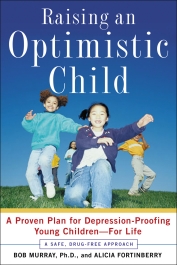
I located a book online today that presents information both about what happened to me and about raising a child who does NOT end up living a life of depression.

Raising an Optimistic Child: A Proven Plan for Depression-Proofing Young Children–For Life

By Dr. Bob Murray and Dr. Alicia Fortinberry

If you click on this title’s active link it will take you to a page that talks about the skyrocketing rates of increasing childhood depression in both the United States and in Australia.  This is part of the information you will read:

Childhood Depression Statistics

The rate of childhood depression is increasing by 23% a year according to a Harvard Medical Center study.

The rate of depression is doubling every 20 years.

1 in 3 American children suffers from depression, 4% of children under 6, according to 2001 National Institute of Mental Health (NIMH) statistics.  Depressions are on average e similar in Australia.

Preschoolers are the fastest growing market for antidepressants.

There is absolutely no evidence that antidepressants work for young children….

++++

We need to be VERY WORRIED about the conditions in our nation that are creating these kinds of stress-anxiety responses in our offspring!  These reactions are being built into little people’s bodies directly in response to the caregiver environment that they are being raised in and by.

TIME online:  Genes and Posttraumatic Stress by Claudia Wallis

++

Can Early Abuse Change Our Genes? It’s Possible

++

Effect of Childhood Trauma on Adult Depression and Neuroendocrine Function: Sex-Specific Moderation by CRH Receptor 1 Gene

++

The Link between Childhood Trauma and Depression

++

January 4, 2011

Controversial Gene-Depression Link Confirmed in New Study

++

Gene Protects From Depression After Childhood Abuse

++

HOMELAND INSECURITY

++++++++++++++++++++++++++++++

+U.N. REPORT CARD ON CHILD WELL-BEING AMONG GLOBE’S 24 RICHEST COUNTRIES: AMERICA FLUNKS!

++++++++++++++++++++++

This IS A MUST READ!  The United Nation’s 2010 report card on child well-being shows the comparative standing of the United States among the world’s 24 richest nations — and we FLUNK!

++

2010

United Nations — The Innocenti Report Card 9

THE CHILDREN LEFT BEHIND:  A league table of inequality in child well-being in the world’s rich countries

++

+HAVING THE COURAGE TO LOOK FOR THE TRUTH

++++++++++++++++++++++

+HAVING THE COURAGE TO LOOK FOR THE TRUTH

++++++++++++++++

For all the interventions and attempts at prevention of human difficulties, for all the therapy, counseling, self-help books, expensive research that results in a plethora of psychological theories, treatment programs, ‘mental illness’ diagnostic categories and their corresponding prescribed medications that exist in our culture for humans of all ages, who exactly is telling us the truth?  How did we come to convince ourselves that humans can break the laws of nature and not suffer devastating consequences?

If a person leaps from a ten story ledge and falls to their death on the ground, they did not break the laws of nature, they broke their neck.

As I bring together what I am thinking at this moment with what I write in this post I am finding I face a shocking fact that I don’t think ANYONE really wants to admit.  A major contributing factor to all that is targeted by the areas of concern I listed in my first paragraph is our culture’s denigration of WOMEN.

Who would want to admit that misogyny is entrenched in America?

Is it?

A fundamental fact in natural law is that human infants and children need certain elements available to them in their earliest caregiving environment to grow their body-brain.   Nature has also devised a most clever way to meet the needs of infants:  Infants are given to mothers.  Gee, rocket science here — mothers are women.

If we choose to NOT have women-mothers be the primary caregivers to their infants then we better make sure we know exactly what appropriate and adequate MOTHERING is so that we can reproduce the meeting of infant-toddler-child needs in some other way.

True, many if not most human infants DO survive nearly completely inadequate early caregiving environments.  But NEVER do these deprived infants grow a body-brain that DOESN’T include in it a full range of trauma altered changes to their development.

++

Maybe there is something built into the psyche of our nation that makes us believe WE CAN HAVE IT ALL just because we want it.

On the most important level that exists for our species, we seem to believe that we can create children and raise them in any kind of environment we want to — and what?  Expect no consequence?  Are we a nation of stubborn, willful, ignorant spoiled brats that we can actually believe we can do anything we want to and suffer nothing negative in consequence?

I find it appalling past pathetic to finally realize that the bottom line for nearly ALL of the difficulties humans face today — related to what I listed in my first paragraph — is that inadequate MOTHERING changed our physiological development in ways that I present again and again and again on this blog (included most recently in the two post-links below).

It is ludicrous to me that when we seek ‘help’ nobody tells us this fact!  How can we assume that we can break the direct link between how what happened to us PRIMARILY conception to age three fundamentally created the physical body IN EVERY WAY that we live in/with for the rest of our lives?

Are we going to wait as a nation until we cross the point of no return before we recognize that the care we give our mother’s and their offspring is the most important expression of our commitment to our continued survival?

We have already been told that our current generation of youth ages 17-24 are mostly unfit for military duty to defend our nation.  Aren’t we concerned that epidemic obesity may well soon mean that parents – for the first time in the history of our species – are likely to outlive their children?  Are we too busy denying the impact of inadequate care to infants and children to notice that the more we disturb the mother-infant safe and secure bonded relationship at the beginning of life the higher the devastating price we pay as individuals and as a society forever more?

Families create civilizations.  That means mothers, fathers and all relations that care for the newest members of that civilization.  If our nation can experience such a violent (vile?) reaction to the topic of Health Care Reform, what on this green earth would really happen to us if we tried to institute reform for completely adequate care for our infants, toddlers, children and adolescents?  A civil war?

Heaven forbid!  We would also have to look at how we care for the people who care for our young ones, most especially the mothers who care for the youngest ones!

++

As long as we continue to deny — as a nation, society, culture, civilization — how our earliest experiences impacted our own TOTAL physiological development on ALL LEVELS we can continue to pretend that somehow we adults simply HATCH into the grown people we are — what?  All by ourselves?  If we experience inadequate early caregiving and then continue to have problems — why?  Because somehow we are ‘genetically inferior’, damaged flawed goods, faulty decision makers, inadequate human beings, or simply are getting what we deserve?

We are approaching being a nation of nonsense.

++++++++++++++++

+WHAT REALLY HAPPENED TO US: VIOLENT TRAUMA, MALTREATMENT, ATTACHMENT – BIRTH TO AGE THREE (and beyond)

+AN OUTLINE – THE SCOTTISH TAKE ON INFANT ABUSE, NEGLECT, TRAUMA AND ITS CONSEQUENCES

It takes courage to think against the mainstream, but when the mainstream’s thinking goes so far off the target of just plain common sense, sane people really have no other sane choice.

As I realize that the only place I can actually turn to discover the truth about what matters most in human development across the lifespan lies hidden and buried in the field of Infant Mental Health, I want to SHAKE this nation of ours.  I can no longer call it ‘great’ except when I add ‘going greatly off track’.  I, for one, do not wish to follow along in that dangerous, dangerous rut.

Maybe all of us -- not only violent trauma, neglect and maltreatment survivors -- need to belong to THIS club

++

2010

United Nations — The Innocenti Report Card 9

THE CHILDREN LEFT BEHIND:  A league table of inequality in child well-being in the world’s rich countries

++

+21 RICH NATIONS COMPARED ON CHILD WELL-BEING – U.S. AND U.K. AT THE BOTTOM

+TO BE OR NOT TO BE A TRAUMA-CHANGED HUMAN — THE QUALITY OF MOTHERING HOLDS THE ABSOLUTE KEY

+AMERICANS MUST NOT BELIEVE THAT CHILDREN ARE HUMAN BEINGS — THUS, NO HUMAN RIGHTS

+ALIGNING OUR NATION WITH UNITED NATIONS CHILD RIGHTS IS AGAINST OUR OWN LAWS

++++++++++++++++

+WHAT REALLY HAPPENED TO US: VIOLENT TRAUMA, MALTREATMENT, ATTACHMENT – BIRTH TO AGE THREE (and beyond)

++++++++++++++++++++++++++++++++++

All survivors of infant-toddler-child violent trauma and maltreatment share a common ground.  Although the information I am presenting here might be difficult for some to read, what is being said here is extremely important.  When I say that it isn’t the exact memories of what specifically happened to any one of us that matters most, it is to the kind of information that follows that I am referring to that DOES matter most.

We survivors have always struggled.

Please spend a little time at least skimming through the rest of this post – if you are a survivor of a chaotic, unstable, violent early life I believe you will feel reverberations in your BODY to this topic.  I don’t believe we can truly follow our pathway through healing if we don’t truly comprehend the impact of the violent trauma and maltreatment we experienced – and what it did to us on all the levels of our development.

++++++++++++++++++++++++++++++++++

What follows comes from this book:

Handbook of infant mental health By Dr. Charles H. Zeanah, Jr.

Publisher: The Guilford Press; Third Edition (July 15, 2009)

From Chapter 12 – The Effects of Violent Experience

(I present this copyrighted material here for educational purposes only – please refer to the actual book article for exact references to research noted)

+++++++++++++++++++++++++++++++++++

Neurobiology

“We noted earlier in this chapter that violent trauma early in life – particularly when involving repeated and severe exposure – impacts the central nervous system, brain development, and the overall health of the individual (McEwen, 2003).  We now review in greater depth the underlying neurobiology of the sequelae of violence exposure in a developmental and relational context.

“Preclinical studies have shown that areas of the brain that are particularly prone to the adverse effects of maltreatment and violent trauma during the first 3-5 years of life include (1) those that have a prolonged postnatal developmental period, (2) those with a high density of glucocorticoid receptors, and (3) those that have the potential for postnatal neurogenesis (Teicher et al., 2003).  These areas include, most prominently, the hippocampus, amygdala, corpus callosum, cerebellar vermis, and the cerebral cortex.

“When a rat infant undergoes severe stress, such as repeated foot shocks, the hippocampus fails to form the expected density of synaptic connections.  Normative pruning of these connections nonetheless occurs later in the prepubertal period, so adult animals who were repeatedly stressed in infancy end up with far fewer synaptic connections in this region (Andersen & Teicher, 2004).  These results support Carrion et al.’s (2007) findings that differences in hippocampal volume in patients with PTSD are more likely due to the neurotoxicity of stress hormones than to a constitutional size difference.  Clinical implications of hippocampal and amygdalar damage due to stress hormones may include increased propensity for confusion of past and present, flashbacks, and dissociative symptoms (Sakamoto et al., 2005).

“The corpus callosum is a heavily myelinated region of the brain that is associated with hemispheric integration.  High levels of stress hormones during infancy and early childhood have been associated with suppressed glial cell division, which is critical for myelination (Berrebi et al., 1988).  DeBellis et al. (2002) observed that reduced corpus callosum size was the most significant structural finding noted in children with a history of maltreatment and PTSD.  Disturbances in the myelination of the corpus callosum and cortex due to excessive exposure to glucocorticoids during the first 3 years of life may explain some of the difficulties that maltreated preschool-age children have in integrating cognitive and emotional information and in taking others’ perspective, in comparison to nonmaltreated age-matched controls (Pears & Fisher, 2005).

“Among the most exciting research that illustrates the interaction of development and traumatic experience is that regarding the differential effects of specific types of maltreatment and violent trauma on the brain at critical periods of development through early adulthood in both animal and human models (Hall, 1998; Teicher, Tomoda, & Andersen, 2006).  For example, repeated episodes of sexual and physical abuse were associated in the same group of subjects with reduced hippocampal volume if the abuse was reported to occur in early childhood, but with reduced prefrontal cortex volume if the abuse occurred during adolescence (Teicher, 2005).  Similar exposure during different, temporally discrete windows of development may have very different clinical implications.

Effects on Memory

The psychological and neurobiological implications of exposure to traumatic events also involve the infant and young child’s developmentally determined capacity to encode, remember, and recall those events in order to subsequently make meaning of their experience.  Recent evidence suggests that even prior to 1 year of age, infants’ capacity to recall events is well underway.  By the end of the second year of life, long-term memory is reliably and clearly present, especially when there have been reinforcing memories (i.e., repeated exposures or explicit reminders), which are unfortunately all too common in cases of maltreatment and family violence (Bauer, 2006; Hartshorn & Rovee-Collier, 2003).  Based on her review of the literature, Fivush (1998) has noted that traumatic events perceived before the age of 18 months are frequently not verbally accessible, whereas events experienced between 18 and 36 months can often be coherently recounted and retained as long-term memories.

“Early chronic and/or severe exposure to violence and/or maltreatment has also been noted to lead to greater pervasive insult to memory functions and to promote dissociative processes that can interfere with memory retrieval (Howe, Cicchetti, & Toth, 2006; Nelson & Carver, 1998).  One mechanism for this biological insult to memory function is thought to be primarily the effect of excessive glucocorticoids, which damage the developing structures involved in memory contextualization and storage, such as the hippocampus (Sapolsky, 2000; Sapolsky, Uno, Rebert, & Finch, 1990).  It is clear that over the course of formative development, exposure to violent trauma and maltreatment can affect the degree and nature of changes in the neurobiology of the brain.

(Pages 203 – 205)

+++++++++++++++++++++++++++++++++++

The Relational Context

“The violent traumatization of an infant or very young child, whether due to maltreatment or exposure to familial, community, war, or terrorist violence, is most significantly a breach in safety.  Unlike older children or adults, very young children experience their world contextually, from within the embrace of the primary attachment relationship (Scheeringa & Zeanah, 2001).  Their sense and expectation of safety are therefore inherently bound to the caregiver.  To appreciate the effects of violence on young children requires an understanding of the goals and mechanisms involved in the attachment relationship as well as the ways in which trauma impacts attachment.”

Attachment, Safety, and Violence

“In the anchoring concept of attachment theory, the ethological wisdom of a caregiver-infant behavioral system is seen as ensuring species’ survival (Bowlby, 1969).  The infant’s drive to maintain safety is paramount and is expressed in attachment behaviors that may phenotypically change over time but that serve the same purposeful goal of achieving “felt security” (Bretherton, 1990).  Perturbations in the infant’s ability to achieve felt security necessarily result in adaptations that may be more or less pernicious, depending on the quality and degree of frustration.  In response to the primary attachment figure’s track record of providing “felt” security, the infant constructs an “internal working model” of self and other.  This internal representation consolidates over the first 3 years of life and guides the infant’s expectations and behaviors in times of stress.

“The experience of violence, with its attendant physiological “felt anxiety” might therefore be conceptualized as the exact affective opposite of felt security.  The young child does not yet have the cognitive ability to mediate feelings of fear that result when exposed to violence, either as a victim or witness.  For young children, the caregiver’s role is to function as external regulator of negative or overwhelming internal affect and sensation.  Several violence scenarios may be imagined in which the caregiver is unavailable to soothe infant anxiety:  when the caregiver is being victimized, when the caregiver is a witness to violence and becomes too hyperaroused or too dissociated/avoidant to provide safety, or when the caregiver is the source of the violence – as in the case of parental child abuse (Carlson, 2000).  A toddler who has internalized a working model in which he or she is unprotected and repeatedly left subject to overwhelming fear – one of the definitional criterion for trauma – may develop what has been termed distortions in secure-base behavior (Lieberman & Pawl, 1990).  Such distortions are, in fact, attempts by the child to manage unmanageable anxiety without the actual or “real time” mentally represented assistance of the caregiver.

“If early childhood is characterized by a relational context in which the child’s ability to manage stress is determined by caregiver response, then the mental health status of the caregiver becomes a vital concern.  Fraiberg, Adelson, and Shapiro (1975) called attention to the profound effects of maternal mental health on the developing child.  The “ghosts in the nursery” that Fraiberg et al. described were malevolent internalized attachment figures who had subjected the caregiver to various forms of maltreatment during his or her own childhood.  Fraiberg et. al. observed that caregiver traumatization in the past resulted in (1) his or her present-day inability to respond appropriately to infant anxiety, or (2) his or her engagement in behavior that actually induced anxiety.  From an attachment perspective, the infant’s working model of self and other is thereby shaped by the caregiver’s disturbed attachment representations.

“Exploring representational models, Fonagy et. al. (Fonagy, Moran, Steele, Steele, & Higgitt, 1991; Fonagy, Steele, Moran, Steele, & Higgitt, 1993) identified the capacity for “reflective functioning” as an awareness of a meaningful relationship between underlying mental states (feelings, thoughts, motivations, intentions) and behavior in and between both self and others.  Fonagy’s group found that caregiver reflective functioning was significantly predictive of infant attachment classification.  The caregiver’s capacity to “read” infant mental states accurately, and with inference of meaning, allows for sensitively attuned responses that create a subjective experience of security/safety and support the infant’s developing capacity for self-regulation (Bretherton & Munholland, 1999).  However, when engaging in reflective functioning leads to the experiencing of highly negative affect, certain aspects of mental functioning may be defensively inhibited (Fonagy, Steele, Steele, Higgitt, & Target, 1994) or excluded (Bretherton, 1990).  A caregiver in a state of defensive inhibition will be incapable of accurately responding to and reflecting the child’s mental state, leaving the child to manage states of arousal and anxiety on his or her own.  Consistent with this formulation is the finding that young children assessed as having a disorganized attachment have caregivers who are often unresolved with respect to past traumatic experience (Lyons-Ruth & Jacobvitz, 1999).  In short, caregiver history of attachment relationships and of trauma exposure determines not only the dyad’s quality of attachment, via reflective functioning, but additionally the manner in which trauma exposure will be processed by both child and caregiver.

“Thus, traumatic violence can interfere with the initial development of a secure and organized attachment or derail a previously secure attachment if the caregiver is sufficiently adversely affected.  Disturbances in attachment, in turn, confer increased [sic] for (1) recovery from trauma exposure by the child and/or caregiver (Fisher, Gunnar, Dozier, Bruce, & Pears, 2006), (2) enactment of maltreatment by the traumatized caregiver (Cicchetti, Rogosch, & Toth, 2006), (3) child exposure to trauma via inadequate caregiver monitoring (Schechter, 2006; Schechter, Brunelli, Cunningham, Brown, & Baca, 2002; Schechter et al., 2005), and (4) subsequent repetition and transmission of risk by the traumatized child and/or caregiver (Weinfield, Whaley, & Egeland, 2004).  Such evidence supports the contention that we must view infant mental health disturbances through the dual conceptual lenses of attachment theory and trauma theory (Lieberman, 2004).”  (pages 205 – 206)

Relational Neurobiology

Like all psychological functions, the child’s expectations in relation to attachment figures have neurobiological correlates.  In addition to the effects of cortisol noted earlier, physical abuse, compounding its clear effects on emotion regulation and separation anxiety within the context of attachment, has been found to be associated with attentional dysregulation and selective biases to angry and negative affect (Pollak & Torrey-Schell, 2003).

“Moreover, from early infancy, children are dependent on their attachment figures to reflect back to them how they are feeling and to make sense of their experience.  Expectation of the contingent responsiveness during early infancy has been described empirically in the work of Gergely and Watson (1996), who also first described the “marking” of the infant’s affect by the primary caregiver – the processing and modulation of that affect, which feeds back a sense of empathy as well as serving a modulatory function for the baby, beginning in the period of the second to fifth months of life.  Subsequently, Gergely (2001) noted that lack of marking and overidentification with the child’s perspective may interfere with affect regulation, particularly around crises and trauma.

“We now know that specific neural circuits in the developing brain, among which the mirror neuron system figures prominently, are crucial to the development of social cognition, self-awareness, affect regulation, and learning (Jacoboni & Dapretto, 2006).  The functional implications of these cortical pre-motor planning and parietal structures in the context of early development are only just beginning to be understood.  The impact of violence exposure on the development of these circuits with respect to expression of aggression remains to be studied.

Myron Hofer (1984) has described multiple “hidden regulators” embedded within the attachment system across mammalian species.  The need for mutual regulation of emotion and arousal in humans lasts approximately as long as it takes for integrative structures in the brain to myelinate and prefrontal cortical areas to develop, all of which serve to assist the child in self-regulation in the face of stress and fear.  In other words, the primary caregiver is, during the first 5 years of life, crucial to the infant’s developing self-regulation.  The hidden regulators embedded within the attachment system include those of sleep, feeding, digestion, and excretion as well as higher functions of emotion, arousal, and attention.  The literature contains many examples of how the sequelae of a caregiver’s experience of violent trauma and maltreatment, PTSD, affective disorders, severe personality disorders, and substance abuse can impair this fundamental regulatory function during formative stages of development, both at the representational and behavioral levels of attachment.  (Lyons-Ruth & Block, 1996; Schechter et al., 2005; Theran, Levendosky, Bogat, & Huth-Bocks, 2005), and contribute to intergenerational transmission of violent trauma and maltreatment.

“Neurobiologically based studies of primates, specifically, macaque monkeys, have helped to elucidate the role of attachment in interrupting versus promoting intergenerational transmission of maltreatment (Barr et al., 2004; Maestripieri, 2005; Shannon et al., 2005).  In Shannon et al.’s study (2005), maternal absence (i.e., neglect) was associated with decreased serotonin replenishment, a finding associated with mood and impulse disorders, as well as with increased alcohol consumption (in Barr e al.’s study, 2004).

“Recent research has also supported transgenerational transmission of biological response to trauma.  Whether this finding proves ultimately to be a risk or resilience factor remains a question.  An affected mother’s exposure to violent trauma during pregnancy (i.e., the 9/11 terrorist attacks on the World Trade Center in New York City) and her glucocorticoid stress response were linked to the glucocorticoid levels, upregulation of the receptor setpoint, and behavior of her infant by 9 months of life (Yehuda et al., 2005)….  Could this transmission of response to shared stress during pregnancy be one example at the very beginning of the organism’s life of adaptation in the service of evolution?  Is the mother’s biology preparing the offspring for expectation of threat?  If so, can one say that the development of PTSD (and/or other posttraumatic psychopathology) is a form of risk if no further threat actually exists, or resilience in the form of potentially beneficial hypervigilance to actual subsequent threat?  [bold type is mine]

“As the hypothalamic-midbrain-limbic-paralimbic-cortical circuits in the caregiver respond jointly to infant stimuli, as has been found in recent neuroimaging studies among normative mother-infant dyads (Swain, Lorberbaum, Kose, & Strathearn, 2007), one can imagine a cycle of dysregulation in which unquelled infant distress becomes a stressor particularly for a traumatized parent.  Indeed, while watching video clips of their children during separation and other stressful moments, group differences between violence-exposed mothers of toddlers and nonexposed mothers have been noted with respect to measures of integrative behavior, autonomic nervous system activity, and brain activation (Schechter, 2006).

“We know that an important determinant of the effects of traumatic exposure (e.g., how long they endure) is the primary caregiver’s ability to help restore a sense of safety via regulation of infant emotion, sleep, arousal, and attention (Laor, Wolmer, & Cohen, 2001; Scheeringa & Zeanah, 2001).  These emerging findings may illuminate the ways in which the experience of violent trauma and its sequelae interfere with this primary caregiving function.  On a positive note, we have also begun to understand how new relationships, most dramatically that of foster care, can curb if not reverse at least some of the effects of early violent trauma exposure (Fisher et al., 2006; Zeanah et al., 2001).

(Pages 206 – 208)

++++++++++++++++++++++++++++++++++++++++++++