+CONTINUALLY TRYING TO CREATE MYSELF IN TIME AND SPACE

+++++++++++++++++++++++++++

I tell myself to put my fingers on this keyboard and make them move.  “Speech is silver.  Silence is golden.”  I choose to go for the silver.  I was forced for the first 18 years of my life to be as silent as a child can be.  Silence will not heal me.

Writing is all tangled up today with what I choose to write about.  Having a disorganized-disoriented insecure attachment MEANS that having access to one single, integrated, cohesive, coherent Linda is extremely difficult.  I will not admit defeat and say it is impossible.  I am coming to understand, and believe, that using my words – putting them together in lines across the page – will help me become more organized, oriented, integrated, cohesive and coherent.  So here goes…..

I am thinking a jumble of thoughts, all tied into very old and continual thoughts about myself in my body in my life since my beginning.  I was not allowed to be a person.  My mother interfered with my normal, ordinary development every single step of my development.  I have paid a price for her terrible abuse of me.  The biggest one is that I didn’t so much as LOSE my self, I didn’t get one in the first place.

++++

So I have to imagine what it would be like to have one of those illusive organized, oriented, integrated, cohesive and coherent selves.  How do all these aspects of such a strong, clear, healthy self operate in time and space, which is what I guess being in a body in a life, in the world is all about?

Today, I want to know the difference between having goals, destination and purpose and having hopes, dreams and wishes.

I want to know because it seems to be I wouldn’t have to question these things the way I do now if I HAD any real idea what they mean.

My mother interfered with my development regarding everything, so why wouldn’t I expect that having a clear sense of goals, destination, purpose, hopes, dreams and wishes would be a part of what I am missing?

She never hesitated to control and abuse me in any way that she could.  Her abuse included confining me in space and time beginning when I was very, very small.  She withheld food, prevented me from even going to the bathroom when I got older.  She woke me from sound sleep to beat me, or didn’t let me sleep.  When I got older she forced me to overeat.  I could go on and on, but this isn’t what I want to say right now.  Not being free to be a growing child, not being safe or allowed to play greatly harmed my development in every single way.

What I want to say is that great sense of loss and grief I feel is tied as much to my loss of access to my inner needs, wants, desires, ability to have intentions, and the ability to find ways to know what brought me happiness as a person and what gave me pleasure.  I didn’t grow up knowing much of anything except how to survive my mother’s torture and abuse.

++++

This thinking is tied to what I believe about people like me with disorganized-disorganized insecure attachment.  I believe I organized and oriented myself around being a mother for the 35 years I had children under 18 in my care.  Today it seems that I used the goal of caring for them as well as I could, the destination I saw for them in the future as leaving home well and happy people, my purpose in life of being their mother, to organize and orient my self in the world.  My hopes, dreams and wishes were tied up in that whole process.

Having them grow up and leave was wonderful.  Yet I was left again being the disorganized-disoriented insecurely attached-to-my-own-self and the world just as I had always been for the first 18 years of my life.

Without the strange and complicated relationship I formed after they left again leaves me feeling inwardly desperate, destitute, lost and confused – again disorganized and disoriented.

I was able to obtain the goals for my education, but the process was extremely confused, and in the end I am still lost.  I can ‘make things’ with my hands, but even being able to use the ‘goal-destination-purpose’ and ‘hopes-dreams-wishes’ thinking only lasts for short periods of time and nothing about me seems connected and tied together.

I want to understand how the brain-mind changes that I have continue to cause me great difficulties in these areas.  Somehow I sense that COMMITMENT has always been a key and central piece of anything I have ever accomplished.  If I say I hope to write, that writing is tied to my dreams and wishes, how do I connect that to my goals, my destination, my purpose?

Because my right brain, left brain, corpus callosum that connects them together, and my higher executive function cortex did not form in an ordinary fashion and instead will suffer from severe trauma influence for the rest of my life, I cannot simply accept that I am going to ‘naturally’ find a solution to my dilemmas.  I have to continue to focus my will toward the goal of better understanding how all these changes – that result in what I am naturally missing – connect to my overall feelings of hopeless sadness in my life.

How does changed me find my self in time and space so that I don’t constantly know that I don’t ‘fit in’, am lost, and want to ‘leave here’?

I don’t know yet, but I wanted to say I am working on these things.  Today.  I continually have to try to learn how to create my self in time and space because this process was completely interrupted for me growing up with such abuse.  I have a trauma bond with myself that makes it hard for me to get through life feeling whole and successful.  There is a rupture between my self and myself and the world I am constantly trying to find ways to repair.

I have to start with the little things, and writing here is one of them.  Now, I will go eat breakfast as I move my self forward in the time and space that is today.

+++++++++++++++++++++++++++++++

It strikes me after putting the above words into their order that the most important word in the whole piece is PLAY.  I was not allowed to play, and as many of my childhood memories show, my mother had an uncanny ability to turn whatever childhood play thoughts or actions I had into something painful for me.

Beginning with playful interactions between infants and their early caregivers, and moving all the way through childhood, play is nature’s way of building an organized and oriented self in the world.  I suffered terribly from the lack of play and from interruption of play every step of my development because of my mother’s abuse.

My sister just gave me a simple example of how play interacts with a growing brain-mind-self regarding hopes, desires and wishes on the one hand, and goals, direction toward a destination and purpose on the other.

She took her granddaughters to a fund raiser bake sale today.  The seven year old bought muffins and a specially formed little bundt cake with a hole in its center.  On the way home she ate the muffins but carefully protected and saved the cake.  At the urging of grandma and her 10 year old sister she finally, shyly told them her PLANS for her special cake.

She wanted to take it home, fill the center with pudding, put a candle on it, and have a birthday party with her Barbie dolls.  This, of course, is what she was allowed to go home and immediately accomplish.  Even her sister, who thinks she’s too grown up to play Barbies, came to the party.  Through each step in her process she was building another healthy, happy aspect of her brain-mind-self.  Severely abused children are very often deprived SO MANY or ALL TIMES of this kind of experience — and this kind of loss is big part of what happened to change us.

I see that everything I am thinking about this morning is simply contained in that pattern of child play.  Play is how children learn to be social (after their infant brain forms through early mirroring caregiving).  Play can involve rules, or not.  Child play does allow the brain not only to build its happy-joy center, but also all the other brain patterns and circuits I am beginning to understand as they in-form our lives.

The arenas of damage my mother orchestrated against me were many and devastating, but today it is particularly the damage done to me by her abuse of my play drive and abilities that has harmed me immeasurably in my adulthood.

Today I also realize that the absence of my sadness that being with my boyfriend gave me was directly tied into play.  He was my playmate.  That is a big part of the joy and happiness I felt when I was with him.  I didn’t know this until today.  I have no built-in experience of play-joy from childhood.  I didn’t even recognize my happy feelings with him were directly connected to play.  My playmate doesn’t want to play any more.  Certainly that gives me great sadness.

What can I learn about play at 58?  How can I begin to understand that a lot of the sadness I feel stems from never having play in my childhood?  My siblings played together, and they all remember my part in their play – by my absence from all of it!

That especially the lack of play in my childhood (coupled with the rest of the terrible abuse) directly created my adult brain-mind-self’s great difficulty with the ability to dream, wish, hope or to plan, have a goal, a sense of direction, a destination for myself in my life, or a sense of purpose — in-forms my sense of grief, loss, and feeling lost like I don’t belong ‘here’ — is not a small piece of information.

+++++++++++++++++++++++++++++++

+WRITING LINDA NOT HERE

++++++++++++++++++++++++++++++++

Strange thing, can’t write since finishing last post — not entirely sure what that ‘transparent moment’ did to me — but the writing Linda isn’t here right now…..  wonder if she’ll come back.

Thanks for stopping by anyway!!

++++++++++++++++++++++++++++++++

+SIMPLE MOMENTS OF HUMAN KINDNESS CAN SAVE AN ABUSED CHILD’S SELF-LIFE

++++++++++++++++++++++++++++

I woke up on this sunny, warm morning thinking about the post I wrote last night, feeling concerned about the darkness in it.  Somehow two topics came into my mind almost like they came to me as a balance weight against that darkness that was the history of the making of Linda.  One topic is about the Brownie scout leader I had when I was eight.  The other topic is my strange cat, Gerri.

I will only know by writing this piece how the darkness and the light within the story of the Brownie scout leader and my cat fit together.  I know attachment lies at the root of this piece of writing.

++++

I will start with Gerri because she is here with me in the present.  She is (I know nothing about cat breeds so I will do the best I can to describe her) a mostly black tortoise shell calico cat.  She has splashes of white markings and light tan, almost peach legs, with some tan speckles throughout her fur.  Her coat is so thick I can scrunch my fingers into it, but also a little oily and waxy.  It reminds me of a soft version of the undercoat a buffalo might wear.

Her eyes are round and always big, yellow with a pitch black slit in them.  She reminds me of an owl when she looks at me, and her look is always a stare as if she is continually looking for threat and danger.  She often looks worried as if I might eat her.  There is always tension in her small body (she is not a big or heavy cat).  I will never know her whole background or history, but what I do know explains for me why she is such an unusual and strange cat.  I don’t expect her to ever be ‘ordinary’ the way the three now mostly grown kitten-cats I rescued are.  But I am seeing the REAL Gerri emerging within this precious original cat!

Those of you who read my postings on my 1982 journal remember that I reached a point all those years ago when I packed up my spinning and weaving and put it all away when I entered college, and my life changed.  As I transcribed those journal pages I realized how sad it was that I let go one of the few parts of myself that were really an important and positive part of me.  I looked at the beautiful maple loom sitting in the corner of my living room and realized that I can place some important energy in my present life getting that part of myself that loves to work with fleece and yarn back into my life.

++++

Now the story about the loom and Gerri intertwine.  About four years ago I happened to hear about this loom that someone in a town about 50 miles from where I live had to give away.  I was fortunate to get this woman’s number and called her.  The following weekend the loom was in my house.  The woman who brought it here was a friend of the woman who owned it, whose Alzheimer’s had progressed to the point she had to be placed in a full-care institution.  It turns out this woman who owned the loom (I never met her) also had two cats that needed a home, too.  I offered to take the cats.

The next weekend the cats arrived, Gerri being one of them and a huge fat white cat named Poe being the other one.  The wisdom of my hindsight came very quickly into play as the woman who brought the cats in their cardboard cat carrier boxes brought them into my house, opened them up immediately, and the cats got away.  I should have insisted immediately that the cats be left in their boxes for awhile until I had time to meet and greet them before I let them out.

Poe only disappeared for a few hours.  The little black one was gone for four months.  I hoped she was still in my house and had not escaped at some sly moment when the door was open, but I didn’t know for sure.  All I could do was keep food, water and litter filled and wait.

Eventually I heard the black one.  I had not written her name down when she had been left at my house, so I called her by the name the little neighbor boy suggested.  Gerri.  After her four months of sneaking out at night and hiding thoroughly during the day, I began to see fleeting shadows of Gerri darting along the outside walls of the house from hiding place to hiding place.  As she became more trusting and daring she would appear here and there away from the walls.  That’s when I began to realize that big fat Poe bullied her.

I ended up finding a home for Poe.  No bullying allowed in my home!  It has taken 3 ½ years for Gerri to transform into my pet.  Gerri is missing her front left paw.  She was stepped on by a horse when she was so tiny she could barely walk, and the woman who owned the loom had taken her to the vet’s and saved her life.  The more I come to know Gerri, the more I realize that she has cat version posttraumatic stress disorder.  I would call her absolutely ‘mentally ill’ and neurotic if I didn’t know better.

Also, the more I have gotten to know Gerri, the more I wonder if her previous owner’s increasing dementia didn’t severely further traumatize this cat.  It makes me worry for pets who are under the care of Alzheimer people before they progress into total near-oblivion.  The hyper startle response this little cat has, her nervousness, her obvious distrust of the world she lives in, her difficulty in forming attachment to me, all make me think that there were many times in her 14-year life that she was threatened not only by a giant horse, and a huge bullying white cat, but also by her increasingly demented owner.

++++

But Gerri seems to realize more every day of her life that she is now safe from harm and secure in my care and affection.  Nothing will ever take away from her either the background experiences of suffering that she’s had, or her physiological responses to those traumas.  But I am watching her become, a little more every day, more and more of the fine cat, Gerri that she is.

She loves to be brushed, and I don’t mean she’s a little fond of it.  She gets ecstatic!  I keep a brush on the bathroom floor, and every time I use the toilet Gerri gets some profoundly happy moments!  I have even seen her let herself be chased by the sweetest of my three half grown kittens.  Gerri is queen of the house now.  She will never eat while the other three do, but she watches them from the middle of the kitchen floor with interest.  She will even curl up now on a corner of my sheet-covered bed in the sunlight during the day, allowing herself to be present with three other cats on the bed!

But it is what happens at night when I first go to bed that tickles me most.  I don’t know why she just started this a week ago.  It’s like some ancient Gerri-is-a-cat genetic memory has kicked into gear.  She always knows about 15 minutes before I head to bed that it is TIME, and she begins to prance around me, waiting.  As soon as the lights are off and I am snuggled under my covers and stop moving, Gerri rushes into the living room.  It took me a couple of days to put two and two together to figure out what her new routine actually was.

I would here her return to my room as she made the strangest cat deep growling  cat talking sounds.  Then they would stop, she would leave the room, and soon she would be back repeating her verbal display.  After awhile she would jump onto my bed and nestle down somewhere near my feet where she spent the night.  Eventually I noticed the pile of cat toy soft balls piled under my bed near my head.  “Oh!  She’s HUNTING for me!”

In order for this game to repeat itself for the first few nights Gerri had to move all the balls back into the living room during the day so she could hunt for them again at night.  Now I round them all up and hide them for her.  At first I kept the hiding simple and obvious so she would have no trouble finding them.  I didn’t want to discourage her from hunting for them.  Now I can be a little more challenging in where I put them in the morning, because she still finds them all at night and brings them back for me.

Now HERE is the connection to my Brownie scout leader when I was eight.  I am Gerri’s attachment person.  She hunts for me because she loves me and she is taking care of me like a momma cat would hunt and bring her kill to her kittens.  I am like her mother at the same time she is mothering me.

++++

When I was eight, shortly after my family had left Los Angeles and moved to Alaska, my mother was still practicing the “Let’s be a GOOD (public face) mother so I make an impression on all these new people I am meeting here!” façade.   Eventually, and it only took less than two years, she stopped caring a hoot what anyone thought about her in her new location and became again completely the mean mother she was to me.

In the meantime, I was allowed to attend Brownies for about a year, which culminated in my being allowed to attend Brownie day camp for a week the June we first began homesteading.   Mother drove me to the Eagle River Shopping Center parking lot and the Brownie leader picked me up and drove me to camp and back again.

I am thinking about how the attachment and child development experts tell us that the ability to form secure attachments lies within each individual child.  When insecure attachment happens instead, the ‘fault’ does not lie within the victim-child.  It lies with the inadequate early caregivers.  I have never forgotten the time I spent at that Brownie camp.  It was one of the very, very few times I actually GOT TO BE A CHILD!  I loved the activities, enjoyed being with the other children, and was treated grandly by every one of the adults.

Yet one particular experience that happened on a return trip back to the shopping center that remains a ‘flashbulb’ memory for me (the same as trauma can create flashbulb memories, so also can extremely positive events, especially when a child is immersed in the darkness of trauma on an ongoing basis).  We had left the camp a little early, and the Brownie scout leader asked me on the return trip if I liked flowers.  I trusted this woman completely by now, and I can remember my own ecstasy when I responded back to her with the full life-force and enthusiasm I was capable of, “Oh, YES!  I LOVE flowers.”

“OK,” this woman responded back to me with a smile.  “Just wait.  I am going to show you something very special.”

She turned off of the paved highway and drove down a narrow dirt road and parked near the edge of the great Knik River.  She walked ahead of me on a slippery damp wet packed black mud pathway along the shore until we came to a small open area where she showed me the Chocolate Lilies growing there.

So beautiful, I thought!  I had never before seen a brown flower!  But when I smelled them, the STUNK!  How could something that looked so beautiful smell so bad?

Well, I have NEVER forgotten those shining moments or the kindness of that woman.  Yet I also realize that woman’s attention and generous kindness to me where probably not one single bit out of the ordinary for her.  I had no idea at all that people ordinarily treat children that way, treat each other that way.  For me, that week at day camp, and my ‘commutes’ with this woman remained the safest, most secure, most kind and happiest days of my entire childhood.

Hope from human kindness means the universe to abused children -- budding flowers in spring -- the Chocolate Lily

++++

Which again takes me back to myself and little traumatized kitty Gerri.  I understand that getting stepped on by a horse and losing your paw can be put in the category of trauma that just happens sometimes.  But neither Gerri nor I ever deserved anything less than perfect kindness.  That we didn’t get it, changed us.  But just as there is a perfect cat Gerri inside that furry body sleeping in the sun at the foot of my bed right now with her three furry companions (the first she has ever let into her life), there always remains a perfect Linda present in this body no matter how difficult it is for me to remain ‘in touch’ with her.

++++

So, in response to the dark reality of the post I wrote last night, I want to remind all of us that because we are still alive there HAD TO BE shining moments of safe and secure attachment with someone somewhere and some time in our childhood.  I won’t talk here about the unspeakable tragedy it is that abused children have to make a few tiny moments of glowing kindness into enough of a sustaining memory to last them throughout their terrible, dark, dangerous, traumatic childhoods.

But I also believe that I would have had a different life course in the end than I did if I had NOT had those few shining moments with that perfect stranger.  Her kindness sustained me throughout my childhood because those moments with her were the only true Linda being Linda and being accepted, treated kindly and being genuinely and completely happy that I can think of.  But the quality of my attachment experiences with this woman kept the channel of secure attachment open for me within my own body-brain-mind.

I have no doubt that in those few joy-filled moments with that woman who cared enough about me to take a little detour to show me new flowers that I loved, in those few secure attachment moments borrowed from the ‘ordinary’ world, that woman saved my life in the same way I am saving little Gerri’s and she is saving mine.

Hope beats within the heart of these moments.

+++++++++++++++++++++++++++++++++++++++++++

+DOES OUR NATION HAVE A CONSCIENCE REGARDING ADULT SURVIVORS OF SEVERE CHILD ABUSE?

++++++++++++++++++++++++++++++++

Please be sure to take a look at the slide show presented in this link I included at the bottom of last evening’s post about the Center for Disease Control’s latest research on the long term suffering caused by severe child abuse that occurs during the early stages of brain-body development:

“adverse childhood experiences” (ACEs)

++++++++++++++++++++++++++++++++

I believe it is critical that this kind of “new” information be coupled with understandings about the body-brain-mind evolutionary changes that those of us who survived the kind of malevolent experiences that the above research is highlighting had to make.

The kinds of life long difficulties the research points to happen not only because of the abuse itself, but because of these changes our body-brain-mind had to make.  Our bodies were designed in, by and for trauma.  We were never designed to live an ordinary life with an ordinary body-brain-mind.  We have to become completely clear about what these changes are and how they affect us.

Researchers and clinicians are going to continue to try to apply a piecemeal solution to an extremely complicated problem just as they always have.  Their efforts will NOT bring about any more positive a solution than they have thus far — which is PATHETIC — if the evolutionary adaptation to trauma during early development due to trauma and abuse is not the PRIMARY and PIVOTAL information used to assess ‘damage’ and effect lasting positive change for survivors.

Otherwise we will continue to be looked at as flawed people.  We are not remotely flawed.  We were terribly wounded as little infant-children, and we endured.  We are perfectly designed to survive what we had to survive or we would not be here!  Even though the adaptive changes we had to make prevent us from smoothly ‘fitting into’ an ordinary world,  they can still be not only recognized, but respected, honored and even applauded and celebrated for being the amazing human resiliency factors that they are.  If we value human life at all, we will know this truth in our bones.  And I believe for any healing to occur for us at all, this point of truth is where all efforts must begin.

The flip side of the coin of surviving intolerably horrible childhoods is that our body adapted for short-term heavy duty survival in trauma.  We are not adapted to a quality of life for the long haul.  THAT portion of our lives is what we need appropriate help with if we are to keep on living in a ‘benevolent’ world.

Nature designed us to live to our childbearing years and not much longer.  The ‘ordinary’ world we grew up into grants us a longevity we were not made for.   Sorry folks, this is the truth as I understand it as a survivor with this kind of trauma-changed body.  No wonder we are likely to contemplate or commit suicide.  I believe our body knows this truth.  This can make just staying alive yet another choice we have to make with conscious effort.

Everyone needs to get their thinking straight on these issues!  What ARE the priorities?  We survivors cannot magically remake our body-brains into ‘ordinary’ ones once the traumas of our childhood have ended.  These changes are with us for the rest of our lives.  Nobody tells us this fact or truly helps us live better with the changed body-brain that we have.  Surviving severe infant-child trauma and abuse is a costly affair.

Please, take a look at that link at the top here.  The Center for Disease Control is not a lightweight institution.  Their findings leave indelible marks on minds within the professional community.  To allow child abuse to continue at all, and to allow those adults who survived the kinds of abuse the ACE study highlights to continue to suffer, can only happen in a culture without a conscience.  For our culture to not consider the evolutionarily altered body-brain-mind development that survivors were forced to make in order to stay alive is even worse.

We will never be able to solve the problems related to severe early abuse and trauma — and survival of it — if we refuse to correctly describe and name what happens to change the course of our human development and how we responded.

++++++++++++++++++++++++++++++++

A WORD TO WISE WOMEN:

IF YOU HAVE A HISTORY OF SEVERE CHILD ABUSE, CONSIDER YOURSELF AT HIGH RISK FOR GETTING BREAST CANCER.  Today’s release of the news article at link below does not apply to you in the same way as it does to ‘ordinary’ women.  A mammogram beginning at age 40 should always be considered necessary for child abuse survivors who choose to be proactive on behalf of their well-being.

If your insurance requires a referral from your doctor, never hesitate to tell her/him the truth about your abuse history.  You can also mention the Center for Disease Control’s newly published findings on the major link between child abuse and the risk for serious adult disease.  We are not ‘making this up!’

Task Force Opposes Routine Mammograms for Women Age 40-49

+DEGREES OF CHANGEABLITY = HOW WELL WE CAN PLAY THE CARD GAME OF LIFE?

++++

The Theory of Mind that a child forms by around the age of five is built upon the brain-mind bedrock that was itself built from every single early caregiver interaction that child experienced from birth.  If those early experiences were unstable, unpredictable, toxic and malevolent, there is no possible way that child can move on to their Theory of Mind developmental stage with an ‘ordinary’ foundation of benevolent safe and secure attachment.  Abused children have no choice but to end up with alterations in their eventual Theory of Mind.

++++

Having “the capacity to reflect on the role of mental states in determining human behavior” is, according to developmental neuroscientist Dr. Daniel Siegel, critical to being able “to provide sensitive and nurturing parenting.”  (see his writing at bottom of post)  Siegel calls having this capacity ‘mindsight’.  This is a BIG subject, and is directly tied to our early childhood development of a Theory of Mind (TOM).

Having this “capacity to reflect on the role of mental states in determining human behavior” affects ALL of our interactions with others, and I would add, all of our interactions between our self and our self, and our self and the whole world around us – because we are human and we process all information by using our human faculties.  Theory of Mind is HOW we are in the world.

Theory of Mind is directly tied to a developmental process that begins at birth that allows humans to understand others’ thoughts, feelings, and intentions behind actions.  Without an adequate (ordinary) Theory of Mind, an abused child cannot possibly understand EITHER others or their own self in an ordinary way.  The ability to recognize states of mind, to tolerate them in self or others, and to transition between them is connected to how an individual’s Theory of Mind operates.

This is a HUGE and critically important concept.  I encourage readers to follow some of the links above and to think about Theory of Mind as it affects all of our lives from the first thoughts we have until the last ones.  We are a social species.  If our Theory of Mind cannot develop through safe and secure early attachments, it will be ‘off center’ and ‘out of balance’ for the rest of our lives.  If we have a history of early and severe abuse, we have been given no choice but to try to understand and apply consciously to ourselves the kinds of ‘rules’ and ‘patterns’ of interaction with self and others that securely attached from birth people have built within themselves and never have to think about.

Ongoing life happens because of ongoing communication that involves patterns of signaling (down to the molecular level).  The signals must be sent, received and understood accurately for life to continue at all.  Any problems with communication signaling will be reflected in some kind of lack of well-being.  It is, to me, as simple as that.

++++

When I consider the statistics that tell us between 50% and 55% of us were raised from birth under ordinary safe and secure attachment conditions, I have to wrap my thinking around the fact that the other 50% to 45% of us were not, and that loss left us with some degree of insecure attachment disorder.  Given the vastness of degrees of difference among us according to how we were treated from birth, it is hard to make any blanket statements.  But I will say that I don’t like to think in terms of ‘damage’ due to irregular or malevolent early caregiving experiences.  I think in terms of ‘changed from the ordinary’.

I envision it like all of us are prepared one way or the other to get along in the ‘game of life’.  If I think about this like we are all prepared by our early experiences to join in a game of cards, I can see how all the problems we experience then play themselves out.

Somebody has to know the rules to the game.  Let’s say the securely attached half of us know these rules.  The rest of us don’t.  We end up with varying degrees of confusion, varying ideas about what this card game is about, how we are to participate, and what all aspects of the game MEAN to self and others.

I think about personality disorders like my mother had, or like someone who has a Narcissistic Personality Disorder.  I am beginning to understand that their difficulties in forming a solid, ordinary Theory of Mind in their early childhood left them prepared to take their place in the Card Game of Life in a very particular way.  My mother’s rules were rigid, bizarre and enforced – period.  Anyone who was forced to be a part of her card game had no choice but to play by her rules.

What if you and I were playing a card game and I drew a 2 of clubs.  But I had no tolerance for a 2 of clubs.  I believed I HAD to have a queen of diamonds.  If I was my mother, that 2 of clubs would BE a queen of diamonds, and there would be nothing you could do but play the game by my rules in spite of my delusion.  To try to challenge me or convince me of a different reality would cause WWII X to break out (at the very least).

Or, what if you were playing cards with me as I am in the world as a result of my having to grow up under my mother’s rules.  I simply would never really understand any part of this game.  Anything that I might know about playing remains illusive to me.  I have to reinvent myself in the game with every card that’s played – by me or by anybody else.

++++

My mother’s version of getting along in the world worked for her because she could exclude any incoming information that she believed on some level to threaten her.  I have great difficulty with excluding any information.  It all comes in, and I am left in the opposite camp from my mother.  I have to continually deal with everything on some level as if it is a new situation that I have never experienced before.

My way of being in the world is costly and exhausting.  My mother’s way, or the way of people with personality disorders (I believe) works better in many ways because it eliminates or greatly reduces the amount of information that has to be consciously experienced and dealt with.  Personality disorders simply allow a person to continue to play the Card Game of Life by a constricting set of rules that was set in place in their childhood and is not subject to change.  Only through a costly application of personal conscious will and effort can those patterns of interaction between the self in the world with others be changed.

I, on the other hand, have to apply great effort to find any kind of an ongoing structure from which to order, organize and orient myself in this world of others.  My mother built herself a mental box that she remained within her entire life.  It was her version of safety in the world.  That her version didn’t match external reality was not of the least concern to her.  She couldn’t afford to let it be.

I don’t have such a box, so I am not limited in my ability to feel unsafe and insecure in the world.  I am forced to recognize that I don’t really have much of a clue about how ordinary people get along in the world with each other.  My mother really didn’t, either, but her personality disorder protected her from ever having to experience that fact.

My mother did not have to feel the experience of being completely baffled, confused, disoriented, disorganized, unsafe and insecure in the world.  She could not have tolerated that reality, so from a very young Theory of Mind developmental stage, she invented her own reality.  Because her version of reality so completely included the need to project her own sense of badness out onto me, and because her focus was so intense, powerful and all consuming, there was absolutely NO ROOM for me to develop any sense of my own cohesiveness as an individual self.  I could only exist entirely as a fixated-upon card within the deck of playing cards she held in her hand for the first 18 years of my life.

The only tiny fragments of self identity that I could form happened in spite of my mother’s focused hatred of me.  They could not become integrally connected to one another because of my mother’s nearly constant interruption of my process.  I could not think with a Theory of Mind of my own because there was no room in my mother’s card game for that to happen.  I am left now trying to piece together all the millions of tiny fragments of my self into a beautiful vase that is Linda even though that vase was never allowed to exist in the first place.  This has left me with a Dissociative Identity Disorder without the identities.  And yes, this CAN happen because it DOES happen.

++++

Where does this leave me in regard to Siegel’s statement about having the capacity to reflect on the role of mental states in determining human behavior?”  I am nearly at ‘ground zero’ where anything and everything is possible.

I came out of my childhood with 2 strong and related missions in life:  “Be good so you don’t get into trouble,” and “don’t hurt anybody else if you can help it.”  I at least had those two cards in my hand, and as it turns out they both acted as wild cards.  I have been able to ‘act as if’ I had a clue about playing the Card Game of Life, but this is a very expensive way to get along in life.

I have always felt as if I am on the outside looking in on ‘ordinary’ life.  I am conscious of what this state feels like.  I see my condition as being the opposite of my mother’s.  She was locked up on the inside of herself looking out, and had to manipulate every possible experience to fit her inner reality.  She did not have to be conscious of how her reality operated in the world or how she affected others.  I am continually left trying to figure everything out as I go along.

In the end, the price of my mother’s way of being in the world cost her every single caring, loving relationship that she could have had.  In the end there was no way around the fact that she was locked in the box of her personality-disordered, insecurely-attached self and was absolutely alone.

At least with my way of being in the world I can keep on trying, always trying to understand, to re-form my Theory of Mind and the way I am with myself and others in the world.  I understand I have never had, nor will I ever have, the benefit and luxury of being an ordinary person in ordinary relationship with ordinary people in any ordinary way.  But I do have the luxury my mother never had of at least being able to comprehend this truth so that I can try to change some things about how I am in the world for the better.

I suffer from having too much flexibility in my being while my mother suffered from having too little.  My state of being in the world involves uncertain and nearly constantly changing reflections.  My mother had no ability to tolerate any reflection at all.  I retained the gift of changeability.  My mother (and others with severe personality disorders) left that gift behind them in their early childhoods.

I would rather suffer from too much changeability in myself than have none at all.  At least having my wild cards, having the capacity to know that they are wild cards, having the capacity to learn how I am different from ‘ordinary’  people and knowing I can realistically change lets me stay in the game.

+++++++++++++++++++++++++++

“Moreover, the capacity to reflect on the role of mental states in determining human behavior is associated with the capacity to provide sensitive and nurturing parenting….this reflective function is more than the ability to introspect; it directly influences a self-organizational process within the individual…..the reflective function also enables the parent to facilitate the self-organizational development of the child….the coherent organization of the mind depends upon an integrative process that enables such reflective processes to occur….integrative coherence within the individual may early in life depend upon, and later facilitate, interpersonal connections that foster the development of emotional well-being.  (Siegle/tdm/312)”

+++++++++++++++++++++++++++

This post follows these others in my exploration about secure versus insecure attachment:

+DISSOCIATION AND THE TRAUMA-SPECIALIZED BRAIN 11-11-09

+SECURE AND INSECURE ATTACHMENT AND THE CHILDHOOD NARRATIVE 11-13-09

+EXPLODING MOTHER, IMPLODING ME: SOME FUNDAMENTAL DIFFERENCES BETWEEN US 11-14-09

+WHEN ABUSIVE PARENTS STEAL THEIR CHILD’S THUNDER 11-16-09

++++++++++++++++++++++++++++

+BREAKING THE TABOO — TALKING ABOUT SUICIDE

++++++++++++++++

It is time for me to break my own self imposed vow of silence about the subject of suicide.  I am certainly not responsible for anyone else’s thoughts about the subject, or for anyone else’s actions.  I feel like I am breaking a social taboo by mentioning it at all.  Can we learn to talk as openly and honestly about suicide as we can talk about any other realistic health concern or threat to our well-being?

++++++++++++++++

The following helped me when I read it today — written to a woman who had just lost her husband to suicide:

++++++++++++++++

“SEVERANCE FROM THIS WORLD”

“Thou hast written of the severe calamity that has befallen thee – the death of thy respected husband.  That honorable personage has been so much subjected to the stress and pain of this world that his highest wish became deliverance from it.  Such is this mortal abode – a storehouse of afflictions and suffering.  It is negligence that binds man to it for no comfort can be secured by any soul in this world, from monarch down to the least subject.  If once it should offer man a sweet cup, a hundred bitter ones will follow it and such is the condition of this world.  The wise man therefore does not attach himself to this mortal life and does not depend upon it; even at some moments he eagerly wishes death that he may thereby be freed from these sorrows and afflictions.  Thus it is seen that some, under extreme pressure of anguish, have committed suicide.

As to him rest assured; he will be immersed in the ocean of pardon and forgiveness and will become the recipient of bounty and favor.”  ‘Abdu’l-Baha

From the book Baha’i World Faith:  Selected Writings of Baha’u’llah and ‘Abdu’l-Baha, published by the National Spiritual Assembly of the Baha’is of the United States, 1943, 1956.  This is from the 5th printing of the 1956 edition, 1971, pages 378-379

++++++++++++++++

There is barely a single moment of a single day of my life that my ‘not wanting to be here on this earth’ does not overshadow me.  I consider myself fortunate that I have friends and a sister that I can talk about my feelings about suicide openly and completely honestly with.  I hate the thought, and I hate the feelings within me that are connected to it.  I have even asked my favorite astrologer, Zane, for a reading that might explain where in my natal-birth astrological chart there might be something I can learn about myself to club this thought to death!  Permanently would be awfully nice.

I have reason to believe that not being loved or wanted and instead being loathed, hated and greatly abused from birth has something to do with my not wanting to be here even now.  I know I have overwhelming pain and sorrow within me from my 18 year history of severe abuse.  It has always been there.  How my not wanting to be here in a body is tied to that pain, I will probably never know for certain.  The important thing is that one day at a time, I am still here.

I do not believe that guilt-tripping, shaming, denying, avoiding, or judging myself for my difficulties being alive in this body on this earth are helpful.  Having received a serious diagnosis of advanced breast cancer 2 ½ years ago put me in direct contact with my dilemma.  I fought the cancer primarily because of my children, and I think they know that.  (My boyfriend also told me at the time if I didn’t finish my chemotherapy treatments he would not see me any more.  I have some resentments about this!)

My children also clearly know my child abuse history and my struggles to live with the consequences of that abuse.  I might wish that not to be true all I want – but the facts about surviving a torturous childhood are best allowed to breath in the bright light of conscious day.

The ending last June of my relationship with the man I am in love with has not made being inside myself any easier.  I continue to suffer greatly from this loss.  Because I have a severe insecure attachment disorder stemming from my extremely abusive childhood (which also affects my attachment in my body to this world), I understand that there is not a single fiber of my being that has not been painfully touched by my continuing loss.  I also understand that probably most of this blog’s readers know exactly what I am talking about.

The choice to take one breath after another, to continue living each day as it comes, is not a minor one.  It is one we all make from our first breath until our last, whether we choose to think about it consciously or not.  The excerpt I placed at the beginning of this post uses the word ‘anguish’.  I use the word ‘agony’, because on some level I feel it every moment of my life (yup, that good old Substance P).

The advanced and I believe sophisticated dissociational survival-protection system within my body-brain-mind cannot erase all of the pain that I am split-off from consciously identifying.  Fortunately, I believe that about 90% of it is remotely being stored away from my ongoing experience of being alive.  But what my body does know and remember affects me continually.

I can ‘make it go away’ more sometimes than others, but it remains a part of me constantly because the pain is a part of my body.  Living with that level of pain is not easy.  Readers, I believe you know what I mean – and I take comfort in that knowledge – as much as it profoundly saddens me that any single one of us had to endure the kind of sufferings that we have.

++++++++++++++++

The Adverse Childhood Experiences Study: New York’s Response

Posted: 15 Nov 2009 10:09 PM PST

Recent medical research on “adverse childhood experiences” (ACEs) reveals a compelling relationship between the extent of childhood trauma and serious later in life health and social problems.   The social science knowledge base and the practical experience of social service providers become important in terms of understanding and responding to adverse life experiences in childhood and adolescence. The ACE research can be linked with prevention and intervention knowledge that involves evidence-based mental health practice, prevention of health risk behaviors, substance abuse treatment, integrated treatment of co-occurring disorders, community development, and service delivery and policy evaluations.  Social workers located in discrete professional settings can mobilize comprehensive responses to address the causal role of adverse childhood experiences by bringing together various professions to create more coherent systems for the development of children and the support of parents.

Capital Region ACE Think Tank and Action Teams have utilized ACE research to connect various areas of concern (workforce issues, trauma-informed practice, prevention and intervention, treatment of co-occurring disorders, cross-systems/service integration).  This webinar outlines the ACE research, emphasizing this connection to social service knowledge for response strategy, and reports on new research on the Prevalence of Adverse Childhood Experiences Among Homeless People.  The mission and purpose of local ACE Think Tank and Action Team Meetings is discussed, outlining the policy journey in the NYS Capital Region along with next steps.  NYS has the opportunity to demonstrate leadership in ACE response, promoting resilience, recovery, and transformation.

Proudly presented in partnership, the State University of New York at Albany’s School of Social Work, the New York State Parenting Education Partnership and Prevent Child Abuse New York are pleased to announce the next in a series of professional development webinars, presented by Professor Heather Larkin.

++++++++++++++++
Why has it taken so long to ‘figure out’ something as obvious as the connection between child abuse and long term life difficulties OF ALL KINDS?  STUPID is as STUPID DOES!  Am I a little bitter?  You bet!!  Try “Too little, too late!” on for size, folks.
++++++++++++++++

+WHEN ABUSIVE PARENTS STEAL THEIR CHILD’S THUNDER

+++++

Experts say that we cannot be truly autonomous and secure adults if we lack the ability to have safe and secure attachments.

I wanted to write today about Dr. Siegel’s next statements about secure-autonomous attachment.  I find, as usual, that I am nearly completely lost in trying to understand what he is saying (see bottom of this post) because I do not come from a childhood of safe and secure attachments.  Instead my 18 years of abuse from birth gave me the opposite – a disorganized-disoriented insecure attachment disorder.  To begin to understand what Siegel is saying, I have to turn his words upside down and backwards so that they can make sense to ‘opposite’ extra-ordinary ME.

++++

In order to keep my thoughts from appearing and flying away in their often random way, I had to find my own internal image to attach them to so that they could have an order I can understand.  What came to me in relation to what Siegel is saying about secure versus insecure attachment was:  “stolen thunder.”  In working with my own internal image I came to understand three basic questions about how parents raise their children.  In fact, I think it might be the simplest ‘test’ possible to determine the quality of the parenting we received and of the parenting we give our own children.

++++

1.  Does a parent help their child’s own personal power, uniqueness, expression and self to grow?  In other words, do they help their child’s thunder to grow or do they interfere with their child’s growing thunder (self=personal power)?

Yes or No

2.  Does a parent actually steal their child’s thunder away from them so that the child is diminished rather than helped and allowed to grow and thrive?

Yes or No

3.  Does the parent then project their own garbage onto and into their child?

Yes or No

++++

These questions are, of course, only showing us what the very tip of the iceberg is like about how parents can act toward their children.  But I think the answers give a pretty clear indication about what lies below the surface:

As I thought about my mother’s interactions with me from my birth, I realized that 1. was No; 2. was Yes; 3.  was Yes.  N-Y-Y.  She did not allow my personal thunder to grow, she stole it away from me and projected her garbage onto me.  (This is exactly what I believe my mother’s mother and grandmother did to her in her childhood.)

I thought about my father and 1. was No; 2. was No; 3.  was No.  N-N-N.  He did not help me to grow my own thunder, but he did not steal it away from me, either.  Nor did he project his garbage onto me.  I basically did not seem to exist in his world at all.

I thought about my interactions with my own children and 1. was Yes; 2. was No; and 3. was No.  Y-N-N.  My foremost effort with my children was to allow them and to help them grow into their own self and to grow their personal thunder.  I did not steal their thunder away from them or deny them the opportunity to grow their own strong, clear self.  I did not confuse, overpower or disempower them.  I did not project my own garbage onto them.  I had what the child development attachment experts would call an ‘earned secure’ attachment with my children.  (I think about this from my own perspective as my having built a ‘borrowed secure’ attachment with my children.)

NOTE:  Our patterns of trying to give our thunder away is a topic for some future writing…..

++++

Out of curiosity I wanted to know where the phrase “steal my thunder” even came from.  At trivia-library.com I found it to be 300 years old:

Origins of Sayings – Steal My Thunder

About the history, origin and story behind the famous saying

STEAL MY THUNDER

Who Said It: John Dennis

When: 1709

The Story behind It: John Dennis, English critic and playwright, invented a new way of simulating the sound of thunder on stage and used the method in one of his plays, Appius and Virginia. Dennis “made” thunder by using “troughs of wood with stops in them” instead of the large mustard bowls usually employed. The thunder was a great success, but Dennis’ play was a dismal failure. The manager at Drury Lane, where the play was performed, canceled its run after only a few performances. A short time later, Dennis returned to Drury Lane to see Shakespeare’s Macbeth. As he sat in the pit, he was horrified to discover that his method of making thunder was being used. Jumping to his feet, Dennis screamed at the audience, “That’s my thunder, by God! The villains will not play my play but they steal my thunder.”

++++

I have a different association with thunder.  I used to be terrified of electrical storms.  Gradually, after more than 25 years spent in friendships with traditional-believing Native Americans in northern Minnesota, I came to understand another perspective on these storms.

I had a friend who was a lawyer and Chief Magistrate, and not given to ‘flights of fancy’.  One time she told the story of driving a stretch of deserted 2-lane highway after leaving Canada as she headed home.  She glanced in her rear view mirror and saw a massive bird speeding towards her along the line of road.  It shone copper, and when it reached her car it lifted over it and swooped down in front of her and continued down the road.  It was so big its wing tips reached over the shoulders on both sides of the road.  My friend was stunned and shaken, and pulled off the road and stopped as she watched it disappear ahead of her.

Traditional Anishinabeg (Ojibway, Chippewa) and other Tribal teachings tell of how thunder is the sound of the voice of these great Thunderbirds, and lightning is the light flashing from their eyes.  I am no longer afraid of electrical storms.  Finding, claiming and growing my own personal thunder remains a bit more of a challenge!

++++

My entire recovery from the terrible child abuse I suffered has been about the healing of myself and the claiming of my personal power to be my self, in my power, in my life.  How does having one’s personal thunder — or not — apply to my understanding of the following words by Dr. Daniel Siegel?  I guess my discussion of this information now belongs in tomorrow’s post:

“Moreover, the capacity to reflect on the role of mental states in determining human behavior is associated with the capacity to provide sensitive and nurturing parenting….this reflective function is more than the ability to introspect; it directly influences a self-organizational process within the individual…..the reflective function also enables the parent to facilitate the self-organizational development of the child….the coherent organization of the mind depends upon an integrative process that enables such reflective processes to occur….integrative coherence within the individual may early in life depend upon, and later facilitate, interpersonal connections that foster the development of emotional well-being.  (Siegle/tdm/312)”

+++++++

This post follows:

+DISSOCIATION AND THE TRAUMA-SPECIALIZED BRAIN 11-11-09

+SECURE AND INSECURE ATTACHMENT AND THE CHILDHOOD NARRATIVE 11-13-09

+EXPLODING MOTHER, IMPLODING ME: SOME FUNDAMENTAL DIFFERENCES BETWEEN US 11-14-09

+++++++

MORE INFORMATION ABOUT BORDERLINE PERSONALITY DISORDER

(IN MEMORY OF MY MOTHER)

Borderline Personality Disorder

In the Spotlight | More Topics |
from Kristalyn Salters-Pedneault, PhD
Most people with a diagnosis of BPD have at least one (if not more) co-occurring disorders. Common comorbid conditions include mood and anxiety disorders and substance use problems. But other disorders can occur alongside BPD as well.
In the Spotlight
Eating Disorders and BPD
Recent research is revealing how often BPD and eating disorders co-occur, why they may be related and how to treat these two types of disorders when they do co-occur.
More Topics

Alcoholism and BPD
There is a remarkable overlap between substance abuse disorders and borderline personality disorder. One study found that about 60% of patients in psychiatric hospitals who have been diagnosed with BPD also have a co-occurring substance use disorder such as alcohol dependence.

+++++++++++++++++++++++++++++++++++++++++++++++++++

+EARLY ABUSE AFFECTS OUR REACTION TO ADULT TRAUMA EXPOSURE

+++++++++++++++++++

My revised list — common reactions to a stressful event can include:

Shock and disbelief

Feeling powerless

(Short and/or long term immune system responses) headaches, back pains, and stomach problems

Sadness and depression (depression is an anxiety response)

Crying

Apathy and emotional numbing (dissociation, depersonalization, derealization)

(Denial – distortion or loss of memory)

Anger

Fear and anxiety about the future

(Over or under reaction to stimuli – hyper- or hypo-startle response)

Sleep difficulties

Nightmares and reoccurring thoughts about the event (left-right brain cannot process trauma information while awake or during dream sleep — ambidextrous  and left handed people at higher risk)

Difficulty concentrating

Difficulty making decisions

(Difficulty assessing meaning and prioritizing)

Loss of appetite (or increase)

(For children – disturbance in play activities)

(Difficulty with social interactions)

(Inability to use words to describe the experience)

++++

I cannot read information such as what is presented at the end of the post from any ‘ordinary’ perspective.  The list presented as “common reactions to a stressful event” describes the kind of traumatic stress reactions that are built into the growing body-brains of severely abused infants and young children.  On some level, these reactions have become our norm.  When additional traumas occur in our later adult lives all of these pre-existing traumatic reactions become stimulated and activated.  We are, therefore, at highest risk for having serious reactions to later traumas in our lives.

I hate having to write about these things.  I hate having to even think about them.  I hate it that my body knows far more than my conscious mind ever will about the reality of what the challenges of trauma can do to us.

Professionals call a reaction to trauma disordered when these reactions do not dissipate after a reasonable period of time goes by after a trauma has happened.  For those of us whose body-brain was built during trauma, we have never had the luxury of having a body-brain that does not include trauma reactions in its makeup.  We cannot return to a pre-trauma condition because we never had one in the first place.

That makes any childhood trauma survivor more vulnerable to post trauma stress disorders.  Personally, I don’t like the use of the word ‘disorder’ and would prefer a recognition that what happens to us after trauma exposure is as natural a reaction as what happens to us as the trauma occurs.  If our reaction is exaggerated or extended, there is a reason for this happening.  Until this fact, coupled with a complete recognition of how early infant-child abuse and trauma alter the developing body-brain from the start is recognized and respected, I do believe the word ‘disorder’ must be used carefully in trauma response considerations.  What ‘they’ see as ‘disordered’ is a different kind of ordering for the entire body-brain from the ground up, from the beginning of life onward for those who have survived severe infant-childhood traumas

Whatever words are used to describe the continued suffering from ongoing reactions to traumas, the long term effects are very real and can be debilitating in regard to quality of life and general well-being.  Adaptations in the body-brain of early trauma survivors means that we react to trauma differently than ‘ordinary’ people do.  We were ‘reordered’ and our ongoing processing of information reflects that condition in our body-brain.

To call us ‘disordered’ is to call us flawed.  We are different, not flawed.

++++++++++++++++

INFORMATION FROM:

Prevent Child Abuse New York Blog

Dealing with a Traumatic EventPosted: 14 Nov 2009 01:26 PM PSTIn the wake of the tragic events at Fort Hood November 5, 2009, it’s important to remember that when traumatic incidents occur, the Center for Disease Control’s Injury Center can assist by providing information that can help people cope and recover. Sometimes after experiencing a traumatic event, including personal or environmental disasters, or being threatened with an assault, people have a strong and lingering reaction to stress. When the symptoms of stress last too long, it can cause people to feel overwhelmed and have an effect on their ability to cope.Common reactions to a stressful event can include:
Disbelief and shock
Fear and anxiety about the future
Difficulty making decisions
Apathy and emotional numbing
Loss of appetite
Nightmares and reoccurring thoughts about the event
Anger
Increased use of alcohol and drugs
Sadness and depression
Feeling powerless
Crying
Sleep difficulties
Headaches, back pains, and stomach problems
Difficulty concentratingFor more information, tips on how to handle a traumatic experience, or to read this full article please visit: http://www.cdc.gov/Features/HandlingStress/ or http://www2c.cdc.gov/podcasts/player.asp?f=5256

++++++++++++++++++++++++++++

+EXPLODING MOTHER, IMPLODING ME: SOME FUNDAMENTAL DIFFERENCES BETWEEN US

++++++++++++++++++++++++

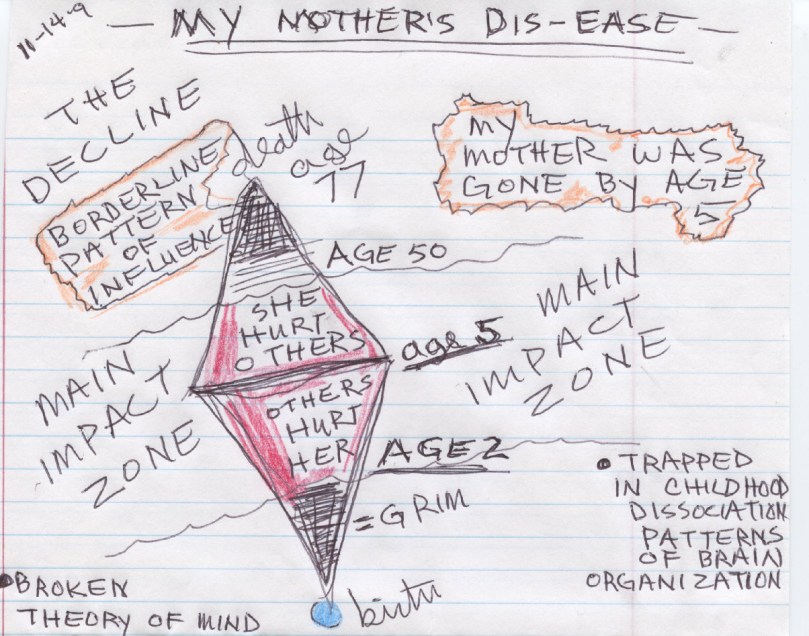
I am revisiting what I see as the core differences between my borderline mother and myself.  I find that nothing has changed in my thinking about these differences in my past five years of research.  My mother’s childhood-onset dissociation became malignant while mine remained benign.

In my first ‘doodle’ I visualized the impact of infant developmental attachment deprivations she suffered from birth until age two.  Born into a family with marital discord and left with her primary care in the hands of a ‘nanny’, I envision that my mother’s developing brain-mind-self was already far off course before she reached the stage of developing a Theory of Mind.

1 111409 post

During the developmental stages from age 2 – 5 conditions in my mother’s childhood so severely impacted her brain-mind that I believe her later mental illness had already centralized the organization of her self.  From the age of 5 it was simply a matter of time before the bomb that was her Borderline Personality Disorder condition would explode – which it did during her terrible delivery of me.

The broader dimensions of the diamond figure that I drew show that in the bottom half powerful interactions with others in her life were feeding her unstable growing self.  She had reached what I call the ‘rage stage’ which was coupled with the following:

My mother was a victim of a lie.  She was told through word and deed by her early caregivers that sometimes she was good enough to be loved.  She was also told that sometimes she was so bad she was un-love-able.  The lie was that she had the power to change herself from being bad to being good, and if she changed into being good (made the bad go away) she would be love-able – and therefore would be loved.

2 111409 post

These conditions presented my mother with an impossible paradox for which there was no answer.  She never knew she was being lied to by her attachment caregivers.  She did not know that there was no solution to this paradox.  She was told she had the power to change herself into being ‘all good’, and she eventually found her solution – me.

The impossible solution to her fundamental betrayal problem was to spit off all her badness and project it onto me.  That left her being all good and me being all bad.  She never had the capacity to know she had believed a lie, found an impossible solution to an impossible riddle, or that she had been tricked and fooled.  Once her child brain-mind wrapped herself around the too-big problem of her early life, her brain-mind continued to grow with this malignant lie within it.

As she moved out of her childhood into her adulthood, and then into the stage of her childbearing years, her childhood dissociation, fueled by childhood rage and a broken Theory of Mind, meant that her children remained her doll-imaginary friends with me as her imaginary enemy (as I have previously described).  By the later years of  my mother’s life she had fewer and fewer people she could influence through her mental illness, and she died as alone and unconsciously troubled as she had been from the time of her birth.

I see this ‘main impact zone’ as being the mass of incoming information that hurt her, followed my the mass of information she later could displace and project onto others to hurt them (primarily me).

++++

My second doodle page (above) presents the basics of what I believe are the differences between my mother and myself.  Like her, my foundation from birth was in disorganizing, disorienting insecure attachment to early caregivers.  But unlike her, I was never fooled, tricked, or betrayed.  Her projection of her own badness onto me condemned me absolutely and permanently.  I was simply doomed to be hated without hope of reprieve, salvation, or any hope of implementing my own solution to solve any of the ‘problems’ I had with her.

The simplicity of my life saved me.  I was not faced with solving an impossible riddle.  I was not presented with the impossible paradox of “you can change yourself into a good and love-able child and then I will love you.”  My childhood was one continual ‘rupture’ without either repair or hope for repair.  My mother’s childhood contained ‘ruptures’ with faulty and deceiving repairs.

In the final analysis, I was far more fortunate than my mother was.  She was set up to fail at being love-able.  I was simply not love-able.  It was the constancy of my unloved-being hated state that saved me.  It was the inconsistency of her unloved-sometimes loved state that ruined her.

I believe her brain fixated a rigid solution to an unsolvable problem.  Her childhood dissociation organized in her brain-mind-self around this solution – which became her internal and unconscious fulltime goal.  I believe her mental illness was fueled by childhood rage.  Her childhood dissociation became malignant, and I became its operational target.

My childhood dissociation had no goal other than physical enduring survival.  My brain-mind-self was left in a fluid, continually changing and adapting state because I HAD NO GOAL and I had no hope, false or otherwise.  My mother’s treatment of me was made tolerable through what I call benign dissociation and my development occurred in a world of sadness.

++++

My mother ended up fighting to be love-able, fueled by rage.  Rage is tied to active coping skills, whether we want to admit this or not.  I did not grow up a fighter.  I grew up a sorrow-filled victim stuck in the passive coping skill state.  My mother was told she had the power to change what happened to her, even though it was a lie and it was not within her power to change the dynamics of her caregivers’ treatment of her.

My mother was damned and didn’t know it.  I was damned and I did know it.  I knew I had no power to change what happened to me.   Nobody ever fooled me into thinking otherwise — from the time I was born.  I believe that there are two entirely different trajectories of development set up by the two different childhood scenarios I am describing.  One leads to the development of a dangerous, demonizing mother and the other one does not.

Both my life and my mother’s of course ended up being extremely complicated with devastating consequences stemming from child abuse and neglect in a malevolent environment during critical body-brain-mind-self stages of early development that resulted in a changed brain for both of us.  Yet as I see it, I was never betrayed or set-up with an impossible task to accomplish like my mother was, and being free from these overpowering early forces allowed me to become who I am.

My mother’s mental illness prevented her from ever being able to tolerate becoming conscious either of how she behaved or of what had happened to so wound her in childhood.  I am not barred in the same way from consciousness.  As I continue to explore the underlying aspects of safe and secure attachment, I will explore how having the ability to be self-aware and self-reflective makes all the difference in how and who we become in our lives.

++++

This post follows:

+DISSOCIATION AND THE TRAUMA-SPECIALIZED BRAIN 11-11-09 and

+SECURE AND INSECURE ATTACHMENT AND THE CHILDHOOD NARRATIVE 11-13-09

++++

++++++++++++++++++++++++++++++++++

THIS INFORMATION COMES TO YOU FROM:

Prevent Child Abuse New York Blog

Improving Children’s Mental Health through Parenting EducationPosted: 13 Nov 2009 03:01 AM PSTGuest post by Michelle Gross, Projects/Public Policy Manager, Prevent Child Abuse New York In today’s difficult times, one of the most important skills one must possess is the ability to form healthy relationships and cope with life’s challenges. Our children are not born with these skills, but rather learn them through their social and emotional development.While providers have traditionally focused on physical development, in 2006, the New York State Legislature passed the Children’s Mental Health Act. The Act required the development of a statewide plan to address issues in children’s social and emotional health, zero to eighteen. As a result of this legislation, the Children’s Plan was developed in collaboration with nine state agencies and led by the New York State Office for Mental Health.The Children’s Plan serves as a blueprint for New York state agencies, providers, and communities to
improve the social and emotional development of children and their families. The Plan focuses on engaging children and their families in services early, ensuring that systems are collaborating to provide effective and efficient services and meeting families’ needs by focusing on their strengths and abilities.

Within the Children’s Plan is a directive for the Office of Mental Health to work with parenting educators to better support parents in raising emotionally healthy children.  The New York State Parenting Education Partnership has been chosen to play this pivotal role in educating providers who work with families and supporting a network of family support and information.

NYSPEP’s efforts to provide professional development sessions for parenting educators will enhance providers’ ability to communicate the importance of social and emotional development with parents, and offer both providers and families tools to facilitate children’s healthy development.

For more information, visit our web site at: http://www.parentingeducationpartnership.org.

Positive Parenting Can have Lasting Impact for Generations

Posted: 12 Nov 2009 07:15 PM PST

A new study that looks at data on three generations of Oregon families shows that “positive parenting” not only has positive impacts on adolescents, but on the way they parent their own children. ” Positive Parenting can include factors such as warmth, monitoring children’s activities, involvement, and consistency of discipline.

Researchers from the Oregon Social Learning Center conducted surveys on 206 boys who were considered “at-risk” for juvenile delinquency. The boys and their parents were interviewed and observed, researchers information about how the boys were parented. Starting in 1984, the boys met with researchers every year from age 9 to 33. As the boys grew up and started their own families, their partners and children began participating in the study. In this way, the researchers learned how the men’s childhood experiences influenced their own parenting.

There is often an assumption that people learn parenting methods from their own parents. In fact, most research shows that a direct link between what a person experiences as a child and what she or he does as a parent is fairly weak. The researchers found that children who had parents who monitored their behavior, were consistent with rules and were warm and affectionate were more likely to have close relationships with their peers, be more engaged in school, and have better self-esteem.

For more information relating to positive parenting techniques, please visit our website http://preventchildabuseny.org/parents.shtml

+++++++++++++++++++++++++++++++++++++++

+SECURE AND INSECURE ATTACHMENT AND THE CHILDHOOD NARRATIVE

++++

This post follows +DISSOCIATION AND THE TRAUMA-SPECIALIZED BRAIN from November 11, 2009

++++

I woke today as if in a different world than usual.  The wind is tearing around my house as if it is demanding something from me and I don’t know what it wants.  The wind is angry.  It rips leaves off of trees and chases them madly around the yard.  With its roaring and whistling it has stolen all my peace away.  It is harder to remember who and when and where I am.

If only the wind would stop and the sun would come out so calm would again surround this body I am in.  Then I could be more certain that my past was in the past and I am in the here and now.  I can I not help feeling challenged and disturbed, made uneasy and agitated in this wind.

++++

I wanted to continue to write this morning about secure-autonomous attachment.  I read Dr. Daniel Siegel’s words again:

The abilities to reflect upon one’s own childhood history, to conceptualize the mental states of one’s parents, and to describe the impact of these experiences on personal development are the essential elements of coherent adult attachment narratives.  (Siegle/tdm/312)”

I do not understand these words.  I do not have the “abilities” Siegel is describing.  I cannot possibly begin to “conceptualize the mental states” of either one of my parents.  I cannot “describe the impact of these experiences” on my development without consulting complicated information from infant and child brain scientists’ research.

If having the ability to “reflect” on my childhood, to “conceptualize” the minds of my parents, to “describe” the impact my childhood experiences on how I developed “are the essential elements of coherent adult attachment narratives,” then I am forced to admit I am coming up empty and confused as if some drastic, terrible wind ripped any chance I might have to begin to think about myself in my life ‘coherently’ from the beginning of my life away as surely as this morning’s wind is forcing away any semblance of a calm and peaceful day.

I feel angry that I have been robbed.  There is no corner of my childhood I can return to without being engulfed in turbulence and trauma.  I am as incapable of ‘conceptualizing’ particularly the mind of my mother at age 58 as I was the day I was born.  That children and the adults they grow into are SUPPOSED to be able to conceptualize the minds of their parents seems beyond belief to me.  I cannot begin to make an attempt in that direction, any more than I can begin to conceptualize the mind of the wind.

++++

Can I begin to understand that my lack of ‘abilities’ to convey even to myself a coherent story of myself in this life from the time of my beginnings is NOT because I am personally deprived, but that this lack of abilities comes directly from the kinds of terrible experiences I had to survive in my parents’ home?  It doesn’t FEEL that way.  It feels that somehow there is something wrong with me that I do not possess these essential requirements Siegel lays out for being an ‘ordinary’ safe and securely attached individual.

Do I understand that I cannot control the wind?  Do I understand that the only way I can ensure that the force of the wind is not directly affecting me is by seeking shelter from it?  Was there any possible shelter I could have sought as an infant-child to escape the terrible storm of my childhood?  No, there wasn’t, except as I could isolate myself in my brain-mind because the only hope of remaining apart from the traumas that I endured ONLY existed within the walls of my own skin.

++++

The words, “There are many rooms in my Father’s mansion” come into my mind.  Because from birth I had no choice but to try to survive within my body as my only protection from insane abuse, it was within me that I had to create these ‘many rooms’ so that the overwhelming traumas I had to endure did not engulf me, swallow me up and destroy me.  My mother’s mind was a cauldron of malevolent chaos.  I am sorry, child development experts, but conceptualizing that kind of mind is not only humanly impossible, it is against all instinct for ongoing survival.

In order to ‘reflect’ on another person’s mind so that it might be ‘conceptualized’, one must be able to make some connection between one’s own mind and the other’s.  Do attachment researchers understand how humanly impossible it is to do this when a parent’s mind is ‘on the other side’ of being human?  My mother was the antithesis of being a mother.  I know I am not alone in my experience.  But I take issue with the suggestion that there’s something wrong with me that I lack the abilities necessary to accomplish the impossible!

The only people I can imagine that could possibly ‘conceptualize’ the mind of my mother would be other mothers who had minds nearly exactly like hers.  What a fantastic delight of an experience it would be to put my mother and the other two mothers I know of like her in an observation room and then ask them all the ‘right’ questions!  Now THERE would be an opportunity for learning!

++++

Short of having this kind of opportunity to explore my mother’s mind – which is, of course impossible because she is dead – I am fighting against having to take on the burden of believing I am at fault in any way for not being able to conceptualize her mind.  Ability is not the right word.  I was born with the ability to accomplish what Siegel is suggesting IF I had been provided with parents whose minds were ‘conceptualizeable’!  Nobody can conceptualize what is impossible to conceptualize!

The abilities to reflect upon one’s own childhood history” – I have the ability to state today that my mother was insane, that my father supported her madness, that my childhood was chaotic, malevolent, dangerous, traumatic, and only survivable because I had the ability to survive it!  That the thousands of abuse memories I might have are stored in their corresponding ‘many rooms’ in the ‘mansion’ of my body where I cannot get to them does not mean that I am in any way more ‘disabled’ than anyone else would be if they had endured the same experiences.

The mansion of my body DOES coherently remember everything that has ever happened to me.  However, it is also a physiological fact that if there were enough stress hormones present at the time the traumas occurred, they would have fried the brain cells designed to store the facts of my experience so that only the emotional memories remained — in my body.

Coherency, as the developmental brain specialists are using the word, applies to their version of remembering the FACTS that tell the linear (left brain) story in words (narrative) of a person’s childhood.  These researchers neglect to mention that an intact, living, breathing, moving, sustainable body is proof enough that coherency is a much larger concept than they seem willing to conceive of.

++++

If I am fighting for the right to stand on my square foot of ground upon this earth in dignity without being judged as being somehow deficient or insufficient or unable to tell a coherent life story, if I am making the statement that I was born with the ABILITY to do so, that I still have this ability, and that the problem is in NO WAY because of any fault of mine but rather lies in the fact that my childhood was simply NOT COHERENT – and that nobody could tell a true story of madness and MAKE it coherent – then where do I go for my proof?

I am going to the dictionary.  I want to learn about this word ‘abilities’ (root word being ‘able’) that Siegel has thrown out as his defining qualification for everything else he says about being the kind of parent who can provide safe and secure attachment to their offspring.

What did I find in my exploration about the word and its family of relatives?  When I try to find ‘coherency’ or understanding about words I always try to find how they are connected in the language of English at the time of their appearance into our language as far back as I can find them – which is always ‘before the 12th century’.

I find that ‘able’ is a young word in our language.  So are its relatives ‘habit’ and ‘give’.  I tracked the word back to its older ancestor words ‘have’, ‘heave’, ‘hold’, and ‘take’.  Interestingly, the word ‘heaven’ is connected through its origins to ‘heave’, and by association of opposites, I find ‘hell’ connected to the word ‘conceal’ and from there to ‘hide’.

++++

I would understand that a dive into the origin and meanings of words might not be something many readers have found to be useful in the past.  Yet we are talking about a BIG subject – our lives and our well-being as it began either in a childhood close to heaven, or in a childhood closer to hell.  If you keep an open mind and meander among the following words, you can see that in our language such subjects as entitlement appear.

Being ‘able’ involves having resources to accomplish a goal.  I was born with and have retained the ability to tell a coherent story about my childhood if I had been given a coherent childhood to tell about.  I have the skill, but I cannot accomplish an impossible task to make madness, chaos and insanity into anything else other than what it was:  incoherent.

I was ‘given’ that childhood’  It was a nasty ‘present’, and I would much rather have had a different one.  The experiences of terrible trauma that I went through were put into my possession and I work as hard as I can to make the best use possible that I can out of what was done to me-given to me.

I cannot make my childhood into anything other than what it was.  It is the childhood that I have.  It is a part of the whole of who I am.  Under the definition of ‘have’ we read:  “to experience especially by submitting to, undergoing, or suffering.”  I performed the best that I could both to endure it and to survive it.

What is the relationship between this subject and ‘heave’ as it relates to ‘heaven’?  ‘Heave’ being related to labor and struggle.  Yet in the origins of this word we can directly see the same origins connected to our word for ‘heaven’.  Both words contain an image of ‘’lifting and heaving something up into the air’.  We are talking old language thinking here.  We are talking about trying to conceive of a ‘place’ beyond comprehension.  Where else would we put our conception of heaven but ‘up there’?

++++

Children are supposed to have good childhoods.  Good childhoods provide no challenge to telling a coherent story about them.  The reality is that some of us have the opposite kinds of childhoods, and it is through no fault of ours that we cannot make them into coherent childhood stories.  On our end, where hell was the norm, ‘concealing’ and ‘hiding’ from our conscious mind experiences that would have overwhelmed our self to death was our only alternative.  Dissociation allowed us to do this.

We cannot possibly tell a coherent childhood story in words about what is hidden and invisible, which is where most of our childhood realities are stored.  We have to believe ourselves!  We have to trust what we do know about our childhoods, even if we simply reduce what we know to our sense of ourselves when we were little.  We know.  Nothing was ever hidden FROM our body.  What we cannot access directly is hidden WITHIN our body.  There is no other possible place for it to be.  I AM my life story.

That means to me that being here alive today IS my coherent story.  My body IS my coherent story – all of it, every single last minute detail of it.  Seigel and other developmental experts are suggesting that it is in the telling of a coherent VERBAL narrative that all hope of having future and ongoing safe and secure attachment lies, including those with our children and mates.  I have to think bigger, because I know better.

I am not my mother.  My mind is ordered in a very particular trauma-survival-based way, but it is NOT in chaos, even if I cannot detect in words what I most know about having been raised through 18 years of terrible abuse.  ‘Coherent’ is a young 1555 word in our language.  Where did it come from?  What meaning is it connected to?  What are its ancestors?

It is related to the idea of sticking things together.  ‘Stick’ has been in our language from before the 12th century:  “to put or set in a specified place or position.”  I am here to tell all the attachment experts that I am stuck together just fine!  Everything I have been through is stuck somewhere inside of me, as well.  That I don’t have words to neatly spin a tidy heavenly story from my childhood in hell does mean I COULD NOT if I had an entirely different story to tell.

To me, what Siegel is really saying is that most patterns of ongoing intergenerational transmission of safe and secure attachments happen among adults who can put their childhood narrative into words.  OK.  I get it.  I can tell my childhood narrative with a three word statement about my childhood.  “It was hell.”  If I tell someone that and they do not understand what I am saying, there are not enough words in the universe to explain to them what my childhood was like.

Meanwhile, the wind has stopped blowing.  All is calm outside my house now.  I like that.  Peace and quiet now mean the world to me.  The version of hell I endured was a very wild and noisy place!  Those of you who have been there, too, know exactly what I am talking about, and I don’t have to spin a coherent narrative to tell you what I mean!  How cool is that?

++++

HERE ARE THE WORDS RELATED TO THIS POST’S  SEARCH:

able

Etymology: Middle English, from Anglo-French, from Latin habilis apt, from habēre to have — more at habit

Date: 14th century

1 a : having sufficient power, skill, or resources to accomplish an object b : susceptible to action or treatment
2 : marked by intelligence, knowledge, skill, or competence

habit

Etymology: Middle English, from Anglo-French, from Latin habitus condition, character, from habēre to have, hold — more at give

Date: 13th century
3 : manner of conducting oneself : bearing
5 : the prevailing disposition or character of a person’s thoughts and feelings : mental makeup
6 : a settled tendency or usual manner of behavior
8 : characteristic mode of growth or occurrence

give

Etymology: Middle English, of Scandinavian origin; akin to Old Swedish giva to give; akin to Old English giefan, gifan to give, and perhaps to Latin habēre to have, hold

Date: 13th century

1 : to make a present of
2 a : to grant or bestow by formal action b : to accord or yield to another

3 a : to put into the possession of another for his or her use

have

Etymology: Middle English, from Old English habban; akin to Old High German habēn to have, and perhaps to hevan to lift — more at heave

Date: before 12th century

transitive verb 1 a : to hold or maintain as a possession, privilege, or entitlement  b : to hold in one’s use, service, regard, or at one’s disposal  c : to hold, include, or contain as a part or whole

3 : to stand in a certain relationship to

4 a : to acquire or get possession of
5 a : to be marked or characterized by (a quality, attribute, or faculty)

6 a : to experience especially by submitting to, undergoing, or suffering b : to make the effort to perform (an action) or engage in (an activity)

heave

Etymology: Middle English heven, from Old English hebban; akin to Old High German hevan to lift, Latin capere to take

Date: before 12th century

intransitive verb 1 : labor, struggle

heaven

Etymology: Middle English heven, from Old English heofon; akin to Old High German himil heaven

Date: before 12th century

1 : the expanse of space that seems to be over the earth like a dome : firmament —usually used in plural
2 a often capitalized : the dwelling place of the Deity and the blessed dead b : a spiritual state of everlasting communion with God
3 capitalized : god 1
4 : a place or condition of utmost happiness

hold

Etymology: Middle English, from Old English healdan; akin to Old High German haltan to hold, and perhaps to Latin celer rapid, Greek klonos agitation

Date: before 12th century

transitive verb 1 a : to have possession or ownership of or have at one’s disposal  b : to have as a privilege or position of responsibility  c : to have as a mark of distinction
4 a : to have or maintain in the grasp
6 a : to enclose and keep in a container or within bounds : contain

take

Etymology: Middle English, from Old English tacan, from Old Norse taka; akin to Middle Dutch taken to take

Date: before 12th century

transitive verb 1 : to get into one’s hands or into one’s possession, power, or control

4 a : to receive into one’s body (as by swallowing, drinking, or inhaling)

hell

Etymology: Middle English, from Old English; akin to Old English helan to conceal, Old High German helan, Latin celare, Greek kalyptein

Date: before 12th century

conceal

Etymology: Middle English concelen, from Anglo-French conceler, from Latin concelare, from com- + celare to hide — more at hell

Date: 14th century

1 : to prevent disclosure or recognition of <conceal the truth>
2 : to place out of sigh

hide

Etymology: Middle English hiden, from Old English hȳdan; akin to Greek keuthein to conceal

Date: before 12th century

transitive verb 1 a : to put out of sight : secrete b : to conceal for shelter or protection : shield
2 : to keep secret
3 : to screen from or as if from view : obscure
4 : to turn (the eyes or face) away in shame or angerintransitive verb 1 : to remain out of sight —often used with out
2 : to seek protection or evade responsibility

++++