+ANTIDOTE TO DISSOCIATION: THE TRANSITION TO WHOLENESS

++++++++++++++++++++++++++++

Even when I stumble upon a website such as this one, Women of Green, containing a post entitled, “Can Western Women Save the World? The Dalai Lama Thinks So” I feel lost and overwhelmed in response.  In my reality, there are just too many pieces, too many parts.

Perhaps it might be especially because of my severe disorganized-disoriented insecure attachment ‘disorder-pattern’ that I am left so unmistakably influenced more by what feels ‘broken into pieces’ than many other people are.  When I follow anything that might concern me about the state of our world I end up at the same point in my thinking and in my emotions.  I am left as if I am standing over a pile of tiny shards that are all that’s left of something precious that was once whole and is now smashed to smithereens.

(See this excellent article that I believe applies to what happened to my mother in her infant-childhood to make turn her into the raging super-abusive ‘anti-mother’ whose trajectory of disorganized-disoriented insecure attachment was so different than mine:

Forecasting Aggression:  Toward a New Interdisciplinary Understanding of What Makes Some Troubled Youth Turn Violent By Daniel S. Schechter, M.D.)

++

Having been the recipient of my (Borderline) mother’s insane, intensive, brutalizing and violent abuse of me from birth and for the following 18 years of my childhood I was forced to grow, develop and build a body-brain-mind-self without having any safe and secure human attachment relationship that could have allowed me to put the pieces together of my own shattered early life.  Every single time (except for my relationship with nature) that I EVER tried to pursue anything that could have brought me happiness, my mother was ALWAYS there to smash me again.  Smash, bash, crash!  My mother was an absolute expert on applying any force of any kind possible (and from her point of view, necessary) to BREAK LINDA.

After writing my recent post, +LEARNING HOW TO CHANGE PEACEFULLY (leaving the trauma-drama OUT!), I have spent most of my waking moments outside working on and in my garden.  The amount of time I have spent out there specifically thinking about anything has been minimal.  The ‘me’ that’s now doing that work is in the process of BECOMING – different.

Because of my dissociation disorder, I have to be very aware and very vigilant (as best as I can be) of my own process of change.  In this past week I have been LIVING through something I have not put specific words to:  I am coming to understand more clearly that for me there is a difference between how I see change, transformation and transitioning.  My innate body-brain circuitry and pathways of dissociation happened inside of my growing and developing body-brain-mind-self BECAUSE of the horrendous abuse I was chronically forced to experience.  As a result my universe has ALWAYS been about the parts and not about the whole.

I am transitioning.  I have always been transitioning.  At this moment of my life at age 59 my own process of transitioning has moved itself into the forefront of my focus.  It is my own transitioning that I am investigating now – by living it at the same time I am becoming consciously aware of what I am experiencing.

This entire post is actually about one unifying topic:  God.  I never set out to write a blog about God.  Yet in my own search for LIFE, which I see as a search for HEALING (because I was so totally wounded and carry those wounds within this body that trauma built), I don’t believe I will be able to move forward without a thorough investigation about what all things ‘God-invested’ means to me.

God.  I believe the entire accumulation of physiological (on every level) consequence that my first 18 years of severe trauma and abuse did to me has greatly complicated my ability to ‘have a meaningful relationship’ with God.  In order to ‘make my own peace’ with my own essential self I believe I have to face my own brokenness from a spiritual point of view.

This is a time of great transition for me.  I have not decided how I am going to process this time of transition on my blog.  I don’t care how anyone approaches their own belief in God.  I see God as the Unknowable Essence, the Omnipotent Being, the Greatest Mystery and the Creator of All Things.  Being able to break through my own dissociation to heal IN SPITE of that brokenness (that lack of continuity of self-in-the-world) is not a minor step for me.

In my personal investigation about what’s wrong in our nation and in our world that so many little and big people are being allowed to suffer so greatly I simply hit an immovable wall that showed me there is no answer on this globe to solve the brokenness in this whole world unless and until a spiritual solution is found – both personally and combined in love and compassion with masses of others within our species.

That we will have to leave behind what is divisive in our thinking and in our actions in favor of keeping what we share in common about our belief in our Higher Power means to me that we can choose to look inside for what sustains all the goodness of life rather than continue to fight internally and with one another over what is wrong.  Our species is as broken and ‘dissociated’ as a unit as I often feel inside of my own self.  But staying in a place of wounded brokenness will NEVER allow us to find solutions.

However we mutually come to share in bigger and bigger and bigger healing circles that will bring about bigger and bigger and bigger ripples of healing around our globe will not happen through clashes of disagreements.  Healing happens when ‘forces are joined’ on the PLUS rather than on the MINUS side of life.  It seems obvious to me that all abuse is about the minus.  I will always need my transitions to be about the plus.

Wholeness, call it ‘holistic’ if that’s the best word we can find in our language, seems to me to be the exact opposite of what I experienced in my unbelievably sick home of origin.  Whether we are considering our own needs for positive transitioning or the needs of others (including the ‘environment’), we are considering a whole that I believe the Creator made as a WHOLE UNIT that functions in wholeness the same way our own body does.  I am exploring that wholeness.

++++++++++++++++++++++++++++

+UNITED NATIONS CIVIL SOCIETY NETWORK LINKS

++++++++++++++++++++++++++++

+FINDING MY COURAGE TO TAKE A LOOK AT ‘WHAT’S WRONG WITH AMERICA’

++++++++++++++++++++++++++++++

For all the severe trauma, neglect, abuse and malevolent treatment I endured during the first 18 years of my life, I have yet to thoroughly explore the topic of the book I am highlighting here today as it applies to my own life.  I have known for many years that I had no relationship with my mother or father that was outside the range of what is described as a ‘trauma bond’ or as a ‘betrayal bond’.  I had no safe and secure attachment relationship with ANYONE during those 18 years.  I have evidently taken that fact so fore granted that it is only now as I continue to explore the CONTEXT of the Bigger Picture in which the trauma that happened to me within that I am NOW directly faced with either paying some attention to what these kinds of bonds actually are – or not.

From a rather detached point of view I find it intriguing to learn this about myself:  I did not move to the point where I could directly consider these damaged-damaging kinds of bonds UNTIL I reached a point where my interest and concern became focused not on my own story, but rather on the suffering of OTHER infants and children CURRENTLY trying to grow up in our nation as they suffer from all kinds of deprivations and traumas within malevolent environments.

As I noted in some of my recent posts, it is within the CONTEXT and within the Bigger Picture that I share the overwhelming suffering of my abusive-traumatic infant-childhood with LOTS of other people.  These ‘other people’ are NOT only grownups.  They are ALSO infants, toddlers, childrens and teens who are suffering NOW – in real-time.  As I have pursued my own understandings about what happened to me from the PAST on into the present real-time moment, all boundaries and distinctions I might have had about ‘my suffering’ and the suffering of others have vanished.

In this dissolution of distinctions about suffering I am left taking a closer look at the conditions within our American nation that are not only allowing growing numbers of our offspring to suffer, but that are contributing to this suffering.  I realized a long time ago that especially in regard to infant abuse our culture has built into itself such a taboo against harming little ones that we don’t even want to THINK about let alone TALK about the fact that infant abuse does happen!

Now I feel like I am broaching yet another taboo subject – what is wrong with America.  As I take a look at this subject I feel I am wandering around alone in a very dark bramble thicket – but I will not change my direction.  Forward I go, no matter how uncomfortable this stage of my journey is.

++

I will be continuing to post further excerpts from the book I introduced in last evening’s post, America’s Sacred Calling: Building a New Spiritual Reality (2010) by John Fitzgerald Medina.   At the same time I admit to myself I am reaching WAY OUT OF MY COMFORT ZONE as I tackle the information Medina presents.  My realization is that I am unable to make any further progress toward understanding suffering in the context of the nation I am a part of if I don’t at the same time understand that I have a BETRAYAL BOND with America.

As members of a social species we are programmed in our DNA to seek protection by being with others of our kind.  We are most comfortable being a part of the larger group at the same time that our innate physiological attachment ‘wiring’ makes certain that if we move too far out of our ‘group comfort zone’ – we will FEEL IT as discomforting, threatening and downright scary!  We will feel this threat in terms of lack of safety and security at the same time our attachment systems go into full play.

I suspect that most people instinctively align themselves with their own nation in the same way that infants and children align themselves with the caregivers they are dependent on for protection-need fulfillment.  Dependency based on NEED can be a powerful force that keeps us even as adults from asking questions and surveying factual information that MIGHT BURST OUR BUBBLE about anyone we are reliant on for protection-need fulfillment – including facts about our own nation.

In this context of examining context I present the following information on ‘betrayal bonds’.  This information comes from this book:

The Betrayal Bond: Breaking Free of Exploitive Relationships (1997) by Patrick J. Carnes

Product Description

Patrick Carnes presents an in-depth study of exploitive relationships: why they form, who is most susceptible, and how they become so powerful. He explains to readers how to recognize when traumatic bonding has occurred and provides a checklist so they can examine their own relationships. Included are steps readers can take to safely extricate themselves or their loved ones from these situations.

In Carnes’ introduction to his book he states:

Betrayal.  A breach of trust.  Fear.  What you thought was true – counted on to be true – was not.  It was just smoke and mirrors, outright deceit and lies.  Sometimes it was hard to tell because there was just enough truth to make everything seem right.  Even a little truth with just the right spin can cover the outrageous.  Worse, there are the sincerity and care that obscure what you have lost.  You can see the outlines of it now.  It was exploitation.  You were used.  Everything in you wants to believe you weren’t. Please make it not so, you pray.  Yet enough has emerged.  Facts.  Undeniable.  You sizzle with anger.

Betrayal.  You can’t explain it away anymore.  A pattern exists.  You know that now.  You can no longer return to the way it was (which was never really as it seemed).  That would be unbearable.  But to move forward means certain pain.  No escape.  No in-between.  Choices have to be made today, not tomorrow.  The usual ways you numb yourself will not work.  The reality is too great, too relentless.

Betrayal.  A form of abandonment.  Often the abandonment is difficult to see because the betrayer can be still close, even intimate, or may be intruding in your life.  Yet your interests, your well-being is continually sacrificed.

Abandonment is at the core of addictions.  Abandonment causes deep shame.  Abandonment by betrayal is worse than mindless neglect.  Betrayal is purposeful and self-serving.  If severe enough, it is traumatic.  What moves betrayal into the real of trauma is fear and terror. [my note:  I would add here that trauma is ALSO about overwhelming helplessness, hopelessness and great pain and suffering!] If the wound is deep enough, and the terror big enough [and great pain and suffering], your bodily systems shift to an alarm state.  You never feel safe.  You’re always on full-alert, just waiting for the hurt to begin again.  In that state of readiness, you’re unaware that part of you has died.  You are grieving.  Like everyone who has loss, you have shock and disbelief, fear, loneliness and sadness.  Yet you are unaware of these feelings because your guard is up.  In your readiness, you abandon yourself. Yes, another abandonment.

But that is not the worst.  The worst is a mind-numbing, highly addictive attachment to the people who have hurt you. [my note:  Addictive physiological patterns use the same chemicals and body-brain routes that human attachment does.  When our earliest caregiver attachments hurt us, our body-brain had no choice in the beginning of our life to alter the way our attachment patterns built us and built themselves into us in our early unsafe and insecure human environment.] You may even try to explain and help them understand what they are doing – convert them into non-abusers.  You may even blame yourself, your defects, your failed efforts.  You strive to do better as your life slips away in the swirl of the intensity.  These attachments cause you to distrust your own judgment, distort your own realities and place yourself at even greater risk.  The great irony?  You are bracing yourself against further hurt.  The result?  A guarantee of more pain.  These attachments have a name.  They are called betrayal bonds.

Exploitive relationships create betrayal bonds.  These occur when a victim bonds with someone who is destructive to him or her.  Thus the hostage becomes the champion of the hostage taker, the incest victim covers for the parent and the exploited employee fails to expose the wrongdoing of the boss. {my note:  I am also becoming very clear that, against all our nation’s social taboos about ‘thinking this way’, that our nation itself is allowing an abusive exploitive relationship to continue to grow between ‘the rich and the poor’.  I have a betrayal bond-attachment (as I suspect most of us do) to my own nation!] Sexual exploitation by professionals – such as in the Father Porter case, the Pied Piper phenomenon at Jonestown, and the kidnapping of the children from the school bus at Chowchilla – grab national attention.  Yet the bonds formed in those situations have much in common with the experiences most of us have.

We typically think of bonding as something good.  We use phrases like male bonding and marital bonds, referring to something positive. [my note:  and ‘the mother-infant bond’ – the following bold type is mine] Yet bonds are neutral.  They can be good or bad.  Consider destructive marriages as in War of the Roses in which the attachment results in a mutually destructive bond that cannot be broken.  Partners cannot leave each other the bond is so strong, even when they clearly know the risks.  Similarly, adult survivors of abusive and dysfunctional families struggle with bonds that are rooted in their own betrayal experiences.  Loyalty to that which does not work, or worse, to a person who is toxic, exploitive or destructive to you, is a form of insanity.

A number of signs indicate the presence of a betrayal bond:

1.  When everyone around you has strong negative reactions, yet you continue covering up, defending or explaining a relationship.

2.  When there is a constant pattern of nonperformance and yet you continue to believe false promises.

3.  When there are repetitive, destructive fights that nobody wins.

4.  When others are horrified by something that has happened to you and you are not.

5.  When you obsess over showing someone that he or she is wrong about you, your relationship or the person’s treatment of you.

6.  When you feel stuck because you know what the other person is doing is destructive but believe you cannot do anything about it.

7.  When you feel loyal to someone even though you harbor secrets that are damaging to others.

8.  When you move closer to someone you know is destructive to you with the desire of converting them to a non-abuser.

9.  When someone’s talents, charisma or contributions cause you to overlook destructive, exploitive or degrading acts. [my note:  Alas, I am also ‘reading’ patterns here that describe the nation I am a part of]

10.  When you cannot detach from someone even though you do not trust, like or care for the person.

11.  When you find yourself missing a relationship, even to the point of nostalgia and longing, that was so awful it almost destroyed you.

12.  When extraordinary demands are placed upon you to measure up as a way to cover up that you’ve been exploited.

13.  When you keep secret someone’s destructive behavior toward you [my note:  and I would add in the case of our nation ‘against others’] because of all the good they have done or the importance of their position or career.

14.  When the history of your relationship is about contracts or promises that have been broken and that you are asked to overlook.

Divorce, employee relations, litigation of any type, incest, child abuse, family and marital systems, domestic violence, hostage negotiation, kidnapping, professional exploitation and religious abuse all are areas that reference and describe the pattern of betrayal bonding.  They have in common situations of incredible intensity, or importance, or both. [my note:  I place our ‘national allegiance’ in this same category when the wealth and interests of the few causes great harm to the desperate many] They all can result in a bond with a person who is dangerous and exploitive.  Signs of betrayal bonding include misplaced loyalty, inability to detach and self-destructive denial. [bold type is mine]

If you are reading this book, a clear betrayal has probably happened in your life.  Chances are that you have also bonded with the person or persons who have let you down.  Now here is the important part:  you will never mend the would without dealing with the betrayal bond.  Like gravity, you may defy it for a while, but ultimately it will pull you back.  You cannot walk away from it.  Time will not heal it.  Burying yourself in compulsive and addictive behaviors will bring no relief, just more pain….

You can click on this title and go to Amazon.com to explore the Table of Contents and other pages, as well.  I haven’t read the book yet as I just discovered it in my searching today.  I will either locate a copy through my local library or buy one for myself.  The Betrayal Bond: Breaking Free of Exploitive Relationships (1997) by Patrick J. Carnes

++++++++++++++++++++++++++++++

+FOUND A GREAT USER-FRIENDLY ABUSE-TRAUMA RECOVERY WEBSITE!

+++++++++++++++++++++++++++

I found this excellent website this morning that has lots of clear accurate information-packed pages related to abuse and trauma — HELPGUIDE.org

Healing Emotional and Psychological Trauma — Symptoms, Treatment, and Recovery

What is emotional and psychological trauma?

Emotional and psychological trauma is the result of extraordinarily stressful events that shatter your sense of security, making you feel helpless and vulnerable in a dangerous world.

Traumatic experiences often involve a threat to life or safety, but any situation that leaves you feeling overwhelmed and alone can be traumatic, even if it doesn’t involve physical harm. It’s not the objective facts that determine whether an event is traumatic, but your subjective emotional experience of the event. The more frightened and helpless you feel, the more likely you are to be traumatized.

A stressful event is most likely to be traumatic if:

  • It happened unexpectedly.
  • You were unprepared for it.
  • You felt powerless to prevent it.
  • It happened repeatedly.
  • Someone was intentionally cruel.
  • It happened in childhood.

Emotional and psychological trauma can be caused by single-blow, one-time events, such as a horrible accident, a natural disaster, or a violent attack. Trauma can also stem from ongoing, relentless stress, such as living in a crime-ridden neighborhood or struggling with cancer.

Risk factors that increase your vulnerability to trauma

People are also more likely to be traumatized by a new situation if they’ve been traumatized before – especially if the earlier trauma occurred in childhood.

Childhood trauma increases the risk of future trauma

Traumatic experiences in childhood can have a severe and long-lasting effect. Children who have been traumatized see the world as a frightening and dangerous place. When childhood trauma is not resolved, this fundamental sense of fear and helplessness carries over into adulthood, setting the stage for further trauma.

Childhood trauma results from anything that disrupts a child’s sense of safety and security, including:

* An unstable or unsafe environment

* Separation from a parent

* Serious illness

* Intrusive medical procedures

* Sexual, physical, or verbal abuse

* Domestic violence

* Neglect

* Bullying

Symptoms of emotional and psychological trauma

Following a traumatic event, most people experience a wide range of physical and emotional reactions. These are NORMAL reactions to ABNORMAL events. The symptoms may last for days, weeks, or even months after the trauma ended.

Emotional symptoms of trauma:

* Shock, denial, or disbelief

* Anger, irritability, mood swings

* Guilt, shame, self-blame

* Feeling sad or hopeless

* Confusion, difficulty concentrating

* Anxiety and fear

* Withdrawing from others

* Feeling disconnected or numb

Physical symptoms of trauma:

* Insomnia or nightmares

* Being startled easily

* Racing heartbeat

* Aches and pains

* Fatigue

* Difficulty concentrating

* Edginess and agitation

* Muscle tension

These symptoms and feelings typically last from a few days to a few months, gradually fading as you process the trauma. But even when you’re feeling better, you may be troubled from time to time by painful memories or emotions—especially in response to triggers such as an anniversary of the event or an image, sound, or situation that reminds you of the traumatic experience.

This appears to be a very user-friendly site.  I found a host of informative articles HERE.  Great site!

+++++++++++++++++++++++++++

+NEEDY PEOPLE AND BUMPY CONVERSATIONS (GRICE’S MAXIMS, AGAIN!)

++++++++++++++

Someone posted this essay to an online group I belong to today.  It’s from The Philosophical Society.com and presents a picture of very common patterns that appear frequently in conversations.  Reading it made me think again about

Grice’s Conversational Maxims

Maxim of Quantity:

1. Make your contribution to the conversation as informative as necessary.

2. Do not make your contribution to the conversation more informative than necessary.

Maxim of Quality:

1. Do not say what you believe to be false.
2. Do not say that for which you lack adequate evidence.

Maxim of Relevance:

Be relevant (i.e., say things related to the current topic of the conversation).

Maxim of Manner:

1. Avoid obscurity of expression.
2. Avoid ambiguity.
3. Be brief (avoid unnecessary wordiness).
4. Be orderly.

These maxims are considered to be reflected within rational ‘cooperative discourse’, and have been incorporated into the rating structure of the Adult Attachment Interview (AAI) used clinically and in research to assess adult attachment.

++++

This article (below) makes the point that often people are in direct competition with one another for the resource of attention in their conversations.  Competition and cooperation seem to me to usually be opposite one another on a continuum of resource availability.  The recent reading I have been doing (and posting about) that states human’s essentially cry to elicit attention from SOMEONE who will offer to them assistance and caregiving also reminds me that we often try to elicit this same response from other people with our words.

Conversations happen when there are patterns of rupture and repair between people.  The idea of balance comes into play in my mind.

If we are suffering with conditions in our lives that make us feel less than safe and secure, often the activation of our attachment system that these conditions can create greatly diminishes our own ability to ‘care give’ another person – including our ability to truly listen and to pay attention to someone else.

We can easily describe the patterns of rupture and repair – or rupture without repair – that happen between people in social interaction from birth until death in terms of give and take.  Taking often happens when someone has a need that has activated their attachment system in response to ‘insecure’ conditions.  The call goes out (one way or the other) to someone who can/will respond with caregiving (the giver).  The essay below uses the term ‘shift-response’ to identify when these ruptures take place.

We have become a nation in which well over half of our population suffers from some form of an unsafe and insecure attachment disorder and corresponding empathy disorder.  These disorders-patterns can be assessed through the Adult Attachment Interview (AAI) which is based on Grice’s Maxims and can be used to identify discrepancies in a person’s telling of their life narrative (coherent or incoherent life story).

The end goal of safe and secure attachment-building in infancy (as those patterns build the human body and brain from birth during critical windows of development) is that an adult be created that can most optimally explore in the world.  The fullest exploration of life becomes the sign of a healthy safely and securely attached individual (who has had the opportunity to build peace and calm into the center of their body-brain-being as their normal resting state).

As the following essay suggests, the prize that can appear in conversation between two equally matched COOPERATIVE conversationalists (when neither partner is feeling needy (or greedy) with an activated insecure attachment system) would be the exploration of IDEAS.

++++

Conversational Narcissism

“I was saying,” continued the Rocket, “I was saying — what was I saying?”

“You were talking about yourself,” replied the Roman Candle.

“Of course; I knew I was discussing some interesting subject when I was so rudely interrupted…”

— Oscar Wilde, “The Remarkable Rocket”

“Without attention being exchanged and distributed, there is no social life,” the sociologist Charles Derber wrote in his influential study The Pursuit of Attention. “A unique social resource, attention is created anew in each encounter and allocated in ways deeply affecting interactions.”

“Derber observed that the social support system in America is relatively weak, and this leads people to compete mightily for attention. In social situations, they tend to steer the conversation away from others and toward themselves. “Conversational narcissism is the key manifestation of the dominant attention-getting psychology in America,” he wrote. “It occurs in informal conversations among friends, family and coworkers. The profusion of popular literature about listening and the etiquette of managing those who talk constantly about themselves suggests its pervasiveness in everyday life…”

What Derber describes as “conversational narcissism” often occurs subtly rather than overtly, because even the dim-witted among us know that it’s rude not to show interest in others, and prudent to avoid being judged an egotist.

Derber distinguishes the “shift-response” from the “support-response.” The difference between the two is evident in these examples:

“John: I’m feeling really starved.

Mary: Oh, I just ate. (shift-response)

John: I’m feeling really starved.

Mary: When was the last time you ate? (support-response)

John: God, I’m feeling so angry at Bob.

Mary: Yeah, I’ve been feeling the same way toward him. (shift-response)

John: God, I’m feeling so angry at Bob.

Mary: Why, what’s been going on between the two of you? (support-response)”

“Conversational narcissism involves preferential use of the shift-response and underutilization of the support-response,” Derber notes. Excessive use of the shift-response is actually not common because it is patently egocentric and disruptive. According to Derber, a “more acceptable — and more pervasive — approach is one where a conversationalist makes temporary responsive concessions to others’ topics before intervening to turn the focus back to himself. The self-oriented conversationalist mixes shift-responses with support-responses, leaving the impression that he has interest in others as well as himself.”

The example Derber gives below is a fine illustration of this point:

“Jim: You know, I’ve been wanting to get a car for so long.

Bill: Yeah. (support-response)

Jim: Maybe when I get the job this summer, I’ll finally buy one. But they’re so expensive.

Bill: I was just thinking about how much I spend on my car. I think over $1500 a year. You know I had to lay out over $750 for insurance. And $250 for that fender job. (shift-response)

Jim: Yeah, it’s absurd. (support-response)

Bill: I’m sick of cars. I’ve been thinking of getting a bicycle and getting around in a healthy way…

Jim: I love bikes. But I’m just really feeling a need for a car now. I want to be able to drive up the coast whenever I want. (shift-response)

Bill: Uh huh…(support-response)

Jim: I could really get into a convertible.

Bill: Oh, you can go anywhere on a bike. I’m going to borrow John’s bike and go way up north next weekend. You know, a couple of weekends ago Sue and I rented bikes and rode down toward the Cape… (shift-response)”

At first glance such a discussion might appear to be reciprocal, but in fact both conversationalists at different points try to steer the conversation back into the orbit of self.

The dynamic of conversational narcissism is of course more complex than these few examples suggest. Derber sees class and gender influencing people’s propensity to gab or to listen. An influential or powerful person will naturally demand a captive audience (unlike, say, the lowly philosopher, to whom no one need pay any attention). Even today, a “good,” “feminine” woman is expected to be generous with support-responses, and listen to assertive men, even if they have nothing particularly illuminating to say. The therapist-client relationship is built on the tacit understanding that the therapist will listen empathetically and keenly to the patient, offering only support-responses, while the patient is given free rein to discuss any aspect of his life.

The ideal conversation would occur when neither party seeks to monopolize it, and when the direction is governed not by individual will or emotional neediness but by the flow of ideas. In such a circumstance, people would only speak to up the intellectual ante — not in any competitive or adversarial way, but in a spirit of wanting to nourish the intellectual rigor of the conversation.

As Derber points out, the ideal is very hard to attain, because people often enter into conversations seeking to receive attention rather than to give it. This norm is unlikely ever to change in a society that is increasingly impersonal and atomistic, and conditioned to award attention to those with status rather to those who might actually have something interesting to say.”

http://www.philosophicalsociety.com/Archives/Conversational%20Narcissism.htm

Further Reading

Nancy Chodorow, The Social Reproduction of Mothering (1977)

R.D. Laing, The Politics of Experience (1967)

Christopher Lasch, The Culture of Narcissism (1978)

David Reisman et al., The Lonely Crowd (1950)

Richard Sennett, The Fall of Public Man (1977)

++++++++++++++

+THE MISSING MONTHS OF THE ‘ANTWONE FISHER’ MOVIE-STORY: WHAT WE MOST NEED TO KNOW

+++++++++++++++++++++++

I rewatched the movie “Antwone Fisher” yesterday.  This movie is about an adult working to heal from terrible child abuse inspired by a true story and marks Denzel Washington’s directorial debut.

From my point of view, what the movie never describes is what probably makes the biggest difference in the outcome of this story.  What were Antwone’s first foster parents like?  Did they love that parentless infant RIGHT?  Did they form a safe and secure attachment with the baby?

According to the story Antwone was removed at age two from his first foster home he had been placed in when he was two months old.  For all concerns about interfering with early bonding-attachment relationships, I do not believe that age two is a permanently damaging age to change primary early attachments.  In this case the child was moved to a horribly abusive home, but nothing in the story addresses the nature and the quality of the earliest, most critically important caregiver attachment patterns BEFORE the age of two that impact the direction that all fundamental physiological development follows.  (See update in comment section to this post.)

I would say by looking at the story as it is presented in this movie that Antwone’s first two years HAD to have taken place within an adequately non-malevolent caregiver-attachment environment.  The remarkable recovery that occurs post-terrible LATER abuse would NOT have followed the same course it did if Antwone’s physiological body-brain development had been changed by severe trauma during his infancy.

When looking at our own recovery from our own severe child abuse it remains MOST IMPORTANT that we understand how profoundly our physiological development is impacted by our earliest experiences in our environment.  If we continually struggle to overcome the horrors of severe abuse experiences that we KNOW about, and can never manage to ‘get our wings’ and soar out of the ugly mire of abuse we know we experienced, I would ALWAYS say that it’s most likely that our body-brain development was changed by trauma in profound ways during the earliest months of our life.

I personally know that if the first two years of my life had been perfectly FINE I would not be in the same body NOW that I am in – no matter how severely I had been abused post-two-years-old.  It is the Trauma Altered Development that happened to me before that age because I was BORN into a malevolent, abusive and traumatic malevolent environment that has created these lifelong difficulties that I (along with all infant-toddler severe trauma-abuse survivors) continue to struggle with.

Because the presentation of Antwone’s story in this film completely ignores those first two MOST CRITICAL years of the child’s life we are left guessing that all infant-child abuse survivors could recover by following a pathway such as this survivor did.  Not so.  Not so.  Not so!

It is not ‘getting lucky enough’ to benefit from high quality therapy that makes the biggest difference.  It is not ‘being willing enough’ to face our traumatic childhood memories of experience that makes the biggest difference, either.  It is not ‘being genetically superior’ or even ‘being resilient enough’ that matters most.

As Dr. Bruce Perry clearly states, children are not born resilient.  They are born MALLEABLE.  When the earliest environment deprives a rapidly growing and developing infant-toddler of what it needs for its body-brain to follow an optimal pathway, Trauma Altered Development will occur – BECAUSE of this malleability.  The resilience a little person needs in order to develop a body most able to ‘deal with’ severe traumas anytime after the age of two comes in ONE WAY and ONE WAY only – FROM THE PEOPLE WHO CARE FOR THAT BABY from the time it is conceived UNTIL it has ESPECIALLY reached the developmental milestones a body has built into it by two years of age.

As far as I can tell a description of these first critical months of experience are complete missing from the Antwone Fisher story.

Is this same time-frame description missing from your child abuse story?  If you continue a struggle to heal from early traumas you DO know about in a body that does not seem to be operating ‘quite right’, my guess is that whatever description of your first months of life that you GUESS happened to you needs to be closely examined in the bright light of reality.

None of us just happened to end up in a Trauma Altered Development body through bad luck.  We were built this way because we grew from (conception) birth in a caregiving environment that did NOT do exactly that:  Give us the care we needed prior to age two so that we could have a body healthy and resilient enough to fully process and recover from our later abuse.

+++++++++++++++++++++++

+DAYS WITHOUT WORDS – FOCUSED SURVIVAL AND DISSOCIATION

+++++++++++++++++++++++++

Awake most of the night – up for good well before the sunrise.  Waiting for the sun, I have work to do.  I have cleared out whatever money I have accumulated these past months and invested all of it in yet another fence.  How antisocial of me, erasing what I can now of my neighbor on the west side of my yard whose trailer sits not 6 feet away from that fence line.

Up went the posts, painted the cross boards, up with the corrugated aluminum panels.  I blocked the sight of their falling apart lattice sided screened porch.  I blocked their never ending porch light from penetrating the still darkness of my yard’s night sky.  Or did I?

I had to laugh when I went outside last night to sit, finally, in the privacy of my yard.  Nope, no more of THEIR light in my yard, but wait?  The siding, like tin foil, now reflects every tall street light behind my house on the Mexican side of the border wall!

I dug around on my pantry shelves last night for a look at all the cans of strange colored paint I have accumulated from here and there over the years.  Is there something I can use to cover that corrugated reflective shine, something to flatten the surface, to darken my yard?  Oh, yes, here it is.  I am waiting for the sun to rise so I can take these two mixed gallons of interior paint, one orange, the other dark terra cotta, so I can work some more on my task.

(The trick I discovered ‘accidentally’ to using interior paint on exterior metal surfaces is to thin it with water.  Somehow the paint seems to then forget it’s supposed to pucker and buckle and flake and peel!)

++

I am reminded of a time about 20 years ago when I worked as an art therapist on a northern Reservation.  I had a caseload of 40 sexually abused and traumatized children under the age of 10 (over half of them boys).  The Indian Health Service had given me some ‘spare’ money they had for these children’s therapy, and I stretched that money out for a year and a half.  When the money finally ran out and was not replaced, I had to leave, and as I ‘checked out’ another Reservation therapist made this parting comment to me:  “You have been so focused all the time you’ve been up here.”

Even back then I knew his comment reflected something about me that ‘wasn’t quite right’ but I had no idea what I had ‘done wrong’.  To me, whatever I could offer to those children meant more to me than sitting around, wasting time and socializing with other workers possibly could have.

And yet doing EXACTLY that would not only have been ‘normal’, but was expected.  I had failed to shmooze!

++

I thought this morning as I waited with pinpoint bright star lights above me for the sun to rise so I could go back to work (before my 2 pm doctor’s appointment this afternoon) on my Secret Garden about my ability to focus.  Being focused these past few days has NOT been about words.  It has NOT been about writing.  It has not even been about thinking, or about feeling.

My focus, whenever it comes upon me, is simply about being alive — in the moment — as I find things to do that involve work — and work I WANT to do, for whatever reasons.

As I think about my powerful ability to focus, I also realize that this ability is not within the ‘normal or ordinary’ range of what MOST people do or HOW they do what they do.  My focus is about being ‘in a space’ where NOTHING else can reach me.

And I know this ability is something that was built into me through the 18 years of terror, trauma and abuse of my infant-childhood, and it has served me well all of my life.

My states of focus have their own patterns of the passage of time.  Stimulation is so moderated that a bomb could probably go off within my sphere and I would hardly notice.

What this topic has also brought to mind today is how I now see my continually operating stress response system that so rarely ever turns itself off that I barely know what CALM peacefulness is or what it feels like.

I think about the three main emotions that get themselves built into the nervous system-brain of severely traumatized little people while they are growing and developing their body at the start of their life in adaptation to the terrible duress, distress and stress they are under:  ANGER, FEAR and/or SADNESS.

I think about what I believe about anger, that it is stimulated by changes and pressures within the environment that could not be solved by immediately known means.  “Find another way — NOW” the body-brain says.  “Learn something new — NOW — and use it to solve this immediate problem.”  Anger includes this important fact:  “YOU CAN DO IT!”

I have been increasingly angry about the noise and lights that stream from my neighbor’s close-to-me yard.  I can do nothing about noise, but I can visually do something about my privacy.  I had to have the RESOURCES to purchase the material I needed to build this fence-wall.  But equally as importantly, I had to have the CONFIDENCE and COMPETENCE to do this work myself.

The interplay-balance between stressors from the environment implicate anger as a reaction that reflects the need to SOLVE the problem, the resources needed to accomplish a solution, AND confidence and competence needed to personally DO SOMETHING useful to make things better to increase well-being.  Anger is NOT so much about learning something completely new as it is about using what one knows in a new and different creative way.

++

There was NOTHING I could do about the terrible abuse I suffered for the first one-third of my life.  NOTHING except to survive it.  I survived that abuse without any anger at all — and that could still amaze me if I didn’t now understand that in order to feel ANGER one must have access to some degree and version of what I wrote in my previous paragraph.

I am old enough NOW to understand that my anger at my neighbor’s ‘intrusion’ into my space is my problem, not theirs.  I didn’t tell them I was going to build a fence ASAP.  I did try to choose a color for the cross boards (very light blue) that would hopefully be pleasing or at least not too offensive to them.  That’s the best I could do about taking care of what I need while trying to be kindly considerate of them.

++

Everything I have been doing these past five days has been about that fence:  planning, preparing, purchasing, leveling the 40′ of ground along my west line, and doing the work.  I am very, very, very much a project oriented person.  Focus provides a safe inner place/space for me.  While in my focus mode, most everything and everyone else is EXCLUDED from my realm of awareness.

Focus is an emotional-regulation tool I HAVE to use because my right brain did NOT experience ‘normal or ordinary’ early safe and secure attachment experiences with my caregivers that would have built ‘normal and ordinary’ emotional regulation abilities into my body-brain in the first place.

Early trauma during especially an infant’s earliest developmental stages prior to one year of age creates emotional DYSREGULATION patterns rather than ‘ordinary’ regulation patterns.  Survivors of early trauma and abuse live with these changes for the rest of their lives.

My focusing abilities are very much about so-called dissociation.  I know that now.  It is something that was built into me from birth in response to the trauma of the environment that I grew and developed within.  Focused survival — that’s what I spent the first 18 years of my life doing.  It can be an extremely ISOLATED process — as I become my own ‘Army of One’.

But that’s a whole OTHER part of my story……..

+++++++++++++++++++++++++

+DEAD CHILDREN: LEAVES FALLEN FROM THE FAMILY TREE

++++++++++++++++++++++++++

I do not mean for this post to be a morbid one, only an informative one.  In looking at the power than unresolved trauma has to follow in families on down the generations I want to write about two discoveries I have made regarding important MEN in my family tree that have to do with the ‘missing’ children, the dead ones, whose initial ‘being in the world’ no doubt impacted the entire lives of these MEN, albeit perhaps invisibly.

Perhaps it is simply my own limited range of thinking and vision that alerts me to the possibility that it is NOT so much the stories that are told in a family — as few or as many as there may be or have been — that truly matters most.  It seems more likely to me that it is the stories that are NOT told that are the ones that contain the storms of intergenerational unresolved trauma that can combine to impact future generations in traumatic ways that TRULY MATTER.

Those of us living today receive the benefit of medical advancements that have lessened or eliminated especially the risk of premature death for infants and children.  It was not too many generations past that the continued life of one’s offspring could be counted on.

There are schools of thought that suggest that modern efforts toward the protection of children did not come into play until the survival of children was more likely to happen than it did in the past.  Before medical advancements came along to help protect the life of people from diseases we can now prevent and treat,  so many parents lost their little ones that a sort of emotional (and affectionate) vacuum existed to lessen the profound grief that losing one’s infants and children had on parents in the past.

++

It was not unusual in the past for infants and children to be treated as possession-objects rather than as human beings with needs, feelings and rights of their own.  In order to more fully understand how we, as early infant-child abuse survivors experienced the ongoing trauma that DID come down to us from our family’s past history, we need to gather for ourselves as much information as we can about the possible CONTEXT that is NOT told in the stories that belong to and within our family tree.

++

I contrast to what I am writing here don’t consider myself especially interested in a genealogical search for my ancestral connections.  Yet at the same time I have devoted many, many hundreds of hours to transcribing the writings of my mother, even of her mother, letters of my father as these words filtered down over time into my possession.

I only through accident have come across two streams of information that directly apply to my words here today.

The first piece of information relates to the contextual history of my own father.  The stories told within my family of origin always included the fact that my father was an ‘unwanted’ child that arrived late among his siblings.  We were told that his sister (unwillingly) was given responsibility for his care when he was young and ‘raised him’.

Much later when I was an adult over 30 my father told me that during his childhood his mother ‘never left the house unless she had to go to the store’ and ‘never had company come to her home’.  This information gives me a sense of the context of my grandmother’s depression and/or sadness that I am quite certain PROFOUNDLY affected my father’s infant-child development.

It has only been in the past few months since my daughter began gathering family records to connect herself to my father’s mother who was a member of the Daughters of the American Revolution that an important NEW piece of information arrived about the context of my father’s family.  Included on my father’s birth certificate is the fact that there were FOUR children born living while only THREE were living as my father was born.

A MISSING CHILD among my father’s siblings.

This fact was NEVER mentioned in spoken words at any time that I know of, and yet is SUCH an important one that it has rearranged and changed everything I know about myself, as the daughter of a man who never stood up to his abusive wife, who never ONCE intervened to protect me or any of my siblings from my mother’s insanity and abuse.

I know enough to understand that the grief of losing a child affected my father’s parents — and siblings — and within the bigger picture, the enlarged context of my family of origin — that missing child affected me.

++

This past weekend I had a woman come visit me overnight who has been a friend of mine for 30 years.  She lives in Annapolis but was in Arizona visiting her sick brother and popped on down to visit me.  My friend has been deeply involved in researching her family tree, and generously spent time online showing me information that can be accessed on my own family history.

I chose to have her look into my mother’s father’s ancestral line.  While she couldn’t go back very far, what was found is fascinating.

And NOTHING that we found was EVER mentioned in story by my mother whose parents divorced in 1930 when my mother was five.  My mother’s mother remained angry and embittered, full of hatred for her ex husband until her death.  She forced her hatred into my mother so that my mother ‘disowned’ her father and never saw him again past about the year 1932.

My mother’s father’s side of the family tree was amputated and erased from the spoken history of our family, but the effects of even this bitterness and the family trauma it was connected to DID affect not only my mother, but also impacted me, and through me, my offspring.

++

We could find no information further back than the 1881 Canadian Census, and moving forward to the 1900 United States Census.

Perhaps because my friend is a member of the Unitarian Universalist Church she immediately noted that my mother’s father’s father (my great grandfather) had listed himself as a member of the Universalist Church on the 1881 census.  His father was listed as born in England, his mother as born in France and French speaking.  We could not find the name of either one of these ancestors of mine.

We did find that the first Canadian Universalist (Unitarian) church was started in Halifax, Nova Scotia, Canaca in 1937, and that my great grandfather was born there in 1845.  (His wife was also born there).  These people immigrated to the Boston, MA area in 1882 and by the 1900 census were listing three children:  Ada (23) who I know nothing about, her brothers Howard (11) and Charles (9).  Charles became my mother’s father.

ALSO included in the census information is the fact that there were FIVE dead children probably between Ada and Howard.  No matter what happened to them, that is a LOT OF GRIEF AND TRAUMA that I never heard anyone ever say anything about.

++

What this tells me in simple fact is that my mother’s father was the youngest child in his family as was my father in his.  I know enough to suspect that the silent, invisible grief in BOTH of these families affected these MEN — right on down the line.

++

The other piece of information about my great grandfather’s connection to the Universalist Church in Nova Scotia has provided an avenue for continued ancestral search because according to my friend’s online search that church still has all of its records.  I have emailed them asking for help.  I would like to know if my unknown great great grandparents were involved in the founding of this first church in Canada.

I am also intrigued with the unique religious affiliation that these ancestors of mine had outside of the ‘mainstream’ of Christian culture.  Learning this piece of information rearranged how I think about free-thinking self and my own very free-thinking children.  That all of these ancestors, all the way back to the French ones (I hope to find my great grandmother’s maiden name from the marriage records of the church in Halifax), were NEVER mentioned by my mother is a clear sign to me that just as there are road signs to unresolved trauma within families carried in the death of children, there are also road signs to unresolved trauma carried within other family history that is encased within silence.

++++

I do not believe that severe infant-child abuse EVER EVER simply pops up within a family out of nowhere.  If there is abuse, it came from somewhere and is a part of a much bigger picture of trauma and is part of a much larger context that we MUST find as much information about as we possibly can to further our own healing process.

It might seem like nonsense within our culture to put the emphasis that I do personally on the need for severe infant-child abuse survivors to go back through any safe way they can to gather ANY and ALL POSSIBLE INFORMATION about family history so that our understanding about how unresolved trauma FROM THE PAST directly impacted what happened to us can be broadened.

Trauma does NOT easily resolve itself in silence — not when it happened and not as it passes down through the generations.

I also believe that blaming and shaming the perpetrators of abuse is NOT helpful to gathering the kind of contextual information that we need to know.  If, as I suspect, trauma does not resolve itself until somebody, somewhere at sometime LEARNS what the trauma has to teach, we need to learn as much as we can about what the signals/signs/symptoms of unresolved trauma are.

Finding that there are amputated branches from the family tree, such as there are in mine, and finding that we had ancestors that died as babies and children so that the unresolved trauma of grief passed down the generations and no doubt affected our parents IS NOT MEANINGLESS TIDBITS OF INFORMATION.

Every bit of unresolved trauma from ‘back there’ found its way, sometimes in trickles, sometimes in roaring rivers, into the ocean of sadness, violence, confusion, loss and rage that fed the traumatic abuse that happened to us.  The more we can know about these histories, the more we can find, hear, tell and learn from the stories (especially in the silent ones carried within families), the more coherent our OWN life story and our telling of our own life narrative will become.

Because the inability to tell a coherent life narrative is the number one sign of an adult insecure attachment system-disorder, it is critically important that we find and use anything we can find that helps us make sense out of trauma.  We can make progress this way in smoothing out the pathway that leads through us from the past into the future.

Our individual participation in this ‘smoothing out’ process, gained through knowledge that leads to understanding and compassion, will increasing contribute SOOTHING healing and equally soothing calmness for our own self and for all those we are in contact with as we work to put trauma to rest.

++++++++++++++++++++++++++

+GUEST POSTS ALWAYS WELCOME! AN INVITATION

++++++++++++++++++++++++

If any reader ever wishes to write a guest post for this blog you are more than welcome to do so!  The best way for you to do this is to add your post as a comment at the last tab that appears with the pages at the top of this blog:

Your Page – Readers’ Responses

We can all describe and document our experiences as infant-child abuse survivors.  The growing body of this information, as it is contained in our stories and experiences, is growing online to become a most valuable resource for everyone — no matter what stage of our journey of life we are writing about.

The ‘professional’ community at the ‘top’ has been missing the truth of what we at the ‘bottom’ truly know about living our lifetime in a trauma-changed body that was altered through our experiences of having to adapt our physiological development to an early environment of trauma.  It is time for us to find our words to describe a reality that those at and near the ‘top’ (the Pampered Ones) cannot — on their own — even begin to imagine.

++++++++++++++++++++++++

+TRIGGERED. STOP THE CHURNING

+++++++++++++++++++++++++

Sometimes words can be so quiet that they don’t come out at all.  When that happens, I do things.  I just do things and do things and do things — and time goes by and things get done eventually.  The inner times, the waiting times.

Sometimes my thoughts and my emotions just seem like weather.  Inner weather.  Tides coming in and going out.  Inner mornings, days, evenings and night times.  Right now I feel like a tiny speck of glitter in a huge, huge world I am a part of.  A link in a never ending chain.

I guess it’s a kind of ‘world weary’ that I feel lately.  My Four Sisters — my disorganized-disoriented insecure attachment disorder, my PTSD, my depression, my dissociation — sometimes it seems they are so busy living my life for me I just have to find a quiet place, be as calm as I can manage to be, strive for contentment and exercise my gratitude — and then wait, do, wait, do — life is guaranteed change.  I just want as little of unforeseen change as possible.

Having spent a great many years in a seriously rocking, topsy turvy boat, I aim for the shallow waters out of the mainstream, out of the wild currents.  I just want to BE.  Just be.  (I just made myself a pot of decaf coffee — without the coffee!)

Those Four Sisters of mine — sometimes they shake the high-wire I am trying to stay balanced on — walking.  Thoughts running too fast.  Unable to sleep.  Skirting my emotions like they are pools of quicksand.  Wanting to run, my ankles are shackled.  No hope of even flying, hands bound behind my back.  (And I am very, very certain that these Four Sisters would not be present in my life if I had not been so severely abused for the first 18 years of my infant-childhood.)

Yes, something has triggered all this STUPID activity, and there’s nothing I can do but let the mud settle to the bottom while I go on — day by day, night by night — the best that I can — waiting while I live, living while I wait.

PS.  I have now moved my adobe making to my front yard — LOTS of work, and I like it.  I have a vision inside of what I want to see come of my labor.  THAT is ME, a sliver of me I can see ahead of me as I feel myself inside of me moving through the present, into the future, changing what was the past, making something new and different and beautiful.

And while I do THAT work, I ONLY think in the immediate present EXACTLY about what I am doing mind, body and soul.  Transformation.  I know it’s really what we all do while we live — alchemy now — turning what this earth gives to us into our self and then giving something back.  I can feel the beauty in that — and I am grateful.

+++++++++++++++++++++++++

+I WILL FORGET THE ANGELS’ PRESENCE NO MORE

++++++++++++++++++++++++

Wise are the mysterious promptings of the heart that sometimes cause us to make new connections in our thoughts, to say things to those we care deeply about, to finally find our own courage to stand by what we know as our own personal truth, and to let ourselves leap into the feared unknown so that we can find hope for ourselves and for others that we never knew existed before.

I have a nearly 20-year-old cassette tape Walkman with headphones that I use while I do my 45 minute near-daily jog.  I only have two tapes that work in the player.  I have tried all kinds of other ones, but I have decided that the bands that move the tape must be geared only to the exact weight of these two tapes — and nothing else.  One is a Chet Atkins tape that is obnoxious to listen to — hard as that is for me to believe!  The music is clipped and fakey to me, no matter how great the talent recorded on it.

The other one is a Stevie Nicks tape, The Wild Heart.  I have listened to that tape throughout my jogs so many times I can’t count them.  Yet suddenly yesterday, on my 59th birthday, there was one line from one song that leaped out not only into my ears, but into my heart, mind and soul so loudly that all other sounds on the tape completely disappeared.  I can’t even say at this moment (until I do today’s jog and hear the song again) what the name of the song even is — but here is the line:

“I BLAME THE ANGELS!”

At that moment something changed inside of me — the greatest birthday present I could ever have been given.  I can’t name or describe the change exactly, but I can feel it.  For the first time in my life I can feel, sense and almost physically see that all the supposed empty space around me, around all of us here on this earth is filled not only with air — but also with angels!

There are actually so many of them that I don’t know how they fly around without bumping into one another!  I guess they have their own version of traffic control, because “Oh, my GOLLY!  There’s a whole LOT of them!”

And each of them is here to help all of us.

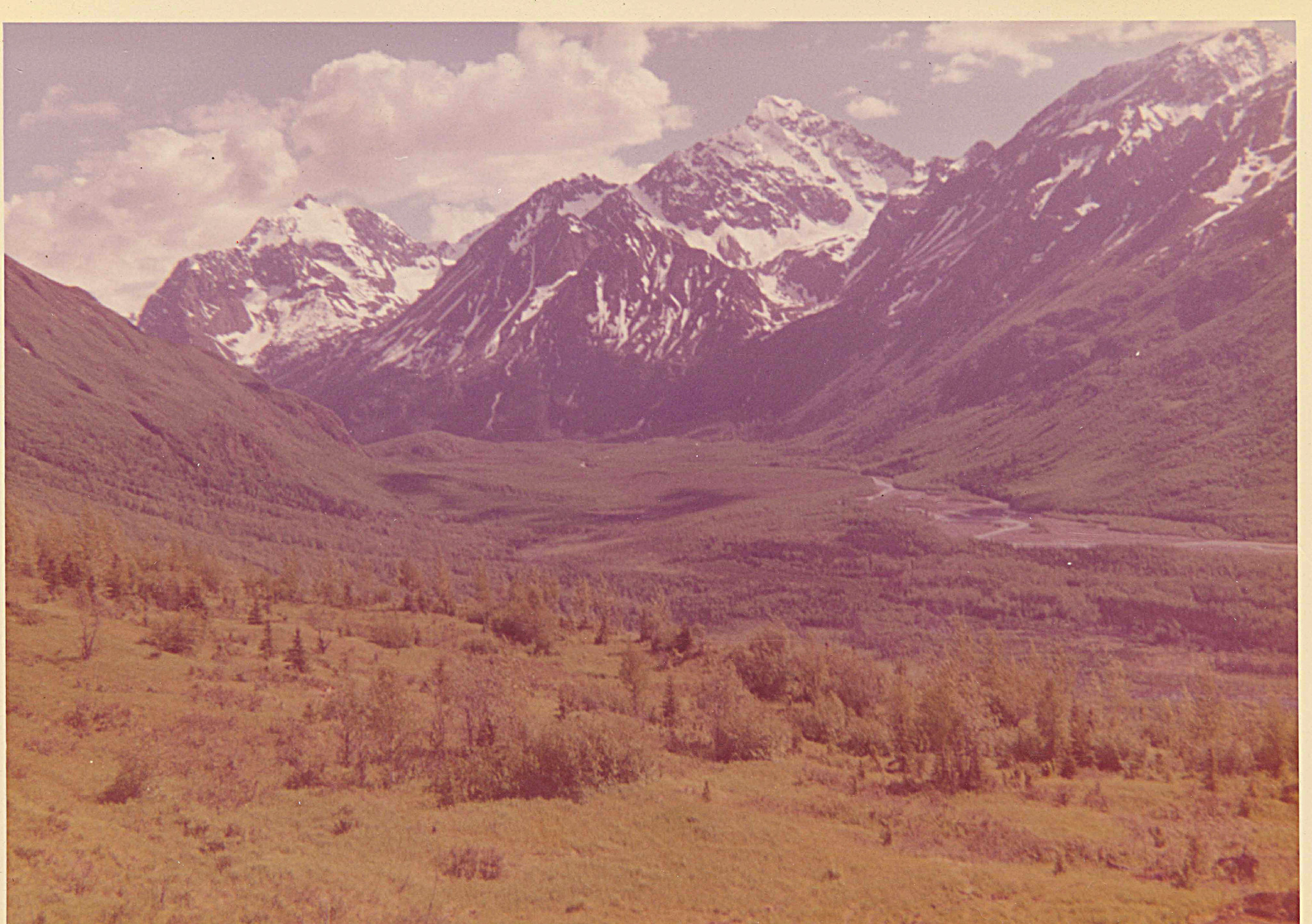
Well, I humbly must admit that I have to wonder how it could have taken me all the way through time to my 59th birthday to reconnect to something I so absolutely knew as a child on that mountain I had no question.  I will try to scan in a photograph that my sister just sent to me that will (again, and hopefully more clearly) introduce you to the Angel on the Mountain that was my closest friend and companion during my abusive childhood.

(Give me a moment here.  I have to dig through this pile of photographs for the one I am thinking of.)

I first met this angel when I was 7.  She was more real to me than anything else in my life, and she was my Companion and my Comfort.

This angel was a Presence in my life. There was in feeling no distance between us. While I could see her visually across the valley and over there perched on her mountain peak, I felt bonded to her.

This angel heard everything I ever said to her, but mostly in my misery I had no words, yet I knew she ALWAYS knew exactly who I was and what I felt.  I knew she always watched over me and never left ‘my side’ — and never would.

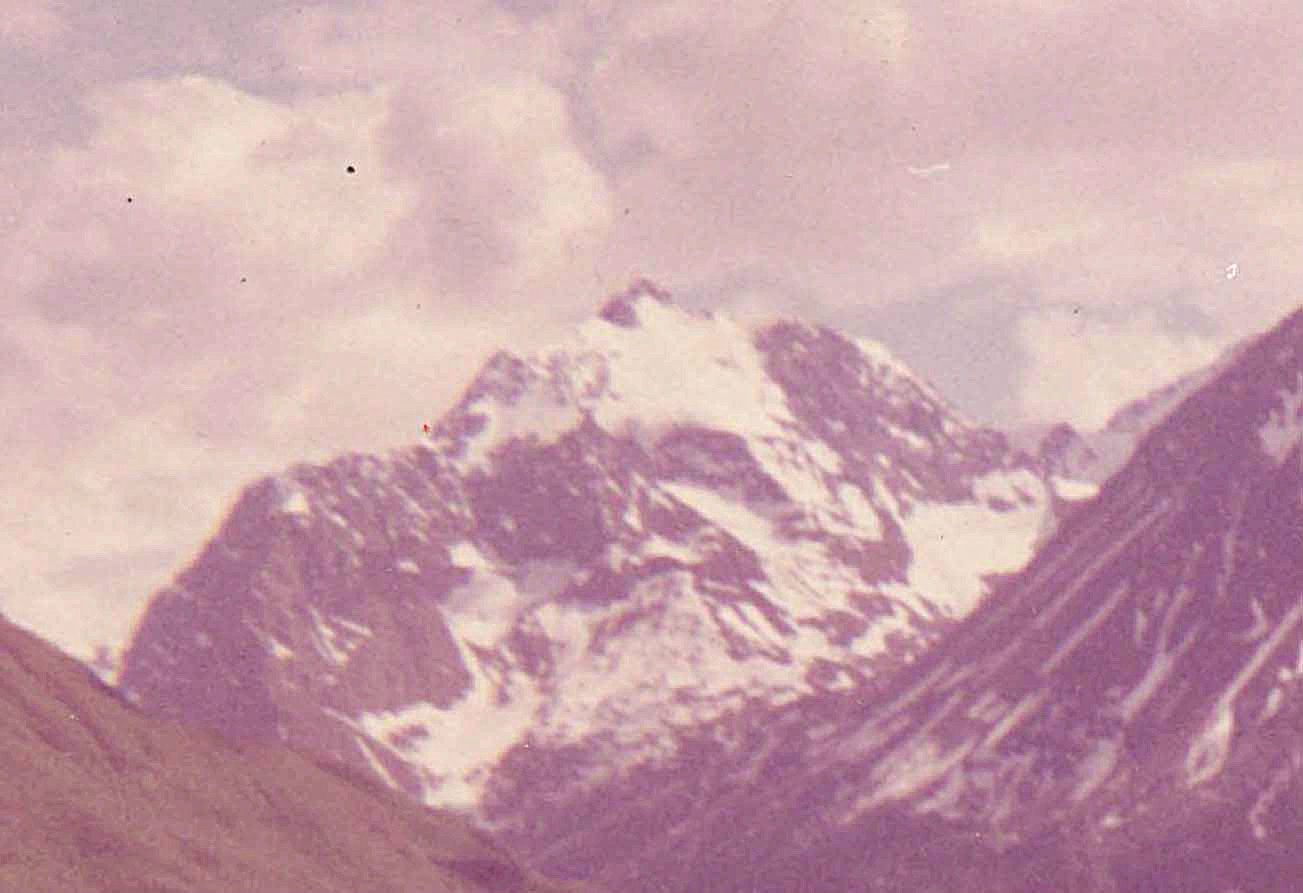
I hope you can detect her up there.  In my senses she was alive — and every time I looked up at her I was in a different spot, never exactly in the same one twice, so her shape changed subtly with my movements as if she, too, could move — though of course I never THOUGHT about these things.

I can look at this photograph my mother took probably in 1959 and there on the left in the back, at the end of the mountain range across from our Alaskan homestead where this picture was taken, I can see that angel up there as clear as day!

Her head is turned slightly to her right, and as a child I knew without ever thinking of it that she was looking at me, that she could see me just as clearly as I could see her.  Her wings spread out to her left and right, her dress cascades down the mountaintop below her.  In the summer she appeared as she does here.  In the winter she donned her winter dress, her halo turned whiter and her wings grew in vastness along the top of the mountain’s crest.

++

Yesterday as I loudly heard the words of Stevie’s song, “I blame the angels,” it was like a veil was torn away that has kept me from feeling the presence of angels like I was able to with THAT Angel on the Mountain when I was small and so terribly hurting.  I never knew I created that veil after I ‘grew up’.  In fact, I have shrouded my entire feeling experience of my childhood under this same (or similar) veils.

These veils, or shrouds, have buffered me from the emotional memory reality of my childhood suffering, as well as from most of the dissociated specific facts of my childhood memories.  I had to not only endure and survive my childhood, I ALSO had to endure and survive my adulthood!

Part of how I did that was to cast over my first 18 years of life a sort of cloak that not so much made it invisible as it did dim and obscure it from my awareness as I made my childhood so out-of-focus and obscure (like having a blindness, a terrible ‘vision’) that I could direct my attention elsewhere (at my adulthood).

++++

The way my thinking works, all of this I am writing about seems closely connected to an experience I had within hours after my double mastectomy surgery in December of 2007.  Nobody had told me prior to surgery what they told me afterward, and perhaps in part because of this I experienced the following:

I was given IV morphine for the first 20 or so hours after surgery.  During that time I did one very important activity — I stretched!  I sat up in bed, raised my arms as high over my head as I possibly could, and I stretched.  I continued to move my arms in this wide stretch in all directions — yes as I think of it, not unlike a butterfly might stretch its wings when it first exits its cocoon (or a new angel).  And as I instinctively performed this stretch without thought or intention, I could hear and feel (though there was no pain) a strange ripping, crackling, snapping inside my shoulders, across my chest and back.

I thought nothing of this until hours later when the surgeon stopped into my room and mentioned that many women experience a limitation in their range of motion due to this surgery.  As she verbally described what this limitation would be like I naturally raised my arms and searched for this limitation within myself.

It wasn’t there.

I had broken through whatever that kind of limitation could have been even before anyone had told me of its possible existence.

I mention this now because in my thought connections I realize that I am again experiencing a related kind of ripping through limitation.  Whatever veil-shroud I naturally created to obscure the pain, horror and reality of my infant-childhood of trauma and abuse  — because I HAD to do it to survive my adulthood — ALSO numbed my ability to experience my ‘Angel Love’.

Some part of that veil was ripped away yesterday on my birthday as I jogged around listening to Stevie Nicks wake up and hone in her musical echos, my ‘angel senses’.

++++

I realize now as I write that I am tired of words.  As a child, back there within that veiled and shrouded world of trauma and trouble, I had very little use for words, and I certainly did not use them to think with.  I was fully capable of thinking without words.  In that state of being, I could simply BE with that angel, a fact that at this moment helps me know a broader sense of Shakespeare’s statement, “To be or not to be.  That is the question.”

That is not an itty bitty personalized reality.  It is as big as the creation all of us are a part of.  I know myself well enough now to know I don’t think in terms of ‘faith’, and not even in terms of ‘belief’, either.

I didn’t have ‘faith’ in my intimate interrelationship with that Angel on the Mountain.  I didn’t have ‘belief’ in her unending and absolute love for me.  Both she and I were simply BE-ING.  We existed.  We were.

As I continue to stumble forward at this moment in my world of words I also know now that I can thank the fact that our family had no indoor bathroom for much of the assistance I received from my relationship with the presence of that Angel.  Sooner or later, no matter what punishment my mother was at the moment engaged in regarding me, I had to use the outhouse.

Those moments I walked out the door of our strange canvas-covered abode into the open air of the wilderness I was both in those moments NOT in my mother’s presence at the same time I WAS in the presence of that Angel as if she and I existed together in an entirely different universe than the one my mother existed in.

Most of my childhood my beaten body and my broken heart bled tears.  During the brief intermissions in abuse created by my having to go outside the ‘house’ into the air of wilderness freedom I was automatically blessed by the presence of that ever-present Angel on the Mountain who I understood without question knew everything about me and compassionately cared.

++++

Yesterday I was reawakened to what that feels like not only to be so loved by an Angel but to be able to receive that love as naturally as I receive air.  THAT angel was situated on THAT mountaintop and never left it (although her love felt like a physical presence as she expanded herself all the way across that valley to wrap me in it).  What I received for my birthday gift yesterday is not only the reawakened sense and knowledge of what that love FEELS like, but also the knowledge that there are angels EVERYWHERE that are all full of that same love for humanity.

I have no desire to complicate this gift with thoughts about ‘proof’ or ‘religion’.  These angels seem to be as much a part of this creation I am a part of as everything else is.  They simply ‘BE’.  I have greatly missed knowing this.  No matter what else I have had to ‘forget’ about my childhood, I will forget the existence and presence of these loving, compassionate, caring angels no more — hopefully forever.

(I swear!  I feel as though I am walking through ANGEL SOUP now and they don’t mind a bit!)

(The song lyric is from Stevie Nicks’ song “Wild Heart,” and literally is “Blame it on the angels.”)

++++

CLICK HERE – TALKING ABOUT THE POWER OF LOVE

++++++++++++++++++++++++