+THE TRAGEDIES OF TRAUMA TOPPLING US LIKE DOMINOES ON DOWN THE GENERATIONS

+++++

I have been thinking about personality disorders today.  One of our homesteading neighbors just sent me a copy of the 1982 letter she wrote to my mother to ‘disown’ her as a friend because my mother had grown so abusive toward her and her husband.  My mother’s life was such a tragedy.  My mother, in turn, caused me the loss of my own best self and my own best life.  Yet I haven’t been able to write today — and now I am thinking of another woman, another best life lost, and another……

Sometimes I can only observe — all of it — feeling more like an historian without any answers, seeing only the causes…….and feeling so helpless.

++++

I wish I could think of something light and upbeat to write about tonight, but I cannot.  Better perhaps not to write at all?

I am thinking of a woman I passed by as I left the grocery store an hour ago, having just spent a careful hour shopping for the best buys I could find to make it through the next 30 days without spending more than my $150 food budget for the month I spent tonight.  I included some things to do a little Christmas gift baking.  I want to make the cut-out, colorfully decorated tiny cinnamon cookie people I haven’t made for nearly 20 years.

This woman was standing beside the store’s DVD kiosk with two other women I didn’t know.  I wasn’t even sure this woman was the woman I thought it was until I heard her speak.  She has gained a lot of weight since I saw her last – actually except for one very brief passing, it has been about 3 ½ years.

“I should sell my house and take my accordion and go on a long cruise,” I could hear her saying as I passed by with my cart.  The other two women she was with were busy selecting their movie and didn’t appear to be listening to her at all.  “I’m not in good shape.  I’m not doing well at all.”

I tried to be friends with this woman when I first met her about six years ago.  It didn’t work.  She consumes people’s energy and attention in a continual flurry of drama that exhausts everyone who knows her (I suspect Histrionic Personality Disorder).  About three years ago she sold her big house in our little town and made enough money from the sale to buy another big house in the country, on some land about 35 miles away.  I was surprised to see her at the store tonight, after dark, a long way from home.

Leaving town and living in the country.  I remember that phase when it hit her.  Everything was going to be better then.  That’s all she needed, to get away from all the town people, to be in the quiet, to do her art, play piano, play accordion, garden.  Living in a peaceful place, that would be better she had told everyone.  I have always wondered how she would survive without having an audience to feed upon.  Would she find a new one?

I briefly thought about stopping on my way out of the store to greet her.  A quick thought as I continued on my way past her out the door.  I didn’t dare stop.  It would not be good for me.  I would be overwhelmed.  Being anywhere around this woman is so complicated….

Yet I know about her past.  I know about the years of sexual abuse she suffered as a little girl.  Her father’s best friend, her babysitter’s husband.  Pillar of the church.  Nobody heard the little girl.  Nobody believed her.  It destroyed her.  It destroyed her life.  It still does.

This woman no longer uses drugs, which she did heavily during all the years she raised her children.  The children did not turn out well.  No surprise.  Nearly a year ago her drug using, drug dealing daughter’s drug using, drug dealing son was shot to death along with his friend.  The trial for the shooter just ended here a week ago.  He was acquitted.

I heard about the outcome for the trial from my friends while we ate quiche at the laundromat yesterday.  I was told my (laundromat) friend’s son has known the shooter for a long time and used to buy his winter’s supply of firewood from him.  One time while picking up what was the last load of wood my friend’s son would ever buy from this man, he watched him grab his rifle that was standing beside his front door and shoot an alien he saw outside his living room window.  He shot through the glass.  Everyone local knows this guy is absolutely loopy, but nobody asked at the trial, and nobody could say.

Nobody was there that dark night in the desert to witness when the woman I passed by at the store tonight lost her 20-year-old grandson to his early and violent death not far from his grandmother’s country home.  I think of my own daughter who just found out last Wednesday that she is carrying a boy – my first grandchild.

I can’t go there in my thinking……

There are so many, many places I cannot go in my thinking.  So many, many things I cannot afford to do because of the damage that was done to me through my own history of severe infant-child abuse.  I could not afford to stop and offer my love to this grieving grandmother, this woman I once tried to befriend.  I can only write this much, and no more.

++++++++++++++++++++++++++++++

Please feel free to comment directly at the end of this post or on

+++++++

Your Page – Readers’ Responses

++++++++++++++++++++++++++++++++

+SURVIVE OR DIE — DISSOCIATION AND THE ORCHID

+++++++

I have heard about endangered species, but until this moment I have not thought in terms of imperiled ones.  I am not certain that this orchid is the one I heard a story about today or not, but I think it is:

Spiranthes delitescens


Family: Orchidaceae  (Orchid Family)
Common Names: Canelo Hills ladie’s tresses, Madrean ladies tresses, Madrean ladies’s tresses

This imperiled plant evidently has a primary custodian:  Desert Botanical Garden

PETITION TO LIST THE

CANELO HILLS LADIES’ TRESSES

Spiranthes delitescens

AS A FEDERALLY ENDANGERED SPECIES

This orchid is also called a ‘sensitive species’

One of the four locations in Arizona where this plant is known to exist is in the mountains of Cochise County near where I live.  Until today I did not know there are native Arizona orchids, so of course I did not know that the very existence of these orchids depends on their relationship to fungi.  The seeds of these Ladies Tresses orchids have no food within them as most seeds do.  Without the fungi to open up the seeds, the plants cannot be born.

And I certainly did not know that there are rare native orchids in the Arizona mountains that bloom underneath the ground.

++++

When I walked away crying from writing this morning’s post, I knew I had reached a very tender place within myself not far from the deep wounds I carry from 18 years of infant-child abuse I experienced from my mother.  I knew I had to be gentle and kind to myself and I knew it was time to come up for air.

So I met my friend at the local laundromat where she was washing her clothes and we sat visiting, eating quiche made there at the small café.  My friend told me the story of how a friend of hers went with one of the professors from our small local college on an extremely difficult hike into the nearby mountains looking for buried orchids that bloom underground.

According to my friend, her friend experienced one of the most memorable moments in her life when she was shown exactly where and how to dig to unearth these orchids.   The story says the orchids were the color of copper.  I didn’t know copper orchids existed, either.

++++

Is an orchid a fragile or a hardy plant?  I certainly do not know.  But evidently these Arizona orchids are at risk because the environment they have always lived in is changing around them in ways to which they might not be able to continue to adapt to.  If they cannot change with the changes happening to their world, they will all die out and become extinct.  (Of course this reminds me of tiny infant-children who have to change and adapt within the malevolent environments of trauma they are developing within, or die.)

I have a personal memory concerning orchids.  Not real live ones, just a memory of my version of the essence of how orchids and raising orchids seems to me.  I think about how we grow up through our early childhood to the point where we begin to have a self that begins to be aware of itself in a body in its life so that it can increasingly have the experience of itself experiencing itself having experiences.  This is similar to how I experience my own experience of the essence of orchids, even though in childhood I had no experience of myself experiencing experience at all.

++++

In 1983 when I left my children with my husband and moved to a town 130 miles away to go through an intensive outpatient treatment program for severe child abuse and trauma survivors, I went through a session one day with the primary therapist who owned this treatment center.  Steve formed a circle with 15 chairs in the middle of the large room that was used for group therapy sessions.  He and I were there alone.  Steve asked me to look into myself and experience as many different versions of myself as I felt safe in doing.

Each time I identified a different version of Linda, I moved to another chair in this circle, sat in it, and allowed that version of me to begin to describe its/my experience.  At one point I found myself as Captain Nemo.  Nemo was a silent, remote, seemingly detached gentleman who shared himself only with the hundreds of varieties of orchids he carefully tended as a hobby when either on land and in his submarine under the sea.  As Nemo began to speak, I learned when Nemo first appeared within me as I learned about his love for orchids.

Every time in the past 26 years since that day when I have had an encounter with orchids I have thought about that therapy session and Captain Nemo.  But never until today did I ever have the image of what it might be like to climb through rocks along a steep and difficult mountain trail until I found a special place on earth where I might dig down and find a sensitive, imperiled, endangered copper orchid in full bloom underneath the ground.

++++

See:  Personal Checklist of the Wild Orchids of North America, north of Mexico

File Format: PDF/Adobe Acrobat – Quick View
North American Native Orchid Journal. June 2007. Revised September 2009 …. Arizona crested coralroot. Hexalectris warnockii. Texas purple-spike forma flavida … copper ladies’-tresses….}

+++++++

Please feel free to comment directly at the end of this post or on

+++++++

Your Page – Readers’ Responses

++++++++++++++++++++++++++++++++

+WHEN OUR TEARS TAKE AWAY OUR WORDS – WHAT IS THE TRUTH ABOUT OUR TRAUMAS?

+++++++++++++++++++++++++++++++++++

By the end of this post I cannot write my way through my tears…..

+++++++++++++++++++++++++++++++++++

I decided to take a look today at this book, hoping to find within it some new information that will give me some new insights about how to ‘recover’ from the effects of the 18 years of chronic trauma I experienced from birth and throughout the survivorhood that was supposed to be my childhood.

The Trauma Spectrum: Hidden Wounds and Human Resiliency by Robert C. Scaer (Hardcover – Jul 17, 2005)

Yet, here again, in spite of Scaer’s many years of experience in treating trauma survivors, in spite of his careful writing based on meticulous research, this book does not truly address my condition.  He misses the fundamental fact that those of us who suffered overwhelming trauma while our body-brain-mind-self was passing through our early critical-window growth and developmental stages have been deprived of the most basic human right possible – the right to live our lives in a body that has not been permanently changed by having trauma built right in to it.

Because I live in a trauma formed body, I have NEVER had a body that did not include these trauma adaptation responses in it.  I do not have the luxury, therefore, to return to any pretrauma state.  Well, I do have to make an important distinction here.  Because the full development of my mother’s mental psychosis did not originate until the time she was actually birthing me, the conditions my body formed in while she was pregnant with me were benign and adequate.  Without at least having had those nine months of untraumatized development, I most certainly would not be alive today.

++++

Except for the critical 9-month reprieve from developmental trauma that I had the luxury of experiencing within my mother’s womb, all the rest of my development occurred in a malevolent environment of trauma.  I now know enough about myself and those like me to understand that everything in Scaer’s book is missing the mark about how trauma ‘facts’ apply to me.

Very few researchers are ready yet to look our situation square in the face.  They treat our reality as if they were trying to consider what a full eclipse of the sun looks like.  We cannot look unaided at an eclipse without suffering permanent visual damage.  Researchers are evidently unprepared to look at our situation without suffering damage to their own vision of what life is SUPPOSED to be like in regard to the impact that trauma truly has on the most powerless and helpless humans on earth – infants and very young children.

++++

I am sorry, but I just cannot find it within me to get too excited about or to feel too hopeful because Scaer starts his book by paying passing lip service to the reality of Trauma Altered Development (TSD) when he writes on page 12:

The nature versus nurture, genes versus experience dilemma is especially important in the field of development of the brain and behavior.  Many mental illnesses and behavioral and personality traits are considered to be primarily genetic in nature.  In fact, genes are routinely activated or “switched on” by experience, often only during a window of opportunity in early infancy.  The long-term effects of early life experience on behavior throughout the lifespan must be considered when diagnosing and treating behavioral disorders, especially when considering the perplexing tendency for victims of trauma to repeat behavior closely associated with prior life trauma.”

HOGWASH!   This is just another example of ‘sinking Titanic’ Dark Age thinking.  Yes, “genes are routinely activated or “switched on” by experience” but there’s nothing ‘often’ about this process.  It occurs on the most fundamental level in a continual process during our early infant-child growth and development – it is HOW we get made!  The experiences we have with our early caregivers, either in a safe and secure attachment relationship or not, set in motion all the physiological, biological adaptations to our benevolent or malevolent environment that determine the creation of the body we will live in and with for the rest of our lives.

Those of us forced to endure overwhelming trauma during these ‘windows of opportunity’ in early infancy (and early childhood) that Scaer mentions in passing so change us that we do not belong to the ‘ordinary’ group the rest of his book is designed to help.  I am left, again, with a mind full of ‘yes, but…..’ – WHAT ABOUT THE REST OF US?

If overwhelming traumatic experiences build us in the first place, we absolutely have no chance to EVER ‘return’ to a pretrauma state.  Very few researchers and clinicians seem to get this critical point.

(see an example of an exception: The Boy Who Was Raised as a Dog: And Other Stories from a Child Psychiatrist’s Notebook Child Psychiatrist’s Notebook–What Traumatized Children Can Teach Us About Loss, Love, and Healing by Bruce Perry and Maia Szalavitz (Paperback – Dec 24, 2007) )

How do I begin to pick my way through the rubble of thinking that is contained in books like Scaer’s so that I can learn SOMETHING useful about the impact of trauma and hoped-for so-called ‘recovery’ from its effects when I know from the start that this author has no clue about how Trauma Altered Development has changed me?  Filtering what Scaer is saying about trauma through my own body-brain-mind-self that was built through my own experiences of overwhelming trauma from the moment I was born and for the next 18 years of my life is a daunting task.  I have to translate and transform his thinking one word, one concept, one ‘lesson’ at a time.

Scaer’s book would be dense and difficult to read even if I knew ahead of time that he knew what he was talking about as his information applies to me.  Knowing ahead of time that he doesn’t have the remotest clue about who and how I am in the world leaves me ONLY with my own desire to better understand the fundamental nature of trauma as it impacts human beings.  I cannot hope or trust that this author has prepared a pathway for me to travel through this information he considers himself enough of an expert to present.

I have to rely upon my own desire for knowledge and understanding about how the trauma that happened to me changed me from the first breath I took on this earth if I am ever going to be able to achieve any healing.  I refuse to accept my assigned status of being a casualty of a war I was born into as I was forced to fight to stay alive and continue my development with every possible human resiliency factor I had in my little, tiny body.

I find myself at this moment up against my own tears that spring from the deepest levels of who I am as I seek to help all of us who were forced to change on our cellular levels in order to remain alive against all odds.  We were terribly, terribly hurt and we remained alive.  Where are the words that we can use to begin to understand what these hurts did to us?  If the trauma experts cannot even find and use these words accurately, how can I?  How can we begin to articulate what our body knows on its most profound levels about the reality of the power trauma has to impact human beings and to forever change us?

How do we begin to translate our experience and transform our tears directly into words?  I have to get back to you on that.  Right now my tears are taking my words away.  I doubt that’s a problem trauma experts like Scaer ever have to face.

++++++++++++++++++++++++++++++++++++++++

Please feel free to comment directly at the end of this post or on

+++++++

Your Page – Readers’ Responses

++++++++++++++++++++++++++++++++

+PTSD AND SEVERE ABUSE SURVIVORSHIP – PART THREE

+++++++++++++++++++++++++++++++++

I find that the only standard I can consistently depend upon in my considerations about what constitutes malevolent treatment versus adequate, benevolent treatment lies within the context of the United Nations Universal Declaration of the Human Rights of Children.  Safe, secure, appropriate and adequate early care that leads to an infant-child’s optimal development lies on a continuum at the opposite end from early malevolent conditions that present nearly a constant challenge and threat to survival itself.

The basic needs of children are defined in this Declaration.  In looking at my own history of survivorhood (I was never allowed to be a child, and therefore I no longer consider that I had a childhood at all) it is clear to me that every one of my rights as an infant-child were violated.  It was in that malevolent environment of deprivation that I was exposed to the degrees of trauma that were severe enough to create within the physiology of my body Trauma Altered Development (TAD).

From my earliest beginnings as a being physically separate from my mother was suffered from a lack of safe and secure attachment.  Deprived of that most fundamental resiliency factor, my body-brain-mind-self had to do the best that I could do to continue to grow and develop within that terrible environment that threatened my very existence.

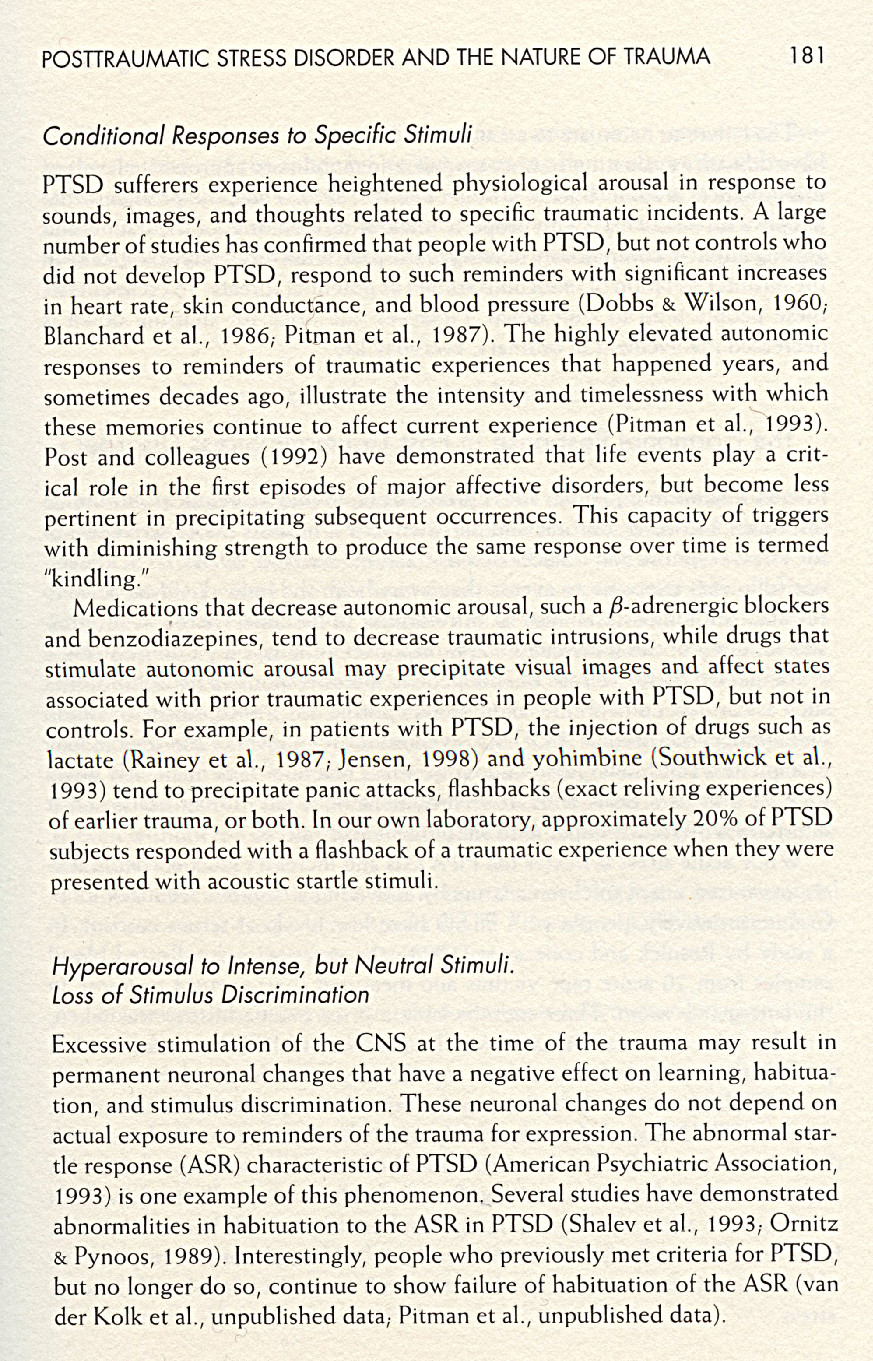
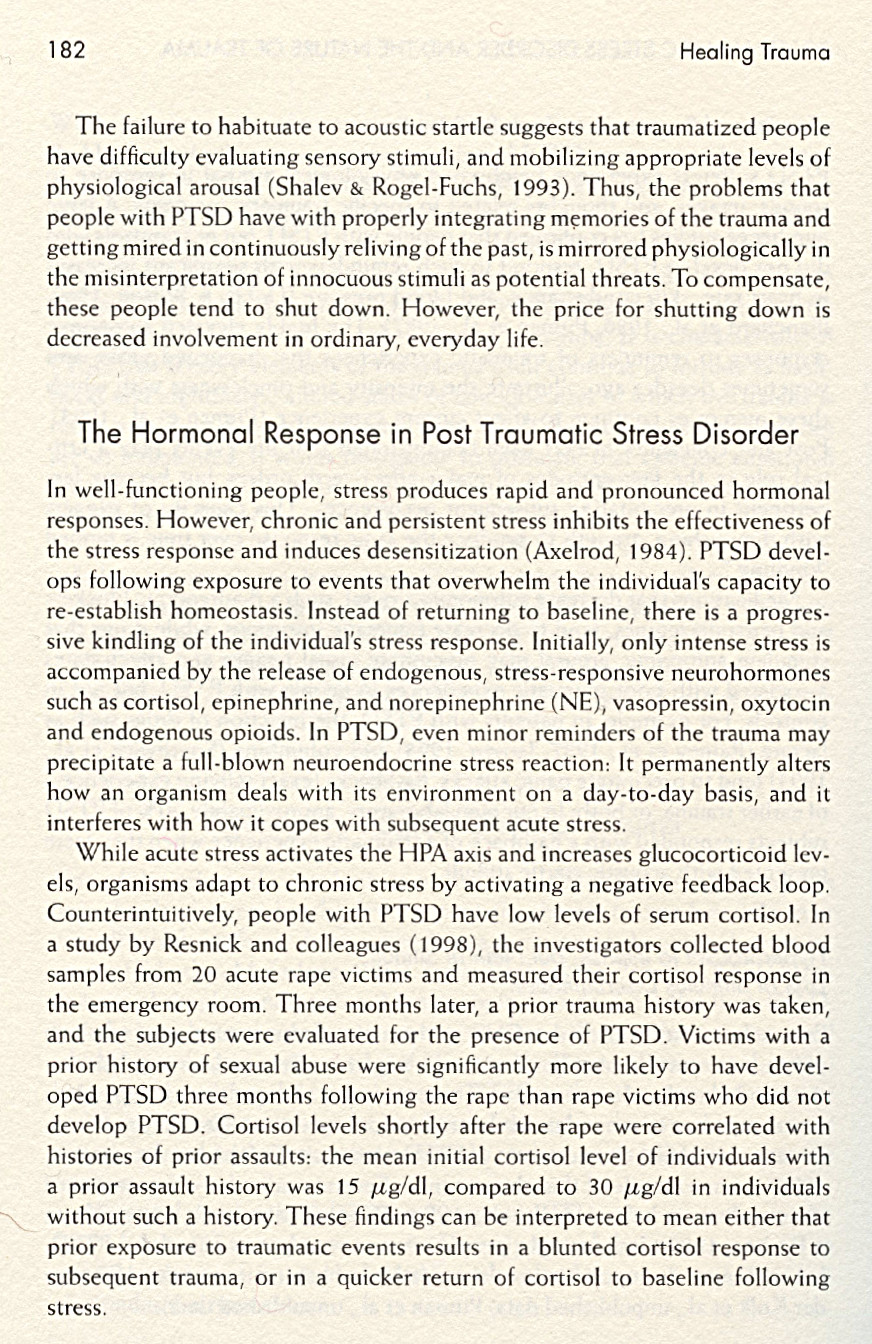
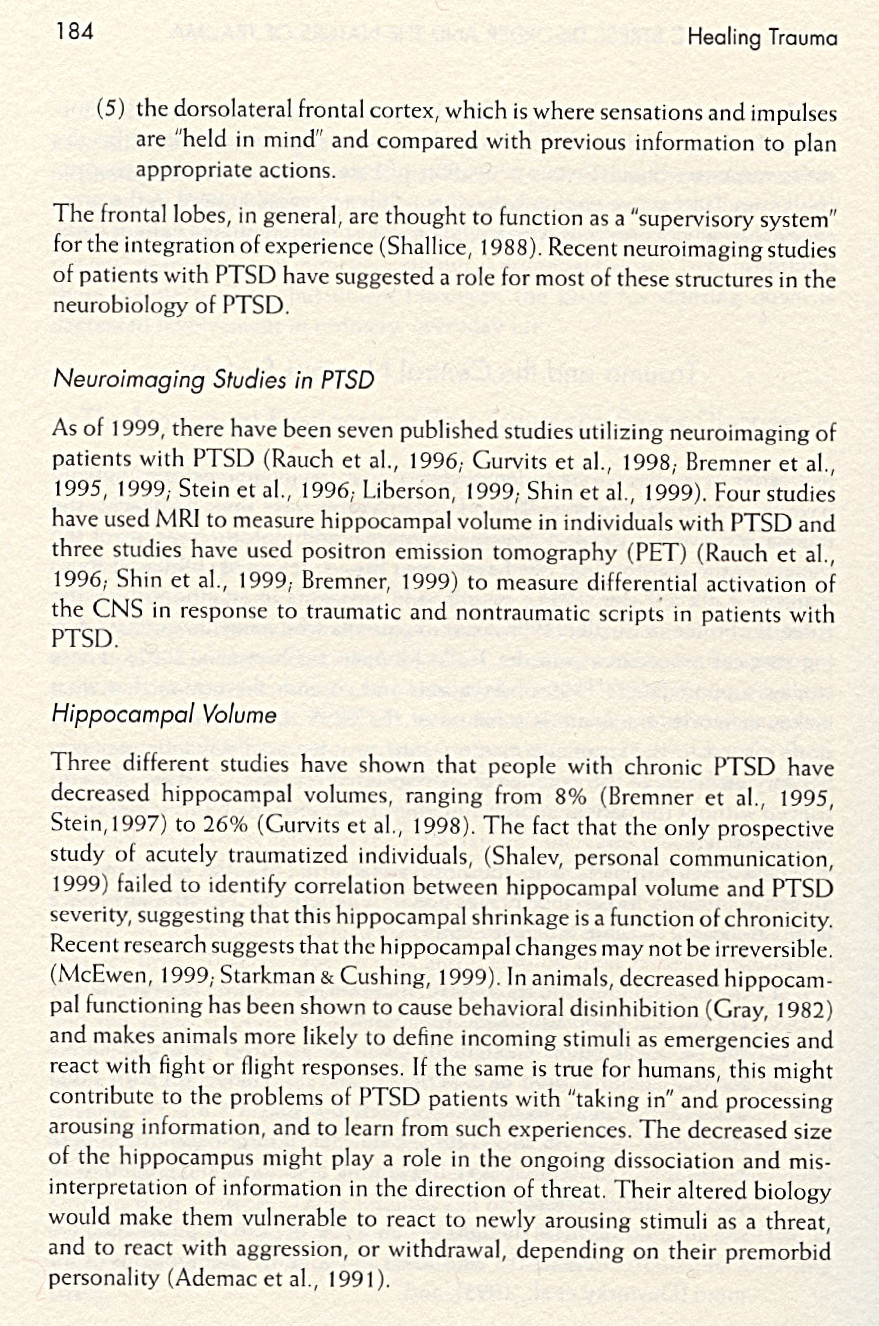
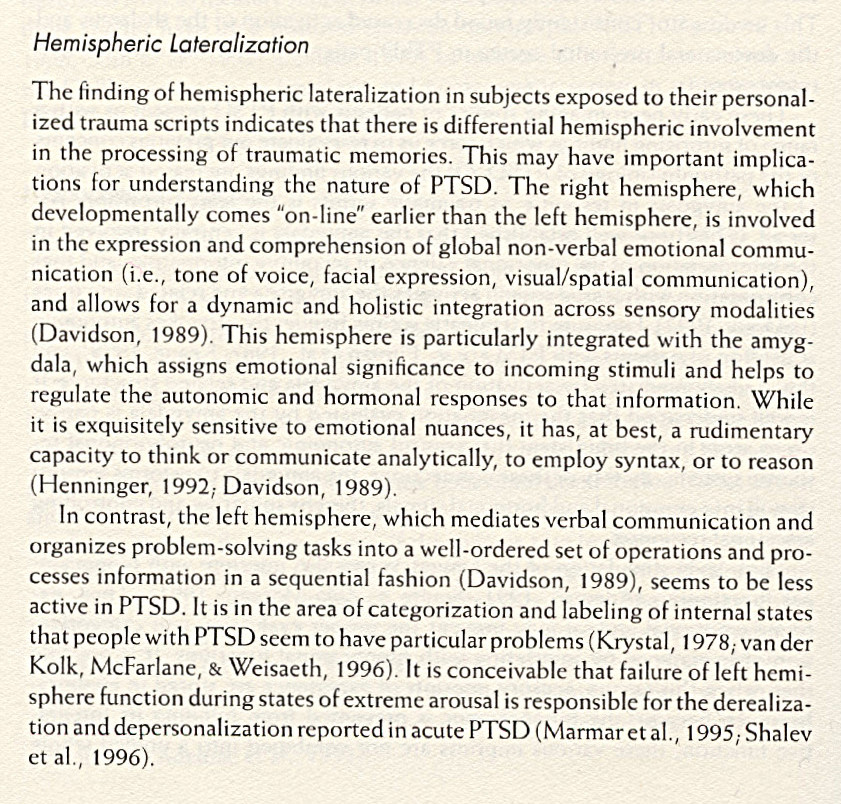
This third post on the topic again continues an exploration of how TAD changes an infant-child abuse survivor’s reaction to ALL trauma.   Van der Kolk writes about posttraumatic stress disorder (PTSD) in the book, Healing Trauma: Attachment, Mind, Body, and Brain – Hardcover (Jan 2003, W.W. Norton and Co.) by Daniel J. Siegel, Marion F. Solomon, and Marion Solomon, chapter 4 (pages 168-195) written by Bessel A. van der Kolk:  “Posttraumatic Stress Disorder and The Nature of Trauma.”

++++

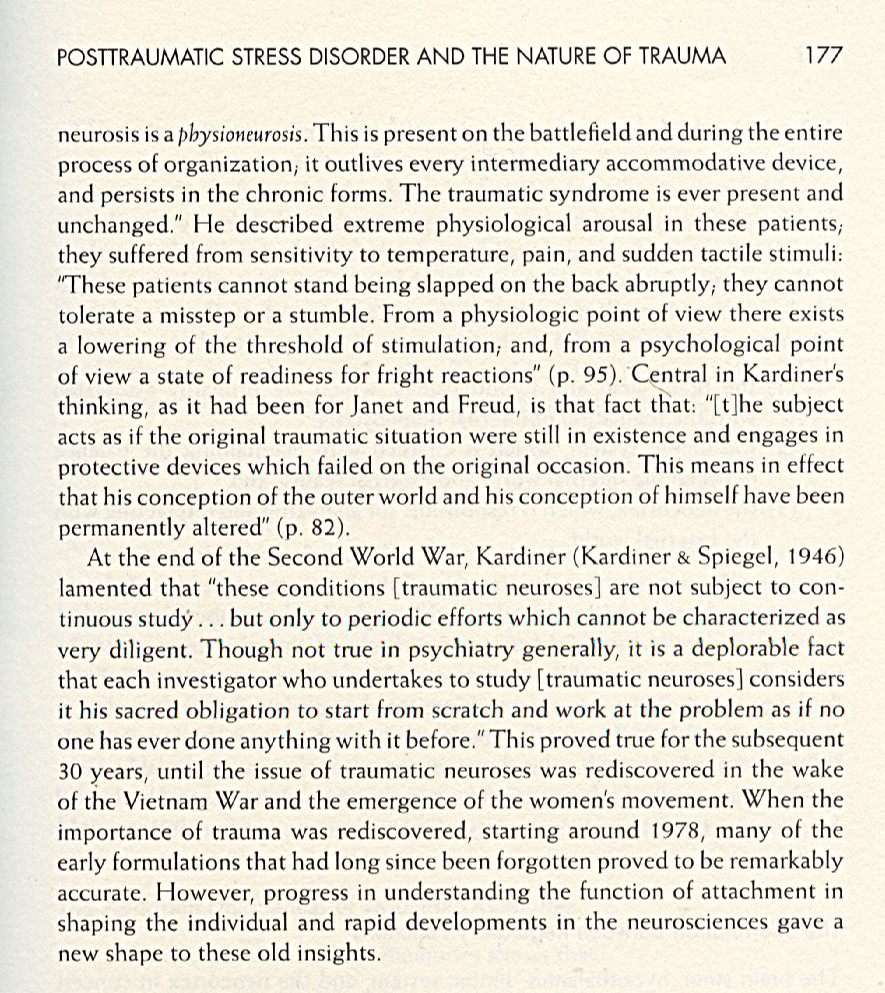
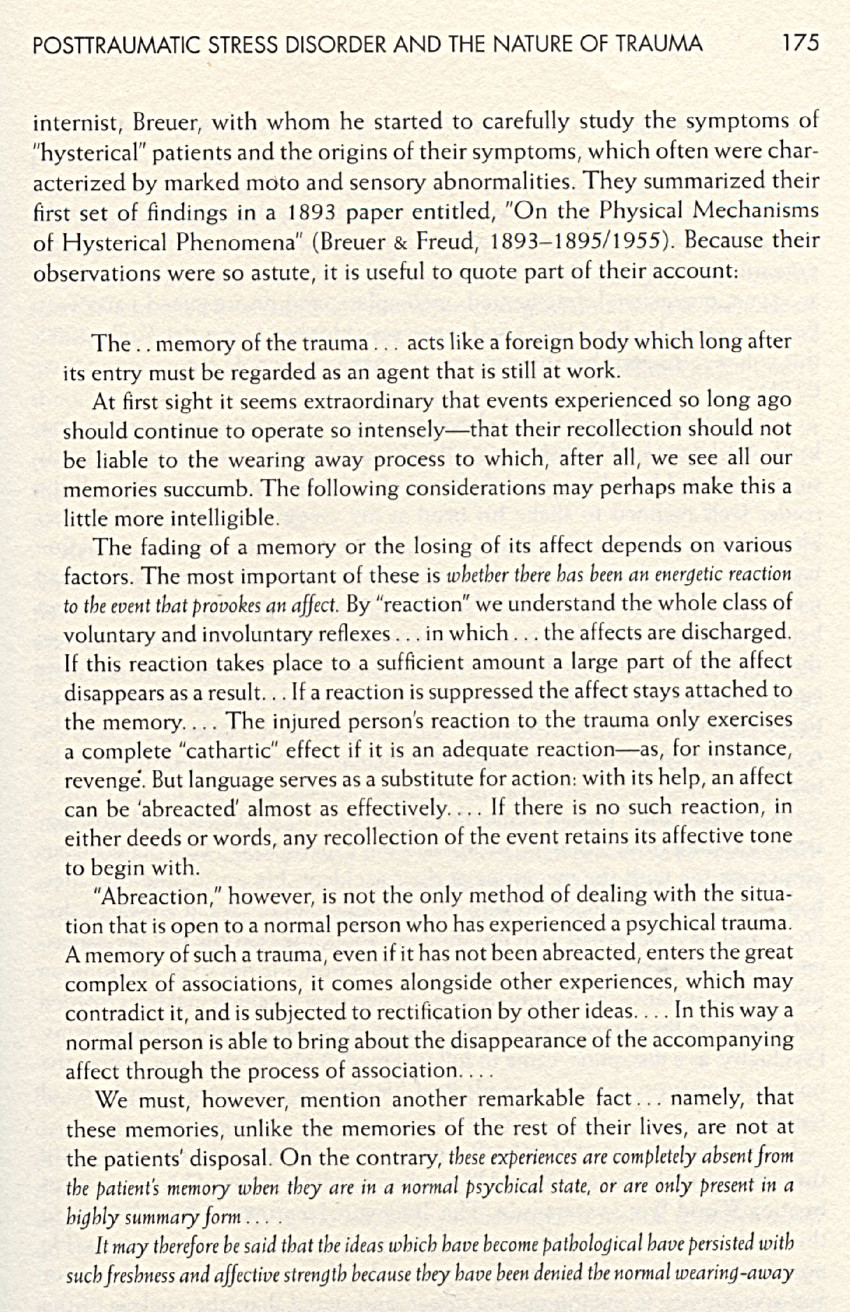
I begin writing today by considering the last sentence of the scanned book pages that were posted on November 30, 2009:

“….progress in understanding the function of attachment in shaping the individual and rapid developments in the neurosciences gave a new shape to these old insights [about the importance of trauma].”  (page 177)

++++

Van der Kolk next considers “The Psychobiology of Trauma” in his writing:

Modern research has come to elucidate the degree to which PTSD is, indeed, a “physioneurosis,” a mental disorder based on the persistence of biological emergency responses.”  (page 177)

In my thinking, naming PTSD ‘a mental disorder’ ignores the overwhelming evidence that the entire human body is included in the ‘persistence of biological emergency responses’ that the author is talking about.  From my point of view, it is the consideration of how severe infant-child maltreatment and abuse changes the development of the ENTIRE BODY of the little one that matters to those of us who survived this degree of early trauma.

‘Biological emergency responses’ BUILT our bodies.  These responses signaled our DNA how to express itself.  These responses signaled our developing nervous system and brain on all levels about how to adapt to trauma.  Our developing nervous system was also intimately involved in these responses as it formed, also.  It is at this most basic, profound level of our physiological development from our beginnings that we have to understand how our development changed in ways that a non-TAD ‘ordinary’ body did not.

The adaptive changes that happened to us took place on far, far deeper levels than just the level of mind.  Mind is simply the topmost layer of our existence that I see as being related to our body as smoke is to fire.  I do not have a ‘mental disorder’.  My entire being is ordered in a very particular way in accordance with what surviving my infant-child trauma required.

It is this Trauma Altered Development that created my survival based, trauma centered ordering of my entire being that I seek to understand.  I am not convinced that van der Kolk has anything more than a passing surface notion of what these TAD changes actually ARE, how they affect us, or even if they legitimately belong to anything like a PTSD diagnostic category.

++++

Van der Kolk continues by saying:

To understand how trauma affects psychobiological activity, it is useful to briefly revisit some basic tenets of neurobiology.”

I do not like the term ‘psychobiological activity’ because it implies that anyone on the outside can ever have any accurate information about what another person’s ‘psyche’ is like.  That is why researchers try to more completely understand the human ability to form a Theory of Mind.  MIND belongs to each of us as individuals, and everyone has their own.  Nobody can ever come to understand what the subjective experience of MIND is like for another person.

‘Neurobiology’ is a different thing.  This is a realistic descriptive word that refers to a part of a person that can, within the current limitations of science, be understood and described because it is physically real on the molecular level.  But neurobiology is not the same thing as MIND.

Van der Kolk continues:

McLean (1990) defined the brain [my note:  The brain is a biological reality as part of our nervous system, from which an individual’s MIND originates.  Brain and MIND are not the same thing.] as a detecting, amplifying, and analyzing device for maintaining us in our internal and external environment.  These functions range from the visceral regulation of oxygen intake and temperature balance to the categorization of incoming information necessary for making complex, long-term decisions affecting both individual and social systems.  In the course of evolution, the human brain has developed three interdependent subanalyzers, each with different anatomical and neurochemical substrates:

(1)  the brain stem and hypothalamus, which are primarily associated with the regulation of internal homeostasis,

(2) the limbic system, which is charged with maintaining the balance between the internal world and external reality, and

(3) the neocortex, which is responsible for analyzing and interacting with the external world.

It is generally thought that the circuitry of the brain stem and hypothalamus is most innate and stable, that the limbic system contains both innate circuitry and circuitry modifiable by experience [my note:  This emotional area of the brain forms through early caregiver attachment interactions birth to age one, forming MUCH earlier than the neocortex], and that the structure of the neocortex is most affected by environmental input (Damasio, 1995).  If that is true, trauma would be expected to leave its most profound changes on neocortical functions, and least affect basic regulatory functions.  However, while this may be true for the ordinary stress response, trauma – stress that overwhelms the organism – seems to affect people over a wide range of biological functioning, involving a large variety of brain structures and neurotransmitter systems.”  (pages 177-178)

++++

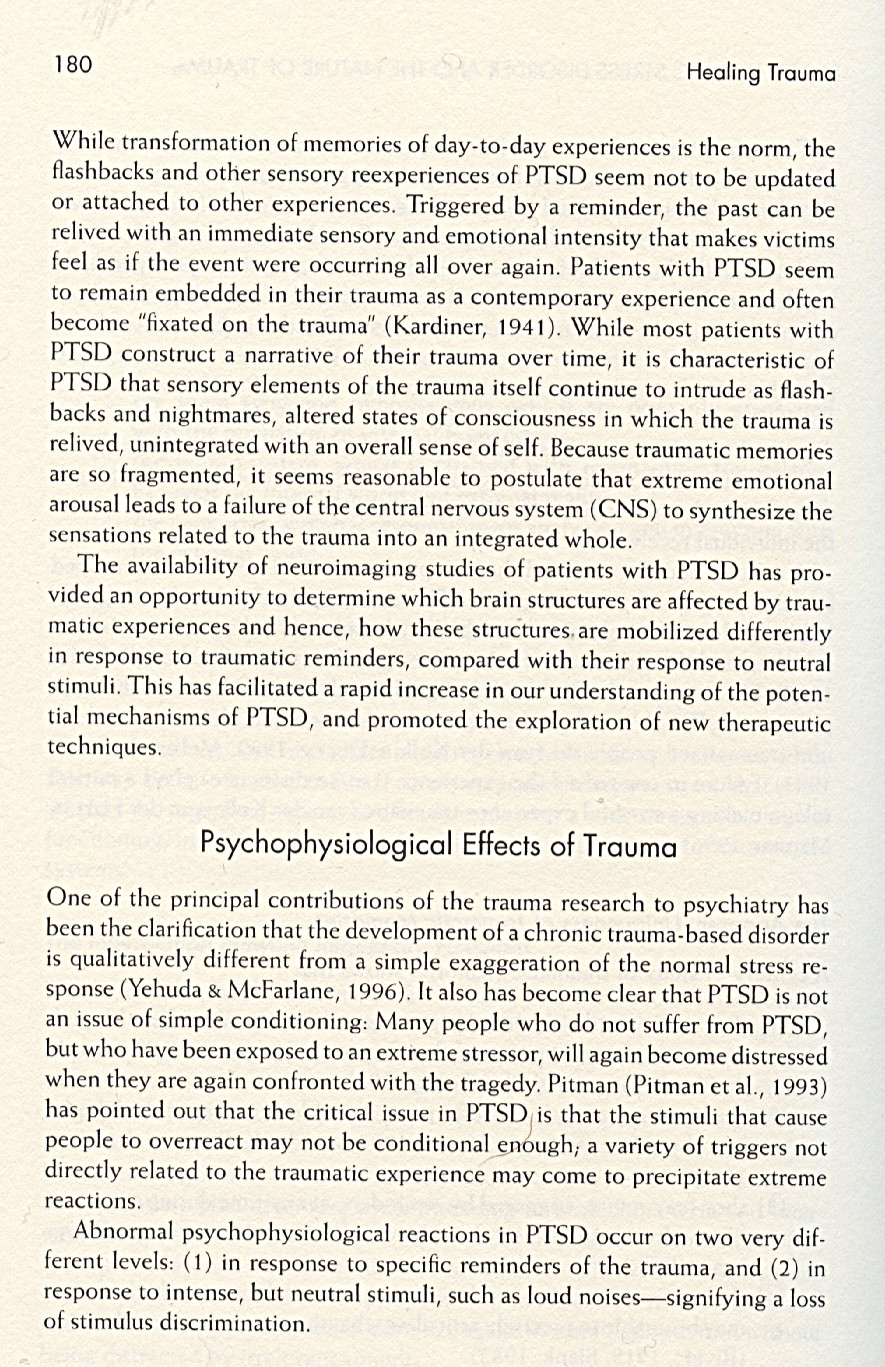
I am going to scan in the book pages that follow in van der Kolk’s description of how trauma affects people.  I believe his statement on the bottom half of page 190 is extremely important:

“…the development of a chronic trauma-based disorder is qualitatively different from a simple exaggeration of the normal stress response….”

We need to stretch that concept as far as we possibly can if we are going to understand how severe trauma from malevolent infant-child abuse and neglect changes our entire development – nothing about us is excluded.  Any possible aspect of our development that can adapt its development in order to help us endure and survive early trauma – does so.

Our problem comes when the reality of our early trauma is denied along with the depth, breadth and width of its impact on our development.  What may be true for a non trauma altered development person cannot be assumed to be true for us.  Yes, we know what the following descriptions of consequences FEELS like – but we also know that we never knew any other, different way of being in the world.

Due to the changed development we experienced as we survived our early severe traumas, anything that we might begin to understand now as being more like  ‘ordinary’ in our physical – and correspondingly in our mental — ability to experience our self in our body in our lifetime, will happen as we begin to understand how deeply trauma formed us in the first place so that we will NEVER experience trauma (or life) in the same way as will a person who did not experience Trauma Altered Development when they were little.

++++

The scanned pages below (from the book mentioned above!) is complicated information, but it is a place for us to truly begin to understand ourselves – the way were MADE in the severely abusive and trauma-filled environments we were formed in.

On page 184 van der Kolk notes that “PTSD patients” have problems

“…with “taking in” and processing arousing information, and to learn from such experiences.”

Sorry, but I am not a ‘PTSD patient’.  I am a 58-year-old woman who has suffered from an extra-ordinary body, altered in all its developmental stages in adaptation to trauma, that has never been able to ‘take in’ even ordinary information, let alone ‘arousing information’, or to ‘learn from’ the experiences of my life in an ordinary way.

What on earth do we expect to happen to little people who must continue to develop and survive even while they have little or no access to even their most basic Universal Human Rights?  Infant-child development IS ALTERED under these conditions.  It is time that we realize this is the most truly horrific consequence of early abuse and trauma.  We don’t get to experience ANYTHING the same way as non-early-traumatized people do – not even later traumas.

(note:  I believe in ‘degrees of damage’ – the 75% of our sub-par young adults in this country have suffered some degree of damage that has changed the course of their development away from optimal and BEST!  We cannot afford to ignore that fact – deprivation and violation of the Universal Human Rights of Children causes changes in the way their body and brain develop.  There is a very real, physiological process through which trauma and deprivation get passed on down the generations.  We know it is happening when we see the consequences in degrees of lack of well-being –- which are detectable no matter what our age.)

++++

(The following is from page 186 on left or right handedness and trauma)

++++++++++++++++++++++++++++++

This post follows:

from November 30, 2009 +PTSD AND SEVERE ABUSE SURVIVORSHIP – PART TWO

from November 28, 2009 +PTSD AND SEVERE CHILD ABUSE SURVIVORSHIP – PART ONE

+++++++++++++++++++++++

PLEASE NOTE:  Do not take anything I say as a reason to alter any ongoing treatment, therapy or medication you are receiving.  Consult with your provider if you find something in my writing that brings questions to your mind regarding your health and well-being.

++++++++++++++++++++++++++++++++

Please feel free to comment directly at the end of this post or on

+++++++

Your Page – Readers’ Responses

++++++++++++++++++++++++++++++++

+FANTASTIC PBS FREE ONLINE DOCUMENTARY ON THE EVOLUTION OF OUR UNIQUELY HUMAN MIND

++++++++++++++++++++++++++

This is a real treat, and FREE!

PBS Documentary – The Mind’s Big Bang – evolution of our mind – from the first time we made BEADS for personal ornamentation.  Cool!  We found decoration that reflected social relationships — tools, technology and social identity.  AND, we began to build on the knowledge of the older, wiser ones among us.

This film also clearly describes the development of Theory of Mind, which allows us to be — sneaky!  It talks about the evolution of language….two thirds of all our talking is about GOSSIP!

There’s a free toolbar you can download that open’s up a universe!!

NOTE:  The theory of Mind developmental stage that is formed between ages 4 – 5 is where I believe my mother’s Borderline mind went permanently astray!  Also, you can do other things on your computer as this documentary plays if you want to!  What a deal!  Be sure to control the size of the image by clicking that little square at the end of the slider-bar under the picture.

+++++++++++++++++++++++

Please feel free to comment directly at the end of this post or on

+++++++

Your Page – Readers’ Responses

++++++++++++++++++++++++++++++++

+HARSH REALITY, NOT EVEN A QUESTION – WE HAVE BECOME A NATION OF FOOLS

+++++++++++++++++++++++

What is wrong with our nation that over 75% of our nation’s young adults born between 1985 and 1990 appear to be sloppy, incompetent fools?  Talk about NEGLECT and bad parenting!!!  How and why did we let things get THIS BAD?

+++++++++++++++++++++++

Thursday, Nov. 5, 2009 the generals and admirals of Mission: Readiness, along with US Secretary of Education, Arne Duncan, released a new report that details the fact that 75% of young Americans are unable to serve their country because they have either failed to graduate high school, engaged in criminal activity, or are physically or mentally unfit.

For state-by-state data, the press release and report, go to the press conference page.  You will find here that even this 75% statistic is considered to be too LOW!

This link goes to the excellent full report, well worth the reading.  Be sure to look for more details about the data collection for this study in this complete report HERE, which includes a full presentation about the need for early childhood development education and parent coaching, as well as the following statement:

“….state and federal governments together are paying over $20 billion a year to identify and care for the victims of abuse or neglect in America….Individual children who grow up to drop out of school, abuse drugs and become career criminals cost society, on average, over 2.5 million dollars each.”

++++

It is too bad that this study did not collect child abuse information, similar to that collected by the Center for Disease Control in their recent studies, along with the other statistics so that we could clearly determine patterns of Trauma Altered Development in correlation with the problems over 75% of our nation’s young adults are now demonstrating.

+++++++++++++++++++++++

I must be living in a bubble.  I am stunned and shocked by the findings of this report that a minimum of “75% of young Americans are unable to serve their country.”  Is our great nation already experiencing this drastic of a decline in our standards and quality of life that this 75% figure measuring a disaster of fitness among the masses of our nation’s youth seems to bother so few?  Yes.  It seems obvious that this is true.

What is wrong with the parents of these children?  What are they doing?  It seems obvious to me what they are NOT doing – paying attention and providing anything like a high quality of life for their children that prepares them for a high quality life in adulthood.

These statistics reflect serious neglect and negligence, at a minimum.  I do not believe the ‘problem’ lies within the schools.  The responsibility of raising healthy and competent children lies with the parents that bring them into the world.  Is this the best that our nation’s parents can do?  Do we have nearly an entire nation of unfit parents?  We must, because evidently we have nearly an entire nation of completely unfit young adults.

If 75% of our nations young adults are this unhealthy and unprepared for competent adulthood, how in the universe are they prepared to provide healthy parenting to any children they may bring into the world?

Something is WRONG here – and I mean right HERE – in this once-was-a-proud-strong nation called America!  Are we destroying our own nation from the inside?

Have we willingly and knowingly turned ourselves into an uneducated, ignorant, lazy, unhealthy, sloppy, placid, valueless drug using nation of misfits, criminals and fools?

I need to revise my entire mental concept of ORDINARY!!  If being useless to oneself, one’s offspring, one’s nation and one’s global civilization is the accepted standard of ordinary in our nation, I want no part of ordinary!!  Or is it the other way around so that most parents have suffered enough traumas that they had no chance at ordinary in the first place?

The inequity in the distribution of fitness versus lack of fitness among our youth is staggering!  This massive group of pathetic youth is entering the age when they will be running our country and making decisions that will impact the future of our globe.  Or, are we content to let the less than 25% of our population run our entire nation while the rest of our population further deteriorate into nothing more than complete social parasites?

Are the non-traumatized, securely attached, advantaged people having fewer (if any) children while the traumatized, insecurely attached and disadvantaged are having more?  Are we seeing the consequences of a generation of daycare and latchkey children whose mother’s abandoned the home for the public work place?

There is no amount of money on this globe that our government could possibly throw into our ‘educational system’ to resolve this massive of a problem.  The government is not any more responsible for raising our nation’s children than our school systems are.

Parents HAVE to more positively participate in the PARENTING of their children.

We have obviously reached this dismal and appalling point in our national decline because far more than the majority of the parents of our nations either do not give a damn or are completely unfit themselves!

+++++++++++++++++++++++

Please feel free to comment directly at the end of this post or on

+++++++

Your Page – Readers’ Responses

++++++++++++++++++++++++++++++++

+THREE TOPIC INFORMATION POST

++++++++++++++++++++++++++

FROM THE:

Prevent Child Abuse New York Blog

Early Learning:   Key to National Defense

Posted: 30 Nov 2009 09:36 AM PST

A new press release, published by Mission Readiness says that according to Pentagon data, that 75% of our nation’s 17 to 24-year-olds are unfit for service due to failure to complete high school, past criminal record or are physically unfit. Military leaders are calling on Congress to pass the Early Learning Challenge Grant legislation.

The Obama Administration’s Early Learning Challenge Grant proposal would challenge states to develop effective, innovative models that promote high standards of quality and a focus on outcomes across early learning settings, and dedicate $10 billion over ten years toward this effort.  The goal is to reform and improve early learning programs to deliver a complete and competitive education to every child in America.

Congress is now considering the proposal, which would help states provide more at-risk kids with access to quality early learning programs.  It would provide grants to the states of $1 billion a year for up to ten years to improve the quality of early childhood development programs and expand access to more at-risk kids.

Some of the goals of the fund are to:

  • Drive results-oriented, standards reform across programs, setting a high standard of quality for programs to strive toward, in order to better promote early learning, child development, and school readiness.
  • Fund and implement pathways to improve existing early learning programs, with the goal of increasing the number of low-income young children who participate in higher-quality settings.
  • Ensure that more children enter kindergarten ready, with the healthy cognitive, social, emotional, and physical skills and ability necessary for success.

The military is currently meeting recruitment goals, due in part to the severe economic recession, but the retired leaders said the challenge of finding quality recruits will return when the economy recovers. Rear Admiral Barnett said, “Our national security in the year 2030 is absolutely dependent on what’s going on in pre-kindergarten today. We urge Congress to take action on this issue this year.”

Major General Comstock adds: “I’m a lifelong political conservative, and I believe that government should intervene on a limited and targeted basis.   Early education is not conservative common sense or liberal common sense, it’s just plain common sense. Reaching the most at-risk kids helps increase graduation rates and cut crime, so early education is a matter of national security.”

To view the full press release please visit : http://www.missionreadiness.org/press110509.html

++++++++++++++++++++++++++

THE FOLLOWING IS PRESENTED IN MEMORY OF MY MOTHER:

FROM About.comBorderline Personality Disorder

In the Spotlight | More Topics |
from Kristalyn Salters-Pedneault, PhD
Lots of people with BPD worry about the whether their marriage can weather the storms that can come with the disorder. And many people who are married to those with BPD wonder whether therapy can improve the quality of the relationship.

Can a BPD Marriage Survive?
Couples counseling may be one helpful avenue of treatment, but there are no systematic studies of these types of therapies in BPD couples.

More Topics

Can I Get Better on My Own?
If you or your spouse has BPD, you may be wondering whether treatment is really necessary. Unfortunately, BPD isn’t the kind of disorder that is easily treated through self-help.

Should I Divorce My BPD Spouse?
Of course there is no blanket answer for this one. Some people make their BPD marriage work, and others can’t. But here are some things to consider…

++++++++++++++++++++++++++

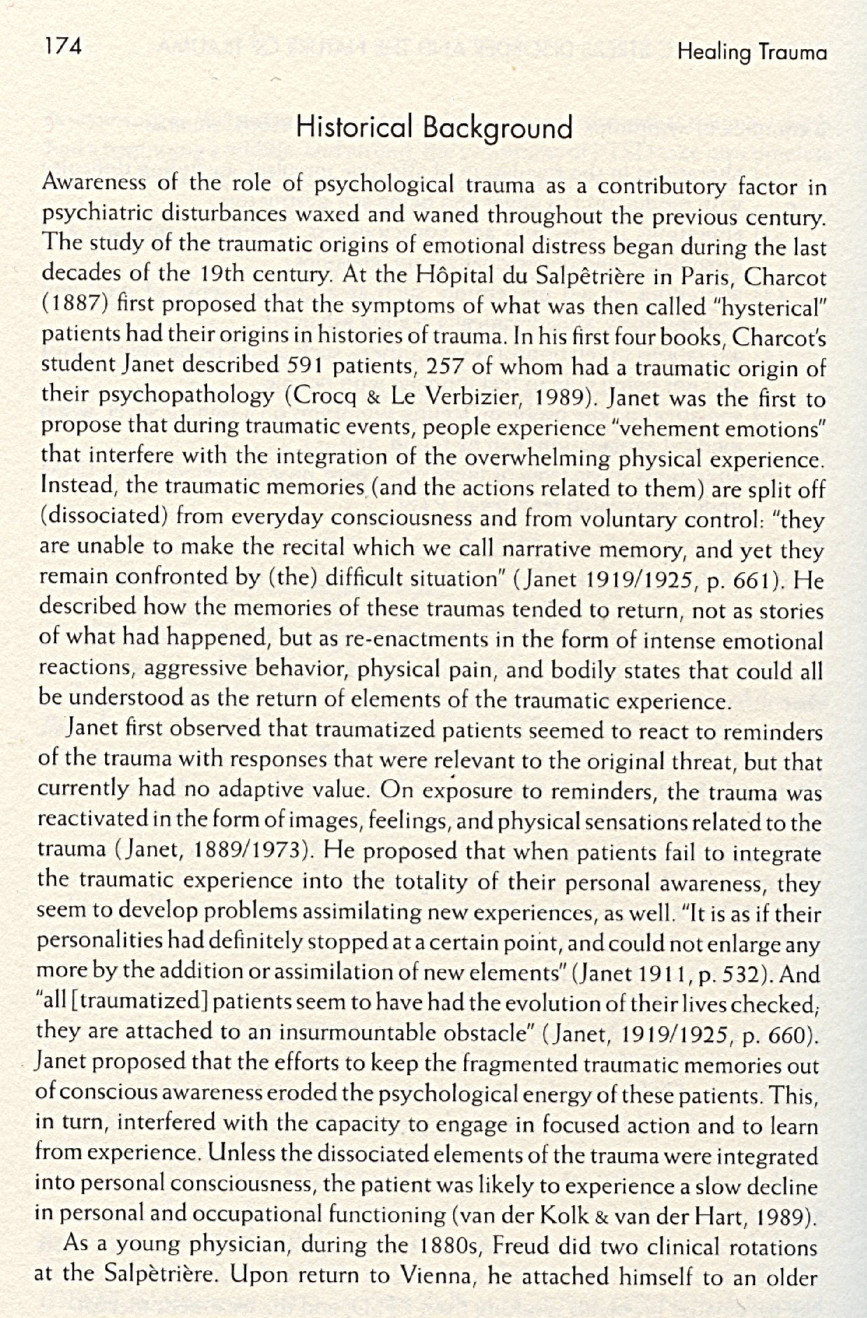
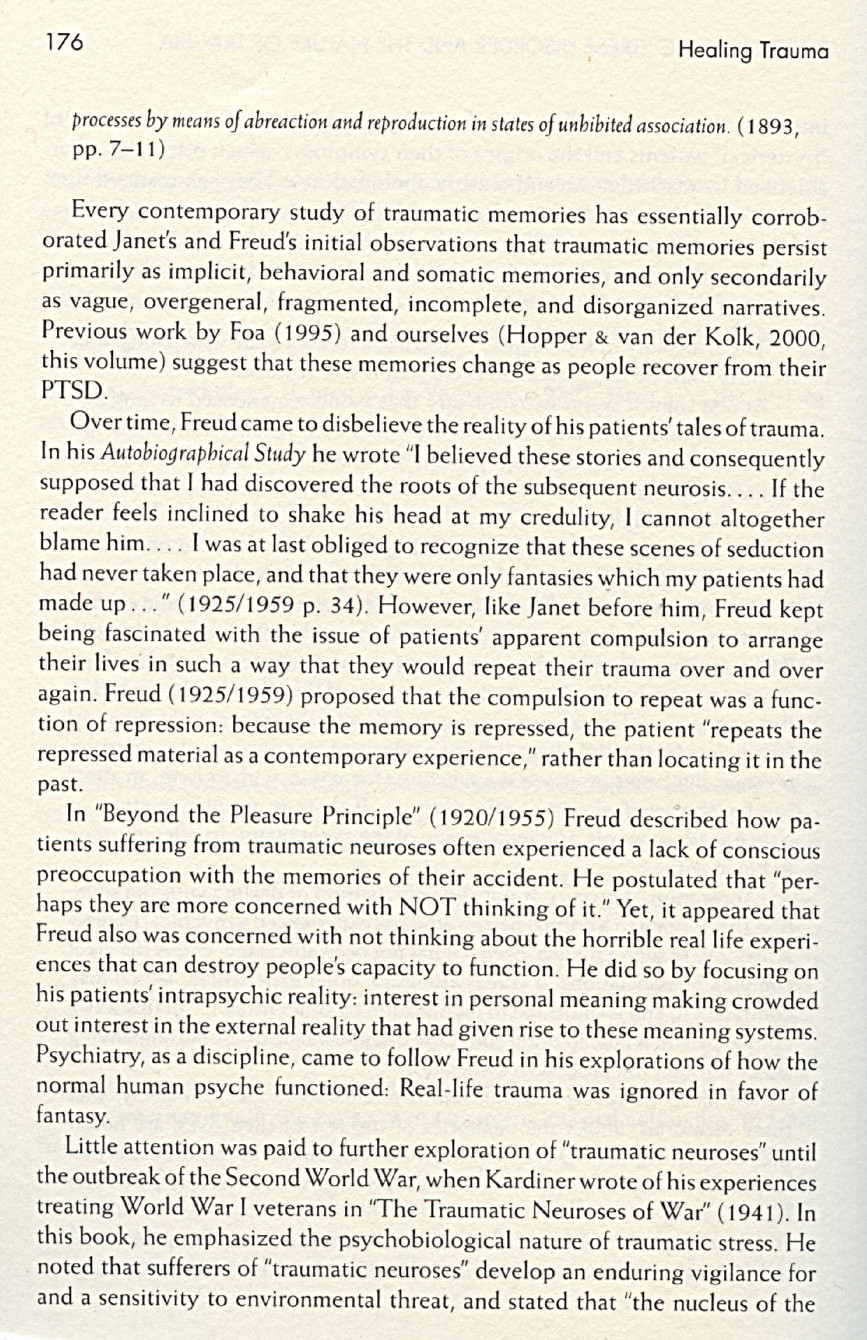
I am scanning in the following four pages about the history of the treatment of trauma for your consideration.  It is the last sentence on page 177 that interests me most as I will consider in a future post, but in all fairness to the author and to my readers, the rest of this information needs to be presented here for educational purposes.

These pages are taken from the book, Healing Trauma: Attachment, Mind, Body, and Brain – Hardcover (Jan 2003, W.W. Norton and Co.) edited by Daniel J. Siegel, Marion F. Solomon, and Marion Solomon, chapter 4 (pages 168-195) written by Bessel A. van der Kolk:  “Posttraumatic Stress Disorder and The Nature of Trauma.

++++

++++++++++++++++++++++++++

Please feel free to comment directly at the end of this post or on

+++++++

Your Page – Readers’ Responses

++++++++++++++++++++++++++++++++

PLEASE NOTE:  Do not take anything I say as a reason to alter any ongoing treatment, therapy or medication you are receiving.  Consult with your provider if you find something in my writing that brings questions to your mind regarding your health and well-being.

++++++++++++++++++++++++++++++++

+PTSD AND SEVERE ABUSE SURVIVORSHIP – PART TWO

+++++++++++++++++++

This second post about Posttraumatic Stress Disorder (PTSD) refers again to a book called Healing Trauma: Attachment, Mind, Body, and Brain – Hardcover (Jan 2003, W.W. Norton and Co.) by Daniel J. Siegel, Marion F. Solomon, and Marion Solomon, chapter 4 (pages 168-195) written by Bessel A. van der Kolk:  “Posttraumatic Stress Disorder and The Nature of Trauma.”

Today’s post follows the November 28, 2009 post

+PTSD AND SEVERE CHILD ABUSE SURVIVORSHIP – PART ONE

PLEASE NOTE:  Do not take anything I say as a reason to alter any ongoing treatment, therapy or medication you are receiving.  Consult with your provider if you find something in my writing that brings questions to your mind regarding your health and well-being.

+++++++++++++++++++

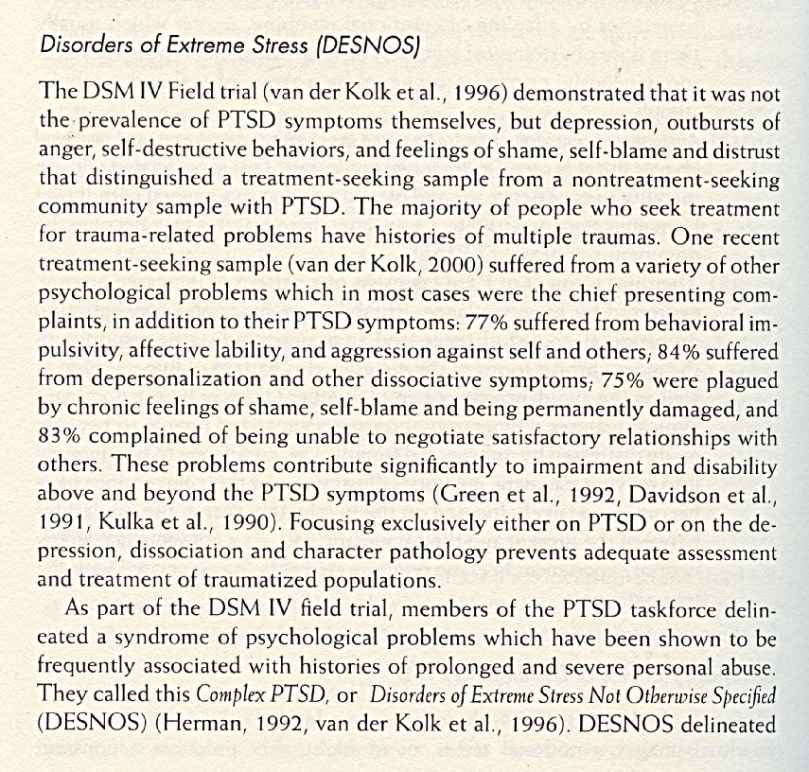
The following is taken from pages 172 of the above text.  I will consider this information in my writing below:
+++++++++++++++++++

It is now easier for me to work with this information because I have described my own version of an alternative way of thinking about the ongoing complications severe infant-child abuse and malevolent treatment survivors face as a direct result not only of the specifics of the actual horrific traumas they lived through, but also because of the very real physiological changes that surviving these traumas created in their infant-child growing and developing body.

(see yesterday’s November 29, 2009 post

+TRAUMA ALTERED DEVELOPMENT (TAD) – A NEW DESCRIPTIVE CONCEPT)

++++

An accurate primary and initial assessment of TAD for those of us who are Infant-Child Severe Maltreatment Survivors would allow us to know immediately how the changes our body-brain had to make created us to be different from ‘ordinary’ people who do not have the history of trauma that we do.

In this TAD assessment two critical resiliency factors would also need to be assessed because these two resiliency factors (one primary, the other secondary) are known to have the ability to nearly completely modify and modulate the power that early trauma has to change our developing body-brain.

The presence of safe and secure attachment to some early primary caregiver is the most basic and important resource an Infant-Child Severe Maltreatment Survivor had.  The current assessment tools available to assess adult secure and insecure attachment need to be simplified, refined and made accessible to the public.

Stemming from the degree of safety and security available through early caregiver attachment, the ability to play is a secondary but critical resiliency factor that impacts an Infant-Child Severe Maltreatment Survivor’s body-brain development.  I believe that assessment criteria and tools to measure this critical factor consistently and accurately can be developed and also made available to the public.

++++

NOTE:  In our new age of technology, the public has the right to be able to access critically important information about themselves and how their early infant and childhood experiences impacted their development.  At present this information remains ONLY available within ‘clinical’ settings, if even there.

++++

As far as I am concerned, anything and everything that is currently lumped under so-called ‘psychological’ categories belongs to the sinking Titanic of dark age medical model thinking that I referred to in yesterday’s post.

Until Trauma Altered Development (TAD) is assessed at the bedrock level of how Infant-Child Severe Maltreatment Survivors changed at their own bedrock (molecular) level, any attempt to moderate so-called ‘symptoms’ remains a crap shoot in the dark.

TAD assessment can connect the consequences of early trauma to altered physiological changes that an Infant-Child Severe Maltreatment Survivor’s body was forced to make to best ensure continued survival in early malevolent environments,

++++

Early caregiver attachment experiences from birth build the body-brain we will live with for the rest of our lives.

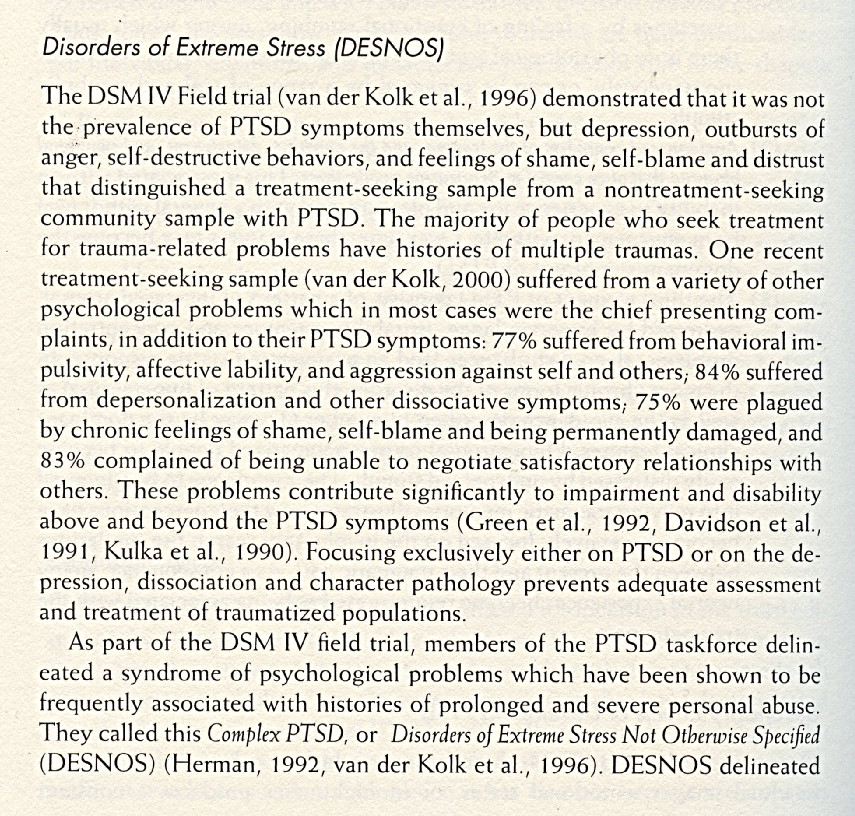
Van der Kolk (scanned text above) writes that it is not usually the symptoms of PTSD itself that brings those seeking help to a clinical setting.  Rather, he says that it is “depression, outbursts of anger, self-destructive behaviors, and feelings of shame, self-blame and distrust that distinguished a treatment-seeking sample from a nontreatment-seeking community sample with PTSD.”

Through an accurate TAD assessment, any ongoing difficulty an Infant-Child Severe Maltreatment Survivor has with emotions and social interactions can be traced to inadequate early caregiver interactions in a malevolent environment that built for the survivor an entirely different early-forming right-limbic-emotional-social brain.

When the foundation of the early forming right brain is altered because of maltreatment, the Infant-Child Severe Maltreatment Survivor’s later developmental stages involving shame, guilt and embarrassment will also be off course from ‘ordinary and optimal’ and will cause altered patterns of development in the body-brain.

++++

Van der Kolk states:

The majority of people who seek treatment for trauma-related problems have histories of multiple traumas.”

OK, I can certainly understand this, but here again, as I mentioned above, I do not agree with applying so-called ‘psychological’ and ‘symptom based’ medical model diagnostic thinking used in the author’s next statements.  I absolutely disagree with ever using terms such as ‘character pathology’ in reference to Infant-Child Severe Maltreatment Survivors!

One recent treatment-seeking sample…suffered from a variety of other psychological problems which in most cases were the chief presenting complaints, in addition to their PTSD symptoms:  77% suffered from behavioral impulsivity, affect lability, and aggression against self and others; 84% suffered from depersonalization and other dissociative symptoms; 75% were plagued by chronic feelings of shame, self-blame and being permanently damaged and 93% complained of being unable to negotiate satisfactory relationships with others.  These problems contribute significantly to impairment and disability above and beyond the PTSD symptoms….Focusing exclusively either on PTSD or on the depression, dissociation and character pathology prevents adequate assessment and treatment of traumatized populations.”

TAD assessments will clearly show that ‘impulsivity’, ‘affect liability’, most aggression, and dissociation are directly connected to changes in how an Infant-Child Severe Maltreatment Survivor’s nervous system, including their brain – and here, particularly their right brain – formed differently from ‘ordinary’ due to growth and development in trauma.

Chronic feelings of shame, self-blame and being permanently damaged” are also directly connected to trauma through developmental changes an Infant-Child Severe Maltreatment Survivor’s nervous system, including their brain – and here, particularly their later forming (after age one) left brain – had to make while developing in an early malevolent, trauma-filled environment.

Rather than referring to these changes as ‘character pathologies’, which in my thinking is the maltreatment, abusive stance taken by the medical model toward Infant-Child Severe Maltreatment Survivors, a TAD assessment can accurately and specifically pinpoint the origin of these changes in the body-brain and describe the consequences of them.

Receiving an accurate TAD assessment will show us exactly how our body was forced to adapt during our development through trauma so that we could survive it.   Yes, I do believe we KNOW we are different from ‘ordinary,’ but we are not ‘permanently damaged’.   We ARE permanently changed.

The changes Infant-Child Severe Maltreatment Survivors experience are fundamental and profound!  Everything about us was subject to adjustment for our trauma survival – our body, our nervous system and brain, our immune system, our mind, and our connection between our self and our self and between our self and the entire world around us.  NOT facing the truth and discovering the facts through TAD assessment will NOT resolve the difficulties we face with our continued survival into adulthood.

The only long term solution societies have is to STOP Infant-Child Severe Maltreatment!!!  Part of that solution is to provide the kind of TAD assessment Infant-Child Severe Maltreatment Survivors need, and to make available to us the resources necessary for us to live the best life we can in spite of the changes we had to make in order to stay alive because nobody STOPPED the Infant-Child Severe Maltreatment that happened to us.

It is the pathological character of the society we were born into that allowed what happened to us to happen at all, let alone allowed it to continue to the degree that trauma changed our physiological development.  If there is any self blame to be had, it is on the level far beyond OURS as the Infant-Child Severe Maltreatment Survivors.

++++

That the grand sinking Titanic of the archaic dark age’s medical model about Infant-Child Severe Maltreatment Survivors has at least THOUGHT about throwing us a life boat becomes apparent in van der Kolk’s next words:

As part of the DSM IV field trial, members of the PTSD taskforce delineated a syndrome of psychological problems which have been shown to be frequently associated with histories of prolonged and severe personal abuse.  They call this Complex PTSD, or Disorders of Extreme Stress Not Otherwise Specified (DESNOS).”

Great!  A life boat full of holes!  Gee, why are we NOT thankful for that?

A syndrome of psychological problems” be damned!  Infant-Child Severe Maltreatment Survivors do not suffer from a ‘syndrome’, and ours are not ‘psychological problems’!  For all the reasons I have repeatedly described, we simply need a TAD assessment that will tell us HOW our little body adapted down to our molecular level during our development in the midst of, and in spite of, toxic malevolent trauma.  Then we need resources that inform us how to live NOW with these profound trauma-caused changes that happened to us THEN.

The author continues:

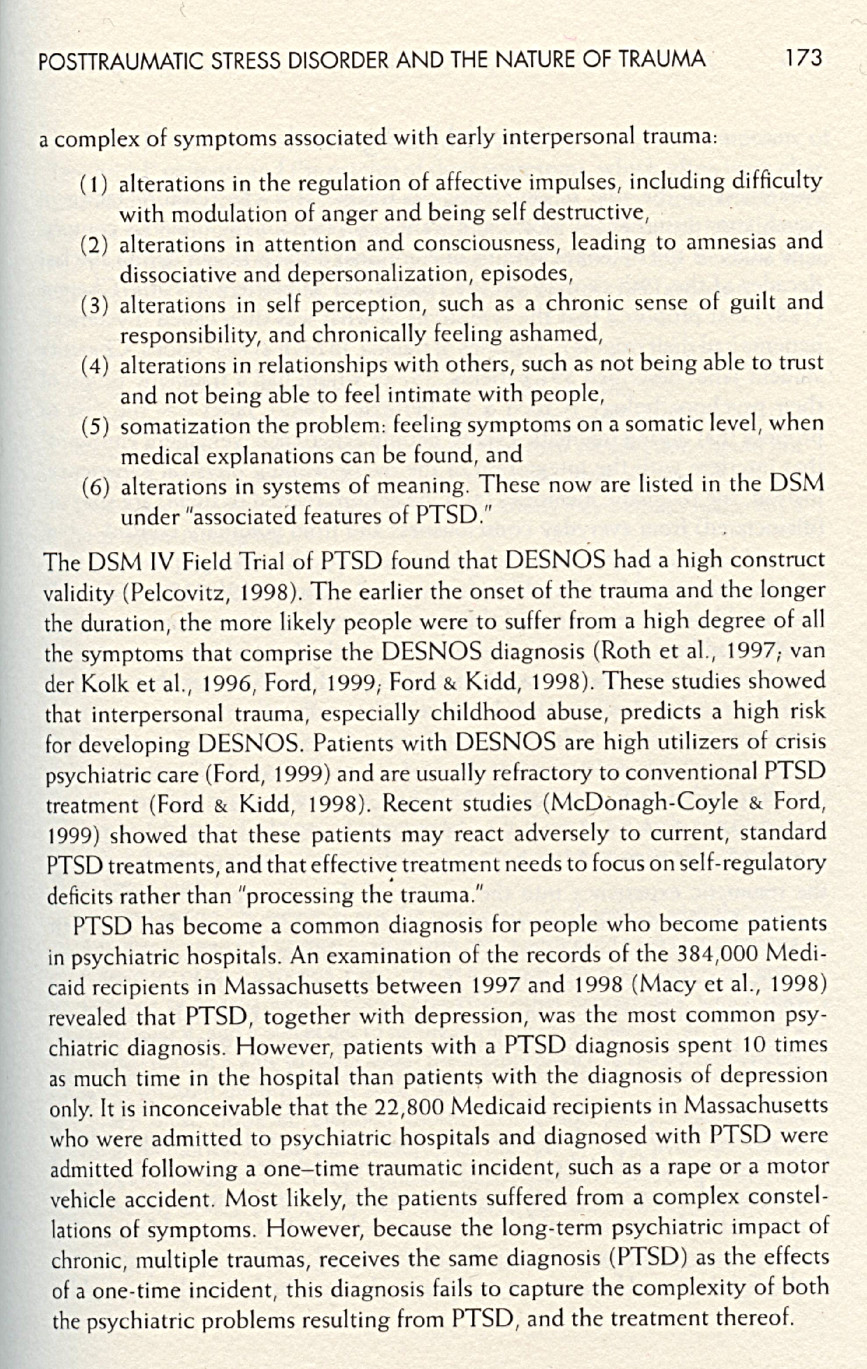
DESNOS delineated a complex of symptoms associated with early interpersonal trauma.”

Again, we don’t have ‘symptoms’.  We have a different body-brain-mind-self that adapted to survival in a malevolent world and caused us to have Trauma Altered Development (TAD).

We don’t have symptoms, we have consequences.  Every single item in the list of so-called ‘complex symptoms’ (see them in the page scan below) that van der Kolk describes are directly connected to our TAD.  EVERY SINGLE ONE OF THESE ITEMS exist within us because of changes our body-brain was forced to make.  They are consequences of the changes our body had to make through our TAD.

The only real progress in the right direction I can see – given to us like faulty patches to a sinking life boat thrown to us from a sinking ship – is that at least an association ‘with early interpersonal trauma’ is finally being considered in the current medical model thinking.

But this tiny droplet of hoped for healing balm offered by the creation of a construct named “Complex PTSD, or Disorders of Extreme Stress Not Otherwise Specified (DESNOS)” is not what we Infant-Child Severe Maltreatment Survivors need in my book.

We need our entire society to understand and accept the truth that the Infant-Child Severe Maltreatment that happened to me and others – and continues to happen to children around us today – is nothing short of a form of parental-selected genocide that did not fulfill its intent to completely destroy us.  We are Infant-Child Severe Maltreatment Survivors because we are still alive, and we ONLY SURVIVED because we were able to adapt our body throughout our Trauma Altered Development to and within the malevolent environments that formed us.

++++

The rest of van der Kolk’s words (below) simply bring into my mind the image of the author being like a modern day Paul Revere, whose horse’s hooves pound along the streets of our nation as he screams a warning.  I am certainly not convinced, however, that even this author knows which message it is that most needs to be delivered.

The Trauma Altered Development that Infant-Child Severe Maltreatment Survivors experienced had no choice but to build itself into every part of who we are BECAUSE we live in a body, and our body had no choice but to change so that we could stay alive.

To describe any aspect of what happened to us in terms of a ‘diagnosis’ or a ‘symptom’, ‘complex’ or not, to call us ‘maladjusted’ or to tell us we suffer from any form of a ‘character pathology’ or ‘psychological problem’ is to continue to condemn us with stigmas and stereotyped prejudice which makes as much sense as applying all of the above labels to someone who is tall versus short, or who has red hair rather than blond.

If we wish as a society to remain in the dark ages about the consequences of Trauma Altered Development for Infant-Child Severe Maltreatment Survivors then at least we should have enough honor and common sense to admit it.  If we are appalled by the ignorance that is still applied to our circumstances, today is the day we can enlighten ourselves and get on with the legitimate task of figuring out how to accurately assess Trauma Altered Development so that we can begin to live well as the changed, extraordinary Infant-Child Severe Maltreatment Survivors that we are.

Our Trauma Altered Development did not affect WHO we are in the world, but it absolutely changed HOW we are in the world.  It is up to all of us to learn what that means.

+++++++++++++++++++

The following is taken from pages 173 of the above text:
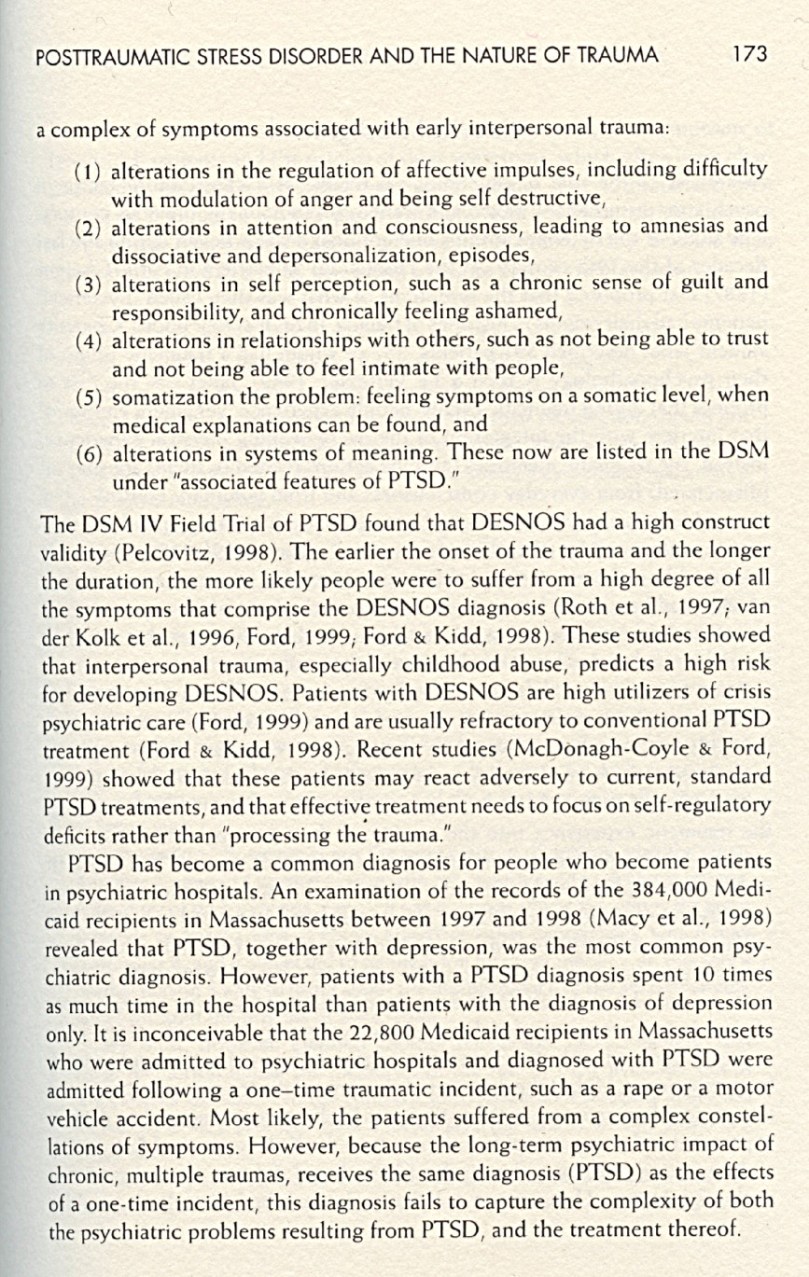
Again, it is not a picture of ‘long-term psychiatric impact’ nor a ‘diagnosis’ that Trauma Altered Development affected Infant-Child Severe Maltreatment Survivors need.  We need to understand the changes our body had to make to guarantee our survival and specifically how those changes affect us, and specifically how to improve our quality of life and well-being in the world in spite of our TAD.

+++++++++++++++++++++++++++++++++++++++++

Please feel free to comment directly at the end of this post or on

+++++++

Your Page – Readers’ Responses

++++++++++++++++++++++++++++++++

+TRAUMA ALTERED DEVELOPMENT (TAD) – A NEW DESCRIPTIVE CONCEPT

+++++++++++++++++++++++++

Presenting a new descriptive concept that applies specifically to severe infant-child abuse and serious neglect survivors of all ages:

Trauma Altered Development (TAD)

++++++++++++++++++++++++++

Those of us who suffered enough severe traumas through malevolent treatment including abuse during our growth and developmental stages of our infant-child ‘survivorhood’ to alter how our body developed do not need a diagnosis.

— We need an assessment of the changes that happened to us because of the abuse.

— We need information about how these changes affect us in our lives today.

— We need resources that tell us how to improve our well-being in the world in spite of the changes our body had to make in order for us to survive the traumatic environment that formed us.

++++

Thinking in terms of changes that happened to me as a result of my development in a severe abuse environment in my infant-child survivorhood, I am beginning to understand that my body developed to manage all resources available to me in my environment – both inner and outer – to maximize my opportunity for successful survivorship.

I am preparing to stand in opposition to the current ‘mental health’ and ‘behavioral health’ models that obviously are not capable of meeting my true needs as stated above.

I want to see the creation of new thinking about the changes that happened to me and to others whose altered early development allowed them to continue living in spite of insurmountable traumatic obstacles.

I have a new name for what happened to me:  Trauma Altered Development (TAD)

TAD is an accurate, factual description of a physiological process that allows individuals to survive in early malevolent environments.  TAD is not a diagnosis.  It is not a label, and it carries with it no stigma toward a person whatsoever.  It is not naming a ‘disorder’, a ‘pathology’ or a ‘maladjustment.’  Trauma Altered Development (TAD) is an accurate descriptive concept that needs to be the starting point for all positive changes we hope to make for ourselves in this world.

Trauma Altered Development (TAD) can be assessed.  In today’s world, it might take a think tank of dedicated people to put together tools to get this job done, but the information DOES exist and an accurate assessment of trauma-forced change can be described for every one of us that went through this process in our early development because of infant-child trauma and abuse.

I would like to see a systematic effort applied to establish national, regional and local Trauma Altered Development Resource and Referral Centers.  These centers would be connected to a global clearinghouse that gathers research, assessment tools, informational and educational curricula about how trauma alters development for the duration of an individual’s lifespan and how well-being for a lifetime can specifically be improved in spite of these trauma altered developmental changes.

Trauma Altered Development (TAD) assessment would consider not only the changes that happened to us in our development and how those changes affect our well-being and our personal resource management systems in our adulthood, but would also increasingly assist in the recognition of how these changes are directly tied to the resiliency abilities that lie within our species.

Trauma Altered Development (TAD) assessment cannot possibly separate any part of an individual from the whole of who they are.  Trying to consider physical health and well-being as being separate from our ‘mental’ or ‘behavioral’ well-being is just plain goofy!  TAD affected our entire being in the world from our beginning and it affects us now.

++++

I don’t want to save a sinking Titanic of dark-age thinking about so-called ‘mental illness’ or ‘behavioral health’.  I want a whole new boat!  Trauma Altered Development (TAD) is a descriptive concept that appears to me to be that new boat.  I know it sits on the bedrock foundation of what happened to me as a result of my mother’s severe abuse of me.  I believe that TAD must be accurately assessed at this bedrock level for every infant-child trauma and abuse survivor because it affects every aspect of our being in the world for the rest of our lives.

Once an accurate TAD assessment has been completed, all other services designed to address our degrees of lack of well-being will make sense to us because they will be based on the truth of the facts about how we developed through trauma to be the way we are in the world — every step of our lives.

++++++++++++++++++++++++++++++++++

Please feel free to comment directly at the end of this post or on

+++++++

Your Page – Readers’ Responses

++++++++++++++++++++++++++++++++
+LIGHT T-DAY READING ON RATS AND THE DALAI LAMA

+++++++++++++++++++++++++++++++++++
I’m not at all sure why I feel safer on the planet knowing the Dalai Lama is here, but I do.  The following links are to information related to the conference presentation to the Dalai Lama about the effects of maternal distress behaviors on her offspring – just a little T-Day light reading!

This is the gist of science told the Dalai Lama:

If a distressed mother rat raises all her own babies, they will all turn out distressed.

If a calm mother rat raises all her own babies, they will all turn out calm.

If you change the litters at birth, and give the calm mother’s babies to the distressed mother, all those babies will grow up distressed.

If you take the distressed mother’s babies at birth and give them to the calm mother, the babies will all grow up calm.

In essence, the distressed mother’s treatment of her babies triggers epigenetic changes in the way the babies she raises turn out because their genes are triggered differently by the distress.

++++

Pity the Poor Lab Rat by Kathy Brown

“…in spite of all our advances in knowledge about mental disorders and the advances in technology that have resulted in an impressive smorgasbord of pharmaceutical agents, the overall prevalence of depression is increasing at an alarming rate. Moreover, the average age at onset continues to drop. Whereas patients once presented with their initial depressive episode in their fifth decade of life, the average age of onset has now dropped into the twenties.”

++++

Mom, Dad, DNA and Suicide by Sharon Begley

Such changes are called “epigenetic,” to distinguish them from changes that affect the sequence of nucleotides in DNA. Epigenetics is arguably the next frontier in genetic research, promising to show why people with identical DNA, such as monozygotic twins, have different traits, including traits known to be strongly affected by genes. The answer seems to be that the events of our lives, including parental behavior, turns some genes on and some genes off. In this case, parental care (or, specifically, abuse) changed the expression of the crucial glucocorticoid-receptor gene in the brain.”

++++

Abuse changes brains of suicide victims

Suicide victims who were abused as children have clear genetic changes in their brains…”

+++++++++++++++++++++

While the new research on neuroplasticity in the brain is important, those of us whose body and brain were changed as a result of severe early child abuse, again, may not be in the realm of ‘ordinary’ when it comes to the changes we can expect in our brains compared to others…..

++++

Buddhism – A meeting of minds by Swati Chopra

At the 12th mind and life conference in dharamshala, buddhism and modern science found points of convergence as the dalai lama and western scientists spoke about neuroplasticity, the brain’s ability to change with experience and focused training.”

++++

2004: Neuroplasticity: The Neuronal Substrates of Learning
and Transformation
a 2004 conference that got neuroscientists together with the Dalai Lama

Download MLXII: Neuroplasticity Brochure PDF

++++

Can Our Minds Change Our Brains?

Train Your Mind, Change Your Brain: How a New Science Reveals Our Extraordinary Potential to Transform OurselvesBy Sharon Begley

At the Dalai Lama’s private compound in Dharamsala, India, leading neuroscientists and Buddhist philosophers met to consider “neuroplasticity.”  The conference was organized by the Mind and Life Institute as part of a series of meetings, beginning in 1987, for brain researchers and Buddhist scholars to share insights into the workings of the mind and brain. The 2004 meeting set out to answer two questions: “Does the brain have the ability to change, and what is the power of the mind to change it?””

++++++++++++++++++++++++++++++++++++++++++++++++++++++++
Child Abuse Causes Lifelong Changes To DNA Expression And Brain.

++++

Mechanisms underlying epigenetic effects of early social experience

++++

Epigenetics. Child abuse alters genes.

++++

What role might epigenetics have in shaping a person’s development?

++++++++++++++++++++++++++++++++++++
Please feel free to comment directly at the end of this post or on +

+++++++

Your Page – Readers’ Responses

++++++++++++++++++++++++++++++++