+CONTINUALLY TRYING TO CREATE MYSELF IN TIME AND SPACE

+++++++++++++++++++++++++++

I tell myself to put my fingers on this keyboard and make them move.  “Speech is silver.  Silence is golden.”  I choose to go for the silver.  I was forced for the first 18 years of my life to be as silent as a child can be.  Silence will not heal me.

Writing is all tangled up today with what I choose to write about.  Having a disorganized-disoriented insecure attachment MEANS that having access to one single, integrated, cohesive, coherent Linda is extremely difficult.  I will not admit defeat and say it is impossible.  I am coming to understand, and believe, that using my words – putting them together in lines across the page – will help me become more organized, oriented, integrated, cohesive and coherent.  So here goes…..

I am thinking a jumble of thoughts, all tied into very old and continual thoughts about myself in my body in my life since my beginning.  I was not allowed to be a person.  My mother interfered with my normal, ordinary development every single step of my development.  I have paid a price for her terrible abuse of me.  The biggest one is that I didn’t so much as LOSE my self, I didn’t get one in the first place.

++++

So I have to imagine what it would be like to have one of those illusive organized, oriented, integrated, cohesive and coherent selves.  How do all these aspects of such a strong, clear, healthy self operate in time and space, which is what I guess being in a body in a life, in the world is all about?

Today, I want to know the difference between having goals, destination and purpose and having hopes, dreams and wishes.

I want to know because it seems to be I wouldn’t have to question these things the way I do now if I HAD any real idea what they mean.

My mother interfered with my development regarding everything, so why wouldn’t I expect that having a clear sense of goals, destination, purpose, hopes, dreams and wishes would be a part of what I am missing?

She never hesitated to control and abuse me in any way that she could.  Her abuse included confining me in space and time beginning when I was very, very small.  She withheld food, prevented me from even going to the bathroom when I got older.  She woke me from sound sleep to beat me, or didn’t let me sleep.  When I got older she forced me to overeat.  I could go on and on, but this isn’t what I want to say right now.  Not being free to be a growing child, not being safe or allowed to play greatly harmed my development in every single way.

What I want to say is that great sense of loss and grief I feel is tied as much to my loss of access to my inner needs, wants, desires, ability to have intentions, and the ability to find ways to know what brought me happiness as a person and what gave me pleasure.  I didn’t grow up knowing much of anything except how to survive my mother’s torture and abuse.

++++

This thinking is tied to what I believe about people like me with disorganized-disorganized insecure attachment.  I believe I organized and oriented myself around being a mother for the 35 years I had children under 18 in my care.  Today it seems that I used the goal of caring for them as well as I could, the destination I saw for them in the future as leaving home well and happy people, my purpose in life of being their mother, to organize and orient my self in the world.  My hopes, dreams and wishes were tied up in that whole process.

Having them grow up and leave was wonderful.  Yet I was left again being the disorganized-disoriented insecurely attached-to-my-own-self and the world just as I had always been for the first 18 years of my life.

Without the strange and complicated relationship I formed after they left again leaves me feeling inwardly desperate, destitute, lost and confused – again disorganized and disoriented.

I was able to obtain the goals for my education, but the process was extremely confused, and in the end I am still lost.  I can ‘make things’ with my hands, but even being able to use the ‘goal-destination-purpose’ and ‘hopes-dreams-wishes’ thinking only lasts for short periods of time and nothing about me seems connected and tied together.

I want to understand how the brain-mind changes that I have continue to cause me great difficulties in these areas.  Somehow I sense that COMMITMENT has always been a key and central piece of anything I have ever accomplished.  If I say I hope to write, that writing is tied to my dreams and wishes, how do I connect that to my goals, my destination, my purpose?

Because my right brain, left brain, corpus callosum that connects them together, and my higher executive function cortex did not form in an ordinary fashion and instead will suffer from severe trauma influence for the rest of my life, I cannot simply accept that I am going to ‘naturally’ find a solution to my dilemmas.  I have to continue to focus my will toward the goal of better understanding how all these changes – that result in what I am naturally missing – connect to my overall feelings of hopeless sadness in my life.

How does changed me find my self in time and space so that I don’t constantly know that I don’t ‘fit in’, am lost, and want to ‘leave here’?

I don’t know yet, but I wanted to say I am working on these things.  Today.  I continually have to try to learn how to create my self in time and space because this process was completely interrupted for me growing up with such abuse.  I have a trauma bond with myself that makes it hard for me to get through life feeling whole and successful.  There is a rupture between my self and myself and the world I am constantly trying to find ways to repair.

I have to start with the little things, and writing here is one of them.  Now, I will go eat breakfast as I move my self forward in the time and space that is today.

+++++++++++++++++++++++++++++++

It strikes me after putting the above words into their order that the most important word in the whole piece is PLAY.  I was not allowed to play, and as many of my childhood memories show, my mother had an uncanny ability to turn whatever childhood play thoughts or actions I had into something painful for me.

Beginning with playful interactions between infants and their early caregivers, and moving all the way through childhood, play is nature’s way of building an organized and oriented self in the world.  I suffered terribly from the lack of play and from interruption of play every step of my development because of my mother’s abuse.

My sister just gave me a simple example of how play interacts with a growing brain-mind-self regarding hopes, desires and wishes on the one hand, and goals, direction toward a destination and purpose on the other.

She took her granddaughters to a fund raiser bake sale today.  The seven year old bought muffins and a specially formed little bundt cake with a hole in its center.  On the way home she ate the muffins but carefully protected and saved the cake.  At the urging of grandma and her 10 year old sister she finally, shyly told them her PLANS for her special cake.

She wanted to take it home, fill the center with pudding, put a candle on it, and have a birthday party with her Barbie dolls.  This, of course, is what she was allowed to go home and immediately accomplish.  Even her sister, who thinks she’s too grown up to play Barbies, came to the party.  Through each step in her process she was building another healthy, happy aspect of her brain-mind-self.  Severely abused children are very often deprived SO MANY or ALL TIMES of this kind of experience — and this kind of loss is big part of what happened to change us.

I see that everything I am thinking about this morning is simply contained in that pattern of child play.  Play is how children learn to be social (after their infant brain forms through early mirroring caregiving).  Play can involve rules, or not.  Child play does allow the brain not only to build its happy-joy center, but also all the other brain patterns and circuits I am beginning to understand as they in-form our lives.

The arenas of damage my mother orchestrated against me were many and devastating, but today it is particularly the damage done to me by her abuse of my play drive and abilities that has harmed me immeasurably in my adulthood.

Today I also realize that the absence of my sadness that being with my boyfriend gave me was directly tied into play.  He was my playmate.  That is a big part of the joy and happiness I felt when I was with him.  I didn’t know this until today.  I have no built-in experience of play-joy from childhood.  I didn’t even recognize my happy feelings with him were directly connected to play.  My playmate doesn’t want to play any more.  Certainly that gives me great sadness.

What can I learn about play at 58?  How can I begin to understand that a lot of the sadness I feel stems from never having play in my childhood?  My siblings played together, and they all remember my part in their play – by my absence from all of it!

That especially the lack of play in my childhood (coupled with the rest of the terrible abuse) directly created my adult brain-mind-self’s great difficulty with the ability to dream, wish, hope or to plan, have a goal, a sense of direction, a destination for myself in my life, or a sense of purpose — in-forms my sense of grief, loss, and feeling lost like I don’t belong ‘here’ — is not a small piece of information.

+++++++++++++++++++++++++++++++
+I WILL NEVER BE ORDINARY. IT IS TIME FOR ME TO KNOW THIS TRUTH.

++++++++++++++++++++++++++++++++++++

I try to be as positive as I can about the work I am doing with my writing about the permanent and lifelong trauma-centered changes that plague survivors of severe abuse and trauma that happened during their early infant-child developmental changes.

Today’s transcription of my quarter of a century old letters my friend just returned back to me has left me feeling anything but positive.  The reality of the kinds of childhoods like mine, and like the kind I am talking about and describing, is horrible.  There is no way to pretty up the picture about what was done to us and what happened to us as a result.

I am faced with the tragedy of what my mother’s abuse did to me — not just during my childhood, but throughout my entire life up until this very instant in time.  Primarily I balance my mother’s abuse by the other side of my child abuse history.  No one was there for me to form a safe and secure attachment with.  THIS LACK, I believe, had as much to do with how my body-brain-mind-self had to change in order to survive as did the abuse itself.

I believe that having a safe and secure attachment to at least one other person from birth particularly through age 5 is a critical resiliency factor to balance out the terrible harm of abuse in infancy and childhood.  When I consider the terrible abuse of my childhood, it is ALSO the absence of having any other person I could form at attachment to and with that profoundly harmed me.

It is not JUST the presence of abuse that truly creates a malevolent childhood.  It is also the complete absence of safe and secure attachment to ANYONE else.  That absence, I believe, amplifies the impact of the trauma of abuse nearly beyond belief.  That absence, in particular, coupled with the abuse, so changes a person’s development that trauma becomes the underlying pivotal factor of their ongoing existence.

No matter how benign our adult life may appear from the outside, the reality of this kind of childhood trauma within us manifests itself in every feeling, thought, action, decision and experience that we have.   How to live well in spite of the trauma-centered developmental changes that happened to us is so far past my ability to understand today that I can’t imagine it.

++++

I am having a transparent moment, as if all the illusions I have ever had about myself being an ‘ordinary’ person in an ‘ordinary’ world have now completely evaporated.  Is this a feeling of complete hopelessness that I am experiencing?  It can’t be.  I won’t let it be.

Having illusions about who and how I am in this body in this lifetime is not the same thing as having hope.  Just because today, finally, all my illusions have vanished because I have challenged them and found that they do not fit me, does not mean that I have no right to find a way to a better life in this world.

At this moment I feel as if I have one foot poised in the air over a threshold I am crossing into a new vision of myself in my life.  I can, for the first time ever, looking backward through the time of my life and see myself being born a pure and innocent child, full of potential, full of life, full of the ability to respond to the world I was born into.

That this world welcomed me with trauma and abuse, which held me firmly within its grasp for the first, formative, 18 years of my life does not mean that I, as a human being, have changed in my essence.  But I do have to work with this body, nervous system, and brain that changed itself to survive the horrors of that ongoing trauma.  It is my mind I am working to change, to the best of my ability, not because it is in any way ill, but because it is mine.

My mind can no longer afford to feed itself on a diet of illusion and false belief that what happened to me did not affect me in ways that I now KNOW it did.  And with this knowledge I now have the most profound hope I have ever had.  It is time for me to learn how to experience life MY way, my CHANGED way, without ever again expecting anything about myself to be — ordinary.

There is an invisible line that is crossed during a severely abused infant-child’s life where the option to develop in an ‘ordinary’ way is removed.  To deny this fact is to suffer from delusion.

++++++++++++++++++++++++++++++++++++

*Ages 29-33 – Eight Letters to a Friend

++++++++++++++++++++++++++++++++++++

*Commentary on the eight letters to a friend – ages 29-33

++++++++++++++++++++++++++++++++++++

SOME OF THE KEY TYPICAL TROUBLESOME WORDS, CONCEPTS AND EXPERIENCES THAT ARE DIFFERENT FOR SEVERE CHILD ABUSE SURVIVORS – SEEN FROM MY NEWLY INFORMED PERSPECTIVE.

These things connect to what continues to ‘trouble’ us because they are all connected to the changes that our body-brain-mind had to make in order to survive early severe abuse during our infant-child developmental stages:

Choice

Feeling guilty – the whole concept of guilty

Concept of procrastination as being a source of our problems

‘shirking’ responsibility – the whole concept of ‘response-ability’ as it applies to us

dealing with things on a self-honesty level

concept of ‘changing’

the concept of feelings, feeling feelings, experiencing feelings

emotional brain not form ‘ordinarily’; emotional dysregulation = chronic problem

feeling lonely, depressed, crying – all different for us than for ‘ordinary’ people

experience of ‘feeling low’ and low on energy is different

‘anger’ has a different meaning to us – both our own and other people’s

being with other people

feeling trapped

our experience of the experience of ‘being sick’ and recuperating is altered

our experience of being kind to ourselves

our experience of giving ourselves ‘permission’

how we experience anticipation of enjoyable experiences

experience of worry different

experience of ‘wishful thinking’ is different

experience of disappointment different

Experience of trust is different

Our experience of the passage of time is VERY different!

Our experience of friendships is different

Being willing to reach for and experience ANY kind of self-help we can find

Finding that it does not REALLY help us at all

blaming-shaming ourselves that it doesn’t

not being able to immediately and completely trust our impressions of people

my ‘who-to-trust/not-trust’ center in my infant brain could not form correctly

making a mess of our own thinking trying to change these first impressions!

Our sense of safety with others is THE number ONE issue – we have to trust it

Intense feelings of isolated-alone, trust them, they are REAL beyond belief

Realize that ‘ordinary’ people do not experience them with the pain we do

Yes, we will do everything possible to ‘protect our feelings’ – naturally

Have to be hyper aware of what feels threatening and scary to us – it’s real

There are memories and feelings we can’t touch because it isn’t good for us to

Repression of trauma is not the same thing as dissociation

we can’t ‘work through issues’ like others if we dissociate

not helpful to feel guilty-shame for what we cannot possible accomplish!

Terrible ambiguity can exist about our abuser(s) – ordinary people can’t imagine

Confused-meshed identity and relationship with abuser

Commonly called ‘defense mechanisms’ don’t begin to describe true insanity

Have to be realistic about ‘recovery’ goals – ours will be different than ‘ordinary’

Be careful of what we believe of what therapists who do truly not know us, tell us

We don’t really know what love is or what it feels like – we weren’t built that way

I strongly suspect that ‘love’ is different from ordinary for us

We will never stop learning about what ‘ordinary’ people automatically know

We did not grow into our thinking abilities like ‘ordinary’ people do

Not helpful to be told by others we are ‘rationalizing’ as a defense when we think

We need help learning about our thinking process because abuse changed it

Our disorganized insecure attachment means that we do not grieve the same

Extremely helpful to understand insecure attachment and love relationships

Our own pain-loneliness puts us at risk for attaching harmfully in relationships

Our sense of ‘time passing’ is different; things do not ‘end’ in time like ordinary

Difficulties with accountability if we don’t know source of our difficulties

Terrible troubles with goals-future plans, our higher cortex formed differently

We have a different version of a selfhood – not the ordinary one formed by age 2

When we feel alone in the world, a lot of it is because we are lonely for our self

(a self-centered-self is cultural and evolutionarily a recent luxury we didn’t get)

We had no say in the matter – we developed a trauma-centered self from birth

12-step program talk about ‘unmanageability’ = not from our ‘planet of origin’

12-step program talk about ‘acceptance’ = not from our ‘planet of origin’

12-step program talk about ‘powerlessness’ = not from our ‘planet of origin’

12-step program talk about ‘resentments’ = not from our ‘planet of origin’

the set-point for our nervous system is not at ‘calm’ like ‘ordinary’ is

(these points are included at the end of the link presented above)

++++++++++++++++++++++++++++++++++++

+EXPLODING MOTHER, IMPLODING ME: SOME FUNDAMENTAL DIFFERENCES BETWEEN US

++++++++++++++++++++++++

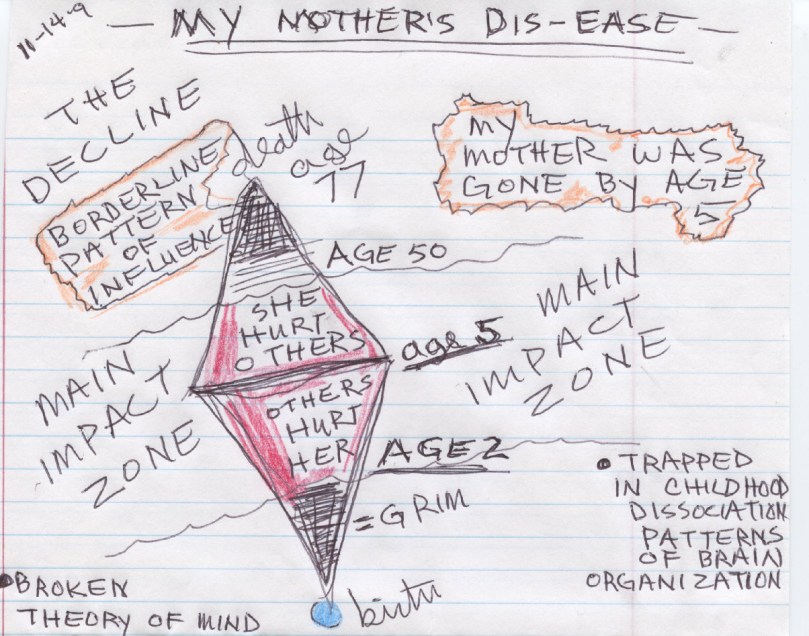
I am revisiting what I see as the core differences between my borderline mother and myself.  I find that nothing has changed in my thinking about these differences in my past five years of research.  My mother’s childhood-onset dissociation became malignant while mine remained benign.

In my first ‘doodle’ I visualized the impact of infant developmental attachment deprivations she suffered from birth until age two.  Born into a family with marital discord and left with her primary care in the hands of a ‘nanny’, I envision that my mother’s developing brain-mind-self was already far off course before she reached the stage of developing a Theory of Mind.

1 111409 post

During the developmental stages from age 2 – 5 conditions in my mother’s childhood so severely impacted her brain-mind that I believe her later mental illness had already centralized the organization of her self.  From the age of 5 it was simply a matter of time before the bomb that was her Borderline Personality Disorder condition would explode – which it did during her terrible delivery of me.

The broader dimensions of the diamond figure that I drew show that in the bottom half powerful interactions with others in her life were feeding her unstable growing self.  She had reached what I call the ‘rage stage’ which was coupled with the following:

My mother was a victim of a lie.  She was told through word and deed by her early caregivers that sometimes she was good enough to be loved.  She was also told that sometimes she was so bad she was un-love-able.  The lie was that she had the power to change herself from being bad to being good, and if she changed into being good (made the bad go away) she would be love-able – and therefore would be loved.

2 111409 post

These conditions presented my mother with an impossible paradox for which there was no answer.  She never knew she was being lied to by her attachment caregivers.  She did not know that there was no solution to this paradox.  She was told she had the power to change herself into being ‘all good’, and she eventually found her solution – me.

The impossible solution to her fundamental betrayal problem was to spit off all her badness and project it onto me.  That left her being all good and me being all bad.  She never had the capacity to know she had believed a lie, found an impossible solution to an impossible riddle, or that she had been tricked and fooled.  Once her child brain-mind wrapped herself around the too-big problem of her early life, her brain-mind continued to grow with this malignant lie within it.

As she moved out of her childhood into her adulthood, and then into the stage of her childbearing years, her childhood dissociation, fueled by childhood rage and a broken Theory of Mind, meant that her children remained her doll-imaginary friends with me as her imaginary enemy (as I have previously described).  By the later years of  my mother’s life she had fewer and fewer people she could influence through her mental illness, and she died as alone and unconsciously troubled as she had been from the time of her birth.

I see this ‘main impact zone’ as being the mass of incoming information that hurt her, followed my the mass of information she later could displace and project onto others to hurt them (primarily me).

++++

My second doodle page (above) presents the basics of what I believe are the differences between my mother and myself.  Like her, my foundation from birth was in disorganizing, disorienting insecure attachment to early caregivers.  But unlike her, I was never fooled, tricked, or betrayed.  Her projection of her own badness onto me condemned me absolutely and permanently.  I was simply doomed to be hated without hope of reprieve, salvation, or any hope of implementing my own solution to solve any of the ‘problems’ I had with her.

The simplicity of my life saved me.  I was not faced with solving an impossible riddle.  I was not presented with the impossible paradox of “you can change yourself into a good and love-able child and then I will love you.”  My childhood was one continual ‘rupture’ without either repair or hope for repair.  My mother’s childhood contained ‘ruptures’ with faulty and deceiving repairs.

In the final analysis, I was far more fortunate than my mother was.  She was set up to fail at being love-able.  I was simply not love-able.  It was the constancy of my unloved-being hated state that saved me.  It was the inconsistency of her unloved-sometimes loved state that ruined her.

I believe her brain fixated a rigid solution to an unsolvable problem.  Her childhood dissociation organized in her brain-mind-self around this solution – which became her internal and unconscious fulltime goal.  I believe her mental illness was fueled by childhood rage.  Her childhood dissociation became malignant, and I became its operational target.

My childhood dissociation had no goal other than physical enduring survival.  My brain-mind-self was left in a fluid, continually changing and adapting state because I HAD NO GOAL and I had no hope, false or otherwise.  My mother’s treatment of me was made tolerable through what I call benign dissociation and my development occurred in a world of sadness.

++++

My mother ended up fighting to be love-able, fueled by rage.  Rage is tied to active coping skills, whether we want to admit this or not.  I did not grow up a fighter.  I grew up a sorrow-filled victim stuck in the passive coping skill state.  My mother was told she had the power to change what happened to her, even though it was a lie and it was not within her power to change the dynamics of her caregivers’ treatment of her.

My mother was damned and didn’t know it.  I was damned and I did know it.  I knew I had no power to change what happened to me.   Nobody ever fooled me into thinking otherwise — from the time I was born.  I believe that there are two entirely different trajectories of development set up by the two different childhood scenarios I am describing.  One leads to the development of a dangerous, demonizing mother and the other one does not.

Both my life and my mother’s of course ended up being extremely complicated with devastating consequences stemming from child abuse and neglect in a malevolent environment during critical body-brain-mind-self stages of early development that resulted in a changed brain for both of us.  Yet as I see it, I was never betrayed or set-up with an impossible task to accomplish like my mother was, and being free from these overpowering early forces allowed me to become who I am.

My mother’s mental illness prevented her from ever being able to tolerate becoming conscious either of how she behaved or of what had happened to so wound her in childhood.  I am not barred in the same way from consciousness.  As I continue to explore the underlying aspects of safe and secure attachment, I will explore how having the ability to be self-aware and self-reflective makes all the difference in how and who we become in our lives.

++++

This post follows:

+DISSOCIATION AND THE TRAUMA-SPECIALIZED BRAIN 11-11-09 and

+SECURE AND INSECURE ATTACHMENT AND THE CHILDHOOD NARRATIVE 11-13-09

++++

++++++++++++++++++++++++++++++++++

THIS INFORMATION COMES TO YOU FROM:

Prevent Child Abuse New York Blog

Improving Children’s Mental Health through Parenting EducationPosted: 13 Nov 2009 03:01 AM PSTGuest post by Michelle Gross, Projects/Public Policy Manager, Prevent Child Abuse New York In today’s difficult times, one of the most important skills one must possess is the ability to form healthy relationships and cope with life’s challenges. Our children are not born with these skills, but rather learn them through their social and emotional development.While providers have traditionally focused on physical development, in 2006, the New York State Legislature passed the Children’s Mental Health Act. The Act required the development of a statewide plan to address issues in children’s social and emotional health, zero to eighteen. As a result of this legislation, the Children’s Plan was developed in collaboration with nine state agencies and led by the New York State Office for Mental Health.The Children’s Plan serves as a blueprint for New York state agencies, providers, and communities to
improve the social and emotional development of children and their families. The Plan focuses on engaging children and their families in services early, ensuring that systems are collaborating to provide effective and efficient services and meeting families’ needs by focusing on their strengths and abilities.

Within the Children’s Plan is a directive for the Office of Mental Health to work with parenting educators to better support parents in raising emotionally healthy children.  The New York State Parenting Education Partnership has been chosen to play this pivotal role in educating providers who work with families and supporting a network of family support and information.

NYSPEP’s efforts to provide professional development sessions for parenting educators will enhance providers’ ability to communicate the importance of social and emotional development with parents, and offer both providers and families tools to facilitate children’s healthy development.

For more information, visit our web site at: http://www.parentingeducationpartnership.org.

Positive Parenting Can have Lasting Impact for Generations

Posted: 12 Nov 2009 07:15 PM PST

A new study that looks at data on three generations of Oregon families shows that “positive parenting” not only has positive impacts on adolescents, but on the way they parent their own children. ” Positive Parenting can include factors such as warmth, monitoring children’s activities, involvement, and consistency of discipline.

Researchers from the Oregon Social Learning Center conducted surveys on 206 boys who were considered “at-risk” for juvenile delinquency. The boys and their parents were interviewed and observed, researchers information about how the boys were parented. Starting in 1984, the boys met with researchers every year from age 9 to 33. As the boys grew up and started their own families, their partners and children began participating in the study. In this way, the researchers learned how the men’s childhood experiences influenced their own parenting.

There is often an assumption that people learn parenting methods from their own parents. In fact, most research shows that a direct link between what a person experiences as a child and what she or he does as a parent is fairly weak. The researchers found that children who had parents who monitored their behavior, were consistent with rules and were warm and affectionate were more likely to have close relationships with their peers, be more engaged in school, and have better self-esteem.

For more information relating to positive parenting techniques, please visit our website http://preventchildabuseny.org/parents.shtml

+++++++++++++++++++++++++++++++++++++++

+SECURE AND INSECURE ATTACHMENT AND THE CHILDHOOD NARRATIVE

++++

This post follows +DISSOCIATION AND THE TRAUMA-SPECIALIZED BRAIN from November 11, 2009

++++

I woke today as if in a different world than usual.  The wind is tearing around my house as if it is demanding something from me and I don’t know what it wants.  The wind is angry.  It rips leaves off of trees and chases them madly around the yard.  With its roaring and whistling it has stolen all my peace away.  It is harder to remember who and when and where I am.

If only the wind would stop and the sun would come out so calm would again surround this body I am in.  Then I could be more certain that my past was in the past and I am in the here and now.  I can I not help feeling challenged and disturbed, made uneasy and agitated in this wind.

++++

I wanted to continue to write this morning about secure-autonomous attachment.  I read Dr. Daniel Siegel’s words again:

The abilities to reflect upon one’s own childhood history, to conceptualize the mental states of one’s parents, and to describe the impact of these experiences on personal development are the essential elements of coherent adult attachment narratives.  (Siegle/tdm/312)”

I do not understand these words.  I do not have the “abilities” Siegel is describing.  I cannot possibly begin to “conceptualize the mental states” of either one of my parents.  I cannot “describe the impact of these experiences” on my development without consulting complicated information from infant and child brain scientists’ research.

If having the ability to “reflect” on my childhood, to “conceptualize” the minds of my parents, to “describe” the impact my childhood experiences on how I developed “are the essential elements of coherent adult attachment narratives,” then I am forced to admit I am coming up empty and confused as if some drastic, terrible wind ripped any chance I might have to begin to think about myself in my life ‘coherently’ from the beginning of my life away as surely as this morning’s wind is forcing away any semblance of a calm and peaceful day.

I feel angry that I have been robbed.  There is no corner of my childhood I can return to without being engulfed in turbulence and trauma.  I am as incapable of ‘conceptualizing’ particularly the mind of my mother at age 58 as I was the day I was born.  That children and the adults they grow into are SUPPOSED to be able to conceptualize the minds of their parents seems beyond belief to me.  I cannot begin to make an attempt in that direction, any more than I can begin to conceptualize the mind of the wind.

++++

Can I begin to understand that my lack of ‘abilities’ to convey even to myself a coherent story of myself in this life from the time of my beginnings is NOT because I am personally deprived, but that this lack of abilities comes directly from the kinds of terrible experiences I had to survive in my parents’ home?  It doesn’t FEEL that way.  It feels that somehow there is something wrong with me that I do not possess these essential requirements Siegel lays out for being an ‘ordinary’ safe and securely attached individual.

Do I understand that I cannot control the wind?  Do I understand that the only way I can ensure that the force of the wind is not directly affecting me is by seeking shelter from it?  Was there any possible shelter I could have sought as an infant-child to escape the terrible storm of my childhood?  No, there wasn’t, except as I could isolate myself in my brain-mind because the only hope of remaining apart from the traumas that I endured ONLY existed within the walls of my own skin.

++++

The words, “There are many rooms in my Father’s mansion” come into my mind.  Because from birth I had no choice but to try to survive within my body as my only protection from insane abuse, it was within me that I had to create these ‘many rooms’ so that the overwhelming traumas I had to endure did not engulf me, swallow me up and destroy me.  My mother’s mind was a cauldron of malevolent chaos.  I am sorry, child development experts, but conceptualizing that kind of mind is not only humanly impossible, it is against all instinct for ongoing survival.

In order to ‘reflect’ on another person’s mind so that it might be ‘conceptualized’, one must be able to make some connection between one’s own mind and the other’s.  Do attachment researchers understand how humanly impossible it is to do this when a parent’s mind is ‘on the other side’ of being human?  My mother was the antithesis of being a mother.  I know I am not alone in my experience.  But I take issue with the suggestion that there’s something wrong with me that I lack the abilities necessary to accomplish the impossible!

The only people I can imagine that could possibly ‘conceptualize’ the mind of my mother would be other mothers who had minds nearly exactly like hers.  What a fantastic delight of an experience it would be to put my mother and the other two mothers I know of like her in an observation room and then ask them all the ‘right’ questions!  Now THERE would be an opportunity for learning!

++++

Short of having this kind of opportunity to explore my mother’s mind – which is, of course impossible because she is dead – I am fighting against having to take on the burden of believing I am at fault in any way for not being able to conceptualize her mind.  Ability is not the right word.  I was born with the ability to accomplish what Siegel is suggesting IF I had been provided with parents whose minds were ‘conceptualizeable’!  Nobody can conceptualize what is impossible to conceptualize!

The abilities to reflect upon one’s own childhood history” – I have the ability to state today that my mother was insane, that my father supported her madness, that my childhood was chaotic, malevolent, dangerous, traumatic, and only survivable because I had the ability to survive it!  That the thousands of abuse memories I might have are stored in their corresponding ‘many rooms’ in the ‘mansion’ of my body where I cannot get to them does not mean that I am in any way more ‘disabled’ than anyone else would be if they had endured the same experiences.

The mansion of my body DOES coherently remember everything that has ever happened to me.  However, it is also a physiological fact that if there were enough stress hormones present at the time the traumas occurred, they would have fried the brain cells designed to store the facts of my experience so that only the emotional memories remained — in my body.

Coherency, as the developmental brain specialists are using the word, applies to their version of remembering the FACTS that tell the linear (left brain) story in words (narrative) of a person’s childhood.  These researchers neglect to mention that an intact, living, breathing, moving, sustainable body is proof enough that coherency is a much larger concept than they seem willing to conceive of.

++++

If I am fighting for the right to stand on my square foot of ground upon this earth in dignity without being judged as being somehow deficient or insufficient or unable to tell a coherent life story, if I am making the statement that I was born with the ABILITY to do so, that I still have this ability, and that the problem is in NO WAY because of any fault of mine but rather lies in the fact that my childhood was simply NOT COHERENT – and that nobody could tell a true story of madness and MAKE it coherent – then where do I go for my proof?

I am going to the dictionary.  I want to learn about this word ‘abilities’ (root word being ‘able’) that Siegel has thrown out as his defining qualification for everything else he says about being the kind of parent who can provide safe and secure attachment to their offspring.

What did I find in my exploration about the word and its family of relatives?  When I try to find ‘coherency’ or understanding about words I always try to find how they are connected in the language of English at the time of their appearance into our language as far back as I can find them – which is always ‘before the 12th century’.

I find that ‘able’ is a young word in our language.  So are its relatives ‘habit’ and ‘give’.  I tracked the word back to its older ancestor words ‘have’, ‘heave’, ‘hold’, and ‘take’.  Interestingly, the word ‘heaven’ is connected through its origins to ‘heave’, and by association of opposites, I find ‘hell’ connected to the word ‘conceal’ and from there to ‘hide’.

++++

I would understand that a dive into the origin and meanings of words might not be something many readers have found to be useful in the past.  Yet we are talking about a BIG subject – our lives and our well-being as it began either in a childhood close to heaven, or in a childhood closer to hell.  If you keep an open mind and meander among the following words, you can see that in our language such subjects as entitlement appear.

Being ‘able’ involves having resources to accomplish a goal.  I was born with and have retained the ability to tell a coherent story about my childhood if I had been given a coherent childhood to tell about.  I have the skill, but I cannot accomplish an impossible task to make madness, chaos and insanity into anything else other than what it was:  incoherent.

I was ‘given’ that childhood’  It was a nasty ‘present’, and I would much rather have had a different one.  The experiences of terrible trauma that I went through were put into my possession and I work as hard as I can to make the best use possible that I can out of what was done to me-given to me.

I cannot make my childhood into anything other than what it was.  It is the childhood that I have.  It is a part of the whole of who I am.  Under the definition of ‘have’ we read:  “to experience especially by submitting to, undergoing, or suffering.”  I performed the best that I could both to endure it and to survive it.

What is the relationship between this subject and ‘heave’ as it relates to ‘heaven’?  ‘Heave’ being related to labor and struggle.  Yet in the origins of this word we can directly see the same origins connected to our word for ‘heaven’.  Both words contain an image of ‘’lifting and heaving something up into the air’.  We are talking old language thinking here.  We are talking about trying to conceive of a ‘place’ beyond comprehension.  Where else would we put our conception of heaven but ‘up there’?

++++

Children are supposed to have good childhoods.  Good childhoods provide no challenge to telling a coherent story about them.  The reality is that some of us have the opposite kinds of childhoods, and it is through no fault of ours that we cannot make them into coherent childhood stories.  On our end, where hell was the norm, ‘concealing’ and ‘hiding’ from our conscious mind experiences that would have overwhelmed our self to death was our only alternative.  Dissociation allowed us to do this.

We cannot possibly tell a coherent childhood story in words about what is hidden and invisible, which is where most of our childhood realities are stored.  We have to believe ourselves!  We have to trust what we do know about our childhoods, even if we simply reduce what we know to our sense of ourselves when we were little.  We know.  Nothing was ever hidden FROM our body.  What we cannot access directly is hidden WITHIN our body.  There is no other possible place for it to be.  I AM my life story.

That means to me that being here alive today IS my coherent story.  My body IS my coherent story – all of it, every single last minute detail of it.  Seigel and other developmental experts are suggesting that it is in the telling of a coherent VERBAL narrative that all hope of having future and ongoing safe and secure attachment lies, including those with our children and mates.  I have to think bigger, because I know better.

I am not my mother.  My mind is ordered in a very particular trauma-survival-based way, but it is NOT in chaos, even if I cannot detect in words what I most know about having been raised through 18 years of terrible abuse.  ‘Coherent’ is a young 1555 word in our language.  Where did it come from?  What meaning is it connected to?  What are its ancestors?

It is related to the idea of sticking things together.  ‘Stick’ has been in our language from before the 12th century:  “to put or set in a specified place or position.”  I am here to tell all the attachment experts that I am stuck together just fine!  Everything I have been through is stuck somewhere inside of me, as well.  That I don’t have words to neatly spin a tidy heavenly story from my childhood in hell does mean I COULD NOT if I had an entirely different story to tell.

To me, what Siegel is really saying is that most patterns of ongoing intergenerational transmission of safe and secure attachments happen among adults who can put their childhood narrative into words.  OK.  I get it.  I can tell my childhood narrative with a three word statement about my childhood.  “It was hell.”  If I tell someone that and they do not understand what I am saying, there are not enough words in the universe to explain to them what my childhood was like.

Meanwhile, the wind has stopped blowing.  All is calm outside my house now.  I like that.  Peace and quiet now mean the world to me.  The version of hell I endured was a very wild and noisy place!  Those of you who have been there, too, know exactly what I am talking about, and I don’t have to spin a coherent narrative to tell you what I mean!  How cool is that?

++++

HERE ARE THE WORDS RELATED TO THIS POST’S  SEARCH:

able

Etymology: Middle English, from Anglo-French, from Latin habilis apt, from habēre to have — more at habit

Date: 14th century

1 a : having sufficient power, skill, or resources to accomplish an object b : susceptible to action or treatment
2 : marked by intelligence, knowledge, skill, or competence

habit

Etymology: Middle English, from Anglo-French, from Latin habitus condition, character, from habēre to have, hold — more at give

Date: 13th century
3 : manner of conducting oneself : bearing
5 : the prevailing disposition or character of a person’s thoughts and feelings : mental makeup
6 : a settled tendency or usual manner of behavior
8 : characteristic mode of growth or occurrence

give

Etymology: Middle English, of Scandinavian origin; akin to Old Swedish giva to give; akin to Old English giefan, gifan to give, and perhaps to Latin habēre to have, hold

Date: 13th century

1 : to make a present of
2 a : to grant or bestow by formal action b : to accord or yield to another

3 a : to put into the possession of another for his or her use

have

Etymology: Middle English, from Old English habban; akin to Old High German habēn to have, and perhaps to hevan to lift — more at heave

Date: before 12th century

transitive verb 1 a : to hold or maintain as a possession, privilege, or entitlement  b : to hold in one’s use, service, regard, or at one’s disposal  c : to hold, include, or contain as a part or whole

3 : to stand in a certain relationship to

4 a : to acquire or get possession of
5 a : to be marked or characterized by (a quality, attribute, or faculty)

6 a : to experience especially by submitting to, undergoing, or suffering b : to make the effort to perform (an action) or engage in (an activity)

heave

Etymology: Middle English heven, from Old English hebban; akin to Old High German hevan to lift, Latin capere to take

Date: before 12th century

intransitive verb 1 : labor, struggle

heaven

Etymology: Middle English heven, from Old English heofon; akin to Old High German himil heaven

Date: before 12th century

1 : the expanse of space that seems to be over the earth like a dome : firmament —usually used in plural
2 a often capitalized : the dwelling place of the Deity and the blessed dead b : a spiritual state of everlasting communion with God
3 capitalized : god 1
4 : a place or condition of utmost happiness

hold

Etymology: Middle English, from Old English healdan; akin to Old High German haltan to hold, and perhaps to Latin celer rapid, Greek klonos agitation

Date: before 12th century

transitive verb 1 a : to have possession or ownership of or have at one’s disposal  b : to have as a privilege or position of responsibility  c : to have as a mark of distinction
4 a : to have or maintain in the grasp
6 a : to enclose and keep in a container or within bounds : contain

take

Etymology: Middle English, from Old English tacan, from Old Norse taka; akin to Middle Dutch taken to take

Date: before 12th century

transitive verb 1 : to get into one’s hands or into one’s possession, power, or control

4 a : to receive into one’s body (as by swallowing, drinking, or inhaling)

hell

Etymology: Middle English, from Old English; akin to Old English helan to conceal, Old High German helan, Latin celare, Greek kalyptein

Date: before 12th century

conceal

Etymology: Middle English concelen, from Anglo-French conceler, from Latin concelare, from com- + celare to hide — more at hell

Date: 14th century

1 : to prevent disclosure or recognition of <conceal the truth>
2 : to place out of sigh

hide

Etymology: Middle English hiden, from Old English hȳdan; akin to Greek keuthein to conceal

Date: before 12th century

transitive verb 1 a : to put out of sight : secrete b : to conceal for shelter or protection : shield
2 : to keep secret
3 : to screen from or as if from view : obscure
4 : to turn (the eyes or face) away in shame or angerintransitive verb 1 : to remain out of sight —often used with out
2 : to seek protection or evade responsibility

++++

+THE HEALING OF DISSOCIATONS – A 50-YEAR MISSING PIECE OF ME HAS RETURNED

+++++++++++

I woke up this morning thinking about all the wounds we received in the war zone of our abusive childhoods.  Often as the war raged on around us we ended up being the targets.  In this battlefield we were the victims.  Some of us received so many wounds they cannot be counted.

My mother’s war with the world began in her own childhood and so wounded her that her war never ended until the day that she died.  I was born a casualty of her war.  I had no choice, no weapon, and I could not escape.  I could not fight back or defend myself against her.  No one was there to tend my wounds when they were inflicted, either.  And yet for all the wounds I suffered both visible and invisible, my strength and resiliency still enabled me to survive and endure.

Like my mother, I carried all my wounds out of my childhood, but unlike my mother I did not carry on the war.  Perhaps that happened in part because she began to attack me on all levels as soon as I was born.  I was too young, too little, to begin to feel anger at her for what she was doing to me.  I continued to grow up through and past the age of rage without knowing what it even was.

But it’s not the rage that fueled my mother’s war against me that I woke up thinking about today.  I woke up thinking about the healing of wounds.

++++

When severe abuse begins so early it impacts the formation of the regions, circuits, pathways and operation of the brain so that we end up with what Dr. Martin Teicher and his Harvard Medical Group refer to as “an evolutionarily altered brain” as a result, the wounds that caused these changes to happen are most difficult to heal.  These wounds include dissociation.

I am thinking this morning about how long ago people lived for a much shorter time.  Their experiences were fewer and their universe was so much smaller than ours.  Their lives were centered on the core basics of staying alive in an often threatening and dangerous world throughout their entire life span.  In those worlds the ability to dissociate during or in the aftermath of traumas must have continued to serve a purpose that is difficult for me to define in the world I live in today.

Yet for those of us who endured unimaginable severe trauma during our infant-child developmental stages, the dissociation we were given as a result of our survival makes it more difficult for us to continue living in the ‘ordinary’ world we grow up to enter.  Nature has not evolved a way to ‘put us back together again’ to be like a pre-early trauma exposed person.  We are stuck with dissociational brain patterns and abilities that are directly linked to the hundreds if not thousands of near-mortal wounds from physical and mental injuries that we received many years ago.

Our wounds within can thus remain open, painful and at times extremely difficult for us to live with as we attempt to live an ‘ordinary’ life of well-being in an ordinary world without the kinds of dangers to our existence that we were programmed to survive because they existed in the times of our origins.

Without ‘medical’ care back then when we needed it most, and without access to the kind of help with our wounds and our resulting dissociation that we need now, how do we heal ANY of our wounds?

++++

The very length and complexity of our modern life experience is working against us now.  We cannot crawl wounded deep into a secluded cave and trust we will be protected and kept safe by our brethren standing guard over us while we receive adequate care and access the kind of quiet, unstimulated time that we need in order to heal.  (Yes, I believe we have these memories within our DNA that tell us what we need for our healing to occur.  These memories are available to us in the same way the memories in our bodies enable us to make adaptations to trauma from conception.)  If we cannot pursue nature’s intended courses of healing for even one of our childhood wounds, how do we carry on with hundreds if not thousands of them within us?

++++

Nature never planned for our species’ infants and children to be in danger without protection and adequate care.  Only under the most dire circumstances would offspring have been sacrificed.  The continuance of our species required that the most helpless tiny ones survive in the best condition possible.  And yet here we are at the most supposedly sophisticated period in our species’ evolution with harm being perpetrated in wars against offspring as if the little ones no longer matter as our species’ most prized hope for going forward into a better world.

Everything around us is busy and complicated.  Our multiple critical wounds are seldom if ever healed.  And then we are expected to live a ‘good life’ not only in spite of our wounds, but also as if the injuries never happened and the wounds do not exist.

++++

This again brings me back to healing.  Any wound has to go through a natural process of healing, often to the stage of creating permanent scar tissue at the end.  All healing requires our body’s immune system be involved.  I believe this includes the healing of our inner mental and emotional wounds as well.  On some level it is always some aspect of our physiological immune system’s negotiation on behalf of our increased well-being that accomplishes all of our healing.

I mention this today because last night I felt one of my many, many wounds close itself in healing.  I will never be able to forget how the wound originated in the first place, or how it has felt for these past 50 years to live with the wound open and unhealed.

This healing involves how I feel in relation to animals, especially to pets.  My healing came from a few simple words a trusted friend recently wrote to me about grieving the loss of both our human and our animal loved ones.  My friend was talking about her love and grief for a pet she lost years ago when she said to me, “Yes, pets are family and more.”

It was her last two words that healed me — “and more.”  Suddenly I understand that I can give myself permission to look into the eyes of not only my pets, but of all animals and SEE and FEEL and be connected with the life within them that is their SELF, and I can love them wholly – “and more.”

It feels like a channel of love and healing that has been blocked for the last 50 years has been opened so that the healing light and love that opened this channel can now flow through it unimpeded.  What I knew and felt when I was a little girl and my heart broke when my pet black rabbit, Peter, died has come back to me.

I have not asked my friend what her two simple words “and more” mean to her.  I needed to know what they mean to me.  It wasn’t the loss of Peter himself that most wounded me.  It was my reaction of dissociating myself from ever being able to feel again the loving connection I felt for that little animal.  Since that dark and rain soaked night he died, the part of myself that knows animals are not remote and distant objects that continue their own existence in a world separated from me has been missing.

My mother told me that night when Peter died that he was a bad rabbit who got what he deserved.  He was dead because that’s what is supposed to happen to all bad animals and bad children like me.  In the midst of the terrible depth of my grieving over the loss of my beloved pet through a violent death, she told me she wished I was dead just like Peter was because that is what I deserved.

The wound of this experience caused me to dissociate my ability to experience love, appreciation, and connection to and with animals (exception noted at the end of this post).  That part of me was removed from my existence until last night when I was in conversation with my sister about those two words, “and more” in relationship to animals in our lives.

Like my friend, my sister has never lost her ability to love animals, especially dogs.  I see this morning that the other side of this unhealed wound I have carried all these years has also prevented me from receiving the love that animals freely give to me.

I can understand today that the trusting innocence of who I was as a young child is reflected and mirrored back to me in the eyes of animals.  I have not been able to tolerate that kind of powerful experience with my own vulnerabilities for 50 years.  I have not been able to reclaim my own portion of passion regarding a deep love, valuing and sustaining friendship with animals until now.  Healing has touched that dissociated wound inside of me and – lo and behold – I can feel this fragmented piece of myself is back.

++++

I know every person alive has been wounded in some way at some time.  The healing of our wounds gives us an added dimension of awareness on an emotional and mental level about the better side of being alive.  Any healing that includes an improvement of connection between myself, myself and the living world I live in is especially significant for me.

Any healing gives me hope that more healing is possible.  Scar tissue might not be especially pretty to look at from the outside, but its presence means that a wound has healed, and I’m not sure there is anything I can experience that is better than that.  Yet at the same time that today I feel this wound has healed I can feel the blackness of overwhelming sadness that created this dissociational wound in the first place.

It helps me to know that I will not go backward in this healing process.  The sense of invading danger will leave me.  It will dissipate in the light of this new day.  (I will be extra tender to myself until this has happened as if I just went through surgery — because I did!)

Life can now pulse again for me where no pulse has been for 50 years.  I am different today as a result of this healing.  I know I am one step closer to being a more complete, integrated and whole ME because of it.  I have to practice being this bit-more-whole me now.  I feel different.  I see my animals around me differently.  They are back in the circle of my life and I am back in their world for the first time since before my black rabbit died.

I am reminded today that miracles of healing do happen – because they can.

This was a missing piece of myself I could recover, and that could be restored to me because it was one that was once an integral part of who I am.  I remembered my self before my rabbit died and my mother was so mean to me about his death.  I re-membered this part of myself so it can be joined with who I am today.  That’s exciting!

++++++++++++++++++++

NOTE:  Last summer when I visited my brother in Alaska I felt my love and connection with moose when one came to graze under my brother’s deck.  I was close enough to that glorious animal to have reached out and touched him if I had wanted to.  I realized then that my ability to love moose had never been removed from me.  Maybe having this August experience was a necessary step toward my healing so that I could again reclaim that same love and connection I felt as a child with all animals.  Now I also understand fully the “and more.”  It is my responsibility (ability to respond) to care for them at the same time that they take care of me.

1959 JUST homestead birthday - Copy
Holding that warm, fuzzy, whisker-wiggling little black rabbit, Peter, in my arms -- MY pet rabbit -- had made this sad little child happy.

++++++++++++++++++++

<!–[if !mso]>

+DISSOCIATION AND THE TRAUMA-SPECIALIZED BRAIN

+++++++++++++++++++++++++

Because of my traumatic experiences with my mentally ill mother from birth, I did not form an ordinary brain.  My thought processes while writing this post reflect some of the difficulties I have always experienced because my brain formed differently.  Similar to the way an air flight might experience turbulence, I have turbulence in my thinking whenever I try to follow an ‘ordinary’ brain’s train of thought.

This does not mean that I am wrong or broken.  Yes, I was wounded, but the resiliency within me coupled with my determination to endure and survive allowed me in the end to become a very special sort of person.  I will just always think in my special way, and I will always struggle to bridge the chasm that can exist between the way my extra-ordinary brain works and the way ordinary-formed brains work in an ordinary world.

I will continue over time to process the secure and insecure attachment information as I try to understand what the experts know and match it in some way with what I know from within myself about, in particular, dissociation.

Here are my thoughts for today on the brain science concept of ‘coherence’.  I am not going to try to edit them or to give them any other organization or orientation than they had when they lined themselves up on this page as a result of my thinking process.

Yes, these thoughts feel turbulent to me.  That would not be my choice, but then I had no choice about how my brain-mind had to form itself in the beginning of my life.  Nor do I have much choice about how my brain-mind regards and processes information today.  This is what happens for me when I try to even begin to understand what forms the basis of a safe and secure organized attachment system.

+++++++++++++++++++++++++

The advantage of my writing about the topic of secure-autonomous adult attachment is that I can take what ‘ordinary’ brained researchers say about the subject and translate it for myself though my ‘extra-ordinary’ brain.  I have the powerful advantage now of knowing absolutely that my childhood was just about as devoid and empty of secure attachment people as it could possibly have been.  I no longer even try to find out who exactly might have been there for me to give me what I needed to form secure attachments.  I know there was nobody.

Whatever attachment I had with my mother’s mother was contrived.  It was set up by my mother according to her rules so that it could fit within her reality, or should I say, fit her ‘dis-reality’ and ‘un-reality’.  My mother’s mind was nothing less than bizarre and distorted when it came to her thinking about me.  I can’t say it was ‘disorganized’ because her psychosis gave her the most rigid organization possible without possibility of rearrangement – ever.

When I read what the experts tell us about safe and secure infant-child attachment I have to stretch my thinking as far as I can manage in order to try to begin to understand on a deep and honest level within myself what it is these people are saying.  I am coming from the position of being raised in a world just about as far away from what researches consider ‘optimal’ early conditions as it might be possible.  Just as I do not believe those researchers can stretch their minds far enough to begin to comprehend my reality, I am not sure that I can stretch mine far enough to begin to understand theirs.

++++

Dr. Daniel J. Siegel makes this statement, “…the way adults can flexibly access information about childhood and reflect upon such information in a coherent manner determines their likelihood of raising securely attached children.”  (siegle/tdm/312)

Taking the meat of the nut out of its shell, I read this as if it is a directive not only about how to be an adequate parent, but also how to get along in the ‘ordinary’ world in an ‘ordinary’ way:  “flexibly access information about childhood and reflect upon such information in a coherent manner.”

But what does Siegel mean by ‘coherent’?  My guess he knows what it means because he has it.  Very few, if any people who lack his version of coherency in their brain-minds make it to the top levels of any professions – for all kinds of reasons I won’t go into at this moment.  I still want to know what this key to secure attachment means because from my own experiences, and in my world, coherency as Siegel describes it does not exist.

++++

Siegel states:  “Integration establishes a sense of congruity and unity of the mind as it emerges within the flexible patterns in the flow of information and energy processes of the brain, both within itself and in interaction with others.  This is coherence.

Wow.  Those words are a mouthful.  I cannot comprehend what he is saying without applying an incredible amount of effort.  I will try to break this apart as I hunt for some meaning that I can make sense out of from inside MY version of an abuse-formed extra-ordinary brain-mind.

Integration

Sense of congruity

Unity of the mind

Well, right here I get lost because I cannot break apart the next group of words:  unity of mind as it emerges within the flexible patterns

But then it goes further:  mind as it emerges, not just any mind, but a unified mind – and this living unified mind emerges, but does not emerge in any old way, does not emerge in a disorganized, disoriented, inflexible-rigid way.  This ‘sense of congruity’ and this ‘unity of the mind’ emerges continually along with every breath of life.  This happens (or not) through flexible patterns that were built into the brain by – yup! – by our experiences with our early caregivers from birth.

When the mind has this sense of congruity, and has its unity, it can continually engage flexibly within all interactions a person has in life.  These flexible patterns are, according to Siegel, “in the flow of information and energy processes of the brain.”  Well, it should not surprise us that under varying degrees of reverse conditions this entire process suffers from some degree of break down, or deviation from what Siegel is not only describing as optimal, but also as what is supposed to be ordinary.

++++++++++++++++++++++++++++

I am rapidly finding out as I try to make sense of Siegel’s description of ‘coherence’ is that I cannot understand what he is saying because I have a brain built in the opposite way from what he is describing.

I see an image of me being dropped from an airplane from a mile up in the air with a parachute attached to me.  I land in a fresh, hot wad of bubble gum the size of an average Wal-Mart.  That’s how I feel trying to grasp what he is saying.

It is hard to imagine that this finely working brain Siegel is describing would have been built entirely by appropriate early infant-child interactions with safely and securely attachment autonomous early caregivers!  But that is exactly what he is saying.

And the problem here for me is that Siegel knows exactly what he is talking about and says what he means PERFECTLY in these few words in this single sentence – that I cannot possibly begin to understand!  Believe it or not!

So, I will write my version of a statement about what having a brain built by my disorganized and disoriented insecurely attached, unsafe psychotic borderline mother gave me!  I have the opposite of a ‘coherency’ built brain, so OK, here goes —

SIEGEL’S VERSION OF AN ORDINARY BRAIN’S OPERATION:  Integration establishes a sense of congruity and unity of the mind as it emerges within the flexible patterns in the flow of information and energy processes of the brain, both within itself and in interaction with others.  This is coherence.

MY VERSION OF AN EXTRA-ORDINARY TRAUMA FORMED BRAIN’S OPERATION:  Disintegration establishes a (non)sense incongruity and disunity of mind as it attempts to emerge within the inflexible (rigid, disorganized and disoriented) patterns in the (disorganized and disoriented, interrupted and often chaotic) flow of misinformation and disturbed energy processes of the brain, and all of these disturbances exist and are experienced both within this brain itself and in all its interactions with others.  This is incoherence.

BUT, I would have to add from my own experience, that this ‘incoherence’ is experienced as DISSOCIATION.

++++

OK, great.  How exactly are we supposed to get along in the ‘ordinary’ person’s world of coherence when our brains were built under opposite conditions so that we have changed brains that will NEVER work the same as these ‘ordinary’ brains do?  We cannot return to our early infant-child body-brain-mind developmental stages so that the foundation and formation of our brain can be done over again!  Never.  Never.  Never.

The first step to improving our chances for experiencing anything like well-being in the world is to begin to understand what these researchers know about ordinary brain development and combining it with what we know about our own early experiences and what happened to our forming brains as a consequence.  We need to learn how our brains process life with a different kind of logic.

Because my personal experiences happened to me under the care of a mad woman, I am nearly completely on the opposite end of the brain-formation spectrum that Siegel is describing.  BUT, I AM STILL HERE!  I might be completely stuck in a bubble gum mess trying to understand Siegel’s description of an ordinary, healthy brain-mind, but I can also at the same time understand that the way my brain formed, even though it is very different in many fundamental ways from the one Siegel describes, DOES WORK.  It kept me alive throughout my childhood and it keeps me alive today.

But, my brain IS DIFFERENT!  It is NOT BROKEN.  Now, to all reasonable description, my mother’s brain was broken.  The changes her growing and developing brain had to make did not allow her to possess even temporary or sporadic flexibility in her thinking.  I can think flexibly, but not in a continual, ongoing ‘mind emerging in the moment’ way.

++++

Dr. Temple Grandin, autistic author of many books and world renowned expert on communicating with animals, talks about how she sees the world in pictures.  I believe I feel the world in pictures and think about it in dissociated pieces, or ‘packets’ of information.  Access to and transition between these dissociated packets of information is not frequently either smooth or predictable.

I am most fortunate that depending on the day and on the topic, my brain can link some or many of these pieces together at one time or another.  But never will I have a continuous, feeling, integrated, coherent story to tell myself or anybody else about myself in the world.

Any version of a continuous story I might form will be contrived, artificial and primarily constructed by my ‘logical’ left brain that has learned some things about how others make sense of their lives – and therefore how I OUGHT to be able to do the same.  Some days I can do this better than others by consciously pretending that I know all the experiences that happened to this BODY that Linda is attached to belong to the thinking, feeling, remembering person that Linda is supposed to be.

Yet the Linda that I MOST am feels like a bird might that soared over some particular piece of geography ten years ago, or 30 years ago, or 2 days ago without picking up the actual place and carrying it along.  I pass through ‘things’, pass by them, pass over them – or they pass through me.  But I feel very transparent, like the true form of who I am has never become embodied in my life in this world.  I absolutely and fundamentally do not process myself in  ‘time and space’ experience in ordinary ways.

Thanks to my mother, my body-brain-mind-self didn’t grown ‘down into the world’ as Dr. James Hillman calls it.  Whatever pieces of me made it into myself in my body in my life in this world are not completely integrated in the ordinary brain that Dr. Siegel has described.

I actually do not believe that neuroscientists or infant-child brain development specialists have ANY IDEA how big a deal dissociation can be!  I don’t think they can understand this kind of a reality any more than I can understand theirs.  I suffer today from a similar problem I had with my mother in the beginning.  There is nobody around to help me make sense of a sensible world, so I have to figure it all out by myself.

There is no retreat, no seminar, no self-help book, no religious text, no university class, no philosophical approach, no kind of meditative practice, no psychological theory that will ever ACTUALLY be able to help me understand how my changed brain operates in this world.  I was forced to grow a specialized brain, a very well-adapted-to-ongoing-trauma body-brain-mind.  I can take what developmental neuroscientists say about how things work when early brain formation experiences go RIGHT and try to translate that information into what happens when early brain formation experiences go terribly WRONG.

I am somewhat of an expert about that field of study!  In a more perfect world, or in a more advanced one (silly thought because in THAT world the kind of abuse that changes an infant-child’s developing brain would not be happening) I would be able to easily access information that would tell me how ordinary brains work, how extra-ordinary brains work, and how I can better experience well-being BECAUSE of how special my brain-mind is.  Well, evidently in THIS world, I will try until my dying breath to figure this out for myself.

++++

In this post I am trying to comprehend and make use of the information contained here:  *Attachment Simplified – Secure Attachment (Organized)

+++++++++++++++++++++++++

+THESE 1983 – 1984 WRITINGS LED TO TODAY’S EARLIER POST….

+++++++++++++++++++++++++

I just spoke with a dear friend I’ve known for 30 years.   She suggested that I think about how the animals and bugs and plants and rocks exist on this earth.  Then think about this:  “Life is empty and meaningless and it doesn’t mean anything that it’s empty and meaningless.”

Then I can think about how humans add meaning because we can think.  That means that it’s all made up.  My friend’s suggestion is about how I might as well make up something I like for a life.  She’ll call me on Sunday to check in with me and see how I am doing in my new meaningless life!

I have to take a break from here until Monday while I try this out!  Have a great weekend!

++++++++++++++++++++++++

Nothing about being raised and abused from birth and for the next 18 years by my incredibly mean, psychotic borderline mother has made my living in this world easy.

++++++++++++++++++++++++

December 28, 1983

Coming alive is a tenuous, delicate, natural thing.”

++++++++++++++++++++++++

As can be seen in my post from earlier today, I have lost my tolerance for facing myself in my age 31 and 32 year old journals.  I am including the link here for those writings I have transcribed so far.  What follows in those journals are the kinds of desperate questions about myself and my life that led to today’s post +THE POWER OF JOURNALING – ASKING A QUESTION THAT HAS AN ANSWER

+++++++++++++++++++++++++

LINK FOR LATEST JOURNALS TRANSCRIBED:

*Ages 31 – 32 – August 13, 1983 through January 22, 1984 Journal

+++++++++++++++++++++++++

+History of Childhood Maltreatment Linked to Higher Rates of Poverty

+++++++++++++++++

The following study confirms what common sense would tell us:

“Adults who were physically abused, sexually abused, or severely neglected as children were significantly more likely to be unemployed, living below the poverty line, and using social services than people without a history of childhood maltreatment.”

+++++++++++++++++

IMPORTANT INFORMATION FROM:


Prevent Child Abuse New York Blog


History of Childhood Maltreatment Linked to Higher Rates of Poverty

Posted: 05 Nov 2009 02:18 PM PST


The long-term impacts of childhood maltreatment include higher rates of unemployment, poverty, and use of social services in adulthood, according to a new study by David Zielinski, Ph.D., of the National Institute for Mental Health. Research has shown that negative early life experiences can adversely affect a person’s physical and mental health in adulthood. Zielinski evaluated data on childhood maltreatment and socioeconomic well-being from the National Comorbidity Survey.

Adults who were physically abused, sexually abused, or severely neglected as children were significantly more likely to be unemployed, living below the poverty line, and using social services than people without a history of childhood maltreatment. Having experienced more than one type of maltreatment increased these risks further. Maltreatment was also linked to lower rates of health care coverage and greater use of social services such as Medicaid, especially among adults who had experienced childhood sexual abuse.

In the first comprehensive study of the long-term socioeconomic effects of abuse and neglect, Zielinski shows that childhood maltreatment carries significant costs to the individual and to society. Not only does the public share the burden in supporting maltreatment-related social services, but also those related to unemployment insurance, poverty-based public assistance, and publicly funded health insurance. Other societal impacts include the loss in employment productivity and tax revenues, from federal and state income taxes as well as state and local sales taxes.

Previous research has shown low socioeconomic status to be a risk factor for the perpetration of child abuse and neglect. Additional research has found that parents who were maltreated as children are more likely to abuse and neglect their own children than those without a history of maltreatment. Targeted assistance for maltreatment victims may help break this cycle. For example, Zielinski suggests that enhanced access to job training and job counseling programs may be especially helpful for victims of physical abuse or multiple types of maltreatment, who were most likely to be unemployed among those who had experienced maltreatment.

+++++++++++++++++


+DISSOCIATION: PRESERVING A SELF IN HIDING

++++++++++++++++++++++++++++++++++++++++

We are born with the capacity to learn about who we are, and to remember ourselves throughout our many and varied experiences.  This is meant to happen as we grow from birth being cared for by loving caregivers, people who give us care consistently over time.

It is natural that caregivers understand an infant is not them, but is somebody else, a separate unique individual.  They communicate this knowledge by everything they say and do with the infant.

These patterns of interaction are building the infant’s growing brain.  Humans are designed from birth to be able to see their own separate and unique self as it is mirrored back and reflected to them by their caregivers, who are their attachment humans.

If a parent such as my mother was lacks the capacity to understand that her infant is NOT her, she will overwhelm her infant with information from herself that has absolutely no relevance to her infant’s developing connection with itself.  The infant will miss the critical interactions with its caregiver that are meant to feedback to it information about its own self.

If the infant has access to additional caregivers who are themselves of healthy brain-mind-self, the infant can get at least some of the feedback about its own self from them, and this information will be critical to the infant’s brain-mind-self growth and development.

Without access to other appropriate (secure attachment) caregivers, the infant’s brain-mind-self will not develop in an ordinary way.  Its body will of course continue to develop, but the self of the infant-child cannot possibly find its way into being a cohesive, integrated, clear and affirmed self-hood.

++++

Whatever the break was that happened within my mother’s brain-mind-self, it had consumed her by the time I took my first tiny breath into my body in this world in my lifetime.  She was prevented from ever looking at me and being able to allow my individual self to be born.  She could only see some split-off part of herself in me that she hated and wanted to destroy.

Her mental illness (I believe psychotic borderline) left no room for Linda to be present in my body or in my life.  All I could do was remain buried alive, hidden from her view, protected only by the miracle of life that demands that people remain intact, separate from one another.

In the meantime all the trauma she caused me from birth built my brain, the only one I have to use to get along in this world.  That my brain could not include clear and definable connections to my own selfhood HAD to be the result of my mother being not only my primary caregiver, but with the exception of early contact with my 14-month-old brother and very occasional exposure to my father or grandmother, she was my sole caregiver.

++++

I can try to describe every resiliency factor I can think of that probably contributed to me being able to survive my childhood with my mother so that I appeared on the adult end of my life to be mostly intact and ‘ordinary’.  At the same time, however, I have to include my dissociational abilities as being the most important resiliency factor I have.

The real me I was born as could remain hidden and protected from my mother where she could not reach me.  At the same time the self of me could not come out into the world to play, grow, learn and live.  My self could not be recognized, could not express myself.  My needs were not met except as they invisibly allowed me to continue to exist without my mother ever being able to stop me except by killing my body (which I helped her not to do).

++++

Evidently I was born strong.  But who and where and how the essential me is in the world still remains extremely difficult for me to detect.  I can sit here writing on this pad at this moment in time with this pen in my hand and hope I am at this moment able to open a clear, true pathway that allows the real me, the hidden-away-from-my-mean-mother me, to speak these words.

It’s like I have to keep the deep, pure waters within myself perfectly still without a single small ripple in order for the real me to appear in my life.  I do not believe this is the way ordinary people have to engage their self.  Life is busy.  It is full of stimulation and changes.  One’s self is supposed to be able to maintain its integrity in spite of external (distracting) factors.

It is only when the environment I am in is quiet, peaceful, safe and predictable that I can experience my core self.  Once anything hits my inner still pool and causes a ripple, my inner me vanishes and I cannot reach her.

When a disturbance happens, a frantic feeling that translates into anxiety follows, as professionals call this state along with the host of other labels they insist on using to describe what my fragile connection to my own true self looks like or seems like from the inside of me.

I am left having to be so careful – so full of care concerning my self in this world — now at 58, because nobody was there in the beginning to do it for me.  I can think about my connection to my self in today’s world as being like a frequently ‘dropped call’.  When life challenges me, the resulting disturbance inside of me causes a ‘call lost’ reaction.  Then some version of Linda has to keep on going, the best way that it-I can until circumstances change and complete calm around and within me returns.

Believe me, this is a hard, hard way to be in this world.

++++++++++++++++++++++++++++++++++++++++

This is a duplicate of *Age 58 – November 5, 2009 – A hard way to be in the world

written for my adult story pages on dissociation

++++


+DISSOCIATION IS ORDINARY AND NORMAL WHEN OUR CHILDHOODS ARE NOT

++++++++++++++++++++++++++++++++++

Breaking free from denial (magical wishful childhood thinking) about our histories of child abuse is essential at some point for any recovery to be initiated.  In these next journal pages I began my attempt at that process.

This section of my age 31 journal covers my entry into trauma and addiction treatment.  My childhood experience of severe trauma was recognized and validated in this treatment process, but evidently once therapy began in earnest I was expected to turn my journal writing into my therapists and I complied.  I have no record of that treatment process.  The treatment center closed when the owner died about 10 years ago and evidently all records were destroyed.

From my 2009 perspective of today, I suggest that very few, if any severe child abuse survivors made it through their childhood without dissociating.  I now understand that even though I did not dissociate during the incidents of abuse I experienced for 18 years, I did dissociate BETWEEN them.  This means, as I have said before, that my experience of my own childhood is in dissociated fragments.  What I know now is that “as it was in the beginning, so shall it forever be.”

I do not believe there is any way to ‘heal’ myself from this fact.  It is just as important, however,  for me to recognize the dissociation built within me as it is to recognize the horrors and traumas that caused it from the time of my birth.  No therapist I have ever had helped me to understand what dissociation truly is, how it affected my childhood development and how it affects me today.

And as I begin to understand these aspects of myself now, I also am coming to understand that I am NOT BROKEN, I am simply different from ‘ordinary’ people as a result of having survived extraordinarily traumatic childhood experiences that changed me during my critical stages of child development.  In my case, I do not see dissociation as the proverbial and supposed ‘defense mechanism’ professionals seem fond of naming it.

My dissociation is not ‘psychological’ in any Freudian sense.  There is simply more than one way to ‘be’ in the world because there is more than one kind of world to ‘be’ in.  How our body-brain-mind-self gets made in the first place is a result of which kind of world we were living in while our development took place.

My dissociation happened because the separate incidents of horrible trauma that happened to me as an infant-child made no sense.  There was therefore no way for my brain to ‘associate’ them together.  The only pattern present was unpredictable, violent, scary insane chaos and nobody’s brain can build itself in any ‘ordinary’ way under these kinds of malevolent circumstances.

I was not, of course, even remotely aware of my dissociation as I wrote the June pages of my 1983 journal.  I simply recorded what I thought I remembered from my childhood, but even this was a significant step.  I had never done it before.  In the end, it is not the details of the traumas themselves that I may or may not remember (over 90% of them I’m sure I never will remember consciously) that matter.  It is how my growing body had to adapt and change as a result of experiencing these traumas that matters to me now.

++++++++++++++++++++++++++++++++++

*Age 31 – Journal Starting June 10 to 27, 1983

++++++++++++++++++++++++++++++++++

++++

I do not wish to leave the information contained in these links behind as I continue with my posting.  Please consider them for your study: