+A MOST IMPORTANT LINK HERE ON FEEDING OUR NATION’S 22.5% HUNGRY LITTLE ONES — GET INVOLVED!

+++++++++++++++++++++++

Taking a look at JUST ONE component of the suffering of millions of our children I see this:

More than one in five children (22.5 percent) live in families who are food insecure – meaning they struggle against hunger and report not having enough to eat

Do you personally know any of these most-hungry infants and children?  Do you have them in your household?  In your neighborhood?  In your city or county?

YES you have them in your nation – and not a ‘handful’ of them, either?

THIS IS THE WEBSITE FOR FEEDING AMERICA

There is an interactive national MAP for FEEDING AMERICA ACROSS THE NATION here

This website is presenting undeniable FACTS about ONLY one measure of our nation’s offspring’s’ lack of well-being.  PLEASE take a look – and then TAKE ACTION.

Take a look at the 2010 report about Hunger in America.

Find your closest Food Bank.

Register with Feeding America.

Take Action Now!

CARE AND CAREGIVE!!

+++++++++++++++++++++++++++++++++++++++++++++++++++++++++++++

While we cannot argue about the United Nation’s facts about the suffering of a large percentage of America’s infants and children, or their facts regarding the appalling gap in our nation between the rich infant-children who ‘have’ and the poor ones who ‘have not’, we can PRETEND that everyone in our nation is created equal because we choose to IGNORE these facts.

Trauma, deprivation, abuse, neglect, exposure to violence to self and to others, affect the way an infant-child’s body-brain develops. This blog is packed with posts containing information about this fact.  Infants and children ESPECIALLY FROM AGE 0-3 will suffer from the greatest physiological changes to their development due to the malevolence in their earliest caregiving environments.

When Trauma Altered Development happens, those who survive it will NOT BE CREATED EQUAL – in their body-brain – to those who had a more benevolent early beginning.  THIS IS A FACT!

++

The growing GAP in our nation between those who HAVE and those who DO NOT HAVE is becoming easier to ignore because of this GAP.  Many Americans live in their RICHER neighborhoods while the POOR live in theirs.  “Out of sight, out of mind?”

In this post I want to highlight something that EVERYONE in our nation can do to help.  In people who were raised within a ‘good enough’ early environment if not an optimal safe and secure attachment home, our EMPATHY AND COMPASSION caregiving system was SUPPOSED to be developed within our physiology RIGHT.  This means that we are able to DETECT the suffering of others of our species so that we can RESPOND WITH APPROPRIATE CAREGIVING.

It is a very real physiological fact that trauma and malevolence we are exposed to in our earliest 0-3 developmental stages alters the development of our attachment systems which causes our EMPATHY and COMPASSION and ABILITY TO RESPOND WITH APPROPRIATE CAREGIVING do NOT develop optimally.  I would say ‘normally’ but it seems to be that what our species is OPTIMALLY capable of offering individuals who are raised 0-3 in the BEST conditions is NOT HAPPENING.

Looking at the end result, that we as a nation are content to allow growing and LARGE numbers of our offspring to suffer – and hence suffer in their physiological development so that their entire lifespan will lack the basics of well-being – means to me simply that THE MAJORITY OF AMERICANS somehow MISSED out on optimal development as members of their species.  “The proof is in the pudding!”

OPTIMAL growth and development in safe and secure attachment caregiving environments ESPECIALLY 0-3 means that these too-rare gifts of our species – empathy, compassion and abilities to respond with appropriate caregiving to others – has evidently NOT HAPPENED for the majority of Americans – no matter how MATERIALLY well-off they may have been in the beginning of their lives or how well-off they are now.

Evidently even though America still remains among the globe’s 24 richest countries, our wealth with its increasingly uneven distribution has NOTHING to do with the condition of our nation’s PEOPLE as human beings.

How are we as individuals and as members of a (once great?) nation able to ignore facts such as I presented in this recent post?

+PLEASE CHECK OUT THIS REPORT ON AMERICA’S CHILDREN IN RECESSION TIMES

++++++++++++++++++++++++++++++++++++++

+++++++++++++++++++++++

+JUST IN ‘MY’ STATE – ARIZONA WANTS TO CUT ALL FOR THE POOR AND NEEDY

+++++++++++++++++++++++++++++++++++++

What does the picture look like in the state YOU live in?  Punish the poor for being poor?  Punish the sick for being sick?  Punish the children for being children?  I can’t write anything intelligent about anything I am presenting in this post except to say the suffering of the poor and sick is getting worse.  The talk of the day when I went into our little town (where our local and state sale’s tax is already 10%) today was this:

Arizona governor seeks to drop 280,000 from state Medicaid rolls

January 21, 2011 | Chris Anderson, Contributing Editor

The Arizona Legislature on Thursday authorized Gov. Jan Brewer to apply for a federal waiver with the Department of Health and Human Services that seeks to drop 280,000 people from the state’s Medicaid rolls.”

This 280,000 includes not only all single people (except pregnant women), but also includes all children in families at 50% of the federal poverty level.  All mental health services for any of these people would also be dropped along with ALL physician care and medications, leaving people with only one option – going to hospital emergency rooms where they cannot be turned away.

++

Second patient removed from Arizona transplant list dies

January 06, 2011 | Chris Anderson, Contributing Editor

An Arizona patient awaiting a liver transplant who was removed from the waiting list as a result of state Medicaid budget cuts has died – the second such person to die since the cuts were announced on Oct. 1, 2010.”

State legislators and Governor Jan Brewer have faced criticism for the policy, which cut funding for certain pancreas, lung, bone marrow, heart and liver transplants for adults on Medicaid. The cuts amount to roughly $4 million in savings for the program.”

++

So, how does this happen?  Top 100 hospitals thrive even in economic downturn

Thomson Reuters has released its annual study identifying the 100 top U.S. hospitals based on overall organizational performance. The study reveals that even in tough economic times, top hospitals show a profit while raising the bar on patient care.”

++

I found information about the Arizona state budget which includes a pitiful picture of our state’s financial woes that are leading to devastating cutbacks in nearly every program that serves the needs of poverty-stricken families and individuals.

In a nutshell:  Arizona total debt $21,902,499,280 — current budget deficit $1.2b, faced the largest budget shortfall as a % of their total spending of any state in US in early 2009. ‘Redirections’ eliminate the KidsCare program (health insurance for children in poverty); reduce mental health services; eliminate cash assistance for 10,000 families; place a hard cap on day care assistance, eliminate services for more than 10,000 children of low-income working parents

++

Arizona’s Mental Health Budget Crunch

January 13, 2011

To fill a $1 billion hole in its 2011 budget, Arizona slashed this year’s budget for mental health services by $36 million — a 37 percent cut. As a result, advocates say 3,800 people who do not qualify for Medicaid are at risk of losing services such as counseling and employment preparation. In addition, more than 12,000 adults and 2,000 children will no longer receive the name-brand medications they take to keep their illnesses in check. Other services such as supportive housing and transportation to doctor’s appointments also will be eliminated.”

And, if our governor has her way, Medicaid in Arizona will disappear.

++

Arizona budget: Mentally ill may lose health benefits

January 15, 2011

Gov. Jan Brewer’s plan to roll back state Medicaid coverage would leave thousands of Arizona‘s most mentally fragile without health care.

An estimated 5,200 people diagnosed with a serious mental illness and thousands more who qualify for other behavioral-health services would be among 280,000 childless adults losing health-care coverage under the governor’s plan.

To mitigate the hit on the seriously mentally ill, Brewer wants to spend $10.3 million to prevent gaps in their psychiatric medication. They would lose coverage for all other medical care, including prescription drugs for physical ailments, as well as case management, transportation and housing they receive through the state’s behavioral-health-care program.”

++

And then I found this site —  naccrra – National Association of Child Care Resource & Referral Agencies — and post some of the information they present here for you to take a look at.  They state:

NACCRRA, the National Association of Child Care Resource & Referral Agencies, is our nation’s leading voice for child care. We work with more than 700 state and local Child Care Resource and Referral agencies nationwide. These agencies help ensure that families in 99 percent of all populated ZIP codes in the United States have access to high-quality, affordable child care. To achieve our mission, we lead projects that increase the quality and availability of child care professionals, undertake research, and advocate child care policies that positively impact the lives of children and families.”

How in today’s economic climate is it possible to even begin to “ensure that families in 99 percent of all populated ZIP codes” in our nation “have access to high-quality, affordable child care?”  Arizona, for one, is heading directly in the opposite direction!

About NACCRRA

Since 1987, NACCRRA has been working to improve the system of early learning for children by:

  1. Providing training, resources, and best practices standards to local and state CCR&Rs that support high quality, accountable services
  2. Promoting national policies and partnerships that facilitate universal access to high quality child care
  3. Collecting, analyzing, and reporting current child care data and research, including childcare supply and demand trends and
  4. Offering child care and parenting information and resources to families and connecting families to local CCR&R services

Our programs and services

  1. Training and technical assistance to local and state child care resource and referral programs
  2. Quality Assurance Program, a national, voluntary certification system for CCR&Rs
  3. Child Care Aware®, a national toll-free information line and Web site for families available in English and Spanish
  4. Child care policy analysis and advocacy, including an Annual Policy Symposium and Day on the Hill event in Washington, DC

Our products and resources

  1. Early Childhood Focus, a Web site featuring daily news clippings about child care and child welfare issues around the country
  2. Field studies and trends reports
  3. NACCRRAware, an Internet-based child care referral and reporting software program that manages family, child care program, and community data

Leaving Children to Chance: NACCRRA’s Ranking of State Standards and Oversight of Small Family Child Care Homes: 2010 Update

“NACCRRA assessed state policies for small family child care homes, where up to six children are cared for in the home of the provider for compensation. The maximum number of points a state could receive is 140. Seventeen states scored a zero. Of the states that scored points, the average score was 63, which equates to 45 percent – a failing grade in any classroom. Family child care in the United States is characterized by weak state inspection standards, incomplete background checks, weak minimum education requirement for providers, weak training requirements, weak early learning standards and weak basic health and safety standards.”

The Current Economy’s Impact on Child Care

“Over 11 million children under age 5 spend a portion of their day, every week, in the care of someone other than their mother. The average young child of a working mom spends about 36 hours a week in such care. About one-quarter of these children are in multiple child care arrangements strung together by their parents. The quality of care varies greatly and many working families struggle with the cost of care. With the current economic crisis, quality child care settings are even more important to the healthy development of children. In too many cases involving low income families, child care is the only place that children may receive a nutritious meal and snack, given that food is often one of the first places parents sacrifice as their family budget becomes tighter.

“The most recent data shows that over 14.5 million Americans are out of work. Another 9 million are working part-time because they cannot find full-time work. About 7 million jobs have been lost since the recession began in December 2007. As parents lose employment, as their hours are cutback, they are taking their children out of organized child care and making due with whatever arrangement they can find (hoping it’s safe, hoping it meets health and safety standards, hoping the arrangement is temporary until times are better).

“Quality child care is the linchpin between working families and safe children. With the current economy, parents are forced to make many difficult decisions about the care of their children. Newspaper stories throughout the country describe parents pulling their children from child care and at very young ages leaving children home alone. In one case of a mall worker, the mother’s hours were reduced, she pulled her daughter from child care and left her in the car where she checked on her every hour. Locking the car doors with an unattended child inside is not safe child care.”

The Impact of the Recession on Child Care:
In the spring of 2009, NACCRRA conducted a survey of its Child Care Resource & Referral (CCR&R) agencies with regard to the impact of the nation’s recession on child care.

To read a brief summary of the survey findings, click here.
To read a copy of NACCRRA’s press release on the survey results, click here.

Effect of State Budget Cuts on Kids:
In January 2010, NACCRRA released a report with Every Child Matters and Voices for America’s Children, “State Budget Cuts: America’s Kids Pay the Price”. To read a copy of the report, click here.

“Congress passed stimulus legislation in February [2010], referred to as the American Recovery and Reinvestment Act (ARRA). The measure included $2 billion for the Child Care and Development Block Grant (CCDBG). For more information on ARRA and stimulus funding to be sent to the states this year, click here. Child care is critical – not just for families so that parents can work but also for children, particularly at a time where they need more continuity and stability in their lives. The following table lists the most recent newspaper stories throughout the country about the impact of the economy on child care.”

+++++++++++++++++++++++++++++++++++++

+WHY WE CAN’T END INFANT-CHILD MALTREATMENT

++++++++++++++++++++++++++++++++++++

If we declared this war, fought this war, and won this war – who do you think would be the loser?  I am talking about a war that desperately needs to be started to end all possible malevolent treatment against infants, toddlers, children and teens.  Now, to begin in a realistic fashion I would say that AT LEAST we need to fight this war on behalf of all of our nation’s offspring 0 – 7.

Still too ambitious?  Well, then let’s start and fight and win this war to end all possible maltreatment against our nation’s offspring 0 – 3.  That would be the most critical physiological window for critical stages of development, anyway.  The loser would be the same.

If we guaranteed the basic human rights of infants from conception to age three, that would mean ALL of them would be given optimal chances for the best physiological growth and development possible BECAUSE we would have to guarantee all these little people were loved and responded to appropriately by their earliest caregivers.  That would mean – Yup!  You’ve got it! – safe and secure attachment relationships would build the best body-nervous system-brain-immune system possible.

Who would the biggest losers be?  Considering that Center for Disease Control research is clearly establishing a powerful and undeniable link between infant-childhood malevolent treatment (Adverse Childhood Experiences) and life long troubles of every kind including so-called mental illness and severe adult diseases, eliminating malevolent treatment even 0 – 3 would drop the number of lifelong Trauma Altered Developmental difficulties probably 85%.

Drop health care costs?  Dropping all ‘mental’ and physical disease by radical percentages would affect the well-being of every adult survivor of BENEVOLENT and BENIGN infant-childhoods TO THE POSITIVE!

Who would lose the most if we started a national war against malevolent treatment of little ones 0-3 and won?  Take a look:

25 Shocking Facts About the Pharmaceutical Industry

Published Thursday the 27th of March, 2008 on the website NOEDB – Nursing Online Education DatabaseReprinted here for enlightened education only!

Researching and snagging an adequate, wallet-friendly health care plan is tough these days, despite its high-profile presence in political debates. A large part of the controversy over expensive health costs stems from criticism of high-priced medications marketed by powerful pharmaceutical companies. From Medicare fraud to CEOs worth billions of dollars, big drug companies are accused of putting profits above patients, spinning false PR campaigns and more. We’ve uncovered 25 of the most shocking facts about the pharmaceutical industry in this list.

  1. The price of drugs is increasing faster than anything else a patient pays for: Marcia Angell writes in her book The Truth About Drug Companies that “drugs are the fastest-growing part of the health care bill which itself is rising at an alarming rate.” Dr. Angell argues that patients are spending more on drugs simply because they are being prescribed more drugs than ever before and that “those drugs are more likely to be expensive new ones instead of older, cheaper ones, and that the prices of the most heavily prescribed drugs are routinely jacked up, sometimes several times a year.”
  2. Your health care provider may have an ulterior motive behind your prescription: In 2007, the St. Petersburg Times reported that drug reps often give gifts to convince medical professionals to prescribe the medications that they represent. Dr. James P. Orlowski tries to teach his students that interaction with drug reps is not in the best interests of patients. Even though many doctors may believe solicitation from drug reps is unethical or at the very least impractical, gifts like free meals, pens, posters, books, and free samples are offered to physicians in an effort to influence their prescription practices.
  3. Pharmaceutical companies spend more on marketing than research: According to ScienceDaily, a “new study by two York University researchers estimates the U.S. pharmaceutical industry spends almost twice as much on promotion as it does on research and development.” Despite pharmaceutical companies’ claims that Americans pay such high prices for prescription medications because they’re really paying for research and development costs, the industry spent $33.5 billion on promotion costs in 2004. The study also “supports the position that the U.S. pharmaceutical industry is marketing-driven and challenges the perception of a research-driven, life-saving, pharmaceutical industry” that values the lives of its patients, rather than their spending habits.
  4. Brand name meds often have a 1,000% mark-up price: Many Americans are aware that brand name prescriptions cost more than generic meds, and that part of the reason for the higher prices is because they’ve been hiked up by the pharmaceutical companies themselves and aren’t necessarily a direct result of expensive new ingredients. This study, however, reveals that some meds can have a mark-up of 1,000%. For example, according to the study, consumers pay approximately $215 for 100 tablets of the allergy medicine Claritin, while the cost of the generic active ingredient in Claritin only costs 71 cents.
  5. Popular meds are referred to as “blockbuster” drugs: The new presence of blockbuster drugs is a testament to how the pharmaceutical company’s marketing tactics and price hikes are getting out of control. According to TheAtlantic.com, “the industry usually considers a drug to be a blockbuster if it reaches a billion dollars a year in sales.” The drug Prilosec, for example, was marketed as a miracle pill that allowed people to “eat the burritos and curries that their gastrointestinal systems had placed off-limits.” Prilosec is the first drug to make the industry $5 billion in one year, and the next year, in 2000, Prilosec reached $6 billion. Consumers called it “purple Jesus,” making it easy for the drug company to capitalize on patients addict-like behavior.
  6. Vioxx advertising reaches new heights: To give consumers more perspective on how prescription drug advertising has reached new heights, the AARP Bulletin reports that pharmaceutical giant “Merck spent more advertising Vioxx, according to NIHCM, than the $125 million spent promoting Pepsi or the $146 million spent on Budweiser beer ads. It even came close to the $169 million spent promoting GM’s Saturn, the nation’s most advertised car.” While “drug prices are rising at more than twice the rate of inflation,” industry analysts and insiders debate over whether or not rising prices is the fault of the pharmaceutical company or the consumers.
  7. Drug reps often have no medical or science education: Is it safe for physicians to assume that the professionals they meet with to discuss new medications and prescription recommendations for their patients actually have backgrounds in medicine or science? According to ABC News, it’s not. A former drug rep for the pharmaceutical company Eli Lily, Shahram Ahari testified before Congress, saying that “pharmaceutical companies hire former cheerleaders and ex-models to wine and dine doctors, exaggerate the drug’s benefits and underplay their side-effects.” He also explained that he was taught “how to exceed spending limits for important clients…[by] using friendships and personal gifts” and to “exploit sexual tension.”
  8. Pharmaceutical companies are helping, hurting the AIDS epidemics: Pharmaceutical companies have been feeling the pressure from the UN as well as governments and activists from underdeveloped countries to supply tests and medicine for AIDS patients at reduced prices. According to the Center for International Development at Harvard University, the pharmaceutical company Merck & Co. agreed to slash prices on its two AIDS drugs in Brazil” in 2001, but supposedly “in part to stop that country from importing a generic version.” Unpatented AIDS drugs are circulating in countries like South Africa, which makes pharmaceutical companies nervous because “patents are the basis for high drug prices,” and the presence of generic drugs “weakens the drug companies’ efforts to maintain a worldwide environment that respects intellectual property.” The debate surrounding intellectual property and the private sector vs. patient rights and affordable health care is magnified on a much larger, more global scale in this situation.
  9. Doctors can choose to reveal or keep private their prescription records: Drug reps often research doctors’ prescription records before meeting with them and attempting to convince them to recommend certain drugs. By understanding a physician’s history with a given drug, the drug rep is more likely to influence caregivers and sell more medicines. The New York Times reports, however, that not all doctors are falling prey to these background checks. In 2006, the American Medical Association decided to give doctors a choice to keep their “records off limits to drug sales representatives” and make prescription recommendations based on unbiased judgment.
  10. Good PR trumps patient care: When Merck & Co. found out that one of their products, Vioxx, can increase the risk of heart attacks in its patients, it allegedly “played down” the evidence. Cleveland Clinic cardiologist Dr. Eric Topol accused Merck of “scientific misconduct,” and two days later, Dr. Topol was kicked off the board of governors at the Cleveland Clinic.
  11. Toxins found in drugs exported from China: A top story in the spring of 2007 centered around Zheng Xiaoyu, a Chinese drug czar who was sentenced to death “after admitting that he took bribes while running the country’s Food & Drug Administration between 1998 and 2005,” when he served as commissioner. According to The New York Times, “every year, thousands of people [in China] are sickened or killed because of rampant counterfeiting and tainted food and drugs.”
  12. Abbott Laboratories charged Medi-Cal nearly $10 for saline solution : This list has already mentioned some of the extreme mark-ups for prescription medications, but Abbott Laboratories’ fraudulent behavior towards California‘s state Medicaid program actually ended up in court. The state attorney general “sued 39 drug companies…accusing them of bilking the state of hundreds of millions of dollars by overcharging for medicines,” reports The New York Times. An example of the outrageous mark-ups include the $9.73 price tag for saline solution, which cost other health care providers 95 cents.
  13. Guilty of Medicare fraud: Pharmaceutical companies are also being tried in federal courts as an answer to their exploitation of Medicare. AstraZeneca Inc. had to pay $280 million in civil penalties and $63 million in criminal penalties to the federal government after the company “paid kickbacks to health care providers and coached them to cheat Medicare to promote a prostate cancer drug.”
  14. Some generic brands are becoming more popular: Those wanting to really “stick it” to the big man and who hope to see pharmaceutical companies stumble as the result of more competition and fewer consumers will enjoy this 2007 report from The New York Times, which finds that “annual inflation in drug costs is at the lowest rate in the three decades since the Labor Department began using its current method of tracking prescription prices.” Patients are starting to use generic medications and buy prescriptions from discount stores like Wal-Mart to alleviate the financial burden of brand name drugs.
  15. Combined wealth of top 5 pharmaceutical companies outweighs GNP of sub-Saharan Africa.: Corporate Watch shows the public just how much wealth big pharmaceutical companies have, even on a global scale. Their report references The Guardian, which found that “the combined worth of the world’s top five drug companies is twice the combined GNP of all sub-Saharan Africa and their influence on the rules of world trade is many times stronger because they can bring their wealth to bear directly on the levers of western power.”
  16. Dr. Robert Jarvik isn’t a licensed doctor: Many Americans watched as Dr. Robert Jarvik, inventor of the artificial heart, gently coaxed them to take the Pfizer-marketed drug Lipitor in order to lower their cholesterol. The ads were eventually pulled, however, when “it turn[ed] out Jarvik isn’t a licensed heart doctor.” U.S. Representative John Dingell remarked, “It seems that Pfizer’s No. 1 priority is to sell lots of Lipitor, by whatever means necessary, including misleading the American people.”
  17. Ernesto Bertarelli makes Forbes’ billionaires list: Just as Americans are questioning the record profits and salaries of booming oil companies when they’re forced to accept rising prices at the pump, people may wonder about Ernesto Bertarelli’s billionaire status. Bertarelli is the CEO of the pharmaceutical company Serono, and Forbes reports that his net worth in 2002 reached $8.4 billion. That was enough to place him as the 31st richest person in the world.
  18. Pfizer is fifth-best wealth creator: Corporate Watch reports that Fortune named pharmaceutical giant Pfizer as the “fifth-best wealth-creator” in America, and Corporate Watch considers it the “largest and richest pharmaceutical enterprise in the world.”
  19. Americans pay more for prescription meds than anyone else in the world: The Media Matters website analyzes a 60 Minutes interview between correspondent Bob Simon and then Surgeon General Richard H. Carmona. During the segment, Carmona maintains that Americans pay more for brand name prescriptions than anyone else in the world because of the hefty price associated with “the research and development of drugs.” See point number 3 on this list, which points out that drug companies pay more on advertising and marketing than they do on research and development.
  20. Pharmaceutical advertisements actually work: The public wag their fingers at pharmaceutical companies’ advertising budgets only if they admit that sometimes, those commercials actually work. The Miami Herald points out that while “more than four in ten [Americans] have an unfavorable view” of pharmaceutical companies, “prescription-drug advertising has driven a third of Americans to talk to a medical professional about specific drugs, and many of these people got a prescription from their health care provider as a result.”
  21. Americans spent $200 billion on prescription drugs in 2002: Marcia Angell reveals in her book The Truth About the Drug Companies that Americans spent $200 billion on prescription drugs in 2002. That’s the amount medical expertsestimated it will cost to rebuild New Orleans after Hurricane Katrina, and the amount China is pouring into an energy renewal program.
  22. Academics help pharmaceutical companies conduct research: A new trend in the R&D sector of the pharmaceutical industry features research-based partnerships between academic centers and drug companies. Marcia Angell explains the collaboration by writing that these companies “now ring the major academic research institutions and often carry out the initial phases of drug development, hoping for lucrative deals with big drug companies that can market the new drugs. Usually both academic researchers and their institutions own equity in the biotechnology companies they are involved with,” and everyone can “cash in on the public investment in research.” As academic centers play a more significant role in the success of the drug companies, they are more likely to take on the “entrepreneur” spirit and make profits from patents, royalties and stocks, which can mark up the prices for everyday consumers.
  23. “New” Drugs aren’t really new: When a new drug hits the market, is it really new? Euractiv.com reports on a recent study which found “that two-thirds of the prescription drugs approved by the Food and Drug Administration between 1989 and 2000 were identical to existing drugs or modified versions of them. Only about one-third of the drugs approved by the FDA during the time period were based on new “molecular entities” that treat diseases in novel ways.” Many of these newer drugs cost more because the drug companies have to extend their patents, which can “enable a brand company to delay generic competitors and maintain a high price for an aging product.”
  24. Some drug companies are taking advantage of underdeveloped countries to perform clinical trials: Wired.com reports that India is becoming a more attractive place for drug companies to run clinical trials and test out new drugs. The article explains, “more and more drug companies are conducting clinical trials in developing countries where government oversight is more lax and research can be done for a fraction of the cost.” Controversy is starting to build over the trend, however, as one expert explains. Sean Philpott, managing editor of The American Journal of Bioethics, reveals to Wired.com that such practices may be unfair, as “individuals who participate in Indian clinical trials usually won’t be educated. Offering $100 [as payment for their participation] may be undue enticement; they may not even realize that they are being coerced.”
  25. Pharmaceutical Companies donated millions to Hurricane Katrina relief programs: Americans are used to bashing pharmaceutical companies, just as they criticize health insurance companies, rising gas prices and monopolies. It may come as a shock, then, to discover the philanthropic efforts undertaken by big drug companies. Medical News Today writes that companies like Abbott, Eli Lilly, Merck, Pfizer and others have donated millions of dollars in cash and supplies to the Hurricane Katrina relief efforts.

++

Hum….  I wonder how much cashola they’d give to fight this war to end malevolent treatment against the future consumers of their products — who if course might be too happy, calm and healthy to NEED those drugs once the war was won!

++++++++++++++++++++++++++++++++++++

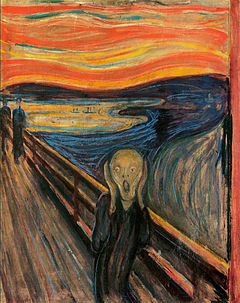
+MUNCH’S ‘THE SCREAM’

+++++++++++++++++++++++++++++++++++

Our screams of pain are not silent!  When Edward Munch gave vision in 1893 to The Scream it seems to me that he recognized a close relative of what I wrote about in my last post, +OUR PAIN: OUTSIDE THE RANGE OF EMPATHY.  He painted the abyss, as well.  Did Munch personally feel pain-beyond-measure?  If he did or if he didn’t, certainly his gift of artistic expression captured in this image a visual presentation of what might well be the bridge across which nobody but those who know this scream can travel.

It seems very possible to me that only those of us who were forced to grow and develop our trauma-altered body-brain in the midst of malevolent early LACK OF mothering-caregiving at the same time we were abused-past-imagining actually NOT ONLY have the physiological ability to feel THIS PAIN — but also that ONLY those who have THIS PAIN built into us CAN feel it.

Who, then, can cross ‘our bridge’ to reach us?

The Scream - Edward Munch (1893)


+++++++++++++++++++++++++++++++++++

+DISORDERED EMPATHY = BLURRED BOUNDARIES = TRAUMA DRAMA = COMBINED CRIES FOR HELP

++++++++++++++

Like writing a revised weather forecast there is something I need to say.  Nature does not make mistakes.  If severe early trauma (in unsafe and insecure attachment environments) builds ‘disordered’ empathic abilities into a little suffering one’s body-brain, this happens for a USEFUL reason.

It strikes me that when I wrote that empathic contamination results when one person’s suffering is directly COMPOUNDED by another person’s suffering this can be considered as the operation of ‘unhealthy boundaries’ between the two.

It also strikes me that if ten people are trapped in a burning building they are sharing trauma.  The chances of being rescued improve if all ten shout for help as loudly as the can together and at the same time.

So as I experience an increase in my own experience of suffering at the same time I contemplate the current suffering of probably half of our nation’s infant-children, I see that this means my body has been built by my own early trauma to KNOW the suffering of those little ones as if I am in the burning building right along with them.

I suspect this is, in fact, what happens with ALL TRAUMA DRAMA.  Everyone entrapped within the trauma drama is suffering together as the dramatic reenactments of unresolved traumas that have traveled on down the generations actually represents A COMBINED SCREAM FOR HELP.

Suffering of the one is suffering to the whole while in the middle of trauma.  Those that can give care, that can rescue, that can save, that can solve the problems the trauma has and is creating ARE ON THE OUTSIDE of the actual trauma happening — not within it.

Nature has no doubt created the ability within humans to ‘blur individual boundaries into a combined whole’ for exactly this reason.  Like the image of the combined flames of individually held candles being brighter to light up the night, those of us who have disordered empathy can amplify the cries of ‘save me’ by adding our voice to the call of all the suffering others who are crying the same thing.  The cry then becomes louder and louder, “SAVE US!”

The question in my mind then becomes, “Who is it on the outside who can hear the cries of the suffering?  Will they hear?  Will they respond?  Do they care enough to have the empathy coupled with compassion coupled with desire coupled with intent coupled with resources to HELP?”

And my own conflict within myself right now has to do with WISHING I was on the outside looking in on the trauma rather than being on the inside crying out.

++

+INSECURE ATTACHMENT = DISORDERED EMPATHY

++++++++++++++

+OUR NATION’S SUFFERING OFFSPRING: WE MUST EXAMINE HOW WE THINK ABOUT THEIR SUFFERING

++++++++++++++++++++++++++++++

One word or two?  Webster’s online dictionary says ‘common sense’ is two words.  A Dictionary of Sociology (1998) uses the one-word version:  commonsense.

Is this sense simply something that we share with all ‘lower life forms’?

Common Sense

According to Aristotle, the common sense is an actual power of inner sensation (as opposed to the external five senses) whereby the various objects of the external senses (color for sight, sound for hearing, etc.) are united and judged, such that what one senses by this sense is the substance (or existing thing) in which the various attributes inhere (so, for example, a sheep is able to sense a wolf, not just the color of its fur, the sound of its howl, its odor, and other sensible attributes.)

It was not, unlike later developments, considered to be on the level of rationality, which properly did not exist in the lower animals, but only in man; this irrational character was because animals not possessing rationality nevertheless required the use of the common sense in order to sense, for example, the difference between this or that thing….

Or does ‘common sense – commonsense’ require a social awareness of our selves as being connected to other members of our species on a conscious level?

Is there anything about ‘common sense – commonsense’ that requires of us that we use our higher-specie’s more complex abilities of rational thought and critical thinking?

“”Fluid Intelligence” directly correlates with critical thinking skills. You are able to determine patterns, make connections and solve new problems. When you improve your critical thinking skills you also improve your fluid intelligence which also helps increase your problem solving skills and deep thinking elements. All of these skills relate to one part of the brain, and the more you use them the easier it will be to put your skill to the test.”

According to the Wickipedia entry for Critical thinking, it calls for the ability to:

  • Recognize problems, to find workable means for meeting those problems
  • Understand the importance of prioritization and order of precedence in problem solving
  • Gather and marshal pertinent (relevant) information
  • Recognize unstated assumptions and values
  • Comprehend and use language with accuracy, clarity, and discernment
  • Interpret data, to appraise evidence and evaluate arguments
  • Recognize the existence (or non-existence) of logical relationships between propositions
  • Draw warranted conclusions and generalizations
  • Put to test the conclusions and generalizations at which one arrives
  • Reconstruct one’s patterns of beliefs on the basis of wider experience
  • Render accurate judgments about specific things and qualities in everyday life

Oh dear.  Sounds like WORK to me!  As opposed to critical thinking, commonsense (I will use this one word because I like it better) seems to simply become a part of us by osmosis.  We simply grow into adults who have naturally absorbed the ‘common’ understandings about people-in-the-world in alliance with what our culture suggests to us.  Questioning either/or our understandings or those of our culture TAKES WORK – and work takes time and committed focus and effort.

In my own thinking if I divide commonsense in half I come up with two other important words:  MYTH and DEBUNKING.  Unless we choose to think critically using fluid intelligence about matters of grave importance to the well-being of people, we can be contributing to other people’s suffering through perpetration of harmful myths without even knowing it – because we haven’t THOUGHT about the problems using the higher brain functions our species has been gifted with.

When it comes to the well-being of infants and children in our nation, commonsense and cultural mythical thinking appears to have the upper hand.  Few wish to examine the actual facts about the increasingly abysmal conditions that REALLY exist for our nation’s little ones so that CREATIVE SOLUTIONS can be found and implemented to improve those conditions.

I am left feeling hopeless, helpless, overwhelmed, and full of sorrow, concern and fear about the lack of well-being for at least half of our nation’s infants, toddlers, children and teens in America whose optimal needs are not being met during the critical growth periods of their development.  As our nation’s offspring suffer so too is our nation suffering.

The FACTS of the situation are grim.  As long as we deny the facts by sticking to commonsense opinions that are NOT based on facts, we as a nation are going to continue to slide backwards.  As a nation we need to take off our ‘rose colored glasses’ and begin to examine what we think we know about the well-being of infant-children by examining HOW we think about the problems they face and the suffering they are enduring.  It’s the least we can do – and hopefully it will help us move into the myth debunking stage of our thinking that we – and our nation’s offspring — so desperately need.

++++++++++++++++++++++++++++++

Commonsense Knowledge

This refers, unsurprisingly, to routine knowledge we have of our everyday world and activities.

“Different sociological approaches adopt different attitudes to commonsense knowledge… [as it] refers to organized ‘typified’ stocks of taken-for-granted knowledge, upon which our activities are based, and which, in the ‘natural attitude’, we do not question. …, commonsense (or, as it is frequently termed, ‘tacit’) knowledge is a constant achievement, in which people draw on implicit rules of ‘how to carry on’, which produce a sense of organization and coherence…. the central aim of sociology is seen as explicating and elaborating on people’s conceptions of the social world, and sociological analysis must always be rooted in these conceptions.”

++

Sociology and common sense

By Elizabeth M. Young

“Sociology is the science of human interaction and social behavior.  Common sense is the indigenous knowledge that comes from living and interacting in the real world and coming to conclusions that are passed on orally.  Science looks for either evidence or a compelling argument that is supported by serious examination of the evidence or by the best possible theoretical design and testing of hypotheses.

“Sometimes they are the same.  Sometimes they are vastly different in the rigors of testing and confirmation of deductions and inferences.  Sometimes both deal with very complex matters and sometimes both deal with simple matters.

“Common sense can be indigenous knowledge that has developed and been proven to be successful over long periods of time in dealing with the world, people, society and nature.

“Over time, common sense identifies the productive, defensive and reactive practices that result in success and survival.  In some cases, there is no objective, factual support for some practices.  In other cases, the predictability of nature provides the factual and logical support for certain practices.

“Generalization is more possible with Sociological conclusions that are made from data that comes from wider sources, is less personalized and is collected in greater detail.  Generalization can be less possible with common sense because of the limited, localized and personalized nature of experience, observation and understandings.

“Some taxpayers use common sense to assume that welfare recipients are mostly lazy people who just want to live off of the dole and who do not want to work.  The reality is that a majority of welfare recipients are either elderly, disabled, or otherwise unable to work, are only temporary recipients, or are fully employed but making low enough wages to qualify for specific welfare benefits and programs.

“Sociologists can access the databases of the social services agency and make rigorous examination of the detailed welfare information.  The average taxpayer usually has access to media reports and very limited data that is filled with non objective opinion, bias and factual error.

“Sociologists might study the economic, political, social and other conditions under disciplines of objectivity, ethics, rigorous methods of quantifying and collecting data, proving causality, modeling and other methods that can be more limited and capricious when developing common sense conclusions.

“The results are always to be tested against common sense that comes from real world, practical applications of ideas, policies and programs.  All regional, national or international programs are implemented at peril of being found inadequate to handle localized realities.  Thus, common sense, through surveys, notice and comment periods, and even lawsuits, is often taken seriously when large programs are being developed.

“To complicate matters, there may have been more objectivity when the common sense understanding was developed, while the sociological result might have involved less objectivity.  Both science and common sense might be supported by factually volatile oral histories, casually completed records, or by detailed records that  can are [sic] highly reliable.

“In summary, common sense develops from interacting personally and locally with the world and developing informal understandings and conclusions that explain things to personal and local satisfaction.  Sociology uses the scientific method to get to the reality and truth of matters in ways that can be challenged and tested again and again and that generalize to more of the world.

“In reality common sense, indigenous knowledge, and scientific method work together as the backbones of the social sciences.”  [all bold type emphasis is mine]

++++

Sociology in Our Times: The Essentials by Diana Elizabeth Kendall (Dec 2, 2008)

Sociology promotes understanding and tolerance by enabling each of us to look beyond intuition, commonsense, and our personal experiences.  Many of us rely on intuition or common sense gained from personal experience to help us understand our daily lives and other people’s behavior.  Commonsense knowledge guides ordinary conduct in everyday life.  However, many commonsense notions are actually myths.  A myth is a popular but false notion that may be used, either intentionally or unintentionally, to perpetuate certain beliefs of “theories” even in the light of conclusive evidence to the contrary.  (page 5)”  [bold type for emphasis is mine]

++

Sociology and Common Sense

Sociology and other social sciences focus on the study of certain aspects of human behavior. Yet human behavior is something with which we all have experience and about which we have at least a bit of knowledge. In our daily lives, we rely on common sense to get us through many unfamiliar situations. However, this knowledge while sometimes accurate is not always reliable because it rests on commonly held beliefs rather than systematic analysis of facts.  Sociology and other social sciences focus on the study of certain aspects of human.

Common sense is knowledge and awareness that is held communally (shared by majority of people). It does not depend on specialist education and in some respects states the obvious….  Many sociologists have responded that common sense is wrong and obvious truths are not so obvious.”

++

Common sense, “based on a strict construction of the term, consists of what people in common would agree on : that which they “sense” as their common natural understanding. Some people (such as the authors of Merriam-Webster Online) use the phrase to refer to beliefs or propositions that — in their opinion — most people would consider prudent and of sound judgment, without reliance on esoteric knowledge or study or research, but based upon what they see as knowledge held by people “in common”. Thus “common sense” (in this view) equates to the knowledge and experience which most people already have, or which the person using the term believes that they do or should have. Another meaning to the phrase is good sense and sound judgment in practical matters.”

++

Debunking is a process of questioning actions and ideas that are usually taken for granted.  It refers to looking behind the facade of everyday life.  It refers to looking at the behind-the-scenes patterns and processes that shape the behavior observed in the social world (Andersen & Taylor, 2001:6).” (Based on the work of Dr. Peter Berger)

++

According to Martin Teicher, MD, PhD, director of the Developmental Biopsychiatry Research Program, “science shows that childhood maltreatment may produce changes in both brain function and structure. These changes are permanent. This is not something people can just get over and get on with their lives.”

++

+U.N. REPORT CARD ON CHILD WELL-BEING AMONG GLOBE’S 24 RICHEST COUNTRIES: AMERICA FLUNKS!

+THE UNITED NATION’S REPORT CARD ON AMERICA’S CHILD WELL-BEING – THE WIDE GULF BETWEEN THE HAVES AND THE HAVE-NOTS: AM I IMPASSIONED OR EMBITTERED?

+CLEAR ARTICLE ON LIFELONG INFANT-CHILD TRAUMA CONSEQUENCES

++++++++++++++++++++++++++

+TO BE ‘WALKED RIGHT THROUGH’ – WHAT MY BODY REMEMBERS ABOUT MY NONEXISTANT SELF

+++++++++++++++++++++++++

I suspect that knowledge of the threat of death, even if existing only on a cellular level within our DNA, must accompany a newborn infant into this world.  Why else would a person’s life force naturally accomplish all that is possible to remain alive?  Is safe and secure attachment to caregivers designed to somehow banish this awareness of the threat of death?  Is this part of the mechanics of change that severe infant abuse/trauma (especially) maltreated survivors never lose when we never had those attachments?

When the caregivers are NOT the source of protection but are rather the transmitters of harm and great violence, what THEN happens to this awareness of the threat of death?

++

It seems almost strange to me that as I wait this morning for the HUD housing inspector to park in my yard this afternoon it is the awareness of the continuity throughout my entire life since my birthing of this awareness of the threat of death that is being fed into my thinking directly from the way my body is feeling right now.

As I pay attention I understand that ‘being walked right through’ is a big part of what I am sensing in my body connected to its memory.  Yes, this inspector will ‘walk right through’ this entire personal, sacred, precious space of my home that is so much a part of ME right now.

The ‘being walked right through’ feels both extremely threatening to me right now and extremely familiar.  It brings to mind my memory of being 21, walking around the northern town I lived in alone late at night in a snowstorm as I stood with my bare hands out in front of me, looked at my palms and heard a ‘voice’ say to me from within:  “I am a wraith.”

At that time I didn’t even ‘logically’ know what the word wraith meant.  Searching online I find that it is used mostly this way:

1 –an apparition of a living person supposed to portend his or her death.

2 — a visible spirit.

The origins of the word appear to be unclear though either Scottish or Celtic origins are suspected.  Most of my genetic heritage is linked to these cultures.

For all the thousands of physical attacks I endured during the 18 years of my childhood, never – not one single time – did I experience of a sense that I as a person-self existed in the body that was being pummeled.  I didn’t have that sense because I DIDN’T exist.  And it wasn’t until that instant in that snowstorm that the first vague and distant clue arrived that I, in fact, did exist.

Until that instant there had never been a connection for me between my BODY and a ME-SELF capable of realizing anything about my own existence.

The two pieces of information had simply never built themselves into the associational networks in my brain.  For this connection between body and awareness of self to come to me, and then for a connection to be made between the self as being connected to that body to happen SO LATE in my life would be nearly unbelievable to me if I didn’t know my own life story.

MY SELF-self HAD always been ‘walked right through’.  My self, as existing not connected to my body, did not receive the physical blows that would have let it know it existed in time and space.  My body obviously knew this information.  It had suffered greatly.

My invisible self, my wraith self – contrary to definition in the dictionary – appeared for the first time when I was 21 not because I was on the verge of DYING but because I was on the verge of COMING ALIVE.

++

Today I struggle with staying in and with my body as I go through this distress-provoking experience related to my well-being.  My body, with its in-built ancient DNA instinctual wisdom DID endure, DID persevere.  But this SELF I am with my awareness of my SELF existence remains only tenuously connected.  The two can very easily become disassociated rather than associated with one another.

My SELF does not want to become nonexistent.  I am very aware that in my case, given my unique history, that the fight to self-preserve happened IN MY BODY, but not in any way with this SELF I work to identify with today.

It is this self, who recognized herself for the first time when I was 21 in those words, “I am a wraith,” who knows what it was like to have no existence so that it could be ‘walked right through’ for my first 18 long years of torture.

++

This is not an easy day……

+++++++++++++++++++++++++

+BLOGGING AND THINKING WITH A TRAUMA-CHANGED BRAIN

++++++++++++++++

I live in and with an over-sensitized, over-sensitive, anxiety-trauma-built body.  Among the changes that happened in my physiological development is that ALL of me was changed in adaptation to severe abuse and violent trauma from the moment I was born and during the following 18 years I could not escape my mother.  This includes how my brain was structured from the beginning of life so that NOW it operates differently from ‘ordinary’.

These facts of course affect not only my thinking, but my writing as well.  I FORCE myself to think in words, which is an essential process that I do not obscure in my writing.

Although I am not ‘autistic’ my patterns of thinking can be as disconcerting to follow verbally as an autistic person’s can be.  I do not – because I really cannot – attempt to obscure from my writing how my brain (hence, I) move forward in time within the realm of words.

++

Blogging has comfortingly allowed me to write in loops and circles.  What my body knows (as with everyone’s) provides information through my right brain that must then be handed over to my left brain for linear-logical-verbal exposure to consciousness.  In order for this process to happen, all this back-and-forth has to involve the ‘bridge’ between my two brain hemispheres – my corpus callosum.  As is well known and is much written about today, the development of both brains and the bridge between them is greatly affected by severe abuse, neglect, trauma, violence and malevolent treatment during the brain’s most critical early stages of growth.

I suffer from these consequences.  But I am determined and courageous.  It is my intent to make the most good possible come out of my disastrous early beginnings, and as is my prayer every day of my life, to at least offer something that might help someone else.

When I began this blog in April of 2009 I could not go back and reread or edit in any way anything that I wrote.  Whatever state I was in when I wrote was not one I could return to even in the immediate future.  I had no tolerance for my own words as if I was deadly allergic to them.  What I wrote about had been deadly toxic to me – and remained so.

I have made SOME progress, although most of the time I have to ‘look the other way’ as the words come out.  Having entirely lacked any concept of ‘being a self’ or of ‘having a self’ for the first 18 years of my life has left me with that all too familiar dissociational condition of being ‘depersonalized’ so that once a single instant of time has passed by in my life it becomes the ‘dereal’ past – not directly connected to me in any way unless I consciously, logically FORCE an awareness of a connection.

But I do not FEEL connected to myself as a ‘past entity’ or as a ‘future entity’.  All perception of time was built into my body-brain in the midst of ongoing severe trauma, and I now believe that if there is NEVER a sense of safety or security (as expressed in human attachment relationships), when there is no safe and secure time to REST between experiences of trauma, the acute trauma stage with its altered sense of time becomes permanent.

This also affects me as I think in written words.  I am ‘mind blind’ to words that are going to follow one another.  I have to, again, ‘look the other way’ rather than anticipate where my thoughts are going.  I believe when Dr. Daniel Siegel speaks of ‘Mind Sight’ he is referring to consequences such as I suffer from.  In my courage and determination I do not let these alterations stop me.

++

Sometimes my posts must seem redundant to this blog’s faithful readers.  Every post I write has to have enough inner integrity that it can be found through someone’s future online search, read, and understood in context.  This is an example of this process in motion over time:

Posted yesterday in comment to a post:  +A LONG, THOUGHTFUL LOOK AT VERBAL ABUSE AS MALIGNANT TEASING

Word Count: 5876

I googled “teasing as verbal abuse” because i wanted to read something exactly like this.”

This post is a long one.  Yet somehow within its structure of words it held something of helpful meaning to this reader – and I am glad it did!

++

Because of my brain being built in the midst of severe trauma my emotional right limbic brain and the body that feeds it information IS overly sensitive-sensitized.  I will struggle with ‘failure’ on a primal level within me for the rest of my life, so when a comment comes in like this one, I struggle directly with the ‘rejection’ that it triggered:

Posted yesterday in a comment to post:   +INSECURE INFANT ATTACHMENT, DAY CARE AND EMOTIONAL NEGLECT

Word Count: 1234

I’ve been skimming your recent posts (sorry, they’re a little long)

And this post was a relatively short one.  Of course I welcome all comments.  My discomfort has nothing to do with the words of the commenter – nearly everything about being alive in my body is a trauma trigger to me, so pervasive was the malevolent trauma that built me!

++

Now, THIS post is a very long one and I thought about perhaps figuring out a way to impose some structure on it at the time it was posted.  And yet dividing one of my thought stream writing processes into segments, like chapters, doesn’t work well in this blog’s format.  Although it easily contains enough words for 4-5 posts, it needs to remain a ‘stand alone’ piece for someone to discover sometime in the future as a ‘whole thing’ with its context intact.

January 16, 2011 post:  +TO BE OR NOT TO BE — HUMAN OR OBJECT: EARLY ATTACHMENT PATTERNS DECIDE AS THEY BUILD OUR ANS

Word count: 4095

++

Computerized reading is nicely designed to allow for scanning and skimming.  Any post can also be read in parts over time – put down and picked up again like a book.

Somehow, to me, the nature of my writing-thinking process is integral to the purpose of this blog.  Nothing comes easily.  Nothing comes without effort.  When a severe infant-child abuse survivor attempts to accomplish a lifespan in a body-brain that was altered and changed in its development by trauma, nothing about our life happens in a simple straightforward way.  This can be especially true with our patterns of processing words that match our experience.

++

NOTE:  It is always best to come directly to the blog post as it exists in real time because I DO now often go back after the post is published and make changes — exactly as I am at this moment.

++++++++++++++++++++++++++++