+SUICIDE – SCREAMING IN THE DARKNESS

++++

While someone screaming in the darkness may not be able at that point to reach a different level where the light of knowledge could penetrate to offer rays of hope, people who are not caught in some seemingly endless web of lost hope CAN educate themselves on a critically important piece of information about those at highest risk for suicide:

Stress, abuse damages childhood genes

Studies show that genes for suicide not only exist, but that they are not nearly as likely to be activated in people who did not suffer severe stress from trauma in their earliest developmental months and years of life.

That means that even though a person might appear to be living in a ‘grown up’ body when suicide thoughts, feelings or the act itself appears in their life – the damage done from changes in physiological development during extreme early traumatic stress is very often the destructive weapon that actually has triggered the entire suicide slide into seemingly unbreachable misery.

All trauma-triggered changes in infant-child development are in themselves signals that the early environmental conditions were malevolent.  People at a point in their lives where suicide can appear as an ONLY option know in their very BODY that much in the world is very, very wrong.  We need to understand that a little one’s body can grow to include trauma within it as surely as a tree might grow to incorporate a piece of wire that was tied around it when it was much, much younger in the world.

In fact I seriously doubt that suicide can show up in a person’s life as an  option or reality without there having been a dangerous, toxic, traumatic breakdown in such a person’s earliest life during critical stages of development.  As research is showing, it is at these earliest stages that genes for suicide become activated.  Further, through epigenetic changes the risk for suicide related to genes can be passed down through future generations.

To address suicide the arms of caring, knowledgeable and informed, compassionate and wise community people must be securely wrapped around such a deeply wounded person for a lifespan.  Love and caring support needs to be present – near and reachable – in the form of a living human chain of rescue and resource that not only offers immediate help when needed to those living in a world where hope has been so elusive that it has barely existed at all, but also makes sure that the strength of this companionship-in-truth is ALWAYS dependably available.

++

The erosion of culture and community, of society and civilization leaves a terrible, terrifying, overwhelming burden of suffering on survivors of early trauma and abuse that really belongs to the outside world that fosters and allows traumatic stress to inflict unspeakable misery on the most vulnerable members of our species.

SUICIDE FACTS AND FIGURES

  • Every 14.2 minutes someone in the United States dies by suicide.
  • Nearly 1,000,000 people make a suicide attempt every year.
  • 90% of people who die by suicide have a diagnosable and treatable psychiatric disorder at the time of their death.  [My note:  One could safely say that MOST so-called ‘mental illness’ can be directly tied to infant-early childhood abuse and trauma – see:  Center for Disease Control – Adverse Childhood Experiences (ACE) Study
  • Most people with mental illness do not die by suicide.
  • Recent data puts yearly medical costs for suicide at nearly $100 million (2005).
  • Men are nearly 4 times more likely to die by suicide than women. Women attempt suicide 3 times as often as men. Click here to view.
  • Suicide rates are highest for people between the ages of 40 and 59. Click here to view.
  • White individuals are most likely to die by suicide, followed by Native American peoples. Click here to view.

++

List of Countries by Suicide Rates

++

Study: US Suicide Rate Rises, Falls With Economy

++

The 15 Most Suicidal Cities In America

++

Why the Happiest States Have the Highest Suicide Rates

++

National Child Abuse Statistics:  “Children are suffering from a hidden epidemic of child abuse and neglect. Every year 3.3 million reports of child abuse are made in the United States involving 6 million children; that’s because reports can include multiple children. The United States has the worst record in the industrialized nation – losing five children every day due to abuse-related deaths.”

++++

Please click here to read or to Leave a Comment »

++++

+HONEST THINKING ABOUT DISSOCIATION AND DEATH

++++++++++++++++++++++

I have an honest yet disheartened post in me today.  I might as well write it so I can move on.  I am spending time working to digest the information presented in visual form on a PowerPoint page I posted the link to recently that comes from the work of Dr. Bruce Perry.

Neurodevelopmental Impact of Childhood Trauma:  Adaptive Responses to Childhood Trauma – Focus on Dissociation

A ChildTrauma Academy Presentation

I haven’t yet gone to look for any text that might accompany the diagrams, graphs and images that this site presents.  Nor can I tolerate considering the facts on this webpage for very long at a time.  Because this information concerns me so personally as a severe infant-child abuse survivor who suffered Trauma Altered Development, it all just plain hurts too much.

++

This webpage is visually clarifying the difference between an infant-child who responds to trauma with HYPERAROUSAL compared to one who responds to trauma with DISSOCIATION (as a HYPO- rather than a HYPERarousal state).

As I have been outside working on building my garden today I have found myself thinking that having patterns of HYPERAROUSAL built into one’s body from birth might be far more useful in the long run that DISSOCIATION can ever be.

It seems that hyperarousal would give one a fighting chance.

Then I think about my mother and HER fighting chance!  Oh my GAWD the harm she was able to do, particularly to little tiny ME!  (Considering the link between shame-dissociation as an opposite physiological response to trauma than hyperarousal is, maybe I don’t have to wander very far at all in my wondering about why-how my mother never had a shame reaction for what she did to me — as her FIGHT over-arousal escalated for my entire 18-year infant-childhood into violence against me.)

Dissociation, even as it is contrasted to hyperarousal on this webpage seems to be directly connected not only to the vagus nerve system, but in the bigger picture to the calm end of the stress response system — the “STOP” arm of the Autonomic Nervous System (ANS) that halts the overwhelming experience of TOO MUCH “GO!”  When I am dissociating my body is regulating the physiology of my body back to CALM in the way that was built into it from birth.

(“Rest in peace.”  Death must be the ultimate calm!  I find it interesting that in online Google searching there does not appear to be the same direct line of thoughts appearing that connect DISSOCIATION with suicide like there are connecting DEPRESSION to suicide.  Someone is missing a very BIG BOAT!)

(By the way:  The neurological-physiological dissociation response pattern that the above webpage describes appears to be nearly indistinguishable from the neurological-physiological reaction of SHAME that developmental neuroscientist Dr. Allan Shore describes as a one-year-old infant experiences it as soon as their body has developed far enough to have the physical capacity to feel its first shame reaction. See also:  The Shame Transaction and PTSD AS A SHAME DISORDER)

Also see:

Childhood abuse, household dysfunction, and the risk of attempted suicide throughout the life span: findings from the Adverse Childhood Experiences Study.

++

Because I have an appointment with and oncologist on the 6th of January I find myself thinking a lot about what I want and what I need.  I have suffered increasing stress complications most definitely escalating my preexisting PTSD, depression and dissociation I suffer as a consequence of being a survivor of sever infant-child abuse after having the doctor who treated my advanced and aggressive breast cancer (there were two cancers) tell me on my last session 2 ½ years ago, “By the way, I wouldn’t bother having breast reconstruction if I were you.  You aren’t going to live long enough to enjoy them anyway.  Besides, we’d just have to cut them off again when the cancer comes back.”

I am going to request a body scan that will show whether or not I have cancer NOW or NOT.

Then I think about the fact that I have no desire or intention of fighting the cancer if I do get it back.  (Knowing I felt this way when the first diagnosis came around created a profound conflict of emotions within me during the grueling chemo-surgery treatment regime I went through so that I can be alive today.)

Then I think about how the dissociation reaction described visually in the webpage I am referring to MUST be tied to both ‘passive’ and ‘active’ suicide.  Dissociation as a ‘going away’?  Death as the ultimate ‘going away’?

Then I think about my mother’s mother who gave up and died.  I think about my father who gave up and died.  I think about my mother who gave up and died.

The deaths of both of my parents was directly tied to a lack of desire to seek and receive appropriate medical care for conditions that were treatable.

That’s exactly the same thing I see myself doing if cancer returns in my body.

++

Hyperarousal?  It looks for this webpage as if this is a reaction that older children and adults utilize, not helpless tiny infant-toddlers who are overwhelmed by abuse and trauma from the time of their birth.  I don’t HAVE a useful hyperarousal reaction.  I believe I experience all the ‘symptoms’ of it listed on page 2 on this webpage (keep track of page numbers in the gray bar at the top of the pages).  But all that hyperarousal response does to me is open my dissociation floodgate – and I am DISSOCIATED again.

And what if the link between hypoarousal-dissociation means that sometimes people simply cannot find the hyperarousal energy continuum necessary for them to continue using their will-life force to FIGHT for their own continued life?  This seems especially likely if dissociation was formed into a person’s body due to extreme abuse and trauma during infant-toddlerhood so that a person has been forced to dissociate all of their lives due to overwhelming pain.

See: +SUBSTANCE P – IT’S OUR BODY’S BIOLOGICAL LINK TO FEELING EMOTIONAL AND PHYSICAL PAIN

++++++++++++++

I found this post online today.  I believe it’s critical to realize that people like me (and my parents) who suffered ENOUGH ALREADY do not want a LONG LIFE.  Some do not want their suffering to continue and continue and continue.  I believe I am one of those people.

What I do know is that refusing medical care must be related to dissociation in some way — dissociation from pain?  Dissociation from a future?  I will be spending much more time on the site I mention above — it has certainly gotten me thinking about connections with me that go all the way back to how my body-brain was made in/by nearly continual trauma and abuse from my mother from the time I was born.

++++

Suicide and Mental Health: They’re Cooking the Books

— Thought provoking post on a healthyplaces.com blog

++++++++++++++++++++++

+WHO WOULD WANT TO LIVE WITH THIS SADNESS?

++++++++++++++++++++++++

This post is for this girl — I am still the same person and feel the same way.

Me left out -- I have felt that all of my life, just a few times less left out - very much feeling this today (me with my father's back turned on me - in a different universe than my siblings were - and I still pay the price for that)
So sad. Sadness beyond 'in my bones' - in all the cells of my body -- and still there

I know I can’t think my sadness away, but I spent the day garden-building and trying to ask ‘God and the angels’ to show me what I can learn from it.

I miss the man I love (who prefers another’s company) and I miss my children and all my siblings more as the holidays arrive than usual.  I HATE ‘the holidays’.

One of the ‘helpful’ insights today was knowing that I am not alone in how I feel, and ‘things could always be worse’.

Far from happy thoughts — either of THOSE two.

Not that I did actually arrive at any happy thoughts today — but I did end up (perhaps mixing up my holidays) thinking about Jesus on the cross and how alone He was there — but for his Father and the angels.

Then I thought about how easy it might be for humans to forget about God when they are happy with one another — well, I don’t fit THAT picture!

Tomorrow on Thanksgiving I am going to a friend’s house to help her in the kitchen — be with people — eat good food.  My friend feeds anyone in the community who wishes to come every Thanksgiving.

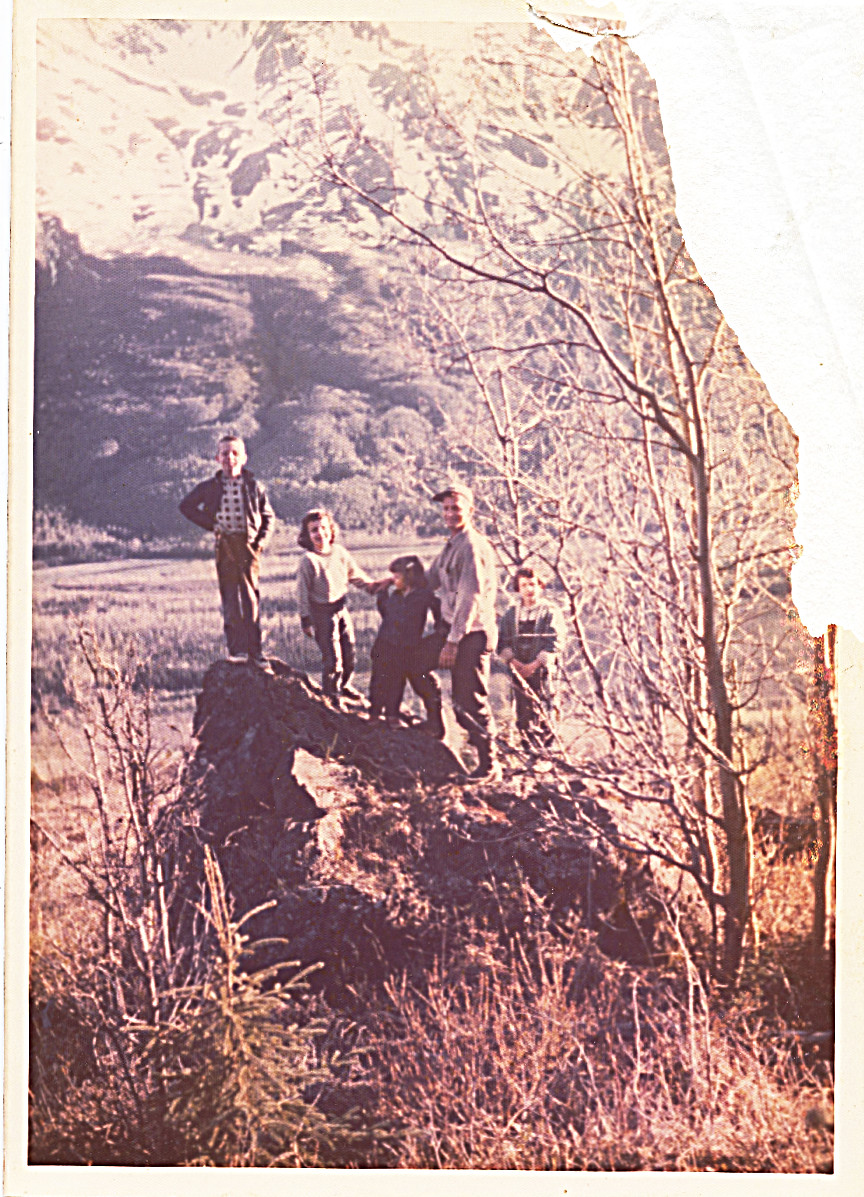
I went last year, and ‘hiding’ in the kitchen suit me.  Serving food to others suit me.  Being quiet suit me.  Watching and listening to others (as if they belonged to a different species than I do) suit me.  I am not sure that I have ever truly felt any more a part of a group than I did in the picture of my father and his three favored children on the big Alaskan rock.

++

At 59 knowing that I can’t CHANGE how I feel pisses me off more than anything else.  I no longer have the false desire to try, either.  I am soul tired.

People say, “Everyone feels alone in a crowd sometimes.”  I believe it takes a special kind of severely traumatic and abusive infant-childhood for anyone to REALLY even begin to have a glimmer of a clue what ‘feeling alone’ really feels like.

Then I thought some more about Christ on the cross.  I thought some more about my horrible, horrible childhood and the ‘special hell’ my mother reserved for me (as my oldest brother put it once).  I thought about how NO INFANT or CHILD ever deserves the treatment that some of us had any more than Jesus deserved what happened to Him during His time on this earth.

This thought cheered me up a TINY bit.

Maybe it is because I feel so sad and soul weary that I cannot find any way at all to fight to ‘get better than this’ any more.  I can’t run around and ‘try this’ and ‘try that’ and ‘run here’ and ‘run there’ like I used to.  I can’t distract myself any more.  I can’t fool myself any more.  I can’t pretend any more.

I was, most importantly, able to be different for the 35 years of my life that I had a child under 18 in my care to raise.  My ‘caregiving system’ was able to combine with my attachment to my children to get me down the road without having to have to FEEL the depths of my sadness.

I know now that the sadness has always been at my center since my insanely abusive mother built it into me from the time I was born.  I am so proud of myself that I was able to let my children GO, to let them fly, to let them create for themselves their OWN life.  I certainly wish they didn’t live — all three of them — in Fargo, North Dakota!

++

Another train of my thoughts today (again) followed the course of my wandering lost life that seemed to most importantly enable all three of the very special people my children are to be born.  Yet I also NEVER felt that the life I lived along the way was mine, meant for me, belonged to me.  Maybe it is ONLY to the future that the meaning of my own life will come true — in my children, in their lives, the people they encounter and affect — and in the next generations.

If my body processed experience and stored my memories in a safe and securely attached fashion (autobiographical memory) I know I would feel different and be different today.  My dissociational patterns means that all of my memories feel remote to me and NOT a part of ME.  That is so WRONG — and so directly connected as a consequence of my having to build a body-brain in the midst of such terrible and continuing trauma.

I don’t believe my memories comfort me in the way that they do more ‘ordinary’ people — and they never have.

++

I think knowing and feeling all of this is directly connected to the most fortunate opportunity I have to work outside with the soil to build a garden.

I laid a big piece of the drip irrigation in the back yard yesterday, and today I planted there.  In went poppy seeds, larkspur seeds, pansy seeds — all waiting now for winter rains to nourish them — and for spring.

I planted a lilac today and I planted an apple tree.  (I moved a rose bush to a happier place for it with morning light so I could better improve the spot for the apple tree.)

I am digging out an area by the back turquoise wood fence as I imagine perhaps — just perhaps — I can tear down the remains of the old shed on my back fence and use that lumber to build a chicken coop.

I use the adobe from that digging to fill in a long planter along the tall yellow metal fence.

I have an adobe bench back there I can sit on in the sun and watch the apple tree grow now.  If I can build a chicken coop I could sit there and watch my chickens.  I would LOVE to be able to do that — though I don’t have transportation to get to a feed store to buy them feed — even if I can afford to buy it — and can find three chickens.

And maybe a little rabbit.  I could sit like I did when I was a child with my warm fuzzy so-gentle rabbit on my lap — pat it and get to know its spirit.

++

Someday I hope somebody comes to visit me.  I find down here in southeastern Arizona that people do not go to one another’s house to be with one another like they do up north.  I couldn’t handle the ‘stimulation-noise’ of too many people — or the ‘wrong’ people.  But SOMEONE?

My daughter will bring my grandson down about the 4th to the 8th of this January.  That will be — well — fantastically wonderful!  Then they will go and then I will miss them…….

Meanwhile……….  Perhaps the angels like it if I talk to them.

(Oh — and yesterday I laid the drip over the large compost pile filled with delicious garbage and the thousand worms my sister sent me from Seattle!  I moved the buried tomb that contained all my mother’s writings into the big compost — and guess what?  For the first time in the four years I’ve lived on this property I saw centipedes — nested within my mother’s papers.  HOW GROSS!  I hate centipedes!  Very unsettling, but somehow didn’t surprise me — certainly not after my recent posts about eliminating the hideous oleanders!  The wonderful composting worms can have those papers now — and I KNOW they will make me wonderful garden soil out of them by spring!)

++++++++++++++++++++++++

+THINKING ABOUT COMPASSION

+++++++++++++++++++++++++

Maybe I think about things too much, but I am not sure I know what compassion is.  Sometimes I think I ‘have it’ and then I find myself looking around at other people and judging them for NOT having it!

I am thinking in specific about a man a little over 55 who worked a Title V job at our local thrift store and quit two weeks ago.  This man had a shady past, true.  He had shady behaviors while working at the store that probably would have gotten him soon fired if he had stayed.

The workers, all friendly acquaintances of mine over these past 10 years, strongly suspected that this man kept out the best of the donations to the store and figured out ways to steal them.  It was suspected that he was using a fraudulent identity.  He was known to concoct intricate stories about his life that were not true.  Someone in town had seen him selling drugs to young people.  Nearly everyone believed that after a few years clean from using drugs himself, that he had returned to his old habits.

A week ago today he walked in the back door of his girlfriend’s house where he also lived, grabbed a gun, and blew his brains out.  His girlfriend, who I’ve never met, was in the front room at the time this happened.  Over this past week I have listened to everyone I know who knew him talk about his death but only one spoke about him with compassion.  The rest seem to both judge him and want to hold him somehow accountable for the questionable way he lived his life.

I have someone whom I love very much in my life, a family member, who was able twenty years ago to kick the chronic and destructive use of alcohol, heroin and meth.  I spent time with him at the end of his active disease simply loving him because I could see how terribly sick he was and there was nothing else I could do for him.  I saw how the meth created the incredible web of lies, a complex, sinister and unfortunately almost believable arrangement of his life that he spun with his words that I eventually found out had absolutely zero basis in reality.

I see the death of this ex-thrift store employee in this light.  He died from a terrible disease.  His disease affected his living and it led directly to his death.

I find myself right now confused about arrogance (ignorance?), self-righteousness, judgment and criticism.  At the same time that I evidently recognize a whole other level to the demise of this man that many others don’t seem able to, perhaps I really am not exercising compassion because at the same time I have to fight with myself not to judge ‘the others’.

I don’t see this man as a ‘bad man’, and yet from other people’s accounts maybe he was.  I think he was sick and ACTED bad at times, but he’s dead now.  I want to say, “Give the man a break!  He suffered the ultimate crisis and he paid with his life.”

I want ME — and THEM — to be able to pray for him.  I believe he deserves to be blessed out of this life now by everyone who knew him and held gently and kindly in thought and in word, if some continue to be spoken about him.  I feel disappointed with these people I know and like — while at the same time I am, myself, judging them — and then judging myself.

I guess sometimes life can seem so tragic and complicated.  Then I remember what I believe – though I can’t say that I understand this either:  There is a God so much bigger than I can ever imagine and that God is, as my son told me emphatically when he was four years old, “the boss of all of us.”

Many times today I have thought about this wisdom.

Sunset photo compliments of http://www.FreeFoto.com

+++++++++++++++++++++++++

Oh, and here’s a mothering note.  One of the nurses caring for my grandson told my daughter that studies have shown that unlike men, mother’s bodies automatically adjust their temperature to stabilize the temperature of their newborns!  My daughter had noticed this as she cuddled and nursed her premie.  She happily told the nurse, “Yes, that’s what my mother always tells me, that mother’s are physiologically specially designed to care for newborns and young infants in ways that men ARE NOT!”

+++++++++++++++++++++++++

+LIVING WITH A BODY BUILT WITH SORROW

+++++++++++++++++++++++

The day I wrote my post on attachment, +HOW DOES THE SELF GET FORMED? HERE’S A WHOLE LOT OF IMPORTANT INFO, I found myself feeling the foreboding, dread and underlying terror that I then wrote about in a second post that day, +LIVING WITH THE AFTERMATH OF INFANT-CHILDHOOD TRAUMA AND TERROR.

Today, after presenting my post on empathy, +EARLY ATTACHMENT ORIGINS OF EMPATHY, I find myself writing a second post today about the other one of the two major emotions that I chronically feel:  overwhelming sadness.

Often these two emotional states, the foreboding and the sadness coexist together at the same time.  Yet, like the other day when the dread was very noticeable, the sadness seemed to be at bay.  Today my experience is the opposite.  I don’t feel the dread, I feel the sadness.  It is this sadness that I wish to say a few words about right now.

++++

This sadness seems to fill the entire inside of my body, as if it exists in all of my cells.  I experience it as I might a loud noise, or sound that cannot be ignored, stopped or controlled.  It is overwhelming and pervasive.

After having just written about empathy, and knowing that empathy operates as we consider another person’s circumstances and feelings, not our own, I realize that at this moment it provides me with a little comfort in knowing that there are other severe infant-abuse survivors who were never loved and were chronically abused who probably know exactly what I am talking about – because they also live with the reality of these feelings on an ongoing basis.

There are times when I can be phony and pretend when I am interacting with others that I feel otherwise than they way I do.  Any reprieve I might attain by distracting myself in one way or the other (including learning my piano) is completely temporary.

I do know that during times over the past 9 years that I could look forward to seeing the man I love, and during every moment I was in his presence, these two feelings vanished completely.  This was such an unusual and foreign experience for me because I had never had it before.  Of course, I miss that reprieve – but it, too, was always temporary.

++++

I have been ‘diagnosed’ with reoccurring major depression, yet knowing that word could be assigned to how I actually feel does not give me comfort.  I continually live and act in spite of this sadness as I would have to do with any other chronic pain.  The pain of this sadness is very real.

I was thinking a few minutes ago about the feeling of being hungry, and about what it might be like to live with that feeling all of the time while nothing I could do could possibly take it away.

I always think that if I can just learn the right piece of information, it would act like a magical key that could unlock the solution that would end my experience of my chronic foreboding-dread and sorrow-sadness.  Mostly I believe it is built into my body-brain in such a way that it is a permanent part of me.  I assure anyone who does NOT experience these chronic states, they are a burden.

I absolutely believe that 18 long years of being despised, abused, hated and maltreated would be enough to engrain these emotions into the cells of anyone’s body.  Had this abuse NOT occurred during my infant-childhood growth and developmental stages, perhaps I could escape these emotions and peel away my experience of them as one can peel dried Elmer’s glue off of the palm of their hand.

I think living with this kind of chronic consequence of severe infant-child abuse requires heroic effort.  It requires courage.  It requires a commitment to those who love us to not find a way to exit the body whose cells retain feeling memories of terror, overwhelming sorrow and trauma.

+++++++++++++++++++++++

+A WORD ON TRAUMA TRIGGERS AND FALLING APART

+++++++++++++++++++++++

Have you ever played the Jenga Stacking Game?  Have you ever felt so emotionally and mentally fragile that if even one block of what gives you calmness and stability is removed that you and your life will topple into a pile of rubble?  It is far too easy for severe infant-childhood trauma and abuse survivors to stumble and crumble if our inner and outer resources are at times not adequate to meet the unforeseen challenges of our adult lives.  We need to anticipate events that might trigger our trauma overload reactions ahead of time if we possibly can.

I’ve never played this game, but my sister brought the image of it up tonight in our telephone conversation about the life long consequences of living within a body that was built in childhood by trauma.  Players are supposed to pull blocks out of the stack with care without toppling the tower.  My sister was talking about how fragile infant-child trauma survivors really are, and about how we have to be so very careful when changes have to be made in our lives not to topple over whatever precarious sense of safety and security we might have constructed within our lives.

I am thinking again about the image I posted yesterday:

I have no idea how life is for people who were not abused as children.  From my point of view as a survivor, finding ways to fill the positive side of this scale is a full time job.

I also want to note that as hard as I try to be in my posts about the possibilities and opportunities we can find for healing, trauma survivors have to ALWAYS be realistic.  When the trauma side of the scale is overloaded, and when our body-brain formed within these terrible conditions, not only is our center point not set at calm and balanced equilibrium in our body-nervous system, but terrible pain and suffering is also built into us.

We need to know, identify, understand and recognize not only the factors in our lives that trigger our pain, but also the signs that we are being triggered and are in danger of melt-down.  We need to know the nature of our woundedness.  Because of the unsafe and insecure attachment experiences we had as our body-brain formed, we can think of our vulnerabilities to threats to our present safe and secure attachment to and in the world as if we have a severe, deadly allergy that if triggered without adequate resources to combat our reaction can destroy us.

If and when we reach a point where our full-blown trauma reactions have been triggered, we are in a state of emergency that is every bit as life threatening as any other kind we can imagine.  The emergencies happen to us when in-built, body-brain based infant-childhood traumas (or any other unresolved, overwhelming traumas) emerge beyond what we have the inner and outer resources to handle, regulate and resolve.  We need to learn how to avoid, if at all possible, reaching these critical states because once we do reach them, we will be caught within what is, for severe trauma survivors, a reaction that is as completely understandable and natural for our body-brain as it CAN be predictable.

As we begin to understand how trauma built our physiology we begin to realize that we have to be as careful as possible to not topple our internal tower.  Not only did our emotional right brain not receive what it needed so that we can smoothly and easily regulate our emotional states, but our emotions were overloaded early in our lives.  These emotions for the most part have gone NOWHERE.  They remain in our body and can overwhelm us in our present life when stress, threat, danger and trauma threaten us just as they did when we were very small.

I remember years ago telling someone that if I ever (so-called) “got in touch with my pain” that I would start crying and never stop.  I knew there was an ocean of tears inside of me.  One time I got myself into a relationship with a man — well, skipping the story — I will just say that the relationship patterns triggered my insecure attachment patterns.  I of course did not know this.  At one point my ancient infant-childhood emotions caused by my severely traumatic childhood exploded through a fissure created in my present within this relationship.

I started crying.  I could not stop crying.  I cried for three weeks.   I cried myself to sleep.  I woke up crying and I could not stop.  (Talk about puffy, sore eyes!)  I fortunately had many close women friends at that time in my life.  One by one they came to visit me, sitting beside me on my bed, stroking my back, patting my hand, bringing me and my children food.  I could not talk about the pain, I could only cry it out and it took a long time for this pain outbreak to begin to diminish.

I do everything I possibly can in my life today to avoid that precipice.  I cannot afford to let the depth of my pain overwhelm me again if I can possibly help it.  That kind of crying is like having an emotional jugular vein sliced wide open.  We can hemorrhage tears like we are imploding and bleeding to death.

As I have written about the chemical that signals our body that we are in pain — Substance P.  Pain, the physiological signaling of it and the experience of the pain itself,  is equally as real for emotional pain as it is for any physical pain.

We cannot afford to allow this pain we carry to be triggered if we can find any way to avoid it.  We need to realize our well-being is at best precarious.  We need to realize that a proactive consideration about how to make changes in our lives, especially major ones, can mean the difference between life and death.  We have to understand that there are times when our inner resources will not be available to match the demands of situations that stress and distress us.

No matter what else happened to us, our deepest and truest childhood trauma, at its core, was our lack of safe and secure attachment at the time of our beginnings.  We have to remember that child trauma survivors who were deprived of the benefits of safe and secure early attachments that would have built a well-regulated emotional right brain translate stress immediately into distress on occasions in adulthood when their safety and security is threatened.

These threats can be caused by such things as change in relationship status including loss and absence of loved ones (including ’empty nest’), threat of loss and of actual loss of financial security including job loss and change, moves, sickness — you name it, anything that makes our precarious tower of safety tremble if not collapse.

Even though these types of situations might not seem to be directly related to our infant-childhood traumas, we need to realize that anything that threatens our degree of safety and security is a trauma trigger because we did not escape our earliest trauma with a strong sense of safety and security built into us as it should have been.  It is also important to realize that some people will react violently, radically and drastically to threat that triggers pain, loss and sadness because they CAN come up with ways to escape the experience of their own pain (dismiss-avoid and/or fight back actively or passively).

These people cannot tolerate the experience of their own childhood pain and will defend themselves against it (often true of men but also true for my mother).  These people will protect and defend themselves first, and anyone dependent upon them is at risk for some kind of harm.  All trauma reactions are un-reason-able because they are automatic and come directly from body memory connected to an unregulated right emotional brain and trauma built nervous system.  Our body-brain does not process threat or stress information ‘normally’ in a way that includes the slower reason-able processes of the higher cortex.

At those times that circumstances of our life threaten to or actually trigger the pain of our deepest traumas, we can so lose our sense of safety and security, of calm, peacefulness and connection in the present that our self seems to completely disappear.  We can become overcome and overwhelmed with the physiological experience of our body, including its emotions.  In this maelstrom it is critical that we find ways to reestablish the anti-distress, anti-trauma conditions that support and affirm our SELF so that we can regain the functions of our higher cortex as we find ways to address the conditions that triggered the severe trauma reactions in the first place.

As my sister mentioned tonight, we need to be careful not to topple the tower of our lives if we can possibly avoid it.  If we have found ways to begin to fill up the un-stressed side of our inner selves, the sense of balance we might be able to finally feel in our lives MUST be maintained.  Our life can depend on it.

We need to understand what our trauma triggers are so we can avoid inner disaster.  The threat and the danger of crumbling inside is very, very real and I do not believe we can survive it without supportive and appropriate help from others.  (So few of us can access the kind of quality therapy we need that I can’t even consider therapy a realistic resource.)

I believe that human beings are more than the sum of our parts.  We are more than the automatic physiological reactions that our body creates in response to threat and trauma in our lives.  We most need to find a way to connect with our own sense of our strong, clear SELF at those times that we experience our ‘falling apart’.  Of course proactive prevention is best for us, but when our trauma is triggered knowing that we are able to accomplish this critical action of regaining our own SELF in the midst of the storm empowers and heals us beyond words.

PLEASE NOTE:  The experience of severe and overwhelming emotion that is related to right limbic brain sensitivity, irritability and lack of adequate ability to regulate emotion — due to having been formed in early infant-childhood malevolent environments — not only FEELS like some kind of ‘seizure activity’, but actually IS closely related.  Please spend some time taking a look at some of the online information about emotional KINDLING in the right limbic brain and its connection to infant-child abuse.

Think of our emotional injuries affecting us like deep splinters and bad burns and other wounds do — all sharing the Substance P physiological pain signaling systems within our body-brain.  Severe infant-childhood trauma and abuse leaves us bruised and battered inside.  Even as we heal gradually over time, we will always still have scars.  Some of us have a broken heart that will never heal in this lifetime.  We have to try to be as gentle and kind to ourselves as we possibly can.

This process must include our being as aware as we can possibly be of what is coming down the road at us so we can be prepared to take wise and protective steps to take care of our self before we get overrun with the ongoing changes and traumas that everyone’s life is prone to.

++++++++++++++++++++++

+TO BE OR NOT TO BE A TRAUMA-CHANGED HUMAN — THE QUALITY OF MOTHERING HOLDS THE ABSOLUTE KEY

+++++

Early mothering-infant caregiver interactions build a human body-brain-mind-self from the foundation on up.  We cannot change the way Nature remembers to make a human being.  If Nature’s laws are broken, a surviving infant-child-adult will suffer the consequences from having to change its early physiological development in adjustment to deprivation-trauma for the rest of its life.

+++++++++++

I am again returning to the writings of Dr. Daniel J. Siegel in his book The Developing Mind: How Relationships and the Brain Interact to Shape Who We Are (The Guilford Press, 1999).

Siegel writes:

What are the mechanisms by which human relationships shape brain structure and function?  How is it possible for interpersonal experience – the interactions between two people – to affect something so inherently different as the activity of neurons?”  (page 9)

I have already laid out in my thinking that human infant-children have basic needs that are met through having their Universal Human Rights met as described in the December 12, 1989 United Nations General Assembly document from the Convention on the Rights of the Child.  Yesterday’s post describes my belief that mothers are ultimately responsible for the well-being of the children they bring into the world.  Just as mothers are biologically designed to carry and birth offspring, they are also biologically designed to provide all that is necessary for an infant to continue to develop in the best way possible most critically through the first year of an infant’s life.

If a mother cannot or chooses not to provide for the necessary memory-making processes her infant requires for its best development, another WOMAN can certainly provide these experiences to an infant under the age of one.  What an infant needs, as I will begin to clarify today, is MOTHERING.  I am not using the word ‘mothering’ interchangeably with ‘nurturing’, which is certainly something anyone can provide.  Mothering is based on the biological memory contained within our specie’s DNA that forms the structure of human-being-making.

An infant’s body, including its nervous system-brain, grows best under adequate care provided by its mother.  Next in line for an infant’s best care are other women who also have the ability to adequately meet the developmental needs of the infant.  As I will describe here, those needs are very specific.  The wonder of making a human from ‘scratch’ is that under ordinary circumstances, women have always known from the origins of our species how to meet the needs of infants.  It does not take a rocket scientist to tell us how to mother.  I believe if we have not experienced infant-child deprivation and trauma-related changes in our own development ourselves as women that we are automatically born with everything we need to raise our offspring right – and by right I mean in the best way possible.

Siblings and other children have, I believe, always been important in the early care of infant-children.  They can certainly be adequate for the job on some levels if they have also been built from conception in the best way possible.  But children cannot take over the job because it is an appropriately regulated brain within the mother than interacts with the developing brain of her infant that paves the way for all future development of her offspring.  It is the ‘interpersonal experiences’ an infant has with its mother (or other mothering female) that shape its early forming (foundational) body-brain.

Love between an infant and its father is no less important than mother-infant love.  Fathers are also important to the well-being of an infant’s development, but nature has designed their contribution (other than the obvious first one) to be in the role of provider and protector of the mother and the infant so that the earliest needs of growing humans can be met by women.  Men tend to excite and overstimulate infants.  They are not biologically designed for the early job of establishing all the nerve-growth factors that create a balanced, healthy brain and nervous system in a tiny person.

Fathers are naturally meant to participate actively with their offspring AFTER the first year of life at the time that an infant has grown a body-nervous system-brain (at about a year of age) that allows it to venture away from its mother further and further into the exciting, stimulating bigger world.  Before that time it is the primary safe and secure attachment an infant has with its mothering caregiver that builds the foundation for all growth and development that will follow.

++++

Over the millennia of human evolution mothering has always been a basic, critically important process that happened naturally.  Mothers were adequately mothered in their own development so that nothing interfered with their memory of how to mother, and they were naturally able to go on to have offspring of their own that they, in turn, adequately mothered.

I do not believe that women evolved to share the earliest infant interactional experiences with men.  Women evolved to share these experiences with other women.  Living in cultures that today isolate women from one another is contributing to the difficulties women are facing in being the best mothers they were naturally designed to be.  In today’s world it has become too easy for women to forget what mothering young infant-children is supposed to be like.  I think it is a pitiful symptom of the decline in the value our species has always placed on the mother-infant-child relationship that makes us now have to turn to neuroscience to tell us about the specifics of building a human being that we have always naturally known how to do.

Even though women are biologically prepared to mother, even those fundamental memories can be tampered with, changed and removed through interactions a human mother has with all those around her as her own DNA memories are telling her how to prepare herself for life in the world she is born into.  The more disconnected mothering becomes from its biological roots, the more complicated our return to mothering naturally becomes.

++++

It does no good whatsoever to sit around, whine and wring our hands when any problem appears that needs to be resolved.  If it takes an understanding of brain development to convince women that the mothering of their infant-child is the most important job they will ever do, then so be it.  If it takes an education in the importance of safe and secure attachment experiences before an infant is one year old to build a ‘best’ human body-brain, we better get to work.

If we were not adequately mothered ourselves, these regions that Siegel is describing (below) have already been altered during their early growth periods of our own infant-childhood in direct response to the deprivations-traumas we experienced during our own development.  Pay particular attention to the information Siegel is presenting on the limbic system.  This system is the main area of the brain being built by mother-infant interactional experiences from birth until age one – and is directed in its development by the degree of safe and secure attachment an infant has with its earliest, primary caregiver.

Siegel writes:

The brain is a complex system of interconnected parts.  The “lower structures” include those circuits of brainstem deep within the skull that mediate basic elements of energy flow, such as states of arousal and alertness and the physiological state of the body (temperature, respiration, heart rate).  At the top of the brainstem is the thalamus, an area that serves as a gateway for incoming sensory information and has extensive connections to other regions of the brain, including the neocortex, just above it.” (page 10)

Pausing for a moment, I will note here that human infants are not developed enough when they are born to be able to regulate or modulate much about themselves at all.  Their body can regulate respiration and heart rate, but they are not yet developed enough to even control their bodily temperature.  An infant is born with more fat cells on its back side to keep it warm, which works fine because adults naturally remember that holding a baby close to one’s body keeps its front side warmest!  Adult caregivers, especially the mothering ones, provide all the interactional experiences necessary to ‘train’ a baby during its development so that it can increasingly regulate everything about itself in the world.  This happens through natural processes – we hope.

Siegel continues, and we have to remember that he is describing brain areas and functions that develop within an infant-child during a succession of growth and developmental windows over time (note:  He wrote the following as one paragraph that I am breaking apart for ease of reading):

The “higher structures,” such as the neocortex at the top of the brain, mediate “more complex” information-processing functions such as perception, thinking, and reasoning.  These areas are considered to be the most evolutionarily “advanced” in humans and mediate the complex perceptual and abstract representations that constitute our associational thought processes.”

[My note:  These regions are formed later in an infant-child’s developmental journey.  The neocortex is not fully developed in humans until between the ages of 25-30.  However, as Dr. Martin Teicher notes, traumatized and abused children’s neocortex actually “atrophies early” and never finishes its course of development properly.  For these survivors, the best growth and development of their neocortex has been robbed from them during their Trauma Altered Development that also affected the development of all the other regions – and the nervous system and immune system – of the survivor during all their preceding critical developmental stages.]

The centrally located “limbic system” – including the regions called the orbitofrontal cortex, anterior cingulate, and amygdala – plays a central role in coordinating the activity of higher and lower brain structures.  The limbic regions are thought to mediate emotion, motivation, and goal-directed behavior.  Limbic structures permit the integration of a wide range of basic mental processes, such as the appraisal of meaning, the processing of social experience (called “social cognition”), and the regulation of emotion.  This region also houses the medial temporal lobe (toward the middle, just to the sides of the temples), including the hippocampus, which is thought to play a central role in consciously accessible forms of memory.

The brain as a whole functions as an interconnected and integrating system of subsystems.  Although each element contributes to the functioning of the whole, regions such as the limbic system, with extensive input and output pathways linking widely distributed areas in the brain, may be primarily responsible for integrating brain activity.

When we look to understand how the mind develops, we need to examine how the brain comes to regulate its own processes.  Such self-regulation appears to be carried out in large part by these limbic regions.”  (pages 10-11 – bolding is mine)

++++

If I cut the fluff, I can simply say that a screwed up, dysregulated mother will ‘download’ her screwed up, dysregulated limbic brain directly into her infant’s growing brain – especially the earliest forming limbic structures —  from birth to age one.  It is within the attachment, caregiving interactions a mother has with her infant that the infant’s brain is formed.  These interactions FORM the infant brain through the ongoing interactional experiences that an infant has with its mother.

Evolution has determined that this is the way growing a body-brain happens.  No infant is ever given the choice to say, “Gee whiz!  There’s something wrong with my mother!  She has an awfully dysregulated brain and she is forcing me to grow one, too!  Help!  Somebody get me a different mother NOW!”

Nope.  Doesn’t happen this way unless someone external to the mother-infant relationship is smart enough to helpfully intervene (and this usually means consciously informed in today’s world) because they know that a dysregulated-brained mother is creating a replica of her own brain as she builds the brain of her infant.

++++

Siegel continues, and this information is critically important.  Any of us who have ‘anxiety’ related disturbances in our body suffered changes in our Hypothalamic–pituitary–adrenal axis (HPA axis responsible for regulating the stress response), as it was formed in us through combinations of early deprivation-trauma to these developing regions:

The limbic and lower regions of the brain also house the hypothalamus and the pituitary, which are responsible for physiological homeostasis [Linda note:  or feedback control.  Our earliest attachment experiences build into our body a memory of how to BE in relationship to our center point of balanced equilibrium.  This point is set at CALM in the best safe and secure attachment environment, and is set somewhere else if we experience deprivation-trauma during this early developmental stage.], or bodily equilibrium, established by way of neuroendocrine activity (neuronal firing and hormonal release).  Stress is often responded to by the “hypothalamic-pituitary-adrenocortical (HPA) axis, and this system can be adversely affected by trauma.  This neuroendocrine axis, along with the autonomic nervous system (regulating such things as heart rate and respiration) and the neuroimmune system (regulating the body’s immunological defense system) are ways in which the function of the brain and body are intricately intertwined.”  (page 11)

[My note:  Autonomic Nervous System – ANS: Remember sympathetic GO arm and parasympathetic STOP arm “pair a brakes” as I have written about it earlier in relation to the age one onset of the physiological experience of shame.  I also believe, and I have tracked my thoughts through research, that it is the developing immune system itself that orchestrates through signals to the growing infant whether or not the world is a safe, secure benevolent place to be living in or not.  If the immune system, whose job it is to protect and defend us down to our most basic molecular level,  identifies deprivation-trauma, it signals the entire cascade of Trauma Altered Development to occur.]

++++

I will close today’s post by adding the following description Siegel presents about brain development as it applies most importantly to an infant’s early body-brain development before the age of one:

The activation of neural pathways directly influences the way connections are made within the brain.  Though experience shapes the activity of the brain and the strength of neuronal connections throughout life, experience early in life may be especially crucial in organizing the way the basic structures of the brain develop.  For example, traumatic experiences at the beginning of life may have more profound effects on the “deeper” structures of the brain, which are responsible for basic regulatory capacities and enable the mind to respond later to stress.  Thus we see that abused children have elevated baseline and reactive stress hormone levels.”  (page 13 – bolding is mine)

Researchers seem forced to use the term “may be” in their writings to avoid some kind of potential peer sanction against their own thinking.  There is nothing “may be” about how early experience IS “especially crucial in organizing the way the basic structures of the brain develop.”  What I hope to convey today is how profound and permanent adaptations to deprivation-trauma are in terms of infant body-brain-nervous system-immune system development.

Early attachment interactional experiences that an infant has with its primary mothering caregiver tells all the mechanisms that govern its early development HOW to build themselves in preparation for either a benevolent, safe and secure world or for an unsafe, insecure and malevolent one.  Once all these critical regulatory structural systems have been built – with or without the need for changes – they will operate on an implicit memory unconscious level, guiding a person’s future interactions from within the core of their body, for the rest of their lives.

If infant mothering is inadequate so that deprivations and trauma are allowed to occur during first-year critical growth stages, Trauma Altered Development is GOING to occur.  There is no possible way it can’t.  And there is no possible way to consider Trauma Altered Development without considering the quality of mothering an infant receives because it is those interactions an infant has with its mothering caregiver that either tell an infant’s DNA to respond to trauma or not to.

If deprivation-trauma does exist in an infant-child’s interactions with its mothering caregiver, this ONLY happens because the same kind of deprivation-trauma was built into the infant’s mother at the start of her life.  This is the way dysregulated trauma-based patterns of ‘being in the world’ topple on down through the generations.  It is in this way, and through these processes that the malevolent conditions of the world are signaled through direct mother-infant communications so that Trauma Altered Development –built right into the forming infant body-brain — can change a growing human into one that can survive in a malevolent world both in the present as well as in the future.

Trauma and the memory of the experience of trauma causes physiological developmental changes because they both build the traumatized infant’s body at the same time they build themselves into it.  This is not like knitting a sweater where an identified mistake can be fixed by unraveling the sweater back to the mistake and correcting it, so a person can start over again and do things right.

Trauma-related adaptive physiological changes that happen within a developing human infant cannot be corrected later.  Any future efforts made to give such a survivor a ‘better life’ have to happen WITH and WITHIN the body-brain that was altered in the first place.  Humans do not REALLY get a second chance to mother an infant right, and we need to drop the illusion that we do.

We have no power to change the way Nature remembers how to make a human being.  The way we form, through mothering-infant social-attachment interactions happens according to Nature’s laws.  If those laws are broken through unsafe, insecure, malevolent early experiences, the developing body-brain of the infant will build all that information into its most basic, fundamental trauma-changed structures.  Survivors of infant-child abuse and maltreatment are left to live with and within a trauma-altered body-brain for the rest of their lives.  I kid you not.

++++++++++++++++++++++++++++++++++++++++++++

PLEASE NOTE:  Do not take anything I say as a reason to alter any ongoing treatment, therapy or medication you are receiving.  Consult with your provider if you find something in my writing that brings questions to your mind regarding your health and well-being.

+++++++++++++++++++++++++

Please feel free to comment directly at the end of this post or on

+++++++

Your Page – Readers’ Responses

++++++++++++++++++++++++++++++++

+BREAKING THE TABOO — TALKING ABOUT SUICIDE

++++++++++++++++

It is time for me to break my own self imposed vow of silence about the subject of suicide.  I am certainly not responsible for anyone else’s thoughts about the subject, or for anyone else’s actions.  I feel like I am breaking a social taboo by mentioning it at all.  Can we learn to talk as openly and honestly about suicide as we can talk about any other realistic health concern or threat to our well-being?

++++++++++++++++

The following helped me when I read it today — written to a woman who had just lost her husband to suicide:

++++++++++++++++

“SEVERANCE FROM THIS WORLD”

“Thou hast written of the severe calamity that has befallen thee – the death of thy respected husband.  That honorable personage has been so much subjected to the stress and pain of this world that his highest wish became deliverance from it.  Such is this mortal abode – a storehouse of afflictions and suffering.  It is negligence that binds man to it for no comfort can be secured by any soul in this world, from monarch down to the least subject.  If once it should offer man a sweet cup, a hundred bitter ones will follow it and such is the condition of this world.  The wise man therefore does not attach himself to this mortal life and does not depend upon it; even at some moments he eagerly wishes death that he may thereby be freed from these sorrows and afflictions.  Thus it is seen that some, under extreme pressure of anguish, have committed suicide.

As to him rest assured; he will be immersed in the ocean of pardon and forgiveness and will become the recipient of bounty and favor.”  ‘Abdu’l-Baha

From the book Baha’i World Faith:  Selected Writings of Baha’u’llah and ‘Abdu’l-Baha, published by the National Spiritual Assembly of the Baha’is of the United States, 1943, 1956.  This is from the 5th printing of the 1956 edition, 1971, pages 378-379

++++++++++++++++

There is barely a single moment of a single day of my life that my ‘not wanting to be here on this earth’ does not overshadow me.  I consider myself fortunate that I have friends and a sister that I can talk about my feelings about suicide openly and completely honestly with.  I hate the thought, and I hate the feelings within me that are connected to it.  I have even asked my favorite astrologer, Zane, for a reading that might explain where in my natal-birth astrological chart there might be something I can learn about myself to club this thought to death!  Permanently would be awfully nice.

I have reason to believe that not being loved or wanted and instead being loathed, hated and greatly abused from birth has something to do with my not wanting to be here even now.  I know I have overwhelming pain and sorrow within me from my 18 year history of severe abuse.  It has always been there.  How my not wanting to be here in a body is tied to that pain, I will probably never know for certain.  The important thing is that one day at a time, I am still here.

I do not believe that guilt-tripping, shaming, denying, avoiding, or judging myself for my difficulties being alive in this body on this earth are helpful.  Having received a serious diagnosis of advanced breast cancer 2 ½ years ago put me in direct contact with my dilemma.  I fought the cancer primarily because of my children, and I think they know that.  (My boyfriend also told me at the time if I didn’t finish my chemotherapy treatments he would not see me any more.  I have some resentments about this!)

My children also clearly know my child abuse history and my struggles to live with the consequences of that abuse.  I might wish that not to be true all I want – but the facts about surviving a torturous childhood are best allowed to breath in the bright light of conscious day.

The ending last June of my relationship with the man I am in love with has not made being inside myself any easier.  I continue to suffer greatly from this loss.  Because I have a severe insecure attachment disorder stemming from my extremely abusive childhood (which also affects my attachment in my body to this world), I understand that there is not a single fiber of my being that has not been painfully touched by my continuing loss.  I also understand that probably most of this blog’s readers know exactly what I am talking about.

The choice to take one breath after another, to continue living each day as it comes, is not a minor one.  It is one we all make from our first breath until our last, whether we choose to think about it consciously or not.  The excerpt I placed at the beginning of this post uses the word ‘anguish’.  I use the word ‘agony’, because on some level I feel it every moment of my life (yup, that good old Substance P).

The advanced and I believe sophisticated dissociational survival-protection system within my body-brain-mind cannot erase all of the pain that I am split-off from consciously identifying.  Fortunately, I believe that about 90% of it is remotely being stored away from my ongoing experience of being alive.  But what my body does know and remember affects me continually.

I can ‘make it go away’ more sometimes than others, but it remains a part of me constantly because the pain is a part of my body.  Living with that level of pain is not easy.  Readers, I believe you know what I mean – and I take comfort in that knowledge – as much as it profoundly saddens me that any single one of us had to endure the kind of sufferings that we have.

++++++++++++++++

The Adverse Childhood Experiences Study: New York’s Response

Posted: 15 Nov 2009 10:09 PM PST

Recent medical research on “adverse childhood experiences” (ACEs) reveals a compelling relationship between the extent of childhood trauma and serious later in life health and social problems.   The social science knowledge base and the practical experience of social service providers become important in terms of understanding and responding to adverse life experiences in childhood and adolescence. The ACE research can be linked with prevention and intervention knowledge that involves evidence-based mental health practice, prevention of health risk behaviors, substance abuse treatment, integrated treatment of co-occurring disorders, community development, and service delivery and policy evaluations.  Social workers located in discrete professional settings can mobilize comprehensive responses to address the causal role of adverse childhood experiences by bringing together various professions to create more coherent systems for the development of children and the support of parents.

Capital Region ACE Think Tank and Action Teams have utilized ACE research to connect various areas of concern (workforce issues, trauma-informed practice, prevention and intervention, treatment of co-occurring disorders, cross-systems/service integration).  This webinar outlines the ACE research, emphasizing this connection to social service knowledge for response strategy, and reports on new research on the Prevalence of Adverse Childhood Experiences Among Homeless People.  The mission and purpose of local ACE Think Tank and Action Team Meetings is discussed, outlining the policy journey in the NYS Capital Region along with next steps.  NYS has the opportunity to demonstrate leadership in ACE response, promoting resilience, recovery, and transformation.

Proudly presented in partnership, the State University of New York at Albany’s School of Social Work, the New York State Parenting Education Partnership and Prevent Child Abuse New York are pleased to announce the next in a series of professional development webinars, presented by Professor Heather Larkin.

++++++++++++++++
Why has it taken so long to ‘figure out’ something as obvious as the connection between child abuse and long term life difficulties OF ALL KINDS?  STUPID is as STUPID DOES!  Am I a little bitter?  You bet!!  Try “Too little, too late!” on for size, folks.
++++++++++++++++

+TRAUMA MATH: THE SORROWS AND HAPPINESS OF “CRAFT SHOW APRIL”

I haven’t completely ‘returned’ or recovered from my out-of-town craft show adventure last weekend.  I say returned because my dissociation condition causes me to experience changes as if separate parts of me are ‘out there’ floating around like dandelion fluff in the breeze, drifting around until they eventually land.  I experience a waiting period while this happens, trying to learn every day more of what to do to speed up the process of consolidation of memory as best I can.

Some might call this a grounding process.  I went out and watered all of my plants, most of them looking pretty darn stressed if not dead.  I forgot to have one of the neighbor children come over to water them while I was gone on this 100 degree plus weekend.  Now I’m washing my blankets and clothing.  There’s no place for the washing machine in the house, so it sits out back on the cement rim that lies around the foundation of the house, hooked by an hundred foot extension cord running out my door and to a fifty foot hose.

Taking the small steps of being in my life, in my house, being in my body as I wait for all of the experiences of this past weekend to settle within me in some form of organized fashion.  That’s what the combination of the dissociative disorder and the PTSD do to me now.  They easily give me the feeling of ‘too much to deal with’ and a sense of being easily overwhelmed by any kind of unusual stimulation.

I believe that’s part of the role of the ‘recurring major depression’ that forms the third leg of my emotional and mental ‘disorder’ and ‘disability.’  It gives me the ‘down time’ I need to let things put themselves together after I experience more incoming information than I can handle at one time.

I am so fortunate at this moment in time to have a simple place that is my home.  One has to have the safety and security of some kind of ‘home’ for their body in order that the home of the mind can maintain itself.  I’ve been homeless before, several times, even when I still had young children under my care.  Today more than in several generations having a home or not having a home has come back to the forefront of our concerns — both individually and as a society.

Which leads me to this story I heard from a neighboring vendor, I’ll call her April, at the craft show last weekend.  I always listen with a special interest to stories told by new people I meet.  It’s the only way that I have to test my own theories or ideas, things that I am coming to believe about how our early childhood experiences come to form who we are as adults.

Because April never asked that anything she was telling me be kept confidential, I am not concerned about telling you what she told me.  After all, she had only just met me and spent a few hours in her booth across from mine as she sold kettle corn and ice water as I hoped to sell earrings and mosaics.

++

April is one year younger than me, another child of the early fifties, born and raised in Phoenix, Arizona.  She was second born of six children and spent her childhood with both of her parents and with her grandparents nearby.  Her father was an untreated bi-polar severe alcoholic and was extremely violent and abusive to his wife and all of the children.  Her father beat his wife during every one of her pregnancies, and over the years knocked out all of his wife’s teeth, and sent her to the hospital with concussions and broken bones many times.

April told of one severe attack of violence this man had perpetrated against his family, and her mother took herself and all of the children to her mother’s house for some kind of protection.  It wasn’t long before her father showed up at the door with his rifle, accompanied by three uniformed police officers who were there to make sure the wife and children returned home with the man of their family immediately.

We might think this unbelievable and barbaric, but that happened only 45 years ago.  It tells us about the conditions of life and of our culture that took so much hard work and effort to change — even a little bit so that things might be different and better for women and children in America today.

April appears as a very attractive, perky, positive, happy, kind, hard working, healthy woman.  There’s nothing about her that meets the eye of the public that would indicate the kind of terrible traumas that she has experienced in her life.  And yet it didn’t take long as we sat in her RV after Saturday’s craft show had closed for the day, talking over an ice cold beer and a container of grocery store deli chili that April had microwaved and generously shared with me, that I learned how close to the surface all of her difficult history is to her.  In fact I would say none of it has gone anywhere.  But what fascinates me is what April is doing with herself in relationship to it.

April is married to her third husband, a hard working truck driver who just lost one hundred thousand dollars of his 401K that he spent 32 years building for his retirement.  April has worked for the past 21 years as a massage therapist for a major hotel chain in Phoenix.  She still loves her work but in order, now, to hope for a retirement she decided to go into the business of traveling as a kettle corn vendor on weekends.

Certainly she had the resources of owning a RV and a sturdy steel trailer to haul her equipment.  She had the resources to buy everything she needed to set up her booth and cook that candied popcorn, including a portable generator.  But she also had the invisible inner resources to come up with her plan and the stamina and willingness to work extremely hard toward making her business a paying venture.

Just the physical work alone that it took to drive that rig, haul all that heavy equipment off of it, set up the canopy, stand there in 100 plus heat for two days trying to sell to a pitifully thin crowd at that show, and then pack it all up again and return home to get herself ready for a full week of work at her ‘real’ job — and do all this smiling and caring for and about every single person she saw along her way and mean it — provided me with an incredible experience to learn about, watch and benefit from personally.

April made sure that I had ice cold water to drink all weekend, that I had an iced wet cloth to lay on the back of my neck in that scorching heat, that I had chili and beer in the evening and a place to park my little truck next to her RV to sleep for the night, and that I had her friendship and her compassionate and sensitive encouragement every step of the way.  April offered these kindnesses in different ways to everyone around her.  She never complained, and even as she told me about her childhood there was no anger or blame.  She simply described what happened.

As she talked I of course listened to discover how it was possible that April was the person she turned out to be.  At first it was a mystery to me until I heard what might just be the secret of her ‘salvation’, the blessings caught among the curses.

++

April described to me how she had attended a cranial massage training institute and had been blindsided by the insensitive and unprofessional experience that she had by being a chosen volunteer for the  technique without being given any warning about what might happen.  While the instructors demonstrated in front of a large crowd of strangers, April experienced what had happened to her in the womb as her father had beaten her mother while she was carrying April.  During this session she remembered what it felt like when she also, as an unborn infant, had been pummeled by her father’s blows.

The conditions of ongoing violence in her home of origin never improved.  April left home very young, married and began having children of her own.  Of her three children, one is schizophrenic and facing a long prison sentence for attempted manslaughter and arson after he tried to burn down his girl friend’s home with her in it.  Among April’s five siblings, one became schizophrenic and two ended up with severe bi-polar conditions.  One of these, her brother, committed suicide.

April’s father died a few months ago and she admits she never loved him and that her father never loved her.  April’s mother suffers from several serious medical conditions in her later years that doctors suspect are directly connected to the many serious injuries that she suffered while being beaten by her husband.  April has struggled with all of these trauma related conditions in her family all of her life, and is left now still trying to find a way to manage continued contact with her mentally ill siblings.

April’s one healthy sister that she is very close to, was a real estate agent in California and her brother-in-law had a successful construction business.  Both sources of income have vanished, her sister’s family has lost both of the homes they owned.  Stress from these challenges caused the brother-in-law to have a serious heart attack and he is facing surgery.  April is not only very worried about her sister and her family, but she also is suffering from what really is the loss of one of the most important support people of her life.

++

So here is April woman-handling a physically and financially difficult new business, and optimistically being happy as she continues to face the challenges of her life.  Because of what I understand about how vital it is that an infant’s growing brain receives happiness stimulation in order for the left brain’s happy center to form in the first place — thus allowing it to be accessed later in life — I had to ask April what her perspective is on the differences between herself and her siblings.

She told me that during her recent physical exam her physician had told her that the reason her three siblings ended up with severe mental illness is probably because they had those specific combination of genetic possibilities in them that were triggered as their bodies were stressed during early childhood.  He further stated that evidently April and her other two siblings did not have these genetic sensitivities so they ended up without the mental illness.  (Even then April was a carrier of the genes because she has a schizophrenic alcoholic drug addicted son.  I did not ask her about her own parenting conditions nor did she tell me.)

This still did not explain to me how April manages to be so optimistically positive and so able to find active ways to cope in her life.  It did not explain that while she had for a period of time become what she termed “an active psychologically dependent alcoholic,” how she managed to extricate herself from her addiction so that it didn’t affect her in the present.

This is the point in the conversation where the secret was unveiled to me.  Part of her current difficulties with her bi-polar sister stem from what happened last January at the death of their father.  April was very clear about her lack of feeling for her father and her sister fell to pieces and became enraged at April for her detachment.  It turns out that the only person their father ever paid any affectionate attention to was this bi-polar sister.  She was his favorite and she was his pet.  (I don’t know whether or not there was sexual abuse occurring in this situation, though it sounds to me like a typical setup for such abuse to happen.)

What April told me next is the most important fact of this story.  While her sister was her very sick, abusive, violent ‘dysfunctional’ father’s pet, April was consistently the favored pet of her father’s mother.  And what is most important about THIS fact is that April describes this grandmother as being a very happy person — able to be happy in her own life and able to be extremely happy in her ongoing relationship with April.

THIS is, to me, a magic key to April’s life today.  The happy center in little April’s developing brain was fed, fostered and able to grow because of this happy, safe and secure relationship she had with her happy grandmother.  Because this happy center was so designed and built in April’s early-developing brain, that collection of neurons was already in her brain in spite of all the other nasty traumatic experiences that April still had to endure.

April lost touch with her happy self for many, many years.  But when she was ready to take a good hard look at herself and her life, and wanted to make it so much better, she had this precious resource within her brain of a well-built happy center to fall back on and to rely on as she sought to make happier changes for a happier life.  Still, today, it was and is April’s decision to exercise the heck out of these happy center neurons that is making the difference not only for her in her life, but also for all others that come into contact with her.

April described to me that she works at being happy all of the time.  She WORKS HARD at it.  But she is the one doing the work.  The fact that she was blessed with the conditions in her early brain developmental life, through a safe, secure and happy attachment relationship with at least one other person, her grandmother, does not take away the importance that April is still doing this good work herself.  She made the decision and is applying her own life force to  continue to make these positive changes.  Nobody else could do this for her.  Yet I believe that her early secure attachment with her grandmother helped to give her both the inner resources to do this work and the ability to want to try.

++

I could sense the very old competition for affection and resources that still exists between April and her sister regarding their father.  It was like, “She had our father but I had my grandmother.”  The unspoken pain was still there caused by a father who could not love his daughters — in fact could probably not really love anyone including himself.

There’s no way a child cannot crave a father’s affection and not notice when another sibling seems to be receiving it.  Yet in this situation the love from a terrible father could in no way compare to the seemingly healthy love from a happy, adoring grandmother.  April got the better end of the deal, and her sister is a deteriorating bi-polar in large part, I believe, because of these inequities.

(This creates another whole set of questions in my mind.  What happened in April’s father’s early life in relationship with his own mother, this happy grandmother, that set him up for a disastrous life?  It is not at all uncommon for grandmother’s to be able to love and attach securely to grandchildren when they could not do this for their own children.  And why did was this grandmother unable to intervene on behalf of all of her grandchildren?  Why did she single out only one as her ‘pet’?  But all this will be food and fodder for future writings.)

++

I understand that everyone who has even only a tiny happy center can still exercise that center through hard work to make it stronger.  But the original nerve cells/neurons that were present at birth — designated for this happy center but NOT used while this center built itself through early attachment relationships and therefore were lost — can NEVER be replaced.

What happy center neurons we DO have can increase their dendrites and the interactions between these dendrites through exercise.  That April is so clearly applying hard work to become more happy, even though she had a better happy center built in the beginning than her sister did, still lets us know that the effects of severe abuse continue for the lifespan.  If they didn’t, April would not have to work so hard to become more happy herself.

People who were raised from birth in safety and security that encompassed and enveloped them as it SHOULD have, have so much more to work with on every level as they face the ongoing challenges of life.  Being happy will always be easier for securely attached from birth people, just as it is for April who only had partial childhood experiences of secure attachment in the midst of trauma compared to her mentally ill siblings.

I describe this today in part as a gesture of support for everyone who has become even more challenged in their lives as a result of the economic difficulties the world is facing.  If you or anyone you know is being additionally challenged right now, please do not judge them harshly if they cannot be as optimistically happy as someone else might be able to be as they struggle to get through their hard times — ANY kind of hard times.

We need to support and encourage ourselves and one another in the work of trying to live a more happy and positive life with kindness to the best of our abilities.  We must be realistic and informed about the context of happiness and active coping just as we need to be about the actual traumas we have experienced.

Those who have suffered early developmental-stage traumas are always the most at risk when new traumas come along.  We can do the math — the aftermath of trauma — to find what is upsetting the balance of well-being in our lives and to find what helps to create a better state of balance every step of the way.

++

Thank you for reading this post — your comments are welcome and appreciated.  Linda