+BUGS IN TELLING OUR STORIES

++++

I just emailed some people dear in my life to whine to them about the fact that at this moment I am severely plagued by an attack of mental fleas.  How to write coherently when each demands attention from me?  In the end I might consider what each of these fleas might have to say in the bigger story — but right now I would rather shove them all in a flea circus box and send them packing off to perform — somewhere else — hopefully for money.

Story.  Healing story.  As I think about how important this topic is to me all I begin to see are concentric rings like ripples in some gigantic lake upon whose shores each human alive resides — somewhere — in a box, under a tree, inside a mansion or a cute little mobile home on wheels.

The point is there is no beginning or end to the interplay of one part of a story with another part.  Healing the story of our family as we heal our own story — as we bring coherency into a tangled chopped apart disowned-sectioned arena of story — we are healing ALL story known to this planet.  The past is part of our story.  Even the future is part of our story.  Our shared story.  Our great big tale of what it means to be human alive within a complex world of creation that we belong to as it belongs to us.

But one cannot open one’s writing mouth and out-shout an entire story at one time!  NO!  A story requires a particular kind of attention.  It requires a deep listening, down and through the center of the earth, all around its circumference, out into the farthest (spellcheck does not like this word) reaches of our expanding universe to the edges that have not even formed themselves yet.

I see a problem in the fact that if we are not willing to listen to and tell even to our own self our own true story how are we going to be able to listen to anyone else’s?

Splitting off what parts of the story we want to hear from those parts we do not want to hear keeps our own story in broken pieces (sick) at the same time this brokenness contributes to the brokenness of the entire story of the human race.

And.  Then.  There are the mental fleas.  I suppose they are most used to feeding off of cut-off emotions, lost story lines, confusion, fear, distress, shame, and mass denial.  Well, I am here today to deal with at least some of the fleas that happen to be pestering me.  I have a story to tell — and as I work to tell it, against all available odds, I will turn each flea into a dragonfly with magnificent multi-colored wings, or a lightning bug, or into some other fantastical creature I cannot even imagine — because those imaginings belong within the edges of someone else’s story where their ripples overlap mine.

++++

Please click here to read or to Leave a Comment »

++++

+WHAT IN THE WORLD IS ADULT ATTACHMENT?

++++

Because I am in a holding pattern today waiting for someone my landlord told me yesterday would show up today to ‘look at’ the frozen water pipe situation at this house – although it’s already half an hour past when that person was slated to arrive – I can’t quite think straight about anything else.  (Of course I am realistically fearing the worst on this pipe situation.)

In the mean time I thought I’d take a diversionary trip into an area I believe I will at some point in my book writing have to take a serious and thorough look at:  Adult attachment.

I found an interesting website whose information I am going to post here today FOR INFORMATION and EDUCATIONAL PURPOSES ONLY.  It’s on a British website that is a Register of Trauma Specialists in London.  The title of the piece is Four Patterns of Adult Discourse Observed in the Adult Attachment Interview written by Paul Renn.

Coherence is a central construct in attachment interviews. Coherent discourse is based on what the linguistic philosopher Grice calls the ‘Cooperative Principle’. This has four maxims, namely:

> Quality: be truthful and have evidence for what you say

> Quantity: be succinct, yet complete

> Relevance: be relevant

> Manner: be clear, brief and orderly

The Adult Attachment Interview (AAI) is a semi-structured interview devised by George, Kaplan and Main, based on Grice’s principle. It provides researchers with a standardized method to assess adult mental representations of childhood attachment experiences, the influence of these experiences as perceived by the interviewee and the current relationship with one’s parents. The participant is also asked about loss of loved ones and about other traumatic experiences. During the interview, the interviewee is faced with the dual tasks of producing and reflecting upon memories related to attachment while simultaneously maintaining coherent discourse with the interviewer.

Bowlby drew attention to the ways in which information is stored in distinct systems of memory. Episodic or explicit memory consists of information that is stored in the form of temporally dated autobiographical details. Each remembered event or episode has its own distinctive place in the person’s life history. By contrast, semantic or implicit memory consists of generalised information about the world and the person’s sense of self in relation to significant others. Such generalised information is encoded in internal working models and mediates the person’s attachment-related thoughts, feelings and behaviour in a largely non conscious or procedural way. Implicitly encoded information may be at great variance with information stored in the explicit memory systems. This gives rise to cognitive and emotional conflict and to gross inconsistencies between the generalisations a person makes about his or her parents and what is explicitly implied or actually recalled in terms of specific episodes. Such conflict and inconsistencies indicate the operation of parallel memory systems and the dissociation of painful affect. The AAI is designed to detect conflict and inconsistencies in the discourse and narrative style of the interviewee.

The AAI operationalizes Bowlby’s construct of the “internal working model” as a “state of mind with respect to attachment”, as expressed in discourse about early relationships. The researcher shifts attention from the content of autobiographical memory to the form of discourse in which those memories are presented. For example, the mother’s state of mind in respect of her attachment history may be classified as secure-autonomous and her child as securely attached, despite her having experienced early trauma in the form of separation, loss and/or abuse. Such findings indicate the resolution of trauma and the attainment of ‘earned security’ via subsequent secure attachment experiences which, of course, may include a therapeutic relationship. AAI classifications, then, reveal differences in discourse style, in access to attachment memories, and in ability to coherently discuss past attachment experience.

The following four patterns of adult discourse in the AAI have been observed:

Secure-Autonomous: Adults termed secure-autonomous provide discourse that is open, free, coherent and collaborative, presenting even difficult early attachment experiences in clear and vivid ways. Discourse includes no contradictions between semantic and episodic memories of childhood attachments, a focus on the goal of the discourse task and rich use of language and expression. The interviewee demonstrates an ability to discuss and reflect upon personal attachment experiences in collaboration with the interviewer without disorganization, lack of memory or passivity of thought. These interviews are characterized by recognition, acceptance and forgiveness of imperfections and injustices in parents and in self, reflecting an integration of positive and negative feelings. As noted above, even adults with extreme and abusive attachment histories, who have come to understand coherently their early difficulties, may provide a coherent and autonomous narrative.

Discourse termed insecure or non-autonomous may show one of three patterns:

Dismissing: Transcripts coded as dismissing tend to be excessively brief and are characterized by notable contradictions in the interviewee’s discourse about early attachments, with generalised representations of history being unsupported or actively contradicted by episodes. Strong idealization of caretakers is common, along with contradictory and impoverished memories of actual events. The interviews are notable for restriction in coherence and content, indicating a deactivating strategy with respect to potentially painful memories. Some adults in this group minimize the importance of close relationships and derogate or dismiss the influence of attachment experiences, emphasizing, instead, extraordinary self-reliance.

Preoccupied: The transcripts of adults termed preoccupied may be excessively long and embellished, including information that is irrelevant to the discourse task. Interviewees are not able to describe their attachment biography coherently and show an inability to move beyond an excessive preoccupation with attachment relationships. There are frequent examples of passive speech, sentences begun and left unfinished and specific ideas that disappear in vague expressions. The boundaries between present and past and self and other are often confused. There is a diffuse self-concept and a notable inability to reflect upon experience. In some transcripts coded as preoccupied there is notable anger, passivity or fear, which is displaced from past childhood events to the present discourse task, indicating a continuing intense involvement and preoccupation with attachment experiences. The reliving of the affective experience of historical events interferes with the interviewee’s consciousness of the current discourse task.

Unresolved: Transcripts of adults are termed unresolved/disorganized when there is evidence of substantial lapses in the monitoring of reasoning and discourse, specifically surrounding the discussion of traumatic events involving loss, physical or sexual abuse. The interviewee may briefly indicate a belief that a dead person is still alive in the physical sense, or that this person was killed by a childhood thought. The individual may lapse into prolonged silence, engage in eulogistic speech or enter a trance-like dissociated state. It should be noted that the unresolved classification is made solely on the discussion of trauma, abuse or loss experiences and is superimposed on one or other of the three main attachment classifications.

Findings from research utilizing the AAI show that psychopathology is associated with non-autonomous patterns of attachment and that people classified as preoccupied and unresolved/disorganized are strongly over-represented in clinical samples.

All rights reserved – Copyright 2009 ©

 ++

My own interest in thinking about the Adult Attachment Interview has to do with the largest picture of the writing and publishing work I am involved in.  I have an idea (I can hardly call it a theory) that the work we do to heal our own trauma story has great power to heal us.

I am deeply engaged in preparing for publication seven volumes of mostly by severely abusive psychotic Borderline Personality Disorder mother (as regular readers of this blog clearly know).  Mother Mildred left behind her a completely disorganized mess of letters and diary notes containing around a ½ million words.  Among these papers were some of her childhood stories, her age-19 diary, her early 1950s diaries, and her entire collection of saved letters about the details of her move to Alaska and of her homesteading experience.

Any mother as deeply troubled as Mildred was leaves behind in the body of her children patterns of the same broken trauma history stories that she had herself.  So broken were the patterns of our family’s life that until I did the work of organizing Mildred’s papers, which allowed me to create a time line of events including many, many moves that Mildred dragged her family through, her children had no way to place memories in either time or place.

No matter what good and bad events occur during a childhood, without having access to a coherent story as it provides a context for when and where those events took place, we cannot create for ourselves a coherent story of our own life.  I absolutely know that is true for me.

It seems to me that most often the facts about how our earliest attachment experiences conception to age 2 shape the way our body, brain, nervous system, stress-calm response system, memory storage and retrieval system, even our immune system and the way our genetic information manifests itself over the course of our lifetime, is left out of nearly all so-called ‘healing’ and ‘recovery’ work.  Very few therapists have training in what matters most.  Once we move through the corridor of the first 33 months of our early development we already have all the systems in our body physiologically set to follow the main course of our life.  Either we were made in, by and for a safe and secure world or we were not.

That these patterns can display themselves through how we tell our life story – through how we remember ourselves in our own life both consciously and unconsciously – seems extremely important to me.  However, I also deeply know that when the words of our story are not available to us for whatever reason, and available to us in a coherent form, these stories will tell themselves through DRAMA.  These trauma drama reenactments usually tell the story of our own and of our family’s unresolved traumas until these stories have been given words.

This suspicion I have about the healing power of healing our story suggests to me that given the fact that very, very few people in America can actually access or afford any kind of quality ‘mental health’ care, we are left on our own to figure out what we need and how to get our needs met.  Working out our story is something we can do on our own.  It is lonely, difficult and very scary work.  But this work MATTERS and I believe it is possible.

This is enough words right now.  I leave readers to ponder the British piece on adult attachment.  Although there is more to the story this is a very good place to start gaining perspective on the connection between how we FEEL in our body in our life – as it connects to what we know of our story.

++++

Please click here to read or to Leave a Comment »

++++

+WHEN LIFE TAKES A DOUBLE TWIST OF STRANGE

++++

If nothing else, the events I mentioned in my previous post have stopped me dead in my book writing tracks.  Nothing thawed out.  I now have the water turned off to the house at the main.  Tonight is again supposed to be super cold — and my house with its poor pipes is a sitting duck for absolute freeze in every one of its pipes.  There is nothing I can do – but stew.

I certainly have not had the heart to return to the work I was so engrossed in last night.  Until the words that belong in the Lloyd family story are set to the music of their accompanying photographs, there is no possible way anyone other than my siblings could begin to imagine what our living environment and conditions actually were.  In fact, as I worked my way through details I have never thought about before last night, I realized that I have never truly let myself know the bigger picture of what all of the Lloyd children lived through.

There are a few pictures here that are descriptive of a very late transformation process of our ‘home’

*Adding wood ends onto the Jamesway (circa 1968?)

These pictures tell a bit of the story about how the original Jamesway got up the Alaskan mountain to our homestead

*1959 – Jeep Truck With Jamesway, Pollard, Tractor

This shows the location of the Jamesway that continued to go through changes for the next 9 years

*1959 June – Two Views of Hut and Mountains

It is far too big a story to tell here — but last night my youngest sister called.  It was through our conversation that I was set upon an intense thought and study journey until midnight that contributed to my dilemma of my frozen water pipes.

Not only did our family move over and over again a nearly countless number of times during our childhood, but as of last night I began to realize how insane the changes were that happened to that Jamesway even during times we actually did live on the mountain (instead of one of many rentals ‘in town’ over the years).

My sister helped me focus on a very specific period of time that belongs to an incredible memory both she and I share, and one that I have not spent time thinking about because I know it is not nearly time for me to write my own ‘crime report story’ — certainly not of my teen years — yet.

That period of time was the winter of 1967.  All these years I knew we lived in an apartment that year in the small town of Eagle River — and not on the homestead.  My sister was in 6th grade that year and I was in 10th.  As my sister talked with me about our ‘sister memory’ the focus on the exact time this memory event happened led me to understand that somehow during this 1966 – 1967 winter we DID spend time on the mountain.

Did we live in two places at the same time?  Thanks to our psychotically mentally ill Borderline Personality Disorder mother that did happen on occasion.

Did we live in the apartments but spend time perhaps on weekends or holidays from school on the mountain?

Did we move entirely out of that apartment on the 1st of April 1967 and back to the homestead?  I say this because as I have been so involved in working with the family photograph history it is clear we were in the apartment on March 23, 1967 – when one of my brother’s turned 6.  (Dang!  Too busy writing this – burned my corndogs!  Writing carries certain risks….)

Meanwhile, back in memory lane…..  I have worked my way through hundreds of disorganized, undated family pictures as I specify where each one of them is to be dropped (after scanning which my son will do) into their exact spot in the text of 7 volumes of my abusive mother’s writings.  At the moment my sister called last evening I was contemplating the final pile of scrambled pictures (no idea WHEN they were taken) as I worked to complete this stage of the books’ process.

We talked.  Afterwards I wrote and thought so intensely I let my water pipes freeze.

I was not DONE figuring things out.  From what I can tell at this moment all that existed of a dwelling on the homestead at that time in 1967 was the very middle section that I THOUGHT corresponded to a revision of the original 5 sections of the canvas Jamesway.  Our father had raised up the sides of the canvas and added wooden walls with windows in them.  When I gave up to head to bed last night at midnight (finding my water pipes already frozen at that time) I was at the point of being STUNNED that it appeared the only structure on the mountain in April 1967 contained a total of 320 square feet.

Before I tell you how many of us were living in that thing — I will say that it took me hours to realize there were six sections of Jamesway in the middle part of this ‘house’, not five as I have always thought.  If you look at the 3rd link I posted above, you will see what I mean when I say each of those canvas sections was 4′ wide.  The whole structure was then 16′ wide as the floor boxes laid end to end were made of 4′ x 8′ sheets of heavy plywood.

NOW I realize that rather than living in 320 square feet, now that I see there was an additional section on the left end of the house (from the front), I see we lived in — 384 square feet.

That’s it.  Stuck in that tiny structure without electricity, running water or a phone — in the Alaskan wilderness on the side of a mountain with NO NEIGHBORS anywhere around us — were eight of us as we moved back to the mountain probably April 1, 1967.  The oldest was 16, I was 15, then came my sisters aged 13 and 11 — and then the two youngest who were 7 and 2.  Plus the madwoman and Father.

384 square feet.

Never before last night have I faced the reality of this fact.  This horrific fact.

It was within this crucible that the ‘sister memory’ climaxed.  It is important to know the kind of context my work is creating for our family.  There was so much chaos and continual moving around — and as I am beginning to realize even continual morphing of our mountain dwelling — that none of the Lloyd children can place any memory exactly in time OR IN place.

++

This has led me to another profound epiphany since last night.  I understand a big part of the reason I left home at 18 to enter a completely foreign world of adulthood while not having a single CLUE consciously that I had been abused — is that the homesteading part of my childhood alone was so profoundly NOT SOMETHING ANYONE COULD COMPREHEND or relate to — that I never bothered to try to tell anyone ‘where I had come from’ in any way.  Not telling them (or even myself) about my severe abuse history was a part of this exact same process.

I realized last night that not only did I come from ONE completely strange universe — I came from TWO of them.

Who else was I going to talk to who grew up being able to count 27 moose grazing in their homestead fields as they were all visible out the dining room window?  Who else was I going to talk to that had a clue what being abused from birth by a psychotic BPD mother was like?  I didn’t try.  Not on either account.

++++

Please click here to read or to Leave a Comment »

++++
+FAULT: ACCIDENT, MISTAKE, INTENTION

++++

It is now 3:30 in the afternoon.  My current stress/distress began last midnight.  I assure myself that the troubles I face are fully of my own making.  So what?

I live at around 5,000 feet in the high American southwest desert.  I does get cold here, but last night was one of the worst.  We’ve had this cold spell for days now.  I’ve lived up north all of my life.  I know there are times when inside faucets have to be left running to prevent pipes from freezing.  This is even more true down here where most houses have no insulation, truest when temperatures drop below 15 degrees, which certainly happened last night.

A main line into the house is frozen.  There is no water moving anywhere.  I have no idea where the freezing in the lines is.  The sun is warming the west side of my house right now, but only for a little more time.  Nothing has thawed yet.  I dragged my blue 100′ extension cord out the door (which means I can’t shut my doors, which means I am losing heat in here).  I have my hair dryer running on high aimed at the main water line in the nasty dirty shallow crawl space under the house.  I dragged a fan out there which is also aimed to blow under the house.  Not a drip is stirring.

Of course I can’t control the weather, but I could have done things differently starting with going online last evening to see what temperatures were expected.  Usually I head to bed at 10 p.m. and turn on a kitchen faucet then.  Last night I was so engrossed in my work on the 8th book going into line for publishing I lost track of time.  I came up for air at midnight, was readying for bed, went to turn on the faucet to drip — and not a drop.  Too late.

I spent so many hours last night focusing so hard on my work I did not flush the toilet for hours.  I did not turn on any faucets.  I just worked — and there was a price to pay — a price still be determined.

If nothing thaws today — I hate to think what’s going to happen in the cold of tonight.  I can’t imagine a single water line in this house that isn’t going to freeze solid.  True, this is a rental — but there’s a limit to ‘what Linda can get away with’.  This is all my fault.

Is this an accident?

Is this a mistake?

No, I did not intentionally let my water lines freeze — but so what?  Frozen they most definitely ARE!

Why – last night on a record low temperature night did I HAPPEN to run the course of time the way that I did?  Never do I go that many hours in a row without using some water — somewhere!

Just chalk this up to more of the cost of doing business on these books.  But I cannot blame the weather.  Dare I blame myself?

More importantly, do I dare NOT TO BLAME MYSELF?

++++

Please click here to read or to Leave a Comment »

++++
+THE DYNAMICS IN THESE PICTURES FASCINATE ME

++++

Well, I drove up to our local office supply store today with my handful of old pictures I found this week to have them scanned.  I have no way to divide these apart from one another — so here I go with another sketch job!!

Page0001

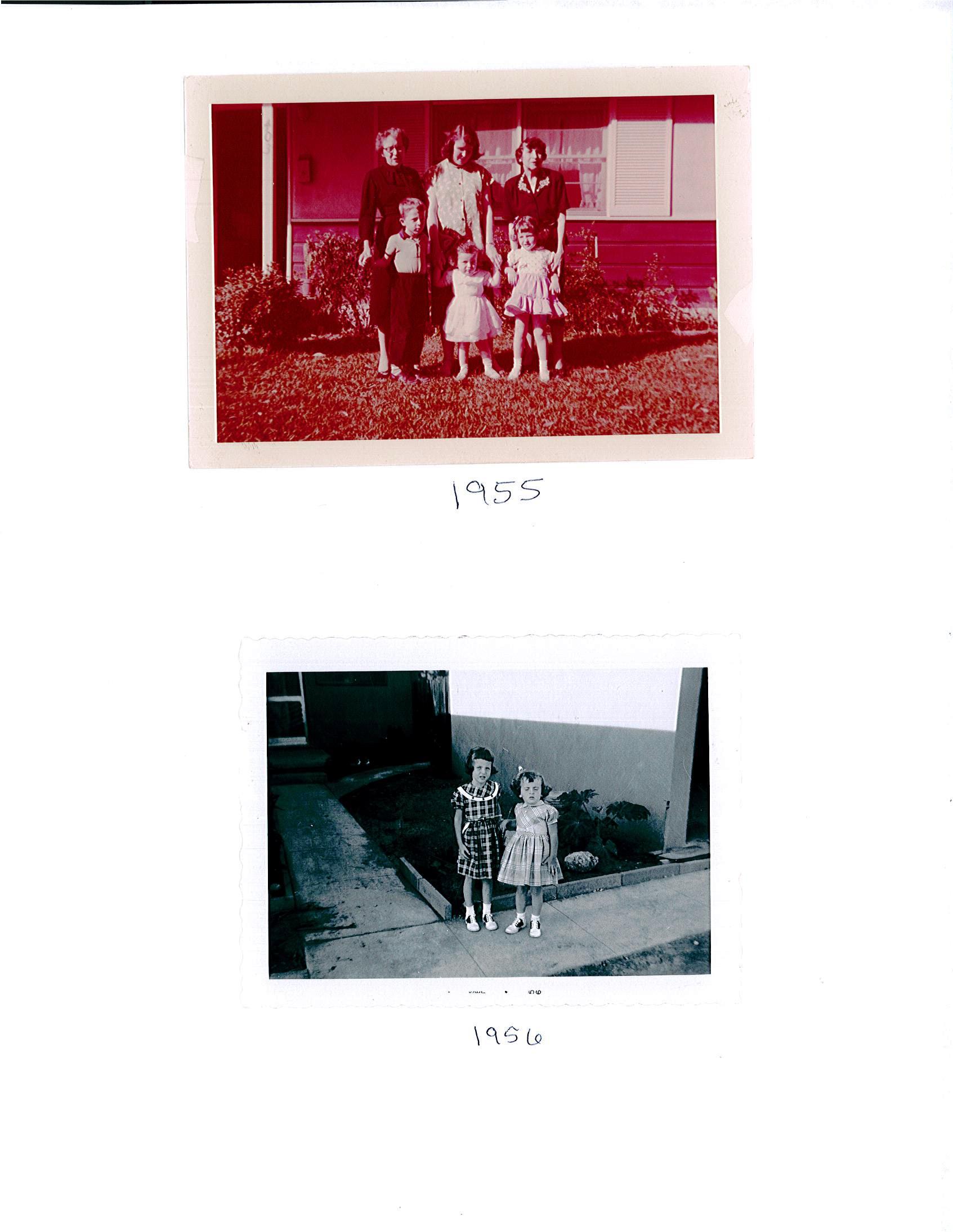
Sorry for all the blank white space, nothing I can do about that right now!  First picture – the tall woman with the glasses was my mother’s friend.  I believe her name was Natalie.  She’s gripping my brother, John.  Next comes sister Cindy who was turning 2.  Mother is pregnant with my sister Sharon, so this had to be 1955.  I am under the grip of my grandmother.  I was 3 nearly 4, John was 4 nearly 5. 

This is one of those pictures that lets me know once we children were outside of the prison we were little WILD THINGS!!!

In the lower picture I would have been 4 nearly 5, Cindy 2 nearly 3.  We don’t look like happy campers.

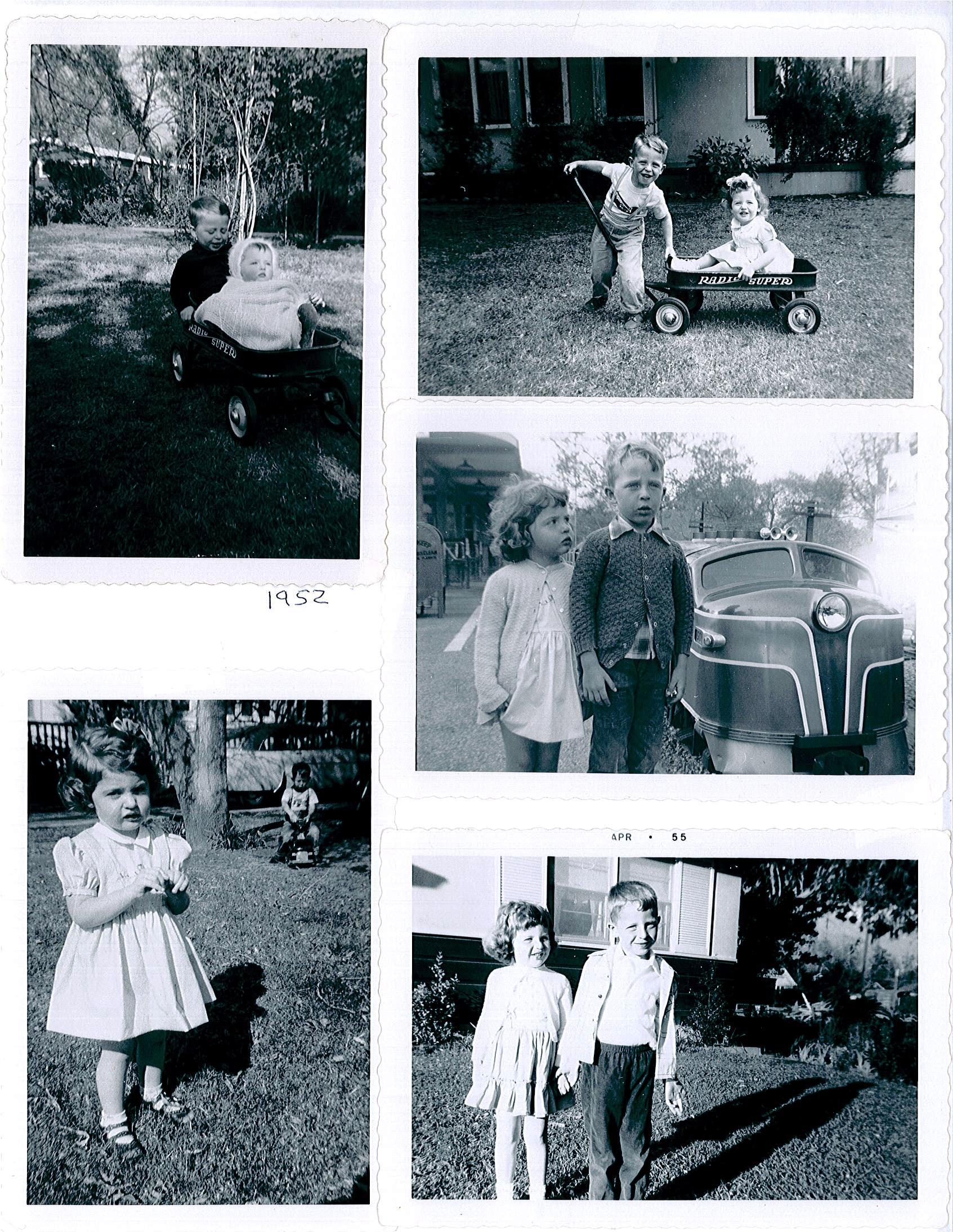
Oh, my angel brother John.  13 1/2 months older than I was – he saved my life!!!!  Such love he had for me, so protective, so watchful, my guardian angel!

Page0002

Page0003

I LOVE this lower one!  That is the ME that MADE IT!  I am 4, not quite 5.  With my two sisters.  I bet if she could have my abusive mother would have KILLED me to get rid of that spunk I had!!!  But – she managed over time to beat it nearly out of me.  But NOT!  I wish I had a poster of this!  This week is the first I’ve seen any of these photographs.

Then moving up – me trapped holding a not happy baby – HELP!!!

And the top one – oh the dynamics in THAT picture!!!!  My grandmother on the left of the picture – 2-year-old me who is LEAVING — Mother Mildred with that LOOK!  Holding sister Cindy – and look at the expression of my protective brother, John!  Not missing a thing!  Sister in NEED!   By the way, that should have read 1953 beside that picture, not 1955!

This is the ONLY picture I have ever seen that even begins to catch a glimmer of what the OTHER mean Mildred could look like.  There I am!  Right square in that little body being ME!!!

Page0004

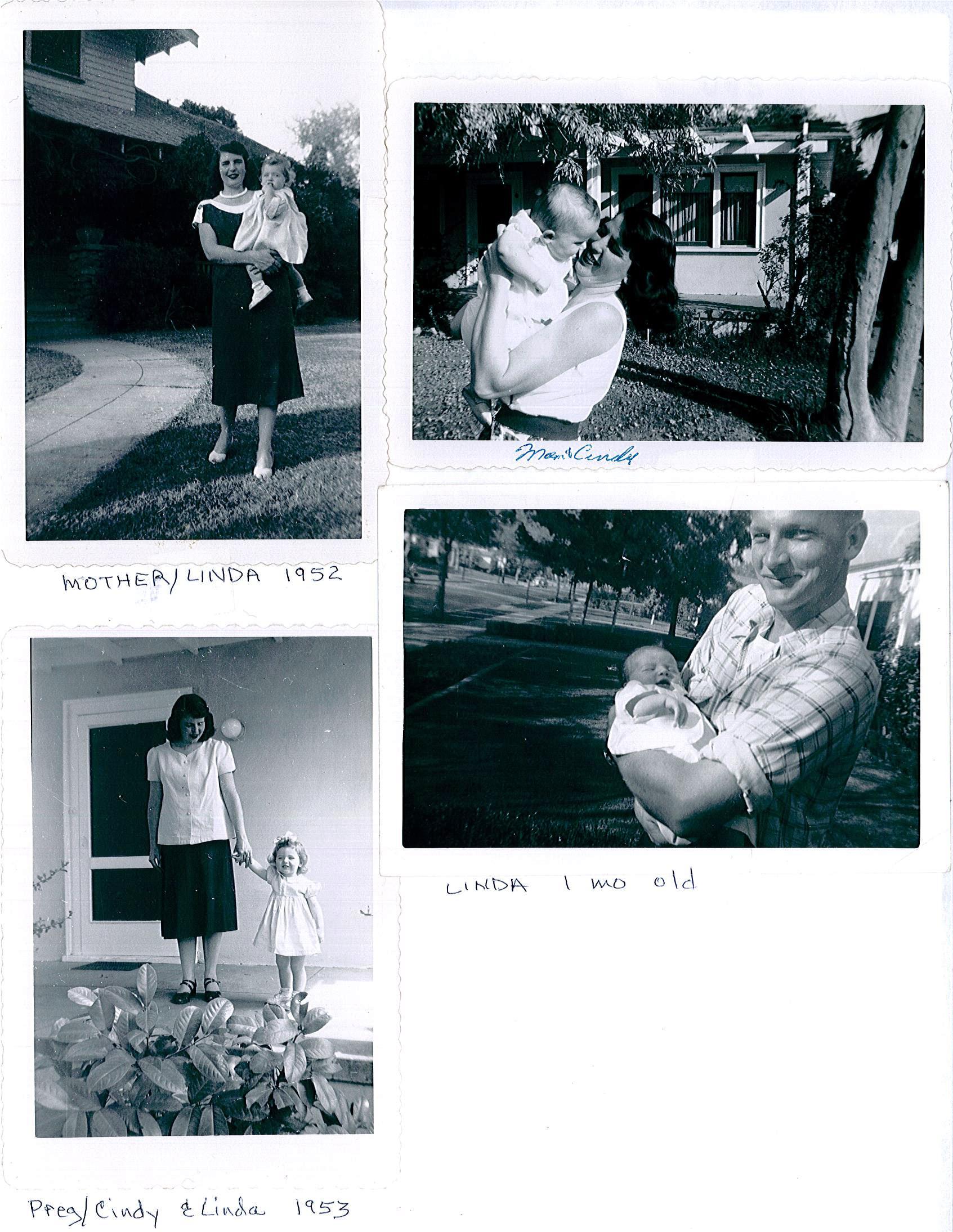
In a normal world this picture of my pregnant mother (with Cindy) and me would be precious and priceless.  Maybe in some ways it was.  The dynamics so changed when Cindy was born and BPD Mildred then had her split-world God’s child.  I can see that in the top right picture of Mother and Cindy – that interaction, that dyad, that expression in Mother’s being with her loved baby — I NEVER felt that from her.  Not once in my entire childhood.

My father holding me when I was one month old – BPD Mildred had to work on that man to turn him against me – but she did it.  He lost himself to HER — and I lost my father once that had happened. 

The top left is Mother holding me. 

Such mental illness in that woman — and NOBODY noticed!!!!  So much horrific abuse — I am quite certain, as a friend of mine pointed out, that the moving from house to house my parents did before we moved to Alaska before my 5th birthday had to do with neighbors hearing what happened to me in one house — asking questions — and on mother moved.  There are three different houses in these pictures….  And there was nothing wrong with ANY of these houses.

++++

Please click here to read or to Leave a Comment »

++++

+WHERE CAN THE ESSENCE OF A CHILD GO?

++++

This post won’t be much more than a sketch of a collection of thoughts that are swirling around in the shadows of my mind this morning.  I will capture a few of them here, but most of them will have to be patient and wait until I am more ready to take them out and put them together into the structure of a more formal writing.

I have been deeply involved for weeks now in sorting through the messy collection of my family’s photographic history.  I don’t have the savvy or the computer power to scan and work with digitalizing this collection, which is most frustrating to me.  I am finding the pictures that correspond to the text of 8 books as I go, but there are other pictures that I know will belong in books that have yet to be written and that don’t even begin to have a structure or a title at this point in time.

Among those pictures are ones of myself before the age of five that also include pictures of my siblings who were also very young at the time those photographs were snapped in California before our family moved to Alaska to begin our homesteading saga.  These pictures tell stories all by themselves!

Back in the 1950s there was great expense in processing films.  Pictures of children were most often taken on some kind of picture taking event like a birthday, Easter or Christmas.  In some of these holiday pictures Mother and Grandmother are literally hanging onto we children to keep us still long enough for a picture to be taken.  Behind the body language in these pictures I envision WILD CHILDREN being captured momentarily, grabbed by the wrist, as adults tried to freeze the energy in our body as we were so awkwardly frozen in time to be framed in a picture.

I can see myself — the INSIDE of myself — bursting through over 50 years of time as if I only stop being who I was then, who I can see, only when I LOOK at these pictures.  The rest of the time little me — being only a fraction of inches tall as I romp around within the space those little pictures hold me within — is trapped waiting to be remembered.

I end up thinking this morning about myself as a severely abused child — and about my siblings who witnessed that abuse — as we could not HELP at those young ages being ourself with our full expression of emotion, feeling, attitude — in action.

As time goes on children begin to learn to make conscious choices, the best that they can (as I imagine the scenarios) to PLEASE the adults upon whom they owe their survival AND when abuse is present to try to avoid harm.

Little people cannot possibly be adept at doing either of these things.  When emotion and reaction live in little children’s bodies they cannot be selected at will to present an ‘acceptable’ version of who they are to either gain praise or avoid retribution.  Little children are ALIVE.  They feel and they begin to think at a very, very young age.

When who the child is is not acceptable to the grownups in their life, where does the free-flowing energy of childhood go to?  Where CAN it go?

In families where the essence of the small child as a person is not tolerated, when any free thought or natural expression of emotion is not allowed, and then when – in cases such as mine was – the person of the child is deemed to be essentially evil and bad no matter WHAT the child does — what happens to the development of the self of the child?

When a child is raised in a healthy family socially acceptable parameters for behaviors — which include the appropriate and healthy expression of the full range of emotions — are gradually introduced as these behaviors are gradually modulated by healthy adults who understand that their little charge was BORN as an individual person.  Abuse and violation of the person of the child is NOT part of the picture.

Because my history involves a mother who most likely suffered from Borderline Personality Disorder (BPD) with a definite psychosis, my perspective is biased.  Things go wrong in all kinds of families in which BPD is not present.  I cannot sort out how much of what I detect of what went wrong in my family as it was run and run over by BPD Mother could possibly apply to other kinds of families in trouble.  All I know is that Mother lacked empathy and did not actually know what a person even was.

To Mother her children were puppets, props, dolls, toys — NOT human beings.  We were in her mind things that could be manipulated, arranged, controlled.  There are some early photographs of Mildred’s children that were taken as little ones were enjoying doing what children do.  At those times we were only accidentally doing something right and approved of in Mildred’s world.

In other pictures we were supposed to be doing something else other than being our own little person.  It is at those times and in photographs of those times that the dynamics appear in body language and expressions that show the contrast between (especially for me) what I was SUPPOSED to look, behave, act and feel and how I truly DID experience myself in my life.

I cannot yet add the photographs into my writing.  There is a whole long process to get to that stage.  What I am writing here in words is simply a kind of narration of an invisible play because the pictures to be submitted as evidence are still being processed.  In the meantime I am processing ideas related to what good use I can put some of these pictures to in my future writing. 

I am wondering where the self of a child GOES when that self is not allowed to grow up even existing within its own body in its own life.  It’s not like a child has a choice to change itself in for a different self that can manage (somehow) to make all the right choices so that conflict with its mother-parent can be avoided.  Nor can a suffering child trade in its caregiver for a better one, either.

The only thing I can think of that might be useful is that somehow conveying stories means that we can convey information that can be thought about, talked about, learned from — somehow.  I wish I had more answers than I have questions.

++++

Please click here to read or to Leave a Comment »

++++
+’BABIES UNDER FIRE’ — THE UMBRELLA OF MY WRITINGS

++++

I began my independent research in 2004 after my last child of three entered the Air Force and left home.  I needed to understand where the depths of my sadness came from and why I could not ease it or make it go away.  I could find no other way to begin to meet my needs that to tackle my problems on my own.

The first book I read was about a man imprisoned in the 1950s by Communist Chinese who exerted every effort over years to control their prisoner’s mind.  As I read this man’s survival account I instantly recognized that this man could not be broken because he had  strength within his inner core-self that had been put there through loving interactions he experienced with others – especially with his mother – from the beginning of his life.  At the same time I this fact I understood that I had never been given the gift that this man had.  I also understood that not only did this man not recognize the source of his survival but also that very few if any others reading his account would recognize this fact, either.  (Unfortunately I do not remember the name of this man or of his book.)

I found the exact same pattern present in the writings of Dave J. Pelzer in his book A Child Called “It”: One Child’s Courage to Survive (1995).  Pelzer (and I suggest, also his readers) seemed to be oblivious to the power that his relationship with his mother before her horrific treatment of him began when he as nearing school age had to form the foundation within his body-brain that allowed him to endure and to survive all that came upon him later.  The movie, Buck, about the child-abused horse whisperer also completely misses this same critically important point.  In his narration for this movie Buck Brannaman states clearly more than once what a wonderful, loving mother his was before she died when he was in his middle childhood, at which he was left with his brother in the care of his severely abusive drunk of a father.  (Why had the mother remained with this man when she knew he was abusing her boys?  Nobody addresses this point in that movie.)

I was only a little ways behind the curve when I found in 2004 a book that began to profoundly change my thinking that had been published in 2001 (there is a new edition out now):  The Developing Mind: How Relationships and the Brain Interact to Shape Who We Are by  Daniel J. Siegel M.D.

I carefully sifted my way word by word through this book, and then discovered my next stairway to truth in this 2001 book:  Traumatic Relationships and Serious Mental Disorders by Dr. Jon G. Allen.  There was no stopping me then, and on I moved into additional serious readings of Dr. Allan Schore and other developmental neuroscientists.  The 2007 book by Dr. Bruce Perry and Maia Szalavitz, The Boy Who Was Raised as a Dog: And Other Stories from a Child Psychiatrist’s Notebook–What Traumatized Children Can Teach Us About Loss, Love, and Healing, gave me the first opportunity to see this critically important information about what happens to ‘Babies Under Fire’ © translated into lay language those of us in the grass-root trenches can understand.

While there are many books and many theories about how to supposedly heal trauma in personal lives, I have learned that for those of us who were indeed one of the ‘Babies Under Fire’ there is not really going to be a single useful piece of information for us to be found in any so-called healing approaches that do NOT clearly, truthfully and accurately give us the knowledge we need about how the lack of safety and security in our earliest attachment relationships — primarily with our mother — permanently altered the way our body-brain developed during the most ‘Critical Windows’ of formative growth in our lifetime.

While ‘Babies Under Fire’ does not give us a pleasant image to hold in our minds, it does give us an accurate place to begin to look for the origin of the widest array of difficulties humans face when we don’t get MOTHERING right.

++++

Please click here to read or to Leave a Comment »

++++

+BLINDED BY OUR BIAS THAT WOMEN NEVER GROW UP

++++

My epiphany this morning is that contrary to what I have so far been believing to be the factor that is stopping us in our society/culture from recognizing that great harm is being done to infants and children at the hands of their mothers is NOT our taboos against infant abuse.  It is our cultural taboo against recognizing that WOMEN – within the mythical sanctity of the mythical perfect home – are not only capable of committing crimes against helpless, dependent, innocent little ones, they ARE committing these crimes. 

If these crimes remain hidden not only from our sight but also from the sight of our clear thinking, we are responsible for allowing these crimes to continue.

I am understanding that what is stopping us from changing what most needs to be changed in order to improve everyone’s quality of life is GENDER BIAS.  (Isn’t this the reason why in recent memory wives were property who could not own property, nor could women vote?)

The ‘European’ belief as it has been passed to America from ‘old times’ is that women are pure and INNOCENT children.  That myth tells us as it perpetrates itself throughout the fabric of our culture on every level that WOMEN NEVER GROW UP!  Because we never grow up we are no more accountable for our actions than children are.

What a deadly two-edged sword this is!  If we believe that women are (1) innocent children that never grow up and therefore, (2) are not accountable for our actions, then (3) it must mean that women ‘really’ never commit crimes because (4) we refuse to see them!

This is cultural MADNESS!!!

WOMEN!  Put on your prettiest petticoat-dress-hat-gloves, grab a frilly parasol, don your dainty shoes and delicately trip down the sidewalk with your handy-dandy macho male on your arm as he walks along the outside near the curb to catch the mucky wet splashes of horse dung flung from those carriages passing you by!!

And on warm and sunny afternoons you can take your little ones with you as you perambulate around a perfect park with your frilly-bonneted baby in its pram.  Don’t forget your parasol!!!!

And in the home you prepare yourself, your children, and a meal (if you have no servants) so that when your macho hero man comes home at night after his long day’s work you can pamper and spoil him with this perfect home life he so richly deserves — and you so perfectly offer to him!

 Times have changed, you say?

Need I mention at the very least Medea, the ancient Greek tragedy written by Euripides that was based upon the myth of Jason and Medea and first produced in 431 BC.?  Beautiful charming Mother Medea was perfectly capable of slaughtering her helpless children with a butcher knife while EVERYONE stood by and let her.  Times have NOT changed in the ways that matter most.

(More accurately, in this play Medea told ‘everyone’ exactly what she was going to do.  She enters the four walls of a house with the butcher knife.  ‘Everyone’ outside the house hears her chasing down her screaming children as she slaughters them one by one.  Because the crime took place hidden inside the walls of the house — it didn’t happen?)

Because of the cultural taboo against believing that women ever grow up — let alone ever grow up to commit heinous crimes through ignorance, neglect and abuse against their own children in their mythical perfect home — let alone that anyone SEE these crimes and hold the women accountable while they intervene to SAVE THE CHILDREN — the entire grimmest of plays plays itself out over and over again right under our very proverbial noses.

++

 I know this because it happened to me.  I recently heard the report back from my friend who read all 7 of the volumes (being published in the Mildred’s Mountain series) of my severely abusive severely mentally ill (Borderline Personality Disorder with abusive psychosis) mother.  My friend said that not only can none of the abuse be detected in my mother’s 500,000 words — but that the mental illness does not appear either!!

No, Mother Mildred was entirely capable of hiding her abuse, her mental illness and her psychosis from view — even all these years after her 2003 death as people read her words — because NOBODY wants to know the truth about women!

Women ARE not blithering blathering gorgeous little helpless innocent toys!!  We ARE not innocents!  We do commit crimes against our children because in most cases we CAN!  My mother committed her crimes against me because her madness made her do it, nobody recognized any part of the truth about what was going on, and she was allowed to continue down her merry path.  Did her madness and its corresponding horrific abuse of me NOT exist?

Not exist — why?  Because nobody wanted to break the cultural taboo that continues to tell us that women are PERFECT in the sphere we must still believe is their perfect kingdom – their home?

We better start asking some different kinds of questions or we are not going to solve these invisible, deadly crimes mothers can and do commit from the start of their offspring’s life.  It is those crimes that create MADMEN and MADWOMEN.  I know this as fact.  (Interesting.  WordPress blog’s spellcheck accepts MADMEN and does not accept MADWOMEN.  That tells me a LOT right there!)

++++

Please click here to read or to Leave a Comment »

++++

See previous post:

+ROMANTICIZED VIEWS ON WOMEN AND MOTHERS BLOCKS US FROM ACCEPTING MOTHER HARM TO OFFSPRING

+ROMANTICIZED VIEWS ON WOMEN AND MOTHERS BLOCKS US FROM ACCEPTING MOTHER HARM TO OFFSPRING

++++

I awoke this morning with a renewed resolve to improve my ability to articulate what I know — which is the same as what I believe — about the subject of how violence and lack of well-being is transmitted not only down the generations but also sideways into the society in which we all reside.

My inability to articulate what I feel is so important will stop troubling me either when I die — or when I figure out how to exactly communicate what I believe is so important.  Being able to articulate what is so important to me means that somehow an interested audience must also be found that is willing to take a look at what I have to say.

The words of ROBIN KARR-MORSE AND DAVID LAWRENCE Jr. speak to me only partially of the truth.  I feel so frustrated with myself that so far I do not have the gift of articulation to present truths such as they did as I presented them in my previous post, +AN IMPORTANT ARTICLE: “Violence and the brain in early childhood development”

They are missing an extremely important point — if not THE most important point!

When they use the term “MADMAN” they neglected to mention that it is just as likely that a “MADWOMAN” will arise in consequence of the early insecure and unsafe relationship conditions that create a “MADMAN.”

It is not likely that a “MADWOMAN” is going to pick up guns to attack innocents in public.  That does not mean that a “MADWOMAN” is not going to create great harm!

In fact, it is some degree of “MADWOMAN” who causes the kind of early relationship harm that these authors so articulately describe.  That they mention the harm without mentioning the cause when it comes to exactly who it is that is responsible for the kind of harmful brain changes in infants that they DO describe — how is it that they are missing this most important part of the story?

What is the societal ignorance that contributes to our refusal to accept the fact that the changes in an infant’s physiological development described by these authors begins with WOMEN?  I happen to know personally what it was like to be raised by a MADWOMAN who was exactly the female version of the MADMAN.

Male physiology, as I mentioned in my comment to my last post, is designed differently (DUH!) from females’.  An ‘evolutionarily altered’ male will attack the wider world because that is what their body is designed by nature to do in worst-case scenarios.

An ‘evolutionarily altered’ female is going to attack within her home and will most harm her own offspring.  That is what the dictates of HER physiology will tell her to do.

Just because we as a society are not willing to look behind the closed doors of what happens within the home does not mean that this is EXACTLY where we are supposed to look.

What is going on in the minds of such articulate, knowledgeable and motivated-for-good writers that they neglect to mention what happens to the FEMALE of our species when early attachment relationship interactions completely FAIL?

These women will perpetrate crimes within their homes against their family.

Because these crimes are ‘hidden’ — and hidden only because we refuse to LOOK for or at them — means that we are STILL missing the truth of ‘the story’ these authors are telling.  We are refusing to admit that women can be criminals within their own home?  We are refusing to admit that when the essential attachment-brain-building experiences an infant needs to not grow up to be a MADWOMAN or a MADMAN a crime has been committed by a MOTHER — who ‘just happens to be’ a woman?

Nobody can solve a mathematical equation if they refuse to look at and consider what lies on the other side of the equal sign.  Equality between men and women means that we must accept ‘the dirt’ as it exists within each half of our species right along with accepting what we WANT to accept.

While I am disappointed in my own lack of ability to smoothly convey in lay terms the complexity of physiological changes that happen to infants raised in the deprivation of malevolent early environments versus the positive development of infants who DO receive what they need within a benevolent environment to live a life of well-being, at least I am willing to think through the entire equation!

Blaming MALES for violence is not right and it’s not fair.

Women commit violence in their homes — against their own children.  Even though we might wish to magically think that women remain the romanticized version of ‘innocents’ in our society so that they cannot be seen as vicious and violent offenders, that thinking belongs in storybooks only.  It is extremely harmful thinking.

Even when a mother ‘innocently’ harms her infant in the ways the above authors describe, her actions might be done out of ignorance but they are still criminal actions.  They have great power to destroy the quality of lives.  Mothers’ actions and inactions toward infants do create the MADMAN just as they create the MADWOMAN.  What is it about our society that we blind ourselves to this fact?

++++

Please click here to read or to Leave a Comment »

++++

Followed by this post:

+BLINDED BY OUR BIAS THAT WOMEN NEVER GROW UP

+AN IMPORTANT ARTICLE: “Violence and the brain in early childhood development”

++++

This article is posted on The Miami Herald website – and copied here for educational purposes only.

Violence and the brain in early childhood development

BY ROBIN KARR-MORSE AND DAVID LAWRENCE Jr. dlawrence@childreadiness.org

Robin Karr-Morse is a therapist in Portland, Ore. and author of “Scared Sick: The Role of Childhood Trauma in Adult Disease” and “Ghosts from the Nursery: Tracing the Roots of Violence.” David Lawrence Jr. is president of The Early Childhood Initiative Foundation and education and community leadership scholar at the University of Miami School of Education and Human Development.

Though Americans have lived through more than 30 school shootings since Columbine in 1999, few have received extensive coverage in the media.  Until the tragedy at Sandy Hook Elementary School, when most Americans thought about violence, they might well have turned to the frequent tragedies of Afghanistan and Iraq.

Understandably, the Newtown massacre of 6- and 7-year-olds generated almost unprecedented anxiety about threats to our own children.  We cannot remember such a level of anxiety and fear in schools and communities and country.If we cannot protect our children — the most vulnerable among us — who are we?

The confluence of madmen and guns is disastrous.  Following each of the major school shootings across the nation, the conversation about firearms and mental instability has filled the media to the point that strangers passing in a grocery store exchange informal remarks on gun control as if they had all just exited a lecture on the topic.  Harder to talk about is the madmen side of the equation.  But this is where the real conversation needs to take place.  Clearly gun control is a critical issue, and we must do all we can to employ adequate background checks and to keep firearms out of the hands of children and emotionally unstable adults.  The common denominator we too often overlook in these events is the pervasive question of “Why” and the central role of the human brain in the answer.

How and why can a baby develop into a vicious killer?  And what can we do about it?

Perhaps the person who answers this most succinctly is Dr. Bruce Perry, director of the Child Trauma Academy in Houston.  He tells us: “It’s not the finger that pulls the trigger; it’s the brain. It’s not the penis that rapes; it’s the brain.”  Violence begins in the brain, and the brain begins in the womb.

All behavior, pro-social or anti-social, is controlled by a physical organ — the brain. That brain is fundamentally built within relationships, beginning with the mother during gestation. Brains are built through stimulation.  Experiences of all kinds literally stimulate electrical connections among brain cells as well as build gray matter in the brain.

The stimulation a baby experiences before birth and in the first years of life shapes the type of brain the child develops.  Those years are simply for developing capacities.  An inadequate or traumatic caregiving relationship is deeply damaging, especially during those early years when the brain is forming chemically and structurally.  That part of the brain that allows the baby to feel connected with another person can be lost or greatly impaired.

A child can emerge lacking the ability to attach or to resonate in any profound way with others, rendering that child emotionally and significantly damaged.  This part of the brain, built primarily through a caregiving relationship, is central to a child’s ability to modulate fear and other emotions.  Absent adequate nurturing by an emotionally competent caregiver, the baby faces an unpredictable tide of unregulated emotions.

To build this critical part of human function requires time and a quality of care that we too often overlook in our culture.  But know that if a baby’s experiences are pathological and steeped in chronic fear early in development, the very capacities that mitigate against violent behavior (including empathy, the capacity for self -regulation of strong emotions and the emotional modulation essential for complex problem-solving) can be lost.

As these children grow into adolescence and adulthood, impulsive and aggressive behaviors are so often the outcomes.  Moreover, genetic proclivities toward mental illness also are exacerbated. Communities inevitably absorb the consequences.  We ignore the root of the problem at our peril.

While earliest development furnishes the greatest moments to do the most to prevent violence in our communities, there will always be children who slip through the cracks.  For children, like the young adult shooter in Newtown who was so clearly estranged and emotionally needy, the mental health system in our country is almost nonexistent.  Meanwhile, the parents of these children are most often left to fend for themselves in trying to get help.

We watched in horror as the Newtown, Conn. story unfolded.  Imagine.  Twenty first-graders massacred in an American school.  Thus, in addition to conversations about gun control and a mandate to renovate and expand mental health services, it is also time for another conversation — that of building healthy brains from the beginning of life, and nurturing and intervening to prevent developing madmen in our midst.  [My note:  Excuse me!  AND MADWOMEN!!!  See my comment at the end of this post.]

We are learning the hard way that mental and physical well-being are inseparable.  Children who are attached and empathic with other people, who can self-regulate strong negative emotions and can use their minds to focus on complex problem-solving won’t be attracted to aggression and violence, or to using guns to maim or massacre and murder other people.

It is time to make the connection.

++++

Please click here to read or to  Leave a Comment »

++++

My comment:

Because of the work I am currently engaged in as books of my mother’s writings and one of my own books are being prepared for publication, my eloquence has left me.

I will simply point out that the kinds of unsafe and insecure early attachment circumstances that lead to developmental brain changes affect also all aspects of an infant’s physiological development, including the way their genetic material manifests.

I believe that due to the inherent differences between boys and girls (men and women) the kinds of changes early traumas create find their way into the adult mainstream in differing ways.

Males are predisposed to take their troubles out into the bigger societal sphere while females are geared to wreck havoc on their own children and in the familial environment.

As I have highlighted on this blog many times in the past, it is imperative that we consider such facts as are presented at these blog links:

+Dr. Teicher’s ARTICLE ON TRAUMA ALTERED DEVELOPMENT

at

https://stopthestorm.wordpress.com/a-book-being-born/dr-teichers-article-on-trauma-altered-development/

and

*Notes on Teicher

at

https://stopthestorm.wordpress.com/about-stop-the-stor/our-earliest-start/notes-on-teicher/

Early traumatic attachment histories create what Teicher calls “evolutionarily altered” individuals who have been designed within early malevolent environments to survive in that same kind of environment — for the rest of their life.

When primarily males cause violence that catches mainstream attention, it is exactly to the facts this article and these links present that we MUST look if we wish to consider the troubles that face us realistically.

That these troubles begin in the infant-mother relationship should surprise no one.  That these troubles pass down the generations — and impact wider society should also offer to surprise to anyone, either.

++++

Posts that follow this one:

+ROMANTICIZED VIEWS ON WOMEN AND MOTHERS BLOCKS US FROM ACCEPTING MOTHER HARM TO OFFSPRING

+BLINDED BY OUR BIAS THAT WOMEN NEVER GROW UP

++++