+SCIENCE ON THE SIDE OF MUSIC THERAPY

++++++++++++++++++++

Thanks to a Yahoo group I ‘attend’ this article on music therapy popped into my email box today.  I especially appreciated it in light of the fascination I  have with my keyboard playing-learning to read music process in the hopes that I can help heal my severely verbally abused (plus) musical brain:

http://www.bbc.co.uk/news/uk-scotland-glasgow-west-11233452

Study to develop ‘musical prescriptions’ for patients

Patients could be prescribed music tailored to their needs as a result of new research.

Scientists at Glasgow Caledonian University are using a mixture of psychology and audio engineering to see how music can prompt certain responses.

They will analyse a composition’s lyrics, tone or even the thoughts associated with it.

Those behind the study say it could be used to help those suffering physical pain or conditions like depression.

By considering elements of a song’s rhythm patterns, melodic range, lyrics or pitch, the team believe music could one day be used to help regulate a patient’s mood.

Audio engineer Dr Don Knox, who is leading the study, said the impact of music on an individual could be significant.

He said: “Music expresses emotion as a result of many factors. These include the tone, structure and other technical characteristics of a piece.

“Lyrics can have a big impact too.

“But so can purely subjective factors: where or when you first heard it, whether you associate it with happy or sad events and so on.”

So far the team has carried out detailed audio analysis of certain music, identified as expressing a range of emotions by a panel of volunteers.

‘Emotional content’

Their ultimate aim is to develop a mathematical model that explains music’s ability to communicate different emotions.

This could, they say, eventually make it possible to develop computer programs that identify music capable of influencing mood.

“By making it possible to search for music and organise collections according to emotional content, such programs could fundamentally change the way we interact with music”, said Dr Knox.

“Some online music stores already tag music according to whether a piece is “happy” or “sad”.

“Our project is refining this approach and giving it a firm scientific foundation, unlocking all kinds of possibilities and opportunities as a result.”
BBC © MMX

++++++++++++++++++++

+SOME MORE INFO ON MUSIC, VOICE AND THE BRAIN

++++++++++++++++

In light of the posts I have written about the changes in right brain development that can happen to abused and traumatized infants, and in light of my postings about the harm caused by verbal abuse and the corresponding healing that can happen through music, I want to highlight the link my sister sent me earlier today.

This comes from the following blog, hosted and tended by an Irish gentleman named Kevin Mitchell.  He states this about his blog:

Wiring the Brain

This blog will highlight and comment on current research and hypotheses relating to how the brain wires itself up during development, how the end result can vary in different people and what happens when it goes wrong. It will include discussions of the genetic and neurodevelopmental bases of traits such as intelligence and personality characteristics, as well as of conditions such as schizophrenia, autism, dyslexia, epilepsy, synaesthesia and others.

The specific article my sister referred me to is today’s post on this blog entitled, Wired for Music.  It’s a wonderful post that presents the human being’s ability to recognize patterns of music in the right brain that corresponds to the area we use from before birth to recognize prosody, or ‘the music of speech.”

When very young infants and children are exposed to verbal abuse and nasty, traumatizing alterations in the sound of the human voice, this section of the brain is affected.

Kevin Mitchell writes:

Music has a bizarre power to engage and affect us – to move us emotionally or literally, whether it’s foot-tapping, finger-drumming or booty-shaking.  It seems to have properties that make it automatically and powerfully salient for human beings.  An obvious question is whether this reflects some innate properties of the human brain or whether it emerges over time due to experience with types of music.  Put another way, does the brain shape the music or the other way around?  Does music show particular structures because those are inherently salient and pleasant to humans or is this reaction caused by the brain’s tendency to specialise in processing stimuli that occur with some statistical regularity in its environment?”

Please click here to read this complete post, which includes this wonderful photograph guaranteed to make you smile:

There are plenty of interesting and informative articles in his posts for his blog – please take a look – and enjoy!

++++++++++++++++

I also want to mention that my first grandchild, little boy Connor, was born yesterday at 5:22 in the morning.  He is currently in neonatal intensive care as he is premature.  He weighed 5 pounds, 13 ounces and was 19 ½ inches long, so he’s well on his way!  He just needs a little more time and some very specialized care to grow a little bit bigger and stronger so he can join his loving family at his own home!

+++++++++++++++++

+HEALING TRAUMA AT OUR BODY-BRAIN CENTER

+++++++++++

I didn’t realize it when I wrote my post last Sunday, +TRAUMA TELLS THE BODY WHAT TO DO, that I was preparing my own way for the study of Dr. Kerstin Moberg’s book, The Oxytocin Factor: Tapping the Hormone of Calm, Love, and Healing.  But then I don’t imagine that Dr. Moberg knew exactly as she was writing her book how much its information can help severe infant-child abuse survivors and other traumatized people.

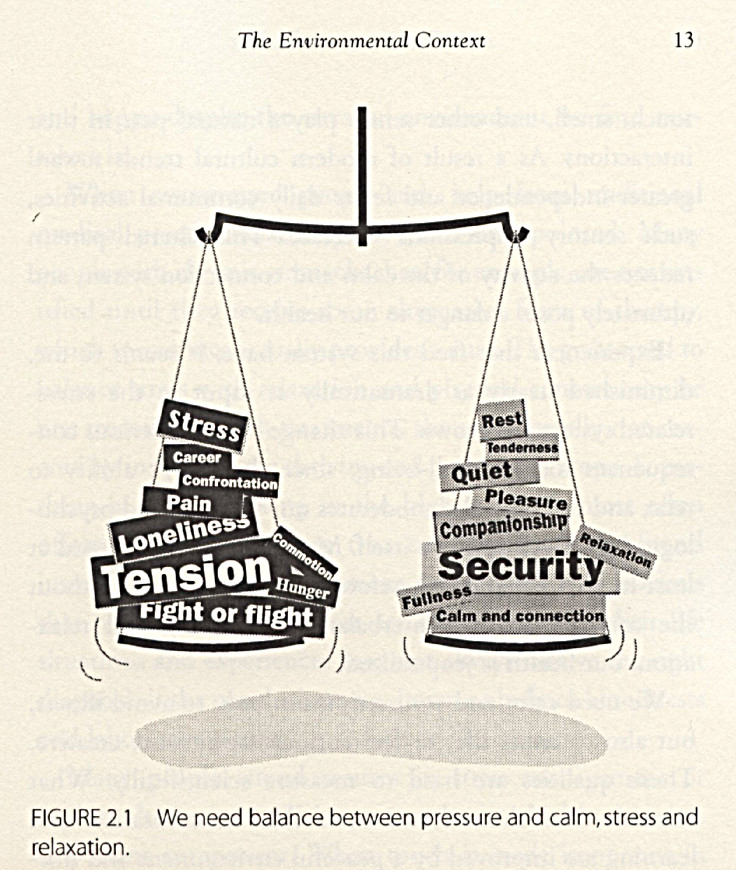
When I take a look at this next image that I scanned here from her book, I think about how it is for a tiny growing body-brain when it has to develop in adaptation to the environment it was born into when the stress scale has bottomed out and the calm and connection scale (of safe and secure attachment) has completely inadequate weight to it – or is nearly completely empty.

It is important to realize that what this image is showing is a required balance between stress and calmness.  Adequate early body-brain forming environments must include this balance for a body-brain to form and operate correctly.  Obviously too much stress and the wrong kind of stress for anyone is not a good thing.  But too much calmness isn’t good, either. Infant-child neglect often causes such a lack of stimulation during early developmental stages that critical regions of the brain do not receive the stimulation they need to grow hardly at all!

Another point I want to make is that if grave imbalance exists in an infant-child’s developmental environment the set point of the nervous system is NOT set at this central balance point where calm is even possible.  For people who survived terrible trauma in their early lives such as I did, the set point for our nervous system is AT the stress reaction point.

As odd as it might seem, looking back at my own infant-childhood with my new neuroscientific and physiological development insights, I can see that the long, long periods of forced isolation that were part of my mother’s patterns of severe abuse of me where probably – and actually – a very good thing.  During these periods when she had me ‘out of her sight’, even though during these times I was also out of any kind of loop that would have offered me normal infant-child opportunities to interact with others and with my environment in play and discovery, overall these times offered my developing body-brain opportunities for NOTHING TO HAPPEN.

These periods were actually rest and restoration times when my overwhelmed and over stimulated senses, forced into overload from the beginning of my life through the terrorizing and terrifying actions and presence of my Mean Mother, during which my body could actually calm itself down so that internally the effects of her nearly continual earthquake-tsunami abuse of me could somewhat dissipate before the next attack came.

Of course these patterns of wild, severe, over stimulating and overwhelming abuse paired with long periods of my being forced to endure the silence of remote, isolated aloneness harmed me greatly.  This pattern became a most fertile ground for patterns of dissociation to build themselves into my body-brain because nothing but the deprivation of being left completely alone to physiologically try to end my suffering alone (unconsciously, of course), offered me to possible way to connect my ongoing experiences to one another on any level other than the physiological one.  Nothing ever made sense, and nobody or nothing ever helped me to make sense of my malevolent experiences, either.

++++

So leading back to the topic at hand, oxytocin and Dr. Moberg’s book, I want to say that importantly I completely TRUST everything this researcher says.  Because I have continual problems with trust that happens in relationship to a sense of my feeling safe and secure in the world (and NOT), I hold this trust in high value.

At the time Moberg published this book she had already published over 400 scientific articles.  She is considered the world’s leading expert on oxytocin and on the calm-connection half of our autonomic nervous system (ANS) and all the processes that are connected to it.  She is talking about what severe infant-child abuse survivors missed most during our earliest growth and developmental stages:  The opportunity to experience safe and secure attachments that would have allowed us to experience peaceful calmness and connection to others so that our body-brain could build into us a body-brain-nervous system with the balance depicted in the above image included.

Because my infant-childhood was filled with extreme, chronic, ongoing and severe abuse and trauma, I read Moberg’s book from a perspective that means I want to know how things SHOULD have been so that I can better know what I am MISSING at the same time I hope to find information that can help me to consciously CHANGE this set point within my body-nervous system-brain for the BETTER.

As I read Moberg’s account of current research patterns being weighted at 90% study of the stress response compared to 10% of study on the other half of the system, I understand why I am still searching for help, healing and answers.  There is no hope for truly understanding what was so damaging during our early physiological development about being immersed in continual overwhelming trauma if we don’t have the information we need about how things were truly SUPPOSED to be different.  I believe the best hope for healing ourselves on every level does not lie in the drugs we might take to override systems in our body.  We need to get the true picture of what is REALLY GOING ON.

No matter what we read, no matter what anyone tells us, we cannot fool our body.  Our body, the Earth Suit we live in, absolutely knows the truth.  When we encounter the truth in research it will resonate inside of us.  Our body knows the truth when it-we hear it.  Moberg’s book, her work and dedication to research about the calm connection system in the human body as it is designed to operate in counter-weight with our stress response system holds truth that I believe is imperative for us to understand.  As we gain these understandings, we will FEEL them in our body and know them in our brain-mind.  Once I have completed my reading of this book, I will enter the universe of the internet to look for research related to this topic that has occurred in the 6-7 years since the book was written.  I can only hope that the scientific world has taken Moberg’s work seriously enough to pick up this critical study of what contributes to the other half of our well-being as a species:  The ability to calm ourselves down and connect to others.  This is absolutely the study, in my mind, of safe and secure attachment of ourselves in our body in the world we live in.  Again, I will keep you posted.

+++++++++++++++++++++++++++

I wanted to make a little note here today at my sister’s suggestion about my present experiences as I teach myself to read music and play this amazing piano keyboard that I was blessed with being able to bring into my life.  As my sister pointed out, as I continue applying myself to this study and practice and as I gradually improve, I will probably not remember the process of learning itself.

I don’t remember learning to tie my shoes, but I do have faint memories of being at the age of trying to learn my right hand from my left.  I invented a learning strategy that involved remembering a pattern of freckles on my right wrist where I would have worn a watch if I had one (like the one my father wore).  All I had to do was connect the freckles with ‘watch’ with how right in my mind a watch would have looked on my wrist to learn which side of me was right and not left!

I know this music learning experience is similar also to when I learned to ride a bicycle.  Once the motor learning has taken place, I expect that I will never have to consciously think about it again.  In the meantime, my actual process of learning is fascinating.  There’s nobody here to judge my process or progress but myself, and in the clear, plain and good spirit of PLAY I am able to leave all self judgment out of the picture.

What I am left with is the process of literally and consciously experiencing what it is like for ME, in this body, with this brain, to learn something this new and strange.  I also know that because of the severe trauma I was immersed in as my brain developed, neither my left nor might right brain hemisphere formed themselves ‘normally’.  I also know that the corpus callosum that transfers information between my brain hemispheres did not form correctly, either.

As I teach myself this new language of music and gain the motor skills required that will let me actually PLAY music, I am experiencing what I believe is a true healing in these regions of my brain.  Last night I began to practice playing scales with both hands at the same time.  I figured there is no way I am going to get my hands to be able to each first play different notes in different ways in different timings if I can’t get them to cooperate and first play the same notes in the same patterns at the same time.

Well, I am here to tell you I can’t remember the last time I experienced such a giggle session!  Part of me was directly the physical process complete with the intention of desired result – while another part of me fell into giggling bursts of delight to watch what my hands were ACTUALLY doing!  Instead of tangoing they were tangling, each finger with a mind of its own tumbling and fumbling over the keys.

Yet I believe that learning good things is healing.  All the healing I have ever done has been about learning.  Learning how to let myself learn is a learning itself both about what learning is like AND what healing is like.  That process is delightful in itself as I gently and kindly, slowly, patiently and firmly open my own channels for change within myself so that I can let something good and new grow itself into my body-brain-mind-self.

I have hopes, a goal, a direction.  I want to play music.  I know I can do this.  I give myself permission to move forward, to make the mistake-errors, to correct them, to learn-heal at my own pace. As I experience such delight even in this process of learning itself I realize this is just a bonus gift I could not anticipate and did not expect to love and enjoy.

So, needless to say, I have a long long way to go to begin to even get the two hemispheres of my brain to operate harmoniously, cooperatively and well together.  But what I look forward to and DO EXPECT TO HAPPEN is that eventually the two hemispheres of my brain will dance on that keyboard in relationship to one another.  Sometimes they will follow the same patterns together.  Sometimes they will be able to ‘say’ something musically that will be very different, one from the other.

I nearly absolutely and entirely and completely missed the opportunity as an infant-child to be safe, secure, and to play.  And I certainly did not get to giggle.  So, if at 58 I am finally able to giggle myself into this amazing new skill of reading and playing music, that’s a very good thing indeed!  No doubt I am helping myself heal at the center of who I am in this trauma-changed body.  I’ll keep you posted on this process, as well!

++++++++++++++++++++++++++++++++++++++++++

+POWER OF SOUND FOR HEALING OUR NERVOUS SYSTEM-BRAIN

+++++++++++++++++++

How much of my trauma changed development happened because of the overwhelming traumatic sound of my mother?  How much vicious screaming, yelling and shouting did you hear from before the time you were old enough to begin to know what words were?  How much terrifying noise was directed at YOU?

I know I heard lots of terrible sound as an infant-child, most of it directed at me.  In between, during the extensive periods of forced isolation, I learned to listen in unusual ways as my body-brain developed.  All kinds of sounds are trauma triggers for me, many times even the sound of the human voice.

Music and sound therapy are used in lots of ways to help abused children heal.  We must not lose sight of the power that sound has to heal us as adults, either.  Sound and music therapy is used to help and heal everything from stress relief, the vagal nerve system, diabetes, Parkinson’s disease, epilepsy, the autistic brain, and the immune system.

What might sound and music therapy have to offer each of us in our efforts to heal from abuse and trauma of all kinds?

Here is some information about our ears, our hearing, and about how music and sound offer resonance that can help heal our limbic right emotional-social brain, our nervous system (stress response), the vagus nerve ( the nerve of calmness and compassionate caring) and MORE!!!

+++++++++++++++++

For your listening pleasure!  Does Music therapy belong to India?  “It helps in the quality of neurotransmitters secreted in brain and the behavior of the individual.”

Emusictherapy.com – listen online — Music Therapy Albums

Music to enhance Concentration and Memory
Music to overcome Depression
Music Therapy for Diabetes
Music to overcome Fear and Anxiety
Music for the Heart
Music for Peace of Mind
Music for Pregnancy & Babies
Music for Sleep and Relaxation
Music to overcome Stress and Strain
Music to Enhance Intellect & Creativity
Music to Reduce Pain and for advance Healing
Music to overcome Headache & Migraine

++++++++++++++

How Music Therapy Works

Sound therapists recognize that certain sounds can slow the breathing rate and create a feeling of overall well-being; others can slow a racing heart, even soothe a restless baby. Sound can also alter skin temperature, reduce blood pressure and muscle tension, and influence brain wave frequencies. Although some sounds (like ultrasonic waves) are beyond the range of the ear, they can have a profound effect on the human condition.

How We Respond to Sound

People respond to sound vibrations in two main ways: via rhythm entertainment and resonance. According to Steven Halpern, Ph.D., of San Anselmo, California, “Rhythm entertainment describes the phenomenon whereby, in the presence of any external rhythmic stimulus, the natural rhythm of the heartbeat will be overridden and caused to pulse in sync with the sound source. This may be the rhythm of drums, or the rhythmic pulse of the music, or it may just be your refrigerator’s motor.

“Resonance refers to the physical phenomenon in which different frequencies of sound (different pitches) stimulate the body to vibrate in different areas. Typically, low sound resonates in the lower parts of the body and high sound resonates in the higher parts of the body.”

Sound and the Brain

Sound is linked to the physical body by the eighth and tenth cranial nerves. These carry sound impulses through the ear and skull to the brain. Motor and sensory impulses are then sent along the vagus nerve (which helps regulate breathing, speech, and heart rate) to the throat, larynx, heart, and diaphragm.

Don G. Campbell, B.M.E.D., Director of the Institute for Music, Health, and Education in Boulder, Colorado, explains, “The vagus nerve and the emotional responses to the limbic system (specific areas of the brain responsible for emotion and motivation) are the link between the ear, the brain, and the autonomic nervous system that may account for the effectiveness of Music Therapy in treating physical and emotional disorders.”

Various elements of sound influence separate parts of the brain. Rhythm, for example, engages the reptilian or hindbrain, while its tempo can alter the sense of time. The human body also has its own rhythmic patterns, and there is growing evidence that the rhythms of the heart, the brain, and other organs enjoy a special synchronicity. Illness can arise when these inner rhythms are disturbed.

Tone engages the limbic midbrain, which governs emotion. According to Campbell, “The real power of sound is in the way the tonal or harmonic aspects influence our emotions and midbrain functions.”

Sound can also be used to help the body regulate its corticosteroid hormone levels, helping to control the severity of spastic muscle tremors, reduce cancer-related pain, and reduce stress in heart patients.

Alternative Medicine: The Definitive Guide
Complied by the Burton Group
Future Medicine Publishing, 1997

+++++++++++++++++++++++++

What follows comes from this website:

MUSIC THERAPY LINKS THE UNIVERSAL VOICE OF ACADEMIC SCIENCE IN MUSIC THERAPY

The Special Status of the Ear in the Organism

1.  Our ear is the first organ to develop to its full size and become fully functional – approx. 18 weeks after conception, our ear is ‘ready’.

2.  Our ear is the first sensory organ to begin working – from the 8th week of life. We began to hear whilst we were still in our mother’s womb – and at 18 weeks our hearing capability was fully developed.

3.  In order for our nerves to be fully operational, our organism surrounds them with a layer of myelin – the auditory nerve is the first to receive this layer of myelin.

4.  The ear is not only the first sensory organ to start working – it is generally also the last sensory organ to cease functioning.
For this reason, it also plays an important part in the determination of brain death: when various brain centers have already ceased to react to the relevant stimulation, the brain usually continues to react to stimulation of the auditory nerve.
Therefore, the response to stimulation of the auditory nerve is an important criterion in the determination of brain death.

5.  Our ear is the brain’s greatest supplier of sensory energy and, as such, is probably the greatest changer of our brain’s electrical activity.

Our ears, our skin, our eyes, our mouth, and our nose constantly receive sensory stimulation from our surroundings which they then convert into electrical impulses in their sensory cells and pass on to our brain. Thus, in our brain, no sound, no touch, no pictures, no taste and no smells are encountered, just electrical impulses which only become our sensory experiences through multifarious processing steps taking place in our brain. In this way, our brain receives a constant flow of bioelectrical energy from our sensory organs, without which it is unable to function correctly. As to how much energy each of the five sensory organs supplies, medicine science now provides the following amazing answer: of 100% of the sensory energy which enters the brain, 80-90% is supplied by the ear! As such, our ear is probably the greatest changer of our brain’s electrical activity – the central administration of our entire organism.

6.  Our ear has a definitive role in the construction of our brain.

However, the sensory organs do not only supply our brain with energy, but the electrical impulses produced by them also work themselves in our brain, in that they play a definitive role in deciding in which way our brain cells link up or ‘switch’, so that the necessary circuits required for the exchange of data and the management of the infinite number of processes within our human organism are created.
So what does our ear that has been sending electrical impulses to the brain since our 8th week of life, have a hand in building?
Some medical experts suspect that it controls the entire maturation of our brain.
It is, however, certain that it definitively has a determining influence on how each of those areas of our brain develops which control our feelings, our understanding, our speech and our movements. So our ear plays an active part in the most important areas of our brain.

7.  Our ear controls all of our organism’s muscular activity, and plays a part in the distribution of tension and relaxation.

In the regulating circuit of the movement processes, the brain gives the order to the muscles to move and when they are carrying out these orders, the muscles are controlled by the organ of balance in the ear. In this way our ear also determines our body’s tension profile – that is the distribution of the different states of tension and relaxation in the different parts of our body.

8.  Our ear influences the control of our organism’s thermal balance.

The flow of blood of our tympanic membrane is supplied by a blood circulation which is directly connected to our organism’s thermal regulation center in the brain. Studies with Medical Resonance Therapy Music® have now revealed that certain music structures can decisively change the thermal regulation. Thermal regulation, however, has a significant influence on overcoming illnesses, as is familiar to us with fevers, for example.

9.  Our ear is directly connected via nerve channels with many important organs.

Neural management of our ear concha or flap and our tympanic membrane is largely effected by the 10th cerebral nerve, the so-called vagus nerve. This nerve is also connected, as an important neural manager, with the larynx, the bronchi, the heart, the stomach, the pancreas, the liver, the kidneys, the intestines, and the solar plexus. It also has a definitive role in triggering physiological stress reactions. Thus, via the vagus nerve, our ear has access to transmission lines to important organs in our body, and exerts a direct influence on the regulation of stress.

Traditional Chinese medicine teaches that there are connections within the ear to all areas of the body. Here are just a few of the most important parts of the body which are accessed by ear-acupuncture: the top of the skull, back of the head, forehead, eyes, ears, nose, neck, cervical vertebrae, clavicle, chest, heart, lungs, stomach, kidneys, liver, large intestine, genitals, urinary tracts, hip joints, buttocks, knee joints, joints of the foot and cartilaginous tissue in various parts of the body.
NEWS

“Studies with Medical Resonance Therapy Music® have now revealed that certain music structures can decisively change the thermal regulation.  Thermal regulation, however, has a significant influence on overcoming illnesses, as is familiar to us with fevers, for example.”

+++++++

I find this most fascinating, true I imagine for both physical and emotional pain:

“A positive emotional reaction to music is of course infinitely valuable to cancer patients, but studies have shown that music therapy can also trigger important physical responses.  Alleviation of pain is one such area, says Dr. Delforia Lane, explaining that the brain uses the same neurotransmitter to send the sensations of both pain and music.  If both elements are received at the same time, neither can reach the brain with full intensity.  Hence pain is felt less intensely, so patients may experience a decreased dependence on pain medications.”

From the Music Center page of the Cancer Consultants website

SEE ALSO:  Music strikes chord on coping with pain [and anxiety]

++++++++++++++++++++++++++++++++++++++

Music strikes chord on coping with pain [and anxiety]

+VERBAL ABUSE – CAN I HEAL MY INFANT MUSICAL BRAIN?

+++++++++++++++++

I have no doubt that our human species participated in dance and music long, long before we had the ability to use words in speech.  I also know that as a newborn infant I could first experience the terrorizing sounds of my mother’s trauma ‘music’ and feel how she physically treated me through her trauma ‘dance’ long, long before I could begin to comprehend what a word was.  Those earliest experiences with my mother affected how my brain developed.  I want to go back now and specifically try to heal my ‘infant’ musical brain.

++++

If someone explained to me, for example, that the reason I couldn’t walk as well as others was because my feet had been bound tightly from the time I was very small, and the bindings were not removed until I was a teenager, I would be able to make that connection.  I understand what feet have to do with walking.

I took the ability to send and receive spoken word communication and to think in words for granted all of my life until two years ago.  After the shocking stress of being diagnosed with advanced, aggressive breast cancer, and then after following through with all the radical treatments, including chemotherapy, that have saved my life, I now have a different understanding of my own speech related processes.

I understand now that my brain did not learn to process language normally.  I understand that somehow I was able to continue forward in my infant-child development and all the way into adulthood without anyone, my self included, recognizing that my mother’s severe verbal abuse of me had changed the way my language processing abilities developed, and thus changed the regions of my brain and their operation that language-processing abilities rely on.

What I know about myself now post cancer and its treatment is that what I really did from the time I was very, very small was create the equivalent of a house of cards within my brain that gave me the illusion that I processed spoken language in the same way that other people do.  Chemotherapy’s affect on my infant-child abused brain on many levels was that it erased most of the post-critical windows of early development abilities I had ‘learned’ to use so that I could get along in the world.  In other words, chemotherapy erased my memory of how I pretended to be normal.

My language processing abilities were not spared.  I see the image of a beautiful (and believable) brilliantly colored and intricately designed paper Chinese lantern that represents the ways I managed to incorporate enough of how regular people interact with one another in verbal ways so that even I was fooled into believing I was no different from others.  Yet my experience with cancer and its treatment has been that a soaking rain has disintegrated the fragile paper structure of pretending I was ‘OK’.

I am left with a barely flickering candle of what normal human verbal-social interactions are supposed to be like – and none of the extraneous trappings.  By finding the developmental brain research and by trying to understand it, I am learning that the balance of information processing between the two hemispheres of my brain has been altered.  Not only did my right emotional social limbic brain not develop normally, but neither did my left brain (as a right-handed person).

With the secondary (later learned) structure of my language processing abilities wiped away, I am left with the experience of what my primary language processing abilities are really like.  It is only now that I am beginning to gain willingness to look behind the illusions of normalcy for myself that I am beginning to understand what my mother’s extreme verbal abuse of me from the time I was born did to me.

At the same time I consider myself fortunate to be living in the period of human history when understandings about the intricate workings of the human brain are being discovered.  I am fortunate also to be living at a time when I can find related important information in my own world through the internet.  In some strange way that I cannot pinpoint or name exactly, I also realize that my having cancer, being treated for it, and still being alive – now with this NEW information about the way my brain REALLY processes language combined with access to new brain discovery information – is giving me the fantastic opportunity to combine my personal story of surviving severe infant-child abuse with new-found awareness of how early verbal abuse impacts a young brain during its critical-window periods of rapid growth and development.

I am the living, breathing, walking, talking, hearing, listening result of my mother’s incredible infant-child severe abuse experiment.  I don’t suffer from anything as blatantly obvious as having the consequence of bound feet.  I suffer from the invisible, internal, brain structural changes that her abuse of me created.  At the same time I don’t have any understanding of what brain regions look like.  Words used to describe them are foreign to me, and most of them I cannot form my mental tongue around enough to grasp what these words even sound like!

But understand them I must because I am out of the loop of normal social interactions, home alone with an invisible 100% disability that frankly enrages me and causes me great sadness.  Not only did my right brain not learn how to read ‘social cues’ or facial expressions normally, my left brain did not grow in such a way that verbally expressed words are connected and associated with the underlying expression of emotion and intention of the speaker in normal ways.

If I were to be given the choice between two gifts, one being a platinum jewel studded necklace worth millions and the other being the information that research such as Dr. Martin Teicher’s presents about how early abuse changes the brain, I would not hesitate to accept the latter.  Most unfortunately my body-brain knows within its every fiber what Dr. Teicher is talking about when he writes the following:

The study on verbal abuse is the first to be published, though the overall hypothesis on distinctive sensory damage has so far panned out when the unpublished work is also considered.  The findings of this study “set the stage for what we’re seeing in the other ongoing studies—that sensory systems are vulnerable,” said Teicher.   “The brain is probably suppressing the development of sensory systems that are providing adverse input.”   That is, children’s brains seem to “turn down the volume” on abusive words, images and even pain.   The result is diminished integrity in these sensory pathways.

At the same time I know it wasn’t JUST the “deleterious effect of ridicule, humiliation, and disdain on brain connectivity” that changed the way my brain grew its language abilities.  In fact, I suspect I would be far better off today if the development brain changes I suffered from my mother’s verbal abuse of me had at least WAITED to happen once I even understood what ridicule, humiliation and distain even were.  Because my mother’s hatred and abuse of me began at the time of my birth, my body-brain had to change its development from my very beginnings.

My suspicion is that dissociation began to find its way into my body-brain development during the first interactions I had with my mother.  As a result, my body-brain has NEVER stored memory in an ordinary way.  Because of this fact, I have what is probably an unusual ability to both remember things I should not remember and to NOT remember things that I should.  Repeated patterns of abusive interactions, which began at my birth, formed themselves into my body-brain in such a way that dissociation itself became a superhighway of connectivity rather than the desired patterns of association.  I can remember my mother’s interactions with me well before I reached the age of words.

This is true because I was born into an infant world that was about as different from normal as it could possibly be.  I didn’t forget these patterns of interactions with my abusive mother from birth, either.  They built the body-brain I have as they built themselves INTO the body-brain I have.  There’s nothing unusual about this fact, either.  ALL of us have the patterns of our earliest interactions with our infant caregivers built into us – because they BUILT us.

When an ordinarily-built person encounters a group of strangers, how they interact with them on all levels, including verbal exchange, happens through a remembering of their earliest caregiver interactions that built them.

I find that I am surprised by the next thoughts that entered my mind as I wrote this last sentence.  My mind is telling me that I thought I’d made progress as I came to understand that interactions between people, including verbal ones, could be looked at as if they were mostly on one of a continuum or the other.  I thought that continuum was about prosocial interactions or antisocial interactions.  Now I realize that I see another entirely different continuum that exists in its own right as an entirely different way.

People like me, who suffered enough severe abuse from birth, operate in our human interactions on this other continuum.  I suspect that the Austic brain shares the features of this continuum, a continuum that simply shows the degrees of unsocial interactions our brains were built with.  The unsocial brain has a different set of rules than does a brain that includes on the ends of its continuum degrees of prosocial or antisocial abilities.  The unsocialized brain is based in its foundational construction on dissociations rather than associations.  It is a brain built from social isolation and ‘maternal deprivation’.

++++

As I mentioned above, I had no way to know that I had a dissociational unsocialized brain until my experience with cancer and its treatment erased all the secondary human social interactional abilities that I had somehow learned far later, and far down the road from ‘normal’.  They could be erased and ‘forgotten’ because they were secondary and not primary.  Now I am left with two ongoing parallel experiences.  I experience myself with my unsocial brain at the same time I remember when I could ‘act as if’ I had a socialized brain.  But I do not believe I can ever get back the secondary socialized brain I had before cancer.  That brain, with its complex set of secondary (learned) patterns of ‘normal’ human interactional abilities has vanished as certainly as a paper Chinese lantern in a hard rain.

Because I live with this unsocial brain I can say that two simultaneous experiences I know about first hand are (1) I do not receive or process sensory information normally, and (2) I have a fundamentally altered sense of time – and therefore of timing.  While these two aspects of the way my brain formed affect every experience that I have, they create the most difficulty for me as a human being in my relationships with others.

Words become words in any language we might speak because we can recognize where each one starts and where it ends.  Next, we understand the agreed upon meaning that each word refers to.  If we listen to a language that is not our own, we do not recognize word starts and stops, nor do we understand their meanings.

I now recognize for myself that I don’t actually have a first language at all.  The language that I began to learn from the time I was born was a language purely of emotion.  Not only that, but the first language I learned was about extremely overwhelming SOUND coupled with physical pain caused by brutal and violent motion.  My mother didn’t wait until I had the advanced mental abilities formed into my brain that would have let me begin to comprehend what the words “ridicule, humiliation and disdain” might actually mean.

The associations being made in my infant brain were that the sound, the feel, the look of my mother threatened my existence.  I believe my body knew this fact profoundly.  My mother’s roaring, screaming voice were coupled with (associated with) the look of her distorted, contorted, twisted, wide-eyed, wide-mouthed psychotically violent hate-filled face.  The sound of her, the look of her face, were coupled with (associated with) the rage-dilled steely hard grip of her hands, with her pinches, slaps, thumps, slaps along with the heavy thundering stomp of her feet.

So why would I be surprised now to find that the actual words that fall out of people’s lips are far from being my first concern?  Why would I wonder now why there is often a great distance of time between when those words fall out and when I can actually make any logical sense out of them?  Why would I wonder that my verbal interactional space is slow and loose and broad and wide with ill-defined edges rather than being tight and clear and succinct and efficient and FAST?

Language spoken by other people (all but those I am closest to and most safe and secure with) is about how the sound of that person first affects me.  What they actually say means very little to me at all.  If there is stress for me in the interaction, often I can watch a person’s lips move without hearing the sound of their words at all.

Listening to spoken language happens for me mostly in the realm of courtesy and consideration, not because I am comfortable with it – or even need it myself.  I am always concerned on my most fundamental levels with assessing information for threat and risk of harm and for another person’s TRUE intentions.  That level of meaning is, for me, nearly completely divorced from the actual words a person rattles out of their mouth.

It can, therefore, take me a very long time to understand others’ questions and to respond to them.  There is often a wide blank dissociational pause in the conversation while I work very hard inside of myself to negotiate this human social space.  Even though I try hardest to determine intention and risk of harm, at the same time I did not build within my brain the normal capacity for reading nonverbal social signals.  I now completely understand that social verbal interactions with others are exhausting for me, and that I do not do them well.

++++

That leads me to the next step in my own thinking.  At 58 years old I am now approaching my own logical conclusion.  I probably had developed within me what might be a supremely musical brain.  This suspicion brings to my mind the writings of Daniel J. Levitin about the human brain and music.  It makes me think about the writings of Arnold H. Modell on the human mirror neuron system as he describes how the essentials of human movement might be best described in terms of dance from before we are born.  It also makes me want to include what Dr. Dacher Keltner says about the brain stem connection between laughter and later-developing human verbal language (Born to Be Good: The Science of a Meaningful Life).

How strange it might seem to think about my mother’s profound abuse of me from birth in these simple terms:  The terrible and terrifying noise and sound of my mother was her music toward me.  The terrible and terrifying, traumatic movement of her was her dance toward me

If we suspend all the intellectual concepts we are tempted to apply in our thinking about newborns in interaction with their mothers – as they begin to happen to all of us from the moment we are born – and begin to understand that it is the patterns of our mother’s music and of her dance that are impacting our developing body-brain, perhaps we can begin to think in terms of a different kind of medicine that might help in our healing.

About a year before I ever knew I had the cancer, I experienced something that actually scared me.  I had bought myself an electric guitar.  One day I decided to give myself permission to play with it for as long as I wanted.  Four hours went by as if they were four minutes. After I put the guitar backing its case and walked away, I realized that my mind was full of music.  Not words, just patterns of notes and rhythms in ongoing streams without beginning or end.

What scared me was that I could not alter this flow of musical patterns  for nearly 48 hours except when I consciously forced myself to focus momentarily on some other action.  – notice the stop sign ahead of me when I was driving, or going through the actions to make a pot of coffee or a piece of toast.

At that time I was committed to my developmental brain studies and to my writing.  I decided not to let myself return to that level of music involvement because I believed it would interfere with my ‘work’.  Well, many thousands of hours and probably millions of written words later, I am making the decision to pursue an experiment with myself.

I accept that I will not be able to achieve the kind of mastery over guitar technique that I want or need, so I am making the very big decision to pull $519.95 out of my pitiful total savings of $1,800 and buy myself an electric piano.  I am choosing to spend that (to me) very large chunk of money because I am beginning to understand that allowing myself to think in music might be the single best medicine I can provide for my brain.  I am also purchasing and Audiogram so I can record myself thinking and go back and follow my conversations with myself – and between my brain hemispheres.  (The more perfect-pitch and consistent sound quality, the better)

I don’t have a history of musical study.  I cannot (yet?) read music.  But the more I come to understand that this last subject I am considering in my studies, how my mother’s verbal abuse of me FIRST affected my brain-body development as a dancing-musical human being, the more profoundly I am beginning to understand that at no time in my life have I actually been ‘normal’ or ‘ordinary’.  I was not built that way.

So if wordless music and dance is the human first language, and if it is the language that continued to build my brain far into the stages when patterns of prosocial verbal speech should have taken over my associational brain patterns, then I think it’s time I gave myself permission to think and speak in my own first language.

Who knows?  Maybe I can go all the way back in the very structure of my brain and rewrite and overwrite what was put in there by the monster from the very beginnings of when I could listen to sound.  Maybe I will find my own first and primary language.  Maybe I will create it.  I will certainly be able to express it.  Of that I have no doubt.

NOTE:  Although this might seem to be an unrelated topic, it is not.  When I was 13 and in 8th grade, I was able to discover in PE class that I was extremely gifted in playing basketball.  If ever I was to know what living in a state of perfect magic is like (other than what I expect to experience now with music), it was the experience of gliding around a basketball court with many other bodies while being oblivious to their existence as real physical objects.  There were only three objects on the full and busy court:  My body, the basketball, and the hoop.  I never took aim.  I never thought.  And I never missed a shot, not even if that shot took place halfway down the court, over everyone else’s head.

As an out-of-shape 58 year old I don’t expect to ever experience the magic of that game as it was for me when I was 13.  I know it was a related ability to autism in some way I don’t quite understand.  Part of how it happened was because I lived in dissociated space where self consciousness did not exist.  I fully expect to be able to recreate that space in the privacy of my own home, hooked to a perfectly tuned electric piano keyboard through head phones.

+++++++++++++++++

I was going to present today a study of these three brain regions that Teicher talked about in his article, Cutting Words May Scar Young Brains, but evidently there were other things I needed to write about.  When I think about his other article, Abuse and Sensitive Periods, from my post +THE ‘TERROR-ABLE’ CONSEQUENCES OF INFANT-CHILDHOOD VERBAL ABUSE, I realize that I already know the truth of what he is saying even if I can’t yet literally understand the specific brain region information he is also writing about.  Right now it is more important to me to get my electric piano keyboard ordered and on its way.  The rest of this study can happen later.

Among those who [solely] experienced parental verbal abuse, three statistically significant disturbed pathways emerged:

— the arcuate fasciculus, involved in language processing;

—  part of the cingulum bundle, altered in patients with posttraumatic stress disorder and associated with depression and dissociation; and

part of the fornix, linked to anxiety.  The degree of disruption of the normal flow correlated with the severity of abuse.

PLEASE READ FULL ARTICLE HERE

+++++++++++++++++