+RESEARCH ON ISOLATION – ANOTHER STUPID SCIENCE AWARD

+++++++++++++++++++

My opinion?  MORE UNBELIEVABLY STUPID SCIENCE!

++++++++++++++++++++

Written by:  Wray Herbert

Full Frontal Psychology

Why does self-reliance make you sick?

Newspapers used to run occasional human interest stories about very old people dying. These profiles often had a subtext, which went something like this: So-and-so died yesterday at the age of 102, and remained fiercely independent to the end. He never took very good care of himself, smoking two packs a day since he was a teenager. He liked his whiskey.

You don’t see these stories nearly so much anymore. That’s in part because living past 100 isn’t all that uncommon anymore, but it’s more than that. In our hearts, we knew all along that these misbehaving centenarians were aberrations. What’s more, our sensibilities about personal health have shifted dramatically, so that journalists are less likely to romanticize unhealthy habits. The fact is, smoking and excessive drinking don’t prolong life. They shorten life and diminish its quality.

That’s true of the “fiercely independent” part, too. Health psychologists have known for years that isolation is rarely the path to health or longevity. Health comes with a rich and diverse social life, with lots of friends and family, church membership, political engagement. Old people with many relationships of different kinds live longer, stay sharper with age, and suffer less disease.

But why? What is it about being connected to others that makes us healthier and more long-lived. How does a rich social life translate into healthy cells and tissue, and conversely, how does isolation trigger the biological processes of disease and death?

Carnegie Mellon University psychologists Sheldon Cohen and Denise Janiki-Deverts have been studying these important questions, and in the new issue of Perspectives on Psychological Science, they provide a progress report. Here’s the gist:

Most the evidence so far is what scientists call “correlational,” which means that it doesn’t really say anything about cause and effect. It may be indisputable that socially integrated people are far healthier than loners, but that doesn’t mean that a rich social life causes better health. It could very well be that healthier people feel more like being around other people, and that people who feel lousy simply prefer to be alone. This needs to be sorted out.

One way to sort it out is to actually intervene in people’s lives–enrich their lives and see what happens. But this isn’t easy to do. Scientists can’t really tell people to join the Rotary or to reconcile with estranged love ones. As a result, interventions haven’t been done much, and the ones that have been done mostly put people together with others facing the same health challenges, like cancer. These efforts have had mixed results at best.

So the existing studies leave a lot of questions begging for answers. For example, do socially connected people have particular psychological traits that help them cope with disease, or avoid it altogether? Do they have different expectations or world views? Are they more optimistic, trusting, or confident? Do they help others more, and could that selflessness have health benefits?  And how about the social network itself: Is the diversity more important that the sheer numbers, or the other way around?

Most important, what can be done to help? Perhaps there are ways to reunite estranged family members, if that is proven to mitigate loneliness and improve health. Or maybe the elderly can be encouraged to join social and recreational groups. Perhaps some basic social skills training would give people the psychological tools to connect more on their own.

It’s also possible that people’s perceptions of their social networks are more important than the actual details of their lives, so that interventions might target how people think. One study of this type did bolster people’s sense of being supported, but it didn’t have any appreciable effect on health or disease. And that, of course, is what matters in the end: how social connections “get under our skin” to influence disease and mortality.”

MY COMMENT:

In light of the Center for Disease Control’s findings from their Adverse Childhood Experiences study, it is most likely that those who suffer from so-called isolation are survivors of traumatizing childhoods.  Any attempt to change the isolation of later life without considering probable cause is like giving shoes to a person without legs and telling them to get up and run.

Severe early abuse and trauma changes the developing body-brain, including the limbic emotional-social brain, the vagus nerve system, the autonomic nervous system, stress response, immune system, etc., leading to lifetime negative consequences, isolation being just one of them.

Frankly I am appalled at the continued resistance of well-funded researchers to comprehend what is to survivors of severe child abuse a very obvious fact, as per links below:

ACES Implications Slideshow


Relationship of Childhood Abuse and Household Dysfunction to Many of the Leading Causes of Death in Adults: The Adverse Childhood Experiences (ACE) Study


Adverse Childhood Experiences Study Pyramid


+CHILD ABUSE SURVIVORSHIP – info and links


Childhood Trauma May Shorten Life By 20 Years


CDC Research Finds Problems in Childhood Can Be Lifelong


The Adverse Childhood Experiences Study: New York’s Response


ACE Study videos

++++++++++++++++++++++++++++++++++++++

By the way, if severe infant-child abuse and trauma survivors weren’t self reliant from the time we were little tiny people, we would all be D-E-A-D!

++++++++++++++++++++++++++++++++++++++

+POWER OF SOUND FOR HEALING OUR NERVOUS SYSTEM-BRAIN

+++++++++++++++++++

How much of my trauma changed development happened because of the overwhelming traumatic sound of my mother?  How much vicious screaming, yelling and shouting did you hear from before the time you were old enough to begin to know what words were?  How much terrifying noise was directed at YOU?

I know I heard lots of terrible sound as an infant-child, most of it directed at me.  In between, during the extensive periods of forced isolation, I learned to listen in unusual ways as my body-brain developed.  All kinds of sounds are trauma triggers for me, many times even the sound of the human voice.

Music and sound therapy are used in lots of ways to help abused children heal.  We must not lose sight of the power that sound has to heal us as adults, either.  Sound and music therapy is used to help and heal everything from stress relief, the vagal nerve system, diabetes, Parkinson’s disease, epilepsy, the autistic brain, and the immune system.

What might sound and music therapy have to offer each of us in our efforts to heal from abuse and trauma of all kinds?

Here is some information about our ears, our hearing, and about how music and sound offer resonance that can help heal our limbic right emotional-social brain, our nervous system (stress response), the vagus nerve ( the nerve of calmness and compassionate caring) and MORE!!!

+++++++++++++++++

For your listening pleasure!  Does Music therapy belong to India?  “It helps in the quality of neurotransmitters secreted in brain and the behavior of the individual.”

Emusictherapy.com – listen online — Music Therapy Albums

Music to enhance Concentration and Memory
Music to overcome Depression
Music Therapy for Diabetes
Music to overcome Fear and Anxiety
Music for the Heart
Music for Peace of Mind
Music for Pregnancy & Babies
Music for Sleep and Relaxation
Music to overcome Stress and Strain
Music to Enhance Intellect & Creativity
Music to Reduce Pain and for advance Healing
Music to overcome Headache & Migraine

++++++++++++++

How Music Therapy Works

Sound therapists recognize that certain sounds can slow the breathing rate and create a feeling of overall well-being; others can slow a racing heart, even soothe a restless baby. Sound can also alter skin temperature, reduce blood pressure and muscle tension, and influence brain wave frequencies. Although some sounds (like ultrasonic waves) are beyond the range of the ear, they can have a profound effect on the human condition.

How We Respond to Sound

People respond to sound vibrations in two main ways: via rhythm entertainment and resonance. According to Steven Halpern, Ph.D., of San Anselmo, California, “Rhythm entertainment describes the phenomenon whereby, in the presence of any external rhythmic stimulus, the natural rhythm of the heartbeat will be overridden and caused to pulse in sync with the sound source. This may be the rhythm of drums, or the rhythmic pulse of the music, or it may just be your refrigerator’s motor.

“Resonance refers to the physical phenomenon in which different frequencies of sound (different pitches) stimulate the body to vibrate in different areas. Typically, low sound resonates in the lower parts of the body and high sound resonates in the higher parts of the body.”

Sound and the Brain

Sound is linked to the physical body by the eighth and tenth cranial nerves. These carry sound impulses through the ear and skull to the brain. Motor and sensory impulses are then sent along the vagus nerve (which helps regulate breathing, speech, and heart rate) to the throat, larynx, heart, and diaphragm.

Don G. Campbell, B.M.E.D., Director of the Institute for Music, Health, and Education in Boulder, Colorado, explains, “The vagus nerve and the emotional responses to the limbic system (specific areas of the brain responsible for emotion and motivation) are the link between the ear, the brain, and the autonomic nervous system that may account for the effectiveness of Music Therapy in treating physical and emotional disorders.”

Various elements of sound influence separate parts of the brain. Rhythm, for example, engages the reptilian or hindbrain, while its tempo can alter the sense of time. The human body also has its own rhythmic patterns, and there is growing evidence that the rhythms of the heart, the brain, and other organs enjoy a special synchronicity. Illness can arise when these inner rhythms are disturbed.

Tone engages the limbic midbrain, which governs emotion. According to Campbell, “The real power of sound is in the way the tonal or harmonic aspects influence our emotions and midbrain functions.”

Sound can also be used to help the body regulate its corticosteroid hormone levels, helping to control the severity of spastic muscle tremors, reduce cancer-related pain, and reduce stress in heart patients.

Alternative Medicine: The Definitive Guide
Complied by the Burton Group
Future Medicine Publishing, 1997

+++++++++++++++++++++++++

What follows comes from this website:

MUSIC THERAPY LINKS THE UNIVERSAL VOICE OF ACADEMIC SCIENCE IN MUSIC THERAPY

The Special Status of the Ear in the Organism

1.  Our ear is the first organ to develop to its full size and become fully functional – approx. 18 weeks after conception, our ear is ‘ready’.

2.  Our ear is the first sensory organ to begin working – from the 8th week of life. We began to hear whilst we were still in our mother’s womb – and at 18 weeks our hearing capability was fully developed.

3.  In order for our nerves to be fully operational, our organism surrounds them with a layer of myelin – the auditory nerve is the first to receive this layer of myelin.

4.  The ear is not only the first sensory organ to start working – it is generally also the last sensory organ to cease functioning.
For this reason, it also plays an important part in the determination of brain death: when various brain centers have already ceased to react to the relevant stimulation, the brain usually continues to react to stimulation of the auditory nerve.
Therefore, the response to stimulation of the auditory nerve is an important criterion in the determination of brain death.

5.  Our ear is the brain’s greatest supplier of sensory energy and, as such, is probably the greatest changer of our brain’s electrical activity.

Our ears, our skin, our eyes, our mouth, and our nose constantly receive sensory stimulation from our surroundings which they then convert into electrical impulses in their sensory cells and pass on to our brain. Thus, in our brain, no sound, no touch, no pictures, no taste and no smells are encountered, just electrical impulses which only become our sensory experiences through multifarious processing steps taking place in our brain. In this way, our brain receives a constant flow of bioelectrical energy from our sensory organs, without which it is unable to function correctly. As to how much energy each of the five sensory organs supplies, medicine science now provides the following amazing answer: of 100% of the sensory energy which enters the brain, 80-90% is supplied by the ear! As such, our ear is probably the greatest changer of our brain’s electrical activity – the central administration of our entire organism.

6.  Our ear has a definitive role in the construction of our brain.

However, the sensory organs do not only supply our brain with energy, but the electrical impulses produced by them also work themselves in our brain, in that they play a definitive role in deciding in which way our brain cells link up or ‘switch’, so that the necessary circuits required for the exchange of data and the management of the infinite number of processes within our human organism are created.
So what does our ear that has been sending electrical impulses to the brain since our 8th week of life, have a hand in building?
Some medical experts suspect that it controls the entire maturation of our brain.
It is, however, certain that it definitively has a determining influence on how each of those areas of our brain develops which control our feelings, our understanding, our speech and our movements. So our ear plays an active part in the most important areas of our brain.

7.  Our ear controls all of our organism’s muscular activity, and plays a part in the distribution of tension and relaxation.

In the regulating circuit of the movement processes, the brain gives the order to the muscles to move and when they are carrying out these orders, the muscles are controlled by the organ of balance in the ear. In this way our ear also determines our body’s tension profile – that is the distribution of the different states of tension and relaxation in the different parts of our body.

8.  Our ear influences the control of our organism’s thermal balance.

The flow of blood of our tympanic membrane is supplied by a blood circulation which is directly connected to our organism’s thermal regulation center in the brain. Studies with Medical Resonance Therapy Music® have now revealed that certain music structures can decisively change the thermal regulation. Thermal regulation, however, has a significant influence on overcoming illnesses, as is familiar to us with fevers, for example.

9.  Our ear is directly connected via nerve channels with many important organs.

Neural management of our ear concha or flap and our tympanic membrane is largely effected by the 10th cerebral nerve, the so-called vagus nerve. This nerve is also connected, as an important neural manager, with the larynx, the bronchi, the heart, the stomach, the pancreas, the liver, the kidneys, the intestines, and the solar plexus. It also has a definitive role in triggering physiological stress reactions. Thus, via the vagus nerve, our ear has access to transmission lines to important organs in our body, and exerts a direct influence on the regulation of stress.

Traditional Chinese medicine teaches that there are connections within the ear to all areas of the body. Here are just a few of the most important parts of the body which are accessed by ear-acupuncture: the top of the skull, back of the head, forehead, eyes, ears, nose, neck, cervical vertebrae, clavicle, chest, heart, lungs, stomach, kidneys, liver, large intestine, genitals, urinary tracts, hip joints, buttocks, knee joints, joints of the foot and cartilaginous tissue in various parts of the body.
NEWS

“Studies with Medical Resonance Therapy Music® have now revealed that certain music structures can decisively change the thermal regulation.  Thermal regulation, however, has a significant influence on overcoming illnesses, as is familiar to us with fevers, for example.”

+++++++

I find this most fascinating, true I imagine for both physical and emotional pain:

“A positive emotional reaction to music is of course infinitely valuable to cancer patients, but studies have shown that music therapy can also trigger important physical responses.  Alleviation of pain is one such area, says Dr. Delforia Lane, explaining that the brain uses the same neurotransmitter to send the sensations of both pain and music.  If both elements are received at the same time, neither can reach the brain with full intensity.  Hence pain is felt less intensely, so patients may experience a decreased dependence on pain medications.”

From the Music Center page of the Cancer Consultants website

SEE ALSO:  Music strikes chord on coping with pain [and anxiety]

++++++++++++++++++++++++++++++++++++++

Music strikes chord on coping with pain [and anxiety]

+CONSCIOUS AWARENESS AND EMOTIONAL AROUSAL REGULATION

+++++++++++++++++++++++++++

Try as I might, I just cannot think of any way that anyone exposed to severe infant-childhood trauma and abuse could NOT change in their body-brain development as a consequence.  The more that is learned about how epigenetic forces creatively alter the pathways of our genetic manifestation the more we are learning about where, how and when these changes can – and do – occur.

I came across a statistic once that suggested that 50% of who we are is in our genes, and 50% of who we are can be changed by the influence of the early environment (and the continued one) that we are developing within.  I think about that now, knowing how severe the infant-abuse was that I endured from birth (and for the next 18 years) and I find that this 50% ‘rule’ gives me a firm place to get my feet under me as I try to understand more and more about who and how I am in the world today.

I will always be 100% me, but as this blog’s commenter stated today, we all “mourn for the who-I-would-have-lived-to-be.”

How on earth could we possibly NOT mourn?

Yet for all the specific variations that exist in the trauma and abuse history of each survivor individually in terms of actual experiences we had, the range of possible changes that our body-brain was able to make in response to the trauma and abuse seem to be contained within increasingly defined (through new research) ways.

From my perspective as a severe early abuse survivor, I find this fact both exciting and extremely hopeful!  The mystery of the unknown is fine if we want to contemplate with wonder the marvels of creation or follow a storyline in some mass market paperback.  But the more mystery we can take out of severe traumatic infant-childhood survivorship, the better!

The 100% of me wants to know and understand how the 50% of me was changed in my development.  I see the wordless image right now in my mind of a complex archeological dig in progress.  Sooner or later all the pieces will be unveiled, one tiny brush sweep at a time, until the whole picture of the civilization of the past becomes revealed.

Severe infant-child trauma survivors are like members of a particular kind of ancient civilization – the civilization of the early attachment world we lived in from conception certainly through age 2 (where our self is clearly established) and on into and through about age 10 when our Theory of Mind is formed (using all the early formed body-brain circuitry established before age 2).

Severe infant-childhood trauma and abuse survivors had to grow their body-brain in a toxic environment.  Nobody gave us one of those fancy suits to wear to protect us from the toxins.  The only protection we had available to us was in the form of the internal changes we could make in our early development so that we could survive.  The newest research is telling us more and more about what these changes were and how they continue to affect us.  We were made in, by and for enduring within a malevolent world in very specific ways.  What we most need to know about how to live a BETTER life while living with these changes will be found in this research that tells us how the ancient civilization of our toxic early environment actually affected us.

+++++++++++++++++++++++++++++++++++++++++++++++++++++++

Because our right limbic emotional-social brain, as it connects into our body through our vagus nerve system, is directly formed through the kinds of attachment experiences we have with our earliest caregivers, it is to this region that we can pay special and care-full attention for clues about how to live a better life NOW.

Some of these clues can be found in Dr. Daniel J. Siegel ‘s book, The Developing Mind: How Relationships and the Brain Interact to Shape Who We Are, as I mentioned in yesterday’s post.

Siegel has also written what I consider to be the most up-to-date accurate parenting book available:  Parenting From the Inside Out.  The author describes how our early caregiver attachment experiences formed our own attachment patterns, how those patters are likely to affect our relationships with our offspring, and what we can do to make positive changes.

Please consider purchasing and reading these two books, and also make a visit to Siegel’s Mindsight Institute website, whose theme “Inspire to Rewire” lets us know that no matter what the toxic conditions of our earliest ‘ancient civilization’ were that changed us in our infant-child development, we CAN take control over how we experience our life NOW.

++++

I want to return to Siegel’s writing in The Developing Mind for awhile this morning because we do not exist in our Earth Suit without emotions.

We are born with emotion as we are born with a body.  How our earliest caregivers interact with us forms our emotional brain.

If these early caregiver interactions are neglectful, traumatic and malevolent, our emotional right limbic brain will have to form itself in adaptation to these interactions – as will our immune system, our nervous system, and our body.

One way or the other our Earth Suit has to encompass ways to handle our emotion.  The patterns we are given from our earliest caregivers’ interactions with us (most importantly our mother) will either help us to regulate our emotions smoothly, or will hinder us with emotional dysregulation.

Personally, I have to wonder if what is called ‘emotional dysregulation’ is even possible, because however our body-brain manages to stay alive incorporates SOME VERSION OF EMOTIONAL REGULATION or we would be dead.

However, the very extreme ways our body finds to adapt its regulation of overwhelming, toxic, traumatic and malevolent emotional experiences will not be in ideal ways for living a life of well-being in a benevolent world.  Those ways of regulating our emotions built into our brain in our toxic ancient civilization of our early life do not match the conditions of a more benign, benevolent present day civilization.

Nor will a severe early trauma survivor’s body-brain’s operation match those of people who were not raised in toxic early environments.

I think we have to empower ourselves for positive change by understanding how completely adaptable our body-brain became in early trauma.  That those adaptations appear in our present more benevolent life as ‘dysregulation’ has more to do with the relative safety and security of the world we find ourselves in NOW than it does with there being something WRONG within US!

True, looking at how someone can be so out-of-the-loop between emotion and higher cognitive functions that they can do something like the pilot did yesterday in Austin, blowing up his house with his wife and child inside and then flying himself to death into a building, obviously appears ‘dysfunctional’, dysregulated and WRONG!  At the same time, if I wanted to understand how the adult got to that point, I would need to accomplish a version of an archeological dig to find out what the environmental influences on his body-brain development were from the time he was conceived through at least age 2 before I could begin to understand the pathway and pattern his life took from that point forward.

++++

As humans, we seem tempted to couch our consideration of aberrant actions of others in terms of ‘good and evil’ and ‘right and wrong’.  Probably because I was raised from birth and for the next 18 years by a mother who was obviously capable of beating me thousands of times, or abusing me consistently and chronically for all that time, by a woman who was not capable of knowing I was human and not the devil’s child, I have a unique position when I look at what being human actually means.

My mother was not fundamentally different from anyone else.  Nor was pilot Mr. Joseph Stack.  Because we are all members of the same species, we are always actually doing the same thing only in different ways:  We are all, always, regulating our state of emotional arousal one way or the other.

My mother regulated her emotional arousal by torturing and abusing me.  Mr. Stack regulated his state of emotional arousal by taking the actions that he did.  Any consideration we might have that these people seem emotionally and mentally ‘dysregulated’ can only happen because we have the luxury of taking an outside perspective on them.  What we might understand about being human, about how humans are supposed to regulate their emotional states of arousal, does not match their understanding.

++++

So what are we really looking at when we turn our thinking toward another human being – no matter what they do?  Turning to Siegel’s writing in The Developing Mind I find that he talks about emotion regulation in terms of basic components that operate within our species no matter who we are.

The problems happen when a developing body-brain-mind-self does not achieve what is most vital and needed for successful living in a benign, benevolent world.  Siegel calls this desired “achievement” as having “a flexible and adaptive capacity for the regulation of emotional process.”  (page 244)

Neither my mother nor Mr. Stack had this “flexible and adaptive capacity.”  In all cases where trauma influences development – even if we are to believe that ONLY that the trauma is in a person’s genetics that manifested without malevolent early influences on development – it is always a resulting rigidity rather than flexibility coupled with an absence of the capacity to adapt appropriately to the conditions of a present benevolent environment that causes such terribly harmful actions and their consequences to happen.

The brain is, according to Siegel, SUPPOSED to develop

“…a rich circuitry that helps regulate its states of arousal.  The nature of this process of emotion regulation may vary quite a lot from individual to individual and may be influenced both by constitutional features and by adaptations to experience….

Attachment studies support the view that the pattern of communication with parents creates a cascade of adaptations that directly shape the development of the child’s nervous system [including the brain]….what parents do with their children makes a difference in the outcome of the children’s development….  It is important to realize that both temperament and attachment history contribute to the marked differences we see between individuals in their ability to regulate their emotions.”  (pages 244-245)

I read Siegel’s words literally.  Everyone has some version of an “ability to regulate their emotions.”  Therefore in my thinking the concept of ‘dysregulation’ really does not apply.  We are all, always, involved in processes of regulating our emotional arousal one way or the other.  What we see are variations, or the “marked differences” between individuals in their capacity to regulate their emotional arousal flexibly and adaptively.  It is the variety of ways, the variation in the ways that different individuals regulate their states of arousal through the “process of emotion regulation” that we can question, not the fact that this process is happening even in the most extremely harmful ways.

If we are going to make any use whatsoever of the concept of ‘emotional dysregulation’ we need to be clear that it only applies when there is a need for change in a person’s capacity to regulate their emotional arousal differently than the way they are doing it.

Once a human being’s body-brain circuitry has been built and established during their early trauma-full or trauma-free development, the patterns of operation for these circuits is automatic.  Trauma-free development enables far more mind-full, free-will dominated, conscious choice to be included in the operation of the feedback and feedforward physiological information-activity loops working in a person’s body-brain.  In this way although consciousness can be applied to override automatic processes, even the presence of the ability to BE conscious has entered the automatic range of options.

Having consciousness is an evolutionary advanced ability.  Trauma-formed early body-brains have had this evolutionary advanced ability interfered with.

I see no way for change to occur in emotional arousal patterns when, where and as needed — no matter how destructive and hurtful they may be to self and others — without there being a corresponding match in increased conscious awareness.  Even though from the outside we can look at my mother, or look at pilot Mr. Stack and consciously know that their patterns of regulating their emotional arousal were not flexible or adaptive within the conditions of the larger environment they lived in.  Yet because it is doubtful that the evolutionary advanced ability to gain conscious control over their emotional arousal regulation was available to these individuals, it is for those on the outside to know they were ‘emotionally dysregulated’.

++++

Learning about the concepts of emotional regulation and dysregulation has given me a new arena to look at my mother, at myself, and at others around me in a new light.  As I begin to understand that everything humans do is about regulating emotional arousal, and that the patterns of regulation we use was built into us through the conditions within our earliest caregiving attachment environment, I can begin to understand more about the experience of being human.

I did not form a right emotional-social brain in a benign, benevolent world.  Therefore my options for processing emotional regulation flexibly and adaptively were changed.  I have to become increasingly conscious of the automatic patterns of emotional arousal regulation that my body-brain uses if I want to change them.  It is helpful for me to know that these patterns I use are the same thing as my attachment patterns.  They have to do with how I am attached within my own body-brain to my own self and to everyone and everything in the world I live in.

Automatic physiologically-based reactions are survival enhancing because they are FAST.  Consciousness happened as an evolutionary advantage only because the environment allowed for enough TIME in enough situations that it was helpful.  Trauma itself has its own time frame reality.  SLOW is not what our survival-based fight/flight/freeze reactions are about.  They have to be FAST, so they have to be automatic.

If we have a body-brain built in, by and for a malevolent world of trauma, and if we want to change how we regulate our emotional states of arousal, we have to realize that we will have to make use of the much SLOWER processes related to consciousness and choice.  BUT, and this is important, as we consciously LEARN to do things differently, the plasticity of our body-brain will eventually move us closer to an automatic capacity to include our NEW learnings in our life.

I am paying attention to the process I am going through as I consciously learn to read music and play the piano keyboard.  I have to be almost painfully conscious of every single step in this process.  Yet my goal HERE is NOT to have to remain conscious of playing.  My goal is to so learn how to read music and to play this instrument that the entire process can move into unconscious, automatic action.

I had a few continuous seconds last evening of what this experience will FEEL like once the conscious learning has moved to unconscious automatic action.  I played five full lines of the music of this song I am learning automatically and without thought – and there it was!!  The feeling of being one with the music.  I WAS the music for those few seconds.  It was an experience I imagine might be like BEING a ray of sunlight or BEING a breath of wind.

At the same time I am extremely aware that when I sit down and put my fingers on those keys, rest my eyes on the first note of the song, I am changing my thoughts and my emotions through my intention, through my focus, and through this process.  No matter what I might be thinking when I sit down at that keyboard, no matter what I might be feeling, the moment I start the playing I can physiologically feel the switch happening in my body-brain.

Because I suffered extreme, ongoing, chronic trauma for my entire infant-childhood, I have no illusion that I will live long enough to be able to consciously change the body-brain patterns of emotional arousal regulation that happen mostly unconsciously and automatically for me.  But at least now I know what I am up against and why.  I live on full disability because of these trauma-changes that are built into me.

At the same time I remain extremely grateful that somehow I retained the capacity to increase my consciousness about how I am in my body-brain in the world.  Knowing that people like my mother and like Mr. Stacker did not seem to gain or retain this ability for consciousness makes me feel humble and contributes to my gratitude for myself as being different from them.  I do not take conscious awareness for granted.

Having degrees of this ability does not make me feel arrogantly superior to those without it.  I too narrowly escaped the traumatic horror of my infant-childhood with my consciousness ability relatively intact not to have a compassionate appreciation for how cherished a gift conscious awareness of ourselves in the world really is.

Leaving infant-childhood bereft of this gift of the ability to have mindful, reflective, conscious awareness of how we regulate our emotional arousal dooms us to a life where the trauma that engulfed us in the beginning will surround us and follow us to our death.

Leaving infant-childhood bereft of this gift of the ability to have mindful, reflective, conscious awareness of how we regulate our emotional arousal dooms us to a life where the trauma that engulfed us in the beginning will surround us and follow us to our death.  At the same time I can mourn for who I could have become if I had not been so traumatized as an infant-child, I can also celebrate that I did not lose the wonderful abilities that I DO have even though I survived such trauma.

++++++++++++++++++++++++++++++++++++++++++++++++

+INFO ON WINDOWS OF EMOTIONAL TOLERANCE

+++++++++++++++++++++++++++++++++++

Sometimes I have to force myself toward the study of information that I KNOW will help me in my life.  The choice is between continuing to live in ignorance while experiencing intensity of emotions I don’t understand and cannot easily regulate (along with repeated dissociation which I believe is one of a survivor’s ‘tools’ for regulating overwhelming emotion), or trying to learn SOMETHING that can help me make sense of the way I experience my life in this trauma-changed body.

The information presented in the article in my post +TRUE HEALING POSSIBLE – MY #1 CHOICE FOR TREATMENT is about the limbic social-emotional right brain as it connects into our body.  It is about how we experience emotion.  It is about how our interactions with other people starting from the beginning of our life form the patterns that either regulate or dysregulate our emotional life.

Our emotions are supposed to be the factors of our existence as human beings that are supposed to guide us toward approach or avoid through a process that lets us know what is good for us and what is harmful for us.  In other words, our limbic brain is intimately connected to our appraisal system, and from there to our reaction-action systems.  Severe infant-abuse survivorship changes the development not only of this limbic region of our brain, but also of our appraisal and our reaction system.

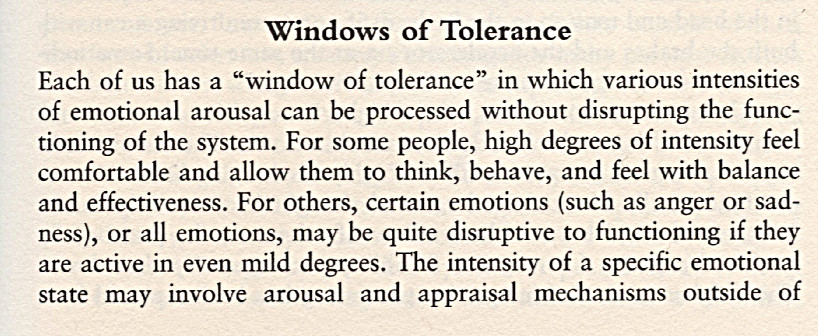
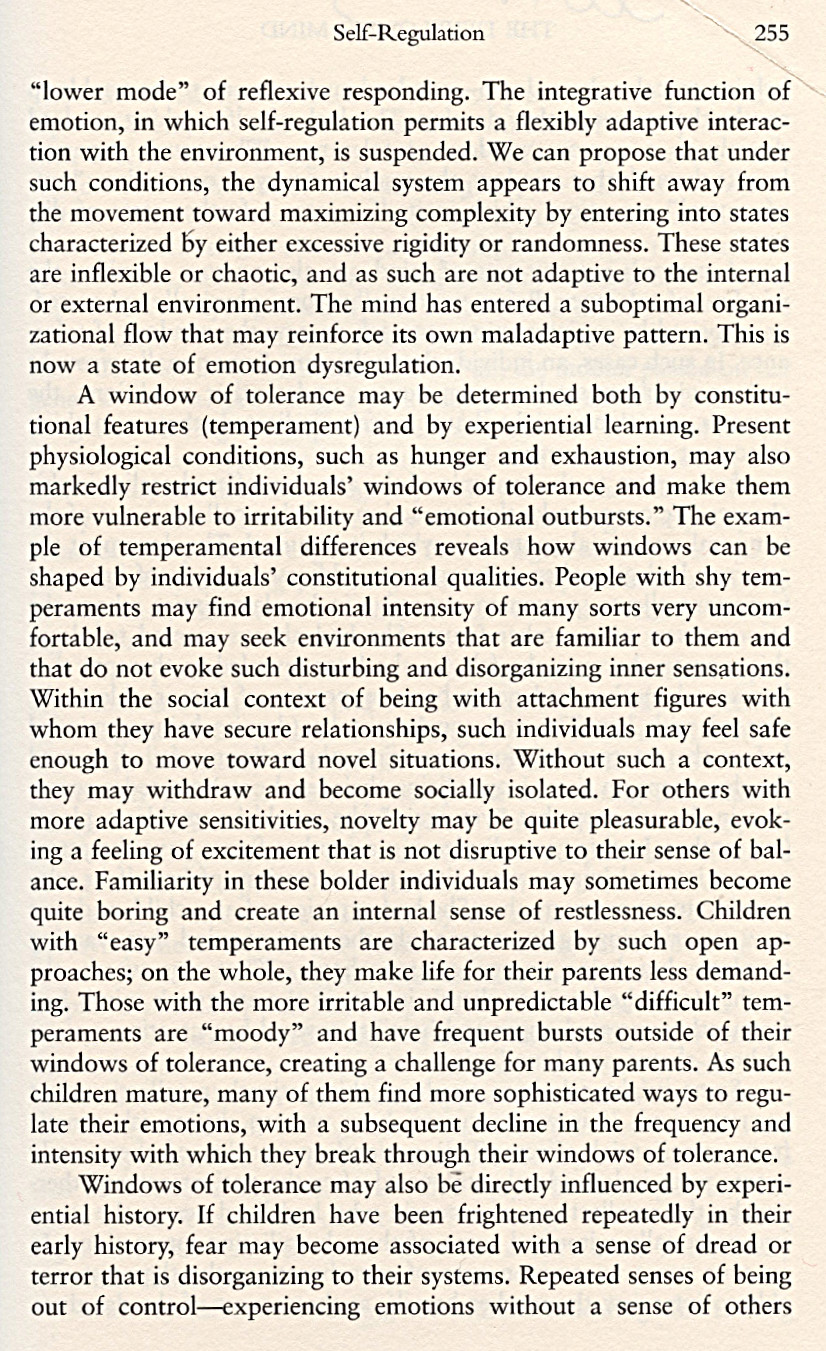
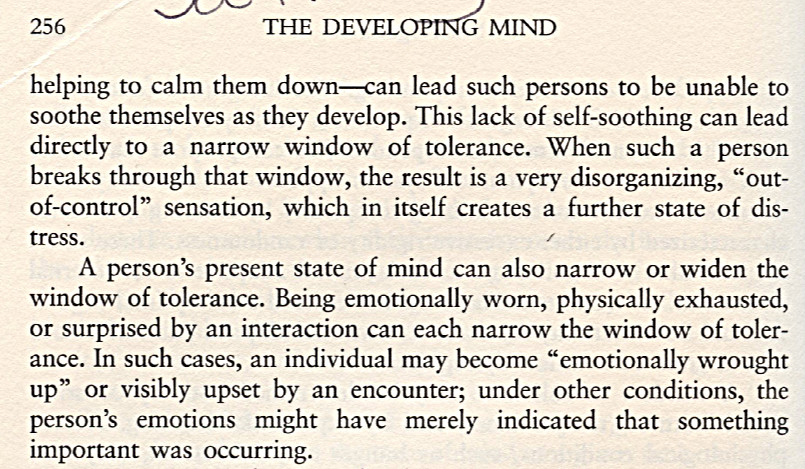
I am going to present some very specific information today about what is termed our Windows of Tolerance as it applies both to our emotional well- or ill-being and to the ways that we get information in the first place through our body.  This information comes from the writings of Dr. Daniel J. Siegel in his book The Developing Mind: How Relationships and the Brain Interact to Shape Who We Are.

The pages that precede the ones I am posting here today talk about how emotions are differentiated early infancy — or not.  These processes all occur within the earliest caregiver attachment interactions we have as our brain and nervous system-body is growing and developing.  All these processes are literally wired into the cells of our body and will determine how we ARE in the world.  The kind of therapy described in my earlier post is recognizing how fundamental these processes are and how they are wired into our body-brain.

Siegel states:

“Creating change within rigid patterns of specific appraisals requires a fundamental change in the organization of information and energy flow….

“Value circuits determine specific appraisal, creating the basic hedonic tone of “this is good” or “this is bad” and the behavioral set of “approach” or “withdraw.”  Value circuits also continue to assess the meaning of these initial activations as they are elaborated into more defined emotional states, including the categorical emotions.  What determines the nature of the appraisal/value process itself?  How does the mind “know” what should be paid attention to, what is good or bad, and how to respond with sadness or anger?

“For human beings to have survived, this complex appraisal process had to be organized by at least two components.  According to the fundamental principles of evolution, the characteristics of those that helped the individuals to survive and pass on their genes are more likely to be present today.  This is one explanation, for example, of why some people are frightened of snakes though they may never have seen one before.  This may also explain why infants have a “hard-wired,” inborn system to appraise attachment experiences as important.

“A second evolutionarily crucial influence on the appraisal mechanism is that it had to be able to learn from an individual’s experience.  Individuals who did not learn, for example, that touching a flame hurts would have been more likely to be repeatedly injured and unable to defend themselves, and therefore less likely to survive and pass on their genes.  Those individuals whose brains could alter their evaluative mechanisms would have been more likely to survive.  Hence, the appraisal system is also responsive to experience; it learns.  Emotional engagement enhances learning.”  (pages 252-253)

As pointed out in the article I posted two days ago on limbic resonance therapy, much of our learning ability happens through epigentic changes.  The healing that severe early abuse survivors need to accomplish happens at these molecular levels through processes that are also described in this article.

Early trauma overwhelms and over-arouses, over stimulates and over amps our nervous system, body and brain.  During our developmental stages that are designed to build emotional regulation into us, we were instead given far, far too much information at the same time we were left to our own physiological adaptations to survive.  As a result our appraisal system changed, a fact that means our Window of Tolerance for emotion and our reaction to emotion was also changed.

++++

While many of us know perfectly well what it FEELS like to have had our emotional, limbic, right brain’s internal guidance system changed because we LIVE with the consequences every day, most of us have never been given the information we need to understand what really happened to us.  We suffer from so-called ‘symptoms’ and ‘mental illnesses’ that are directly a consequence of how our extreme early trauma changed our body-brain in development.

These pages I scanned today from Siegel’s book give us some vital information that lets us begin to think more mindfully and consciously about what we experience in our body.  While change and healing is always possible, I believe that we need to comprehend how pervasive our trauma-related developmental changes in our body-brain’s arousal and reaction systems were so that we can be realistic in our expectations of ourselves as we go forward in our lives practicing gentle kindness.

NOTE:  It is important to realize that what Siegel states here about temperament are factors that are influenced in early development and by any exposure to trauma.  Hence, anxiety disorders, PTSD, depression, dissociation are all related to windows of emotional tolerance and our nervous system’s STOP and/or GO response, influencing how ‘shy’ or ‘bold’ we feel in our body-brain.  (It also might explain why/how things like this can happen:  http://www.kvue.com/news/KVUE-Live-Streaming-Video-81260087.html)

++++

+++++++++++++++++++++++++++++++

+HEALING GENTLE KINDNESS HAPPENS IN OUR BODY

++++++++++++++++++++++++++++++++

I hope from the article posted yesterday that we can begin to understand how what happened to us at the hands of our mothers created patterns in our body and our brain that affect us every moment of our lives.

Change can happen, and when it does it affects our genetics just as the article describes.  What we need is gentle kindness from others we participate in life with, and from ourselves.  Kindness happens in little ways, as each moment moves into the next.  Kindness comes as appreciation — a particular kind of understanding that allows us to appreciate how our anxiety, PTSD, depression, dissociation, and the processes of our free will and choice is fundamentally connected to our SELF within the body-brain we live within (and at one with).

Gentle kindness can come from these new levels of understanding, along with healing.  Just as who we are happens with molecular changes that bubble up to our consciousness, so does change happen the other way around.

I was disturbed in my sleep last night as I seldom am, and cannot remember my dreams except that I need to make certain I learn ‘happy’ songs first as I learn to read music and play this piano because I was ‘told-shown’ that these songs can change me on my insides.  “OK,” I say.  I can do that.  I can learn to play the happiest songs I can find — each tiny note and pause at a time.

I can pay very close attention today to all life’s gifts around me and bring gratitude into my thoughts during this day that I started with feeling (inexplicably) so very, very blue as if I woke an entirely different person than the one I was yesterday.  And I very possibly am.

So I anchor and ground myself in my body in this world, in this sunshine, putting real blankets on the real clothesline to make them smell so sweet and fresh when I put them back on my real bed tonight.  I use real water to take care of my real cats and my real plants.  I peel real oranges, and dig my real coffee grounds into my real compost pile where the real curling gray worms can really eat them up and give me back healthy soil for my little gardens.

The chronic stress reactions my body knows so well, communicated through my vagus nerve to my brain and back again, need me to constantly be aware that time is real because peritrauma timelessness can so easily take over my experience, and steal my life away from me.  Anxiety makes things unreal to me, and feeds that continuing sense of disconnection I feel between my self and my self and my self and the world.  Paying close attention to the littlest things is kind and gentle to me.  I can watch it with my breathing, “Exhale, Linda, Exhale,” knowing as I do this my vagus nerve begins to smile and with every careful, mindful breath and with every careful, mindful action I can steal another instant of my own life away from the trauma that built my body and experience my life as ME.

++++++++++++++++++++++++++++++++

+TRUE HEALING POSSIBLE – MY #1 CHOICE FOR TREATMENT

+++++++++++++++++++++++++

I have nothing but good to say about the information contained in this post and the article referenced here.  This is the most comprehensive, practical and hopeful information I have found on healing yet.  This would be my NUMBER ONE pick as a healing technique for infant-child abuse survivors.  Please spend some time looking this over – I have also ordered this book:

The Oxytocin Factor: Tapping the Hormone of Calm, Love, and Healing

BY: Kerstin Uvnas Moberg

+++++++++++++++++++++++++

WEBSITE:  The Rosen Institute

Rosen Method Bodywork and Movement

What is Rosen Method Bodywork?

What is Rosen Method Movement?

Benefits of Rosen Method
Bodywork & Movement

It appears that accessing this therapy is difficult but not impossible within the United States  —  it looks to me to be the real thing.  Can demand help stimulate increasing supply even though there are not the billions to be made off of REAL therapy that addresses our REAL problems and can REALLY help us to REALLY heal — like there are to be made within the psychopharmacalogical industry of pills, pills, pills and more pills and drugs, drugs, drugs and more drugs?

I haven’t personally tried this therapy — but I sure would if I could or will if I can!!

+++++++++++++++++++++++++

Resonance, Regulation and Revision:  Rosen Method Meets the Growing Edge of Neurological Research

BY:  Dorothea Hrossowyc

Rosen Method Bodywork Practitioner

Introductory Workshop Teacher and Bodywork Teacher in Training

Northfield, MN

hrossowyc@gmail.com

Published in Rosen Method International Journal (RMIJ), 2(2), 2009

ABSTRACT

This article presents some of the recent research from the burgeoning field of neuroscience that supports what we do in Rosen Method Bodywork. Current neuroscience is confirming that deep listening, presence, and limbic resonance are powerful healing tools as they provide regulation and revision for human beings. The healing cascade of the human connection system, stimulated by the hormone oxytocin, regulates and revises our neurological health and our physiological functioning, modulating emotions, hormonal status, immune function, stability, and likely our fresh, creative thinking. Epigenetics, which says genes are not destiny, and brain plasticity, the ability of the brain to grow and change, may also be affected by Rosen Method touch. Turning off the fight/flight adrenaline system in the body and turning on this powerful physiological system of relationship, caring, and trust has far reaching implications for our physical and mental health and for our evolution as a species.

++++

(Article here for educational purposes only)

“A recent program on public television titled “The New Medicine” stirred coverage in news media for suggesting putting “the care back into medical care,” and for suggesting that the relationship between a caregiver and a client is an extremely important factor in healing.   In Rosen Method, we have long understood the term resonance, the ability humans have to sense deeply the feeling state of another in relationship.  In Touching the Body, Healing the Soul, Rosen Method Senior Teacher, Sandra Wooten, long ago referred to affective resonance in psychotherapy, as the matching that takes place on an emotional level between a client and a listener.   But she states further, “In the physical, somatic realm of touch, I have coined the term, somatic resonance to define the matching that takes place with gentle, therapeutic (Rosen Method) touch between the client and the practitioner, allowing enhanced inward attention and perception for both” (Wooten, 1995, p 24.   In Rosen Method, we know that when we touch someone sensitively and inquisitively, we can often sense the emotional state in the other, that two people, even strangers, can be attuned to the inner state of each other through deep listening, and that this, in itself, is a powerful healing tool.

“The idea of “limbic resonance” is getting a lot of attention currently by scientists like Thomas Lewis and Stephen Porges, and in such body psychotherapies as Hakomi Experiential Psychotherapy, Sensorimotor Psychotherapy, Somatic Experiencing and others.   It seems this is something that human beings have always known how to do, and now we are remembering its importance.  Though scientific confirmation has not been necessary to know the benefits of Rosen practice, I find it exciting that now neuroscience is confirming what we have long known or believed.  Knowledge of the basic findings of neuroscience may also contribute in the long- run to Rosen practice.

Limbic Resonance

“Thomas Lewis tells us that contact and connection, or physical and emotional closeness and connection, actually affect the physiology of human beings in regulatory ways (Lewis et al., 2000).  Neurological research in animals and in human beings shows that humans are wired for connection, i.e. we have neural circuits that foster interpersonal connection.   According to Lewis, many of these circuits are located in the limbic system, the feeling part of the brain.   The neocortex has a large part of the thinking, cognitive functions of the brain where abstraction, learning, and voluntary behavior reside.  The limbic system, which evolved in mammals, has to do with socialization, social communication, care of the young, bonding, relational attachment, and play, i.e. with caring, and emotionality.   From a young age, we need caring connections to promote healthy development of the limbic system.   From research with both monkeys and infants, Lewis tells us that we mammals need relatedness or connection for our “neurophysiology to coalesce correctly.”  We are designed this way, he says, for the “shaping physiologic force of love” (Lewis et al., 2000, p 218).

“A mother who is functioning well with her child is attuned in both a feeling sense and a physiological sense, what Lewis calls “limbic resonance,” sensing the child’s inner state and responding appropriately.   The mother’s contact with her infant affects the physiological state of the infant, and her physiology is affected as well by this contact, connection, and physical and emotional closeness.   The child knows this instinctively, and senses the physiological need for the mother in times of stress or pain.   Consider the ill child who wants to be held all the time, or the vigorous protest during times of separation.   Lewis says, “The first part of emotional healing is being limbically known, having someone with a keen ear sense your melodic essence” (Lewis et al., 2000, p 170).   In Rosen Method we might call this presence, being conscious and aware in the present moment, taking the whole of another in, listening deeply, attuning, sensing the feeling, sensing the essence, reflecting back.

“The idea of this mutual regulation via limbic resonance is supported by very interesting recent research by Michael Meaney, co-director of the Sackler Program for Epigenetics and Psychobiology at McGill University, who studied rats with varying levels of maternal licking and grooming (Meaney, 2001; Fish, Shahrokh, Bagot, Calji, Bredy, Szyf, & Meaney, 2004; Swan, 1997).   Rats with attentive mothers grow up with more receptors for neurotransmitters that inhibit the activity of the amygdala, and fewer for stress hormones like adrenalin and corticotropin releasing hormones.  The amygdala is the part of the limbic system that senses and conveys fear responses.

“Rats raised with high maternal contact, lots of licking and grooming, grow up with adequate but lower responses to stress hormonally and so are less fearful, more curious, and more exploratory.  Those with low physical contact grow up to have more receptors for stress hormones and are more timid, more withdrawing, and more fearful in novel situations. Low physical contact pups grow up to be low contact mothers (Fish et al., 2004).

“Meaney’s research further shows that in rats, low physical contact affects epigenetic changes.  Epigenetics is the idea, supported in some of the newest genetic research, that “DNA is Not Destiny” (Fish et al, 2004, Watters, 2006).  While the DNA sequence is not changed, epigenetics is the process by which environmental factors and chemical modification of inherited genes can affect whether a particular gene is expressed or not expressed, silenced or activated like an on/off switch for genetic expression.  Meaney tested the methylation of a gene important to the stress response.   Methylation is a chemical marker of an epigenetic process, i.e. the state of methylation is critical to gene activity and to whether the gene expresses.   He found distinct differences, after birth, in methylation patterns between pups with high licking mothers and low licking mothers.   Before birth there is normally no methylation, so the difference in genetic expression happens after birth according to low or high physical contact.   Equally interesting is that low contact pups showed reversal of the effects when they were placed later in life with high physical contact mothers, or into nurturing, playful, low stress “social” situations around healthier rats.   Physical contact as late as adolescence still changes the epigenetic processes, suggesting that the adverse effects of low physical contact are reversible by more physical contact later (Meaney, 2001; Fish et al., 2004; Swan, 1997).

“Meaney’s research suggests that genes responsible for controlling the stress hormonal response are epigenetically regulated by maternal care, in particular, the physical contact of licking and grooming.   This means that the way the genetic material is expressed is affected, and that these epigenetic changes can be altered later. I suggest that this is what Lewis calls “revision”, revising the physiology through contact and connection (Lewis et al., 2000).

“What if physical contact and touch actually reverses the effects of stress responses that occurred in human infancy and childhood as well as in rats?  Lewis suggests this regulation and revision involves more than just touch for humans, however.   It involves touch with a limbic resonance, what Sandra Wooten calls “somatic resonance,” a presence with a relationship to the feeling state of the other.   Lewis calls this “somatic concordance” not just normal, but necessary for human development (Lewis et al., 2000).

““Without rich limbic resonance, a child doesn’t discover how to sense with his limbic brain, how to tune in to the emotional channel, and apprehend himself and others.   Without sufficient opportunity for limbic regulation he cannot internalize emotional balance. Children thus handicapped grow up to become fragile adults who remain uncertain of their own identities, cannot modulate their emotions and fall prey to chaos when stress threatens” (Lewis et al., 2000, p. 210).

“Lewis goes on to say that anxiety and depression are the consequences of disconnection.  Monkeys deprived of early limbic regulation lose billions of neurons they would ordinarily develop in caring environments.   They suffer neural disorganization and lose the capacity to modulate aggression   If the isolation stretches out, and they survive physically, they are marked by lethargic despair with the accompanying outpouring of stress hormones and neurotransmitters with unpredictable negative physical effects. Moreso, “they become erratically, unpredictably and chaotically vicious” (Lewis et al., 2000, p. 218).

“Lewis describes the limbically damaged human, seriously neglected, seriously deprived of human care, or living largely without physical and social contact and connection, without limbic regulation and revision, as deadly: “a functionally reptilian organism armed with the cunning of a neocortical brain, lacking compunction about harming others” (Lewis et al., 2000, p.218).   He challenges us to imagine and act on how society might be different if we were intolerant of childhood abuse and neglect.   Parents, and the physicians and others who guide them, need to understand the importance of emotional presence and resonance, holding, and gentle, contactful touch.

“Lewis reminds us that children don’t grow up to be fully self-regulating, even with good contact as infants and children.   Adults are still social animals, requiring stabilization outside themselves.  Physiological stability means finding people who regulate you well and staying by them. (Lewis et al, 2000).   Babies know this instinctually, and it is why they don’t want to be left alone.   It is why hurts around attachment, abandonment, and aloneness are so big in the adults we see as clients. Rosen work is so powerful, helpful, and effective as it recreates a special experience of limbic resonance, regulation and revision, a deep, resonating connection providing neural lessons missed earlier, and changing neural pathways. And what if it also provides a revision of genetic expression?

“In Rosen work these are all happening:

  • • There is resonance, in the Rosen practitioner’s deep, listening presence, attending to, really tuning in to someone, “catching the melodic essence”, the client being limbically known, reflected, and the client “knowing,” sensing himself/herself.
  • • There is regulation, with the change happening in the breath, in the release of body tension, in increased circulation and aliveness, in relaxation, the body working as it should, physiology regulating itself through resonance.   Limbic regulation thus allows the ability to modulate emotions, neurophysiology, hormonal status, immune function, sleep rhythms and stability (Lewis et al, 2000).
  • • There is revision, changing one another’s brains through limbic revision.   The Rosen therapist supports the client to bring long repressed emotions into consciousness, and these are received and affirmed by the therapist without judgment. The Rosen therapist supports the client to bring unconscious behavior patterns into consciousness where there is choice about them, even if the choice has to be made consistently and persistently against longstanding neural patterning and conditioning.  Neurobiologist and author Candace Pert tells us that the more we exercise choice against our neural patterning, the more we “exercise” that part of our brain that makes us uniquely human: our free will, the freedom to choose against conditioned neural patterning.   And the more we exercise our free will against one pattern, the freer we are to choose against all of our conditioned patterning (Pert, 1999; 2006). And there is the possibility of epigenetic changes described by Meaney and colleagues.

“The possibility of “limbic revision” indicates that the therapist needs to do her own work, get her own mental and emotional house in order, because the client regulates and revises to and through the therapist.   As much as we in Rosen Method would like to not have to pay attention to the “clinical relationship”, and do not consider ourselves mental health therapists, the clinical relationship is already there, a vital part of the work.   And it is crucially important that Rosen is taught experientially.  We learn the work by doing it and by receiving it, revising and regulating our own physiology and neural pathways.   In this way we meet the “…urgent necessity of the therapist to get his own house in order.   His patients are coming to stay, and they may have to live there for the rest of their lives” (Lewis et al., 2000, p. 187).

Oxytocin and the Human Connection System

“Science is just beginning to explore the physiological importance of human connection and Rosen work has been indirectly involved in some of the scientific research into the human connection system in Sweden.   The oxytocin cascade is an understudied part of this system, just beginning to get a lot of scientific attention. Kerstin Uvnas-Moberg is a researcher from Sweden who published many scientific articles on this hormone and its subsequent cascade, and also a book called The Oxytocin Factor: Tapping the hormone of calm, love, and healing (Uvnas-Moberg, 2003). It is worth noting that in Sweden, the book was titled Calm and Stillness Though Touch.

“While studying attachment and mother infant bonding, Uvnas-Moberg became fascinated by oxytocin, which is both a hormone and a neurotransmitter.   Knowing it is stimulated by touch, she researched the effects of touch on the production of this bonding, relaxation hormone.   She used massage practitioners in her research, some of whom are also Rosen practitioners, though they did not use Rosen Method in the sessions that were in the studies.  I first heard about Uvnas-Moberg’s  research before the book was published in English, from her good friend, Swedish Rosen Senior Teacher Annika Minnbergh, in her lecture at Calistoga, California, in 2001 at one of the first international Rosen gatherings.

“There has also been more research of this connection hormone by scientists in the US including Susan Carter, who did a study about oxytocin levels in the species of voles, small rodents like mice, who mate for life.  Carter is the wife of Stephen Porges, who developed the polyvagal theory, and the theory of the social engagement system, or human connection system facilitated by the vagus nerve and the oxytocin cascade.

“The polyvagal theory postulates that humans have three hierarchical systems of protection in the body, the freeze system, the fight/flight system and the social engagement system.   The social engagement system, or the human connection system, was the latest to evolve, and Porges suggests it is really a whole complex physical system of communication and connection facilitated by the ventral or front part of vagus nerve, and stimulated by oxytocin.   He suggests that fight /flight is connected to the central part of the vagus, which comes to the area of the diaphragm, and that the freeze system is connected to the dorsal part of the vagus nerve, which comes in to the lower part of the spine (Porges, 2001; 2006).  Carter and Uvnas-Moberg have published together about oxytocin and bonding, and are friends.  Porges’s work is related.

“Thus, the oxytocin cascade is proposed as part of a whole physiological system in the body we are just beginning to understand.   This is the study of human connection, and the physiological system that supports human connection, or social engagement.  We know a lot about the fight/flight and the freeze systems in the body, and it is time we learn as much about the human connection system, or the social engagement system.

“If one thinks of this social engagement or human connection system as a biological system in the body, and as the latest to evolve in humans, then one might say it is evolutionary for humans that it is being studied now in human history and that we are just beginning to understand its importance and its workings.   Even if we are not so proficient at it, it is part of the design, available to develop and bring into consciousness.   According to these researchers of the oxytocin cascade and the social engagement system, oxytocin is the bonding hormone, highly activated at birth and in nursing mothers.  It is not just a female hormone, however, but present in both females and males (Uvnas-Moberg, 2003).   It is the hormone that helps a parent get up many times in the middle of the night, not go completely crazy, and still love her baby.

“But when adrenalin is high, the oxytocin sites shut down (Minnbergh, 2001; Uvnas Moberg, 2003).  Adrenalin is about firing up the musculature and organs for fight or flight capability.   Often, intense physical tension and pain in the body is a result of chronic activation of this system, and the result of a chronic production of stress hormones such as adrenalin, cortisol, and noradrenalin.

“These stress hormones have many beneficial effects as they facilitate the fight/flight response.  When needed, they stimulate increased cardiac output, increased blood pressure, and increased heart rate to do the strong physical tasks we require.  But these effects can be unnecessarily sustained and lead to a sustained stress response.   The increase in blood pressure and heart rate can be sustained even when no longer needed, or when the limbic brain perceives threat that isn’t there anymore.   These chemicals are harsh on the body when sustained over long periods, and can produce chronic tension and physical pain and wear the body down.   Other potentially adverse effects of these hormones include adverse effects on the heart, increased blood glucose, increased blood pressure, decreased memory, negative effects on sleep, impaired immune function, and they are linked to higher rates of weight gain and obesity.   Persistent or sustained increases in stress hormones also suppress nonessential functions in a fight/flight situation, or a perceived fight/flight situation.   Even in a perceived flight/fight situation, there can be adverse effects on the digestive system, reproductive system, and growth processes (McMahon, 2009; Minnbergh, 2007).

“From stem cell research, Bruce Lipton found that cells responding to stress or fear do not grow (Lipton, 2005).   The body turns off any nonessential activity, like digesting your food, if it thinks you have to pay attention to fighting or fleeing, even if the threat is only perceived, not really happening in present time.

“There is also new research from Nuno Sousa and colleagues in the Life and Health Sciences Foundation in Portugal that shows chronic stress in rats produces what looks like “thinking in a rut”, repeating the same patterned, ineffective behavior again and again.   Sousa found parts of the brain that are associated with executive functions and goal-directed behavior had shriveled in chronically stressed rats, and those parts of neural circuits linked to habit formation had grown.   “Behaviors become habitual faster in stressed animals than in the controls, and worse, the stressed animals can’t shift back to goal directed-behaviors when that would be the better approach” (Angier, 2009).   Sousa’s research supports the idea that when we are in chronic stress, we are more likely to rely on distressed, patterned behavior rather than fresh, clear, creative thinking.

“Sousa also found, as Meaney’s studies did, that taking the stressed rats out of the stressful situation and putting them “on vacation” with healthier comrades, even for just 4 weeks, helped them to rewire, and use innovative skills again.  “Atrophied synaptic connections in the decisive regions of the prefrontal cortex resprouted, while the overgrown dendritic vines of the habit-prone sensorimotor striatum retreated” (Angier, 2009).

“This plasticity in the brain is another aspect of our newly understood neural circuitry and a finding in many new research studies.   Bruce McEwen, head of the neuroendocrinology lab at Rockefeller University, describes the brain as “…a very resilient and plastic organ.   Dendrites and synapses retract and reform, and reversible remodeling can occur throughout life” (Angier, 2009).

“In contrast to the stress responses, oxytocin and the oxytocin cascade — stimulated through touch, connection, and presence, and possibly regulated by the vagus nerve — is about calm, nourish, digest, relax, restore, connect and grow: the trust system in the body. Give it to roosters and they act like mother hens, showing nurturing behavior. Give it to rats and they come out of their cages with less fear, recognize their littermates, and socialize with other rats less fearfully.   Give it to stockbrokers and they are not afraid of risks and act more trusting with their money.

“The oxytocin cascade, or the human connection system, is about stress release, pain release, and it plays a larger role than we have known in the recovery from illness, injury and disease.   It may also play a role in creating fresh, innovative responses, new possibilities, and clearer thinking.   Moberg describes it as an open loop, one that feeds upon itself.  The more you have, the more you get.   Then the more you connect with others, the more of this neurotransmitter is stimulated, the whole cascade is stimulated again, so then the more you are able to connect, to yourself, to others, to something larger than yourself (Uvnas-Moberg 2003; Minnbergh, 2001).

“If you think of this as a protection system in the body, the implications of this theory are great:  social engagement and connection as the highest most evolved form of human protection rather than the adrenalin/fight/flight system in the body, one which possibly produces fresh, innovative thinking, and even more human connection, than other patterned responses.

“Moberg’s research shows oxytocin is elevated after sessions of touch therapy, but it goes back down.   After 4 sessions, it tends to go up and stay elevated.   After 7 sessions, it tends to stay elevated for longer periods.   And the research shows it is best stimulated by gentle touch, not heavy, deep tissue work, and especially by stroking on the belly (Minnbergh, 2001).   Uvnas-Moberg also found that the oxytocin levels in the practitioner increase as well through contactful touch.

“We know this healing cascade is stimulated largely by touch with other humans, by doing fun things, by being with other people, by connecting.  It is also stimulated by alcohol, nicotine, and the process of smoking, and by high fat foods (comfort foods) (Uvnas-Moberg, 2003).   So if you are not getting your social connection system stimulated any other way, have no other way of turning off the adrenalin or fight/flight system in the body, then you may turn to one of these less healthy alternatives.   It is not surprising that these are addictive substitutes for something else that the body needs.

“In Porges’ polyvagal theory, we learn that humans have inherited three forms of protection:  The first and most evolved form of protection is the ability to connect in relationship to other humans through complex and instantly read facial expressions and the human voice, this connection system being regulated by the upper end of the vagus nerve and stimulated by oxytocin.   Fight/flight is the second level of protection in this evolutionary hierarchy.   The freeze response, going numb, going unconscious, checking out, withdrawing, isolating or dissociating is the third and most primitive (Porges, 2001; 2006).

“Each of these is a necessary form of protection for the human.   We need to know how to go unconscious in an accident, for example, to conserve all resources for the tremendous job of healing that has to happen, and also to withstand the pain.   But chronic numbness or chronic unconscious living, chronic isolation, chronic aggression or fighting, chronic stress is obviously not life-enhancing for humans, and physically harmful.

“Porges theorizes from research with autistic children that relaxing areas where the vagus nerve comes close to the surface, i.e. the occipital ridge, the back and sides of the neck, the face, especially around the ears, and of course, the diaphragm, can help turn on the social engagement system.   These are all areas  we commonly work in Rosen Method.   Porges uses sound waves to relax the vagus nerve through the ears in autistic children (Porges, 2001; 2006).

“Rosen Method uses touch, presence, and limbic resonance to relax the whole body, which likely turns on this system.   Perhaps when the vagus nerve can function well, uninhibited by muscular tension, the social engagement system or human connection system may be encouraged to function well also.

Conclusion

“So relationship, through the healing cascade of the human connection system, regulates and revises our neurological health and our physiological functioning.   In loving and caring, in connecting through touch or otherwise, we modulate each other’s emotions, neurophysiology, hormonal status, immune function, sleep rhythms, and stability.   When you find someone who regulates you well,  someone with whom you feel good, with whom you can share at least some physical closeness and touch, around whom you can revise, then stick with that person.  And that is why your clients should stick with you.
“We know, and neuroscience is confirming, the importance of touch and caring, and of understanding and stimulating this biological system in the body, for recovery from illness, disease, injury, but also for human development and peace in the world.   We can use touch, presence and limbic resonance for the evolution of a new human species that will use connection to other human beings as its first form of protection.  Through touch, and also through the connection that is the essence of Rosen work, we are stimulating a whole physiological system in the body, the physiological system of trust, and human connection, facilitating the evolution of the human species toward more and deeper intimacy, connection and safety.”

References

Angier, N. (2009).   Brain is a co-conspirator in a vicious stress loop.   The New York Times, August 17, 2009.

Fish, E., Shahrokh, D., Bagot, R., Calji, C., Bredy, T., Szyf, M. & Meaney, M. J. (2004).   Epigenetic programming of stress responses through variations in maternal care.    Annals of the New York Academy of Sciences, 1036, 167-180.

Lewis, T., Fari, A. & Lannon, R. (2000).   A general theory of love. Random House.

Lipton, B. (2005).   The biology of belief. Hay House.

McMahon, M. (2009, in preparation).   Common effects of stress hormones on the body.

Meaney, M. J. (2001).   Maternal care, gene expression, and the transmission of individual differences in stress reactivity across generations.   Annual Review of Neuroscience, 24, 1161-92.

Minnbergh, A. (2001).   New research from Sweden on the oxytocin hormone and touch.  Lecture presented at the International Rosen Method Gathering, Calistoga, CA.

Minnbergh, A. (2007).   Comparing the adrenelin/stress response and the oxytocin cascade.   Lecture presented at the Rosen Method Global Congress, Imatra, Finland.

Pert, C. (2006).   The biochemistry of consciousness.  Lecture presented at the Continuum Center,  Minneapolis, MN.

Pert, C. (1999).   The molecules of emotion.   Touchstone.

Porges, S. W. (2001).   The polyvagal theory:  Phylogenetic substrates of a social nervous system.   International Journal of Psychophysiology, 42, 123-146.

Porges, S. W. (2006).   The polyvagal theory. Lecture presented at Hakomi International Conference, Boulder, CO.

Rosen, M. (with Brenner, S.) (2003).   Rosen method bodywork:   Accessing the unconscious through touch.   North Atlantic Books.

Swan, N. (1997).   Maternal care. Radio interview with Michael Meaney, Radio National Home, The Health Report, November 17.

Uvnas-Moberg, K. (2003).   The oxytocin factor:  Tapping the hormone of calm, love and healing. Da Capo Press.

Watters, E. (2006).   DNA is not destiny.  Discover Magazine, November, 33-75.

Wooten, S. (1995).  Touching the body reaching the soul: How touch influences the nature of human beings. Chimes Printing.

++++

READ ABOVE ARTICLE ONLINE HERE

SEE ALSO:

Rosen Method International Journal

Alan Fogel, Editor

Rosen Method Bodywork Practitioner, PhD, LMT

+++++++++++++++++++++++++++

DON’T MISS THE WEALTH OF INFORMATION FOR YOUR READING/STUDY/RESEARCH AND HEALING FROM INFANT-CHILD ABUSE PLEASURE AT THIS LINK

+++++++++++++++++++++++++++

Must be why I was drawn to buy myself this amazing electric piano keyboard so I can learn to play – and use music to ‘heal my abused infant brain’:

Porges uses sound waves to relax the vagus nerve through the ears in autistic children (Porges, 2001; 2006).  “

+++++++++++++++++++++++++++

+LINKS TO MUST-KNOW INFO ON ATTACHMENT

+++++++++++++++++++++++++++++++++++++++++

While I continue work on my other post for today about what I think is a therapy that has great healing potential for infant-child severe abuse survivors, I wanted to again post these links (below) to some very important information about attachment and relationships.

As I prepare the second post, I think about how I believe there is a universe of difference between the word ‘recovery’ and the word ‘healing’.  While I do not rely on any concept related to recovery for severe early abuse survivors (because we have nothing to go back to or for in the usual sense), I do believe that healing is not only possible, but is the work survivors are most involved in for the duration of their life times.

I hope you will spend some time reviewing the information below if you already read it in May 2009 when it was first posted.  If this is your first time encountering these links on my blog, please enjoy!!  Please carry along in your thinking the recently posted information on the vagal nerve system in the body as it ties our body-based information directly to our stress response system, our compassionate caring system, our nervous system, our brain and our immune system.

+++++++++++++++++++++++++++++++++++++++++

*COLLINS ON RESPONDING TO NEED – Part One

*COLLINS ON RESPONDING TO NEED – Part Two

*COLLINS ON RESPONDING TO NEED – Part Three

*COLLINS ON RESPONDING TO NEED – Part Four

*COLLINS ON RESPONDING TO NEED – Part Five

*COLLINS ON RESPONDING TO NEED – Part Six

**Attachment Styles and Caregiving from Collins Article

+++++++++++++++++++++++++++++++++++++++++

+HARDHITTING ON THE TOPIC OF BAD RELATIONSHIPS

++++++++++++++++++++++++++

Of all the tragedies that life can find to place in our way along our path from start to finish, those connected to our early histories of growing up in homes with what the Center for Disease Control refers to as Adverse Childhood Experiences could become the easiest ones for us to spot.  Sure, there are plenty of self help books and programs that more and more of us eventually discover that tell us how to ‘get better’, but are they really telling us anything like the REAL truth about who and how we are in the world?

Is there anything like a product guide, a user’s guide, or a reliable guarantee of ‘full disclosure’ as we leave our abusive homes of origin and seek to join the mainstream world, jumping into the flow of major life choices and their resulting consequences?  Of all the things we leave our abusive homes not knowing anything about, perhaps the one that follows along with us the longest is our mistaken idea that we can somehow create safe and secure adult relationships between partners who do not have an early history of safe and secure attachments.

We are heroic in our attempts to build sandcastles to live within as if they will shelter us from the storms we face in life, as if they can withstand the onslaught of storms that sweep over and around us over the years of our life time.  How hard it is to let ourselves know that we are really homeless in the world of our partnerships, that no matter what any self help book tells us, those of us who survived an infant-childhood filled with trauma, abuse and madness will not live long enough to learn enough to begin to change enough to be able to sustain and maintain a mate relationship of safe and secure attachment.

So many people, especially in today’s unsafe and insecure economic environment, are facing limitations of choice to exit unstable, abusive, and simply put, very BAD relationships, especially if they are still caring for dependent children.  Those now left without the ability to create a sustainable exit plan out of one of these BAD relationships will experience increasing levels of stress for themselves and for their children.

These children, growing up with the pressure and strain of Adverse Childhood Experiences of their own are likely to seek attachment relationships themselves that are the equivalent of sandcastle and cardboard box partnerships that will never do more than temporarily appear to be sustainable.  What the self help books don’t tell us, is that we would be far better off building a concrete vault to sustain ourselves within independently and autonomously than we would be pretending that we have the first clue what a safe and secure attachment relationship is – because we don’t.

++++

Which is harder, learning to avoid getting into these unsustainable relationships in the first place or trying to get ourselves out of them after we have committed our hearts and entangled our lives?  Actually, I could be accused of cheating and that accusation would be correct.  At age 58, I am far enough down the road of life to be able to look backwards at my own life and sideways at the lives of others to see that a sustainable, autonomous, independent and FREE life alone has – the way I see it from here – so much more to offer me as a severe infant-child abuse survivor that I can no longer even pretend that I even WANT another sandcastle or cardboard box attachment relationship in my lifetime.

Coming out of abusive childhoods leaves many people prepared to continue struggling against insurmountable obstacles for the rest of their lives.  If the goal is to survive given the difficult conditions of life, then we are experts at trying to reach our goals.  Over and over again, on and on we go repeating our efforts to make a truly crappy situation and/or relationship into a good one.  We learned at the start of our life that to give up is to die.  We can continue to apply our simple rules of trying to stay alive to all kinds of situations that we would be better served simply walking away from.

++++

The goal of a truly sustainable infant-childhood is to form, through safe and secure attachment relationships with our caregivers, our own clear, strong, independent and autonomous self that can then continue down the road of life with enough inner resources to appropriately interact empathically, responsibly, appropriately and compassionately with others.  The more I learn about the physiological body-brain changes that are a direct result of growing and developing within malevolent early environments, the more I see that we survivors were simply never given what we needed to create one of these best-selves-possible.

Our handicaps show up in some way in nearly every choice we make.  Our choices for our adult attachment relationships are probably the most volatile and unsustainable ones we make.  While we continue to believe that somehow if we work hard enough we can perform the magic act of alchemy to transform ourselves in our relationships and that our partners can also transform themselves, we are most often struggling to accomplish the impossible.  We are like the dolphins caught in tuna nets who struggle until they die.

From my age 58 perspective I am beginning to finally understand something that appears to be one of the greatest paradoxes, if not downright ironies of life:  Those people who are most able to sustain themselves comfortably as independent and autonomous people outside of a mate relationship are the ones that will be able to sustain themselves – AND THEIR PARTNER – in a safe and secure attachment relationship – IF THEY EVER CHOOSE TO HAVE ONE.

While this might seem obvious, simplistic, and intellectually believable, severe infant-child abuse survivors are likely to NEVER TRULY GET THIS POINT.  I think back nearly 30 years ago when I was going through a treatment program designed to address my ‘child abuse issues’.  I was unhappily married for the second time.  My therapist told me and my husband that unless and until we each, on our own, separately and independently improved our own well-being, that ‘working on the marriage was impossible.  This therapist told us that otherwise it would be like scraping two piles of mold from different corners of the bottom of a refrigerator into one pile and expecting something good and healthy to come of the effort.

He was right.  I will grant him that point.  But I was not told NEXT what I now know, and needed to be told THEN.  I could apologize here for mentioning what I am going to say next, but with my advancing years I now see this as the rest of the story.  Never in my lifetime is it possible for me to make enough so-called changes so that I will ever be able to have a sustainable mate relationship with anyone.

That’s an extremely harsh reality, but reality it is.  I can spend the rest of my life, literally working to improve my independent, autonomous, sustainable own self and while I can make progress within myself, I do not believe that I have a long enough lifetime to make myself into this kind of self.

Even if my therapist in 1983 had told me this fact, it’s doubtful I would have believed him.  I would have thought, “Well, that might be true for others, but I am special.  I can be the exception.”  That would have been a delusion I could freely have believed in.  But sooner or later things that are true remain standing, like stone pillars strong enough to withstand millions of years of erosion.  That’s one of the things that the truth actually does:  It remains standing when all else has crumbled and vanished away.

++++

Knowing this fact now, that unless and until I can become an independent, autonomous, sustainable single self I will not be capable of forming safe and secure attachment with a mate, actually gives me a point of reference that acts like a true-north orientation of myself in relationship to my entire life.  I can kick and scream, deny and try to make deals, compromise, suffer and struggle, sacrifice and fantasize that somehow I can escape the consequences of having been forced to grow and develop a body-brain in a horribly abusive, deprived, malevolent world that in no way created a physiology in me that operates the way a safely and securely-built attachment physiology operates.  Or I can accept the facts and begin to realize that life offers me an acceptable alternative – the freedom of being alone that I need to heal what can be healed inside of my own self.

I say this as I come to realize why I cannot ever be with the man I love completely.  As I understand that WHY from inside my own body I am at the same time gaining understanding about the WHY as it relates to his attachment physiology.  I know of no attachment therapy approach that even begins to explain the facts of what makes our relationship so much more than difficult.  Our relationship is impossible.  Survivors need to be told what is really going on for us.  Dancing around the facts of our changed attachment physiology continues to give us the illusion that there really is ‘hope’ for such impossible relationships.

++++

Anyone who reads this post is of course perfectly free to take their own stand and make their own choices regarding any relationship they may be in.  I am simply stating my own point of view based on what I have learned about the nature of terrible infant-childhoods and how they change our physiological development.  These changes operate in unsafe and insecure attachment patterns that are visible and definable once we understand how basic and fundamental these patterns truly are.

These changes are, I believe, the root causes of all the trauma dramas we enact in our lives.  They are at the root of our suffering.  They created a lack of ability to smoothly and consciously regulate our emotions – in our body, our brain and our mind – through safe and secure attachments between ourselves and the world we live in.

As a result we are more like unstable nuclear reactors than we are like independent, autonomous, sustainable people.  It is at this level of woundedness – in our trauma-changed body-brains — that our problems with mates and relationships actually originates.  It is at this level, for those of us who are survivors of traumatic infant-childhoods, that our physiology does not support recovery.  We had no opportunity to create in the first place what would help us to go ‘back’ and ‘recover’ now.  We cannot ‘recover’ what we never had in the first place.

All human actions and interactions are ultimately about regulating our individual physiology, including our emotions.  That is what being a human being living in an Earth Suit really means.  The experiences of our early attachment relationships tailor fit our Earth Suit accordingly.  We need to understand ourselves and others at this most basic physiological-change level if we want the misery-patterns of our lives to end.

It’s not the relationships we participate in that we need to change.  It’s the Earth Suit we live in while we have these relationships.  Changing the Earth Suit we live in while in the midst of trauma drama is about as impossible as flying into the sun.

++++++++++++++++++++++++++++++++++++++

+WHO CAN GET TO AND RESCUE THE SUFFERING BABY?

++++++++++++++++++++++++++++++++

Even though I am not able to be with her right now, I am so grateful for the wonderful telephone conversations I am able to have with my daughter who is expecting her firstborn, a son in the third week of April.  They are entering their 31st week of pregnancy.  I have never been a grandmother before.  It’s all new, to all of us, to baby boy’s mother and father, his grandparents, his auntie and uncle.  I think it’s because of last night’s telephone call with mommy-to-be that the dream came to me last night.

Many thoughts crowd into my mind as I start to write about this dream.  There were two newborn babies, a boy and a girl.  There were two women.  But looking back on the dream as if remembering a movie I know these two women were really four:  My grandmother, my mother, myself and my daughter.  Between the four of us we took turns at being one of the two women in the dream.

There was no doubt in the dream that the boy newborn was loved.  He was not left to cry, alone, hungry, isolated in the dark.  He was cared for, picked up and held, swaddled in soft blankets and cuddled closely to the breast as he was fed.  I was aware that the tiny newborn girl was alone.  I could sense where she was, far away in the shadows of a big empty room.  If she was fed at all it was through a cold glass bottle propped on a rolled blanket laid beside her head.

I could FEEL the sad forlornness of the little girl, but I was powerless myself to reach her, or to in any way convince her mother to go rescue her from her living tomb of isolation.  Her mother shifted from being my grandmother with the baby being my mother, to being my mother and the baby girl being me.  The mother of the little boy shifted from being my daughter to being me, but the little boy, I knew clearly in the dream was going to grow and develop in a completely different way than how that little unloved girl would.

Although I cried and pleaded in the dream for someone to let me go get and breast feed the little girl, nobody heard me and I was prevented from going to find her.  I could only know she was there.  I could empathize with her aloneness of being lost in an unending huge world of dim shadows where nobody loved or wanted her.

The woman in the dream that lovingly cared for the newborn boy as she held him closely in her arms and fed him from her breast, shifted from being my daughter with her son, to being me with my son, to being my mother with her firstborn son, my brother who was 14 months old when I was born.  Even though I know my mother never breastfed my brother, in the dream I knew she was able to give him what he needed as if she did.

++++

I knew in the dream that both babies were equally needy, equally deserving, equally perfect.  I knew in the dream that it would not have mattered to that little girl who picked her up and held her closely, who gazed into her little tear strained eyes, who nursed and nurtured her, who touched her tiny hands and stroked her soft, smooth cheeks.  I also knew in the dream that the little girl, being treated with cold, hard, uncaring disdain from birth was not going to develop the same nervous system, body or brain as this well-loved and cared for little boy would.  I was able to see the end in the beginning, yet I could change nothing.

I think of this dream now on Valentine’s Day and know that there is no more possible picture of perfect love than that between a mother in intimate caring with her infant.  Next to this, there is no more perfect Valentine picture than that of SOMEONE, anyone, offering the kind of nearness and tender, loving care to an infant-child.  It’s not the picture of swooning and/or devoted adult lovers that comes into my mind today.  My dream made sure of that.  It is this picture of the perfect love that our species is designed to give to offspring, that can go so terribly wrong, that I see in my heart’s eye.

I also know that for all the efforts at healing ourselves that severe infant-abuse survivors participate in, nothing is going to undo the damage that being harmed during our earliest, neediest developmental stages did to us.  We have to include, without fantasy, denial or blame, the circumstances going back through the generations that created environments of deprivation and trauma to occur between mothers and their helpless, perfect infants.

I try to think of some adequate and accurate word I can use to describe a feeling that came to me both in the dream and in my morning’s waking, but the only one that sits in my mind is ‘gratitude’.  It’s not the right word.  I know it’s not.  It makes me think of the eight pound bag of delicious oranges in my kitchen that I would turn into juice if I only had one simple piece of kitchen equipment:  one of those little plastic or glass juicers.  I would simply slice the fruit in half, plop them onto this gadget and twist away until the juice was free and running.

There is nothing I can use for a substitute to make juice out of these oranges.  I looked in all the stores in the little town I live near yesterday and could not find one.  Searching for the word I want to describe how I feel about the fact that I could love my babies and that my daughter will be able to love her son leaves me at a loss.  Gratitude is only a tiny sliver of the meaning I want to portray.

I think of the word ‘awe’.  I think of the word ‘grace’.  I think of the word ‘blessing’.  None of these are the right word.  I wonder what word I could use to describe how I would feel at the instant I experienced safe passage after a near head-on collision at high speeds on a freeway.  ‘Relieved’?  ‘Stunned’ and ‘amazed’?  ‘Grateful’?

Any word I can think of seems only to be like the plastic external wrapping of an object that I would tear off and throw away.  I cannot think of the real word for how I feel knowing that it is so completely possible to not only not pass onto our offspring what was done to us, but to feel about and act toward our offspring through loving that is the opposite of what we ourselves experienced from the world around us when we were tiny.

At the same time ‘empathy’ and ‘compassion’ or ‘sympathy’ are completely inadequate words to describe how I feel for the little ones that are unloved, left alone, battered, neglected, abused, maltreated and traumatized.  For all the words we have in our language there are gaps where no adequate words exist at all.  There are times when I reach for words to describe how I feel and find them as missing as is an orange juice squeezer from my kitchen.

What I am most left with, then, is the word ‘recognition’.  I recognize the missing words by their absence.  I recognized the patterns of infant treatment in my dream.  I recognized the changes in how those patterns happened between my grandmother, my mother, my self and my daughter.  I recognize through my own research what the implications are for the developing body-brain of the most helpless and dependent and innocent and needy beings of our species depending upon the way they are treated from the time they are born.

I recognize that the most important element of human relationship is invisible:  the self.  I could see and feel the self both within the little newborn infant I held and nursed in the dream as strongly as I could sense the desperate, hurting self of the tiny newborn girl I could not reach.  I could sense the self within the shifting forms of each of the women in my dream.  Somewhere at the edges of my mind every term related to self I know scratches away at the truth of what this dream showed me.

From ‘self worth’ to ‘self esteem’ to ‘self centeredness’ to ‘selfishness’, every concept we might use to describe and explain how any human being is in the world is really first describing the relationship that each one of us has with our own conscious-unconscious self.  As we look at our most central relationship between our own self and our own self, we have to consider that everything we know is connected to how our ability to choose was formed within our body-brain from the start of our existence.

While I believe that how my mother developed from that maltreated newborn left alone crying in the dim, remote shadows of my grandmother’s world, and recognize that my mother’s powers of choice were consequently all but eliminated from her consciousness, I hold my grandmother accountable for her treatment of my mother.

I saw my grandmother in this dream as being self-centered and selfish, having made a choice not to love her newborn daughter.  I then experienced my mother without a choice in how she treated me.  I also saw her interacting with my brother, my mother’s newborn son, not as an action designed to foster the well-being of her son’s self, but in action to preserve her own self.  Perhaps if my birthing had not completely threatened the physical life of my mother (and her extremely fragile, ill-formed self), she would have been able to enact the ‘mother with her dolly’ roll with me just as she was able to do with my five siblings.

In some ways I am surprised that looking back it is to my grandmother that I attribute responsibility for what happened, in turn, to me.  I find that I believe my mother didn’t receive what she needed as an infant-child from her mother because my grandmother did not WANT to love my mother.  My mother did not give me what I needed and harmed me instead because she COULD not love me.

Somehow, in ways I do not comprehend completely, I had the choice to love my children and I did.  My daughter has the ability to choose to love her son, and she does.

What gave me the ability to choose to love my children?  Why DID I choose to love my children?  Why, if my grandmother had the ability to choose, did my grandmother choose NOT to love my mother?

++++

There was another level to this dream that I cannot recall or remember.  It had to do with seeing clearly that when an infant such as the little girl in this dream is developing a nervous system that is always caught in the ongoing scream of DANGER, something can intercede to sooth and change the direction this nervous system is developing.  I know in the dream that this soothing factor did not come from where it was supposed to come from – a warm and loving human caregiver.

It was something else entirely, but I cannot remember what it was.  It seems it was some innate human ability, that would lie within the range of possibilities within the infant itself, which can influence the development of the DANGER and DANGEROUS based nervous system (which would include the brain).

I am left with the sense that this ‘something else’ is a gift, that it creates a miracle within the developing infant that alters physiological destiny.  If such a gift-ability does exist, I had access to it and my mother did not.  Again, I come around full circle to the fact that the simple word ‘gratitude’ for my having received this gift does not come any closer to describing what I feel than would ‘compassion’ describe how I feel for my mother who did not have access to this gift.

I am simply left to question mysteries that I believe will be fully understood by infant-child developmental researchers in the future.  In the meantime, someone needs to do what I could not do even within my own dream:  get to and rescue the suffering baby.

++++++++++++++++++++++++++++++++++++++++++

+INFANT-CHILD TRAUMA CHANGES THE VAGUS NERVE’S DEVELOPMENT

+++++++++++++++++++

If a shark ate my legs off, how well would I run?

In a “born to be good” fairy tale world such as the one I continue to read about in Dr. Dacher Keltner’s chapter on compassion (from his book Born to Be Good: The Science of a Meaningful Life), I wouldn’t have to have the image within my mind that I do, and I sure wouldn’t have to write about it.  But I cannot continue to read Keltner’s chapter on compassion without first stopping to pick up the pieces of broken tales that Keltner can evidently simply ignore and omit from his “born to be good” story.

I am imagining infant-childhood to be like the time of life a person is growing a body-brain in a sea of experience that little ones have no power to escape from or to change.  Eventually, as time goes on and as one grows up, they get to either swim to the shore or get washed up on the beach of adulthood where they will live the rest of their adult lives.

Keltner suggests that all are given equal opportunity in this sea of childhood to grow into their “born to be good” body as if it is some entitled right that everyone shares as members of the human species.  I beg to differ, and when I say this I mean, “I REALLY BEG TO DIFFER!”

As Keltner continues his writing about the vagal nerve system and its connection to the good life of well-being, he cites research that shows that people with a good resting vagal tone seem to experience more joy in life, are more prone to experiencing life events in positive, growth enhancing ways, have more friends, more close connections to others, and can share easily in compassionate, altruistic exchanges with people around them.

Keltner calls such people with the better resting vagal nerve tone “Vagal Superstars.”  He counters the image of these ‘superior’ humans with the limitations faced beginning in early childhood by those that are ‘born shy’ as he states about these differences:

That fearful 4 month old [shy babies – implied connection between high anxiety and low resting vagal tone], startled and distressed at the presence of a new toy, fight or flight physiology throbbing in the veins and throughout the body, is likely to lead a life of restraint, inhibition, and hesitation in the fact of intimacy.

“If the vagus nerve is a caretaking organ, then one would expect individuals with elevated vagus nerve activity to enjoy rich networks of social connection, to show highly responsive caretaking behavior, and for compassion to be at the center of their emotional lives.  New studies are finding this to be the case.”  (page 241)

++++

Nowhere in his chapter on compassion does Keltner make any mention of the fact that the resting state of the vagus nerve bundle, as well as its ongoing operation, can be directly shaped, influenced and changed by early infant-childhood attachment trauma.  Because I KNOW this to be true, I inwardly bristle when I read Keltner’s following words:

Elevated vagus nerve activity, then, orients the individual to a life of greater warmth and social connection.  Nancy Eisenberg has found that seven- and eight-year-olds with a higher resting vagal tone are more helpful in class, more sympathetic to those in need, more pro-social toward their friends, and experience more positive emotions.  College students with higher resting vagal tone are better able to cope with the stresses of college – exam periods, career choices, the vicissitudes of romantic life.  Following the loss of a married partner, people with high resting vagal tone recovered more quickly from the depressive symptoms that often accompany bereavement.  And on the other end of the continuum, people experiencing severe depression, and its accompanying impoverishment of social connection, have been shown to have low resting vagal tone.”  (pages 242-243)

All these words tell me is that some people – who I will never believe to be innately superior beings as I think Keltner’s writings suggest – happen to make it through their body-brain early infant-childhood developmental stages with safe and secure attachments in a benevolent world that DID NOT rob from them the beneficial abilities of a benevolently-formed body-brain, which most certainly and definitely includes a wonderful “higher resting vagal tone.”

What Keltner is really describing here is the way the life of a traumatized infant-child suffers for the duration of their lifetime from the abuse and malevolent treatment they received while their body-brain formed.  Everything about their life is changed as a consequence of the influence of early trauma, maltreatment and abuse.

++++

Going back to my ocean image.  I see Keltner sitting comfortable on some warm, sunny beach in the comfort of his lounge chair, adjustable umbrella overhead, sipping some luscious beverage, clipboard in hand, scribbling his assessment notes as he watches people reach the ocean’s shore.

Some of these people emerge from the ocean of their infant-childhood beaming with joy, smiling, laughing, teasing, and eagerly running off into the future of their abundant life.  Others are washed up onto the shore already dead.  Some have no legs at all, having had them chewed off long ago by vicious sharks that devoured their future abilities while these victims had no possible way to fight them off or to escape.

Do researchers such as Keltner then applaud, reward and congratulate those who were privileged enough, who were advantaged enough, and who were lucky and fortunate enough to emerge from the waters of their early life unscathed by awarding them the label “vagal superstar” while at the same time suggesting that there is something innately wrong and defective with those who could not possibly emerge whole because of the traumas they suffered during their most vulnerable and important growth and developmental stages?

If what I am sensing in Keltner’s writing, and in the perspective of the research he is citing, I would ask, “Where is reality in this picture?  Where is the humble gratitude shown when the gift of a safe and secure, benevolent infant-childhood results in unwounded people being given these wonderful vagus nerve-related stupendously valuable super abilities?  Where is the compassion for suffering others that Keltner so vocally values?”

I see another possible scene on that beach where infant-childhood survivors of terrible malevolent trauma emerge so terribly wounded.  I see every rescue vehicle, every team of rescue personnel imaginable assembled on that beach rushing to assist every victim.  I see those who have emerged from the waters of childhood unhurt being shown how to care for those who make it to the shore injured, suffering and dying.  And I see other good, caring, compassionate, altruistic people entering the water in masses to address what’s happening in those oceans of childhood that is creating this kind of injury in the first place so the wreckage of this carnage can be stopped at its source.

++++

In my version of reality I will point to this kind of research, performed in 2009 in Ontario, Canada:

ABSTRACT:

The experience of child maltreatment is a known risk factor for the development of psychopathology. Structural and functional modifications of neural systems implicated in stress and emotion regulation may provide one mechanism linking early adversity with later outcome.

The authors examined two well-documented biological markers of stress vulnerability [resting frontal electroencephalogram (EEG) asymmetry and cardiac vagal tone] in a group of adolescent females exposed to child maltreatment (n = 38; M age = 14.47) and their age-matched non-maltreated (n = 25; M age = 14.00) peers.

Maltreated females exhibited greater relative right frontal EEG activity and lower cardiac vagal tone than controls over a 6-month period. In addition, frontal EEG asymmetry and cardiac vagal tone remained stable in the maltreated group across the 6 months, suggesting that the neurobiological correlates of maltreatment may not simply reflect dynamic, short-term changes but more long lasting alterations.

The present findings appear to be the first to demonstrate stability of two biologically based stress-vulnerability measures in a maltreated population. Findings are discussed in terms of plasticity within the neural circuits of emotion regulation during the early childhood period and alternative causal models of developmental psychopathology.” © 2009 Wiley Periodicals, Inc. Dev Psychobiol 51: 474-487, 2009

Research Article

Stability of resting frontal electroencephalogram (EEG) asymmetry and cardiac vagal tone in adolescent females exposed to child maltreatment
Vladimir Miskovic , Louis A. Schmidt, Katholiki Georgiades, Michael Boyle , Harriet L. MacMillan

Published in

Developmental Psychobiology

Volume 51 Issue 6, Pages 474 – 487

Published Online: 23 Jul 2009

++++

This research, and other similar research, clearly show that not only is the right brain hemisphere a ‘stress-vulnerability’ area that can be changed in its development by early infant-child maltreatment, but so also is the vagal nerve bundle.

Attachment researchers suggest that between 40 and 65% of adults in our culture came out of their early formative years with a safe and secure attachment-built body-brain-mind-self.  That means that between 35 and 60% of adults DO NOT!  Because the vagal nerve bundle is vulnerable to alteration through the effects of maltreatment, neglect and trauma that happen WITHIN early unsafe and insecure attachment conditions, I can clearly see that Keltner’s work, as enlightening as it is in regard to how a high resting vagal tone operates throughout the lifespan to improve well-being, it is not enlightening in regard to the profound impact that the conditions present in a human being’s earliest years affect the early growth and ongoing operation of this most important ‘be good’ nerve system.

Nor do I yet find in Keltner’s book any suggestions about how people with less than super vagal tone can actually, physiologically improve the operation of this important nerve system.  I will have to search elsewhere for this critically important information.

++++++++++++++++++++++++++++++++++++++++++