
+++++++++++++++++++++++
Where can severe trauma survivors look for our best-guess for healing? In a way this next direction I am going with my study, reading and writing surprises me. Yet at the same time I am grateful for both this inner guidance system I seem to have that tells me what I most need for healing and for the fact that again and again, I trust and follow this guidance.
Not long ago I wrote a post about an article I had found sometime in the past, printed, and added to the ever expanding pile of papers that grows here on my desk in front of my computer. By the time I picked it up and read it through and wrote my post about it, I had no memory of how, where or when I had found it online. The information I will be working with next for as long as it takes me to understand it as thoroughly as I possibly can comes from a book that was referenced in that article.
I ordered this book, written by this Swedish doctor:
The Oxytocin Factor: Tapping the Hormone of Calm, Love, and Healing by Kerstin Uvnas Moberg, Roberta Francis, Kerstin Uvnäs Moberg, and Translated by Roberta Francis (Hardcover – Sept. 16, 2003)
The book is lovely, solid and comforting even in its design and construction. It is well made and well written, and as I hold it in my hands and begin to explore its message and teaching, it gives me great hope of healing for any trauma survivor, especially for those of us whose body-brain was designed and built by, for and within early infant-childhood environments of malevolent treatment.
++++++++++++++++++++++
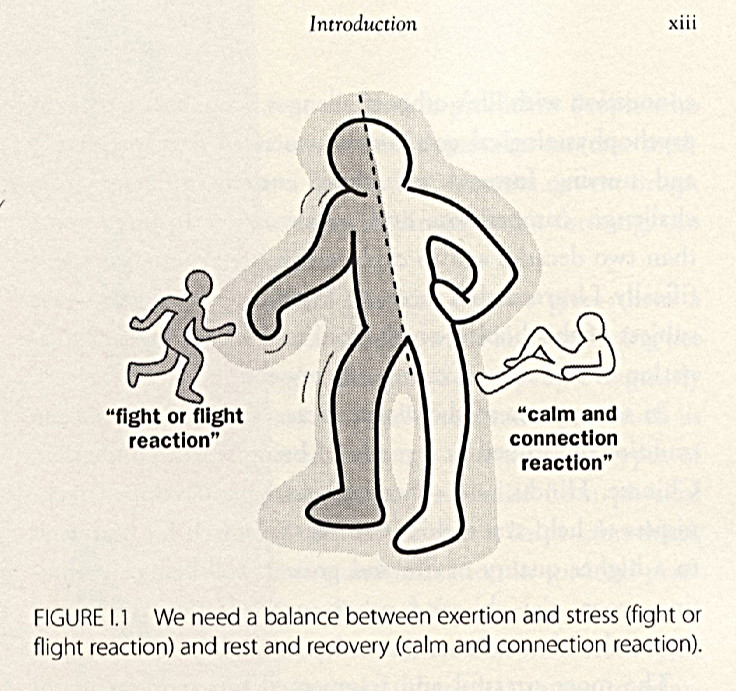
I first want to share with you a copy of an image that appears within the introduction to this book. It is a simple graphic illustration about what everyone needs, especially trauma survivors who will have to work extra, extra hard to reach this desired balance in our body, nervous system, brain, mind and self between states of alarm and states of calmness:
++++++++++++++++++++++
As we look at this picture we are really looking at a visual depiction of what safe and secure attachment gives to us. If this balance had existed in our parents, especially our within our mother from the time we were conceived and born, our physiological systems including our brain would have been able to develop within us to match this desired state for ourselves.
In early environments of threat, danger and trauma, this picture was missing within our universe because it was missing within our earliest caregivers whose job it was to MAKE an equally safe and secure environment for us so that we could have safe and secure attachment relationships that would have built our body-brain into an entirely different one that the one we ended up with.
I believe that the more we can learn about the information presented in this book the better we will be able to begin to recreate safe and secure patterns within our body-brain-mind-self NOW, no matter what our early forming environment was like.
In fact, we might be able to think about our condition in these most simple terms. A trauma-built body-brain, formed through unsafe and insecure attachment conditions, continues to run on the fuel of cortisol and the stress hormones creating patterns of freeze, flight and fight response that translates into ‘anxiety problems’.
On the other hand, early safe and secure attachments design and build a body-brain that can run on the fuel of oxytocin or the ‘feel good’ chemical of peaceful calmness and positive connection to self, others and the world. It is the body-in-balance as the above picture describes that is our goal for our healing. Oxytocin is a critical neurotransmitter of peace and cooperation. Cortisol is a critical neurotransmitter of stress, threat and danger.
++++++++++++++++
I find a powerful confirmation of my intuition that I am moving in the right, good and healing direction in my studies when I read in Dr. Moberg’s introduction that she immediately mentions the biases that exist in MOST mainstream medical research. Those readers who followed the difficult time I had in my struggles with Dr. Dacher Keltner’s book will understand how affirming, comforting and freeing it is for me to find an authority on the subject of human ill- and well-being who recognizes the biases up front that Dr. Keltner seemed to be oblivious to yet relies upon and utilizes heavily in his work.
Moberg notes that fully 90% of published research focuses on the stress response, or sympathetic GO branch of our nervous system while only 10% is devoted to the parasympathetic STOP branch (remember: pair-a-brakes) branch. She states about this bias:
“…an interest in the physiology of performance, exertion, and defense has dominated existing scientific knowledge and current research to an extent that we do not always recognize. This way of looking at things, or shall I say those blinders, has until now kept those of us who work in the medical sciences from seeing the calm and connection response as a separate and valuable physiological system. Thus, for me, studying this system has involved an element of swimming against the tide with respect to the political mainstream in my profession.” (pages xii-xii of her introduction)
This imbalance in research focus HIGHLY impacts infant-child abuse and maltreatment survivors, as it does anyone experiencing difficulties with so-called anxiety (including dissociation, PTSD, depression, personality disorders, etc.) We are in desperate need not only of healing, but of accurate information that can help us DO SO.
As Moberg writes:
“The neglected physiological pattern I will describe in this book is the opposite pole to the fight or flight reaction. Like most other mammals, we humans are able not only to mobilize when danger threatens but also to enjoy the good things in life, to relax, to bond, to heal. The fight or flight pattern has an opposite [effect] not only in the events of our lives but also in our biochemical system. This book deals with the other end of the seesaw, the body’s own system for calm and connection.
“This calm and connection system is associated with trust and curiosity instead of fear, and with friendliness instead of anger. The heart and circulatory system slow down as the digestion fires up. When peace and calm prevail, we let our defenses down and instead become sensitive, open, and interested in others around us. Instead of tapping the internal “power drink,” [of stress-related neurotransmitters] our bodies offer a ready-made healing nectar. Under its influence, we see the world and our fellow humans in a positive light; we grow, we heal. This response is also the effect of hormones and signaling substances, but until now, the connections among these vital physiological effects have not been fully recognized and studied.
“The neglect of this system tells us much about the values that underlie scientific research. The calm and connection system is certainly as important for survival as the system for defense and exertion, and it is equally as complex. Nevertheless, the stress system is explored much for frequently….
“One reason why research has been so slanted may be that goal-directed activity is emphasized so strongly in our culture. We are used to defining activity as something moving, something we can see. But many of the calm and connection system’s processes and effects are not visible to the naked eye. They also occur slowly and gradually, and they are not as easy to isolate or define as are the more dramatic actions involving attack and defense….physiologists have studied the clearly visible fight or flight mechanism but have been less able to perceive the more hidden and subtle calm and connection system.
“The calm and connection system is most often at work when the body is at rest. In this apparent stillness, an enormous amount of activity is taking place, but it is not directed to movement or bursts of effort. This system instead helps the body to heal and grow. It changes nourishment to energy, storing it up for later use. Body and mind become calm. In this state, we have greater access to our internal resources and creativity. The ability to learn and to solve problems increases when we are not under stress.
“I believe that it is extremely important to increase our understanding of the physical and psychological workings of this antithesis to the fight or flight system. We need both, since for each individual in each situation there is an optimal way to react. But it is now well known that long-term stress can produce a variety of psychological and physical problems. If we are to be healthy in the long run, the two systems must be kept in balance.” (pages x-xiii of her introduction)
Moberg states very clearly that her interest in the connection system is rooted in her experience of mothering her four children. Her description of mothering would be the antithesis of my mother’s experience with mothering me. As I have already noted, it is very clear that the vagus nerve and autonomic nervous system of Borderline’s works with a distortion of the stress-caregiving response systems. Moberg’s writings are about how things are SUPPOSED to work:
“In pregnancy, nursing, and close contact with my children, I experienced a state diametrically opposed to the stress I was familiar with in connection with life’s other challenges. I was aware that the psychophysiological conditions associated with pregnancy and nursing fostered something entirely different from challenge, competition, and performance. Inspired more than two decades ago to explore this life experience scientifically, I learned that there is a key biological marker – the subject of this book – on the trail to a physiological explanation of this state of calm and connection.” (pages xiii-xiv of her introduction)
++++
It does not surprise me one bit that it would be not only a female researcher, but also one that has her roots on interested grounded in her experience of mothering that I would now turn to for answers about how the terrible imbalance that survivors of severe infant-child trauma have in their body-brain as a consequence of being formed by trauma can be healed. In profoundly critical ways early abuse survivors were deprived of the safe and secure early attachments – especially with our mothers – that we desperately needed to grow a healthy balance of peace and calmness into our body-brain from the start.
For all the millions and millions of American children and adults that suffer from obesity, depression and other anxiety-related problems, from addictions, from relationships dis-orders, I believe that it will be in gaining factual information about how our body-brain can be rewired for safety, security, connection, and peaceful calmness that our best chance will come for healing. I am most hopeful that Dr. Moberg’s writings will give me many important answers that I seek. I will literally keep you posted on what I discover!
++++++++++++++++++++++++++++++++++++++
 Stop the Storm