+STUDYING DOPAMINE: POST #1 OF THE HARD TO READ SERIES!

++++++++++++++++++++++++

I need to call this post #1 in the ‘you don’t really want to read this post’ series (although you are certainly welcome to!).  I am ‘on the hunt’ for information about dopamine and reward, and am filing information as I go along on my blog for safekeeping.

++

Dopamine may therefore be a neural substrate for novelty or reward expectation rather than reward itself.”

Dissociation of dopamine release in the nucleus accumbens from intracranial self-stimulation

Paul A. Garris, Michaux Kilpatrick, Melissa A. Bunin, Darren Michael, Q. David Walker & R. Mark Wightman

Nature 398, 67-69 (4 March 1999) | doi:10.1038/18019; Received 26 August 1998; Accepted 29 December 1998

++

Behavioural significance of the regional variation in the catecholaminergic control of long-term potentiation

The consolidation of LTP [In neuroscience, long-term potentiation (LTP) is a long-lasting enhancement in signal transmission between two neurons that results from stimulating them synchronously. It is one of several phenomena underlying synaptic plasticity, the ability of chemical synapses to change their strength. As memories are thought to be encoded by modification of synaptic strength, LTP is widely considered one of the major cellular mechanisms that underlies learning and memory.] is powerfully regulated by NA in both the dentate gyrus (e.g., present results) and CA3, at least for the mossy fibre synapses, (22,24) yet DA plays this role in CA1.  What is the behavioural significance of this dissociation?

While it is difficult to completely characterize their repertoire of responding in behaving animals, it is noteworthy that neurons in the locus coeruleus [a nucleus in the brain stem involved with physiological responses to stress and panic], source of the NA [sodium] innervation to the hippocampus, are phasically activated by both noxious and nonnoxious stimuli.(4) They are also tonically inhibited during slow-wave sleep, but show marked activation just prior to waking. (3)   For these and other reasons, the locus coeruleus has often been described as participating in behavioural arousal as well as orienting responses and attention, (2–4) through its divergent modulation of multiple brain regions.

Dopaminergic neurons in the ventral midbrain , on the other hand, are typically activated during the expectation or receipt of positive reward.(27,39) [Midbrain, also called the mesencephalon — During development, the mesencephalon forms from the middle of three vesicles that arise from the neural tube to generate the brain.  The mesencephalon is considered part of the brain stem. Its substantia nigra is closely associated with motor system pathways of the basal ganglia.  The human mesencephalon is archipallian in origin, meaning its general architecture is shared with the most ancient of vertebrates.  Dopamine produced in the substantia nigra plays a role in motivation and habituation of species from humans to the most elementary animals such as insects.]

These differences in neural responses to behavioural stimuli suggest that consolidation of LTP, and to some extent its induction, may show regional variations in its sensitivity to the behavioural state of the animals.

It has been suggested that, during exploration and initial learning, there is selective activation of the entorhinal–dentate–CA3 pathway, during which selective synaptic modifications may occur. Modification of these pathways would be turned off during later behaviourally quiet periods or slow-wave sleep. (13) This fits well with the noradrenergic control of dentate gyrus and CA3 LTP, since these periods of learning correspond well with the behavioural situations when locus coeruleus neurons are active.

Conversely, it has been observed that, during behaviourally quiet periods, slow-wave sleep and consummatory behaviours, there are sporadic bursts of activity in CA3 that phasically drive CA1 neurons (sharp waves),(12) and this may reflect the read-out of CA3-localized memory back through CA1 to the cortex for consolidation purposes. (13,31)

During periods of reward consummation, therefore, there may be a conjunction of dopaminergic activity and synaptic activity in CA1 and perhaps other limbic cortical areas, promoting the induction and consolidation of plasticity in these brain areas. It is noteworthy, however, that endogenous catecholamines can influence persistence of LTP in hippocampal slices, which are cut off from the influences of afferent activity originating extrinsically to the hippocampus. Thus, endogenous catecholamines can affect LTP independently of behavioural state. This could simply reflect there being a constitutive release of catecholamines in slices, or that catecholaminergic fibres are being directly stimulated during the experiments. Another more intriguing possibility, however, is that the catecholamine release is locally controlled by glutamate released at activated synapses. There is evidence that glutamate can facilitate catecholamine release from synaptosomes via presynaptic glutamate receptors on catecholaminergic terminals, (46) and there may be sufficient extrasynaptic spillover of glutamate during high-frequency stimulation to activate these receptors in situ. (7) Alternatively, a mobile trans-synaptic messenger such as nitric oxide could serve a similar function. The finding that tetanization-induced cyclic-AMP accumulation in CA1 is blocked by both SCH-23390 and an NMDA receptor antagonist supports this latter possibility. (16) If either of these scenarios were the case, then endogenous high-frequency activity in the hippocampus may have the capacity to be selfreinforcing, regardless of the activity state of the catecholamine cell bodies. This would provide a means for promoting the local consolidation of LTP, specific to the region of the activated synapses, without requiring a flood of catecholamine release throughout widespread regions of the brain that would be initiated by ventral tegmental area or locus coeruleus activity.

CONCLUSIONS

Our results have demonstrated a double dissociation of the catecholaminergic control of persistence of LTP between area CA1 and the dentate gyrus of the hippocampus. NA plays a privileged role promoting the late phase of LTP in the dentate gyrus, while DA fulfils that role in area CA1. Our findings are most complete for the in vitro preparation, and are indicative that the same functions are fulfilled by DA in vivo. Recent data have confirmed that NA plays a vital role in persistence of LTP in the dentate gyrus in vivo.40  Overall, these data suggest that LTP in these brain areas may be differentially consolidated according to the animal’s behavioural state.

A DOUBLE DISSOCIATION WITHIN THE HIPPOCAMPUS OF DOPAMINE D1/D5 RECEPTOR AND b-ADRENERGIC RECEPTOR CONTRIBUTIONS TO THE PERSISTENCE OF LONG-TERM POTENTIATION

J. L. SWANSON-PARK, C. M. COUSSENS, S. E. MASON-PARKER, C. R. RAYMOND, E. L. HARGREAVES,  M. DRAGUNOW,  A. S. COHEN and W. C. ABRAHAM  — New Zealand – [bold type is mine — click on title for full article including references noted]

Neuroscience Vol. 92, No. 2, pp. 485–497, 1999 Copyright

++

ABSTRACT:  “What are the genetic and neural components that support adaptive learning from positive and negative outcomes?

Here, we show with genetic analyses that three independent dopaminergic mechanisms contribute to reward and avoidance learning in humans.

A polymorphism in the DARPP-32 gene, associated with striatal dopamine function, predicted relatively better probabilistic reward learning.

Conversely, the C957T polymorphism of the DRD2 gene, associated with striatal D2 receptor function, predicted the degree to which participants learned to avoid choices that had been probabilistically associated with negative outcomes.

The Val/Met polymorphism of the COMT gene, associated with prefrontal cortical dopamine function, predicted participants’ ability to rapidly adapt behavior on a trial-to-trial basis.

These findings support a neurocomputational dissociation between striatal and prefrontal dopaminergic mechanisms in reinforcement learning. Computational maximum likelihood analyses reveal independent gene effects on three reinforcement learning parameters that can explain the observed dissociations.”

Genetic triple dissociation reveals multiple roles for dopamine in reinforcement learning

Michael J. Frank, Ahmed A. Moustafa, Heather M. Haughey, Tim Curran, and Kent E. Hutchison

PNAS, October 9, 2007, Vol. 104, No. 41, pages 11311-16316

++

+EARLY TRAUMA CHANGES HOW WE THINK AND TALK

++++++++++++++++++++++++++++++

When infant-children do not receive what they need NOT TO CHANGE their development in response to early trauma, well, their body-brain-mind-self has no choice but to change!  These changes then have no choice but to appear as altered patterns of being in the world, including patterns of verbal exchange.

This post concerns a posted comment and my reply to it.

+++++++

COMMENT FROM:  Randy Webb, aztraumatherapy.com —  2010/01/08 at 6:58am

TO:  *Chapter 3a Symptoms

I’ve noticed anecdotally that my clients who have reported experiences of trauma seem more likely than others who have not reported trauma to indicate “black and white” and relatively more “rigid” views of religion, definitions of happiness or success and other people’s behavior. Could these be indications of relatively less CNS plasticity and an indication of something getting “frozen” instead of “completing” some cycle of recovery in response to trauma?

+++++++

REPLY:

Your comment and question relate in my mind to my December 28, 2009 post:

+ATTACHMENT – HOW WE ARE WHO WE ARE

While the kinds of thinking you are describing can be reflected in cultural attitudes in the form of biases, prejudices and their resulting stereotypical thinking, because you are specifically noticing them in relation to traumatized people I will suggest that the nature and quality of early attachment experiences might lie at the root of what you are describing.

We are not used to thinking about what people say as being representations of the patterns of communication that exist on the molecular, physiological level of the body, they are.  Our earliest infant-child interactions with our mothering caregivers create us at these fundamental levels, and determine how our genetic potential manifests itself.

These interactions, which signal to our growing and developing body-brain-mind-self the condition of the world as being mostly either safe, secure and benevolent, or as being mostly unsafe, insecure and malevolent, will determine how we receive and process all information from the world around us.  The patterns of signaling communication in our body will eventually show itself both in the quality and nature of the ‘trauma dramas’ we experience for the rest of our lives, and in the patterns of spoken and unspoken communications – including our thoughts – that we use to describe ourselves in relation to the world we live in for the rest of our lives.

++++

The connection you are making in your own thoughts that led to your question are fascinating:   “Could these be indications of relatively less CNS plasticity and an indication of something getting “frozen” instead of “completing” some cycle of recovery in response to trauma?”

If we think about communication patterns in terms of how they were influenced and formed during our earliest developmental stages, CNS plasticity as it connects to how our immune system interpreted the quality of our experience and then signaled all our developmental pathways, yes, you are completely correct.

It becomes essential that we think about people’s traumas in terms of ‘age at first onset’ (see link to 12-28-09 post above).  People, who were formed without severe relational traumas in infancy, have a completely different CNS (including the brain and Autonomic Nervous System (ANS) homeostatic set point.  They formed a ‘trauma centered’ body-brain-mind-self from the beginning which limited and changed the range of possible ‘free choice’ options for response they will have in and to the world.  Their body has taken over for them far more aspects of ‘being alive’ that non-early traumatized people’s body do.

When people seem to be struggling with recovery from adult trauma, the most important first step we need to take in order to most help them is to determine the quality and nature of their earliest attachments during their early growth and development stages.  While birth to age one is the most critical stage, these critical windows of development continue certainly through age 4-6 while a person’s Theory of Mind is forming.

We can listen to adults talk about their lives and begin to hear disturbances in their ability to tell a ‘coherent life story’.  Unresolved trauma will show itself in disturbances in our patterns of processing information on all levels within the body.  The earlier the traumas happened, most certainly before the age of 2, the more an appropriate, flexible, and coherent ability to converse verbally about one’s experiences in their life will be absent.

If early trauma did not build a person’s body-brain-mind-self, the ‘frozen’ interruptions in signaling communication – as they appear as you say in decreased CNS (body) plasticity – can hopefully be overcome.  The more usual approaches to resolving these traumas will allow the ‘lessons’ from the trauma to begin to unfold and take hold – as the hold the unresolved trauma has on a person will lessen its hold over them.

HOWEVER, if trauma built a person’s body-brain-mind-self from the beginning there is no ‘recovery’ to be made in anything like the normal sense of this process.  Because our earliest experiences of attachment form us, these patterns (such as you are describing) are hard wired into us on all levels, including our CNS-brain.

People who suffered what I refer to as Trauma Altered Development are evolutionarily altered people, built in, by and for a malevolent world of deprivation and trauma.  All their communication signals have been adjusted on their most fundamental levels in response to this kind of a world.  All later traumas they may experience will be processed by their trauma altered body-brain.  These people are most likely not to be able to respond with the ‘plasticity’ or resiliency that non-early traumatized people can.

++++

If infant development has been sent of course through early relational deprivation and trauma, the later stages leading to a plastic, flexible, adaptive, resilient and accurate Theory of Mind will not occur correctly.  Early trauma will show itself in patterns of behavior for these survivors, including thought and verbal communication, for the rest of their lives.

Treating trauma effectively in these survivors requires a detailed understanding about how trauma altered all aspects of their development from their beginning.  They have altered patterns of attachment to the world, to their own self, and to everyone else.  These physiological alterations have been permanently set into place.  They receive different information from the world in different ways and process this information differently.

I would say that while healing trauma in these survivors IS POSSIBLE, ‘recovery’ in the usual sense is not.  The trauma-changed body has no pre-trauma state to return to.  Their healing can utilize all the resilient powers of plasticity contained in the trauma changed body-brain, but these powers have to operate according to how a survivor was formed from their start.  Recognizing early trauma changes through the attachment signaling patterns they create is the first step.

++++++++++++++++++++++++++++++

+TRAGEDIES OF CHILD ABUSE REFLECTED IN STORIES

++++

Something related to my abusive childhood experiences with Christmas stands out so clearly and powerfully I am not going to ignore it.  I can’t put bows or shiny tinsel or colored lights on this post to pretty it up.  I can only present what I know.

I have already written a holiday season post presented on December 8, 2009 – +CONSUMERS BEWARE OF TRAUMA TRIGGERS LURKING IN ‘HOLIDAY SEASON MAGIC’.  I would rather not write another one, but tonight is Christmas Eve, and in America it is hard to escape from the reality that the holiday season is often a complicated one for abuse survivors of any age.

How well does our internal experience of the holiday season match what we see mirrored back to us about what we think the holidays are SUPPOSED to be like?  How closely does our personal experience match other people’s?  How much mirroring and ‘reflecting back and forth’ actually goes between ourselves, our own reality, and the social environment we are immersed within?

How might our early infant-child experiences of maltreatment be influenced by our mirror neuron system?

++++

Much has been written in recent years about our brain’s mirror neurons which allow our brain to fire parallel patterns in the motor areas of our brain as the one’s that are firing in the brain of somebody we are watching perform an action.  Whether or not these mirror neurons operate in regard to empathy or not is still open to neuroscientific debate.

Do our mirror neurons allow us to predict the actions of others?  Are mirror neurons a part of what allows us to form a Theory of Mind because they help us to understand other people?  How do they operate in allowing us to learn actions that better facilitate our existence in the world?  How might mirror neurons interact with our ability to understand gestures and body movements as a part of human language and signaling communication?

We know that the patterns of signaling communication between a very young infant and its earliest mothering caregiver create the circuits, pathways and patterns of development within the human emotional-social limbic brain.  These patterns of communication are supposed to operate through a mutual reflective, attuned, mirroring process.  Trauma interrupts the optimal development of this early forming brain as it communicates a need to change development to match conditions in a malevolent world.

An infant-child’s experiences within an abusive, neglectful, malevolent world do not magically skip the holiday season even if and when, as happened in my childhood home, an infant-child’s parents PRETEND the holidays are a safe, secure, happy and wonderful time.  Patterns of trauma that built our body-brain in early malevolent conditions do not magically disappear from our adult body during the holiday season, either.

Trying to match ourselves to a HAPPY holiday reality that we see reflected within our culture and mirrored back to us can create an incongruous, dissociated experience.

++++

Song, music, story, dramatic expression, dance, movement, gestures, active story telling and eventually written literature and film carries power to invoke imagination through a sharing of experience between human beings.  Our mirror neuron system is involved in how we process information contained in these forms of expression.

As members of a social species, we respond to patterns that resonate with our own experience either because we can recognize ourselves within the messages being communicated, or because we have an active imaginal interaction with them.

I bring this up today because I am going to share with you a story that moved me as a young extremely abused child.  I didn’t read the story in print.  I watched the movie version.  Looking back, I now understand that my 6, 7, 8, 9-year-old experiences with this movie was not a ‘normal’ one.  I loved the story because it was the first time I ever saw my own inner experience as a child clearly and accurately mirrored and reflected back to me in the fullest possible way.

Of course as a child watching this movie on television I did not know that it was speaking back to me the reality of my own heart, mind and life.  I was simply mesmerized because I was involved with the story as if it was happening inside of me rather than on the outside.

I resonated with the story.  It and I were in harmony as if we were telling this story together as two people might sing a song together, perfectly matched either note for note or harmonizing together perfectly.  It was this TOGETHER-WITH feeling that I had never experienced before that tells me now that only in this movie did I experience a sharing of the emotions that had formed and filled my body-brain-mind-self from the time of my birth.

The little girl character in this story matched me.  I knew there was some matching between my experience and that portrayed in Cinderella, for example.  But I also knew inside the marrow of my bones that I did not match any chance of a happy ending like Cinderella had.  My story could only match one with a different kind of ending, and this story I am including the text of today more closely matched what might be my kind of happy ending.

+++++++++++++++++

The Little Match Girl (or The Little Match-Seller)

Hans Christian Andersen wrote “The Little Match Girl” (Danish: Den Lille Pige med Svovlstikkerne, meaning “The little girl with the sulphur sticks”).  The story was first published in 1845 and has been adapted to various media including animated film, and a television musical.

I don’t remember which movie version of the story I saw on television as I watched it over repeated holiday seasons of my young childhood.  Here is the text of the story.

The Little Match-Seller

Most terribly cold it was; it snowed, and was nearly quite dark, and evening– the last evening of the year. In this cold and darkness there went along the street a poor little girl, bareheaded, and with naked feet. When she left home she had slippers on, it is true; but what was the good of that? They were very large slippers, which her mother had hitherto worn; so large were they; and the poor little thing lost them as she scuffled away across the street, because of two carriages that rolled by dreadfully fast.

One slipper was nowhere to be found; the other had been laid hold of by an urchin, and off he ran with it; he thought it would do capitally for a cradle when he some day or other should have children himself. So the little maiden walked on with her tiny naked feet, that were quite red and blue from cold. She carried a quantity of matches in an old apron, and she held a bundle of them in her hand. Nobody had bought anything of her the whole livelong day; no one had given her a single farthing.

She crept along trembling with cold and hunger–a very picture of sorrow, the poor little thing!

The flakes of snow covered her long fair hair, which fell in beautiful curls around her neck; but of that, of course, she never once now thought. From all the windows the candles were gleaming, and it smelt so deliciously of roast goose, for you know it was New Year’s Eve; yes, of that she thought.

In a corner formed by two houses, of which one advanced more than the other, she seated herself down and cowered together. Her little feet she had drawn close up to her, but she grew colder and colder, and to go home she did not venture, for she had not sold any matches and could not bring a farthing of money: from her father she would certainly get blows, and at home it was cold too, for above her she had only the roof, through which the wind whistled, even though the largest cracks were stopped up with straw and rags.

Her little hands were almost numbed with cold. Oh! a match might afford her a world of comfort, if she only dared take a single one out of the bundle, draw it against the wall, and warm her fingers by it. She drew one out. “Rischt!” how it blazed, how it burnt! It was a warm, bright flame, like a candle, as she held her hands over it: it was a wonderful light. It seemed really to the little maiden as though she were sitting before a large iron stove, with burnished brass feet and a brass ornament at top. The fire burned with such blessed influence; it warmed so delightfully. The little girl had already stretched out her feet to warm them too; but–the small flame went out, the stove vanished: she had only the remains of the burnt-out match in her hand.

She rubbed another against the wall: it burned brightly, and where the light fell on the wall, there the wall became transparent like a veil, so that she could see into the room. On the table was spread a snow-white tablecloth; upon it was a splendid porcelain service, and the roast goose was steaming famously with its stuffing of apple and dried plums. And what was still more capital to behold was, the goose hopped down from the dish, reeled about on the floor with knife and fork in its breast, till it came up to the poor little girl; when–the match went out and nothing but the thick, cold, damp wall was left behind. She lighted another match. Now there she was sitting under the most magnificent Christmas tree: it was still larger, and more decorated than the one which she had seen through the glass door in the rich merchant’s house.

Thousands of lights were burning on the green branches, and gaily-colored pictures, such as she had seen in the shop-windows, looked down upon her. The little maiden stretched out her hands towards them when–the match went out. The lights of the Christmas tree rose higher and higher, she saw them now as stars in heaven; one fell down and formed a long trail of fire.

“Someone is just dead!” said the little girl; for her old grandmother, the only person who had loved her, and who was now no more, had told her, that when a star falls, a soul ascends to God.

She drew another match against the wall: it was again light, and in the lustre there stood the old grandmother, so bright and radiant, so mild, and with such an expression of love.

“Grandmother!” cried the little one. “Oh, take me with you! You go away when the match burns out; you vanish like the warm stove, like the delicious roast goose, and like the magnificent Christmas tree!” And she rubbed the whole bundle of matches quickly against the wall, for she wanted to be quite sure of keeping her grandmother near her. And the matches gave such a brilliant light that it was brighter than at noon-day: never formerly had the grandmother been so beautiful and so tall. She took the little maiden, on her arm, and both flew in brightness and in joy so high, so very high, and then above was neither cold, nor hunger, nor anxiety–they were with God.

But in the corner, at the cold hour of dawn, sat the poor girl, with rosy cheeks and with a smiling mouth, leaning against the wall–frozen to death on the last evening of the old year. Stiff and stark sat the child there with her matches, of which one bundle had been burnt. “She wanted to warm herself,” people said. No one had the slightest suspicion of what beautiful things she had seen; no one even dreamed of the splendor in which, with her grandmother she had entered on the joys of a new year .

Literature Network » Hans Christian Andersen » The Little Match Girl

This translation posted on The Literature Network

+++++++++++++++++++

I can say what a terribly sad state of affairs it was that watching this story made me feel warm inside, and this is true.  I can also say what a miracle it was that I was exposed to an art form that allowed me to experience what it felt like to have my inner experience matched and mirrored back to me.  I finally felt that majestic feeling of mutual resonance that allowed me to know that someone out there knew my reality.

Although I wasn’t literally freezing or starving to death physically as a child, my world was that cold on the inside.  I knew what it felt like to be beaten.  I knew what it felt like to be alone.  I knew what it felt like to be unloved.  But I had no words for my own experience.  I did not even have the ability to think about my own experience or about my own feelings as I experienced my experiences.  All I could do was endure.

I had lost the only person who ever loved me when we left my grandmother behind in Los Angles the year I turned six when we moved to Alaska.

Did I empathize with the little match girl or did I simply completely know with the entirety of my being what her experience was?  I think what mattered to me most was that I knew that little match girl would know completely how I felt.  On a very deep unconscious level I knew that this little match girl was having my feelings.  I watched her have them in this story.

Is this experience what empathy is all about?  How starved I was for affection.  How starved I was for warmth and love.  How starved I was for understanding.  How fundamentally starved I was for a mutual experience of sharing my inner reality with any other single person in the universe.

How including rather than excluding is the human experience that I could feel this understood and connected to a century old story portrayed by an actress showing through the hard cold screen of a television set?

Others might have the luxury of being able to feel compassion for the girl in this story.  I certainly didn’t.  Others might pity her.  How many would experience harmonious, resonating empathy WITH her?

I never pitied myself as a child.  I did not experience anger or resentment.  I had no fight left in me because my mother had put the full force of her considerably powerful and successful efforts into obliterating any trace of Linda from my existence.  But she could not touch the warmth inside of me I felt watching that movie as the power it had to touch me reached out of that television like the light of that little girl’s shooting star.

I had no ability to imagine my life as being different or better.  I did not know how overwhelmingly sad I was.  I only felt the great sorrow of knowing that I could not die and be with my grandmother like this girl in the movie got to do.  I knew I couldn’t have this same happy ending to my story because my grandmother wasn’t dead yet.

++++

Before we moved to Alaska I had the opportunity to experience a little bit of an attachment relationship with my grandmother, but my mother was able to interfere with and mostly completely prevent my grandmother from having contact with me.  This experience of ‘feeling felt’ is SUPPOSED to build our early-forming emotional-social right limbic brain:

The feeling of being felt

In The Developing Mind, Daniel J. Siegel uses the phrase “the feeling of being felt” to describe relationships that shape the mental circuits responsible for memory, emotion, and self-awareness. Brain-altering communication is triggered by deeply felt emotions that register in facial expressions, eye contact, touch, posture, movements, pace and timing, intensity, and tone of voice.”

Looking back I believe that being able to watch this movie changed my life.  It created for me one of the few times in the 18 years of my infant-childhood that I clearly experienced the feeling of ‘feeling felt’.  This is a critically important experience for us to have as members of a social species.  It involves looking out into our social world and seeing in other people our own experience mirrored back to us.

In today’s world of sanitized and ‘prettified’ young children’s stories, even to the outright fabrication of happy endings for stories like Andersen’s and the other old fairy tales, I would have been deprived of even having this single most significant self-building experience of being able to see my own reality mirrored back to me from the social human world outside of me.

I might wish to believe that infant-children are no longer suffering in the kinds of childhoods I had, that their lives have been sanitized and prettified right along with the stories they have access to through the media including books.  But I know this is not true.

I am not talking about monsters portrayed in imaginary form.  I am talking about the impact this movie had on me BECAUSE it involved a human girl in a human world with humans that ignored her, mistreated her, did not help her, and let her die.  HUMANS do this to HUMAN children, and we cannot pretend that they don’t simply because we have changed and banned the stories that might let these children see their own reality mirrored back to them so that they can have the feeling of ‘feeling felt’ which will be the most important experience humans can ever have.

It is only through having this experience of ‘feeling felt’ that we can ever truly know that we exist at all as an individual self, and that we are not here in this world fundamentally isolated and alone.  It is this feeling that lies at the heart of safe and secure attachment.  It is this feeling that is supposed to be at the basis of our early forming social-emotional brain and that directs our development toward life in a benevolent.   When it is missing in a malevolent world our development changes to help us survive.

++++

There is one other aspect of our humanity that I want to mention here.  There are times when we cannot use a mirroring, reflecting empathy process with someone else.  There are times when we cannot truly give back to someone else that feeling for them that they are being truly felt by us.  There are times when we reach a line we cannot cross in our own ability to feel what another person is feeling.

When we reach this line we cannot fake it.  It is at these times when we cannot share with another person our feelings that need to be shared — so that they can experience that we truly feel what they are feeling — we have something else to give them.  That something else is compassion.  Not pity, not sympathy, but a compassion that means we are WITH that other person with a genuine concern for their well-being that lets us both know we are not alone.

According to Dr. Dacher Keltner, there is an additional aspect to compassion that makes it different from empathy.  He states in his article, The Evolution of Compassion:

Compassion has a biological basis in the brain and body. It can be communicated in the face and with touch. And when experienced, compassion overwhelms selfish concerns, and motivates altruistic behavior.

As children, both the imaginary little match girl and me needed NOT to be left alone in a malevolent world.  We needed someone not only to empathize with our feelings; we needed someone to DO something to help us.  I never even knew as a child that I had this need.  Someone on the outside of my world needed to care enough to not only tell me I needed help, but to show me by actually caring enough to help me.

There never was anything about Christmas, or about any other holiday of my childhood that made this fact less true.  When I mirror back to myself my own memories of the holidays of my childhood, the memory of myself seeing myself reflected back to myself in the story of The Little Match Girl always stands out in stark contrast to all the phony, fake efforts at holiday cheer my abusive mother created in her pretend version of reality.

++++++++++++++++++++++++++++++++

Don’t forget to check out — Brain Facts – A primer on the brain and nervous system

++++

— NEW:  CLICK ON POST, PAGE AND/OR COMMENT TITLE

AND LOOK FOR ‘YOU RATE IT’ STARS AT BOTTOM OF PAGE —

Please feel free to comment directly at the end of this post or on

+++++++

Your Page – Readers’ Responses

+++++++++++++++++++++++++

+THIS HONEST TRUTH: ME, MY 6-YEAR-OLD SELF AND MY MOTHER’S 1958 LETTERS

++++++++++++++++++++++

It takes courage for me to publish here this link (below) because I do not have any answers when it comes to my own ongoing, internal, personal experience with my childhood traumas with my mother.  I have returned to the task of transcribing my mother’s 1958 letters, a job that I left behind several months back.

My efforts TODAY to deal with further discovery in my mother’s letters of her beliefs about me as a six-year-old disintegrated me even further than they did last night when I first re-encountered her writing.  The internal process going on for me as contained here and in this link make me feel like I am dying, my guts torn out and strewn on the ground as Hitchcock’s birds fly at me to peck my eyes out.

I guess I could say, “This post may trigger” — it certainly triggered me:

*Age 6 – Jan. 1958 First Grade in Mother’s Letters

++++++++++++++++++++++

background information:

Diagnosis of Trauma and Abuse-Related Dissociative Symptom Disorders in Children and Adolescents

++++

This is what I wrote when I found that the first words of the first 1958 letter of my mother’s that I picked up to work on transcribing last night was about me:

I feel icky and contaminated as I start back to work on my mother’s letters, a job I abandoned awhile back because I was SICK of the memory of my mother.  These are the 1958 letters from the year I was 6, in first grade, the first year we were in Alaska.  By August 31, 1958 I turned seven and started second grade that fall.

My mother – with her twisted, tweaked, twilight borderline distorted view of the world – the one I grew up thinking was normal because I had no frame of reference to the contrary.

As soon as I begin work again with my mother’s letters I can feel conflict between knowing the truth NOW that I didn’t know for the first 30 years of my life, and my feelings of what, fear?  That I ‘should’ respect my mother, and “Who am I to make up all these bad things about her and slander her good name?”  Bad Linda.  Bad, Bad Linda.

Horse pucky.

These feelings are difficult to identify and to face head on because I have spent most of my life avoiding them.  It’s like getting caught in a time warp, reading that my father in January of 1958 just went out the door to start the car to warm it up and is coming back into the house in a minute to get the note my mother is writing so it can be mailed to my grandmother.  All dead, all of them dead now.  How, really, can a person criticize a dead person’s life?

What values of my own do I confront here?  They certainly aren’t around to care what I say about anything.  Is all that I have here before me in these tattered and tanning envelopes really nothing but the passing of time – soon to be 52 years of it with this particular batch of mother’s letters.

Yet it does matter.  These people’s lives formed mine, and I in turn formed my children’s lives.  We all just march on down the road of our lives leaving one little tiny, miniature less than an ant sized footprint along the pathway after the other.

Yet I know I am not far away from my own deep sadness as I transcribe my mother’s letters:  I wanted my parents to love me and they did not.  I want to reach my hands back through the passage of all this time gone by, grab them each by the shoulders as the big person I am now.  I want to shake them, looking them each straight in the eye.  My face would follow theirs closely if they tried to look away from me when I ask them, “Why?  Why could you not love me?  I am your CHILD!  Why did you HURT me?”

I never really was my parents’ child.  I was their hated stranger.

+++++++++++++++++++++++++

Please feel free to comment directly at the end of this post or on

+++++++

Your Page – Readers’ Responses

++++++++++++++++++++++++++++++++

+PTSD AND SEVERE ABUSE SURVIVORSHIP – PART THREE

+++++++++++++++++++++++++++++++++

I find that the only standard I can consistently depend upon in my considerations about what constitutes malevolent treatment versus adequate, benevolent treatment lies within the context of the United Nations Universal Declaration of the Human Rights of Children.  Safe, secure, appropriate and adequate early care that leads to an infant-child’s optimal development lies on a continuum at the opposite end from early malevolent conditions that present nearly a constant challenge and threat to survival itself.

The basic needs of children are defined in this Declaration.  In looking at my own history of survivorhood (I was never allowed to be a child, and therefore I no longer consider that I had a childhood at all) it is clear to me that every one of my rights as an infant-child were violated.  It was in that malevolent environment of deprivation that I was exposed to the degrees of trauma that were severe enough to create within the physiology of my body Trauma Altered Development (TAD).

From my earliest beginnings as a being physically separate from my mother was suffered from a lack of safe and secure attachment.  Deprived of that most fundamental resiliency factor, my body-brain-mind-self had to do the best that I could do to continue to grow and develop within that terrible environment that threatened my very existence.

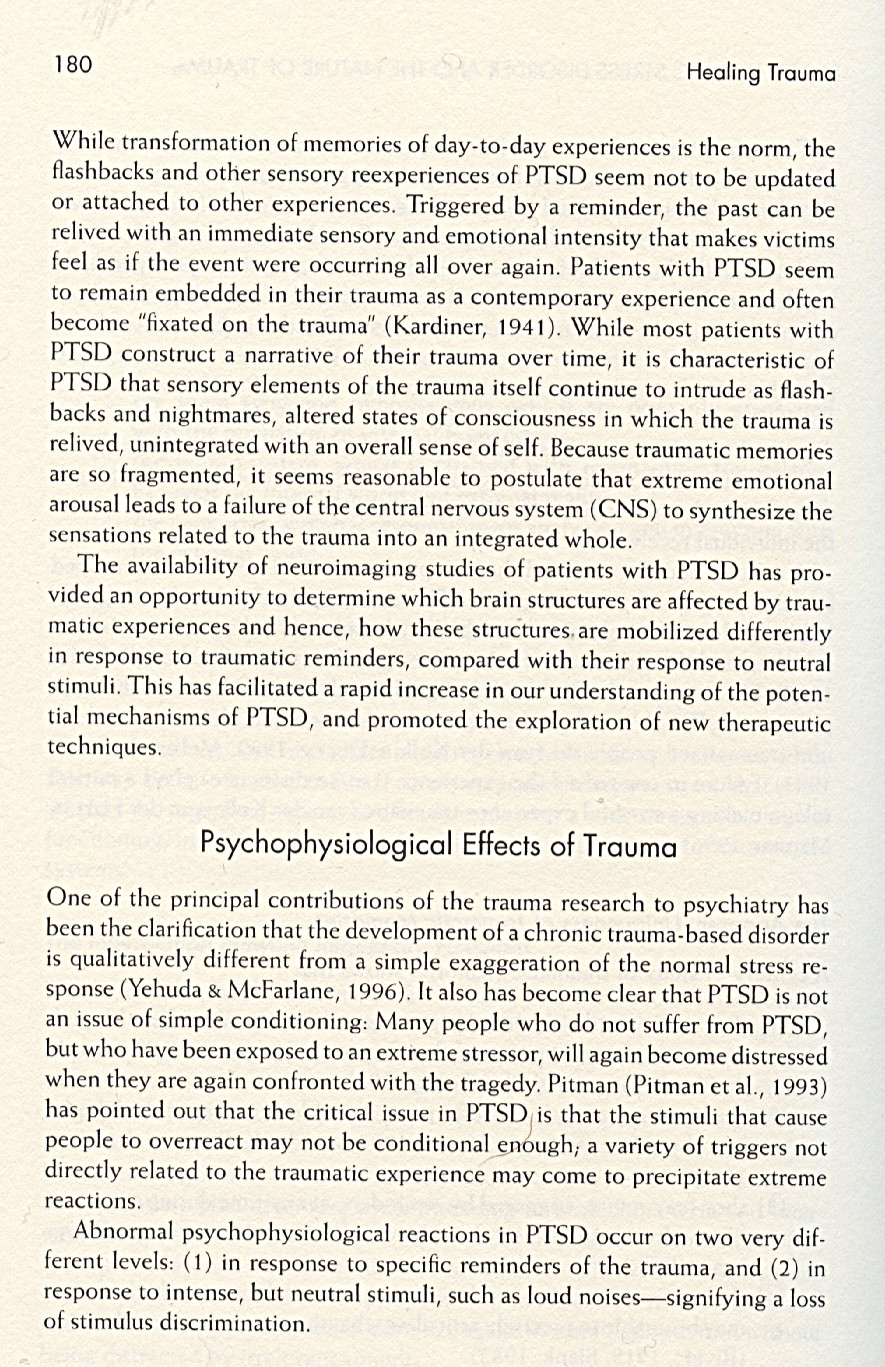
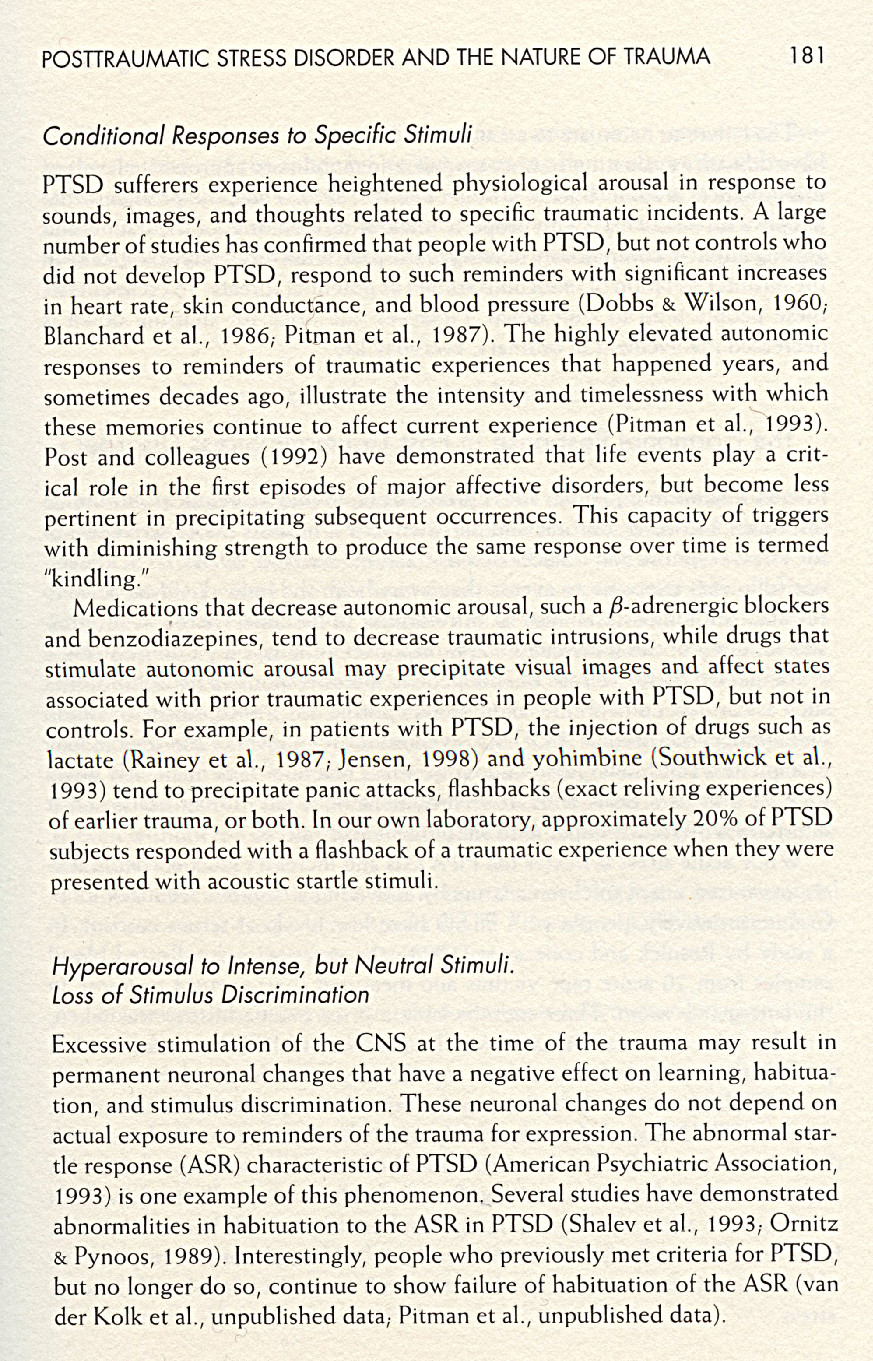
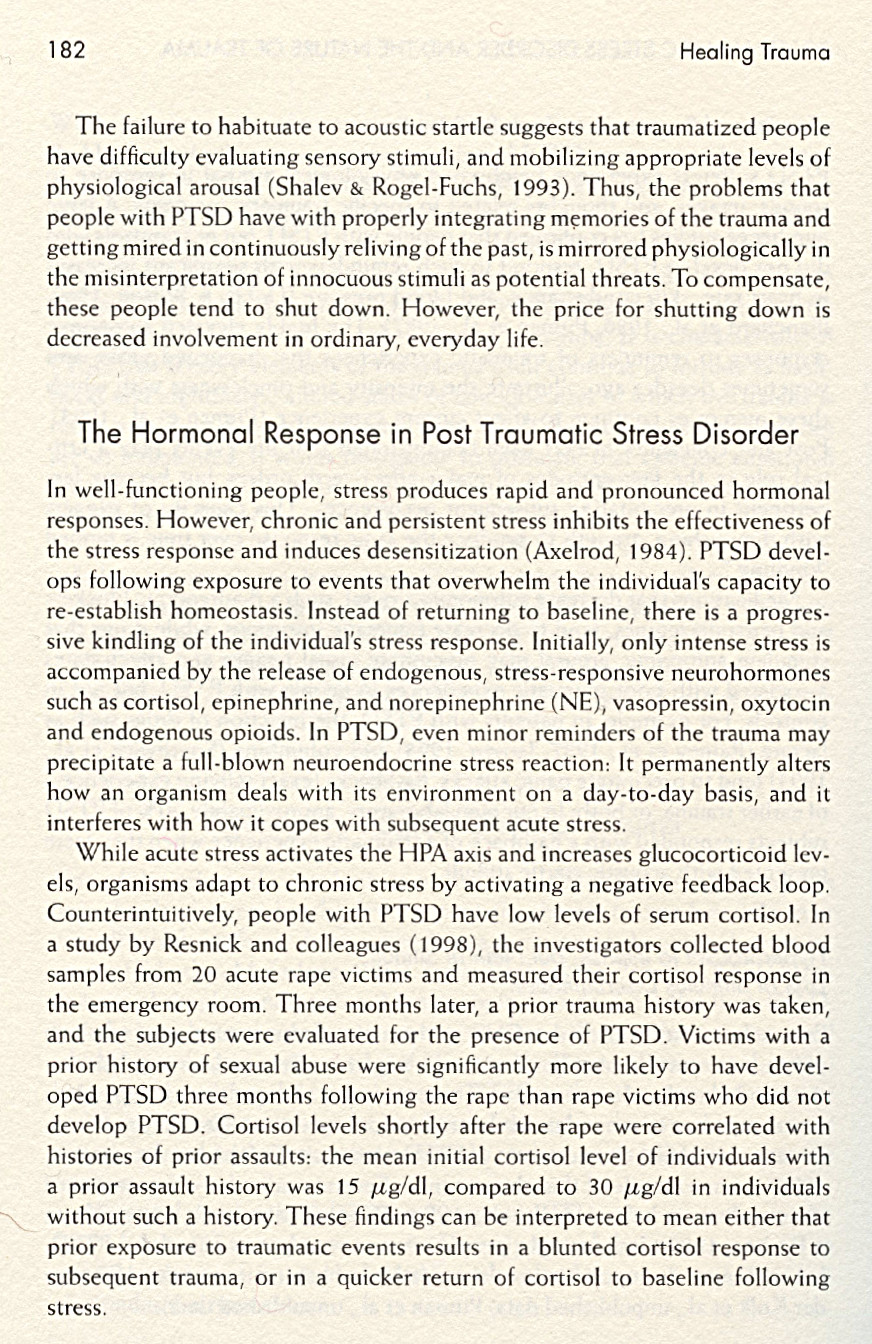
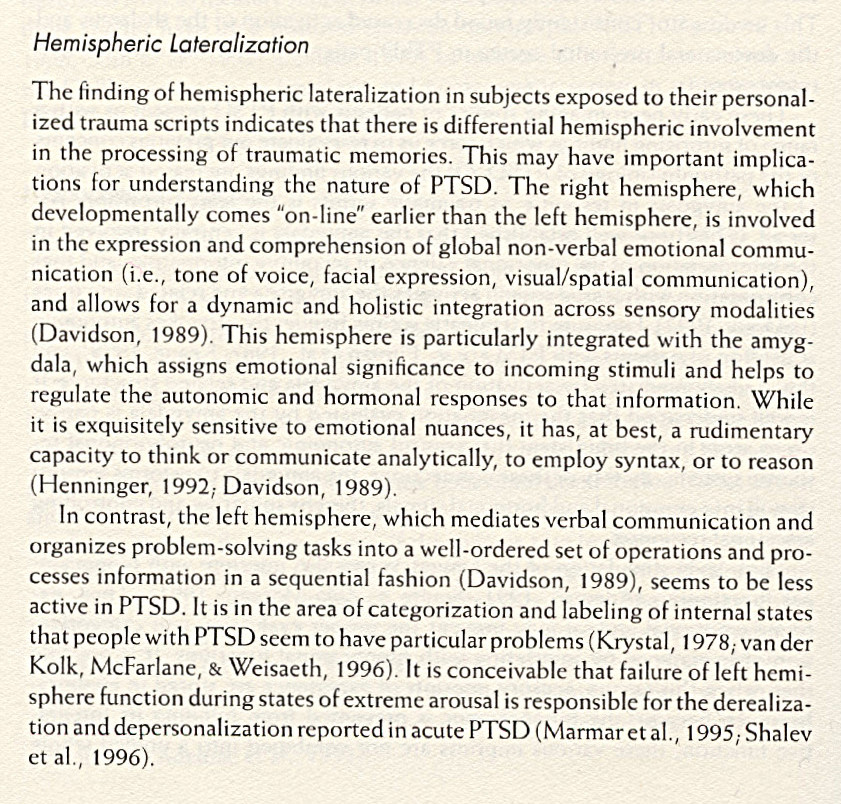
This third post on the topic again continues an exploration of how TAD changes an infant-child abuse survivor’s reaction to ALL trauma.   Van der Kolk writes about posttraumatic stress disorder (PTSD) in the book, Healing Trauma: Attachment, Mind, Body, and Brain – Hardcover (Jan 2003, W.W. Norton and Co.) by Daniel J. Siegel, Marion F. Solomon, and Marion Solomon, chapter 4 (pages 168-195) written by Bessel A. van der Kolk:  “Posttraumatic Stress Disorder and The Nature of Trauma.”

++++

I begin writing today by considering the last sentence of the scanned book pages that were posted on November 30, 2009:

“….progress in understanding the function of attachment in shaping the individual and rapid developments in the neurosciences gave a new shape to these old insights [about the importance of trauma].”  (page 177)

++++

Van der Kolk next considers “The Psychobiology of Trauma” in his writing:

Modern research has come to elucidate the degree to which PTSD is, indeed, a “physioneurosis,” a mental disorder based on the persistence of biological emergency responses.”  (page 177)

In my thinking, naming PTSD ‘a mental disorder’ ignores the overwhelming evidence that the entire human body is included in the ‘persistence of biological emergency responses’ that the author is talking about.  From my point of view, it is the consideration of how severe infant-child maltreatment and abuse changes the development of the ENTIRE BODY of the little one that matters to those of us who survived this degree of early trauma.

‘Biological emergency responses’ BUILT our bodies.  These responses signaled our DNA how to express itself.  These responses signaled our developing nervous system and brain on all levels about how to adapt to trauma.  Our developing nervous system was also intimately involved in these responses as it formed, also.  It is at this most basic, profound level of our physiological development from our beginnings that we have to understand how our development changed in ways that a non-TAD ‘ordinary’ body did not.

The adaptive changes that happened to us took place on far, far deeper levels than just the level of mind.  Mind is simply the topmost layer of our existence that I see as being related to our body as smoke is to fire.  I do not have a ‘mental disorder’.  My entire being is ordered in a very particular way in accordance with what surviving my infant-child trauma required.

It is this Trauma Altered Development that created my survival based, trauma centered ordering of my entire being that I seek to understand.  I am not convinced that van der Kolk has anything more than a passing surface notion of what these TAD changes actually ARE, how they affect us, or even if they legitimately belong to anything like a PTSD diagnostic category.

++++

Van der Kolk continues by saying:

To understand how trauma affects psychobiological activity, it is useful to briefly revisit some basic tenets of neurobiology.”

I do not like the term ‘psychobiological activity’ because it implies that anyone on the outside can ever have any accurate information about what another person’s ‘psyche’ is like.  That is why researchers try to more completely understand the human ability to form a Theory of Mind.  MIND belongs to each of us as individuals, and everyone has their own.  Nobody can ever come to understand what the subjective experience of MIND is like for another person.

‘Neurobiology’ is a different thing.  This is a realistic descriptive word that refers to a part of a person that can, within the current limitations of science, be understood and described because it is physically real on the molecular level.  But neurobiology is not the same thing as MIND.

Van der Kolk continues:

McLean (1990) defined the brain [my note:  The brain is a biological reality as part of our nervous system, from which an individual’s MIND originates.  Brain and MIND are not the same thing.] as a detecting, amplifying, and analyzing device for maintaining us in our internal and external environment.  These functions range from the visceral regulation of oxygen intake and temperature balance to the categorization of incoming information necessary for making complex, long-term decisions affecting both individual and social systems.  In the course of evolution, the human brain has developed three interdependent subanalyzers, each with different anatomical and neurochemical substrates:

(1)  the brain stem and hypothalamus, which are primarily associated with the regulation of internal homeostasis,

(2) the limbic system, which is charged with maintaining the balance between the internal world and external reality, and

(3) the neocortex, which is responsible for analyzing and interacting with the external world.

It is generally thought that the circuitry of the brain stem and hypothalamus is most innate and stable, that the limbic system contains both innate circuitry and circuitry modifiable by experience [my note:  This emotional area of the brain forms through early caregiver attachment interactions birth to age one, forming MUCH earlier than the neocortex], and that the structure of the neocortex is most affected by environmental input (Damasio, 1995).  If that is true, trauma would be expected to leave its most profound changes on neocortical functions, and least affect basic regulatory functions.  However, while this may be true for the ordinary stress response, trauma – stress that overwhelms the organism – seems to affect people over a wide range of biological functioning, involving a large variety of brain structures and neurotransmitter systems.”  (pages 177-178)

++++

I am going to scan in the book pages that follow in van der Kolk’s description of how trauma affects people.  I believe his statement on the bottom half of page 190 is extremely important:

“…the development of a chronic trauma-based disorder is qualitatively different from a simple exaggeration of the normal stress response….”

We need to stretch that concept as far as we possibly can if we are going to understand how severe trauma from malevolent infant-child abuse and neglect changes our entire development – nothing about us is excluded.  Any possible aspect of our development that can adapt its development in order to help us endure and survive early trauma – does so.

Our problem comes when the reality of our early trauma is denied along with the depth, breadth and width of its impact on our development.  What may be true for a non trauma altered development person cannot be assumed to be true for us.  Yes, we know what the following descriptions of consequences FEELS like – but we also know that we never knew any other, different way of being in the world.

Due to the changed development we experienced as we survived our early severe traumas, anything that we might begin to understand now as being more like  ‘ordinary’ in our physical – and correspondingly in our mental — ability to experience our self in our body in our lifetime, will happen as we begin to understand how deeply trauma formed us in the first place so that we will NEVER experience trauma (or life) in the same way as will a person who did not experience Trauma Altered Development when they were little.

++++

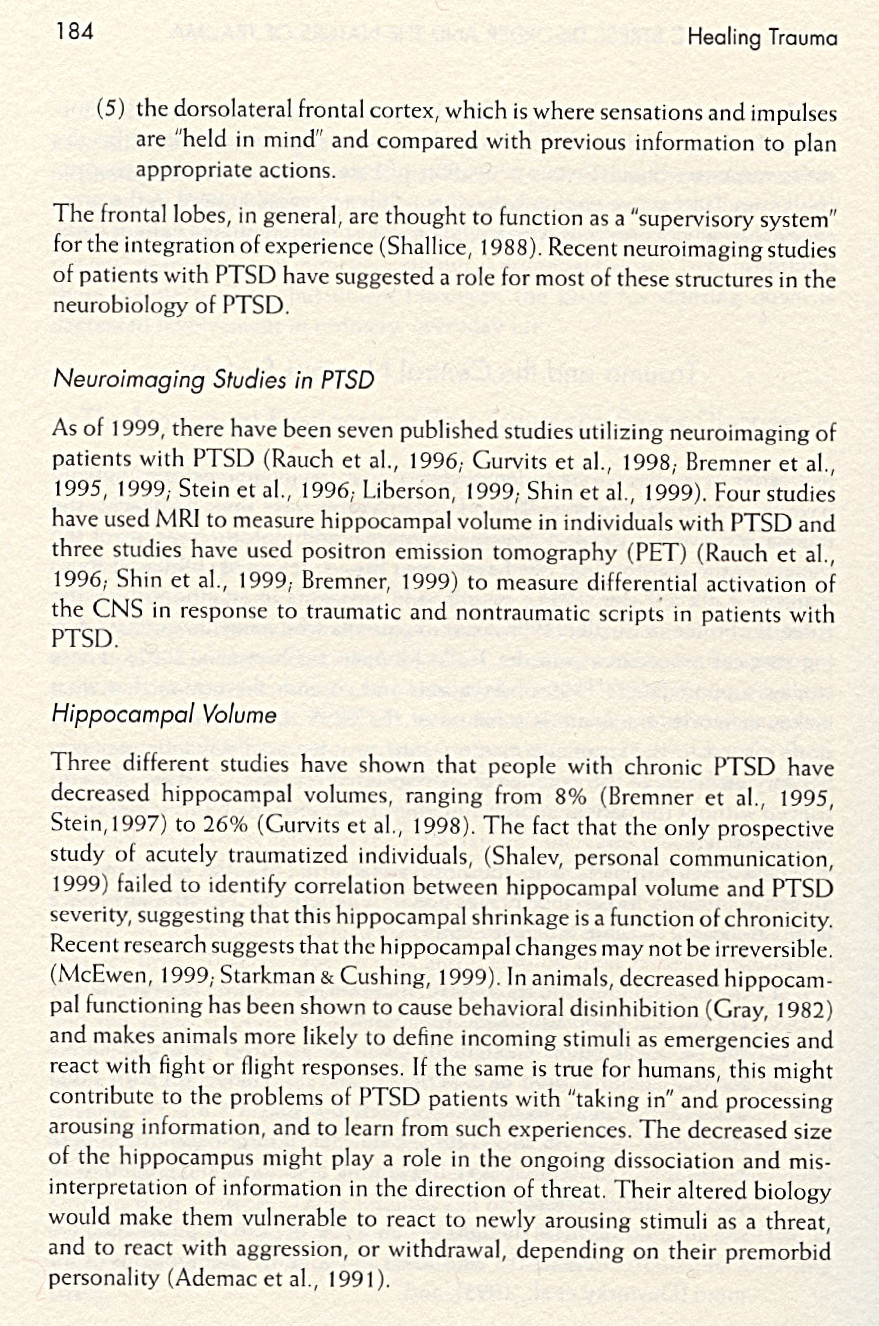
The scanned pages below (from the book mentioned above!) is complicated information, but it is a place for us to truly begin to understand ourselves – the way were MADE in the severely abusive and trauma-filled environments we were formed in.

On page 184 van der Kolk notes that “PTSD patients” have problems

“…with “taking in” and processing arousing information, and to learn from such experiences.”

Sorry, but I am not a ‘PTSD patient’.  I am a 58-year-old woman who has suffered from an extra-ordinary body, altered in all its developmental stages in adaptation to trauma, that has never been able to ‘take in’ even ordinary information, let alone ‘arousing information’, or to ‘learn from’ the experiences of my life in an ordinary way.

What on earth do we expect to happen to little people who must continue to develop and survive even while they have little or no access to even their most basic Universal Human Rights?  Infant-child development IS ALTERED under these conditions.  It is time that we realize this is the most truly horrific consequence of early abuse and trauma.  We don’t get to experience ANYTHING the same way as non-early-traumatized people do – not even later traumas.

(note:  I believe in ‘degrees of damage’ – the 75% of our sub-par young adults in this country have suffered some degree of damage that has changed the course of their development away from optimal and BEST!  We cannot afford to ignore that fact – deprivation and violation of the Universal Human Rights of Children causes changes in the way their body and brain develop.  There is a very real, physiological process through which trauma and deprivation get passed on down the generations.  We know it is happening when we see the consequences in degrees of lack of well-being –- which are detectable no matter what our age.)

++++

(The following is from page 186 on left or right handedness and trauma)

++++++++++++++++++++++++++++++

This post follows:

from November 30, 2009 +PTSD AND SEVERE ABUSE SURVIVORSHIP – PART TWO

from November 28, 2009 +PTSD AND SEVERE CHILD ABUSE SURVIVORSHIP – PART ONE

+++++++++++++++++++++++

PLEASE NOTE:  Do not take anything I say as a reason to alter any ongoing treatment, therapy or medication you are receiving.  Consult with your provider if you find something in my writing that brings questions to your mind regarding your health and well-being.

++++++++++++++++++++++++++++++++

Please feel free to comment directly at the end of this post or on

+++++++

Your Page – Readers’ Responses

++++++++++++++++++++++++++++++++

+PTSD AND SEVERE ABUSE SURVIVORSHIP – PART TWO

+++++++++++++++++++

This second post about Posttraumatic Stress Disorder (PTSD) refers again to a book called Healing Trauma: Attachment, Mind, Body, and Brain – Hardcover (Jan 2003, W.W. Norton and Co.) by Daniel J. Siegel, Marion F. Solomon, and Marion Solomon, chapter 4 (pages 168-195) written by Bessel A. van der Kolk:  “Posttraumatic Stress Disorder and The Nature of Trauma.”

Today’s post follows the November 28, 2009 post

+PTSD AND SEVERE CHILD ABUSE SURVIVORSHIP – PART ONE

PLEASE NOTE:  Do not take anything I say as a reason to alter any ongoing treatment, therapy or medication you are receiving.  Consult with your provider if you find something in my writing that brings questions to your mind regarding your health and well-being.

+++++++++++++++++++

The following is taken from pages 172 of the above text.  I will consider this information in my writing below:

+++++++++++++++++++

It is now easier for me to work with this information because I have described my own version of an alternative way of thinking about the ongoing complications severe infant-child abuse and malevolent treatment survivors face as a direct result not only of the specifics of the actual horrific traumas they lived through, but also because of the very real physiological changes that surviving these traumas created in their infant-child growing and developing body.

(see yesterday’s November 29, 2009 post

+TRAUMA ALTERED DEVELOPMENT (TAD) – A NEW DESCRIPTIVE CONCEPT)

++++

An accurate primary and initial assessment of TAD for those of us who are Infant-Child Severe Maltreatment Survivors would allow us to know immediately how the changes our body-brain had to make created us to be different from ‘ordinary’ people who do not have the history of trauma that we do.

In this TAD assessment two critical resiliency factors would also need to be assessed because these two resiliency factors (one primary, the other secondary) are known to have the ability to nearly completely modify and modulate the power that early trauma has to change our developing body-brain.

The presence of safe and secure attachment to some early primary caregiver is the most basic and important resource an Infant-Child Severe Maltreatment Survivor had.  The current assessment tools available to assess adult secure and insecure attachment need to be simplified, refined and made accessible to the public.

Stemming from the degree of safety and security available through early caregiver attachment, the ability to play is a secondary but critical resiliency factor that impacts an Infant-Child Severe Maltreatment Survivor’s body-brain development.  I believe that assessment criteria and tools to measure this critical factor consistently and accurately can be developed and also made available to the public.

++++

NOTE:  In our new age of technology, the public has the right to be able to access critically important information about themselves and how their early infant and childhood experiences impacted their development.  At present this information remains ONLY available within ‘clinical’ settings, if even there.

++++

As far as I am concerned, anything and everything that is currently lumped under so-called ‘psychological’ categories belongs to the sinking Titanic of dark age medical model thinking that I referred to in yesterday’s post.

Until Trauma Altered Development (TAD) is assessed at the bedrock level of how Infant-Child Severe Maltreatment Survivors changed at their own bedrock (molecular) level, any attempt to moderate so-called ‘symptoms’ remains a crap shoot in the dark.

TAD assessment can connect the consequences of early trauma to altered physiological changes that an Infant-Child Severe Maltreatment Survivor’s body was forced to make to best ensure continued survival in early malevolent environments,

++++

Early caregiver attachment experiences from birth build the body-brain we will live with for the rest of our lives.

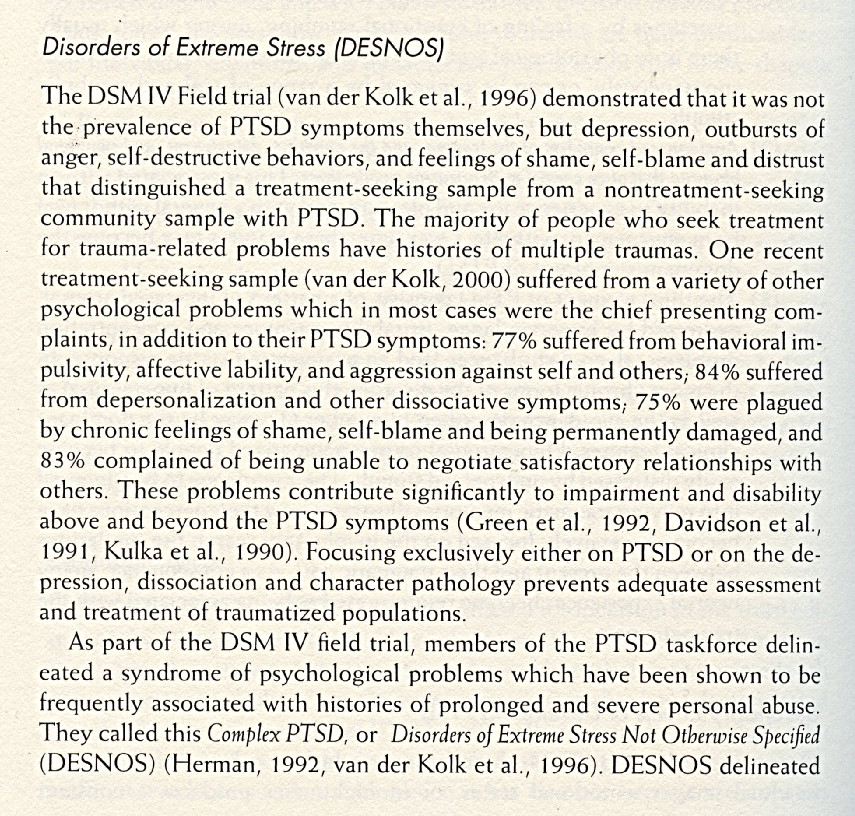
Van der Kolk (scanned text above) writes that it is not usually the symptoms of PTSD itself that brings those seeking help to a clinical setting.  Rather, he says that it is “depression, outbursts of anger, self-destructive behaviors, and feelings of shame, self-blame and distrust that distinguished a treatment-seeking sample from a nontreatment-seeking community sample with PTSD.”

Through an accurate TAD assessment, any ongoing difficulty an Infant-Child Severe Maltreatment Survivor has with emotions and social interactions can be traced to inadequate early caregiver interactions in a malevolent environment that built for the survivor an entirely different early-forming right-limbic-emotional-social brain.

When the foundation of the early forming right brain is altered because of maltreatment, the Infant-Child Severe Maltreatment Survivor’s later developmental stages involving shame, guilt and embarrassment will also be off course from ‘ordinary and optimal’ and will cause altered patterns of development in the body-brain.

++++

Van der Kolk states:

The majority of people who seek treatment for trauma-related problems have histories of multiple traumas.”

OK, I can certainly understand this, but here again, as I mentioned above, I do not agree with applying so-called ‘psychological’ and ‘symptom based’ medical model diagnostic thinking used in the author’s next statements.  I absolutely disagree with ever using terms such as ‘character pathology’ in reference to Infant-Child Severe Maltreatment Survivors!

One recent treatment-seeking sample…suffered from a variety of other psychological problems which in most cases were the chief presenting complaints, in addition to their PTSD symptoms:  77% suffered from behavioral impulsivity, affect lability, and aggression against self and others; 84% suffered from depersonalization and other dissociative symptoms; 75% were plagued by chronic feelings of shame, self-blame and being permanently damaged and 93% complained of being unable to negotiate satisfactory relationships with others.  These problems contribute significantly to impairment and disability above and beyond the PTSD symptoms….Focusing exclusively either on PTSD or on the depression, dissociation and character pathology prevents adequate assessment and treatment of traumatized populations.”

TAD assessments will clearly show that ‘impulsivity’, ‘affect liability’, most aggression, and dissociation are directly connected to changes in how an Infant-Child Severe Maltreatment Survivor’s nervous system, including their brain – and here, particularly their right brain – formed differently from ‘ordinary’ due to growth and development in trauma.

Chronic feelings of shame, self-blame and being permanently damaged” are also directly connected to trauma through developmental changes an Infant-Child Severe Maltreatment Survivor’s nervous system, including their brain – and here, particularly their later forming (after age one) left brain – had to make while developing in an early malevolent, trauma-filled environment.

Rather than referring to these changes as ‘character pathologies’, which in my thinking is the maltreatment, abusive stance taken by the medical model toward Infant-Child Severe Maltreatment Survivors, a TAD assessment can accurately and specifically pinpoint the origin of these changes in the body-brain and describe the consequences of them.

Receiving an accurate TAD assessment will show us exactly how our body was forced to adapt during our development through trauma so that we could survive it.   Yes, I do believe we KNOW we are different from ‘ordinary,’ but we are not ‘permanently damaged’.   We ARE permanently changed.

The changes Infant-Child Severe Maltreatment Survivors experience are fundamental and profound!  Everything about us was subject to adjustment for our trauma survival – our body, our nervous system and brain, our immune system, our mind, and our connection between our self and our self and between our self and the entire world around us.  NOT facing the truth and discovering the facts through TAD assessment will NOT resolve the difficulties we face with our continued survival into adulthood.

The only long term solution societies have is to STOP Infant-Child Severe Maltreatment!!!  Part of that solution is to provide the kind of TAD assessment Infant-Child Severe Maltreatment Survivors need, and to make available to us the resources necessary for us to live the best life we can in spite of the changes we had to make in order to stay alive because nobody STOPPED the Infant-Child Severe Maltreatment that happened to us.

It is the pathological character of the society we were born into that allowed what happened to us to happen at all, let alone allowed it to continue to the degree that trauma changed our physiological development.  If there is any self blame to be had, it is on the level far beyond OURS as the Infant-Child Severe Maltreatment Survivors.

++++

That the grand sinking Titanic of the archaic dark age’s medical model about Infant-Child Severe Maltreatment Survivors has at least THOUGHT about throwing us a life boat becomes apparent in van der Kolk’s next words:

As part of the DSM IV field trial, members of the PTSD taskforce delineated a syndrome of psychological problems which have been shown to be frequently associated with histories of prolonged and severe personal abuse.  They call this Complex PTSD, or Disorders of Extreme Stress Not Otherwise Specified (DESNOS).”

Great!  A life boat full of holes!  Gee, why are we NOT thankful for that?

A syndrome of psychological problems” be damned!  Infant-Child Severe Maltreatment Survivors do not suffer from a ‘syndrome’, and ours are not ‘psychological problems’!  For all the reasons I have repeatedly described, we simply need a TAD assessment that will tell us HOW our little body adapted down to our molecular level during our development in the midst of, and in spite of, toxic malevolent trauma.  Then we need resources that inform us how to live NOW with these profound trauma-caused changes that happened to us THEN.

The author continues:

DESNOS delineated a complex of symptoms associated with early interpersonal trauma.”

Again, we don’t have ‘symptoms’.  We have a different body-brain-mind-self that adapted to survival in a malevolent world and caused us to have Trauma Altered Development (TAD).

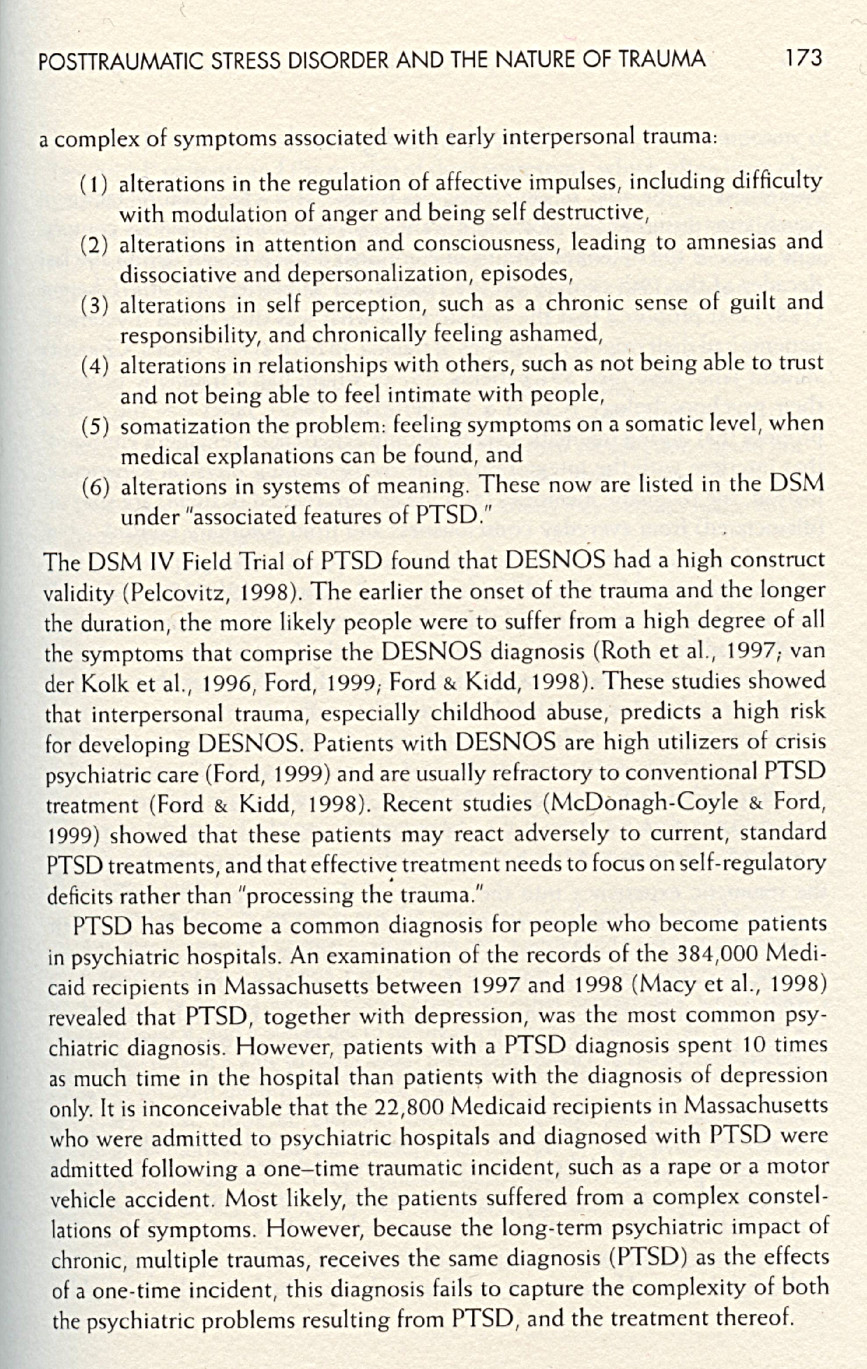
We don’t have symptoms, we have consequences.  Every single item in the list of so-called ‘complex symptoms’ (see them in the page scan below) that van der Kolk describes are directly connected to our TAD.  EVERY SINGLE ONE OF THESE ITEMS exist within us because of changes our body-brain was forced to make.  They are consequences of the changes our body had to make through our TAD.

The only real progress in the right direction I can see – given to us like faulty patches to a sinking life boat thrown to us from a sinking ship – is that at least an association ‘with early interpersonal trauma’ is finally being considered in the current medical model thinking.

But this tiny droplet of hoped for healing balm offered by the creation of a construct named “Complex PTSD, or Disorders of Extreme Stress Not Otherwise Specified (DESNOS)” is not what we Infant-Child Severe Maltreatment Survivors need in my book.

We need our entire society to understand and accept the truth that the Infant-Child Severe Maltreatment that happened to me and others – and continues to happen to children around us today – is nothing short of a form of parental-selected genocide that did not fulfill its intent to completely destroy us.  We are Infant-Child Severe Maltreatment Survivors because we are still alive, and we ONLY SURVIVED because we were able to adapt our body throughout our Trauma Altered Development to and within the malevolent environments that formed us.

++++

The rest of van der Kolk’s words (below) simply bring into my mind the image of the author being like a modern day Paul Revere, whose horse’s hooves pound along the streets of our nation as he screams a warning.  I am certainly not convinced, however, that even this author knows which message it is that most needs to be delivered.

The Trauma Altered Development that Infant-Child Severe Maltreatment Survivors experienced had no choice but to build itself into every part of who we are BECAUSE we live in a body, and our body had no choice but to change so that we could stay alive.

To describe any aspect of what happened to us in terms of a ‘diagnosis’ or a ‘symptom’, ‘complex’ or not, to call us ‘maladjusted’ or to tell us we suffer from any form of a ‘character pathology’ or ‘psychological problem’ is to continue to condemn us with stigmas and stereotyped prejudice which makes as much sense as applying all of the above labels to someone who is tall versus short, or who has red hair rather than blond.

If we wish as a society to remain in the dark ages about the consequences of Trauma Altered Development for Infant-Child Severe Maltreatment Survivors then at least we should have enough honor and common sense to admit it.  If we are appalled by the ignorance that is still applied to our circumstances, today is the day we can enlighten ourselves and get on with the legitimate task of figuring out how to accurately assess Trauma Altered Development so that we can begin to live well as the changed, extraordinary Infant-Child Severe Maltreatment Survivors that we are.

Our Trauma Altered Development did not affect WHO we are in the world, but it absolutely changed HOW we are in the world.  It is up to all of us to learn what that means.

+++++++++++++++++++

The following is taken from pages 173 of the above text:

Again, it is not a picture of ‘long-term psychiatric impact’ nor a ‘diagnosis’ that Trauma Altered Development affected Infant-Child Severe Maltreatment Survivors need.  We need to understand the changes our body had to make to guarantee our survival and specifically how those changes affect us, and specifically how to improve our quality of life and well-being in the world in spite of our TAD.

+++++++++++++++++++++++++++++++++++++++++

Please feel free to comment directly at the end of this post or on

+++++++

Your Page – Readers’ Responses

++++++++++++++++++++++++++++++++

+DOES OUR NATION HAVE A CONSCIENCE REGARDING ADULT SURVIVORS OF SEVERE CHILD ABUSE?

++++++++++++++++++++++++++++++++

Please be sure to take a look at the slide show presented in this link I included at the bottom of last evening’s post about the Center for Disease Control’s latest research on the long term suffering caused by severe child abuse that occurs during the early stages of brain-body development:

“adverse childhood experiences” (ACEs)

++++++++++++++++++++++++++++++++

I believe it is critical that this kind of “new” information be coupled with understandings about the body-brain-mind evolutionary changes that those of us who survived the kind of malevolent experiences that the above research is highlighting had to make.

The kinds of life long difficulties the research points to happen not only because of the abuse itself, but because of these changes our body-brain-mind had to make.  Our bodies were designed in, by and for trauma.  We were never designed to live an ordinary life with an ordinary body-brain-mind.  We have to become completely clear about what these changes are and how they affect us.

Researchers and clinicians are going to continue to try to apply a piecemeal solution to an extremely complicated problem just as they always have.  Their efforts will NOT bring about any more positive a solution than they have thus far — which is PATHETIC — if the evolutionary adaptation to trauma during early development due to trauma and abuse is not the PRIMARY and PIVOTAL information used to assess ‘damage’ and effect lasting positive change for survivors.

Otherwise we will continue to be looked at as flawed people.  We are not remotely flawed.  We were terribly wounded as little infant-children, and we endured.  We are perfectly designed to survive what we had to survive or we would not be here!  Even though the adaptive changes we had to make prevent us from smoothly ‘fitting into’ an ordinary world,  they can still be not only recognized, but respected, honored and even applauded and celebrated for being the amazing human resiliency factors that they are.  If we value human life at all, we will know this truth in our bones.  And I believe for any healing to occur for us at all, this point of truth is where all efforts must begin.

The flip side of the coin of surviving intolerably horrible childhoods is that our body adapted for short-term heavy duty survival in trauma.  We are not adapted to a quality of life for the long haul.  THAT portion of our lives is what we need appropriate help with if we are to keep on living in a ‘benevolent’ world.

Nature designed us to live to our childbearing years and not much longer.  The ‘ordinary’ world we grew up into grants us a longevity we were not made for.   Sorry folks, this is the truth as I understand it as a survivor with this kind of trauma-changed body.  No wonder we are likely to contemplate or commit suicide.  I believe our body knows this truth.  This can make just staying alive yet another choice we have to make with conscious effort.

Everyone needs to get their thinking straight on these issues!  What ARE the priorities?  We survivors cannot magically remake our body-brains into ‘ordinary’ ones once the traumas of our childhood have ended.  These changes are with us for the rest of our lives.  Nobody tells us this fact or truly helps us live better with the changed body-brain that we have.  Surviving severe infant-child trauma and abuse is a costly affair.

Please, take a look at that link at the top here.  The Center for Disease Control is not a lightweight institution.  Their findings leave indelible marks on minds within the professional community.  To allow child abuse to continue at all, and to allow those adults who survived the kinds of abuse the ACE study highlights to continue to suffer, can only happen in a culture without a conscience.  For our culture to not consider the evolutionarily altered body-brain-mind development that survivors were forced to make in order to stay alive is even worse.

We will never be able to solve the problems related to severe early abuse and trauma — and survival of it — if we refuse to correctly describe and name what happens to change the course of our human development and how we responded.

++++++++++++++++++++++++++++++++

A WORD TO WISE WOMEN:

IF YOU HAVE A HISTORY OF SEVERE CHILD ABUSE, CONSIDER YOURSELF AT HIGH RISK FOR GETTING BREAST CANCER.  Today’s release of the news article at link below does not apply to you in the same way as it does to ‘ordinary’ women.  A mammogram beginning at age 40 should always be considered necessary for child abuse survivors who choose to be proactive on behalf of their well-being.

If your insurance requires a referral from your doctor, never hesitate to tell her/him the truth about your abuse history.  You can also mention the Center for Disease Control’s newly published findings on the major link between child abuse and the risk for serious adult disease.  We are not ‘making this up!’

Task Force Opposes Routine Mammograms for Women Age 40-49

+EXPLODING MOTHER, IMPLODING ME: SOME FUNDAMENTAL DIFFERENCES BETWEEN US

++++++++++++++++++++++++

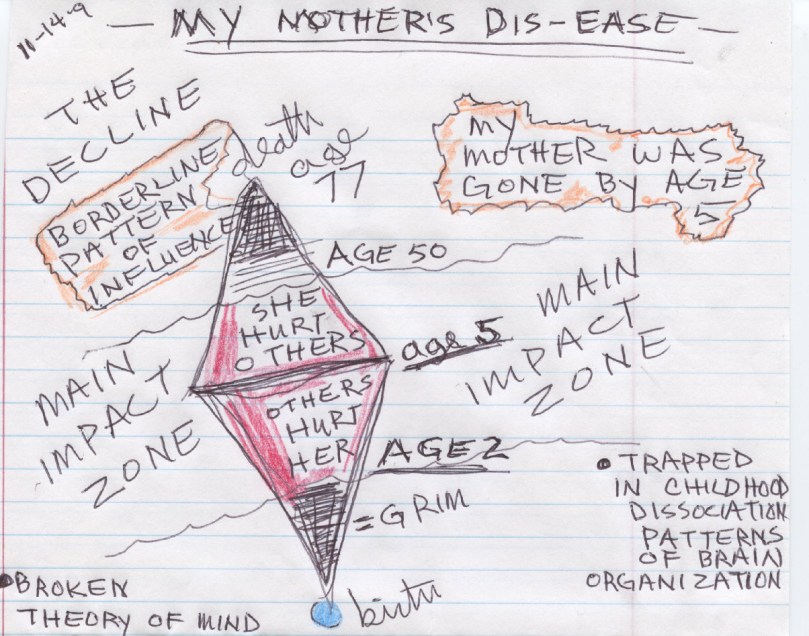
I am revisiting what I see as the core differences between my borderline mother and myself.  I find that nothing has changed in my thinking about these differences in my past five years of research.  My mother’s childhood-onset dissociation became malignant while mine remained benign.

In my first ‘doodle’ I visualized the impact of infant developmental attachment deprivations she suffered from birth until age two.  Born into a family with marital discord and left with her primary care in the hands of a ‘nanny’, I envision that my mother’s developing brain-mind-self was already far off course before she reached the stage of developing a Theory of Mind.

1 111409 post

During the developmental stages from age 2 – 5 conditions in my mother’s childhood so severely impacted her brain-mind that I believe her later mental illness had already centralized the organization of her self.  From the age of 5 it was simply a matter of time before the bomb that was her Borderline Personality Disorder condition would explode – which it did during her terrible delivery of me.

The broader dimensions of the diamond figure that I drew show that in the bottom half powerful interactions with others in her life were feeding her unstable growing self.  She had reached what I call the ‘rage stage’ which was coupled with the following:

My mother was a victim of a lie.  She was told through word and deed by her early caregivers that sometimes she was good enough to be loved.  She was also told that sometimes she was so bad she was un-love-able.  The lie was that she had the power to change herself from being bad to being good, and if she changed into being good (made the bad go away) she would be love-able – and therefore would be loved.

2 111409 post

These conditions presented my mother with an impossible paradox for which there was no answer.  She never knew she was being lied to by her attachment caregivers.  She did not know that there was no solution to this paradox.  She was told she had the power to change herself into being ‘all good’, and she eventually found her solution – me.

The impossible solution to her fundamental betrayal problem was to spit off all her badness and project it onto me.  That left her being all good and me being all bad.  She never had the capacity to know she had believed a lie, found an impossible solution to an impossible riddle, or that she had been tricked and fooled.  Once her child brain-mind wrapped herself around the too-big problem of her early life, her brain-mind continued to grow with this malignant lie within it.

As she moved out of her childhood into her adulthood, and then into the stage of her childbearing years, her childhood dissociation, fueled by childhood rage and a broken Theory of Mind, meant that her children remained her doll-imaginary friends with me as her imaginary enemy (as I have previously described).  By the later years of  my mother’s life she had fewer and fewer people she could influence through her mental illness, and she died as alone and unconsciously troubled as she had been from the time of her birth.

I see this ‘main impact zone’ as being the mass of incoming information that hurt her, followed my the mass of information she later could displace and project onto others to hurt them (primarily me).

++++

My second doodle page (above) presents the basics of what I believe are the differences between my mother and myself.  Like her, my foundation from birth was in disorganizing, disorienting insecure attachment to early caregivers.  But unlike her, I was never fooled, tricked, or betrayed.  Her projection of her own badness onto me condemned me absolutely and permanently.  I was simply doomed to be hated without hope of reprieve, salvation, or any hope of implementing my own solution to solve any of the ‘problems’ I had with her.

The simplicity of my life saved me.  I was not faced with solving an impossible riddle.  I was not presented with the impossible paradox of “you can change yourself into a good and love-able child and then I will love you.”  My childhood was one continual ‘rupture’ without either repair or hope for repair.  My mother’s childhood contained ‘ruptures’ with faulty and deceiving repairs.

In the final analysis, I was far more fortunate than my mother was.  She was set up to fail at being love-able.  I was simply not love-able.  It was the constancy of my unloved-being hated state that saved me.  It was the inconsistency of her unloved-sometimes loved state that ruined her.

I believe her brain fixated a rigid solution to an unsolvable problem.  Her childhood dissociation organized in her brain-mind-self around this solution – which became her internal and unconscious fulltime goal.  I believe her mental illness was fueled by childhood rage.  Her childhood dissociation became malignant, and I became its operational target.

My childhood dissociation had no goal other than physical enduring survival.  My brain-mind-self was left in a fluid, continually changing and adapting state because I HAD NO GOAL and I had no hope, false or otherwise.  My mother’s treatment of me was made tolerable through what I call benign dissociation and my development occurred in a world of sadness.

++++

My mother ended up fighting to be love-able, fueled by rage.  Rage is tied to active coping skills, whether we want to admit this or not.  I did not grow up a fighter.  I grew up a sorrow-filled victim stuck in the passive coping skill state.  My mother was told she had the power to change what happened to her, even though it was a lie and it was not within her power to change the dynamics of her caregivers’ treatment of her.

My mother was damned and didn’t know it.  I was damned and I did know it.  I knew I had no power to change what happened to me.   Nobody ever fooled me into thinking otherwise — from the time I was born.  I believe that there are two entirely different trajectories of development set up by the two different childhood scenarios I am describing.  One leads to the development of a dangerous, demonizing mother and the other one does not.

Both my life and my mother’s of course ended up being extremely complicated with devastating consequences stemming from child abuse and neglect in a malevolent environment during critical body-brain-mind-self stages of early development that resulted in a changed brain for both of us.  Yet as I see it, I was never betrayed or set-up with an impossible task to accomplish like my mother was, and being free from these overpowering early forces allowed me to become who I am.

My mother’s mental illness prevented her from ever being able to tolerate becoming conscious either of how she behaved or of what had happened to so wound her in childhood.  I am not barred in the same way from consciousness.  As I continue to explore the underlying aspects of safe and secure attachment, I will explore how having the ability to be self-aware and self-reflective makes all the difference in how and who we become in our lives.

++++

This post follows:

+DISSOCIATION AND THE TRAUMA-SPECIALIZED BRAIN 11-11-09 and

+SECURE AND INSECURE ATTACHMENT AND THE CHILDHOOD NARRATIVE 11-13-09

++++

++++++++++++++++++++++++++++++++++

THIS INFORMATION COMES TO YOU FROM:

Prevent Child Abuse New York Blog

Improving Children’s Mental Health through Parenting EducationPosted: 13 Nov 2009 03:01 AM PSTGuest post by Michelle Gross, Projects/Public Policy Manager, Prevent Child Abuse New York In today’s difficult times, one of the most important skills one must possess is the ability to form healthy relationships and cope with life’s challenges. Our children are not born with these skills, but rather learn them through their social and emotional development.While providers have traditionally focused on physical development, in 2006, the New York State Legislature passed the Children’s Mental Health Act. The Act required the development of a statewide plan to address issues in children’s social and emotional health, zero to eighteen. As a result of this legislation, the Children’s Plan was developed in collaboration with nine state agencies and led by the New York State Office for Mental Health.The Children’s Plan serves as a blueprint for New York state agencies, providers, and communities to
improve the social and emotional development of children and their families. The Plan focuses on engaging children and their families in services early, ensuring that systems are collaborating to provide effective and efficient services and meeting families’ needs by focusing on their strengths and abilities.

Within the Children’s Plan is a directive for the Office of Mental Health to work with parenting educators to better support parents in raising emotionally healthy children.  The New York State Parenting Education Partnership has been chosen to play this pivotal role in educating providers who work with families and supporting a network of family support and information.

NYSPEP’s efforts to provide professional development sessions for parenting educators will enhance providers’ ability to communicate the importance of social and emotional development with parents, and offer both providers and families tools to facilitate children’s healthy development.

For more information, visit our web site at: http://www.parentingeducationpartnership.org.

Positive Parenting Can have Lasting Impact for Generations

Posted: 12 Nov 2009 07:15 PM PST

A new study that looks at data on three generations of Oregon families shows that “positive parenting” not only has positive impacts on adolescents, but on the way they parent their own children. ” Positive Parenting can include factors such as warmth, monitoring children’s activities, involvement, and consistency of discipline.

Researchers from the Oregon Social Learning Center conducted surveys on 206 boys who were considered “at-risk” for juvenile delinquency. The boys and their parents were interviewed and observed, researchers information about how the boys were parented. Starting in 1984, the boys met with researchers every year from age 9 to 33. As the boys grew up and started their own families, their partners and children began participating in the study. In this way, the researchers learned how the men’s childhood experiences influenced their own parenting.

There is often an assumption that people learn parenting methods from their own parents. In fact, most research shows that a direct link between what a person experiences as a child and what she or he does as a parent is fairly weak. The researchers found that children who had parents who monitored their behavior, were consistent with rules and were warm and affectionate were more likely to have close relationships with their peers, be more engaged in school, and have better self-esteem.

For more information relating to positive parenting techniques, please visit our website http://preventchildabuseny.org/parents.shtml

+++++++++++++++++++++++++++++++++++++++

+DISSOCIATION AND THE TRAUMA-SPECIALIZED BRAIN

+++++++++++++++++++++++++

Because of my traumatic experiences with my mentally ill mother from birth, I did not form an ordinary brain.  My thought processes while writing this post reflect some of the difficulties I have always experienced because my brain formed differently.  Similar to the way an air flight might experience turbulence, I have turbulence in my thinking whenever I try to follow an ‘ordinary’ brain’s train of thought.

This does not mean that I am wrong or broken.  Yes, I was wounded, but the resiliency within me coupled with my determination to endure and survive allowed me in the end to become a very special sort of person.  I will just always think in my special way, and I will always struggle to bridge the chasm that can exist between the way my extra-ordinary brain works and the way ordinary-formed brains work in an ordinary world.

I will continue over time to process the secure and insecure attachment information as I try to understand what the experts know and match it in some way with what I know from within myself about, in particular, dissociation.

Here are my thoughts for today on the brain science concept of ‘coherence’.  I am not going to try to edit them or to give them any other organization or orientation than they had when they lined themselves up on this page as a result of my thinking process.

Yes, these thoughts feel turbulent to me.  That would not be my choice, but then I had no choice about how my brain-mind had to form itself in the beginning of my life.  Nor do I have much choice about how my brain-mind regards and processes information today.  This is what happens for me when I try to even begin to understand what forms the basis of a safe and secure organized attachment system.

+++++++++++++++++++++++++

The advantage of my writing about the topic of secure-autonomous adult attachment is that I can take what ‘ordinary’ brained researchers say about the subject and translate it for myself though my ‘extra-ordinary’ brain.  I have the powerful advantage now of knowing absolutely that my childhood was just about as devoid and empty of secure attachment people as it could possibly have been.  I no longer even try to find out who exactly might have been there for me to give me what I needed to form secure attachments.  I know there was nobody.

Whatever attachment I had with my mother’s mother was contrived.  It was set up by my mother according to her rules so that it could fit within her reality, or should I say, fit her ‘dis-reality’ and ‘un-reality’.  My mother’s mind was nothing less than bizarre and distorted when it came to her thinking about me.  I can’t say it was ‘disorganized’ because her psychosis gave her the most rigid organization possible without possibility of rearrangement – ever.

When I read what the experts tell us about safe and secure infant-child attachment I have to stretch my thinking as far as I can manage in order to try to begin to understand on a deep and honest level within myself what it is these people are saying.  I am coming from the position of being raised in a world just about as far away from what researches consider ‘optimal’ early conditions as it might be possible.  Just as I do not believe those researchers can stretch their minds far enough to begin to comprehend my reality, I am not sure that I can stretch mine far enough to begin to understand theirs.

++++

Dr. Daniel J. Siegel makes this statement, “…the way adults can flexibly access information about childhood and reflect upon such information in a coherent manner determines their likelihood of raising securely attached children.”  (siegle/tdm/312)

Taking the meat of the nut out of its shell, I read this as if it is a directive not only about how to be an adequate parent, but also how to get along in the ‘ordinary’ world in an ‘ordinary’ way:  “flexibly access information about childhood and reflect upon such information in a coherent manner.”

But what does Siegel mean by ‘coherent’?  My guess he knows what it means because he has it.  Very few, if any people who lack his version of coherency in their brain-minds make it to the top levels of any professions – for all kinds of reasons I won’t go into at this moment.  I still want to know what this key to secure attachment means because from my own experiences, and in my world, coherency as Siegel describes it does not exist.

++++

Siegel states:  “Integration establishes a sense of congruity and unity of the mind as it emerges within the flexible patterns in the flow of information and energy processes of the brain, both within itself and in interaction with others.  This is coherence.

Wow.  Those words are a mouthful.  I cannot comprehend what he is saying without applying an incredible amount of effort.  I will try to break this apart as I hunt for some meaning that I can make sense out of from inside MY version of an abuse-formed extra-ordinary brain-mind.

Integration

Sense of congruity

Unity of the mind

Well, right here I get lost because I cannot break apart the next group of words:  unity of mind as it emerges within the flexible patterns

But then it goes further:  mind as it emerges, not just any mind, but a unified mind – and this living unified mind emerges, but does not emerge in any old way, does not emerge in a disorganized, disoriented, inflexible-rigid way.  This ‘sense of congruity’ and this ‘unity of the mind’ emerges continually along with every breath of life.  This happens (or not) through flexible patterns that were built into the brain by – yup! – by our experiences with our early caregivers from birth.

When the mind has this sense of congruity, and has its unity, it can continually engage flexibly within all interactions a person has in life.  These flexible patterns are, according to Siegel, “in the flow of information and energy processes of the brain.”  Well, it should not surprise us that under varying degrees of reverse conditions this entire process suffers from some degree of break down, or deviation from what Siegel is not only describing as optimal, but also as what is supposed to be ordinary.

++++++++++++++++++++++++++++

I am rapidly finding out as I try to make sense of Siegel’s description of ‘coherence’ is that I cannot understand what he is saying because I have a brain built in the opposite way from what he is describing.

I see an image of me being dropped from an airplane from a mile up in the air with a parachute attached to me.  I land in a fresh, hot wad of bubble gum the size of an average Wal-Mart.  That’s how I feel trying to grasp what he is saying.

It is hard to imagine that this finely working brain Siegel is describing would have been built entirely by appropriate early infant-child interactions with safely and securely attachment autonomous early caregivers!  But that is exactly what he is saying.

And the problem here for me is that Siegel knows exactly what he is talking about and says what he means PERFECTLY in these few words in this single sentence – that I cannot possibly begin to understand!  Believe it or not!

So, I will write my version of a statement about what having a brain built by my disorganized and disoriented insecurely attached, unsafe psychotic borderline mother gave me!  I have the opposite of a ‘coherency’ built brain, so OK, here goes —

SIEGEL’S VERSION OF AN ORDINARY BRAIN’S OPERATION:  Integration establishes a sense of congruity and unity of the mind as it emerges within the flexible patterns in the flow of information and energy processes of the brain, both within itself and in interaction with others.  This is coherence.

MY VERSION OF AN EXTRA-ORDINARY TRAUMA FORMED BRAIN’S OPERATION:  Disintegration establishes a (non)sense incongruity and disunity of mind as it attempts to emerge within the inflexible (rigid, disorganized and disoriented) patterns in the (disorganized and disoriented, interrupted and often chaotic) flow of misinformation and disturbed energy processes of the brain, and all of these disturbances exist and are experienced both within this brain itself and in all its interactions with others.  This is incoherence.

BUT, I would have to add from my own experience, that this ‘incoherence’ is experienced as DISSOCIATION.

++++

OK, great.  How exactly are we supposed to get along in the ‘ordinary’ person’s world of coherence when our brains were built under opposite conditions so that we have changed brains that will NEVER work the same as these ‘ordinary’ brains do?  We cannot return to our early infant-child body-brain-mind developmental stages so that the foundation and formation of our brain can be done over again!  Never.  Never.  Never.

The first step to improving our chances for experiencing anything like well-being in the world is to begin to understand what these researchers know about ordinary brain development and combining it with what we know about our own early experiences and what happened to our forming brains as a consequence.  We need to learn how our brains process life with a different kind of logic.

Because my personal experiences happened to me under the care of a mad woman, I am nearly completely on the opposite end of the brain-formation spectrum that Siegel is describing.  BUT, I AM STILL HERE!  I might be completely stuck in a bubble gum mess trying to understand Siegel’s description of an ordinary, healthy brain-mind, but I can also at the same time understand that the way my brain formed, even though it is very different in many fundamental ways from the one Siegel describes, DOES WORK.  It kept me alive throughout my childhood and it keeps me alive today.

But, my brain IS DIFFERENT!  It is NOT BROKEN.  Now, to all reasonable description, my mother’s brain was broken.  The changes her growing and developing brain had to make did not allow her to possess even temporary or sporadic flexibility in her thinking.  I can think flexibly, but not in a continual, ongoing ‘mind emerging in the moment’ way.

++++

Dr. Temple Grandin, autistic author of many books and world renowned expert on communicating with animals, talks about how she sees the world in pictures.  I believe I feel the world in pictures and think about it in dissociated pieces, or ‘packets’ of information.  Access to and transition between these dissociated packets of information is not frequently either smooth or predictable.

I am most fortunate that depending on the day and on the topic, my brain can link some or many of these pieces together at one time or another.  But never will I have a continuous, feeling, integrated, coherent story to tell myself or anybody else about myself in the world.

Any version of a continuous story I might form will be contrived, artificial and primarily constructed by my ‘logical’ left brain that has learned some things about how others make sense of their lives – and therefore how I OUGHT to be able to do the same.  Some days I can do this better than others by consciously pretending that I know all the experiences that happened to this BODY that Linda is attached to belong to the thinking, feeling, remembering person that Linda is supposed to be.

Yet the Linda that I MOST am feels like a bird might that soared over some particular piece of geography ten years ago, or 30 years ago, or 2 days ago without picking up the actual place and carrying it along.  I pass through ‘things’, pass by them, pass over them – or they pass through me.  But I feel very transparent, like the true form of who I am has never become embodied in my life in this world.  I absolutely and fundamentally do not process myself in  ‘time and space’ experience in ordinary ways.

Thanks to my mother, my body-brain-mind-self didn’t grown ‘down into the world’ as Dr. James Hillman calls it.  Whatever pieces of me made it into myself in my body in my life in this world are not completely integrated in the ordinary brain that Dr. Siegel has described.

I actually do not believe that neuroscientists or infant-child brain development specialists have ANY IDEA how big a deal dissociation can be!  I don’t think they can understand this kind of a reality any more than I can understand theirs.  I suffer today from a similar problem I had with my mother in the beginning.  There is nobody around to help me make sense of a sensible world, so I have to figure it all out by myself.

There is no retreat, no seminar, no self-help book, no religious text, no university class, no philosophical approach, no kind of meditative practice, no psychological theory that will ever ACTUALLY be able to help me understand how my changed brain operates in this world.  I was forced to grow a specialized brain, a very well-adapted-to-ongoing-trauma body-brain-mind.  I can take what developmental neuroscientists say about how things work when early brain formation experiences go RIGHT and try to translate that information into what happens when early brain formation experiences go terribly WRONG.

I am somewhat of an expert about that field of study!  In a more perfect world, or in a more advanced one (silly thought because in THAT world the kind of abuse that changes an infant-child’s developing brain would not be happening) I would be able to easily access information that would tell me how ordinary brains work, how extra-ordinary brains work, and how I can better experience well-being BECAUSE of how special my brain-mind is.  Well, evidently in THIS world, I will try until my dying breath to figure this out for myself.

++++

In this post I am trying to comprehend and make use of the information contained here:  *Attachment Simplified – Secure Attachment (Organized)

+++++++++++++++++++++++++

+ANSWERS THAT ARE NOT A PHONE CALL AWAY

+++++++++++++++++++++++++++++++

I woke this morning with too many thoughts, each one appearing in a rush, demanding my attention, shooting through my mind in its own direction, not connected to the next thought that flashes into my inner sight.  I can’t follow them all.  Each one is chased away by the next one.  I cannot see their beginning, their intention, or their ending.

I am bombarded by thoughts as if there is a fireworks show going on within me, without being orchestrated, and it frightens me.

After my strange and stressful day yesterday, I picked up my mail at the post office on my way home.  Our mail does not get delivered to our houses in this little town.  My bank statement was there, which would have been the correct proof of my disability income that I needed yesterday in my hunt for winter utility bill assistance.  The substitute printout confirming my income from the food stamp office was not what those people wanted.

Along with the bank statement there was a letter from the social security office telling me I am to receive a ‘special one-time payment of $775 in December 2009’, and that this amount will disqualify me from receiving any disability – and the letter stopped there – “Forever?” I want to know.  “What does this mean?  What’s going on here?”

There were pages and pages to this form letter of gobbelty-goop I do not understand.  Do humans actually write these words of confusion?  I fight shock and panic as I wonder if my sole source of income is about to vanish forever.  There are telephone numbers to call, and I anticipate long waits, leaving messages without return calls, bizarre conversations with mechanical telephone voices as I try to find the answers I need.

Meanwhile my body and mind are in distress overload mode.  So I sit outside in my fleece, writing in the dappled morning sunshine as the leaves still on the trees shake and shiver in a gentle breeze.  They make a higher pitched sound now as they brittle and age with frost at night.

I scribble words in lines across these pages because it helps me to see them here.  I can focus on them one by one so the noise of cascading of thoughts and emotions within me can dim.  I organize and orient myself in this moment as I feel the paper held against my knee and watch this pen, gripped between my fingers, glide along these neat straight lines like parallel rails into the future.  I am comforted.

I sit here with my cell phone waiting for the closest SSI office to open.  Will I end up consuming all my free day minutes and get no answer at all?  I will myself not to follow my thoughts up into the air or down, down, sucked down where there is no air at all.  All I have to do is wait and try not to panic.

I do not want to think about the grief, guilt, anger and sadness churning within me because I am no longer able to feel competent, tough and strong like I managed to be while my children were growing up under my care.  I was more like a Sherman tank then, forging always forward.  Now I am dependent for all of my living needs on forces I cannot see, comprehend, control or change.  Will this ever change?

I do not want to follow all the thoughts and feelings within me about the over crowding of our planet or about the diminishment and mismanagement of its resources.  I don’t want to think about the growing masses of people, so many of them suffering and terrified.  I do not want to think about the nearly 20% unemployment rate some estimate for our nation.  I do not want to think about the money that is not being spent to help those in need, about the jobs that have vanished because of technology, foreign placement of industry, and the out-going channels of money that once belonged within the boundaries of our own country.

+++++++++++++++

My call to SSI the moment they opened their doors put me on the other end of the line with a real person.  I am grateful and amazed.  I am told it will all be OK, that an adjustment is being made to my case because of past earnings I had that weren’t in their system when my benefits were first figured, but are there now.  I am told that I won’t have medical coverage for the month of December, but by January my income should be reestablished as ongoing, and I will not have a medical review of my disability until 2015.

+++++++++++++++

Now I will process a de-escalation of my – fortunately temporary – distressed escalation caused by my concerns about my basic well-being in the world.  With the current economic crisis the numbers of people applying for disability has escalated drastically.  I know I am fortunate my cancer and resulting descent into internal fragmentation happened before the woes of this economic downturn hit our nation so hard.

I also think about how throwing crumbs to starving people can create gratitude in them, while the conditions that created the starvation in the first place have not been considered.  How about the others who remain content to gorge themselves on excesses of plenty?  Are the cracks Americans can fall through getting wider now?  Are people that have barely managed to be OK thus far, many of them from less-than-perfect childhoods, now creating a landslide of suffering people falling through those cracks that none of us can seem to get fat enough to be safe from?

I cannot begin to understand how I would be now in the world if the 18 years of severe child abuse I endured had not been allowed to happen.  I cannot easily disentangle the consequences of that abuse as it has impacted me all of my life from how it is impacting me now.  I was fortunate to make it through my mothering years without this degree of disintegration of my coping abilities hitting me like it has now.  I was able to keep moving forward before the armored tank of myself disintegrated and vanished.

+++++++++++++++

Perhaps I will always struggle between guilt and gratitude that I am receiving help to stay alive and in a home with food to eat.  On many levels I believe that when my cancer hit me it was my time to leave here.  For whatever reasons, I chose to fight it and others chose to help me with my battle.

Yet at the same time I know there are millions of people of all ages suffering who do not have access to what they need.  Am I accountable and responsible for this fact?  Is it like the co-dependency theorists suggest, I didn’t cause this problem, I cannot cure or control it?  What happens in this world that disables so many of its inhabitants from having the basics of safety and security that would alleviate so much of their sufferings?

Will it only be when those higher up on the food chain begin to grow skinny — because the rest of us down here below them can no longer consume enough to give them money to grow fatter on — that they will perhaps only then turn around and suddenly, finally sprout wings of compassion and generosity toward the rest of their kind?

How do we define poverty and disability, anyway?  Who am I to be taken care of when so many others are not?  Is there any way that I, even with my own disabilities, can find some way to be part of a solution?  How can I work each moment of my life to stabilize my body-brain-mind and emotions?  How do any of us — and all of us — turn tragedy into triumph?

Who cares enough to make sure this process ever happens?  How and where do we begin?  I know I won’t find answers to all these questions in my speed dial.  I don’t even know how to use it.

+++++++++++++++

I just received this from a dear friend in an email about:

A Personal Message from Mary Robinson Reynolds, M.S.

Do you feel like somehow, inadvertently you made a vow of poverty
because of some pivotal, if not painful, moment in your life?  Did you
make a deal with God that you thought you had to make, to keep
something bad from happening?

I remember when I did.  After my first full-term baby boy died during
labor, I was devastated.  A year later during my second pregnancy, I
had five early labor scares that landed me in the hospital for bed
rest.  I remember promising God that I would never again ask for
anything more important than having this child in my life alive and
well …ever again!  This, I would discover, had been my vow of
poverty:   I promise not to ever ask for anything ever again …
including money!

From that point forward, I would fight myself over every single need,
want and desire I had, until I began to expand my knowledge about God
and about the wealth of all good things available to me…..

SEE MORE AT:
www.MakeADifference.com/MasterMinding

www.GodWantsYouToBeRichMovie.com

www.GodWantsYoutobeRichmovie.com/FlashBook.html

+++++++++++++++