+TRAUMA DRAMA: WHEN IS THERAPY MORE OF THE SAME?

++++++++++++++++++++++

I would like to highlight a recent comment-reply about ‘therapy’ that is at the end of this post:

+THOUGHTS – INCLUDING DISMISSIVE-AVOIDANT INSECURE ATTACHMENT DISORDER

I have said this before on this blog, and it’s time to say it again.  If you are in therapy, there is nothing about the experience that means you need to set aside what you know about yourself.  “Listen to your gut.”

It is a fact that our earliest forming right social-emotional brain is the part of our brain that gathers all the information our body has to tell us about ‘its’ experience in the world.  When you hear the expression, “I had a gut reaction” or “I knew it in my gut,” the right brain with its physiological roots in our body experience and awareness is what the ‘gut’ truly is.

The other, more accurate way to say this is, “I am having a visceral reaction.”

++

VISCERAL

Date: 1575

: felt in or as if in the viscera : deep <a visceral conviction>

: not intellectual : instinctive, unreasoning <visceral drives>

: dealing with crude or elemental emotions : earthy <a visceral novel>

Definition of VISCERA

plural of viscus

1  : an internal organ of the body; especially : one (as the heart, liver, or intestine) located in the great cavity of the trunk proper

++

We are taught that ‘feelings’, including the identified physical ones like touch, heat, physical pain, are not ‘reasonable’.  That is a myth.

What we all need is for the information our right brain knows to be passed over the ‘wall’ to our left brain so that they can — TOGETHER — cooperate jointly, equally and in a balanced way with our living.

++

I meant what I said in the reply to the comment I mentioned above.  There is nothing particularly extraordinary about therapists.  Most of them, I would guess, come from troubled pasts of their own.  If they have not explored the new research about the formation of our ‘attachment’ circuitry from birth — especially as it is altered through traumatic early infant-child conditions of unsafe and insecure with our caregivers — a therapist really has no REAL (and therefore reason-able) idea what ‘attachment’ really is, what it does, what it is meant to do, what it does NOT do if our early development was changed by trauma, or how to FIX our attachment ‘problems’.

Simply being told that we ‘won’t make progress’ or ‘won’t get better’ if we don’t ‘form an attachment with them’ belongs — in my thinking — to the trauma drama side of the fence.

With these simplified, often inaccurate demands often made by therapists clients are left believing there is ‘something wrong’ with them that they can’t or won’t or don’t want to form one of these illusive ‘attachments’ to their therapist.

Your gut (your viscera) will tell you when the trauma drama wheel is in full motion in your therapy.  There is nothing more important in my thinking than for a ‘client’ to be allowed to trust the information their gut (through their right brain and in cooperation with their left brain) is telling them.

++++

True, most clients in therapy today probably have had traumatic pasts.  If the trauma happened early in their life, if they were born into trauma drama, they will be caught in the web of trauma drama in their own life at the same time that they have an unrecognized, unexplored, and unexplained INSECURE ATTACHMENT DISORDER.

Telling a client whose physiology was changed early in their development because their entire body-brain-mind-self had to change and adjust to survive trauma that what will ‘fix’ them is the formation of an ‘attachment’ with their therapist is like telling that same client that, like Dumbo, all their problems will get better if they only do what it takes (being told “You can do it if you want to and are willing”) that they can FLY.

HOGWASH!

If, as I mentioned in my reply mentioned above, any therapist has not thoroughly studied current developmental neuroscience about human attachment, in my book they do not know what they are talking about.

CONSUMER BEWARE!  CONSUMER, BE AWARE!

++++

What I have been writing about in my recent posts about insecure attachment styles-patterns-disorders, resentments, Grice’s maxims and trauma drama applies here.

If our body, through particularly the experience of our right brain, is telling us that we are NOT feeling peaceful calm, then at the same time we are not feeling safe and secure (the essence of secure attachment).

If we do not have peace and calm built into the center of our nervous system-brain because of our altered development in infant-child environments of trauma and abuse, having someone, even a therapist telling us to ‘get there’ – form ‘an attachment’ – ‘feel safe and secure’ – feel peace and calm — will NOT magically make this state appear in our body, our brain, our nervous system, in our mind — or in our self!

What, in my opinion, so often happens in therapy IS a continuation of trauma drama if

(1) there is too much of the wrong information given

(2) there is not enough of the right information given

(3) the information being given is not REALLY (or reason-able) accurate to what is really important and is therefore ACTUALLY IRRELEVANT

(4) the TRUTH about the facts is MISSING

When this happens a client’s BODY will tell this this is the current state IF peace and calm is not an increasingly more present state between the client and the therapist.

True, there are many therapeutic theories and strategies that encourage what is called PROJECTION — whereby the client explores feelings from the PAST in therapy as if they are connected to the therapist rather than to the person who actually committed the abuse and harm in the first place.

These same schools of thought (and therapist thinking and action) also ASSUME that if a client forms this mysterious ‘attachment’ to the therapist this entire process will not only HAPPEN — but effectively help a client to ‘heal’.

I am not going to argue with these thoughts.  What I am going to say is that if no one — not the therapist, not the client — REALLY knows what human attachment is PHYSIOLOGICALLY — what it does and why — the core difficulties within the client are not going to be changed in the way both the therapist and the client hope that they will.

++++

Anyone who is reading this post has access to relevant information necessary to become — most of the time — more educated about attachment than their therapist is likely to be.  Simply Google search attachment and child abuse, or attachment and brain development, or attachment and ANYTHING and begin to educate yourself by exploring what pops up on your screen.

In my book, it is critically important that trauma survivors, especially infant-child abuse survivors, find and learn this information.  All of our physiology is affected by our human attachment system — no matter how it was formed.  Please follow the links presented in the comment-reply cited above!  To be in therapy to resolve trauma drama difficulties while being exposed to more of the same patterns in the therapy itself is NOT helpful — in my book.

++++++++++++++++++++++

+HOW NICE TO SAY, “BYE! BYE!” TO TRAUMA DRAMA

++++++++++++++

I have had some serious reason this week to contemplate — yet again — what trauma drama is and what it feels like to be stuck in one.  There are two links here to posts that I would not have previously especially linked to the topic of trauma drama, but in this post I am going to take a look at something my intuition is telling me about how, in fact, both of these previous posts hold information within them that bears directly on my topic.

I searched this blog for “Grice’s Maxims” and these are the posts that appeared as a result:

+ATTACHMENT – HOW WE ARE WHO WE ARE

+A LONG, THOUGHTFUL LOOK AT VERBAL ABUSE AS MALIGNANT TEASING

It is time to revisit Grice’s Maxims as they are presented very clearly in this attachment post link:

Grice’s Conversational Maxims

Maxim of Quantity:

1. Make your contribution to the conversation as informative as necessary.

2. Do not make your contribution to the conversation more informative than necessary.

Maxim of Quality:

1. Do not say what you believe to be false.
2. Do not say that for which you lack adequate evidence.

Maxim of Relevance:

Be relevant (i.e., say things related to the current topic of the conversation).

Maxim of Manner:

1. Avoid obscurity of expression.
2. Avoid ambiguity.
3. Be brief (avoid unnecessary wordiness).
4. Be orderly.

These maxims are considered to be reflected within rational ‘cooperative discourse’, and have been incorporated into the rating structure of the Adult Attachment Interview (AAI) used clinically and in research to assess adult (secure and insecure — please follow links above) attachment.

++++

It struck me today as I was working on some fresh adobes for the little wall forming as I come in my gate — (which was just mashed to smithereens tonight by my neighbor’s giant bull mastiff who is out of her yard without her owner’s at home to tend to the problem while she romps freely in anyone’s yard she can get into — and she can get into mine — and yes, I called the sheriff, finally, and complained.  The dog has been getting out all week, the owner’s have been told and did nothing about it.  The dog is fortunately not a mean one, except to cats.  I had one disappear this week, and just chased the dog out as she was after the other two, trampling my flower beds — I am MAD!) — anyway, I was thinking that if ‘breaking the rules of polite conversation-rational discourse’ can be used to assess adult insecure attachment difficulties, and if early infant-childhood abuse, neglect and trauma are so closely linked to insecure attachment difficulties, there MUST be a correlation I can find between what Grice’s Maxims (rules for polite conversation) are actually saying and longterm, repeating patterns of trauma drama in adult survivors’ lives.

++++

Looking at these maxim’s head-on to discover their possible ability to describe trauma drama I find:

Maxim of Quantity:

1. Make your contribution to the conversation as informative as necessary.

Include appropriate information.  When I read this I immediately think about all the trauma drama I have lived through in my life.  I see trauma drama patterns repeating themselves endlessly, over and over and over again.

I had no idea when I left my insanely abusive childhood what an ordinary life even began to look like, and I certainly didn’t know the difference between a life that operates in sane ways where once a pattern is seen as NOT working, and therefore is not helpful, it is discarded because the information learned through the experience is used to move on in a different and better direction — and pattern.

In healthy people with secure attachment patterns, the experience of life itself is a conversation — a dialog between self and self and self and others that actually makes sense.  There is no need to suffer needlessly.  In trauma dramas, the ‘actors’ know no other way to live OTHER than in suffering!  They do not even begin to realize that all the trauma drama IS NOT NECESSARY!

Nor are those of us who were formed in the midst of outrageous and extremely harmful trauma dramas since our earliest life likely to easily be able to determine who is contributing WHAT to the ongoing patterns of disruption, upheaval, insecurity, and downright trauma while it is happening.

(I just spoke with the sheriff’s deputy who arrived to check out the dog situation.  He could do nothing.  Animal control is not available until Monday.  I am NOT a happy camper.  My neighbor is responsible for this, but so am I.  I trusted that when I dealt with this dog all day yesterday and DID NOT call the sheriff’s office to report the problem and instead told my neighbor that her dog has figured a way out of the fence, that she would take her responsibility seriously and fix the problem.  I should NOT have taken the route I did — and I have learned never to do it ‘the cooperative neighborly way’ again!  I and my adobe work and my flower beds, along with my cats and my little dog when I put him out, along with my destroyed fences are proof of that fact!)
2. Do not make your contribution to the conversation more informative than necessary.

Here again, trauma drama as a dramatic expression of nonverbal communication offers us far more information that what a healthy, securely attached person would need to get the point and make the required changes so life can get back to an ordinary normal.

Trauma drama participants and survivors don’t know what normal even is, so the information aspect of learning from life is left in the ditch as we whiz through life pell mell without glory.  We really DO have enough information to adjust.  The information is there.  But we cannot recognize the facts, are powerless to understand them, and don’t have a clue most of the time that we even CAN make things better — make the trauma drama STOP — let alone HOW to do this!
Maxim of Quality:

1. Do not say what you believe to be false.

Looking at these two maxims together I can clearly see where trauma drama participant-survivors have blind spots that prevent us from knowing the difference between the lies that our early lives were and the truth.  We have no clear idea of the difference between living a FAKE life of trauma drama that we mistake for a real life, and living a REAL life that has an absolute minimum of trauma drama in it.

We experience a backwards reality where we have difficulty speaking up for ourselves and telling our own truth, even if we can figure out what our own truth is.  (Can I actually tell my neighbor how disappointed I am she didn’t fix ‘the problem’ and didn’t even come home to feed the dog tonight?  Can I tell her how angry I am at the destruction her dog has caused in my yard?  I don’t think so!)

We just really don’t know how to take appropriate healthy care of ourselves, especially in situations that are unpleasant (a vast understatement for most of us!).

2. Do not say that for which you lack adequate evidence.

Oh, so OK, “Mother, it is just plain RUDE to claim that your daughter was sent by the devil to kill you while she was being born, and that she is a nonhuman curse upon your life because she lived to be born.”

All kinds of so-called guesswork and mind-reading goes on in trauma drama infant-childhoods where violence, neglect, insanity and abuse are the fare for the day — every day — and many nights — year after year.  And most of us could never SAY anything, no matter how much ‘adequate evidence’ WE knew.  Did anyone who could have helped us have this same ‘adequate evidence’?

We learn that ‘adequate evidence’ means exactly — NOTHING!  How do we come to get our bearings in our adulthood to survive on equal grounds with all the people who passed through their development without being terrorized and abused?  The ‘adequate evidence’ of what we know happened to us, was real real real to us (and to adults who suffer abuse), remains in the tombs of silence.  Ours is a topsy turvy, whacky world where even beginning to say ‘that for which we do have evidence’ is nearly impossible.

What most commonly happens is that our very lives, trapped in trauma drama, is that our lives become the ‘adequate evidence’ that something terrible happened to us and we are still suffering.
Maxim of Relevance:

Be relevant (i.e., say things related to the current topic of the conversation).

I doubt that I was unique among survivors when I left my horrible childhood and entered an adult world that was so different from what I knew that I could tell nobody about my past — not even myself.  My childhood was NOT RELEVANT.

Ordinary people tend to have conversations that exclude trauma unless it relates to a shared experience known by many.  At the same time, ‘experts’ know that it is the sharing of trauma with other people that MOST strongly heals trauma’s effects — the sooner after a trauma occurs the better.

The rules of polite society require that we DON’T speak about what is not relevant to those around us.  And even in our horrible homes we could not speak because of trauma’s own inherent rule of silence.

Again, as we continue to live our trauma drama lives our lives also become ‘irrelevant’ to the mainstream.  Being caught in a web of trauma we often do not reach our full potential in ANY way.  Being ‘mentally ill’, poor, homeless, in trouble with the law, in battered shelters, and just plain sick does not make a person MATTER much to the bigger social whole.  We become as irrelevant as our truthful trauma topics are in a world where so many people at least had a ‘good enough’ infant-childhood.

But what I wonder about most when it comes to ‘relevance’ for survivors is related to what we emphasize in our lives as SO IMPORTANT in contrast to what we ignore (deny).  Putting major emphasis, attention and energy on things that do not REALLY matter will not help us.  Painting the bathroom wall while your house burns down is not a relevant act.
Maxim of Manner:

1. Avoid obscurity of expression.
2. Avoid ambiguity.
3. Be brief (avoid unnecessary wordiness).
4. Be orderly.

By the time I get down to these maxims, I can already clearly tell that the confusing, chaotic, cloudy, muddy, shaky, often very ugly trauma dramas many survivors remain captive to in their lives leave us in a state of social obscurity at the same time the actual source for our troubles remains as obscure as the solutions we need to escape them.

Life is ambiguous to us.  The cause of our suffering is ambiguous unless we can become strong enough and clear enough to stare the roaring giants down to less than the size of a pea.  We can spend our entire lives in this state of ambiguity.

And, we have one hell of a story to tell — often many of them — and often, also, our stories are never told except through the dramatic expression of the trauma drama lives we live in.  How do we briefly formulate the facts to tell our stories when most of the time we have no words at all that belong to the facts of our lives?  Trauma drama reenactments serve this purpose if we can understand this.  They communicate terrible realities that cannot (yet) be talked about in words.

And, our stories are extremely complex.  The DEMAND not only SOME words, but truly require MANY words to convey accurately.  Who cares to listen to us?  Who takes the time?  Where do people’s tragic stories actually reside?  In the drama — in the action — in the trauma dramas of our lives.

And I KNOW trauma drama is NOT an orderly affair.  Trauma’s closest relative is CHAOS, plain and simple.  What stops chaos, and heals its effects is ORDER that tames the chaos of trauma.

What I know from doing my little exercise here is that when an adult is assessed with an insecure attachment pattern-disorder through the tools that have been created based upon Grice’s Maxims, what is AT THE SAME TIME being revealed is the presence of trauma drama in the beginning of that person’s life as their body-brain-mind-self was forming.

If the maxims cannot be met in the telling of the narrative on one’s life story, it is because that person has BOTH an insecure attachment pattern-disorder AT THE SAME time they live a life of trauma drama.  We do not have one without the other.

In other words, putting all these thoughts back together again and looking anew at these actual maxims, I find myself wondering how helpful it might be to just copy what follows into a Word document so that it can be printed and then kept handy SOMEWHERE — and referred to daily, or many times a day, for guidance.

I say this because whether we are trauma drama survivor-participants or not, we all employ conversation with our own self in the form of our thinking as well as with other people.

Our thoughts are tied into our lives.  Our thoughts are tied into the presence or absence of trauma drama.  Some version, some degree of either using these rules to live a reasonable life — or breaking these rules because our lives have been dominated by the chaotic unreason-able disorder of trauma dramas all along the way — happens for everyone.

When in operation — in thought, verbalized conversation or in trauma drama reenactments — these simple maxims have the power to accurately portray the degrees of safe or unsafe, secure or insecure attachment in our body-life.  By studying them carefully I suspect we can begin to learn how to apply the HEALTHY side of these maxims (being used reasonably).  As we do this, the UNHEALTHY patterns that we have been forced to accept as normal and ordinary for us will begin to diminish in every way so that we can say, “Bye!  Bye!” to a little more trauma drama in our life every day.

+++++++++++

Grice’s Conversational Maxims

Maxim of Quantity:

1. Make your contribution to the conversation as informative as necessary.
2. Do not make your contribution to the conversation more informative than necessary.
Maxim of Quality:

1. Do not say what you believe to be false.
2. Do not say that for which you lack adequate evidence.
Maxim of Relevance:

Be relevant (i.e., say things related to the current topic of the conversation).
Maxim of Manner:

1. Avoid obscurity of expression.
2. Avoid ambiguity.
3. Be brief (avoid unnecessary wordiness).
4. Be orderly.

++++++++++++++

+THOUGHTS ON DISSOCIATION’S ARM = DEREALIZATION

++++++++++++++++++++++

It took me a few moments this morning to realize that the many loud sirens I was hearing from my house were not coming from the American side, but rather from the Mexican one.  It took me a few more moments to realize that, yet again, their sirens were not indicating threat, danger or harm, but were instead part of an ongoing Independence Day (from Spain) celebration.

Having lived on the border now for over ten years I only slightly question how celebration and good times are so often recognized by the ‘playing’ of sirens in Mexico.  They don’t sound them for any short period on these days, either.  They scream often for an hour or more, as they did today, their sound winding its way along the Mexican border town’s streets like big people playing.

It took me even more time to have the thoughts appear in my mind that were connected to last night at the stroke of midnight.  I was sound asleep, and suddenly wakened by a BOOM so powerful it shook the walls of my house, its floor, my bed — and me.  Crawling toward consciousness I sat up in bed, and sure enough high in the black night sky were circles and crescents of sparkling lights from an expensive and beautiful fireworks display.

I sat up in bed for all of about four seconds trying to appreciate how interesting it is that I can watch Mexican fireworks from the end of my bed, but sleep was evidently far more attractive.  I laid down, fell back into my slumber and forgot all about it until after I had placed both the sound of this morning’s sirens and their purpose.

++++

All is a memory now.  The sirens have silenced.  I had the thought that perhaps playing siren music in celebrations might be a delightful aspect of police and fire protection employees who for those brief times can forget their more weighty obligations.

At the same time I also recognized how familiar this feeling is to me of what is called ‘derealization’.  Coming awake from my sleeping dreams last night into the out-of-the-ordinary experience of witnessing a massive fireworks display at midnight simply by opening my eyes and sitting up in bed did NOT feel real when I remembered it today.  In fact, it did not feel real last night when it happened, either.

And then it struck me that perhaps if I wrote this simple post it might help those who have no clear idea what the ‘derealization’ aspect of dissociation feels like might be able to glimpse for an instant through my words what our life in our body often feels like for may severe infant-child abuse survivors.

Most everyone who experiences trauma — and nearly everyone does at some point in their life — will, during the ACTIVE experience of the ongoing trauma itself experience what I mentioned in an earlier post this week — the altered sense of time and experience that happens during the peritraumatic experience of acute trauma.  But most people ‘get over it’ quickly and do not go forward into the rest of their lives with posttraumatic (PTSD) changes in the way their body-brain processes their experience of life.

There was nothing traumatic about what I am describing (although fireworks is a symbolic display of the violent trauma of war), but it was also not quite ordinary, either.  But what matters to me is that I was given a very clear event that helps me name and describe how sometimes life doesn’t feel quite real when things happen, and things don’t feel quite real when they are remembered — which leads me to briefly mention yet another arm of dissociation — depersonalization — which is the experience of the person having both experience and the memory of experience not feeling real, either!

Numb, distanced, remote, operating on the other side of a void, having the void within, out of synch with time and place — there are as many ways to describe what dissociation ‘symptoms’ feel like as there are people who have experienced it.  While some-many severe abuse and trauma survivors (war veterans included) have no choice but to live continually trying to battle their way out of these sensations, all of us would probably rather be able to say, “I have no idea what you are talking about.”

++++++++++++++++++++++

+MY ABUSIVE MOTHER: A PERFECT MADNESS

++++++++++++++++++++++++

Oh, what a last few days.  What a morning, that began when I woke and couldn’t sleep from 3 am onward, and began to address some important and very difficult issues.  Most of it I am not able to speak of right now publicly because it involves siblings — not yet — or perhaps not ever.  Time will tell.

I am hard at work now outside on my adobe work trying to irradiate the nasty pest Bermuda grass, and the process reminds me of how hard it can be to pull the trauma from abusive childhoods out of our life.  Probably it is impossible, not only because of the trauma-created physiological development changes, but also probably it is impossible because everything really is so interrelated and complicated.

The Bermuda runners and tendrils wrap themselves around every root of every ‘good’ plant.  Trying to get it away from the plants completely would destroy the plants I want to keep.  But I am doing my best.

One thing I can mention from a long conversation I had on the phone with my younger sister today came from somethings she described as she made clear to me the difference between the two main arms of my mother’s terrible abuse of me.

My sister uses the word ‘pariah’, or outcast (untouchable), coming into English from India around 1600 from a word that literally means ‘drummer’.  It was always members of the largest and lowest caste who drummed during ceremonies.

All but my older brother who was 14 months old when I was born were themselves born into my mother’s mad universe in which I was two things:  (1) the pariah and (2) the scapegoat (‘pharmacos’).

According to my sister’s perspective, nobody could have done a better job than my mother did — at what she did.  She completely convinced my siblings that I was not the same as they were.

I realize there are avenues for me to explore here because ‘not being the same’ as my siblings — while of course ending up to mean I was different than they were — operated more profoundly, pervasively and conclusively.  ‘Not being the same’ as my siblings was the bedrock basis and condition of my existence — and I was ‘not the same’ as my siblings in every possible way my mother could name.

On the other hand, as my sister describes it, my mother also created another arm of madness that was tied to making sure that all my siblings, my father, and my grandmother understand that my mother NEEDED me to be her scapegoat.  They knew without words from her actions and attitudes toward me that nobody could question what she did to me or said about me.

My sister also described how absolutely effective my mother’s turning me into a pariah was.  By keeping my siblings from having any kind of a relationship with me as their sibling, as a human being, as someone they could not only relate to, but appreciate, value and care about, my mother guaranteed that they would NEVER question her abuse of me and more importantly would NEVER intervene in any way — ever.

In other words, her turning me into a pariah, by removing any common ground I could have shared with my siblings as children, gave my mother everything she needed to scapegoat me — to abuse me terribly, any way she wanted to.

Another aspect my sister described this morning had to do with the biological, instinctual, genetic understanding that mother’s care for children and that without primary caregiving of basic physical needs, children cannot survive.  My mother was supremely effective at making sure there were no other possible adults in her children’s life so that all of us were completely dependent upon her.

Whatever my mother wanted was a fact, and if she wanted to, needed to abuse me, that also was an unquestionable fact.  Needing to be cared for (fed, clothed, etc.)  to stay alive overrode all other young concerns.

In other words, as I think about this all today, our family was extremely primitive.  It seems natural that my mother would gravitate toward a wilderness mountainside to play out her madness.  Nobody evolved to the point where anything could be verbalized, discussed, or willfully changed.

My sister also marvels at how, even though completely unconsciously orchestrated, my mother filled every crack, covered all ground, put together all the pieces that she could so thoroughly convince everyone, within and outside the family, that nothing out of the ordinary happened.  But for that to happen she first had to make her insane abuse of me ‘ordinary’ to my siblings, to my father, to my grandmother — and to anyone else that might possibly have noticed and/or questioned what she was doing.

My mother’s madness, although perfectly terrible, was still perfect.  That, to me, rings profoundly true and equally disturbing.

++++

On the other hand, the process I am going through right now is very much about whether or not I CAN write my own story — and whether or not I want to.  I don’t know yet.  If I were to look at this on a weighted scale, the weight by far is on the NO end.

If I am going to move forward with my writing, I have to change on the inside of me in ways that are both scary and unknown.  My early day thus far was a walk on the ‘blind side’ — into areas involving myself as a sibling as I begin to explore, ask questions, feel feelings about what it was like to be ME growing up as my siblings’ sibling.

That is different for me from being my mother’s abused daughter, my father’s daughter, etc.  Being my siblings’ sibling is very up close and personal — in ways I cannot yet explain.

++++++++++++++++++++++++

+INFANT-CHILD ABUSE, ACUTE TRAUMA = PERITRAUMATIC ALTERED SENSE OF THE PASSAGE OF TIME

++++++++++++++++++++++

This electronic article talks about something I wanted to mention today:  The peritraumatic sense of the passing of time.

Acute Stress Disorder Symptoms in Children and Their Parents After Pediatric Traffic Injury

By Winston, et. Al.  (‘and others’) found in PEDIATRICS Vol. 109 No. 6 June 2002, pp. e90

Although the article presents information about the trauma of car accidents, the processes described here apply to everyone of any age.  Yet my major concern (as usual) is with what happens when similar conditions of trauma and its impact create changes in severely abused infants and children.

I am particularly interested in these aspects of the subject:  peritrauma components (dissociation, fear/helplessness/horror, and an altered sense of time)

++

Nobody – no body – is designed to operate well under chronic conditions of ACUTE TRAUMA.

And, it is especially the very young growing and developing body that is most vulnerable to the impact that ACUTE TRAUMATIC CONDITIONS create as they alter development of the body, nervous system-brain, autonomic nervous system (ANS), vagal (vagus) nerve system, and the immune system.  As presented on this blog many times, epigenetic changes are likely to occur as the mechanisms that tell the DNA what to do (for the rest of a person’s lifetime and on down the generations) to best ensure survival under truly chronic, malevolent conditions also adapt in a malevolent world.

++

Very few people are yet able to discuss the long-range impact that ACUTE TRAUMATIC CONDITIONS create in young abused infants and children as they grow and development in adaptation to these conditions.  Fewer still are able to openly and accurately admit that the risk for so-called ‘mental illness’ in these survivors is astronomically high.  These so-called ‘mental illnesses’ are direct symptoms of the trauma that created them in interaction (most often) with genetic combinations that would NEVER have manifested themselves had these same infant-children been raised in safe, secure and benevolent environments.

What most survivors, myself included, ACTUALLY have is a trauma changed body.  The most accurate description of what these changes did to us, and both ‘gave’ to us and ‘took away’ is NOT within the field of so-called ‘mental illness’ even though our difficulties appear to lie along this spectrum of dis-ease and lack of well-being throughout our lifetime.

No.  What we early severe abuse survivors actually  ‘have’ is more closely and accurately described as an insecure attachment pattern (disorder) that is the NATURAL and also the LOGICAL consequence resulting from what was done to us as we tried to be children growing up.

++

Many of severe early abuse and neglect survivors end up with physiological changes from trauma altered development that most closely fit the DISORGANIZED-DISORIENTED (D-D) insecure attachment pattern (disorder).  I now know, having only done my research-homework of related research in the last six years that allowed me to figure this out, that this is what I live with in consequence of all that my mother did to me for the first important critical developmental years of my life.

Every other so-called ‘diagnosable’ condition I have – be it major depression, dissociation, and PTSD is actually a manifestation of this D-D attachment pattern.

It is time for severe early abuse and neglect survivors to recognize both the earthquake-trauma of our early environments, and the power that the trauma we survived had to change the core of our physiology.

++

In follow-up to the post I wrote yesterday about being ‘broken hearted’ I wanted to add this information today because being fundamentally ‘broken hearted’ in my trauma-altered physiology is very much concerned with the peritraumatic sense of the passage of time.

I don’t believe that ANY DISSOCIATION ever happens without this peritraumatic sense of the passage of time being present.  And this is important because our body does not measure time by any clock or calendar.  Trauma induces conditions within the body during the duration of the traumatic episode that match only ONE thing – how much time does the body have to spend in the ACUTE TRAUMA stage of actually being in the midst of ongoing trauma before the trauma STOPS.

As infants and children endure the many-faceted components of trauma – both as it is happening to them FROM THE OUTSIDE and as it is happening to them ON THE INSIDE OF THEIR BODY – they are at the same TIME experiencing this peritraumatic sense of time passing in a changed-altered way.

Trauma creates a state of immediacy because trauma IS an emergency condition and the body knows it – no matter how old it is.  When left in the ACUTE TRAUMA stage for too long – as severely abused infants and children are – the body has no choice but to adapt to these conditions.  And one of the adaptations the body is forced to make – permanently – is a changed sense of the passage of time that is most often recognized and named – DISSOCIATION.

++

When I write about the consequences of living with a ‘broken heart’ from having been formed in infancy-childhood during ACUTE TRAUMA that happened to us in environments where we had no safe and secure attachments to mitigate the traumas we endured – I am ALWAYS writing at the same time about this peritraumatic altered sense of time.

People who were not severely and chronically abused during their earliest developmental stages, and who therefore did not experience physiological alterations in their body-brain in response, do not REALLY know what I am talking about.  When we enclose our personal expressions as survivors about what it is like to live in and with our trauma-changed body, what we can also KNOW and recognize is that the passage of time will never be the same for us as it is for those who developed in safe and secure-enough early caregiver environments.

Having been ‘given’ a D-D insecure attachment pattern (disorder) MEANS that at the same time the passage of time for us could not possibly be built into our body-brain in any ordinary way.

Therefore, when it comes to ANYTHING in our life, or about us, that involves threat of harm or actual harm during ‘later on’ in our lives, this altered sense of time will hop right up to the forefront within our trauma-altered body.

“Leaving the past behind” or “letting go and moving on” or “forgiving and forgetting” does not operate in the same way for severe early abuse survivors.  We are in effect at risk for being caught in what I will call a ‘TIME LOOP’ that does not match ordinary time perception.  Our TIME LOOP has at its center an ACUTE TRAUMA, perpetual peritraumatic sense of time passing – or NOT passing.

Having a Disorganized-Disoriented Insecure Attachment Pattern (disorder) built into our body (in my opinion) ALWAYS includes BOTH dissociation and this peritraumatic sense of time passing.  Only when healing can happen surrounding the traumatic experience as described in this article I mentioned at the beginning of this post will a survivor NOT be ‘doomed’ with permanent body changes that mean these disorienting-disorganizing dissociating experiences of peritraumatic time become continual underlying patterns of ‘being in a body in the world’.

++

Naturally those of us survivors who were not given an adequate reprieve from the pain and terror of severe abuse as our body-brain grew and developed had no choice.  Adaptation to perpetual ACUTE TRAUMATIC CONDITIONS became a part of our body, and hence both of who we are in the world and HOW we are in the world.

Researchers and other professionals who ‘deal with’ so-called ‘mental illness’ both in children and in adults need to understand these facts.  Trying to apply ‘healing’ information and strategies to physiologically trauma-changed people is both ridiculous and harmful.

I know that I am ‘ahead of the curve’ on this topic, but I have to be.  I have to be.  Otherwise it is far too easy for me to get caught up in the societal loop that says there is something WRONG with me, when the truth actually is that there is something DIFFERENT about me.

Learning what this ‘different’ actually is means that at the same time I have to learn about what happened to me as my body-brain developed, and how what happened to me changed me.  And one of the changes that I DO have is a nearly continual altered sense of the passage of time – acute trauma — peritraumatic time – altered sense of the passage of time.

++

All this having been said, I will add that we were blessed with a wonderful soaking rain yesterday early evening, and the ground where I am beginning to work my adobe magic is perfectly moist and soft to receive my efforts.  So, out I now go to place myself in ADOBE time – time connected to the most ancient of us all – the earth itself.

++++++++++++++++++++++

+WHINERS AND WORKERS. HUM……

++++++++++++++++++++++++++

Today I accomplished some catch up with myself.  Yesterday we were showered well with a late monsoon rain — a real soaker!  The adobes I had made for my newly forming front yard walkway were aged enough to survive it, but I sure got to see how and where the rain off of my gutterless roof pounds down on some of them.  Today I did some repair in those spots, adding stones for the rain to beat upon — and let it come!

The ground was wonderfully wet.  I could dig away anywhere I wanted to without hard caliche (in Arizona, a layer of soil in which the soil particles have been cemented together by lime) to stop my shovel and demand a hose soaking before I could have my way with it.  And today the clouds obscured the punishing sun.  I worked all day out there — and now I feel better.

Only twice did I have to detour my thoughts away from the negative patterns that can crop up so quickly — and so unexpectedly, seemingly out of nowhere.  When those thoughts came today I could do one of two things:  (1) say a simple prayer, and/or (2) redirect my thoughts to the next physical action required of my task.

It worked.  Then five times after I told myself, “That’s enough for today. Your body is tired.  There’s always tomorrow,” I perched my sweat soaked rubber work gloves on the handles of my upright shovel and hoe — after sunset.

Today I made a low three-leveled adobe wall out of bricks I had formed last spring that are too sandy to support much weight without breaking.  The wall encircles the exposed two sides of my north-east corner of my front yard.

Everywhere I work I am hell-bent on digging up gone-wild Bermuda grass trying to clear the soil for planting of something else.  There is no way to eliminate this (to me) terrible pest.  It has roots two feet deep, and with every rain sends out four to six foot runners with little rootlets along it every two inches.  Left on its own, with its tiny little (to me) obnoxious seeds, it takes over everywhere it is planted, and everywhere it can reach.  (One square foot of Bermuda grass, if chopped up very finely, can solidly seed an acre — great if you are bovine or equine!)

++++

I did have one solid thought as I worked away out there today, sweat pouring into my eyes despite my headband and the cloud cover above me.  This thought, once it appeared, could not be chased away.  Not that it matters, but it is now stuck like it is a part of me.

“What if there are basically two kinds of people in the world, one being whiners and the other being workers?”

As this thought popped up in my mind, like a slice of toast just cooked in the toaster, another slice of toast popped up right along side of it.  “My mother was a whiner and my father was a worker.”

I don’t think I ever heard my father whine.  I BARELY ever saw my mother work.  So there.

“What on earth does this mean?”  I ask myself.  “Useful information?”  I can’t at the moment begin to imagine what possible use this observation is to me — or to anyone else!

What I do know is that I WORKED my way through the 18 years of my childhood!  I have no idea what would have happened to me given how much my mother hated me and how intensely she did work at proving it (Oh!  I see.  She WORKED at abusing me!) if I had been a whiner instead of a worker.  Collapsing in a pitiful heap on the floor with one flick of her finger upon me, or one bash of her fist, or one smack of a belt would not have done me any good whatsoever!

So I guess I, along with all five of my siblings, inherited my father’s working genes!  (Who would have wanted HERS?)

++++

Which reminds me, part of what I have been doing this past week is sorting through my inventory of all the ‘things’ I have made with my hands that I cannot seem to ever sell.  Some I priced and will send up to North Dakota to my daughter who will take them to a November craft show she exhibits at every year.  Good riddance, STUFF!  I have given away heavy crocheted rugs I made, donated  a bunch more STUFF — and……..  More to go!  I am determined to find this STUFF I have made a home — freely given, most often welcomed!

But I also had the thought appear several times these past days that in long gone days I would have been a valuable asset to some tribe or another for my making-things abilities, drive, ambition and accomplishments.  Whatever happens to people like me, deprived as we are as a true place in the grand scheme of our survival in today’s American world?

I don’t get to be a making-things blessing as my genes have dictated.  I am not a square peg meant for a round hole, or vice verso.  I simply don’t have a slot at all!  I just carry these WORK genes, designed for survival of a whole crowd of people — in a different time, a different world, a different culture than the one I have obviously flopped into in my lifetime!

Well, that’s getting awfully close to being a whine — so I better quit before I go THAT far!

++++++++++++++++++++++++++

+’SHAKE IT UP BABY!’ — MOVEMENT MATTERS

++++++++++++++++++++

Yesterday I spent all of the generously given birthday money I received on drip-soaker irrigation supplies.  It just struck me as I decided to write a post that my thoughts FEEL about how that collection of pieces, parts, hoses and tubes looks like in their pile on my kitchen floor:  JUMBLED.

Then I thought, “Well, if one of the key indicators of a disorganized-disoriented insecure attachment pattern-disorder is ‘incoherency’ in the narrating (and living) of one’s life, then figuring out how to put together a complicated working irrigation system for my back, side and front yard is actually a similar process to organizing BOTH jumbles — the one on my kitchen floor and the one inside of me.”

OK.  Then, “If it isn’t necessary to put together my irrigation system in a simple straight LINEAR way then it isn’t necessary to put my thoughts together in a linear straight way to make them organized, oriented and coherent, either.”

I will certainly admit that putting that watering system together so that it actually WORKS within the limitations I have both financially and expertise-wise, is intimidating.  Both involve a learning curve, and if I want to get both jobs accomplished, I have to start at one single place:  THE BEGINNING.

++++

Regarding my jumble of thoughts, I will go back and pick up a little piece of information I found on a website early in the week when my daughter and I were discussing (via email), “How important is it for an infant to crawl before it walks, and how is crawling related to the ability to read?”

From the Minnesota Learning Resource Center I found an article titled, Movement and Brain Development which states:

Fascinating research informs us that the baby’s brain develops through natural movements of nursing, tummy time, rolling, creeping and crawling. Baby’s most complex senses, vision and hearing, are also organized by doing the same movements.

Developmental movements organize and structure the brain for cognition, attention asset (vs. attention deficit) and emotional regulation, the ability to modulate between calm and excited states. The earliest learning takes place through movement explorations. Baby’s natural movements also provide a baseline of core strength and good coordination.”

(Bold type is mine)

++

I had never until the moment my eyes scanned these words heard the term ATTENTION ASSET.  “Well how cool is that?”  I thought to myself.  “Like in so many cases, what we tend to hear about is the negative side of things.”  That’s what I have finally come to understand about all the public hoopla around ‘the stress response’.  We are not likely to hear about the other part of the WHOLE that makes up our body-brain-nervous system responses to life — THE CALM AND CONNECTION SYSTEM which is exactly part of the SAME response system.

In the same way we are likely to hear of ‘attention deficit’ without hearing at the same time about ‘attention asset’.

So, I appreciated LEARNING something new just from these few simple words.  At the same time I know that ALL learning IS MOVEMENT — and also that because I have some particular prior learning, I also understand that the interactions an infant has with its earliest caregivers ALSO are also exactly building these same abilities in the infant body-brain at the same time!

++

But what I am particularly thinking about right now is about how MOVEMENT is essential throughout our entire lifespan so that we can both continue to live as we continue to GROW.  We make no significant, meaningful progress on ANYTHING (even staying alive) without movement taking place.

All the so-called ‘anxiety spectrum’ disorders that pile up inside our body-brain due to our having had to grow and develop our body-brain in the first place in horrendously inadequate, traumatic, abusive, malevolent infant-childhoods ALL involve some complication with our attention.  As our body responds continually to our environment, we are often left with a disorganized-disoriented (dissociated) condition that saps our life force and deprives us of the ability to focus our conscious, self-directed desires and will power into the channels that would allow what REALLY MATTERS MOST TO US to manifest in our lives.

I am thinking not only about dissociation, but also about ‘depression’ and ‘posttraumatic stress disorder (PTSD)’.  If I don’t build my irrigation system exactly right, water is going to leak and spill, overflow itself in its hoses and in its tubes in the wrong direction, overwater, underwater, and basically NOT end up where I want it where it is needed.

That’s very similar to how my thoughts and my energies (ALL of them) end up much of the time if I am not very careful to take care of the JUMBLE inside of me.  The ability to focus ATTENTION and to be resiliently flexible and responsive to our inner and outer environment has been DISRUPTED through the horrific experiences in our infant-childhood that we survived.

As a consequence, I believe we survivors have to build our conscious awareness and power of directed CHOICE every moment we are alive.  We cannot take for granted that either DECISION or CHOICE comes easily to us.  All severe trauma has the power to change our body, and if the stress response end becomes overtaxed — and hence takes over the utilization of our energy and life force on the AUTOMATIC AND UNCONSCIOUS LEVEL, we will have (pardon me) a HELL of a job (if not a battle) getting control of our own energy and life force back again — for our SELF.

The ONLY way I see to improve our well-being and the overall quality of our (survivorship) life is by finding as many ways as possible to NOTICE both what is happening in us that DOES NOT HAVE OUR CONSCIOUS ATTENTION (attention deficit) and to what DOES HAVE OUR CONSCIOUS ATTENTION (attention asset).

If I simply turn on my outside water spigots and let them run, the water will go wherever it wants to because I have not both paid attention to how the water is directed AND found ways to make it go where I want it to according to my conscious CHOICE and intentions.  This jumble of $147 worth of irrigation ‘stuff’ piled in my kitchen has no use or purpose whatsoever until I make the movements — ALL of them — that are required to make something out of them according to my wishes and my intention.

On a personal level, I have to ask myself, “What is your investment, Linda, in directing the flow of your own life today?”  In the same way that I have invested all of my birthday gift money in my hopes for a finished and working irrigation system, I need to FIND, KNOW, VALUE, and INVEST in my hopes for myself in my life regarding every part of it-me that I can wrestle away from my body’s automatic pilot that my trauma-built body-brain runs on — naturally.

Sure, my body has hopes, plans and ways to keep itself alive — but, “Wait a dang minute here?  Where is MY choice in all of this living?  What do I want, need, desire, hope for?”

Staying alive isn’t enough.  Building my irrigation system right isn’t enough to promise me a beautiful yard.  I need the plants.  I need to amend the soil, pull the weeds, chose the right plants, feed them, give them enough water for their needs, make sure they have the right amount of sunshine.

And — I need to enjoy them!

I am making all this yard-related effort and movement for simply THAT reason — it is a part of who I am since my earliest memories that I love flowers.  Along the way I figured out that growing food is also a good thing.  What I love CAN have a ‘lionesses’ share’ of my attention.  No matter how great this struggle, the more I learn how to organize and orient myself according to what my passions can make clear to me, the more I can direct the flow and consequence of my own energy and life force — at the same time I diminish how ‘anxiety’ rules my life.

The physical exercise that gardening (and my addition of adobe into the landscaping) gives to me benefits me in exactly the same way the author referenced above says about little tiny growing babies.  We NEVER leave behind the need to MOVE.  (Contrasted to being miserably STUCK anywhere along our life’s journey!)

And if I can’t get outside due to weather to do what I want to, I can jog, I can dance — I can do SOMETHING.  And I have to because physical movement of the body is absolutely necessary to human well-being.  I am convinced of that fact.  Movement helps cure the ‘jumbles’ — so off I go with my attention focused on my intention to make SOMETHING GOOD happen in my life today!

++++++++++++++++++++

+I WILL FORGET THE ANGELS’ PRESENCE NO MORE

++++++++++++++++++++++++

Wise are the mysterious promptings of the heart that sometimes cause us to make new connections in our thoughts, to say things to those we care deeply about, to finally find our own courage to stand by what we know as our own personal truth, and to let ourselves leap into the feared unknown so that we can find hope for ourselves and for others that we never knew existed before.

I have a nearly 20-year-old cassette tape Walkman with headphones that I use while I do my 45 minute near-daily jog.  I only have two tapes that work in the player.  I have tried all kinds of other ones, but I have decided that the bands that move the tape must be geared only to the exact weight of these two tapes — and nothing else.  One is a Chet Atkins tape that is obnoxious to listen to — hard as that is for me to believe!  The music is clipped and fakey to me, no matter how great the talent recorded on it.

The other one is a Stevie Nicks tape, The Wild Heart.  I have listened to that tape throughout my jogs so many times I can’t count them.  Yet suddenly yesterday, on my 59th birthday, there was one line from one song that leaped out not only into my ears, but into my heart, mind and soul so loudly that all other sounds on the tape completely disappeared.  I can’t even say at this moment (until I do today’s jog and hear the song again) what the name of the song even is — but here is the line:

“I BLAME THE ANGELS!”

At that moment something changed inside of me — the greatest birthday present I could ever have been given.  I can’t name or describe the change exactly, but I can feel it.  For the first time in my life I can feel, sense and almost physically see that all the supposed empty space around me, around all of us here on this earth is filled not only with air — but also with angels!

There are actually so many of them that I don’t know how they fly around without bumping into one another!  I guess they have their own version of traffic control, because “Oh, my GOLLY!  There’s a whole LOT of them!”

And each of them is here to help all of us.

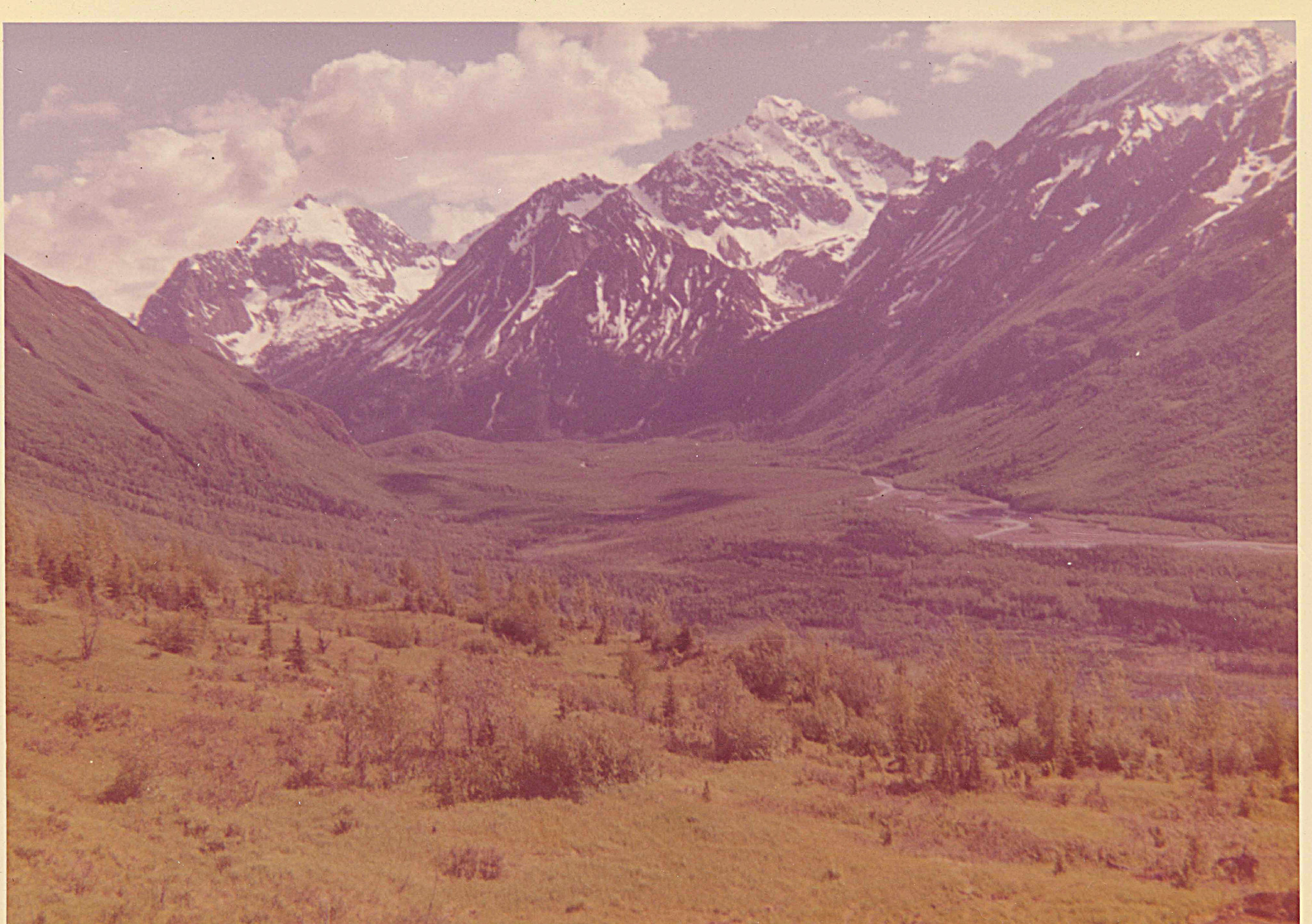
Well, I humbly must admit that I have to wonder how it could have taken me all the way through time to my 59th birthday to reconnect to something I so absolutely knew as a child on that mountain I had no question.  I will try to scan in a photograph that my sister just sent to me that will (again, and hopefully more clearly) introduce you to the Angel on the Mountain that was my closest friend and companion during my abusive childhood.

(Give me a moment here.  I have to dig through this pile of photographs for the one I am thinking of.)

I first met this angel when I was 7.  She was more real to me than anything else in my life, and she was my Companion and my Comfort.

This angel was a Presence in my life. There was in feeling no distance between us. While I could see her visually across the valley and over there perched on her mountain peak, I felt bonded to her.

This angel heard everything I ever said to her, but mostly in my misery I had no words, yet I knew she ALWAYS knew exactly who I was and what I felt.  I knew she always watched over me and never left ‘my side’ — and never would.

I hope you can detect her up there.  In my senses she was alive — and every time I looked up at her I was in a different spot, never exactly in the same one twice, so her shape changed subtly with my movements as if she, too, could move — though of course I never THOUGHT about these things.

I can look at this photograph my mother took probably in 1959 and there on the left in the back, at the end of the mountain range across from our Alaskan homestead where this picture was taken, I can see that angel up there as clear as day!

Her head is turned slightly to her right, and as a child I knew without ever thinking of it that she was looking at me, that she could see me just as clearly as I could see her.  Her wings spread out to her left and right, her dress cascades down the mountaintop below her.  In the summer she appeared as she does here.  In the winter she donned her winter dress, her halo turned whiter and her wings grew in vastness along the top of the mountain’s crest.

++

Yesterday as I loudly heard the words of Stevie’s song, “I blame the angels,” it was like a veil was torn away that has kept me from feeling the presence of angels like I was able to with THAT Angel on the Mountain when I was small and so terribly hurting.  I never knew I created that veil after I ‘grew up’.  In fact, I have shrouded my entire feeling experience of my childhood under this same (or similar) veils.

These veils, or shrouds, have buffered me from the emotional memory reality of my childhood suffering, as well as from most of the dissociated specific facts of my childhood memories.  I had to not only endure and survive my childhood, I ALSO had to endure and survive my adulthood!

Part of how I did that was to cast over my first 18 years of life a sort of cloak that not so much made it invisible as it did dim and obscure it from my awareness as I made my childhood so out-of-focus and obscure (like having a blindness, a terrible ‘vision’) that I could direct my attention elsewhere (at my adulthood).

++++

The way my thinking works, all of this I am writing about seems closely connected to an experience I had within hours after my double mastectomy surgery in December of 2007.  Nobody had told me prior to surgery what they told me afterward, and perhaps in part because of this I experienced the following:

I was given IV morphine for the first 20 or so hours after surgery.  During that time I did one very important activity — I stretched!  I sat up in bed, raised my arms as high over my head as I possibly could, and I stretched.  I continued to move my arms in this wide stretch in all directions — yes as I think of it, not unlike a butterfly might stretch its wings when it first exits its cocoon (or a new angel).  And as I instinctively performed this stretch without thought or intention, I could hear and feel (though there was no pain) a strange ripping, crackling, snapping inside my shoulders, across my chest and back.

I thought nothing of this until hours later when the surgeon stopped into my room and mentioned that many women experience a limitation in their range of motion due to this surgery.  As she verbally described what this limitation would be like I naturally raised my arms and searched for this limitation within myself.

It wasn’t there.

I had broken through whatever that kind of limitation could have been even before anyone had told me of its possible existence.

I mention this now because in my thought connections I realize that I am again experiencing a related kind of ripping through limitation.  Whatever veil-shroud I naturally created to obscure the pain, horror and reality of my infant-childhood of trauma and abuse  — because I HAD to do it to survive my adulthood — ALSO numbed my ability to experience my ‘Angel Love’.

Some part of that veil was ripped away yesterday on my birthday as I jogged around listening to Stevie Nicks wake up and hone in her musical echos, my ‘angel senses’.

++++

I realize now as I write that I am tired of words.  As a child, back there within that veiled and shrouded world of trauma and trouble, I had very little use for words, and I certainly did not use them to think with.  I was fully capable of thinking without words.  In that state of being, I could simply BE with that angel, a fact that at this moment helps me know a broader sense of Shakespeare’s statement, “To be or not to be.  That is the question.”

That is not an itty bitty personalized reality.  It is as big as the creation all of us are a part of.  I know myself well enough now to know I don’t think in terms of ‘faith’, and not even in terms of ‘belief’, either.

I didn’t have ‘faith’ in my intimate interrelationship with that Angel on the Mountain.  I didn’t have ‘belief’ in her unending and absolute love for me.  Both she and I were simply BE-ING.  We existed.  We were.

As I continue to stumble forward at this moment in my world of words I also know now that I can thank the fact that our family had no indoor bathroom for much of the assistance I received from my relationship with the presence of that Angel.  Sooner or later, no matter what punishment my mother was at the moment engaged in regarding me, I had to use the outhouse.

Those moments I walked out the door of our strange canvas-covered abode into the open air of the wilderness I was both in those moments NOT in my mother’s presence at the same time I WAS in the presence of that Angel as if she and I existed together in an entirely different universe than the one my mother existed in.

Most of my childhood my beaten body and my broken heart bled tears.  During the brief intermissions in abuse created by my having to go outside the ‘house’ into the air of wilderness freedom I was automatically blessed by the presence of that ever-present Angel on the Mountain who I understood without question knew everything about me and compassionately cared.

++++

Yesterday I was reawakened to what that feels like not only to be so loved by an Angel but to be able to receive that love as naturally as I receive air.  THAT angel was situated on THAT mountaintop and never left it (although her love felt like a physical presence as she expanded herself all the way across that valley to wrap me in it).  What I received for my birthday gift yesterday is not only the reawakened sense and knowledge of what that love FEELS like, but also the knowledge that there are angels EVERYWHERE that are all full of that same love for humanity.

I have no desire to complicate this gift with thoughts about ‘proof’ or ‘religion’.  These angels seem to be as much a part of this creation I am a part of as everything else is.  They simply ‘BE’.  I have greatly missed knowing this.  No matter what else I have had to ‘forget’ about my childhood, I will forget the existence and presence of these loving, compassionate, caring angels no more — hopefully forever.

(I swear!  I feel as though I am walking through ANGEL SOUP now and they don’t mind a bit!)

(The song lyric is from Stevie Nicks’ song “Wild Heart,” and literally is “Blame it on the angels.”)

++++

CLICK HERE – TALKING ABOUT THE POWER OF LOVE

++++++++++++++++++++++++

+RESEARCH: EPIDEMIC OF AUTISM AMONG YOUNG

++++++++++++++++

Is it abuse to pollute the growing and developing body-brain of our young?  This article on childhood autism increases came into my email box through a group I belong to — looks to me like one of the ‘classic’ windows for epigentic forces to alter genetic expression which may then possibly move forward through the generations affecting not only current offspring, but bringing the genetic responses and changes forward into the future.

What do we consider ‘acceptable risks’ and ‘acceptable losses’?  Take a look:

++++

http://www.huffingtonpost.com/stephen-barrie-nd/child-autism-epidemic-fir_b_696179.html

Child Autism Epidemic Firmly Linked to Environment

Stephen Barrie, ND

Author, medical researcher, entrepreneur

Autism among U.S. children has reached epidemic proportion. And it’s getting worse by the year.

Since the ’70’s, there has been a 60-fold increase in American children with autism. Currently one in every 100 U.S. children and one in every 58 boys are being diagnosed with autism. That’s over 2.6 percent of all male children in America. The number of autistic children expected to reach adulthood in the next 10 years along with their caregivers will exceed the population of Rhode Island and cost an estimated $27 billion in additional care beyond the almost $60 billion being spent on current autism-related costs. (1,2)

Under the specter of an autism epidemic sweeping America, Senator Barbara Boxer (CA) convened hearings last week on the “State of Research on Potential Environmental Health Factors with Autism.” (3)

The result?

Experts agree that the primary explanation for the dramatic increase in autism is toxic environmental exposure and gene-environment interactions. New research shows that even low-dose, multiple toxic and infectious exposures may be a key factor to the onset of autism.

One expert, Dr. Linda Birnbaum, Director of the National Institute of Environmental Health, testified that “Research supported by NIEH has clearly shown that it is not just genetics that causes neuro-developmental disorders such as autism but rather the interplay of both genes and the environment”.

Dr. Birnbaum also stated that NIEH has uncovered information on the role that early environmental exposures play in the development of a broad spectrum of childhood disorders, including not only autism but also ADHD, and other learning disorders.

Another expert, Dr. Paul Anastas, the U.S.Environmental Protection Agency’s assistant administrator, told the subcommittee that children are especially susceptible to the effects of chemicals in the environment because they eat, drink and breathe in more for their body weight than adults. They absorb a greater proportion of many chemicals in the environment than adults, and due to hand to mouth behaviors, young children tend to have higher exposures to contaminants, such as pollutants in the surrounding air and dust, deposited from lead paint, tobacco smoke, cleaning products, pesticides and other chemicals. (4,5)

We already know that prenatal and early childhood exposures to chemicals such as methyl mercury (commonly found in fish and some vaccines), lead (in paints), PCBs (in plastics such as baby bottles and food storage containers) and arsenic (in the air) can affect development of the nervous system and lead to developmental disability. (6,7,8)

Also, the developing brain and nervous system can be disrupted by much lower levels of environmental exposures than would affect adults. (9,10,11) You can read about the current levels of exposure in the just released CDC’s National Report on Human Exposure to Environmental Chemicals, a frightening document.

Dr. Isaac Pessah, Director of the UC Davis Center for Children’s Environmental Health, testified that many of the molecular and cellular systems associated with autism are the same ones that are the target of environmental chemicals currently of concern to human health because of their widespread use. He spoke of a critical need to identify which chemicals in the environment influence the same biological pathways that are effected in autism. Dr. Pessah said that limiting exposure to these chemicals is the only way to mitigate or prevent autism in susceptible individuals.

Increasingly, evidence links even chronic, low-level exposure to industrial pollutants to many of the most prevalent and disabling learning and behavioral problems in children.

Professor Bruce Lanphear Ph.D, of the Child & Family Research Institute, Simon Fraser University, reported that some of the most widely dispersed environmental toxicants, even at very low levels are risk factors for the “new morbidities” of childhood — both intellectual and behavioral impairments such as autism. Indeed, there is often no apparent threshold — in some cases the effects appear to be greater at the lowest levels of exposure. (12) Emerging evidence shows that a whole host of new environmental chemicals such as Bisphenol A, (the protective inner lining in tin cans and baby bottles) PBDEs, pesticides, phthalates and airborne pollutants are all associated with intellectual deficits or behavioral problems in children. (13,14,15)

Just prior to the Senate hearing, several important research papers were published that further documented the relationship between environmental toxins and autism:

• A study in India correlated the increased body burdens of lead and mercury with the severity of children’s autism — the more severe the autism, the higher concentrations of heavy metals were found in their bodies. (16)
• An exhaustive scientific literature search just completed in August shows that the link between autism and toxic exposures in infants is supported by current published research. (17)

My own recent study of a large autistic clinical database shows that children with autism had elevated levels in their bodies of several chemicals known to be neurotoxic. The children have genetic variations, which interfere with the proper detoxification of those chemicals. With over 2,000 patients in the database, my paper is one of the largest studies to show that environmental factors interacting with associated genetic components may be contributing to the causation of autism.

Development of the human nervous system begins in the womb and extends throughout childhood. During these periods of rapid development, the brain is vulnerable to some environmental exposures, which may have the potential to disrupt the chemical signals that organize development. Even small changes can have potentially major consequences for brain structure and function. Thus, even brief adverse exposure at these vulnerable stages can have lasting effects on brain function throughout life.

My report showed on average the amount of lead and mercury in the children’s blood was 50 percent higher than normal. Their genetic changes (SNPs) were related to what is called Phase I and Phase II detoxification — specifically the CYP and GST family of genes. This defect reduced the children’s ability to remove excess toxins from their bodies.

These autistic children also had a several fold higher level of bad gut bacteria and reduced levels of beneficial gut bacteria. Bad gut bacteria can produce neurotoxic amines and cause a “leaky gut” which allows toxic substances to more easily enter the circulatory system (see my previous Huffington Post entry “The Keys to Maintaining a Healthy Gut“).

You may read the full clinical study here:http://personalizedmedicine.posterous.com/environmental-factors-contributing-to-the-ons#

We as a society have a toxic chemical addiction, which we need to kick now. We need to be better informed consumers — choosing chemically free foods, products and environments, affecting change with our wallets.

Here are some Toxic Exposure Avoidance Tips for All of Us — And Especially For Pregnant Women. Start taking them, right now:

  1. Avoid eating foods that may contain high levels of toxic chemicals
  2. While fish are a good source of protein and omega-3 fatty acids, some contain high levels of mercury. Tuna, Cod and Mahi Mahi are ones to avoid. Wild salmon is a good healthy choice.
  3. Consume organic foods and drinks as much as possible.
  4. Use glass containers instead of plastic to store left over foods and drinks.
  5. Reduce our purchase of foods in cans as the can lining contains high levels of Bisphenol A (an endocrine disrupter linked to increased rates of cancer and abnormal behavior in children).
  6. Limit exposure to toxic household chemicals, pesticides and cleaning supplies. Look for natural alternatives.
  7. Install HEPA and carbon filter air purifiers in bedrooms to insure a healthy toxin free nights rest.

Exposure to toxic chemicals by pregnant women, fetuses and children has a high probability of causing autism and other neuro-developmental disorders and learning disabilities in those whose genetic profile expresses in a reduced ability to detoxify these chemicals. This is not “fringe” science; it’s fact.

The time for action is now. We must reduce our exposure to toxic chemicals for ourselves, for our children’s sake and for future generations.

We have a responsibility to protect those who cannot protect themselves. We cannot afford to be incurious, indifferent or uninformed when the price of inattention is disability and heartache — an overwhelming emotional and financial burden to families and society.

Ask for help: Tell your government that we must lessen our exposure to these chemicals. For the future of all Americans. Email or call your own representatives. Senator Boxer can be reached at: senator@boxer.senate.gov.
References

(1) Autism Society of America (ASA). 2003. Facts and statistics. Available: http://www.autism-society.org/

(2) Pennsylvania Department of Public Welfate. 2005 PA Autism Census Project: Final Report; Oct 2009

(3) US Senate Subcommittee on Environment and Public Works. Aug 2010

(4) National Research Council. 1993. Pesticides in the Diets of Infants and Children. National Academy of Sciences Press, Washington, DC.

(5) U.S. Environmental Protection Agency (EPA). 2005 Guidance on selecting age groups for monitoring and assessing childhood exposures to environmental contaminants. National Center for Environmental Assessment, Washington, DC; EPA/630/P-03/003F

(6) Wasserman GA, Liu X, Parvez F, Ahsan H, Factor-Litvak P, Kline J, van Geen A, Slavkovich V, Loiacono NJ, Levy D, Cheng Z, Graziano JH. 2007. Water arsenic exposure and intellectual function in 6-year-old children in Araihazar, Bangladesh. Environ Health Perspect. 115(2):285-9

(7) Landrigan PJ, Whitworth RH, Baloh RW, Barthel WF, Staehling NW, Rosenblum BF. 1975. Neuropsychological dysfunction in children with chronic low-level lead absorption. Lancet 1:708-712

(8) Rogan WJ, Ware JH. 2003. Exposure to lead in children – how low is low enough? N Engl J Med. 348:1515-1516

(9)(ATSDR). 2007. Toxicological profile for Lead. Atlanta, GA: U.S. Department of Health and Human Services, Public Health Service. http://www.atsdr.cdc.gov/ToxProfiles/tp13-c3.pdf

(10) Grandjean P, and Landrigan PJ. 2006. Developmental neurotoxicity of industrial chemicals. Lancet.;368(9553):2167-78.

(11) Jett DA, Kuhlmann AC, Farmer SJ, Guilarte TR.1997. Age-dependent effects of developmental lead exposure on performance in the Morris water maze. Pharmacol Biochem Behav.57(1-2):271-9

(12) Canfield RL, Henderson CR, Cory-Slechta DA, Cox C, Jusko TA, Lanphear BP. Intellectual impairment in children with blood lead concentrations below 10 micrograms per deciliter. N Engl J Med 2003;348:1517-1526

(13) Eskenazi B, Marks AR, Bradman A, et al. Organophosphate pesticide exposure and neurodevelopment in young Mexican-American children. Environ Health Perspect 2007;115:792-798

(14) Herbstman JB, Sjödin A, Kurzon M, et al. Prenatal exposure to PBDEs and neuro-development. Environ Health Perspect 2010;118:712-719

(15) Braun JM, Froehlich TE, Daniels JL, et al. Association of environmental toxicants and conduct disorder in U.S. children: NHANES 2001-2004. Environ Health Perspect 2008;116:956-962

(16) Priya MD. Level of Trace Elements (Copper, Zinc, Magnesium
and Selenium) and Toxic Elements (Lead and Mercury)
in the Hair and Nail of Children with Autism. Biol Trace Elem Res
DOI 10.1007/s12011-010-8766-2

(17) DeSoto MC. Sorting out the spinning of autism: heavy metals and the
question of incidence. Acta Neurobiol Exp 2010, 70: 165-176

++++++++++++++++

+A TURTLE CAN’T STAY ON ITS BACK — AND LIVE

++++++++++++++++++++++++

There is probably little else so disturbing, disorienting and disorganizing to a turtle or a tortoise than being flipped over onto its back.  It struggles and struggles to turn itself back over because if it stays on its back it dies.

It has taken me many disoriented and disorganized days to at last have this helpful image appear to me.  I have been feeling badly, on my way down from worse to ‘more worse’ and today realized that I absolutely had to figure out how to right myself because this downhill slide — well — SUCKS!

My anxiety level escalated right along with my disorientation and disorganization, and trying to understand what started all of this has taken some time.  Of course I know it all REALLY STARTED when I was born to my insane Borderline mother who knew nothing else to do with me than to batter and abuse me.

Thinking about this upside-down turtle image, I see how its disorientation and disorganization happens at the same time its anxiety level skyrockets as it tries everything in its power to right itself to save its own life.  I have been in some version of that state since the time I was born.  Every time my mother attacked me she in effect flipped me upside-down, creating within my growing body-nervous system-brain-mind-self a state of extreme anxiety (which actually never had time to leave me between attacks, either, because they were so frequent).

I don’t believe there is a way anyone can come out of their earliest childhood with a disoriented-disorganized insecure attachment to the world (and self) without the corresponding massive alteration to their nervous system-brain-body that is later named a so-called ‘anxiety disorder.  My dissociation, my major depression, my complex posttraumatic stress disorder are ALL anxiety-related complications from the severe and long-term infant-child abuse I suffered for 18 years.

What does this all mean to me RIGHT NOW?

I spent two weeks doing my friend a favor and babysitting the very quiet little office that she cares for otherwise.  There should have been nothing to upset me to the degree it did.  Yet at the end of those two weeks which ended last Thursday I could not find any place within myself that wasn’t fully anxious, disoriented and disorganized.  I am still not wholly ‘repaired’ inside from that experience — and the whole (vibrating) mess that is inside of me can also so upset me that everything just continues to get worse and worse until I find a way to stop this spinning while remaining right-side-up.

++++

While I was in art therapy graduate school 20 years ago I had a series of thoughts come to me — and these thoughts returned to me today.  Back then I drew a circle, like a compass, and in each of the four directions I placed a word:

East – MAKE

South – USE

West – FIX

North – BREAK

As I thought about it, it seemed that at any given time all of us are ‘doing’ one of those four things.  Then I thought about some people seem to be more oriented in their approach to the world in one of those four directions.

Because I have felt so flipped-on-my-back disoriented, disorganized and anxious lately I had to find something that could help me feel BETTER.  My body-self was created in, by and for such traumatic conditions that GOOD or BEST are almost foreign concepts to me.  When I am really off-kilter, just finding ways to feel BETTER rather than WORSE is about all I can manage.

Today I began to simply concentrate and focus on choices I can make right now while being very conscious about which of these four directions my actions are a part of.

We have had lots and lots of rain during our monsoon season this summer, such a blessing.  The weeds are unable to offer resistance no matter how big they have grown so I went out and pulled bunches of them up by their roots this morning — fixing my yard.

I then realized that if I want to go have pizza tomorrow evening for my birthday (59th) I HAD to finally fix my headlamps.  I had tried before and couldn’t budge the screws.  No doubt the passenger side light is the original on my ’78 El Camino.  But someone told me to get a can of PB Blaster to loosen the screws and it worked.  I did it.  I can drive in the dark now for the first time in four months.  Only problem now is I dropped one of those rusty little screws in the dirt and for the life of me can’t find it.  I hope it stays away from my tire and vice verso.

Then I began to clean my freezer and my refrigerator, fixing those too.  I repotted a little houseplant someone me gave last week, fixing that.  In spite of how crappy I might feel, I know that I can find little things, little tiny things that I can do that I can consciously connect to one of these four aspects of LIVING — as it contrasts to spinning down into a destructive cycle that has been familiar to me all of my life and can easily overwhelm my present if I am not very, very careful.

As I make my choices, direct my attention and energy, and accomplish even the smallest of tasks, if I connect what I am doing to one of the four directions of human activities I feel like I am turning these terrible BLUES around in a better direction.  And as I do this I can recognize that I am orienting myself and organizing myself around the things that I do to help things be better — both in my environment and within myself — one little action at a time.

(All of this is about the history of RUPTURES with or without REPAIR — and is what makes the difference between safe and secure attachment or unsafe and insecure attachment to and in the world.)

++++++++++++++++++++++++