+ATTACHMENT: SMART AND STUPID RESEARCH

++++

Personally I am tired of wandering around in the darkness wondering why I am not a particularly HAPPY person with some kind of an active, exciting, thrilling, fulfilling life full of social connections and emotional well-being.

Sure, my childhood sucked.  But, so what?  “Too bad, so sad, be glad you are grown up now and can make any choice you want to make about yourself in your life.  Get over it!  Get on with it!  Quit feeling sorry for yourself!  Your life is what you make of it.  Still having problems?  You must have bad genes.”

My response is, “Oh, yeah?  Says who?  What can ‘the research’ tell us?”

++++

My sister sent me an interesting link the other day that presents information directly connected to what I wrote in my December 26, 2009 post where I mentioned that I suspect my social-emotional brain shares some characteristics with autism.  Take a look at this Yahoo news article about research coming from a study of school children:

Texas study confirms lower autism rate in Hispanics

For every 10 percent increase in Hispanic schoolchildren in a given district, the researchers found, the prevalence of autism decreased by 11 percent, while the prevalence of kids with intellectual disabilities or learning disabilities increased by 8 percent and 2 percent, respectively.

The reverse was seen as the percentage of non-Hispanic white children in a district increased, with the prevalence of autism rising by 9 percent and the prevalence of intellectual and learning disabilities falling by 11 percent and 2 percent.

The observed relationships remained for Hispanic children after the researchers accounted for key socioeconomic and health care provider factors, although “urbanicity” of a district, median household income, and number of health care professionals did explain the increased percentage of autism among districts with more non-Hispanic white kids — a finding the researchers call “curious.”

Whether lower autism prevalence in Hispanics is attributable to other, still-unexamined socioeconomic, health care delivery or biological factors “remains a crucial area for further research,” Palmer and colleagues conclude.”

SOURCE: American Journal of Public Health, December 2009.

++++++++++++++++

Well, will you look at that.  All that time, effort and money spent on this research study and did they think to include a measurement of what matters most?  Did they include any kind of questions about size of immediate family, number of siblings, size of the dwelling, or amount of contact with extended family?

I can’t access the full research article online, but here’s what its abstract says:

Am J Public Health. 2009 Dec 17. [Epub ahead of print]

Explaining Low Rates of Autism Among Hispanic Schoolchildren in Texas.

Palmer RF, Walker T, Mandell D, Bayles B, Miller CS.

University of Texas Health Science Center.

In data from the Texas Educational Agency and the Health Resources and Services Administration, we found fewer autism diagnoses in school districts with higher percentages of Hispanic children. Our results are consistent with previous reports of autism rates 2 to 3 times as high among non-Hispanic Whites as among Hispanics. Socioeconomic factors failed to explain lower autism prevalence among Hispanic schoolchildren in Texas. These findings raise questions: Is autism underdiagnosed among Hispanics? Are there protective factors associated with Hispanic ethnicity?

++++

Researchers are evidently content to conclude their research with such statements as “this is a curious finding,” while they continue to ask their unanswered questions like, “Are there protective factors associated with Hispanic ethnicity?”  There is no reason I can think of to expect that degrees of human attachment don’t affect genes for autism just like it does for schizophrenia, suicide, depression, PTSD and other ‘disorders’ of the body-brain.

I have lived for the last ten years in a small town in southeastern Arizona on the Mexican-American border line.  The fence lies right behind my back yard.  99.9% of this town’s community is Hispanic.  Every family I know has a lot of children.  The children are cherished.  Every family has extended ties to extended family.  Their median income is low.  Many children often share a bedroom.  I have watched them as they grow from infanthood in the closest of interactions with one another within all age groups.  They are social and they are connected to one another.  Nobody is alone.

Duh, researchers.  Do you think that MAYBE the research findings might have to do with safe and secure attachment that builds for these people an excellently formed early social-emotional brain so that autism is not as likely to appear among their culture?

Is there some kind of STUPID gene operating among researchers that prevents them from bothering to consider collecting what is the most obvious information that would answer their questions?  Or is there some kind of implicit agreement among researchers to keep skipping the gathering of the most important attachment related information so they can keep on doing more and more stupid research without gaining any true understanding – because it gives them job security?

++++

I know this pattern exists.  The same kind of researcher ‘stupid gene’ operated during the South African – Kenyan youth research project on the consequences of trauma.  Follow this link for a description of the kinds of information the researchers collected on the 2000 teenagers in their study.  Did they include any standardized, accurate and useful assessment of attachment relationships among their subjects?  Of course not!  How could they justify spending more and more money on research to answer the puzzling results they found?

The most striking finding was the discrepancy in the rate of PTSD between South African and Kenyan adolescents in the context of equally high rates of trauma exposure (and even higher for specific types of trauma in the Kenyan sample).  The lower rate of PTSD in Kenya adolescents is difficult to explain.”  Seedat et al, 2004, p 173

Note the “difficult to explain” statement.  Read for yourself, “Give me more money so I can use my stupid genes and do more research.  I want to keep my job.”

These researchers noted at the conclusion of their massive project that for all the money spent and for all the extensive effort they put into their research, the were left unable to

“…account for higher rates of PTSD in the South African students, despite higher rates of exposure in Kenyan youth to both sexual assault and physical assault by a family member, as these are traumas that are likely to be repeated.  Further, these traumas were most likely to e associated with a PTSD full-symptom diagnosis.  This discrepancy is one for which we do not have an adequate explanation.”  Seedat et al, 2004, p 174

Obviously these Kenyan children were not necessarily safe and secure in their own home, so how might we consider that attachment information might help explain the difference in outcome between these two groups of extremely traumatized youth?

No standardized or valid attachment assessment tool exists.  These researchers do not seem to be bothered by its absence.  Even though they did not use the word ‘attachment’ in their research conclusions, these researchers did ‘wonder’ if the patterns of differences they observed might be related to the long history of cultural disruption that South Africa has endured in contrast to the retained cultural integrity of Kenya.

Can degrees of safe and secure versus unsafe and insecure attachment be related to degrees of cultural integrity?  The findings of both of these two research studies point in that direction.  Because neither study contained any (nonexistent) standardized collection of attachment information, both studies are left simply pointing in a “a direction for further research.”  Of course this doesn’t bother the researchers.  It guarantees their job security.

++++

The hole in the bucket of both of these studies validates my thinking.  It is the degree of safe and secure attachment that an infant-child has in its beginning with its mothering caregiver that most influences how a person’s genes manifest themselves as the very young body-brain develops.  The protective factors against any so-called ‘mental illness’, be it depression, aspects of autism, or PTSD are activated very early in a person’s development.

Looking at the end result of degrees of attachment security, even within school age children, tells researchers nothing about how their ‘subjects’ got to be the way they are.  I want to know, “How safe and securely attached were these children to their mothers and their other earliest caregivers from the time they were born – as their body-brain developed in interaction with the experiences the little one had in its environment?”

In my thinking, cultural integrity protects mothers and therefore protects the infants who benefit in their earliest, fundamental development from safe and secure attachment.  As the early body-brain is forming, information from the environment has already told an individual’s genes how to respond and adapt.  Although safe and secure attachment is certainly not guaranteed to children like those in Kenya, not EVEN in their home, the underlying structure of their body-brain seems to have included residency factors that protect them from PTSD.

++++

Without trying to explain the research today that describes the physiological impact that early stress has on development (notes for a lot of this research can be found HERE), I will simply present some links here today related to research that is showing how child abuse changes genetic expression:

Child Abuse Causes Damage at Genetic Level

++

Child abuse ‘impacts stress gene’

++

Infant Abuse Linked To Early Experience, Not Genetics

++

Gene protects adults abused as children from depression

Influence of child abuse on adult depression: moderation by the corticotropin-releasing hormone receptor gene.

++

The Neurobiology of Child Abuse and Neglect

++

Do Genetics and Childhood Environment Combine to Pose Risk for Adult PTSD?

Association of FKBP5 polymorphisms and childhood abuse with risk of posttraumatic stress disorder symptoms in adults.

++

Selected Publications of the Members of the Attachment Parenting International Research Group

++

And also, the results of a Google search for child abuse brain development

++++

Researchers need to come up with an accurate way to measure degrees of safe and secure versus unsafe and insecure attachment and add this measurement tool into the design of all research about the affects that trauma has on human beings throughout the lifespan.

Every research study being done that does not include a measure of degrees of attachment is missing the critical piece of information about how attachment creates resiliency factors that protect humans from ongoing problems related to trauma experiences.

All funding channels that support trauma-related research need to mandate that an assessment of the quality of human attachment be included.  Of course, this means that attachment patterns need to be taken most seriously as a primary factor that profoundly influences trauma research results.  Let’s do smart rather than stupid research!  Find a way to accurately measure degree and quality of human attachment – NOW!

++++

Please note:  I will be taking a break from the blog until Wednesday, January 6, 2010.  Best wishes for a Happy New Year 2010!

+++++++++++++++++++++++++++++++++++++

+TO BE OR NOT TO BE A TRAUMA-CHANGED HUMAN — THE QUALITY OF MOTHERING HOLDS THE ABSOLUTE KEY

+++++

Early mothering-infant caregiver interactions build a human body-brain-mind-self from the foundation on up.  We cannot change the way Nature remembers to make a human being.  If Nature’s laws are broken, a surviving infant-child-adult will suffer the consequences from having to change its early physiological development in adjustment to deprivation-trauma for the rest of its life.

+++++++++++

I am again returning to the writings of Dr. Daniel J. Siegel in his book The Developing Mind: How Relationships and the Brain Interact to Shape Who We Are (The Guilford Press, 1999).

Siegel writes:

What are the mechanisms by which human relationships shape brain structure and function?  How is it possible for interpersonal experience – the interactions between two people – to affect something so inherently different as the activity of neurons?”  (page 9)

I have already laid out in my thinking that human infant-children have basic needs that are met through having their Universal Human Rights met as described in the December 12, 1989 United Nations General Assembly document from the Convention on the Rights of the Child.  Yesterday’s post describes my belief that mothers are ultimately responsible for the well-being of the children they bring into the world.  Just as mothers are biologically designed to carry and birth offspring, they are also biologically designed to provide all that is necessary for an infant to continue to develop in the best way possible most critically through the first year of an infant’s life.

If a mother cannot or chooses not to provide for the necessary memory-making processes her infant requires for its best development, another WOMAN can certainly provide these experiences to an infant under the age of one.  What an infant needs, as I will begin to clarify today, is MOTHERING.  I am not using the word ‘mothering’ interchangeably with ‘nurturing’, which is certainly something anyone can provide.  Mothering is based on the biological memory contained within our specie’s DNA that forms the structure of human-being-making.

An infant’s body, including its nervous system-brain, grows best under adequate care provided by its mother.  Next in line for an infant’s best care are other women who also have the ability to adequately meet the developmental needs of the infant.  As I will describe here, those needs are very specific.  The wonder of making a human from ‘scratch’ is that under ordinary circumstances, women have always known from the origins of our species how to meet the needs of infants.  It does not take a rocket scientist to tell us how to mother.  I believe if we have not experienced infant-child deprivation and trauma-related changes in our own development ourselves as women that we are automatically born with everything we need to raise our offspring right – and by right I mean in the best way possible.

Siblings and other children have, I believe, always been important in the early care of infant-children.  They can certainly be adequate for the job on some levels if they have also been built from conception in the best way possible.  But children cannot take over the job because it is an appropriately regulated brain within the mother than interacts with the developing brain of her infant that paves the way for all future development of her offspring.  It is the ‘interpersonal experiences’ an infant has with its mother (or other mothering female) that shape its early forming (foundational) body-brain.

Love between an infant and its father is no less important than mother-infant love.  Fathers are also important to the well-being of an infant’s development, but nature has designed their contribution (other than the obvious first one) to be in the role of provider and protector of the mother and the infant so that the earliest needs of growing humans can be met by women.  Men tend to excite and overstimulate infants.  They are not biologically designed for the early job of establishing all the nerve-growth factors that create a balanced, healthy brain and nervous system in a tiny person.

Fathers are naturally meant to participate actively with their offspring AFTER the first year of life at the time that an infant has grown a body-nervous system-brain (at about a year of age) that allows it to venture away from its mother further and further into the exciting, stimulating bigger world.  Before that time it is the primary safe and secure attachment an infant has with its mothering caregiver that builds the foundation for all growth and development that will follow.

++++

Over the millennia of human evolution mothering has always been a basic, critically important process that happened naturally.  Mothers were adequately mothered in their own development so that nothing interfered with their memory of how to mother, and they were naturally able to go on to have offspring of their own that they, in turn, adequately mothered.

I do not believe that women evolved to share the earliest infant interactional experiences with men.  Women evolved to share these experiences with other women.  Living in cultures that today isolate women from one another is contributing to the difficulties women are facing in being the best mothers they were naturally designed to be.  In today’s world it has become too easy for women to forget what mothering young infant-children is supposed to be like.  I think it is a pitiful symptom of the decline in the value our species has always placed on the mother-infant-child relationship that makes us now have to turn to neuroscience to tell us about the specifics of building a human being that we have always naturally known how to do.

Even though women are biologically prepared to mother, even those fundamental memories can be tampered with, changed and removed through interactions a human mother has with all those around her as her own DNA memories are telling her how to prepare herself for life in the world she is born into.  The more disconnected mothering becomes from its biological roots, the more complicated our return to mothering naturally becomes.

++++

It does no good whatsoever to sit around, whine and wring our hands when any problem appears that needs to be resolved.  If it takes an understanding of brain development to convince women that the mothering of their infant-child is the most important job they will ever do, then so be it.  If it takes an education in the importance of safe and secure attachment experiences before an infant is one year old to build a ‘best’ human body-brain, we better get to work.

If we were not adequately mothered ourselves, these regions that Siegel is describing (below) have already been altered during their early growth periods of our own infant-childhood in direct response to the deprivations-traumas we experienced during our own development.  Pay particular attention to the information Siegel is presenting on the limbic system.  This system is the main area of the brain being built by mother-infant interactional experiences from birth until age one – and is directed in its development by the degree of safe and secure attachment an infant has with its earliest, primary caregiver.

Siegel writes:

The brain is a complex system of interconnected parts.  The “lower structures” include those circuits of brainstem deep within the skull that mediate basic elements of energy flow, such as states of arousal and alertness and the physiological state of the body (temperature, respiration, heart rate).  At the top of the brainstem is the thalamus, an area that serves as a gateway for incoming sensory information and has extensive connections to other regions of the brain, including the neocortex, just above it.” (page 10)

Pausing for a moment, I will note here that human infants are not developed enough when they are born to be able to regulate or modulate much about themselves at all.  Their body can regulate respiration and heart rate, but they are not yet developed enough to even control their bodily temperature.  An infant is born with more fat cells on its back side to keep it warm, which works fine because adults naturally remember that holding a baby close to one’s body keeps its front side warmest!  Adult caregivers, especially the mothering ones, provide all the interactional experiences necessary to ‘train’ a baby during its development so that it can increasingly regulate everything about itself in the world.  This happens through natural processes – we hope.

Siegel continues, and we have to remember that he is describing brain areas and functions that develop within an infant-child during a succession of growth and developmental windows over time (note:  He wrote the following as one paragraph that I am breaking apart for ease of reading):

The “higher structures,” such as the neocortex at the top of the brain, mediate “more complex” information-processing functions such as perception, thinking, and reasoning.  These areas are considered to be the most evolutionarily “advanced” in humans and mediate the complex perceptual and abstract representations that constitute our associational thought processes.”

[My note:  These regions are formed later in an infant-child’s developmental journey.  The neocortex is not fully developed in humans until between the ages of 25-30.  However, as Dr. Martin Teicher notes, traumatized and abused children’s neocortex actually “atrophies early” and never finishes its course of development properly.  For these survivors, the best growth and development of their neocortex has been robbed from them during their Trauma Altered Development that also affected the development of all the other regions – and the nervous system and immune system – of the survivor during all their preceding critical developmental stages.]

The centrally located “limbic system” – including the regions called the orbitofrontal cortex, anterior cingulate, and amygdala – plays a central role in coordinating the activity of higher and lower brain structures.  The limbic regions are thought to mediate emotion, motivation, and goal-directed behavior.  Limbic structures permit the integration of a wide range of basic mental processes, such as the appraisal of meaning, the processing of social experience (called “social cognition”), and the regulation of emotion.  This region also houses the medial temporal lobe (toward the middle, just to the sides of the temples), including the hippocampus, which is thought to play a central role in consciously accessible forms of memory.

The brain as a whole functions as an interconnected and integrating system of subsystems.  Although each element contributes to the functioning of the whole, regions such as the limbic system, with extensive input and output pathways linking widely distributed areas in the brain, may be primarily responsible for integrating brain activity.

When we look to understand how the mind develops, we need to examine how the brain comes to regulate its own processes.  Such self-regulation appears to be carried out in large part by these limbic regions.”  (pages 10-11 – bolding is mine)

++++

If I cut the fluff, I can simply say that a screwed up, dysregulated mother will ‘download’ her screwed up, dysregulated limbic brain directly into her infant’s growing brain – especially the earliest forming limbic structures —  from birth to age one.  It is within the attachment, caregiving interactions a mother has with her infant that the infant’s brain is formed.  These interactions FORM the infant brain through the ongoing interactional experiences that an infant has with its mother.

Evolution has determined that this is the way growing a body-brain happens.  No infant is ever given the choice to say, “Gee whiz!  There’s something wrong with my mother!  She has an awfully dysregulated brain and she is forcing me to grow one, too!  Help!  Somebody get me a different mother NOW!”

Nope.  Doesn’t happen this way unless someone external to the mother-infant relationship is smart enough to helpfully intervene (and this usually means consciously informed in today’s world) because they know that a dysregulated-brained mother is creating a replica of her own brain as she builds the brain of her infant.

++++

Siegel continues, and this information is critically important.  Any of us who have ‘anxiety’ related disturbances in our body suffered changes in our Hypothalamic–pituitary–adrenal axis (HPA axis responsible for regulating the stress response), as it was formed in us through combinations of early deprivation-trauma to these developing regions:

The limbic and lower regions of the brain also house the hypothalamus and the pituitary, which are responsible for physiological homeostasis [Linda note:  or feedback control.  Our earliest attachment experiences build into our body a memory of how to BE in relationship to our center point of balanced equilibrium.  This point is set at CALM in the best safe and secure attachment environment, and is set somewhere else if we experience deprivation-trauma during this early developmental stage.], or bodily equilibrium, established by way of neuroendocrine activity (neuronal firing and hormonal release).  Stress is often responded to by the “hypothalamic-pituitary-adrenocortical (HPA) axis, and this system can be adversely affected by trauma.  This neuroendocrine axis, along with the autonomic nervous system (regulating such things as heart rate and respiration) and the neuroimmune system (regulating the body’s immunological defense system) are ways in which the function of the brain and body are intricately intertwined.”  (page 11)

[My note:  Autonomic Nervous System – ANS: Remember sympathetic GO arm and parasympathetic STOP arm “pair a brakes” as I have written about it earlier in relation to the age one onset of the physiological experience of shame.  I also believe, and I have tracked my thoughts through research, that it is the developing immune system itself that orchestrates through signals to the growing infant whether or not the world is a safe, secure benevolent place to be living in or not.  If the immune system, whose job it is to protect and defend us down to our most basic molecular level,  identifies deprivation-trauma, it signals the entire cascade of Trauma Altered Development to occur.]

++++

I will close today’s post by adding the following description Siegel presents about brain development as it applies most importantly to an infant’s early body-brain development before the age of one:

The activation of neural pathways directly influences the way connections are made within the brain.  Though experience shapes the activity of the brain and the strength of neuronal connections throughout life, experience early in life may be especially crucial in organizing the way the basic structures of the brain develop.  For example, traumatic experiences at the beginning of life may have more profound effects on the “deeper” structures of the brain, which are responsible for basic regulatory capacities and enable the mind to respond later to stress.  Thus we see that abused children have elevated baseline and reactive stress hormone levels.”  (page 13 – bolding is mine)

Researchers seem forced to use the term “may be” in their writings to avoid some kind of potential peer sanction against their own thinking.  There is nothing “may be” about how early experience IS “especially crucial in organizing the way the basic structures of the brain develop.”  What I hope to convey today is how profound and permanent adaptations to deprivation-trauma are in terms of infant body-brain-nervous system-immune system development.

Early attachment interactional experiences that an infant has with its primary mothering caregiver tells all the mechanisms that govern its early development HOW to build themselves in preparation for either a benevolent, safe and secure world or for an unsafe, insecure and malevolent one.  Once all these critical regulatory structural systems have been built – with or without the need for changes – they will operate on an implicit memory unconscious level, guiding a person’s future interactions from within the core of their body, for the rest of their lives.

If infant mothering is inadequate so that deprivations and trauma are allowed to occur during first-year critical growth stages, Trauma Altered Development is GOING to occur.  There is no possible way it can’t.  And there is no possible way to consider Trauma Altered Development without considering the quality of mothering an infant receives because it is those interactions an infant has with its mothering caregiver that either tell an infant’s DNA to respond to trauma or not to.

If deprivation-trauma does exist in an infant-child’s interactions with its mothering caregiver, this ONLY happens because the same kind of deprivation-trauma was built into the infant’s mother at the start of her life.  This is the way dysregulated trauma-based patterns of ‘being in the world’ topple on down through the generations.  It is in this way, and through these processes that the malevolent conditions of the world are signaled through direct mother-infant communications so that Trauma Altered Development –built right into the forming infant body-brain — can change a growing human into one that can survive in a malevolent world both in the present as well as in the future.

Trauma and the memory of the experience of trauma causes physiological developmental changes because they both build the traumatized infant’s body at the same time they build themselves into it.  This is not like knitting a sweater where an identified mistake can be fixed by unraveling the sweater back to the mistake and correcting it, so a person can start over again and do things right.

Trauma-related adaptive physiological changes that happen within a developing human infant cannot be corrected later.  Any future efforts made to give such a survivor a ‘better life’ have to happen WITH and WITHIN the body-brain that was altered in the first place.  Humans do not REALLY get a second chance to mother an infant right, and we need to drop the illusion that we do.

We have no power to change the way Nature remembers how to make a human being.  The way we form, through mothering-infant social-attachment interactions happens according to Nature’s laws.  If those laws are broken through unsafe, insecure, malevolent early experiences, the developing body-brain of the infant will build all that information into its most basic, fundamental trauma-changed structures.  Survivors of infant-child abuse and maltreatment are left to live with and within a trauma-altered body-brain for the rest of their lives.  I kid you not.

++++++++++++++++++++++++++++++++++++++++++++
PLEASE NOTE:  Do not take anything I say as a reason to alter any ongoing treatment, therapy or medication you are receiving.  Consult with your provider if you find something in my writing that brings questions to your mind regarding your health and well-being.

+++++++++++++++++++++++++

Please feel free to comment directly at the end of this post or on

+++++++

Your Page – Readers’ Responses

++++++++++++++++++++++++++++++++

+”MOTHER! WHERE ART THOU?” — RESPONDING TO AN INFANT-CHILD’S CRY OF NEED

++++++++++++++++++++++++++++

I did not intend to write about what found its way out the ends of my finger tips on this keyboard today.  Degrees of deprivation of a young human’s developmental needs cause degrees of deprivation adaptations to happen – translated by the tiny growing body as degrees of trauma – as they build the body from its start. When mothers cannot, or will not provide the necessary care to their infant-children during their critical early developmental stages some degree of Trauma Altered Development will occur.

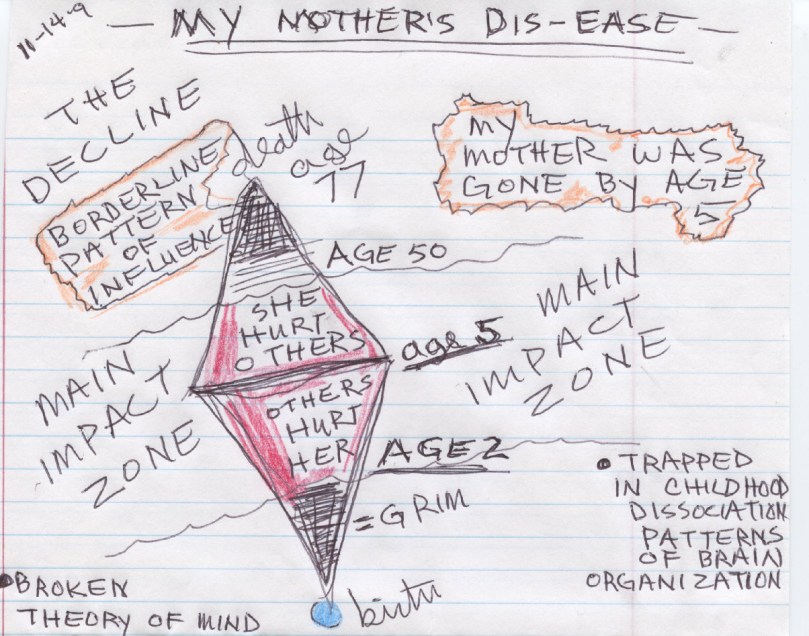
‘Response-ability’ – are mother’s losing their ability to adequately respond to the needs of their offspring?  Is our society losing its ability to respond to the needs of mothers so that they can no longer adequately respond to the needs of their young?  My mother was simply on the far end of the infant-child deprivation of need spectrum.  How many other mothers share this offspring-deprivation spectrum with her?

++++++++++++++++++++++++++++

Humans are presented at conception with a package of material that is our portion of our species’ memory contained within our genetic material.  Within our DNA is the information needed to send and receive signals of communication within our growing self in relationship to the environment outside of us.  Within this DNA package we were also given abilities to accomplish an impressive range of flexible adaptation to and within our first environment.

By the time we are born our genetic memory as contained within our DNA, including the memory of what to DO with this DNA, has already accomplished an impressive amount of remembering work.  If we are fortunate, all has gone well and we appear into our next arena of development healthy.  Whatever adjustments we needed to make in order to survive and grow within our first environment were made efficiently and well.

We carry all our communication and flexible adaptive abilities right out of the womb with us, along with the rest of the package of our DNA material.  But being born has nothing to do with us having completed all of the most critical stages of our early development.  Nature was faced with two interconnected problems:  How to make an increasingly complex human being even though if left in the womb too long it would be too big to get out without killing its mother, and how to provide continued required nurturing for the infant while it completed the rest of its critical early development.

Nature solved these two problems through a sophisticated maternal preparation process that genetically and hormonally gives mothers what they need to not only carry the unborn but also to be prepared to care for the newborn as it passes through the rest of its early body-brain critical-windows of developmental stages.

All this probably sounds common knowledge to the point of, “Ho!  Hum!” until we begin to understand that HOW the mother cares for her offspring continues to determine the course of its development post-birth just as profoundly as it did pre-birth.  The mother IS an infant’s universe, and it is to THIS universe that an infant’s DNA-communication-adaptation package is going to continue to respond to in its development.

Certainly there are usually other caregivers present surrounding a newborn.  All the interactions an infant has with these significant others are important, but it is to women, the females of our species, that Nature gave the specific biological, physiological nurturing abilities an infant requires to continue its postnatal development in the best way possible.  Any deviation from what is best for an infant will result to it having to make some form of alteration as it adapts to a less-than-best environment.

Deprivations signal to the infant’s growing body that stress exists in the world it is being made for.  Changes that happen in an infant’s course of development depend on the degree of deprivation it is exposed to during the critical windows of its early growth stages.  These changes can and will be made because the original DNA package the infant received at conception contains information that not only tells the infant what conditions of its world ARE less-than-best, how to detect them, but also HOW to adjust to them in order to survive.

Depending on temperament and personality of an infant as contained within its DNA, there are allowable degrees of deprivation to which infant-children can adapt without noticeably altering the direction their overall development has to take.  Results from many years of twin study research has shown that while 50% of temperament and personality stem directly from DNA the other 50% comes directly through the experiences a developing infant-child has within its environment.

In the sophisticated juggling act that an infant-child engages with in interaction with its early primary caregiver, the margin for allowable deprivation-before-adaptation is much smaller than we might think.  I believe that we have reached a point in civilization where the given boundaries of what an infant can flexibly adapt to without having to fundamentally CHANGE itself for survival in a malevolent world can be usefully identified.

In line with the adage that “When a disease appears so will its cure,” it is now, at this point in our evolution, as women make major changes in their lives that affect the quality of care they provide to their young offspring that we must understand how these changes are impacting infant-child development.  Just because cultures allow women increasing opportunity to change their lives during their childbearing years does not in any way mean that the critical needs of developing infant-children can or will change in equal measure.  If these needs are not met, trauma-based changes will occur within the developing body-brain that will last a life time.

Advancing attachment research and increasingly sophisticated findings from the field of development neuroscience are beginning to show us in detail exactly what the best early caregiving environments are that meet the needs of young infants in the best way possible.  If mothers are no longer prepared to take care of offspring the way nature designed them to within a benevolent world in the first place, their little ones are going to suffer changes in their own development as they adapt to the deprivations present within their early environment.

++++

I am obviously not simply writing today about the long term and permanent adaptive adjustments an infant-child body-brain has to make to survive a severely abusive malevolent early environment as it prepares for a lifetime of living in the same.  I am talking about the universal human needs of children.  Any deprivation of basic need an infant-child suffers exists on a continuum of severity, as do the developmental changes these deprived little ones will experience and suffer from for the rest of their lives.

We have to ask ourselves, “How much deprivation of an infant-child’s fundamental human needs is OK?  How much deprivation is allowable?”  Given the 18 years of severe maltreatment I suffered from birth and throughout my childhood, I am sensitized to concern about the developmental needs of human infant-children from the far end of the maltreatment continuum.  At the same time, it is because I have been forced to learn about the permanent adaptive changes a developing little one will have to make to deprivations that I can stand on the line of this continuum and see how these degrees of deprivation cause changes all the way along its length.

I have thought long, hard and deeply about the topic of human infant-children’s fundamental needs during their early developmental stages.  I have honed my thinking to the point where what I know about the topic appears to be fact.  Best-possible human development requires that certain fundamental human needs be met adequately or some degree of deprivation-trauma will cause adaptive changes to occur during these developmental stages that create corresponding degrees of deprivation of best well-being for a lifetime.

When a society loses sight of the critical role mother’s play in the quality of their offspring’s development that society is in a state of decline.  This slide will take such a society past ‘shabby’ right into ‘a shambles’.  With 75% of our nation’s 17-24 year old young adults being currently unfit for military service I would say our national slide is moving quickly into the ‘shambles’ state.  I will also say that I strongly suspect this rapid decline of quality of life among our nation’s youth can be directly correlated with mothers’ increasing exit from their job of providing for the fundamental human developmental needs of their young infant-children.  (Keep in mind, my maniac abusive mother was a stay-at-home mom!)

I absolutely believe that when a mother brings offspring into the world it is her naturally given responsibility to meet the best-possible developmental needs of that infant-child.  If she chooses to pursue her own life away from her offspring, it is her responsibility to know exactly what the needs of her infant-child are, and to make absolutely certain those needs are being met elsewhere.  If mothers cannot or will not take care of their offspring, even with encouragement and assistance, those little ones need to be removed and be cared for appropriately – elsewhere.

In cases such as my mother’s was, it was (or should have been) obvious that something went terribly wrong during her own young development that caused her to adjust in ways that prevented her from being a mother to me at all.  But it is easy to point a finger at such a complete disaster of a mother while at the same time not paying attention to the kinds of deprivations that cause deprivation/trauma-related changes to happen in the body-brain development of little ones in much less obvious ways.

Any deprivation of ‘best’ will create a deprivation-based memory to be built into a human being’s developing body because memory builds our body in the first place.  Every single adjustment away from ‘best’ treatment in a ‘best’ environment is translated by the body into a need to prepare for a ‘less than best’ future.  When these changes happen particularly during the first year of life, they affect all of development from those foundational changes onward in ways that are permanent and can never be reversed.

It is the degree of quality in mothering during the first developmental years of life that causes these changes to happen.

+++++++++++++++++++++++++

Please feel free to comment directly at the end of this post or on

+++++++

Your Page – Readers’ Responses

++++++++++++++++++++++++++++++++

+EARLY TRAUMA MEMORY CHANGES ‘THE BODY’ WE DO ALL OUR REMEMBERING WITH

++++++++++++++++++++++++++++++++++++++++++++
It is not possible to talk about how we developed into the people we are today without talking about memory.  It is not possible to talk about our Trauma Altered Development without first considering how all our experiences were processed by and stored within our body as memory that built us from our beginning.

Experience forms us.  If this were not true, early infant-childhood trauma would not have the absolute power to change our development that it does.  We cannot talk about how a human being develops or how it remembers itself in the world without thinking in terms of early attachment experiences.  Memory is not only built into the body-brain, it builds the body-brain that does the remembering.

I am including information in today’s post written by Dr. Daniel J. Siegel in his book The Developing Mind: How Relationships and the Brain Interact to Shape Who We Are (The Guilford Press, 1999).  Please see the scanned image below of his chart about the types and characteristics of memory.

It is much easier to think about ‘memory’ in terms of this single, simple word.  But there is nothing simple about memory.  Memory is what our DNA is made of.  We carry genetic memory within us from the instant we are conceived.  From that instant our experiences within the environment begin to tell our DNA about the conditions of the world we find ourselves within so that we can adjust ourselves in every way possible to survive within the conditions of the world we are being made in and for.

++++

All of the terms that Siegel uses in his chart (below) describe different kinds of memory processes.  Siegel says:

From the first days of life, infants perceive the environment around them.” (page 28)

More accurately, humans “perceive the environment around them” — and within them — from the instant of their conception.  Their DNA has already begun the process of adapting within the conditions of a person’s earliest world.  What Siegel is saying here is that the postnatal infant, once it has been born and now lives independently in a body outside of its mother, continues to process experience in the form of memory.  Memory happens at the point an individual encounters the world outside of its own skin, takes information about the world and uses it to create an increasingly advanced ‘self in the world’ (which of course includes the body).

Experience and early growth and development of an infant-child’s entire body, INCLUDING the brain, are intimately, fundamentally and absolutely intertwined and interconnected.  Siegel writes:

At birth, the infant’s brain is the most undifferentiated organ in the body.  Genes and early experience shape the way neurons connect to one another and thus form the specialized circuits that give rise to mental processes.  In this way, experiences early in life have a tremendously important impact on the developing mind.  The differentiation of circuits within the brain involves a number of processes including (1) the growth of axons into local and widely distributed regions; (2) the establishment of new and more extensive synaptic connections between neurons; (3) the growth of myelin along the lengths of neurons, which increases the speed of nerve conduction and thus…enhances the linkage among synaptically connected nerve cells; (4) the modification of receptor density and sensitivity at the postsynaptic “receiving” cell making connections more efficient; and (5) the balance of all of these factors with the dying away or pruning of neurons and synapses resulting from disuse or toxic conditions such as chronic stress….Experiences lead to an increased activity of neurons, which enhances the creation of new synaptic connections.  This experience-dependent brain growth and differentiation is thus referred to as an “activity-dependent” process.”  (page 14)

The entire process described in the above paragraph is how memories make us.  This is not an arbitrary choice.  Memory makes everyone through this same interactive experience-memory-body making process.  Looked at in this way, who and what we are on every level of our existence is a result of how we interact in our biological-physiological very real body with the experiences of our life within the environments we pass through — from conception to death.

++++

MIND is not a tangible ‘thing.’  Brain is not MIND.  MIND cannot operate separately from the physiological body that gives rise to it and informs it for a person’s lifetime.  The entire foundation for our growth and development from birth happens through our earliest interactions with our attachment caregivers.  If our earliest experiences are unstable, toxic, traumatic and malevolent, the direction of our growth and development will be changed.

Siegel writes:

Interpersonal experiences continue to influence how our minds function throughout life, but the major structures – especially those that are responsible for self-regulation – appear to be formed in the early years.  It is for this reason that we will look closely at the early years of life to understand the ways in which the mind develops and comes to regulate its own processes.”  (pages 14-15)

Siegel proposes “…that the mind develops at the interface of neurophysiological processes and interpersonal relationships.  Relationship experiences have a dominant influence on the brain because the circuits responsible for social perception are the same as or tightly linked to those that integrate the important functions controlling the creation of meaning, the regulation of bodily states, the modulation of emotion, the organization of memory, and the capacity for interpersonal communication.  Interpersonal experience thus plays a special organizing role in determining the development of brain structure early in life and the ongoing emergence of brain function throughout the lifespan.”  (page 21)

++++

It is not possible to consider human growth and development without considering the kinds of early attachment experiences an infant has with its caregivers.  In my thinking, the kind of interpersonal signaling that Siegel describes here even governs our conception and all our interactive experiences from the time that conception happens.

It is here that I have to say that because I am a survivor of early and long term severe abuse trauma that caused me to change in my development, I begin to take issue with Siegel’s thinking.   I do not have the luxury of taking the kinds of liberties in my thinking that nearly all non-traumatized people can afford to take.

I have found that research-writers frequently make a giant leap between ‘infant’ and ‘child’ in their thinking and this bothers me.  That is why I use the term ‘infant-child’ most often in my own writing.  An ‘infant’ is not the same as a ‘child’.  There is a universe of critical developmental impact and room for Trauma Altered Development to occur between these two stages of being.  Siegel makes that giant leap here as he continues:

One fundamental finding relevant for developing this “interpersonal neurobiology” of the mind comes from numerous studies across a wide variety of cultures:  Attachment is based on collaborative communication.  Secure attachment involves contingent communication, in which the signals of one person are directly responded to by the other.  Sounds simple.  But why is this type of reciprocal communication so important?  Why doesn’t it happen in all families?  During early development, a parent and child “tune in” to each other’s feelings and intentions in a dance of connection that establishes the earliest form of communication.  Mary Ainsworth’s early studies suggest that healthy, secure attachment requires that the caregiver have the capacity to perceive and respond to the child’s mental state.” (page 21)

++++

“Collaborative communication” even happens inside our own bodies as our cells signal one another.  It happens on our molecular levels as our DNA interacts with the environment we live in.  Without collaborative communication life cannot continue.  Life happens on its fundamental levels through this “dance of connection” that Siegel is describing.  These signaling patterns and the information that they transmit form our entire body on all levels, not ‘just’ the brain.  Our brain, as a part of our Central Nervous System (CNS) processes all the signaling information going on within our entire body.

Siegel states that neuroscience can now describe

“…the mechanisms underlying how these early reciprocal communication experiences are remembered and how they allow a child’s brain to develop a balanced capacity to regulate emotions, to feel connected to other people, to establish an autobiographical story, and to move out into the world with a sense of vitality.  The capacity to reflect on mental states, both of the self and of others, emerges from within attachment relationships that foster such processes.  These patterns of communication literally shape the structure of the child’s developing brain.  These important early interpersonal experiences are encoded within various forms of memory.”  (pages 21-22, bolding is mine)

These earliest attachment experiences do not ‘just’ form the child’s developing brain.  They contribute to the formation of the entire body including the nervous system and the immune system because they are communicating to the growing body information in the form of memories about either the benevolent or malevolent environment the infant-child is preparing to live in for the rest of its life.

++++

My thinking continues to deviate from Siegel’s as he begins in his writing to specifically discuss the impact of memory on an infant-child’s development.  I have to read between his lines and begin to translate what he is saying through the filter of my own experiences from birth.  Siegel states:

Memory is more than what we can consciously recall about events from the past.  A broader definition is that memory is the way past events affect future function.  Memory is thus the way the brain is affected by experience and then subsequently alters its future responses.  In this view, the brain experiences the world and encodes this interaction in a manner that alters future ways of responding.  What we shall soon see is that this definition of memory allows us to understand how past events can directly shape how and what we learn, even though we may have no conscious recollections of those events.  Our earliest experiences shape our ways of behaving, including patterns of relating to others, without our ability to recall consciously when these first learning experiences occurred.”  (page 24 – I added underlining to what Siegel had italicized)

I do not disagree with Siegel’s words, but from my point of view, his thinking is too limited to apply to what I, as a Trauma Altered Development survivor, most need to understand.  DNA is memory.  DNA has recorded within it all the information needed to remember how to make a body from a single cell.  DNA contains the record of what we need to know to be built from conception into a human being rather than into a leaf, a turnip or a toad.

It is not ‘just’ the brain that “experiences the world and encodes this interaction in a manner that alters future ways of responding.”  Our brain does not pursue a course of development that is in any way separate from the ongoing development of our entire body down to its basic molecular operations.  Experience is translated by the mechanisms that tell our DNA what to do every step of the way.  I now have to consider the research discovering and describing epigenetic changes has happened since the 1999 publication of this book.

While Siegel says “this definition of memory allows us to understand how past events can directly shape how and what we learn, even though we may have no conscious recollections of those events” I must expand my thinking to include how “past events” in the form of memories build the entire body.  I have to expand my concept of “learning” to include the learning that is contained within our DNA itself, within the mechanisms that tell our DNA what to do, within the cells of our body that signal one another and receive signals from the larger environment, and within our entire body that contains a brain that eventually grows and develops an ability to inform our mind.

Because I grew and developed from birth in a malevolent environment that influenced my development on all my levels except the fundamental DNA I was conceived with, I cannot take for granted that any of my ensuing development post-birth was not affected by the influence of trauma, and therefore altered.

The only way I can begin to truly understand myself in the world is to begin to understand that trauma and the memory of trauma built my entire body in the first place, and this trauma-formed (trauma in-formed) ‘remembering body built from trauma memory’ is itself the one that I remember every memory with.  Every memory I have, conscious or not, happens within this trauma changed body.

++++

Siegel:

In a direct way, experience shapes the structure of the brain.”  (page 24)

Add to this, in a direct way experience shapes the structure of the body itself.

Siegel:

The infant brain has an overabundance of neurons with relatively few synaptic connections at birth, compared to the highly differentiated and interconnected set of connections that will be established in the first few years of life.  Experience and genetic information will determine to a large extent how those connections are established.  Memory utilizes the processes by which chemical alterations strengthen associations among neurons for short-term encoding and actually activate the genetic machinery required for the establishment of new synaptic connections for longterm memory storage.”  (page 25 – bolding is mine:  I suspect trauma interruptions in the process lead to dissociation)

Experience interacts with our genetic information.  They do not operate separately or independently.  Human beings are created to be adaptable creatures within the realm of what is possible for each of us as individual members of our species.  At its most fundamental levels, all these interactions are stored within our body as memory, and from our beginning these memories are stored as implicit memory that, according to Siegel,

“…involves parts of the brain that do not require conscious processing during encoding or retrieval.  When implicit memory is retrieved, the neural net profiles that are reactivated involve circuits in the brain that are a fundamental part of our everyday experience of life:  behaviors, emotions, and images.  These implicit elements form part of the foundation for our subjective sense of ourselves:  We act, feel, and imagine without recognition of the influence of past experience on our present reality.”  (page 29 – bolding is mine)

People who do not have a body that developed, grew and formed in a malevolent environment of trauma have a different body than does an early traumatized survivor.  The differences in the kinds of early experiences between these two groups formed different memories into the body that will then be the body that remembers everything else in their life time.  That “we act, feel, and imagine without recognition of the influence of past experience on our present reality” includes everything about our self in the world as determined through our earliest caregiving experiences in the world that built us.

People who did not experience Trauma Altered Development do not have to concern themselves with how their past experiences influenced their present reality.  They can roll on down the road of their lives having been built in a ‘good enough’ benevolent world.  Those of us who suffered severe maltreatment during our formative stages will experience the impact of those traumas within the very fiber of our body in which we live our lives.

Nearly all people who experienced Trauma Altered Development have experienced adulthoods that are less than optimal – and most of us eventually are told that we have ‘symptoms’ that place us in some ‘dysfunctional’ category or another.  NONE of us have been told the facts that I just outlined above.  NONE of us have been told that it is not only the terribly harmful things that were done to us that are our problem, not the memory of these experiences that we might or might not consciously remember that is our problem, but that it is the body we live in that was itself built BY THE EXPERIENCES OF TRAUMA we endured and changed as a consequence – through which we live our life and remember everything else with for the rest of our life – that has made us into a different kind of person than non-early-traumatized people are.

This is what Siegel is not telling me.  Severe trauma so changes us in our development that we become what Teicher’s group calls ‘evolutionarily altered’ beings.  I want to know what that means, because I know that without having had these human resiliency factors that allowed me to transform trauma memory from birth into a body that could survive, I would not be here at all.

++++++++++++++++++++++++++++++++++++++++++++

from page 33, "The Developing Mind: How relationships and the brain interact to shape who we are," by Daniel J. Siegel

++++++++++++++++++++++++++++++++++++++++++++

PLEASE NOTE:  Do not take anything I say as a reason to alter any ongoing treatment, therapy or medication you are receiving.  Consult with your provider if you find something in my writing that brings questions to your mind regarding your health and well-being.

+++++++++++++++++++++++++

Please feel free to comment directly at the end of this post or on

+++++++

Your Page – Readers’ Responses

++++++++++++++++++++++++++++++++

+THOUGHTS ON THE TRIGGER POINT OF SHAME

++++

I have the advantage of trying to work my way through trauma related information using my own experience as a basis for what I know, rather than being locked into any established patterns of thinking about either trauma or the so-called ‘mental illnesses’ that are directly connected to Trauma Altered Development (TAD).   I am writing a ‘forensic autobiography’.  That means I write from the perspective of being a ‘confessional’ rather than from being a ‘professional’.  I am free to think any way I want to about the topic of trauma as it concerns me and others like me.

I try to understand what the developmental, attachment, and neuroscience experts say about the topic of TAD, but I am certain that if I line up my conclusions on the topic against these expert findings we will not always match point by point.

I want to talk today – again – about how trauma influences our core development as infant-child abuse survivors.  If our earliest caregiver interactions were not safe and secure, our development was altered from the start.

The experience of shame, as I have written before, is a very real physiological Autonomic Nervous System response to explorations within our early environment that caused us to experience conflict – rupture either with or without repair – with our early caregivers.  If there was no serious rupture (we were in agreement with our caregivers about our self in our environment), or there were ruptures that were met with repair through the appropriate actions of our early caregivers, the “GO” and “STOP” balance within our growing Autonomic Nervous System (sympathetic arm = GO, parasympathetic arm = STOP (pair a brakes)) developed optimally and well in a balanced, ‘ordinary’ way.

These ‘shame’ interactions are always based on the experiences prior to the age of one either in a benevolent or malevolent early caregiver environment that has already by this age built our growing brain, nervous system, body and earliest experience of self in a particular direction.  If these interactions were benevolent, a different body-brain-growing mind and self is forming than would be one that is forming under malevolent conditions.

We have to begin to REALLY understand how profoundly our experiences within our earliest caregiver environment affect us – permanently.  Once we are one year old, our development has already been profoundly directed by the kinds of experiences we have had with our caregivers, primarily with our mother.  It is on this earliest foundation that all other experiences will be processed within our little growing body.

By the time we grow a body-brain that is physically developed enough to be able to experience SHAME at one year of age, the course of our development has already been determined – either within and for a safe, secure, trauma-free benevolent world, or for the opposite.

++++

I mention this today in following my post of yesterday where I described my opinion of our nation as not being completely pro the human rights of children.  The ability to optimally experience shame in a growing body already by the age of one, I believe, is directly tied to how we experience any later event that involves conflict, consciousness, conscience and choice.

I believe the earliest caregiver interactions we have, mostly benevolent or malevolent, color the development of our personality.  Experts still suspect that personality is primarily influenced by our genetics.  However, developmental, attachment and neuroscientists are rapidly uncovering the facts about how our earliest experiences actually tell our genes what to do.  Given these new and extremely important findings, we can no longer ever assume that anyone’s personality follows the same developmental pathways if everyone is not raised with the same Universal Human Rights guaranteed.  Any violation of basic human needs for development, as conveyed through our understandings about basic human rights, causes Trauma Altered Development (TAD) to occur.

Our national personality is built upon the personalities of all the individuals that are a part of the whole.  Because we are a democracy, the most obvious personality we show to the world becomes the personality of the majority of our members.  Each of our own individual personalities, in turn, were built upon a combination of our personal genetics as they manifested themselves within either a primarily safe and secure early environment or within a traumatic one.

If early attachment is not safe and secure, some degree of trauma is present because fundamental universal human rights were not guaranteed.  We are talking humans here.  Humans have basic PHYSIOLOGICAL needs for our optimal development that create us – in an interaction between our genes and the quality of our early environment – to end up being a certain way in the world.

++++

America prides itself on being a nation of individualists, choosing to consider that within the perhaps one percent of our genes that make us different from one another there is enough individual potential for differences that it outweighs the 99% of our genes that we share in common as members of our social human species.  I suspect, however, that it is only when early developmental needs are met through the application of human universal rights that the development of the foundational 99% of our shared genetic material can manifest itself optimally that the remaining 1% that provides us the buffet of individual differences can grow, develop and shine among us.

If basic human needs are not met in a safe and secure early environment primarily free of trauma (without ruptures for which there are not adequate and appropriate repair) as described within the recognition of basic human rights, the 99% of us has to take a course through Trauma Altered Development that means we have been forced to adjust to the trauma in a way that limits our ability to be far more of our unique, different self as adults.

Early traumatic, unsafe, insecure and malevolent environments seem to me to narrow the ‘channel’ through which we can pass through our early body-brain-mind-self developmental stages – and still survive.  One by one, I can think about everyone I have ever met who suffered from a malevolent early childhood and begin to see how the patterns among them-us-me become more alike in fundamental ways than they are different.

If I simply look at the so-called ‘personality disorders’ that researchers are now finding are nearly ALWAYS tied in their origins to early infant-child abuse and trauma, the end result makes these people enough alike that they can be grouped into ‘functioning categories’ according to the ‘symptoms’ that they demonstrate in their continued lives.

If I look just at three particular people, I see how Histrionic Personality Disorder, Narcissistic Personality Disorder, and Borderline Personality Disorder lie on a continuum of personality alteration that created these people to be different than I believe they would have been had their Child Rights been guaranteed so that they would have been able to grow up without Trauma Altered Development.

The very best scenario for human growth and development occurs because of development that happens without the mediating and CHANGING affects of trauma.  Only when Children’s Rights are guaranteed within safe and secure environments can a body-brain-mind-self grow up to be free – and by that I mean, free to be MOST flexible and creative throughout their lives in their actions and responses to every life experience (change) that they encounter.

Trauma Altered Development means that we have been forced to sacrifice aspects of our own autonomous development.  We are forced to be more alike than different because SURVIVAL itself has specific requirements that need to be met.  If we are exposed to overwhelming danger, threat and trauma during our early development, our specie’s resiliency factors from within our bodies will be forced into activation.  If the threat to our infant-child well-being endangers our body-brain-mind-self on the most basic levels, the Trauma Altered Development we experience will simply turn us primarily into SURVIVORS    rather into the most unique, flexible, creative original beings that we had the capacity to become.

To the degree that trauma changes a developing infant-child so that they can survive, to that degree will conscious choice and aware decision making be removed from them – unless and until these survivors can learn what the physiological trauma-changes were, how they affect us, and how we can now FORCE ourselves to become increasingly more conscious in our lives.

Non-trauma-altered people who were not forced to physiologically adapt to early traumas naturally end up with a fuller buffet of consciousness – including the ability to empathize, use a broadly built Theory of Mind to understand themselves in relationship to others in the world, and filter their experience through an aware conscience.  They simply have more choices about how to be in the world.

Of course, these non-trauma developed people can choose to be total jerks if they want to be.  Yet we know that a staggeringly high percentage of our nation’s criminal population suffered from Trauma Altered Development in malevolent childhoods.  Compared to people with Trauma Altered Development, the range of potential choices for non-trauma altered people appears to be almost infinite.

The feedback-feedforward information gathering and response loops within the body-brain-mind-self of a non-traumatized infant-child compared to a traumatized one form differently.  When I think about optimal development using the image of the infinity sign, non-trauma development creates an ever expanding, fully operational flow of life force along that “8” pathway.

The more an individual is forced to apply survival-based physiological changes during their infant-child development in the midst of trauma, the smaller the “8” pathway becomes.  In cases such as my mother’s was, the “8” simply broke so that she was left with the repetitive patterns of “0” only, living her life without the ability to allow incoming information to come in without it having to be processed entirely through the filer of the damage she suffered in her development through trauma.  My mother was not allowed to become the fully unique, thriving, creative, flexible person she COULD have become had she not been forced to physiologically adapt in order to survive during her developmental stages as an infant-child.

++++

The physiological crisis point within our human body-brain-mind-self as we interact with others of our species is at the SHAME point.  No matter how we choose to recognize this point, no matter what word we choose to apply to this very real physiological point in the operation of our Autonomic Nervous System (ANS), it is at this SHAME point that we are notified that there has been a rupture in need of repair between ourselves and others around us.  The SHAME point is where the “GO” and the “STOP” within our body-brain-mind-self happens.  It is at this point that negotiation can happen successfully – or not.

It seems entirely possible to me that this SHAME point is where the two circles of the “8” infinity sign meet one another.  In cases such as my mother’s, it is at this point that she broke and was left with “0”, unable to negotiate herself as a being in relationship not only to others, but also in relationship to her own self.  She lost the ability to consciously identify herself in a complex world of shifting realities.

My mother operated from the extremely limited survival-based point of automatic pilot only.  She could not flexibly and creatively, openly or consciously consider options to solving conflicts because everything about her centered on NOT feeling shame because she could not tolerate it.  When an infant-child’s environment is so unstable, when their basic human needs-rights are not met, when survival becomes the ONLY option, it means that the patterns of rupture without either repair or HOPE of repair have so signaled the developing little person of danger in a malevolent world that all but the most very basic, primitive options have been allowed.

++++

The problem with overwhelming trauma is that it disturbs the rupture-repair pattern of checks and balances that allows life to continue going on in anything like a normal or ordinary way.  The problem with overwhelming trauma during our infant-child developmental stages is that we are forced to find a way to survive at the same time we have the most limited resources we will have in our lifetime.  Our only option was, in effect, to steal from our own inner bank of resources in order to survive.  This causes the problem to be built right into our developing body-brain-mind-self because we are then depleted from the inside out.

The point of surviving trauma is to eliminate its effects on us.  If we have no power to eliminate its effects (think here, little tiny person) then the next best thing we can do is eliminate our awareness of the experience of being in a state of ongoing trauma that we cannot escape from.  We have no option except to escape on the inside.

Recovery from trauma post-infant-childhood means that we ‘return’ to a normal or near normal state which happens when the rupture that trauma created becomes repaired.  There must be adequate resources available to allow repair to take place so that life can “GO” on, one way or the other.  In the case of Trauma Altered Development during infant-childhood, the resources had to be found within the child itself because they were not available from the outside.

I do not believe it will be much longer before we understand completely that nearly all of what we call ‘dysfunctional behavior’ including ‘mental illness’ is a result of overwhelming trauma during infant-childhood developmental stages that causes survivors to steal from their own inner storehouse of resources at a time when having to do so – in order to stay alive – robs them of the capacity to later experience a full, healthy, flexibly adaptive, creative best-developed-self.

It is for this reason, if for no other, that a guarantee of Child Rights becomes such a critically important factor.  When a child has its fundamental human rights provided, it will not be forced to use up its own internal resources in order to survive.  Those resources HAVE TO COME from the outside of the child.  That is what human childhood is – a developmental period of growing and expanding ability to sustain oneself in the world.  In order for an infant-child to develop optimally, its needs must be attended to and met during these stages of dependency.  If those needs are not met from the outside, Trauma Altered Development will occur, or the infant-child will die.

It is the responsibility of all adults to ensure that all of a child’s rights are guaranteed and protected.  Nature has designed humans so that appropriate and adequate adult caregiving of infants and children is our specie’s primary, number one resiliency factor.  We must lift the yoke of stigma off of the survivors of infant-child neglect, abuse and trauma and place it instead on all the adults in the society surrounding our little ones that allowed this malevolent treatment and trauma to happen to them in the first place.

It is on this level that I place responsibility and accountability on our nation when I say “SHAME on you!”  Either we intend to STOP neglecting our responsibility to our nation’s children or we don’t.  Either we intend to repair the rupture in the fabric of our society that allows the basic rights of children to be violated, or we do not.

If we choose to GO on letting traumas happen to our little ones that is within our society’s power to STOP, then we must realize that the Trauma Altered Development that will happen to these maltreated and traumatized infant-children will change them on their most primary, physiological level — as they are forced to take from inside of themselves what they need in order to survive — because the adults in their world were not there to help them.  Having to do so will change the degree of well-being for these survivors for the rest of their lives.

When the trigger point of shame is touched, it is time to examine conscience and to choose a course of action.  This is true for individuals and for the societies they are a part of.  In cases such as my mother’s, these abilities were removed from her through trauma that caused her Trauma Altered Development.  Is this same kind of pattern also contained within our nation?

++++++++++++++++++++++++++++++++

Please feel free to comment directly at the end of this post or on

+++++++

Your Page – Readers’ Responses

++++++++++++++++++++++++++++++++

+PTSD AND SEVERE ABUSE SURVIVORSHIP – PART TWO

+++++++++++++++++++

This second post about Posttraumatic Stress Disorder (PTSD) refers again to a book called Healing Trauma: Attachment, Mind, Body, and Brain – Hardcover (Jan 2003, W.W. Norton and Co.) by Daniel J. Siegel, Marion F. Solomon, and Marion Solomon, chapter 4 (pages 168-195) written by Bessel A. van der Kolk:  “Posttraumatic Stress Disorder and The Nature of Trauma.”

Today’s post follows the November 28, 2009 post

+PTSD AND SEVERE CHILD ABUSE SURVIVORSHIP – PART ONE

PLEASE NOTE:  Do not take anything I say as a reason to alter any ongoing treatment, therapy or medication you are receiving.  Consult with your provider if you find something in my writing that brings questions to your mind regarding your health and well-being.

+++++++++++++++++++

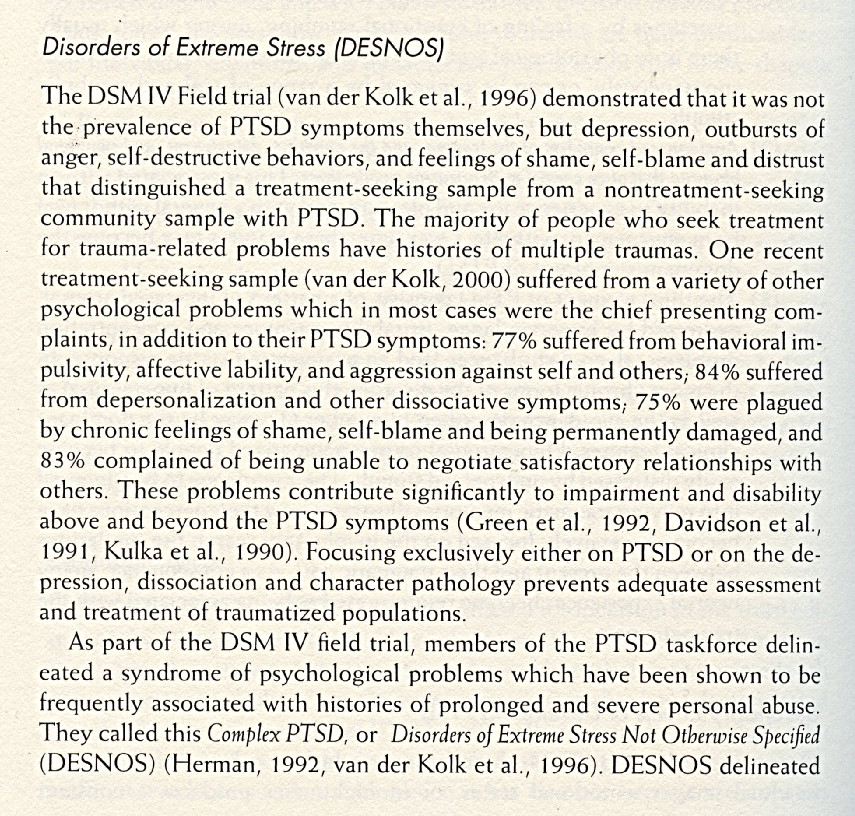
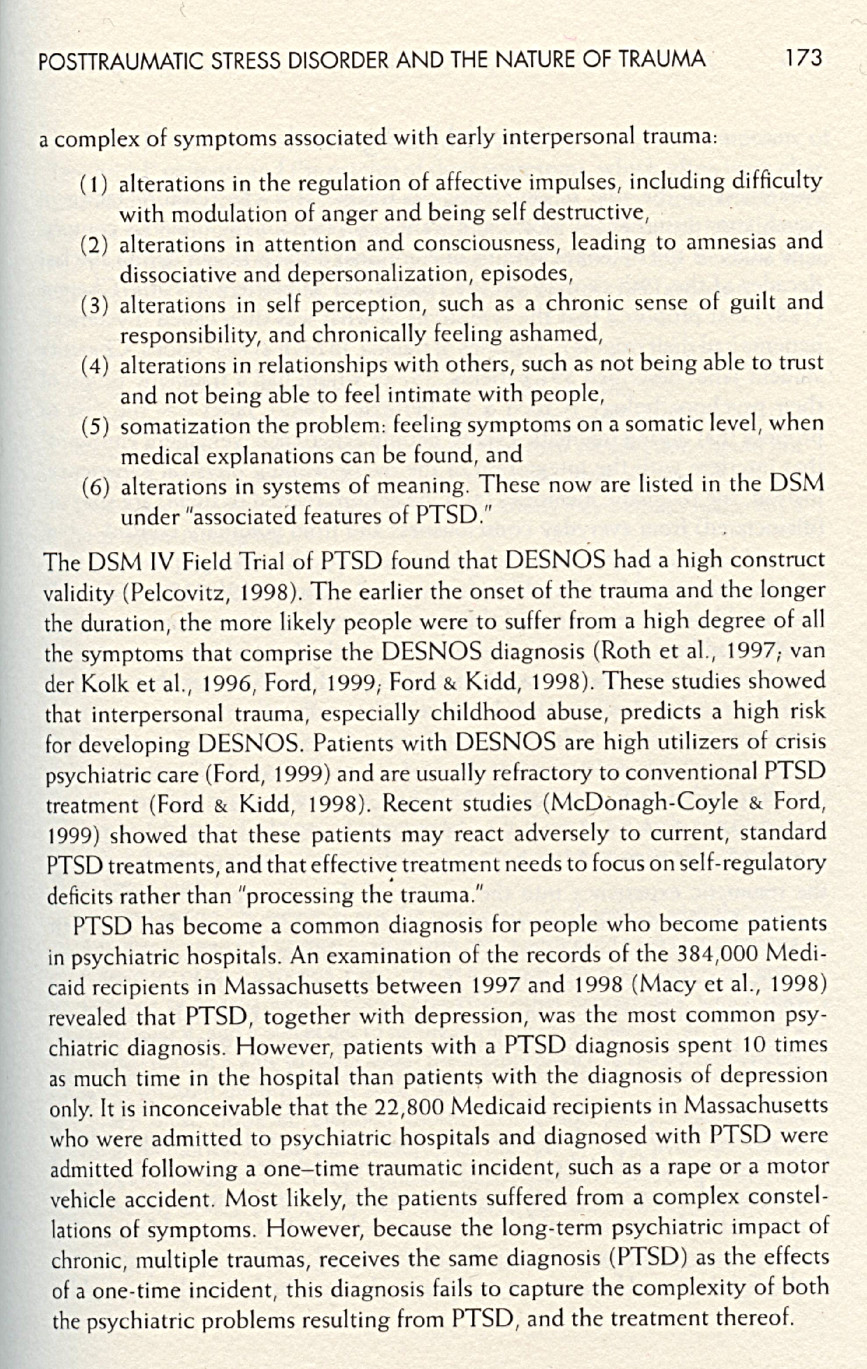
The following is taken from pages 172 of the above text.  I will consider this information in my writing below:

+++++++++++++++++++

It is now easier for me to work with this information because I have described my own version of an alternative way of thinking about the ongoing complications severe infant-child abuse and malevolent treatment survivors face as a direct result not only of the specifics of the actual horrific traumas they lived through, but also because of the very real physiological changes that surviving these traumas created in their infant-child growing and developing body.

(see yesterday’s November 29, 2009 post

+TRAUMA ALTERED DEVELOPMENT (TAD) – A NEW DESCRIPTIVE CONCEPT)

++++

An accurate primary and initial assessment of TAD for those of us who are Infant-Child Severe Maltreatment Survivors would allow us to know immediately how the changes our body-brain had to make created us to be different from ‘ordinary’ people who do not have the history of trauma that we do.

In this TAD assessment two critical resiliency factors would also need to be assessed because these two resiliency factors (one primary, the other secondary) are known to have the ability to nearly completely modify and modulate the power that early trauma has to change our developing body-brain.

The presence of safe and secure attachment to some early primary caregiver is the most basic and important resource an Infant-Child Severe Maltreatment Survivor had.  The current assessment tools available to assess adult secure and insecure attachment need to be simplified, refined and made accessible to the public.

Stemming from the degree of safety and security available through early caregiver attachment, the ability to play is a secondary but critical resiliency factor that impacts an Infant-Child Severe Maltreatment Survivor’s body-brain development.  I believe that assessment criteria and tools to measure this critical factor consistently and accurately can be developed and also made available to the public.

++++

NOTE:  In our new age of technology, the public has the right to be able to access critically important information about themselves and how their early infant and childhood experiences impacted their development.  At present this information remains ONLY available within ‘clinical’ settings, if even there.

++++

As far as I am concerned, anything and everything that is currently lumped under so-called ‘psychological’ categories belongs to the sinking Titanic of dark age medical model thinking that I referred to in yesterday’s post.

Until Trauma Altered Development (TAD) is assessed at the bedrock level of how Infant-Child Severe Maltreatment Survivors changed at their own bedrock (molecular) level, any attempt to moderate so-called ‘symptoms’ remains a crap shoot in the dark.

TAD assessment can connect the consequences of early trauma to altered physiological changes that an Infant-Child Severe Maltreatment Survivor’s body was forced to make to best ensure continued survival in early malevolent environments,

++++

Early caregiver attachment experiences from birth build the body-brain we will live with for the rest of our lives.

Van der Kolk (scanned text above) writes that it is not usually the symptoms of PTSD itself that brings those seeking help to a clinical setting.  Rather, he says that it is “depression, outbursts of anger, self-destructive behaviors, and feelings of shame, self-blame and distrust that distinguished a treatment-seeking sample from a nontreatment-seeking community sample with PTSD.”

Through an accurate TAD assessment, any ongoing difficulty an Infant-Child Severe Maltreatment Survivor has with emotions and social interactions can be traced to inadequate early caregiver interactions in a malevolent environment that built for the survivor an entirely different early-forming right-limbic-emotional-social brain.

When the foundation of the early forming right brain is altered because of maltreatment, the Infant-Child Severe Maltreatment Survivor’s later developmental stages involving shame, guilt and embarrassment will also be off course from ‘ordinary and optimal’ and will cause altered patterns of development in the body-brain.

++++

Van der Kolk states:

The majority of people who seek treatment for trauma-related problems have histories of multiple traumas.”

OK, I can certainly understand this, but here again, as I mentioned above, I do not agree with applying so-called ‘psychological’ and ‘symptom based’ medical model diagnostic thinking used in the author’s next statements.  I absolutely disagree with ever using terms such as ‘character pathology’ in reference to Infant-Child Severe Maltreatment Survivors!

One recent treatment-seeking sample…suffered from a variety of other psychological problems which in most cases were the chief presenting complaints, in addition to their PTSD symptoms:  77% suffered from behavioral impulsivity, affect lability, and aggression against self and others; 84% suffered from depersonalization and other dissociative symptoms; 75% were plagued by chronic feelings of shame, self-blame and being permanently damaged and 93% complained of being unable to negotiate satisfactory relationships with others.  These problems contribute significantly to impairment and disability above and beyond the PTSD symptoms….Focusing exclusively either on PTSD or on the depression, dissociation and character pathology prevents adequate assessment and treatment of traumatized populations.”

TAD assessments will clearly show that ‘impulsivity’, ‘affect liability’, most aggression, and dissociation are directly connected to changes in how an Infant-Child Severe Maltreatment Survivor’s nervous system, including their brain – and here, particularly their right brain – formed differently from ‘ordinary’ due to growth and development in trauma.

Chronic feelings of shame, self-blame and being permanently damaged” are also directly connected to trauma through developmental changes an Infant-Child Severe Maltreatment Survivor’s nervous system, including their brain – and here, particularly their later forming (after age one) left brain – had to make while developing in an early malevolent, trauma-filled environment.

Rather than referring to these changes as ‘character pathologies’, which in my thinking is the maltreatment, abusive stance taken by the medical model toward Infant-Child Severe Maltreatment Survivors, a TAD assessment can accurately and specifically pinpoint the origin of these changes in the body-brain and describe the consequences of them.

Receiving an accurate TAD assessment will show us exactly how our body was forced to adapt during our development through trauma so that we could survive it.   Yes, I do believe we KNOW we are different from ‘ordinary,’ but we are not ‘permanently damaged’.   We ARE permanently changed.

The changes Infant-Child Severe Maltreatment Survivors experience are fundamental and profound!  Everything about us was subject to adjustment for our trauma survival – our body, our nervous system and brain, our immune system, our mind, and our connection between our self and our self and between our self and the entire world around us.  NOT facing the truth and discovering the facts through TAD assessment will NOT resolve the difficulties we face with our continued survival into adulthood.

The only long term solution societies have is to STOP Infant-Child Severe Maltreatment!!!  Part of that solution is to provide the kind of TAD assessment Infant-Child Severe Maltreatment Survivors need, and to make available to us the resources necessary for us to live the best life we can in spite of the changes we had to make in order to stay alive because nobody STOPPED the Infant-Child Severe Maltreatment that happened to us.

It is the pathological character of the society we were born into that allowed what happened to us to happen at all, let alone allowed it to continue to the degree that trauma changed our physiological development.  If there is any self blame to be had, it is on the level far beyond OURS as the Infant-Child Severe Maltreatment Survivors.

++++

That the grand sinking Titanic of the archaic dark age’s medical model about Infant-Child Severe Maltreatment Survivors has at least THOUGHT about throwing us a life boat becomes apparent in van der Kolk’s next words:

As part of the DSM IV field trial, members of the PTSD taskforce delineated a syndrome of psychological problems which have been shown to be frequently associated with histories of prolonged and severe personal abuse.  They call this Complex PTSD, or Disorders of Extreme Stress Not Otherwise Specified (DESNOS).”

Great!  A life boat full of holes!  Gee, why are we NOT thankful for that?

A syndrome of psychological problems” be damned!  Infant-Child Severe Maltreatment Survivors do not suffer from a ‘syndrome’, and ours are not ‘psychological problems’!  For all the reasons I have repeatedly described, we simply need a TAD assessment that will tell us HOW our little body adapted down to our molecular level during our development in the midst of, and in spite of, toxic malevolent trauma.  Then we need resources that inform us how to live NOW with these profound trauma-caused changes that happened to us THEN.

The author continues:

DESNOS delineated a complex of symptoms associated with early interpersonal trauma.”

Again, we don’t have ‘symptoms’.  We have a different body-brain-mind-self that adapted to survival in a malevolent world and caused us to have Trauma Altered Development (TAD).

We don’t have symptoms, we have consequences.  Every single item in the list of so-called ‘complex symptoms’ (see them in the page scan below) that van der Kolk describes are directly connected to our TAD.  EVERY SINGLE ONE OF THESE ITEMS exist within us because of changes our body-brain was forced to make.  They are consequences of the changes our body had to make through our TAD.

The only real progress in the right direction I can see – given to us like faulty patches to a sinking life boat thrown to us from a sinking ship – is that at least an association ‘with early interpersonal trauma’ is finally being considered in the current medical model thinking.

But this tiny droplet of hoped for healing balm offered by the creation of a construct named “Complex PTSD, or Disorders of Extreme Stress Not Otherwise Specified (DESNOS)” is not what we Infant-Child Severe Maltreatment Survivors need in my book.

We need our entire society to understand and accept the truth that the Infant-Child Severe Maltreatment that happened to me and others – and continues to happen to children around us today – is nothing short of a form of parental-selected genocide that did not fulfill its intent to completely destroy us.  We are Infant-Child Severe Maltreatment Survivors because we are still alive, and we ONLY SURVIVED because we were able to adapt our body throughout our Trauma Altered Development to and within the malevolent environments that formed us.

++++

The rest of van der Kolk’s words (below) simply bring into my mind the image of the author being like a modern day Paul Revere, whose horse’s hooves pound along the streets of our nation as he screams a warning.  I am certainly not convinced, however, that even this author knows which message it is that most needs to be delivered.

The Trauma Altered Development that Infant-Child Severe Maltreatment Survivors experienced had no choice but to build itself into every part of who we are BECAUSE we live in a body, and our body had no choice but to change so that we could stay alive.

To describe any aspect of what happened to us in terms of a ‘diagnosis’ or a ‘symptom’, ‘complex’ or not, to call us ‘maladjusted’ or to tell us we suffer from any form of a ‘character pathology’ or ‘psychological problem’ is to continue to condemn us with stigmas and stereotyped prejudice which makes as much sense as applying all of the above labels to someone who is tall versus short, or who has red hair rather than blond.

If we wish as a society to remain in the dark ages about the consequences of Trauma Altered Development for Infant-Child Severe Maltreatment Survivors then at least we should have enough honor and common sense to admit it.  If we are appalled by the ignorance that is still applied to our circumstances, today is the day we can enlighten ourselves and get on with the legitimate task of figuring out how to accurately assess Trauma Altered Development so that we can begin to live well as the changed, extraordinary Infant-Child Severe Maltreatment Survivors that we are.

Our Trauma Altered Development did not affect WHO we are in the world, but it absolutely changed HOW we are in the world.  It is up to all of us to learn what that means.

+++++++++++++++++++

The following is taken from pages 173 of the above text:

Again, it is not a picture of ‘long-term psychiatric impact’ nor a ‘diagnosis’ that Trauma Altered Development affected Infant-Child Severe Maltreatment Survivors need.  We need to understand the changes our body had to make to guarantee our survival and specifically how those changes affect us, and specifically how to improve our quality of life and well-being in the world in spite of our TAD.

+++++++++++++++++++++++++++++++++++++++++

Please feel free to comment directly at the end of this post or on

+++++++

Your Page – Readers’ Responses

++++++++++++++++++++++++++++++++

+FORCED THROUGH ABUSE IN INFANT-CHILDHOOD TO GROW A DISSOCIATING SELF

+++++++++++++++++++++++++++++++++

Growing a self (with matter) in a body in the world is an infant-child’s sole job in childhood.  Our early caregivers either help us or they harm us in our efforts.

For someone as abused as I was from birth and throughout their childhood, with without a safe and a secure attachment to any early caregiver that would allow them to develop their self in connection to their body in the world, feeling as if one MATTERS or even is a self WITH MATTER is extremely hard to do.

Everyone is born with a spark of life that is uniquely theirs and nobody else’s.  Parents are not supposed to work to destroy that spark.  They are supposed to recognize it in the body (and as the body) of the little one under their care.  They are supposed to recognize the growing self of their infant-child as being separate from their own self, so they can fan the spark and feed it fuel to grow on.

Parents who have serious unresolved trauma complications of their own often cannot do their job.  In my mother’s case, she never recognized ME as a separate being from herself at all.  She overwhelmed me, threatened my spark of life, and my growing and developing body-SELF from the moment I was born and for the next 18 years of my childhood.

Only no matter how hard she tried she could never destroy the spark of life that was-is me.  She heaped every possible obstacle in the way of ME growing my SELF in my body in the world that she could.

I see in my mind the terrible image of an un-jolly giant wielding a gargantuan sledge hammer (like in a tragic cartoon), smashing it down on top of me every chance she got.  In this image I am no bigger than a tiny ant.  As much as it was possible for me to do, my growing self had to stay hiding in order to stay alive at all.

++++

When early caregivers are not available to recognize and nurture and reflect an infant-child’s spark of life self back to it, that little self can seem to all but disappear over time.

I was never allowed to have happy genuine time to grow my self or to even be my self from birth (except in hiding).  The ugly giant with her weapons of destruction was always present or near5 by.  Any time she caught me out in the open being my self in play, exploration or in a state of mistaken safety, she would attack me again.

I see another image in my mind that reminds me of the Phantom of the Opera, because this image is of a stage.  I was only allowed to be like a shadow on the stage of my family’s play.  My mother completely controlled and directed the show.  Mostly I was ‘in trouble’ and being punished somewhere off stage.  I was banished and forbidden to be a part of the ongoing play.

I was left alone in misery because that’s where my mother wanted me (short of dead, which she dared not accomplish).  I could only appear in some version of her dramas such as “It’s a fun family holiday” or “This is Linda in the classroom.”

Mostly I remained either hidden, or under attack.

The REAL me was able to remain hidden back stage and could only sneak around like a phantom where she couldn’t detect me.  Over time, as I aged, I learned to appear on stage in different roles, both as an older child and later as an adult.  But my self-in-hiding could not become integrated within the body that appeared in all of its roles.

Only I didn’t know this was happening.  I have seen in my adult journals how lost I was to myself.  As I’ve mentioned before, my being lost in the world appeared in an unending sequence of patterns of questions that I could never find the answers for no matter how hard I searched or tried.

I have only been able to see the parts of myself that are reflected in my actions performed either around other people, or in my actions I perform when I am alone.  I so rarely have any sense that my WHOLE SELF exists at all that doubt I even have one.  I’ve always had a sense that most of who I am remains somewhere in hiding.

++++

Some would say that loving my ‘inner child’ would give her permission to come out of hiding.  I do not attach an age to the self.  A self moves forward in time just as a body does.  Neither exist ‘back there’ somewhere, suspended in the past.

From my perspective as I write this, I would think that the WHOLE of me simply knows things, as do its ‘parts’.  This self of me was forced to make decisions about how to remain alive in a dangerous world every step forward through my childhood from birth.

Every time my growing and developing self was attacked, my body-self was forced at the same time to make a decision about how best to adapt its growth and development so I could survive in a malevolent world.  Those decisions were made automatically in my body on the cellular, molecular level – including the epigenetic processes that used all the available options possible to tell my DNA how to ensure my survival in a chaotic and dangerous world.

++++

As   strange as it might seem as I write this, I believe by body-brain continued to develop throughout my entire childhood without the ‘usual’ connections to the ongoing presence of a continuous self within it.  Any time I was attacked by my mother and a survival-based decision had to be made in my tiny body about how to stay alive, my growing body went one way and my spark-of-life-self went a different way.

I was supposed to be growing an intimate, inseparable connection between my self and my body.  My mother’s attacks on me were so threatening and continual that this connection could not be formed – physiologically – in any ordinary way.

My ongoing responses to attacks during my early growth and developmental stages changed not only how my body-brain developed, and changed this connection between my self and my body, it also changed how I experienced my self in a body in the world.  Both my growing body and self had to include these changes on a structural and operational level.  There was no magic.  There was no possible alternative.

++++

These patterns of interruption between my growing self and body happened so many times that they cannot be counted.  Two examples that I’ve written earlier come immediately to mind.

One happened when I was two:  *AGE 2 – CINDY BORN – 1953

The other happened when I was three:  *Age 3 – THE TOILET BOWL

I already suffered from an extremely disorganized, disoriented insecure attachment to my ‘caregiving’ mother, to the world around me, and most importantly to my developing body-self connection well before these experiences happened to me.  I believe my mother had already overwhelmed my ability to have any ongoing self experience of having an experience an uncountable number of times well before I reached the age of two.  Without safe, secure and stable early caregiving interactions a safe, secure and stable connection between a growing self and a growing body cannot possibly be made.

After my mother dragged me out of the safety of my grandmother’s bed on the day a month and a half before my second birthday, my mother’s version of this incident was added to her abuse litany of me as proof that I wanted to be an only child, that I loved my grandmother more than I loved her, that I was able to deceive my grandmother by hiding my true, terrible self from her, and that I wanted my grandmother to be my mother and not her.

I first remembered this incident from my vantage point of being a very small toddler floating above my body which I could see in lying at the head in the middle of the expanse of my grandmother’s bed.  I can also remember this experience from within my body on the bed and see the ‘other me’ up there above me looking down.  Only by closing my eyes in my remembering process or by not looking up at all can I make ‘that one’ go away.

I can float around my grandmother’s entire house in that little body.  I can float over the heads of the two screaming women.  I can float over to the window and touch the lace of the curtains.  I can float through the open walk-in closet door, out the bedroom door, down the long curving hallway, into the massive kitchen, into the dusky living room.  I can experience the whole nasty, terrifying event from within the little physical body on the bed, but I cannot bring these two states of experiencing the experience together into one.

++++

When it comes to the toilet bowl incident that happened a month and a half before my fourth birthday, I cannot experience both sides of my memory’s experience.  This ‘event’ was added to my mother’s ongoing abuse litany as proof that I was a murderer who wanted my little sister dead, and that I tried to kill her.

I can remember being in my small battered body as it crumpled against the cold hard surface of the side of the bathtub where my mother threw me after she had exhausted herself in beating me.  What I experienced next I cannot put back together.

As my mother turned to storm out of the bathroom I turned my eyes upward to the window high on the wall across from my sobbing, shaking body.  I can return to this memory in my body.  I remember feeling some part of me rise out of my body and float up toward that window and out of it into the radiant blue sky.  In this memory my awareness remains in my tortured body as the other part of me left my body-self behind.

++++

These are remembered patterns of who-what separates from who-what.  I believe that because I was older and further down the body-brain-self developmental pathway when the toilet bowl attack happened that the separation between my body and self that happened then has continued as a pattern of my being in the world ever since.  What happened that day was an inner rupture without repair.

++++

As I sit here writing at this moment, thinking about what I might be willing or able to say about the part of my self that drifted up out of my body, aimed itself at the window, found its way to escape and floated away, I am having a rather ‘Disney Moment.’

Those of you who watched the movie, ‘Who Framed Roger Rabbit’, can probably remember the final scenes as the wall disappears and a magical world of animation opens up into motion, light, music and color.  At this moment I can sense a similar scene going on behind my shoulders as I write these words.  Thousands of brilliantly colored butterflies dance in the sunlight behind me, each one being a fragment of my experience of myself in my life.

Yet I also know that if I could enter that scene, and travel more deeply within it, that the light would dim, the sounds would change, the butterflies would not be dancing………there I will not go.

This sense I am having of this other world is eerie and makes the hairs on the back of my neck begin to crawl.  I turn around and look behind my back.  There is nothing there but my kitchen wall.  It helps to see a framed picture of Johnny Depp in his pirate guise hanging there.  Seeing it there, I smile.

++++++++++++++++++++++++++++++++++++++++++

For those of you who might be curious, this is the link to the latest ‘counseling’ report I asked for from astrologer Zane:

*Age 58 – Astrology reading about life and death

++++++++++++++++++++++++++++++++++++

Please feel free to comment directly at the end of this post or on

+++++++

Your Page – Readers’ Responses

++++++++++++++++++++++++++++++++

+EXPLODING MOTHER, IMPLODING ME: SOME FUNDAMENTAL DIFFERENCES BETWEEN US

++++++++++++++++++++++++

I am revisiting what I see as the core differences between my borderline mother and myself.  I find that nothing has changed in my thinking about these differences in my past five years of research.  My mother’s childhood-onset dissociation became malignant while mine remained benign.

In my first ‘doodle’ I visualized the impact of infant developmental attachment deprivations she suffered from birth until age two.  Born into a family with marital discord and left with her primary care in the hands of a ‘nanny’, I envision that my mother’s developing brain-mind-self was already far off course before she reached the stage of developing a Theory of Mind.

1 111409 post

During the developmental stages from age 2 – 5 conditions in my mother’s childhood so severely impacted her brain-mind that I believe her later mental illness had already centralized the organization of her self.  From the age of 5 it was simply a matter of time before the bomb that was her Borderline Personality Disorder condition would explode – which it did during her terrible delivery of me.

The broader dimensions of the diamond figure that I drew show that in the bottom half powerful interactions with others in her life were feeding her unstable growing self.  She had reached what I call the ‘rage stage’ which was coupled with the following:

My mother was a victim of a lie.  She was told through word and deed by her early caregivers that sometimes she was good enough to be loved.  She was also told that sometimes she was so bad she was un-love-able.  The lie was that she had the power to change herself from being bad to being good, and if she changed into being good (made the bad go away) she would be love-able – and therefore would be loved.

2 111409 post

These conditions presented my mother with an impossible paradox for which there was no answer.  She never knew she was being lied to by her attachment caregivers.  She did not know that there was no solution to this paradox.  She was told she had the power to change herself into being ‘all good’, and she eventually found her solution – me.

The impossible solution to her fundamental betrayal problem was to spit off all her badness and project it onto me.  That left her being all good and me being all bad.  She never had the capacity to know she had believed a lie, found an impossible solution to an impossible riddle, or that she had been tricked and fooled.  Once her child brain-mind wrapped herself around the too-big problem of her early life, her brain-mind continued to grow with this malignant lie within it.

As she moved out of her childhood into her adulthood, and then into the stage of her childbearing years, her childhood dissociation, fueled by childhood rage and a broken Theory of Mind, meant that her children remained her doll-imaginary friends with me as her imaginary enemy (as I have previously described).  By the later years of  my mother’s life she had fewer and fewer people she could influence through her mental illness, and she died as alone and unconsciously troubled as she had been from the time of her birth.

I see this ‘main impact zone’ as being the mass of incoming information that hurt her, followed my the mass of information she later could displace and project onto others to hurt them (primarily me).

++++

My second doodle page (above) presents the basics of what I believe are the differences between my mother and myself.  Like her, my foundation from birth was in disorganizing, disorienting insecure attachment to early caregivers.  But unlike her, I was never fooled, tricked, or betrayed.  Her projection of her own badness onto me condemned me absolutely and permanently.  I was simply doomed to be hated without hope of reprieve, salvation, or any hope of implementing my own solution to solve any of the ‘problems’ I had with her.

The simplicity of my life saved me.  I was not faced with solving an impossible riddle.  I was not presented with the impossible paradox of “you can change yourself into a good and love-able child and then I will love you.”  My childhood was one continual ‘rupture’ without either repair or hope for repair.  My mother’s childhood contained ‘ruptures’ with faulty and deceiving repairs.

In the final analysis, I was far more fortunate than my mother was.  She was set up to fail at being love-able.  I was simply not love-able.  It was the constancy of my unloved-being hated state that saved me.  It was the inconsistency of her unloved-sometimes loved state that ruined her.

I believe her brain fixated a rigid solution to an unsolvable problem.  Her childhood dissociation organized in her brain-mind-self around this solution – which became her internal and unconscious fulltime goal.  I believe her mental illness was fueled by childhood rage.  Her childhood dissociation became malignant, and I became its operational target.

My childhood dissociation had no goal other than physical enduring survival.  My brain-mind-self was left in a fluid, continually changing and adapting state because I HAD NO GOAL and I had no hope, false or otherwise.  My mother’s treatment of me was made tolerable through what I call benign dissociation and my development occurred in a world of sadness.

++++

My mother ended up fighting to be love-able, fueled by rage.  Rage is tied to active coping skills, whether we want to admit this or not.  I did not grow up a fighter.  I grew up a sorrow-filled victim stuck in the passive coping skill state.  My mother was told she had the power to change what happened to her, even though it was a lie and it was not within her power to change the dynamics of her caregivers’ treatment of her.

My mother was damned and didn’t know it.  I was damned and I did know it.  I knew I had no power to change what happened to me.   Nobody ever fooled me into thinking otherwise — from the time I was born.  I believe that there are two entirely different trajectories of development set up by the two different childhood scenarios I am describing.  One leads to the development of a dangerous, demonizing mother and the other one does not.

Both my life and my mother’s of course ended up being extremely complicated with devastating consequences stemming from child abuse and neglect in a malevolent environment during critical body-brain-mind-self stages of early development that resulted in a changed brain for both of us.  Yet as I see it, I was never betrayed or set-up with an impossible task to accomplish like my mother was, and being free from these overpowering early forces allowed me to become who I am.

My mother’s mental illness prevented her from ever being able to tolerate becoming conscious either of how she behaved or of what had happened to so wound her in childhood.  I am not barred in the same way from consciousness.  As I continue to explore the underlying aspects of safe and secure attachment, I will explore how having the ability to be self-aware and self-reflective makes all the difference in how and who we become in our lives.

++++

This post follows:

+DISSOCIATION AND THE TRAUMA-SPECIALIZED BRAIN 11-11-09 and

+SECURE AND INSECURE ATTACHMENT AND THE CHILDHOOD NARRATIVE 11-13-09

++++

++++++++++++++++++++++++++++++++++

THIS INFORMATION COMES TO YOU FROM:

Prevent Child Abuse New York Blog

Improving Children’s Mental Health through Parenting EducationPosted: 13 Nov 2009 03:01 AM PSTGuest post by Michelle Gross, Projects/Public Policy Manager, Prevent Child Abuse New York In today’s difficult times, one of the most important skills one must possess is the ability to form healthy relationships and cope with life’s challenges. Our children are not born with these skills, but rather learn them through their social and emotional development.While providers have traditionally focused on physical development, in 2006, the New York State Legislature passed the Children’s Mental Health Act. The Act required the development of a statewide plan to address issues in children’s social and emotional health, zero to eighteen. As a result of this legislation, the Children’s Plan was developed in collaboration with nine state agencies and led by the New York State Office for Mental Health.The Children’s Plan serves as a blueprint for New York state agencies, providers, and communities to
improve the social and emotional development of children and their families. The Plan focuses on engaging children and their families in services early, ensuring that systems are collaborating to provide effective and efficient services and meeting families’ needs by focusing on their strengths and abilities.

Within the Children’s Plan is a directive for the Office of Mental Health to work with parenting educators to better support parents in raising emotionally healthy children.  The New York State Parenting Education Partnership has been chosen to play this pivotal role in educating providers who work with families and supporting a network of family support and information.

NYSPEP’s efforts to provide professional development sessions for parenting educators will enhance providers’ ability to communicate the importance of social and emotional development with parents, and offer both providers and families tools to facilitate children’s healthy development.

For more information, visit our web site at: http://www.parentingeducationpartnership.org.

Positive Parenting Can have Lasting Impact for Generations

Posted: 12 Nov 2009 07:15 PM PST

A new study that looks at data on three generations of Oregon families shows that “positive parenting” not only has positive impacts on adolescents, but on the way they parent their own children. ” Positive Parenting can include factors such as warmth, monitoring children’s activities, involvement, and consistency of discipline.

Researchers from the Oregon Social Learning Center conducted surveys on 206 boys who were considered “at-risk” for juvenile delinquency. The boys and their parents were interviewed and observed, researchers information about how the boys were parented. Starting in 1984, the boys met with researchers every year from age 9 to 33. As the boys grew up and started their own families, their partners and children began participating in the study. In this way, the researchers learned how the men’s childhood experiences influenced their own parenting.

There is often an assumption that people learn parenting methods from their own parents. In fact, most research shows that a direct link between what a person experiences as a child and what she or he does as a parent is fairly weak. The researchers found that children who had parents who monitored their behavior, were consistent with rules and were warm and affectionate were more likely to have close relationships with their peers, be more engaged in school, and have better self-esteem.

For more information relating to positive parenting techniques, please visit our website http://preventchildabuseny.org/parents.shtml

+++++++++++++++++++++++++++++++++++++++

+DISSOCIATION AND THE TRAUMA-SPECIALIZED BRAIN

+++++++++++++++++++++++++

Because of my traumatic experiences with my mentally ill mother from birth, I did not form an ordinary brain.  My thought processes while writing this post reflect some of the difficulties I have always experienced because my brain formed differently.  Similar to the way an air flight might experience turbulence, I have turbulence in my thinking whenever I try to follow an ‘ordinary’ brain’s train of thought.

This does not mean that I am wrong or broken.  Yes, I was wounded, but the resiliency within me coupled with my determination to endure and survive allowed me in the end to become a very special sort of person.  I will just always think in my special way, and I will always struggle to bridge the chasm that can exist between the way my extra-ordinary brain works and the way ordinary-formed brains work in an ordinary world.

I will continue over time to process the secure and insecure attachment information as I try to understand what the experts know and match it in some way with what I know from within myself about, in particular, dissociation.

Here are my thoughts for today on the brain science concept of ‘coherence’.  I am not going to try to edit them or to give them any other organization or orientation than they had when they lined themselves up on this page as a result of my thinking process.

Yes, these thoughts feel turbulent to me.  That would not be my choice, but then I had no choice about how my brain-mind had to form itself in the beginning of my life.  Nor do I have much choice about how my brain-mind regards and processes information today.  This is what happens for me when I try to even begin to understand what forms the basis of a safe and secure organized attachment system.

+++++++++++++++++++++++++

The advantage of my writing about the topic of secure-autonomous adult attachment is that I can take what ‘ordinary’ brained researchers say about the subject and translate it for myself though my ‘extra-ordinary’ brain.  I have the powerful advantage now of knowing absolutely that my childhood was just about as devoid and empty of secure attachment people as it could possibly have been.  I no longer even try to find out who exactly might have been there for me to give me what I needed to form secure attachments.  I know there was nobody.

Whatever attachment I had with my mother’s mother was contrived.  It was set up by my mother according to her rules so that it could fit within her reality, or should I say, fit her ‘dis-reality’ and ‘un-reality’.  My mother’s mind was nothing less than bizarre and distorted when it came to her thinking about me.  I can’t say it was ‘disorganized’ because her psychosis gave her the most rigid organization possible without possibility of rearrangement – ever.

When I read what the experts tell us about safe and secure infant-child attachment I have to stretch my thinking as far as I can manage in order to try to begin to understand on a deep and honest level within myself what it is these people are saying.  I am coming from the position of being raised in a world just about as far away from what researches consider ‘optimal’ early conditions as it might be possible.  Just as I do not believe those researchers can stretch their minds far enough to begin to comprehend my reality, I am not sure that I can stretch mine far enough to begin to understand theirs.

++++

Dr. Daniel J. Siegel makes this statement, “…the way adults can flexibly access information about childhood and reflect upon such information in a coherent manner determines their likelihood of raising securely attached children.”  (siegle/tdm/312)

Taking the meat of the nut out of its shell, I read this as if it is a directive not only about how to be an adequate parent, but also how to get along in the ‘ordinary’ world in an ‘ordinary’ way:  “flexibly access information about childhood and reflect upon such information in a coherent manner.”

But what does Siegel mean by ‘coherent’?  My guess he knows what it means because he has it.  Very few, if any people who lack his version of coherency in their brain-minds make it to the top levels of any professions – for all kinds of reasons I won’t go into at this moment.  I still want to know what this key to secure attachment means because from my own experiences, and in my world, coherency as Siegel describes it does not exist.

++++

Siegel states:  “Integration establishes a sense of congruity and unity of the mind as it emerges within the flexible patterns in the flow of information and energy processes of the brain, both within itself and in interaction with others.  This is coherence.

Wow.  Those words are a mouthful.  I cannot comprehend what he is saying without applying an incredible amount of effort.  I will try to break this apart as I hunt for some meaning that I can make sense out of from inside MY version of an abuse-formed extra-ordinary brain-mind.

Integration

Sense of congruity

Unity of the mind

Well, right here I get lost because I cannot break apart the next group of words:  unity of mind as it emerges within the flexible patterns

But then it goes further:  mind as it emerges, not just any mind, but a unified mind – and this living unified mind emerges, but does not emerge in any old way, does not emerge in a disorganized, disoriented, inflexible-rigid way.  This ‘sense of congruity’ and this ‘unity of the mind’ emerges continually along with every breath of life.  This happens (or not) through flexible patterns that were built into the brain by – yup! – by our experiences with our early caregivers from birth.

When the mind has this sense of congruity, and has its unity, it can continually engage flexibly within all interactions a person has in life.  These flexible patterns are, according to Siegel, “in the flow of information and energy processes of the brain.”  Well, it should not surprise us that under varying degrees of reverse conditions this entire process suffers from some degree of break down, or deviation from what Siegel is not only describing as optimal, but also as what is supposed to be ordinary.

++++++++++++++++++++++++++++

I am rapidly finding out as I try to make sense of Siegel’s description of ‘coherence’ is that I cannot understand what he is saying because I have a brain built in the opposite way from what he is describing.

I see an image of me being dropped from an airplane from a mile up in the air with a parachute attached to me.  I land in a fresh, hot wad of bubble gum the size of an average Wal-Mart.  That’s how I feel trying to grasp what he is saying.

It is hard to imagine that this finely working brain Siegel is describing would have been built entirely by appropriate early infant-child interactions with safely and securely attachment autonomous early caregivers!  But that is exactly what he is saying.

And the problem here for me is that Siegel knows exactly what he is talking about and says what he means PERFECTLY in these few words in this single sentence – that I cannot possibly begin to understand!  Believe it or not!

So, I will write my version of a statement about what having a brain built by my disorganized and disoriented insecurely attached, unsafe psychotic borderline mother gave me!  I have the opposite of a ‘coherency’ built brain, so OK, here goes —

SIEGEL’S VERSION OF AN ORDINARY BRAIN’S OPERATION:  Integration establishes a sense of congruity and unity of the mind as it emerges within the flexible patterns in the flow of information and energy processes of the brain, both within itself and in interaction with others.  This is coherence.

MY VERSION OF AN EXTRA-ORDINARY TRAUMA FORMED BRAIN’S OPERATION:  Disintegration establishes a (non)sense incongruity and disunity of mind as it attempts to emerge within the inflexible (rigid, disorganized and disoriented) patterns in the (disorganized and disoriented, interrupted and often chaotic) flow of misinformation and disturbed energy processes of the brain, and all of these disturbances exist and are experienced both within this brain itself and in all its interactions with others.  This is incoherence.

BUT, I would have to add from my own experience, that this ‘incoherence’ is experienced as DISSOCIATION.

++++

OK, great.  How exactly are we supposed to get along in the ‘ordinary’ person’s world of coherence when our brains were built under opposite conditions so that we have changed brains that will NEVER work the same as these ‘ordinary’ brains do?  We cannot return to our early infant-child body-brain-mind developmental stages so that the foundation and formation of our brain can be done over again!  Never.  Never.  Never.

The first step to improving our chances for experiencing anything like well-being in the world is to begin to understand what these researchers know about ordinary brain development and combining it with what we know about our own early experiences and what happened to our forming brains as a consequence.  We need to learn how our brains process life with a different kind of logic.

Because my personal experiences happened to me under the care of a mad woman, I am nearly completely on the opposite end of the brain-formation spectrum that Siegel is describing.  BUT, I AM STILL HERE!  I might be completely stuck in a bubble gum mess trying to understand Siegel’s description of an ordinary, healthy brain-mind, but I can also at the same time understand that the way my brain formed, even though it is very different in many fundamental ways from the one Siegel describes, DOES WORK.  It kept me alive throughout my childhood and it keeps me alive today.

But, my brain IS DIFFERENT!  It is NOT BROKEN.  Now, to all reasonable description, my mother’s brain was broken.  The changes her growing and developing brain had to make did not allow her to possess even temporary or sporadic flexibility in her thinking.  I can think flexibly, but not in a continual, ongoing ‘mind emerging in the moment’ way.

++++

Dr. Temple Grandin, autistic author of many books and world renowned expert on communicating with animals, talks about how she sees the world in pictures.  I believe I feel the world in pictures and think about it in dissociated pieces, or ‘packets’ of information.  Access to and transition between these dissociated packets of information is not frequently either smooth or predictable.

I am most fortunate that depending on the day and on the topic, my brain can link some or many of these pieces together at one time or another.  But never will I have a continuous, feeling, integrated, coherent story to tell myself or anybody else about myself in the world.

Any version of a continuous story I might form will be contrived, artificial and primarily constructed by my ‘logical’ left brain that has learned some things about how others make sense of their lives – and therefore how I OUGHT to be able to do the same.  Some days I can do this better than others by consciously pretending that I know all the experiences that happened to this BODY that Linda is attached to belong to the thinking, feeling, remembering person that Linda is supposed to be.

Yet the Linda that I MOST am feels like a bird might that soared over some particular piece of geography ten years ago, or 30 years ago, or 2 days ago without picking up the actual place and carrying it along.  I pass through ‘things’, pass by them, pass over them – or they pass through me.  But I feel very transparent, like the true form of who I am has never become embodied in my life in this world.  I absolutely and fundamentally do not process myself in  ‘time and space’ experience in ordinary ways.

Thanks to my mother, my body-brain-mind-self didn’t grown ‘down into the world’ as Dr. James Hillman calls it.  Whatever pieces of me made it into myself in my body in my life in this world are not completely integrated in the ordinary brain that Dr. Siegel has described.

I actually do not believe that neuroscientists or infant-child brain development specialists have ANY IDEA how big a deal dissociation can be!  I don’t think they can understand this kind of a reality any more than I can understand theirs.  I suffer today from a similar problem I had with my mother in the beginning.  There is nobody around to help me make sense of a sensible world, so I have to figure it all out by myself.

There is no retreat, no seminar, no self-help book, no religious text, no university class, no philosophical approach, no kind of meditative practice, no psychological theory that will ever ACTUALLY be able to help me understand how my changed brain operates in this world.  I was forced to grow a specialized brain, a very well-adapted-to-ongoing-trauma body-brain-mind.  I can take what developmental neuroscientists say about how things work when early brain formation experiences go RIGHT and try to translate that information into what happens when early brain formation experiences go terribly WRONG.

I am somewhat of an expert about that field of study!  In a more perfect world, or in a more advanced one (silly thought because in THAT world the kind of abuse that changes an infant-child’s developing brain would not be happening) I would be able to easily access information that would tell me how ordinary brains work, how extra-ordinary brains work, and how I can better experience well-being BECAUSE of how special my brain-mind is.  Well, evidently in THIS world, I will try until my dying breath to figure this out for myself.

++++

In this post I am trying to comprehend and make use of the information contained here:  *Attachment Simplified – Secure Attachment (Organized)

+++++++++++++++++++++++++

+THE POWER OF JOURNALING – ASKING A QUESTION THAT HAS AN ANSWER

+++++++++++++++++++++++++++++++

I am in a battle with myself over whether or not there is any value to myself or to anyone else in my reading and transcribing my quarter of a century old journals.  Part of me wants to burn them all.  I think about how to contain the fire I could make of them so no smoldering ashes would escape and float away to light some part of this dry high desert landscape around me on fire.

Maybe I could tear them all into tiny pieces and soak them in water and then cook them into papier mache mash and make something beautiful out of them.  Maybe I could tear them up and dig them into the damp earth of my composting pile where I know the hungering masses of worms and slugs there would chew them up gladly and digest them into soil.

Maybe I could box them all up and take them camping when my sister comes next month to visit.  We could burn them more safely in the contained campground fire pit, have a little releasing ceremony and let all the words that record what all the versions of Linda talked about for 25 years vanish as if they had never been.

++++

What is the value of this journaling process that so many therapists (and others) seem so fond of recommending?  We could just as well write our words on an area of flat dirt and then sweep them away when we are finished.  We could just as well write them with chalk on slate or with grease pencil on a mirror or a piece of glass, and erase them as soon as they no longer hold any meaning to us.

Who are we telling the intimate details of our lives to as we sit alone and tarry over our silent words so studiously copied as if we are creating lessons for ourselves out of nothing but the contents of our minds?

Does journaling help us tolerate our hard times, I would say ‘better’, but I really mean ‘tolerate them at all’?

Or does the writing simply contain the passage of time as we transition through all the changes that happen to us along the way of our lifetime, both outside of us and within?

Does journaling help us to think more clearly?  Do we create a dialog with our self because we are so alone there is no other person alive we can trust enough to pass ourselves on to?

What is it about writing the words our souls tell us in hidden places between two covers of a journal that helps us or heals us?  And in today’s world where keyboards replace ink or lead, our words simply join some cyber network, taking their place in simultaneous land where they enter themselves into an invisible cue, waiting for whom to go back and read them?

++++

Or do those of us who write do so simply because we are writers?  Could we find a writing gene somewhere in our constitution if we knew where to look for it?  Do we write because we care about certain things in a particular way that non-writers can’t even imagine?

++++

That would be all fine and worthy if I could SEE what matters about the process of journaling for me in the end.  What I am finding instead is that the same concerns I wrote about 25 years ago are really right here inside of me today if I let them be.  Questions.  I asked thousands of questions on those pages that I had no answers for.

I recorded my inner conflicts and turmoil and suffering.  I recorded how it felt to be so lost from myself and others that I could only ask the questions themselves and could never find any answers, no matter how committed I was to finding them.  The answers were intangible.  They were invisible.

++++

My journals portray my journey, each word on a line in the order I could see them.  Writing was my way of trying to organize and orient myself in my body in my life.

Time has moved forward.  My children grew up, left home intact, and have orchestrated their own lives free from trauma.  Because I was their mother, far from perfect but ‘good enough’, their journey will always remain connected to mine but not central.

In the meantime my journals reveal all the turbulence, all the missteps and attempts I have made to catch up to a Linda who was living a life that never has been coherent or integrated or cohesive or well planned.  I know now that I was always trying to make sense of myself in my life even though I was missing all the most important pieces.

I mistakenly thought I could create an ordinary life without knowing the extreme, long term abuse I suffered from birth and for the 18 years of my childhood had changed the way my body-brain developed, and had therefore changed me.

Not only was the development of my right and left brain hemispheres changed, and the corpus callosum that connects them and transmits information between the two changed, but also the development of my higher level thinking cortex part of my brain was changed, as well.

I have avoided writing about the development of my ‘executive cortex’.  When I am ready to do so I will have to consider how child abuse deprived me of an ‘ordinary’ ability to process information about the future and affected all my choice and decision making abilities.

Normal, ordinary brains that form without a history of severe abuse and trauma continue to grow all the way through the teen and early adult years.  A normal, ordinary cortex does not finish its development until somewhere between ages 25 and 30.  A severely abused and traumatized child’s cortex atrophies early and never finishes its development to become normal and ordinary.

++++

Nobody was there to stop me just as I crossed the threshold out of my parents’ home and into my own life when I was 18 to tell me that what I had just endured of a childhood was hell, wrong, and extremely hurtful to me.  Nobody explained to me that the trauma I had suffered from birth had so changed the way I had to grow and develop so I could survive it that it meant I now have a different brain that works fine in terrible, toxic, malevolent, threatening, dangerous and self-obliterating conditions but was not designed like an ordinary brain to work well in an ordinary, benevolent world.

Maybe nobody told me this in 1969 when I left home because nobody knew it.  Certainly if all the infant and child development experts didn’t know these basic facts, if the human brain development neuroscientists and physiologists didn’t know, I need not blame myself for not knowing this critical information about my chances for achieving any quality of well-being in an ‘ordinary’ life, either.

++++

So what exists in the last 25 years of my journals in their piles on the shelves beside my computer desk is a simple chronicling of one severe child abuse survivor’s disorganized, disoriented incoherent life story about how the changes my body and brain had to make so that I could survive the hell of my childhood could not possibly have prepared me to live any kind of an ordinary life.

++++

I look up above me right now as I sit here outside my door writing in the high desert gentle sunlight of this early November 2009 morning and watch the wispy tendrils of clouds drifting, white against the distant blue sky, and I know that’s the same sky that caps the lives of everyone living below it.  At the same time I know there are two kinds of people on this planet, plain and simple, no matter where they plant their feet on this grand planet earth.

There are those whose early caregivers loved them and cared for them appropriately when they were an infant-child the way human evolution has dictated in order for an ordinary-functioning brain to grow and develop.  They provided safe and secure attachment for their offspring.

And then there are the rest of us who were not loved, who were treated malevolently by our early caregivers.  The traumatizing circumstances of our early environments demanded of our growing early body-brain that we change and adapt or we die.

There are degrees of change just as there are degrees of trauma, but because I know so clearly what the circumstances of my infancy and childhood were as a result of my mother’s psychotic break when I was born and because of her severe mental illness, I no longer have to ask the thousands of questions I used to ask in my  journals without being able to find any answers.

There remains only one single answer that matters to me now.  It’s the same answer for every one of those questions I have been asking all of my adult life as I tried to make myself into a ‘better’ and a different more ordinary person who could then live a more ordinary life of ordinary well-being.

The reason I cannot become an ‘ordinary’ person is because I have an ‘extra-ordinary’ brain that had to grow, develop and form under the ‘extra-ordinary’ circumstances of severe trauma and abuse that was my infant-child environment.  My trauma-changed-body and brain does not receive ‘ordinary’ information from the environment in ‘ordinary’ ways.  It does not process information in ‘ordinary’ ways, either.  There is very little about severe-abuse-and-trauma-survivor Linda that is ‘ordinary’ or can EVER be ‘ordinary’.  Just because I look ordinary on the outside tells me nothing about how I am different on the inside.

If I continue to ignore what I now know about being a changed-by-severe early abuse and trauma person, I will condemn myself to the continued struggle of asking questions forever that I will never find the answers for.

++++

I realize now that all my journal writings up until this point in time have created a chronicle of my journey through adulthood with a changed body and brain, and what this has been like for me.  Continued research is now chronicling the life long changes severe abuse creates for its survivors on a much larger scale.  The outcomes appear extremely bleak and grim for survivors.  We have to put the facts together and realize that the very foundation in our body and brain has been changed, and these changes give us a changed life outcome.

It is not possible for us to escape the consequences of what was done to us until we begin to understand how we changed and how those changes continue to affect EVERYTHING about us and our lives.

++++

For those of us who journal, we will see in our own words how exploring ourselves in our life will change as we begin to include this vital information in our thinking.  Just because everyone else has remained ignorant of the changed body and brain because of early trauma and abuse survival information, does not mean we have to remain ignorant of the facts ourselves.  We owe it to ourselves not to continue archaic patterns of thinking about ourselves in the world.

In fact, those of us who experience this ‘extra-ordinary’ reality are the REAL experts.  We know, down to our last cell in our body, what being changed by child abuse and trauma did to us.  We know our truth.  Now we have to empower ourselves to know what we have known all along.

Together we can define what living in a trauma-changed body is like.  On this planet earth, under this arching blue sky, we have to begin to understand that what humanity’s right arm might know about being ‘ordinary’ is balanced by what humanity’s left arm knows about not ever being allowed to both be ‘ordinary’ and remain alive.  We can no longer afford to let ‘ordinary’ condemn us to a lifetime of suffering because of who we are – different from ordinary.

We can join together to learn how to end the suffering of all of us.  A reality of privilege can no longer remain the standard we measure survival against.  If what happened to us had happened to ‘them’, they would have been changed just as we were or they would have died.  That is the reality of being human in an imperfect world.  What happens – and happened – to infants and children that causes these changes must become the primary concern for all of us.

Otherwise we will continue to ask all the wrong questions for which there are no answers.  We need to ask the right question, “How does severe early trauma and abuse change developing humans into ‘extra-ordinary’ beings, and how do those changes affect them for the rest of their lives?”  This IS a question we can find the answer to when we are willing to consider the truth – both individually and as a species.

+++++++++++++++++++++++++++++++

PS.  What will I do with my old journals?  I still do not know.

++++++++++++