
+THE HEALING OF DISSOCIATONS – A 50-YEAR MISSING PIECE OF ME HAS RETURNED

+++++++++++

I woke up this morning thinking about all the wounds we received in the war zone of our abusive childhoods.  Often as the war raged on around us we ended up being the targets.  In this battlefield we were the victims.  Some of us received so many wounds they cannot be counted.

My mother’s war with the world began in her own childhood and so wounded her that her war never ended until the day that she died.  I was born a casualty of her war.  I had no choice, no weapon, and I could not escape.  I could not fight back or defend myself against her.  No one was there to tend my wounds when they were inflicted, either.  And yet for all the wounds I suffered both visible and invisible, my strength and resiliency still enabled me to survive and endure.

Like my mother, I carried all my wounds out of my childhood, but unlike my mother I did not carry on the war.  Perhaps that happened in part because she began to attack me on all levels as soon as I was born.  I was too young, too little, to begin to feel anger at her for what she was doing to me.  I continued to grow up through and past the age of rage without knowing what it even was.

But it’s not the rage that fueled my mother’s war against me that I woke up thinking about today.  I woke up thinking about the healing of wounds.

++++

When severe abuse begins so early it impacts the formation of the regions, circuits, pathways and operation of the brain so that we end up with what Dr. Martin Teicher and his Harvard Medical Group refer to as “an evolutionarily altered brain” as a result, the wounds that caused these changes to happen are most difficult to heal.  These wounds include dissociation.

I am thinking this morning about how long ago people lived for a much shorter time.  Their experiences were fewer and their universe was so much smaller than ours.  Their lives were centered on the core basics of staying alive in an often threatening and dangerous world throughout their entire life span.  In those worlds the ability to dissociate during or in the aftermath of traumas must have continued to serve a purpose that is difficult for me to define in the world I live in today.

Yet for those of us who endured unimaginable severe trauma during our infant-child developmental stages, the dissociation we were given as a result of our survival makes it more difficult for us to continue living in the ‘ordinary’ world we grow up to enter.  Nature has not evolved a way to ‘put us back together again’ to be like a pre-early trauma exposed person.  We are stuck with dissociational brain patterns and abilities that are directly linked to the hundreds if not thousands of near-mortal wounds from physical and mental injuries that we received many years ago.

Our wounds within can thus remain open, painful and at times extremely difficult for us to live with as we attempt to live an ‘ordinary’ life of well-being in an ordinary world without the kinds of dangers to our existence that we were programmed to survive because they existed in the times of our origins.

Without ‘medical’ care back then when we needed it most, and without access to the kind of help with our wounds and our resulting dissociation that we need now, how do we heal ANY of our wounds?

++++

The very length and complexity of our modern life experience is working against us now.  We cannot crawl wounded deep into a secluded cave and trust we will be protected and kept safe by our brethren standing guard over us while we receive adequate care and access the kind of quiet, unstimulated time that we need in order to heal.  (Yes, I believe we have these memories within our DNA that tell us what we need for our healing to occur.  These memories are available to us in the same way the memories in our bodies enable us to make adaptations to trauma from conception.)  If we cannot pursue nature’s intended courses of healing for even one of our childhood wounds, how do we carry on with hundreds if not thousands of them within us?

++++

Nature never planned for our species’ infants and children to be in danger without protection and adequate care.  Only under the most dire circumstances would offspring have been sacrificed.  The continuance of our species required that the most helpless tiny ones survive in the best condition possible.  And yet here we are at the most supposedly sophisticated period in our species’ evolution with harm being perpetrated in wars against offspring as if the little ones no longer matter as our species’ most prized hope for going forward into a better world.

Everything around us is busy and complicated.  Our multiple critical wounds are seldom if ever healed.  And then we are expected to live a ‘good life’ not only in spite of our wounds, but also as if the injuries never happened and the wounds do not exist.

++++

This again brings me back to healing.  Any wound has to go through a natural process of healing, often to the stage of creating permanent scar tissue at the end.  All healing requires our body’s immune system be involved.  I believe this includes the healing of our inner mental and emotional wounds as well.  On some level it is always some aspect of our physiological immune system’s negotiation on behalf of our increased well-being that accomplishes all of our healing.

I mention this today because last night I felt one of my many, many wounds close itself in healing.  I will never be able to forget how the wound originated in the first place, or how it has felt for these past 50 years to live with the wound open and unhealed.

This healing involves how I feel in relation to animals, especially to pets.  My healing came from a few simple words a trusted friend recently wrote to me about grieving the loss of both our human and our animal loved ones.  My friend was talking about her love and grief for a pet she lost years ago when she said to me, “Yes, pets are family and more.”

It was her last two words that healed me — “and more.”  Suddenly I understand that I can give myself permission to look into the eyes of not only my pets, but of all animals and SEE and FEEL and be connected with the life within them that is their SELF, and I can love them wholly – “and more.”

It feels like a channel of love and healing that has been blocked for the last 50 years has been opened so that the healing light and love that opened this channel can now flow through it unimpeded.  What I knew and felt when I was a little girl and my heart broke when my pet black rabbit, Peter, died has come back to me.

I have not asked my friend what her two simple words “and more” mean to her.  I needed to know what they mean to me.  It wasn’t the loss of Peter himself that most wounded me.  It was my reaction of dissociating myself from ever being able to feel again the loving connection I felt for that little animal.  Since that dark and rain soaked night he died, the part of myself that knows animals are not remote and distant objects that continue their own existence in a world separated from me has been missing.

My mother told me that night when Peter died that he was a bad rabbit who got what he deserved.  He was dead because that’s what is supposed to happen to all bad animals and bad children like me.  In the midst of the terrible depth of my grieving over the loss of my beloved pet through a violent death, she told me she wished I was dead just like Peter was because that is what I deserved.

The wound of this experience caused me to dissociate my ability to experience love, appreciation, and connection to and with animals (exception noted at the end of this post).  That part of me was removed from my existence until last night when I was in conversation with my sister about those two words, “and more” in relationship to animals in our lives.

Like my friend, my sister has never lost her ability to love animals, especially dogs.  I see this morning that the other side of this unhealed wound I have carried all these years has also prevented me from receiving the love that animals freely give to me.

I can understand today that the trusting innocence of who I was as a young child is reflected and mirrored back to me in the eyes of animals.  I have not been able to tolerate that kind of powerful experience with my own vulnerabilities for 50 years.  I have not been able to reclaim my own portion of passion regarding a deep love, valuing and sustaining friendship with animals until now.  Healing has touched that dissociated wound inside of me and – lo and behold – I can feel this fragmented piece of myself is back.

++++

I know every person alive has been wounded in some way at some time.  The healing of our wounds gives us an added dimension of awareness on an emotional and mental level about the better side of being alive.  Any healing that includes an improvement of connection between myself, myself and the living world I live in is especially significant for me.

Any healing gives me hope that more healing is possible.  Scar tissue might not be especially pretty to look at from the outside, but its presence means that a wound has healed, and I’m not sure there is anything I can experience that is better than that.  Yet at the same time that today I feel this wound has healed I can feel the blackness of overwhelming sadness that created this dissociational wound in the first place.

It helps me to know that I will not go backward in this healing process.  The sense of invading danger will leave me.  It will dissipate in the light of this new day.  (I will be extra tender to myself until this has happened as if I just went through surgery — because I did!)

Life can now pulse again for me where no pulse has been for 50 years.  I am different today as a result of this healing.  I know I am one step closer to being a more complete, integrated and whole ME because of it.  I have to practice being this bit-more-whole me now.  I feel different.  I see my animals around me differently.  They are back in the circle of my life and I am back in their world for the first time since before my black rabbit died.

I am reminded today that miracles of healing do happen – because they can.

This was a missing piece of myself I could recover, and that could be restored to me because it was one that was once an integral part of who I am.  I remembered my self before my rabbit died and my mother was so mean to me about his death.  I re-membered this part of myself so it can be joined with who I am today.  That’s exciting!

++++++++++++++++++++

NOTE:  Last summer when I visited my brother in Alaska I felt my love and connection with moose when one came to graze under my brother’s deck.  I was close enough to that glorious animal to have reached out and touched him if I had wanted to.  I realized then that my ability to love moose had never been removed from me.  Maybe having this August experience was a necessary step toward my healing so that I could again reclaim that same love and connection I felt as a child with all animals.  Now I also understand fully the “and more.”  It is my responsibility (ability to respond) to care for them at the same time that they take care of me.
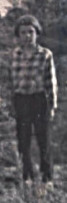
1959 JUST homestead birthday - Copy
Holding that warm, fuzzy, whisker-wiggling little black rabbit, Peter, in my arms -- MY pet rabbit -- had made this sad little child happy.

++++++++++++++++++++

<!–[if !mso]>

+THE POWER OF JOURNALING – ASKING A QUESTION THAT HAS AN ANSWER

+++++++++++++++++++++++++++++++

I am in a battle with myself over whether or not there is any value to myself or to anyone else in my reading and transcribing my quarter of a century old journals.  Part of me wants to burn them all.  I think about how to contain the fire I could make of them so no smoldering ashes would escape and float away to light some part of this dry high desert landscape around me on fire.

Maybe I could tear them all into tiny pieces and soak them in water and then cook them into papier mache mash and make something beautiful out of them.  Maybe I could tear them up and dig them into the damp earth of my composting pile where I know the hungering masses of worms and slugs there would chew them up gladly and digest them into soil.

Maybe I could box them all up and take them camping when my sister comes next month to visit.  We could burn them more safely in the contained campground fire pit, have a little releasing ceremony and let all the words that record what all the versions of Linda talked about for 25 years vanish as if they had never been.

++++

What is the value of this journaling process that so many therapists (and others) seem so fond of recommending?  We could just as well write our words on an area of flat dirt and then sweep them away when we are finished.  We could just as well write them with chalk on slate or with grease pencil on a mirror or a piece of glass, and erase them as soon as they no longer hold any meaning to us.

Who are we telling the intimate details of our lives to as we sit alone and tarry over our silent words so studiously copied as if we are creating lessons for ourselves out of nothing but the contents of our minds?

Does journaling help us tolerate our hard times, I would say ‘better’, but I really mean ‘tolerate them at all’?

Or does the writing simply contain the passage of time as we transition through all the changes that happen to us along the way of our lifetime, both outside of us and within?

Does journaling help us to think more clearly?  Do we create a dialog with our self because we are so alone there is no other person alive we can trust enough to pass ourselves on to?

What is it about writing the words our souls tell us in hidden places between two covers of a journal that helps us or heals us?  And in today’s world where keyboards replace ink or lead, our words simply join some cyber network, taking their place in simultaneous land where they enter themselves into an invisible cue, waiting for whom to go back and read them?

++++

Or do those of us who write do so simply because we are writers?  Could we find a writing gene somewhere in our constitution if we knew where to look for it?  Do we write because we care about certain things in a particular way that non-writers can’t even imagine?

++++

That would be all fine and worthy if I could SEE what matters about the process of journaling for me in the end.  What I am finding instead is that the same concerns I wrote about 25 years ago are really right here inside of me today if I let them be.  Questions.  I asked thousands of questions on those pages that I had no answers for.

I recorded my inner conflicts and turmoil and suffering.  I recorded how it felt to be so lost from myself and others that I could only ask the questions themselves and could never find any answers, no matter how committed I was to finding them.  The answers were intangible.  They were invisible.

++++

My journals portray my journey, each word on a line in the order I could see them.  Writing was my way of trying to organize and orient myself in my body in my life.

Time has moved forward.  My children grew up, left home intact, and have orchestrated their own lives free from trauma.  Because I was their mother, far from perfect but ‘good enough’, their journey will always remain connected to mine but not central.

In the meantime my journals reveal all the turbulence, all the missteps and attempts I have made to catch up to a Linda who was living a life that never has been coherent or integrated or cohesive or well planned.  I know now that I was always trying to make sense of myself in my life even though I was missing all the most important pieces.

I mistakenly thought I could create an ordinary life without knowing the extreme, long term abuse I suffered from birth and for the 18 years of my childhood had changed the way my body-brain developed, and had therefore changed me.

Not only was the development of my right and left brain hemispheres changed, and the corpus callosum that connects them and transmits information between the two changed, but also the development of my higher level thinking cortex part of my brain was changed, as well.

I have avoided writing about the development of my ‘executive cortex’.  When I am ready to do so I will have to consider how child abuse deprived me of an ‘ordinary’ ability to process information about the future and affected all my choice and decision making abilities.

Normal, ordinary brains that form without a history of severe abuse and trauma continue to grow all the way through the teen and early adult years.  A normal, ordinary cortex does not finish its development until somewhere between ages 25 and 30.  A severely abused and traumatized child’s cortex atrophies early and never finishes its development to become normal and ordinary.

++++

Nobody was there to stop me just as I crossed the threshold out of my parents’ home and into my own life when I was 18 to tell me that what I had just endured of a childhood was hell, wrong, and extremely hurtful to me.  Nobody explained to me that the trauma I had suffered from birth had so changed the way I had to grow and develop so I could survive it that it meant I now have a different brain that works fine in terrible, toxic, malevolent, threatening, dangerous and self-obliterating conditions but was not designed like an ordinary brain to work well in an ordinary, benevolent world.

Maybe nobody told me this in 1969 when I left home because nobody knew it.  Certainly if all the infant and child development experts didn’t know these basic facts, if the human brain development neuroscientists and physiologists didn’t know, I need not blame myself for not knowing this critical information about my chances for achieving any quality of well-being in an ‘ordinary’ life, either.

++++

So what exists in the last 25 years of my journals in their piles on the shelves beside my computer desk is a simple chronicling of one severe child abuse survivor’s disorganized, disoriented incoherent life story about how the changes my body and brain had to make so that I could survive the hell of my childhood could not possibly have prepared me to live any kind of an ordinary life.

++++

I look up above me right now as I sit here outside my door writing in the high desert gentle sunlight of this early November 2009 morning and watch the wispy tendrils of clouds drifting, white against the distant blue sky, and I know that’s the same sky that caps the lives of everyone living below it.  At the same time I know there are two kinds of people on this planet, plain and simple, no matter where they plant their feet on this grand planet earth.

There are those whose early caregivers loved them and cared for them appropriately when they were an infant-child the way human evolution has dictated in order for an ordinary-functioning brain to grow and develop.  They provided safe and secure attachment for their offspring.

And then there are the rest of us who were not loved, who were treated malevolently by our early caregivers.  The traumatizing circumstances of our early environments demanded of our growing early body-brain that we change and adapt or we die.

There are degrees of change just as there are degrees of trauma, but because I know so clearly what the circumstances of my infancy and childhood were as a result of my mother’s psychotic break when I was born and because of her severe mental illness, I no longer have to ask the thousands of questions I used to ask in my  journals without being able to find any answers.

There remains only one single answer that matters to me now.  It’s the same answer for every one of those questions I have been asking all of my adult life as I tried to make myself into a ‘better’ and a different more ordinary person who could then live a more ordinary life of ordinary well-being.

The reason I cannot become an ‘ordinary’ person is because I have an ‘extra-ordinary’ brain that had to grow, develop and form under the ‘extra-ordinary’ circumstances of severe trauma and abuse that was my infant-child environment.  My trauma-changed-body and brain does not receive ‘ordinary’ information from the environment in ‘ordinary’ ways.  It does not process information in ‘ordinary’ ways, either.  There is very little about severe-abuse-and-trauma-survivor Linda that is ‘ordinary’ or can EVER be ‘ordinary’.  Just because I look ordinary on the outside tells me nothing about how I am different on the inside.

If I continue to ignore what I now know about being a changed-by-severe early abuse and trauma person, I will condemn myself to the continued struggle of asking questions forever that I will never find the answers for.

++++

I realize now that all my journal writings up until this point in time have created a chronicle of my journey through adulthood with a changed body and brain, and what this has been like for me.  Continued research is now chronicling the life long changes severe abuse creates for its survivors on a much larger scale.  The outcomes appear extremely bleak and grim for survivors.  We have to put the facts together and realize that the very foundation in our body and brain has been changed, and these changes give us a changed life outcome.

It is not possible for us to escape the consequences of what was done to us until we begin to understand how we changed and how those changes continue to affect EVERYTHING about us and our lives.

++++

For those of us who journal, we will see in our own words how exploring ourselves in our life will change as we begin to include this vital information in our thinking.  Just because everyone else has remained ignorant of the changed body and brain because of early trauma and abuse survival information, does not mean we have to remain ignorant of the facts ourselves.  We owe it to ourselves not to continue archaic patterns of thinking about ourselves in the world.

In fact, those of us who experience this ‘extra-ordinary’ reality are the REAL experts.  We know, down to our last cell in our body, what being changed by child abuse and trauma did to us.  We know our truth.  Now we have to empower ourselves to know what we have known all along.

Together we can define what living in a trauma-changed body is like.  On this planet earth, under this arching blue sky, we have to begin to understand that what humanity’s right arm might know about being ‘ordinary’ is balanced by what humanity’s left arm knows about not ever being allowed to both be ‘ordinary’ and remain alive.  We can no longer afford to let ‘ordinary’ condemn us to a lifetime of suffering because of who we are – different from ordinary.

We can join together to learn how to end the suffering of all of us.  A reality of privilege can no longer remain the standard we measure survival against.  If what happened to us had happened to ‘them’, they would have been changed just as we were or they would have died.  That is the reality of being human in an imperfect world.  What happens – and happened – to infants and children that causes these changes must become the primary concern for all of us.

Otherwise we will continue to ask all the wrong questions for which there are no answers.  We need to ask the right question, “How does severe early trauma and abuse change developing humans into ‘extra-ordinary’ beings, and how do those changes affect them for the rest of their lives?”  This IS a question we can find the answer to when we are willing to consider the truth – both individually and as a species.

+++++++++++++++++++++++++++++++

PS.  What will I do with my old journals?  I still do not know.

++++++++++++

+BEING CHEERFUL AND COURAGEOUS IN THE FACE OF A TERRIBLE REALITY

++++++++++++++++++++++++++++++++++++++++++++++

I cannot pull any punches.  Surviving child abuse is a serious matter that needs to concern both those who endured it and those who were fortunate enough not to.

Child abuse should happen to no one.  Yet it does.  Those of us who survived it are doing the best that we can to understand the changes this abuse did to us during our development, to learn, to grow and heal.  We need to be vigilant about our well-being, proactive regarding the state of our health, and informed.

We suffer from continued difficult lives for as long as we live.  At the same time, our risk for developing serious adult ailments and perhaps to die young is connected to the extremely high price we had to pay to endure and remain alive.  Sticking our heads in the sand will not help us.  We are incredibly STRONG people or we would not be here!  We have the strength to face the facts and to find ways to continue to improve ourselves, our lives, and our chances for continued survival.

++++++++++++++++++++++++++++++++++++++++++++++

It is easy to lose track of important information as time goes on that is posted in comments to writings on this blog.  One such piece of information came through today, and I think it warrants a repeat here:

Comment and reply posted to *THE ADVANTAGES OF DISCLOSURE

Comment submitted on 2009/10/30 at 1:54am

I never knew what I was experiencing was a disassociation from myself but now that I read what you wrote I go through exactly what you do. I like how you put this.
“While I have the benefit now of reorganizing and reorienting myself in relation to my brother based on our new level of connection, I have to experience aspects of this readjustment consciously in order for it to become a living useful integrated part of who I am.”

I always get in this stuck phase. Words for describing what Im going through just aren’t there. I feel like it’s because I learned from a very early age to program myself to shut off to the describing, and trying to put it into words because when I did I got hurt one way or another. So now that I am an adult I flounder. I have to work twice as hard and I fumble with thing actions, reactions that most normal adults are able to have within seconds without much thought and commit it to memory. Where as I have to actively think and then do and the evaluate and then try to commit it to memory.

Thank you for your blog

Reply submitted on 2009/10/30 at 9:58am

Hi there, and it makes me so happy to hear from you! After I had done my post yesterday about my journal, down at the bottom I went back and added something that was a (welcomed) revelation for me. For all the years of my recovery work I’ve heard people talk about how we have to learn how to feel — value of feelings, what they tell us, how to tolerate them, how to regulate them, how to learn from them. It’s true.

But yesterday was the first time it clicked with me that I never learned how to think!! My mother’s abuse interrupted me and my development every possible step of the way she could do it. Even though she could not say to me directly, “LINDA! STOP THINKING!” She really accomplished this.

This is a new realization or a new level of recovery for me to begin to understand this. Many times in my early recovery both therapists and AA people told me, “Linda, you use rationalization as a defense all of the time.” Nobody ever detected the underlying crisis of self that is connected to being smart and thinking. Nobody said to me, “By the way, Linda. Let’s look at the way you think. Let’s see where those thought patterns are connected in how your poor little growing baby brain learned to BE in a malevolent world of chaos and violence.”

We can always trust that our body, “itself” (it really IS US) remembers all our experiences and feelings because those memories are stored separately from the facts of our experience. How our left and right brain hemispheres develop and how they communicate with one another is MAJORLY affected in our early development from severe early child abuse. That means we are NOT the same as other ‘ordinary’ people are. Once we understand this, it’s a whole new world to explore, examine and learn about as we come to NAME HOW we are in the world which affects WHO we are in the world.

We cannot take for granted what ‘ordinary’ safe and secure, or even organized insecurely attached people can. We have to become far more conscious and aware. I take for granted that I have arms and hands, for example, and that I can use them and control what they do in ‘ordinary’ ways. I don’t have to consciously think about this. I just DO ordinary things with them.

Not so with the way my brain developed through abuse. So many things that psychology has simply stuck in the ‘defense’ category do not belong there. Thinking involves words, but how to connect our thinking both to our body-feelings and to our words becomes a task we can learn to practice with discipline as we try to train or retrain our brain-body-mind-self connections!

How can a growing little child ever find words when what they experience is beyond reason?

It is helping me to affirm who I am by realizing that what happened to me is shared by most people who were severely abused and neglected as children, especially to those whose mothers were ‘damaged’. It helps me to know the changes that happened to us as we grew and developed were not willy-nilly. The adaptations and adjustments our body-brain-mind-self had to make so we could survive DO follow patterns. It’s just that only now with new brain imaging techniques and new infant-child development research we are beginning to realize that we are evolutionarily altered beings. On a most profound level that is something for us to celebrate! That is a testimony to the miracle of resiliency that our species has ALWAYS had so that we could outlive at least 19 other hominid species throughout all the millions of years we have been developing — and surviving — as a species.

Having an identifiable ’self’, I believe, was a later evolutionary gift to our species that came after our life on this planet was no longer as terribly malevolent and dangerous as it was in our beginnings. We had grown enough to find ways to survive under threat, and the actual conditions of our environment eventually improved. But a tiny fetus and newborn, a little child, born into a world that is toxic and threatening still has the ancient genetic memory of how to grow a body and brain that allows it to continue to survive intolerable conditions. That those of us who were born into a bad-mothering world (especially and primarily) really are a testament to the amazing survival abilities of our species.

But the world we grow up into is filled with other people whose early lives were not all that bad, and they were able to grow and develop ‘ordinarily’ in contrast to us. It becomes, pardon the expression, like the Clash of the Titans. Only it is not supposed to be a conflict between survivors and those whose survival early on was not challenged. We just have to LEARN, and humans are very good at that. That’s why the name of our species is The Wise Ones! By golly, we are on the way.

Exactly what you are describing in your comment is how this process works for us. Think about how humans only ‘got’ verbal language ONLY 140,000 years ago. When we realize how LATE that was in our development, we realize we have vast storehouses of abilities to survive and to live BESIDES words. THOSE abilities are what kept us alive. Those abilities kept our species alive. There’s incredible powers in those non-verbal abilities. We can learn about the word part! In a way, words are frosting on the cake of life — yes, essential to who we are now in our more ‘ordinary’ world. But as I write this I realize they are not as essential to our survival as all our other abilities are (that we used or we wouldn’t be here).

++++++++++++++++++++++++++++++++++++++++++++++

I hate to have to say this, but reality IS reality.  I was thrilled – even though it is a strange thing to say, and I WISH (a part of denial, magical childhood thinking reality state) it were not so – to see yesterday’s news about research that is confirming the long term, life span consequences for an individual who has survived intolerable severe child abuse.  The research is catching up with reality.

Our survival comes with an extremely high price tag.  Survival to the child bearing years is what nature has allowed us to do.  That we survive PAST that age, as I have said before, is due to the more benevolent conditions of the world we grow up and survive into.  The cost of the adaptations and adjustments our body-brain-mind-self had to make to keep us alive DOES show up in the costly consequences of serious illnesses and premature death.

Nature does not see our early death as being unusual.  It is simply the cost of surviving in a dangerous and malevolent world.  We have to realize the facts so that we can acknowledge risk and take precautions wherever possible to alter the natural course of our continued survival in our altered and adjusted bodies.  For example, if anyone had ever told me that surviving the distress and trauma of a severely abusive childhood put me at extremely high risk for cancer, I would have made certain I had mammograms early – or at all.

That I ended up with advanced, aggressive breast cancer (in fact, two different cancers in the same breast) does not surprise me now that I understand the risks and the price my body paid for surviving my incredibly terrible childhood with my parents.  This is why I continue to work as hard as I can on this blog.  I suffer under no delusions that I have now been granted anything more than a temporary reprieve from the cancers I have been treated for and that now seem to be ‘not present’ in my body at this time.  Whatever it is that I may have learned from surviving 18 years of terrible child abuse — and what might be of use to someone else —  I better say while I am still here to say it.

Whatever happens to me down the road of my life, and whenever it happens to me, this blog will remain as my legacy in the hopes that what I have learned from my suffering will be able to help those who also suffer to live a better life.

++++

I did not fit the ‘ordinary’ breast cancer risk factor profile.  Add in the severe child abuse history, and I was on the top of the list.  Should this make us terribly sad that we continue to pay the price for the abuse we suffered for the rest of our – perhaps very short – lives!  YES!  Sad and enraged, not only as the victim-survivors, but as members of a civilization that continues to allow severe child abuse and neglect to occur.

I posted this yesterday, but as this is a repeat-of-information post, I’ll post it again (comes to us from the Prevent Child Abuse New York Blog:

Traumatic Childhood Can Reduce Life Expectancy

A difficult childhood reduces life expectancy by up to 20 years according to a study published in the American Journal of Preventive Medicine. The study found that participants who were exposed to more then five different types of adverse childhood experiences (ACEs) were over 50 percent more likely to die during the 10-year period of the study. On the other hand, people who reported fewer than six ACEs did not have a statistically increased risk of death compared with the control group.

Listen to a podcast Adversce Childhood Experiences and the Risk of Premature Mortality.

To explore the effect that childhood trauma could have on life span, Kaiser Permanente mailed questionnaires to adults who were 18 years and older, and who had visited the Kaiser clinic in San Diego from 1995 to 1997. Overall, the study subjects were middle-class and had good health coverage. Of those surveyed, 75 percent were white, 11 percent Latino, 7 percent Asian, and 5 percent African-American. They’re educated: 75 percent attended college and 40 percent have a basic or higher college education. When they filled out the questionnaire, their average age was 57. Most of them had jobs. Half were women, half were men.

The participants were asked about their exposure to eight categories of abuse or dysfunction based on previous Kaiser studies. One third of the 17,337 participants who replied to the questionnaires had an ACE score of zero, meaning they had not been exposed to any of the eight types of abuse or household dysfunction. The majority of the remaining responders registered a score of between one and four, whereas about 8 percent of the scoring participants were rated five, and roughly three percent, six to eight.

During the next decade, the study authors, kept records of which of the 17,337 participants passed away by matching identifying information such as Social Security numbers from the questionnaire with data from the National Death Index. In total 1,539 of the participants died during the follow-up period. When the increased number of deaths in those subjects with an ACE score of six or greater was compared with the control group, their mortality risk was 1.5 times higher than for people whose childhoods had been free of all eight types of abuse. They lost about 20 years from their lives, living to 60.6 years on average, whereas the average age of death for the control group was 79.1.

It is unclear why the authors saw more death ages during the 10-year period only for the group with an ACE score of six or greater. Previous studies by these authors found that the risk of chronic illnesses, such as heart disease, lung disease and cancer, was greater only for people with these high ACE scores. In contrast, the risk of substance abuse and suicide increased stepwise from low to high scores. The authors found that ACE-related health risks, namely mental illness, social problems and prescription medication use, accounted for about 30 percent of the 50 percent greater risk of death seen in this population. “As would be expected, the documented ACE-related conditions among participants appear to account for some, although not all, of the increased risk of premature death observed in the current study,” wrote David Brown, an epidemiologist at the U.S. Centers for Disease Control and Prevention (CDC), and lead author of the study.

This posting includes an audio/video/photo media file: Download Now

+THE TOUGH FACTS: MY MOTHER ABUSED ME BECAUSE SHE LIVED LONG ENOUGH TO DO IT.

++++++++++++++++++++++++++++++++++++

Sometimes when I write I feel the presence of my Siamese twin.  One voice tries to speak while the other is full of silence.  One voice is bold and rushes forward, sword raised in her hand, while the other twin, so timid, hides under the bed.

One voice says, “I know what the ancient will of our species is.”  The other voice says, “Don’t mention it.  No words are meant to speak that will in this world today.”

One voice says, “My mother lived too long.  She was supposed to die much before she did.  Her time came and went and yet she endured.”  The other voice says, “That’s not for you to judge.”

One voice says, “What happened to my mother when she was a little girl ended up turning her into a monster.  It’s like what happened to Hitler.  His mother birthed him, but she should not have raised him.  My mother was not meant to raise me.  In fact, I doubt I was meant to be born at all.”

The other voice?  I don’t hear her.  She’s too far away from me now.  After all, she’s hiding underneath a very big bed and I am busy here in the other room.

++++

When times are very hard in childhood, a growing person changes.  That’s the ancient will of our species.  It only matters that any person lives long enough to produce offspring if possible, so there will be somebody left to carry us on.

It does not matter who it is that raises such children.  It is not meant to be that the changed people raise them.  It is better that unchanged people raise them.

The unchanged people were loved from the moment they were born.  Someone was there to take care of them.  They took one fork in the road that began in a good world and moved forward into the same.

The ones that have to change were born into a world where nobody was there to love and take care of them.  That told their body to follow the other fork in the road, the fork that says “The world is bad and is bound to get worse.  Make a different body now, one that can live long enough to make a baby.  You won’t live long enough to raise it.”

++++

Only somebody changed the rules our species has known for millions of years.  No longer do these changed ones expire as they once did in a world that was as bad later on as it was at their beginning.  These changed ones continue to live, past when their body was programmed to end.  These changed ones end up raising their children when they shouldn’t have to.  They were not designed for it.  They only pass on the same trauma that built them, and the dark road overflows with too many people.

++++

Our species only cares that babies be born.  It meant for the good-fork road people to raise them.  Our species has always held this hope, that someone on the good-fork road could raise the children for a better world.  Our species has always believed in a better world coming.

But we are slipping up now.  We no longer seem to believe in the good-fork-bad-fork road.  We no longer believe that our genetic memory has any wisdom, that it has the power to change us if our early beginnings are more bad than good.  We no longer believe that there are two main kinds of people – those who survived a bad beginning and changed to survive it – and those that had a good beginning who could simply just get on with the business of moving into a good future without having to change back to the ‘old way’ that our genetic memories remember.

++++

I am a child of a changed one.  Nobody from the good-fork road took me away from her and raised me in a good world like they were supposed to so I wouldn’t have to change, to adjust to a bad world.

People are confused now.  They don’t even want to admit that there is a difference between a bad world childhood and a good world childhood.  They don’t want to understand that the good of our species still governs how the bad childhood people have to turn out.  They want to join my Siamese twin sister and go hide under the bed.  Or they just want to get on with their own lives of good-fork-road play.

++++

It is an upside-down world in which parents kill their babies, but nobody ever thinks about the fact that those parents should not have been allowed to keep their babies in the first place.  In our older, more ancient and wiser days, our species knew this.  I am telling you why.  Parents who cannot provide a good-fork in the road childhood for their own children simply were never meant to keep them.  These changed parents in the old days would not have lived in a world good enough for very many to survive in at all, and the few that did survive had to take the best care possible of the little ones or none of us would be here today.

Somebody else is supposed to be raising those changed parents’ babies.  The will of our species has determined that.  It’s the same will that has kept our species alive for all these millions of years.  We are supposed to be wise, not dumb, ignorant or stupid.

++++

Conditions in the world build these two roads.  The good-fork road is not the same thing as the bad-fork road, and the people on these two roads are not the same, either, because little people raised by bad-fork changed parents have to change themselves or they will not survive long enough to have babies of their own.  One road is like Easy Street.  The other road is very, very hard and makes the people who have to be on it suffer very much.

When you are very little, if nobody takes you away to a better place and you have to suffer that much, your body and your brain have to change as you grow up or you will die.  In the olden, ancient days if you had to make these kinds of changes it was a sign that the world was very hard and you probably would not live very much longer.

At least being able to make these changes let you live a little longer, but they also meant back then that somebody else who didn’t have things quite this hard would probably be able to raise your children, if you lived long enough to have any, better in a better world.  Then your children wouldn’t have to change so much or maybe not at all.  I can see that people now have forgotten how this used to work and what it meant.  Now the changed ones don’t die so soon and their children are left to just suffer on that hard road so that they have to change, too.

What has happened to our species that we no longer know which is which?  Are there just too many of us now, and our old, ancient wisdom isn’t important any more?

It all seems very clear to me because I can write this with a 14 year old mind because my grown up Siamese twin is still in there hiding under the bed.  I know what it’s like to have a bad-fork in the road mother.  I remember.  I know somebody was supposed to take me away from her and raise me on the good-fork road.  Why didn’t anyone do that?  Did they forget what their ancient wise specie memory told them?  I guess they just choose not to pay it any attention at all.

++++++++++++++++++++++++++++++++++++

I do not wish to leave the information contained in these links behind as I continue with my posting.  Please consider them for your study:

+THE COMPLEXITIES OF SECURE AND INSECURE ATTACHMENT – DO-IT-YOURSELF STUDY LINKS

++++++++++++++++++++++++++++++

One important point to realize about insecure attachment disorders is that in effect, our on-off switch governing our human relationships is not set right, or is nearly broken completely.  We rarely, if ever, truly feel safe, secure and connected to others.  This leaves us feeling pain and anxiety much of the time (Yes, we feel that Substance P).

A securely attached person does not have their attachment system ON all of the time.  It will turn on and off appropriately.  If an attachment system cannot turn itself on and off correctly, none of the other systems will work correctly, either (exploration, caregiving, sexuality).

++++++++++++++++++++++++++++++

In our ‘modern era’ humans seem tempted to believe we are above the rules and laws of nature.  We are not, and if enough of these rules and laws are breached early enough in our development, the ensuing trajectory of all our future development will be sent off into an unhealthy, survival-only-based for the short term, direction.

Our species has evolved over millions of years in such a way that there is a narrow margin for what is most needed for our best development.  As we change how we raise our children from an extended family, tribal and community base, we are placing ourselves and our children at ever increasing risk for suffering from insecure attachment disorders with all their accompanying disruptions for the life span.

What happened to my mother and my father in their earliest beginnings set in motion a chain of predictable consequences that culminated in the 18-year torturous childhood I endured.  They both had insecure attachment early histories with resulting insecure attachment disorders.  Those disorders let the dark rather than the sunshine in to my childhood.

++++++++++++++++++++++++++++++

There is nothing easy about writing this post.  I am tempted to offer a blanket apology for the disarrayed information I am going to post links for you today.  What I WANT is polished, completed perfection.  What I WANT to present to you would look like the information contained in my October 1, 2009 post +CHILDHOOD DISSOCIATION, DEPERSONALIZATION, DEREALIZATION – I NEVER HAD A CHOICE TO BE OR NOT TO BE about the symptoms of childhood dissociation.

I was envious of those few succinct and perfectly chosen words that presented that information on Guidelines for the Evaluation and Treatment of Dissociative Symptoms in Children and Adolescents written by someone for the International Society for the Study of Dissociation.  Then I realized that these concepts were probably part of what could be called a White Paper.  They were no doubt an accumulation of multiple minds working on a problem that needed a solution, and what is presented is the result of a combined effort.

I had some friends when I lived in northern Minnesota who owned 40 acres of sugar maple trees.  Every spring when the sap began to run their entire family would participate in tapping the trees, collecting the sap, and boiling it down in huge vats until it turned into maple syrup.  It took 60 gallons of sap to create one gallon of syrup.

Thinking about secure and insecure attachment feels like a similar process to me.  I can’t begin to imagine the brilliant genius of the minds of the specialists who discover facts and write about the topic.  What I am presenting today is still — only — a collection of their words as I try to gather enough information, and go over it enough times, that I might begin to glimpse the critical significance of their work.

+++++++++++++++++++

Because the experiences of abuse and trauma I endured during the 18 years of my childhood were so extreme, my search of the ‘ordinary’ literature on ‘dysfunctional’ childhoods did not begin to answer my questions about what happened to me and why.  These links I present today contain what I KNOW is critical information about what put both of my parents at risk for turning into monsters.

In order to begin to understand the life of a tree I would not simply study the tip of the topmost and outermost branches.  To understand the bigger picture I would have to study the whole tree, down to the deepest roots that keep it standing in the sky.  I am not content to rely simply on such terms as ‘mental illness’ or ‘Borderline Personality Disorder’ to describe what I might be able to learn about my mother.  I am not content to simply label my father ‘an enabler’.  Who my parents were, why and how they operated the way that they did toward me, I will never actually know.

Attachment research gives me the clearest and most correct platform I have ever found from which I can begin to understand — and therefore begin to apply informed compassion — to the criminal actions my parents took against me.  It also helps me to understand the most important consequences caused by their actions toward me, and helps me learn how to transform them.

+++++++++++++++++++

Even a quick but dedicated quick scanning of the words contained in the following links will have the capacity to change how you look at yourself, your parents, your relationships.  These words are about how early caregiver interactions — good and bad — form the brain-mind.  It is from the foundation of these early beginnings that all future development of an individual arises, in the same way that all the future growth of a tree begins with the cracking of a fertile seed and the growth down of roots and up of its trunk and branches.

The very bare-bones layout of the information in the links covers the difference between secure attachment (about 55% of our population) and insecure attachment (the other 45%).  Most researchers use one set of words to describe the insecure attachment disorder in infants and another for adults related to the exact same patterns.  I see no reason to do this.  What exists in infancy as a disordered attachment remains for a lifetime unless some specific interventions and applied efforts are made toward trying to change the hard-wiring of the infant brain as it was built in the first place so that it becomes more ‘secure’ later in life.

There are breakdowns within the category of insecure attachment that cover what happens to the 45% of people who have less than an optimal early caregiver brain building interaction period in their infancy.  My guesstimate is that about one-third of this 45% fit into each of the following three main categories.

— There are two ‘organized’ insecure attachment disorders/patterns/systems = Avoidant-Dismissive Insecure Attachment and Preoccupied-Ambivalent Insecure Attachment.   The important word here is ORGANIZED, which is in contrast to the third insecure attachment disorder which is NOT organized.

— This is the disorganized  insecure attachment disorder/pattern/system known as the  – Disorganized-Disoriented Insecure Attachment.  Serious dissociation occurs within this group as well as many of the more serious so-called mental illnesses.

There are at least two other attachment categories that may or may not be recognized in the future as having enough merit on their own to remain distinguished from any of the above categories.  They are the ‘earned secure attachment‘ and the ‘cannot classify insecure attachment‘ groupings.

+++++++++++++++++++

I hope that readers will find something useful in these links.  I am a long, long way from coming up with my own version of a simple, clear and succinct ‘white’ paper. What appears in italics in these links are my own words as I processed these technical writings as I read them.

The main references you will find in these links are as follows as they match my codes for citation page numbers (you will also occasionally find a page number inserted in the middle of some paragraphs to note where in a sentence the page number changed):

Siegel/tdm = The Developing Mind: Toward a Neurobiology of Interpersonal Experience by Daniel J. Siegel

Schore/ad = Affect Dysregulation and Disorders of the Self by Allan N. Schore

Schore/ar = Affect Regulation and the Origin of the Self: The Neurobiology of Emotional Development by Allan N. Schore

+++++++++++++++++++

These writings contain many unfamiliar words.  If you are scanning only, skip them.  Or, do a quick Google search using “Webster define _____.”

I believe that the more traumatic a reader’s childhood was, the more they will benefit from gaining an understanding of this information.   It will improve understanding on a more profound level about what happened to their own self development and the development of their early caregivers.  (I need to specify here that I can make no assumptions about how sexual abuse fits into the picture of secure and insecure attachments.  That is not a part of my story, and I cannot and do not make any statements about it.)

++++++++++++++++++++++++++++++

++++++++++++++++++++++++++++++

+THINKING ABOUT THE DIFFERENCE BETWEEN CHILD ABUSE AND NEGLECT – MY REVIEW OF ‘THE GLASS CASTLE’, A BOOK I HAVE NEVER READ

++++++++++++++++++++++++++++++++++++++++++++++

Differences between Child Abuse and Neglect

++++++++++++++++++++++++++++++++++++++++++++++

I am going to pretend this morning that I am critiquing a book.  “All things are possible under the sun,” and like performing surgery on an invisible patient I am going to express my thoughts about a book I have never read.

My sister told me about this book last night in our telephone conversation.  She first heard about it while operating her used book store in Ballard (Seattle).  Customers coming up to her seeking information asked over and over again, “Where can I find the book written by that woman who was abused when she was a girl?”

“What book is that?” my sister wondered.  So she found herself a copy and eventually read it.  Perhaps you have read it, too.

++++

The Glass Castle: A Memoir by Jeannette Walls

(1,311 customer reviews)

++++

So am I writing today about the book and its story, or am I just writing about what my sister told me about the book from her ‘take’ of it?  Well, a little of both, I guess.  Will I ever read the book?  I’m truthfully not at all sure.   I make it a polished habit not to read anything while I am engrossed in my own story hunting and writing because I do not wish to contaminate my thinking.

Perhaps I have a strange attitude, but it is born from knowing some important information about myself and about how “I” and my brain-mind operate.  Because I have suffered from dissociation ever since I was a very tiny child, and because I now know this, I understand that my brain-mind can put whole batches of information places I do not know about – most, if not all of the time.

I do not want to be writing away while I am in one dissociated state or another and have whole conglomerations of thoughts pop into my sphere of consciousness when I am not aware it is happening, or aware of where the information is coming from.

My sister assures me that because my-our story is so different from Walls’, and because my writing style is so different from hers, this should never be a problem for me even if I DO read her book.  But I lack my sister’s confidence.

So I am left today with thoughts bubbling around beneath the surface of my thoughts today coming from my sister’s description of the story printed on this book’s pages.

++++

I know neither me nor my siblings have anything like a corner on the market about what it is like to grow up with a crazy parent.  Walls evidently has us beat.  She grew up with two of them.  But my siblings and I can be assured that we are also closer to belonging to the eclectic group of nutty parent survivorship than we are to being a part of the ‘close to ordinary’ or ‘ordinary’ childhood survivor group even though our story, and particularly my story, is about severe child abuse rather than mostly about the kind of child neglect Walls describes.

Yet what my sister reiterated several times last night in her conversation with me about this book is that the public does not seem to understand that there is a fundamental difference between being neglected as a child growing up and being abused.  Walls’ did not seem to suffer from abuse, no matter how neglectful and nutty her parents were.  She and her siblings were obviously seriously deprived of an ‘ordinary’ childhood experience, and suffered from severe deprivation due to neglect, but these children-people were evidently not abused as children the way my sister and I understand child abuse.  Not even close.

From my sister’s description of this book, it sounds as though at one point or another one or the other of Walls’ parents were lucid.  It also sounds like Walls’ parents were able to (1) love them and (2) not commit ‘soul murder’ on them.  Because it is the very early infant and very young childhood growth windows concerned with loving secure attachment that build the foundation of the developing brain, ANYONE who has any kind of safe and secure attachment to loving early caregivers is off to a running start from the beginning of their lives.

This running start allows fundamental brain structures, patterns, and brain circuits to form themselves in an adequate way so that they will continue to operate during all the ensuing time that little person experiences the events of their ongoing childhood.  Without these relatively dependable positive early caregiver interactions the infant-child’s brain will not be based on ‘ordinary’ benevolent world information.  This fact creates a situation where the growing child is left to play an entirely different ball game, with entirely different rules, on an entirely different playing field than any relatively safe and securely attached brain-mind child will ever know.

++++

The quality of these very early attachments determines how a young child can bond and attach to siblings as well as to parents.  Walls and her siblings were evidently attached to one another.  It sounds as though the very youngest child was left bereft of the sustenance of the attachment to her siblings, and was also left under the care of parents whose mental illnesses caused further and further deterioration of their brain-minds.  She did not turn out so well.

Walls’ story sounds entertaining, mesmerizing, fascinating, titillating, if not entrancing.  Yet while it sounds like a story of terrible neglect and madness, of starvation and deprivation, it is not the story of terrorism that my and my siblings’ story is.  I don’t think the Walls children were raised in hostile enemy territory or brutalized by acts of parental terrorism.

I believe that because the root of my mother’s mental illness was established in a childhood dissociative disorder, and because her mental illness originated in disoriented and disorganized insecure attachment conditions, and because what grew into her brain-mind and out into the way she lived her life caused her children to be projections of my mother’s fragile imaginary friendship – and in my case her imaginary enemy – needs, none of us stood any chance of developing our self as we “grew down into the world” in any ordinary fashion.  This is created for the Lloyd children a very different reality than the one the Walls children evidently grew up in.

Walls’ story sounds like it expresses living madness, but it  does not sound like her parents were terrorists.  We as a nation now clearly know what terrorist actions are like from the experience of the events from the September 11, 2001 attack on the World Trade Center and the Pentagon.  Those acts of terrorism were different than any that might be taken in a military combat situation against trained troops sent directly into a war zone.  9/11 devastated innocent civilians.

Terrorism penetrated the boundaries of our nation and overtook the boundaries of everyone who was attacked and left dead or devastated – on every level.  This attack changed us as a nation.  How much more so does terrorism change the development of infant-children?  The experience of 9/11 was a very different one than allowing our homeless to starve to death on our nation’s streets.

My sister told me that one commentator of Walls’ book portrayed her story as being told “without self pity.”  While the ongoing endurance and positive life outcome for Walls and her older siblings sounds if not heroic, at least miraculous and amazing, let us not lose sight of the differences between stories told by people who were directly abused through acts of brutality and terrorism from very early in their life from those stories told by people who did NOT suffer from soul murder, boundary violations by their caregivers, acts of violence and torture, and deprivation of vitally required early caregiver love and attachment.

It is critical that we know the difference between child neglect and abuse.  It is not helpful for the purposes of understanding, intervening, preventing, protection of children or healing the effects of severe child abuse and/or neglect to be comparing peanut butter with a light socket.  It is important that we be able to accept the ‘pain-full’ reality that belongs to the stories severe child abuse survivors tell, and know the difference between this level of overwhelming pain and so-called ‘self pity’.

In any case, we are left needing to examine the resiliency factors that allows victims of both severe childhood neglect and abuse to endure and sometimes to thrive.  Those resiliency factors are ALWAYS there if we look, and know what we are looking for (and at).  Some might call these “the wild cards.”  I do not.  I believe there is nothing imaginary or ‘wild’ about them.  They are very real factors that exist in a child’s life that allow them to “go on being” under extremely malevolent early developmental conditions.  If and when I ever choose to read Walls’ book, these resiliency factors are what I would be looking for in the story that she tells.

To not recognize and accept that powerful resiliency factors DID exist for Walls’ and her siblings, just as they existed for myself and my siblings, is to deny the fundamental construction of our human species.  Just as identifiable and definable circumstances create miserable childhoods, so also do identifiable and definable resiliency factors allow children to survive them, and sometimes to thrive in spite of them.

Reality, folks.  Do not forget reality.  None of us are super human.  Not me, not my siblings, not Walls, not her siblings.  Turning any kind of childhood tragedy into any kind of ongoing adult triumph means that we had powerful gifts provided to us in the midst of childhood traumas of any kind – or we would not be here to tell our stories.  Pretending otherwise is just that – imagining a world where reality’s rules do not apply.

We have a word for pure imagination:  Fantasy.  It is only in the world of fantasy that we can imagine that severe child abuse is the same thing as severe deprivation through neglect — and creates the same consequences.  Reality dictates otherwise.

++++++++++++++++

In my case, my mother malevolently and maliciously controlled every aspect of my growing and developing self for 18 years so far as was possible for her to do.  She accomplished this through physical, emotional, verbal, psychological, mental and spiritual abuse.  I do not make this statement with ‘self pity’.  I make it in recognition of fact.  She did everything she could imagine to make me miserable.  That she succeeded should be no surprise to anyone, not even to me.

In the Walls’ case, those children each had a self TO rescue, and a self with which to help rescue one another.  My mother’s violating abusive intentions were always intended to destroy her enemy she thought was me.  That I came out of my childhood with any semblance of a self at all is a miracle.  As a result of extreme child abuse, everything I ever do is about trying to find and rescue my damaged self.  I do not believe this would be the case if my childhood history had been of neglect instead of abuse.

That, dear readers, amounts to a waste of what should have been a perfectly good life time.

++++++++++++++++++++++++++++++++++++++++++++++

+STEALING OUR CHILDREN’S LIGHT

++++++++++++++++++++++++++++++++++++++++

Every time we try to get our adult attachment needs met through our children we are placing them in our darkness and stealing from them the light they need to build their own strong self so they can live their own good life.  Doing so is the surest way to destroy our children’s lives — which is certainly not what we hope for.

It is critically important that we foster our children’s attachment to us as parents, not the other way around – and not mutually.  Yes, parents need to be bonded with their children, but that is not the same thing as parents having to have their attachment needs met by their children.  Parents are their children’s care givers.  We can only activate our care giving system when our attachment-need system is deactivated, or turned off.  Otherwise the whole natural process of raising healthy-minded, safely and securely attached children is contaminated, and unresolved trauma is passed down the generations.

Adults, particularly those who were not raised themselves by securely attached adults who knew how to meet their own attachment needs appropriately outside their parenting relationship – and thus have a resulting insecure attachment disorder coupled with an empathy disorder themselves — need to become crystal clear about what their own attachment needs are and how to get these needs met appropriately without involving their children.

If we ourselves have an insecure attachment disorder, we will be forever at risk for passing this insecure attachment pattern down to our offspring no matter how hard we try not to.  We need information, we need it NOW and we need it desperately!

I am most strongly recommending the writings of Dr. Daniel J. Siegel.

— WEBSITE:   Mindsight Institute

Parenting From the Inside Out by Daniel Siegel and Mary Hartzell (Paperback – April 22, 2004)

Better Parents, Better Spouses, Better People (Wired to Connect: Dialogues on Social Intelligence, 2) by Daniel J. Siegel and Daniel Goleman (Audio CD – 2007) – Audiobook

The Developing Mind: How Relationships and the Brain Interact to Shape Who We Are by Daniel J. Siegel (Paperback – Oct 22, 2001)

The Mindful Brain: Reflection and Attunement in the Cultivation of Well-Being by Daniel J. Siegel (Hardcover – April 1, 2007)

The Neurobiology of “We”: How Relationships, the Mind, and the Brain Interact to Shape Who We Are (Sounds True Audio Learning Course) by Daniel J. Siegel (Audio CD – May 1, 2008) – Audiobook

Mindsight: The New Science of Personal Transformation by Daniel J. Siegel (Hardcover – Jan 12, 2010)

Healing Trauma: Attachment, Mind, Body, and Brain by Daniel J. Siegel, Marion F. Solomon, and Marion Solomon (Hardcover – Jan 2003)

The Healing Power of Emotion: Affective Neuroscience, Development & Clinical Practice (Norton Series on Interpersonal Neurobiology) by Diana Fosha, Daniel J. Siegel, and Marion F. Solomon (Hardcover – Nov 16, 2009)

Trauma and the Body: A Sensorimotor Approach to Psychotherapy by Kekuni Minton, Pat Ogden, Clare Pain, and Daniel J. Siegel (Hardcover – Oct 13, 2006)

++++++++++++++++++++++++++++++++++++++++

Adequate parenting means we can respond adequately to the needs of our children.

Please also see on this blog:

*COLLINS ON RESPONDING TO NEED – Part One

*COLLINS ON RESPONDING TO NEED – Part Two

*COLLINS ON RESPONDING TO NEED – Part Three

*COLLINS ON RESPONDING TO NEED – Part Four

*COLLINS ON RESPONDING TO NEED – Part Five

*COLLINS ON RESPONDING TO NEED – Part Six

**Attachment Styles and Caregiving from Collins Article

**Attachment Styles from Collin’s Article

++++++++++++++++++++++++++++++++++++++++

+EXTREME STATES AND BRAIN REWIRING

+++++++++++++++++++++++++++++

PLEASE READ THIS ARTICLE BEFORE READING THIS POST:

++++

Mind & Brain / Senses

Extreme States

Out-of-body experiences? Near-death experiences? Researchers are beginning to understand what’s really going on.

by Steven Kotler, Photo illustration by Josef Astor

From the July 2005 issue, Discover, published online July 24, 2005

+++++++++++++++++++++++++++++

HERE ARE SOME POINTS I PONDER AND QUESTION:

++++

”…I was also watching the chute’s open-close-open routine, despite knowing that what I was watching was technically impossible to see.”

Those of us with extreme early and chronic child abuse histories are very likely be able to ‘do this’.  We can have access to information about ourselves in the world that seems to defy ‘scientific’ or ‘rational’ explanation.  What’s more, these abilities appear to have been built into our growing brains.

++++

Interesting statement:

“…most out-of-body tales do not take place within the confines of an extreme environment. They transpire as part of normal lives.”

++++

“The out-of-body experience is much like the near-death experience, and any exploration of one must include the other. While out-of-body experiences are defined by a perceptual shift in consciousness, no more and no less, near-death experiences start with this shift and then proceed along a characteristic trajectory. People report entering a dark tunnel, heading into light, and feeling an all-encompassing sense of peace, warmth, love, and welcome. They recall being reassured along the way by dead friends, relatives, and a gamut of religious figures. Occasionally, there’s a life review, followed by a decision of the “should I stay or should I go?” variety. A 1990 Gallup poll of American adults found that almost 12 percent of Americans, roughly 30 million individuals, said they have had some sort of near-death experience.”

++++

Take a look at the information about this:

“When Whinnery reviewed his data, he noted a correlation: The longer his pilots were knocked out, the closer they got to brain death. And the closer they got to brain death, the more likely it was that an out-of-body experience would turn into a near-death experience. This was the first hard evidence for what had been long suspected—that the two states are not two divergent phenomena, but two points on a continuum.”

++

It makes me wonder about how a very young growing brain processes traumatic information.  Because an infant-child person is too young to even have a completely formed sense of self when traumas occur, how would their brain even process information related to “Am I out of my body or am I dead?”

It seems to me that a very young child would first have to develop enough of a brain ability to even know they were a self-alive-in-the-world before these kinds of concepts could even apply.  What happens if the trauma-generating experiences build the very question itself into the growing brain – “Am I alive or am I dead?”

++++

“The simplest conclusion to draw from these studies is that, give or take some inexplicable memories, these phenomena are simply normal physical processes that occur during unusual circumstances.”

++++

“What researchers have studied is the effect of a near-death experience. Van Lommel conducted lengthy interviews and administered a battery of standard psychological tests to his study group of cardiac-arrest patients. The subset that had had a near-death experience reported more self-awareness, more social awareness, and more religious feelings than the others.

“Van Lommel then repeated this process after a two-year interval and found the group with near-death experience still had complete memories of the event, while others’ recollections were strikingly less vivid. He found that the near-death experience group also had an increased belief in an afterlife and a decreased fear of death compared with the others. After eight years he again repeated the whole process and found those two-year effects significantly more pronounced. The near-death experience group was much more empathetic, emotionally vulnerable, and often showed evidence of increased intuitive awareness. They still showed no fear of death and held a strong belief in an afterlife.”

++++

So what might that mean for those of us severely abused and traumatized at a very early age?  Might there be something about those experiences that makes us perceive our being-in-the-world in a different way – from the very start?

++

“Morse, too, did follow-up studies long after his original research. He also did a separate study involving elderly people who had a near-death experience in early childhood. “The results were the same for both groups,” says Morse. “Nearly all of the people who had had a near-death experience—no matter if it was 10 years ago or 50—were still absolutely convinced their lives had meaning and that there was a universal, unifying thread of love which provided that meaning. Matched against a control group, they scored much higher on life-attitude tests, significantly lower on fear-of-death tests, gave more money to charity, and took fewer medications. There’s no other way to look at the data. These people were just transformed by the experience.”

++

To me, there’s obviously an incomparable difference in experience between what a 10-year-old might know from a childhood near death experience and what a 10-week or 10-month old infant might know.

What happens when a very young infant-child perceives that their survival is being threatened LONG before they can even begin to THINK?

++++

So what might out-of-body experiences, near death experiences, coma experiences and religious experiences share in common?

++

“Britton hypothesized that people who have undergone a near-death experience might show the same altered brain firing patterns as people with temporal lobe epilepsy….Britton thinks near-death experience somehow rewires the brain, and she has found some support for her hypothesis regarding altered activity in the temporal lobe.”

++++

What might they have to do with depression?

“She [Britton] then asked a University of Arizona epilepsy specialist who knew nothing about the experiment to analyze the EEGs. Two features distinguished the group with near-death experience from the controls: They needed far less sleep, and they went into REM (rapid eye movement) sleep far later in the sleep cycle than normal people. “The point at which someone goes into REM sleep is a fantastic indicator of depressive tendencies,” says Britton. “We’ve gotten very good at this kind of research. If you took 100 people and did a sleep study, we can look at the data and know, by looking at the time they entered REM, who’s going to become depressed in the next year and who isn’t.”

Normal people enter REM at 90 minutes. Depressed people enter at 60 minutes or sooner. Britton found that the vast majority of her group with near-death experience entered REM sleep at 110 minutes. With that finding, she identified the first objective neurophysiological difference in people who have had a near-death experience.

Britton thinks near-death experience somehow rewires the brain, and she has found some support for her hypothesis regarding altered activity in the temporal lobe: Twenty-two percent of the group with near-death experience showed synchrony in the temporal lobe, the same kind of firing pattern associated with temporal lobe epilepsy.

She also found something that didn’t fit with her hypothesis. The temporal lobe synchrony wasn’t happening on the right side of the brain, the site that had been linked in Penfield’s studies to religious feeling in temporal lobe epilepsy. Instead she found it on the left side of the brain. That finding made some people uncomfortable because it echoed studies that pinpointed, in far more detail than Penfield achieved, the exact locations in the brain that were most active and most inactive during periods of profound religious experience.”

++++

What about religious experience?

“Over the past 10 years a number of different scientists, including neurologist James Austin from the University of Colorado, neuroscientist Andrew Newberg, and the late anthropologist and psychiatrist Eugene D’Aquili from the University of Pennsylvania, have done SPECT (single photon emission computed tomography) scans of the brains of Buddhists during meditation and of Franciscan nuns during prayer. They found a marked decrease in activity in the parietal lobes, an area in the upper rear of the brain. This region helps us orient ourselves in space; it allows us to judge angles and curves and distances and to know where the self ends and the rest of the world begins. People who suffer injuries in this area have great difficulties navigating life’s simplest landscapes. Sitting down on a couch, for example, becomes a task of Herculean impossibility because they are unsure where their own legs end and the sofa begins. The SPECT scans indicated that meditation temporarily blocks the processing of sensory information within both parietal lobes…..

When that happens, as Newberg and D’Aquili point out in their book Why God Won’t Go Away, “the brain would have no choice but to perceive that the self is endless and intimately interwoven with everyone and everything the mind senses. And this perception would feel utterly and unquestionably real.” They use the brain-scan findings to explain the interconnected cosmic unity that the Buddhists experienced, but the results could also explain what Morse calls the “universal, unifying thread of love” that people with near-death experience consistently reported.

These brain scans show that when the parietal lobes go quiet, portions of the right temporal lobe—some of the same portions that Penfield showed produced feelings of excessive religiosity, out-of-body experiences, and vivid hallucinations—become more active. ….”

++++

And, this article’s conclusion:

“None of this work is without controversy, but an increasing number of scientists now think that our brains are wired for mystical experiences. The studies confirm that these experiences are as real as any others, because our involvement with the rest of the universe is mediated by our brains. Whether these experiences are simply right temporal lobe activity, as many suspect, or, as Britton’s work hints and Morse believes, a whole brain effect, remains an open question. But Persinger thinks there is a simple explanation for why people with near-death experience have memories of things that occurred while they were apparently dead. The memory-forming structures lie deep within the brain, he says, and they probably remain active for a few minutes after brain activity in the outer cortex has stopped. Still, Crystal Merzlock remembered events that occurred more than 19 minutes after her heart stopped. Nobody has a full explanation for this phenomenon, and we are left in that very familiar mystical state: the one where we still don’t have all the answers.”

++++

For myself, I am most interested in this statement:

“…in the parietal lobes, an area in the upper rear of the brain. This region helps us orient ourselves in space; it allows us to judge angles and curves and distances and to know where the self ends and the rest of the world begins. People who suffer injuries in this area have great difficulties navigating life’s simplest landscapes.”

I think when severe threat-to-life trauma in a malevolent early brain-forming stages of brain development happens, the entire orientation of a forming ‘self-in-the-world’ is changed.  Such a growing self does not receive the right information to orient themselves in the world.  That is why, in my considerations, malevolent early developmental caregiver interactions create a disoriented disorganized insecure attachment between the growing self and the world.

How does a growing brain orient itself in an environment of trauma and chaos?  Are we to believe that such an infant-child translates its threat-to-life experiences into expressions of ‘love and bliss’?

How ludicrous an idea is that one?  Yet I do believe all these same states of being described in this article – as they exist as human potential – are involved with the alterations a trauma-built brain has to go through in order to survive in a malevolent early world.

Something to think about considering the ‘injuries’ to the development of the self-in-the-world that an abused infant-child experiences.

How do we know we are we alive in a body even though we are not dead – and where exactly IS the line between the two?  After all, the experience of trauma is itself an extreme state experience — and our brain knows it no matter HOW YOUNG WE ARE.   It is entirely possible for trauma to ‘rewire the brain’ just as any other ‘extreme state’ experience can.

+++++++++++++++++++++++++++++

RECOMMENDED – VISIT THIS WEBSITE!!

Randi Kreger
* http://www.BPDCentral.com
* Stop Walking on Eggshells
* Stop Walking on Eggshells Workbook
* The Essential Family Guide to Borderline Personality Disorder

+++++++++++++++++++++++++++++

+EXPERTS LEAVE US KNOWING WE NEED ‘SOMETHING MORE’

+++++++++++++++++++++++++++++++++

I would like to recommend (with the following reservations) the book

Surviving a Borderline Parent: How to Heal Your Childhood Wounds & Build Trust, Boundaries, and Self-Esteem by Kimberlee Roth, Freda B. Friedman, and Randi Kreger.

The authors have created a recovery tool for anyone exposed in childhood to the whims and rages of a parent with this form of mental illness.  The book is clearly divided into sections which cover NEARLY every topic of interest for those of us who had to endure childhoods under the care (or more likely the lack of care) of a parent whose mind never worked correctly.

Yet while the book carries within its pages hundreds of tips for working out our adult ‘issues’ created within this malevolent kind of childhood, it does not, in my opinion, speak to the single most important FACT that those of us who were raised from birth by parents – particularly mothers – who manifested the most severe ‘style’ of Borderline Personality Disorder known within the human species know instinctively about ourselves.

++++

This book, like most others except The Boy Who Was Raised as a Dog: And Other Stories from a Child Psychiatrist’s Notebook Child Psychiatrist’s Notebook–What Traumatized Children Can Teach Us About Loss, Love, and Healing by Bruce Perry and Maia Szalavitz, does not discuss or present the very real brain development changes that occur as a result of an infant being raised in a truly malevolent environment.

I find that altered brain development is a completely ignored consequence of being raised by a severe Borderline parent.  I remain disappointed that the experts in the topic of working to recover a healthy self and a healthy life post-malevolent childhoods do not consider that for every word of their expert writing those of us who HAVE one of these altered brains read, we are still left ‘starving and alone’, bereft of the most important information we need in order to make use of the information all the experts are giving us.

No matter how helpful, how accurate, how comprehensive, how informed or how ‘scientifically based’ any Borderline Personality Disorder recovery book may intend to be, either for the BPD person or for their offspring, if altered brain development is not presented as THE SINGLE most significant consequence of a malevolent childhood, then the authors’ words are missing the point.

++++

Even though Roth, Friedman and Kreger at least mention insecure attachment disorders in their book, they do not develop the potential that exists within this one crucial sphere of thought to its REAL conclusion.  Insecure attachment patterns from birth, if they are not altered and improved by secure attachment patterns with other adequate early infant and childhood caregivers, result in the development of a changed brain.

These changed brains will NEVER process incoming information in the same way as a securely attached, benevolently formed brain will.  When this fact is ignored in any ‘self help’ book — which I might add currently includes ALL of them – the foundational brain of the person trying to make sense of the ‘help’ and apply it to themselves is left floating around without the information most needed in order to make improvements in their lives.

++++

This, to me, amounts to a situation similar to one in which instruction is given in how to drive a car safely without anyone ever acknowledging or addressing the single most important aspect of the task – one must not be completely sightless.  It’s like being instructed to build a modern day wood frame house while at the same time NOT being told that one must have something to measure with, cut the wood with, and drive the nails with.

In other words, every ‘self help’ book I have ever read, with the exception of those who specifically begin from the start by identifying the fundamental brain changes that result from infant and child development in a malevolent world, make major assumptions about their readership that leaves those of us with these changed brains flailing around in the dark.  We know from our insides that something is missing.  I am here to say the missing information is not due to any fault of ours.  The missing information is in the writing and work of the ‘experts’ who are presenting THEIR information while ignoring what some of us know absolutely to be true.

‘Un-ordinary’ infancies and childhoods create ‘un-ordinary’ brain-mind-bodies.  Those with severe Borderline Personality Disorder are among such people, and it is likely that without outside assistance during our childhoods that those of us raised by these BPD parents end up with ‘un-ordinary’ brains, as well.

++++

The tricky part of trying to locate, access and use information helpful to improving the quality of our lives is that those people with an ‘ordinary brain’ and those with an ‘un-ordinary’ brain might both be left needing to build the proverbial modern wood frame house.  The first have the box of tools, the second do not – and may well NEVER have them because the brain that was built inside their skulls from birth was simply not made to be an ‘ordinary brain’.

Yes, the brain is plastic and can accomplish incredible feats of adjustment.  But the fundamental brain regions, circuits, pathways and patterns of operation are built into the brain’s structure before the age of two.   These most fundamental aspects of a brain, once it has been built, cannot be changed in any fundamental way.  It would seem far more helpful to me to have experts tell me what these brain changes are, how to recognize how they affect me, and how to work most constructively in order to try to create a quality life in spite of them.

++++

Without information about my changed brain, I am left alone deep within a pitch dark cave without a source of light.  The ‘self help’ books can tell me what it’s like up there on the earth’s surface, but they do not describe where I am to start with, nor do they give me a single solitary clue how to find my way to the surface so that I can try to begin the journey they so helpfully describe for those who are already there.

Yet even if I do somehow miraculously make my way to the ‘ordinary surface’, my journey there would STILL be a far different one than ‘ordinary’ because of my brain-mind-body changes.  I would STILL be left trying to translate their helpful instructions about how to ‘drive safely’ even though I lack the sightedness these authors take completely for granted.  Where DOES this quandary leave me?  Let me ‘count the ways’ I know there’s a field on the surface that is not covered with daisies.

++++

I was raised from birth by a Narcissistic Psychotic Borderline.  At the same time I can say that my experiences were obviously an exception to the RULE, I can also say that this proves to me that what is considered to be the RULE is fallible.  Therefore in my thinking the RULE is not a RULE at all.  It is simply an assumption about brain formation based on what optimal caregiving environments produce.

Similar breaches of this RULE, as I experienced them, produced my mother’s changed brain during her own early development, as well.  Therefore, in my thinking, obviously the RULE cannot apply to my experience as all ‘self help’ authors seem to assume.

My mother and I, as exceptions to the RULE, must therefore exist in a world that operates under completely different rules, and we ended up with a brain-mind-body that resulted from our adaptations to this altered ‘un-ordinary’ world.  Because nobody tells me what these changes really ARE, I am left trying to figure them out for myself.

Most simply put, I do not receive ‘ordinary’ information in an ‘ordinary’ way.  From those beginnings, I do not process the ‘un-ordinary’ information I receive or act on it in an ‘ordinary’ way, either.  Just taking these simple facts into account, I cannot read any ‘self help’ book and make any ‘ordinary’ sense out of it unless I understand that those books are not addressing the altered reality that I was forced to grow up adjusting to.

Let me give you a few examples.  Because from the time I was born I had no way to count on a ‘good mother’ appearing in response to my infant needs, my brain’s processing systems had to expand themselves to accept that incoherent malevolent chaos was just as equally likely to respond to ME as was coherent benevolent niceness.   Well before the age of three months my brain would already have changed from ‘ordinary optimal’ development as a consequence.

When an infant ordinarily needs something and that something is out-of-sight, it can ordinarily begin to form brain circuits that allow it to WAIT HOPEFULLY because it can TRUST that its caregiver is going to return to take care of it.  If incoherent malevolent chaos is just as likely to appear as the alternative, it seems perfectly obvious to me that this tiny forming brain is not going to have the ‘ordinary’ experiences required to build an ‘ordinary’ brain – from the start.

Most simply put, because my mother lacked the capacity to respond to me as my own self, nothing inside of me was able to respond back to her from my own internal ‘self place’.  I simply have what I can most clearly describe as blank spots in my brain where ‘ordinary’ patterns and circuits were supposed to develop.  As a consequence I am NOT an ‘ordinary’ person and never will be, no matter what good use I try to make out of information contained in expert self help books.

++++

As a result of my development within the malevolent conditions my mother was just as likely to provide for me as her periodic – and undependable – benevolent conditions, my brain did not build within itself any ‘ordinary’ potential to process human interactions.  This is a complicated condition that I will not cover in detail here.  But I will say here that as a consequence, my right brain did not grow to include ‘ordinary’ processing of social or emotional information.  Its connection with information in my body is different.

Once the major development of the right brain is completed before the age of one, it is time for the left brain to begin going through its major developmental stages.  Under extreme malevolent conditions, there is no way that the left brain can develop ‘ordinarily’, either.  It is not possible for the corpus coliseum, the region of the brain that transfers information between the right and left brain for processing, to develop ‘ordinarily’, either.

That’s just the very earliest beginnings of what I know about changes in my own (and my mother’s) brain development.  We could move on in our understanding of how the development of an infant’s left brain ‘happy’ center’s neurons are affected, how the ability to process social cues is affected, how the brain’s ability to form understandings about trust and hope is affected, how the brain’s neurological information processing about the self is affected, and about how all aspects of communication from the molecular to the verbal are affected as a result of a brain’s ability to adapt a human being’s development to and under malevolent environmental conditions.

There is absolutely no way that the higher functioning cortical areas develop in any ‘ordinary’ fashion, either.  As a result, future planning, decision making, and the ability to understand consequences with cognitive flexibility are affected.

I personally know that my brain does not even process the fundamental concept of TIME in an ordinary way.  Yet I am even here only describing the proverbial ‘tip of the iceberg’ of how extreme early infant and child abuse changes the fundamental ways a survivor’s brain-mind-body changes.

++++

In other words, even if we take every single expert self help book and put them together in one volume, the OTHER volume that some of us most need to read simply does not exist – yet.  We are left trying to find a fit for ourselves as we attempt to understand ourselves in relation to the more ‘ordinary’ world we were hatched into as adults.

I’m not saying that we can’t make good use of information found in books that do not recognize our ‘un-ordinary’ reality or what our changed brains are really like.  I’m simply making a point that no matter how hard these self help books might try to help us a create a more ‘ordinary’ life, they are evidently unable to address the specifics of what actually happened to some of us.

For any of us who have ever had the attempted-recovery-based feeling of “YES, but……..  “ when we try to apply what seems to make sense to everyone else but not QUITE to us, we are absolutely correct!!  There IS something missing – but the trouble is NOT with us.  The trouble is that what happened to us has yet to be truly recognized for what it is – the creation of ‘un-ordinary’ individuals who were able to adapt physiologically on our most fundamental levels to endure unimaginably malevolent early developmental conditions.

+++++++++++++++++++++++++++++++++

We are truly extraordinary people, and it evidently remains for us to identify and describe exactly what that means!!  Nobody else seems able to do that for us!

We don’t have to look beyond ourselves to know what living with a changed brain is like.  We’ve made that quantum leap in understanding.  We were forced to, or we would not have survived the malevolent world we developed in.

The rest of the ‘expert’ world just has to catch up with us.  We know what we are talking about.  We are our own living proof!

+++++++++++++++++++++++++++++++++

+SOME FANTASTIC LINKS ON CHILD ABUSE AND BRAIN CHANGES!

+++++++++++++++++++++++++

Greetings to each and every person who has visited this blog during the seven weeks of absence from writing here.  I am home now after more than 10,000 miles of traveling during the past seven weeks as I visited family and friends whom I love and who love me.

The time I spent in Alaska, the home of my heart, was everything I needed it to be in order for me to move forward with the writing of my book.

I will at this point be dividing my writing clearly between my book (which will not be appearing on this blog) and other assorted writing specifically for the blog.  As my precious Alaskan baby brother (now 44) told me, if it is my desire and my intention to write a book, then I need to do it.  He explained it to me this way:

A person might pick up tools and a block of wood intending to carve an image.  Perhaps they are not quite sure what image lies within the wood so they begin carving in process until that image becomes clear and the carving can then give it form.  If, however, that point never occurs where the image within the wood is found, shaped and born, all that will result from the effort of carving is a pile of wood shavings and dust.

I heard and understand the wisdom contained in my brother’s words, and I recognize that continuing to pour words out into my blog will not accomplish the creation of my book.  I will now separate the words that belong in my book from those that do not.

+++++++++++++++++++++++++

As I continue through the process of getting my ‘home legs’ under me, I will at least post a few interesting links here for reader consideration!  Please follow some or all of these links – THEY ARE IMPORTANT!  Please also join me in my gratitude to every single person who is involved with this quality of work to further our understanding about the impact of severe child abuse on human development – and the work of everyone committed to ending child maltreatment around the globe.

Please also remember the abuse being done to the fragile web of life on our glorious planet and the suffering of so many species being caused by the thoughtless harm of all kinds caused by humans.

And, for a load of Alaskan MOOSE FUN….

+++++++++++++++++++++++++

Back to School Tips: Parents Should Get Ready, Too!

Posted: 27 Aug 2009 08:21 AM PDT

Tips for parents on helping their kids succeed in school, adapter from information provided by our friends at Prevent Child Abuse New Jersey.

Amid the shopping trips for sharpened #2 pencils, crisp notebooks and new shoes, parents should start thinking about what they can do to become the best possible support system for their child this school year. The beginning of the new academic season is often the most important, as it sets the tone for a meaningful and successful year.  Research shows that students are more equipped to thrive academically and socially when parents are actively involved in their child’s education.

+++++++++++++++++++++++++

Emotional Abuse Recovery NOW

+++++++++++++++++++++++++

Going Big: Harlem Children’s Zone on This American Life

Posted: 18 Aug 2009 02:17 AM PDT

Hats off to This American Life for shining a spotlight on the solutions to the many problems that plague our nation’s impoverished families. Going Big, this week’s episode, profiles Geoffrey Canada, a pioneer in the fields of child and family support and poverty prevention. His organization, Harlem Children’s Zone, boasts tremendous outcomes for the families and community it serves, including:

  • l00% of students in the Harlem Gems pre-K program were found to be school-ready for the sixth year in a row.
  • 81% of Baby College parents improved the frequency of reading to their children.
  • $4.8 million returned to 2,935 Harlem residents as a result of HCZ’s free tax-preparation service
  • 10,883 number of youth served by HCZ in 2008.

Listen to the This American Life podcast.

Below is a five-minute video of moms talking about the challenges of raising children in Harlem and the difference HCZ is making in their lives.

This posting includes an audio/video/photo media file: Download Now

+++++++++++++++++++++++++

Brain Development Altered by Violence

By Dale Russakoff
Washington Post Staff Writer
Saturday, May 15, 1999; Page A3

LITTLETON, Colo.—More than a week had passed since Krystie DeHoff felt bullets and bombs explode all around her, since she ran in horror past young, dead bodies to safety. Now she was inching toward normality, shopping at King Soopers grocery, when the most innocent sound–a baby crying in his mother’s arms–set the Columbine High School massacre in motion again, this time in her mind. Her heart raced, her muscles coiled. She heard not a baby, but her classmates, shrieking. “All I could think was: MAKE HIM STOP!” she said.

READ MORE……

+++++++++++++++++++++++++

Using Mental Strategies Can Alter

The Brain’s Reward Circuitry

ScienceDaily (June 30, 2008) — The cognitive strategies humans use to regulate emotions can determine both neurological and physiological responses to potential rewards, a team of New York University and Rutgers University neuroscientists has discovered. The findings, reported in the most recent issue of the journal Nature Neuroscience, shed light on how the regulation of emotions may influence decision making.

READ MORE….

+++++++++++++++++++++++++

The Neural Self: The Neurobiology of Attachment

By Phil Rich, Ed.D., LICSW

It is its basis in biology that makes attachment theory unique among theories of psychology and child development. From the biological perspective, attachment is simply an evolutionarily-evolved process to ensure species survival, and is thus as much a part our biology as that of any animal.

From this perspective, cognitive schema and the resulting mental map is not merely a psychological phenomenon, but a physical entity, hard-wired into neural circuits and reflected in neurochemical and electrical activity within the central nervous system.

The mental map into which our experiences and memories are imprinted is thus a neurobiological structure, the result of synaptic processes, out of which human cognition and behavior emerges, resulting in LeDoux’s (2002) description of our “synaptic” self.

Siegel (2001) describes the pattern and clusters of synaptic firing as “somehow creat(ing) the experience of mind” (p. 69). He writes that “integration” reflects the manner in which functionally separate neural structures and processes cluster together and interact to form a functional whole – in this case, our selves.

READ MORE…..

+++++++++++++++++++++++++

Child abuse marks genes, affects ability to cope: Study

By Margaret Munro , Canwest News Service

+++++++++++++++++++++++++

Stress

Your Three Brains

The neurologist Paul MacLean has proposed that our skull holds not one brain, but three, each representing a distinct evolutionary stratum that has formed upon the older layer before it, like an archaeological site – he calls it the “triune brain.” MacLean, now the director of the Laboratory of Brain Evolution and Behaviour in Poolesville, Maryland, says that three brains operate like “three interconnected biological computers, each with its own special intelligence, its own subjectivity, its own sense of time and space and its own memory”.

READ MORE….

+++++++++++++++++++++++++