
+WHEN OUR TEARS TAKE AWAY OUR WORDS – WHAT IS THE TRUTH ABOUT OUR TRAUMAS?

+++++++++++++++++++++++++++++++++++

By the end of this post I cannot write my way through my tears…..

+++++++++++++++++++++++++++++++++++

I decided to take a look today at this book, hoping to find within it some new information that will give me some new insights about how to ‘recover’ from the effects of the 18 years of chronic trauma I experienced from birth and throughout the survivorhood that was supposed to be my childhood.

The Trauma Spectrum: Hidden Wounds and Human Resiliency by Robert C. Scaer (Hardcover – Jul 17, 2005)

Yet, here again, in spite of Scaer’s many years of experience in treating trauma survivors, in spite of his careful writing based on meticulous research, this book does not truly address my condition.  He misses the fundamental fact that those of us who suffered overwhelming trauma while our body-brain-mind-self was passing through our early critical-window growth and developmental stages have been deprived of the most basic human right possible – the right to live our lives in a body that has not been permanently changed by having trauma built right in to it.

Because I live in a trauma formed body, I have NEVER had a body that did not include these trauma adaptation responses in it.  I do not have the luxury, therefore, to return to any pretrauma state.  Well, I do have to make an important distinction here.  Because the full development of my mother’s mental psychosis did not originate until the time she was actually birthing me, the conditions my body formed in while she was pregnant with me were benign and adequate.  Without at least having had those nine months of untraumatized development, I most certainly would not be alive today.

++++

Except for the critical 9-month reprieve from developmental trauma that I had the luxury of experiencing within my mother’s womb, all the rest of my development occurred in a malevolent environment of trauma.  I now know enough about myself and those like me to understand that everything in Scaer’s book is missing the mark about how trauma ‘facts’ apply to me.

Very few researchers are ready yet to look our situation square in the face.  They treat our reality as if they were trying to consider what a full eclipse of the sun looks like.  We cannot look unaided at an eclipse without suffering permanent visual damage.  Researchers are evidently unprepared to look at our situation without suffering damage to their own vision of what life is SUPPOSED to be like in regard to the impact that trauma truly has on the most powerless and helpless humans on earth – infants and very young children.

++++

I am sorry, but I just cannot find it within me to get too excited about or to feel too hopeful because Scaer starts his book by paying passing lip service to the reality of Trauma Altered Development (TSD) when he writes on page 12:

The nature versus nurture, genes versus experience dilemma is especially important in the field of development of the brain and behavior.  Many mental illnesses and behavioral and personality traits are considered to be primarily genetic in nature.  In fact, genes are routinely activated or “switched on” by experience, often only during a window of opportunity in early infancy.  The long-term effects of early life experience on behavior throughout the lifespan must be considered when diagnosing and treating behavioral disorders, especially when considering the perplexing tendency for victims of trauma to repeat behavior closely associated with prior life trauma.”

HOGWASH!   This is just another example of ‘sinking Titanic’ Dark Age thinking.  Yes, “genes are routinely activated or “switched on” by experience” but there’s nothing ‘often’ about this process.  It occurs on the most fundamental level in a continual process during our early infant-child growth and development – it is HOW we get made!  The experiences we have with our early caregivers, either in a safe and secure attachment relationship or not, set in motion all the physiological, biological adaptations to our benevolent or malevolent environment that determine the creation of the body we will live in and with for the rest of our lives.

Those of us forced to endure overwhelming trauma during these ‘windows of opportunity’ in early infancy (and early childhood) that Scaer mentions in passing so change us that we do not belong to the ‘ordinary’ group the rest of his book is designed to help.  I am left, again, with a mind full of ‘yes, but…..’ – WHAT ABOUT THE REST OF US?

If overwhelming traumatic experiences build us in the first place, we absolutely have no chance to EVER ‘return’ to a pretrauma state.  Very few researchers and clinicians seem to get this critical point.

(see an example of an exception: The Boy Who Was Raised as a Dog: And Other Stories from a Child Psychiatrist’s Notebook Child Psychiatrist’s Notebook–What Traumatized Children Can Teach Us About Loss, Love, and Healing by Bruce Perry and Maia Szalavitz (Paperback – Dec 24, 2007) )

How do I begin to pick my way through the rubble of thinking that is contained in books like Scaer’s so that I can learn SOMETHING useful about the impact of trauma and hoped-for so-called ‘recovery’ from its effects when I know from the start that this author has no clue about how Trauma Altered Development has changed me?  Filtering what Scaer is saying about trauma through my own body-brain-mind-self that was built through my own experiences of overwhelming trauma from the moment I was born and for the next 18 years of my life is a daunting task.  I have to translate and transform his thinking one word, one concept, one ‘lesson’ at a time.

Scaer’s book would be dense and difficult to read even if I knew ahead of time that he knew what he was talking about as his information applies to me.  Knowing ahead of time that he doesn’t have the remotest clue about who and how I am in the world leaves me ONLY with my own desire to better understand the fundamental nature of trauma as it impacts human beings.  I cannot hope or trust that this author has prepared a pathway for me to travel through this information he considers himself enough of an expert to present.

I have to rely upon my own desire for knowledge and understanding about how the trauma that happened to me changed me from the first breath I took on this earth if I am ever going to be able to achieve any healing.  I refuse to accept my assigned status of being a casualty of a war I was born into as I was forced to fight to stay alive and continue my development with every possible human resiliency factor I had in my little, tiny body.

I find myself at this moment up against my own tears that spring from the deepest levels of who I am as I seek to help all of us who were forced to change on our cellular levels in order to remain alive against all odds.  We were terribly, terribly hurt and we remained alive.  Where are the words that we can use to begin to understand what these hurts did to us?  If the trauma experts cannot even find and use these words accurately, how can I?  How can we begin to articulate what our body knows on its most profound levels about the reality of the power trauma has to impact human beings and to forever change us?

How do we begin to translate our experience and transform our tears directly into words?  I have to get back to you on that.  Right now my tears are taking my words away.  I doubt that’s a problem trauma experts like Scaer ever have to face.

++++++++++++++++++++++++++++++++++++++++

Please feel free to comment directly at the end of this post or on

+++++++

Your Page – Readers’ Responses

++++++++++++++++++++++++++++++++
+PTSD AND SEVERE ABUSE SURVIVORSHIP – CONCLUSION

++++++++

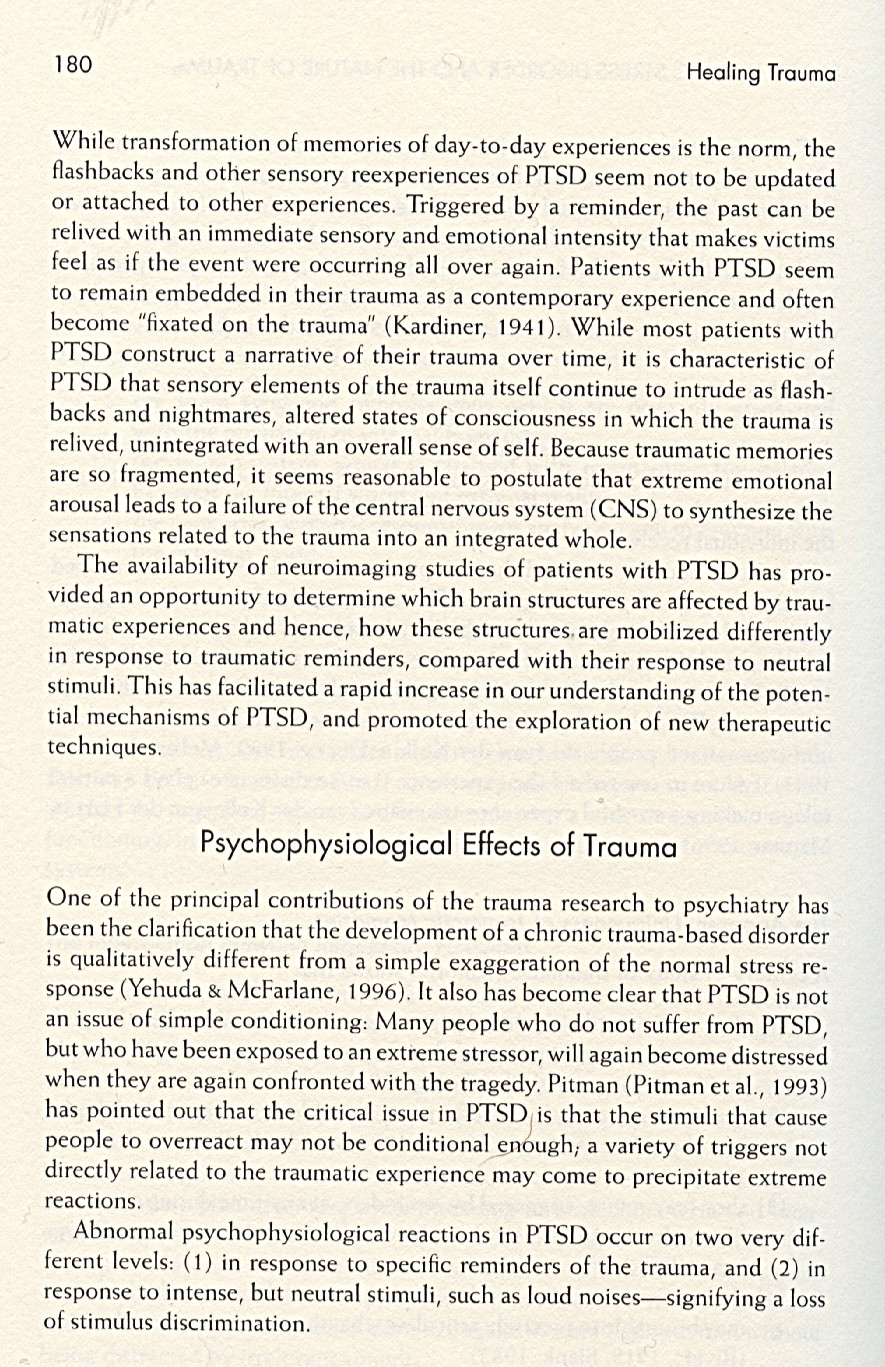
This is the concluding post (PART 4 – see links below to 1st 3 posts) about how Trauma Altered Development (TAD) changes an infant-child abuse survivor’s reaction to ALL trauma.   Van der Kolk writes about posttraumatic stress disorder (PTSD) in the book, Healing Trauma: Attachment, Mind, Body, and Brain – Hardcover (Jan 2003, W.W. Norton and Co.) by Daniel J. Siegel, Marion F. Solomon, and Marion Solomon, chapter 4 (pages 168-195) written by Bessel A. van der Kolk:  “Posttraumatic Stress Disorder and The Nature of Trauma.”

In his concluding statement of his chapter, van der Kolk writes:

“The rediscovery of trauma as an etiological [causing] factor in mental disorders is only about 20 years old.  During this time there has been an explosion of knowledge about how experience shapes the CNS [Central Nervous System, including the brain] and the formation of the self.  Developments in the neurosciences have started to make significant contributions to our understanding of how the brain is shaped by experience, and how life itself continues to transform the ways biology is organized.”

Again, in talking about infant-child abuse survivors, I would throw the term ‘mental disorders’ out the window.  (Yet how did my mother’s TAD lead her to be HOW she was in the world?]  Trauma Altered Development (TAD) happens at birth (and before) as these trauma experiences shape the CNS and brain’s formation and ‘the formation of the self’.

We cannot minimize, ignore, deny or under estimate the power early trauma has to affect an infant-child’s development.  Van der Kolk is writing in 2003.  Many advances in research and discovery about the impact early experience has on forming an individual have been made in these intervening seven years.  Evidence of early trauma’s power to change people is piling up around us.

“How life itself continues to transform the ways biology is organized” has to be considered in the light that certain of our developmental stages, once passed through in our early life, cannot later be redone under better conditions.  Science has to sort out which is which – which changes are permanent and which changes can be altered at a later age.

++

Van der Kolk continues:

“The study of trauma has probably been the single most fertile area within the disciplines of psychiatry and psychology in helping to develop a deeper understanding of the interrelationships among emotional, cognitive, social and biological forces that shape human development.  Starting with PTSD in adults, but expanding into early attachment and coping with overwhelming experiences in childhood, our field has discovered how certain experiences can “set” psychological expectations and biological selectivity.  Research in these areas has opened up entirely new insights into how extreme experiences throughout the lifecycle can have profound effects on memory, affect regulation, biological stress modulation, and interpersonal relatedions [sic].  These findings, in the context of the development of a range of new therapy approaches, are beginning to open up entirely new perspectives on how traumatized individuals can be helped to overcome their past.”

OK, I will first take issue with the last statement van der Kolk makes in his conclusion.  We have to sort out those with Trauma Altered Development (TAD) due to adaptation to extreme traumatic stress during the critical windows of their development from those who did not suffer from trauma that changed them in their development.  I belong to the first group.  Now that I know that fact, I can understand that I will NEVER be able to “overcome” my “past” in any fashion such as this author is suggesting here.

This is a critically important point for TAD survivors to understand.  Our traumatic infant-child experiences changed how we formed so that both the trauma experiences and our physiological responses to them are built into our body!  We cannot, obviously, leave our trauma changed body in our ‘past’, and any suggestion that we should or can do is worse than ludicrous.

I do not believe that any ‘help’ for me can start with PTSD in my adulthood.  For reasons pointed out in my previous posts on this topic (see below) I am no longer convinced that I even have PTSD.  I never had a pretrauma state from which to measure a posttraumatic state against – nor do I have a pretrauma state (or condition of my body) to return to.

Maybe it would help me understand myself better if I rework van der Kolk’s words so they make more sense to me as a TAD survivor:

“The study of trauma …[can help us] to develop a deeper understanding of the interrelationships among emotional, cognitive, social and biological forces that shape human development.  Starting with … early attachment and coping with overwhelming [malevolent, traumatic] experiences in childhood, our field has discovered how certain experiences …[form a developing infant-child body so that] psychological expectations and biological selectivity [are profoundly affected and permanently altered as a result].  Research in these areas has opened up entirely new insights into how extreme [traumatic] experiences throughout the lifecycle can have profound effects on memory, affect regulation, biological stress modulation, and interpersonal …[relations – but most definitely and profoundly when these experiences happen during development and change it so that all life experiences, including any later trauma experience, is processed in a different way]  These findings… are beginning to open up entirely new perspectives on how traumatized individuals [changed from birth cannot] …be helped to overcome their past.”

We cannot overcome our past.  We can begin to learn about the changes that happened to us so that we can begin to learn how to live well in spite of them.

++++

Interesting website my sister sent me the link to – am exploring it – has really COOL TRAUMA CHARTS!  Take a look at them, especially the third one which about describes how I feel all the time — and the way I felt for the entire first 18 years of my life — minus the hostility and rage because I did not have the luxury of that experience.  It is important to remember that depression is considered ‘an anxiety disorder’.

The experience of all these experiences related to trauma built themselves into our body through early infant-child maltreatment from our beginning.  The top right cluster of experiences on that bottom chart are ‘hyper’  or ‘GO’ sympathetic arm responses of our Autonomic Nervous System (ANS) and the lower left ones are the ‘hypo’ or ‘STOP’ parasympathetic ones (remember, like a ‘pair a brakes’).  Fundamental changes in how our ANS formed happened to us through our Trauma Altered Development (TAD).

Again, I have to consider this information through my Trauma Altered Development (TAD) severe infant-child abuse survivorhood filter – I do not have an ‘ordinary’ non-trauma built body – my nervous system does not have a safe, secure calm set point……I am different…..so how does this information apply to me/us?  We have to figure this out…..
Somatic Experiencing Foundation for Human EnrichmentMission Statement

The Foundation for Human Enrichment – FHE is a non-profit, educational and research organization dedicated to the worldwide healing and prevention of trauma. We provide professional training in Somatic Experiencing and outreach to under served populations and victims of violence, war and natural disasters.

What is Somatic Experiencing® (SE)?

”Somatic Experiencing® is a body-awareness approach to trauma being taught throughout the world. It is the result of over forty years of observation, research, and hands-on development by Dr. Levine. Based upon the realization that human beings have an innate ability to overcome the effects of trauma, Somatic Experiencing has touched the lives of many thousands. SE® restores self-regulation, and returns a sense of aliveness, relaxation and wholeness to traumatized individuals who have had these precious gifts taken away. Peter has applied his work to combat veterans, rape survivors, Holocaust survivors, auto accident and post surgical trauma, chronic pain sufferers, and even to infants after suffering traumatic births.

This is the primary website for the SE training, support of health professionals in Somatic Experiencing® and connecting trauma victims to the approximately 5,000 SE® Practitioners across the globe.”

++

FROM MY POINT OF VIEW — considered from the above:

SE® restores self-regulation, and returns a sense of aliveness, relaxation and wholeness to traumatized individuals who have had these precious gifts taken away

TAD survivors cannot be restored or returned to anything like what these presenters are describing.  “These precious gifts” were taken away from us from the time of our birth — or even before!!  We have to understand what this means to us — nobody is going to do it for us!!  I never had a ‘sense of aliveness, relaxation or wholeness’ ever formed into my body in the first place — or any ‘ordinary’ ability to self-regulate (formed into our body-nervous system-brain fundamentally through our caregiver attachment experiences before the age of one).  Nobody can give me back what I never had.

So, how do I FIND these ‘precious gifts’ for myself NOW?  My Trauma Altered Development is a consequence I have suffered from my entire life as a result of having had my Human Rights as a Child stripped from me and violated through 18 years of abuse, torment and trauma.

++++++++++++++++++++++++++++++

This post follows:

From December 2, 2009 +PTSD AND SEVERE ABUSE SURVIVORSHIP – PART THREE

from November 30, 2009 +PTSD AND SEVERE ABUSE SURVIVORSHIP – PART TWO

from November 28, 2009 +PTSD AND SEVERE CHILD ABUSE SURVIVORSHIP – PART ONE

+++++++++++++++++++++++

PLEASE NOTE:  Do not take anything I say as a reason to alter any ongoing treatment, therapy or medication you are receiving.  Consult with your provider if you find something in my writing that brings questions to your mind regarding your health and well-being.

++++++++++++++++++++++++++++++++

Please feel free to comment directly at the end of this post or on

+++++++

Your Page – Readers’ Responses

++++++++++++++++++++++++++++++++
OK, and this for FUN?

President Obama and ET?  “The Vatican Astrobiology conference from November 6-8 , for the first time legitimized discussion of extraterrestrial life and its implications for the Catholic Church.”

++++++++++++++++++++++++++++++++

+ALIGNING OUR NATION WITH UNITED NATIONS CHILD RIGHTS IS AGAINST OUR OWN LAWS

++++

The following comment has brought something to my attention that extremely troubles me.  Perhaps I am experiencing some of the reactions and feelings that others might experience when faced with the reality that child abuse really does occur after they have spent their lives in oblivious ignorance of this fact.

Those of us who have suffered from infant-child abuse and neglect already know, of course, that extreme maltreatment of infants and children happens in our nation.  Yet here I am today, evidently having spent my life time somehow believing that the United States of America exists at some high level of the social food chain and would, given our advantages in the world, OF COURSE lead the world on all fronts that have to do with caring for and protecting our children.

NOT TRUE I find today, thanks to the following comment:

posted comment by Pat Gordon-Smith
patsky.blogspot.com

90.211.0.50

Submitted on 2009/12/03 at 8:47am

The Universal Declaration of Children’s Rights was superseded in 1989 by the United Nations Convention on the Rights of the Child — CRC – http://www.cirp.org/library/ethics/UN-convention/

It is a detailed interpretation of the Universal Declaration of Human Rights in the special case of children whose journey between wholly dependent infancy and legally independent adulthood means that, for a greater or lesser period between birth and age 18, they must rely on others for their physical, financial and emotional security.

Every country in the world has ratified the CRC apart from two – Somalia and the USA, although last week Somalia indicated its intention to sign. This was reported on the Jobsanger blog, where I posted a response (http://jobsanger.blogspot.com/2009/11/statement-on-childrens-rights.html).

Your conclusions seem bang on to me. I agree that, in the US, recognition of children’s rights should be a matter for the federal government. Perhaps you and blogger Ted McLaughlin might join forces in putting pressure on the president for just that.

Good luck.

IN RESPONSE TO:

+VIOLATING THE UNIVERSAL HUMAN RIGHTS OF CHILDREN

++++

I just printed and read the December 12, 1989 United Nations General Assembly document from the Convention on the Rights of the Child.  I highly encourage my blog’s readers to do the same.  President Clinton did sign this, but it has never been presented to our Senate.

I did a Google search for the United Nations 10- member elected Committee on the Rights of the Child, which was established as a result of the 1989 Convention on the Rights of the Child to help nations improve the conditions of their children.

Article 44 of the Convention’s 54 Article Annex report on the Rights of the Child says,

1.  States Parties undertake to submit to the Committee, through the Secretary-General of the United Nations, reports on the measures they have adopted which give effect to the rights recognized herein and on the progress made on the enjoyment of those rights.”

This is emblazoned at the top of the Google search page:

United Nations Convention on the Rights of the Child Adopted by the United Nations General Assembly on 20 November 1989, and ratified by all nations except the United States and Somalia. www.unicef.org/crc

++++

Any great, grand illusion I may have had about our nation’s commitment to the well-being of children – no matter what – has evaporated.  I feel chilled, sickened, saddened and scared.  I want to know on what grounds, and using what reasoning, what licensure, was our nation the ONLY one other than completely unstable Somalia to refuse involvement with this global effort to identify, recognize, clarify and describe the Human Rights of Children, or to participate with an enforced accountability for the treatment and protection of our nation’s children.

This 1989 United Nations Convention on the Rights of the Child was held during the same time period (1985-1990) that the 75% of our young adults who are now unfit for military duty to our nation were born.

++++

This United Nations Background Note on Children’s Rights outlines global issues and progress made on behalf of earth’s children up until 1995 and includes the following:

A Global Pact on Children’s Rights

“After a lengthy period of careful negotiations, the Convention on the Rights of the Child was adopted in November 1989 by a vote of the General Assembly. By September of the following year, the Convention had obtained the 20 ratifications required for its entry into force as international law. Its importance as a foundation of modern human rights law was later underscored at the 1993 World Conference on Human Rights in Vienna….”

America evidently wants no part of ‘international law’?  Ask the Indigenous People of our nation how well the USA honors its treaties.

++++

The failure to ratify the treaty so far is in part due to potential conflicts with the constitution and because of opposition by some political and religious conservatives to the treaty.”

This scares me – why 75% of our youth ended up being misfits today?  How far are we willing to let the condition of our children deteriorate before we recognize that the states are not up to the job of ensuring a standard of Child Rights that even matches the United Nations suggestions?

Evidently we cannot participate in a global Child Right action because it is against our own law:

American laws for the protection of children are at the state, rather than the federal level, and the Tenth Amendment to the United States Constitution restricts the authority of the federal government to pass legislation in this area.”

++

International human rights instruments such as the Convention on the Rights of the Child and its Optional Protocols are negotiated among United Nations Member States and are legally binding on the individual States that become parties to the instrument. There are two ways for a State to become a party: by signature and ratification or by accession.

In ratifying the Convention or an Optional Protocol, a State accepts an obligation to respect, protect, promote and fulfill the enumerated rights—including by adopting or changing laws and policies that implement the provisions of the Convention or Protocol.

++++

This appears to be the kind of American reaction to these United Nations global efforts to provide for and protect the Rights of Children that leaves our nation hanging out in nowhere-ville in the company of Somalia, a nation without any government at all:

Updated February 25, 2009

Boxer Seeks to Ratify U.N. Treaty That May Erode U.S. Rights

By Joseph Abrams

– FOXNews.com

Sen. Barbara Boxer is pushing the Obama administration to move forward with ratification of the U.N. Convention on the Rights of the Child, a controversial treaty that has never gained much support in the U.S.

Sen. Barbara Boxer is urging the U.S. to ratify a United Nations measure meant to expand the rights of children, a move critics are calling a gross assault on parental rights that could rob the U.S. of sovereignty.

The California Democrat is pushing the Obama administration to review the U.N. Convention on the Rights of the Child, a nearly 20-year-old international agreement that has been foundering on American shores since it was signed by the Clinton administration in 1995 but never ratified.

Critics say the treaty, which creates “the right of the child to freedom of thought, conscience and religion” and outlaws the “arbitrary or unlawful interference with his or her privacy,” intrudes on the family and strips parents of the power to raise their children without government interference.

Nearly every country in the world is party to it — only the U.S. and Somalia are not — but the convention has gained little support in the U.S. and never been sent to the Senate for ratification……” [READ FULL ARTICLE HERE – I find the ‘opposition’ sickening]

++++

Of course, there’s this, found at the Smart Girl Politics blog:

Home Schooling families stepped up to represent not only their rights, but the rights of all Americans. The grassroots movement that took place yesterday must continue on a larger scale by educating all Americans about the danger of this U.N. treaty and placing calls to their elected officials.

Once again, our liberal friends in Washington, who claim to love America, are covertly hoping to ratify CRC making it the law of the land here in the United States helping to strip away the rights of parents in America and allow the U.N. to dictate what proper parenting looks like at a global level.

Both Drudge http://www.drudge.com/news/122366/us-may-join-un-childrens-treaty and Free Republic http://freerepublic.com/focus/f-news/2278566/posts reported on this development on June 24, 2009, but this has been on the back burner for Barbara Boxer as reported earlier this year by FoxNews.com. “Sen. Barbara Boxer is urging the U.S. to ratify a United Nations measure meant to expand the rights of children, a move critics are calling a gross assault on parental rights that could rob the U.S. of sovereignty.” http://www.foxnews.com/politics/2009/02/25/boxer-seeks-ratify-treaty-erode-rights/

According to J. Michael Smith, HSLDA President, in Washington Times Op-ed—U.N. Treaty Might Weaken Families

++++

June 23, 2009 post comment on Drudge Report:

The US was a major player in getting the Convention on the Rights of the Child up and running. In fact, the US signed on to the convention 14 years ago, but has not ratified it. (Just like Somalia.) However, the US has signed and ratified a pair of optional protocols: “Optional Protocol on the Involvement of Children in Armed Conflict” and “Optional Protocoal on the Sale of Children, Child Prostitution and Child Pornography.” President Obama has described this country’s failure to ratify the convention as “embarrassing.” The text is located here: www.crin.org

As mentioned above, these are the

Optional Protocols

Two Optional Protocols to the Convention on the Rights of the Child exist:

+++++++++++++++++++

Fortunately I have found some hope in this impressive website concerned with the Rights of the Child:

CRIN – Child Rights Information Network found at http://www.crin.org/

THEIR MISSION:

CRIN’s mission is to equip the global child rights community with the information it needs to ensure the implementation of children’s rights.

CRIN presses for rights, not charity and is passionate about putting children’s rights at the top of the global agenda by addressing root causes and promoting systematic change. Its guiding framework is the UN Convention on the Rights of the Child (CRC).

Our activities are based on the belief that information is a powerful tool for realising children’s rights – and such information should be made as widely available and accessible as possible. As such, CRIN aims to bridge the gap between the information-rich and the information-poor by maximising the potential of new information technologies, and ensuring that those unable to use them are not excluded.

As a network of, at the last count, over 2,000 members in 150 countries, we aim to capture the expertise and the knowledge of our members, making this available to all actors involved in the implementation of the CRC.”

++++

Please take a moment to follow this link and read CRIN’s Factsheet on Children’s Rights.  Print it, display it, believe it, share it.

For every single one of us who has suffered the trauma of infant-child maltreatment and abuse, we know the truth of these words within every cell of our body.  These facts give us the common ground we need in order to understand the essence of what was done to us, what happened to us as a result, and why.

Our basic human Child Rights were violated.  We were not protected.  We were harmed, hurt – and changed.

+++++++++++++++++++++++++++++++++++++++++++++++

Please feel free to comment directly at the end of this post or on

+++++++

Your Page – Readers’ Responses

++++++++++++++++++++++++++++++++
+PTSD AND SEVERE ABUSE SURVIVORSHIP – PART THREE

+++++++++++++++++++++++++++++++++

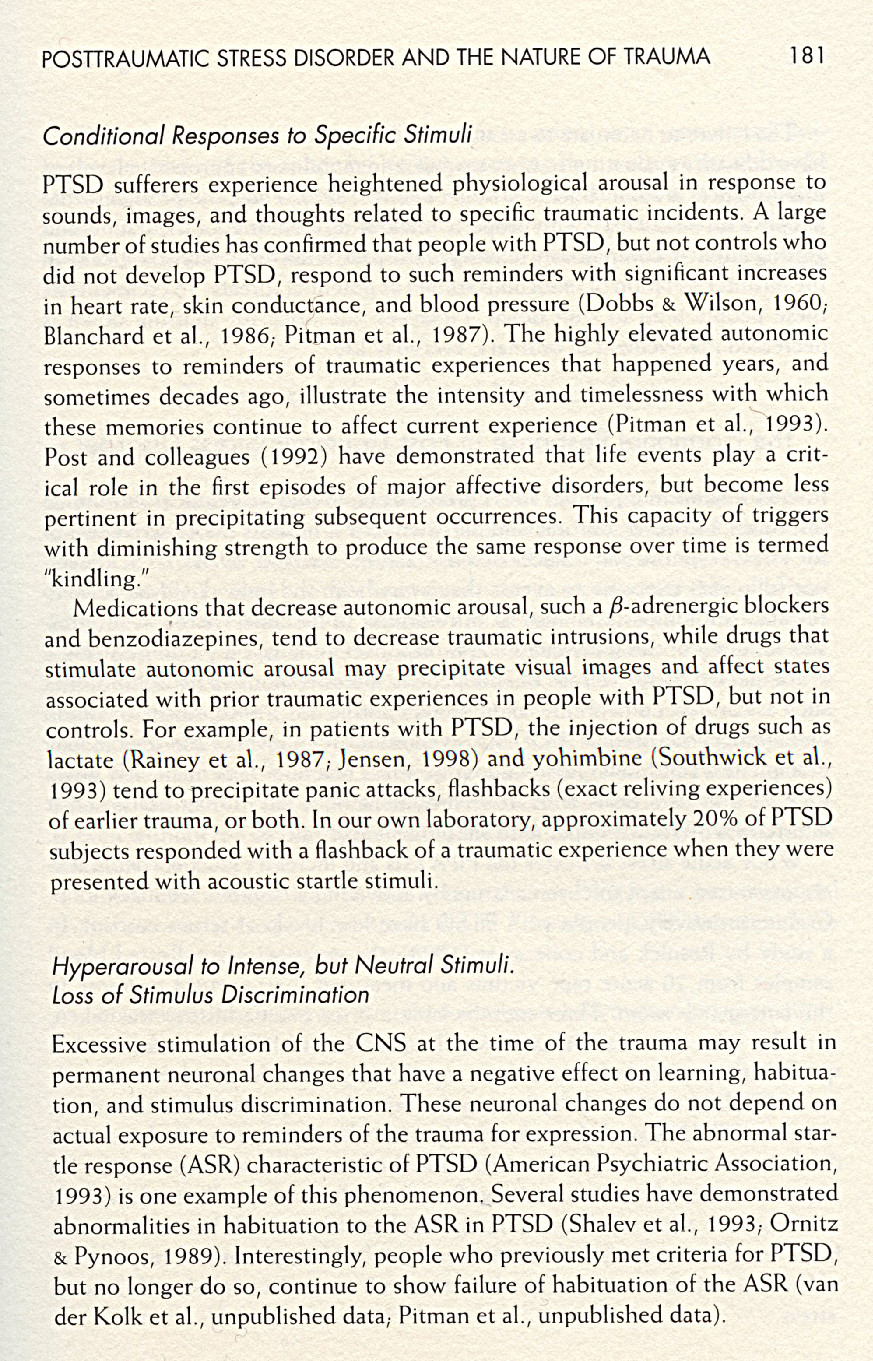
I find that the only standard I can consistently depend upon in my considerations about what constitutes malevolent treatment versus adequate, benevolent treatment lies within the context of the United Nations Universal Declaration of the Human Rights of Children.  Safe, secure, appropriate and adequate early care that leads to an infant-child’s optimal development lies on a continuum at the opposite end from early malevolent conditions that present nearly a constant challenge and threat to survival itself.

The basic needs of children are defined in this Declaration.  In looking at my own history of survivorhood (I was never allowed to be a child, and therefore I no longer consider that I had a childhood at all) it is clear to me that every one of my rights as an infant-child were violated.  It was in that malevolent environment of deprivation that I was exposed to the degrees of trauma that were severe enough to create within the physiology of my body Trauma Altered Development (TAD).

From my earliest beginnings as a being physically separate from my mother was suffered from a lack of safe and secure attachment.  Deprived of that most fundamental resiliency factor, my body-brain-mind-self had to do the best that I could do to continue to grow and develop within that terrible environment that threatened my very existence.

This third post on the topic again continues an exploration of how TAD changes an infant-child abuse survivor’s reaction to ALL trauma.   Van der Kolk writes about posttraumatic stress disorder (PTSD) in the book, Healing Trauma: Attachment, Mind, Body, and Brain – Hardcover (Jan 2003, W.W. Norton and Co.) by Daniel J. Siegel, Marion F. Solomon, and Marion Solomon, chapter 4 (pages 168-195) written by Bessel A. van der Kolk:  “Posttraumatic Stress Disorder and The Nature of Trauma.”

++++

I begin writing today by considering the last sentence of the scanned book pages that were posted on November 30, 2009:

“….progress in understanding the function of attachment in shaping the individual and rapid developments in the neurosciences gave a new shape to these old insights [about the importance of trauma].”  (page 177)

++++

Van der Kolk next considers “The Psychobiology of Trauma” in his writing:

Modern research has come to elucidate the degree to which PTSD is, indeed, a “physioneurosis,” a mental disorder based on the persistence of biological emergency responses.”  (page 177)

In my thinking, naming PTSD ‘a mental disorder’ ignores the overwhelming evidence that the entire human body is included in the ‘persistence of biological emergency responses’ that the author is talking about.  From my point of view, it is the consideration of how severe infant-child maltreatment and abuse changes the development of the ENTIRE BODY of the little one that matters to those of us who survived this degree of early trauma.

‘Biological emergency responses’ BUILT our bodies.  These responses signaled our DNA how to express itself.  These responses signaled our developing nervous system and brain on all levels about how to adapt to trauma.  Our developing nervous system was also intimately involved in these responses as it formed, also.  It is at this most basic, profound level of our physiological development from our beginnings that we have to understand how our development changed in ways that a non-TAD ‘ordinary’ body did not.

The adaptive changes that happened to us took place on far, far deeper levels than just the level of mind.  Mind is simply the topmost layer of our existence that I see as being related to our body as smoke is to fire.  I do not have a ‘mental disorder’.  My entire being is ordered in a very particular way in accordance with what surviving my infant-child trauma required.

It is this Trauma Altered Development that created my survival based, trauma centered ordering of my entire being that I seek to understand.  I am not convinced that van der Kolk has anything more than a passing surface notion of what these TAD changes actually ARE, how they affect us, or even if they legitimately belong to anything like a PTSD diagnostic category.

++++

Van der Kolk continues by saying:

To understand how trauma affects psychobiological activity, it is useful to briefly revisit some basic tenets of neurobiology.”

I do not like the term ‘psychobiological activity’ because it implies that anyone on the outside can ever have any accurate information about what another person’s ‘psyche’ is like.  That is why researchers try to more completely understand the human ability to form a Theory of Mind.  MIND belongs to each of us as individuals, and everyone has their own.  Nobody can ever come to understand what the subjective experience of MIND is like for another person.

‘Neurobiology’ is a different thing.  This is a realistic descriptive word that refers to a part of a person that can, within the current limitations of science, be understood and described because it is physically real on the molecular level.  But neurobiology is not the same thing as MIND.

Van der Kolk continues:

McLean (1990) defined the brain [my note:  The brain is a biological reality as part of our nervous system, from which an individual’s MIND originates.  Brain and MIND are not the same thing.] as a detecting, amplifying, and analyzing device for maintaining us in our internal and external environment.  These functions range from the visceral regulation of oxygen intake and temperature balance to the categorization of incoming information necessary for making complex, long-term decisions affecting both individual and social systems.  In the course of evolution, the human brain has developed three interdependent subanalyzers, each with different anatomical and neurochemical substrates:

(1)  the brain stem and hypothalamus, which are primarily associated with the regulation of internal homeostasis,

(2) the limbic system, which is charged with maintaining the balance between the internal world and external reality, and

(3) the neocortex, which is responsible for analyzing and interacting with the external world.

It is generally thought that the circuitry of the brain stem and hypothalamus is most innate and stable, that the limbic system contains both innate circuitry and circuitry modifiable by experience [my note:  This emotional area of the brain forms through early caregiver attachment interactions birth to age one, forming MUCH earlier than the neocortex], and that the structure of the neocortex is most affected by environmental input (Damasio, 1995).  If that is true, trauma would be expected to leave its most profound changes on neocortical functions, and least affect basic regulatory functions.  However, while this may be true for the ordinary stress response, trauma – stress that overwhelms the organism – seems to affect people over a wide range of biological functioning, involving a large variety of brain structures and neurotransmitter systems.”  (pages 177-178)

++++

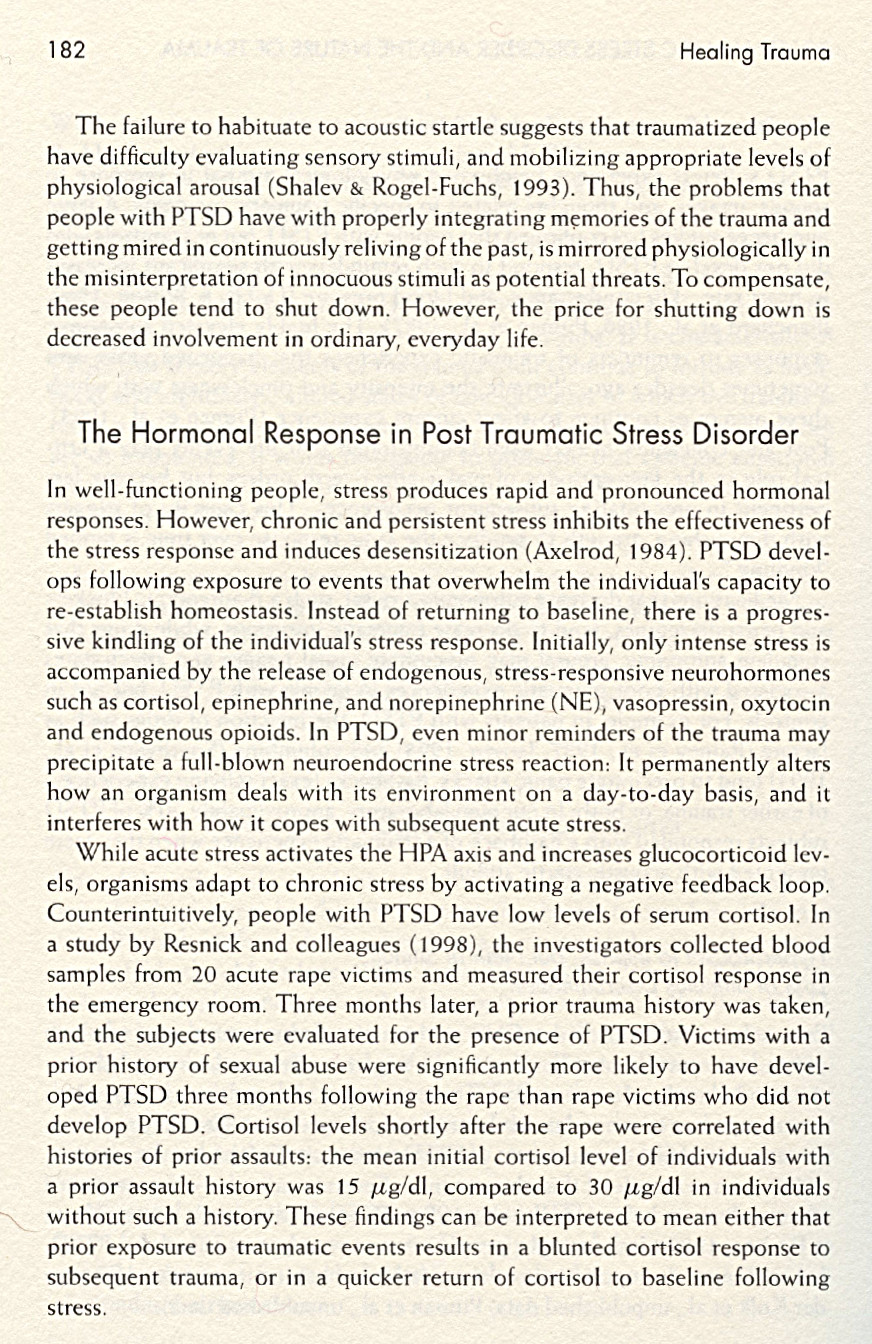
I am going to scan in the book pages that follow in van der Kolk’s description of how trauma affects people.  I believe his statement on the bottom half of page 190 is extremely important:

“…the development of a chronic trauma-based disorder is qualitatively different from a simple exaggeration of the normal stress response….”

We need to stretch that concept as far as we possibly can if we are going to understand how severe trauma from malevolent infant-child abuse and neglect changes our entire development – nothing about us is excluded.  Any possible aspect of our development that can adapt its development in order to help us endure and survive early trauma – does so.

Our problem comes when the reality of our early trauma is denied along with the depth, breadth and width of its impact on our development.  What may be true for a non trauma altered development person cannot be assumed to be true for us.  Yes, we know what the following descriptions of consequences FEELS like – but we also know that we never knew any other, different way of being in the world.

Due to the changed development we experienced as we survived our early severe traumas, anything that we might begin to understand now as being more like  ‘ordinary’ in our physical – and correspondingly in our mental — ability to experience our self in our body in our lifetime, will happen as we begin to understand how deeply trauma formed us in the first place so that we will NEVER experience trauma (or life) in the same way as will a person who did not experience Trauma Altered Development when they were little.

++++

The scanned pages below (from the book mentioned above!) is complicated information, but it is a place for us to truly begin to understand ourselves – the way were MADE in the severely abusive and trauma-filled environments we were formed in.

On page 184 van der Kolk notes that “PTSD patients” have problems

“…with “taking in” and processing arousing information, and to learn from such experiences.”

Sorry, but I am not a ‘PTSD patient’.  I am a 58-year-old woman who has suffered from an extra-ordinary body, altered in all its developmental stages in adaptation to trauma, that has never been able to ‘take in’ even ordinary information, let alone ‘arousing information’, or to ‘learn from’ the experiences of my life in an ordinary way.

What on earth do we expect to happen to little people who must continue to develop and survive even while they have little or no access to even their most basic Universal Human Rights?  Infant-child development IS ALTERED under these conditions.  It is time that we realize this is the most truly horrific consequence of early abuse and trauma.  We don’t get to experience ANYTHING the same way as non-early-traumatized people do – not even later traumas.

(note:  I believe in ‘degrees of damage’ – the 75% of our sub-par young adults in this country have suffered some degree of damage that has changed the course of their development away from optimal and BEST!  We cannot afford to ignore that fact – deprivation and violation of the Universal Human Rights of Children causes changes in the way their body and brain develop.  There is a very real, physiological process through which trauma and deprivation get passed on down the generations.  We know it is happening when we see the consequences in degrees of lack of well-being –- which are detectable no matter what our age.)

++++

(The following is from page 186 on left or right handedness and trauma)

++++++++++++++++++++++++++++++

This post follows:

from November 30, 2009 +PTSD AND SEVERE ABUSE SURVIVORSHIP – PART TWO

from November 28, 2009 +PTSD AND SEVERE CHILD ABUSE SURVIVORSHIP – PART ONE

+++++++++++++++++++++++

PLEASE NOTE:  Do not take anything I say as a reason to alter any ongoing treatment, therapy or medication you are receiving.  Consult with your provider if you find something in my writing that brings questions to your mind regarding your health and well-being.

++++++++++++++++++++++++++++++++

Please feel free to comment directly at the end of this post or on

+++++++

Your Page – Readers’ Responses

++++++++++++++++++++++++++++++++

+VIOLATING THE UNIVERSAL HUMAN RIGHTS OF CHILDREN

++++++++++++++++++++++++++++++

When any of the Universal Human Rights of Children are violated, those who violate and those who allow the violation to occur are equally accountable for the criminality of their actions.

Today I am reminded of the biggest picture not only about the condition of the youth, children, infants and their parents within our nation.  This picture is about Human Rights – not only as they apply to adults, but also as they apply to the offspring we are raising among us.

What do these words mean?

Equal Justice, Equal Opportunity, Equal Dignity

I found a wonderful video about Human Rights presented at this above link presented by our friends on their website, Treasures of Wonderment.

I then went to the United Nations website where I found the full text of the Universal Declaration of Human Rights:

On December 10, 1948 the General Assembly of the United Nations adopted and proclaimed the Universal Declaration of Human Rights….Following this historic act the Assembly called upon all Member countries to publicize the text of the Declaration and “to cause it to be disseminated, displayed, read and expounded principally in schools and other educational institutions, without distinction based on the political status of countries or territories.””

++++

Considering my concerns about the current poor condition of the youth of our nation, and thinking about how every passing present moment of our lives are passing continually into the past as we step into the future, I wonder about the decline in well-being that our nation is obviously experiencing as demonstrated not only by this lack of well-being of our youth but also of the parents who raise them.

Do we in America today deny that we have these Universal Human Rights and that our children also have Universal Human Rights?  What are we lacking as a nation that is creating these conditions of distress within our population?  What elements are missing that the required environment of safe and secure attachment to ourselves, to our children, to one another and to the world we live in seems to be increasingly missing within our own nation?

What standards can we use in order to take a clearer look at ourselves?  Why NOT consider the Universal Declaration of Human Rights as the most complete set of guidelines existing on our planet about our concerns?

++++

Every one of the 30 Articles contained within the Universal Declaration of Human Rights are vital to ensure human well-being.  All these Rights fit together into a whole.  It is my particular concern today about the well-being of our nation’s infants, children, youth and their parents that most concerns me, so I paid particular attention to Articles 25 and 26 as I read this Declaration:

Article 25.

  • (1) Everyone has the right to a standard of living adequate for the health and well-being of himself and of his family, including food, clothing, housing and medical care and necessary social services, and the right to security in the event of unemployment, sickness, disability, widowhood, old age or other lack of livelihood in circumstances beyond his control.
  • (2) Motherhood and childhood are entitled to special care and assistance. All children, whether born in or out of wedlock, shall enjoy the same social protection.

Article 26.

  • (1) Everyone has the right to education. Education shall be free, at least in the elementary and fundamental stages. Elementary education shall be compulsory. Technical and professional education shall be made generally available and higher education shall be equally accessible to all on the basis of merit.
  • (2) Education shall be directed to the full development of the human personality and to the strengthening of respect for human rights and fundamental freedoms. It shall promote understanding, tolerance and friendship among all nations, racial or religious groups, and shall further the activities of the United Nations for the maintenance of peace.
  • (3) Parents have a prior right to choose the kind of education that shall be given to their children.

++++

Do the rights of children solely lie with their parents?  What happens if parents do not and cannot ensure the rights of their children?  What happens if and when parents directly violate ANY of the United Nations Human Rights as they apply to children?  What ARE the Universal Human Rights of children?  Do they have any?

On November 20, 1959 the United Nations adopted the Universal Declaration of Children’s Rights.  I found a United Nations page with links on the rights of children, and also found the official version of the Universal Declaration of Children’s Rights.

I also found the following on the United Nations website.  It is in these few words that the picture becomes clear not only about what children need, but what their Universal Human Rights are in plain and simple language:

Declaration of the Rights of the Child – Plain Language Version

1.  All children have the right to what follows, no matter what their race, colour, sex, language, religion, political or other opinion, or where they were born or who they were born to.

2.  You have the special right to grow up and to develop physically and spiritually in a healthy and normal way, free and with dignity.

3.  You have a right to a name and to be a member of a country.

4.  You have a right to special care and protection and to good food, housing and medical services.

5.  You have the right to special care if handicapped in any way.

6.  You have the right to love and understanding, preferably from parents and family, but from the government where these cannot help.

7.  You have the right to go to school for free, to play, and to have an equal chance to develop yourself and to learn to be responsible and useful.

Your parents have special responsibilities for your education and guidance.

8.  You have the right always to be among the first to get help.

9.  You have the right to be protected against cruel acts or exploitation, e.g. you shall not be obliged to do work which hinders your development both physically and mentally.

You should not work before a minimum age and never when that would hinder your health, and your moral and physical development.

10.  You should be taught peace, understanding, tolerance and friendship among all people.

++++

Those who are survivors of any degree of deprivation of any of these rights anywhere on our planet – including within our own nation — are caused suffering through criminal actions.  When any of these Universal Human Rights of children are violated, it is to this that we must pay the closest attention:

6.  You have the right to love and understanding, preferably from parents and family, but from the government where these cannot help.

I do not believe that in our nation the Universal Human Rights of Children should be left to the care of the governments of our separate states.  I believe that the guarantee of these Rights needs to be protected by our federal government.  I believe we need to develop a federal standardization in regards to children’s Rights that is applied equally across all 50 states on every level that impacts the well-being of our nation’s children – from conception forward.

This would include all child protection services, including all services designed to identify maltreatment, all services designed to remedy critical issues within a child’s home of origin in a speedy and competent manner, and all services that are designed to place children in living environments where ALL their Universal Human Rights will be guaranteed.

I also believe that our children’s public education needs to be standardized on a national level and should NO LONGER be left, in any way or on any level, up to the incompetent design and administration of individual states.

It seems obvious to me that considering the findings that 75% of our youth are suffering from serious lack of well-being that even finding ways to shore up inadequate parenting will not resolve the profound problems our nation is facing in regard to Universal Human Rights of our children.  We need an across-the-board revision of our educational system by the federal government, and this need has reached critical proportions.

++++

Either we are a nation that is willing to stand behind these Rights as defined by the United Nations or we are not.  It seems obvious to me where the great grey area of “maybe yes, maybe no” has gotten us.  We have approached a ‘crisis management needed’ stage within our nation.  We need to move up the hierarchy of who is going to take care of our nation’s children – and how.

If parents are not equipped to guarantee the Universal Human Rights of their children, and if our individual states are not equipped to do it, then it is our federal government’s responsibility to step up to its job of guaranteeing these rights through every possible means at its disposal.

Violating the Universal Human Rights of Children is a criminal act.  Allowing anyone to violate these rights is a criminal act.  These Rights are not arbitrary.  They are absolute, fundamental and necessary.  There is no room for grey.  Either we are a nation of criminals or we are not.

+++++++++++++++++++++++

Please feel free to comment directly at the end of this post or on

+++++++

Your Page – Readers’ Responses

++++++++++++++++++++++++++++++++
PBS Documentary – The Mind’s Big Bang – evolution of our mind – There’s a free toolbar you can download that open’s up a universe!!

+THREE TOPIC INFORMATION POST

++++++++++++++++++++++++++

FROM THE:

Prevent Child Abuse New York Blog

Early Learning:   Key to National Defense

Posted: 30 Nov 2009 09:36 AM PST

A new press release, published by Mission Readiness says that according to Pentagon data, that 75% of our nation’s 17 to 24-year-olds are unfit for service due to failure to complete high school, past criminal record or are physically unfit. Military leaders are calling on Congress to pass the Early Learning Challenge Grant legislation.

The Obama Administration’s Early Learning Challenge Grant proposal would challenge states to develop effective, innovative models that promote high standards of quality and a focus on outcomes across early learning settings, and dedicate $10 billion over ten years toward this effort.  The goal is to reform and improve early learning programs to deliver a complete and competitive education to every child in America.

Congress is now considering the proposal, which would help states provide more at-risk kids with access to quality early learning programs.  It would provide grants to the states of $1 billion a year for up to ten years to improve the quality of early childhood development programs and expand access to more at-risk kids.

Some of the goals of the fund are to:

  • Drive results-oriented, standards reform across programs, setting a high standard of quality for programs to strive toward, in order to better promote early learning, child development, and school readiness.
  • Fund and implement pathways to improve existing early learning programs, with the goal of increasing the number of low-income young children who participate in higher-quality settings.
  • Ensure that more children enter kindergarten ready, with the healthy cognitive, social, emotional, and physical skills and ability necessary for success.

The military is currently meeting recruitment goals, due in part to the severe economic recession, but the retired leaders said the challenge of finding quality recruits will return when the economy recovers. Rear Admiral Barnett said, “Our national security in the year 2030 is absolutely dependent on what’s going on in pre-kindergarten today. We urge Congress to take action on this issue this year.”

Major General Comstock adds: “I’m a lifelong political conservative, and I believe that government should intervene on a limited and targeted basis.   Early education is not conservative common sense or liberal common sense, it’s just plain common sense. Reaching the most at-risk kids helps increase graduation rates and cut crime, so early education is a matter of national security.”

To view the full press release please visit : http://www.missionreadiness.org/press110509.html

++++++++++++++++++++++++++

THE FOLLOWING IS PRESENTED IN MEMORY OF MY MOTHER:

FROM About.comBorderline Personality Disorder

In the Spotlight | More Topics |
from Kristalyn Salters-Pedneault, PhD
Lots of people with BPD worry about the whether their marriage can weather the storms that can come with the disorder. And many people who are married to those with BPD wonder whether therapy can improve the quality of the relationship.

Can a BPD Marriage Survive?
Couples counseling may be one helpful avenue of treatment, but there are no systematic studies of these types of therapies in BPD couples.

More Topics

Can I Get Better on My Own?
If you or your spouse has BPD, you may be wondering whether treatment is really necessary. Unfortunately, BPD isn’t the kind of disorder that is easily treated through self-help.

Should I Divorce My BPD Spouse?
Of course there is no blanket answer for this one. Some people make their BPD marriage work, and others can’t. But here are some things to consider…

++++++++++++++++++++++++++

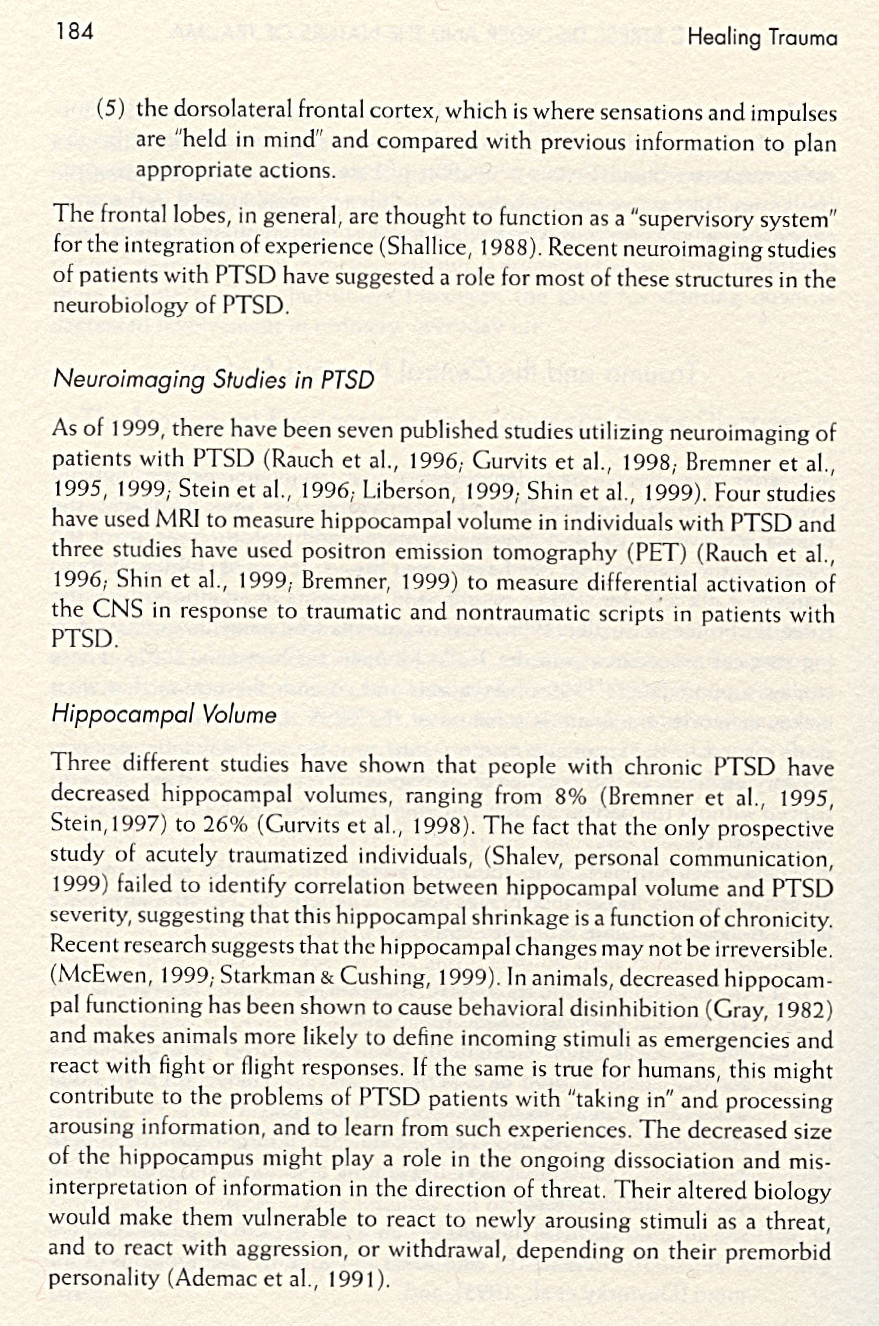
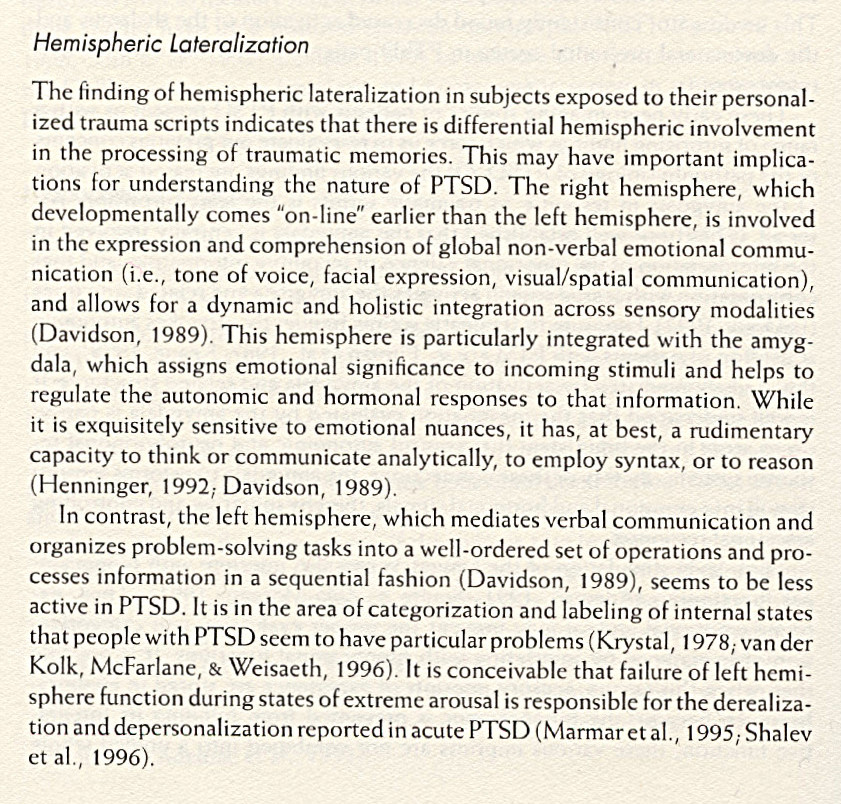
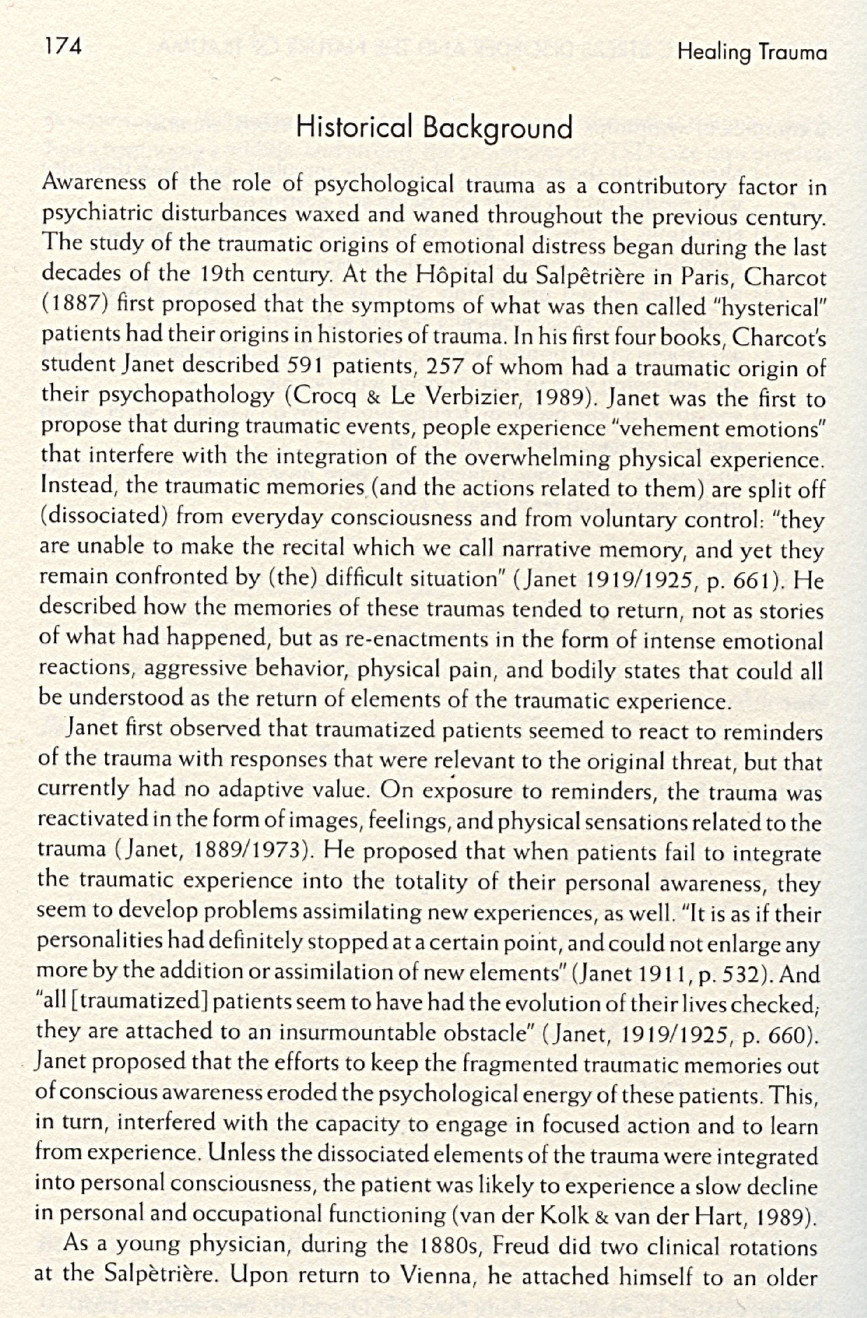
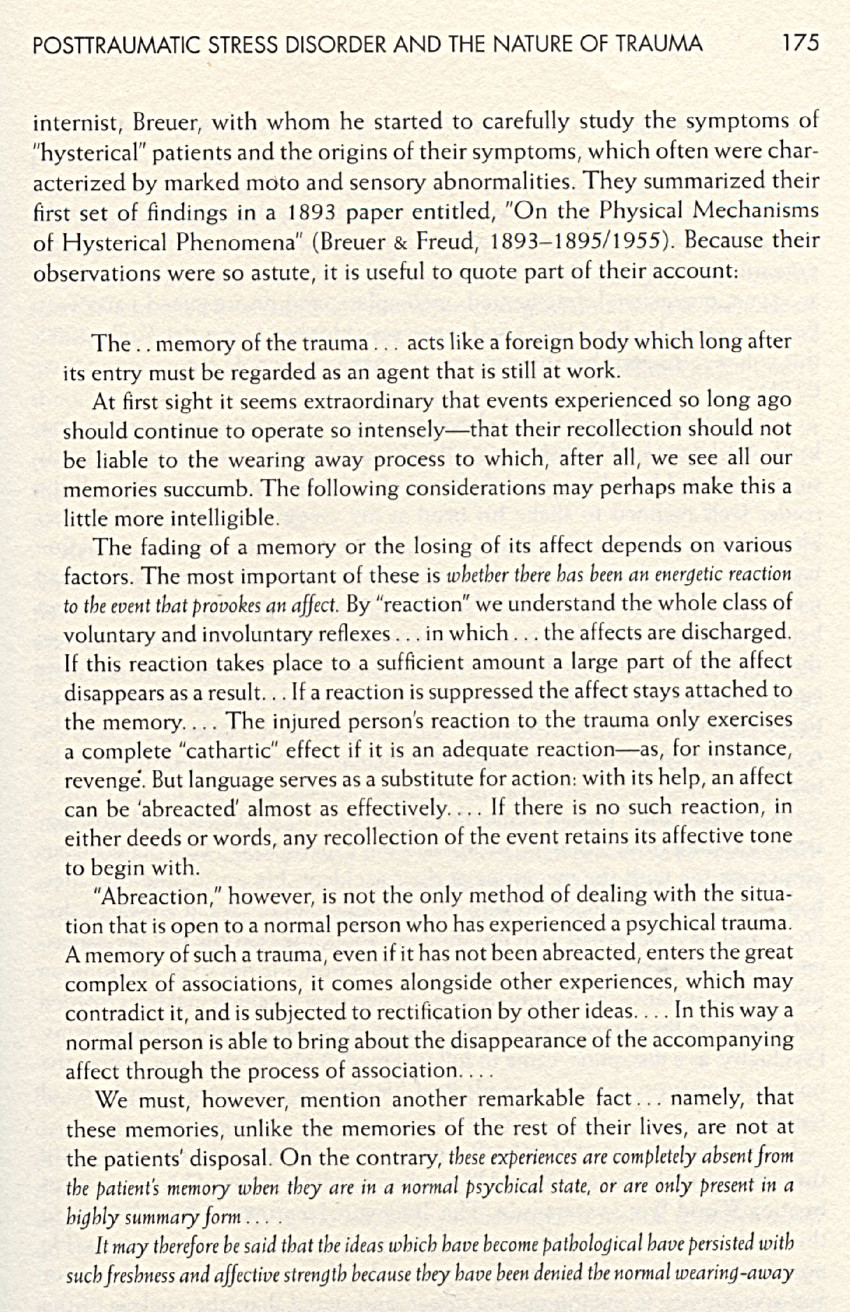
I am scanning in the following four pages about the history of the treatment of trauma for your consideration.  It is the last sentence on page 177 that interests me most as I will consider in a future post, but in all fairness to the author and to my readers, the rest of this information needs to be presented here for educational purposes.

These pages are taken from the book, Healing Trauma: Attachment, Mind, Body, and Brain – Hardcover (Jan 2003, W.W. Norton and Co.) edited by Daniel J. Siegel, Marion F. Solomon, and Marion Solomon, chapter 4 (pages 168-195) written by Bessel A. van der Kolk:  “Posttraumatic Stress Disorder and The Nature of Trauma.

++++

++++++++++++++++++++++++++

Please feel free to comment directly at the end of this post or on

+++++++

Your Page – Readers’ Responses

++++++++++++++++++++++++++++++++
PLEASE NOTE:  Do not take anything I say as a reason to alter any ongoing treatment, therapy or medication you are receiving.  Consult with your provider if you find something in my writing that brings questions to your mind regarding your health and well-being.

++++++++++++++++++++++++++++++++

+PTSD AND SEVERE ABUSE SURVIVORSHIP – PART TWO

+++++++++++++++++++

This second post about Posttraumatic Stress Disorder (PTSD) refers again to a book called Healing Trauma: Attachment, Mind, Body, and Brain – Hardcover (Jan 2003, W.W. Norton and Co.) by Daniel J. Siegel, Marion F. Solomon, and Marion Solomon, chapter 4 (pages 168-195) written by Bessel A. van der Kolk:  “Posttraumatic Stress Disorder and The Nature of Trauma.”

Today’s post follows the November 28, 2009 post

+PTSD AND SEVERE CHILD ABUSE SURVIVORSHIP – PART ONE

PLEASE NOTE:  Do not take anything I say as a reason to alter any ongoing treatment, therapy or medication you are receiving.  Consult with your provider if you find something in my writing that brings questions to your mind regarding your health and well-being.

+++++++++++++++++++

The following is taken from pages 172 of the above text.  I will consider this information in my writing below:

+++++++++++++++++++

It is now easier for me to work with this information because I have described my own version of an alternative way of thinking about the ongoing complications severe infant-child abuse and malevolent treatment survivors face as a direct result not only of the specifics of the actual horrific traumas they lived through, but also because of the very real physiological changes that surviving these traumas created in their infant-child growing and developing body.

(see yesterday’s November 29, 2009 post

+TRAUMA ALTERED DEVELOPMENT (TAD) – A NEW DESCRIPTIVE CONCEPT)

++++

An accurate primary and initial assessment of TAD for those of us who are Infant-Child Severe Maltreatment Survivors would allow us to know immediately how the changes our body-brain had to make created us to be different from ‘ordinary’ people who do not have the history of trauma that we do.

In this TAD assessment two critical resiliency factors would also need to be assessed because these two resiliency factors (one primary, the other secondary) are known to have the ability to nearly completely modify and modulate the power that early trauma has to change our developing body-brain.

The presence of safe and secure attachment to some early primary caregiver is the most basic and important resource an Infant-Child Severe Maltreatment Survivor had.  The current assessment tools available to assess adult secure and insecure attachment need to be simplified, refined and made accessible to the public.

Stemming from the degree of safety and security available through early caregiver attachment, the ability to play is a secondary but critical resiliency factor that impacts an Infant-Child Severe Maltreatment Survivor’s body-brain development.  I believe that assessment criteria and tools to measure this critical factor consistently and accurately can be developed and also made available to the public.

++++

NOTE:  In our new age of technology, the public has the right to be able to access critically important information about themselves and how their early infant and childhood experiences impacted their development.  At present this information remains ONLY available within ‘clinical’ settings, if even there.

++++

As far as I am concerned, anything and everything that is currently lumped under so-called ‘psychological’ categories belongs to the sinking Titanic of dark age medical model thinking that I referred to in yesterday’s post.

Until Trauma Altered Development (TAD) is assessed at the bedrock level of how Infant-Child Severe Maltreatment Survivors changed at their own bedrock (molecular) level, any attempt to moderate so-called ‘symptoms’ remains a crap shoot in the dark.

TAD assessment can connect the consequences of early trauma to altered physiological changes that an Infant-Child Severe Maltreatment Survivor’s body was forced to make to best ensure continued survival in early malevolent environments,

++++

Early caregiver attachment experiences from birth build the body-brain we will live with for the rest of our lives.

Van der Kolk (scanned text above) writes that it is not usually the symptoms of PTSD itself that brings those seeking help to a clinical setting.  Rather, he says that it is “depression, outbursts of anger, self-destructive behaviors, and feelings of shame, self-blame and distrust that distinguished a treatment-seeking sample from a nontreatment-seeking community sample with PTSD.”

Through an accurate TAD assessment, any ongoing difficulty an Infant-Child Severe Maltreatment Survivor has with emotions and social interactions can be traced to inadequate early caregiver interactions in a malevolent environment that built for the survivor an entirely different early-forming right-limbic-emotional-social brain.

When the foundation of the early forming right brain is altered because of maltreatment, the Infant-Child Severe Maltreatment Survivor’s later developmental stages involving shame, guilt and embarrassment will also be off course from ‘ordinary and optimal’ and will cause altered patterns of development in the body-brain.

++++

Van der Kolk states:

The majority of people who seek treatment for trauma-related problems have histories of multiple traumas.”

OK, I can certainly understand this, but here again, as I mentioned above, I do not agree with applying so-called ‘psychological’ and ‘symptom based’ medical model diagnostic thinking used in the author’s next statements.  I absolutely disagree with ever using terms such as ‘character pathology’ in reference to Infant-Child Severe Maltreatment Survivors!

One recent treatment-seeking sample…suffered from a variety of other psychological problems which in most cases were the chief presenting complaints, in addition to their PTSD symptoms:  77% suffered from behavioral impulsivity, affect lability, and aggression against self and others; 84% suffered from depersonalization and other dissociative symptoms; 75% were plagued by chronic feelings of shame, self-blame and being permanently damaged and 93% complained of being unable to negotiate satisfactory relationships with others.  These problems contribute significantly to impairment and disability above and beyond the PTSD symptoms….Focusing exclusively either on PTSD or on the depression, dissociation and character pathology prevents adequate assessment and treatment of traumatized populations.”

TAD assessments will clearly show that ‘impulsivity’, ‘affect liability’, most aggression, and dissociation are directly connected to changes in how an Infant-Child Severe Maltreatment Survivor’s nervous system, including their brain – and here, particularly their right brain – formed differently from ‘ordinary’ due to growth and development in trauma.

Chronic feelings of shame, self-blame and being permanently damaged” are also directly connected to trauma through developmental changes an Infant-Child Severe Maltreatment Survivor’s nervous system, including their brain – and here, particularly their later forming (after age one) left brain – had to make while developing in an early malevolent, trauma-filled environment.

Rather than referring to these changes as ‘character pathologies’, which in my thinking is the maltreatment, abusive stance taken by the medical model toward Infant-Child Severe Maltreatment Survivors, a TAD assessment can accurately and specifically pinpoint the origin of these changes in the body-brain and describe the consequences of them.

Receiving an accurate TAD assessment will show us exactly how our body was forced to adapt during our development through trauma so that we could survive it.   Yes, I do believe we KNOW we are different from ‘ordinary,’ but we are not ‘permanently damaged’.   We ARE permanently changed.

The changes Infant-Child Severe Maltreatment Survivors experience are fundamental and profound!  Everything about us was subject to adjustment for our trauma survival – our body, our nervous system and brain, our immune system, our mind, and our connection between our self and our self and between our self and the entire world around us.  NOT facing the truth and discovering the facts through TAD assessment will NOT resolve the difficulties we face with our continued survival into adulthood.

The only long term solution societies have is to STOP Infant-Child Severe Maltreatment!!!  Part of that solution is to provide the kind of TAD assessment Infant-Child Severe Maltreatment Survivors need, and to make available to us the resources necessary for us to live the best life we can in spite of the changes we had to make in order to stay alive because nobody STOPPED the Infant-Child Severe Maltreatment that happened to us.

It is the pathological character of the society we were born into that allowed what happened to us to happen at all, let alone allowed it to continue to the degree that trauma changed our physiological development.  If there is any self blame to be had, it is on the level far beyond OURS as the Infant-Child Severe Maltreatment Survivors.

++++

That the grand sinking Titanic of the archaic dark age’s medical model about Infant-Child Severe Maltreatment Survivors has at least THOUGHT about throwing us a life boat becomes apparent in van der Kolk’s next words:

As part of the DSM IV field trial, members of the PTSD taskforce delineated a syndrome of psychological problems which have been shown to be frequently associated with histories of prolonged and severe personal abuse.  They call this Complex PTSD, or Disorders of Extreme Stress Not Otherwise Specified (DESNOS).”

Great!  A life boat full of holes!  Gee, why are we NOT thankful for that?

A syndrome of psychological problems” be damned!  Infant-Child Severe Maltreatment Survivors do not suffer from a ‘syndrome’, and ours are not ‘psychological problems’!  For all the reasons I have repeatedly described, we simply need a TAD assessment that will tell us HOW our little body adapted down to our molecular level during our development in the midst of, and in spite of, toxic malevolent trauma.  Then we need resources that inform us how to live NOW with these profound trauma-caused changes that happened to us THEN.

The author continues:

DESNOS delineated a complex of symptoms associated with early interpersonal trauma.”

Again, we don’t have ‘symptoms’.  We have a different body-brain-mind-self that adapted to survival in a malevolent world and caused us to have Trauma Altered Development (TAD).

We don’t have symptoms, we have consequences.  Every single item in the list of so-called ‘complex symptoms’ (see them in the page scan below) that van der Kolk describes are directly connected to our TAD.  EVERY SINGLE ONE OF THESE ITEMS exist within us because of changes our body-brain was forced to make.  They are consequences of the changes our body had to make through our TAD.

The only real progress in the right direction I can see – given to us like faulty patches to a sinking life boat thrown to us from a sinking ship – is that at least an association ‘with early interpersonal trauma’ is finally being considered in the current medical model thinking.

But this tiny droplet of hoped for healing balm offered by the creation of a construct named “Complex PTSD, or Disorders of Extreme Stress Not Otherwise Specified (DESNOS)” is not what we Infant-Child Severe Maltreatment Survivors need in my book.

We need our entire society to understand and accept the truth that the Infant-Child Severe Maltreatment that happened to me and others – and continues to happen to children around us today – is nothing short of a form of parental-selected genocide that did not fulfill its intent to completely destroy us.  We are Infant-Child Severe Maltreatment Survivors because we are still alive, and we ONLY SURVIVED because we were able to adapt our body throughout our Trauma Altered Development to and within the malevolent environments that formed us.

++++

The rest of van der Kolk’s words (below) simply bring into my mind the image of the author being like a modern day Paul Revere, whose horse’s hooves pound along the streets of our nation as he screams a warning.  I am certainly not convinced, however, that even this author knows which message it is that most needs to be delivered.

The Trauma Altered Development that Infant-Child Severe Maltreatment Survivors experienced had no choice but to build itself into every part of who we are BECAUSE we live in a body, and our body had no choice but to change so that we could stay alive.

To describe any aspect of what happened to us in terms of a ‘diagnosis’ or a ‘symptom’, ‘complex’ or not, to call us ‘maladjusted’ or to tell us we suffer from any form of a ‘character pathology’ or ‘psychological problem’ is to continue to condemn us with stigmas and stereotyped prejudice which makes as much sense as applying all of the above labels to someone who is tall versus short, or who has red hair rather than blond.

If we wish as a society to remain in the dark ages about the consequences of Trauma Altered Development for Infant-Child Severe Maltreatment Survivors then at least we should have enough honor and common sense to admit it.  If we are appalled by the ignorance that is still applied to our circumstances, today is the day we can enlighten ourselves and get on with the legitimate task of figuring out how to accurately assess Trauma Altered Development so that we can begin to live well as the changed, extraordinary Infant-Child Severe Maltreatment Survivors that we are.

Our Trauma Altered Development did not affect WHO we are in the world, but it absolutely changed HOW we are in the world.  It is up to all of us to learn what that means.

+++++++++++++++++++

The following is taken from pages 173 of the above text:

Again, it is not a picture of ‘long-term psychiatric impact’ nor a ‘diagnosis’ that Trauma Altered Development affected Infant-Child Severe Maltreatment Survivors need.  We need to understand the changes our body had to make to guarantee our survival and specifically how those changes affect us, and specifically how to improve our quality of life and well-being in the world in spite of our TAD.

+++++++++++++++++++++++++++++++++++++++++

Please feel free to comment directly at the end of this post or on

+++++++

Your Page – Readers’ Responses

++++++++++++++++++++++++++++++++
+TRAUMA ALTERED DEVELOPMENT (TAD) – A NEW DESCRIPTIVE CONCEPT

+++++++++++++++++++++++++

Presenting a new descriptive concept that applies specifically to severe infant-child abuse and serious neglect survivors of all ages:

Trauma Altered Development (TAD)

++++++++++++++++++++++++++

Those of us who suffered enough severe traumas through malevolent treatment including abuse during our growth and developmental stages of our infant-child ‘survivorhood’ to alter how our body developed do not need a diagnosis.

— We need an assessment of the changes that happened to us because of the abuse.

— We need information about how these changes affect us in our lives today.

— We need resources that tell us how to improve our well-being in the world in spite of the changes our body had to make in order for us to survive the traumatic environment that formed us.

++++

Thinking in terms of changes that happened to me as a result of my development in a severe abuse environment in my infant-child survivorhood, I am beginning to understand that my body developed to manage all resources available to me in my environment – both inner and outer – to maximize my opportunity for successful survivorship.

I am preparing to stand in opposition to the current ‘mental health’ and ‘behavioral health’ models that obviously are not capable of meeting my true needs as stated above.

I want to see the creation of new thinking about the changes that happened to me and to others whose altered early development allowed them to continue living in spite of insurmountable traumatic obstacles.

I have a new name for what happened to me:  Trauma Altered Development (TAD)

TAD is an accurate, factual description of a physiological process that allows individuals to survive in early malevolent environments.  TAD is not a diagnosis.  It is not a label, and it carries with it no stigma toward a person whatsoever.  It is not naming a ‘disorder’, a ‘pathology’ or a ‘maladjustment.’  Trauma Altered Development (TAD) is an accurate descriptive concept that needs to be the starting point for all positive changes we hope to make for ourselves in this world.

Trauma Altered Development (TAD) can be assessed.  In today’s world, it might take a think tank of dedicated people to put together tools to get this job done, but the information DOES exist and an accurate assessment of trauma-forced change can be described for every one of us that went through this process in our early development because of infant-child trauma and abuse.

I would like to see a systematic effort applied to establish national, regional and local Trauma Altered Development Resource and Referral Centers.  These centers would be connected to a global clearinghouse that gathers research, assessment tools, informational and educational curricula about how trauma alters development for the duration of an individual’s lifespan and how well-being for a lifetime can specifically be improved in spite of these trauma altered developmental changes.

Trauma Altered Development (TAD) assessment would consider not only the changes that happened to us in our development and how those changes affect our well-being and our personal resource management systems in our adulthood, but would also increasingly assist in the recognition of how these changes are directly tied to the resiliency abilities that lie within our species.

Trauma Altered Development (TAD) assessment cannot possibly separate any part of an individual from the whole of who they are.  Trying to consider physical health and well-being as being separate from our ‘mental’ or ‘behavioral’ well-being is just plain goofy!  TAD affected our entire being in the world from our beginning and it affects us now.

++++

I don’t want to save a sinking Titanic of dark-age thinking about so-called ‘mental illness’ or ‘behavioral health’.  I want a whole new boat!  Trauma Altered Development (TAD) is a descriptive concept that appears to me to be that new boat.  I know it sits on the bedrock foundation of what happened to me as a result of my mother’s severe abuse of me.  I believe that TAD must be accurately assessed at this bedrock level for every infant-child trauma and abuse survivor because it affects every aspect of our being in the world for the rest of our lives.

Once an accurate TAD assessment has been completed, all other services designed to address our degrees of lack of well-being will make sense to us because they will be based on the truth of the facts about how we developed through trauma to be the way we are in the world — every step of our lives.

++++++++++++++++++++++++++++++++++

Please feel free to comment directly at the end of this post or on

+++++++

Your Page – Readers’ Responses

++++++++++++++++++++++++++++++++
+RETHINKING THE CONSEQUENCES OF EARLY (DEVELOPMENTAL) TRAUMA

++++++++++

Most of us are familiar with the sideways “8” symbol for infinity.   It’s a simple image, but is designed to represent a continuation of something that flows smoothly without having an end in itself.

I was thinking about the symbol this morning in terms of how we use resources in our life from the time we are conceived.  When we came into this world as a fertilized egg we could live off of our own inner resources just long enough to receive signals from our mother’s body that told us it was ‘safe’ to attach to her uterine wall.  Signals from her body told us where to attach, and the ability to receive those signals and act on them allowed us to accomplish this required attachment.

During the length of time we remained attached to the world through our attachment inside our mother we grew an increasingly more complex body by using resources we received from our mother.  From the time we were born as a breathing being into this world outside our mother’s body we were still completely dependent on outside others to provide all our resources for us.  We needed our early caregivers to allow us to breath, to keep us warm, to feed us, to protect us from harm.

During our most dependent stages of growth and development outside our mother’s body we were using the resources given to us by our early caregivers to continue our growth and development which included our nervous system-brain, immune system, and our entire body.  Nature has designed this process to work very well!

If safe and secure attachments continue to exist as they operate through our early caregivers’ attention to us, we continue to grow along an ‘ordinary’ and optimal pathway.  If trauma is introduced into our growing environment, and if it is allowed to overwhelm what is needed for our ‘ordinary’ and optimal growth, changes in our development HAVE to happen so that we can continue to remain alive.

I was thinking about our early growth and development in terms of the infinity sign because in a benevolent world our increasing ability to find and use resources can be represented by an expanding infinity sign.  In a safe and secure attachment environment we have a need, resources are provided to us, we take those resources into our bodies, can use them to our best advantage and we continue to grow.

If trauma in an unsafe and insecure early attachment world that threatens our ‘ordinary’, optimal development by directly interrupting our ability to access and use the resources we need to grow up in a benevolent world, what is changing in our developing body-brains as a consequence is our ability to get the resources we need in order to continue to grow to fulfill our potential for living in a safe and secure world.

As I have said many times in the past, the changes our body has to make due to interruptions through trauma during our early development are not maladaptive or ‘pathological’.  They are necessary and required for continuation of our life.

When we grow up and find ourselves living in a far more benevolent world than the one was that we formed in, we simply (!!) do not have a body-brain-mind-self that is prepared to access and use resources in the same way that an ‘ordinary’ non-traumatized (in early childhood) person can.  Something about our infinity sign has been changed.  Something about how we detect, access and use resources changed as a result of growing a body-brain in an early environment filled not with safety and security but rather with a lack of safety and security = trauma.

++++

When I think about this sideways “8” sign as it passes resources back and forth between the world outside of the body and the world inside a person, I have to think about boundaries.  Where do I stop and where does the outside world begin?

As I continue to explore the existing information about posttraumatic stress disorder (PTSD), I will have to consider one of the fundamental and primary concerns that this diagnostic category of ‘mental illness’ is attempting to address – how we detect, access and use the resource of information from our environment.  This information comes to us in the form of stimuli – both from within our own body and from the world outside of us.  Severe early trauma has changed us in ways that make our stimuli information resource systems work differently from ‘ordinary’.

If there is some degree of lack of well-being exiting within either a fertilized egg or in its mother, the step of attaching safely and securely to the uterine wall is interfered with, the infinity sign of resource transactions required for continued life ceases, and that is the end of life for the new little person.  This kind of risk continues for us every step of our life.  Given enough trauma and given enough inability to overcome the trauma, life stops.

The resource transaction process continues because information passes freely between the world and a life form.  We might think of air and water and food and heat ranges as resources, but do we think of their presence, availability and quality as providing basic information about the condition of the world we live in?  Do we think of early caregiver interactions with offspring as directly providing information (a vital resource about vital resources) concerning the quality of the environment the little one is growing up in – and for?

++++

If a person was built from conception in a safe and secure world, they will have a resource management system designed in, by and for a benevolent world.  If that person later experiences severe trauma, they will process it according to the resource management system they received very early in their lives – because that system has built itself into their body.  This ‘ordinary’ person will still have to access and use plenty of resources to overcome the experience of later traumas – but they will do so differently than someone will who has resource management systems (i.e. body-brain) designed in, by and for a malevolent, traumatic world.

Most plainly put, the following stems from my on-paper doodling as it relates to this critical topic or resource management and the changes our developing body-brain had to make in an unsafe, insecure and traumatic early environment:

S surviving

T – trauma

O – orients

P – personality

The

S – surviving

T – trauma

O – orients

R – resource

M – management

If a newborn finds itself in a malevolent environment all its ongoing experiences will send it signals about the trauma-filled world it lives in so that it can alter its ongoing resource management systems as they develop to maximize its ability to survive in this malevolent world.

If a newborn finds itself in a benevolent environment all its ongoing experiences will send it signals about a safe and secure world so that it can continue our species’ best-case development pathway using information it has received about adequate resources in the world.

Our particular personality is one of our primary resource management assets – but its development is influenced by the information an infant-child receives from its environment.  (More on this later regarding how early trauma creates ‘personality disorder’ developmental conditions.)

++++

Information communicated through the ability to send and receive signals on the molecular level continues throughout our entire life span.  Not only is the information itself a vital resource, but so also is the ability to send and receive these signals.  Beginning from conception information is transmitted between the environment and the organism living in the environment.

As a result of the information we receive and through our potential to adjust to the world we live in, we end up with an orientation either to a safe and secure or a trauma filled world.  Child abuse during critical developmental stages communicates on the molecular level what the conditions of our early world are like.  Our body has the miraculous ability to receive these signals of information and to adjust our development accordingly.

On the most basic level, when we are considering the effects that severe and early trauma has on a developing infant-child, this is what we are talking about – orientation in the world that determines how our resource management systems develop and operate to maximize our chances of survival.

Those of us who had to develop in a malevolent world have a body that is designed through flexible adaptive abilities during early development to be oriented to survival in a malevolent world.  Everything our body-brain knows about being in the world was set by this initial orientation-in-the-world process.

Current clinical thinking about trauma uses a model that looks like this:

Pre-trauma > trauma > post-trauma

That model DOES NOT apply to me.

Because I was born into a world filled with trauma, and because my tiny body-brain had to adapt its development in response to surviving that trauma, trauma built itself into me.  My most fundamental physiological orientation is based on surviving trauma.  I never had a ‘pre-trauma’ state.  Without having one, I cannot have a ‘post-trauma’ state, either.

So what might a severe infant-child abuse survivor’s trauma model look like?

Trauma < > trauma < > trauma

This model represents to me the development of a body-brain on all levels that has trauma at its origins because trauma was present at ground zero when development occurred.  (I am saying ground zero, but in my case that point happened at the moment I was born.  Variations of trauma can exist in utero.  In my case it did not.)

++++

What do we do with such a infant-child abuse trauma model?  My suggestion:  Go back to the drawing board.  The existing model about trauma and PTSD simply do not make sense as it is currently being used to describe what happened to and continues to happen for early severe infant-child abuse survivors.

The operation of our infinity sign resource management system simply developed differently from ‘ordinary’.  We are optimally designed to survive in a malevolent world.  No amount of magical, wishful childhood thinking (termed denial) is going to make us into ‘ordinary’ people.  We were not built in an ordinary world nor designed for living in a benevolent one.

By rethinking what is known about the affects of severe early abuse during infant-child development I have no doubt that we can and will become clear about what our changed body-brain resource management systems are designed to do for us and how they operate.  Once we have this information, we can THEN realistically and most effectively begin to find ways to alter our present experience of being alive in a more benevolent world while having to do so in/with a body physiologically designed in, by and for a malevolent world.

To continue to ignore and deny that we do not fit existing clinical models of ‘mental health’ and that we need to come up with new and appropriate ones, means that the storm of trauma that created us differently in the first place has no real possibility of ending.  The consequences to all of us for not being willing to consider the truth about how a trauma-changed body affects our ability to live well in a more benevolent world means that the wake trauma creates in our beginnings will follow us on through the rest of our lives.

We can do better than this!

++++++++++++++++++++++++++++++++++++++++++++

Please feel free to comment directly at the end of this post or on

+++++++

Your Page – Readers’ Responses

++++++++++++++++++++++++++++++++
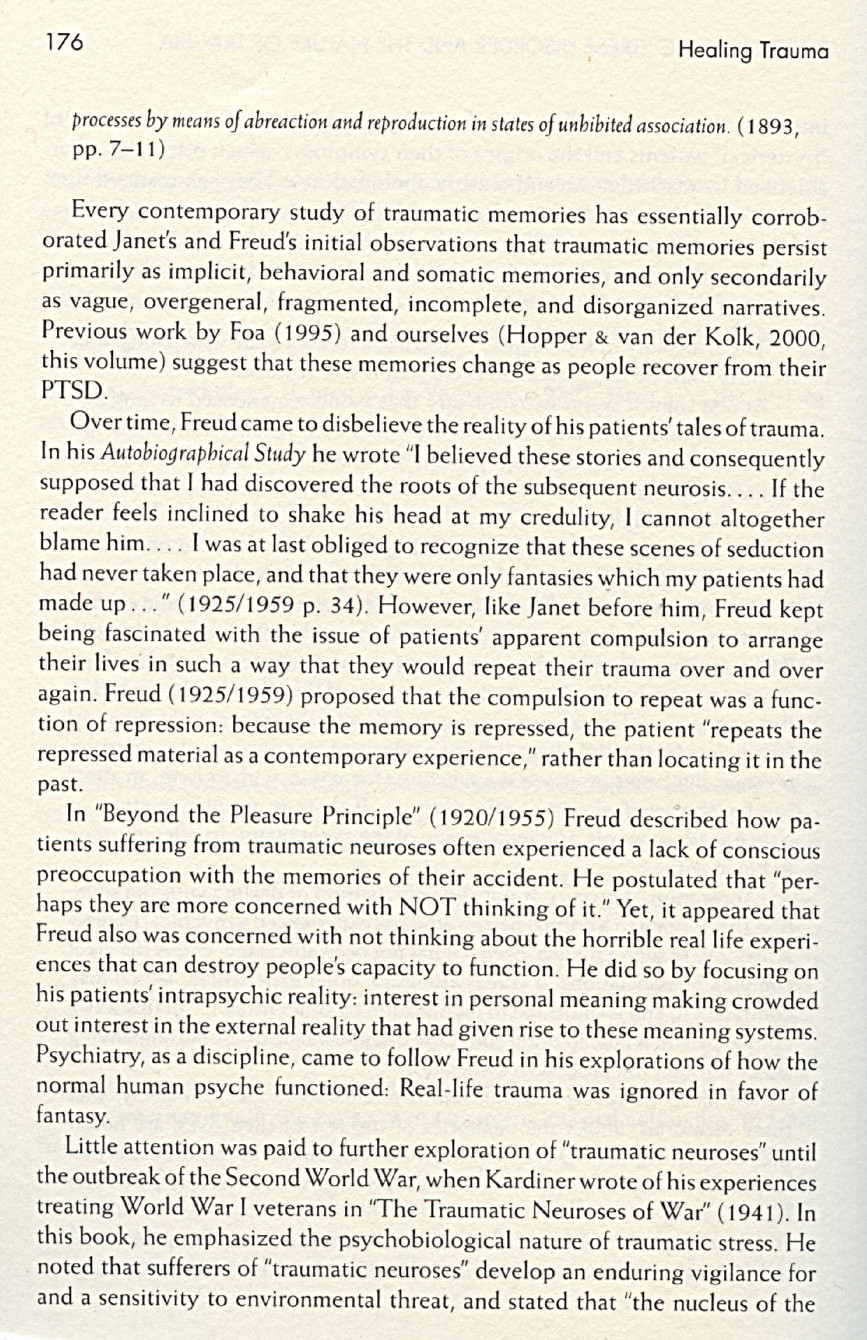
+FORCED THROUGH ABUSE IN INFANT-CHILDHOOD TO GROW A DISSOCIATING SELF

+++++++++++++++++++++++++++++++++
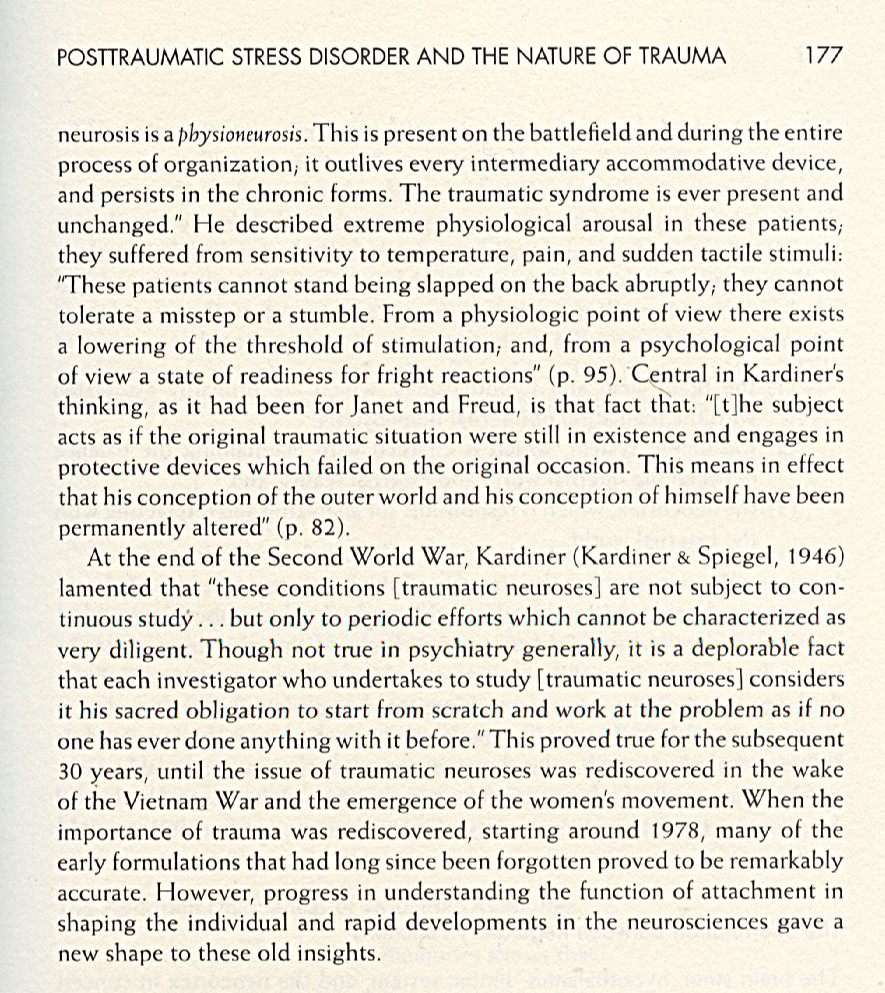
Growing a self (with matter) in a body in the world is an infant-child’s sole job in childhood.  Our early caregivers either help us or they harm us in our efforts.

For someone as abused as I was from birth and throughout their childhood, with without a safe and a secure attachment to any early caregiver that would allow them to develop their self in connection to their body in the world, feeling as if one MATTERS or even is a self WITH MATTER is extremely hard to do.

Everyone is born with a spark of life that is uniquely theirs and nobody else’s.  Parents are not supposed to work to destroy that spark.  They are supposed to recognize it in the body (and as the body) of the little one under their care.  They are supposed to recognize the growing self of their infant-child as being separate from their own self, so they can fan the spark and feed it fuel to grow on.

Parents who have serious unresolved trauma complications of their own often cannot do their job.  In my mother’s case, she never recognized ME as a separate being from herself at all.  She overwhelmed me, threatened my spark of life, and my growing and developing body-SELF from the moment I was born and for the next 18 years of my childhood.

Only no matter how hard she tried she could never destroy the spark of life that was-is me.  She heaped every possible obstacle in the way of ME growing my SELF in my body in the world that she could.

I see in my mind the terrible image of an un-jolly giant wielding a gargantuan sledge hammer (like in a tragic cartoon), smashing it down on top of me every chance she got.  In this image I am no bigger than a tiny ant.  As much as it was possible for me to do, my growing self had to stay hiding in order to stay alive at all.

++++

When early caregivers are not available to recognize and nurture and reflect an infant-child’s spark of life self back to it, that little self can seem to all but disappear over time.

I was never allowed to have happy genuine time to grow my self or to even be my self from birth (except in hiding).  The ugly giant with her weapons of destruction was always present or near5 by.  Any time she caught me out in the open being my self in play, exploration or in a state of mistaken safety, she would attack me again.

I see another image in my mind that reminds me of the Phantom of the Opera, because this image is of a stage.  I was only allowed to be like a shadow on the stage of my family’s play.  My mother completely controlled and directed the show.  Mostly I was ‘in trouble’ and being punished somewhere off stage.  I was banished and forbidden to be a part of the ongoing play.

I was left alone in misery because that’s where my mother wanted me (short of dead, which she dared not accomplish).  I could only appear in some version of her dramas such as “It’s a fun family holiday” or “This is Linda in the classroom.”

Mostly I remained either hidden, or under attack.

The REAL me was able to remain hidden back stage and could only sneak around like a phantom where she couldn’t detect me.  Over time, as I aged, I learned to appear on stage in different roles, both as an older child and later as an adult.  But my self-in-hiding could not become integrated within the body that appeared in all of its roles.

Only I didn’t know this was happening.  I have seen in my adult journals how lost I was to myself.  As I’ve mentioned before, my being lost in the world appeared in an unending sequence of patterns of questions that I could never find the answers for no matter how hard I searched or tried.

I have only been able to see the parts of myself that are reflected in my actions performed either around other people, or in my actions I perform when I am alone.  I so rarely have any sense that my WHOLE SELF exists at all that doubt I even have one.  I’ve always had a sense that most of who I am remains somewhere in hiding.

++++

Some would say that loving my ‘inner child’ would give her permission to come out of hiding.  I do not attach an age to the self.  A self moves forward in time just as a body does.  Neither exist ‘back there’ somewhere, suspended in the past.

From my perspective as I write this, I would think that the WHOLE of me simply knows things, as do its ‘parts’.  This self of me was forced to make decisions about how to remain alive in a dangerous world every step forward through my childhood from birth.

Every time my growing and developing self was attacked, my body-self was forced at the same time to make a decision about how best to adapt its growth and development so I could survive in a malevolent world.  Those decisions were made automatically in my body on the cellular, molecular level – including the epigenetic processes that used all the available options possible to tell my DNA how to ensure my survival in a chaotic and dangerous world.

++++

As   strange as it might seem as I write this, I believe by body-brain continued to develop throughout my entire childhood without the ‘usual’ connections to the ongoing presence of a continuous self within it.  Any time I was attacked by my mother and a survival-based decision had to be made in my tiny body about how to stay alive, my growing body went one way and my spark-of-life-self went a different way.

I was supposed to be growing an intimate, inseparable connection between my self and my body.  My mother’s attacks on me were so threatening and continual that this connection could not be formed – physiologically – in any ordinary way.

My ongoing responses to attacks during my early growth and developmental stages changed not only how my body-brain developed, and changed this connection between my self and my body, it also changed how I experienced my self in a body in the world.  Both my growing body and self had to include these changes on a structural and operational level.  There was no magic.  There was no possible alternative.

++++

These patterns of interruption between my growing self and body happened so many times that they cannot be counted.  Two examples that I’ve written earlier come immediately to mind.

One happened when I was two:  *AGE 2 – CINDY BORN – 1953

The other happened when I was three:  *Age 3 – THE TOILET BOWL

I already suffered from an extremely disorganized, disoriented insecure attachment to my ‘caregiving’ mother, to the world around me, and most importantly to my developing body-self connection well before these experiences happened to me.  I believe my mother had already overwhelmed my ability to have any ongoing self experience of having an experience an uncountable number of times well before I reached the age of two.  Without safe, secure and stable early caregiving interactions a safe, secure and stable connection between a growing self and a growing body cannot possibly be made.

After my mother dragged me out of the safety of my grandmother’s bed on the day a month and a half before my second birthday, my mother’s version of this incident was added to her abuse litany of me as proof that I wanted to be an only child, that I loved my grandmother more than I loved her, that I was able to deceive my grandmother by hiding my true, terrible self from her, and that I wanted my grandmother to be my mother and not her.

I first remembered this incident from my vantage point of being a very small toddler floating above my body which I could see in lying at the head in the middle of the expanse of my grandmother’s bed.  I can also remember this experience from within my body on the bed and see the ‘other me’ up there above me looking down.  Only by closing my eyes in my remembering process or by not looking up at all can I make ‘that one’ go away.

I can float around my grandmother’s entire house in that little body.  I can float over the heads of the two screaming women.  I can float over to the window and touch the lace of the curtains.  I can float through the open walk-in closet door, out the bedroom door, down the long curving hallway, into the massive kitchen, into the dusky living room.  I can experience the whole nasty, terrifying event from within the little physical body on the bed, but I cannot bring these two states of experiencing the experience together into one.

++++

When it comes to the toilet bowl incident that happened a month and a half before my fourth birthday, I cannot experience both sides of my memory’s experience.  This ‘event’ was added to my mother’s ongoing abuse litany as proof that I was a murderer who wanted my little sister dead, and that I tried to kill her.

I can remember being in my small battered body as it crumpled against the cold hard surface of the side of the bathtub where my mother threw me after she had exhausted herself in beating me.  What I experienced next I cannot put back together.

As my mother turned to storm out of the bathroom I turned my eyes upward to the window high on the wall across from my sobbing, shaking body.  I can return to this memory in my body.  I remember feeling some part of me rise out of my body and float up toward that window and out of it into the radiant blue sky.  In this memory my awareness remains in my tortured body as the other part of me left my body-self behind.

++++

These are remembered patterns of who-what separates from who-what.  I believe that because I was older and further down the body-brain-self developmental pathway when the toilet bowl attack happened that the separation between my body and self that happened then has continued as a pattern of my being in the world ever since.  What happened that day was an inner rupture without repair.

++++

As I sit here writing at this moment, thinking about what I might be willing or able to say about the part of my self that drifted up out of my body, aimed itself at the window, found its way to escape and floated away, I am having a rather ‘Disney Moment.’

Those of you who watched the movie, ‘Who Framed Roger Rabbit’, can probably remember the final scenes as the wall disappears and a magical world of animation opens up into motion, light, music and color.  At this moment I can sense a similar scene going on behind my shoulders as I write these words.  Thousands of brilliantly colored butterflies dance in the sunlight behind me, each one being a fragment of my experience of myself in my life.

Yet I also know that if I could enter that scene, and travel more deeply within it, that the light would dim, the sounds would change, the butterflies would not be dancing………there I will not go.

This sense I am having of this other world is eerie and makes the hairs on the back of my neck begin to crawl.  I turn around and look behind my back.  There is nothing there but my kitchen wall.  It helps to see a framed picture of Johnny Depp in his pirate guise hanging there.  Seeing it there, I smile.

++++++++++++++++++++++++++++++++++++++++++
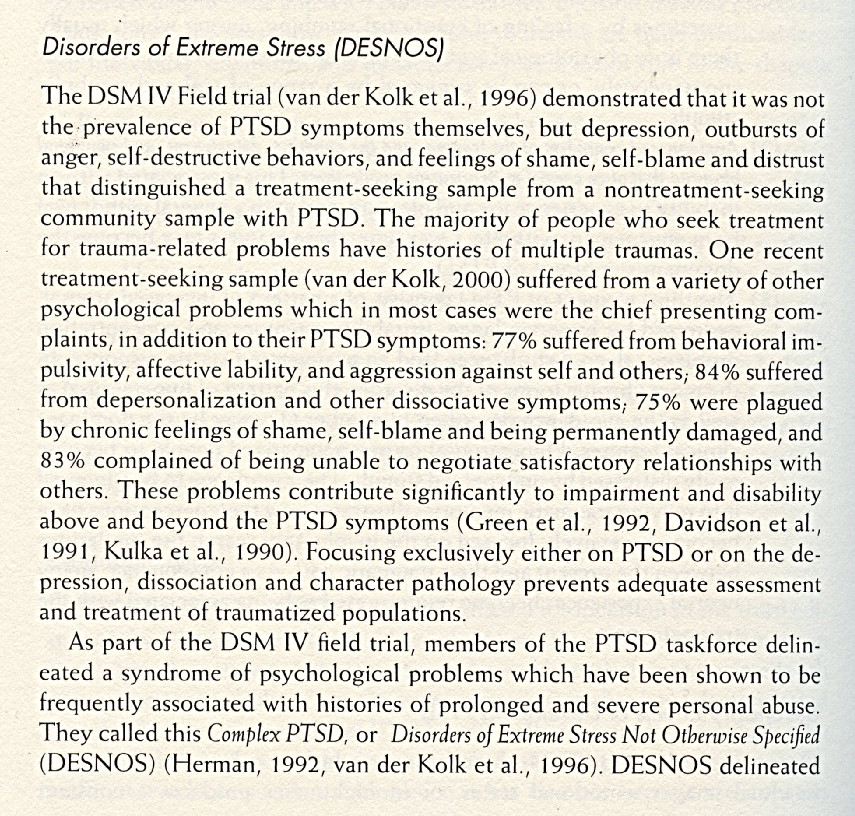
For those of you who might be curious, this is the link to the latest ‘counseling’ report I asked for from astrologer Zane:

*Age 58 – Astrology reading about life and death

++++++++++++++++++++++++++++++++++++
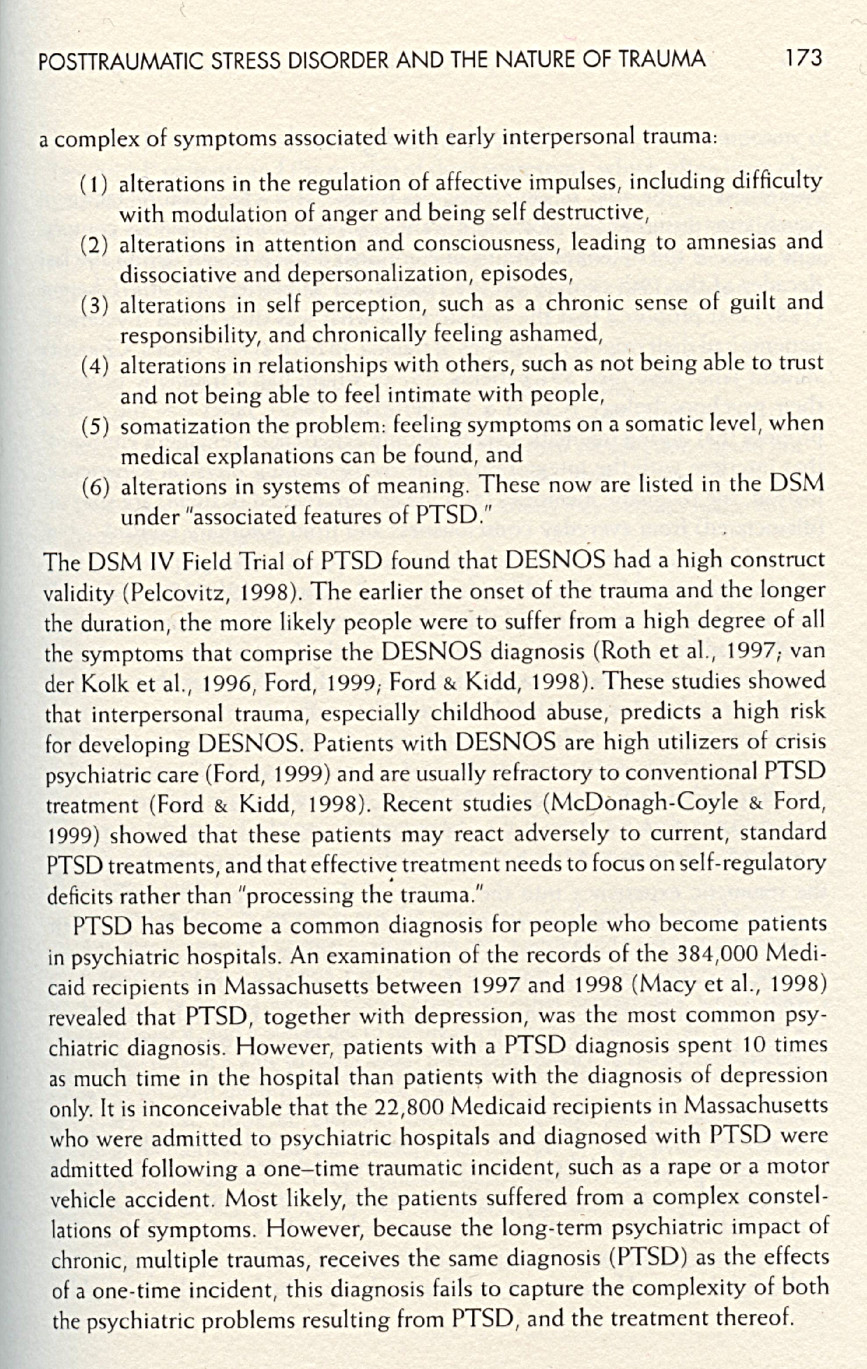
Please feel free to comment directly at the end of this post or on

+++++++

Your Page – Readers’ Responses

++++++++++++++++++++++++++++++++