+SOME PATTERNS OF ‘RELIGIOUS ABUSE’ AND THE GENE CONNECTION

++++++++++++++++++++++++++++

I found this sensitive, informative and thought provoking blog today (licoriceroot) that contains many posts that get me to thinking in new ways about the ‘complex’ of my own severe infant-child abuse history and its (most obvious) connection to my abusive mother’s own infant-childhood history of malevolent treatment.

One of the posts on this blog is about ‘hyperreligiosity’:  Hyperreligiosity: Fabulous Article Published Jan. 2010

I used to tract my mother’s ‘fundamental religious fanaticism’ to when I was in 10th grade and she became a member of an Assembly of God church.  The stories I wrote concerning the religious abuse I suffered post-mother’s getting religion contain traumatic experiences I suffered that I believe have interfered with my ability to be comfortable with ANYTHING that has to do with religion.

I have come to realize that the foundation of my mother’s terrible psychosis she placed me at the center of (that because she and I were ‘dying’ during her difficult breach birthing of me and that the devil had sent me to kill her – meaning to her that I was never human, that I was the devil’s child) WAS absolutely a religious-based thought and belief that not only affected my entire infant-childhood but that lasted for the rest of my mother’s life.

As my mother’s friend of 45 years told me in a recent interview about my mother’s aging years my mother had answered her knock on my mother’s door with 666 written on her forehead and hands to keep the devil from being able to find her when he came for her I realized how pervasive my mother’s religion-based terror actually was.

I further believe that someone in my mother’s deeply disturbed earliest years of life didn’t put the ‘fear of god’ into her but rather instilled in my mother the ‘fear of the devil’.  I strongly suspect that the abuse related to my mother’s deepest terrors was in some way sexually based.

I understand now that even my mother’s insane obsession with my ‘cleanliness’ was connected (wired) into her by something she had experienced as a child that she was told was ‘dirty’.

In fact, I can consider the entire violent abusive pattern of my 18-year childhood with my mother as being connected to religious abuse within a system that could not resolve the range of ambiguities – the grey scale – of good-bad within her Borderline body-brain.

++++

I went looking for the source of the article posted on the licoriceroot blog and found it here:

Website:  The Hindu:  Arts/Magazine

Article: A Japanese genius and his God module!

By Dr. Ennapadam S. Krishnamoorthy

This article discusses the idea of there being a ‘God module’ in the brain as it presents neurobiological underpinnings for the human experience of religion – and its experience of THE EXTREME.

++

I also located this article posted on The New York Times site November 14, 2009

The Evolution of the God Gene by Nicholas Wade

IN the Oaxaca Valley of Mexico, the archaeologists Joyce Marcus and Kent Flannery have gained a remarkable insight into the origin of religion.

During 15 years of excavation they have uncovered not some monumental temple but evidence of a critical transition in religious behavior. The record begins with a simple dancing floor, the arena for the communal religious dances held by hunter-gatherers in about 7,000 B.C. It moves to the ancestor-cult shrines that appeared after the beginning of corn-based agriculture around 1,500 B.C., and ends in A.D. 30 with the sophisticated, astronomically oriented temples of an early archaic state

This and other research is pointing to a new perspective on religion, one that seeks to explain why religious behavior has occurred in societies at every stage of development and in every region of the world. Religion has the hallmarks of an evolved behavior, meaning that it exists because it was favored by natural selection. It is universal because it was wired into our neural circuitry before the ancestral human population dispersed from its African homeland.”

And…..

It is easier to see from hunter-gatherer societies how religion may have conferred compelling advantages in the struggle for survival. Their rituals emphasize not theology but intense communal dancing that may last through the night. The sustained rhythmic movement induces strong feelings of exaltation and emotional commitment to the group. Rituals also resolve quarrels and patch up the social fabric.”

[Read entire article by clicking HERE]

++

After you take a look at the above article, consider this also:  Google search ‘genes dancing’ and a fascinating universe of information will appear before your eyes.  I already knew about this 2006 study that comes up with the Google search term combination of ‘Israel genes dancing’:

‘Dancing’ Genes Discovered by Israeli Researcher

++++

These articles I mention here point to a fascinating connection for me.  When an individual’s actions appear to us as unbelievable, we can think a bit more deeply about who and how these people are in the world.

The insane infant-child abuse my mother perpetrated against me involved a distortion in how her original genetic potential displayed itself, just as it undoubtedly did for the young paranoid schizophrenic man who was capable of perpetrating the horrific violence displayed in last Saturday’s Arizona shooting.

See post:  +IS MENTAL ILLNESS THE COST OF OUR SPECIES’ GREATEST GIFTS?

I don’t believe that our continued survival as a species was ever determined by what tore us apart.  Our survival depended then – and still does today – on what brings us together and binds us together.

When we look at extremes of abuse and perpetration of violence and trauma we are looking at the ABSENCE of the positive traits that ensured our specie’s reproductive fitness and the continuance of our genetic lines.

Rather than try to examine the faults of any single individual representative of our species I believe it would be far more helpful and productive to search for the malevolent conditions that existed in their earliest caregiving environment that CHANGED how their genes manifested themselves during the earliest critical windows of their development.

If we can manage to take a step back as we examine human behavior that represents a ‘tearing apart’ of the fabric of healthily bonded social connections and their expressions we will begin to notice how clearly these negative patterns reflect malevolence in an environment of deprivation and trauma.  The negative displays the absence of the positive.

As we begin to focus on the necessary POSTIVE qualities that contribute to building the best body-brain possible in a new little human being we will automatically lessen the potential for a lifetime of trouble that growing a body-brain in a malevolent environment causes.

++++++++++++++++++++++++++++

+SOME LINKS FOR CHILD ABUSE TRAUMA BLOGS I VISITED TODAY

+++++++++++++++++++

I occasionally get the bright idea that I could wander around the web and find sites related to healing infant-child abuse trauma so that I could promote my blog-info in a little comment inviting readers to come over here for a visit to my Stop the Storm blog.  The only problem is that I never get that far and instead end up wanting to present other people’s blog work here for my readers to visit, learn from and support.

So, a word of thanks to any of my blog readers who might leave a link to my blog when they go visit someone else’s and leave a word about my work in a comment.  Just copy this and paste into your comment https://stopthestorm.wordpress.com/

So what follows are some links for places I visited today!  (I was following a Google search for ‘child abuse trauma blog’)

+++++++++++++++++++

I want to highlight a post on the blog of Dr. Kathleen Young (a therapist in Chicago) entitled Treating Trauma: Top 10 for 2010.  These are among these top posts Dr. Young mentions:

Depersonalization Disorder. In this most read post of 2010 I defined depersonalization, as a normative experience, a symptom of other diagnoses or a type of dissociative disorder. I also shared research that explored the role of childhood interpersonal trauma in depersonalization disorder.

Complex PTSD describes a variant of PTSD that applies to those who have experienced prolonged, repeated abuse from an early age. This was one of my favorite posts of the year as it is at the heart of much of my practice. It was also inspired by a fantastic training I attended in 2010 Contextual Therapy: Treating Survivors of Complex Trauma.

Verbal Abuse: Words Can Hurt. I am so glad this topic got a lot of attention, given how little we understand the impact of verbal abuse. Here I shared research that indicates that parental verbal abuse alone can impact the child’s brain development in ways that lead to language processing issues and symptoms common to complex PTSD.

Understanding Dissociation was another favorite post of mine. Dissociation and trauma often go hand in hand, and yet it is not well understood even by trauma therapists! One take away idea: while dissociation helps you survive childhood trauma, it may be maladaptive later in life.

Does Self-Care Mean Others Don’t? is the most recent post in my top ten and part of a bigger conversation about self-care. The comments in response to both these posts are well worth reading and my favorite part of this entry. Your feedback and responses make me think and grow. That is what I love about blogging and what keeps me committed to it as we get ready for 2011.

++++++++++++++++++++

Here is an informative article posted online by Prevent Child Abuse America:  Fact Sheet:  Emotional Child Abuse

Click here for the main website for Prevent Child Abuse America where the following can be found among the many informative links on this site:

Here are some helpful tips:

Recognizing Child Abuse: What You Should Know [pdf]

An Approach to Preventing Child Abuse [pdf]

Ten Ways to Help Prevent Child Abuse [pdf]

Twelve Alternatives to Lashing Out at Your Child [pdf]

For even more helpful Prevention tips click here.

+++++++++++++++++++

I found this excellent post on the Nursing School Blog that includes a list with an active link along with a brief description for

40 Excellent Blogs for PTSD Support

+++++++++++++++++++

I also found this Child Abuse Effects blog hosted by survivor/educator Darlene Barriere (Canadian).  Worth a visit and a click around – lots of information from professionals and readers alike along the left side of the blog.

+++++++++++++++++++

Child Abuse Survivor

An interesting blog —   “About a male survivor of childhood abuse, and the issues he faces in adult life.”

+++++++++++++++++++

Take a meander through the list on the right side of this one:   

Dr. Laura blog

America‘s #1 Female Talk Radio Host

+++++++++++++++++++

Here is a blog about child abuse though I can’t quite figure out what it is actually CALLED!  My Windows says it has something to do with someone named Karen Holmes – comes complete with heart-touching comments —   CLICK HERE to read

+++++++++++++++++++

An Interview with Author Chris Knight Capone by KevaD

An Interview with Author Chris Knight Capone

Chris Knight Capone’s moving novel “Son of Scarface” is not another book about Al Capone. What it is, is the unnerving story of an abused child, through the eyes of the child abused, seeking to unravel the mysterious life of his beloved father and the mother who physically and emotionally battered her son and daughter.

“Son of Scarface” is a book about healing and the tribulations of one man’s lifelong struggle to identify the past and heritage hidden from and denied him.”

+++++++++++++++++++

Here on SelfGrowth.com (scroll down a little) there’s a

list of Overcoming Trauma Websites.

+++++++++++++++++++

This entire (2001) article is available free online by clicking on the title:

The Role of Childhood Interpersonal Trauma in Depersonalization Disorder

By Daphne Simeon, M.D., Orna Guralnik, Psy.D., James Schmeidler, Ph.D., Beth Sirof, M.A., and Margaret Knutelska, M.A.

In conclusion, this study is the first systematic demonstration of an association between depersonalization disorder and childhood interpersonal trauma and suggests that emotional abuse may play an important role in the genesis of depersonalization symptoms. In contrast to physical and sexual abuse, psychological maltreatment appears underestimated and neglected in the psychiatric literature and merits more attention. Finally, the various dissociative disorders may lie on a spectrum of severity associated with different types of childhood traumatic antecedents.”

+++++++++++++++++++

+NOTES ON THE AMY GOODMAN – DR. MATE INTERVIEW

+++++++++++++++++

I have gone through this interview to highlight some excerpts containing important information related to healing for severe early abuse and trauma survivors.  This information relates to most people with ‘mental illness’ diagnosis as well as addictions.  All text bolding (below) is mine.

INTERVIEW at this link:

Dr. Gabor Maté on the stress-disease connection, addiction, attention deficit disorder and the destruction of American childhood

AMY GOODMAN: Today, a Democracy Now! special with the Canadian physician and bestselling author Gabor Maté. From disease to addiction, parenting to attention deficit disorder, Dr. Maté’s work focuses on the centrality of early childhood experiences to the development of the brain, and how those experiences can impact everything from behavioral patterns to physical and mental illness. While the relationship between emotional stress and disease, and mental and physical health more broadly, is often considered controversial within medical orthodoxy, Dr. Maté argues too many doctors seem to have forgotten what was once a commonplace assumption, that emotions are deeply implicated in both the development of illness, addictions and disorders, and in their healing.”

+++++++++++++++++

DR. GABOR MATÉ: The hardcore drug addicts that I treat…are, without exception, people who have had extraordinarily difficult lives. And the commonality is childhood abuse. In other words, these people all enter life under extremely adverse circumstances. Not only did they not get what they need for healthy development, they actually got negative circumstances of neglect. I don’t have a single female patient in the Downtown Eastside who wasn’t sexually abused, for example, as were many of the men, or abused, neglected and abandoned serially, over and over again.

And that’s what sets up the brain biology of addiction. In other words, the addiction is related both psychologically, in terms of emotional pain relief, and neurobiological development to early adversity.

++

DR. GABOR MATÉ: And my point really is, is that there’s no clear distinction between the identified addict and the rest of us. There’s just a continuum in which we all may be found. They’re on it, because they’ve suffered a lot more than most of us.

++

AMY GOODMAN: Can you talk about the biology of addiction?

DR. GABOR MATÉ: For sure. You see, if you look at the brain circuits involved in addiction—and that’s true whether it’s a shopping addiction like mine or an addiction to opiates like the heroin addict—we’re looking for endorphins in our brains. Endorphins are the brain’s feel good, reward, pleasure and pain relief chemicals. They also happen to be the love chemicals that connect us to the universe and to one another.

And the susceptible people are the ones with these impaired brain circuits, and the impairment is caused by early adversity, rather than by genetics.

AMY GOODMAN: What do you mean, “early adversity”?

DR. GABOR MATÉ:  …much of our brain development, that in other animals occurs safely in the uterus, for us has to occur out there in the environment. And which circuits develop and which don’t depend very much on environmental input.

When people are mistreated, stressed or abused, their brains don’t develop the way they ought to. It’s that simple. And unfortunately, my profession, the medical profession, puts all the emphasis on genetics rather than on the environment, which, of course, is a simple explanation. It also takes everybody off the hook.

AMY GOODMAN: What do you mean, it takes people off the hook?

DR. GABOR MATÉ: Well, if people’s behaviors and dysfunctions are regulated, controlled and determined by genes, we don’t have to look at child welfare policies, we don’t have to look at the kind of support that we give to pregnant women, we don’t have to look at the kind of non-support that we give to families, so that, you know, most children in North America now have to be away from their parents from an early age on because of economic considerations. And especially in the States, because of the welfare laws, women are forced to go find low-paying jobs far away from home, often single women, and not see their kids for most of the day. Under those conditions, kids’ brains don’t develop the way they need to.

And so, if it’s all caused by genetics, we don’t have to look at those social policies; we don’t have to look at our politics that disadvantage certain minority groups, so cause them more stress, cause them more pain, in other words, more predisposition for addictions; we don’t have to look at economic inequalities. If it’s all genes, it’s all—we’re all innocent, and society doesn’t have to take a hard look at its own attitudes and policies.

++

AMY GOODMAN: Can you talk about this whole approach of criminalization versus harm reduction, how you think addicts should be treated, and how they are, in the United States and Canada?

DR. GABOR MATÉ: Well, the first point to get there is that if people who become severe addicts, as shown by all the studies, were for the most part abused children, then we realize that the war on drugs is actually waged against people that were abused from the moment they were born, or from an early age on. In other words, we’re punishing people for having been abused. That’s the first point.

The second point is, is that the research clearly shows that the biggest driver of addictive relapse and addictive behavior is actually stress.

Now imagine a situation where we’re trying to figure out how to help addicts. Would we come up with a system that stresses them to the max? Who would design a system that ostracizes, marginalizes, impoverishes and ensures the disease of the addict, and hope, through that system, to rehabilitate large numbers? It can’t be done. In other words, the so-called “war on drugs,” which, as the new drug czar points out, is a war on people.

++

AMY GOODMAN: I’m curious about your own history, Gabor Maté.

DR. GABOR MATÉ: Yeah.

AMY GOODMAN: You were born in Nazi-occupied Hungary?

DR. GABOR MATÉ: Well, ADD has a lot to do with that. I have attention deficit disorder myself. And again, most people see it as a genetic problem. I don’t. It actually has to do with those factors of brain development, which in my case occurred as a Jewish infant under Nazi occupation in the ghetto of Budapest. And the day after the pediatrician—sorry, the day after the Nazis marched into Budapest in March of 1944, my mother called the pediatrician and says, “Would you please come and see my son, because he’s crying all the time?” And the pediatrician says, “Of course I’ll come. But I should tell you, all my Jewish babies are crying.”

Now infants don’t know anything about Nazis and genocide or war or Hitler. They’re picking up on the stresses of their parents. And, of course, my mother was an intensely stressed person, her husband being away in forced labor, her parents shortly thereafter being departed and killed in Auschwitz. Under those conditions, I don’t have the kind of conditions that I need for the proper development of my brain circuits. And particularly, how does an infant deal with that much stress? By tuning it out. That’s the only way the brain can deal with it. And when you do that, that becomes programmed into the brain.

And so, if you look at the preponderance of ADD in North America now and the three millions of kids in the States that are on stimulant medication and the half-a-million who are on anti-psychotics, what they’re really exhibiting is the effects of extreme stress, increasing stress in our society, on the parenting environment. Not bad parenting. Extremely stressed parenting, because of social and economic conditions. And that’s why we’re seeing such a preponderance.

So, in my case, that also set up this sense of never being soothed, of never having enough, because I was a starving infant. And that means, all my life, I have this propensity to soothe myself.

++

AMY GOODMAN: How do you think kids with ADD, with attention deficit disorder, should be treated?

DR. GABOR MATÉ: Well, if we recognize that it’s not a disease and it’s not genetic, but it’s a problem of brain development, and knowing the good news, fortunately—and this is also true for addicts—that the brain, the human brain, can develop new circuits even later on in life—and that’s called neuroplasticity, the capacity of the brain to be molded by new experience later in life—then the question becomes not of how to regulate and control symptoms, but how do you promote development. And that has to do with providing kids with the kind of environment and nurturing that they need so that those circuits can develop later on.

That’s also, by the way, what the addict needs. So instead of a punitive approach, we need to have a much more compassionate, caring approach that would allow these people to develop, because the development is stuck at a very early age.

++

DR. GABOR MATÉ: Naguib Mahfouz, the great Egyptian writer. He said that “Nothing records the effects of a sad life” so completely as the human body—“so graphically as the human body.” And you see that sad life in the faces and bodies of my patients.

++++++++++++++++++++++

We still have to remember that the neuroplasticity that is mentioned in this interview will never later in life match the neuroplasticity that a newly forming infant’s brain has during its earliest critical windows of development.  There are very particular requirements during the earliest developmental periods of an infant-toddler’s life that must be met appropriately for the brain regions and their operation to be built correctly from the start.

(We have to also understand that early stress and trauma DID change how our genes manifest themselves.)

Although neuroplasticity, matched by the resiliency of the body itself are vital resources for healing from the consequences of trauma alterations during these earliest developmental stages DO exist, we must be realistic in what we are aiming for.

I do not believe that ANY severe infant abuse and neglect survivor’s brain or body can be ‘cured’ later on so that its body-brain can become as WELL as it could have been if initial development had happened under GOOD conditions.

I am not sure why this point is glossed over and not mentioned in this interview, but all the work of the most important developmental neuroscientists affirms this fact.  (For further information on this fact please do a Google term search including Stop the Storm in combination with the individual names of doctors Schore, Teicher, Perry, Siegel, van der Kolk, Allen, Damasio, Ratey – to name a few of these researchers.  You can also do a Google search for Stop the Storm Trauma Altered Development to find more posts on this blog describing these processes as well as Stop the Storm Center for Disease Control.)

Aside from this very important point, I agree with the fact that it is kind compassionate nurturing that is needed for healing.

++

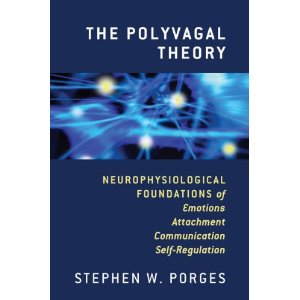
This is partly why I am so excited to see the book coming off the press that I mentioned in yesterday’s post because early trauma changed our physiological development —  +PORGES’ IMPORTANT NEW BOOK TO HELP INFANT-CHILD ABUSE SURVIVORS

It is why I find the writings on this webpage on healing trauma in the body so important – Evolutionary Healing Institute.

I want to know what the combined intelligence of ALL fields related to this area of study have to offer severe early abuse and trauma survivors in our healing.  We deserve NOW what we missed in our beginning – THE BEST!

It is possible to heal the heart of humanity — but we need THE FACTS!

+++++++++++++++++

+PORGES’ IMPORTANT NEW BOOK TO HELP INFANT-CHILD ABUSE SURVIVORS

++++++++++++++++

I have absolute confidence that this new book authored by Dr. Stephen W. Porges that is nearing its release will be of the greatest help to survivors of severe early infant-child abuse and trauma:

The Polyvagal Theory: Neurophysiological Foundations of Emotions, Attachment, Communication, and Self-regulation

This title is available for pre-order at Amazon.com by clicking on this title, and at a very reasonable price!

Product Description

A collection of groundbreaking research by a leading figure in neuroscience. This book compiles, for the first time, Stephen W. Porges’s decades of research. The world’s leading expert on the autonomic nervous system, Porges is the mind behind the groundbreaking Polyvagal Theory, which has startling implications for the treatment of anxiety, depression, trauma, and autism.

About the Author

Stephen W. Porges, PhD, is a professor of psychiatry and the director of the Brain-Body Center at the University of Illinois at Chicago.

++

I encountered reference to Porges’ work on the polyvagal theory several years ago, and as patience would have it – here comes HIS BOOK!

I posted this reference a week ago to his Australian seminar to be held November 2, 2011:

Polyvagal theory, oxytocin and the neurobiology of love and attachment:  A two day seminar with Stephen Porges and Sue Carter

The objective of this workshop is to describe current research and theory in behavioural neuroscience that can be translated into demystifying the features of many emotional, psychological and behavioural problems faced by children, young people and adults. It will provide invaluable insights into breaking maladaptive cycles to enable clients to experience states of calmness and to feel safe with other people.

++

I fully believe that Porges’ book will do exactly this:  “…provide invaluable insights into breaking maladaptive cycles to enable clients to experience states of calmness and to feel safe with other people.

In this short sentence I found a great resonance with what my body knows:  I DO NOT feel safe with other people!

What does Porges’ work have to teach me about this consequence that was built into my body from birth at the same time that GREAT harm and danger ‘from other people’ so traumatized me?

I am most curious to find out!

++++++++++++++++

+WHAT MATTERS MOST – THE MOTHER-INFANT RELATIONSHIP

+++++++++++++++++++++

My daughter and my 9-month-old grandson are down here visiting me in Arizona from North Dakota for three very short days.  I, of course, am in heaven as I bask in the delight of every single instant of their presence.  And in every interaction I observe between this most loving mother and the tiny growing person who is her son I am learning, learning, learning!

Yesterday as I waited in the lobby for my fuel assistance appointment I glimpsed a magazine picture of some primate specie’s mother and her infant.  The caption described how that mother would not put her baby down for the first four months of its life.  What has happened to humans in our culture that has made them actually believe that a baby under the age of one can be ‘spoiled’?  How bizarre.  How dangerous, and how bizarre!

++

Knowing what I do now about human infant development I know that what I witness of my daughter’s interactions with her infant son are building the neuronal wiring of his brain along with its connection to the way his entire body (nervous system and immune system included) that he will live in and with for the rest of his life.  There is NOTHING on earth that could possibly match the job she is doing in its vital importance.  NOTHING!

++

They are both snuggled under a warm down comforter on the big soft guest bed at the moment.  The little one was exhausted, but if there’s one thing that little person HATES it is sleeping!  His mantra must read, “WOE IS ME!  Sleeping is such GREAT SORROW!”  As I watched her take the time to tenderly sooth him into sleep (which of course can happen more easily because he has no siblings to be demanding his mother’s attention) I noticed that even with his eyes glued shut in near-slumber his tiny fingers continued to move and their stillness marked his final succumbing passage into his much-needed state of sleep.

As I silently witnessed the half hour process that baby and mother were engaged in I could see how she is my grandson’s external EMOTIONAL regulator at the same time she is helping him gain his own physiological abilities to regulate his emotions AND his body.  Both are intimately intertwined and at this stage of his development are also intimately intertwined with his mother’s assistance at regulation that he will eventually be able to accomplish on his own.

But NOT YET!  He needs his attachment to his mother — and reciprocally her attachment to him — to continue his growth and development as much as he needs air to breath.  When he needs her, and returns to the snuggles of her most-loving embraces I watch as he DEVOURS her presence with ALL of his senses.  His entire BEING is engaged in relationship with her.  I do not believe that it is possible for an infant to be more safely and securely attached to his mother than my grandson is to his.

There is NOTHING — NOTHING — on this glorious earth of ours that could make me happier than to know this!

++

As my grandson so struggles NOT to sleep, no matter how tired he his, I can at the same time clearly see four power-full characteristics within this infant that I can rest knowing will NEVER be taken away from him by his parents:  His desire (passion), his will, his determination and his stamina.

He WANTS and DESIRES to be most actively engaged with everything in his world.  He has great WILL that HE can make continuous active engagement possible at the same time he is determined that what he desires can happen if he applies himself — ENOUGH!

Of course at his young age he cannot yet mediate any of these streams of his life force consciously, but as he gains increasing ability to regulate his own body-brain-mind-self he will be able to.  He must have his early caregivers ‘carry’ him through his first critical stages of growth and development until he can.  His caregivers are literally sharing his life with him at the same time he can ‘borrow’ from them all the appropriate regulatory functions that a big body has and a little one doesn’t.

What my grandson’s parents have given this baby so far SHINES from his entire being with true joy and a love for human interaction.  His ability to communicate with his mother is comprehensive and complete.  She guarantees to him a safe haven from which he can continue to expand himself into the world around him.

I notice that many of the most important interactions between mother and infant happen (as Dr. Allan Schore describes) in the millisecond-speed range.  I placed myself 8′ away from him on the living room floor and invited him to come to me.  At nearly the speed of light he turned his head backward toward his mother, located exactly where she was, caught her smile, her nod and the look in her eye — INSTANTLY — as he received all the information he needed to begin his movements toward me.

The word ‘stanchion’ comes to mind.  She is his safety and security ‘prop’ at the same time she is the ‘archway’ through which he is growing into his own body and his own self.  All of these interactions are BUILDING him on all his levels — literally within his physiology.

++

My daughter is a more than full-time worker.  Her son has primarily been cared for by his father when she is gone, sometimes by a part-time babysitter, but at 9 months of age it is CLEAR that his primary attachment is with his mother — as nature intends it.  From now until he reaches about-age-one his primary attachment to his mother will matter THE MOST no matter where he is physically in relationship to her.

His INNER attachment to her, the patterns of rupture and repair created by his distance and nearness to her will continue to build themselves into the body-brain-mind-self platform within him that will govern his THOUGHT patterns, his stress-calm response system patterns, and how many of his genes will manifest themselves for the rest of his life.  My grandson is most importantly building his relationship with his MOTHER into himself at the same time the nature and quality of that primary relationship is BUILDING HIM.

My greatest joy is that everything is happening optimally for this little new human being.  At the same time I know that everything that is going so right for my grandson and my daughter is showing me what went so wrong between my mother and me.

Never did my mother peacefully sleep with infant me wrapped in love beside her.  My daughter asked me if it makes me feel sad to know all of this now.

No, I honestly don’t think that it does.  I believe I have cleaned my ‘mother-daughter’ house so well now that all that is left are the facts — the reality of what went so wrong for my mother as an infant changed her into the monster that could not mother me.

What matters to me is on the side of the positive:  What is necessary for mothering an infant to go RIGHT?  What happens when these necessary factors are missing in a mother-infant relationship is a tragedy that was/is nearly ALWAYS preventable.

THAT is what matters to me.

++++++++++++++++++++++

+IN THE MIDST OF CYCLES OF TRAUMA: THE ANGUISH-ANGER CONNECTION

+++++++++++++++++++++

I have frequently said on this blog that I don’t believe the actual specifics of our infant-child abuse and trauma experiences matter in the bigger picture as we work to heal ourselves as adults.  All survivors have a history or a herstory that CAN contain the specifics we might remember.  I don’t encourage people to ‘go back’ to look for the specifics of abuse experiences, either.  In the end I believe that what matters MOST to all survivors is how the early infant-child trauma and abuse we suffered, most often coupled with and a result of inadequate caregiving that deprived us of the safe and secure attachment we so naturally and desperately needed, changed the course of our physiological development in our body-brain.

THOSE changes are what we need to discover and begin to describe to our self and to others.  Those changes that our Trauma Altered Development caused in our body determine what kind of a life experience we have.  Those changes are ALWAYS related to our having had an overtaxed stress response system at the same time we had an underdeveloped or undeveloped safe and secure attachment system built into us.

++

By means of illustration I will present here a very taxing and stressful experience that I have been involved with for the past three months that finally today reached completion.  There is a federal fuel assistance program administered by each state – on the county level through Community Action Programs.  The rules change at the same time they make NO common sense.  I will not go into the details here, but being poor and having to rely on the ‘system’ is ALWAYS stressful.

With my extreme anxiety problems, including my social anxiety and my inability to utilize spoken language when under duress are direct consequences of the severe abuse I suffered PARTICULARLY before the age of one.

Every single nasty, horrible, terrifying, abusive and traumatic experience I endured with my mother for the 18 years of my infant-childhood of course contributed to the mess my nervous system and brain are in today.  At the same time, as I repeat, it isn’t that on this or that particular day my mother hit me with a belt versus a wooden coat hangar versus a flapjack turner.  It doesn’t matter specifically that on this or that day she forced me to eat a bar of Dove hand soap versus swallow heaping tablespoons of black pepper or spoonfuls of laundry soap.

What matters is that I experienced Trauma Altered Development as my body-brain developed as a consequence of the extreme stress-duress I was exposed to.

I suffered all the way through these past three months trying to jump through the right hoops at the right time in the right way to get the fuel assistance I needed.  What today’s’ final leg of the journey brought to mind is that the anxiety, fears, distress of this experience built itself over this time into a state for which I only had one word:  ANGUISH.

I recognized this state, this emotion in my body and realized how fundamentally familiar it is to me from the abuse experiences of my childhood.

Then I went to online Webster’s for the definition of ANGUISH and discovered that in its roots it is directly related to ANGER.

Anguish, to me, feels more related to sadness, so what is the anger connection?

This led me to reconsider my own ideas about the patterns of stress response to a challenge in the environment that leads first through

anger:  trying to meet the challenge successfully using skills we have used in the past – if this works, we are supposed to move back to a center set point in our nervous system-body of peaceful calm.

– if anger doesn’t work, we move into the next spot on a stress response cycle – fear.  In this state we realize that what we have learned in the past is NOT going to solve the problem.  Quickly we utilize whatever we can figure out to move BACK into the anger state where energy is available to get us out of whatever mess we are in.  Sometimes simply freezing, running, etc. is all we have

– but if NOTHING we can find to do, nothing whatsoever works, then we move into sadness – which can turn into hopelessness and despair.  But in this spot on the cycle-wheel-circle we are MOST prepared to learn something entirely new – if we are open to this possibility and often just plain fortunate.

++

So, as I considered the connection today between anguish and anger in our English language I began to wonder if this emotion is the connection point between sadness and anger if we DON’T get stuck in sadness but end up experiencing emotions far more powerful – and to me, far more disturbing.

Anguish happens when we are pushed to our limits and are forced to endure anyway.

As I remember the anguish of my childhood, as I think for example about my mother’s beatings that could go on and on and on and on in FULL force – that feeling without words of “I CAN BEAR NO MORE” – for me – is the place that anguish has past anything like ‘ordinary’ pain and sadness.

When we are in fact in true NEED of something and at the same time dependent upon especially ANOTHER PERSON to get our needs met, on our own we cannot escape the anguish state easily.

++

I figured out for myself years ago that my anger is ALWAYS connected to a true injustice.  ALWAYS.

That I do not tend to recognize the anger doesn’t probably mean that it doesn’t exist.  I was NEVER angry at my mother – never – even today.

But, true, I AM angry at the idiocy of our government’s ineptitude when it comes to making programs for those in poverty accessible.  I could write a LOT about this point – and my heart breaks for those in much worse situations than mine – also a topic I could write a LOT about.

But to make this short, I will simply say that those of us who were severely abused as infant-children are the MOST likely to be the MOST poor and in the MOST need for help – specifically BECAUSE of the consequences of the abuse that altered our physiological development in all KINDS of ways that continue to make life difficult for us for our lifetime.

ANGUISH is very nearly an intolerable state – but I believe also that it is the state we survivors spent MOST of our developmental years in.  Anger – as I define it is the most active start point for our stress response system to enter when we are challenged by difficulties.  Our little body could NOT overcome the monsters that hurt us, and we were left to degenerate along the stress response cycle points without reprieve or resolution.  Our entire body-brain has paid a price for that – and in the end it is our experience of the emotional-physiological state of ANGUISH that most closely mirrors the state we spent our infant-childhoods within.

What followed today for me finally was a solution that means I will receive the fuel assistance funds I need.  This means I can experience RELIEF which soothes away the ANGUISH – at least for now and in connection with this situation.

How did RELIEF feel to me at the end of a long drawn out horrible beating when I was little?  Did I feel ‘good’ when the beating ceased?  Not possible.

These conditions built my body-brain at the same time they built themselves into it/me.  To have experiences as an adult that create parallel emotions within me is very difficult.  We don’t need someone to physically BEAT us to experience the same cycles within our body that we did when we were little and in the midst of trauma.

And that is a fact.

+++++++++++++++++++++

+BORROWED SECURE ATTACHMENT: WHEN CHILD ABUSE IS NOT PASSED ON

++++++++++++++

As I look back from my current age of 59 not at WHO I was immediately after I physically left the severely abusive home I grew up in for my first 18 years, I realize that there WAS no conscious me.  I have to look back at HOW I was at this time of my life.

HOW I was meant that I was unconscious of having a self or of being a self at all.  I have no memory of my ever self-reflecting or of my ever reflecting backwards on my first 18 years of terrible abuse and traumatic experiences.

WHAT I was also comes to mind:  I was a BODY moving through space.  That’s it.  I moved, like an empty puppet responding to this ‘freedom’ I found outside of my insanely abusive mother’s reach.  In fact, that’s all I really had ever been – A WHAT.

++

I left home as I entered Navy boot camp and at the same time entered a universe that knew nothing about me but what they witnessed of what my empty-puppet body did.

A strange image comes to mind as I write this.  I was and had always been from the moment of my birth a FIRST RESPONDER.  That’s what I had always done because that was all that I was ever allowed to do – to RESPOND immediately to stimulation that came AT me, most of it in extremely traumatic, abusive and violent form, from the outside world my body just happened to have been born into.

Nobody responded FIRST to me, a pattern that is ‘natural’ and required for a human infant to begin to form its body-brain-mind-self in the world.  I was born into a chaotic, traumatic and extremely REACTIVE environment that was controlled by my abusive mother.

There had never been a place, space, time or opportunity for Linda to be Linda except for moments I stole from the spaces in between my mother’s attacks of me.  Linda grew, developed and evolved as a LEFTOVER – formed within whatever little spaces there were for me to stretch out into – in those cracks between my mother’s attacks.

The only reason there ever were actual spaces between my mother’s attacks is that she had other responsibilities to take care of her home and her other children.  Besides, sometimes she just got tired, physically tired from her rage at me and had to take a rest.  During these times she most often secluded me in my bed or in a corner until she could ‘get back’ to actively abusing me again.

++

So because I had to FIRSTLY respond to my mother, I didn’t get to put myself first in my own life.  As a result, I left home having no single clue that I was a person at all.  This fact, probably more than any other single consequence of my abusive childhood impacted my parenting history with my firstborn as it had the most amazing effect on how I treated her (and my next two children).

I didn’t have a self in the beginning at age 19 when my oldest was born.  Without a self, there was ‘nobody here’ to interfere with the self expression and development of my baby.  My instinctive first response to being a mother always was – and I mean instinctive because I was completely unconscious of this fact – was to do nothing as a mother that could possibly interfere with the self-development of my children.

++

Perhaps because I had been built entirely, body-brain-mind, as a FIRST RESPONDER to my reactive delusional abusive mother I was able to make very good use of my abilities as a first responder to respond FIRST to the unique individual people my children were each born as.

It just so happens that THIS pattern, responding FIRST to the infant-child as its own person, is exactly what an infant needs to develop its own self fully on all levels as it grows its own body-brain-mind-self.

++

Perhaps this is the actual root of what I term for myself as Borrowed Secure Attachment.  (I cannot personally relate to what attachment experts refer to as ‘Earned Secure Attachment’.)   As an untampered-with individual new being, all infants are born with the ability to form safe and secure attachments with their caregivers.  Left ‘hands-off’ except to be a First Responder to the INFANT itself, the infant’s natural abilities to attach will guide the relationship its earliest caregiver has with it.

Infants give the signals, all the signals needed to let its caregiver know not only WHAT it needs when there is a need, but also at the same time the infant is signaling its caregiver, “Hey, here I am!  This self-being-grown in here needs this, is sending you this signal – and by-the-way, thank you for responding to ME first!”

++

Putting the infant-as-an-individual-self FIRST just happens to be what correct caregiving is all about.  Correct infant-child caregiving is NOT about the little one meeting the attachment needs of its caregivers – although doing so is often a natural SECONDARY benefit of being a parent.

Who the infant is and what the infant needs is a great parent’s FIRST concern.

And by hook and by crook – the patterns my mother created inside of me by her never responding to ME FIRST and always by responding to HER FIRST just happened to leave me with a completely wide open road inside of myself to do things pretty much RIGHT with my own children.

As Dr. Peter Fonagy suggests, there are transgenerational patterns of attachment.  I was a LUCKY one!  Because my mother’s insane abuse was so persistent and pervasive my own attachment brain-body wiring was basically left untouched!!

(Experts report that the ability to attach securely lies in the INFANT-CHILD as it reacts differently to different attachment patterns of different caregivers.)

True, I ended up with completely messed up insecure attachment patterns myself – but I was at the same time – and strangely for the same reasons – able to allow my own children to utilize the attachment-wiring-operation potential for secure attachment that they were BORN WITH.

My mother OVERWHELMED me so completely that there was nothing BUILT into me for human attachment wiring that could have (or did) enable me to overwhelm my own children.

++

I call what I was able to allow to happen with my own children BORROWED secure attachment because the entire amazing, marvelous, naturally-determine ability to attach came from THEM, not from me.  I had not been built from birth with anything within myself that could have interfered with what my children were born to do naturally – and perfectly.

++

I believe that our culture has a very important task of trying to elucidate what factors contribute to the average statistic that ONLY 35% of parents who were abused as children go on to abuse their own children while 65% DO NOT go on to abuse their own children.  True, the offspring of the 35% suffer terribly.  But what happens – and I mean really happens – in the cases of the 65%?

I am, most blessedly, among the 35% of nonabusing parents.  Considering the fact that my entire childhood was about NOTHING but abuse and trauma, and considering the fact that I was not allowed to form ONE SINGLE safe and secure attachment with anyone, HOW DID THIS HAPPEN?

I don’t believe in magic.  There is a very real physiological pattern within my own body that was built into me in the midst of severe abusive trauma for the first 18 years of my life that worked extremely well FOR MY OWN CHILDREN.

Even though I have a reactive disorganized-disoriented insecure attachment pattern MYSELF I did not pass it on to my children because I operated as a parent in an appropriate caregiving mode.

Attachment experts suggest that someone who has an insecure attachment pattern does not have what it takes in their own ‘wiring’ to have it easily – or naturally – turned ‘off’ so that their caregiving system can operate correctly.  I suggest that in cases such as mine where there never was an opportunity to EVER feel safe and securely attached to humans I simply had a blank slate in the ‘take care of me’ department.

I had never been able to DO ANYTHING to get my own attachment needs met.  I did not have a ‘take care of me’ repertoire on any level.  My mother, on the other hand, was the extreme opposite as she consumed EVERYTHING from me.  I was born to TAKE CARE OF HER with everything I had.

It was my job as my mother’s child from my birth to do one thing and one thing only – to BE the complete object of her displaced-projected personal BADNESS.  My mother’s NEED to make me this object of her projection CONSUMED everything about me to the point that when I left home at age 18 to enter ‘the real world’ no Linda existed other than as a First Responder (‘reactive’) – in totality – to the needs of someone outside else.

My children (as strange as this is as I write it) simply replaced my MOTHER as I FIRST RESPONDED no longer to her, but in replacement, to my own children.  Because I had never done anything but take care of my abusive mother’s needs, I must have been exquisitely prepared to take care of my own children’s needs – as those needs existed NOT IN ME – but as with my mother – as those needs existed outside of me and within my children.

++

Once born a caregiver (as an infant-child recipient of complete insane abuse), always a caregiver?

NOTE:  One HUGE miracle to me is that I never once became involved with any abusive ADULT!  Because I didn’t, I haven’t spent any time wondering why not.

+++++++++++++++++++++++

+WORDPRESS SHARED THIS TODAY: 2010 in review

+++++++++++++

The stats helper monkeys at WordPress.com mulled over how this blog did in 2010, and here’s a high level summary of its overall blog health:

Healthy blog!

The Blog-Health-o-Meter™ reads Wow.

Crunchy numbers

Featured image

A helper monkey made this abstract painting, inspired by your stats.

About 3 million people visit the Taj Mahal every year. This blog was viewed about 37,000 times in 2010. If it were the Taj Mahal, it would take about 5 days for that many people to see it.

In 2010, there were 400 new posts, growing the total archive of this blog to 719 posts. There were 506 pictures uploaded, taking up a total of 283mb. That’s about 1 picture per day.

The busiest day of the year was July 1st with 260 views. The most popular post that day was ++MY CHILDHOOD STORIES.

Where did they come from?

The top referring sites in 2010 were en.wordpress.com, mail.yahoo.com, google.com, search.aol.com, and en.search.wordpress.com.

Some visitors came searching, mostly for sunflower, avoidant attachment, earned secure attachment, borderline mother, and stop the storm.

Attractions in 2010

These are the posts and pages that got the most views in 2010.

1

++MY CHILDHOOD STORIES April 2009

2

*Attachment Simplified – Organized Insecure Attachment – Avoidant-Dismissive October 2009

3

*Attachment Simplified – Disorganized Insecure Attachment – Disorganized-Disoriented October 2009
2 comments

4

+MY MOTHER’S VAGUS NERVE: THE MAKING OF HER PERFECT BORDERLINE STORM? February 2010
7 comments

5

MY BORDERLINE MOM June 2009
6 comments

+++++++++++++

My most sincere gratitude and appreciation goes to WordPress for all the amazing free services they provide — thank you!

+++++++++++++

+WHEN IS A STORY A STORY?

+++++++++++++++++++++++++

Perhaps if I lived in a different time or a different place everyone around me would understand if I told them, “All I have left in me is one good story.”  That I cannot tell that story to the empty air would also be understood.  I can write and write and write and write, but for me writing is not the same thing as telling.

Where is a story when it’s not being told?  Is it, like our memories themselves lying around in shards and shreds, in pieces and parts within our minds — somewhere?  Or is a story a living thing that has no slumbering existence at all, existing only when it is falling from somebody’s activated lips?

Perhaps it is because so much of the body of my story as I imagine telling it, probably to my daughter, is so much about being alone in solitary confinement, in isolation and in silence (in between the terrors of traumatic abuse over those first 18 years of my life) that my story is frozen there, askew akimbo, in limbo, and cannot take on a life of its own if there is no caring listener to help it be born.

Perhaps my story– spoken (or written) into silence — would be worse than no story at all.  Perhaps, formed THAT way my story would be no story, just an ongoing pause, more of the same, a restless opera hanging around getting parts of itself stuck in cobwebs while the rest of it fades and fades and fades into silence like notes at the end of an echo.

Is a museum a museum if it’s empty?  Is an art gallery a gallery if it doesn’t contain a single piece of art?  Is a story a story if there’s nobody there to hear it but the teller?  I think not.  In all these cases I think not.

++

+BLOGGING HISTORY – NEW WAYS FOR OUR SPECIES TO REMEMBER ITSELF

+++++++++++++++++++++++++

+BLOGGING HISTORY – NEW WAYS FOR OUR SPECIES TO REMEMBER ITSELF

+++++++++++++++++++++++++

Blogging our way through time — recording our histories — recording our histories in the making — reading histories in the moment — What I found at the end of one of Dr. Bruce Perry’s articles (link below) makes me think about how new and different our perspectives on the passage of time and our places in it are today as we participate with advances in technology to record ourselves as a species in a new way.

++

“Learning the language of trauma and translating the verbal and non-verbal elements of this language will require many more years of investigation. Yet, as this investigation is underway, it is the task of all of us working with maltreated children [ME:  and adult survivors] to educate our peers and the rest of society that this language exists…. To educate our society that traumatic events, like other experience, change the brain. Further, that the brain stores elements of the traumatic events as cognitive memory, motor memory, emotional memory and state memory, altering the functional capacity of the traumatized individual. And, in the end, by robbing the individual potential of millions of children each year, childhood trauma and neglect robs the potential of our families, our communities and our societies. (page 16)”

Info above and below is from this article:  Memories of Fear: How the Brain Stores and Retrieves Physiologic States, Feelings, Behaviors and Thoughts from Traumatic Events by Bruce D. Perry, MD, PhD

++

Beginning at the end of page 16 Perry talks about trauma and history – and what is human history but what we remember of what happened?  I am copying this portion of the text found at this link into this post – in part because it reminds me so much of what all bloggers are doing today – recording our history and our perspectives on history-in-the-making in the ongoing moments of the present.

++

“The memory of trauma is carried not only through the life of the individual by their neurobiology but it is carried in the life of a family through family myths, childrearing practices and belief systems. Major traumatic events in the history of a people or culture become memorialized, as well, and carried forward across generations in our literature, our laws and our very social structures.

“It is the unique property of living systems to carry forward elements of past experience – indeed, for all living systems, the present is contingent upon and a reflection of that past experience. In a very true sense, a body collective – a group – is a living, dynamic system. And, as the individual carries its own history forward using the apparatus of neurobiological mechanisms related to memory, each living group carries its memories forward in time. Yet living groups – families, clans, societies – carry this information forward using different mechanisms of recording and storage.

“Over the history of humankind, the methods for recording and storing the experiences of the group have evolved. In our distant past, humans living [in] groups passed experience from generation to generation using oral tradition – and sociocultural practices – language, arts, belief systems, rules, law – all were reflections of the past – and with each generation, modification, amendment, and alteration of the past ‘memory’ was modified by present experience. With the development of written language, information could be passed across generations more efficiently. Sociocultural advance occurred at an increased rate, made possible by more efficient ‘remembering’ of the lessons (good and bad) from the past. The ‘brain’ of humankind – the libraries of the world — kept ‘civilization’ alive through its darkest moments – and even if generation after generation during a given period in history did not take advantage of this ‘memory’ – the information was not lost to humankind.

“Later in history, again, with the introduction of the printing press, the past was more efficiently stored and passed on. Books became available for everyone. More people became literate. Information of all sorts – arts, science, social studies– was stored in books. Again, a tremendous advancement in human sociocultural evolution can be traced to this process – to literacy and widespread education. Information from the past – primarily cognitive information – enriched the present. The rate of creativity was accelerated; invention and innovation – new ideas, machines, products, processes – were facilitated by the more efficient sociocultural ‘memory’ allowed by books and literacy. Now, in the span of a lifetime, the accumulated and distilled experience of thousands of generations could be absorbed – and acted upon to create sociocultural advances.

And now, we are in the first generations of a new era of recording, storing and transmitting information – electronic media – tapes, photographs, videos, films – all immortalize the experiences of humankind. The electronic media allow a unique and

different form for the memory of an individual, family, community and society to pass from generation to generation.

“There is great hope for humankind in these advances. In the past, the inefficient methods of recording, storing and passing on the horror of war, rape, neglect, abuse, starvation, misogyny, slavery – allowed these lessons of living to be edited, modified, distorted and, with tragic consequences, forgotten. Only elements of the experience of war were passed across generations – the heroism of an individual, the success of the nation — and the emotional ‘memory’ of war – the hate, rage, death, loss – has been transformed, altered and, all too often, forgotten.

“Creative artists have always played the role of ‘emotional’ memory for a culture. In ways that standard recording of simple facts and figures cannot convey, a painting, poem, novel, or film can capture the emotional ‘memory’ of an experience. But in a society where access to and ‘artistic’ literacy is low, the emotional lessons of the past are easily lost. And when the last veteran of each distant war died, an element of the emotional ‘memory’ of that horror died as well. Unable to carry the emotional memory of war to the next generation – history could much more easily repeat itself – or more honestly, we could much more easily repeat history. But with documentary and creative film and video, which can convey both the fact and the emotion, maybe it will be harder for us to forget the past – and we, therefore, will be not so doomed to repeat it.

“Yet the ever present danger of recording, storing and passing on false images, false stories, false history can be equally destructive. The responsible use of film, video, electronic storage may allow us to use these advances to promote and pass on those qualities which create, sustain and grow our humanity and, over many generations, to leave behind those qualities which rob our humanity (racism, misogyny, factionalism).

Can we change our world to create fewer traumatic memories to carry into the next generations – fewer traumatic events to shape our children who will create our future social structures?

“How can we heal the scars of individual and group trauma that haunt us today? Can we ever make racism, misogyny, maltreatment of children – distant memories? There are solutions. These conditions are not the inevitable legacy of our past. When an individual becomes self-aware, there is the potential for insight. With insight comes the potential for altered behavior. With altered behavior comes the potential to diminish the transgenerational passage of dysfunctional or destructive ideas and practices.

“And so it must be for groups. As a society, we cannot develop true insight without self-awareness. Enduring socio-cultural changes in racism, misogyny and maltreatment of children cannot occur without institutional and cultural insight and the resulting altered institutional and cultural behavior. The challenge for our generation is to understand the dynamics and realities of our human living groups in a way that can result in group insight – which, inevitably, will lead to the understanding that we must change our institutionalized ignorance and maltreatment of children. (pages 16 – 18)”

+++++++++++++++++++++++++