+EARLY ABUSE AFFECTS OUR REACTION TO ADULT TRAUMA EXPOSURE

+++++++++++++++++++

My revised list — common reactions to a stressful event can include:

Shock and disbelief

Feeling powerless

(Short and/or long term immune system responses) headaches, back pains, and stomach problems

Sadness and depression (depression is an anxiety response)

Crying

Apathy and emotional numbing (dissociation, depersonalization, derealization)

(Denial – distortion or loss of memory)

Anger

Fear and anxiety about the future

(Over or under reaction to stimuli – hyper- or hypo-startle response)

Sleep difficulties

Nightmares and reoccurring thoughts about the event (left-right brain cannot process trauma information while awake or during dream sleep — ambidextrous  and left handed people at higher risk)

Difficulty concentrating

Difficulty making decisions

(Difficulty assessing meaning and prioritizing)

Loss of appetite (or increase)

(For children – disturbance in play activities)

(Difficulty with social interactions)

(Inability to use words to describe the experience)

++++

I cannot read information such as what is presented at the end of the post from any ‘ordinary’ perspective.  The list presented as “common reactions to a stressful event” describes the kind of traumatic stress reactions that are built into the growing body-brains of severely abused infants and young children.  On some level, these reactions have become our norm.  When additional traumas occur in our later adult lives all of these pre-existing traumatic reactions become stimulated and activated.  We are, therefore, at highest risk for having serious reactions to later traumas in our lives.

I hate having to write about these things.  I hate having to even think about them.  I hate it that my body knows far more than my conscious mind ever will about the reality of what the challenges of trauma can do to us.

Professionals call a reaction to trauma disordered when these reactions do not dissipate after a reasonable period of time goes by after a trauma has happened.  For those of us whose body-brain was built during trauma, we have never had the luxury of having a body-brain that does not include trauma reactions in its makeup.  We cannot return to a pre-trauma condition because we never had one in the first place.

That makes any childhood trauma survivor more vulnerable to post trauma stress disorders.  Personally, I don’t like the use of the word ‘disorder’ and would prefer a recognition that what happens to us after trauma exposure is as natural a reaction as what happens to us as the trauma occurs.  If our reaction is exaggerated or extended, there is a reason for this happening.  Until this fact, coupled with a complete recognition of how early infant-child abuse and trauma alter the developing body-brain from the start is recognized and respected, I do believe the word ‘disorder’ must be used carefully in trauma response considerations.  What ‘they’ see as ‘disordered’ is a different kind of ordering for the entire body-brain from the ground up, from the beginning of life onward for those who have survived severe infant-childhood traumas

Whatever words are used to describe the continued suffering from ongoing reactions to traumas, the long term effects are very real and can be debilitating in regard to quality of life and general well-being.  Adaptations in the body-brain of early trauma survivors means that we react to trauma differently than ‘ordinary’ people do.  We were ‘reordered’ and our ongoing processing of information reflects that condition in our body-brain.

To call us ‘disordered’ is to call us flawed.  We are different, not flawed.

++++++++++++++++

INFORMATION FROM:

Prevent Child Abuse New York Blog

Dealing with a Traumatic EventPosted: 14 Nov 2009 01:26 PM PSTIn the wake of the tragic events at Fort Hood November 5, 2009, it’s important to remember that when traumatic incidents occur, the Center for Disease Control’s Injury Center can assist by providing information that can help people cope and recover. Sometimes after experiencing a traumatic event, including personal or environmental disasters, or being threatened with an assault, people have a strong and lingering reaction to stress. When the symptoms of stress last too long, it can cause people to feel overwhelmed and have an effect on their ability to cope.Common reactions to a stressful event can include:
Disbelief and shock
Fear and anxiety about the future
Difficulty making decisions
Apathy and emotional numbing
Loss of appetite
Nightmares and reoccurring thoughts about the event
Anger
Increased use of alcohol and drugs
Sadness and depression
Feeling powerless
Crying
Sleep difficulties
Headaches, back pains, and stomach problems
Difficulty concentratingFor more information, tips on how to handle a traumatic experience, or to read this full article please visit: http://www.cdc.gov/Features/HandlingStress/ or http://www2c.cdc.gov/podcasts/player.asp?f=5256

++++++++++++++++++++++++++++

+EXPLODING MOTHER, IMPLODING ME: SOME FUNDAMENTAL DIFFERENCES BETWEEN US

++++++++++++++++++++++++

I am revisiting what I see as the core differences between my borderline mother and myself.  I find that nothing has changed in my thinking about these differences in my past five years of research.  My mother’s childhood-onset dissociation became malignant while mine remained benign.

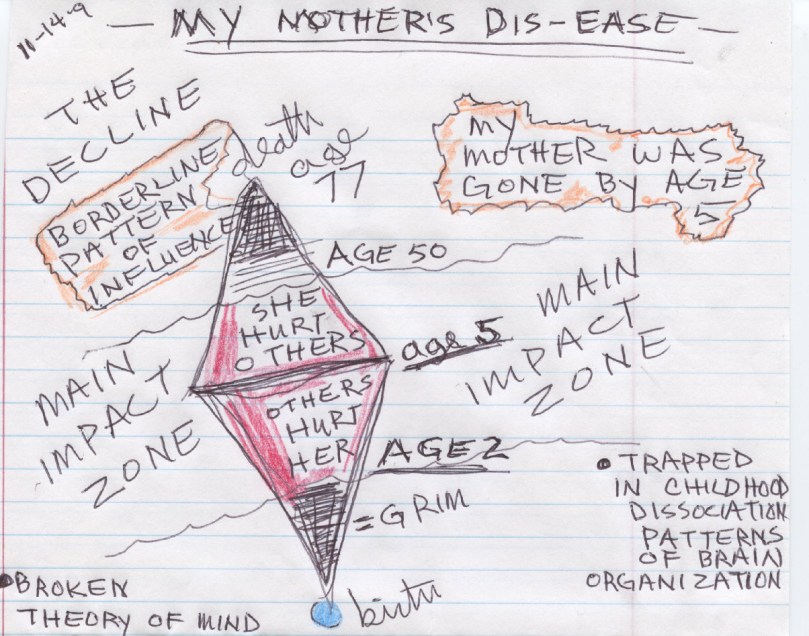
In my first ‘doodle’ I visualized the impact of infant developmental attachment deprivations she suffered from birth until age two.  Born into a family with marital discord and left with her primary care in the hands of a ‘nanny’, I envision that my mother’s developing brain-mind-self was already far off course before she reached the stage of developing a Theory of Mind.

1 111409 post

During the developmental stages from age 2 – 5 conditions in my mother’s childhood so severely impacted her brain-mind that I believe her later mental illness had already centralized the organization of her self.  From the age of 5 it was simply a matter of time before the bomb that was her Borderline Personality Disorder condition would explode – which it did during her terrible delivery of me.

The broader dimensions of the diamond figure that I drew show that in the bottom half powerful interactions with others in her life were feeding her unstable growing self.  She had reached what I call the ‘rage stage’ which was coupled with the following:

My mother was a victim of a lie.  She was told through word and deed by her early caregivers that sometimes she was good enough to be loved.  She was also told that sometimes she was so bad she was un-love-able.  The lie was that she had the power to change herself from being bad to being good, and if she changed into being good (made the bad go away) she would be love-able – and therefore would be loved.

2 111409 post

These conditions presented my mother with an impossible paradox for which there was no answer.  She never knew she was being lied to by her attachment caregivers.  She did not know that there was no solution to this paradox.  She was told she had the power to change herself into being ‘all good’, and she eventually found her solution – me.

The impossible solution to her fundamental betrayal problem was to spit off all her badness and project it onto me.  That left her being all good and me being all bad.  She never had the capacity to know she had believed a lie, found an impossible solution to an impossible riddle, or that she had been tricked and fooled.  Once her child brain-mind wrapped herself around the too-big problem of her early life, her brain-mind continued to grow with this malignant lie within it.

As she moved out of her childhood into her adulthood, and then into the stage of her childbearing years, her childhood dissociation, fueled by childhood rage and a broken Theory of Mind, meant that her children remained her doll-imaginary friends with me as her imaginary enemy (as I have previously described).  By the later years of  my mother’s life she had fewer and fewer people she could influence through her mental illness, and she died as alone and unconsciously troubled as she had been from the time of her birth.

I see this ‘main impact zone’ as being the mass of incoming information that hurt her, followed my the mass of information she later could displace and project onto others to hurt them (primarily me).

++++

My second doodle page (above) presents the basics of what I believe are the differences between my mother and myself.  Like her, my foundation from birth was in disorganizing, disorienting insecure attachment to early caregivers.  But unlike her, I was never fooled, tricked, or betrayed.  Her projection of her own badness onto me condemned me absolutely and permanently.  I was simply doomed to be hated without hope of reprieve, salvation, or any hope of implementing my own solution to solve any of the ‘problems’ I had with her.

The simplicity of my life saved me.  I was not faced with solving an impossible riddle.  I was not presented with the impossible paradox of “you can change yourself into a good and love-able child and then I will love you.”  My childhood was one continual ‘rupture’ without either repair or hope for repair.  My mother’s childhood contained ‘ruptures’ with faulty and deceiving repairs.

In the final analysis, I was far more fortunate than my mother was.  She was set up to fail at being love-able.  I was simply not love-able.  It was the constancy of my unloved-being hated state that saved me.  It was the inconsistency of her unloved-sometimes loved state that ruined her.

I believe her brain fixated a rigid solution to an unsolvable problem.  Her childhood dissociation organized in her brain-mind-self around this solution – which became her internal and unconscious fulltime goal.  I believe her mental illness was fueled by childhood rage.  Her childhood dissociation became malignant, and I became its operational target.

My childhood dissociation had no goal other than physical enduring survival.  My brain-mind-self was left in a fluid, continually changing and adapting state because I HAD NO GOAL and I had no hope, false or otherwise.  My mother’s treatment of me was made tolerable through what I call benign dissociation and my development occurred in a world of sadness.

++++

My mother ended up fighting to be love-able, fueled by rage.  Rage is tied to active coping skills, whether we want to admit this or not.  I did not grow up a fighter.  I grew up a sorrow-filled victim stuck in the passive coping skill state.  My mother was told she had the power to change what happened to her, even though it was a lie and it was not within her power to change the dynamics of her caregivers’ treatment of her.

My mother was damned and didn’t know it.  I was damned and I did know it.  I knew I had no power to change what happened to me.   Nobody ever fooled me into thinking otherwise — from the time I was born.  I believe that there are two entirely different trajectories of development set up by the two different childhood scenarios I am describing.  One leads to the development of a dangerous, demonizing mother and the other one does not.

Both my life and my mother’s of course ended up being extremely complicated with devastating consequences stemming from child abuse and neglect in a malevolent environment during critical body-brain-mind-self stages of early development that resulted in a changed brain for both of us.  Yet as I see it, I was never betrayed or set-up with an impossible task to accomplish like my mother was, and being free from these overpowering early forces allowed me to become who I am.

My mother’s mental illness prevented her from ever being able to tolerate becoming conscious either of how she behaved or of what had happened to so wound her in childhood.  I am not barred in the same way from consciousness.  As I continue to explore the underlying aspects of safe and secure attachment, I will explore how having the ability to be self-aware and self-reflective makes all the difference in how and who we become in our lives.

++++

This post follows:

+DISSOCIATION AND THE TRAUMA-SPECIALIZED BRAIN 11-11-09 and

+SECURE AND INSECURE ATTACHMENT AND THE CHILDHOOD NARRATIVE 11-13-09

++++

++++++++++++++++++++++++++++++++++

THIS INFORMATION COMES TO YOU FROM:

Prevent Child Abuse New York Blog

Improving Children’s Mental Health through Parenting EducationPosted: 13 Nov 2009 03:01 AM PSTGuest post by Michelle Gross, Projects/Public Policy Manager, Prevent Child Abuse New York In today’s difficult times, one of the most important skills one must possess is the ability to form healthy relationships and cope with life’s challenges. Our children are not born with these skills, but rather learn them through their social and emotional development.While providers have traditionally focused on physical development, in 2006, the New York State Legislature passed the Children’s Mental Health Act. The Act required the development of a statewide plan to address issues in children’s social and emotional health, zero to eighteen. As a result of this legislation, the Children’s Plan was developed in collaboration with nine state agencies and led by the New York State Office for Mental Health.The Children’s Plan serves as a blueprint for New York state agencies, providers, and communities to
improve the social and emotional development of children and their families. The Plan focuses on engaging children and their families in services early, ensuring that systems are collaborating to provide effective and efficient services and meeting families’ needs by focusing on their strengths and abilities.

Within the Children’s Plan is a directive for the Office of Mental Health to work with parenting educators to better support parents in raising emotionally healthy children.  The New York State Parenting Education Partnership has been chosen to play this pivotal role in educating providers who work with families and supporting a network of family support and information.

NYSPEP’s efforts to provide professional development sessions for parenting educators will enhance providers’ ability to communicate the importance of social and emotional development with parents, and offer both providers and families tools to facilitate children’s healthy development.

For more information, visit our web site at: http://www.parentingeducationpartnership.org.

Positive Parenting Can have Lasting Impact for Generations

Posted: 12 Nov 2009 07:15 PM PST

A new study that looks at data on three generations of Oregon families shows that “positive parenting” not only has positive impacts on adolescents, but on the way they parent their own children. ” Positive Parenting can include factors such as warmth, monitoring children’s activities, involvement, and consistency of discipline.

Researchers from the Oregon Social Learning Center conducted surveys on 206 boys who were considered “at-risk” for juvenile delinquency. The boys and their parents were interviewed and observed, researchers information about how the boys were parented. Starting in 1984, the boys met with researchers every year from age 9 to 33. As the boys grew up and started their own families, their partners and children began participating in the study. In this way, the researchers learned how the men’s childhood experiences influenced their own parenting.

There is often an assumption that people learn parenting methods from their own parents. In fact, most research shows that a direct link between what a person experiences as a child and what she or he does as a parent is fairly weak. The researchers found that children who had parents who monitored their behavior, were consistent with rules and were warm and affectionate were more likely to have close relationships with their peers, be more engaged in school, and have better self-esteem.

For more information relating to positive parenting techniques, please visit our website http://preventchildabuseny.org/parents.shtml

+++++++++++++++++++++++++++++++++++++++

+THE HEALING OF DISSOCIATONS – A 50-YEAR MISSING PIECE OF ME HAS RETURNED

+++++++++++

I woke up this morning thinking about all the wounds we received in the war zone of our abusive childhoods.  Often as the war raged on around us we ended up being the targets.  In this battlefield we were the victims.  Some of us received so many wounds they cannot be counted.

My mother’s war with the world began in her own childhood and so wounded her that her war never ended until the day that she died.  I was born a casualty of her war.  I had no choice, no weapon, and I could not escape.  I could not fight back or defend myself against her.  No one was there to tend my wounds when they were inflicted, either.  And yet for all the wounds I suffered both visible and invisible, my strength and resiliency still enabled me to survive and endure.

Like my mother, I carried all my wounds out of my childhood, but unlike my mother I did not carry on the war.  Perhaps that happened in part because she began to attack me on all levels as soon as I was born.  I was too young, too little, to begin to feel anger at her for what she was doing to me.  I continued to grow up through and past the age of rage without knowing what it even was.

But it’s not the rage that fueled my mother’s war against me that I woke up thinking about today.  I woke up thinking about the healing of wounds.

++++

When severe abuse begins so early it impacts the formation of the regions, circuits, pathways and operation of the brain so that we end up with what Dr. Martin Teicher and his Harvard Medical Group refer to as “an evolutionarily altered brain” as a result, the wounds that caused these changes to happen are most difficult to heal.  These wounds include dissociation.

I am thinking this morning about how long ago people lived for a much shorter time.  Their experiences were fewer and their universe was so much smaller than ours.  Their lives were centered on the core basics of staying alive in an often threatening and dangerous world throughout their entire life span.  In those worlds the ability to dissociate during or in the aftermath of traumas must have continued to serve a purpose that is difficult for me to define in the world I live in today.

Yet for those of us who endured unimaginable severe trauma during our infant-child developmental stages, the dissociation we were given as a result of our survival makes it more difficult for us to continue living in the ‘ordinary’ world we grow up to enter.  Nature has not evolved a way to ‘put us back together again’ to be like a pre-early trauma exposed person.  We are stuck with dissociational brain patterns and abilities that are directly linked to the hundreds if not thousands of near-mortal wounds from physical and mental injuries that we received many years ago.

Our wounds within can thus remain open, painful and at times extremely difficult for us to live with as we attempt to live an ‘ordinary’ life of well-being in an ordinary world without the kinds of dangers to our existence that we were programmed to survive because they existed in the times of our origins.

Without ‘medical’ care back then when we needed it most, and without access to the kind of help with our wounds and our resulting dissociation that we need now, how do we heal ANY of our wounds?

++++

The very length and complexity of our modern life experience is working against us now.  We cannot crawl wounded deep into a secluded cave and trust we will be protected and kept safe by our brethren standing guard over us while we receive adequate care and access the kind of quiet, unstimulated time that we need in order to heal.  (Yes, I believe we have these memories within our DNA that tell us what we need for our healing to occur.  These memories are available to us in the same way the memories in our bodies enable us to make adaptations to trauma from conception.)  If we cannot pursue nature’s intended courses of healing for even one of our childhood wounds, how do we carry on with hundreds if not thousands of them within us?

++++

Nature never planned for our species’ infants and children to be in danger without protection and adequate care.  Only under the most dire circumstances would offspring have been sacrificed.  The continuance of our species required that the most helpless tiny ones survive in the best condition possible.  And yet here we are at the most supposedly sophisticated period in our species’ evolution with harm being perpetrated in wars against offspring as if the little ones no longer matter as our species’ most prized hope for going forward into a better world.

Everything around us is busy and complicated.  Our multiple critical wounds are seldom if ever healed.  And then we are expected to live a ‘good life’ not only in spite of our wounds, but also as if the injuries never happened and the wounds do not exist.

++++

This again brings me back to healing.  Any wound has to go through a natural process of healing, often to the stage of creating permanent scar tissue at the end.  All healing requires our body’s immune system be involved.  I believe this includes the healing of our inner mental and emotional wounds as well.  On some level it is always some aspect of our physiological immune system’s negotiation on behalf of our increased well-being that accomplishes all of our healing.

I mention this today because last night I felt one of my many, many wounds close itself in healing.  I will never be able to forget how the wound originated in the first place, or how it has felt for these past 50 years to live with the wound open and unhealed.

This healing involves how I feel in relation to animals, especially to pets.  My healing came from a few simple words a trusted friend recently wrote to me about grieving the loss of both our human and our animal loved ones.  My friend was talking about her love and grief for a pet she lost years ago when she said to me, “Yes, pets are family and more.”

It was her last two words that healed me — “and more.”  Suddenly I understand that I can give myself permission to look into the eyes of not only my pets, but of all animals and SEE and FEEL and be connected with the life within them that is their SELF, and I can love them wholly – “and more.”

It feels like a channel of love and healing that has been blocked for the last 50 years has been opened so that the healing light and love that opened this channel can now flow through it unimpeded.  What I knew and felt when I was a little girl and my heart broke when my pet black rabbit, Peter, died has come back to me.

I have not asked my friend what her two simple words “and more” mean to her.  I needed to know what they mean to me.  It wasn’t the loss of Peter himself that most wounded me.  It was my reaction of dissociating myself from ever being able to feel again the loving connection I felt for that little animal.  Since that dark and rain soaked night he died, the part of myself that knows animals are not remote and distant objects that continue their own existence in a world separated from me has been missing.

My mother told me that night when Peter died that he was a bad rabbit who got what he deserved.  He was dead because that’s what is supposed to happen to all bad animals and bad children like me.  In the midst of the terrible depth of my grieving over the loss of my beloved pet through a violent death, she told me she wished I was dead just like Peter was because that is what I deserved.

The wound of this experience caused me to dissociate my ability to experience love, appreciation, and connection to and with animals (exception noted at the end of this post).  That part of me was removed from my existence until last night when I was in conversation with my sister about those two words, “and more” in relationship to animals in our lives.

Like my friend, my sister has never lost her ability to love animals, especially dogs.  I see this morning that the other side of this unhealed wound I have carried all these years has also prevented me from receiving the love that animals freely give to me.

I can understand today that the trusting innocence of who I was as a young child is reflected and mirrored back to me in the eyes of animals.  I have not been able to tolerate that kind of powerful experience with my own vulnerabilities for 50 years.  I have not been able to reclaim my own portion of passion regarding a deep love, valuing and sustaining friendship with animals until now.  Healing has touched that dissociated wound inside of me and – lo and behold – I can feel this fragmented piece of myself is back.

++++

I know every person alive has been wounded in some way at some time.  The healing of our wounds gives us an added dimension of awareness on an emotional and mental level about the better side of being alive.  Any healing that includes an improvement of connection between myself, myself and the living world I live in is especially significant for me.

Any healing gives me hope that more healing is possible.  Scar tissue might not be especially pretty to look at from the outside, but its presence means that a wound has healed, and I’m not sure there is anything I can experience that is better than that.  Yet at the same time that today I feel this wound has healed I can feel the blackness of overwhelming sadness that created this dissociational wound in the first place.

It helps me to know that I will not go backward in this healing process.  The sense of invading danger will leave me.  It will dissipate in the light of this new day.  (I will be extra tender to myself until this has happened as if I just went through surgery — because I did!)

Life can now pulse again for me where no pulse has been for 50 years.  I am different today as a result of this healing.  I know I am one step closer to being a more complete, integrated and whole ME because of it.  I have to practice being this bit-more-whole me now.  I feel different.  I see my animals around me differently.  They are back in the circle of my life and I am back in their world for the first time since before my black rabbit died.

I am reminded today that miracles of healing do happen – because they can.

This was a missing piece of myself I could recover, and that could be restored to me because it was one that was once an integral part of who I am.  I remembered my self before my rabbit died and my mother was so mean to me about his death.  I re-membered this part of myself so it can be joined with who I am today.  That’s exciting!

++++++++++++++++++++

NOTE:  Last summer when I visited my brother in Alaska I felt my love and connection with moose when one came to graze under my brother’s deck.  I was close enough to that glorious animal to have reached out and touched him if I had wanted to.  I realized then that my ability to love moose had never been removed from me.  Maybe having this August experience was a necessary step toward my healing so that I could again reclaim that same love and connection I felt as a child with all animals.  Now I also understand fully the “and more.”  It is my responsibility (ability to respond) to care for them at the same time that they take care of me.

1959 JUST homestead birthday - Copy
Holding that warm, fuzzy, whisker-wiggling little black rabbit, Peter, in my arms -- MY pet rabbit -- had made this sad little child happy.

++++++++++++++++++++

<!–[if !mso]>

+DISSOCIATION AND THE TRAUMA-SPECIALIZED BRAIN

+++++++++++++++++++++++++

Because of my traumatic experiences with my mentally ill mother from birth, I did not form an ordinary brain.  My thought processes while writing this post reflect some of the difficulties I have always experienced because my brain formed differently.  Similar to the way an air flight might experience turbulence, I have turbulence in my thinking whenever I try to follow an ‘ordinary’ brain’s train of thought.

This does not mean that I am wrong or broken.  Yes, I was wounded, but the resiliency within me coupled with my determination to endure and survive allowed me in the end to become a very special sort of person.  I will just always think in my special way, and I will always struggle to bridge the chasm that can exist between the way my extra-ordinary brain works and the way ordinary-formed brains work in an ordinary world.

I will continue over time to process the secure and insecure attachment information as I try to understand what the experts know and match it in some way with what I know from within myself about, in particular, dissociation.

Here are my thoughts for today on the brain science concept of ‘coherence’.  I am not going to try to edit them or to give them any other organization or orientation than they had when they lined themselves up on this page as a result of my thinking process.

Yes, these thoughts feel turbulent to me.  That would not be my choice, but then I had no choice about how my brain-mind had to form itself in the beginning of my life.  Nor do I have much choice about how my brain-mind regards and processes information today.  This is what happens for me when I try to even begin to understand what forms the basis of a safe and secure organized attachment system.

+++++++++++++++++++++++++

The advantage of my writing about the topic of secure-autonomous adult attachment is that I can take what ‘ordinary’ brained researchers say about the subject and translate it for myself though my ‘extra-ordinary’ brain.  I have the powerful advantage now of knowing absolutely that my childhood was just about as devoid and empty of secure attachment people as it could possibly have been.  I no longer even try to find out who exactly might have been there for me to give me what I needed to form secure attachments.  I know there was nobody.

Whatever attachment I had with my mother’s mother was contrived.  It was set up by my mother according to her rules so that it could fit within her reality, or should I say, fit her ‘dis-reality’ and ‘un-reality’.  My mother’s mind was nothing less than bizarre and distorted when it came to her thinking about me.  I can’t say it was ‘disorganized’ because her psychosis gave her the most rigid organization possible without possibility of rearrangement – ever.

When I read what the experts tell us about safe and secure infant-child attachment I have to stretch my thinking as far as I can manage in order to try to begin to understand on a deep and honest level within myself what it is these people are saying.  I am coming from the position of being raised in a world just about as far away from what researches consider ‘optimal’ early conditions as it might be possible.  Just as I do not believe those researchers can stretch their minds far enough to begin to comprehend my reality, I am not sure that I can stretch mine far enough to begin to understand theirs.

++++

Dr. Daniel J. Siegel makes this statement, “…the way adults can flexibly access information about childhood and reflect upon such information in a coherent manner determines their likelihood of raising securely attached children.”  (siegle/tdm/312)

Taking the meat of the nut out of its shell, I read this as if it is a directive not only about how to be an adequate parent, but also how to get along in the ‘ordinary’ world in an ‘ordinary’ way:  “flexibly access information about childhood and reflect upon such information in a coherent manner.”

But what does Siegel mean by ‘coherent’?  My guess he knows what it means because he has it.  Very few, if any people who lack his version of coherency in their brain-minds make it to the top levels of any professions – for all kinds of reasons I won’t go into at this moment.  I still want to know what this key to secure attachment means because from my own experiences, and in my world, coherency as Siegel describes it does not exist.

++++

Siegel states:  “Integration establishes a sense of congruity and unity of the mind as it emerges within the flexible patterns in the flow of information and energy processes of the brain, both within itself and in interaction with others.  This is coherence.

Wow.  Those words are a mouthful.  I cannot comprehend what he is saying without applying an incredible amount of effort.  I will try to break this apart as I hunt for some meaning that I can make sense out of from inside MY version of an abuse-formed extra-ordinary brain-mind.

Integration

Sense of congruity

Unity of the mind

Well, right here I get lost because I cannot break apart the next group of words:  unity of mind as it emerges within the flexible patterns

But then it goes further:  mind as it emerges, not just any mind, but a unified mind – and this living unified mind emerges, but does not emerge in any old way, does not emerge in a disorganized, disoriented, inflexible-rigid way.  This ‘sense of congruity’ and this ‘unity of the mind’ emerges continually along with every breath of life.  This happens (or not) through flexible patterns that were built into the brain by – yup! – by our experiences with our early caregivers from birth.

When the mind has this sense of congruity, and has its unity, it can continually engage flexibly within all interactions a person has in life.  These flexible patterns are, according to Siegel, “in the flow of information and energy processes of the brain.”  Well, it should not surprise us that under varying degrees of reverse conditions this entire process suffers from some degree of break down, or deviation from what Siegel is not only describing as optimal, but also as what is supposed to be ordinary.

++++++++++++++++++++++++++++

I am rapidly finding out as I try to make sense of Siegel’s description of ‘coherence’ is that I cannot understand what he is saying because I have a brain built in the opposite way from what he is describing.

I see an image of me being dropped from an airplane from a mile up in the air with a parachute attached to me.  I land in a fresh, hot wad of bubble gum the size of an average Wal-Mart.  That’s how I feel trying to grasp what he is saying.

It is hard to imagine that this finely working brain Siegel is describing would have been built entirely by appropriate early infant-child interactions with safely and securely attachment autonomous early caregivers!  But that is exactly what he is saying.

And the problem here for me is that Siegel knows exactly what he is talking about and says what he means PERFECTLY in these few words in this single sentence – that I cannot possibly begin to understand!  Believe it or not!

So, I will write my version of a statement about what having a brain built by my disorganized and disoriented insecurely attached, unsafe psychotic borderline mother gave me!  I have the opposite of a ‘coherency’ built brain, so OK, here goes —

SIEGEL’S VERSION OF AN ORDINARY BRAIN’S OPERATION:  Integration establishes a sense of congruity and unity of the mind as it emerges within the flexible patterns in the flow of information and energy processes of the brain, both within itself and in interaction with others.  This is coherence.

MY VERSION OF AN EXTRA-ORDINARY TRAUMA FORMED BRAIN’S OPERATION:  Disintegration establishes a (non)sense incongruity and disunity of mind as it attempts to emerge within the inflexible (rigid, disorganized and disoriented) patterns in the (disorganized and disoriented, interrupted and often chaotic) flow of misinformation and disturbed energy processes of the brain, and all of these disturbances exist and are experienced both within this brain itself and in all its interactions with others.  This is incoherence.

BUT, I would have to add from my own experience, that this ‘incoherence’ is experienced as DISSOCIATION.

++++

OK, great.  How exactly are we supposed to get along in the ‘ordinary’ person’s world of coherence when our brains were built under opposite conditions so that we have changed brains that will NEVER work the same as these ‘ordinary’ brains do?  We cannot return to our early infant-child body-brain-mind developmental stages so that the foundation and formation of our brain can be done over again!  Never.  Never.  Never.

The first step to improving our chances for experiencing anything like well-being in the world is to begin to understand what these researchers know about ordinary brain development and combining it with what we know about our own early experiences and what happened to our forming brains as a consequence.  We need to learn how our brains process life with a different kind of logic.

Because my personal experiences happened to me under the care of a mad woman, I am nearly completely on the opposite end of the brain-formation spectrum that Siegel is describing.  BUT, I AM STILL HERE!  I might be completely stuck in a bubble gum mess trying to understand Siegel’s description of an ordinary, healthy brain-mind, but I can also at the same time understand that the way my brain formed, even though it is very different in many fundamental ways from the one Siegel describes, DOES WORK.  It kept me alive throughout my childhood and it keeps me alive today.

But, my brain IS DIFFERENT!  It is NOT BROKEN.  Now, to all reasonable description, my mother’s brain was broken.  The changes her growing and developing brain had to make did not allow her to possess even temporary or sporadic flexibility in her thinking.  I can think flexibly, but not in a continual, ongoing ‘mind emerging in the moment’ way.

++++

Dr. Temple Grandin, autistic author of many books and world renowned expert on communicating with animals, talks about how she sees the world in pictures.  I believe I feel the world in pictures and think about it in dissociated pieces, or ‘packets’ of information.  Access to and transition between these dissociated packets of information is not frequently either smooth or predictable.

I am most fortunate that depending on the day and on the topic, my brain can link some or many of these pieces together at one time or another.  But never will I have a continuous, feeling, integrated, coherent story to tell myself or anybody else about myself in the world.

Any version of a continuous story I might form will be contrived, artificial and primarily constructed by my ‘logical’ left brain that has learned some things about how others make sense of their lives – and therefore how I OUGHT to be able to do the same.  Some days I can do this better than others by consciously pretending that I know all the experiences that happened to this BODY that Linda is attached to belong to the thinking, feeling, remembering person that Linda is supposed to be.

Yet the Linda that I MOST am feels like a bird might that soared over some particular piece of geography ten years ago, or 30 years ago, or 2 days ago without picking up the actual place and carrying it along.  I pass through ‘things’, pass by them, pass over them – or they pass through me.  But I feel very transparent, like the true form of who I am has never become embodied in my life in this world.  I absolutely and fundamentally do not process myself in  ‘time and space’ experience in ordinary ways.

Thanks to my mother, my body-brain-mind-self didn’t grown ‘down into the world’ as Dr. James Hillman calls it.  Whatever pieces of me made it into myself in my body in my life in this world are not completely integrated in the ordinary brain that Dr. Siegel has described.

I actually do not believe that neuroscientists or infant-child brain development specialists have ANY IDEA how big a deal dissociation can be!  I don’t think they can understand this kind of a reality any more than I can understand theirs.  I suffer today from a similar problem I had with my mother in the beginning.  There is nobody around to help me make sense of a sensible world, so I have to figure it all out by myself.

There is no retreat, no seminar, no self-help book, no religious text, no university class, no philosophical approach, no kind of meditative practice, no psychological theory that will ever ACTUALLY be able to help me understand how my changed brain operates in this world.  I was forced to grow a specialized brain, a very well-adapted-to-ongoing-trauma body-brain-mind.  I can take what developmental neuroscientists say about how things work when early brain formation experiences go RIGHT and try to translate that information into what happens when early brain formation experiences go terribly WRONG.

I am somewhat of an expert about that field of study!  In a more perfect world, or in a more advanced one (silly thought because in THAT world the kind of abuse that changes an infant-child’s developing brain would not be happening) I would be able to easily access information that would tell me how ordinary brains work, how extra-ordinary brains work, and how I can better experience well-being BECAUSE of how special my brain-mind is.  Well, evidently in THIS world, I will try until my dying breath to figure this out for myself.

++++

In this post I am trying to comprehend and make use of the information contained here:  *Attachment Simplified – Secure Attachment (Organized)

+++++++++++++++++++++++++

+ANSWERS THAT ARE NOT A PHONE CALL AWAY

+++++++++++++++++++++++++++++++

I woke this morning with too many thoughts, each one appearing in a rush, demanding my attention, shooting through my mind in its own direction, not connected to the next thought that flashes into my inner sight.  I can’t follow them all.  Each one is chased away by the next one.  I cannot see their beginning, their intention, or their ending.

I am bombarded by thoughts as if there is a fireworks show going on within me, without being orchestrated, and it frightens me.

After my strange and stressful day yesterday, I picked up my mail at the post office on my way home.  Our mail does not get delivered to our houses in this little town.  My bank statement was there, which would have been the correct proof of my disability income that I needed yesterday in my hunt for winter utility bill assistance.  The substitute printout confirming my income from the food stamp office was not what those people wanted.

Along with the bank statement there was a letter from the social security office telling me I am to receive a ‘special one-time payment of $775 in December 2009’, and that this amount will disqualify me from receiving any disability – and the letter stopped there – “Forever?” I want to know.  “What does this mean?  What’s going on here?”

There were pages and pages to this form letter of gobbelty-goop I do not understand.  Do humans actually write these words of confusion?  I fight shock and panic as I wonder if my sole source of income is about to vanish forever.  There are telephone numbers to call, and I anticipate long waits, leaving messages without return calls, bizarre conversations with mechanical telephone voices as I try to find the answers I need.

Meanwhile my body and mind are in distress overload mode.  So I sit outside in my fleece, writing in the dappled morning sunshine as the leaves still on the trees shake and shiver in a gentle breeze.  They make a higher pitched sound now as they brittle and age with frost at night.

I scribble words in lines across these pages because it helps me to see them here.  I can focus on them one by one so the noise of cascading of thoughts and emotions within me can dim.  I organize and orient myself in this moment as I feel the paper held against my knee and watch this pen, gripped between my fingers, glide along these neat straight lines like parallel rails into the future.  I am comforted.

I sit here with my cell phone waiting for the closest SSI office to open.  Will I end up consuming all my free day minutes and get no answer at all?  I will myself not to follow my thoughts up into the air or down, down, sucked down where there is no air at all.  All I have to do is wait and try not to panic.

I do not want to think about the grief, guilt, anger and sadness churning within me because I am no longer able to feel competent, tough and strong like I managed to be while my children were growing up under my care.  I was more like a Sherman tank then, forging always forward.  Now I am dependent for all of my living needs on forces I cannot see, comprehend, control or change.  Will this ever change?

I do not want to follow all the thoughts and feelings within me about the over crowding of our planet or about the diminishment and mismanagement of its resources.  I don’t want to think about the growing masses of people, so many of them suffering and terrified.  I do not want to think about the nearly 20% unemployment rate some estimate for our nation.  I do not want to think about the money that is not being spent to help those in need, about the jobs that have vanished because of technology, foreign placement of industry, and the out-going channels of money that once belonged within the boundaries of our own country.

+++++++++++++++

My call to SSI the moment they opened their doors put me on the other end of the line with a real person.  I am grateful and amazed.  I am told it will all be OK, that an adjustment is being made to my case because of past earnings I had that weren’t in their system when my benefits were first figured, but are there now.  I am told that I won’t have medical coverage for the month of December, but by January my income should be reestablished as ongoing, and I will not have a medical review of my disability until 2015.

+++++++++++++++

Now I will process a de-escalation of my – fortunately temporary – distressed escalation caused by my concerns about my basic well-being in the world.  With the current economic crisis the numbers of people applying for disability has escalated drastically.  I know I am fortunate my cancer and resulting descent into internal fragmentation happened before the woes of this economic downturn hit our nation so hard.

I also think about how throwing crumbs to starving people can create gratitude in them, while the conditions that created the starvation in the first place have not been considered.  How about the others who remain content to gorge themselves on excesses of plenty?  Are the cracks Americans can fall through getting wider now?  Are people that have barely managed to be OK thus far, many of them from less-than-perfect childhoods, now creating a landslide of suffering people falling through those cracks that none of us can seem to get fat enough to be safe from?

I cannot begin to understand how I would be now in the world if the 18 years of severe child abuse I endured had not been allowed to happen.  I cannot easily disentangle the consequences of that abuse as it has impacted me all of my life from how it is impacting me now.  I was fortunate to make it through my mothering years without this degree of disintegration of my coping abilities hitting me like it has now.  I was able to keep moving forward before the armored tank of myself disintegrated and vanished.

+++++++++++++++

Perhaps I will always struggle between guilt and gratitude that I am receiving help to stay alive and in a home with food to eat.  On many levels I believe that when my cancer hit me it was my time to leave here.  For whatever reasons, I chose to fight it and others chose to help me with my battle.

Yet at the same time I know there are millions of people of all ages suffering who do not have access to what they need.  Am I accountable and responsible for this fact?  Is it like the co-dependency theorists suggest, I didn’t cause this problem, I cannot cure or control it?  What happens in this world that disables so many of its inhabitants from having the basics of safety and security that would alleviate so much of their sufferings?

Will it only be when those higher up on the food chain begin to grow skinny — because the rest of us down here below them can no longer consume enough to give them money to grow fatter on — that they will perhaps only then turn around and suddenly, finally sprout wings of compassion and generosity toward the rest of their kind?

How do we define poverty and disability, anyway?  Who am I to be taken care of when so many others are not?  Is there any way that I, even with my own disabilities, can find some way to be part of a solution?  How can I work each moment of my life to stabilize my body-brain-mind and emotions?  How do any of us — and all of us — turn tragedy into triumph?

Who cares enough to make sure this process ever happens?  How and where do we begin?  I know I won’t find answers to all these questions in my speed dial.  I don’t even know how to use it.

+++++++++++++++

I just received this from a dear friend in an email about:

A Personal Message from Mary Robinson Reynolds, M.S.

Do you feel like somehow, inadvertently you made a vow of poverty
because of some pivotal, if not painful, moment in your life?  Did you
make a deal with God that you thought you had to make, to keep
something bad from happening?

I remember when I did.  After my first full-term baby boy died during
labor, I was devastated.  A year later during my second pregnancy, I
had five early labor scares that landed me in the hospital for bed
rest.  I remember promising God that I would never again ask for
anything more important than having this child in my life alive and
well …ever again!  This, I would discover, had been my vow of
poverty:   I promise not to ever ask for anything ever again …
including money!

From that point forward, I would fight myself over every single need,
want and desire I had, until I began to expand my knowledge about God
and about the wealth of all good things available to me…..

SEE MORE AT:
www.MakeADifference.com/MasterMinding

www.GodWantsYouToBeRichMovie.com

www.GodWantsYoutobeRichmovie.com/FlashBook.html

+++++++++++++++

+THESE 1983 – 1984 WRITINGS LED TO TODAY’S EARLIER POST….

+++++++++++++++++++++++++

I just spoke with a dear friend I’ve known for 30 years.   She suggested that I think about how the animals and bugs and plants and rocks exist on this earth.  Then think about this:  “Life is empty and meaningless and it doesn’t mean anything that it’s empty and meaningless.”

Then I can think about how humans add meaning because we can think.  That means that it’s all made up.  My friend’s suggestion is about how I might as well make up something I like for a life.  She’ll call me on Sunday to check in with me and see how I am doing in my new meaningless life!

I have to take a break from here until Monday while I try this out!  Have a great weekend!

++++++++++++++++++++++++

Nothing about being raised and abused from birth and for the next 18 years by my incredibly mean, psychotic borderline mother has made my living in this world easy.

++++++++++++++++++++++++

December 28, 1983

Coming alive is a tenuous, delicate, natural thing.”

++++++++++++++++++++++++

As can be seen in my post from earlier today, I have lost my tolerance for facing myself in my age 31 and 32 year old journals.  I am including the link here for those writings I have transcribed so far.  What follows in those journals are the kinds of desperate questions about myself and my life that led to today’s post +THE POWER OF JOURNALING – ASKING A QUESTION THAT HAS AN ANSWER

+++++++++++++++++++++++++

LINK FOR LATEST JOURNALS TRANSCRIBED:

*Ages 31 – 32 – August 13, 1983 through January 22, 1984 Journal

+++++++++++++++++++++++++

+History of Childhood Maltreatment Linked to Higher Rates of Poverty

+++++++++++++++++

The following study confirms what common sense would tell us:

“Adults who were physically abused, sexually abused, or severely neglected as children were significantly more likely to be unemployed, living below the poverty line, and using social services than people without a history of childhood maltreatment.”

+++++++++++++++++

IMPORTANT INFORMATION FROM:


Prevent Child Abuse New York Blog


History of Childhood Maltreatment Linked to Higher Rates of Poverty

Posted: 05 Nov 2009 02:18 PM PST


The long-term impacts of childhood maltreatment include higher rates of unemployment, poverty, and use of social services in adulthood, according to a new study by David Zielinski, Ph.D., of the National Institute for Mental Health. Research has shown that negative early life experiences can adversely affect a person’s physical and mental health in adulthood. Zielinski evaluated data on childhood maltreatment and socioeconomic well-being from the National Comorbidity Survey.

Adults who were physically abused, sexually abused, or severely neglected as children were significantly more likely to be unemployed, living below the poverty line, and using social services than people without a history of childhood maltreatment. Having experienced more than one type of maltreatment increased these risks further. Maltreatment was also linked to lower rates of health care coverage and greater use of social services such as Medicaid, especially among adults who had experienced childhood sexual abuse.

In the first comprehensive study of the long-term socioeconomic effects of abuse and neglect, Zielinski shows that childhood maltreatment carries significant costs to the individual and to society. Not only does the public share the burden in supporting maltreatment-related social services, but also those related to unemployment insurance, poverty-based public assistance, and publicly funded health insurance. Other societal impacts include the loss in employment productivity and tax revenues, from federal and state income taxes as well as state and local sales taxes.

Previous research has shown low socioeconomic status to be a risk factor for the perpetration of child abuse and neglect. Additional research has found that parents who were maltreated as children are more likely to abuse and neglect their own children than those without a history of maltreatment. Targeted assistance for maltreatment victims may help break this cycle. For example, Zielinski suggests that enhanced access to job training and job counseling programs may be especially helpful for victims of physical abuse or multiple types of maltreatment, who were most likely to be unemployed among those who had experienced maltreatment.

+++++++++++++++++


+RETURNING WITH AGE TO HOW I HAVE ALWAYS BEEN AND DIDN’T KNOW IT: DISSOCIATED

1 t-shirt mat
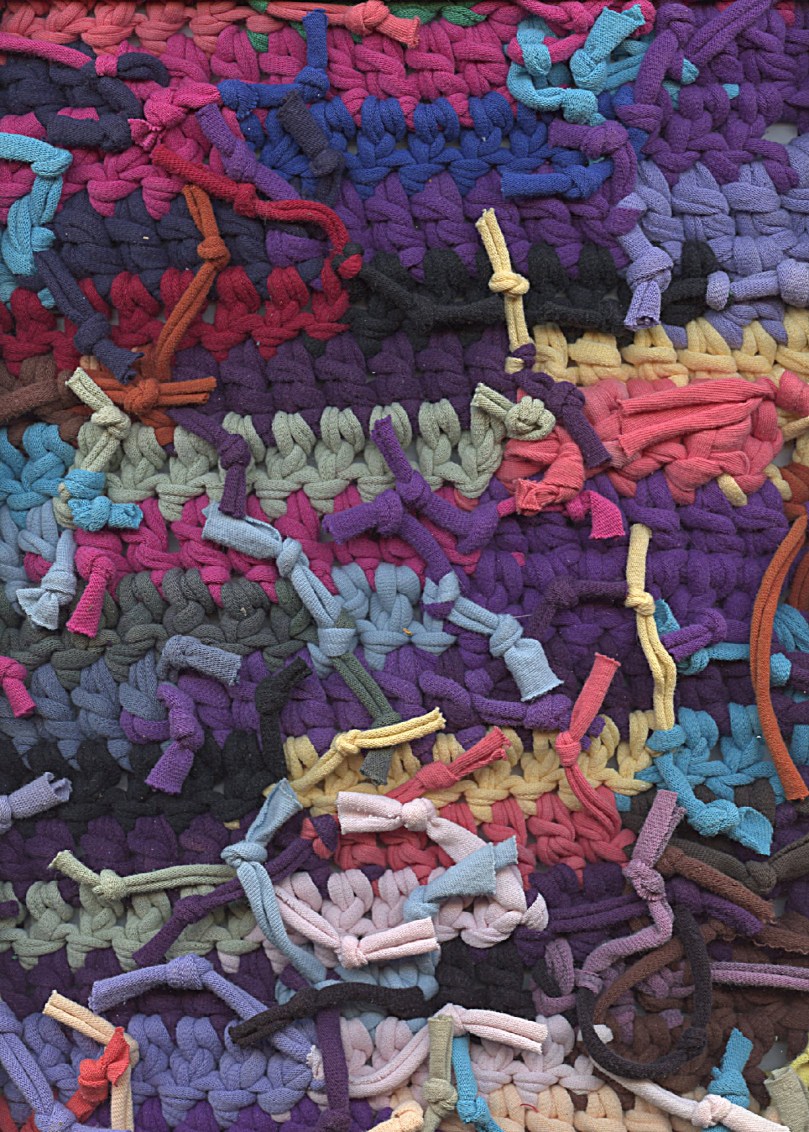
From the time we are conceived life in this world it is full of stimulation and changes. In a mostly safe and secure world we can accept them all and our experiences of transition and change moves smoothly along as we grow into a person with a self that can connect all our experiences together into some kind of fabric that is the whole of our life. This image reminds me of a safe and secure organized attachment!
2 t-shirt mat
The reverse side of my little crocheted T-shirt rug reminds me of organized insecure attachment. The transitions between 'events' has been made, but on the inside some vestiges of lack of smooth transtions between experiences remains like little loose ends that most organized insecurely attached people remain completely unaware of.
3 t-shirt mat
This would be an extreme illustration of a disorganized and disoriented insecure attachment disorder. Life has been too traumatic, and without safety and security to make transitions between traumatic and nontraumatic early experiences, the body-nervous system including the brain, the mind and the self of someone raised in a malevolent world will not be able to put things together to make a solid, coherent 'story' of their self in their life.

+++++++++++++++++++++++++++++++++++++++++++++

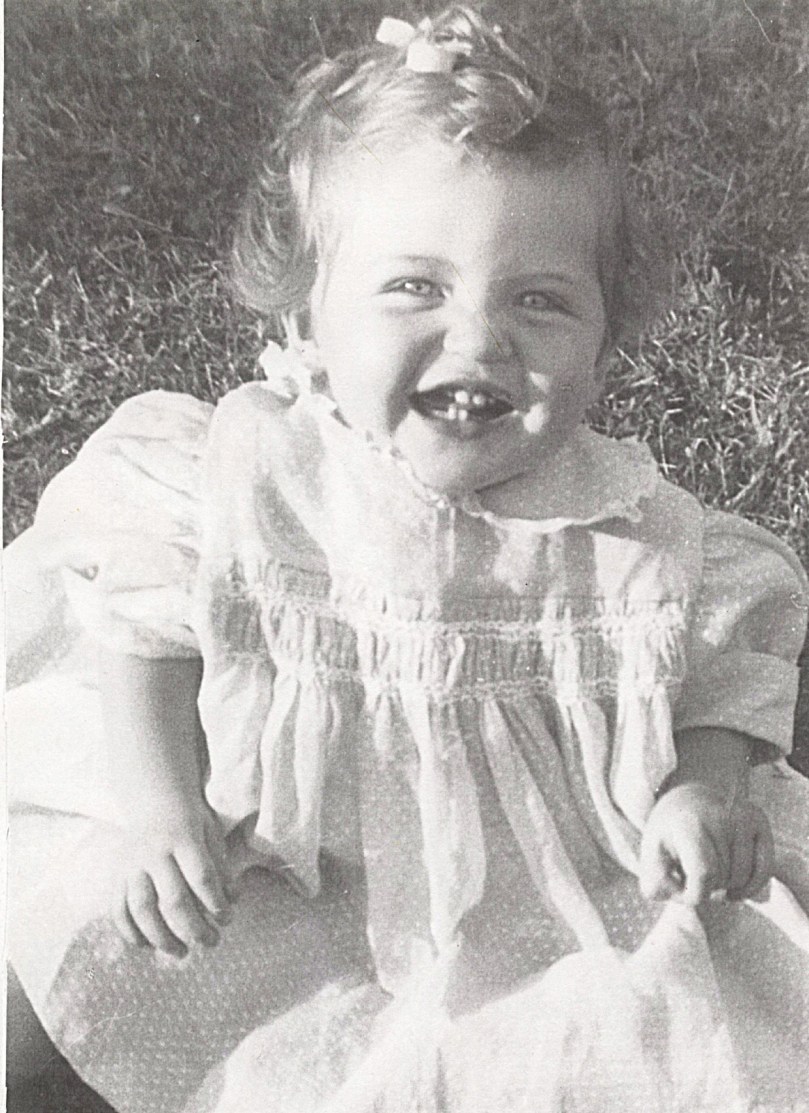
This is me at 11 months old, all dressed up with curls in my hair. This is me looking 'happy' during a picture taking event.
11 month old 'happy' me - mother allowed it at this moment -- it was 'be happy, picture taking time' -- which had nothing to do with my 'other' ongoing realities
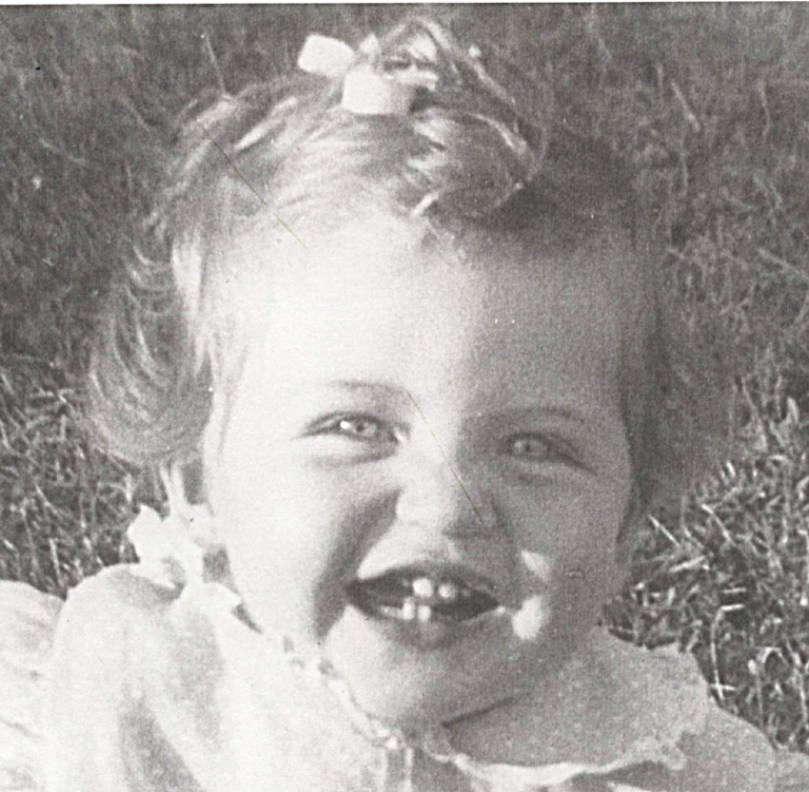
1952 closeup - 11 mos baby pic
Yes, 'happy' for this instant, but I now know this is a dissociated state. It was not part of any ongoing safe and secure organization of my baby brain as it had formed itself through chaotic, unstable and dangerous early caregiver interactions. (I can't get the scratch damage off of the photo at present)

+++++++++++++++++++++++++++++++++++++++++++++

When I first found this photograph of me two years ago in MY BABY BOOK I was pleased to see that I could ‘still be happy’ when I was eleven months old.  It gave me hope that at least some of my developing baby brain’s left hemisphere happy center neurons had been activated, and gave me hope that I can find them today and build on them.

Then the more I considered my baby picture, the more I realized that this happy picture was not showing me ‘sun and roses’.  I have come to understand that this was a dissociated state that baby me was not going to be able to transition  smoothly in my baby brain to any other kind of state that was likely to follow. What I first saw as an expression in my baby eyes close to ecstatic I have come to see as over-stimulated, too intense, and most likely a sign of my dysregulated right limbic brain development due to my mother’s psychotic abuse of me.

The early and ongoing environment I formed in was chaotic, unstable, unpredictable, often terrorizing, terrifying, violent and painful.  Safe, secure peaceful serenity and calmness did not form itself at the center of my body-nervous system-brain-mind self as it was supposed to.

My set point of balanced equilibrium is not at calm.    Patterns of adjustment and adaptation to my infant-child malevolent environment, which happened to a large extent through dissociation,  had to build themselves into me so that I could survive and ‘go on being’ — and now I clearly know they are still there.

+++++++++++++++++++++++++++++++++++++++++++++

I had an experience last night that gave me a clear insight about how I am in the world.

Around the time of my 1980 – 1983 journals I am transcribing from around my age of 30, I could function in the world in a relatively ‘ordinary’ way.  Now, through circumstances of my life, I have returned to who-how I have always been in the world and didn’t, until now, have to know about.  Just using the experience I had last night as an example, I can see that

(1) first I learned how to get along in both of the worlds of my childhood, the chaotic, malevolent, insanely abuse world of my home life with my mother, and in the ‘ordinary’ world outside my home such as school.

(2) Once I left my childhood abusive home, I found myself living entirely in an ‘ordinary’ world.  I could fake it by then so that only those in my most intimate circle of friends could have known that things were not all right with me on my insides.

(3)  I continued down that trying-to-be-ordinary road all of my life until two things happened to me that brought into focus in the forefront how ‘unordinary’ I really am.

(4) After 35 years of having a child under the age of 18 in my care, my baby left home nearly six years ago.  I didn’t know what was happening to me at the time, but looking back the disorganization and disorientation of my insecure attachment disorder reared its head.  Breast cancer manifested itself in my body immediately, although I was not to discover its presence for another 3 years.  It seemed that the entire world of my life dropped out from under me and I tumbled down Alice’s not so wonderful rabbit hole, disoriented and disorganized and not having a clue what that was.  Then

(5) happened.  Finding out I had cancer so completely threatened the only true source of safety and security I had ever known, my body itself, and coupled with the terrors of treatment and the consequences that chemotherapy had on my brain, left me where I am today — on mental and emotional disability with an extremely limited arena of activities that I can tolerate with any degree of comfort.

I have lost any way I developed (learned) to transition into an inner feeling state of calm, serene, safety within my body no matter where I am in the world.  This ability never developed at my core as it was supposed to from infancy.  For me, a state of calm equilibrium has evidently always been a dissociative state, and seems to be one that I now have lost access to — unless I can ‘get there’ through remaining in a very controlled, calm and quiet external environment which then ‘soothes my soul’.

++

This leads me to last night’s adventure.  A close friend of mine encouraged me to attend the local Fiber Arts Guild meeting that was preceded by a fantastic presentation on African textiles.  Of course I am not presently comfortable with people at all, certainly not with groups of people, certainly not with strangers.  I am not comfortable in small closed environments.  I am not comfortable with ‘noise.’  But, in light of my recent journal transcribing realization about how important weaving and spinning and related textile arts are to me, and considering that I want to TRY to ‘get better’, I went to this meeting.

Nothing disastrous happened, which is great.  But what I felt on the inside, and can still feel today is both intensely disappointing and creatively illuminating.  We cannot work with trying to change or improve what we cannot see about ourselves — so now I have some clearer information.

++

In light of what I now understand about how insecure attachment disorders exist in the brain as a result of changes that happen when we are very young and our brains are growing and developing in the first place, I can FEEL and begin to understand the damage done by these changes.  My right, social, limbic, emotional brain does not receive or process ordinary information in ordinary ways.  For all the years that I was able to ‘function’ in the ordinary world in a ‘good enough’ fashion, I was able to work around and hide what my brain was really doing.  I can’t do that any more.

Too much stimulation.  My brain does not regulate input or experience correctly.  I cannot do what experts call switch states, or move smoothly and comfortably through what is called transition states.  In that group of around 40 women last night, the walls began to close in, sound became a noisy roar.  Faces became super animated, and people began to get larger and larger in relation to me.  Noise and more noise as I lost the ability to focus on one single pattern of sound or conversation.  I tolerated nearly three hours of this mayhem and madness (to me), and began to crave silence, calmness, peace and simplicity.

Because my internal self cannot provide these things for me, I am nearly completely at the mercy of where I am and what is going on around me physically and externally on the outside of my body.  It is not supposed to work this way — not in ordinary situations.  Our right brain, in balance with our reasonable left brain and our rational cortex, is supposed to be able to navigate throughout life with the peace and calm on the INSIDE of us.

++

I feel I am failing at a description of what I am trying to explain and describe, so I added some visuals here that might be able to convey an image on the OUTSIDE that relates to what I know on my INSIDE.  Part of what I did to self-soothe my ‘anxiety’ level from too much stimulation last night that continued to reverberate in my brain and body, was to pick up the closest thing I could find and begin working with my hands which always calms me, focuses my attention, and provides a transition space for me to deescalate.

(My condition makes me think about the increase in ADHD and autism and about how little researchers know or are willing to admit about what they know about what is causing this condition among today’s children.  I suspect it will eventually be tracked back to inadequate conception to age one brain development — because we are losing our ancient wisdom about taking care of our babies right during early critical brain and body developmental stages.)

++

Those women last night were ordinary women who meant me no harm.  They were not threatening.  They were not dangerous.  I was not in danger of being further traumatized.  But the oldest part of who I am and how I operate in this body in this world does not seem able to any longer put on the town dress, put curls in my hair, walk out into the world and be able to smoothly handle multiple stimuli from the environment and the required transitions that would enable me to be comfortable.

++++++++++++++++++++++++++++++++++++++++

+TRYING NOT TO GET CAUGHT IN THE ‘OLE DICHOTOMOUS THINKING

+++++++++++++++++++++++++++++++++++++++

All or Nothing: Dichotomous Thinking

+++++++++++++++++++++++++++++++++++++++

Borderlines are certainly not the only ones who practice dichotomous thinking,  and yet the second website popping up on a Google search on the topic is one on Borderline Personality Disorder and dichotomous thinking.  Most simply put, this way of thinking looks like this:

  • black or white
  • good or bad
  • all or nothing

++

I believe that this type of thinking pattern is completely entrenched in Judeo-Christian traditions.  Seems obvious to me!  And yet our culture finds its way into our growing infant-child brain so that we seldom question what the basis of our thinking is or where it comes from.

++

I need to remind myself of this as I work with my quarter-century old journals.  It seems a pattern for me to think dichotomously, and then assign blame, guilt, shame and other toxic labels to the simple facts of what went on ‘back then’.  I was not the bad guy, nor was my husband.  I was just thinking back, and remembered how I found out in January 1985 as our divorce was finalizing that he had been seeing another woman (nine years his junior and eight years mine) for three years, starting winter 1981-1982.

What I might call my indiscretions – and what others might see as my indiscretions, tended to be out-front, blatant and obvious.  I never had one single clue for those three years he was ‘seeing’ another woman that this was going on.  It had progressed to the point where he brought her home to his mother and father’s house, introduced her to his family – all the while nobody ever said a thing to me, and I did not know.  Not consciously, anyway.

Supposedly his indiscretion didn’t matter and didn’t count because they ‘controlled themselves’ and did not have intercourse.  Give me a break.  They met in 12-Step meetings, and their relationship evidently flourished.  They married shortly after my husband and I divorced, and are still married.  That relationship wasn’t a fling in the park, and all honesty would have made sure I at least knew they were involved.  I could say “So much for ‘working an honest program’.”  Oh, I guess I just DID say it.

I found out when I received a telephone call from my small-town neighbor, also an Al-Anon member, who told me the facts 3 days before our divorce was final.

“Everyone in town knows,” this lady told me.  “I thought you should know, too, in case you don’t.”  I didn’t.

(More to this story will be told when I get to the 1984-1985 journals.)

++

I realized that demonizing and angelizing was something my mother was a professional at.  She was an expert in dichotomous thinking.  Of course I was immersed in an environment thick with it, both in my home and in my culture.  But I do not want to think that way now if I can catch myself and stop it so that I can take another course in my thoughts.

+++++++++++++++++++++++++++++++++++++++

I am also thinking about how the signs of the endings of all my relationships were present in their beginnings.

+++++++++++++++++++++++++++++++++++++++

+PETER PANELLA AND ALL MY LOST GIRLS – AGE 31 JOURNALS, THE NEXT STEPS

+++++++++++++++++++++++++++++++++++

Nine months.  That’s the length of time this next of my age 31 journal entries covers.  This would be the same length of time it takes for a baby to travel from conception to birth.

It seems strange to me that over a quarter of a century later I cannot begin to be objective about myself, my story, or my process as contained in these writings.  I still distance myself from myself, and can give myself total permission to do this distancing now because THAT was a different Linda, in a different set of circumstances at a different place in a different time.  I also continue to distance myself from myself because I have no other choice:  I was made that way.

It strikes me how remote I have always been from myself in my life except for the very NEAR past and the in-the-moment experiences I have as each moment of my life unfolds into the future.  It seems that my past carries me, not that I carry it.  It is too vast, too painful and in too many pieces.

I cannot think of a story that could be more closely like the reversal of the ordinary Peter Pan and the Lost Boys story than mine is in these pages.  What would that story look like if the sexes of all the characters were reversed?  I would be Peter Panella with my Lost Girls.   My mother would be the Wicked Captainella Hook.  Marlin (name changed) in my story would be the male reversal-same character of Tinker Belle!  Leo (named changed)  would be the ever-devoted, right thinking and well-intentioned Wendy.

++++

In the nine month period of time that elapses in the pages here, I left my husband and my children in ‘their’ home and rented a ‘Room of My Own‘.  I completed my BA college degree.

It has never until this moment struck me that the trials and tribulations of a recovery-from-abuse journey happens in its own story version of a Trauma Drama.  If we had never experienced the trauma of abuse in the first place, there would never be a need for this Recovery Trauma Drama story to ever happen, either.

As Peter Panella in my story, all the Lost Girls were part of my self.  There was a dissociated me not only for every developmental stage of childhood I had missed going through ‘normally’, but also hundreds and hundreds more of them that had each experienced some horror caused by my mother along each step of the way.  Each Lost Girl holds her piece of my memory along with the experience of having her experience of her experience of trauma.  In this way each one of them holds her own consciousness about what the Main Me, Linda, cannot remember except through the emotions held within the body that all of us share.

Nobody ever told me that these unintegrated shards of my existence could not magically become part of some magical WHOLE PERSON named Linda.  Nobody ever told me that what I was really accomplishing in my recovery journey was the recognition, identification, and naming of all these separate dissociated Lost Girl pieces of my self.  Nobody ever told me that they were NEVER going to become anything else.

Nobody told me my brain-mind-self had formed from the beginning of my life under so much trauma that continued for 18 years that I will NEVER be able to obtain or create a single-self-entity that resembles the one that ordinary-childhood people are created with.  Nobody told me that as a consequence of my childhood I was made into a different sort of person.

++++

In these journal writings I am describing a catching-up-to-Linda-at-31 process that was going on at the same time I was beginning to identify the trauma and the individual pieces of me that it had created.  I tried to accomplish an exploration and solidification of self that should have automatically and naturally happened throughout my childhood and young adulthood years — and didn’t.

Every single step I took in my journey included some confrontation and encounter with my profound woundedness.  The 18 years of abuse I endured had affected — and infected — me so profoundly and pervasively that I could not find anything but a shell of Linda, packed full to overflowing with pain, confusion, and the defenses that had enabled me to survive.

By the time these journal entries end I had found my way to the only place, both internally and externally, possible for me to go to next:  Another treatment center.  This one was designed specifically to address both severe trauma and addiction.  I remained apart from both my husband and children, now 130 miles away, and walked through the next doorway of my trauma drama recovery story.  The steps that I took to get to this next doorway are described here:

+++++++++++++++++++++++++++++++++++

*Age 31 Journal – Sept. 1982 thru June 10, 1983

+++++++++++++++++++++++++++++++++++

EXCERPTS:

January 19, 1983

What do I see as my boundary problem with Leo?

My mother = my conscious

Her right and wrongs = mine

Leo’s rights and wrongs = my rights and wrongs

I use Leo:  the whole part of me that would love Linda isn’t there and Leo is that part of me that loves me

Doesn’t feel healthy

My mother is the part of Linda that hates Linda

Kathy [therapist] says:  “In some ways what you’re talking about is pretty profound.””

++

January 26, 1983

Talked to the girls tonight about my moving out for awhile.  Kathy [therapist] says it should be for at least 6 weeks.”

++

February 8, 1983 Tuesday 11 PM

Had class tonight on child abuse issues.  Sue told her story.  Makes me think about my unvisited “cave” where I’ve hidden all my childhood issues.  Wonder when I’ll get in there and poke around.”

++

February 24, 1983

From notes on Rollo May talk, “Creativity as Significant Form

“Without anxiety = heightened sensitivity, there’s no creative person.”

“Creativity:  The divine madness.  The anxiety of being lost leads to creativity.”

“The pause is not nothing.  Listen to the silence.  Technology calls pauses depressions.  PAUSING – the kind of aloneness of a creative person.”

++

March 4, 1983

Well, it’s 9:15 PM and at last I’m here in my room.  Made the move.

++

March 13, 1983

(I’m losing tears again).”

I’m creating a safe place here for myself to be with myself, and, finally, cry.”

++

March 22, 1983

I don’t want to die – I don’t want to be dead.  I want to live.”

++

March 23, 1983

I feel angry tonight.  Very lonely, too.  In that lonely place nobody else can come to.  Maybe lonely for myself.”

++

March 28, 1983

There’s a point where you go numb and you have to choose not to feel any more in order to survive.”

I used to think my mother was “just” an overly critical perfectionist.”

++

April 2, 1983

7 PM – I’m in Glyndon now [visiting].  Leo and girls are at Larry and Echo’s.  The house is very neat and clean.  It’s my home, and yet I also feel like I don’t have a home.  Alienated – That’s how I feel.  From people, my family, pets, home, even my body and myself.  I feel sad, like I want to cry, but I can’t.”

I feel hopeless like I got made wrong and I can’t get fixed.  My body is healed of the childhood wounds, bruises; but inside I haven’t healed yet – I don’t even know if I’ve started yet.  I don’t have the option of getting high to forget this all like I used to.”

2009 note: I know now, finally, that I didn’t get made ‘wrong’, I got made different.  I could not have survived my abuse if I hadn’t adapted and adjusted in every possible way that I could.  Fortunately, our human species has that ability — to adapt in order to survive.  I also know now that I could not possibly re-make myself into the same kind of person I would have been if the abuse had never happened to me.

++

June 9, 1983

There’s someone inside wanting to get out and not knowing how.”

+++++++++++++++++++++++++++++++++++

NEWS FROM:

Prevent Child Abuse New York Blog


Recent Surge in Recession RunawaysPosted: 30 Oct 2009 02:46 AM PDTThe intersection between the recession and family stress may be causing an increase in runaway kids and teens, according to a recent article in the New York Times.   Job loss, foreclosures, and poverty have added to the stresses at home which have been trickling down and effecting teens.  Reporter Ian Urbina recently spent time with teen runaways in Medford, Oregon.  He learned the desperate measures they take in order to survive everyday rather than return home.  Most runaways aren’t even reported missing by their guardians, and if they are reported to the local police, most times they don’t make it into the national database.  Without national recognition, it is very hard for police to identify and return these runaways.  Police claim that runaways are not a top priority because most of the time they do not want to be found or returned home.  Unfortunately of the 267 runaways reported nationwide 58 of them were found dead.  “These kids might as well be invisible if they aren’t in National crime information center (N.C.I.C.),” said Ernie Allen, the director of the National Center for Missing and Exploited Children.  While federal officials are expecting a rise in homelessness this year, most social programs aid homeless families, not unaccompanied youth.   At the same time, many financially troubled states have severely cut social services, leaving little to no help for homeless runaways.  This presents a significant challenge for society, as runaway children are more likely to become homeless adults who are forced to live a life of crime.For information please visit the National Association for the Education of Homeless Children and Youth, The National Coalition for the Homeless, and The National Child Traumatic Stress Network.

+++++++++++++++++++++++++++++++++++