+INFANT-CHILD ABUSE AND PERMANENT CHANGES TO THE ‘STARTLE RESPONSE’

++++++++++++++++++++++++++++++++++

Yet again I must remind myself about the special characteristics of my life, my infancy and childhood, my story and of my body as it had to change in its development within an 18-year environment of trauma as these characteristics are unique and extraordinary (out-of-the-ordinary).  As I begin today to allow words about ‘my relationship with my father’ to take form on paper and digitalized screen I am coming around full circle to thoughts that came to me in 2006 when I first began my ‘developmental neuroscience’ research into my experience of life – and how it got to be the way that it is.

I started then and I am back there today thinking about brainwashing, mind-control and thought-control that was first formerly identified in 1950 related to techniques the Chinese used to alter the lives of people in drastic ways through trauma, torture, terror and imprisonment.  In 2006 I read stories written by survivors of these Chinese brainwashing efforts, but even as I did so I found not ONLY the similarity between what was done to these survivors (and their experience of surviving them) but also began to understand at the core of my being that every one of these survivors seemed to have had access to a tool that saved them.  I understood that I never had this tool.

What allowed these survivors to retain deep within their brain-mind-self at least a tiny corner of resistance and self-identity that the brainwashing could never touch was a sense of having BEEN a self prior to their torture experiences.  That self was directly tied to memories, very often of deep love and secure attachment to others, from their life prior to these terrible times.  I never had the opportunity to experience anything before my mother’s torture of me began because I had suffered from the same kinds of brainwashing patterns the Chinese used on their prisoners from the moment I was born.

++

These thoughts are tied to my beginning response to Question #4 about my father that is a part of the book my daughter and I are writing about my infant-childhood.  I have no reason to believe that my mother wasn’t able to brainwash my father.  But at the moment that is not my concern.  What I am thinking about still is my response to the snake on my door yesterday.

I just did a Google search of the terms “child abuse startle response,” and encourage readers to do the same and spend some time poking around with the information that appears on the screen.  The single word that pops out to me on this search page is this one:  “obligatory.”  Everyone’s body is ‘obliged’ to respond one way or the other to perceived threat to well-being and life, but if a body has been built within environments of severe trauma from infancy the entire process of obliged-to-response will have been changed during earliest development.

I believe it pays all abuse survivors to become familiar with some of the information presented in the Google search I mention because we LIVE in and with a body that has been changed in development and will ALWAYS respond differently to the stress of trauma (real or perceived).

I suspect nearly everyone would experience a startle response to suddenly finding a great big snake wrapped around their doorknob of a door they just approach.  But for someone like me the reverberations from my initial startle reaction lasted for hours and hours, long past the actual experience with the snake.  Unlike what a nonabused person’s reaction would have been, mine involved and included a reawakening of many of my body’s old traumas along with my body’s ‘obligatory’ reactions and responses to them.

I doubt that I will ever look at or touch my front security door again without having the thought (and the image) of that snake’s body wrapping and twisting and slithering itself all over it.  I also know that my body-brain-mind-self never formed any procedures to release trauma from the present moment so that it doesn’t become added onto the entire massive collection of trauma that I have physiologically been ‘obliged’ to remember.

At the same time I understand that I am certainly not in any exclusive club when it comes to reactions to snakes, I also understand that the startle response I had yesterday and all the feelings I am STILL feeling in my body as a result are the SAME ONES I was forced to have in response to my OWN MOTHER on most occasions I was forced to endure my encounters with her – in one way or the other.

These patterns of startle, trauma and pain built themselves into me in such a way from the moment I was born that I most often experience some degree of ‘startle’ and resonating discomfort when I am in the company of nearly ANY human being other than those people, like my children, with whom I share my closest love-attachments.

These are the kinds of lifelong difficult consequence that infant abuse in particular creates.

++++++++++++++++++++++++++++++++++

+MY DAY IN THE HOOD AND “THIS UGLY FEELING”

++++++++++++++++++++

I forgot that today was a holiday.  There’s nobody around me to celebrate it with.  So I was dumbly going out my front door to run over to the post office to check my mail (too small a town for door delivery).  I opened my solid wood inner door, reached for the knob of my outer security door (wrought iron bars with steel mesh) and turned it.

Because the holes in the mesh are quite small and have been painted several times, with the way the sun was hitting it I couldn’t see outside except to notice from where I stood on the inside heading out that there seemed to be a new and additional CURVED piece of rod visible at the height of the knob.

It wasn’t until I had the door opened about six inches that the loops of a large snake with diamond patterns on its back came into my view as it enclosed my outer door knob completely with its wrapped body as it slid itself across, up and down my screen door!

Panic.

Not a reasonable thought in my head as I stepped backwards and slammed shut my wooden door without shutting the outer door, reaching into my pocket for my cell phone.  My friend, no doubt alarmed by my alarm, told me to call the sheriff’s office.  I did.  Waiting for the deputy to arrive I watched with prehistoric revulsion from my picture window as the snake undulated its way all over that door.  It began to drop itself through the air and I knew it would be on the ground and gone before help arrived.

In my state of alarm I didn’t see its head or its tail clearly.  I did see it taking off in a straight line across my yard (after it obviously negotiated the five steps that lead up to my front door).  I watched it crossing the road.  I now gingerly stepped from my door and kept my distance so I could see where the snake was once the deputy arrived.

This man didn’t like snakes any more than I do, but he relaxed when he spotted the narrow rather than arrowhead shaped head – and eventually saw the tail that he already knew would not have rattles.

I only felt very mildly stupid.

Growing up in Alaska where there are no snakes, I will NEVER respond to them like a south-of-the-snake line native.  The deputy assured me I could “leave now and have a nice day” while he and his soon to appear buddy would snare the snake and relocate it.  I didn’t watch.

++

I am STILL not OK – many hours and much reasoning later.  My body, having spent 18 years living in an extremely abusive home, does not tolerate a full-blown stress response well.  Not well at all.  But the warning to watch ALL OF THE time for hazardous creatures came with today’s experience at the same time the reminder came that my nervous system and stress response system had to develop from infancy with a super overload that means today that trauma affects me differently than it does ‘ordinary’ people.

Which brings me to the second experience of my day I wish to write about.  I am getting to know my neighbor L, a woman I liked and trusted instantly from the moment I met her.  L grew up in a stable and loving home and did not suffer from abuse or trauma.  I can tell that about her – really just read it in her body language.  Her easy smile, her natural confidence that shows in her relaxed movements — she just feels HEALTHY to me.

Today when I stopped by to tell her about the snake that came a’knocking (L HATES snakes and has a true phobia about them) we ended up visiting for quite awhile.  L lost her husband of 25 years to cancer less than a year ago, and as L talked about how she relies on prayer to help ease her through the most difficult year – one holiday, one birthday, one anniversary – at a time she placed both of her palms on top of one another right in the center of her chest.

“Sometimes the ugly feeling builds up right here.”

I asked L how she handles that feeling, and if the prayer helps it go away.

“Oh,” she said, “Sometimes I have to really cry and when I do then this ugly feeling goes away.”

L had also told me about a friend of hers whose husband died, too.  L asked her how long she had cried after his death.  “For a year,” the friend told her.  “I cried and I cried so hard I thought I would never stop, but I’m finally getting a little bit better now.”

++

Sometime when I am visiting with L I want to remember to ask her again about her friend – most particularly about what L knows about her friend’s early infant-childhood years.  It would not surprise me one bit to learn that this woman did not have the kind, loving and good childhood that L had.  In fact, just from the description about these two women crying I would be most surprised if the friend HAD a happy childhood.

L described to me something I will never be able to experience.  She described her feeling of deep sadness and grief as “this ugly feeling” that is obviously (to me) not a feeling that L has experienced as a chronic state of her life.  In fact I doubt it showed up at all until her tragic loss.  Crying is SUPPOSED to make what really IS an ugly feeling go away.

Now, for L’s friend the crying seems to have gone on a long long time and did not make the “ugly feeling go away” after a reasonable period of crying.  L can cry, the ugly feeling leaves her shortly and she can go about her day still missing her loved husband — but NOT captured in the essence of her being by “this ugly feeling.”

++

Perhaps this is true for other severe (especially when it starts in infancy) abuse survivors as it is true for me.  Such stress and such sadness built themselves into my growing little body that “this ugly feeling” became my normal state.  It’s at the center of my nervous system where peace and calm is supposed to be (as the ‘set point’ for homeostatic equilibrium of the stress response and nervous system).

L and I have very differently-developed bodies – I know this now – so as she describes her ability to cry a cry and have “the ugly feeling” vanish from the center of her chest, and as she tells me about her friend who cried continually for a year I know where I fit in along this continuum – and I know why.

++++++++++++++++++++

+ABUSE: IN THE ABSENCE OF EITHER MODESTY OR THE FEAR OF GOD

+++++++++++++++++++++++++++++

Tomorrow I begin my writing of response to the book’s question #4 (about my father) – so I shouldn’t be surprised that today I feel far from chipper!  I found a passage today that I wish I understood – but I don’t.  Not really, not in any way but the most superficial fashion:

Truly, I say, the fear of God hath ever been the perspicuous protection and solid fortress for the whole community of the world.  It is the greatest means for the protection of mankind, and the chief cause of the preservation of humanity.  Yes, there exists a sign in the being of man which guards and protects him from that which is unworthy and unbecoming.  That sign is called modesty.  But this virtue is assigned to a few; for all are not endowed with this station.” From Baha’u’llah in “Bahai’I World Faith:  Selected writings of Baha’u’llah and ‘Abdul’l-Baha” (out of print) page 180

++

This would suggest that for the bulk of humans it would be the fear of God that would keep us in line with living a truly good life.  Modesty, in a culture so pervasively materialistic, is often considered ONLY in this light.  But when I went to Webster’s online dictionary I found that the first definition of ‘modest’ is this one:  “placing a moderate estimate on one’s abilities or worth.”

I feel today as I prepare to write tomorrow for the book that I have a sinkhole of sadness and of DISAPPOINTMENT inside of me that seems at this moment to circle around a center that this word ‘modest’ represents.  I see that within this small and not-often used word might be a deep connection to both the essence of empathy and of compassion both of which were entirely missing in the severely abusive home of my origin.

Oh, no doubt both of my parents would have claimed if asked that modesty was one of their most ‘prized personal possessions’, but that would have been a lie as big as all the others their patterns in living represented.

It didn’t seem to be my mother’s ‘fear of God’ that was the straw that broke her, but rather the ‘fear of the devil coming to get her’.  I am not interested in arguing any points about how these two perspectives might be similar or different from one another.  I just sense at the core of my body that it was not any light that the first might carry that was present in her but rather all the darkness contained in the latter.

Whatever factors a human being might need to have been exposed to in their earliest life so that a healthy self could form that could have healthy relationships was missing from both of my parents’ experience.  They must have both been denied whatever it takes to develop “a moderate estimate on one’s abilities or worth.”  There is NOTHING moderate about infant-child abuse!  There IS NOT SUCH THING as ‘moderate abuse’.  Abuse is abuse, and I cannot imagine a human being who HAS “a moderate estimate on one’s abilities or worth” ever committing it.

Yet if modesty, according to this quotation is a rare virtue not common among humans, then there must be a whole lot of people who do, in their innermost essence, at least have a healthy fear of some kind for God – however that relationship is defined and experienced.  (I imagine the rare modest people have both.)  This passage suggests to me that to live a life of well-being ONE of these two factors must be present.  My parents evidently didn’t have either one – and oh the suffering and abuse that was fostered and perpetrated in their absence!

+++++++++++++++++++++++++++++

+WHAT MY PARENTS DID TO ME WAS COMPLETELY EVIL.

+++++++++++++++++++++++

I have been outside piddling around in my garden doing activities that need to be done but are on the lazier end of work.  I have known since I created the newest flower bed on the east side of my house that the tubing I used, given to me by a neighbor so I used it with consideration of ‘repurposing’ and conserving $$, was too stiff and too old to hold any pressure and instead cracked and leaked.  I knew I needed to replace it with new tubing, but doing anything with the irrigation irritates me!  So I postponed the repair and just now finally DID it!

In that process — and because I am INTENSELY involved with thoughts about writing my book — I learned something simple that connects these two jobs.  What I did just now was REPAIR a ruptured and faulty section of my irrigation.  What I am doing as I write my book and tell my story is repairing the ruptured and faulty parts of myself as I repair my life story!

I am following two story lines as I book-write.  One is my mother’s and the other is mine.  These two stories have been so intertwined, meshed and fused together from the time my mother was in labor with me that distinguishing between her story and mine is an arduous and at times excruciating process.

I realized just now as I replaced the faulty irrigation line so the drip will work correctly that the ONLY tool I actually have to use in order to distinguish between my mother’s story and my own is THE TRUTH.  Her story is a lie.  My story is the truth.  And as surely as M. Scott Peck writes in his book, “People of the Lie” I will be able to make the minute distinctions between story lines that must be made by FEELING MY WAY ALONG IN MY GUT!!

Bless his cotton socks, that’s exactly what Peck is saying.  We know EVIL because we can FEEL it in our gut.  It dawns on me this morning that the other side of this — MY SIDE — is that I can tell THE TRUTH the same way:  I feel it in my gut!

Because I Netfilx stream lots of British TV shows I am becoming more and more familiar with their term, “sorting things out.”  They use it a lot.  That’s what I am doing, sorting out the truth from the lies as I write this book – and although the POWER is in the TRUTH I hold to no delusions that there isn’t incredible power in this world all tied up in EVIL.

Because I understand the spiritual truth that God exists and is good, and that what humans might call the devil and evil only exists when God and good is absent (shadow without light).  The LIGHT of God’s love is real.  The shadow of evil and of hatred is the absence of that light.

++

As I prepare to continue responding to the next question #4 my daughter has given me for this book, I am spiritually waking myself up for that task.  This is not an effort on my part that will be a success if I am sloggy or half-awake or only half paying attention.

I am approaching the Great Divide.  On one side will go GOOD and on the other side will go EVIL.  EVERY SINGLE THING ABOUT BOTH OF MY PARENTS’ RELATIONSHIP WITH ME WAS EVIL.

I am naming that with a clarity and power that has alluded me before today.  It is not mine to judge their souls.  That is God’s job.  I am naming WHAT THEY DID as evil.  All of it.

Now how that evil came to permeate and contaminate each of them as people is not my business.  Humans have that special dual nature:  animal and spiritual.  God wants humans to chose to live according to the spiritual where all goodness and human virtues lie.  But humans have free choice and choosing to act worse than an animal is our free option every moment we breath.

The BEHAVIOR of my parents was evil, belonged on the dark-ignorant-selfish side of human nature — whether their choices were made consciously or not.  When enough trauma happens during earliest stages of development the resulting adaptations and changes can so remove a human’s ability TO ACT CONSCIOUSLY that the automatic animal-survival-based INSTINCT to survive runs the show at all costs.

It doesn’t matter to me whether the evil happened consciously or not at this point.  It is my concern that EVIL is what my parents did to me.

So in thinking about the ‘warrior’ comment yesterday to my ‘hero’ post I have been facing today my inner WHINER who wants to just quit fighting and relax in the glory of a job well done and battles well fought and won.

“Give me a break, Linda!” I tell myself.  “Who are you kidding?”

The evil that exists in this world, with all the combined force of the life force that is tied up within it, is VERY REAL.  Enduring as a hero in the moment with no thought of the future except to survive that moment is one thing.

Giving a damn about the future of US ALL is another.  Fighting against ignorance is a battle I will not escape fighting as long as I am in this body.  Acknowledging infant and child abuse and then fighting against THAT GREAT EVIL is what I am about.

“So on with it, Linda!  No matter how intense, no matter how difficult, no matter how much you might rather have had a different life, this is the one you got and the one you are living.”  Within THIS LIFE I have everything I need to make something beautiful out of something that was evil and ugly nearly beyond imagination.  And that task is what I want to be all about.

+++++++++++++++++++++++

+MY LIFE IN HELL – “SET MY PEOPLE FREE!!!”

+++++++++++++++++++++++++++

I WANT TO SET THIS GIRL-ME FREE WITH THIS BOOK I AM WRITING!

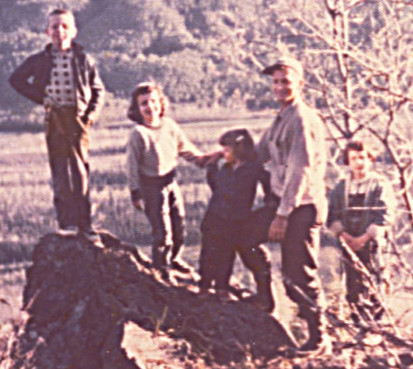
Next question for book is about my 'relationship with my father' - I have a VOLCANO inside of me! There he is with his children but not me with his back turned to me - look at the BODY language in this Alaskan mountain homesteading photo!
Age 7
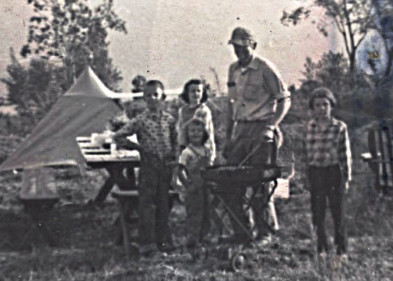
Again age 7, brother's birthday BBQ - OH LITTLE ME, again father with his prides and joys - and me, oh it breaks my own heart!
In my writing I have to go to hell to get myself out

Things are coming together as I write this book in ways I could never have imagined, planned for or anticipated.  This is a very good thing!  Just very, very hard!

+++++++++++++++++++++++++++

+INFANT-CHILD ABUSE: THE DIFFERENCE BETWEEN HERO AND VICTIM

++++++++++++++++

Somehow I must think I would be pretentious or audacious to think of myself as a writer – but maybe I am anyway.  If so, words are the tools of a writer’s craft be one a poet or a songwriter or a writer of plays or stories true or imagined.  I am tracking a thought of mine today in between my writing for the book and this must MATTER to me because the use of one of the following words instead of the other makes – to me – a universe of difference.

Hero or victim?  Now, this must be coming from the writer-in-me (obviously, I’m writing this) who ‘says’ to me, “You were never a victim.  For all the terrible abuse your mother did to you, you were NOT a victim.  You were a hero.”

Next thought:  In order to have the LUXURY of being a victim rather than a hero one must be in a place of SAFETY rather than in one of threat, danger and harm.  The VICTIM part comes after-the-fact when there’s somebody there to CARE!  Being a victim does not happen while we are enduring alone.

That would mean that VICTIM is a word other people use to describe something from the OUTSIDE of the tragic-traumatic experience.  It is (probably) NOT a word the one who experiences the abuse ever thinks about – unless somehow someone OUTSIDE of the situation has given this hero the word and the thoughts and feelings that might go with it.

I am traveling back to before I was born in my book-writing process, and although I have made a deal with myself not to discuss what is happening with THAT writing, I wanted to let the writer-in-me have this say about these two words.

I will not be able to go back to any abuse memory from my early life, not even into the memory of a terrible beating and find myself in the midst of those traumas feeling, thinking or acting in ANY WAY like a so-called victim.  I bore what was done to me.  I endured.  I survived.  I was then and still am now A HERO!!

Now – I am safe.  I have people around me who love me and care.  But I have NO ONE, not one single person in my life who perceives me in any way as a ‘victim’.  I like that just fine!

Yet I also know that all infants and children who are being maltreated are being ‘victimized’ – but just as those actions against little ones are done by the big people, so does the word ‘victim’ belong to them.  The little ones who are suffering – and YES there is much suffering — their only choice is to a HERO.

++++++++++++++++

+MISSING: AN ARCHETYPE FOR THE HERO THAT IS A CHILD AS IT ENDURES ABUSE

++++++++++++++++++++++++++

I have put some careful thought into deciding to write this post considering I might be breaking my own book-writing rule by doing so.  While I am in the process of answering the 19 questions my daughter is feeding to me one at a time I wanted to retain all my ‘inner information’ in reserve, in a reservoir, so that nothing that belongs in the book that is my story will be drained off into some other direction.  Now I have reached a point as I begin to write my response to Question #3 that leaves me unable to move until I DO drain something from that reservoir that I have decided does not belong to the book.

What I need to write about here is more like a log jam that is preventing me from clearing my thoughts enough to proceed with what the book needs.  So I am going to tear apart that log jam, let out what needs to go elsewhere, at the same time that I will then discover if there is anything about these thoughts that has a ‘deeper’ and relevant meaning for my truth that is going into this book.

++++

Yesterday as I worked in the mud to finish the east side of my adobe-project yard, and just as I finally located the exact spot where I am going to install my new umbrella clothesline so I can dismantle the long lines that are draped across my main walkways, and under which I have had to carefully duck my head each time I walk past their direction, my little just-turned-six year old neighbor girl came over to visit.

As I soaked this chosen spot with water to soften the earth enough that I could begin to dig a hole for the clothesline post this girl, I’ll call her Jay, fiddled around with the plastic sleeve that needs to be settled into the hole so the main pole can slip solidly into it.  Bright green in its pristine newness, the tubular plastic sleeve finally had to be placed into the muddy, slimy, soupy muck in the hole I was digging so I could see how much deeper I had to dig.

“Oh, no!”  Jay changed her voice, speaking for the new green sleeve-tube.  “I am all clean!  Please don’t put me in that hole and make me all dirty!  I will have to go take a shower!”

I explained to her the process I was going through to put up my new clothesline, but she remained completely immersed in her little girl world of what my mother would have called ‘make-believe’.  (A healthy child normally passes through this ‘make-believe’ stage by the age of seven.  My mother never did.  She remained in a twisted version of that stage for the rest of her life.)

“OK,” she finally spoke for the green sleeve.  “You can make me go into that dirty mud.  You can make me stay there.  But I’m never going to like it.”

++

As she spoke these words another entirely different train of thought that had been working its way through my mind all day as I worked on my yard flitted again into my mind-sight.  In that image I saw Atlas holding up the world on his shoulders.  I had been thinking before my company arrived about what are called the archetypes that some believe lie underneath all that humanity can be conscious of, that govern behavior as they lie within the stream of ancient, ancient human experience and appear in our psychology.

I had been thinking earlier about the ‘hero’ archetypes in relationship to my childhood with my Borderline abusive mother.  I thought about the first book I ever encountered that finally helped me to ‘name’ what had been so wrong with my mother:

Understanding the Borderline Mother: Helping Her Children Transcend the Intense, Unpredictable, and Volatile Relationship – Paperback (July 1, 2002) by Christine Ann Lawson

This morning I pulled that same volume from my bookshelf and noticed the many sticky-note tags I placed on so many of its pages seven years ago when I read it.  I flipped through its pages and saw all the underlining I had done then, all the stars I had drawn beside certain passages, the notes I had written in the margin.  Yes, this book had been a milestone marker along my latest journey of healing, but I also know I will never bother to read that book again.

And, yes, that book does write about Borderline mothers by defining various archetypal patterns they can act out in their lives.

Yet what I was thinking yesterday about Atlas being an unnamed hero who was left to carry the weight of the world upon his shoulders – and what combined with hearing how Jay was processing from her child’s point of view what I was processing in my adult view of putting in a clothesline pole – was that I have never seen anyone write about how the archetypes that might govern the experience of the mind of a young child are probably (they have to be!) so much different than the ones that govern adult ones.

++

My mother didn’t wake up suddenly one morning in adulthood and simply ‘become’ a Borderline.  The malaise that swallowed up my mother didn’t simply one day cast its shadow over her and stay there following her around for the rest of her life.  What became of my mother long past her childhood was directly a result of malevolent experiences she had had long before she was even Jay’s age.

And here was Jay before me yesterday living out a life stage that I know is the same one in which the final throes of trying to make sense out of the universe she had been born into pushed her into what might be called a ‘pre-Borderline’ condition that was destined to eventually destroy her.

++

Here I begin to reach the point in my own thoughts were the book information is intersecting the thoughts I am writing here.  I searched Google for ‘archetype women hero’ and found a page that lists what are considered to be these images especially as they are presented in ‘literature’.

From the Desk of Tami Cowden:  The Women We Want to Be – The Eight Female Archetypes

There I was yesterday arguing in my thoughts, down on my knees in the mud shoving cement into the hole to hold up the now-filthy sleeve that will hold up my new clothesline, as I concluded, “There is something WRONG with this picture.  I know there is.  There is nothing in these existing descriptions about women and archetypes that accurately describes the experience of abused children – who survive.”

There IS another kind of hero (be it female or male).  This hero does not fight battles, does not have any but one single motive:  To endure.

In more ordinary circumstances endurance is no big deal, but in the midst of horrific overwhelming traumatic circumstances ANYONE of ANY age can (hopefully) do this one main thing:  Endure.

The image I had come to me of Atlas holding up the world FELT to me to describe both what my mother did and what I did.  Only as severe early abuse and trauma survivors (ANY unresolved trauma survivors) we hold the burden of the world of trauma INSIDE our body, not on our shoulder.  The trauma builds our body-brain at the same time it builds itself into us.  We cannot put this burden down.

I found an interesting website last night in which the author describes what the name, Atlas, means:

The name of Atlas indeed derives from the Greek radix tla meaning “to bear”, preceded by the negative affix a, meaning “not”. Hence, the name of Atlas literally means “the one unable to bear [the skies]”. Such is the reason why Atlas (and other Titans like himself) are often portrayed with weak, serpentine legs.” – Copyright ©1997-2005 Arysio Nunes dos Santos. All Rights reserved. Please click here for more information about the copyright of this page and website. – “The true history of Atlantis” by Prof Arysio Nunes dos Santos online

And from the website answers.com:

  • An “Atlas” or “atlas” is an incredibly strong person or one who carries an enormous burden.

Now THIS feels accurate.  Thinking about how Jay processed her experience and about how I was processing my experience of putting in a clothesline pole in mud and cement, and thinking about how my mother processed her life of trauma that happened to her as a child, and thinking about my own self (as the book is describing) as I went through my own early traumas of abuse, I recognized that VICTIM – as a word and as an archetype – IS NOT THE RIGHT IMAGE.

‘Victim’ is a grown-up word.  It has no place in the world or vocabulary or thoughts of a child.  What infants do, what young children do is ENDURE while they bear a burden of trauma that is NOT their own.  The little ones HAVE NO CHOICE but to endure.  ‘Victim’ then becomes (to me) an arrogant, assaultive and insultive word that is a completely inaccurate word to apply to the reality of very young abuse survivors.

Early caregivers of infants and young children are supposed to buffer their offspring from adult trauma.  When this does not happen, and when those same adults are in fact harming and hurting these little ones, the young one is left in a place where nothing can change what happens to them – and they know it.  Certainly I knew it as I took my first breath.

These little ones – myself and my mother included – are left to bear the burden, endure, and survive.  That to me is a different kind of hero than the ones sorted and filtered into the descriptions of ‘hero’ I found in either of the two places I mentioned above.  Little ones live in a different world than adults do.  Jay does.  My mother did.  I did.

++

Now, more than this I cannot write because I have made my attempt at clearing the log-jam in my thinking so I can move forward in writing my response to Question #3.  I will only provide a simple linking bridge to that ‘other side’ where that other writing is going on.

All the circumstances of my mother’s life intersected during the time she was in labor with me.  She suddenly, in the midst of that current-moment experience simple BROKE.  The burden she had carried all of her life became at the moment her psychosis about me was born MORE than she could bear.  How ironic to me in some ways that it was as I, her firstborn daughter was coming into the world (or even exactly as I was born and she was told ‘It’s a girl’) that my mother let go of HER burden and put it onto me.

I then became the next generation of Atlas hero.

++++++++++++++++++++++++++

NOTE:  I discovered another interesting pattern in Jay’s current developmental stage of thinking yesterday.  She has watched me and helped me all the way through the work to build the adobe chicken coop and pen.  She saw these six chicks from the day I brought them home.  They are still young at one month old, and yesterday as I took her into the pen to sit with me and watch them she asked me, “When are you going to get the big chickens that will lay the eggs?  I want to see THOSE chickens!”

As hard as I tried to explain to her that these six young birds are the SAME ones that will grow up and lay the eggs she could not comprehend what I was telling her.  I tried to explain that they are like she is, and that she will grow up to be an adult.  I explained to her that every adult was once a baby and a child like she is now and that they grew up just like these young birds will.

She ABSOLUTELY did not understand what I was telling her because she COULD NOT.

++++++++++++++++++++++++++

+IMPORTANT NEW RESEARCH ON ‘EXECUTIVE FUNCTION’ OF THE BRAIN – AND INFANT EXPERIENCE IMPACTS THESE ABILITIES

+++++++++++++++++++++

From the Prevent Child Abuse New York Blog – May 23, 2011

How Early Experiences Shape the Development of Executive Function

A new joint Working Paper from Harvard’s National Scientific Council on the Developing Child and National Forum on Early Childhood Policy and Programs explains how a child’s early childhood years are the foundation for developing vital brain functions, what can disrupt this development, and how supporting this important stage in child development benefits them in the future.

Completing most tasks requires the successful collaboration of a number of executive function skills. Scientists break these down into three dimensions:

  • Working Memory: the capacity to hold and manipulate information in our heads over short periods of time.
  • Inhibitory Control: the skill we use to master and filter our thoughts and impulses. This allows us to think before we act, resist distractions and temptations.
  • Cognitive or Mental Flexibility: the capacity to switch gears and adjust to changed demands, priorities, or perspectives. This allows us to apply different rules in different settings.

The study that consisted of extensive Neuroscience and Developmental Research came to the following conclusions:

  • The building blocks of children’s capacities to retain and use new information, focus attention, control impulses, and make plans are acquired during early childhood, but the full range of executive function skills continues to develop into the adolescent years.
  • Executive functioning is distinct and separate (although still crucial to) school readiness and academic success.
  • Children’s executive function skills provide the link between early school achievement and social, emotional, and moral development.
  • Large individual differences in executive functioning at kindergarten entry can have important implications for children’s adjustment and success in and out of school as well as in their relationships with others.
  • A young child’s environment and relationships plays an important role in the development of executive capacities.
  • Adverse environments resulting from neglect, abuse, and/or exposure to violence can impair the development of executive function skills as a result of the disruptive effects of toxic stress on the developing architecture of the brain.
  • There is increasing evidence revealing a close relationship between the roles played by community, school, and family contexts, as well as socioeconomic status, in the development of executive function skills.
  • Children who experience adversity at an early age are more likely to exhibit deficits in executive functioning, suggesting that these capacities are vulnerable to disruption early in the developmental process.

The study suggested several strategies to help foster the development of these important skills in young children. For instance, a “Preschool Intervention” approach introducing an increase in the practice of the following three strategies:

  1. Programs aimed at fostering emerging executive function skills e.x. the ability to retain and use information, focus and resist distractions
  2. Programs that train and support teachers in effective classroom management strategies e.x. rewarding positive student behavior, redirecting negative behavior
  3. Programs that train teachers to model and coach children as their social-emotional skills are developing. Focusing specifically on children’s pro-social behavior, social problem-solving skills, ability to understand and express emotions constructively, and ability to control impulsive behavior and organize themselves to accomplish goals.

+++++++++++++++++++++

+BORDERLINE PERSONALITY DISORDER PARENTING: WHAT WE MOST NEED TO KNOW

++++++++++++++++++++++++++++++++

I am currently approaching the ‘deeper levels’ in writing my response to the 3rd of the 19 questions my daughter is feeding to me in our writing for our book on my experience being raised by – and severely abused by – my Borderline Personality Disorder (BPD) mother.  She suffered a severe ‘psychotic break’ during her delivery of breech-me.  While I am ‘sworn to silence’ about any writing right now other than for the book, I am fully responding to comments on this blog.

I want to point out this morning’s comment and my reply on some of the difficulties of BPD parenting.  Please read them at the end of this post:

+SOMETHING WENT TERRIBLY WRONG WITH MY MOTHER’S PRECUNEUS

Just as there were stages in development of the physiological changes that traumatic stress caused during the growth of our body-brain-mind-self, there are stages NOW in our learning of new information that can help all of us begin to understand not only what these changes were and how they were caused, but WHY they happened to help ensure survival and HOW they operate in our body-self NOW.

This information matters because it is ACCURATE!!  Within the truth lies our freedom to find ways to heal and change now – no matter what biological course our development HAD to take THEN to keep us alive!!

++++++++++++++++++++++++++++++++

+ADMITTING CONFUSION ABOUT ATTACHMENT, SAFETY AND PROTECTION

++++++++++++++++

I often ponder the combination of information about safe and secure infant attachment (and the opposite).  Pondering means I still wonder about how these patterns work — and don’t work — according to how ‘nature’ designed them for mammalian survival.  In the simplest of patterns I can actually WATCH (because human behavior is SO complicated!) I notice my two grown cats.

Each of them is let out for the night.  They go off and do their cat thing, and in the morning they return.  But the gold tiger female, Goldilocks, nearly always returns hours before her brother, Hunter, does.  I don’t think she even goes very far afield.  He probably does.

Neither Goldilocks nor my dog settle in on the mornings that Hunter comes home late like he did this morning.  They pace around, sit by the door at attention, or scamper the reaches of our yard searching for him until he arrives.  Then, as was the pattern today, they greet him gladly once he’s safely home.  All eat their breakfast, and then the cat-rest of the day begins.

I have an old sheet spread over my blankets on my bed.  No matter how much I wash it within moments of cat-sleeping upon it it is dingy again.  I also don’t ‘make’ my bed in any sense of the word.  I plump up my blankets in inviting piles under this sheet because if I don’t the cats don’t like it there.  Then they go wander around the house and sleep in whatever location they decide is more inviting than a correctly smoothed out bed thus dragging dirt and cat hair all over the house!

So up both cats hopped onto their daytime domicile this morning once all had eaten his breakfast.  I had watched his entire string of actions from the moment he appeared at the screen door meowing softly to be let in.  SUPER AWARE and HYPER-VIGILANT at first, he startled at every tiny sound.  This is how he survives his nightly travels, I know.

Yet after a few moments of being indoors he settles down.  His entire body language shifts to that of being an indoor cat.  Once on the bed both cats luxuriously stretch out to their LONG full length, doze for a few moments and then disappear into deep long sleep for the rest of the day.

++

SO – obviously they feel safe in the house, but it is not I that is providing them protection.  It must be the total environment of these four walls with entry barred by windows, doors and their screens that lets these cats know they have nothing to fear.  The end result is that in safety they REST.

This intertwining (as I still see it) pattern of safety, protection and relaxation-rest still leaves me with some confusion about how they all operate together.  As an abused infant-child I NEVER had a ‘place’ to go where I felt as safe within a parameter of protection as my cats do.  I obviously found ways to rest in spite of this fact.

I have talked to battle-worn war survivors who express how sleeping on an active battlefield happens differently than otherwise.  Some of these altered patterns might never leave a war veteran for the rest of their lifetime.  Being able to sleep at the same time one is hyper-alert is possible, but I believe there is a high cost to the well-being of body and self if this is the chronic pattern of one’s life.

++

My point?  I don’t have a clue.  As I say this topic is still swirling and unclear to me.  I cannot view this from the ‘outside’ as if I ever knew in my body from my birth what resting in safety and security ever meant.  So, I guess I still can’t figure this out even now!

++++++++++++++++