
+MISSING LAUGHTER IN MY MOTHER’S MONKEY HOUSE

++++++++++++++++++++++++

As I move forward in Dr. Dacher Keltner’s 2009 book, Born to Be Good: The Science of a Meaningful Life out of his chapter on smiles into his chapter on laughter, I find I am using his information like a powerful laser flashlight, beaming a pinpoint of illumination back through the years of my childhood as I search my memory for genuine smiles, laughter or humor of any kind.

I find myself thinking about the important book, Stop Walking on Eggshells: Taking Your Life Back When Someone You Care About Has Borderline Personality Disorder by Paul T. Mason and Randi Kreger as I realize that the absence of happiness in our abusive infant-childhoods paralleled the presence of unsafely, insecurity, unpredictability and violence.  Genuine smiles and riotous laughter do not occur in the middle of trauma.

What can I learn about the development of my body-brain-mind-self if I think about myself as having been a monkey in my mother’s monkey house?  Certainly my mother’s sovereign nation lacked any equality between members.  There was no ‘flattened hierarchy’.  My mother had all of the power, and everyone knew it.  There was no true cooperation.  And certainly in my case there was no affiliation.  These conditions did not contribute to any sense of safety or security, and in these conditions true happiness, laughter and humor did not exist.  Their absence is incredibly telling.

From my previous studies I already know that good humor is one of the powerful ‘reproductive fitness indicators’ of our species, right up there with good physical health and beauty, intelligence, good memory, and creative thought.  Any species fitness indicators provide direct evidence of the state of ill- or well-being of specie’s members – like does the fitness indicator of a peacock’s tail display.

The research literature is full of information about how the greatest gifts of our species are directly tied to the greatest risks of being distorted through negative influences within a deprived, malevolent, abusive, traumatic early environment.

Reproductive fitness indicators develop in humans through an interactive process of genetics being influenced by conditions within the environment during development.  They end up communicating information not only about any single member of a species, but more importantly they communicate information about the condition of the environment that influenced any individual’s development.

The presence or absence of genuine D smiles and laughter is no exception.  The lack of safety and security in my childhood was represented by the opposite of joy.  My mother’s dysregulated emotions, especially her hatred and rage toward me created suffering, terror, sorrow, despair and alienation within our home.  She kept complete power and controlled her family’s environment through terror, threat of violence and violence.  Ours was NOT a healthy, happy monkey house.

And of course, because I was my mother’s singled out abuse target, the impact of deprivation and trauma had its most powerful effects on me during my development.  My resulting difficulties with happiness are directly tied to having had my mother’s sickness built right into my own body-brain from birth as signals of the lack of well-being and fitness within the environment that formed me.  My mother did not give me any “all-purpose signal of cooperative intent.”  I received from her the opposite.

++++

Keltner describes how the smile originated back in the early history of our evolution.  A comparison of human patterns with primates’ shows that

“…in more hierarchical macaques, such as the rhesus macaque, there is a narrow use of the silent bared-teeth and relaxed open-mouth display.  The silent bared-teeth display – the predecessor to our smile – is used only as an appeasement display.  In these status-conscious monkeys, the smile is intertwined with anxiety and defense.

“There are more egalitarian macaque species, however, such as the Tonkean macaque.  In these macaques, hierarchies are flatter and power is equally distributed.  This social condition more closely resembles the hierarchies observed in our hominid predecessors and contemporary hunter-gathers – power differences are reduced, and equality is more pronounced.  In egalitarian primates, food sharing is pervasive, alliances among subordinates are common, and social life consists more of negotiation than assertion of force….  In less stratified macaques, monkeys put the silent bared-teeth display to many new uses:  to reassure, to affiliate, and to reconcile, as well as to appease.  This is a standard evolutionary principle – that adaptations such as the silent bared-teeth display are put to new uses in a broader array of contexts to respond adaptively to shifting selection pressures.  With the rise of primate equality, the silent bared-teeth display became freed from its one-to-one mapping to fear and submissiveness, and extended into new social contexts that promote affectionate cooperation and affiliation.  This display became a sign of friendly intent, and the trigger of behavioral processes that allow for close proximity and cooperation – grooming, embraces, hand clasping, and the like.  In egalitarian primates, the silent bared-teeth display folded into affiliative, pleasurable exchange.

“The physical signature of human happiness is the D smile.  The D smile did not originate in contexts that we today think are fast tracks to happiness…In fact,,.hunter-gatherer hierarchies…systematically downplay any sudden abundance in resources through modesty and generosity.

“In our primate evolution, the D smile was the first vocabulary of friendly intent and affection, in particular between near-equals….the roots of human happiness are found in those moments when individuals moved toward one another toward cooperative and intimate ends.  Our ultrascoiality required this, as well as an all-purpose signal of cooperative intent, one that is highly visible and unambiguous, and one that could preempt conflict and spread cooperative relations potently and quickly, faster than a stranger could cock his arm and throw the first punch.”  (pages 120-122)

++++

From here – you guessed it – Keltner continues forward in his next chapter to the topic of laughter.  My personal experiences with forbidden laughter were anything but funny.

++

I have no memory of my mother ever telling a joke.  I have no memory of my father ever telling one, either.  I asked my sister and she can’t remember either of our parents ever telling a joke.

I do remember watching the Beverly Hillbillies on TV while we lived in the Government Hill apartments the year I was in 4th grade.  I made the mistake of actually considering something on the show funny, and I actually laughed out loud.

My mother jumped all over me verbally, berating me for my gullibility and stupidity in thinking anything about the show was funny.  I was stupid, just as the show was stupid.  She told me nobody was supposed to think it was funny, or to laugh at it.  Was I so stupid that I didn’t know that they used ‘canned laughter’ – totally fake audible laughter – as a part of the show?

She made it sound like my inability to detect the stupidity of the show and the fakeness of the canned laughter meant I had failed some important and significant test that ANYBODY else would have passed.  I had to be the dumbest, stupidest person in the whole WORLD!

I’ve have never forgotten this experience.  It too was added on a more minor line of my mother’s abuse litany than were my major crimes, as proof of how gullible I was.  It was part of the proof that I was a chameleon, had no mind of my own, and would follow anyone to do anything, even over a cliff if they told me to.  It proved I could not think on my own for myself (well, that was pretty much true – she never allowed me to think).

How sad it was not to be able to even laugh safely.  I never laughed out loud in front of her again.  I had to watch myself to be sure I didn’t, monitor my reactions even to humor, make sure no sign of it accidentally slipped out or gave me away.  In essence, I knew it was simply bad and unacceptable for me to ever think anything was ever funny.

In fact, by the time I was in 8th grade my mother very creatively forced me to watch black and white film footage on TV of the WWII bombing of Poland as she informed me that I should have been there because that is what I deserved to happen to me – brutal annihilation.

++++

Keltner describes the evolutionary origins of human laughter as this ability followed a different trajectory from primates’ beginning four million years ago.  Smiles and laughter evolved as signals of communication long, long before humans achieved our verbal abilities.

“Most striking is how human laugher differs from that of our primate relatives – gorillas, chimps, and bonobos.  In the most rudimentary sense, the laughter of the great apes resembles our own.  Their relaxed open-mouth displays and panting vocalizations look and sound quite familiar.  They emit these displays in similar contexts as we do – when being tickled and during rough-and-tumble play.  As with humans, chimps and apes are most likely to show open-mouthed play faces in developmental periods (adolescence) and times of day (leading up to feeding) where play can defuse conflict.  Yet the laughter of chimps and apes is more tightly linked to inhalation and exhalation patterns that that of humans.  As a result, it is emitted as short, repetitive, single-breath pants, and has little acoustic variety.

“Human laughter, by contrast, is stunning in its diversity and complexity.  It is a language unto its own.”  (pages 124-125)

++++

The presence, absence and quality of laughter both influences the physiological state of the human body and is an expression of the state of the body.  Safe and secure early infant attachment to caregivers includes smiles and laughter.  Unsafe and insecure early infant attachments do not communicate safety and security through the presence of these signals.  These degrees of variation in interaction with the environment are built right into an infant-child’s developing body-brain, including the regulation of the nervous system.

++

Keltner states about the physiology of laughter:

“And perhaps most subtly, laughter is intertwined with our breathing….  With the exception of certain pathological laughs…almost all laughter occurs as people exhale.  This simple laughter fact may seem incidental to our understanding of laughter, but in fact it is fundamental.  Here’s why.

“Respiration and heart rate are two of the body’s most essential rhythms.  These two rhythms play off each other like the voices of singers in an a cappella group.  When you breath in, your heart rate rises.  When you breathe out, your heart rate drops, as does your blood pressure, and you move toward a state of relaxation.

“This lung-heart dynamic has made its way into….the thousand-year-old breathing exercises of yoga practices.  Exhalation reduces fight/flight physiology, especially heart rate, calming the body down.”  (page 128)

Studies of the acoustical qualities of laughter show that different kinds of laughs correspond to different brain region patterns just as varying smiles do.  The sound and pattern of laughter is affected by degrees of intimacy and is different among groups of friends than it is between groups of strangers.  Studies have shown that women laugh more than men do, and that men “are much more likely to snort and grunt than women.”  (page 130)

Keltner presents more information about laughter:

“…voiced laughs, which have tone to them and involve vibrations of the vocal folds (chords), and unvoiced laughs, which do not.  Voiced laughs sound like songs, rising and falling as they move through space.  Other people perceive these laughs as invitations to friendship and camaraderie.  Unvoiced laughs – hisses, snorts, grunts – are not perceived as such.  Much as the language of smiles is divided into Duchene [D] and non-Duchene [non D] smiles, there are voiced laughs of pleasure and unvoiced laughs not involving pleasure….  Both are vital to the social contract.”  (pages 130-131)

“Here is a remarkable discovery:  Laughs occupy a part of acoustic space that is different from vowel sounds like “ahhh” and “eee.”  We may describe laughs in the written word as “ha, ha, ha” or “hee, hee, hee,” but in fact the acoustic structure of laughter is distinct from that of the vowels we use to represent this mysterious category of behavior.  Certain regions of the human vocal apparatus produce the vowels and consonants that make up human speech, in which so much of human social life transpires.  But there is another register of the human vocal apparatus, another form of output – laughter – with different origins and functions than human speech.”  (page 131)

“When people laugh, subcortical, limbic regions of the brain and brain stem – most notably a region known as the pons, which is involved in sleep and breathing – are activated.  These regions are much older evolutionarily than the cortical regions involved in language, suggesting that the deeper meaning of laughter is intertwined with breathing.”  (page 132.

++++

From my point of view, learning here that laughter is connected in our body-brain to our most basic fundamental experiences like breathing and sleep is amazing, though not surprising.  When I write about how interactive early infant-caregiver interactions influence the growth, development and formation of who we are in the world for the rest of our lives, it is on these fundamental levels that we are helped or harmed in our ability to experience life from a state of either well- or ill-being.

Although infants can obviously cry from the instant they are born just as they can breath, their capacity for smiles and for laughter very soon follows.  If an infant is born into an environment of neglect, abuse, maltreatment and trauma, even its first experiences of sending signals out into its caregiving environment and receiving them back will be influenced in development.  In cases such as mine was, my environment never improved.  The trajectories of all of my abilities were changed during my development, not the least of which is my ability to be happy, to express happiness, and to understand other people’s experience and expression of happiness.

My infant-childhood experiences with ‘joy’ happened in dissociated patterns according to my mother’s orchestration of my life.  As a result there is little natural ebb and flow or unconstrained ability to participate with others in states of safe and secure joy.  Anxiety was tied in my body to every experience I ever had as an infant-child as I developed, as was dissociation.  It is a rare, rare moment when I can even now experience pure joy.  My sense of derealization and depersonalization mostly requires that a distance between me and others has to first be bridged.

Because expressions of happiness, including spontaneous laughter, are designed to happen instantaneously and automatically as forms of nonverbal communication, they happen in extremely fast-action displays.  I did not get the same circuitry build into my body-nervous system-brain that most other people did so that I operate much more slowly in all social interactions.  It helps me to know that there are reasons for how and why I experience social interactions differently than most people do, including the funny, happy ones.

When I talk about the tragedy of life long changes that happen during early developmental stages of abused, traumatized and maltreated infant-children, it is on these profoundly fundamental most basic levels of the human experience that we must accept that these changes take place.  These changes often rob a survivor of the experience of being something other than completely alone in an unsafe and insecure world.

Laughter as the form of emotional regulation and social interaction that it is, is missing in most severely abusive families.  These deprivation conditions are built into our social-emotional brain, into our entire nervous system and body.  At the same time that the signs of happiness, social connectedness and well-being are visible, attempting to access this information with our changed body-brain-self can take an invisible super-Herculean effort.

Those of us who were so seriously deprived and maltreated as infant-children require patience and compassion for ourselves and from others in our efforts to find ways to heal these near mortal wounds that were inflicted on our being and built into our body-brain from the time we were tiny.  This isn’t a job for cowards.  It is a job for those of us who are willing to fight to our death for what should have been our birthright – the right to experience the fullness of joy within ourselves and with other members of our species.

It helps me to begin to understand how deeply and profoundly the absence of joy influenced my body-brain development right along with the presence of severe violence and abuse.  While I can take an umbrella out to keep the rain off of my head I cannot stop it from raining.  I will never have the opportunity to return to a happy infant-childhood so I can take a different pathway that would allow joy-filled wiring to be built into me from the start.  I have to be realistic as I work with who and how I am as a consequence of what was done to me throughout my formative stages.

It helps me to learn more about why improved well-being, including the experience of happiness, takes effort for me that most non-early abused and traumatized people might never be able to understand.  They benefited from advantages in an advantaged early environment that most of these people take for granted because it is all built right into them.  It is as if they climbed Mt. Everest by being dropped off near the top.  Severe early trauma survivors have to make the struggle from sea level on up.

But facts are facts and we best get on with our climbing, even if that means that the last person to the top had to work hardest to get there.

+++++++++++++++++++++++++++++
+RESEARCHER BIAS ON THE ‘D’ SMILE = SICKENING

+++++++++++++++++++++++++++++

First of all, I would like to apologize to any readers of yesterday’s post, +HOOKED ON ‘D’ SMILES – THE HAPPINESS CENTER, who may have inexplicably ended up feeling blue after they read it.  I understand now that I should have placed a “This Post May Trigger” warning at the top of it.  I didn’t because I had no idea that such a reaction to ‘happiness’ might happen.  I did not know that post would trigger my loss and grieving that would wash over me for the rest of the day, and that I would have to go to work to understand where it came from.

I ended up understanding what had happened to me yesterday after I wrote that post because I found myself about a half hour later feeling not like a frog who could blithely and easily hop off my lily pad onto a different one and go on my way, but like a frog whose feet were glued to a stone as I sank into the depths of a sadness that seemed to come from nowhere.  My insecure attachment system had been triggered in all its complicated glory, and powerful body-memory emotions nearly swallowed me whole.  In fact, I don’t feel today quite like the same person I was yesterday when I wrote that post in the first place.

I understand that as we learn, grow and heal change is SUPPOSED to be part of the process.  At the same time I know there is risk involved, risk of feeling what our body has to tell us about the reality of our present life as we have been deeply and permanently affected by the severe deprivations, traumas, abuses and maltreatments of our infant-childhood.  When these changes happen, our first response is not likely going to be one of those glowing, authentic, genuine ‘D’ smiles tied to our happiness center that I wrote about yesterday.

++++

As I began today to think about what my next learning-writing step was going to be, I realized that what I encountered yesterday is affecting me today.  What I found in the next pages of Dr. Dacher Keltner’s 2009 book, Born to Be Good: The Science of a Meaningful Life, confirms what I know in my whole body.  I see that as an extreme infant-child trauma and abuse survivor that most often what is presented by experts to be accurate and truthful, even ‘proved’ information simply ends up making me feel worse about myself.

In its subtle way, nearly everything I encounter about well-being in the world makes assumptions that are not the truth for everyone, certainly not for us survivors.  Something that is presented as truth across all people and ISN’T is, most fundamentally, a lie.  Perhaps the most important accomplishment of my work on this blog is to highlight the fact that when we read this kind of information our body will ALWAYS rebel against the lie.

We can train our self to recognize when swallowing the lie creates what is actually a wise immune-system response of rejecting toxic poison.  The lie resonates with the contamination our connection with our own self that our early abusers did to us.  We will know when this happens because our body-feelings well TELL US.  It is time for us to pay attention.

It is for presenting the lie as truth yesterday that all of us are ‘born equal’ in regard to our ability to experience the ‘D’ smile that I apologize for.  I mentioned yesterday something of the fact that when happiness was not the fare of our early attachment experiences, our happiness center in our left brain simply lost its neurons as our body-brain developed.  But I didn’t say enough.  My body told me soon after the post was published that all I did was drop a sprinkle of truth into a sea of suspicious lies.  I might as well have dumped a pot of boiling water over my head and then stupidly wondered why I didn’t ‘feel so good’.

Let me try to present an example of the disguised lie being cleverly presented with the so-called truth.  I found it nicely presented in the very next section of Keltner’s book that appears after what I wrote about yesterday.  After my crashing experience of yesterday, I was hyper-alert today to this kind of information that can hurt severe early abusers because assumptions are made about the ‘truth’ that are not true for us.

++++

A longitudinal study is one in which the participants are followed over long periods of time.  Repeated ‘measures’ are taken over time about certain characteristics, or variables, these longitudinal studies are designed to understand.  Keltner presents one of these studies, and states:

“Ravenna Helson is a pioneer in the study of women’s lives.  In the early states of her scientific career in the 1950s, she was interested in the intellectual creativity of women – an area almost entirely ignored by psychological science – and interviewed female pioneers in mathematics and the physical sciences.  She then turned her scientific imagination to the question of how identity develops….  In 1959…Ravenna initiated what would become the longest longitudinal study of the lives of women ever conducted, the Mills Longitudinal Study.  This study has followed the lives of approximately 110 women who graduated from Mills College in 1959 and 1960 for the past fifty years, and continues to this day.  It has led to basic discoveries about how identity shifts over the course of life for women, and how it remains the same.”  (page 113)

Ravenna contacted Keltner in 1999 to ask him to add a branch to the study.  Because he is an expert at understanding human facial expressions, she wanted him to take a look at the high school yearbook photographs of her study’s participants in order to explore

“…whether her Mills participants’ smiles, captured when they were graduating from college, would say anything about the next thirty years of their lives….  Relying upon one yearbook photo as a potential measure of the person’s identity was problematic in this regard, to say the least.”  (pages 113-114)

Keltner agreed to accomplish this photographic analysis and

“…took this measure of the warmth of the smile and related it to the treasure trove of measures Ravenna had gathered on these Mills alumnae…when they were twenty-seven, forty-two, and fifty-two.  This included measures of their daily stress, their personalities, the health of their marriages, and their sense of meaning and well-being as they moved into middle age.”  (pages 114-115)

++++

Now right here is where my risk-for-contamination from the ‘toxic lie’ meter went off today – loud and clear.  Keltner is NOT saying that any measure of early childhood trauma that might have affected these participants’ development from the start of their lives is included in the research analysis.  I found online the University of California at Berkeley laboratory that continues to work with this Mills study, and see that over 100 research articles have been published about some combination of findings related to this study.

Finally, it seems, researchers are including measurements of the participants related both to attachment and to emotional regulation in ongoing research.  That is progress.  But nowhere on their website do I see any direct connection to the kinds of early trauma measurements The Center for Disease Control is using in their Adverse Childhood Experiences (ACE) studies.  The ACE Questionnaires that the CDC uses are perfectly designed to gather information about early childhood trauma that would directly apply to the findings Keltner presents as truth and fact in his words that follow.

Because Keltner makes no reference whatsoever to the possible impact early traumas had on building the happiness centers and the early brain of the women in the Mills study, as a severe infant-child abuse survivor I have to take his findings with such a huge grain of salt that it chokes me.  In fact, if these kinds of research findings are presented without including both attachment and early infant-child trauma information, I consider them just plain toxic to my own well-being.

Keltner states:

“What we discovered about the benefits of the warm smile [as assessed from the year book photographs] would fit the analysis of the smile developed here….

“Mills alumnae who showed warmer, stronger D smiles when they were twenty reported less anxiety, fear, sadness, pain, and despair on a daily basis for the next thirty years.  The smile mitigates anxiety and pain, most likely through the effects smiling has on stress-related cardiovascular arousal.  The strong D smilers also reported feeling more connected to those around them; the smile helps trigger greater trust and intimacy with others.”  (page 115)

OK, readers, count the flaws in cause-and-effect logic just presented in Keltner’s last paragraph.   I can accept that the D smilers “reported less anxiety, fear, sadness, pain, and despair on a daily basis for the next thirty years,” but there is something wrong with the logic that follows from a severe infant-childhood survivor’s point of view.

We are left swallowing the toxic suggestion that if we were ‘better’ people and we smiled a D smile more often, we would have our ‘anxiety and pain’ mitigated.  Well, wouldn’t that just be so nice!  How survivors must wish to have the same chances as non-survivors do to react to all the experiences of life in the way that they can and do.

For researchers to suggest that there is something superior about “strong D smilers” compared to others is ludicrous.  If early severe infant-childhood abuse survivors had felt “more connected to those around them” – and others had been more connected to them — while their brains were built in the beginning, the traumas and abuse would not have probably happened in the first place.

I find Keltner’s strange mixing of truth with intimations of control of the factors of one’s life by smiling to be toxic to me.  One of the lessons I learned from my post-post experience yesterday is that not only was I nearly NEVER encouraged or allowed to be happy as a child from birth, and therefore could not build a big, strong, D smiling happiness center in my brain, but opposite to that immeasurable loss the corresponding fact that unbearable suffering overwhelmed my right brain in its development, as well.

I don’t ‘simply’ suffer from the consequences of not being able to feel happiness from birth, but also suffer from great pain that I doubt someone like Keltner can ever begin to imagine or understand.  But for researchers to make the stupid assuming jump between happy D smilers having better lives because they self-empowered themselves in their choices and decisions as opposed to non-D smilers who have less lifelong well-being because they evidently just don’t TRY HARD ENOUGH makes me mad.

That’s right up there with saying, “Of course you didn’t fall off the edge of the world.  You simply didn’t walk far enough.  That has to be a fact because the world is flat and if you had walked far enough you would have fallen off.  That you are here now telling your tale has nothing to do with the world being round.  It is simply proof that you didn’t try hard enough to walk far enough.”

Severe infant-child abuse survivors cannot argue with 98%+ of the research findings that ignore the facts of our existence.

++++

Keltner does not rest with just throwing a poisoned sugar cube at us, either.  He pours an ocean of sappy sweet (toxic-shaming) sugar over his following pages without having a clue about how his statements are completely biased against severe infant-child abuse survivors:

“The warmth of a woman’s smile also predicted a rising trajectory in her sense that she was achieving her goals.  Women with warmer smiles for the next thirty years became more organized, mentally focused, and achievement-oriented.  Forget what people have told you about creativity and achievement emerging out of despair and anxiety.  Not so.  Dozens of scientific studies have found that people who are led to experience brief positive emotions are more creative, expansive, generative, synthetic, and loosened up in their thought.  Our Mills women who showed warmer smiles reflected these benefits of positive emotion across their lives.”  (pages 115-116)

Nothing like a blithe inconsideration for what has been stolen from survivors, or for the weight of the burdens we had to bear from the time we were tiny and that still reside within the fiber of our body-brain.  Rethinking this paragraph from a survivor’s point of view, and realizing the fact that “despair and anxiety” built our body-brain from the start as they built themselves into us, how hard do we have to work to even begin to achieve what non-abuse survivors can with relative ease?  From my point of view, I am not so much interested in how the “good-built” people get better.  I want to know how the “trauma-built” people do.

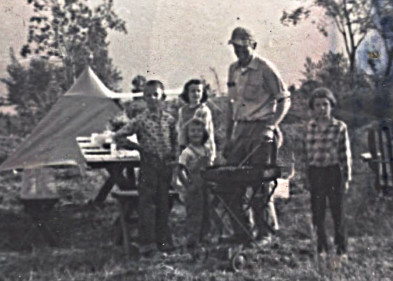
Maybe Keltner could enlighten me (on my father's left) on how this overwhelmed, ostracized, isolated, unloved, battered, hated, hurt, lonely, shunned, rejected, rigid, terrorized, terrified, anxious, dissociated, full of despair, hopeless, helpless and terribly sad so-called 'child of the devil' (from the time of my birth) might be able to build into herself the kind of safe and secure attachment happy left brain and correspondingly a without-traumatized-emotion right brain that would have made me into a D-smiling woman like Keltner's research showcases and promotes. I am not feeling sorry for myself. Infant-child abuse lifelong consequences are real.

Keltner continues with the toxic syrup:

“Our results concerning the relationships of the Mills alumnae were perhaps even more striking.  These women were brought to UC Berkeley to spend a day with other individuals, as well as a group of scientists who wrote up personal narratives based on their impressions of the women.  Women with warm smiles made much more favorable impressions upon the scientists in this context, suggesting that the smile enables more positive social encounters.”  (page 116)

Yes, I suppose a warm smile has this effect on others.  But how does this work for survivors whose nervous system was built upon despair and anxiety, who had to develop massive dissociational abilities in order to survive, who have then entirely different body-brains as a result?  I want to know how many severe abuse survivors in the 1950s ever made it into a college in the first place so that they could be included in this study?

“Turning to marriage, those women who displayed warmer smiles were more likely to be married by age twenty-seven, less likely to have remained single into middle adulthood, and more likely to have satisfying marriages thirty years later….  Women with warmer smiles had healthier marriages.

“Finally, women with warmer smiles at age twenty reported a more fulfilling life at age fifty-two.  Across young and middle adulthood, women prone to expressing positive emotions experience fewer psychological and physical difficulties and greater satisfaction with their lives.”  (116)

Keltner has the cart before the horse as far as I can tell.  If a person starts off life advantaged, and that means with safe and secure early attachment that build all the self worth and strong, clear sense of self and a great big happiness center at the same time they are not battered, beaten, shamed, shunned, neglected, tortured, etc. so that their left brain ‘negative emotional center’ is not massive and overwhelming, of COURSE they will have a better life!

So, in the end I am at least most impressed with other researchers who have the smarts to understand that without measures of attachment and emotional regulation all the findings of this 50-year+ study show nothing but the benefits of having an advantaged life.  I will try to locate the findings of studies that HAVE now included these measures, but I see no indication that any of the 100 papers written from the Mills study include any assessment of the most important factor influencing the well-being of a person throughout their lifetime – presence, absence and/or degree of early developmental deprivation, abuse and trauma.

If researchers are not adding in some measurement of infant-childhood traumas such as the Center for Disease Control’s Adverse Childhood Experience questionnaires, the research findings are still going to be incomplete and relatively useless.  By excluding this information from human well-being research, the findings are invalidated.  The problem with trying to gather this information from the Mills Study participants at this late stage is that nobody can ever go back and find out these measures from the participants of the Mills study that are already dead.  Considering the CDC’s finding that severe early abuse survivors die on the average of 20 years earlier than non-survivors, the most important information that this study could have offered will be forever missing.

++++

At the same time that I am disappointed with important research that takes place from a position biased in favor of non-child abuse privilege, I can refuse to buy the corresponding bias that suggests that there is something wrong, faulty and inadequate about those of us who never had equal positive advantages in the first place.

I would rather these researchers include a disclaimer with their findings:  “We are biased in favor of the privileged people who were not traumatized in their early-infant childhood periods of development.  We don’t care about our biases so we present our findings as fact for all and refuse to include measures of infant-childhood trauma into our research design.  We have the education, the University and federal backing, and all the power so we can do exactly as we wish.  The rest of you be damned.”

Their implied meaning?  “The rest of you could change yourself to be like US if you wanted to.  You just don’t try hard enough to smile that big genuine happy center D smile.  You got what you deserved, and continue to get what you deserve because you just aren’t as good as we are.  Accept your lot or change it, but don’t expect us to really give you any useful, truthful information you can use to improve your lives.  We only care about ourselves.”

Yes, I am disgusted.  Interesting, disgust is a genuine human facial expression connected to an automatic physical response against eating toxic things that will poison us.  Research findings that blame, shame and condemn survivors because advantaged biases are not recognized, and because the most important information is ignored, are toxic to early abuse survivors.

I bought the research yesterday and swallowed the poison that presented and highlighted the kinds of opportunities I never had from birth coupled with the horrible suffering I did have and left me feeling somehow accountable for the consequences of how what was done to me affected me.  The research findings told me about advantages that happy babies and young children have for the rest of their lives in contrast to the heavy penalty we survivors live with in terms of our lifetime of suffering.  Nowhere did I see any compliment given to those of us who endured and survived what many might not have been able to, even though we did not end up able to be like those D smiley people.

I am not so gullible today.  It is my firm belief that any research whose funding can be tracked on any level into a federal ‘giving pool’ source, must be required to include consistent and accurate measurements of early trauma and attachment.  Otherwise, the research is biased toward the privileged against infant-abuse survivors and is therefore polluted, contaminated, toxic and useless.

++++++++++++++++++++++++++++++++++

+HOOKED ON ‘D’ SMILES – THE HAPPINESS CENTER

+++++++++++++++++

The advantage of being in my own think tank of one is that I can be like a frog jumping from lily pad to lily pad, following my own fly, landing when and where I want to, devouring information without having to answer to anyone else.  This is why I can follow my last post on pathological liars with this one on smiles!

I am still hopping around in the same pond I was in yesterday as I search for information about how my mother’s abusive Borderline brain gave me a torturous, miserable childhood.  I am still trying to understand how what happened to her in her own abusive childhood gave her such an awful brain.  Today I just landed on a different lily pad.

++++

I am back for the moment with Dr. Dacher Keltner’s 2009 book, Born to Be Good: The Science of a Meaningful Life, having landed on his chapter on smiles.

It turns out that of the vast number of kinds of smiles humans produce, there really is only one authentic, genuine real one and a whole lot of fakes.  In the field of research that Keltner belongs to, scientists have discovered the facial-muscle vocabulary of all human emotion expressed by the face.  Smiling has a language.

Keltner describes how the genuine smile originates in the left anterior frontal lobe, a region whose activity is connected to positive emotional experience.  All the phony impostor, fake smiles originate in the right anterior frontal lobe.  We can tell the difference and respond accordingly from nearly the time we are born.  Infants are the first smile detection quality experts.

There are two very specific facial muscles involved in a real, genuine left-brain smile display:  the zygomatic major muscle and the orbicularis oculi.  The smile these two muscles combine to create by their movement has been named, according to Keltner,

“…in honor of the French neuroanatomist Guilluame Benjamin Amand Duchenne (1806-1875), who first discovered the visible traces of the activity of orbicularis occuli.  Smiles that do not involve the activity of the happiness muscle, the orbicularis oculi, are sensibly known as non-Duchenne or non-D smiles.”  (page 105)

“When a ten-month-old is approached by his or her mother, the face lights up with the D smile; when a stranger approaches, the same infant greets the approaching adult with a wary non-D smile.”  (page 106)

So, we have been able to tell the difference between a real D smile and a fake non-D smile from our first days as breathing creatures.  I’ve just never thought about the difference in words before today.  The D smile involves

“…the activity of the happiness muscle, the orbicularis oculi.  This muscle surrounds the eyes and when contracted leads to the raising of the cheek, the pouching of the lower eyelid, and the appearance of those dreaded crow’s feet – the most visible sign of happiness – which the Botox industry is trying to wipe out of the vocabulary of human expression.”  (page 105)

“Duchenne smiles differ morphologically in many ways from the many other smiles that do not involve the action of the orbicularis oculi muscle.  They tend to last between one and five seconds, and the lip corners tend to be raised to equal degrees on both sides of the face.  Smiles missing the action of the orbicularis oculi and likely masking negative states can be on the face for very brief periods (250 milliseconds [1/4 of a second]) or very long periods (a lifetime of polite smiling…).”  (pages 105-106)

“And importantly, several studies have found that Duchenne and non-Duchenne smiles, brief two- to three-second displays differing only in the activation of the orbicularis oculi muscle, map onto entirely different emotional experiences.”  (pages 106-107)

In other words, these two kinds of smiles are connected to entirely different sides of the brain and their corresponding emotional centers:  The D smile to the happiness center on the left side, the fake non-D smiles on the right, negative emotional side of the brain.  The D smile “accompanies high spirits and goodwill” while the non-D smile “reflects the attempt to mask some underlying negative state.”  (page 108)

++++

I can easily see how these two kinds of smiles communicate to all of us and especially to tiny infants in their earliest brain formation stages, the state of the environment.  A genuine D smile signals through happiness states of safe and secure attachment and at least – at that instant – life in a benign, benevolent world.  (It is really an ‘approach’ signal.)

The non-D smile communicates something else entirely.  Our sophisticated emotional-social brains are genetically programmed to read these extremely rapid emotional signals from human faces.  We KNOW when a non-D smile happens, and that it happens from the negative (unsafe, insecure, “something is not quite right in the world”) place inside another person.  (It is really an ‘avoid’ signal.)

The predominant pattern of smiling signals is one of the MAJOR ways our brain is directed in its formation from the time we are born.  Unsafe world equals poverty in the genuine happiness D smile.  Safe world equals lots of signals about what a wonderful, safe and secure place the world is to be in.  The nature of these signals communicate to an infant’s developing body-brain what kind of a world its genetics have to prepare for, and the signals affect the entire body, including the developing nervous and immune system.

The genuine D smile is a flashing green safe-to-GO light.  Then fake smile, masking negative emotional states is some degree of a yellow warning light or a down right flashing unsafe-STOP light.  Our infant developing body-brain builds itself around this kind of information, and we respond to our environment with this body-brain for the rest of our lives.

++++

Keltner misses what I consider a most important fact about what he talks about next in his presentation about how depressed mothers responses to and with their infants.  It is the nature of these kinds of signaling patterns between a mother and her infant that is building her infant’s body-brain from the beginning of her infant’s life.

(It is also extremely important to note here that a vastly understated problem exists of women who negatively affect their infant’s development because of postpartum anxiety that does not appear as ‘typical’ as postpartum depression.  This post also underscores how vitally important it is for any ‘mental health’ treatment a pregnant mother or a mother of a young infant receives to be tied into the needs of her developing infant – such as is now recognized through the field of Infant Mental HealthCalifornia, for example, has highly developed services in this regard funded by tobacco taxes.)

Keltner writes:

“In the 1980s developmental psychologists Ed Tronick, Jeff Cohn, and Tiffany Field became interested in what postpartum depression does to mother-child interactions.  Their studies, and those of other investigators, revealed that postpartum depression mutes the positive emotionality of the mother – she smiles less, she vocalizes with less warm intonation, and her positive emotional repertoire is less contingent upon the actions of her child.  Children of mothers experiencing postpartum depression tend to show complementary behavior – they are more agitated, distressed, and anxious.

“This kind of result is compellingly intuitive.  Any parent or friend who has been up close to this phenomenon, who has been in the living room of a depressed mother whose positive emotion is dampened and disengaged from that of her child, readily knows how essential the exchanges of smiles, coos, touch, play faces, and interested and encouraging eyebrow flashes are to the parent-child dynamic.  Yet from a scientific standpoint, the finding – the mother’s impoverished positive emotional repertoire brings about anxiety and agitation in the child – is plagued by alternative explanations.  Perhaps agitated, fussy infants produce muted positive emotionality and depression in the mother.  Perhaps they both share some genetically based tendency that predisposes their parent-child interactions to lack mutual smiles, coos, touches, and play.  Perhaps their shared emotional condition is the product of deeper structural causes – underpaid work, poverty, alienated or abusive husbands and the like.

“So to study the role of smiling and muted positive emotionality in parent-child interactions, Tronick, Cohn, and Field developed what has come to be known as the still-face paradigm.  This experimental technique is profoundly simple but powerful.  The mother is requested to simply be in the presence of her young infant, say nine months old, but to show no facial expressions whatsoever, and none of the most common of facial expressions for young mothers – smiles.  As the young child navigates around the laboratory environment, approaching toy robots and stuffed elephants and brightly colored objects that make farm animal noises, the child looks to the mother’s face for signals about the environment.  The child seeks information in facial muscle movements about what is safe, fun, and worthy of curious exploration, and what is not, and the mother sits there impassionate, stone-faced, and unresponsive.

“The results are astonishing.  In a smile-impoverished environment, the young child no longer explores the environment, no longer approaches novel toys or play structures; her imagination shuts down.  The child quickly becomes agitated and distressed, often wildly so, arching his or her back and crying out.  The child will often move to the mother and try to provoke her, stir her out of her stupor, with a vocalization or touch or encouraging smile.  And as the child begins to resign herself to the unexpressive condition of the mother, she moves away from the mother, refusing eye contact, and eventually falls into listlessness and torpor.”  (pages 108-110)

++++

The first thing I want to say about this information is that what Keltner is describing is the difference between safe and secure and unsafe and insecure attachment in the world for the playing, exploring, and still very dependent infant.  The only way this infant can determine the ‘condition of the world’ is through signals sent back and forth between it and its mother.

My strong suspicion is that if an infant has been exposed from birth to a mother who is depressed, anxious, dissociated, frightened or who abuses the infant, the entire scenario Keltner is describing would take a different course.  The infant reaction he describes could only happen if an infant had a safe and secure attachment with its mother before they entered the laboratory.

Imagine – taking just these few words and thinking long and deeply about them – how profoundly and negatively a deprived-traumatized infant’s body-brain would have had to develop ALREADY by the age of nine months.  Positive and appropriate safe and secure attachment experiences from birth – or their opposite — would have already had powerful impact on and influence over how the infant’s body-brain had formed itself in critical ways.

It would be a most excellent sign in the experiment described above if the infant DID become agitated, distressed, and tried to engage its mother.  An abused infant would demonstrate all kinds of alterations in its patterns of interaction with its mother.  But see how quickly the infant gives up trying and slumps into helpless, powerless hopelessness even in this brief of an interaction when the mother does not TELL the infant anything it can use to feel safe, secure and attached?

++++

Keltner continues about the social reinforcement of smiles:

“…they are the first incentives toward which young children move, and that parents hungrily seek.  In relevant research, when one-year-old infants sit at the edge of a visual cliff, a glass surface over a precipitous drop, with their mother on the other side, the infant immediately looks to the mother for information about this ambiguous scene, which looks both dangerous and passable.  If the mother shows fear, not a single child will crawl across the glass surface.  If the mother smiles…approximately 80 percent of the infants will eagerly cross the surface, risking potential harm, to be in the warm, reassuring midst of their mother’s smile.”  (page 111)

++++

Long, long before an infant can move itself around in the world at a distance from its earliest caregivers, its brain has been shaped in its development as circuits, pathways and regions have developed themselves in direct response to the kinds of facial signals it has had with its caregivers – or not had as in the case of deprivation of appropriate interactions.

Keltner describes the physiological benefits of both sending and receiving genuine D smiles:

“Two smiles are exchanged within the span of a second or two…  Within the bodies of those individuals…are reciprocally coordinated surges of dopamine and the opiates.  Stress-related cardiovascular response reduces.  A sense of trust and social well-being rises.  The smile….evolved as a neon-light signal of cooperativeness, it became embedded in social exchanges between individuals that give rise to closeness and affiliation.”  (pages 112-113)

++++

A core belief in my thinking is that our entire feel-good biochemical body systems is designed to keep us attached in positive ways to members of our species.  To the degrees that we have lost sight of this, we suffer from all the kinds of ‘addictions’ and social ills known within our species, not the least of which is severe infant-child abuse.

I don’t believe my mother’s earliest life was filled with genuine smiles anymore than mine was.  If it had been, I can guarantee I wouldn’t be sitting here writing these words today.  Had any of my readers own mother been born into a world of genuine smiles they would not be hear reading my words, either.

While the related subjects of humor and laughter await a future post, it is enough today to suggest that by thinking back – mostly within our body – we can track the presence of absence of unresolved trauma in our infant-childhood by the presence or absence of genuine D smiles.  It is most helpful to realize that long before our conscious memory abilities were able to operate, the patterns of smiles versus traumas that we experienced built the very foundation of our brain through which we process our emotions for the rest of our lives.

It is never too late to learn more about the power of genuine happiness to expand the activity of and connections between what happy center neurons we have – even if we don’t have very many.  That left brain happy center is definitely one that shed unused neurons (those not stimulated by happy caregivers in infancy) as it formed in our early lives.  They can never be replaced.  Safe and securely attached people HAVE MORE OF THEM present!

Research on brain plasticity clearly shows that exercising areas of our brain can build more and stronger CONNECTIONS BETWEEN NEURONS and thus expand the operation of brain regions – the happy center included.

But I am a realist.  Those of us who suffered greatly from infant-child abuse, deprivation and trauma and were NOT born to happy mothers or families, simply did not get to build as big a left brain happy center as did those with opposite experiences.  As adults, we actually – in our body – KNOW THIS!

I personally doubt I would be alive if I had not had my brother John, 14 months older than me, who is by character about the dearest person on earth.  He got to keep his happy neurons because my mother was able to love him, as was my father.  By the time I was born he was fully shining.  It is because he lovingly turned the power of his genuine smiling happy neurons upon little tiny (much hated by my turned-psychotic mother) me that any happy neurons were left alive in my brain at all.

Learning how to exercise them so that my happy center neurons can form better connections is one of the most important missions of my life time.

++++

NOTE:  Too much happy stimulation can overstimulate an infant and harm its developing nervous system and brain!  A healthy, happy mother knows instinctively how much is enough and when and how to calm her baby down!  HINT:  When an infant turns its head away and breaks eye contact, LET IT!  It is busy with all the information it can handle (like a busy telephone line).  Do not get right back into its face or you will overwhelm it.  At such times an infant is processing information, building its brain, regulating its own emotional state (self soothing), organizing itself, and calming itself down!  The infant will let you know when it is done and ready to reengage with you.  Another hint:  Men in general are not geared as women are to recognize over stimulating activity with young infants – be careful!

(When such an infant turns its head to the right it is organizing the left side of its brain and vice versa!)

+++++++++++++++++++++++++++++++++

REMEMBER THIS:

Any parent or friend who has been up close to this phenomenon, who has been in the living room of a depressed mother whose positive emotion is dampened and disengaged from that of her child, readily knows how essential the exchanges of smiles, coos, touch, play faces, and interested and encouraging eyebrow flashes are to the parent-child dynamic.

MOST IMPORTANTLY — They are VITAL!  Please do not forget this – and please do remember to find a way to help any parent and infant you might encounter who is experiencing anxious or depressed interactions so that infant can have a better chance to build a better brain and have a better life – When you see negative, anxious, depressed kinds of infant-caregiver interaction patterns, know they are hurting an infant’s brain development and changing the degree of well-being it will experience for the rest of its life.  FIND A WAY TO EDUCATE – TO POSITIVELY INTERVENE!

+++++++++++++++++++++++++++++++++

+REALLY COOL WEBSITE ON THE BRAIN

FROM – THE BRAIN FROM TOP TO BOTTOM WEBSITE

You can navigate the site from HERE, beginner, intermediate or advanced

PARTS OF THE BRAIN THAT SLOW DOWN OR SPEED UP IN DEPRESSION

“Though depression involves an overall reduction in brain activity, some parts of the brain are more affected than others. In brain-imaging studies using PET scans, depressed people display abnormally low activity in the prefrontal cortex, and more specifically in its lateral, orbitofrontal, and ventromedial regions. And the severity of the depression often correlates with the extent of the decline in activity in the prefrontal cortex.

The prefrontal cortex is known not only to be involved in emotional responses, but also to have numerous connections with other parts of the brain that are responsible for controlling dopamine, norepinephrine, and serotonin, three neurotransmitters that are important in mood regulation. More specifically, the lateral prefrontal cortex seems to help us choose a course of behaviour by letting us assess the various alternatives mentally. The orbitofrontal cortex seems to let us defer certain immediate gratifications and suppress certain emotions in order to obtain greater long-term benefits. And the ventromedial cortex is thought to be one of the sites in the brain where we experience emotions and the meanings of things.

The two halves of the prefrontal cortex also seem to have specialized functions, with the left half being involved in establishing positive feelings and the right half in establishing negative ones. And indeed, in depressed people, it is the left prefrontal cortex that shows the greatest signs of weakness. In other words, when people are depressed, they find it very hard not only to set goals in order to obtain rewards, but also to believe that such goals can be achieved.

In healthy people, the left prefrontal cortex might also help to inhibit the negative emotions generated by limbic structures such as the amygdalae, which show abnormally high activity in depressed patients. In patients who respond positively to antidepressants, this overactivity is reduced. And when the amygdalae remain highly hyperactive despite antidepressant treatment, the likelihood of a patient’s relapsing into depression is high.

It is also interesting to note that when someone’s left prefrontal cortex is operating at full capacity, the levels of glucocorticoids in their blood are generally very low. This follows logically, considering the harmful effects that high levels of glucocorticoids have on mood.

Brain-imaging studies have also shown that in patients with severe depression, the volume of the two hippocampi is reduced. This atrophy may be due to a loss of neurons that is also induced by the toxic effects of the high levels of glucocorticoids associated with recurrent episodes of depression.The extent of atrophy in the hippocampus even seems to be proportional to the sum of the durations of the episodes of depression, and depressions that are treated rapidly do not seem to lead to this reduction in hippocampal volume.”

++++++++++++++++++++++++++++

I am over on my Taking Care of Mothers blog working on my ABUSIVE BORDERLINE MOTHER BRAIN book/information.  You can check out the progress (long way to go yet) here:  +BOOK ON BORDERLINE BRAIN

++++++++++++++++++++++++++++

Yet another really cool brain site — stuff we should learn in grade school:

Brain structures glossary

++++

+21 RICH NATIONS COMPARED ON CHILD WELL-BEING – U.S. AND U.K. AT THE BOTTOM

++++++++++++++++

Please spend some time reading the UNICEF 2007 Report Card on six measurements of the well-being of children.  The United States and the United Kingdom have total scores at the bottom of the 21 OECD [Organization for Economic Co-operation and Development] industrialized nations included in this study (page 2).

While every measurement is extremely important, the one that is of greatest concern to me in regard to the well-being particularly of infants and very young children is the finding that the United States rates highest in the percentage of births per 1,000 women

ages 15-19.  See Report Card page 31, Figure 5.2f.

This report states this about teenage births:

For most girls growing up in an OECD country, the norm today is an extended education, a career, a two income household, delayed childbearing and a small family.   And it is in this context that teenage pregnancy has become a significant problem: giving birth at too young an age is now associated with wide ranging disadvantage for both mother and child – including a greater likelihood of dropping out of school, of having no or low qualifications, of being unemployed or low-paid, and of living in poor housing conditions.   But as always, association is not the same as cause.   Many girls who give birth in their teens have themselves grown up with the kind of poverty and disadvantage that would be likely to have negative consequences whether or not they wait until they are in their twenties before having children.  Becoming pregnant while still a teenager may make these problems worse, but not becoming pregnant will not make them go away.

Beyond the immediate problem, teenage fertility levels may also serve as an indicator of an aspect of young people’s lives that is otherwise hard to capture.  To a young person with little sense of current well-being – unhappy and perhaps mistreated at home, miserable and under-achieving at school, and with only an unskilled and low-paid job to look forward to – having a baby to love and be loved by, with a small income from benefits and a home of her own, may seem a more attractive option than the alternatives.   A teenager doing well at school and looking forward to an interesting and well-paid career, and who is surrounded by family and friends who have similarly high expectations, is likely to feel that giving birth would de-rail both present well-being and future hopes.

It is as an approximate measure of what proportion of teenagers fall on which side of this divide that the teenage fertility rates shown in Figure 5.2f may be an especially significant indicator of young people’s well-being.”

++++++++++++++++

I consider these findings also especially significant in light of this blog’s strong emphasis on the critical importance of safe and secure attachments as a foundation of body-brain-mind-self development of people.  Take a look at these findings.  The United States and the United Kingdom appear to be failing miserably on these measures of child well-being and are at the bottom of this combined initial attempt to measure attachment on the national level.

On page 22, Figure 4.0 shows young people’s family and peer relationships – and an OECD overview is presented in graphic form.  The Report states:  “The quality of children’s relationships is as difficult to measure as it is critical to well-being.  Nonetheless it was considered too important a factor to be omitted altogether and an attempt has therefore been made to measure the quality of ‘family and peer relationships’ using data on family structures, plus children’s own answers to survey questions.”

++++

Among the measurements on behaviors and risk-taking of young people presented beginning on page 26, Figure 5.0, the Report states:   “Any overview of children’s well-being must attempt to incorporate aspects of behaviour which are of concern to both young people themselves and to the society in which they live.   This section therefore brings together the available OECD data on such topics as obesity, substance abuse, violence, and sexual risk-taking.”

Again, the United States and the United Kingdom are at the very bottom in their total scores on these measurements.  Page 27, Figure 5.1 Overview — Children’s health behavior the United States is at the bottom.  Page 28, Figure 5.1d, the United States has the highest percentage of young people age 13 and 15 who report being overweight.    “…the EU [European Union] Health Commissioner has said:   “Today’s overweight teenagers are tomorrow’s heart attack victims”.”

“…in most countries young people’s health behaviours do not deviate very far from the average for the OECD as a whole.  The exceptions are Poland, where children’s health behaviours are considerably better than average, and the United States whose overall ranking suffers because of high levels of obesity.”

++++++++++++++++

The great majority of young people growing up in all OECD countries score themselves above the midpoint on the ‘life satisfaction ladder’.”  Fortunately, United States’ young people are among this majority (page 37).

An interesting observation in this section of the Report about student agreement with negative statements about personal well-being in regard to feeling ‘out of place’ comes from Japan (page 38):

The most striking individual result is the 30% of young people in Japan who agreed with the statement ‘I feel lonely’ – almost three times higher than the next highest-scoring country. Either this reflects a difficulty of translating the question into a different language and culture, or a problem meriting further investigation, or both.”

++++++++++++++++

From the Report Card:

The true measure of a nation’s standing is how well it attends to its children – their health and safety, their material security, their education and socialization, and their sense of being loved, valued, and included in the families and societies into which they are born.

++

When we attempt to measure children’s well-being what we really seek to know is whether children are adequately clothed and housed and fed and protected, whether their circumstances are such that they are likely to become all that they are capable of becoming, or whether they are disadvantaged in ways that make it difficult or impossible for them to participate fully in the life and opportunities of the world around them.   Above all we seek to know whether children feel loved, cherished, special and supported, within the family and community, and whether the family and community are being supported in this task by public policy and resources.

All families in OECD countries today are aware that childhood is being reshaped by forces whose mainspring is not necessarily the best interests of the child.   At the same time, a wide public in the OECD countries is becoming ever more aware that many of the corrosive social problems affecting the quality of life have their genesis in the changing ecology of childhood.   Many therefore feel that it is time to attempt to re-gain a degree of understanding, control and direction over what is happening to our children in their most vital, vulnerable years.

That process begins with measurement and monitoring. And it is as a contribution to that process that the Innocenti Research Centre has published this initial attempt at a multi-dimensional overview of child well-being in the countries of the OECD.”  (page 38)

++++

Any part of the Innocenti Report Card may be freely reproduced using the following reference:

UNICEF, Child poverty in perspective: An overview of child well-being in rich countries, Innocenti Report Card 7

2007 UNICEF Innocenti Research Centre, Florence. © The United Nations Children’s Fund, 2007

Full text and supporting documentation can be downloaded from the UNICEF Innocenti Research Centre website.

This Report Card provides a comprehensive assessment of the lives and well-being of children and young people in 21 nations of the industrialized world.   Its purpose is to encourage monitoring, to permit comparison, and to stimulate the discussion and development of policies to improve children’s lives.

The report represents a significant advance on previous titles in this series which have used income poverty as a proxy measure for overall child well-being in the OECD countries.   Specifically, it attempts to measure and compare child well-being under six different headings or dimensions: material well-being, health and safety, education, peer and family relationships, behaviours and risks, and young people’s own subjective sense of well-being.   In all, it draws upon 40 separate indicators relevant to children’s lives and children’s rights (see pages 42 to 45).

Although heavily dependent on the available data, this assessment is also guided by a concept of child well-being that is in turn guided by the United Nations Convention on the Rights of the Child…. The implied definition of child well-being that permeates the report is one that will also correspond to the views and the experience of a wide public.”

* The United Kingdom and the United States find themselves in the bottom third of the rankings for five of the six dimensions reviewed  [material well-being, health and safety, education, peer and family relationships, behaviors and risks, and young people’s subjective sense of their circumstances]

* There is no obvious relationship between levels of child well-being and GDP per capita.  The Czech Republic, for example, achieves a higher overall rank for child well-being than several much wealthier countries including France, Austria, the United States and the United Kingdom

+++++++++++++++++++++++++++++++++++++++++++

SEE ALSO – The United States has been taking internal measurements on our nation’s children’s well-being for over 30 years.

CHILD WELL-BEING STATISTICAL REPORT, SPECIFIC TO THE UNITED STATES:

The 2009 Foundation for Child Development — Child and Youth Well-being Index (CWI) Report

Children and youth live unique lives and as such, at some point, each experiences a range of social conditions.   The Index is comprised of Key Indicators associated with different stages of the life course in the first two decades of life.

The CWI includes the following 28 Key Indicators organized into seven domains of child well-being in the United States that have been found in numerous social science studies to be related to an overall sense of subjective well-being or satisfaction with life.

Family Economic Well-Being Domain

1. Poverty Rate (All Families with Children)

2. Secure Parental Employment Rate

3. Median Annual Income (All Families with Children)

4. Rate of Children with Health Insurance

Health Domain

1. Infant Mortality Rate

2. Low Birth Weight Rate

3. Mortality Rate (Ages 1-19)

4. Rate of Children with Very Good or Excellent Health (as reported by parents)

5. Rate of Children with Activity Limitations (as reported by parents)

6. Rate of Overweight Children and Adolescents (Ages 6-19)

Safety/Behavioral Domain

1. Teenage Birth Rate (Ages 10-17)

2. Rate of Violent Crime Victimization (Ages 12-19)

3. Rate of Violent Crime Offenders (Ages 12-17)

4. Rate of Cigarette Smoking (Grade 12)

5. Rate of Binge Alcohol Drinking (Grade 12)

6. Rate of Illicit Drug Use (Grade 12)

Educational Attainment Domain

1. Reading Test Scores (Ages 9, 13, and 17)

2. Mathematics Test Scores (Ages 9, 13, and 17)

Community Connectedness

1. Rate of Persons who have Received a High School Diploma (Ages 18-24)

2. Rate of Youths Not Working and Not in School (Ages 16-19)

3. Rate of Pre-Kindergarten Enrollment (Ages 3-4)

4. Rate of Persons who have Received a Bachelor’s Degree (Ages 25-29)

5. Rate of Voting in Presidential Elections (Ages 18-20)

Social Relationships Domain

1. Rate of Children in Families Headed by a Single Parent

2. Rate of Children who have Moved within the Last Year (Ages 1-18)

Emotional/Spiritual Well-Being Domain

1. Suicide Rate (Ages 10-19)

2. Rate of Weekly Religious Attendance (Grade 12)

3. Percent who report Religion as Being Very Important (Grade 12)

Taken together, changes in the performance of these 28 Key Indicators and the seven domains into which they are grouped provide a view of the changes in the overall well-being of children and youth in American society.   Each domain represents an important area that affects well-being/quality of life: economic well-being, health, safety/behavior, educational attainment, community connectedness (participation in major social institutions), social relationships, and emotional/spiritual well-being.   The performance of the nation on each indicator also reflects the strength of America’s social institutions: its families, schools, and communities.   All of these Key Indicators either are well-being indicators that measure outcomes for children and youths or surrogate indicators of the same.

SEE ALSO:

THE CHILD AND YOUTH WELL-BEING INDEX (CWI)

Foundation for Child Development and the CWI

++++

Check out this article:

How Is the Economic Recession Affecting U.S. Children?

The 2009 Child Well-being Index

by Eric Zuehlke

+++++++++++++++++++++++++++++++++++++++++++

+SILENCE. TURN AROUND AND WALK AWAY?

+++++++++++++++++++++++++++++

I cannot imagine anyone WANTING to write about or talk about child abuse.  Why spoil a perfectly gorgeous day by even thinking about that so dark side of life, especially when those days lie so far back hidden in the dim and distant past?

Why no simply enjoy, if not cherish, everything that seems so good and right in one’s present moment?

If nobody wants to speak or write about those days and nights of misery, those months, those years of abuse and torture — so the silence can continue without words — can each of us forget equally?  Both those of us who have endured abuse equally with those who have not?

Who will tell those stories?  “I don’t want to,” people say.  So they don’t.  “What’s the point of it?”

Today I join those people who have to still admit we don’t know the point of it.  I don’t know the good of it.

Turn around and walk away?

+++++++++

What matters?

From service dog to SURFice dog…

turning disappointment into a joyful new direction

+++++++++++++++++++++++++++++

+INSECURE ATTACHMENT BREEDS CHILD ABUSE

+++++++++++++++++++++++

I did not intend to write myself around in a big circle about attachment today, but I did.  I guess that is what my ‘global’ thinking just naturally does.  In the end my conclusion is that child abuse continues to happen quite simply because we let it.

+++++++++++++++++++++++++

As usual I have a collection of thoughts that I can’t make sense out of until I write them down.  Once I open a Word page and begin to place all these letters together, one after the other, in rows I begin to see a THING, a post, as it forms itself on my computer screen.

Hum.  What is it I want to say?  I think about myself at age 18, having been sent away from my parents’ home out into the world some thousands of miles away from Alaska and into Navy boot camp.  What did I know of the world outside the doors of my childhood home(s)?  Nothing.

What did I know about interacting with other humans on the level playing field of so-called adulthood?  Nothing.  What did I know about what had been done to me, all the violence and hatred, fear and sadness my childhood had built up inside of me?  Nothing.

Who could I talk to about what had been done to me?  Nobody.  Who cared?  No one.  Did any of this matter to the bigger world outside of my own skin?  No, it didn’t.

++++

Sometimes I find myself thinking about what good I could do with the profits of a bestseller if I actually could write one and it sold well.  How could one book, or even two or three generate enough capitol to do anything that could make much of a difference toward improving the quality of life – either for survivors of child abuse or for the offspring of those trauma-changed people?

Whenever I think about efforts that might be designed to prevent child abuse my thoughts return to my mother like a compass needle pointing North.  I can’t say that women like me, who become pregnant in their teens and face the world alone are at highest risk for abusing their children.  I didn’t abuse mine.  My mother wasn’t married until she was 23.  She and my father wanted children, planned them, brought them into the world as if they were part of some perfectly orchestrated drama with the stage set and all the necessary actors trained, present and accounted for.

Would it have made a difference in my case if someone had given my parents an infant-child growth and development chart that described the needs of a human social-emotional brain in some up-beat, attractive, catchy format that would have told them clearly what safe and secure human attachment LOOKS like and FEELS like especially between a mother and her offspring?

Well, gee.  Any kind of a cutesy, informative infant-child brain growth and early development chart presented to MY MOTHER in a little pamphlet would have had to say inside as soon as she opened it up:

1)  DO NOT HATE YOUR BABY

2)  YOUR BABY IS NOT SATAN’S CHILD

3)  YOUR UNBORN INFANT DID NOT TRY TO KILL YOU AS SHE WAS BEING BORN

4)  YOUR INFANT-CHILD IS NOT A CURSE UPON YOUR LIFE

5)  YOUR BABY WAS BORN PERFECT AND IF YOU CANNOT LOVE HER, GIVE HER AWAY TO SOMEONE WHO WILL

OK.  So what if I don’t think about my mother and about other mothers and fathers who obviously have something seriously wrong with the way their own early social-emotional brain-body-mind-self developed.  Do I aim at simply trying to heighten the overall public mindset about the critical impact that all early interactions with an infant have on its growing brain?

Would anyone who had been so specifically enlightened have EVER recognized what my mother was doing to me even if they had learned this infant-brain building information.

Nope.

++++

I reached a dead end in my thinking.  Don’t you hate it when that happens?  Where do I go next?  Toward educating the mates of mothers such as mine was?

When I turn my thinking in the direction of my father the first thing that comes to mind is adult attachment disorders.  In order to begin to think about what kind of information could have reached my father, I think about how I could perhaps put proceeds from a bestseller into an effort to enlighten the public about what human attachment is, about how our attachment patterns are formed through our earliest brain-building experiences with our mothering caregiver, and about how those attachment patterns form how we relate to others – including our mates and offspring – for the rest of our lives.

My mother was a gregarious, charming, extremely attractive woman.  She LOOKED like quite the catch.  She ACTED like quite the catch.  My father was quiet, reserved, gentle, handsome, smart and educated.  He also appeared at quite the catch.  Mildred meets Bill, Bill marries Mildred.  End of story for the next almost 40 years until my father gave up and divorced my mother.

How to have reached my father so that he could possibly have understood that something was terribly, terribly wrong in my home of origin?

OK.  So my father did not abuse me.  So my father never once intervened to protect me.  Nobody would have spotted what was happening to me through studying my father.

UNLESS……What?

++++

Let me talk for a moment about how infant-childhood formed insecure attachment patterns operate in adult relationships.  First of all, if we still believe that about 50% of infant-children grow up in ‘normal’ families with good enough safe and secure attachment so that their social-emotional brain foundation operates in safe and secure patterned ways, we would pretty well know just from a description of how safe and secure adult attachment operates that even if a securely attached person should choose a mate who is insecurely attached, chances are that relationship will not last.

In fact, given that the securely attached person has a much better formed social-emotional brain from the start, they are likely to recognize the insecurely attached pattern from the beginning and then will smartly avoid any involvement in the first place.

Think about the groups of brain-changed primates I wrote about in yesterday’s post.  Those primates expertly found one another according to the patterns of signaling that each transmitted, received and understood.  If we understood ourselves better as humans, our changed-brain detection systems are every bit as capable of knowing the truth about one another as any ‘lower’ primate does.

Humans ignore the signals of secure and insecure social-emotional brain patterns.  We ignore the signs of insecure attachment.

++++

This brings to mind a strange collection of images.  First I think about the Ray Bradbury story that was made into a movie, Something Wicked This Way Comes.  Bradbury wrote the signs of Wicked into the story.  Signs of Wicked exist in humans.  Do we know what they are?  That depends.

In a social-emotional brain-body that has had trauma built into it and then responds to the world with insecurely attached patterns, changes in the Wicked, or Danger detection systems have been changed.  Although primates would still evidently be able to detect signals and signs from one another clearly enough to act on these differences, humans have reached a social evolution point where they can choose to ignore them and still survive.

Another image that comes to my mind is about how all kinds of living creatures can detect and ‘predict’ earthquakes.  They can sense the coming of a Tsunami.  That happens because they have no interference with their ability to remember signs and signals and to act on them the best way that they can.

Living creatures have amazing abilities to know when threat and danger is coming so that they can avoid the consequences of related potential harm whenever possible.  While humans might not have senses refined enough to be able to sense and predict earthquakes and Tsunamis that other living creatures do, we are certainly supposed to be able to do so in regard to human relationships.  If we LACK the ability to sense and detect danger that lies ahead if we chose to become ‘involved’ with another person, that only happens if we have an insecure attachment-formed early social-emotional brain.  Unfortunately, in a best-case scenario, this group includes – on some level – at least half of our adult population.

++++

If suddenly we gained our ability (I can’t say regained because we never got to build a securely attached social-emotional brain in the first place) to detect ‘Something Wicked This Way Comes’ both in ourselves and in those around us, we would still have to be able to ACT appropriately (better) in response to this information.  Very few of us with insecure attachment patterns are going to be able to do this.

We would need to be able to recognize the signs of insecure attachment patterns BOTH within our own self and within other people.  It is the nature of insecure attachment patterns that we are lacking in the ability to recognize the signs within EITHER others or within our self.  This does not mean that the signs do not exist and it does not mean that we cannot learn to understand what they are.  Once we do this, we empower ourselves to make different choices every single step of the way.

Those of us trained to drive a vehicle on public roads are trained to know what a green, yellow and red light mean when we encounter one at an intersection.  This brings to my mind one of my very favorite ideas:  BIFURCATION POINT.  A bifurcation point is a decision point where a choice is made.

Some people describe chaos as a state where all possibilities exist.  As we move forward through space and time in our life, we make billions and billions of choices we don’t think about.  For every choice we make we are ordering chaos into patterns.  One of my favorite books, Eskimo Realities, by Edmund Snow Carpenter, describes an ancient cultural approach to bringing life into existence through the ordering of chaos.

++++

My mother and father reached a significant bifurcation point when they met one another in the winter of 1948-1949.  Both of them ignored (for whatever reasons) the warning signs and signals about the Something Wicked that would come if they continued their relationship on down wedding lane.  What happened to me was obviously a result of their choices – or I would not exist.  The rest of what happened to me, the 18 years of severe abuse I suffered from my mother with my father’s full support of my mother, also happened to be because of the choices they made at their significant bifurcation points.

Trauma Altered Development that changes the way an infant-child’s body-brain-mind-self forms itself in a malevolent environment happens every infitesimally small bifurcation point at a time.  Every single brain neuron that responds to the conditions of an infant-child’s early environment does so at the molecular bifurcation point of early brain development.  The resiliency factors that we have as humans within our DNA operate in response – continually – to and within our environment.  This is how our attachment patterns come into being within us.

++++

At this point in my writing today as some inner force nudges each letter into existence on this page boils down to one single word.  INFLUENCE.

Our early environment, as it communicated its condition to us during our earliest development through our attachment experiences with our earliest mothering caregiver, influenced the molecular decisions our body-brain chose to make as it built itself.  Every time a bifurcation point was reached our body-brain physiologically, automatically and without our conscious informed consent made a decision and a choice for us.

What we need to understand is that ALL of these influences and the corresponding choices that were made within our body-brain are essentially and fundamentally ABOUT attachment in the world.  Because we are a social species (not something we have a choice over), which means that social attachment patterns are at the core of our existence, and because being a social species means that we have a prescribed range of possible responses to an influence when it occurs, ALL OF OUR RESPONSES at every bifurcation point we encounter and pass through in our lifetime means that we are having a social attachment-related experience.

We have no choice but to be influenced by all the containing parameters of the species to which we belong – our social one – in whose image we are created.

This means to me that if there is one thing that would most benefit us from learning about so that we can empower ourselves to make the best and wisest conscious choices at every bifurcation point we reach, it would be about how our human attachment systems operate.

++++

I could duck briefly under the umbrella of ‘ongoing life’ here and simply state that as long as we remain attached to this world we remain alive.  When we are no longer attached to this world we die.  We need basics, like air, water and food to remain attached and alive.  We have ongoing attachment systems within us that let us utilize this air, water and food.  All of our attachment systems are connected and operate together throughout every instant of our ongoing life.  Our connections to one another as members of a social species are, most simply put, a part of the same ongoing attachment-to-life system.  Our environment influences us, and our attachment systems respond.

Consciousness cannot be in any way disconnected in our thinking from attachment.  The same brain that formed itself within us during our critical windows of early infant-child development allows or disallows consciousness to manifest according to how our early attachment experiences influenced our growth.  This was no less true for my father as it was for my mother or for my self, or for any of the rest of us.

Our brain-building human attachment experiences influenced what we are conscious of and how.  There is only one other point that comes to mind as I write these words:  CARING.  Although what we care about and how is obviously tied to the body-brain we were built with from the start of our life here, I believe that it is at the level of CARING that we can most influence not only one another, but our own ongoing experience in the world.

The saying “You can lead a horse to water but you cannot make it drink” comes to mind.  Interestingly, some say that this might be the oldest proverb in the English language.  If a horse doesn’t care to drink, it won’t.

What might influence human caring?  A donkey or a chicken could detect the signs and signals from the environment that an earthquake or a Tsunami is coming until it was ‘blue in the face’, but if nobody pays attention, if nobody gives a damn, if nobody cares, what is the point?

So, again, what might influence human caring?  One thing and one thing only comes to mind:  PAIN.  Yet the word ‘pain’, as it came into modern English in the 14th century, has roots to both ‘punishment’ and through Sanskrit roots to ‘he revenges’.  These ideas are connected in our language to ‘vengeance’, ‘payment’, and ‘penalty’.  In order to find the oldest 9before the 12th century) connecting concept in the roots of our language, I had to go back to the word ‘bear’ as in ‘to bear’.

It all goes back to what influences we tolerate, either through choice or because we have to.  The word ‘tolerate’ in our language goes directly back in its roots to ‘to bear’, which of course goes back to ‘carry’.

As severe infant-child abuse survivors, we had no choice but to tolerate, bear and carry within our body-brains the malevolent treatment we received.  Our deprivation-traumas changed how we developed.  That means our attachment patterns within our self to the world changed.  These changes happened according to the degree of safe and secure or unsafe and insecure attachments we had with our earliest caregivers.

How much we continue to bear remains up to us.  When and if it ever comes down to how I choose to spend any future book sale proceeds, I will allocate them exactly and specifically to public education efforts about the human attachment continuum because attachment is how our life originates and how it continues.

++++

What each of us had to bear when we were little is exactly what we continue to bear unless and until we care enough to change.  Caring enough will happen as people come to understand exactly what IT is that they are bearing in the first place, and that different options DO exist so they don’t have to bear IT any more.  Neither do they have to pass what they are bearing down to future generations.

IT is made up of the unsafe and insecure attachment patterns that were built into our body-brain when we were tiny while our body-brain was being built.  Conditions of our early life influenced our entire existence in the direction of survival in either a benevolent or a malevolent world.

While everyone after the age of consciousness can be influenced to be informed enough to care enough to learn to make better attachment-related choices, it is only each individual person who can actually make their own choices.  As a social species we have the power collectively to care enough to prevent – what?

I have come around full circle to the concept of free will, free choice, freedom.  Our word ‘free’ (before the 12th century word) ties back to Sanskrit ‘own, dear’.  ‘Own’ goes back to roots before the 12th century to ‘owe’.  ‘Owe’ goes back before the 12th century to Sanskrit ‘he possesses’.  The word ‘dear’ also goes back in our language to before the 12th century as it connects to ‘costly’.  Not surprisingly, by following the connections through the concept of ‘cost’ back through ‘constant’ to before the 12th century we end up here:  ‘to stand’.

What are we able to bear?  What are we able to stand?

What are we willing to bear?  What are we willing to stand?

Are we as a society willing and able to bear that little tiny infants and children are being maltreated?  Are we as a society willing and able to stand for infant-child abuse to continue along with its cost to individual and collective well-being?

Or are we willing and able to care enough to stand up and stop it?

Think about the nature and quality of your own human attachment system.  Who do you include and who do you exclude?  If other people do not care about other people’s children enough to take a stand against all maltreatment of all children, the tragedy of child abuse will remain a reality quite simply because we choose to bear it.

++++++++++++++++++++++++++++++++

Don’t forget to check out — Brain Facts – A primer on the brain and nervous system

++++

— NEW:  CLICK ON POST, PAGE AND/OR COMMENT TITLE

AND LOOK FOR ‘YOU RATE IT’ STARS AT BOTTOM OF PAGE —

Please feel free to comment directly at the end of this post or on

+++++++

Your Page – Readers’ Responses

+++++++++++++++++++++++++

+LEARNING STYLES AND LONELINESS

+++++++++++++++++++++++++++

People have differing styles of learning about themselves in the world which are no doubt influenced by our earliest experiences.  I present a link today to a very simple ‘test’ that will show you clearly what your own individual preferences for processing yourself in the world are.  This information comes to us ‘free and easy’ from the engineering department of North Carolina State University.  I found their website today that presents extremely clear and concise information about the four main styles of learning:

INDEX OF LEARNING STYLES (ILS)

It contains a link to the  ILS questionnaire.   Click on this link and complete the 44-item questionnaire that can be submitted and automatically — and instantly — scored on the Web.  This is an ‘older person’s’ version for determining learning styles – just right for us!

Many people believe (myself included) that if our public educational system bothered to do a version of this simple assessment for students, and then bothered to tailor instruction for students according to the learning styles that are most a part of their individual nature, the current miserable state of education among our youth would not exist as it does.  Our learning styles continue to influence how we process ourselves in the world for the rest of our lives.

I hope you will take a few moments to take this test for yourself before you read the rest of this post because I think our first response to the questions will be more on target if we don’t think too much about them ahead of time.  I would recommend going through this experience from your ‘gut’ (body) rather than from your ‘head’ (second-guessing) so that you can better ALLOW your responses to come naturally rather than force them.

After you complete the 44-item questionnaire, your results will appear immediately as soon as you submit them.  You will see a continuum between the extreme ends of all four main learning styles.  Your result will show an ‘X’ above some point on each of these four lines.  THEN click on LEARNING STYLES AND STRATEGIES for the description of what each of these four styles are.  (This link is also at the bottom of your ‘results’ page.)

If you are the type of learner who wants as much information as possible BEFORE you attempt any unfamiliar task, this link (above) will give you an explanation related to the results as it describes the ‘playing field’!

+++++++++++++++

How did your scores come out on the continuums between these four dimensions of learning styles?

These are my scores::

—  ‘1’ toward the ‘reflective’ end on ‘active-reflective

— ‘11’ toward the ‘intuitive’ end on ‘sensing-intuitive

— ‘9’ toward the ‘visual’ end on ‘visual-verbal

— ‘9’ toward the ‘global’ end on ‘sequential-global

++++++++++++++

I believe that where we find ourselves on this MAP shows us how we are in the world, period.  Our learning style shows us how we pay attention, how we perceive, how we process, how we order and orient ourselves in the world.

Here, as with everything else about how I am in the world, I have to consider the impact that severe ongoing early trauma and abuse had on me as my body-brain-mind-self developed in the world through Trauma Altered Development.

How did the trauma of my childhood affect and influence the development of my learning style for me?  I see that I am very nearly at the extreme ends on three of the four continuums.  Only on the ‘active-reflective’ scale do I lie within a middle, more balanced range.

I can more clearly NAME and understand my own writing process when I think in terms of my position on these four scales.  I intuit my writing, I visualize from within myself (really by a sort of sensing and feeling from within my body) what ‘wants’ to be said, and the whole process operates in a globalized fashion where the end result becomes a ‘whole’ rather than a collection of parts that can be rearranged, reordered or restructured.

+++++++++++++++++++++++

For example, my thinking about how things end up being connected to one another makes more sense when I can simply allow my own individual style to shine.

As I have been thinking about my Christmas Eve post +TRAGEDIES OF CHILD ABUSE REFLECTED IN STORIES, I realize that my ‘cup runneth over’ with thoughts than seem disconnected (dissociated)  from the theme of the post.  Yet I know they are related and are connected (associated) in some way or I wouldn’t have them all tumbling around inside of me.

So, what is my inner logic?  What is the pattern and what are the connections?  I won’t begin to know until I write them down!

First of all, to own for myself the truth of what I wrote in this December 24th post I have to accept that my brain did not form in an optimal way through safe and secure attachment – obviously – or I would not have had the experience as a child in relation to the story-movie I wrote about.

In-tune reflection, empathy and mirroring between an infant as it grows its brain and its earliest mothering caregiver are meant to build a social-emotional brain that is built with patterns of human familiarity and connectedness.  The infant is supposed to see its own emotion-states-self mirrored back to it by its mothering caregiver.  As this happens, the infant is learning about patterns of harmonious similarity between itself and the human world it has been born into as these patterns both build the brain and build themselves into it.

At the same time patterns of how the infant is a separate DIFFERENT individual get harmoniously built into the early forming foundation of the infant’s social-emotional brain at the same time it is learning about similarities.  Ideally patterns of ASSOCIATION (similarities – “WE are socially human.”) form the foundation of the social-emotional brain rather than patterns of DISSOCIATION (“Gee, I have no idea what’s going on, or who is who, or what in the UNIVERSE is happening here!”)

++++

The first scenario happens through safe and secure attachment in a benevolent world.  The infant has repeated experiences of being shown that there is a WE that is made up of two separate people.  The self of the infant is growing in relationship to the self of the caregiver.

The second scenario happens in a malevolent environment where trauma is present.  Trauma is trauma because it is not ordinary or normal, and because it interrupts the ongoing experience of being safely and securely attached in the world.  If trauma is not resolved, and continues to place itself at the center of infant-mothering caregiver interactions (in all kinds of miserable ways), the infant will not be able to either clearly see the OTHER or be able to form its own self in relationship to this scrambled and scrambling messed up maybe-other.

The main relationship then ends up being to the ongoing TRAUMA rather than being a relationship between two benevolent entities in a benevolent world.

Voila!  Enter here a connection to my December 24th post.  What amazes me most is that I survived my severely traumatic childhood being able to function in anything like a human way!!  Making point one:  My version of being human is NOT normal!

If my first truly social-human experience of feeling myself mirrored back to myself happened the way I describe in my December 24th post, there is no possible way that I can feel – and here comes point number two – connected within myself to other people in anything like a normal way.

Oh – I am going to pause here and say something about use of the word NORMAL.  I have avoided this word, but my professional statistician daughter assures me that it is a fallacy to ever think that normal is not real.  Take a look at any Bell Curve.  Think about these images.  NORMAL is there in the middle, and pretending it isn’t is a childhood magical thinking stage illusion!  Normal exists, and it IS measurable once we define what we are talking about.

So, normal.  Oh, yes.  I experienced Trauma Altered Development and I am not normal.  Normal for members of a social species like ours has to do with comfort level that is connected to our experience of well-being – being well as a safely and securely attached member of our species.

What is my own experience of being an evolutionarily changed, adapted to trauma since my early social-emotional brain formed human?

++++

I am alone.  That is what happens within a traumatized infant-child’s brain in an unsafe and insecure, violent, chaotic, unstable, unpredictable malevolent early brain forming world.  Patterns of overwhelming isolation and DISSOCIATIONS built my brain.  My brain did not form within itself patterns of associations and similarities between myself and others.

If we go back to the foundational brain-building facts of Dr. Allen Schore’s most important 60-page article about infant early development, we can see how things are normally supposed to work between an infant and its mothering caregiver as its social-emotional brain is being built – from the beginning.  My brain did not get built normally.  I am a trauma altered person.

My growing brain could invent nothing outside of the experiences I had that built it.  I had very limited exposure from my birth to anyone besides my mother.  She designed my environment.  She controlled it.  In the beginning, most fortunately, she did not ban my 14-month-older brother from having contact with me.  It was those experiences that my earliest forming infant brain had with a human being – my little brother who loved me as much as it is possible for a human being to love another person – that I believe most saved my life.

Without those early human interactional face-to-face mirroring interactions with my baby brother, my growing brain would not have formed hardly ANY human connection circuits, pathways and patterns into my brain.  As I continued to grow from being an infant into a toddler, my mother began to interfere with and prevent contact even between me and my brother in the same ways she prevented my contact with my father, grandmother and other children.

But while the early interactions I had with my brother probably saved my life, they were NOT enough to save me from Trauma Altered Development.  My brain formed itself with human beings on one side of an impenetrable wall, and what self I could manage to form on the other side.

That means I was formed ALONE, disconnected and dissociated from the experience of being WITH other humans in the world.  That fundamental fact is what my December 24th post is ultimately about.

++++

My brain formed in isolation.  Isolation is NOT a GOOD condition for humans or any other mammal to form within.  I believe my Trauma Altered Development contributed to the fact that how my self is in the world lies on the extreme ends of three of the four learning style spectrums presented at the beginning of the post.  In my intuitive, visual, global way of knowing things, I KNOW that how my social-emotional early-formed brain developed itself is so far outside the Bell Curve range of normal that it is far closer to one shared on a continuum with autistic people.

I do not anticipate ever being able to find a so-called ‘mental health’ professional who would agree with me.  But I KNOW what I KNOW, and I am right.  I am my own living proof that I know what I am talking about.

It enrages me that I was forced to form a social-emotional brain that does not contain within it normal patterns of being a social human being.  I was BORN with full potential to have a normal brain.  I was FORCED through abuse and trauma to grow a different one.

Another thing that enrages me is that nobody ever told me – ever HAS told me about the facts regarding how my social-emotional brain formed differently from normal.  Luckily ‘they’ did the research, I found it, and now I DO understand what happened to me to give me this unending inner feeling of being not just lonely in any normal sense of the word – but fundamentally isolated and alone – within the very fabric of my body-brain-mind-self’s molecular construction.

++++

I write this post today for all readers who suffered extreme early trauma and abuse and who suffered from Trauma Altered Development as a consequence.

If you picture Michelangelo’s image of God giving life to Adam painted on the Sistine Chapel ceiling, and imagine the space between the finger tips as a visual presentation of a gap that cannot ever be bridged between an individual self and the world of other people, others of you without Trauma Altered Development might begin to get a sense of what our kind of isolation, aloneness and loneliness is like.

I believe that a person with a social-emotional brain built through mostly safe and secure early attachment experiences can FEEL connected to others which bridges this gap.  The gap that is supposed to exist between people is supposed to be closed through this ‘feeling felt’ experience.  This gap is only supposed to exist between human beings on the most central levels of selfhood where the boundaries that allow for selfhood itself to exist are not meant to be crossed.

On all other levels people are supposed to have early brains formed that can so communicate with one another between selves through empathic reflective mirroring — that happens in their normally formed social-emotional brain — that they have a choice about being connected to others of their species that the rest of us will never have (including people on the Autistic spectrum).

I am no longer remotely concerned with couching the reality of my state of being in any kind of terms that might make other normally developed social-emotional brained people feel comfortable.  I am different from most human beings, and now I know it – along with the why, how and what of it.  I am not ‘disordered, dysfunctional, blah, blah, blah’ either.  I am different.

I was left isolated and alone with a brutal monster of a mother who did not want me to be alive.  How she treated me – along with the absence of anyone else in my life who gave a damn – gave me a nonsocial emotionally altered body-brain-mind-self.  None of these changes happened as a result of my choice.

++++

I attended a community Christmas dinner yesterday.  Now that I know HOW I feel being a human in relationship to other humans, I can understand and accept that at no time in my life have I EVER, nor do I hope to in the future to EVER, feel connected to or with them.

I now know I am specifically skilled at pretending to be ‘one of them’.  I can watch them and interpret their actions.  I can mimic these communications in return.  I have a human body, so I look like other people.  But I know the differences between us now, and because I do I also know more and more about how my own feelings inside of myself stem from this fundamental disconnection (dissociation) between myself and other people that exists at the foundation of my long ago formed right social-emotional brain.

I might as well be on the other side of a glass wall forming a barrier between myself and others that can never be removed.

I cannot imagine a greater loss in life than is the loss of any ability to truly FEEL connected – through the circuitry of our brain – to others of our species.

When I write about child abuse, when I speak about the abridgment of fundamental universal human rights of children, when I talk about the consequences of maltreatment in infant-childhood that CAUSES Trauma Altered Development, I am talking about the crime of allowing human beings to be formed in the world so absolutely, fundamentally, essentially ALONE in a dangerous world that their brains are prevented from forming the beginning circuitry that would allow human connection to take place.

++++

About three years ago I accidentally discovered information that came about through an offshoot of primate brain research that was accomplished through surgical alteration of the victim brains.  I cannot locate my source, and will be very happy when I can.

The gist of it is that at some primate brain study facility that had a very large and ‘nice’ compound for the subject-victims to live in, a discovery was made in a surprising way.  All the primates in the compound had enough space and enough food, etc. so that their social patterns happened most certainly according to the following:

Researchers discovered that the primates bonded to one another and formed their social groups exactly and specifically according to which area of their brain had been tampered with, damaged and changed.  The victims of brain region alteration found one another based only on the similarity of changes caused by what had been done to them.  Each group was self sustaining and had no interaction with any other group who had suffered from damage to any different part of their brain.

++++

When I talk about having a changed social-emotional brain due to Trauma Altered Development, I am talking about every one of us who survived our terrible childhoods because of these changes knowing on an intuitive, global and visual level – which includes ALL of the information we KNOW from within our entire body-brain-self – that we are lost in a world where we cannot find one another in the way that these (really) trauma-changed-brain primates could.

When we feel lonely, when we feel isolated and alone, when we feel ‘alien’ and ‘different’ from mainstream normal others – it’s because we are.  If nonhuman primates can figure this out, it’s certainly time that the humans did.

I am tempted to say that we DO find one another – in prisons, on the streets, in battered spouse centers, in poverty, ‘mental health’ centers, etc.  While I DO believe this is true, there’s far more to the story.  Most of us find ourselves among people who did not suffer developmental early social-emotional brain changes.  We then additionally suffer from all kinds of mismatches between our experience of being alive and theirs.

We need to validate what we KNOW and how we KNOW it so that we can fully celebrate who we are.  We need to understand HOW and WHAT happened to us – on our most basic, fundamental, essential levels.  We need to know how to live better lives in spite of the changes that happened to us, and I will never be able to say this enough:  We need to HONOR who we are and how we are in the world.  (And we must remember that changes to our early growing social-emotional brain happened according to degrees of early deprivation-trauma we experienced.)

So — THIS is what I wanted to write about today.  Now that I wrote it – I know it – and so do you.  Those brain-changed primates evidently can easily tell how they are different – so they can be different together.  As members of another social species, it is time humans understand this same fact.

If we don’t like the fact that some people end up with a trauma-changed social-emotional brain, we need to  – STOP CHILD ABUSE NOW!  STOP TRANSMITTING UNRESOLVED TRAUMA DOWN THE GENERATIONS NOW!  STOP THE STORM NOW!

++++++++++++++++++++++++++++++++

Don’t forget to check out — Brain Facts – A primer on the brain and nervous system

++++

— NEW:  CLICK ON POST, PAGE AND/OR COMMENT TITLE

AND LOOK FOR ‘YOU RATE IT’ STARS AT BOTTOM OF PAGE —

Please feel free to comment directly at the end of this post or on

+++++++

Your Page – Readers’ Responses

+++++++++++++++++++++++++

+CALM THE CRYING BABY — IMMUNE SYSTEM STIMULATES VAGUS NERVE TRAUMA ALTERED DEVELOPMENT

+++++++++++++

I have been in HOT pursuit of an idea all day.  This thought has lingered inside of me for 4 years in a ‘body knowing’ place because of what I know as a survivor of severe abuse and malevolent treatment from birth until I left home at 18.

In order for this idea to be given form I need to link it to other people’s related thoughts, and many of these ideas are only recently appearing as science races into a new place of truth about what it means to be a human — and how we develop in interaction with our environment from out conception.

I am not a scientist.  Even if I come up with a theory, and develop an hypothesis, I cannot create or perform research to either prove or disprove my ideas.  So, I have to use the interactive thinking the web provides and see what I can come up with.

And I found something very exciting – but I could not find it until I included the words ‘fish’ and ‘evolution’ into my search on the ‘vagus nerve’ and ‘the immune response’.

It has been my thinking that there has to be a point within the body — and within the body of a developing infant-child exactly ‘where the fire meets the gunpowder’.  A tiny person is powerless to stop trauma that happens to it from outside of its body.  It is therefore forced to try to stop the trauma ON ITS INSIDES.

This STOP action is the job of the vagus nerve as it controls the parasympathetic STOP arm of our Autonomic Nervous System and interacts with our immune system.  Right at this point where the developing body has to try to STOP the force of the impact of trauma ON ITS INSIDES is where Trauma Altered Development is forced to kick in.

It is RIGHT here, at this present moment in time where I cannot think into the future and must patiently await for science to confirm what I know is true – that RIGHT here where the fire meets the gunpowder, where a developing infant-child has to adapt within a malevolent environment and alter who it is becoming that EPIGENTIC forces that interfere with normal development by altering the immune system-vagus nerve-Autonomic Nervous System and brain interactions in preparation for survival within a toxic, malevolent unsafe and insecure attachment environment come into play.  The research proving this point is coming, but it is not entirely here yet.

This, I believe, is where and how what Dr. Martin Teicher calls evolutionarily altered development happens.  When a tiny growing body cannot STOP the ongoing affects of trauma happening to it from outside its body, the STOPPING happens on the inside.

This form of Stop the Storm of the impact of trauma — within a developing little body — causes things to happen like what happened to change my mother into the monster she became.  She could not afford to experience the suffering deprivation-trauma caused her so her body found a way to STOP it.

++++

My idea goes back to the very beginnings of how severe abuse and neglect in a malevolent environment force a newborn to begin to alter its development in adaptation to the deprivation-traumas that surround and impact it.

Thinking about how a tiny little body has so much work to do to grow its Central Nervous System including its brain, and about how its Autonomic Nervous System is able to at least control its heart rate and breathing from birth, knowing that an infant’s immune system is already in operation, I think about how all these developing processes interconnect.

I believe that it is the job of the immune system to protect and defend us within our environment.  I therefore suspect that it is our immune system that responds to the toxins in our environment – and if our earliest caregivers actually maltreat us and are themselves toxins in our early world, then our immune system must respond accordingly.

In this response to threat, to trauma, all our development is changed.  I suspect that there is an intersection within us where our immune system affects our Autonomic Nervous System (ANS).  The vagus nerves are intimately connected with the parasympathetic STOP arm of our ANS.  (I have collected pages of information and active links today on the subject.)

I think about how development altered through trauma ends up often making people into such changed people that their lives become very difficult in adulthood, both for themselves and for those around them.  I think about my mother’s birthday post I wrote for her last night, and I think about how compassionate would be the opposite of the way she turned out.

++++

I have spent the best part of this day searching for information I read online a few years back about how information transmitted through the vagus nerve reaches male brains differently than it does female’s.  I remember reading that men receive the information from one branch of the nerve – the left one – only while women receive information into both sides of their brains through both branches of the vagus nerve at the same time.

I combed through every gender and the brain link I presented last Sunday, and found nothing about this!  So I have been on the hunt, in pursuit, ever since.

I just found a fascinating article connecting the vagus nerve to compassion—something that my mother, through her trauma altered early development, did not grow up to possess – compassion.  Something about her adaptation to early deprivation and trauma changed her – and eliminated the possibility of having this experience from her for the rest of her life.

This article 9referenced below) follows exactly my line of expanding thought about how early trauma interacts with our immune system, our developing brain, and impacts our Autonomic Nervous System’s development.  It seems very probable to me that the evolutionarily altered person Dr. Martin Teicher describes due to developmental changes through early exposure to trauma experiences changes related to what this article is describing.

Compassion at the Core of Social Work: A – Florida State University

This article by Dan Orzech contains the following:

THE SEAT OF COMPASSION:

THE VAGUS NERVE?


“… Dacher Keltner, PhD, believes that the seat of compassion may just lie somewhere else: the vagus nerve. Keltner is a professor of psychology at the University of California, Berkeley, and coeditor of Greater Good, a magazine about prosocial behavior such as compassion and forgiveness. For the past several years, he has been examining the novel hypothesis that the vagus nervea bundle of nerves that emerges out of the brain stem and wanders throughout the body, connecting to the lungs, heart, and digestive system, among other areas-is related to prosocial behavior such as caring for others and connecting with other people.

The vagus nerve is considered part of the parasympathetic branch of the autonomic nervous system. That means it’s involved in relaxation and calming the body down-the opposite of the “fight or flight” arousal for which the sympathetic branch of the autonomic nervous system is responsible. Medicine has traditionally focused on the vagus nerve’s role in controlling things such as breathing, heart rate, kidney function, and digestion. But researchers lately have experimented with stimulating the vagus nerve to treat epilepsy as well as drug-resistant cases of clinical depression (see sidebar).

Keltner has been exploring the idea that the vagus nerve-which is unique to mammals-is part of an attachment response. Mammals, he says, “attach to their offspring, and the vagus nerve helps us do that.” Researchers have already found that children with high levels of vagal activity are more resilient, can better handle stress, and get along better with peers than children with lower vagal tone.

In his laboratory; Keltner has found that the level of activity in peoples vagus nerve correlates with how warm and friendly they are to other people. Interestingly it also correlates with how likely they are to report having had a spiritual experience during a six-month follow-up period. And, says Keltner, vagal tone is correlated with how much compassion people feel when they’re presented with slides showing people in distress, such as starving children or people who are wincing or showing a facial expression of suffering. Among other things, Keltner is interested in the implications of these findings for human evolution. “Much of the scientific research so far on emotions,” he says, “has focused on negative emotions like anger, fear, or disgust”-what Keltner calls the “fight or flight” emotions. “We tend to assume,” says Keltner, “that evolution produced just these fight/flight tendencies, but it may have also produced a biologically based tendency to be good to other people and to sacrifice self-interest.

Evolutionary thought is increasingly arising at the position that the defining characteristic of human evolution is our sociality We are constantly cooperating, constantly doing things in interdependent fashion, and constantly embedded in relationships. From an evolutionary perspective, that suggests that we should have a set of emotions that help us do that work.”

MORE:

WATCH THIS VIDEO – HE SAYS WHAT I’VE BEEN LOOKING FOR – THE VAGUS NERVE CONTROLS OUR IMMUNE SYSTEM!!  I believe that it is here that an abused developing infant-child experiences the start of its Trauma Altered Development.


Dacher Keltner in Conversation

43 min – Feb 5, 2009
Why have we evolved positive emotions like gratitude, amusement, awe and compassion? Dacher Keltner, professor of psychology at UC Berkeley
fora.tv/2009/02/05/Dacher_Keltner_in_Conversation

+++++++++++++++

HIS BOOK:

Born to Be Good: The Science of a Meaningful Life by Dacher Keltner

++++

The Evolution of Compassion

Dacher Keltner

University of California, Berkeley

++

Dacher Keltner
Professor
Ph.D., Stanford University

Campus Contact Information
Departmental Area(s): Social/Personality; Change, Plasticity &
Development;
Director: Berkeley Social Interaction Laboratory

Interests: Social/Personality: emotion; social interaction; individual
differences in emotion; conflict and negotiation; culture

+++++++++++++++++++++


Well, this is enough thinking and research for one day!  I am not going on to read the following today!!  It has just always made perfect sense to me that something in a traumatized tiny developing body causes its immune system to respond – and triggers the vast array of changes that we see in severe infant-child abuse survivors.  I believe the answer lies along this track.

What happens to an infant’s physiological development when no one calms the crying baby?

WHAT HAPPENS WHEN PARENTS HIT AND TERRIFY THE BABY?  Immune systems changes to development through interaction with the vagus nerve, that’s what.

++++

Vagal activity, early growth and emotional development – Elsevier

by T Field – 2008 – Cited by 1Related articles
The vagus nerve is a key component in the regulation of the autonomic nervous system and Infant growth and development. Several studies have documented a ….. including the hypothalamic-pituitary–adrenal axis and the immune system

++++

Parental Meta-Emotion Philosophy and the Emotional Life of …

by JM Gottman – 1996 – Cited by 228Related articlesAll 5 versions
nerve. The tonic firing of the vagus nerve slows down many physiological processes, such as the …. a central part of the immune system that is …..

++++

Calm Sleeping Baby – Baby Massage

Relaxation and enhancement of neurological development. Massage provides both stimulation and relaxation for an infant, Massage stimulates a nerve in the brain, known as the vagus nerve. Strengthens the immune system. Massage causes a significant increase is Natural Killer Cell numbers.

++++

Tears – Wikipedia, the free encyclopedia

Strong emotions, such as sorrow or elation, may lead to crying. lysozyme) fight against bacterial infection as a part of the immune system. A newborn infant has insufficient development of nervous control, so s/he “cries without weeping. of the facial nerve causes sufferers to shed tears while eating.

++++

TOUCH IN LABOR AND INFANCY: Clinical Implications

Increases in infants’ vagal activity during massage may lead to an increase As noted earlier, massage has been shown to increase activity of the vagus nerve, As in animal studies, massage has shown immunesystem benefits in humans. autonomic nervous system; a disturbance in the development of sleep-wake

++++

INFANT IN PAIN

Oct 29, 2009 Does your infant suffer from colic? Reflux? Projectile Vomiting? In her book, Molecules of Emotion,8 Dr Candice Pert (a recognized system interference are a hindrance to normal immune system function. Scientists are still discovering exactly how the immune and nerve systems interrelate.

++++

[PDF] Emotion

File Format: PDF/Adobe Acrobat – View as HTML
vagus nerve— a branch of the parasympathetic autonomic nervous system — may be involved in positive …. New research on the immune system suggests a biological …… Handbook of infant development

++++

[PDF] Phylogenetic origins of affective experiences: The neural …

File Format: PDF/Adobe Acrobat – Quick View
by SW Porges – Cited by 3Related articlesAll 3 versions
The healing power of emotion: Affective neuroscience, development ….. how the autonomic nervous system interacts with the immune system, nervous system. The vagus nerve exits the brain stem and has branches …… Porges SW, Doussard-Roosevelt JA, Portales AL, and Greenspan SI (1996) Infant regulation of the

++++

Evolution and Emotions

File Format: Microsoft Powerpoint – View as HTML
Neurological Development and the Limbic System. R-Hemi has closer connections to limbic system than L-Hemi. R-Hemi develops earlier in infancy than L-Hemi. Emotions appear in Stim vagus nerve, slows Heart 1 (H1). ….Effectiveness of the immune system; ability to ward off illness,

++++

The Brain and the Neuro-psycho-immune System – Anne Baring’s Website

When Cannon stimulated the vagus through electrodes implanted in the …. Emotions are in the digestive system, in the immune system, The nervous system consists of the brain and network of nerve cells We remember most the most vivid memories – this was probably of great help in evolutionary development,

++++

Vagus Nerve Is Direct Link From Brain To Immune System

++++

Deep Brain Stimulation … – Blogs – Revolution Health

which explains how the brain and the immune system are interconnected through the vagus nerve. “It turns out that the brain talks directly to the immune

++++

How the Dalai Lama can help you live to 120… « Terryorisms

Oct 5, 2006 … it is the way the immune system responds to the mind. Let me explain. You immune system is controlled by a nerve call the vagus nerve

++++

The Dana Foundation – Seeking the cause of deadly inflammation ….

May 3, 2007 And the vagus nerve story is progressing on multiple fronts, for device development, for understanding classical physiology, meditation, “Look, everybody knows that meditation is good for your immune system.


++++

Breakthrough “Neuro Nutrition” Targets the Brain and Vagus Nerve

Jul 6, 2008 … The Vagus Nerve is the body’s most powerful anti-inflammatory … the Vagus Nerve, has a direct ability to restore the human immune system

++++

NSLIJ – Scientists Figure Out How the Immune System and Brain …

When they stimulated the vagus nerve, a long nerve that goes from the base of Many laboratories at The Feinstein Institute study the immune system in

++++

Cholinergic anti-inflammatory pathway – Wikipedia, the free …

Kevin Tracey found that the vagus nerve provides the immune system with a direct connection to the brain. Tracey’s paper in the December 2002 issue of

++++

The vagus nerve, cytokines and depression

The vagus nerve mediates behavioural depression, but not fever, in response to peripheral immune The immune system, depression and antidepressants

++++

Article: Scientists figure out how the immune system and brain ….

Jul 21, 2008 Scientists figure out how the immune system and brain communicate When they stimulated the vagus nerve, a long nerve that goes from the ……..In a major step in understanding how the nervous system and the immune system Pain & Central Nervous System

++++

Brain ‘talks’ directly to body’s immune system – The Hindustan …

Brain ‘talks’ directly to body’s immune system – Report from the Asian News Pain & Central Nervous System Week, Vagus Nerve Stimulation Can Suppress

++++

FASCINATING IDEAS HERE — DOES THE VAGUS NERVE HELP ORGANIZE CONSCIOUSNESS AND THE SELF?

[PDF] Does vagus nerve constitute a self-organization complexity or a …

File Format: PDF/Adobe Acrobat
by B Mravec – 2006 – Cited by 3Related articles
nervous system modulates immune functions via vagus nerve (5, 6). from the immune system to the brain via the vagus nerve

++++

[PDF] Evidences for vagus nerve in maintenance of immune balance and …

++++

Brain ‘talks’ directly to body’s immune system

post: Nov 14, 2007

He discovered that the vagus nerve speaks directly to the immune system through a neurochemical called acetylcholine.

++++

Vagus Nerve Schwannoma: effects on internal organs?

I just gave a talk the vagus nerve and the immune system–the vagus nerve > probably plays a very important role in many important chemoregulatory


++++

BiomedExperts: The vagus nerve mediates behavioural depression ….

We propose that behavioural depression is mediated by the vagus nerve indicate that the recently proposed vagal link between the immune system and the


++++++++++++++++++++++++++++++++

MY MOTHER’S DREAM – March 29, 1960
The whole family was out walking and suddenly we looked up to see a dark rainbow appear – then it got bright and behind it a skyline appeared outlining massive dormed buildings such as I’ve never seen and skyscraper buildings – then it all disappeared and a big wind came.

We realized it was a hurricane. We could hardly stand up against the wind. We saw big apartment buildings on the sides of the streets but the entrances faced another street and we were on the wrong side. The wind grew stronger – finally a door appeared and we went in the building and the person asked us what was wrong? We told her of the great wind but as we pointed outside – all was silent and the wind was gone … and I awoke.

++++

Stop the Storm of the intergenerational transmission of unresolved trauma carried on through the maltreatment of little infant-children.  If we don’t do this, changes in development will continue to rob these children of their own life free from Trauma Altered Development.

If we don’t stop the trauma from happening on the outside, the tiny developing body will do everything in its power to stop its affects on the inside.  This is what happened to my mother.

++++++++++++++++++++++++++++++++

Don’t forget to check out — Brain Facts – A primer on the brain and nervous system

++++

— NEW:  CLICK ON POST, PAGE AND/OR COMMENT TITLE

AND LOOK FOR ‘YOU RATE IT’ STARS AT BOTTOM OF PAGE —

Please feel free to comment directly at the end of this post or on

+++++++

Your Page – Readers’ Responses

+++++++++++++++++++++++++


+GENDER AND THE BRAIN — DIFFERENCES AND EARLY TRAUMA

++++++++++++++++++++++++++++++++++++++

While severe early infant-child maltreatment will often cause Trauma Altered Development, those changes will occur according to our gender.  As we begin to understand how maltreatment of infants and children changes the way a body-brain-mind-self grows through adaptation to trauma, we must consider the physiological differences between the female and the male brain.

++++++++++++++++++++++++++++++++++++++

I have been thinking about a man’s comment posted yesterday to +PTSD AND SEVERE ABUSE SURVIVORSHIP – CONCLUSION, which included the following:

There are times when I am doing certain things that I have mastered so purely, that when I am in the middle of “being”, I am, whole, relaxed and alive.


There is no me and you, there just IS, if that makes sense.


This tells me that when we can let go of all the memories of pain, anger, abandonment, being on the defensive all the time, that WE can get for ourselves what was not there
.”

This brings to my mind a topic that I haven’t included yet on my blog – physiological differences between a female and a male brain which affects how we receive and process information.  As we learn about how severe early maltreatment changes an infant-child’s growing and developing body-brain, we must also consider that gender differences occur every step of the way.

I replied to this comment in terms of the fact that memory not only builds an early forming body-brain, but also forms itself into that body-brain.  We cannot ‘let go’ of these memories.  They ARE integrated with who we are – body-brain-mind-self – from the time of our beginnings.

We continually make new memories into our body.  We can achieve amazing consciously altered changes in the present.  Yet we have no choice but to process our self in our lifetime with the structural foundation of the body-brain that was made for us – through secure and safe attachments in a mostly benevolent world, or through insecure and unsafe attachments in a mostly malevolent one.  Our fundamental physiology evolved in our infant-early childhood according to the signals we received from our environment so that we could adjust and alter our development accordingly.

BUT – I need to put the big BUT in here:  Male and female brains are different from our conception.  There is much yet to be learned about what these differences actually are and how they affect us.  When I talk about Trauma Altered Development, it is important to include the concept that our developing early brains are responding to input from the environment differently — according to our sex — from the start.

++++++++++++++++++++++++++++++++++++++

What follows is a presentation of links to LOTS of information about the differences between the female and male brain, and about how severe maltreatment of infant-children during development changes them – each according to their body-brain’s gender.

As you read them, think “adult” rather than just “child” — if we survive our abuse, these trauma consequences do not simply disappear!

++

Here is a link to an excellent (and readable!) article – highly recommended!

Understanding the Effects of Maltreatment on Early Brain Development
In Focus: Understanding the Effects of Maltreatment on Early Brain Development

The effects of abuse and neglect on the developing brain during children’s first few years can result in various mental health problems. For example:

  • Diminished growth in the left hemisphere may increase the risk for depression (Teicher, 2000).
  • Irritability in the limbic system can set the stage for the emergence of panic disorder and post-traumatic stress disorder (PTSD) (Teicher, 2000).
  • Smaller growth in the hippocampus and limbic abnormalities can increase the risk for dissociative disorders and memory impairments (Teicher, 2000).
  • Impairment in the connection between the two brain hemispheres has been linked to symptoms of attention-deficit/hyperactivity disorder (ADHD) (Teicher, 2000).
  • Severely neglected children who have been deprived of sensory stimulation-including touch, movement, and sound-may be at risk for Sensory Integration Disorder (SID) (Parent Network for the Post-Institutionalized Child, 1999).
  • Children who have been raised in environments that totally disregarded their needs for comfort, stimulation, and affection may be at risk for Reactive Attachment Disorder (Parent Network for the Post-Institutionalized Child, 1999).

We are learning more about the serious, long-term consequences of abuse and neglect on brain development, and subsequent physical, cognitive, emotional, and social growth.”

++++++++++++++++++++++++++++++++++++

An interesting collection of information about sex differences in the brain is presented on the Medical Education Online website, I encourage readers to click on this link for a straightforward description of what some of these fundamental differences are.  Note the description of differences between the sexes in their emotional-social limbic brain structure and operation.
++

Another interesting presentation of research related to this topic can be found at:

Female, male brain differences studied

BY: MELANIE MORAN

5/05/2006 – New research attempting to shed light on the age old question of how male and female brains differ has found that timing is everything.

I personally strongly suspect that a severely abused infant experiences brain developmental trauma-related changes as their brain-mind grows to experience TIMING.

My own experience through a severely abusive infant-childhood left me with permanent changes in regard to how I create, store, process and consider my own memory of myself in the world.  I suspect that because I am female my dissociation might have originated and therefore operates differently than it would if I had been born a boy.

++

Sex Hormones Influence Human Cognitive Pattern

There are consistent differences between men’s and women’s cognitive skills, indicating, whatever the source, that their nervous systems also differ. Cognitive sex differences appear well before puberty, are present across cultures, and to some extent parallel differences seen in nonhuman mammals. Nonetheless, we must keep in mind that in the larger comparative context, the similarities between men’s and women’s brains far outweigh the differences.”

++

Here’s another great article that describes in part how women relate to young children differently than men do:

Understanding the Difference Between Men and Women

by Michael G. Conner, Psy.D,

What is very interesting about the differences between men and women is their access to right brain. Women are more connected to their right brain because the connective tissue is greater. Men can access their right brain but they have to “listen” for the messages it provides. It is easy for most men to ignore what the right brain has to offer.

The right brain is focused, for the most part, on information that is not left brain. The right brain “makes sense” of the qualities of voice such as tone, pitch, volume. It also “makes sense” of facial expressions, gestures, body language and the feelings we get. In a sense, our right brain is our emotional radar. It picks up on information that is felt, perceived, heard or seen. This is one reason why women are so much more aware of how children and adults are feeling. This comes in handy to a mother because it allows a mother to “read” and understand an infant based on behaviors and sounds. That’s important because children can’t speak. It is also why women are usually much more attuned, sensitive and unable to ignore an infant who is upset. Mothers seem to know more for reasons that they cannot explain fully to fathers.”

++

This Psychology Today article, The New Sex Scorecard by Hara Estroff Marano, about sex differences and the brain, states, “Males and females, it turns out, are different from the moment of conception, and the difference shows itself in every system of body and brain.”  It’s an excellent, easy to read description about our differences, and from here we can begin to think about how early infant-child trauma during our body-brain develop can affect us differently.

++

Are There Differences between the Brains of Males and Females?

Renato M.E. Sabbatini, PhD

The conclusion is that neuroscience has made great strides in the 90s, regarding the discovery of concrete, scientifically proved anatomical and functional differences between the brains of males and females.”

++

Male brain vs. female brain I: Why do men try to figure out their relationships? Why do women talk to their cars?

These sex differences emerged during the course of human evolution because men and women often faced different selection pressures. Men have come to acquire systemizing and mechanistic skills because such skills were necessary for inventing and making tools and weapons. At the same time, low empathizing ability was helpful for men in tolerating solitude during long hunting and tracking trips, and for committing acts of interpersonal violence and aggression necessary for male competition. (It is very difficult to kill other people if you strongly feel for them.) Similarly, women have come to acquire empathizing and mentalistic skills because they facilitate various aspects of mothering, such as anticipating and understanding the needs of infants who cannot yet talk, or making friends and allies in new environments, in which ancestral women found themselves upon marriage.”

++

Differences in Male and Female Brain Structure

depression and chronic anxiety are diagnosed far more often in women; this may have to do with differences in the chemical composition of the brain, as one study has shown that women produce only about half as much serotonin (a neurotransmitter linked to depression) as men and have fewer transporters to recycle it.

Or, it may have to do with how the various sides of the female brain respond to emotions and pain. Men, on the other hand, are more likely to be diagnosed with autism, Tourette’s syndrome, dyslexia and schizophrenia, to name a few.

Additionally, disorders like schizophrenia and Alzheimer’s disease can show up differently in men and women.

Based on the location of neurons, brain injuries may affect men and women differently.

This sort of knowledge could affect drug treatments, or at least explain why some drugs work differently in men and women. It extends beyond just drugs, though. One study has found that men and women’s brains fire differently when they do plan a visually guided action, like reaching for an object. This may necessitate changes in physical therapy after a brain disorder that affects one side of the brain, like a stroke.”

++

Gender-Specific Differences Found In Human Brain

Men and women’s brains are distinctly different. While men have more neurons in the cerebral cortex, the brain’s outer layer, women have more neuropil, which contains the processes allowing cell communication.”

++

Gender differences seen in brain connections

Human brains appear to come in at least two flavours: male and female. Now variations in the density of the synapses that connect neurons may help to explain differences in how men and women think.

+++++++++++++++++++++++++++++

The Effect of Childhood Trauma on Brain Development

As recently as the 1980s, many professionals thought that by the time babies are born, the structure of their brains was already genetically determined. However, emerging research shows evidence of altered brain functioning as a result of early abuse and neglect. The key to why this occurs appears to be in the brain.

The following studies highlight some of the effects of maltreatment on brain development:

Bremner, J. D., Southwick, S. M., & Charney, D. S. (1991, fall). Animal Models for the Neurobiology of Trauma. National Center for PTSD Research Quarterly, 2(4), 1-7. (PDF Format – Acrobat Reader required)

Clinicians will notice parallels between the behavioral and biological sequelae of inescapable stress and the phe-nomenology of PTSD symptoms in their patients. The animal model of inescapable stress parallels the experience of being pinned down in combat or being the victim of repeated assaults. Inescapable stress produces a variety of behaviors in animals including abnormal alarm states, aggression, sensitivity to stress, altered sleep patterns, deficits in learning and memory, and withdrawal. These behaviors resemble those seen in patients with PTSD. For instance, evidence from animal findings of alterations in noradrenergic brain systems is consistent with emerging findings of abnormalities in noradrenergic systems in patients with PTSD as evidenced by abnormal responses to the alpha-2 noradrenergic receptor antagonist yohimbine. The identification of specific neurobiological abnormalities may lead to the development of new psychopharmacological and psychotherapeutic treatments based on the pathophysiology of PTSD.

Bremner JD, Randall P, et al. (1997). MRI-based measurement of hippocampal volume in posttraumatic stress disorder related to childhood physical and sexual abuse: A preliminary report. Biol Psychiatry, 41, 23-32.

Bremner, J. D. (1999). The Lasting Effects of Psychological Trauma on Memory and the Hippocampus.

Childhood abuse and other extreme stressors can have lasting effects on brain areas involved in memory and emotion. The hippocampus is a brain area involved in learning and memory that is particularly sensitive to stress

Bremner, J. D. (2000). The Invisible Epidemic: Post-Traumatic Stress Disorder, Memory and the Brain. (PDF)

The biology of soul murder: Fear can harm a child’s brain. Is it reversible? (Nov. 11, 1996). U.S. News & World Report

Excerpt: “Once viewed as genetically programmed, the brain is now known to be plastic, an organ molded by both genes and experience throughout life. A single traumatic experience can alter an adult’s brain: A horrifying battle, for instance, may induce the flashbacks, depression and hair-trigger response of post-traumatic stress disorder (PTSD). And researchers are finding that abuse and neglect early in life can have even more devastating consequences, tangling both the chemistry and the architecture of children’s brains and leaving them at risk for drug abuse, teen pregnancy and psychiatric problems later in life.

Centers for Disease Control and Prevention (CDC). (2008). The Effects of Childhood Stress on Health Across the Lifespan

This booklet summarizes the research on childhood stress and its implications for adult health and well-being. Of particular interest is the stress caused by child abuse, neglect, and repeated exposure to intimate partner violence. Intensive and prolonged stress can lead to a variety of short- and long-term negative health effects. It can disrupt early brain development and compromise functioning of the nervous and immune systems. In addition, childhood stress can lead to health problems later in life including alcoholism, depression, eating disorders, heart disease, cancer, and other chronic diseases. This publication provides violence prevention practitioners with ideas about how to incorporate information on childhood stress into their work.
http://www.cdc.gov/ncipc/pub-res/pdf/Childhood_Stress.pdf (warning large file)

Chamberlain, D.B. (1989). Babies Remember Pain. Pre- and Peri-natal Psychology, 3(4), 297-310.

We are still enthralled by popular myths that babies don’t feel, don’t think, don’t remember, and have no sense of self. Scientific research shows these myths to be false and calls into question painful procedures and rituals at birth that are both inhumane and unnecessary.

De Bellis, Michael D. (1999). Developmental Traumatology: Neurobiological Development in Maltreated Children With PTSD. Psychiatric Times, 16 (11),

Science shows that child abuse may be associated with alterations of the body’s major stress systems. These neurobiological effects may cause delays or deficits in a child’s ability to achieve age-appropriate behavioral, cognitive and emotional regulation.

+++++++++++++++++++++++++++++

What about differences in brain between the sexes when it comes to Trauma Altered Development related to malevolent early treatment?

Here is an excellent article on differences in brain development between girls and boys:

Gender Differences in the Sequence of Brain Development

by Leonard Sax, M.D., Ph.D.

The most profound difference between girls and boys is not in any brain structure per se, but rather in the sequence of development of the various brain regions. The different regions of the brain develop in a different sequence, and different tempo, in girls compared with boys.”

++

Gender Differences in Dissociation:  A Dimensional Approach

From abstract:

Considering that epidemiological research on dissociative disorders has suggested a 9 to 1 predominance of female cases, this study investigated the relationship between gender and dissociation using a dimensional approach. A total of 2,153 participants from different diagnostic groups completed the Dissociative Experience Scale. …. There were no significant sex differences in the distribution of high dissociators. Our findings suggest that men and women do not generally differ in dissociative psychopathology.”

++

Sex differences in brain maturation in maltreatment-related pediatric posttraumatic stress disorder

These data suggest that there are sex differences in the brain maturation of boys and girls with maltreatment-related PTSD.”

++

Developmental traumatology part II: brain development

(study of 44 maltreated children and adolescents with PTSD and 61 matched controls )

Results: PTSD subjects had smaller intracranial and cerebral volumes than matched controls. The total midsagittal area of corpus callosum and middle and posterior regions remained smaller; while right, left, and total lateral ventricles were proportionally larger than controls, after adjustment for intracranial volume. Brain volume robustly and positively correlated with age of onset of PTSD trauma and negatively correlated with duration of abuse. Symptoms of intrusive thoughts, avoidance, hyperarousal or dissociation correlated positively with ventricular volume, and negatively with brain volume and total corpus callosum and regional measures. Significant gender by diagnosis effect revealed greater corpus callosum area reduction in maltreated males with PTSD and a trend for greater cerebral volume reduction than maltreated females with PTSD. The predicted decrease in hippocampal volume seen in adult PTSD was not seen in these subjects.

Conclusions: These data suggest that the overwhelming stress of maltreatment experiences in childhood is associated with adverse brain development.”

++

Brain Development:  Evidence of Gender Differences (text review page)

++

(I couldn’t access the text of this online, but you can order it if you want)

Brain structures in pediatric maltreatment-related posttraumatic stress disorder: a sociodemographically matched study
Biological Psychiatry, Volume 52, Issue 11, Pages 1066-1078

++

Developmental Problems of Maltreated Children

Research has estimated that 10% to 61% of maltreated children have mental health problems….  Undoubtedly, differences in maltreatment status, duration, and severity as well as the way psychopathology was measured account for some discrepancies in prevalence.”

[Linda note:  Whether or not a child has a safe and secure adult attachment is a MAJOR factor that affects a traumatized child’s resiliency.]

Maltreated boys display higher rates of aggression than maltreated girls whereas maltreated girls displayed higher rates of internalizing problems (e.g., depression, anxiety, somatic, etc.) than maltreated boys

Health, Growth and Motor Delays, and Compromised Physiological Systems

These fast facts highlight key issues related to the occurrence of developmental problems for maltreated children younger than the age of 3:

  • Twenty-two percent to eighty percent demonstrate acute and chronic health problems
  • Eleven percent demonstrate failure to thrive
  • Twenty percent demonstrate growth delays
  • Four percent to forty-seven percent demonstrate gross and fine motor delays

The occurrence of developmental problems for maltreated children younger than the age of 3

  • Twenty-three percent to sixty-five percent of maltreated children demonstrate cognitive delays
  • Fourteen percent to sixty-four percent of maltreated children demonstrate speech and language delays

Common problems seen in maltreated children younger than the age of 3:

  • Poor emotional comprehension
  • Heightened arousal to negative emotions
  • Increased expression of negative emotion
  • Increased evidence of insecure attachment relationships
  • Poor peer relations and social competence

Diagnosable mental health difficulties in very young children. The occurrence of developmental problems for maltreated children younger than the age of 3 is summarized in these prevalence data:

  • Fourteen percent to thirty-seven percent of maltreated children demonstrate externalizing problems such as aggressive behavior and oppositional behavior
  • Approximately 11% of maltreated children demonstrate internalizing problems such as depression, anxiety, and somatic [physical] complaints
  • Maltreated children exhibit the following specific disorders:
    • Reactive Attachment Disorder — approximately 7%
    • Post Traumatic Stress Disorder or the PTSD symptom of hypervigilance approximately 7%
    • Adjustment Disorders — 40%
    • Regulatory Disorders — 22%”

+++++++++++++++++++++++++

NEW:  CLICK ON POST, PAGE AND/OR COMMENT TITLE

AND LOOK FOR ‘YOU RATE IT’ STARS AT BOTTOM OF PAGE —

Please feel free to comment directly at the end of this post or on

+++++++

Your Page – Readers’ Responses

++++++++++++++++++++++++++++++++