
+NOTHING SIMPLE ABOUT THE TOPIC OF ‘PRIDE’

+++++++++++++++++++++++

How necessary is the “Who is proud of whom for what?” game?

I feel strange.  I am face-to-face with some part of my self that can do things some other parts of my self know nothing about.  I was going to back for a few minutes today and write about something I introduced the other day when I mentioned feeling proud for our children (an for our self?).

From the blog post:  Pride in the successes, achievements and accomplishments of one’s child is just another emotion and state of being that abusive parents are deprived of.  The children of these parents are then deprived of having parents who truly appreciate them for the wonderful people that they are.

I was going to return to one of the chapters I skipped in Born to Be Good: The Science of a Meaningful Life.  He included a chapter on ‘awe’ that I wanted to read this morning because I suspected that the ability to feel awe, an experience connected to the feel good-be good happiness, compassion and connection arm of our vagus nerve system is involved in the experience of pride as well as of awe.

Problem is for me at this moment, I cannot find his book anywhere in my house.  True, I was having problems sorting out what I could believe, accept and understand in Keltner’s writing from what I suspected was grounded in arrogance and bias, but how did I manage to vanquish this book from my sight at the same time I have no memory of doing so?

I have many books on trauma on my book shelves.  Keltner’s book is not among them.  I have searched through every pile of papers, on every table top, every book shelf, in short I have looked everywhere in my house where I could have possibly placed that book once I was done reading it, and the book is nowhere to be found.  I can’t believe I would have either trashed or donated the book without having some memory trace of having done so.  Evidently I really DIDN’T like that book!  Hum…….

So I guess I will have to wing the writing of this post about pride and the vagus nerve as I figure out what I know on my insides about this experience.  Meanwhile, this me of today is very curious about where Keltner’s book is eventually going to make its reappearance in my life!  It HAS to be here some place, but I sure have managed to hide it from myself.

This experience of missing this book makes me wonder how much can we and do we manage to hide from our own self in our life, not even realizing that we are doing so?  I have to wonder at this moment.  How much do we put away, disguise, place ‘out of sight, out of mind’ in our life because our ability to tolerate has diminished something to the point we simply cannot or will not deal with it any more?  (Was I THAT sick of Keltner?)

++++

So at this point, as I continue down the pathway of “What is pride?” on my forensic autobiographical journey, I call not Keltner as my first witness, but my dear sister, Cindy.  When we spoke about the topic on the telephone last night, she mentioned that from the Christian training she had in her young adult lives, she knows that the word and concept of RESPECT is directly tied in its roots to AWE.

She also affirmed that never once to her knowledge was my mother ever proud of me.  Also, in her memory, she knows of only one single instance where she knew absolutely that our mother was proud of her.  That happened when my sister trained our family’s dog for an obedience dog show and they won first place.  Mother didn’t SAY anything to Cindy, but Cindy knew mother was proud of her.

One of my own questions about pride enters my thoughts right now, though I’ll wait for a moment to consider it.  I find myself wondering, “Is the feeling of being proud of another person tied more to conditional love than it is to unconditional love?  Is there a difference between the experience of feeling proud – really for the other or for one’s own self – based on a conditional valuing based on what a person DOES rather than on who a person IS irregardless of what they actually DO?”

But, first, to finish the thoughts from last night’s conversation with my sister, I have to mention that she told me that in all her 56 years, it has been her observation that the topic of pride is a VERY SENSITIVE ONE to many if not most people.  She believe that all of these people suffer their entire lives from a wound that means they continually ACT in ways that they WANT to create a demonstration of pride for them from their parents.

The saddest part of this is that this lack of feeling ‘proud for’ existed in their earliest years and continues to be a part of adults’ feeling reality for their entire lives – and is rarely if ever fulfilled so that the DESIRE is gone.  As a consequence, people then feel empty in a place that is never filled.  It sounds to me like there’s a wound that never heals about this, a hole that’s always there, a continually unmet attachment need that then affects how a person IS in their body, in relationship with their own self and with others, for their entire life time.

My sister understands for herself that the root of ‘awe’ that is a part of ‘respect’ means that when we hear someone say to us, “That is awesome,” we are really receiving from that person a fundamental recognition of our worthiness based on fundamental respect.  My sister believes that once we lose respect for another person, our relationship with them changes – often instantaneously – forever.  Evidently being able to have respect for another person is somehow directly tied to our ability to feel pride for them.

++++

If this is true, I have some searching to do in order that I can understand with clarity within my own self how this respect-awe-pride pathway might actually work.  Even though I cannot locate Keltner’s book anywhere in my house, I know he connected ‘awe’ to the healthy operation of the vagus nerve system just as he did embarrassment, genuine D-miles and compassion – or he would not have included a chapter on ‘awe’ in his book.

I already know that something was wrong with the operation of my mother’s feel good-be good vagus nerve system branch.  I can understand that her stress response was “ON” all of the time.  As a result, her “STOP” arm of her vagus nerve system and of her autonomic nervous system (ANS) could never be activated toward true peaceful calmness and connection to others.  She was not safely and securely attached to her own self or to anyone else.

Now I can add her lack of ability to feel pride for me, and just barely for any of her other children, to the list of ‘symptoms’ of her infant-childhood changed growth and development from trauma, abuse and neglect.

++++

From this point forward in today’s writing I have to make it clear that I think the way I do in a particular way that gives me a bias on the topic that most people do not have – either most fortunately or most unfortunately.  I evidently have some strange immunity regarding the subject of whether other people feel proud of me or not that came from my mother’s abuse of me.

I have written in previous posts that my mother’s demise that led her development down a pathway where she was incapable of experiencing either well-being for her own self or in connection to anyone else happened (I suspect) because of the very traumatic experiences she had with her earliest caregivers as they gave her so-called love that was insanely and unreasonably conditional.  She grew up believing that her personal ‘badness’ caused her caregivers to hate her.  If she could only be ‘good enough’ she could bask in the warmth of their love.

Hers was an environment of terrible and terrifying betrayal.  This betrayal broke her.  I had the benefit of having never been betrayed.  I knew she hated me from the first breath I took.  My mother did not vacillate.  She did not wander away from her first stated course of action toward me from the time I was born.  My mother never swerved off of her course.  In her mind, I was not human.  I was the devil’s child, bad beyond possibility of redemption.

I was never tricked into believing in any way, ever, that there was anything I could do NOT to be hated and abused.  I was never fooled into believing that if I could be ‘good enough’ that she would love me.  I was never given false hope either than I was loveable or that my parents could possibly love me.

True, I am painting a grim picture almost beyond belief.  I can see this even though I know that the picture I am painting was absolutely real.  At the same time I am saying that the absolute devastation of my infant-childhood gave me at the same time the possibility of surviving it as I grew into the person I am now.

I will give you this bizarre yet accurate image:  If we could imagine an infant being born into a world where no air was ever available either that infant would die or it would find a way to endure in spite of the absence of air.  If this is the reality this infant faced, and it did manage to adapt and survive anyway, the concept of ‘air’ and the experience of needing it or of being dependent upon its presence would simply never exist.

Of course we know no human can live without air.  But if we substitute love for air in this image, I can assure you humans can manage to endure without it.  I basically did.  What little bit of love-air I found came from my 14-month-older brother, and very occasionally from contact with my grandmother and father.  Eventually I became an absolute professional at being able to endure and survive on such a pitifully inadequate supply of love-air that it’s almost beyond belief.  But because it was love that I was deprived of rather than of air, my body kept on enduring and growing through its developmental stages because it could adapt to these devastating conditions.

++++

As a consequence, I cannot conceive of the world the way my sister seems to, or in the way that evidently MOST people do.  I have no ability to imagine ever wanting or desiring my mother or father to feel proud of me.  It is not possible for me to do so.  Therefore, I cannot probably empathize with all the other people who ‘have issues’ concerning their need or desire for this ‘feeling proud’ of them by their parents – or anyone else.

On some levels, having just realized this about my self is very scary.  Yet at the same time the benefit of the pattern of abuse I received seems obvious to me.  Nothing my mother did or did not do to me altered my ability to feel proud of or for my own children.

That’s pretty darn amazing!  I could call this miracle, but I understand that in no possible way are my abilities, as they are so different from my mother’s, a miracle.  My abilities, as are everyone’s, lie within me because they are physiologically possible.  My mother lacked these abilities because they were physiologically impossible for her.

My body-brain-mind-self development did not ever include the possibility of my mother loving me, or with the possibility she could be correspondingly proud of me.  Impossible is exactly just that – impossible.  Only when the POSSIBILITY exists of something happening do we ever wish for it, desire it, hope for it, anticipate it, or expect it.    I knew from the moment I was born there was no possibility my mother loved me, conditionally or unconditionally.  Her love for me or her lack of it was never an issue.  Things were simply the way that they were and that was that.

In other words, the issue of ‘sometimes’ or of ‘some of the time’ didn’t exist for me.  Ever.  My mother did not play the tug-o-war, and I mean WAR, game with me of ‘sometimes I will love you’ or of ‘some of the time I love you’ or of ‘I would and could love you if only……”  She just fundamentally hated me.  How strange, and looking at this from this present moment, how freeing for me this ACTUALLY was.

I did not learn how to conditionally love.  I did not learn how to conditionally BE loved.  At the same time, though I don’t call it a miracle, I will say the blessing of this whole pattern in combination with my own particular makeup as a person was this:  I came out of my infant-childhood completely free to love, and I DO.  How cool is that?  Cool, I would say, beyond words or measure!

++++

Physiologically, even though I suffer from trauma and abuse in-built anxiety problems of many kinds, my vagus nerve system as it connects with my STOP and GO autonomic nervous system remained able to operate so that I am free to feel a range of emotion that includes the feel good-be good emotions and their corresponding range of options for actions.  My problem lies in that RECEIVING love and affection in all its forms is difficult if not impossible for me to FEEL.  But I CAN feel these feelings for others, and if I had to make a choice, this is the better one.  It means I can offer to others what I never had myself.

++++

I want to go back for a moment here to the ideas contained in the words ‘respect’, ‘awe’ and ‘pride’ and to very real human experience of and with them.  I suspect that my sister’s thoughts on the root of ‘respect’ might be tied to the Bible’s Hebrew translation into English text rather than to the roots in English of the word itself.  I turn to Webster’s:

RESPECT

Etymology: Middle English, from Latin respectus, literally, act of looking back, from respicere to look back, regard, from re- + specere to look — more at spy

Date: 14th century

1 : a relation or reference to a particular thing or situation <remarks having respect to an earlier plan>
2 : an act of giving particular attention : consideration
3 a : high or special regard : esteem b : the quality or state of being esteemed c plural : expressions of respect or deference <paid our respects>

This description doesn’t go back far enough in its origins for my liking (14th century).  I’ll follow ‘respect’ back to ‘spy’:

SPY

Etymology: Middle English spien, from Anglo-French espier, of Germanic origin; akin to Old High German spehōn to spy; akin to Latin specere to look, look at, Greek skeptesthai & skopein to watch, look at, consider

Date: 13th century

transitive verb 1 : to watch secretly usually for hostile purposes
2 : to catch sight of : see
3 : to search or look for intensively —usually used with out <spy out places fit for vending…goods — S. E. Morison>intransitive verb 1 : to observe or search for something : look
2 : to watch secretly as a spy

This goes back further, to the 13th century, but this still isn’t far enough for my liking.  I want to find the connections as far back as the dictionary will track them (before the 12th century) because only then to I feel at rest knowing I am getting at a root image and concept.  I find that both the word ‘look’ and ‘see’ originated in the English language before the 12th century:

LOOK

Etymology: Middle English, from Old English lōcian; akin to Old Saxon lōcōn to look

Date: before 12th century

SEE

Etymology: Middle English seen, from Old English sēon; akin to Old High German sehan to see and perhaps to Latin sequi to follow — more at sue

Date: before 12th century

Under ‘see’ I can follow ‘sue’.  I find we are now moving forward in time to the 14th century and away from older images in the word, except any reference in word origins to Sanskrit always intrigues me:

SUE

Etymology: Middle English sewen, siuen to follow, strive for, petition, from Anglo-French sivre, siure, from Vulgar Latin *sequere, from Latin sequi to follow; akin to Greek hepesthai to follow, Sanskrit sacate he accompanies

Date: 14th century

The word ‘accompany’ connects to ‘companion’:

COMPANION

Etymology: Middle English compainoun, from Anglo-French cumpaing, cumpaignun, from Late Latin companion-, companio, from Latin com- + panis bread, food — more at food

Date: 13th century

And here I find what makes me happy – a reference to a fundamental image – FOOD!  The necessity for, the procurement, provision, consumption and sharing of this basic element of FOOD is connected to safe and secure attachment in and to the world:

FOOD

Etymology: Middle English fode, from Old English fōda; akin to Old High German fuotar food, fodder, Latin panis bread, pascere to feed

Date: before 12th century

++++

OK, so I don’t see ‘awe’ in this family of word connections in relationship to ‘respect’.  What do I find if I specifically follow the meanings and origins of this word, ‘awe’?  This is interesting, and not what I would have expected (someday if I find Keltner’s book it will be interesting to see how he defines ‘awe’.):

AWE

Etymology: Middle English, from Old Norse agi; akin to Old English ege awe, Greek achos pain

Date: 13th century

1 : an emotion variously combining dread, veneration, and wonder that is inspired by authority or by the sacred or sublime <stood in awe of the king> <regard nature’s wonders with awe>
2 archaic a : dread, terror b : the power to inspire dread

Uh-oh!  Follow that link to pain and find reference to ‘punishment’ and ‘grief’.  So, what about the word ‘pride’ itself?  Can this idea, with roots in our language before the 12th century, be in any way connected to a sense of amazement and awe at and for another person?  The concepts of ‘pride’ and ‘proud’ are fully RELATIONSHIP oriented, contextual ideas that involve social judgment:

PRIDE

Etymology: Middle English, from Old English prȳde, from prūd proud — more at proud

Date: before 12th century

1 : the quality or state of being proud: as a : inordinate self-esteem : conceit b : a reasonable or justifiable self-respect c : delight or elation arising from some act, possession, or relationship <parental pride>
2 : proud or disdainful behavior or treatment : disdain
3 a : ostentatious display b : highest pitch : prime
4 : a source of pride : the best in a group or class
5 : a company of lions
6 : a showy or impressive group <a pride of dancers>

PROUD

Etymology: Middle English, from Old English prūd, probably from Old French prod, prud, prou advantageous, just, wise, bold, from Late Latin prode advantage, advantageous, back-formation from Latin prodesse to be advantageous, from pro-, prod- for, in favor + esse to be — more at pro-, is

Date: before 12th century

1 : feeling or showing pride: as a : having or displaying excessive self-esteem b : much pleased : exultant c : having proper self-respect
2 a : marked by stateliness : magnificent b : giving reason for pride : glorious <the proudest moment in her life>
3 : vigorous, spirited <a proud steed>

Pause for a moment and take a look at the social judgment loading and weight related to this concept.  Look at the synonyms and try to imagine how it is possible that beginning from the time of our birth, as social beings in social interactions beginning with our earliest caregivers, we might move through our childhood and into our adulthood REALLY being able to both understand these concepts let alone being able to negotiate the billions of ways human interactions involve them:

synonyms proud, arrogant, haughty, lordly, insolent, overbearing, supercilious, disdainful mean showing scorn for inferiors. proud may suggest an assumed superiority or loftiness <too proud to take charity>. arrogant implies a claiming for oneself of more consideration or importance than is warranted <a conceited and arrogant executive>. haughty suggests a consciousness of superior birth or position <a haughty aristocrat>. lordly implies pomposity or an arrogant display of power <a lordly condescension>. insolent implies contemptuous haughtiness <ignored by an insolent waiter>. overbearing suggests a tyrannical manner or an intolerable insolence <an overbearing supervisor>. supercilious implies a cool, patronizing haughtiness <an aloof and supercilious manner>. disdainful suggests a more active and openly scornful superciliousness <disdainful of their social inferiors>.

++++

We have to consider the cultural environment that creates the social context of our human interactions – including the religious underpinnings of our culture.  These look to me to be anything but serene, calm, peaceful, safe and secure waters to negotiate!!  How can a very young child, moving through its age 4-6 stage of developing a workable Theory of Mind, even begin to comprehend what’s what socially?

My guess is that for anyone who has a reason to think about the idea of feeling proud for self or others, or of having others feel proud of them, would benefit from taking some time to explore in the real world, in real time, and in the language of the REAL words we use to talk and think about the topic, how incredibly complex it is.  We need to understand that when considering the idea of ‘proud’ we are considering what really is a war zone with mine fields of explosively emotionally dangerous, if not devastating, concepts.  This idea, ‘pride’ and feeling ‘proud’ deserves a warning:  DANGER ZONE!  HIGH RISK HERE!

++++

While all this might look like a Pandora’s Box, if I look among the above definitions carefully, I find the words that can best assist me in my thinking about the topic.  They are not the bold-typed words; they are the humble ones:  ‘just, wise’, ‘reasonable’, ‘having proper self-respect’.  Even the word ‘bold’ is up there, having to do with our ability to exercise our courage (within the origins of the word ‘proud’).  These, to me, are the important words related to the healing possibilities of how we can learn to think about our concerns related to absence and presence of ‘pride’.

These words are connected to the center point of calm in our vagus nerve and autonomic nervous system as they connect our experience within our body and brain.  They reside in the quiet, in the place of cooperation and acceptance, not of competition and judgment.  These are not frenetic words.  They are not restless or demanding words.  At the same time, we need to realize that at whatever point in the continuum of the pride-proud spectrum we stand as we consider our potential related losses and our gains, it is our ability to reach that center point on the teeter-totter that truly matters.

THAT point is where, I believe, our hope for increased resiliency and well-being lies, not with our worrying about who has what or who gives what to whom.  In the end, once a pride-proud transaction has occurred, what matters is that we feel safe, secure and attached within our own self with and to those we care most about.  This is an experience of acceptance, or peaceful ‘OK-ness’ in the world.  What matters is the love expressed, felt and shared.

++++

When I said the other day that abusive parents are deprived of the feeling of being proud of and for their offspring, which then deprives the offspring of the feeling that their caregiver IS proud of them, what we are talking about is actually degrees of love and of attachment as they connect to our emotional experience negotiated in our body-brain by our vagus nerve and autonomic nervous system.

The presence or absence of the positive transactions related to pride-proud happen physiologically just as the shame reaction does.  Both are about ‘rupture and repair’, rejection and acceptance.  Both of these are STOP and GO interactions that share their existence in the same physiological systems that our rest and stress responses do.  We can pay attention to the emotions (and how they feel to us in the body) as we experience them related to both kinds of experiences.

How our earliest caregivers treated us had HUGE influence on how our physiological body-brain developed, but our body-brain-mind-self BELONGS to us, not to them.  My mother’s hate-full treatment of me did not fill me with hate.  Yes, there are many levels of my being that are connected to my corresponding RAGE from being traumatized by her the way I was, but rage is not the same thing as hate.  But even the word ‘hate’ cannot be dissociated from its fundamental root concept in ‘care’:

HATE

Etymology: Middle English, from Old English hete; akin to Old High German haz hate, Greek kēdos care

Date: before 12th century

1 a : intense hostility and aversion usually deriving from fear, anger, or sense of injury b : extreme dislike or antipathy : loathing <had a great hate of hard work>
2 : an object of hatred <a generation whose finest hate had been big business — F. L. Paxson>

Looking carefully at what it says here I have to think about my mother’s hatred of me, and what her hatred REALLY tells me – not about me, but about her:  “intense hostility and aversion usually deriving from fear, anger, or sense of injury.”

Not even a consideration of the word ‘care’ or of all the actions that are connected to it – including early caregiver interactions that we experienced from infant-childhood (and beyond) is a simple or straightforward one:

CARE

Etymology: Middle English, from Old English caru; akin to Old High German kara lament, Old Irish gairm call, cry, Latin garrire to chatter

Date: before 12th century

1 : suffering of mind : grief
2 a : a disquieted state of mixed uncertainty, apprehension, and responsibility b : a cause for such anxiety
3 a : painstaking or watchful attention b : maintenance <floor-care products>
4 : regard coming from desire or esteem
5 : charge, supervision <under a doctor’s care>
6 : a person or thing that is an object of attention, anxiety, or solicitude

++++

Over and over and over again I will say that if there is any one single simple idea I can help to introduce to people, especially to survivors who have suffered early trauma and abuse, it is the idea of what I call INFORMED COMPASSION, which is a reason-able response.

Being gentle and kind within our own self as we seek to heal and grow DEMANDS AND REQUIRES of us that we learn how to expand this gentle kindness to a consideration of those who harmed and hurt us.  I don’t think we can grow gentle kindness within our own self while at the same time withholding it from the stance we take regarding others – because this stance we take comes from within our own self.

Compassion comes from the same systems in our body that create our stress and calmness responses.  It is an option we can exercise with our conscious intention, will, awareness and reflective abilities.  Informing ourselves by thinking about the words we use to think WITH is a critical part of this healing process.  It’s a part of our continued growth and development.  It’s a part of our continuing to grow up as we ‘grow out’ an expanding circle of understanding how incredibly complex it is to be a human being, let alone to be one WELL, in multiple senses of this word.

When we think in terms of pride and proud, we are really at the threshold of thinking about our truest concern:  Are we accepted or isolated?  Are we together-with or isolated and alone?  Are we approved of?  Are we deemed and proved worthy of being a part of the whole – which has to do with our very survival?  Because if we follow these concepts far enough back in our language that is what we are really talking about:  To be or not to be.  It’s about living or dying, being built up or being destroyed.

Fortunately, I was so busy growing up with my own survival in mind that I didn’t have time to learn to worry if the same woman who was so busy trying to destroy me was at the same time feeling proud of me for avoiding her destruction.  (Or proud of me for any other reason:  She was not a reason-able person.)  Looking at the roots of the word ‘proud’, it is my ability to recognize what is wise and just, along with my ability to be bold in pursuing what I know in my own self to be GOOD that I have, access and use my own power.

Nothing my mother did to me took these abilities away from me.  Her unconditional hatred of me seems to have been better for me that would have been her conditional love.  The trade-off seems to be that I have the ability to love unconditionally, which means I feel proud of and for my children because I CAN.

++++++++++++++++++++++++++++++++++++++
+STOPPING INTERGENERATIONAL TRAUMA – EVEN WHEN THE CHOICES ARE HARD

++++++++++++++++++++++++++++

The thing about trauma triggers is that they create a break in one’s pathway through life beyond which we cannot easily pass in the present moment.  They always come because the trauma from the past has not been able to resolve itself within us.

Today might be one of those tests of the healing power of writing.  Will I be more whole at the end of this post than I am right now as I start it?

My dear daughter who is pregnant with her firstborn, a son who will be named Connor, who was due to pop into this world on April 20th.  Because of a surgery my daughter had last year everyone has known from the beginning that he would be born c-section.  All has been well through the pregnancy, and all is well with mother and baby at this moment.  The only problem is that my daughter’s water broke last night and her labor began early.

In today’s world of modern medicine I guess any delivery after 34 weeks is considered to be very low risk, even though the babies have to spend the first two weeks of their lives not cuddled within their loving mother’s tender arms, but instead have to live inside a neonatal intensive care ward being watched over as their temperature is artificially regulated as their lungs continue to develop.

There are evidently times when a person can know too much.  I know how critically important mother-infant bonding is to the well-being of both baby and mother.  One of the biggest risk factors there is for attachment disorders is complications at birth.

++++

So this brings me head-on to my own trauma triggers and my natural tendencies to overlay my past experiences onto a situation in the present that really is NOT about me, and in fact really has nothing to do with me, even though this infant is my first grandchild.  I am not his mother, and what happened to me and my firstborn daughter has nothing to do with either of THESE children – my daughter or her son.

Last night when I spoke with my daughter, who lives well over a thousand miles away from me (I’m on the Mexican border and she’s nearly on the Canadian border), I could hear all the love and connection in that hospital room where my daughter and baby have to live for as long as it takes for this process to play itself out.  My son, soon to be 25, is out of the Air Force and moved in to stay with his sister and brother-in-law in their home a week ago.  He was there.  My oldest daughter was also there.  Father of the baby was there.  His very best friend, like a brother, was there, so excited that he could barely contain himself!

So much love.  So, so much love.

It is such a miracle to me that given my own past of an infant-childhood of 18 long years of hatred and abuse from the first breath I took that I could have participated in the creation of a family where there really is NOTHING but love between my three children and those who love them.  While I know it really isn’t a miracle in some sort of objective, detached way, but rather is a consequence of lots of choices that everyone has BEEN ABLE to make along the way that were so different from the unconscious ‘choicelessness’ that was the way of my mother and father regarding me.

++++

My daughter has been given antibiotics.  She was given a shot to stop the labor.  She is not allowed to leave the hospital now.  The clock is ticking.  Everyone will do whatever is in their power to keep that little boy, who is a healthy six pounds, 11 ounces, inside of his mommy for as long as is safely possible.  Nobody knows now if that will be 3 more hours or three more weeks.

My daughter has excellent insurance, but no paid maternity leave and very high bills.  Her husband is underemployed, and like nearly every young family they have little savings and already worry about daycare and separation of mother and child because my daughter will have to go back to work shortly after Connor is born.  I certainly am poor and have nothing to offer them financially.

My daughter and her husband are in their early thirties.  They waited to have children until they were more mature, and I can count absolutely on their maturity.  That is something I did not have when I got pregnant, unmarried, at 18.  My daughter does not have a background of trauma and abuse.  She does not have an attachment disorder.  But what she evidently now will have is a major challenge to get through the first two weeks of her son’s life without him in her arms.

My daughter is very wise, very practical and very resilient.  She and her husband are very much in love and have been together over 12 years already.  They have close and dear friends.  My daughter has a flexible and supportive work environment.  She is in good health.  There is nothing about my worrying that is helpful right now.

Yet how do we get ourselves internally to an emotional hands-off state when the need arises?  Faith and hope and trust are all about our increasing our margin of feeling safe and secure in the world no matter WHAT is going on.  Admitting helplessness and an inability to affect outcomes is never easy when there is an investment of love and caring.  I will, of course, not rest until this whole birthing drama has completed itself and everyone is fine.

++++

Life is full of risk factors and their corresponding resiliency factors.  As parents, we continually work to build up the latter while trying in any way we can to lessen the possibility of the former.  Giving birth to a preterm baby is a risk factor.  Interference with the natural bonding process at birth is a risk factor.  Even the fact that in our nation we do not put preterm babies into rocking incubators is a decreased resiliency factor for the infant.  I would want to send my daughter links like these, which of course I won’t:

Tips on Sensory Stimulation of Your Premature Infant in the NICU

Common Drug For Stopping Preterm Labor May Be Harmful For Babies

Infant Massage Research

INFANT HOSPITAL BED

At birth, the rich intrauterine environment is suddenly replaced with a whole new world of sensations. The gamut of stimuli given the fetus before birth suddenly stops. Recent investigations indicate that kinesthetic stimuli such as touching, movement, sound and definition of space, stimuli provided by rocking.”

++++

My daughter’s life is hers.  I can’t be up there with her, which of course is hard.  It is hard knowing that I, as her mother, have such a trauma-changed body-brain that I’m not much good, honestly, in any kind of crisis.  That makes me mad and sad, but it’s a reality.

The other part of this relates to the ‘preoccupied insecure attachment’ pattern I mentioned in my recent post.  My own birthing experiences with my first born were traumatic.  Her current circumstances are triggering all my memories of that experience.  Most simply put, it all went something like this:

I was oblivious at 18 when I left home both about the 18 years of abuse I had just survived.  I had no frame of reference that would have allowed me to know how terribly hurt I was.  Four months out of Naval boot camp I was pregnant.  I carried the baby with no family support, not even from the father.  I was terrified about the future, and didn’t know if I could keep my child.

I counseled with a social worker through the pregnancy who told me that I did not have to rush to make any decisions.  She told me that I even could wait until the baby was born, hold the infant in the hospital, and make my decision then.

Because I conceived while still in the military (in those years a woman was thrown out if she got pregnant, married or not), the military was committed to covering my delivery.  I entered Balboa Naval Hospital in hard labor on a Monday afternoon.  I was left in hard labor, all alone, until late Wednesday afternoon before they finally decided to take X-Rays to find out what was wrong.

My daughter’s head was pushing hard against my spine and could not come out on her own.  The treatment I received during my extensive labor was anything but kind or compassionate, or even helpful.  When they decided to take the baby by turning her with forceps, they gave me a spinal block.  Once she was born, the doctor ripped the afterbirth out of my body.  I remember the flashing stabbing pain and then I was gone.  I woke up late the following Saturday, having spent the interim days unconscious and hemorrhaging.

I had friends who had driven me to the hospital but because they were not family the hospital refused to release any information to them about what had happened to me or to the baby.  I didn’t dare tell my parents I was delivering.  Their reaction to my pregnancy had been abusive and terrible.  Obviously I could have easily died in there and nobody would have known.

Once I was placed in a regular hospital room I waited for my daughter to be brought into me.  I watched one by one while all the other babies were wheeled down the hallway past the doorway of my room in their little bassinets to their mother as I eagerly waited for mine.  No baby came, and nobody would tell me why not.

I was an incredibly passive victim, but eventually I found my demanding rage.  Only when I began to scream, cry, yell and shout for my BABY did the pediatrician enter my room to tell me the following as he stood in the doorway of my room:  “You are an unwed mother and your baby is going to be given up for adoption.  She has a cut on her cheek for her forceps delivery, and if I allow you to touch her that cut will become infected and she will have a scar on her cheek for the rest of her life.  What prospective adoptive family is going to want a baby with a scar on her cheek?”

For the first time in my life I erupted with emotion.  I picked up the full stainless steel pitcher of water on the table next to my bed and screamed “You mother f****r” at him as I heaved the pitcher at his head.  I missed him by a fraction of an inch.  The pitcher dented the wooden door jam and crashed to the floor.  The doctor disappeared.

During the next several days I was in the hospital I was allowed to touch my healthy, beautiful nine pound baby girl only once.  In the middle of one night a nurse wrapped me in a sterile gown, put a sterile mask over my face, and quietly led me into a room off of the nursery as she settled me in a rocking chair.  She brought me my baby and a bottle of milk so I could feed it to her.

I can never describe how I felt in those few stolen moments.  But the next day, somehow, the doctor found out that nurse had broken his law and I could hear him screaming at her from a hallway away.  She came to talk to me later, apologizing from the bottom of her heart for how my daughter and I were being treated, and told me she had been put on probation.

I left that hospital without my baby girl.  She went into a foster home for the first month of her life.  But as I had stood with my face pressed to the glass of the hospital nursery window and watched my daughter – not crying, looking around as if she owned the place – I had vowed to her that if this was the kind of world she was going to get adopted into, there was nothing worse I could do to her if I raised her even though I had absolutely nothing to give her.

Nobody had told me how to prepare for a baby.  In my destitution and confused aloneness while being pregnant, I had not been able to take a single step in preparation for OUR future.  Looking back now, I can see that I might as well have been living in a next of poisonous vipers.  That’s how dark and lost and traumatized I was as a terrible abuse survivor.

I was not mentally capable of conceptualizing ANY future, let alone one that included me as a mother of a child.  Nobody helped me.  But I went home, took a city bus to the local Salvation Army office, and received an entire baby layette with hand crocheted blanket, sweater, bonnet and booties.  It had bottles and diapers, everything we needed except for what we needed most:  Love, guidance, connection, and hope for the future.

I had thought I would bring my daughter home from the foster home during the second week of her life.  There’s an entire story about what happened then, and why it took another two weeks before a social worker came to pick me up and drove me over to the foster parent’s home.  I never entered that house.  The social worker retrieved my daughter and brought her to me and laid her in my arms as I stood on the side of the road outside the social worker’s car waiting.

Thirty nine years later the rest is history.  Included now in this history is the moment-by-moment wait while my second daughter is watched over with her own tiny boy inside of her.  My heart aches knowing my own pain of separation I went through with my first newborn baby.  I see no way that my daughter and her son are not going to experience some of these feelings if he does have to stay in a preterm incubator without her.

++++

It is not ideal that I am not up there with my children right now, either.  What I am describing to you here is a big part of the reason I am not.  I can never magically evaporate the effects my traumatic past has had on me.  There is no magic wand that can make me forget, and no dissociation so complete that I can be in my daughter’s presence without my own emotional turmoil being present with me.

Right or wrong, I am here and she and baby are there.  I have, in effect banished myself because I know full well that I cannot predict or control how my posttraumatic stress disorder can or could or might or will manifest itself, and I want no part of the presence of my trauma in her life at this critical point in her and her husband’s new parenting experience.  I absolutely trust that they will work out every single tiny detail, each instant of this process, together – and well, no matter how this all plays itself out.

Nothing I am going through HAS ANYTHING TO DO WITH MY DAUGHTER.  Nothing.  I do not wish to have any part of my trauma, as it is contained in the body of my daughter’s mother, to have any chance in HELL of contaminating or toxifying what she is going through right now.  Of course I am sad.  Very, very sad.  But this sadness belongs to the relationship I had with my own mother.  Her trauma and traumatized reactions did this to me – and now through intergenerational ripple effect is depriving both my daughter of having a happy, healthy present mother beside her right now as it deprives me of being there.

++++

So, where does writing this post leave me?  Mostly in a state of resignation.  My own integrity, the same integrity that has given my children a chance at a better life that they have grabbed and run with, does not let me ever lie or pretend with my children.  I am not a carefree mom.  As much as I might WISH that I could set aside all of my own problems to benefit my daughter right now, reality is that my absence is what is best for all of us.

Just because the psychotic break my mother suffered in her difficult labor with me prevented her from ever boding with or loving me, and just because the difficulties of my 18-year-old mothering life complicated my bonding with my firstborn, does not mean that my daughter NOW won’t be perfectly able to establish the vitally critical bond with her own son when he is born — even if she cannot hold him in her arms for the first two weeks of his life — that this little boy will need to experience his own life in the fullest.

But at the same time I am perhaps more consciously aware of the risk factors present, the resiliency factors needed, and of the obstacles that my daughter (and her husband) will have to overcome to create a bonding after birth with her newborn than nearly anyone else could possibly be.  When push comes to shove, and the most important priorities of life are considered, other than the most basic, fundamental necessities that staying alive in a body require, there is NOTHING in this world more important than the bond a mother has with her newborn.  NOTHING.

I think more than any other time in my life with my daughter, this time – exactly NOW – is the testing point.  Every resource she has a person will be tested, both inside and outside of herself.  Life has its critical moments, and this is certainly one of them.  I have always done the best that I possibly could to parent my children well so that they could live their own life in the best way they possibly can.

My daughter has her wings.  I know that.  She can fly.  It is my job as her mother to let her.

+++++++++++++++++++++++++++++++++++++

+SOME MORE WORDS SENT BY MY FRIEND

+++++++++++++++++++++++++++++++++++

Here is another collection of wisdom saved in words now passed to me by my family’s Alaskan homesteading neighbor from my childhood, Dorothy (now 83), who I have mentioned came back into my life after 40 years to be my dear friend.  These words have given me opportunity to ponder:

1.  GOD IS LOVE.  I am an extension of God; therefore I am love, just as I am.

2.  GOD IS LOVE.  Love is light.  The lighted candle cannot NOT shine on, illuminate, and radiate everywhere, touching everyone and everything.

3.  THE EGO IS A TOOL FOR LEARNING.  On this plane, egos relate to egos for learning and teaching.

4.  ROMANTIC LOVE IS A GLIMPSE OF HOLY LOVE — unconditional — heavenly.  Every person needs to experience that.

5.  SPECIAL RELATIONSHIPS ARE A NECESSARY PART OF OUR LEARNING ABOUT OURSELVES.  Also a path to understanding forgiveness and therefore, healing.  From the painful moments comes opportunity to think our deepest thoughts.

6.  I HAVE SEARCHED FOR MY IDENTITY, TRYING TO FIND ME.  Who are we?  We move from one thing to another looking, looking.  We fall in love, and expect to find our identity through the beloved.  We look to money, baubles and trinkets, prestige and power for validity.  Then one day it becomes clear:  THERE IS NO SOLUTION OUTSIDE OF MYSELF.  I heard that in dozens of ways, but it took “suffering” to make it real, and it has taken many years.

7.  CONFLICT WEAKENS ONE to being nearly non-functional.  EACH SIDE OF THE ISSUE HAS ITS OWN ENERGY.  These energies do battle with one another.  We have no peace; not enough energy “left over” for pursuing constructive thinking or activity.  Need to move from division to atonement.

8.  …JUDGMENT BECOMES THE UNKINDEST CUT OF ALL

+++++++++++++++++++++++++++++++++++

IN MEMORY OF MY BORDERLINE MOTHER, HERE’S SOME HOPEFULLY HELPFUL INFORMATION LINKS:

From Kristalyn Salters-Pedneault, PhD, your Guide to Borderline Personality Disorder Many of you are probably familiar with the standard treatment options for BPD, but there are some alternative treatments that you may not have considered. The treatments discussed this week haven’t been tested extensively, but may be considered as adjuncts to your treatment regimen.

Family Therapy – Can it Reduce BPD Symptoms?
Rather than just one person (such as the person with BPD) and their therapist, family therapy involves the whole family, working together, with one or two therapists.
BPD Couples Therapy
There has been no systematic research on couples counseling for borderline personality disorder, but experts are becoming more and more aware of how helpful a stable support network is for people with BPD.
Does Electroconvulsive Therapy Work?
Electroconvulsive therapy (ECT) is a psychiatric treatment with a long and controversial history. Is electroconvulsive therapy effective for borderline personality disorder (BPD)?
Get the Most Out of Your Treatment
Wondering how you can get the most out of therapy? There are times when the success of therapy is related — completely, or in part — to factors that are in your control.

Must Reads

What is BPD?
Symptoms of BPD
Diagnosis of BPD
Treatment of BPD
Living with BPD

+++++++++++++++++++++++++++++++++++

I am loving my new pursuit, learning the language of music with my piano keyboard!!

+++++++++++++++++++++++++++++++++++

+LINKS TO MUST-KNOW INFO ON ATTACHMENT

+++++++++++++++++++++++++++++++++++++++++

While I continue work on my other post for today about what I think is a therapy that has great healing potential for infant-child severe abuse survivors, I wanted to again post these links (below) to some very important information about attachment and relationships.

As I prepare the second post, I think about how I believe there is a universe of difference between the word ‘recovery’ and the word ‘healing’.  While I do not rely on any concept related to recovery for severe early abuse survivors (because we have nothing to go back to or for in the usual sense), I do believe that healing is not only possible, but is the work survivors are most involved in for the duration of their life times.

I hope you will spend some time reviewing the information below if you already read it in May 2009 when it was first posted.  If this is your first time encountering these links on my blog, please enjoy!!  Please carry along in your thinking the recently posted information on the vagal nerve system in the body as it ties our body-based information directly to our stress response system, our compassionate caring system, our nervous system, our brain and our immune system.

+++++++++++++++++++++++++++++++++++++++++

*COLLINS ON RESPONDING TO NEED – Part One

*COLLINS ON RESPONDING TO NEED – Part Two

*COLLINS ON RESPONDING TO NEED – Part Three

*COLLINS ON RESPONDING TO NEED – Part Four

*COLLINS ON RESPONDING TO NEED – Part Five

*COLLINS ON RESPONDING TO NEED – Part Six

**Attachment Styles and Caregiving from Collins Article

+++++++++++++++++++++++++++++++++++++++++

+WHO CAN GET TO AND RESCUE THE SUFFERING BABY?

++++++++++++++++++++++++++++++++

Even though I am not able to be with her right now, I am so grateful for the wonderful telephone conversations I am able to have with my daughter who is expecting her firstborn, a son in the third week of April.  They are entering their 31st week of pregnancy.  I have never been a grandmother before.  It’s all new, to all of us, to baby boy’s mother and father, his grandparents, his auntie and uncle.  I think it’s because of last night’s telephone call with mommy-to-be that the dream came to me last night.

Many thoughts crowd into my mind as I start to write about this dream.  There were two newborn babies, a boy and a girl.  There were two women.  But looking back on the dream as if remembering a movie I know these two women were really four:  My grandmother, my mother, myself and my daughter.  Between the four of us we took turns at being one of the two women in the dream.

There was no doubt in the dream that the boy newborn was loved.  He was not left to cry, alone, hungry, isolated in the dark.  He was cared for, picked up and held, swaddled in soft blankets and cuddled closely to the breast as he was fed.  I was aware that the tiny newborn girl was alone.  I could sense where she was, far away in the shadows of a big empty room.  If she was fed at all it was through a cold glass bottle propped on a rolled blanket laid beside her head.

I could FEEL the sad forlornness of the little girl, but I was powerless myself to reach her, or to in any way convince her mother to go rescue her from her living tomb of isolation.  Her mother shifted from being my grandmother with the baby being my mother, to being my mother and the baby girl being me.  The mother of the little boy shifted from being my daughter to being me, but the little boy, I knew clearly in the dream was going to grow and develop in a completely different way than how that little unloved girl would.

Although I cried and pleaded in the dream for someone to let me go get and breast feed the little girl, nobody heard me and I was prevented from going to find her.  I could only know she was there.  I could empathize with her aloneness of being lost in an unending huge world of dim shadows where nobody loved or wanted her.

The woman in the dream that lovingly cared for the newborn boy as she held him closely in her arms and fed him from her breast, shifted from being my daughter with her son, to being me with my son, to being my mother with her firstborn son, my brother who was 14 months old when I was born.  Even though I know my mother never breastfed my brother, in the dream I knew she was able to give him what he needed as if she did.

++++

I knew in the dream that both babies were equally needy, equally deserving, equally perfect.  I knew in the dream that it would not have mattered to that little girl who picked her up and held her closely, who gazed into her little tear strained eyes, who nursed and nurtured her, who touched her tiny hands and stroked her soft, smooth cheeks.  I also knew in the dream that the little girl, being treated with cold, hard, uncaring disdain from birth was not going to develop the same nervous system, body or brain as this well-loved and cared for little boy would.  I was able to see the end in the beginning, yet I could change nothing.

I think of this dream now on Valentine’s Day and know that there is no more possible picture of perfect love than that between a mother in intimate caring with her infant.  Next to this, there is no more perfect Valentine picture than that of SOMEONE, anyone, offering the kind of nearness and tender, loving care to an infant-child.  It’s not the picture of swooning and/or devoted adult lovers that comes into my mind today.  My dream made sure of that.  It is this picture of the perfect love that our species is designed to give to offspring, that can go so terribly wrong, that I see in my heart’s eye.

I also know that for all the efforts at healing ourselves that severe infant-abuse survivors participate in, nothing is going to undo the damage that being harmed during our earliest, neediest developmental stages did to us.  We have to include, without fantasy, denial or blame, the circumstances going back through the generations that created environments of deprivation and trauma to occur between mothers and their helpless, perfect infants.

I try to think of some adequate and accurate word I can use to describe a feeling that came to me both in the dream and in my morning’s waking, but the only one that sits in my mind is ‘gratitude’.  It’s not the right word.  I know it’s not.  It makes me think of the eight pound bag of delicious oranges in my kitchen that I would turn into juice if I only had one simple piece of kitchen equipment:  one of those little plastic or glass juicers.  I would simply slice the fruit in half, plop them onto this gadget and twist away until the juice was free and running.

There is nothing I can use for a substitute to make juice out of these oranges.  I looked in all the stores in the little town I live near yesterday and could not find one.  Searching for the word I want to describe how I feel about the fact that I could love my babies and that my daughter will be able to love her son leaves me at a loss.  Gratitude is only a tiny sliver of the meaning I want to portray.

I think of the word ‘awe’.  I think of the word ‘grace’.  I think of the word ‘blessing’.  None of these are the right word.  I wonder what word I could use to describe how I would feel at the instant I experienced safe passage after a near head-on collision at high speeds on a freeway.  ‘Relieved’?  ‘Stunned’ and ‘amazed’?  ‘Grateful’?

Any word I can think of seems only to be like the plastic external wrapping of an object that I would tear off and throw away.  I cannot think of the real word for how I feel knowing that it is so completely possible to not only not pass onto our offspring what was done to us, but to feel about and act toward our offspring through loving that is the opposite of what we ourselves experienced from the world around us when we were tiny.

At the same time ‘empathy’ and ‘compassion’ or ‘sympathy’ are completely inadequate words to describe how I feel for the little ones that are unloved, left alone, battered, neglected, abused, maltreated and traumatized.  For all the words we have in our language there are gaps where no adequate words exist at all.  There are times when I reach for words to describe how I feel and find them as missing as is an orange juice squeezer from my kitchen.

What I am most left with, then, is the word ‘recognition’.  I recognize the missing words by their absence.  I recognized the patterns of infant treatment in my dream.  I recognized the changes in how those patterns happened between my grandmother, my mother, my self and my daughter.  I recognize through my own research what the implications are for the developing body-brain of the most helpless and dependent and innocent and needy beings of our species depending upon the way they are treated from the time they are born.

I recognize that the most important element of human relationship is invisible:  the self.  I could see and feel the self both within the little newborn infant I held and nursed in the dream as strongly as I could sense the desperate, hurting self of the tiny newborn girl I could not reach.  I could sense the self within the shifting forms of each of the women in my dream.  Somewhere at the edges of my mind every term related to self I know scratches away at the truth of what this dream showed me.

From ‘self worth’ to ‘self esteem’ to ‘self centeredness’ to ‘selfishness’, every concept we might use to describe and explain how any human being is in the world is really first describing the relationship that each one of us has with our own conscious-unconscious self.  As we look at our most central relationship between our own self and our own self, we have to consider that everything we know is connected to how our ability to choose was formed within our body-brain from the start of our existence.

While I believe that how my mother developed from that maltreated newborn left alone crying in the dim, remote shadows of my grandmother’s world, and recognize that my mother’s powers of choice were consequently all but eliminated from her consciousness, I hold my grandmother accountable for her treatment of my mother.

I saw my grandmother in this dream as being self-centered and selfish, having made a choice not to love her newborn daughter.  I then experienced my mother without a choice in how she treated me.  I also saw her interacting with my brother, my mother’s newborn son, not as an action designed to foster the well-being of her son’s self, but in action to preserve her own self.  Perhaps if my birthing had not completely threatened the physical life of my mother (and her extremely fragile, ill-formed self), she would have been able to enact the ‘mother with her dolly’ roll with me just as she was able to do with my five siblings.

In some ways I am surprised that looking back it is to my grandmother that I attribute responsibility for what happened, in turn, to me.  I find that I believe my mother didn’t receive what she needed as an infant-child from her mother because my grandmother did not WANT to love my mother.  My mother did not give me what I needed and harmed me instead because she COULD not love me.

Somehow, in ways I do not comprehend completely, I had the choice to love my children and I did.  My daughter has the ability to choose to love her son, and she does.

What gave me the ability to choose to love my children?  Why DID I choose to love my children?  Why, if my grandmother had the ability to choose, did my grandmother choose NOT to love my mother?

++++

There was another level to this dream that I cannot recall or remember.  It had to do with seeing clearly that when an infant such as the little girl in this dream is developing a nervous system that is always caught in the ongoing scream of DANGER, something can intercede to sooth and change the direction this nervous system is developing.  I know in the dream that this soothing factor did not come from where it was supposed to come from – a warm and loving human caregiver.

It was something else entirely, but I cannot remember what it was.  It seems it was some innate human ability, that would lie within the range of possibilities within the infant itself, which can influence the development of the DANGER and DANGEROUS based nervous system (which would include the brain).

I am left with the sense that this ‘something else’ is a gift, that it creates a miracle within the developing infant that alters physiological destiny.  If such a gift-ability does exist, I had access to it and my mother did not.  Again, I come around full circle to the fact that the simple word ‘gratitude’ for my having received this gift does not come any closer to describing what I feel than would ‘compassion’ describe how I feel for my mother who did not have access to this gift.

I am simply left to question mysteries that I believe will be fully understood by infant-child developmental researchers in the future.  In the meantime, someone needs to do what I could not do even within my own dream:  get to and rescue the suffering baby.

++++++++++++++++++++++++++++++++++++++++++

+THE LIFE ENHANCING NATURE OF SHARED THOUGHTS

+++++++++++++++++++++++++++++++++++

I asked libramoon, a member of an online group, if I could post her words and my reply to them on my blog today and my request was accepted:

“In rereading this with the other jumble of thought/impressions from other readings today, I am wondering: Are what we think of as psychological “conditions” reactions to a social atmosphere that largely negates the natural? I am speaking of both the larger natural environment and the internal natural development of the individual. If we are stunted in development by traumatic events along the way which become defined by normative values which keep us stuck in an unnatural frame, perhaps we need to look to nature for a healthier framing and way out?

I am also thinking about the article you posted regarding pain. Pain is a symptom of something out of whack in the system. The social norm is to block the pain rather than look to restoring balance in the system. Is this part of the mindset that sees nature as outside of conquering man? Is this part of the mindset that honors bullying, control, power and victimization because we are defeating nature rather than honoring wisdom?”

+++++++++++++++++++++++++++++++++++

I was thinking about libramoon’s words last night and the post I wanted to write in response to them when I went to sleep last night thinking only one word as I passed into my world of dreams – NATURE.

I woke out of my sleep this morning with one single word in my mind in return – FRACTALS.

This thought was soon followed by another one:  Nature is nothing more and nothing less that SHARED INTELLIGENCE.

Then, as I wandered through my house in my still-waking-up state, pausing to open the curtains in my living room to let the morning light in, pausing to open the door to let all three of my eager cats in from their night of play, and on into the kitchen to start my pot of coffee, I had an entire phrase come into my mind:  “At this point in our specie’s evolution, human beings are ‘children of the half-light.”

Then, as I waited for my coffee, I opened my email to find these heart wrenching words:

Please read this reader response:

2010/02/05 at 5:58am | In reply to debbi irish.

comment by LilAdopted1 found at this link — CONTACT INFO page

++++

All of these pieces of thought were preceded by the November 30, 2009 Time Magazine (must read) article by Tim McGirk on our returning war veterans and PTSD-depression that I read yesterday as I ate my delicious lunch at our local laundromat café:

How One Army Town Copes with Posttraumatic Stress

+++++++++++++++++++++++++++++++++++

I am humbled by the rich display of humanity already presented here today in the stories presented in the words above that I have already collected upon this page.

When I read about FRACTALS I begin to wonder if this same explanation might apply to all of us as human beings within the realm of so-called NATURE as we simply exist:

“A fractal is “a rough or fragmented geometric shape that can be split into parts, each of which is (at least approximately) a reduced-size copy of the whole,”[1] a property called self-similarity.”

+++++++++++++++++++++++++++++++++++

I could go on here to talk again about how without the pristine perfection of the Alaskan homestead my parents staked claim to, without the purist life force on that mountain and valley land and my bonding with it I would not have survived my childhood.  I could talk about how at 18, after I was ‘put into the Navy’ by my parents and flew thousands of miles away from my home that I was completely without conception of what being a human being among humans even meant.

I could talk about how in my mid-twenties I was attracted to Native American teachings because I thought among those people I could AT LAST and AT LEAST find comrades that understood what NATURE was and what it meant to be so in love with that natural world that humans remained simply as diminutive representatives of the Life Force that sustains us.  I could talk about how disappointed I was to find that the forced assimilation-genocide our nation had used to destroy the People’s connection to Nature had been so effective that barely a trace of the Original Connection to the Natural World even remained alive.

I could talk about the PTSD article and say that our military is refusing to apply the two simplest measurements of both risk and contribution to PTSD-depression that could mean the difference between life and death, well-being and ill-being for our service people and their loved ones for generations to come:  (1) assess the dominant hand used by these soldiers which relates to how their brain hemispheres process ALL information, most importantly the information contained in traumatic experiences, and (2) accurately assess these soldiers’ attachment systems, which would then clearly describe how their body-brain was built either with or without trauma at its center.

I could talk today about how nature’s SHARED INTELLIGENCE might well save us all at this ‘half-lit’ juncture in human evolution.  If we ALL, all of life, is connected in one body, and if the accurate sending and receiving of communication signals all the way down to life’s molecular levels is what intelligence is all about, then we have given ourselves a most valuable tool to assist us in gaining the kind of wisdom our species now so desperately needs:  We have the technology of computers and of the internet.

This means that those of us who are so fortunate to have access to this world wide web of vital information have an unspoken obligation to use it – and use it wisely.  I believe we are doing that.

SHARED INTELLIGENCE means that we all, each and every one of us, have something critical to offer toward the betterment of life on this planet.  Right here.  Right now.

We are speaking.  We are reading.  We are listening.  We are thinking.  We are sharing.  We are learning.  We are sending and receiving signals between members of the body of our species in ways that have never happened before in the history of our species.

++++

While I certainly can’t say that it doesn’t exit, I can’t find the whole in the boat of my thinking.  Life continues to exist on this planet because information is signaled through communications between all of its elements – and that intimate fabric of life does not exclude human beings.

As I return to the top of this post in my thinking I note one single word in libramoon’s statement that most captivated me:  STUNTED.

Can we be, as libramoon suggests, “stunted in development by traumatic events along the way?”

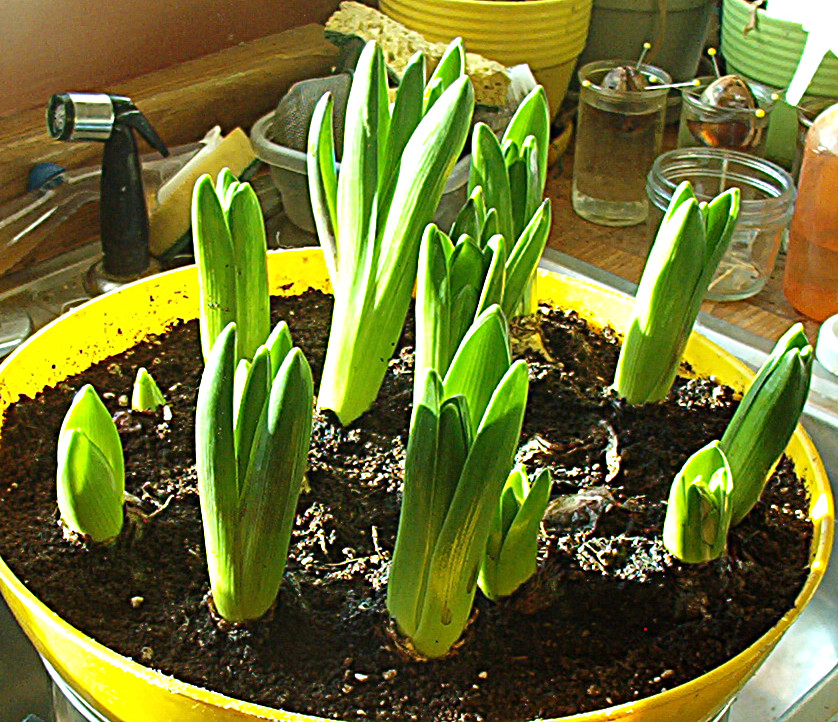
I find myself wondering why it took me so many years to buy a bag of Hyacinth bulbs so that I could stick them into a pot of dirt and watch them grow into one of my most favorite flowers.  But this year I did buy them, and every day I watch them grow and develop.  In this case every one of the 12 bulbs is receiving the identical resources.  One bulb rotted.  Eleven are growing greener and taller every day.  I can see their sturdy outer leaves part as the bud of each one’s flower begins to form close to the soil.

Yet not one of the plants is the same.  There is one that is twice the size of the rest of them.  Standing at nearly seven inches it towers over the smallest which only yesterday showed its first greenery at all.  Given this band-width of normal development, what would have happened should any or all of them have suffered some degree of trauma in their development.

Do I compare the tallest and the shortest and the middle plants and say that some are stunted and some are not?  Or is it the truth that each separate plant is simply fulfilling its own individual nature by growing in the only way that it can – in its OWN way?

++++

The presence or absence of traumatic influences during human development simply signals through molecular pathways in the body what the condition of the world is like so that the growing body-brain of the infant-child can adjust and adapt itself in the best way it can to survive in, and even thrive in, the world it is being built for.

These beautiful Hyacinth plants I am watching are crowded together in an old plastic yellow colander I bought at our local thrift store.  The soil then has excellent drainage.  It sits in my kitchen sink directly in the even light provided by my west facing window.  I can carefully monitor the needs of this whole tribe of plants equally.  But nothing I can provide for them will change them into anything else other than what they started out being.

No matter what influences an infant-child’s development, no matter how much they have to adapt in their body-brain development to trauma, they will always come out of these earliest stages of development in the best way they possibly can.  Each one will always be a unique representation of their potential as members of our species.  But none of us, not one single one of us, can ever overcome the boundaries that make us human.  None of us can become something nature did not intend us to be.

And because of this we each represent the environment that made us in ‘natural’ ways.

Given the information in her earliest environment that my mother’s body-brain-mind-self had to work with (from both within and from outside her body), it is natural that my mother became who she was.  Given who she became, it is natural that the outflow of her condition would be what it was.  Given what my mother did to me during my development, it is natural that my body-brain-mind-self would make the kinds of adaptations and adjustments that it/I did.  There is nothing, to me, unnatural about any of this.

What happened to me, however, is that once I left my home of origin I began to look around me as I became a part of what libramoon refers to as a “social atmosphere.”  Before that time I simply had no points of reference either outside of myself or within myself that I could use for comparison.  I had no inner compass other than the natural one that I had been formed with.

My Hyacinth plants have no ability (that I know of) to compare themselves to one another.  It is only once the signaling communication that we participate in achieves some level of the ability to compare our reality with some other reality that the trouble really begins.  Before that time I believe we simply exist within the natural world in the same way that any other part of nature does.

Once we have reached what I believe to be an evolutionarily advanced state that allows for a point of reference, we enter an expanded universe of thought that includes the ability to CONTRAST some aspect of something to, with and against some aspect of something else.  Without a reference point, we cannot COMPARE or CONTRAST anything any more than my Hyacinth plants can.

The human ability to access reference points so that we can compare and contrast allows us to also form opinions as it allows us to exercise conscious choice.  Using these abilities does not separate us from NATURE.  Thinking is as natural as breathing once we have that ability.

And just as we humans breathe the same air that our planet provides for us, we think by using the same neural abilities that everyone else does.  True, my own individual lungs breathe in and exhale particular molecules.  True, my brain’s particular molecules are thinking my own thoughts as I go through life.  But at the same time these are sharing operations.  Nobody can tell me, “No!  Don’t breathe THAT air!” or “No!  Don’t think THOSE thoughts!”

My body can breathe without my conscious awareness.  My body can also think without my conscious awareness.  Again I return to another critically important concept that I see implied in libramoon’s writing:  MINDFUL.

I can choose to be mindful of both my breathing and of my thinking.  I can accomplish this because I have gained the evolutionary advantage point of HAVING a reference point.  While my mother could no doubt have gained mindfulness of her breathing, I’m not certain that in her entire life my mother could gain mindfulness in regard to her thinking.  In fact, ‘mindfulness’ is one of the primary concepts applied to recovery within the so-called Borderline condition because the ability to live a mindful life has been altered – I believe through early developmental trauma – in a Borderline’s body.

++++

I believe that the ability to obtain the ability to have a reference point within one’s self is an evolutionarily provided gift.  Having a reference-point ability gives us powers to discriminate, to contrast and to compare so that we can think in mindful ways.  I don’t think my mother had this ability any more than my Hyacinth plants do.

Does this mean that trauma stunted my mother’s development?  Is a plant stunted because it has no reference point and cannot compare and contrast itself to any other aspect of existence?  No.  Simply put, a gift is missing in both circumstances.

Our ability to think mindfully happens because we operate within a social atmosphere that feeds information back to us at the same time we have degrees of ability to receive this information even before we are born.  Information comes to us as forms of nutrients that build our body-brain just as surely as water, soil and light are nutrients that are building my Hyacinths.  These are shared natural processes.

If, however, a developing human being does not receive enough information about its own individual self-in-the-world, the gift of mindfulness will not come into bloom in the same way that if my Hyacinths do not receive the nutrients they need RIGHT NOW as they grow, they will not be able to form blossoms.  In this way, mindfulness is the gift of the flower of humanity.

In this way, also, I see that my mother was not stunted; she was robbed of the evolutionarily advanced gift of mindfulness.  She was not fed with the necessary nutrients within the social atmosphere of her infant-childhood to build a self that could in turn possess a viable reference point that she needed in order to accurately compare and contrast her own self within a world of others.  She could not, therefore, share a gift of mindfulness that she never received.

++++

My choice to mention both breathing and thinking together is not an arbitrary one.  Research on the human vagal nerve system is showing that it is directly connected to our physiological reactions to what we see ourselves ‘a part of’ and what we see ourselves ‘a part from’ as it regulates our breathing and our heart rate.

Reacting as ‘a part of’ stimulates the STOP arm of our Autonomic Nervous System (ANS).  Our heart rate and our breathing slow down.  We then find ourselves on the cooperative rather than the competitive pathway, or the prosocial one.

If we react with an ‘a part from’ reaction, our heart rate and our breathing escalate with stimulation of the GO arm of our ANS, or our fight/flight response.

In this way, I suggest that WE ARE WHAT WE BREATHE and the more conscious and mindful we can become about our fastest physiological reactions within our body the more mindful we can become about our self in relationship with the entire world we live within.  The STOP reactions we have release our breath in an exhale.  The GO reactions that we have catch us with an inhale.  If we can learn to pay attention to this most basic signal from our body, we can increasingly notice with mindfulness the orientation we are taking from our internal reference point – our individual self.

Even without our mindful conscious perception, our naturally constructed social species’ body-brain is continually evaluating our degree of safety and security in the world through finely tuned assessments about what belongs and what doesn’t – what is safe and what isn’t.  These are comparing and contrasting operations that our body has formed itself to assess so that we can increase our chances of staying alive.

The more traumatic our earliest environment was the more automatic and the less mindfully conscious these patterns operate within our body because we were naturally built this way.  As we experience a lifetime of mostly automatic reactions, our body itself has taken over the reference point position, not our conscious mind.

As we begin to practice mindfulness we are creating our own bloom.  We can choose to grow this gift even if nobody gave us this gift pro bono.  Traumatized infant-children are given censored, erroneous information.  The building of an ever increasingly mindful self requires access to and sharing of truthful and accurate information.  Because we are a social species, this growth always happens through give and take within a social atmosphere, even if that atmosphere mostly exists between our own mind and our own self in online exchanges with others.

The more we access, utilize, process and digest new information the less hold any trauma we have ever experienced will have on our mindful self, and the more we will grow and blossom into being the evolutionarily advancing people nature has intended us to become.  Mindfulness, the blossom of our specie’s evolution, concerns all the information about our experience that we can consciously share with our self.  Mindfulness defines the social atmosphere we create within our self with our self.  This is the area where our healing will show its greatest accomplishments.  “Go bloom, everyone!  Go bloom!”

++++

NOTE:  In consideration of the tendency for some people to think that humans are separate from nature and/or superior to the natural world, all this means to me is that the ‘a part from’ pathway has been chosen rather than the ‘a part of’ pathway.  The reference point of the self has compared and contrasted itself and has made up a thinking-based fiction that has nothing to do with reality.

+++++++++++++++++++++++++++++++++++

+DOES STAYING ALIVE AT ALL COSTS LEAVE ROOM FOR GOODNESS?

++++++++++++++++++++++

When life takes us on a wild and dangerous ride before we have the skills to handle it, is the choice for goodness erased from the picture?

Reading further in Keltner’s chapter on compassion my mind stumbled into its own thoughts – as it often does.  Is this, again, simply a process of taking a detour through the memories of my own experiences so that I can begin to better understand both what Keltner is saying and how his research on ‘being good’ relates to the topic of my blog – the causes and consequences of early trauma and maltreatment in infant-childhood?

I am remembering a brief wonderful friendship I had with a woman who moved from New Mexico to this region of Arizona where I live for about a year.  I first met Mary at a craft show in town.  A tiny woman, with thick curly nearly white hair, Mary had a way with people coupled with a life force that made me feel – well – LIKED!

Mary came from a severely abusive childhood home, but if nothing else could be said about this woman, one could say that she flew out of that childhood with colors flying like a warrior from some ancient time.  She was an attendee at the 1969 Woodstock Festival.  And for the past nearly 30 years everywhere this woman moved to she brought along with her a sort of extended body that included 4 horses and a mule.

That might not seem like any particular accomplishment unless one knows that Mary was poor.  She’d always been poor.  Keeping livestock is not a cost-free endeavor.  Mary’s love for those four-legged big animals was a joy for me to see.

During the months that Mary lived in Arizona, living in a camp trailer with her not employed husband, I was able to muck for her horses in exchange for Mary’s teaching me the fundamentals of riding.  Saddling up, she took me on leisurely training rides through the native tall grass fields that bank the San Pedro River.  We were never in a hurry.  Mary showed me how to guide the horse I rode so gently that I felt a part of its great body.  How sad I was the day she packed up her tack and moved back to their home in the Sandia Mountains above Albuquerque.

I stayed in touch with Mary for months after she left here, and was even able to go spend a week with her as we worked together to strengthen the fences that kept her small herd from running wild in the brushy mountains.  One day we saddled the horses and went out for a ride.  Perhaps Mary thought she’d trained me well enough that I could handle her big mare that day.  Perhaps she was right.

That mare was in heat, and as soon as we headed away from the barn she took off running with me sitting on top of her like a gangling piece of fire wood.  Up the rocky mountain trails and down she raced, mane flying in the wind.  I did the only thing I could do, flying instant by flying instant.  I hung on for dear life.

I can tell you for certain that horse didn’t care one bit that I was on her back.  She had no concern for my needs as her rider.  I was clearly the one with all of the needs for that full-run half hour that horse took off in the Sandia foothills like she owned them.

I think about that horse and Mary this morning because what Keltner really is describing next in his chapter on compassion is how human beings respond to the needs of others, a response that can be measured in the trunk of the body by the activity of the vagus nerve system that regulates breathing and heart rate in response to the environment around us.  I think about humans’ ability to respond to the needs of others as a negotiation that involves resources.

When I remember my wild ride on the back of Mary’s gorgeous red mare, I think about how all of my attention – and I mean ALL of it – was solely focused on my own survival while I tried to ride her.  There was no possibility until that horse slowed her gait (by her own free will) that I could either think about anything else, or could have responded to anything else in the environment around me.  All of my resources were focused on my own one single need – remaining attached to the back of that horse.

For the duration of that ride there was no chance in hell that I had anything to give to anyone else.  Nothing.  My breathing and heart rate were in a pell-mell state of high gear gallop right along with that mare’s.  That means that if someone had been able to measure the activity of my vagus nerve wandering nerve bundle the results would have paralleled that fact.  During that ride I had nothing to give and could not possibly have been able to respond to anyone else’s need – no matter what.

++++

When I think about the results of the research study on Borderlines and their vagus nerve, and combine that thinking with the results of the compassion versus pride research Keltner describes (in his chapter on compassion from his book Born to Be Good: The Science of a Meaningful Life), I come up with the idea that at no time when we are in a fight/flight condition because our own survival is threatened are we free to worry about what others might need.  At those times we simply do not have any extra resources available to offer to anyone else.

At those times when we are most intensely focused on keeping ourselves alive we don’t even have the resources available to pause to even think about anyone else.  Any decisions we are able to make while we are in full fight/flight are made in the body, as quickly as possible, and are not the consequence of slow higher cortical thinking.  As that red mare was in full flight mode, and I was in full fight mode to stay on her back, I did not have the ability to think about anything else.

However it actually happened in my mother’s earliest childhood that her body came to understand my mother was not any more safely or securely attached in the world than I was as I clung to that racing horse, her body made adjustments that meant forever more that the fight/flight state would be the main state of her existence, no matter what.  That is what having an evolutionarily altered body and brain means to me.

If I had had more experience, better skills, more competence and confidence before I swung my leg over the back of that mare before the ride ever began, of course my entire ride would have gone differently.  But a newborn, born into a traumatic and malevolent world, has no prior experience.  Everything their body-brain comes to know about being in the world will be built into them through their earliest experiences in the world.

I understand, certainly, that people who have a body-brain built in early safety and security can still make terrible choices in regard to the needs of others.  Again, the important word here is CHOICE.  While I had the choice to climb onto that horse, while Mary had the choice, knowing my complete inadequacies as a rider, to let me climb onto that mare in her season, once those choices were made the rest of the ride was predictable.

I suspect that my mother’s unconscious state mirrored my own as she rode the horse she’d been placed upon from the time she was born.  In a state of desperation, in a condition of emergency, my mother never wavered from the task she saw put before her in the beginning of her life.  I’m not sure she ever had a choice to pause for a moment to consider the needs of anyone else because she was as fully occupied with her own survival throughout her lifetime as I was as I tried to stay safely and securely attached on the back of that footloose, headstrong happy horse.

This means to me that measurements of the operation of the vagus nerve within our body tells us not so much what our capacity for compassion is, but actually tells us how dangerous we feel the world is.  Measurements of the vagus nerve’s response tell about a body’s perception of need to stay alive in a word of threat, danger and deprivation.  Only when a person feels safe and secure enough in the world — because their own survival is assured — are they free to choose ‘be good enough’ to offer resources of caring compassion through kindness to somebody else.

++++

At the end of this story I will say that I have lost any hope of contact in the future with Mary unless she someday makes contact with me.  Last I heard from her two years ago she and her husband had divorced, their home had burned to the ground, and Mary was living in the barn with her four horses and her mule.  Her cell telephone number is no longer attached to her, and while Mary will always have a warm place in my heart, I don’t expect to ever hear from her again in this lifetime.

I feel sad, and I will always miss her.  At the same time I know that if anyone can survive a merry romp through the tragedies of life it will be Mary.  With the hundreds of miles of weathered wrinkles on her shining face, I have no doubt whatsoever that if Mary is still breathing air she is happy while she does it.

++++++++++++++++++++++++++

MORE INFORMATION ABOUT BORDERLINE PERSONALITY DISORDER IN MEMORY OF MY MOTHER AND MY CHILDHOOD WITH HER, WITH THANKS TO:

From Kristalyn Salters-Pedneault, PhD, Your Guide to Borderline Personality Disorder.

The most common questions I get from readers are about BPD relationships– many people in relationships with people with BPD struggle to understand the disorder and their role in their loved one’s recovery.

What You Need to Know About BPD Relationships

Borderline relationships are often tumultuous and chaotic. The effects of borderline personality disorder (BPD) on family members, friends, romantic partners, and children can be very broad, and are often devastating for loved ones.
Understanding Abandonment Sensitivity

A key symptom of BPD is fear of abandonment. This symptom may cause you to need frequent reassurance that abandonment is not imminent, to go to great lengths to try to avoid abandonment, and to feel devastated when someone ends a relationship with you.
The BPD Marriage – Can it Work?

Many different kinds of close relationships are affected by BPD, but perhaps none more than marriage.
Borderline Friendships

Must Reads

What is BPD?
Symptoms of BPD
Diagnosis of BPD
Treatment of BPD
Living with BPD

++++++++++++++++++++++++++

+INTERGENERATIONAL TRAUMA AND THE NATURE OF GOOD AND BAD

+++++++++++++++++++++++++

Is our species still on this planet because we are equally wired for both kindness and selfishness/self-preservation?  Someone was ‘kind enough’ yesterday to post the ScienceDaily December 9, 2009 article (included below) about the ‘goodness’ research coming out of Berkeley to an online group I belong to.  Someone else responded with a comment that they disagree with this “theory”.

How does it happen that what was once considered theory comes to be known as fact?  I wonder how long it took the ‘discovery’ that the sun was at the center of our solar system to permeate public thinking.  How long did it take the ‘discovery’ that our planet is round to infiltrate common knowledge?  Whatever people thought about the rotations of our solar system or the shape of our planet certainly had no affect on how things actually are in reality.  So what is the process by which erroneous thinking becomes supplanted with new thoughts that directly contradict the old?

++++

I could say that I staked my career on a losing hand of cards.  I could say that even in light of what I have since come to understand about my own limitations, about the body-brain physiological changes that my mother’s severe abuse of me created.  I understand now that dissociation happens to me on a regular basis.  I understand now that the stress response systems within me were built in trauma and do not allow me to experience my life in ordinary ways.  I understand now that going all the way before my brain’s language centers were built trauma changed how my emotional-social brain operates.  But all of this new information that I have doesn’t change the basic fact that I staked my career on the stars while I walked down here in the mud.

I trained myself with a BA in psychology and a MA in art therapy specifically to work with sexually abused children on Native American reservations.  THAT didn’t work.  But I had to go through a PROCESS of learning and understanding how I fit into a world that I did not create.

I found that after the U.S. government rescinded its laws in 1974 that had been put into place to make sure that indigenous people within the borders of our nation did not practice their traditional spiritual beliefs, the tribal people where I lived had to resurrect their ceremonies and ancient teachings into the new world they found themselves now living in.  It had been the intention of our government to disempower the people.  What has been called ‘assimilation’ was nothing more than an invisibility cloak thrown over the true intention of genocide.

Our government was joined by private interest forces that were allowed to help destroy the tribal structure of our nation’s indigenous people through greed.  Our government was also joined by religious interest forces that introduced the gangrene of sexual abuse into Native communities through boarding schools, which also operated to erase traditional languages, customs, beliefs and practices and destroy clan and family systems.

Included in the history of terrible abuse and trauma that was perpetrated against our nation’s so-called enemy, is a pattern of dishonoring treaties that should make any conscience-ridden nation so ashamed of itself it could not exist.  But exist America does, in spite of these actions which to this day remain so buried, hidden, disguised, condoned and still practiced that it is amazing our nation can ignore them.

What does any of this have to do with me?  As far as I know I have no indigenous American ancestry.  What I did was take my newly acquired credentials, acquire a job as an art therapist on a reservation, and set to work to ‘help’ the little 2-10 year-old members of my 40 child caseload to ‘recover’.  Of these children, all of them had been sexually abused along with being victimized by neglect and maltreatment, many from before they were born through drug and alcohol usage of their mothers.   Seventy percent of my caseload were little boys.

What ‘good’ did I think I could do for these children?  I had children on my caseload who could name 55 cousins they were sexually active with.  I found that in many cases adults knew this was happening and ignored it.  There were ‘rape gangs’ of older children who tricked or kidnapped younger children, taking them far into the woods to sexually initiate them, if they hadn’t already been molested from the time they were babies.

There were stories of children watching their father chop their mother to death in the household kitchen with an ax because he was on acid.  There were stories of foster parents putting their own and their foster children to sleep at night by putting plastic bags over their heads until the children passed out.  When the older children could be taught to do this themselves so that the foster parents could go out an party, guess what happened?  While eventually the children were removed from these parents’ care, nobody ever prosecuted for abuse.

And on this reservation where it wasn’t uncommon for people to be killed by being buried alive, I found it got even worse.  I had little children on my caseload whose mother had run away from their abusing father.  The father’s parents went to medicine people and asked in retaliation that the spirits attack their grandchildren.  The spirits complied.  The children suffered through sickness and threat of death.  And if all of this wasn’t bad enough, sooner rather than later these same ‘bad’ people asked that bad medicine be used not only against me (as the foreign intruder that I was), but also against all three of my children.

My response?  I was fortunate to have the same ‘good’ medicine man I brought my caseload’s children to for assistance and healing perform ceremonies that removed this bad medicine from me and from my children.  Then I turned tail and ran.  I abandoned my work with the children, took myself and my own children, left the area and disappeared.

++++

Before I left the area I did some serious questioning of people ‘in the know” about how and why the spirits could participate in this kind of evil.  I was told that most of the spirits that Indigenous people have always been able to access through ceremony are neutral.  They can be accessed as power to work either good or ill.  The choice is within the humans who are the ones who ASK them, or COMMAND them to either help or harm others.

Yet for all of this, what I most often think about is something my then 7-year-old son told me one warm early spring day as he and I were walking down an old logging road through the forest.  It was early on in my art therapist days on the reservation, and I was struggling with something that disturbed me greatly.

I asked my son, who was and is very wise, “What am I going to do if some day I am asked to work with some of the adults or older teens that are the perpetrators of these great harms against little children?  I don’t think I can do it, and I don’t think I will be given the choice.  Do you think there’s any hope that abusers can change?”

I wasn’t looking at my son while I asked him these questions while we walked.  I was looking into the forest at the tiny little brilliantly green leaves that were sprouting from the trees.  When I looked to my right my son was no longer beside me.  I stopped and turned around to see him standing a ways back on the road in the sunshine with his feet spread apart, his hands resting on his skinny little hips, his head cocked to the side, staring at me.

“Well, MOM,” he said, obviously perturbed with me.  “Don’t YOU KNOW?”

I turned around and walked back to him, standing in front of him I responded, “KNOW WHAT?”  Obviously I didn’t have a clue.

“Well, MOM, you SHOULD know this!  Everyone decides when they are in their mother’s tummy if they are going to be good people or bad ones.  They’ve made that decision before they are born and NOTHING ANYONE can ever do is going to change them.”

I was stunned by his insistent sincerity.  And only for a moment did I doubt him.  “Well, honey, how can that be possible?” I wanted to know in my adult logical way.  “Babies can’t make those kinds of decisions before they are born.  How could they even have enough information to even begin to think about such things, let alone make such a huge decision that will determine the course of their lives?”

Again, as if amazed and almost disgusted with my ignorance, my son responded, “Mother, don’t you KNOW?  Babies talk to the angels all the time they are in their mother’s tummy.  They know what they are doing when they decide.  Once they are born they will just be who they have already decided to be, and nobody, nothing, not even you, can change them.”

I have never been able to convince myself that my son didn’t know exactly what he was talking about.  I strongly suspect that it is entirely possible that what he told me on that glorious spring morning was the truth.

It took another few years before I began to understand how pervasive and how powerful the bad choices could be.

++++++++++++++++++++++++

This brings to mind my fascination with wolverines that I had as a child as soon as I found out this animal existed.  Although I don’t think they lived in the Alaskan valleys or on the mountains anywhere near where my family staked claim to our homestead, certainly stories of them floated in the air around me in childhood.

I knew there was something special about their fur so that if a ruff was made out of it around a parka hood one’s breath would not accumulate moisture and freeze on the ruff.  I know they were MEAN and people were afraid of them.  I knew they were smart and could disarm traps intentionally so that humans could not catch them.

I heard they were the only animal that intentionally bullied others.  I heard they could chase away wolves from their moose kill and then spray the meat so it stunk so badly no other animal could eat it.  The wolverine was selfish.  It wasn’t one bit hungry or interested in the meat.  It just liked to be mean.  Wolverines stayed alone, liked or needed nobody, and as far as I could tell nobody liked them.  Wolverines seemed to embody powerful fear at the same time they were immune to it themselves.

Probably as a combined consequence of the terrible ongoing abuse I suffered, coupled with the fact that I had access to no information that would have helped me be able to THINK about anything that happened to me, I liked and admired wolverines even though I never got to meet one personally.

My fascination and respect for this animal continued to crystallize in my mind all the way through my 20s.  I searched for and read everything I could find about them.  In some mythological, unconscious way I seemed to understand that perhaps the only being strong enough to overcome the badness that was my mother would have to be badder than her.  Wolverines seemed to be the essence of bad.  I knew my mother had nothing on them.  If my mother ever met one, she would NOT win that battle.  That thought delighted me!

Few probably equate the potential for badness in animals that we project onto humans.  Nobody is going to teach or influence a wolverine to be ‘good’ or ‘nice’.  Wolverines occupy an environmental niche that belongs to them.  They were always, to me, about the opposite of what I could imagine tame, domesticated or civilized could be.  “Take a walk on the wild side” named both who this animal was and who it would always be.  Even now, there is something comforting to me about knowing that there is a legitimate place for badness and a place it belongs.

My mother might have been vicious and incredibly abuse and mean, but even though she shared these characteristics with a wild beast, she had NOTHING on a wolverine.  At the same time I know that no degree of early developmental trauma could change any other animal into a wolverine.  They ARE born to be mean.  That’s their nature.

Early trauma CAN change the course of physiological development of humans.  As researchers clarify the wiring in humans that operates in our goodness, it is also clarifying a critical area of our body that can be changed through trauma in our earliest developmental stages so that these systems will operate differently from normal.

What this tells me is that we need to listen to the newest information about how trauma influences human development every step of the way.  We have to consider the largest, broadest picture we can about the influence that traumas have not only on individuals, not only on families, but within cultures and societies.  As resiliency factors are removed through trauma at the same time that risk factors are increased, the intergenerational affect that trauma has on human development can actually physiologically reduce the human capacity to both experience goodness and to choose it.

I see this as fact, not theory.

+++++++++++++++++++++++++

Social Scientists Build Case for ‘Survival of the Kindest’

ScienceDaily (Dec. 9, 2009) — Researchers at the University of California, Berkeley, are challenging long-held beliefs that human beings are wired to be selfish. In a wide range of studies, social scientists are amassing a growing body of evidence to show we are evolving to become more compassionate and collaborative in our quest to survive and thrive.

In contrast to “every man for himself” interpretations of Charles Darwin’s theory of evolution by natural selection, Dacher Keltner, a UC Berkeley psychologist and author of “Born to be Good: The Science of a Meaningful Life,” and his fellow social scientists are building the case that humans are successful as a species precisely because of our nurturing, altruistic and compassionate traits.

They call it “survival of the kindest.”

“Because of our very vulnerable offspring, the fundamental task for human survival and gene replication is to take care of others,” said Keltner, co-director of UC Berkeley’s Greater Good Science Center. “Human beings have survived as a species because we have evolved the capacities to care for those in need and to cooperate. As Darwin long ago surmised, sympathy is our strongest instinct.”

Empathy in our genes

Keltner’s team is looking into how the human capacity to care and cooperate is wired into particular regions of the brain and nervous system. One recent study found compelling evidence that many of us are genetically predisposed to be empathetic.

The study, led by UC Berkeley graduate student Laura Saslow and Sarina Rodrigues of Oregon State University, found that people with a particular variation of the oxytocin gene receptor are more adept at reading the emotional state of others, and get less stressed out under tense circumstances.

Informally known as the “cuddle hormone,” oxytocin is secreted into the bloodstream and the brain, where it promotes social interaction, nurturing and romantic love, among other functions.

“The tendency to be more empathetic may be influenced by a single gene,” Rodrigues said.

The more you give, the more respect you get

While studies show that bonding and making social connections can make for a healthier, more meaningful life, the larger question some UC Berkeley researchers are asking is, “How do these traits ensure our survival and raise our status among our peers?”

One answer, according to UC Berkeley social psychologist and sociologist Robb Willer is that the more generous we are, the more respect and influence we wield. In one recent study, Willer and his team gave participants each a modest amount of cash and directed them to play games of varying complexity that would benefit the “public good.” The results, published in the journal American Sociological Review, showed that participants who acted more generously received more gifts, respect and cooperation from their peers and wielded more influence over them.

“The findings suggest that anyone who acts only in his or her narrow self-interest will be shunned, disrespected, even hated,” Willer said. “But those who behave generously with others are held in high esteem by their peers and thus rise in status.”

“Given how much is to be gained through generosity, social scientists increasingly wonder less why people are ever generous and more why they are ever selfish,” he added.

Cultivating the greater good

Such results validate the findings of such “positive psychology” pioneers as Martin Seligman, a professor at the University of Pennsylvania whose research in the early 1990s shifted away from mental illness and dysfunction, delving instead into the mysteries of human resilience and optimism.

While much of the positive psychology being studied around the nation is focused on personal fulfillment and happiness, UC Berkeley researchers have narrowed their investigation into how it contributes to the greater societal good.

One outcome is the campus’s Greater Good Science Center, a West Coast magnet for research on gratitude, compassion, altruism, awe and positive parenting, whose benefactors include the Metanexus Institute, Tom and Ruth Ann Hornaday and the Quality of Life Foundation.

Christine Carter, executive director of the Greater Good Science Center, is creator of the “Science for Raising Happy Kids” Web site, whose goal, among other things, is to assist in and promote the rearing of “emotionally literate” children. Carter translates rigorous research into practical parenting advice. She says many parents are turning away from materialistic or competitive activities, and rethinking what will bring their families true happiness and well-being.

“I’ve found that parents who start consciously cultivating gratitude and generosity in their children quickly see how much happier and more resilient their children become,” said Carter, author of “Raising Happiness: 10 Simple Steps for More Joyful Kids and Happier Parents” which will be in bookstores in February 2010. “What is often surprising to parents is how much happier they themselves also become.”

The sympathetic touch

As for college-goers, UC Berkeley psychologist Rodolfo Mendoza-Denton has found that cross-racial and cross-ethnic friendships can improve the social and academic experience on campuses. In one set of findings, published in the Journal of Personality and Social Psychology, he found that the cortisol levels of both white and Latino students dropped as they got to know each over a series of one-on-one get-togethers. Cortisol is a hormone triggered by stress and anxiety.

Meanwhile, in their investigation of the neurobiological roots of positive emotions, Keltner and his team are zeroing in on the aforementioned oxytocin as well as the vagus nerve, a uniquely mammalian system that connects to all the body’s organs and regulates heart rate and breathing.

Both the vagus nerve and oxytocin play a role in communicating and calming. In one UC Berkeley study, for example, two people separated by a barrier took turns trying to communicate emotions to one another by touching one other through a hole in the barrier. For the most part, participants were able to successfully communicate sympathy, love and gratitude and even assuage major anxiety.

Researchers were able to see from activity in the threat response region of the brain that many of the female participants grew anxious as they waited to be touched. However, as soon as they felt a sympathetic touch, the vagus nerve was activated and oxytocin was released, calming them immediately.

“Sympathy is indeed wired into our brains and bodies; and it spreads from one person to another through touch,” Keltner said.

The same goes for smaller mammals. UC Berkeley psychologist Darlene Francis and Michael Meaney, a professor of biological psychiatry and neurology at McGill University, found that rat pups whose mothers licked, groomed and generally nurtured them showed reduced levels of stress hormones, including cortisol, and had generally more robust immune systems.

Overall, these and other findings at UC Berkeley challenge the assumption that nice guys finish last, and instead support the hypothesis that humans, if adequately nurtured and supported, tend to err on the side of compassion.

“This new science of altruism and the physiological underpinnings of compassion is finally catching up with Darwin’s observations nearly 130 years ago, that sympathy is our strongest instinct,” Keltner said.

Story Source:

Adapted from materials provided by University of California, Berkeley. Original article written by Yasmin Anwar, Media Relations.

+++++++++++++++++++++++++

+EMOTIONAL BLINDNESS – WONDERING WHAT LOVE IS

++++

I am trying to think about an emotional experience I had the other day so that I can write about it.  At the same time I realize I cannot think about it separately from writing about it.  If my words don’t follow themselves across a page they disappear like lemmings over a cliff into oblivion.  Partly this is true because I am in an inner battle with ambiguity.  If I write this piece most of the ambiguity will vanish.  But because of the 18 years of abuse I suffered from my severe Borderline mother, her brain patterns were built into me, and it’s a known fact that Borderlines DO NOT LIKE ambiguity as A. J. Mahari describes:

Borderlines have not learned how to relate in healthy ways. Borderlines have not experienced the world as loving, fair or trustworthy place. Borderline ambiguity is born from the two-faced damage of the betrayal of a parent, both parents and or one’s primary care-givers.

What I experienced the other day that I MAYBE want to understand has to do with the fact that not once in the 18 years of my childhood did I ever feel loved by either my mother or by my father.  I have written before that one of the main reasons I believe I did not turn out just like my mother is that nobody ever betrayed me the way my child-mother was betrayed.

Nobody ever loved me.  Nobody pretended to love me.  I was not exposed to what were the devastating effects of the conditional love my grandparents used to manipulate my mother and destroy her brain-mind.  I was just plain hated without hope of reprieve.  Yet at the same time the underlying lack of awareness of what it feels like not to be truly loved affects me just as it affected my mother.  The love circuitry from safe and secure attachment with early caregivers was not built correctly into either my mother’s or my own early forming body-brain-mind-self – or later forming one, either.

++++

My inner battle with ambiguity today is about whether or not I want to face some of what this means to and for me.  Am I better off not knowing what an examination of my last week’s experience can show me about who and how I am in the world?  Is it helpful for me to follow my own thoughts in my writing to some more unambiguous place where I will be out of this thick enveloping fog of not knowing what this experience has to teach me?

I both want to know at the same time I don’t want to know.  Do I stay right here in this murky ambiguous place or do I choose to take a step in my next thoughts toward the light of clarity?  At the same time I ask myself this question I understand that right here is a place where I can differentiate my own self from my mother.  I can make this choice.  My mother could not.

This does not mean that taking this step toward differentiation from my mother’s brain-mind as she formed herself into mine is easy.  This does not mean that stepping toward the light of conscious reflection and illumination, toward understanding of the truth is easy.  It just means that for me, unlike for my mother, taking this step is possible.

++++

Unlike what Leigh Eric Schmidt, the Charles Warren Professor of the History of Religion in America at Harvard Divinity School might say, I do not believe it is possible for humans to have any experience of themselves in the world that does not directly involve their brain’s processing of information.  The 18 years of severe abuse I suffered from my mother built the brain I now have to use to try to understand all of my experiences of myself in my life.  Today’s excursion into exploring my last week’s experience is no exception.

Nearly all of the associational processes that went on behind the closed doors of my mother’s mind happened completely outside the range of her consciousness attention.  My mother was a dangerous, violently explosive madwoman.  Growing up, I knew about her violence but I did not know about her madness.  How could I?  It had greeted me with the first breath I ever took in this world and it continued unabated throughout all my developmental stages until I was 18.

As a result of the free rein (and free reign) my mother had in her home to do anything she wanted to, there was always only one single pattern for me.  She erupted, hurt me, and I suffered.  All that suffering built me as it built itself into me, and it was never accompanied by any experience of love.

As a young infant-child grows into its body-brain-mind-self, it is supposed to be helped to differentiate experience.  It is supposed to learn that it exists as a separate entity, and it is supposed to form not only its own stable self, but also a clear stable connection to this self.  All of this process is negotiated through the experience of emotion.  Emotions have to become ever more clearly differentiated from one another so that the self can have access to its own information about being in the world.

I did not go through ANY of these differentiation stages of development normally.  My mother overwhelmed me from the moment I was born.  Because my mother did not succeed at physically killing me, she did not succeed at completely obliterating me.  But she did very successfully limit my options of experience down to one.  She made me suffer.

++++

My mother overwhelmed me with the scourge of her hatred of who she imagined me to be at every step of my infant-childhood that she possibly could.  I see the image of someone continually trying to dump a thousand gallons of gasoline into a tiny little perfume bottle.  My mother effectively did this to me for 18 long years.  I did not escape unscathed.

There were dire consequences of my survival, most of which I will never know.  However, the experience I had last week dropped into the middle of one of them.  I was blindsided by my own emotional blindness.  Can I grab the lantern of my best intentions and spark within it the blazing light of my willingness to learn? Am I willing to go back into the depths of that enveloping fog of sorrow (in my body and in my brain) and take some part of myself back out into clarity?  Is there some new in-sight here for me that is mine and that I really can’t do without?

Yes.  To all these questions I choose to answer “Yes.”  I will walk past these grasping, numbing shadows of doubt.  I will shed this burden of “Shame on you, Linda, for not being a better woman than you are.”  I will not be afraid of my tears.  I will not be afraid that what I will say here or what I will find here will make those who love me, love me any less.

It is not my fault that my mother cut my wings off so that I cannot ever fly in the prosocial world that most others seem to me to take so for granted. “So take your scrawny little bird legs and hop on with this, Linda.  You can do it.  I know that you can.  Go where the angles might fear to tread and know that as you go, they will go with you.”

++++

Last August I was given the gift of being able to reconnect with one of our closest Alaskan homesteading neighbors in my childhood.  I haven’t heard her voice.  I haven’t seen her.  We correspond via email.

Against all rational logic, I love her.  Our connection means a great, great deal to me.  This woman, now 83, lives well over a thousand miles away from me.  I do not have her telephone number.  While I know she is very busy taking care of herself, her husband, her household and preparing to leave their home to move into an addition her son is building on his house for her, when I hadn’t received an email from her from last Monday to last Friday, I felt like a bomb went off inside of me.

It’s easy to say that given what I know about my unsafe and insecure attachment patterns in my body-brain that of course I would be upset.  Yet ‘of course’ doesn’t give me enough information to understand what I felt.  I became terrified that she was either gravely ill or had died.  I believed on some level of my being that she had been called home through the veil to help the 100,000 Haitian earthquake victims cross over to the next world.  Nothing I could find to tell myself would sooth the depths of my growing sorrow.

I have been much blessed in my lifetime that none of my three children have been threatened by sickness or harm.  My siblings are all safe and well.  Even though I continue to grieve for the loss of the man I am in love with from my life, never before last Friday did I feel the depths of that kind of sorrow and fear that someone I loved was in trouble and there was nothing I could do about it.

Most fortunately I had the telephone number of my friend’s son in Alaska.  Through him I was finally able to find out that his mother was just fine.  Never before, either, had I felt that powerful sense of gratitude and relief at hearing this good news.

Now, I suspect that if I had a normally-formed prosocial body and brain I would have been able to take all of this in stride and gone on with my life.  But thanks to the consequences of my mother’s abuse this didn’t happen.  This experience touched the depths of my attachment woundedness in ways I could not understand.  I had felt something new in a way I had never felt it before.

++++

Most of the normal prosocial emotional differentiation circuits and their corresponding connection to people I care about in my life are missing in my brain.  This experience I am describing opened up a circuit for me that I don’t believe ever existed before.  The mystery of my experience with these emotions led me to ask my daughter two days later after I had expressed to her how I had felt, “Is that something like all of you felt when you found out I had cancer?”

My daughter paused, and answered, “Yes, mother.  That’s how we felt.”

++++

What can I say through my tears as I write now that can help me understand what this means to me?  First, I feel terribly sad for my children and for others who love me that it is so nearly impossible for me to comprehend, let alone feel on an emotional level, what it feels like to be loved.  I have to absolve myself of any responsibility for this fact.  It is not my intention to hurt anyone by depriving them of the fullness of the experience of sharing their love for me.  At the same time I am grateful that they both love me, and can experience the fullest spectrum of attachment feelings toward me.

That I cannot participate equally with them in the depths of these life-love experiences is not my fault.  Until I felt what I did last Friday I had no idea how the people who loved me felt as they all traveled thousands of miles, one after the other, to support me and to care for me and to love me as I went through the grueling chemotherapy and eventual surgery that would allow me to remain in their lives.  I know they all love me.  They show me they all love me.  I believe they mean what they say.  But it is nearly impossible for me to FEEL their love inside my own body-brain-mind-self because those circuits were never built inside of me during the first 18 years of my life from the time of my birth.

At the same time I realize that I am now perhaps a fraction of an inch closer to knowing what it FEELS like to be loved, at age 58 I also realize that my emotional blindness is not likely to ever be completely removed from me in my lifetime.  I also understand that part of the pattern of attachment I feel to this homesteading neighbor comes from body memories I have of interactions with her in my childhood that were positive, and were among the very few truly kind and genuine, warm adult interactions I ever had in those miserable 18 years.

Yet I cannot consciously remember this woman.  She has generously sent me photographs of her and her husband from those long-past years, and they help me a great deal as I try to connect the unconscious memories of my childhood to the present day facts of what a wonderful woman this homesteading neighbor truly is.

At the same time I realize I will always struggle with allowing myself to form deep affectionate bonds with other people.  To love is to risk.  I believe that although my mother was able to steal from me the physiological foundations of what it feels like to BE LOVED, she did not remove from me my own ability to deeply love others.  The powers to give love seem to me to operate differently than do the powers of being able to feel love from others.

Of course I don’t know this to be true and I probably never will know for sure.  I imagine my brain to be similar in some ways to the autistic brain given the severe conditions of harm and deprivation in my infant-childhood that interfered with my emotional-social brain’s development.  There is on one in my life who truly loves me that does not also know about my childhood.  They do not have to question their love for me.  They do not have to wonder or guess or doubt.  And they don’t love me any less because I do.

+++++++++++++++++++++++++++++++++++++++++++

ON BORDERLINE PERSONALITY DISORDER:

  • Symptoms of BPD
  • Finding a BPD Therapist
  • BPD on the Internet
  • Self-Harm Explained
  • When You Encounter Splitting
  • +++++++++++++++++++++++++++++++++++++++++++
  • +IT WASN’T FUNNY: THE BUZZARD THAT ATE MY MOTHER

    ++++++++++++++++++

    Shared laughter might just be the ultimate in human-to-human cooperative communication.  It has long been my suspicion that when researchers say that severe infant-child deprivation and trauma can create an ‘evolutionarily altered brain’ that is designed for life in a malevolent rather than a benevolent world that they are actually describing two different kinds of brain-body-mind self development.

    Either we grow into our early body-brain information about plenty of available, necessary resources that allows cooperation to be fruitful or we grow into our early body-brain information that there are so few vital resources that cooperation is not going to really solve anything.  In this latter malevolent world environment ‘survival of the fittest’ and ‘kill or be killed’ can rule supreme.  This connection to human past evolutionary conditions means that at such times in our evolutionary past existence, when the world was an impossible place for very many to survive in, individual development may well have been pushed into the direction of non-cooperation at the same time it was pushed toward competition.

    When I look at all the aspects I know about my mother, it is now easy for me to say she was formed in an unfit early environment that changed her in through her earliest development to be an unfit mother.  The unfitness of her early world was retained within her body-brain and communicated to me, and to her entire family by her actions.  These actions included what she DID do as well as what she DID NOT do in regard to her children.

    She did try to annihilate me.  She did not express genuine smiles or laughter.  The absence of these high profile prosocial signals communicated ‘reproductive unfitness’ in a malevolent world as powerfully as did her complete dysregulated emotional states, her impulsive actions including rage and violence, her twisted view of reality, her overall dissatisfaction with her life and her total unhappiness.

    +++++++++++++++++++++++++++++

    The more I learn about how early caregiver interactions between an infant-child and its earliest caregivers directly communicate either safety and security of the world or its opposite to a little one’s developing body-brain, the less puzzling and mysterious my mother’s insanely abusive treatment of me becomes.  Early human development is designed to prepare an individual for life in a ‘good’ or a ‘bad’ world, and the resulting person they become simply reflects the degrees of plenty or of deprivation that their earliest world contained.

    Input early on becomes output later on.  Early infant-child input from safe and secure attachment with caregivers gives the developing body-brain information about a good enough world.  The little one knows they are not alone, that they are connected within a species-wide social fabric that tells their body-brain that cooperation can exist because it does exist.  The infant does not receive signals that it is not only completely alone, but that the environment is dangerous, toxic, deprived, malevolent, overwhelming and without adequate resources.  A safely and securely attached infant-child receives information about the opposite kind of this kind of world and its entire development happens along the cooperative end of the prosocial human continuum.

    In order for an infant to grow and develop a prosocial body-brain, it has particular needs throughout the critical-window stages of its growth.  A prosocial human must first have its attachment needs met so that it can move forward in its development successfully.  Safe and secure attachment interactions include the presence of adequate and appropriate caregiving.  Building a prosocial human requires that more than an infant-child’s basic physical needs must be met.

    A prosocially-built human has to experience repeated, consistent patterns of appropriate prosocial interactions with its caregivers from birth as its body-brain grows.  Secure attachment builds a prosocial, regulated emotional-social brain so that the infant is prepared to enter its next exploratory stage of development.  After that stage has been successfully completed, the infant-child continues to grow its own prosocial connection to its self along with its prosocial connection to others.  It moves into the caregiving stages that allow the infant to use empathy skills and to consider the existence of others as it builds its Theory of Mind.

    From its earliest experiences an infant has received patterns of cooperative and/or competitive signals based on the quality and nature of its early caregiver interactions that have – I say again – both built the young body-brain and built themselves into it.  There is no magic here, no errors, no mistakes.  Nature has determined that the ability to flexibly adapt one’s earliest development to the conditions of the external environment is the most pro-life thing to do.

    If one’s early world was both pro-life and prosocial, BINGO.  A balanced, positively cooperative-competitive person will come out the other end of childhood.  If one’s early world was in actuality malevolent and anti-life, well, we can all imagine the end result of this.  It is easy to see that the opposite end of prosocial is antisocial – and here we have a description of what happened to my mother.

    ++++

    An young infant-child is a ‘show me’ kind of critter.  Human interactions directly communicate conditions of a safe and secure prosocial benevolent cooperative world to a tiny one as these patterns build its body-brain.  Its basic physical needs must be met along with its basic social ones.  Most importantly, safety and security happen are communicated socially by direct mirroring interactions between an infant-child and its caregivers.

    For a prosocial person to grow out of early experiences, these interactions have to happen in a safe and secure early environment that allows for and includes smiles and laughter through playful interactions from birth.  Degrees of deprivation and trauma will be directly communicated to a developing little one by the absence of these interactions just as they equally would be communicated by the actual direct presence of violence and abuse.

    It seems logical to conclude that in an abusive home the presence of trauma is coupled equally with the absence of smiling, laughter and play (those prosocial interactions that communicate safe and secure attachment in a safe and secure world).  I accept this to be a true fact, BUT in cases such as my mother’s was, I suspect a third extremely important influence.

    If the one wing of a devouring buzzard is trauma, and the other wing of this devouring buzzard is the absence of happiness, the third negative influence for my mother was the deprivation caused by outright neglect.  Here we have the tail of the buzzard that devoured my mother’s chances for having a good life of well-being.  While my mother came out of her childhood grown into an adult body, the truth of the matter was that she was actually road kill.  Nothing was left for her but to wait for the buzzard of a malevolent infant-childhood to gradually devour her carcass.

    ++++

    Yes, that assessment of my mother’s state and condition is extremely dark and grim, but believe me, there was nothing prosocial about my mother.  While obviously her most basic physical needs were met from birth that allowed her shell of a body to keep on living, what she needed to be given to grow into a cooperative prosocial human being was not.  I can see that gigantic buzzard that overshadowed her life.  It had one wing of trauma, one wing of anti-happiness, and long destabilizing tail feathers of the early neglect of nothing-at-all.

    Even if an infant-child’s earliest world cooperates enough with the little one to provide for its basic physical needs, if it does not cooperate enough to provide for its basic emotional and social needs, such an infant will not grow a prosocial cooperation-built body or brain.  I have spent a lot of time thinking about factors that influenced my development versus those that might have influenced my mother that made me into a different kind of person than my mother was.

    While I know some things as fact about my mother’s early life, there is much I will never know.  But if I look at how she turned out – full of unresolved trauma and without prosocial abilities – I can make some pretty educated (and I believe correct) important guesses.

    My mother’s family had money.  They lived in what I would consider to be a pretty affluent gargantuan house.  I have it in my grandmother’s own written word that after five years of marriage without the arrival of desired children, by the time my grandmother became pregnant her husband had decided he did not want to be bothered.  My mother’s brother was born first.  I suspect that any possible joy at the prospect of parenting that the combined force of my grandfather and grandmother could muster was used up giving minimal attention to their son.

    Two years later when my mother was born in 1925, I seriously doubt there was much left of parental affection left in my grandparents’ home.  I absolutely intuitively know that my mother was placed in some remote area of this huge house and tended by a maid-nanny.  I knew about my mother being cared for by a nanny before the facts recently came to light from my nephew’s search of the Mormon genealogical database that included from the 1929 census not only that the nanny-maid was in the house, but also what her name was.

    Because my mother could be bottle fed, leaving her alone for extended periods of time in her little crib was not much of a problem.  I have no doubt that the outright neglect of her fundamental emotional and social developmental needs led to a large degree to her disabled prosocial body-brain.  Coupled with whatever other erroneous and cruelly stupid remnants of Victorian-age parenting practices that tormented and terrorized my mother, her earliest history of being left absolutely alone harmed her beyond repair.

    My mother was left to build a body-brain-mind-self that included not the knowledge of resource plenty within a prosocial cooperative environment, but rather knowledge of how to endure and survive within a competitive environment that did not include adequate resources.  There was no ‘sharing’ in my mother’s world.  Prosocial neurological circuits and pathways did not build themselves into her body-brain.  Antisocial ones did.

    ++++

    I consider the continual presence of my loving 14-month-old brother during the earliest months of my life to be the single most important influence on the direction my development took differently than my mother’s.  I do not believe that my mother’s two-year-old brother offered to her the saving interactions that my brother offered to me.  My brother’s loving, positive contact with me allowed those prosocial interactions to find their way into my physiological development.  I do not believe my mother had such a most important ally.

    I had the chance to mutually smile, to mutually laugh and to mutually play with my little brother.  Because my mother’s psychosis of competitive hatred of me did not happen with her (and my father’s) most cherished first born son, my brother had been given what he needed from the time of his birth to safely and securely attach to baby me.  My mother thought my brother’s love for me was cute.  She considered it acceptable and entertaining not because it benefited me, but because it was related to her positive feelings for him.  (My intuitions about this pattern were clearly confirmed when I found my mother’s written description of my brother as she ‘pretended’ to write about my six-week infant checkup.)

    As I grew into my older toddler months, my mother did intervene and increasingly isolated me from interacting with my brother.  But the good had been done and nothing my mother could ever do to me afterwards could alter those prosocial patterns my brother’s interaction with me had built into me.  I had cooperated with my brother in a mutually shared environment of positive interaction and those interactions broke the back of the buzzard that would have followed me all the days of my life as surely as it followed my mother.

    ++++

    All these words that I have just written came to me today because I wanted to talk about what comes next in Dr. Dacher Keltner’s 2009 book, Born to Be Good: The Science of a Meaningful Life about laughter as a prosocial exchange of cooperative intent between humans.  I had one of those light-bulb moments of “Ah Ha!” illumination today when I read Keltner’s words that follow.  The words literally jumped off of the page and emblazoned themselves within my body-brain-mind-self the way truth can do when you find it.  I will share these words with you.  Be prepared.  They have the power to change everything you know about yourself in the world.  I know that, because they changed me.

    Keltner wrote:

    Recent neuroscience evidence suggests that when we hear others laugh, mirror neurons represent that expressive behavior and quickly activate action tendencies and experiences that simulate the original laugh in the listener’s brain.  Specifically, laughter triggers activation in a region of the motor cortex in the listener, the supplementary motor area (SMA).  Bundles of neurons leaving the SMA go to the insula and the amygdala, thus triggering the experience of mirth and amusement in the perceiver of the laugh.  When we hear others laugh, this system of mirror neurons acts as if the listener is laughing.”  (page 134)

    ++++

    There is a universe of information in this paragraph.  I already know that patterns of infant-caregiver mirroring interactions (or their absence) create the foundation of our brain from the time we are born.  The light went on for me when I read these words particularly in regard to my mother’s complete inability to participate in exchanges of genuine laughter.  Her body-brain-mind-self could never magically recreate what was never built into her in the first place.  At the same time I instantly KNEW this I saw the buzzard I described above.

    I leave you with a few Google search results that you can explore in order to begin to understand how profoundly the absence of a safe and secure early environment of mirroring prosocial interactions involving smiles, laughter and play changed your own abusive early caregiver into a ‘monster’.  Believe me, the information on the other end of these links is only the beginning tip of a very big iceberg that tells me more about the terrible abuse my mother did to me than will any self-help book I can ever find to read

    Empower yourself – take a look at these:

    child abuse brain development mirror neurons

    child abuse brain development laughter

    child neglect brain development smiles

    child abuse brain development amygdala

    child abuse brain development insula

    child abuse brain development borderline

    child neglect brain development borderline

    +++++++++++++++++++++++++++++++++++++++++++++++