+DIFFICULTIES WORKING WITH MY PARENTS’ 1965 LETTERS

+++++++++++++++++++++++++++++++

I just want to record here how difficult it is for me to move forward in transcribing my mother’s and my father’s 1965 letters.  I would rather burn them.  I spoke with my daughter about this, and she encouraged me, saying that there is no reason to expect these letters to be any less significant or important to the work I am doing and to the story of my childhood that were any of the previous letters I have worked with.  She also suggested that this part of the work is probably especially important because it is so difficult — there must be something here and in this process that I need to know within myself.

I seem to feel something like a wild animal might who gets a foot caught in a trap and cannot escape without gnawing its own leg off.  I was 14 years old when these October through December 1965 letters were written.  I was at the age when all the following occurred, and I’m sure many others that I do not remember:

I have for some reason I do not yet understand found it more difficult to work with correspondence between my mother and father than I do with correspondence between my mother and my grandmother.  It’s like I am faced with two realities, mine and the one that BOTH of my parents shared.  In their reality, I was all but obliterated.  When I work with their letters, that obliteration seems to threaten to swallow me whole, or to snap me up in a trap some part of me fears I can never get out of.

So, it all continues to be an experience of facing myself as I was and as I am.  It takes courage.  It takes hope, that somehow I am changing myself now for the better, and hope that something I discover — and then write about — can help someone else.  I am going in where angels fear to tread…..

+++++++++++++++++++++++++++++++

+WHAT DO I DO ABOUT NEEDING TO BE RESCUED, OR NEEDING TO RESCUE?

+++++++++++++++++

The real world we all live in is not a perfect place.  Our species knows this.  We have evolved to be able to respond appropriately to threat when at all possible, using any means possible.  I know this.  Yet today something new and different seems to be entering my thinking – through reactions I can feel throughout my entire body.  Surviving malevolent and threatening conditions means that we are able to rescue ourselves.  Because we are a social species, we are perhaps equally prepared through our physiological makeup to rescue someone else.

Nature wants each one of us to survive so that we can reproduce offspring in order than our species endures.  First and foremost our instinct is probably to preserve our own life.  But perhaps preserving the life of another member of our species is also so engrained within us that we cannot – truly – separate the two.

++++

We have a tendency in today’s modern American culture to separate and divide everything into its proper container.  Doing so, however, is not always best for us.  Often we ‘cut off our nose to spite our face’.  Being the abused daughter of a severe Borderline taught me this.  My mother’s brain-mind could not tolerate either ambiguity.  In her ‘either-or’ universe good was always separated from bad.  Godly was separated from evil.  No opposite or duality could exist in the home of her Borderline mind – and because of this ‘all hell broke loose’ in our home, and I paid the highest price.

We often speak of abuse in terms of victim and perpetrator.  Those are among the ‘split archetypes’ where one single whole become split in two, causing serious imbalances of power.  We can also think in terms of the one who wounds and the one who heals the wounds.  Those concepts also reflect a broken archetype of wholeness.  I believe that a split can also occur between one who rescues and one who needs rescuing, a split that can easily occur in homes where violence, abuse and unresolved trauma reign supreme.

++++

Nature has designed our species so that some members are naturally more than others to be able to protect, defend and rescue.  It is under malevolent, threatening, endangering and traumatic conditions that the widest difference between the two can be seen.  Nature does not intend that threat remains a chronic, persistent condition.  That would wear out even the toughest of us – and does, as chronic stress responses tell us even in our modern culture.

The trauma of severe, early and chronic child abuse creates a situation where the most abused child becomes the least able to rescue their self or anyone else.  The lesser abused, or non-abused siblings are left in a chronic state of needing to be rescuers – whether they know it or not.  This ‘split archetype’ of rescuer and one needing rescue will most likely follow all child abuse survivors into adulthood, and will play itself out over and over again in the unresolved trauma dramas of our lives.

++++

How do I heal that split within my self today?  How do I recognize and begin to change this fundamental trauma-related archetypal split within myself?

It struck me today that being cut off from contact with the man I love leaves me without reprieve from my fundamental overwhelming sadness.  Although neither he nor I realized at the time what was happening when I was with him and experienced peace and joy in his presence, I am beginning today to realize that when I was with him, he rescued me.

The overwhelming pain and sadness within me was put there as a result of early, severe and chronic child abuse.  It has remained an essential part of my deepest physiological body and being ever since.  I felt peace and joy I had never felt before when I was with that man.  Being with him banished my pain.  But if I wasn’t split within myself between the ‘one who needs rescuing’ and the ‘one who rescues’, I know I would not have experienced that relationship with that man in exactly this same way.

++++

How do I achieve a balance between these two aspects of the archetype of being ‘O.K. in the world’?  Where is the confidence, and the competence I need to rescue myself?  How do I find my place in a safe and secure world, as a safely and securely attached person, so that I no longer carry the traumas of a malevolent, dangerous world of threat and deprivation within me?

Quite frankly, I don’t think I can possibly ever achieve a full balance such as I am describing, because the trauma not only built my body, but built itself into me.  The best I can hope for is probably to be able to recognize what is happening to me as it is happening.  I see that someone who has always been in the rescuer role is probably equally as split off from being weak, needy, vulnerable and NOT confident and competent.  So the healing must be to aim for the balance between these two extremes – no matter where and how they originated in our bodies, brains and lives in the first place.

We CAN become more consciously aware of being in the kind of a world that makes ‘being rescued’ even an issue.  Living in a primarily safe and secure world means that the need to be rescued or to be a rescuer can remain mostly invisible, to be called upon only in time of current crisis.  I suspect that Posttraumatic Stress Disorder keeps the archetype present in the first place, and then contributes to its fundamental split in the second place.  To know this, I believe, is an important step in finding ways to alter these powerful patterns.

+++++++++++++++++

+THINKING ABOUT THE DIFFERENCE BETWEEN CHILD ABUSE AND NEGLECT – MY REVIEW OF ‘THE GLASS CASTLE’, A BOOK I HAVE NEVER READ

++++++++++++++++++++++++++++++++++++++++++++++

Differences between Child Abuse and Neglect

++++++++++++++++++++++++++++++++++++++++++++++

I am going to pretend this morning that I am critiquing a book.  “All things are possible under the sun,” and like performing surgery on an invisible patient I am going to express my thoughts about a book I have never read.

My sister told me about this book last night in our telephone conversation.  She first heard about it while operating her used book store in Ballard (Seattle).  Customers coming up to her seeking information asked over and over again, “Where can I find the book written by that woman who was abused when she was a girl?”

“What book is that?” my sister wondered.  So she found herself a copy and eventually read it.  Perhaps you have read it, too.

++++

The Glass Castle: A Memoir by Jeannette Walls

(1,311 customer reviews)

++++

So am I writing today about the book and its story, or am I just writing about what my sister told me about the book from her ‘take’ of it?  Well, a little of both, I guess.  Will I ever read the book?  I’m truthfully not at all sure.   I make it a polished habit not to read anything while I am engrossed in my own story hunting and writing because I do not wish to contaminate my thinking.

Perhaps I have a strange attitude, but it is born from knowing some important information about myself and about how “I” and my brain-mind operate.  Because I have suffered from dissociation ever since I was a very tiny child, and because I now know this, I understand that my brain-mind can put whole batches of information places I do not know about – most, if not all of the time.

I do not want to be writing away while I am in one dissociated state or another and have whole conglomerations of thoughts pop into my sphere of consciousness when I am not aware it is happening, or aware of where the information is coming from.

My sister assures me that because my-our story is so different from Walls’, and because my writing style is so different from hers, this should never be a problem for me even if I DO read her book.  But I lack my sister’s confidence.

So I am left today with thoughts bubbling around beneath the surface of my thoughts today coming from my sister’s description of the story printed on this book’s pages.

++++

I know neither me nor my siblings have anything like a corner on the market about what it is like to grow up with a crazy parent.  Walls evidently has us beat.  She grew up with two of them.  But my siblings and I can be assured that we are also closer to belonging to the eclectic group of nutty parent survivorship than we are to being a part of the ‘close to ordinary’ or ‘ordinary’ childhood survivor group even though our story, and particularly my story, is about severe child abuse rather than mostly about the kind of child neglect Walls describes.

Yet what my sister reiterated several times last night in her conversation with me about this book is that the public does not seem to understand that there is a fundamental difference between being neglected as a child growing up and being abused.  Walls’ did not seem to suffer from abuse, no matter how neglectful and nutty her parents were.  She and her siblings were obviously seriously deprived of an ‘ordinary’ childhood experience, and suffered from severe deprivation due to neglect, but these children-people were evidently not abused as children the way my sister and I understand child abuse.  Not even close.

From my sister’s description of this book, it sounds as though at one point or another one or the other of Walls’ parents were lucid.  It also sounds like Walls’ parents were able to (1) love them and (2) not commit ‘soul murder’ on them.  Because it is the very early infant and very young childhood growth windows concerned with loving secure attachment that build the foundation of the developing brain, ANYONE who has any kind of safe and secure attachment to loving early caregivers is off to a running start from the beginning of their lives.

This running start allows fundamental brain structures, patterns, and brain circuits to form themselves in an adequate way so that they will continue to operate during all the ensuing time that little person experiences the events of their ongoing childhood.  Without these relatively dependable positive early caregiver interactions the infant-child’s brain will not be based on ‘ordinary’ benevolent world information.  This fact creates a situation where the growing child is left to play an entirely different ball game, with entirely different rules, on an entirely different playing field than any relatively safe and securely attached brain-mind child will ever know.

++++

The quality of these very early attachments determines how a young child can bond and attach to siblings as well as to parents.  Walls and her siblings were evidently attached to one another.  It sounds as though the very youngest child was left bereft of the sustenance of the attachment to her siblings, and was also left under the care of parents whose mental illnesses caused further and further deterioration of their brain-minds.  She did not turn out so well.

Walls’ story sounds entertaining, mesmerizing, fascinating, titillating, if not entrancing.  Yet while it sounds like a story of terrible neglect and madness, of starvation and deprivation, it is not the story of terrorism that my and my siblings’ story is.  I don’t think the Walls children were raised in hostile enemy territory or brutalized by acts of parental terrorism.

I believe that because the root of my mother’s mental illness was established in a childhood dissociative disorder, and because her mental illness originated in disoriented and disorganized insecure attachment conditions, and because what grew into her brain-mind and out into the way she lived her life caused her children to be projections of my mother’s fragile imaginary friendship – and in my case her imaginary enemy – needs, none of us stood any chance of developing our self as we “grew down into the world” in any ordinary fashion.  This is created for the Lloyd children a very different reality than the one the Walls children evidently grew up in.

Walls’ story sounds like it expresses living madness, but it  does not sound like her parents were terrorists.  We as a nation now clearly know what terrorist actions are like from the experience of the events from the September 11, 2001 attack on the World Trade Center and the Pentagon.  Those acts of terrorism were different than any that might be taken in a military combat situation against trained troops sent directly into a war zone.  9/11 devastated innocent civilians.

Terrorism penetrated the boundaries of our nation and overtook the boundaries of everyone who was attacked and left dead or devastated – on every level.  This attack changed us as a nation.  How much more so does terrorism change the development of infant-children?  The experience of 9/11 was a very different one than allowing our homeless to starve to death on our nation’s streets.

My sister told me that one commentator of Walls’ book portrayed her story as being told “without self pity.”  While the ongoing endurance and positive life outcome for Walls and her older siblings sounds if not heroic, at least miraculous and amazing, let us not lose sight of the differences between stories told by people who were directly abused through acts of brutality and terrorism from very early in their life from those stories told by people who did NOT suffer from soul murder, boundary violations by their caregivers, acts of violence and torture, and deprivation of vitally required early caregiver love and attachment.

It is critical that we know the difference between child neglect and abuse.  It is not helpful for the purposes of understanding, intervening, preventing, protection of children or healing the effects of severe child abuse and/or neglect to be comparing peanut butter with a light socket.  It is important that we be able to accept the ‘pain-full’ reality that belongs to the stories severe child abuse survivors tell, and know the difference between this level of overwhelming pain and so-called ‘self pity’.

In any case, we are left needing to examine the resiliency factors that allows victims of both severe childhood neglect and abuse to endure and sometimes to thrive.  Those resiliency factors are ALWAYS there if we look, and know what we are looking for (and at).  Some might call these “the wild cards.”  I do not.  I believe there is nothing imaginary or ‘wild’ about them.  They are very real factors that exist in a child’s life that allow them to “go on being” under extremely malevolent early developmental conditions.  If and when I ever choose to read Walls’ book, these resiliency factors are what I would be looking for in the story that she tells.

To not recognize and accept that powerful resiliency factors DID exist for Walls’ and her siblings, just as they existed for myself and my siblings, is to deny the fundamental construction of our human species.  Just as identifiable and definable circumstances create miserable childhoods, so also do identifiable and definable resiliency factors allow children to survive them, and sometimes to thrive in spite of them.

Reality, folks.  Do not forget reality.  None of us are super human.  Not me, not my siblings, not Walls, not her siblings.  Turning any kind of childhood tragedy into any kind of ongoing adult triumph means that we had powerful gifts provided to us in the midst of childhood traumas of any kind – or we would not be here to tell our stories.  Pretending otherwise is just that – imagining a world where reality’s rules do not apply.

We have a word for pure imagination:  Fantasy.  It is only in the world of fantasy that we can imagine that severe child abuse is the same thing as severe deprivation through neglect — and creates the same consequences.  Reality dictates otherwise.

++++++++++++++++

In my case, my mother malevolently and maliciously controlled every aspect of my growing and developing self for 18 years so far as was possible for her to do.  She accomplished this through physical, emotional, verbal, psychological, mental and spiritual abuse.  I do not make this statement with ‘self pity’.  I make it in recognition of fact.  She did everything she could imagine to make me miserable.  That she succeeded should be no surprise to anyone, not even to me.

In the Walls’ case, those children each had a self TO rescue, and a self with which to help rescue one another.  My mother’s violating abusive intentions were always intended to destroy her enemy she thought was me.  That I came out of my childhood with any semblance of a self at all is a miracle.  As a result of extreme child abuse, everything I ever do is about trying to find and rescue my damaged self.  I do not believe this would be the case if my childhood history had been of neglect instead of abuse.

That, dear readers, amounts to a waste of what should have been a perfectly good life time.

++++++++++++++++++++++++++++++++++++++++++++++

+LINK TO WHAT I CAN FIND OF MY MOTHER’S 1964 LETTERS

+++++++++++++++++++++++++

There are very few of my mother’s letters for 1964 – I guess they disappeared somewhere over the years.  This is the year she found herself (at 39) pregnant with her sixth and last child.

*1964 MOTHER’S LETTERS

++++++++++++++++++++++++

+LINKS TO NEW HOMESTEADING PHOTOS

1959 March closeup Angel Mt. -- taken from below the homestead, but I can see the angel there at the top of that mountain -- my angel when I was a child, the one who was always there to comfort me, the one I talked to, the one that looked over me always no matter how sad and hurt I was
1959 March closeup Angel Mt. -- taken from below the homestead, but I can see the angel there at the top of that mountain -- my angel when I was a child, the one who was always there to comfort me, the one I talked to, the one that looked over me always no matter how sad and hurt I was. Can you see her up there, top center? She shed some snow in the summer, and put on a lighter skirt, but she was ALWAYS there for me. (I think now with global warming she will soon disappear in the summer - at least this summer 2009 when I saw her she was almost gone)

+++++++++++++++++++++++++++++++++++++

1958 – Old Chugiak High School – John went to elementary in this building

++++

*1959 – Big Moose

++++

*1959 – April Fool’s Day – Gray trailer with Jeep pickup parked at Pollard’s

++++

*1959 – Dad (looks like Steve), Cindy and John on “Castle Rock” on Homestead

++++

*1960 (ish) – Building the Second Mountain Homestead Road

++++

*1961 Dad and Baby David (on changing table)

++++

*1963 – August – Chevrolet Station Wagon and David – trip to Santa Fe, New Mexico

++++

*1963 – October – trip back from Santa Fe – Dad at Grand Canyon

++++

*1966 – February – Clearing Second Fields – last 5 acres

+++++++++++++++++++++++++++++++++++++

+MAD MOTHERS AND THE LACK OF MENTORSHIP

+++++++++++++++++++++++++++++++

Mentoring–from the Greek word meaning enduring-

+++++++++++++++++++++++++++++++

I am thinking this morning about my mother’s attitudes about women coupled with her own self imposed isolation.  She complained about being lonely at the same time she told her mother things like what I find in her March 9, 1964 letter as I try to decipher what it is she might really have been saying here:

March 9, 1964

P.T.A., which I never attend when up here – and I detest groups of women anyways!  is putting on a play and wants me to sell ads in program so I said O.K. as couldn’t refuse.

Am supposed to go see about it – at Mauldin’s (ugh) and Thomas’ – Darn.

[ME:  How could she have any friends with this attitude?]

Oh Mom, I realize this year life is so short – I am getting grey streaks – no white in my hair!  What’s life all about?  I don’t enjoy it the way I once did – I feel such a loss!  Why?

I try so hard to get enthusiastic but I can’t.

I’m lonely for someone to talk and bubble with.

Bill works nites here and is so quiet and un-bubbly.  He knows I’m different and doesn’t seem to know what to do about it.  How can I tell him?  I’ve tried.

[ME:  Dad worked days at a professional civil engineering job, had incredibly long and difficult commutes, and worked after he got home hauling water from the creek, plowing roads, repairing the tractor, cutting and hauling firewood, running errands, transporting children back and forth to school – – – ]

David is so dear but sometimes I tire of him and Laila is a nice neighbor but Mom, I’ve seen too much of her.  I wanted those classes Oh Mom, I need to be part of the world after 15 years.”

[Me:  David turned three two weeks after this letter was written, and was no longer a baby.  As I’ve described in my previous writings, once my mother’s children, her ‘imaginary friends’ outgrew their allowed baby-doll status, my mother had increasing difficulties in getting her needs met through them.  In fact, she had another baby 11 months after this letter was written.]

++++

I think about how my mother’s ‘time’ was before so-called ‘women’s liberation.  I think about how she was descended from a mother who was educated with her masters degree in 1918, from a grandmother who was highly self-educated and while did not work to support herself or her family, owned her own property that she ‘managed’.  I also think about my mother’s mental illness as I come to understand that it permeated every aspect of her mind and of her life and limited her ability to live a happy, healthy and fulfilling life in every dimension, including friendships.

I think about how my mother did not know what a person really was, and could therefore not ever participate wholly in friendships of any kind.  In this March 9, 1963 letter mother is alluding to taking a university class as if it would have provided her with her ONLY possibility for getting her social needs met.  Yet these ‘classes’ were really an unknown for my mother, something she could dream and fantasize about because they were NOT a part of her reality in any other way.

Yet every time something ACTUALLY became real in my mother’s life, she suffered from disillusionment and disappointment.  She was a master at fault finding with others.  That was a part of her disability, of her mental illness.  As long as her perceived opportunities to have her social needs met remained invisibly ‘out there’ – rather than within the very real opportunity she had to make friends and to socialize with the real people in her life – she could keep the invisible not real people in her imagination as hoped-for ‘imaginary friends’ — and evidently ‘bubbly’ ones at that.

++++

I had no frame of reference growing up from which to understand that my mother’s mind was sick.  Looking back, it’s not only what my mother did do to me that was a problem, it was also what she did not do.  One of those ‘not do’ things is that she never showed me, or any of my siblings, how to have genuine nurturing caring supportive friendships with other adults – particularly with women.

Fortunately I was able to overcome my biases about ‘hating women’ fairly early in my adulthood so that I have several long term friendships even today.  But I still do suffer from something very subtle that my mother could not show me:  How to find and use a mentor, particularly a female one.  I’m not even sure that I could define for myself today what I think a mentor is, or what a mentor would do, or what I could gain from having one.  I only know that I am missing one in my life.

I don’t think there would be the same kind of mutual reliance or give-and-take between a mentor and ‘mentee’ as there is between friends.  I would want my mentor to be so clearly, strongly and firmly walking ahead of me in her own chosen path that she would never need me to further her own life.  Yet perhaps my thinking about the matter of mentorship is all mixed up with what having a mother would have meant to me – because I never really had one.

++++

What a novel thought it is for me that parents should mentor their children.  Certainly I am old enough now that my parents are naturally dead.  But I will never NOT suffer from the deprivations from my childhood – until and unless I can truly recognize and make up for some of them.

So, at present, I simply invented a mentor.  I found two beautiful black and white full page magazine pictures of Meryl Streep.  I bought two $6 black frames and now have Meryl’s pictures hanging on my wall.  When I have a question, I simply ask myself, “What might Meryl do?  What might Meryl think?  Would Meryl tolerate this?”  I don’t, of course, have any real idea what the answers to my questions would REALLY be, and it doesn’t matter, because Meryl is my imaginary mentor!

It has certainly been easier for me to make real friends in my life than it has been to find a real mentor for myself.  Just having Imaginary Mentor Meryl Streep in this role in my life helps me take small steps forward in my thinking toward what I believe is a more positive direction in my life, one question at a time.  This might seem silly, but it helps me – and I know there’s really nothing silly about that.

+++++++++++++++++++++++++++++++

Borderline Personality From The Inside Out

My parents left me like a rudderless ship.  I don’t like that feeling!

Mentor: Someone whose hindsight can become your foresight

My mother’s brain didn’t work right!  She had no properly functioning foresight, middle sight or hindsight!  She didn’t even have mindsight!  So she certainly could not see me, could not see what I needed – and could not provide it.

It’s up to me to figure out what I need — and then to find ways to get those needs met, even with an imaginary mentor!

+++++++++++++++++++++++++++++++

+RUPTURE IN RELATIONSHIPS ALWAYS NEEDS REPAIR – MY MOTHER’S REPAIR LETTER

++++++++++++++++++++++++++++++++++++++

The saga continues.  Dr. Allan Schore writes in great detail about how patterns of rupture and repair are built into an infant’s developing brain — either under optimal conditions or under malevolent ones.  Nobody can ever be completely ‘in synch’ with others all of the time.  Ruptures are to be expected.  It is critical that healthy patterns of repairing these ruptures get built into the new brain through safe and secure early care giver interactions.

Without healthy, safe and securely attached rupture and repair patterns, insecure attachment patterns will predominantly ‘rule’ the brain — and a person’s resulting actions.  The dominant patters will be of rupture without hope of repair.  Humans do not do well with that scenario, and thus adapt as they find ways to accomplish the needed repair.

I DO believe that my parents were doing the best that they could do with one another — given what they knew and what they had to work with.  This letter gives us some clues about how the ‘repair after rupture’ part of their relationship worked.

*1963 – September 9 – Mother’s “repair” response letter to dad

In context:

++++++++++++++++++++++++++++++++++++++
Please don’t rush by the active link I put up there in the post!  This link leads to important insecure attachment information: 

patterns of rupture and repair

This information describes how in early infant-caregiver interactions, the infant is never the one who causes the rupture.  It is always the caregiver, and it is vitally important that the one who causes an infant-caregiver  rupture is the one who repairs it.  Once an infant can move around in the world by itself some distance from its caregiver, rupture and repair patterns already built into the brain begin to expand their affects — and these expanded patterns begin to build what we can call the

‘shame reaction pattern’.

The increasing complexity of the brain-mind and nervous system are fundamentally tied into how the rupture-repair patterns were established in early infant development, and continue to be ‘directed’ by information the growing infant-child receives throughout the ‘shame reaction’ stage of early human development.  As this new stage of mobilization within the wider world is safely and securely negotiated with others, what our body-brain knows about rupture and repair can be expanded to include our every more increasingly complex interactions between ourselves and other members of our social species.  — see

shame and the nervous system

++++++++++++++++++++++++++++++++++++++

+UNEQUAL POWER BETWEEN CLIENTS, PATIENTS AND MEDICAL PROFESSIONALS = DANGEROUS!

+++++++++++++++++++++++++++++++++++++

Healer, Heal Thyself!

Digest for Power In The Helping Professions

+++++++++++++++++++++++++++++++++++++

I would like to recommend a book that is used in the training of the best psychotherapists and analysts.  I believe it should be a required study for anyone in any branch of the medical professions!

If you are of curious mind and don’t mind stimulation of your thinking, I would suggest this book not only for medical professionals, but for anyone who has ever had the feeling that medical treatment can be inhumane in terms of the attitudes of the supposed helpers – including those who consider it their main job to dish out drugs!  Clients and patients BEWARE.  If your ‘professional’ does not KNOW the information in this book – there’s a problem!!

I think these professionals are around sickness so much, their own minds and attitudes get sick, and they can be so cocky and sure of themselves and their power that they can become extremely toxic when they are ‘out of balance’!  This book has information that can help professionals be accountable for their biases, attitudes and often their stupidity and rudeness.  It will help consumers to be more responsible for their own care.

Beware, be-wary, be-aware.  If you ever walk out of any professional medical appointment of any kind and feel icky, disrespected or even contaminated, it is NOT you that’s the problem.  I guarantee it!!  Take a look at this book — get a copy from your public library — order yourself a copy — it is worth every penny you will pay for it!!

Power in the Helping Professions by Adolf Guggenbuhl-Craig (Paperback – Feb 23, 2009)

And, yes, something happened to me today that instigated the posting of this title — but I am too mad to write about it now!

+++++++++++++++++++++++++++++++++++++

Prevent Child Abuse New York Blog


October is Parent Involvement MonthPosted: 09 Oct 2009 02:41 AM PDTToday’s youth are tomorrow’s leaders. Their success, in and out of the class room, is the foundation of a prosperous future for all of us.

October is Parental Involvement Month, a time to highlight various ways parents can work with their children’s school to accomplish a shared goal—helping children learn and be successful.

Studies have continually shown that students from families of all different backgrounds and incomes who have involved parents are more likely to: earn higher grades and test scores and enroll in higher level programs; be promoted; pass their classes and earn academic credits; attend school regularly; have better social skills, show improved behavior, and adapt well to school; and graduate and go on to post secondary education.

Quite simply, research shows that students learn more, have higher grades, and have better school attendance when parents are involved.

Tips for becoming more involve in your child’s education:

  • Look for school activities or events that you could be involved in.
  • Attend Parent teacher meetings at your child’s school
  • Eat dinner together as a family.
  • Help your child with homework.
  • Take your child on regular trips to the library.
  • Have a family game night. Have your child keep score.
  • Have a family reading night. One person can read aloud, or everyone can read silently.
  • Talk with your children about their day. What was the best part?

PSA on parental involvement from our friends at Prevent Child Abuse New Jersey.

+++++++++++++++++++++++++++++++++++++

+AFTER 100s OF LETTERS, THIS ONE’S GETTING CLOSER TO SHOWING THE REAL WITCH MOTHER

++++++++++++++++

(This letter also posted:  *1963 – September 4 – Letter from dad to mother)

++++++++++++++++

Hang onto your hat, the top’s down and we’re going for a ride……

1963 August 6 - Here for the first time in all my mother's letters we can begin to catch a glimpse of a glimmer of the real Mildred

++++++++++++++++

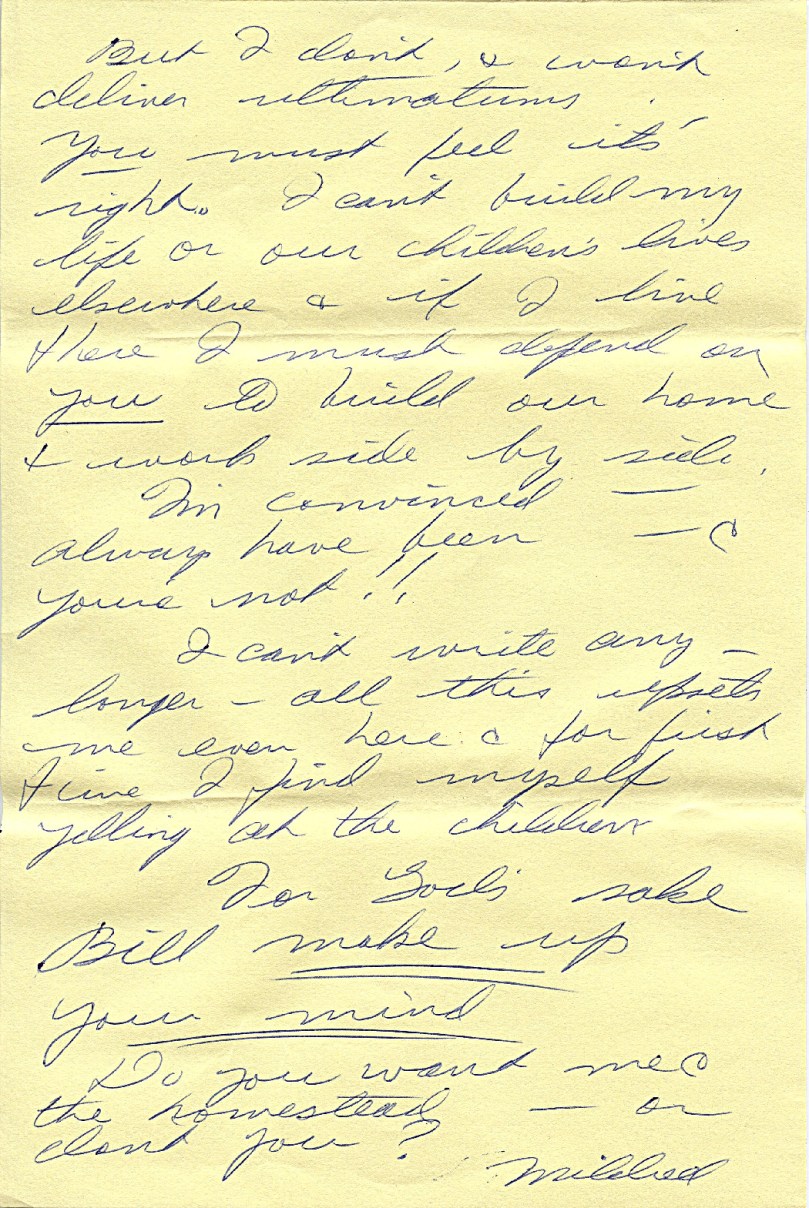
This letter is mother’s (to me, shocking) response to dad’s long (to me, thoughtful and honest) letter of —*1963 – September 3 – Dad’s Letter to Mother While the Rest of Us Are In New Mexico.   Here is an excellent opportunity to look at the pitiful and destructive dynamics in my parents’  relationship.  This is a rare letter because in it she is honest about how she felt both about her mother and my father — and neither honesty nor the truth was my mother’s strong suit in these hundreds of letters of hers I am transcribing.

This letter shows the kind of ‘switching’ that my mother would do, and shows how, even on pieces of paper with a pen as a weapon she would work herself up into a rage filled frenzy.  The best thing for us children would have been — a long time prior to when this letter was written — for our parents to have chosen a place for us to live in so we could get on with some semblance of growing up while having our needs met.

We were growing up anyway.  *1963 – Trip to Santa Fe – Here at Grand Canyon – mom and kids It was not OUR choice for five of us plus my mother to run over two thousand miles away from my father, or to be jammed into a tiny motel room in a strange town, to start school late in the year, to have no certainty about what was going to happen next in our lives.  And as much as any of us children might have loved the homestead, it was not our biggest need to have ourselves dragged back there as pawns in my mother’s sick, distorted ‘mind games’ with my father.

++++

Another factor that is of course not mentioned in these letters flying back and forth between my parents is the fact that we had lost what might as well have been another member of our family — the log house.  It had been sold.  In order for massive ‘trauma drama’ to be enacted within a family, there must be a stage and a setting.  The dynamics of my mother’s chaos worked prior to this time with three main settings:  the log house in Eagle River, the homestead, and the Panoramic View Apartments in Anchorage.  She had lost the log house, and that fact — like a child growing up and leaving the family — changed how mother’s, and hence our drama was to play itself out after this time.

(For background on the truth of mother’s actions during the year prior to the time this letter was written in 1963, read particularly her late summer, fall and winter letters here: *1962 – MOTHER’S LETTERS and the letters *1963 – Mother’s Letters written prior to our leaving Alaska in August of 1963)

In this September 6, 1963 letter she tells dad:

I don’t mind if we don’t live there this winter as it isn’t our fault but I’m not the one for you if you feel we should buy a house.  I can’t return under such circumstances.  I simply can’t.  I know I’ll yell, scream and fuss again and I won’t….Bill if we don’t live on the homestead I don’t want to live in Alaska with you.

It seems clear to me from letters months and years prior to this that it has always been mother who orchestrated the moves off the mountain and  Dad simply obliged her.

From my point of view, certainly toward the second half of this letter, mother is writing ‘crazy-talk’!  She tells him,

But I don’t, and won’t deliver ultimatums.  You must feel it’s right.  I can’t build my life or our children’s lives elsewhere and if I live there I must depend on you to build our home and work side by side….I’m convinced – always have been – and you’re not!!

++++++++++++++++

Please follow this link to read

*1963 – September 6 – Mother’s Wicked Response to Father From Santa Fe

++++++++++++++++++++++++++++++++++++++++++++++++++

In a letter September 5, 1963 she stated about the opposite of her letter 1 day later:

You’ll know what you want to do after your trip – live there now or next summer.  I don’t care.

I want you – I love you – and will work out our problems together.

I am absolutely lost without you!!

Write soon and often.  Your ever loving wife, Mildred -”

++++++++++++++++