+TITLE ON SALE NOW BY DR. BRUCE PERRY: BORN FOR LOVE

++++++++++++++++++++++++

I have faithfully continued to add the tags ’empathy disorder’ and ‘infant abuse’ to nearly every single one of my many, many blog posts because I am waiting for ‘science’ and the mainstream to catch up to these two most important topics any day now.  Here, tonight, I have found the perfect subject that fits both of these category tags RIGHT NOW!

If there is one thing abusive parents are lacking, IT IS EMPATHY!  Take a look at this!

I am thrilled and delighted to have just discovered that  Dr. Bruce D Perry — an internationally recognized authority on brain development and children in crisis — along with Maia Szalavitz, authors of The Boy Who Was Raised as a Dog: And Other Stories from a Child Psychiatrist’s Notebook Child Psychiatrist’s Notebook–What Traumatized Children Can Teach Us About Loss, Love, and Healing, released on April 6, 2010 yet another critically important title.

Born for Love: Why Empathy Is Essential–and Endangered by Bruce D. Perry and Maia Szalavitz (Hardcover – Apr. 6, 2010)

This is what his website says about the title:

Born for Love: Why Empathy Is Essential–and Endangered

In BORN FOR LOVE: Why Empathy Is Essential—and Endangered (on-sale April 6, 2010), Dr. Bruce D. Perry and journalist Maia Szalavitz argue that empathy, the ability to recognize and share the feelings of others, is a crucial human quality that underlies much more than love, friendship and parenting. Through compelling personal stories and wide-ranging research, they explore how empathy affects everything from emotional depression to the Great Recession, from physical health to mental health, from our ability to love to criminal behavior and even the rise and fall of societies.

Sounds wonderful to me!  Ordering a copy immediately.  Dr. Perry’s work seems extremely grounded to me because he is in clinical practice with children, and does not draw his writing from any ‘ivory tower’ thinkology academy.

Dr. Perry is the one person I would like to have write a ‘blurb’ about/on my book.  I don’t even know what that’s called – but you know what I mean.  This new book covers the subject of empathy with the full understanding of the authors about the critical role of early attachment in brain formation as well as a complete understanding of how early trauma changes human development.

Developmental neuroscientist Dr. Allan Schore states in his writings that every insecure attachment pattern includes within it as a matter of course a corresponding empathy disorder.  Learning as much as we can about empathy will help us to grow even more knowledgeable about how our early insecure attachments and resulting adult insecure attachments have impacted our empathic abilities — and therefore our physiological development and our entire life.  I don’t think there could be a better author to read on the subject than Dr. Perry.

This is what I found on Amazon.com about “Born for Love”:

Editorial Reviews

Product Description

An inside look at the power of empathy: Born for Love is an unprecedented exploration of how and why the brain learns to bond with others—and a stirring call to protect our children from new threats to their capacity to love

From birth, when babies’ fingers instinctively cling to those of adults, their bodies and brains seek an intimate connection, a bond made possible by empathy—the ability to love and to share the feelings of others.

In this provocative book, renowned child psychiatrist Bruce D. Perry and award-winning science journalist Maia Szalavitz interweave research and stories from Perry’s practice with cutting-edge scientific studies and historical examples to explain how empathy develops, why it is essential for our development into healthy adults, and how it is threatened in the modern world.

Perry and Szalavitz show that compassion underlies the qualities that make society work—trust, altruism, collaboration, love, charity—and how difficulties related to empathy are key factors in social problems such as war, crime, racism, and mental illness. Even physical health, from infectious diseases to heart attacks, is deeply affected by our human connections to one another.

As Born for Love reveals, recent changes in technology, child-rearing practices, education, and lifestyles are starting to rob children of necessary human contact and deep relationships—the essential foundation for empathy and a caring, healthy society. Sounding an important warning bell, Born for Love offers practical ideas for combating the negative influences of modern life and fostering positive social change to benefit us all.

About the Author

Bruce D. Perry, M.D., Ph.D., is the senior fellow of the ChildTrauma Academy (www.ChildTrauma.org), a not-for-profit organization based in Houston that is dedicated to improving the lives of high-risk children, and he is an adjunct professor of psychiatry at the Northwestern University School of Medicine in Chicago. He is the author, with Maia Szalavitz, of The Boy Who Was Raised as a Dog, a bestselling book based on his work with maltreated children.

+++++++++++++++++++++

Please also take a few minutes to wander around Dr. Perry’s website.  Meet The Childtrauma Academy:

A not-for-profit organization, based in Houston, Texas, working to improve the lives of high-risk children through direct service, research and education. We recognize the crucial importance of childhood experience in shaping the health of the individual, and ultimately, society.  By creating  biologically-informed child and family respectful practice, programs and policy, The ChildTrauma Academy seeks to help maltreated and traumatized children.

A major activity of the CTA is to translate emerging findings about the human brain and child development into practical implications for the ways we nurture, protect, enrich, educate and heal children. The “translational neuroscience” work of the CTA has resulted in a range of innovative programs in therapeutic, child protection and educational systems.

The CTA is a Community of Practice. Etienne Wenger, a leading social learning theorist, defines communities of practice as groups of people who share a concern or a passion for something they do and learn how to do it better as they interact regularly. This model has been discussed as optimal for promoting social change in our current complex world. The CTA works to create collaborative working relationships between organizations and individuals to most effectively promote positive change for children.

The CTA started as a typical center of excellence in an academic setting, initially at The University of Chicago and later at Baylor College of Medicine. Over time however, it was clear that the problems of abuse and neglect in children were much more complex and multi-dimensional in ways that our medical model was unable to address.

A medical school centered work group investigating and solving physiological problems in humans makes sense. Solving problems which involve parenting, education, the law, child protection systems, mental health, law enforcement and a host of related systems across every professional discipline is more challenging. In response to this challenge we have created a collaborative, multi-site, interdisciplinary virtual Center of Excellence, The ChildTrauma Academy.

++++

There is  information on this site about the work this Community of Practice is involved in.  I wish they had a little house for me down there, with big shade trees, lots of flowers, a gentle fountain – and an art therapy studio for me to play in with others – I would be happy to move right in!!

++++++++++++++++++++++++

And, in memory of my Borderline mother, here’s more BPD info –

From Kristalyn Salters-Pedneault, PhD, your Guide to Borderline Personality Disorder

Did that subject line get your attention? Very few researchers have explored the relationship between BPD and sexual problems. But, more and more research is finding a link — problems such as sexual avoidance and reckless casual sex may be linked to BPD.

BPD and Sexual Difficulties

BPD symptoms can affect your emotional state, your relationships, and your ability to control your behavior. So, not surprisingly, BPD can have a major impact on your sex life.
Impulsive Behavior in BPD

Impulsivity can be a very troubling aspect of BPD, leading to problems with relationships, physical health, and finances, as well as legal issues.
BPD and Your Physical Health

BPD does not only have an impact on your mental health. People with BPD are more likely to report a variety of physical health problems, and are more likely to need to be hospitalized for medical reasons, than those without BPD.
Conditions Related to Borderline Personality Disorder

Learn more about conditions and disorders that are related to or frequently co-occur with borderline personality disorder.

What is BPD? Symptoms of BPD Diagnosis of BPD Treatment of BPD
Living with BPD

++++++++++++++++++++++++

+HEARING AND HONORING OUR INNER ‘GONG!’

+++++++++++++++++++++++++++++++

I remember watching a few episodes of The Gong Show many years ago.  It was a terrible show!  But my memory of it comes back to me in my thinking about how I now trust my own inner GONG when I hear it inside of my body, even when I can’t track EXACTLY why it’s obnoxious tones are resonating LOUDLY within me.

When someone says something to me like, “What your mother did to survive in her madness if your life story!” I don’t hear the gong.   When I heard – actually read them in an email – they made me feel ‘fed’.  The truth of these words resonated within me as being the truth.  They felt profound to me and I know they always will.

But in my telephone conversation with a dear friend yesterday, I experienced exactly the opposite reaction.  We were talking about the same thing I wrote about in:  *Age 20 – Horrible visit ‘home’ with my daughter.

My friend, who did not come from a perfect childhood home, still never experienced abuse.  She trained herself with a degree in social work and worked for several years in the field of Child Protection but she rapidly ‘burned out’ and left the profession.

Where, within her own self, her response to me in conversation ACTUALLY came from doesn’t matter to me one single bit.  What matters to me is that as she talked about her response to my experience at age 20 of ‘going home’ again to see my family I heard my inner GONG so loudly it was deafening.  What also matters is that I did not question my reaction, no matter how persistent she was in insisting she was right.

To paraphrase:  “Well, you know what they say.  Anytime someone with a difficult childhood returns home, no matter how long they have been gone, the family – every member present – is likely to instantly return to the familiar roles they played in the family when they were young.”

GONG!

As soon as I heard my inner gong I recognized there was a ‘cultural’ division between what she was saying (based on what ‘experts’ suggest) and what I know about myself, my childhood, and my experience during that age 20 visit.

I did not ‘assume the role’ I had in my family when I was growing up.  My entire being, body-brain-mind and self WAS ‘the role’.  I was built that way.  It wasn’t something I could remove like a suit of clothing, and then step back into.  Not a chance.

Now, here is my dividing line, I bet.  For those of us who suffered extreme attachment-related traumas chronically and terribly from birth, the so-called ‘role’ is built right into our developing body and becomes a part of our physiology.  Therefore, there IS NO ROLE.  In line with the quote I put first in this post, the reactions my mother and father had to me from the moment I was born were not roles, either.  Who I was forced to be, how my growing body was forced to adapt its development, had nothing to do with me ‘playing a role’, either.

The day my father put me on that jetliner headed for Naval boot camp when I was 18 marked the day my physical body exited the ‘stage’ of the ‘drama’ that I had participated in since I was conceived.  When I ‘left’ I obviously took with me the body that had every experience of my first 18 years built into its foundation, right down to the molecular interactions between my cells.

To hear someone outside of my reality refer to my reality as a ‘role’ – well – GONG!

It is extremely affirming and empowering of my SELF HOOD to be so consciously aware of the difference within my entire being-body between my response to ‘the truth’ and ‘the lie’.

I am not saying that for MOST people, who experienced safe and secure attachments during their childhood with SOMEBODY, that the ‘role playing’ description of both in-childhood and post-childhood home-of-origin experiences is not accurate.  But my inner GONG instantly tells me it isn’t true for me – and I no longer have to doubt my own reality for one single instant.

HOW I recognize ‘the lie’ and what that means to me is the subject of this blog.  I just wanted to mention this because it’s fresh in my body-mind.  I am glad I was able to experience my two different reactions so clearly and powerfully within the same week!  The first outsider’s comment resonated harmoniously – I ‘felt felt’.  The second comment created the opposite reaction:  I knew this friend has no clue what my reality was or is – and no matter WHAT I can ever say to her – she never will.

++++

None of this discussion has anything to do with my potential and efforts toward healing, growth and change.  Nothing about my improved well-being over time has anything to do with my parents – then or now.  They did the damage.  I do the repair.

+++++++++++++++++++++++++++++++

+MY ENTERTAINING JOURNEY TO UNDERSTAND THE WORD ‘TABOO’

++++++++++++++++++++++++++++++

This is turning out to be the STRANGEST POST I have ever written!  Never could I have imagined where my writing on the subject of “TABOO” would end up going today!  I feel at this instant like I found a mystery I never knew existed because I just found its solution.

It makes me think at this instant of all the strange twists and turns everybody’s life takes, and about how we all take our place somewhere in the long march of human history.  Our lives, and therefore our life stories, touch one another in consequential and seemingly inconsequential ways.

These seemingly random intersections in pathways, these transient transits can have meanings that nobody even notices at the time, but these random acts of touching do mean something even though we can’t comprehend the impact we have on changes that happen continually as the history of our species unfolds itself in space and over time.

Today I am experiencing how this same process can operate within the realm of thought.

++++

What on earth am I talking about?  I started out today writing this:

TABOO:  What an interesting and unexpected origin for this word, a very latecomer into the modern English language – in 1777!  How did English get this word from a Tongan language?

TABOO

Function: adjective

Etymology: Tongan tabu

Date: 1777

1 : forbidden to profane use or contact because of what are held to be dangerous supernatural powers
2 a : banned on grounds of morality or taste <the subject is taboo> b : banned as constituting a risk <the area beyond is taboo, still alive with explosives — Robert Leckie>

Function: noun

Inflected Form(s): plural taboos also tabus

Date: 1777

1 : a prohibition against touching, saying, or doing something for fear of immediate harm from a supernatural force
2 : a prohibition imposed by social custom or as a protective measure
3 : belief in taboos

++++

I began my searching to find out what was happening in the world around this 1777 date that might have contributed to the ‘birth’ of this word TABOO from the Tongan  language into the English language at this specific time, and found what seems to be to be a very interesting (strange) and unique connection to my own childhood.

Perhaps ONLY because I grew up around Anchorage, Alaska for much of my childhood did I recognize the name of Captain James Cook as it appeared here and there within my wandering internet information search.

Anchorage sits on the shores of an inlet named Cook Inlet after this famous British Naval officer seafaring explorer.  All fine and good, but how could I possibly know that he would make an appearance in my search through history for the origins of our English word – TABOO?

WHO WAS THIS MAN?

Well, for starters, here’s an account of his wanderings according to THE ENCHANTED LEARNING WEBSITE:

“James Cook (October 27, 1728 – February 14, 1779) was a British explorer and astronomer who went on many expeditions to the Pacific Ocean, the Antarctic, the Arctic, and around the world.

Cook’s first journey lasted from August 26,1768 to July 13, 1771.  He sailed on the Endeavor from Plymouth, England, to Brazil, around Cape Horn (the southern tip of South America), and to Tahiti (April 11, 1769), where he stayed for months in order to observe the transit of Venus as it passed between the Earth and the Sun (in order to determine the distance from the Earth to the Sun).  Cook was also searching for a large, southern continent that was thought to exist (but does not).

“Cook sailed to New Zealand on October 6,1769, where he and his crew fought with the Maori (the earliest inhabitants of New Zealand) and mapped much of the two major islands (the strait between these two islands is now named Cook Strait) and showed that is was not part of a larger southern continent.

(See also:  Discontentment Brews Over The Genographic Project — “Along with other indigenous populations, the Maori of New Zealand have objected to the use of their DNA on the grounds that it might disprove some of the stories about their origins that have been passed down from generation to generation.”)

“He then sailed to and mapped eastern and northern Australia (The Endeavor was stuck for a day on the Great Barrier Reef off northeastern Australia; the ship was damaged by coral and almost sank). They repaired the ship in northern Queensland, Australia (the site of Cooktown and the mouth of the Endeavor River), completing the repairs on August 6, 1770.

Cook’s second expedition (1772-1775) took him to Antarctica and to Easter Island on a voyage intended to show there was no large southern continent. Cook’s two ships on this voyage were the Resolution and the Adventure.

Cook’s last expedition (1776-1779) was a search for a Northwest Passage across northern North America to Asia – he searched from the Pacific Ocean side of the continent.  Cook sailed from England on July 12, 1776, on the Resolution. Officers on the ship included George Vancouver and William Bligh (who would later be the captain of the Bounty and have his crew mutiny).

“Cook arrived at Capetown, South Africa, on October 18, 1776, and sailed to the Indian Ocean and on to New Zealand (in early 1777), the Cook Islands, and Tonga. Heading for Alaska, Cook sailed to and named the Christmas Islands (arriving on December 25, 1777, hence the name). He then sailed to and named the Sandwich Islands (named for the Earl of Sandwich, one of Cook’s patrons). Cook searched for a Northwest Passage in Alaska, but was unsuccessful.

“Cook was killed by a mob on Feb. 14, 1779, on the Sandwich Islands (now called Hawaii). At the time, he was trying to take the local chief hostage to get the natives to return a stolen sailboat. The ship returned to England without Cook on October 4, 1780.

“Cook was the first ship’s captain to stop the disease scurvy (now known to be caused by a lack of vitamin C) among sailors by providing them with fresh fruits. Before this, scurvy had killed or incapacitated many sailors on long trips.”

++++

This next description of Cook’s travels comes from the writing of Murray Lundberg, in her paper, Captain James Cook in Alaska:

“Captain Cook is universally regarded as one of the most ambitious explorers of all time – in particular, his three expeditions in 1768-1771, 1772-1775, and 1776-1779 accomplished an impressive list of “firsts,” including the first European sighting of Hawaii. While his exploration of the coast of Alaska in 1778 was not one of his greatest accomplishments, it added an enormous amount of information to the blank spots on the maps of the northern coast.

“Born on October 27, 1728, Cook rose rapidly through the ranks after joining the Royal Navy in 1755. He received his promotions the hard way, through sheer determination and ability, with no powerful connections to assist him. After serving in several battles against the French, his mapping abilities earned him a posting as surveyor of Newfoundland, and for the same skill, he was appointed to his first expedition command in 1768. During this first voyage he conducted the first detailed mapping of Tahiti and New Zealand.

“On his second voyage, Cook had made one of the great non-discoveries of the age, arriving home with proof that Terra Australis Incognita, the continent that was imagined to be in the southern hemisphere to balance the Earth, did not exist. He was also able to conclusively prove that with a high level of cleanliness and a proper diet, scurvy could be prevented, regardless of the length of time spent at sea.

“The primary reason for organizing another expedition for 1776 was to find the fabled Northwest Passage, a trading route across the top of North America, from Europe to the Orient. Over the previous 280 years, dozens of unsuccessful expeditions had been launched – so important was the discovery of this route that a £20,000 prize had been offered by Britain. Although Cook had been given an honourary shore posting in gratitude for his previous service, and was not initially considered to lead this new expedition, the prize money must surely have been a consideration in his offer on January 9, 1776 to lead the expedition.

“The 462-ton Resolution finally left England on July 12, 1776, eight days after the Declaration of Independence had been signed on the opposite side of the Atlantic. At Plymouth Sound on June 30th, Cook had encountered 3 warships and 62 troop transports heading for the revolution on the east coast of North America.

“Following months exploring the South Pacific, the coast of New Albion was sighted on March 6, 1778, south of present-day Newport, Oregon. Three weeks later, after fighting violent weather, Cook arrived at Nootka Sound (he named it St. George’s Sound) on March 29, making the Resolution the first British ship on the Northwest Coast.

(For the detailed 1778 dates of Cook’s Alaskan route see HERE.)

The Demise of Captain James Cook

October 30 – the last view of Alaska for Cook, as they pass Umnak Island in a storm.  November 26 – sights Maui.  On February 14, 1779, Captain James Cook was killed at Kealakekua Bay, Hawaii, along with Royal Marine Corporal John Thomas, Privates Theophilus Hinks, John Allen and Tom Fatchett, and many Hawaiians. Cook’s body was dismembered and burned, but the remains were returned to Captain Clerke, who had taken over command on the Resolution and the expedition, despite being so ill that he could barely stand. On February 21, 1779 as much of Cook’s remains as could be recovered were buried at sea.”   VIEW IMAGE HERE

++++

Where on EARTH was Captain Cook in 1777, the year Webster’s dictionary states the word TABOO appeared in the modern English language?

It turns out that in this year in question, given all of the extremely important historical events that were taking place on America’s shores during this time period, Captain James Cook was a long ways away – on our very small world.

In 1777 Captain Cook and his crew were in the Kingdom of Tonga (today’s population about 101,000) in the South Pacific about one-third of the way from New Zealand to Hawaiʻi.

– The Maoris of New Zealand were first encountered by Europeans during Captain Cook’s 1772-73 voyage.

– February 10, 1777 – Captain James Cook with Resolution and Discovery sighted New Zealand just south of Cape Farewell on his third voyage

– February 12, 1977 – Captain James Cook’s Resolution along with the Discovery arrived at Queen Charlotte Sound

– February 26, 1777 – Captain James Cook’s final departure from New Zealand on the Resolution along with Discovery (on his 3rd voyage)

(The above three date-related facts are cited here from The New Zealand chronology compiled by John Mitchell)

++++++++++++++++++++++

Before I finally realized how significant  the travels of Captain James Cook actually WERE in regard to the history of the word TABOO’s appearance into English, I had compiled the following 1777-era information:

1777 Napoleon Bonaparte celebrated his 8th birthday this same year his father Nobile Carlo Buonaparte, an attorney, was named Corsica’s representative to the court of Louis XVI in France.

1777 – The first step was taken by playwrights in 1777 that led to the French Assembly passing the first law in the world to officially recognize authors’ rights to their written words.

January 1777 – In Salzburg, Austria, Wolfgang Amadeus Mozart (born January 27, 1756) wrote a piece that, for the first time, proclaimed him to be not merely one of the best composers in Europe, but one of music’s greatest geniuses.

1777 – The Organization of the Atlantic Slave Trade in Yorubaland, ca.1777 to ca.1856 – (see:  African bondage in the colonies north of the Mason-Dixon Line)

In America:

September 5, 1774 – The First Continental Congress convened in Philadelphia’s Carpenters Hall

March 6, 1775Prince Hall and fourteen other Free Blacks became members of the British Army Lodge No 441.  Prince Hall faced discrimination and was not allowed to join the White Masonic lodges in America, “Even though these Masons preached brotherhood, they insisted on keeping Blacks out of their lodges.”  In response to their refusal, Prince Hall turned to the British Masons stationed in America. The creation of the first African Masonic Lodge came about due to the unrelenting efforts of Prince Hall and these fourteen others who were taking the “initial steps to form America’s first Black institution”.  Prentice Hall drafted the 1777 petition for a Gradual Process of Emancipation for slaves in America.

(Our family-history rumor mill has it that we have Free Mason involvement on both my father’s and my mother’s sides of the family orchard.)

April 19, 1775The American Revolution began in 1775 with the “shot heard round the world” fired at Lexington on April 19, 1775. The Revolution lasted eight and a half years and finally ended on September 3, 1783, with America and the King of England signing the Treaty of Paris.

July 4, 1776 – The United States Declaration of Independence is a statement adopted by the Second Continental Congress on July 4, 1776, which announced that the thirteen American colonies then at war with Great Britain were now independent states, and thus no longer a part of the British Empire. Written primarily by Thomas Jefferson, the Declaration is a formal explanation of why Congress had voted on July 2 to declare independence from Great Britain, more than a year after the outbreak of the American Revolutionary War. The birthday of the United States of AmericaIndependence Day—is celebrated on July 4, the day the wording of the Declaration was approved by Congress, even though it was not until after the American Revolution ended that we won our independence.

1777 – “The year 1777 was probably the most perilous period in the “beginning of the nation,” and marked one of the great crises of the world’s history.”

January 1777 –  Considered to be a month of epochal events in world history. In the bitter cold of New Jersey, George Washington and his ragtag band of soldiers saved the American Revolution from collapse.

1777 – Vermont becomes the first U.S. territory to abolish slavery.

January 13, 1777 –  Prince Hall and seven other African American men petition the Massachusetts legislature for freedom based on the stated principles of the Declaration of Independence and military service in the Revolutionary War.  They directly challenged the commonwealth of Massachusetts’ government to live up to the principles of liberty and rights which had been set forth less than a year before in the Declaration of Independence. (see:  Slavery in Early America 1777-1829)

June 14, 1977 – The Marine Committee of the Second Continental Congress passed the Flag Resolution which stated: “Resolved, That the flag of the United States be thirteen stripes, alternate red and white; that the union be thirteen stars, white in a blue field, representing a new Constellation.”

November 15, 1777 – Congress adopted the Articles of Confederation and Perpetual Union, customarily referred to as the Articles of Confederation, which was the first constitution of the United States of America and legally established the union of the states. The Second Continental Congress, as the government of the new United States of America, appointed a committee to draft the Articles in June 1776 and sent the draft to the states for ratification in November 1777. Under the Articles, Congress was the sole authority of the new national government.

1777 – Most of the world was skeptical about the effectiveness and of vaccinations. Still, George Washington had the entire Continental Army vaccinated against smallpox. Having only 1,000 men at the time he couldn’t afford to lose any to sickness.
December 17, 1777 – At Valley Forge in Pennsylvania, the Continental Army led by Washington sets up winter quarters.

1777 – Morocco became the first country in the world to grant diplomatic recognition to the United State.

My father’s ancestors on his mother’s side were already living on this land.  (His mother was a member of the Daughters of the American Revolution.)

1778 – Virginia abolishes the slave trade

+++++++++++++++++++++++++

So here I reach a point where I have to wonder, for all the important contributions Captain James Cook made in his life, is it the introduction of this TABOO from its Tongan roots the most noteworthy of them all?

Did Captain Cook pick up this word on his voyage, or did some member of his crew?  Was it carried as a living yet invisible cargo across the seas to English speaking lands so that it planted itself into our language and sprouted into the powerful concept that it is in governing the moral behaviors of our people?

I cannot imagine that accepted social and cultural beliefs didn’t already exist to govern behavior before this word appeared in our language, but what word did we use prior to 1777 to name them?

I find this as I look at Tongan related languages at Wickipedia:

Tongan is one of the many languages in the Polynesian branch of the Austronesian languages, along with Hawaiian, Maori, Samoan and Tahitian, for example. Together with Niuean, it forms the Tongic subgroup of Polynesian. By comparing Tongic to the other subgroup, Nuclear Polynesian, it is possible to reconstruct the phonology of Proto-Polynesian, the theoretical source of the Polynesian languages.

There are three registers which consist of

  • ordinary words (the normal language)
  • honorific words (the language for the chiefs)
  • regal words (the language for the king)

There are also further distinctions between

  • polite words (used for more formal contexts)
  • derogatory words (used for informal contexts, or to indicate humility)

And yet, 233 years after TABOO supposedly appeared as a formal member of the modern English family, when I typed the word into this site nothing came back to me.

FREELANG Tongan-English and English-Tongan online dictionary

That’s like calling an important and familiar telephone number and receiving the recording, “The number you have dialed has been disconnected or is no longer in service.”

Yet, again at Wickipedia, I found an entire page devoted to the facts about our English word TABOO and its origins in the Tongan language:

A taboo is a strong social prohibition (or ban) relating to any area of human activity or social custom that is sacred and forbidden based on moral judgment and sometimes even religious beliefs. Breaking the taboo is usually considered objectionable or abhorrent by society. The term comes from the Tongan language, and appears in many Polynesian cultures.

In those cultures, a tabu (or tapu or kapu) often has specific religious associations. When an activity or custom is taboo, it is forbidden and interdictions are implemented concerning it, such as the ground set apart as a sanctuary for criminals.

Some taboo activities or customs are prohibited under law and transgressions may lead to severe penalties. Other taboos result in embarrassment, shame, and rudeness. Although critics and/or dissenters may oppose taboos, they are put into place to avoid disrespect to any given authority, be it legal, moral and/or religious.

++++

Well, will you look at this!  I would have completely missed this entire amazing adventure and thrilling journey I just completed (coming full circle in my search and ending up ‘back home’ – Play song from Lala.com) had I just searched on Wickipedia for this word TABOO in the first place!  This MAKES ME REALLY CHUCKLE (I must be easily entertained!)

Etymology

Common etymology traces taboo to the Tongan word tapu[1][2] or the Fijian word tabu[3] meaning “under prohibition”, “not allowed”, or “forbidden”.[3]

In its current use in Tonga, the word tapu also means “sacred” or “holy”, often in the sense of being restricted or protected by custom or law.

In the main island of the Kingdom of Tonga, where the greater portion of the population reside within the capital Nuku’alofa, the word is often appended to the end of “Tonga”, making the word “Tongatapu”, where local use it as “Sacred South” rather than “forbidden south”.

The use of taboo in English dates back to 1777 when English explorer, Captain James Cook, visited Tonga

++++

I was RIGHT, though.  I feel like I was challenged to a quest, without being given any clues about how to successfully complete it and accomplish my mission – and I DID IT RIGHT!

In the process I used an invisible resource:  My personal connection to Captain James Cook as his name has been assigned to Cook Inlet that hugs the mudflat shore of Anchorage, Alaska.

What, in the end here, strikes me personally as most critically important on my search to understand the word TABOO and its relationship ESPECIALLY to abuse and maltreatment of newborn infants and very young children, is that this word, now living in BOTH languages of Tongan and English – belongs within the realm of  – “sacred” or “holy” – and cannot be severed in its roots, origin, meaning or truth from the states of being it refers to.

As I pursue my writing, I realize that social and cultural relationships to what is “restricted or protected by custom or law” does change over time.  The information available in the mainstream about infant-child abuse in the 1950s during my earliest years of childhood was no doubt nearly nonexistent.

That does not mean that the moral, commonsense, instinctive awareness of right and wrong did not exist.  That does not mean that the nervous system-brain connections, especially in relation to the human vagus nerve system did not alert MOST people to actions that stimulated shame, embarrassment – and most importantly for my topic of severe infant-child abuse – REMORSE – for millennium before TABOO traveled its long watery journey into modern English.

What I feel as one branch of my personal ‘mission’ as a severe infant-child abuse survivor is to help people understand that without the physiological ability to feel remorse, behavior toward and treatment of children (and adults) will not be governed in anything like a normal way by any social standards – TABOO ones or not.

These people DO exist, and it’s time for all of us to realize that they are not JUST lurking in the shadows with axes in their hands waiting to butcher the unsuspecting masses.  We need to remove the TABOO against the IDEA of sociopathy and psychopathy (as we need to remove the taboo-based concepts about ‘mental illness’ as a whole).

At this point in my life, both as a survivor of an 18-year childhood of severe abuse and trauma and as a fairly intelligent researcher-thinker, I understand that the issue is NOT helped by asking questions about whether someone has a so-called ‘conscience’ or not.

That, to me, is a stupid and useless position to assume in one’s thinking about perpetration of crimes against humanity.  On the other hand, it is most realistic and useful in my opinion to start learning about trauma-altered developmental changes that happen during early infant-childhood years that cause people to grow into a body that is NOT PHYSIOLOGICALLY capable of experiencing REMORSE (or related physiologically-based states like true embarrassment).

++++

My mother was an educated, articulate, gregarious, gorgeous ‘socially acceptable’ woman.  My professional father fit a similar profile.  That my mother was a hair’s breadth away from axe murdering me was an invisible fact to the world.  She never, not one single time in 18 years of severely abusing me, EVER considered that what she was doing was wrong.  Not once.  Her brain did not process the right information to reach that conclusion.  She was not built that way.

As a consequence, OF COURSE she never felt remorse.  In her world any TABOO that might have existed for everyone else did not even cast a shadow into the universe of her mind or her home.

Along with my intention to broadcast this fact as widely as I possibly can, I also want to say that our societal and cultural TABOO against thinking anything ‘bad’ about one’s parents HAS GOT TO GO!  It has to die a permanent cultural death.

In fact, we need to rise to a new cultural height where it will be considered TABOO NOT to tell the truth about abuse of children (and I know parental abuse of children can continue for the lifespan of both the parent and their offspring).

We need to overcome our cultural TABOOS against recognizing the fact that there are adults who TERRORIZE children.

+++++++++++++++++++++++++

+A REFRESHER ON ATTACHMENT AND RESILIENCY

++++++++++++++++++++++++++++
In writing about attachment as the patterns present in the narration of one’s life story reflect the patterns of secure or insecure attachments, I just came again across this book:

A User’s Guide to the Brain: Perception, Attention, and the Four Theaters of the Brain by John J. Ratey (I am referencing from the Vintage 2001 edition)

with this important statement:

“”Some stress makes us tougher in the face of future adversity.  There is even research that shows that exposure to reasonable challenges during childhood alters the balance of brain chemicals so that children are able to respond better to stress later in life.”  (page 365)

++

This statement, of course, brings questions to mind for those of us who certainly NEVER experienced anything like ‘reasonable challenges’ during our abusive infant-childhoods.  If ‘reasonable challenges’ during childhood can alter ‘the balance of brain chemicals’, imagine what happened to us!!

But, to move to what Ratey covers next  — which includes a description of how important secure attachments are to children — perhaps most significantly for children who do NOT have safe and secure attachments with their primary caregivers.  Ratey also mentions the importance of secure attachment in adulthood:

“Houston psychologist Emmy Werner found evidence for this when she studied the offspring of chronically poor, alcoholic, and abusive parents to understand how failure was passed from one generation to the next.  To her surprise, one-third of the children ended up leading more productive lives than their parents.

“Many social scientists now suggest that while we must continue to study children who fail, there may be much more to learn from children who succeed despite adversity.  Such children, researchers find, are not simply born that way.

“The presence of a variety of positive influences in their lives often makes the difference between a child who fails and one who thrives.  The implications are profound; parents, teachers, volunteers, peers, and all those who are in contact with children can create a pathway to resiliency.

“Werner later studied women who overcame adversity in their adult lives.  She found that several factors made the difference:  at least one person who gave them unconditional love and acceptance; a sense of faith in themselves; the willingness to seek support; and finally, hope.”  (page 365)

See also by Emmy Werner:  Resilience: A Universal Capacity

Related posts:

*RESILIENCY – WHY I’M ALIVE – NOT A MYSTERY

+ATTACHMENT – HOW WE ARE WHO WE ARE

A search of this blog on RESILIENCY HERE for more related posts

++++++++++++++++++++++++++++

resiliency.chap1.id

A search of this blog on RESILIENCY HERE for more related posts

+LINK TO A WHOPPER OF A TALE ABOUT TELLING OUR TALE

++++++++++++++++

I didn’t create the hell of my childhood.  I didn’t create the changes that hell forced upon my growing and developing body-brain.  I might like what happened to me.  Others might not like to hear about it.  But this IS my story – And I’m Sticking To It.  (Play song from Lala.com)

Here is a link for the brave among you readers who have a vested interest in thinking about your own life in terms of the narrative life story you TELL and the one you COULD TELL.  Because the inability to tell (narrate) a coherent life story is considered to be the NUMBER ONE symptom of an insecure attachment (which any of us with severe early abuse in our lives are EXTREMELY likely to have), thinking about the telling of our story has a critically important purpose:

Healing our self will heal the telling of our story (making it more coherent), and improving the coherency of the telling of our life story helps heal us!  (Think infinity sign)

There are a LOT of words at the other end of this link!  But what is telling a life story about if it’s not about WORDS?

The topic is personally important to me because I am stuck with a Catch-22 in that I want to make a book from my experience.  A book is SUPPOSED to be coherent, yet my #1 symptom of having a disorganized-disoriented insecure attachment pattern due to early and long term severe infant-childhood abuse took away my ability to tell a coherent life story in the first place!  (That’s sort of a broken infinity sign situation!)

So, in working to put my book(s) together I am thinking about words related to this whole process.  How it all got broken and how this might all be repaired is part of what I write about at this link.  Feel free to scan rather than read it, but perhaps there is something in here that you might find of interest:

*THE MEANING OF MENDING OUR LIFE STORY

++++++++++++++++

+WHAT IF AN ABUSIVE CHILDHOOD IS JUST TOO SIMPLE?

++++++++++++++++

What if Chinese biophysicists are right?  What if “…our consciousness is subject to evolutionary development…?”  Popp, 254

What if Dr. Martin Teicher is right?  What if severe child abuse in a malevolent environment creates an “evolutionarily altered brain?”

What if the second happens directly because the first does?

I was thinking about increased complexity as a good thing in life.  I was thinking that my mother was too simple.  She created an environment that was too simple for me.  As a result of this, I got a changed body-brain – a different one from hers, obviously, but one like hers because we each shared related experiences as we developed.

The simple, unconsciously-driven world of my mother’s and mine went like this:  “Let’s play a game.  I’ll be the mean monster mother who hates and hurts you.  You try to survive me.”

Day after day, week in, week out, year in and year out.  Same old game.  Nothing original in that!  Nothing that increased the complexity of our relationship.  Nothing that fed an increase in complex communication between us.  Nothing that challenged me to THINK.

Of course the isolation my mother enforced for me kept me from developing any diverse and increasingly complex relationships with anyone else, either.

Popp, the Chinese biophysicist mentioned above, also writes about a theory that – “essentially claims that the guide-line of evolution is the expansion of coherent states.”

Nothing very coherent about my mother’s state, and thus, because she had kept so much control over me from birth, was there much coherence in my state, or in our relationship.  Just the same old ‘game’ repeated over and over again.

When I think about an ‘evolutionarily altered brain’ the way Teicher describes it, I think about far earlier years in the experience of our species when ‘group think’ had not evolved into ‘individual think’.  Considering our species has only had spoken language for about 140,000 years, it doesn’t take much imagination to picture communication happening back then in far more simple and primitive ways.

(‘Group think’, to me, has different boundaries.  My mother included me as a part of her group – not mine.  Actually, she and I were an enmeshed group of one!  Her – and me as her projection.  I could not escape to become a separate more complex and differentiated person – like constantly fighting being sucked into a black hole – unable to escape a gravitational pull.  An individual has to become increasingly differentiated from the ‘group’ – or we remain (develop into) a more ‘ancient’ being than a ‘modern’ one.)

So, what if simply put, both mine and my mother’s childhoods were just too primitive and simple:  Survive?  Hard to get increased complexity (and a matching ‘evolutionarily advanced brain’) out of that situation!

++++++++++++++++

+TRANSPARENCY AND MY CHANGED SOCIAL BRAIN

+++++++++++++++++++++++++++++++

My sister gave me some valuable and insightful feedback last night in a telephone conversation about my writing and about this blog.  She spends far more time than I do reading other people’s blog writing – on far different topics that what I write about.  But what she told me fits in with something I have been thinking about a lot recently:  What do humans show to one another and what do they hide?

I have mentioned recently how much I am enjoying the Netflix gift subscription my children have given to me as I stream the Australian television series, “McLeod’s Daughters” and watch some of it daily.  Perhaps I so thoroughly enjoy watching this series because it portrays very confident and capable women ranchers, perhaps because it portrays country living, perhaps because it is about a culture that is certainly ‘western’ in that everyone speaks English and shares a background similar enough to mind that I don’t have to stretch very far to imagine the story but does not come from an American-Hollywood perspective.

But ultimately what I am most enjoying about this series is that it offers me the opportunity to watch ‘ordinary’ people interacting with one another.  It’s the same reason I love the movie, “The Secret Garden.”  I can’t count the number of times I’ve watched this movie because from it I can glimpse a little bit of what it might be like to be a child.

The truth is, I don’t have any more personal information about what being a child is/was like than I do about what being an adult is REALLY like.  I missed that show when it came to town.  I was too busy surviving being tortured, tormented, terrified, overwhelmed, traumatized and isolated as an infant-child and then trying to make my way through my adulthood as a confused survivor.

++++

What this has to do with ‘writing a book’ and the conversation I had with my sister last night is that I will never be able to write a single word that comes from a so-called ‘ordinary’ point of view.  I have often written about ‘the spectrum of abuse’, but today I am not feeling that as a linear concept.  I am feeling it as a circle.

Those of my readers here who suffered from parental abuse that happened within a context of true madness will always be most qualified to understand what I say and the way that I say it.  I cannot, however, offer anything to anyone if I don’t get to a place of knowing and accepting that I (and the readers I mention) are in a narrow percentage range having to do with surviving ‘the worst possible childhoods.’

I don’t want to be in some vague exclusive group.  I never wanted that from the moment I was born to my mad, mean mother.  But it happened, and I AM there.

My sister was describing to me aspects of my blog writing that she sees as being ‘different from others’.  I am not sure that I exactly understand what she said to me, but I think it had something to do with TRANSPARENCY.  In watching the actions and interactions of people on “McLeod’s Daughters” I am learning something about the reality of the social species I belong to.  I can do it far more safely than is possible when I am in interaction with REAL people because I am not expected to say or do anything as I watch.

The concept of TRANSPARENCY in my writing has to do with how much I disclose in my writing versus how much I ‘hide’ from public view.  It has to do with my inability to participate in any ordinary way in social interactions.

I have written far more about the early developing EMOTIONAL right limbic brain through very early infant-caregiver interactions than I have about THIS SAME BRAIN REGION as it governs SOCIAL interactions.  In fact, emotional cannot physiologically be split off and separated from social.

When I say “I cannot read or respond normally to social cues,” I mean it.  That inability cannot help but show itself in my writing.  I simply have no concept of ‘filters’ or ‘screening’ of information that evidently ordinary-built people do normally.

I see this filtering all the time on “McLeod’s Daughters” as the characters are shown to have inner thoughts, feelings, motivations, intentions and ‘blockages’ that the watcher is privy to but that the individual characters do not know about one another.

This has to do with the early developing emotional-social brain (and all its corresponding nervous system connections) that are involved in the development of what is called Theory of Mind.  To be extremely blunt about this topic, mammal Theory of Mind is just as real as ‘human’ Theory of Mind.  My mother’s abuse of me interfered with my developing even as rudimentary a Theory of Mind as a dog or a monkey might have.

And this will always show in my writing just as surely as having an altered brain-mind development is a sure sign of the presence of an Autistic-spectrum person’s relationship with self and others.

++++

So when I say today that suddenly I feel the ‘abuse spectrum’ exists in a circle rather than ‘on a line’, I am saying that ALL Theory of Mind processes, ALL human interactions happen through ‘social-emotional’ brain processes that were built into it from the start of our life by social interactions with caregivers.  All these social interactions happen within social-societal environments.

If you follow any circle around far enough from the point of origin we will come back to the beginning.  Those of us in the far extreme away from normal-ordinary early caregiver interactions are simply closer to the starting point of the RANGE of what is humanly possible.

What is normal-ordinary is socially defined.  At the same time I can say that I am extremely limited in my ability to interact socially in normal-ordinary ways with other people (or with myself), and therefore am dis-abled to fit into mainstream human society, I can also say that I am en-abled to operate in a very different way that so-called normal and ordinary people cannot begin to imagine.

As I watch the Australian dramas unfold on “McLeod’s Daughters” what I am ACTUALLY WATCHING is the keeping and sharing of SECRETS.  What I see is that evidently adults not only keep secrets from other people, they keep them from their own self.  This, to me, quite simply means that the ‘legal tender’ of normal-ordinary human social interactions on ALL levels is about the TRUTH.

Who has the truth?  Who knows the truth?  When will the truth be revealed?  How will the truth finally appear?  Will the truth ever be discovered?  What is the truth, anyway?  What happens when the truth finally pops out – one way or the other?  What power does the truth have to change people’s lives?  What power does keeping the truth secret have on people’s lives?

Is all truth equal?  Are all secrets equal?  When does the truth appear accidentally?  When does it appear intentionally and why?  Who knows what about whom?  And on and on and on social interactions seem to go.

Theory of Mind then becomes about this whole connected circle that exists between having secrets, keeping secrets, revealing secrets, hiding the truth, knowing the truth — or not.  It seems people have a variety of techniques for keeping this circle broken, for keeping the truth a secret – or not.  It seems that their are an infinite number of ways that these patterns of truth-secret interactions play themselves out.

++++

My transparency comes from my having experienced so much abuse, trauma and isolation that none of these physiological circuits ever developed within me in the first place.  When ‘self help’ writers talk about survivors of ‘dysfunctional childhoods’ having no clue what ‘normal’ is – so they have to ‘guess what normal is’ – I cringe now.

The most important truth here has not been revealed by these writers.  Some of us were formed in environments that were so far from being socially normal-ordinary that we never received the social-emotional information during our development that would have put these normal-ordinary social circuits into play.  So – they aren’t there and they never will be.  We are a different sort of human.  I am a different sort of human.

I am on the far extreme of the social-game interaction circle.  I did not develop WITHIN that arena.  I was always on the outside, I AM on the outside, and I will ALWAYS be on the outside.  I can ‘watch and learn’ about how humans interact about as effectively as a high-functioning Autistic person can.  I watch and try to learn about social interactions around REAL humans equally as I do with television and movie people.

But I have no more illusions or delusions that anything I will ever be able to do will let me BE on the inside of that circle.  As a consequence of being a survivor of early abuse on the far end of the abuse-spectrum, I simply will never have the same in-formation that less abuse or non abused people have built into them.

It is here that my ability becomes my disability, right where the whole circle of what is socially possible for my species connects itself:  I can both know what I am NOT SUPPOSED to know about others at the same time I don’t know what I am SUPPOSED to know.

++++

According to developmental-attachment experts, I am in the small percentage of people who have a ‘disorganized-disoriented insecure attachment disorder’.  Looking at myself from this ‘whole circle’ perspective, I can say that of course having the experience of operating with a completely different social-emotional brain puts me at a disadvantage when and if I find I need to interact with people who are, themselves, different than I am.

But because the social mainstream was built ordinarily, they set the rules.  What is normal for them is NOT normal for me and vice verso.  Because of what I now know about this whole subject, I can OFTEN watch people who interact with me express their confusion and disarray as they try to understand my reactions and interactions.  We speak a different language – and most of the time, unless I am interacting with people who care about me greatly, there is simply not enough time or opportunity for the TRANSLATION to occur.

Communication between species members is most efficient and effective when the arena is a shared one, when the ground rules are known and understood, and when everyone participating is on equal (shared-learned-understood) ground.

++++

The topic gets really complicated at this point.  It seems that human interactions are meant to negotiate power, competence, status and connectedness.  This all happens within a shared Theory of Mind arena that allows patterns of truth-revelation and secret-keeping to operate.  These patterns, it seems to me, help to define who is who, who is a self, how they are a self, what self they are with whom.  These patterns define the individual self, the group self, the connections of the self to others as members of a social species.

Being as TRANSPARENT as I am sets me apart from all of these patterns of interactions.  Am I sitting at the table with other people playing cards with no cards in my hand?  With a hand full of wild cards?  Trump cards?  Crap cards?  Am I playing with the same number of cards as others have?  Are all my cards showing to others?  Are all their cards showing to me?

What am I supposed to pretend?  What am I supposed to know, or not know?  What am I supposed to hide?  What am I supposed to reveal?  To whom, when, under what conditions?  How am I supposed to KNOW?

By connecting the trauma/abuse spectrum ends together into a full circle range of human social interactional patterns together, I would guess that if everyone was raised the way I was, everyone would be about as transparent as I am.  How would power and the boundaries of selfhood and connection-disconnection with others be negotiated then?

+++++++++++++++++++++++++++++++

Related post:

+DEGREES OF CHANGEABLITY = HOW WELL WE CAN PLAY THE CARD GAME OF LIFE?

+++++++++++++++++++++++++++++++

+THREE THINGS I LOVED AS A CHILD – AND STILL DO

+++++++++++++++++++++++++++

For all the horror and suffering my mother created for me in my childhood, there were three things about me that she did not obliterate.  She didn’t criticize me for them.  She didn’t verbally berate me for them.  She didn’t ever seem to see or say or do anything negative to me about them.

What a miracle that was!  I experience the benefit from this absence of my mother’s abuse of me about these three things every single day of my life.  In fact, for some strange reason I could not fathom as a child even if I had tried to, my mother actually approved of my BIG THREE as if they somehow offered a glimmer of redemption for EVERYTHING else that she saw wrong with me.

On the other hand, it strikes me how bizarre my childhood was that I would even now, at 58, even think about what shining pleasure I have in my life just BECAUSE my mother allowed me to be me in regard to these three things.  Had I had a different childhood with a different mother, who knows how much more these three aspects of who I am could have blossomed.  Her severe and chronic abuse of me couldn’t help but interfere with all of my development, including these three aspects of me.  But I am grateful my mother did not — maybe COULD not — remove from my life the pleasure I have always taken in these three things:

* My love of the outdoors and the natural world

*My love particularly of plants and flowers

*My creativity and love for making things with my hands

++++

I thought about this today as I worked to change the contours of my backyard.  I thought about this today as I sloshed water into soil and created more bricks for my expanding project.  I thought about this today as I ‘dead-headed’ my flowers, carefully pinching off dead blooms so the flowers do not go to seed and the plants can keep on blooming, and as I snipped away bigger plants to allow more sunshine and air to reach the smaller ones.

Some months back I remember replying to a commenter who wrote about her troubled son.  I paraphrase this mother here:  “Where is my son?  All I can see are the symptoms of his distress.  I cannot see my son at all.  I cannot find him.”

My response to this mother’s sorrow was to encourage her to pay very close attention, attentive attention, to everything she could possibly find out about what her son liked.  What foods does he like?  What colors does he like?  What clothes does he like to wear?  What can you notice about what he likes to do, what gives him pleasure?

When I think back on my childhood in terms of my BIG THREE, I know that the two-year-old me sitting in the middle of the living room floor playing with my pop beads is the same person I am today with my love of making things.  Even though my mother lent a shade of abuse to this particular incident, saying that only a slow and stupid child would sit like that, doing that (she added this part to her abuse litany of me), she did not tie that abuse to my artistic loves or to my creativity.

When I think back on the very first early summer days on the homestead when I was seven, I remember finding a little group of brightly blooming flowers growing in the grasses.  Only because flowers are a part of my ‘gift’ could I have known there was something unusual and particularly special about these few blossoms.  I picked one and ran into the canvas Jamesway to show my mother.  “That’s a Bachelor Button,” she told me.  “It came from somewhere far away from here.  It doesn’t grow here naturally.  A bird must have eaten seeds and brought them here.  Leave the rest of them alone now and we’ll see if they come back next year.”

My mother wasn’t mad at me or mean to me that I picked that flower, or that I bothered her in showing it to her.  On this occasion she treated me as a human child.  Every following year of my childhood on the mountain I looked in that same place for another patch of Bachelor Buttons, but I never saw them grow there again.

++++

True, my mother interfered with my actions every single time she thought I was showing signs of being a ‘Tom Boy’.  I could not climb trees.  I was supposed to play with dolls (which I hated).  I was supposed to be ‘lady like’, whatever that meant to my mother.  But any time I was able to escape from my mother’s glare and meanness to get outdoors, I did.  And I loved it there.

I loved the idea that we could plant seeds and grow things to eat, and grow our own flowers.  But I especially loved Alaska’s wildflowers.  Somehow just today I realized on a whole new level how much of a plant person I am – plants are more real to me like being people than people are.  Of course the abuse and imposed isolation I experienced from birth did nothing to help me develop the social part of my right brain, so I suppose my special connection with plants and flowers perhaps grew more keenly and deeply into me as a result.

But grow into me it did.  I knew the names of all the wildflowers on the homestead.  I knew what they looked like with their first leaves in the spring.  I knew their buds, I knew their flowers.  I knew each of their seasons.  I knew when they were getting ready to seed, and I watched until the moment was perfect so I could capture them.  I made little packets for the seeds, wrote information about the flowers on them, carefully preserved my collections, and took them outdoors in the springtime to sow them among their wild relations.

And I love flowers now.  I love their fragility, their endurance, their shape, their colors.  I love to watch them shake and sway in the wind.  I have never seen a flower that wasn’t delicate.  I have never seen a flower that can survive abuse and harsh treatment.  Flowers endure in their own environment and thrive as their needs are met.  Perhaps they are like little children to me, and I thrive on taking care of them and enjoying them.

++++

Plants are about seasons.  They are about change and resilience to me.  They are about living according to nature’s way, and I suspect that as insane, chaotic, unpredictable, terrifying, painful and violent as my childhood was, there was something stable and predictable and reasonable and knowable about the life of plants.  I could rely on trees and bushes to change their colors in the fall, lose their dead leaves, remain quiet and silently alive all winter, to burst again into life again in the spring.

I never questioned any of these processes.  I noticed, I watched, I appreciated and valued, I loved plants – and the earth they grew out of.  I loved all nature’s influences on the plants – sun and rain, clouds and wind, warmth and coldness.  No plant ever did anything to harm me.  I resonated with their inner stillness, their ‘beingness’.

In other words, I am a creative, ‘artistic’ plant person and for some inexplicable reason my mother never took her monster boots and stomped this out of me.  Maybe somehow she KNEW she could not take these three parts of who I am away from me, no matter what she did to me and no matter how hard she might have tried.

I suspect there is some part of every single person, no matter what our infant-childhood was like, that could only have been removed from us through our death.  Because we endured and survived, those things we innately LOVE remain with us because they are an integral-integrated part of us — they are a part of who we are.

I believe we must find out for our self what the loves of our childhood were, because they are still our loves.  What made us happiest?  What joy did we return to as often as we could?  What are those loves of ours that continue to appear and reappear in our lives as surely as an air bubble will rise to the surface of water?

So maybe instead of feeling grateful my mother ‘chose’ not to abuse me in regard to my BIG THREE, I need to feel grateful that she did not kill me, because as long as I am alive these three loves of mine remain — and they are not a part of trauma for me.  These loves have always been good and pure for me, uncontaminated by my mother.  How super-duper cool is that?

+++++++++++++++++++++++++++

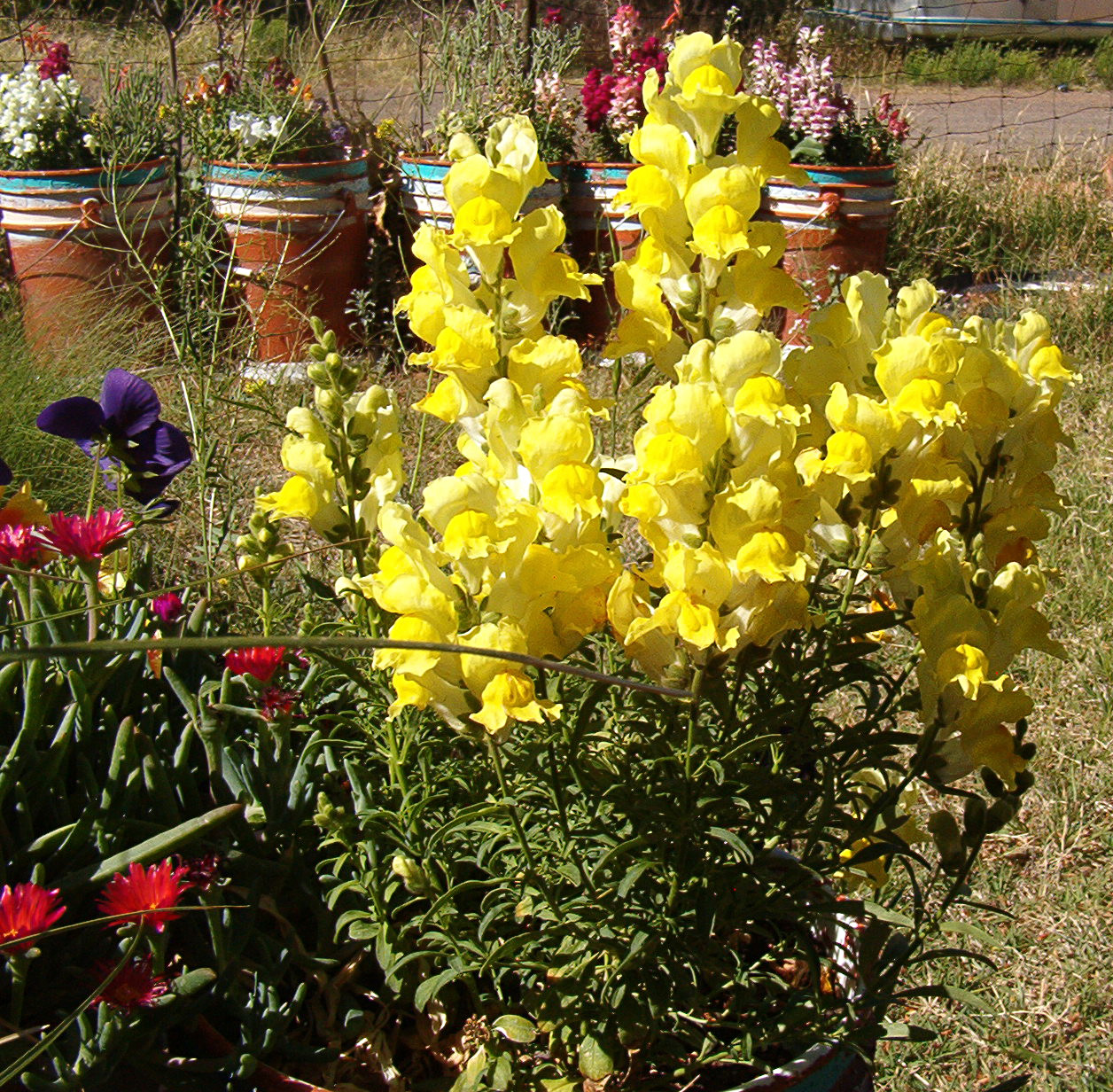
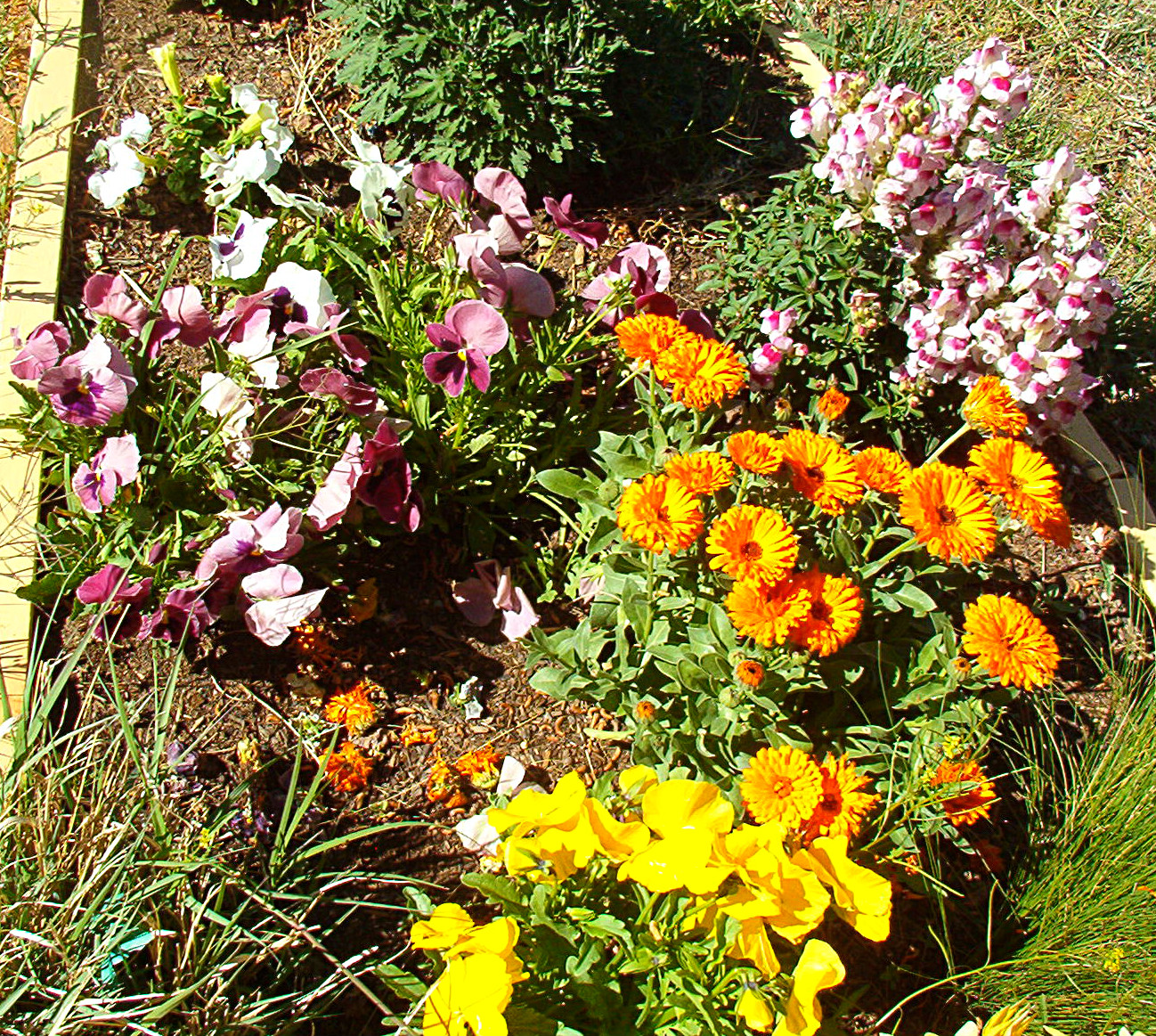
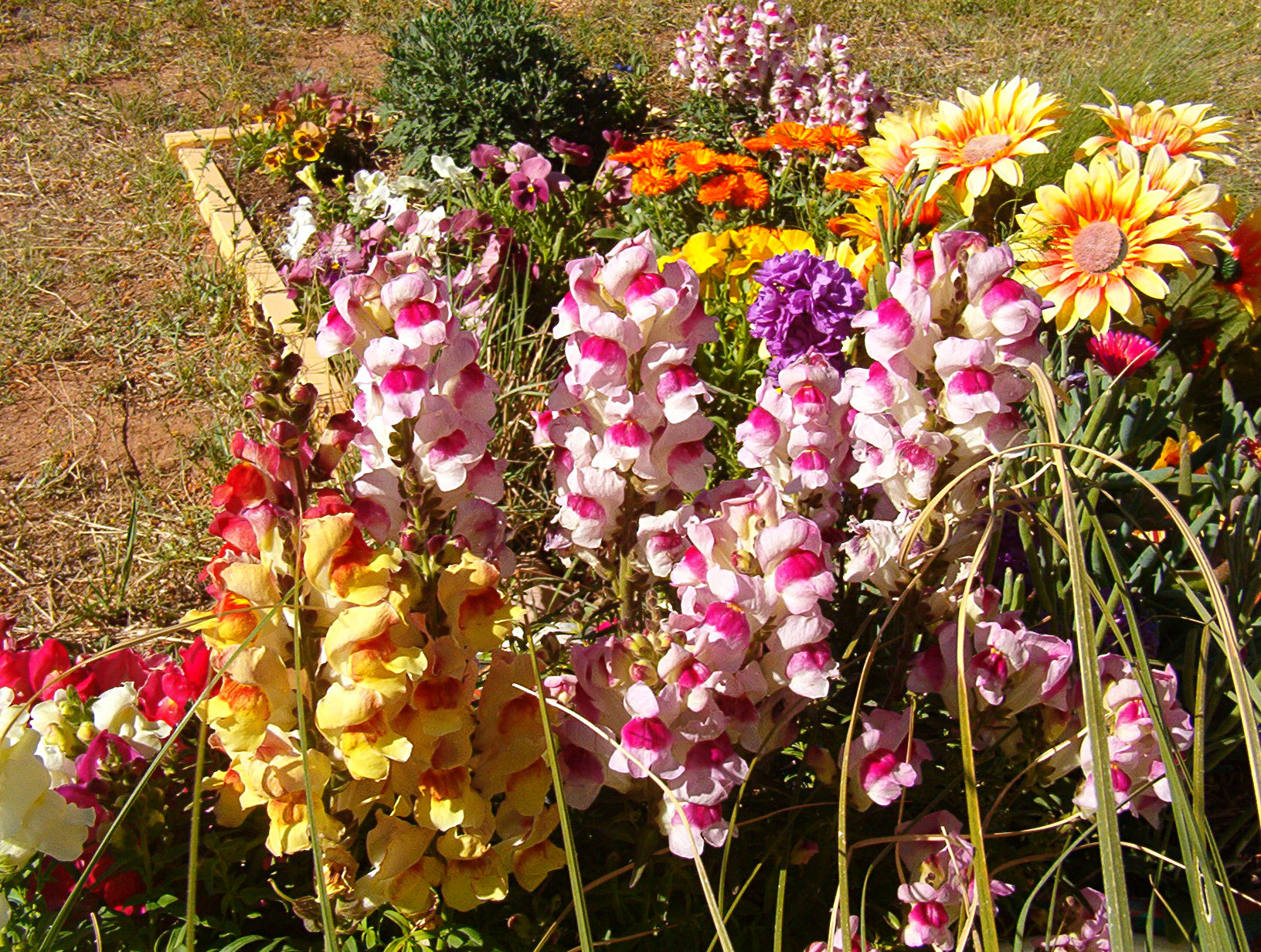
Here are a few pictures taken outside today.

Nothing fancy. Nothing spectacular. Just two flowers blooming in the dirt.
Flowers, themselves, are fragile, vulnerable and honest. They are beautiful and seem to me to express themselves in colors that are unique in this world to the flower kingdom.
Flowers are humble, pretend nothing, demand nothing, never intrude, are patient and willing to do one simple thing - bloom until they die. Afterward, when the seeds come, that is a good thing, also.
Coming from a world where I was the Chosen Child for terrible abuse, there was something RIGHT with the natural world that was missing in my mother's world of WRONG: Nature plays no favorites. Everything is equally in the mix together. All these flowers were equally blown in today's wind. They all receive the same sunshine, moonshine, starshine. Rained upon equally, live and die equally. None pulls rank. None abuses another. Everything makes perfect sense in THIS world - and I knew this from the earliest time of my life I can remember.
Fake, faded yellow flowers - spot them?
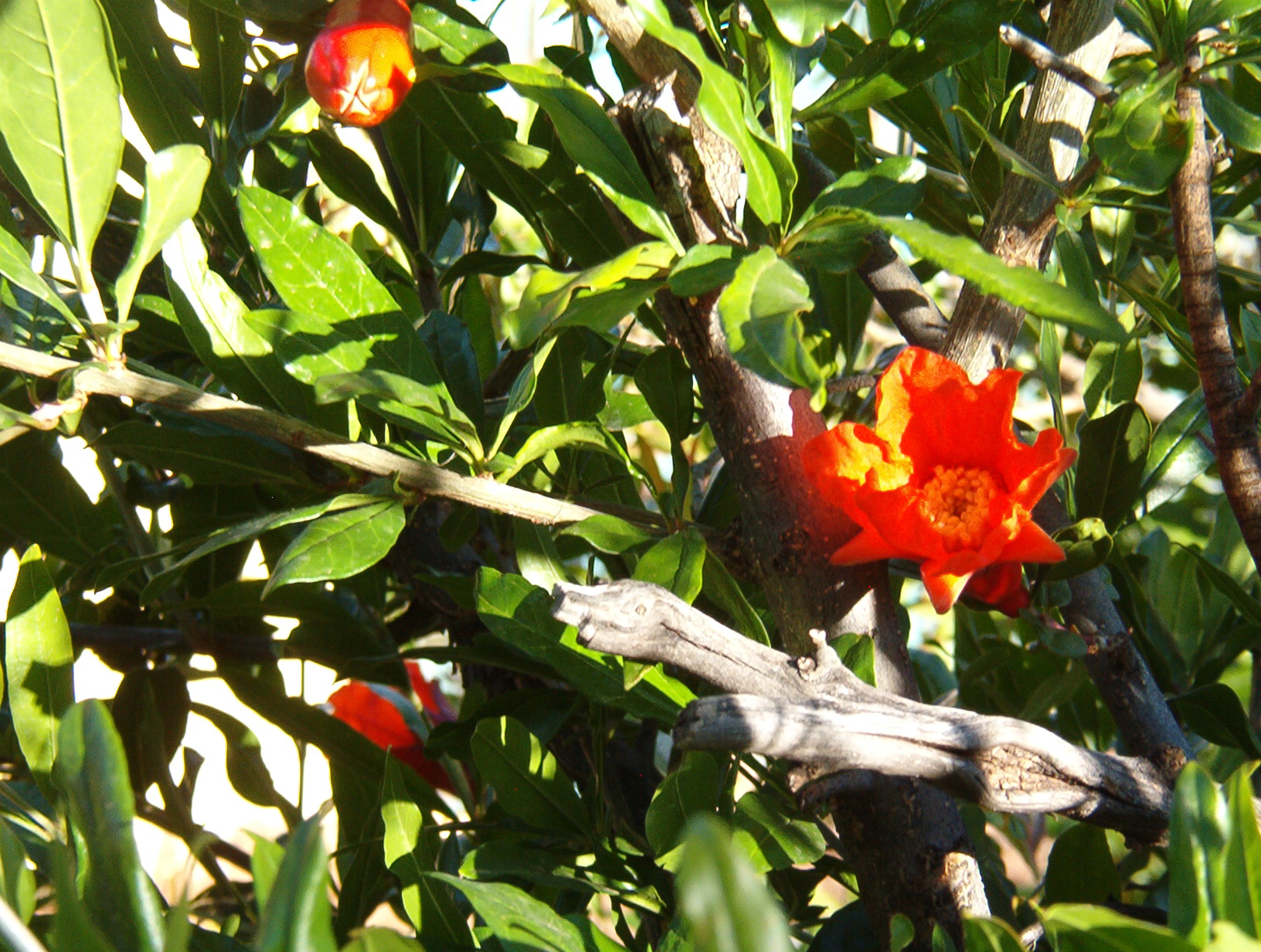
I am trying to resurrect the raggedy pomegranate tree in the back yard. This season it has five blossoms.
I remember the one pomegranate I ever held in my hands and ate as a child. Our school bus driver gave each of his riders one on the last day of school the year I was in 5th grade.
The pomegranate - figure of myth and legend - Persephone in the underworld, being tricked, eating its seed?
I remember a line from the movie I recently watched, "Local Color," about painters and painting. "Every time you see a color, if you look closely, you will see its complementary opposite." Red and green. Not hard to see here.

+++++++++++++++++++++++++++

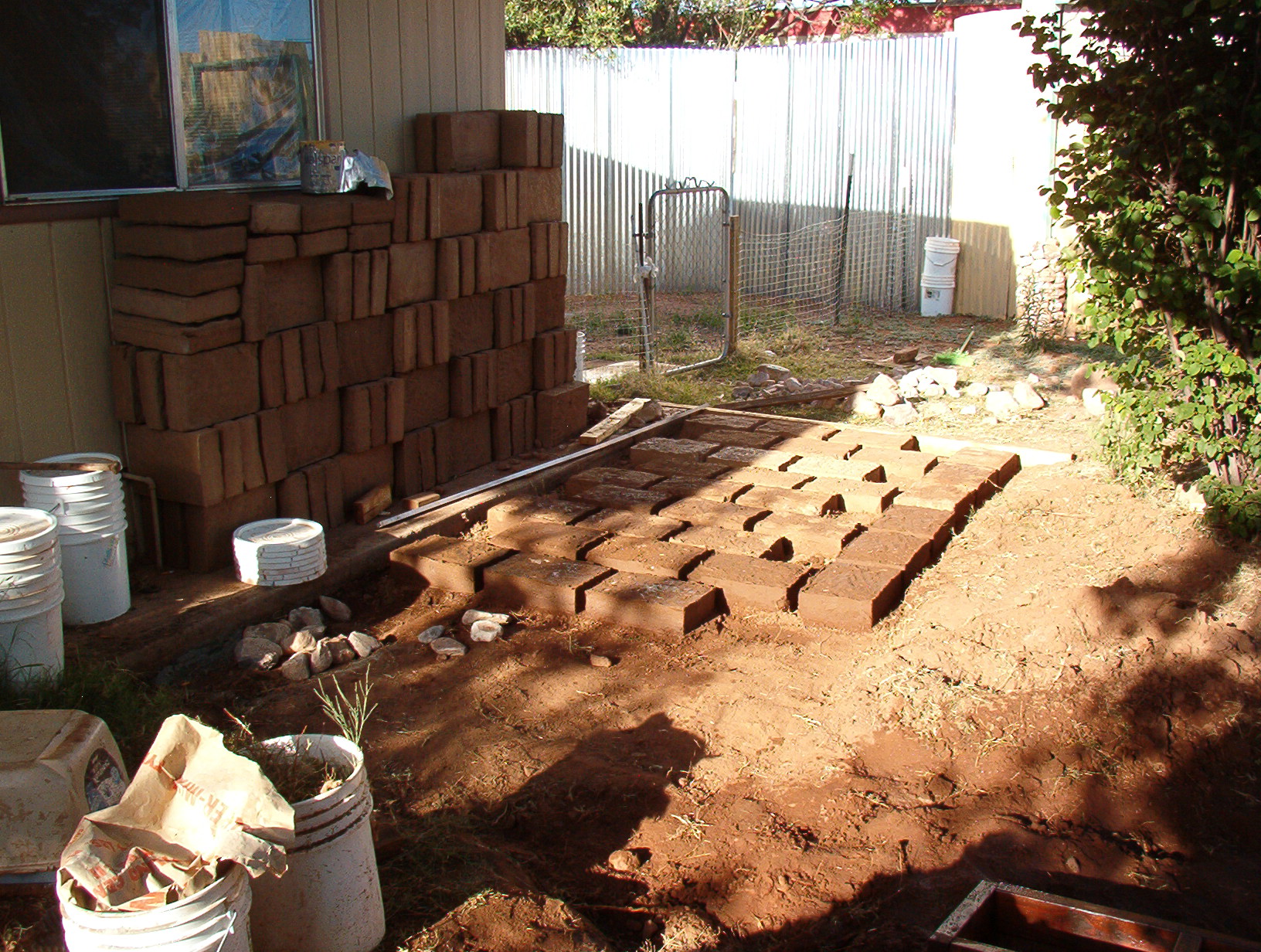
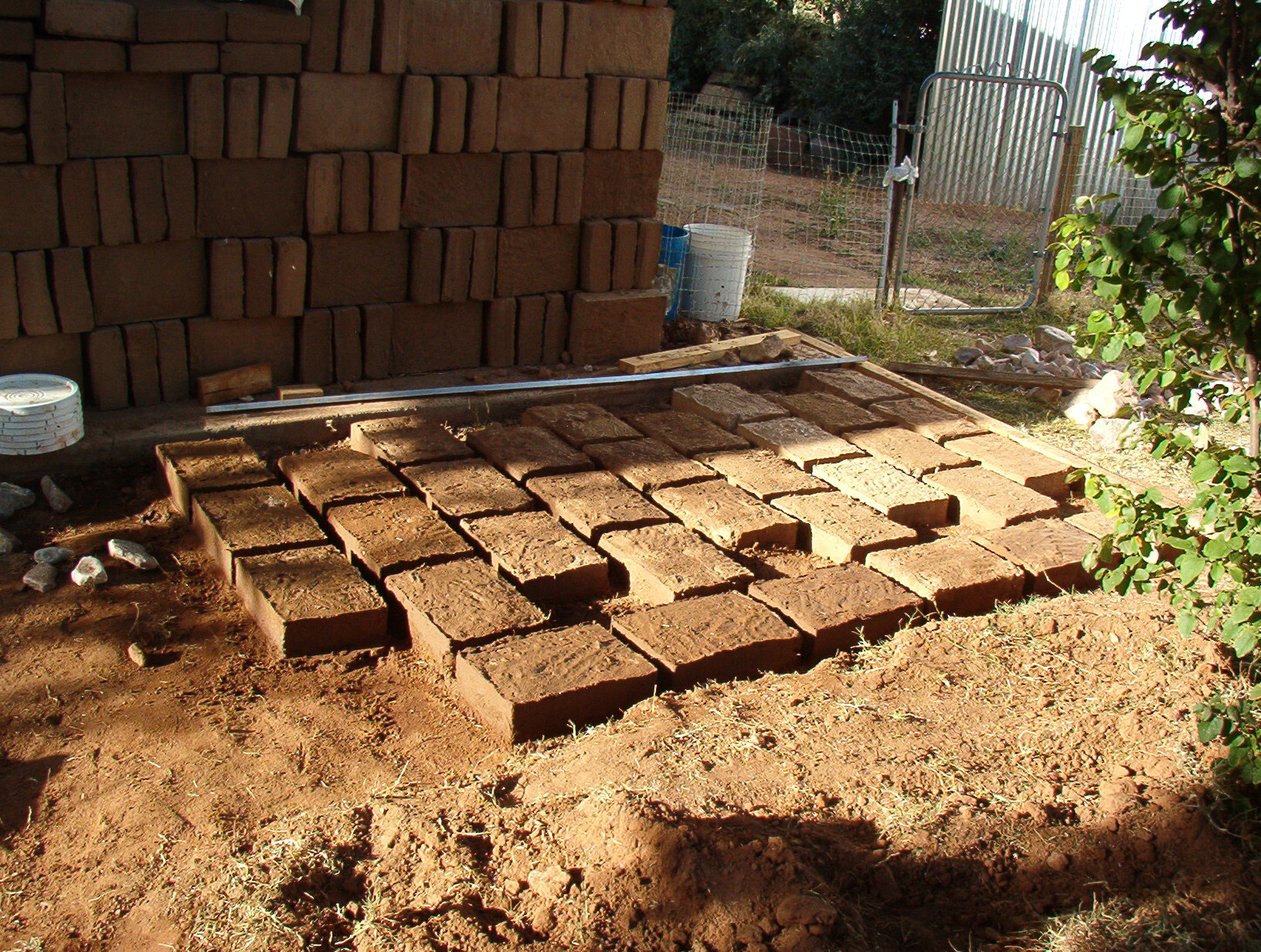
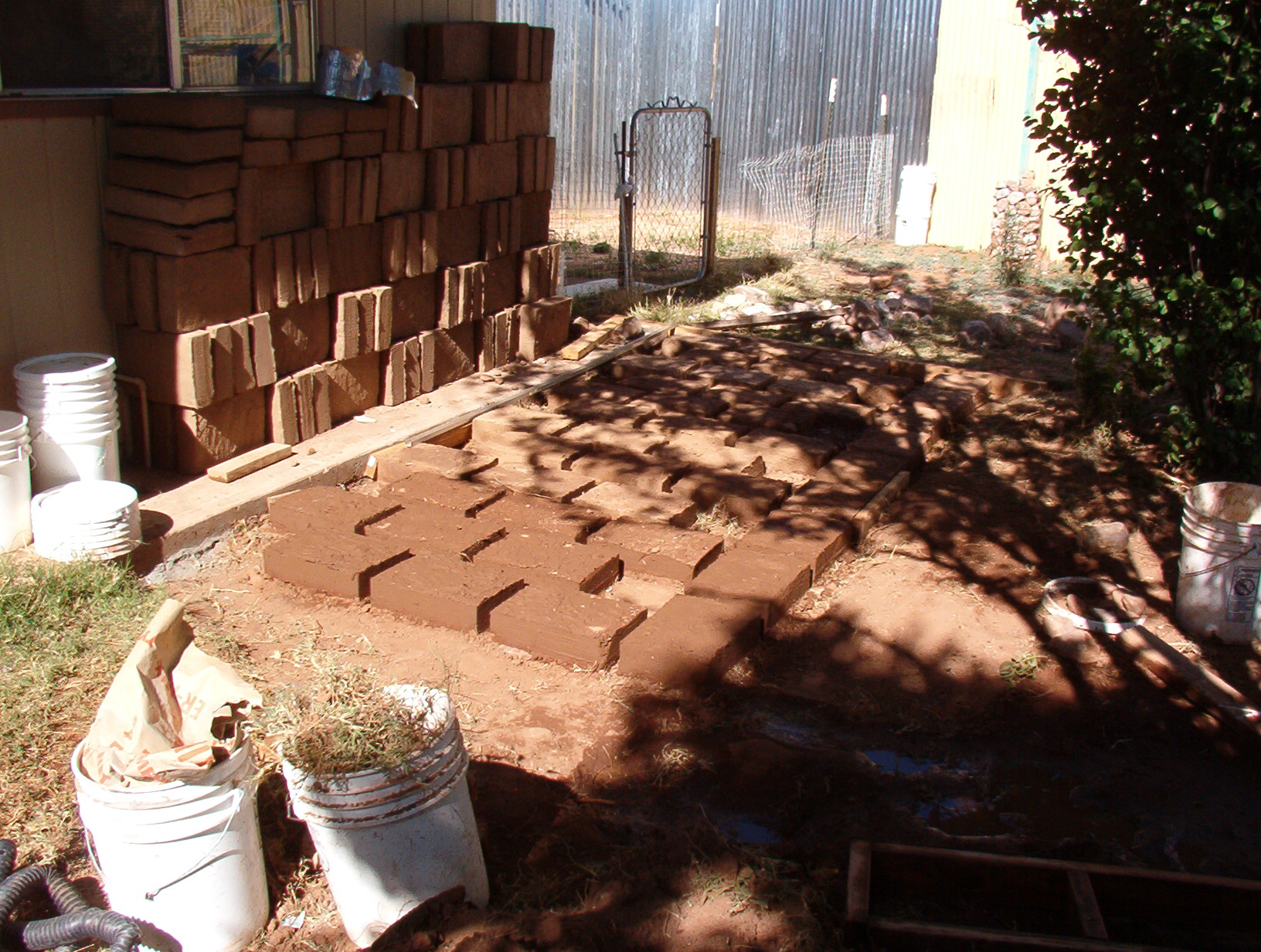
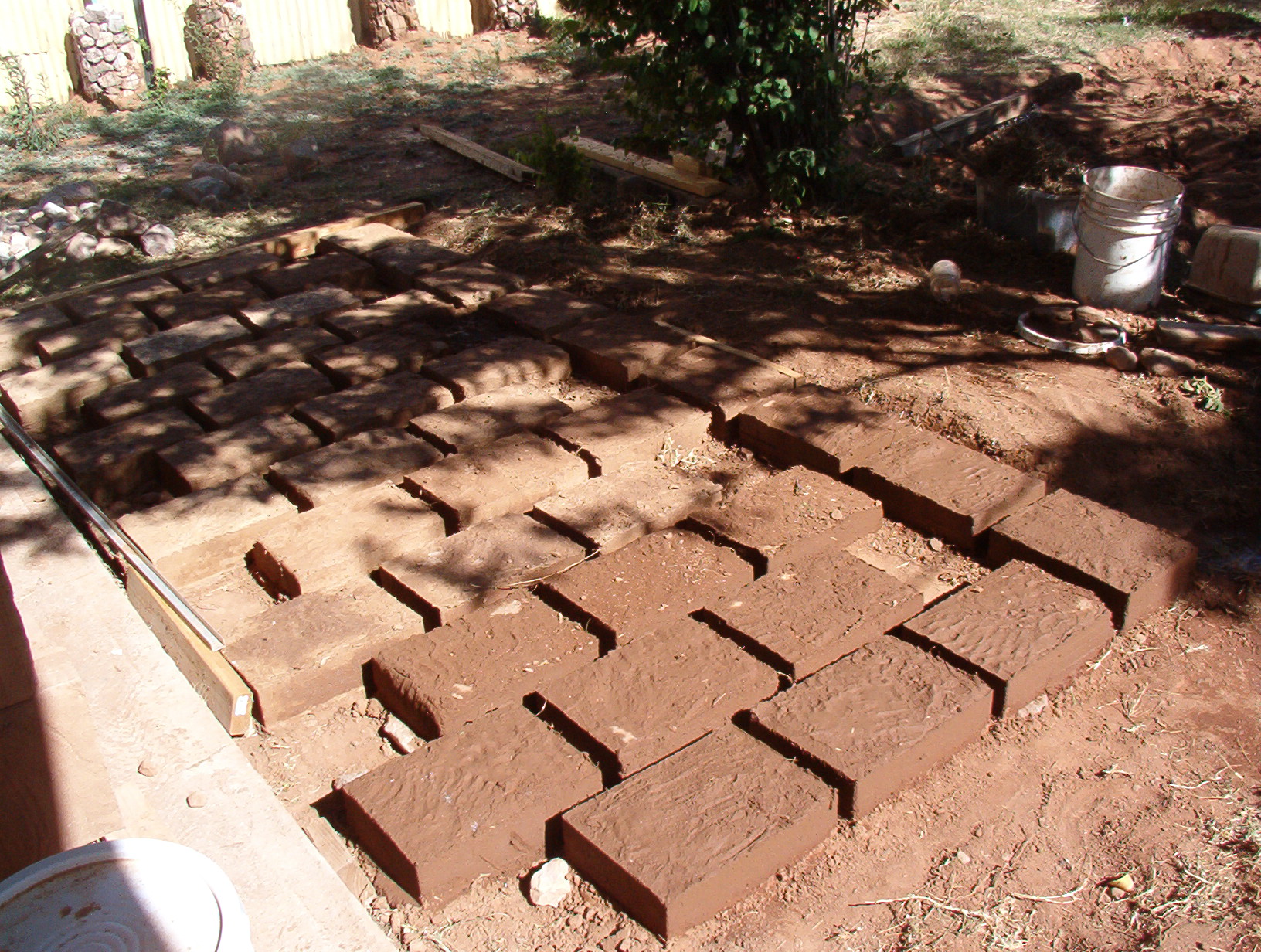
Here are a few pictures of the ongoing mud project behind my house:

Dirt grows (that's an empty pain can with flapping label on top of the bricks - to help keep my cats from leaping up there and knocking bricks down - or attacking my window screen)
Tuesday's work
Still Tuesday
Today
Various shades of dry
That's the little pomegranate tree back there. I am going to make a pathway heading in that direction.

+++++++++++++++++++++++++++

+THOUGHT SALAD: HAVING ‘THIS’ TO SAY ABOUT ‘THAT’

++++++++++++++++++++++++++++

I have been thinking about a commenter’s words yesterday to the post, *Age 36 – My May 10, 1988 Letter Disowning My Mother as it relates to ‘disclosure’:

I’m reading your stories and I’m amazed they are not triggering me. There are many similarities (my mother is bipolar and went off of her meds around 1975 because it embarrassed my father) in experiences, but the original abuses are a bit different.

This brought to mind the several posts I have written on DISCLOSURE:

The collection of this blog’s posts related to DISCLOSURE can be reached HERE, including —

+WRITING ABOUT OUR SEVERE EARLY TRAUMAS FROM THE INSIDE OUT

+SECURE AND INSECURE ATTACHMENT AND THE CHILDHOOD NARRATIVE

+HOW DO WE LIVE WELL WHEN WE HAVE TOO MUCH TRAUMA INFORMATION

+WE NEED NEW WORDS TO DIALOG WITH OUR BODY ABOUT TRAUMA

+LINKS TO TODAY’S PAGES ON DISSOCIATION AND DISCLOSURE

*THE ADVANTAGES OF DISCLOSURE

*FURTHER UNDERSTANDINGS ABOUT DISSOCIATION

+NOT INVITING IN THE FURIES

+EXCLUSIVE INTELLECTUAL PROPERTY OWNED BY SEVERE ABUSE SURVIVORS

+BEING CHEERFUL AND COURAGEOUS IN THE FACE OF A TERRIBLE REALITY

+A WORD ON TRAUMA TRIGGERS AND FALLING APART

+LINK to *THE DANGERS OF MEMORY RETRIEVAL

++++

I have had some feedback on the writing of my childhood stories that they need to be more detailed, contain more emotion, be more ‘real’.  This commenter’s words were affirming to me that perhaps MY way of writing is, well, MY way!  I will never write for the voyeur readers.  Nor is it my intention to so horrify and trigger traumatic memories in my readers that harm to them might follow.  My aim has always been to be kind to myself and kind to my readers while at the same time (hopefully) striking a beneficial balance between safety and disclosure.

++++++++++++++++++++++++++++

Posting links to posts from the past makes this post another ‘scavenger post’ – which got me to thinking about something else I found important in my studies:  The relationship between the ratio of adrenal gland to thyroid function in mammals as it corresponds to predator and prey status.

Human infants are born with an adrenal gland that is two-and-a-half times larger in proportion to their body weight than it will be when they reach adulthood.  This fact causes me to cringe at the thought of how devastating extreme stress and distress is to infants during their development because stress hormone overdose is a toxin to them.

We know how destructive stress hormones can be on the adult body (including what it does to the hippocampus brain region and memory) – it is almost unimaginable what these powerful hormones do to an infant-toddler and small child’s developing body-brain.

Thoughts about the posts at the links below came to me in relation to the idea of a ‘scavenger post’ because I now live where huge buzzards float above the earth searching for their meals.  During the years I lived north in Alaska and in northern Minnesota, eagles floated above me instead.

Both of these two birds are mentioned in the work referenced below.  Buzzards are thyroid-based creatures who do not hunt, while eagles are adrenal-based creatures that do.  If you haven’t already encountered these posts, perhaps you might find it helpful to scan through them now:

+BELOW THE SURFACE – THE CONNECTION BETWEEN SEVERE EARLY CHILD ABUSE, EAGLES AND BUZZARDS

+TOMKINS ON EVOLUTION OF AFFECT

*EVOLUTION OF AFFECT

+TOMKINS ON AFFECT

Related posts:

+EARLY CHILDHOOD ADVERSE EXPERIENCES

WELL-BEING

*ADVERSIVE CHILDHOODS (notes from chapter 4)

*ATTACHMENT (chapter 5 notes)

*Trauma Recovery – notes on Waking the Tiger

+OUR STRESS RESPONSE IS WHAT WE PASS DOWN TO OUR KIDS

+CALM THE CRYING BABY — IMMUNE SYSTEM STIMULATES VAGUS NERVE TRAUMA ALTERED DEVELOPMENT

+TO BE OR NOT TO BE A TRAUMA-CHANGED HUMAN — THE QUALITY OF MOTHERING HOLDS THE ABSOLUTE KEY

+RISK, STRESS AND DISTRESS

+SCHORE ON BRAIN AND NERVOUS SYSTEM DEVELOPMENT

+SCHORE ON DISSOCIATION

++SCHORE ON ENERGY SYSTEMS

*Endocannabinoids, Digestion, Food Intake, Energy Balance

*Endocannabinoid System, Fear and Anxiety

*Endocannabinoids, Pain, Depression and Grief

*Endocannabinoid Protection and Regulation

+ARE YOU A ‘SENSITIVE?’

+WHEN ABUSIVE PARENTS STEAL THEIR CHILD’S THUNDER

++++

More of these related posts can be found by continuing to search through this blog HERE (past the links you see posted here today)

++

Just a note:  There’s a Buzzard Tree in Old Bisbee where hundreds of buzzards roost every night.  Near sunset the skies are filled with these giant, peaceful, slowly soaring birds.  A few years ago the city council wanted to destroy that giant tree because they said all the buzzard droppings are a health hazard!  Old Bisbee-ites would have nothing to do with this idea, and arose en masse in protection of their friends and this ancient cottonwood the buzzards have chosen for their summertime home.

++++++++++++++++++++++++++++

These related posts can be found by continuing to search through this blog HERE (past the links you see posted here today)

+THE SPIDER, THE LIZARD, AND ‘DEAD’ MOTHERS

++++++++++++++++++++++++++++++++++

I watched a spider scampering across the stubby lawn grass this morning as I sat in the shade drinking my coffee.  Somehow, and this puzzled me, this spider noticed I was near even though it was a good six feet away from me.  It froze in place at the edge of the dirt pathway it was about to cross, and it stayed there completely still.

I wondered how the spider knew of my presence.  I, too, froze and was careful not to move a muscle, but my stillness did not fool that little beast.  I watched and I watched to see how long it would take before the spider determined I was no threat, but my attention wandered away from watching the spider without me even noticing.  The next I knew, the next I looked, the spider was gone.

Most spiders in the southwest are harmless to mammals as I imagine this one was.  The ones to pay most attention to are either obvious as the Black Widows are with their masses of obvious, very messy webs, or the ones that hide in quiet, untouched places like the Brown Recluse.  Spiders that cross open ground in the daylight are probably not dangerous.  But, even so, how do I know for certain when I meet a spider who is prey and who is predator?

A few moments after noticing the spider had vanished, the form of a little lizard, also seeming frozen near me on the dirt caught my eye.  “Go away, little one,” I said to it.  I was thinking that it might be intent on heading toward the single step that rises to the back door, and as nice as it is to have these bug eating reptiles running around in the yard, I certainly don’t like the idea of one surprising me under foot inside my house, or popping out from under the appliances in the kitchen.

I tossed a pebble in the direction of the lizard thinking I could startle it into movement along with a change in its direction.  The lizard didn’t move.  One of its tiny front feet was placed in front of its body.  The other one was bent with the foot behind the lizard’s shoulder.  Again, frozen in place, the lizard seemed to be in its survival-based state of visual suspended animation.

As I moved toward the lizard, thinking I could scare it away with my hand movement, I noticed its tail.  Nature designs lizards, as you probably know, with a detachable and re-growable tail with the hopes that a tail catch by a predator will leave the lizard free to run away.  This one’s tail was half gone and all dried up, which seemed most strange to me.  I didn’t ‘get it’ until I actually touched the lizard and realized he was entirely all dried up and – well – completely D-E-A-D.

++++

I guess I have an enquiring mind that feeds on the obvious as I try to understand the mysteries of my infant-childhood.  It’s not that I particularly CARE about my mother, or even about the details of the horrific abuse she perpetrated against me.  What I care about is having a body-brain that cannot keep me in the mainstream of life, that leaves me nestled in the safest place I can find (my home) without the physical, mental or emotional stamina, resources, or resiliency to be able to handle anything like a social demand or a stressful situation.  Those dis-abilities, I know, stem directly from how my body-brain developed under the constant trauma of living as my mother’s daughter.

So as soon as I knew the lizard was dead (and had been for some time), my next thought after, “I wish my cats would leave these poor little lizards alone, but cats will be cats,” was “Well, if that isn’t just like my relationship with my mother!”

My mother.  The truth is I never had a mother.  I might have imagined that woman was my mother, but she was as dead to me as a mother as this dried up, petrifying lizard IS dead.  My mother was dead to me as a mother from the first breath of air I ever consumed.

My mother could no more mother me than this lizard can ever move its tiny legs and go off for another bug.

As for the frozen spider obviously afraid of me:  If something as small as that spider could detect threat to its life from me, how could I not have known from the moment I was born that my mother was a threat to me and to my life?

But my mother never lost interest in paying attention to her prey, me.  Her mind and her attention never wandered off to other things so that I could somehow escape and go on with my business of being an infant, a toddler, a child, a teen.

When a woman who is SUPPOSED to be one’s mother is instead a predatory monster, the laws and by-laws of the natural order of life are obviously turned up-side-down.  There are very real physiological developmental consequences to having a monster for a mother, as infant-child abuse and trauma survivors well know.

++++

This brings me to the point of needing to speak about the ‘hidden monster’ mothers.  These neglectful, abusive and traumatizing mothers might SEEM to be the real thing.  They might SEEM to be living, breathing lizards.  The trick is to identify when these mothers are/were as inadequate as my mother was – and just as dead to their position of being a mother.

The information I posted yesterday about Borderline Personality Disorder as it may or may not be tied in its origins to early abuse, bothers me”

++

From Kristalyn Salters-Pedneault, PhD, your Guide to Borderline Personality Disorder

Child Abuse and BPD– Understanding the Link

– “Parents of BPD teens and adults often ask why their child has the disorder, and sometimes feel blamed for their child’s symptoms. Yes, sometimes BPD is caused by child maltreatment, but that isn’t the full story– parents are not always to blame.”

++

In thinking about my mother’s early years as her mother’s daughter, even though NOBODY in the family would have EVER dared to suggest that my mother was abused, I KNOW in my mind and in my heart of hearts that she was.  Leaving a tiny infant alone in a crib crying and not being heard or responded to is abuse.  Not loving an infant enough to cuddle it, coo to it, talk to it, and glow with joy over the infant’s existence is abuse.  Propping a bottle and disappearing is abuse.

My grandmother relied on the ‘main-nanny’ to care for her newborn daughter.  Throughout the years of my mother’s childhood the patterns of abuse and neglect reappeared in many stories my mother told us, though she never put the two-plus-two together and arrived at that conclusion that she had been abused.

So when someone like Salters-Pedneault throws out that ‘life line’ of sustaining the illusion that no abuse ever occurred in certain Borderline’s early life, I listen in the same way I look at a petrifying dead lizard.  I could wish all I want that little lizard was still alive, but that IS NOT going to happen.  I can pretend my mother was a living, breathing mother to me, but she wasn’t.  I can imagine that my grandmother was a true mother to my mother, but she wasn’t.

“Dead lizards tell no tales.”  (This dead lizard barely had anything left of its tail.)  Dead is dead, and my mother was as dead to me as a mother as any woman could be short of performing the act of completing murder.  Mrs. Lloyd shared her genes with me and incubated me.  That’s the extent of her mothering contribution.  What she did after that belongs in the category of PREDATORY terrorism, not mothering.  It took me far too long to figure this out.

++++++++++++++++++++++++++++++++++