+A WORD TO THE WISE – – – –

++++++++++++++++++++++++++++++++

Check out this NOVA PBS video on EPIGENETICS.  The epigenetic process is one of the ways that early infant-childhood stress, abuse and trauma changes the way our body-brain develops and can affect how our DNA information is ‘transcribed’ into action for the rest of our lives.

++++++++++++++++++++++++++++++++

A word to the wise from

Prevent Child Abuse New York Blog


The Costs of Disinvestment: Why States Can’t Afford to Cut Smart Early Childhood Programs

As New York and other states continue to struggle with budget shortfalls that have placed programs that focus on early childhood on the chopping block, we’d like to mention a recent issue brief from the Partnership for American’s Economic Success (PAES), part of the Pew Center on the States.   The brief offers policymakers a succinct argument for maintaining and even increasing investments in early childhood as a strategy for smart budgeting during the economic downturn.  PAES highlights the demonstrated economic gains in both the short term and the long term of supporting early childhood investments with solid examples from states.

Quite simply, children are our future.  Investing in their success is perhaps the best way to guarantee future prosperity.  Budget cuts that deprive children of a strong developmental start mean society and taxpayers lose too.

Effective pre-k programs reduce costly grade retention and special education services.  Each child that is held back a grade costs the state $16,000 per year.

Better-prepared pre-k graduates make kindergarten teachers more effective, which reduces costs because ready learners have a tendency to reduce teacher turnover, as well as enabling the whole class to learn more and progress more quickly.

Programs that start children on the path to successful adulthood—such as early education and parent support/home visiting—spur the workforce development in multiple ways.

Read “The Cost of State Disinvestment: Why states Can’t Afford to Cut Smart Early Childhood Programs.”

++++++++++++++++++++++++++++++++

+NOTHING LIKE A MONDAY MORNING ‘HODGE-PODGE’ POST

+++++++++++++++++++++++++

This is a sort of ‘scavenger’ post.  I’ve been thinking about a comment left yesterday, and I wanted to make sure these links were easy to spot in case there might be something in here that might interest/assist!

Considering the fact that our body is a link in a generational and genetic chain, the more we can learn about how the actual circumstances of our individual life affects how our genetic code manifests itself throughout our lifetime, the more we can learn about both the specifics and the overall picture of where we came from and how the history of our species affects us now.

Understanding how our circumstances affect how our genetic code manifests itself through epigenetic processes helps us expand the range of our vision about our self and about our family.

See this blog’s posts:

+ EPIGENETICS

We can think of a load-bearing wall in a house and understand that if that wall is removed without special attention being first made as to how the load that wall is carrying can be handled in some other way the house can collapse.  Our body carries the load of all the combined debits and credits combined.  Learning how the circumstances of our life affect how our body handles the load of our life involves an understanding of what is called allostasis and allostatic load.

See this blog’s posts:

+ ALLOSTASIS AND ALLOSTATIC LOAD

Two other links of interest:

+ Other posts on the vagus nerve

+ DIGESTIVE SYSTEM

See also:  +IS MENTAL ILLNESS THE COST OF OUR SPECIES’ GREATEST GIFTS?

+++++++++++++++++++++++++

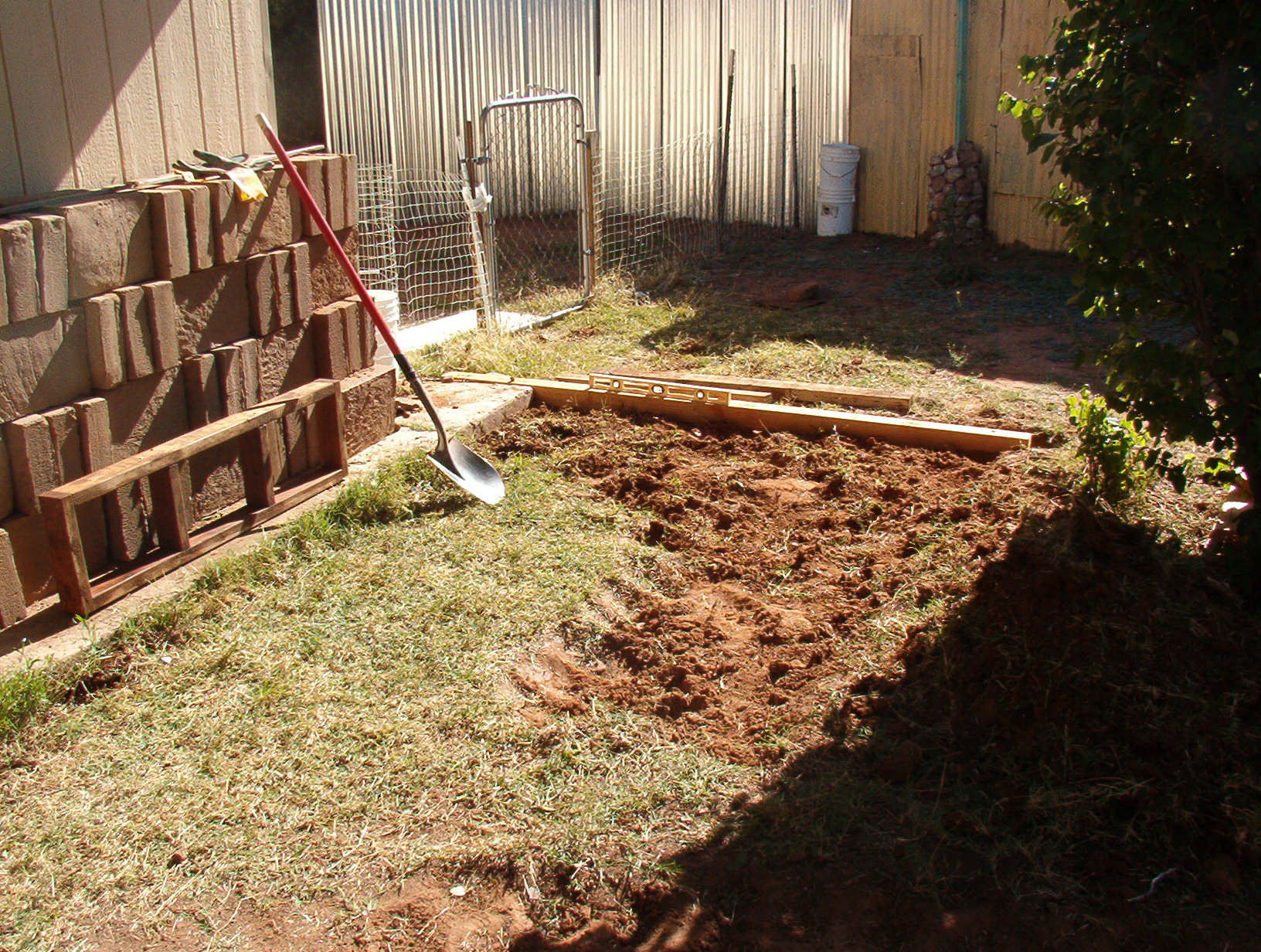
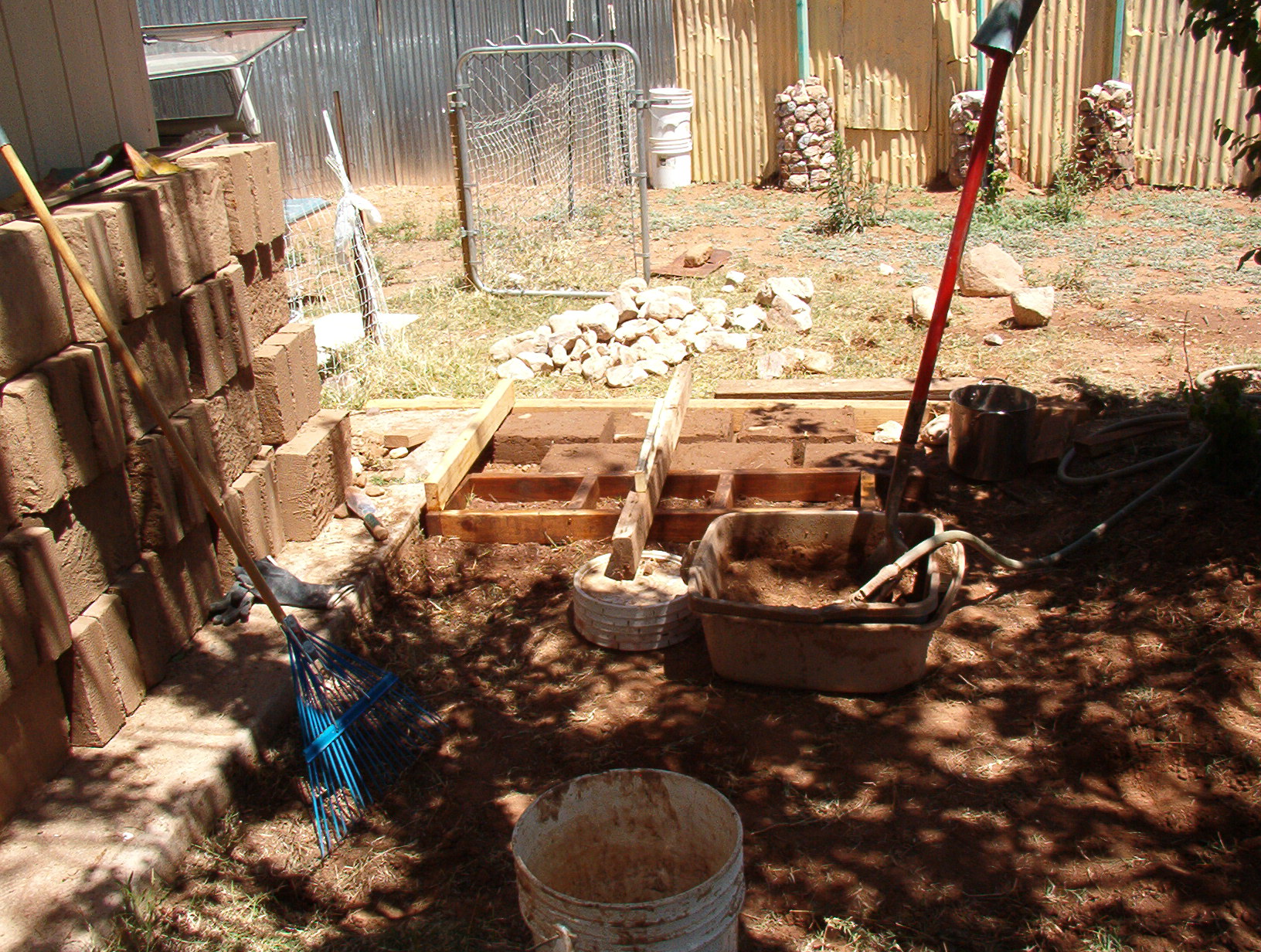
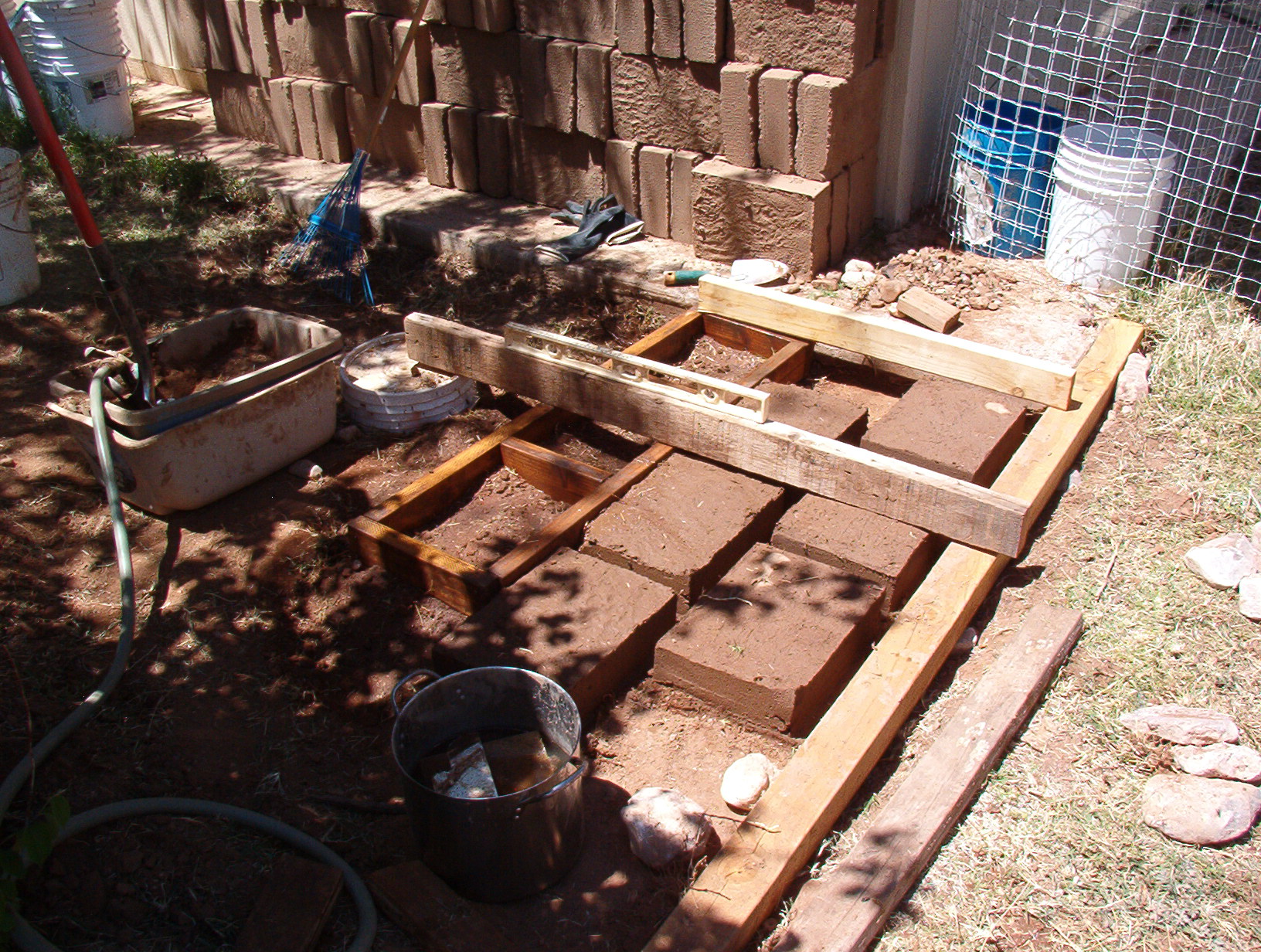
Here are a few pictures of my current mud project.  I want to direct the rain water coming off my south roof line away from the house’s foundation.  Eventually I want to grade the back yard so that the water ends up where I want it:  On the plants and trees!

Years of water pounding down along the sidewalk edge have lowered the soil there so far rain water cannot escape and run into the yard. I need to change that grade and direct the water flow - before the summer monsoon rains come (usually in July). The slope I need is 1/4 inch per foot down away from the house, and level across the width - my civil engineering father would probably cringe if he saw the way I do things!
I had to go collect some rocks from nearby roadsides for this project. The rocks are embedded into the adobes. I find I don't care if I see the stones or not, but suspect that eventually wear on the adobes will expose them. Certainly the stones (and increased cement in my mud mix) will aid in survival of my adobes under the pressures of running water over time.
It's always hard for me to be linear enough (left-brained?) to level anything! It just happens that directing the water requires that I pay at least SOME attention to which way 'what' is going!

I figure it will take several days before the blocks are dry enough that I can go back and fill the cracks - with cement-mud and gravel/small stones.
I don't know the technical name for this species of aloe, but they survive winters and go 'native' - this is what they look like blooming (my neighbor's trailer was put there the day they moved in 3 years ago - has never moved - and I doubt it ever will in my lifetime!)

+++++++++++++++++++++++++

IN MEMORY OF MY BORDERLINE MOTHER:

From Kristalyn Salters-Pedneault, PhD, your Guide to Borderline Personality Disorder

What’s the link between child abuse and BPD? We do know that people with BPD endorse child abuse at a much higher rate than the general population, but does that mean the BPD is caused by abuse?

Child Abuse and BPD– Understanding the Link

Parents of BPD teens and adults often ask why their child has the disorder, and sometimes feel blamed for their child’s symptoms. Yes, sometimes BPD is caused by child maltreatment, but that isn’t the full story– parents are not always to blame.
What is ‘Abusive’ Behavior?

When we talk about child abuse, what exactly do we mean? Learn more about child abuse and maltreatment.
Building a Meaningful Life- Where to Start?

Do you need help finding meaning in your life? Many people with borderline personality disorder (BPD) struggle with feelings of emptiness, identity problems, and depressed mood. Together, the symptoms of BPD can leave you searching for meaning in your life.
This Week’s How-To — Grounding Exercises

Grounding exercises are designed to help you focus your attention on the present moment. They are helpful whenever you are having an experience that is overwhelming, or that is absorbing all of your attention. Grounding exercises are meant to “snap you back into reality” relatively quickly.

Must Reads

What is BPD?
Symptoms of BPD
Diagnosis of BPD
Treatment of BPD
Living with BPD

+++++++++++++++++++++++++

+WHERE IS MY REFLECTIVE POOL OF SELF?

++++++++++++++++++++++++++

I woke up thinking with my brain-mind-soul-self about an opposite condition – if it exists – to Narcissistic Personality Disorder.

Actually, I was wondering.  I didn’t wonder for my first 18 years, either – so I actually think being able to wonder is a gift.

I keep seeing images from movies of situations (sci-fi) in space where ‘life support failure’ means the oxygen in the environment is going to run out.  Who would last longer, a big person who needs to breathe a lot or a little person who needs to breathe less oxygen?

An infant-child is a captive of its early environment.  It is contained in the space with its earliest caregivers and cannot escape or do anything, really, to improve what might be terrible conditions it is living in.  If there is ‘limited life support’, which person is going to get the most and leave whom without, the parent or the child?

If a little person and a big person were both approaching a Black Hole, or if one just suddenly appeared in front of them some distance away, but both are within the gravitational pull-field of the Hole, who would get sucked in first and fastest, the big or the little one?

If a big person and a much smaller person were wandering lost, thirsty without water, and came upon a little clear pool, and were both kneeling on the moist soil at the edge of the pool, bending to take a drink, who would get to the water first and drink the most?

What if this pool is one meant for gaining a ‘narcissistic psychological’ view of one’s self?  What if the big person shoved the little one away?  If I imagine that there’s only enough room on the surface of the pool for only one to get a clear view of their own self reflection there, might only the big one get that clear reflective (mirroring) look?

Yes, in all of these conditions, I can imagine the big person being the hog while the little person does without.  It is nice in environments free from scarcity and trauma when everyone can get what they need.  Yet because I was raised by my Borderline mother, it isn’t hard for me at all to imagine my mother, as the big person, consuming everything she felt that she needed (certainly psychologically) while leaving her children with scraps.

It is much harder for me to imagine what these situations might be like if a mother would self-sacrifice her own self for the benefit of her child.  Is this what nature would want to happen if push came to shove and only one of a ‘big person-little person’ pair (dyad) could survive?  What would evolution say about survival then?

Would Nature determine that the big person mother take what she needed so she could survive and reproduce soon again if and when the environment became less malevolent rather than influencing survival in the direction of the little dependent one who still had so very far to go before it could reproduce?

++++

I don’t want these thoughts and wonderings to fade away as my dreams from last night certainly have already done that spawned these ponderings, yet all I can do is string out these words that seem connected to whatever it was I was processing while I slept and before I woke up this morning.

All I can guess is that my ‘topic’ might be related to mothers who see their own more complete self reflected only in the faces and in the lives and in the presence of their children long after this mother’s solid sense of self COULD have been formed within her under better circumstances from the time she was very, very young herself.

It’s too early in the day for my thinking to be able to get as complicated as it would need to be in order for me to follow my own train of thought past this point.  I lose my own bread-crumb trail through the forest.  All I know is that there are varying conditions where physical deprivation related to supplies of air, water and food can occur in families.  I spoke with a woman in her 60s yesterday whose WWII PTSD alcoholic father consumed most of his income and often left his wife and children hungry during her childhood with no food in the house whatsoever.  This woman built into herself an ongoing, continual concern for her own children that they (and herself) NEVER have a house empty of food.  As this woman told me, “I always made sure there was baking powder, flour and beans in the house.  Then I always knew I could make something for us to eat.”

But what if the scarcity is more invisible?  What if the deprivation is primarily ‘psychological’ like it was in my childhood home?  What if infant-children’s needs to have their little growing self reflected back to them so they can claim it for their own never happens because their parent is consumed with trying to find their own reflection?

Such a parent is psychologically starving to death in their own need to locate and claim their OWN fully formed self.  They not only have little or nothing left over to offer their offspring personally because they are so depleted, they also steal away their children’s opportunities to use vital resources themselves.

++++

So, this leaves me thinking about ‘anti-narcissism’ as it might ‘psychologically’ exist like anti-matter.  If the parents of these anti-matter children cannot help their own children to MATTER, what choice do the children have but to be in a deprivation-of-a-fully-formed-own-self into their adulthood?  Offspring of incompletely-built-self parents were never given the chance to form their own self, either, and on down the generations the scarcity and deprivation-based patterns tumble.

I can’t think my way out far enough away from the Black Hole of the Personality Disorder spectrum to imagine under what conditions an anti-narcissism state of being does not exist in some way within every single one of the Personality Disorders.

As I ponder this morning about a state of ‘anti-narcissism’ I cannot imagine that there is any self-love involved in the process of having to perpetually search for the reflection of an unformed self.  Particularly infants and very young children are SUPPOSED to search for the reflections of their own self being mirrored back to them from others in their beginning of their lives.  What the little ones find mirrored back to them (or not) gets built particularly into the way their brain will operate for the rest of their lives (along with the brain’s connection to all aspects of their body, nervous and immune system).

To NOT have one’s self appropriately and adequately mirrored back leaves a person in a state of ‘unfinished business’ so that the search for self, through mirrored reflection from outside of the self, simply continues on and on and on and on…..

‘Anti-narcissism’  seems to be like a state of hanging around in life in limbo, like in a state of anti-gravity where a person can never completely come into their own body and live their own life from a position of FELT CERTAINTY that they exist as a whole-self person at all.  Developmental neuroscientist, Dr. Daniel Siegel, addresses the ‘problems’ from one point of view:  That a person’s self is always meant to be in a state of flexible, resilient adaptation.

But I believe the first steps of forming a strong, clear sense of self in relationship to others and to the world must be taken correctly for this adaptive, cohesive, coherent self to ever appear at all.  If those first steps cannot be taken, if the new self cannot be reflected back to the ‘new one’ through a mirroring process that includes required information being sent to the ‘new one’ very early in its life, the adaptive whole self simply never takes form, and the searching continues for this whole self that lasts for a lifetime.

++++

If I am using people, situations and circumstances in my life to see my own partially-formed self reflected back to me, what happens to ME when these reflecting ‘surfaces’ change?  If having a WHOLE self means that I am flexible, resilient and adaptive, and if I KNOW I don’t have one of these whole selves, then by definition I am at risk for suffering greatly if the external conditions of my life (that I am dependent upon to shine aspects of my self back to me) change.

Life is about change.  In fact, to me, LIFE IS CHANGE.  Being alive is a guarantee that change is constantly happening.  My suffering happens when I cannot do what a whole self is designed to do – flexibly, resiliently and adaptively adjust to change.

Our capacity to control our ‘reflective surfaces’, be they people, situations or circumstances, is limited.  Those of us who were deprived of the air, water and food we needed ‘psychologically’ to build our whole self in our earliest life, are left feeling disoriented and disorganized, if not overwhelmingly desperate when change leaves us in a void without the ‘reflective surfaces’ we need for our survival.

My guess is that one of the meanest consequences of growing up with ‘mentally ill’ if not truly abusive parents is that we are at extremely high risk for painful disequilibrium to take over our self and our life when life changes take away from us whatever ‘reflective surface’ we rely upon to recognize important parts of our own self.  We are left like a flying kite with a severed string, a bobbing balloon untied and left to the whims of the wind.  We are like an unanchored ship without a rudder tossed around in a raging storm far out at sea, or like a small or giant tree without roots that falls to the earth unable to stand.

One way or the other a human being needs to be tethered inside of their own self to their own whole self.  Even in cultures where the definition of a self means the self is more closely formed in social relationship and less defined by autonomous action, a self that is not tethered will suffer from change that threatens its organization and orientation in a body in the world.

++++

The ongoing processes of life do not stop and wait for any individual to form a whole self.  We are given our infant-childhoods for this job to be mostly completed.  Some attachment experts call this whole self ‘the autonomous self’.  Whatever words we use to culturally describe this whole self, it is the one that possesses what it needs to successfully adapt and adjust itself throughout the changes life brings.

Various self-states of being that exist along the narcissism /anti-narcissism spectrum simply reflect degrees of lack of wholeness that affect a person’s ability to flexibly, resiliently and adaptively adjust to change with a minimal reliance on outside ‘reflective-surfaces’ – or mirrors for the self.

I am one of the dependent searchers.  My inner well-being state right now is completely dependent on where I live.  I am dependent for my safety and security on this house I reside in, on my yard I can grow things in, on the small circle of people I know that care about me.  Any thought of change to my circumstances right now completely threatens to destabilize me.

But I have a huge advantage over what my mother had.  I KNOW this about myself.  I am uncomfortably conscious of my current internal limitations in the same way I am painfully aware of my financial and material limitations.

At the same time I am also aware that the way my mother consumed ‘psychological’ air, water, food and all other resources she could get a hold of in my infancy-childhood left me without all the inner whole self structures that would now let me be more complete and whole myself.  I greatly struggle with my own dis-abilities to live my life as a flexible, resilient and adaptive-to-change person.

This all leaves me today as a high risk for upset person.  I struggle every moment of my life to nurture, feed, strengthen and grow my own root connection to my own authentic, autonomous, whole self so that my own self can be stronger and not be so shakily dependent upon outside conditions and circumstances for its sense of well-being.

Where does the concept of ‘self love’ or ‘love of one’s own reflection’ even enter this picture I am painting in words here this morning?  If one has been left from the origins of their being in a state of searching for one’s self in the reflections we get back from the world around us that might tell us we even exist at all, we can only guess at what it would FEEL like and BE like to know entirely that we even are a self in the first place.

“I feel, therefore I am.”  “I do, therefore I am.”  “I think, therefore I am.”  These are stages of development that we go through from the time we are born.  All of these states of self-development, if accomplished adequately and successfully, most likely lead to this integrative state:  “I am, therefore I am.”

Nobody is exempt from enduring this process in this lifetime according to their physiological abilities.  In this fact we are all the same.  To the degree that this process is joy-filled or pain-filled we take delight or sorrow in the process – and trigger degrees of either state within others around us.  It’s far better that the major stages be accomplished in our earliest years as they are meant to, but if that does not happen, we will be going through them for the rest of our lives.  This seems to me to be the destiny of being human, whether we like it so or not.

++++

I remember telling the first therapist I had ever developed a relationship with right before she moved away that she had been like a sustaining, reflective pool of clear water that I had been able to go to and see myself reflected back to me.  Looking back, I am surprised that I knew exactly what I needed even way back then 30 years ago.  Now I know I want that reflecting pool within my own self.  That is what I work for.  That is what I need.  That is what I want.  That is where my strength and power as a self truly lies.  Having this reflective pool of self within my self is my antidote to feeling fragile and vulnerable throughout my life.  And it is something my mother never had.

(I wonder, is this the difference between being a being that is resource-full rather than being a being that is resource-less?)

++++++++++++++++++++++++++

+LIVING ON EARTH – HOW MUCH ARE WE MISSING?

++++++++++++++++++++++++

Everyday we are alive is an Earth Day, yet it seems now we have chosen a particular day once a year in our culture to recognize Earth.  I suppose that’s in part so we might focus our thoughts on the source of our existence.

I’m on my way into town today to spend a few hours working on a little project – my town day.  But before I leave home I just wanted to post a link to the story I wrote a year ago that I will probably always remember especially on Earth Day because on the day I wrote about I saw something so different from the ordinary that it’s impossible for me to forget it.

In a lifetime of being a human being, at least in this culture, it is easy to assume superiority over the rest of life’s manifestations, I suppose.  But on this day I felt humbled, extremely humbled.  I just want to again share this story for any readers who might not have encountered it last year as I wish everyone the best of days on this amazing planet we all share life on together.

*In Honor of the Grieving Chicken (2003)

++++++++++++++++++++++++

+THINKING MORE THOUGHTS ABOUT THINKING

++++++++++++++++++++++++++++

OK, there’s a cloud cover outside today (well, obviously OUTSIDE!), and it’s a perfect temperature for me to be out there making adobe blocks.  I set the 22 I made yesterday on their edges so they can continue to dry evenly.  But I am distracted from mud work because I am very busy still thinking about thinking.

The small section of Power of Now by Eckhart Tolle I read this morning led to another suggested pause, so I am being an obedient reader and now I’m processing what Tolle said while on vacation, or recess.  His suggestion is to try to get to a ‘place’ where we can watch our self that is doing all this THINKING.  I guess this watching self is one step closer to the FREE self who is the BIG self.  This BIG self (as I see it) is somehow itself closer to an ‘enlightened one’.

I’m game.  I’m usually game for learning something new, and something that might be helpful to increasing my internal state of well-being.  But all this thinking about thinking, and the ‘one’ that is doing the thinking and the ‘one’ that watches the ‘one’ doing all the thinking – well, believe it or not, it’s all rather confusing!

So, if I can’t yet pull up anchor on this thinking business, or yet cut the chain that ties me down to all this thinking, or cut the proverbial apron string to my own ‘mind’, or free the inner kite that might be a different sort of ME, I might as well write something.

Writing presents a different kind of thinking for me.  It always seems to be a bit more orderly process, putting all these single letters into words as they string themselves into nice left-brain sentences.  As I write I know that at least on some sort of level my left and my right brain are at the moment in cooperation with one another.

++++

I continue to tell myself repeatedly that I didn’t think during the first 18 years of my life about myself in any personal way – that I didn’t know I even WAS a self or HAD a self.  In a moment I will include here something from Dr. Daniel Siegel’s book, The Developing Mind: How Relationships and the Brain Interact to Shape Who We Are (2001), about ‘self’ (see link below).  But first I want to say something about memories of my thinking self.

I was given a very nice gold-colored very feminine watch by my grandmother on my 14th birthday.  I loved my grandmother.  I loved the watch.  I loved that she loved me enough to give me a watch.  I loved wearing the watch.  NOW I can say that I loved how wearing the watch made me feel about myself, only I didn’t know THEN that I had a self.  But as I think about thinking I think about this:

I walked to and from high school that winter of my 9th grade year.  The family (minus my father) spent the year in Tucson, an exotic place for a girl from Alaska.  I consciously made the effort every morning and every afternoon during my walk to switch all my school books I was carrying to holding them in my right arm so that I could swing my left arm with my watch on my wrist freely every time I came to a place I had to cross a street.

I remember my thinking:  “Everyone sitting there in their car waiting for me to cross this street notices my beautiful watch.  They will think, “Look at that beautiful watch.  What a special and wonderful girl that is to be wearing such a beautiful watch.””

Looking back I can see that the Theory of Mind I had about the world was – well, ridiculous for a girl of 14.  As a severely abused child, I had been given no experience in forming a Theory of Mind that would have allowed me to grow into a world with other people in it in such a way that I could conceive anything about how their minds worked.  Neither did I have a Theory of Mind that appropriately or adequately let me understand the workings of my own mind.

There is no possible way that even one single person of all those I walked in front of my 9th grade year ever noticed my watch, let alone THOUGHT what I THOUGHT they were THINKING.

++++

This leads me to thinking about something else I remember thinking this same year.  One morning I had scraped the skin off the entire length of my shin bone while I was hurriedly shaving my legs before school.  That afternoon as I was changing into my little blue (required) gym suit before class, a girl glanced at my leg and simply said, “I see you cut yourself shaving.”

No big deal, except that again I see how pitiful, even nonexistent my Theory of Mind was at 14.  I was stunned by her observation.  How could this girl POSSIBLY know that fact?  I had no concept of clairvoyancy, but that was my feeling.  This girl obviously possessed amazing magical abilities!  There was, to me, no other possible way that she could have known my secret, a secret that was veiled and shrouded in the privacy of my own bathroom at home.  I felt naked and exposed in front of this stranger, and I’ve never forgotten this moment, either.

Partly this is true because this wasn’t the only time in my life I had this exact same reaction to something someone observed about me as a truth.  When I was 29 and was going through my final session with my therapist before exiting my 7-week inpatient alcoholism treatment program, I was stunned in the same way when my therapist said to me, “I have called a local counseling center and made an appointment for you with a therapist there as a part of your aftercare program.  She is a specialist in treating child abuse survivors.”

Child abuse survivor?  ME?  That was the very first time anyone had ever signaled to me in any way that I had been abused in my childhood.  At that time, I wasn’t even remotely, consciously privy to the fact I had been abused.  Yet on another level OF COURSE I knew I had been abused.  I had just NEVER, EVER had any way to think about this fact.

Here was this woman, who even though I had spent hours with her in addiction-related therapy sessions over a 7-week period of time, still considered her a stranger.  I was just as stunned at her words as I was when the magical girl had known the secret of my leg scrape.  How could this woman possibly know I had been abused?  I certainly hadn’t told either one of these people my secrets!  This therapist was, obviously, a magical clairvoyant, too.

I had no place in my warped, distorted, tiny, unsubstantial and uniformed Theory of Mind to understand that other people can EASILY tell all kinds of things about other people.  Again, I felt exposed, vulnerable, and very confused.  Walking around in a world filled with other people, how was I supposed to ever know what they knew about me?

++++

It wasn’t until about six years ago when I began my own research in an effort to more fully understand what my mother’s 18 years of abuse of me had ACTUALLY done to me that I discovered the very real concept of Theory of Mind.  Even then, it took me another two years after I discovered this concept for me to realize how my trauma-influenced formation of my own (very limited) Theory of Mind meant that not only did I not understand how other people were able to know what they know about me and others, but in return I am equally limited in my understanding of other people’s minds.

Having an adequately formed Theory of Mind built through secure-enough early attachment experiences means that in most human-to-human interactions people do not have to stop and THINK about what is going on.  These patterns of interaction have their roots in the early-forming right, social, limbic, emotional brain.  When trauma and abuse changes the way this part of the brain develops, human interactions and the operation of Theory of Mind will never (in my opinion) be automatic and normal.

This all comes into my thinking about thinking today in regard to Tolle’s writing because I know that our Theory of Mind doesn’t only concern itself with other people.  It also informs all of our thinking about our relationship with the most important person we know:  our own SELF.  Tolle’s writing seems to be in part about discovering a different layer of our self, one that exists in a much bigger way than does our ‘thinking self’.

This is all fine and good, but our physiological construction, I believe, always guides everything in our life as long as we are alive in a body.  The Theory of Mind that we use in our THINKING is directly tied in all of its aspects to our body through our nervous system.  Our early-forming right brain is meant to be the foremost expert at being able to read all the extremely rapid-firing nerve-based expressions other people send about their inner states through the sound of their voice, the extremely rapid signals of their facial muscles, their body language – in essence, all the nonverbal information that is always included in our interactions with other people in real-place, real-time.

These most important nonverbal signals are received by our brain on its fundamental levels, and the regions of our brain that receive them are directly tied to our autonomic nervous system and vagus nerve responses.  In fact, our vagus nerve system and our facial signaling processes are connected in their earliest evolution to the nerve structures of primitive jawless fish and are connected to both our stress and our calm and connection response systems.

I don’t believe that we can disconnect, or dis-associate our THINKING that Tolle is suggesting we begin to watch from these very ancient and very real present-day physiological structures within our body.  Thinking that we can witness above the surface, or consciously pay attention to, is the tip of our physiological iceberg that happens BECAUSE we have some version of a Theory of Mind.

The ‘place’ where our Theory of Mind operates within us is, to me, like a Ground Zero for what we actually can know consciously both about our self and about others:  Our Theory of Mind in-forms our thinking.  While we are not perhaps used to thinking about our thinking this way, I believe that our entire being thinks.  We think with our body because we live within our body.

Certainly what we actually know is much larger that what reaches our conscious awareness at any given instant of time.  I suspect that our Theory of Mind acts like a two-way filtering system.  It not only influences and in-forms both our unconscious (implicit) and our conscious (explicit) reactions, it also determines which is which, and colors our self-reflective abilities and processes!

I believe that as long as we are alive we experience a changing Theory of Mind, and that we have the power to influence these changes.  This is what I THINK Tolle is talking about when he states:

The good news is that you can free yourself from your mind.  This is the only true liberation.  You can take the first step right now.  Start listening to the voice in your head as often as you can.  Pay particular attention to any repetitive thought patters, those old gramophone records that have been playing in your head perhaps for many years.  This is what I mean by “watching the thinker,” which is another way of saying:  listen to the voice in your head, be there as the witnessing presence.

“When you listen to that voice, listen to it impartially.  That is to say, do not judge.  Do not judge or condemn what you hear, for doing so would mean that the same voice has come in again through the back door.  You’ll soon realize:  there is the voice, and here I am listening to it, watching it.  This I am realization, this sense of your own presence, is not a thought.  It arises from beyond the mind.”  (pages 18-19)

Perhaps I simply have a differing definitions of ‘thought’, ‘mind’ and ‘self’ than Tolle might.  In My Stroke of Insight: A Brain Scientist’s Personal Journey author Jill Bolte Taylor describes a very similar pattern as Tolle does, one based on her stroke experience of ‘losing’ access to her left-brain hemisphere action, Taylor describes this ‘thoughtless state’ in terms of being able to access our right-brain hemisphere’s reality without words.

Our ‘thinking self’ is not the enemy.  Having the ability to think is a gift.  Having a mind is a gift to be thankful for (see word family-definitions below).  Having a flexible, adaptive, resilient, changeable Theory of Mind allows us to make the best use possible of both of these gifts – and more.  If I accept that Tolle is using his own thinking about thinking in his particular way, and that what he is trying to say is that he found a way to improve upon the experience of being a conscious non-word-based thinker, I am curious enough about his thoughts to read more about what he has to say.

Perhaps my own Theory of Mind will change in positive ways as a result of this process of learning.  I always appreciate learning how to bring new ways of being myself into the playing field of my Theory of Mind.  Meanwhile, now that this post is completed I will go outdoors before today’s big winds show up and ‘think with my body-mind’ as I play with the mud making more adobes!

++++

For some thought provoking information from Dr. Siegel’s writings about states of mind (and states of being) in regard to the organization of the SELF, follow this link (might be a little slow on the page loading!):

**Dr. Siegel on organization-reorganization of the SELF

++++++++++++++++++++++++++++

THINK

Inflected Form(s): thought \ˈthȯt\; think·ing

Etymology: Middle English thenken, from Old English thencan; akin to Old High German denken to think, Latin tongēre to know — more at thanks

Date: before 12th century

transitive verb 1 : to form or have in the mind
2 : to have as an intention <thought to return early>
3 a : to have as an opinion <think it’s so> b : to regard as : consider <think the rule unfair>
4 a : to reflect on : ponder <think the matter over> b : to determine by reflecting <think what to do next>
5 : to call to mind : remember <he never thinks to ask how we do>
6 : to devise by thinking —usually used with up <thought up a plan to escape>
7 : to have as an expectation : anticipate <we didn’t think we’d have any trouble>
8 a : to center one’s thoughts on <talks and thinks business> b : to form a mental picture of
9 : to subject to the processes of logical thought <think things out>intransitive verb 1 a : to exercise the powers of judgment, conception, or inference : reason b : to have in the mind or call to mind a thought
2 a : to have the mind engaged in reflection : meditate b : to consider the suitability <thought of her for president>
3 : to have a view or opinion <thinks of himself as a poet>
4 : to have concern —usually used with of <a man must think first of his family>
5 : to consider something likely : suspect <may happen sooner than you think>

think·er noun

think better of : to reconsider and make a wiser decision

think much of : to view with satisfaction : approve —usually used in negative constructions <I didn’t think much of the new car>

synonyms think, conceive, imagine, fancy, realize, envisage, envision mean to form an idea of. think implies the entrance of an idea into one’s mind with or without deliberate consideration or reflection <I just thought of a good joke>. conceive suggests the forming and bringing forth and usually developing of an idea, plan, or design <conceived of a new marketing approach>. imagine stresses a visualization <imagine you’re at the beach>. fancy suggests an imagining often unrestrained by reality but spurred by desires <fancied himself a super athlete>. realize stresses a grasping of the significance of what is conceived or imagined <realized the enormity of the task ahead>. envisage and envision imply a conceiving or imagining that is especially clear or detailed <envisaged a totally computerized operation> <envisioned a cure for the disease>.

synonyms think, cogitate, reflect, reason, speculate, deliberate mean to use one’s powers of conception, judgment, or inference. think is general and may apply to any mental activity, but used alone often suggests attainment of clear ideas or conclusions <teaches students how to think>. cogitate implies deep or intent thinking <cogitated on the mysteries of nature>. reflect suggests unhurried consideration of something recalled to the mind <reflecting on fifty years of married life>. reason stresses consecutive logical thinking <able to reason brilliantly in debate>. speculate implies reasoning about things theoretical or problematic <speculated on the fate of the lost explorers>. deliberate suggests slow or careful reasoning before forming an opinion or reaching a conclusion or decision <the jury deliberated for five hours>.

++++++++++++++

THANKS

Etymology: plural of Middle English thank, from Old English thanc thought, gratitude; akin to Old High German dank gratitude, Latin tongēre to know

Date: before 12th century

1 : kindly or grateful thoughts : gratitude
2 : an expression of gratitude <return thanks before the meal> —often used in an utterance containing no verb and serving as a courteous and somewhat informal expression of gratitude <many thanks>

++++++++++++++

MIND

Etymology: Middle English, from Old English gemynd; akin to Old High German gimunt memory, Latin ment-, mens mind, monēre to remind, warn, Greek menos spirit, mnasthai, mimnēskesthai to remember

Date: before 12th century

1 : recollection, memory <keep that in mind> <time out of mind>
2 a : the element or complex of elements in an individual that feels, perceives, thinks, wills, and especially reasons b : the conscious mental events and capabilities in an organism c : the organized conscious and unconscious adaptive mental activity of an organism
3 : intention, desire <I changed my mind>
4 : the normal or healthy condition of the mental faculties
5 : opinion, view
6 : disposition, mood
7 a : a person or group embodying mental qualities <the public mind> b : intellectual ability
8 capitalized Christian Science : god 1b
9 : a conscious substratum or factor in the universe
10 : attention <pay him no mind>

++++++++++++++++++++++++++++++

+THINKING THOUGHTS ABOUT THINKING

++++++++++++++++++

I thought a lot about thinking today while I mixed and formed my 22 adobe blocks.  The book my sister sent to me arrived yesterday, Power of Now by Eckhart Tolle and I’ve started reading it.  Tolle writes ‘pauses’ into his text to give the reader an idea how far and how much to read before pausing to consider his words.  I’m not far into it, being a big believer in pauses, but I can tell already that Tolle is saying that we are not our thoughts.

In fact, I think what he’s going to be saying is that our BIG self has nothing to do with mind or thinking at all.  I think he’s going to say that NOT THINKING frees us to be our BIG person who is somehow closer to ‘enlightened’.  I think he’s saying that when we can find the part of ourselves that can watch the thinking part of us doing all its busy thinking, we will be a step closer to understanding whatever it is he is writing about.

I won’t give up, though.  I’ll keep reading and pausing and reading and pausing – and I guess sooner or later I’ll be able to read without thinking and pause without thinking.  In the meantime I remember very well 18 years of childhood spent not thinking.  I evidently wasn’t close to ‘enlightened’, though, because I didn’t know I had a self to be thinking with.  Tolle seems to suggest that once a person can find this non-thinking person self and then BY CHOICE  STOP THINKING – well, that must be something entirely different.

Today I didn’t get very far in my pausing in regard to not thinking, even though I enjoyed the pauses – kind of like recess!.  I just thought about thinking just as I did when I woke up this morning.  Part of what is contributing to this thinking on thinking has to do with why I seriously doubt that, for all the information on this blog, that I can manage to write a book without outside help.

I was thinking about how I thought when I first had to write papers in art therapy graduate school in 1989.  I couldn’t think about what I was writing about straight on.  I took my notes, wrote my words, and then after my 3-year-old was in bed for the night, I cut every single sentence apart from the next one, laid all the little slips of paper on my living room floor, and proceeded to think about my thoughts.

I could move all the slips around, group them one way and then another way.  Eventually I figured out what thought went with what, and taped them together.  I didn’t have a computer, so off to the typewriter I went and worked through the night until I had a finished paper to turn into the professor the next day.

I never received anything but an “A” on a paper I wrote, and most of them my professor suggested I submit to art therapy journals for publication.  I never did.

++++

Then came the second year of graduate school, and the thinking got harder.  Near the end of my coursework, I was given an assignment to write a 40-page synthesis paper about the ideas contained in this book:  The Creative Imagination: Enlightenment to Romanticism – Hardcover (Feb. 20, 1981) by James Engell.  Believe me, this was NOT an easy or a fun project!  Take a look HERE at the Table of Contents.

But, boy oh boy, had I made progress in my ability to think and to synthesize ideas.  I read the book through and wrote a 50-page paper about the idea of the creative imagination as presented by 40 of the philosophers whose thoughts were presented in this book.

I received an “A+” plus on the paper, which was written straight through from beginning to end without notes.  I added the introduction as my final movement.  Yet never after that moment could I again remember one single bit of information from that book, nor could I remember one single thing I had written about it.  I had memory of being the person who had pursued the process of MAKING the paper appear, but that was all I ever had – except for my grade.  The chair of the department requested I submit that paper for publication.  I never did.

So, I have no idea how I can ever write a book.  I don’t want to become that dissociated Linda that could process information and write like that.  Neither can I be the ‘invested’ Linda that has to think that intensely about every single sentence I write.  Blogging just seems to fit because it can be as circular as a buzz-saw blade.

My writing can go somewhere or nowhere at all.  Nobody pays to read it.  If someone doesn’t like how I write or what I write – well, the internet’s the limit!  Unless some magical day appears in the future where I can write a ‘once and for all’, blogging is exactly where I will stay.

I posted my first thoughts here on April 10, 2009.  What matters to me is that I do not give up writing just because I cannot contain my ideas, thoughts, expressions or feelings within two covers of a book, although if this ever happens it will delight me.

++++++++++++++++++

+NOT UP TO MUCH OF ANYTHING AT ALL

++++++++++++++++++++++++++++++++

I chose to just work myself tired today outside digging down my yard.  Literally.  I am very grateful I have as big a yard as I do, but I miss the 7 1/2 acres I managed to ‘buy’ for a few years when I first moved down here.  Eventually I had to let it go.  I could no longer afford a $1,200 monthly payment.  Fortunately, that ‘crash’ in my life happened 8 months after my youngest had left home for the Air Force.

So, I decided to change the slope of the property away from the house rather than toward it.  My big piles of dirt I shoveled today will end up in adobe blocks.  Meanwhile, it was overcast and threatening rain – a big “No! No!” for making mud bricks.  I just didn’t want to think or feel today, so shovel in hand I plowed through the earth like a big above ground mole.

Sometimes I DO wish I knew what the point is to all the writing I do over here.  But, I don’t.  I just do it.  I TRY to be constructive whether its writing or digging, but the truth is my life is pretty simple these days.  Mental-emotional ‘disabilities’ do that to a person sometimes.  If I think of something even a wee bit profound to say, I’ll be back here.  Meanwhile, I’m going back to watch some more of this ‘take-me-away-to-Australia’ ranch (station they call it) Netflix streamed TV series.

++++++++++++++++++++++++++++++++

+A COLLECTION OF THIS BLOG’S LINKS ON DISSOCIATION AND DISORGANIZED-DISORIENTED INSECURE ATTACHMENT

++++++++++++++++++++++++++++++++++

Today I am just moving some blog links to the front burner on self-organization, dissociation and disorganized-disoriented insecure attachment patterns.  I sure can’t claim that reading any of this information is fun, but it might be helpful in some way to add a few new ideas into the Think Pot!

++++++++++++++++++++++++++++++++++

++

++++++++++++++++++++++++++++++++++

IN MEMORY OF MY BORDERLINE MOTHER:

From Kristalyn Salters-Pedneault, PhD, your Guide to Borderline Personality Disorder
Scientists Explore Ways to Alter MemoriesI stumbled on this interesting article recently published in the Wall Stress Journal on scientists’ attempts to alter fear memories. Researchers are finding that memories that produce fear and anxiety… Read more
Physician on Trial for Allegedly Assisting a BPD SuicideLast week Newsweek ran this article on Dr. Lawrence Egbert, the head of the right-to-die group Final Exit Network (FEN). Dr. Egbert is currently facing charges in Georgia and Arizona… Read more
How Will Healthcare Reform Impact BPD Treatment?Readers in the United States woke up to the news that the House of Representatives has passed massive healthcare reform legislation. The road to this legislation has been contentious and… Read more
Understanding Borderline Personality DisorderLearn more about the symptoms and associated features of borderline personality disorder, including emotional and relationship instability, impulsivity, suicidality, self-harm, and more.

What is BPD? Symptoms of BPD Diagnosis of BPD Treatment of BPD
Living with BPD

++++++++++++++++++++++++++++++++++

+’DIS-ASSOCIATION’ BETWEEN RIGHT-LEFT BRAIN HEMISPHERES AND DISMISSIVE-AVOIDANT INSECURE ATTACHMENT DISORDERS

+++++++++++++++++++++++++++++

Dr. Daniel Siegel, in his book The Developing Mind: How Relationships and the Brain Interact to Shape Who We Are (2001), describes how “dis-associated hemispheric processing” between our left and right human brain regions each contribute to differently as he describes in what he calls a “laterality-attachment hypothesis.”  This hypothesis seems to be particularly related to what attachment experts refer to as ‘dismissive-avoidant’ insecure attachment disorders (one I suspect my father had and ‘got’ from his depressed mother).

In this post I am presenting some of Siegel’s creative and thought provoking ideas on the subject:

“Patterns of representations differ markedly between the left and right halves of the brain.  An important distinction, often underrecognized within the fields of clinical psychiatry and psychology, is the distinction between the modes of representation within the two hemispheres of the brain.  The left hemisphere has been described as having a logical “interpreter” function that uses syllogistic reasoning to deduce cause-effect relationships from the representational data it has available to it.  The right hemisphere specializes in the representation of context and of mentalizing capacities.  It is therefore uniquely capable of registering and expressing affective facial expressions, developing a “theory of mind,” registering and regulating the state of the body, and having autobiographical representations.

“How are these bilateral processes relevant to relationships?  Communication is crucial in establishing neural connections early in life and involves the sharing of energy and information.  Levels of arousal (energy) and mental representations (information) are very different on each side of the brain.  The sharing of arousal and representations from one brain to another — the essence of connecting minds — will thus differ between the hemispheres.  One can propose, in fact, that the right brain perceives the output of the right brain of another person, whereas the left brain perceives the left brain’s output.

“In intimate, emotional relationships, such as friendship, romance, parent-child pairs, psychotherapy, and teacher-student dyads, what does this look like?  The left brain sends out language-based, logical, sequential interpreting statements that attempt to make sense of things [in a particular way].  The left brain receives these messages, decodes the linguistic representations, and tries to make sense out of these newly arrived digital symbols.  At the same time, the right brain is sending nonverbal messages via facial expressions, gestures, prosody [the music of speech], and tone of voice, which are perceived by the other’s [sic] right brain.  OK.  So what?

“The “what” of it is that the right brain takes this information and uses its social perceptions of nonverbal communication to engage directly in a few very important processes.

— It creates an image of the other’s [sic] mind (“mindsight”).

— It regulates bodily response while at the same time registering the somatic [body-based] markers of shifts in bodily state.

— It creates autobiographical representations within memory.

— It appraises the meaning of these events and directly affects the degree of arousal, thus creating primary emotional responses.  Intense and primary emotional states are therefore likely to be mediated via the right hemisphere.”

“When we examine these findings alongside the independent set of data from attachment research, certain patterns are suggested.  The early affect attunement and alignment of mental states can be seen as a mutually regulated hemisphere-to-hemisphere coordination between child and parent.  In this view, we can propose that avoidant attachment involves a serious lack of this form of communication between the right hemispheres of child and parent.  The extension of this finding to laterality research raises the possibility that the left hemisphere serves as the dominant mediator of communication between an avoidant child and a dismissing parent.

“In support of this perspective, it turns out that in 1989, [attachment experts] Main and Hesse examined exactly this hypothesis in two large-scale samples of Berkeley undergraduates, each of whom were asked about their degree of right (or left) handedness, as a rough approximation of brain dominance….  At the same time, Main and Hesse had devised a set of self-report items that they considered indicative of a “dismissing” state of mind.  Although this type of scale was not ultimately able to predict AAI [Adult Attachment Interview] classifications [of attachment styles] statistically, and therefore these findings were never published, in keeping with the hypothesis both studies found that the degree of right handedness was significantly correlated with elevated scores of the scale for “dismissing” state of mind.

“Further extensions of these ideas to relationships allow us to look more deeply into why certain couples may be “unable to communicate” with any emotional satisfaction.  When we know about the different languages of the right and left hemispheres, it is possible to make hypotheses  about why interactions may be frustrating:  Individuals may not know how to understand the particular language being expressed by their significant others.  If we then integrate past attachment history in understanding the pattern of these difficulties, it is possible to create a framework of understanding that can help the partners in such relationships escape their well-worn ruts.   [My note:  I would think parents, as well, would benefit so that the intergenerational transmission of dismissive-avoidant insecure attachment patterns could be eliminated.]

“If this laterality-attachment hypothesis is correct, then a logical implication would be that any experiences that help to develop the processing abilities of each hemisphere and/or the integrated activities of the two hemispheres may improve certain individuals’ internal and interpersonal lives.  Such movement toward more coordinated interhemispheric functioning would be quite welcomed by many people (especially the lonely and frustrated spouses [and I would say infant-children0 of dismissing individuals).

“The developmental and experiential histories that have led to a lack of integration of the functioning of the two hemispheres may leave individuals vulnerable to emotional and social problems.  Unresolved trauma and grief, histories of emotional neglect, and restrictive adaptations may each represent some form of constriction in the flow of information processing between the hemispheres.  This proposal of the central role of the dis-associated hemispheric processing in emotional disturbances is supported by the finding that insecure attachments in childhood may establish a vulnerability to psychological dysfunction.

“Emotional relationships that enhance the development of each hemisphere and its unrestricted integration with the activity of the other can thus be proposed to be likely to foster the development of psychological well-being.  In this way, a secure attachment can be seen as a developmental relationship that provides for an integration of functioning of the two hemispheres, both between child and caregiver and within the child’s own brain.

“At the most basic level, right-hemisphere-to-right-hemisphere communication can be seen within the affectively attuned communications that allow for primary emotional states to be shared via nonverbal signals. Left-hemisphere-to-left-hemisphere alignment can be seen in shared attention to objects in the world.  Reflective dialogues, in which language is used to focus attention on the mental states of others (including the two members of the dyad), may foster bilateral integration between the two hemispheres of both child and parent.  The resilience of secure attachments can thus be proposed as founded in part in the bilateral integration that these relationships foster.”  (pages 205-207 – all bold type is mine)

++++++++++++++++++++++++++++++

+ANTI-DISSOCIATION: REMEMBERING THE FEELING OF FEELING ONE’S SELF IN ONE’S LIFE

++++++++++++++++++++

While a mouse like the one I just described in my previous post is under attack and threat of attack, there is nothing else in its life that matters except for its own self-preservation.  Such a mouse will not be finding a mate, or likely return to take care of a nest of its young.  It will not be looking for food or eating.  It will not be playing or exploring its environment.  All its usual safety- and security-based activities will be suspended.

From the point of view of a 18 year survivor of my mother’s insane and persistent abuse of me from birth, I know that nearly every opportunity that could have been and should have been mine to simply BE an infant, toddler, child and teenager was sabotaged or stolen from me by my mother.  I was left in a perpetual state of trauma at the same time that my life was passing by.  In my condition of emergency and near emergency I was not able to form a story of myself in my own life, and could do very little of what a child is naturally supposed to be doing.

Autobiographical memory preserves the ongoing story of a person having a felt experience of their own self in and moving through their own life.  Because there wasn’t enough time (or times) where I was allowed to simply BE safely and securely in my own life as an infant-child, my ability to form, exercise, consolidate and use autobiographical memory circuitry and networks in my body-brain was nearly completely eliminated.

Imagining the ongoing life experience of a little mouse being preyed upon by a cat, and knowing that the mouse’s ongoing ordinary life has been interrupted, interfered with and eliminated, reminds me that not being able to make sense of my early life or to influence what happened to me contributed to the ongoing sensation of being ‘unreal’ and depersonalized in my life today.

When developmental neuroscientists like Dr. Daniel J. Siegel write about the effects and consequences of early attachment-caregiver related trauma and abuse, they are describing what is known about memory and dissociation from the outside.  Those of us who are survivors of severe early ongoing trauma and abuse live with the consequences as they have built our body-brain differently from normal.

As we take Siegel’s following words, found in his book, The Developing Mind: How Relationships and the Brain Interact to Shape Who We Are (2001), and let this information resonate with and connect to what we survivors experience from the inside, we can begin to understand how profoundly different we were formed because we were forced to live through trauma in our early life.  Trauma all but filled all the time and space of our infancy-childhood, leaving us very little time and space of our own to associate our experiences together with who we were and who we were becoming.

Of course we ‘dissociated’ ourselves from our experiences of trauma.  They were too big, too awful, too overwhelming to incorporate into any ongoing story of our life or to be included in our ongoing memory.  Dissociation is like a detour taken by the self safely and securely around an accident scene.

Although the abuse and trauma my mother perpetrated on me affected me, influenced the way my body-brain developed, encircled me, endangered me, hurt me, terrified me – it WAS NOT ME.  The me that was supposed to be connecting to the world and finding associations stayed in hiding.  All the trauma continued on with me at its center, BUT IT WAS NOT ME.  ME is something ELSE completely, and it is that ME that matters now.  It is that ME that I want to connect to and forge associations with now.

Inbuilt physiological, neurological patterns of dissociation interfere with this process of experiencing ME now in my own life, and prevent me from remembering myself in my ongoing autobiographical FELT experience of myself in my life.  These patterns have always influenced how I experience my self in time and space.  Unlike Siegel, I know on the inside of me what living life with these patterns built within me FEELS like.  It is by adding my own awareness of this fact to the following words he gives us in his book that helps me understand the reality of his words.

++++++++++++++++++++

From The Developing Mind: How Relationships and the Brain Interact to Shape Who We Are by Daniel J. Siegel (2001)

STRESS, TRAUMA, AND MEMORY

“Stressful experiences may take the form of highly emotional events or, when overwhelming, overtly traumatizing experiences.  The degree of stress will have a direct effect on memory:  Small amounts have a neutral effect on memory; moderate amounts facilitate memory, and large amounts impair memory…..  Recent studies suggest that the HPA axis involves the release of stress hormones that directly affect the hippocampus, a region with the highest density of receptors for these blood-borne agents.  Chronic stress may produce elevated baseline levels of stress hormones and abnormal daily rhythms of hormone release.

“The effects of high levels of stress hormones on the hippocampus may initially be reversible and involve the inhibition of neuronal growth and the atrophy of cellular receptive components called dendrites….  High levels of stress not only transiently block hippocampal functioning, but excessive and chronic exposure to stress hormones may lead to neuronal death in the region, possibly producing decreased hippocampal volume, as found in patients with chronic posttraumatic stress disorder….

“Activation of the autonomic nervous system [our STOP and GO stress response and calm, connection response system] leads to the release of epinephrine and norepinephrine (known as the catecholamines), which are thought to affect the amygdala directly.  The amygdala…plays an important role in establishing the value of an experience and integrating elements of encoding with the hippocampal processing of the event.  Excessive stress hormone or catecholamine release appears respectively, to impair the hippocampal and amygdala contributions to memory processing….

“Under some conditions, explicit memory [conscious] may be blocked from encoding at the actual time of an experience.  Trauma may be proposed to be such a situation.  Various factors may contribute to the inhibition of hippocampal functioning needed for explicit memory at the time of a severe trauma…. During a trauma….the release of large amounts of stress hormones and the excessive discharge of amygdala activity in response to threat may impair hippocampal functioning.

“The outcome for a victim who dissociates explicit [conscious] from implicit [unconscious] processing is an impairment in autobiographical memory for at least certain aspects of the trauma….  Implicit memory of the event is intact and includes intrusive elements such as behavioral impulses to flee [hide/freeze, fight, etc.] emotional reactions, bodily sensations, and intrusive images related to the trauma….

“As we’ve discussed, chronic stress may actually damage the hippocampus itself, as suggested by the finding of decreased hippocampal volume in patients suffering from chronic posttraumatic stress disorder….  Under such conditions, future explicit processing and learning may be chronically impaired.  Furthermore, in addition to damaging the hippocampus, early child maltreatment may directly affect circuits that link bodily response to brain function:  the autonomic nervous system, the HPA axis, and the neuroimmune process….

“These ingrained ways in which adverse child experiences are “remembered,” and directly affect the development of regulatory brain structures that govern basic brain-body processes, may explain the markedly increased risk for medical illness in adults with histories of childhood abuse and dysfunctional home environments….

“On the basis of this information, one can propose that psychological trauma involving the blockage of explicit processing also impairs the victim’s ability to cortically consolidate the experience….  With dissociation or the prohibition of discussing with others what was experienced, as is so often the case in familial child abuse, there may be a profound blockage to the pathway toward consolidating memory.  Unresolved traumatic experiences from this perspective may involve an impairment in the cortical consolidation process, which leaves the memories of these events out of permanent [conscious] memory….

(pages 50-52)

+++++++++++++++++++++++++++++++

I believe that this is what I experienced as a child, what was ‘built into me’, represents the way my body-brain grew and developed, and is now a permanent condition and not a ‘may be’:

chronic stress may actually damage the hippocampus itself….  Under such conditions, future explicit processing and learning may be chronically impaired.”

The way I remember EVERYTHING about myself in my life has been affected because the severe trauma happened while my remembering capacities were being physiologically created.  It isn’t just “ingrained ways in which adverse child experiences are “remembered”” that I suffer from.  These so-called “ingrained ways” are actually the physiological circuits and pathways built into my body-brain that form my ‘remembering’ abilities.

Because of the extensive and very severe abuse I endured, I take Siegel’s term INGRAINED absolutely literally.  Patterns of dissociation, derealization and depersonalization formed themselves – ingrained themselves – physiologically into my body-brain.  I could say the same thing Jessica does in the wonderful movie, Who Framed Roger Rabbit:  “… I’m just drawn that way,”

++++

The only way I know of to try to combat the ingrained dissociation built into my remembering brain is to try to make implicit explicit.  Those readers who were built with a dissociational body-brain will know from the inside what this feels like:  Every evening as I stand holding my hose with a stream of water flowing onto my lovely flower beds, I ‘remember’ and recognize ‘the Linda how stands and waters.’

I am every evening in the SAME time and space of the watering Linda, so I FEEL her.  I recognize her.

While I have a shovel in my hand and am bent over stirring water into my bucket of adobe mud, involved in that process, I am in the time and space of ‘the adobe-making Linda’.  I remember and recognize her.

Today I am giving my muscles a rest.  I sit outside and look at the adobe blocks as they soak up the heat of the sun and turn a lighter shade of brown – and become lighter weight in the process.  I can explicitly and consciously force myself to remember that ‘the Linda sitting in the chair in the yard watching the adobes dry’ is the same person who made them.  She is the same person who waters the flowers, who planted them, who enjoys them.

‘The Linda sitting at the computer typing’ is – I intellectually understand – the same Linda who has done and might do in the future all kinds of things.  But all the different Linda’s that I am do not FEEL connected, nor can they always remember things that have happened at all.

As I wrote in a reply today to a blog comment, it’s not just that I struggle with a detached, remote, dissociated sense of ‘things have always been this way’.  (The Linda aware of watering flowers has ALWAYS been watering flowers because that’s what she does.)

Going all the way back to the patterns that began at my birth and continued to form me for the following 18 years, one incident of terror, pain, trauma and abuse – while it was happening – found me in a state of ‘it’s always been this way’.  Then, when there was a pause in the abuse, and often when I was isolated in a corner or in bed, that was another ‘it’s always been this way’ experience.

When one of the dissociated experiences happened (and happens) it is its own reality and the person autobiographically remembering the ‘in the moment’ experience is not connected at that moment to any other time in space.  When something is ‘always happening’ it precludes anything else from ‘ever happening’.

In this strange dissociated web of events, experiences are both ‘always happening’ and ‘never happened’ at the same time.  The only ‘thing’ that links our life experiences to us, and to one another, is HOW we remember them – both while they are happening and after they have happened.  (This sense of ‘it never happened’ is about time, space and how events are remembered.  It is NOT the same as denial in any usual sense of the concept, although the end results can be nearly the same in regard to ‘dealing with’ traumas that of course DID actually happen.)

Because the physiological stress chemical reactions have changed the way our body-brain processes information, those of us who were formed while our self was in hiding do not link ourselves in the events of our lives in ordinary ways.  I am fortunate that nothing inside of me ever put together complete constellations of ‘personalities’ that might hold together collections of memories.

The fragmentation of my ongoing experience was nearly complete.  I can ‘cortically process’ information intellectually that always allows at least some ability to place ‘a Linda’, and ‘only a Linda’ as being somewhere in the vicinity of the one doing the autobiographical remembering.  But it doesn’t take much turning up the heat of stress or anxiety to instigate disorganization and disorientation of my entire experience-processing and remembering system.  But that’s the subject of future posts.

Right now I will just say that if I were the mouse I watched today being captured and hauled around and dropped arbitrarily into ‘hiding places’, there would be a ‘different mouse’ for each stage of the ‘hauling’ and for each one of those locations I just posted the pictures of.  There would be ‘a mouse in the clover’ and ‘a mouse in the pansies’ and ‘a mouse in the poppies’.  Each of these different and separate entities had a different and separate experience in time and space.

As a child, for the entire first 18 years of my life, I had no more of an ability to THINK about these different time and space Linda’s than a mouse would.  Each experience, and the self who had them, were dissociated from one another so completely that Linda didn’t exist as a separate (remembering) self at all.  Any associating I might now do to bring together the autobiographical experience of my life, because I was formed as an ‘ingrained-dissociator, requires application of conscious effort.  But not even this effort can give me the feeling of feeling FELT as a complete being having the experiences of and within my own life.

So if anyone who did not build a body-brain from the start of their life within a severely abuse-trauma environment (without reprieve) wants to talk about ‘dissociation’ OR ‘being in the now’, I simply know that they will NEVER know what they are talking about.  Those people’s ‘ingrained’ physiological patterning doesn’t work that way and never really will.  Lucky them!

+++++++++++++++++++++++++++++++++++++++