+ALL MY MOTHER’S ABUSE? IT WAS THE FORCED ISOLATION THAT HURT/CHANGED ME THE MOST

++++++++++++++++++++

I feel today like a survivor of an evil experiment designed to determine exactly  how much a human infant-child could be deprived of and still go on living.  I feel like an inhabitant of a freaks-only sideshow as I realize gradually over the span of my lifetime how completely, thoroughly and vilely abusive the first 18 years of my life truly were.

In some ways the absence of overt sexual abuse just makes my own personal experience all the stranger because that’s about all that was missing short of broken bones and actual death to make the first 18 years of my life so unique that I doubt I will ever encounter anyone who will ever be able to share with me what their own experience of a similar infant-childhood was like — or what it did to them.

My mother’s sense of her own needs for self preservation was enough to keep me from ending up at a doctor’s office or a hospital as a result of her violence toward me.  That and the fact that as soon as I was old enough I participated actively with her violent beatings to prevent my body from being broken to bits as I avoided calamitous crashes into solid objects.

Yet after all the years I have spent trying to ‘get real’ about the reality of my infant-childhood, it is only now at age 59 that I am finally finding myself face-to-face with one of the most critical factors of my mother’s unique abuse of me — the solitary confinement and isolation she encapsulated me within.

As a survivor of the 18-year abuse experiment I endured, right now I would say that for all the thousands of physical beatings, for all the nearly constant verbal abuse I endured, for all the terror and sadness I felt, my reality today was probably most powerfully and negatively influenced by extreme isolation.

And again, the same as with all the other abuse my mother did to me, she isolated and confined me as early as she could after my birth — because she COULD.

My mother was perfect at what she did.  She was perfect at making sure nobody interfered, nobody questioned, nobody noticed.  She created the perfect prison for me, the perfect trap, the perfect living tomb that I had no hope of escaping from.  She spun me into the center of her madly abusive psychosis and kept me there for 18 years.

Yet today I would say that for all the voracious physical and verbal attacks against me it was the fact that she completely disallowed me from having any meaningful human contact that was the aspect of her abuse that has most contributed to my lack of well-being.  All the damage my mother did to me impacted the way my body-brain physiologically developed, but with the theft of my opportunity to engage in positive meaningful human contact nearly all of my permanent internal ‘wiring’ was created to operate within a human vacuum.

Understatement:  NOT GOOD for me as a member of a social species.

Does it give me any consolation and comfort to know that, given parallel deprivation and abuse from birth, there isn’t a member of any mammal species on earth whose physiological development wouldn’t have been as equally and negatively interfered with as mine was?

No.

My only ray of hope is that there is something about my extreme and bizarre story of infant-child abuse that can offer something of vital importance to somebody about what humans truly NEED from birth to live a life of well-being.

What I would say today is that for all the different kinds of abuse, neglect, trauma and malevolent treatment little ones might be forced to endure and survive it is the deprivation of caring, positive meaningful human contact that damages us the MOST.  The absence of this contact, call it safe and secure human attachment for ease of translation across the various fields of human developmental study, most detrimentally alters the physiological developing wiring in the body-nervous system-brain of an infant-child.

Given the most extreme and severe cases these changes are permanent and irreversible, and in members of our human species they are accompanied by corresponding FEELINGS of suffering and awareness of loss.

++

I don’t write to gain sympathy or pity.  I write to document as accurately as I can what the long-term permanent consequences of severe abuse and deprivation from birth can and will most likely do to its survivors.

Through my own process I am clarifying what I see as priorities — no matter how severely abused an infant-child abuse survivor was.  Digging around for the actual specifics of this event or that one — no matter how fundamentally overwhelmed with sorrows someone’s formative years actually were — pales in importance when compared with what we need to understand about the entire array of human contact experiences we had.

Social species’ members are NOT designed to be raised in solitary confinement or isolation.  Without positive and caring human contact within our immediate circle of infant-childhood life — no matter what other abuses are going on — we cannot escape the consequences of physiological developmental changes that happen to us and leave us as outsiders in the great circle of humanity.

As I become increasingly clear about the worst damage I suffered during the 18 years of abuse I suffered from my mother, and as I reconsider some of the stories I have written of my experiences, I am realizing that it was the power my mother had to remove me from human contact that has made me continue to suffer in my life.

It was the isolation my mother enforced to keep my father, my grandmother and my siblings away from me that removed the most important resiliency factor I needed to have come out of those terribly abusive years better than I did.

It was the thousands and thousands of hours of being made to lie in my bed as a child and the thousands of hours of being stood in corners all alone while everyone else went on with their lives as if I did not exist, as if I were dead that created the internal isolation burden that I suffer most from today.  It wasn’t the beatings or the terrible screaming and verbal abuse or being dragged around by my hair, not the bruises and cuts and abrasions to my flesh that damaged me most.

It was the being forced to be absolutely alone.

++++

*Age 5 – THE BUBBLE GUM

*AGE 6 – FIRST GRADE — NIGHT ON THE STOOL

*Age 7 – Sad me, homestead birthday BBQ

*AGE 7 – MUD PUDDLE INCIDENT

*Age 9 – BLOODY NOSE

*Age 10 – 1960-61 fantasy locked in the semi trailer

*Age 14 – SILENT TREATMENT

*Age 14 – Gardening and the Sabotage

*Age 15 – FORCED TO WATCH AN ALASKAN SUNRISE

*Age 15 – MY ‘VISION’ – ALONE NAKED IN THE WOODS SINGING

++++++++++++++++++++

+MY HOLIDAY BLUES — ANY WORSE THAN USUAL?

++++++++++++++++++++

Well, if this is the jolly time of year I sure don’t feel one bit jolly.  Family is too far away.  Trying to go ‘out in public’ to make some kind of human connection is, well, just about hopeless.  So here I am home alone again, as usual.

by Petr Kratochvil -- on publicdomainpictures.net

I wouldn’t MIND that so much if the ratio weren’t so completely lopsided.  Maybe one percent of the time when I am ‘out there’ where the ‘other people’ are I MIGHT feel a little bit connected to someone.  But like a groove worn all the way through one of those old fashioned LP vinyl records, my being alone just seems to be a fundamental fact of my existence – no matter how much I wish it (I) were otherwise.

I will go out on Christmas day to a local community dinner and that will help — in part because I know the people who have no other place to go that gather there are more like me than most people are in the world.  That still won’t guarantee that I will feel CONNECTED, though, because of my lack of ability to feel connected to other people is a consequence of the serious insecure attachment pattern built into my body-brain from the time I was born (thanks to my insanely abusive mother who was able to pull off her horrific abuse of me without anyone’s intervention).

So while I would much rather be able to write of a different tale, I am left with the one that is the true one for me.  It is NOT that I ‘don’t need people like other people do’ as someone told me once.  It’s that I desperately need people and always have — but I honestly don’t believe I have the internal wiring necessary to ever feel true connection with others even when I am around them (with the exception of a very very very few people who are closest to me).

++

Even though I am living in the same body that trauma built during my first 18 years of life, I didn’t know THEN that I would eventually, as an adult, have to try to consciously PRETEND that my being around others is the same for me as it looks like as I watch most everyone else.  In fact, I didn’t even know as an adult that I pretended to be a socially-engage-able person.

Now I know that I didn’t have a safe and secure attachment with ANYONE during my childhood — not ANYONE — and therefore all of the incredibly complex wiring didn’t get put into place for me.  I can no longer genuinely pretend that being with others is remotely satisfying or soothing to me.

++

There is always The Watcher.  The Watcher is not alone, of course.  There are a multitude of Others who watch the Watcher.  The Watcher is never truly engaged with other people.  The Watcher ‘goes away’ if I am EVER truly and wholly engaged.  But that is so seldom that it rarely happens.

There are The Coaches, too.  There is the one that tries to help me keep up with others during social engagement, trying to give me cues to help me read other people’s social cues.  I can’t keep up.  I can’t trust or know or believe or act like I know what all the social cues people learned through human interactions from the time they were born even ARE — let alone how they operate and how I am supposed to respond to them.

There is a Verbal Coach who tries to help me stay in synch in conversation, tries to keep me in beat with the rhythm of the verbal exchange.  The Watcher is always there watching me AND the coaches — because The Watcher has no emotion (more like a Razor’s Edge).

Mostly when I am attempting to engage with other people I am extremely aware of being The Outsider.  I was an outsider in the life of my family for the first 18 years of my life.  Being The Outsider is probably as natural a state for me as being an adequately engaged human social being is for most other people.

I say ‘most other people’ because the ONLY people who are not naturals in their essence at social engagement are those who were either born with rare shyness genes, autism spectrum genes (etc.), or are those of us who suffered from extreme trauma, abuse and unsafe and insecure attachment relationships — alone — birth to age one and most usually AT LEAST birth to age two while the social-emotional-preverbal language brain-nervous system was forming itself.

ALL of these people who are not ‘naturals” (with the exception of the shyness gene people as long as they were not an abused/neglected infant) are NOT native language speakers and are missing most of the most primary and fundamental human social connection body-brain wiring/circuitry necessary to truly be able to connect — and to FEEL connection to and with other people.

++

So here come the holidays.  At least I am fortunate that I do not have to deal with any negative family charades which must be very difficult for severe infant-child abuse survivors that DO.

++

I used to pretend to be a socially OK person because I used to be able to BORROW the attachment patterns of other people.  I was very very good at being an attachment-chameleon — which by itself was NOT a ‘bad’ thing.  Being able to borrow the attachment patterns of other people enabled me NOT to abuse my own children because I could borrow the attachment abilities they were born with at the same time I was able to respond appropriately to them so that their attachments could grow and develop in safe and secure ways.  Borrowing attachments also allowed me NOT to be as socially isolated all of my adult life as I am now.

I know this now, looking back from my age-59 vantage point at all the different kinds of relationships I used to be able to maintain at different stages of my adult life.

Borrowed Attachment is directly connected to having a Disorganized-Disoriented (Reactive) Insecure attachment pattern.  I simply was able to organize and orient myself around other people’s attachment patterns.  (And yes, as I have said before on this blog, being this dependent upon others was like being on life support.  I was borrowing from them what I did not and could not have myself — like being dependent on a life support system.)

At least in my life my own insecure attachment patterns have not caused undo hardships on others.  While these others might WISH that I was able to form strong, clear and sustained attachment connections with them, I simply can’t, and these others are not harmed.  They are simply unable to form the kinds of connections with me that they might rather have because I cannot form attachments of my own with them.

++++

Rather than go into any more detail here about any of this, I just want to present a stark contrast to how I am feeling and to how I am as an isolated being unable to form attachments in the world (except with the ‘chosen few’ who love me enough in spite of all my difficulties).

My daughter told me of how my 9-month-old grandson attended a meeting with his mother and father today at a bank.  One of the women there wanted to take the baby off so that his parents could concentrate on paper signing.  Back came the woman in only a few moments with baby and his tear streaked cheeks and hearty bawling.

Back to his parents he quickly quieted back to contentment.

“Most excellent!”  I assured my daughter.  “That’s EXACTLY what you want the little one to be doing at this age.  He is wonderfully demonstrating his secure attachment.”

I also told my daughter that a baby that will, at this age and up to around the age of one, happily go off with strangers is NOT likely to have a happy life.  A healthy infant HAS to have powerfully strong safe and secure — loving and happy — attachments with its earliest caregivers FIRST AND FOREMOST because EVERYTHING else in its growth and development has already depended on this and will for the rest of its life depend on this firm, good and RIGHT foundation.

++

Given my mother’s severe Borderline (abusive) condition I never stood a chance and I will the price for what she did to my attachment system as it built itself into my growing body-brain for the rest of my life — holidays or not.

++++++++++++++++++++

+ADOBE MOMMA GARDEN NEWS – BY THE BACK DOOR

+++++++++++++++

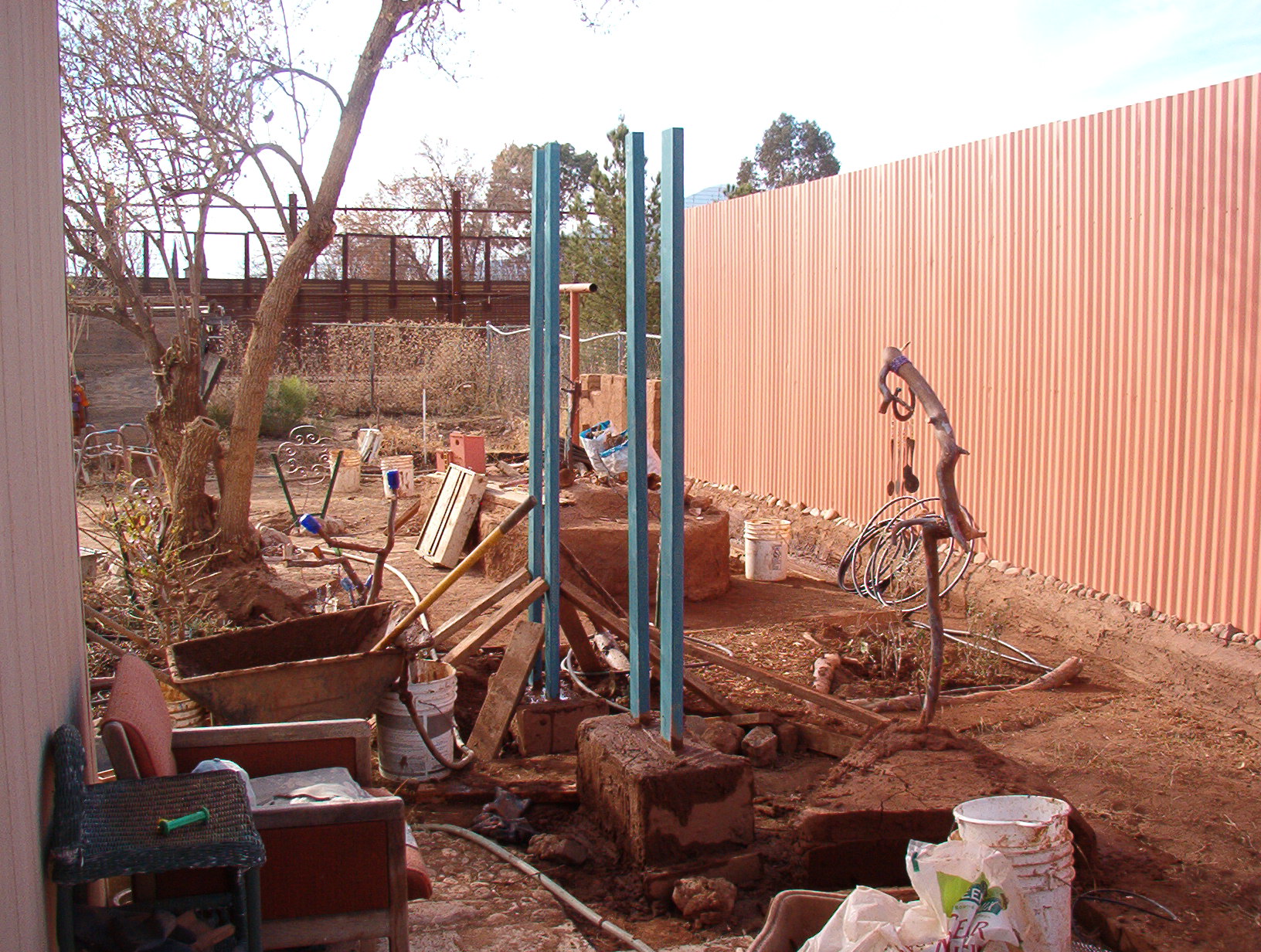
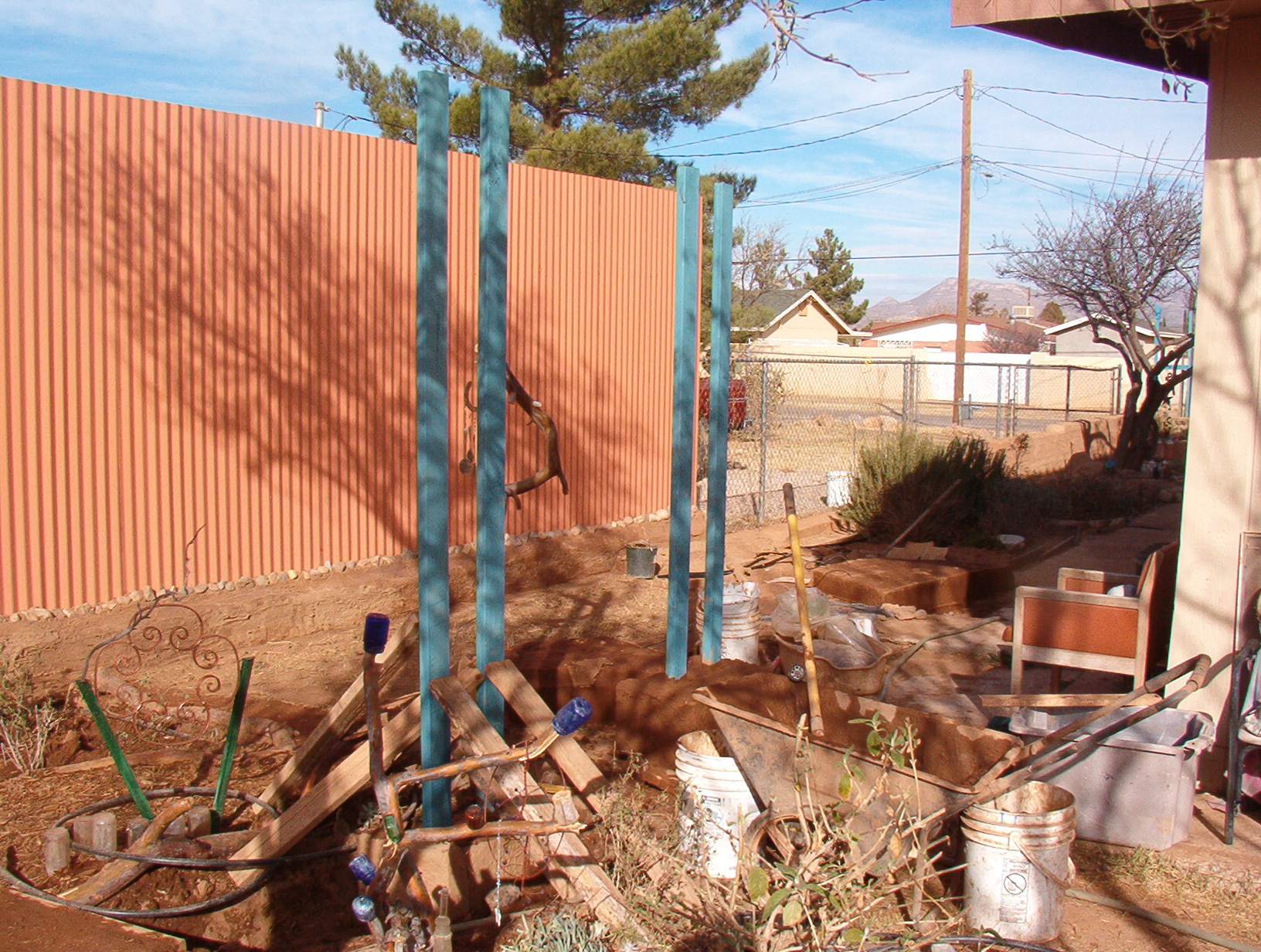
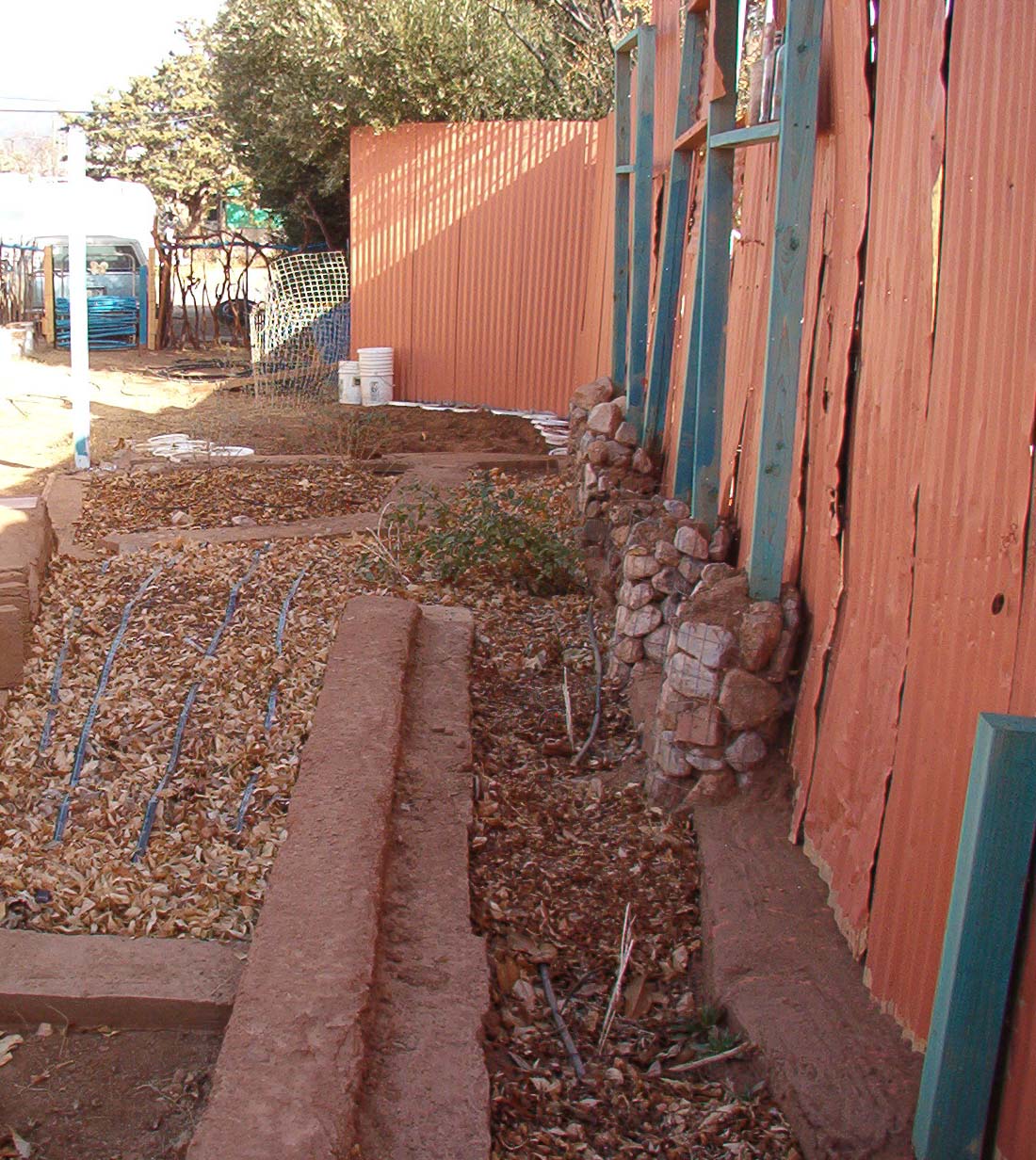
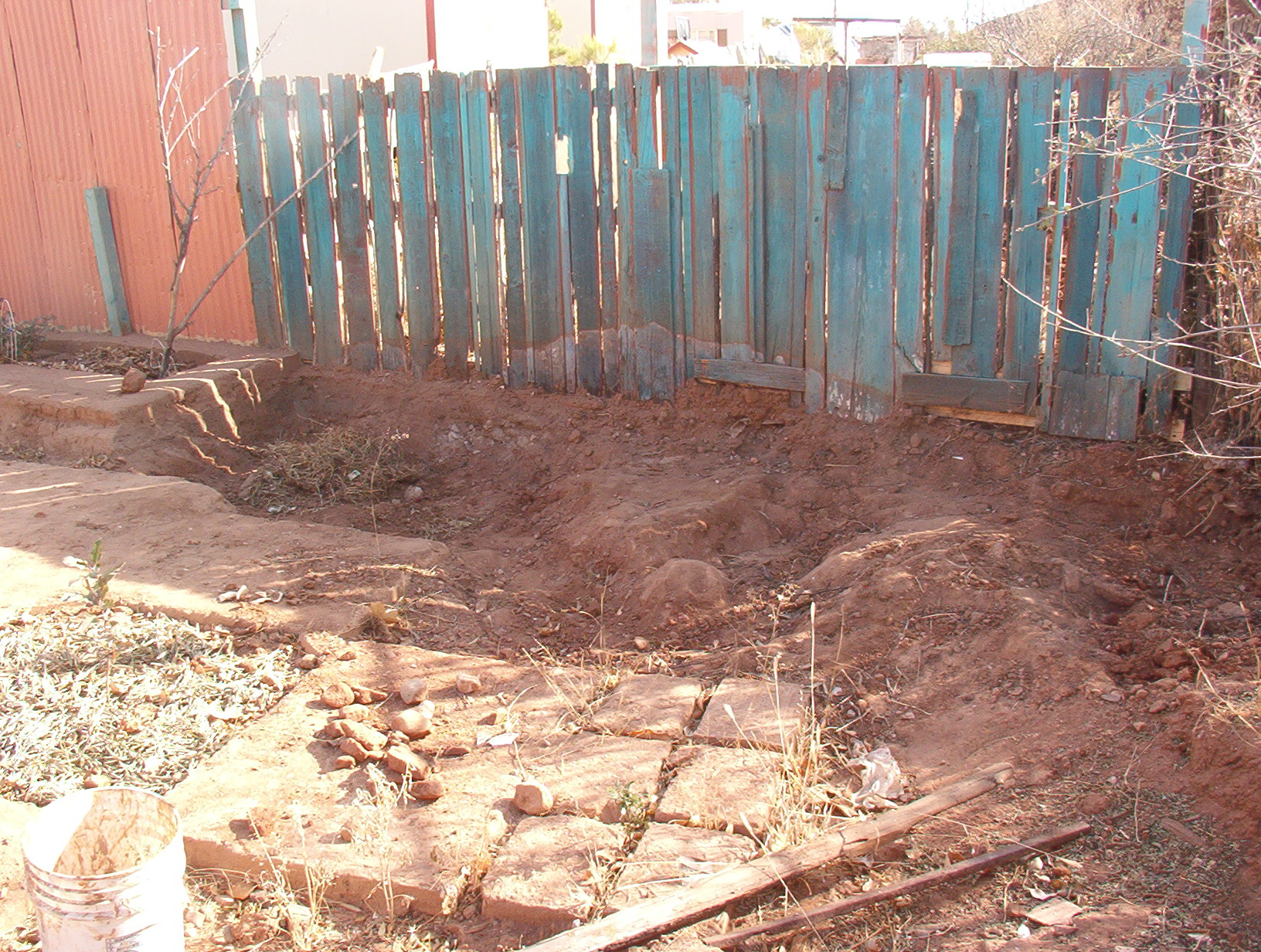
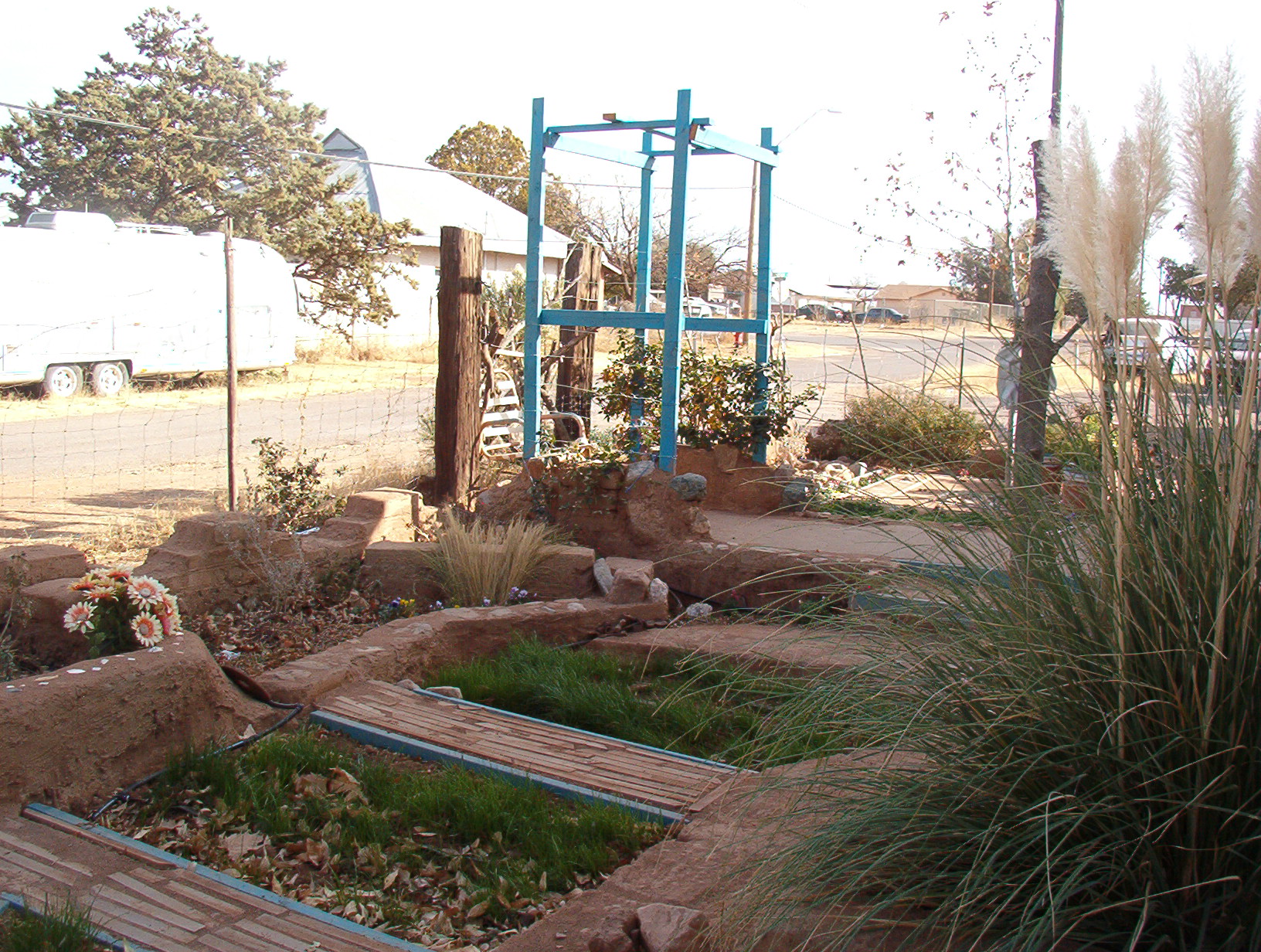
Here are a few photographs of my current adobe garden building along the west side of my house:

New 40' painted metal fence - irrigation lines going in. I cut down the two hideously ugly gnarled Quince trees here and entombed them in adobe like I did the Oleanders (in that BIG block of adobe back there) - I will build adobe planters on the dead Quince blocks! That's a piece of cedar branch sticking up there with a silver spoon wind chime a friend made years ago.
New trellis being built for roses yet to come, right outside my back door. There is a small lawn area along fence here (I get nice tree shadows on the new fence) You can see the adobe block drying over the (hopefully) dead Quince
Leaf compost along east fence with sleeping plants with irrigation, latest adobe 'mine' there by white buckets (looking north - new fence up there behind the El Camino) - I raked strangers' yards in town for the leaves - adobe along fence line to cut down on weeds, especially noxious Morning Glories
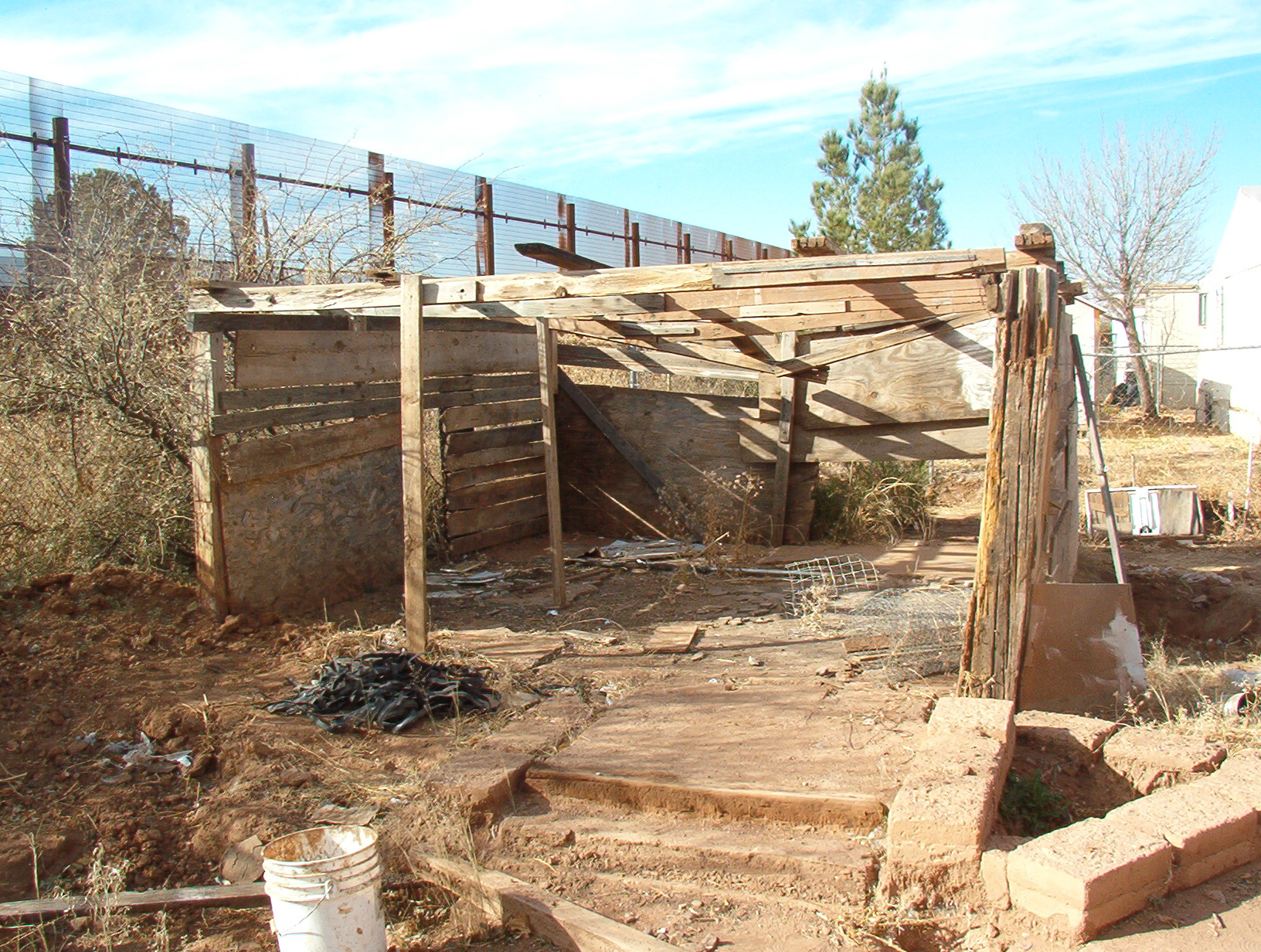
I would like to build a chicken coop/run in this SE back corner (this red clay is hard as cement when dry, and still can't dig this corner even when WET! I want to let chickens 'heal' this soil.)
Old shed still has to go, hope to use lumber for the chicken coop/run. Want to free the Mesquite tree between shed and Mexican border fence.
Front north yard, mostly in shade until the days lengthen
Winter rye doing well in front

I am trying to learn how to get the big fat awful root-eating grubs out of my yard.  Sustainable way is to plant peony plants that attract a wasp that lays its eggs on the grubs –

I really want this peony.  It does not come from China but from the Mediterranean instead – making it better suited to high Arizona desert growing climate.  Unfortunately these are $30 PER ROOT/plant!

I also found this amazing peony site, but they only ship September 1-15:  Hidden Springs Flower Farm

It will take probably three summers for one of these plants to really bloom – so meanwhile I will have to try some other organic treatments against those grubs – horrible beasts!

+++++++++++++++

+INSECURE ATTACHMENT: WHY I WORRY ABOUT WORRYING

++++++++++++++++++++++

It’s 7 a.m. now, and I’ve been waiting since 2 this morning for the sun to rise.  Silly me.  My waiting doesn’t make the sun come up one second earlier than it will otherwise.

Maybe my waiting is connected to my worrying, the same worrying that no doubt got me up out of bed so early this morning.  I have a whole palette of things to worry about, yet worry itself seems like such a complete waste of time.

Because I already know that my insecure attachment pattern-disorder to and in the world forms the bedrock of EVERYTHING about me, I have cause to wonder this morning what the connection might be between ‘attachment’ and worry.  Let’s see:

+++++++++++++++++++++++

Expectation and Attachment – The Anti Buddha Consciousness of Anxiety, Fear and Worry

By Glen Russell

Expectation and attachment are the worst enemies of man. These two simple words keep humanity trapped in a place of anxiety, fear and worry. Fear can only exist if you have an expectation and an emotional attachment to an outcome either happening or not happening.

In Earth society expectation and attachments are actively promoted and humanity is encouraged to adopt these as part of its psyche. Humanity is conditioned to chase after this and to chase after that. Humanity is conditioned to form emotional attachments to many different things. Yet the cost is great.

The cost is humanity suffers and its inner peace is now gone. Whenever you “expect” an outcome to happen or not happen – and it either does happen, or doesn’t happen, or doesn’t happen quickly enough, anxiety, fear and worry is created within your mental body and your emotional body. You then feel disappointment, anger, frustration, inner turmoil and suffering. Your inner peace is now gone.

It is not the outcome that stole your peace – it is your decision to have expectations and emotional attachments to a specific outcome that stole your inner peace.”  (Click on above link to read the rest of this article)

++

My “inner peace,” huh?  Severe early infant-child abuse survivors are not likely to have had any ‘inner peace’ built into them in the first place.  Can we find it NOW?  Infants don’t ‘decide’ to expect their early caregivers to do exactly THAT – take care of them!

Yet as I think about all the things I can find to worry about in the middle of the night (and in the middle of the day), I realize that every one of those worries is fundamentally about TAKING CARE OF SOMETHING, OR HAVING SOMETHING I WORRY ABOUT INVOLVE TAKING CARE OF MYSELF OR SOMEONE ELSE I CARE ABOUT.

“Where do I get the money I need to pay my heat bill?  How do I get rid of those ugly finger-sized “C” shaped grubs lying in wait in my soil to eat every root of every living plant I cherish in my garden?  How do I baby proof my house before my very very active 9-month-old grandson comes with his mommy to visit the first week of January?  Why don’t I want to do a single dang thing for Christmas and will that make my children upset with me?  How do I build yet ANOTHER stretch of fence to keep my stupid neighbors’ stupid rampaging buffalo dogs out of my yard?  When I go to my early January oncologist appointment will they find my cancer is back?  Etc.”

++++

Perceived attachment: relations to anxiety sensitivity, worry, and GAD symptoms.

Viana AG, Rabian B.

This investigation examined the relation between perceived alienation from parents and peers, anxiety sensitivity (AS), and current worry and generalized anxiety disorder (GAD) symptoms with the goal of expanding the knowledge base on factors that may contribute to the development of AS and its role in worry.”

++

Worry and Coping:  An Attachment Perspective

By Colleen J. Allison

Attachment anxiety…associated with the tendency to worry.”

(Contains excellent references for further reading)

++

Fostering Healthy Attachment
An Interview with Dr. Karen Walant

Creating the Capacity for Attachment looks at how we, as a society, have raised our children with the expectation that they become totally self-reliant and autonomous rather than with the hope that they have the capacity to form close, loving, intimate relationships with others.”

“This unhealthy pattern of reliance on objects is encouraged in the detached parenting styles so common in Western society, and it’s easy to see how, from this tendency, as adults we continue to seek comfort in other non-human objects, such as drugs, food, money, etc.

Very early on, children are generally taught not to disclose to others when feeling “weak” or scared, “needy” or alone. Many of the emotions we felt in childhood – what people call the “negative” emotions – we were taught not to share. So, we sought comfort from blankets, pacifiers, and teddy bears, and we learned not to seek comfort from our mothers, our fathers, our family. As we got too old for blankets and teddy bears, we turned instead to other comforts – food, alcohol, money, etc. As adults, we struggle with holding our emotions within because we fear that by sharing our inner souls with others, we will – as in childhood – be discounted, dismissed, or denied.”

Many people spend their lives feeling like nobody hears their cries – they feel alone, afraid, and powerless. When children are not responded to, in their earliest and most primary relationships, they learn that their thoughts and feelings are burdensome to others and that their needs are shameful. As adults, these same people often go underground with their feelings and seek comfort in substances. Or, alternately, these same people become so vocal in their neediness that, again, they are met with disdain from others and go on to find comfort, as well, in non-human substances.”

++++

OK, I get it – yet again.  Worrying about the fact that I worry is just another piece of my insecure attachment puzzle.  Dropping the worry bundle and looking at myself instead as a whole person living in and with a body that was altered in its development due to terrible trauma as I grew this body in the first place allows me to look up at the brightening skyline with hopes that today I will heal some part of myself rather than worrying that I won’t.

++++++++++++++++++++++

+RISK AND COMPASSION (5 DEAD PUPPIES AND A HEADLESS FROG)

+++++++++++++++++

While I have not spent time sitting down to further contemplate the amazing attachment-compassion article I posted the link to earlier (Attachment, Caregiving, and Altruism:  Boosting Attachment Security Increases Compassion and Helping), I haven’t stopped thinking about it.  Because ‘exploration’ really describes our entire LIFE actions, I believe it is the end-product of the quality of early attachment patterns that build our body-brain.  This article also clearly describes how our ability to feel compassion and empathy, and to ACT response-ably with the information we receive in relationship with all of life — and in some small way this post is about that compassion.

(I add a WARNING to this post that it contains descriptions that might be difficult for some people to read!)

Yesterday I received transportation to a doctor’s appointment for a bone density scan from a medical agency.  The driver, I will call him Fred, was a 73 year old man who talked about himself on that 75-mile round trip.

As I sat down to write this post I realized that for all the difficulties I have been describing recently about my inability to process verbal information when I am under stress/distress/duress, when I feel OK (as per the article noted above) I have a GIFTED ability to listen to what I will call ‘genuine people’ who are speaking from their heart.

After some of these kinds of conversations I later wonder why I didn’t respond with ‘this or that’, yet I realize that it is often another person’s NEED to simply speak and receive the listening I have to offer.

We were traveling in the medical transport van past the low-lying hills that crop up at the tail end of a line of higher mountains along the highway.  Perhaps there was something about Fred’s gazing along the rising hills that reminded him about what he spoke of next.

Fred told me that from childhood hunting had been an important part of his life.  He told me that among his many truck driving jobs he drove for a cement mixer company.  One day (I think about 20 years ago) as he was delivering a load out to a house in the desert he was gazing along the road to the right and then as he turned his head to the left he saw them coming.

Out of the desert shrubbery right at the edge of the highway appeared in a line five pure white puppies heading straight out in front of him.  He told me there was no possible way he could swerve that massive loaded truck to miss them, and sure enough, ‘thunk, thunk, thunk, thunk, thunk’ he heard the sound of each of them being crushed to death under the wheels of the truck he was driving.

++

As the writers of the above article describe compassion, it was evident to me as this man who had been a complete stranger to me when he picked me up at my house for medical transport must have had the need to express to SOMEONE the fact that he has never hunted again since that day.  As he told me all of this tears were streaming down his face.  He said he sold his $8,000 gun collection to his son for $1,000, having kept for his own possible need only one handgun.

I wondered to myself if this man could ever possibly shoot another person even under the most extreme circumstances.  Then I thought perhaps he could do so if his beloved wife was threatened.  At the same time I marveled at Fred’s wide-open expression of absolute sorrow for his actions the day he killed those five pure white puppies.

++

Now, my next image — not a pretty one at first glance but an important one to me nonetheless…..

I shed my town clothes as soon as I arrived home around noon yesterday and put on my work clothes to go outside and work on my adobe garden.  I am preparing an adobe walkway that runs along the western line of my back yard, along the new tall metal fence I just built where it runs along behind the big ‘berm’ I built to kill those ancient monster oleander bushes.

The desert soil here is now extremely dry and hard and cannot be dug into unless it is first thoroughly soaked with water.  In preparation for this next extension of my adobe work I laid the gray water hose from my outside-perched washing machine along the fence the other day and let that water do its work so I could follow with mine.

I am well aware that there are parts of my yard that I am digging into now that include soil that has never been dug into since time began making it millions of years ago.  Even though I live in a small town, there is something profound for me in knowing that.

As I dug into an area of dark red clay (normally hard as cement when dry) I began to find ‘stored’ frogs sleeping.  One by one as I dumped a load of soil off of my shovel and found these tiny guests in my yard I picked them up quickly and cupped them gently in my stiff black plastic work gloves so I could move them as fast as possible over to one of my damp, soft compost areas in my garden.

As I carried them each I talked to them, thanking them for being, and for being here.  I apologized for bothering them, and wished them a long happy winter sleeping now in a safer place where they will not be further disturbed by my digging.  (My compost areas are covered with layers of leaves I have raked up in town and hauled out here, and are being kept moist through a drip irrigation set-up I have carefully installed in each bed full of worms.)

++

As I dug along the fence yesterday I began to hear myself telling me that the odds were pretty dang good that one of the times I stuck my shovel edge into that red clay I would sooner or later accidentally kill a frog.  I thought about Fred and his story about the five puppies.  I told myself to prepare myself for this possibility.

Five dug-up frogs later it happened, I am very sad to say.  I saw the little frogs movements within the dirt on the end of my shovel and yet again reached for its little body to save it.  Oh, dear! —

Now I only  tell you this because there is something here I believe is important (again, what opportunities all traumas offer us for learning something new in a new and different way — if we can).

That little frog a-wiggling its body was upside-down in the loosened dark red dirt on my shovel.  I could tell it was trying by flailing its little legs to right itself, to turn itself right-side up — to right itself, to restore its ‘normal orientation’.  So I reached to help it, gently moving the dirt from around its body — at the same time I realized — Oh, dear! — that the tiny little being was missing its head.

++++

Of course I will always feel bad when I think of this, just like Fred does about those puppies.  I wondered this morning about both Fred and myself, and about self-compassion and forgiveness — and about whether or not we can ever release ourselves from the feelings we have if we hurt another life in some way.

I don’t know.

But what came to me about the frog reminds me of the writings on healing our woundedness from trauma that Diana Fosha writes about in regards to attachment.  I remember that she says every living being knows exactly how to heal itself — given a possible chance.  She says that human attachment-related body-brain wiring remains in existence in us from before we were born — no matter how traumatized we were later by our earliest caregiver interactions of trauma, neglect and abuse.

Fosha says we all know HOW TO RIGHT OUR SELF INSTINCTIVELY in the same way we can all look at a picture hanging askew on a wall and INSTANTLY know which way to move it to RIGHT it — to make it RIGHT.

++

One of the things that strikes me about the headless frog was that EVEN WITHOUT ITS HEAD its BODY absolutely knew that it was upside down.  Its body knew exactly what to do to make its body RIGHT by taking body actions to turn itself over.

Yes, this is all unsettling — and perhaps a bit preposterous in what I am concluding from my strange line of experience yesterday.  There seems to be something about the words Fred spoke to me yesterday — and something about his obvious caring emotional compassionate nonverbal expressions — that primed me for what happened as I dug in my backyard.

It seems very likely to me that we all know instinctively IN OUR BODY exactly what we need so that we can heal.  In our culture, what we learn IN OUR BRAIN-thoughts is probably likely to interfere with what we actually need to do for ourselves to heal.  How do we listen to our own BODY as it tells us what it remembers both about all that has happened to us AT THE SAME TIME it can tell us what it needs so that it can heal?

++

I am going back out today to work some more on that walk way — at the same time I don’t really know how to miss harming another little friend-frog as I do so.  Digging just carries that risk — and I can not set aside the softness I feel for those frogs even though I am going to run the risk of a repeat from yesterday.  I will be as care-full as I can at the same time I know that living carries risk — for all of us.  And sometimes it carries healing.

+++++++++++++++++

+LINK TO ARTICLE ON ATTACHMENT, COMPASSION AND ALTRUISM

++++++++++++++++

I found an excellent, very informative article (2005) online today as I was searching for the ‘difference between empathy and compassion’ as they relate to attachment.  The article represents the thoughts of an Israeli and three American researchers, and is titled:

Attachment, Caregiving, and Altruism:  Boosting Attachment Security Increases Compassion and Helping.

These researchers use the attachment measures for amounts of anxiety about attachment and avoidance of attachment.  Anxiety and avoidance are found in the insecure attachment patterns – and are absent in the secure attachment patterns.

This article takes some thoughtful time to read, but is well worth the investment.  There is a lot of information here, and as I read it I could place people I know and have known along the dimensions the authors describe as I realized that people FIT PATTERNS of attachment that then makes them very much like one another depending on these pattern types.

I am too tired at the moment to say anything more right now, but I hope you follow the above link and take a look at this article.  I hope to spend some more time taking notes in a few days as I process the information this article contains.

Depending on the variety of early caregivers around us that we could form attachments to — or not — our body-brain development was set down a course before we were one year old along the attachment pattern dimensions this article describes.

Once we reach adulthood these patterns, built right into our physiology, can be extremely difficult to change.  I believe that for the most part people with the avoidant dimensions of insecure attachment live their lives in such a way that they can appear cold and self-absorbed and don’t seem to even know it, let alone care.  On the other hand, people with the anxiety related insecure attachment patterns are far more likely to KNOW there is something wrong so they are most commonly the people who might identify their problems so that they can find new ways to relate to others.

++++++++++++++++

+INTERGENERATIONAL TRAUMA: ITS TRANSMISSION AND ITS HEALING

+++++++++++++++++++++

It is important for me to understand the reality of my own words.  If I wish to write about the intergenerational transmission of unresolved trauma – most usually through abuse and neglect of offspring (as well as through the epigenetic transmission of trauma-caused genetic changes) I have to know where my own limitations are.

Through my recent thought processes about writing a book I am coming to understand that it will most probably be my daughter who will need to ‘step up to the plate’ and accomplish that task.  I have presented the idea to her very clearly and in her very busy schedule at present, she is considering my request.

I know that I more than cringe at the thought of relegating the lifelong consequences for infant-children who are/were raised under the burden of active transmission of intergenerational trauma through abuse to the professional categories of ‘mental illness diagnostic categories’.  As a very severe infant-abuse survivor I now understand that my entire physiological development was altered through trauma exposure, I now understand that I am NOT ill I am simply different from those who were raised in the ‘pampered’ worlds of love, safety, security and supportive attachments to caregivers.

It is my job from the place I hold in the generation chain of my family to understand as fully as I can what happened to me that changed me, what those changes are, what living with those changes is like, and how learning new information about what ALL of this means will contribute to all of the positive changes I seek.

As I define how my language development, along with its social-emotional body-brain developmental channels has been changed through trauma, I realize that I do not speak the common language of ‘the masses’ and I never will.  I realize that this limits my ability to write a book that will accomplish the goals I hope for.

As I understand that ‘mental illness’ is NOT what about I am coming to recognize that a sociological rather than a psychological or psychiatric perspective would be the most accurate frame of reference for every word a book about my topic needs.  My daughter is a professional sociologist, and is also a professional researcher, interviewer and writer.  She is also has a gift for language.

Looking back as far as I can at the chain of my family’s history that directly impacted the severe abuse trauma I experienced I can point vaguely to my mother’s grandmother, more clearly at my mother’s mother, VERY clearly at my own mother, most clearly at myself, and from there I see my daughter who now has her first child, my first grandchild.

It is HER perspective as the survivor of being MY daughter that matters to me most, and from there it matters to me how what my daughter knows is impacting the raising of her children (which of course also involves her husband).

In recognizing my limitations I am understanding that I AM NOT THE BRIDGE.  I have continued to work as hard as I possibly can ALL OF MY LIFE at surviving as a trauma altered individual to the best of my ability.  I have massive amounts of information, and through a very tailored interview process that my daughter can orchestrate and accomplish, I can transmit that information to HER — and she can write ‘the book’.

I can never physiologically take my feet out of the burning building that represents what is left of the edifice of intergenerational transmission of trauma that came to me through my father.  My daughter has some ‘smoke inhalation’ problems from being raised as my daughter (mostly due to my depression at the time she was born that altered my patterns of interactions with her).  But I did not abuse my children (with one exception noted), and there is NO WAY in the known or unknown universe that my grandchildren will EVER be abused in any possible way.

With every fiber of my being I hope that my daughter decides to undertake this mission I ask of her.  For all my recurring discouragement that overtakes me at times because the more I understand my story the more I realize that it was so unique in its trauma that probably very, very few people can truly relate to or find anything useful in what I have to say, the more I realize that THIS FACT IS EXACTLY WHAT WOULD MAKE THE TELLING OF MY STORY a BEST SELLER.

If there is anyone on earth that can find a helpful common threat between what I have experienced (and what I know about the consequences of those experiences) so that something can come out of the ‘fire’, be polished and perfected, and then passed onto others in the form of useful information for their betterment, it is my daughter.

I cannot consider any part of my story without fully understanding that it was the job of the society I was born into to rescue and protect me.  My story exists as it does because my society failed me as much as my mother and father (and grandmother) did.

That ‘arm’ of intergenerational trauma transmission HAS to be addressed head-on, and as far as I can tell that is a sociological issue.  My daughter can do that, also.

In addition, translating the language I know as a society of one into the language of the many is also a job I cannot do, but she can.  She will also be able to address how language forms a fundamental core of society itself.

All I can do now is hope, pray and wait……..  It is her decision.  It will require great dedication — and time — and effort — on her part to help me with this vital project.  Nothing on this earth would make me feel happier than for her to decide “Yes.”

+++++++++++++++++++++

+WORDS DO NOT MEAN SOCIAL CONNECTION TO ME – THEY ARE OBJECT-TOOLS-WEAPONS

++++++++++++++++

I know I better write a post right now before I head out to do some serious adobe work in my garden today because if I don’t track the process of my thinking at this moment I know I will soon make such a quantum leap in what I know about myself, my trauma altered development that happened because of the severe infant-child abuse I experienced, dissociation and my language development that I will never be able to go back and track how my conclusions about the connections between all these vitally important topics actually arrived.

As I ‘play around with’ the experiences I had last week with the medical clinic, and as I anticipate the medically-related appointments that I am going to have to go through in the near future, and as I sift through the facts of MY experience to gain information about what happened last week I am finding myself headed straight for some amazing discoveries.

++

Much of what I experience as dissociation when I am engaged in a stressful situation with people who actually escalate my stress response rather than sooth it — dissociation that includes an inability to hear spoken language, to process verbal information or to even THINK in words (the blank state) — is directly related to the way my physiological development was affected by severe trauma from birth.

The trauma that matters most to me as I consider the consequences of it that I live with DAILY at age 59 happened from birth to age two.  I have focused much of my writing so far on this blog on the critically important right-limbic-social-emotional brain development that happens directly through early attachment relationships with caregivers.

I have to move forward now in my thinking to age two.

While there are specific developmental stages and milestones that happen during this second year of life, the one I want to look at right now has to do with the continuation of the development of LANGUAGE.

An infant begins its breathing life with the ability to send and receive signals in the form of PREVERBAL communication.  All ‘attachment’ interactions with early caregivers happen on the level (from the infant’s point of view) of this PREVERBAL communication.

An infant’s caregiver is also using NONVERBAL and VERBAL communication signals with the infant.  As the infant’s body-nervous system-brain grows and develops, its physiology has been built by the PATTERNS of the earliest (attachment) interactions.  These patterns literally tell the DNA and the cells of the infant’s body WHAT TO DO.

++

As an infant moves toward the acquisition of WORDS and the ability to understand and use them, it uses ALL the patterns that have been built into it as ‘traffic flow channels’ for its growing abilities to communicate.

If everything the infant has experienced has happened in an extremely traumatic, abusive, neglectful environment of malevolence, chaos, unpredictability and NONEXISTENT contact between the infant’s SELF and its caregiver, the infant’s ENTIRE REPERTOIRE INVOLVING VERBAL LANGUAGE HAS ALREADY BEEN SENT DOWN A COMPLETELY DIFFERENT PATHWAY than the kind a safely and securely attached infant’s has.

++

‘Ordinary people’ are familiar with part of what I wish to describe if they think about trying to communicate with a police official after a serious car accident, or if they think about how words failed them in an important interview, or failed them at the moment they received a cancer diagnosis.

This tells me that the ‘dissociatable’ regions of the human brain that can separate emotional experience from verbal articulation (both spoken and in thinking abilities) is perfectly POSSIBLE for everyone.

What happens to me is that I experience these changes in how words include themselves in my ongoing experience at times that ‘ordinary people’ would NEVER experience.  That is the difference between how I operate and how they do — not that ‘I dissociate words from my experience’ and they do not.

++

Researchers know that a ‘bad mother rat’ is a nervous, over amped-stress response rat who will NOT LICK HER OFFSPRING like a safely and securely NON stressed mother rat will.

Researchers also know that if they switch offspring between a high licking rat mother and a low licking mother (meaning highly stressed and nonstressed), the offspring RAISED by either of these types of mothers will build into their developing physiology the corresponding high or low stress level responses.

Researchers now know that the degree of stressed-out response in the offspring is NOT due to genetics.  It is due to the ability an offspring’s body has to alter its physiological development in direct response to the nature of the environment is is formed by and in.

In human terms we can translate this very basic fact into what happens to infants raised in secure, safe, loving, appropriate, adequate MOTHER-early caregiving environments versus those who are raised in opposite conditions.

Severe infant abuse and neglect constitutes a LOW LICKING environment — which is the same as a HIGH STRESS environment.

Most simply put, there is NO POSSIBLE WAY THAT THESE CONTRASTS IN ENVIRONMENTS COULD NOT AFFECT AN INFANT’S LANGUAGE DEVELOPMENT.

The stages of preverbal to nonverbal to verbal development are directly affected by the level of stress and trauma present or absent from an infant’s universe during its most critical windows of early physiological development.

++

Now, to switch thinking tracks:  There are language development experts who look back over the word-utilizing history of the human species who see in our verbal-language development a pattern that suggests the following.

Many other living creatures (bats and primates included) have the same gene that humans eventually made use of to develop our ability to TALK.

This is the FOXP2 gene.

Researchers believe that it was ONLY about 140,000 years ago that this gene was activated in humans so that it could directly alter the development of our brain AND OUR LARYNX so that we could begin to talk.

All the interactions that mother’s have with their offspring are part of how this ability evolves in all of us now as they are directly tied to the development of our infant body-brain in our earliest attachment caregiving universe.

Some researchers also believe that once the world became benign enough that more early humans had safety and security to spend more time sitting around socializing with one another — which amounts to GROOMING BEHAVIOR in both primates and rats.

The quality of grooming behavior in both primates and rats is used as a measurement of HIGH and LOW stress.

It is evidently very possible that humans began to utilize their FOXP2 gene simply to expand their ability to sooth, bond and communicate with one another — researchers refer to this in humans as GOSSIP — with spoken language as an advancement over gesture that could then include more people within the circle of communicative signaling — or GOSSIP.

++

Human infants, as they interact with their earliest caregivers, are engaged in a mutual dance of signaling communication — sending and receiving — with their caregivers.  In abusive, neglectful, traumatic and malevolent early infant environments, the signaling DOES NOT GO ACCORDING TO OPTIMAL PLAN.

The infant’s language-communication-signaling patterns are therefore correspondingly altered within its physiological body-brain development.

++

Use of signaling in patterns of listening and responding (rupture and repair) in ‘healthy’ early attachment environments are tied to the development of emotional regulation abilities in an infant’s growing right-emotional-limbic brain AT THE SAME TIME that this same brain region is also developing its SOCIAL-emotional patterns.

Because I was abused and traumatized from birth I did not participate in ‘normal or ordinary’ preverbal or nonverbal communication patterns with my caregivers.  There was no possible way that my physiology could pattern itself AS IF I had magically grown them in a safe, secure, optimal or even adequate environment.

++

I therefore suggest that for every single person who has been given the so-called ‘mentally ill diagnosis of Dissociative Identity Disorder’ and that KNOWS that something was NOT OK in their early infant-caregiver interactions that DISSOCIATION as it includes the component of verbal communication with others and within our self in our thoughts HAS BEEN CHANGED right along with all our other Trauma Altered Development.

What happened to me the other day at the medical clinic has also highlighted a critically important point to me:  When I was born nobody gave a single solitary HOOT about what I needed.  They didn’t respond to me as if I existed as a human being at all.  Because all my patterns of communication included patterns of abuse and trauma, I DID NOT DEVELOP A RIGHT BRAIN THAT INCLUDES ‘NORMAL OR ORDINARY’ use of preverbal and nonverbal social-emotional cuing.

What this means to me when push comes to shove NOW is that — as a component of my nonattachment reality tied to the so-called insecure Reactive Attachment Disorder or Disorganized-Disoriented attachment disorder — is that not only can I NOT include ‘normal’ nonverbal social communication cues in MY communication to others, I cannot read the ones they send to me, either.

In the end — I DO NOT CARE ABOUT OTHER PEOPLE.  That level of signaling caring was NOT built into my infant (birth to 2) physiology during my precursory stages of verbal language ability.

Nobody cared about ME so very realistically, how could CARING possibly have been included in my language acquisition physiological patterning?  (This is part of the ’empathy disorder’ Dr. Allan Schore describes as a component of all insecure attachment disorders within the 45% of our population that has some version of one.)

Because the ability to include EMOTIONALLY relevant information and to read its signals and clues was not a part of my preverbal-nonverbal-verbal physiological development, the bottom line TO ME is that I am excluded from the highly developed human social specie’s GROOMING and GOSSIPING behavior.  I was not born into an environment that included me as a PART OF THE GROUP to be safely and securely attached to and within.

The solitary confinement and isolation I experienced due to my mother’s abuse continued to one degree or another to profoundly affect me through my entire 18 year childhood.  (No play included.)

++

Language – spoken and nonverbal — not only does not work the same in my body-brain, it does not mean the same to me as it no doubt does to ‘ordinary people’, either.

Although I obviously am able to understand words themselves, I do not believe that my language abilities are wired into me in anything like a normal way when it comes to interactions with members of my species.  And who the hell else would CARE if I could talk or not?

I am an excluded-from-ordinary person, and my latest clarity of discovery is that THIS is perhaps one of the MOST IMPORTANT consequences of being raised from birth so that my development was physiologically patterned in and by trauma.

I am excluded from being truly attached in my lifetime to members of my species who developed normal and ordinary language abilities.

This does leave me to wonder if I could learn more about how I am in the world by coming to understand how language develops in people who are blind and/or deaf from birth (and Autism-spectrum brain holders).  These people also would have to move through the preverbal-nonverbal-verbal developmental stages differently.

But even here, it would only be those who were NOT LOVED or treated kindly in safe and secure attachment earliest caregiving infant environments that would have experienced the kind of base-line, bottom-up truly altered right-limbic-emotional-social-preverbal brain development that I did.

++

So when my stress response is activated like it was at the clinic last week, other people can feel extremely threatened and defensive around me and interaction with me because we are from completely different worlds when it comes to the use of words.

Words are simply a tool to me — to be used as a tool to accomplish an end.  I was not built with words included in my development to be primarily about exchanges involving emotion between people that belong to and in a human group (involving degrees of social bonding).

I believe the more I clarity I can gain about this topic the more I might be able (if I am willing) to NOT move very quickly between using words as TOOLS and using these TOOLS as weapons.  This means to me that words are OBJECTS to me — and I suspect this happens for me on very deep, profound, fundamental levels of my Trauma Altered physiology.

I tried to explain to the doctor at the clinic that all stress has to be deescalated in that environment for me to begin to understand verbal exchange.  I also know that written words are ACTUALLY my primary language.

Social-emotional spoken language exchange, with its normal roots in preverbal and nonverbal language development, IS NOT MY FIRST OR MY PRIMARY LANGUAGE.

If this fact is true for many people with the a so-called ‘anxiety-dissociation diagnosis of mental illness’ — what I am saying is IN HIGH NEED OF SCIENTIFIC VALIDATION.

If what I am discovering about myself as a survivor of extreme early and long-term infant-child abuse is correct, much of the ‘mystery’ and therefore of the social stigma based on misunderstanding about DISSOCIATION can be traced back to Trauma Altered Development as it affected our ability to communicate with others of our species AND MOST IMPORTANTLY in verbal cognition-verbal thought WITHIN OUR OWN SELF.

When I ‘go blank’ during ‘dissociation’ I have followed back a track of development in my physiology that moves far more quickly to a place where words do not exist in information gathering and processing interactions or transactions (either with others or within my own thoughts).

The ONLY hope-for-balm to heal this in the moment it happens would be for all around me to recognize INSTANTLY the need to erase all threat of harm and stress from the encounter.  More importantly, once the ‘dissociation’ involving my altered language processing happens, it is too late to fix it at that moment.

AWARENESS that allows for proactive prevention of the conditions that lead to this dissociation of word meaning from language transaction would be most helpful, along with the very real understanding that I, and others who were abused as infants like I was, do not have the ‘ordinary’ connection between emotional information and ‘verbal fact’.

++

It struck me after I published this post that one powerful effect of my mother’s horrific verbal abuse of me all of my life is that I KNOW what the end product of words as object-tools-weapons REALLY can mean.  All verbal abuse survivors know this.  But when it comes to the ADDITION of terrible verbal abuse as it bombards an infant that is ALSO being neglected, physically abuse and traumatized, there is no possible way that profound physiological development of language abilities can be avoided.

We survivors of trauma on these most profound language-development levels are therefore language exiles from our species and are probably ONLY able to truly communicate with survivors whose brain-language abilities were built with these same altered preverbal-nonverbal-verbal physiological Trauma Altered patterns.

This all must tie in on the deepest human physiological levels with the reasons why it is the ability or disability to tell one’s life narrative ‘coherently’ according to compliance with or ‘incoherently’ in deviation from Grice’s conversational maxims that is the foundation of the assessment tool used to determine a secure versus insecure attachment pattern-system-disorder in adults.  (Adult Attachment Assessment Interview)

Those of us raised in extremely malevolent early attachment environments did not have the same communication ‘rules’ built into our body-brain.  We do NOT, therefore, speak the same language as do those who were not equally as exposed to severe trauma during critical early physiological developmental stages.

(To know a LANGUAGE is a far more complex and expansive operation than simply knowing a collection of WORDS.  There are, for example, nearly 3000 words in this post, but I believe it is only those who have some ‘cultural immersion’ experience in the universe of severe infant-child abuse trauma that will know exactly what I am actually talking about here!)

The Meaning in Words by Dr. Bruce Perry

++++++++++++++++

+FACTS OF THE MATTER

+++++++++++++++

I am more convinced today than I have ever been in my life that no one would arbitrarily ever choose to wake up one day and write what I have to say.  I offer a prayer every night of my life that something I present on this blog will help someone else.  For all those infant and child abuse survivors who have NO POSSIBLE ACCESS to any kind of therapy let alone access to the quality of therapy we survivors ACTUALLY need, I say, “Never give up!  Never surrender!  Never stop standing up and sticking up for yourself!  Listen to your inner voice that tells you what YOU KNOW AS FACT about who and how you are in the world!”

For all the terrible abuse I suffered during my first 18 years of life, I somehow still fundamentally believe that the world is a good place, that other people care, that if we stay alive long enough we will find the truth we need to make sense out of what happened to us — somehow — and that things CAN get better than they are now.

When people search online using terms that matter the most to them, asking questions for which no answer has YET turned up that feels like the right key that will open the lock of their deepest understandings, I want them to find something on this blog that matches their search.  I want to add something truthful and useful into the great pot of ‘this is what infant-child abuse TRULY DID to its survivors’.

‘Professionals’ can argue all they want amongst themselves about which diagnostic slot to drop us into.  The fact of the matter is that if we have troubles that might bring us to anyone’s attention in the first place, what we suffer from — no matter what slot THEY decide to drop us into — is Trauma Altered Development that changed the patterns of our physiological development on profound levels that affect us for our lifetime.

If these same professionals ever choose to turn the brilliant light of their intelligence upon this fact, then and only then will the kind of assistance we need in order to understand ourselves and to improve our well-being as Trauma Altered Development beings will begin to rise to the surface as it becomes available to those of us who need it most.

+++++++++++++++