++++++++++++++++
Here are some quick snapshots of front adobe progress!

++++++++++++++++

++++++++++++++++
Here are some quick snapshots of front adobe progress!
++++++++++++++++
++++++++++++++++++++++++++++++
On the positive side of what I have been working my way through since the time of my birthday at the end of August I will write here about the benefit of what I have learned over time about how the two hemispheres of my brain actually work. I can truthfully say, “I wish I had known many years ago that all of us actually have two different brains that are designed to gather information differently and then pass it back and forth between them to our benefit.”
Early infant-child severe abuse and trauma change our physiological development, as I have written about so many times on this blog. But an apple is still an apple and not a fig. The exact right brain I was given through my trauma altered development, and my left brain, and the way these two brain hemispheres operate together was DEFINITELY altered due to trauma during my development, but they are still exactly what they are: my right and my left brain!
Now, through my recent years of study, learning and discovery I can FEEL how my brain operates. I can detect its natural inclinations as I begin to be able to USE what these hemispheres can do at the same time I recognize their changes and limitations.
But, in focusing on the positive, I am so delighted to finally be able to USE my brain intentionally in ways I have never done before.
I understand now that it is my RIGHT brain, not my left (as it is with everybody’s) that has deep connections into my body and that gathers all the information my senses provide me. This information is superbly crafted by my right brain into IMAGES.
My left brain, on the other hand, does not operate with the same information that my right brain does. It does not have deep connections into my body and the information my body gets from senses about living in a physical world.
At the same time, just as my left brain is dependent on my right brain to gather this ‘sensing-feeling’ information as it forms images, my right brain MUST be able to pass what it knows over to my left brain so that it can be organized and made coherent.
The organizational abilities that the left brain has were built into our species through centuries of experience in sequencing actions that kept us alive. The right brain does not have this sequencing ability.
Overwhelming trauma, especially early abuse during development, changes the development of our entire body-brain — but like I said, an apple is an apple and a fig is a fig.
So, now when I am faced with anything in my life I need information about, it is by paying attention to the IMAGES that my right brain has created from all the body-based, sensory and emotional information it has meticulously and expertly gathered that I can use to REALLY begin to understand how I am in the world.
Getting the right brain information in the form of images over to the left brain, and then improving what the left brain can do with this information, is actually more of an evolutionary advancement process than it is a healing one – although this IS healing.
++++
I can best detect not only the actual images my right brain has and presents to me but also the vital information contained in these ‘messages’ by articulating in a series of words (left brain). This process organizes and makes coherent the information my right brain has.
I write about this today in connection to my recent concerns about transitions and transformations in relationships with people closest to me. As I conversed with one of these people via email this morning, a powerful image was given to my left brain by my right brain.
I imagined that each of us (perhaps best described as a combination of our essence with our life force) is like a river. Our river starts out at our conception as a little bubbling headwaters and grows through our infant-childhood from a trickle into an eventually powerful force of water to be reckoned with!
But our personal river never actually flows with ONLY its own water. There is a mutual sharing of river water with others. We often share a lot of ‘cross-water’ with those who are truly significant to us in our lives just as we share our river water with others.
In this river image I saw that we do all sorts of things with the water from our river. We divert it off for recreation, to irrigate crops, to power mills, to help others in crisis, to encourage others. Those of us from abusive backgrounds were never taught about our river or how to manage it. In essence, that is what I am still learning about.
What happens to my river when my waters are mingling with other people’s river water that is toxic, contaminated, ugly, dangerous, or in any other way NOT GOOD FOR ME? I want my river to be well mannered and controlled, though still wild and free. I don’t want my plants and fish dying. I don’t want a garbage-filled, oily toxic mess! I don’t want to have my waters polluted. And I am the ONLY one who can manage my own river waters.
So what I have been learning recently is that if there are times I find that my relationship with someone is too much like what I just described I can change the way my river water interacts with theirs. I can close off channels to block toxins from entering my river and I can control how my water flows into their river.
If I close a channel off to another person I will then as a consequence have more water flowing in my river. I will need to decide what to do with it. Maybe it will just make my river wider and deeper so that by the time it opens out onto its downstream delta new rivulets will appear there.
But in this image what I want to see happen is for my river to be glistening and sparkling in the sun and moon light. I want my river to sustain all life it contains and touches in a healthy way. I want to be able to share the water from my river with others while at the same time I protect my river from any pollution coming into it from other people’s water.
I cannot truly affect the quality of another person’s river water. Each of us have our own river to manage. If there are times that I cannot freely share my water with someone without toxins entering my stream, I will have to defend against this pollution. I have that right. I have that obligation. And I DO have the ability to do this.
++++
My left and right brain hemispheres are delighted to work cooperatively together to define the Rules of the River (which are the opposite of the Rules of Trauma):
Thou shalt assume full responsibility for the well-being of your river
Thou shalt maintain your river’s boundaries with good conscience and effectiveness
Thou shalt make wise, informed and careful choices regarding the use of your precious resource to avoid useless waste
Thou shalt share water with others when needed in healthy ways, including help and play
+
Thou shalt not dump toxic waste into another’s river or in any other way attempt to overwhelm another’s river or force change upon it
Thou shalt not steal water from another’s river
Thou shalt not tamper with another river’s boundaries or attempt to alter its course.
Thou shalt not let fear interfere with the healthy management of all aspects of your river
++++
It strikes me that a very skilled and creative person could design a wonderful Facebook game to rival Farmville using this analogy!
In the meantime, this living image has become something I can use to assess my process of being in relationship with others in ever more healthy ways. I can also use it to assess how I am taking care of my own self as I work to purify my river’s water from the toxins of trauma that were dumped into it through abuse and neglect early on.
This image tells me that we each only have one river in our lifetime. Well, time is marching forward and I need to get busy with some river management of my own.
++++++++++++++++++++++++++++++
+++++++++++++++++++++++++
I have rather accidentally discovered today what is evidently one of my most powerful values. I have known since the day in 1988 when I wrote my letter disowning my abusive mother that I would no longer be willing to tolerate what I called ‘a phony relationship’ with her. Today all these years later I have discovered that I will not do it with anyone — no matter whom, no matter what.
Two other words besides ‘phony’ would be superficial and pretend. That’s just me. Phony, superficial and pretend might work for a nonrelationship with very casual acquaintances. That to me is appropriate. But I have no tolerance for phony, superficial or pretend when it comes to people who truly matter to me. Those are the people, both family and my friends who I also expect to matter to, also.
So the powerful value I hold that became super clear to me today, after some happenings these past few days that led up to this point for me, is that any time someone I care about is in need, I will do everything in my capacity to assist them. Equally, I will downgrade any relationship in my life from the rank of important to one of ‘casual acquaintance’ if I discover that when I truly need them, they either assist me with resentment (especially when years later the fact that I was vulnerable and that the so-called help that was given is thrown back in my face along with the resentment), the help was given with judgment-criticism-condemnation, or not given at all.
There will always be times where circumstances limit or prevent what assistance can realistically be offered. But I always need a two-way street of open, caring, and honest communication during times of greatest hardship.
(I will not stand by and be treated meanly, disrespected, or bullied! I have to remember that if active alcoholism is present, resentments will be rampant. They are part and parcel of the disease. That doesn’t mean I am going to tolerate any part of it, no matter how much love I have for anyone.)
There are just times when people need one another. That’s a fact of life. When someone we care about lets us down, well that’s another matter. What I do know — and found out so clearly about myself today — is that this is one value I cannot and will not compromise on. Once I become clear that a person close to me does not share this value with me equally, I have to seriously question and perhaps reappraise the entire relationship — or end it.
+++++++++++++++++++++++++
++++++++++++++++++++++
It took me a few moments this morning to realize that the many loud sirens I was hearing from my house were not coming from the American side, but rather from the Mexican one. It took me a few more moments to realize that, yet again, their sirens were not indicating threat, danger or harm, but were instead part of an ongoing Independence Day (from Spain) celebration.
Having lived on the border now for over ten years I only slightly question how celebration and good times are so often recognized by the ‘playing’ of sirens in Mexico. They don’t sound them for any short period on these days, either. They scream often for an hour or more, as they did today, their sound winding its way along the Mexican border town’s streets like big people playing.
It took me even more time to have the thoughts appear in my mind that were connected to last night at the stroke of midnight. I was sound asleep, and suddenly wakened by a BOOM so powerful it shook the walls of my house, its floor, my bed — and me. Crawling toward consciousness I sat up in bed, and sure enough high in the black night sky were circles and crescents of sparkling lights from an expensive and beautiful fireworks display.
I sat up in bed for all of about four seconds trying to appreciate how interesting it is that I can watch Mexican fireworks from the end of my bed, but sleep was evidently far more attractive. I laid down, fell back into my slumber and forgot all about it until after I had placed both the sound of this morning’s sirens and their purpose.
++++
All is a memory now. The sirens have silenced. I had the thought that perhaps playing siren music in celebrations might be a delightful aspect of police and fire protection employees who for those brief times can forget their more weighty obligations.
At the same time I also recognized how familiar this feeling is to me of what is called ‘derealization’. Coming awake from my sleeping dreams last night into the out-of-the-ordinary experience of witnessing a massive fireworks display at midnight simply by opening my eyes and sitting up in bed did NOT feel real when I remembered it today. In fact, it did not feel real last night when it happened, either.
And then it struck me that perhaps if I wrote this simple post it might help those who have no clear idea what the ‘derealization’ aspect of dissociation feels like might be able to glimpse for an instant through my words what our life in our body often feels like for may severe infant-child abuse survivors.
Most everyone who experiences trauma — and nearly everyone does at some point in their life — will, during the ACTIVE experience of the ongoing trauma itself experience what I mentioned in an earlier post this week — the altered sense of time and experience that happens during the peritraumatic experience of acute trauma. But most people ‘get over it’ quickly and do not go forward into the rest of their lives with posttraumatic (PTSD) changes in the way their body-brain processes their experience of life.
There was nothing traumatic about what I am describing (although fireworks is a symbolic display of the violent trauma of war), but it was also not quite ordinary, either. But what matters to me is that I was given a very clear event that helps me name and describe how sometimes life doesn’t feel quite real when things happen, and things don’t feel quite real when they are remembered — which leads me to briefly mention yet another arm of dissociation — depersonalization — which is the experience of the person having both experience and the memory of experience not feeling real, either!
Numb, distanced, remote, operating on the other side of a void, having the void within, out of synch with time and place — there are as many ways to describe what dissociation ‘symptoms’ feel like as there are people who have experienced it. While some-many severe abuse and trauma survivors (war veterans included) have no choice but to live continually trying to battle their way out of these sensations, all of us would probably rather be able to say, “I have no idea what you are talking about.”
++++++++++++++++++++++
++++++++++++++++++++++++
Oh, what a last few days. What a morning, that began when I woke and couldn’t sleep from 3 am onward, and began to address some important and very difficult issues. Most of it I am not able to speak of right now publicly because it involves siblings — not yet — or perhaps not ever. Time will tell.
I am hard at work now outside on my adobe work trying to irradiate the nasty pest Bermuda grass, and the process reminds me of how hard it can be to pull the trauma from abusive childhoods out of our life. Probably it is impossible, not only because of the trauma-created physiological development changes, but also probably it is impossible because everything really is so interrelated and complicated.
The Bermuda runners and tendrils wrap themselves around every root of every ‘good’ plant. Trying to get it away from the plants completely would destroy the plants I want to keep. But I am doing my best.
One thing I can mention from a long conversation I had on the phone with my younger sister today came from somethings she described as she made clear to me the difference between the two main arms of my mother’s terrible abuse of me.
My sister uses the word ‘pariah’, or outcast (untouchable), coming into English from India around 1600 from a word that literally means ‘drummer’. It was always members of the largest and lowest caste who drummed during ceremonies.
All but my older brother who was 14 months old when I was born were themselves born into my mother’s mad universe in which I was two things: (1) the pariah and (2) the scapegoat (‘pharmacos’).
According to my sister’s perspective, nobody could have done a better job than my mother did — at what she did. She completely convinced my siblings that I was not the same as they were.
I realize there are avenues for me to explore here because ‘not being the same’ as my siblings — while of course ending up to mean I was different than they were — operated more profoundly, pervasively and conclusively. ‘Not being the same’ as my siblings was the bedrock basis and condition of my existence — and I was ‘not the same’ as my siblings in every possible way my mother could name.
On the other hand, as my sister describes it, my mother also created another arm of madness that was tied to making sure that all my siblings, my father, and my grandmother understand that my mother NEEDED me to be her scapegoat. They knew without words from her actions and attitudes toward me that nobody could question what she did to me or said about me.
My sister also described how absolutely effective my mother’s turning me into a pariah was. By keeping my siblings from having any kind of a relationship with me as their sibling, as a human being, as someone they could not only relate to, but appreciate, value and care about, my mother guaranteed that they would NEVER question her abuse of me and more importantly would NEVER intervene in any way — ever.
In other words, her turning me into a pariah, by removing any common ground I could have shared with my siblings as children, gave my mother everything she needed to scapegoat me — to abuse me terribly, any way she wanted to.
Another aspect my sister described this morning had to do with the biological, instinctual, genetic understanding that mother’s care for children and that without primary caregiving of basic physical needs, children cannot survive. My mother was supremely effective at making sure there were no other possible adults in her children’s life so that all of us were completely dependent upon her.
Whatever my mother wanted was a fact, and if she wanted to, needed to abuse me, that also was an unquestionable fact. Needing to be cared for (fed, clothed, etc.) to stay alive overrode all other young concerns.
In other words, as I think about this all today, our family was extremely primitive. It seems natural that my mother would gravitate toward a wilderness mountainside to play out her madness. Nobody evolved to the point where anything could be verbalized, discussed, or willfully changed.
My sister also marvels at how, even though completely unconsciously orchestrated, my mother filled every crack, covered all ground, put together all the pieces that she could so thoroughly convince everyone, within and outside the family, that nothing out of the ordinary happened. But for that to happen she first had to make her insane abuse of me ‘ordinary’ to my siblings, to my father, to my grandmother — and to anyone else that might possibly have noticed and/or questioned what she was doing.
My mother’s madness, although perfectly terrible, was still perfect. That, to me, rings profoundly true and equally disturbing.
++++
On the other hand, the process I am going through right now is very much about whether or not I CAN write my own story — and whether or not I want to. I don’t know yet. If I were to look at this on a weighted scale, the weight by far is on the NO end.
If I am going to move forward with my writing, I have to change on the inside of me in ways that are both scary and unknown. My early day thus far was a walk on the ‘blind side’ — into areas involving myself as a sibling as I begin to explore, ask questions, feel feelings about what it was like to be ME growing up as my siblings’ sibling.
That is different for me from being my mother’s abused daughter, my father’s daughter, etc. Being my siblings’ sibling is very up close and personal — in ways I cannot yet explain.
++++++++++++++++++++++++
++++++++++++++++++++++
This electronic article talks about something I wanted to mention today: The peritraumatic sense of the passing of time.
Acute Stress Disorder Symptoms in Children and Their Parents After Pediatric Traffic Injury
By Winston, et. Al. (‘and others’) found in PEDIATRICS Vol. 109 No. 6 June 2002, pp. e90
Although the article presents information about the trauma of car accidents, the processes described here apply to everyone of any age. Yet my major concern (as usual) is with what happens when similar conditions of trauma and its impact create changes in severely abused infants and children.
I am particularly interested in these aspects of the subject: peritrauma components (dissociation, fear/helplessness/horror, and an altered sense of time)
++
Nobody – no body – is designed to operate well under chronic conditions of ACUTE TRAUMA.
And, it is especially the very young growing and developing body that is most vulnerable to the impact that ACUTE TRAUMATIC CONDITIONS create as they alter development of the body, nervous system-brain, autonomic nervous system (ANS), vagal (vagus) nerve system, and the immune system. As presented on this blog many times, epigenetic changes are likely to occur as the mechanisms that tell the DNA what to do (for the rest of a person’s lifetime and on down the generations) to best ensure survival under truly chronic, malevolent conditions also adapt in a malevolent world.
++
Very few people are yet able to discuss the long-range impact that ACUTE TRAUMATIC CONDITIONS create in young abused infants and children as they grow and development in adaptation to these conditions. Fewer still are able to openly and accurately admit that the risk for so-called ‘mental illness’ in these survivors is astronomically high. These so-called ‘mental illnesses’ are direct symptoms of the trauma that created them in interaction (most often) with genetic combinations that would NEVER have manifested themselves had these same infant-children been raised in safe, secure and benevolent environments.
What most survivors, myself included, ACTUALLY have is a trauma changed body. The most accurate description of what these changes did to us, and both ‘gave’ to us and ‘took away’ is NOT within the field of so-called ‘mental illness’ even though our difficulties appear to lie along this spectrum of dis-ease and lack of well-being throughout our lifetime.
No. What we early severe abuse survivors actually ‘have’ is more closely and accurately described as an insecure attachment pattern (disorder) that is the NATURAL and also the LOGICAL consequence resulting from what was done to us as we tried to be children growing up.
++
Many of severe early abuse and neglect survivors end up with physiological changes from trauma altered development that most closely fit the DISORGANIZED-DISORIENTED (D-D) insecure attachment pattern (disorder). I now know, having only done my research-homework of related research in the last six years that allowed me to figure this out, that this is what I live with in consequence of all that my mother did to me for the first important critical developmental years of my life.
Every other so-called ‘diagnosable’ condition I have – be it major depression, dissociation, and PTSD is actually a manifestation of this D-D attachment pattern.
It is time for severe early abuse and neglect survivors to recognize both the earthquake-trauma of our early environments, and the power that the trauma we survived had to change the core of our physiology.
++
In follow-up to the post I wrote yesterday about being ‘broken hearted’ I wanted to add this information today because being fundamentally ‘broken hearted’ in my trauma-altered physiology is very much concerned with the peritraumatic sense of the passage of time.
I don’t believe that ANY DISSOCIATION ever happens without this peritraumatic sense of the passage of time being present. And this is important because our body does not measure time by any clock or calendar. Trauma induces conditions within the body during the duration of the traumatic episode that match only ONE thing – how much time does the body have to spend in the ACUTE TRAUMA stage of actually being in the midst of ongoing trauma before the trauma STOPS.
As infants and children endure the many-faceted components of trauma – both as it is happening to them FROM THE OUTSIDE and as it is happening to them ON THE INSIDE OF THEIR BODY – they are at the same TIME experiencing this peritraumatic sense of time passing in a changed-altered way.
Trauma creates a state of immediacy because trauma IS an emergency condition and the body knows it – no matter how old it is. When left in the ACUTE TRAUMA stage for too long – as severely abused infants and children are – the body has no choice but to adapt to these conditions. And one of the adaptations the body is forced to make – permanently – is a changed sense of the passage of time that is most often recognized and named – DISSOCIATION.
++
When I write about the consequences of living with a ‘broken heart’ from having been formed in infancy-childhood during ACUTE TRAUMA that happened to us in environments where we had no safe and secure attachments to mitigate the traumas we endured – I am ALWAYS writing at the same time about this peritraumatic altered sense of time.
People who were not severely and chronically abused during their earliest developmental stages, and who therefore did not experience physiological alterations in their body-brain in response, do not REALLY know what I am talking about. When we enclose our personal expressions as survivors about what it is like to live in and with our trauma-changed body, what we can also KNOW and recognize is that the passage of time will never be the same for us as it is for those who developed in safe and secure-enough early caregiver environments.
Having been ‘given’ a D-D insecure attachment pattern (disorder) MEANS that at the same time the passage of time for us could not possibly be built into our body-brain in any ordinary way.
Therefore, when it comes to ANYTHING in our life, or about us, that involves threat of harm or actual harm during ‘later on’ in our lives, this altered sense of time will hop right up to the forefront within our trauma-altered body.
“Leaving the past behind” or “letting go and moving on” or “forgiving and forgetting” does not operate in the same way for severe early abuse survivors. We are in effect at risk for being caught in what I will call a ‘TIME LOOP’ that does not match ordinary time perception. Our TIME LOOP has at its center an ACUTE TRAUMA, perpetual peritraumatic sense of time passing – or NOT passing.
Having a Disorganized-Disoriented Insecure Attachment Pattern (disorder) built into our body (in my opinion) ALWAYS includes BOTH dissociation and this peritraumatic sense of time passing. Only when healing can happen surrounding the traumatic experience as described in this article I mentioned at the beginning of this post will a survivor NOT be ‘doomed’ with permanent body changes that mean these disorienting-disorganizing dissociating experiences of peritraumatic time become continual underlying patterns of ‘being in a body in the world’.
++
Naturally those of us survivors who were not given an adequate reprieve from the pain and terror of severe abuse as our body-brain grew and developed had no choice. Adaptation to perpetual ACUTE TRAUMATIC CONDITIONS became a part of our body, and hence both of who we are in the world and HOW we are in the world.
Researchers and other professionals who ‘deal with’ so-called ‘mental illness’ both in children and in adults need to understand these facts. Trying to apply ‘healing’ information and strategies to physiologically trauma-changed people is both ridiculous and harmful.
I know that I am ‘ahead of the curve’ on this topic, but I have to be. I have to be. Otherwise it is far too easy for me to get caught up in the societal loop that says there is something WRONG with me, when the truth actually is that there is something DIFFERENT about me.
Learning what this ‘different’ actually is means that at the same time I have to learn about what happened to me as my body-brain developed, and how what happened to me changed me. And one of the changes that I DO have is a nearly continual altered sense of the passage of time – acute trauma — peritraumatic time – altered sense of the passage of time.
++
All this having been said, I will add that we were blessed with a wonderful soaking rain yesterday early evening, and the ground where I am beginning to work my adobe magic is perfectly moist and soft to receive my efforts. So, out I now go to place myself in ADOBE time – time connected to the most ancient of us all – the earth itself.
++++++++++++++++++++++
+++++++++++++++++++++
This post is an honest one about what I don’t let myself think about – or lately to write about – choosing when I can to work without words to try to distract myself instead:
From Mirriam-Webster’s online dictionary:
ANOMALY
1 : the angular distance of a planet from its perihelion as seen from the sun
2 : deviation from the common rule : irregularity
3 : something anomalous : something different, abnormal, peculiar, or not easily classified
First Known Use of ANOMALY
1603
The origins-roots of the word showed up under this form of the word:
ANOMALOUS
Origin of ANOMALOUS
Late Latin anomalus, from Greek anōmalos, literally, uneven, from a- + homalos even, from homos same — more at same
First Known Use: 1655
1 : inconsistent with or deviating from what is usual, normal, or expected : irregular, unusual
2 a : of uncertain nature or classification b : marked by incongruity or contradiction : paradoxical
++++
I would not be exploring this word ‘anomaly’ if I didn’t have to.
For weeks I have avoided writing. I work instead, trying not to feel or to think – at all if I can help it.
Today this word has appeared to me along with a realization that I have my nose to a wall, in another corner not unlike the ones my mother stood me in for many, many thousands of hours during my childhood.
I cannot move out of this corner in any direction until I DO think about and give words to what I have been experiencing – actually for my entire lifetime.
++
I could say that after over ten years I remain ‘love sick’ for a certain man that I have never in all that time deviated one fraction of an inch from feeling the same way about that I do not only at this moment, but at every moment of my life.
I cannot escape my feelings, no matter what I do. Working as hard as I do at distracting myself accomplishes only one thing – if I can do it: no thinking. The no thinking is an exercise that consumes horrendous amounts of my life force. I know that it does. And although I convince myself the best that I can that not thinking IS actually helpful and productive, it really isn’t. I know that.
The problem is that I cannot make myself feel any differently than I do. I miss this man.
But there is more to the problem. Unfortunately, a lifetime of more. A more that began when I was born and has so changed me down to my molecular levels that I have no hope that I really CAN change and adapt ‘better’ to the only very sporadic, undependable, and pitifully inadequate contact that this man now chooses to have with me without having what I do have – a broken heart.
I was not born with a broken heart. My mother’s abuse, and my father’s neglect of me and support of my mother’s abuse, broke my heart. This trauma changed my development in all the ways I have described in the past on this blog.
So what can I possibly add today to my descriptions of what the terrible abuse of my childhood did to me?
++
Not only did my mother treat me as the nonhuman devil’s child her Borderline Personality Disorder psychosis believed me to be from the time of her labor of me forward HURT me and CHANGE me, it created physiological patterns in my body-brain-mind-self that I really do not believe I can alter.
That’s where this word ‘anomaly’ came from today. My existence within my physiological reality IS an anomaly.
Yes, I was treated in ‘irregular’ and ‘unusual’ ways that were extremely traumatic and abusive. But more than that, it was built into me that I was an ‘irregular’ and ‘unusual’ child from my birth – and that was NEVER A GOOD THING.
I was permanently convinced from birth that I WAS NOT THE SAME as any other human being – as can be seen in the root origins of this word I have to accept into my thoughts today if I am going to make any progress now – in any direction. I was not even a member of my species – and I was completely unacceptable and a failure – not as a human being, but as a — WHAT?
Origin of ANOMALOUS
Late Latin anomalus, from Greek anōmalos, literally, uneven, from a- + homalos even, from homos same — more at same
++
And then there’s this information connected to this word:
a : of uncertain nature or classification b : marked by incongruity or contradiction : paradoxical
There was nobody LIKE me. I was unique in my family, unique in my mother’s psychotic abusive mind. Where does one go to meet another ‘born of the devil’ child like one’s self?
I was told the entire 18 years of my childhood that I was this not-human devil child. And yet there I was – caught in this state of being ONE of this family, though hated and not wanted. An incongruity, a contradiction, a paradox I could not possibly handle.
This paradox has never left me. I hope that this link on the consequences of infant-child abuse as it places the little one in the face of an ‘unsolvable paradox’ as Dr. Allan Schore describes it is active HERE. If not, Google search these terms: allan schore child abuse paradox.
++++
No infant-child asks to be severely and malevolently treated. The survivors do not ask to have to live the rest of their lives with the physiological changes that happened in their growing and developing body-brain for the rest of their lives.
This broken heart that I live with constantly is NOT ‘just about’ this broken relationship with this man I love. My disorganized-disoriented insecure attachment pattern-disorder has been severely triggered, and I cannot make the pain of it go away. It is tied into the fundamental changes that the abuse I endured created in me – at my core.
++
Take a look at the pictures here of what was left of the San Francisco-Oakland Bay Bridge after a 1989 earthquake. This is what I feel like inside nearly all of the time. And just as it wasn’t any fault of the bridge that it reacted to the severe trauma that changed it, a severe infant-child abuse survivor is not at fault for the changes our body had to make during the traumas of our childhood, either.
I can avoid feeling and thinking about how I AM inside – nobody wants to listen to me whine about it – least of all ME.
I have also been avoiding writing about how I feel.
Coming ‘up’ from the word ‘anomaly’ the other word that is stuck in my thoughts if I don’t distract myself most of the time is ‘wrong’.
WRONG
Middle English, from Old English wrang, from *wrang, adjective, wrong
First Known Use: before 12th century
NOUN — 1 a : an injurious, unfair, or unjust act : action or conduct inflicting harm without due provocation or just cause b : a violation or invasion of the legal rights of another; especially : tort
2 : something wrong, immoral, or unethical; especially : principles, practices, or conduct contrary to justice, goodness, equity, or law
3 : the state, position, or fact of being or doing wrong: as a : the state of being mistaken or incorrect b : the state of being guilty
ADJECTIVE — 1 : not according to the moral standard : sinful, immoral <thought that war was wrong>
2 : not right or proper according to a code, standard, or convention : improper <it was wrong not to thank your host>
3 : not according to truth or facts : incorrect <gave a wrong date>
4 : not satisfactory (as in condition, results, health, or temper)
5 : not in accordance with one’s needs, intent, or expectations <took the wrong bus>
6 : of, relating to, or constituting the side of something that is usually held to be opposite to the principal one, that is the one naturally or by design turned down, inward, or away, or that is the least finished or polished
++
That was me, all right. Eighteen years of having this beat into me in every possible, conceivable way. Nobody EVER told me my mother was wrong, or that there was something wrong with my childhood. By the time I figured that out – beginning when I was 30 years old – it was far, far, far too late to have this information help me where it mattered most.
By the time I began to understand how wrong my childhood was, how wrong the things done to me for 18 years were, how wrong my mother was that I was not human, that I was evil, that I was the devil’s child – all the physiological changes in my development had already taken place – a long, long, long time ago.
Nobody ever told me for those 18 suffering years that my childhood was the reverse of what most people’s were — turned inside out — nobody read the ‘wrong way – do not enter here’ signs of ‘thou shalt NOT NOT NOT do this to any child, certainly not your OWN’. My body changed its development in such a WRONG world — and in its (my) essence it learned to know as a fundamental fact that there is something WRONG with me — in this world.
And in part, the powerful effects of the enduring isolation imposed on my by my mother in my childhood: there is something WRONG with me that these people who I so wanted/want to love me do not even miss my presence or my company.
(I am trying to articulate some of the body-based information that I know and feel because I believe for survivors of severe infant-child abuse our concerns are much more profound, deeper, and physiologically based than anything that can be covered by such trite, overly simplified and inaccurate terms such as ‘addictive love’.)
++
Dr. Martin Teicher refers to evolutionarily altered development as I mentioned in my December 22, 2009 post —
+CALM THE CRYING BABY — IMMUNE SYSTEM STIMULATES VAGUS NERVE TRAUMA ALTERED DEVELOPMENT
There are obviously consequences to these changes – and living with a constantly broken heart – or more accurately a constantly activated insecure attachment system – HURTS.
++++
So all I know today is that I can’t work hard enough today to avoid the truth about how I feel, or avoid the words that go with both these feelings and my inner physiological reality. A member of a species KNOWS when they are exiled, for whatever reason their ‘flaws’ have been discovered. LOGICALLY trying to use my so-called (and evolutionarily altered in development) ‘higher executive functions’ to try to CONVINCE myself of anything other than what my body knows is useless.
No amount of self talk, no amount of great affirmations, no amount of logic, NOTHING changes this perpetual state I am in of a broken heart except being exactly in the presence of (physical or verbal) of my most important attachment ‘figures’ – and that includes ‘this man’ – whether I like it or not. There is something wrong with me that the man I love does not love me in return — and that my parents did not love me, either.
++
Which leads me around to music – something ELSE besides work that does sooth me – usually. My musical nephew in Seattle was very kind to help with some guidance on reading ‘Coda’ in music, and he transcribed these lyrics to a song I found and LIKE –
Here’s a version with Nat King Cole singing it on YouTube: http://www.youtube.com/watch?v=4kd1A0zVK9Y.
IF I GIVE MY HEART TO YOU
Words and music by Jimmie Crane, Al Jacobs and Jimmy Brewster
Copyright 1954 by Miller Music Corporation
If I give my heart to you
Will you handle it with care?
Will you always treat me tenderly?
And in every way be fair?
If I give my heart to you
Will you give me all your love?
Will you swear that you’ll be true to me?
By the light that shines above?
And will you sigh with me when I’m sad
Smile with me when I’m glad
And always be as you are with me tonight
Think it over and be sure
Please don’t answer ‘til you do
When you promise all these things to me
Then I’ll give my heart to you
++++
Which leads me to say in conclusion that had I known ten years ago when I met ‘this man’ what I clearly know now about my Trauma Altered Development and the incredibly high risk my disorganized-disoriented insecure attachment pattern-disorder puts me in for GREAT PAIN that does not end because it is connected to all that HURT me as my body-brain developed – I would have known that I needed to KNOW what this simple song says.
Yet even if I ever actually had asked anyone to do what this song suggests, I also have a corresponding disability – I cannot often tell if someone is lying to me or telling me the truth. I cannot ‘read’ social cues well enough to know. (Another consequence of early severe abuse changing the development of my right social-emotional brain.)
But give the song a listen – Nat King Cole is my piano playing role model!
All for now – thanks for giving a read! I wish I had better news to report – but I think that will happen in ‘the next world’ when I am free from this body with its trauma-forced developmental changes.
Now I must go back outside, though it is baking-hot out today, and prepare three good holes to put the three remaining plants I have left in pots into before they die.
+++++++++++++++++++++
++++++++++++++++++++++++++++
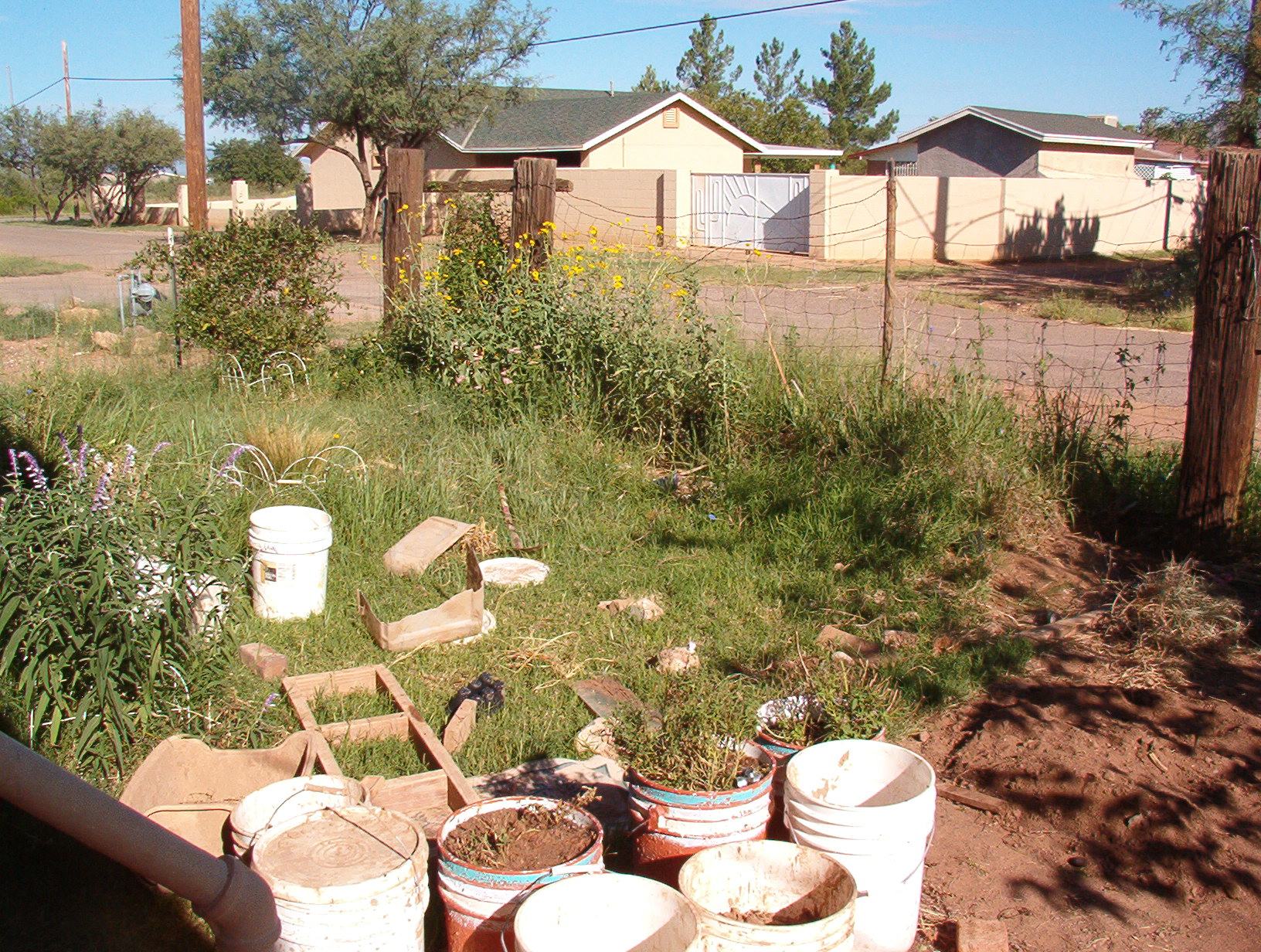
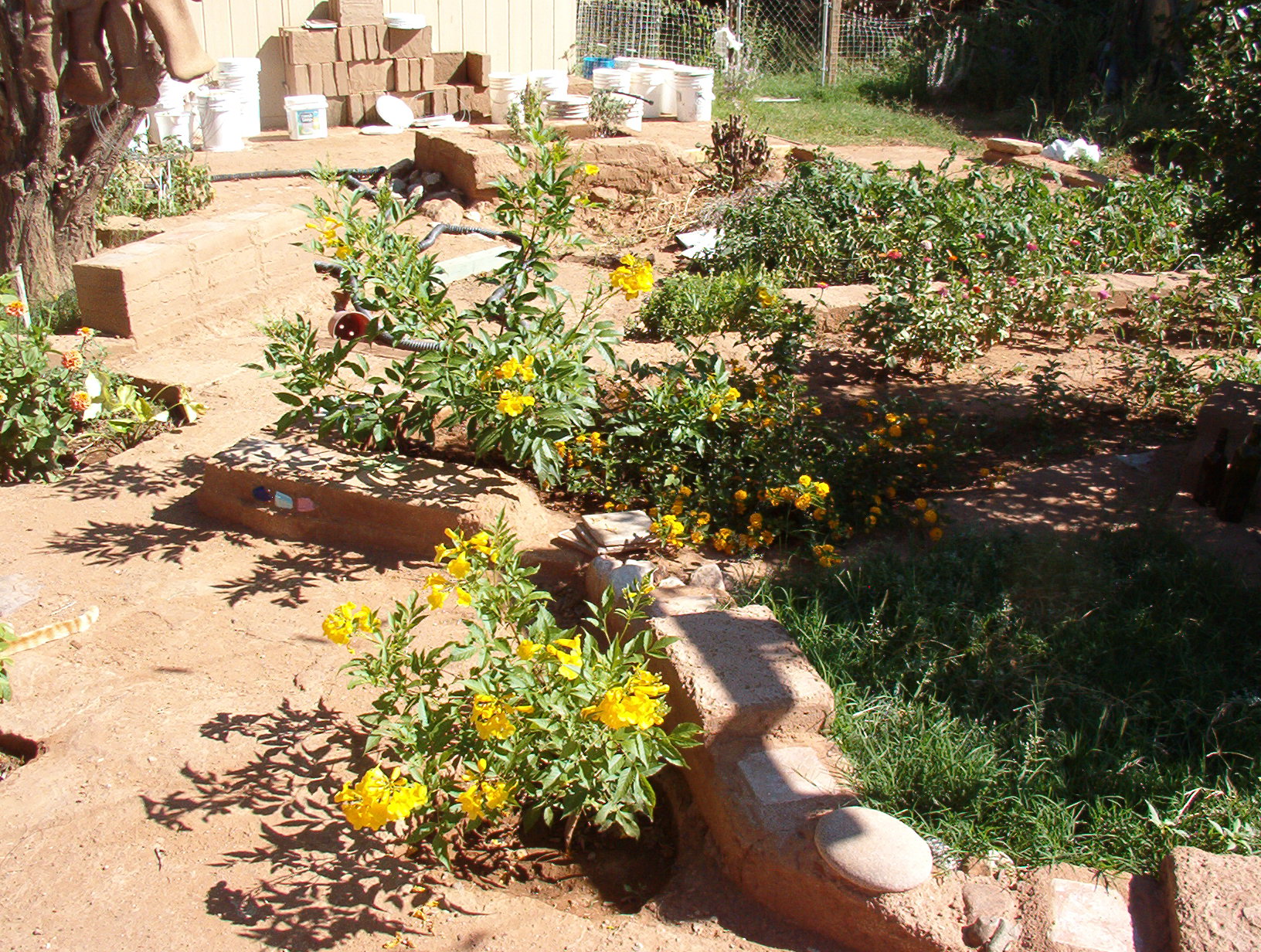
These are some pictures that show what I have been doing lately– this amazing work I love that requires no words and lets me think in an entirely different way…….

Of course with the monsoon rains at their end, all green grass will dry and turn brown. Our world down here on the Mexican border will remain mostly brown for another ten months. How to work with that brown-red dirt?
By-the-way, in the corner of the yard in this picture (above) is a Honeysuckle on left and a Jasmine on right with a lovely Lantana starting here, buried in the grass…..

The little purple tips of this fall blooming sage coming into its showing time gets rain from the gutters, packed full at the roots with Bermuda grass that can NEVER truly be eradicated once it gets a hold — only pulled, cut, dug out the best I can. There’s the adobe form, an array of junk I always seem to collect around me as I work and move move move forward until a project nears completion —
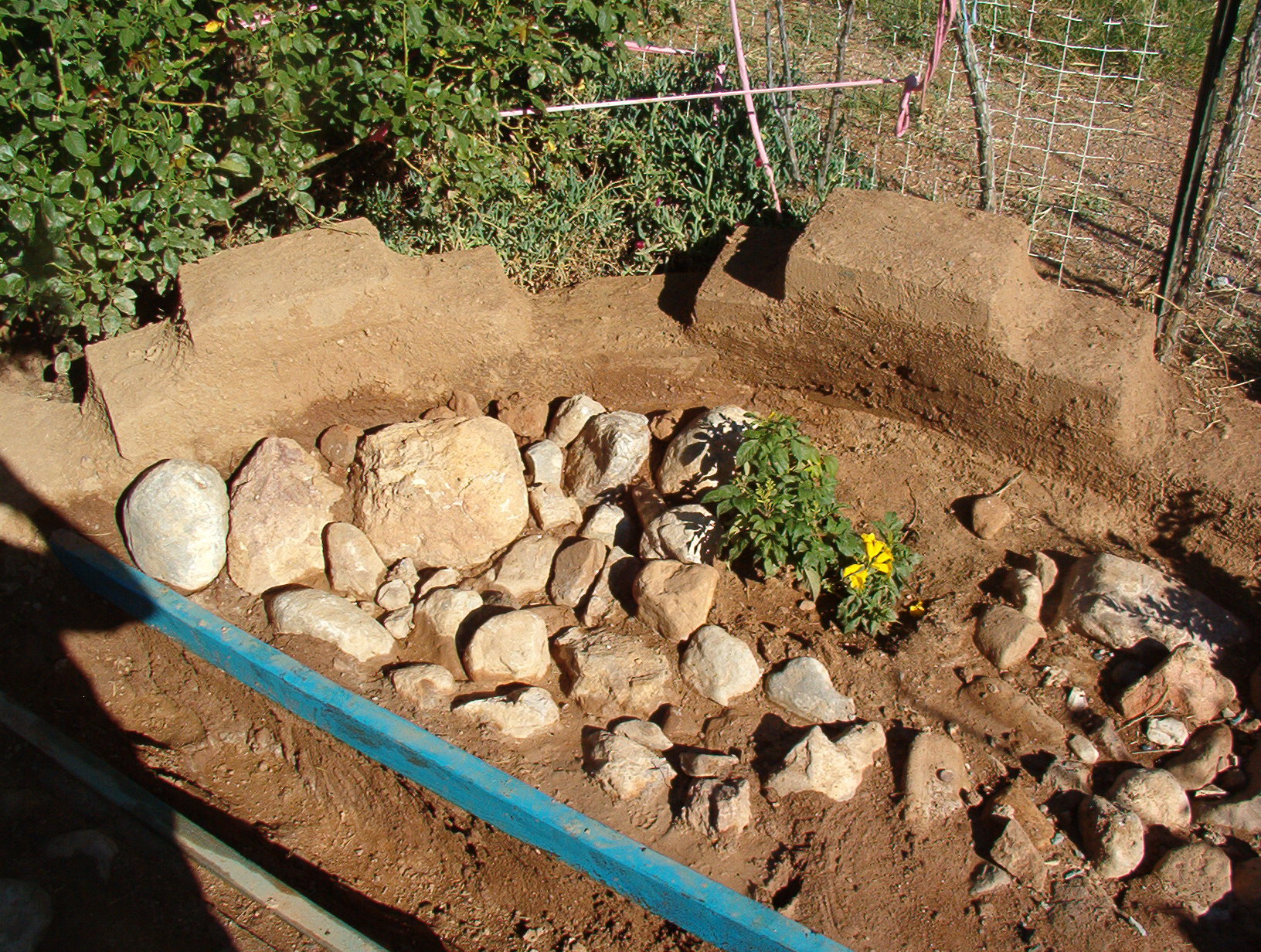
I dug 8″ – 10″ ‘holes’ around and in between my newly planted perennials, sloshed some cement into a soaked mud slurry, leveled it off and randomly placed in stones — sort of like a creek bed. I doubt either weeds or Bermuda can perk their way through this ‘pad’ once it hardens. All the water that collects in these pads will flow onto the perennials when summer rains come.
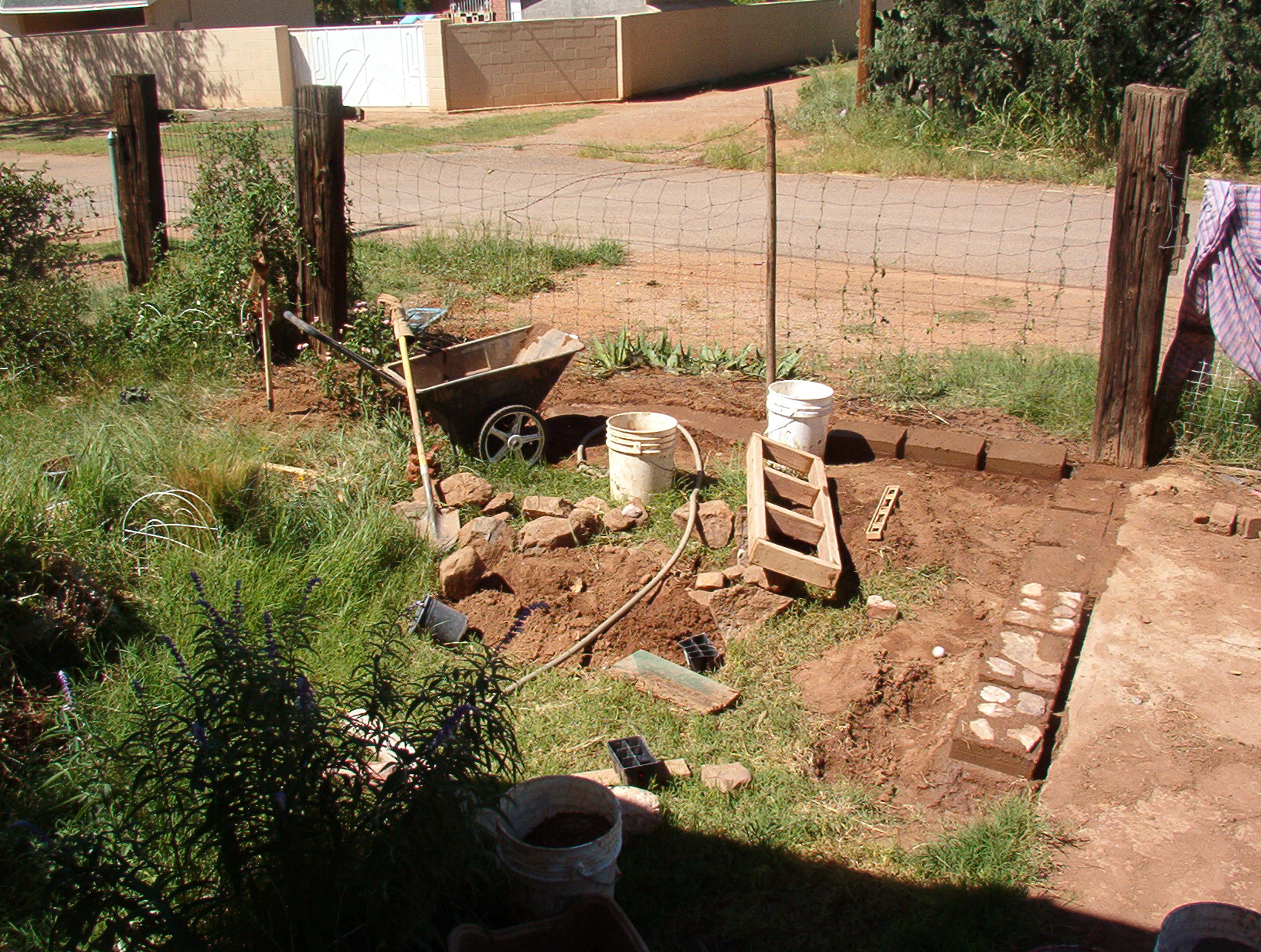
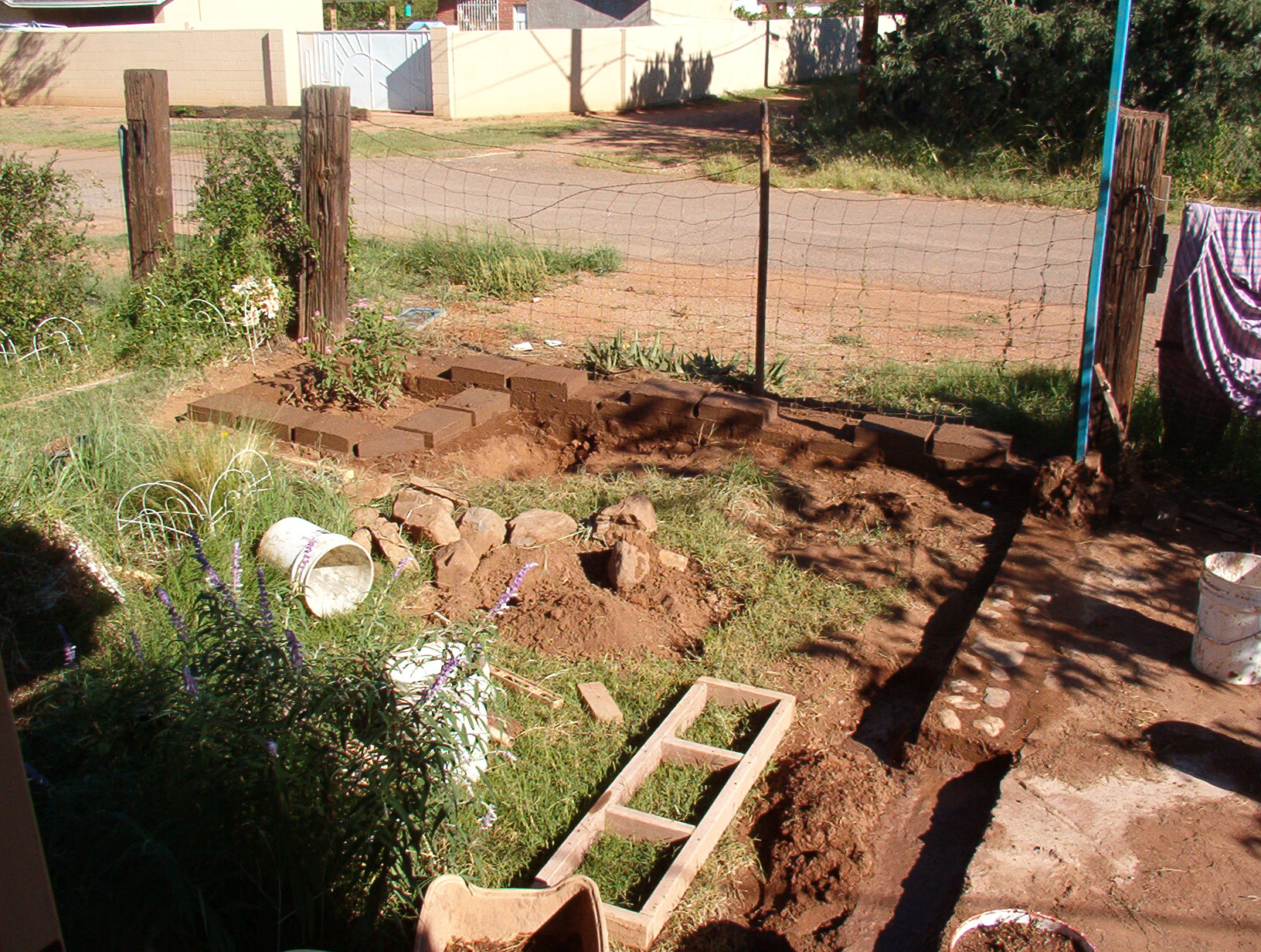
My little wall around the perimeter is made from the adobes I showed pictures of last summer stored against the wall of my house. They are too sandy and fragile to use to carry much weight, but are perfect — again — for a Bermuda defense wall. There is creeping Bermuda outside my fence, but hopefully I can catch its nasty little runners as they come OVER the top of my little wall before they can take root on my GOOD side of the fence.
I have a colorful rooster picture I found somewhere years ago hanging on my kitchen wall by my microwave. As I have studied that brightly colored picture over time, I found a perfect blue tucked in among the rooster’s tail feathers. I took the picture to our local hardware store the other day and perfectly matched it with an outdoor paint.
Again (as I did with the turquoise on the back wooden fence), I mixed about a quarter cup of paint with two cups water and made a stain for my boards I am experimenting with in the front landscaping project. Once the boards are stained, I wipe motor oil on them to bug and waterproof the wood.
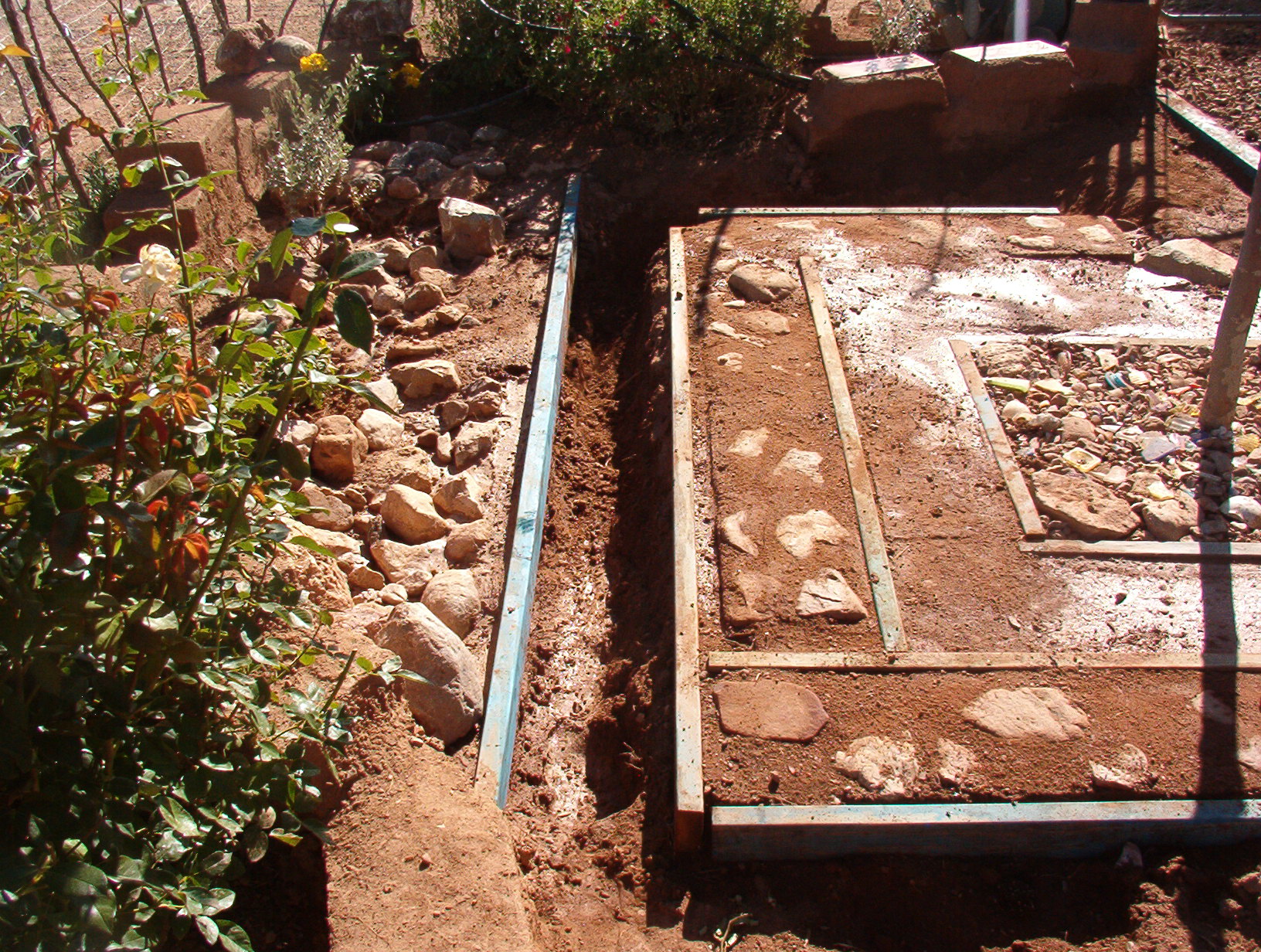
This trench forms the ‘U’ around what you will see next. That ‘dirt’ is a red clay, very dense, that turns into ROCK when dry. No plant roots can penetrate its depths. I have removed it from my trench as I did out back, and today’s work will be to remove weeds from the area in my back yard I get refill dirt from — that will also get hard when wet if not mixed with organic matter, but that contains far more sand and is Bermuda free. I figure it will take about eleven cubic yards today to refill this ‘U’ trench.
I am working, also, at figuring out how to install drip irrigation.

There are two silver Texas Ranger plants along this little wall — this next picture shows one I have started in the back yard. They are a rain-prophet plant, gaining and losing their beautiful, delicate lavender flowers many times in a season as they predict the coming of moisture (though I haven’t seen a drop of the rain they are prepared for now!)

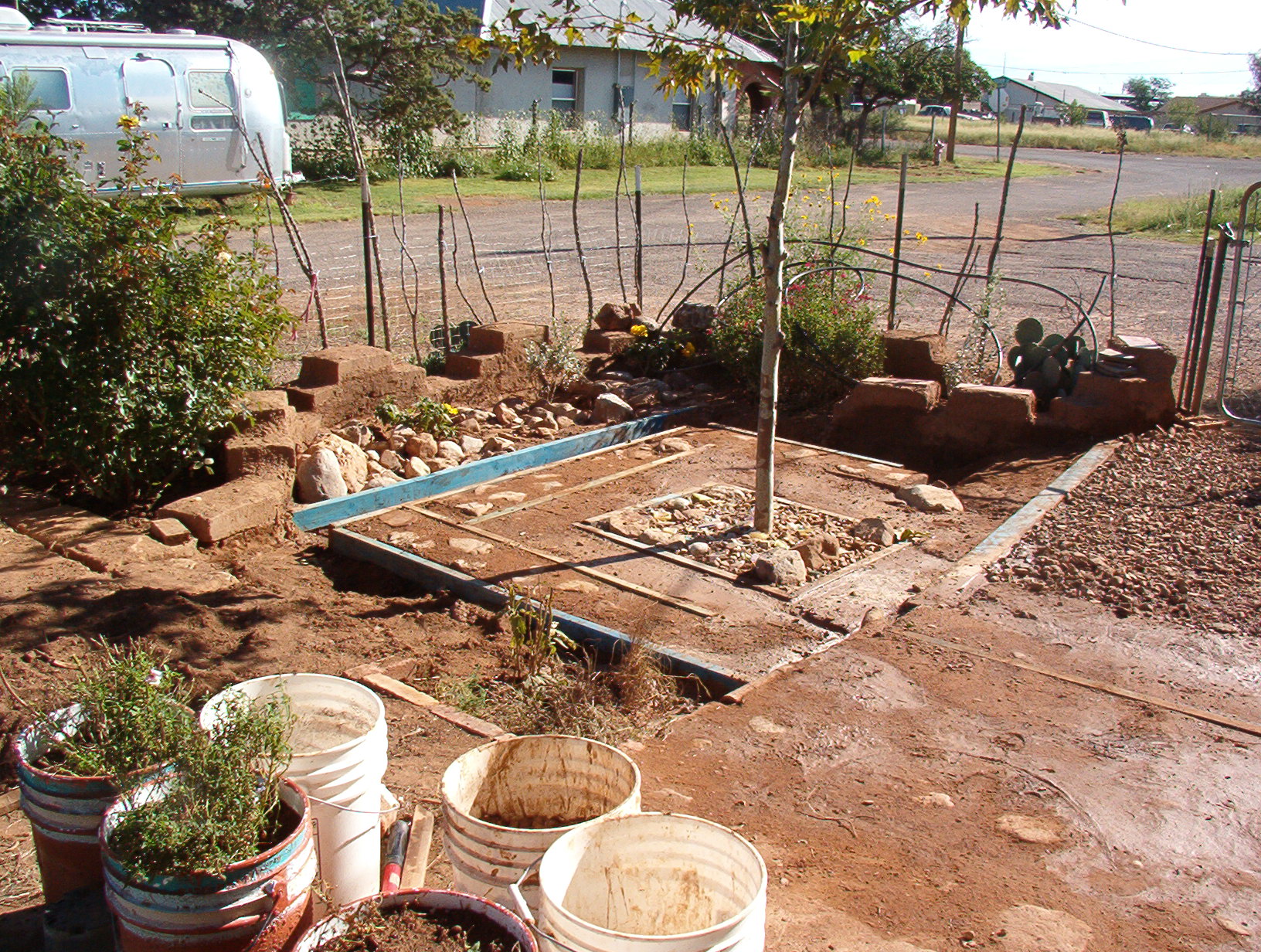
This is looking north east. The stones I embedded in my adobe walkway are mostly buried, but add strength and durability to this area where the heavy monsoon rains are going to rush. I moved and moved and moved the gravel (sifted from the dirt in the back yard when I was working back there) until I knew where I wanted it. The blue board laying on its side is meant to contain the gravel so it doesn’t get kicked here and there where I don’t want it to end up.
Once I am done with the adobe work, including doing my best to create drainage ‘channels’ to let the water run off when it rains and not flood the colored boards, I will try to scrub and clean the boards so that their color shows more brightly.
In the left corner of this picture is a yellow climbing rose. I bought it four years ago and didn’t remember it was a climber. Every year I have trimmed it incorrectly, so now that I understand how to maintain a climber I am hoping to restore this one. I have plans (again, cheapest possible on my budget) to build it an arbor over the end of the sidewalk. Currently there is no gate on that end, but I plan to build one after I tear down the broken old shed in the back yard so I can use its wood.
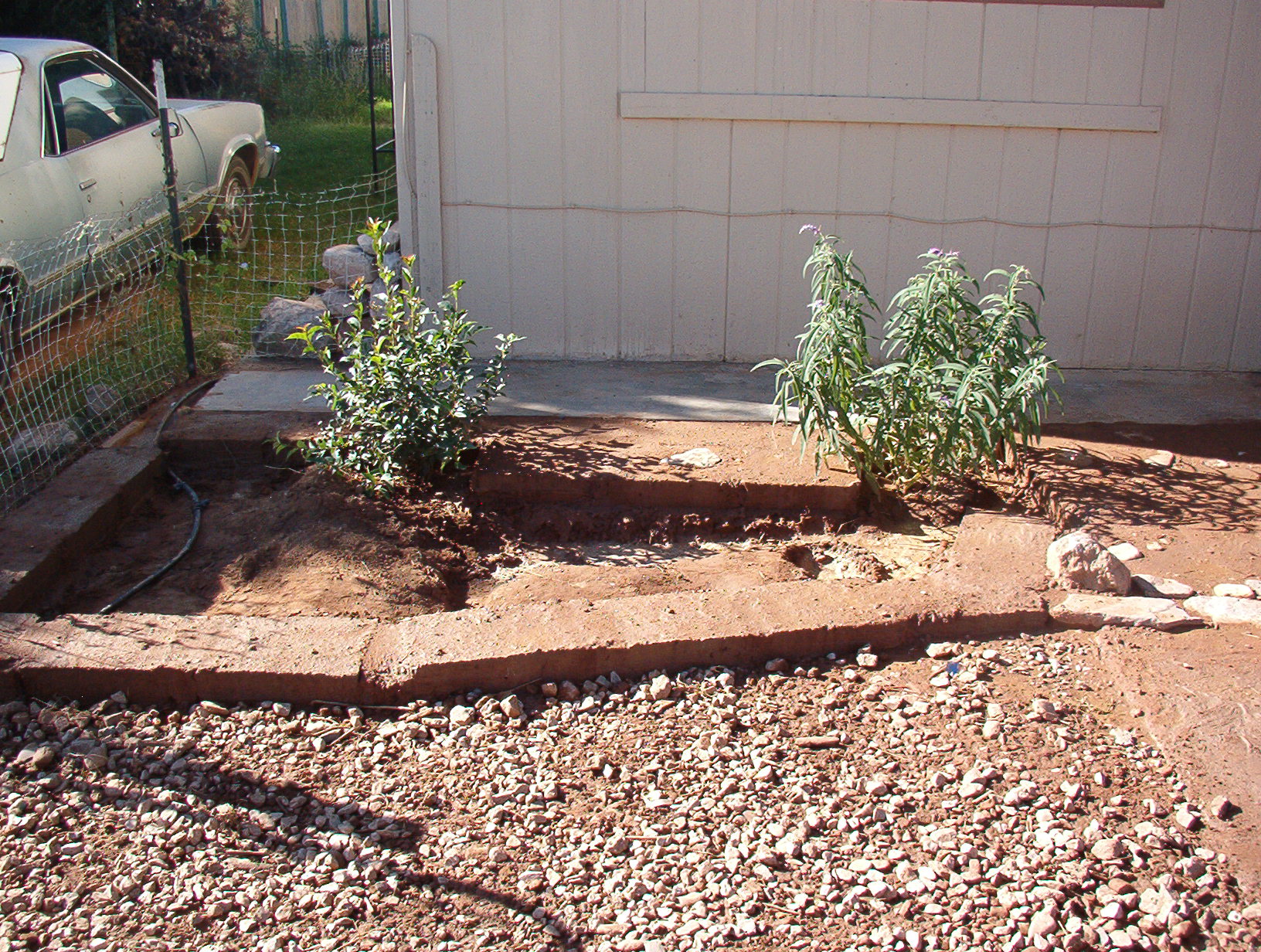
This is the most light (morning) that this area gets, but I decided I can find something to put here next summer — hopefully begonias and geraniums. This is where I ended last night, so these bricks are still quite wet. In a few days I will be able to add bricks to either end to add some sculptural height and interest to this little wall without cutting much light. Unfortunately my much-moved-around-gravel is very dirty and lots of it is sunk in wet mud — but…..
Again, the water runs off of the front house roof line here (no gutters).
And, just a quick shot — the back adobe walkways survived the monsoons just fine!
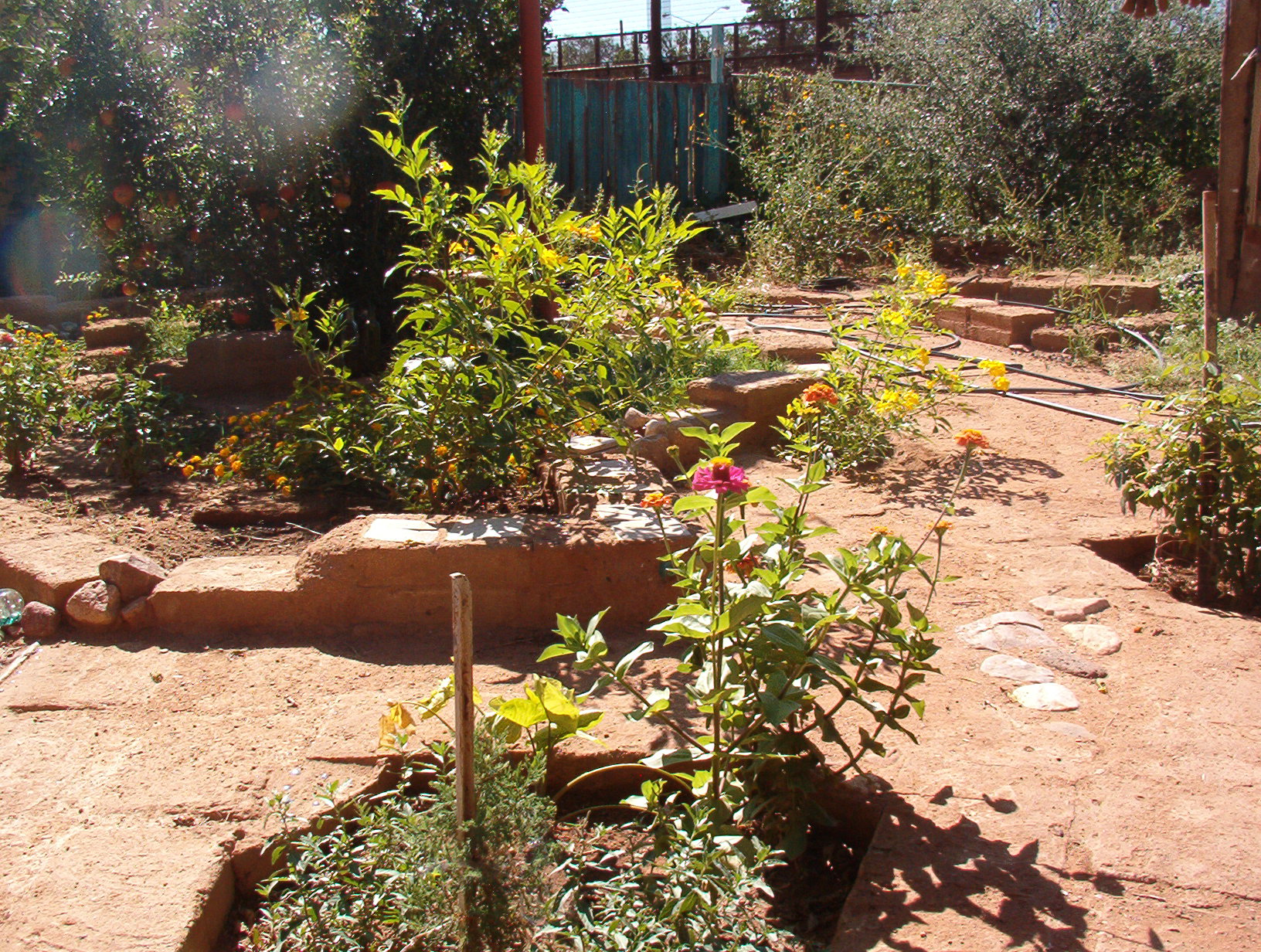 There are lots of pomegranates ripening. Right in lower center is the little cedar tree my sis brought me! AND, without the amazing garden cart my other sister gave me for my birthday I could not be doing the front project as hauling all the dirt in 5-gallon buckets all the way to the front yard would be more than I could do! ‘Harvey’ the garden cart is a miracle on wheels!
ALL the plants will do so much better on drip — long story why that is — saving it for later!
++++++++++++++++++++++++++++
++++++++++++++++++++
Thanks to a Yahoo group I ‘attend’ this article on music therapy popped into my email box today. I especially appreciated it in light of the fascination I have with my keyboard playing-learning to read music process in the hopes that I can help heal my severely verbally abused (plus) musical brain:
http://www.bbc.co.uk/news/uk-scotland-glasgow-west-11233452
Study to develop ‘musical prescriptions’ for patients
Patients could be prescribed music tailored to their needs as a result of new research.
Scientists at Glasgow Caledonian University are using a mixture of psychology and audio engineering to see how music can prompt certain responses.
They will analyse a composition’s lyrics, tone or even the thoughts associated with it.
Those behind the study say it could be used to help those suffering physical pain or conditions like depression.
By considering elements of a song’s rhythm patterns, melodic range, lyrics or pitch, the team believe music could one day be used to help regulate a patient’s mood.
Audio engineer Dr Don Knox, who is leading the study, said the impact of music on an individual could be significant.
He said: “Music expresses emotion as a result of many factors. These include the tone, structure and other technical characteristics of a piece.
“Lyrics can have a big impact too.
“But so can purely subjective factors: where or when you first heard it, whether you associate it with happy or sad events and so on.”
So far the team has carried out detailed audio analysis of certain music, identified as expressing a range of emotions by a panel of volunteers.
‘Emotional content’
Their ultimate aim is to develop a mathematical model that explains music’s ability to communicate different emotions.
This could, they say, eventually make it possible to develop computer programs that identify music capable of influencing mood.
“By making it possible to search for music and organise collections according to emotional content, such programs could fundamentally change the way we interact with music”, said Dr Knox.
“Some online music stores already tag music according to whether a piece is “happy” or “sad”.
“Our project is refining this approach and giving it a firm scientific foundation, unlocking all kinds of possibilities and opportunities as a result.”
BBC © MMX
++++++++++++++++++++
++++++++++++++++
In today’s news — something I figured out two years ago on my own — because it makes ‘body sense’ — and I was right:
View this article on Time.com
Genetic Scars of the Holocaust: Children Suffer Too
By JEFFREY KLUGER Jeffrey Kluger – Thu Sep 9, 4:45 am ET
The Holocaust is a crime that never seems to quit. Even as the ranks of survivors grow smaller each year, the impact of that dark passage in history continues to be to be felt. And it’s not just the victims who feel the effects; it’s their children too.
Psychologists have long been intrigued by the emotional profile of so-called second-generation Holocaust survivors. Parents who lived through the camps were forever changed by the horrors they witnessed. In the 21st century, many – probably most – would be recognized as suffering from post-traumatic stress disorder (PTSD). Back then, the absence of such a diagnosis meant the absence of effective treatments too. As a result, a generation of children grew up in homes in which one, and sometimes both, parents were battling untold emotional demons at the same time they were going about the difficult business of trying to raise happy kids. No surprise, they weren’t always entirely successful. (See photos of Auschwitz after 65 years.)
Over the years, a large body of work has been devoted to studying PTSD symptoms in second-generation survivors and it has found signs of the condition in their behavior and even their blood – with higher levels of cortisol, a stress hormone, for example. The assumption – a perfectly reasonable one – was always that these symptoms were essentially learned. Grow up with parents afflicted by the mood swings, irritability, jumpiness and hypervigilance typical of PTSD and you’re likely to wind up stressed and high-strung yourself. (See more on how children are also vulnerable to posttraumatic stress.)
Now, a new paper adds another dimension to the science, suggesting that it’s not just a second generation’s emotional profile that can be affected by a parent’s trauma, it may be their genes too. The study, just published in the journal Biological Psychiatry, was conducted by a team headed by neurobiologist Isabelle Mansuy of the University of Zurich. What she and her colleagues set out to explore went deeper than genetics in general, focusing instead on epigenetics – how genes change as a result of environmental factors in ways that can be passed onto the next generation. (See pictures of an army town coping with PTSD.)
To conduct their work, Mansuy’s team raised male mice from birth and continually but unpredictably separated them from their mothers from the time they were one day old until they were 14 days old. Thereafter, the animals were reared, fed and cared for normally, but the early trauma took its toll.
As adults, the subject animals exhibited PTSD-like symptoms such as isolation and jumpiness. More tellingly, their genes functioned differently from those of other mice. The investigators looked at five target genes associated with behavior – most notably, one that helps regulate the stress hormone CRF and one that regulates the neurotransmitter serotonin – and found that all of them were either overreactive or underreactive.
These mice, for the purposes of the study, were the equivalent of first generation of Holocaust survivors. The same mice then fathered young and, like most males of the species, had nothing to do with their upbringing. The pups were raised by their mothers with none of the trauma and separation their fathers had suffered, and yet when they grew up, not only did they exhibit the same anxious behavior, they also had the same signature gene changes.
“We saw the genetic differences both in the brains of the offspring mice and in the germline – or sperm – of the fathers,” says Mansuy.
Mouse studies, by their definition, are limited, particularly when the animals are being used as stand-ins not merely for human biology, but for human behavior. Still, in this case, the nonhuman models were actually an advantage, since you could hardly run a control experiment in which second-generation survivors of the Holocaust were separated from their fathers, ensuring that you were studying inherited – not acquired – traits. What’s more, says Mansuy, “with animals, you can study the brain in detail.”
That doesn’t mean that some studies couldn’t be conducted in human subjects that sought similar findings. Straightforward analysis of blood, plasma and sperm from volunteers could reveal signs of genetic changes similar to those seen in mice. And a deeper analysis of the mouse genes should yield other target genes to study in people. “We’re now doing a high throughput study of hundreds of genes that go beyond the first five,” says Mansuy.
The Holocaust is hardly the only life crisis that can shape behavior and genes. Survivors of Afghanistan, Iraq or Darfur – or even those who grew up in unstable or abusive homes – can exhibit similar changes. But Holocaust survivors remain one of the best study groups available because their trauma was so great, their population is so well known, and so many of them have gone on to produce children, grandchildren and even great-grandchildren. Humans, alas, may never run out of ways to behave savagely toward one another. But the better we can understand the price paid by the victims – and the babies of the victims – the better we might be able to treat their wounds.
See the top 10 medical breakthroughs of 2009.
Buy reprints of TIME’s health and medicine covers.
++++++++++++++++
 Stop the Storm
You must be logged in to post a comment.