
+++++++++++++++++++
Having just mentioned metaphors as being useful ways the brain (particularly the right brain) has to consider and process information, I remembered this picture I just discovered yesterday.
My mother took this picture around 1960 during our family’s early Alaskan homesteading years.
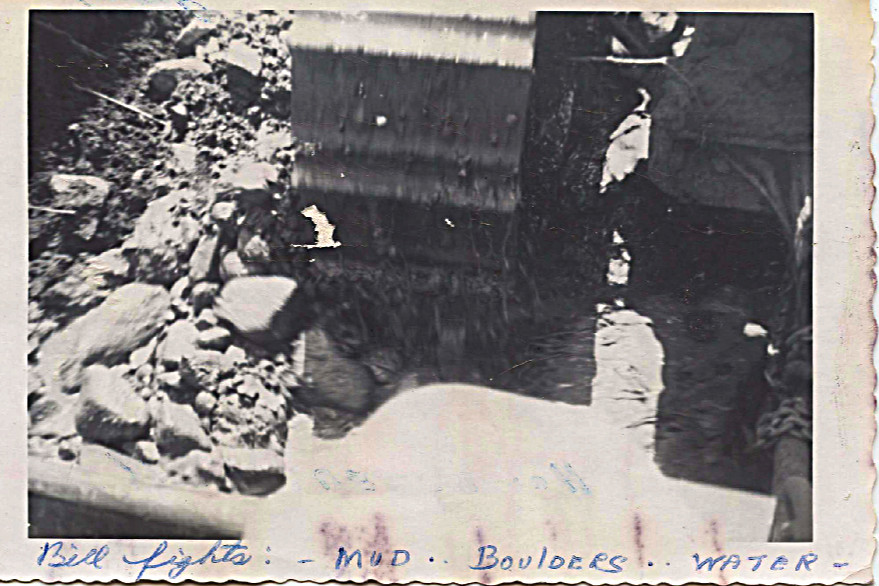
Written on the back of the photograph: “See the mud spattering up — it is dark here in the woods and picture doesn’t show up the MUCK [underlined]”
Most of these photographs survived a major fire in the 1980s so the white area in the lower picture is a result of that damage. I never knew this picture existed until yesterday, and I found it a useful addition to my metaphor thinking about how early trauma changes the development of an infant-child’s body-nervous system-brain.
What those of us with serious insecure attachment ‘disorders’ experience — as related to the physiological changes that complex post-traumatic stress disorder (PTSD) causes, is a body that cannot turn off it’s fight-flight-flee-freeze stress response.
When I think of this, I ‘hear’ the low growl of a hard-working machine trying to get us through life in a world that our body was designed to believe would ALWAYS be a dangerous one to our survival.
I know this growl because I heard it growing up on the side of an Alaskan mountain after I was seven as tractors often were heard working hard to either build roads or to repair them.
What our mountainside had was a ‘mountain marsh’ caused by water that ran underground but near to the soil surface. Once the intricate network of tree and shrub roots that held the soil in place were cut through for road building, the mountainside continually oozed its water — creating in winter massive living glaciers that filled the roads and crawled down the mountain.
In break-up the glaciers melted and created deep ruts that were actually mountain creeks as the water ran down the easiest pathways it could find headed toward the valley below. Except in the dead of winter, the common denominator for the entire road nightmare was MUD — what my mother is calling here MUCK.
Horrific infant-childhoods tell a little one’s growing and developing body to prepare for a lifetime of the worst. We only have this one time in our life to grow some of the most profoundly important parts of our body. Once our adaptations to an early malevolent environment take place, they cannot be undone ‘down the road’ or ‘later on’. We live with them.
So, in effect I have a body-nervous system built in and designed for a very hard road through life — for one not unlike the road my father was trying to crawl over with his tractor in this picture.
++++
Another picture I have scanned from this era of my childhood comes to mind, and it represents another metaphor of high risk for severe child abuse survivors — that of BEING STUCK along the way.
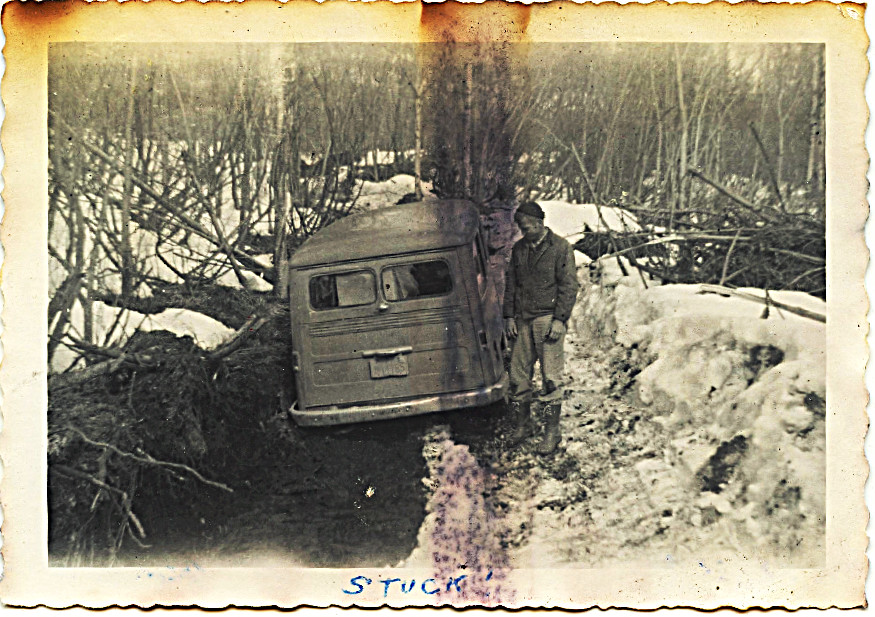
Always running in low working gear, always trying to negotiate a tough, rough road through life, always prepared for the worst, always at risk for danger, frequently getting stuck and needing to find our way out again — all these experiences are part of severe infant-child abuse survivorship.
All these ways of being in the world are built into our body, and all of it consumes vast amount of our inner resources and life force throughout our lifespan. If we wonder as adults why we can’t reach some pie-in-the-sky level of so-called ‘recovery’ so that we can be more like other people who had entirely different, benevolent early years that gave them a different body entirely, think about all of this.
I’m not saying that improvements can’t be made for us in our lives toward increased well-being — but first, we need to KNOW what happened to us where it matters most.
+++++++++++++++++++
 Stop the Storm