
++++++++++++++++++++++++
I am revisiting what I see as the core differences between my borderline mother and myself. I find that nothing has changed in my thinking about these differences in my past five years of research. My mother’s childhood-onset dissociation became malignant while mine remained benign.
In my first ‘doodle’ I visualized the impact of infant developmental attachment deprivations she suffered from birth until age two. Born into a family with marital discord and left with her primary care in the hands of a ‘nanny’, I envision that my mother’s developing brain-mind-self was already far off course before she reached the stage of developing a Theory of Mind.
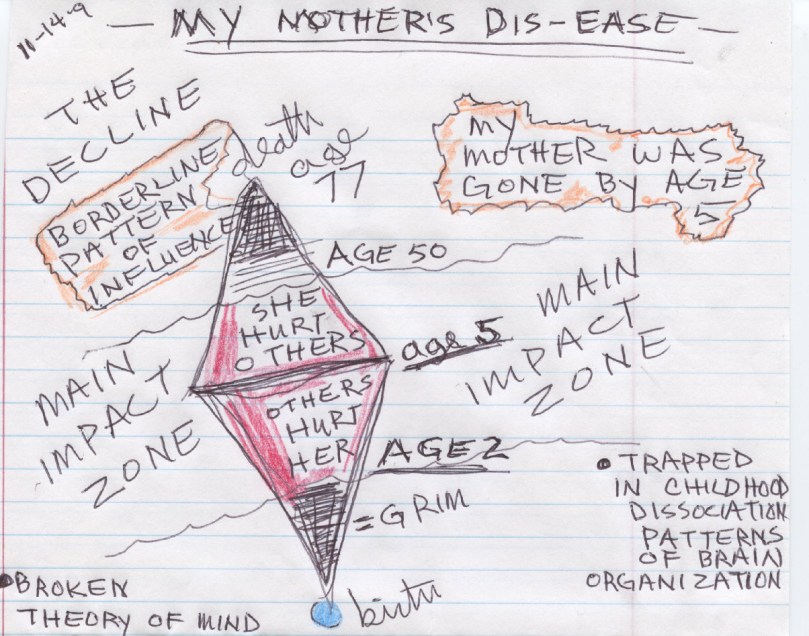
During the developmental stages from age 2 – 5 conditions in my mother’s childhood so severely impacted her brain-mind that I believe her later mental illness had already centralized the organization of her self. From the age of 5 it was simply a matter of time before the bomb that was her Borderline Personality Disorder condition would explode – which it did during her terrible delivery of me.
The broader dimensions of the diamond figure that I drew show that in the bottom half powerful interactions with others in her life were feeding her unstable growing self. She had reached what I call the ‘rage stage’ which was coupled with the following:
My mother was a victim of a lie. She was told through word and deed by her early caregivers that sometimes she was good enough to be loved. She was also told that sometimes she was so bad she was un-love-able. The lie was that she had the power to change herself from being bad to being good, and if she changed into being good (made the bad go away) she would be love-able – and therefore would be loved.

These conditions presented my mother with an impossible paradox for which there was no answer. She never knew she was being lied to by her attachment caregivers. She did not know that there was no solution to this paradox. She was told she had the power to change herself into being ‘all good’, and she eventually found her solution – me.
The impossible solution to her fundamental betrayal problem was to spit off all her badness and project it onto me. That left her being all good and me being all bad. She never had the capacity to know she had believed a lie, found an impossible solution to an impossible riddle, or that she had been tricked and fooled. Once her child brain-mind wrapped herself around the too-big problem of her early life, her brain-mind continued to grow with this malignant lie within it.
As she moved out of her childhood into her adulthood, and then into the stage of her childbearing years, her childhood dissociation, fueled by childhood rage and a broken Theory of Mind, meant that her children remained her doll-imaginary friends with me as her imaginary enemy (as I have previously described). By the later years of my mother’s life she had fewer and fewer people she could influence through her mental illness, and she died as alone and unconsciously troubled as she had been from the time of her birth.
I see this ‘main impact zone’ as being the mass of incoming information that hurt her, followed my the mass of information she later could displace and project onto others to hurt them (primarily me).
++++
My second doodle page (above) presents the basics of what I believe are the differences between my mother and myself. Like her, my foundation from birth was in disorganizing, disorienting insecure attachment to early caregivers. But unlike her, I was never fooled, tricked, or betrayed. Her projection of her own badness onto me condemned me absolutely and permanently. I was simply doomed to be hated without hope of reprieve, salvation, or any hope of implementing my own solution to solve any of the ‘problems’ I had with her.
The simplicity of my life saved me. I was not faced with solving an impossible riddle. I was not presented with the impossible paradox of “you can change yourself into a good and love-able child and then I will love you.” My childhood was one continual ‘rupture’ without either repair or hope for repair. My mother’s childhood contained ‘ruptures’ with faulty and deceiving repairs.
In the final analysis, I was far more fortunate than my mother was. She was set up to fail at being love-able. I was simply not love-able. It was the constancy of my unloved-being hated state that saved me. It was the inconsistency of her unloved-sometimes loved state that ruined her.
I believe her brain fixated a rigid solution to an unsolvable problem. Her childhood dissociation organized in her brain-mind-self around this solution – which became her internal and unconscious fulltime goal. I believe her mental illness was fueled by childhood rage. Her childhood dissociation became malignant, and I became its operational target.
My childhood dissociation had no goal other than physical enduring survival. My brain-mind-self was left in a fluid, continually changing and adapting state because I HAD NO GOAL and I had no hope, false or otherwise. My mother’s treatment of me was made tolerable through what I call benign dissociation and my development occurred in a world of sadness.
++++
My mother ended up fighting to be love-able, fueled by rage. Rage is tied to active coping skills, whether we want to admit this or not. I did not grow up a fighter. I grew up a sorrow-filled victim stuck in the passive coping skill state. My mother was told she had the power to change what happened to her, even though it was a lie and it was not within her power to change the dynamics of her caregivers’ treatment of her.
My mother was damned and didn’t know it. I was damned and I did know it. I knew I had no power to change what happened to me. Nobody ever fooled me into thinking otherwise — from the time I was born. I believe that there are two entirely different trajectories of development set up by the two different childhood scenarios I am describing. One leads to the development of a dangerous, demonizing mother and the other one does not.
Both my life and my mother’s of course ended up being extremely complicated with devastating consequences stemming from child abuse and neglect in a malevolent environment during critical body-brain-mind-self stages of early development that resulted in a changed brain for both of us. Yet as I see it, I was never betrayed or set-up with an impossible task to accomplish like my mother was, and being free from these overpowering early forces allowed me to become who I am.
My mother’s mental illness prevented her from ever being able to tolerate becoming conscious either of how she behaved or of what had happened to so wound her in childhood. I am not barred in the same way from consciousness. As I continue to explore the underlying aspects of safe and secure attachment, I will explore how having the ability to be self-aware and self-reflective makes all the difference in how and who we become in our lives.
++++
This post follows:
+DISSOCIATION AND THE TRAUMA-SPECIALIZED BRAIN 11-11-09 and
+SECURE AND INSECURE ATTACHMENT AND THE CHILDHOOD NARRATIVE 11-13-09
++++
++++++++++++++++++++++++++++++++++
THIS INFORMATION COMES TO YOU FROM:
| Prevent Child Abuse New York Blog |
| Improving Children’s Mental Health through Parenting EducationPosted: 13 Nov 2009 03:01 AM PSTGuest post by Michelle Gross, Projects/Public Policy Manager, Prevent Child Abuse New York In today’s difficult times, one of the most important skills one must possess is the ability to form healthy relationships and cope with life’s challenges. Our children are not born with these skills, but rather learn them through their social and emotional development.While providers have traditionally focused on physical development, in 2006, the New York State Legislature passed the Children’s Mental Health Act. The Act required the development of a statewide plan to address issues in children’s social and emotional health, zero to eighteen. As a result of this legislation, the Children’s Plan was developed in collaboration with nine state agencies and led by the New York State Office for Mental Health.The Children’s Plan serves as a blueprint for New York state agencies, providers, and communities to improve the social and emotional development of children and their families. The Plan focuses on engaging children and their families in services early, ensuring that systems are collaborating to provide effective and efficient services and meeting families’ needs by focusing on their strengths and abilities. Within the Children’s Plan is a directive for the Office of Mental Health to work with parenting educators to better support parents in raising emotionally healthy children. The New York State Parenting Education Partnership has been chosen to play this pivotal role in educating providers who work with families and supporting a network of family support and information. NYSPEP’s efforts to provide professional development sessions for parenting educators will enhance providers’ ability to communicate the importance of social and emotional development with parents, and offer both providers and families tools to facilitate children’s healthy development. For more information, visit our web site at: http://www.parentingeducationpartnership.org. |
|
Positive Parenting Can have Lasting Impact for Generations Posted: 12 Nov 2009 07:15 PM PST A new study that looks at data on three generations of Oregon families shows that “positive parenting” not only has positive impacts on adolescents, but on the way they parent their own children. ” Positive Parenting can include factors such as warmth, monitoring children’s activities, involvement, and consistency of discipline. Researchers from the Oregon Social Learning Center conducted surveys on 206 boys who were considered “at-risk” for juvenile delinquency. The boys and their parents were interviewed and observed, researchers information about how the boys were parented. Starting in 1984, the boys met with researchers every year from age 9 to 33. As the boys grew up and started their own families, their partners and children began participating in the study. In this way, the researchers learned how the men’s childhood experiences influenced their own parenting. There is often an assumption that people learn parenting methods from their own parents. In fact, most research shows that a direct link between what a person experiences as a child and what she or he does as a parent is fairly weak. The researchers found that children who had parents who monitored their behavior, were consistent with rules and were warm and affectionate were more likely to have close relationships with their peers, be more engaged in school, and have better self-esteem. For more information relating to positive parenting techniques, please visit our website http://preventchildabuseny.org/parents.shtml |
 Stop the Storm