+HARDHITTING ON THE TOPIC OF BAD RELATIONSHIPS

++++++++++++++++++++++++++

Of all the tragedies that life can find to place in our way along our path from start to finish, those connected to our early histories of growing up in homes with what the Center for Disease Control refers to as Adverse Childhood Experiences could become the easiest ones for us to spot.  Sure, there are plenty of self help books and programs that more and more of us eventually discover that tell us how to ‘get better’, but are they really telling us anything like the REAL truth about who and how we are in the world?

Is there anything like a product guide, a user’s guide, or a reliable guarantee of ‘full disclosure’ as we leave our abusive homes of origin and seek to join the mainstream world, jumping into the flow of major life choices and their resulting consequences?  Of all the things we leave our abusive homes not knowing anything about, perhaps the one that follows along with us the longest is our mistaken idea that we can somehow create safe and secure adult relationships between partners who do not have an early history of safe and secure attachments.

We are heroic in our attempts to build sandcastles to live within as if they will shelter us from the storms we face in life, as if they can withstand the onslaught of storms that sweep over and around us over the years of our life time.  How hard it is to let ourselves know that we are really homeless in the world of our partnerships, that no matter what any self help book tells us, those of us who survived an infant-childhood filled with trauma, abuse and madness will not live long enough to learn enough to begin to change enough to be able to sustain and maintain a mate relationship of safe and secure attachment.

So many people, especially in today’s unsafe and insecure economic environment, are facing limitations of choice to exit unstable, abusive, and simply put, very BAD relationships, especially if they are still caring for dependent children.  Those now left without the ability to create a sustainable exit plan out of one of these BAD relationships will experience increasing levels of stress for themselves and for their children.

These children, growing up with the pressure and strain of Adverse Childhood Experiences of their own are likely to seek attachment relationships themselves that are the equivalent of sandcastle and cardboard box partnerships that will never do more than temporarily appear to be sustainable.  What the self help books don’t tell us, is that we would be far better off building a concrete vault to sustain ourselves within independently and autonomously than we would be pretending that we have the first clue what a safe and secure attachment relationship is – because we don’t.

++++

Which is harder, learning to avoid getting into these unsustainable relationships in the first place or trying to get ourselves out of them after we have committed our hearts and entangled our lives?  Actually, I could be accused of cheating and that accusation would be correct.  At age 58, I am far enough down the road of life to be able to look backwards at my own life and sideways at the lives of others to see that a sustainable, autonomous, independent and FREE life alone has – the way I see it from here – so much more to offer me as a severe infant-child abuse survivor that I can no longer even pretend that I even WANT another sandcastle or cardboard box attachment relationship in my lifetime.

Coming out of abusive childhoods leaves many people prepared to continue struggling against insurmountable obstacles for the rest of their lives.  If the goal is to survive given the difficult conditions of life, then we are experts at trying to reach our goals.  Over and over again, on and on we go repeating our efforts to make a truly crappy situation and/or relationship into a good one.  We learned at the start of our life that to give up is to die.  We can continue to apply our simple rules of trying to stay alive to all kinds of situations that we would be better served simply walking away from.

++++

The goal of a truly sustainable infant-childhood is to form, through safe and secure attachment relationships with our caregivers, our own clear, strong, independent and autonomous self that can then continue down the road of life with enough inner resources to appropriately interact empathically, responsibly, appropriately and compassionately with others.  The more I learn about the physiological body-brain changes that are a direct result of growing and developing within malevolent early environments, the more I see that we survivors were simply never given what we needed to create one of these best-selves-possible.

Our handicaps show up in some way in nearly every choice we make.  Our choices for our adult attachment relationships are probably the most volatile and unsustainable ones we make.  While we continue to believe that somehow if we work hard enough we can perform the magic act of alchemy to transform ourselves in our relationships and that our partners can also transform themselves, we are most often struggling to accomplish the impossible.  We are like the dolphins caught in tuna nets who struggle until they die.

From my age 58 perspective I am beginning to finally understand something that appears to be one of the greatest paradoxes, if not downright ironies of life:  Those people who are most able to sustain themselves comfortably as independent and autonomous people outside of a mate relationship are the ones that will be able to sustain themselves – AND THEIR PARTNER – in a safe and secure attachment relationship – IF THEY EVER CHOOSE TO HAVE ONE.

While this might seem obvious, simplistic, and intellectually believable, severe infant-child abuse survivors are likely to NEVER TRULY GET THIS POINT.  I think back nearly 30 years ago when I was going through a treatment program designed to address my ‘child abuse issues’.  I was unhappily married for the second time.  My therapist told me and my husband that unless and until we each, on our own, separately and independently improved our own well-being, that ‘working on the marriage was impossible.  This therapist told us that otherwise it would be like scraping two piles of mold from different corners of the bottom of a refrigerator into one pile and expecting something good and healthy to come of the effort.

He was right.  I will grant him that point.  But I was not told NEXT what I now know, and needed to be told THEN.  I could apologize here for mentioning what I am going to say next, but with my advancing years I now see this as the rest of the story.  Never in my lifetime is it possible for me to make enough so-called changes so that I will ever be able to have a sustainable mate relationship with anyone.

That’s an extremely harsh reality, but reality it is.  I can spend the rest of my life, literally working to improve my independent, autonomous, sustainable own self and while I can make progress within myself, I do not believe that I have a long enough lifetime to make myself into this kind of self.

Even if my therapist in 1983 had told me this fact, it’s doubtful I would have believed him.  I would have thought, “Well, that might be true for others, but I am special.  I can be the exception.”  That would have been a delusion I could freely have believed in.  But sooner or later things that are true remain standing, like stone pillars strong enough to withstand millions of years of erosion.  That’s one of the things that the truth actually does:  It remains standing when all else has crumbled and vanished away.

++++

Knowing this fact now, that unless and until I can become an independent, autonomous, sustainable single self I will not be capable of forming safe and secure attachment with a mate, actually gives me a point of reference that acts like a true-north orientation of myself in relationship to my entire life.  I can kick and scream, deny and try to make deals, compromise, suffer and struggle, sacrifice and fantasize that somehow I can escape the consequences of having been forced to grow and develop a body-brain in a horribly abusive, deprived, malevolent world that in no way created a physiology in me that operates the way a safely and securely-built attachment physiology operates.  Or I can accept the facts and begin to realize that life offers me an acceptable alternative – the freedom of being alone that I need to heal what can be healed inside of my own self.

I say this as I come to realize why I cannot ever be with the man I love completely.  As I understand that WHY from inside my own body I am at the same time gaining understanding about the WHY as it relates to his attachment physiology.  I know of no attachment therapy approach that even begins to explain the facts of what makes our relationship so much more than difficult.  Our relationship is impossible.  Survivors need to be told what is really going on for us.  Dancing around the facts of our changed attachment physiology continues to give us the illusion that there really is ‘hope’ for such impossible relationships.

++++

Anyone who reads this post is of course perfectly free to take their own stand and make their own choices regarding any relationship they may be in.  I am simply stating my own point of view based on what I have learned about the nature of terrible infant-childhoods and how they change our physiological development.  These changes operate in unsafe and insecure attachment patterns that are visible and definable once we understand how basic and fundamental these patterns truly are.

These changes are, I believe, the root causes of all the trauma dramas we enact in our lives.  They are at the root of our suffering.  They created a lack of ability to smoothly and consciously regulate our emotions – in our body, our brain and our mind – through safe and secure attachments between ourselves and the world we live in.

As a result we are more like unstable nuclear reactors than we are like independent, autonomous, sustainable people.  It is at this level of woundedness – in our trauma-changed body-brains — that our problems with mates and relationships actually originates.  It is at this level, for those of us who are survivors of traumatic infant-childhoods, that our physiology does not support recovery.  We had no opportunity to create in the first place what would help us to go ‘back’ and ‘recover’ now.  We cannot ‘recover’ what we never had in the first place.

All human actions and interactions are ultimately about regulating our individual physiology, including our emotions.  That is what being a human being living in an Earth Suit really means.  The experiences of our early attachment relationships tailor fit our Earth Suit accordingly.  We need to understand ourselves and others at this most basic physiological-change level if we want the misery-patterns of our lives to end.

It’s not the relationships we participate in that we need to change.  It’s the Earth Suit we live in while we have these relationships.  Changing the Earth Suit we live in while in the midst of trauma drama is about as impossible as flying into the sun.

++++++++++++++++++++++++++++++++++++++

+WHO CAN GET TO AND RESCUE THE SUFFERING BABY?

++++++++++++++++++++++++++++++++

Even though I am not able to be with her right now, I am so grateful for the wonderful telephone conversations I am able to have with my daughter who is expecting her firstborn, a son in the third week of April.  They are entering their 31st week of pregnancy.  I have never been a grandmother before.  It’s all new, to all of us, to baby boy’s mother and father, his grandparents, his auntie and uncle.  I think it’s because of last night’s telephone call with mommy-to-be that the dream came to me last night.

Many thoughts crowd into my mind as I start to write about this dream.  There were two newborn babies, a boy and a girl.  There were two women.  But looking back on the dream as if remembering a movie I know these two women were really four:  My grandmother, my mother, myself and my daughter.  Between the four of us we took turns at being one of the two women in the dream.

There was no doubt in the dream that the boy newborn was loved.  He was not left to cry, alone, hungry, isolated in the dark.  He was cared for, picked up and held, swaddled in soft blankets and cuddled closely to the breast as he was fed.  I was aware that the tiny newborn girl was alone.  I could sense where she was, far away in the shadows of a big empty room.  If she was fed at all it was through a cold glass bottle propped on a rolled blanket laid beside her head.

I could FEEL the sad forlornness of the little girl, but I was powerless myself to reach her, or to in any way convince her mother to go rescue her from her living tomb of isolation.  Her mother shifted from being my grandmother with the baby being my mother, to being my mother and the baby girl being me.  The mother of the little boy shifted from being my daughter to being me, but the little boy, I knew clearly in the dream was going to grow and develop in a completely different way than how that little unloved girl would.

Although I cried and pleaded in the dream for someone to let me go get and breast feed the little girl, nobody heard me and I was prevented from going to find her.  I could only know she was there.  I could empathize with her aloneness of being lost in an unending huge world of dim shadows where nobody loved or wanted her.

The woman in the dream that lovingly cared for the newborn boy as she held him closely in her arms and fed him from her breast, shifted from being my daughter with her son, to being me with my son, to being my mother with her firstborn son, my brother who was 14 months old when I was born.  Even though I know my mother never breastfed my brother, in the dream I knew she was able to give him what he needed as if she did.

++++

I knew in the dream that both babies were equally needy, equally deserving, equally perfect.  I knew in the dream that it would not have mattered to that little girl who picked her up and held her closely, who gazed into her little tear strained eyes, who nursed and nurtured her, who touched her tiny hands and stroked her soft, smooth cheeks.  I also knew in the dream that the little girl, being treated with cold, hard, uncaring disdain from birth was not going to develop the same nervous system, body or brain as this well-loved and cared for little boy would.  I was able to see the end in the beginning, yet I could change nothing.

I think of this dream now on Valentine’s Day and know that there is no more possible picture of perfect love than that between a mother in intimate caring with her infant.  Next to this, there is no more perfect Valentine picture than that of SOMEONE, anyone, offering the kind of nearness and tender, loving care to an infant-child.  It’s not the picture of swooning and/or devoted adult lovers that comes into my mind today.  My dream made sure of that.  It is this picture of the perfect love that our species is designed to give to offspring, that can go so terribly wrong, that I see in my heart’s eye.

I also know that for all the efforts at healing ourselves that severe infant-abuse survivors participate in, nothing is going to undo the damage that being harmed during our earliest, neediest developmental stages did to us.  We have to include, without fantasy, denial or blame, the circumstances going back through the generations that created environments of deprivation and trauma to occur between mothers and their helpless, perfect infants.

I try to think of some adequate and accurate word I can use to describe a feeling that came to me both in the dream and in my morning’s waking, but the only one that sits in my mind is ‘gratitude’.  It’s not the right word.  I know it’s not.  It makes me think of the eight pound bag of delicious oranges in my kitchen that I would turn into juice if I only had one simple piece of kitchen equipment:  one of those little plastic or glass juicers.  I would simply slice the fruit in half, plop them onto this gadget and twist away until the juice was free and running.

There is nothing I can use for a substitute to make juice out of these oranges.  I looked in all the stores in the little town I live near yesterday and could not find one.  Searching for the word I want to describe how I feel about the fact that I could love my babies and that my daughter will be able to love her son leaves me at a loss.  Gratitude is only a tiny sliver of the meaning I want to portray.

I think of the word ‘awe’.  I think of the word ‘grace’.  I think of the word ‘blessing’.  None of these are the right word.  I wonder what word I could use to describe how I would feel at the instant I experienced safe passage after a near head-on collision at high speeds on a freeway.  ‘Relieved’?  ‘Stunned’ and ‘amazed’?  ‘Grateful’?

Any word I can think of seems only to be like the plastic external wrapping of an object that I would tear off and throw away.  I cannot think of the real word for how I feel knowing that it is so completely possible to not only not pass onto our offspring what was done to us, but to feel about and act toward our offspring through loving that is the opposite of what we ourselves experienced from the world around us when we were tiny.

At the same time ‘empathy’ and ‘compassion’ or ‘sympathy’ are completely inadequate words to describe how I feel for the little ones that are unloved, left alone, battered, neglected, abused, maltreated and traumatized.  For all the words we have in our language there are gaps where no adequate words exist at all.  There are times when I reach for words to describe how I feel and find them as missing as is an orange juice squeezer from my kitchen.

What I am most left with, then, is the word ‘recognition’.  I recognize the missing words by their absence.  I recognized the patterns of infant treatment in my dream.  I recognized the changes in how those patterns happened between my grandmother, my mother, my self and my daughter.  I recognize through my own research what the implications are for the developing body-brain of the most helpless and dependent and innocent and needy beings of our species depending upon the way they are treated from the time they are born.

I recognize that the most important element of human relationship is invisible:  the self.  I could see and feel the self both within the little newborn infant I held and nursed in the dream as strongly as I could sense the desperate, hurting self of the tiny newborn girl I could not reach.  I could sense the self within the shifting forms of each of the women in my dream.  Somewhere at the edges of my mind every term related to self I know scratches away at the truth of what this dream showed me.

From ‘self worth’ to ‘self esteem’ to ‘self centeredness’ to ‘selfishness’, every concept we might use to describe and explain how any human being is in the world is really first describing the relationship that each one of us has with our own conscious-unconscious self.  As we look at our most central relationship between our own self and our own self, we have to consider that everything we know is connected to how our ability to choose was formed within our body-brain from the start of our existence.

While I believe that how my mother developed from that maltreated newborn left alone crying in the dim, remote shadows of my grandmother’s world, and recognize that my mother’s powers of choice were consequently all but eliminated from her consciousness, I hold my grandmother accountable for her treatment of my mother.

I saw my grandmother in this dream as being self-centered and selfish, having made a choice not to love her newborn daughter.  I then experienced my mother without a choice in how she treated me.  I also saw her interacting with my brother, my mother’s newborn son, not as an action designed to foster the well-being of her son’s self, but in action to preserve her own self.  Perhaps if my birthing had not completely threatened the physical life of my mother (and her extremely fragile, ill-formed self), she would have been able to enact the ‘mother with her dolly’ roll with me just as she was able to do with my five siblings.

In some ways I am surprised that looking back it is to my grandmother that I attribute responsibility for what happened, in turn, to me.  I find that I believe my mother didn’t receive what she needed as an infant-child from her mother because my grandmother did not WANT to love my mother.  My mother did not give me what I needed and harmed me instead because she COULD not love me.

Somehow, in ways I do not comprehend completely, I had the choice to love my children and I did.  My daughter has the ability to choose to love her son, and she does.

What gave me the ability to choose to love my children?  Why DID I choose to love my children?  Why, if my grandmother had the ability to choose, did my grandmother choose NOT to love my mother?

++++

There was another level to this dream that I cannot recall or remember.  It had to do with seeing clearly that when an infant such as the little girl in this dream is developing a nervous system that is always caught in the ongoing scream of DANGER, something can intercede to sooth and change the direction this nervous system is developing.  I know in the dream that this soothing factor did not come from where it was supposed to come from – a warm and loving human caregiver.

It was something else entirely, but I cannot remember what it was.  It seems it was some innate human ability, that would lie within the range of possibilities within the infant itself, which can influence the development of the DANGER and DANGEROUS based nervous system (which would include the brain).

I am left with the sense that this ‘something else’ is a gift, that it creates a miracle within the developing infant that alters physiological destiny.  If such a gift-ability does exist, I had access to it and my mother did not.  Again, I come around full circle to the fact that the simple word ‘gratitude’ for my having received this gift does not come any closer to describing what I feel than would ‘compassion’ describe how I feel for my mother who did not have access to this gift.

I am simply left to question mysteries that I believe will be fully understood by infant-child developmental researchers in the future.  In the meantime, someone needs to do what I could not do even within my own dream:  get to and rescue the suffering baby.

++++++++++++++++++++++++++++++++++++++++++
+INFANT-CHILD TRAUMA CHANGES THE VAGUS NERVE’S DEVELOPMENT

+++++++++++++++++++

If a shark ate my legs off, how well would I run?

In a “born to be good” fairy tale world such as the one I continue to read about in Dr. Dacher Keltner’s chapter on compassion (from his book Born to Be Good: The Science of a Meaningful Life), I wouldn’t have to have the image within my mind that I do, and I sure wouldn’t have to write about it.  But I cannot continue to read Keltner’s chapter on compassion without first stopping to pick up the pieces of broken tales that Keltner can evidently simply ignore and omit from his “born to be good” story.

I am imagining infant-childhood to be like the time of life a person is growing a body-brain in a sea of experience that little ones have no power to escape from or to change.  Eventually, as time goes on and as one grows up, they get to either swim to the shore or get washed up on the beach of adulthood where they will live the rest of their adult lives.

Keltner suggests that all are given equal opportunity in this sea of childhood to grow into their “born to be good” body as if it is some entitled right that everyone shares as members of the human species.  I beg to differ, and when I say this I mean, “I REALLY BEG TO DIFFER!”

As Keltner continues his writing about the vagal nerve system and its connection to the good life of well-being, he cites research that shows that people with a good resting vagal tone seem to experience more joy in life, are more prone to experiencing life events in positive, growth enhancing ways, have more friends, more close connections to others, and can share easily in compassionate, altruistic exchanges with people around them.

Keltner calls such people with the better resting vagal nerve tone “Vagal Superstars.”  He counters the image of these ‘superior’ humans with the limitations faced beginning in early childhood by those that are ‘born shy’ as he states about these differences:

That fearful 4 month old [shy babies – implied connection between high anxiety and low resting vagal tone], startled and distressed at the presence of a new toy, fight or flight physiology throbbing in the veins and throughout the body, is likely to lead a life of restraint, inhibition, and hesitation in the fact of intimacy.

“If the vagus nerve is a caretaking organ, then one would expect individuals with elevated vagus nerve activity to enjoy rich networks of social connection, to show highly responsive caretaking behavior, and for compassion to be at the center of their emotional lives.  New studies are finding this to be the case.”  (page 241)

++++

Nowhere in his chapter on compassion does Keltner make any mention of the fact that the resting state of the vagus nerve bundle, as well as its ongoing operation, can be directly shaped, influenced and changed by early infant-childhood attachment trauma.  Because I KNOW this to be true, I inwardly bristle when I read Keltner’s following words:

Elevated vagus nerve activity, then, orients the individual to a life of greater warmth and social connection.  Nancy Eisenberg has found that seven- and eight-year-olds with a higher resting vagal tone are more helpful in class, more sympathetic to those in need, more pro-social toward their friends, and experience more positive emotions.  College students with higher resting vagal tone are better able to cope with the stresses of college – exam periods, career choices, the vicissitudes of romantic life.  Following the loss of a married partner, people with high resting vagal tone recovered more quickly from the depressive symptoms that often accompany bereavement.  And on the other end of the continuum, people experiencing severe depression, and its accompanying impoverishment of social connection, have been shown to have low resting vagal tone.”  (pages 242-243)

All these words tell me is that some people – who I will never believe to be innately superior beings as I think Keltner’s writings suggest – happen to make it through their body-brain early infant-childhood developmental stages with safe and secure attachments in a benevolent world that DID NOT rob from them the beneficial abilities of a benevolently-formed body-brain, which most certainly and definitely includes a wonderful “higher resting vagal tone.”

What Keltner is really describing here is the way the life of a traumatized infant-child suffers for the duration of their lifetime from the abuse and malevolent treatment they received while their body-brain formed.  Everything about their life is changed as a consequence of the influence of early trauma, maltreatment and abuse.

++++

Going back to my ocean image.  I see Keltner sitting comfortable on some warm, sunny beach in the comfort of his lounge chair, adjustable umbrella overhead, sipping some luscious beverage, clipboard in hand, scribbling his assessment notes as he watches people reach the ocean’s shore.

Some of these people emerge from the ocean of their infant-childhood beaming with joy, smiling, laughing, teasing, and eagerly running off into the future of their abundant life.  Others are washed up onto the shore already dead.  Some have no legs at all, having had them chewed off long ago by vicious sharks that devoured their future abilities while these victims had no possible way to fight them off or to escape.

Do researchers such as Keltner then applaud, reward and congratulate those who were privileged enough, who were advantaged enough, and who were lucky and fortunate enough to emerge from the waters of their early life unscathed by awarding them the label “vagal superstar” while at the same time suggesting that there is something innately wrong and defective with those who could not possibly emerge whole because of the traumas they suffered during their most vulnerable and important growth and developmental stages?

If what I am sensing in Keltner’s writing, and in the perspective of the research he is citing, I would ask, “Where is reality in this picture?  Where is the humble gratitude shown when the gift of a safe and secure, benevolent infant-childhood results in unwounded people being given these wonderful vagus nerve-related stupendously valuable super abilities?  Where is the compassion for suffering others that Keltner so vocally values?”

I see another possible scene on that beach where infant-childhood survivors of terrible malevolent trauma emerge so terribly wounded.  I see every rescue vehicle, every team of rescue personnel imaginable assembled on that beach rushing to assist every victim.  I see those who have emerged from the waters of childhood unhurt being shown how to care for those who make it to the shore injured, suffering and dying.  And I see other good, caring, compassionate, altruistic people entering the water in masses to address what’s happening in those oceans of childhood that is creating this kind of injury in the first place so the wreckage of this carnage can be stopped at its source.

++++

In my version of reality I will point to this kind of research, performed in 2009 in Ontario, Canada:

ABSTRACT:

The experience of child maltreatment is a known risk factor for the development of psychopathology. Structural and functional modifications of neural systems implicated in stress and emotion regulation may provide one mechanism linking early adversity with later outcome.

The authors examined two well-documented biological markers of stress vulnerability [resting frontal electroencephalogram (EEG) asymmetry and cardiac vagal tone] in a group of adolescent females exposed to child maltreatment (n = 38; M age = 14.47) and their age-matched non-maltreated (n = 25; M age = 14.00) peers.

Maltreated females exhibited greater relative right frontal EEG activity and lower cardiac vagal tone than controls over a 6-month period. In addition, frontal EEG asymmetry and cardiac vagal tone remained stable in the maltreated group across the 6 months, suggesting that the neurobiological correlates of maltreatment may not simply reflect dynamic, short-term changes but more long lasting alterations.

The present findings appear to be the first to demonstrate stability of two biologically based stress-vulnerability measures in a maltreated population. Findings are discussed in terms of plasticity within the neural circuits of emotion regulation during the early childhood period and alternative causal models of developmental psychopathology.” © 2009 Wiley Periodicals, Inc. Dev Psychobiol 51: 474-487, 2009

Research Article

Stability of resting frontal electroencephalogram (EEG) asymmetry and cardiac vagal tone in adolescent females exposed to child maltreatment
Vladimir Miskovic , Louis A. Schmidt, Katholiki Georgiades, Michael Boyle , Harriet L. MacMillan

Published in

Developmental Psychobiology

Volume 51 Issue 6, Pages 474 – 487

Published Online: 23 Jul 2009

++++

This research, and other similar research, clearly show that not only is the right brain hemisphere a ‘stress-vulnerability’ area that can be changed in its development by early infant-child maltreatment, but so also is the vagal nerve bundle.

Attachment researchers suggest that between 40 and 65% of adults in our culture came out of their early formative years with a safe and secure attachment-built body-brain-mind-self.  That means that between 35 and 60% of adults DO NOT!  Because the vagal nerve bundle is vulnerable to alteration through the effects of maltreatment, neglect and trauma that happen WITHIN early unsafe and insecure attachment conditions, I can clearly see that Keltner’s work, as enlightening as it is in regard to how a high resting vagal tone operates throughout the lifespan to improve well-being, it is not enlightening in regard to the profound impact that the conditions present in a human being’s earliest years affect the early growth and ongoing operation of this most important ‘be good’ nerve system.

Nor do I yet find in Keltner’s book any suggestions about how people with less than super vagal tone can actually, physiologically improve the operation of this important nerve system.  I will have to search elsewhere for this critically important information.

++++++++++++++++++++++++++++++++++++++++++
+ABUSIVE PARENTS HAVE THE WEAKEST SELVES POSSIBLE

++++++++++++++++++++++++++++++

The first time I ever heard anyone talk about feelings was after my 29th birthday when I entered a seven week in-patient treatment program for alcoholism and addiction in 1980.  I intellectually understood what the word ‘feelings’ meant, but I had no personal idea what a feeling even was.

The therapists soon realized this, and worked with me through practice sessions so I could begin to learn to identify feelings in my body.  They had me sit in a chair and then had me focus and pay attention to the feeling of my feet on the floor, of my butt on the chair, of my hands resting on my knees.  “Now shift your weight in your chair and see if anything feels different.”

I felt like a girl version of the wooden puppet Pinocchio.  Not only was I unable to feel a SELF inside my body, my SELF could not feel itself inside of my body, either.  It took me many years before I could experience my own life in any kind of a feeling way.  After that there were many times when I wished I had never begun that journey.  Feelings, well, they FEEL.

I was nearly constantly overwhelmed with the feelings of trauma throughout the entire 18 years of childhood with my mother.  Positive feelings were forbidden.  Once, as an adult, I began to feel, I found (as I now understand far more completely) I could not regulate them.  I could not alter their intensity, and once I was in their grip I could not get out of it.

I now understand that the unsafe and insecure infant-childhood I had changed the way my right limbic emotional brain processes emotion — period.  I did not learn to self-soothe.  I did not learn how to smoothly and easily shift gears between feeling states.  In fact, as I mentioned, I did not even know what a feeling really even was.

++++

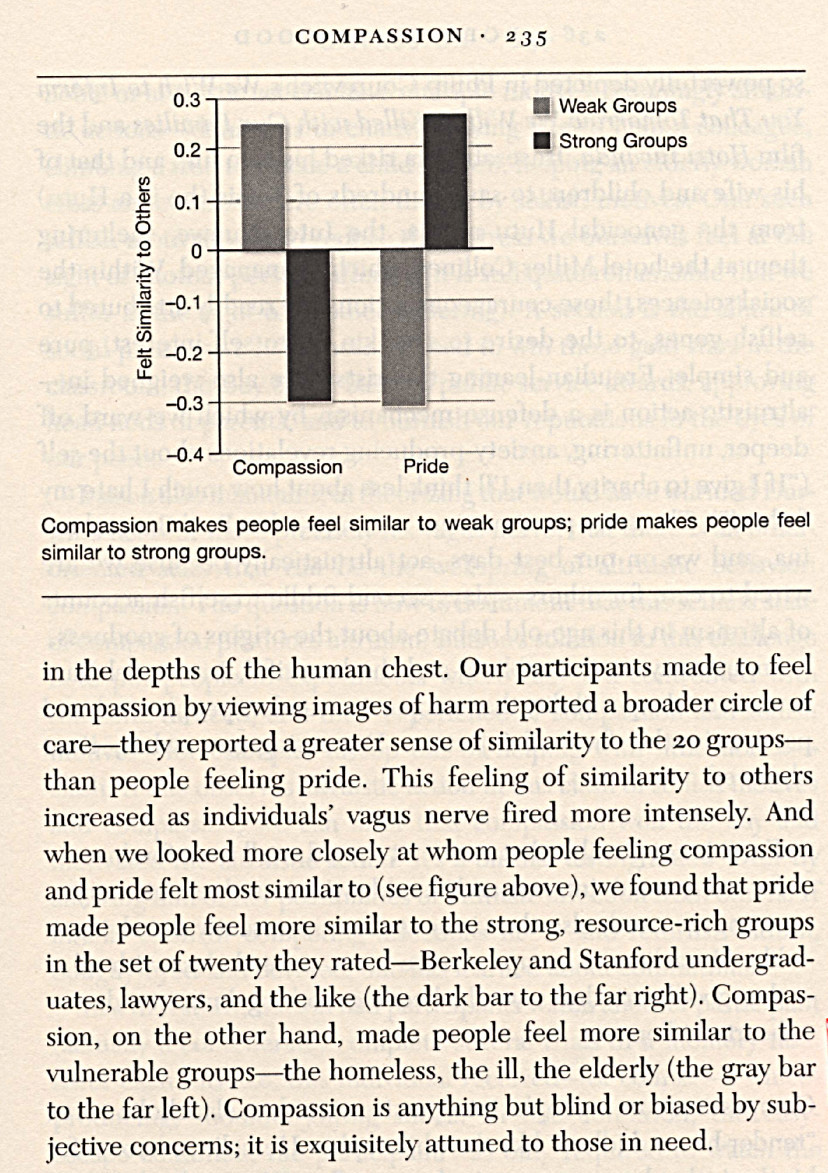
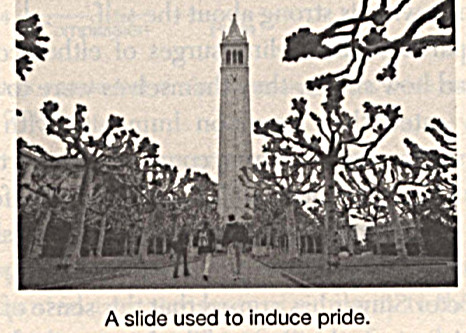
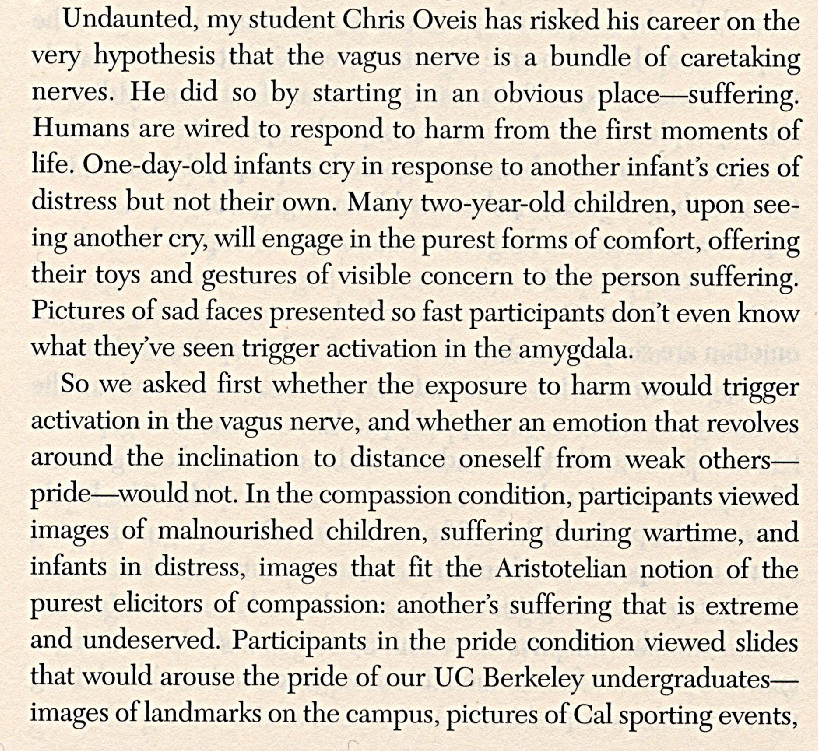
I mention this today because I am going to present two pictures here from Dr. Dacher Keltner’s chapter on compassion (from his book Born to Be Good: The Science of a Meaningful Life) along with a bit of the text he includes with them.

The exercise I suggest is for readers to just spend a little time looking at first one of these pictures and then at the other.  I find it fascinating that I can fully feel the difference IN MY BODY between how my body feels, and therefore how I feel, in response to each of these pictures.

The feeling shift in my torso involves my breathing.  As I mentioned in yesterday’s post, we can become mindfully aware of our experience of breathing as we shift from automatic pilot breathing to breathing with our SELF-conscious awareness.  These two pictures, to one degree or another, offer an example of how breathing and mindful awareness are connected together.

++++

Picture number one:

+++++++++++++++++++++++++++++

Picture number two:

++++++++++++++++++++++++++++++

I realize the quality of the pictures is pretty shabby, but they still work just fine to demonstrate how our vagus nerve system responds within our body differently as we experience emotion and feeling.

I am posting again today Keltner’s writing about how these photographs were used in research, which is part of the whole chapter on compassion that I posted the other day that includes some writing on altruism.

I just wanted to mention today that in cases of severely abusive parents something is obviously terribly wrong with their compassion-altruism-be good spectrum of response.  Research, as I’ve mentioned previously, about Borderlines shows that their vagus nerve system does not operate in a normal way.

Keltner states here:

With increasing vagus nerve response, participants’ orientation shifted toward one of care rather than attention to what is strong about the self.”  (page 234)

I am reminded of my thinking about my mother’s distorted self, about her distorted relationship with this distorted self, and about her distorted relationship with everyone in her universe, most specifically with me.

In her relationship with me my mother was solely occupied with what she unconsciously perceived as being WRONG with herself as she projected ALL of that wrongness onto me — and then punished me for it.

By taking what was WRONG with herself and placing it all on me, she was making her good self STRONGER in some bizarre and distorted way.  But she couldn’t even just do this half of her psychosis without doing the other half, which was to ‘personify’ her projection of goodness onto my younger sister as she made her the all-good child in a similar way that she made me the all-bad one.

While Keltner is obviously not talking about child abuse in his writings, there is no way that I can avoid the fact that it is within this same vagus nerve system that these distorted patterns — of ‘strong’ versus ‘weak’, of what ‘belonged’ and what did ‘not belong’ within my mother’s version of herself, along with who she identified with and who she refused to identify with (as being weak versus strong) — operated within my mother.

My mother lacked any normal self-reference point within herself that is necessary for the normal demonstration of the reactions that Keltner describes in this research (see below).  Because she did not have any true sense of what was strong about herself, she could not be mindful of the fact that her entire psychic, mental system — and the behavior that was its result — operated through externalized inner dramas that she acted-out, outside of her self as they mostly involved tortured, battered, hated, shunned, and terribly abused ME.

++++

Although the research presented here had nothing overtly to do with infant-child abuse or about a comparison of safe and secure attachment versus unsafe and insecure attachment, I believe absolutely that this research model could be used in combination with these factors.

What would be discovered would be the deeper levels of how shifts between so-called pride and compassion are actually showing the  strength or weakness of the SELF.  The weaker and more unsafely and insecurely attached a self is in the world, the more distorted their vagus nerve reaction is likely to be on this pride-compassion spectrum.

But what might register in such a study as a tendency toward pride is actually a tendency to NOT be able to recognize any weakness within the self at all.  Such a person learned (it was built into their body-brain) that weakness meant threat of death.  If the early trauma could not be avoided in any other way, the body-brain simply shuts off any ability to recognize self-weakness at all.  Awareness of weakness costs too much — as does weakness itself.

++++

In my thinking, I suspect that the stronger a self REALLY is, the more fluidly that self will be able to afford the cost of recognizing weakness in others.   They can afford to allow themselves to resonate with need and weakness through the feeling of compassion.  They will also be able to afford to respond with care.

If a self is REALLY weak rather than strong, they cannot afford to identify with another’s weakness.  It simply costs too much.  “I am strong enough to survive so I can afford to help others to survive” is an entirely different mantra than “I know I am vulnerable and weak (though I can’t even afford to let myself know this) so I must align myself with the strongest (and act like I am one of the strongest) to survive.  I cannot afford to give anything to anyone else.”

My mother took all this weakness to another level that made her an extremely dangerous mother.  Not only could she not be consciously and mindfully aware of her own weaknesses and vulnerabilities of her own self, she was hell bent on actively destroying her own projected version of weakness — again, of course, ME.   Not only could she not appropriately care for me, or have compassion for me, she attacked me as she tried to destroy me.  It would not surprise me if these dynamics operate on some level for all severely abusive parents.

If this is true, then abusive parents have the weakest selves possible.

++++++++++++++++++++++++++++++

The part of Keltner’s next cited above related to this particular research:

++++++++++++++++++++++++++++++

+THE LIFE ENHANCING NATURE OF SHARED THOUGHTS

+++++++++++++++++++++++++++++++++++

I asked libramoon, a member of an online group, if I could post her words and my reply to them on my blog today and my request was accepted:

“In rereading this with the other jumble of thought/impressions from other readings today, I am wondering: Are what we think of as psychological “conditions” reactions to a social atmosphere that largely negates the natural? I am speaking of both the larger natural environment and the internal natural development of the individual. If we are stunted in development by traumatic events along the way which become defined by normative values which keep us stuck in an unnatural frame, perhaps we need to look to nature for a healthier framing and way out?

I am also thinking about the article you posted regarding pain. Pain is a symptom of something out of whack in the system. The social norm is to block the pain rather than look to restoring balance in the system. Is this part of the mindset that sees nature as outside of conquering man? Is this part of the mindset that honors bullying, control, power and victimization because we are defeating nature rather than honoring wisdom?”

+++++++++++++++++++++++++++++++++++

I was thinking about libramoon’s words last night and the post I wanted to write in response to them when I went to sleep last night thinking only one word as I passed into my world of dreams – NATURE.

I woke out of my sleep this morning with one single word in my mind in return – FRACTALS.

This thought was soon followed by another one:  Nature is nothing more and nothing less that SHARED INTELLIGENCE.

Then, as I wandered through my house in my still-waking-up state, pausing to open the curtains in my living room to let the morning light in, pausing to open the door to let all three of my eager cats in from their night of play, and on into the kitchen to start my pot of coffee, I had an entire phrase come into my mind:  “At this point in our specie’s evolution, human beings are ‘children of the half-light.”

Then, as I waited for my coffee, I opened my email to find these heart wrenching words:

Please read this reader response:

2010/02/05 at 5:58am | In reply to debbi irish.

comment by LilAdopted1 found at this link — CONTACT INFO page

++++

All of these pieces of thought were preceded by the November 30, 2009 Time Magazine (must read) article by Tim McGirk on our returning war veterans and PTSD-depression that I read yesterday as I ate my delicious lunch at our local laundromat café:

How One Army Town Copes with Posttraumatic Stress

+++++++++++++++++++++++++++++++++++

I am humbled by the rich display of humanity already presented here today in the stories presented in the words above that I have already collected upon this page.

When I read about FRACTALS I begin to wonder if this same explanation might apply to all of us as human beings within the realm of so-called NATURE as we simply exist:

“A fractal is “a rough or fragmented geometric shape that can be split into parts, each of which is (at least approximately) a reduced-size copy of the whole,”[1] a property called self-similarity.”

+++++++++++++++++++++++++++++++++++

I could go on here to talk again about how without the pristine perfection of the Alaskan homestead my parents staked claim to, without the purist life force on that mountain and valley land and my bonding with it I would not have survived my childhood.  I could talk about how at 18, after I was ‘put into the Navy’ by my parents and flew thousands of miles away from my home that I was completely without conception of what being a human being among humans even meant.

I could talk about how in my mid-twenties I was attracted to Native American teachings because I thought among those people I could AT LAST and AT LEAST find comrades that understood what NATURE was and what it meant to be so in love with that natural world that humans remained simply as diminutive representatives of the Life Force that sustains us.  I could talk about how disappointed I was to find that the forced assimilation-genocide our nation had used to destroy the People’s connection to Nature had been so effective that barely a trace of the Original Connection to the Natural World even remained alive.

I could talk about the PTSD article and say that our military is refusing to apply the two simplest measurements of both risk and contribution to PTSD-depression that could mean the difference between life and death, well-being and ill-being for our service people and their loved ones for generations to come:  (1) assess the dominant hand used by these soldiers which relates to how their brain hemispheres process ALL information, most importantly the information contained in traumatic experiences, and (2) accurately assess these soldiers’ attachment systems, which would then clearly describe how their body-brain was built either with or without trauma at its center.

I could talk today about how nature’s SHARED INTELLIGENCE might well save us all at this ‘half-lit’ juncture in human evolution.  If we ALL, all of life, is connected in one body, and if the accurate sending and receiving of communication signals all the way down to life’s molecular levels is what intelligence is all about, then we have given ourselves a most valuable tool to assist us in gaining the kind of wisdom our species now so desperately needs:  We have the technology of computers and of the internet.

This means that those of us who are so fortunate to have access to this world wide web of vital information have an unspoken obligation to use it – and use it wisely.  I believe we are doing that.

SHARED INTELLIGENCE means that we all, each and every one of us, have something critical to offer toward the betterment of life on this planet.  Right here.  Right now.

We are speaking.  We are reading.  We are listening.  We are thinking.  We are sharing.  We are learning.  We are sending and receiving signals between members of the body of our species in ways that have never happened before in the history of our species.

++++

While I certainly can’t say that it doesn’t exit, I can’t find the whole in the boat of my thinking.  Life continues to exist on this planet because information is signaled through communications between all of its elements – and that intimate fabric of life does not exclude human beings.

As I return to the top of this post in my thinking I note one single word in libramoon’s statement that most captivated me:  STUNTED.

Can we be, as libramoon suggests, “stunted in development by traumatic events along the way?”

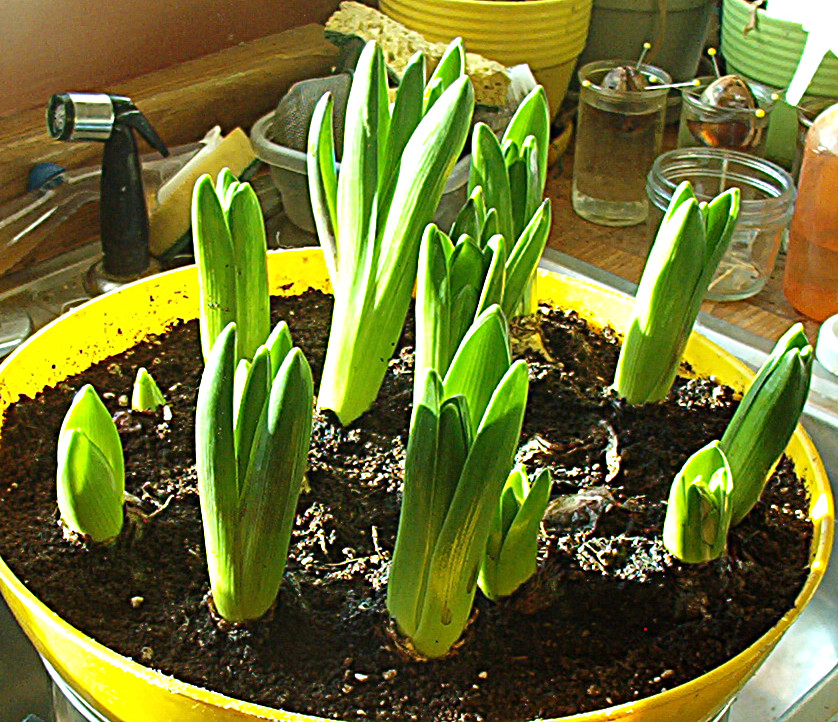
I find myself wondering why it took me so many years to buy a bag of Hyacinth bulbs so that I could stick them into a pot of dirt and watch them grow into one of my most favorite flowers.  But this year I did buy them, and every day I watch them grow and develop.  In this case every one of the 12 bulbs is receiving the identical resources.  One bulb rotted.  Eleven are growing greener and taller every day.  I can see their sturdy outer leaves part as the bud of each one’s flower begins to form close to the soil.

Yet not one of the plants is the same.  There is one that is twice the size of the rest of them.  Standing at nearly seven inches it towers over the smallest which only yesterday showed its first greenery at all.  Given this band-width of normal development, what would have happened should any or all of them have suffered some degree of trauma in their development.

Do I compare the tallest and the shortest and the middle plants and say that some are stunted and some are not?  Or is it the truth that each separate plant is simply fulfilling its own individual nature by growing in the only way that it can – in its OWN way?

++++

The presence or absence of traumatic influences during human development simply signals through molecular pathways in the body what the condition of the world is like so that the growing body-brain of the infant-child can adjust and adapt itself in the best way it can to survive in, and even thrive in, the world it is being built for.

These beautiful Hyacinth plants I am watching are crowded together in an old plastic yellow colander I bought at our local thrift store.  The soil then has excellent drainage.  It sits in my kitchen sink directly in the even light provided by my west facing window.  I can carefully monitor the needs of this whole tribe of plants equally.  But nothing I can provide for them will change them into anything else other than what they started out being.

No matter what influences an infant-child’s development, no matter how much they have to adapt in their body-brain development to trauma, they will always come out of these earliest stages of development in the best way they possibly can.  Each one will always be a unique representation of their potential as members of our species.  But none of us, not one single one of us, can ever overcome the boundaries that make us human.  None of us can become something nature did not intend us to be.

And because of this we each represent the environment that made us in ‘natural’ ways.

Given the information in her earliest environment that my mother’s body-brain-mind-self had to work with (from both within and from outside her body), it is natural that my mother became who she was.  Given who she became, it is natural that the outflow of her condition would be what it was.  Given what my mother did to me during my development, it is natural that my body-brain-mind-self would make the kinds of adaptations and adjustments that it/I did.  There is nothing, to me, unnatural about any of this.

What happened to me, however, is that once I left my home of origin I began to look around me as I became a part of what libramoon refers to as a “social atmosphere.”  Before that time I simply had no points of reference either outside of myself or within myself that I could use for comparison.  I had no inner compass other than the natural one that I had been formed with.

My Hyacinth plants have no ability (that I know of) to compare themselves to one another.  It is only once the signaling communication that we participate in achieves some level of the ability to compare our reality with some other reality that the trouble really begins.  Before that time I believe we simply exist within the natural world in the same way that any other part of nature does.

Once we have reached what I believe to be an evolutionarily advanced state that allows for a point of reference, we enter an expanded universe of thought that includes the ability to CONTRAST some aspect of something to, with and against some aspect of something else.  Without a reference point, we cannot COMPARE or CONTRAST anything any more than my Hyacinth plants can.

The human ability to access reference points so that we can compare and contrast allows us to also form opinions as it allows us to exercise conscious choice.  Using these abilities does not separate us from NATURE.  Thinking is as natural as breathing once we have that ability.

And just as we humans breathe the same air that our planet provides for us, we think by using the same neural abilities that everyone else does.  True, my own individual lungs breathe in and exhale particular molecules.  True, my brain’s particular molecules are thinking my own thoughts as I go through life.  But at the same time these are sharing operations.  Nobody can tell me, “No!  Don’t breathe THAT air!” or “No!  Don’t think THOSE thoughts!”

My body can breathe without my conscious awareness.  My body can also think without my conscious awareness.  Again I return to another critically important concept that I see implied in libramoon’s writing:  MINDFUL.

I can choose to be mindful of both my breathing and of my thinking.  I can accomplish this because I have gained the evolutionary advantage point of HAVING a reference point.  While my mother could no doubt have gained mindfulness of her breathing, I’m not certain that in her entire life my mother could gain mindfulness in regard to her thinking.  In fact, ‘mindfulness’ is one of the primary concepts applied to recovery within the so-called Borderline condition because the ability to live a mindful life has been altered – I believe through early developmental trauma – in a Borderline’s body.

++++

I believe that the ability to obtain the ability to have a reference point within one’s self is an evolutionarily provided gift.  Having a reference-point ability gives us powers to discriminate, to contrast and to compare so that we can think in mindful ways.  I don’t think my mother had this ability any more than my Hyacinth plants do.

Does this mean that trauma stunted my mother’s development?  Is a plant stunted because it has no reference point and cannot compare and contrast itself to any other aspect of existence?  No.  Simply put, a gift is missing in both circumstances.

Our ability to think mindfully happens because we operate within a social atmosphere that feeds information back to us at the same time we have degrees of ability to receive this information even before we are born.  Information comes to us as forms of nutrients that build our body-brain just as surely as water, soil and light are nutrients that are building my Hyacinths.  These are shared natural processes.

If, however, a developing human being does not receive enough information about its own individual self-in-the-world, the gift of mindfulness will not come into bloom in the same way that if my Hyacinths do not receive the nutrients they need RIGHT NOW as they grow, they will not be able to form blossoms.  In this way, mindfulness is the gift of the flower of humanity.

In this way, also, I see that my mother was not stunted; she was robbed of the evolutionarily advanced gift of mindfulness.  She was not fed with the necessary nutrients within the social atmosphere of her infant-childhood to build a self that could in turn possess a viable reference point that she needed in order to accurately compare and contrast her own self within a world of others.  She could not, therefore, share a gift of mindfulness that she never received.

++++

My choice to mention both breathing and thinking together is not an arbitrary one.  Research on the human vagal nerve system is showing that it is directly connected to our physiological reactions to what we see ourselves ‘a part of’ and what we see ourselves ‘a part from’ as it regulates our breathing and our heart rate.

Reacting as ‘a part of’ stimulates the STOP arm of our Autonomic Nervous System (ANS).  Our heart rate and our breathing slow down.  We then find ourselves on the cooperative rather than the competitive pathway, or the prosocial one.

If we react with an ‘a part from’ reaction, our heart rate and our breathing escalate with stimulation of the GO arm of our ANS, or our fight/flight response.

In this way, I suggest that WE ARE WHAT WE BREATHE and the more conscious and mindful we can become about our fastest physiological reactions within our body the more mindful we can become about our self in relationship with the entire world we live within.  The STOP reactions we have release our breath in an exhale.  The GO reactions that we have catch us with an inhale.  If we can learn to pay attention to this most basic signal from our body, we can increasingly notice with mindfulness the orientation we are taking from our internal reference point – our individual self.

Even without our mindful conscious perception, our naturally constructed social species’ body-brain is continually evaluating our degree of safety and security in the world through finely tuned assessments about what belongs and what doesn’t – what is safe and what isn’t.  These are comparing and contrasting operations that our body has formed itself to assess so that we can increase our chances of staying alive.

The more traumatic our earliest environment was the more automatic and the less mindfully conscious these patterns operate within our body because we were naturally built this way.  As we experience a lifetime of mostly automatic reactions, our body itself has taken over the reference point position, not our conscious mind.

As we begin to practice mindfulness we are creating our own bloom.  We can choose to grow this gift even if nobody gave us this gift pro bono.  Traumatized infant-children are given censored, erroneous information.  The building of an ever increasingly mindful self requires access to and sharing of truthful and accurate information.  Because we are a social species, this growth always happens through give and take within a social atmosphere, even if that atmosphere mostly exists between our own mind and our own self in online exchanges with others.

The more we access, utilize, process and digest new information the less hold any trauma we have ever experienced will have on our mindful self, and the more we will grow and blossom into being the evolutionarily advancing people nature has intended us to become.  Mindfulness, the blossom of our specie’s evolution, concerns all the information about our experience that we can consciously share with our self.  Mindfulness defines the social atmosphere we create within our self with our self.  This is the area where our healing will show its greatest accomplishments.  “Go bloom, everyone!  Go bloom!”

++++

NOTE:  In consideration of the tendency for some people to think that humans are separate from nature and/or superior to the natural world, all this means to me is that the ‘a part from’ pathway has been chosen rather than the ‘a part of’ pathway.  The reference point of the self has compared and contrasted itself and has made up a thinking-based fiction that has nothing to do with reality.

+++++++++++++++++++++++++++++++++++

+INTERGENERATIONAL TRAUMA AND THE NATURE OF GOOD AND BAD

+++++++++++++++++++++++++

Is our species still on this planet because we are equally wired for both kindness and selfishness/self-preservation?  Someone was ‘kind enough’ yesterday to post the ScienceDaily December 9, 2009 article (included below) about the ‘goodness’ research coming out of Berkeley to an online group I belong to.  Someone else responded with a comment that they disagree with this “theory”.

How does it happen that what was once considered theory comes to be known as fact?  I wonder how long it took the ‘discovery’ that the sun was at the center of our solar system to permeate public thinking.  How long did it take the ‘discovery’ that our planet is round to infiltrate common knowledge?  Whatever people thought about the rotations of our solar system or the shape of our planet certainly had no affect on how things actually are in reality.  So what is the process by which erroneous thinking becomes supplanted with new thoughts that directly contradict the old?

++++

I could say that I staked my career on a losing hand of cards.  I could say that even in light of what I have since come to understand about my own limitations, about the body-brain physiological changes that my mother’s severe abuse of me created.  I understand now that dissociation happens to me on a regular basis.  I understand now that the stress response systems within me were built in trauma and do not allow me to experience my life in ordinary ways.  I understand now that going all the way before my brain’s language centers were built trauma changed how my emotional-social brain operates.  But all of this new information that I have doesn’t change the basic fact that I staked my career on the stars while I walked down here in the mud.

I trained myself with a BA in psychology and a MA in art therapy specifically to work with sexually abused children on Native American reservations.  THAT didn’t work.  But I had to go through a PROCESS of learning and understanding how I fit into a world that I did not create.

I found that after the U.S. government rescinded its laws in 1974 that had been put into place to make sure that indigenous people within the borders of our nation did not practice their traditional spiritual beliefs, the tribal people where I lived had to resurrect their ceremonies and ancient teachings into the new world they found themselves now living in.  It had been the intention of our government to disempower the people.  What has been called ‘assimilation’ was nothing more than an invisibility cloak thrown over the true intention of genocide.

Our government was joined by private interest forces that were allowed to help destroy the tribal structure of our nation’s indigenous people through greed.  Our government was also joined by religious interest forces that introduced the gangrene of sexual abuse into Native communities through boarding schools, which also operated to erase traditional languages, customs, beliefs and practices and destroy clan and family systems.

Included in the history of terrible abuse and trauma that was perpetrated against our nation’s so-called enemy, is a pattern of dishonoring treaties that should make any conscience-ridden nation so ashamed of itself it could not exist.  But exist America does, in spite of these actions which to this day remain so buried, hidden, disguised, condoned and still practiced that it is amazing our nation can ignore them.

What does any of this have to do with me?  As far as I know I have no indigenous American ancestry.  What I did was take my newly acquired credentials, acquire a job as an art therapist on a reservation, and set to work to ‘help’ the little 2-10 year-old members of my 40 child caseload to ‘recover’.  Of these children, all of them had been sexually abused along with being victimized by neglect and maltreatment, many from before they were born through drug and alcohol usage of their mothers.   Seventy percent of my caseload were little boys.

What ‘good’ did I think I could do for these children?  I had children on my caseload who could name 55 cousins they were sexually active with.  I found that in many cases adults knew this was happening and ignored it.  There were ‘rape gangs’ of older children who tricked or kidnapped younger children, taking them far into the woods to sexually initiate them, if they hadn’t already been molested from the time they were babies.

There were stories of children watching their father chop their mother to death in the household kitchen with an ax because he was on acid.  There were stories of foster parents putting their own and their foster children to sleep at night by putting plastic bags over their heads until the children passed out.  When the older children could be taught to do this themselves so that the foster parents could go out an party, guess what happened?  While eventually the children were removed from these parents’ care, nobody ever prosecuted for abuse.

And on this reservation where it wasn’t uncommon for people to be killed by being buried alive, I found it got even worse.  I had little children on my caseload whose mother had run away from their abusing father.  The father’s parents went to medicine people and asked in retaliation that the spirits attack their grandchildren.  The spirits complied.  The children suffered through sickness and threat of death.  And if all of this wasn’t bad enough, sooner rather than later these same ‘bad’ people asked that bad medicine be used not only against me (as the foreign intruder that I was), but also against all three of my children.

My response?  I was fortunate to have the same ‘good’ medicine man I brought my caseload’s children to for assistance and healing perform ceremonies that removed this bad medicine from me and from my children.  Then I turned tail and ran.  I abandoned my work with the children, took myself and my own children, left the area and disappeared.

++++

Before I left the area I did some serious questioning of people ‘in the know” about how and why the spirits could participate in this kind of evil.  I was told that most of the spirits that Indigenous people have always been able to access through ceremony are neutral.  They can be accessed as power to work either good or ill.  The choice is within the humans who are the ones who ASK them, or COMMAND them to either help or harm others.

Yet for all of this, what I most often think about is something my then 7-year-old son told me one warm early spring day as he and I were walking down an old logging road through the forest.  It was early on in my art therapist days on the reservation, and I was struggling with something that disturbed me greatly.

I asked my son, who was and is very wise, “What am I going to do if some day I am asked to work with some of the adults or older teens that are the perpetrators of these great harms against little children?  I don’t think I can do it, and I don’t think I will be given the choice.  Do you think there’s any hope that abusers can change?”

I wasn’t looking at my son while I asked him these questions while we walked.  I was looking into the forest at the tiny little brilliantly green leaves that were sprouting from the trees.  When I looked to my right my son was no longer beside me.  I stopped and turned around to see him standing a ways back on the road in the sunshine with his feet spread apart, his hands resting on his skinny little hips, his head cocked to the side, staring at me.

“Well, MOM,” he said, obviously perturbed with me.  “Don’t YOU KNOW?”

I turned around and walked back to him, standing in front of him I responded, “KNOW WHAT?”  Obviously I didn’t have a clue.

“Well, MOM, you SHOULD know this!  Everyone decides when they are in their mother’s tummy if they are going to be good people or bad ones.  They’ve made that decision before they are born and NOTHING ANYONE can ever do is going to change them.”

I was stunned by his insistent sincerity.  And only for a moment did I doubt him.  “Well, honey, how can that be possible?” I wanted to know in my adult logical way.  “Babies can’t make those kinds of decisions before they are born.  How could they even have enough information to even begin to think about such things, let alone make such a huge decision that will determine the course of their lives?”

Again, as if amazed and almost disgusted with my ignorance, my son responded, “Mother, don’t you KNOW?  Babies talk to the angels all the time they are in their mother’s tummy.  They know what they are doing when they decide.  Once they are born they will just be who they have already decided to be, and nobody, nothing, not even you, can change them.”

I have never been able to convince myself that my son didn’t know exactly what he was talking about.  I strongly suspect that it is entirely possible that what he told me on that glorious spring morning was the truth.

It took another few years before I began to understand how pervasive and how powerful the bad choices could be.

++++++++++++++++++++++++

This brings to mind my fascination with wolverines that I had as a child as soon as I found out this animal existed.  Although I don’t think they lived in the Alaskan valleys or on the mountains anywhere near where my family staked claim to our homestead, certainly stories of them floated in the air around me in childhood.

I knew there was something special about their fur so that if a ruff was made out of it around a parka hood one’s breath would not accumulate moisture and freeze on the ruff.  I know they were MEAN and people were afraid of them.  I knew they were smart and could disarm traps intentionally so that humans could not catch them.

I heard they were the only animal that intentionally bullied others.  I heard they could chase away wolves from their moose kill and then spray the meat so it stunk so badly no other animal could eat it.  The wolverine was selfish.  It wasn’t one bit hungry or interested in the meat.  It just liked to be mean.  Wolverines stayed alone, liked or needed nobody, and as far as I could tell nobody liked them.  Wolverines seemed to embody powerful fear at the same time they were immune to it themselves.

Probably as a combined consequence of the terrible ongoing abuse I suffered, coupled with the fact that I had access to no information that would have helped me be able to THINK about anything that happened to me, I liked and admired wolverines even though I never got to meet one personally.

My fascination and respect for this animal continued to crystallize in my mind all the way through my 20s.  I searched for and read everything I could find about them.  In some mythological, unconscious way I seemed to understand that perhaps the only being strong enough to overcome the badness that was my mother would have to be badder than her.  Wolverines seemed to be the essence of bad.  I knew my mother had nothing on them.  If my mother ever met one, she would NOT win that battle.  That thought delighted me!

Few probably equate the potential for badness in animals that we project onto humans.  Nobody is going to teach or influence a wolverine to be ‘good’ or ‘nice’.  Wolverines occupy an environmental niche that belongs to them.  They were always, to me, about the opposite of what I could imagine tame, domesticated or civilized could be.  “Take a walk on the wild side” named both who this animal was and who it would always be.  Even now, there is something comforting to me about knowing that there is a legitimate place for badness and a place it belongs.

My mother might have been vicious and incredibly abuse and mean, but even though she shared these characteristics with a wild beast, she had NOTHING on a wolverine.  At the same time I know that no degree of early developmental trauma could change any other animal into a wolverine.  They ARE born to be mean.  That’s their nature.

Early trauma CAN change the course of physiological development of humans.  As researchers clarify the wiring in humans that operates in our goodness, it is also clarifying a critical area of our body that can be changed through trauma in our earliest developmental stages so that these systems will operate differently from normal.

What this tells me is that we need to listen to the newest information about how trauma influences human development every step of the way.  We have to consider the largest, broadest picture we can about the influence that traumas have not only on individuals, not only on families, but within cultures and societies.  As resiliency factors are removed through trauma at the same time that risk factors are increased, the intergenerational affect that trauma has on human development can actually physiologically reduce the human capacity to both experience goodness and to choose it.

I see this as fact, not theory.

+++++++++++++++++++++++++

Social Scientists Build Case for ‘Survival of the Kindest’

ScienceDaily (Dec. 9, 2009) — Researchers at the University of California, Berkeley, are challenging long-held beliefs that human beings are wired to be selfish. In a wide range of studies, social scientists are amassing a growing body of evidence to show we are evolving to become more compassionate and collaborative in our quest to survive and thrive.

In contrast to “every man for himself” interpretations of Charles Darwin’s theory of evolution by natural selection, Dacher Keltner, a UC Berkeley psychologist and author of “Born to be Good: The Science of a Meaningful Life,” and his fellow social scientists are building the case that humans are successful as a species precisely because of our nurturing, altruistic and compassionate traits.

They call it “survival of the kindest.”

“Because of our very vulnerable offspring, the fundamental task for human survival and gene replication is to take care of others,” said Keltner, co-director of UC Berkeley’s Greater Good Science Center. “Human beings have survived as a species because we have evolved the capacities to care for those in need and to cooperate. As Darwin long ago surmised, sympathy is our strongest instinct.”

Empathy in our genes

Keltner’s team is looking into how the human capacity to care and cooperate is wired into particular regions of the brain and nervous system. One recent study found compelling evidence that many of us are genetically predisposed to be empathetic.

The study, led by UC Berkeley graduate student Laura Saslow and Sarina Rodrigues of Oregon State University, found that people with a particular variation of the oxytocin gene receptor are more adept at reading the emotional state of others, and get less stressed out under tense circumstances.

Informally known as the “cuddle hormone,” oxytocin is secreted into the bloodstream and the brain, where it promotes social interaction, nurturing and romantic love, among other functions.

“The tendency to be more empathetic may be influenced by a single gene,” Rodrigues said.

The more you give, the more respect you get

While studies show that bonding and making social connections can make for a healthier, more meaningful life, the larger question some UC Berkeley researchers are asking is, “How do these traits ensure our survival and raise our status among our peers?”

One answer, according to UC Berkeley social psychologist and sociologist Robb Willer is that the more generous we are, the more respect and influence we wield. In one recent study, Willer and his team gave participants each a modest amount of cash and directed them to play games of varying complexity that would benefit the “public good.” The results, published in the journal American Sociological Review, showed that participants who acted more generously received more gifts, respect and cooperation from their peers and wielded more influence over them.

“The findings suggest that anyone who acts only in his or her narrow self-interest will be shunned, disrespected, even hated,” Willer said. “But those who behave generously with others are held in high esteem by their peers and thus rise in status.”

“Given how much is to be gained through generosity, social scientists increasingly wonder less why people are ever generous and more why they are ever selfish,” he added.

Cultivating the greater good

Such results validate the findings of such “positive psychology” pioneers as Martin Seligman, a professor at the University of Pennsylvania whose research in the early 1990s shifted away from mental illness and dysfunction, delving instead into the mysteries of human resilience and optimism.

While much of the positive psychology being studied around the nation is focused on personal fulfillment and happiness, UC Berkeley researchers have narrowed their investigation into how it contributes to the greater societal good.

One outcome is the campus’s Greater Good Science Center, a West Coast magnet for research on gratitude, compassion, altruism, awe and positive parenting, whose benefactors include the Metanexus Institute, Tom and Ruth Ann Hornaday and the Quality of Life Foundation.

Christine Carter, executive director of the Greater Good Science Center, is creator of the “Science for Raising Happy Kids” Web site, whose goal, among other things, is to assist in and promote the rearing of “emotionally literate” children. Carter translates rigorous research into practical parenting advice. She says many parents are turning away from materialistic or competitive activities, and rethinking what will bring their families true happiness and well-being.

“I’ve found that parents who start consciously cultivating gratitude and generosity in their children quickly see how much happier and more resilient their children become,” said Carter, author of “Raising Happiness: 10 Simple Steps for More Joyful Kids and Happier Parents” which will be in bookstores in February 2010. “What is often surprising to parents is how much happier they themselves also become.”

The sympathetic touch

As for college-goers, UC Berkeley psychologist Rodolfo Mendoza-Denton has found that cross-racial and cross-ethnic friendships can improve the social and academic experience on campuses. In one set of findings, published in the Journal of Personality and Social Psychology, he found that the cortisol levels of both white and Latino students dropped as they got to know each over a series of one-on-one get-togethers. Cortisol is a hormone triggered by stress and anxiety.

Meanwhile, in their investigation of the neurobiological roots of positive emotions, Keltner and his team are zeroing in on the aforementioned oxytocin as well as the vagus nerve, a uniquely mammalian system that connects to all the body’s organs and regulates heart rate and breathing.

Both the vagus nerve and oxytocin play a role in communicating and calming. In one UC Berkeley study, for example, two people separated by a barrier took turns trying to communicate emotions to one another by touching one other through a hole in the barrier. For the most part, participants were able to successfully communicate sympathy, love and gratitude and even assuage major anxiety.

Researchers were able to see from activity in the threat response region of the brain that many of the female participants grew anxious as they waited to be touched. However, as soon as they felt a sympathetic touch, the vagus nerve was activated and oxytocin was released, calming them immediately.

“Sympathy is indeed wired into our brains and bodies; and it spreads from one person to another through touch,” Keltner said.

The same goes for smaller mammals. UC Berkeley psychologist Darlene Francis and Michael Meaney, a professor of biological psychiatry and neurology at McGill University, found that rat pups whose mothers licked, groomed and generally nurtured them showed reduced levels of stress hormones, including cortisol, and had generally more robust immune systems.

Overall, these and other findings at UC Berkeley challenge the assumption that nice guys finish last, and instead support the hypothesis that humans, if adequately nurtured and supported, tend to err on the side of compassion.

“This new science of altruism and the physiological underpinnings of compassion is finally catching up with Darwin’s observations nearly 130 years ago, that sympathy is our strongest instinct,” Keltner said.

Story Source:

Adapted from materials provided by University of California, Berkeley. Original article written by Yasmin Anwar, Media Relations.

+++++++++++++++++++++++++

+NOT HAVING A PARTICULARLY CHIPPER DAY

+++++++++++++++++++++++++++++++

I was looking for something a friend had asked me for today and found, in a very unlikely place, an envelope that included my first grade picture, first grade report card, second grade report card and others.  Against my own wishes, I scanned them in and post the links to them here.  I really can’t say at this moment what the point of this even is.

What I did discover, as mentioned in the link for my first grade report card, is that I was absent 23 days in my first grade year of school.  I was not a sickly child, and even if I had missed a few days here and there for normal childhood sicknesses, 23 is a lot of days.

What is confirmed for me here is that my mother kept me out of school throughout my childhood on occasions when she was in a beating, abusive frenzy.  Part of me says today, “Well, I don’t want to even know that little girl.  I don’t want to know anything about her.  She was not me.”

Yes, she was me.  Yes, I am she.  Obviously what she/me experienced is what this blog is about.  But I don’t want to think about any of it today.  Not one single part of it except to scan in this information and post the links.  Not particularly helpful to anyone, I don’t expect, but it will have to do.

++++

The other thing that’s been on my mind today was a dream I had last night that I actually remembered having this morning when I woke up.  I died in my dream last night.  I don’t remember how I died, or the actual dying itself.  But first in the dream I was alive, and then later in the dream I was dead.

I find it interesting that the whole dream took place at the home of the woman who found my mother dying in her shabby motel room in 2002.  This woman, I call JV, first met and befriended my mother when we moved to Alaska in 1957, and was the only person that maintained a relationship/friendship with my mother over all those years.

JV was strong enough in some unusual way to stay my mother’s friend for 45 years.  In my dream I was with a group of friends and family at JV’s house when I died.  Nobody could see me then but her.  I could see everyone else.  JV didn’t act like anything had changed, even though I knew she knew I was dead.  I’m not going to worry about the ‘meaning’ of the dream — just having it and remembering it is unsettling and strange enough.

So for now, I will go do my 45 minute walk-jog and then do simple things, like eat supper.  I wish everyone well — and I’ll be back here perhaps more chipper tomorrow.  (PS – I hit ‘publish’ for this post and my Firefox crashed.  Glad it saved the post FIRST!)

+++++++++++++++++++++++++++++++

*Age 5 – kindergarten 1956-57

*Age 6 – 1st grade report card 1957-58

Just turned 6, too-old eyes, puffy from crying

*Age 7 – 1958-59 2nd grade report card

*Age 9 – 1960-61 4th grade report card

*Age 10 – 5th grade 1961-62

*Age 11 1962-63 6th grade class picture

*Age 11 – 1962-63 6th grade report card

+++++++++++++++++++++++++++++++

Well, this does come to mind:

I used to remember my dreams.  Now I remember remembering the dreams.

Years ago I belonged to a circle of women who met with the elder Grandmothers to learn about teachings.  One time I traveled to a Canadian reserve with some of these women to visit our Grandmother elder, Mary.  I brought Mary some tobacco so I could ask her about a dream I had a few days before.

Mary accepted my tobacco.  She sat across the living room from me on her couch, staring down at her shoes while I talked.  I told her my dream about the group of Native American men that stood talking among themselves on the sidewalk across the street from where I stood talking with a group of women.

Suddenly I looked down at my palms and saw each of them had a hole in it I could see through.  Shocked, I turned to my friends and showed the women, “What happened to me?” I asked them.  “What can we do about this?”

None of the women had a clue.  As I looked up I saw the most handsome young man with long black hair glistening down his back crossing the street toward me, looking straight into my eyes.  When he reached me he gently took each of my hands into his, one at a time, raised them to his lips and blew his breath through each hole, never taking his eyes off of mine.

When he released my hands, the holes were gone, and the man turned and sauntered back across the street without saying a word.  Oh, I was in LOVE!  I wanted to follow him more than anything, but the women restrained me.

“Oh, no, Linda, you can’t go where the men are.  The men have men things they have to do.  We women have our women things we have to take care of.  Stay here.  You cannot go to be with that man.  Leave that man alone.”

So, I didn’t follow him.  I dutifully stayed with the women, glancing across the street now and then, until finally I saw him get into his car and leave.

++

At no time while I was telling Grandmother Mary about this dream did she move a muscle.  She did not look at me for a few minutes after I had stopped talking, either.  I sat, barely breathing, waiting for her profound interpretation of what this dream might mean.  Finally, Mary shifted her weight, turned toward me and said with the straightest of faces, “Well, honey, all I can tell you is this.  Next time you have that dream about that man, you call me.  I’ll help you get into his trunk.”

The whole room lit up with her laughter.

++++++++++++++++++++++++++++++

+CHILD ABUSE: IN THE ABSENCE OF THE PRESENCE OF GOODNESS

++++++++++++++++++++

The absence of goodness and of prosocial interactions (like teasing) in my childhood home of origin impacted me equally with the presence of my mother’s abusive badness.  The presence of abuse in infant-childhood tragically turns a little one’s entire universe upside-down, backwards and inside-out from safe, secure and normal.  The more I study about the good side of being human, the more I realize that it isn’t just the presence of abuse that is so damaging.  The absence of goodness astronomically multiplies the impact that the presence of badness has on developing offspring.

++++++++++++++++++++

I return again today to the chapter on teasing in Dr. Dacher Keltner’s 2009 book’s (Born to Be Good: The Science of a Meaningful Life).  Non-child abuse survivors can probably read Keltner’s information on teasing without having to first think about verbal abuse.  Infant-child abuse survivors, however, can easily bring memories of verbal attacks into their thinking about teasing.

Keltner’s writings about smiling and laughter didn’t present me with the same challenge as the one I face when he moved on to teasing.  Smiles and laughter are by nature not verbal, although they very often happen within the varied verbal arenas people participate in with one another.  Teasing, from the human perspective, often involves the use of words.  Infant-childhood verbal abuse survivors can well remember how words can slice, dice and shred the innocent into greatly wounded tiny pieces.

Because verbal abuse is so harmful to the developing infant-child, it can make it even more important for survivors to follow Keltner’s descriptions about what teasing is, and what teasing is not.  He begins his chapter on teasing by presenting us with the image of the famous peacock’s tail.  This tail is often referred to scientifically in terms of how it is a ‘reproductive fitness indicator’ because it is a high cost item for the peacock to present.  The healthier the tail, the more resplendent its appearance, the healthier the peacock is – which simply means that this bird has had enough resources available to it within its environment to produce a tail that is closest to the ‘best possible tail’.

If the peacock’s tail is shabby and forlorn, however, that tail indicates that there were not enough resources in the environment for this peacock to create a ‘best possible tail’.  The shabby-tailed peacock could not afford to make a better one.  Allusions to the quality of the peacock tail’s display are often transferred to considerations of ‘mental illnesses’ as those genes exist toward the gifted end of the human continuum of abilities.  The more creative, say, or talented a person is, the more likely they are to be at higher risk for developing negative complications if their earliest environment was malevolent rather than benign.  The continued presence of human giftedness and ‘mental illness’ is thought to relate to ‘reproductive fitness indicators’ because of the high cost that giftedness carries with it to ‘end up right’.

++++

Although perhaps they might not seem as dramatic as a peacock’s tail in terms of being obvious and visible reproductive fitness indicators, the presence or absence, as well as the quality of humor and happiness ‘displays’ such as genuine smiles, laughter and teasing do reflect to other people both our individual fitness and the fitness of the early environment that builds the circuits and pathways into the brain that allow humor displays to happen in the first place.

Unlike physical prowess or musical and artistic giftedness, the presence of humor-related abilities is directly tied to our prosocial brain.  Ongoing early unsafe and insecure attachment experiences deplete our human prosocial brain abilities.  The continued absence of humor – call it happiness – directly signals humans that unfortunate early circumstances deprived the brain of its ability to establish all the prosocial (safe and secure attachment) regions and circuits a brain needs to process happiness information on both the personal and the social level.

++++

Keltner tells his reader at the beginning of his chapter on teasing that no matter how well-built and flourishing a peacock’s tail might be, there is another aspect to the tail that is not so often mentioned.  When a male peacock meets a potential mate, the first thing he does is turn his tail’s display away from the female.  This is the teasing interaction in a most basic and simple form.

The male is testing the female’s interest and intention.  If she turns and walks away, obviously no matter how resplendent the male’s tail is, the female is not impressed.  If, however, the female pursues a ‘relationship’ with the male, she will move around toward the head of the peacock and a ‘relationship’ can continue.  As Keltner notes, if the female shows no further interest once the male has teased her by turning away, “he has acquired critical information about her lack of commitment.  He can factor this information into his decision about whom to mate with and whom not.”  (pages 146-147)

Of course humans are far more complicated than peacocks are, yet we also use a wide array of nonverbal signals as cues in our communications with others.  Most simply put, no matter what our original genetic makeup might have been, the conditions of attachment in our earliest body-brain developmental stages moderate and modulate our abilities to both send and receive our species’ signaling cues.  Teasing is one of these cues.

Prosocial actions happen to signal cooperation in an environment of plenty.  Antisocial actions signal competition in an environment of scarcity.  Unsocial actions communicate an absence of social interactional abilities that are most closely tied to an early environment of nothing at all – or isolation.

Keltner states about teasing:

“The importance of provocation and teasing in our social evolution is suggested by how pervasive teasing is in the animal world….  Sexual insults are as reliable an occurrence in human social life as food sharing, greeting gestures, patterns of comfort, flirtation, and the expression of gratitude.”  (page 147)

“The perils of teasing are patently clear.  “Just teasing” is invoked as a last defense by the grammar-school bully and the incorrigible sexual malfeasant at work.  But what they are referring to with the claim “I was just teasing” upon closer inspection is not teasing at all but aggression and coercion, pure and simple.  Bullies steal, punch, kick, spit on, torment, and humiliate.  They don’t really tease.  Sexual predators grope, leer, and made crude, at times threatening, passes.  They’re pretty ineffectual flirts.  In contrast, teasing is a mode of play, no doubt with a sharp edge, in which we provoke others.  We turn to the playful provocation of teasing to negotiate the ambiguities of social living – establishing hierarchies, testing commitments to social norms, uncovering potential romantic interest, negotiating conflicts over work and resources.”  (page 148)

++++

As I’ve already described about genuine smiles and laughter, both scarce and nearly missing entirely from my childhood home, so also was teasing missing along with any other safe and secure display of playful behavior.  What was present was my mother’s unremitting bullying actions toward me, and her near complete malevolent control over everyone else in her household.

There was no joking or kidding around in my mother’s monkey house.  We all lived under her malevolent reign of terror.  We were not ‘vaccinated’ as Keltner describes.  We were poisoned.  Our home was not a practice ground for developing prosocial human interactional abilities.  Our home was a practice ground for one thing:  how to survive a childhood with my mother.

Keltner delineates the social nature of teasing:

“The consensus was [in the scientific world] that teasing is “playful aggression.”  Clearly, though, teasing does not equate to all kinds of playful aggression.  Unintended playful aggression – accidentally elbowing a fellow train passenger’s nose while you’re hustling money with your imitation of Harp Marx – is clearly not teasing (at least I hope you don’t think so).  More general references to play are ambiguous.  Many forms of childhood play, such as role playing (children acting as princesses or ninja warriors), roughhousing, highly structured playground games like tag or four square, and the ritualized jokes and conversational games that fill the air of school buses – are not teasing.  The same is true of many forms of adult play:  We tell amusing stories, exchange playful repartee, and josh around in ways that are not teasing.

“…[M]y colleagues…and I defined a tease as an intentional provocation accompanied by playful off-record markers.  We referred to provocation instead of aggression because a tease involves an act that is intended to provoke emotion, to discern another’s commitments.  The provocation is evident in the content of the verbal utterance or some physical act, like a poke in the ribs, the proverbial pinch of the cheek, or a tongue protrusion.  The tease, in a funny way (and I’m not teasing), is like a social vaccine.  Vaccines are weak forms of pathogens (for example, small pox) that, when injected, stimulates the recipient’s immune system – the inflammation response, killer T cells that recognize the dangerous pathogen, bind to it and kill it.  The tease seeks to stimulate the recipient’s emotional system, to reveal the individual’s social commitments.

“The more mysterious element is what is unsaid in the tease.  This family of linguistic acts we called off-record markers.  These are the nonverbal actions that swirl around the hostile provocation and signal that it is not to be taken literally but instead in the spirit of play.”  (pages 150-151)

++++

I found it fascinating that what Keltner writes about next in his chapter on teasing is directly connected to expert assessments of adult attachment.  Keltner uses the same Grice’s Maxims as rules for sincere communication that adult attachment researchers use to measure safe and secure versus unsafe and insecure attachment patterns.  Keltner presents the four simple rules governing the ability to converse coherently as follows:

“Sincere communication, according to Grice, involves utterances that are to be taken literally.  These statements should adhere as closely as possible to four maxims….  Statements should follow the rule of quantity – avoid the Strunk and White catastrophes of being too wordy or opaquely succinct.  Statements should be relevant and on topic and avoid meandering into digressions, irrelevances, or stream-of-consciousness flights of fancy.  Finally, in honoring the rule of manner, statements should be direct, clear, and to the point….”  (page 151)

Adult attachment researchers have discovered that disintegration in the ability to follow these simple four rules of sincere (coherent) communication is a direct sign of insecure adult attachment.  The more the rules are broken, the more unable an adult is to tell their life story in accordance with these rules, the more certain it is that early relational trauma was present during the adult’s early body-brain developmental stages.  The lack of the ability to tell a coherent life story is the number one signal that an adult insecure attachment ‘disorder’ exists.

Keltner is not making this connection in his writings, but from my point of view, if a person cannot follow these rules in the telling of their life story, and therefore have an insecure attachment pattern built into their body-brain, they will not be able TO BREAK THESE RULES APPROPRIATELY in order to participate in appropriate teasing interactions.  The presence, absence and quality of appropriate teasing abilities might well be a very simple way to assess how pro-socially a person’s body-brain was built from the start of their life.  (I, for example, am extremely unskilled and uncomfortable in the teasing arena!)

How can we intentionally break rules that we do not inherently understand in the first place?  The more I examine what Keltner says about teasing, the more I think about the connection between having a discomfort with teasing that parallels a discomfort with ambiguity in general.  A Borderline Personality Disorder brain does not seem to be able to process ambiguous information in anything like an ordinary way.  It seems very probable to me that insecure attachment, lack of the ability to tell one’s life story according to Grices’ Maxims, the inability to regulate emotion, the inability to tolerate ambiguity and the inability to participate in the teasing arena are ALL related disabilities within the Borderline condition, disabilities that are anchored within the Borderline body-nervous system-brain-mind-self.  I know they were for my mother.

One cannot use what one does not possess.  Nor can one give away what they don’t have in the first place.  My mother’s disabilities created the environment within our childhood home that, in turn, robbed my mother’s children (especially me) of being able to obtain healthy prosocial interaction abilities, either. Thus the consequences of unresolved trauma, including insecure attachments to self and others, are built into the body-brain of offspring and tumble down the generations.

++++

Keltner continues in his explanation of how genuine insincerity is intentionally communicated through teasing:

“When we intentionally violate Grice’s maxims, we signal that alternative interpretations of the utterance are possible.  We say “this” with our words, and “not this” with violations of Grice’s maxims, pointing to other possible meanings of our utterance.  We signal “not this” by resorting to obvious falsehoods or exaggerations of the truth (which violate the rule of quantity).  We can provide too much information, for example in systematic repetition, or too little information, thus violating the rule of quantity.  We can dwell in the irrelevant to violate the rule of relation.  And we can resort to various linguistic acts – idiomatic expressions, metaphors, oblique references – that violate the rule of manner and its requirements of clarity and directness.

“As important as sincere speech is to our social life, so too is this realm of nonliteral communication.  Our brief utterances can take on the opposite meaning of what the words denote (irony, satire).  We can connect disparate concepts in communicative acts that leap beyond narrow literal denotation (metaphor).  We can endow our utterances with multiple layers of unbounded, aesthetically pleasing meaning (poetry).  (page 152)

Keltner’s words make me think about my suspicions that part of what was wrong with my mother’s brain was related to her not having transitioned successfully out of her childhood stage of magical thinking.  That stage is when a child learns  about what is real and what is not, about multiple and varying ways that other people have of experiencing the world, and about negotiating a developing self comfortably and cooperatively in an ever expanding shared social world.  That is what forming an appropriate Theory of Mind is all about, and my mother didn’t get one.

My mother never learned how to negotiate conflict.

I can easily stretch my thinking about what Keltner is saying about the rules of sincere coherent communication and how we break those rules in certain ways for certain reasons to also include what Keltner says next about polite speech as I think about my mother.  Verbal abuse, any verbal abuse, is NOT teasing and it is NOT polite speech.  Never once in the 18 years of my childhood, did my mother treat me politely!  Child abuse is inconsiderate and rude!

Sure, she knew how to practice polite speech as a part of her public persona, but within the confines of her own domain, politeness was not remotely her concern.  As I already described in my post on Keltner’s description of embarrassment, my mother’s lack of this ability was evidently tied back in its roots into her problems with Grice’s maxims related not only to teasing, but also to polite speech.

Keltner writes.

“The relevance of Grice’s maxims to teasing, ironically enough, is revealed in linguists Brown and Levinson’s 1987 classic, Politeness.  Brown and Levinson carefully document how in the world’s languages speakers add a layer of politeness to their utterances when what they say risks embarrassing the listener or themselves.  Politeness is achieved through systematic violations of Grice’s four maxims.

“Consider the simple act of making a request.  If someone asks you for the time, or directions, or to pass the rutabagas, or not to talk so loudly during the previews, that act is fraught with potential conflict.  The recipient of the request is imposed upon and risks being revealed as incompetent, boorish, or disinterested in social conventions.  The requester risks being perceived as intrusive and impolite.  To soften the impact of requests and other potentially impolite acts such as recommendations, or criticism, people violate Grice’s maxims to communicate in more polite fashion….  We break the rules of sincere communication to be polite.  Equipped with this analysis of nonliteral communication, a careful examination of the tease reveals that teasing and politeness are surprisingly close relatives.”  (pages 152-153)

It is not surprising, then, to find that the lack of teasing and the lack of politeness in my mother are connected.  I suspect these abilities to also be distorted or missing in all severely abusive parents.  (I am not talking about the hundreds of ‘social rules’ my Boston-raised mother enforced such as putting our knife down and switching hands every time we cut a piece of meat on our plate, keeping our elbows off of the dinner table, or brushing our hair before we ever showed up at the table in the first place.)

++++

I have only made it half way through Keltner’s teasing chapter here today.  There is certainly enough information here to provoke some insightful thought about ourselves, those we know, and about the conditions in our childhood home – especially if abuse was present.

I feel like a social anthropologist, carefully brushing away tidbits of clay to reveal patterns in my mother’s antisocial interactions that I’ve never specifically thought about before now.  A human being might be more than the sum of their parts, but taking this close a look at some of the parts my mother was missing helps me to more clearly see more of the whole picture of who she was – in large measure according to what she was missing – a prosocial brain with its matching abilities.

+++++++++++++++++++++++++++

MORE ON BORDERLINE PERSONALITY DISORDER IN MEMORY OF MY MOTHER:

from Kristalyn Salters-Pedneault, PhD
If you have BPD, do you find yourself sometimes creating obstacles to your own success? Some people with BPD describe this kind of self-defeating cycle– just as they get close to success, they sabotage it. Maybe you quit therapy just as you are making progress, or a job when it looks like good things are happening. Does this pattern describe you?
In the Spotlight
Don’t Give Up! Reasons to Stay in Therapy
Research shows that about 47% of patients with BPD leave treatment prematurely. Before you make a decision about dropping out of therapy, however, here are some things to consider.
More Topics
BPD and Your Career
Is the self-sabotage factor affecting your career? Do you jump from job to job? Learn more about BPD and career choices.
Maximize Your Time in Therapy
Here are some things you can do to make sure that you are getting the most out of therapy.

+THE ‘TERROR-ABLE’ CONSEQUENCES OF INFANT-CHILDHOOD VERBAL ABUSE

++++++++++++++++

It is becoming clear to me that I will not be able to approach the topic of ‘teasing’ until I so some serious thinking about verbal abuse in general and about my own infant-childhood experiences with my mother’s severe (from birth) verbal abuse of me.  I have been avoiding this subject until now.  It is going to be an extremely painful one for me to approach and consider.

Research on how all forms of abuse infants and children experience can change the way their brain develops is beginning to specify which brain regions are most susceptible to change during particular time-frames of development.  Because my mother began to abuse me from birth, I suspect that everything about how my brain developed was affected, including the regions of my brain that process verbal information.

Some links are presented below to information related to brain changes and infant-child abuse.  I realize that all this information does is to begin to build the frame of the scaffold I need before I can personally think about verbal abuse.

+++++++

February 20, 2009

Cutting Words May Scar Young Brains

Parental Verbal Abuse of Child Appears to Damage Cerebral Pathways

Sticks and stones may break bones, but harsh words may damage a child’s brain. New work from HMS researchers suggests that parental verbal abuse can injure brain pathways, possibly causing depression, anxiety and problems with language processing.”

Word Power
Principal investigator Martin Teicher, HMS associate professor of psychiatry at McLean Hospital, became interested in the effects of parental verbal abuse 25 years ago.   A patient of his showed all of the signs of being traumatized as a child, but the only form of maltreatment she had been exposed to was parental verbal abuse.

Later, in 2005, Teicher’s research revealed that parental verbal abuse has the same negative psychiatric influence as witnessing domestic violence or experiencing extrafamilial sexual abuse.  His latest study, which shows that verbal abuse damages specific brain connections, is part of a strategy to isolate different types of abuse, including witnessing domestic violence, childhood sexual abuse and harsh corporal punishment, and to examine the specific effects of each on the developing brain.  The researchers designed this strategy around a hypothesis that all of these will act as stressors that produce similar responses in the brain but along different sensory pathways, said Teicher.

The study on verbal abuse is the first to be published, though the overall hypothesis on distinctive sensory damage has so far panned out when the unpublished work is also considered.  The findings of this study “set the stage for what we’re seeing in the other ongoing studies—that sensory systems are vulnerable,” said Teicher.   “The brain is probably suppressing the development of sensory systems that are providing adverse input.”   That is, children’s brains seem to “turn down the volume” on abusive words, images and even pain.   The result is diminished integrity in these sensory pathways.

“This is the first evidence of the potential deleterious effect of ridicule, humiliation, and disdain on brain connectivity,” said Jeewook Choi, first author and visiting assistant professor of psychiatry from South Korea.”

Among those who [solely] experienced parental verbal abuse, three statistically significant disturbed pathways emerged: the arcuate fasciculus, involved in language processing; part of the cingulum bundle, altered in patients with posttraumatic stress disorder and associated with depression and dissociation; and part of the fornix, linked to anxiety.  The degree of disruption of the normal flow correlated with the severity of abuse.”   PLEASE READ FULL ARTICLE HERE

There’s an incredible photograph at this link showing these three areas of brain changes!

two people who show the same symptoms of depression today may be treated the same. Yet one condition may stem mostly from genetic susceptibility and the other mostly from exposure to childhood adversity. Though the two patients may appear to have the same disorder, “different brain regions or structures may be involved,” said Teicher. “Each may need a very different kind of therapy.”

Teicher and his team are now working to identify sensitive periods when specific brain structures are most susceptible and, if possible, to find ways to reverse the damage.

For now, however, the most important message of this work may be the awareness that parental verbal abuse is damaging. “People hear that spanking is bad, so they stop doing that and become more verbally abusive,” said Teicher. “It turns out, that may be worse.””

+++++++

WHEN PARENTS VERBALLY ABUSE ONE ANOTHER THEY CAN BE DAMAGING THEIR INFANT-CHILD’S BRAIN DEVELOPMENT:

The Effects of Verbal Abuse on a Fetus

++

Parental Verbal Abuse Affects Brain White Matter

By dr teicher

+++++++

Abuse and Sensitive Periods

By dr teicher

Research from my laboratory, and from other labs here and abroad, have shown that exposure to childhood abuse is associated with alterations in brain structure and function.  This research has largely focused on brain regions known to be susceptible to the effects of stress, such as the hippocampus.  We have recently expanded our knowledge regarding the potential adverse effects of abuse by publishing the first preliminary data indicating that the neurobiological consequences of abuse depend on the age of exposure (Andersen et al 2008).

Background

The brain is molded by experiences that occur throughout the lifespan. However, there are particular stages of development when experience exerts either a maximal (sensitive period) or essential (critical period) effect. Little direct evidence exists for sensitive or critical periods in human brain development. Based on differential rates of maturation specific brain regions should have their own unique periods of sensitivity to the effects of early experiences such as stress.

Summary

Within the same group of subjects there were marked differences between regions in the stages of greatest vulnerability.  The hippocampus was particularly sensitive to abuse reported to occur at 3-5 and 11-13 years of age.  In contrast, the rostral body of the corpus callosum was affected by abuse reported to have occurred at ages 9-10, and prefrontal cortex by abuse at ages 14-16.

Discussion

Childhood abuse has been associated with vulnerability to a host of psychiatric disorders and behavioral problems. Based on the present findings, there may be different abuse-related syndromes associated with particular stages of abuse and specific regional brain changes.

Identifying sensitive periods may also provide insight into key ages at which stimulation or environmental enrichment may optimally benefit development of specific brain regions.”

+++++++

This information comes from the “A Healthy Me” website.

Yelling at Children (Verbal Abuse)

By Benj Vardigan
CONSUMER HEALTH INTERACTIVE

“…current research shows that verbal abuse of children can be just as destructive emotionally as physical and sexual abuse and puts them in as much risk for depression and anxiety.”

What is verbal abuse?

• How common is verbal abuse?
• What are signs that a child is suffering from verbal abuse?
• Does verbal abuse do any long-term harm?
• Why can’t I seem to control my temper?
• What can I do to avoid verbally abusing my child?
• What can I do to prevent someone else from verbally abusing my child or another child?
• What if I see a stranger verbally abusing a child in the supermarket or at the park?

+++++++

From the Find Counseling.com website –

“Child Abuse: An Overview” was written by C. J. Newton, MA, Learning Specialist and published in the Find Counseling.com (formerly TherapistFinder.net) Mental Health Journal in April, 2001:
Child Abuse: Just One Story
Child Abuse Introduction |   Signs of Child Abuse
Child Abuse Statistics |   It’s Under Reported
Effects of Child Abuse on Children: Abuse General
Effects of Child Abuse on Children: Child Sexual Abuse
Injuries to Children: Physical and Sexual Abuse
Effects of Child Abuse on Adults: Childhood Abuse
Effects of Child Abuse on Adults: Childhood Sexual Abuse
Definition of Physical Abuse |   Signs of Physical Abuse
Definition of Sexual Abuse |   Signs of Sexual Abuse
Definition of Child Neglect |   Signs of Child Neglect
Definition of Emotional Abuse |   Signs of Emotional Abuse
Abusers |   Pedophiles
Child Physical Abuse and Corporal Punishment
Treatment for Child Abuse
Costs to Society
Conclusions
References
State Child Abuse Laws
Nationwide Crisis Line and Hotline Directory
National Non-Governmental Organizations and Links
U.S. Government Organizations and Links

+++++++

Psychiatric News July 7, 2006
Volume 41 Number 13 Page 28
© American Psychiatric Association

  • Clinical & Research News

Parents’ Verbal Abuse Leaves Long-Term Legacy

By Joan Arehart-Treichel

+++++++

Here is a website devoted entirely to the subject of VERBAL ABUSE:

ARTICLE:  Verbal Abuse and Children
by Patricia Evans –
Provides information particularly to parents

+++++++

From The Parent Zone.com website:

What Are The Effects Of Verbal Abuse On Children?

+++++++

This article is one of the ground breaking research papers about how child abuse changes the development of an infant-child’s brain.  This paper is excluding research about how abuse changes the development of the right emotional limbic brain.  It is focused on LEFT BRAIN changes, and presents a ‘preliminary’ study about altered patterns of development in right handed children who do not end up with the usual left hemisphere dominance.  (EEGs are not able to detect the kinds of right brain changes child abuse causes).

This 1998 article is presenting the hypothesis that verbal abuse might be one of the powerful influences that changes how the hemispheres develop in relation to one another with the end result being that information is not processed ‘normally’ by either hemisphere and is not transmitted between hemispheres ‘normally’, either.

Preliminary Evidence for Aberrant Cortical Development in Abused Children

A Quantitative EEG Study

http://neuro.psychiatryonline.org/cgi/content/full/10/3/298

J Neuropsychiatry Clin Neurosci 10:298-307, August 1998
© 1998 American Psychiatric Press, Inc.

Yutaka Ito, M.D., Ph.D., Martin H. Teicher, M.D., Ph.D., Carol A. Glod, R.N., Ph.D. and Erika Ackerman, B.S.

+++++++

Here is another excellent presentation about child abuse written by Dr. Bruce Perry (1997), Incubated in terror: Neurodevelopmental factors in the ‘cycle of violence.’

+++++++

The development of dissociation in maltreated preschool-aged children

++++++++++++++++++++++++++++++++++++++++
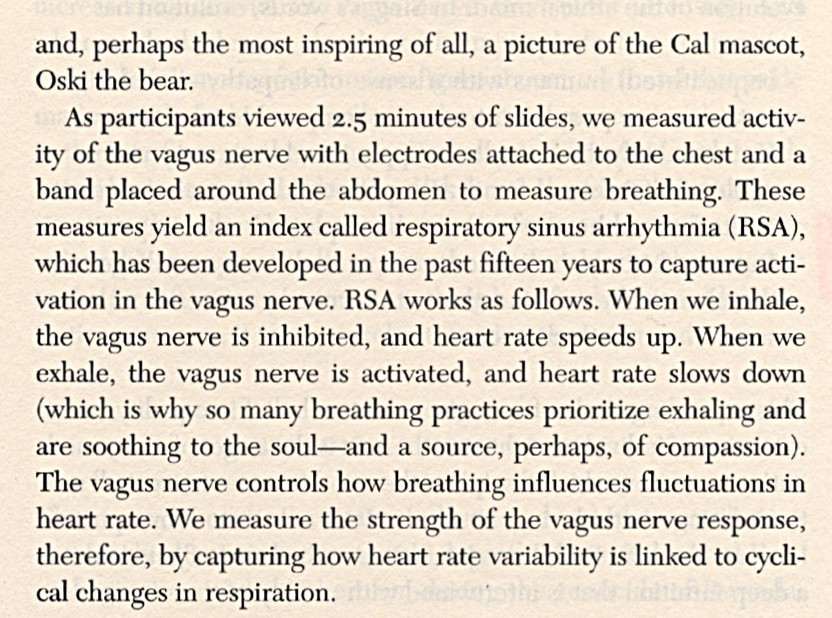
Johnson et al 2001

Abstract – Columbia University College of Physicians and Surgeons, New York State Psychiatric Institute, NY 10032, USA.

Childhood verbal abuse and risk for personality disorders during adolescence and early adulthood
Comprehensive Psychiatry, Volume 42, Issue 1, Pages 16-23

ABSTRACT:  Data from a community-based longitudinal study were used to investigate whether childhood verbal abuse increases risk for personality disorders (PDs) during adolescence and early adulthood. Psychiatric and psychosocial interviews were administered to a representative community sample of 793 mothers and their offspring from two New York State counties in 1975, 1983, 1985 to 1986, and 1991 to 1993, when the mean ages of the offspring were 5, 14, 16, and 22 years, respectively. Data regarding childhood abuse and neglect were obtained from the psychosocial interviews and from official New York State records.

Offspring who experienced maternal verbal abuse

during childhood were more than three times as likely

as those who did not experience verbal abuse

to have borderline, narcissistic, obsessive-compulsive, and paranoid PDs during adolescence or early adulthood.

These associations remained significant after offspring temperament, childhood physical abuse, sexual abuse, neglect, physical punishment during childhood, parental education, parental psychopathology, and co-occurring psychiatric disorders were controlled statistically.

In addition, youths who experienced childhood verbal abuse had elevated borderline, narcissistic, paranoid, schizoid, and schizotypal Personality Disorder symptom levels during adolescence and early adulthood after the covariates were accounted for.

These findings suggest that childhood verbal abuse may contribute to the development of some types of Personality Disorders, independent of offspring temperament, childhood physical abuse, sexual abuse, neglect, physical punishment during childhood, parental education, parental psychopathology, and co-occurring psychiatric disorders.

++++++++++++++++

The region in the primate brain that contains mirror neurons corresponds in our human brain to the region, Broca’s area, that processes speech (see page 184 of chapter reference below).  Think about the impact of all forms of adult interactions with infant-children — especially during the rapid-growth brain developmental stages — as you read the following:

“Relational” Mirror Neurons and the Concept of Representation

“Mirror neurons respond only to intentional motor actions. This is the first evidence that there is an area in the motor cortex that can respond specifically and only to goal-directed, relational actions.”  (page 183)

“When mirror neurons are activated, there is a very tight, precise correspondence between a specific motor action and neuron firing. For example, if a neuron responded to an object held between the fingers, it would not respond to the same object held by tweezers. Self-initiated actions and the individual’s perception of the identical action performed by another evoke the same neural response. So it can be said that the monkey’s brain (and ours as well) is intrinsically relational.”” (page 184)

“The discovery of mirror neurons suggests that certain actions may be represented in the mind because they trigger a neural link between self and other. This representation of the other’s action by means of mirror neurons is direct and immediate and does not require any intervening symbolic code or a mental language, as there is an instantaneous mapping from self to other and from other to self. Mirror neurons support ecological theories of perception in that there is an innate coupling between the self and the other: we respond to directly perceived qualities of the other’s intentionality; we do not require coded information.”  (page 185)

READ REST OF CHAPTER HERE

in Imagination and the Meaningful Brain (Philosophical Psychopathology)By Arnold H. Modell (2006), The MIT Press

++++++++++++++++

“Scientists who use advanced imaging technology to study brain function report that the human brain is wired to reward caring, cooperation, and service. According to this research, merely thinking about another person experiencing harm triggers the same reaction in our brain as when a mother sees distress in her baby’s face. Conversely, the act of helping another triggers the brain’s pleasure center and benefits our health by boosting our immune system, reducing our heart rate, and preparing us to approach and soothe. Positive emotions like compassion produce similar benefits. By contrast, negative emotions suppress our immune system, increase heart rate, and prepare us to fight or flee.”

READ REST OF ARTICLE HERE:  We Are Hard-Wired to Care and Connect by by David Korten

++++++++++++++++


+IN THE PRESENCE OF LAUGHTER WE ARE SAFE, SECURE AND FREE

+++++++++++++++++++++++++++++++++++
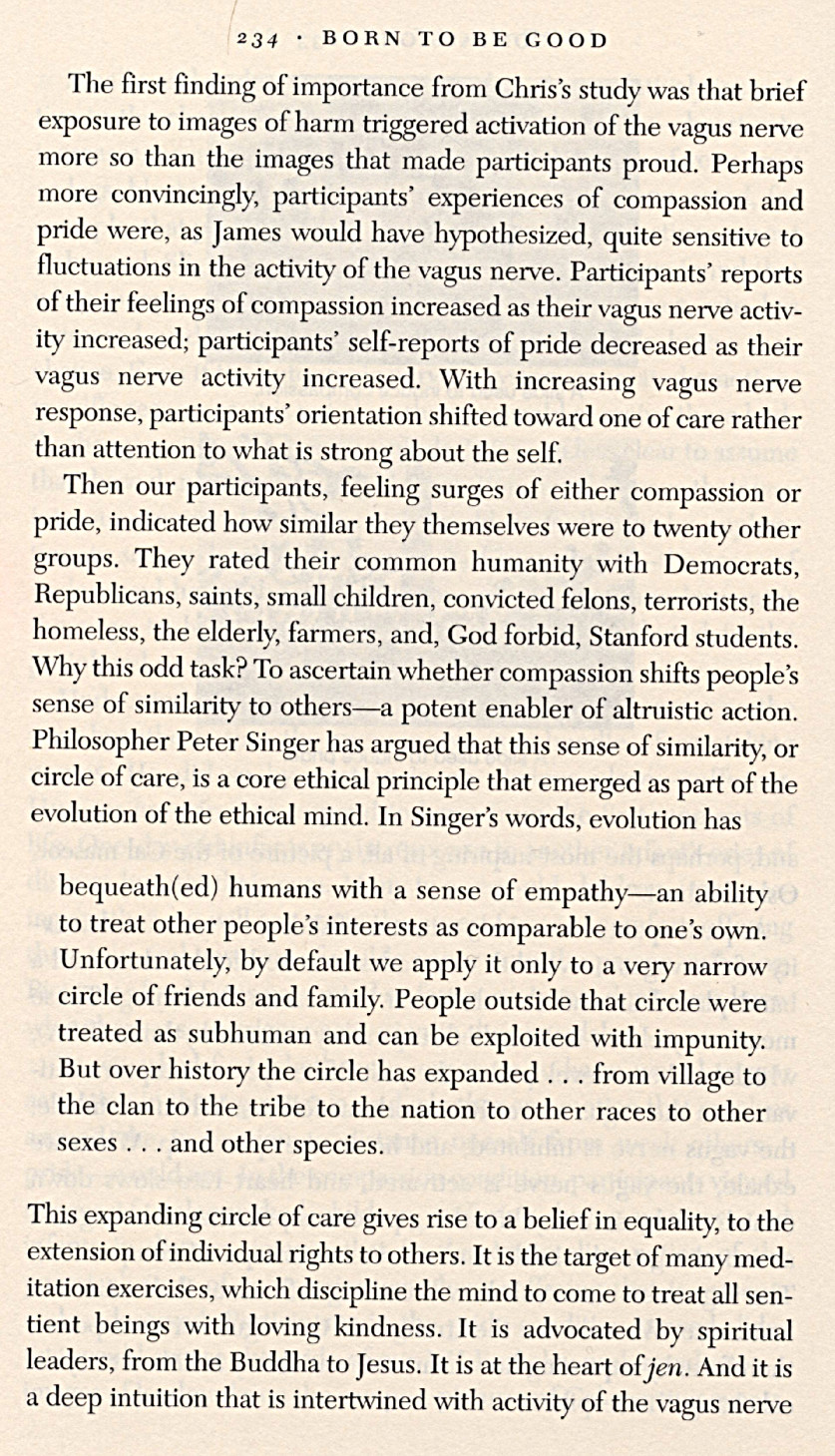
The wind is back at dawn today, roaring around my house like a drunken clan of Cyclops giants.  The tall pine in my neighbor’s yard is dancing a wild, frenzied jig in fast motion.  The wind is trying to rip the leaves off the plum tree before they even come out.  The giants are bellowing at me down the water heater chimney in the corner of my kitchen.

The sky grows lighter with the sound of birds perched in the twigs of the quince tree above their pan of water outside my kitchen window.  The light is all gray today.  It seems to be within the clouds across the sky, even in all directions, masking the outlines of the mountains, yet here and there in the west the clouds are outlined with the faintest tints of peach, ecru and tan.

It looks like a day to stay indoors.  My cold has thickened and settled, making me feel feverish and queasy.  Sneezing, I watch droplets of rain appear on the outside of my window.  I am grateful for this roof and these walls of shelter (thinking about my study last weekend about the precuneus part of the brain and its connection to our human sense of shelter and to the self).  Protection for the body of the self and for the self of the self.

I am not so tough that I can’t appreciate these advantages I have being only one of billions who have so much less to keep them protected from so much more.  Without these protecting walls of shelter around me right now, without this sturdy roof, without some source of heat, I would experience this coming day differently.  It strikes me as I read a little more of Dr. Dacher Keltner’s 2009 book, Born to Be Good: The Science of a Meaningful Life, about laughter that the presence or absence of laughter seems to correspond to the nature of the protection we have inside our self for our self.

++++

Keltner and his colleague, George Bonanno, designed a long-term study to examine how laughter operated among 45 adults who were grieving for the loss of a much loved spouse who had died within the previous six months.  Here again Keltner does not include any assessment of previous traumas, child abuse or maltreatment, or to degrees of secure or insecure attachment.  By not collecting this information from his participants, he missed the opportunity to learn about how the presence or absence of laughter during a time of personal storms is directly connected to the nature of the sheltering protection a person has for their self.

Yes, he found that laughter appears as a resiliency factor in human grieving.  Yes, laughter appears to be a ‘fitness factor’ that corresponds to the ability to transcend one’s losses so they can flexibly resolve their traumas and move on into the next stages of life.  But I resist the intimation his writings leave with is readers, that there is plainly something innately superior about those who can laugh in the midst of their grief compared to those who cannot so easily access laughter’s power to heal.

My bet is that those who entered into the rooms of Keltner’s experimental laboratory to complete his interviews and have their most minute reactions critically examined brought with them the condition of the shelter of their self built within them through critical developmental stages of their infancy and childhood.  Those who were early traumatized were most likely to have soggy cardboard boxes to live in, if that.  Those who benefited during their development by being given good strong walls and a good strong roof, doors that sealed out the storms and tight, solidly placed windows of course had the corresponding ability to access their laughter within.

What did Keltner and Bonanno find among their 45 participants?

“Measures of laughter (and smiling) predicted reduced grief as assessed at six, fourteen, and twenty-five months postloss.  Duchenne laughter while talking about their deceased spouses were less anxious and depressed, and more engaged in their daily living, for the next two years.  Just as important, people who showed more anger were observed to be experiencing more anxiety, depression, and disengagement from daily living for the next two years.”  (page 142

These researchers continued to study how these grief-triggered reactions appeared in the body of their subjects and observed the following:

“…George and I went on a search for further evidence in support of the benefits of laughter.  Why did laughing while talking about the deceased partner relate to increased personal adjustment?  What we observed were findings very much in keeping with the laughter as vacation hypothesis.  Our first analysis looked at how bereaved individuals’ experience of distress tracked one physiological index of arousal – elevated heart rate.  The bereaved individuals who laughed showed similar heart rate arousal as those who did not laugh.  But whereas our nonlaughers’ feelings of distress closely tracked increases in their heart rate, our laughers’ feelings of distress were decoupled from this physiological index of stress.  Metaphorically, laughers were taking a vacation from the stress of their partners’ deaths, freed from the tension of stress-related physiology.

“We then transcribed their conversations and identified exactly what the bereaved participants were talking about when they laughed.  Here again, data suggest that laughter is not a sign of denial of trauma, as widely assumed, but an indicator of a shift toward a new perspective enabled by the imagination.  We coded participants’ references to several existential themes related to bereavement – loss, yearning, injustice, uncertainty.  We also coded for insight words that reflect a shift in perspective, phrases like “I see” or “from this perspective” or “looking back.”  Our participants who laughed were most likely to be talking about the injustice of death – the unfair termination of life, the difficulties of raising a family alone, the loss of intimacy – but they engaged in this discourse with perspective-shifting clauses.  Laughter was part of these individuals’ shift in viewing the death of their spouses.  It was a portal into a new understanding of their lives.  A laugh is a lightning bolt of wisdom, a moment in which the individual steps back and gains a broader perspective upon their lives and the human condition.

“Finally, our data speak to the social benefits of laughter.  Our bereaved individuals who laughed reported better relations with a current significant other.  They more readily engaged in new intimate relations.”  (pages 143-144)

++++

I believe that Keltner and Bonanno missed the most important fact that it wasn’t the presence or absence of laughter itself that mattered most in their study.  It was the presence or absence of a safe and secure attachment system, built into these individuals through the nature of their earliest caregiver interactions during their body-brain developmental stages, that either enabled laughter to exist as the resiliency factor it is, or did not.

Laughter is obviously connected to the benefits this research describes.  Yes, it does have the power to modulate the physiological stress response in the body.  Yes it indicates “a shift toward a new perspective enabled by the imagination” because it is a signal of fitness that reflects the conditions of the environment an individual was formed in, by and for.  Yes, laughter is included in autobiographical narratives when it appears in “perspective-shifting clauses” that are part of the telling of a coherent, continuous life story that is most likely to happen for a safe and securely attached-from-birth person.

Transitioning between contrasting mental states, processing information in insightful ways, being able to obtain shifts in perspective, having a “portal into a new understanding” of one’s life, having the capacity to experience “a lightning bolt of wisdom, a moment in which the individual steps back and gains a broader perspective upon their lives and the human condition” all are possible because of safe and secure attachment patterns built into a person’s body-nervous system-brain-mind-self from the start of one’s life.

And of course having these abilities, which stem from a safe and securely built body-brain, means that such a person will have the capacity also to report “better relations with a current significant other” and will be able to “more readily” engage “in new intimate relations.”

++++

This research is describing the differences between those who have and those who do not have the insurance-policy benefits of safe and secure attachment built into their early developing body-brain.  The presence or absence of laughter is the internal and external signal that clearly indicates the nature of a person’s attachment system.  Our attachment system is itself a signifier of the quality of the world that built each of us in our beginnings.

Our attachment system is about the quality of the protective structure within us that contains our self.  If I had to try to recover from this cold I have outside in the cold wind and rain of today, rather than trying to recover within the adequate home I have that keeps those stormy elements away from me, I would not be likely to recover as well, as quickly, or maybe even at all.  That’s just plain common sense.

So why do we continue to so stubbornly refuse to accept that the conditions of our inward attachment system that directly formed the who and how we are in this world don’t have an equally powerful influence on how we respond to and recover from the trials and tribulations, the storms that happen to us along the pathway of our lives?

If the presence of laughter signifies the existence of a safe and secure inner protective structure for the self, and its absence signifies that this inner protective structure is not safe and secure enough, then I know more about the meaning of laughter in my own life and in the lives of others.  Just as I would want to improve the physical structure of my dwelling if the rain was pouring in the roof and my siding was blowing off, I want to improve the structure surrounding my self.

++++

It is with this new “light of understanding” about the powerful signifier laughter is of the conditions of my inner shelter that I will share with you something that made me laugh so hard yesterday my sides literally hurt.  I haven’t laughed like that for a long, long time.

Our rural town weekly newspaper always includes a page called “The Police Beat” where the past week’s 911 calls are presented to the public.  I happen to live in this unincorporated outskirt town of 700 people that I found mentioned in the news yesterday.  I was trying to read this entire piece from start to finish over the telephone to my daughter last evening without laughing.  I couldn’t do it:

Jan. 7

A Naco woman reported a large green half snake half something else was in her bathroom.  By the time deputies arrived, the creature was gone.

Of all the descriptions Keltner has presented (above) about laughter, it is his mention of how laughter is “an indicator of a shift toward a new perspective enabled by the imagination” that most caught my attention.  I thought to myself, “Hey!  I can do THAT!”

Reading this report from the sheriff’s call yesterday captivated my imagination.  The words in that report created for me a playground for my imagination – as I suspect it will yours.  Now, thanks to reading Keltner’s book combined with my own insights, I understand more than ever before the critical place that laughter has as a signifier of human well-being.

I will pay ever more close attention to finding the large and often very small places that humor, smiles and laughter might be hidden around me in my life – even if they are hidden in the words of a paper about something that first appeared in someone else’s bathroom – and then did not.  Now I understand more clearly that my attachment system, my home of my self in the world, will be better off for every instant of genuine laughter I can find.

Human laughter, older than words, might well be the most important language we have.  It tells the stories of the better side of life.  In laughter we share both the oldest and best of who we are and what we know.  In the presence of genuine laughter we are most present in the present because in its embrace we are most completely safe, secure and free.

+++++++++++++++++++++++++++++++++++