+LINKS: CHILD ABUSE AND CHILD ABUSE PREVENTION

+++++++++++++

I am getting way behind on posting information links on child abuse prevention and Child Rights.   Here’s a post for catching up!!  Just click, roll and scan – follow any links that appeal to your interests.

+++++++++++++

New Site about Kids’ Health for Parents

Posted: 10 Mar 2010 08:40 AM PST on Prevent Child Abuse New York’s Blog

Many parents, upon discovering their child’s stuffy nose, rising fever or latest injury, retreat to the computer to do some research. Other parents may consult Google to find answers about developmental questions, potty training or sleeping difficulties. While this can be helpful, the sheer volume of information available on the internet can be overwhelming and at times inaccurate. Good news, parents. The search for reliable information about child health and development just got easier.

The American Academy of Pediatrics (AAP) recently launched a website that’s backed by 60,000 pediatricians. Healthychildren.org offers detailed answers to questions that parents have about their child’s well being. This website encourages parents to be proactive about their children’s health, providing reliable, up-to-date information.

Healthychildren.org is divided into multiple, easy to use sections, which include Ages and Stages, Healthy Living, Safety and Prevention, and Health Issues.

Although Healthychildren.org is an easy and convenient way to receive the up-to-date information, parents should always consult with their own pediatrician as well.

++++

Excellence in Child Abuse Prevention Awards

Posted: 15 Mar 2010 12:19 PM PDT on Prevent Child Abuse New York’s Blog

Do you know someone who has made an exceptional difference in the lives of New York’s children and families? Who works tirelessly to see that children live in families that love, nurture and protect them? Who has made their community a better, more supportive place for parents and kids? If so, we want to hear about them!

Prevent Child Abuse New York and New York’s Children and Family Trust Fund are proud to announce the 15th annual award recognition of excellence in the field of child abuse prevention in New York State.
Qualified nominees will have had an impact on any of four levels:

  • Societal issues, such as social norms or public policies.
  • Community issues, such as community development.
  • Personal relationships, such as family or peer-to-peer interactions.
  • Individual knowledge, attitudes, skill, or behavior about children or maltreatment.

The awards will be presented at the 15th Annual Child Abuse Prevention Conference, Education, Inspiration & Solutions , being held at the Marriott Hotel in Albany, New York, April 26-28, 2010.

Individuals, organizations and companies are all eligible for nomination.

For more information about the NYS Child Abuse Prevention Conference and the Excellence Awards, please call 518-445-1273.

+++++++++++++

From CRIN – Child Rights Information Network

9 March 2010 – Child Rights at the Human Rights Council 58

Side event on national violence strategies [news]

A side event at the 13th Council session tackled the issue of violence against children, with delegates discussing the publication and implementation of the Council of Europe’s new Council of Europe Policy guidelines on integrated national strategies for the protection of children from violence.

Hannu Himanen, Permanent Representative of Finland to the United Nations Office, began the event by quoting the 2006 UN Study on Violence Against Children, which emphasised that action on violence requires an integrated plan. He said: “A piecemeal approach does not do the job.”

“For example”, he said, “in Finland, my country, the governement banned corporal punishment in 1984. This was an important step, but still it occurs. A recent study showed that one quarter of Finish adults accept the notion of corporal punishment.”

Mr Himanen said that a quote from Thomas Hammerberg, Commissioner for Human Rights at the Council of Europe, at the 20th CRC anniversary conference, had stayed with him. Mr Hammerberg said: “It is paradoxical and an affront to humanity that the smallest and most vulnerable people should have less protection from assault than adults.”

Lothar Friedrich Krappmann, of the Committee on the Rights of the Child, said: “The adoption of these guidelines is a significant step in the protection of violence against children.”

He went on to emphasise that: “No violence against children is acceptable. All violence against children is preventable.” Mr Krappmann said this was not limited to physical violence, but also mental abuse.

He said there had not been enough coordination between different initiatives, programmes and policies. “These guidelines affect more than 200 million children,” he added.

Marta Santos Pais, Special Representative to the Secretary General on Violence Against Children, also presented at the event. She said: “Regional organisations such as the Council of Europe can have a huge influence in regional implementation of standards, and aid cross fertilisation.”

The Council has been very influential in promoting a regional platform, she continued. In 2010, many countries have not adopted a violence strategy, even though the UN Study on Violence Against Children stated all countries should adopt a strategy by 2007. This should also include laying down markers for implementation. These European guidelines help to address some of these requirements and are relevant everywhere, she added.

She said: “I believe that promoting the dissemination of these guidelines will help us move forward on implementing the UN Study’s recommendations, and could provide a good framework in countries all over the world.”

Lioubov Samokhina, Head of the Children’s Rights Policies Division at the Council of Europe, spoke about the development of the guidelines, and the approach taken in the drafting process. “The main objective of the guideline is to promote a culture of respect for the rights of children, and to stimulate change in the attitude towards children and childhood,” she said. The main aim of the guidelines, she added, was to encourage States to develop a multi-faceted and systematic framework.

Idália Moniz, Secretary of State for Disability, Portugal, spoke of her country’s efforts to adopt an integrated and model strategy. She emphasised the importance of redefining budgets. Portuguese criminal law was changed in 2007 to outlaw all forms of corporal punishment. Cooperation is needed on all levels, from local researchers to policy and decision makers, she said.

NGO role

Peter Newell, of the NGO Advisory Council on Violence Against Children, spoke of the role of the non-governmental sector.

He said: “We are speaking about all violence, however slight. There is an adult tendency to draw a line between so-called softer forms of violence.”

He said the biggest role for NGOs was advocacy. “I think these guidelines are an advocacy tool of great value,” he added.

Mr Newell said there is still a long way to go, within the Council of Europe, and everywhere else. Mechanisms are still not being used to promote an end to all violence against children, and no country can claim to have an effective strategy against violence against children when some forms of punishment are still legally endorsed.

Twenty seven of the 47 Member States have still not prohibited all forms of violence against children, and in many countries corporal punishment is still permitted in institutions such as care homes. It is inconceivable that States would defend legalised violence towards any other groups, such as women, people with disabilities or elderly people, Mr Newell said.

Retrospective research studies interviewing young adults about their childhood show many had experienced sexual assault and other forms of violence, but they did not report it, in part because of a mistrust of social services. He said: “Proper child protection systems must involve children being systematically invited to give their views on such systems.”

Mr Newell said it was important that, while it is usually NGOs that facilitate child participation for government programmes and policy, it should really be governments themselves that are involving children directly.

“It is fine for NGOs to provide demonstration and pilot projects, but in doing so it is important we are not colluding with governments in their failure to fulfil their obligations,” he said.

A change in attitudes requries long-term campaigning. Mr Newell also mentioned how some church and faith groups were embracing an approach against violence, while evidence of abuse in such institutions is becoming more publicly acknowledged.

He said he felt conspiracy laws should be used against those groups that attempt to cover up evidence of sexual exploitation and other forms of violence towards children.

During the discussion following the presentations, a delegate asked if there had been any positive examples of the international dissemination of the guidelines. Ms Samokhina spoke of plans to organise events on the guidelines, inviting international representatives from a range of countries and organisations.

Mr Krappmann said it is “such a hard job” to eradicate violence against children, and that it is “not just the job of European States, but of all States.”

Ms Santos Pais noted that international cooperation was also essential in respect of the migration of children.

About the guidelines

In line with the recommendations of the United Nations Committee on the Rights of the Child and of the United Nations Secretary-General’s Study on Violence against Children, these guidelines were developed to promote the development and implementation of a holistic national framework to safeguard the rights of the child and to eradicate violence against children.

The guidelines are based on eight general principles (protection against violence, the right to life and maximum survival and development, non-discrimination, gender equality, child participation, a state’s obligations, other actors’ obligations and participation, best interests of the child) and four operative principles (multidimensional nature of violence, integrated approach, cross- sectoral co-operation, multi stakeholder approach). These have been mainstreamed throughout, including into sections on integrated national, regional and local action; education and awareness-raising measures; legal, policy and institutional frameworks; research and data collection.

Further information

For more information, contact:
Council of Europe
Building a Europe for and with children, DG III- Social Cohesion / Council of Europe, B Building – Office B137, F – 67075 Strasbourg Cedex
Tel: +33 3 88 41 22 62; Fax: +33 3 90 21 52 85
Email: children@coe.int
Website: www.coe.int/children

Visit: http://www.crin.org/resources/infoDetail.asp?ID=22119

++++

NGO statements

OMCT: Violence against children in detention

ECPAT : Children’s right to protection from sexual violence

Defence for Children International: Statement on Prosecution of children in military courts

Women’s World Summit Foundation: Statement on violence against children

Further information

++++


COUNCIL OF EUROPE: Call for papers on ending sexual violence
[news]

This call for papers is addressed to legal, health, social, research and education professionals wishing to contribute to a Council of Europe study on sexual violence against children. The study will serve as a background for the Council of Europe awareness raising campaign to stop sexual violence against children.

The Council of Europe campaign

The Council of Europe Strategy on the Rights of the Child (2009-2011) has amongst its major focuses that of eradicating all forms of violence against children. In particular, it calls for launching comprehensive awareness-raising actions to prevent and combat sexual exploitation and sexual abuse of children.

In response to this mandate, in autumn 2010, the Council of Europe will launch a pan-European campaign to stop sexual violence against children. The campaign’s overall objective will be to raise European societies’ awareness of the full extent of sexual violence against children and to equip them with knowledge and tools to prevent it. The campaign will address the various forms of sexual violence including child pornography, child prostitution, online grooming, child sex tourism and child sexual abuse.

The future study

Given the complexity and sensitivity of the issue at stake, the Council of Europe wishes to prepare a study to inform and guide the campaign. The study should cover inter alia the following dimensions:

  • Overview of the extent of sexual violence (sexual exploitation and sexual abuse) in Europe;
  • Overview of the legal framework (global and European) to combat sexual violence against children;
  • Sexual violence reporting and referral mechanisms;
  • Rehabilitation services for child victims of sexual violence;
  • The range of services available for children exhibiting sexually harmful behaviour;
  • Training of professionals to identify and report sexual violence;
  • Internet dimensions of sexual violence against children;
  • Support services for potential and actual adult perpetrators of sexual violence;
  • Data collection on violence against children;Communication and awareness raising campaigns against sexual violence in Council of Europe member States.
  • Sexual education and prevention of sexual violence

The proposed length for research articles addressing one of the aforementioned issues should be no more than 8,000 words (about 15 to 16 A4 pages, normal spacing) and should be submitted in one of the official languages of the Council of Europe, i.e. English or French.

Following the selection procedure, a limited number of experts will be invited to work with the Council of Europe on a contractual basis, during the period between April and June 2010.

Building a network of professionals

The experts who will contact us will be also invited to express their interest in cooperating with the Council of Europe in the various projects and activities to be launched during the campaign, the objective being to build a network of professionals wishing to bring their expertise and the results of their work to a community of practice at European level.

How to contact us

Please fill the document enclosed and send it, accompanied by your CV to Ms Marie-Francoise GLATZ (marie-francoise.glatz@coe.int) by 31 March 2010 at the latest.

For more information, contact:
Council of Europe
Building a Europe for and with children
DG III- Social Cohesion / Council of Europe
B Building – Office B137
F – 67075 Strasbourg Cedex, France
Tel: +33 3 88 41 22 62; Fax: +33 3 90 21 52 85
Email: children@coe.int
Website: www.coe.int/children

Visit: http://www.crin.org/resources/infoDetail.asp?ID=22165

++++

Further information

+++++++++++++

+STOPPING INTERGENERATIONAL TRAUMA – EVEN WHEN THE CHOICES ARE HARD

++++++++++++++++++++++++++++

The thing about trauma triggers is that they create a break in one’s pathway through life beyond which we cannot easily pass in the present moment.  They always come because the trauma from the past has not been able to resolve itself within us.

Today might be one of those tests of the healing power of writing.  Will I be more whole at the end of this post than I am right now as I start it?

My dear daughter who is pregnant with her firstborn, a son who will be named Connor, who was due to pop into this world on April 20th.  Because of a surgery my daughter had last year everyone has known from the beginning that he would be born c-section.  All has been well through the pregnancy, and all is well with mother and baby at this moment.  The only problem is that my daughter’s water broke last night and her labor began early.

In today’s world of modern medicine I guess any delivery after 34 weeks is considered to be very low risk, even though the babies have to spend the first two weeks of their lives not cuddled within their loving mother’s tender arms, but instead have to live inside a neonatal intensive care ward being watched over as their temperature is artificially regulated as their lungs continue to develop.

There are evidently times when a person can know too much.  I know how critically important mother-infant bonding is to the well-being of both baby and mother.  One of the biggest risk factors there is for attachment disorders is complications at birth.

++++

So this brings me head-on to my own trauma triggers and my natural tendencies to overlay my past experiences onto a situation in the present that really is NOT about me, and in fact really has nothing to do with me, even though this infant is my first grandchild.  I am not his mother, and what happened to me and my firstborn daughter has nothing to do with either of THESE children – my daughter or her son.

Last night when I spoke with my daughter, who lives well over a thousand miles away from me (I’m on the Mexican border and she’s nearly on the Canadian border), I could hear all the love and connection in that hospital room where my daughter and baby have to live for as long as it takes for this process to play itself out.  My son, soon to be 25, is out of the Air Force and moved in to stay with his sister and brother-in-law in their home a week ago.  He was there.  My oldest daughter was also there.  Father of the baby was there.  His very best friend, like a brother, was there, so excited that he could barely contain himself!

So much love.  So, so much love.

It is such a miracle to me that given my own past of an infant-childhood of 18 long years of hatred and abuse from the first breath I took that I could have participated in the creation of a family where there really is NOTHING but love between my three children and those who love them.  While I know it really isn’t a miracle in some sort of objective, detached way, but rather is a consequence of lots of choices that everyone has BEEN ABLE to make along the way that were so different from the unconscious ‘choicelessness’ that was the way of my mother and father regarding me.

++++

My daughter has been given antibiotics.  She was given a shot to stop the labor.  She is not allowed to leave the hospital now.  The clock is ticking.  Everyone will do whatever is in their power to keep that little boy, who is a healthy six pounds, 11 ounces, inside of his mommy for as long as is safely possible.  Nobody knows now if that will be 3 more hours or three more weeks.

My daughter has excellent insurance, but no paid maternity leave and very high bills.  Her husband is underemployed, and like nearly every young family they have little savings and already worry about daycare and separation of mother and child because my daughter will have to go back to work shortly after Connor is born.  I certainly am poor and have nothing to offer them financially.

My daughter and her husband are in their early thirties.  They waited to have children until they were more mature, and I can count absolutely on their maturity.  That is something I did not have when I got pregnant, unmarried, at 18.  My daughter does not have a background of trauma and abuse.  She does not have an attachment disorder.  But what she evidently now will have is a major challenge to get through the first two weeks of her son’s life without him in her arms.

My daughter is very wise, very practical and very resilient.  She and her husband are very much in love and have been together over 12 years already.  They have close and dear friends.  My daughter has a flexible and supportive work environment.  She is in good health.  There is nothing about my worrying that is helpful right now.

Yet how do we get ourselves internally to an emotional hands-off state when the need arises?  Faith and hope and trust are all about our increasing our margin of feeling safe and secure in the world no matter WHAT is going on.  Admitting helplessness and an inability to affect outcomes is never easy when there is an investment of love and caring.  I will, of course, not rest until this whole birthing drama has completed itself and everyone is fine.

++++

Life is full of risk factors and their corresponding resiliency factors.  As parents, we continually work to build up the latter while trying in any way we can to lessen the possibility of the former.  Giving birth to a preterm baby is a risk factor.  Interference with the natural bonding process at birth is a risk factor.  Even the fact that in our nation we do not put preterm babies into rocking incubators is a decreased resiliency factor for the infant.  I would want to send my daughter links like these, which of course I won’t:

Tips on Sensory Stimulation of Your Premature Infant in the NICU

Common Drug For Stopping Preterm Labor May Be Harmful For Babies

Infant Massage Research

INFANT HOSPITAL BED

At birth, the rich intrauterine environment is suddenly replaced with a whole new world of sensations. The gamut of stimuli given the fetus before birth suddenly stops. Recent investigations indicate that kinesthetic stimuli such as touching, movement, sound and definition of space, stimuli provided by rocking.”

++++

My daughter’s life is hers.  I can’t be up there with her, which of course is hard.  It is hard knowing that I, as her mother, have such a trauma-changed body-brain that I’m not much good, honestly, in any kind of crisis.  That makes me mad and sad, but it’s a reality.

The other part of this relates to the ‘preoccupied insecure attachment’ pattern I mentioned in my recent post.  My own birthing experiences with my first born were traumatic.  Her current circumstances are triggering all my memories of that experience.  Most simply put, it all went something like this:

I was oblivious at 18 when I left home both about the 18 years of abuse I had just survived.  I had no frame of reference that would have allowed me to know how terribly hurt I was.  Four months out of Naval boot camp I was pregnant.  I carried the baby with no family support, not even from the father.  I was terrified about the future, and didn’t know if I could keep my child.

I counseled with a social worker through the pregnancy who told me that I did not have to rush to make any decisions.  She told me that I even could wait until the baby was born, hold the infant in the hospital, and make my decision then.

Because I conceived while still in the military (in those years a woman was thrown out if she got pregnant, married or not), the military was committed to covering my delivery.  I entered Balboa Naval Hospital in hard labor on a Monday afternoon.  I was left in hard labor, all alone, until late Wednesday afternoon before they finally decided to take X-Rays to find out what was wrong.

My daughter’s head was pushing hard against my spine and could not come out on her own.  The treatment I received during my extensive labor was anything but kind or compassionate, or even helpful.  When they decided to take the baby by turning her with forceps, they gave me a spinal block.  Once she was born, the doctor ripped the afterbirth out of my body.  I remember the flashing stabbing pain and then I was gone.  I woke up late the following Saturday, having spent the interim days unconscious and hemorrhaging.

I had friends who had driven me to the hospital but because they were not family the hospital refused to release any information to them about what had happened to me or to the baby.  I didn’t dare tell my parents I was delivering.  Their reaction to my pregnancy had been abusive and terrible.  Obviously I could have easily died in there and nobody would have known.

Once I was placed in a regular hospital room I waited for my daughter to be brought into me.  I watched one by one while all the other babies were wheeled down the hallway past the doorway of my room in their little bassinets to their mother as I eagerly waited for mine.  No baby came, and nobody would tell me why not.

I was an incredibly passive victim, but eventually I found my demanding rage.  Only when I began to scream, cry, yell and shout for my BABY did the pediatrician enter my room to tell me the following as he stood in the doorway of my room:  “You are an unwed mother and your baby is going to be given up for adoption.  She has a cut on her cheek for her forceps delivery, and if I allow you to touch her that cut will become infected and she will have a scar on her cheek for the rest of her life.  What prospective adoptive family is going to want a baby with a scar on her cheek?”

For the first time in my life I erupted with emotion.  I picked up the full stainless steel pitcher of water on the table next to my bed and screamed “You mother f****r” at him as I heaved the pitcher at his head.  I missed him by a fraction of an inch.  The pitcher dented the wooden door jam and crashed to the floor.  The doctor disappeared.

During the next several days I was in the hospital I was allowed to touch my healthy, beautiful nine pound baby girl only once.  In the middle of one night a nurse wrapped me in a sterile gown, put a sterile mask over my face, and quietly led me into a room off of the nursery as she settled me in a rocking chair.  She brought me my baby and a bottle of milk so I could feed it to her.

I can never describe how I felt in those few stolen moments.  But the next day, somehow, the doctor found out that nurse had broken his law and I could hear him screaming at her from a hallway away.  She came to talk to me later, apologizing from the bottom of her heart for how my daughter and I were being treated, and told me she had been put on probation.

I left that hospital without my baby girl.  She went into a foster home for the first month of her life.  But as I had stood with my face pressed to the glass of the hospital nursery window and watched my daughter – not crying, looking around as if she owned the place – I had vowed to her that if this was the kind of world she was going to get adopted into, there was nothing worse I could do to her if I raised her even though I had absolutely nothing to give her.

Nobody had told me how to prepare for a baby.  In my destitution and confused aloneness while being pregnant, I had not been able to take a single step in preparation for OUR future.  Looking back now, I can see that I might as well have been living in a next of poisonous vipers.  That’s how dark and lost and traumatized I was as a terrible abuse survivor.

I was not mentally capable of conceptualizing ANY future, let alone one that included me as a mother of a child.  Nobody helped me.  But I went home, took a city bus to the local Salvation Army office, and received an entire baby layette with hand crocheted blanket, sweater, bonnet and booties.  It had bottles and diapers, everything we needed except for what we needed most:  Love, guidance, connection, and hope for the future.

I had thought I would bring my daughter home from the foster home during the second week of her life.  There’s an entire story about what happened then, and why it took another two weeks before a social worker came to pick me up and drove me over to the foster parent’s home.  I never entered that house.  The social worker retrieved my daughter and brought her to me and laid her in my arms as I stood on the side of the road outside the social worker’s car waiting.

Thirty nine years later the rest is history.  Included now in this history is the moment-by-moment wait while my second daughter is watched over with her own tiny boy inside of her.  My heart aches knowing my own pain of separation I went through with my first newborn baby.  I see no way that my daughter and her son are not going to experience some of these feelings if he does have to stay in a preterm incubator without her.

++++

It is not ideal that I am not up there with my children right now, either.  What I am describing to you here is a big part of the reason I am not.  I can never magically evaporate the effects my traumatic past has had on me.  There is no magic wand that can make me forget, and no dissociation so complete that I can be in my daughter’s presence without my own emotional turmoil being present with me.

Right or wrong, I am here and she and baby are there.  I have, in effect banished myself because I know full well that I cannot predict or control how my posttraumatic stress disorder can or could or might or will manifest itself, and I want no part of the presence of my trauma in her life at this critical point in her and her husband’s new parenting experience.  I absolutely trust that they will work out every single tiny detail, each instant of this process, together – and well, no matter how this all plays itself out.

Nothing I am going through HAS ANYTHING TO DO WITH MY DAUGHTER.  Nothing.  I do not wish to have any part of my trauma, as it is contained in the body of my daughter’s mother, to have any chance in HELL of contaminating or toxifying what she is going through right now.  Of course I am sad.  Very, very sad.  But this sadness belongs to the relationship I had with my own mother.  Her trauma and traumatized reactions did this to me – and now through intergenerational ripple effect is depriving both my daughter of having a happy, healthy present mother beside her right now as it deprives me of being there.

++++

So, where does writing this post leave me?  Mostly in a state of resignation.  My own integrity, the same integrity that has given my children a chance at a better life that they have grabbed and run with, does not let me ever lie or pretend with my children.  I am not a carefree mom.  As much as I might WISH that I could set aside all of my own problems to benefit my daughter right now, reality is that my absence is what is best for all of us.

Just because the psychotic break my mother suffered in her difficult labor with me prevented her from ever boding with or loving me, and just because the difficulties of my 18-year-old mothering life complicated my bonding with my firstborn, does not mean that my daughter NOW won’t be perfectly able to establish the vitally critical bond with her own son when he is born — even if she cannot hold him in her arms for the first two weeks of his life — that this little boy will need to experience his own life in the fullest.

But at the same time I am perhaps more consciously aware of the risk factors present, the resiliency factors needed, and of the obstacles that my daughter (and her husband) will have to overcome to create a bonding after birth with her newborn than nearly anyone else could possibly be.  When push comes to shove, and the most important priorities of life are considered, other than the most basic, fundamental necessities that staying alive in a body require, there is NOTHING in this world more important than the bond a mother has with her newborn.  NOTHING.

I think more than any other time in my life with my daughter, this time – exactly NOW – is the testing point.  Every resource she has a person will be tested, both inside and outside of herself.  Life has its critical moments, and this is certainly one of them.  I have always done the best that I possibly could to parent my children well so that they could live their own life in the best way they possibly can.

My daughter has her wings.  I know that.  She can fly.  It is my job as her mother to let her.

+++++++++++++++++++++++++++++++++++++

+HEALING TRAUMA WITH THE TIME ASSET

+++++++++++++++++

I have a few other thoughts related to my encounters with people-families-children at the Saturday children art festival where I did the spinning demonstration.

One collection of thoughts has to do, again, with small and big people and how humans relate to one another in ‘tearing down’ or ‘building up’ ways.  A young man about 12 years old stopped by my demonstration and immediately showed not only rapt interest but quite a bit of knowledge about spinning, weaving and the fiber arts.  His mother was with him, and in talking with these two I was given a picture I’ll try to relay to you here.

Last year this boy enrolled in a beginning weaving class held by Bisbee’s local Fiber Arts Guild.  He was fascinated, learned quickly, warped his own loom at the Guild studio and made his mother a scarf along with a baby blanket for his newborn cousin.  In the middle of the weekend class schedule his mother became ill.  The Guild was notified, and the boy missed three of the 10 week class sessions.  When he was able to return he found not only that the Guild members had passed off his loom with his next project on it to someone else, but they had not bothered to call and ask or tell him this was being done.  The adults participating in these activities were evidently quite demeaning, rude, disrespectful and hurtful to this child.  They let him know they did not want him around.

I have been given a solid and working handmade table top loom that I told this boy I will bring into town and leave off at his home for him.  I will collect all of the related items I can find here that go with the loom, look for a book or two I might have here at home that can help him, and also see what I have in the way of extra yarn I can give him.  Once I have all of this collected, I will pile it all into my trusty 1978 rather worn El Camino and drop it off at his house.

With all the troubles our nation is having in engaging our youth in their own lives, let alone in the life of their community and nation, it is beyond my comprehension how ANYONE could be rude to any child, period!  Let alone to a child like this boy is who is obviously motivated with passion to learn the fiber arts and is committed to doing so!

++++

The next collection of thoughts I have is related to an 8-year-old boy and his parents who stopped by my demonstration.  This child is obviously brilliant, as are his parents.  His father is a professional musician, a drummer.  His mother is a computer programmer web designer.  The child is fortunately home schooled and very much loved.

From the first instant this child spotted the very simple and basic, actually rudimentary gizmos and gadgets that are used in the process of preparing wool and spinning it, I could see that his brain did not work like an ordinary child’s.  His parents sat most patiently for over two hours on a stone bench in the middle of the Central School hallway while their son explored every avenue not only of the wool preparation process, but most noticeably of the equipment – how it was constructed, how it worked, why it worked.

Not knowing anything by fact here, I can still think that this child’s tool region of this brain is forming major connections.  The child certainly wasn’t intimidated by people.  In fact, he hawked the process from his newly found and claimed station at the drum carder.  He instantly memorized every step of the process when I first told him, and continued to instruct every passerby he could rope in about how this all worked.

At one point I was vaguely aware of him giving his spiel while I sat at my spinning wheel visiting with his parents.  All of a sudden I hear the boy say in a rather loud, commanding voice, “Hey!  What’s wrong over there!  Why aren’t’ you working?”  I had to laugh.  There I sat like a broken machine.  He had educated his audience completely up to the point where they needed to see the final stage in process, and there I was having dropped my end of the bargain.

The boy was not being rude, though certainly his attitude could have been interpreted that way.  This boy, I could tell from watching him, treated human beings exactly as if they had gears and mechanisms and programming that made them tick.  He is a brilliant, absolutely brilliant child, but I would not expect him to ever have an ordinarily developed right social-emotional limbic brain.  His brain is special, as he is.

This brings me to mentioning the Asperger autistic spectrum giant, Temple Grandin.  A made-for-television movie about her life has just been released:  “The HBO movie “Temple Grandin” honors its heroine’s priorities, stressing deeds over tearful setbacks and joyous breakthroughs.”  If you haven’t heard about Grandin and her work before now, please spend a little time checking her out.  In the meantime, I will specifically mention that Grandin has a LOT to say about so-called GEEK children who have brains that are gifts to the world.  This little boy might well fit into the schemata of the children Grandin is talking about.

++++

This brings me to my third thought collection for today which is related to yesterday’s post, +SO MANY NEEDY PEOPLE IN DENIAL OF THEIR NEEDINESS.  Due to the insane and terrible abuse I suffered during my childhood from birth, complete with extended manipulation of any opportunities I might have had from tiny on to interact with people, my right limbic emotional-social brain did not have the chance to build itself in an ordinary fashion (as this blog’s readers have heard me write about repeatedly).

As a part of the spectrum of consequences to the adaptive brain changes my body made, I do not read, understand, process, or respond to the emotional-social signals other people send out easily or well.  In some ways, I am realizing that I have a rather unique ability to not automatically buy into the send-receive-respond social signal-cue communications cycles that people with ordinarily built early brains (through safe and secure early caregiver attachment exchanges) are designed for.  I can notice, attend to and translate actions that ordinary-brained people probably miss — because they CAN.

(Similarly, I suspect, to how the 8-year-old boy’s brain gains and processes information about machines that few other brains would, or can, notice.  Temple Grandin’s brain gets this altered information about animals.  These are abilities that do not come primarily from choice.  They reflect in manifestation different body-brain constructions — changed in part or wholly by combinations of genetics interacting with the environment.  Our abilities give us resources that more ordinarily-brained people probably do not have.  These differences and changes are part of what makes us exceptional and extra-ordinary people.)

Lest any of my readers suspect that I am exaggerating the differences I experience in my emotional-social interactional abilities with people, let me again mention that these transactions normally occur in the hundredths of a millisecond response signaling range.  They are happening physiologically about at the speed of light, or however quickly electrical signals are sent and received between neurons and other bodily cells.

These extremely fast, and supposed-to-be automatic electrical signals are operating according to how a person’s body-brain was constructed primarily from conception through age one.  Connections between pathways, circuits, brain regions and the body are constructed very early on and all growth and development past these early critical window stages of development follow along accordingly as we finish our early (and later) development.

This matters in many, many ways.  When, as a commenter to yesterday’s post mentioned (See: +SO MANY NEEDY PEOPLE IN DENIAL OF THEIR NEEDINESS) those of us with these changed brains are faced with awkward, uncomfortable, disquieting if not down right mean interactions with other people, we have an extremely difficult time doing what this commenter suggested when she noted:  Eleanor Roosevelt said “no one can make you feel inferior without your permission.”

Our body-brain does not read social-emotional cues and signals in the same way as Ms. Roosevelt’s no doubt did.  As a result, our attempts to decipher all of the signals other people are sending out in the hundredth of millisecond range do not mean the same thing to us as they do to ordinary brains.  If we are even going to get a clue about what is actually happening in our interactions with others, we need the one thing to happen that SO RARELY DOES HAPPEN that we could consider it impossible.

We need time to slow way, way down.  Because these communication signals are designed (normally) to occur near the speed of light, because they are outward manifestations of electrical impulses traveling invisibly within a person yet STILL manifesting themselves in visual and auditory signals that we are supposed to automatically read, understand and be able to respond back to in kind, we are at a serious disadvantage when it comes to doing what dear Ms. Roosevelt (and this commenter) suggest.

There is a universe, and I MEAN A UNIVERSE of information necessary to process information between people according to this maxim:  “no one can make you feel inferior without your permission.”  The brain has to know who-what the self is completely, it has to know who-what the other is completely, it has to process what-where the boundaries are between them, it has to be able to process the “feel” emotional information appropriately (and FAST), it has to make determinations as to what the emotion means, what the value is connected to the emotion, whether it is an ‘approach’ signal or an ‘avoid’ signal, it has to assess what’s at stake, what the degree of risk of threat to self and/or life is, what is being asked or demanded by this nebulous ‘other’, who has the power, what are the control stakes, where free will and choice (higher cortical functions) can fit into the picture……..  In other words, there is NOTHING simple about humans interacting with humans!  NOTHING!

This brings me to my last critical point.  When infant-children do not enjoy body-brain development in interaction with SOMEONE in the earliest caregiver department that allows for a safe and secure attachment to others, to the self, and to the world as a whole, none of the emotional-social processes the early brain is building itself upon will include the same information as will the body-brain of those who DID have the benefit of these more optimal developmental experiences.

We would be better off to NEVER automatically assume that the person we are engaging with in any way has a NORMALLY built optimal body-brain.  I would never expect that the woman I mentioned who needed to put me down regarding my spinning had an optimal emotional-social brain any more than I would ever expect that the rage filled passive-aggressive (in complete denial) worker at the laundromat I mentioned has one either.  They are operating in survival mode just as I do, just as my mother did.

True, individual personality blends with individual experience to create individually unique selves (by ratio with conscious awareness).  I recognize more and more my own inability to negotiate complex human transactions and interactions BECAUSE I no longer opt out by assuming that my automatic responses are the ones that are best for me.  At the same time – quite literally – TIME is RARELY my friend.

In a culture of hit-and-miss, hit-and-run, of brushing past one another at near breakneck speeds, very few of us are allowed or given the kind of TIME we would need to slow these interactional processes down far enough that we could manage to HONESTLY, with integrity, and ACTUALLY do the kind of processing Ms. Roosevelt must have assumed could happen automatically for everyone always – IF ONLY a person chose to do so.

When the emotional-social brain has not been built optimally, and the corresponding wiring in the body is not either (i.e. vagus nerve, autonomic nervous system, stress versus connection system, etc.), the only hope we have of processing information in any other way than the automatic trauma-built way we are designed for is to have TIME to include conscious processing.  Our social milieu is too invested on shallow and speedy interactions to let this happen.

We end up operating without enough information relevant for the present instant of time we find ourselves in with other people.  Our version of automatic creates ripples upon ripples of inward discomfort that we don’t even usually know about.  As we DO begin to become aware of the changed way other people and ourselves process emotional-social information, we begin to notice details of information – in our feelings, emotions, grounded in our body – that time does not let us process within usual fast moving social interactions.  That does NOT mean we are WRONG if we claim that many of our interactions with others leave us feeling sour inside as if we swallowed a toxic poison.

To no longer deny the truth behind many of the intentions, needs, demands, assessments and assumptions humans in our culture are wont to dish out back and forth – often in disguise so as to appear socially appropriate – means that we are returning back to the very beginning of our emotional-social brain’s formation so that we can do things differently than was done to us.  We are learning to no longer deny what we know on our insides to be true for us.

I believe this is healing, no matter how uncomfortable the process might be to our self or to anyone else.  We must take the TIME we need to figure out these uncomfortable interactions with others and our responses to them.  This, to me, is where the hope for change truly lies – not in therapy chambers, not in pills and drugs.

Hope and healing lies

in our being willing and patient enough

to find our own questions

so that we can find our own way

to answering them.

+++++++++++++++++

+A WORD ON TRAUMA TRIGGERS AND FALLING APART

+++++++++++++++++++++++

Have you ever played the Jenga Stacking Game?  Have you ever felt so emotionally and mentally fragile that if even one block of what gives you calmness and stability is removed that you and your life will topple into a pile of rubble?  It is far too easy for severe infant-childhood trauma and abuse survivors to stumble and crumble if our inner and outer resources are at times not adequate to meet the unforeseen challenges of our adult lives.  We need to anticipate events that might trigger our trauma overload reactions ahead of time if we possibly can.

I’ve never played this game, but my sister brought the image of it up tonight in our telephone conversation about the life long consequences of living within a body that was built in childhood by trauma.  Players are supposed to pull blocks out of the stack with care without toppling the tower.  My sister was talking about how fragile infant-child trauma survivors really are, and about how we have to be so very careful when changes have to be made in our lives not to topple over whatever precarious sense of safety and security we might have constructed within our lives.

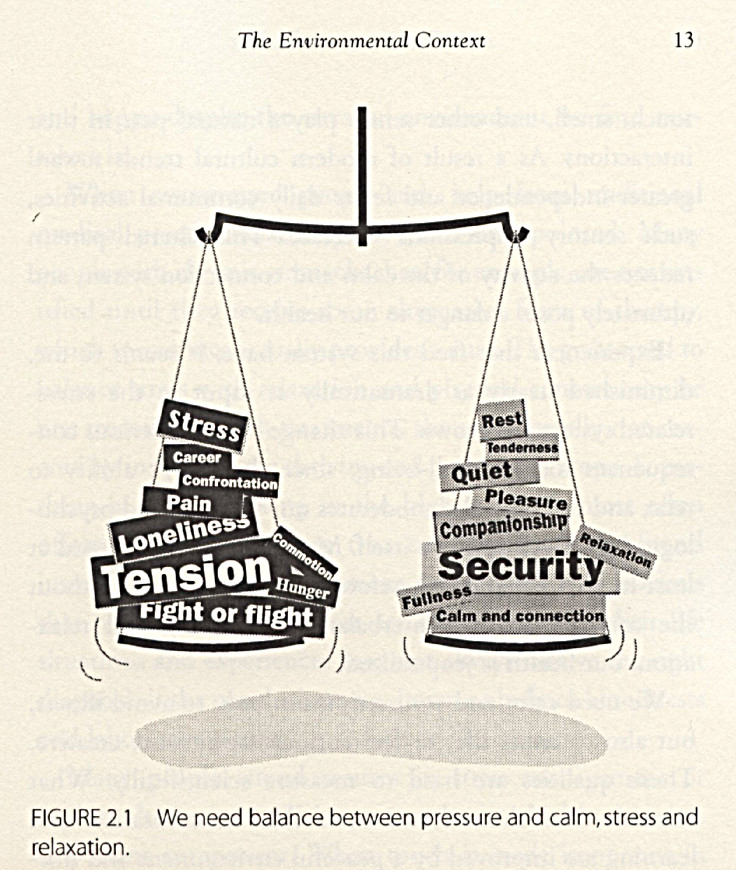
I am thinking again about the image I posted yesterday:

I have no idea how life is for people who were not abused as children.  From my point of view as a survivor, finding ways to fill the positive side of this scale is a full time job.

I also want to note that as hard as I try to be in my posts about the possibilities and opportunities we can find for healing, trauma survivors have to ALWAYS be realistic.  When the trauma side of the scale is overloaded, and when our body-brain formed within these terrible conditions, not only is our center point not set at calm and balanced equilibrium in our body-nervous system, but terrible pain and suffering is also built into us.

We need to know, identify, understand and recognize not only the factors in our lives that trigger our pain, but also the signs that we are being triggered and are in danger of melt-down.  We need to know the nature of our woundedness.  Because of the unsafe and insecure attachment experiences we had as our body-brain formed, we can think of our vulnerabilities to threats to our present safe and secure attachment to and in the world as if we have a severe, deadly allergy that if triggered without adequate resources to combat our reaction can destroy us.

If and when we reach a point where our full-blown trauma reactions have been triggered, we are in a state of emergency that is every bit as life threatening as any other kind we can imagine.  The emergencies happen to us when in-built, body-brain based infant-childhood traumas (or any other unresolved, overwhelming traumas) emerge beyond what we have the inner and outer resources to handle, regulate and resolve.  We need to learn how to avoid, if at all possible, reaching these critical states because once we do reach them, we will be caught within what is, for severe trauma survivors, a reaction that is as completely understandable and natural for our body-brain as it CAN be predictable.

As we begin to understand how trauma built our physiology we begin to realize that we have to be as careful as possible to not topple our internal tower.  Not only did our emotional right brain not receive what it needed so that we can smoothly and easily regulate our emotional states, but our emotions were overloaded early in our lives.  These emotions for the most part have gone NOWHERE.  They remain in our body and can overwhelm us in our present life when stress, threat, danger and trauma threaten us just as they did when we were very small.

I remember years ago telling someone that if I ever (so-called) “got in touch with my pain” that I would start crying and never stop.  I knew there was an ocean of tears inside of me.  One time I got myself into a relationship with a man — well, skipping the story — I will just say that the relationship patterns triggered my insecure attachment patterns.  I of course did not know this.  At one point my ancient infant-childhood emotions caused by my severely traumatic childhood exploded through a fissure created in my present within this relationship.

I started crying.  I could not stop crying.  I cried for three weeks.   I cried myself to sleep.  I woke up crying and I could not stop.  (Talk about puffy, sore eyes!)  I fortunately had many close women friends at that time in my life.  One by one they came to visit me, sitting beside me on my bed, stroking my back, patting my hand, bringing me and my children food.  I could not talk about the pain, I could only cry it out and it took a long time for this pain outbreak to begin to diminish.

I do everything I possibly can in my life today to avoid that precipice.  I cannot afford to let the depth of my pain overwhelm me again if I can possibly help it.  That kind of crying is like having an emotional jugular vein sliced wide open.  We can hemorrhage tears like we are imploding and bleeding to death.

As I have written about the chemical that signals our body that we are in pain — Substance P.  Pain, the physiological signaling of it and the experience of the pain itself,  is equally as real for emotional pain as it is for any physical pain.

We cannot afford to allow this pain we carry to be triggered if we can find any way to avoid it.  We need to realize our well-being is at best precarious.  We need to realize that a proactive consideration about how to make changes in our lives, especially major ones, can mean the difference between life and death.  We have to understand that there are times when our inner resources will not be available to match the demands of situations that stress and distress us.

No matter what else happened to us, our deepest and truest childhood trauma, at its core, was our lack of safe and secure attachment at the time of our beginnings.  We have to remember that child trauma survivors who were deprived of the benefits of safe and secure early attachments that would have built a well-regulated emotional right brain translate stress immediately into distress on occasions in adulthood when their safety and security is threatened.

These threats can be caused by such things as change in relationship status including loss and absence of loved ones (including ’empty nest’), threat of loss and of actual loss of financial security including job loss and change, moves, sickness — you name it, anything that makes our precarious tower of safety tremble if not collapse.

Even though these types of situations might not seem to be directly related to our infant-childhood traumas, we need to realize that anything that threatens our degree of safety and security is a trauma trigger because we did not escape our earliest trauma with a strong sense of safety and security built into us as it should have been.  It is also important to realize that some people will react violently, radically and drastically to threat that triggers pain, loss and sadness because they CAN come up with ways to escape the experience of their own pain (dismiss-avoid and/or fight back actively or passively).

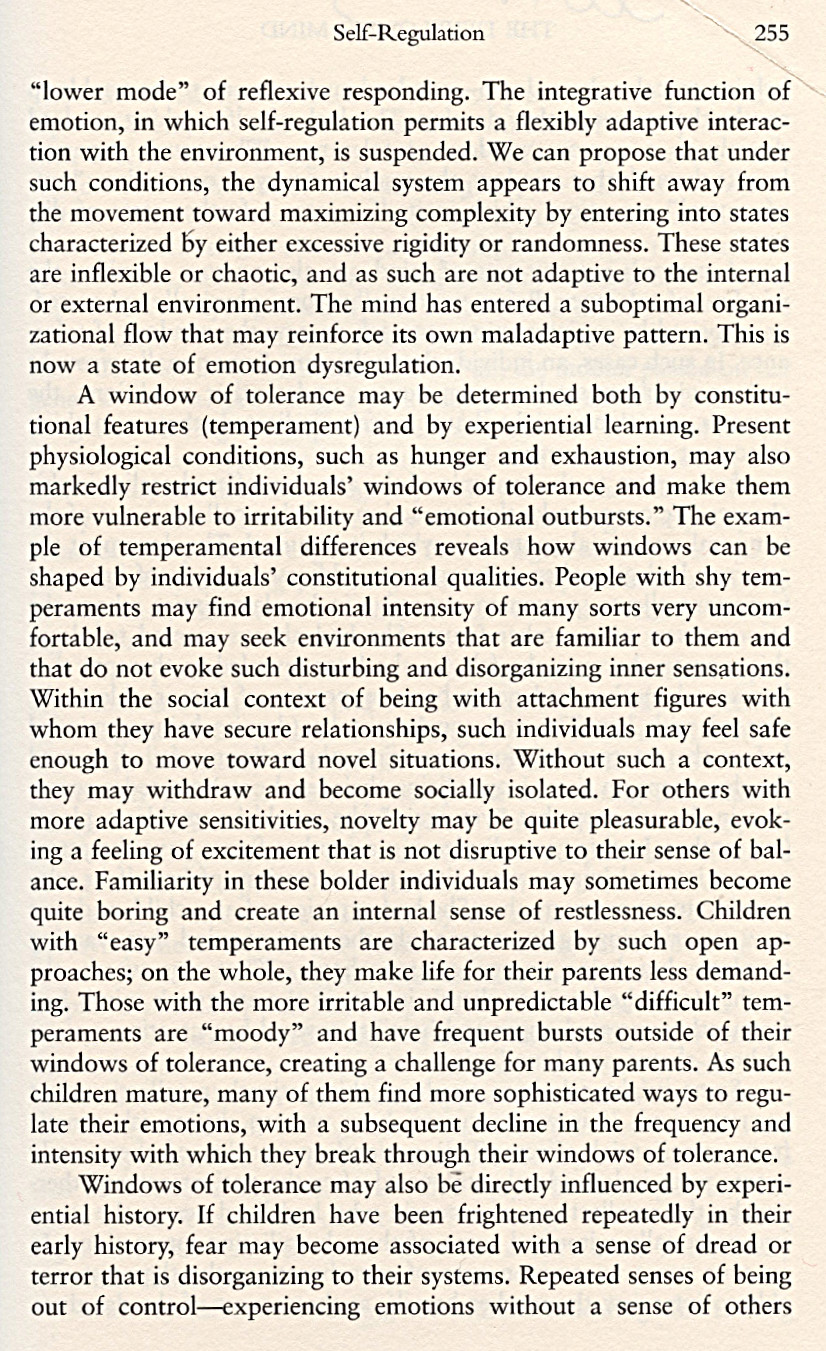
These people cannot tolerate the experience of their own childhood pain and will defend themselves against it (often true of men but also true for my mother).  These people will protect and defend themselves first, and anyone dependent upon them is at risk for some kind of harm.  All trauma reactions are un-reason-able because they are automatic and come directly from body memory connected to an unregulated right emotional brain and trauma built nervous system.  Our body-brain does not process threat or stress information ‘normally’ in a way that includes the slower reason-able processes of the higher cortex.

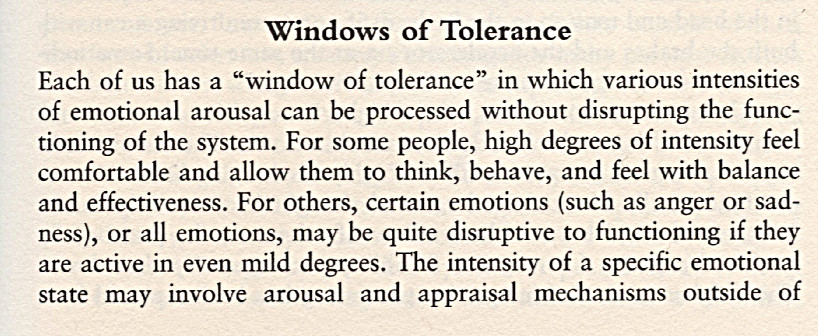
At those times that circumstances of our life threaten to or actually trigger the pain of our deepest traumas, we can so lose our sense of safety and security, of calm, peacefulness and connection in the present that our self seems to completely disappear.  We can become overcome and overwhelmed with the physiological experience of our body, including its emotions.  In this maelstrom it is critical that we find ways to reestablish the anti-distress, anti-trauma conditions that support and affirm our SELF so that we can regain the functions of our higher cortex as we find ways to address the conditions that triggered the severe trauma reactions in the first place.

As my sister mentioned tonight, we need to be careful not to topple the tower of our lives if we can possibly avoid it.  If we have found ways to begin to fill up the un-stressed side of our inner selves, the sense of balance we might be able to finally feel in our lives MUST be maintained.  Our life can depend on it.

We need to understand what our trauma triggers are so we can avoid inner disaster.  The threat and the danger of crumbling inside is very, very real and I do not believe we can survive it without supportive and appropriate help from others.  (So few of us can access the kind of quality therapy we need that I can’t even consider therapy a realistic resource.)

I believe that human beings are more than the sum of our parts.  We are more than the automatic physiological reactions that our body creates in response to threat and trauma in our lives.  We most need to find a way to connect with our own sense of our strong, clear SELF at those times that we experience our ‘falling apart’.  Of course proactive prevention is best for us, but when our trauma is triggered knowing that we are able to accomplish this critical action of regaining our own SELF in the midst of the storm empowers and heals us beyond words.

PLEASE NOTE:  The experience of severe and overwhelming emotion that is related to right limbic brain sensitivity, irritability and lack of adequate ability to regulate emotion — due to having been formed in early infant-childhood malevolent environments — not only FEELS like some kind of ‘seizure activity’, but actually IS closely related.  Please spend some time taking a look at some of the online information about emotional KINDLING in the right limbic brain and its connection to infant-child abuse.

Think of our emotional injuries affecting us like deep splinters and bad burns and other wounds do — all sharing the Substance P physiological pain signaling systems within our body-brain.  Severe infant-childhood trauma and abuse leaves us bruised and battered inside.  Even as we heal gradually over time, we will always still have scars.  Some of us have a broken heart that will never heal in this lifetime.  We have to try to be as gentle and kind to ourselves as we possibly can.

This process must include our being as aware as we can possibly be of what is coming down the road at us so we can be prepared to take wise and protective steps to take care of our self before we get overrun with the ongoing changes and traumas that everyone’s life is prone to.

++++++++++++++++++++++

+HEALING TRAUMA AT OUR BODY-BRAIN CENTER

+++++++++++

I didn’t realize it when I wrote my post last Sunday, +TRAUMA TELLS THE BODY WHAT TO DO, that I was preparing my own way for the study of Dr. Kerstin Moberg’s book, The Oxytocin Factor: Tapping the Hormone of Calm, Love, and Healing.  But then I don’t imagine that Dr. Moberg knew exactly as she was writing her book how much its information can help severe infant-child abuse survivors and other traumatized people.

When I take a look at this next image that I scanned here from her book, I think about how it is for a tiny growing body-brain when it has to develop in adaptation to the environment it was born into when the stress scale has bottomed out and the calm and connection scale (of safe and secure attachment) has completely inadequate weight to it – or is nearly completely empty.

It is important to realize that what this image is showing is a required balance between stress and calmness.  Adequate early body-brain forming environments must include this balance for a body-brain to form and operate correctly.  Obviously too much stress and the wrong kind of stress for anyone is not a good thing.  But too much calmness isn’t good, either. Infant-child neglect often causes such a lack of stimulation during early developmental stages that critical regions of the brain do not receive the stimulation they need to grow hardly at all!

Another point I want to make is that if grave imbalance exists in an infant-child’s developmental environment the set point of the nervous system is NOT set at this central balance point where calm is even possible.  For people who survived terrible trauma in their early lives such as I did, the set point for our nervous system is AT the stress reaction point.

As odd as it might seem, looking back at my own infant-childhood with my new neuroscientific and physiological development insights, I can see that the long, long periods of forced isolation that were part of my mother’s patterns of severe abuse of me where probably – and actually – a very good thing.  During these periods when she had me ‘out of her sight’, even though during these times I was also out of any kind of loop that would have offered me normal infant-child opportunities to interact with others and with my environment in play and discovery, overall these times offered my developing body-brain opportunities for NOTHING TO HAPPEN.

These periods were actually rest and restoration times when my overwhelmed and over stimulated senses, forced into overload from the beginning of my life through the terrorizing and terrifying actions and presence of my Mean Mother, during which my body could actually calm itself down so that internally the effects of her nearly continual earthquake-tsunami abuse of me could somewhat dissipate before the next attack came.

Of course these patterns of wild, severe, over stimulating and overwhelming abuse paired with long periods of my being forced to endure the silence of remote, isolated aloneness harmed me greatly.  This pattern became a most fertile ground for patterns of dissociation to build themselves into my body-brain because nothing but the deprivation of being left completely alone to physiologically try to end my suffering alone (unconsciously, of course), offered me to possible way to connect my ongoing experiences to one another on any level other than the physiological one.  Nothing ever made sense, and nobody or nothing ever helped me to make sense of my malevolent experiences, either.

++++

So leading back to the topic at hand, oxytocin and Dr. Moberg’s book, I want to say that importantly I completely TRUST everything this researcher says.  Because I have continual problems with trust that happens in relationship to a sense of my feeling safe and secure in the world (and NOT), I hold this trust in high value.

At the time Moberg published this book she had already published over 400 scientific articles.  She is considered the world’s leading expert on oxytocin and on the calm-connection half of our autonomic nervous system (ANS) and all the processes that are connected to it.  She is talking about what severe infant-child abuse survivors missed most during our earliest growth and developmental stages:  The opportunity to experience safe and secure attachments that would have allowed us to experience peaceful calmness and connection to others so that our body-brain could build into us a body-brain-nervous system with the balance depicted in the above image included.

Because my infant-childhood was filled with extreme, chronic, ongoing and severe abuse and trauma, I read Moberg’s book from a perspective that means I want to know how things SHOULD have been so that I can better know what I am MISSING at the same time I hope to find information that can help me to consciously CHANGE this set point within my body-nervous system-brain for the BETTER.

As I read Moberg’s account of current research patterns being weighted at 90% study of the stress response compared to 10% of study on the other half of the system, I understand why I am still searching for help, healing and answers.  There is no hope for truly understanding what was so damaging during our early physiological development about being immersed in continual overwhelming trauma if we don’t have the information we need about how things were truly SUPPOSED to be different.  I believe the best hope for healing ourselves on every level does not lie in the drugs we might take to override systems in our body.  We need to get the true picture of what is REALLY GOING ON.

No matter what we read, no matter what anyone tells us, we cannot fool our body.  Our body, the Earth Suit we live in, absolutely knows the truth.  When we encounter the truth in research it will resonate inside of us.  Our body knows the truth when it-we hear it.  Moberg’s book, her work and dedication to research about the calm connection system in the human body as it is designed to operate in counter-weight with our stress response system holds truth that I believe is imperative for us to understand.  As we gain these understandings, we will FEEL them in our body and know them in our brain-mind.  Once I have completed my reading of this book, I will enter the universe of the internet to look for research related to this topic that has occurred in the 6-7 years since the book was written.  I can only hope that the scientific world has taken Moberg’s work seriously enough to pick up this critical study of what contributes to the other half of our well-being as a species:  The ability to calm ourselves down and connect to others.  This is absolutely the study, in my mind, of safe and secure attachment of ourselves in our body in the world we live in.  Again, I will keep you posted.

+++++++++++++++++++++++++++

I wanted to make a little note here today at my sister’s suggestion about my present experiences as I teach myself to read music and play this amazing piano keyboard that I was blessed with being able to bring into my life.  As my sister pointed out, as I continue applying myself to this study and practice and as I gradually improve, I will probably not remember the process of learning itself.

I don’t remember learning to tie my shoes, but I do have faint memories of being at the age of trying to learn my right hand from my left.  I invented a learning strategy that involved remembering a pattern of freckles on my right wrist where I would have worn a watch if I had one (like the one my father wore).  All I had to do was connect the freckles with ‘watch’ with how right in my mind a watch would have looked on my wrist to learn which side of me was right and not left!

I know this music learning experience is similar also to when I learned to ride a bicycle.  Once the motor learning has taken place, I expect that I will never have to consciously think about it again.  In the meantime, my actual process of learning is fascinating.  There’s nobody here to judge my process or progress but myself, and in the clear, plain and good spirit of PLAY I am able to leave all self judgment out of the picture.

What I am left with is the process of literally and consciously experiencing what it is like for ME, in this body, with this brain, to learn something this new and strange.  I also know that because of the severe trauma I was immersed in as my brain developed, neither my left nor might right brain hemisphere formed themselves ‘normally’.  I also know that the corpus callosum that transfers information between my brain hemispheres did not form correctly, either.

As I teach myself this new language of music and gain the motor skills required that will let me actually PLAY music, I am experiencing what I believe is a true healing in these regions of my brain.  Last night I began to practice playing scales with both hands at the same time.  I figured there is no way I am going to get my hands to be able to each first play different notes in different ways in different timings if I can’t get them to cooperate and first play the same notes in the same patterns at the same time.

Well, I am here to tell you I can’t remember the last time I experienced such a giggle session!  Part of me was directly the physical process complete with the intention of desired result – while another part of me fell into giggling bursts of delight to watch what my hands were ACTUALLY doing!  Instead of tangoing they were tangling, each finger with a mind of its own tumbling and fumbling over the keys.

Yet I believe that learning good things is healing.  All the healing I have ever done has been about learning.  Learning how to let myself learn is a learning itself both about what learning is like AND what healing is like.  That process is delightful in itself as I gently and kindly, slowly, patiently and firmly open my own channels for change within myself so that I can let something good and new grow itself into my body-brain-mind-self.

I have hopes, a goal, a direction.  I want to play music.  I know I can do this.  I give myself permission to move forward, to make the mistake-errors, to correct them, to learn-heal at my own pace. As I experience such delight even in this process of learning itself I realize this is just a bonus gift I could not anticipate and did not expect to love and enjoy.

So, needless to say, I have a long long way to go to begin to even get the two hemispheres of my brain to operate harmoniously, cooperatively and well together.  But what I look forward to and DO EXPECT TO HAPPEN is that eventually the two hemispheres of my brain will dance on that keyboard in relationship to one another.  Sometimes they will follow the same patterns together.  Sometimes they will be able to ‘say’ something musically that will be very different, one from the other.

I nearly absolutely and entirely and completely missed the opportunity as an infant-child to be safe, secure, and to play.  And I certainly did not get to giggle.  So, if at 58 I am finally able to giggle myself into this amazing new skill of reading and playing music, that’s a very good thing indeed!  No doubt I am helping myself heal at the center of who I am in this trauma-changed body.  I’ll keep you posted on this process, as well!

++++++++++++++++++++++++++++++++++++++++++

+HOPE FOR HEALING TRAUMA IN THE BODY

+++++++++++++++++++++++

Where can severe trauma survivors look for our best-guess for healing?  In a way this next direction I am going with my study, reading and writing surprises me.  Yet at the same time I am grateful for both this inner guidance system I seem to have that tells me what I most need for healing and for the fact that again and again, I trust and follow this guidance.

Not long ago I wrote a post about an article I had found sometime in the past, printed, and added to the ever expanding pile of papers that grows here on my desk in front of my computer.  By the time I picked it up and read it through and wrote my post about it, I had no memory of how, where or when I had found it online.  The information I will be working with next for as long as it takes me to understand it as thoroughly as I possibly can comes from a book that was referenced in that article.

I ordered this book, written by this Swedish doctor:

The Oxytocin Factor: Tapping the Hormone of Calm, Love, and Healing by Kerstin Uvnas Moberg, Roberta Francis, Kerstin Uvnäs Moberg, and Translated by Roberta Francis (Hardcover – Sept. 16, 2003)

The book is lovely, solid and comforting even in its design and construction.  It is well made and well written, and as I hold it in my hands and begin to explore its message and teaching, it gives me great hope of healing for any trauma survivor, especially for those of us whose body-brain was designed and built by, for and within early infant-childhood environments of malevolent treatment.

++++++++++++++++++++++

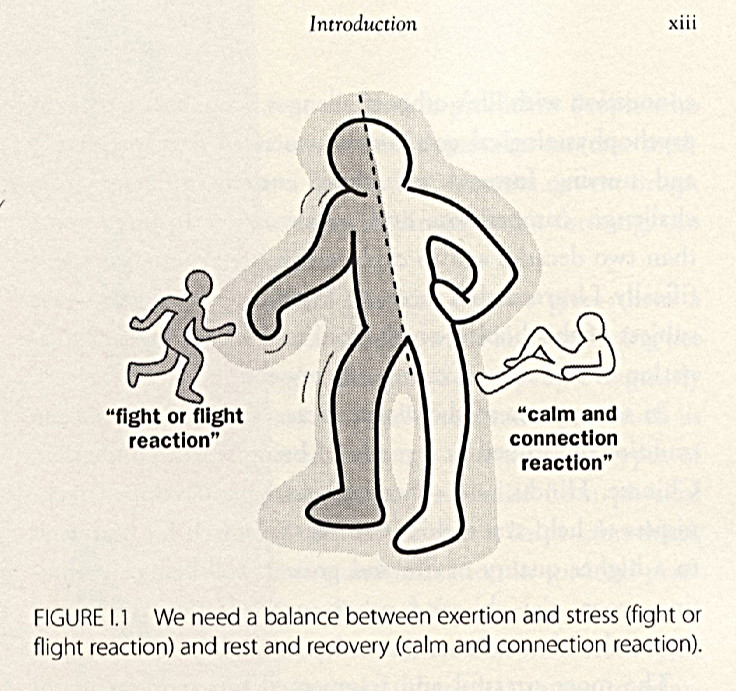
I first want to share with you a copy of an image that appears within the introduction to this book.  It is a simple graphic illustration about what everyone needs, especially trauma survivors who will have to work extra, extra hard to reach this desired balance in our body, nervous system, brain, mind and self between states of alarm and states of calmness:

Infant-child abuse and other survivors of severe trauma DO NOT get to experience what this balanced harmony feels like -- if at all possible, it's time that we DID!

++++++++++++++++++++++

As we look at this picture we are really looking at a visual depiction of what safe and secure attachment gives to us.  If this balance had existed in our parents, especially our within our mother from the time we were conceived and born, our physiological systems including our brain would have been able to develop within us to match this desired state for ourselves.

In early environments of threat, danger and trauma, this picture was missing within our universe because it was missing within our earliest caregivers whose job it was to MAKE an equally safe and secure environment for us so that we could have safe and secure attachment relationships that would have built our body-brain into an entirely different one that the one we ended up with.

I believe that the more we can learn about the information presented in this book the better we will be able to begin to recreate safe and secure patterns within our body-brain-mind-self NOW, no matter what our early forming environment was like.

In fact, we might be able to think about our condition in these most simple terms.  A trauma-built body-brain, formed through unsafe and insecure attachment conditions, continues to run on the fuel of cortisol and the stress hormones creating patterns of freeze, flight and fight response that translates into ‘anxiety problems’.

On the other hand, early safe and secure attachments design and build a body-brain that can run on the fuel of oxytocin or the ‘feel good’ chemical of peaceful calmness and positive connection to self, others and the world.  It is the body-in-balance as the above picture describes that is our goal for our healing.  Oxytocin is a critical neurotransmitter of peace and cooperation.  Cortisol is a critical neurotransmitter of stress, threat and danger.

++++++++++++++++

I find a powerful confirmation of my intuition that I am moving in the right, good and healing direction in my studies when I read in Dr. Moberg’s introduction that she immediately mentions the biases that exist in MOST mainstream medical research.  Those readers who followed the difficult time I had in my struggles with Dr. Dacher Keltner’s book will understand how affirming, comforting and freeing it is for me to find an authority on the subject of human ill- and well-being who recognizes the biases up front that Dr. Keltner seemed to be oblivious to yet relies upon and utilizes heavily in his work.

Moberg notes that fully 90% of published research focuses on the stress response, or sympathetic GO branch of our nervous system while only 10% is devoted to the parasympathetic STOP branch (remember:  pair-a-brakes) branch.  She states about this bias:

“…an interest in the physiology of performance, exertion, and defense has dominated existing scientific knowledge and current research to an extent that we do not always recognize.  This way of looking at things, or shall I say those blinders, has until now kept those of us who work in the medical sciences from seeing the calm and connection response as a separate and valuable physiological system.  Thus, for me, studying this system has involved an element of swimming against the tide with respect to the political mainstream in my profession.”  (pages xii-xii of her introduction)

This imbalance in research focus HIGHLY impacts infant-child abuse and maltreatment survivors, as it does anyone experiencing difficulties with so-called anxiety (including dissociation, PTSD, depression, personality disorders, etc.)  We are in desperate need not only of healing, but of accurate information that can help us DO SO.

As Moberg writes:

“The neglected physiological pattern I will describe in this book is the opposite pole to the fight or flight reaction.  Like most other mammals, we humans are able not only to mobilize when danger threatens but also to enjoy the good things in life, to relax, to bond, to heal.  The fight or flight pattern has an opposite [effect] not only in the events of our lives but also in our biochemical system.  This book deals with the other end of the seesaw, the body’s own system for calm and connection.

“This calm and connection system is associated with trust and curiosity instead of fear, and with friendliness instead of anger.  The heart and circulatory system slow down as the digestion fires up.  When peace and calm prevail, we let our defenses down and instead become sensitive, open, and interested in others around us.  Instead of tapping the internal “power drink,” [of stress-related neurotransmitters] our bodies offer a ready-made healing nectar.  Under its influence, we see the world and our fellow humans in a positive light; we grow, we heal.  This response is also the effect of hormones and signaling substances, but until now, the connections among these vital physiological effects have not been fully recognized and studied.

“The neglect of this system tells us much about the values that underlie scientific research.  The calm and connection system is certainly as important for survival as the system for defense and exertion, and it is equally as complex.  Nevertheless, the stress system is explored much for frequently….

“One reason why research has been so slanted may be that goal-directed activity is emphasized so strongly in our culture.  We are used to defining activity as something moving, something we can see.  But many of the calm and connection system’s processes and effects are not visible to the naked eye.  They also occur slowly and gradually, and they are not as easy to isolate or define as are the more dramatic actions involving attack and defense….physiologists have studied the clearly visible fight or flight mechanism but have been less able to perceive the more hidden and subtle calm and connection system.

“The calm and connection system is most often at work when the body is at rest.  In this apparent stillness, an enormous amount of activity is taking place, but it is not directed to movement or bursts of effort.  This system instead helps the body to heal and grow.  It changes nourishment to energy, storing it up for later use.  Body and mind become calm.  In this state, we have greater access to our internal resources and creativity.  The ability to learn and to solve problems increases when we are not under stress.

“I believe that it is extremely important to increase our understanding of the physical and psychological workings of this antithesis to the fight or flight system.  We need both, since for each individual in each situation there is an optimal way to react.  But it is now well known that long-term stress can produce a variety of psychological and physical problems.  If we are to be healthy in the long run, the two systems must be kept in balance.”  (pages x-xiii of her introduction)

Moberg states very clearly that her interest in the connection system is rooted in her experience of mothering her four children.  Her description of mothering would be the antithesis of my mother’s experience with mothering me.  As I have already noted, it is very clear that the vagus nerve and autonomic nervous system of Borderline’s works with a distortion of the stress-caregiving response systems.  Moberg’s writings are about how things are SUPPOSED to work:

“In pregnancy, nursing, and close contact with my children, I experienced a state diametrically opposed to the stress I was familiar with in connection with life’s other challenges.  I was aware that the psychophysiological conditions associated with pregnancy and nursing fostered something entirely different from challenge, competition, and performance.  Inspired more than two decades ago to explore this life experience scientifically, I learned that there is a key biological marker – the subject of this book – on the trail to a physiological explanation of this state of calm and connection.”  (pages xiii-xiv of her introduction)

++++

It does not surprise me one bit that it would be not only a female researcher, but also one that has her roots on interested grounded in her experience of mothering that I would now turn to for answers about how the terrible imbalance that survivors of severe infant-child trauma have in their body-brain as a consequence of being formed by trauma can be healed.  In profoundly critical ways early abuse survivors were deprived of the safe and secure early attachments – especially with our mothers – that we desperately needed to grow a healthy balance of peace and calmness into our body-brain from the start.

For all the millions and millions of American children and adults that suffer from obesity, depression and other anxiety-related problems, from addictions, from relationships dis-orders, I believe that it will be in gaining factual information about how our body-brain can be rewired for safety, security, connection, and peaceful calmness that our best chance will come for healing.  I am most hopeful that Dr. Moberg’s writings will give me many important answers that I seek.  I will literally keep you posted on what I discover!

++++++++++++++++++++++++++++++++++++++

+SOME MORE WORDS SENT BY MY FRIEND

+++++++++++++++++++++++++++++++++++

Here is another collection of wisdom saved in words now passed to me by my family’s Alaskan homesteading neighbor from my childhood, Dorothy (now 83), who I have mentioned came back into my life after 40 years to be my dear friend.  These words have given me opportunity to ponder:

1.  GOD IS LOVE.  I am an extension of God; therefore I am love, just as I am.

2.  GOD IS LOVE.  Love is light.  The lighted candle cannot NOT shine on, illuminate, and radiate everywhere, touching everyone and everything.

3.  THE EGO IS A TOOL FOR LEARNING.  On this plane, egos relate to egos for learning and teaching.

4.  ROMANTIC LOVE IS A GLIMPSE OF HOLY LOVE — unconditional — heavenly.  Every person needs to experience that.

5.  SPECIAL RELATIONSHIPS ARE A NECESSARY PART OF OUR LEARNING ABOUT OURSELVES.  Also a path to understanding forgiveness and therefore, healing.  From the painful moments comes opportunity to think our deepest thoughts.

6.  I HAVE SEARCHED FOR MY IDENTITY, TRYING TO FIND ME.  Who are we?  We move from one thing to another looking, looking.  We fall in love, and expect to find our identity through the beloved.  We look to money, baubles and trinkets, prestige and power for validity.  Then one day it becomes clear:  THERE IS NO SOLUTION OUTSIDE OF MYSELF.  I heard that in dozens of ways, but it took “suffering” to make it real, and it has taken many years.

7.  CONFLICT WEAKENS ONE to being nearly non-functional.  EACH SIDE OF THE ISSUE HAS ITS OWN ENERGY.  These energies do battle with one another.  We have no peace; not enough energy “left over” for pursuing constructive thinking or activity.  Need to move from division to atonement.

8.  …JUDGMENT BECOMES THE UNKINDEST CUT OF ALL

+++++++++++++++++++++++++++++++++++

IN MEMORY OF MY BORDERLINE MOTHER, HERE’S SOME HOPEFULLY HELPFUL INFORMATION LINKS:

From Kristalyn Salters-Pedneault, PhD, your Guide to Borderline Personality Disorder Many of you are probably familiar with the standard treatment options for BPD, but there are some alternative treatments that you may not have considered. The treatments discussed this week haven’t been tested extensively, but may be considered as adjuncts to your treatment regimen.

Family Therapy – Can it Reduce BPD Symptoms?
Rather than just one person (such as the person with BPD) and their therapist, family therapy involves the whole family, working together, with one or two therapists.
BPD Couples Therapy
There has been no systematic research on couples counseling for borderline personality disorder, but experts are becoming more and more aware of how helpful a stable support network is for people with BPD.
Does Electroconvulsive Therapy Work?
Electroconvulsive therapy (ECT) is a psychiatric treatment with a long and controversial history. Is electroconvulsive therapy effective for borderline personality disorder (BPD)?
Get the Most Out of Your Treatment
Wondering how you can get the most out of therapy? There are times when the success of therapy is related — completely, or in part — to factors that are in your control.

Must Reads

What is BPD?
Symptoms of BPD
Diagnosis of BPD
Treatment of BPD
Living with BPD

+++++++++++++++++++++++++++++++++++

I am loving my new pursuit, learning the language of music with my piano keyboard!!

+++++++++++++++++++++++++++++++++++

+WATCHING WHOLENESS AND HAPPINESS HAPPEN

++++++++++++++++++++++++++++++++++

I discovered a portrayal of happiness when I found online the videos of these 40 piano lessons.  It’s a great place to go for a brush-up on music reading and keyboard playing if you have already had some experience in your past with playing music and might – for great benefit and healing – wish to pick up this pastime again.  For those, like me, who have never experienced the joys of playing music, these lessons are a great place to start!

However, my bigger purpose in posting these links today is to present to you the visual of the teacher, an obviously talented and well-skilled young man, who appears to be quite genuinely happy!

I simply wanted to point out today that I think it’s highly doubtful that someone who appears to possess such an ability for humor, for spontaneous laughter and for genuine smiles lives within a body that was formed in a malevolent environment of infant-childhood abuse, maltreatment and trauma.

When I watch the face and body movements of someone like this young man, I can see that I am actually watching a body-nervous system, including a brain that was allowed to form within a safe and secure attachment environment.  Nowhere in these videos do I see the flash of a stress response in the eyes and face.  Nowhere do I hear the millisecond pause in his speech that would let me know the body itself has detected threat to safety and security in its ongoing appraisal of itself in the world.

Not only is the ‘presence of happiness’ well, present in this young man, but just as importantly the ‘absence of anxiety and sadness’ is, well, also equally present.  As a result, he can probably move through his life unimpeded in his intentions and actions by the interrupting ongoing inner experience of having to be hypervigilant about either himself or others in the world.

Along with the happiness apparent in this young man is the competent confidence that comes with being a self in the world that can be fully present in the moment.  This includes having the ability to be a present self in the presence of others.

This young man seems obviously capable of enjoying himself (in-joying himself) in his life.  Nobody seems to have communicated to him that he doesn’t have that right.  It is important to realize that the invisible physiological nervous system-brain underlying circuits and pathways of competence and joy were built into the body of this young man from the time he was born (and before).  What others SEE when they witness this young man in his body in his life is the physical manifestation of well he has been treated throughout his life.

He has been allowed and encouraged on all the important levels that matter to be himself because he was allowed to be safe and secure.  As I have said so many times before, this IS a matter of availability of resources.  Certainly there may well me economic stability in his family that enabled him to have access to instruments and training (not to mention all the other vital requirements for sustaining life).  Yet while these advantages are obviously important to tutor and train inborn talent, it is the social-emotional environment of safe and secure attachment to caregivers from birth (and before) that were vital to the ongoing experience of confidence and joy that this young man seems so able to demonstrate.

While watching these piano lesson videos gives me a visual related to what this young man was given in his life compared to what I was not given, at the same time it gives me a visual of the goal I suggest all survivors can work for.  Even though our long ago formed body (with its nervous system including our brain and our connection to self) may have been altered in our earliest developmental stages due to trauma and abuse, being THIS happy and confident while experiencing safety and security in our body within our environment, with our self present in our experience, is what we need, desire and work for.

Check out How to play piano: Lesson #2 and How to play piano: Lesson #3 Piano Lounge: Andrew Furmanczyk to see for yourself this young man who offers an example of happiness.

+++++++++++++++++++++++++++++++

The next example I encountered in my musical searches online yesterday offers yet another example of what I am talking about here today.  For all the amazing talent visible in the video attached to this link, six-year old girl mastering piano, it is the joy and happiness visible not only in the little girl’s body-face that captured my attention, but MORE SO the joy and happiness visible in her MOTHER’S face.

Here again we are presented with a visual of advantage.  This little girl is not homeless or going to bed hungry at night.  But most importantly this little girl is obviously fully loved.  Look at her face.  Watch her.  You can see that her SELF is fully present in that little body.  You can see that she is safely and securely attached to her own self BECAUSE she has been offered the opportunity to safely and securely attach to her caregivers.

Certainly this little girl was born with an amazing talent.  But the most important talent I want to emphasize, the one that we are all conceived with and hopefully born with, is this ability to thrive and blossom as our body-brain-mind-self grows and develops in interaction with its earliest caregiver environment.

Neither of these young people presented in these videos would LOOK the same, ACT the same, FEEL the same or BE the same if they had been raised within a malevolent rather than a benevolent environment.  They would NOT HAVE THE SAME PHYSIOLOGICAL BODY.  If they had been raised within an early unsafe and insecure attachment environment, they would not think the same, feel the same, act the same, or be the same people they turned out to be.  No way, no how.

So for all the obvious musical virtuosity present in these video samples, what I end up being most aware of is that what these videos are showing most clearly IS THE ABSENCE OF TRAUMA.  While we know that much talent still arises within people who did suffer early trauma and live a life within a trauma-changed body, it is also equally true that talent does not need to be automatically paired with angst and suffering.

++++

What I believe is most empowering for infant-child abuse survivors to know is that not only does early trauma change our physiological development, but also that these consequences follow us for the rest of our lives.  For all the well-wishers that tell us to simply “get over it” or “leave your childhood behind you” or “You could be happy if you really wanted to,” it is vital for us to realize that these statements are not actually grounded in the truth of our trauma-changed physiological reality.

At the same time I believe it is important for we survivors who have been ‘diagnosed’ with so-called ‘mental illnesses’ to realize that most often the best creative and expressive gifts of our species are directly tied genetically to the highest risks for the experience of difficult consequences from trauma-changed bodies during our earliest development.  I suspect that it is equally true that the kinds of changes our genes allow us to make include not only high risk for later complications from these changes, but also gave us immense resiliency factors that allowed us to survive at all.

In essence, if my thinking is correct, I would suggest that both of these piano wizards presented in these videos would have been at extremely high risk for developing serious ‘mental disorders’ had their infant-childhoods been malevolent and traumatic rather than benign and benevolent.  At the same time, their sensitivities and vulnerabilities to trauma-related consequences WOULD STILL HAVE ALLOWED THEM TO ENDURE AND SURVIVE.  But they each would probably have suffered greatly in a trauma-changed body.  Neither would have been the same people we see in these videos.

++++

All of this brings to my mind the question, “Who is the self?”  When I say these musical children would be different, I am not saying that the essence of who they are as individual people could even possibly be altered under any circumstances.  That is equally true for all of us, infant-child abuse survivors or not.

The consequences of enduring within malevolent early-body-brain-forming developmental stages means that the expression of the self, the inner relationship with the self, the outward manifestation of the exact nature of the individual self will be changed and altered, not the actual self itself!  What all of us are working toward is the discovery of who our own individual self IS so that we can learn how to give this self as many opportunities to experience safety and security in the body in the world as is humanly possible to do.

No matter what our age, the process of being a self in a body in the world is essentially the same.  Severe early abuse survivors, however, have to experience, face and deal with all the trauma-related physiological changes that mean for us that an ongoing assessment of potential threat and danger to our SELF (and to our body) is likely to be at the forefront for us the rest of our lives.  Our ability to simply BE a self, with full free interactions and expression, becomes far more difficult for us to obtain.

Coupled with these difficulties is the fact that within our trauma changed body-brain we were robbed of the fullest development of a genuine happy center and the neural development of all the corresponding ‘be safe in the world’ pathways and circuitry.  We have to train and retrain our physiology as we seek to improve our presence in our own body in our own life in the world.

Yes, our experience and the resulting body-brain we would have developed COULD have been different for us as it obviously was for these two musical wizards.  Yes, we do have a lot to mourn for in our loss not only of the actual experiences of a safe and secure infant-childhood, but most importantly for the different body-brain we would have developed under benevolent rather than malevolent conditions.

Yet for severe infant-childhood trauma survivors I believe it is ultimately and importantly empowering for us to realize what we are REALLY dealing with.  As we try to ‘change’ our self to be a ‘better’ person to life a ‘better’ life we need to understand that we are participating in acts of creation as we heal.  We are ‘recreating’ the very molecular structure and operation of our trauma-adjusted, trauma changed body.

Yes, resiliency is possible as long as we breathe.  At the same time, the healing changes we make affect our entire being in the world on every level.  Just as a benevolent safe and secure world created the physiology of these video children, changing our own physiology as survivors means that we need as much of what these children were given as we can possibly get.

++++

In the same way that how these musical children are in the world is a result of the sum total of their genetics in interaction with their environment, our own healing happens in the same way.  I don’t believe it’s possible or even realistic to ‘just’ treat a so-called ‘mental illness’ with drugs, or ‘just’ treat harmful parenting or anger or sadness or anxiety or relationship difficulties with classes or education, or to ‘just’ treat addictions of any kind.

We can become consciously aware that any single ‘part’ of us that heals is providing a healing for our whole self on every level of who we are.  Just as growing a body-brain in the beginning was a ‘whole’ process, healing happens in the same way.  Watching these delightfully whole children in their experiences portrayed on these videos tells me that once the camera lens is taken off of them, their whole self is equally occupied with living their whole life just as happily as their fingers play their music.

++++++++++++++++++++++++++++++

This information today ties into the posts I presented earlier on the genuine, authentic D-smile and true happiness:

+HOOKED ON ‘D’ SMILES – THE HAPPINESS CENTER

+RESEARCHER BIAS ON THE ‘D’ SMILE = SICKENING

+MISSING LAUGHTER IN MY MOTHER’S MONKEY HOUSE

+IT WASN’T FUNNY: THE BUZZARD THAT ATE MY MOTHER

++++++++++++++++++++++++++++++++++

+CONSCIOUS AWARENESS AND EMOTIONAL AROUSAL REGULATION

+++++++++++++++++++++++++++

Try as I might, I just cannot think of any way that anyone exposed to severe infant-childhood trauma and abuse could NOT change in their body-brain development as a consequence.  The more that is learned about how epigenetic forces creatively alter the pathways of our genetic manifestation the more we are learning about where, how and when these changes can – and do – occur.

I came across a statistic once that suggested that 50% of who we are is in our genes, and 50% of who we are can be changed by the influence of the early environment (and the continued one) that we are developing within.  I think about that now, knowing how severe the infant-abuse was that I endured from birth (and for the next 18 years) and I find that this 50% ‘rule’ gives me a firm place to get my feet under me as I try to understand more and more about who and how I am in the world today.

I will always be 100% me, but as this blog’s commenter stated today, we all “mourn for the who-I-would-have-lived-to-be.”

How on earth could we possibly NOT mourn?

Yet for all the specific variations that exist in the trauma and abuse history of each survivor individually in terms of actual experiences we had, the range of possible changes that our body-brain was able to make in response to the trauma and abuse seem to be contained within increasingly defined (through new research) ways.

From my perspective as a severe early abuse survivor, I find this fact both exciting and extremely hopeful!  The mystery of the unknown is fine if we want to contemplate with wonder the marvels of creation or follow a storyline in some mass market paperback.  But the more mystery we can take out of severe traumatic infant-childhood survivorship, the better!

The 100% of me wants to know and understand how the 50% of me was changed in my development.  I see the wordless image right now in my mind of a complex archeological dig in progress.  Sooner or later all the pieces will be unveiled, one tiny brush sweep at a time, until the whole picture of the civilization of the past becomes revealed.

Severe infant-child trauma survivors are like members of a particular kind of ancient civilization – the civilization of the early attachment world we lived in from conception certainly through age 2 (where our self is clearly established) and on into and through about age 10 when our Theory of Mind is formed (using all the early formed body-brain circuitry established before age 2).

Severe infant-childhood trauma and abuse survivors had to grow their body-brain in a toxic environment.  Nobody gave us one of those fancy suits to wear to protect us from the toxins.  The only protection we had available to us was in the form of the internal changes we could make in our early development so that we could survive.  The newest research is telling us more and more about what these changes were and how they continue to affect us.  We were made in, by and for enduring within a malevolent world in very specific ways.  What we most need to know about how to live a BETTER life while living with these changes will be found in this research that tells us how the ancient civilization of our toxic early environment actually affected us.

+++++++++++++++++++++++++++++++++++++++++++++++++++++++

Because our right limbic emotional-social brain, as it connects into our body through our vagus nerve system, is directly formed through the kinds of attachment experiences we have with our earliest caregivers, it is to this region that we can pay special and care-full attention for clues about how to live a better life NOW.

Some of these clues can be found in Dr. Daniel J. Siegel ‘s book, The Developing Mind: How Relationships and the Brain Interact to Shape Who We Are, as I mentioned in yesterday’s post.

Siegel has also written what I consider to be the most up-to-date accurate parenting book available:  Parenting From the Inside Out.  The author describes how our early caregiver attachment experiences formed our own attachment patterns, how those patters are likely to affect our relationships with our offspring, and what we can do to make positive changes.

Please consider purchasing and reading these two books, and also make a visit to Siegel’s Mindsight Institute website, whose theme “Inspire to Rewire” lets us know that no matter what the toxic conditions of our earliest ‘ancient civilization’ were that changed us in our infant-child development, we CAN take control over how we experience our life NOW.

++++

I want to return to Siegel’s writing in The Developing Mind for awhile this morning because we do not exist in our Earth Suit without emotions.

We are born with emotion as we are born with a body.  How our earliest caregivers interact with us forms our emotional brain.

If these early caregiver interactions are neglectful, traumatic and malevolent, our emotional right limbic brain will have to form itself in adaptation to these interactions – as will our immune system, our nervous system, and our body.

One way or the other our Earth Suit has to encompass ways to handle our emotion.  The patterns we are given from our earliest caregivers’ interactions with us (most importantly our mother) will either help us to regulate our emotions smoothly, or will hinder us with emotional dysregulation.

Personally, I have to wonder if what is called ‘emotional dysregulation’ is even possible, because however our body-brain manages to stay alive incorporates SOME VERSION OF EMOTIONAL REGULATION or we would be dead.

However, the very extreme ways our body finds to adapt its regulation of overwhelming, toxic, traumatic and malevolent emotional experiences will not be in ideal ways for living a life of well-being in a benevolent world.  Those ways of regulating our emotions built into our brain in our toxic ancient civilization of our early life do not match the conditions of a more benign, benevolent present day civilization.

Nor will a severe early trauma survivor’s body-brain’s operation match those of people who were not raised in toxic early environments.

I think we have to empower ourselves for positive change by understanding how completely adaptable our body-brain became in early trauma.  That those adaptations appear in our present more benevolent life as ‘dysregulation’ has more to do with the relative safety and security of the world we find ourselves in NOW than it does with there being something WRONG within US!

True, looking at how someone can be so out-of-the-loop between emotion and higher cognitive functions that they can do something like the pilot did yesterday in Austin, blowing up his house with his wife and child inside and then flying himself to death into a building, obviously appears ‘dysfunctional’, dysregulated and WRONG!  At the same time, if I wanted to understand how the adult got to that point, I would need to accomplish a version of an archeological dig to find out what the environmental influences on his body-brain development were from the time he was conceived through at least age 2 before I could begin to understand the pathway and pattern his life took from that point forward.

++++

As humans, we seem tempted to couch our consideration of aberrant actions of others in terms of ‘good and evil’ and ‘right and wrong’.  Probably because I was raised from birth and for the next 18 years by a mother who was obviously capable of beating me thousands of times, or abusing me consistently and chronically for all that time, by a woman who was not capable of knowing I was human and not the devil’s child, I have a unique position when I look at what being human actually means.

My mother was not fundamentally different from anyone else.  Nor was pilot Mr. Joseph Stack.  Because we are all members of the same species, we are always actually doing the same thing only in different ways:  We are all, always, regulating our state of emotional arousal one way or the other.

My mother regulated her emotional arousal by torturing and abusing me.  Mr. Stack regulated his state of emotional arousal by taking the actions that he did.  Any consideration we might have that these people seem emotionally and mentally ‘dysregulated’ can only happen because we have the luxury of taking an outside perspective on them.  What we might understand about being human, about how humans are supposed to regulate their emotional states of arousal, does not match their understanding.

++++

So what are we really looking at when we turn our thinking toward another human being – no matter what they do?  Turning to Siegel’s writing in The Developing Mind I find that he talks about emotion regulation in terms of basic components that operate within our species no matter who we are.

The problems happen when a developing body-brain-mind-self does not achieve what is most vital and needed for successful living in a benign, benevolent world.  Siegel calls this desired “achievement” as having “a flexible and adaptive capacity for the regulation of emotional process.”  (page 244)

Neither my mother nor Mr. Stack had this “flexible and adaptive capacity.”  In all cases where trauma influences development – even if we are to believe that ONLY that the trauma is in a person’s genetics that manifested without malevolent early influences on development – it is always a resulting rigidity rather than flexibility coupled with an absence of the capacity to adapt appropriately to the conditions of a present benevolent environment that causes such terribly harmful actions and their consequences to happen.

The brain is, according to Siegel, SUPPOSED to develop

“…a rich circuitry that helps regulate its states of arousal.  The nature of this process of emotion regulation may vary quite a lot from individual to individual and may be influenced both by constitutional features and by adaptations to experience….

Attachment studies support the view that the pattern of communication with parents creates a cascade of adaptations that directly shape the development of the child’s nervous system [including the brain]….what parents do with their children makes a difference in the outcome of the children’s development….  It is important to realize that both temperament and attachment history contribute to the marked differences we see between individuals in their ability to regulate their emotions.”  (pages 244-245)

I read Siegel’s words literally.  Everyone has some version of an “ability to regulate their emotions.”  Therefore in my thinking the concept of ‘dysregulation’ really does not apply.  We are all, always, involved in processes of regulating our emotional arousal one way or the other.  What we see are variations, or the “marked differences” between individuals in their capacity to regulate their emotional arousal flexibly and adaptively.  It is the variety of ways, the variation in the ways that different individuals regulate their states of arousal through the “process of emotion regulation” that we can question, not the fact that this process is happening even in the most extremely harmful ways.

If we are going to make any use whatsoever of the concept of ‘emotional dysregulation’ we need to be clear that it only applies when there is a need for change in a person’s capacity to regulate their emotional arousal differently than the way they are doing it.

Once a human being’s body-brain circuitry has been built and established during their early trauma-full or trauma-free development, the patterns of operation for these circuits is automatic.  Trauma-free development enables far more mind-full, free-will dominated, conscious choice to be included in the operation of the feedback and feedforward physiological information-activity loops working in a person’s body-brain.  In this way although consciousness can be applied to override automatic processes, even the presence of the ability to BE conscious has entered the automatic range of options.

Having consciousness is an evolutionary advanced ability.  Trauma-formed early body-brains have had this evolutionary advanced ability interfered with.

I see no way for change to occur in emotional arousal patterns when, where and as needed — no matter how destructive and hurtful they may be to self and others — without there being a corresponding match in increased conscious awareness.  Even though from the outside we can look at my mother, or look at pilot Mr. Stack and consciously know that their patterns of regulating their emotional arousal were not flexible or adaptive within the conditions of the larger environment they lived in.  Yet because it is doubtful that the evolutionary advanced ability to gain conscious control over their emotional arousal regulation was available to these individuals, it is for those on the outside to know they were ‘emotionally dysregulated’.

++++

Learning about the concepts of emotional regulation and dysregulation has given me a new arena to look at my mother, at myself, and at others around me in a new light.  As I begin to understand that everything humans do is about regulating emotional arousal, and that the patterns of regulation we use was built into us through the conditions within our earliest caregiving attachment environment, I can begin to understand more about the experience of being human.

I did not form a right emotional-social brain in a benign, benevolent world.  Therefore my options for processing emotional regulation flexibly and adaptively were changed.  I have to become increasingly conscious of the automatic patterns of emotional arousal regulation that my body-brain uses if I want to change them.  It is helpful for me to know that these patterns I use are the same thing as my attachment patterns.  They have to do with how I am attached within my own body-brain to my own self and to everyone and everything in the world I live in.

Automatic physiologically-based reactions are survival enhancing because they are FAST.  Consciousness happened as an evolutionary advantage only because the environment allowed for enough TIME in enough situations that it was helpful.  Trauma itself has its own time frame reality.  SLOW is not what our survival-based fight/flight/freeze reactions are about.  They have to be FAST, so they have to be automatic.

If we have a body-brain built in, by and for a malevolent world of trauma, and if we want to change how we regulate our emotional states of arousal, we have to realize that we will have to make use of the much SLOWER processes related to consciousness and choice.  BUT, and this is important, as we consciously LEARN to do things differently, the plasticity of our body-brain will eventually move us closer to an automatic capacity to include our NEW learnings in our life.

I am paying attention to the process I am going through as I consciously learn to read music and play the piano keyboard.  I have to be almost painfully conscious of every single step in this process.  Yet my goal HERE is NOT to have to remain conscious of playing.  My goal is to so learn how to read music and to play this instrument that the entire process can move into unconscious, automatic action.

I had a few continuous seconds last evening of what this experience will FEEL like once the conscious learning has moved to unconscious automatic action.  I played five full lines of the music of this song I am learning automatically and without thought – and there it was!!  The feeling of being one with the music.  I WAS the music for those few seconds.  It was an experience I imagine might be like BEING a ray of sunlight or BEING a breath of wind.

At the same time I am extremely aware that when I sit down and put my fingers on those keys, rest my eyes on the first note of the song, I am changing my thoughts and my emotions through my intention, through my focus, and through this process.  No matter what I might be thinking when I sit down at that keyboard, no matter what I might be feeling, the moment I start the playing I can physiologically feel the switch happening in my body-brain.

Because I suffered extreme, ongoing, chronic trauma for my entire infant-childhood, I have no illusion that I will live long enough to be able to consciously change the body-brain patterns of emotional arousal regulation that happen mostly unconsciously and automatically for me.  But at least now I know what I am up against and why.  I live on full disability because of these trauma-changes that are built into me.

At the same time I remain extremely grateful that somehow I retained the capacity to increase my consciousness about how I am in my body-brain in the world.  Knowing that people like my mother and like Mr. Stacker did not seem to gain or retain this ability for consciousness makes me feel humble and contributes to my gratitude for myself as being different from them.  I do not take conscious awareness for granted.

Having degrees of this ability does not make me feel arrogantly superior to those without it.  I too narrowly escaped the traumatic horror of my infant-childhood with my consciousness ability relatively intact not to have a compassionate appreciation for how cherished a gift conscious awareness of ourselves in the world really is.

Leaving infant-childhood bereft of this gift of the ability to have mindful, reflective, conscious awareness of how we regulate our emotional arousal dooms us to a life where the trauma that engulfed us in the beginning will surround us and follow us to our death.

Leaving infant-childhood bereft of this gift of the ability to have mindful, reflective, conscious awareness of how we regulate our emotional arousal dooms us to a life where the trauma that engulfed us in the beginning will surround us and follow us to our death.  At the same time I can mourn for who I could have become if I had not been so traumatized as an infant-child, I can also celebrate that I did not lose the wonderful abilities that I DO have even though I survived such trauma.

++++++++++++++++++++++++++++++++++++++++++++++++

+INFO ON WINDOWS OF EMOTIONAL TOLERANCE

+++++++++++++++++++++++++++++++++++

Sometimes I have to force myself toward the study of information that I KNOW will help me in my life.  The choice is between continuing to live in ignorance while experiencing intensity of emotions I don’t understand and cannot easily regulate (along with repeated dissociation which I believe is one of a survivor’s ‘tools’ for regulating overwhelming emotion), or trying to learn SOMETHING that can help me make sense of the way I experience my life in this trauma-changed body.

The information presented in the article in my post +TRUE HEALING POSSIBLE – MY #1 CHOICE FOR TREATMENT is about the limbic social-emotional right brain as it connects into our body.  It is about how we experience emotion.  It is about how our interactions with other people starting from the beginning of our life form the patterns that either regulate or dysregulate our emotional life.

Our emotions are supposed to be the factors of our existence as human beings that are supposed to guide us toward approach or avoid through a process that lets us know what is good for us and what is harmful for us.  In other words, our limbic brain is intimately connected to our appraisal system, and from there to our reaction-action systems.  Severe infant-abuse survivorship changes the development not only of this limbic region of our brain, but also of our appraisal and our reaction system.

I am going to present some very specific information today about what is termed our Windows of Tolerance as it applies both to our emotional well- or ill-being and to the ways that we get information in the first place through our body.  This information comes from the writings of Dr. Daniel J. Siegel in his book The Developing Mind: How Relationships and the Brain Interact to Shape Who We Are.

The pages that precede the ones I am posting here today talk about how emotions are differentiated early infancy — or not.  These processes all occur within the earliest caregiver attachment interactions we have as our brain and nervous system-body is growing and developing.  All these processes are literally wired into the cells of our body and will determine how we ARE in the world.  The kind of therapy described in my earlier post is recognizing how fundamental these processes are and how they are wired into our body-brain.

Siegel states:

“Creating change within rigid patterns of specific appraisals requires a fundamental change in the organization of information and energy flow….

“Value circuits determine specific appraisal, creating the basic hedonic tone of “this is good” or “this is bad” and the behavioral set of “approach” or “withdraw.”  Value circuits also continue to assess the meaning of these initial activations as they are elaborated into more defined emotional states, including the categorical emotions.  What determines the nature of the appraisal/value process itself?  How does the mind “know” what should be paid attention to, what is good or bad, and how to respond with sadness or anger?

“For human beings to have survived, this complex appraisal process had to be organized by at least two components.  According to the fundamental principles of evolution, the characteristics of those that helped the individuals to survive and pass on their genes are more likely to be present today.  This is one explanation, for example, of why some people are frightened of snakes though they may never have seen one before.  This may also explain why infants have a “hard-wired,” inborn system to appraise attachment experiences as important.

“A second evolutionarily crucial influence on the appraisal mechanism is that it had to be able to learn from an individual’s experience.  Individuals who did not learn, for example, that touching a flame hurts would have been more likely to be repeatedly injured and unable to defend themselves, and therefore less likely to survive and pass on their genes.  Those individuals whose brains could alter their evaluative mechanisms would have been more likely to survive.  Hence, the appraisal system is also responsive to experience; it learns.  Emotional engagement enhances learning.”  (pages 252-253)

As pointed out in the article I posted two days ago on limbic resonance therapy, much of our learning ability happens through epigentic changes.  The healing that severe early abuse survivors need to accomplish happens at these molecular levels through processes that are also described in this article.

Early trauma overwhelms and over-arouses, over stimulates and over amps our nervous system, body and brain.  During our developmental stages that are designed to build emotional regulation into us, we were instead given far, far too much information at the same time we were left to our own physiological adaptations to survive.  As a result our appraisal system changed, a fact that means our Window of Tolerance for emotion and our reaction to emotion was also changed.

++++

While many of us know perfectly well what it FEELS like to have had our emotional, limbic, right brain’s internal guidance system changed because we LIVE with the consequences every day, most of us have never been given the information we need to understand what really happened to us.  We suffer from so-called ‘symptoms’ and ‘mental illnesses’ that are directly a consequence of how our extreme early trauma changed our body-brain in development.

These pages I scanned today from Siegel’s book give us some vital information that lets us begin to think more mindfully and consciously about what we experience in our body.  While change and healing is always possible, I believe that we need to comprehend how pervasive our trauma-related developmental changes in our body-brain’s arousal and reaction systems were so that we can be realistic in our expectations of ourselves as we go forward in our lives practicing gentle kindness.

NOTE:  It is important to realize that what Siegel states here about temperament are factors that are influenced in early development and by any exposure to trauma.  Hence, anxiety disorders, PTSD, depression, dissociation are all related to windows of emotional tolerance and our nervous system’s STOP and/or GO response, influencing how ‘shy’ or ‘bold’ we feel in our body-brain.  (It also might explain why/how things like this can happen:  http://www.kvue.com/news/KVUE-Live-Streaming-Video-81260087.html)

++++

+++++++++++++++++++++++++++++++