+THE DANGERS OF EMPATHIZING WITH ANOTHER’S TRAUMA

++++++++++++++++++++++++++++++

It’s been quite awhile since I have added the warning to a post:  BE VERY CAREFUL OF YOURSELF IF YOU CHOOSE TO READ THIS POST, IT MAY TRIGGER TRAUMA MEMORY FOR THOSE WITH EARLY AND SEVERE INFANT-CHILD ABUSE HISTORIES!  But here it is.  While what I describe here might be subtle and difficult to identify in a world with words, it is very real and with a trauma history, your body might very well let you know it.

There seems to be a kind of overlaying of experience that can happen at times when adult survivors of severe infant-child abuse are faced with the reality of someone else’s sorrow.  Of course as a survivor I cannot be at all objective so that I can report this feeling with accuracy.  I just know that it exists because I am so familiar with the experience.

If I choose a name for it, I would call it “the dark night of the soul.”  I know it so well because I spent the first 18 years of my life engulfed within its shadowy realm and didn’t know it.  Looking at it so early in the morning, having had a sleepless and troubled night, I can tell that I know this feeling.  At the same time I recognize it – and feel it – I don’t want to admit to myself how familiar its cold embrace actually is.

++

I know what has triggered this for me:  Stories of another person’s life whose experience of being so lost in life that they cannot see a possible way out of the darkness without help from of loving and supportive friends and family.

As adults we expect our self to know ‘the answers’ both about how we fell into the inky abyss and how we get out of it.  But sometimes it seems the risk for losing our way in the labyrinth of who we are versus who we have become simply exists because we do.

I can in no way speak about the experience of the person whose story was told to me in parts these past two days.  I can only speak for myself when I say that something has triggered my own deep body memories of living for the first 18 years of my life within a world within a world – all by myself.

At the same time my mother’s treatment of me was directly responsible for the darkness I was forced to live in – day in and day out, night in and night out – I also know that because I never escaped the darkness I didn’t know the light of day existed at all.  I think of someone sitting in public appearing to read a book.  Looking from the outside others could see the cover, perhaps the title along with the shape and size of it – but inside of this opened book there is another one that cannot be seen from the outside.  The book that is actually open and hidden inside is a completely different one – and in my case, not a nice one.

++

I can’t remember the last time I felt this exact feeling.  It’s almost like it has a physical form.  It has a sound.  It has a pressure against my body, both from the outside and from the inside.  I remember it because I could not escape it as a child, and because I had no altered perspective that would have let me know there was any other way to feel.

The sound is like a low, droning hum, like of a vicious animal that has me in its jaws.  I must remain completely still.  If I move it will crush me to death with its jaws.

The feel of this darkness is that it is so immensely bigger than I am that I hardly exist as all.  In fact, all I am is the one being nearly crushed to death by this force that fills the universe with me at its center.

I don’t think this feeling has a name.  If I were to call it ‘fear’ I would only be describing what someone on the outside of it might call it by its color.  “It looks like fear.  It smells like fear.  It tastes like fear.  It feels like fear, so it must BE fear.”

But it isn’t.  Fear exists for me when I know there is some alternative to it.  This feeling does not have an alternative because it comes from 18 years of body memory of being not snatched from safety into its sticky, thick, endless blackness.  It is something I was born into without an alternative.

++

To give it the most efficient adult name, I would simply have to call it ‘trauma drama’, but not so that its presence and clutch would be diminished or dissipated.  I would call it this with the complete understanding that while it is in operation in a person’s life, it happens both on the outside of the person — in the ongoing experiences of the external environment — at the same time that it goes on inside of a person.  It’s like these two realities attach themselves to each other like two huge, powerfully attracted magnets that cannot be pried apart from one another.

The quality of the experience of being squashed between these two trauma drama magnets is one of waiting for impending extinction.  It involves an altered sense of time.  Time both stops and feels ongoing without an end in sight.  “Things have been this way forever and they always will be the same.”  There is no escape, as if I have fallen into someone else’s nightmare that sucked me in and will not let go.

++

I did not realize that I made any kind of choice to recognize what this other person might be feeling in their time of crisis.  I didn’t know my insides would mirror the darkness that I must, through some version of my own empathy, imagine that they are feeling.  When two tuning forks are placed close enough together, and one is plucked and begins to hum, the one sitting next to it will begin to mirror back in resonance what the one next to it is playing until their vibrational patterns match exactly.

The risk and danger for me is that when I don’t recognize that my empathy for another in deep sorrow in their time of soul darkness is putting me at risk for waking up the dark giant of my own trauma body memories, when I don’t pay attention and step away or shield, screen or in some way protect myself, my own trauma will resonate with another person’s until I am left wrestling within the death grip of the monster of misery that consumed the first 18 years of my life.

My mother’s needs were so great, her emotional wounds so deadly, that when I was born the vibrational patterns of her constantly ringing tuning fork of herself completely overcame and overwhelmed whatever little infant-child vibrations of my own.  She consumed me.  Her need consumed me.  Her projections consumed me.  Her psychosis consumed me.

I was left to breathe my own breaths in the vacuum she created and cast around me like a net.  She consumed the light of the world around her like a black hole sucks in everything within its gravitational range.  There was nothing left for me except my very life that she did not ACTUALLY take away from me.  This feeling I have right now is what that experience of being her daughter felt like.

++

Now, being the 58 year old adult that I am, I still fight against the power of that vortex of trauma memory that does not lie back there in the dim past.  It lies within my body, within the unending body memory of what a continual state of trauma feels like.

At this moment I can see how valuable it is for me that I haven’t felt this feeling within my recent memory.  I have not been sucked into that nameless place where no escape feels possible, the place between inhale and exhale when I know I have run out of air and have no idea where or when or how the next breath of air will ever arrive – or if it will.

What I can see about this feeling state now at this moment, what I am understanding about my experience of it, is that it is NOT one I can dissociate from.  It is bigger, ancient to the time of my beginnings, and more enveloping.  It carries a more permanent risk for being there ‘forever’ than anything else that ever came to me after THIS feeling first came to me, very shortly after my birth most likely.

This feeling probably came to me the first time I ever experienced a direct attack from the monster that was my mother.  It came to me the first time I recognized on an instinctual level that my existence was threatened and that I would most likely not survive.  But I did survive.  And because I did this feeling came with me, as if I was captive within a womb of darkness that I could not be born out of.

++

At this instant as the first morning’s rays of THIS day’s sunlight change into colors the darkness of the night that just passed, I realize that although I resist the use of the term ‘recovery’ in relation to what needs to happen for those of us who were born into vast trauma, at this instant I will use that term:  I have the right to recover for myself the right to be alive.

That darkness seems to be about having lost sight of that right so early in my life that it only exists for me now when and as I CLAIM it – consciously and with effort.  Within my range of possibilities now I DO have some tools for grounding myself in my body today in spite of the horrendous history of trauma that formed my body when I was young and formed itself into me.

I see it like learning a second language, my first native language being one where nothing else existed but trauma.  At this moment I must feel the weight of my body upon my feet as I cross the floor.  I must feel the texture of my curtain against the tips of my fingers as I pull them open to let in the new light of day.  I must feel this hunger in my belly, walk into my kitchen and find food for my breakfast.

The memory of trauma is within me.  Last night it again nearly took me as its captive.  I must exercise in my brain what I have learned about time passing.  The trauma memories in my body are a part of me, but they are not the whole of me.  Not any more.

I will need to be very full-of-tender-care for myself today.  I need to understand that I will never be able to feel ‘normal’ empathy for another person’s experience of their own travails because I cannot draw that most important line within myself that would let me recognize their state without having my own similar one triggered.

These thoughts are also letting me know that not only do I have the right to recover my right to be alive, I have the right to recover my right to be alive, in my body, in this world, without experiencing suffering.  Knowing this was not given to me with my birth.  I have to work to keep this knowledge close to me, even though  might always wear it like a second skin.  Doing so certainly beats the alternative.

++++++++++++++++++++++++++++++

+DISSOCIATION: MEMORY OF ONGOING EXPERIENCE FROM THE PREY’S POINT OF VIEW

++++++++++++++++++++

I intended today to write a post about dissociation when I went outside to sit with my morning cup of coffee.  What greeted me there was a trauma-drama in full play, and not a pleasant one for me to watch.  Yet I know that life, and nature itself shows us things that often allow our right brain to watch visually as drama and image at the same time our left brain is offered information to THINK about.

I am going to separate my two ‘streams of information’ this morning.  This post is about how a severely abused and traumatized infant-toddler’s body-brain is forced to absorb information about the world, and about itself in the world in relation to its early attachment caregivers.  The information I am going to present in my NEXT post will be the scientific, rational, logical and far more abstract information.  We NEED this more technical information, but as survivors we will not be able to really understand it or make good practical use of the dry information that developmental neuroscientists provide for us if we cannot ASSOCIATE this information with our own ongoing experience.

People often use this term in the English language, “a game of cat and mouse.”  What I watched this morning as one of my cats toyed with a furry little mouse could have looked like a game from her point of view.  But what was this experience like for the little, tiny mouse?  Its life was at stake, and there was anything BUT a game going on from its point of view.

Those of us who were raised especially by extremely hate-filled abusive and traumatizing mothers from the time of our birth were like this little mouse.  Yet we were even more helpless against our giant predator.  At least this mouse was fully developed and could use all its possible defense abilities – not that they would in the end be effective at allowing it to escape and go on living.

I knew how this ongoing drama would end.  Yes, my cat WAS playing with her prey.  She was fully focused and concentrated on her ‘game’.  The mouse was fully focused on trying to avoid being killed.  And there I was, the bystander at the same time I was the only hope that little mouse had for staying alive.

++++

The mouse was quick, but the cat was quicker.  Every time I tried to sidetrack the cat she out maneuvered me, grabbed her little ‘toy’ and ran off to continue her ‘hunt’ somewhere else.  How could I help to give the mouse a chance to escape – to where?  There’s nowhere in my yard that mouse would be safe and secure.  There was no way I could catch the mouse and move it somewhere out of danger’s way, either.

There are a lot of mice here.  Part of the reason why, I know, is because my east neighbor whose property I just fenced off from my yard visually, continues to heap all his garbage for a family of seven against that fence, thus encouraging rodents to multiply.  Where there are rodents, there are rattlesnakes to eat them in this country.  Elimination of mice is normally a good thing.  I just didn’t want to WATCH the elimination happen.  Not today.  Not as I prepared to write a victimized-survivor post about dissociation!

But what I thought about as I continued to try to dissuade my cat from continuing her mission was how that little mouse, in the midst of the insecurity and lack of safety involved with its ongoing trauma, would NEVER do anything else but focus on its own survival.

These thoughts became entangled and intertwined with the technical information I was thinking about for my post on dissociation.  Because my mother was a predator, and because I was just as much her ongoing prey as this mouse was to my cat, there was NEVER a time in my infant-toddler-childhood that I was assured of enough safety and security to do ANYTHING ELSE other than survive.

At the same time I was more powerless and helpless than a mouse is under the attack of a cat, my brain, my nervous system, my immune system, my entire being was growing and developing in interaction with the experiences I was having in my early environment.  Nothing else but surviving the trauma of my mother’s attacks against me mattered.  Never was there a TIME when trauma wasn’t immediately threatening and impending, happening in the present moment, or just having finished happening – so that it could happen again.

My childhood was spent in a state of heightened trauma alertness from the beginning of my life.  As I watched my cat, she periodically caught the mouse in her mouth and carried him to another ‘play ground’ where she then let it go long enough that it could run a short distance and do what a little mouse will do:  Hide itself in an area that it thinks MIGHT best conceal it.

Of course the cat knew exactly where the mouse went, and right where it was.  She poked her paws into the spaces in the hiding places, batted the little creature, pushed and prodded it, and when it didn’t come out at a full run, she’s simply stick her head in, grab the mouse again, and move it on to another (to her) intriguing hiding playground.  Of course the most obvious places for this game to go on were in amongst my flower beds, a process which of course would have eventually led not only to the death of the mouse but to the destruction of my much-loved plants!

++++

Yes, watching my cat’s play-filled species determined extermination of this mouse was a trauma trigger for me.  I could not help but try to intervene on behalf of the little one who was going to lose its life if I didn’t.  I couldn’t catch my cat, so I sat out there for a long time chasing her away from the vicinity of the hidden prey.  I opened the back door thinking she would eventually get bored with out-waiting me and venture into the house.  Nope, that didn’t happen.

Instead, two of my other cats wandered out of the house.  They could tell immediately that Goldilocks was after prey, and all I could think of was, “Oh great!  There’s no way out of this.  I’ll take some pictures and then exit the playground so I don’t have to watch what I know is unavoidably going to happen.”

++++

So here are some pictures.  It’s been about an hour since I stopped watching the trauma-drama outside my door.  I just went outside again to see another one of my cats sitting under the Oleander bush satisfyingly smacking its lips and cleaning its jaw daintily with its paw.  “Mouse gone.  Game over.”

So, now in thinking about dissociation as the experts like to write about it, I have to say that nobody, absolutely nobody actually knows what dissociation is, what it does, what it feels like, how it operates, or where it came from like survivors do – particularly and especially those of us who endured and survived repeated, ongoing predatory attacks in our very early life of infancy and toddlerhood by our mothers.

If we then continued to endure trauma, abuse and attacks into and throughout our childhood, there is (in my thinking) no possible way that so-called dissociation did not build itself into our growing and developing body-brain.

I will never believe that dissociation is a so-called ‘defense mechanism’ for such survivors.  Our dissociation is simply HOW our brain regions, circuitry and networks were forced to grow and develop.

The mouse I watched today was in an ongoing peritraumatic state which was broken up A LITTLE TINY BIT by the moments the cat allowed it to nestle within its hiding places.  But these periodic reprieves from direct terror and assault were not enough to ever allow this mouse to go on about its life in anything like an ordinary (safe and secure) way.

Everything that mouse experienced both during direct assaults upon its life and during its reprieves, demanded that trauma-based body-brain operations continue to happen.  Those experiences are completely different in the midst of trauma and its trauma-based allowances of semi-reprieve than are ongoing experiences where trauma is not present or immediately threatened.  When any creature is forced to adapt to trauma environments during critical growth and developmental stages, both the experiences of trauma and reactions to it build themselves in.  The trauma in effect ‘moves in to stay’.

What this means to an early abused and traumatized human is that the emerging self goes into and remains in hiding as surely as this mouse did.  I don’t believe our parental-predators could ever reach our hidden self.  Yes, they could reach our little bodies with the attack of their words and blows, but our inner own self remained protected simply because of the nature of being human.

Every single person is a separate, individual entity that can only be accessed from the inside.  Even though everything that happens to us from the OUTSIDE profoundly affected our development, and could and did change the way our body that our self lives in, our self – its own self – remains ours and ours only.

The problem became one of us not being able to experience our self in our own life.  Experts refer to alterations in memory capacities (which is what the next post is about).  Dissociation means that we do not remember ourselves as being connected to our own ongoing experience in ordinary ways because our capacity to REMEMBER was affected PHYSIOLOGICALLY during our earliest development.

Enough said at the moment.  As you look at the following pictures think of each one as representing an environmental context for ongoing moments of my cat’s life – but from the point of view of the mouse.  No way was it important for the mouse (forget the cat here) to remember itself in one of these ‘pictures’ in any particular order.  All the mouse could do was attempt to stay alive.  The only way it could do that would be if it could find a safe enough place to hide and remain hidden.

Safe enough.  That is what every living creature needs so it can continue to remain alive.  But growing and developing a human body-brain as time moves on and the trauma continues means that the inner experience of being in the midst of trauma never leaves us.  Trauma is not only what happened to us, but became how we grew a body-brain to remember ourselves with.

+++++++++++++++++++++++

It's only a GAME of hide-and-seek if we play it with equal peers. It's only a GAME of cat-and-mouse if you are the predator.
Where could a victimized-prey hide to escape? Under the blue flax and sage bush?
Is there a tiny little self tucked into hiding within the clover?
Under the poppies among the petunias? Is this a safe place to hide for survival?
Where is it safe for an abused and traumatized mouse -- or infant-child -- to hide?
Is it safe enough to stay alive under the newly blooming rose bush?
When I finally turned away from the trauma drama, the little mouse had hidden itself here among the tiny pansies.
The mouse was hiding in here last I saw of it. Each of these hiding places can be thought of as a momentary segment of the mouse's endangered life -- like victimized tiny children forming their abilities to remember their self in their life -- the separate events are just that -- dissociated experiences linked together only by one thing: Ongoing experiences of individual events of enduring and surviving trauma. Meanwhile, the SELF remains hidden unless we can contact and connect with 'self' within its own world

+++++++++++++++++++++++

+TRAUMA AND DISAPPOINTMENT – POINTING TO OUR TRAUMA WOUNDS

++++++++++++++++++

All trauma is upsetting.  That’s what trauma does.  It upsets the status quo.  That’s what trauma is.  It’s an upset.  By its very nature, trauma involves disappointment.

The more an organism is prepared with resources to ‘cope’ with trauma the better off they are because this means they can ‘get over’ the trauma and get back to a state of status quo faster.  Without enough of the right kind of resources, the slower a return to the state of status quo becomes.  Or, without enough of the right kind of resources, a return to a state of status quo is impossible.

Available resources are directly tied to a very real state of safety and security in the world.  Having enough of the right resources means that we can achieve a return to the desired state of safety and security relatively quickly and easily.

Survivors of severe early infant-childhood abuse trauma had things happen to them in their lives way before they had the inner or outer resources to effect a return to a state of safety and security – because if they’d had an environment filled with the plenty of safety and security in the first place the traumas of abuse would not have happened to them in the first place.

That’s what an insecure attachment ‘disorder’ actually is.  The state not only of trauma but of scarcity and depletion of inner and outer resources, which creates unsafe and insecure status in and to the world, built itself right into the growing body-brain-mind-self from the start.

This means that the necessary status quo state of safety, security and calm connection is missing.  The normal physiological state for early abuse trauma survivors never was a status quo state of well-being.  Because this calm, safe, secure state is missing in our very body itself, survivors of early abuse trauma can struggle the rest of their lives just trying to figure out what this GOOD status quo state even feels like.

From there we have to figure out how to GET THERE from HERE – HERE being our trauma-built state of inner disequilibrium.

++++

Dr. Diana Fosha is one of the most hopeful and positive experts within the field of trauma, attachment and healing that I have encountered.  Here’s a link to one of her 2002 articles that I highly recommend, written primarily for professionals working with traumatized clients.  Because so few of us have access to any therapy at all, let alone to effective therapy with truly competent trauma experts, what Fosha says in this article is important for we survivors to know on our own:

TRAUMA REVEALS THE ROOTS OF RESILIENCE

++++

Here is the link to her book:  The Transforming Power of Affect : A Model for Accelerated Change by Diana Fosha (Hardcover – May 5, 2000)

I haven’t had the opportunity to read it myself, but I include it here because it is the feelings related to trauma that tend to trap me in some other place than a calm center of connected well-being.

Sometimes it seems as though all the powerful abuse trauma-related emotions that were going on within my body from the time I was born, that were not identified, recognized, differentiated, named or understood, just sat there within the cells of my body waiting.  Well, not only did they wait for a time they could make their presence known, they expanded and multiplied astronomically until they broke through the numbness and the blankness of all of my dissociation to become the ‘animals’, the rampaging beasts they often seem to me to be within me today because I did not grow up with a body-brain-mind-self that was able to recognize them as friends and allies.

Rather my reactions to life, with all the trauma triggers that are built into me, often disrupt my ongoing equilibrium – what little of it I can manage to find for myself.  My reactions to trauma triggers stimulate emotions that are not integrated together in a modulated, right-limbic-social-emotional brain built with stability, safety and security within it.  This region of my brain along with the rest of my brain and all the nervous system components that it is connected to, was not built with ‘normal’ or ‘ordinary’ regulatory abilities within it.

Where my experiences within my environment should have been able to hook themselves together in ongoing ASSOCIATED patterns of being, they were instead created in DISSOCIATIONAL patterns that are often profoundly disorganizing and disorienting to me today.  Often the best I can do is try to identify these patterns so that I can find the ‘willy-nilly’ way things were connected together inside of me and try to piece them together differently in more orderly, organized and oriented ways.

++++

Here is another book, again one I haven’t yet read but that looks vitally promising:

Sweet Sorrow: Love, Loss and Attachment In Human Life – Paperback (June 2009) by Alan B. Eppel

“In this volume the author proposes that it is the interplay of love and loss that lies at the epicentre of the human story. Support for this proposal is taken from neuroscience, art and psychoanalysis. It will also introduce the reader to important ideas and findings from Attachment Theory. An exploration of the relationship between love and loss can lead us to some understanding of the meaning of our lives. It shows how love and loss are inextricably bound at the centre of human experience, and form the essential dynamic of the human struggle.”

“Alan B. Eppel has been a practicing psychiatrist over the past thirty years and currently is director of Community Psychiatric Services at St. Joseph’s Hospital, Hamilton, Ontario, and an associate clinical professor in the Department of Psychiatry and Behavioural Neurosciences at McMaster University, Hamilton, Ontario.”

++++

I mention this book in connection with the topic of my last post, +MY FOGGY POST ABOUT DISAPPOINTMENT AS A TRAUMA TRIGGER, because the state of feeling disappointed is for me a very real experience of being in a state of disorganization and disorientation in my body in the world.

Expectations are a required ‘food’ for our brain as it works to combine information we have about our self in the world in an integrated way.  Our body-brain-mind-self processes life through ongoing feedforward and feedbackward information loops that take into account everything we know about our self in the world – IN TIME.

I complained in my last post about the invisibility of the root word origins for the word ‘disappointment’ in our English language.  Thinking about it more clearly today, I realize that just as individual people begin very early in their lives (hopefully) to recognize, identify, discriminate between, name and manage all the different emotional experiences we are capable of, so must the words that name these emotional states of being also go through some kind of growth process themselves.

‘Disappoint’ is a word related both to ‘appoint’ and to ‘point’.  Our right brain is our imaginal link to experience and contains within it a veritable ocean of potential meaning.  As we use words the two hemispheres of our brain pass information back and forth between them – sort of like pouring water from one glass to another until a level of balanced equality exists between the two containers – as we seek to gain understanding about our own self in our experience of our life.

I believe that ‘disappointment’ is intimately connected with overwhelming heartbreak.  As our brain-being tries to get along in life, we orient and organize our self IN TIME by using information as reference POINTS.  In fact, without reference points, we cannot orient and organize ourselves at all.

These reference POINTS IN TIME exist in us where associations have been successfully and satisfactorily made.  Those of us whose body-brains were formed within abusive traumatic early environments suffered far more dissociations in our experiences than we did associations, and are therefore suffering from a scarcity of these required reference points in time.

What could our inner self compass possibly find as reference points in a world of madness, abuse and trauma?  How could we establish our self with any stability in a dangerous world of chaos?  What could I point to as a KNOWN, as a dependable GIVEN in the world as I grew up?

I knew really only one thing as a given and one thing only:  I was terribly BAD and not only deserved everything that my mother did to me, not only earned everything she did to me, but I evidently liked and wanted her to do what she did to me because I CHOSE TO REMAIN BAD.  According to my mother, she magnanimously offered to me every possible (saint-given) opportunity to change my ways, and I never made the right choice.  I chose to defy her efforts with every breath I took.

How could I possibly use any information I got from that environment to find a stable inner or outer POINT of reference in the world?  What was the POINT in my even trying, though I DID try as hard as I possibly could to BE GOOD, not knowing I was absolutely and fundamentally and permanently being set up to fail?  After all, according to my mother, being born ‘the devil’s child’ did not even get me started off in life at the starting point of even being a human being in the first place.

Did I ever reach the POINT as a child of not trying?  No.  Did I ever surrender or give up?  No.  I didn’t see that I ever had a choice.  I just formed my entire being around the information I was given and kept on going.

++++

It is not a stretch of reality to consider ‘disappointment’ within the context of its right-brain meanings.  It involves every aspect of ‘point’ we can think of with our left brain.  We really come into this world as a single one-dimensional POINT in time and space.  From there we are supposed to be able to grow and blossom and bear fruit in our lifetime.  Some of us are born to parents who seem completely intent on stomping the life out of that little tiny point that is us from the moment we are born.  What we do, then, is survive IN SPITE of our parents.

That is the primary POINT of life – to stay alive in it.

When we experience our emotions and reactions in the present, the POINT of origin of our emotions lies in our body as it was formed way back there.  A pinhole-sized point of light continues to expand over distance and time.  The older we get, the more complex life becomes, the wider becomes the range of influence that our emotions can have in our life.

When severe trauma of abuse forms a person, the expanding rays of light from the early origin point of emotions suffers from distortion.  We then live with those distortions unless and until we can bring healing to all the wounded places within us – a job of a lifetime.

++++

Looking at Webster’s:

POINT

Date 13th century

Etymology: Middle English, partly from Anglo-French, prick, dot, moment, from Latin punctum, from neuter of punctus, past participle of pungere to prick; partly from Anglo-French pointe sharp end, from Vulgar Latin *puncta, from Latin, feminine of punctus, past participle — more at pungent

And tracing connections back through

PUNGENT

Etymology: Latin pungent-, pungens, present participle of pungere to prick, sting; akin to Latin pugnus fist, pugnare to fight, Greek pygmē fist

Date: 1597

1 : sharply painful…..

and through the synonyms to ‘pungent’ to

PUNGENT implies a sharp, stinging, or biting quality especially of odors <a cheese with a pungent odor> POIGNANT suggests something is sharply or piercingly effective in stirring one’s emotions <felt a poignant sense of loss — applies to what keenly or sharply affects one’s sensitivities <a poignant documentary on the homeless>

POIGNANT

Etymology: Middle English poynaunt, from Anglo-French poinant, poignant, present participle of poindre to prick, sting, from Latin pungere — more at pungent

Date: 14th century

1 : pungently pervasive <a poignant perfume>
2 a (1) : painfully affecting the feelings : piercing (2) : deeply affecting : touching b : designed to make an impression : cutting <poignant satire>
3 a : pleasurably stimulating b : being to the point : apt

synonyms see pungent, moving

STING

Etymology: Middle English, from Old English stingan; akin to Old Norse stinga to sting and probably to Greek stachys spike of grain, stochos target, aim

Date: before 12th century

Here I begin to see and feel the ‘image in the word’ as it relates to the origins of disappoint – sticking one’s self with a dry, sharp spike of rustling, life sustaining grain

PRICK

Etymology: Middle English prikke, from Old English prica; akin to Middle Dutch pric prick

Date: before 12th century

1 : a mark or shallow hole made by a pointed instrument
2 a : a pointed instrument or weapon b : a sharp projecting organ or part
3 : an instance of pricking or the sensation of being pricked: as a : a nagging or sharp feeling of remorse, regret, or sorrow

++

And of course, looking from the angle of Latin pungere – related to the origins of ‘poignant’ I see this connection:

PUNCTURE

Etymology: Middle English, from Latin punctura, from punctus, past participle of pungere

Date: 14th century

1 : an act of puncturing
2 : a hole, wound, or perforation made by puncturing
3 : a minute depression

+++++++++++++++++++

Our abusers punctured us full of holes.  Full of wounds, we continued onward.  Every time we were physically, emotionally, mentally hurt, our chance for building an ongoing safe and secure, organized, oriented attachment with our self in the world was ruptured and not repaired.  Every time we were hurt in any way, deprived, terrorized, terrified, we suffered from a disappointment based on how things are MEANT to be in the world for little ones who are completely dependent on their early caregivers.

How possible would it be to empty the ocean with a sieve?

First we were ‘poked full of holes’, wounded nearly beyond belief by the same people who were supposed to love us, cherish us, protect us, provide for us, defend us, and help us become integrated ‘associated’ people.  Then we are supposed to take our punctured selves out into the world and NOT be disappointed?

Maybe every single time I recognize the state of disappointment in myself I can learn to identify how that disappointment POINTS to my wounds.  From there, maybe I can begin to find ways to exercise my resilience to repair them.

++++++++++++++++++

+MY FOGGY POST ABOUT DISAPPOINTMENT AS A TRAUMA TRIGGER

++++++++++++++++

I’ve been doing pretty good these past few days.  I think I got spoiled.  Today was a crasher.  My word for my mood, or state of emotional being is FUNK.  I’m trying to sort out how I got here today thinking that maybe it will help me get out of this dark grey-blue-black mood, or feeling state.

So far, I can think of at least ten things that happened today that I reacted to with disappointment.  That’s one sure thing I know about myself:  I do not handle disappointment very well at all.  I also know that disappointment IS a feeling I felt as an abused child – often.  My mother was an expert at setting me up and then knocking me down.  She took sadistic pleasure in my innocent hope knowing she could shatter it in a heartbeat – which she always did.

Because I WAS a child, I could not out-guess her.  I walked blindly into her traps over and over and over again.  I was unsuspecting.  Part of how all this operated, I know, was because of the dissociated states I slipped into between all the violent attacks, that state where time always seemed suspended as if it didn’t exist at all.  My mother’s forced isolation did this to me, also.  Nothing made sense.  I could predict nothing, anticipate nothing.  But, unfortunately for me I still believed my mother when she said something good was going to happen, even though every time she took it away.  (see **FAMILY TIME – by Brother (1965) for my baby brother’s experience with my mother about this.)

++++

Main Entry: dis·ap·point·ment

Date: 1604

1 : the act or an instance of disappointing : the state or emotion of being disappointed
2 : one that disappoints <he’s a disappointment to his parents>

++++

Why in 1604 did this word suddenly appear in the English language?  Why does Webster’s not include any reference to this word’s roots?  Elsewhere I found a reference that the root is in ‘appoint’.  Somewhere else I read online it’s in ‘point’.  It all seems very confusing to me.

I think when I experience disappointment in my life it ALWAYS acts as a trauma trigger for me.  ALWAYS.

That means when something disappointments me NOW in my life, all the ick attached to disappointment in my 18 year abusive childhood comes plowing right on through and catches up with me every single time.

I don’t know how to NOT let this happen.

I didn’t catch the warning signs this morning when I encountered my first disappointment.  Looking back, I see that my disappointment was connected FIRST to a feeling of being surprised.  I had hoped to buy 3 (cheap) climbing roses bushes today at our local Alco store.  I looked at my bank balance online.  It was far lower than I had expected, and it ruled out flowers along with just about anything else until the 3rd of next month when my next disability check shows up in the account.

So, I EXPECTED the balance to be higher.  I was SURPRISED when it wasn’t.  Then I was disappointed not only that I’m about broke (again), but also that there will be no roses or anything else.  Then I was disappointed because I couldn’t have lunch today as I usually do with my woman friend.  I NEED that social contact.

I was swept up in the twisting snake of down-the-emotional-drain and didn’t catch it – in time.  On the day went.  No major disaster, just a series of expectations, hopes, surprises, and disappointments.

They pile up, and then knock me down.  Flat.

Now, how exactly do I pick myself up again?

Is there some way I can avoid this crash in the future?

How can I expand my “Window of Tolerance” for disappointment?

++++

One big disappointment of my life right now is that I’ve been working on this blog for a year now, and I am not one single word closer to being able to put together and publish a book than I was before I started writing here.  I see publishing a worthwhile and SELLING book as my ONLY hope out of my poverty.  It’s a big disappointment.

If I tell myself that it doesn’t matter if there’s ever a book, that it only matters if I can write something that might make sense to someone – and there’s nothing wrong with FREE info – then I’m better, but that has to be processed for me on some kind of ‘spiritual’ level having to do with my ‘purpose in life’ and ‘my mission’ in being alive.  I have no idea, most of the time.  I just TRY…..

++++

It was too hot today to work outside on my adobe-making project.  That was disappointing.  All-in-all, my disappointment ALWAYS cycles around to my difficulty in not being angry at my self.  GEE, I sure don’t have to wonder how that pattern came to be!  Every single time my mother punished me with intentional disappointment, I was blamed for it.  It was ALWAYS my fault because I was bad, because I wanted to be bad, because I wanted to ruin my mother’s life.

I am going to quit writing – enough said.  I imagine there are plenty of readers who know exactly what I am TRYING to say.  I am going to watch my NetFlix streaming Australian TV series, “McLeod’s Daughters,” which I am enjoying.  I could see myself living that life.  I would have loved it.

Or, as that other great movie puts it”  “Never give up!  Never surrender!”

++++++++++++++++

+WHAT I HAVE TO SAY TODAY ABOUT DISSOCIATION

++++++++++++++++++++++++++++++
I wonder if there will be a day that we will understand what dissociation really is.  It seems that people talk about it and write about ‘as if’ at least someone has actually defined it.  Coming from my severe infant-childhood abuse background, I don’t believe anyone is much past the dark ages in terms of actually knowing what dissociation is.

In looking at the abstract for this 2007 article by Dr. Matthias Michal and colleagues, Depersonalization, Mindfulness, and Childhood Trauma, I can’t even get the first sentence before I find myself in disagreement with one of the main premises of this ‘expert opinion’ of an experience related to dissociation:

Depersonalization (DP), i.e., feelings of being detached from one’s own mental processes or body, can be considered as a form of mental escape from the full experience of reality. This mental escape is thought to be etiologically linked with maltreatment during childhood. The detached state of consciousness in DP contrasts with certain aspects of mindfulness, a state of consciousness characterized by being in touch with the present moment.”

Here again I see yet another example of what I call ‘sloppy science’.  Researchers seem to build their hypothesis into their studies in such a way that they are nearly guaranteed to supposedly prove their own point.  Nobody wants to publish failure research.

The gulf that exists between infant-child abuse survivors and those who study us like we are some malformed off shoots of what is considered normal continues to widen because the basic premises researchers use to discover facts about so-called ‘reality’ come from their own ‘mental processes’ that they never question within themselves.

I know what depersonalization feels like because I live with it.  My body-brain formed through trauma that did not allow me as a person to exist from the time I was born.  So, NO, this cannot “be considered as a form of mental escape from the full experience of reality.”  Sorry to disappoint you well-funded and supposedly well meaning wise ones.

Mind, itself, along with its relatives ‘mental’ and ‘mindful’ exist as metaphors for physiological, very real molecular operations within the structures of the body-brain.  The operations that are suggested to represent ‘mind’ happen through biochemical interactions.  Early experiences from conception onward during the critical growth windows, or periods of specific development form circuits and pathways that are not the same for infant-childhood severe trauma and abuse survivors.

The experience of dissociation, depersonalization and derealization are connected to the physiological changes our early developing body-brain was forced to make in the midst of trauma.  In my experience, and I suspect for many other people, what I experience as dissociation is NOT any “form of escape from the full experience of reality.

IT IS MY REALITY.

I cannot “escape from the full experience” of my reality as long as I exist in this trauma-changed-during-development body that does not process information in the same way as the (evidently) NOT trauma changed body of the researchers who define the terms and design the research that names something survivors live with that these researchers will never REALLY know a damn thing about.

++++

The detached state of consciousness in DP contrasts with certain aspects of mindfulness, a state of consciousness characterized by being in touch with the present moment.”

I am not going to ever say that there is not a contrast between the way I experience life in the body I live in and the way a non trauma built body person experiences life.  But what the “H” does “being in touch with the present moment” even BEGIN to mean?  What, exactly, does these researchers’ term “detached state of consciousness” even begin to mean?

++++

I will try to describe to you an experience I had yesterday that has brought this subject into my ‘mindful awareness’ tonight.  I recognized the experience because it was so familiar to me.  I know the state, I know the feeling, I know what it WAS with every sense I possess.

The event was a simple one.  Nothing in particular happened at any point yesterday up until the instant I am going to tell you about.  I was out running errands in the morning in the small town I live near, and had just driven over to my favorite spot to meet my friend for a simple lunch at our local laundromat café.

I pulled into the spacious, nearly empty parking lot, reached to turn off the motor of my car and as I was in the act of pulling my key out of the ignition I froze in the instant my eyes passed by the ‘visual’ of my steering wheel.

I’ve owned this particular car for over four years.  I’ve driven it hundreds of times.  There was nothing, absolutely nothing different about my driving it yesterday.  And yet in the split second my visual field passed over my steering wheel I had the most strange, bizarre feeling that this was NOT my steering wheel.  I had never seen it before.  Did someone change my steering wheel and give me a different one?  Not likely.

Not only did it not look right, and was not shaped ‘right’, it wasn’t attached to the steering column at the ‘right’ angle.  Nothing about the steering wheel looked or seemed remotely familiar to me.  I pulled out the key and sat staring at that steering wheel for a full five minutes as my brain scanned for information about both the nature of the wheel itself and the experience I was having in relationship to it.

I searched, just in case, for any kind of button or possible means to shift or tilt the angle of the wheel.  The car is a 1978 model that has no such option.  The only information that I could possibly find in my brain was the familiar realization that who I was at that moment, sitting in that car behind the steering wheel, was in some way not related to any one of me that had ever been in that car before that instant.

Yes, I knew about every other usual familiar aspect of Linda and of my life.  But I was SEEING that steering wheel for the first time in my life.  Am I supposed to believe that only at this single instant I simply became ‘mindfully conscious and aware’ of my steering wheel?  I wish, oh how I wish the explanation could be that simple.

Was I somehow suddenly in a different reality?  Was I somehow (using researcher logic) suddenly in an ATTACHED rather than in a “detached state of consciousness?”  Did something magically happen that snapped me into “being in touch with the present moment?”  Am I (chuckle, chuckle!) supposed to believe that I have, until that instant, needed some form of “mental escape” from the reality of my automobile’s steering wheel?

Hogwash.

I have thousands and thousands and thousands of running-time and space memories from 18 years of extreme trauma and abuse from my infant-childhood that were simply never actually connected to me.  How could they have been when the abuse began at the moment I was born, far before my brain had formed any neurological abilities to process the information of myself in my life beyond the absolute ‘born with’ essentials?

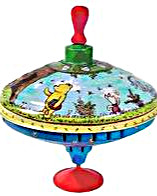
Picture a child’s toy of a spinning top.  Pick one tiny point on the top, and imagine it spinning at full speed.  Imagine a newborn ‘self’ with senses to the world attached to that single spot as the spinning goes on minute after minute, day in and day out, year after year.  Never did the insanity of the abuse of my childhood actually end.  Never was I safe.  Never did anything make any sense.  Never was there any real cause and effect.  There was – continually and always – no opportunity for me to form my own thoughts, to have my own feelings, to find my own self, anywhere in my body-brain forming years as my mother’s traumatized daughter.

Evidently, for some inexplicable reason, as I reached to remove the keys from my car’s ignition yesterday, while I was under no particular stress, about to have a good lunch and a relaxing visit with my friend, a millisecond snapshot was taken by my being of exactly and specifically ONE THING – the steering wheel of my car.  The top stopped spinning, frozen for one instant of time, as the ME that lives inside this body, and processes my life with this chaos-built traumatized brain saw one particular slice of my life – of my reality — perfectly in focus, absolutely clearly:  My steering wheel.

Did I feel remote at that instant?  Yes.  Did I feel like a stranger in my body, in my car, in that parking lot, at that instant of time?  Yes.  Do I remember this feeling from my childhood?  Yes.  Any memory I have of my childhood is a snapshot, or what is called a flashbulb trauma memory.

My brain did not form itself to process information so-called normally.  I live in what I call a ‘parallel’ life where time and space are related to one another, and to me through combinations of associations that shift like specks of sand in the wind.  If I become ‘mindfully aware’ of this fact, I find myself marveling that there is some core cognizant centralized self of Linda that is aware of itself in this lifetime as being anything other than a figment of a passing (and passed) dream.

So if any Ivory Tower researcher wants to devise a study that might provide any really useful or accurate information about what dissociation, depersonalization and derealization might actually BE, they might want to study the consciousness-invested relationship any severe infant-child abuse survivor might have with their automobile’s steering wheel.

++++++++++++++++++++++++++++++