+BORN AS A COMPONENT OF A BORDERLINE MOTHER’S MIND-LIE

+++++++++++++++++++++++++++++

How I remembered what memories I do have that are written in my childhood stories was affected-infected by the obsession my mother had with ‘telling the truth’.  Her perception of every experience involving me including those she added to ‘her abuse litany’ involved somehow involved a deception and a lie.  Because she continued to repeat these perception-lies verbally every time she ‘punished’ (beat) me for the rest of the years of my childhood, not only were her versions of the events kept alive, but also mine because my version and her version simply never matched.

How was it that I, a child that had never been affirmed by my mother as ever existing at all as a human being but rather as a nonhuman child of the devil, could so clearly KNOW the truth (my truth) about what had ACTUALLY happened every single time my mother repeated her attacks on me through the years because of my supposed transgressions that existed only within her distorted mind?

It is affirming to me at this moment to recognize that as far back as I can remember my own memory of what actually happened for each of her twisted abuse litany versions of my actions was carried forward in time within my own mind-self intact.  Nothing my mother ever said or did to me changed the truth of what I knew.  I find comfort in realizing that obviously Linda WAS present.  I WAS there as a glimmer of a reflection of a self within my own experience of my own life.

I was the one being viciously verbally and physically attacked without having any possible way of avoiding, escaping, preventing or of understanding what was happening to me.  But I WAS there, in my body, having my life experiences.  I had them.  I knew what they were.  I knew the truth of what actually happened, and I remembered the experiences intact – every single one of them – in spite of how my mother twisted the facts and in spite of what she did to me along with twisting the reality of the facts.

++++

At this moment I am also detecting where one of my biggest problems originated.  As the brain-mind-self grows and develops, a person’s memory abilities are supposed to expand and become more complex and advanced.  When I say I had no ability to THINK about myself in my life in any kind of self-reflective, awareness-based way for the 18 years of my childhood, what I realize I am actually saying is that within the horrific abusive environment I was developing within, I could only go so far in my development and no further.

There is something called ‘semantic memory’ which is a term that “refers to the memory of meanings, understandings, and other concept-based knowledge unrelated to specific experiences.”  Tied to the development of semantic memory abilities is a following stage of memory development called ‘episodic memory’, a term refers to “the memory of autobiographical events (times, places, associated emotions, and other contextual knowledge) that can be explicitly (consciously – which is versus ‘implicit’ memory that is unconscious and exists in the body but is not accessible to the brain-mind) stated.”  Not only did I not develop this remembering ability at the appropriate age, but I have only with effort been able to exercise it in my adult life.

As memory abilities develop in the body-brain from birth, they form what I think of as links in a memory chain.  The next stage of memory ability development I should have been able to obtain was nearly completely obliterated by my mother’s abuse of me.  ‘Autobiographical memory‘, is not a simple process.  It is meant to allow us to connect our self from the inside out not only with the experiences of our life as we have them, but also involves being able to experience our experience (having a self to remember having an experience).  Then, we are supposed to be able to remember our experience of our self having had the experience.

We can refer to the end result of the abuse my mother did to me ‘dissociation’, but what I know is that her abuse interfered with my brain’s development, including the development of memory abilities.  I had a deadly predator in pursuit of me throughout the 18 years of my childhood.  I never had the luxury to pause for the length of time it would have taken to consolidate my memory of my life or of myself living it.  I certainly was never allowed to pause long enough to form the ability to remember myself having an experience, or to remember myself remembering having experiences.

The reality of my abusive childhood resulted in such profoundly altered brain development that I simply managed to escape my childhood with the memories of my own reality that were directly tied to the incidents my mother repeated over the years in her abuse litany.  Even then, it was only because I had been able to develop some version of semantic memory abilities so that I could not only recognize certain literal facts in the world, I could remember the details of my experiences that were directly associated with these remembered facts.

My mother always had an altered version regarding the facts than I did.  I did not think in terms like “My mother is lying” so that I could have evolved further into thinking about “Why is my mother lying?” or “What is wrong with my mother?” or “Gee, I am so angry at my mother for lying.””  I simply knew for a semantic fact that what had actually happened on each abuse litany-included occasion factually happened as they did in fact happen.

The truly strange addition to this entire pattern was my mother’s insistence on every occasion that I was lying to her if I tried to contradict her version by daring to assert myself and tell her the facts.  I never thought of these facts as real, or as being something so abstract as ‘the truth’.  I learned very young as a child, certainly by the age of six, that not only could I not ‘make things right’ by trying to tell my mother the simple facts of what happened, but my trying to do further fueled her rage like pouring gasoline on a roaring fire.

But – and this is extremely important to me – I always remembered the facts of every event she ever attacked me for the way things actually happened.  Every single time my mother viciously attacked me, verbally and/or physically for one of these events (or for her later recalling of these events), I COULD NOT LET GO OF THE FACTS as I knew them to be.

I did not recall the facts with emotion.  I did not recall them with any sense whatsoever that either the original experience of the experience belonged to me, or that the facts of the experience were a part of me or of my life.  Facts were facts.  They existed like physical objects exist in space and time.  They were literal realities and were nearly as physically tangible in my mind as any object can be.

These fact-objects only reappeared to me when my mother brought them up again and again over the span of my childhood.  They had nothing to do with me that I knew of.  I just simply and clearly recognized them as if they were a fork or a spoon or an automobile.  Although I can be grateful that at least physical objects existed for me with words attached to them, and can be equally grateful that at least I retained the facts-as-objects with names for each incident my mother kept remembering for me, I cannot be grateful for the fact that objects and object-facts had some existence in the world while I, as a human being did not.

All I was, all I knew, and all I continued to be for 18 years was a one single fact-object:  I was the devil’s child.

++++

How a person begins from infancy to recognize and develop their individual self is dependent upon their ability to be seen, heard and responded to by others in their environment.  This begins with the earliest primary caregiver, usually the mother, being able to recognize the needs of her infant when they are expressed, mirror back to the infant its own emotional states, and appropriately respond both to the infant’s emotions and to its needs.

Thinking this through is a strenuous exercise for my mind.  From the first instants in my infancy that I should have been having my own self recognized and responded to appropriately as my brain-mind-self was forming in relationship to the world through the interactions my mother was having with me, I was fed the opposite of the truth about who I was in the world.

My mother could never respond back to me by mirroring my own existence, my own emotional states, my own needs and desires because I was ALWAYS invisible to her from the moment I was born.  She could not reflect ME back to ME because all she ever saw when it came to me was her own projected reflection of badness that her mind had split away from itself and cast onto and into me.

I did not exist.  No infant can exist to itself fully and automatically from the time it is born.  Everyone requires this mirroring of the self back to it for the identification of self to be made.  Now that I understand how the nature of caregiver-infant mirroring interactions actually physiologically determines how an infant’s brain and nervous system develops makes my effort to understand what happened to me because of my mother’s madness even more scary.  I understand how profoundly her disturbed mind affected the development of everything about me from the ground on up.

The truth is that everything that ever happened between my mother and I was based on a lie.  Because I was at ground zero, because I not only existed at the center of the lie but actually WAS the lie my mother’s deranged mind created, I never had a chance or a way to gain an alternative perspective about what was happening to me.

When I say I spent 18 years being the center of my mother’s psychosis and being the target of her hatred, rage and abuse, I mean this as a literal fact.  I WAS the target and nothing else but a target.

That target came into the world not as a human being, but as the spawn of the devil who tried to kill my mother while I was being born – because the devil sent me on a mission to do just that.  I was raised knowing not only that I was owned by the devil, that I belonged to the devil, that I was not human, but also that the devil had given me the power to ‘take’ my mother’s other children ‘to the devil’.

The last time I heard my mother verbalize her unwavering beliefs about me was on the telephone when I was 30.  She launched into her abuse litany in our conversation as if a switch had been flipped on.  The words she used in her litany were always the same.  They would defy belief it I didn’t have the continued ability to recognize facts when I encounter them.

What I never had in my entire life until the moment in that conversation when I was 30 — as these exact familiar words yet again spewed out of her mouth and into my ear through my telephone’s receiver, “The devil sent you to kill me while you were being born and because I survived, you have been nothing but a curse upon my life ever since” – was the ability to do what I did on this day.  I suddenly recognized the lie in the span of a heartbeat and just as quickly in the next heartbeat my finger flicked through the air as I pushed the phone button that hung up on her.

In that span of a heartbeat, for the first time in my life, I caught a glimpse of a glimmer that my mind existed separately from my mother’s.  It took that long, 30 years, to begin a process of differentiating my own self in my own mind from the mind of my mother that should have started when I was born.

Before this instant there had never been a boundary formed between my mother and myself so that I could have been on one side – busy developing my own self in my own brain-mind – while she was on her side of the boundary dealing with her self within her own brain-mind.  I was included as a part of her mind from the time of her difficult and near-death labor with me.  I was nothing but her mental projection of ‘evil’ before I took my first breath.

I was a captured and encapsulated part of my mother and could not escape.  I was not allowed to form a self to escape with even if escape had been an option.  And that option did not really appear for me until I was already 30 years old, 12 years after I had walked out my mother’s front door into my adulthood.

I believe my mother suffered from just about the most severe case of Borderline Personality Disorder possible, and she forced me to share the turmoil of her mental experience with her as if I was an incorporated part of her self.  She kept me on the psychotic side of her Borderline mind for my entire 18-year childhood and for the rest of her life from the time of my birthing.  I was not born free.  In fact, until I somehow managed to step across the line out of her Borderline lie and into my own reality during that telephone conversation, I had not been born as a human being at all.

++++++++++++++++++++++++++++++++++++++++++

+A REFRESHER ON ATTACHMENT AND RESILIENCY

++++++++++++++++++++++++++++

In writing about attachment as the patterns present in the narration of one’s life story reflect the patterns of secure or insecure attachments, I just came again across this book:

A User’s Guide to the Brain: Perception, Attention, and the Four Theaters of the Brain by John J. Ratey (I am referencing from the Vintage 2001 edition)

with this important statement:

“”Some stress makes us tougher in the face of future adversity.  There is even research that shows that exposure to reasonable challenges during childhood alters the balance of brain chemicals so that children are able to respond better to stress later in life.”  (page 365)

++

This statement, of course, brings questions to mind for those of us who certainly NEVER experienced anything like ‘reasonable challenges’ during our abusive infant-childhoods.  If ‘reasonable challenges’ during childhood can alter ‘the balance of brain chemicals’, imagine what happened to us!!

But, to move to what Ratey covers next  — which includes a description of how important secure attachments are to children — perhaps most significantly for children who do NOT have safe and secure attachments with their primary caregivers.  Ratey also mentions the importance of secure attachment in adulthood:

“Houston psychologist Emmy Werner found evidence for this when she studied the offspring of chronically poor, alcoholic, and abusive parents to understand how failure was passed from one generation to the next.  To her surprise, one-third of the children ended up leading more productive lives than their parents.

“Many social scientists now suggest that while we must continue to study children who fail, there may be much more to learn from children who succeed despite adversity.  Such children, researchers find, are not simply born that way.

“The presence of a variety of positive influences in their lives often makes the difference between a child who fails and one who thrives.  The implications are profound; parents, teachers, volunteers, peers, and all those who are in contact with children can create a pathway to resiliency.

“Werner later studied women who overcame adversity in their adult lives.  She found that several factors made the difference:  at least one person who gave them unconditional love and acceptance; a sense of faith in themselves; the willingness to seek support; and finally, hope.”  (page 365)

See also by Emmy Werner:  Resilience: A Universal Capacity

Related posts:

*RESILIENCY – WHY I’M ALIVE – NOT A MYSTERY

+ATTACHMENT – HOW WE ARE WHO WE ARE

A search of this blog on RESILIENCY HERE for more related posts

++++++++++++++++++++++++++++

resiliency.chap1.id

A search of this blog on RESILIENCY HERE for more related posts

+CRITICAL – OXYTOCIN – THE RELATIONSHIP GLUE

++++++++

Oxytocin is the glue that holds all mammal relationships TOGETHER.  Without oxytocin the opposite of ‘together’ happens.  Infant-child abuse represents a ‘tearing apart’ and a ‘breaking apart’ of relationships rather than a ‘building up’.

I am posting two chapters today from this book, with more to follow in future posts:

The Oxytocin Factor: Tapping the Hormone of Calm, Love, and Healing by Kerstin Uvnas Moberg, Roberta Francis, Kerstin Uvnäs Moberg, and Translated by Roberta Francis (Hardcover – Sept. 16, 2003)

The information on this blog from Moberg’s book is very important.  We cannot think intelligently about infant-child abuse without the ability to think intelligently about attachment, and we cannot think about attachment intelligently without being able to think about oxytocin.

In situations where caregivers abuse and maltreat infants and children under their care – EVERY SINGLE TIME THIS HAPPENS – there is something wrong with the operation of the caregiver’s attachment system.  This means that at those times the perpetrator’s oxytocin-related system IS NOT WORKING PROPERLY.

*Oxytocin – Chapter 4: The body’s control centers

*Oxytocin – Chapter 5: How oxytocin works

++++

There are several posts on this blog that are concerned with oxytocin – FIND THEM HERE.

Of these posts, THESE ARE THE ONES about oxytocin that relate to Dr. Moberg’s work I have posted through today.

++++++++++++++++++++++++++++++++++++++++

From Kristalyn Salters-Pedneault, PhD, your Guide to Borderline Personality Disorder

I am a cognitive behavioral therapist, but not many people know what that means or how cognitive behavioral therapy (CBT) can be used to address BPD symptoms. This week, learn more about whether CBT could help you.

CBT for Borderline Personality

Cognitive behavioral therapy (CBT) is a type of psychotherapy that targets the “cognitive” (thinking-related) and “behavioral” (action-related) aspects of a psychological condition.
Dialectical Behavior Therapy – When Change Isn’t Enough

Dialectical behavior therapy (DBT) is a special kind of cognitive behavioral therapy designed for people with BPD. Dr. Marsha Linehan at the University of Washington noticed that people with BPD need more than just a change-focused therapy, they need better acceptance (by others and of themselves). The solution? DBT.
BPD in the News -Charges Brought in Assisted BPD Suicide

Dr. Lawrence Egbert, the head of the right-to-die group Final Exit Network (FEN) is currently facing charges for allegedly helping a woman with BPD commit suicide.
Life With Borderline Personality Disorder

While BPD can affect many areas of your life, your legal status and physical health, many people with BPD lead normal and fulfilling lives. Learn how BPD might impact you, and how you can improve your quality of life.

Must Reads

What is BPD?
Symptoms of BPD
Diagnosis of BPD
Treatment of BPD
Living with BPD

++++++++++++++

+ARE YOU A ‘SENSITIVE?’

++++++++++++++++++

I appreciate this link on information about sensitivity being sent to ‘my attention’.  It reminds me of the description of the ends of a ‘personality’ spectrum being like ‘hawks’ on one end and ‘doves’ on another — SEE:  *Allostasis and Allostatic Load for more information, including a presentation about even the differences in the immune system between these two types of people.

(Also this link to articles by Bruce McEwen on the subject)

Throughout human history, there have always been ‘sensitives’ that were specifically geared to gathering plants.  Even their immune system response is specifically geared to fight the kind of pathogens that are more likely to appear within this kind of environment.  These ‘dove’ people’s immune system is different than the ‘hawk’ people’s immune system as the ‘hawks’ are more likely to receive wounds in combat and the hunt for large game that required a different immune system response.

++++

I am a ‘dove’ person as is my oldest brother.  When ‘sensitives’ are exposed to severely traumatic, unstable and unpredictable early home circumstances, I believe we follow a different kind of ‘suffering’ pathway than do those who are less sensitive and ‘hawkish’ (like my mother).  (Perhaps some are naturally easier prey and others predators?)

This article posted here is interesting, to say the least!

++++++++++++++++++

http://www.livescie nce.com/health/ shy-brain- process-informat ion-differently- 100405.html

Study Sheds Light on What Makes People Shy

By LiveScience Staff

posted: 06 April 2010 08:07 am ET

The brains of shy or introverted individuals might actually process the world differently than their more extroverted counterparts, a new study suggests.

About 20 percent of people are born with a personality trait called sensory perception sensitivity (SPS) that can manifest itself as the tendency to be inhibited, or even neuroticism. The trait can be seen in some children who are “slow to warm up” in a situation but eventually join in, need little punishment, cry easily, ask unusual questions or have especially deep thoughts, the study researchers say.

The new results show that these highly sensitive individuals also pay more attention to detail, and have more activity in certain regions of their brains when trying to process visual information than those who are not classified as highly sensitive.

The study was conducted by researchers at Stony Brook University in New York, and Southwest University and the Chinese Academy of Sciences, both in China. The results were published March 4 in the journal Social Cognitive and Affective Neuroscience.

The sensitive type

Individuals with this highly sensitive trait prefer to take longer to make decisions, are more conscientious, need more time to themselves in order to reflect, and are more easily bored with small talk, research suggests.

Previous work has also shown that compared with others those with a highly sensitive temperament are more bothered by noise and crowds, more affected by caffeine,  and more easily startled. That is, the trait seems to confer sensitivity all around.

The researchers in the current study propose the simple sensory sensitivity to noise, pain, or caffeine is a side effect of an inborn preference to pay more attention to experiences.

They first used an established questionnaire to separate the sensitive from the non-sensitive participants. Then, the 16 participants compared a photograph of a visual scene with a preceding scene, indicating whether or not the scene had changed. Scenes differed in whether the changes were obvious or subtle, and in how quickly they were presented. Meanwhile, the researchers scanned each participant’ s brain with functional magnetic resonance imaging (fMRI).

Sensitive persons looked at the scenes with subtle differences for a longer time than did non-sensitive persons, and showed significantly greater activation in brain areas involved in associating visual input with other input to the brain and with visual attention. These brain areas are not simply used for vision itself, but for a deeper processing of input.

Role in evolution

The sensitivity trait is found in over 100 other species, from fruit flies and fish to canines and primates, indicating this personality type could sometimes provide an evolutionary advantage.

Biologists are beginning to agree that within one species there can be two equally successful “personalities. ” The sensitive type, always a minority, chooses to observe longer before acting, as if doing their exploring with their brains rather than their limbs. The other type “boldly goes where no one has gone before,” the scientists say.

The sensitive individual’s strategy is not so advantageous when resources are plentiful or quick, aggressive action is required. But it comes in handy when danger is present, opportunities are similar and hard to choose between, or a clever approach is needed.

Copyright © 2010 TechMediaNetwork. com

++++++++++++++++++

http://www.livescie nce.com/health/ shy-brain- process-informat ion-differently- 100405.html

Study Sheds Light on What Makes People Shy

By LiveScience Staff

posted: 06 April 2010 08:07 am ET

The brains of shy or introverted individuals might actually process the world differently than their more extroverted counterparts, a new study suggests.

About 20 percent of people are born with a personality trait called sensory perception sensitivity (SPS) that can manifest itself as the tendency to be inhibited, or even neuroticism. The trait can be seen in some children who are “slow to warm up” in a situation but eventually join in, need little punishment, cry easily, ask unusual questions or have especially deep thoughts, the study researchers say.

The new results show that these highly sensitive individuals also pay more attention to detail, and have more activity in certain regions of their brains when trying to process visual information than those who are not classified as highly sensitive.

The study was conducted by researchers at Stony Brook University in New York, and Southwest University and the Chinese Academy of Sciences, both in China. The results were published March 4 in the journal Social Cognitive and Affective Neuroscience.

The sensitive type

Individuals with this highly sensitive trait prefer to take longer to make decisions, are more conscientious, need more time to themselves in order to reflect, and are more easily bored with small talk, research suggests.

Previous work has also shown that compared with others those with a highly sensitive temperament are more bothered by noise and crowds,more affected by caffeine, and more easily startled. That is, the trait seems to confer sensitivity all around.

The researchers in the current study propose the simple sensory sensitivity to noise, pain, or caffeine is a side effect of an inborn preference to pay more attention to experiences.

They first used an established questionnaire to separate the sensitive from the non-sensitive participants. Then, the 16 participants compared a photograph of a visual scene with a preceding scene, indicating whether or not the scene had changed. Scenes differed in whether the changes were obvious or subtle, and in how quickly they were presented. Meanwhile, the researchers scanned each participant’ s brain with functional magnetic resonance imaging (fMRI).

Sensitive persons looked at the scenes with subtle differences for a longer time than did non-sensitive persons, and showed significantly greater activation in brain areas involved in associating visual input with other input to the brain and with visual attention. These brain areas are not simply used for vision itself, but for a deeper processing of input.

Role in evolution

The sensitivity trait is found in over 100 other species, from fruit flies and fish to canines and primates, indicating this personality type could sometimes provide an evolutionary advantage.

Biologists are beginning to agree that within one species there can be two equally successful “personalities. ” The sensitive type, always a minority, chooses to observe longer before acting, as if doing their exploring with their brains rather than their limbs. The other type “boldly goes where no one has gone before,” the scientists say.

The sensitive individual’s strategy is not so advantageous when resources are plentiful or quick, aggressive action is required. But it comes in handy when danger is present, opportunities are similar and hard to choose between, or a clever approach is needed.

Copyright © 2010 TechMediaNetwork. com

+LINK TO MY MOTHER’S 1958 LETTERS

++++++++++++++++++++

It is not a fun process to be back at the job of transcribing my mother’s letters.  I finally finished doing these letters:

+1958 MOTHER’S LETTERS – FINDING LAND

For some reason I skipped this year months ago when I transcribed many, many of my mother’s other letters for other years.  The first day of 1958 coincided with the start of our 6th month in Alaska.  We lived in the rented log house whose lease was up on July 1.

During April and May my father hiked back into the Eagle River Valley and found the land he staked claim to as our 160 acre homestead.  In June my grandmother arrived for her first visit (a month) to the territory.

The cabin (shack) we moved into July 1958 and left October

By the end of July we had moved into a primitive rented cabin.  By mid-October we moved into an apartment in Anchorage.

The Jeep truck my parents named "The Monster" and the apartments we moved into in 1958 for my 2nd grade year

If you read little else of these letters, read the one written December 29, 1958 — it’s a classic mother letter!  It describes what happened – from my mother’s point of view – when my mother took the only outside job with a boss that I ever knew her to have during my childhood.  It was a part-time evening job that she held for a little over a month.  My guess is that her true Borderline colors were flying, and others reacted to her (heaven forbid!).  She could not control her work environment the way she controlled her home and children.  The result was a natural disaster.

After working many hours today on transcription, I am tired and sick of my mother!  Now, I have to decide what I am going to do about the rest of the 1957 letters that I have left until the very last.

I feel like I have spent the day in a place without any light at all, in the complete darkness of my scrambled, devastating childhood — little of which, of course, shows up in my mother’s bizarrely surreal letters.

++++++++++++++++++++

Borderline Personality Disorder People with BPD, and their family members, sometimes wonder why certain people get the disorder and others don’t. Sometimes there is a clear environmental cause (e.g., a history of psychological trauma), but research suggest that there are also biological factors.
Genetic Links to BPD
Studies of BPD in families show that first degree relatives (siblings, children, parents) of people treated for BPD are 10 times more likely to have been treated for BPD themselves than the relatives of people with schizophrenia or bipolar disorder.
Will My Kids Get BPD Too?
If you have BPD, your kids are at greater risk of having BPD themselves. But, there is also a good chance that they will not have BPD. And, there are things you can do to reduce their risk.
Can BPD Be Prevented?
If the causes of BPD are in part biological, is there anything that can be done to decrease your risk for BPD?
BPD Family Resources
Sometimes it may seem like there is help available for the person with BPD, but not for his or her loved ones. Fortunately, there is a growing appreciation for the need of BPD families to have their own sources of information, treatment, and support.

++++++++++++++++++++

April is Child Abuse Prevention Month

Posted: 05 Apr 2010 07:54 AM PDT

All children in New York deserve a healthy, happy and safe childhood. This April, it’s your turn to make a difference for the kids in your neighborhood!

To raise awareness of April as Child Abuse Prevention Month, Prevent Chid Abuse New York (PCANY) and its sister chapters around the nation mobilize Pinwheels for Prevention campaigns. As part of these campaigns, New Yorkers make a promise to prevention by distributing pinwheels and hosting educational events throughout the state. Pinwheels are a symbol of a happy, carefree childhood and the belief that getting it right for kids early on is less costly than trying to fix problems after things have gone wrong. Doesn’t every child deserve this opportunity?

Everyone has a role to play in preventing child abuse and supporting families. You can get involved by planting pinwheel gardens in a public place, wearing pinwheel label pins, displaying car and storefront window clings, hosting events for families, and signing a promise to prevention. Businesses, schools, community-based organizations, civic groups, educators, volunteers, decision-makers and families participate.

PCANY offers you the tools to be an active part of Child Abuse Prevention Month. Please contact us to learn more about how to mobilize a campaign in your community. It’s your turn to make a difference for a child!

For more information about mobilizing a Pinwheels for Prevention campaign event near you, please visit our web site or call 1-800-CHILDREN.

++++++++++++++++++++

+FOOLED BY AN ABUSIVE BORDERLINE? – MY MOTHER’S EXPERT DISTORTION OF REALITY

++++++++++++++

see also:

+MY ABUSIVE BPD MOTHER LOST HER WINGS – AND NEVER GREW UP

How expert are you at being able to detect the twisted reality presented by a severely abusive Borderline?  The clues to the truth do not lie with the Borderline, they exist within the empathic abilities of outside observers to know the truth from a lie.  This ability to know true reality from the lies of a deceptive reality so marginally exits within an abusive Borderline that I would say it does not exist at all.

++

For example:

Brain Scans Clarify Borderline Personality Disorder

By Rick Nauert PhD

Using real-time brain imaging, a team of researchers have discovered that patients with Borderline Personality Disorder (BPD) are physically unable to regulate emotion.

The findings, by Harold W. Koenigsberg, MD, professor of psychiatry at Mount Sinai School of Medicine suggest individuals with BPD are unable to activate neurological networks that would help to control feelings.   READ ARTICLE HERE

(NOTE:  In later posts I will write about my father’s participation in my mother’s distorted reality.  I believe he had an avoidant-dismissive insecure attachment that meant his brain could regulate emotion to the extreme — but not in a normal way.  His brain, which could overly activate ‘neurological networks’ that helped him overly control his feelings, was the perfect compliment to my mother’s Borderline brain.)

++

WHAT HAPPENS WITHIN THE BORDERLINE BRAIN?

++

Perhaps the most important piece of information those of us who were severely abused and traumatized by a Borderline Personality Disordered mother need to understand is that our mothers had/have a completely different kind of brain.  These severe Borderline brains are expertly created through completely natural (and possible) processes of distortions in early childhood that in the end make the brain differences most difficult to detect unless and until we know what we are looking at when we consider the Borderline behaviors that manifest themselves as a result of early brain developmental changes.

We also need to understand that as a consequence of early traumatizing experiences a Borderline’s entire nervous system development (the brain is ‘just’ one component of the Central Nervous System) were changed and altered as well.  This means that my mothers Autonomic Nervous System, which regulates both stress-defense responses through its ‘GO’ sympathetic arm and the connecting, compassionate, caregiving and seeking responses through the calming arm of the ‘STOP’ parasympathetic branch (think ‘pair-a-brakes’) were changes, as well.

I now understand that everything about who and how my severe Borderline mother was in the world was different from ‘normal’.  What is harder to understand is why it took me so long to figure this out, and why nobody – not one single person including my father and grandmother – was able to detect the incredibly severe, consistent, perpetual, and horrible trauma and abuse my mother perpetrated against me for 18 long years.

What makes an abusive Borderline mother’s violence and horrible treatment of her offspring (most often, I suspect, of a ‘chosen child’) so nearly impossible to detect?

++++

I am presenting here a letter my mother wrote to her mother just prior to the first visit to Alaska to see us that my grandmother made after we left Alaska in August 1957 a month before my sixth birthday.

The distortion in my mother’s thinking about me that really shows how subtle and pervasive her psychosis was is present in this letter as I describe it in my comments within the text.  My mother’s Borderline reality, and her psychosis regarding me (age six at the time this letter was written) would be impossible for an outside reader to detect.

The same processes that make her psychosis (and the abuse it engendered toward me) impossible to detect are the same ones, I suggest, that made her abuse of me undetectable to others all during the 18 years of terrible suffering my mother caused me.  If readers think ‘undetectable deadly toxins’ as they read this, perhaps they will be able to twist their own thinking back to a normal-reality perspective as the proceed through the following words.

The biggest problem contact with a severe Borderline psychosis creates is that people with Borderline brains are so complete in their distortions of reality.  They spin such a believable story, weave such a believable lie, that nobody but the most trained observers can possibly begin to detect the deceptions the psychosis contains.  When a person encounters a Borderline such as my mother was, all rules of human decency are suspended, and the outsider does not have a clue – not a single solitary clue – that these rules have been changed.  Everyone outside of the Borderline’s skin becomes instantaneously consumed within the distorted reality.

I can say here that I don’t give a solitary damn myself about anything I write here.  My concern is for those poor, pitiful, unbelievably tortured other people who grew up being the victim of a twisted Borderline’s reality – and with all those helpless, powerless suffering children who are trying to endure a Borderline parent’s torture at this present moment in time.

I know what I am talking about here.  My mother was probably among the best of the best of the best of abusive Borderlines.  Her web of deceptions was as impeccable as it was sinister and destructive.  And it was invisible, evidently, to all but her single chosen prey – me – and my poor siblings who had to live within the darkened home she controlled and ruined.

Because I was born into my mother’s hate-filled psychosis – and I mean this literally because the core of the psychosis formed during her labor with me – I had no possible way to begin to understand that my mother’s reality was not real.  The discoveries of REAL reality I uncover as I work with her 50-year-old-letters only come to me because I have found a way to take a safe stance as I read them.  That safe stance is ONLY possible now because I have enough information, finally, about Borderline brain changes to detect the clues that show me the presence of my mother’s invisible psychosis when I encounter them.

I am able to make the invisible visible.  There is no action more empowering for a severe early infant-child abuse survivor than this.  As you read the following you will be a part of experiencing this process in action.  Turn up the volume of your sensitivities here – turn it WAY up.  The truth contained in the deceptions of an abusive Borderline’s lies – that create the reality they BELIEVE – are so subtle as to actually exist exactly at that BORDERLINE the name of their disorder suggests.

The BORDERLINE appears, like a line drawn in invisible ink, exactly at the place where the observer can detect THEIR OWN INTERNAL EMOTIONAL CLUES that a deception of such grand proportions actually exists that it seems beyond belief.  It is at this BORDERLINE where what does not possibly seem believable is in fact BELIEVABLE that the expert Borderline brain’s creation of distorted reality becomes no longer invisible.

A Borderline such as my mother was does not possess within the operation of their brain or entire nervous system-body the capacity to detect the deceptions that form their reality.

The detection of the deceptions can ONLY come from those aware observers from the outside who have the capacity to – actually – experience the near outer-limits of EMPATHIC ability.  Observers have to know their own self, be able to sense with exquisite, accurate sensitivity what they are themselves feeling – within their own body – as they interact with an expert, professional Borderline like my mother was.

My mother’s Borderline deception-reality was NOT ACCURATE, but it was profoundly presented as such, as it is in this letter.  The clues to the truth do not lie here within my mother’s words.  They lie within the body-brain-mind of the outsiders who read them.

++++++++++++++

An example of the pervasively subtle psychosis my mother had about me — along with my comments.  My grandmother was soon to come for her first visit since we had left Los Angeles and moved to Alaska in August of 1957 a month before my sixth birthday:

June 4, 1958

Dear Mother,

Imagine – 10 more days and you’ll be here!!  Does it seem possible?  Yesterday morning I looked at the calendar and was amazed to see that the happy day falls one week from this Saturday.  But then I became concerned.  It’s the best day for you to come but also the day I planned John’s party for the boys.

This is going to be a business letter as I’ll see you to chat in no time at all now.  I do feel he needs a party.  I wrote you about his shyness and Jo Anne’s remarks etc. and I’ve had quite a time overcoming this.

Then this summer I knew he had to have boys to play with and yet he didn’t want to go to Vanovers.  They’re big boys for their age, bossy and dominating – like her and he’s too young to understand their talk and sarcasm – and far too sweet and sensitive.  I knew he needed self-confidence this summer.

Well, I encouraged him to go to Headlows who I found out that they have 3 girls and one boy – perfect match?  He’s a darling boy6 and John and he hit it off from the first.

Then another boy Johnny Johnson moved to the hill.  His Mom owns the Department store at the shopping center.  She’s nice and so is he – I like the Headlow boy better but they’re both nice.

Now yesterday Gerry Vanover came over but he’s loud, bossy etc. but I was nice and John was happy but still prefers others.

Now his party will be perfect.  He needs it and I’ve promised.  I want it late afternoon and a BBQ – hot dogs and rolls so it won’t interfere with your arriving except this:  it will be an all boy party out doors and I don’t want the girls here. [She drew a little sketch for invitations that ‘John can draw’ showing person at BBQ.]

So last nite Bill and I talked it over and arrived at the conclusion if it suits you.  At first I was afraid it would be too much for you to arrive midst a child’s party but you could rest indoors.  Your plane is due to arrive around noon – give or take one hour!  We’ll take girls over to Le Verne’s house.  Her mom takes care of children anyway and I adore Le Verne.  I’ll talk it up to girls – give them new color books and some ‘party food’.  They’ve never been to her house and they’ll enjoy it.

I’d rather we all met you but plane could be one hour late or early so this way Bill and John will meet you – OK?  And I’ll wait home.  We’ll take you sight seeing Sunday and have family party Sunday too.

You’ll be here for that and meet boys too!  Then after party we’ll all go get girls!!

Oh Mom, I get so excited!  I’ve missed you so!  Won’t it be wonderful?  I’m working like mad to get house all clean, waxed and fixed so we won’t have a thing to do.

Bible School starts 9th through 20th and 3 older ones will go so you can rest and we’ll visit first week – only Sharon will be home.  Even she knows you’re coming and talks about it constantly.

Now does this plan meet with your approval.  I could go too if I was sure plane wouldn’t be late – we’ll see.  I’ll have his party at 3:00 – 7:00 or could be 4:00 – 7:00.  I’ll have house clean and food ready, potato salad, cake, etc.  He’ll be in 7th heaven and deserves it.  Will give him our gifts on Sunday.

Now I haven’t asked Le Verne yet.  Let me know your reaction right away!!

We’re planning lots of things to do on week-ends and Bill is going to buy a jeep truck today – good buy, only $600 and he needs it to get back to homestead – then I’ll have the car!!

First week relax.  2nd week-end trip to Girdwood Road and Portage Glacier and visit gold mines and pan for gold!!!  This is road will connect with our Eagle River Road when put through.  [Linda note:  2010, the road was never ‘put through’.]  We’ve never been to these places but have saved them for when you get here!!

Next week = you and I and children to Palmer and Valley.  Nice ride, paved road and we’ll take picnic and visit Rusty Dow – a character and painter.  I want to get some for art shop.  Fun?  Bill’s been to Palmer so we’ll go during week.

Week-end trip and stay over night – to Homer, Alaska.  Colorful, interesting beautiful scenery but rough, dirt road and long trip but FUN.  Another week-end to Seward.  A long day trip and picnic!!

Evening – Fire Lake Lodge and Spring Creek Lodge for dinner at nearby places.  Chart Room in town at Hotel.  Music Festival in Anchorage.  We’re going first Monday to visit gift shops with Alaska Woodcrafts – Mr. Bockstahler’s new wife – you’ll like her.  We want ideas and you’ll enjoy it.

So much to do and see.  Weather is coolish in 60s and 70s – I think you’ll need sweaters and blouses with sleeves.  Nights are light and cool!

We have beds all planned.  Children go to bed as usual and when we all turn in – we transfer Cindy to cot in John’s and Linda’s room and you sleep in Sharon’s room on folding bed.  It’s full size and comfortable – roll-a-way OK?  There that’s settled!

I’m not planning on having neighbors over – you and I will visit them!  I want to enjoy your visit and not plan parties OK?

One Saturday or Sunday we’ll drive in to see country back in but no need to hike

Remember, I wrote you I was to be Brownie Leader’s Assistant – sounds funny.  I hate not to keep my promises (like a Good Brownie) and had hoped to do it with Linda but I got so worried.  Kathy P. was to watch children.  She’s nice but just turned 14 and a flitter budget.  I got worried and this morning wrote a note saying I couldn’t help.  I feel terrible but better!!  Creek has risen so it’s not recognizable as same gentle stream.  It’s overflowed and is fast, dangerous and deep.  They never go there without us but might.  At night you can hear water rushing even in house.  The rapids and current is so strong – a child could never stand up and would be washed to river immediately.  Makes me shudder!!  I couldn’t leave Cindy and Sharon with her.  I told her I could help after 14th.  She’s expecting and wanted me to take troop while she had baby in July.  Also I’d be gone 4 hours and that adds up in baby sitting $ and I don’t trust neighbors.  What a worrier I am!!

++

[Linda note 2010:  Doesn’t surprise me she would find major reasons not to do something with me – and not to admit that she hated doing anything with me.  I am really surprised she let me go – but having there would NOT have been good for me at all, either, of course.  Her tone here is completely different than when she just wrote about doing a birthday party for John, even though at least here she is not ‘slamming’ me directly (at least).

My mother very rarely writes such a single long paragraph, either – confirming my suspicion that her unconscious would in no way allow her to participate as a loving mother in anything that had to do with me.  Very cunning, sounds so legitimate.

Another side to this is that no doubt it SEEMED like something a GOOD mother would do, help with a Brownie troop.  I putting together her Borderline public façade, her public persona, being seen as THIS KIND of mother would have been a good thing – like a prop in her pretend mother play.

Yet at the same time my mother lacked the capacity to ever concern herself, truly, with someone else’s needs.  It became apparent to my mother that this would not have been a pretend activity.  She would REALLY have had to take over this troop, REALLY and actually HELP, do something real outside of her own kingdom, her own range of control and influence.  She knew she would not have been allowed to be her own true controlling self in this outside environment.  The light of day would have shown up both her true intentions (that she did not see or comprehend) and her actions.

In addition, she certainly would not have been allowed to act toward me as she always did.  She would not have been able to control and overrun me in the public setting of a Brownie troop group.  At the same time, if she were away from her home, she could not have controlled what happened there, either.  That faintly, perhaps, her precious doll-baby-children MIGHT have gone too near the creek and MIGHT have been endangered was NOT a concern for her children’s safety.  It was a concern based on her obsession that her children were not only her possessions; they were extended parts of her self – her mind, her psyche and her sickness.

It is never the sign of a healthy, normal safe and secure parent-child attachment when the truth that lies within the attachment is that the parent’s deep psychological needs are involved in ‘getting met’ in the relationship.  When this happens it is an activated parental insecure attachment disorder that is operating.  When this happens, true caregiving for others is not possible.  My mother was, as my sister recently noted, her children’s and her husband’s ‘puppet master’.  She could not be in true relationship with anyone, not even with her own self.

These altered patterns of relationship are so subtle, at least within a very disturbed Borderline, that they are nearly impossible to detect unless the observer KNOWS what they are looking at.  Because I have spent the past six years carefully observing my mother’s thinking and behavior as it appeared in her letters, all constructed with few exceptions for an outside ‘public’ audience that I can begin to notice where the deceptions in her thinking appear.

Even though my mother was purportedly writing to her mother privately, these letters, preserved as they have been for over 50 years, were written by my mother with the intention that someday they would be used to write ‘an Alaskan book’.  On those very few occasions where I can see, touch, taste, smell my mother’s distorted thinking within these letters, I cannot ignore what I know.  This small description of why my mother suddenly could concoct a completely believable (to her or to anyone else) reason why she could not assist as a Brownie scout leader in a troop with her daughter in it is one of those times I can see how pervasive her psychosis truly was.

My mother mentioned the creek to her mother in a letter written the day before this letter was, and she mentions nothing risky or sinister about it:  “The creek is full and deep now as glacier and snow melts.”  But the presence of too much water in the creek gave her the perfect alibi when she needed it.  I don’t for one instant believe any of her children, especially Cindy who was extremely responsible as she approached 5 years of age, especially with John in the house when my mother was gone as he approached 9 years of age, would ever have gone near this creek alone – nor let sister Sharon approaching age 3.  That my mother is saying she could not trust a 14-year-old sitter to watch her children safely is hog wash.  Just plain Borderline-psychosis-constructed nonsense.

A Borderline does not have the capacity to conceive either of self or of others in a normal way.  Everyone outside of my mother was an extension of herself, a living prop in her drama-play at life.  That she – and everyone else – did not see or know what was going on in our home, in her life, or in her psyche did not take away from the fact that her psychosis touched and influenced everything she ever did.

My mother evidently somehow decided for this one year of my young life that it served her purposes to let me participate in Brownies.  I have no reason to believe that this one experience would have been her single exception to her rule of making Linda’s life perpetually miserable.  Somehow my being a Brownie made my mother look good in the public eye.  This was my only childhood experience that let me get away from her influence and be around something meaningful and positive, and to interact as a child (age 6 here) with adults who treated me as the child I was.

For anyone reading these words who doubts the accuracy of what I am describing here in regard to my mother’s sickness, let me mention that one of the hallmarks of the Borderline mother is that NOBODY is supposed to ever detect the presence of the abuse these mothers so expertly enact upon a child.  A Borderline like my mother was is an absolute professional at deception.

Part of the reason why deception like is being presented her in my mother’s account is so effective is that it comes from a completely constructed invisible, unconscious reality that exists BECAUSE the ‘owner’s’ psyche is completely contaminated by their disease.  This pervasive contamination is like a highly effective contagion.  It contaminates the growing mind’s of such a parent’s children, and it contaminates the psyche (unconsciously) of everyone who comes in contact with a professional-psychotic Borderline.

I encourage any reader who disagrees with my hard-earned ability to decipher my mother’s mental mess to take a look at how this kind of deception, so carefully constructed that it legitimizes whatever the Borderline mother turns her thinking toward no matter how insane, how out-of-touch with actual reality it might be.  If you doubt me here, you believe my mother’s version of reality.

It is for the same reason you might doubt me (and my reality) while believing my mother’s lies that nobody ever detected the 18 years of severe abuse my mother perpetrated against me.  My mother was very, very, very good at what she did – creating an alternate reality based upon her distorted brain’s operation that seemed to make sense to everyone, her own self included.

I am the only one alive who knows the truth about how this Linda-being-a-Brownie scout chapter of this story progressed, and more importantly, how it ended.  Our family moved out of the Log House by the end of the summer of 1958, eventually into an apartment in Anchorage for the winter, and back to the Log House in 1959 by which time the homesteading saga consumed our lives in earnest.  By fall 1959 I was back in Brownies, and had sold the essential Brownie Scout Cookies.

The afternoon I collected the money for the cookie sales, put it into a Milk Dud box, and then had it all fall out through the faulty bottom of the box without my noticing this was happening, before I returned home, marked the ending of this story with unspeakable, and unbelievable distortion and violence.  My mother accused me of stealing the money, and because after hours in the evening twilight of retracing my every step through the neighborhood of Eagle River searching for the fallen coins I could not find them, I was accused of being a thief and a liar and was beaten afterwards severely – not once, but every time my mother brought up my ‘crime’ until I left home at 18.  ]

++

Now John for first time is old enough to come and go and is so good about coming back in one hour – etc.

Children need me at home and I can spread myself too thin.

I trust you and Bill in day time and Le Verne at night and 3rd choice days.

Golly so much to write.  I only earned 1.75 imagine – Sunday!  People looked but didn’t buy.  Tell you more later!!

Children still asleep.  I’ve been writing this in bed.  Got Bill’s breakfast and got back in.  They sleep late mornings til 9:00 or 10:00!  So you’ll rest too – of course Bible School starts at 9:30 so will have to get them up early.

Guess what?  Methodist bought Briggs new 30,000 house for the new parson for the new full time Methodist Chugiak Minister.  Now what do you think of that and new church to be built!!

Mrs. Pottle wants me to help with tea for him Sunday?  Probably will take children here if improves as never get to [words washed out here] visit both while you’re here.  Must close!  Love, Mildred.  PS.  Can hardly wait – you know me.

June 4, 1958

Dear Mother,

Imagine – 10 more days and you’ll be here!!  Does it seem possible?  Yesterday morning I looked at the calendar and was amazed to see that the happy day falls one week from this Saturday.  But then I became concerned.  It’s the best day for you to come but also the day I planned John’s party for the boys.

This is going to be a business letter as I’ll see you to chat in no time at all now.  I do feel he needs a party.  I wrote you about his shyness and Jo Anne’s remarks etc. and I’ve had quite a time overcoming this.

Then this summer I knew he had to have boys to play with and yet he didn’t want to go to Vanovers.  They’re big boys for their age, bossy and dominating – like her and he’s too young to understand their talk and sarcasm – and far too sweet and sensitive.  I knew he needed self-confidence this summer.

Well, I encouraged him to go to Headlows who I found out that they have 3 girls and one boy – perfect match?  He’s a darling boy6 and John and he hit it off from the first.

Then another boy Johnny Johnson moved to the hill.  His Mom owns the Department store at the shopping center.  She’s nice and so is he – I like the Headlow boy better but they’re both nice.

Now yesterday Gerry Vanover came over but he’s loud, bossy etc. but I was nice and John was happy but still prefers others.

Now his party will be perfect.  He needs it and I’ve promised.  I want it late afternoon and a BBQ – hot dogs and rolls so it won’t interfere with your arriving except this:  it will be an all boy party out doors and I don’t want the girls here. [She drew a little sketch for invitations that ‘John can draw’ showing person at BBQ.]

So last nite Bill and I talked it over and arrived at the conclusion if it suits you.  At first I was afraid it would be too much for you to arrive midst a child’s party but you could rest indoors.  Your plane is due to arrive around noon – give or take one hour!  We’ll take girls over to Le Verne’s house.  Her mom takes care of children anyway and I adore Le Verne.  I’ll talk it up to girls – give them new color books and some ‘party food’.  They’ve never been to her house and they’ll enjoy it.

I’d rather we all met you but plane could be one hour late or early so this way Bill and John will meet you – OK?  And I’ll wait home.  We’ll take you sight seeing Sunday and have family party Sunday too.

You’ll be here for that and meet boys too!  Then after party we’ll all go get girls!!

Oh Mom, I get so excited!  I’ve missed you so!  Won’t it be wonderful?  I’m working like mad to get house all clean, waxed and fixed so we won’t have a thing to do.

Bible School starts 9th through 20th and 3 older ones will go so you can rest and we’ll visit first week – only Sharon will be home.  Even she knows you’re coming and talks about it constantly.

Now does this plan meet with your approval.  I could go too if I was sure plane wouldn’t be late – we’ll see.  I’ll have his party at 3:00 – 7:00 or could be 4:00 – 7:00.  I’ll have house clean and food ready, potato salad, cake, etc.  He’ll be in 7th heaven and deserves it.  Will give him our gifts on Sunday.

Now I haven’t asked Le Verne yet.  Let me know your reaction right away!!

We’re planning lots of things to do on week-ends and Bill is going to buy a jeep truck today – good buy, only $600 and he needs it to get back to homestead – then I’ll have the car!!

First week relax.  2nd week-end trip to Girdwood Road and Portage Glacier and visit gold mines and pan for gold!!!  This is road will connect with our Eagle River Road when put through.  [Linda note:  2010, the road was never ‘put through’.]  We’ve never been to these places but have saved them for when you get here!!

Next week = you and I and children to Palmer and Valley.  Nice ride, paved road and we’ll take picnic and visit Rusty Dow – a character and painter.  I want to get some for art shop.  Fun?  Bill’s been to Palmer so we’ll go during week.

Week-end trip and stay over night – to Homer, Alaska.  Colorful, interesting beautiful scenery but rough, dirt road and long trip but FUN.  Another week-end to Seward.  A long day trip and picnic!!

Evening – Fire Lake Lodge and Spring Creek Lodge for dinner at nearby places.  Chart Room in town at Hotel.  Music Festival in Anchorage.  We’re going first Monday to visit gift shops with Alaska Woodcrafts – Mr. Bockstahler’s new wife – you’ll like her.  We want ideas and you’ll enjoy it.

So much to do and see.  Weather is coolish in 60s and 70s – I think you’ll need sweaters and blouses with sleeves.  Nights are light and cool!

We have beds all planned.  Children go to bed as usual and when we all turn in – we transfer Cindy to cot in John’s and Linda’s room and you sleep in Sharon’s room on folding bed.  It’s full size and comfortable – roll-a-way OK?  There that’s settled!

I’m not planning on having neighbors over – you and I will visit them!  I want to enjoy your visit and not plan parties OK?

One Saturday or Sunday we’ll drive in to see country back in but no need to hike

Remember, I wrote you I was to be Brownie Leader’s Assistant – sounds funny.  I hate not to keep my promises (like a Good Brownie) and had hoped to do it with Linda but I got so worried.  Kathy P. was to watch children.  She’s nice but just turned 14 and a flitter budget.  I got worried and this morning wrote a note saying I couldn’t help.  I feel terrible but better!!  Creek has risen so it’s not recognizable as same gentle stream.  It’s overflowed and is fast, dangerous and deep.  They never go there without us but might.  At night you can hear water rushing even in house.  The rapids and current is so strong – a child could never stand up and would be washed to river immediately.  Makes me shudder!!  I couldn’t leave Cindy and Sharon with her.  I told her I could help after 14th.  She’s expecting and wanted me to take troop while she had baby in July.  Also I’d be gone 4 hours and that adds up in baby sitting $ and I don’t trust neighbors.  What a worrier I am!!

[Linda note 2010:  Doesn’t surprise me she would find major reasons not to do something with me – and not to admit that she hated doing anything with me.  I am really surprised she let me go – but having there would NOT have been good for me at all, either, of course.  Her tone here is completely different than when she just wrote about doing a birthday party for John, even though at least here she is not ‘slamming’ me directly (at least).

My mother very rarely writes such a single long paragraph, either – confirming my suspicion that her unconscious would in no way allow her to participate as a loving mother in anything that had to do with me.  Very cunning, sounds so legitimate.

Another side to this is that no doubt it SEEMED like something a GOOD mother would do, help with a Brownie troop.  I putting together her Borderline public façade, her public persona, being seen as THIS KIND of mother would have been a good thing – like a prop in her pretend mother play.

Yet at the same time my mother lacked the capacity to ever concern herself, truly, with someone else’s needs.  It became apparent to my mother that this would not have been a pretend activity.  She would REALLY have had to take over this troop, REALLY and actually HELP, do something real outside of her own kingdom, her own range of control and influence.  She knew she would not have been allowed to be her own true controlling self in this outside environment.  The light of day would have shown up both her true intentions (that she did not see or comprehend) and her actions.

In addition, she certainly would not have been allowed to act toward me as she always did.  She would not have been able to control and overrun me in the public setting of a Brownie troop group.  At the same time, if she were away from her home, she could not have controlled what happened there, either.  That faintly, perhaps, her precious doll-baby-children MIGHT have gone too near the creek and MIGHT have been endangered was NOT a concern for her children’s safety.  It was a concern based on her obsession that her children were not only her possessions; they were extended parts of her self – her mind, her psyche and her sickness.

It is never the sign of a healthy, normal safe and secure parent-child attachment when the truth that lies within the attachment is that the parent’s deep psychological needs are involved in ‘getting met’ in the relationship.  When this happens it is an activated parental insecure attachment disorder that is operating.  When this happens, true caregiving for others is not possible.  My mother was, as my sister recently noted, her children’s and her husband’s ‘puppet master’.  She could not be in true relationship with anyone, not even with her own self.

These altered patterns of relationship are so subtle, at least within a very disturbed Borderline, that they are nearly impossible to detect unless the observer KNOWS what they are looking at.  Because I have spent the past six years carefully observing my mother’s thinking and behavior as it appeared in her letters, all constructed with few exceptions for an outside ‘public’ audience that I can begin to notice where the deceptions in her thinking appear.

Even though my mother was purportedly writing to her mother privately, these letters, preserved as they have been for over 50 years, were written by my mother with the intention that someday they would be used to write ‘an Alaskan book’.  On those very few occasions where I can see, touch, taste, smell my mother’s distorted thinking within these letters, I cannot ignore what I know.  This small description of why my mother suddenly could concoct a completely believable (to her or to anyone else) reason why she could not assist as a Brownie scout leader in a troop with her daughter in it is one of those times I can see how pervasive her psychosis truly was.

My mother mentioned the creek to her mother in a letter written the day before this letter was, and she mentions nothing risky or sinister about it:  “The creek is full and deep now as glacier and snow melts.”  But the presence of too much water in the creek gave her the perfect alibi when she needed it.  I don’t for one instant believe any of her children, especially Cindy who was extremely responsible as she approached 5 years of age, especially with John in the house when my mother was gone as he approached 9 years of age, would ever have gone near this creek alone – nor let sister Sharon approaching age 3.  That my mother is saying she could not trust a 14-year-old sitter to watch her children safely is hog wash.  Just plain Borderline-psychosis-constructed nonsense.

A Borderline does not have the capacity to conceive either of self or of others in a normal way.  Everyone outside of my mother was an extension of herself, a living prop in her drama-play at life.  That she – and everyone else – did not see or know what was going on in our home, in her life, or in her psyche did not take away from the fact that her psychosis touched and influenced everything she ever did.

My mother evidently somehow decided for this one year of my young life that it served her purposes to let me participate in Brownies.  I have no reason to believe that this one experience would have been her single exception to her rule of making Linda’s life perpetually miserable.  Somehow my being a Brownie made my mother look good in the public eye.  This was my only childhood experience that let me get away from her influence and be around something meaningful and positive, and to interact as a child (age 6 here) with adults who treated me as the child I was.

For anyone reading these words who doubts the accuracy of what I am describing here in regard to my mother’s sickness, let me mention that one of the hallmarks of the Borderline mother is that NOBODY is supposed to ever detect the presence of the abuse these mothers so expertly enact upon a child.  A Borderline like my mother was is an absolute professional at deception.

Part of the reason why deception like is being presented her in my mother’s account is so effective is that it comes from a completely constructed invisible, unconscious reality that exists BECAUSE the ‘owner’s’ psyche is completely contaminated by their disease.  This pervasive contamination is like a highly effective contagion.  It contaminates the growing mind’s of such a parent’s children, and it contaminates the psyche (unconsciously) of everyone who comes in contact with a professional-psychotic Borderline.

I encourage any reader who disagrees with my hard-earned ability to decipher my mother’s mental mess to take a look at how this kind of deception, so carefully constructed that it legitimizes whatever the Borderline mother turns her thinking toward no matter how insane, how out-of-touch with actual reality it might be.  If you doubt me here, you believe my mother’s version of reality.

It is for the same reason you might doubt me (and my reality) while believing my mother’s lies that nobody ever detected the 18 years of severe abuse my mother perpetrated against me.  My mother was very, very, very good at what she did – creating an alternate reality based upon her distorted brain’s operation that seemed to make sense to everyone, her own self included.

I am the only one alive who knows the truth about how this Linda-being-a-Brownie scout chapter of this story progressed, and more importantly, how it ended.  Our family moved out of the Log House by the end of the summer of 1958, eventually into an apartment in Anchorage for the winter, and back to the Log House in 1959 by which time the homesteading saga consumed our lives in earnest.  By fall 1959 I was back in Brownies, and had sold the essential Brownie Scout Cookies.

The afternoon I collected the money for the cookie sales, put it into a Milk Dud box, and then had it all fall out through the faulty bottom of the box without my noticing this was happening, before I returned home, marked the ending of this story with unspeakable, and unbelievable distortion and violence.  My mother accused me of stealing the money, and because after hours in the evening twilight of retracing my every step through the neighborhood of Eagle River searching for the fallen coins I could not find them, I was accused of being a thief and a liar and was beaten afterwards severely – not once, but every time my mother brought up my ‘crime’ until I left home at 18.  ]

Now John for first time is old enough to come and go and is so good about coming back in one hour – etc.

Children need me at home and I can spread myself too thin.

I trust you and Bill in day time and Le Verne at night and 3rd choice days.

Golly so much to write.  I only earned 1.75 imagine – Sunday!  People looked but didn’t buy.  Tell you more later!!

Children still asleep.  I’ve been writing this in bed.  Got Bill’s breakfast and got back in.  They sleep late mornings til 9:00 or 10:00!  So you’ll rest too – of course Bible School starts at 9:30 so will have to get them up early.

Guess what?  Methodist bought Briggs new 30,000 house for the new parson for the new full time Methodist Chugiak Minister.  Now what do you think of that and new church to be built!!

Mrs. Pottle wants me to help with tea for him Sunday?  Probably will take children here if improves as never get to [words washed out here] visit both while you’re here.  Must close!  Love, Mildred.  PS.  Can hardly wait – you know me.

++

If you have reason to question the kinds and amount of trauma-drama that is present in your life or present in the life of others you care about, beginning at the beginning by reading, studying and acknowledging the information at this link is of utmost importance:

EFFECTS OF A SECURE ATTACHMENT RELATIONSHIP ON RIGHT BRAIN DEVELOPMENT, AFFECT REGULATION, AND INFANT MENTAL HEALTH

By Dr. ALLAN N. SCHORE

SEE ALSO:

+WHY DID MY SIBLINGS NOT BELIEVE MY ABUSIVE BPD MOTHER?

+CHILD ABUSE AND BPD: TRACKING THE TRAUMA IN THE FAMILY TREE

+RATIONAL THOUGHT: POWER OF THE HUMAN SOUL BPD STEALS AWAY TO ENSURE SURVIVAL

+A NOTE TO CHILD ABUSERS WHO FIND THEIR WAY TO THIS BLOG

<!–[if !mso]>

+WORKING ON MY OWN BOUNDARY WALL

+++++++++++++++++++++++++

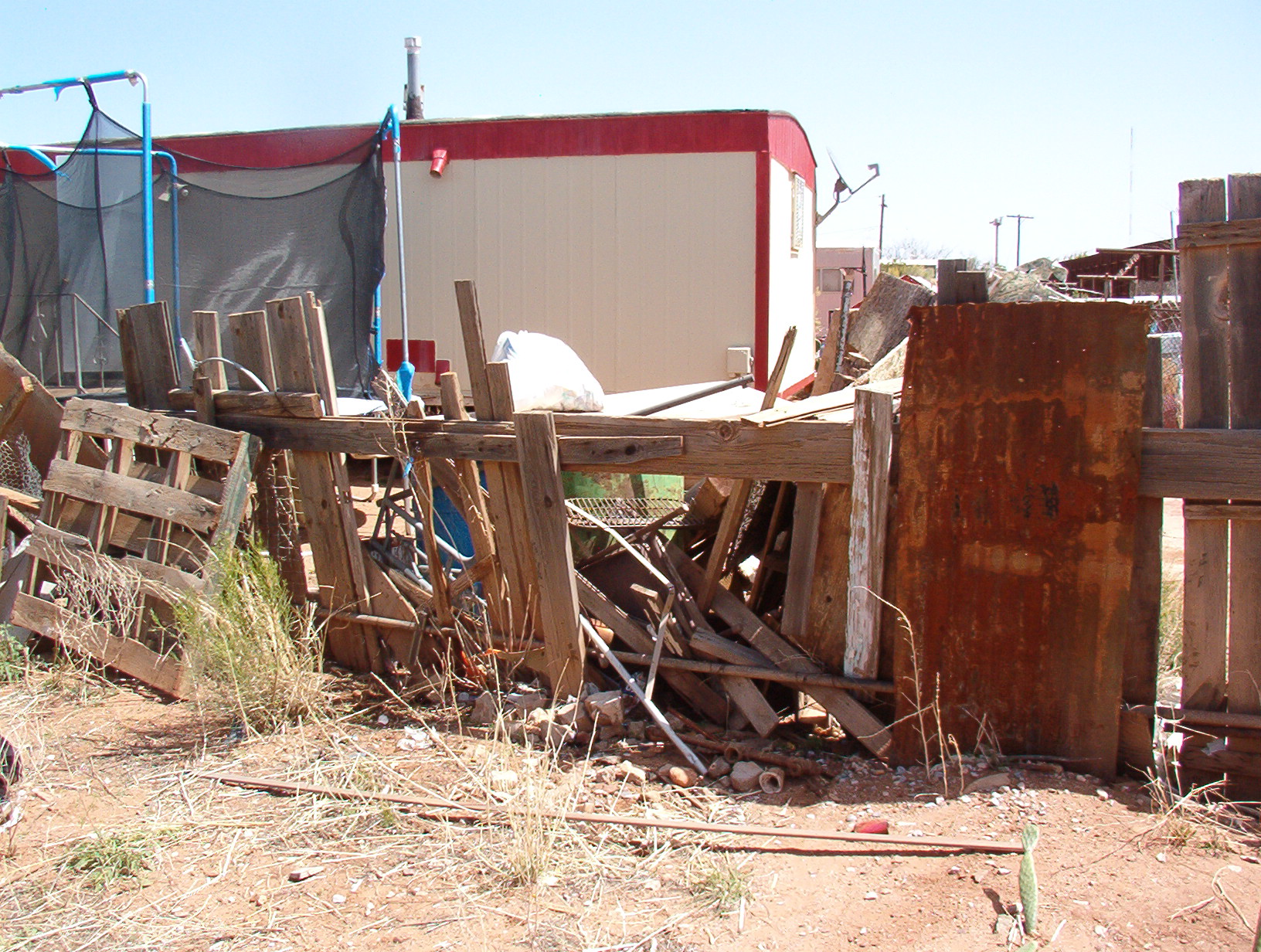
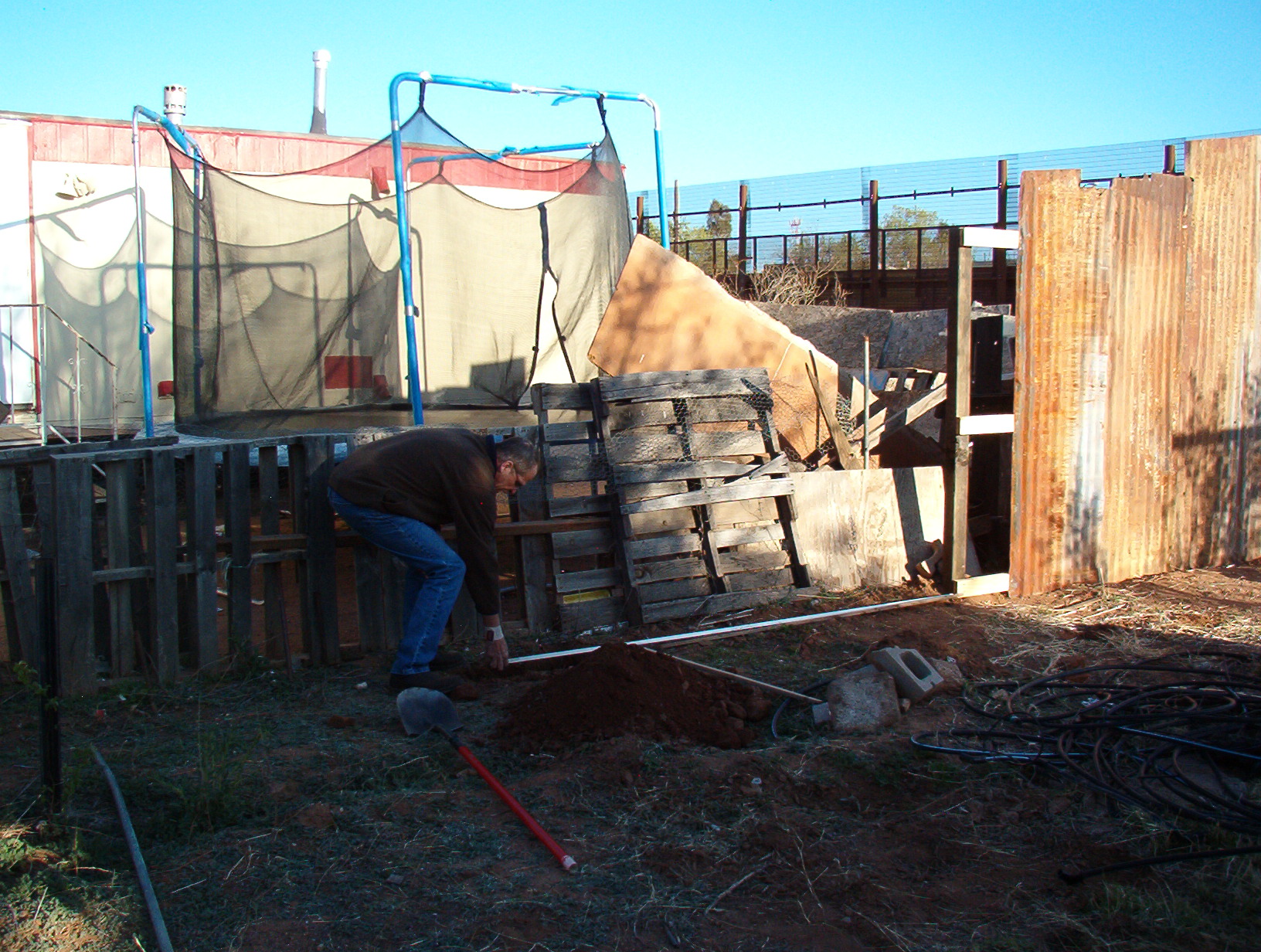
I am feeling neglectful of my blog — because I have been.  My oldest brother was here last week for a visit and left today.  He got me started on a boundary-fence building project in my back yard so I can claim my positive space away from a very negative neighbor (and his piles and piles of stinking garbage).  Budget is extremely limited, so am tearing apart a broken down shed in the back and reusing every scrap of material for the fence.

It’s good to be outside in this warm spring weather.  I’ll be able to sit in my back yard now and gaze at the sky as the brilliant moon glides westward.  I plan to make some adobe blocks to add to my building project, and hope to create some garden space.

Truth be told, I am battling sadness and sorrow.  I refuse to call it ‘depression’ though I know that it is.  I have been watching my dreaming time, and true to my post, +DEPRESSION EVEN GETS OUR DREAMING TIME, my dreaming and my sleeping are not ‘right’ — or at least not like ten years ago.  That fact is hitting me pretty ‘close to the bone’, and is not something I can tell myself I am imagining.

If, somehow, my dreaming-sleeping can improve, I will know it.  I am hoping that I can find ways to be more peaceful with myself, more gentle, more accepting.  I am working in that direction, anyway.

So, I just wanted to make the effort to write something here, even something small.  I’ll include a picture of what I am ‘walling off’ as I set my back yard boundaries, claiming some private, peaceful space for myself where I can be outside, which is good for me and healing.  I’ll post more pictures as the job progresses!

My east neighbor (family of seven) piles weeks' worth of stinky garbage until it falls through this shabby fence, and over it, into my back yard.
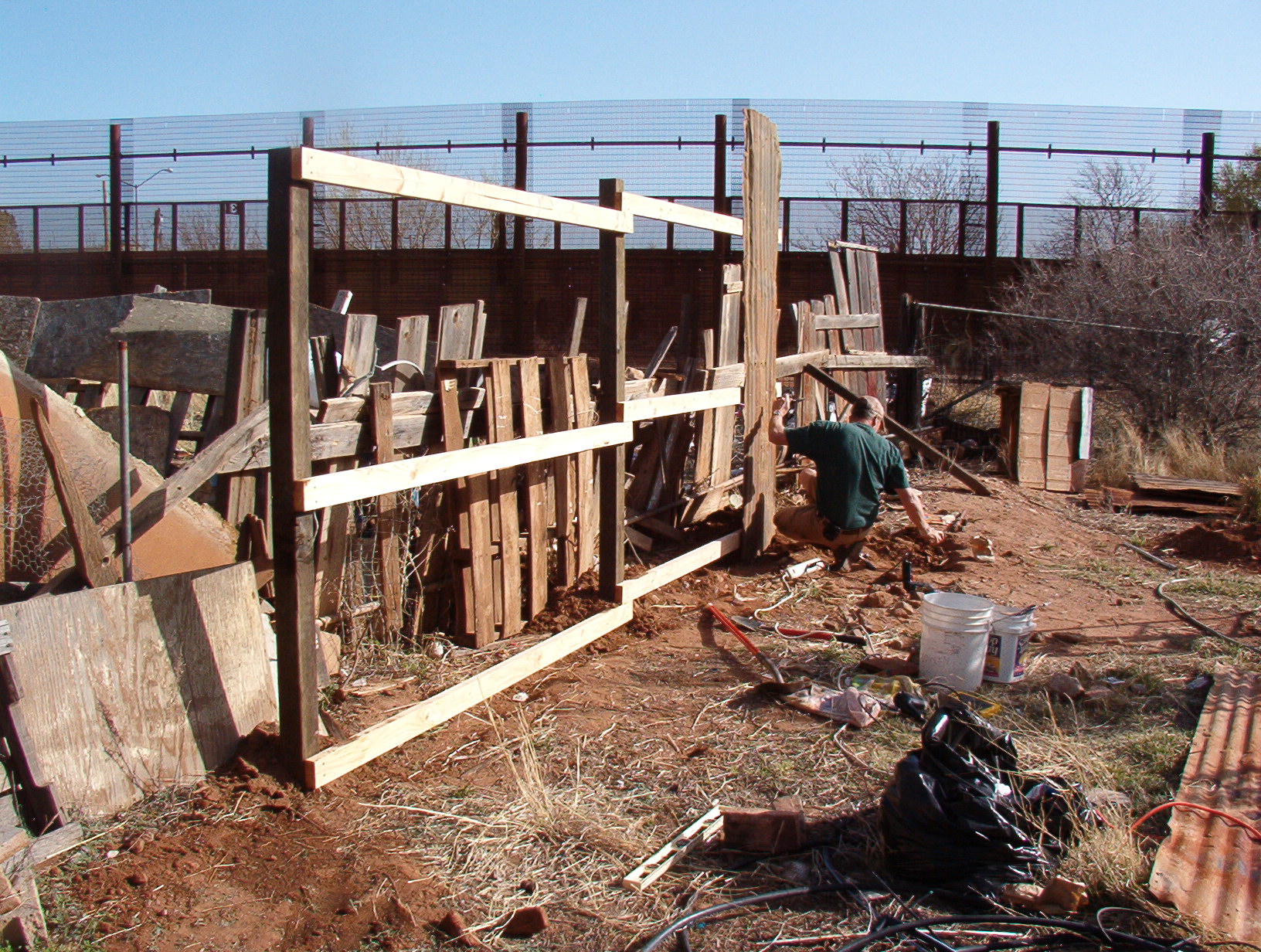
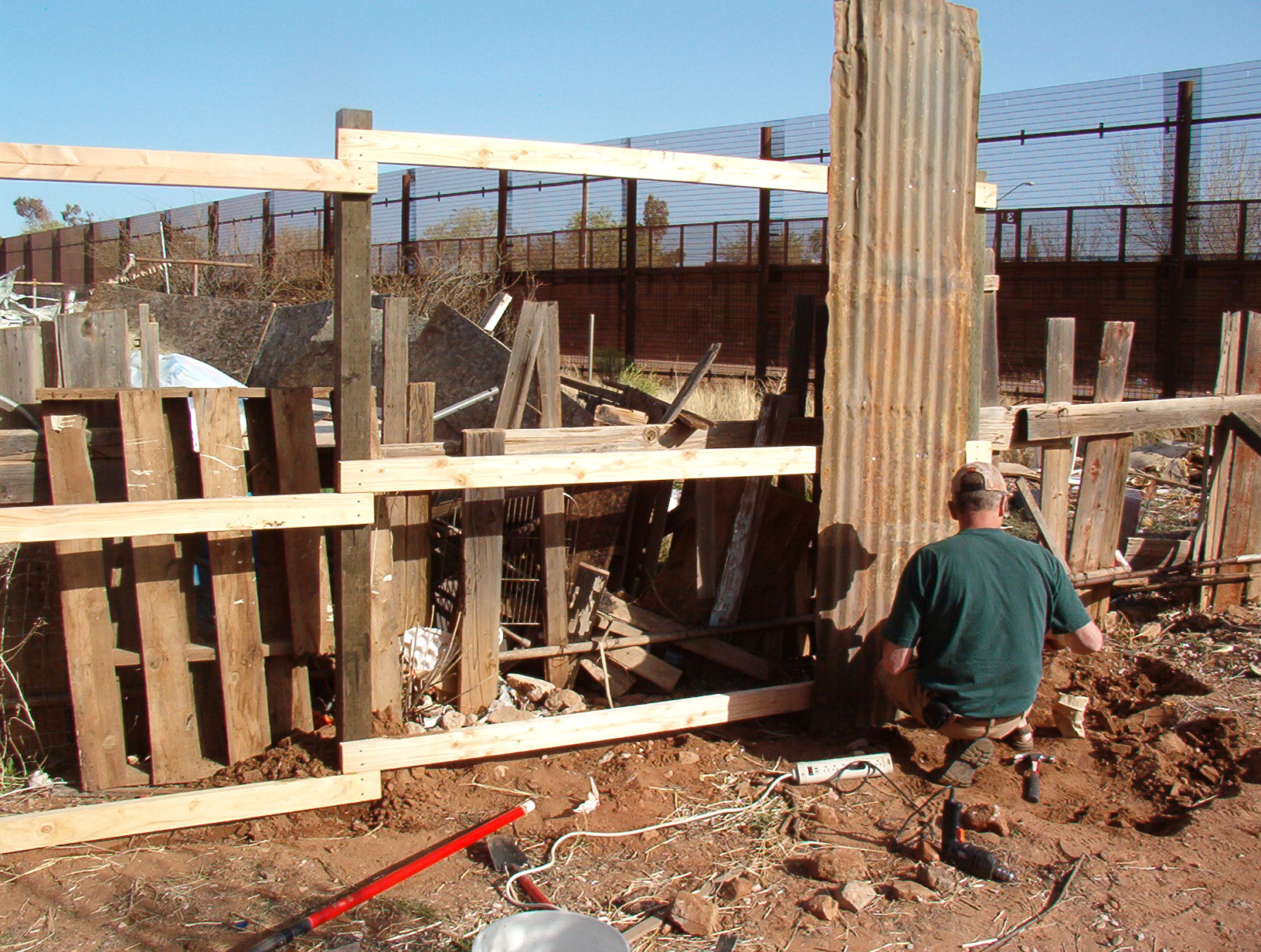
My brother showed me how to set up the 8' sections to cover with rusted corrugated roofing the wind blew off of my (quite poor) shed. But getting this wall started is giving me HOPE for something better - HOPE is something I am struggling with lately BIG TIME (That's the Mexico border there with 2 fences now and a Border Patrol road between them. I'm listening to drug enforcement choppers fly over my house as I write this - but no matter what, I love it here and it is my home. I am grateful.)
The American-Mexico border fence is visible - actually those are 2 parallel fences running alongside one another there.
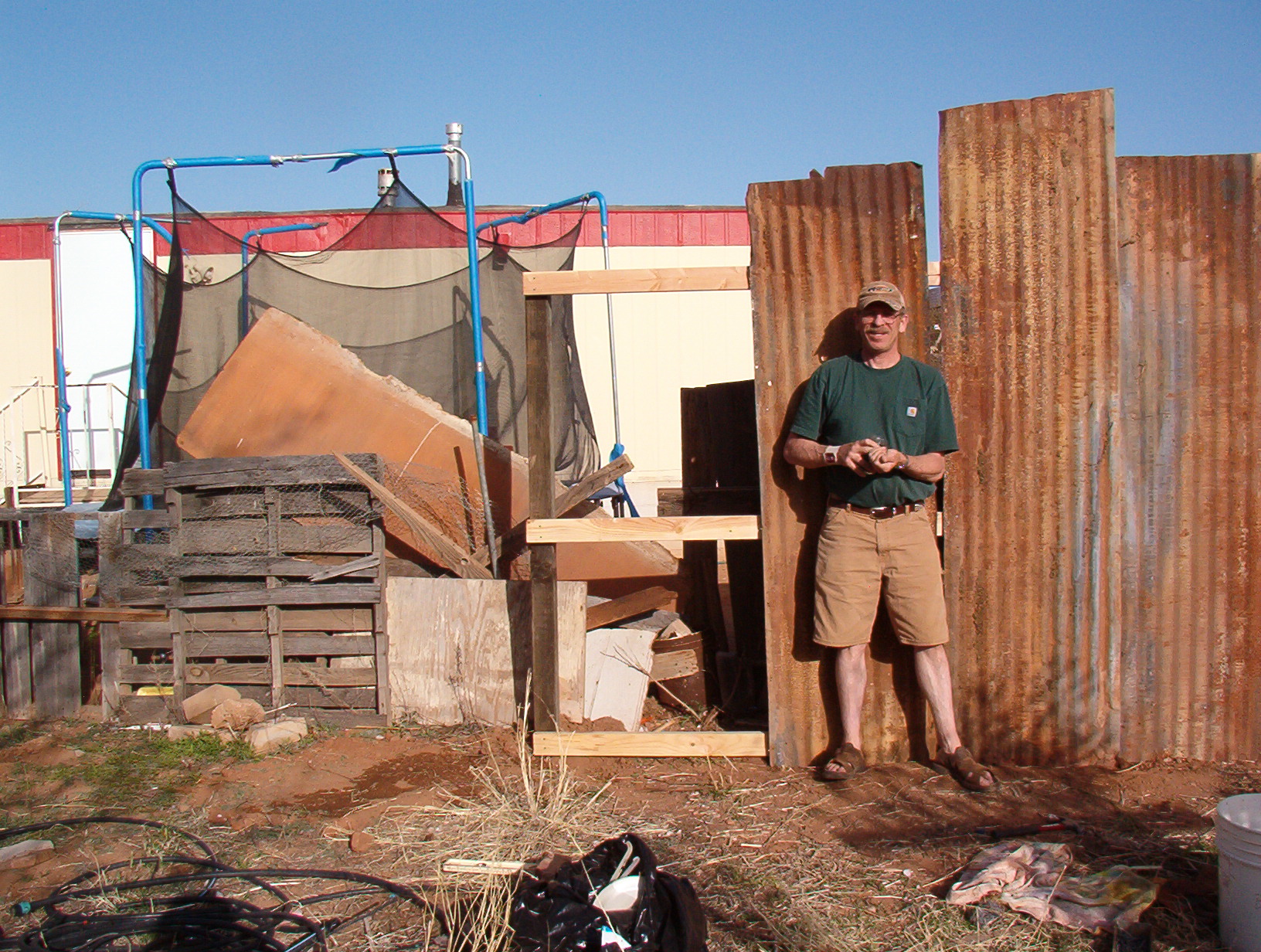
Well, my fence won't be fancy, but it's a 'step up' and will give privacy. My brother says Texas BBQ places love the rusted tin look! We priced new and it will be $200 to do 16 feet. I have enough rusted stuff to do 32 feet. Not to complain, but being poor is hard on projects - I am glad to have a large yard, and look forward to growing some food.
Laying out the line for holes to continue my own border wall - time for some clear boundaries here! Lots left to do, but even with my brother back at home in Illinois, I have confidence that I can do the rest even if it takes time to do it step by step as I can afford lumber and STUFF!

+++++++++++++++++++++++++

+IS THERE ANY OTHER WAY FOR ME TO ‘BE’ IN THE WORLD?

++++++++++++++++

Is it possible to be very nearly a species of one?  That’s how I feel today as I realize that nowhere in the ‘professional’ literature can I find much of a match for my infant-childhood experiences and how I became a changed being as a consequence.

It seems very rare that researchers ever talk realistically (from my point of view) about the ‘freeze’ response when they talk about the ‘fight or flight’ response.  I think about it as an infant-child abuse survivor because I suspect, more than anything else, it was the freeze response that I most often used in response to my mother’s abuse.

Because I never knew anything OTHER than my mother’s abuse from the time I was born, there was never a time when the flight response came to me.  There was one occasion I know of when I was a preteen that I actually ran from her.  If I hadn’t done so that time, she would probably have killed me.

The rest of the time, beginning in my infancy, I suffered, endured and persisted to live on in spite of my mother’s abuse.  But what was going on inside of me during all these experiences of trauma?  If I could not fight, and I could not escape her, was I forced to use this freeze response that nobody seems to want to talk about?

++++

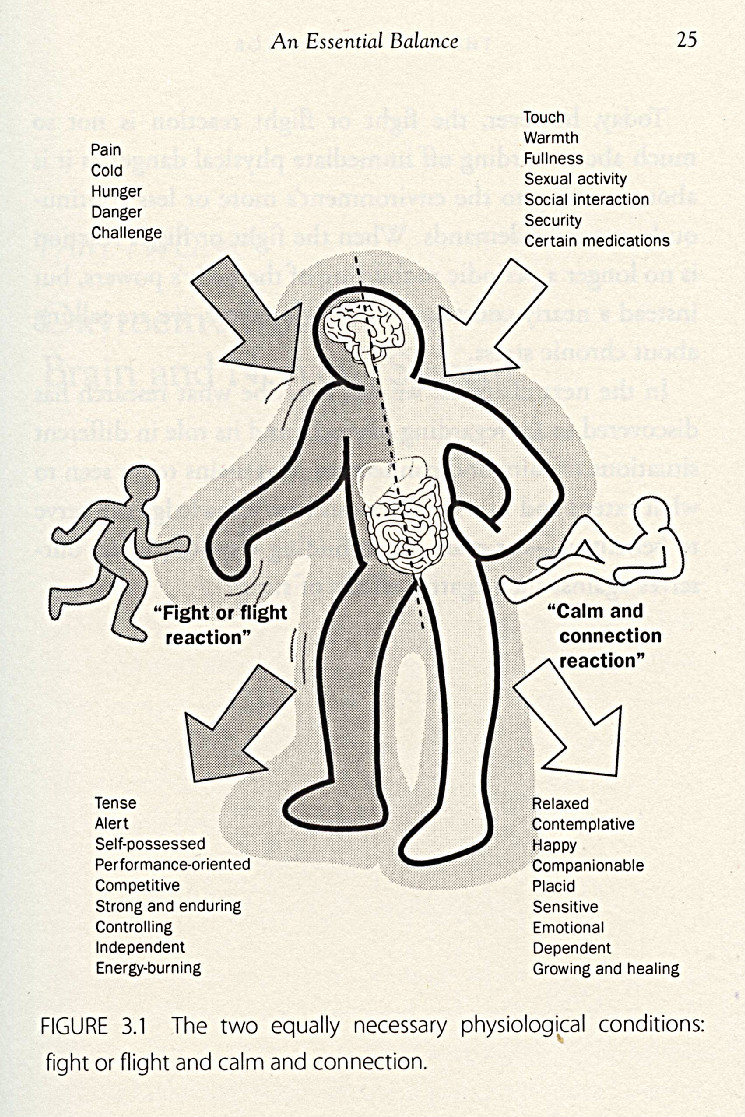
I wonder about this today in regard to this image presented in the book by Dr. Kerstin Uvnas Moberg, The Oxytocin Factor: Tapping the Hormone of Calm, Love, and Healing.

++++

I located this excellent online source of articles on trauma, although I wish the page were more up-to-date!

David Baldwin’s Trauma Information Pages

Contained among these pages is this:

Introduction to Survival Strategies

Paul Valent

This is a modification of a key chapter (chapter 7 by the same name, pp. 115-123) in From Survival to Fulfillment: a framework for the life-trauma dialectic, by Paul Valent (1998). Philadelphia: Brunner/Mazel. Copyright© by Paul Valent.

Valent presents a chart (about half way down his pages) that includes many aspects of the trauma response in detail:  Table 2 – Survival Strategy Components.  This article and table are useful, and worth reading, but Valent does not mention the freeze response, either.

Something is missing.  I don’t find what resonates with me in trauma-response writings because the authors of these writings are missing the point I need in their own thinking about trauma as it applies to many severe infant-early childhood abuse and trauma survivors.

++++

I found this article:

Inducing traumatic attachment in adults with a history of child abuse:  Forensic applications

By Felicity De Zulueta published in The British Journal of Forensic Practice * VOLUME 8 * ISSUE 3 * SEPTEMBER 2006

It presents typical theory and understanding about how particularly disorganized-disoriented insecure attachment is created and how it manifests in infants as well as in adults.  This author, as do others, suggests that the biggest problem with insecure attachment happens when the early caregiver is the source of fear to an infant.  The infant has no one to turn to for safety and security, and is left in a state of ‘fear without resolution’.

Researchers and theorists assume that an infant will do everything in its power to try to get its earliest attachment figure to respond to it appropriately (according to the infant’s needs).  What happens when absolutely nothing the infant can do – within its very limited natural abilities – works?  What happens when the efforts of the infant to generate an appropriate response from its caregiver results in unpredictable, painful, terrifying and completely inappropriate responses to its efforts?

From my point of view, I believe infants and very young children are forced to deal with this state of ‘fear without resolution’ — so that they can ‘go on being’ while in situations that present what other developmental experts call, ‘the unsolvable paradox’ – in ways that all but the most thorough-thinking and astute researchers miss completely.

The infant is left in a frozen state of helplessness that is like suspended animation.  This response shares some of the typical patterns of response assigned to the fight-flight response, but is inherently different.  I do not agree with professionals that assign the term ‘coping mechanism’ to the processes that these severely abused infants and young children are forced to develop within their growing body-brain.

Some discussion of the child response to trauma can be found here:

Childhood Responses to Threat/Coping Strategies

++++

Because my history of severe infant-child abuse happened on the far-far-from-normal range of parenting practices, I personally know that there is a whole other level to early trauma survival that even this information (above) does not address.

A child experiencing abuse develops strategies, which become coping mechanisms which enable day-to-day functioning, but yet help the child detach from the emotional and physical pain of events, especially when abuse continues over a long period of time….

In my thinking a CHILD is a far different entity than an INFANT is.  Most all research statements, like this one, make the assumption that the two stages of being human are the same.

When severe abuse occurs during fundamental, critical window-of-development stages, these so-called ‘coping mechanisms’ do NOT exist as such.  What I experience is a life lived within a body-brain that was changed in its development as a direct consequence of the trauma I was forced to endure.  I know that very real epigenetic changes occur.  I know that nervous system-brain circuitry changes.

SOMETHING ELSE results from early severe abuse.  I even believe it is more than so-called dissociation.  I believe it is more than the fight-flight response.  It is more and different even from the freeze response as presented in these writings.

++++

I am left to explore from within what I can detect about how my body-brain operates in the world – and to try to determine the nature of my experience.  I often return in my thoughts to the presentation of the unique child-woman in the movie “Nell.”  I will never forget my response to this movie the first time I watched it.

For the first time in my life I was presented with an image of a person who was more like me than anyone else I had ever imagined.  And yet even this imagined character was far different than I was.  This character had a bonded attachment at least at one point in her life to her twin sister.  She had a bizarre mother, but not a mother that hated, tormented and abused her.  Unlike me, this character did not seem bonded to the life of the natural world around her as I was growing up in Alaska.

Yet the difference between this character and other people was portrayed adequately enough to let viewers know that there was something so different about Nell that she would never in ten million years ‘be like other people’.

Thoughts of this movie comfort me now.  If you’ve never watched it, please consider doing so.  There are many realms of human experience that can only be presented through forms of art, and the state of being I am more familiar with than not is at least alluded to in this story.  But the film presents no suggestion that Nell was remotely concerned with whether or not she was like other people or if others could understand her.  How freeing that would be to me, if I could ever attain that state!

Nell did not wish to be any other way than how she was in the world.  My problems probably stem mostly from the fact that I do.

++++++++++++++++

+IN MEMORY OF MY MOTHER; LINKS TO INFO ON BORDERLINE PERSONALITY DISORDER

++++++++++++++++++++++

In memory of my mother, and of the monster that ate her, here are some links I am behind on (catching up!) on information about Borderline Personality Disorder.

++++++++++++++++++++++

But — First This, with gratitude to the person who sent me this link:

Eavesdropping on Happiness

Well-Being Is Related to Having Less Small Talk and More Substantive Conversations

++++++++++++++++++++++

+++++++++++++

From Kristalyn Salters-Pedneault, PhD

Your Guide to Borderline Personality Disorder.

It is not uncommon for people with BPD to be misdiagnosed with another disorder before getting the correct diagnosis. Many clinicians who are less familiar with BPD might assign someone a diagnosis of chronic depression, or bipolar disorder, or even an anxiety disorder. Learn more about diagnosis of BPD.

BPD and Violence – The Facts, Not the Stigma Do men and women who have BPD commit more violent acts that the general population? Are all people with BPD violent? To what kinds of violence are people with BPD most prone?

Understanding the Cluster B Personality Disorders While BPD is associated with impulsive violence, there are other personality disorders that are associated with premeditated violence. Learn more about the Cluster B personality disorders.

What is Phone Coaching and How Can It Help You? One important aspect of dialectical behavior therapy (DBT) for borderline personality disorder is phone coaching. What is phone coaching, and how can it help you cope with symptoms?

Understanding Borderline Personality Disorder Learn more about the symptoms and associated features of borderline personality disorder, including emotional and relationship instability, impulsivity, suicidality, self-harm, and more.

Proposed Revisions to the DSM – Are Big Changes on the Way? The American Psychiatric Association (APA) recently posted the proposed changes to the upcoming edition of the Diagnostic and Statistical Manual of Mental Disorders (fifth edition). Find links to the relevant changes and share your reaction.

The Current BPD Diagnostic Criteria If you want to see just how big the changes are, here are the DSM diagnostic criteria for BPD as they currently stand.
What’s In a Name? Many are surprised that the term “borderline” is not being replaced in the DSM-V. Learn more about the history of the name controversy here.
Stigma and BPD For years, in the United States and abroad, public information campaigns have tried to combat the stigma associated with mental illness. Unfortunately, these campaigns don’t seem to have been successful.

BPD versus Bipolar Disorder – How to Tell the Difference The primary reason that some clinicians confuse BPD and bipolar disorder is that they share the common feature of mood instability.

Learn how to tell the difference between BPD and bipolar symptoms.

How is a BPD Diagnosis Made? How is BPD diagnosed? What symptoms contribute to a BPD diagnosis? And who made up these diagnostic criteria anyway? Learn all about BPD diagnosis.

What to Expect from a Good BPD Assessment Many people have been misdiagnosed after an inadequate or incomplete assessment. What should an assessment look like? How do you know you’ve been thoroughly assessed? These guidelines will help you understand how to get a good BPD assessment and what to expect.

Understanding Borderline Personality Disorder Learn more about the symptoms and associated features of borderline personality disorder, including emotional and relationship instability, impulsivity, suicidality, self-harm, and more.

How to Create a Safety Plan This article covers the steps in making a clear and comprehensive safety plan. This is not something that can be done when you are already in the midst of a mental health emergency.

If you don’t already have a safety plan, bring this article to your therapist!

The Pros and Cons Tool This is a great tool to add to your safety plan – at lower levels of crisis, the pros and cons tool helps you make decisions about high risk behaviors.

Build a Social Support Network A key to a good safety plan is to have many sources of social support to rely on so that someone is always available (and so that you don’t burn-out existing supports). But how do you find support when you need it?

For Family and Friends of Individuals with BPD Does someone you care about have BPD? BPD can affect all types of relationships, including friends, family members, and romantic partners. Learn more about how BPD may be affecting your relationship, how to cope when a loved one has BPD, and how you can help..

Must Reads

What is BPD?
Symptoms of BPD
Diagnosis of BPD
Treatment of BPD
Living with BPD

++++++++++++++++++++++

+NOTHING SIMPLE ABOUT THE TOPIC OF ‘PRIDE’

+++++++++++++++++++++++

How necessary is the “Who is proud of whom for what?” game?

I feel strange.  I am face-to-face with some part of my self that can do things some other parts of my self know nothing about.  I was going to back for a few minutes today and write about something I introduced the other day when I mentioned feeling proud for our children (an for our self?).

From the blog post:  Pride in the successes, achievements and accomplishments of one’s child is just another emotion and state of being that abusive parents are deprived of.  The children of these parents are then deprived of having parents who truly appreciate them for the wonderful people that they are.

I was going to return to one of the chapters I skipped in Born to Be Good: The Science of a Meaningful Life.  He included a chapter on ‘awe’ that I wanted to read this morning because I suspected that the ability to feel awe, an experience connected to the feel good-be good happiness, compassion and connection arm of our vagus nerve system is involved in the experience of pride as well as of awe.

Problem is for me at this moment, I cannot find his book anywhere in my house.  True, I was having problems sorting out what I could believe, accept and understand in Keltner’s writing from what I suspected was grounded in arrogance and bias, but how did I manage to vanquish this book from my sight at the same time I have no memory of doing so?

I have many books on trauma on my book shelves.  Keltner’s book is not among them.  I have searched through every pile of papers, on every table top, every book shelf, in short I have looked everywhere in my house where I could have possibly placed that book once I was done reading it, and the book is nowhere to be found.  I can’t believe I would have either trashed or donated the book without having some memory trace of having done so.  Evidently I really DIDN’T like that book!  Hum…….

So I guess I will have to wing the writing of this post about pride and the vagus nerve as I figure out what I know on my insides about this experience.  Meanwhile, this me of today is very curious about where Keltner’s book is eventually going to make its reappearance in my life!  It HAS to be here some place, but I sure have managed to hide it from myself.

This experience of missing this book makes me wonder how much can we and do we manage to hide from our own self in our life, not even realizing that we are doing so?  I have to wonder at this moment.  How much do we put away, disguise, place ‘out of sight, out of mind’ in our life because our ability to tolerate has diminished something to the point we simply cannot or will not deal with it any more?  (Was I THAT sick of Keltner?)

++++

So at this point, as I continue down the pathway of “What is pride?” on my forensic autobiographical journey, I call not Keltner as my first witness, but my dear sister, Cindy.  When we spoke about the topic on the telephone last night, she mentioned that from the Christian training she had in her young adult lives, she knows that the word and concept of RESPECT is directly tied in its roots to AWE.

She also affirmed that never once to her knowledge was my mother ever proud of me.  Also, in her memory, she knows of only one single instance where she knew absolutely that our mother was proud of her.  That happened when my sister trained our family’s dog for an obedience dog show and they won first place.  Mother didn’t SAY anything to Cindy, but Cindy knew mother was proud of her.

One of my own questions about pride enters my thoughts right now, though I’ll wait for a moment to consider it.  I find myself wondering, “Is the feeling of being proud of another person tied more to conditional love than it is to unconditional love?  Is there a difference between the experience of feeling proud – really for the other or for one’s own self – based on a conditional valuing based on what a person DOES rather than on who a person IS irregardless of what they actually DO?”

But, first, to finish the thoughts from last night’s conversation with my sister, I have to mention that she told me that in all her 56 years, it has been her observation that the topic of pride is a VERY SENSITIVE ONE to many if not most people.  She believe that all of these people suffer their entire lives from a wound that means they continually ACT in ways that they WANT to create a demonstration of pride for them from their parents.

The saddest part of this is that this lack of feeling ‘proud for’ existed in their earliest years and continues to be a part of adults’ feeling reality for their entire lives – and is rarely if ever fulfilled so that the DESIRE is gone.  As a consequence, people then feel empty in a place that is never filled.  It sounds to me like there’s a wound that never heals about this, a hole that’s always there, a continually unmet attachment need that then affects how a person IS in their body, in relationship with their own self and with others, for their entire life time.

My sister understands for herself that the root of ‘awe’ that is a part of ‘respect’ means that when we hear someone say to us, “That is awesome,” we are really receiving from that person a fundamental recognition of our worthiness based on fundamental respect.  My sister believes that once we lose respect for another person, our relationship with them changes – often instantaneously – forever.  Evidently being able to have respect for another person is somehow directly tied to our ability to feel pride for them.

++++

If this is true, I have some searching to do in order that I can understand with clarity within my own self how this respect-awe-pride pathway might actually work.  Even though I cannot locate Keltner’s book anywhere in my house, I know he connected ‘awe’ to the healthy operation of the vagus nerve system just as he did embarrassment, genuine D-miles and compassion – or he would not have included a chapter on ‘awe’ in his book.

I already know that something was wrong with the operation of my mother’s feel good-be good vagus nerve system branch.  I can understand that her stress response was “ON” all of the time.  As a result, her “STOP” arm of her vagus nerve system and of her autonomic nervous system (ANS) could never be activated toward true peaceful calmness and connection to others.  She was not safely and securely attached to her own self or to anyone else.

Now I can add her lack of ability to feel pride for me, and just barely for any of her other children, to the list of ‘symptoms’ of her infant-childhood changed growth and development from trauma, abuse and neglect.

++++

From this point forward in today’s writing I have to make it clear that I think the way I do in a particular way that gives me a bias on the topic that most people do not have – either most fortunately or most unfortunately.  I evidently have some strange immunity regarding the subject of whether other people feel proud of me or not that came from my mother’s abuse of me.

I have written in previous posts that my mother’s demise that led her development down a pathway where she was incapable of experiencing either well-being for her own self or in connection to anyone else happened (I suspect) because of the very traumatic experiences she had with her earliest caregivers as they gave her so-called love that was insanely and unreasonably conditional.  She grew up believing that her personal ‘badness’ caused her caregivers to hate her.  If she could only be ‘good enough’ she could bask in the warmth of their love.

Hers was an environment of terrible and terrifying betrayal.  This betrayal broke her.  I had the benefit of having never been betrayed.  I knew she hated me from the first breath I took.  My mother did not vacillate.  She did not wander away from her first stated course of action toward me from the time I was born.  My mother never swerved off of her course.  In her mind, I was not human.  I was the devil’s child, bad beyond possibility of redemption.

I was never tricked into believing in any way, ever, that there was anything I could do NOT to be hated and abused.  I was never fooled into believing that if I could be ‘good enough’ that she would love me.  I was never given false hope either than I was loveable or that my parents could possibly love me.

True, I am painting a grim picture almost beyond belief.  I can see this even though I know that the picture I am painting was absolutely real.  At the same time I am saying that the absolute devastation of my infant-childhood gave me at the same time the possibility of surviving it as I grew into the person I am now.

I will give you this bizarre yet accurate image:  If we could imagine an infant being born into a world where no air was ever available either that infant would die or it would find a way to endure in spite of the absence of air.  If this is the reality this infant faced, and it did manage to adapt and survive anyway, the concept of ‘air’ and the experience of needing it or of being dependent upon its presence would simply never exist.

Of course we know no human can live without air.  But if we substitute love for air in this image, I can assure you humans can manage to endure without it.  I basically did.  What little bit of love-air I found came from my 14-month-older brother, and very occasionally from contact with my grandmother and father.  Eventually I became an absolute professional at being able to endure and survive on such a pitifully inadequate supply of love-air that it’s almost beyond belief.  But because it was love that I was deprived of rather than of air, my body kept on enduring and growing through its developmental stages because it could adapt to these devastating conditions.

++++

As a consequence, I cannot conceive of the world the way my sister seems to, or in the way that evidently MOST people do.  I have no ability to imagine ever wanting or desiring my mother or father to feel proud of me.  It is not possible for me to do so.  Therefore, I cannot probably empathize with all the other people who ‘have issues’ concerning their need or desire for this ‘feeling proud’ of them by their parents – or anyone else.

On some levels, having just realized this about my self is very scary.  Yet at the same time the benefit of the pattern of abuse I received seems obvious to me.  Nothing my mother did or did not do to me altered my ability to feel proud of or for my own children.

That’s pretty darn amazing!  I could call this miracle, but I understand that in no possible way are my abilities, as they are so different from my mother’s, a miracle.  My abilities, as are everyone’s, lie within me because they are physiologically possible.  My mother lacked these abilities because they were physiologically impossible for her.

My body-brain-mind-self development did not ever include the possibility of my mother loving me, or with the possibility she could be correspondingly proud of me.  Impossible is exactly just that – impossible.  Only when the POSSIBILITY exists of something happening do we ever wish for it, desire it, hope for it, anticipate it, or expect it.    I knew from the moment I was born there was no possibility my mother loved me, conditionally or unconditionally.  Her love for me or her lack of it was never an issue.  Things were simply the way that they were and that was that.

In other words, the issue of ‘sometimes’ or of ‘some of the time’ didn’t exist for me.  Ever.  My mother did not play the tug-o-war, and I mean WAR, game with me of ‘sometimes I will love you’ or of ‘some of the time I love you’ or of ‘I would and could love you if only……”  She just fundamentally hated me.  How strange, and looking at this from this present moment, how freeing for me this ACTUALLY was.

I did not learn how to conditionally love.  I did not learn how to conditionally BE loved.  At the same time, though I don’t call it a miracle, I will say the blessing of this whole pattern in combination with my own particular makeup as a person was this:  I came out of my infant-childhood completely free to love, and I DO.  How cool is that?  Cool, I would say, beyond words or measure!

++++

Physiologically, even though I suffer from trauma and abuse in-built anxiety problems of many kinds, my vagus nerve system as it connects with my STOP and GO autonomic nervous system remained able to operate so that I am free to feel a range of emotion that includes the feel good-be good emotions and their corresponding range of options for actions.  My problem lies in that RECEIVING love and affection in all its forms is difficult if not impossible for me to FEEL.  But I CAN feel these feelings for others, and if I had to make a choice, this is the better one.  It means I can offer to others what I never had myself.

++++

I want to go back for a moment here to the ideas contained in the words ‘respect’, ‘awe’ and ‘pride’ and to very real human experience of and with them.  I suspect that my sister’s thoughts on the root of ‘respect’ might be tied to the Bible’s Hebrew translation into English text rather than to the roots in English of the word itself.  I turn to Webster’s:

RESPECT

Etymology: Middle English, from Latin respectus, literally, act of looking back, from respicere to look back, regard, from re- + specere to look — more at spy

Date: 14th century

1 : a relation or reference to a particular thing or situation <remarks having respect to an earlier plan>
2 : an act of giving particular attention : consideration
3 a : high or special regard : esteem b : the quality or state of being esteemed c plural : expressions of respect or deference <paid our respects>

This description doesn’t go back far enough in its origins for my liking (14th century).  I’ll follow ‘respect’ back to ‘spy’:

SPY

Etymology: Middle English spien, from Anglo-French espier, of Germanic origin; akin to Old High German spehōn to spy; akin to Latin specere to look, look at, Greek skeptesthai & skopein to watch, look at, consider

Date: 13th century

transitive verb 1 : to watch secretly usually for hostile purposes
2 : to catch sight of : see
3 : to search or look for intensively —usually used with out <spy out places fit for vending…goods — S. E. Morison>intransitive verb 1 : to observe or search for something : look
2 : to watch secretly as a spy

This goes back further, to the 13th century, but this still isn’t far enough for my liking.  I want to find the connections as far back as the dictionary will track them (before the 12th century) because only then to I feel at rest knowing I am getting at a root image and concept.  I find that both the word ‘look’ and ‘see’ originated in the English language before the 12th century:

LOOK

Etymology: Middle English, from Old English lōcian; akin to Old Saxon lōcōn to look

Date: before 12th century

SEE

Etymology: Middle English seen, from Old English sēon; akin to Old High German sehan to see and perhaps to Latin sequi to follow — more at sue

Date: before 12th century

Under ‘see’ I can follow ‘sue’.  I find we are now moving forward in time to the 14th century and away from older images in the word, except any reference in word origins to Sanskrit always intrigues me:

SUE

Etymology: Middle English sewen, siuen to follow, strive for, petition, from Anglo-French sivre, siure, from Vulgar Latin *sequere, from Latin sequi to follow; akin to Greek hepesthai to follow, Sanskrit sacate he accompanies

Date: 14th century

The word ‘accompany’ connects to ‘companion’:

COMPANION

Etymology: Middle English compainoun, from Anglo-French cumpaing, cumpaignun, from Late Latin companion-, companio, from Latin com- + panis bread, food — more at food

Date: 13th century

And here I find what makes me happy – a reference to a fundamental image – FOOD!  The necessity for, the procurement, provision, consumption and sharing of this basic element of FOOD is connected to safe and secure attachment in and to the world:

FOOD

Etymology: Middle English fode, from Old English fōda; akin to Old High German fuotar food, fodder, Latin panis bread, pascere to feed

Date: before 12th century

++++

OK, so I don’t see ‘awe’ in this family of word connections in relationship to ‘respect’.  What do I find if I specifically follow the meanings and origins of this word, ‘awe’?  This is interesting, and not what I would have expected (someday if I find Keltner’s book it will be interesting to see how he defines ‘awe’.):

AWE

Etymology: Middle English, from Old Norse agi; akin to Old English ege awe, Greek achos pain

Date: 13th century

1 : an emotion variously combining dread, veneration, and wonder that is inspired by authority or by the sacred or sublime <stood in awe of the king> <regard nature’s wonders with awe>
2 archaic a : dread, terror b : the power to inspire dread

Uh-oh!  Follow that link to pain and find reference to ‘punishment’ and ‘grief’.  So, what about the word ‘pride’ itself?  Can this idea, with roots in our language before the 12th century, be in any way connected to a sense of amazement and awe at and for another person?  The concepts of ‘pride’ and ‘proud’ are fully RELATIONSHIP oriented, contextual ideas that involve social judgment:

PRIDE

Etymology: Middle English, from Old English prȳde, from prūd proud — more at proud

Date: before 12th century

1 : the quality or state of being proud: as a : inordinate self-esteem : conceit b : a reasonable or justifiable self-respect c : delight or elation arising from some act, possession, or relationship <parental pride>
2 : proud or disdainful behavior or treatment : disdain
3 a : ostentatious display b : highest pitch : prime
4 : a source of pride : the best in a group or class
5 : a company of lions
6 : a showy or impressive group <a pride of dancers>

PROUD

Etymology: Middle English, from Old English prūd, probably from Old French prod, prud, prou advantageous, just, wise, bold, from Late Latin prode advantage, advantageous, back-formation from Latin prodesse to be advantageous, from pro-, prod- for, in favor + esse to be — more at pro-, is

Date: before 12th century

1 : feeling or showing pride: as a : having or displaying excessive self-esteem b : much pleased : exultant c : having proper self-respect
2 a : marked by stateliness : magnificent b : giving reason for pride : glorious <the proudest moment in her life>
3 : vigorous, spirited <a proud steed>

Pause for a moment and take a look at the social judgment loading and weight related to this concept.  Look at the synonyms and try to imagine how it is possible that beginning from the time of our birth, as social beings in social interactions beginning with our earliest caregivers, we might move through our childhood and into our adulthood REALLY being able to both understand these concepts let alone being able to negotiate the billions of ways human interactions involve them:

synonyms proud, arrogant, haughty, lordly, insolent, overbearing, supercilious, disdainful mean showing scorn for inferiors. proud may suggest an assumed superiority or loftiness <too proud to take charity>. arrogant implies a claiming for oneself of more consideration or importance than is warranted <a conceited and arrogant executive>. haughty suggests a consciousness of superior birth or position <a haughty aristocrat>. lordly implies pomposity or an arrogant display of power <a lordly condescension>. insolent implies contemptuous haughtiness <ignored by an insolent waiter>. overbearing suggests a tyrannical manner or an intolerable insolence <an overbearing supervisor>. supercilious implies a cool, patronizing haughtiness <an aloof and supercilious manner>. disdainful suggests a more active and openly scornful superciliousness <disdainful of their social inferiors>.

++++

We have to consider the cultural environment that creates the social context of our human interactions – including the religious underpinnings of our culture.  These look to me to be anything but serene, calm, peaceful, safe and secure waters to negotiate!!  How can a very young child, moving through its age 4-6 stage of developing a workable Theory of Mind, even begin to comprehend what’s what socially?

My guess is that for anyone who has a reason to think about the idea of feeling proud for self or others, or of having others feel proud of them, would benefit from taking some time to explore in the real world, in real time, and in the language of the REAL words we use to talk and think about the topic, how incredibly complex it is.  We need to understand that when considering the idea of ‘proud’ we are considering what really is a war zone with mine fields of explosively emotionally dangerous, if not devastating, concepts.  This idea, ‘pride’ and feeling ‘proud’ deserves a warning:  DANGER ZONE!  HIGH RISK HERE!

++++

While all this might look like a Pandora’s Box, if I look among the above definitions carefully, I find the words that can best assist me in my thinking about the topic.  They are not the bold-typed words; they are the humble ones:  ‘just, wise’, ‘reasonable’, ‘having proper self-respect’.  Even the word ‘bold’ is up there, having to do with our ability to exercise our courage (within the origins of the word ‘proud’).  These, to me, are the important words related to the healing possibilities of how we can learn to think about our concerns related to absence and presence of ‘pride’.

These words are connected to the center point of calm in our vagus nerve and autonomic nervous system as they connect our experience within our body and brain.  They reside in the quiet, in the place of cooperation and acceptance, not of competition and judgment.  These are not frenetic words.  They are not restless or demanding words.  At the same time, we need to realize that at whatever point in the continuum of the pride-proud spectrum we stand as we consider our potential related losses and our gains, it is our ability to reach that center point on the teeter-totter that truly matters.

THAT point is where, I believe, our hope for increased resiliency and well-being lies, not with our worrying about who has what or who gives what to whom.  In the end, once a pride-proud transaction has occurred, what matters is that we feel safe, secure and attached within our own self with and to those we care most about.  This is an experience of acceptance, or peaceful ‘OK-ness’ in the world.  What matters is the love expressed, felt and shared.

++++

When I said the other day that abusive parents are deprived of the feeling of being proud of and for their offspring, which then deprives the offspring of the feeling that their caregiver IS proud of them, what we are talking about is actually degrees of love and of attachment as they connect to our emotional experience negotiated in our body-brain by our vagus nerve and autonomic nervous system.

The presence or absence of the positive transactions related to pride-proud happen physiologically just as the shame reaction does.  Both are about ‘rupture and repair’, rejection and acceptance.  Both of these are STOP and GO interactions that share their existence in the same physiological systems that our rest and stress responses do.  We can pay attention to the emotions (and how they feel to us in the body) as we experience them related to both kinds of experiences.

How our earliest caregivers treated us had HUGE influence on how our physiological body-brain developed, but our body-brain-mind-self BELONGS to us, not to them.  My mother’s hate-full treatment of me did not fill me with hate.  Yes, there are many levels of my being that are connected to my corresponding RAGE from being traumatized by her the way I was, but rage is not the same thing as hate.  But even the word ‘hate’ cannot be dissociated from its fundamental root concept in ‘care’:

HATE

Etymology: Middle English, from Old English hete; akin to Old High German haz hate, Greek kēdos care

Date: before 12th century

1 a : intense hostility and aversion usually deriving from fear, anger, or sense of injury b : extreme dislike or antipathy : loathing <had a great hate of hard work>
2 : an object of hatred <a generation whose finest hate had been big business — F. L. Paxson>

Looking carefully at what it says here I have to think about my mother’s hatred of me, and what her hatred REALLY tells me – not about me, but about her:  “intense hostility and aversion usually deriving from fear, anger, or sense of injury.”

Not even a consideration of the word ‘care’ or of all the actions that are connected to it – including early caregiver interactions that we experienced from infant-childhood (and beyond) is a simple or straightforward one:

CARE

Etymology: Middle English, from Old English caru; akin to Old High German kara lament, Old Irish gairm call, cry, Latin garrire to chatter

Date: before 12th century

1 : suffering of mind : grief
2 a : a disquieted state of mixed uncertainty, apprehension, and responsibility b : a cause for such anxiety
3 a : painstaking or watchful attention b : maintenance <floor-care products>
4 : regard coming from desire or esteem
5 : charge, supervision <under a doctor’s care>
6 : a person or thing that is an object of attention, anxiety, or solicitude

++++

Over and over and over again I will say that if there is any one single simple idea I can help to introduce to people, especially to survivors who have suffered early trauma and abuse, it is the idea of what I call INFORMED COMPASSION, which is a reason-able response.

Being gentle and kind within our own self as we seek to heal and grow DEMANDS AND REQUIRES of us that we learn how to expand this gentle kindness to a consideration of those who harmed and hurt us.  I don’t think we can grow gentle kindness within our own self while at the same time withholding it from the stance we take regarding others – because this stance we take comes from within our own self.

Compassion comes from the same systems in our body that create our stress and calmness responses.  It is an option we can exercise with our conscious intention, will, awareness and reflective abilities.  Informing ourselves by thinking about the words we use to think WITH is a critical part of this healing process.  It’s a part of our continued growth and development.  It’s a part of our continuing to grow up as we ‘grow out’ an expanding circle of understanding how incredibly complex it is to be a human being, let alone to be one WELL, in multiple senses of this word.

When we think in terms of pride and proud, we are really at the threshold of thinking about our truest concern:  Are we accepted or isolated?  Are we together-with or isolated and alone?  Are we approved of?  Are we deemed and proved worthy of being a part of the whole – which has to do with our very survival?  Because if we follow these concepts far enough back in our language that is what we are really talking about:  To be or not to be.  It’s about living or dying, being built up or being destroyed.

Fortunately, I was so busy growing up with my own survival in mind that I didn’t have time to learn to worry if the same woman who was so busy trying to destroy me was at the same time feeling proud of me for avoiding her destruction.  (Or proud of me for any other reason:  She was not a reason-able person.)  Looking at the roots of the word ‘proud’, it is my ability to recognize what is wise and just, along with my ability to be bold in pursuing what I know in my own self to be GOOD that I have, access and use my own power.

Nothing my mother did to me took these abilities away from me.  Her unconditional hatred of me seems to have been better for me that would have been her conditional love.  The trade-off seems to be that I have the ability to love unconditionally, which means I feel proud of and for my children because I CAN.

++++++++++++++++++++++++++++++++++++++