+MORE LINKS ON TEARS, CRYING AND WEEPING

++++

Why We Evolved to Cry

By JOHN TIERNEY

What’s the use of crying when you’re sad? Other animals shed tears, but humans may be unique in shedding tears of grief, and Robert Provine says that he knows why: to send a signal.

“Emotional tears are a breakthrough in the evolution of humans as a social species,” says Dr. Provine, a neuroscientist at the University of Maryland, Baltimore County. Writing in Evolutionary Psychology (pdf), he reports the first experimental demonstration of what he calls the “tear effect.” The subjects in the experiment were asked to rate the sadness of photographs of people crying, but in some of the photos the tears were digitally removed. (The experiment used actual photographs of people, not the cartoon images shown above.) When the tears were removed, the people were rated less sad, and their faces were often mistakenly interpreted as expressions of awe, puzzlement or concern. Dr. Provine concludes:

Emotional tears resolve ambiguity and add meaning to the neuromuscular instrument of facial expression, what we term the tear effect. Tears are not a benign secretory correlate of sadness or other emotional state. Emotional tears may be exclusively human and, unlike associated vocal crying, do not develop until a few months after birth. The emergence of emotional tearing during evolution and development is a significant but neglected advance in human social behavior that taps an already established secretory process involving the eye, a primary target of visual attention.

Dr. Provine says that so little is known about why adults cry that there are lots more questions to answer. “Do tears, for example, make a person appear more needy, helpless, frustrated, or powerless, as well as sadder?” he asks. “Do tears amplify a perceived emotional expression, add a unique message, or contribute a subtle nuance interpreted as sincerity or wistfulness?”

++++

Crying, Sex, and John Boehner: Not So Fast

Why the claim that women’s tears signal, ‘not tonight, dear,’ is probably wrong.

[but not by much!]

The scientists’ conclusion: “Women’s emotional tears contain a chemosignal that reduces sexual arousal in men” even though the men “did not see the women cry” or know that they were sniffing tears. Added Sobel, “This study reinforces the idea that human chemical signals—even ones we’re not conscious of—affect the behavior of others.”

The study is, predictably, getting a lot of media attention (WOMEN’S TEARS SAY, ‘NOT TONIGHT, DEAR’), but experts on tears and crying aren’t so sure the findings mean what the Weizmann scientists say they do. “I like their study very much, and I think their results are fascinating, but I have my doubts about their interpretation,” says Vingerhoets. “I suspect the sexual effect is just a side effect: testosterone, which was reduced when men sniffed the women’s tears, isn’t only about sex: it’s also about aggression. And that fits better with our current thinking about tears.”

++++

February 9, 2010

The benefits of crying

Dr. Oren Hasson, a professor at Tel Aviv University, recently conducted a study in which he studied different types of crying and the benefits of crying.  He speculated that the evolutionary advantage of crying comes from crying with your peers.  When you cry, you show vulnerability because your vision is blurred.  This allows someone who cares about you to take care of you while you are in a weakened state. According to Hasson, this is beneficial to both the caretaker and receiver because it creates a stronger relationship bond.  This means that a positive comes out of the negative situation which caused the crying in the first place.”

++++

Why Adults Cry So Easily in Animated Kids Movies – TIME Healthland

Oct 11, 2010 Why Adults Cry So Easily in Animated Kids Movies. By Belinda Luscombe Monday, The most interesting is that animated movies can be more affecting than movies with real people in them. Editors’ Picks. Research

++++

For crying out loud – Times Union

Jul 2, 2010 The most extensive research into this particular aspect of human behavior to More elucidating studies — from a parent’s perspective, was fine to reach for the tissues during moving moments in movies. And, it seems, adults cry for pretty much the same reason babies do: we want attention.

++++

Emotional Intelligence Gets Better With Age

A recent study conducted by the University of California, Berkeley (in conjunction with Arizona State University,) concludes that emotional intelligence peaks as we enter our 60s.

++++

see also:

+A START ON THE TOPIC OF TEARS, CRYING, WEEPING, THE ANS AND ATTACHMENT….

++++

+INFANT-CHILD ABUSE, SUBSTANCE P AND A LIFETIME OF SADNESS

++++++++++++++++

I have yet to find a way to write about the connection I know exists between infant-child violent trauma caused within an abusive environment and the lifelong experience of living in a body that henceforth knows ONLY one thing for sure:  Pain of Sadness.  Nor can I find ANYONE who has clearly written about this subject before me as it involves Substance P and depression caused by infant-child abuse.

I know intuitively (and my body knows it) that Substance P (our pain neurostransmitter), chronic sadness, chronic depression, chronic anxiety ‘stress response’ (PTSD) and an extremely insecure and unsafe infant-toddler-child attachment-relationship environment are absolutely connected.  I also believe that future research that focuses on these connections will show I am right.  This is logical because ABUSE CAUSES PAIN and when this pain is extreme (and chronic), happens early in an infant-child’s life during its rapid growth during critical windows of development, and involves a failed-dangerous attachment relationship, there is no way that the Substance P system (along with all other developing physiology of a little one) could NOT be radically changed as a consequence.

I still believe that all Trauma Altered Development due to growth of a human infant 0-3 (and beyond) in an environment of violent trauma and malevolent deprivation is orchestrated by the immune system in a feedback-loop process that changes the body-brain we live in for the rest of our lives.

Sometimes when I turn to an online search regarding a topic that is front and center in my thinking I am astounded to immediately locate EXACTLY what I need.  The excerpt from a research study specifically refers to Substance P, the neuropeptide of pain signaling, as being connected to the stress-fear response related – in my thinking – to interrupted early attachment:

Substance P causes a “fight or flight” response, and there is evidence of substance P antagonists blocking this stress response via blockade of substance P receptors in the amygdala.  There are multiple animal models providing evidence for this. Guinea pig pups that are separated from their mothers make vocalizations that seem to result from increased substance P released in their internal amygdala. [This bold type and italics is mine.]  Substance P antagonists inhibit these vocalizations. More direct evidence has come from cats who manifest rage behavior when their medial hypothalamus is stimulated. The medial hypothalamus has direct projections to the medial amygdala. Substance P antagonists as well as antidepressants block this behavior. Similar effects have been noted in hamsters with forced intruders in their cages and in mice forced to swim. There appears to be no direct interaction between substance P antagonists and antidepressants; substance P antagonists seem to work at sites unrelated to monoamines.

Other areas of the brain that have been implicated in substance P activity are the dorsal raphe nucleus and an area of the thalamus called the habenula, which has the highest density of substance P receptors. The habenula inhibits firing of the dorsal raphe nucleus. The dorsal raphe consists of approximately 50% serotonin neurons and 50% substance P neurons.”

“It [Substance P] is thought to be the primary neurotransmitter for nociceptive [pain] information.”

2001 informative and fascinating article on Substance P (CLICK FOR FULL ARTICLE) by Harrison S, Geppetti P., Italy

++

Article on cell communication and signaling from Germany (2008):

Impact of norepinephrine, dopamine and substance P on the activation and function of CD8 lymphocytes

During the past 30 years in became evident that neurotransmitter are important regulators of the immune system.  The presence of nerve fibers and the release of neurotransmitters within lymphoid organs represent a mechanism by which signals from the central nervous system influence the immune cell functions. Neurotransmitter per se cannot induce any new function in immune cells but they are mainly responsible for the “fine-tuning” of an immune response.”

neurotransmitters are specific modulators of certain immune functions.”  [bold type is mine]

++

Divergent effects of norepinephrine, dopamine and substance P on the activation, differentiation and effector functions of human cytotoxic T lymphocytes (2009)

Neurotransmitters are important regulators of the immune system, with very distinct and varying effects on different leukocyte subsets…..  Conclusion:  Neurotransmitters are specific modulators of CD8 + T lymphocytes not by inducing any new functions, but by fine-tuning their key tasks. The effect can be either stimulatory or suppressive depending on the activation status of the cells.”

++

(Hypertension. 1997;29:510.)
© 1997 American Heart Association, Inc.

Hypothalamic Substance P Release

++

From Harvard Medical School – Harvard Health Publications

Depression and pain

Hurting bodies and suffering minds often require the same treatment.

(This article was first printed in the September 2004 issue of the Harvard Mental Health Letter. For more information or to order, please go to http://www.health.harvard.edu/mental.)

The convergence of depression and pain is reflected in the circuitry of the nervous system. In the experience of pain, communication between body and brain goes both ways. Normally, the brain diverts signals of physical discomfort so that we can concentrate on the external world. When this shutoff mechanism is impaired, physical sensations, including pain, are more likely to become the center of attention. Brain pathways that handle the reception of pain signals, including the seat of emotions in the limbic region, use some of the same neurotransmitters involved in the regulation of mood, especially serotonin and norepinephrine. When regulation fails, pain is intensified along with sadness, hopelessness, and anxiety. And chronic pain, like chronic depression, can alter the functioning of the nervous system and perpetuate itself.

The mysterious disorder known as fibromyalgia may illustrate these biological links between pain and depression. Its symptoms include widespread muscle pain and tenderness at certain pressure points, with no evidence of tissue damage. Brain scans of people with fibromyalgia show highly active pain centers, and the disorder is more closely associated with depression than most other medical conditions. Fibromyalgia could be caused by a brain malfunction that heightens sensitivity to both physical discomfort and mood changes.

++

An online chapter reading on Sadness and Depression – worth a read.  Unfortunately (on page 7) the article does not state that failed safe and secure attachment with a primary caregiver(s) is probably the most neglected ‘cause’ of depression at the same time it influences genetic expression most powerfully.

++

“Substance P (SP) is thought to have an impact in the pathophysiology of depression and the mechanism of action of antidepressant drugs.”

Substance P serum levels are increased in major depression: preliminary results

By Baghai et al., University of Munich, Germany, Biol Psychiatry 2003 Mar 15;53(6):538-42

++

More United Kingdom research on Substance P and depression HERE

++++++++++++++++++

I ask, “What happens to our development when contact with humans causes infants pain rather than brings them reward (Dopamine, a reward-related chemical)?”

Transitions in infant learning are modulated by dopamine in the amygdala

By Barr et al., Nature Neuroscience 12, 1367 – 1369 (2009)

++

International research team on infant frontal cortex development at 9 months:

Polymorphisms in Dopamine System Genes are Associated with Individual Differences in Attention in Infancy

By Holmboe et al., Nature Neuroscience 12, 1367 – 1369 (2009)

++++++++++++++++++

+SUBSTANCE P – IT’S OUR BODY’S BIOLOGICAL LINK TO FEELING EMOTIONAL AND PHYSICAL PAIN

++

Interesting article:

Sadness Strengthens with Age

Researcher “…Levenson thinks the heightened sadness response might be beneficial for maintaining and strengthening social ties. Sadness “is a very functional emotion,” Levenson says. “It’s an emotion that really brings people towards us and motivates them to help us.”

SEE ALSO:

+CLEAR ARTICLE ON LIFELONG INFANT-CHILD TRAUMA CONSEQUENCES

+++++++++++++++++++++++++++++

+TODAY’S PURSUIT OF HAPPINESS

+++++++++++++++++++++++++

Life, liberty and the pursuit of happiness —  the fundamental human rights declared in 1776 as The United States of America took its form as an independent nation.  Where do abused infants and children look for their portion of these rights?  To their caregivers.

As I work again today out in the sunshine on this glorious day, and as I pay attention to how I feel in my body, I know I am not happy.  I am aware that what I am accomplishing is to lessen my continual sadness.  “What, then,” I ask myself, “might contribute to something MORE than a lessening of sadness?  What — if you use the powers of your mind to think and dream, might actually give you some measure of happiness?”

Well, at least I am in PURSUIT OF HAPPINESS!  That’s the right direction for me to go as far as I can tell.

Happiness is NOT ‘just’ a lessening of sadness.

I’ve also been thinking about the ‘all right’ feeling as being a measure of a state of well-being.  Oh, how seldom, how very, very seldom have I EVER experienced THAT feeling state:  All is right.  I am all right.

Knowing one is all right in the world is, to me, the rock bottom accomplishment given to an infant-child by its attachment-caregivers from birth so it can build this feeling state into its body-brain from the beginning of its life.  From that time forward this feeling state remains built into the body and is therefore accessible to a person.

Being slapped and hit and yanked and punched and dragged around by hair and limb, having one’s skin punctured by grasping talons of fingernails, being screamed at and……..  Well, as I an other severe abuse survivors well know, these threatening, dangerous, traumatic and terrible-terrorizing conditions of infancy and childhood simply COULD NOT POSSIBLY build into our body a feeling of being ALL RIGHT.

Nope.

Never happened.

So here I am in adulthood sunk in the ‘depression’ of terrible sadness in the Meteor Crater I found myself born and battered in (not perched precariously at the top of a high precipice fighting to the death with her anger and rage against all perceived attacks, as my mother was).

Today I am practicing using my mind, thoughts and dreams to see if I can modulate-moderate the feelings of sadness into something that might resemble what I guess happiness is — or at least make progress toward an inner feeling of ALL RIGHT.

This is what I have come up with so far:  If I could finish this garden, and name it The Secret Garden,  then perhaps I could search out programs in this region of Arizona that work with abused children and invite them to come visit.

When I was five, and before our family moved from Los Angeles to Alaska, we visited an immense garden somewhere on a hill.  I have never forgotten that glorious garden, and every single time in all my 54 years since that day when I think of that garden I feel not only a little-bit-less-sad, but for a brief flash of time I feel almost-happy.

Perhaps if I can create a magical garden here, designed especially for the eye level and imagination of five-year-olds, and then these little people who have been traumatized, battered and abused could come wander around here, MAYBE they too could carry within their body-brain-mind-self a memory that would ALWAYS be happy enough to displace their sadness (or rage) and provide for them a glimmer of true — ALL RIGHT — joy!

Big people could come, too — but it is to the little ones’ joy that I now return to my digging and adobe creation.  May all of us today pursue our happiness!

+++++++++++++++++++++++++

+MY HEART IS NOT BREAKING – IT’S BROKEN

++++++++++++++++++++

I don’t think I’m alone in how I feel right now.  In fact, I’m quite sure other commenters have talked about this — feeling like we MUST act phony around other people, never truly feeling OK being our authentic (often quite miserable) severe infant-child abuse survivor self.

I spent the day physically active, working hard to concentrate on every screw I placed, every rock I placed, every paint brush stroke, every step I took throughout the day — so I could, if possible, neither THINK or FEEL.

The fact of the matter is that I don’t want to be alive.  I wondered about this today in terms of how I felt as a child way before I could ever think in terms of not wanting to be alive.  I think it’s something my body knew, my soul knew – but I had no words for anything I felt.  I had no thoughts about anything I felt, either.

But for all my suffering for those 18 first years, did I not want to be here?  Do I feel the same today as I did back then only now I know what and how I feel?  Today I realized it’s not accurate for me to say “My heart is breaking.”  My heart is broken.  It broke when I was very very very young and small, and I honestly think, except for distractions over the years of my life, that my heart has always been broken and always will be.  At 58 I’ve run out of rope waiting for a miracle.

As I’ve written before, being diagnosed with advanced, aggressive breast cancer nearly 3 years ago was most difficult because I KNEW I didn’t want to be here.  I can’t say that I went through any of my treatments because I truly wanted to.  Authenticity would have me dead by now.  I fought it for everyone else, and I am mad as hell I am still here – and that’s the authentic truth.

As one commenter suggested today, no amount of compassion or forgiveness, empathy or understanding, no amount of intellectual fact finding is ever REALLY going to take the pain away of what was done to us.

++++

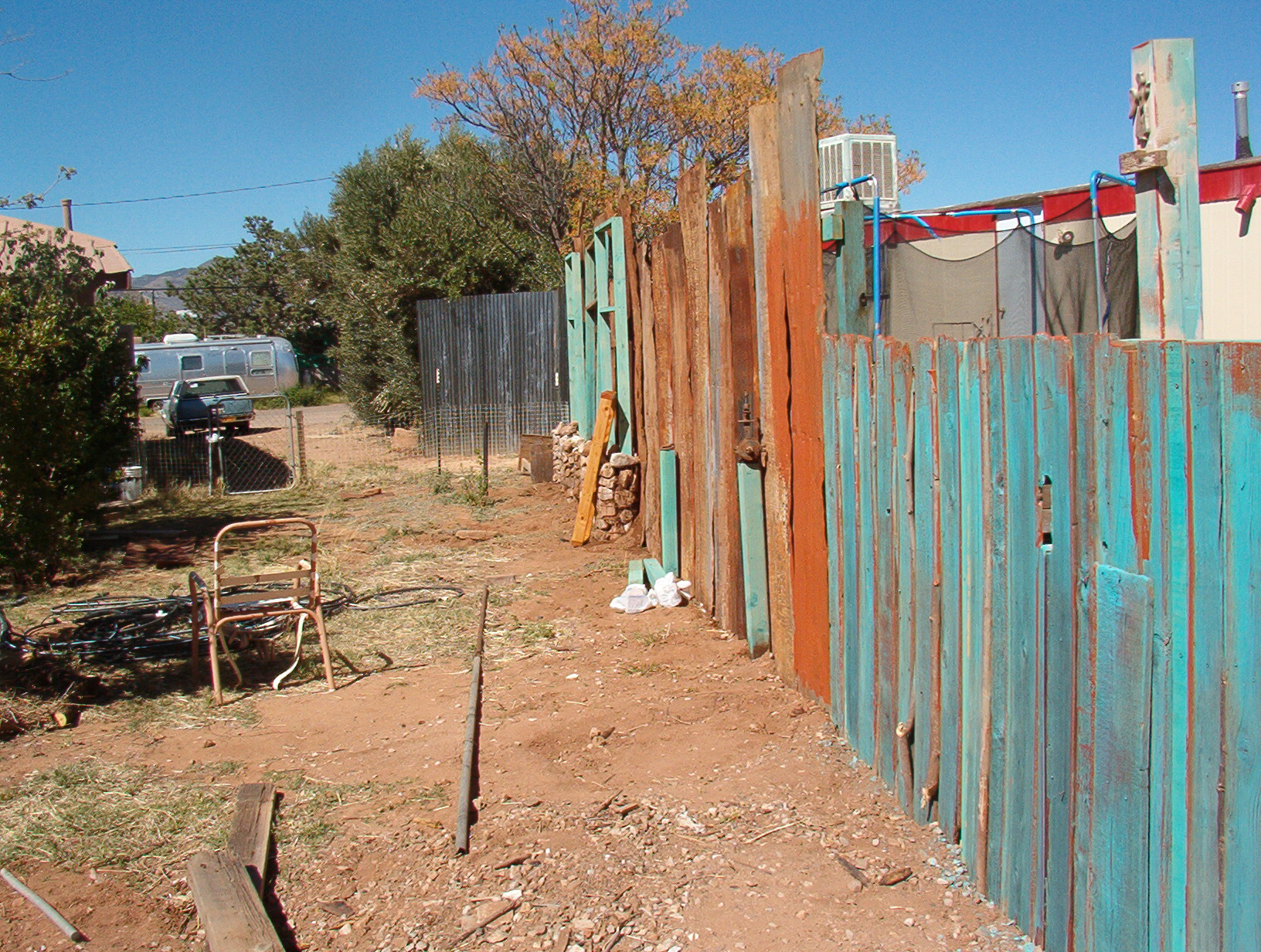
One thing I did today was toss every single piece of my mother’s writing I have already transcribed into the compost pile.  (For some reason all pictures are included in the slideshow, but below that is the description that goes along with the fence pics!)

This slideshow requires JavaScript.

++++

I also finished the fence:

I ran out of recycled rusty steel so yesterday spent $160 for materials to finish these two 8-foot sections (8' tall, some of the rusty stuff is 10', with one piece 12') - stuff today is FLIMSY! and costly!
Looking north at the entire fence (that's the neighbor across the street's trailer, my El Camino) - I don't know yet if/how I'm going to close this end off - the tall upright forms, held by rocks in wire, are designed to (anti-wind) stabilize the tall steel pieces I have to way to cut. Now, all I need are 3 climbing rose bushes to plant and train on them
I was lucky a couple of years ago - went to our 'dump' area and they actually had some paint there to take, this yellow is from there, watered down, still have a little left to touch up tomorrow - interior paint, but what the heck!
3-block form for adobe bricks I made today, it's soaked with motor oil so the mud will slide out - not ideal dirt here, too sandy, will add a little cement and hope it works - plan to level the yard, taking 'extra' and turning it into bricks - I love making adobe, haven't done it since I lived in Taos, New Mexico in 1994-5 (that was perfect mud to mix with sand)

++++

So, without being able to see the man I love I am miserable.  There is no reprieve now.  I have to work every second of 24-hours (even when I try to sleep) – yes, it makes me soul weary!  I ‘try’ to feel grateful.  I ‘try’ to think about how I might ‘help others.’  I ‘try’ to have hope.  But most of the time I feel like I am running up hill on empty.

++++++++++++++++++++

12 Alternatives to Lashing out at Your Child

In honor of April as Child Abuse Prevention Month, please remember when the big and little problems of your everyday life pile up to the point where you feel like lashing out, don’t take it out on your kids. Try any or all of these simple alternatives:

1. Stop in your tracks. Step back. Sit down.

2. Take fave deep breaths. Inhale and exhale slowly.

3. Count to 10. Better yet, to 20. Say the alphabet out loud.

4. Phone a friend or relative.

5. Still mad? Punch a pillow. Or munch on an apple.

6. Do some sit-ups. If you have someone to watch your children, take a walk.

7. Flip through a magazine, book, newspaper, or a photo album.

8. Pick up a pencil and write down your thoughts.

9. Take a hot bath or a cold shower.

10. Lie down on the floor or just put your feet up.

11. Listen to the radio or your favorite music.

12. Call the Prevention & Parent Helpline at 1-800-CHILDREN, from anywhere in New York, in English and Spanish. The Parent Helpline can connect you to programs and services where you can get help.

++++++++++++++++++++

+HOPE FOR HEALING TRAUMA IN THE BODY

+++++++++++++++++++++++

Where can severe trauma survivors look for our best-guess for healing?  In a way this next direction I am going with my study, reading and writing surprises me.  Yet at the same time I am grateful for both this inner guidance system I seem to have that tells me what I most need for healing and for the fact that again and again, I trust and follow this guidance.

Not long ago I wrote a post about an article I had found sometime in the past, printed, and added to the ever expanding pile of papers that grows here on my desk in front of my computer.  By the time I picked it up and read it through and wrote my post about it, I had no memory of how, where or when I had found it online.  The information I will be working with next for as long as it takes me to understand it as thoroughly as I possibly can comes from a book that was referenced in that article.

I ordered this book, written by this Swedish doctor:

The Oxytocin Factor: Tapping the Hormone of Calm, Love, and Healing by Kerstin Uvnas Moberg, Roberta Francis, Kerstin Uvnäs Moberg, and Translated by Roberta Francis (Hardcover – Sept. 16, 2003)

The book is lovely, solid and comforting even in its design and construction.  It is well made and well written, and as I hold it in my hands and begin to explore its message and teaching, it gives me great hope of healing for any trauma survivor, especially for those of us whose body-brain was designed and built by, for and within early infant-childhood environments of malevolent treatment.

++++++++++++++++++++++

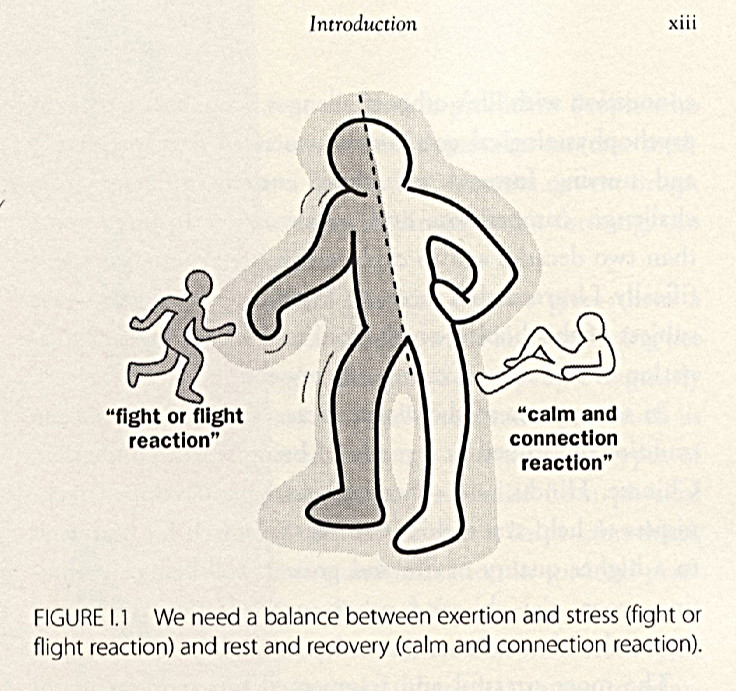
I first want to share with you a copy of an image that appears within the introduction to this book.  It is a simple graphic illustration about what everyone needs, especially trauma survivors who will have to work extra, extra hard to reach this desired balance in our body, nervous system, brain, mind and self between states of alarm and states of calmness:

Infant-child abuse and other survivors of severe trauma DO NOT get to experience what this balanced harmony feels like -- if at all possible, it's time that we DID!

++++++++++++++++++++++

As we look at this picture we are really looking at a visual depiction of what safe and secure attachment gives to us.  If this balance had existed in our parents, especially our within our mother from the time we were conceived and born, our physiological systems including our brain would have been able to develop within us to match this desired state for ourselves.

In early environments of threat, danger and trauma, this picture was missing within our universe because it was missing within our earliest caregivers whose job it was to MAKE an equally safe and secure environment for us so that we could have safe and secure attachment relationships that would have built our body-brain into an entirely different one that the one we ended up with.

I believe that the more we can learn about the information presented in this book the better we will be able to begin to recreate safe and secure patterns within our body-brain-mind-self NOW, no matter what our early forming environment was like.

In fact, we might be able to think about our condition in these most simple terms.  A trauma-built body-brain, formed through unsafe and insecure attachment conditions, continues to run on the fuel of cortisol and the stress hormones creating patterns of freeze, flight and fight response that translates into ‘anxiety problems’.

On the other hand, early safe and secure attachments design and build a body-brain that can run on the fuel of oxytocin or the ‘feel good’ chemical of peaceful calmness and positive connection to self, others and the world.  It is the body-in-balance as the above picture describes that is our goal for our healing.  Oxytocin is a critical neurotransmitter of peace and cooperation.  Cortisol is a critical neurotransmitter of stress, threat and danger.

++++++++++++++++

I find a powerful confirmation of my intuition that I am moving in the right, good and healing direction in my studies when I read in Dr. Moberg’s introduction that she immediately mentions the biases that exist in MOST mainstream medical research.  Those readers who followed the difficult time I had in my struggles with Dr. Dacher Keltner’s book will understand how affirming, comforting and freeing it is for me to find an authority on the subject of human ill- and well-being who recognizes the biases up front that Dr. Keltner seemed to be oblivious to yet relies upon and utilizes heavily in his work.

Moberg notes that fully 90% of published research focuses on the stress response, or sympathetic GO branch of our nervous system while only 10% is devoted to the parasympathetic STOP branch (remember:  pair-a-brakes) branch.  She states about this bias:

“…an interest in the physiology of performance, exertion, and defense has dominated existing scientific knowledge and current research to an extent that we do not always recognize.  This way of looking at things, or shall I say those blinders, has until now kept those of us who work in the medical sciences from seeing the calm and connection response as a separate and valuable physiological system.  Thus, for me, studying this system has involved an element of swimming against the tide with respect to the political mainstream in my profession.”  (pages xii-xii of her introduction)

This imbalance in research focus HIGHLY impacts infant-child abuse and maltreatment survivors, as it does anyone experiencing difficulties with so-called anxiety (including dissociation, PTSD, depression, personality disorders, etc.)  We are in desperate need not only of healing, but of accurate information that can help us DO SO.

As Moberg writes:

“The neglected physiological pattern I will describe in this book is the opposite pole to the fight or flight reaction.  Like most other mammals, we humans are able not only to mobilize when danger threatens but also to enjoy the good things in life, to relax, to bond, to heal.  The fight or flight pattern has an opposite [effect] not only in the events of our lives but also in our biochemical system.  This book deals with the other end of the seesaw, the body’s own system for calm and connection.

“This calm and connection system is associated with trust and curiosity instead of fear, and with friendliness instead of anger.  The heart and circulatory system slow down as the digestion fires up.  When peace and calm prevail, we let our defenses down and instead become sensitive, open, and interested in others around us.  Instead of tapping the internal “power drink,” [of stress-related neurotransmitters] our bodies offer a ready-made healing nectar.  Under its influence, we see the world and our fellow humans in a positive light; we grow, we heal.  This response is also the effect of hormones and signaling substances, but until now, the connections among these vital physiological effects have not been fully recognized and studied.

“The neglect of this system tells us much about the values that underlie scientific research.  The calm and connection system is certainly as important for survival as the system for defense and exertion, and it is equally as complex.  Nevertheless, the stress system is explored much for frequently….

“One reason why research has been so slanted may be that goal-directed activity is emphasized so strongly in our culture.  We are used to defining activity as something moving, something we can see.  But many of the calm and connection system’s processes and effects are not visible to the naked eye.  They also occur slowly and gradually, and they are not as easy to isolate or define as are the more dramatic actions involving attack and defense….physiologists have studied the clearly visible fight or flight mechanism but have been less able to perceive the more hidden and subtle calm and connection system.

“The calm and connection system is most often at work when the body is at rest.  In this apparent stillness, an enormous amount of activity is taking place, but it is not directed to movement or bursts of effort.  This system instead helps the body to heal and grow.  It changes nourishment to energy, storing it up for later use.  Body and mind become calm.  In this state, we have greater access to our internal resources and creativity.  The ability to learn and to solve problems increases when we are not under stress.

“I believe that it is extremely important to increase our understanding of the physical and psychological workings of this antithesis to the fight or flight system.  We need both, since for each individual in each situation there is an optimal way to react.  But it is now well known that long-term stress can produce a variety of psychological and physical problems.  If we are to be healthy in the long run, the two systems must be kept in balance.”  (pages x-xiii of her introduction)

Moberg states very clearly that her interest in the connection system is rooted in her experience of mothering her four children.  Her description of mothering would be the antithesis of my mother’s experience with mothering me.  As I have already noted, it is very clear that the vagus nerve and autonomic nervous system of Borderline’s works with a distortion of the stress-caregiving response systems.  Moberg’s writings are about how things are SUPPOSED to work:

“In pregnancy, nursing, and close contact with my children, I experienced a state diametrically opposed to the stress I was familiar with in connection with life’s other challenges.  I was aware that the psychophysiological conditions associated with pregnancy and nursing fostered something entirely different from challenge, competition, and performance.  Inspired more than two decades ago to explore this life experience scientifically, I learned that there is a key biological marker – the subject of this book – on the trail to a physiological explanation of this state of calm and connection.”  (pages xiii-xiv of her introduction)

++++

It does not surprise me one bit that it would be not only a female researcher, but also one that has her roots on interested grounded in her experience of mothering that I would now turn to for answers about how the terrible imbalance that survivors of severe infant-child trauma have in their body-brain as a consequence of being formed by trauma can be healed.  In profoundly critical ways early abuse survivors were deprived of the safe and secure early attachments – especially with our mothers – that we desperately needed to grow a healthy balance of peace and calmness into our body-brain from the start.

For all the millions and millions of American children and adults that suffer from obesity, depression and other anxiety-related problems, from addictions, from relationships dis-orders, I believe that it will be in gaining factual information about how our body-brain can be rewired for safety, security, connection, and peaceful calmness that our best chance will come for healing.  I am most hopeful that Dr. Moberg’s writings will give me many important answers that I seek.  I will literally keep you posted on what I discover!

++++++++++++++++++++++++++++++++++++++

+CALM THE CRYING BABY — IMMUNE SYSTEM STIMULATES VAGUS NERVE TRAUMA ALTERED DEVELOPMENT

+++++++++++++

I have been in HOT pursuit of an idea all day.  This thought has lingered inside of me for 4 years in a ‘body knowing’ place because of what I know as a survivor of severe abuse and malevolent treatment from birth until I left home at 18.

In order for this idea to be given form I need to link it to other people’s related thoughts, and many of these ideas are only recently appearing as science races into a new place of truth about what it means to be a human — and how we develop in interaction with our environment from out conception.

I am not a scientist.  Even if I come up with a theory, and develop an hypothesis, I cannot create or perform research to either prove or disprove my ideas.  So, I have to use the interactive thinking the web provides and see what I can come up with.

And I found something very exciting – but I could not find it until I included the words ‘fish’ and ‘evolution’ into my search on the ‘vagus nerve’ and ‘the immune response’.

It has been my thinking that there has to be a point within the body — and within the body of a developing infant-child exactly ‘where the fire meets the gunpowder’.  A tiny person is powerless to stop trauma that happens to it from outside of its body.  It is therefore forced to try to stop the trauma ON ITS INSIDES.

This STOP action is the job of the vagus nerve as it controls the parasympathetic STOP arm of our Autonomic Nervous System and interacts with our immune system.  Right at this point where the developing body has to try to STOP the force of the impact of trauma ON ITS INSIDES is where Trauma Altered Development is forced to kick in.

It is RIGHT here, at this present moment in time where I cannot think into the future and must patiently await for science to confirm what I know is true – that RIGHT here where the fire meets the gunpowder, where a developing infant-child has to adapt within a malevolent environment and alter who it is becoming that EPIGENTIC forces that interfere with normal development by altering the immune system-vagus nerve-Autonomic Nervous System and brain interactions in preparation for survival within a toxic, malevolent unsafe and insecure attachment environment come into play.  The research proving this point is coming, but it is not entirely here yet.

This, I believe, is where and how what Dr. Martin Teicher calls evolutionarily altered development happens.  When a tiny growing body cannot STOP the ongoing affects of trauma happening to it from outside its body, the STOPPING happens on the inside.

This form of Stop the Storm of the impact of trauma — within a developing little body — causes things to happen like what happened to change my mother into the monster she became.  She could not afford to experience the suffering deprivation-trauma caused her so her body found a way to STOP it.

++++

My idea goes back to the very beginnings of how severe abuse and neglect in a malevolent environment force a newborn to begin to alter its development in adaptation to the deprivation-traumas that surround and impact it.

Thinking about how a tiny little body has so much work to do to grow its Central Nervous System including its brain, and about how its Autonomic Nervous System is able to at least control its heart rate and breathing from birth, knowing that an infant’s immune system is already in operation, I think about how all these developing processes interconnect.

I believe that it is the job of the immune system to protect and defend us within our environment.  I therefore suspect that it is our immune system that responds to the toxins in our environment – and if our earliest caregivers actually maltreat us and are themselves toxins in our early world, then our immune system must respond accordingly.

In this response to threat, to trauma, all our development is changed.  I suspect that there is an intersection within us where our immune system affects our Autonomic Nervous System (ANS).  The vagus nerves are intimately connected with the parasympathetic STOP arm of our ANS.  (I have collected pages of information and active links today on the subject.)

I think about how development altered through trauma ends up often making people into such changed people that their lives become very difficult in adulthood, both for themselves and for those around them.  I think about my mother’s birthday post I wrote for her last night, and I think about how compassionate would be the opposite of the way she turned out.

++++

I have spent the best part of this day searching for information I read online a few years back about how information transmitted through the vagus nerve reaches male brains differently than it does female’s.  I remember reading that men receive the information from one branch of the nerve – the left one – only while women receive information into both sides of their brains through both branches of the vagus nerve at the same time.

I combed through every gender and the brain link I presented last Sunday, and found nothing about this!  So I have been on the hunt, in pursuit, ever since.

I just found a fascinating article connecting the vagus nerve to compassion—something that my mother, through her trauma altered early development, did not grow up to possess – compassion.  Something about her adaptation to early deprivation and trauma changed her – and eliminated the possibility of having this experience from her for the rest of her life.

This article 9referenced below) follows exactly my line of expanding thought about how early trauma interacts with our immune system, our developing brain, and impacts our Autonomic Nervous System’s development.  It seems very probable to me that the evolutionarily altered person Dr. Martin Teicher describes due to developmental changes through early exposure to trauma experiences changes related to what this article is describing.

Compassion at the Core of Social Work: A – Florida State University

This article by Dan Orzech contains the following:

THE SEAT OF COMPASSION:

THE VAGUS NERVE?


“… Dacher Keltner, PhD, believes that the seat of compassion may just lie somewhere else: the vagus nerve. Keltner is a professor of psychology at the University of California, Berkeley, and coeditor of Greater Good, a magazine about prosocial behavior such as compassion and forgiveness. For the past several years, he has been examining the novel hypothesis that the vagus nervea bundle of nerves that emerges out of the brain stem and wanders throughout the body, connecting to the lungs, heart, and digestive system, among other areas-is related to prosocial behavior such as caring for others and connecting with other people.

The vagus nerve is considered part of the parasympathetic branch of the autonomic nervous system. That means it’s involved in relaxation and calming the body down-the opposite of the “fight or flight” arousal for which the sympathetic branch of the autonomic nervous system is responsible. Medicine has traditionally focused on the vagus nerve’s role in controlling things such as breathing, heart rate, kidney function, and digestion. But researchers lately have experimented with stimulating the vagus nerve to treat epilepsy as well as drug-resistant cases of clinical depression (see sidebar).

Keltner has been exploring the idea that the vagus nerve-which is unique to mammals-is part of an attachment response. Mammals, he says, “attach to their offspring, and the vagus nerve helps us do that.” Researchers have already found that children with high levels of vagal activity are more resilient, can better handle stress, and get along better with peers than children with lower vagal tone.

In his laboratory; Keltner has found that the level of activity in peoples vagus nerve correlates with how warm and friendly they are to other people. Interestingly it also correlates with how likely they are to report having had a spiritual experience during a six-month follow-up period. And, says Keltner, vagal tone is correlated with how much compassion people feel when they’re presented with slides showing people in distress, such as starving children or people who are wincing or showing a facial expression of suffering. Among other things, Keltner is interested in the implications of these findings for human evolution. “Much of the scientific research so far on emotions,” he says, “has focused on negative emotions like anger, fear, or disgust”-what Keltner calls the “fight or flight” emotions. “We tend to assume,” says Keltner, “that evolution produced just these fight/flight tendencies, but it may have also produced a biologically based tendency to be good to other people and to sacrifice self-interest.

Evolutionary thought is increasingly arising at the position that the defining characteristic of human evolution is our sociality We are constantly cooperating, constantly doing things in interdependent fashion, and constantly embedded in relationships. From an evolutionary perspective, that suggests that we should have a set of emotions that help us do that work.”

MORE:

WATCH THIS VIDEO – HE SAYS WHAT I’VE BEEN LOOKING FOR – THE VAGUS NERVE CONTROLS OUR IMMUNE SYSTEM!!  I believe that it is here that an abused developing infant-child experiences the start of its Trauma Altered Development.


Dacher Keltner in Conversation

43 min – Feb 5, 2009
Why have we evolved positive emotions like gratitude, amusement, awe and compassion? Dacher Keltner, professor of psychology at UC Berkeley
fora.tv/2009/02/05/Dacher_Keltner_in_Conversation

+++++++++++++++

HIS BOOK:

Born to Be Good: The Science of a Meaningful Life by Dacher Keltner

++++

The Evolution of Compassion

Dacher Keltner

University of California, Berkeley

++

Dacher Keltner
Professor
Ph.D., Stanford University

Campus Contact Information
Departmental Area(s): Social/Personality; Change, Plasticity &
Development;
Director: Berkeley Social Interaction Laboratory

Interests: Social/Personality: emotion; social interaction; individual
differences in emotion; conflict and negotiation; culture

+++++++++++++++++++++


Well, this is enough thinking and research for one day!  I am not going on to read the following today!!  It has just always made perfect sense to me that something in a traumatized tiny developing body causes its immune system to respond – and triggers the vast array of changes that we see in severe infant-child abuse survivors.  I believe the answer lies along this track.

What happens to an infant’s physiological development when no one calms the crying baby?

WHAT HAPPENS WHEN PARENTS HIT AND TERRIFY THE BABY?  Immune systems changes to development through interaction with the vagus nerve, that’s what.

++++

Vagal activity, early growth and emotional development – Elsevier

by T Field – 2008 – Cited by 1Related articles
The vagus nerve is a key component in the regulation of the autonomic nervous system and Infant growth and development. Several studies have documented a ….. including the hypothalamic-pituitary–adrenal axis and the immune system

++++

Parental Meta-Emotion Philosophy and the Emotional Life of …

by JM Gottman – 1996 – Cited by 228Related articlesAll 5 versions
nerve. The tonic firing of the vagus nerve slows down many physiological processes, such as the …. a central part of the immune system that is …..

++++

Calm Sleeping Baby – Baby Massage

Relaxation and enhancement of neurological development. Massage provides both stimulation and relaxation for an infant, Massage stimulates a nerve in the brain, known as the vagus nerve. Strengthens the immune system. Massage causes a significant increase is Natural Killer Cell numbers.

++++

Tears – Wikipedia, the free encyclopedia

Strong emotions, such as sorrow or elation, may lead to crying. lysozyme) fight against bacterial infection as a part of the immune system. A newborn infant has insufficient development of nervous control, so s/he “cries without weeping. of the facial nerve causes sufferers to shed tears while eating.

++++

TOUCH IN LABOR AND INFANCY: Clinical Implications

Increases in infants’ vagal activity during massage may lead to an increase As noted earlier, massage has been shown to increase activity of the vagus nerve, As in animal studies, massage has shown immunesystem benefits in humans. autonomic nervous system; a disturbance in the development of sleep-wake

++++

INFANT IN PAIN

Oct 29, 2009 Does your infant suffer from colic? Reflux? Projectile Vomiting? In her book, Molecules of Emotion,8 Dr Candice Pert (a recognized system interference are a hindrance to normal immune system function. Scientists are still discovering exactly how the immune and nerve systems interrelate.

++++

[PDF] Emotion

File Format: PDF/Adobe Acrobat – View as HTML
vagus nerve— a branch of the parasympathetic autonomic nervous system — may be involved in positive …. New research on the immune system suggests a biological …… Handbook of infant development

++++

[PDF] Phylogenetic origins of affective experiences: The neural …

File Format: PDF/Adobe Acrobat – Quick View
by SW Porges – Cited by 3Related articlesAll 3 versions
The healing power of emotion: Affective neuroscience, development ….. how the autonomic nervous system interacts with the immune system, nervous system. The vagus nerve exits the brain stem and has branches …… Porges SW, Doussard-Roosevelt JA, Portales AL, and Greenspan SI (1996) Infant regulation of the

++++

Evolution and Emotions

File Format: Microsoft Powerpoint – View as HTML
Neurological Development and the Limbic System. R-Hemi has closer connections to limbic system than L-Hemi. R-Hemi develops earlier in infancy than L-Hemi. Emotions appear in Stim vagus nerve, slows Heart 1 (H1). ….Effectiveness of the immune system; ability to ward off illness,

++++

The Brain and the Neuro-psycho-immune System – Anne Baring’s Website

When Cannon stimulated the vagus through electrodes implanted in the …. Emotions are in the digestive system, in the immune system, The nervous system consists of the brain and network of nerve cells We remember most the most vivid memories – this was probably of great help in evolutionary development,

++++

Vagus Nerve Is Direct Link From Brain To Immune System

++++

Deep Brain Stimulation … – Blogs – Revolution Health

which explains how the brain and the immune system are interconnected through the vagus nerve. “It turns out that the brain talks directly to the immune

++++

How the Dalai Lama can help you live to 120… « Terryorisms

Oct 5, 2006 … it is the way the immune system responds to the mind. Let me explain. You immune system is controlled by a nerve call the vagus nerve

++++

The Dana Foundation – Seeking the cause of deadly inflammation ….

May 3, 2007 And the vagus nerve story is progressing on multiple fronts, for device development, for understanding classical physiology, meditation, “Look, everybody knows that meditation is good for your immune system.


++++

Breakthrough “Neuro Nutrition” Targets the Brain and Vagus Nerve

Jul 6, 2008 … The Vagus Nerve is the body’s most powerful anti-inflammatory … the Vagus Nerve, has a direct ability to restore the human immune system

++++

NSLIJ – Scientists Figure Out How the Immune System and Brain …

When they stimulated the vagus nerve, a long nerve that goes from the base of Many laboratories at The Feinstein Institute study the immune system in

++++

Cholinergic anti-inflammatory pathway – Wikipedia, the free …

Kevin Tracey found that the vagus nerve provides the immune system with a direct connection to the brain. Tracey’s paper in the December 2002 issue of

++++

The vagus nerve, cytokines and depression

The vagus nerve mediates behavioural depression, but not fever, in response to peripheral immune The immune system, depression and antidepressants

++++

Article: Scientists figure out how the immune system and brain ….

Jul 21, 2008 Scientists figure out how the immune system and brain communicate When they stimulated the vagus nerve, a long nerve that goes from the ……..In a major step in understanding how the nervous system and the immune system Pain & Central Nervous System

++++

Brain ‘talks’ directly to body’s immune system – The Hindustan …

Brain ‘talks’ directly to body’s immune system – Report from the Asian News Pain & Central Nervous System Week, Vagus Nerve Stimulation Can Suppress

++++

FASCINATING IDEAS HERE — DOES THE VAGUS NERVE HELP ORGANIZE CONSCIOUSNESS AND THE SELF?

[PDF] Does vagus nerve constitute a self-organization complexity or a …

File Format: PDF/Adobe Acrobat
by B Mravec – 2006 – Cited by 3Related articles
nervous system modulates immune functions via vagus nerve (5, 6). from the immune system to the brain via the vagus nerve

++++

[PDF] Evidences for vagus nerve in maintenance of immune balance and …

++++

Brain ‘talks’ directly to body’s immune system

post: Nov 14, 2007

He discovered that the vagus nerve speaks directly to the immune system through a neurochemical called acetylcholine.

++++

Vagus Nerve Schwannoma: effects on internal organs?

I just gave a talk the vagus nerve and the immune system–the vagus nerve > probably plays a very important role in many important chemoregulatory


++++

BiomedExperts: The vagus nerve mediates behavioural depression ….

We propose that behavioural depression is mediated by the vagus nerve indicate that the recently proposed vagal link between the immune system and the


++++++++++++++++++++++++++++++++

MY MOTHER’S DREAM – March 29, 1960
The whole family was out walking and suddenly we looked up to see a dark rainbow appear – then it got bright and behind it a skyline appeared outlining massive dormed buildings such as I’ve never seen and skyscraper buildings – then it all disappeared and a big wind came.

We realized it was a hurricane. We could hardly stand up against the wind. We saw big apartment buildings on the sides of the streets but the entrances faced another street and we were on the wrong side. The wind grew stronger – finally a door appeared and we went in the building and the person asked us what was wrong? We told her of the great wind but as we pointed outside – all was silent and the wind was gone … and I awoke.

++++

Stop the Storm of the intergenerational transmission of unresolved trauma carried on through the maltreatment of little infant-children.  If we don’t do this, changes in development will continue to rob these children of their own life free from Trauma Altered Development.

If we don’t stop the trauma from happening on the outside, the tiny developing body will do everything in its power to stop its affects on the inside.  This is what happened to my mother.

++++++++++++++++++++++++++++++++

Don’t forget to check out — Brain Facts – A primer on the brain and nervous system

++++

— NEW:  CLICK ON POST, PAGE AND/OR COMMENT TITLE

AND LOOK FOR ‘YOU RATE IT’ STARS AT BOTTOM OF PAGE —

Please feel free to comment directly at the end of this post or on

+++++++

Your Page – Readers’ Responses

+++++++++++++++++++++++++



+WHEN OUR TEARS TAKE AWAY OUR WORDS – WHAT IS THE TRUTH ABOUT OUR TRAUMAS?

+++++++++++++++++++++++++++++++++++

By the end of this post I cannot write my way through my tears…..

+++++++++++++++++++++++++++++++++++

I decided to take a look today at this book, hoping to find within it some new information that will give me some new insights about how to ‘recover’ from the effects of the 18 years of chronic trauma I experienced from birth and throughout the survivorhood that was supposed to be my childhood.

The Trauma Spectrum: Hidden Wounds and Human Resiliency by Robert C. Scaer (Hardcover – Jul 17, 2005)

Yet, here again, in spite of Scaer’s many years of experience in treating trauma survivors, in spite of his careful writing based on meticulous research, this book does not truly address my condition.  He misses the fundamental fact that those of us who suffered overwhelming trauma while our body-brain-mind-self was passing through our early critical-window growth and developmental stages have been deprived of the most basic human right possible – the right to live our lives in a body that has not been permanently changed by having trauma built right in to it.

Because I live in a trauma formed body, I have NEVER had a body that did not include these trauma adaptation responses in it.  I do not have the luxury, therefore, to return to any pretrauma state.  Well, I do have to make an important distinction here.  Because the full development of my mother’s mental psychosis did not originate until the time she was actually birthing me, the conditions my body formed in while she was pregnant with me were benign and adequate.  Without at least having had those nine months of untraumatized development, I most certainly would not be alive today.

++++

Except for the critical 9-month reprieve from developmental trauma that I had the luxury of experiencing within my mother’s womb, all the rest of my development occurred in a malevolent environment of trauma.  I now know enough about myself and those like me to understand that everything in Scaer’s book is missing the mark about how trauma ‘facts’ apply to me.

Very few researchers are ready yet to look our situation square in the face.  They treat our reality as if they were trying to consider what a full eclipse of the sun looks like.  We cannot look unaided at an eclipse without suffering permanent visual damage.  Researchers are evidently unprepared to look at our situation without suffering damage to their own vision of what life is SUPPOSED to be like in regard to the impact that trauma truly has on the most powerless and helpless humans on earth – infants and very young children.

++++

I am sorry, but I just cannot find it within me to get too excited about or to feel too hopeful because Scaer starts his book by paying passing lip service to the reality of Trauma Altered Development (TSD) when he writes on page 12:

The nature versus nurture, genes versus experience dilemma is especially important in the field of development of the brain and behavior.  Many mental illnesses and behavioral and personality traits are considered to be primarily genetic in nature.  In fact, genes are routinely activated or “switched on” by experience, often only during a window of opportunity in early infancy.  The long-term effects of early life experience on behavior throughout the lifespan must be considered when diagnosing and treating behavioral disorders, especially when considering the perplexing tendency for victims of trauma to repeat behavior closely associated with prior life trauma.”

HOGWASH!   This is just another example of ‘sinking Titanic’ Dark Age thinking.  Yes, “genes are routinely activated or “switched on” by experience” but there’s nothing ‘often’ about this process.  It occurs on the most fundamental level in a continual process during our early infant-child growth and development – it is HOW we get made!  The experiences we have with our early caregivers, either in a safe and secure attachment relationship or not, set in motion all the physiological, biological adaptations to our benevolent or malevolent environment that determine the creation of the body we will live in and with for the rest of our lives.

Those of us forced to endure overwhelming trauma during these ‘windows of opportunity’ in early infancy (and early childhood) that Scaer mentions in passing so change us that we do not belong to the ‘ordinary’ group the rest of his book is designed to help.  I am left, again, with a mind full of ‘yes, but…..’ – WHAT ABOUT THE REST OF US?

If overwhelming traumatic experiences build us in the first place, we absolutely have no chance to EVER ‘return’ to a pretrauma state.  Very few researchers and clinicians seem to get this critical point.

(see an example of an exception: The Boy Who Was Raised as a Dog: And Other Stories from a Child Psychiatrist’s Notebook Child Psychiatrist’s Notebook–What Traumatized Children Can Teach Us About Loss, Love, and Healing by Bruce Perry and Maia Szalavitz (Paperback – Dec 24, 2007) )

How do I begin to pick my way through the rubble of thinking that is contained in books like Scaer’s so that I can learn SOMETHING useful about the impact of trauma and hoped-for so-called ‘recovery’ from its effects when I know from the start that this author has no clue about how Trauma Altered Development has changed me?  Filtering what Scaer is saying about trauma through my own body-brain-mind-self that was built through my own experiences of overwhelming trauma from the moment I was born and for the next 18 years of my life is a daunting task.  I have to translate and transform his thinking one word, one concept, one ‘lesson’ at a time.

Scaer’s book would be dense and difficult to read even if I knew ahead of time that he knew what he was talking about as his information applies to me.  Knowing ahead of time that he doesn’t have the remotest clue about who and how I am in the world leaves me ONLY with my own desire to better understand the fundamental nature of trauma as it impacts human beings.  I cannot hope or trust that this author has prepared a pathway for me to travel through this information he considers himself enough of an expert to present.

I have to rely upon my own desire for knowledge and understanding about how the trauma that happened to me changed me from the first breath I took on this earth if I am ever going to be able to achieve any healing.  I refuse to accept my assigned status of being a casualty of a war I was born into as I was forced to fight to stay alive and continue my development with every possible human resiliency factor I had in my little, tiny body.

I find myself at this moment up against my own tears that spring from the deepest levels of who I am as I seek to help all of us who were forced to change on our cellular levels in order to remain alive against all odds.  We were terribly, terribly hurt and we remained alive.  Where are the words that we can use to begin to understand what these hurts did to us?  If the trauma experts cannot even find and use these words accurately, how can I?  How can we begin to articulate what our body knows on its most profound levels about the reality of the power trauma has to impact human beings and to forever change us?

How do we begin to translate our experience and transform our tears directly into words?  I have to get back to you on that.  Right now my tears are taking my words away.  I doubt that’s a problem trauma experts like Scaer ever have to face.

++++++++++++++++++++++++++++++++++++++++

Please feel free to comment directly at the end of this post or on

+++++++

Your Page – Readers’ Responses

++++++++++++++++++++++++++++++++

+PTSD AND SEVERE ABUSE SURVIVORSHIP – PART THREE

+++++++++++++++++++++++++++++++++

I find that the only standard I can consistently depend upon in my considerations about what constitutes malevolent treatment versus adequate, benevolent treatment lies within the context of the United Nations Universal Declaration of the Human Rights of Children.  Safe, secure, appropriate and adequate early care that leads to an infant-child’s optimal development lies on a continuum at the opposite end from early malevolent conditions that present nearly a constant challenge and threat to survival itself.

The basic needs of children are defined in this Declaration.  In looking at my own history of survivorhood (I was never allowed to be a child, and therefore I no longer consider that I had a childhood at all) it is clear to me that every one of my rights as an infant-child were violated.  It was in that malevolent environment of deprivation that I was exposed to the degrees of trauma that were severe enough to create within the physiology of my body Trauma Altered Development (TAD).

From my earliest beginnings as a being physically separate from my mother was suffered from a lack of safe and secure attachment.  Deprived of that most fundamental resiliency factor, my body-brain-mind-self had to do the best that I could do to continue to grow and develop within that terrible environment that threatened my very existence.

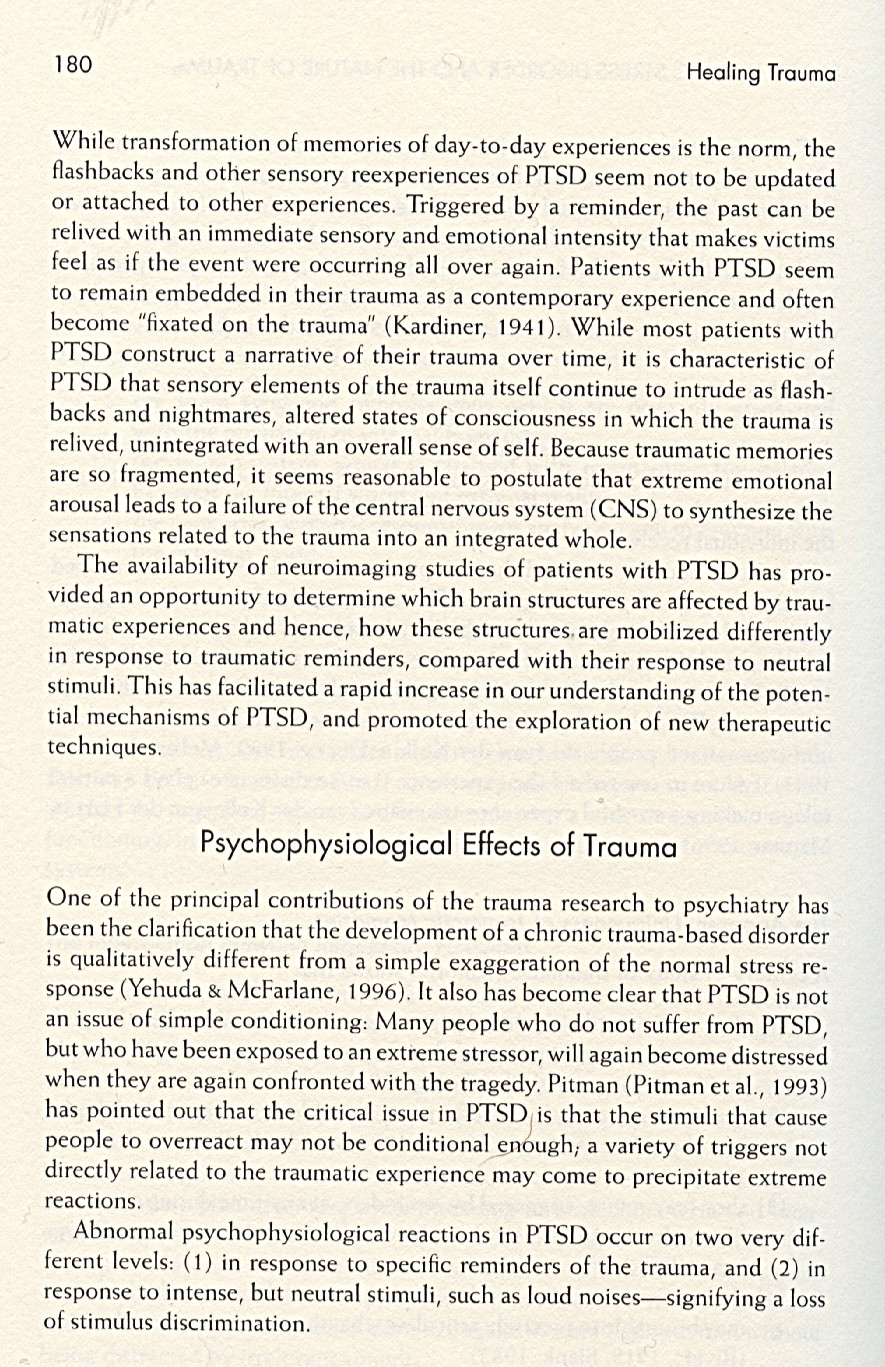
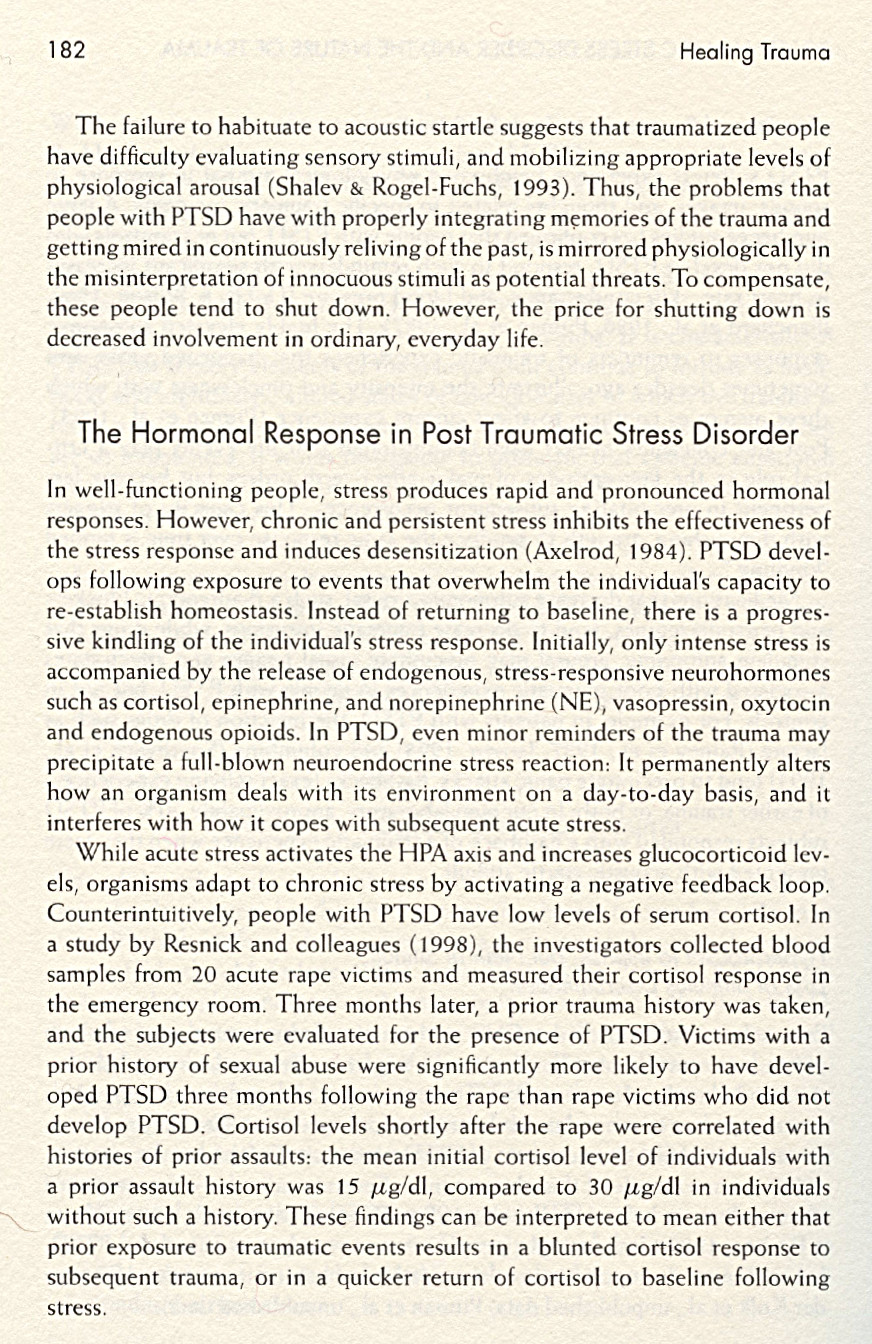
This third post on the topic again continues an exploration of how TAD changes an infant-child abuse survivor’s reaction to ALL trauma.   Van der Kolk writes about posttraumatic stress disorder (PTSD) in the book, Healing Trauma: Attachment, Mind, Body, and Brain – Hardcover (Jan 2003, W.W. Norton and Co.) by Daniel J. Siegel, Marion F. Solomon, and Marion Solomon, chapter 4 (pages 168-195) written by Bessel A. van der Kolk:  “Posttraumatic Stress Disorder and The Nature of Trauma.”

++++

I begin writing today by considering the last sentence of the scanned book pages that were posted on November 30, 2009:

“….progress in understanding the function of attachment in shaping the individual and rapid developments in the neurosciences gave a new shape to these old insights [about the importance of trauma].”  (page 177)

++++

Van der Kolk next considers “The Psychobiology of Trauma” in his writing:

Modern research has come to elucidate the degree to which PTSD is, indeed, a “physioneurosis,” a mental disorder based on the persistence of biological emergency responses.”  (page 177)

In my thinking, naming PTSD ‘a mental disorder’ ignores the overwhelming evidence that the entire human body is included in the ‘persistence of biological emergency responses’ that the author is talking about.  From my point of view, it is the consideration of how severe infant-child maltreatment and abuse changes the development of the ENTIRE BODY of the little one that matters to those of us who survived this degree of early trauma.

‘Biological emergency responses’ BUILT our bodies.  These responses signaled our DNA how to express itself.  These responses signaled our developing nervous system and brain on all levels about how to adapt to trauma.  Our developing nervous system was also intimately involved in these responses as it formed, also.  It is at this most basic, profound level of our physiological development from our beginnings that we have to understand how our development changed in ways that a non-TAD ‘ordinary’ body did not.

The adaptive changes that happened to us took place on far, far deeper levels than just the level of mind.  Mind is simply the topmost layer of our existence that I see as being related to our body as smoke is to fire.  I do not have a ‘mental disorder’.  My entire being is ordered in a very particular way in accordance with what surviving my infant-child trauma required.

It is this Trauma Altered Development that created my survival based, trauma centered ordering of my entire being that I seek to understand.  I am not convinced that van der Kolk has anything more than a passing surface notion of what these TAD changes actually ARE, how they affect us, or even if they legitimately belong to anything like a PTSD diagnostic category.

++++

Van der Kolk continues by saying:

To understand how trauma affects psychobiological activity, it is useful to briefly revisit some basic tenets of neurobiology.”

I do not like the term ‘psychobiological activity’ because it implies that anyone on the outside can ever have any accurate information about what another person’s ‘psyche’ is like.  That is why researchers try to more completely understand the human ability to form a Theory of Mind.  MIND belongs to each of us as individuals, and everyone has their own.  Nobody can ever come to understand what the subjective experience of MIND is like for another person.

‘Neurobiology’ is a different thing.  This is a realistic descriptive word that refers to a part of a person that can, within the current limitations of science, be understood and described because it is physically real on the molecular level.  But neurobiology is not the same thing as MIND.

Van der Kolk continues:

McLean (1990) defined the brain [my note:  The brain is a biological reality as part of our nervous system, from which an individual’s MIND originates.  Brain and MIND are not the same thing.] as a detecting, amplifying, and analyzing device for maintaining us in our internal and external environment.  These functions range from the visceral regulation of oxygen intake and temperature balance to the categorization of incoming information necessary for making complex, long-term decisions affecting both individual and social systems.  In the course of evolution, the human brain has developed three interdependent subanalyzers, each with different anatomical and neurochemical substrates:

(1)  the brain stem and hypothalamus, which are primarily associated with the regulation of internal homeostasis,

(2) the limbic system, which is charged with maintaining the balance between the internal world and external reality, and

(3) the neocortex, which is responsible for analyzing and interacting with the external world.

It is generally thought that the circuitry of the brain stem and hypothalamus is most innate and stable, that the limbic system contains both innate circuitry and circuitry modifiable by experience [my note:  This emotional area of the brain forms through early caregiver attachment interactions birth to age one, forming MUCH earlier than the neocortex], and that the structure of the neocortex is most affected by environmental input (Damasio, 1995).  If that is true, trauma would be expected to leave its most profound changes on neocortical functions, and least affect basic regulatory functions.  However, while this may be true for the ordinary stress response, trauma – stress that overwhelms the organism – seems to affect people over a wide range of biological functioning, involving a large variety of brain structures and neurotransmitter systems.”  (pages 177-178)

++++

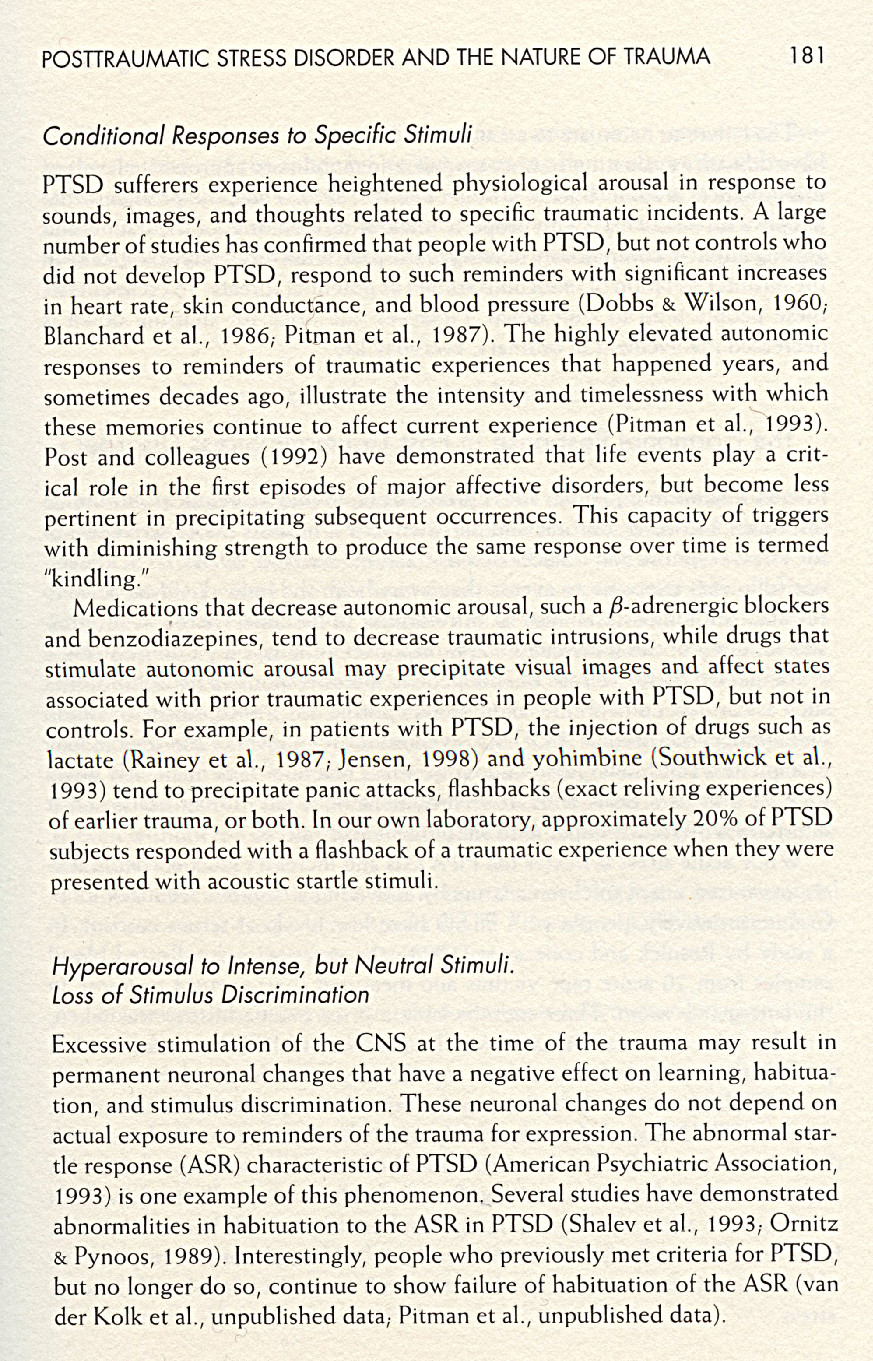
I am going to scan in the book pages that follow in van der Kolk’s description of how trauma affects people.  I believe his statement on the bottom half of page 190 is extremely important:

“…the development of a chronic trauma-based disorder is qualitatively different from a simple exaggeration of the normal stress response….”

We need to stretch that concept as far as we possibly can if we are going to understand how severe trauma from malevolent infant-child abuse and neglect changes our entire development – nothing about us is excluded.  Any possible aspect of our development that can adapt its development in order to help us endure and survive early trauma – does so.

Our problem comes when the reality of our early trauma is denied along with the depth, breadth and width of its impact on our development.  What may be true for a non trauma altered development person cannot be assumed to be true for us.  Yes, we know what the following descriptions of consequences FEELS like – but we also know that we never knew any other, different way of being in the world.

Due to the changed development we experienced as we survived our early severe traumas, anything that we might begin to understand now as being more like  ‘ordinary’ in our physical – and correspondingly in our mental — ability to experience our self in our body in our lifetime, will happen as we begin to understand how deeply trauma formed us in the first place so that we will NEVER experience trauma (or life) in the same way as will a person who did not experience Trauma Altered Development when they were little.

++++

The scanned pages below (from the book mentioned above!) is complicated information, but it is a place for us to truly begin to understand ourselves – the way were MADE in the severely abusive and trauma-filled environments we were formed in.

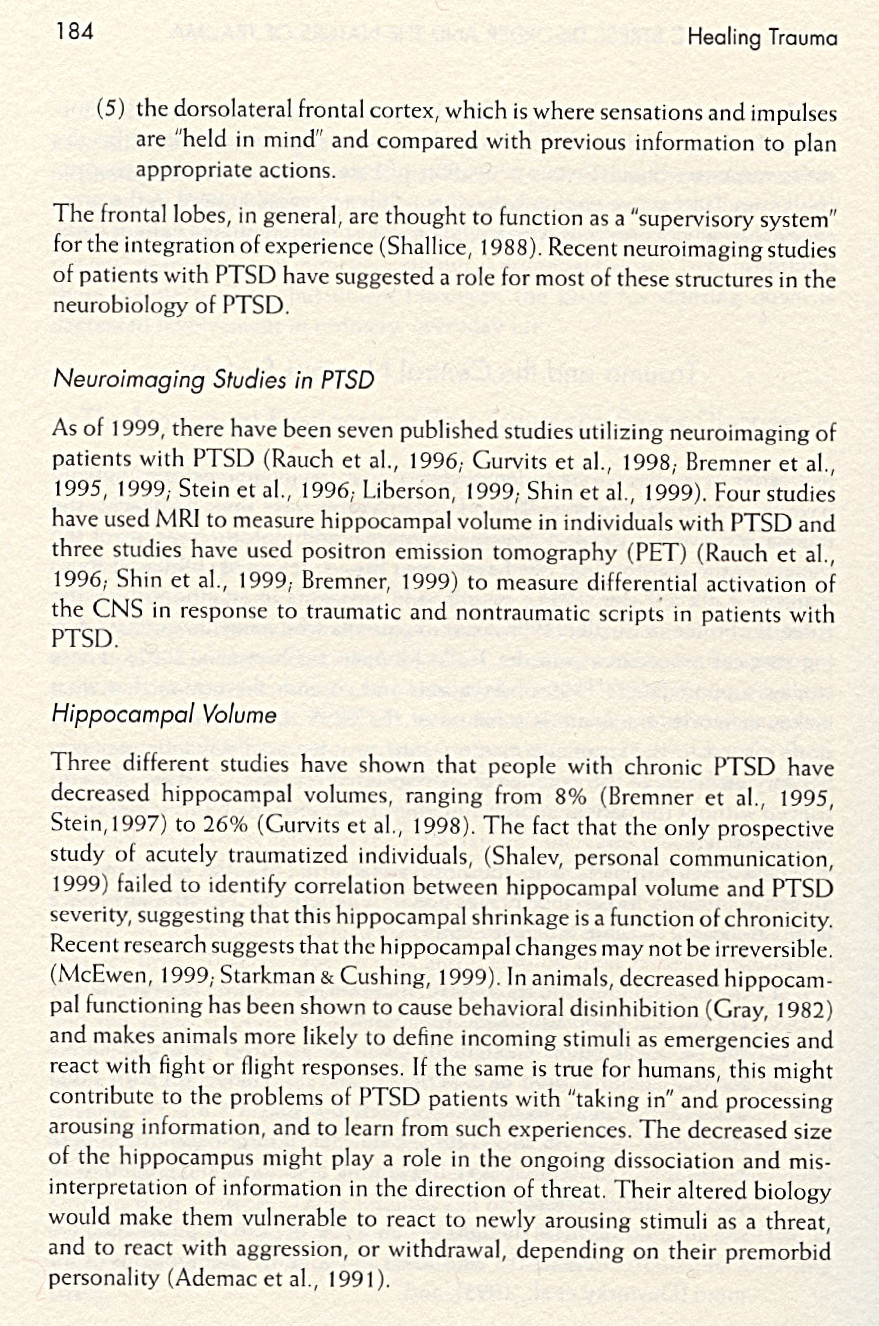
On page 184 van der Kolk notes that “PTSD patients” have problems

“…with “taking in” and processing arousing information, and to learn from such experiences.”

Sorry, but I am not a ‘PTSD patient’.  I am a 58-year-old woman who has suffered from an extra-ordinary body, altered in all its developmental stages in adaptation to trauma, that has never been able to ‘take in’ even ordinary information, let alone ‘arousing information’, or to ‘learn from’ the experiences of my life in an ordinary way.

What on earth do we expect to happen to little people who must continue to develop and survive even while they have little or no access to even their most basic Universal Human Rights?  Infant-child development IS ALTERED under these conditions.  It is time that we realize this is the most truly horrific consequence of early abuse and trauma.  We don’t get to experience ANYTHING the same way as non-early-traumatized people do – not even later traumas.

(note:  I believe in ‘degrees of damage’ – the 75% of our sub-par young adults in this country have suffered some degree of damage that has changed the course of their development away from optimal and BEST!  We cannot afford to ignore that fact – deprivation and violation of the Universal Human Rights of Children causes changes in the way their body and brain develop.  There is a very real, physiological process through which trauma and deprivation get passed on down the generations.  We know it is happening when we see the consequences in degrees of lack of well-being –- which are detectable no matter what our age.)

++++

(The following is from page 186 on left or right handedness and trauma)

++++++++++++++++++++++++++++++

This post follows:

from November 30, 2009 +PTSD AND SEVERE ABUSE SURVIVORSHIP – PART TWO

from November 28, 2009 +PTSD AND SEVERE CHILD ABUSE SURVIVORSHIP – PART ONE

+++++++++++++++++++++++

PLEASE NOTE:  Do not take anything I say as a reason to alter any ongoing treatment, therapy or medication you are receiving.  Consult with your provider if you find something in my writing that brings questions to your mind regarding your health and well-being.

++++++++++++++++++++++++++++++++

Please feel free to comment directly at the end of this post or on

+++++++

Your Page – Readers’ Responses

++++++++++++++++++++++++++++++++

+PTSD AND SEVERE ABUSE SURVIVORSHIP – PART TWO

+++++++++++++++++++

This second post about Posttraumatic Stress Disorder (PTSD) refers again to a book called Healing Trauma: Attachment, Mind, Body, and Brain – Hardcover (Jan 2003, W.W. Norton and Co.) by Daniel J. Siegel, Marion F. Solomon, and Marion Solomon, chapter 4 (pages 168-195) written by Bessel A. van der Kolk:  “Posttraumatic Stress Disorder and The Nature of Trauma.”

Today’s post follows the November 28, 2009 post

+PTSD AND SEVERE CHILD ABUSE SURVIVORSHIP – PART ONE

PLEASE NOTE:  Do not take anything I say as a reason to alter any ongoing treatment, therapy or medication you are receiving.  Consult with your provider if you find something in my writing that brings questions to your mind regarding your health and well-being.

+++++++++++++++++++

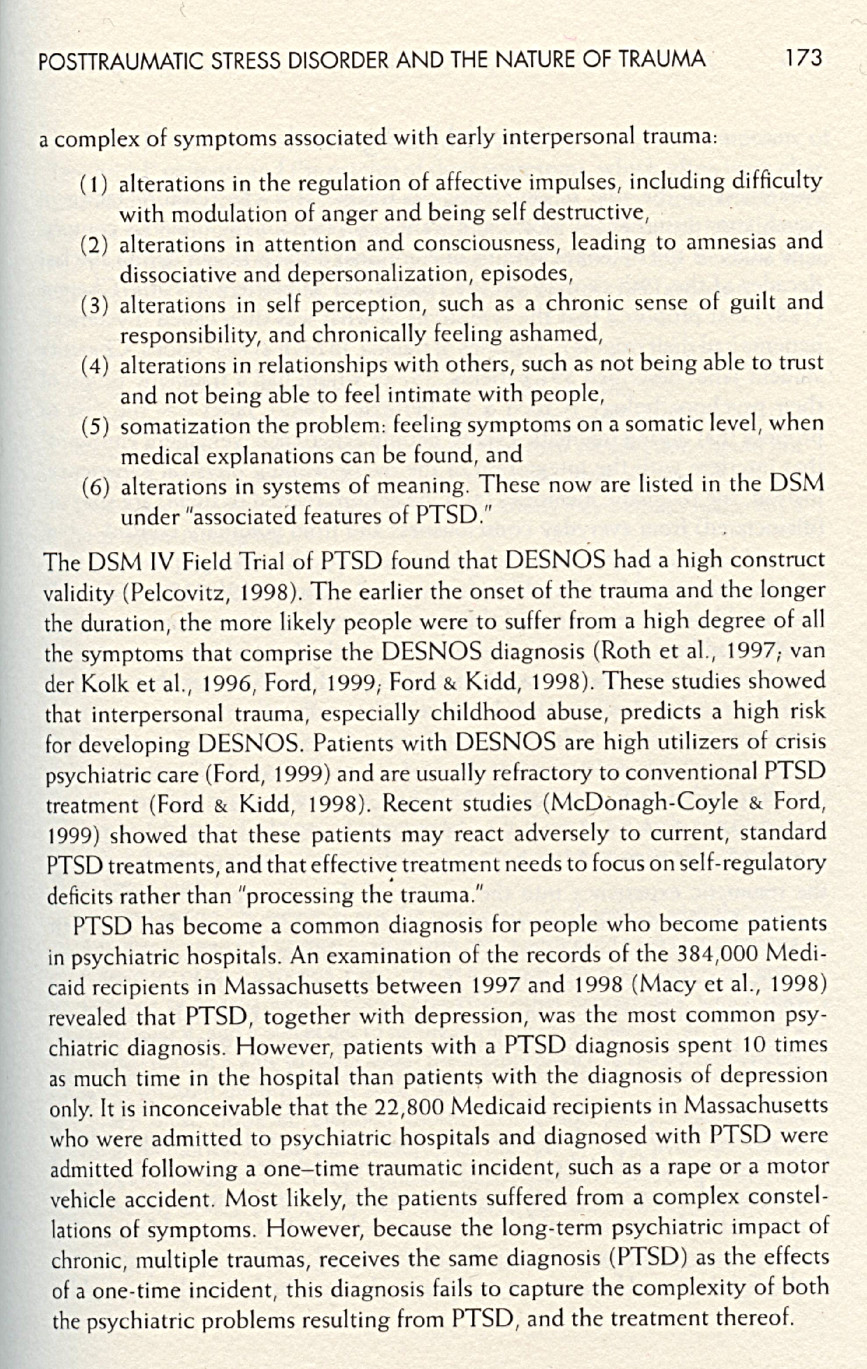
The following is taken from pages 172 of the above text.  I will consider this information in my writing below:

+++++++++++++++++++

It is now easier for me to work with this information because I have described my own version of an alternative way of thinking about the ongoing complications severe infant-child abuse and malevolent treatment survivors face as a direct result not only of the specifics of the actual horrific traumas they lived through, but also because of the very real physiological changes that surviving these traumas created in their infant-child growing and developing body.

(see yesterday’s November 29, 2009 post

+TRAUMA ALTERED DEVELOPMENT (TAD) – A NEW DESCRIPTIVE CONCEPT)

++++

An accurate primary and initial assessment of TAD for those of us who are Infant-Child Severe Maltreatment Survivors would allow us to know immediately how the changes our body-brain had to make created us to be different from ‘ordinary’ people who do not have the history of trauma that we do.

In this TAD assessment two critical resiliency factors would also need to be assessed because these two resiliency factors (one primary, the other secondary) are known to have the ability to nearly completely modify and modulate the power that early trauma has to change our developing body-brain.

The presence of safe and secure attachment to some early primary caregiver is the most basic and important resource an Infant-Child Severe Maltreatment Survivor had.  The current assessment tools available to assess adult secure and insecure attachment need to be simplified, refined and made accessible to the public.

Stemming from the degree of safety and security available through early caregiver attachment, the ability to play is a secondary but critical resiliency factor that impacts an Infant-Child Severe Maltreatment Survivor’s body-brain development.  I believe that assessment criteria and tools to measure this critical factor consistently and accurately can be developed and also made available to the public.

++++

NOTE:  In our new age of technology, the public has the right to be able to access critically important information about themselves and how their early infant and childhood experiences impacted their development.  At present this information remains ONLY available within ‘clinical’ settings, if even there.

++++

As far as I am concerned, anything and everything that is currently lumped under so-called ‘psychological’ categories belongs to the sinking Titanic of dark age medical model thinking that I referred to in yesterday’s post.

Until Trauma Altered Development (TAD) is assessed at the bedrock level of how Infant-Child Severe Maltreatment Survivors changed at their own bedrock (molecular) level, any attempt to moderate so-called ‘symptoms’ remains a crap shoot in the dark.

TAD assessment can connect the consequences of early trauma to altered physiological changes that an Infant-Child Severe Maltreatment Survivor’s body was forced to make to best ensure continued survival in early malevolent environments,

++++

Early caregiver attachment experiences from birth build the body-brain we will live with for the rest of our lives.

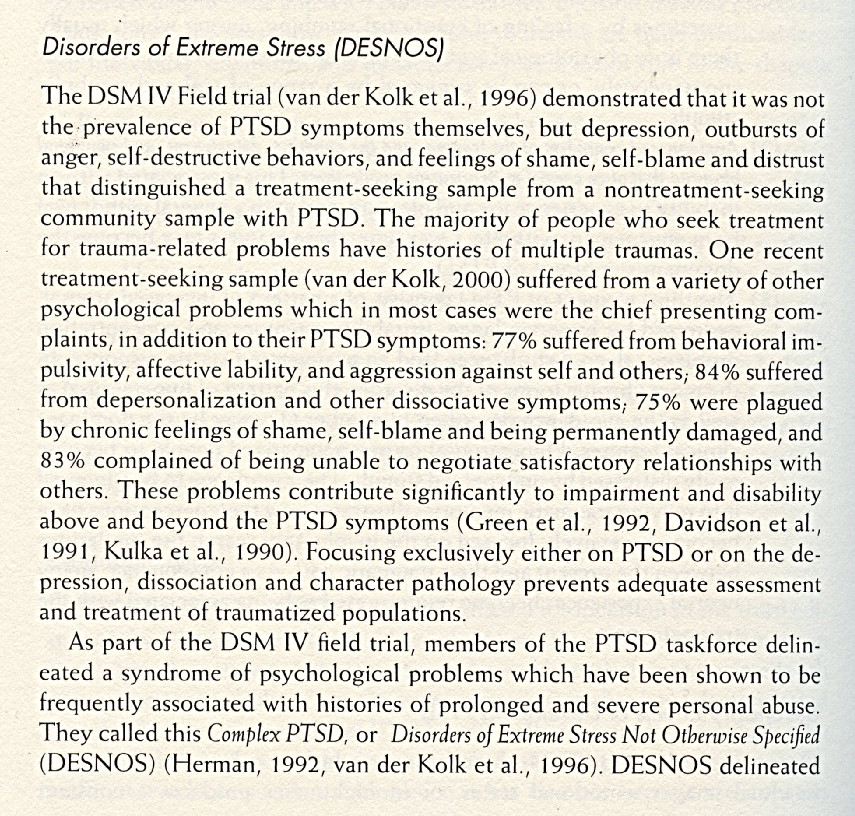
Van der Kolk (scanned text above) writes that it is not usually the symptoms of PTSD itself that brings those seeking help to a clinical setting.  Rather, he says that it is “depression, outbursts of anger, self-destructive behaviors, and feelings of shame, self-blame and distrust that distinguished a treatment-seeking sample from a nontreatment-seeking community sample with PTSD.”

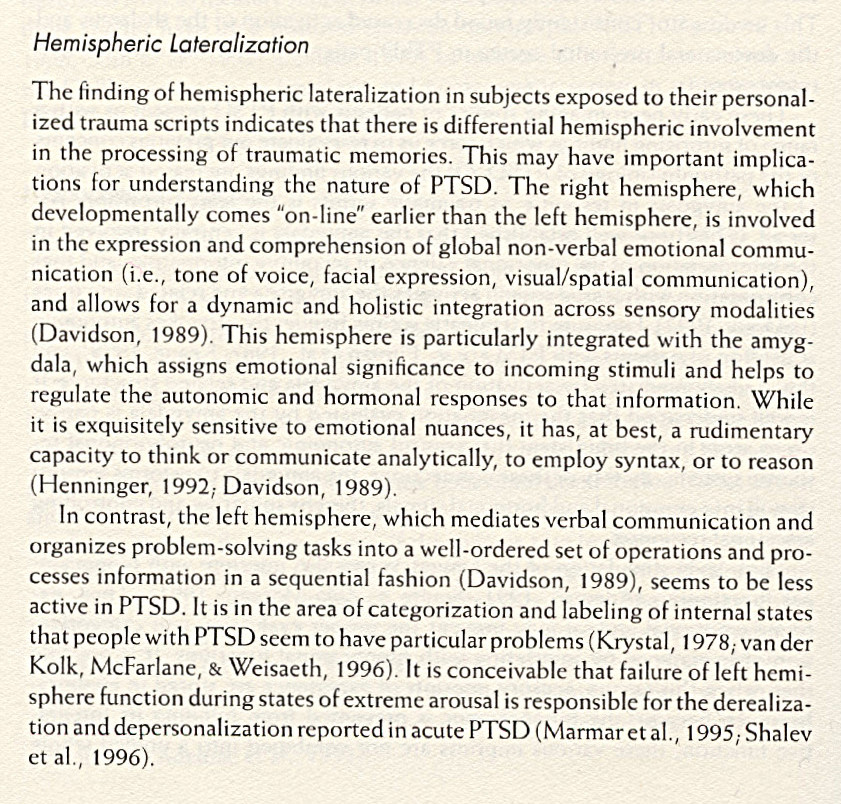
Through an accurate TAD assessment, any ongoing difficulty an Infant-Child Severe Maltreatment Survivor has with emotions and social interactions can be traced to inadequate early caregiver interactions in a malevolent environment that built for the survivor an entirely different early-forming right-limbic-emotional-social brain.

When the foundation of the early forming right brain is altered because of maltreatment, the Infant-Child Severe Maltreatment Survivor’s later developmental stages involving shame, guilt and embarrassment will also be off course from ‘ordinary and optimal’ and will cause altered patterns of development in the body-brain.

++++

Van der Kolk states:

The majority of people who seek treatment for trauma-related problems have histories of multiple traumas.”

OK, I can certainly understand this, but here again, as I mentioned above, I do not agree with applying so-called ‘psychological’ and ‘symptom based’ medical model diagnostic thinking used in the author’s next statements.  I absolutely disagree with ever using terms such as ‘character pathology’ in reference to Infant-Child Severe Maltreatment Survivors!

One recent treatment-seeking sample…suffered from a variety of other psychological problems which in most cases were the chief presenting complaints, in addition to their PTSD symptoms:  77% suffered from behavioral impulsivity, affect lability, and aggression against self and others; 84% suffered from depersonalization and other dissociative symptoms; 75% were plagued by chronic feelings of shame, self-blame and being permanently damaged and 93% complained of being unable to negotiate satisfactory relationships with others.  These problems contribute significantly to impairment and disability above and beyond the PTSD symptoms….Focusing exclusively either on PTSD or on the depression, dissociation and character pathology prevents adequate assessment and treatment of traumatized populations.”

TAD assessments will clearly show that ‘impulsivity’, ‘affect liability’, most aggression, and dissociation are directly connected to changes in how an Infant-Child Severe Maltreatment Survivor’s nervous system, including their brain – and here, particularly their right brain – formed differently from ‘ordinary’ due to growth and development in trauma.

Chronic feelings of shame, self-blame and being permanently damaged” are also directly connected to trauma through developmental changes an Infant-Child Severe Maltreatment Survivor’s nervous system, including their brain – and here, particularly their later forming (after age one) left brain – had to make while developing in an early malevolent, trauma-filled environment.

Rather than referring to these changes as ‘character pathologies’, which in my thinking is the maltreatment, abusive stance taken by the medical model toward Infant-Child Severe Maltreatment Survivors, a TAD assessment can accurately and specifically pinpoint the origin of these changes in the body-brain and describe the consequences of them.

Receiving an accurate TAD assessment will show us exactly how our body was forced to adapt during our development through trauma so that we could survive it.   Yes, I do believe we KNOW we are different from ‘ordinary,’ but we are not ‘permanently damaged’.   We ARE permanently changed.

The changes Infant-Child Severe Maltreatment Survivors experience are fundamental and profound!  Everything about us was subject to adjustment for our trauma survival – our body, our nervous system and brain, our immune system, our mind, and our connection between our self and our self and between our self and the entire world around us.  NOT facing the truth and discovering the facts through TAD assessment will NOT resolve the difficulties we face with our continued survival into adulthood.

The only long term solution societies have is to STOP Infant-Child Severe Maltreatment!!!  Part of that solution is to provide the kind of TAD assessment Infant-Child Severe Maltreatment Survivors need, and to make available to us the resources necessary for us to live the best life we can in spite of the changes we had to make in order to stay alive because nobody STOPPED the Infant-Child Severe Maltreatment that happened to us.

It is the pathological character of the society we were born into that allowed what happened to us to happen at all, let alone allowed it to continue to the degree that trauma changed our physiological development.  If there is any self blame to be had, it is on the level far beyond OURS as the Infant-Child Severe Maltreatment Survivors.

++++

That the grand sinking Titanic of the archaic dark age’s medical model about Infant-Child Severe Maltreatment Survivors has at least THOUGHT about throwing us a life boat becomes apparent in van der Kolk’s next words:

As part of the DSM IV field trial, members of the PTSD taskforce delineated a syndrome of psychological problems which have been shown to be frequently associated with histories of prolonged and severe personal abuse.  They call this Complex PTSD, or Disorders of Extreme Stress Not Otherwise Specified (DESNOS).”

Great!  A life boat full of holes!  Gee, why are we NOT thankful for that?

A syndrome of psychological problems” be damned!  Infant-Child Severe Maltreatment Survivors do not suffer from a ‘syndrome’, and ours are not ‘psychological problems’!  For all the reasons I have repeatedly described, we simply need a TAD assessment that will tell us HOW our little body adapted down to our molecular level during our development in the midst of, and in spite of, toxic malevolent trauma.  Then we need resources that inform us how to live NOW with these profound trauma-caused changes that happened to us THEN.

The author continues:

DESNOS delineated a complex of symptoms associated with early interpersonal trauma.”

Again, we don’t have ‘symptoms’.  We have a different body-brain-mind-self that adapted to survival in a malevolent world and caused us to have Trauma Altered Development (TAD).

We don’t have symptoms, we have consequences.  Every single item in the list of so-called ‘complex symptoms’ (see them in the page scan below) that van der Kolk describes are directly connected to our TAD.  EVERY SINGLE ONE OF THESE ITEMS exist within us because of changes our body-brain was forced to make.  They are consequences of the changes our body had to make through our TAD.

The only real progress in the right direction I can see – given to us like faulty patches to a sinking life boat thrown to us from a sinking ship – is that at least an association ‘with early interpersonal trauma’ is finally being considered in the current medical model thinking.

But this tiny droplet of hoped for healing balm offered by the creation of a construct named “Complex PTSD, or Disorders of Extreme Stress Not Otherwise Specified (DESNOS)” is not what we Infant-Child Severe Maltreatment Survivors need in my book.

We need our entire society to understand and accept the truth that the Infant-Child Severe Maltreatment that happened to me and others – and continues to happen to children around us today – is nothing short of a form of parental-selected genocide that did not fulfill its intent to completely destroy us.  We are Infant-Child Severe Maltreatment Survivors because we are still alive, and we ONLY SURVIVED because we were able to adapt our body throughout our Trauma Altered Development to and within the malevolent environments that formed us.

++++

The rest of van der Kolk’s words (below) simply bring into my mind the image of the author being like a modern day Paul Revere, whose horse’s hooves pound along the streets of our nation as he screams a warning.  I am certainly not convinced, however, that even this author knows which message it is that most needs to be delivered.

The Trauma Altered Development that Infant-Child Severe Maltreatment Survivors experienced had no choice but to build itself into every part of who we are BECAUSE we live in a body, and our body had no choice but to change so that we could stay alive.

To describe any aspect of what happened to us in terms of a ‘diagnosis’ or a ‘symptom’, ‘complex’ or not, to call us ‘maladjusted’ or to tell us we suffer from any form of a ‘character pathology’ or ‘psychological problem’ is to continue to condemn us with stigmas and stereotyped prejudice which makes as much sense as applying all of the above labels to someone who is tall versus short, or who has red hair rather than blond.

If we wish as a society to remain in the dark ages about the consequences of Trauma Altered Development for Infant-Child Severe Maltreatment Survivors then at least we should have enough honor and common sense to admit it.  If we are appalled by the ignorance that is still applied to our circumstances, today is the day we can enlighten ourselves and get on with the legitimate task of figuring out how to accurately assess Trauma Altered Development so that we can begin to live well as the changed, extraordinary Infant-Child Severe Maltreatment Survivors that we are.

Our Trauma Altered Development did not affect WHO we are in the world, but it absolutely changed HOW we are in the world.  It is up to all of us to learn what that means.

+++++++++++++++++++

The following is taken from pages 173 of the above text:

Again, it is not a picture of ‘long-term psychiatric impact’ nor a ‘diagnosis’ that Trauma Altered Development affected Infant-Child Severe Maltreatment Survivors need.  We need to understand the changes our body had to make to guarantee our survival and specifically how those changes affect us, and specifically how to improve our quality of life and well-being in the world in spite of our TAD.

+++++++++++++++++++++++++++++++++++++++++

Please feel free to comment directly at the end of this post or on

+++++++

Your Page – Readers’ Responses

++++++++++++++++++++++++++++++++

+LIGHT T-DAY READING ON RATS AND THE DALAI LAMA

+++++++++++++++++++++++++++++++++++

I’m not at all sure why I feel safer on the planet knowing the Dalai Lama is here, but I do.  The following links are to information related to the conference presentation to the Dalai Lama about the effects of maternal distress behaviors on her offspring – just a little T-Day light reading!

This is the gist of science told the Dalai Lama:

If a distressed mother rat raises all her own babies, they will all turn out distressed.

If a calm mother rat raises all her own babies, they will all turn out calm.

If you change the litters at birth, and give the calm mother’s babies to the distressed mother, all those babies will grow up distressed.

If you take the distressed mother’s babies at birth and give them to the calm mother, the babies will all grow up calm.

In essence, the distressed mother’s treatment of her babies triggers epigenetic changes in the way the babies she raises turn out because their genes are triggered differently by the distress.

++++

Pity the Poor Lab Rat by Kathy Brown

“…in spite of all our advances in knowledge about mental disorders and the advances in technology that have resulted in an impressive smorgasbord of pharmaceutical agents, the overall prevalence of depression is increasing at an alarming rate. Moreover, the average age at onset continues to drop. Whereas patients once presented with their initial depressive episode in their fifth decade of life, the average age of onset has now dropped into the twenties.”

++++

Mom, Dad, DNA and Suicide by Sharon Begley

Such changes are called “epigenetic,” to distinguish them from changes that affect the sequence of nucleotides in DNA. Epigenetics is arguably the next frontier in genetic research, promising to show why people with identical DNA, such as monozygotic twins, have different traits, including traits known to be strongly affected by genes. The answer seems to be that the events of our lives, including parental behavior, turns some genes on and some genes off. In this case, parental care (or, specifically, abuse) changed the expression of the crucial glucocorticoid-receptor gene in the brain.”

++++

Abuse changes brains of suicide victims

Suicide victims who were abused as children have clear genetic changes in their brains…”

+++++++++++++++++++++

While the new research on neuroplasticity in the brain is important, those of us whose body and brain were changed as a result of severe early child abuse, again, may not be in the realm of ‘ordinary’ when it comes to the changes we can expect in our brains compared to others…..

++++

Buddhism – A meeting of minds by Swati Chopra

At the 12th mind and life conference in dharamshala, buddhism and modern science found points of convergence as the dalai lama and western scientists spoke about neuroplasticity, the brain’s ability to change with experience and focused training.”

++++

2004: Neuroplasticity: The Neuronal Substrates of Learning
and Transformation
a 2004 conference that got neuroscientists together with the Dalai Lama

Download MLXII: Neuroplasticity Brochure PDF

++++

Can Our Minds Change Our Brains?

Train Your Mind, Change Your Brain: How a New Science Reveals Our Extraordinary Potential to Transform OurselvesBy Sharon Begley

At the Dalai Lama’s private compound in Dharamsala, India, leading neuroscientists and Buddhist philosophers met to consider “neuroplasticity.”  The conference was organized by the Mind and Life Institute as part of a series of meetings, beginning in 1987, for brain researchers and Buddhist scholars to share insights into the workings of the mind and brain. The 2004 meeting set out to answer two questions: “Does the brain have the ability to change, and what is the power of the mind to change it?””

++++++++++++++++++++++++++++++++++++++++++++++++++++++++

Child Abuse Causes Lifelong Changes To DNA Expression And Brain.

++++

Mechanisms underlying epigenetic effects of early social experience

++++

Epigenetics. Child abuse alters genes.

++++

What role might epigenetics have in shaping a person’s development?

++++++++++++++++++++++++++++++++++++

Please feel free to comment directly at the end of this post or on +

+++++++

Your Page – Readers’ Responses

++++++++++++++++++++++++++++++++