+IS MENTAL ILLNESS THE COST OF OUR SPECIES’ GREATEST GIFTS?

Why has our species retained the potential genetic combinations that result in mental illness?

We need to realize that the cost of the development of our greatest gifts as a species are being paid by those who carry the genetic combinations that put them at risk of developing serious ‘mental illness’ conditions.  These people are forced to suffer at the opposite end of the spectrum and continuum of giftedness because many of our greatest human gifts are actually related to signals related to ‘conspicuous consumption’.  We have our gifts because we can afford to pay for them, and the gifts themselves are reproductive fitness indicators that act as signals of our ability to handle the cost of keeping them.

This brings to mind the current financial complications our culture is experiencing related to an imbalance in conspicuous consumption practices.  In order for this process to operate in a good fashion, what is being consumed and displayed has to be paid for.

From a human point of view, the existence of the pyramids, the Vatican, Versailles, the Parthenon, and even the great wall of China are all manifestations of conspicuous consumption indicators.  Someone could afford the cost and paid for them.

On a more mundane level, I can imagine conspicuous consumption being like a peacock’s feathers if I think about someone going to a store, picking an isle and buying everything in that isle whether they needed the goods or not.  If they take them all home and dump them in a pile in their yard so the neighbors would drive by and think, “My oh my that person must be rich!  All those goods in their front yard indicate that they are.”  We do that in our culture with all sorts of items.  We don’t realize that the basis of our actions are still grounded in the ancient evolutionary practice of signaling our reproductive fitness that we can afford all of these things.

During the evolution of our species it was only when we were not under threat of immediate extinction that we could dance out our dramas or learn to chit chat about our trivial experiences.  It was only as we could afford to protect and provide for mothers so that they had the safety and security to spend the time required for long developmental stages leading to advanced mental capacities that we began to develop our FOXP2 gene’s ability for language in the first place (about 140,000 years ago).

In this way all of our advanced gifts were allowed to evolve as indicators of conspicuous consumption because their existence meant that we had access to the resources we needed in order for them to be developed from the start.  The appearance of these gifts within our species today still reflects the fact that we have access to the resources we need to keep them.

In the end, it always comes back to the issues surrounding resources.  If we don’t have the resources, or don’t use them wisely to protect the unborn and the newly born from the consequences of having to adapt to a malevolent environment, ‘mental illness’ will continue to plague our species far more than is required from us to maintain the existence — in our gene pool — of our gifts.

The most important step we can take toward ending unnecessary traumas during infant developmental stages that trigger many ‘mental illness’ genetic combinations would be to destigmatize ‘mental illness’ by appreciating the gifts of our species that are connected genetically to ‘mental illness’ risk factors.  By doing so we would greatly increase our opportunities to intervene constructively with ‘mentally ill’ parents who are most at risk for severely traumatizing their offspring, thus alleviating a major portion of the suffering of future generations.

++

Yet when it comes to our species’ more intangible gifts we can easily lose site of the genetic combinations that allow these gifts to exist.  I believe that many families who can point to ‘mental illness’ in their lineage also could point to many great examples of genius and talent.  It is the unfortunate preventable manifestation of the suffering of ‘mental illness’ that concerns me.  In today’s enlightened world we have information that can help us prevent much of its occurrence.  We can effectively lessen the human cost of keeping our greatest gifts through paying close attention to the early infant traumas that often cause ‘mental illness’ genetic combinations to manifest so that we can prevent them.

Because all of life operates in circles and cycles of balance, our species cannot retain the ability to display our great gifts related to our intelligence, our creativity, language, movement and dance without retaining the risk factors that are connected to these gifts.  Our species beat out at least 19 other hominid species because we have the gift of an extremely agile brain.  But the cost of maintaining the gene pool linked to our agility also means that the risk of fragility must also be maintained.

When we think about reproductive fitness indicators even within our advanced species we need to think in three directions at the same time:  male to male reproductive fitness indicators often related to combat competition, female selection indicators related to preferences for selection of mates, and survival fitness indicators among siblings that allow them to compete with each other for resources that the parents provide.

Then we need to realize and remember that for every group of survival reproductive fitness indicators that we have evolved related to these three different survival spectrums our species has a corresponding genetic potential for opposite risk.  In addition, our most valued resources are so expensive to maintain (like the peacock’s feathers) that all they really do is indicate that we can afford to keep them.

In my thinking this means that when the difficulties of ‘mental illness’ manifest themselves in members of our species we need to hold these people carefully in the palm of our species’ hand because without the negative risks that exist related to the genetic combinations of our species’ gifts we would not have their positive expression, either.  The people who end up suffering most are paying the highest price for the cost our species must expend to retain what made us endure, survive and beat out all our competition in the first place.

That the actual expression of many of these ‘mental illnesses’ results from interaction between the sufferer’s genetic potential and harsh, toxic and malevolent environmental conditions from conception to the age (especially) of two means that the rest of us have an obligation to make sure, wherever possible, that early conditions of infants are maintained well enough that these genetic combinations are never forced to appear in their full negative display.  Current scientific research is confirming that this preventive potential DOES exist regarding mental illnesses.  We need to understand what this research is telling us and we need to apply the research findings effectively through the prevention of early maltreatment to infants and young children.

We need to stop condemning the ‘mentally ill’ as if they are substandard, inadequate members of our species.  We need to realize that within their genetic combinations lies links to the greatest giftedness of our species.  If anything, we need to humbly acknowledge the fact that when early abuse and trauma triggers the full spectrum of the opposite end of our giftedness to appear, we are to a large extent responsible as a culture for their suffering.

Certainly there are instances when the genetic combinations of ‘mental illness’ will manifest no matter how well or how adequately these people were cared for from conception.  But research is also demonstrating that a recognizably large percentage related to the appearance of ‘mental illness’ is directly connected to some form of malevolent conditions as they existed in an infant’s early environment, particularly related to early caregiver attachment disorders.

++

I understand that only particularly interested readers will spend the time thinking about this topic that following the links below will require.  I know that I am only at the beginning of following the information through myself.  I find it fascinating that we are, as sophisticated users of technology, simply continuing  a process that takes place from the time of our birth when we use information available on the internet to increase our knowledge about this (or any) subject just as we used the information in the brains of our caregivers to form our own brains.

Infants share cognition with their mothers and earliest caregivers as their brains develop.  We are in a very similar way sharing cognition with all the others who have placed their own thoughts and information on the web for us to access.  Through this process of shared cognition we grow our brains today related to any subject we choose to research and to learn about.

Understanding how the risk factors for ‘mental illness’ are directly connected to the greatest gifts of our species will require that we all pursue new directions in our thinking to understand the implications of this information.  By doing so we will discover that the supposed curses related to mental illness and the blessings of our gifts are simply on the two ends of the same reproductive fitness indicator spectrum.

The gifts of our species are expensive and we retain them by paying the cost.  Just because some people are able to enjoy the benefits and others must suffer the cost does not mean that all of us are not equally responsible for trying to lessen the impact related to risk.

++

This has been a difficult post for me to attempt to write because I perceive that I come from a family whose lineage has repeatedly included ‘mental illness’.  Because of this fact there has existed a continued pattern of neglect and maltreatment that continues to influence how our family’s at risk genes are expressing themselves.  It becomes hard for me not to wonder if some families are thus having to pay the price for the ‘goods’ that other humans get to enjoy, while the rest of us end up not able to experience the benefits equally because of our suffering.  Writing this post feels like staring down the throat of the beast.

++

Why do male peacocks create their brilliant tail displays when they are not connected to mating success which is instead related to their vocalizations?

SEE on peacocks:

http://en.wikipedia.org/wiki/Peafowl#Plumage

Note the following:

“The plumage of the peacock, and the peahen’s preference for its exorbitance, is a classical example of sexual selection and especially the handicap principle. However, in recent years scientific research has shown that the size and brilliance of a male’s plumage does not meaningfully correlate with his mating success nor his health, and that instead the key factor for attracting females is the vocalizations made prior to mating.”

++

Our concern in today’s post about the appearance of mental illness gene combinations within our species relates to sexual selection and handicap principle.

From handicap principle.:

“The central idea is that sexually selected traits function like conspicuous consumption, signalling the ability to afford to squander a resource simply by squandering it. Receivers know that the signal indicates quality because inferior quality signallers cannot afford to produce such wastefully extravagant signals.”

From the section on sexual selection:

see also for an example of the fascinating connection between ‘intelligence’ in humans and our reproductive fitness indicators —

http://en.wikipedia.org/wiki/Sexual_selection#In_humans

“Some hypotheses about the evolution of the human brain argue that it is a sexually selected trait, as it would not confer enough fitness in itself relative to its high maintenance costs (a quarter to a fifth of the energy and oxygen consumed by a human). [9] Related to this is vocabulary, where humans, on average, know far more words than are necessary for communication. Miller (2000) has proposed that this apparent redundancy is due to individuals using vocabulary to demonstrate their intelligence, and consequently their “fitness”, to potential mates. This has been tested experimentally and it appears that males do make greater use of lower frequency (more unusual) words when in a romantic mindset compared to a non-romantic mindset, meaning that vocabulary is likely to be used as a sexual display (Rosenberg & Tunney, 2008).”

and

http://en.wikipedia.org/wiki/Sexual_selection#History_and_application_of_the_theory

“The theory of sexual selection was first proposed by Charles Darwin in his book The Origin of Species, though it was primarily devoted to natural selection. A later work, The Descent of Man and Selection in Relation to Sex dealt with the subject of sexual selection exhaustively, in part because Darwin felt that natural selection alone was unable to account for certain types of apparently non-competitive adaptations, such as the tail of a male peacock.”

++

Now if we shift over and look for the direct connection between the cost of peacocks’ feathers and the cost of our most extravagant human gifts, we find a direct connection to the existence of mental illness in our species.

See for example

http://en.wikipedia.org/wiki/Schizophrenia#Genetic

“There is little doubt about the existence of a fecundity deficit in schizophrenia. Affected individuals have fewer children than the population as a whole. This reduction is of the order of 70% in males and 30% in females. The central genetic paradox of schizophrenia is why if the disease is associated with a biological disadvantage is this variation not selected out? To balance such a significant disadvantage, a substantial and universal advantage must be exist. Insofar, all theories of a putative advantage were disproved or remain unsubstantiated.

The references noted for this quote are:

++

Now, to consider a link between reproductive fitness indicators within our species and the continued appearance of autism:

http://www.springerlink.com/content/m775188523140523/

The abstract of this article,

Autism as the Low-Fitness Extreme of a Parentally Selected Fitness Indicator

“Abstract  Siblings compete for parental care and feeding, while parents must allocate scarce resources to those offspring most likely to survive and reproduce. This could cause offspring to evolve traits that advertise health, and thereby attract parental resources. For example, experimental evidence suggests that bright orange filaments covering the heads of North American coot chicks may have evolved for this fitness-advertising purpose. Could any human mental disorders be the equivalent of dull filaments in coot chicks—low-fitness extremes of mental abilities that evolved as fitness indicators? One possibility is autism. Suppose that the ability of very young children to charm their parents evolved as a parentally selected fitness indicator. Young children would vary greatly in their ability to charm parents, that variation would correlate with underlying fitness, and autism could be the low-fitness extreme of this variation. This view explains many seemingly disparate facts about autism and leads to some surprising and testable predictions.”

++
LINKS TO NEW PAGES ADDED ON ATTACHMENT, PTSD AND EMOTIONS

I will be writing another post for today, but for those readers who might find this information useful, the following pages were added this morning:

++++

under the category of Emotion, in pages on the ANXIETY SPECTRUM

**ARTICLE: Predictors of PTSD

**ARTICLE: Meta-Analysis of PTSD Risk Factors

** Notes on Research About PTSD Core Symptoms

**BIOMARKERS FOR PTSD

++++

On the brain development of emotional regulation:

**Dr. Allan Schore on Emotional Regulation – Notes

**Schore on Emotion: Orbitofrontal Notes

** Schore – Notes on Developmental Emotional Dysregulation

**Notes on Schore – Development of Attachment

++++

On disorganized-disoriented attachment:

DISSOCIATION AND DISORGANIZED ATTACHMENT – from Liotti

++++

On origins of Borderline Personality Disorder:

**Notes on Origin of BPD from Bateman and Fonagy

++++

+TRAUMA MATH: THE SORROWS AND HAPPINESS OF “CRAFT SHOW APRIL”

I haven’t completely ‘returned’ or recovered from my out-of-town craft show adventure last weekend.  I say returned because my dissociation condition causes me to experience changes as if separate parts of me are ‘out there’ floating around like dandelion fluff in the breeze, drifting around until they eventually land.  I experience a waiting period while this happens, trying to learn every day more of what to do to speed up the process of consolidation of memory as best I can.

Some might call this a grounding process.  I went out and watered all of my plants, most of them looking pretty darn stressed if not dead.  I forgot to have one of the neighbor children come over to water them while I was gone on this 100 degree plus weekend.  Now I’m washing my blankets and clothing.  There’s no place for the washing machine in the house, so it sits out back on the cement rim that lies around the foundation of the house, hooked by an hundred foot extension cord running out my door and to a fifty foot hose.

Taking the small steps of being in my life, in my house, being in my body as I wait for all of the experiences of this past weekend to settle within me in some form of organized fashion.  That’s what the combination of the dissociative disorder and the PTSD do to me now.  They easily give me the feeling of ‘too much to deal with’ and a sense of being easily overwhelmed by any kind of unusual stimulation.

I believe that’s part of the role of the ‘recurring major depression’ that forms the third leg of my emotional and mental ‘disorder’ and ‘disability.’  It gives me the ‘down time’ I need to let things put themselves together after I experience more incoming information than I can handle at one time.

I am so fortunate at this moment in time to have a simple place that is my home.  One has to have the safety and security of some kind of ‘home’ for their body in order that the home of the mind can maintain itself.  I’ve been homeless before, several times, even when I still had young children under my care.  Today more than in several generations having a home or not having a home has come back to the forefront of our concerns — both individually and as a society.

Which leads me to this story I heard from a neighboring vendor, I’ll call her April, at the craft show last weekend.  I always listen with a special interest to stories told by new people I meet.  It’s the only way that I have to test my own theories or ideas, things that I am coming to believe about how our early childhood experiences come to form who we are as adults.

Because April never asked that anything she was telling me be kept confidential, I am not concerned about telling you what she told me.  After all, she had only just met me and spent a few hours in her booth across from mine as she sold kettle corn and ice water as I hoped to sell earrings and mosaics.

++

April is one year younger than me, another child of the early fifties, born and raised in Phoenix, Arizona.  She was second born of six children and spent her childhood with both of her parents and with her grandparents nearby.  Her father was an untreated bi-polar severe alcoholic and was extremely violent and abusive to his wife and all of the children.  Her father beat his wife during every one of her pregnancies, and over the years knocked out all of his wife’s teeth, and sent her to the hospital with concussions and broken bones many times.

April told of one severe attack of violence this man had perpetrated against his family, and her mother took herself and all of the children to her mother’s house for some kind of protection.  It wasn’t long before her father showed up at the door with his rifle, accompanied by three uniformed police officers who were there to make sure the wife and children returned home with the man of their family immediately.

We might think this unbelievable and barbaric, but that happened only 45 years ago.  It tells us about the conditions of life and of our culture that took so much hard work and effort to change — even a little bit so that things might be different and better for women and children in America today.

April appears as a very attractive, perky, positive, happy, kind, hard working, healthy woman.  There’s nothing about her that meets the eye of the public that would indicate the kind of terrible traumas that she has experienced in her life.  And yet it didn’t take long as we sat in her RV after Saturday’s craft show had closed for the day, talking over an ice cold beer and a container of grocery store deli chili that April had microwaved and generously shared with me, that I learned how close to the surface all of her difficult history is to her.  In fact I would say none of it has gone anywhere.  But what fascinates me is what April is doing with herself in relationship to it.

April is married to her third husband, a hard working truck driver who just lost one hundred thousand dollars of his 401K that he spent 32 years building for his retirement.  April has worked for the past 21 years as a massage therapist for a major hotel chain in Phoenix.  She still loves her work but in order, now, to hope for a retirement she decided to go into the business of traveling as a kettle corn vendor on weekends.

Certainly she had the resources of owning a RV and a sturdy steel trailer to haul her equipment.  She had the resources to buy everything she needed to set up her booth and cook that candied popcorn, including a portable generator.  But she also had the invisible inner resources to come up with her plan and the stamina and willingness to work extremely hard toward making her business a paying venture.

Just the physical work alone that it took to drive that rig, haul all that heavy equipment off of it, set up the canopy, stand there in 100 plus heat for two days trying to sell to a pitifully thin crowd at that show, and then pack it all up again and return home to get herself ready for a full week of work at her ‘real’ job — and do all this smiling and caring for and about every single person she saw along her way and mean it — provided me with an incredible experience to learn about, watch and benefit from personally.

April made sure that I had ice cold water to drink all weekend, that I had an iced wet cloth to lay on the back of my neck in that scorching heat, that I had chili and beer in the evening and a place to park my little truck next to her RV to sleep for the night, and that I had her friendship and her compassionate and sensitive encouragement every step of the way.  April offered these kindnesses in different ways to everyone around her.  She never complained, and even as she told me about her childhood there was no anger or blame.  She simply described what happened.

As she talked I of course listened to discover how it was possible that April was the person she turned out to be.  At first it was a mystery to me until I heard what might just be the secret of her ‘salvation’, the blessings caught among the curses.

++

April described to me how she had attended a cranial massage training institute and had been blindsided by the insensitive and unprofessional experience that she had by being a chosen volunteer for the  technique without being given any warning about what might happen.  While the instructors demonstrated in front of a large crowd of strangers, April experienced what had happened to her in the womb as her father had beaten her mother while she was carrying April.  During this session she remembered what it felt like when she also, as an unborn infant, had been pummeled by her father’s blows.

The conditions of ongoing violence in her home of origin never improved.  April left home very young, married and began having children of her own.  Of her three children, one is schizophrenic and facing a long prison sentence for attempted manslaughter and arson after he tried to burn down his girl friend’s home with her in it.  Among April’s five siblings, one became schizophrenic and two ended up with severe bi-polar conditions.  One of these, her brother, committed suicide.

April’s father died a few months ago and she admits she never loved him and that her father never loved her.  April’s mother suffers from several serious medical conditions in her later years that doctors suspect are directly connected to the many serious injuries that she suffered while being beaten by her husband.  April has struggled with all of these trauma related conditions in her family all of her life, and is left now still trying to find a way to manage continued contact with her mentally ill siblings.

April’s one healthy sister that she is very close to, was a real estate agent in California and her brother-in-law had a successful construction business.  Both sources of income have vanished, her sister’s family has lost both of the homes they owned.  Stress from these challenges caused the brother-in-law to have a serious heart attack and he is facing surgery.  April is not only very worried about her sister and her family, but she also is suffering from what really is the loss of one of the most important support people of her life.

++

So here is April woman-handling a physically and financially difficult new business, and optimistically being happy as she continues to face the challenges of her life.  Because of what I understand about how vital it is that an infant’s growing brain receives happiness stimulation in order for the left brain’s happy center to form in the first place — thus allowing it to be accessed later in life — I had to ask April what her perspective is on the differences between herself and her siblings.

She told me that during her recent physical exam her physician had told her that the reason her three siblings ended up with severe mental illness is probably because they had those specific combination of genetic possibilities in them that were triggered as their bodies were stressed during early childhood.  He further stated that evidently April and her other two siblings did not have these genetic sensitivities so they ended up without the mental illness.  (Even then April was a carrier of the genes because she has a schizophrenic alcoholic drug addicted son.  I did not ask her about her own parenting conditions nor did she tell me.)

This still did not explain to me how April manages to be so optimistically positive and so able to find active ways to cope in her life.  It did not explain that while she had for a period of time become what she termed “an active psychologically dependent alcoholic,” how she managed to extricate herself from her addiction so that it didn’t affect her in the present.

This is the point in the conversation where the secret was unveiled to me.  Part of her current difficulties with her bi-polar sister stem from what happened last January at the death of their father.  April was very clear about her lack of feeling for her father and her sister fell to pieces and became enraged at April for her detachment.  It turns out that the only person their father ever paid any affectionate attention to was this bi-polar sister.  She was his favorite and she was his pet.  (I don’t know whether or not there was sexual abuse occurring in this situation, though it sounds to me like a typical setup for such abuse to happen.)

What April told me next is the most important fact of this story.  While her sister was her very sick, abusive, violent ‘dysfunctional’ father’s pet, April was consistently the favored pet of her father’s mother.  And what is most important about THIS fact is that April describes this grandmother as being a very happy person — able to be happy in her own life and able to be extremely happy in her ongoing relationship with April.

THIS is, to me, a magic key to April’s life today.  The happy center in little April’s developing brain was fed, fostered and able to grow because of this happy, safe and secure relationship she had with her happy grandmother.  Because this happy center was so designed and built in April’s early-developing brain, that collection of neurons was already in her brain in spite of all the other nasty traumatic experiences that April still had to endure.

April lost touch with her happy self for many, many years.  But when she was ready to take a good hard look at herself and her life, and wanted to make it so much better, she had this precious resource within her brain of a well-built happy center to fall back on and to rely on as she sought to make happier changes for a happier life.  Still, today, it was and is April’s decision to exercise the heck out of these happy center neurons that is making the difference not only for her in her life, but also for all others that come into contact with her.

April described to me that she works at being happy all of the time.  She WORKS HARD at it.  But she is the one doing the work.  The fact that she was blessed with the conditions in her early brain developmental life, through a safe, secure and happy attachment relationship with at least one other person, her grandmother, does not take away the importance that April is still doing this good work herself.  She made the decision and is applying her own life force to  continue to make these positive changes.  Nobody else could do this for her.  Yet I believe that her early secure attachment with her grandmother helped to give her both the inner resources to do this work and the ability to want to try.

++

I could sense the very old competition for affection and resources that still exists between April and her sister regarding their father.  It was like, “She had our father but I had my grandmother.”  The unspoken pain was still there caused by a father who could not love his daughters — in fact could probably not really love anyone including himself.

There’s no way a child cannot crave a father’s affection and not notice when another sibling seems to be receiving it.  Yet in this situation the love from a terrible father could in no way compare to the seemingly healthy love from a happy, adoring grandmother.  April got the better end of the deal, and her sister is a deteriorating bi-polar in large part, I believe, because of these inequities.

(This creates another whole set of questions in my mind.  What happened in April’s father’s early life in relationship with his own mother, this happy grandmother, that set him up for a disastrous life?  It is not at all uncommon for grandmother’s to be able to love and attach securely to grandchildren when they could not do this for their own children.  And why did was this grandmother unable to intervene on behalf of all of her grandchildren?  Why did she single out only one as her ‘pet’?  But all this will be food and fodder for future writings.)

++

I understand that everyone who has even only a tiny happy center can still exercise that center through hard work to make it stronger.  But the original nerve cells/neurons that were present at birth — designated for this happy center but NOT used while this center built itself through early attachment relationships and therefore were lost — can NEVER be replaced.

What happy center neurons we DO have can increase their dendrites and the interactions between these dendrites through exercise.  That April is so clearly applying hard work to become more happy, even though she had a better happy center built in the beginning than her sister did, still lets us know that the effects of severe abuse continue for the lifespan.  If they didn’t, April would not have to work so hard to become more happy herself.

People who were raised from birth in safety and security that encompassed and enveloped them as it SHOULD have, have so much more to work with on every level as they face the ongoing challenges of life.  Being happy will always be easier for securely attached from birth people, just as it is for April who only had partial childhood experiences of secure attachment in the midst of trauma compared to her mentally ill siblings.

I describe this today in part as a gesture of support for everyone who has become even more challenged in their lives as a result of the economic difficulties the world is facing.  If you or anyone you know is being additionally challenged right now, please do not judge them harshly if they cannot be as optimistically happy as someone else might be able to be as they struggle to get through their hard times — ANY kind of hard times.

We need to support and encourage ourselves and one another in the work of trying to live a more happy and positive life with kindness to the best of our abilities.  We must be realistic and informed about the context of happiness and active coping just as we need to be about the actual traumas we have experienced.

Those who have suffered early developmental-stage traumas are always the most at risk when new traumas come along.  We can do the math — the aftermath of trauma — to find what is upsetting the balance of well-being in our lives and to find what helps to create a better state of balance every step of the way.

++

Thank you for reading this post — your comments are welcome and appreciated.  Linda

POWER OF PLAY AND THE MEMORIES OF PLAY

My older brother sent me the link to this site about hope and humanity

http://www.humanmedia.org/catalog/home.php

Full Length Audio Programs as Heard on Public Radio
Satellite Radio • CDs • Online MP3 Audio Downloads

++

He had just listened to a program featuring Nancy Carlsson-Paige and told me, “There are some interesting articles there to read.  The interview mentioned that Nancy is the mother of actor Matt Damon.”

http://nancycarlsson-paige.org/

“Childhood is dramatically different today than it was just a generation ago, but children still need an environment that encourages healthy play, a sense of security, and strong, loving relationships. Whether you are a parent or teacher, my goal is to help you prepare and succeed in supporting children’s optimal growth in these challenging times.”
– Nancy Carlsson-Paige

++

Refer also to this interesting news article on pills and memories.  If those of us with horrific childhoods had a choice, would we choose to erase our ‘bad’ memories?  Part of what is so significant to me about what I have learned about early abuse and brain formation is that even if specific memories could be erased, the changes that the brain and body had to make to adjust to the conditions of the toxic and threatening, dangerous environment have already been made, and these changes are permanent.

But would elimination of specific toxic memories give us a different degree of peace within ourselves, and hence of a sense of well being?

http://www.cognitiveliberty.org/neuro/memory_drugs_sd.html

My father had brain surgery for a pituitary tumor in 1990 but ‘forgot’ to tell the brain surgeon he had a bleeding disorder.  As a result, he suffered massive brain hemorrhaging but survived it.  Along with an assortment of substantial deterioration, he lost all his long term memory.  He did not remember he had a wife and could not remember why he had divorced her.  He could not remember his childhood or his children.  He could not remember homesteading or the life time of work he had done as a civil engineer.  But he DID know that he couldn’t remember himself in his past and that he had forgotten everything good and bad, and he suffered greatly with this knowledge until his death 10 years later.

++

Animals enact genetic memories about how to get along in the world and reinforce behaviors for their offspring through play.  Humans have an additional critical brain development layer.  As we get older our brains sort out complicated information that we receive from our daily experiences in our dreams during our sleep time.  Part of the disruption that occurs for PTSD sufferers happens because the traumatic experiences are so overwhelming that the brain cannot find a use for the experiences and they are not integrated.  They often continue to trouble our sleep and our dreams as a result.

I found it fascinating to learn that migrating geese, for example, can go lengthy periods without sleep because they are engaging only in repetitive motor actions and do not have anything new or different happening while they are flying.  They therefore don’t need to sleep.  Sharks also don’t need to sleep because their repetitive motor actions consume most of their lives, and without new and unusual experiences, their brains have nothing new to process during dreaming states.

++

So what does childhood play have in common with dreaming?  Children process incoming information during their play in the same way that we process incoming information in our dreams.  Because the foundation of our brain’s processing of information that we can later access consciously through thought and with words is first formed in our right brain as wordless images, our species has developed ways of working with these images in ways that do not involve words — including dreaming and playing.

All our processing ‘techniques’ below consciousness still involve efficient transmission of information back and forth across our corpus collosum — the two hemispheres communicate via dense bundles of nerve fibers called the corpus callosum.  Early childhood trauma is known to alter the development of both hemispheres, and of the corpus callosum.  These alterations interfere with processing of memory and learning, and this interruption shows itself both as problems with dreaming and especially with small children, as problems that appear in play.

++

One of the ways that intergenerational unresolved traumas are communicated to future generations is through alterations in play behavior between mother and infant.  Dr. Allan Schore’s writings on early brain development so clearly describe the importance of mother-infant play that he makes me think that just watching a mother’s play interactions with her infant would provide enough information alone to be able to detect potential danger — or not — in how that mother handles raising the infant in every way.

http://www.amazon.com/s/ref=nb_ss_gw?url=search-alias%3Dstripbooks&field-keywords=allan+schore&x=0&y=0

When I return to the work of ‘translating’ such research findings into common word usage, I will write posts with more specifics about what the experts are finding about mothers, infants, play and early brain development.

++

For now I will just say that once I discovered this research and then looked back over my childhood, I realized that the deprivation I experienced by having play interfered with and removed from my early life had profound consequences both on my brain’s development and on my ability to process the traumas themselves.

I have written about one memory regarding the removal of play from my school experience in first grade: FIRST GRADE — NIGHT ON THE STOOL and of another about playing alone when I was the same age:   THE MARBLES

Part of how my mother controlled me from birth was by controlling my ability to play, and as the above memories indicate, she found ways to even control my interaction with peers when I was away from her just as she controlled my interactions with my siblings when I was at home.  Childhood play has evolved as a way our species engages in social interactions as members of a social species.  Play affects our development from the time we are born, and without play we lose an important aspect of becoming our best selves possible, both in our relationships with ourselves and with one another.

++

In addition, we need to realize that the same region of the brain that is exercised during physical play and activity, the cerebellum

(SEE:   http://www.google.com/search?q=brain+coordination&sourceid=navclient-ff&ie=UTF-8&rlz=1B3RNFA_enUS270US307

and  http://www.waiting.com/brainanatomy.html) is the same region of the brain we use to coordinate thoughts when we cognate.  Our body’s movement in interaction with our mother’s movements when are within her womb are thus building our capacities to coordinate our thoughts well before the time we are born.  Our body’s movements continue to participate in this process during our entire lives.

Interestingly, this word cognate is directly connected to the female – or mother:  http://www.google.com/search?hl=en&rlz=1B3RNFA_enUS270US307&defl=en&q=define:cognate&ei=w2cASvP1MJ7etAOM_o3uBQ&sa=X&oi=glossary_definition&ct=title).  Mothering is critical to the development of humans inside and out!

A connection between movement and well being in newborns can also be seen in the fact that rocking a premature infant vastly improves their growth

http://www.google.com/search?q=rocking+premature+infants&sourceid=navclient-ff&ie=UTF-8&rlz=1B3RNFA_enUS270US307

including even their breathing.  Is being held and rocked play to a newborn?  What happened to us if our mothers couldn’t even do this?  What potential monster did we create when we invented bottles for feeding babies?  (I believe that this was the monster that began to harm my mother from the moment of her birth, as well as the monster that began harming me.  Even monkeys won’t become attached to a propped bottle!)

http://jap.physiology.org/cgi/content/abstract/77/3/1548

++

As Nancy Carlsson-Paige proposes (in the link at the start of this post) our culture’s children today are at risk of developing long term socialization disabilities related to their lack of active physical play, and of positive socially interactive play experiences.  An area of basic human needs that developed throughout our evolution is being tampered with and neglected, and there will be negative consequences for future generations.  Play is a part of the development of well being on crucially important levels.

Realizing this fact has opened a whole new level for me to understand how my mother’s abuse of me affected my development.  I believe that as ‘recovering’ survivors taking a thorough inventory of everything we know about our childhood play becomes an important tool to claiming our lives.  Play is a dramatic expression of inner experience (and continues to express itself through the ‘trauma dramas’ we enact in adulthood), just as dreams are, during our entire life.

What DO we remember about our childhood play?  Play occurs in an arena of safety and security.  Therefore our play activities from birth are like litmus paper indicators of the degree of benevolence present in our environment, surrounding not only our caregivers but ourselves as well.  In this way knowing our play history can provide us with extremely useful information about our attachment patterns to and within the world at large.  Quality play does not indicate a malevolent environment.  Lack of it does.

++

Thank you for reading — your comments are welcome and appreciated.  Linda

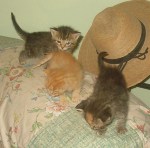
3 Tiny Lost Kittens and Me

One of my neighbors just knocked on my door and asked me to take 3 little kittens that he’d found underneath the trailer he’d just bought and moved.  No mom.  Guy hates cats and said he’d kill them if I didn’t take them.  At least they can drink milk and eat softened food, but they’re still too young to be away from their mother.

When I hold them they look up at me and cry, but when I talk to them they watch my eyes and stop and listen to me and then squeak back at me softly, telling me a little more of their story.

Three little gifts I needed today.  I won’t be able to keep them but I can take care of them for a little while and then find them good homes.  It’s been a long time since I’ve had little kittens around.  They feel so fragile in my big hands.

Good listening on child abuse prevention:

http://preventchildabuseny.typepad.com/prevent_child_abuse_new_y/2009/05/what-do-think-about-angela-shelton.html

+FINDING THE CRACK IN MY BORDERLINE MOTHER’S REALITY

At 5:35 pm on Good Friday, March 27, 1964 I was 12 years old and not yet a woman.

Then the great Alaskan earthquake happened on this day at 5:36 pm — the second strongest earthquake on record anywhere on our planet.

http://images.google.com/images?q=1964+alaska+earthquake&sourceid=navclient-ff&rlz=1B3RNFA_enUS270US307&um=1&ie=UTF-8&ei=Eyz-SfPnA5ectAOtoaDWAQ&sa=X&oi=image_result_group&resnum=4&ct=title

http://wcatwc.arh.noaa.gov/64quake.htm

++

I could tell you my personal story of the earthquake that day when my menarche happened, but all I want to mention now is that by the end of that three minutes of terrible shaking, I was a woman.

What matters most to me right now is that because of the earthquake, because of my mother’s writing about her personal experience during it, because those pieces of paper she wrote her story on survived for over 40 years and then found their way into my hands after her death in 2002, I now have proof of a critical point regarding Borderline Personality Disorder (BPD) — most importantly of my mother’s version of this mental adaptation to early traumas and my assessment of her condition.

++

I believe that an abusive borderline parent will do everything in their power to keep the ‘outside world’ from seeing or being able to detect both their broken mental condition and the abuse that is a result of it.  This is what makes BPD parents so extremely dangerous to their offspring.  Nobody outside of the family is likely to EVER suspect the existence of either the mental illness or the abuse.  (Knowing the signs to look for in order to notice in the first place and then to be able to see through the crack in the reality of BPDs will be covered in future posts).

I am not saying that my mother’s mental illness or her abuse of me was invisible to the outside.  I am saying that a combination of the fact that nobody cared with the fact that these same people did not know what they were seeing even if they were looking, resulted in a complete absence of intervention for the entire 18 years of my childhood I spent being severely abused by my mother.

It is likely that my father also succumbed to these same factors, although the additional fact of him being my father SHOULD have allowed him the ability to intervene on my behalf in some way.  This is a good part of why I am pursuing my writing based on my personal experience.  I believe that personality disorders are so pervasive, consistent and insidious that until our present ‘enlightened era’ it has been nearly impossible for those who are on the inside to recognize what is going on, either.

++

This is why what I found in my mother’s writings about her earthquake experience is so empowering to me because it confirmed what I intuitively know about her condition and affirmed my assessment on many levels both of the cause of BPD and of the consequences of involvement on any level with a person — especially a mother — who has it.

You can read her story as she wrote it at My Mother’s Alaskan Earthquake Journal Entry.

In the months just prior to receiving my cancer diagnosis I was hard at work sorting and copying into my computer all my mother’s letters, notes and journal entries concerning her homesteading experiences.  I will post what I have completed for you to reference, but there remains hundreds of disorganized pages and letters that still need to be included to make the entries complete.

These papers my mother wrote traveled thousands of miles, some of them being stored for up to 30 years in her various storage lockers she kept, and finally found their way to me nearly 50 years after she wrote them.  It was in this collection of her papers that I found the stories that she wrote the winter of her 11th birthday.  (SEE also:   My Mother’s Childhood Stories)

++

All the time I was transcribing her writings I was searching for a clue that would show me the truth in her writings that would confirm what I know in my own heart about my mother’s mental illness.  Because my mother’s stated intention in writing any of these letters and journals was to eventually write what she referred to as her “Alaskan book,” they were written from the public side of the border wall that allowed her to write under the ‘spell’ of that BPD persona.  Because this borderline split between public and private is so fundamentally and profoundly crafted into the altered brain of a borderline it is usually impossible to detect it through their own description of their version of reality.

That is why what I found in her earthquake writing created in me a state of elation!  I FOUND it!!  I found the hole in her border wall, the crack in her reality.  I found the chink in the armor that she had developed as her brain grew in childhood to protect herself from unbearable pain.  I found the equivalent of my own Silver Chalice.  If I never read another word she wrote I have still successfully completed my mission and my quest.

++

I need to take a related diversion, or detour at this moment to make a connection that I believe is vitally crucial to putting severely abusive mothers’ behavior in the social context of the human mythological imagination.

I encountered this ‘myth’ several years ago at the start of my research, Euripides’ Medea, and would like you to find a way to read it if you can.  It is contained in this book

http://www.amazon.com/gp/product/1417908971

though I read it in an earlier printing of this one

http://www.amazon.com/Greek-Drama-Bantam-Classics-Moses/dp/0553212214/ref=sr_1_1?ie=UTF8&qid=1241397818&sr=1-1

Refer to this for historical context surrounding the Trojan War and Jason and Medea:

http://en.wikipedia.org/wiki/Medea

Euripides’ famous retelling of this part of Greek myth in his play about Medea was first performed in 431 B.C., hence this story is a retelling of mythology that is older than 2500 years.  My point is that I believe this story is about a particular form of madness and can be seen as very closely related to aspects of what we now know of as Borderline Personality Disorder (BPD).  For whatever reasons the authors of the myth ascribe to her, in the end Medea murders her own children.

Had my mother been able to escape any consequence for her actions, I know she would have murdered me. In fact, this is a point of argument that I hold with the experts’ version of what dissociation is and what it does.  I DID NOT dissociate during my mother’s beatings of me.  I felt every single one of them because I had to remain absolutely aware and present during all of them as soon as I was old enough to control my body.  Her rage usually and quickly escalated to the point that she lost control of herself while she was beating me — in rhythm to her recitation of the litany she had created for me — SEE:  Litany from Start to Finish — to avoid the most dangerous falls her beatings caused me or I would have been killed — if possible, killed many times over.

It is evident in Euripides’ play that all the public present knew of Medea’s intent to kill her children because she stated it publicly and yet nobody intervened — not even when they heard the children screaming as she hacked them to death in their home with a massive knife.  Yet while many consider that this play refers to abandonment, one of the key symptoms of BPD, it is the ‘lower layer’ related to a mother’s ‘passion’ to kill her child or children that most fascinates me personally.

Because I understand that extreme childhood trauma can cause an evolutionarily altered brain to form, and because I believe that BPD appears as one of the manifestations possible from these changed brains, I also believe that it is the very, very ancient genetic information about surviving in the worst of all possible worlds that triggers this mother-passion to harm her offspring.  It is no different an instinctual reaction as one pursued by animals when they kill offspring, abandon entire litters, or choose the most ‘fit’ of the offspring to save while abandoning the others.

This is, I believe, the human basis of the killing Medea did of her children and the attempted killing my mother did to me.

++

Now back to the earthquake writings:  My proof is contained therein.  If you read her writings at My Mother’s Alaskan Earthquake Journal Entry you will find in her story the following — (Words written in the brackets are mine as is the type bolding.  Eklunds were neighboring homesteaders on the valley floor whose house my sisters, younger brother and I had been staying at while my parents were in Anchorage during the earthquake):

“Finally Eklund’s house was in sight – from outward appearances all seemed fine.  She came running out as we approached.  I could see our children were fine.  I was so thankful!  I hugged and killed [meant kissed no doubt but she wrote killed], each child in turn.  We were all together again.  I can’t emphasize strongly enough – that this was all that was important.  We could always start over again – even though for us, who like so many Alaskans have struggled so long and hard for everything and still have so far to go.  We could and would, if necessary, do it again.  I’m sure there was absolutely no questioning our minds to that.”

BINGO!

Even if we call this a ” Freudian slip, or parapraxis,  an error in speech, memory, or physical action that is believed to be caused by the unconscious mind,” the unmistakable evidence is here in her writings that what I suspect of her mental reality was real.

When I am ready to dig through boxes again, and ready to set up my scanner and do this, I will scan in the actual words as she wrote them with her own hand.  I transcribed them into my computer exactly.  There is no way, once a person sees her writing, that the two middle letters in ‘killed’ could possibly be construed as being the two middle letters in ‘kissed’.

Finding this hole through which I could see her reality may well be the only tangible vindication I can ever discover that proves my mother was who she did not say she was, particularly as she terrorized me from the moment of my birth as a result of her psychosis.

The only other related confirmations that I have found in her writings appears in the last of her childhood stories (mentioned above) and in her writing of the dream about the dark rainbow and the storm which can be seen at

https://stopthestorm.wordpress.com/about-stop-the-stor/

++

Drawing the line between the real world and the reality of the world of a borderline becomes nearly impossible particularly for those of us who were abused by one from birth.   Not only the trauma is built into the body-brain, but as a result, the version of the borderline mother’s reality is built into the survivor, as well.  I know my mother’s is built into me.

These three ‘holes’ that appear in my mother’s writings are thus critically important for me to both possess and to consider as I attempt to face the reality of what happened to me on all the levels that my mother damaged me.  I’m not sure that anybody who was not severely abused by a borderline parent can even begin to imagine how important these tangible expressions that illustrate clearly the break in the nearly perfect facade a borderline shows to the public world is — or imagine the terrible confusion such a parent creates in the minds of those she abuses.

++

My mother never knew that she meant to write that word KILL, yet there it was where I was able to find it.  What a gift this discovery is to me, and perhaps to someone else who reads this post.  That word is a direct connection to the ancient genetic potential for survival in a traumatic world that mothers who have been abused themselves CAN form even in this very real current day world.  Because the evolutionary throw-back potential can exist in a brain that was traumatized during its development, it is folly for us to remain puzzled on any level when we hear of a mother abusing her children, not even her infants.

We can no longer afford to be puzzled when mothers actually kill their offspring, either.  All the evidence that trauma can turn a mother into a killer is in the 2500 year old play about Medea which I am sure only reflects a reality that has been with our species from the time of our beginnings.  It was present in my mother’s writings and in her abuse of me.

++

I also want to note here that the infliction of self harm and self injury that is common to borderlines did not have to be a part of my mother’s spectrum of behaviors because she made no distinction between herself and me.  I was a projection of all that she had been taught to abhor within herself.  I was thus an externalized aspect of her mind — a mind that was, in effect, turned inside out because the burden of containing her own reality within herself was potentially too much to bear.  She could then heap all kinds of punishments and injuries on me and did not have to self-harm her own body.

++

As always, thank you for reading — Your comments are welcome and appreciated.  Linda

PROFOUND PHYSIOLOGICAL CONSEQUENCES OF EXTREME EARLY ABUSE

I stop and look inside of myself as I begin to write this post.  Do I want to write about the present?  Do I want to write about the past?  Chasing fireflies in the darkness, so beautiful, becoming rare.  I miss them.  They do not live in the desert.

Which words might want to appear here?  What story?

++

I know that I mentioned this once before in an earlier post, that the inability to tell a coherent life story is one of the key and central indicators that a person has an insecure attachment from early childhood.  I think we are often tempted to focus on what we know of our adult relationships.  Task masters that we are, we count them like keeping score.  Which ones were ‘good’?  Which ones failed?  Were we hurt?  Are we bitter?  Could we have ‘done better’?

But what do we really know about those early relationships, the ones that set the stage and formed the patterns that lie in the very fiber of our brain and body?  Those, the implicit memories, that guide us obliquely?

Now there’s a word I didn’t expect to pop out of my keyboard when I started writing this post.

………………………………..

http://www.google.com/search?hl=en&rlz=1B3RNFA_enUS270US307&defl=en&q=define:oblique&ei=UtT7Se3dC56utAOH-MDzAQ&sa=X&oi=glossary_definition&ct=title

from – Definitions of oblique on the Web:

  • any grammatical case other than the nominative
  • slanting or inclined in direction or course or position–neither parallel nor perpendicular nor right-angled; “the oblique rays of the winter sun …
  • external oblique muscle: a diagonally arranged abdominal muscle on either side of the torso
  • devious: indirect in departing from the accepted or proper way; misleading; “used devious means to achieve success”; “gave oblique answers to direct questions”; “oblique political maneuvers”
    wordnet.princeton.edu/perl/webw

…………………………….

“slanting or inclined in direction or course or position–neither parallel nor perpendicular nor right-angled”

All our experiences, even those that we participate in before we are born, even all those that happen to us before we can hold our head up, roll over or sit by ourselves, dig their way into our growing bodies and form us.  If they were formed by experiences that were hazardous to our well-being, these never-to-be-consciously accessed memories can lie there in wait like predators that later steal our lives away from us without us even knowing it.

They ‘slant’ our lives and incline us ‘in direction or course or position’ so that we end up out of kilter and off on a life direction that can often be far different from the one that COULD have been ours if those very early experiences (certainly up to age 2) had been harmonious and balanced.  There are consequences if we survived, and our entire life course ends up ‘neither parallel nor perpendicular nor right-angled’.

++

Does that make us, the survivors of severe abuse as infants and young children the ‘oblique people?’  When I pay attention, more so now than ever before in my life I would have to say, “Yes, that is very probably so.”  I say this at 57 because the trajectory I was sent out upon from the time of my birth has now landed me at this age in a place that I would never have been any more able to anticipate than I was able to anticipate the word ‘oblique’ appearing on this page.

++

An image has appeared in my mind, of myself being hungry for a fresh peach.  In this image I know they are in season, but I have no peach tree.  No one in my town has a peach tree either, so if I want a peach badly enough I will have to go to the market to buy one.

How do I know where the market is if I’ve never been there?  Do I simply head off in any old random direction, suggesting to myself that if I travel far enough I will eventually find the market and buy my peach?  Probably not.  I will probably find someone who knows and ask them for directions.  They would probably guide me to a well used road and suggest that I follow it to my ultimate destination — in this case, the peach store.

Troubled brains grow in troubled infancies.  My analogy might be trivial but my point is far from trite.  If chaos reigned in our early lives while our brains were finishing their human growth and development stages, our adult brains are not likely to be able to effectively participate in reasoned life planning.   “What goes in comes out.”  We end up being the ones that would have a hard time finding a peach store even if we lived in one.

++

We can easily see here how troubled families create troubled offspring ad infinitum, and on down the generations the troubledness goes.  I will introduce the information here that our higher thought processes are centered in our cortex which is not completely developed until the age to 25 – 30.  Brain development continues through our life span, but no matter what, it is the development of the brain during those first 2 years that ALWAYS matter the most, followed in importance by the mental maturation that builds upon this early development through the age of 6 or 7.

By the age of 7 we have ‘decided’ how we fit into the world around us, and our resulting Theory of Mind that we have created will both lead us and follow us for the rest of our lives.  All sorts of changes in the brain happen if those first few years are toxic and harmful.  Our brains adjust to this life in a malevolent world, and all our higher level thinking processes will be affected as will our ‘under cover’ operations that unconsciously control our ability to bond to other people, affect what motivates us toward reward, what we avoid, what we are afraid of, what confuses and confounds us.

These altered brains formed through early abuse, I believe, are not designed to participate in a long term future.  Our bodies knew if the world was already this terribly bad from the start, it was not likely to change and we cannot truly hope — on a biological or physiological basis — for things to get better.  There is no time for wishful thinking in a malevolent world.  Survival is not the name of the game, it is the ONLY game in town.

++

In some ways this programmed troubled pathway to survival in a terrible world is incredibly efficient.  All possible short cuts are designed within the body and the brain to insure that in every future situation the fastest response based on survival learning will be the one chosen by the survivor.  On the other hand, because most of us do not move into an adulthood that could ever match the horrors we went through as we developed our brains in the first place, we simply DO NOT MATCH.  We are a very bad fit with the rest of the world ‘out there’.  (And then we wonder why ALL our relationships are troubled, even the one we try to have with our self?)

This ‘out there’ world did not exist for us as we were harmed, abused, neglected, maltreated in the first place, so we could not build bodies designed to live in this better ‘out there’ world.  We were not loved and we were not protected.  We have no innate idea what safety and security mean — and for some of us, we never will  — because our brains and bodies will not let us.

Although our altered brains and bodies (along with their implicit memories) allowed us to survive our horrors, they do not participate well in a benevolent world.  And herein lies a whole new, MAJOR set of troubles.

++

To follow my peach craving image, my brain is unable to find its way to the store, no matter how helpful others might be in giving their directions, and no matter how hungry I am for a peach.  What if someone offered to put me in their car so they drive me to the store?  OK.  Maybe that might work — or probably, that is the ONLY alternative that would work.  But as adults we are mostly on our own.  Nobody is going to drive us through life in their car.

People who had adequate experiences with early caregivers during their brain formation stages do not understand how or why the rest of us, who did not have these benevolent experiences, get so lost in our lives.  We don’t understand it, either.  We often end up feeling as if there is something terribly wrong with us.

No, on the most practical level, there is nothing ‘wrong’ with us.  Just something very, very different.

How could we NOT be different, considering how we started out in this life?  The miracle to me is that our human genetic material and all the operations that tell our genes what to do have such a vast array of possible choices that can be made so that a human can continue to survive in a world that does little except threaten immediate extinction — to the body and to the ‘soul’ of the suffering one.

++

Everything about how our brain develops takes place flexibly in a situational context.  We are influenced by what goes on both on our insides and outside of ourselves.  This is the same adjustable, flexible, adaptive process that led our species down four and a half million years of evolution.  There is nowhere on the timeline that it stops.  I am a result of this process.  You are a result of this process.  And, again, “What goes in comes out.”  We can’t have it any other way.  This is the process of survival as a species and as individuals.

Eventually I hope to finish the work of translating into the simplest terms possible some of the information available to us from development neuroscience that shows what I would easily say is 20 different changes a body-brain will make as a result of developing in an environment of severe deprivation and trauma.  The one I want to mention now is in relationship to future planning abilities, and only enough to say that the early traumatized brain is not physiologically designed for one of our species’ highest aims — to be able to access what is called ‘future memory.’  (Yes, we have a ‘memory dis-ability.)

The brain and body are designed, through development under certain conditions (malevolent or benevolent), to continually process information through both feed forward and feed backward loops.  As we prepared ourselves — biologically — through terrible childhoods to survive in a world in the future, our brains made adaptations that benevolent brains NEVER have to make.  Nor can they later make the same kinds of adjustments that our brains and bodies had to make from our start.

We were assured of being at the cutting edge if the world we moved into as  adults matched the terror and trauma of the worlds that formed us.  We are designed and built to be survival machines.  Our cortex forms differently (along with all kinds of other changes), and if abuse is bad enough, actually atrophies long before the usual and optimal timeline for completion of development for the cortex is reached.

As a result, one of the most important luxuries of the benevolently formed brain is stolen from us for the rest of our lives:  We cannot participate in the feed forward loop that leads to future memory — future thought and planning.  Our brains do not believe the future exists, and if it does, well……  nobody would want to live in the kind of future our brains know from past experience.

Human brains are the most complex forms in our universe, but they are not magical.  Even though research shows that our brains are actually formed — under optimal conditions — to process infinity, if our brains were told through early experiences that the world was certain to cause our destruction at any moment, they adjust themselves as efficiently as possible in preparation for this event.   All possible roads to survival needed to be maximized and available.  There is no future in a doomsday world.  Our infanthoods and early childhoods without hope insured that we knew this then and that we would know it for the rest of our lives.

++

Early abuse survivors cannot take the obvious road to a better future.  That road was never built into our brains at our beginning.  While human brains seem to have the ability to process infinity, we have to understand that HOW they do this is different for people who suffered extreme hardship, trauma and deprivation while their brains were forming.

We cannot afford to ignore this fact.  We have to begin to understand on a profound level how different a malevolently formed brain is from a benevolently formed brain.  While a peach and an orange are both fruits, they differ from one another in substantial ways, just as the brains I am attempting to describe do.

I think we live in a culture that is so used to thinking in terms of mass production.  We believe it is somehow wrong to focus on how people are different rather focusing on how we are the same.  We find ourselves in a both/and culture that contains a paradox.  We value individuality while insisting that everyone has the same opportunities and is equal.  Where in our thinking do we have room for consequences and cause and effect?

Just because an abused infant survives to its toddlerhood, and then makes it to its teen years and beyond, does not mean that it has within itself a whole person that somehow miraculously survived to be the same person it would have become if the abuse had never happened.  I am not talking about HEALING here.  I am talking about very real changes that happened during the development of that person physiologically — on the genetic level, the level of the brain, nervous system and immune system.  That means that we do not even end up in the same body when we are adults as a result of having survived extreme early abuse that we would have had if our circumstances had been good ones.

This means that we live in different bodies and we live in a different world — because our perception and the way we process information is different.  We were built differently almost as if we came from a different planet.  For those of you — and I don’t say this with humor — that have felt yourself to be an alien on this planet — I say take a long honest look at the conditions surrounding your early development.  If they were harsh, you are an alien.  Being a survivor makes us a different KIND of person in a different kind of body with a different kind of brain.

We are the ones that will never easily find our way down the wide common road to any peach market.  Ours is a relentless struggle, often complicated by benevolent-world ideas about how we SHOULD be better at getting along in life.  It is time for those of us who KNOW a different world to begin speaking our truth.

++

A very clear expose of these kinds of scenarios I am describing  is presented by Bruce Perry and Maia Szalavitz in their book,

The Boy Who Was Raised as a Dog: And Other Stories from a Child Psychiatrist’s Notebook Child Psychiatrist’s Notebook–What Traumatized Children Can Teach Us About Loss, Love, and Healing

http://www.amazon.com/s/ref=nb_ss_gw?url=search-alias%3Dstripbooks&field-keywords=boy+raised+dog&x=0&y=0

I highly recommend this book as a thought expanding opportunity to discover what Dr. Perry knows about this topic of alterations in development for maltreated children.

++

Thank you very much for reading this post — your comments are welcome and appreciated.  Linda

DOES THE GOOD MAKE THE BAD BETTER?

On the whole, one could never have said that our family valued being lazy.  I don’t remember exactly what time we woke up in the summer when we had no reason to leave the homestead, no place particular to go.  But neither do I remember that we ever ‘slept in.’

But getting up in time to see a sunrise during on any Alaskan July day was nearly impossible.  It seemed like a sunset would happen with a sunrise following so close behind it that nobody ever actually saw one happen.  But because of this particular experience that happened  the summer before I turned 17, when my mother devised one of her more bizarre  punishments of me, I was able to see one of the most gorgeous sunrises of my life.

I don’t remember what instigated this event.  I have no idea what I had ‘done wrong’.  Maybe I had forgotten to remove all the clothespins from the clothes line.  Maybe I had forgotten to wipe the stove top clean after I had done the dishes.  Maybe I had ‘wiggled my bottom’ when I walked across the room.  Maybe I had slipped and used the word “she’ where my mother could hear me.

It never mattered.  Most of the time I had no idea why my mother was mad at me.  But on this particular night she decided that I wasn’t ‘fit’ to sleep under the same roof as the rest of the family so I was therefore banished to spend the night in the family’s station wagon.  But not just anywhere in the car.  I was told to sit in the driver’s seat with my head bent down under the steering wheel.

I was skinny at 16, but my full height of five foot eight and a half inches, so bending down that far down in that position was not comfortable by any means.  I suspect that my mother kept my father up all night yelling at him because I know she didn’t sleep.  About every half hour she returned to the car to check on me to make sure I was still in my assigned position.  Which, of course, to avoid any further wrath from her, I still was.

One must realize that we lived miles from the nearest neighbor (and had no electricity until we purchased a generator that we ran sometimes and no running water).  We were ‘out there’ and ‘up there’ on the side of a mountain at the end of the road.  Nobody ever saw us.  Nobody cared that we were there — certainly nobody cared what happened to me.

++

But on this night I summoned all the rebellion I was capable of and in between the times my mother came out to check on me and the time she returned to the house, I sat up!  How daring was that!  I didn’t get out of the car,  but I was able to watch the sun move over the mountain tops when the sun came up far behind the homestead’s mountain.  I had never seen anything so beautiful.  All shades of pink, peach, rose and red lit up the high floating clouds and then brushed gradually over the mountain as the sun rose.

Sunrises had never been a part of my summer life until this punishment.  I always could time it so that I guessed accurately about what time my mother would pop out of the house and stomp over to the car, could time when her fist would pound on the car’s window and her twisted rage filled face would scream at me.  And then she would be gone again and I would sit up to be a part, again, of a wondrous process that held me in awe.

This was not a punishment that my siblings were meant to see, so before they awakened my mother came out, released me from my night’s prison and told me to go in and cook the family breakfast.  That’s where I was when the others arose and they never knew where I had been while they had been soundly sleeping.

++

What a contrast I experienced between the times of my mother’s appearance and her screaming tirades and the sweet stillness of the mountain as it slept through that short night.  How could I have survived, relatively intact, the thousands of my mother’s ingenious punishments if I didn’t have that mountain place to feed and sustain me?

I know now that a severely abused child who has no choice but to survive has to have altered and different ways to receive information and to process experiences.  When I think back on this experience on some level it makes me literally sick to my stomach — especially knowing my father was in the house and fully aware of what was taking place and did not intervene.

But the punishment also carries within two jewels.  One is that I dared to defy my mother by sitting up.  The other is that I had implanted in my being a memory that is by itself precious to me — that of being a witness to and a part of an Alaskan summer sunrise as it came over the mountains surrounding me.  I could not stop her punishment of me, but I did make use of what options were available to me.  I chose to fix beauty and goodness around this abusive incident and I hold the two together inside of me so that one cannot be separated from the other.

And yet this experience is still one that is dissociated from my ongoing life process because there is no way that I could make it ‘fit’ back then when it happened and no way I can make it ‘fit’ now.  The only pieces that seem to matter to me are the good parts which I willed myself to keep closer than the experience of the abuse itself.  Yes, the experience was traumatic.  No, I have never forgotten it, though I do not remember many thousands of other abusive experiences.  But I decided even back then that I was going to add my own beauty to the abuse — and that part is MINE.

I need to make it clear here that I do not write about sexual abuse.  To my knowledge, that form abuse was not a part of my childhood.  I am also NOT saying that anything about the abuse itself was positive.  What I am saying is that I find value in being able to own those qualities in me that allowed me to endure all the abusive events and still come out to be a lovely person.  I do not have the mental illness that my mother had, and I can never be grateful enough for that fact.  ‘Normal’ people never have to think in these terms, but I have to.

One could think that a body (mine) could never have endured even the physical aspects of being beaten from the time I was tiny.  Certainly it is critical to understand how a child endures the verbal, psychological and emotional abuse, as well.  We did survive because there is something inside of us that allowed that to happen.  What THAT was is for me to discover, hold onto and use every day, today included.

++

At this point, I would not encourage anyone to go ‘back there’ and hunt around for awful childhood abuse memories.  Most of us have more than our share to face and deal with on a daily basis as it is.  But I will always ask that others think about how the goodness surrounded the abuse in some way or we would never have survived it at all in the first place.  There is something good in each survivor, something precious and I say, holy, that we brought with us through the abuse because it is a part of who we are and nobody could or can take that away from us.

After all, I am the one that remembers what it feels like to be included in the rising sun’s caress of an Alaskan mountainside on the morning of a long summer’s day– not my mother nor my father nor my siblings.  I am the one that still feels that sun’s kiss, and I always will.

++

Thank you for reading.  Your comments are welcome and appreciated.  Linda