+WHAT I DON’T WANT TO SAY ABOUT BEING IN LOVE

+++++++++++++++++++++++++++++++++++

I am going to write this post this morning – because I don’t want to.  I mean, I REALLY don’t want to!  The truth of the matter is that I am deeply in love with a man that is most likely suffering from Narcissistic Personality Disorder (NPD).  Being in love with this man for the past 11 years, and remaining in love with this man – no matter what – has of course allowed suffering in the present to merge powerfully with all the suffering I know from the past.  And yes, being raised as the central target of my Borderline Personality Disordered mother severe abuse for the first 18 years of my life has no doubt vastly contributed to this ‘predicament’ I remain in.

It is very hard for me to approach this target without feeling greatly ashamed of myself!  It is very hard for me to ‘let myself off of the hook’ – in any way – regarding this matter.  I obviously have not extricated myself emotionally from this mostly non-relationship.  I love this man – and that is that.  No amount of effort on my own behalf, no amount of intellectual propping myself up with the facts about myself (or about what I see in him) has lessened my insecure attachment to THIS man at all!

Someone very close to me simply tells me, “He lives entirely within a bubble of his own making.”  Looking at this fact head-on tells me she is exactly correct.

++

Research shows that NPD men seem most likely to target their rage at heterosexual women.  That this rage operates with manipulation based on a need to maintain ‘supremacy’ and control is not surprising.  That these kinds of patterns are very familiar to me from my own abusive history is not surprising, either.  That I have high tolerance to remain focused on this man DOES surprise me at the same time I feel this shame and disappointment in myself for being in love with my very own ‘specimen’ NPD man.

This article online is very clear about the patterns that are familiar to me and perhaps some of my readers:

Narcissistic Personality Disorder – How to Recognize a Narcissist

Are you in a relationship with a narcissist?

In order to “qualify” as a narcissist, a person must meet some or all of the below criteria:

  • Inability to [display] empathy
  • Expects special treatment
  • Feeling of entitlement
  • Inability to admit that he or she is wrong
  • Inability to receive criticism
  • Unexpected, strong bursts of rage in situations that would not trigger rage in normal people. There aggressive outbursts are referred to as narcissistic rage.
  • Does not react to tears. If other person starts crying due to the cruel behavior of a narcissist, that may even aggravate the rage of a narcissist
  • Perceives oneself as omnipotent, superior individual
  • Strong need for admiration. Admiration serves as a form of a narcissistic supply. Without sufficient amount of narcissistic supply a narcissist feels empty and unsatisfied. A narcissist is like a drug addict, and narcissistic supply in its different forms is the drug.
  • Is often envious and mocks other people (often behind their back)
  • In the beginning of the relationship idealizes one’s partner and often talks about supreme, never-ending love. However as the relationship proceeds a narcissist often withdraws his or her attention and may become cold and uncaring, even cruel.
  • Is often untruthful and due to this often ends up cheating in a relationship. Cheating is often a consequence of other traits of a narcissist, such as the feeling of entitlement (it is impossible for a narcissist to do anything wrong and so a narcissist does not perceive cheating to be a huge “crime”), inability to emphasize with the cheated partner and the need for admiration (narcissistic supply).
  • Double standards: A narcissist twists the rules so that they fit to the current needs of a narcissist. For example, if the spouse of a narcissist is cheating on a narcissist, the spouse is considered to be dishonest and bad person, whereas if a narcissist is cheating it is not wrong, because a narcissist simply “fell in love” and followed his or her heart. Double standards also apply to other areas in life.

Read more HERE

++

This man I love has himself very grounded in the material world (and does not display overt rage).  Whatever ‘grandiosity’ he displays happens in ways that only those people closest to him are truly exposed to.  Most of what ‘the public’ can see seems perhaps over-the-top in terms of ‘ego’ expression, but not beyond ‘reason’.  In the end this man most likely shares patterns of Trauma Altered Development caused by early infant-child neglect/abuse/trauma/maltreatment like I do.

A child who grows up in a disturbed home may enter the adult world emotionally injured. Without having developed strong bonds, he is self-absorbed and indifferent to others. The lack of consistent discipline [abuse is not consistent discipline] results in little regard for rules and delayed gratification. He lacks appropriate role models and learns to use aggression to solve disputes. He fails to develop empathy and concern for those around him.”  Read more HERE

++

For all the information about NPD and the brain, for all the information that shows that NPD lies along the same Personality Disorder spectrum that Borderline does, for all the information that can show a link (in my opinion) between all the personality disorders and insecure attachment disorders, it is probably the information that talks about the development from early in childhood of the NPD person’s FALSE SELF that most helpfully gives me an opportunity to better understand how my own ‘dis-abilities’ operate in cooperation with this man’s.

Doing an online Google search for the terms narcissistic personality disorder false self leads to a host of pages that discuss this topic.  The first page of this search states:

Basics of Narcissistic Personality Disorder (NPD)

What is the false self?

The simple answer is it’s whatever the Narcissist wants it to be. In essence whatever mask they can use to hide the insecure and damaged part of themselves to obtain the narcissistic supplies they need to support an inflated view of themselves.

The more complex answer is that the false Self is a protection mechanism against attack from the outside world. The Narcissist may suspect that something is wrong in their make up but they choose not to investigate the source of their insecurities and fears, they deny their feelings because it would mean they are not perfect. They don’t want others to see their defects because if they are pointed out it casts doubt on the grandiose image they have of themselves. Hence the development of a false Self that they and others can respect, admire and “love”. This is what their childhood has taught them, if they always behave as expected people will perceive them as special. If they show them their faults they are not special and others will deny them their respect, admiration and “love“.

++

For all the information that exists about NPD, what matters most to me is that I believe I DO KNOW that the false self of this man (as with the false self that I still believe my BPD mother displayed throughout her lifetime which included unbelievable abuse of me) is NOT the true self.  It is the true self that I have been especially formed to be able to detect – and evidently to love.

The pain I experienced (and still do to degrees) because of my emotional involvement with NPD stimulated me to begin my own search into the truth of my own Trauma Altered Development nearly 8 years ago.  What I understand today is that my own insecure attachment system is NEVER turned off – and it is the operation of my continually activated insecurely attached OWN body-self (to put this most imply) that creates my pain – NOT this man and not my affection for him.

The other significant contributing factor to this whole picture for me is that I believe that while all people who have a Dismissive-Avoidant insecure attachment do NOT develop NPD, I am willing to bet that all people with NPD do have this form-pattern of insecure attachment – AS DID MY FATHER.  Interacting with a Dismissive-Avoidant insecurely attached man is therefore very familiar to me.

++

I simply know that the fact that I will never live with a man I am not married to (and this man will never marry again and does have a live-in woman) I am spared from the major impact of NPD.  At the same time I very much remain ‘in the learning ground’ about my own self related to my great – and very true – affections for this man.  All my difficulties that I experience are my own.  I do not hold him responsible for any of them.

To continue my own growth and development I DO need to work toward finding out my own truth, no matter how difficult that might be.  Being able to accept myself (and him) without shame-filled condemnation is a part of this process.  Writing this post is a step in that direction.

+++++++++++++++++++++++++++++++++++

+THE RISK OF LOSING OUR BODY = THE RISK OF LOSING OUR SELF: WHAT EARLY ABUSE SURVIVORS KNOW

++++++++++++++++++++++++++++++++++

As I continue to process what happened to me last week that disrupted my equilibrium so that I felt like the floor dropped out from under my inner world as I fell into my troubling disorganized-disoriented insecure attachment patterns I find myself pondering a series or a collection of words.  Perhaps by exploring what these words mean and how they might be connected and related to one another I can better understand the dynamics of these dissociating shifts that happen within my body-brain as they leave me feeling lost, depleted, confused and dysregulated.

MAINTAIN comes to mind:

1: to keep in an existing state (as of repair, efficiency, or validity): preserve from failure or decline <maintain machinery>

2: to sustain against opposition or danger: uphold and defend <maintain a position>

3: to continue or persevere in: carry on, keep up <couldn’t maintain his composure>

4a : to support or provide for

Origin of MAINTAIN

Middle English mainteinen, from Anglo-French maintenir, maynteiner, from Medieval Latin manutenēre, from Latin manu tenēre to hold in the hand

First Known Use: 14th century

Related to MAINTAIN

Synonyms: conserve, keep up, preserve, save

++

SUSTAIN also comes to mind, and I wonder how this word might be different than MAINTAIN:

1: to give support or relief to

2: to supply with sustenance: nourish

3: keep up, prolong

4: to support the weight of : prop; also : to carry or withstand (a weight or pressure)

5: to buoy up <sustained by hope>

6a : to bear up under b : suffer, undergo <sustained heavy losses>

7a : to support as true, legal, or just b : to allow or admit as valid <the court sustained the motion>

Origin of SUSTAIN

Middle English sustenen, from Anglo-French sustein-, stem of sustenir, from Latin sustinēre to hold up, sustain, from sub-, sus- up + tenēre to hold — more at sub-, thin

First Known Use: 13th century

Related to SUSTAIN

Synonyms: nourish, nurture

++

And then I think of the word RETAIN:

1a : to keep in possession or use b : to keep in one’s pay or service; specifically : to employ by paying a retainer c : to keep in mind or memory : remember

2: to hold secure or intact

Origin of RETAIN

Middle English reteinen, retainen, from Anglo-French retenir, reteigner, from Latin retinēre to hold back, restrain, from re- + tenēre to hold — more at thin

First Known Use: 15th century

Related to RETAIN

Synonyms: hold, reserve, keep, withhold

++

And finally, the word DRAIN:

1:  obsolete : filter

2a : to draw off (liquid) gradually or completely <drained all the water out> b : to cause the gradual disappearance of <drain the region’s wealth> c : to exhaust physically or emotionally <feeling drained at the end of a long workday>

3a : to make gradually dry <drain a swamp> b : to carry away the surface water of <the river that drains the valley> c : to deplete or empty by or as if by drawing off by degrees or in increments <drained the country of its resources> d : to empty by drinking the contents of <drain a mug of beer>

4: drop 7c, sink <drained the putt>

Origin of DRAIN

Middle English draynen, from Old English drēahnian — more at dry

First Known Use: before 12th century

Related to DRAIN

Synonyms: bleed, draft, draw (off), pump, siphon (also syphon), tap

++++++++++++++++++++

All of these four words invoke and involve activity of some kind that either contributes to holding onto life or contributes to its decline.

As I have aged, as I have continued to endure and survive, I find now that my margin for staying on the plus or positive side of well-being has become a very narrow one.  It takes very little depletion now for me to feel it as it happens.

My inner storehouse of sustenance seems to be minimal.  When faced with stimulation from my environment that creates a challenge to me, I have trouble maintaining not only my slim margin of well-being, but more critically I have trouble maintaining-retaining my sense of self.

As I look backwards through time at the circumstances of severe abuse and trauma that were ongoing major stressful challenges to my developing body-brain during my most critical growth stages I am filled with wonder.  How did I come out of that horrible hell being a person at all?  I certainly was never treated as one!

At the same time I try to reason with myself by letting my self know that it shouldn’t surprise me now that this marginal sense of self that I have come to know can so easily dissolve into oblivion when I am in situations that make demands on this self in ways that deplete my inner resources rather than help me maintain or sustain them.

If I were to imagine my ongoing life as being a road, I would say that I don’t have enough power in my motor to make it smoothly and easily over even the smallest of bumps that might appear in my path.  Challenges tax me and drain me.

++++

Part of what brings these four words to mind today – maintain, sustain, retain and drain – has to do with looking back at the few simple interactions I had with people last Thursday when I left the safe-secure-predictable seclusion of my home.  I felt very different depending on which person I was interacting with where.

I am quite fine when interacting with people I am familiar with and that I have a history of positive interaction with.  These people ASSIST me in being able to maintain, sustain and retain my connection with myself – they do not drain me.

As I examine the circumstances of my recent difficulties I see that what each of these positive-impact people seem to have in common is that I can detect each of these people’s own SELF in their eyes, in their voice, in their words, in their body language.

None of these people appear depleted to me.  They each seem to be running down the road of their life with full power.  There is no ‘game’ with them.  There is no conflict present on any level.  These people radiate a kind of empowered JOY and ENJOYMENT of life that has nothing but a positive impact on me.

++

While I might hate it that what I have suffered in my life has so contributed to my own vulnerability and fragility of my self-in-the-world, I cannot escape the fact that I seem to have used up whatever inner resources I seemed to enter my adulthood with that allowed me to raise my own children and make it to menopause.  I have to live with the facts.  And if I don’t want to feel this depleted and drained, disorganized and disoriented after every minor excursion I take into the world away from my home I want to try to learn what the dynamics seem to be that seem to so drain me.

I met nobody last week in my excursion that was actively mean.  But I am so sensitive inwardly to ‘energy transactions’ that when I was interacting with people who also seem to be as fragile, vulnerable and inwardly depleted as I am, those interactions created demands on me that I don’t know how to screen out at the same time I have no resources of my own to give them what they communicate that they need.

++

This is one of those ‘documenting’ posts that I write sometimes because I don’t have any answers.  At the same time I also know that everything I am describing relates to the process of having survived unbearable traumas for the first 18 years of my life.  I paid a heavy price for surviving, and it is that price that I seem to be most involved in paying here in my later years.  I feel, most simply put, worn down and worn out.

While I don’t mean for this to be a negative post, I do mean for it to be a realistic one.  As our society considers the cost of allowing infant-child abuse, neglect and maltreatment to continue the consequences that survivors will live with for the rest of their lifespan must be included in the ‘budget package’.

++

As I allow and encourage my SELF to express its awareness and its experience today, I know that my RIGHT brain with its connections to what my body knows has given over to my LEFT brain not only these four words today, but also its knowledge that the images contained in the words themselves hold great body-based deeper meaning:

MAINTAIN – to hold in the hand

SUSTAIN – to hold against thinning

RETAIN – also to hold against thinning

DRAIN – to hold against drying

These words are about holding onto versus losing the essential elements life needs to preserve itself.  In my case, I am looking at the needs my SELF has, not only the needs of my body that holds me.

These are words that relate to nourishment – physiologically the food and water my body needs.  What I experience when I feel drained of my SELF means that the food and water my SELF needs is just as real a need as what my body needs.  These are life and death concerns.

Looking at the word HOLD itself I see in its origins that it has a connection both to ‘rapid’ and to ‘agitation’.  People who never experienced severe trauma during their earliest developmental years probably never have to experience concern about holding onto not only the life of their body but also to the life of their SELF.  They probably never experience how rapidly their self can disappear (dissociate) or how the inner agitation feels when a SELF cannot at times be held onto.

But for many severe early trauma survivors being able to hold onto our SELF becomes as much of an ongoing concern as it is for us to keep our BODY alive.  For us, the risk of losing one is just as great as it is for losing the other.  Our abusers made certain of that.

Note:  I suspect that the risk of losing my self is GREATER THAN the risk of losing my body!

++++++++++++++++++++++++++++++++++

+HIDE-AND-SEEK

++++++++++++++++++++++

No matter how hard I try I do not feel like myself today.  Just going out yesterday to do my monthly shopping leaves me feeling today like a different person, like a foreigner in my own body, in my yard and in my home.  This ‘derealization’ feeling leaves me without grounding as if I am not the same person now that I was before my venture out yesterday.  Like I left in the morning and came back as somebody else.

The world around me does not feel the same, either.  This is a dreamy sort of feeling and I don’t like it — but neither can I find a way to rush things back to the way they were.  Intellectually I know that the world including the people in it are continually changing.  But I also know that we are supposed to remain with a sense of intactness as time moves forward.

All I know to do now is to be patient.  Take it easy, be gentle with myself and be patient.  There is nothing I can do to rush away this unreal feeling.  There is nothing I can do to convince myself this unreal feeling isn’t real.  It is real.  Very very real.

I let myself know this is a sort of sickness feeling, a sort of un-wellness that is a part of my life.  I allow myself to feel grateful that I don’t always feel this way at the same time I feel grief and loss for myself in my life that actions as simple as running a day full of errands can so disorient me, so unsettle me — so that I feel I left a bread crumb trail from my home-self yesterday that I should have been able to follow to get back to myself — but it didn’t work.  The bread crumb trail is gone.

These feelings and this sense of derealization is a part of what it is like to live with a trauma changed body-brain.  I didn’t ask for this.  I didn’t ask for any of the horrors that happened to me when I was so young and so little — trying to grow up in a world of pain and terror.

But here I am anyway feeling lost to myself no matter what I tried to (or did) accomplish this day.  It doesn’t help me that the wind is racing and tearing around today.  I never do well here in these winds, but they go away.  They do not last forever and this feeling — though it is likely to come upon me again in the future — is also going to go away before too long.

(This is like losing my place when reading a book and having to try to find that place again — in a complex book that is the story of my life.)

I wait this out knowing that my usual work in my yard is greatly about grounding myself in my body in this world, and that yesterday I had to break that stride, break that rhythm because those errands had to be done.  But it feels like I left myself behind yesterday when I left my home and when I returned I wasn’t anywhere to be found.  Perhaps I could see humor in this but I can’t.

I am going away now.  I will be back when I am back.

++++++++++++++++++++++

+ORDER OUT OF CHAOS BRINGS ME CALM PEACEFULNESS

++++++++++++++++++++++++++++++++++

I am paying attention to myself as I walk somewhere between fearfully and courageously into the next moments of my life to my process.  HOW am I doing that?  HOW am I using my efforts and life energy to order and organize myself at the forefront — at the leading edge — of this sense of chaos I am trying to overcome rather than being overwhelmed by?

This is a personal inexact science.  I realize this at the same time I marvel at my self as I notice how I do this.  I find myself realizing that after I left my miserable home of origin and entered my adult life the pattern I notice TODAY is probably the same one I have used ALL OF MY ADULT LIFE!

What I did from the instant I posted my last piece of writing was look around the universe that is my tiny little piece of the world and asked, “What around me NEEDS me to take care of it?  What around me needs me to work with it so that it can achieve its own natural progress in its own life?”

As I asked these questions I realized that part of what probably contributes to altered development of an early abuse survivor’s left brain is that — as happened to me — is that nobody ever let me set my own individually-based PRIORITIES!  (My single priority as an infant-child-teen, unconscious and body-based as it was, was solely to endure and survive!)  Nobody was ever concerned with what I NEEDED or with what I WANTED.  So how could I begin to ‘train my brain’ to process my own priorities?

Priorities, I just now realized very clearly, are what humans use to ORDER and ORGANIZE their self in their life — which means moving through time one instant at a time.

My priority as an adult has most centrally always been to help, or to caregive to, someone else.

‘Experts’ say that it is only when our own internal attachment system is turned off that we are free to caregive.  They describe these two systems of being connected to one another like the ends of a teeter-totter.  One up/on the other down/off.

Well, I believe from inside my own life that in cases of severe abuse survivors we can operate differently.  I certainly did as a mother and I see myself doing the same thing today:  Taking care of someone/something outside of myself IS taking care of ME!

I had a terrible, nearly fatal reaction to my last child leaving home.  It was so far past ‘ordinary empty nest’ that I could almost laugh at the concept itself.  My entire BEING was ordered and organized around caregiving my children — and doing that job the best possible way.  No more kids at home?  Linda as a self disappeared again into the invisibility I spent my entire first 18 years surviving in.

++

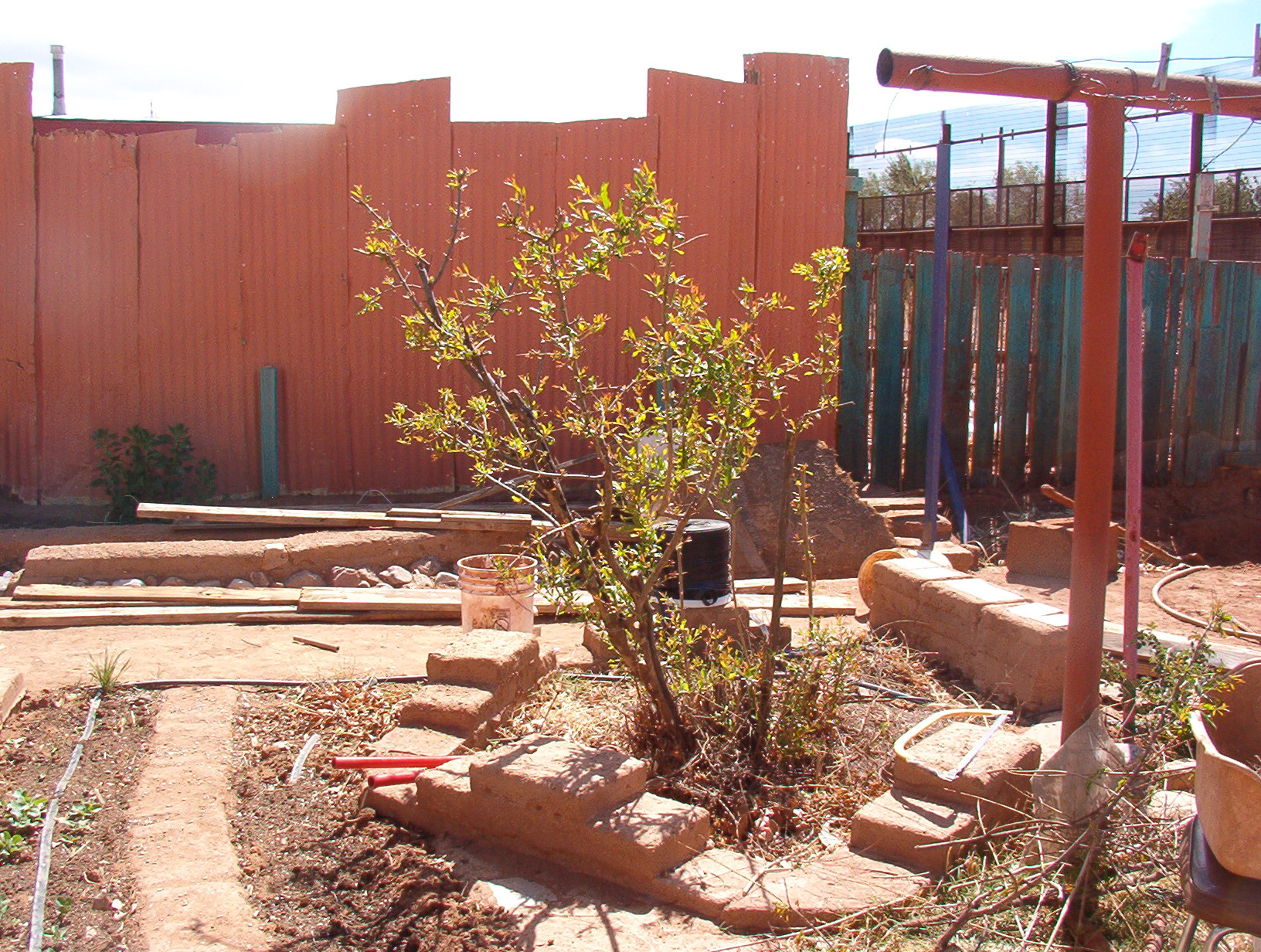
So my pick-for-the-start-of-ordering and organizing my self for this day?  The priority?  I headed outside, dull clippers in hand, to salvage my Pomegranate tree!  As its tiny new deep green leaves began to appear last week I realized that I had neglected to even consider that last winter’s 2-below-zero nights of freezing might have killed that tree!  But, oh does it look SAD!  A few leaves here, a few leaves there — among masses of obviously dead dead dead brown brittle branches.

While it might be somebody else’s priority to wash the dishes or put away all the goodies that litter the kitchen floor in plastic bags, doing so is NOT my heart’s desire!  THIS is Linda, not somebody else.  This is ME that desires to be outside and a part of the gentle wind, under the scooting shadows of the rare desert sky cloud cover, warmed by the sun but still needing several layers of clothing to stay warm out there.

It gives me joy to know that I have the power to act upon the future of that tree in such a way that I CAN save its life.  At the same time I know that helping that tree into a thriving future benefits me because its fruits are luscious and SO GOOD FOR ME!  I can productively apply myself to caregive that tree – and it is my priority at this moment and my desire and my passion to do so.

As I FOCUS on this job all anxiety leaves me.  There is no pressure to do this job ‘right’ because I am confident in my ability to automatically accomplish this task in the best way possible.

It strikes me that I intuitively and instinctively had this same sense as I raised my children.  True, my efforts with my firstborn (conceived when I was 18) were not what they grew to be later on.  But I know about myself that when I follow my OWN inner priorities I do the best I possibly can as I try in some small way to help the world become a better place.

++

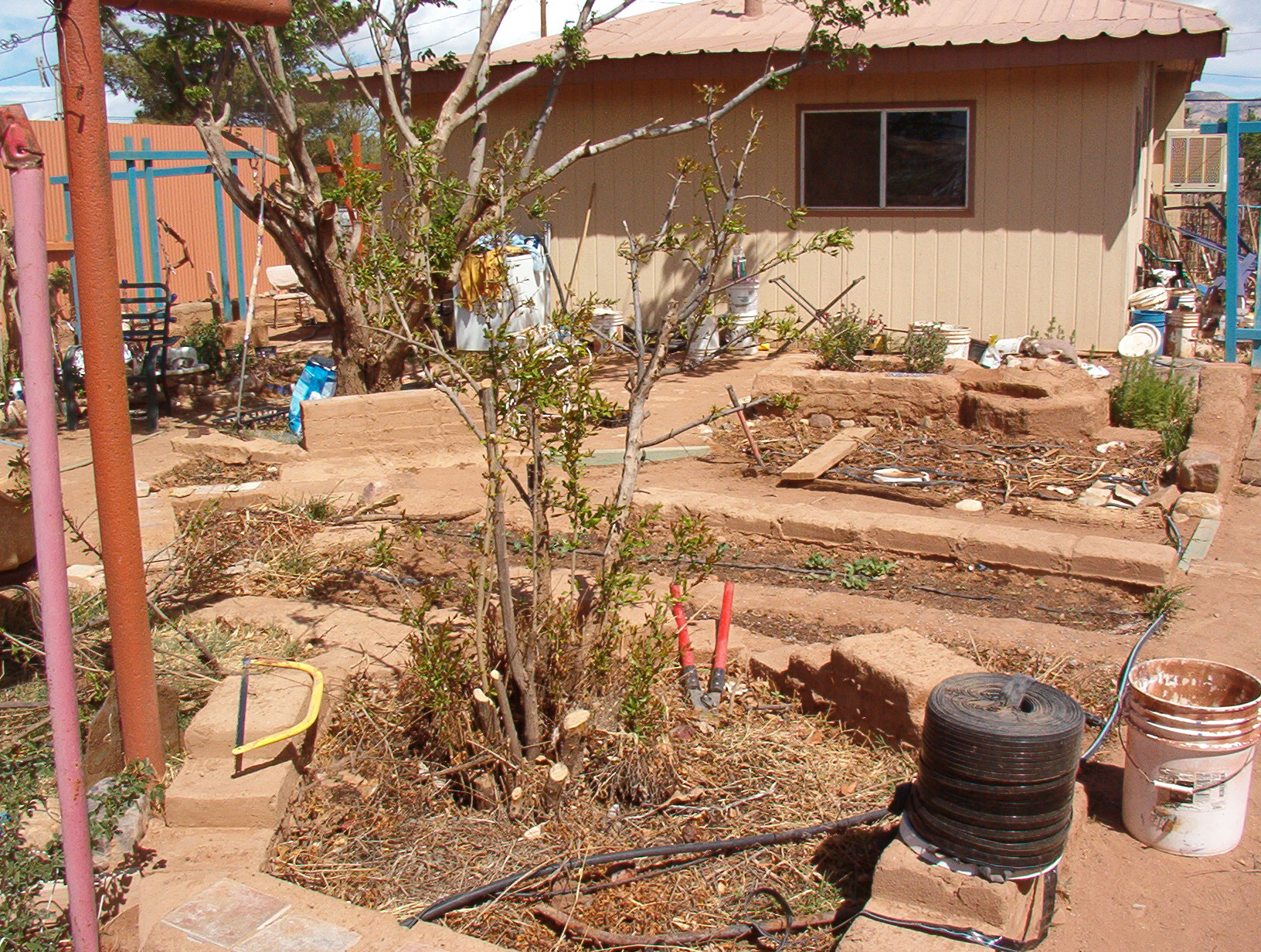
All that's left of the Pomegranate tree now -- kind of like all healing work, what's dead harms the whole unless it's gone!
I'm sure willing to bet that this tree will now thrive again. Today's cooler temps and my extra clothes did the job for pruning this tree with its 4" sharp thorns! Caregiving ALL life is the responsibility of the human race - I believe I learned that as a child on our Alaskan mountain homestead as the land took care of me!

++

Next priority for this day:  Create the best home possible for the hundreds of red wiggler worms by beloved Seattle sister sent me for the garden!  Yup!  Caregiving worms so they can caregive the garden so it can feed me is part of The Bigger Plan for my life.  Gotta love this life!

++

Previous post: +BEFRIENDING CHAOS? (EARLY ABUSE SURVIVORS AND CHOICE)

++++++++++++++++++++++++++++++++++

+BEFRIENDING CHAOS? (EARLY ABUSE SURVIVORS AND CHOICE)

+++++++++++++++++++++++

I can’t imagine that any severe early abuse survivor would say that they LIKE this feeling, the one that exists at the edge of where being OK meets ‘dissociation’.  But while I will never LIKE this feeling it is a reality of my life and my concern today is that somehow I learn how to peacefully co-exist with it knowing the feeling itself was built into my body-brain through trauma and abuse from the moment I was born.

I have written recently about my efforts to discriminate between the feeling of what I used to call continual foreboding and the one I more recently named prescience.  Today I would call it a chronic wariness state, one that is tied to chronic anxiety but that also seems to lie at an edge-line where I still retain the power of careful and conscious choice contrasted to the state that lies across this line in which full-blown stress-anxiety takes over the show.

When my personal ‘show’ becomes ruled by my body’s physiological reactions to stress dissociation is most likely to place me in a state of lessened powers of conscious choice.  I would rather have the power to choose how I am going to handle ‘things’ as my day progresses.  And, yes, all of this feels like work to me – often intangible work but work nonetheless.

++

Backing up a day to yesterday…..  I went into town with my monthly income and spent nearly all of it on necessities which included material to finish my chicken pen and coop roof.  The back of my 1978 (gas hog) El Camino is filled with bags of potting soil, stucco lathe, stucco wire (which is far cheaper than chicken wire) to enclose the pen, 2’ x 4’ boards for the roof.

My kitchen floor is covered with food staples to pack away that will hopefully last me until my disability check comes in again the first of next month.  There are also bags from our new ACE hardware store containing various boxes and paper bags full of nails and screws.  There is plant food, various useful findings from the local thrift store, and many cans of ‘no sugar added’ canned fruit that was on sale at the only grocery store we have in town.

I am good to go!

Or am I?

++

What is actually contributing to my current ‘on the edge of anxiety’ state is that there are TOO MANY THINGS here which places me in a state of TOO MANY CHOICES of where to go from here.

I think about this in relation to my recent posts about the work of Dr. Martin Teicher regarding the kinds of very real physiological changes that happened to my earliest developing body-brain.

Making conscious choices is an activity handled best by a balanced flow of information between my left brain (changed in its development) and my right brain (also changed in its development) ALONG WITH the assistance of the super highway corpus callosum region of my brain in the middle that is meant to send information back and forth between my two brain hemispheres (also changed in its development).

What all these changes contribute to my FEELING and to my AWARENESS states is a quality of being overwhelmed by possibilities!

“Aren’t possibilities supposed to be a good thing?”  I ask of myself.

“Yes,” I respond, “but all these possibilities sit very closely in my reality to the state I knew ALL OF THE TIME as a little person – CHAOS!”

Some say that chaos is the realm where all possibilities exist co-currently, simultaneously and that it is only by a CHOICE being made and a DECISION being implemented that a tiny piece of chaos is changed into a more useful and constructive reality.

“OK, then,” my inner dialog continues.  “I think I understand these feelings that I am caught in like a gigantic spider web a little bit better.  Because I was so overwhelmed by abuse for the first 18 years of my life, and because I was left with so little opportunity to actually make conscious self-initiated choices and decisions regarding my own self-reality-life, my decision-making left brain did not develop itself to process any of these interactions!”

From the inside of me (not from the Ivory Tower outside of me) I know what all this feels like to me right at this moment.  My body-brain has to fight its way up for air – which is to say it has to fight itself up to the conscious level where I can PEACEFULLY order and organize my own thoughts, desires, efforts, feelings and actions MY OWN SELF.  I have to FORCE my body-brain to calm itself down, to be OK, to feel safe and secure enough at this moment in time to know that I not only have the RIGHT to order and organize myself and my life the way I want to – but that also have the ability to do this!

Choice and decision making – creating organized order out of overwhelming chaos – is an activity that was SUPPOSED to grow into my body-brain from the time I was born.  This is how the SELF of a new human being becomes integrated into all aspects of its life in the world.

As this happens during ‘Critical Windows of Development ’ the substructure that allows everything to flow cooperatively together to accomplish a lifetime of tasks (large and small) is wired into the developing body-brain on the physiological level.

Severe early abuse, neglect, trauma and malevolent treatment of little people sabotages the ‘normal/ordinary’ development of these abilities.

++

Enough said about all of this for this moment.  This blog is packed full of information about all of those changes in development.  What I need at the moment is to accept this reality as it exists in my body-brain (still, at my age of 59 ½) – so that if I can’t find a way to become friends right this moment with my body-brain as it was created, at least I can find ways to NOT be its enemy.

Being angry at my reality, being full of misery and suffering because of it, remaining in a feeling-awareness state of blocked mobility in my actions for the day will not help me one little bit!  How can I ACTUALLY organize and orient myself today so that I can move forward?  How do I settle this being-overwhelmed-in-the-sea-of-chaos (too many possibilities) DOWN?

++

This disorganized-disoriented insecure attachment-built body-brain that I live in/with doesn’t get to pick and choose when, where, how or why it operates because it is directly built into my entire physiology.  I will always believe that it is ONLY through conscious application of new information about me that can free me from my physiological natural state so that I can experience some peaceful calm that does NOT automatically exist in my body-brain.

I relate everything I am experiencing this morning back to Teicher’s writings (recently posted) including what it IS like and FEELS like to have an apt-to-kindle right limbic brain (which is intimately tied to what it knows of our body).  I have to (in essence) take my finger out of the pot of boiling water!!  Boiling water might be what my body-brain essentially knows, but I AM here, and I CAN make different choices today rather than let this perpetual peritraumatic acute trauma-reality state rule my day.

I can tell myself that all stimulation that happens in life is NOT BAD – nor is it automatically overwhelming!  While this is the reactive state that is most familiar to me, it is not the ONLY state that exists.

Can I take my own hand and in partnership if not in friendship discover how to move forward in time as I change inner CONFLICT awareness into calm peacefulness?  Let me see………

+++++++++++++++++++++++

+DISSOCIATION AND EXTERNALIZED NONAUTOBIOGRAPHICAL MEMORY

++++++++++++++++++++++++

I was able to sit in my garden this morning to watch the first sun rays touch the delicate leaves of the Ballerina Rose bush I moved yesterday.  “Ah-Ha!”  I thought to the rose.  “I can tell you will be happy there, and I am glad!  No longer will you have to wait too long each morning for that light you so desperately need.  You will grow into a beautiful plant now.  Just wait until next summer.  You will see!”

I hope 'my' rose reaches this fullest expression of beauty -- in its own time.

It was cool last night, though still not quite a hard freeze.  There is no breath of wind, and I was able to hear each leaf collapsing off the branch of the old Mulberry tree I hard-pruned last summer.  Plink!  Click!  Clatter!  Each single leaf marked its falling with a sound hitting the hard adobe walkways.

Does a falling leaf remember its life growing upon the twigs and branches of a tree each year?  Does it remember its falling?  Can a leaf remember itself once its eaten by a worm and becomes new soil that in turn can feed the growth of something else?

++

I thought about how hard my day was for me yesterday.  I realized how critically important my garden is to me — for a reason I have not until now clarified in words.

My garden is a collective storehouse of my memories.

This helped me to understand more clearly that just as a leaf is not likely to remember itself in its life, I cannot really remember myself in my life, either.  My memories are not ‘attached’ to me as I suspect ‘ordinary’ people’s memories are attached.  My memories are attached externally to objects and to people.

Semantic memory is a memory for facts, I think always available in their connection to descriptive words.

Autobiographical memory is SUPPOSED to form so that a self is in the middle of the memory — because they were in the middle of the experience of not ONLY the experience as it happened in time — but most importantly they were in the experience of HAVING the experience as it happened.

This is connected to the critical FEELING FELT process that is supposed to happen for an infant as its body-brain is building through interactions it has with its earliest caregivers.  The nature of the infant-caregiver interactions are SUPPOSED to mirror back to the infant, reflect back to the infant, and resonate with the infant in such a way that the infant begins — through the experience of FEELING FELT — to know that it has a SELF inside of it that is having the experience of feeling its own self in its own life.

I MISSED THIS STAGE OF DEVELOPMENT, and once this stage was missed and the ‘feeling felt’ neurons did not develop in an ordinary way, I have lacked the ability to FEEL FELT in my body in my own life — for ALL of my life.

++

I thought again this morning about the very first time I encountered a literal awareness of the passage of time.  When I was 18, fresh away from home and just out of Naval boot camp, I met a man I fell in love with, had a child by, and eventually married (and soon divorced).

This man had friends with money who lived high on a hill somewhere in the San Francisco Bay area.  We went to visit them one day and I saw my first hammock.  It was pure white, strong and new looking, hanging in the sun from the branches of two trees that overlooked a vineyard.

Nothing should have been especially noteworthy about my seeing the hammock, and there wasn’t until I returned 2 years later on another visit with my partner and encountered the hammock again.

There is STILL something intangible about my experience of having the experience of encountering this hammock a second time.  There it was, the same hammock, but now it was sun rotted, broken and shredded, dirty and in threads half hidden in a growth of weeds.

I remember standing there gazing at the hammock in SHOCK!

It wasn’t the hammock itself that I was responding to so much as it was my very first experience of SEEING the passage of time.

++

As I remember this memory this morning — the hammock as I first saw it, the hammock as I saw it next — and as I remember the stunned sensation that filled me at realizing PHYSICALLY in my body that enough time had passed by since I had first walked upon that spot that the hammock and disintegrated into nothing but a tangled web of broken strings — I realize that this is the clearest example I have in my life of how the passage of the time of me in my life is connected NOT to my own internal experience of myself passing through time but is rather connected to how everything I can notice OUTSIDE of myself passes through time.

++

My memory returns to the second experience I am clearly aware of that again involves a physical object (as if these things have a life of their own — like a leaf) with its own ‘life in and over time’.

When I was 20 and first moved with my little daughter to Fargo, North Dakota I was blessed with the sweetest landlady anyone could every have — Lily.  Over the few months that I lived in Lily’s basement apartment I often sat with her at her kitchen table and shared coffee with her and visited.

After many such encounters one day something came into my awareness — again with a sense of shock.  There on the lowest shelf of her narrow shelves built into the wall next to her kitchen table was the exact same sand-filled, metal-topped, plaid cloth-bottomed ashtray — that had ALWAYS been returned to sit in that same exact spot.

Thinking about my own inner reaction to my realization that the ashtray ‘resided’ in that spot over time reminds me of something my son said when we were eating burgers at a restaurant when he was three.  Well, actually, he was NOT eating his hamburger — a fact that created this specific memory for me.

We were ready to leave and as I looked at my son’s plate with its burger still intact I said to him, “You haven’t even touched your hamburger!”

He replied from his three-year-old’s perception, “Here, momma, I am touching it now,” as he gingerly placed the tip of his right pointer finger on the bun.

“Oh,” I said next.  “I guess we’ll just have take it home.”

My son, in his young thinking-processing stage was NOT being sassy when he responded back.  “But Momma!  We can’t take the hamburger home!  It already is home!  This is where it lives!”

++

I have a sticky note attached to a infant-child growth chart that is lying here beside my computer.  The note is from page 126 of Affect Regulation and the Repair of the Self – Hardcover (Apr. 2003) by Allan N. Schore:

At three years of age and beginning at the end of the second year a child “can construct accurate representations of events that endure and are accessible over time.”  These are imprinted into the right brain hemisphere as AUTOBIOGRAPHICAL MEMORY.

++

My son was very much involved in related growth and developmental processes that happen as ‘Theory of Mind’ develops — as he went through them HIS WAY.  Eventually, of course, he grew to understand that hamburgers don’t ‘live’ anywhere and don’t have a ‘Theory of Mind’.  Hamburgers also don’t have memory — at least not as we usually think of memory.

++

I have a whole collection of sticky notes attached to this growth chart I am looking at.  I have been waiting for years to be ready to address them, in all their simply stated accuracy, in my writing. These statements are about critically important inner growth processes that happen from age one to age four.  These stages of development are built upon the first foundation of body-brain development that happens from birth to one through early attachment relationships an infant has with its caregivers.

So far I cannot look directly at these next stages of development because I personally know that NOTHING went as it should have in my development up until age one — and therefore all of my future development was altered, as well.  I have not wanted to face what all these changes did to me!

Yet I also know that my ability to have ‘ordinary’ experience of having experience with the FEELING FELT in my own body as the experiences happen — and then storing those memories autobiographically — was stolen from me by severe abuse from birth.  I was amputated from my own life, separated from it as surely as each leaf I watch plummet to the earth on a windless morning has been amputated from its tree.

++

Identifying specifically HOW I experience my life is hard enough.  Finding words to describe it is equally as hard.  While I know I am the person who watched those leaves fall this morning, I cannot FEEL it.

As I have worked toward being able to write my own story about my own experience of my severely abusive infant-childhood I have struggled with being able to remember what remembering myself in my first 18 years was REALLY like.

As I do this work I increasingly realize that how I experienced those first 18 years is the same as how I have ALWAYS experienced myself in my life.

Perhaps nature had no better way to assist me in surviving those 18 years of traumatic hell other than to remove from me the ability to truly FEEL myself feeling myself as I went through those experiences.

Instead every experience, as an amputated individual snippet in time, appears to me as if I had remotely WATCHED what happened from a very great distance away (like watching a hammock or an ashtray over time).  Today it is becoming even more clear to me that the process I use — have always used — to remember my life is SEMANTIC recall of the facts as they happened and does not involve what ‘ordinary’ people would use as autobiographical memory building and retrieval.

I have always been left outside rather than inside my own life.  I believe I lack the neurological underpinnings that would have formed the circuits and pathways inside my body-brain so that I could CONNECT and ASSOCIATE and ATTACH my own self in a ‘feeling felt’ way through time as I live in this body in my lifetime.

On this physiologically-trauma-changed level I ALSO lack those same required neurological pathways and circuits that would enable me to truly feel felt WITH and BY anyone else.  I am left wondering what the ‘ordinary’ experience of life is even like for other people — and I truly believe I will never know.  Once these emotional-social patterns are built into the body-brain BEFORE THE AGE OF ONE they cannot be changed.

The earliest foundations of body-brain growth and development happened for me in the midst of terrible trauma in such a way that my pathways and circuits were made in a different-than-ordinary way.

As surely as the body of the little girl me in those two pictures I included in my last post look like they were cutout and pasted into a picture of ongoing life of OTHERS that had nothing to do with the reality of my life, I am STILL a cutout-and-pasted-in person in the midst of a stream of life that I experience very, very differently from others.

Yes, I experience feelings.  Intensely.  But somehow my emotions are disconnected from my memory process in such a way that the literal facts of events are stored (as they are for everyone) separately from the emotions.  In my case the emotional of memory (stored by a different process in the body as it is for everyone) is ALWAYS disconnected, unattached and dissociated permanently from my memory recall.

++

In rewinding the ‘movie’ of my thinking process this morning I need to add in the part about going to visit yesterday’s post commenter’s blog and reading what he says there about Dissociative Identity Disorder from his experience and perspective.  As I read I found myself being envious of people who can experience the experience of having ANY identity — from inside their own self — at all!

I think about looking at my newly moved rose bush shining away in the sunshine this morning.  I can only begin to try to imagine what the rose bush’s experience MIGHT be like.  As I look at my newly planted apple tree, also shining away and gently swaying in the emerging morning breeze I can wonder what it MIGHT be like to be that apple tree.

As I remember myself yesterday I try to IMAGINE what it was actually like to be me, to have my feelings and thoughts as I did yesterday, because I cannot FEEL myself in my memory from yesterday any more than I can feel what it might have been like to be anyone else — yesterday.

I document all of this simply because I know I was formed in an extreme environment — yes, like in a perfect storm.  My mother was so insanely focused on what she did to me from birth that she was able to effectively beat, terrorize and remove from me all of my own ability to know what it was like to actually be me in my own life in any way except in the exact present moment as it was/is happening.  Not only did she cut me off from nearly all human contact other than with her, she also cut me off from my ability to be in contact with my own feeling-felt self in my own life.

I therefore have a version of Dissociative Identity Disorder without any real, stuck-together, feeling felt version of any identity at all.  I exist from one moment to the next because I semantically (factually) KNOW that I do — and because I exist to other people.  No wonder I responded powerfully to the quip about “If a tree falls in a forest and nobody is there to hear it, does it make a sound?” when I first heard it shortly after I left home at 18.

I was built to be that tree falling.

++++++++++++++++++++++++

+IN THE PRESENCE OF LAUGHTER WE ARE SAFE, SECURE AND FREE

+++++++++++++++++++++++++++++++++++

The wind is back at dawn today, roaring around my house like a drunken clan of Cyclops giants.  The tall pine in my neighbor’s yard is dancing a wild, frenzied jig in fast motion.  The wind is trying to rip the leaves off the plum tree before they even come out.  The giants are bellowing at me down the water heater chimney in the corner of my kitchen.

The sky grows lighter with the sound of birds perched in the twigs of the quince tree above their pan of water outside my kitchen window.  The light is all gray today.  It seems to be within the clouds across the sky, even in all directions, masking the outlines of the mountains, yet here and there in the west the clouds are outlined with the faintest tints of peach, ecru and tan.

It looks like a day to stay indoors.  My cold has thickened and settled, making me feel feverish and queasy.  Sneezing, I watch droplets of rain appear on the outside of my window.  I am grateful for this roof and these walls of shelter (thinking about my study last weekend about the precuneus part of the brain and its connection to our human sense of shelter and to the self).  Protection for the body of the self and for the self of the self.

I am not so tough that I can’t appreciate these advantages I have being only one of billions who have so much less to keep them protected from so much more.  Without these protecting walls of shelter around me right now, without this sturdy roof, without some source of heat, I would experience this coming day differently.  It strikes me as I read a little more of Dr. Dacher Keltner’s 2009 book, Born to Be Good: The Science of a Meaningful Life, about laughter that the presence or absence of laughter seems to correspond to the nature of the protection we have inside our self for our self.

++++

Keltner and his colleague, George Bonanno, designed a long-term study to examine how laughter operated among 45 adults who were grieving for the loss of a much loved spouse who had died within the previous six months.  Here again Keltner does not include any assessment of previous traumas, child abuse or maltreatment, or to degrees of secure or insecure attachment.  By not collecting this information from his participants, he missed the opportunity to learn about how the presence or absence of laughter during a time of personal storms is directly connected to the nature of the sheltering protection a person has for their self.

Yes, he found that laughter appears as a resiliency factor in human grieving.  Yes, laughter appears to be a ‘fitness factor’ that corresponds to the ability to transcend one’s losses so they can flexibly resolve their traumas and move on into the next stages of life.  But I resist the intimation his writings leave with is readers, that there is plainly something innately superior about those who can laugh in the midst of their grief compared to those who cannot so easily access laughter’s power to heal.

My bet is that those who entered into the rooms of Keltner’s experimental laboratory to complete his interviews and have their most minute reactions critically examined brought with them the condition of the shelter of their self built within them through critical developmental stages of their infancy and childhood.  Those who were early traumatized were most likely to have soggy cardboard boxes to live in, if that.  Those who benefited during their development by being given good strong walls and a good strong roof, doors that sealed out the storms and tight, solidly placed windows of course had the corresponding ability to access their laughter within.

What did Keltner and Bonanno find among their 45 participants?

“Measures of laughter (and smiling) predicted reduced grief as assessed at six, fourteen, and twenty-five months postloss.  Duchenne laughter while talking about their deceased spouses were less anxious and depressed, and more engaged in their daily living, for the next two years.  Just as important, people who showed more anger were observed to be experiencing more anxiety, depression, and disengagement from daily living for the next two years.”  (page 142

These researchers continued to study how these grief-triggered reactions appeared in the body of their subjects and observed the following:

“…George and I went on a search for further evidence in support of the benefits of laughter.  Why did laughing while talking about the deceased partner relate to increased personal adjustment?  What we observed were findings very much in keeping with the laughter as vacation hypothesis.  Our first analysis looked at how bereaved individuals’ experience of distress tracked one physiological index of arousal – elevated heart rate.  The bereaved individuals who laughed showed similar heart rate arousal as those who did not laugh.  But whereas our nonlaughers’ feelings of distress closely tracked increases in their heart rate, our laughers’ feelings of distress were decoupled from this physiological index of stress.  Metaphorically, laughers were taking a vacation from the stress of their partners’ deaths, freed from the tension of stress-related physiology.

“We then transcribed their conversations and identified exactly what the bereaved participants were talking about when they laughed.  Here again, data suggest that laughter is not a sign of denial of trauma, as widely assumed, but an indicator of a shift toward a new perspective enabled by the imagination.  We coded participants’ references to several existential themes related to bereavement – loss, yearning, injustice, uncertainty.  We also coded for insight words that reflect a shift in perspective, phrases like “I see” or “from this perspective” or “looking back.”  Our participants who laughed were most likely to be talking about the injustice of death – the unfair termination of life, the difficulties of raising a family alone, the loss of intimacy – but they engaged in this discourse with perspective-shifting clauses.  Laughter was part of these individuals’ shift in viewing the death of their spouses.  It was a portal into a new understanding of their lives.  A laugh is a lightning bolt of wisdom, a moment in which the individual steps back and gains a broader perspective upon their lives and the human condition.

“Finally, our data speak to the social benefits of laughter.  Our bereaved individuals who laughed reported better relations with a current significant other.  They more readily engaged in new intimate relations.”  (pages 143-144)

++++

I believe that Keltner and Bonanno missed the most important fact that it wasn’t the presence or absence of laughter itself that mattered most in their study.  It was the presence or absence of a safe and secure attachment system, built into these individuals through the nature of their earliest caregiver interactions during their body-brain developmental stages, that either enabled laughter to exist as the resiliency factor it is, or did not.

Laughter is obviously connected to the benefits this research describes.  Yes, it does have the power to modulate the physiological stress response in the body.  Yes it indicates “a shift toward a new perspective enabled by the imagination” because it is a signal of fitness that reflects the conditions of the environment an individual was formed in, by and for.  Yes, laughter is included in autobiographical narratives when it appears in “perspective-shifting clauses” that are part of the telling of a coherent, continuous life story that is most likely to happen for a safe and securely attached-from-birth person.

Transitioning between contrasting mental states, processing information in insightful ways, being able to obtain shifts in perspective, having a “portal into a new understanding” of one’s life, having the capacity to experience “a lightning bolt of wisdom, a moment in which the individual steps back and gains a broader perspective upon their lives and the human condition” all are possible because of safe and secure attachment patterns built into a person’s body-nervous system-brain-mind-self from the start of one’s life.

And of course having these abilities, which stem from a safe and securely built body-brain, means that such a person will have the capacity also to report “better relations with a current significant other” and will be able to “more readily” engage “in new intimate relations.”

++++

This research is describing the differences between those who have and those who do not have the insurance-policy benefits of safe and secure attachment built into their early developing body-brain.  The presence or absence of laughter is the internal and external signal that clearly indicates the nature of a person’s attachment system.  Our attachment system is itself a signifier of the quality of the world that built each of us in our beginnings.

Our attachment system is about the quality of the protective structure within us that contains our self.  If I had to try to recover from this cold I have outside in the cold wind and rain of today, rather than trying to recover within the adequate home I have that keeps those stormy elements away from me, I would not be likely to recover as well, as quickly, or maybe even at all.  That’s just plain common sense.

So why do we continue to so stubbornly refuse to accept that the conditions of our inward attachment system that directly formed the who and how we are in this world don’t have an equally powerful influence on how we respond to and recover from the trials and tribulations, the storms that happen to us along the pathway of our lives?

If the presence of laughter signifies the existence of a safe and secure inner protective structure for the self, and its absence signifies that this inner protective structure is not safe and secure enough, then I know more about the meaning of laughter in my own life and in the lives of others.  Just as I would want to improve the physical structure of my dwelling if the rain was pouring in the roof and my siding was blowing off, I want to improve the structure surrounding my self.

++++

It is with this new “light of understanding” about the powerful signifier laughter is of the conditions of my inner shelter that I will share with you something that made me laugh so hard yesterday my sides literally hurt.  I haven’t laughed like that for a long, long time.

Our rural town weekly newspaper always includes a page called “The Police Beat” where the past week’s 911 calls are presented to the public.  I happen to live in this unincorporated outskirt town of 700 people that I found mentioned in the news yesterday.  I was trying to read this entire piece from start to finish over the telephone to my daughter last evening without laughing.  I couldn’t do it:

Jan. 7

A Naco woman reported a large green half snake half something else was in her bathroom.  By the time deputies arrived, the creature was gone.

Of all the descriptions Keltner has presented (above) about laughter, it is his mention of how laughter is “an indicator of a shift toward a new perspective enabled by the imagination” that most caught my attention.  I thought to myself, “Hey!  I can do THAT!”

Reading this report from the sheriff’s call yesterday captivated my imagination.  The words in that report created for me a playground for my imagination – as I suspect it will yours.  Now, thanks to reading Keltner’s book combined with my own insights, I understand more than ever before the critical place that laughter has as a signifier of human well-being.

I will pay ever more close attention to finding the large and often very small places that humor, smiles and laughter might be hidden around me in my life – even if they are hidden in the words of a paper about something that first appeared in someone else’s bathroom – and then did not.  Now I understand more clearly that my attachment system, my home of my self in the world, will be better off for every instant of genuine laughter I can find.

Human laughter, older than words, might well be the most important language we have.  It tells the stories of the better side of life.  In laughter we share both the oldest and best of who we are and what we know.  In the presence of genuine laughter we are most present in the present because in its embrace we are most completely safe, secure and free.

+++++++++++++++++++++++++++++++++++

+IN THE ABSENCE OF LAUGHTER

++++++++++++++++++++++++++

My guess is that if we could count up all the people in our culture on a given day that mention the interpretation of dreams, we could then divide that number by five and get a good idea about the number of differing theories about dream interpretation.  Ten thousand people?  Two thousand versions.  A hundred thousand people?  Twenty thousand interpretations.

I have often wondered if aging changes how people dream.  When I reached the age of about 45, my dreaming seemed to stop completely as if I had suddenly become a different person.  Gone were the vivid Technicolor scenes of flowing activity.  Gone were the presentations of insight in fairy tale formats.  Gone were my dreams.

Last night the wind came.  It tore around the house, picking up anything not tied or nailed down and throwing them against the walls of the house, battering my mind in sleep with its roaring.  Rain pounded on the tin roof above my bed, an ever welcome sound in this high desert, but strange in its silence as both the water pouring out of the sky and its sister wind stopped together as soon as the first faint light of dawn began to creep over our world from the eastern horizon.

It is so silent now it almost feels like the world on the other side of the walls of my house has disappeared.  It is this same kind of silence that greets me when I rise from my bed in the morning, leaving behind me the rattling noise of my sleep.  I woke many times last night because of the storm, and each time I did a part of me thought, “Oh, darn it!  I am not dreaming, I’m thinking!”

There were even times when my eyes opened into the darkness that I found myself in the middle of writing while I was sleeping.  Whole paragraphs of words greeted me just at that threshold between sleep and waking.  One time I knew the topic of my epistle that had been taking place behind the veil was profoundly sociological.   Patterns of human thought, instantly collapsed into a single awareness as I opened my eyes, seemed to contain the wishes for wisdom that follow human generations for thousands and thousands of years.

I gave up on sleeping at 4:30 this morning, and wandered into my kitchen to fix myself some coffee.  At that time the storm was still surrounding my house.  Now it has gone as if it had never existed, just like the words of my dreams.

What has changed in my brain that now I am forced to sleep with a mind full of words instead of images?  Where are the living, breathing connections within me?  They have been replaced with this dry, sterile flat landscape of words.  I resent this.  I miss my dreams.

++++

As a member of the select group of people who today might wake up wondering about a dream they had last night (even though I doubt I officially even had one), I can join in the medley of dream interpretations by offering what was taught to me about ‘working with dreams’ when I was in art therapy graduate school.

“Dreams are images,” by long white-bearded professor would chant in front of the class.  “They are no different than the images painted on canvas or drawn with pencil on pages of white paper.  Stick with the image,” he would repeat time after time.  “Stick with the image.  It will always tell you what it wants you to know if you simply learn how to let it.”

Besides these sparse words there is one other point I can remember now twenty years later.  “Look for the places in the image where something is changing.  It is in those places that the life force within the image is moving.”

We were taught to find within an image exactly what was there.  Nothing more.  Nothing less.  Within a dream’s verbal telling the change points will always appear in such words as “suddenly” and “but” and “but then” and “if.”  At these points a new perspective appears.  Something different happens.  One thing turns into another.  We were taught to understand that no matter how convoluted and complex dreams might appear, they can always be understood in their essence by the movement of their changes.

++++

The morning’s slow shift from pitch blackness to daylight doesn’t seem to be captured correctly in the word ‘dawn’ to me like the evening shift can be transcribed into ‘twilight’.  There is just as much mystery to me in this gradual shift happening outside of my windows right now as I wait for what’s missing – the sound of today’s first bird call.  Where are the birds?  Are they frightened, soaked and in hiding?

“Call to me, little ones.  Let me know you are out there.  The sound of your voices will comfort me.  You let me know every day I wake up into the same world I was in last night when I tried to sleep, restlessly, dreamlessly and verbal.  This silent dray world is eerie and everything seems out of place.”

I wait for this half-light transition to complete itself.  Transitions, the stuff all life is made out of.

+++++++++++++++++++++++++++++++++++++

I did not intend to write about dreaming this morning.  I intended to write about laughter.  What has happened is that I am stuck in between these two topics at the point where they are connected.  That point is about transitions and insight.  (I am glad.  I hear a small bird’s first chirping outside my kitchen window.  I am home now.  I am awake as the world outside wakes along with me.)

I tried earlier to find a book on my shelves I could read this morning to carry me in time across that great divide between darkness and daylight, but several pages of several books left me feeling the same.  Too many harsh words with edges that left grit between my teeth.  Too few words in each sentence so that as I tried to move my eyes across lines on the page I kept being hit in the face with period after period.  “Just let me read,” my word-dream tired brain bellowed at me.  “I just want to flow with a thought, not be pulled up short each time I barely get going!”

So I ended up simply back again with Dr. Dacher Keltner’s 2009 book, Born to Be Good: The Science of a Meaningful Life, picking up where I left off in my reading several days ago, before I got sidetracked by my sadness and minor sickness.

I found this morning that Keltner headed the next section of his chapter on laughter “The Cooperation Switch.”  After reading this section, my mind wants to rename it “The Transition-Insight Switch.”  He describes how researchers have discovered that every time we laugh our nervous system responds by relaxing itself.  Keltner describes how as this pause in our ongoing experience happens, we benefit from an instant of opportunity for discovering something new and different about any situation we might be contending with.

Laugher, as the prosocial specialized sound mix it is, in between the ranges in our vocal chords that we use for talking, connects us not only to others around us, but also to our own self.  Laughter represents a loosening of our grip on what we consider to be our usual reality, and makes room for explorations into ‘something different’.

Keltner describes how an infant-child’s capacity for laugher is integrated with the capacity for developing speech and thought.  He writes about the stages of young childhood a child passes through as it pretends one thing is something else.  A bathtub filled with water IS an ocean.  A teaspoon IS a magic wand.  A child bobbing up and down wildly on a bed IS flying.  Children learn about themselves as they transition into the larger world by using pretense in play.

This critical play stage of infant-child development is supposed to involve laugher.  I have written previously about how I don’t believe my mother ever transitioned successfully through this process.  The patterns of human development that Keltner describes are supposed to happen in the same way those nighttime transitions turn into day.

Long before the first rays of the sun outlined the high edges of the clouds to differentiate them from the mountaintops I could then see outside my kitchen window, I knew the daylight was coming because of the chirping of the birds.  When laugher and happiness are missing for a child during this critical developmental stage of development, it is possible that the borderline between night and day in a child’s developing mind is never crossed completely.  The presence of infant-child laugher is as sure a signal of transition as is the chirping of a morning’s first bird.

Laughter does not make a child grow up any more than a chirping bird makes the sun come up.  Yet while it would take a drastic force beyond my imagination to change the natural patterns of a daybreak, I can imagine forces that change a young child’s world so much that laughter ceases to be a part of it.  Such was the early world of my mother.

Keltner writes about childhood laugher, play and the individual evolution of the human mind as he describes a transitional process across the ‘border land’ of development my mother never completed successfully:

“These forms of pretense emerge in systematic fashion at around eighteen months of age.  They are all systematically accompanied by laughter.  And they lead the child to develop the ability to use words to refer to multiple objects.  As children free themselves from one-to-one relations between words and objects, they learn that words have multiple meanings.  They also learn that objects can be many things – a banana can be a banana, a phone, an ogre’s nose, or a boy’s penis (when the parents aren’t’ around).

“In the freedom of pretend play, children learn that there are multiple p0erspectives upon objects, actions, and identities.  The child moves out of the egocentrism of his or her own mind and learns that the beliefs and representations of other minds most certainly differ from one’s own.  And it is laughter that transports children to this platform of understanding and epistemological insight.

“Laughter is a portal to the world of pretense, play, and the imagination; it is an invitation to a nonliteral world where the truths of identities, objects, and relations are momentarily suspended, and alternatives are willingly entertained.  Those hours of pretend play – peek-a-boo games, monsters and princesses, the ogre under the bridge, astronauts – are the gateway to empathy and moral imagination.”  (pages 137-138)

++++

Keltner has developed a theory about laughter:

“In the observation that laugher accompanies the child’s capacity to pretend, to participate in alternatives to the realities referred to in sincere communication, we arrive at a hypothesis about laugher.  Let’s call this hypothesis the laughter as vacation hypothesis.

“The word “vacation” traces its linguistic history back to the Latin vacare, which means to be “empty, free, or at leisure” and is defined as a formal suspension of activity or duty.  The laugh, then, signals the suspension of formal, sincere meaning.  It points to a layer of interaction where alternatives to assumed truths are possible, where identities are lighthearted and nonserious.  When people laugh, they are taking a momentary vacation from the more sincere claims and implications of their actions.

“A special realm of sound is reserved for laughs, and it is an ancient one that predates language, represented in old regions of the nervous system – the brain stem – which also regulates breathing.  This acoustic space reserved for laughs triggers laughter and pleasure in others [through the actions of our mirror neurons], and designates, like the confines of a circus or theater, a social realm for acts of pretense and imagination.  In the pretend play of young children, laugher enables playful routines that allow them to have alternative perspectives on the world they are facing.  Laugher is a ticket to the world of pretense, it is a two- to three-second vacation from the encumbrances, burdens, and gravity of the world of literal truths and sincere commitments.”  (pages 138-139)

++++

Steps to the making of a regular day happen without human influence.  Not so the making of a human being.  The book, Ghosts from the Nursery: Tracing the Roots of Violence by Robin Karr-Morse, Meredith S. Wiley, and Dr. T. Berry Brazelton, applies to my mother.  Playing alone and isolated with her delicately painted china dolls, my mother became a ghost of a child.  As my sister puts it, our mother became a Toymaster, not a mother, not a whole person.  My mother’s mind never transitioned out of the imaginary world of her early childhood.

Everyone in my mother’s world, including her, was a pretend doll playing a pretend part in a pretend drama on a pretend stage.  Everything she ever did was a pretense and she never even knew it.  She was a ghostly shadow of the woman she could have become because she never completed the transition across that borderline between what is real and what is not.

What was missing at the beginning of my mother’s life – the prosocial genuine experience of laughter – was also absent in the middle and at the end.  My mother lived a nightmare she never woke up from until the day she died.  It was on the darkest side of her twilight borderline, where she never fully consciously woke up out of her own abused and neglected child mind, that I shared the misery of my childhood with her.

In my mother’s nightmare the darkness could never transform  itself into the light of day.

++++++++++++++++++++++++++++

+CALM THE CRYING BABY — IMMUNE SYSTEM STIMULATES VAGUS NERVE TRAUMA ALTERED DEVELOPMENT

+++++++++++++

I have been in HOT pursuit of an idea all day.  This thought has lingered inside of me for 4 years in a ‘body knowing’ place because of what I know as a survivor of severe abuse and malevolent treatment from birth until I left home at 18.

In order for this idea to be given form I need to link it to other people’s related thoughts, and many of these ideas are only recently appearing as science races into a new place of truth about what it means to be a human — and how we develop in interaction with our environment from out conception.

I am not a scientist.  Even if I come up with a theory, and develop an hypothesis, I cannot create or perform research to either prove or disprove my ideas.  So, I have to use the interactive thinking the web provides and see what I can come up with.

And I found something very exciting – but I could not find it until I included the words ‘fish’ and ‘evolution’ into my search on the ‘vagus nerve’ and ‘the immune response’.

It has been my thinking that there has to be a point within the body — and within the body of a developing infant-child exactly ‘where the fire meets the gunpowder’.  A tiny person is powerless to stop trauma that happens to it from outside of its body.  It is therefore forced to try to stop the trauma ON ITS INSIDES.

This STOP action is the job of the vagus nerve as it controls the parasympathetic STOP arm of our Autonomic Nervous System and interacts with our immune system.  Right at this point where the developing body has to try to STOP the force of the impact of trauma ON ITS INSIDES is where Trauma Altered Development is forced to kick in.

It is RIGHT here, at this present moment in time where I cannot think into the future and must patiently await for science to confirm what I know is true – that RIGHT here where the fire meets the gunpowder, where a developing infant-child has to adapt within a malevolent environment and alter who it is becoming that EPIGENTIC forces that interfere with normal development by altering the immune system-vagus nerve-Autonomic Nervous System and brain interactions in preparation for survival within a toxic, malevolent unsafe and insecure attachment environment come into play.  The research proving this point is coming, but it is not entirely here yet.

This, I believe, is where and how what Dr. Martin Teicher calls evolutionarily altered development happens.  When a tiny growing body cannot STOP the ongoing affects of trauma happening to it from outside its body, the STOPPING happens on the inside.

This form of Stop the Storm of the impact of trauma — within a developing little body — causes things to happen like what happened to change my mother into the monster she became.  She could not afford to experience the suffering deprivation-trauma caused her so her body found a way to STOP it.

++++

My idea goes back to the very beginnings of how severe abuse and neglect in a malevolent environment force a newborn to begin to alter its development in adaptation to the deprivation-traumas that surround and impact it.

Thinking about how a tiny little body has so much work to do to grow its Central Nervous System including its brain, and about how its Autonomic Nervous System is able to at least control its heart rate and breathing from birth, knowing that an infant’s immune system is already in operation, I think about how all these developing processes interconnect.

I believe that it is the job of the immune system to protect and defend us within our environment.  I therefore suspect that it is our immune system that responds to the toxins in our environment – and if our earliest caregivers actually maltreat us and are themselves toxins in our early world, then our immune system must respond accordingly.

In this response to threat, to trauma, all our development is changed.  I suspect that there is an intersection within us where our immune system affects our Autonomic Nervous System (ANS).  The vagus nerves are intimately connected with the parasympathetic STOP arm of our ANS.  (I have collected pages of information and active links today on the subject.)

I think about how development altered through trauma ends up often making people into such changed people that their lives become very difficult in adulthood, both for themselves and for those around them.  I think about my mother’s birthday post I wrote for her last night, and I think about how compassionate would be the opposite of the way she turned out.

++++

I have spent the best part of this day searching for information I read online a few years back about how information transmitted through the vagus nerve reaches male brains differently than it does female’s.  I remember reading that men receive the information from one branch of the nerve – the left one – only while women receive information into both sides of their brains through both branches of the vagus nerve at the same time.

I combed through every gender and the brain link I presented last Sunday, and found nothing about this!  So I have been on the hunt, in pursuit, ever since.

I just found a fascinating article connecting the vagus nerve to compassion—something that my mother, through her trauma altered early development, did not grow up to possess – compassion.  Something about her adaptation to early deprivation and trauma changed her – and eliminated the possibility of having this experience from her for the rest of her life.

This article 9referenced below) follows exactly my line of expanding thought about how early trauma interacts with our immune system, our developing brain, and impacts our Autonomic Nervous System’s development.  It seems very probable to me that the evolutionarily altered person Dr. Martin Teicher describes due to developmental changes through early exposure to trauma experiences changes related to what this article is describing.

Compassion at the Core of Social Work: A – Florida State University

This article by Dan Orzech contains the following:

THE SEAT OF COMPASSION:

THE VAGUS NERVE?


“… Dacher Keltner, PhD, believes that the seat of compassion may just lie somewhere else: the vagus nerve. Keltner is a professor of psychology at the University of California, Berkeley, and coeditor of Greater Good, a magazine about prosocial behavior such as compassion and forgiveness. For the past several years, he has been examining the novel hypothesis that the vagus nervea bundle of nerves that emerges out of the brain stem and wanders throughout the body, connecting to the lungs, heart, and digestive system, among other areas-is related to prosocial behavior such as caring for others and connecting with other people.

The vagus nerve is considered part of the parasympathetic branch of the autonomic nervous system. That means it’s involved in relaxation and calming the body down-the opposite of the “fight or flight” arousal for which the sympathetic branch of the autonomic nervous system is responsible. Medicine has traditionally focused on the vagus nerve’s role in controlling things such as breathing, heart rate, kidney function, and digestion. But researchers lately have experimented with stimulating the vagus nerve to treat epilepsy as well as drug-resistant cases of clinical depression (see sidebar).

Keltner has been exploring the idea that the vagus nerve-which is unique to mammals-is part of an attachment response. Mammals, he says, “attach to their offspring, and the vagus nerve helps us do that.” Researchers have already found that children with high levels of vagal activity are more resilient, can better handle stress, and get along better with peers than children with lower vagal tone.

In his laboratory; Keltner has found that the level of activity in peoples vagus nerve correlates with how warm and friendly they are to other people. Interestingly it also correlates with how likely they are to report having had a spiritual experience during a six-month follow-up period. And, says Keltner, vagal tone is correlated with how much compassion people feel when they’re presented with slides showing people in distress, such as starving children or people who are wincing or showing a facial expression of suffering. Among other things, Keltner is interested in the implications of these findings for human evolution. “Much of the scientific research so far on emotions,” he says, “has focused on negative emotions like anger, fear, or disgust”-what Keltner calls the “fight or flight” emotions. “We tend to assume,” says Keltner, “that evolution produced just these fight/flight tendencies, but it may have also produced a biologically based tendency to be good to other people and to sacrifice self-interest.

Evolutionary thought is increasingly arising at the position that the defining characteristic of human evolution is our sociality We are constantly cooperating, constantly doing things in interdependent fashion, and constantly embedded in relationships. From an evolutionary perspective, that suggests that we should have a set of emotions that help us do that work.”

MORE:

WATCH THIS VIDEO – HE SAYS WHAT I’VE BEEN LOOKING FOR – THE VAGUS NERVE CONTROLS OUR IMMUNE SYSTEM!!  I believe that it is here that an abused developing infant-child experiences the start of its Trauma Altered Development.


Dacher Keltner in Conversation

43 min – Feb 5, 2009
Why have we evolved positive emotions like gratitude, amusement, awe and compassion? Dacher Keltner, professor of psychology at UC Berkeley
fora.tv/2009/02/05/Dacher_Keltner_in_Conversation

+++++++++++++++

HIS BOOK:

Born to Be Good: The Science of a Meaningful Life by Dacher Keltner

++++

The Evolution of Compassion

Dacher Keltner

University of California, Berkeley

++

Dacher Keltner
Professor
Ph.D., Stanford University

Campus Contact Information
Departmental Area(s): Social/Personality; Change, Plasticity &
Development;
Director: Berkeley Social Interaction Laboratory

Interests: Social/Personality: emotion; social interaction; individual
differences in emotion; conflict and negotiation; culture

+++++++++++++++++++++


Well, this is enough thinking and research for one day!  I am not going on to read the following today!!  It has just always made perfect sense to me that something in a traumatized tiny developing body causes its immune system to respond – and triggers the vast array of changes that we see in severe infant-child abuse survivors.  I believe the answer lies along this track.

What happens to an infant’s physiological development when no one calms the crying baby?

WHAT HAPPENS WHEN PARENTS HIT AND TERRIFY THE BABY?  Immune systems changes to development through interaction with the vagus nerve, that’s what.

++++

Vagal activity, early growth and emotional development – Elsevier

by T Field – 2008 – Cited by 1Related articles
The vagus nerve is a key component in the regulation of the autonomic nervous system and Infant growth and development. Several studies have documented a ….. including the hypothalamic-pituitary–adrenal axis and the immune system

++++

Parental Meta-Emotion Philosophy and the Emotional Life of …

by JM Gottman – 1996 – Cited by 228Related articlesAll 5 versions
nerve. The tonic firing of the vagus nerve slows down many physiological processes, such as the …. a central part of the immune system that is …..

++++

Calm Sleeping Baby – Baby Massage

Relaxation and enhancement of neurological development. Massage provides both stimulation and relaxation for an infant, Massage stimulates a nerve in the brain, known as the vagus nerve. Strengthens the immune system. Massage causes a significant increase is Natural Killer Cell numbers.

++++

Tears – Wikipedia, the free encyclopedia

Strong emotions, such as sorrow or elation, may lead to crying. lysozyme) fight against bacterial infection as a part of the immune system. A newborn infant has insufficient development of nervous control, so s/he “cries without weeping. of the facial nerve causes sufferers to shed tears while eating.

++++

TOUCH IN LABOR AND INFANCY: Clinical Implications

Increases in infants’ vagal activity during massage may lead to an increase As noted earlier, massage has been shown to increase activity of the vagus nerve, As in animal studies, massage has shown immunesystem benefits in humans. autonomic nervous system; a disturbance in the development of sleep-wake

++++

INFANT IN PAIN

Oct 29, 2009 Does your infant suffer from colic? Reflux? Projectile Vomiting? In her book, Molecules of Emotion,8 Dr Candice Pert (a recognized system interference are a hindrance to normal immune system function. Scientists are still discovering exactly how the immune and nerve systems interrelate.

++++

[PDF] Emotion

File Format: PDF/Adobe Acrobat – View as HTML
vagus nerve— a branch of the parasympathetic autonomic nervous system — may be involved in positive …. New research on the immune system suggests a biological …… Handbook of infant development

++++

[PDF] Phylogenetic origins of affective experiences: The neural …

File Format: PDF/Adobe Acrobat – Quick View
by SW Porges – Cited by 3Related articlesAll 3 versions
The healing power of emotion: Affective neuroscience, development ….. how the autonomic nervous system interacts with the immune system, nervous system. The vagus nerve exits the brain stem and has branches …… Porges SW, Doussard-Roosevelt JA, Portales AL, and Greenspan SI (1996) Infant regulation of the

++++

Evolution and Emotions

File Format: Microsoft Powerpoint – View as HTML
Neurological Development and the Limbic System. R-Hemi has closer connections to limbic system than L-Hemi. R-Hemi develops earlier in infancy than L-Hemi. Emotions appear in Stim vagus nerve, slows Heart 1 (H1). ….Effectiveness of the immune system; ability to ward off illness,

++++

The Brain and the Neuro-psycho-immune System – Anne Baring’s Website

When Cannon stimulated the vagus through electrodes implanted in the …. Emotions are in the digestive system, in the immune system, The nervous system consists of the brain and network of nerve cells We remember most the most vivid memories – this was probably of great help in evolutionary development,

++++

Vagus Nerve Is Direct Link From Brain To Immune System

++++

Deep Brain Stimulation … – Blogs – Revolution Health

which explains how the brain and the immune system are interconnected through the vagus nerve. “It turns out that the brain talks directly to the immune

++++

How the Dalai Lama can help you live to 120… « Terryorisms

Oct 5, 2006 … it is the way the immune system responds to the mind. Let me explain. You immune system is controlled by a nerve call the vagus nerve

++++

The Dana Foundation – Seeking the cause of deadly inflammation ….

May 3, 2007 And the vagus nerve story is progressing on multiple fronts, for device development, for understanding classical physiology, meditation, “Look, everybody knows that meditation is good for your immune system.


++++

Breakthrough “Neuro Nutrition” Targets the Brain and Vagus Nerve

Jul 6, 2008 … The Vagus Nerve is the body’s most powerful anti-inflammatory … the Vagus Nerve, has a direct ability to restore the human immune system

++++

NSLIJ – Scientists Figure Out How the Immune System and Brain …

When they stimulated the vagus nerve, a long nerve that goes from the base of Many laboratories at The Feinstein Institute study the immune system in

++++

Cholinergic anti-inflammatory pathway – Wikipedia, the free …

Kevin Tracey found that the vagus nerve provides the immune system with a direct connection to the brain. Tracey’s paper in the December 2002 issue of

++++

The vagus nerve, cytokines and depression

The vagus nerve mediates behavioural depression, but not fever, in response to peripheral immune The immune system, depression and antidepressants

++++

Article: Scientists figure out how the immune system and brain ….

Jul 21, 2008 Scientists figure out how the immune system and brain communicate When they stimulated the vagus nerve, a long nerve that goes from the ……..In a major step in understanding how the nervous system and the immune system Pain & Central Nervous System

++++

Brain ‘talks’ directly to body’s immune system – The Hindustan …

Brain ‘talks’ directly to body’s immune system – Report from the Asian News Pain & Central Nervous System Week, Vagus Nerve Stimulation Can Suppress

++++

FASCINATING IDEAS HERE — DOES THE VAGUS NERVE HELP ORGANIZE CONSCIOUSNESS AND THE SELF?

[PDF] Does vagus nerve constitute a self-organization complexity or a …

File Format: PDF/Adobe Acrobat
by B Mravec – 2006 – Cited by 3Related articles
nervous system modulates immune functions via vagus nerve (5, 6). from the immune system to the brain via the vagus nerve

++++

[PDF] Evidences for vagus nerve in maintenance of immune balance and …

++++

Brain ‘talks’ directly to body’s immune system

post: Nov 14, 2007

He discovered that the vagus nerve speaks directly to the immune system through a neurochemical called acetylcholine.

++++

Vagus Nerve Schwannoma: effects on internal organs?

I just gave a talk the vagus nerve and the immune system–the vagus nerve > probably plays a very important role in many important chemoregulatory


++++

BiomedExperts: The vagus nerve mediates behavioural depression ….

We propose that behavioural depression is mediated by the vagus nerve indicate that the recently proposed vagal link between the immune system and the


++++++++++++++++++++++++++++++++

MY MOTHER’S DREAM – March 29, 1960
The whole family was out walking and suddenly we looked up to see a dark rainbow appear – then it got bright and behind it a skyline appeared outlining massive dormed buildings such as I’ve never seen and skyscraper buildings – then it all disappeared and a big wind came.

We realized it was a hurricane. We could hardly stand up against the wind. We saw big apartment buildings on the sides of the streets but the entrances faced another street and we were on the wrong side. The wind grew stronger – finally a door appeared and we went in the building and the person asked us what was wrong? We told her of the great wind but as we pointed outside – all was silent and the wind was gone … and I awoke.

++++

Stop the Storm of the intergenerational transmission of unresolved trauma carried on through the maltreatment of little infant-children.  If we don’t do this, changes in development will continue to rob these children of their own life free from Trauma Altered Development.

If we don’t stop the trauma from happening on the outside, the tiny developing body will do everything in its power to stop its affects on the inside.  This is what happened to my mother.

++++++++++++++++++++++++++++++++

Don’t forget to check out — Brain Facts – A primer on the brain and nervous system

++++

— NEW:  CLICK ON POST, PAGE AND/OR COMMENT TITLE

AND LOOK FOR ‘YOU RATE IT’ STARS AT BOTTOM OF PAGE —

Please feel free to comment directly at the end of this post or on

+++++++

Your Page – Readers’ Responses

+++++++++++++++++++++++++



+PTSD AND SEVERE ABUSE SURVIVORSHIP – PART TWO

+++++++++++++++++++

This second post about Posttraumatic Stress Disorder (PTSD) refers again to a book called Healing Trauma: Attachment, Mind, Body, and Brain – Hardcover (Jan 2003, W.W. Norton and Co.) by Daniel J. Siegel, Marion F. Solomon, and Marion Solomon, chapter 4 (pages 168-195) written by Bessel A. van der Kolk:  “Posttraumatic Stress Disorder and The Nature of Trauma.”

Today’s post follows the November 28, 2009 post

+PTSD AND SEVERE CHILD ABUSE SURVIVORSHIP – PART ONE

PLEASE NOTE:  Do not take anything I say as a reason to alter any ongoing treatment, therapy or medication you are receiving.  Consult with your provider if you find something in my writing that brings questions to your mind regarding your health and well-being.

+++++++++++++++++++

The following is taken from pages 172 of the above text.  I will consider this information in my writing below:

+++++++++++++++++++

It is now easier for me to work with this information because I have described my own version of an alternative way of thinking about the ongoing complications severe infant-child abuse and malevolent treatment survivors face as a direct result not only of the specifics of the actual horrific traumas they lived through, but also because of the very real physiological changes that surviving these traumas created in their infant-child growing and developing body.

(see yesterday’s November 29, 2009 post

+TRAUMA ALTERED DEVELOPMENT (TAD) – A NEW DESCRIPTIVE CONCEPT)

++++

An accurate primary and initial assessment of TAD for those of us who are Infant-Child Severe Maltreatment Survivors would allow us to know immediately how the changes our body-brain had to make created us to be different from ‘ordinary’ people who do not have the history of trauma that we do.

In this TAD assessment two critical resiliency factors would also need to be assessed because these two resiliency factors (one primary, the other secondary) are known to have the ability to nearly completely modify and modulate the power that early trauma has to change our developing body-brain.

The presence of safe and secure attachment to some early primary caregiver is the most basic and important resource an Infant-Child Severe Maltreatment Survivor had.  The current assessment tools available to assess adult secure and insecure attachment need to be simplified, refined and made accessible to the public.

Stemming from the degree of safety and security available through early caregiver attachment, the ability to play is a secondary but critical resiliency factor that impacts an Infant-Child Severe Maltreatment Survivor’s body-brain development.  I believe that assessment criteria and tools to measure this critical factor consistently and accurately can be developed and also made available to the public.

++++

NOTE:  In our new age of technology, the public has the right to be able to access critically important information about themselves and how their early infant and childhood experiences impacted their development.  At present this information remains ONLY available within ‘clinical’ settings, if even there.

++++

As far as I am concerned, anything and everything that is currently lumped under so-called ‘psychological’ categories belongs to the sinking Titanic of dark age medical model thinking that I referred to in yesterday’s post.

Until Trauma Altered Development (TAD) is assessed at the bedrock level of how Infant-Child Severe Maltreatment Survivors changed at their own bedrock (molecular) level, any attempt to moderate so-called ‘symptoms’ remains a crap shoot in the dark.

TAD assessment can connect the consequences of early trauma to altered physiological changes that an Infant-Child Severe Maltreatment Survivor’s body was forced to make to best ensure continued survival in early malevolent environments,

++++

Early caregiver attachment experiences from birth build the body-brain we will live with for the rest of our lives.

Van der Kolk (scanned text above) writes that it is not usually the symptoms of PTSD itself that brings those seeking help to a clinical setting.  Rather, he says that it is “depression, outbursts of anger, self-destructive behaviors, and feelings of shame, self-blame and distrust that distinguished a treatment-seeking sample from a nontreatment-seeking community sample with PTSD.”

Through an accurate TAD assessment, any ongoing difficulty an Infant-Child Severe Maltreatment Survivor has with emotions and social interactions can be traced to inadequate early caregiver interactions in a malevolent environment that built for the survivor an entirely different early-forming right-limbic-emotional-social brain.

When the foundation of the early forming right brain is altered because of maltreatment, the Infant-Child Severe Maltreatment Survivor’s later developmental stages involving shame, guilt and embarrassment will also be off course from ‘ordinary and optimal’ and will cause altered patterns of development in the body-brain.

++++

Van der Kolk states:

The majority of people who seek treatment for trauma-related problems have histories of multiple traumas.”

OK, I can certainly understand this, but here again, as I mentioned above, I do not agree with applying so-called ‘psychological’ and ‘symptom based’ medical model diagnostic thinking used in the author’s next statements.  I absolutely disagree with ever using terms such as ‘character pathology’ in reference to Infant-Child Severe Maltreatment Survivors!

One recent treatment-seeking sample…suffered from a variety of other psychological problems which in most cases were the chief presenting complaints, in addition to their PTSD symptoms:  77% suffered from behavioral impulsivity, affect lability, and aggression against self and others; 84% suffered from depersonalization and other dissociative symptoms; 75% were plagued by chronic feelings of shame, self-blame and being permanently damaged and 93% complained of being unable to negotiate satisfactory relationships with others.  These problems contribute significantly to impairment and disability above and beyond the PTSD symptoms….Focusing exclusively either on PTSD or on the depression, dissociation and character pathology prevents adequate assessment and treatment of traumatized populations.”

TAD assessments will clearly show that ‘impulsivity’, ‘affect liability’, most aggression, and dissociation are directly connected to changes in how an Infant-Child Severe Maltreatment Survivor’s nervous system, including their brain – and here, particularly their right brain – formed differently from ‘ordinary’ due to growth and development in trauma.

Chronic feelings of shame, self-blame and being permanently damaged” are also directly connected to trauma through developmental changes an Infant-Child Severe Maltreatment Survivor’s nervous system, including their brain – and here, particularly their later forming (after age one) left brain – had to make while developing in an early malevolent, trauma-filled environment.

Rather than referring to these changes as ‘character pathologies’, which in my thinking is the maltreatment, abusive stance taken by the medical model toward Infant-Child Severe Maltreatment Survivors, a TAD assessment can accurately and specifically pinpoint the origin of these changes in the body-brain and describe the consequences of them.

Receiving an accurate TAD assessment will show us exactly how our body was forced to adapt during our development through trauma so that we could survive it.   Yes, I do believe we KNOW we are different from ‘ordinary,’ but we are not ‘permanently damaged’.   We ARE permanently changed.

The changes Infant-Child Severe Maltreatment Survivors experience are fundamental and profound!  Everything about us was subject to adjustment for our trauma survival – our body, our nervous system and brain, our immune system, our mind, and our connection between our self and our self and between our self and the entire world around us.  NOT facing the truth and discovering the facts through TAD assessment will NOT resolve the difficulties we face with our continued survival into adulthood.

The only long term solution societies have is to STOP Infant-Child Severe Maltreatment!!!  Part of that solution is to provide the kind of TAD assessment Infant-Child Severe Maltreatment Survivors need, and to make available to us the resources necessary for us to live the best life we can in spite of the changes we had to make in order to stay alive because nobody STOPPED the Infant-Child Severe Maltreatment that happened to us.

It is the pathological character of the society we were born into that allowed what happened to us to happen at all, let alone allowed it to continue to the degree that trauma changed our physiological development.  If there is any self blame to be had, it is on the level far beyond OURS as the Infant-Child Severe Maltreatment Survivors.

++++

That the grand sinking Titanic of the archaic dark age’s medical model about Infant-Child Severe Maltreatment Survivors has at least THOUGHT about throwing us a life boat becomes apparent in van der Kolk’s next words:

As part of the DSM IV field trial, members of the PTSD taskforce delineated a syndrome of psychological problems which have been shown to be frequently associated with histories of prolonged and severe personal abuse.  They call this Complex PTSD, or Disorders of Extreme Stress Not Otherwise Specified (DESNOS).”

Great!  A life boat full of holes!  Gee, why are we NOT thankful for that?

A syndrome of psychological problems” be damned!  Infant-Child Severe Maltreatment Survivors do not suffer from a ‘syndrome’, and ours are not ‘psychological problems’!  For all the reasons I have repeatedly described, we simply need a TAD assessment that will tell us HOW our little body adapted down to our molecular level during our development in the midst of, and in spite of, toxic malevolent trauma.  Then we need resources that inform us how to live NOW with these profound trauma-caused changes that happened to us THEN.

The author continues:

DESNOS delineated a complex of symptoms associated with early interpersonal trauma.”

Again, we don’t have ‘symptoms’.  We have a different body-brain-mind-self that adapted to survival in a malevolent world and caused us to have Trauma Altered Development (TAD).

We don’t have symptoms, we have consequences.  Every single item in the list of so-called ‘complex symptoms’ (see them in the page scan below) that van der Kolk describes are directly connected to our TAD.  EVERY SINGLE ONE OF THESE ITEMS exist within us because of changes our body-brain was forced to make.  They are consequences of the changes our body had to make through our TAD.

The only real progress in the right direction I can see – given to us like faulty patches to a sinking life boat thrown to us from a sinking ship – is that at least an association ‘with early interpersonal trauma’ is finally being considered in the current medical model thinking.

But this tiny droplet of hoped for healing balm offered by the creation of a construct named “Complex PTSD, or Disorders of Extreme Stress Not Otherwise Specified (DESNOS)” is not what we Infant-Child Severe Maltreatment Survivors need in my book.

We need our entire society to understand and accept the truth that the Infant-Child Severe Maltreatment that happened to me and others – and continues to happen to children around us today – is nothing short of a form of parental-selected genocide that did not fulfill its intent to completely destroy us.  We are Infant-Child Severe Maltreatment Survivors because we are still alive, and we ONLY SURVIVED because we were able to adapt our body throughout our Trauma Altered Development to and within the malevolent environments that formed us.

++++

The rest of van der Kolk’s words (below) simply bring into my mind the image of the author being like a modern day Paul Revere, whose horse’s hooves pound along the streets of our nation as he screams a warning.  I am certainly not convinced, however, that even this author knows which message it is that most needs to be delivered.

The Trauma Altered Development that Infant-Child Severe Maltreatment Survivors experienced had no choice but to build itself into every part of who we are BECAUSE we live in a body, and our body had no choice but to change so that we could stay alive.

To describe any aspect of what happened to us in terms of a ‘diagnosis’ or a ‘symptom’, ‘complex’ or not, to call us ‘maladjusted’ or to tell us we suffer from any form of a ‘character pathology’ or ‘psychological problem’ is to continue to condemn us with stigmas and stereotyped prejudice which makes as much sense as applying all of the above labels to someone who is tall versus short, or who has red hair rather than blond.

If we wish as a society to remain in the dark ages about the consequences of Trauma Altered Development for Infant-Child Severe Maltreatment Survivors then at least we should have enough honor and common sense to admit it.  If we are appalled by the ignorance that is still applied to our circumstances, today is the day we can enlighten ourselves and get on with the legitimate task of figuring out how to accurately assess Trauma Altered Development so that we can begin to live well as the changed, extraordinary Infant-Child Severe Maltreatment Survivors that we are.

Our Trauma Altered Development did not affect WHO we are in the world, but it absolutely changed HOW we are in the world.  It is up to all of us to learn what that means.

+++++++++++++++++++

The following is taken from pages 173 of the above text:

Again, it is not a picture of ‘long-term psychiatric impact’ nor a ‘diagnosis’ that Trauma Altered Development affected Infant-Child Severe Maltreatment Survivors need.  We need to understand the changes our body had to make to guarantee our survival and specifically how those changes affect us, and specifically how to improve our quality of life and well-being in the world in spite of our TAD.

+++++++++++++++++++++++++++++++++++++++++

Please feel free to comment directly at the end of this post or on

+++++++

Your Page – Readers’ Responses

++++++++++++++++++++++++++++++++