+SHARING SOME PHOTOS FROM MY LIFE, AND A STORY

++++++++++++++++++++++++++++

What is play and what is work?  I am including here some photographs of my spinning demonstration for our community’s children’s art festival held Saturday, March 6, 1010.  I also write here about an encounter I had with a family at the carnival that made me think again about denial and empathy, both of which are complex aspects of the human experience.

Before I begin, let me share with you a few pictures I took on Saturday of a tiny slice of Old Bisbee, Arizona.

These cacti grow at one end of a retaining wall above a part of one of the town's parking lots.
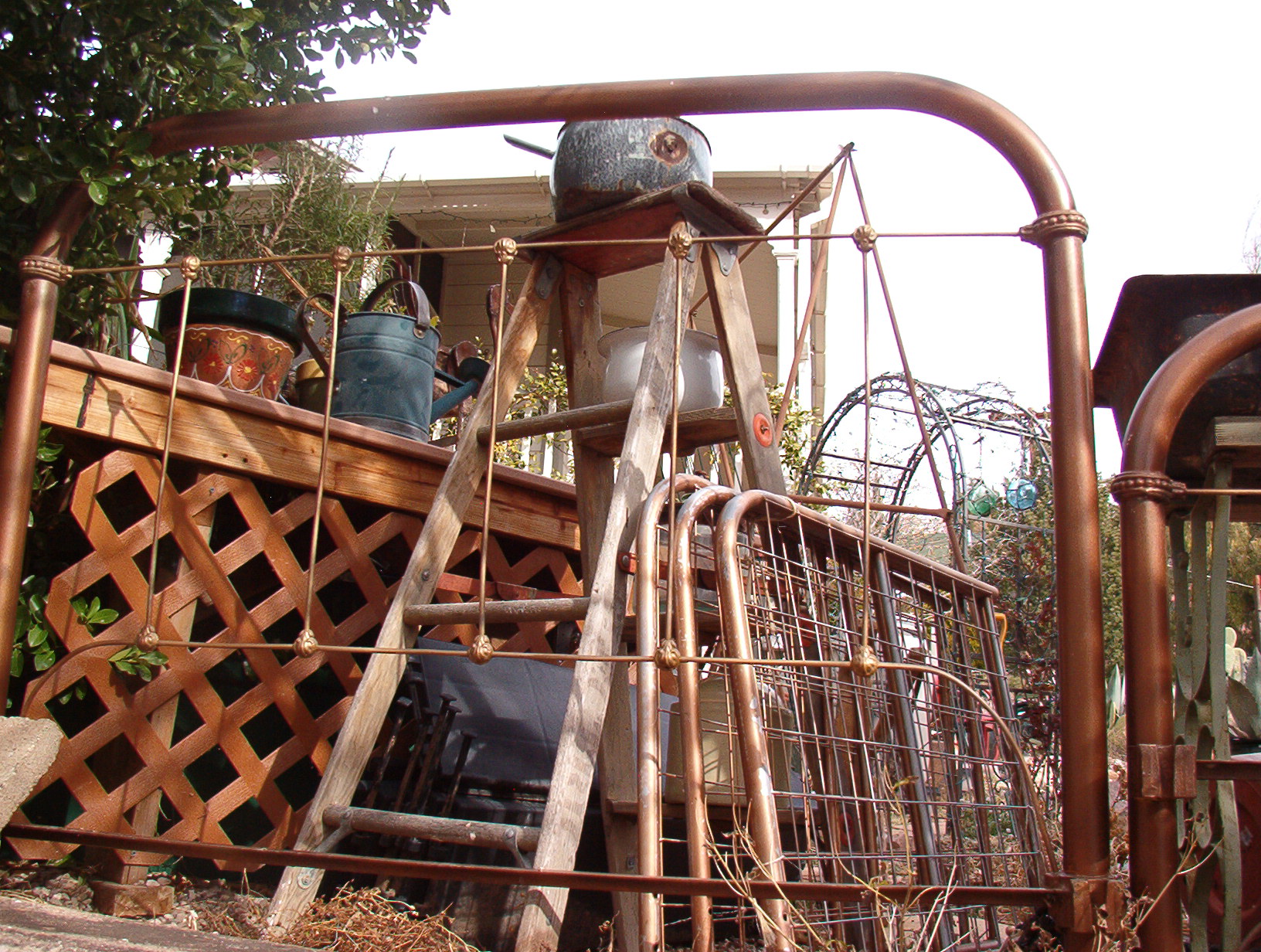
This is a picture of part of the yard above the retaining wall, a simple, humble and creative homage both to gardens and to water.
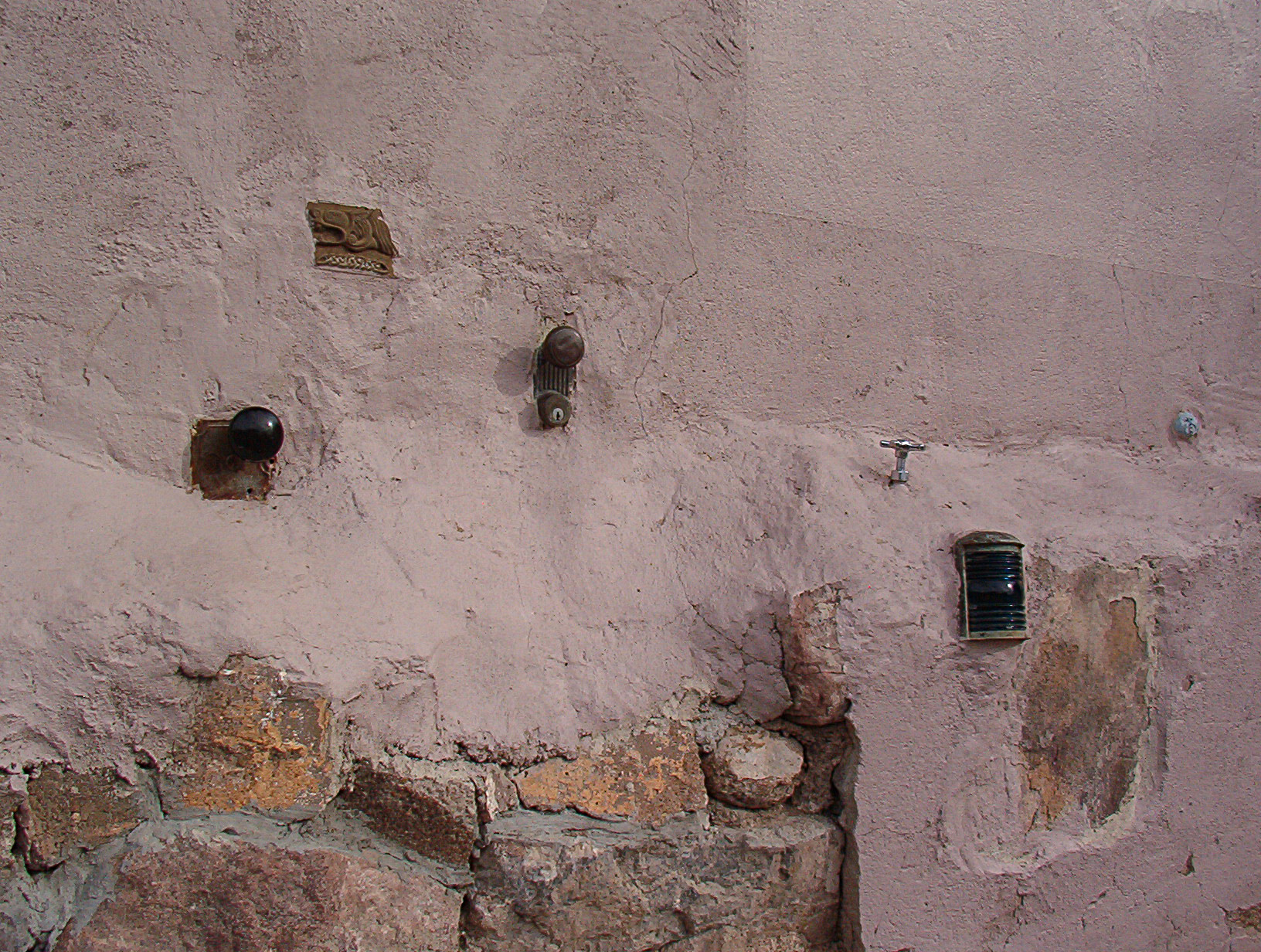
Here is the retaining wall below the yard (you can see the Central School tower at the top in the background). Notice how thoughtfully someone included old door knobs and a water faucet handle that people can grip to help themselves step from the parking lot onto the little dirt pathway.
I'll show you next some of the little things embedded into the wall. This is just one of thousands of similar creative additions to this little town's environment.
This little face is tiny, no more than three inches across, visible on the right side of the picture above this one.

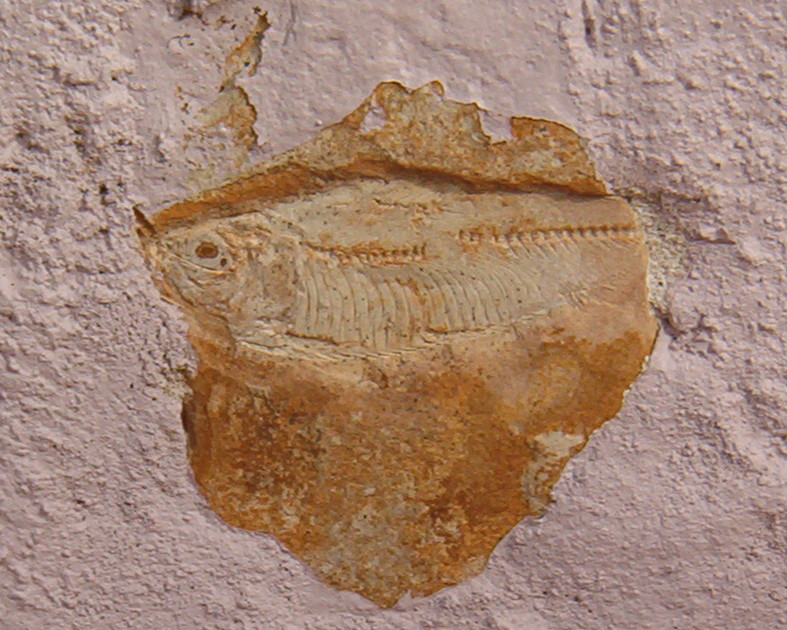
This is also very tiny.
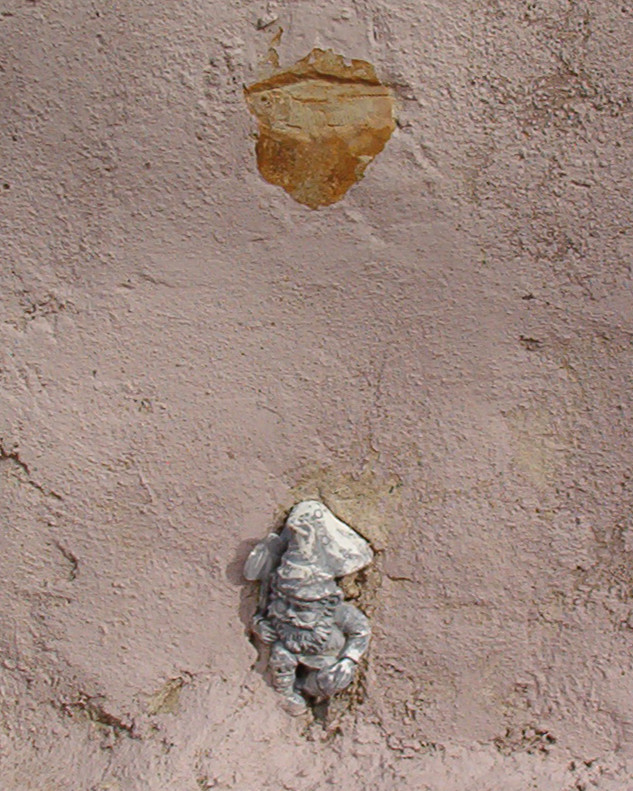
He's about four inches tall, set with the fish next to the door knobs.
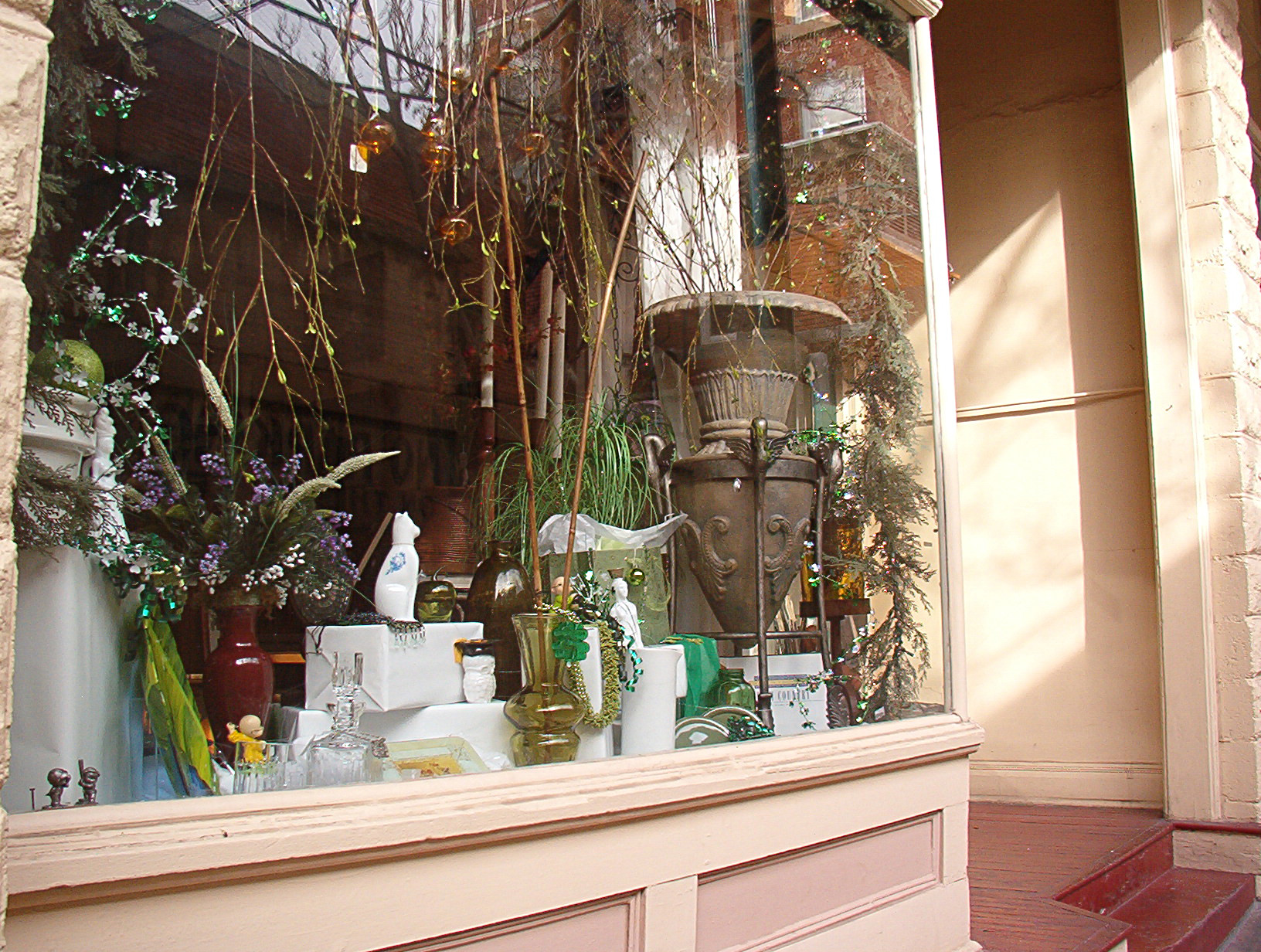
On my walk, passed by this store front, just one of many quaint and special establishments in this little town.

++++++++++++++++++++++++++++

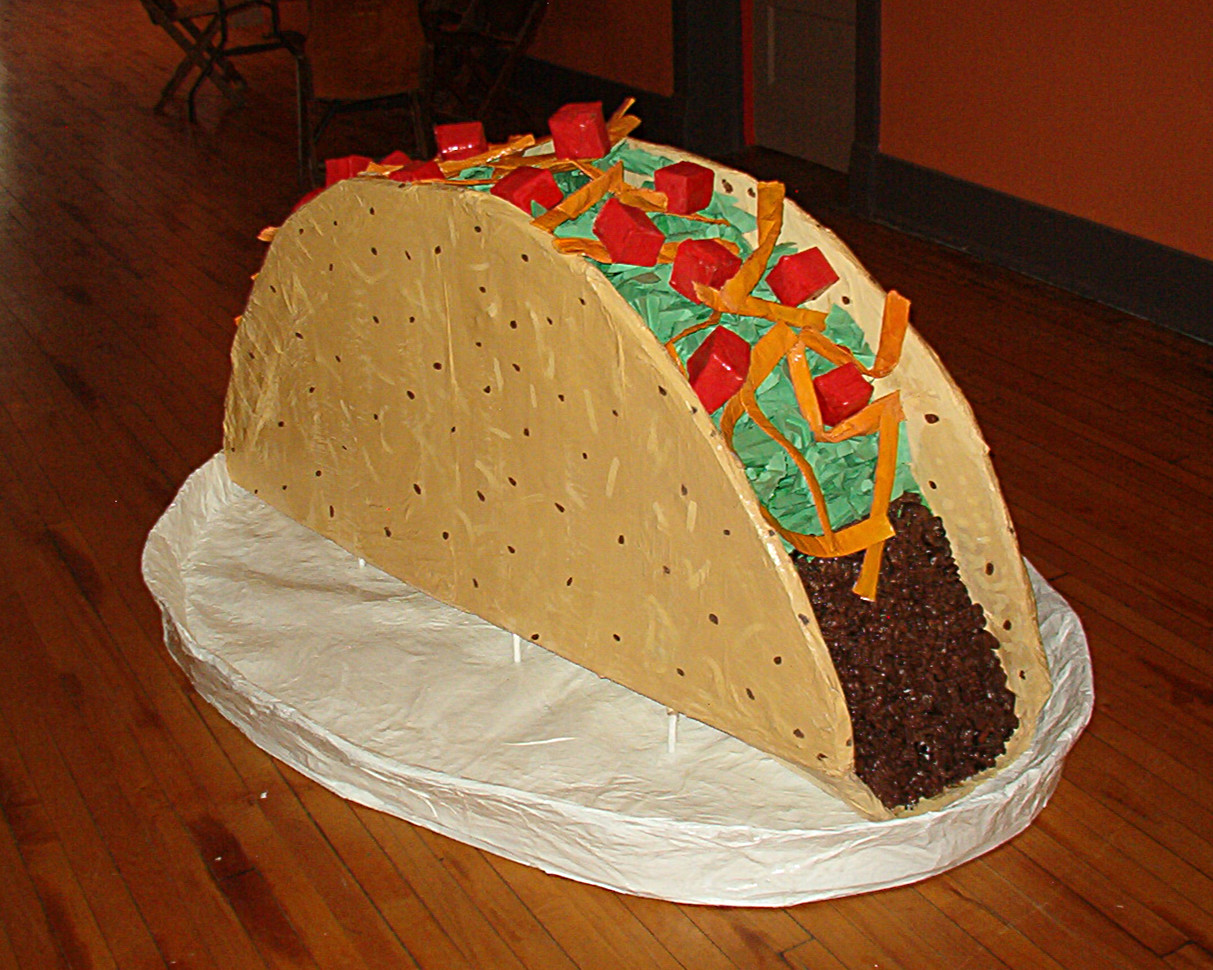
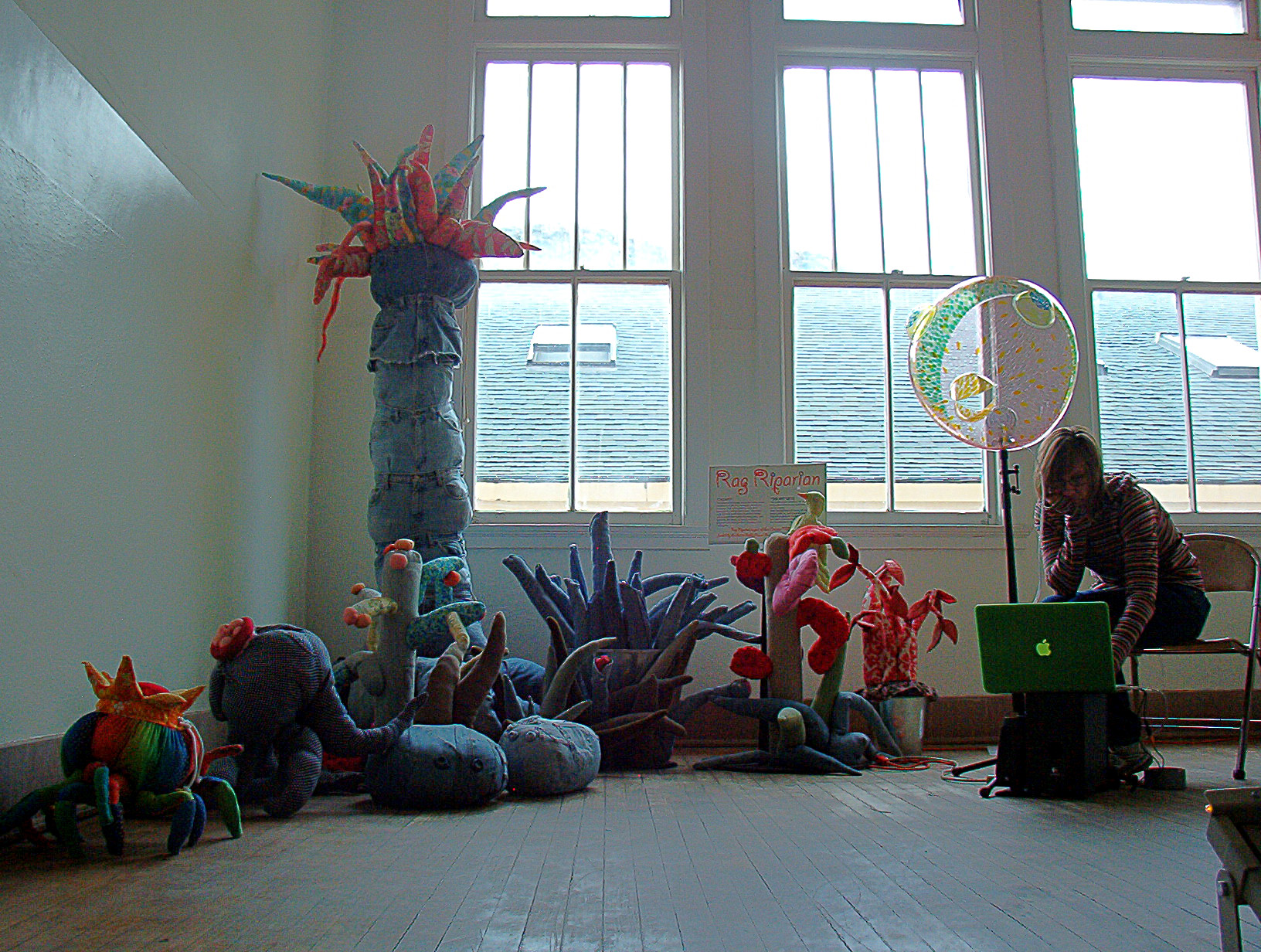
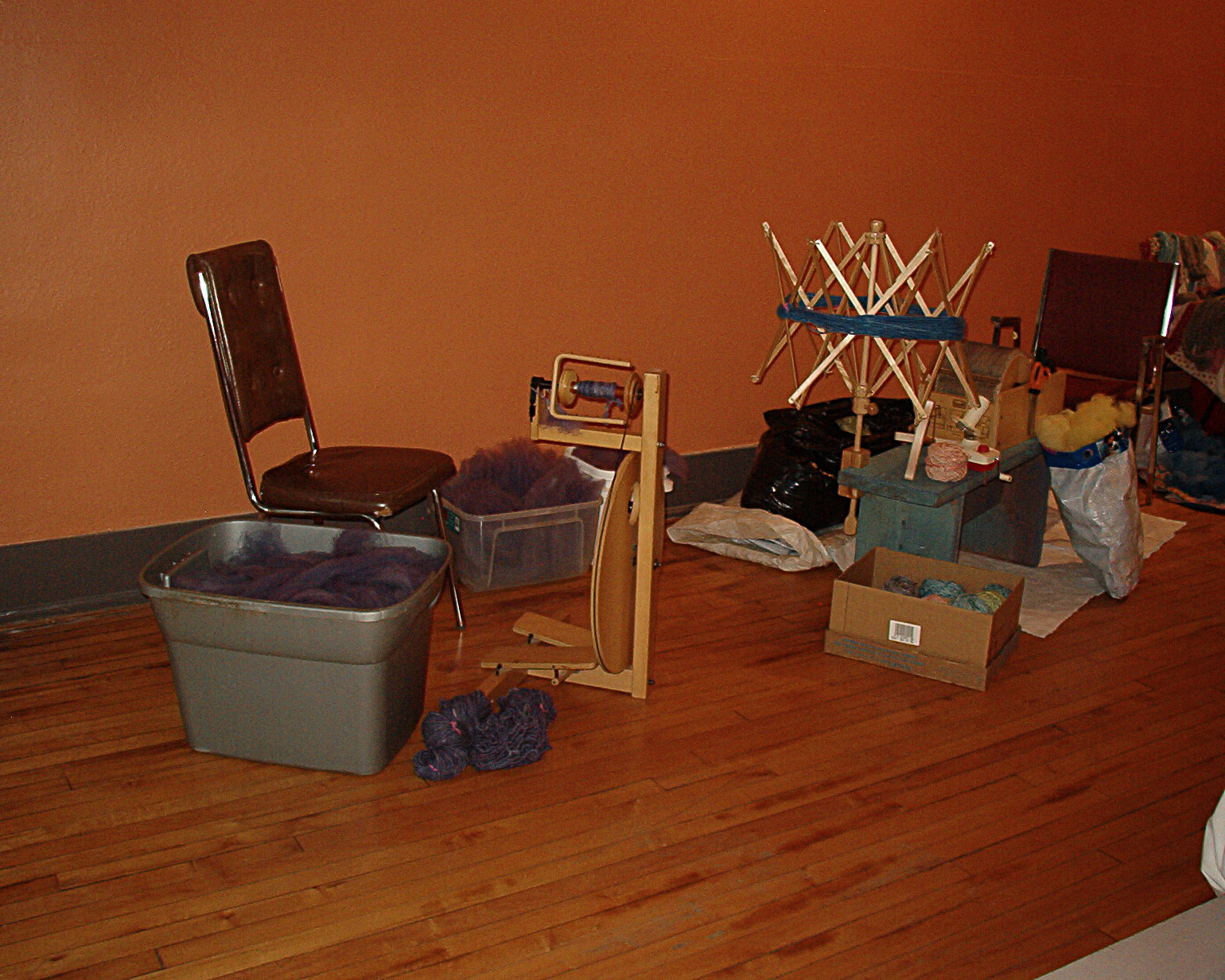
Next I’ll share some pictures with you of Central School where the children’s art festival was held.  This old school has been purchased by a nonprofit community art collective.  The class rooms are rented individually as studios.  You will see the giant papier mache taco made by 6th graders, the cloth sculpted cacti with their artist sitting beside them, and my spinning demonstration area before the children arrived with their families en masse.  I was too busy to take pictures at that point.

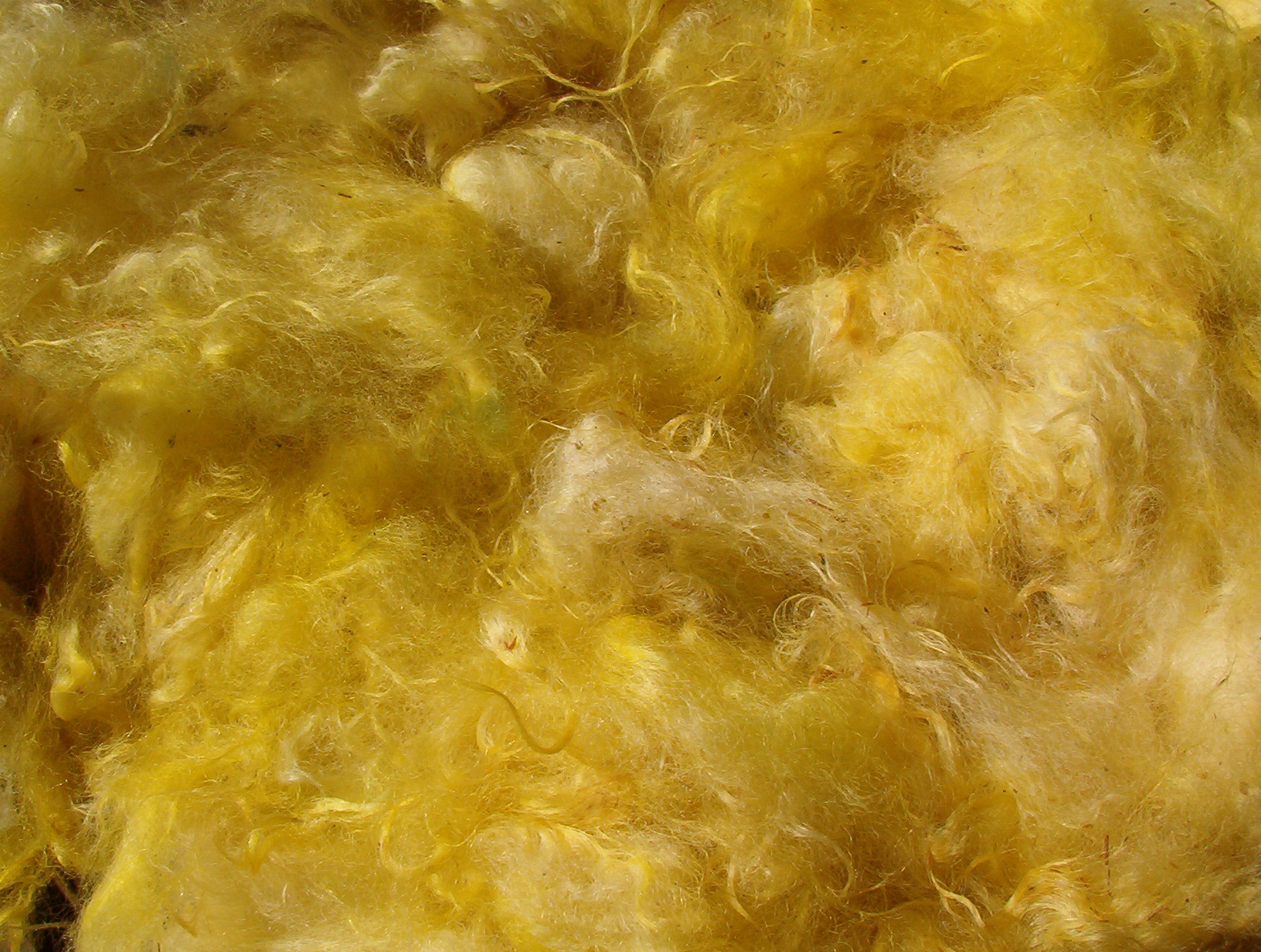
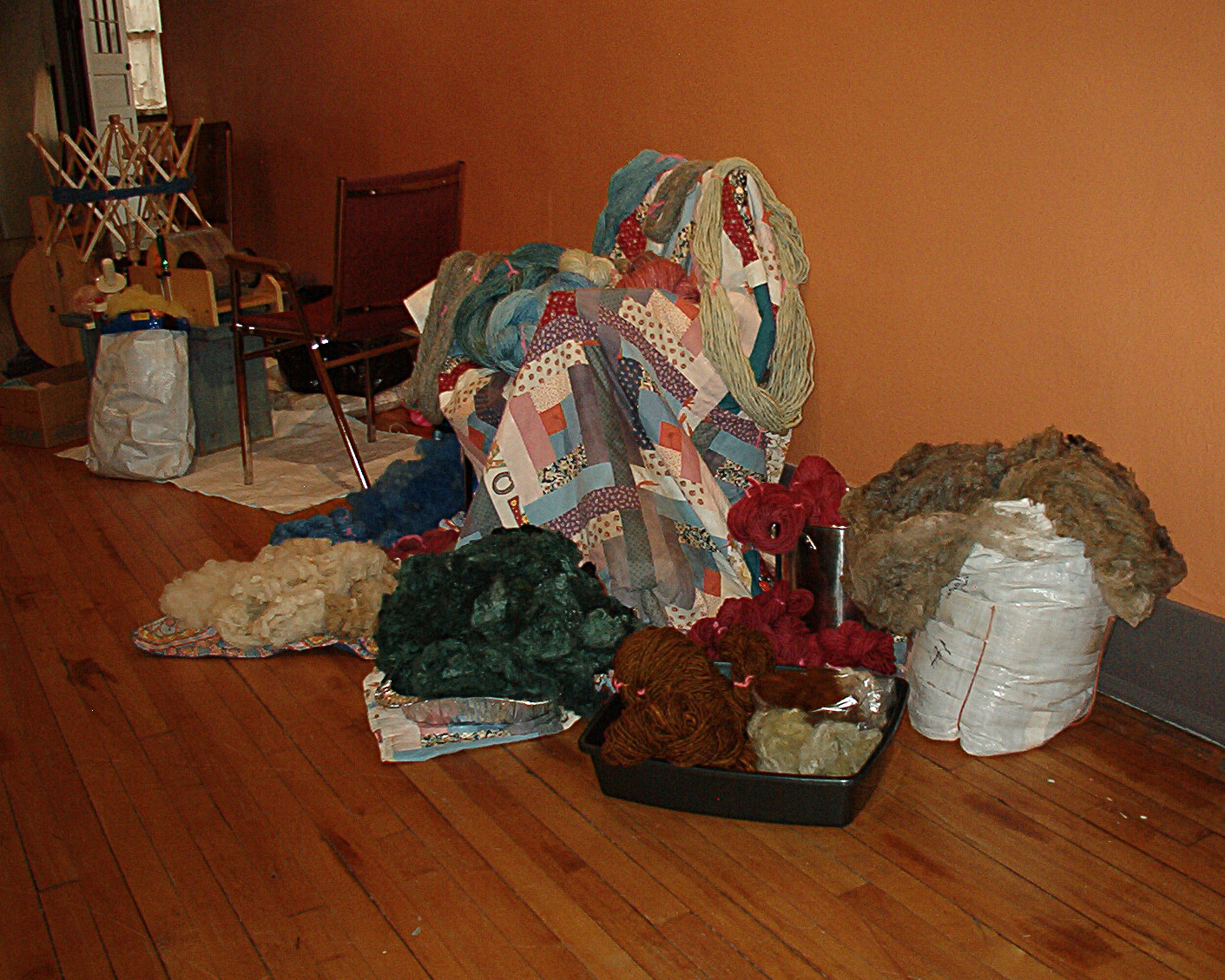
Showing the raw greasy fleece in the bag from the farmer, the green fleece having been washed and oven dyed still needs to be teased-fluffed and then carded prior to spinning -- also some finished yarn.
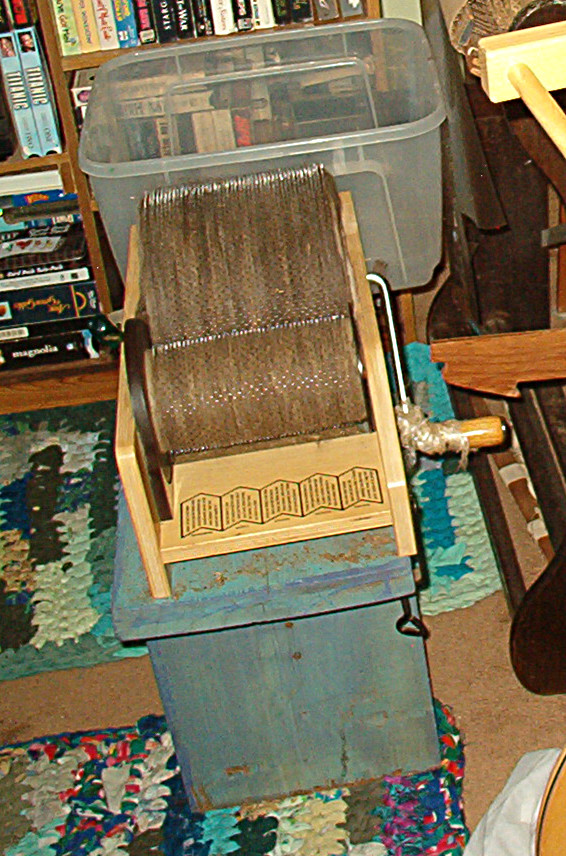
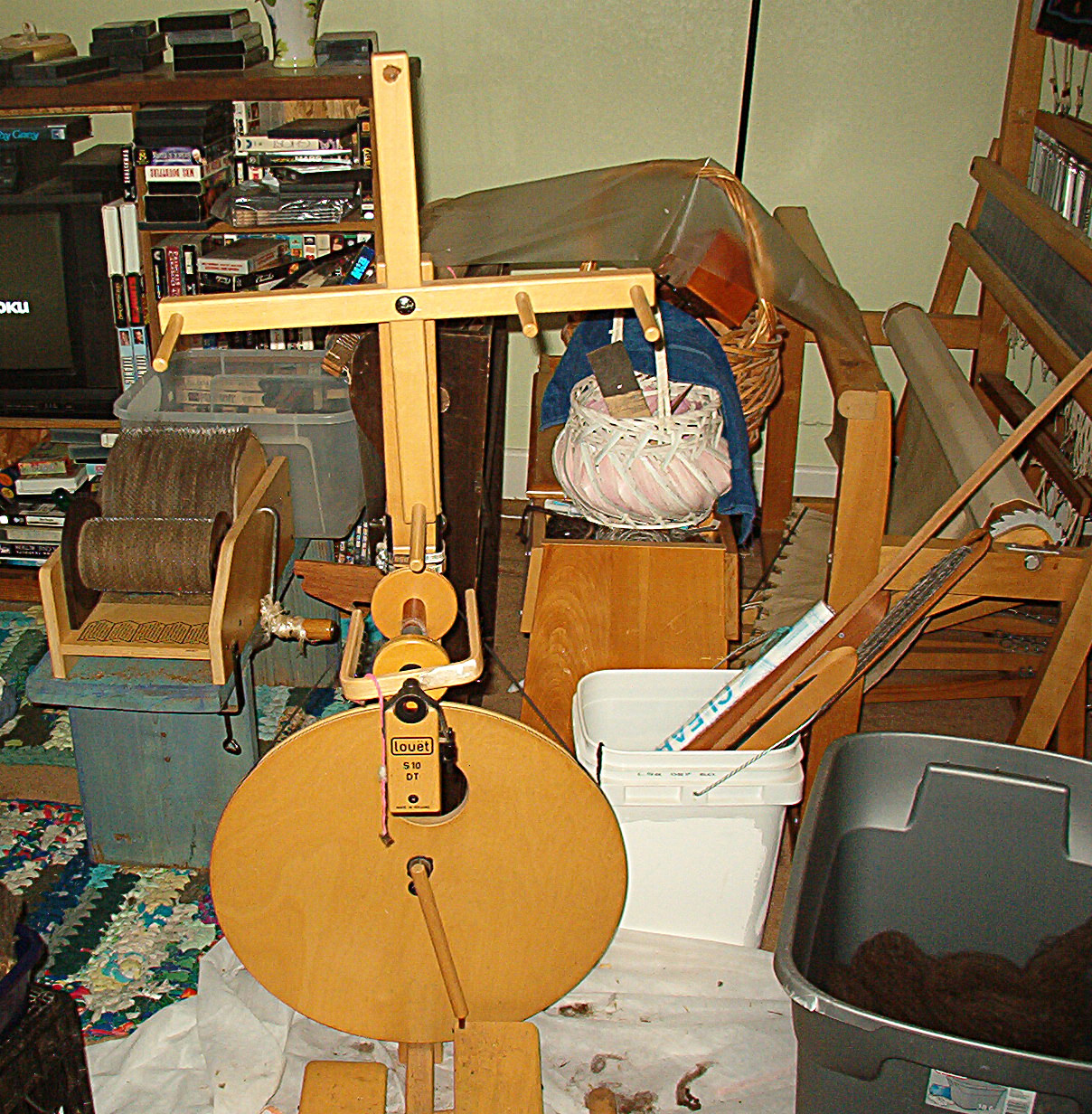
That's an umbrella swift used to wind skeins into balls, attached here to turquoise bench with drum carder.
This is a $665 Louet spinning wheel from Holland, specifically designed to spin three different weights of heavier texture yarn.

++++++++++++++++++++++++++++

Now, for a little story.  Among the many families that brought children to this event, one stands out for me in particular.  For all the families and children who seemed delighted to have a chance to play with the wool, this one family had an entirely reaction.  The man who brought the children was at least their grandfather, if not their great grandfather.  He was not a young man.

When I first became aware of the presence of the family, three of the four children present with this gentleman stood close enough to my spinning wheel that I could demonstrate for them how the big wheel transferred a twist into the lose, fluffy wool I held in my hands.  These three, all girls ranging in age from about 4 to 7, watched raptly.

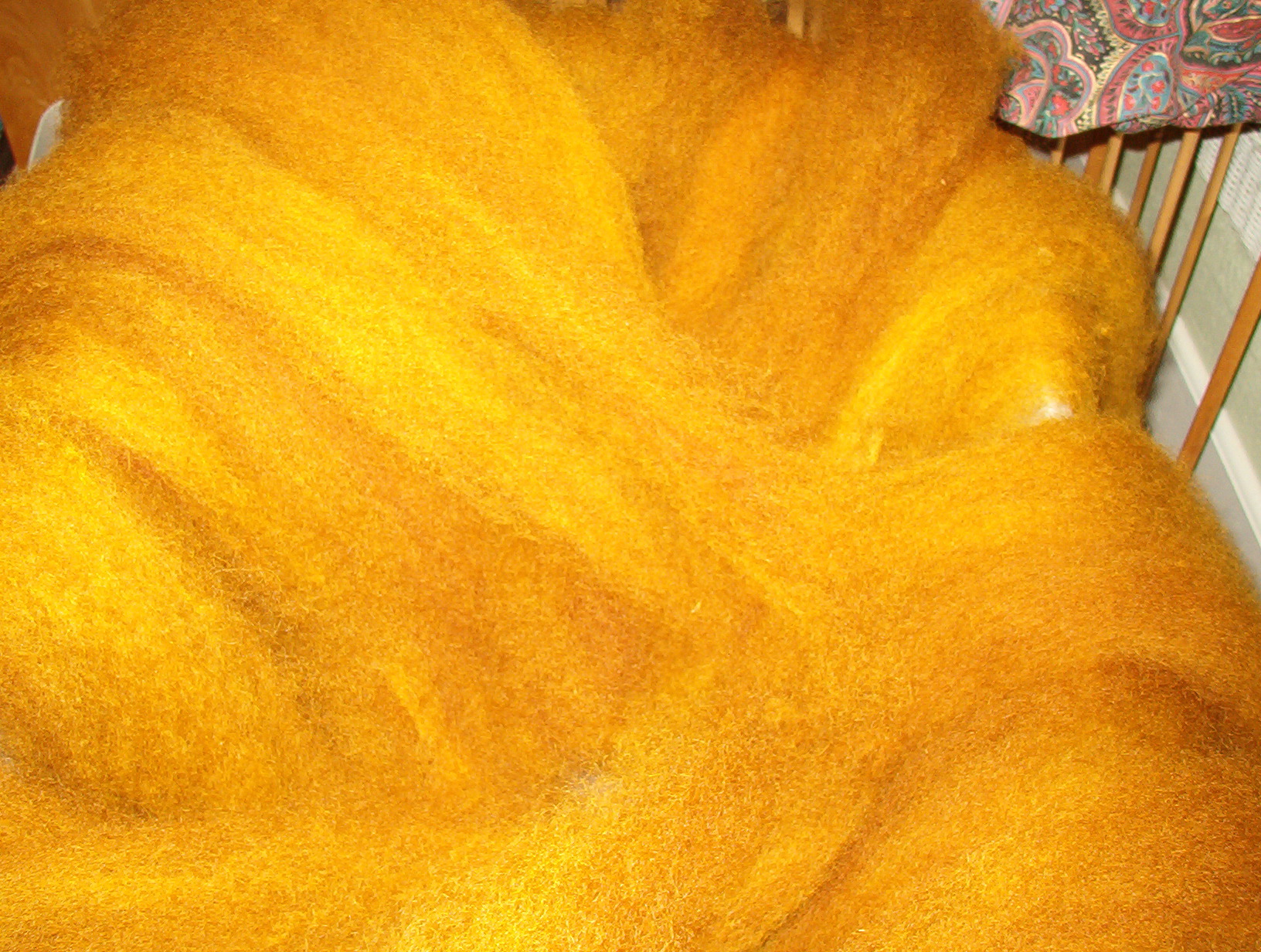
When I asked them if they wanted to see how the wool looked at the beginning when it came off of the sheep, they nodded their heads.  So, I walked to the other end of the set up here and began to show them all of the various steps involved in making yarn.  The oldest of these three girls was captivated by the pile of fluffy yellow fleece that by this time surrounded the drum carder.  Lots of children had had their hands in the pile of soft wool as they had sat to turn the crank of the drum carder to watch all the hairs sort themselves into straightened order for spinning them.

The older of the girls wanted to try the carder, but as I was explaining to her how to lay bits of wool under the teeth of the drums, her grandfather person began to speak more and more loudly to her.  At first I was oblivious to him because I was entirely focused on helping the little girl learn and enjoy herself.  But it didn’t take very long before the words this man was speaking became very clear both to me and to the girl.

“You don’t want to do that,” he was saying when I first tuned into his words.  As he continued I began to understand that this girl’s experience with the fluffy yellow fleece was going to be interrupted and aborted.  It became obvious that this man couldn’t get the little girl away from this scene fast enough.

“This isn’t fun.  This is work.  You don’t want to do this.”  The man was obviously gearing up.  “It wasn’t that long ago that nobody had anything to wear if someone didn’t do this kind of work to make their clothes.  It hasn’t been that long since children had to work long hours every day without stopping.  You don’t want to do that.  That is work.  We didn’t come here to work.  We came here for you to have fun.  This isn’t fun.  We came here so you could make a kaleidoscope.  Come with me.  Come with me right now.  Leave this and come have fun.”

The little girl had not heard this man right away.  It was obvious to me that she, like all the other children who had stopped by the demo before her, loved the feel of the soft wool.  She was intrigued with the steel-toothed drums that she could turn as they tugged and pulled the fibers into their teeth.  It struck me how large the drums looked with her little hands next to them holding onto the fluff so it didn’t get yanked at one time and get stuck between the wheels.

When the girl noticed this man’s words, as he became more intense and more insistent and more chagrined, I could see that she didn’t share his thoughts of the moment.  Although she never said a word, I could tell she didn’t want to leave.  I could also tell that if I didn’t act quickly even a bigger scene was in the act of creation.  I looked into the little girl’s eyes and spoke to her quietly.  “It’s OK.  You can go upstairs now and see what’s up there for you to do.  I will be here when you are done if you want to come back.”

The family immediately disappeared up the stairs.  I did not see them again.

There are more levels to this story and to this encounter than I will ever understand.  The family was African American.  Would I feel any different about the encounter if the family had been Anglo?  I don’t think so, because I was tuned into the interaction as it happened because of the child being a child.  I could sense a universe of hurt behind the voice of the thin, intense, disturbed and agitated man.  I can imagine that he, having been born perhaps in the early 30s or before, having deep personal history about labor, including child labor, both for himself and for his ancestors.  I can imagine a similar story coming from people whose lives as children revolved around farm work, as well.

At the same time I understand that he was not, at this instant, tuned into the life experience of the silent, shy, thin and beautiful child with her hands clutching handfuls of soft yellow fluffy fleece.

Yes, spinning and weaving IS WORK.  Yet work done by choice and with happiness is different than the kind of work this man seemed to be referring to.

It brought me to thinking about how easy it is for adults to miss the moments of empathy that children require to find in their own interactions with the environment what things feel like to their own self.  These experiences of what attachment experts refer to as ‘exploration’ happen as soon as an infant’s body has developed enough to begin to understand that the hands waving around in front of their eyes belong to them, and that they can move them around at will.

The end result of what is called safe and secure attachment to caregivers in the world is exploration.  Interferences in safety and security impinge upon this process of exploration.  Yes, it was obvious to me that every caregiver that cared enough to come with their children to an event such as this art festival cared a great deal for their little ones.  Yet in this small interactive encounter I thought about how histories of trauma affect grown ups who in billions of small ways communicate unresolved trauma on down the generations.

This, in turn, makes me think particularly of something I have said very little about thus far on my blog:  What is preoccupied (ambivalent) insecure attachment?  (see:  +SIEGEL – DESCRIPTION OF ATTACHMENT STYLES).  In unconscious ways, orchestrated most effectively through denial of our own trauma triggers, we can remain preoccupied with our own reality of unresolved trauma and project that reality onto children in our care.

I sensed that something about seeing this little girl that he loved probably more than he loves his own life with her hands in that fleece, standing by that drum carder intent on the process of ‘working’ with the wool, was a trauma trigger for this man.  That was his reaction.  I could FEEL it big time.  I felt sad at the same time I couldn’t help but feel happy that what this man wanted for this girl was to have fun — aka, for her to be happy.

Yet in the short term perhaps making a kaleidoscope was the happier choice, the more fun option at the moment, but was there a pattern of not being able to notice the reality of the child from her point of view that could be short circuiting her explorations of herself in her own world?  I certainly cannot say, nor will I ever know.

++++++++++++++++++++++++++++

I will share with you here just a few more pictures related to the spinning work with wool that I do.  As a woman, I have always worked with my hands.  Beginning with the pop beads I had when I was two, I have always enjoyed this WORK.  Would this be less of a fact if I hadn’t had such a miserable abusive childhood that this work became a solace for me that allowed me to survive?  Would I be making kaleidoscopes if things in my own infant-childhood past had been better?  I don’t know that, either.

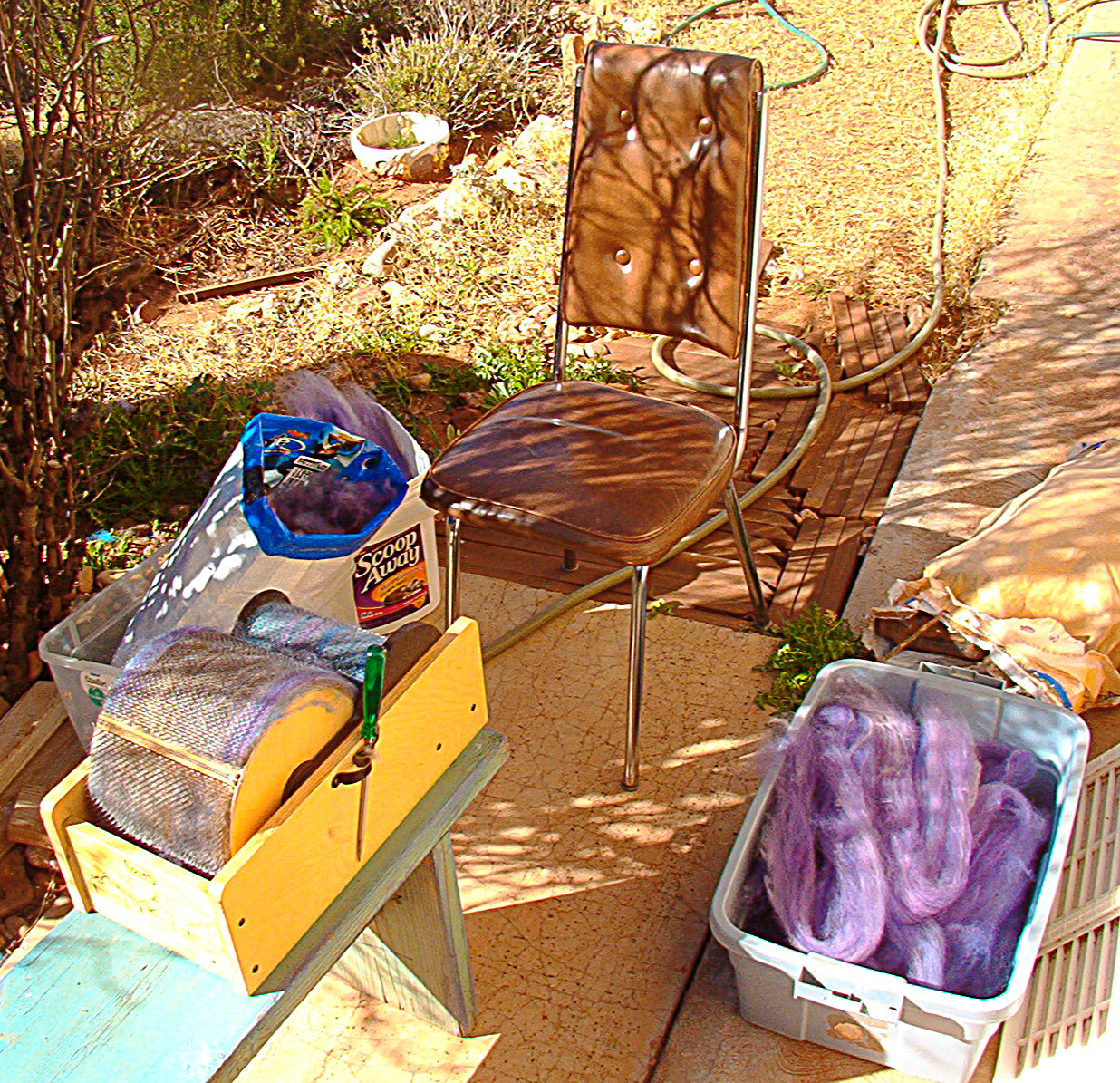
This is the drum carder, outside where I sit working with the wool after it's been washed, dyed, and teased-fluffed.
Drum carders are much faster than the small hand carders.
When I have enough colored yarn, I will warp and weave on the loom to the right.
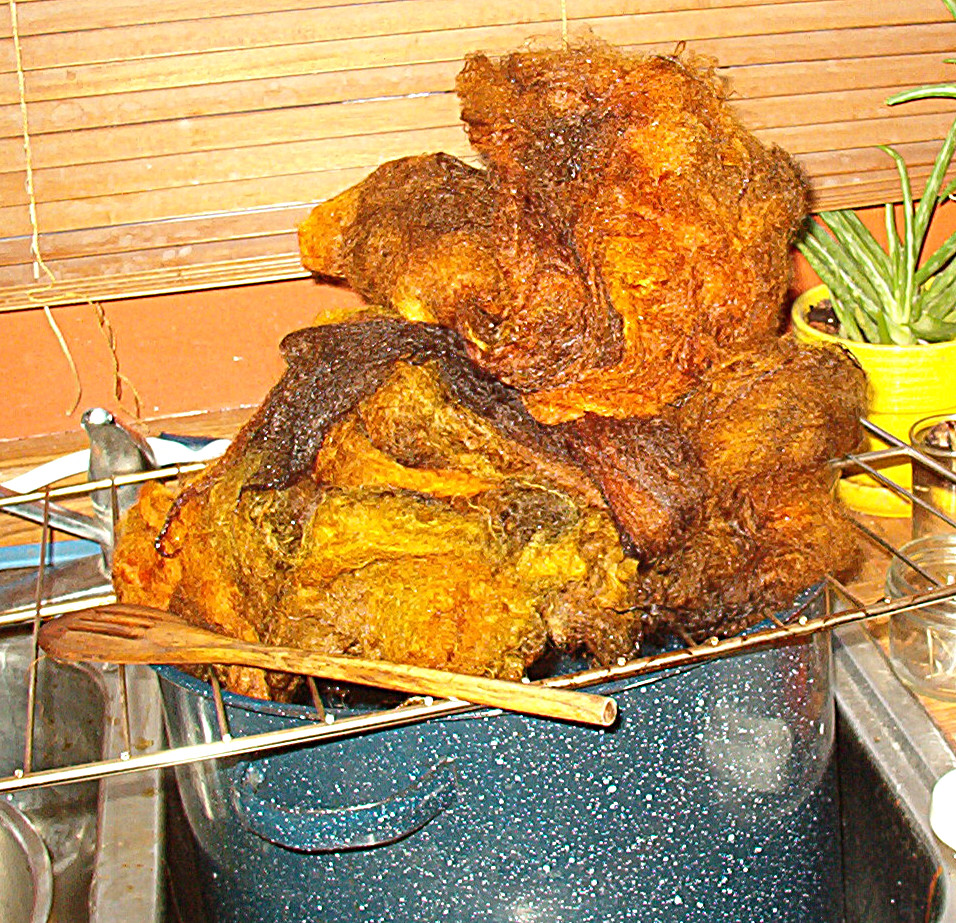
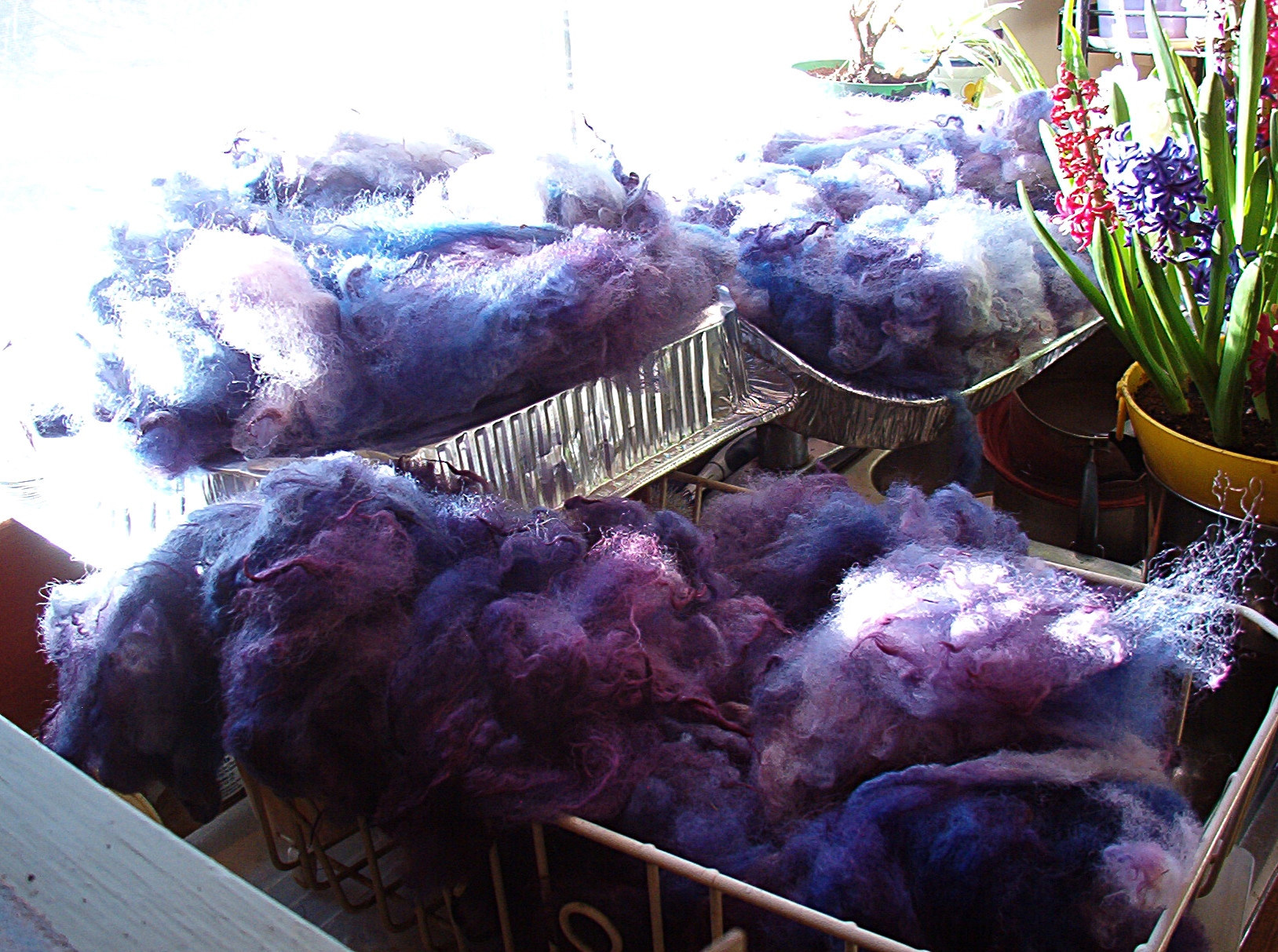
Washed, dyed, ready for teasing, carding and spinning a variegated yarn.
Wahed, dyed, teased, carded and ready for spinning -- this is SOFT! Like putting your hands into a cloud might be like
Oven dyed

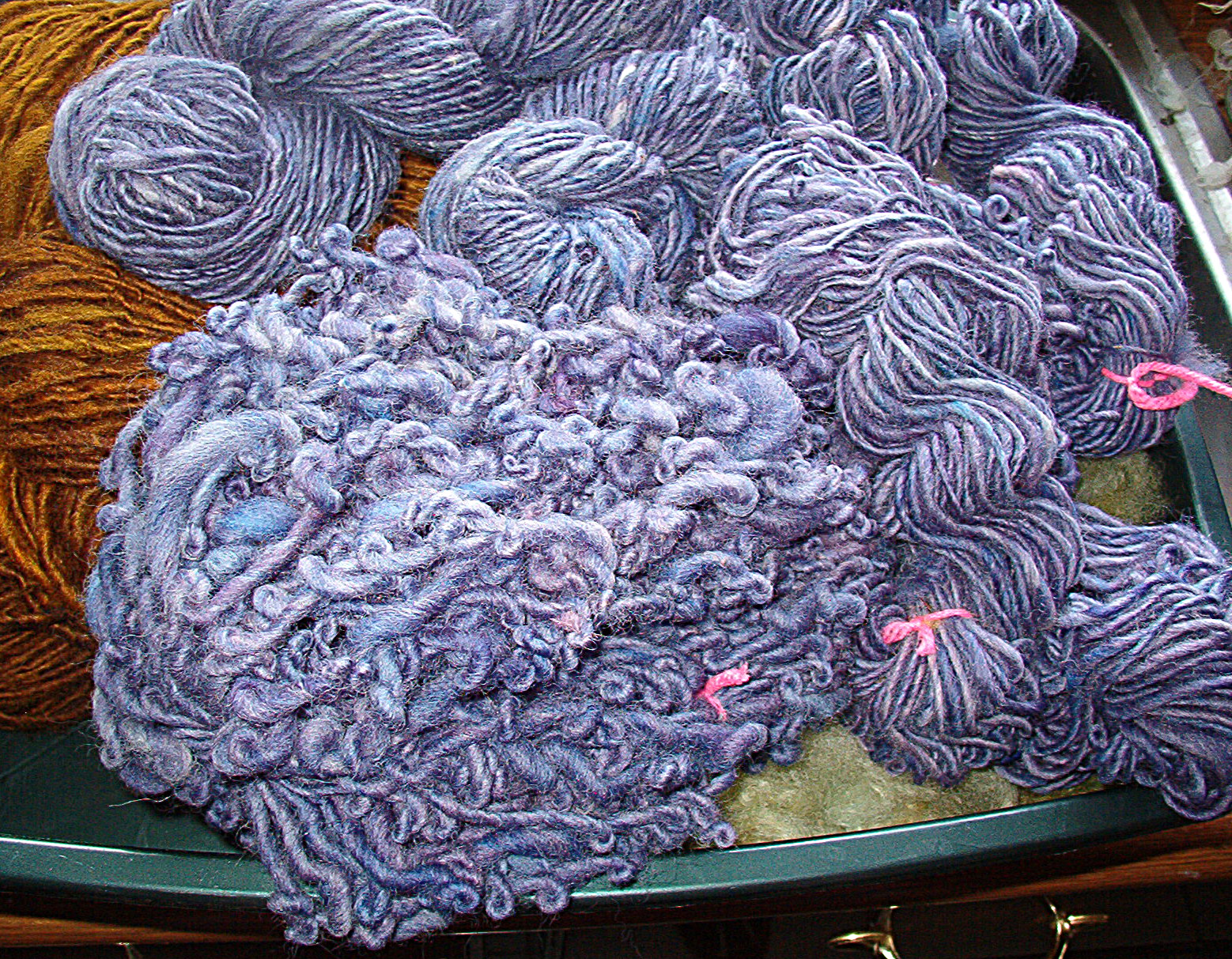
The purple fleece spun - the crinkly yarn still has to be wet again and stretched outside with weights hung from it to set the twist.

So, yes, the old man is correct.  This is work, but work — for whatever reason, I love.

++++++++++++++++++++++++++++

+HOOKED ON ‘D’ SMILES – THE HAPPINESS CENTER

+++++++++++++++++

The advantage of being in my own think tank of one is that I can be like a frog jumping from lily pad to lily pad, following my own fly, landing when and where I want to, devouring information without having to answer to anyone else.  This is why I can follow my last post on pathological liars with this one on smiles!

I am still hopping around in the same pond I was in yesterday as I search for information about how my mother’s abusive Borderline brain gave me a torturous, miserable childhood.  I am still trying to understand how what happened to her in her own abusive childhood gave her such an awful brain.  Today I just landed on a different lily pad.

++++

I am back for the moment with Dr. Dacher Keltner’s 2009 book, Born to Be Good: The Science of a Meaningful Life, having landed on his chapter on smiles.

It turns out that of the vast number of kinds of smiles humans produce, there really is only one authentic, genuine real one and a whole lot of fakes.  In the field of research that Keltner belongs to, scientists have discovered the facial-muscle vocabulary of all human emotion expressed by the face.  Smiling has a language.

Keltner describes how the genuine smile originates in the left anterior frontal lobe, a region whose activity is connected to positive emotional experience.  All the phony impostor, fake smiles originate in the right anterior frontal lobe.  We can tell the difference and respond accordingly from nearly the time we are born.  Infants are the first smile detection quality experts.

There are two very specific facial muscles involved in a real, genuine left-brain smile display:  the zygomatic major muscle and the orbicularis oculi.  The smile these two muscles combine to create by their movement has been named, according to Keltner,

“…in honor of the French neuroanatomist Guilluame Benjamin Amand Duchenne (1806-1875), who first discovered the visible traces of the activity of orbicularis occuli.  Smiles that do not involve the activity of the happiness muscle, the orbicularis oculi, are sensibly known as non-Duchenne or non-D smiles.”  (page 105)

“When a ten-month-old is approached by his or her mother, the face lights up with the D smile; when a stranger approaches, the same infant greets the approaching adult with a wary non-D smile.”  (page 106)

So, we have been able to tell the difference between a real D smile and a fake non-D smile from our first days as breathing creatures.  I’ve just never thought about the difference in words before today.  The D smile involves

“…the activity of the happiness muscle, the orbicularis oculi.  This muscle surrounds the eyes and when contracted leads to the raising of the cheek, the pouching of the lower eyelid, and the appearance of those dreaded crow’s feet – the most visible sign of happiness – which the Botox industry is trying to wipe out of the vocabulary of human expression.”  (page 105)

“Duchenne smiles differ morphologically in many ways from the many other smiles that do not involve the action of the orbicularis oculi muscle.  They tend to last between one and five seconds, and the lip corners tend to be raised to equal degrees on both sides of the face.  Smiles missing the action of the orbicularis oculi and likely masking negative states can be on the face for very brief periods (250 milliseconds [1/4 of a second]) or very long periods (a lifetime of polite smiling…).”  (pages 105-106)

“And importantly, several studies have found that Duchenne and non-Duchenne smiles, brief two- to three-second displays differing only in the activation of the orbicularis oculi muscle, map onto entirely different emotional experiences.”  (pages 106-107)

In other words, these two kinds of smiles are connected to entirely different sides of the brain and their corresponding emotional centers:  The D smile to the happiness center on the left side, the fake non-D smiles on the right, negative emotional side of the brain.  The D smile “accompanies high spirits and goodwill” while the non-D smile “reflects the attempt to mask some underlying negative state.”  (page 108)

++++

I can easily see how these two kinds of smiles communicate to all of us and especially to tiny infants in their earliest brain formation stages, the state of the environment.  A genuine D smile signals through happiness states of safe and secure attachment and at least – at that instant – life in a benign, benevolent world.  (It is really an ‘approach’ signal.)

The non-D smile communicates something else entirely.  Our sophisticated emotional-social brains are genetically programmed to read these extremely rapid emotional signals from human faces.  We KNOW when a non-D smile happens, and that it happens from the negative (unsafe, insecure, “something is not quite right in the world”) place inside another person.  (It is really an ‘avoid’ signal.)

The predominant pattern of smiling signals is one of the MAJOR ways our brain is directed in its formation from the time we are born.  Unsafe world equals poverty in the genuine happiness D smile.  Safe world equals lots of signals about what a wonderful, safe and secure place the world is to be in.  The nature of these signals communicate to an infant’s developing body-brain what kind of a world its genetics have to prepare for, and the signals affect the entire body, including the developing nervous and immune system.

The genuine D smile is a flashing green safe-to-GO light.  Then fake smile, masking negative emotional states is some degree of a yellow warning light or a down right flashing unsafe-STOP light.  Our infant developing body-brain builds itself around this kind of information, and we respond to our environment with this body-brain for the rest of our lives.

++++

Keltner misses what I consider a most important fact about what he talks about next in his presentation about how depressed mothers responses to and with their infants.  It is the nature of these kinds of signaling patterns between a mother and her infant that is building her infant’s body-brain from the beginning of her infant’s life.

(It is also extremely important to note here that a vastly understated problem exists of women who negatively affect their infant’s development because of postpartum anxiety that does not appear as ‘typical’ as postpartum depression.  This post also underscores how vitally important it is for any ‘mental health’ treatment a pregnant mother or a mother of a young infant receives to be tied into the needs of her developing infant – such as is now recognized through the field of Infant Mental HealthCalifornia, for example, has highly developed services in this regard funded by tobacco taxes.)

Keltner writes:

“In the 1980s developmental psychologists Ed Tronick, Jeff Cohn, and Tiffany Field became interested in what postpartum depression does to mother-child interactions.  Their studies, and those of other investigators, revealed that postpartum depression mutes the positive emotionality of the mother – she smiles less, she vocalizes with less warm intonation, and her positive emotional repertoire is less contingent upon the actions of her child.  Children of mothers experiencing postpartum depression tend to show complementary behavior – they are more agitated, distressed, and anxious.

“This kind of result is compellingly intuitive.  Any parent or friend who has been up close to this phenomenon, who has been in the living room of a depressed mother whose positive emotion is dampened and disengaged from that of her child, readily knows how essential the exchanges of smiles, coos, touch, play faces, and interested and encouraging eyebrow flashes are to the parent-child dynamic.  Yet from a scientific standpoint, the finding – the mother’s impoverished positive emotional repertoire brings about anxiety and agitation in the child – is plagued by alternative explanations.  Perhaps agitated, fussy infants produce muted positive emotionality and depression in the mother.  Perhaps they both share some genetically based tendency that predisposes their parent-child interactions to lack mutual smiles, coos, touches, and play.  Perhaps their shared emotional condition is the product of deeper structural causes – underpaid work, poverty, alienated or abusive husbands and the like.

“So to study the role of smiling and muted positive emotionality in parent-child interactions, Tronick, Cohn, and Field developed what has come to be known as the still-face paradigm.  This experimental technique is profoundly simple but powerful.  The mother is requested to simply be in the presence of her young infant, say nine months old, but to show no facial expressions whatsoever, and none of the most common of facial expressions for young mothers – smiles.  As the young child navigates around the laboratory environment, approaching toy robots and stuffed elephants and brightly colored objects that make farm animal noises, the child looks to the mother’s face for signals about the environment.  The child seeks information in facial muscle movements about what is safe, fun, and worthy of curious exploration, and what is not, and the mother sits there impassionate, stone-faced, and unresponsive.

“The results are astonishing.  In a smile-impoverished environment, the young child no longer explores the environment, no longer approaches novel toys or play structures; her imagination shuts down.  The child quickly becomes agitated and distressed, often wildly so, arching his or her back and crying out.  The child will often move to the mother and try to provoke her, stir her out of her stupor, with a vocalization or touch or encouraging smile.  And as the child begins to resign herself to the unexpressive condition of the mother, she moves away from the mother, refusing eye contact, and eventually falls into listlessness and torpor.”  (pages 108-110)

++++

The first thing I want to say about this information is that what Keltner is describing is the difference between safe and secure and unsafe and insecure attachment in the world for the playing, exploring, and still very dependent infant.  The only way this infant can determine the ‘condition of the world’ is through signals sent back and forth between it and its mother.

My strong suspicion is that if an infant has been exposed from birth to a mother who is depressed, anxious, dissociated, frightened or who abuses the infant, the entire scenario Keltner is describing would take a different course.  The infant reaction he describes could only happen if an infant had a safe and secure attachment with its mother before they entered the laboratory.

Imagine – taking just these few words and thinking long and deeply about them – how profoundly and negatively a deprived-traumatized infant’s body-brain would have had to develop ALREADY by the age of nine months.  Positive and appropriate safe and secure attachment experiences from birth – or their opposite — would have already had powerful impact on and influence over how the infant’s body-brain had formed itself in critical ways.

It would be a most excellent sign in the experiment described above if the infant DID become agitated, distressed, and tried to engage its mother.  An abused infant would demonstrate all kinds of alterations in its patterns of interaction with its mother.  But see how quickly the infant gives up trying and slumps into helpless, powerless hopelessness even in this brief of an interaction when the mother does not TELL the infant anything it can use to feel safe, secure and attached?

++++

Keltner continues about the social reinforcement of smiles:

“…they are the first incentives toward which young children move, and that parents hungrily seek.  In relevant research, when one-year-old infants sit at the edge of a visual cliff, a glass surface over a precipitous drop, with their mother on the other side, the infant immediately looks to the mother for information about this ambiguous scene, which looks both dangerous and passable.  If the mother shows fear, not a single child will crawl across the glass surface.  If the mother smiles…approximately 80 percent of the infants will eagerly cross the surface, risking potential harm, to be in the warm, reassuring midst of their mother’s smile.”  (page 111)

++++

Long, long before an infant can move itself around in the world at a distance from its earliest caregivers, its brain has been shaped in its development as circuits, pathways and regions have developed themselves in direct response to the kinds of facial signals it has had with its caregivers – or not had as in the case of deprivation of appropriate interactions.

Keltner describes the physiological benefits of both sending and receiving genuine D smiles:

“Two smiles are exchanged within the span of a second or two…  Within the bodies of those individuals…are reciprocally coordinated surges of dopamine and the opiates.  Stress-related cardiovascular response reduces.  A sense of trust and social well-being rises.  The smile….evolved as a neon-light signal of cooperativeness, it became embedded in social exchanges between individuals that give rise to closeness and affiliation.”  (pages 112-113)

++++

A core belief in my thinking is that our entire feel-good biochemical body systems is designed to keep us attached in positive ways to members of our species.  To the degrees that we have lost sight of this, we suffer from all the kinds of ‘addictions’ and social ills known within our species, not the least of which is severe infant-child abuse.

I don’t believe my mother’s earliest life was filled with genuine smiles anymore than mine was.  If it had been, I can guarantee I wouldn’t be sitting here writing these words today.  Had any of my readers own mother been born into a world of genuine smiles they would not be hear reading my words, either.

While the related subjects of humor and laughter await a future post, it is enough today to suggest that by thinking back – mostly within our body – we can track the presence of absence of unresolved trauma in our infant-childhood by the presence or absence of genuine D smiles.  It is most helpful to realize that long before our conscious memory abilities were able to operate, the patterns of smiles versus traumas that we experienced built the very foundation of our brain through which we process our emotions for the rest of our lives.

It is never too late to learn more about the power of genuine happiness to expand the activity of and connections between what happy center neurons we have – even if we don’t have very many.  That left brain happy center is definitely one that shed unused neurons (those not stimulated by happy caregivers in infancy) as it formed in our early lives.  They can never be replaced.  Safe and securely attached people HAVE MORE OF THEM present!

Research on brain plasticity clearly shows that exercising areas of our brain can build more and stronger CONNECTIONS BETWEEN NEURONS and thus expand the operation of brain regions – the happy center included.

But I am a realist.  Those of us who suffered greatly from infant-child abuse, deprivation and trauma and were NOT born to happy mothers or families, simply did not get to build as big a left brain happy center as did those with opposite experiences.  As adults, we actually – in our body – KNOW THIS!

I personally doubt I would be alive if I had not had my brother John, 14 months older than me, who is by character about the dearest person on earth.  He got to keep his happy neurons because my mother was able to love him, as was my father.  By the time I was born he was fully shining.  It is because he lovingly turned the power of his genuine smiling happy neurons upon little tiny (much hated by my turned-psychotic mother) me that any happy neurons were left alive in my brain at all.

Learning how to exercise them so that my happy center neurons can form better connections is one of the most important missions of my life time.

++++

NOTE:  Too much happy stimulation can overstimulate an infant and harm its developing nervous system and brain!  A healthy, happy mother knows instinctively how much is enough and when and how to calm her baby down!  HINT:  When an infant turns its head away and breaks eye contact, LET IT!  It is busy with all the information it can handle (like a busy telephone line).  Do not get right back into its face or you will overwhelm it.  At such times an infant is processing information, building its brain, regulating its own emotional state (self soothing), organizing itself, and calming itself down!  The infant will let you know when it is done and ready to reengage with you.  Another hint:  Men in general are not geared as women are to recognize over stimulating activity with young infants – be careful!

(When such an infant turns its head to the right it is organizing the left side of its brain and vice versa!)

+++++++++++++++++++++++++++++++++

REMEMBER THIS:

Any parent or friend who has been up close to this phenomenon, who has been in the living room of a depressed mother whose positive emotion is dampened and disengaged from that of her child, readily knows how essential the exchanges of smiles, coos, touch, play faces, and interested and encouraging eyebrow flashes are to the parent-child dynamic.

MOST IMPORTANTLY — They are VITAL!  Please do not forget this – and please do remember to find a way to help any parent and infant you might encounter who is experiencing anxious or depressed interactions so that infant can have a better chance to build a better brain and have a better life – When you see negative, anxious, depressed kinds of infant-caregiver interaction patterns, know they are hurting an infant’s brain development and changing the degree of well-being it will experience for the rest of its life.  FIND A WAY TO EDUCATE – TO POSITIVELY INTERVENE!

+++++++++++++++++++++++++++++++++

+21 RICH NATIONS COMPARED ON CHILD WELL-BEING – U.S. AND U.K. AT THE BOTTOM

++++++++++++++++

Please spend some time reading the UNICEF 2007 Report Card on six measurements of the well-being of children.  The United States and the United Kingdom have total scores at the bottom of the 21 OECD [Organization for Economic Co-operation and Development] industrialized nations included in this study (page 2).

While every measurement is extremely important, the one that is of greatest concern to me in regard to the well-being particularly of infants and very young children is the finding that the United States rates highest in the percentage of births per 1,000 women

ages 15-19.  See Report Card page 31, Figure 5.2f.

This report states this about teenage births:

For most girls growing up in an OECD country, the norm today is an extended education, a career, a two income household, delayed childbearing and a small family.   And it is in this context that teenage pregnancy has become a significant problem: giving birth at too young an age is now associated with wide ranging disadvantage for both mother and child – including a greater likelihood of dropping out of school, of having no or low qualifications, of being unemployed or low-paid, and of living in poor housing conditions.   But as always, association is not the same as cause.   Many girls who give birth in their teens have themselves grown up with the kind of poverty and disadvantage that would be likely to have negative consequences whether or not they wait until they are in their twenties before having children.  Becoming pregnant while still a teenager may make these problems worse, but not becoming pregnant will not make them go away.

Beyond the immediate problem, teenage fertility levels may also serve as an indicator of an aspect of young people’s lives that is otherwise hard to capture.  To a young person with little sense of current well-being – unhappy and perhaps mistreated at home, miserable and under-achieving at school, and with only an unskilled and low-paid job to look forward to – having a baby to love and be loved by, with a small income from benefits and a home of her own, may seem a more attractive option than the alternatives.   A teenager doing well at school and looking forward to an interesting and well-paid career, and who is surrounded by family and friends who have similarly high expectations, is likely to feel that giving birth would de-rail both present well-being and future hopes.

It is as an approximate measure of what proportion of teenagers fall on which side of this divide that the teenage fertility rates shown in Figure 5.2f may be an especially significant indicator of young people’s well-being.”

++++++++++++++++

I consider these findings also especially significant in light of this blog’s strong emphasis on the critical importance of safe and secure attachments as a foundation of body-brain-mind-self development of people.  Take a look at these findings.  The United States and the United Kingdom appear to be failing miserably on these measures of child well-being and are at the bottom of this combined initial attempt to measure attachment on the national level.

On page 22, Figure 4.0 shows young people’s family and peer relationships – and an OECD overview is presented in graphic form.  The Report states:  “The quality of children’s relationships is as difficult to measure as it is critical to well-being.  Nonetheless it was considered too important a factor to be omitted altogether and an attempt has therefore been made to measure the quality of ‘family and peer relationships’ using data on family structures, plus children’s own answers to survey questions.”

++++

Among the measurements on behaviors and risk-taking of young people presented beginning on page 26, Figure 5.0, the Report states:   “Any overview of children’s well-being must attempt to incorporate aspects of behaviour which are of concern to both young people themselves and to the society in which they live.   This section therefore brings together the available OECD data on such topics as obesity, substance abuse, violence, and sexual risk-taking.”

Again, the United States and the United Kingdom are at the very bottom in their total scores on these measurements.  Page 27, Figure 5.1 Overview — Children’s health behavior the United States is at the bottom.  Page 28, Figure 5.1d, the United States has the highest percentage of young people age 13 and 15 who report being overweight.    “…the EU [European Union] Health Commissioner has said:   “Today’s overweight teenagers are tomorrow’s heart attack victims”.”

“…in most countries young people’s health behaviours do not deviate very far from the average for the OECD as a whole.  The exceptions are Poland, where children’s health behaviours are considerably better than average, and the United States whose overall ranking suffers because of high levels of obesity.”

++++++++++++++++

The great majority of young people growing up in all OECD countries score themselves above the midpoint on the ‘life satisfaction ladder’.”  Fortunately, United States’ young people are among this majority (page 37).

An interesting observation in this section of the Report about student agreement with negative statements about personal well-being in regard to feeling ‘out of place’ comes from Japan (page 38):

The most striking individual result is the 30% of young people in Japan who agreed with the statement ‘I feel lonely’ – almost three times higher than the next highest-scoring country. Either this reflects a difficulty of translating the question into a different language and culture, or a problem meriting further investigation, or both.”

++++++++++++++++

From the Report Card:

The true measure of a nation’s standing is how well it attends to its children – their health and safety, their material security, their education and socialization, and their sense of being loved, valued, and included in the families and societies into which they are born.

++

When we attempt to measure children’s well-being what we really seek to know is whether children are adequately clothed and housed and fed and protected, whether their circumstances are such that they are likely to become all that they are capable of becoming, or whether they are disadvantaged in ways that make it difficult or impossible for them to participate fully in the life and opportunities of the world around them.   Above all we seek to know whether children feel loved, cherished, special and supported, within the family and community, and whether the family and community are being supported in this task by public policy and resources.

All families in OECD countries today are aware that childhood is being reshaped by forces whose mainspring is not necessarily the best interests of the child.   At the same time, a wide public in the OECD countries is becoming ever more aware that many of the corrosive social problems affecting the quality of life have their genesis in the changing ecology of childhood.   Many therefore feel that it is time to attempt to re-gain a degree of understanding, control and direction over what is happening to our children in their most vital, vulnerable years.

That process begins with measurement and monitoring. And it is as a contribution to that process that the Innocenti Research Centre has published this initial attempt at a multi-dimensional overview of child well-being in the countries of the OECD.”  (page 38)

++++

Any part of the Innocenti Report Card may be freely reproduced using the following reference:

UNICEF, Child poverty in perspective: An overview of child well-being in rich countries, Innocenti Report Card 7

2007 UNICEF Innocenti Research Centre, Florence. © The United Nations Children’s Fund, 2007

Full text and supporting documentation can be downloaded from the UNICEF Innocenti Research Centre website.

This Report Card provides a comprehensive assessment of the lives and well-being of children and young people in 21 nations of the industrialized world.   Its purpose is to encourage monitoring, to permit comparison, and to stimulate the discussion and development of policies to improve children’s lives.

The report represents a significant advance on previous titles in this series which have used income poverty as a proxy measure for overall child well-being in the OECD countries.   Specifically, it attempts to measure and compare child well-being under six different headings or dimensions: material well-being, health and safety, education, peer and family relationships, behaviours and risks, and young people’s own subjective sense of well-being.   In all, it draws upon 40 separate indicators relevant to children’s lives and children’s rights (see pages 42 to 45).

Although heavily dependent on the available data, this assessment is also guided by a concept of child well-being that is in turn guided by the United Nations Convention on the Rights of the Child…. The implied definition of child well-being that permeates the report is one that will also correspond to the views and the experience of a wide public.”

* The United Kingdom and the United States find themselves in the bottom third of the rankings for five of the six dimensions reviewed  [material well-being, health and safety, education, peer and family relationships, behaviors and risks, and young people’s subjective sense of their circumstances]

* There is no obvious relationship between levels of child well-being and GDP per capita.  The Czech Republic, for example, achieves a higher overall rank for child well-being than several much wealthier countries including France, Austria, the United States and the United Kingdom

+++++++++++++++++++++++++++++++++++++++++++

SEE ALSO – The United States has been taking internal measurements on our nation’s children’s well-being for over 30 years.

CHILD WELL-BEING STATISTICAL REPORT, SPECIFIC TO THE UNITED STATES:

The 2009 Foundation for Child Development — Child and Youth Well-being Index (CWI) Report

Children and youth live unique lives and as such, at some point, each experiences a range of social conditions.   The Index is comprised of Key Indicators associated with different stages of the life course in the first two decades of life.

The CWI includes the following 28 Key Indicators organized into seven domains of child well-being in the United States that have been found in numerous social science studies to be related to an overall sense of subjective well-being or satisfaction with life.

Family Economic Well-Being Domain

1. Poverty Rate (All Families with Children)

2. Secure Parental Employment Rate

3. Median Annual Income (All Families with Children)

4. Rate of Children with Health Insurance

Health Domain

1. Infant Mortality Rate

2. Low Birth Weight Rate

3. Mortality Rate (Ages 1-19)

4. Rate of Children with Very Good or Excellent Health (as reported by parents)

5. Rate of Children with Activity Limitations (as reported by parents)

6. Rate of Overweight Children and Adolescents (Ages 6-19)

Safety/Behavioral Domain

1. Teenage Birth Rate (Ages 10-17)

2. Rate of Violent Crime Victimization (Ages 12-19)

3. Rate of Violent Crime Offenders (Ages 12-17)

4. Rate of Cigarette Smoking (Grade 12)

5. Rate of Binge Alcohol Drinking (Grade 12)

6. Rate of Illicit Drug Use (Grade 12)

Educational Attainment Domain

1. Reading Test Scores (Ages 9, 13, and 17)

2. Mathematics Test Scores (Ages 9, 13, and 17)

Community Connectedness

1. Rate of Persons who have Received a High School Diploma (Ages 18-24)

2. Rate of Youths Not Working and Not in School (Ages 16-19)

3. Rate of Pre-Kindergarten Enrollment (Ages 3-4)

4. Rate of Persons who have Received a Bachelor’s Degree (Ages 25-29)

5. Rate of Voting in Presidential Elections (Ages 18-20)

Social Relationships Domain

1. Rate of Children in Families Headed by a Single Parent

2. Rate of Children who have Moved within the Last Year (Ages 1-18)

Emotional/Spiritual Well-Being Domain

1. Suicide Rate (Ages 10-19)

2. Rate of Weekly Religious Attendance (Grade 12)

3. Percent who report Religion as Being Very Important (Grade 12)

Taken together, changes in the performance of these 28 Key Indicators and the seven domains into which they are grouped provide a view of the changes in the overall well-being of children and youth in American society.   Each domain represents an important area that affects well-being/quality of life: economic well-being, health, safety/behavior, educational attainment, community connectedness (participation in major social institutions), social relationships, and emotional/spiritual well-being.   The performance of the nation on each indicator also reflects the strength of America’s social institutions: its families, schools, and communities.   All of these Key Indicators either are well-being indicators that measure outcomes for children and youths or surrogate indicators of the same.

SEE ALSO:

THE CHILD AND YOUTH WELL-BEING INDEX (CWI)

Foundation for Child Development and the CWI

++++

Check out this article:

How Is the Economic Recession Affecting U.S. Children?

The 2009 Child Well-being Index

by Eric Zuehlke

+++++++++++++++++++++++++++++++++++++++++++

+SOMEONE AT BERKELEY, HEAR MY PLEA!

Dear Dr. Dacher Keltner,

I have committed myself to the search for understanding about what goes so terribly wrong in early infant-child development in an environment of deprivation-trauma that can make someone like my mother end up being an extremely violent and abusive mother.  I suffered from her malevolent treatment from my birth until I left home at 18, and I suffered Trauma Altered Development as a result.  My mother completely lacked the ability to experience compassion.

I have read the work of Doctors Damasio, Schore, Siegel, Perry, Scaer, Allen, LeDoux and others but only discovered your work yesterday as I searched for the connections that might give credence to my thoughts about both the experience of being a survivor of severe abuse from birth and about the experience that leads some parents to be so absolutely abusive.

I discovered the work of Dr. Martin Teicher and ‘the Harvard Research Group’ several years ago as these researchers describe the ‘evolutionarily altered brain’ that severe infant-child abuse survivors end up with due to what I call the Trauma Altered Development that they experienced during their critical window periods of early development.

I have never believed that these trauma alterations exist solely within the brain.  I believe every aspect of a young survivor’s body is changed, and I believe that these changes, including and especially the epigenetic ones, happen as a result of signaling from the immune system.

I believe that most of what we label (and stigmatize) as mental and behavioral ‘dysfunction’ and ‘disorder’ can be more accurately and helpfully understood in terms of the Trauma Altered Development that severely abused infant-children must undergo during their development in order to survive it.  I believe the underlying mechanisms (including the opioid and cannabinoid systems) are all affected through deviations away from safe and secure attachment.

The Center for Disease Control is finally releasing statistics about the devastating lifelong consequences of infant-child abuse survivorship.  I believe that our systems that ‘treat’ lack of well-being among all age groups need to first assess an individual’s level of deprivation-trauma during early development through tools similar to the Adverse Childhood Experience (ACE) questionnaires the CDC is using, along with an assessment of safe and secure attachment (or the opposite) of everyone before anything like a ‘diagnosis’ of a ‘mental’ or ‘behavioral’ condition is given.

I am a 58 year old severe infant-child abuse survivor.  My body has within it a long and nearly unbelievable history of trauma from birth.  This information informs my work and my thinking, but I must be able to connect what I know from my insides with what research is showing as a whole.  Discovering your work yesterday let me know I am thinking in the right direction.

++++

I am asking for any help in locating resources about the vagus nerve-immune system connection as it relates to the very earliest signaling within a deprivation-traumatized developing infant-child that sets into motion the cascade of evolutionary alterations within a survivor’s body.  I believe that in many if not most cases of severe child abuse the perpetrator’s early development was changed within an early malevolent environment in such a way that the ability to experience compassion was erased from their range of response options.

Since the beginning five years ago of my attempt to understand what happened to my mother to turn her into a psychotic, violent, dangerous Borderline (and what happened to me as a consequence of the abuse I suffered from her), I have searched for what I call ‘informed compassion’.  I work continually on my blog, Stop the Storm, to present my ongoing ideas in order to perhaps help others who have experienced the level of abuse that I did.

We were forced to become evolutionarily altered beings in order to survive our infant-childhoods, and while I can find in the developmental neuroscience literature many descriptions of how we are changed, I find nothing that specifically talks about how we experience ourselves in our body-brain-mind-self as BEING these trauma-changed people and what this means to the WHOLE of who we are.

What you write about is what we need to know to help us live good lives to the best of our ability in spite of the trauma changes we experienced in our early development that makes us into a different kind of human being.  The response of our immune system, through signaling from our vagus nerve ‘system’ in a malevolent unsafe and secure early environment, gave us what we needed to reach our adulthood.  But we suffer.  We continue to suffer – and that needs to change.

Being stigmatized, labeled, diagnosed and given drugs is not our best solution!  I believe that we are alive because of the incredible human capacity for resiliency that allowed us to so adapt to our intolerable early malevolent world that we made it out alive.  But we did so by paying a price.

We need to lessen the cost of remaining alive.  Severe infant-childhood abuse survivors with Trauma Altered Development (as the CDC research is showing) fill our prisons, our homeless shelters, our domestic abuse centers, our poverty ranks, our hospitals and our cemeteries.  The unresolved trauma that we experience is most likely to be transmitted down the generations to and through our offspring.

We have a right to know the truth about what happened to us, how and why.  If, as I believe, our vagus nerve-immune system response to early trauma in unsafe and insecure early attachment environments told our body that we had to change in order to survive in a completely malevolent world – we need to know this and no longer be told that we are ‘maladapted’, ‘maladjusted’, ‘dysfunctional’, ‘disordered’, ‘diseased’, ‘sick’, ‘mentally ill’, ‘genetically faulty’, ‘flawed’ and ‘inadequate’ human beings.

We have a right to be joined in our recognition of the gift of resiliency that the human body has retained to survive in harsh and malevolent environments and in our celebration of survivorship.  We also need help in understanding what REALLY happened to us – what that means – and how we can truly improve our lives.

If there is anyone in the great academic institution of which you are a part that might be willing to assist me in my work I would be extremely grateful.  I am in ‘a think tank of one’ over here!

I believe your work is at the connecting point of where unsafe and insecure attachment interacts with an infant-child’s immune system-vagus nerve that causes early trauma adaptations to occur.  I ordered your book today and enthusiastically await its arrival.

I thank you for reading my letter and for any assistance you might be able to offer me in my work.

Very sincerely,

Linda A. Danielson

(‘alchemynow’)

+++++++++++++++

DR. KELTNER’S BOOK:

Born to Be Good: The Science of a Meaningful Life by Dacher Keltner

HIS VIDEO:

Dacher Keltner in Conversation

43 min – Feb 5, 2009
Why have we evolved positive emotions like gratitude, amusement, awe and compassion?

++++++++++++++++++++++++++++++++

Don’t forget to check out — Brain Facts – A primer on the brain and nervous system

++++

— NEW:  CLICK ON POST, PAGE AND/OR COMMENT TITLE

AND LOOK FOR ‘YOU RATE IT’ STARS AT BOTTOM OF PAGE —

Please feel free to comment directly at the end of this post or on

+++++++

Your Page – Readers’ Responses

+++++++++++++++++++++++++

+CALM THE CRYING BABY — IMMUNE SYSTEM STIMULATES VAGUS NERVE TRAUMA ALTERED DEVELOPMENT

+++++++++++++

I have been in HOT pursuit of an idea all day.  This thought has lingered inside of me for 4 years in a ‘body knowing’ place because of what I know as a survivor of severe abuse and malevolent treatment from birth until I left home at 18.

In order for this idea to be given form I need to link it to other people’s related thoughts, and many of these ideas are only recently appearing as science races into a new place of truth about what it means to be a human — and how we develop in interaction with our environment from out conception.

I am not a scientist.  Even if I come up with a theory, and develop an hypothesis, I cannot create or perform research to either prove or disprove my ideas.  So, I have to use the interactive thinking the web provides and see what I can come up with.

And I found something very exciting – but I could not find it until I included the words ‘fish’ and ‘evolution’ into my search on the ‘vagus nerve’ and ‘the immune response’.

It has been my thinking that there has to be a point within the body — and within the body of a developing infant-child exactly ‘where the fire meets the gunpowder’.  A tiny person is powerless to stop trauma that happens to it from outside of its body.  It is therefore forced to try to stop the trauma ON ITS INSIDES.

This STOP action is the job of the vagus nerve as it controls the parasympathetic STOP arm of our Autonomic Nervous System and interacts with our immune system.  Right at this point where the developing body has to try to STOP the force of the impact of trauma ON ITS INSIDES is where Trauma Altered Development is forced to kick in.

It is RIGHT here, at this present moment in time where I cannot think into the future and must patiently await for science to confirm what I know is true – that RIGHT here where the fire meets the gunpowder, where a developing infant-child has to adapt within a malevolent environment and alter who it is becoming that EPIGENTIC forces that interfere with normal development by altering the immune system-vagus nerve-Autonomic Nervous System and brain interactions in preparation for survival within a toxic, malevolent unsafe and insecure attachment environment come into play.  The research proving this point is coming, but it is not entirely here yet.

This, I believe, is where and how what Dr. Martin Teicher calls evolutionarily altered development happens.  When a tiny growing body cannot STOP the ongoing affects of trauma happening to it from outside its body, the STOPPING happens on the inside.

This form of Stop the Storm of the impact of trauma — within a developing little body — causes things to happen like what happened to change my mother into the monster she became.  She could not afford to experience the suffering deprivation-trauma caused her so her body found a way to STOP it.

++++

My idea goes back to the very beginnings of how severe abuse and neglect in a malevolent environment force a newborn to begin to alter its development in adaptation to the deprivation-traumas that surround and impact it.

Thinking about how a tiny little body has so much work to do to grow its Central Nervous System including its brain, and about how its Autonomic Nervous System is able to at least control its heart rate and breathing from birth, knowing that an infant’s immune system is already in operation, I think about how all these developing processes interconnect.

I believe that it is the job of the immune system to protect and defend us within our environment.  I therefore suspect that it is our immune system that responds to the toxins in our environment – and if our earliest caregivers actually maltreat us and are themselves toxins in our early world, then our immune system must respond accordingly.

In this response to threat, to trauma, all our development is changed.  I suspect that there is an intersection within us where our immune system affects our Autonomic Nervous System (ANS).  The vagus nerves are intimately connected with the parasympathetic STOP arm of our ANS.  (I have collected pages of information and active links today on the subject.)

I think about how development altered through trauma ends up often making people into such changed people that their lives become very difficult in adulthood, both for themselves and for those around them.  I think about my mother’s birthday post I wrote for her last night, and I think about how compassionate would be the opposite of the way she turned out.

++++

I have spent the best part of this day searching for information I read online a few years back about how information transmitted through the vagus nerve reaches male brains differently than it does female’s.  I remember reading that men receive the information from one branch of the nerve – the left one – only while women receive information into both sides of their brains through both branches of the vagus nerve at the same time.

I combed through every gender and the brain link I presented last Sunday, and found nothing about this!  So I have been on the hunt, in pursuit, ever since.

I just found a fascinating article connecting the vagus nerve to compassion—something that my mother, through her trauma altered early development, did not grow up to possess – compassion.  Something about her adaptation to early deprivation and trauma changed her – and eliminated the possibility of having this experience from her for the rest of her life.

This article 9referenced below) follows exactly my line of expanding thought about how early trauma interacts with our immune system, our developing brain, and impacts our Autonomic Nervous System’s development.  It seems very probable to me that the evolutionarily altered person Dr. Martin Teicher describes due to developmental changes through early exposure to trauma experiences changes related to what this article is describing.

Compassion at the Core of Social Work: A – Florida State University

This article by Dan Orzech contains the following:

THE SEAT OF COMPASSION:

THE VAGUS NERVE?


“… Dacher Keltner, PhD, believes that the seat of compassion may just lie somewhere else: the vagus nerve. Keltner is a professor of psychology at the University of California, Berkeley, and coeditor of Greater Good, a magazine about prosocial behavior such as compassion and forgiveness. For the past several years, he has been examining the novel hypothesis that the vagus nervea bundle of nerves that emerges out of the brain stem and wanders throughout the body, connecting to the lungs, heart, and digestive system, among other areas-is related to prosocial behavior such as caring for others and connecting with other people.

The vagus nerve is considered part of the parasympathetic branch of the autonomic nervous system. That means it’s involved in relaxation and calming the body down-the opposite of the “fight or flight” arousal for which the sympathetic branch of the autonomic nervous system is responsible. Medicine has traditionally focused on the vagus nerve’s role in controlling things such as breathing, heart rate, kidney function, and digestion. But researchers lately have experimented with stimulating the vagus nerve to treat epilepsy as well as drug-resistant cases of clinical depression (see sidebar).

Keltner has been exploring the idea that the vagus nerve-which is unique to mammals-is part of an attachment response. Mammals, he says, “attach to their offspring, and the vagus nerve helps us do that.” Researchers have already found that children with high levels of vagal activity are more resilient, can better handle stress, and get along better with peers than children with lower vagal tone.

In his laboratory; Keltner has found that the level of activity in peoples vagus nerve correlates with how warm and friendly they are to other people. Interestingly it also correlates with how likely they are to report having had a spiritual experience during a six-month follow-up period. And, says Keltner, vagal tone is correlated with how much compassion people feel when they’re presented with slides showing people in distress, such as starving children or people who are wincing or showing a facial expression of suffering. Among other things, Keltner is interested in the implications of these findings for human evolution. “Much of the scientific research so far on emotions,” he says, “has focused on negative emotions like anger, fear, or disgust”-what Keltner calls the “fight or flight” emotions. “We tend to assume,” says Keltner, “that evolution produced just these fight/flight tendencies, but it may have also produced a biologically based tendency to be good to other people and to sacrifice self-interest.

Evolutionary thought is increasingly arising at the position that the defining characteristic of human evolution is our sociality We are constantly cooperating, constantly doing things in interdependent fashion, and constantly embedded in relationships. From an evolutionary perspective, that suggests that we should have a set of emotions that help us do that work.”

MORE:

WATCH THIS VIDEO – HE SAYS WHAT I’VE BEEN LOOKING FOR – THE VAGUS NERVE CONTROLS OUR IMMUNE SYSTEM!!  I believe that it is here that an abused developing infant-child experiences the start of its Trauma Altered Development.


Dacher Keltner in Conversation

43 min – Feb 5, 2009
Why have we evolved positive emotions like gratitude, amusement, awe and compassion? Dacher Keltner, professor of psychology at UC Berkeley
fora.tv/2009/02/05/Dacher_Keltner_in_Conversation

+++++++++++++++

HIS BOOK:

Born to Be Good: The Science of a Meaningful Life by Dacher Keltner

++++

The Evolution of Compassion

Dacher Keltner

University of California, Berkeley

++

Dacher Keltner
Professor
Ph.D., Stanford University

Campus Contact Information
Departmental Area(s): Social/Personality; Change, Plasticity &
Development;
Director: Berkeley Social Interaction Laboratory

Interests: Social/Personality: emotion; social interaction; individual
differences in emotion; conflict and negotiation; culture

+++++++++++++++++++++


Well, this is enough thinking and research for one day!  I am not going on to read the following today!!  It has just always made perfect sense to me that something in a traumatized tiny developing body causes its immune system to respond – and triggers the vast array of changes that we see in severe infant-child abuse survivors.  I believe the answer lies along this track.

What happens to an infant’s physiological development when no one calms the crying baby?

WHAT HAPPENS WHEN PARENTS HIT AND TERRIFY THE BABY?  Immune systems changes to development through interaction with the vagus nerve, that’s what.

++++

Vagal activity, early growth and emotional development – Elsevier

by T Field – 2008 – Cited by 1Related articles
The vagus nerve is a key component in the regulation of the autonomic nervous system and Infant growth and development. Several studies have documented a ….. including the hypothalamic-pituitary–adrenal axis and the immune system

++++

Parental Meta-Emotion Philosophy and the Emotional Life of …

by JM Gottman – 1996 – Cited by 228Related articlesAll 5 versions
nerve. The tonic firing of the vagus nerve slows down many physiological processes, such as the …. a central part of the immune system that is …..

++++

Calm Sleeping Baby – Baby Massage

Relaxation and enhancement of neurological development. Massage provides both stimulation and relaxation for an infant, Massage stimulates a nerve in the brain, known as the vagus nerve. Strengthens the immune system. Massage causes a significant increase is Natural Killer Cell numbers.

++++

Tears – Wikipedia, the free encyclopedia

Strong emotions, such as sorrow or elation, may lead to crying. lysozyme) fight against bacterial infection as a part of the immune system. A newborn infant has insufficient development of nervous control, so s/he “cries without weeping. of the facial nerve causes sufferers to shed tears while eating.

++++

TOUCH IN LABOR AND INFANCY: Clinical Implications

Increases in infants’ vagal activity during massage may lead to an increase As noted earlier, massage has been shown to increase activity of the vagus nerve, As in animal studies, massage has shown immunesystem benefits in humans. autonomic nervous system; a disturbance in the development of sleep-wake

++++

INFANT IN PAIN

Oct 29, 2009 Does your infant suffer from colic? Reflux? Projectile Vomiting? In her book, Molecules of Emotion,8 Dr Candice Pert (a recognized system interference are a hindrance to normal immune system function. Scientists are still discovering exactly how the immune and nerve systems interrelate.

++++

[PDF] Emotion

File Format: PDF/Adobe Acrobat – View as HTML
vagus nerve— a branch of the parasympathetic autonomic nervous system — may be involved in positive …. New research on the immune system suggests a biological …… Handbook of infant development

++++

[PDF] Phylogenetic origins of affective experiences: The neural …

File Format: PDF/Adobe Acrobat – Quick View
by SW Porges – Cited by 3Related articlesAll 3 versions
The healing power of emotion: Affective neuroscience, development ….. how the autonomic nervous system interacts with the immune system, nervous system. The vagus nerve exits the brain stem and has branches …… Porges SW, Doussard-Roosevelt JA, Portales AL, and Greenspan SI (1996) Infant regulation of the

++++

Evolution and Emotions

File Format: Microsoft Powerpoint – View as HTML
Neurological Development and the Limbic System. R-Hemi has closer connections to limbic system than L-Hemi. R-Hemi develops earlier in infancy than L-Hemi. Emotions appear in Stim vagus nerve, slows Heart 1 (H1). ….Effectiveness of the immune system; ability to ward off illness,

++++

The Brain and the Neuro-psycho-immune System – Anne Baring’s Website

When Cannon stimulated the vagus through electrodes implanted in the …. Emotions are in the digestive system, in the immune system, The nervous system consists of the brain and network of nerve cells We remember most the most vivid memories – this was probably of great help in evolutionary development,

++++

Vagus Nerve Is Direct Link From Brain To Immune System

++++

Deep Brain Stimulation … – Blogs – Revolution Health

which explains how the brain and the immune system are interconnected through the vagus nerve. “It turns out that the brain talks directly to the immune

++++

How the Dalai Lama can help you live to 120… « Terryorisms

Oct 5, 2006 … it is the way the immune system responds to the mind. Let me explain. You immune system is controlled by a nerve call the vagus nerve

++++

The Dana Foundation – Seeking the cause of deadly inflammation ….

May 3, 2007 And the vagus nerve story is progressing on multiple fronts, for device development, for understanding classical physiology, meditation, “Look, everybody knows that meditation is good for your immune system.


++++

Breakthrough “Neuro Nutrition” Targets the Brain and Vagus Nerve

Jul 6, 2008 … The Vagus Nerve is the body’s most powerful anti-inflammatory … the Vagus Nerve, has a direct ability to restore the human immune system

++++

NSLIJ – Scientists Figure Out How the Immune System and Brain …

When they stimulated the vagus nerve, a long nerve that goes from the base of Many laboratories at The Feinstein Institute study the immune system in

++++

Cholinergic anti-inflammatory pathway – Wikipedia, the free …

Kevin Tracey found that the vagus nerve provides the immune system with a direct connection to the brain. Tracey’s paper in the December 2002 issue of

++++

The vagus nerve, cytokines and depression

The vagus nerve mediates behavioural depression, but not fever, in response to peripheral immune The immune system, depression and antidepressants

++++

Article: Scientists figure out how the immune system and brain ….

Jul 21, 2008 Scientists figure out how the immune system and brain communicate When they stimulated the vagus nerve, a long nerve that goes from the ……..In a major step in understanding how the nervous system and the immune system Pain & Central Nervous System

++++

Brain ‘talks’ directly to body’s immune system – The Hindustan …

Brain ‘talks’ directly to body’s immune system – Report from the Asian News Pain & Central Nervous System Week, Vagus Nerve Stimulation Can Suppress

++++

FASCINATING IDEAS HERE — DOES THE VAGUS NERVE HELP ORGANIZE CONSCIOUSNESS AND THE SELF?

[PDF] Does vagus nerve constitute a self-organization complexity or a …

File Format: PDF/Adobe Acrobat
by B Mravec – 2006 – Cited by 3Related articles
nervous system modulates immune functions via vagus nerve (5, 6). from the immune system to the brain via the vagus nerve

++++

[PDF] Evidences for vagus nerve in maintenance of immune balance and …

++++

Brain ‘talks’ directly to body’s immune system

post: Nov 14, 2007

He discovered that the vagus nerve speaks directly to the immune system through a neurochemical called acetylcholine.

++++

Vagus Nerve Schwannoma: effects on internal organs?

I just gave a talk the vagus nerve and the immune system–the vagus nerve > probably plays a very important role in many important chemoregulatory


++++

BiomedExperts: The vagus nerve mediates behavioural depression ….

We propose that behavioural depression is mediated by the vagus nerve indicate that the recently proposed vagal link between the immune system and the


++++++++++++++++++++++++++++++++

MY MOTHER’S DREAM – March 29, 1960
The whole family was out walking and suddenly we looked up to see a dark rainbow appear – then it got bright and behind it a skyline appeared outlining massive dormed buildings such as I’ve never seen and skyscraper buildings – then it all disappeared and a big wind came.

We realized it was a hurricane. We could hardly stand up against the wind. We saw big apartment buildings on the sides of the streets but the entrances faced another street and we were on the wrong side. The wind grew stronger – finally a door appeared and we went in the building and the person asked us what was wrong? We told her of the great wind but as we pointed outside – all was silent and the wind was gone … and I awoke.

++++

Stop the Storm of the intergenerational transmission of unresolved trauma carried on through the maltreatment of little infant-children.  If we don’t do this, changes in development will continue to rob these children of their own life free from Trauma Altered Development.

If we don’t stop the trauma from happening on the outside, the tiny developing body will do everything in its power to stop its affects on the inside.  This is what happened to my mother.

++++++++++++++++++++++++++++++++
Don’t forget to check out — Brain Facts – A primer on the brain and nervous system

++++

— NEW:  CLICK ON POST, PAGE AND/OR COMMENT TITLE

AND LOOK FOR ‘YOU RATE IT’ STARS AT BOTTOM OF PAGE —

Please feel free to comment directly at the end of this post or on

+++++++

Your Page – Readers’ Responses

+++++++++++++++++++++++++