
+THE LIFE ENHANCING NATURE OF SHARED THOUGHTS

+++++++++++++++++++++++++++++++++++

I asked libramoon, a member of an online group, if I could post her words and my reply to them on my blog today and my request was accepted:

“In rereading this with the other jumble of thought/impressions from other readings today, I am wondering: Are what we think of as psychological “conditions” reactions to a social atmosphere that largely negates the natural? I am speaking of both the larger natural environment and the internal natural development of the individual. If we are stunted in development by traumatic events along the way which become defined by normative values which keep us stuck in an unnatural frame, perhaps we need to look to nature for a healthier framing and way out?

I am also thinking about the article you posted regarding pain. Pain is a symptom of something out of whack in the system. The social norm is to block the pain rather than look to restoring balance in the system. Is this part of the mindset that sees nature as outside of conquering man? Is this part of the mindset that honors bullying, control, power and victimization because we are defeating nature rather than honoring wisdom?”

+++++++++++++++++++++++++++++++++++

I was thinking about libramoon’s words last night and the post I wanted to write in response to them when I went to sleep last night thinking only one word as I passed into my world of dreams – NATURE.

I woke out of my sleep this morning with one single word in my mind in return – FRACTALS.

This thought was soon followed by another one:  Nature is nothing more and nothing less that SHARED INTELLIGENCE.

Then, as I wandered through my house in my still-waking-up state, pausing to open the curtains in my living room to let the morning light in, pausing to open the door to let all three of my eager cats in from their night of play, and on into the kitchen to start my pot of coffee, I had an entire phrase come into my mind:  “At this point in our specie’s evolution, human beings are ‘children of the half-light.”

Then, as I waited for my coffee, I opened my email to find these heart wrenching words:

Please read this reader response:

2010/02/05 at 5:58am | In reply to debbi irish.

comment by LilAdopted1 found at this link — CONTACT INFO page

++++

All of these pieces of thought were preceded by the November 30, 2009 Time Magazine (must read) article by Tim McGirk on our returning war veterans and PTSD-depression that I read yesterday as I ate my delicious lunch at our local laundromat café:

How One Army Town Copes with Posttraumatic Stress

+++++++++++++++++++++++++++++++++++

I am humbled by the rich display of humanity already presented here today in the stories presented in the words above that I have already collected upon this page.

When I read about FRACTALS I begin to wonder if this same explanation might apply to all of us as human beings within the realm of so-called NATURE as we simply exist:

“A fractal is “a rough or fragmented geometric shape that can be split into parts, each of which is (at least approximately) a reduced-size copy of the whole,”[1] a property called self-similarity.”

+++++++++++++++++++++++++++++++++++

I could go on here to talk again about how without the pristine perfection of the Alaskan homestead my parents staked claim to, without the purist life force on that mountain and valley land and my bonding with it I would not have survived my childhood.  I could talk about how at 18, after I was ‘put into the Navy’ by my parents and flew thousands of miles away from my home that I was completely without conception of what being a human being among humans even meant.

I could talk about how in my mid-twenties I was attracted to Native American teachings because I thought among those people I could AT LAST and AT LEAST find comrades that understood what NATURE was and what it meant to be so in love with that natural world that humans remained simply as diminutive representatives of the Life Force that sustains us.  I could talk about how disappointed I was to find that the forced assimilation-genocide our nation had used to destroy the People’s connection to Nature had been so effective that barely a trace of the Original Connection to the Natural World even remained alive.

I could talk about the PTSD article and say that our military is refusing to apply the two simplest measurements of both risk and contribution to PTSD-depression that could mean the difference between life and death, well-being and ill-being for our service people and their loved ones for generations to come:  (1) assess the dominant hand used by these soldiers which relates to how their brain hemispheres process ALL information, most importantly the information contained in traumatic experiences, and (2) accurately assess these soldiers’ attachment systems, which would then clearly describe how their body-brain was built either with or without trauma at its center.

I could talk today about how nature’s SHARED INTELLIGENCE might well save us all at this ‘half-lit’ juncture in human evolution.  If we ALL, all of life, is connected in one body, and if the accurate sending and receiving of communication signals all the way down to life’s molecular levels is what intelligence is all about, then we have given ourselves a most valuable tool to assist us in gaining the kind of wisdom our species now so desperately needs:  We have the technology of computers and of the internet.

This means that those of us who are so fortunate to have access to this world wide web of vital information have an unspoken obligation to use it – and use it wisely.  I believe we are doing that.

SHARED INTELLIGENCE means that we all, each and every one of us, have something critical to offer toward the betterment of life on this planet.  Right here.  Right now.

We are speaking.  We are reading.  We are listening.  We are thinking.  We are sharing.  We are learning.  We are sending and receiving signals between members of the body of our species in ways that have never happened before in the history of our species.

++++

While I certainly can’t say that it doesn’t exit, I can’t find the whole in the boat of my thinking.  Life continues to exist on this planet because information is signaled through communications between all of its elements – and that intimate fabric of life does not exclude human beings.

As I return to the top of this post in my thinking I note one single word in libramoon’s statement that most captivated me:  STUNTED.

Can we be, as libramoon suggests, “stunted in development by traumatic events along the way?”

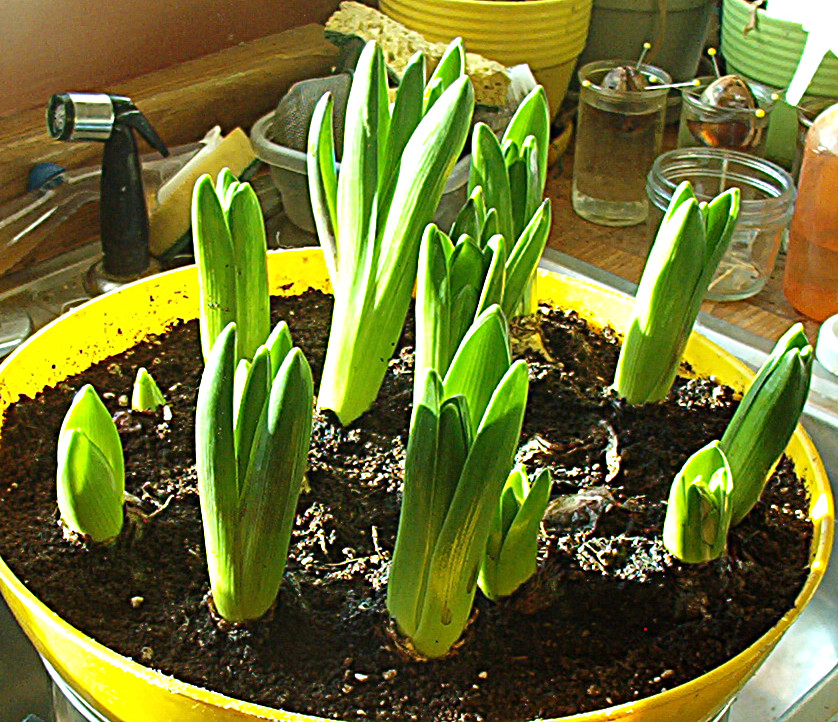
I find myself wondering why it took me so many years to buy a bag of Hyacinth bulbs so that I could stick them into a pot of dirt and watch them grow into one of my most favorite flowers.  But this year I did buy them, and every day I watch them grow and develop.  In this case every one of the 12 bulbs is receiving the identical resources.  One bulb rotted.  Eleven are growing greener and taller every day.  I can see their sturdy outer leaves part as the bud of each one’s flower begins to form close to the soil.

Yet not one of the plants is the same.  There is one that is twice the size of the rest of them.  Standing at nearly seven inches it towers over the smallest which only yesterday showed its first greenery at all.  Given this band-width of normal development, what would have happened should any or all of them have suffered some degree of trauma in their development.

Do I compare the tallest and the shortest and the middle plants and say that some are stunted and some are not?  Or is it the truth that each separate plant is simply fulfilling its own individual nature by growing in the only way that it can – in its OWN way?

++++

The presence or absence of traumatic influences during human development simply signals through molecular pathways in the body what the condition of the world is like so that the growing body-brain of the infant-child can adjust and adapt itself in the best way it can to survive in, and even thrive in, the world it is being built for.

These beautiful Hyacinth plants I am watching are crowded together in an old plastic yellow colander I bought at our local thrift store.  The soil then has excellent drainage.  It sits in my kitchen sink directly in the even light provided by my west facing window.  I can carefully monitor the needs of this whole tribe of plants equally.  But nothing I can provide for them will change them into anything else other than what they started out being.

No matter what influences an infant-child’s development, no matter how much they have to adapt in their body-brain development to trauma, they will always come out of these earliest stages of development in the best way they possibly can.  Each one will always be a unique representation of their potential as members of our species.  But none of us, not one single one of us, can ever overcome the boundaries that make us human.  None of us can become something nature did not intend us to be.

And because of this we each represent the environment that made us in ‘natural’ ways.

Given the information in her earliest environment that my mother’s body-brain-mind-self had to work with (from both within and from outside her body), it is natural that my mother became who she was.  Given who she became, it is natural that the outflow of her condition would be what it was.  Given what my mother did to me during my development, it is natural that my body-brain-mind-self would make the kinds of adaptations and adjustments that it/I did.  There is nothing, to me, unnatural about any of this.

What happened to me, however, is that once I left my home of origin I began to look around me as I became a part of what libramoon refers to as a “social atmosphere.”  Before that time I simply had no points of reference either outside of myself or within myself that I could use for comparison.  I had no inner compass other than the natural one that I had been formed with.

My Hyacinth plants have no ability (that I know of) to compare themselves to one another.  It is only once the signaling communication that we participate in achieves some level of the ability to compare our reality with some other reality that the trouble really begins.  Before that time I believe we simply exist within the natural world in the same way that any other part of nature does.

Once we have reached what I believe to be an evolutionarily advanced state that allows for a point of reference, we enter an expanded universe of thought that includes the ability to CONTRAST some aspect of something to, with and against some aspect of something else.  Without a reference point, we cannot COMPARE or CONTRAST anything any more than my Hyacinth plants can.

The human ability to access reference points so that we can compare and contrast allows us to also form opinions as it allows us to exercise conscious choice.  Using these abilities does not separate us from NATURE.  Thinking is as natural as breathing once we have that ability.

And just as we humans breathe the same air that our planet provides for us, we think by using the same neural abilities that everyone else does.  True, my own individual lungs breathe in and exhale particular molecules.  True, my brain’s particular molecules are thinking my own thoughts as I go through life.  But at the same time these are sharing operations.  Nobody can tell me, “No!  Don’t breathe THAT air!” or “No!  Don’t think THOSE thoughts!”

My body can breathe without my conscious awareness.  My body can also think without my conscious awareness.  Again I return to another critically important concept that I see implied in libramoon’s writing:  MINDFUL.

I can choose to be mindful of both my breathing and of my thinking.  I can accomplish this because I have gained the evolutionary advantage point of HAVING a reference point.  While my mother could no doubt have gained mindfulness of her breathing, I’m not certain that in her entire life my mother could gain mindfulness in regard to her thinking.  In fact, ‘mindfulness’ is one of the primary concepts applied to recovery within the so-called Borderline condition because the ability to live a mindful life has been altered – I believe through early developmental trauma – in a Borderline’s body.

++++

I believe that the ability to obtain the ability to have a reference point within one’s self is an evolutionarily provided gift.  Having a reference-point ability gives us powers to discriminate, to contrast and to compare so that we can think in mindful ways.  I don’t think my mother had this ability any more than my Hyacinth plants do.

Does this mean that trauma stunted my mother’s development?  Is a plant stunted because it has no reference point and cannot compare and contrast itself to any other aspect of existence?  No.  Simply put, a gift is missing in both circumstances.

Our ability to think mindfully happens because we operate within a social atmosphere that feeds information back to us at the same time we have degrees of ability to receive this information even before we are born.  Information comes to us as forms of nutrients that build our body-brain just as surely as water, soil and light are nutrients that are building my Hyacinths.  These are shared natural processes.

If, however, a developing human being does not receive enough information about its own individual self-in-the-world, the gift of mindfulness will not come into bloom in the same way that if my Hyacinths do not receive the nutrients they need RIGHT NOW as they grow, they will not be able to form blossoms.  In this way, mindfulness is the gift of the flower of humanity.

In this way, also, I see that my mother was not stunted; she was robbed of the evolutionarily advanced gift of mindfulness.  She was not fed with the necessary nutrients within the social atmosphere of her infant-childhood to build a self that could in turn possess a viable reference point that she needed in order to accurately compare and contrast her own self within a world of others.  She could not, therefore, share a gift of mindfulness that she never received.

++++

My choice to mention both breathing and thinking together is not an arbitrary one.  Research on the human vagal nerve system is showing that it is directly connected to our physiological reactions to what we see ourselves ‘a part of’ and what we see ourselves ‘a part from’ as it regulates our breathing and our heart rate.

Reacting as ‘a part of’ stimulates the STOP arm of our Autonomic Nervous System (ANS).  Our heart rate and our breathing slow down.  We then find ourselves on the cooperative rather than the competitive pathway, or the prosocial one.

If we react with an ‘a part from’ reaction, our heart rate and our breathing escalate with stimulation of the GO arm of our ANS, or our fight/flight response.

In this way, I suggest that WE ARE WHAT WE BREATHE and the more conscious and mindful we can become about our fastest physiological reactions within our body the more mindful we can become about our self in relationship with the entire world we live within.  The STOP reactions we have release our breath in an exhale.  The GO reactions that we have catch us with an inhale.  If we can learn to pay attention to this most basic signal from our body, we can increasingly notice with mindfulness the orientation we are taking from our internal reference point – our individual self.

Even without our mindful conscious perception, our naturally constructed social species’ body-brain is continually evaluating our degree of safety and security in the world through finely tuned assessments about what belongs and what doesn’t – what is safe and what isn’t.  These are comparing and contrasting operations that our body has formed itself to assess so that we can increase our chances of staying alive.

The more traumatic our earliest environment was the more automatic and the less mindfully conscious these patterns operate within our body because we were naturally built this way.  As we experience a lifetime of mostly automatic reactions, our body itself has taken over the reference point position, not our conscious mind.

As we begin to practice mindfulness we are creating our own bloom.  We can choose to grow this gift even if nobody gave us this gift pro bono.  Traumatized infant-children are given censored, erroneous information.  The building of an ever increasingly mindful self requires access to and sharing of truthful and accurate information.  Because we are a social species, this growth always happens through give and take within a social atmosphere, even if that atmosphere mostly exists between our own mind and our own self in online exchanges with others.

The more we access, utilize, process and digest new information the less hold any trauma we have ever experienced will have on our mindful self, and the more we will grow and blossom into being the evolutionarily advancing people nature has intended us to become.  Mindfulness, the blossom of our specie’s evolution, concerns all the information about our experience that we can consciously share with our self.  Mindfulness defines the social atmosphere we create within our self with our self.  This is the area where our healing will show its greatest accomplishments.  “Go bloom, everyone!  Go bloom!”
++++

NOTE:  In consideration of the tendency for some people to think that humans are separate from nature and/or superior to the natural world, all this means to me is that the ‘a part from’ pathway has been chosen rather than the ‘a part of’ pathway.  The reference point of the self has compared and contrasted itself and has made up a thinking-based fiction that has nothing to do with reality.

+++++++++++++++++++++++++++++++++++

+CAN EARLY INFANT-CHILD MALTREATMENT TURN OFF THE COMPASSION SWITCH?

+++++++++++++++++++++++++++++++++++

What if a single research key exists that fits into the lock that will open the door for me to find out what was REALLY wrong with my severely abusive Borderline mother?

I used to think that if I could name one single fact about my mother that allowed her to so terribly abuse me from birth and for the next 18 years of my childhood, I would say that my mother lacked a conscience.  Search as I might, I cannot actually find anyone who can begin to say exactly what ‘conscience’ is let alone where it might physically reside in a person’s body-brain.

Today I am beginning to understand that there is another word I can use to think about what my mother did to me.  My mother completely lacked the ability to feel compassion for me.  Compassion, it turns out, IS an aspect of human beings that does seem to be connected biologically, physiologically, neurologically to very real systems in our body-brain.  I like that.  I can learn about this.

The most fundamental human do-good, be-good system in our body is evidently our vagal nerve structures.  Before I present my informational links for today, I want to first present this single piece of research that shines a clear, bright light on what might be the very system within my mother’s body that was – most simply put – unable to help her not to harm me!

++++++++

Borderline personality disorder and emotion regulation: Insights from the Polyvagal Theory

By

Marilyn A. Austina, Todd C. Riniolob and Stephen W. Porges (2007)

References and further reading may be available for this article. To view references and further reading you must purchase this article.

Abstract

The current study provides the first published evidence that the parasympathetic component of the autonomic nervous system differentiates the response profiles between individuals diagnosed with borderline personality disorder (BPD) and controls.

Respiratory sinus arrhythmia (RSA), a non-invasive marker of the influence of the myelinated vagal fibers on the heart, and heart period were collected during the presentation of film clips of varying emotional content.

The BPD and control groups had similar initial levels of RSA and heart period. However, during the experiment the groups exhibited contrasting trajectories, with the BPD group decreasing RSA and heart period and the control group increasing RSA and heart period.

By the end of the experiment, the groups differ significantly on both RSA and heart period. The correlation between the changes in RSA and heart period was significant only for the control group, suggesting that vagal mechanisms mediated the heart period responses only in the control group.

The findings were consistent with the Polyvagal Theory [Porges, S. W. (1995). Orienting in a defensive world: Mammalian modifications of our evolutionary heritage: A Polyvagal Theory. Psychophysiology, 32, 301–318; Porges, S. W. (2001). The Polyvagal Theory: Phylogenetic substrates of a social nervous system. International Journal of Psychophysiology, 42, 123–146; Porges, S. W. (2003). Social engagement and attachment: A phylogenetic perspective. Annals of the New York Academy of Sciences, 1008, 31–47.], illustrating different adaptive shifts in autonomic state throughout the course of the experiment.

The BPD group ended in a physiological state that supports the mobilization behaviors of fight and flight, while the control group ended in a physiological state that supports social engagement behaviors.

These finding are consistent with other published studies demonstrating atypical vagal regulation of the heart with other psychiatric disorders.

FULL ARTICLE IS PUBLISHED IN:

Brain and Cognition
Volume 65, Issue 1, October 2007, Pages 69-76
Social Cognitive and Affective Neuroscience: Developmental and Clinical Perspectives

Marilyn A. Austina, Todd C. Riniolob and Stephen W. Porgesc, ,

aDepartment of Human Development, University of Maryland, College Park, College Park, MD, USA

bDepartment of Psychology, Medaille College, Buffalo, NY, USA

cDepartment of Psychiatry, University of Illinois at Chicago, Psychiatric Institute, Chicago, IL, USA

+++++++++++++++++++++++++++++++++++

GREAT SHOW!!  GREAT SHOW!!  GREAT SHOW!!  GREAT SHOW!!

THE SCIENCE OF HUMAN GOODNESS

ONLINE – FREE – RADIO PROGRAM

LISTEN HERE (scroll down their web page for title)

Dr. Moira Gunn talks with UC Berkeley Psychology Professor, Dacher Keltner and the editor of Greater Good magazine, Jason Marsh, about how humans are naturally programmed to be good and what separates those who are from those who are not.

Interview with the authors Dacher Keltner and Jason Marsh ABOUT —

The Compassionate Instinct: The Science of Human Goodness by Dacher Keltner, Jason Marsh, and Jeremy Adam Smith (Paperback – Jan 4, 2010)

Book Review

The short, accessible essays…underscore empathy, forgiveness, gratitude, happiness, trust, and apology…. A readable digest of current work in positive psychology for a general audience. (E. James Lieberman – Library Journal )

Book Description

Leading scientists and science writers reflect on the life-changing, perspective-changing, new science of human goodness. In these pages you will hear from Steven Pinker, who asks, “Why is there peace?”; Robert Sapolsky, who examines violence among primates; Paul Ekman, who talks with the Dalai Lama about global compassion; Daniel Goleman, who proposes “constructive anger”; and many others. Led by renowned psychologist Dacher Keltner, the Greater Good Science Center, based at the University of California in Berkeley, has been at the forefront of the positive psychology movement, making discoveries about how and why people do good. Four times a year the center publishes its findings with essays on forgiveness, moral inspiration, and everyday ethics in Greater Good magazine. The best of these writings are collected here for the first time.

A collection of personal stories and empirical research, The Compassionate Instinct will make you think not only about what it means to be happy and fulfilled but also about what it means to lead an ethical and compassionate life. 25 illustrations.

See all Editorial Reviews

+++++++++++++++++++++++++++++++++++++++++++++++++++++

IMPORTANT LINK TO PAGES ON COMPASSION:

Today I scanned the next chapter in Dr. Dacher Keltner’s book, Born to Be Good: The Science of a Meaningful Life on Compassion.  I initially purchased this book out of my interest in what Keltner had to say about the human neural circuits that appear to have evolved specifically to help us live a good life in the world having to do with the Polyvagal Theory, or the vagal components of our nervous system.

It is here in his chapter on Compassion that Keltner begins to talk about this vagal nerve system (and about its direct connection to our immune system).  Please take a few moments to read this.  I present this chapter for discussion and educational purposes – please follow the active book title link above to purchase your copy:

CLICK HERE TO READ THE SCANNED PAGES OF KELTNER’S CHAPTER ON COMPASSION

++++++++++++++++++++++++++++++++++++++++++++++++++++

+WHAT IS LONELY? FEELING SO ALONE ALONE

+++++++++++++++++++++++++

My topic is loneliness.  It is that life-long recurring state of isolation and aloneness that has never left me for long.  I live with it now nearly constantly.  I want to learn more about my aloneness because I have no more hope that it is ever truly going to leave me in this lifetime.  At times my aloneness attacks me, gripping me in a death lock and does not let go.

I  returned this weekend to an event that happened to me 23 years ago when I was nearly 36 years old that I suspect holds a key to something I need to learn about myself.  At this age I had been gone from home nearly 18 years, the same length of time I had lived in my mother’s abusive home.  Eighteen years seemed like a long, long time.

I read my age 34 journal, and have transcribed much of my age 35 journal.  I was looking for the date that this event I wonder about happened.  I found the date, but I wrote nothing about the event itself, so just now had to recall it from memory.

This event can be singled out as an important one for me that I have never understood, but it belongs to the story of my life.  In the story of my life I found myself for over 30 years being attracted to Native American teachings.  In the journal I transcribed today I pulled out the dates that came to be related to my first introduction into Native American ceremony.  I have not attended any kind of ceremony for the past 15 years, and do not anticipate ever attending one again — but that is a whole different story.

Yet as I read what I wrote at 34 and 35, I was again reminded of those years of being a recently divorced single mother of three children in the far north country of northern Minnesota, on welfare, in poverty, struggling to find a way to find myself in spite of every choice I had ever made that created the situation I was living in.  I obviously knew by then about the seriousness of the infant-child abuse I had experienced — but I had no idea how to connect what had happened to me with who I was, or what any of it really meant.

I could not recognize that so much of what I struggled with was due to very real brain-mind difficulties that were a consequence of an entire infant-childhood of severe abuse.  Those difficulties are still with me, but at least now I recognize them for what they are and realize that most of them have always been permanent.

NOTE:  Of the $336 our family received in AFDC grant per month, the state received $290 per month in child support from my ex-husband for his two daughters.  The state paid the difference of $46.  He paid his support faithfully, and as a result we also received an additional $50 check from the state every month as ‘incentive pay’.  In the nearly 25 years since my son was born his father still owes the bulk of his child support, none of which was paid during the years I raised his son alone.  We also received medical coverage and around $100 per month in food stamps.  In time the county allotted me five hours a week of paid respite day-care for my extremely active baby.  I doubt I could have kept the family together without this help.

+++++++++++++++++++++++++

These two links travel to this part of my story.

A slice of my life for the year between my youngest son’s 1st and 2nd birthday:

*Age 34-35 (August 1986 – August 1987) First Sweat Ceremony

The story of one July night:

*Age 35 – Bear Butte and the circle around me (1987)

+++++++++++++++++++++++++

+THE TOPIC OF TEASING: TOO HARD TO CONSIDER?

++++++++++++++++++++

When I turned the next page after the chapter on laughter in Keltner’s book my first reaction was aversion.  This isn’t the aversion of disgust I would feel if someone handed me a white china plate with a serving of dog turds in the center of it.  It’s more the aversion I would feel to continuing down a path once I saw a large diamond back rattler stretched across it.  It’s like the aversion I would feel should I be asked to step up on stage to join a chorus line of showgirls scantily dressed and overly plumed in Las Vegas, or should I be asked to sing the national anthem from the center of a pro football stadium in front of thousands.

That’s a strong negative reaction to the single word that appears at the top of Dr. Dacher Keltner’s 2009 book’s (Born to Be Good: The Science of a Meaningful Life) next page as the heading for his next chapter:  Teasing.

I am experiencing the ‘freeze, hide and flee’ half of the fight/flight stress reaction.  There’s no ‘fight’ for me here except for the fight I am experiencing inside my self about facing my fears by plowing through a topic that obviously makes me feel completely uncomfortable.  I am presented with a challenge here to which I respond with feelings of incompetence and un-confidence.  I KNOW I am an unequipped gladiator in the arena of normal human teasing.

It is only because of my commitment to reading Keltner’s entire book and to learning about my self as the severe infant-child abuse survivor that I am that I marshal my courage and willingness to pay attention both to the information that Keltner presents and to my own difficulties with it.  I know from my experience of aversion to the topic that there is something important here I need to understand.  I know from the start both that I am not going to like what I find here, and that what I find will reflect a truth about how the severe abuse I experienced from birth changed me into someone who is different from the person I could have become had this severe abuse not happened to me.

++++

Because my experience of severe infant-child abuse contained very specific, unusual, uncommon and unique patterns, I have found myself falling through nearly every single crack in the ‘psychological’ theories about how child abuse can affect adult survivors.  Because my abuse began at birth, I have had to learn that ‘recovery’ of abilities I supposedly ‘used to have’ before severe trauma happened to me is not possible.  My journey of healing is mostly about what I can uncover and discover connected to what was done to me rather than to recover anything.

I have to connect-the-dots of the information I uncover and discover about being myself in the world in far different ways than non-early severe infant-child abuse survivors might get to.  I cannot take for granted even the most basic facts about what it means to be a member of our social human species.  This is mostly true because my mother didn’t just use one massive club of abuse against me from the time I was born.  She had a second massive club that she wielded over me equally:  extreme social isolation.  Being bludgeoned from birth and for the next 18 years by one of these clubs would have all but obliterated me.  Being attacked on all fronts by a combination of the two clubs has made me into a person who very nearly fits the description of a nonsocial species of one.

I am left having to uncover and discover more of what is uniquely different about me from others than what is similar or the same.  Yet I was born a member of a social species.  Everything that is different for me happens according to categories of experience that I share with all others.  It’s just that within each of these categories of possibilities about what it means to be human and what it feels like to be human, I experience patterns of being-in-the-world that are different for me than for nearly all others.

As I encountered my aversion to Keltner’s chapter heading on teasing it didn’t take me very long in scanning the next pages to understand that the topic of teasing is about one of these socially-human categories.  Although Keltner does not make the obvious connection between teasing and attachment patterns, I do.  In fact, the connection is more than glaringly obvious to me.

I suggest that a clear appraisal of our competency of interactions within the arena of teasing activity can show us the kind of social brain we have.. At the same time this appraisal can tell us about the kinds of infant-child interactions we had with our earliest caregivers while the foundation of our emotional-social brain was built from the time of our birth.

++++

At the same time that I now want to turn to Keltner’s actual presentation of information on teasing, I am experiencing one of my own inner reactions I wrote about earlier in the week.  I hear that warning:  “Do not enter.  Past this point all angels fear to tread.”  I realize that if I cross this line, move past this point, I am at risk for inviting in The Furies.

At the same time I realize there is a second sign posted beside the first.  This one reads, “You cannot get there from here.”  I don’t even have time to consider what this second sign means before I notice a third one that reads, “What is true for most others is absolutely not true for you.”  Oh!  And a fourth sign!  “If you choose to follow down this pathway you must understand that none of what you will find here can be taken personally.  Whatever you are missing in regard to teasing did not come about through any fault of your own.”

If the presence of all those signs aren’t warning enough that I better consider carefully what I am going to choose to do next, I see a flash of yellow through the trees and underbrush just around a curve of the pathway ahead of me.  I walk toward it and see yellow crime scene plastic ribbons strung across the pathway and wound around the bushes on both sides of the pathway into the forest as far as I can see.  At the same time I see a gleaming silver pair of giant scissors lying on the ground in the center of the path right in front of the tape.

I am standing here thinking about this carefully.  What might the repercussions be for me if I pick up these scissors, snap through that yellow tape and continue forward down this pathway?  What might the ramifications be of gaining conscious knowledge about something my body already knows but has no words to describe?  Would I rather be skinned alive than uncover what I am going to discover about myself in this body-brain in this lifetime should I carefully read this chapter?

Believe me, readers.  This is turning into a really long pause here…….  There are more than a few parts of myself I have to consult with before I can make this decision.

++++

One thing I know today from the information Keltner presents in his book on this topic.  True teasing in the human social arena is NOT about aggression.  If there is aggression present, it is not teasing.  There is not supposed to be anything terrible — ‘terror able’ — about teasing.   Obviously, for me, there was in my “Something Wicked This Way Comes” version of a childhood.

I should not be surprised, given the continual reign of my mother’s verbal abuse of me (included within her unending repertoire of violence), that her so-called teasing was extremely vicious, hurtful and WRONG — from the time I was born.

++++++++++++

+NOT INVITING IN THE FURIES

++++

What I did to myself by writing yesterday’s post was not kind, or gentle, or wise.  Of course I didn’t know at the time that I was putting myself through the clear paces that the part of May Sarton’s poem I posted the other day describes.  Yesterday I innocently invited in The Furies and it has taken 24 hours for the angels, who are also “never far away” to help me reestablish some kind of inner balance.

I am fortunate today that yesterday’s nasty storm seems to have abated.  Today I have what May Sarton mentioned in her poem:

“It is the light that matters,
The light of understanding.
Who has ever reached it
Who has not met the furies again and again:
Who has reached it without
Those sudden acts of grace?

-From “The Angels And The Furies”

I have received comments over time about my writing from several people whose opinions I highly value and appreciate.  They have told me that most of the time my writing is too intellectual, too detached, distant, remote and objective, too sparse of emotion and personal detail.  Well, I can promise you now that “the light that matters, the light of understanding” that I had to suffer through yesterday to GET now clearly tells me that this is just the way I am going to write – because it is all I can afford.

++++

I might have just as well stood on the thick ice of a raging frozen river yesterday with a lit stick of dynamite in my hands that I used to blow a whole in that ice so that I could crash through it and get swept down that river, under the ice, unable to escape.

I became overwhelmed by sorrow and sadness and spent the rest of my day and night fighting to overcome it.  I did that to myself, and it was not pretty.  I had dumped myself back into a survival mode where I was fighting, absolutely alone, for my life.  My “light of understanding” commitment to myself today is that I don’t care what anyone else says, wants or needs, I will never do that to myself again.  I cannot afford to.

Only those who suffered from the worst-case kinds of terrible infant-child abuse, particularly by their mother from birth can ever begin to understand the devastating power such a FURY has to obliterate a tiny developing self.  Every single possible avenue we could find to survive – because there was no possible way to escape – became a part of the very body-brain we live with.  Yesterday, without realizing it, I violated my own self-protective measures and caused myself the experience of remembering a part of my overwhelming pain.  I will not do that again – Duh!

There is no place within myself that I can return safely to any part of my childhood other than to my experiences with the mountain land of Alaska itself.  Every single other part of my infant-childhood is connected to absolute, fundamental misery.  I learned yesterday that I have needs in the present in order to ever begin to write about the emotions of my experience that I DO NOT HAVE around me in my life today.

First of all, I am sick.  I have a nasty cold, the likes of which I have not suffered for well over 20 years.  My body is the single continuous fortitude of protection I have counted on to carry me through my life from the moment I was born.  I am – quite obviously – at my weakest when my immune system reacts to a physical sickness attack.

Secondly, I am thousands of miles away from my family and my closest friends.  I do not have a therapist.  I cannot afford one and I couldn’t find one competent or capable enough to help me now, anyway.  I choose not to take psychotropic medications, which is usually OK unless I take stupid steps that overwhelm the systems I have in place within myself to keep me in a place of reasonable balance.

I do not have a support system close to me.  I do not have a safety net.  When I took my own steps yesterday to invite The Furies in I did so with good intentions, but I made a big mistake.  By the time I figured this out yesterday, I had crashed through the ice and was gone.  The simplest piece of information I now have as a result of my miserable experience yesterday is that next time I am writing and the words “going where Angels fear to tread” I am going to turn around and run as fast as I possibly can in the other direction!  I received that warning yesterday, and I kept on going.

++++

Several hours after I posted yesterday I knew exactly the point in my writing yesterday where my lit stick of dynamite exploded and little dissociated me flew to pieces and disappeared into the ice-covered raging river.  I am taking a risk even at this moment by going back and retrieving the phrase that shows where the “perfect storm” was born.  I hear the angels’ warning.  I tell them, “Only these few words.  I hear you.  I am being extra careful.”  I am determined to prove my own point.  Some of readers might have noticed this, anyway.

This was the fulcrum point.  It came in my description of how those that love me loved me during my experience with cancer:

Until I felt what I did last Friday I had no idea how the people who loved me felt as they all traveled thousands of miles, one after the other, to support me and to care for me and to love me as I went through the grueling chemotherapy and eventual surgery that would allow me to remain in their lives.”

I clearly did not think and therefore did not say that these loved ones helped me to REMAIN IN MY OWN LIFE.  I said they helped me to remain in theirs.

Enough said.  You get my point.  I don’t want to invite some giant auger to fall out of the sky on top of my head today to take me down, down, down, down…..

++++

I am wiser today, even though my cold still has my body in its grip.  I am back up here on the surface of the world where I belong.  I will do things today like rest when I need to, clean the kitchen table off, maybe wash my kitchen floor until it shines in the infrequent moments the sun breaks through the high clouds.

I have “the light of understanding” that I can fully give myself permission to write what I can write the way I can write it.  Yesterday I put myself into the problem of my childhood, not the solution.  I most want to work at understanding what happened to my mother that made her into the monster she was.  I want to understand how the millions of separate, individual terrorizingly brutal encounters I had with her changed me in my development.  I want to make informed connections about the conditions of infant-children that lead to either their increased or decreased well-being throughout their life spans.

If there are in the future people who want to be close with me to support me with their love so that I can enter a space safely and securely in order to ‘go back’ to the emotion and details of my childhood (any more than I already have), it is only THEN that a different level of my writing can appear on this blog.

In the meantime, I am going to let the angels surround me up, down, side to side.  I will take precautions to keep myself in the present and not travel into that dangerous fog as I did yesterday.  Hell is too short, brief, simple and inadequate of a word to even begin to describe the conditions of a severely abused infant-child’s experience is like.  There truly are no words to express or to explain that kind of trauma.  Trying to put those experiences into words can be an extremely dangerous occupation, one that I am not willingly going to participate in again.

Please refer to my previous writings about the dangers of DISCLOSURE.  I need to heed my own words.  Nobody else can do it for me.  I am still fragile today, raw and shaky.  I will go now and do what needs to be done:  BE GOOD TO ME.

As Sarton wrote:

“Able to bless and forgive
Ourselves.
This is what is asked of us.”

++++++++++++++++++++++++++++

Still brings a smile — watch this video!

TIGER MOTHER ADOPTS PIGLETS

And, MORE TO THE STORY with MORE PICTURES

++++++++++++++++++++++++++++

+EMOTIONAL BLINDNESS – WONDERING WHAT LOVE IS

++++

I am trying to think about an emotional experience I had the other day so that I can write about it.  At the same time I realize I cannot think about it separately from writing about it.  If my words don’t follow themselves across a page they disappear like lemmings over a cliff into oblivion.  Partly this is true because I am in an inner battle with ambiguity.  If I write this piece most of the ambiguity will vanish.  But because of the 18 years of abuse I suffered from my severe Borderline mother, her brain patterns were built into me, and it’s a known fact that Borderlines DO NOT LIKE ambiguity as A. J. Mahari describes:

Borderlines have not learned how to relate in healthy ways. Borderlines have not experienced the world as loving, fair or trustworthy place. Borderline ambiguity is born from the two-faced damage of the betrayal of a parent, both parents and or one’s primary care-givers.

What I experienced the other day that I MAYBE want to understand has to do with the fact that not once in the 18 years of my childhood did I ever feel loved by either my mother or by my father.  I have written before that one of the main reasons I believe I did not turn out just like my mother is that nobody ever betrayed me the way my child-mother was betrayed.

Nobody ever loved me.  Nobody pretended to love me.  I was not exposed to what were the devastating effects of the conditional love my grandparents used to manipulate my mother and destroy her brain-mind.  I was just plain hated without hope of reprieve.  Yet at the same time the underlying lack of awareness of what it feels like not to be truly loved affects me just as it affected my mother.  The love circuitry from safe and secure attachment with early caregivers was not built correctly into either my mother’s or my own early forming body-brain-mind-self – or later forming one, either.

++++

My inner battle with ambiguity today is about whether or not I want to face some of what this means to and for me.  Am I better off not knowing what an examination of my last week’s experience can show me about who and how I am in the world?  Is it helpful for me to follow my own thoughts in my writing to some more unambiguous place where I will be out of this thick enveloping fog of not knowing what this experience has to teach me?

I both want to know at the same time I don’t want to know.  Do I stay right here in this murky ambiguous place or do I choose to take a step in my next thoughts toward the light of clarity?  At the same time I ask myself this question I understand that right here is a place where I can differentiate my own self from my mother.  I can make this choice.  My mother could not.

This does not mean that taking this step toward differentiation from my mother’s brain-mind as she formed herself into mine is easy.  This does not mean that stepping toward the light of conscious reflection and illumination, toward understanding of the truth is easy.  It just means that for me, unlike for my mother, taking this step is possible.

++++

Unlike what Leigh Eric Schmidt, the Charles Warren Professor of the History of Religion in America at Harvard Divinity School might say, I do not believe it is possible for humans to have any experience of themselves in the world that does not directly involve their brain’s processing of information.  The 18 years of severe abuse I suffered from my mother built the brain I now have to use to try to understand all of my experiences of myself in my life.  Today’s excursion into exploring my last week’s experience is no exception.

Nearly all of the associational processes that went on behind the closed doors of my mother’s mind happened completely outside the range of her consciousness attention.  My mother was a dangerous, violently explosive madwoman.  Growing up, I knew about her violence but I did not know about her madness.  How could I?  It had greeted me with the first breath I ever took in this world and it continued unabated throughout all my developmental stages until I was 18.

As a result of the free rein (and free reign) my mother had in her home to do anything she wanted to, there was always only one single pattern for me.  She erupted, hurt me, and I suffered.  All that suffering built me as it built itself into me, and it was never accompanied by any experience of love.

As a young infant-child grows into its body-brain-mind-self, it is supposed to be helped to differentiate experience.  It is supposed to learn that it exists as a separate entity, and it is supposed to form not only its own stable self, but also a clear stable connection to this self.  All of this process is negotiated through the experience of emotion.  Emotions have to become ever more clearly differentiated from one another so that the self can have access to its own information about being in the world.

I did not go through ANY of these differentiation stages of development normally.  My mother overwhelmed me from the moment I was born.  Because my mother did not succeed at physically killing me, she did not succeed at completely obliterating me.  But she did very successfully limit my options of experience down to one.  She made me suffer.

++++

My mother overwhelmed me with the scourge of her hatred of who she imagined me to be at every step of my infant-childhood that she possibly could.  I see the image of someone continually trying to dump a thousand gallons of gasoline into a tiny little perfume bottle.  My mother effectively did this to me for 18 long years.  I did not escape unscathed.

There were dire consequences of my survival, most of which I will never know.  However, the experience I had last week dropped into the middle of one of them.  I was blindsided by my own emotional blindness.  Can I grab the lantern of my best intentions and spark within it the blazing light of my willingness to learn? Am I willing to go back into the depths of that enveloping fog of sorrow (in my body and in my brain) and take some part of myself back out into clarity?  Is there some new in-sight here for me that is mine and that I really can’t do without?

Yes.  To all these questions I choose to answer “Yes.”  I will walk past these grasping, numbing shadows of doubt.  I will shed this burden of “Shame on you, Linda, for not being a better woman than you are.”  I will not be afraid of my tears.  I will not be afraid that what I will say here or what I will find here will make those who love me, love me any less.

It is not my fault that my mother cut my wings off so that I cannot ever fly in the prosocial world that most others seem to me to take so for granted. “So take your scrawny little bird legs and hop on with this, Linda.  You can do it.  I know that you can.  Go where the angles might fear to tread and know that as you go, they will go with you.”

++++

Last August I was given the gift of being able to reconnect with one of our closest Alaskan homesteading neighbors in my childhood.  I haven’t heard her voice.  I haven’t seen her.  We correspond via email.

Against all rational logic, I love her.  Our connection means a great, great deal to me.  This woman, now 83, lives well over a thousand miles away from me.  I do not have her telephone number.  While I know she is very busy taking care of herself, her husband, her household and preparing to leave their home to move into an addition her son is building on his house for her, when I hadn’t received an email from her from last Monday to last Friday, I felt like a bomb went off inside of me.

It’s easy to say that given what I know about my unsafe and insecure attachment patterns in my body-brain that of course I would be upset.  Yet ‘of course’ doesn’t give me enough information to understand what I felt.  I became terrified that she was either gravely ill or had died.  I believed on some level of my being that she had been called home through the veil to help the 100,000 Haitian earthquake victims cross over to the next world.  Nothing I could find to tell myself would sooth the depths of my growing sorrow.

I have been much blessed in my lifetime that none of my three children have been threatened by sickness or harm.  My siblings are all safe and well.  Even though I continue to grieve for the loss of the man I am in love with from my life, never before last Friday did I feel the depths of that kind of sorrow and fear that someone I loved was in trouble and there was nothing I could do about it.

Most fortunately I had the telephone number of my friend’s son in Alaska.  Through him I was finally able to find out that his mother was just fine.  Never before, either, had I felt that powerful sense of gratitude and relief at hearing this good news.

Now, I suspect that if I had a normally-formed prosocial body and brain I would have been able to take all of this in stride and gone on with my life.  But thanks to the consequences of my mother’s abuse this didn’t happen.  This experience touched the depths of my attachment woundedness in ways I could not understand.  I had felt something new in a way I had never felt it before.

++++

Most of the normal prosocial emotional differentiation circuits and their corresponding connection to people I care about in my life are missing in my brain.  This experience I am describing opened up a circuit for me that I don’t believe ever existed before.  The mystery of my experience with these emotions led me to ask my daughter two days later after I had expressed to her how I had felt, “Is that something like all of you felt when you found out I had cancer?”

My daughter paused, and answered, “Yes, mother.  That’s how we felt.”

++++

What can I say through my tears as I write now that can help me understand what this means to me?  First, I feel terribly sad for my children and for others who love me that it is so nearly impossible for me to comprehend, let alone feel on an emotional level, what it feels like to be loved.  I have to absolve myself of any responsibility for this fact.  It is not my intention to hurt anyone by depriving them of the fullness of the experience of sharing their love for me.  At the same time I am grateful that they both love me, and can experience the fullest spectrum of attachment feelings toward me.

That I cannot participate equally with them in the depths of these life-love experiences is not my fault.  Until I felt what I did last Friday I had no idea how the people who loved me felt as they all traveled thousands of miles, one after the other, to support me and to care for me and to love me as I went through the grueling chemotherapy and eventual surgery that would allow me to remain in their lives.  I know they all love me.  They show me they all love me.  I believe they mean what they say.  But it is nearly impossible for me to FEEL their love inside my own body-brain-mind-self because those circuits were never built inside of me during the first 18 years of my life from the time of my birth.

At the same time I realize that I am now perhaps a fraction of an inch closer to knowing what it FEELS like to be loved, at age 58 I also realize that my emotional blindness is not likely to ever be completely removed from me in my lifetime.  I also understand that part of the pattern of attachment I feel to this homesteading neighbor comes from body memories I have of interactions with her in my childhood that were positive, and were among the very few truly kind and genuine, warm adult interactions I ever had in those miserable 18 years.

Yet I cannot consciously remember this woman.  She has generously sent me photographs of her and her husband from those long-past years, and they help me a great deal as I try to connect the unconscious memories of my childhood to the present day facts of what a wonderful woman this homesteading neighbor truly is.

At the same time I realize I will always struggle with allowing myself to form deep affectionate bonds with other people.  To love is to risk.  I believe that although my mother was able to steal from me the physiological foundations of what it feels like to BE LOVED, she did not remove from me my own ability to deeply love others.  The powers to give love seem to me to operate differently than do the powers of being able to feel love from others.

Of course I don’t know this to be true and I probably never will know for sure.  I imagine my brain to be similar in some ways to the autistic brain given the severe conditions of harm and deprivation in my infant-childhood that interfered with my emotional-social brain’s development.  There is on one in my life who truly loves me that does not also know about my childhood.  They do not have to question their love for me.  They do not have to wonder or guess or doubt.  And they don’t love me any less because I do.

+++++++++++++++++++++++++++++++++++++++++++

ON BORDERLINE PERSONALITY DISORDER:

  • Symptoms of BPD
  • Finding a BPD Therapist
  • BPD on the Internet
  • Self-Harm Explained
  • When You Encounter Splitting
  • +++++++++++++++++++++++++++++++++++++++++++
  • +HEALING, HELPING WORDS….

    +++++++++++++

    I just received these words from a school mate from my childhood that I just found on Facebook — she and they touched my heart so much I wanted to share them with you.

    +++++++++++++

    “… as I was perusing thru my “A Grateful Heart” book that my darling grand daughter gave me for X-mas I came across this beautiful poem by May Sarton.  I was moved by the last 2 verses & something,  (someone?) told me you’d appreciate them.”
    …. so here’s an excerpt:

    3
    The angels, the furies
    Are never far away
    While we dance, we dance,
    Trying to keep a balance,
    To be perfectly human
    (Not perfect, never perfect,
    Never an end to growth and peril),
    Able to bless and forgive
    Ourselves.
    This is what is asked of us.
    4
    It is the light that matters,
    The light of understanding.
    Who has ever reached it
    Who has not met the furies again and again:
    Who has reached it without
    Those sudden acts of grace?

    -From “The Angels And The Furies”

    +++++++++++++

    +CHILD ABUSE SURVIVORSHIP – info and links

    +++++++++++++++++++++++++

    CHILD ABUSE SURVIVORSHIP IN THE NEWS:

    Childhood Trauma May Shorten Life By 20 Years

    CDC Research Finds Problems in Childhood Can Be Lifelong

    By JOSEPH BROWNSTEIN
    ABC News Medical Unit

    Oct. 6, 2009

    +++++++++++++++++++++++++

    I want to pause for a moment from the ongoing themes of my present writing to mention again the important work being done by the Center for Disease Control (CDC) in regard to tracking the longterm consequences of Adverse Childhood Experiences (ACE) including child maltreatment, traumas and abuse.

    But first I want to let you know about an interesting website I found while pursuing a Google search on the ACE study called The Survivor Archives Project.  This is a trauma hope and healing site that invites readers to personally submit to their archives, journal and library.

    ++++

    The CDC-ACE study is not without limitations.  All 17,421 participants were insurance members which means that information from the many other uninsured levels of our society were not included.   If they had been (or are in the future) how much more child abuse connected lifelong adult devastation would be seen?

    I would like to see the model of this study expanded through the use of the ACE questionnaires in a far wider variety of settings, preferably included in every human well-being study our nation produces.  At the moment, I want to simply highlight the important work the CDC has been doing over the past 14 years with its studies of the consequences of child abuse for survivors for your thought and consideration by presenting some information from their website on Adverse Childhood Experiences as follows:

    The Adverse Childhood Experiences (ACE) Study is one of the largest investigations ever conducted on the links between childhood maltreatment and later-life health and well-being. As a collaboration between the Centers for Disease Control and Prevention and Kaiser Permanente’s Health Appraisal Clinic in San Diego, Health Maintenance Organization (HMO) members undergoing a comprehensive physical examination provided detailed information about their childhood experience of abuse, neglect, and family dysfunction. Over 17,000 members chose to participate. To date, over 50 scientific articles have been published and over 100 conference and workshop presentations have been made.

    The ACE Study findings suggest that these experiences are major risk factors for the leading causes of illness and death as well as poor quality of life in the United States. Progress in preventing and recovering from the nation’s worst health and social problems is likely to benefit from the understanding that many of these problems arise as a consequence of adverse childhood experiences.

    Here is one website about the study:

    The Adverse Childhood Experiences (ACE) Study:  Bridging the gap between childhood trauma and negative consequences later in life.

    ++++

    About the study:

    The ACE Study was initiated at Kaiser Permanente from 1995 to 1997, and its participants are over 17,000 members who were undergoing a standardized physical examination. No further participants will be enrolled, but we are tracking the medical status of the baseline participants.

    Each study participant completed a confidential survey that contained questions about childhood maltreatment and family dysfunction, as well as items detailing their current health status and behaviors. This information was combined with the results of their physical examination to form the baseline data for the study.

    The prospective phase of the ACE Study is currently underway, and will assess the relationship between adverse childhood experiences, health care use, and causes of death.

    More detailed scientific information about the study design can be found in “The relationship of adult health status to childhood abuse and household dysfunction,”* published in the American Journal of Preventive Medicine in 1998, Volume 14, pages 245-258.

    ++++++++++++++++++++++++++++++

    The ACE Pyramid represents the conceptual framework for the Study. During the time period of the 1980s and early 1990s information about risk factors for disease had been widely researched and merged into public education and prevention programs. However, it was also clear that risk factors, such as smoking, alcohol abuse, and sexual behaviors for many common diseases were not randomly distributed in the population. In fact, it was known that risk factors for many chronic diseases tended to cluster, that is, persons who had one risk factor tended to have one or more others.

    Because of this knowledge, the ACE Study was designed to assess what we considered to be “scientific gaps” about the origins of risk factors. These gaps are depicted as the two arrows linking Adverse Childhood Experiences to risk factors that lead to the health and social consequences higher up the pyramid. Specifically, the study was designed to provide data that would help answer the question: “If risk factors for disease, disability, and early mortality are not randomly distributed, what influences precede the adoption or development of them?” By providing information to answer this question, we hoped to provide scientific information that would be useful for the development of new and more effective prevention programs.

    The ACE Study takes a whole life perspective, as indicated on the orange arrow leading from conception to death. By working within this framework, the ACE Study began to progressively uncover how childhood stressors (ACE) are strongly related to development and prevalence of risk factors for disease and health and social well-being throughout the lifespan.

    ++++++++++++++++++++++++++++++

    Major Findings

    Childhood abuse, neglect, and exposure to other traumatic stressors which we term adverse childhood experiences (ACE) are common. Almost two-thirds of our study participants reported at least one ACE, and more than one in five reported three or more ACE. The short- and long-term outcomes of these childhood exposures include a multitude of health and social problems. The ACE Study uses the ACE Score, which is a count of the total number of ACE respondents reported. The ACE Score is used to assess the total amount of stress during childhood and has demonstrated that as the number of ACE increase, the risk for the following health problems increases in a strong and graded fashion:

    • alcoholism and alcohol abuse
    • chronic obstructive pulmonary disease (COPD)
    • depression
    • fetal death
    • health-related quality of life
    • illicit drug use
    • ischemic heart disease (IHD)
    • liver disease
    • risk for intimate partner violence
    • multiple sexual partners
    • sexually transmitted diseases (STDs)
    • smoking
    • suicide attempts
    • unintended pregnancies

    In addition, the ACE Study has also demonstrated that the ACE Score has a strong and graded relationship to health-related behaviors and outcomes during childhood and adolescence including early initiation of smoking, sexual activity, and illicit drug use, adolescent pregnancies, and suicide attempts. Finally, as the number of ACE increases the number of co-occurring or “co-morbid” conditions increases.

    Content source: Division of Adult and Community Health, National Center for Chronic Disease Prevention and Health Promotion

    +++++++++++++++++++++++++++

    Adverse Childhood Experiences Study Questionnaires – AVAILABLE TO EVERYONE

    This is the simplest version of the ACE questionnaire I have seen that consists of ten questions:  What’s YOUR ACE Score?  Help me calculate my ACE Score.

    +++++++++++++++++++++++++++

    THE ACE SCORE:

    The ACE Study used a simple scoring method to determine the extent of each study participant’s exposure to childhood trauma.  Exposure to one category (not incident) of ACE, qualifies as one point.  When the points are added up, the ACE Score is achieved.  An ACE Score of 0 (zero) would mean that the person reported no exposure to any of the categories of trauma listed as ACEs above.  An ACE Score of 10 would mean that the person reported exposure to all of the categories of trauma listed above.  The ACE Score is referred to throughout all of the peer-reviewed publications about the ACE Study findings

    Below are the links to the actual forms used (and to be used) for research purposes.

    The Family Health History and Health Appraisal questionnaires were used to collect information on childhood maltreatment, household dysfunction, and other socio-behavioral factors examined in the ACE Study. The questionnaires are not copyrighted and there are no fees for their use. As a courtesy, a copy of articles on any research conducted using items from the questionnaires is requested.

    Family Health History Questionnaire

    Male Version (PDF–190K)

    Female Version (PDF–180K)

    Health Appraisal Questionnaire

    Male Version (PDF–85K)

    Female Version (PDF–89K)

    +++++++++++++++++++++++++++

    Adverse Childhood Experiences Definitions

    +++++++++++++++++++++++++++

    Future Directions

    The ACE study is now in its 10th year and the prospective phase is currently underway. In this ongoing stage of the study, data are being gathered from various sources including outpatient medical records, pharmacy utilization records, and hospital discharge records to track the subsequent health outcomes and health care use of ACE Study participants. In addition, an examination of National Death Index records will be conducted to establish the relationship between ACE and mortality among the ACE Study population.

    International interest in replications of the ACE Study is growing. At present there is knowledge of efforts to replicate the ACE Study or use its questionnaire in Canada, China, Jordan, Norway, the Philippines and the United Kingdom. In Puerto Rico, the link between women’s cardiovascular health risks and ACE are under study. In addition, the World Health Organization has included the ACE Study questionnaires as an addendum to the document Preventing Child Maltreatment: A Guide to Taking Action and Generating Evidence. (October 2006*) (PDF)

    +++++++++++++++++++++++++++

    Related Links

    CDC Resources

    CDC’s National Center on Birth Defects and Developmental Disabilities

    CDC’s National Center for Injury Prevention and Control

    Other Government Resources

    The Department of Health and Human Services Administration for Children and Families

    Research Institutes

    American Professional Society on the Abuse of Children*

    International Society for the Prevention of Child Abuse and Neglect*

    Family Research Laboratory*

    Voluntary Organizations

    Prevent Child Abuse America*

    Childhelp USA*

    Victim Assistance

    National Children’s Advocacy Center*

    Chadwick Center*

    +++++++++++++++++++++++++++

    Overview Article:

    Felitti VJ, Anda RF, Nordenberg D, Williamson DF, Spitz AM, Edwards V, Koss MP, Marks JS. Relationship of Childhood Abuse and Household Dysfunction to Many of the Leading Causes of Death in Adults: The adverse childhood experiences (ACE) study.
    American Journal of Preventive Medicine. 1998;14:245-258.

    +++++++++++++++++++++++++++

    New Publication: Childhood Stress and Autoimmune Disease in Adults

    ++++++++++++++++++++++++++++++++++

    PUBLICATIONS ON MAJOR FINDINGS BY:

    Health Outcomes

    Publication Year

    A Video Series on:  THE ACE STUDY

    The ACE PyramidACE Study Links Childhood Trauma—  These results, appearing in the November 2009 issue of the American Journal of Preventive Medicine, are the latest from the ACE Study (Adverse Childhood Experiences). The research project, now in its 14th year,  is one of the largest investigations ever conducted on the links between childhood maltreatment and health and well-being later in life. The ongoing study looks at how both positive and negative experiences and childhood stressors are strongly related to development and affect risk factors for disease, health and social well-being throughout the lifespan.

    The ACE Study — The Good Works in TraumaFrom the Institute for Educational Research and Service and the National Native Children’s Trauma Center

    ++++++++++++++++++++++++++++++++++

    +MISSING LAUGHTER IN MY MOTHER’S MONKEY HOUSE

    ++++++++++++++++++++++++

    As I move forward in Dr. Dacher Keltner’s 2009 book, Born to Be Good: The Science of a Meaningful Life out of his chapter on smiles into his chapter on laughter, I find I am using his information like a powerful laser flashlight, beaming a pinpoint of illumination back through the years of my childhood as I search my memory for genuine smiles, laughter or humor of any kind.

    I find myself thinking about the important book, Stop Walking on Eggshells: Taking Your Life Back When Someone You Care About Has Borderline Personality Disorder by Paul T. Mason and Randi Kreger as I realize that the absence of happiness in our abusive infant-childhoods paralleled the presence of unsafely, insecurity, unpredictability and violence.  Genuine smiles and riotous laughter do not occur in the middle of trauma.

    What can I learn about the development of my body-brain-mind-self if I think about myself as having been a monkey in my mother’s monkey house?  Certainly my mother’s sovereign nation lacked any equality between members.  There was no ‘flattened hierarchy’.  My mother had all of the power, and everyone knew it.  There was no true cooperation.  And certainly in my case there was no affiliation.  These conditions did not contribute to any sense of safety or security, and in these conditions true happiness, laughter and humor did not exist.  Their absence is incredibly telling.

    From my previous studies I already know that good humor is one of the powerful ‘reproductive fitness indicators’ of our species, right up there with good physical health and beauty, intelligence, good memory, and creative thought.  Any species fitness indicators provide direct evidence of the state of ill- or well-being of specie’s members – like does the fitness indicator of a peacock’s tail display.

    The research literature is full of information about how the greatest gifts of our species are directly tied to the greatest risks of being distorted through negative influences within a deprived, malevolent, abusive, traumatic early environment.

    Reproductive fitness indicators develop in humans through an interactive process of genetics being influenced by conditions within the environment during development.  They end up communicating information not only about any single member of a species, but more importantly they communicate information about the condition of the environment that influenced any individual’s development.

    The presence or absence of genuine D smiles and laughter is no exception.  The lack of safety and security in my childhood was represented by the opposite of joy.  My mother’s dysregulated emotions, especially her hatred and rage toward me created suffering, terror, sorrow, despair and alienation within our home.  She kept complete power and controlled her family’s environment through terror, threat of violence and violence.  Ours was NOT a healthy, happy monkey house.

    And of course, because I was my mother’s singled out abuse target, the impact of deprivation and trauma had its most powerful effects on me during my development.  My resulting difficulties with happiness are directly tied to having had my mother’s sickness built right into my own body-brain from birth as signals of the lack of well-being and fitness within the environment that formed me.  My mother did not give me any “all-purpose signal of cooperative intent.”  I received from her the opposite.

    ++++

    Keltner describes how the smile originated back in the early history of our evolution.  A comparison of human patterns with primates’ shows that

    “…in more hierarchical macaques, such as the rhesus macaque, there is a narrow use of the silent bared-teeth and relaxed open-mouth display.  The silent bared-teeth display – the predecessor to our smile – is used only as an appeasement display.  In these status-conscious monkeys, the smile is intertwined with anxiety and defense.

    “There are more egalitarian macaque species, however, such as the Tonkean macaque.  In these macaques, hierarchies are flatter and power is equally distributed.  This social condition more closely resembles the hierarchies observed in our hominid predecessors and contemporary hunter-gathers – power differences are reduced, and equality is more pronounced.  In egalitarian primates, food sharing is pervasive, alliances among subordinates are common, and social life consists more of negotiation than assertion of force….  In less stratified macaques, monkeys put the silent bared-teeth display to many new uses:  to reassure, to affiliate, and to reconcile, as well as to appease.  This is a standard evolutionary principle – that adaptations such as the silent bared-teeth display are put to new uses in a broader array of contexts to respond adaptively to shifting selection pressures.  With the rise of primate equality, the silent bared-teeth display became freed from its one-to-one mapping to fear and submissiveness, and extended into new social contexts that promote affectionate cooperation and affiliation.  This display became a sign of friendly intent, and the trigger of behavioral processes that allow for close proximity and cooperation – grooming, embraces, hand clasping, and the like.  In egalitarian primates, the silent bared-teeth display folded into affiliative, pleasurable exchange.

    “The physical signature of human happiness is the D smile.  The D smile did not originate in contexts that we today think are fast tracks to happiness…In fact,,.hunter-gatherer hierarchies…systematically downplay any sudden abundance in resources through modesty and generosity.

    “In our primate evolution, the D smile was the first vocabulary of friendly intent and affection, in particular between near-equals….the roots of human happiness are found in those moments when individuals moved toward one another toward cooperative and intimate ends.  Our ultrascoiality required this, as well as an all-purpose signal of cooperative intent, one that is highly visible and unambiguous, and one that could preempt conflict and spread cooperative relations potently and quickly, faster than a stranger could cock his arm and throw the first punch.”  (pages 120-122)

    ++++

    From here – you guessed it – Keltner continues forward in his next chapter to the topic of laughter.  My personal experiences with forbidden laughter were anything but funny.

    ++

    I have no memory of my mother ever telling a joke.  I have no memory of my father ever telling one, either.  I asked my sister and she can’t remember either of our parents ever telling a joke.

    I do remember watching the Beverly Hillbillies on TV while we lived in the Government Hill apartments the year I was in 4th grade.  I made the mistake of actually considering something on the show funny, and I actually laughed out loud.

    My mother jumped all over me verbally, berating me for my gullibility and stupidity in thinking anything about the show was funny.  I was stupid, just as the show was stupid.  She told me nobody was supposed to think it was funny, or to laugh at it.  Was I so stupid that I didn’t know that they used ‘canned laughter’ – totally fake audible laughter – as a part of the show?

    She made it sound like my inability to detect the stupidity of the show and the fakeness of the canned laughter meant I had failed some important and significant test that ANYBODY else would have passed.  I had to be the dumbest, stupidest person in the whole WORLD!

    I’ve have never forgotten this experience.  It too was added on a more minor line of my mother’s abuse litany than were my major crimes, as proof of how gullible I was.  It was part of the proof that I was a chameleon, had no mind of my own, and would follow anyone to do anything, even over a cliff if they told me to.  It proved I could not think on my own for myself (well, that was pretty much true – she never allowed me to think).

    How sad it was not to be able to even laugh safely.  I never laughed out loud in front of her again.  I had to watch myself to be sure I didn’t, monitor my reactions even to humor, make sure no sign of it accidentally slipped out or gave me away.  In essence, I knew it was simply bad and unacceptable for me to ever think anything was ever funny.

    In fact, by the time I was in 8th grade my mother very creatively forced me to watch black and white film footage on TV of the WWII bombing of Poland as she informed me that I should have been there because that is what I deserved to happen to me – brutal annihilation.

    ++++

    Keltner describes the evolutionary origins of human laughter as this ability followed a different trajectory from primates’ beginning four million years ago.  Smiles and laughter evolved as signals of communication long, long before humans achieved our verbal abilities.

    “Most striking is how human laugher differs from that of our primate relatives – gorillas, chimps, and bonobos.  In the most rudimentary sense, the laughter of the great apes resembles our own.  Their relaxed open-mouth displays and panting vocalizations look and sound quite familiar.  They emit these displays in similar contexts as we do – when being tickled and during rough-and-tumble play.  As with humans, chimps and apes are most likely to show open-mouthed play faces in developmental periods (adolescence) and times of day (leading up to feeding) where play can defuse conflict.  Yet the laughter of chimps and apes is more tightly linked to inhalation and exhalation patterns that that of humans.  As a result, it is emitted as short, repetitive, single-breath pants, and has little acoustic variety.

    “Human laughter, by contrast, is stunning in its diversity and complexity.  It is a language unto its own.”  (pages 124-125)

    ++++

    The presence, absence and quality of laughter both influences the physiological state of the human body and is an expression of the state of the body.  Safe and secure early infant attachment to caregivers includes smiles and laughter.  Unsafe and insecure early infant attachments do not communicate safety and security through the presence of these signals.  These degrees of variation in interaction with the environment are built right into an infant-child’s developing body-brain, including the regulation of the nervous system.

    ++

    Keltner states about the physiology of laughter:

    “And perhaps most subtly, laughter is intertwined with our breathing….  With the exception of certain pathological laughs…almost all laughter occurs as people exhale.  This simple laughter fact may seem incidental to our understanding of laughter, but in fact it is fundamental.  Here’s why.

    “Respiration and heart rate are two of the body’s most essential rhythms.  These two rhythms play off each other like the voices of singers in an a cappella group.  When you breath in, your heart rate rises.  When you breathe out, your heart rate drops, as does your blood pressure, and you move toward a state of relaxation.

    “This lung-heart dynamic has made its way into….the thousand-year-old breathing exercises of yoga practices.  Exhalation reduces fight/flight physiology, especially heart rate, calming the body down.”  (page 128)

    Studies of the acoustical qualities of laughter show that different kinds of laughs correspond to different brain region patterns just as varying smiles do.  The sound and pattern of laughter is affected by degrees of intimacy and is different among groups of friends than it is between groups of strangers.  Studies have shown that women laugh more than men do, and that men “are much more likely to snort and grunt than women.”  (page 130)

    Keltner presents more information about laughter:

    “…voiced laughs, which have tone to them and involve vibrations of the vocal folds (chords), and unvoiced laughs, which do not.  Voiced laughs sound like songs, rising and falling as they move through space.  Other people perceive these laughs as invitations to friendship and camaraderie.  Unvoiced laughs – hisses, snorts, grunts – are not perceived as such.  Much as the language of smiles is divided into Duchene [D] and non-Duchene [non D] smiles, there are voiced laughs of pleasure and unvoiced laughs not involving pleasure….  Both are vital to the social contract.”  (pages 130-131)

    “Here is a remarkable discovery:  Laughs occupy a part of acoustic space that is different from vowel sounds like “ahhh” and “eee.”  We may describe laughs in the written word as “ha, ha, ha” or “hee, hee, hee,” but in fact the acoustic structure of laughter is distinct from that of the vowels we use to represent this mysterious category of behavior.  Certain regions of the human vocal apparatus produce the vowels and consonants that make up human speech, in which so much of human social life transpires.  But there is another register of the human vocal apparatus, another form of output – laughter – with different origins and functions than human speech.”  (page 131)

    “When people laugh, subcortical, limbic regions of the brain and brain stem – most notably a region known as the pons, which is involved in sleep and breathing – are activated.  These regions are much older evolutionarily than the cortical regions involved in language, suggesting that the deeper meaning of laughter is intertwined with breathing.”  (page 132.

    ++++

    From my point of view, learning here that laughter is connected in our body-brain to our most basic fundamental experiences like breathing and sleep is amazing, though not surprising.  When I write about how interactive early infant-caregiver interactions influence the growth, development and formation of who we are in the world for the rest of our lives, it is on these fundamental levels that we are helped or harmed in our ability to experience life from a state of either well- or ill-being.

    Although infants can obviously cry from the instant they are born just as they can breath, their capacity for smiles and for laughter very soon follows.  If an infant is born into an environment of neglect, abuse, maltreatment and trauma, even its first experiences of sending signals out into its caregiving environment and receiving them back will be influenced in development.  In cases such as mine was, my environment never improved.  The trajectories of all of my abilities were changed during my development, not the least of which is my ability to be happy, to express happiness, and to understand other people’s experience and expression of happiness.

    My infant-childhood experiences with ‘joy’ happened in dissociated patterns according to my mother’s orchestration of my life.  As a result there is little natural ebb and flow or unconstrained ability to participate with others in states of safe and secure joy.  Anxiety was tied in my body to every experience I ever had as an infant-child as I developed, as was dissociation.  It is a rare, rare moment when I can even now experience pure joy.  My sense of derealization and depersonalization mostly requires that a distance between me and others has to first be bridged.

    Because expressions of happiness, including spontaneous laughter, are designed to happen instantaneously and automatically as forms of nonverbal communication, they happen in extremely fast-action displays.  I did not get the same circuitry build into my body-nervous system-brain that most other people did so that I operate much more slowly in all social interactions.  It helps me to know that there are reasons for how and why I experience social interactions differently than most people do, including the funny, happy ones.

    When I talk about the tragedy of life long changes that happen during early developmental stages of abused, traumatized and maltreated infant-children, it is on these profoundly fundamental most basic levels of the human experience that we must accept that these changes take place.  These changes often rob a survivor of the experience of being something other than completely alone in an unsafe and insecure world.

    Laughter as the form of emotional regulation and social interaction that it is, is missing in most severely abusive families.  These deprivation conditions are built into our social-emotional brain, into our entire nervous system and body.  At the same time that the signs of happiness, social connectedness and well-being are visible, attempting to access this information with our changed body-brain-self can take an invisible super-Herculean effort.

    Those of us who were so seriously deprived and maltreated as infant-children require patience and compassion for ourselves and from others in our efforts to find ways to heal these near mortal wounds that were inflicted on our being and built into our body-brain from the time we were tiny.  This isn’t a job for cowards.  It is a job for those of us who are willing to fight to our death for what should have been our birthright – the right to experience the fullness of joy within ourselves and with other members of our species.

    It helps me to begin to understand how deeply and profoundly the absence of joy influenced my body-brain development right along with the presence of severe violence and abuse.  While I can take an umbrella out to keep the rain off of my head I cannot stop it from raining.  I will never have the opportunity to return to a happy infant-childhood so I can take a different pathway that would allow joy-filled wiring to be built into me from the start.  I have to be realistic as I work with who and how I am as a consequence of what was done to me throughout my formative stages.

    It helps me to learn more about why improved well-being, including the experience of happiness, takes effort for me that most non-early abused and traumatized people might never be able to understand.  They benefited from advantages in an advantaged early environment that most of these people take for granted because it is all built right into them.  It is as if they climbed Mt. Everest by being dropped off near the top.  Severe early trauma survivors have to make the struggle from sea level on up.

    But facts are facts and we best get on with our climbing, even if that means that the last person to the top had to work hardest to get there.

    +++++++++++++++++++++++++++++

    +HOOKED ON ‘D’ SMILES – THE HAPPINESS CENTER

    +++++++++++++++++

    The advantage of being in my own think tank of one is that I can be like a frog jumping from lily pad to lily pad, following my own fly, landing when and where I want to, devouring information without having to answer to anyone else.  This is why I can follow my last post on pathological liars with this one on smiles!

    I am still hopping around in the same pond I was in yesterday as I search for information about how my mother’s abusive Borderline brain gave me a torturous, miserable childhood.  I am still trying to understand how what happened to her in her own abusive childhood gave her such an awful brain.  Today I just landed on a different lily pad.

    ++++

    I am back for the moment with Dr. Dacher Keltner’s 2009 book, Born to Be Good: The Science of a Meaningful Life, having landed on his chapter on smiles.

    It turns out that of the vast number of kinds of smiles humans produce, there really is only one authentic, genuine real one and a whole lot of fakes.  In the field of research that Keltner belongs to, scientists have discovered the facial-muscle vocabulary of all human emotion expressed by the face.  Smiling has a language.

    Keltner describes how the genuine smile originates in the left anterior frontal lobe, a region whose activity is connected to positive emotional experience.  All the phony impostor, fake smiles originate in the right anterior frontal lobe.  We can tell the difference and respond accordingly from nearly the time we are born.  Infants are the first smile detection quality experts.

    There are two very specific facial muscles involved in a real, genuine left-brain smile display:  the zygomatic major muscle and the orbicularis oculi.  The smile these two muscles combine to create by their movement has been named, according to Keltner,

    “…in honor of the French neuroanatomist Guilluame Benjamin Amand Duchenne (1806-1875), who first discovered the visible traces of the activity of orbicularis occuli.  Smiles that do not involve the activity of the happiness muscle, the orbicularis oculi, are sensibly known as non-Duchenne or non-D smiles.”  (page 105)

    “When a ten-month-old is approached by his or her mother, the face lights up with the D smile; when a stranger approaches, the same infant greets the approaching adult with a wary non-D smile.”  (page 106)

    So, we have been able to tell the difference between a real D smile and a fake non-D smile from our first days as breathing creatures.  I’ve just never thought about the difference in words before today.  The D smile involves

    “…the activity of the happiness muscle, the orbicularis oculi.  This muscle surrounds the eyes and when contracted leads to the raising of the cheek, the pouching of the lower eyelid, and the appearance of those dreaded crow’s feet – the most visible sign of happiness – which the Botox industry is trying to wipe out of the vocabulary of human expression.”  (page 105)

    “Duchenne smiles differ morphologically in many ways from the many other smiles that do not involve the action of the orbicularis oculi muscle.  They tend to last between one and five seconds, and the lip corners tend to be raised to equal degrees on both sides of the face.  Smiles missing the action of the orbicularis oculi and likely masking negative states can be on the face for very brief periods (250 milliseconds [1/4 of a second]) or very long periods (a lifetime of polite smiling…).”  (pages 105-106)

    “And importantly, several studies have found that Duchenne and non-Duchenne smiles, brief two- to three-second displays differing only in the activation of the orbicularis oculi muscle, map onto entirely different emotional experiences.”  (pages 106-107)

    In other words, these two kinds of smiles are connected to entirely different sides of the brain and their corresponding emotional centers:  The D smile to the happiness center on the left side, the fake non-D smiles on the right, negative emotional side of the brain.  The D smile “accompanies high spirits and goodwill” while the non-D smile “reflects the attempt to mask some underlying negative state.”  (page 108)

    ++++

    I can easily see how these two kinds of smiles communicate to all of us and especially to tiny infants in their earliest brain formation stages, the state of the environment.  A genuine D smile signals through happiness states of safe and secure attachment and at least – at that instant – life in a benign, benevolent world.  (It is really an ‘approach’ signal.)

    The non-D smile communicates something else entirely.  Our sophisticated emotional-social brains are genetically programmed to read these extremely rapid emotional signals from human faces.  We KNOW when a non-D smile happens, and that it happens from the negative (unsafe, insecure, “something is not quite right in the world”) place inside another person.  (It is really an ‘avoid’ signal.)

    The predominant pattern of smiling signals is one of the MAJOR ways our brain is directed in its formation from the time we are born.  Unsafe world equals poverty in the genuine happiness D smile.  Safe world equals lots of signals about what a wonderful, safe and secure place the world is to be in.  The nature of these signals communicate to an infant’s developing body-brain what kind of a world its genetics have to prepare for, and the signals affect the entire body, including the developing nervous and immune system.

    The genuine D smile is a flashing green safe-to-GO light.  Then fake smile, masking negative emotional states is some degree of a yellow warning light or a down right flashing unsafe-STOP light.  Our infant developing body-brain builds itself around this kind of information, and we respond to our environment with this body-brain for the rest of our lives.

    ++++

    Keltner misses what I consider a most important fact about what he talks about next in his presentation about how depressed mothers responses to and with their infants.  It is the nature of these kinds of signaling patterns between a mother and her infant that is building her infant’s body-brain from the beginning of her infant’s life.

    (It is also extremely important to note here that a vastly understated problem exists of women who negatively affect their infant’s development because of postpartum anxiety that does not appear as ‘typical’ as postpartum depression.  This post also underscores how vitally important it is for any ‘mental health’ treatment a pregnant mother or a mother of a young infant receives to be tied into the needs of her developing infant – such as is now recognized through the field of Infant Mental HealthCalifornia, for example, has highly developed services in this regard funded by tobacco taxes.)

    Keltner writes:

    “In the 1980s developmental psychologists Ed Tronick, Jeff Cohn, and Tiffany Field became interested in what postpartum depression does to mother-child interactions.  Their studies, and those of other investigators, revealed that postpartum depression mutes the positive emotionality of the mother – she smiles less, she vocalizes with less warm intonation, and her positive emotional repertoire is less contingent upon the actions of her child.  Children of mothers experiencing postpartum depression tend to show complementary behavior – they are more agitated, distressed, and anxious.

    “This kind of result is compellingly intuitive.  Any parent or friend who has been up close to this phenomenon, who has been in the living room of a depressed mother whose positive emotion is dampened and disengaged from that of her child, readily knows how essential the exchanges of smiles, coos, touch, play faces, and interested and encouraging eyebrow flashes are to the parent-child dynamic.  Yet from a scientific standpoint, the finding – the mother’s impoverished positive emotional repertoire brings about anxiety and agitation in the child – is plagued by alternative explanations.  Perhaps agitated, fussy infants produce muted positive emotionality and depression in the mother.  Perhaps they both share some genetically based tendency that predisposes their parent-child interactions to lack mutual smiles, coos, touches, and play.  Perhaps their shared emotional condition is the product of deeper structural causes – underpaid work, poverty, alienated or abusive husbands and the like.

    “So to study the role of smiling and muted positive emotionality in parent-child interactions, Tronick, Cohn, and Field developed what has come to be known as the still-face paradigm.  This experimental technique is profoundly simple but powerful.  The mother is requested to simply be in the presence of her young infant, say nine months old, but to show no facial expressions whatsoever, and none of the most common of facial expressions for young mothers – smiles.  As the young child navigates around the laboratory environment, approaching toy robots and stuffed elephants and brightly colored objects that make farm animal noises, the child looks to the mother’s face for signals about the environment.  The child seeks information in facial muscle movements about what is safe, fun, and worthy of curious exploration, and what is not, and the mother sits there impassionate, stone-faced, and unresponsive.

    “The results are astonishing.  In a smile-impoverished environment, the young child no longer explores the environment, no longer approaches novel toys or play structures; her imagination shuts down.  The child quickly becomes agitated and distressed, often wildly so, arching his or her back and crying out.  The child will often move to the mother and try to provoke her, stir her out of her stupor, with a vocalization or touch or encouraging smile.  And as the child begins to resign herself to the unexpressive condition of the mother, she moves away from the mother, refusing eye contact, and eventually falls into listlessness and torpor.”  (pages 108-110)

    ++++

    The first thing I want to say about this information is that what Keltner is describing is the difference between safe and secure and unsafe and insecure attachment in the world for the playing, exploring, and still very dependent infant.  The only way this infant can determine the ‘condition of the world’ is through signals sent back and forth between it and its mother.

    My strong suspicion is that if an infant has been exposed from birth to a mother who is depressed, anxious, dissociated, frightened or who abuses the infant, the entire scenario Keltner is describing would take a different course.  The infant reaction he describes could only happen if an infant had a safe and secure attachment with its mother before they entered the laboratory.

    Imagine – taking just these few words and thinking long and deeply about them – how profoundly and negatively a deprived-traumatized infant’s body-brain would have had to develop ALREADY by the age of nine months.  Positive and appropriate safe and secure attachment experiences from birth – or their opposite — would have already had powerful impact on and influence over how the infant’s body-brain had formed itself in critical ways.

    It would be a most excellent sign in the experiment described above if the infant DID become agitated, distressed, and tried to engage its mother.  An abused infant would demonstrate all kinds of alterations in its patterns of interaction with its mother.  But see how quickly the infant gives up trying and slumps into helpless, powerless hopelessness even in this brief of an interaction when the mother does not TELL the infant anything it can use to feel safe, secure and attached?

    ++++

    Keltner continues about the social reinforcement of smiles:

    “…they are the first incentives toward which young children move, and that parents hungrily seek.  In relevant research, when one-year-old infants sit at the edge of a visual cliff, a glass surface over a precipitous drop, with their mother on the other side, the infant immediately looks to the mother for information about this ambiguous scene, which looks both dangerous and passable.  If the mother shows fear, not a single child will crawl across the glass surface.  If the mother smiles…approximately 80 percent of the infants will eagerly cross the surface, risking potential harm, to be in the warm, reassuring midst of their mother’s smile.”  (page 111)

    ++++

    Long, long before an infant can move itself around in the world at a distance from its earliest caregivers, its brain has been shaped in its development as circuits, pathways and regions have developed themselves in direct response to the kinds of facial signals it has had with its caregivers – or not had as in the case of deprivation of appropriate interactions.

    Keltner describes the physiological benefits of both sending and receiving genuine D smiles:

    “Two smiles are exchanged within the span of a second or two…  Within the bodies of those individuals…are reciprocally coordinated surges of dopamine and the opiates.  Stress-related cardiovascular response reduces.  A sense of trust and social well-being rises.  The smile….evolved as a neon-light signal of cooperativeness, it became embedded in social exchanges between individuals that give rise to closeness and affiliation.”  (pages 112-113)

    ++++

    A core belief in my thinking is that our entire feel-good biochemical body systems is designed to keep us attached in positive ways to members of our species.  To the degrees that we have lost sight of this, we suffer from all the kinds of ‘addictions’ and social ills known within our species, not the least of which is severe infant-child abuse.

    I don’t believe my mother’s earliest life was filled with genuine smiles anymore than mine was.  If it had been, I can guarantee I wouldn’t be sitting here writing these words today.  Had any of my readers own mother been born into a world of genuine smiles they would not be hear reading my words, either.

    While the related subjects of humor and laughter await a future post, it is enough today to suggest that by thinking back – mostly within our body – we can track the presence of absence of unresolved trauma in our infant-childhood by the presence or absence of genuine D smiles.  It is most helpful to realize that long before our conscious memory abilities were able to operate, the patterns of smiles versus traumas that we experienced built the very foundation of our brain through which we process our emotions for the rest of our lives.

    It is never too late to learn more about the power of genuine happiness to expand the activity of and connections between what happy center neurons we have – even if we don’t have very many.  That left brain happy center is definitely one that shed unused neurons (those not stimulated by happy caregivers in infancy) as it formed in our early lives.  They can never be replaced.  Safe and securely attached people HAVE MORE OF THEM present!

    Research on brain plasticity clearly shows that exercising areas of our brain can build more and stronger CONNECTIONS BETWEEN NEURONS and thus expand the operation of brain regions – the happy center included.

    But I am a realist.  Those of us who suffered greatly from infant-child abuse, deprivation and trauma and were NOT born to happy mothers or families, simply did not get to build as big a left brain happy center as did those with opposite experiences.  As adults, we actually – in our body – KNOW THIS!

    I personally doubt I would be alive if I had not had my brother John, 14 months older than me, who is by character about the dearest person on earth.  He got to keep his happy neurons because my mother was able to love him, as was my father.  By the time I was born he was fully shining.  It is because he lovingly turned the power of his genuine smiling happy neurons upon little tiny (much hated by my turned-psychotic mother) me that any happy neurons were left alive in my brain at all.

    Learning how to exercise them so that my happy center neurons can form better connections is one of the most important missions of my life time.

    ++++

    NOTE:  Too much happy stimulation can overstimulate an infant and harm its developing nervous system and brain!  A healthy, happy mother knows instinctively how much is enough and when and how to calm her baby down!  HINT:  When an infant turns its head away and breaks eye contact, LET IT!  It is busy with all the information it can handle (like a busy telephone line).  Do not get right back into its face or you will overwhelm it.  At such times an infant is processing information, building its brain, regulating its own emotional state (self soothing), organizing itself, and calming itself down!  The infant will let you know when it is done and ready to reengage with you.  Another hint:  Men in general are not geared as women are to recognize over stimulating activity with young infants – be careful!

    (When such an infant turns its head to the right it is organizing the left side of its brain and vice versa!)

    +++++++++++++++++++++++++++++++++

    REMEMBER THIS:

    Any parent or friend who has been up close to this phenomenon, who has been in the living room of a depressed mother whose positive emotion is dampened and disengaged from that of her child, readily knows how essential the exchanges of smiles, coos, touch, play faces, and interested and encouraging eyebrow flashes are to the parent-child dynamic.

    MOST IMPORTANTLY — They are VITAL!  Please do not forget this – and please do remember to find a way to help any parent and infant you might encounter who is experiencing anxious or depressed interactions so that infant can have a better chance to build a better brain and have a better life – When you see negative, anxious, depressed kinds of infant-caregiver interaction patterns, know they are hurting an infant’s brain development and changing the degree of well-being it will experience for the rest of its life.  FIND A WAY TO EDUCATE – TO POSITIVELY INTERVENE!

    +++++++++++++++++++++++++++++++++