+WRITING ABOUT WORDLESS TERROR IN A CONTAMINATED CHILDHOOD

+++++++++++++++++++++++++++++

I am about to set my feet upon a path today that I will at times lay upon as if I am dying, at times crawl upon, at times slink along, and hopefully at times march along strongly as I try this week to prepare a manuscript of my childhood stories to send to an editor I am blessed to have found who is willing to help pull together this first book on my childhood.

There is bound to be some spill-over as I fight out this battle over words to describe what happened to me in enough detail to convince readers of two things:  I am telling the truth and it matters.

In order to tell this truth I have to use words, and because words were used from the time I was born as viscous and deadly weapons by my mother, all words that I consider and use to tell my story are contaminated by definition.

At this moment as I prepare myself for this week ahead I am afraid.  I can use logic all I want to tell myself that “It’s OK.  You are all grown up.  You survived what was done to you by your mother.  She can’t reach you.  She can’t touch you.  She is dead dead dead.”

But I cannot do this work without going “back there” into the 18 years of hell I spent being inhuman, being evil, being The Devil’s Child sent as a curse upon my mother’s life.  With all the information I now have about how broken my mother was, about how the neglect, maltreatment, abuse, lack of love and acceptance, lack of WHATEVER coupled with WHATEVER dark and toxic forces that shaped my mother’s genetic constitution to permanently remove her from the universe of sanity and reason – I see at this moment no way to take this factual information into my past with me so I can be two places at the same time – here – and there.

It might help to wrap myself tightly within a sort of invisibility cloak as I travel back there to retrieve some version of MY childhood story.  The fabric of this cloak is woven of threads made up of the awareness that I only have to do this once.  One time only.  THIS one time only.

But in order for this journey to be a ‘one time’, I am aware that I have to do it right.  I need protection.  I need a gas mask.  I need a suit to keep my mother’s contamination of my childhood, her contamination of me as her growing daughter off of my skin, out of my airways.

My mind wants to KNOW what the title of this book is as if having the title shuts Pandora’s Box forever with the scary, awful stuff inside.  I don’t WANT to jump inside that box and wrestle again with the demons that infected and overwhelmed, in fact consumed and BECAME the mind of my mother.  I cannot tell my story without being there with her madness because WHO and WHAT she believed me to be WAS the darkness within her.

Only I didn’t know it.  How could I have known it?  From the first breath I ever took on this earth I was already guilty of being a murderess.  “The Devil sent you to kill me while you were being born.”  That being the beginning of my life, the beginning of my relationship with my mother, being just the BEGINNING of her verbal attacks, nothing ever got any better.

My infancy and childhood with my mother happened within a thick, gooey, sticky, slurpy poisonous stew of malevolent darkness.  Sometimes this stew was volcano hot.  Sometimes it was glacial cold.  My mother had all the power in the universe to keep me a hidden captive underneath its scummy, putrefying crust.

But I stop myself here.  I have the power to CHOOSE the words I will put in this book of my infancy-childhood.  I will encounter words that suck me into that horrible place.  I do not want those words.  I am hopeful that I can JUST do my best to tell what few stories I have about what few memories I have and let THAT be THAT.

As I work to write staying on MY path I will need to watch carefully for the defining edges of it so that I don’t fall into the infernos of my mother’s madness.  My mind did not form itself for the first 18 years of my life having any idea at all where the boundary line was between my own self and my own mind – and my mother’s.  Because she was a severe (though undiagnosed) Borderline, the borders of the universes that separated us did not exist.

My childhood was contaminated.  I was born contaminated.  There really is no story to tell.  There is a description of profound contamination that has more in common with being born out of my mother’s womb into a deadly radioactive environment – that exploded while she was in labor with me.

The truth of what happened to me, even of what happened to my mother IS beyond words.  The core of trauma that shaped her and hence shaped me does not exist where words are.  In fact, this trauma acted itself out beyond the range of anyone’s detection as if what cannot be named does not exist.  It is time to name it.

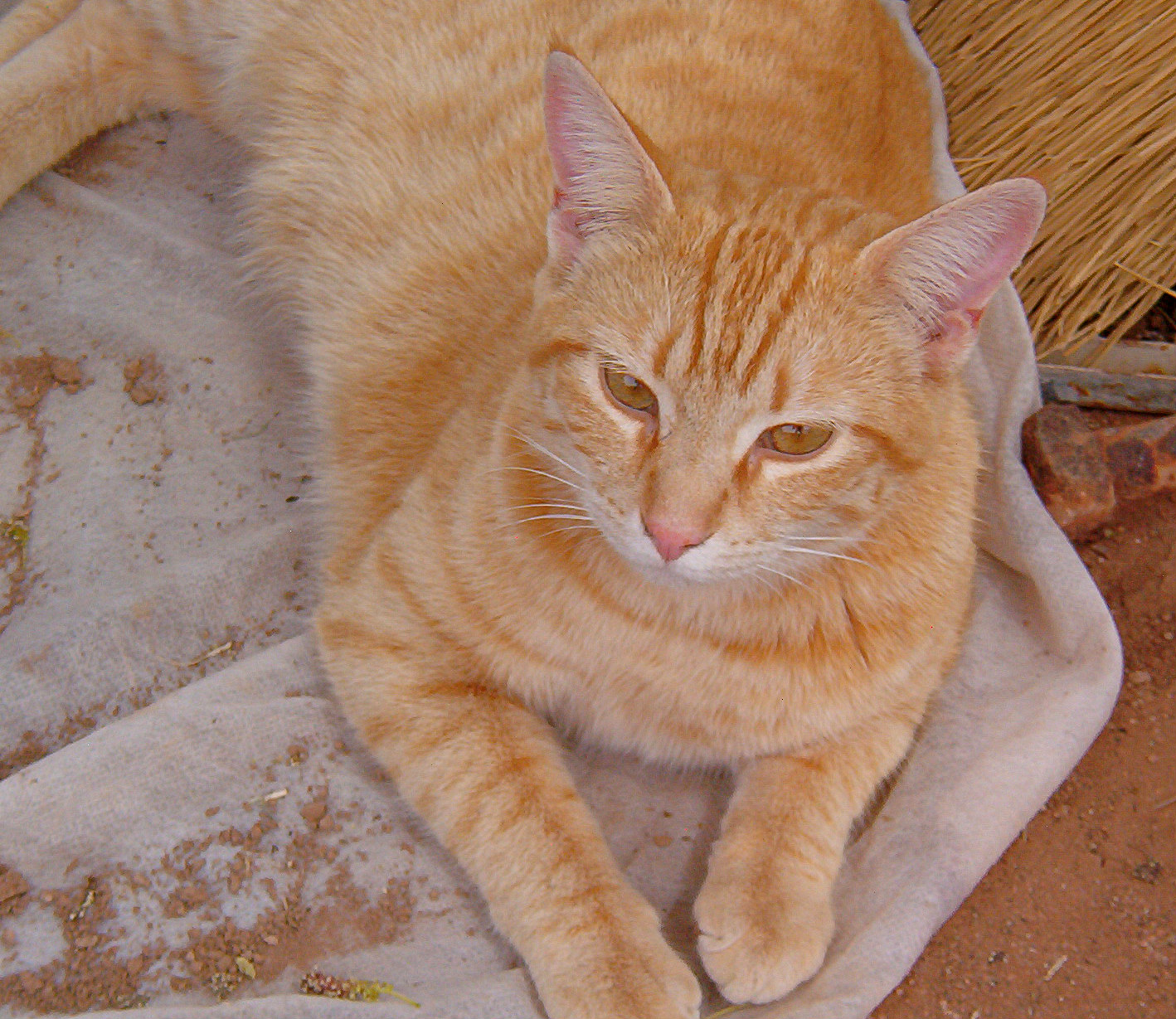
The so-called stories of my childhood?  They are no more about the reality of what happened to me than is my cat’s lose hair stuck to the cushion where she sleeps ACTUALLY my cat.  (Great line for the book’s intro, by the way.)

++++

I think about my piano keyboard right now, and imagine that there are notes that are so high and so low that they don’t actually exist on the keyboard because they lie outside the range of human ability to detect them.

My life with my mother was like that.  What actually happened DID happen because NOBODY detected the ‘notes’ my mother was playing for me.  It is my challenge as a writer to transpose the experience of being raised as my mother’s inhuman, evil devil’s child into a range of notes-words that CAN be heard by others.

Because in the reality of my childhood with my mother words were contaminated weapons, I have to chose words now carefully and run them through a filter so that they can be cleaned and detoxified, decontaminated and made safe for human consumption.

What happened to me from the moment I was born and continued over the next 18 years of my childhood happened ‘under the cloak of darkness’.  My mother was able to effectively construct and maintain two worlds.  One of these worlds on one side of her Borderline was designed to deceive the public.  On the other side of her Borderline was the world that she designed, constructed and maintained JUST FOR ME as her evilness projection.

It is evidently my job to transpose what happened to me on the darkest side of her Borderline into language that can be understood by ‘the public’.  I ask two questions:

(1)  Is it possible write about wordless terror?

(2)  Is it possible to write of this terror beautifully?

++++

In other words, it is time for both me and my newly found writing assistant to become WORD WARRIORS.

+++++++++++++++++++++++++++++

+NOTHING LIKE A MONDAY MORNING ‘HODGE-PODGE’ POST

+++++++++++++++++++++++++

This is a sort of ‘scavenger’ post.  I’ve been thinking about a comment left yesterday, and I wanted to make sure these links were easy to spot in case there might be something in here that might interest/assist!

Considering the fact that our body is a link in a generational and genetic chain, the more we can learn about how the actual circumstances of our individual life affects how our genetic code manifests itself throughout our lifetime, the more we can learn about both the specifics and the overall picture of where we came from and how the history of our species affects us now.

Understanding how our circumstances affect how our genetic code manifests itself through epigenetic processes helps us expand the range of our vision about our self and about our family.

See this blog’s posts:

+ EPIGENETICS

We can think of a load-bearing wall in a house and understand that if that wall is removed without special attention being first made as to how the load that wall is carrying can be handled in some other way the house can collapse.  Our body carries the load of all the combined debits and credits combined.  Learning how the circumstances of our life affect how our body handles the load of our life involves an understanding of what is called allostasis and allostatic load.

See this blog’s posts:

+ ALLOSTASIS AND ALLOSTATIC LOAD

Two other links of interest:

+ Other posts on the vagus nerve

+ DIGESTIVE SYSTEM

See also:  +IS MENTAL ILLNESS THE COST OF OUR SPECIES’ GREATEST GIFTS?

+++++++++++++++++++++++++

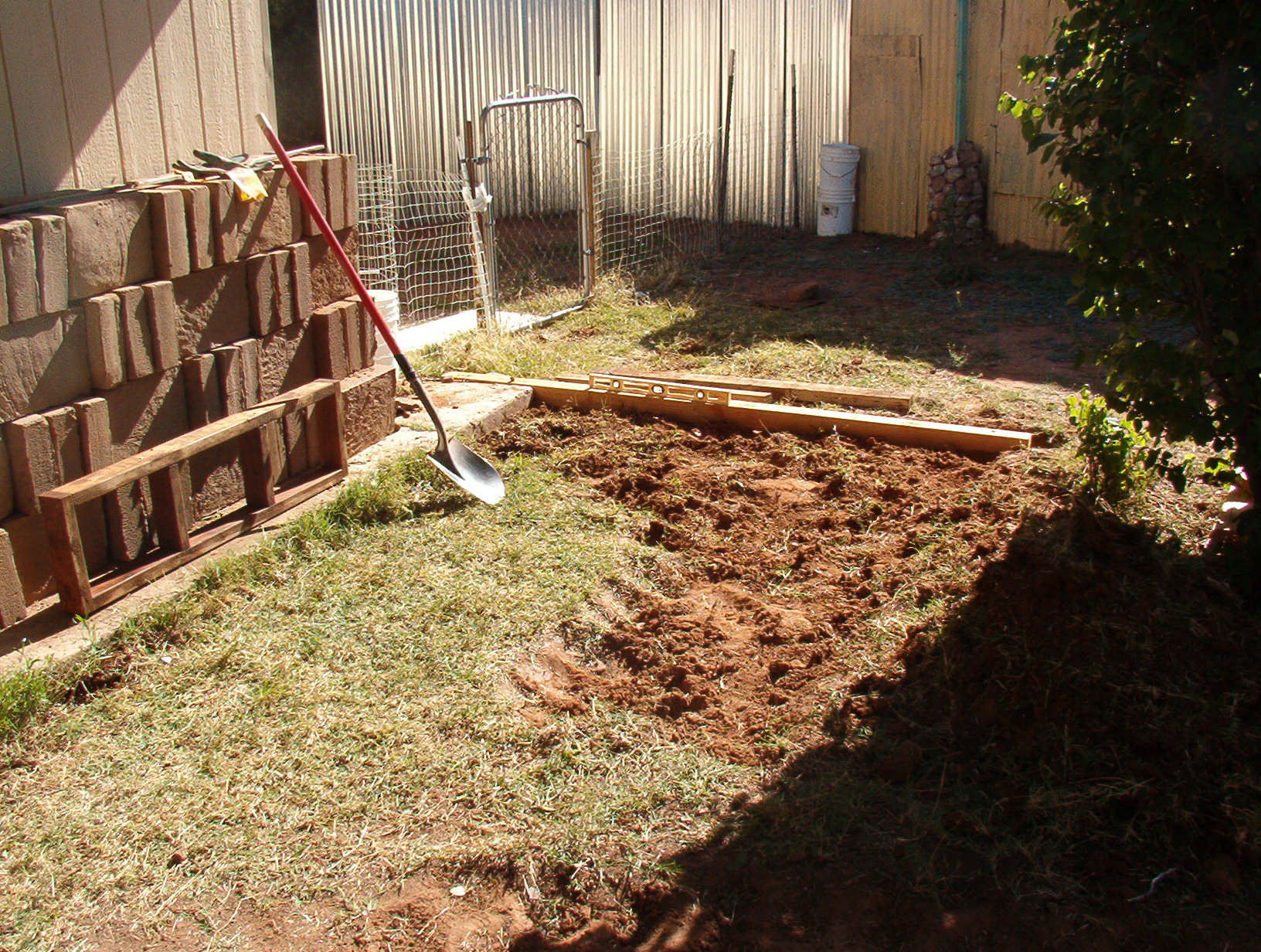
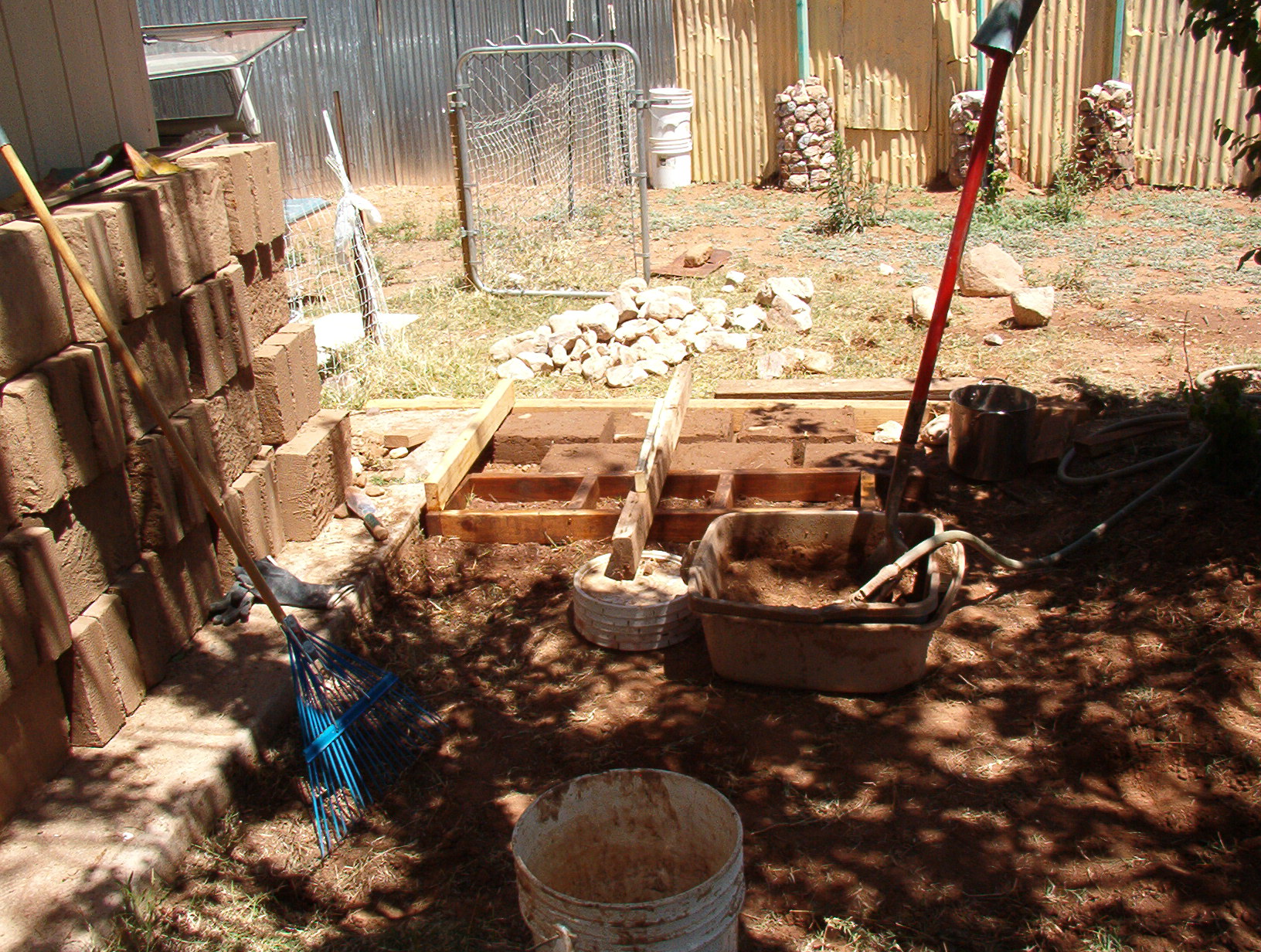
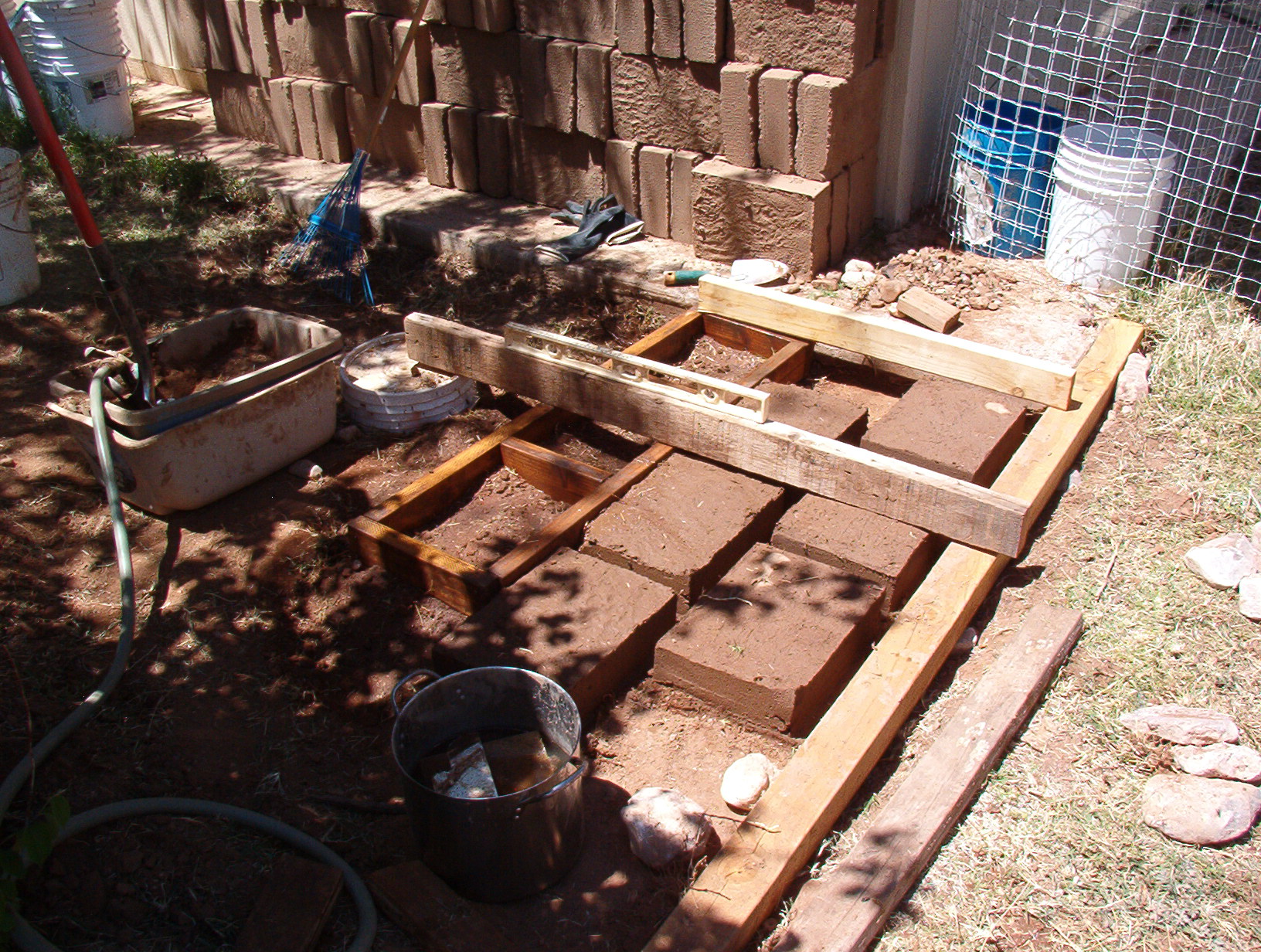
Here are a few pictures of my current mud project.  I want to direct the rain water coming off my south roof line away from the house’s foundation.  Eventually I want to grade the back yard so that the water ends up where I want it:  On the plants and trees!

Years of water pounding down along the sidewalk edge have lowered the soil there so far rain water cannot escape and run into the yard. I need to change that grade and direct the water flow - before the summer monsoon rains come (usually in July). The slope I need is 1/4 inch per foot down away from the house, and level across the width - my civil engineering father would probably cringe if he saw the way I do things!
I had to go collect some rocks from nearby roadsides for this project. The rocks are embedded into the adobes. I find I don't care if I see the stones or not, but suspect that eventually wear on the adobes will expose them. Certainly the stones (and increased cement in my mud mix) will aid in survival of my adobes under the pressures of running water over time.
It's always hard for me to be linear enough (left-brained?) to level anything! It just happens that directing the water requires that I pay at least SOME attention to which way 'what' is going!

I figure it will take several days before the blocks are dry enough that I can go back and fill the cracks - with cement-mud and gravel/small stones.
I don't know the technical name for this species of aloe, but they survive winters and go 'native' - this is what they look like blooming (my neighbor's trailer was put there the day they moved in 3 years ago - has never moved - and I doubt it ever will in my lifetime!)

+++++++++++++++++++++++++

IN MEMORY OF MY BORDERLINE MOTHER:

From Kristalyn Salters-Pedneault, PhD, your Guide to Borderline Personality Disorder

What’s the link between child abuse and BPD? We do know that people with BPD endorse child abuse at a much higher rate than the general population, but does that mean the BPD is caused by abuse?

Child Abuse and BPD– Understanding the Link

Parents of BPD teens and adults often ask why their child has the disorder, and sometimes feel blamed for their child’s symptoms. Yes, sometimes BPD is caused by child maltreatment, but that isn’t the full story– parents are not always to blame.
What is ‘Abusive’ Behavior?

When we talk about child abuse, what exactly do we mean? Learn more about child abuse and maltreatment.
Building a Meaningful Life- Where to Start?

Do you need help finding meaning in your life? Many people with borderline personality disorder (BPD) struggle with feelings of emptiness, identity problems, and depressed mood. Together, the symptoms of BPD can leave you searching for meaning in your life.
This Week’s How-To — Grounding Exercises

Grounding exercises are designed to help you focus your attention on the present moment. They are helpful whenever you are having an experience that is overwhelming, or that is absorbing all of your attention. Grounding exercises are meant to “snap you back into reality” relatively quickly.

Must Reads

What is BPD?
Symptoms of BPD
Diagnosis of BPD
Treatment of BPD
Living with BPD

+++++++++++++++++++++++++

+DISSOCIATION: MEMORY OF ONGOING EXPERIENCE FROM THE PREY’S POINT OF VIEW

++++++++++++++++++++

I intended today to write a post about dissociation when I went outside to sit with my morning cup of coffee.  What greeted me there was a trauma-drama in full play, and not a pleasant one for me to watch.  Yet I know that life, and nature itself shows us things that often allow our right brain to watch visually as drama and image at the same time our left brain is offered information to THINK about.

I am going to separate my two ‘streams of information’ this morning.  This post is about how a severely abused and traumatized infant-toddler’s body-brain is forced to absorb information about the world, and about itself in the world in relation to its early attachment caregivers.  The information I am going to present in my NEXT post will be the scientific, rational, logical and far more abstract information.  We NEED this more technical information, but as survivors we will not be able to really understand it or make good practical use of the dry information that developmental neuroscientists provide for us if we cannot ASSOCIATE this information with our own ongoing experience.

People often use this term in the English language, “a game of cat and mouse.”  What I watched this morning as one of my cats toyed with a furry little mouse could have looked like a game from her point of view.  But what was this experience like for the little, tiny mouse?  Its life was at stake, and there was anything BUT a game going on from its point of view.

Those of us who were raised especially by extremely hate-filled abusive and traumatizing mothers from the time of our birth were like this little mouse.  Yet we were even more helpless against our giant predator.  At least this mouse was fully developed and could use all its possible defense abilities – not that they would in the end be effective at allowing it to escape and go on living.

I knew how this ongoing drama would end.  Yes, my cat WAS playing with her prey.  She was fully focused and concentrated on her ‘game’.  The mouse was fully focused on trying to avoid being killed.  And there I was, the bystander at the same time I was the only hope that little mouse had for staying alive.

++++

The mouse was quick, but the cat was quicker.  Every time I tried to sidetrack the cat she out maneuvered me, grabbed her little ‘toy’ and ran off to continue her ‘hunt’ somewhere else.  How could I help to give the mouse a chance to escape – to where?  There’s nowhere in my yard that mouse would be safe and secure.  There was no way I could catch the mouse and move it somewhere out of danger’s way, either.

There are a lot of mice here.  Part of the reason why, I know, is because my east neighbor whose property I just fenced off from my yard visually, continues to heap all his garbage for a family of seven against that fence, thus encouraging rodents to multiply.  Where there are rodents, there are rattlesnakes to eat them in this country.  Elimination of mice is normally a good thing.  I just didn’t want to WATCH the elimination happen.  Not today.  Not as I prepared to write a victimized-survivor post about dissociation!

But what I thought about as I continued to try to dissuade my cat from continuing her mission was how that little mouse, in the midst of the insecurity and lack of safety involved with its ongoing trauma, would NEVER do anything else but focus on its own survival.

These thoughts became entangled and intertwined with the technical information I was thinking about for my post on dissociation.  Because my mother was a predator, and because I was just as much her ongoing prey as this mouse was to my cat, there was NEVER a time in my infant-toddler-childhood that I was assured of enough safety and security to do ANYTHING ELSE other than survive.

At the same time I was more powerless and helpless than a mouse is under the attack of a cat, my brain, my nervous system, my immune system, my entire being was growing and developing in interaction with the experiences I was having in my early environment.  Nothing else but surviving the trauma of my mother’s attacks against me mattered.  Never was there a TIME when trauma wasn’t immediately threatening and impending, happening in the present moment, or just having finished happening – so that it could happen again.

My childhood was spent in a state of heightened trauma alertness from the beginning of my life.  As I watched my cat, she periodically caught the mouse in her mouth and carried him to another ‘play ground’ where she then let it go long enough that it could run a short distance and do what a little mouse will do:  Hide itself in an area that it thinks MIGHT best conceal it.

Of course the cat knew exactly where the mouse went, and right where it was.  She poked her paws into the spaces in the hiding places, batted the little creature, pushed and prodded it, and when it didn’t come out at a full run, she’s simply stick her head in, grab the mouse again, and move it on to another (to her) intriguing hiding playground.  Of course the most obvious places for this game to go on were in amongst my flower beds, a process which of course would have eventually led not only to the death of the mouse but to the destruction of my much-loved plants!

++++

Yes, watching my cat’s play-filled species determined extermination of this mouse was a trauma trigger for me.  I could not help but try to intervene on behalf of the little one who was going to lose its life if I didn’t.  I couldn’t catch my cat, so I sat out there for a long time chasing her away from the vicinity of the hidden prey.  I opened the back door thinking she would eventually get bored with out-waiting me and venture into the house.  Nope, that didn’t happen.

Instead, two of my other cats wandered out of the house.  They could tell immediately that Goldilocks was after prey, and all I could think of was, “Oh great!  There’s no way out of this.  I’ll take some pictures and then exit the playground so I don’t have to watch what I know is unavoidably going to happen.”

++++

So here are some pictures.  It’s been about an hour since I stopped watching the trauma-drama outside my door.  I just went outside again to see another one of my cats sitting under the Oleander bush satisfyingly smacking its lips and cleaning its jaw daintily with its paw.  “Mouse gone.  Game over.”

So, now in thinking about dissociation as the experts like to write about it, I have to say that nobody, absolutely nobody actually knows what dissociation is, what it does, what it feels like, how it operates, or where it came from like survivors do – particularly and especially those of us who endured and survived repeated, ongoing predatory attacks in our very early life of infancy and toddlerhood by our mothers.

If we then continued to endure trauma, abuse and attacks into and throughout our childhood, there is (in my thinking) no possible way that so-called dissociation did not build itself into our growing and developing body-brain.

I will never believe that dissociation is a so-called ‘defense mechanism’ for such survivors.  Our dissociation is simply HOW our brain regions, circuitry and networks were forced to grow and develop.

The mouse I watched today was in an ongoing peritraumatic state which was broken up A LITTLE TINY BIT by the moments the cat allowed it to nestle within its hiding places.  But these periodic reprieves from direct terror and assault were not enough to ever allow this mouse to go on about its life in anything like an ordinary (safe and secure) way.

Everything that mouse experienced both during direct assaults upon its life and during its reprieves, demanded that trauma-based body-brain operations continue to happen.  Those experiences are completely different in the midst of trauma and its trauma-based allowances of semi-reprieve than are ongoing experiences where trauma is not present or immediately threatened.  When any creature is forced to adapt to trauma environments during critical growth and developmental stages, both the experiences of trauma and reactions to it build themselves in.  The trauma in effect ‘moves in to stay’.

What this means to an early abused and traumatized human is that the emerging self goes into and remains in hiding as surely as this mouse did.  I don’t believe our parental-predators could ever reach our hidden self.  Yes, they could reach our little bodies with the attack of their words and blows, but our inner own self remained protected simply because of the nature of being human.

Every single person is a separate, individual entity that can only be accessed from the inside.  Even though everything that happens to us from the OUTSIDE profoundly affected our development, and could and did change the way our body that our self lives in, our self – its own self – remains ours and ours only.

The problem became one of us not being able to experience our self in our own life.  Experts refer to alterations in memory capacities (which is what the next post is about).  Dissociation means that we do not remember ourselves as being connected to our own ongoing experience in ordinary ways because our capacity to REMEMBER was affected PHYSIOLOGICALLY during our earliest development.

Enough said at the moment.  As you look at the following pictures think of each one as representing an environmental context for ongoing moments of my cat’s life – but from the point of view of the mouse.  No way was it important for the mouse (forget the cat here) to remember itself in one of these ‘pictures’ in any particular order.  All the mouse could do was attempt to stay alive.  The only way it could do that would be if it could find a safe enough place to hide and remain hidden.

Safe enough.  That is what every living creature needs so it can continue to remain alive.  But growing and developing a human body-brain as time moves on and the trauma continues means that the inner experience of being in the midst of trauma never leaves us.  Trauma is not only what happened to us, but became how we grew a body-brain to remember ourselves with.

+++++++++++++++++++++++

It's only a GAME of hide-and-seek if we play it with equal peers. It's only a GAME of cat-and-mouse if you are the predator.
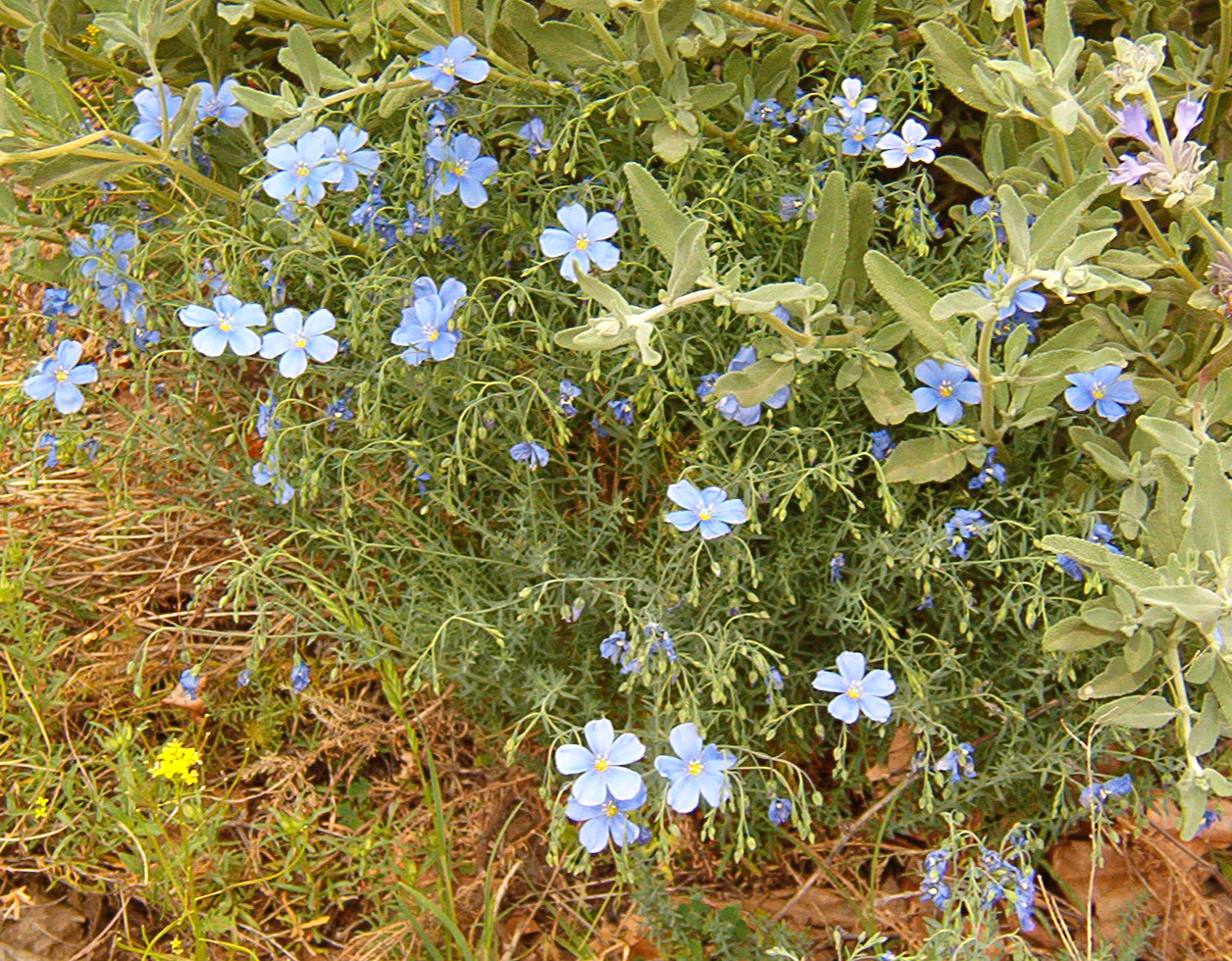
Where could a victimized-prey hide to escape? Under the blue flax and sage bush?
Is there a tiny little self tucked into hiding within the clover?
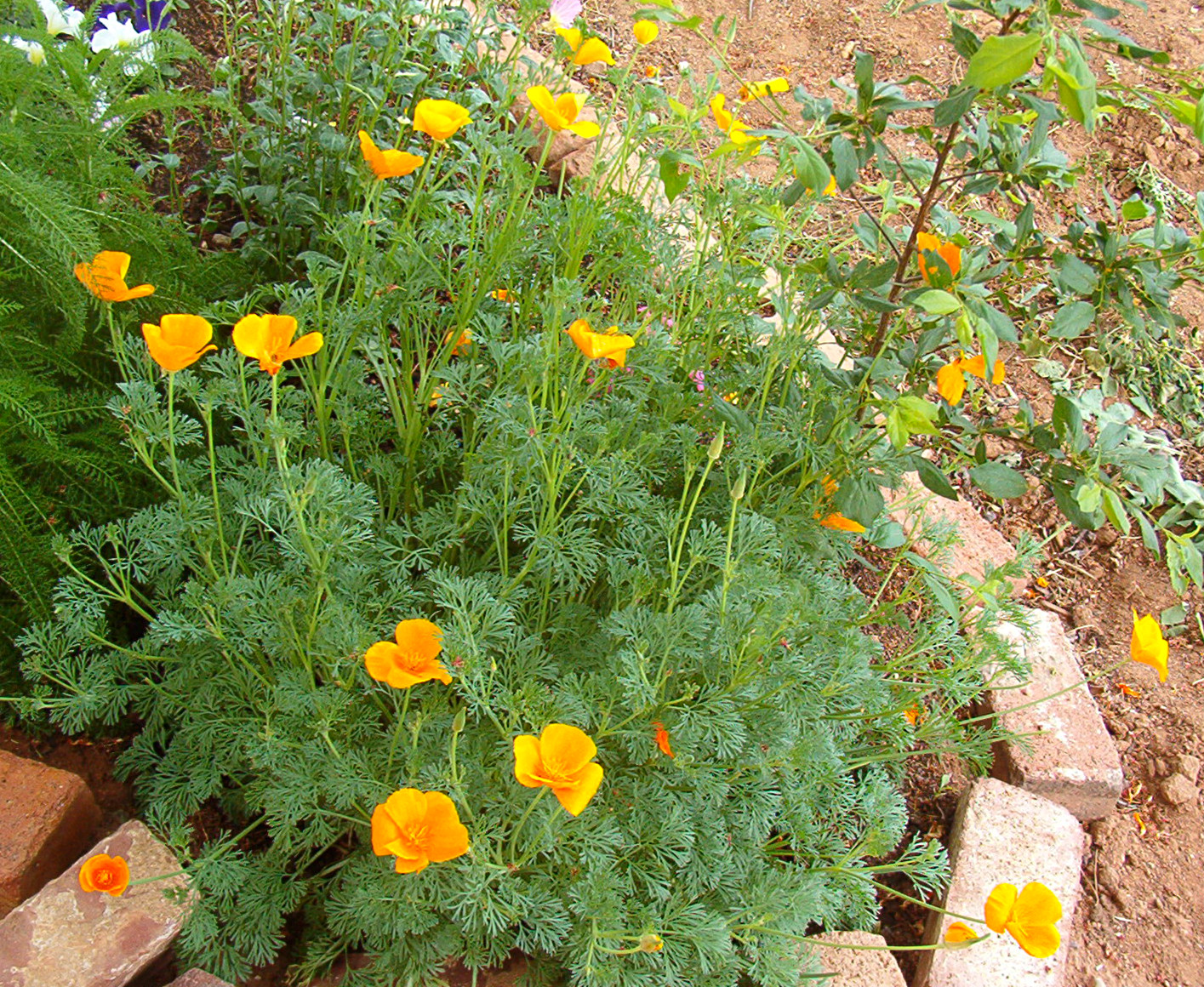
Under the poppies among the petunias? Is this a safe place to hide for survival?
Where is it safe for an abused and traumatized mouse -- or infant-child -- to hide?
Is it safe enough to stay alive under the newly blooming rose bush?
When I finally turned away from the trauma drama, the little mouse had hidden itself here among the tiny pansies.
The mouse was hiding in here last I saw of it. Each of these hiding places can be thought of as a momentary segment of the mouse's endangered life -- like victimized tiny children forming their abilities to remember their self in their life -- the separate events are just that -- dissociated experiences linked together only by one thing: Ongoing experiences of individual events of enduring and surviving trauma. Meanwhile, the SELF remains hidden unless we can contact and connect with 'self' within its own world

+++++++++++++++++++++++

+MY FOGGY POST ABOUT DISAPPOINTMENT AS A TRAUMA TRIGGER

++++++++++++++++

I’ve been doing pretty good these past few days.  I think I got spoiled.  Today was a crasher.  My word for my mood, or state of emotional being is FUNK.  I’m trying to sort out how I got here today thinking that maybe it will help me get out of this dark grey-blue-black mood, or feeling state.

So far, I can think of at least ten things that happened today that I reacted to with disappointment.  That’s one sure thing I know about myself:  I do not handle disappointment very well at all.  I also know that disappointment IS a feeling I felt as an abused child – often.  My mother was an expert at setting me up and then knocking me down.  She took sadistic pleasure in my innocent hope knowing she could shatter it in a heartbeat – which she always did.

Because I WAS a child, I could not out-guess her.  I walked blindly into her traps over and over and over again.  I was unsuspecting.  Part of how all this operated, I know, was because of the dissociated states I slipped into between all the violent attacks, that state where time always seemed suspended as if it didn’t exist at all.  My mother’s forced isolation did this to me, also.  Nothing made sense.  I could predict nothing, anticipate nothing.  But, unfortunately for me I still believed my mother when she said something good was going to happen, even though every time she took it away.  (see **FAMILY TIME – by Brother (1965) for my baby brother’s experience with my mother about this.)

++++

Main Entry: dis·ap·point·ment

Date: 1604

1 : the act or an instance of disappointing : the state or emotion of being disappointed
2 : one that disappoints <he’s a disappointment to his parents>

++++

Why in 1604 did this word suddenly appear in the English language?  Why does Webster’s not include any reference to this word’s roots?  Elsewhere I found a reference that the root is in ‘appoint’.  Somewhere else I read online it’s in ‘point’.  It all seems very confusing to me.

I think when I experience disappointment in my life it ALWAYS acts as a trauma trigger for me.  ALWAYS.

That means when something disappointments me NOW in my life, all the ick attached to disappointment in my 18 year abusive childhood comes plowing right on through and catches up with me every single time.

I don’t know how to NOT let this happen.

I didn’t catch the warning signs this morning when I encountered my first disappointment.  Looking back, I see that my disappointment was connected FIRST to a feeling of being surprised.  I had hoped to buy 3 (cheap) climbing roses bushes today at our local Alco store.  I looked at my bank balance online.  It was far lower than I had expected, and it ruled out flowers along with just about anything else until the 3rd of next month when my next disability check shows up in the account.

So, I EXPECTED the balance to be higher.  I was SURPRISED when it wasn’t.  Then I was disappointed not only that I’m about broke (again), but also that there will be no roses or anything else.  Then I was disappointed because I couldn’t have lunch today as I usually do with my woman friend.  I NEED that social contact.

I was swept up in the twisting snake of down-the-emotional-drain and didn’t catch it – in time.  On the day went.  No major disaster, just a series of expectations, hopes, surprises, and disappointments.

They pile up, and then knock me down.  Flat.

Now, how exactly do I pick myself up again?

Is there some way I can avoid this crash in the future?

How can I expand my “Window of Tolerance” for disappointment?

++++

One big disappointment of my life right now is that I’ve been working on this blog for a year now, and I am not one single word closer to being able to put together and publish a book than I was before I started writing here.  I see publishing a worthwhile and SELLING book as my ONLY hope out of my poverty.  It’s a big disappointment.

If I tell myself that it doesn’t matter if there’s ever a book, that it only matters if I can write something that might make sense to someone – and there’s nothing wrong with FREE info – then I’m better, but that has to be processed for me on some kind of ‘spiritual’ level having to do with my ‘purpose in life’ and ‘my mission’ in being alive.  I have no idea, most of the time.  I just TRY…..

++++

It was too hot today to work outside on my adobe-making project.  That was disappointing.  All-in-all, my disappointment ALWAYS cycles around to my difficulty in not being angry at my self.  GEE, I sure don’t have to wonder how that pattern came to be!  Every single time my mother punished me with intentional disappointment, I was blamed for it.  It was ALWAYS my fault because I was bad, because I wanted to be bad, because I wanted to ruin my mother’s life.

I am going to quit writing – enough said.  I imagine there are plenty of readers who know exactly what I am TRYING to say.  I am going to watch my NetFlix streaming Australian TV series, “McLeod’s Daughters,” which I am enjoying.  I could see myself living that life.  I would have loved it.

Or, as that other great movie puts it”  “Never give up!  Never surrender!”

++++++++++++++++

+HEALING TRAUMA WITH THE TIME ASSET

+++++++++++++++++

I have a few other thoughts related to my encounters with people-families-children at the Saturday children art festival where I did the spinning demonstration.

One collection of thoughts has to do, again, with small and big people and how humans relate to one another in ‘tearing down’ or ‘building up’ ways.  A young man about 12 years old stopped by my demonstration and immediately showed not only rapt interest but quite a bit of knowledge about spinning, weaving and the fiber arts.  His mother was with him, and in talking with these two I was given a picture I’ll try to relay to you here.

Last year this boy enrolled in a beginning weaving class held by Bisbee’s local Fiber Arts Guild.  He was fascinated, learned quickly, warped his own loom at the Guild studio and made his mother a scarf along with a baby blanket for his newborn cousin.  In the middle of the weekend class schedule his mother became ill.  The Guild was notified, and the boy missed three of the 10 week class sessions.  When he was able to return he found not only that the Guild members had passed off his loom with his next project on it to someone else, but they had not bothered to call and ask or tell him this was being done.  The adults participating in these activities were evidently quite demeaning, rude, disrespectful and hurtful to this child.  They let him know they did not want him around.

I have been given a solid and working handmade table top loom that I told this boy I will bring into town and leave off at his home for him.  I will collect all of the related items I can find here that go with the loom, look for a book or two I might have here at home that can help him, and also see what I have in the way of extra yarn I can give him.  Once I have all of this collected, I will pile it all into my trusty 1978 rather worn El Camino and drop it off at his house.

With all the troubles our nation is having in engaging our youth in their own lives, let alone in the life of their community and nation, it is beyond my comprehension how ANYONE could be rude to any child, period!  Let alone to a child like this boy is who is obviously motivated with passion to learn the fiber arts and is committed to doing so!

++++

The next collection of thoughts I have is related to an 8-year-old boy and his parents who stopped by my demonstration.  This child is obviously brilliant, as are his parents.  His father is a professional musician, a drummer.  His mother is a computer programmer web designer.  The child is fortunately home schooled and very much loved.

From the first instant this child spotted the very simple and basic, actually rudimentary gizmos and gadgets that are used in the process of preparing wool and spinning it, I could see that his brain did not work like an ordinary child’s.  His parents sat most patiently for over two hours on a stone bench in the middle of the Central School hallway while their son explored every avenue not only of the wool preparation process, but most noticeably of the equipment – how it was constructed, how it worked, why it worked.

Not knowing anything by fact here, I can still think that this child’s tool region of this brain is forming major connections.  The child certainly wasn’t intimidated by people.  In fact, he hawked the process from his newly found and claimed station at the drum carder.  He instantly memorized every step of the process when I first told him, and continued to instruct every passerby he could rope in about how this all worked.

At one point I was vaguely aware of him giving his spiel while I sat at my spinning wheel visiting with his parents.  All of a sudden I hear the boy say in a rather loud, commanding voice, “Hey!  What’s wrong over there!  Why aren’t’ you working?”  I had to laugh.  There I sat like a broken machine.  He had educated his audience completely up to the point where they needed to see the final stage in process, and there I was having dropped my end of the bargain.

The boy was not being rude, though certainly his attitude could have been interpreted that way.  This boy, I could tell from watching him, treated human beings exactly as if they had gears and mechanisms and programming that made them tick.  He is a brilliant, absolutely brilliant child, but I would not expect him to ever have an ordinarily developed right social-emotional limbic brain.  His brain is special, as he is.

This brings me to mentioning the Asperger autistic spectrum giant, Temple Grandin.  A made-for-television movie about her life has just been released:  “The HBO movie “Temple Grandin” honors its heroine’s priorities, stressing deeds over tearful setbacks and joyous breakthroughs.”  If you haven’t heard about Grandin and her work before now, please spend a little time checking her out.  In the meantime, I will specifically mention that Grandin has a LOT to say about so-called GEEK children who have brains that are gifts to the world.  This little boy might well fit into the schemata of the children Grandin is talking about.

++++

This brings me to my third thought collection for today which is related to yesterday’s post, +SO MANY NEEDY PEOPLE IN DENIAL OF THEIR NEEDINESS.  Due to the insane and terrible abuse I suffered during my childhood from birth, complete with extended manipulation of any opportunities I might have had from tiny on to interact with people, my right limbic emotional-social brain did not have the chance to build itself in an ordinary fashion (as this blog’s readers have heard me write about repeatedly).

As a part of the spectrum of consequences to the adaptive brain changes my body made, I do not read, understand, process, or respond to the emotional-social signals other people send out easily or well.  In some ways, I am realizing that I have a rather unique ability to not automatically buy into the send-receive-respond social signal-cue communications cycles that people with ordinarily built early brains (through safe and secure early caregiver attachment exchanges) are designed for.  I can notice, attend to and translate actions that ordinary-brained people probably miss — because they CAN.

(Similarly, I suspect, to how the 8-year-old boy’s brain gains and processes information about machines that few other brains would, or can, notice.  Temple Grandin’s brain gets this altered information about animals.  These are abilities that do not come primarily from choice.  They reflect in manifestation different body-brain constructions — changed in part or wholly by combinations of genetics interacting with the environment.  Our abilities give us resources that more ordinarily-brained people probably do not have.  These differences and changes are part of what makes us exceptional and extra-ordinary people.)

Lest any of my readers suspect that I am exaggerating the differences I experience in my emotional-social interactional abilities with people, let me again mention that these transactions normally occur in the hundredths of a millisecond response signaling range.  They are happening physiologically about at the speed of light, or however quickly electrical signals are sent and received between neurons and other bodily cells.

These extremely fast, and supposed-to-be automatic electrical signals are operating according to how a person’s body-brain was constructed primarily from conception through age one.  Connections between pathways, circuits, brain regions and the body are constructed very early on and all growth and development past these early critical window stages of development follow along accordingly as we finish our early (and later) development.

This matters in many, many ways.  When, as a commenter to yesterday’s post mentioned (See: +SO MANY NEEDY PEOPLE IN DENIAL OF THEIR NEEDINESS) those of us with these changed brains are faced with awkward, uncomfortable, disquieting if not down right mean interactions with other people, we have an extremely difficult time doing what this commenter suggested when she noted:  Eleanor Roosevelt said “no one can make you feel inferior without your permission.”

Our body-brain does not read social-emotional cues and signals in the same way as Ms. Roosevelt’s no doubt did.  As a result, our attempts to decipher all of the signals other people are sending out in the hundredth of millisecond range do not mean the same thing to us as they do to ordinary brains.  If we are even going to get a clue about what is actually happening in our interactions with others, we need the one thing to happen that SO RARELY DOES HAPPEN that we could consider it impossible.

We need time to slow way, way down.  Because these communication signals are designed (normally) to occur near the speed of light, because they are outward manifestations of electrical impulses traveling invisibly within a person yet STILL manifesting themselves in visual and auditory signals that we are supposed to automatically read, understand and be able to respond back to in kind, we are at a serious disadvantage when it comes to doing what dear Ms. Roosevelt (and this commenter) suggest.

There is a universe, and I MEAN A UNIVERSE of information necessary to process information between people according to this maxim:  “no one can make you feel inferior without your permission.”  The brain has to know who-what the self is completely, it has to know who-what the other is completely, it has to process what-where the boundaries are between them, it has to be able to process the “feel” emotional information appropriately (and FAST), it has to make determinations as to what the emotion means, what the value is connected to the emotion, whether it is an ‘approach’ signal or an ‘avoid’ signal, it has to assess what’s at stake, what the degree of risk of threat to self and/or life is, what is being asked or demanded by this nebulous ‘other’, who has the power, what are the control stakes, where free will and choice (higher cortical functions) can fit into the picture……..  In other words, there is NOTHING simple about humans interacting with humans!  NOTHING!

This brings me to my last critical point.  When infant-children do not enjoy body-brain development in interaction with SOMEONE in the earliest caregiver department that allows for a safe and secure attachment to others, to the self, and to the world as a whole, none of the emotional-social processes the early brain is building itself upon will include the same information as will the body-brain of those who DID have the benefit of these more optimal developmental experiences.

We would be better off to NEVER automatically assume that the person we are engaging with in any way has a NORMALLY built optimal body-brain.  I would never expect that the woman I mentioned who needed to put me down regarding my spinning had an optimal emotional-social brain any more than I would ever expect that the rage filled passive-aggressive (in complete denial) worker at the laundromat I mentioned has one either.  They are operating in survival mode just as I do, just as my mother did.

True, individual personality blends with individual experience to create individually unique selves (by ratio with conscious awareness).  I recognize more and more my own inability to negotiate complex human transactions and interactions BECAUSE I no longer opt out by assuming that my automatic responses are the ones that are best for me.  At the same time – quite literally – TIME is RARELY my friend.

In a culture of hit-and-miss, hit-and-run, of brushing past one another at near breakneck speeds, very few of us are allowed or given the kind of TIME we would need to slow these interactional processes down far enough that we could manage to HONESTLY, with integrity, and ACTUALLY do the kind of processing Ms. Roosevelt must have assumed could happen automatically for everyone always – IF ONLY a person chose to do so.

When the emotional-social brain has not been built optimally, and the corresponding wiring in the body is not either (i.e. vagus nerve, autonomic nervous system, stress versus connection system, etc.), the only hope we have of processing information in any other way than the automatic trauma-built way we are designed for is to have TIME to include conscious processing.  Our social milieu is too invested on shallow and speedy interactions to let this happen.

We end up operating without enough information relevant for the present instant of time we find ourselves in with other people.  Our version of automatic creates ripples upon ripples of inward discomfort that we don’t even usually know about.  As we DO begin to become aware of the changed way other people and ourselves process emotional-social information, we begin to notice details of information – in our feelings, emotions, grounded in our body – that time does not let us process within usual fast moving social interactions.  That does NOT mean we are WRONG if we claim that many of our interactions with others leave us feeling sour inside as if we swallowed a toxic poison.

To no longer deny the truth behind many of the intentions, needs, demands, assessments and assumptions humans in our culture are wont to dish out back and forth – often in disguise so as to appear socially appropriate – means that we are returning back to the very beginning of our emotional-social brain’s formation so that we can do things differently than was done to us.  We are learning to no longer deny what we know on our insides to be true for us.

I believe this is healing, no matter how uncomfortable the process might be to our self or to anyone else.  We must take the TIME we need to figure out these uncomfortable interactions with others and our responses to them.  This, to me, is where the hope for change truly lies – not in therapy chambers, not in pills and drugs.

Hope and healing lies

in our being willing and patient enough

to find our own questions

so that we can find our own way

to answering them.

+++++++++++++++++

+HEALING TRAUMA AT OUR BODY-BRAIN CENTER

+++++++++++

I didn’t realize it when I wrote my post last Sunday, +TRAUMA TELLS THE BODY WHAT TO DO, that I was preparing my own way for the study of Dr. Kerstin Moberg’s book, The Oxytocin Factor: Tapping the Hormone of Calm, Love, and Healing.  But then I don’t imagine that Dr. Moberg knew exactly as she was writing her book how much its information can help severe infant-child abuse survivors and other traumatized people.

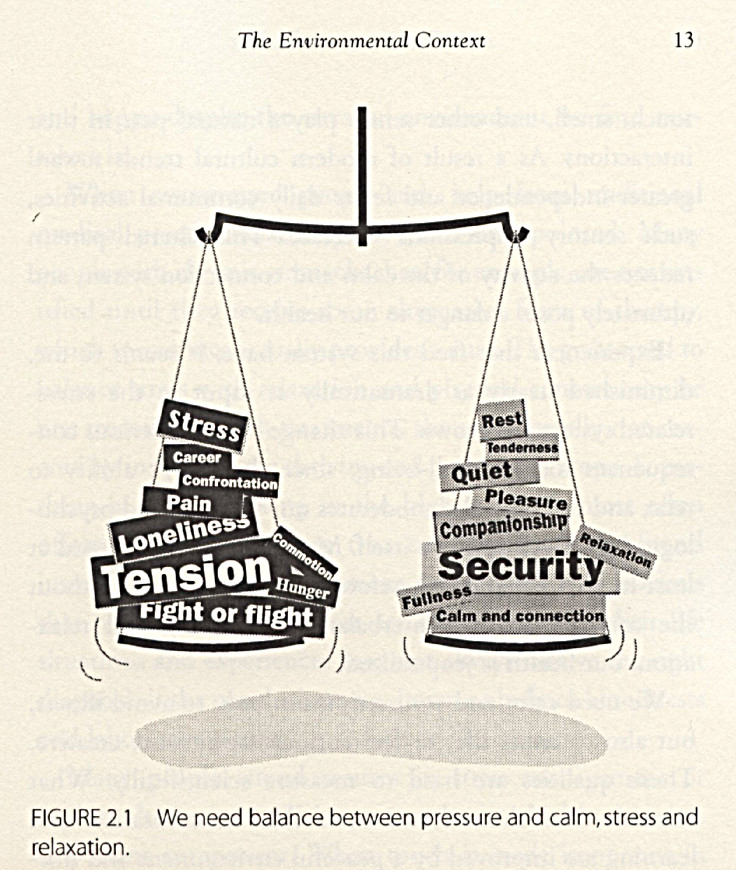
When I take a look at this next image that I scanned here from her book, I think about how it is for a tiny growing body-brain when it has to develop in adaptation to the environment it was born into when the stress scale has bottomed out and the calm and connection scale (of safe and secure attachment) has completely inadequate weight to it – or is nearly completely empty.

It is important to realize that what this image is showing is a required balance between stress and calmness.  Adequate early body-brain forming environments must include this balance for a body-brain to form and operate correctly.  Obviously too much stress and the wrong kind of stress for anyone is not a good thing.  But too much calmness isn’t good, either. Infant-child neglect often causes such a lack of stimulation during early developmental stages that critical regions of the brain do not receive the stimulation they need to grow hardly at all!

Another point I want to make is that if grave imbalance exists in an infant-child’s developmental environment the set point of the nervous system is NOT set at this central balance point where calm is even possible.  For people who survived terrible trauma in their early lives such as I did, the set point for our nervous system is AT the stress reaction point.

As odd as it might seem, looking back at my own infant-childhood with my new neuroscientific and physiological development insights, I can see that the long, long periods of forced isolation that were part of my mother’s patterns of severe abuse of me where probably – and actually – a very good thing.  During these periods when she had me ‘out of her sight’, even though during these times I was also out of any kind of loop that would have offered me normal infant-child opportunities to interact with others and with my environment in play and discovery, overall these times offered my developing body-brain opportunities for NOTHING TO HAPPEN.

These periods were actually rest and restoration times when my overwhelmed and over stimulated senses, forced into overload from the beginning of my life through the terrorizing and terrifying actions and presence of my Mean Mother, during which my body could actually calm itself down so that internally the effects of her nearly continual earthquake-tsunami abuse of me could somewhat dissipate before the next attack came.

Of course these patterns of wild, severe, over stimulating and overwhelming abuse paired with long periods of my being forced to endure the silence of remote, isolated aloneness harmed me greatly.  This pattern became a most fertile ground for patterns of dissociation to build themselves into my body-brain because nothing but the deprivation of being left completely alone to physiologically try to end my suffering alone (unconsciously, of course), offered me to possible way to connect my ongoing experiences to one another on any level other than the physiological one.  Nothing ever made sense, and nobody or nothing ever helped me to make sense of my malevolent experiences, either.

++++

So leading back to the topic at hand, oxytocin and Dr. Moberg’s book, I want to say that importantly I completely TRUST everything this researcher says.  Because I have continual problems with trust that happens in relationship to a sense of my feeling safe and secure in the world (and NOT), I hold this trust in high value.

At the time Moberg published this book she had already published over 400 scientific articles.  She is considered the world’s leading expert on oxytocin and on the calm-connection half of our autonomic nervous system (ANS) and all the processes that are connected to it.  She is talking about what severe infant-child abuse survivors missed most during our earliest growth and developmental stages:  The opportunity to experience safe and secure attachments that would have allowed us to experience peaceful calmness and connection to others so that our body-brain could build into us a body-brain-nervous system with the balance depicted in the above image included.

Because my infant-childhood was filled with extreme, chronic, ongoing and severe abuse and trauma, I read Moberg’s book from a perspective that means I want to know how things SHOULD have been so that I can better know what I am MISSING at the same time I hope to find information that can help me to consciously CHANGE this set point within my body-nervous system-brain for the BETTER.

As I read Moberg’s account of current research patterns being weighted at 90% study of the stress response compared to 10% of study on the other half of the system, I understand why I am still searching for help, healing and answers.  There is no hope for truly understanding what was so damaging during our early physiological development about being immersed in continual overwhelming trauma if we don’t have the information we need about how things were truly SUPPOSED to be different.  I believe the best hope for healing ourselves on every level does not lie in the drugs we might take to override systems in our body.  We need to get the true picture of what is REALLY GOING ON.

No matter what we read, no matter what anyone tells us, we cannot fool our body.  Our body, the Earth Suit we live in, absolutely knows the truth.  When we encounter the truth in research it will resonate inside of us.  Our body knows the truth when it-we hear it.  Moberg’s book, her work and dedication to research about the calm connection system in the human body as it is designed to operate in counter-weight with our stress response system holds truth that I believe is imperative for us to understand.  As we gain these understandings, we will FEEL them in our body and know them in our brain-mind.  Once I have completed my reading of this book, I will enter the universe of the internet to look for research related to this topic that has occurred in the 6-7 years since the book was written.  I can only hope that the scientific world has taken Moberg’s work seriously enough to pick up this critical study of what contributes to the other half of our well-being as a species:  The ability to calm ourselves down and connect to others.  This is absolutely the study, in my mind, of safe and secure attachment of ourselves in our body in the world we live in.  Again, I will keep you posted.

+++++++++++++++++++++++++++
I wanted to make a little note here today at my sister’s suggestion about my present experiences as I teach myself to read music and play this amazing piano keyboard that I was blessed with being able to bring into my life.  As my sister pointed out, as I continue applying myself to this study and practice and as I gradually improve, I will probably not remember the process of learning itself.

I don’t remember learning to tie my shoes, but I do have faint memories of being at the age of trying to learn my right hand from my left.  I invented a learning strategy that involved remembering a pattern of freckles on my right wrist where I would have worn a watch if I had one (like the one my father wore).  All I had to do was connect the freckles with ‘watch’ with how right in my mind a watch would have looked on my wrist to learn which side of me was right and not left!

I know this music learning experience is similar also to when I learned to ride a bicycle.  Once the motor learning has taken place, I expect that I will never have to consciously think about it again.  In the meantime, my actual process of learning is fascinating.  There’s nobody here to judge my process or progress but myself, and in the clear, plain and good spirit of PLAY I am able to leave all self judgment out of the picture.

What I am left with is the process of literally and consciously experiencing what it is like for ME, in this body, with this brain, to learn something this new and strange.  I also know that because of the severe trauma I was immersed in as my brain developed, neither my left nor might right brain hemisphere formed themselves ‘normally’.  I also know that the corpus callosum that transfers information between my brain hemispheres did not form correctly, either.

As I teach myself this new language of music and gain the motor skills required that will let me actually PLAY music, I am experiencing what I believe is a true healing in these regions of my brain.  Last night I began to practice playing scales with both hands at the same time.  I figured there is no way I am going to get my hands to be able to each first play different notes in different ways in different timings if I can’t get them to cooperate and first play the same notes in the same patterns at the same time.

Well, I am here to tell you I can’t remember the last time I experienced such a giggle session!  Part of me was directly the physical process complete with the intention of desired result – while another part of me fell into giggling bursts of delight to watch what my hands were ACTUALLY doing!  Instead of tangoing they were tangling, each finger with a mind of its own tumbling and fumbling over the keys.

Yet I believe that learning good things is healing.  All the healing I have ever done has been about learning.  Learning how to let myself learn is a learning itself both about what learning is like AND what healing is like.  That process is delightful in itself as I gently and kindly, slowly, patiently and firmly open my own channels for change within myself so that I can let something good and new grow itself into my body-brain-mind-self.

I have hopes, a goal, a direction.  I want to play music.  I know I can do this.  I give myself permission to move forward, to make the mistake-errors, to correct them, to learn-heal at my own pace. As I experience such delight even in this process of learning itself I realize this is just a bonus gift I could not anticipate and did not expect to love and enjoy.

So, needless to say, I have a long long way to go to begin to even get the two hemispheres of my brain to operate harmoniously, cooperatively and well together.  But what I look forward to and DO EXPECT TO HAPPEN is that eventually the two hemispheres of my brain will dance on that keyboard in relationship to one another.  Sometimes they will follow the same patterns together.  Sometimes they will be able to ‘say’ something musically that will be very different, one from the other.

I nearly absolutely and entirely and completely missed the opportunity as an infant-child to be safe, secure, and to play.  And I certainly did not get to giggle.  So, if at 58 I am finally able to giggle myself into this amazing new skill of reading and playing music, that’s a very good thing indeed!  No doubt I am helping myself heal at the center of who I am in this trauma-changed body.  I’ll keep you posted on this process, as well!

++++++++++++++++++++++++++++++++++++++++++
+SOME MORE WORDS SENT BY MY FRIEND

+++++++++++++++++++++++++++++++++++
Here is another collection of wisdom saved in words now passed to me by my family’s Alaskan homesteading neighbor from my childhood, Dorothy (now 83), who I have mentioned came back into my life after 40 years to be my dear friend.  These words have given me opportunity to ponder:

1.  GOD IS LOVE.  I am an extension of God; therefore I am love, just as I am.

2.  GOD IS LOVE.  Love is light.  The lighted candle cannot NOT shine on, illuminate, and radiate everywhere, touching everyone and everything.

3.  THE EGO IS A TOOL FOR LEARNING.  On this plane, egos relate to egos for learning and teaching.

4.  ROMANTIC LOVE IS A GLIMPSE OF HOLY LOVE — unconditional — heavenly.  Every person needs to experience that.

5.  SPECIAL RELATIONSHIPS ARE A NECESSARY PART OF OUR LEARNING ABOUT OURSELVES.  Also a path to understanding forgiveness and therefore, healing.  From the painful moments comes opportunity to think our deepest thoughts.

6.  I HAVE SEARCHED FOR MY IDENTITY, TRYING TO FIND ME.  Who are we?  We move from one thing to another looking, looking.  We fall in love, and expect to find our identity through the beloved.  We look to money, baubles and trinkets, prestige and power for validity.  Then one day it becomes clear:  THERE IS NO SOLUTION OUTSIDE OF MYSELF.  I heard that in dozens of ways, but it took “suffering” to make it real, and it has taken many years.

7.  CONFLICT WEAKENS ONE to being nearly non-functional.  EACH SIDE OF THE ISSUE HAS ITS OWN ENERGY.  These energies do battle with one another.  We have no peace; not enough energy “left over” for pursuing constructive thinking or activity.  Need to move from division to atonement.

8.  …JUDGMENT BECOMES THE UNKINDEST CUT OF ALL

+++++++++++++++++++++++++++++++++++
IN MEMORY OF MY BORDERLINE MOTHER, HERE’S SOME HOPEFULLY HELPFUL INFORMATION LINKS:

From Kristalyn Salters-Pedneault, PhD, your Guide to Borderline Personality Disorder Many of you are probably familiar with the standard treatment options for BPD, but there are some alternative treatments that you may not have considered. The treatments discussed this week haven’t been tested extensively, but may be considered as adjuncts to your treatment regimen.

Family Therapy – Can it Reduce BPD Symptoms?
Rather than just one person (such as the person with BPD) and their therapist, family therapy involves the whole family, working together, with one or two therapists.
BPD Couples Therapy
There has been no systematic research on couples counseling for borderline personality disorder, but experts are becoming more and more aware of how helpful a stable support network is for people with BPD.
Does Electroconvulsive Therapy Work?
Electroconvulsive therapy (ECT) is a psychiatric treatment with a long and controversial history. Is electroconvulsive therapy effective for borderline personality disorder (BPD)?
Get the Most Out of Your Treatment
Wondering how you can get the most out of therapy? There are times when the success of therapy is related — completely, or in part — to factors that are in your control.

Must Reads

What is BPD?
Symptoms of BPD
Diagnosis of BPD
Treatment of BPD
Living with BPD

+++++++++++++++++++++++++++++++++++

I am loving my new pursuit, learning the language of music with my piano keyboard!!

+++++++++++++++++++++++++++++++++++

+INFO ON WINDOWS OF EMOTIONAL TOLERANCE

+++++++++++++++++++++++++++++++++++

Sometimes I have to force myself toward the study of information that I KNOW will help me in my life.  The choice is between continuing to live in ignorance while experiencing intensity of emotions I don’t understand and cannot easily regulate (along with repeated dissociation which I believe is one of a survivor’s ‘tools’ for regulating overwhelming emotion), or trying to learn SOMETHING that can help me make sense of the way I experience my life in this trauma-changed body.

The information presented in the article in my post +TRUE HEALING POSSIBLE – MY #1 CHOICE FOR TREATMENT is about the limbic social-emotional right brain as it connects into our body.  It is about how we experience emotion.  It is about how our interactions with other people starting from the beginning of our life form the patterns that either regulate or dysregulate our emotional life.

Our emotions are supposed to be the factors of our existence as human beings that are supposed to guide us toward approach or avoid through a process that lets us know what is good for us and what is harmful for us.  In other words, our limbic brain is intimately connected to our appraisal system, and from there to our reaction-action systems.  Severe infant-abuse survivorship changes the development not only of this limbic region of our brain, but also of our appraisal and our reaction system.

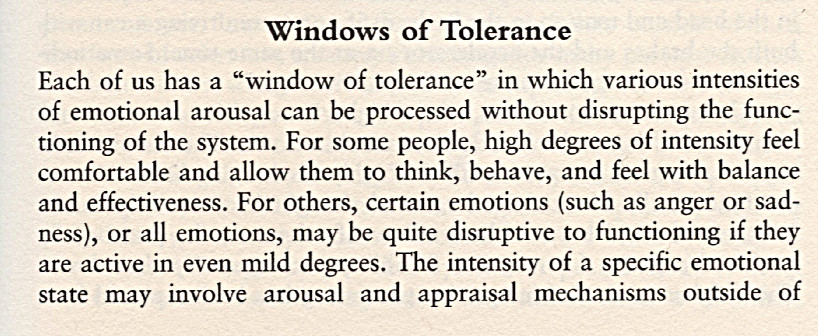
I am going to present some very specific information today about what is termed our Windows of Tolerance as it applies both to our emotional well- or ill-being and to the ways that we get information in the first place through our body.  This information comes from the writings of Dr. Daniel J. Siegel in his book The Developing Mind: How Relationships and the Brain Interact to Shape Who We Are.

The pages that precede the ones I am posting here today talk about how emotions are differentiated early infancy — or not.  These processes all occur within the earliest caregiver attachment interactions we have as our brain and nervous system-body is growing and developing.  All these processes are literally wired into the cells of our body and will determine how we ARE in the world.  The kind of therapy described in my earlier post is recognizing how fundamental these processes are and how they are wired into our body-brain.

Siegel states:

“Creating change within rigid patterns of specific appraisals requires a fundamental change in the organization of information and energy flow….

“Value circuits determine specific appraisal, creating the basic hedonic tone of “this is good” or “this is bad” and the behavioral set of “approach” or “withdraw.”  Value circuits also continue to assess the meaning of these initial activations as they are elaborated into more defined emotional states, including the categorical emotions.  What determines the nature of the appraisal/value process itself?  How does the mind “know” what should be paid attention to, what is good or bad, and how to respond with sadness or anger?

“For human beings to have survived, this complex appraisal process had to be organized by at least two components.  According to the fundamental principles of evolution, the characteristics of those that helped the individuals to survive and pass on their genes are more likely to be present today.  This is one explanation, for example, of why some people are frightened of snakes though they may never have seen one before.  This may also explain why infants have a “hard-wired,” inborn system to appraise attachment experiences as important.

“A second evolutionarily crucial influence on the appraisal mechanism is that it had to be able to learn from an individual’s experience.  Individuals who did not learn, for example, that touching a flame hurts would have been more likely to be repeatedly injured and unable to defend themselves, and therefore less likely to survive and pass on their genes.  Those individuals whose brains could alter their evaluative mechanisms would have been more likely to survive.  Hence, the appraisal system is also responsive to experience; it learns.  Emotional engagement enhances learning.”  (pages 252-253)

As pointed out in the article I posted two days ago on limbic resonance therapy, much of our learning ability happens through epigentic changes.  The healing that severe early abuse survivors need to accomplish happens at these molecular levels through processes that are also described in this article.

Early trauma overwhelms and over-arouses, over stimulates and over amps our nervous system, body and brain.  During our developmental stages that are designed to build emotional regulation into us, we were instead given far, far too much information at the same time we were left to our own physiological adaptations to survive.  As a result our appraisal system changed, a fact that means our Window of Tolerance for emotion and our reaction to emotion was also changed.

++++

While many of us know perfectly well what it FEELS like to have had our emotional, limbic, right brain’s internal guidance system changed because we LIVE with the consequences every day, most of us have never been given the information we need to understand what really happened to us.  We suffer from so-called ‘symptoms’ and ‘mental illnesses’ that are directly a consequence of how our extreme early trauma changed our body-brain in development.

These pages I scanned today from Siegel’s book give us some vital information that lets us begin to think more mindfully and consciously about what we experience in our body.  While change and healing is always possible, I believe that we need to comprehend how pervasive our trauma-related developmental changes in our body-brain’s arousal and reaction systems were so that we can be realistic in our expectations of ourselves as we go forward in our lives practicing gentle kindness.

NOTE:  It is important to realize that what Siegel states here about temperament are factors that are influenced in early development and by any exposure to trauma.  Hence, anxiety disorders, PTSD, depression, dissociation are all related to windows of emotional tolerance and our nervous system’s STOP and/or GO response, influencing how ‘shy’ or ‘bold’ we feel in our body-brain.  (It also might explain why/how things like this can happen:  http://www.kvue.com/news/KVUE-Live-Streaming-Video-81260087.html)

++++

+++++++++++++++++++++++++++++++

+INFANT-CHILD TRAUMA CHANGES THE VAGUS NERVE’S DEVELOPMENT

+++++++++++++++++++

If a shark ate my legs off, how well would I run?

In a “born to be good” fairy tale world such as the one I continue to read about in Dr. Dacher Keltner’s chapter on compassion (from his book Born to Be Good: The Science of a Meaningful Life), I wouldn’t have to have the image within my mind that I do, and I sure wouldn’t have to write about it.  But I cannot continue to read Keltner’s chapter on compassion without first stopping to pick up the pieces of broken tales that Keltner can evidently simply ignore and omit from his “born to be good” story.

I am imagining infant-childhood to be like the time of life a person is growing a body-brain in a sea of experience that little ones have no power to escape from or to change.  Eventually, as time goes on and as one grows up, they get to either swim to the shore or get washed up on the beach of adulthood where they will live the rest of their adult lives.

Keltner suggests that all are given equal opportunity in this sea of childhood to grow into their “born to be good” body as if it is some entitled right that everyone shares as members of the human species.  I beg to differ, and when I say this I mean, “I REALLY BEG TO DIFFER!”

As Keltner continues his writing about the vagal nerve system and its connection to the good life of well-being, he cites research that shows that people with a good resting vagal tone seem to experience more joy in life, are more prone to experiencing life events in positive, growth enhancing ways, have more friends, more close connections to others, and can share easily in compassionate, altruistic exchanges with people around them.

Keltner calls such people with the better resting vagal nerve tone “Vagal Superstars.”  He counters the image of these ‘superior’ humans with the limitations faced beginning in early childhood by those that are ‘born shy’ as he states about these differences:

That fearful 4 month old [shy babies – implied connection between high anxiety and low resting vagal tone], startled and distressed at the presence of a new toy, fight or flight physiology throbbing in the veins and throughout the body, is likely to lead a life of restraint, inhibition, and hesitation in the fact of intimacy.

“If the vagus nerve is a caretaking organ, then one would expect individuals with elevated vagus nerve activity to enjoy rich networks of social connection, to show highly responsive caretaking behavior, and for compassion to be at the center of their emotional lives.  New studies are finding this to be the case.”  (page 241)

++++

Nowhere in his chapter on compassion does Keltner make any mention of the fact that the resting state of the vagus nerve bundle, as well as its ongoing operation, can be directly shaped, influenced and changed by early infant-childhood attachment trauma.  Because I KNOW this to be true, I inwardly bristle when I read Keltner’s following words:

Elevated vagus nerve activity, then, orients the individual to a life of greater warmth and social connection.  Nancy Eisenberg has found that seven- and eight-year-olds with a higher resting vagal tone are more helpful in class, more sympathetic to those in need, more pro-social toward their friends, and experience more positive emotions.  College students with higher resting vagal tone are better able to cope with the stresses of college – exam periods, career choices, the vicissitudes of romantic life.  Following the loss of a married partner, people with high resting vagal tone recovered more quickly from the depressive symptoms that often accompany bereavement.  And on the other end of the continuum, people experiencing severe depression, and its accompanying impoverishment of social connection, have been shown to have low resting vagal tone.”  (pages 242-243)

All these words tell me is that some people – who I will never believe to be innately superior beings as I think Keltner’s writings suggest – happen to make it through their body-brain early infant-childhood developmental stages with safe and secure attachments in a benevolent world that DID NOT rob from them the beneficial abilities of a benevolently-formed body-brain, which most certainly and definitely includes a wonderful “higher resting vagal tone.”

What Keltner is really describing here is the way the life of a traumatized infant-child suffers for the duration of their lifetime from the abuse and malevolent treatment they received while their body-brain formed.  Everything about their life is changed as a consequence of the influence of early trauma, maltreatment and abuse.

++++

Going back to my ocean image.  I see Keltner sitting comfortable on some warm, sunny beach in the comfort of his lounge chair, adjustable umbrella overhead, sipping some luscious beverage, clipboard in hand, scribbling his assessment notes as he watches people reach the ocean’s shore.

Some of these people emerge from the ocean of their infant-childhood beaming with joy, smiling, laughing, teasing, and eagerly running off into the future of their abundant life.  Others are washed up onto the shore already dead.  Some have no legs at all, having had them chewed off long ago by vicious sharks that devoured their future abilities while these victims had no possible way to fight them off or to escape.

Do researchers such as Keltner then applaud, reward and congratulate those who were privileged enough, who were advantaged enough, and who were lucky and fortunate enough to emerge from the waters of their early life unscathed by awarding them the label “vagal superstar” while at the same time suggesting that there is something innately wrong and defective with those who could not possibly emerge whole because of the traumas they suffered during their most vulnerable and important growth and developmental stages?

If what I am sensing in Keltner’s writing, and in the perspective of the research he is citing, I would ask, “Where is reality in this picture?  Where is the humble gratitude shown when the gift of a safe and secure, benevolent infant-childhood results in unwounded people being given these wonderful vagus nerve-related stupendously valuable super abilities?  Where is the compassion for suffering others that Keltner so vocally values?”

I see another possible scene on that beach where infant-childhood survivors of terrible malevolent trauma emerge so terribly wounded.  I see every rescue vehicle, every team of rescue personnel imaginable assembled on that beach rushing to assist every victim.  I see those who have emerged from the waters of childhood unhurt being shown how to care for those who make it to the shore injured, suffering and dying.  And I see other good, caring, compassionate, altruistic people entering the water in masses to address what’s happening in those oceans of childhood that is creating this kind of injury in the first place so the wreckage of this carnage can be stopped at its source.

++++

In my version of reality I will point to this kind of research, performed in 2009 in Ontario, Canada:

ABSTRACT:

The experience of child maltreatment is a known risk factor for the development of psychopathology. Structural and functional modifications of neural systems implicated in stress and emotion regulation may provide one mechanism linking early adversity with later outcome.

The authors examined two well-documented biological markers of stress vulnerability [resting frontal electroencephalogram (EEG) asymmetry and cardiac vagal tone] in a group of adolescent females exposed to child maltreatment (n = 38; M age = 14.47) and their age-matched non-maltreated (n = 25; M age = 14.00) peers.

Maltreated females exhibited greater relative right frontal EEG activity and lower cardiac vagal tone than controls over a 6-month period. In addition, frontal EEG asymmetry and cardiac vagal tone remained stable in the maltreated group across the 6 months, suggesting that the neurobiological correlates of maltreatment may not simply reflect dynamic, short-term changes but more long lasting alterations.

The present findings appear to be the first to demonstrate stability of two biologically based stress-vulnerability measures in a maltreated population. Findings are discussed in terms of plasticity within the neural circuits of emotion regulation during the early childhood period and alternative causal models of developmental psychopathology.” © 2009 Wiley Periodicals, Inc. Dev Psychobiol 51: 474-487, 2009

Research Article

Stability of resting frontal electroencephalogram (EEG) asymmetry and cardiac vagal tone in adolescent females exposed to child maltreatment
Vladimir Miskovic , Louis A. Schmidt, Katholiki Georgiades, Michael Boyle , Harriet L. MacMillan

Published in

Developmental Psychobiology

Volume 51 Issue 6, Pages 474 – 487

Published Online: 23 Jul 2009

++++

This research, and other similar research, clearly show that not only is the right brain hemisphere a ‘stress-vulnerability’ area that can be changed in its development by early infant-child maltreatment, but so also is the vagal nerve bundle.

Attachment researchers suggest that between 40 and 65% of adults in our culture came out of their early formative years with a safe and secure attachment-built body-brain-mind-self.  That means that between 35 and 60% of adults DO NOT!  Because the vagal nerve bundle is vulnerable to alteration through the effects of maltreatment, neglect and trauma that happen WITHIN early unsafe and insecure attachment conditions, I can clearly see that Keltner’s work, as enlightening as it is in regard to how a high resting vagal tone operates throughout the lifespan to improve well-being, it is not enlightening in regard to the profound impact that the conditions present in a human being’s earliest years affect the early growth and ongoing operation of this most important ‘be good’ nerve system.

Nor do I yet find in Keltner’s book any suggestions about how people with less than super vagal tone can actually, physiologically improve the operation of this important nerve system.  I will have to search elsewhere for this critically important information.

++++++++++++++++++++++++++++++++++++++++++

+ABUSIVE PARENTS HAVE THE WEAKEST SELVES POSSIBLE

++++++++++++++++++++++++++++++

The first time I ever heard anyone talk about feelings was after my 29th birthday when I entered a seven week in-patient treatment program for alcoholism and addiction in 1980.  I intellectually understood what the word ‘feelings’ meant, but I had no personal idea what a feeling even was.

The therapists soon realized this, and worked with me through practice sessions so I could begin to learn to identify feelings in my body.  They had me sit in a chair and then had me focus and pay attention to the feeling of my feet on the floor, of my butt on the chair, of my hands resting on my knees.  “Now shift your weight in your chair and see if anything feels different.”

I felt like a girl version of the wooden puppet Pinocchio.  Not only was I unable to feel a SELF inside my body, my SELF could not feel itself inside of my body, either.  It took me many years before I could experience my own life in any kind of a feeling way.  After that there were many times when I wished I had never begun that journey.  Feelings, well, they FEEL.

I was nearly constantly overwhelmed with the feelings of trauma throughout the entire 18 years of childhood with my mother.  Positive feelings were forbidden.  Once, as an adult, I began to feel, I found (as I now understand far more completely) I could not regulate them.  I could not alter their intensity, and once I was in their grip I could not get out of it.

I now understand that the unsafe and insecure infant-childhood I had changed the way my right limbic emotional brain processes emotion — period.  I did not learn to self-soothe.  I did not learn how to smoothly and easily shift gears between feeling states.  In fact, as I mentioned, I did not even know what a feeling really even was.

++++

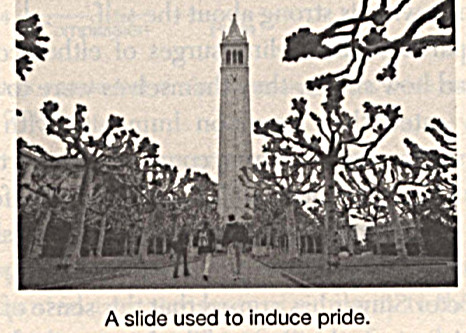
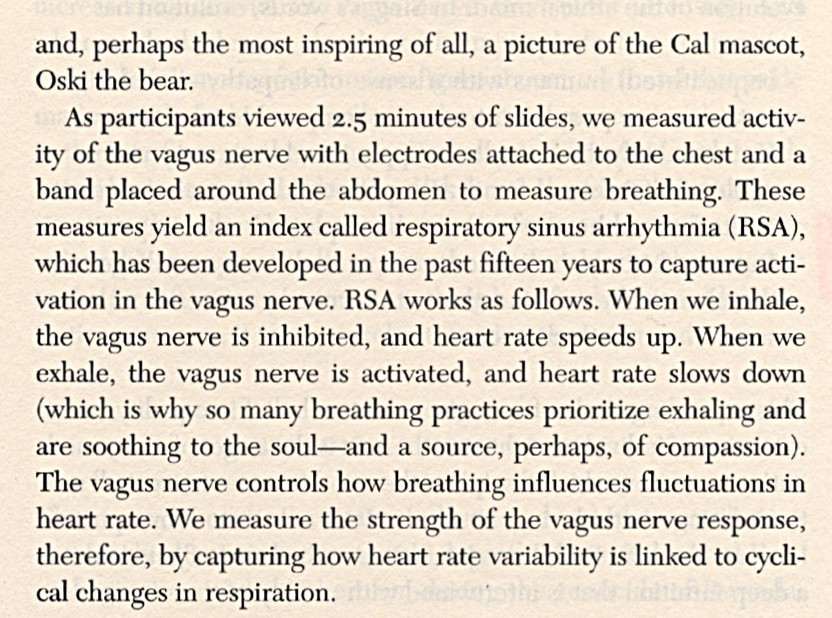
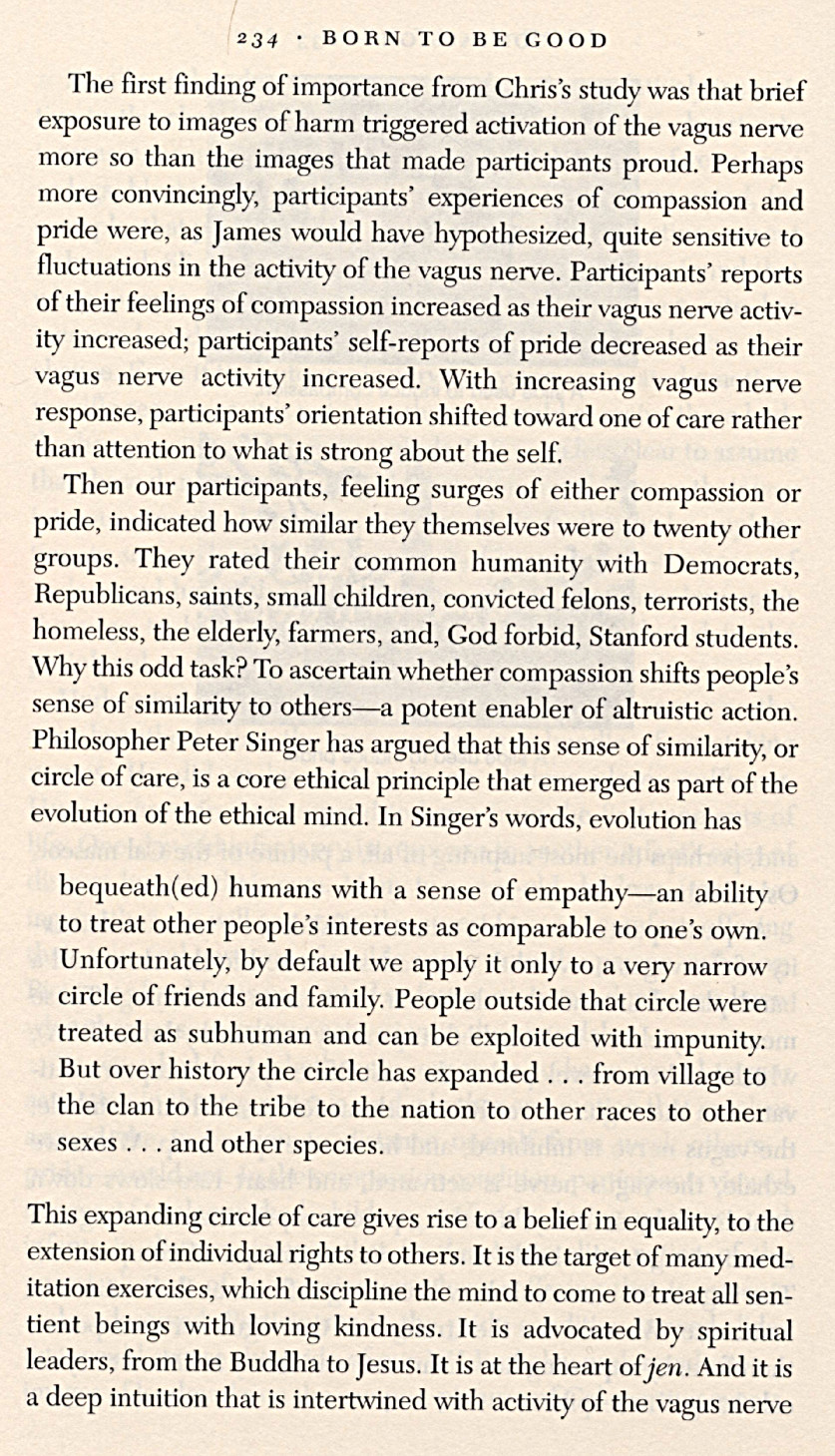
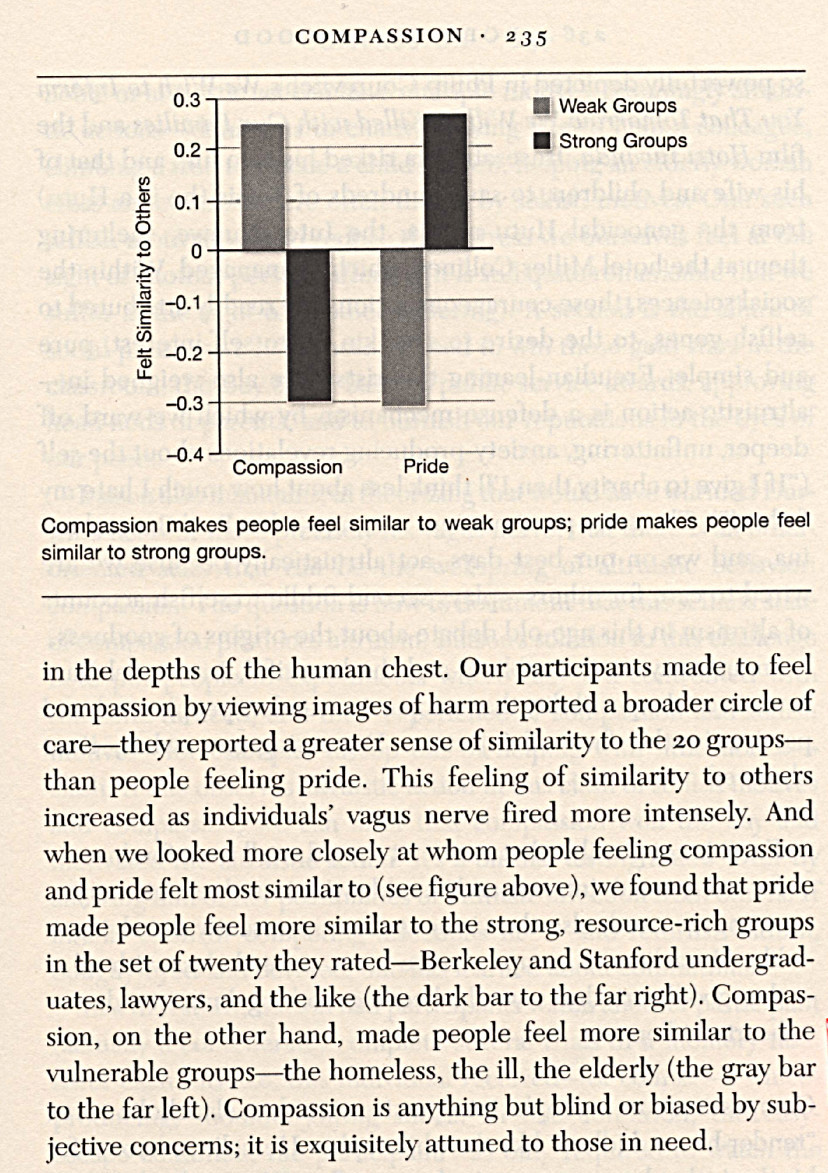
I mention this today because I am going to present two pictures here from Dr. Dacher Keltner’s chapter on compassion (from his book Born to Be Good: The Science of a Meaningful Life) along with a bit of the text he includes with them.

The exercise I suggest is for readers to just spend a little time looking at first one of these pictures and then at the other.  I find it fascinating that I can fully feel the difference IN MY BODY between how my body feels, and therefore how I feel, in response to each of these pictures.

The feeling shift in my torso involves my breathing.  As I mentioned in yesterday’s post, we can become mindfully aware of our experience of breathing as we shift from automatic pilot breathing to breathing with our SELF-conscious awareness.  These two pictures, to one degree or another, offer an example of how breathing and mindful awareness are connected together.

++++

Picture number one:

+++++++++++++++++++++++++++++

Picture number two:

++++++++++++++++++++++++++++++

I realize the quality of the pictures is pretty shabby, but they still work just fine to demonstrate how our vagus nerve system responds within our body differently as we experience emotion and feeling.

I am posting again today Keltner’s writing about how these photographs were used in research, which is part of the whole chapter on compassion that I posted the other day that includes some writing on altruism.

I just wanted to mention today that in cases of severely abusive parents something is obviously terribly wrong with their compassion-altruism-be good spectrum of response.  Research, as I’ve mentioned previously, about Borderlines shows that their vagus nerve system does not operate in a normal way.

Keltner states here:

With increasing vagus nerve response, participants’ orientation shifted toward one of care rather than attention to what is strong about the self.”  (page 234)

I am reminded of my thinking about my mother’s distorted self, about her distorted relationship with this distorted self, and about her distorted relationship with everyone in her universe, most specifically with me.

In her relationship with me my mother was solely occupied with what she unconsciously perceived as being WRONG with herself as she projected ALL of that wrongness onto me — and then punished me for it.

By taking what was WRONG with herself and placing it all on me, she was making her good self STRONGER in some bizarre and distorted way.  But she couldn’t even just do this half of her psychosis without doing the other half, which was to ‘personify’ her projection of goodness onto my younger sister as she made her the all-good child in a similar way that she made me the all-bad one.

While Keltner is obviously not talking about child abuse in his writings, there is no way that I can avoid the fact that it is within this same vagus nerve system that these distorted patterns — of ‘strong’ versus ‘weak’, of what ‘belonged’ and what did ‘not belong’ within my mother’s version of herself, along with who she identified with and who she refused to identify with (as being weak versus strong) — operated within my mother.

My mother lacked any normal self-reference point within herself that is necessary for the normal demonstration of the reactions that Keltner describes in this research (see below).  Because she did not have any true sense of what was strong about herself, she could not be mindful of the fact that her entire psychic, mental system — and the behavior that was its result — operated through externalized inner dramas that she acted-out, outside of her self as they mostly involved tortured, battered, hated, shunned, and terribly abused ME.

++++

Although the research presented here had nothing overtly to do with infant-child abuse or about a comparison of safe and secure attachment versus unsafe and insecure attachment, I believe absolutely that this research model could be used in combination with these factors.

What would be discovered would be the deeper levels of how shifts between so-called pride and compassion are actually showing the  strength or weakness of the SELF.  The weaker and more unsafely and insecurely attached a self is in the world, the more distorted their vagus nerve reaction is likely to be on this pride-compassion spectrum.

But what might register in such a study as a tendency toward pride is actually a tendency to NOT be able to recognize any weakness within the self at all.  Such a person learned (it was built into their body-brain) that weakness meant threat of death.  If the early trauma could not be avoided in any other way, the body-brain simply shuts off any ability to recognize self-weakness at all.  Awareness of weakness costs too much — as does weakness itself.

++++

In my thinking, I suspect that the stronger a self REALLY is, the more fluidly that self will be able to afford the cost of recognizing weakness in others.   They can afford to allow themselves to resonate with need and weakness through the feeling of compassion.  They will also be able to afford to respond with care.

If a self is REALLY weak rather than strong, they cannot afford to identify with another’s weakness.  It simply costs too much.  “I am strong enough to survive so I can afford to help others to survive” is an entirely different mantra than “I know I am vulnerable and weak (though I can’t even afford to let myself know this) so I must align myself with the strongest (and act like I am one of the strongest) to survive.  I cannot afford to give anything to anyone else.”

My mother took all this weakness to another level that made her an extremely dangerous mother.  Not only could she not be consciously and mindfully aware of her own weaknesses and vulnerabilities of her own self, she was hell bent on actively destroying her own projected version of weakness — again, of course, ME.   Not only could she not appropriately care for me, or have compassion for me, she attacked me as she tried to destroy me.  It would not surprise me if these dynamics operate on some level for all severely abusive parents.

If this is true, then abusive parents have the weakest selves possible.

++++++++++++++++++++++++++++++

The part of Keltner’s next cited above related to this particular research:

++++++++++++++++++++++++++++++