+THE TOPIC OF TEASING: TOO HARD TO CONSIDER?

++++++++++++++++++++

When I turned the next page after the chapter on laughter in Keltner’s book my first reaction was aversion.  This isn’t the aversion of disgust I would feel if someone handed me a white china plate with a serving of dog turds in the center of it.  It’s more the aversion I would feel to continuing down a path once I saw a large diamond back rattler stretched across it.  It’s like the aversion I would feel should I be asked to step up on stage to join a chorus line of showgirls scantily dressed and overly plumed in Las Vegas, or should I be asked to sing the national anthem from the center of a pro football stadium in front of thousands.

That’s a strong negative reaction to the single word that appears at the top of Dr. Dacher Keltner’s 2009 book’s (Born to Be Good: The Science of a Meaningful Life) next page as the heading for his next chapter:  Teasing.

I am experiencing the ‘freeze, hide and flee’ half of the fight/flight stress reaction.  There’s no ‘fight’ for me here except for the fight I am experiencing inside my self about facing my fears by plowing through a topic that obviously makes me feel completely uncomfortable.  I am presented with a challenge here to which I respond with feelings of incompetence and un-confidence.  I KNOW I am an unequipped gladiator in the arena of normal human teasing.

It is only because of my commitment to reading Keltner’s entire book and to learning about my self as the severe infant-child abuse survivor that I am that I marshal my courage and willingness to pay attention both to the information that Keltner presents and to my own difficulties with it.  I know from my experience of aversion to the topic that there is something important here I need to understand.  I know from the start both that I am not going to like what I find here, and that what I find will reflect a truth about how the severe abuse I experienced from birth changed me into someone who is different from the person I could have become had this severe abuse not happened to me.

++++

Because my experience of severe infant-child abuse contained very specific, unusual, uncommon and unique patterns, I have found myself falling through nearly every single crack in the ‘psychological’ theories about how child abuse can affect adult survivors.  Because my abuse began at birth, I have had to learn that ‘recovery’ of abilities I supposedly ‘used to have’ before severe trauma happened to me is not possible.  My journey of healing is mostly about what I can uncover and discover connected to what was done to me rather than to recover anything.

I have to connect-the-dots of the information I uncover and discover about being myself in the world in far different ways than non-early severe infant-child abuse survivors might get to.  I cannot take for granted even the most basic facts about what it means to be a member of our social human species.  This is mostly true because my mother didn’t just use one massive club of abuse against me from the time I was born.  She had a second massive club that she wielded over me equally:  extreme social isolation.  Being bludgeoned from birth and for the next 18 years by one of these clubs would have all but obliterated me.  Being attacked on all fronts by a combination of the two clubs has made me into a person who very nearly fits the description of a nonsocial species of one.

I am left having to uncover and discover more of what is uniquely different about me from others than what is similar or the same.  Yet I was born a member of a social species.  Everything that is different for me happens according to categories of experience that I share with all others.  It’s just that within each of these categories of possibilities about what it means to be human and what it feels like to be human, I experience patterns of being-in-the-world that are different for me than for nearly all others.

As I encountered my aversion to Keltner’s chapter heading on teasing it didn’t take me very long in scanning the next pages to understand that the topic of teasing is about one of these socially-human categories.  Although Keltner does not make the obvious connection between teasing and attachment patterns, I do.  In fact, the connection is more than glaringly obvious to me.

I suggest that a clear appraisal of our competency of interactions within the arena of teasing activity can show us the kind of social brain we have.. At the same time this appraisal can tell us about the kinds of infant-child interactions we had with our earliest caregivers while the foundation of our emotional-social brain was built from the time of our birth.

++++

At the same time that I now want to turn to Keltner’s actual presentation of information on teasing, I am experiencing one of my own inner reactions I wrote about earlier in the week.  I hear that warning:  “Do not enter.  Past this point all angels fear to tread.”  I realize that if I cross this line, move past this point, I am at risk for inviting in The Furies.

At the same time I realize there is a second sign posted beside the first.  This one reads, “You cannot get there from here.”  I don’t even have time to consider what this second sign means before I notice a third one that reads, “What is true for most others is absolutely not true for you.”  Oh!  And a fourth sign!  “If you choose to follow down this pathway you must understand that none of what you will find here can be taken personally.  Whatever you are missing in regard to teasing did not come about through any fault of your own.”

If the presence of all those signs aren’t warning enough that I better consider carefully what I am going to choose to do next, I see a flash of yellow through the trees and underbrush just around a curve of the pathway ahead of me.  I walk toward it and see yellow crime scene plastic ribbons strung across the pathway and wound around the bushes on both sides of the pathway into the forest as far as I can see.  At the same time I see a gleaming silver pair of giant scissors lying on the ground in the center of the path right in front of the tape.

I am standing here thinking about this carefully.  What might the repercussions be for me if I pick up these scissors, snap through that yellow tape and continue forward down this pathway?  What might the ramifications be of gaining conscious knowledge about something my body already knows but has no words to describe?  Would I rather be skinned alive than uncover what I am going to discover about myself in this body-brain in this lifetime should I carefully read this chapter?

Believe me, readers.  This is turning into a really long pause here…….  There are more than a few parts of myself I have to consult with before I can make this decision.

++++

One thing I know today from the information Keltner presents in his book on this topic.  True teasing in the human social arena is NOT about aggression.  If there is aggression present, it is not teasing.  There is not supposed to be anything terrible — ‘terror able’ — about teasing.   Obviously, for me, there was in my “Something Wicked This Way Comes” version of a childhood.

I should not be surprised, given the continual reign of my mother’s verbal abuse of me (included within her unending repertoire of violence), that her so-called teasing was extremely vicious, hurtful and WRONG — from the time I was born.

++++++++++++

+GREAT BOOK ABOUT THE BEST IN HUMANS

+++++++++++++++

My book Born to Be Good: The Science of a Meaningful Life – Paperback (Oct 5, 2009) by Dacher Keltner has arrived.  I am eagerly embarking on its study about what’s best about humans.  My insanely abusive Borderline mother sure didn’t teach me anything about THAT!

Keltner resides in the camp of study about positive human emotions.  Interestingly, researchers could not really study what has always been termed ‘happiness’ equally with the survival emotions such as fear and rage until technology invented photographic equipment that operates as fast as our face moves when we express emotion.

The more survival-based emergency related emotions happen in bigger ways so that we can watch them happen more easily than we can (could) watch expressions related to happiness and well-being.  Just as we needed really FAST photography to accurately be able to watch the visual information transmitted and received between infants and mothers (that build our earliest fundamental brain regions), we also needed it to see what happens when we treat one another well and with kindness.

(For an example of how the extremely rapid fraction-of-a-millisecond mother-infant communication takes place please scroll down to page 22 in Dr. Allan N. Schore’s paper, EFFECTS OF A SECURE ATTACHMENT RELATIONSHIP ON RIGHT BRAIN DEVELOPMENT, AFFECT REGULATION, AND INFANT MENTAL HEALTH)

++++

Humans are born with the capacity to experience emotion.  We simply live them without thinking about what they are, what they mean, or what they are named.  In safe and secure infant-childhood environments we are helped by our caregivers to gradually learn about our emotions as we learn about our self and others in the world.  Eventually we learn what emotions are named and about how to ever more effectively regulate them.

Because this ability to regulate and differentiate emotions happens within our earliest infant-child attachment relationship environment, the process is either assisted or interfered with by our caregivers.  In my own case, as I study Keltner’s book, I doubt I will be able to think about very many instances from my infant-childhood at all where I would have even been allowed to experience the positive emotional states.

I find it interesting that even in the field of vastly expensive scientific research that the differentiation of ‘happiness’ and the study of this state had to wait until technology caught up with our desire and need to better understand the happiness aspect of who we are.

Dr. Keltner is at the cutting-edge of this research.  His study happens because he can use the new lens of sophisticated super-stop action photography to see our human finely tuned happiness communications in the same way that evolution of the lens allowed us to see new aspects of our world through microscopes and telescopes.

++++

Keltner states about the study of happiness in the first chapter of his book:

“The canonical [orthodox] studies of human emotion, studies of the universality of facial expression, of how emotion is registered in the nervous system, how emotion shapes judgment and decision making, had never looked into these states.  The groundbreaking studies of emotion had only examined one state covered by the term “happiness.”  But research is often misled by “ordinary” language, the language we speak rather than the language of scientific theory.  Happiness is a diffuse term.  It masks important distinctions between emotions such as gratitude, awe, contentment, pride, love, compassion and desire – the focus of this book – as well as expressive behaviors such as teasing, touch, and laughter.  This narrow concentration on “happiness” has stunted our scientific understanding of the emotions that move people toward higher jen ratios.  By solely asking, “Am I happy?” we miss out on the many nuances of the meaningful life.

My hope is to shift what goes into the numerator of you jen ration, to bring into sharper focus the millisecond manifestations of human goodness.  I hope that you will see human behavior in a new light, the subtle cues of embarrassment, playful vocalizations, the visceral feelings of compassion, the sense of gratitude in another’s touch to your shoulder, that have been shaped by the seven million years of hominid evolution and that bring the good in others to completion.  In our pursuit of happiness we have lost sight of these essential emotions.  Our everyday conversations about happiness are filled withy references to sensory pleasure – delicious Australian wines, comfortable hotel beds, body tone produced by our exercise regimens.  What is missing is the language and practice of emotions like compassion, gratitude, amusement, and wonder.  My hope is to tilt your jen ratio to what the poet Percy Shelley describes as the great secret of morals:  “the identification of ourselves with the beautiful which exists in thought, action, or person, not our own.”  The key to this quest resides in the study of emotions long ignored by affective science.”  (pages 14-15)

++++

My mother was extremely short on jen, as are all people who outright neglect, abuse and maltreat people – infants and children most included.  My mother’s experiences in her own abusive childhood seemed to completely obliterate any ability she was born with to understand what ‘being good’ was all about.  Certainly it was my experience with her that she was never able to ‘be good’ to me and in fact she did not believe I even had the capacity to ‘be good’ myself.

In fact, my mother projected her own ‘badness’ that she found intolerable inside herself out onto me and proceeded to spend the 18 years of my childhood ‘punishing’ me for being ‘that bad’.  This process was, I believe, entirely connected to abuse in her own childhood as she had been told her ‘badness’ made her unlovable, but if she could only be ‘good enough’ she would be lovable and loved again.  Something became permanently broken in my mother’s early ‘good-bad’ early forming brain, and it made her into a monster.

Knowing this about my Borderline mother makes me very curious about Keltner’s book whose very title —  BORN TO BE GOOD — addresses the underlying conflicts my entire childhood was consumed with:  Evil versus Good versus Evil versus Good……..  Every interaction I had with my mother from the time I was born was in reality a communication from her to me about how essentially and fundamentally un-good and totally evil I was.

The extremes of my mother’s psychosis were so severe that she literally believed I was satan’s child and was not even born as a human being.  I was condemned beyond salvation, though my mother believed through every word and deed she abused me with that she was doing her very super-human best to save me as she battled to accomplish the impossible task of turning me into ‘something good’.

Keltner’s book is about the best in human social interactions.  I want to know more about this because I certainly have vast personal experience about what the worst in human social interactions can be like.  I want to improve my own ‘jen ratio’.  What might this mean?

By first translating the broad term ‘happiness’ into the broader term ‘goodness’, Keltner then describes the kinds of minute human interactions that both communicate goodness and build it into self and others.  The term “jen ratio” is the kingpin of his writing    About jen itself Keltner states:

“…Confucius taught a new way of finding the meaningful life through the cultivation of jen.  A person of jen, Confucius observes, “wishing to establish his own character, also establishes the character of others.”  A person of jen “brings the good things of others to completion and does not bring the bad things of others to completion.”  Jen is felt in that deeply satisfying moment when you bring out the goodness in others.

Jen science is based on its own microscopic observations of things not closely examined before.  Most centrally, it is founded on the study of emotions such as compassion, gratitude, awe, embarrassment, and amusement, emotions that transpire between people, bringing the good in each other to completion.  Jen science has examined new human languages [My note:  New to scientific study, ancient to humans] under its microscope – movements of muscles in the face that signal devotion, patterns of touch that signal appreciation, playful tones of the voice that transforms conflicts.  It brings into focus new substances that we are made of, neurotransmitters as well as regions of our nervous system that promote trust, caring, devotion, forgiveness, and play.  It reveals a new way of thinking about the evolution of human goodness, which requires revision of longstanding assumptions that we are solely wired to maximize desire, to compete, and to be vigilant to what is bad.

“The jen ratio is a lens onto the balance of good and bad in your life.  In the denominator of the jen ratio place recent actions in which someone has brought the bad in others to completion….  Above this, in the numerator of the ratio, tally up the actions that bring the good in others to completion….  As the value of your jen ratio rises, so too does the humanity of your world.

“Think of the jen ratio as a lens through which you might take stock of your attempt at living a meaningful life.”  (pages 3-5)

++++++++++++++++++

I haven’t seen these two words in Keltner’s book yet, hope and enthusiasm, but this is how I feel as I enter into this new journey.  For all my awarenesses about the differences between how my body-brain-mind-self was formed in comparison to others who benefited from having a safe and secure attachment foundation rather than one formed in, by and for trauma, I enthusiastically hope that by understanding how we ALL have a jen ration operating in our lives I can begin to make my own ration better.

I will keep you posted (literally!) about my experiences with the information contained within the pages of Keltner’s BORN TO BE GOOD book I was fortunate to discover!

+++++++++++++++

+SILENCE. TURN AROUND AND WALK AWAY?

+++++++++++++++++++++++++++++

I cannot imagine anyone WANTING to write about or talk about child abuse.  Why spoil a perfectly gorgeous day by even thinking about that so dark side of life, especially when those days lie so far back hidden in the dim and distant past?

Why no simply enjoy, if not cherish, everything that seems so good and right in one’s present moment?

If nobody wants to speak or write about those days and nights of misery, those months, those years of abuse and torture — so the silence can continue without words — can each of us forget equally?  Both those of us who have endured abuse equally with those who have not?

Who will tell those stories?  “I don’t want to,” people say.  So they don’t.  “What’s the point of it?”

Today I join those people who have to still admit we don’t know the point of it.  I don’t know the good of it.

Turn around and walk away?

+++++++++

What matters?

From service dog to SURFice dog…

turning disappointment into a joyful new direction

+++++++++++++++++++++++++++++

+ATTACHMENT: SMART AND STUPID RESEARCH

++++

Personally I am tired of wandering around in the darkness wondering why I am not a particularly HAPPY person with some kind of an active, exciting, thrilling, fulfilling life full of social connections and emotional well-being.

Sure, my childhood sucked.  But, so what?  “Too bad, so sad, be glad you are grown up now and can make any choice you want to make about yourself in your life.  Get over it!  Get on with it!  Quit feeling sorry for yourself!  Your life is what you make of it.  Still having problems?  You must have bad genes.”

My response is, “Oh, yeah?  Says who?  What can ‘the research’ tell us?”

++++

My sister sent me an interesting link the other day that presents information directly connected to what I wrote in my December 26, 2009 post where I mentioned that I suspect my social-emotional brain shares some characteristics with autism.  Take a look at this Yahoo news article about research coming from a study of school children:

Texas study confirms lower autism rate in Hispanics

For every 10 percent increase in Hispanic schoolchildren in a given district, the researchers found, the prevalence of autism decreased by 11 percent, while the prevalence of kids with intellectual disabilities or learning disabilities increased by 8 percent and 2 percent, respectively.

The reverse was seen as the percentage of non-Hispanic white children in a district increased, with the prevalence of autism rising by 9 percent and the prevalence of intellectual and learning disabilities falling by 11 percent and 2 percent.

The observed relationships remained for Hispanic children after the researchers accounted for key socioeconomic and health care provider factors, although “urbanicity” of a district, median household income, and number of health care professionals did explain the increased percentage of autism among districts with more non-Hispanic white kids — a finding the researchers call “curious.”

Whether lower autism prevalence in Hispanics is attributable to other, still-unexamined socioeconomic, health care delivery or biological factors “remains a crucial area for further research,” Palmer and colleagues conclude.”

SOURCE: American Journal of Public Health, December 2009.

++++++++++++++++

Well, will you look at that.  All that time, effort and money spent on this research study and did they think to include a measurement of what matters most?  Did they include any kind of questions about size of immediate family, number of siblings, size of the dwelling, or amount of contact with extended family?

I can’t access the full research article online, but here’s what its abstract says:

Am J Public Health. 2009 Dec 17. [Epub ahead of print]

Explaining Low Rates of Autism Among Hispanic Schoolchildren in Texas.

Palmer RF, Walker T, Mandell D, Bayles B, Miller CS.

University of Texas Health Science Center.

In data from the Texas Educational Agency and the Health Resources and Services Administration, we found fewer autism diagnoses in school districts with higher percentages of Hispanic children. Our results are consistent with previous reports of autism rates 2 to 3 times as high among non-Hispanic Whites as among Hispanics. Socioeconomic factors failed to explain lower autism prevalence among Hispanic schoolchildren in Texas. These findings raise questions: Is autism underdiagnosed among Hispanics? Are there protective factors associated with Hispanic ethnicity?

++++

Researchers are evidently content to conclude their research with such statements as “this is a curious finding,” while they continue to ask their unanswered questions like, “Are there protective factors associated with Hispanic ethnicity?”  There is no reason I can think of to expect that degrees of human attachment don’t affect genes for autism just like it does for schizophrenia, suicide, depression, PTSD and other ‘disorders’ of the body-brain.

I have lived for the last ten years in a small town in southeastern Arizona on the Mexican-American border line.  The fence lies right behind my back yard.  99.9% of this town’s community is Hispanic.  Every family I know has a lot of children.  The children are cherished.  Every family has extended ties to extended family.  Their median income is low.  Many children often share a bedroom.  I have watched them as they grow from infanthood in the closest of interactions with one another within all age groups.  They are social and they are connected to one another.  Nobody is alone.

Duh, researchers.  Do you think that MAYBE the research findings might have to do with safe and secure attachment that builds for these people an excellently formed early social-emotional brain so that autism is not as likely to appear among their culture?

Is there some kind of STUPID gene operating among researchers that prevents them from bothering to consider collecting what is the most obvious information that would answer their questions?  Or is there some kind of implicit agreement among researchers to keep skipping the gathering of the most important attachment related information so they can keep on doing more and more stupid research without gaining any true understanding – because it gives them job security?

++++

I know this pattern exists.  The same kind of researcher ‘stupid gene’ operated during the South African – Kenyan youth research project on the consequences of trauma.  Follow this link for a description of the kinds of information the researchers collected on the 2000 teenagers in their study.  Did they include any standardized, accurate and useful assessment of attachment relationships among their subjects?  Of course not!  How could they justify spending more and more money on research to answer the puzzling results they found?

The most striking finding was the discrepancy in the rate of PTSD between South African and Kenyan adolescents in the context of equally high rates of trauma exposure (and even higher for specific types of trauma in the Kenyan sample).  The lower rate of PTSD in Kenya adolescents is difficult to explain.”  Seedat et al, 2004, p 173

Note the “difficult to explain” statement.  Read for yourself, “Give me more money so I can use my stupid genes and do more research.  I want to keep my job.”

These researchers noted at the conclusion of their massive project that for all the money spent and for all the extensive effort they put into their research, the were left unable to

“…account for higher rates of PTSD in the South African students, despite higher rates of exposure in Kenyan youth to both sexual assault and physical assault by a family member, as these are traumas that are likely to be repeated.  Further, these traumas were most likely to e associated with a PTSD full-symptom diagnosis.  This discrepancy is one for which we do not have an adequate explanation.”  Seedat et al, 2004, p 174

Obviously these Kenyan children were not necessarily safe and secure in their own home, so how might we consider that attachment information might help explain the difference in outcome between these two groups of extremely traumatized youth?

No standardized or valid attachment assessment tool exists.  These researchers do not seem to be bothered by its absence.  Even though they did not use the word ‘attachment’ in their research conclusions, these researchers did ‘wonder’ if the patterns of differences they observed might be related to the long history of cultural disruption that South Africa has endured in contrast to the retained cultural integrity of Kenya.

Can degrees of safe and secure versus unsafe and insecure attachment be related to degrees of cultural integrity?  The findings of both of these two research studies point in that direction.  Because neither study contained any (nonexistent) standardized collection of attachment information, both studies are left simply pointing in a “a direction for further research.”  Of course this doesn’t bother the researchers.  It guarantees their job security.

++++

The hole in the bucket of both of these studies validates my thinking.  It is the degree of safe and secure attachment that an infant-child has in its beginning with its mothering caregiver that most influences how a person’s genes manifest themselves as the very young body-brain develops.  The protective factors against any so-called ‘mental illness’, be it depression, aspects of autism, or PTSD are activated very early in a person’s development.

Looking at the end result of degrees of attachment security, even within school age children, tells researchers nothing about how their ‘subjects’ got to be the way they are.  I want to know, “How safe and securely attached were these children to their mothers and their other earliest caregivers from the time they were born – as their body-brain developed in interaction with the experiences the little one had in its environment?”

In my thinking, cultural integrity protects mothers and therefore protects the infants who benefit in their earliest, fundamental development from safe and secure attachment.  As the early body-brain is forming, information from the environment has already told an individual’s genes how to respond and adapt.  Although safe and secure attachment is certainly not guaranteed to children like those in Kenya, not EVEN in their home, the underlying structure of their body-brain seems to have included residency factors that protect them from PTSD.

++++

Without trying to explain the research today that describes the physiological impact that early stress has on development (notes for a lot of this research can be found HERE), I will simply present some links here today related to research that is showing how child abuse changes genetic expression:

Child Abuse Causes Damage at Genetic Level

++

Child abuse ‘impacts stress gene’

++

Infant Abuse Linked To Early Experience, Not Genetics

++

Gene protects adults abused as children from depression

Influence of child abuse on adult depression: moderation by the corticotropin-releasing hormone receptor gene.

++

The Neurobiology of Child Abuse and Neglect

++

Do Genetics and Childhood Environment Combine to Pose Risk for Adult PTSD?

Association of FKBP5 polymorphisms and childhood abuse with risk of posttraumatic stress disorder symptoms in adults.

++

Selected Publications of the Members of the Attachment Parenting International Research Group

++

And also, the results of a Google search for child abuse brain development

++++

Researchers need to come up with an accurate way to measure degrees of safe and secure versus unsafe and insecure attachment and add this measurement tool into the design of all research about the affects that trauma has on human beings throughout the lifespan.

Every research study being done that does not include a measure of degrees of attachment is missing the critical piece of information about how attachment creates resiliency factors that protect humans from ongoing problems related to trauma experiences.

All funding channels that support trauma-related research need to mandate that an assessment of the quality of human attachment be included.  Of course, this means that attachment patterns need to be taken most seriously as a primary factor that profoundly influences trauma research results.  Let’s do smart rather than stupid research!  Find a way to accurately measure degree and quality of human attachment – NOW!

++++

Please note:  I will be taking a break from the blog until Wednesday, January 6, 2010.  Best wishes for a Happy New Year 2010!

+++++++++++++++++++++++++++++++++++++

+CALM THE CRYING BABY — IMMUNE SYSTEM STIMULATES VAGUS NERVE TRAUMA ALTERED DEVELOPMENT

+++++++++++++

I have been in HOT pursuit of an idea all day.  This thought has lingered inside of me for 4 years in a ‘body knowing’ place because of what I know as a survivor of severe abuse and malevolent treatment from birth until I left home at 18.

In order for this idea to be given form I need to link it to other people’s related thoughts, and many of these ideas are only recently appearing as science races into a new place of truth about what it means to be a human — and how we develop in interaction with our environment from out conception.

I am not a scientist.  Even if I come up with a theory, and develop an hypothesis, I cannot create or perform research to either prove or disprove my ideas.  So, I have to use the interactive thinking the web provides and see what I can come up with.

And I found something very exciting – but I could not find it until I included the words ‘fish’ and ‘evolution’ into my search on the ‘vagus nerve’ and ‘the immune response’.

It has been my thinking that there has to be a point within the body — and within the body of a developing infant-child exactly ‘where the fire meets the gunpowder’.  A tiny person is powerless to stop trauma that happens to it from outside of its body.  It is therefore forced to try to stop the trauma ON ITS INSIDES.

This STOP action is the job of the vagus nerve as it controls the parasympathetic STOP arm of our Autonomic Nervous System and interacts with our immune system.  Right at this point where the developing body has to try to STOP the force of the impact of trauma ON ITS INSIDES is where Trauma Altered Development is forced to kick in.

It is RIGHT here, at this present moment in time where I cannot think into the future and must patiently await for science to confirm what I know is true – that RIGHT here where the fire meets the gunpowder, where a developing infant-child has to adapt within a malevolent environment and alter who it is becoming that EPIGENTIC forces that interfere with normal development by altering the immune system-vagus nerve-Autonomic Nervous System and brain interactions in preparation for survival within a toxic, malevolent unsafe and insecure attachment environment come into play.  The research proving this point is coming, but it is not entirely here yet.

This, I believe, is where and how what Dr. Martin Teicher calls evolutionarily altered development happens.  When a tiny growing body cannot STOP the ongoing affects of trauma happening to it from outside its body, the STOPPING happens on the inside.

This form of Stop the Storm of the impact of trauma — within a developing little body — causes things to happen like what happened to change my mother into the monster she became.  She could not afford to experience the suffering deprivation-trauma caused her so her body found a way to STOP it.

++++

My idea goes back to the very beginnings of how severe abuse and neglect in a malevolent environment force a newborn to begin to alter its development in adaptation to the deprivation-traumas that surround and impact it.

Thinking about how a tiny little body has so much work to do to grow its Central Nervous System including its brain, and about how its Autonomic Nervous System is able to at least control its heart rate and breathing from birth, knowing that an infant’s immune system is already in operation, I think about how all these developing processes interconnect.

I believe that it is the job of the immune system to protect and defend us within our environment.  I therefore suspect that it is our immune system that responds to the toxins in our environment – and if our earliest caregivers actually maltreat us and are themselves toxins in our early world, then our immune system must respond accordingly.

In this response to threat, to trauma, all our development is changed.  I suspect that there is an intersection within us where our immune system affects our Autonomic Nervous System (ANS).  The vagus nerves are intimately connected with the parasympathetic STOP arm of our ANS.  (I have collected pages of information and active links today on the subject.)

I think about how development altered through trauma ends up often making people into such changed people that their lives become very difficult in adulthood, both for themselves and for those around them.  I think about my mother’s birthday post I wrote for her last night, and I think about how compassionate would be the opposite of the way she turned out.

++++

I have spent the best part of this day searching for information I read online a few years back about how information transmitted through the vagus nerve reaches male brains differently than it does female’s.  I remember reading that men receive the information from one branch of the nerve – the left one – only while women receive information into both sides of their brains through both branches of the vagus nerve at the same time.

I combed through every gender and the brain link I presented last Sunday, and found nothing about this!  So I have been on the hunt, in pursuit, ever since.

I just found a fascinating article connecting the vagus nerve to compassion—something that my mother, through her trauma altered early development, did not grow up to possess – compassion.  Something about her adaptation to early deprivation and trauma changed her – and eliminated the possibility of having this experience from her for the rest of her life.

This article 9referenced below) follows exactly my line of expanding thought about how early trauma interacts with our immune system, our developing brain, and impacts our Autonomic Nervous System’s development.  It seems very probable to me that the evolutionarily altered person Dr. Martin Teicher describes due to developmental changes through early exposure to trauma experiences changes related to what this article is describing.

Compassion at the Core of Social Work: A – Florida State University

This article by Dan Orzech contains the following:

THE SEAT OF COMPASSION:

THE VAGUS NERVE?


“… Dacher Keltner, PhD, believes that the seat of compassion may just lie somewhere else: the vagus nerve. Keltner is a professor of psychology at the University of California, Berkeley, and coeditor of Greater Good, a magazine about prosocial behavior such as compassion and forgiveness. For the past several years, he has been examining the novel hypothesis that the vagus nervea bundle of nerves that emerges out of the brain stem and wanders throughout the body, connecting to the lungs, heart, and digestive system, among other areas-is related to prosocial behavior such as caring for others and connecting with other people.

The vagus nerve is considered part of the parasympathetic branch of the autonomic nervous system. That means it’s involved in relaxation and calming the body down-the opposite of the “fight or flight” arousal for which the sympathetic branch of the autonomic nervous system is responsible. Medicine has traditionally focused on the vagus nerve’s role in controlling things such as breathing, heart rate, kidney function, and digestion. But researchers lately have experimented with stimulating the vagus nerve to treat epilepsy as well as drug-resistant cases of clinical depression (see sidebar).

Keltner has been exploring the idea that the vagus nerve-which is unique to mammals-is part of an attachment response. Mammals, he says, “attach to their offspring, and the vagus nerve helps us do that.” Researchers have already found that children with high levels of vagal activity are more resilient, can better handle stress, and get along better with peers than children with lower vagal tone.

In his laboratory; Keltner has found that the level of activity in peoples vagus nerve correlates with how warm and friendly they are to other people. Interestingly it also correlates with how likely they are to report having had a spiritual experience during a six-month follow-up period. And, says Keltner, vagal tone is correlated with how much compassion people feel when they’re presented with slides showing people in distress, such as starving children or people who are wincing or showing a facial expression of suffering. Among other things, Keltner is interested in the implications of these findings for human evolution. “Much of the scientific research so far on emotions,” he says, “has focused on negative emotions like anger, fear, or disgust”-what Keltner calls the “fight or flight” emotions. “We tend to assume,” says Keltner, “that evolution produced just these fight/flight tendencies, but it may have also produced a biologically based tendency to be good to other people and to sacrifice self-interest.

Evolutionary thought is increasingly arising at the position that the defining characteristic of human evolution is our sociality We are constantly cooperating, constantly doing things in interdependent fashion, and constantly embedded in relationships. From an evolutionary perspective, that suggests that we should have a set of emotions that help us do that work.”

MORE:

WATCH THIS VIDEO – HE SAYS WHAT I’VE BEEN LOOKING FOR – THE VAGUS NERVE CONTROLS OUR IMMUNE SYSTEM!!  I believe that it is here that an abused developing infant-child experiences the start of its Trauma Altered Development.


Dacher Keltner in Conversation

43 min – Feb 5, 2009
Why have we evolved positive emotions like gratitude, amusement, awe and compassion? Dacher Keltner, professor of psychology at UC Berkeley
fora.tv/2009/02/05/Dacher_Keltner_in_Conversation

+++++++++++++++

HIS BOOK:

Born to Be Good: The Science of a Meaningful Life by Dacher Keltner

++++

The Evolution of Compassion

Dacher Keltner

University of California, Berkeley

++

Dacher Keltner
Professor
Ph.D., Stanford University

Campus Contact Information
Departmental Area(s): Social/Personality; Change, Plasticity &
Development;
Director: Berkeley Social Interaction Laboratory

Interests: Social/Personality: emotion; social interaction; individual
differences in emotion; conflict and negotiation; culture

+++++++++++++++++++++


Well, this is enough thinking and research for one day!  I am not going on to read the following today!!  It has just always made perfect sense to me that something in a traumatized tiny developing body causes its immune system to respond – and triggers the vast array of changes that we see in severe infant-child abuse survivors.  I believe the answer lies along this track.

What happens to an infant’s physiological development when no one calms the crying baby?

WHAT HAPPENS WHEN PARENTS HIT AND TERRIFY THE BABY?  Immune systems changes to development through interaction with the vagus nerve, that’s what.

++++

Vagal activity, early growth and emotional development – Elsevier

by T Field – 2008 – Cited by 1Related articles
The vagus nerve is a key component in the regulation of the autonomic nervous system and Infant growth and development. Several studies have documented a ….. including the hypothalamic-pituitary–adrenal axis and the immune system

++++

Parental Meta-Emotion Philosophy and the Emotional Life of …

by JM Gottman – 1996 – Cited by 228Related articlesAll 5 versions
nerve. The tonic firing of the vagus nerve slows down many physiological processes, such as the …. a central part of the immune system that is …..

++++

Calm Sleeping Baby – Baby Massage

Relaxation and enhancement of neurological development. Massage provides both stimulation and relaxation for an infant, Massage stimulates a nerve in the brain, known as the vagus nerve. Strengthens the immune system. Massage causes a significant increase is Natural Killer Cell numbers.

++++

Tears – Wikipedia, the free encyclopedia

Strong emotions, such as sorrow or elation, may lead to crying. lysozyme) fight against bacterial infection as a part of the immune system. A newborn infant has insufficient development of nervous control, so s/he “cries without weeping. of the facial nerve causes sufferers to shed tears while eating.

++++

TOUCH IN LABOR AND INFANCY: Clinical Implications

Increases in infants’ vagal activity during massage may lead to an increase As noted earlier, massage has been shown to increase activity of the vagus nerve, As in animal studies, massage has shown immunesystem benefits in humans. autonomic nervous system; a disturbance in the development of sleep-wake

++++

INFANT IN PAIN

Oct 29, 2009 Does your infant suffer from colic? Reflux? Projectile Vomiting? In her book, Molecules of Emotion,8 Dr Candice Pert (a recognized system interference are a hindrance to normal immune system function. Scientists are still discovering exactly how the immune and nerve systems interrelate.

++++

[PDF] Emotion

File Format: PDF/Adobe Acrobat – View as HTML
vagus nerve— a branch of the parasympathetic autonomic nervous system — may be involved in positive …. New research on the immune system suggests a biological …… Handbook of infant development

++++

[PDF] Phylogenetic origins of affective experiences: The neural …

File Format: PDF/Adobe Acrobat – Quick View
by SW Porges – Cited by 3Related articlesAll 3 versions
The healing power of emotion: Affective neuroscience, development ….. how the autonomic nervous system interacts with the immune system, nervous system. The vagus nerve exits the brain stem and has branches …… Porges SW, Doussard-Roosevelt JA, Portales AL, and Greenspan SI (1996) Infant regulation of the

++++

Evolution and Emotions

File Format: Microsoft Powerpoint – View as HTML
Neurological Development and the Limbic System. R-Hemi has closer connections to limbic system than L-Hemi. R-Hemi develops earlier in infancy than L-Hemi. Emotions appear in Stim vagus nerve, slows Heart 1 (H1). ….Effectiveness of the immune system; ability to ward off illness,

++++

The Brain and the Neuro-psycho-immune System – Anne Baring’s Website

When Cannon stimulated the vagus through electrodes implanted in the …. Emotions are in the digestive system, in the immune system, The nervous system consists of the brain and network of nerve cells We remember most the most vivid memories – this was probably of great help in evolutionary development,

++++

Vagus Nerve Is Direct Link From Brain To Immune System

++++

Deep Brain Stimulation … – Blogs – Revolution Health

which explains how the brain and the immune system are interconnected through the vagus nerve. “It turns out that the brain talks directly to the immune

++++

How the Dalai Lama can help you live to 120… « Terryorisms

Oct 5, 2006 … it is the way the immune system responds to the mind. Let me explain. You immune system is controlled by a nerve call the vagus nerve

++++

The Dana Foundation – Seeking the cause of deadly inflammation ….

May 3, 2007 And the vagus nerve story is progressing on multiple fronts, for device development, for understanding classical physiology, meditation, “Look, everybody knows that meditation is good for your immune system.


++++

Breakthrough “Neuro Nutrition” Targets the Brain and Vagus Nerve

Jul 6, 2008 … The Vagus Nerve is the body’s most powerful anti-inflammatory … the Vagus Nerve, has a direct ability to restore the human immune system

++++

NSLIJ – Scientists Figure Out How the Immune System and Brain …

When they stimulated the vagus nerve, a long nerve that goes from the base of Many laboratories at The Feinstein Institute study the immune system in

++++

Cholinergic anti-inflammatory pathway – Wikipedia, the free …

Kevin Tracey found that the vagus nerve provides the immune system with a direct connection to the brain. Tracey’s paper in the December 2002 issue of

++++

The vagus nerve, cytokines and depression

The vagus nerve mediates behavioural depression, but not fever, in response to peripheral immune The immune system, depression and antidepressants

++++

Article: Scientists figure out how the immune system and brain ….

Jul 21, 2008 Scientists figure out how the immune system and brain communicate When they stimulated the vagus nerve, a long nerve that goes from the ……..In a major step in understanding how the nervous system and the immune system Pain & Central Nervous System

++++

Brain ‘talks’ directly to body’s immune system – The Hindustan …

Brain ‘talks’ directly to body’s immune system – Report from the Asian News Pain & Central Nervous System Week, Vagus Nerve Stimulation Can Suppress

++++

FASCINATING IDEAS HERE — DOES THE VAGUS NERVE HELP ORGANIZE CONSCIOUSNESS AND THE SELF?

[PDF] Does vagus nerve constitute a self-organization complexity or a …

File Format: PDF/Adobe Acrobat
by B Mravec – 2006 – Cited by 3Related articles
nervous system modulates immune functions via vagus nerve (5, 6). from the immune system to the brain via the vagus nerve

++++

[PDF] Evidences for vagus nerve in maintenance of immune balance and …

++++

Brain ‘talks’ directly to body’s immune system

post: Nov 14, 2007

He discovered that the vagus nerve speaks directly to the immune system through a neurochemical called acetylcholine.

++++

Vagus Nerve Schwannoma: effects on internal organs?

I just gave a talk the vagus nerve and the immune system–the vagus nerve > probably plays a very important role in many important chemoregulatory


++++

BiomedExperts: The vagus nerve mediates behavioural depression ….

We propose that behavioural depression is mediated by the vagus nerve indicate that the recently proposed vagal link between the immune system and the


++++++++++++++++++++++++++++++++

MY MOTHER’S DREAM – March 29, 1960
The whole family was out walking and suddenly we looked up to see a dark rainbow appear – then it got bright and behind it a skyline appeared outlining massive dormed buildings such as I’ve never seen and skyscraper buildings – then it all disappeared and a big wind came.

We realized it was a hurricane. We could hardly stand up against the wind. We saw big apartment buildings on the sides of the streets but the entrances faced another street and we were on the wrong side. The wind grew stronger – finally a door appeared and we went in the building and the person asked us what was wrong? We told her of the great wind but as we pointed outside – all was silent and the wind was gone … and I awoke.

++++

Stop the Storm of the intergenerational transmission of unresolved trauma carried on through the maltreatment of little infant-children.  If we don’t do this, changes in development will continue to rob these children of their own life free from Trauma Altered Development.

If we don’t stop the trauma from happening on the outside, the tiny developing body will do everything in its power to stop its affects on the inside.  This is what happened to my mother.

++++++++++++++++++++++++++++++++

Don’t forget to check out — Brain Facts – A primer on the brain and nervous system

++++

— NEW:  CLICK ON POST, PAGE AND/OR COMMENT TITLE

AND LOOK FOR ‘YOU RATE IT’ STARS AT BOTTOM OF PAGE —

Please feel free to comment directly at the end of this post or on

+++++++

Your Page – Readers’ Responses

+++++++++++++++++++++++++



+THOUGHTS ON THE TRIGGER POINT OF SHAME

++++

I have the advantage of trying to work my way through trauma related information using my own experience as a basis for what I know, rather than being locked into any established patterns of thinking about either trauma or the so-called ‘mental illnesses’ that are directly connected to Trauma Altered Development (TAD).   I am writing a ‘forensic autobiography’.  That means I write from the perspective of being a ‘confessional’ rather than from being a ‘professional’.  I am free to think any way I want to about the topic of trauma as it concerns me and others like me.

I try to understand what the developmental, attachment, and neuroscience experts say about the topic of TAD, but I am certain that if I line up my conclusions on the topic against these expert findings we will not always match point by point.

I want to talk today – again – about how trauma influences our core development as infant-child abuse survivors.  If our earliest caregiver interactions were not safe and secure, our development was altered from the start.

The experience of shame, as I have written before, is a very real physiological Autonomic Nervous System response to explorations within our early environment that caused us to experience conflict – rupture either with or without repair – with our early caregivers.  If there was no serious rupture (we were in agreement with our caregivers about our self in our environment), or there were ruptures that were met with repair through the appropriate actions of our early caregivers, the “GO” and “STOP” balance within our growing Autonomic Nervous System (sympathetic arm = GO, parasympathetic arm = STOP (pair a brakes)) developed optimally and well in a balanced, ‘ordinary’ way.

These ‘shame’ interactions are always based on the experiences prior to the age of one either in a benevolent or malevolent early caregiver environment that has already by this age built our growing brain, nervous system, body and earliest experience of self in a particular direction.  If these interactions were benevolent, a different body-brain-growing mind and self is forming than would be one that is forming under malevolent conditions.

We have to begin to REALLY understand how profoundly our experiences within our earliest caregiver environment affect us – permanently.  Once we are one year old, our development has already been profoundly directed by the kinds of experiences we have had with our caregivers, primarily with our mother.  It is on this earliest foundation that all other experiences will be processed within our little growing body.

By the time we grow a body-brain that is physically developed enough to be able to experience SHAME at one year of age, the course of our development has already been determined – either within and for a safe, secure, trauma-free benevolent world, or for the opposite.

++++

I mention this today in following my post of yesterday where I described my opinion of our nation as not being completely pro the human rights of children.  The ability to optimally experience shame in a growing body already by the age of one, I believe, is directly tied to how we experience any later event that involves conflict, consciousness, conscience and choice.

I believe the earliest caregiver interactions we have, mostly benevolent or malevolent, color the development of our personality.  Experts still suspect that personality is primarily influenced by our genetics.  However, developmental, attachment and neuroscientists are rapidly uncovering the facts about how our earliest experiences actually tell our genes what to do.  Given these new and extremely important findings, we can no longer ever assume that anyone’s personality follows the same developmental pathways if everyone is not raised with the same Universal Human Rights guaranteed.  Any violation of basic human needs for development, as conveyed through our understandings about basic human rights, causes Trauma Altered Development (TAD) to occur.

Our national personality is built upon the personalities of all the individuals that are a part of the whole.  Because we are a democracy, the most obvious personality we show to the world becomes the personality of the majority of our members.  Each of our own individual personalities, in turn, were built upon a combination of our personal genetics as they manifested themselves within either a primarily safe and secure early environment or within a traumatic one.

If early attachment is not safe and secure, some degree of trauma is present because fundamental universal human rights were not guaranteed.  We are talking humans here.  Humans have basic PHYSIOLOGICAL needs for our optimal development that create us – in an interaction between our genes and the quality of our early environment – to end up being a certain way in the world.

++++

America prides itself on being a nation of individualists, choosing to consider that within the perhaps one percent of our genes that make us different from one another there is enough individual potential for differences that it outweighs the 99% of our genes that we share in common as members of our social human species.  I suspect, however, that it is only when early developmental needs are met through the application of human universal rights that the development of the foundational 99% of our shared genetic material can manifest itself optimally that the remaining 1% that provides us the buffet of individual differences can grow, develop and shine among us.

If basic human needs are not met in a safe and secure early environment primarily free of trauma (without ruptures for which there are not adequate and appropriate repair) as described within the recognition of basic human rights, the 99% of us has to take a course through Trauma Altered Development that means we have been forced to adjust to the trauma in a way that limits our ability to be far more of our unique, different self as adults.

Early traumatic, unsafe, insecure and malevolent environments seem to me to narrow the ‘channel’ through which we can pass through our early body-brain-mind-self developmental stages – and still survive.  One by one, I can think about everyone I have ever met who suffered from a malevolent early childhood and begin to see how the patterns among them-us-me become more alike in fundamental ways than they are different.

If I simply look at the so-called ‘personality disorders’ that researchers are now finding are nearly ALWAYS tied in their origins to early infant-child abuse and trauma, the end result makes these people enough alike that they can be grouped into ‘functioning categories’ according to the ‘symptoms’ that they demonstrate in their continued lives.

If I look just at three particular people, I see how Histrionic Personality Disorder, Narcissistic Personality Disorder, and Borderline Personality Disorder lie on a continuum of personality alteration that created these people to be different than I believe they would have been had their Child Rights been guaranteed so that they would have been able to grow up without Trauma Altered Development.

The very best scenario for human growth and development occurs because of development that happens without the mediating and CHANGING affects of trauma.  Only when Children’s Rights are guaranteed within safe and secure environments can a body-brain-mind-self grow up to be free – and by that I mean, free to be MOST flexible and creative throughout their lives in their actions and responses to every life experience (change) that they encounter.

Trauma Altered Development means that we have been forced to sacrifice aspects of our own autonomous development.  We are forced to be more alike than different because SURVIVAL itself has specific requirements that need to be met.  If we are exposed to overwhelming danger, threat and trauma during our early development, our specie’s resiliency factors from within our bodies will be forced into activation.  If the threat to our infant-child well-being endangers our body-brain-mind-self on the most basic levels, the Trauma Altered Development we experience will simply turn us primarily into SURVIVORS    rather into the most unique, flexible, creative original beings that we had the capacity to become.

To the degree that trauma changes a developing infant-child so that they can survive, to that degree will conscious choice and aware decision making be removed from them – unless and until these survivors can learn what the physiological trauma-changes were, how they affect us, and how we can now FORCE ourselves to become increasingly more conscious in our lives.

Non-trauma-altered people who were not forced to physiologically adapt to early traumas naturally end up with a fuller buffet of consciousness – including the ability to empathize, use a broadly built Theory of Mind to understand themselves in relationship to others in the world, and filter their experience through an aware conscience.  They simply have more choices about how to be in the world.

Of course, these non-trauma developed people can choose to be total jerks if they want to be.  Yet we know that a staggeringly high percentage of our nation’s criminal population suffered from Trauma Altered Development in malevolent childhoods.  Compared to people with Trauma Altered Development, the range of potential choices for non-trauma altered people appears to be almost infinite.

The feedback-feedforward information gathering and response loops within the body-brain-mind-self of a non-traumatized infant-child compared to a traumatized one form differently.  When I think about optimal development using the image of the infinity sign, non-trauma development creates an ever expanding, fully operational flow of life force along that “8” pathway.

The more an individual is forced to apply survival-based physiological changes during their infant-child development in the midst of trauma, the smaller the “8” pathway becomes.  In cases such as my mother’s was, the “8” simply broke so that she was left with the repetitive patterns of “0” only, living her life without the ability to allow incoming information to come in without it having to be processed entirely through the filer of the damage she suffered in her development through trauma.  My mother was not allowed to become the fully unique, thriving, creative, flexible person she COULD have become had she not been forced to physiologically adapt in order to survive during her developmental stages as an infant-child.

++++

The physiological crisis point within our human body-brain-mind-self as we interact with others of our species is at the SHAME point.  No matter how we choose to recognize this point, no matter what word we choose to apply to this very real physiological point in the operation of our Autonomic Nervous System (ANS), it is at this SHAME point that we are notified that there has been a rupture in need of repair between ourselves and others around us.  The SHAME point is where the “GO” and the “STOP” within our body-brain-mind-self happens.  It is at this point that negotiation can happen successfully – or not.

It seems entirely possible to me that this SHAME point is where the two circles of the “8” infinity sign meet one another.  In cases such as my mother’s, it is at this point that she broke and was left with “0”, unable to negotiate herself as a being in relationship not only to others, but also in relationship to her own self.  She lost the ability to consciously identify herself in a complex world of shifting realities.

My mother operated from the extremely limited survival-based point of automatic pilot only.  She could not flexibly and creatively, openly or consciously consider options to solving conflicts because everything about her centered on NOT feeling shame because she could not tolerate it.  When an infant-child’s environment is so unstable, when their basic human needs-rights are not met, when survival becomes the ONLY option, it means that the patterns of rupture without either repair or HOPE of repair have so signaled the developing little person of danger in a malevolent world that all but the most very basic, primitive options have been allowed.

++++

The problem with overwhelming trauma is that it disturbs the rupture-repair pattern of checks and balances that allows life to continue going on in anything like a normal or ordinary way.  The problem with overwhelming trauma during our infant-child developmental stages is that we are forced to find a way to survive at the same time we have the most limited resources we will have in our lifetime.  Our only option was, in effect, to steal from our own inner bank of resources in order to survive.  This causes the problem to be built right into our developing body-brain-mind-self because we are then depleted from the inside out.

The point of surviving trauma is to eliminate its effects on us.  If we have no power to eliminate its effects (think here, little tiny person) then the next best thing we can do is eliminate our awareness of the experience of being in a state of ongoing trauma that we cannot escape from.  We have no option except to escape on the inside.

Recovery from trauma post-infant-childhood means that we ‘return’ to a normal or near normal state which happens when the rupture that trauma created becomes repaired.  There must be adequate resources available to allow repair to take place so that life can “GO” on, one way or the other.  In the case of Trauma Altered Development during infant-childhood, the resources had to be found within the child itself because they were not available from the outside.

I do not believe it will be much longer before we understand completely that nearly all of what we call ‘dysfunctional behavior’ including ‘mental illness’ is a result of overwhelming trauma during infant-childhood developmental stages that causes survivors to steal from their own inner storehouse of resources at a time when having to do so – in order to stay alive – robs them of the capacity to later experience a full, healthy, flexibly adaptive, creative best-developed-self.

It is for this reason, if for no other, that a guarantee of Child Rights becomes such a critically important factor.  When a child has its fundamental human rights provided, it will not be forced to use up its own internal resources in order to survive.  Those resources HAVE TO COME from the outside of the child.  That is what human childhood is – a developmental period of growing and expanding ability to sustain oneself in the world.  In order for an infant-child to develop optimally, its needs must be attended to and met during these stages of dependency.  If those needs are not met from the outside, Trauma Altered Development will occur, or the infant-child will die.

It is the responsibility of all adults to ensure that all of a child’s rights are guaranteed and protected.  Nature has designed humans so that appropriate and adequate adult caregiving of infants and children is our specie’s primary, number one resiliency factor.  We must lift the yoke of stigma off of the survivors of infant-child neglect, abuse and trauma and place it instead on all the adults in the society surrounding our little ones that allowed this malevolent treatment and trauma to happen to them in the first place.

It is on this level that I place responsibility and accountability on our nation when I say “SHAME on you!”  Either we intend to STOP neglecting our responsibility to our nation’s children or we don’t.  Either we intend to repair the rupture in the fabric of our society that allows the basic rights of children to be violated, or we do not.

If we choose to GO on letting traumas happen to our little ones that is within our society’s power to STOP, then we must realize that the Trauma Altered Development that will happen to these maltreated and traumatized infant-children will change them on their most primary, physiological level — as they are forced to take from inside of themselves what they need in order to survive — because the adults in their world were not there to help them.  Having to do so will change the degree of well-being for these survivors for the rest of their lives.

When the trigger point of shame is touched, it is time to examine conscience and to choose a course of action.  This is true for individuals and for the societies they are a part of.  In cases such as my mother’s, these abilities were removed from her through trauma that caused her Trauma Altered Development.  Is this same kind of pattern also contained within our nation?

++++++++++++++++++++++++++++++++

Please feel free to comment directly at the end of this post or on

+++++++

Your Page – Readers’ Responses

++++++++++++++++++++++++++++++++

+WHEN OUR TEARS TAKE AWAY OUR WORDS – WHAT IS THE TRUTH ABOUT OUR TRAUMAS?

+++++++++++++++++++++++++++++++++++

By the end of this post I cannot write my way through my tears…..

+++++++++++++++++++++++++++++++++++

I decided to take a look today at this book, hoping to find within it some new information that will give me some new insights about how to ‘recover’ from the effects of the 18 years of chronic trauma I experienced from birth and throughout the survivorhood that was supposed to be my childhood.

The Trauma Spectrum: Hidden Wounds and Human Resiliency by Robert C. Scaer (Hardcover – Jul 17, 2005)

Yet, here again, in spite of Scaer’s many years of experience in treating trauma survivors, in spite of his careful writing based on meticulous research, this book does not truly address my condition.  He misses the fundamental fact that those of us who suffered overwhelming trauma while our body-brain-mind-self was passing through our early critical-window growth and developmental stages have been deprived of the most basic human right possible – the right to live our lives in a body that has not been permanently changed by having trauma built right in to it.

Because I live in a trauma formed body, I have NEVER had a body that did not include these trauma adaptation responses in it.  I do not have the luxury, therefore, to return to any pretrauma state.  Well, I do have to make an important distinction here.  Because the full development of my mother’s mental psychosis did not originate until the time she was actually birthing me, the conditions my body formed in while she was pregnant with me were benign and adequate.  Without at least having had those nine months of untraumatized development, I most certainly would not be alive today.

++++

Except for the critical 9-month reprieve from developmental trauma that I had the luxury of experiencing within my mother’s womb, all the rest of my development occurred in a malevolent environment of trauma.  I now know enough about myself and those like me to understand that everything in Scaer’s book is missing the mark about how trauma ‘facts’ apply to me.

Very few researchers are ready yet to look our situation square in the face.  They treat our reality as if they were trying to consider what a full eclipse of the sun looks like.  We cannot look unaided at an eclipse without suffering permanent visual damage.  Researchers are evidently unprepared to look at our situation without suffering damage to their own vision of what life is SUPPOSED to be like in regard to the impact that trauma truly has on the most powerless and helpless humans on earth – infants and very young children.

++++

I am sorry, but I just cannot find it within me to get too excited about or to feel too hopeful because Scaer starts his book by paying passing lip service to the reality of Trauma Altered Development (TSD) when he writes on page 12:

The nature versus nurture, genes versus experience dilemma is especially important in the field of development of the brain and behavior.  Many mental illnesses and behavioral and personality traits are considered to be primarily genetic in nature.  In fact, genes are routinely activated or “switched on” by experience, often only during a window of opportunity in early infancy.  The long-term effects of early life experience on behavior throughout the lifespan must be considered when diagnosing and treating behavioral disorders, especially when considering the perplexing tendency for victims of trauma to repeat behavior closely associated with prior life trauma.”

HOGWASH!   This is just another example of ‘sinking Titanic’ Dark Age thinking.  Yes, “genes are routinely activated or “switched on” by experience” but there’s nothing ‘often’ about this process.  It occurs on the most fundamental level in a continual process during our early infant-child growth and development – it is HOW we get made!  The experiences we have with our early caregivers, either in a safe and secure attachment relationship or not, set in motion all the physiological, biological adaptations to our benevolent or malevolent environment that determine the creation of the body we will live in and with for the rest of our lives.

Those of us forced to endure overwhelming trauma during these ‘windows of opportunity’ in early infancy (and early childhood) that Scaer mentions in passing so change us that we do not belong to the ‘ordinary’ group the rest of his book is designed to help.  I am left, again, with a mind full of ‘yes, but…..’ – WHAT ABOUT THE REST OF US?

If overwhelming traumatic experiences build us in the first place, we absolutely have no chance to EVER ‘return’ to a pretrauma state.  Very few researchers and clinicians seem to get this critical point.

(see an example of an exception: The Boy Who Was Raised as a Dog: And Other Stories from a Child Psychiatrist’s Notebook Child Psychiatrist’s Notebook–What Traumatized Children Can Teach Us About Loss, Love, and Healing by Bruce Perry and Maia Szalavitz (Paperback – Dec 24, 2007) )

How do I begin to pick my way through the rubble of thinking that is contained in books like Scaer’s so that I can learn SOMETHING useful about the impact of trauma and hoped-for so-called ‘recovery’ from its effects when I know from the start that this author has no clue about how Trauma Altered Development has changed me?  Filtering what Scaer is saying about trauma through my own body-brain-mind-self that was built through my own experiences of overwhelming trauma from the moment I was born and for the next 18 years of my life is a daunting task.  I have to translate and transform his thinking one word, one concept, one ‘lesson’ at a time.

Scaer’s book would be dense and difficult to read even if I knew ahead of time that he knew what he was talking about as his information applies to me.  Knowing ahead of time that he doesn’t have the remotest clue about who and how I am in the world leaves me ONLY with my own desire to better understand the fundamental nature of trauma as it impacts human beings.  I cannot hope or trust that this author has prepared a pathway for me to travel through this information he considers himself enough of an expert to present.

I have to rely upon my own desire for knowledge and understanding about how the trauma that happened to me changed me from the first breath I took on this earth if I am ever going to be able to achieve any healing.  I refuse to accept my assigned status of being a casualty of a war I was born into as I was forced to fight to stay alive and continue my development with every possible human resiliency factor I had in my little, tiny body.

I find myself at this moment up against my own tears that spring from the deepest levels of who I am as I seek to help all of us who were forced to change on our cellular levels in order to remain alive against all odds.  We were terribly, terribly hurt and we remained alive.  Where are the words that we can use to begin to understand what these hurts did to us?  If the trauma experts cannot even find and use these words accurately, how can I?  How can we begin to articulate what our body knows on its most profound levels about the reality of the power trauma has to impact human beings and to forever change us?

How do we begin to translate our experience and transform our tears directly into words?  I have to get back to you on that.  Right now my tears are taking my words away.  I doubt that’s a problem trauma experts like Scaer ever have to face.

++++++++++++++++++++++++++++++++++++++++

Please feel free to comment directly at the end of this post or on

+++++++

Your Page – Readers’ Responses

++++++++++++++++++++++++++++++++

+PTSD AND SEVERE ABUSE SURVIVORSHIP – PART TWO

+++++++++++++++++++

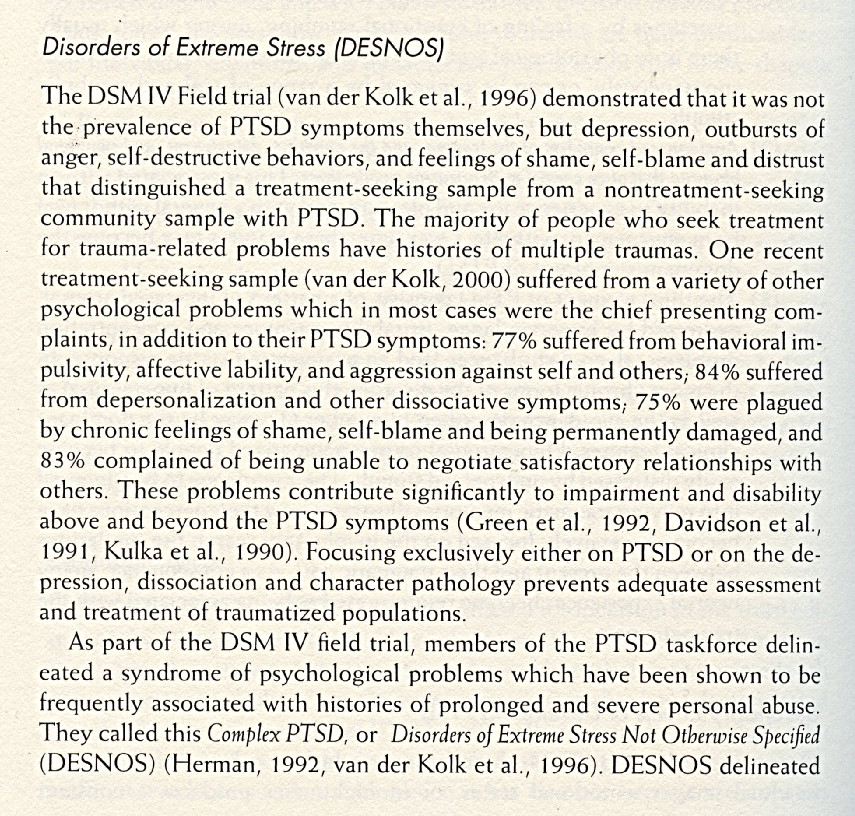
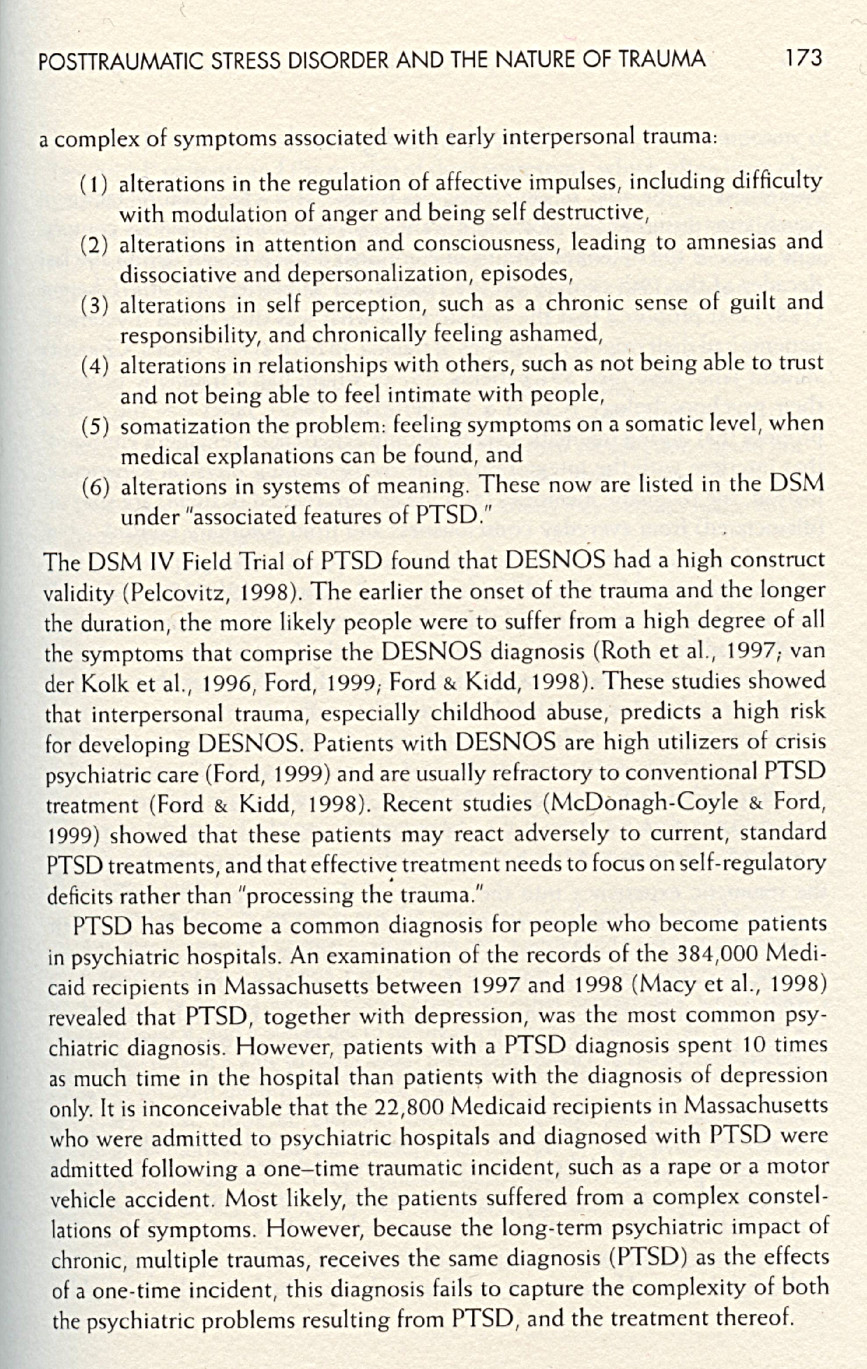
This second post about Posttraumatic Stress Disorder (PTSD) refers again to a book called Healing Trauma: Attachment, Mind, Body, and Brain – Hardcover (Jan 2003, W.W. Norton and Co.) by Daniel J. Siegel, Marion F. Solomon, and Marion Solomon, chapter 4 (pages 168-195) written by Bessel A. van der Kolk:  “Posttraumatic Stress Disorder and The Nature of Trauma.”

Today’s post follows the November 28, 2009 post

+PTSD AND SEVERE CHILD ABUSE SURVIVORSHIP – PART ONE

PLEASE NOTE:  Do not take anything I say as a reason to alter any ongoing treatment, therapy or medication you are receiving.  Consult with your provider if you find something in my writing that brings questions to your mind regarding your health and well-being.

+++++++++++++++++++

The following is taken from pages 172 of the above text.  I will consider this information in my writing below:

+++++++++++++++++++

It is now easier for me to work with this information because I have described my own version of an alternative way of thinking about the ongoing complications severe infant-child abuse and malevolent treatment survivors face as a direct result not only of the specifics of the actual horrific traumas they lived through, but also because of the very real physiological changes that surviving these traumas created in their infant-child growing and developing body.

(see yesterday’s November 29, 2009 post

+TRAUMA ALTERED DEVELOPMENT (TAD) – A NEW DESCRIPTIVE CONCEPT)

++++

An accurate primary and initial assessment of TAD for those of us who are Infant-Child Severe Maltreatment Survivors would allow us to know immediately how the changes our body-brain had to make created us to be different from ‘ordinary’ people who do not have the history of trauma that we do.

In this TAD assessment two critical resiliency factors would also need to be assessed because these two resiliency factors (one primary, the other secondary) are known to have the ability to nearly completely modify and modulate the power that early trauma has to change our developing body-brain.

The presence of safe and secure attachment to some early primary caregiver is the most basic and important resource an Infant-Child Severe Maltreatment Survivor had.  The current assessment tools available to assess adult secure and insecure attachment need to be simplified, refined and made accessible to the public.

Stemming from the degree of safety and security available through early caregiver attachment, the ability to play is a secondary but critical resiliency factor that impacts an Infant-Child Severe Maltreatment Survivor’s body-brain development.  I believe that assessment criteria and tools to measure this critical factor consistently and accurately can be developed and also made available to the public.

++++

NOTE:  In our new age of technology, the public has the right to be able to access critically important information about themselves and how their early infant and childhood experiences impacted their development.  At present this information remains ONLY available within ‘clinical’ settings, if even there.

++++

As far as I am concerned, anything and everything that is currently lumped under so-called ‘psychological’ categories belongs to the sinking Titanic of dark age medical model thinking that I referred to in yesterday’s post.

Until Trauma Altered Development (TAD) is assessed at the bedrock level of how Infant-Child Severe Maltreatment Survivors changed at their own bedrock (molecular) level, any attempt to moderate so-called ‘symptoms’ remains a crap shoot in the dark.

TAD assessment can connect the consequences of early trauma to altered physiological changes that an Infant-Child Severe Maltreatment Survivor’s body was forced to make to best ensure continued survival in early malevolent environments,

++++

Early caregiver attachment experiences from birth build the body-brain we will live with for the rest of our lives.

Van der Kolk (scanned text above) writes that it is not usually the symptoms of PTSD itself that brings those seeking help to a clinical setting.  Rather, he says that it is “depression, outbursts of anger, self-destructive behaviors, and feelings of shame, self-blame and distrust that distinguished a treatment-seeking sample from a nontreatment-seeking community sample with PTSD.”

Through an accurate TAD assessment, any ongoing difficulty an Infant-Child Severe Maltreatment Survivor has with emotions and social interactions can be traced to inadequate early caregiver interactions in a malevolent environment that built for the survivor an entirely different early-forming right-limbic-emotional-social brain.

When the foundation of the early forming right brain is altered because of maltreatment, the Infant-Child Severe Maltreatment Survivor’s later developmental stages involving shame, guilt and embarrassment will also be off course from ‘ordinary and optimal’ and will cause altered patterns of development in the body-brain.

++++

Van der Kolk states:

The majority of people who seek treatment for trauma-related problems have histories of multiple traumas.”

OK, I can certainly understand this, but here again, as I mentioned above, I do not agree with applying so-called ‘psychological’ and ‘symptom based’ medical model diagnostic thinking used in the author’s next statements.  I absolutely disagree with ever using terms such as ‘character pathology’ in reference to Infant-Child Severe Maltreatment Survivors!

One recent treatment-seeking sample…suffered from a variety of other psychological problems which in most cases were the chief presenting complaints, in addition to their PTSD symptoms:  77% suffered from behavioral impulsivity, affect lability, and aggression against self and others; 84% suffered from depersonalization and other dissociative symptoms; 75% were plagued by chronic feelings of shame, self-blame and being permanently damaged and 93% complained of being unable to negotiate satisfactory relationships with others.  These problems contribute significantly to impairment and disability above and beyond the PTSD symptoms….Focusing exclusively either on PTSD or on the depression, dissociation and character pathology prevents adequate assessment and treatment of traumatized populations.”

TAD assessments will clearly show that ‘impulsivity’, ‘affect liability’, most aggression, and dissociation are directly connected to changes in how an Infant-Child Severe Maltreatment Survivor’s nervous system, including their brain – and here, particularly their right brain – formed differently from ‘ordinary’ due to growth and development in trauma.

Chronic feelings of shame, self-blame and being permanently damaged” are also directly connected to trauma through developmental changes an Infant-Child Severe Maltreatment Survivor’s nervous system, including their brain – and here, particularly their later forming (after age one) left brain – had to make while developing in an early malevolent, trauma-filled environment.

Rather than referring to these changes as ‘character pathologies’, which in my thinking is the maltreatment, abusive stance taken by the medical model toward Infant-Child Severe Maltreatment Survivors, a TAD assessment can accurately and specifically pinpoint the origin of these changes in the body-brain and describe the consequences of them.

Receiving an accurate TAD assessment will show us exactly how our body was forced to adapt during our development through trauma so that we could survive it.   Yes, I do believe we KNOW we are different from ‘ordinary,’ but we are not ‘permanently damaged’.   We ARE permanently changed.

The changes Infant-Child Severe Maltreatment Survivors experience are fundamental and profound!  Everything about us was subject to adjustment for our trauma survival – our body, our nervous system and brain, our immune system, our mind, and our connection between our self and our self and between our self and the entire world around us.  NOT facing the truth and discovering the facts through TAD assessment will NOT resolve the difficulties we face with our continued survival into adulthood.

The only long term solution societies have is to STOP Infant-Child Severe Maltreatment!!!  Part of that solution is to provide the kind of TAD assessment Infant-Child Severe Maltreatment Survivors need, and to make available to us the resources necessary for us to live the best life we can in spite of the changes we had to make in order to stay alive because nobody STOPPED the Infant-Child Severe Maltreatment that happened to us.

It is the pathological character of the society we were born into that allowed what happened to us to happen at all, let alone allowed it to continue to the degree that trauma changed our physiological development.  If there is any self blame to be had, it is on the level far beyond OURS as the Infant-Child Severe Maltreatment Survivors.

++++

That the grand sinking Titanic of the archaic dark age’s medical model about Infant-Child Severe Maltreatment Survivors has at least THOUGHT about throwing us a life boat becomes apparent in van der Kolk’s next words:

As part of the DSM IV field trial, members of the PTSD taskforce delineated a syndrome of psychological problems which have been shown to be frequently associated with histories of prolonged and severe personal abuse.  They call this Complex PTSD, or Disorders of Extreme Stress Not Otherwise Specified (DESNOS).”

Great!  A life boat full of holes!  Gee, why are we NOT thankful for that?

A syndrome of psychological problems” be damned!  Infant-Child Severe Maltreatment Survivors do not suffer from a ‘syndrome’, and ours are not ‘psychological problems’!  For all the reasons I have repeatedly described, we simply need a TAD assessment that will tell us HOW our little body adapted down to our molecular level during our development in the midst of, and in spite of, toxic malevolent trauma.  Then we need resources that inform us how to live NOW with these profound trauma-caused changes that happened to us THEN.

The author continues:

DESNOS delineated a complex of symptoms associated with early interpersonal trauma.”

Again, we don’t have ‘symptoms’.  We have a different body-brain-mind-self that adapted to survival in a malevolent world and caused us to have Trauma Altered Development (TAD).

We don’t have symptoms, we have consequences.  Every single item in the list of so-called ‘complex symptoms’ (see them in the page scan below) that van der Kolk describes are directly connected to our TAD.  EVERY SINGLE ONE OF THESE ITEMS exist within us because of changes our body-brain was forced to make.  They are consequences of the changes our body had to make through our TAD.

The only real progress in the right direction I can see – given to us like faulty patches to a sinking life boat thrown to us from a sinking ship – is that at least an association ‘with early interpersonal trauma’ is finally being considered in the current medical model thinking.

But this tiny droplet of hoped for healing balm offered by the creation of a construct named “Complex PTSD, or Disorders of Extreme Stress Not Otherwise Specified (DESNOS)” is not what we Infant-Child Severe Maltreatment Survivors need in my book.

We need our entire society to understand and accept the truth that the Infant-Child Severe Maltreatment that happened to me and others – and continues to happen to children around us today – is nothing short of a form of parental-selected genocide that did not fulfill its intent to completely destroy us.  We are Infant-Child Severe Maltreatment Survivors because we are still alive, and we ONLY SURVIVED because we were able to adapt our body throughout our Trauma Altered Development to and within the malevolent environments that formed us.

++++

The rest of van der Kolk’s words (below) simply bring into my mind the image of the author being like a modern day Paul Revere, whose horse’s hooves pound along the streets of our nation as he screams a warning.  I am certainly not convinced, however, that even this author knows which message it is that most needs to be delivered.

The Trauma Altered Development that Infant-Child Severe Maltreatment Survivors experienced had no choice but to build itself into every part of who we are BECAUSE we live in a body, and our body had no choice but to change so that we could stay alive.

To describe any aspect of what happened to us in terms of a ‘diagnosis’ or a ‘symptom’, ‘complex’ or not, to call us ‘maladjusted’ or to tell us we suffer from any form of a ‘character pathology’ or ‘psychological problem’ is to continue to condemn us with stigmas and stereotyped prejudice which makes as much sense as applying all of the above labels to someone who is tall versus short, or who has red hair rather than blond.

If we wish as a society to remain in the dark ages about the consequences of Trauma Altered Development for Infant-Child Severe Maltreatment Survivors then at least we should have enough honor and common sense to admit it.  If we are appalled by the ignorance that is still applied to our circumstances, today is the day we can enlighten ourselves and get on with the legitimate task of figuring out how to accurately assess Trauma Altered Development so that we can begin to live well as the changed, extraordinary Infant-Child Severe Maltreatment Survivors that we are.

Our Trauma Altered Development did not affect WHO we are in the world, but it absolutely changed HOW we are in the world.  It is up to all of us to learn what that means.

+++++++++++++++++++

The following is taken from pages 173 of the above text:

Again, it is not a picture of ‘long-term psychiatric impact’ nor a ‘diagnosis’ that Trauma Altered Development affected Infant-Child Severe Maltreatment Survivors need.  We need to understand the changes our body had to make to guarantee our survival and specifically how those changes affect us, and specifically how to improve our quality of life and well-being in the world in spite of our TAD.

+++++++++++++++++++++++++++++++++++++++++

Please feel free to comment directly at the end of this post or on

+++++++

Your Page – Readers’ Responses

++++++++++++++++++++++++++++++++

+CRIMES AGAINST CHILDREN – WHO ARE THEIR PROTECTORS?

++++++++++++++++++++++++++++++++

Something so troubles me that I cannot sleep tonight.  Could it be the sound of hurt and scared children crying, if only silently in their wounded hearts?  Who is protecting these children?

++++++++++++++++++++++++++++++++

A new page posted along the top of my blog has been added JUST FOR READERS to write any trauma-related thoughts that come to mind — either directly in response to something I have posted — or not!

Please feel free to click on the COMMENT link at the bottom of this new page that will always be at the top of the blog — and write!  Your words are important!

++++++++++++++++++++++++++++++++

Your Page – Readers’ Responses

++++++++++++++++++++++++++++++++

++++

Remembering what I wrote yesterday about the lack of playfulness and the ability to play being directly connected to the presence of trauma in a child’s environment, reading this new report about our nation’s children’s exposure to violence greatly troubles me.

++++

Please take some time to look at the report’s information, and also check out the information at the Safe Start Center website!

++++

The Office of Juvenile Justice and Delinquency Prevention published a new report that discusses findings from a survey examining children’s exposure to violence. The survey is the first to attempt to comprehensively measure exposure to violence for nationally representative sample of 4,549 children younger then 18 across major categories. Some of these categories were:

  1. Conventional crime, including robbery, theft, destruction of property, attack with an object or weapon
  2. Child maltreatment, other than spanking on the bottom
  3. Sexual victimization
  4. Witnessing and indirect victimization
  5. Exposure to family violence
  6. School violence and threat
  7. Internet violence and victimization, including Internet threats or harassment and unwanted online sexual solicitation

Results suggest that most children in the U.S. are exposed to violence in their daily lives, with more than 60 percent of the children surveyed having been exposed to violence within the past year. Nearly half of the children surveyed had been assaulted in the previous year, and nearly 1 in 10 witnessed one family member assaulting another.

Safe Start Center is dedicated to teaching about the harmful effects of the exposure of violence on children. Safe Start’s website is packed with information and resources for parents and the community to help our children stay safe. To read the full report of to learn more about the Safe Start Initiative, visit www.safestartcenter.org.

++++

About the Crimes Against Children Research Center

The mission of the Crimes against Children Research Center (CCRC) is to combat crimes against children by providing high quality research and statistics to the public, policy makers, law enforcement personnel, and other child welfare practitioners. CCRC is concerned with research about the nature of crimes including child abduction, homicide, rape, assault, and physical and sexual abuse as well as their impact.

++++

Here, also, is some more information on borderline personality disorder put together by —

In the Spotlight | More Topics |
Kristalyn Salters-Pedneault, PhD
When we talk about the impact of BPD, we’re not just talking about symptoms; BPD also has a major impact on your quality of life. From work, to relationships, to your physical health, think about the ways that BPD may be interfering for you.
In the Spotlight
Your Life with BPD
What is it like to live with BPD? It’s not easy. Intense emotional pain, and feelings of emptiness, desperation, anger, hopelessness, and loneliness are common. But life with BPD is not hopeless, and you can create a life full of quality and meaning.
More Topics
BPD and Relationships
Many of the symptoms of BPD can have direct impact on relationships, and other symptoms have an indirect (but not necessarily less disruptive) influence.
Physical Health Problems and BPD
People with BPD are more likely to report a variety of physical health problems, and are more likely to need to be hospitalized for medical reasons, than those without BPD

++++++++++++++++++++++++++++++++

+PLAY AS AN INDICATOR OF SAFETY AND SECURITY IN A BENEVOLENT WORLD

+++++++++++++++++++++++++++++++++++++++++

Mothers have evolved throughout the millennia to play with their infants.

Having the ability to engage in healthy play has evolved through the millennia to build healthy body-nervous system-brain-mind selves in our species.  Play happens when the world is a friendly place to be.  Play TELLS us that the world is a friendly place to be.

When the environment surrounding mother and infant-child is benevolent, healthy play is most usually present.  This benevolence in the environment is then built into the growing-developing offspring.

When the environment surrounding mother and infant-child is hostile, toxic, lacking in essential survival qualities and therefore is malevolent, a mother’s ability to engage in healthy play with her offspring is interfered with.

Thus, the absence of healthy playfulness between mother and offspring signal the developing infant-child on every physiological level that trauma exists in its world.  The offspring will then be forced to change and adapt to the best of its physiological abilities to prepare itself for a lifetime within a malevolent world.

++++

Healthy playfulness between a mother and her offspring only happens to the degree that the environment is safe and secure enough to allow this play to happen.

If a mother grew and developed in her own early childhood in a world that signaled her body-nervous system-brain-mind self that the world was malevolent, she is most likely carrying unresolved trauma within herself that then signals to her offspring that the world is malevolent.  Her offspring will then have to change according to the trauma-present-in-the-world message just as its mother did.

Both mother and infant-child will then suffer from a lack of safety and security perceived as permanent and real by their physiological development.  When trauma is present, healthy play is interfered with because our evolution has designed our species so that degree, quality, kinds of, presence of healthy play and playful attitudes directly indicate the degree of either benevolence or malevolence in the world.

++++

I am not talking about play as we might think about it in today’s world.  This kind of play has nothing to do with toys or ‘stuff’.  Healthy play that signals to offspring the condition of the world is about direct face-to-face interaction between mother and infant-child.  The presence of a world safe and secure enough to allow for this kind of play between early caregivers and offspring has operated throughout our evolution.

It was only when the world because safe and secure enough, adequate and benevolent enough for this level of play to grow and thrive that humans ever achieved powers of speech at all (only about 140,000 years ago).  The physiological systems within our body and brain had to have already evolved sophisticated organizational and orientational abilities to have ever allowed our powers of speech to manifest in the first place because speech uses all those preexisting abilities.

Any time trauma happens it always disrupts ongoing coherent life.  If trauma cannot be resolved, consequences happen.  Dissociation represents one of the fundamental consequences of a being’s inability to resolve trauma.  Dissociation continues to affect a mother because its very existence means that something malevolent occurred that was not able to be resolved.

A dissociating mother thus communicates her state of unresolved trauma to her offspring primarily through an interruption in her ability to engage in healthy play and playful attitudes with her offspring.  The key to healthy playfulness between a mother and her offspring is that it is APPROPRIATE.

Appropriate, and therefore healthy play and playfulness between a mother and her offspring, the kind of play that then signals the offspring to grow an entire body geared for life in a benevolent world, happens when the mother’s entire focus is on fostering the well-being of her infant-child.

Mother’s have evolutionarily evolved to respond appropriately to their offspring so that their play-filled responses do not overwhelm, over stimulate or under stimulate them.  When a mother has experienced enough trauma during her own development that incoherency in the form of dissociation has been built into her entire body, she is not likely to be able to operate from this optimal, benign, benevolent-world-condition state within herself.  She will then communicate her own preexisting, unresolved trauma states directly to her offspring.

++++

Terror, pain and trauma interrupt play and the ability to play.  This lack of play and the ability to play then acts as a direct signal that communicates malevolence in the world.  When healthy play and playfulness exist, they happen in a safe and secure world, not in the midst of trauma.

A mother who does not carry unresolved trauma into her interactions with her offspring will be able to focus on the well-being of her offspring and demonstrate the benevolence of the world to her developing infant-child through her healthy, appropriate play and playfulness with it.

These interactions operate from birth to form first the right, limbic, emotional, social brain.  As the infant-child continues to grow, the foundation of play or its absence, built within its body-nervous system-brain-mind-self will further influence the development of its later-forming left brain, the connection between the two hemispheres of its brain, and the development of its higher-processing cortical abilities.

A non-dissociating mother is able to have appropriate hopes, dreams, wishes and desires for the well-being of her offspring.  She will automatically be able to orient herself and organize her interactions with her offspring.  Her goal, destination, direction and purpose regarding her offspring will be benevolent.  This benevolence will be communicated through safety and security that manifests itself in healthy play and playfulness toward her offspring.

A dissociating mother will experience breaks in her ongoing interactions with her offspring that will vary in degree according to the changes that had to happen to her during her own development in a malevolent early environment.

In my case, my mother’s dissociation toward me was extreme, fundamental and complete.  In her psychosis she believed that I was evil, that I tried to kill her while I was being born, that I was not human, and that I was sent to be a curse on her life.  Her psychotic dissociation in-formed every interaction she ever had with me from the time I was born.

My mother’s unresolved trauma, manifesting itself in her dissociation, prevented her from ever being able to respond to me with anything like appropriate, healthy play or playfulness.  She was not able to consider my well-being because she could never understand that I was a separate entity from her.  I was merely and continually the recipient of her slit-off projection of her intolerable perception of her own badness.

She not only could not have playful interactions with me that I needed to build a non-trauma centered body-nervous system-brain-mind-self, but her psychosis was so severe that she prevented ME from ever being able to play at all.

++++

The absolute disturbance in the necessary operation of play in my childhood directly ties into my own dissociation.  The trauma I experienced in the malevolent environment of my childhood could not possibly be integrated into a coherent self.  However, as a mother to my own children I was able to know they were separate beings from me, and I was able to focus as much as I possibly could on them and on the development of their well-being.

In other words, I was able to organize and orient a ‘mothering self’ within me that existed to foster the development of my children.  Because I could do this, I could offer to them enough play and playfulness that it communicated to them a relative lack of trauma in the world and enough of a sense of safety and security in the world that I did not pass my unresolved trauma onto them.

They did not have perfect childhoods because the unresolved trauma and the changes that had to happen to me so that I could survive my childhood affected every other aspect of my being-in-the-world, and therefore DID affect them.  But these problems were MINE and I was able to keep them myself.  I did not force them INTO my children the way my mother forced her unresolved trauma INTO growing and developing me.

++++

As we return in our thoughts to consider our infancy and childhood through the lens of playfulness and play or its absence, we can become much more clear about how our caregivers’ unresolved trauma — or the absence of it — operated to directly communicate to our growing and developing body on all its levels what the condition of the world was like.

If appropriate and healthy play and playfulness was there for us, it is during those experiences that we were developing in an ‘ordinary’ way.  If it was absent, some degree of trauma was present, and we were forced at those times in our development to try to adapt to that malevolency.

Who we are today and how we are in our bodies in the world is directly connected to play and playfulness because it is only in times of safety and security that play exists at all.

+++++++++++++++++++++++++++++++++++++