+I FOUND MYSELF TODAY AT HALF MY AGE – MY AGE 29 JOURNAL ENTRIES – 30 DAY ROAD TRIP TO FIND MYSELF

++++++++++++++++++++++++++++++++++++++

I went visiting around on Borderline Personality Disorder (my mother = extremely abusive Borderline) blogs this afternoon.  I got the sense that many readers and posters are probably at a completely different stage of their lives than I am.  What do I remember of my own years of being a mother with young children in my home?  What do I remember, really, of being a much younger adult than I am today?

I decided to randomly pick one of my journals from the many I have written over the years of my adulthood and have never again opened since the day I wrote them.  I ran my fingers over the journals, picked one, pulled it out an opened it.  It turns out that it was written when I was exactly half of my lifetime younger than I am today.

I went through my 7-week alcoholism treatment program in October and November of 1980.  This journal’s first entry is from February 17, 1981, just 3 months after my completion of treatment and entry into the new-found world of my first steps into ‘recovery’.

I had left my children in the care of their father, my husband, and left on a 30-day Greyhound bus trip by myself.  The pages in the following link were written during that trip.  I returned to see my first husband’s parents on this trip.  I returned to the ocean where I met and fell in love with their son when I was 18.  I returned to the town on the beach where our daughter was conceived.  I was trying to heal the hole in my heart that relationship gave me.

I went to see my sister and her family, and we talked about all kinds of things, including about being mothers.  We had not spent any time together as adults, and this was the first time I had confronted any of my feelings about my childhood.  In fact, I was brand new to the concept of feelings at all!  The Minnesota model of alcoholism treatment pioneered the idea that addictions are ‘feeling diseases’.  My journal writings on this 30-day journey show the new baby-feeling-Linda’s first steps into a world I should have been introduced into from the time I was born.

++++++++++++++++++++++++++++++++++++++

*Age 29 – Greyhound bus trip started February 17, 1981 – Journal entries

++++++++++++++++++++++++++++++++++++++

+THE TOUGH FACTS: MY MOTHER ABUSED ME BECAUSE SHE LIVED LONG ENOUGH TO DO IT.

++++++++++++++++++++++++++++++++++++

Sometimes when I write I feel the presence of my Siamese twin.  One voice tries to speak while the other is full of silence.  One voice is bold and rushes forward, sword raised in her hand, while the other twin, so timid, hides under the bed.

One voice says, “I know what the ancient will of our species is.”  The other voice says, “Don’t mention it.  No words are meant to speak that will in this world today.”

One voice says, “My mother lived too long.  She was supposed to die much before she did.  Her time came and went and yet she endured.”  The other voice says, “That’s not for you to judge.”

One voice says, “What happened to my mother when she was a little girl ended up turning her into a monster.  It’s like what happened to Hitler.  His mother birthed him, but she should not have raised him.  My mother was not meant to raise me.  In fact, I doubt I was meant to be born at all.”

The other voice?  I don’t hear her.  She’s too far away from me now.  After all, she’s hiding underneath a very big bed and I am busy here in the other room.

++++

When times are very hard in childhood, a growing person changes.  That’s the ancient will of our species.  It only matters that any person lives long enough to produce offspring if possible, so there will be somebody left to carry us on.

It does not matter who it is that raises such children.  It is not meant to be that the changed people raise them.  It is better that unchanged people raise them.

The unchanged people were loved from the moment they were born.  Someone was there to take care of them.  They took one fork in the road that began in a good world and moved forward into the same.

The ones that have to change were born into a world where nobody was there to love and take care of them.  That told their body to follow the other fork in the road, the fork that says “The world is bad and is bound to get worse.  Make a different body now, one that can live long enough to make a baby.  You won’t live long enough to raise it.”

++++

Only somebody changed the rules our species has known for millions of years.  No longer do these changed ones expire as they once did in a world that was as bad later on as it was at their beginning.  These changed ones continue to live, past when their body was programmed to end.  These changed ones end up raising their children when they shouldn’t have to.  They were not designed for it.  They only pass on the same trauma that built them, and the dark road overflows with too many people.

++++

Our species only cares that babies be born.  It meant for the good-fork road people to raise them.  Our species has always held this hope, that someone on the good-fork road could raise the children for a better world.  Our species has always believed in a better world coming.

But we are slipping up now.  We no longer seem to believe in the good-fork-bad-fork road.  We no longer believe that our genetic memory has any wisdom, that it has the power to change us if our early beginnings are more bad than good.  We no longer believe that there are two main kinds of people – those who survived a bad beginning and changed to survive it – and those that had a good beginning who could simply just get on with the business of moving into a good future without having to change back to the ‘old way’ that our genetic memories remember.

++++

I am a child of a changed one.  Nobody from the good-fork road took me away from her and raised me in a good world like they were supposed to so I wouldn’t have to change, to adjust to a bad world.

People are confused now.  They don’t even want to admit that there is a difference between a bad world childhood and a good world childhood.  They don’t want to understand that the good of our species still governs how the bad childhood people have to turn out.  They want to join my Siamese twin sister and go hide under the bed.  Or they just want to get on with their own lives of good-fork-road play.

++++

It is an upside-down world in which parents kill their babies, but nobody ever thinks about the fact that those parents should not have been allowed to keep their babies in the first place.  In our older, more ancient and wiser days, our species knew this.  I am telling you why.  Parents who cannot provide a good-fork in the road childhood for their own children simply were never meant to keep them.  These changed parents in the old days would not have lived in a world good enough for very many to survive in at all, and the few that did survive had to take the best care possible of the little ones or none of us would be here today.

Somebody else is supposed to be raising those changed parents’ babies.  The will of our species has determined that.  It’s the same will that has kept our species alive for all these millions of years.  We are supposed to be wise, not dumb, ignorant or stupid.

++++

Conditions in the world build these two roads.  The good-fork road is not the same thing as the bad-fork road, and the people on these two roads are not the same, either, because little people raised by bad-fork changed parents have to change themselves or they will not survive long enough to have babies of their own.  One road is like Easy Street.  The other road is very, very hard and makes the people who have to be on it suffer very much.

When you are very little, if nobody takes you away to a better place and you have to suffer that much, your body and your brain have to change as you grow up or you will die.  In the olden, ancient days if you had to make these kinds of changes it was a sign that the world was very hard and you probably would not live very much longer.

At least being able to make these changes let you live a little longer, but they also meant back then that somebody else who didn’t have things quite this hard would probably be able to raise your children, if you lived long enough to have any, better in a better world.  Then your children wouldn’t have to change so much or maybe not at all.  I can see that people now have forgotten how this used to work and what it meant.  Now the changed ones don’t die so soon and their children are left to just suffer on that hard road so that they have to change, too.

What has happened to our species that we no longer know which is which?  Are there just too many of us now, and our old, ancient wisdom isn’t important any more?

It all seems very clear to me because I can write this with a 14 year old mind because my grown up Siamese twin is still in there hiding under the bed.  I know what it’s like to have a bad-fork in the road mother.  I remember.  I know somebody was supposed to take me away from her and raise me on the good-fork road.  Why didn’t anyone do that?  Did they forget what their ancient wise specie memory told them?  I guess they just choose not to pay it any attention at all.

++++++++++++++++++++++++++++++++++++

I do not wish to leave the information contained in these links behind as I continue with my posting.  Please consider them for your study:

+CRY FOR THE NIGHTBIRDS – SOME CHILDREN NEED TO BE SAVED FROM THEIR PARENTS

++++++++++++++++++++++++++++++++++

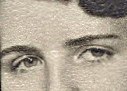
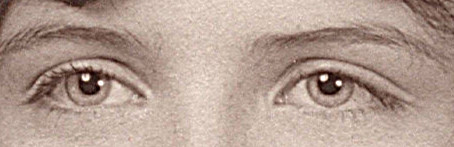
The strangest thing is, for all the many, many, many moves, for all the thousands of miles traveled, for all the years in storage, within this disarrayed collection of my mother’s papers, letters and photographs I am going through, I found my mother’s and my senior high school pictures  — having been somehow brought together at some point in time so that they were stored as I found them this week — laying face to face.

++++++++++++++++++++++++++++++++++

*1943 – Mildred Ann Cahill Lloyd – Senior High School Picture

1943 - mother's eyes

++++++++++++++++++++++++++++++++++

*Age 17 – Linda’s Senior High School Picture 1969

1969 age 17 - my eyes - senior high school picture

++++++++++++++++++++++++++++++++++

I do not like the look of my mother’s eyes.  I do not like the look in my mother’s eyes.  Those readers who were exposed to the insanity of violent rage attacks against them by an adult when they were children no doubt KNOW that look that comes into the face of such an attacker.

I didn’t think about it when I was a child, but when I was 20 I took my young daughter and returned home to visit my family where they were living in Tucson at the time.  I won’t describe the details of what happened there right now, but I saw that look — again — come into my mother’s eyes and I was able to think to myself, “That woman looks like she is possessed.  She looks like a demon has taken over her body!”  The visit did not go well, and I and my daughter escaped.  I never again returned to my parents’ home.

++++++++++++++++++++++++++++++++++

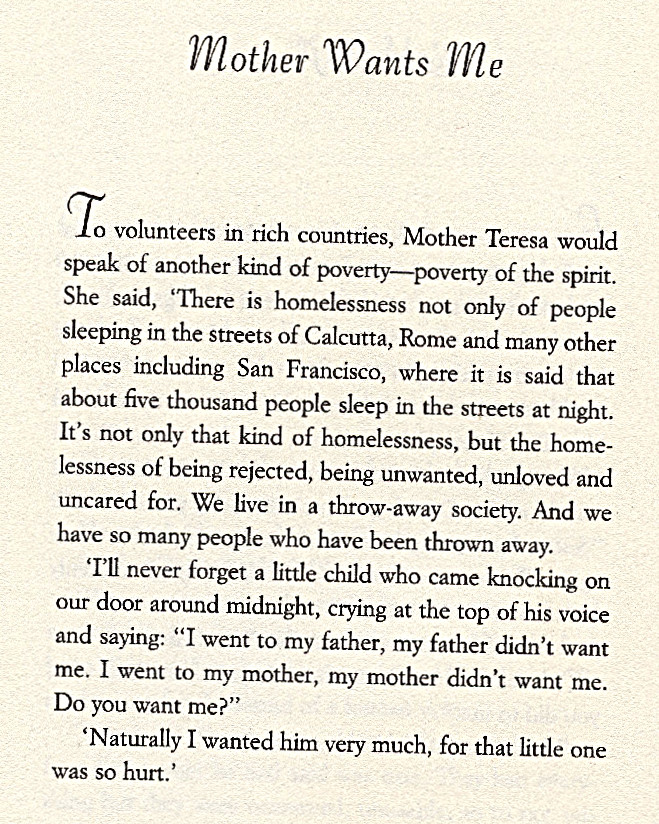
Mother Teresa’s Reaching Out in Love: Stories Told by Mother Teresa by Edward Le Joly and Jaya Chaliha, 1998 (page 66)

To whom -- and with whom -- do the children belong?

++++++++++++++++++++++++++++++++++

I KNOW no child should ever look this sad.  Yet compared to other abused and neglected children, I had it good.

I grew up in a culture that 100%  supported what my mother did to me for 18 years.  I grew up in a culture that 100% supported my father’s enabling of my mother’s abuse of me.  How do I know this to be true?  Because nobody — ever — not one single solitary TIME – EVER looked into my eyes, saw my suffering, and so much as said a word.  Not once did anybody question.  Not once did they blink an eye.  Obviously they were in support!

++++++++++++++++++++++++++++++++++

Click here to listen:

STEVIE NICKS “NIGHTBIRD” LIVE WITH LORI NICKS 1983

++

Nightbird Lyrics

“…And when I call
Will you walk gently
Thru my shadow
The ones who sing at night
The ones you dream of
The ones who walk away
Capes pulled around them tight
Cryin’ for the night
Cry for the nightbird tonite

And the darkened eyes
Thru the net of the lace
In the darkness
It’s hard to see her face
Pulls back the net
And you feel the touch
Of her fingers
And you see she turns the eyes
And you see the eyes of a nightbird
The ones you dream of
Finally the nightbird
Tonite”

++++++++++++++++++++++++++++++++++

This post is dedicated to the nightbirds, to every child who has ever cringed in terror, screamed through tortures, sobbed silently in the darkness of the night without anyone there to hear, to care, or to save them.  It is dedicated to all the adult nightbirds who suffer the same as grownups because of what happened to them THEN still happens to them NOW.

It is not singing for these nightbirds that we need to do, though.  We need to pay attention, look into their sorrow filled eyes, and DO SOMETHING to help them.

I have though long and hard about my next statement:  There are times when a child or children in a family cannot be loved by their parents.  These children, when abuse, violation, violence, and severe neglect is present, need to be permanently removed from their home of origin and placed into families where love is truly present, where safe and secure attachments can be formed, where damage done to these children can hopefully begin to be rectified, and where hope for a better life can be born.

Nobody can ever make anybody love anyone.  It is not humanly possible.  If a parent does not love a child it is because they cannot.  We, as a society, are 100% supportive participants in any abuse that happens to children if we refuse to face this fact and take action on behalf of unloved children.

Children are not objects.  They are not possessions.  Children do not belong to their parents as if they were.  Parents do not own their children.  In my book, children’s rights to get their basic needs met and their rights to be loved and cherished in a safe and securely attached environment completely outweigh the rights of any parent to abuse and neglect them.

That we have an incompetent and inadequate system to care for the needs of unloved children is the problem that needs to be addressed.  No child should ever have to suffer because of adult lack of preparedness.  It is every adult in a society that fails an abused, neglected and unloved child, not just the parents.

I can claim all I want to that I would not have forgone growing up with my siblings.  I can say in the end it was all O.K. with me because I was able to meet, greet and fall in love with the wilderness of our homestead.  At the same time I can see the truth.  It was no kind of childhood at all to be a little one who had only a cold stone snow shrouded distant and remote mountain peak that was the only source I had of comfort and connection.  I needed caring humans.  I needed to be loved.

++++++++++++++++++++++++++++++++++

We can do nothing now about what happened to us when we were children.  We can try to learn how to parent our own offspring better.  We can try to help other children now.  We can learn as much as we can about what our deepest needs for love and attachment were as children, and still are.  I do not wish to leave the information contained in these links behind as I continue with my posting.  Please consider them for your study:

++++++++++++++++++++++++++++++++++

+THE COMPLEXITIES OF SECURE AND INSECURE ATTACHMENT – DO-IT-YOURSELF STUDY LINKS

++++++++++++++++++++++++++++++

One important point to realize about insecure attachment disorders is that in effect, our on-off switch governing our human relationships is not set right, or is nearly broken completely.  We rarely, if ever, truly feel safe, secure and connected to others.  This leaves us feeling pain and anxiety much of the time (Yes, we feel that Substance P).

A securely attached person does not have their attachment system ON all of the time.  It will turn on and off appropriately.  If an attachment system cannot turn itself on and off correctly, none of the other systems will work correctly, either (exploration, caregiving, sexuality).

++++++++++++++++++++++++++++++

In our ‘modern era’ humans seem tempted to believe we are above the rules and laws of nature.  We are not, and if enough of these rules and laws are breached early enough in our development, the ensuing trajectory of all our future development will be sent off into an unhealthy, survival-only-based for the short term, direction.

Our species has evolved over millions of years in such a way that there is a narrow margin for what is most needed for our best development.  As we change how we raise our children from an extended family, tribal and community base, we are placing ourselves and our children at ever increasing risk for suffering from insecure attachment disorders with all their accompanying disruptions for the life span.

What happened to my mother and my father in their earliest beginnings set in motion a chain of predictable consequences that culminated in the 18-year torturous childhood I endured.  They both had insecure attachment early histories with resulting insecure attachment disorders.  Those disorders let the dark rather than the sunshine in to my childhood.

++++++++++++++++++++++++++++++

There is nothing easy about writing this post.  I am tempted to offer a blanket apology for the disarrayed information I am going to post links for you today.  What I WANT is polished, completed perfection.  What I WANT to present to you would look like the information contained in my October 1, 2009 post +CHILDHOOD DISSOCIATION, DEPERSONALIZATION, DEREALIZATION – I NEVER HAD A CHOICE TO BE OR NOT TO BE about the symptoms of childhood dissociation.

I was envious of those few succinct and perfectly chosen words that presented that information on Guidelines for the Evaluation and Treatment of Dissociative Symptoms in Children and Adolescents written by someone for the International Society for the Study of Dissociation.  Then I realized that these concepts were probably part of what could be called a White Paper.  They were no doubt an accumulation of multiple minds working on a problem that needed a solution, and what is presented is the result of a combined effort.

I had some friends when I lived in northern Minnesota who owned 40 acres of sugar maple trees.  Every spring when the sap began to run their entire family would participate in tapping the trees, collecting the sap, and boiling it down in huge vats until it turned into maple syrup.  It took 60 gallons of sap to create one gallon of syrup.

Thinking about secure and insecure attachment feels like a similar process to me.  I can’t begin to imagine the brilliant genius of the minds of the specialists who discover facts and write about the topic.  What I am presenting today is still — only — a collection of their words as I try to gather enough information, and go over it enough times, that I might begin to glimpse the critical significance of their work.

+++++++++++++++++++

Because the experiences of abuse and trauma I endured during the 18 years of my childhood were so extreme, my search of the ‘ordinary’ literature on ‘dysfunctional’ childhoods did not begin to answer my questions about what happened to me and why.  These links I present today contain what I KNOW is critical information about what put both of my parents at risk for turning into monsters.

In order to begin to understand the life of a tree I would not simply study the tip of the topmost and outermost branches.  To understand the bigger picture I would have to study the whole tree, down to the deepest roots that keep it standing in the sky.  I am not content to rely simply on such terms as ‘mental illness’ or ‘Borderline Personality Disorder’ to describe what I might be able to learn about my mother.  I am not content to simply label my father ‘an enabler’.  Who my parents were, why and how they operated the way that they did toward me, I will never actually know.

Attachment research gives me the clearest and most correct platform I have ever found from which I can begin to understand — and therefore begin to apply informed compassion — to the criminal actions my parents took against me.  It also helps me to understand the most important consequences caused by their actions toward me, and helps me learn how to transform them.

+++++++++++++++++++

Even a quick but dedicated quick scanning of the words contained in the following links will have the capacity to change how you look at yourself, your parents, your relationships.  These words are about how early caregiver interactions — good and bad — form the brain-mind.  It is from the foundation of these early beginnings that all future development of an individual arises, in the same way that all the future growth of a tree begins with the cracking of a fertile seed and the growth down of roots and up of its trunk and branches.

The very bare-bones layout of the information in the links covers the difference between secure attachment (about 55% of our population) and insecure attachment (the other 45%).  Most researchers use one set of words to describe the insecure attachment disorder in infants and another for adults related to the exact same patterns.  I see no reason to do this.  What exists in infancy as a disordered attachment remains for a lifetime unless some specific interventions and applied efforts are made toward trying to change the hard-wiring of the infant brain as it was built in the first place so that it becomes more ‘secure’ later in life.

There are breakdowns within the category of insecure attachment that cover what happens to the 45% of people who have less than an optimal early caregiver brain building interaction period in their infancy.  My guesstimate is that about one-third of this 45% fit into each of the following three main categories.

— There are two ‘organized’ insecure attachment disorders/patterns/systems = Avoidant-Dismissive Insecure Attachment and Preoccupied-Ambivalent Insecure Attachment.   The important word here is ORGANIZED, which is in contrast to the third insecure attachment disorder which is NOT organized.

— This is the disorganized  insecure attachment disorder/pattern/system known as the  – Disorganized-Disoriented Insecure Attachment.  Serious dissociation occurs within this group as well as many of the more serious so-called mental illnesses.

There are at least two other attachment categories that may or may not be recognized in the future as having enough merit on their own to remain distinguished from any of the above categories.  They are the ‘earned secure attachment‘ and the ‘cannot classify insecure attachment‘ groupings.

+++++++++++++++++++

I hope that readers will find something useful in these links.  I am a long, long way from coming up with my own version of a simple, clear and succinct ‘white’ paper. What appears in italics in these links are my own words as I processed these technical writings as I read them.

The main references you will find in these links are as follows as they match my codes for citation page numbers (you will also occasionally find a page number inserted in the middle of some paragraphs to note where in a sentence the page number changed):

Siegel/tdm = The Developing Mind: Toward a Neurobiology of Interpersonal Experience by Daniel J. Siegel

Schore/ad = Affect Dysregulation and Disorders of the Self by Allan N. Schore

Schore/ar = Affect Regulation and the Origin of the Self: The Neurobiology of Emotional Development by Allan N. Schore

+++++++++++++++++++

These writings contain many unfamiliar words.  If you are scanning only, skip them.  Or, do a quick Google search using “Webster define _____.”

I believe that the more traumatic a reader’s childhood was, the more they will benefit from gaining an understanding of this information.   It will improve understanding on a more profound level about what happened to their own self development and the development of their early caregivers.  (I need to specify here that I can make no assumptions about how sexual abuse fits into the picture of secure and insecure attachments.  That is not a part of my story, and I cannot and do not make any statements about it.)

++++++++++++++++++++++++++++++

++++++++++++++++++++++++++++++

+I BEGAN TO WRITE ABOUT MY FATHER AND ENDED UP WRITING ABOUT EVIL

++++++++++++++++++++++++++++++++++++++++++++++

Whenever I try to think through my father’s role in our family, I seem to come back around, again and again, to one thing:  He did his job.  He worked as hard as any man possibly could to support us.  He was not a financial deadbeat dad, and he did not abandon us.

This is important.  When I look at these early California pictures I see that we looked like the perfect family.  Gorgeous parents, gorgeous kids, nice houses.  Our family did not fit the poverty stricken profile, even though my parents’ later decisions including homesteading, continual moving, and addition of more children to the family left us with thin resources that certainly placed us on the ‘poorer’ end of the spectrum in terms of food we ate and clothes we wore.  But we did not starve.  While we usually lived in over crowded conditions, we had a roof over our heads.  When push came to shove, somebody went to the doctor.

I think about my mother’s home of origin where past the age of 5, after my mother’s father lost everything in the stock market crash of 1929 and her mother divorced him, it was my educated, motivated and capable grandmother who consistently worked to support herself and her children.  I tie two factors together when I think about how utterly incapable my mother was throughout her lifetime of being able to financially support herself.  If our financial care had been left entirely to my mother as a single mother I know for a fact we would have been in terrible, dire trouble.

I have no way to verify any facts that lie behind the stories I heard growing up about my father’s childhood.  Supposedly my father had been a late, unwanted child.  He was ignored by his mother and raised nearly exclusively by his older sister, Olive.  My mother for some reason despised Olive, and I heard thousands of times in my childhood how much I looked and acted like her.

Right before my father’s brain surgery in the fall of 1990 he came through Albuquerque, New Mexico where I was attending graduate school and my sister had lived for many years.  He was on a mission to return to his childhood home in Holbrook, Arizona in an effort to sadly retrieve some connection to his own self and his own past that had been denied to him during his marriage to my hate filled mother who had demanded that my father disown his family of origin.

On that trip my father told me about his mother that during his childhood remained at home and never left the house except when absolutely necessary to procure goods necessary for survival.  She had no friends and she talked to no one.  My father’s father worked mostly out of town, went through three bankruptcies and died of alcoholism (as eventually did both his only brother and his sister).

My father’s description of his mother was that she might have been severely depressed.  If she had been in that state around the time of his birth and throughout his childhood, my father would have no doubt been forced to develop what is called an avoidant-dismissive attachment disorder.  Most simply put, this means that his brain was never formed to include enough of the right kinds of emotional information to develop a strong, clear healthy self, or to have a strong, clear healthy relationship with anybody else.

The avoidant-dismissive insecure attachment disorders can easily create depressed offspring.  Those same early deprivation experiences with early caregivers can also easily create Narcissistic Personality Disorder offspring.  In order for NPD to develop, I believe other malevolent factors have to exist besides emotional, psychological and mental neglect.  I don’t believe those more malevolent factors existed for my childhood father.  I think he suffered from not being wanted, and therefore from neglect.  In the end, he was anything BUT narcissistic.  I never knew my father to do a single selfish thing — unless ignoring me fit that category.

That made him a perfect fit for my mother, who intuitively would have known, unconsciously, from the first moment she met my father that he would never, ever overwhelm her emotionally.  And he didn’t.  My father’s brain-mind had been created to simply automatically know how to flip inner switches in its circuitry so that he could still function rather than being overwhelmed himself.  He could compartmentalize and dissociate from stimuli coming at him from all directions and still carry an incredibly heavy load on his back as he trudged down the road of his life while his children grew up and his wife abused him.

++++

This morning I woke up from dreams I could not remember with the image of my father carrying the load of the world upon his back like the mythological Atlas.  Atlas was one of the Classical Gods of Ancient Greece, God of Weightlifting and Heavy Burdens.  If the psychologist, Carl Jung, ever identified a human archetype related to the aspects of this god, my father lived that archetype.  When I woke this morning I saw my father in the role of being a work horse tied into the traces of trying to provide for his family.  He was more like a heavily burdened mule than a man.  And because nobody in his early life had probably ever cared about his emotional or physical well being, being able to care for his own or his childrens’ later on was probably just about impossible for him to do.

Meanwhile, my father took on the work not only of fulfilling a demanding professional profession but also took on his Alaskan lifestyle duties as described frequently in my mother’s letters.  He looks in his pictures to be gaunt and exhausted most of the time.  My father never once in his lifetime abandoned the financial care of my mother, and I don’t think she was able to ever know how fortunate she was, and I don’t think she ever appreciated what my father gave to her.  Those inabilities were simply another extension of her mental illness.

The disorganized-disoriented insecure attachment disorder my mother developed in her early childhood manifested as a severe mental illness which was, though unnamed, just another of the heavy burdens my father shouldered and lived with.  Because my mother had 6 children to ‘raise’ it seemed mostly obvious that she would not be the one to financially support the family in any way.  In that era of time, it was mostly common for men to work outside the home and mothers to remain in the home, anyway.  Those roles were rarely questioned.  But if my father had ever reneged on his own obligations that he assumed, I know for a fact our mother could have in no way filled his provider shoes.  We would have starved and frozen to death if that part of our care had been in the hands of my mother.

++++

The family stories about my father’s childhood also included reference to the ‘fact’ that he was a shy child, and by the time he was in 8th grade he was obese and had no friends.  How did the young man who was to become my father respond to the persuasive, seductive charms of the gorgeous young woman who was to be my mother when he met her?  They met through my mother’s brother, who was my father’s university roommate, and were married six months later.  Did he see all hell breaking lose from the start?  Was it a gradual process?

My parents were living in their third Los Angeles house by the time I was four.  My mother berated my father for not being motivated enough to care for the yard at the Atchinson house causing their eviction.  They bought a house in Altadena and only lived in it a brief time before they left that one and bought the one in Pasadena.  I have come to wonder because other people have questioned it, whether it was because of my mother’s rage attacks on tiny me that created a stir in the neighborhoods they lived in so that my parents simply moved out and moved on.  It’s entirely possible that is what happened.

I know that whatever happened during my mother’s labor with me created a fundamental psychotic break in her mind as she believed the devil sent me to kill her and that I was the devil’s child sent as a curse upon her life.  How did that psychosis appear to my father?  To my mother’s mother?  I believe my mother was insane enough, clever enough, and narcissistic enough to preserve her own survival by hiding her feelings about me from everyone around her.  She know how to play the perfect part of being the perfect charming wife, homemaker and mother.  She had her disguises and she chose to use them well.  She had that capacity.

I think about all the Trickster legends in old and traditional lore and legend.  My mother appeared to be an expert at switching in and out of mental and mood states depending upon what environment she was in and on who she was trying to fool.  I think my mother kept my father spinning around and around and around so that putting one foot in front of the other as he hauled his heavy burden with him was all that he could do.  Of the thousand things that were wrong with his life noticing what was wrong with me was so NOT his priority that it never happened at all.  That is what my mother intended, and my mother never missed her mark.

++++

I believe that in most cases all forms of insecure attachment disorders and their resulting so-called mental illnesses progress throughout a lifetime, and their ability to change or even identify what is wrong deteriorates accordingly.  As I grew older both my father and my mother were becoming sicker and sicker.  The more vicious, demanding and mean my mother became, the more fragmented, dissociated and compartmentalized my father’s brain-mind-self must have become to adapt to her.  I do believe that my father took the easiest route out regarding his daughter, Linda.  My mother fed him a poisoned apple regarding my innate badness, and he ate and swallowed it.  I believe that he came to believe my mother.  He ate her bait, ‘hook, line and sinker’.

It is an odd paradox to me that my father seemed to be so emotionally and mentally weak and vulnerable against the evil hatred my mother was toward me.  The more pressure she put on him the more he caved.  My mother did not want my father to love her mortal sworn enemy, Linda.  She used every power she possessed to make her wish come true.  My father, who could carry every one of the other thousand burdens in his life chose not to think or feel for himself regarding me.  I believe my father ‘learned’ not to question my mother regarding me.  Somewhere along the time-line of being my father and his wife’s husband, he gave up and gave in.

++++

The worst thing that could have happened did happen.  My father came to believe my mother’s lies about Linda.  Once that happened, I believe that my father believed that ‘if only’ Linda were not a part of his family life would be better.  He certainly had a perfected ability through his insecure attachment disorder to dismiss and avoid not only me as his child, but evidently any possible thought that my mother and he were either wrong in their thinking or their actions – and in his case, particularly his inactions.  I was doomed.  I would have been better off one or both of them had simply taken me out and shot me.

So my commenter was right that my father’s difficulties in taking the life of a moose meant nothing compared to his treatment of me.  My difficulties in seeing this and knowing this fact originated in 18 years of living under conditions controlled by my mother’s hatred of me and of my father believing her.  I was also fed my mother’s poisoned apple.  I look at these early pictures of baby me, and I can’t put the ‘1 + 1 together’ and come up with 2.  I seem to auger myself deeper and deeper in self loathing as I blame and fault myself that I cannot seem to face the truth about my childhood.

++++++++++++++++++++++++++++++++++++++++++++++

I believe I need to let my thinking wander into an area that I have only one single time seriously considered.  As I describe in +THE MOST IMPORTANT LETTER I’VE EVER WRITTEN – WHEN I DISOWNED MY MOTHER, the only way I was ever able to severe my faulty connection to my mother was when I could consider that evil was present in my childhood.  Never since that time have I allowed myself to consider that thought.

What happens if I can allow myself to add in one more factor into the equation of my childhood?  What happens if I allow myself to understand that evil is not only real, but that it permeated my entire childhood and was present in all the interactions I had with BOTH my mother and my father?  What happens if I say that I was raised in an environment filled with evil, and that both my parents participated in it?

Inside my body I can feel something happening with these thoughts.  I can feel myself separating from the group of others that were my siblings.  At can see it happening inside my body.  Like separating one dull penny from a group of five shiny ones, I am scooped away from them and left isolated and completely alone to suffer consequences that none of them – and this is my truth – cannot ever possibly imagine.

And this is the truth of what happened to me.  I was culled out of the Lloyd children flock because I was evil.  My mother believed that because I was not human, and that because I was the devil’s child, I had the innate power to take my siblings to the devil.  I had the power to contaminate and ruin them, just as I, myself, was ruined.  When I am off by myself in the family photographs, or when I am completely missing from the pictures, it was because I was being held hostage by an evil that I was told existed AS me – not IN me – but AS me.

Thousands and thousands of times that happened in my childhood.  My siblings so grew up in that environment of evil that they could not question it.  The powers of my mother’s brainwashing affected everyone.  That it affected my father is the crime.

I always want to say that I don’t know what evil is, therefore how can I believe in it?  That is a lie.  Yes, I do know what evil is.  At least the part of it that affected every part of me as a child growing up a victim of my mother’s psychosis.  Am I afraid of evil?  Yes, of course I am.  Do I think if I ignore even thinking about evil that I am somehow protected from its powers?  Yes, I think that.

++++

At this point of being willing to allow myself to think in terms of evil in my childhood, I can feel my skin and everything inside of it tighten up as if I have crashed through the ice on some vast frozen lake and fallen into icy water that I might never be able to get out of again.  I can feel my blood curdling like sour milk, and perhaps it won’t be able to flow through my heart.  I want to know, “Is there some invisible dam that does its job of keeping evil out of human lives?”  If there is, something broke through that dam in my mother’s brain-mind and evil rushed into her life and swallowed me up.  It swallowed my mother.  It swallowed my father.  But I, as their child, paid the price of suffering while they seemed oblivious.

If God is Love, which I believe He/She is, then the absence of God is not love.  In a topsy-turvy world of blurred boundaries about what is right and what is wrong, about what is love and what is hate, there I place my mother and that blurred boundary is where her Borderline was.  She crossed it with me.  She not only did not love me, she hated me, and she never wavered from that decision, whenever and wherever and however she made it.  If it happened as a result of a psychotic break while she was delivering me, it happened without her conscious thought.  But once she made her decision that I was her mortal enemy, evil consumed my mother toward me.

I could see it in her eyes when she attacked me.  I could feel it in her being toward me all the rest of the time.  She was turned, again like sour milk.  Once soured, milk cannot be returned to its sweet, good state.  Something rotten does not reverse its course and have its better life returned to it.  All that was sour and rotten within my mother was so thoroughly projected out onto me that her beliefs about me grew themselves into my brain, body and mind.

My father, whether he knew it or not, was her assistant.  He helped her.  He believed her.  He stood by her against me every time he knew what she did to me and did nothing to help me.  He took her side.  He stood by her side.  And by doing so he kept open all the flood gates that allowed evil to exist in his home and in his life as it tortured his daughter, me.

++++

I cannot find it within myself to think at this moment in any other way but to say, it was all a tragedy.  When I look at the definition and origin and relationships of words surrounding tragedy, I see that it’s about the downfall off a man – or a woman.  It’s related to ‘goat’ and to ‘ode’.  There are ancient stories contained within the human race, repeated patterns that happen within our species over and over again.  I was the sacrificial goat in my family – yes, the scapegoat.  But the bigger story, the ancient story was about the interactions between people who are ‘fallen down’ and who involve others, even their children, in this down-falling process.

Yet where does the ‘ode’ fit in?  How is it that I, the sacrificed child, be the one to sing the ode now, the “lyric poem usually marked by exaltation of feeling?”  I see at this moment an image of the Titanic going down with my parents on it.  But I escaped.  I did not go down with them.

I am the one doing this writing.  I am the one that takes a break from these words and goes outside to sit in the sun and listen to the contented chirping of the birds around me.  I just watched a cream colored butterfly with purple spots land on a cream colored pansy with purple spots that I brought into my life.  I am the one who has always, from the time of my earliest beginnings, allayed the power of the darkness that surrounded me.

The Dine people (known as Navajo) use a greeting infused with the idea of living, breathing, and walking in beauty.  I was born with that gift.  I have never lost it.  I have never laid it down and walked away from it.  Nothing has ever removed it from me.  Nothing has that power over me.  Even the name my parents gave me, Linda, is infused with the concept of ‘beauty’, though evidently in its origins it is also tied to the concept of ‘serpent’.

Whatever the role I was forced to play in the trauma drama of my parents’ lives, on my innermost levels I escaped unscathed.  I am no more tarnished by the evil present in their lives than I would be if I was that butterfly or that pansy.  It is on the equally real physiological level, however, of my brain-mind-body that my early and ongoing childhood tortures changed me.  It is with those very real changes that I must live with today no matter what I believe about my parents.

++++

I did not start off knowing I was going to end up today writing about evil.  Yet now I am thinking about another ancient story about Medusa, the snake-haired monster who could not be looked at directly because doing so would turn a person to stone.  Perhaps it is by looking into the mirror of my father as he was in relationship to her that I can better see the monster image of my mother.  Or maybe it was that he looked at my monster mother directly and was himself turned into stone.  So what is it about me that feels a twang of guilt if I think, “Better him than me?”

After all, whose ode am I singing?  If I keep on my own side of the Borderline, I know it is mine and not either one of my parents’.

++++++++++++++++++++++++++++++++++++++++++++++

+WHAT HAPPENS TO US IN CHILDHOOD AFFECTS OUR BODY FOR THE REST OF OUR LIVES

+++++++++++++++++++++

I WANTED TO MENTION THIS:

++++++++++++++++++++++++++++++++++

Epigenetics is some serious stuff!  I know this information appears technical, but when we consider it we can see that this information is talking about changes in the ‘DNA control mechanisms’ rather than in the DNA itself that causes all kinds of serious disorders.

Epigenetic changes are often adaptations to toxic, threatening and malevolent conditions in our environment, particularly our early one.  Severe child abuse and neglect constitutes such a condition.  While the DNA itself is not changing in these epigenetic cases, the mechanisms that tell the DNA what to do — every single second of our lifetime — changes and THESE changes can be passed on down to future generations along with the physiological changes they cause.

This is a very new field of study.  Epigenetic changes are one of the reasons that early childhood severe stress and trauma is so dangerous.  The passing-down of these ‘directional mechanism’ changes means that we have a whole new level other than actual DNA code to consider as we look at how genetics influence development – including the development of adult-onset diseases including many so-called mental illnesses.

++++++++++++++++++++++++++++++++++

from Wickipedia:

Epigenetics

In biology, the term epigenetics refers to changes in phenotype (appearance) or gene expression caused by mechanisms other than changes in the underlying DNA sequence, hence the name epi- (Greek: over; above) –genetics. These changes may remain through cell divisions for the remainder of the cell’s life and may also last for multiple generations. However, there is no change in the underlying DNA sequence of the organism;[1] instead, non-genetic factors cause the organism’s genes to behave (or “express themselves”) differently.[2] ….

++++++++++++++++++++++++++++++++++

The following is an example of how this information looks in the research.  This is an abstract coming from research on epigenetics.  I thought about this topic today after a friend of mine whose husband has Parkinson’s disease told me today that his mother never wanted him, and that he was orphaned from birth.  I thought about the kinds of stressors on his developing body and how they probably correspond to his adult-onset Parkinson’s.  I thought about my cancer, which I will always believe was triggered by unimaginable stress during my childhood.

Epigenetic adaptations and changes are among the very real problems that originate in malevolent childhoods that are a part of what we would hope to alleviate as we work toward intervention and prevention of child abuse.

++++++++++++++++++++++++++++++++++

Lancet Neurol. 2009 Nov;8(11):1056-72.

Epigenetic mechanisms in neurological diseases: genes, syndromes, and therapies.

Urdinguio RG, Sanchez-Mut JV, Esteller M.

Cancer Epigenetics and Biology Program, Bellvitge Biomedical Research Institute, Barcelona, Catalonia, Spain.

Epigenetic mechanisms such as DNA methylation and modifications to histone proteins regulate high-order DNA structure and gene expression. Aberrant epigenetic mechanisms are involved in the development of many diseases, including cancer. …

Moreover, aberrant DNA methylation and histone modification profiles of discrete DNA sequences, and those at a genome-wide level, have just begun to be described for neurodegenerative disorders such as Alzheimer’s disease, Parkinson’s disease, and Huntington’s disease, and in other neurological disorders such as multiple sclerosis, epilepsy, and amyotrophic lateral sclerosis.

In this Review, we describe epigenetic changes present in neurological diseases and discuss the therapeutic potential of epigenetic drugs, such as histone deacetylase inhibitors.

PMID: 19833297 [PubMed – in process of publication]

++++++++++++++++++++++++++++++++++

+THE MOST IMPORTANT LETTER I’VE EVER WRITTEN – WHEN I DISOWNED MY MOTHER

++++++++++++++++++++++++++++++++

After these pages and their links are posted here, I am going outside to recreate my flower beds.  I made a special 50-mile round trip to a town near here to buy flowers last evening.  It will never cease to please me that I can actually recreate flower beds now, in mid October, with flowers that will last until spring, even if they have to slow down their growth and blooming during the ‘colder’ months of our Arizona high desert winter.

This reminds me of how so much of my life is like tending a garden, trying to rid myself of weeds, changing with the seasons.  Now, if I can learn how to see the re-creation of myself as recreation rather than being a chore, I could definitely have more fun with this whole process!

Celebrate the seasons.  I try to do that.  Sometimes it’s just a little harder to celebrate the seasons of my soul.

++++++++++++++++++++++++++++++++

POST AND THE LETTER AND JOURNAL ENTRIES LINKED TO HERE ABOUT MY DISOWNING MY MOTHER

MAY TRIGGER — PLEASE BE CAREFUL OF YOURSELF!

++++++++++++++++++++++++++++++++

Once I completed my process of disowning my mother I never went back on it.  I never spoke to her again [she died in 2002] , and only saw her like the flash of some fading shadow as she entered my father’s hospital room after his disastrous surgery in Alaska the fall of 1990 and instantly turned and left.

I did not find this letter I wrote disowning my mother among the few of my letters she had saved that were with her other papers.  I went searching for my copy of this letter because I knew I had made and kept one.  I also found my journal entries for the days surrounding the writing and the mailing of this letter and they are included below the letter itself in the following link.

++++++++++++++++++++++++++++++++

*Age 36 – My May 10, 1988 Letter Disowning My Mother

++++++++++++++++++++++++++++++++

I am including this link to the letters I wrote my mother in the year prior to my disowning her.  These ones she saved, and I found them among her papers.  They provide a context and a contrast to what eventually followed their writing — my ‘disownment’ of my mother.

As I read these later letters, I can see how much healthier and happier I was overall than I was at age 20 — but boy, did I go through a LOT in those ensuing 15 years!  What I see NOW, another 20+ years down the road of my life, is that my entire self was organized and oriented around being a mother.

When my baby left home nearly six years ago I suffered a crash I could NEVER have imagined — and I HOPE I am rebounding (very slowly) now though I still feel like whatever SELF I had when I wrote these letters was crushed nearly beyond recognition or retrieval once the major self-organization factor of being a full-time mother vanished.

Perhaps in part because being the best mother I could be (as a counteraction to my mother’s treatment of her children) occupied so much focus for me, and because I didn’t really have much of a SELF to start with thanks to my mother, being a mother myself put me in ‘orbit’ around the ‘sun’ that my children were to my existence for 35 years.

Did my organizing-orienting sun explode or implode when my children left home?  That’s sure what it STILL feels like to me.  I believe that if I had been able to develop a clear, strong and healthy SELF in the right way during the right developmental stages, that ‘crash’ would have been a minuscule fraction of what it has turned out to be for me.  I will be extremely grateful until the moment I leave this world that I was able to let my children go — and take their wonderful selves with them.  I did not create a trauma bond with my children.  I am completely clear that any problems I have in dealing with them being gone are my own to deal with and have nothing to do with them.

++++

How many times in a lifetime do ‘ordinary’ people reinvent themselves?  Again — and still — I have no ‘ordinary’ points for comparison.

*Ages 35 – 36 – My 1987 Letters to My Mother

++++++++++++++++++++++++++++++++

+SO TANGLED UP IN LIES – MY AGE 20 LETTERS ‘HOME’

++++++++++++++++++++++++++++++++++

It does me no good to be embarrassed, humiliated or ashamed of the young 20 year old woman I was when I wrote these letters that my mother saved among her papers all these years.  They show me how powerfully effective dissociation is to survival.  I simply found a way to invent a ‘self’ and a life using whatever spare parts of a mind-self I found lying around once I left my home of origin.

As I comment at the end of the second letter, the left brain has amazing abilities to fabricate realities that, if never challenged by the right brain, the body memory brain, the higher cortex or a clear, strong and healthy self, simply appear to be THE reality of a person’s life.  I could not see that everything I had ever known about my life was a sham — and a shame.

I had created an entire semblance of some kind of life already by the time I was 20.  I had left home, entered the Navy (from Alaska) , gone through training (Baltimore and San Diego), gotten pregnant, out of the Navy (Rhode Island and back to San Diego) , endured a pregnancy, a terrible and traumatic delivery that nearly killed me, and the first 6 months of my daughter’s life alone, moved to San Francisco, married the father in Honolulu, moved to Sacramento and then to Ohio, spent time with my husband, done drugs, quit doing drugs, separated from my husband and was about to move to Fargo, North Dakota — all in two-and-a-half years.  I had a dissociated life — but by golly, the body that I was living in had survived all of it and kept on going.  My poor self?  Lost.  My poor mind?  Doing the best it could do to make sense of any of it.

I would say, “Don’t bother reading these letters,” but “Who am I to say?”

++++++++++++++++++++++++++++++++++

*Age 20 – My March 7, 1972 letter to my parents

*Age 20 – My May 1, 1972 letter to my mother

++++++++++++++++++++++++++++++++++

+LINKS TO NEW PAGES ADDED TODAY INCLUDING MY CHILDHOOD ART

New links today

++++++++++++++++++++++++++++++++++++++++
*Age 9 – Happy Photo of Me and Baby David

++++++++++++++++++++++++++++++++++++++++
*Grandmother’s Notes On Analyzing Mother’s Handwriting

++++++++++++++++++++++++++++++++++++++++
*A FEW OF MY CHILDHOOD HANDMADE GREETING CARDS

++++

I included in this link (above) ‘The Reindeer Envelope’ that is considered in far more detail in this link below!

++++++++++++++++++++++++++++++++++++++++

See more - click on the link below

*Age 8 – The Reindeer Envelope – My Own Art Work Analyzed By Me – The Art Therapist

++++++++++++++++++++++++++++++++++++++++

And one of my mother’s letters:

*1963 – July 1 – Mother’s Letter About the Death of Her Father

++++++++++++++++++++++++++++++++++++++++

I will add here, because the topic of “I love Mother” greeting cards applies, that never in my childhood until I was 17 years old did I EVER feel angry at my mother.  I had no possible concept of that.  I had no concept of love, so I had no idea if she or my father loved me.  Nor did I have any concept of loving them — or anyone — except for my pet rabbits who were ‘one’s to me, as was the homestead, the mountains, the valley and all they contained.

Making ‘loving cards’ so one could ‘give loving cards’ was simply something one did — like eating, walking, sleeping.  Today I certainly don’t care one little bit about whether they loved me or whether I loved them.  It absolutely couldn’t matter then — what happened IS what happened, no matter what words they would have used themselves to explain their actions.  It doesn’t matter to me at this moment if I loved them or not.

Being able to read the images that my tragic, said and yet incredibly wise, strong and evidently directed self created is what matters to me.  That I can see my protective process in these images, especially in the reindeer one, gives me a renewed appreciation for the resiliency and resourcefulness of the human spirit.  That image shows that I was going to make it — and, by golly, I DID!  THAT’S WHAT MATTERS!

++++++++++++++++++++++++++++++++++++++++

+BEING MY MOTHER’S IMAGINARY SWORN ENEMY

Deadly Child’s Play

+++++++++++++++++++++++++++++

The consequences of some childhood imaginative play can be so destructive when carried into adulthood that we have no real choice other than to call it deadly.  My mother’s play fit this category.

For all the writings that attempt to describe and explain the behavior that some Borderline Personality Disorder parents, particularly mothers, engage in with some or all of their children, fit this category.

The reference for this post about the symptoms of dissociative disorders in children can be found below.  There is only one single aspect of the material contained in it that I wish to address right now:

4. The child’s belief in alternate selves or imaginary friends that control the child’s behavior may reflect disorganization in the development of a cohesive self.

+++++++++++++++++++++++++++++

I am also writing a reply to a comment my second to the youngest (1961) brother wrote today.  I believe that my mother suffered from a pre-Borderline Personality Disorder condition from the time she was no older than 6 years old.  I believe that what went wrong for her prior to that age had already spawned this condition so that without immediate and adequate childhood intervention, the course of the progression of her mental illness was – by today’s enlightened standards and knowledge about the disorder – entirely predictable.

She was, therefore, already mentally ill when my father married her.  The ‘up side’ of her disorder allowed my mother to appear as a vivacious, charming, stunningly gorgeous catch of a wife.  That she was too vivacious, charming, stunning and gorgeous could not have alerted anyone at that time to the terrible troubles that lay down the road of her life – and down the road of anyone’s life that she captured in the web of her illness.

My mother had a mind that could ‘think’ only in terms of the imaginary world of her early childhood.  My father fit the image of her perfect imaginary Perfect Husband – with only one fixable flaw.  As she used to tell us, he did not smoke a pipe.  That was easy.  She convinced him to start smoking one.

The birth of a son for a first child also fit her perfect imaginary world image of motherhood.  EVERYONE wanted a boy to be born first.  It amazed me that my oldest brother’s wife could hear the hysterical tone of my mother’s psychotic mind in the ‘voice’ used to comment in my brother’s baby book.  My brother and I were evidently still so captured in my mother’s web, even three years ago, that we could not detect that crazy woman’s crazy voice.  My astute objective sister-in-law sure could!

++++

So, yes, in response to my brother’s comment, my mother did become the woman she already was when my father married her – just more so.  By the time I was born, through complications of my being a breach birth that nearly killed the both of us, and due to a psychotic break that seemed to have happened to her while she birthed me, Linda, the first born daughter and second child to be born into this perfect imaginary married life of motherhood for my mother, was assigned a role all of her own.

I need to mention that according to the way my mother described all during my childhood how I tried to kill her before I was born, that the devil sent me to kill her — that part of the psychosis could easily have happened with its resulting consequences no matter which sex I had been born as.  After all, back then she had no way of knowing if I was a boy or a girl until I actually appeared.  Which brings me to the clearest way I have yet found to explain and describe what happened to me next – and through contamination, to my siblings.

My mother did not have imaginary friends from childhood that controlled her as the above number 4 symptom of childhood dissociative disorder suggests.  She formed her imaginary mental and emotional structure, I believe, while playing alone with her dolls.  They were her initial imaginary friends, and she could, of course, control them absolutely.  When she began to have children of her own she simply slid her imaginary friend structure over on top of us.  With one exception.

For whatever reasons, no doubt stimulated by the difficult circumstances of my birth, I was NEVER my mother’s imaginary friend.  I was her imaginary mortal enemy – so bad that I was assigned the status of being so evil that I was not human.   I was a demon, the spawn of the devil, the devil’s child.  I strongly suspect that her psychotic break in labor was facilitated by the use of the anesthesia used at that time for women in labor, Twilight Sleep.  This drug combination is know to have induced severe nightmarish hallucinations that were SUPPOSED to be ‘not remembered’ along with the pain of birthing.  For some women, particularly those with pre-Borderline or other psychosis-related underpinnings, administration of this drug became their demise.

In taking a short-cut here, I can clearly see the pattern my mother applied to her children as we were forced to assume the cloak of her imaginary friend/enemy projections upon us.  First born (1950) son was the Hero, second born (1951) daughter the sworn mortal Demonic Enemy Satan’s Child, third born daughter (1953) God’s Child, the Angel Saint, fourth born daughter (1955) the Fairytale Princess, fifth born son (1961) the Alaskan God Son.  I cannot yet name imaginary friend status of the sixth son (1965).

My mother had no conscious capacity to recognize these patterns.  I think my father believed her fantasies without question, as well.  I doubt he had any more of a capacity to recognize what he was dealing with than she did.  She was his wife, the mother of his children, and he evidently believed her — lies about Linda.

I see us all in a police line up.  I see us all having our mug shots taken, and instead of our actual name and identity being recorded, we each have our chosen imaginary friend – or enemy – designation attached to our existence in my mother’s – and my father’s – world.

++++

We were all simply a part of my mother’s mentally ill child’s play.  I differ from authors who might suggest the ‘imaginary’ role belonged to my mother – witch, waif, etc.  The imaginary designations with their resulting and correlating treatment we received from her, belonged to her broken mind.  The source of all of our suffering, including to a large extent the suffering of her imaginary Perfect Husband, came from whatever combination of trauma and adaptation to trauma and neglect that my mother made well before she was six years old.

Because my mother was by physiology a female, and raised a ‘traditional doll playing girl’, her psychosis centered around home and family.  Had she been a boy, who knows where her psychotic imaginary play would have taken her in adulthood.  Perhaps she would have been likely to murder us, chop us into little pieces and store us in a wall, bury us in the yard, or eat us.

Fortunately, that’s not the story being told here.  What I know of what happened to me was on the level of soul murder, and that’s bad enough.  Because the imaginary friend status assigned to my siblings was not enemy, they were able to ‘escape around the edges’ and form some self of their own.  My history with her was of her continually controlling me and abusing me as much as she possibly could.  When it comes to being able to empathize with my mother enough to truly understand her underlying unconscious motives, nobody who did not share my mother’s psychosis can ever know what it all seemed like and felt like inside of herself.  I probably come the closest because she so pervasively invaded and obsessively controlled me.

++++

Herein lays the difference between siblings that are not often apparently abused by a mentally ill parent and the Chosen One that is insanely and chronically abused.  My mother did not have the ‘benefit’ of knowing who her imaginary enemy was until I was born.  Once she KNEW, she then had a specified target upon which she could focus the full destructive intent of her psychosis.  And believe me, that’s exactly what she did.

All the moving around we did, what my mother refers to in her letters as “shifting” from place to place, simply HAD to happen as a result of the unanchored mercurial madness of her extremely disturbed mind.  It began very early in her marriage and became far more pronounced with the progression of her illness once we reached Alaska when I was five.

This “shifting” deprived all of us of any stable footing beneath our childhood feet.  Coupled with the toxic contamination of being raised by an unstable mother who was obviously capable of severe depressions and violent rage attacks, all six of her children can no doubt say that they “did not have a happy childhood.”  This does not mean that there were not positive aspects to our childhood, because there were.  Yet each of our separate, individual experiences of our childhood, even with the underlying madness, depended to the largest extent upon which one of my mother’s inescapable imaginary friends – or enemy – identities we had been assigned at our birth.

Excluding and excusing my father from responsibility for either his active or passive participation in my mother’s madness places him on the level of being a child rather than of being an adult.  He was no doubt a traumatized adult, but as one of my commenter’s wisely points out, he WAS an adult and we were his children.  At the same time that he might have been my mother’s imaginary husband, he was our very real father, as she was our very real mother.

There is no judge and jury here.  There is no real question of accountability.  It’s far too late for that.  My intention is to uncover what I can of the clues, the evidence and the seeming facts about my childhood of unimaginable suffering.  That it could have been worse is obvious.  That it never got any better is equally obvious.  I am, at best, simply a survivor of a childhood that should NOT have been allowed to happen.  And it wouldn’t have, if anyone, anywhere, had cared enough to pay adequate attention and take some appropriate action on behalf of my parents’ traumatized children.

++++++++++++++++++++++++++++++++++++++

Because the early experiences of my mother’s own childhood left her with a disorganized-disoriented insecure attachment disorder, focusing on fighting her ‘war’ against the enemy that was me allowed her to find a purpose (other than homesteading so she could have her imaginary Kingdom) that to some extent allowed her to organize and orient her inner life.  Hers was a war waged in the private confines of our home.  It was a war of terrorism.  It was a clandestine war, as most wars against innocents are, with me as the victim because my mother lacked the capacity to know I was her precious little girl, not her enemy.

Main Entry: clan·des·tine
Pronunciation: \klan-ˈdes-tən also -ˌtīn or -ˌtēn or ˈklan-dəs-\
Function: adjective
Etymology: Middle French or Latin; Middle French clandestin, from Latin clandestinus, from clam secretly; akin to Latin celare to hide — more at hell
Date: circa 1528

: marked by, held in, or conducted with secrecy

++++++++++++++++++++++++++++++++++++++

REFERENCE as presented in this October 1, 2009 post:  +CHILDHOOD DISSOCIATION, DEPERSONALIZATION, DEREALIZATION – I NEVER HAD A CHOICE TO BE OR NOT TO BE

++++

Guidelines for the Evaluation and Treatment

of Dissociative Symptoms in Children

and Adolescents

International Society for the Study of Dissociation

Journal of Trauma & Dissociation, Vol. 5(3) 2004

Digital Object Identifier: 10.1300/J229v05n03_09 119

++++++++++++++++++++++++++++++

Please follow (above) link to read this entire article and to find the exact references the authors are referring to in this section of their article (below):

“There is no consensus yet on the exact etiological pathway for the development of dissociative symptomatology, but newer theoretical models stress impaired parent-child attachment patterns (Barach, 1991; Liotti, 1999; Ogawa, Sroufe, Weinfield, Carlson, & Egeland, 1997) and trauma-based disruptions in the development of self-regulation of state transitions (Putnam, 1997; Siegel, 1999).

Newer theorizing ties maladaptive attachment patterns directly to dysfunctional brain development that may inhibit integrative connections in the developing child’s brain (Schore, 2001; Stien & Kendall, 2003).

From the vantage point of treating children and adolescents, a developmental understanding of dissociation makes the most sense.

That is, dissociation may be seen as a developmental disruption in the integration of adaptive memory, sense of identity, and the self-regulation of emotion.

According to Siegel (1999), integration is broadly defined as “how the mind creates a coherent self-assembly of information and energy flow across time and context” (p. 316).

In other words, Siegel sees the development of an integrated self as an ongoing process by which the mind continues to make increasingly organized connections that allow adaptive action.

Children and adolescents may present with a variety of dissociative symptoms that reflect a lack of coherence in the self-assembly of mental functioning:

1. Inconsistent consciousness may be reflected in symptoms of fluctuating attention, such as trance states or “black outs.”

2. Autobiographical forgetfulness and fluctuations in access to knowledge may reflect incoherence in developmental memory processes.

3. Fluctuating moods and behavior, including rage episodes and regressions, may reflect difficulties in self-regulation.

4. The child’s belief in alternate selves or imaginary friends that control the child’s behavior may reflect disorganization in the development of a cohesive self.

5. Depersonalization and derealization may reflect a subjective sense of dissociation from normal body sensation and perception or from a sense of self.

++++++++++++++++++++++++++++++++++++++

  What are the Causes of Borderline Personality Disorder?

  Conditions Related to Borderline Personality Disorder

  Treatments for Borderline Personality Disorder

  Getting Help for Borderline Personality Disorder

  Life With Borderline Personality Disorder

  Symptoms of BPD

  Diagnosis of BPD

++++++++++++++++++++++++++++++++++++++

Check out this super website!

Baby Brain Development

++++++++++++++++++++++++++++++++++++++